From the FasterSkier archive — posts syndicated from athletes’ and coaches’ own blogs between 2004 and 2012, kept online as published. Current coverage is at fasterskier.com.
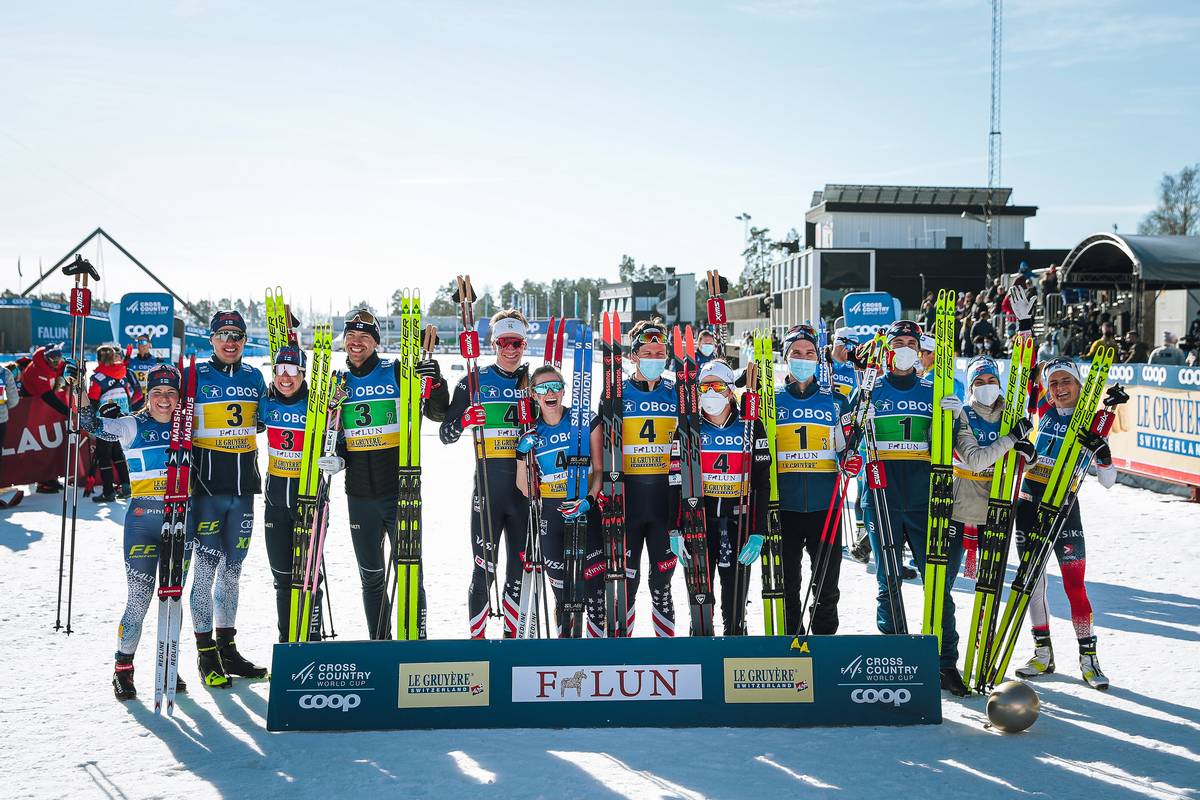
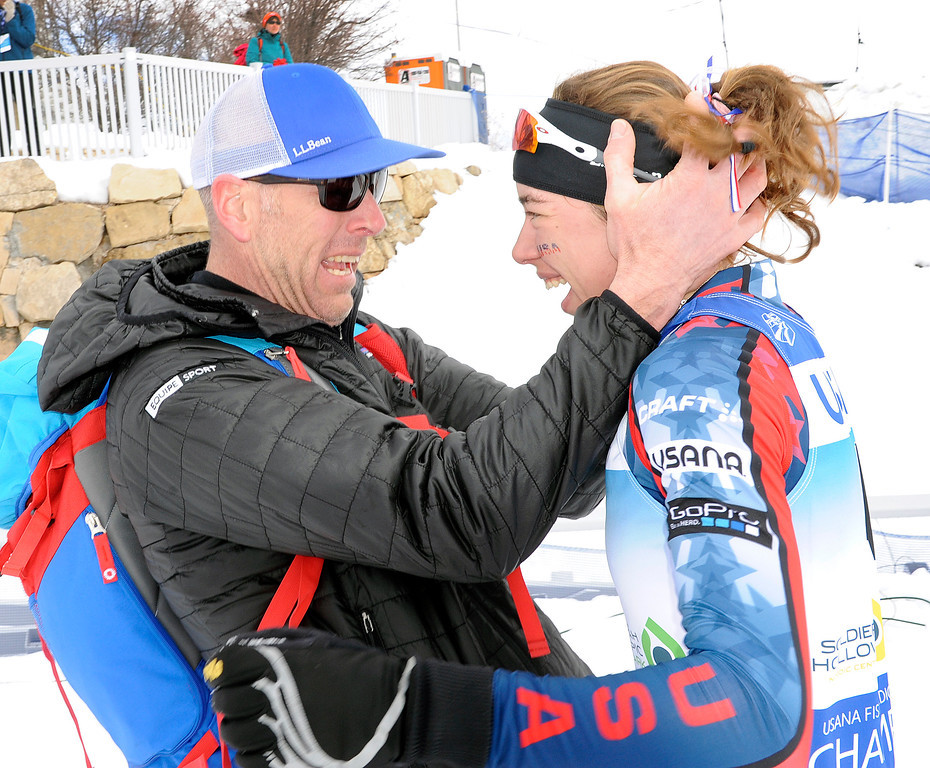
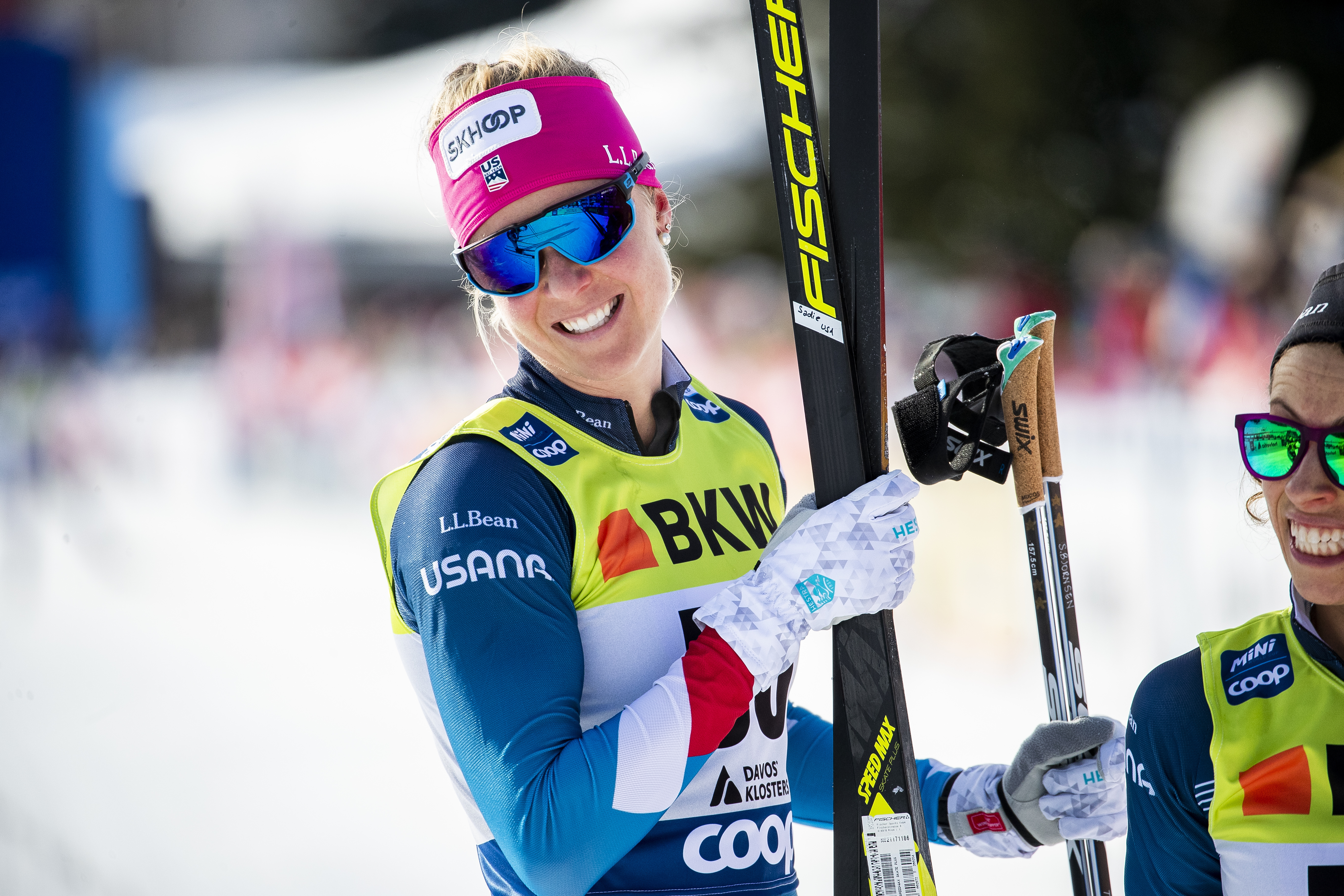
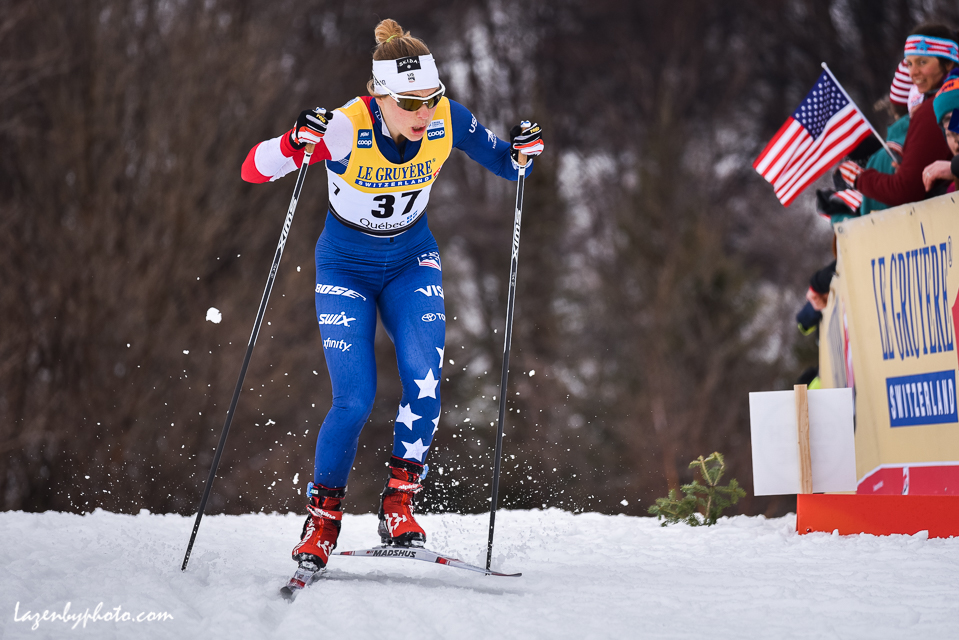
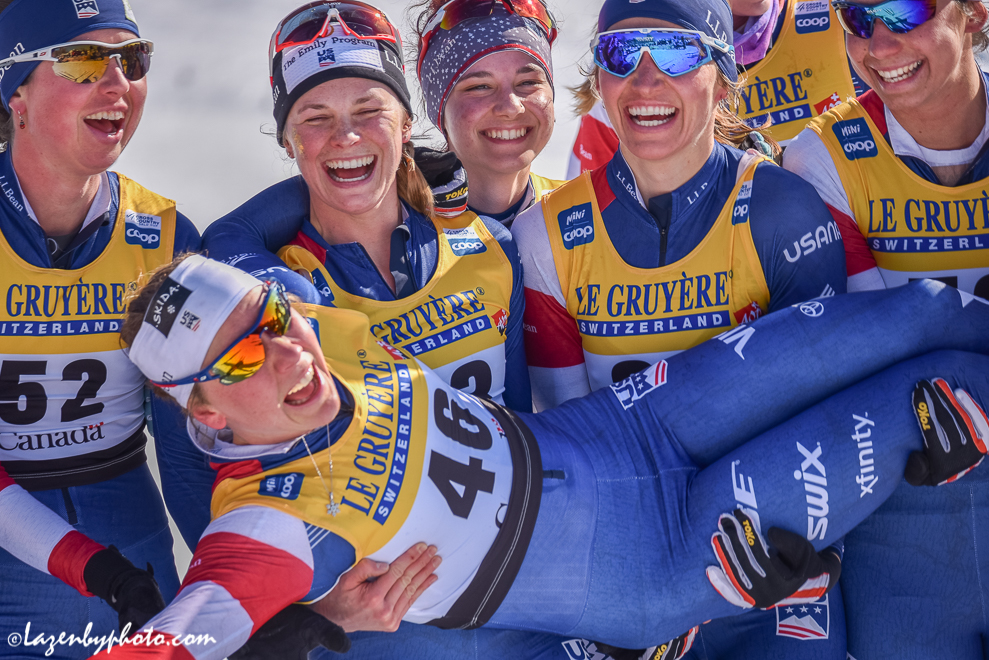
Rosie Brennan (USA) celebrates in Ruka (FIN) in 2023 after finishing 2nd in Saturday’s 10 k classic race. The result was Brennan’s first classic World Cup podium of her career. (Photo: Nordic Focus)
Rosie Brennan has stepped away from the World Cup, though she’s still figuring out exactly how to define the next chapter in her life.
Retirement is the easy word, and in some ways, the accurate one. She is done with the World Cup. She is done with the version of cross-country skiing that demands five months in Europe, constant travel, start lists, team schedules, narrow margins and the unrelenting pressure of measuring a career in seconds.
After more than a decade with the U.S. Ski Team, three Olympic appearances, hundreds of World Cup starts, two World Cup wins and a place among the best all-around skiers the United States has produced, Brennan has stepped away from the highest level of the sport.
But if retirement is supposed to mean the end of something, Brennan is not quite sure the word fits.
“Retirement has been a tough word for me,” Brennan said. “It feels very black and white.”
“One of my friends and older teammates called it rewiring.”
To Brennan, that seems closer. She’s not walking away from skiing so much as trying to build a new relationship with it. The shape of her days may change, and her focus will no longer be “110 percent” on racing, but skiing itself remains too central, too familiar and too joyful to simply leave behind.
“I love skiing and ski racing,” Brennan said. “I want to continue to be able to use my body in ways that challenge and push me in the world of skiing and competition again at some point, maybe sooner than later.”
“Skiing is just not that for me,” Brennan said of the idea of retiring and never doing the thing again. “It’s something that I hope to do till the day I die, honestly.”
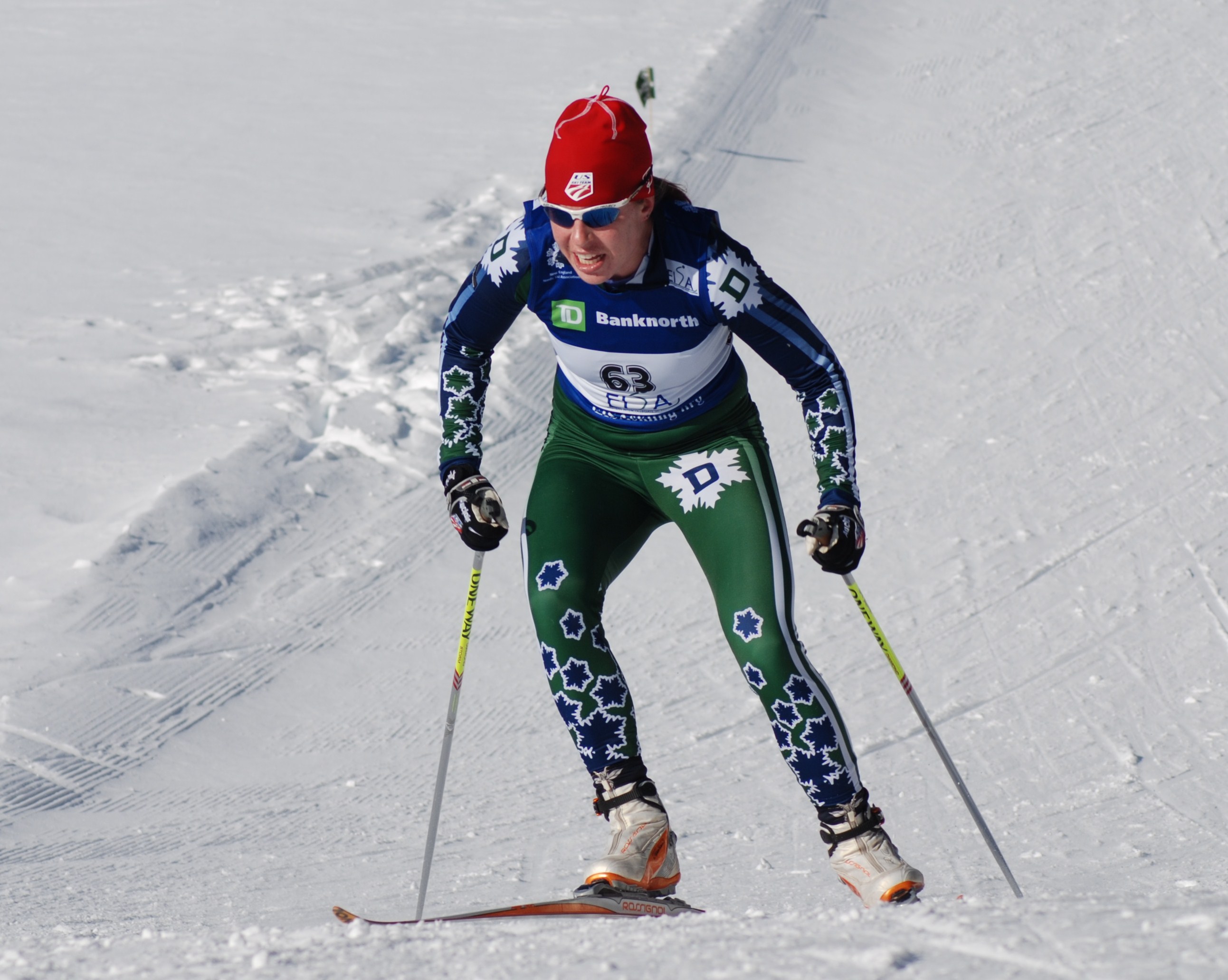
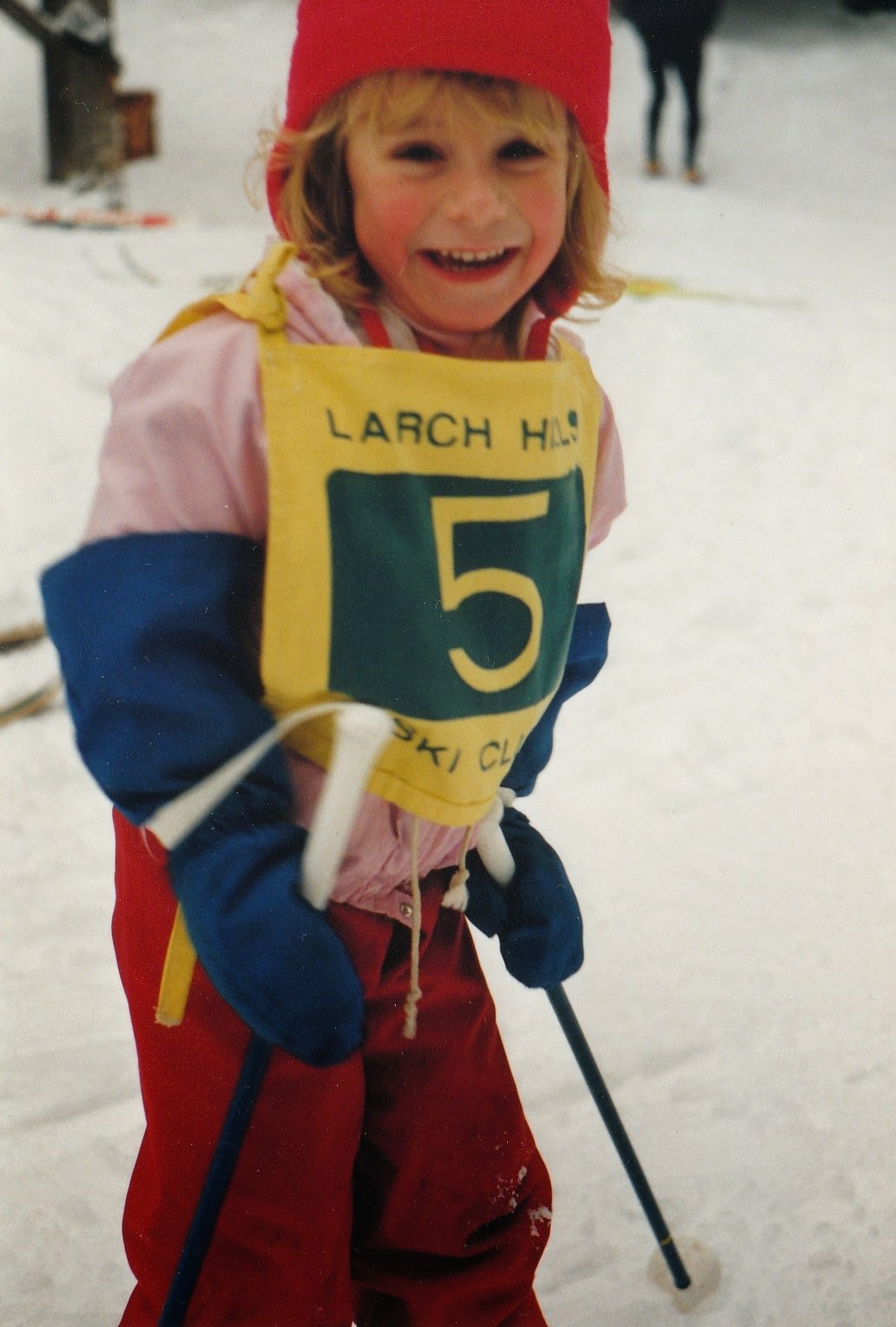
The first uploaded image of Rosie Brennan in the FasterSkier archives after she won both EISA women’s races in Feb. 2009 (Photo: Ruff Patterson)
A Career Built on Perseverance
When Brennan looks back now, the first thing she points to is not a specific race, podium or result sheet, but rather the belief in herself that made all of those things possible.
“I’m really proud of, I guess, the perseverance of my career,” Brennan said. “It takes perseverance to have longevity in a career, to weather the inevitable obstacles that appear throughout a long career, and to find belief when things aren’t going your way.”
That perseverance became the throughline of a career that took time to reveal itself. Brennan was not a teenage prodigy who moved smoothly from junior success to World Cup podiums. She came to skiing later than many of her peers, waited longer for the biggest results and had to weather the doubts that creep in when progress slows, injuries interrupt momentum and other paths begin to look more practical. Then when the results did arrive, those earlier years felt even more meaningful.
In a career defined by patience and progress, one of the things Brennan says she is most proud of is not just that she reached the top level, but that she continued to expand what she could do once she got there. She never settled into one lane as only a distance skier or only a classic specialist. Instead, she kept working to become more complete, finding reward in the challenge of improving across formats, distances and techniques.
“I’m also proud of the range that I maintained throughout my career,” Brennan said. “Continuing to be an all-arounder throughout my career and finding some success in all the disciplines and both techniques throughout — that was something that was just, I don’t know, I guess a personal challenge that I found a lot of reward in.”
That sense of progress extended beyond Brennan’s own results. Her career also unfolded during the strongest era in the history of American women’s cross-country skiing, and as the U.S. team continued to raise its standard internationally, Brennan came to see herself as part of something larger than her own race days.
“I’m proud to have been part of a really amazing wave of American women skiing,” Brennan said, “and to have done my best to carry that wave forward and to help push things forward and pass things on to future generations as well.”
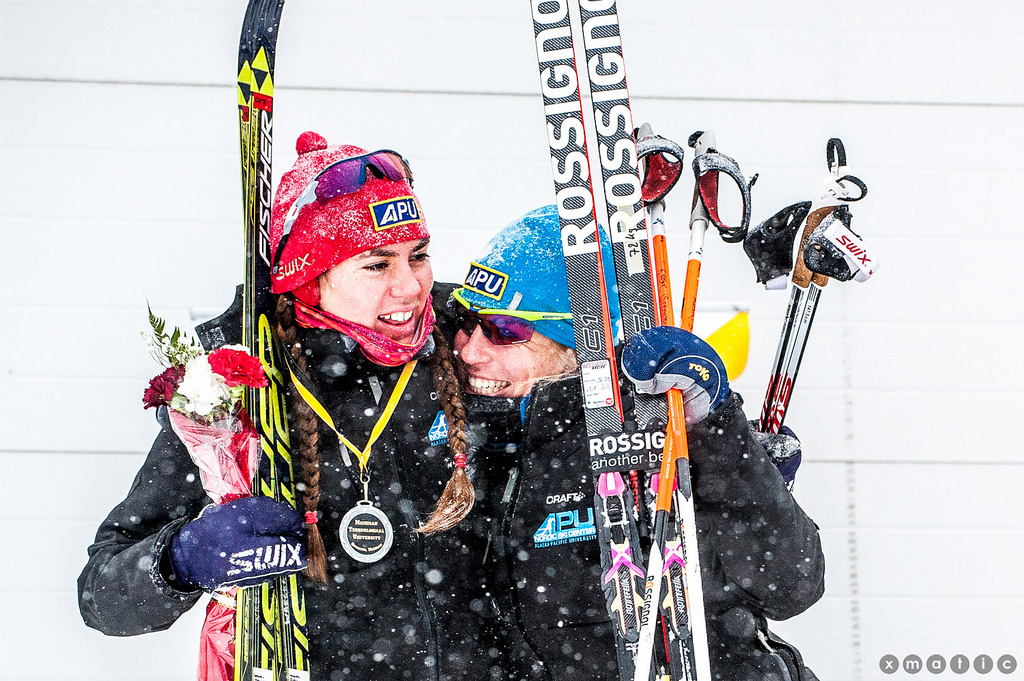
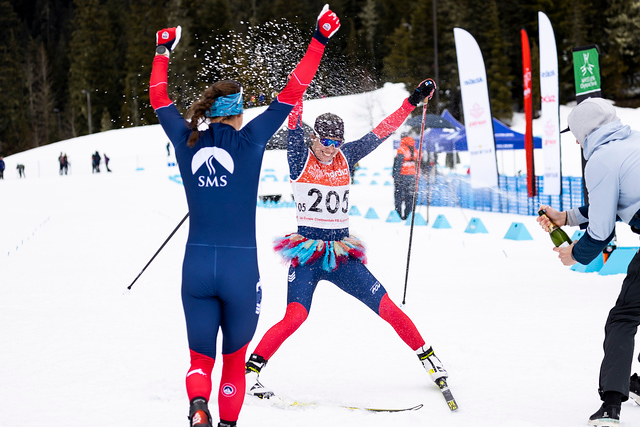
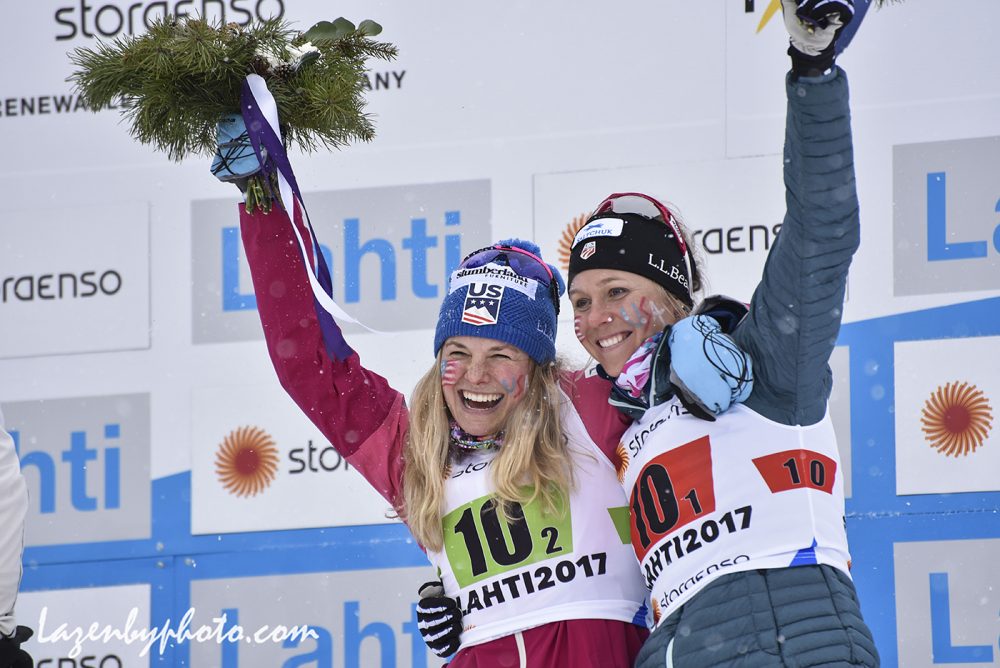
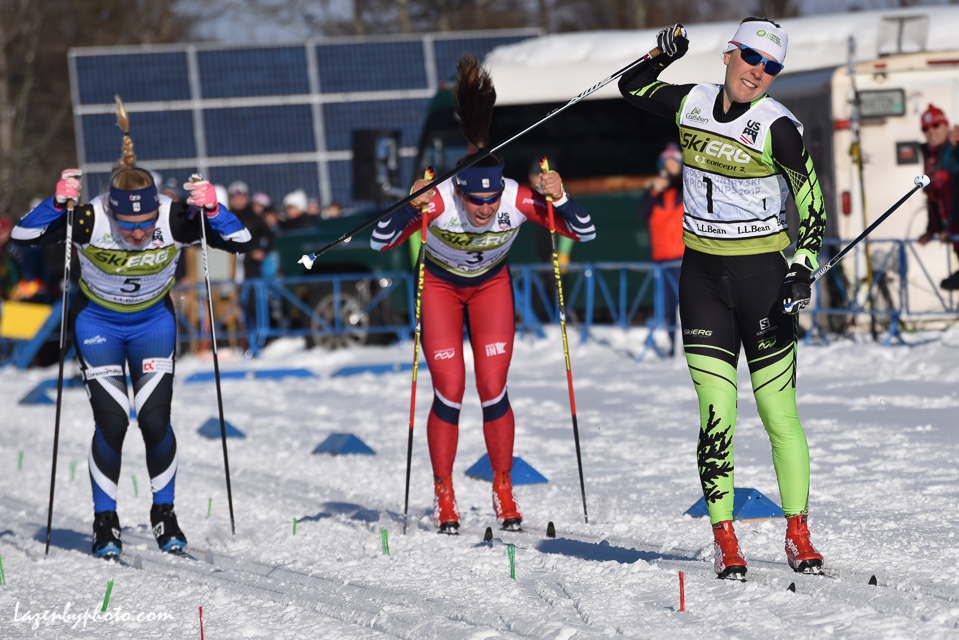
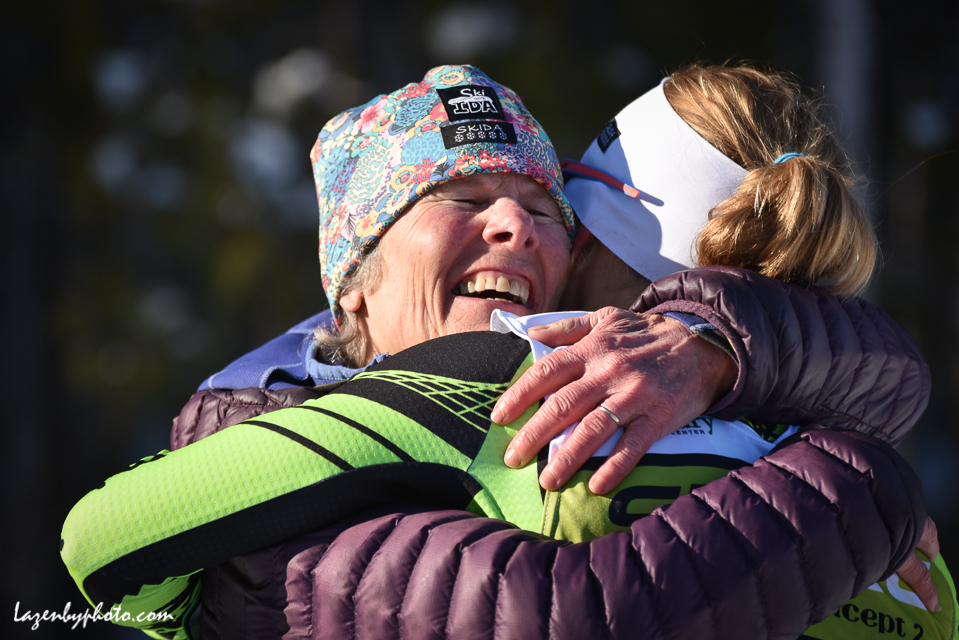
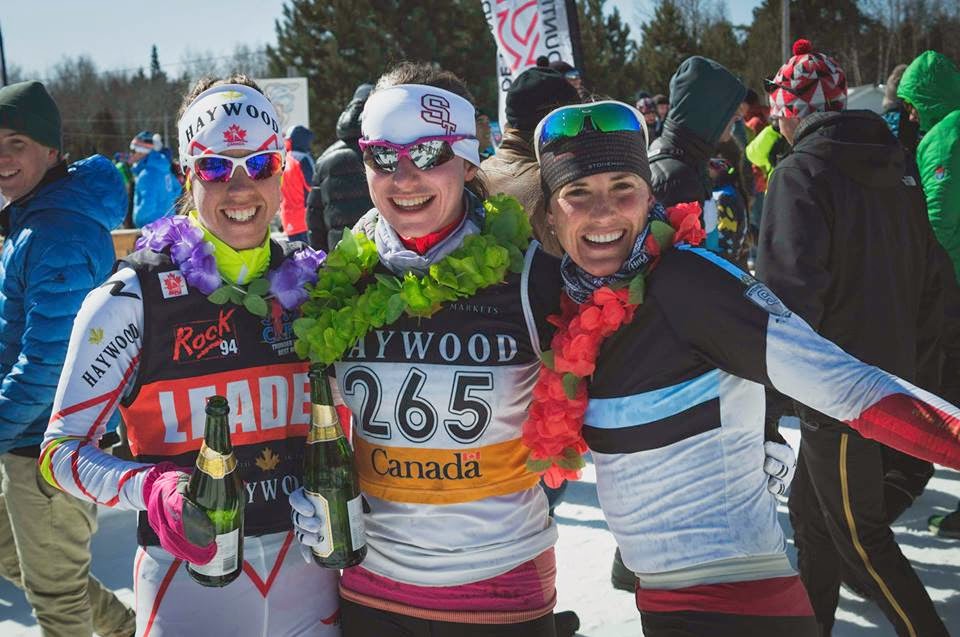
APU’s Rosie Brennan (r) embraces close friend and APU teammate, Becca Rorabaugh (l), after they finish first and second, respectively, in the Women’s 1.5 k Classic Sprint at the 2015 U.S. Cross Country Championships in Houghton, Mich.
Starting Late, Staying Long Enough
Brennan started skiing at 14, late by the standards of an international sport where many athletes first step onto a set of fish scales as young children. But she never saw her development as a simple matter of being behind.
“I was older when I kind of found top-level success in podiums on the World Cup,” Brennan said. “But because I started skiing so late, I guess I never really saw it that way.”
In her mind, the clock did not start with age, but when she first found herself on a pair of skis.
“If you look at when I started at 14 to when I had success, those accumulated hours of skiing and training are probably actually fairly equivalent to somebody who started at eight,” Brennan said. “So I always just chose to look at it that way, as if it was just going to take time to learn those skills, and it was fine that I started late.”
“I’m not good at being patient,” Brennan said.
But skiing gave her little choice. It took time to develop the specific strengths required of the sport, to learn how to race and to absorb the small skills that many skiers pick up almost without realizing it when they start young. Brennan had to build the engine and the instincts at the same time.
There were moments when she wondered whether it was worth it. In college, after injuries and difficult stretches, she decided she was done with skiing when she graduated. She looked toward other paths. At times, she quit, or at least tried to. But the sport kept pulling her back.
“I think what I enjoyed the most that made me keep coming back was just the challenge of it,” Brennan said. “Waking up every day with some purpose to get a little bit better, and to have the challenge of seeing if it was possible.”
Eventually, that challenge became a way of life.
“I just learned to really enjoy and thrive and love the lifestyle of skiing,” Brennan said. “And so that made it a lot easier to just keep coming back.”
Brennan is quick to point out that she did not do that alone. The support systems around her mattered. At Dartmouth and later at Alaska Pacific University, she found teams and coaches that helped her keep believing when she could not quite do it herself.
“There were definitely moments that it’s easy to question, and it’s hard to keep going,” Brennan said. “I was really fortunate to be part of some really, really amazing groups, and have coaches that fostered that belief in me, and made me see things in myself that I couldn’t see on my own.”
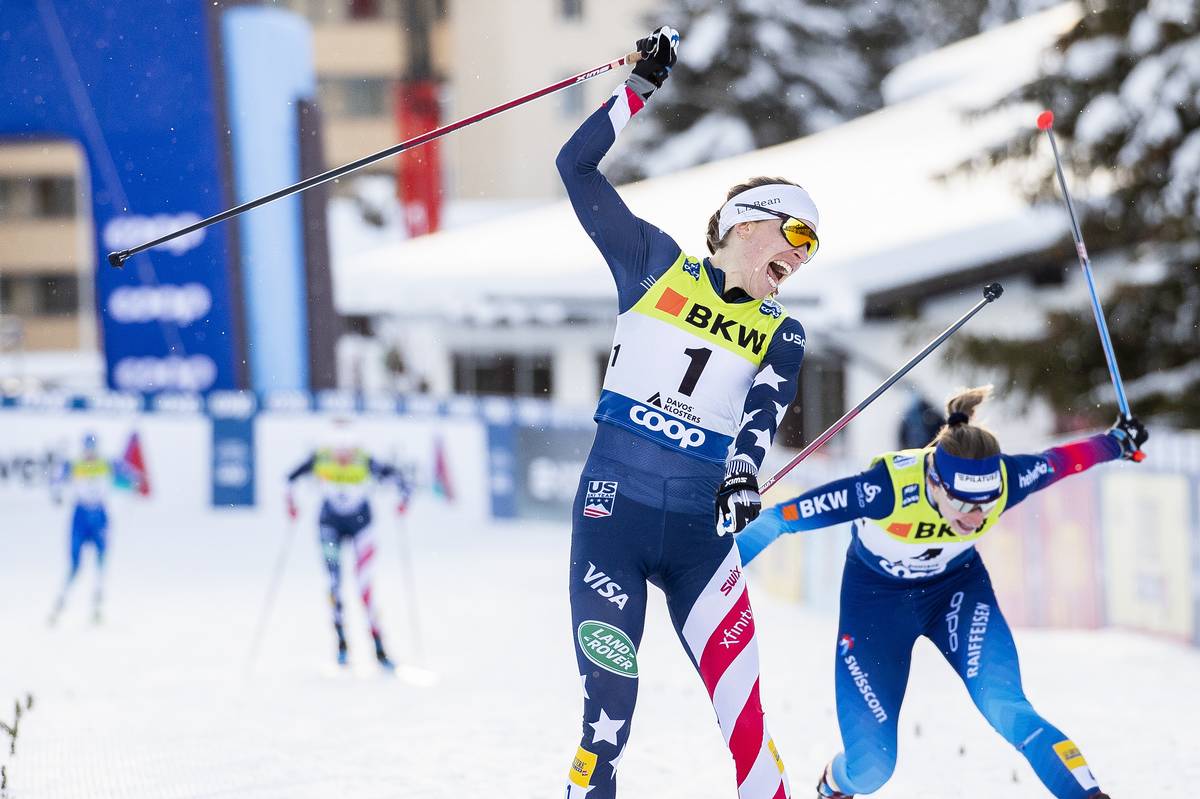
Rosie Brennan celebrates her victory and first World Cup podium after the freestyle sprint in Davos, Switzerland. Photo: NordicFocus
When the World Was Put on Notice
For years, Brennan’s career was a slow and steady build, but then came that famous weekend in Davos.
In December of 2020, during a World Cup season shaped by the uncertainty of the pandemic, Brennan won twice in two days in Switzerland. On Saturday, she claimed her first career World Cup victory, in a freestyle sprint, and then the very next day, she won again in the 10-kilometer freestyle.
From the outside, it looked like a breakthrough and a historic moment for U.S. skiing. Brennan does not dispute that. She says what stays with her the most now is not only the winning, but everything she had to manage in order to ski that way.
“Davos 2020 was definitely a breakthrough moment for me,” Brennan said. “That year was challenging for the whole world, and being a ski racer during that time certainly had its challenges too.”
The uncertainty of that season weighed heavily. Rules changed, travel was complicated and athletes did not always know whether races would happen. The risk of illness carried not just health concerns, but career implications for athletes whose bodies were their livelihoods.
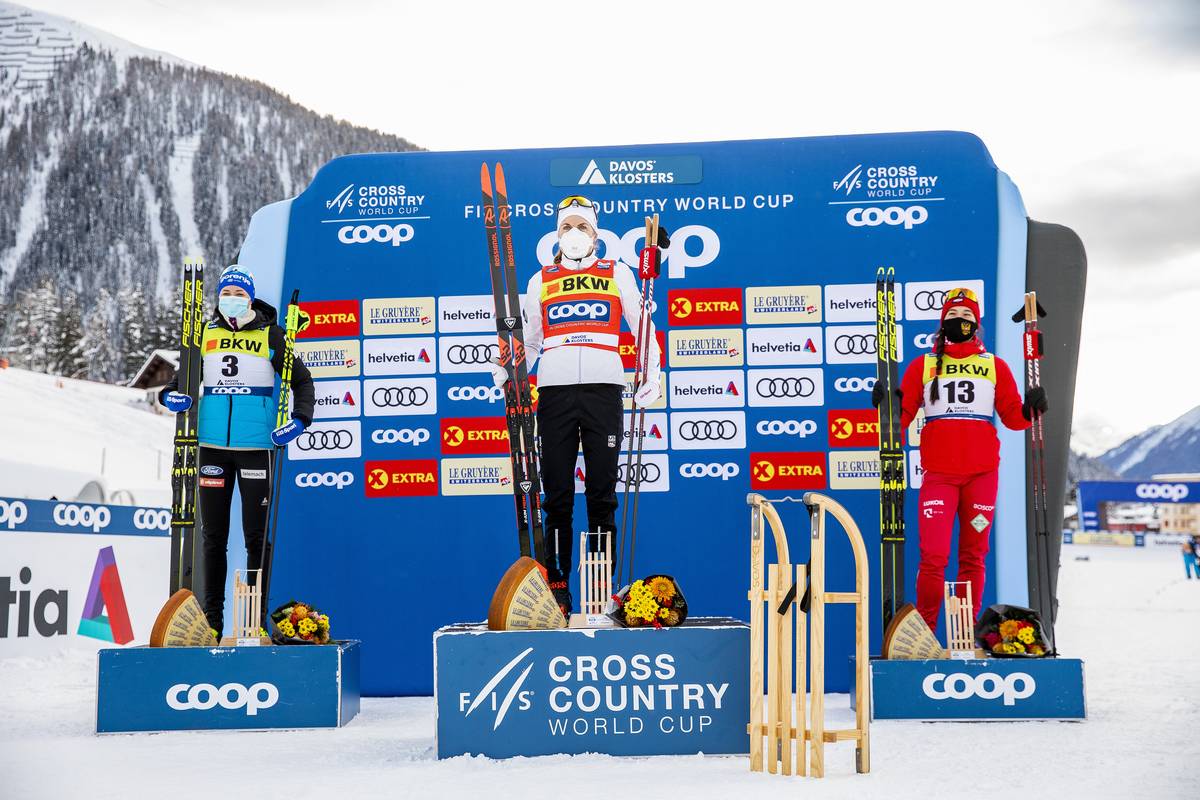
Taking the victory and the sled, Rosie Brennan stands atop the podium in Davos, Switzerland. (Left to right) Anamarija Lampic (SLO) 2nd, Brennan (USA) 1st, Natalia Nepryaeva (RUS) 3rd.
“I really struggled with the anxiety of it all,” Brennan said. “Just never knowing — traveling in foreign countries, where the rules were changing all the time, and you didn’t know what would happen if you got sick.”
Hence why Davos still means something more than two entries on a results page. Brennan was proud of the wins, of course, but she was even more proud of how she managed everything around them.
“It definitely showed me what I was capable of,” Brennan said, “and that I could manage these really high-stress environments and all the uncertainty and thrive in that setting.”
That weekend did not just give Brennan her first World Cup wins. It helped confirm the range she had been building toward for years. Later that season, she became the first American to hold the overall World Cup leader’s bib, sprint leader’s bib and distance leader’s bib at the same time. Which was both a major accomplishment and also a fitting reward for all the work she had put in to become a more complete racer.
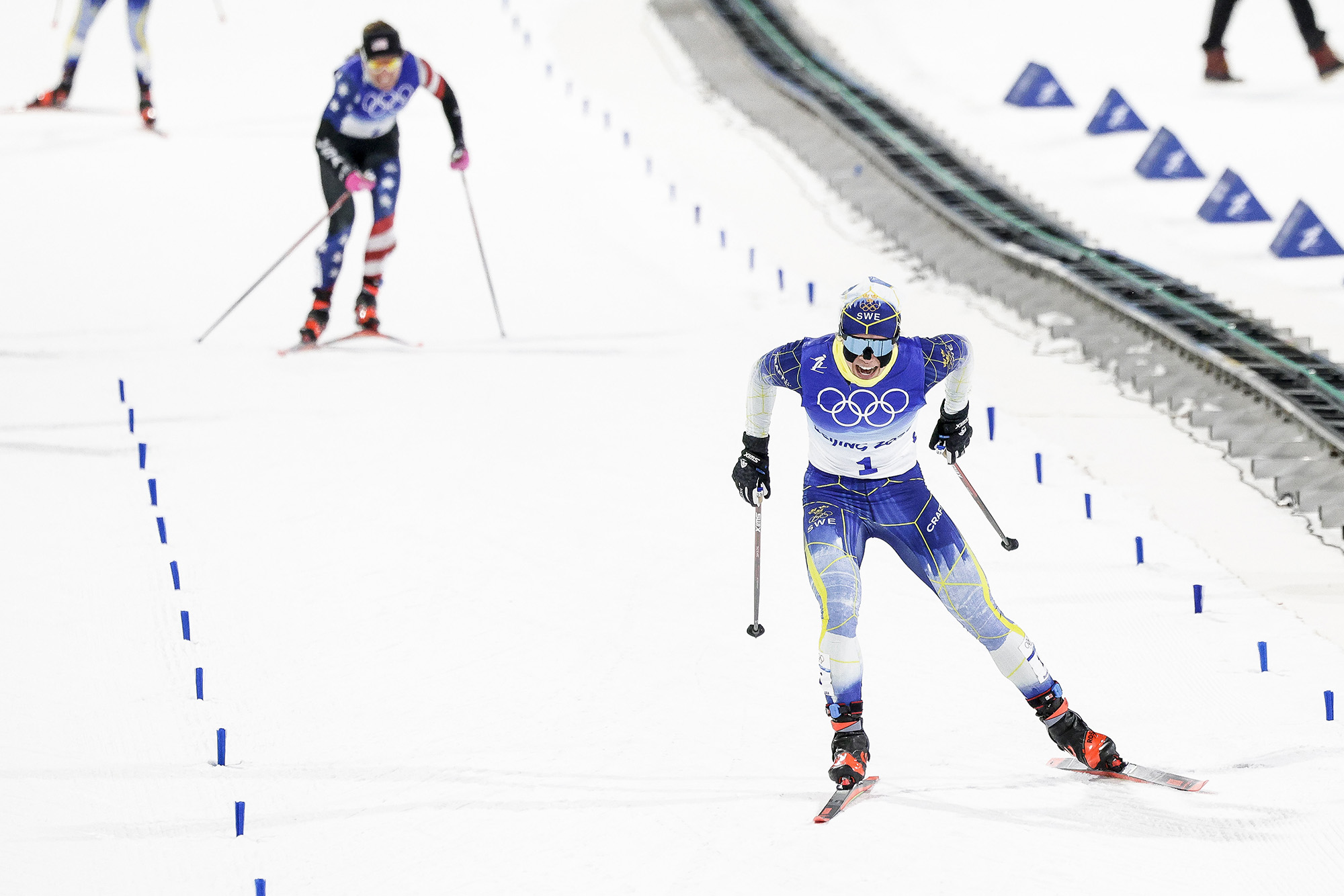
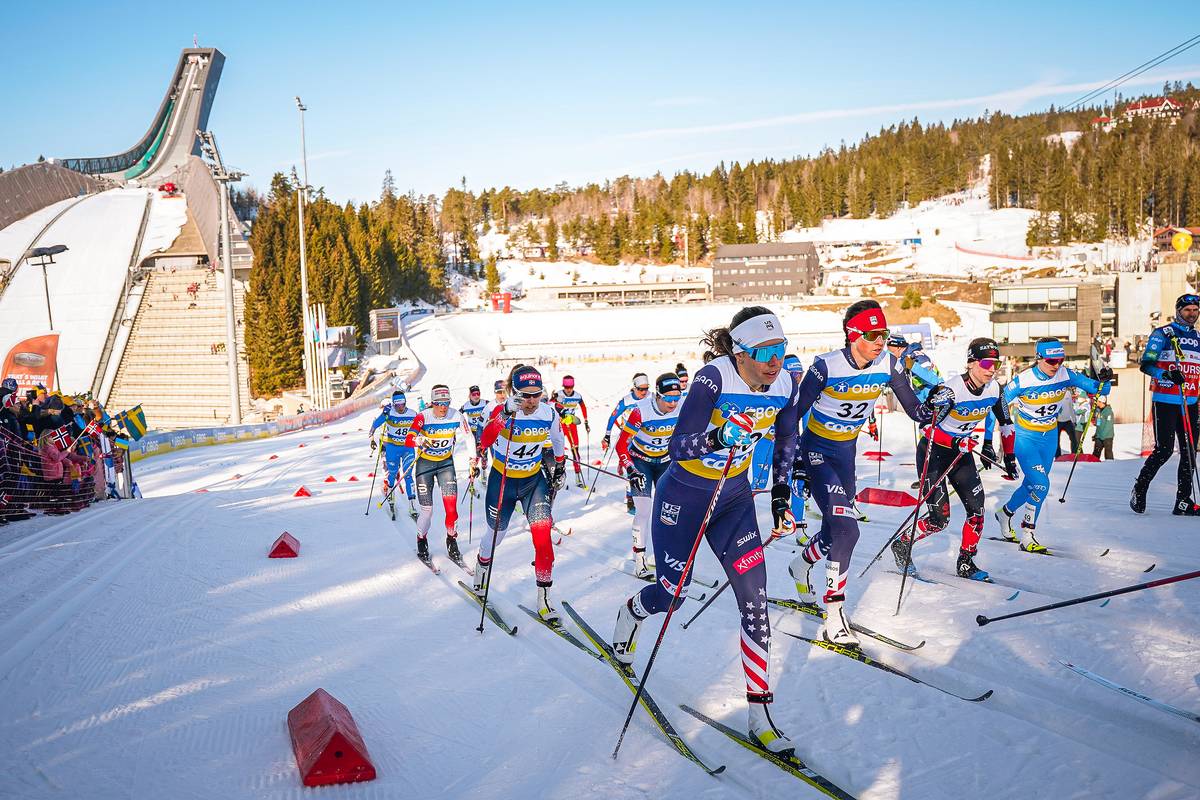
Jonna Sundling (SWE), with a commanding victory in the 2022 Olympic individual freestyle sprint, comes to the finish with Rosie Brennan (USA) in the background on her way to fourth. (Photo: NordicFocus)
What the Career Adds Up To
Brennan will take a step back from her professional career after amassing quite the résumé, representing the United States at the 2018, 2022 and 2026 Winter Olympics. She finished fourth in the freestyle sprint at the Beijing Olympics in 2022, the kind of result that can feel both extraordinary and excruciating, by missing out on an Olympic podium by a single place. She reached World Cup podiums across seasons and disciplines. She became a two-time World Cup winner, a fixture in the American women’s team and one of the athletes who helped move the U.S. from occasional contender to regular presence near the front of international races.
But Brennan’s own accounting of her career is not limited to the results she garnered over the years. She is proud of showing up. Proud of learning. Proud of becoming competitive in every event. Proud of the people who helped her and the younger athletes she helped in return. Proud that a career that could have ended several times kept expanding instead.
That may just be why the end of her World Cup career does not feel like a true breakup. For Brennan, skiing was never just a job. It provided her with structure, challenges, community, identity and gave her something to work toward every day and a way to test what was possible. Even now, when she is no longer organizing her life around World Cup racing, she says she’s not suddenly becoming someone else.
“When you train that many years, it’s hard,” Brennan said. “I’m still going out twice a day most days, because it just feels so normal to me.”
That may change when she starts school again and other commitments begin to fill the space skiing once occupied. Brennan says she plans to pursue new interests and give attention to parts of herself that the World Cup lifestyle did not always allow. But the habits of a skier are not easy to unwind, and she does not seem especially eager to unwind all of them.
“I definitely hope to bring forward a lifestyle that’s active, that treats your body well, that’s also willing to push yourself and see where the limits are,” Brennan said.
Rosie Brennan (USA) during the individual sprint qualification at the final World Cup weekend this past March in Lake Placid, New York. (Photo: Modica/NordicFocus)
Rewiring, Not Retiring
That is why “rewiring” works. Brennan is not flipping a switch. She is just rearranging the circuitry.
There will be no more full World Cup campaign, no more life built entirely around the next race weekend. But there will still be skiing, there will still be movement and there will still be competition. The habits and lessons of her career that she built through years of resilience and patience are not things Brennan expects to leave behind.
“I’m sure there are countless skills, probably most of the skills I’ve learned in my adult life, that I will have to lean on in any of the various careers that I may pursue, and in my studying as well,” Brennan said. “The lessons that I’ve learned will undoubtedly come with me, along with the character and strength that I’ve built throughout my career.”
Those lessons were built through the less tidy parts of Brennan’s career, from the late start and the years before the podiums to the injuries and doubts that forced her to keep adjusting. But the same career that asked so much of her also gave her something lasting. Skiing was more than a pursuit or a profession, it was the driving rhythm of her adult life, and one she still feels lucky to have followed for so long.
“It’s definitely an incredible lifestyle to be a ski racer,” Brennan said. “I feel insanely lucky to have called that my career, and to have done so for so long.”
That gratitude does not make the transition simple. After so many years of organizing life around training, racing and the rhythm of the World Cup, stepping back from that structure means more than changing a schedule. It means figuring out what skiing looks like when it is no longer the center around which everything else has to turn.
Rosie Brennan (USA) during her final World Cup of her career — the 20 k Freestyle Mass Start in Lake Placid (USA). (Photo: Thibaut/NordicFocus)
But there is also freedom in that. Brennan no longer has to prove she belongs. She already did. And now, instead of defining skiing only through the World Cup, she gets to decide what parts of it she wants to keep.
Maybe that means races. Maybe it means long days outside. Maybe it means testing herself in new settings, with new stakes, away from the circuit that shaped so much of her adult life. Maybe it means all of that.
What seems clear is that Brennan is not disappearing from the sport. She is stepping out of one version of it and into another.
She is retired, if that is the word people want to use. But it is not the sunset kind. Not the final-page kind.
For Rosie Brennan, skiing will always be there, just not in the all-consuming way it once was. Now, she gets the chance to redefine her relationship with the sport as something woven into the life she is building next.
“It’s truly been a dream,” Brennan said.
Help Support Our Coverage!
If you value the thoughtful work and access FasterSkier provides, please consider becoming a Voluntary Subscriber. Your support directly fuels our work to cover the people, places, and moments that make our sport special.
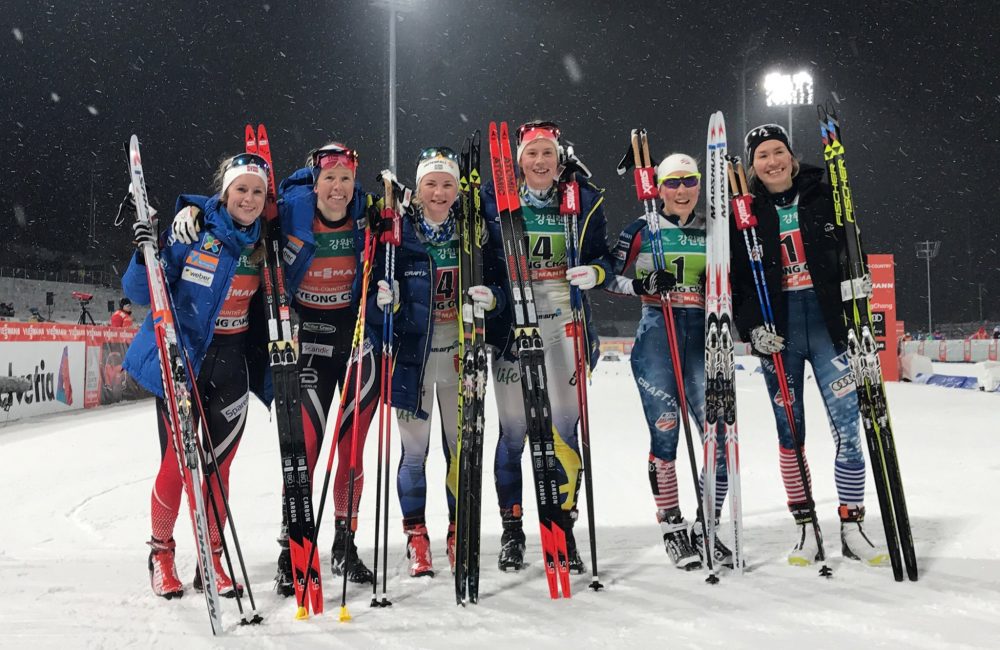
Brennan’s U.S. teammates wait at the line to greet her after her final World Cup race, a 20-kilometer start in Lake Placid on March 22. (Photo: NordicFocus)
This coverage is made possible through the generous support of Marty and Kathy Hall and A Hall Mark of Excellence Award. To learn more about A Hall Mark of Excellence Award, or to learn how you can support FasterSkier’s coverage, please contact info@fasterskier.com.
LAKE PLACID, New York (March 21) — As the snow settled on Lake Placid and clouds began to dissipate over Mt. Van Hoevenberg, a growing sense that something momentous could happen permeated the crowd assembling for the last Sprint of the 2025-26 World Cup.
That something unusual would happen was assured. With the Sprint Globe already secured to Johannes Høsflot Klæbo, the golden-haired juggernaut would not be on the starting line – opting instead to rest his legs, and head, in hopes of defending his 12-point lead over Harald Østberg Amundsen in the Distance standings. By default, then, someone other than Klæbo would stand atop Saturday’s podium – a rare occurrence in a season where the Norwegian had already won 8 of 11 Sprints in commanding fashion. (Two wins evaded Klæbo due to falls; the third because he did not start in Oberhof).
Who would take his place? Ben Ogden, the Northeast’s homegrown favorite and the Sprint silver medalist in Milano-Cortina? Gus Schumacher, Ogden’s partner in the Olympic Team Sprint? France’s embattled specialist, Lucas Chanavat, who appeared on track to rival Klæbo during the 2023-24 season, who had seized the opportunity – and the win – after Johannes’ bobble in Davos last December? Ansgar Evensen (NOR), who had done the same in Drammen?
Or, perhaps, it would be Federico Pellegrino (ITA) – the 35-year-old elder statesman of the league; making his 344th (and penultimate) World Cup start, eyeing an 18th and final Sprint victory?
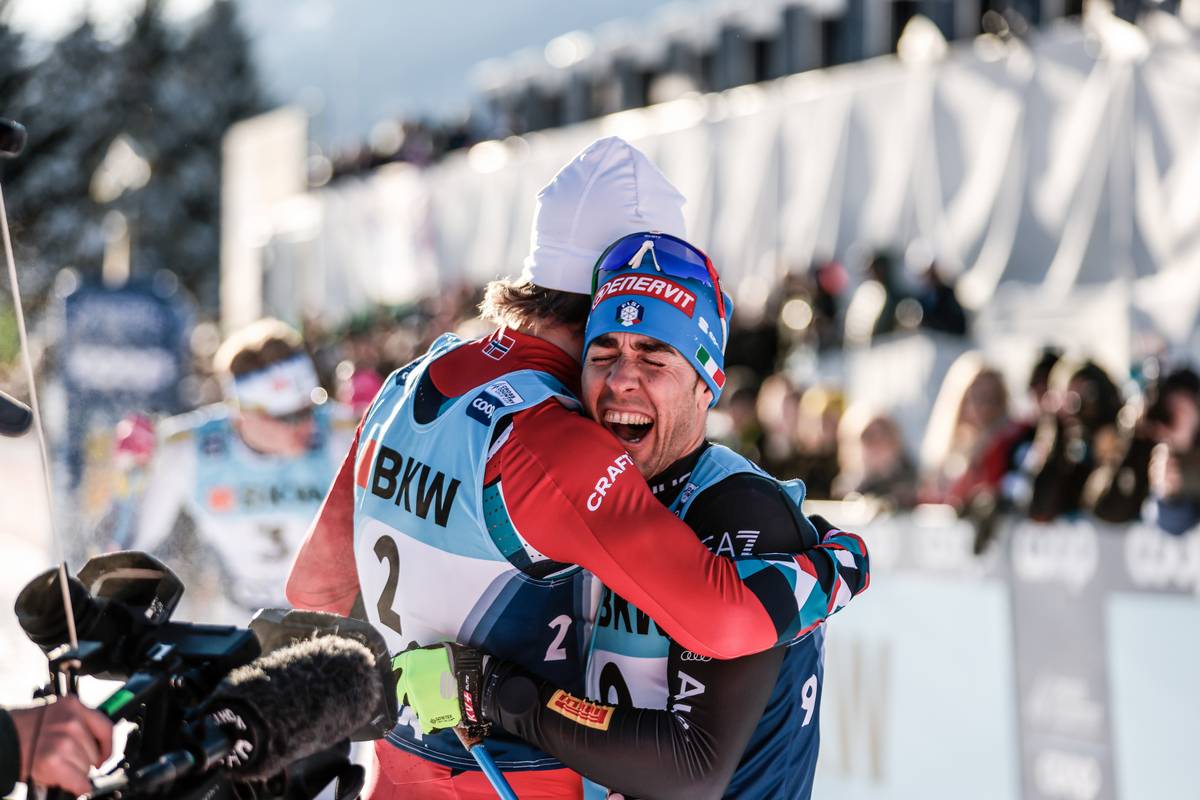
Johannes Hoesflot Klæbo (NOR) and Federico Pellegrino (ITA) after the finish of the Finals in Davos, 2022. Pellegrino bested Klæbo on the eve of the birth of his first child. (Photo: Nordic Focus)
It states the obvious to say that success in cross-country skiing is a matter of timing, and for “Chicco Pelle’s” 15 seasons, the timing had been just shy of right. The formative and final years of Pellegrino’s career were defined by the dominance of skiers other than he. Pellegrino made his World Cup debut in Drammen in March 2010, finishing 49th. The winner that day was Emil Joensson (SWE); runner-up was Petter Northug (NOR), then on his way to his first of two Overall Globes. These were the halcyon days in which Dario Cologna (CHE) descended from his Alpine fastness to rack up World Cup and Tour de Ski titles; when Northug, Joensson and Marcus Hellner (SWE) traded sprint victories and taunts in a bitter intra-Scandinavian rivalry. Pellegrino was 12th in his first World Championships Sprint (Oslo, 2011) and 11th at his first Olympic Sprint (Sochi, 2014).
While notching his debut victory in December, 2014 in the Davos Freestyle Sprint, Chicco’s break came in the 2015-16 season. He won 5 of 13 sprint races, becoming the first non-Scandinavian male to win the Sprint Globe. As Pellegrino hit his stride, Northug’s star was showing its first flickerings ahead of a dramatic waning, Joensson had entered the twilight of his career, and although Sergey Ustiugov (RUS) was approaching his own prime, the factious cast of World Cup sprinters was looking for a new leading man.
That man would not be Chicco. An upstart dramatist from Trondheim, Johannes Høsflot Klæbo, had arrived to script skiing’s long, and mind-bogglingly successful, next chapter. After making his debut in Drammen in 2016, Klæbo outscored Pellegrino in the 2016-17 Sprint standings, taking his first of 8 (and counting) Sprint Globes. The two went head to head at the 2017 World Championships in Lahti, Finland, where Pellegrino surged from behind to claim his first World Title ahead of a legendary lineup, including Ustiugov, Klæbo, and Northug, but this maiden gold would also be his last. In Pyeongchang the next year, the Olympic gold went to Klæbo; Chicco brought home silver.
The wins did keep coming for Chicco, including a tear of three consecutive Sprint victories and his second Sprint Globe in 2020-21. And, though they admittedly came in greater abundance to Klæbo (who, it should be noted, did not start in those races, or the 2020-21 Tour de Ski), it is rather glib to assert that Chicco’s career had slid “in[to] the shadow of” the Norwegian. Pellegrino bested Klæbo in Dresden and Lahti in the spring of 2018; in Lillehammer that winter; and in Davos in 2022. He was near-omnipresent on Sprint podiums and won his second Olympic silver in Beijing in 2022; moreover, he was among the very few men who could disrupt Klæbo’s dominance in the discipline, and the clear favorite when Johannes was absent.
But Pellegrino’s win in Davos in December 2022 marked the beginning of a long, and perhaps self-inflicted, World Cup drought. Chicco declared his intention to focus on distance races ahead of Milano-Cortina, and did indeed record four such podiums in classic, skate, and skiathlon formats, alongside a welter of Sprint podiums – including an ecstatic World Championships silver in Trondheim in 2025, and Olympic bronzes on home soil in the Team Sprint (alongside Elia Barp) and in the 4 x 7.5 k Relay (which he described as “the proudest day of [his] life!”) this February.
Elia Barp welcomes Federico Pellegrino to a bronze-medal finish in the Olympic Team Sprint in Milano-Cortina, February 18th, 2026. (Photo: Vanzetta/Barbieri/NordicFocus)
Outright wins, however, were not forthcoming. By the time March 21, 2026 arrived in Lake Placid, it had become Pellegrino’s last, best chance to secure one more Sprint victory.
Anticipation and emotions ran high. While Pellegrino had been impervious to the crowd in Friday’s 10 k Classic – earbuds deadening the world beyond his blue racing cap during warmups, and his face a deaf mask of exertion during the race – their excitement overwhelmed him on Saturday. During his first warmup lap, he skated calmly up the course’s A-Climb through a chorus of “CHI-CCO, CHI-CCO, CHI-CCO.” On his second, the frenzied chant began again, and the gravity of the impending race dragged him to a halt. His skis splayed wide against the pitch; he buried face in his hands. “The energies I got in the Final were coming from the warmup lap, where I stopped in the middle of the climb, crying,” Pellegrino told me at the finish line. “I think the public deserved this kind of show, and I deserved to finish my career, with a Sprint skate like this.”
Pellegrino embraces the crowd ahead of Sprint qualifying in Lake Placid. “The energies I got in the Final were coming from the warmup lap, where I stopped in the middle of the climb, crying.” (Photo: Thibaut/NordicFocus.)
To reach that final finish line, however, was a perilous journey.
After qualifying second, Pellegrino sidestepped two falls (the first from Jules Chappaz (FRA); the second from Elias Keck (GER)) in his Quarterfinal, moving from sixth to first in the course’s final descent and level hairpin. In Semifinal 1, he attempted to close on Lucas Chanavat (FRA) and Anton Grahn (SWE) through the crest of the A-Climb but couldn’t get by; pushed to the outside on the level hairpin, he was out-lunged by Lars Heggen (NOR) in the final meters, finishing third by 0.03.
While the Lucky Loser spot was Chicco’s to lose heading into Semifinal 2, Erik Johansson (SWE), Harald Amundsen (NOR), and Even Northug (NOR) lost time playing for a slipstream position as they approached the top of the A-Climb. Pellegrino was on to the final by a comfortable margin.
Lars Heggen (NOR) outlunges Federico Pellegrino (ITA) by 0.03 in Semifinal 1. Federico moved on to the Final as a Lucky Loser. (Photo: Thibaut/NordicFocus)
Once more around the track, and the day could be his. After being fourth out of the gate, he attacked from the outside on the B-Climb; breaking into an aggressive V-2 and taking Chanavat and Heggen by surprise, he moved into second behind Grahn. The pace increased again at the base of the A-Climb, but where Grahn and Chanavat’s broad frames moved up the hill in sweeping, powerful strokes, Pellegrino leapt into a furious V-1.
The move was decisive. To the adulation of the crowd, he opened a decisive gap through the crest of the climb. His lead only grew through the final descent into the level hairpin, but Chicco was taking no chances. While Grahn and Heggen grappled for second behind him, Pellegrino hammered to the line, threw his arms wide and his head back, roaring with the crowd.
An 18th victory and 46th career podium, clinched.
Federico Pellegrino secures his 18th and final World Cup victory. Lake Placid, March 21, 2026. (Photo: Thibaut/NordicFocus)
What had happened in the Semifinal, when this triumphant last dance had nearly evaded him by three hundredths of a second? And what had changed for the Final?
“I could not do what I did in the Final, because the energies of the other athletes were still quite big,” Chicco admitted our post-race interview. “About the last downhill, I was not the same as the others. I am not, I know, but I have some different qualities, and if I could get quite good gap in the top of the uphill, then I knew that I could keep it until I end. This is what I did. This is how I loved to win all along my career – not wait until the last meter, but trying before.”
“Sometimes it happened, mostly before Klæbo came,” he laughed. “But today I was there, and I studied the best tactics in the end . . . the public here in Lake Placid deserves this kind of show, and I think we are all happy now.”
And, this was nothing short of “the best way” to end his journey. “I could not do different. In the end, the last four years have been strange. I didn’t focus so much on sprinting; I tried to discover my body in different fields. Sometimes I got really great feelings and performances, but then, to come back here . . . and to win in that way, I could not do more.”
Pellegrino after his final win. “I think the public deserved this kind of show, and I deserved to finish my career, with a Sprint skate like this.” (Photo: Thibaut/NordicFocus)One more podium for Federico Pellegrino, alongside Lars Heggen (NOR) and Anton Grahn (SWE). (Photo: Thibaut/NordicFocus.)
In 15 seasons, Pellegrino proved himself to be far more than a runner-up to those Swedish and Norwegian titans who loomed large over his early and later years. He had taken the Sprint Globe from the Scandinavians for the first time; outsprinted Klæbo, Ustiugov, and Northug in Lahti; perpetually challenged – and occasionally beaten – the greatest athlete in the history of the sport; and secured Olympic medals on home soil, alongside a team of up-and-coming Italians ready and eager to fill his boots. “I’m really happy that he finished his career with probably one of the best weekends for him so far,” Elia Barp (ITA) told me on Sunday. “I’m very happy for him; I’m very happy for the team. I think we have proved that we are ready to race without him – not only me, but a few other young guys are ready to try to take victories next year . . . [He showed] that it is important to keep fighting and try to be a good overaller as he was in the last years. And, now we know that it’s possible; everyone is human as us, and we can do that.”
To Chicco’s fans, that determination – to grapple with giants; to reinvent himself; to seize the final, perfect timing and a final, perfect victory – defined his career. But for Pellegrino himself, “the biggest memories will not stay about the races, but much more about the hugs I got from the teammates, from the coaches, even outside of Italy, from my family, from the people that love me – and not only when things went well; even when things were not going so well. I think this is something that sport teaches us; that in the end, it’s only a cross-country ski race, and life is different. That’s it. The hugs are something I will remember for my entire life.”
Pellegrino, the most popular man at Zig Zag’s on Saturday, March 21. (Photo: Lily Den Hartog)
At Zig Zag’s Pub on Saturday night, Pellegrino told this reporter’s associate that his win vindicated his decision to retire. On Sunday, soaked with rain and champagne and tears after his last World Cup race, he reaffirmed it:
“That’s it. I tried to enjoy today as well . . . I tried to give my best, as always, and it was good after the finish line; under the rain, it was special. But with the teammates and coaches and waxers celebrating this moment, it was good for me.”
“Now, I really need to stay with my family. They deserve this, and I need to give them a lot of time.”
Love Stories Like This? Help Keep Them Coming.
Feature stories like this one take time, access, and care to produce. If you value thoughtful storytelling and independent ski journalism, please consider becoming a Voluntary Subscriber. Your support directly fuels the work we do to cover the people, places, and moments that make our sport special.
“Grazie Papao!!” Team Italy was waiting at the finish of the 20 k Skate with champagne and a tribute to Pellegrino’s children and wife, Greta Laurent (ITA, ret.). (Photo: Thibaut/NordicFocus)
The Zoom room filled slowly, one journalist after another blinking into existence in a grid of small rectangles. Los Angeles, Minneapolis, Helsinki, Colorado, New York — not just the coordinates of U.S. skiing scattered across time zones, but also NPR, NBC, and European reporters, over 60 media outlets, all converging on a November morning. Jessie Diggins appeared in the largest box, glowing as she does all the way from Muonio, Finland, where she had arrived two nights earlier. The wooden panels on the wall behind her made it clear she sat in a Northern Scandinavian rental, probably one that has become quite recognizable to her each November. Diggin’s voice is steady and familiar, but beneath the surface, something is newly unbound.
“Hi, everyone,” she began, smiling with that practiced combination of approachability and poise that has made her — for more than a decade — the emotional center of American cross-country skiing.
It was the day after she announced her retirement.
Not an immediate farewell, but a season-long glide toward her final finish line — a full World Cup circuit, the Milano-Cortina Olympics, and a last race on home snow at the Stifel Lake Placid World Cup Finals. Her final year. Her final winter. A long goodbye in the only language she has ever known: motion.
But on this morning, she wasn’t moving at all. She was speaking — clearly, expansively — as though practicing for a stage much larger than a press conference. Which, in a way, she was.
When asked what comes next — “besides knitting,” she said, laughing — Diggins didn’t hesitate.
“I’m really excited… because I feel like when I ski race, it’s usually done with my body moving around as fast as it can, but everyone’s watching and you get this one moment to try to leave people feeling inspired,” she said. “And I want to do that — but through keynote speaking… it’s all about the storytelling and leaving people with this little piece.”
As she talked, I could see it already: a home office somewhere in Wakefield, Massachusetts, where she’ll finally get to spend time with her husband. A wooden desk, house plants, and a neatly stacked pile of notes for a TED-style talk on resilience. And above her desk, three matte-framed photographs from her career — not the ones you’d expect.
Not the historic PyeongChang team sprint.
Not the Crystal Globe.
Not the Tour de Ski.
Diggins has never defined herself by her medals. And in the conference, she explained why.
“To me, it’s not about the racing,” she said. “It’s not about medals, it’s not about results. It never has really been.”
Instead, she pointed to three moments — three stories — that she said she is most proud of. They form a different kind of highlight reel, one that reveals far more about how she sees herself, and how she hopes the sport will remember her when she’s gone.
These are the three frames above the desk.
Jessie Diggins (USA) embraced by teammate and close friend Julia Kern (USA) at the World Championships in Trondheim (NOR). (Photo: Modica/NordicFocus)
The First Frame: Advocacy — Where Her Legacy Lives
When she was asked about impact — real impact, the kind that doesn’t fit in a results database — Diggins leaned forward slightly, like someone stepping out of a doorway into more honest light.
“One of the legacy pieces that I’m leaving behind is how US Ski & Snowboard handles mental health and how they support people,” she said. “When someone says, ‘Hey, I’m struggling with an eating disorder,’ there is so much help available for athletes… and I know I was a part of that because I was so open and shared everything along the way.”
For over a decade, she has made vulnerability her strength — not a PR tactic, not a brand, but a form of leadership she learned the hard way.
She spoke about the younger version of herself with a mix of compassion and urgency:
“18-year-old Jessie needed that so bad… if I had felt less alone and isolated when I was 18, I think I would have hopefully asked for help sooner.”
So she built what she calls a “safety net,” a phrase that recurred throughout the hour:
“When you’re in a good place of recovery… every time you meet with your therapist or your eating disorder specialist, sport dietitian, or eating-disorder doctor, you’re stitching and weaving together more of a really robust and large safety net,” she said. “You have this awesome thing ready to catch you should you need it.”
The metaphor is striking — a net woven from professional expertise, honesty, repetition, andpermission.
She also made clear that part of protecting herself meant protecting her team from having to be responsible for her recovery:
“My coaches, the wax techs, my teammates… they get to help support me, and I get to help support them, but they don’t have to work on the eating disorder side of things,” she said. “That is not something that they have to tackle. They shouldn’t feel obligated.”
Her work with Protect Our Winters (POW) — from lobbying in Washington to serving on the board — is woven into that same mission: to leave the sport stronger, safer, and more sustainable for others. Her climate story has always been an extension of her mental-health story: both about protecting what is fragile, what is at risk of disappearing.
It’s no surprise this is the first frame above the desk. This is the part of her career she insists cannot fade.
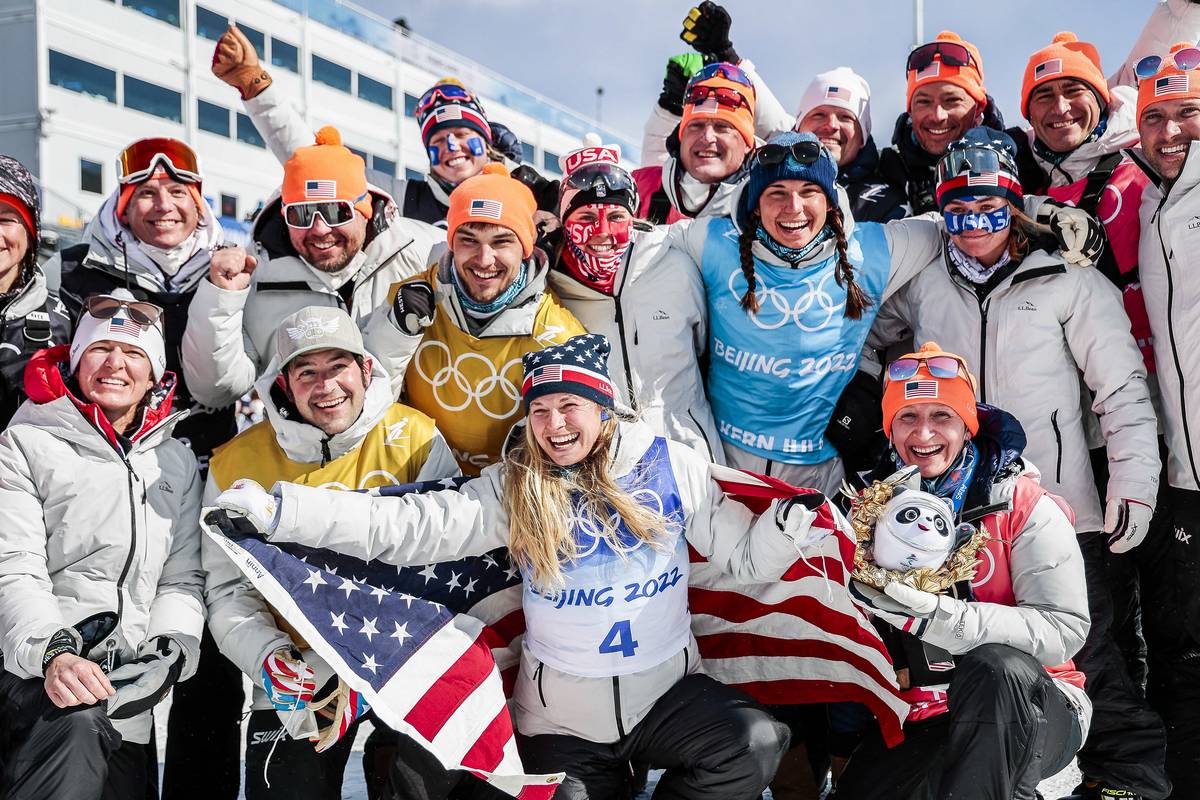
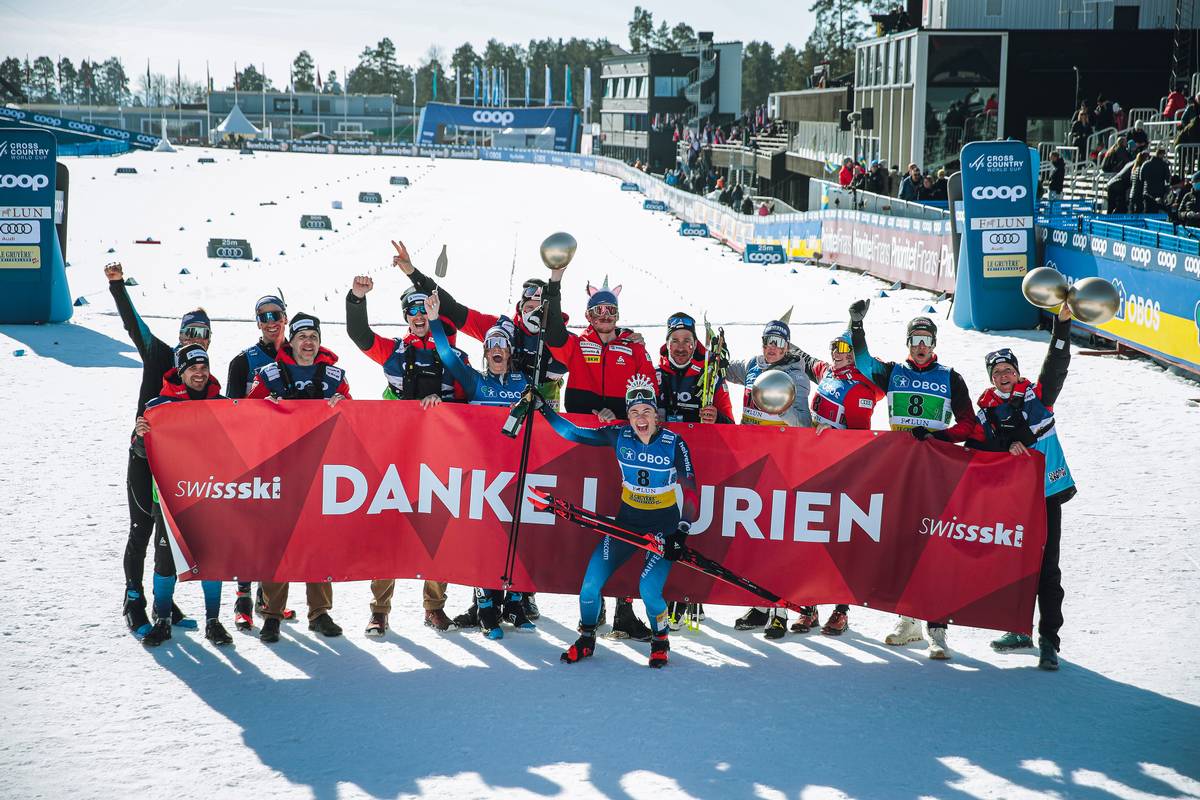
Jessie Diggins with teammates and staff after winning a historic silver medal in the 30K Freestyle at the 2022 Olympics in Beijing, China. (Photo: NordicFocus)
The Second Frame: The Beijing 30K — The Race She Calls Her Proudest
When asked about the moment she is most proud of as a competitor, she didn’t hesitate.
She didn’t say PyeongChang, though she acknowledged the magic of that day. She didn’t say her World Cup overall titles, though she earned those through years of relentless precision.
Instead, she chose a different story — one that most athletes would quietly bury.
“The proudest moment… was the 30K in Beijing,” she said. “Because it wasn’t about if I won or not… the fact that I had battled through food poisoning and chosen to start the race… one minute into the race I had [crashed] and got back on… everything had gone wrong… but I decided to go after it anyway.”
There is something primitive about that choice: to define greatness by suffering openly, to measure success by depth rather than placement.
She emphasized that she “had no business going in the breakaway,” no business skiing alone with a body that was “falling apart and cramping.” But she did it anyway. And she finished.
In a career built on composure and precision, this race was about something far less visible: the instinct to keep going when no one would blame you for stopping.
It is not the kind of image that hangs in a sports museum. But it belongs above her desk — the second frame — because it reminds her who she became, not merely what she achieved.
Jessie Diggins soaks in all the energy from the home crowd in Minneapolis. (Photo: Gretchen Powers, U.S. Ski & Snowboard )
The Third Frame: Minneapolis — The Moment That Surprised Even Her
Jessie Diggins’ favorite moment of her entire career was not a race, not a podium, and not a championship. It was a warm-up lap.
Not even the race itself — just the lap before it.
“It was the warm-up lap that I did in Minneapolis,” she said. “I cried like 12 times. It was the coolest moment of my entire career.”
The Minneapolis World Cup, held after years of planning and pandemic delays, drew more than 20,000 fans — kids in ski jackets, families, high school teams, masters racers, longtime volunteers, and the entire Nordic diaspora of America. She helped bring the race to Worth Park; she fought to keep it on the calendar; and then she skied into a stadium that felt like home.
“When you’re warming up, you can really see the crowd and be in it with them,” she explained. “Being a part of bringing together 20,000 plus fans… that was the coolest moment.”
This is the third frame above the desk. It captures the rarest kind of athlete achievement: the moment when an individual’s career transforms into a collective story.
This wasn’t symbolic. It was literal. She had helped create the environment in which the sport could grow.
She wasn’t skiing through fans; she was skiing through the future of U.S. skiing itself.
Staying, Leaving, Returning
If advocacy, suffering, and community are the three frames above her desk, there might be a fourth frame just below them: the one showing something from this final World Cup season or what comes next.
She says she will still support the team, “just not in a way that has to be quite so physically hard on my body.” She imagines herself as “team mom from the sidelines,” cheering but not chasing splits.
She will garden.
She will sleep in her own bed.
She will run a 100-mile race — “just for me… I don’t expect to run it quickly or competitively.”
She will finally come home.
The irony of this final season is that she wants to experience it with the full emotional force of closure — the opposite of detachment, the opposite of stoicism.
“It frees me to enjoy it even when it’s hard,” she said, describing the upcoming Olympics. “Even if it doesn’t go perfectly… my career is this entire body of work, and I just want to be there to be present… because it’s the last time I’m ever going to do this.”
Her retirement announcement wasn’t a curtain; it was an opening.
She’s letting people in.
She’s letting herself feel everything.
She’s letting the sport rush over her one last time.
The Press Conference Ends. The Story Begins.
When the final question was asked and the moderator thanked everyone for their time, Diggins’ Zoom square flickered and the screen returned to its familiar grid. Reporters signed off. Microphones muted. The call ended.
But her voice stayed in my head — not the athlete’s voice I’ve heard in mixed-zones for years, but the one she seems excited to use next.
The voice of someone shifting from performance to reflection, from competition to communication.
The voice of someone ready to tell stories for a living.
Back in Wakefield, someday soon, she’ll sit at her desk beneath those three frames. And as she maps out the arc of a keynote, or a book, or whatever comes after skiing, she’ll look up and see exactly what she spent her career building:
The people she helped.
The battles she fought.
The community she created.
Three frames.
One legacy.
And one last winter to live it fully.
Love Stories Like This? Help Keep Them Coming.
Feature interviews like this one take time, access, and care to produce. If you value thoughtful storytelling and independent ski journalism, please consider becoming a Voluntary Subscriber. Your support directly fuels the work we do to cover the people, places, and moments that make our sport special.
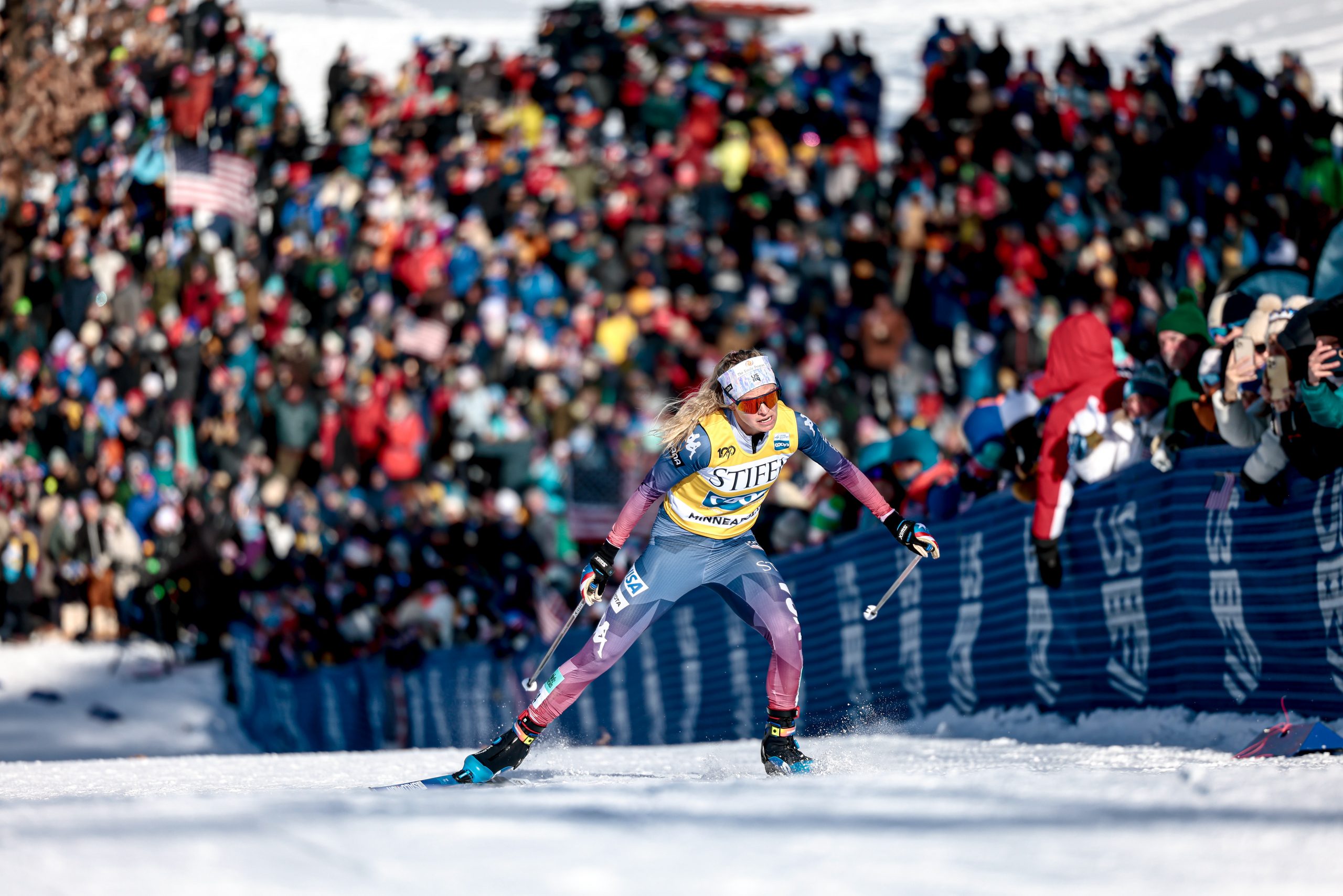
Jessie Diggins (USA) racing on home soil in Minneapolis and will do so again in Lake Placid as she concludes her storied World Cup career. (Photo: Modica/NordicFocus)
You’ve been waiting on pins and needles for the first episode of this season’s Devon Kershaw Show; we know. But it’s been a busy spring. This edition was recorded a couple of weeks ago, so apologies we’re not up to speed on all the latest developments, but we break down some retirements and other off-season news and we’ll be back soon with some discussion of equal distance racing and other news.
Adam Martin strides at the 2022 Holmenkollen 50 k classic in Oslo, Norway. Martin finished 26th in his third Holmenkollen in March, and recently announced his retirement. (Photo: NordicFoucs).
Adam Martin’s skiing has always tended to be best described in conjunctions rather than disjunctions. He could do this and he would do that.
Or, that’s always how his mentors looked at it. My most distinct memory of Martin is from a CXC (Central Cross Country Skiing) camp about a decade ago when Sten Fjeldheim, then Martin’s coach at Northern Michigan University (NMU), gathered a group of us J2s (U16) around in the lobby of the old Telemark Lodge and said, “there’s proof you can be an All-American caliber skier and have a 4.0 GPA too,” pointing to Martin as the example.
That stuck with me as I watched him as a US skiing fan for years. Martin was giving it everything he could in everything he did, and the juxtapositions that produced were inspiring in their absurdity.
He would run a combined bike/run hill climb andbeat all but one of the cyclists. He would win a local 5 k while pushing for pro runner–caliber paces (seriously, he ran a14:34). He would compete on the World Cup, and his best result would consistently come at its longest and hardest race – theHolmenkollen 50 k.
That pattern strung along almost a decade from his high school career to its final, most striking juxtaposition: Martin had his best season ever in 2021/2022, and now he will retire from professional skiing.
The pattern held all the way through. He gave it all, in every way, and at everything the ski world had to offer.
It was exemplary of his philosophy of inclusiveness, of an and; a persistence in bringing in others’ ideas, their accomplishments, their experiences in skiing, learning what he could, andchanneling it all into his performance out on the course.
That stance towards thoughtfulness and inclusion could be figured as an essence to Adam Martin the skier. Something that reached all the way back and followed him all the way through. When we spoke a couple weeks after his retirement, that was the timescale he reached for. “I was lucky to grow up in the nordic skiing community that I did, with a lot of great people helping me in the sport, both getting into it and supporting me today,” Martin said.
Adam Martin strides through the woods in Falun, Sweden, during a 15 k classic in January 2021. (Photo: NordicFocus)
That nordic community was the one in Martin’s hometown of Wausau, Wisconsin. He first came to skiing as a 10-year-old there – venturing out on skis after the local skating rink shut down and left his then favorite sport, figure skating, an impossibility. “It was a good winter so there was good skiing at 9-mile (Wausau’s trails) for all of March. My mom took me out once or twice a week for a whole month and I think we progressively worked up to 20 k at the end of the ski season. And that was big for me. I didn’t think about figure skating after that.”
It was an understated but persistent start in the sport that matched the ski community that Martin would grow up in. An old timber-boom relic in Wisconsin’s Northwoods, Wausau hums along as a city of 38,000 marked most prominently by Rib Mountain, an erratic that signals that glaciers crept across the land there, carving up knolls and hills under the forests that now surround it. It is as perfect ski terrain as you’ll find in the Midwest. Granite Peak, one of the oldest lift-served ski hills in the country, calls one side of Rib Mountain home. Characteristically of Martin, when I asked him if he skied there as a kid he replied “Never downhill. I used to ski up it after the lifts closed in high school though.” Martin was instead drawn into skiing by the rolling terrain at Nine-Mile County Forest, a network of trails a mile south of Rib Mountain that had already been home to a couple generations of nationally competitive skiers .
Before he joined those ranks though, Martin signed up for the Wausau Night Gliders, the community’s youth program coached by Rachel and Greg Kresse. “We met twice a week, and I was just so excited to see and learn different things in the sport. I remember the first time we learned to skate, and was like thinking, ‘could you V2 in a race?’ Because at that point I was just doing one technique. That was the clincher, I decided I wanted to race. I wasn’t even doing particularly well in the beginning, and getting extremely nervous, but I do remember one race at 9-mile where I had one of my experiences hitting the ‘flow state’ and that was it after that. I was totally hooked on that experience.”
From there, Martin started to look down the road at skiing. Standing there metaphorically, he saw skiers doing what he would one day hope to do. “[In Wausau] the Hugus brothers were three or four years older than me. When I was in 8th grade Ben [Hugus] won the state Championship. One of them was getting top 10s at Junior Nationals, and then I was good friends with Matt and Chris Nichols who were around my age. I had a lot of great competition in Wausau, and in Wisconsin too. I remember Dylan McGarthwrite (from Hayward) making the Scando (Nordic Nations U18) trip when I was a freshman in high school, and I was really hyped up about that.”
After gaining that preview of the Wisconsin nordic world, Martin would chase down each and every one of those goals reached by his role models. By the time he was a freshman in high school, he was qualifying for Junior Nationals. Then, he won the Wisconsin high school state meet, and then qualified for the U18 Scandinavian Cup trip with US Ski & Snowboard. With dreams realized and only good things ahead, Martin decided to go all in on skiing.
Adam Martin pushes over the line during a 15 k classic in Falun in February, 2020. (Photo: NordicFocus)
His time, and his place in Wausau, were serendipitous in presenting a ready-made opportunity in his own backyard. In the early 2010s, the Midwest was home to a grouping of skiers who would go on to define their generation of American skiing. Martin headed to the CXC Elite Team, where an orbit of skiers that included Jessie Diggins and Kevin Bolger, along with coaches like Jason Cork, Igor Badamshin and Bryan Fish, were all forging the philosophies and approaches to skiing that would eventually influence the direction of US skiing for years to come.
That it was happening was almost hidden by the shabby surroundings in which they were pushing forward. After joining up with CXC, Martin split his time between Wausau, and CXC’s main training site at the Telemark Lodge in Cable, WI. The training environment was spartan, but the facilities couldn’t even strive for that aesthetic – they were just run down. The VO2Max-fitted treadmill hung out in what used to be a shop floor in the Lodge’s old mall, most athlete accommodations still donned the dull color tones of the 1970s, and the old Telemark World Cup trails were overgrown and uncut.
It was out of the way, but it was also all about skiing, which let Martin fully lean into his developing thoughtfulness towards his technique and his training. “I took a lot of cues from Igor [Badamshin] there. The thing that stood out for me was that he was so joyful about skiing, and that joy could extend to looking at every little aspect of things. He’d point out a little thing in technique, and would get incredibly excited about it, and that was contagious.” (Badamshin passed away in 2014; read a FasterSkier tribute to him here).
That attitude extended to new areas of interest too for Martin, who began to take an amateur’s interest in the sports science behind cross-country skiing. “I just bought a standard exercise physiology textbook and think I like read it cover-to-cover. … I started reading all sorts of exercise physiology, and still do.”
Martin’s post-grad year was a fruition and a starting point. Going into a year at CXC, Martin was a skier whose results indicated a huge amount of physical talent and mental intelligence. Then, somewhere in the Wisconsin Northwoods, they melded together, and Martin formed a full-on focused approach to skiing.
But there was a paradox at play too. In developing this holistic approach to skiing, Martin realized he had let go of fitting skiing into his holistic approach to life. “Just focusing on skiing and putting all that pressure on one avenue of my life did not work for me. I really needed to challenge myself mentally and take the pressure off skiing after that post-grad year.”
That led Martin to another natural stopping point in his skiing career, college skiing at Northern Michigan University (NMU) under coach Sten Fjeldheim. “I really fell in love with the sport again under the tutelage of Sten, and with the incredible team environment there.” NMU had long been a waypoint for talented Midwestern juniors – the path that stemmed from JNQ wins to Marquette seemed almost ubiquitous. That meant Martin joined up with a group of teammates that could help him push and be pushed by him.
Adam Martin tags Craftsbury Green Racing teammate Caitlin Patterson during a March, 2022 4 x 5 k mixed gender relay in Falun, Sweden. (Photo: NordicFocus)
Like he had when he was a young skier in Wausau, he looked ahead to see what and where his teammates were achieving results, and found cues he could take, saying that “When I was a sophomore, Kyle Bratrud won the15 k skate at Nationals in Houghton. He was a year older than me and that really opened my eyes to say ‘ok, we can do this. That level is achievable.’”
With that long view of what he wanted to accomplish, Martin also found in Sten Fjeldheim a coach perfectly matched to the detailed approach to skiing he had formed. Fjeldheim at the time was somewhere between elder statesmen and guru in his career, which meant that the years that Martin was beyond in his skiing knowledge had found a home. “Oftentimes, before a workout, [Sten] would explain exactly why we were doing it, why we needed to execute it a certain way, and what the physiological effect would be for doing that. That was exciting to me, and it worked really well with how I looked at ski training.”
As important as his coach was the skiers that Martin called teammates during his time at NMU. “That was a rare team environment, we were all super competitive with each other but in a super constructive manner.” During his four years, Martin was part of teams that included former, present, and future US ski team members with Ian Torchia, Zak Ketterson, Kyle Bratud, and biathlete Jake Brown. At the NCAA Championships in 2016, he, Torchia, and Brown combined to put NMU at the top of the team scoring – all earning All-American status in the process. Across both the 10 k Classic and 20 k Skate races, he and Torchia were the top American-born athletes in collegiate skiing.
When Martin graduated in 2017, it was also with a distinction that marked a whole other focus during his time at NMU. He hadtwo degrees – one in mathematics and one in computer engineering. He had taken what he learned about himself during those post-grad days in Wisconsin, moved on up to the U.P., and nailed it.
Adam Martin (NMU) racing to a American-leading 23rd in men’s 15 k classic at 2016 U23 World Championships in Rasnov, Romania. (Photo: Pete Leonard)
With a 23rd in the 2016 U23 World Championships 30 k Freestyle, there were plenty of professional clubs that were interested in seeing Martin continue his skiing career. And he was up for it, if he could continue to take the holistic approach that had seen skiing not be “the only thing” in his life. From a far-flung corner of Vermont’s Northeast Kingdom, a call came in from Pepa Miloucheva, the coach atCraftsbury Outdoor Center’s Green Racing Project. The GRP was a top-level, proven club, and also one uniquely structured to have its athletes take an active role in the sustainability and outdoor recreation–focused activism of the Outdoor Center. “It just made sense,” said Martin on his decision to head to Vermont after graduating. “I was getting into a program that was more than just training…I was able to work with them, take the GRE, take grad school classes, and make it feel like NMU where I was very challenged.”
Again, Martin had put himself in a place where skiing was the thing. A small pocket of rolling hills that were a little bigger than the ones he started out on in Wausau, but rolling, nonetheless.
On the skiing front, things continued to progress for Martin after joining the CGRP. He made his World Cup debut at the 2018 openerin Ruka, where he placed 51st in the 15 k Classic. That season he also notched a pair of 2nd places at US Nationals in the 15 k Classic and the 50 k Classic, while earning consistent World Cup starts throughout that 2018-19 season. Those World Cup appearances culminated in a season-high31st place at the Holmenkollen 50k marathon in March 2019. It was Holmenkollen that year which provided another one of Martin’s realizations about himself as a skier. “I started to learn that my strength as a cross country skier is that my physiology is really geared towards distance – it’s definitely not speed or transitions. Holmenkollen specifically has these grinding features that make you get to your VO2 max and have to stay there for a long time. It’s almost a perfect physiological stress for me.”
Adam Martin during the Holmenkollen 50 k in 2020. (Photo: NordicFocus)
That further stuck out to Martin especially when he returned to the Holmenkollen race the next season, in 2020. “In 2020, it was a low snow year, so we had to do a different course than the traditional 8 k, and it was more focused on transitions. I just learned again, in one race, a lot about myself as a skier. I was just happy to finish.”
That Holmenkollen marathon also marked the end of normalcy in skiing for the next couple of seasons to come. “That was my last race on the World Cup before the pandemic, and then I came home to do the SuperTour in Minneapolis right before the World Cup, and I won. It was my first SuperTour win, and then the pandemic happened.”
Martin was in a weird spot. The markers that he had traditionally used to gauge and reach for new heights in his skiing career would suddenly disappear over the course of the next season. He was making progress, but the road didn’t have as many markers as it did before.
“[The pandemic] was something everyone dealt with differently, right? But I think for me, the big challenge was that the Craftsbury program is traditionally very communal and very close knit. It’s a big group of athletes – like 30 between our skiers and rowers – and traditionally we’re eating in a dining hall, working together, working out together, and sharing the same gym. That was a super vulnerable situation to COVID, so we went from super communal to basically not going into public buildings for that first year.”
Adam Martin races a frosty 15 k in Falun, Sweden in January, 2021. (Photo: NordicFocus)
It was as if someone flipped a switch on the type of training environment that Martin had been in since his days at CXC. His training grounds had always been out of the way geographically, but always included the ability to bounce ideas off his teammates and coaches, to try out new things, and to get feedback then and there. They also had always included a full race schedule, which due to a combination of the COVID situation locally in Craftsbury and Vermont state safety policies, became an impossibility the next season.
When Martin could race, it was internationally. “I was lucky to get a start on the World Cup at Davos in December, but while I was gone, the state of Vermont changed the rules around COVID travel. (At the time, COVID cases were undergoing a spike.) I got back and I couldn’t be on the ski trails in Craftsbury while I quarantined unless it was like before 7am or after 6pm at night. I knew I was lucky to be getting racing in, but it brought restraints that forced you to adapt your training.”
Martin credits the imperatives surrounding COVID compliance with giving him a new adaptability to his training approach, even if the changes he made were more informed by what they always had been – his coaches, his intuition, and his constant searching for knowledge that would lead to improvement. “I think there was some changes in those two years that helped me make some big improvements that were probably independent of COVID, but came about because I felt like the pressure was off again for the first time in a while.”
That intermittent COVID season’s lessons would all come to a fruition in Martin’s skiing at the start of the 2021-22 season. Martin started his season on the US SuperTour circuit, and the SuperTour circuit was to begin in the Midwest. That, for Martin, brought back an extra level of familiarity to the return of a regular racing schedule in 2022. “I was so happy to win that first SuperTour in Cable (in the15 k Classic).”
The early part of the season also saw him call to mind some of the moments that he had once seen teammates achieve back when he was based in his home region. When he came out of the first SuperTour period in 2nd place overall, behind former teammate Zak Ketterson and barely missing out on the automatic World Cup start Ketterson earned, Martin turned towards US Nationals in Soldier Hollow in January.
There, on a sunny Utah day, he won the 15 k Classic, a moment that was “particularly awesome, since it was what I watched Kyle Bratrud do at Houghton.” Over seven years, Martin had had the revelation about who he skied with, and then chased down that moment for himself.
Adam Martin at 2022 Nationals in Soldier Hollow. Martin would become a National Champion in the 15 k Classic, a goal he set 7 years earlier after watching then NMU teammate Kyle Bratrud accomplish the feat. (Photo: Tobias Albrigtsen / @untraceableg)
His National Championship and SuperTour results would, in nearly any other season, have seen him shortly to the start line of a World Cup. But for a second winter in a row, COVID was surging (this time as part of the Omicron wave). A slate of World Cups were canceled in January, and the Olympics in February took out any flexibility in the US Ski Team’s lineup. In the Olympic qualifying period, Martin was just behind Scott Patterson for 2nd place in the standings. With a more competitive field than ever before, Martin just missed out on qualifying for the 2022 Beijing team.
From there, he would continue to race the SuperTour, with his consistency throughout the whole season earning that series’ overall title, which he capped off with a win in the15 k classic at SuperTour finals in Whistler. He also would get the nod to race the final World Cup period in March. A period that included, once again, the Holmenkollen marathon.
Martin had a memory and a goal. “I had been 31st there my first time, so I wanted to notch a top-30 finish. I looked at the points list and my bib and knew it was going to be a challenge, but the way the race went out I felt like I could hang onto the pack a little longer than I had before, and with the course being one I knew I liked, I just skied with a confidence that I might not otherwise of had.” That effort and that approach, as it had throughout his career, saw him through to accomplishing his goal. Martinfinished in 26th.
Martin could continue like that – setting goals that, through the constant refinement of his approach to skiing, he would surely accomplish. But that’s where the paradox of his approach comes in again. In powering his skiing through a fine-tuned balance between focus on skiing and focus on other aspects of life, there came a time when the balance would shift towards life. For Martin, that moment is one he says has come:
“What was important to me in professional skiing is giving it everything I have, and that requires a lot of sacrifices. It’s important to me that I’m giving my best effort, and now I give that to other things in my life. I had so much fun this season, and don’t have to step away with any bitter taste in my mouth. Skiing will always be there – I’ll be doing the Birkie or the Noquemanon next year I’m sure, but I’m ready to push myself in a different sense.”
Anyone who has had the pleasure of interacting with Katharine Ogden, also commonly known as KO, can tell you that she is humorous, kind, and thoughtful – both in regard to others as well as in her own self-introspection. She is also a wicked good skier, proving herself both nationally and internationally in competition. Ogden recently shared that she was stepping away from professional skiing, having already experienced a range of career ups and downs at her relatively young age of twenty-four.
Katharine Ogden races the classic sprint during the 2021/22 Tour de Ski in Oberstdorf, Germany. (Photo: NordicFocus)
I had the privilege of overlapping with Ogden for two years as teammates on the Dartmouth Women’s Ski Team, during which time I was undergoing my own personal, though distinctly less significant, reckoning with ski racing. Thus, when Ogden announced her retirement at the end of last month, I asked to be the one to write this piece, hoping to do justice to the story of a career that is as important in its low moments as it is at its heights. Ogden herself wrote an eloquently expressed reflection of her career on the SMS T2 blog which can – and should – be read here.
Ogden began skiing at the tender age of two, after her family moved from Seattle to Vermont. Shortly thereafter her brother Ben was born and as Ogden explained it, “I was now living in Vermont, no longer an only child, and so I spent a lot of time with my dad, while my mom was having, you know, the baby. And my dad, once we moved back to Vermont, kind of re-engaged with the Nordic ski community and started coaching the local ski program.” Ogden’s father, John, has long been an active member in the Eastern ski community, most recently through his work with the timing company, Bullitt Timing, which he runs with a colleague. “Pretty much since I can remember, my dad has been coaching for [West River Sports] my childhood club, and bringing me to practices and he would also go to the local races and bring me along,” said Ogden.
A young KO takes to the race course. (Courtesy photo)
These early memories of ski racing instilled a strong sense of ski community within Ogden and given the high level of participation in Nordic skiing among her elementary school peers, Ogden explained that this was a big reason why she stuck with ski racing. “And, of course, my dad coaching the team,” she added, “Definitely he encouraged us to do it.” Racing with her best friends throughout elementary school and middle school, while participating in events like the Bill Koch Festival, played a big part in growing Ogden’s love for the sport.
Entering high school, Ogden attended Stratton Mountain School in southern Vermont, the well-known private school which, according to its website, “provides a unique environment that offers each student the opportunity to pursue excellence in competitive winter sports and college preparatory academics.” Around the same time, Ogden was earning her first international starts, as she participated in the U18 Scandinavian Cup trips in 2013 and 2014. “That was kind of a cool progression up to World Juniors,” shared Ogden, “I think it’s very important, and honestly sometimes underrated in my opinion, to build up your international experience in that way.”
For at least one, if not both of the years, Ogden had also qualified for World Juniors but she explained that her coaches encouraged her to choose the U18 trip instead. “Sometimes there are really young kids who got to World Juniors and I think that it’s a bit of a missed opportunity, because those U18 team trips are still a really high level of competition,” Ogden said, “And a good way to be like with people your own age, which really improves the experience.”
Katharine Ogden (SMS) competing at U.S. Nationals in 2013 representing Stratton Mountain School. (Photo: Bert Boyer)
After having built some international racing experience, Ogden attended her first FIS World Junior Ski Championship in Almaty, Kazakhstan in 2015. “At that point, I had made a lot of good friends in the ski world,” shared Ogden, “I knew Julia Kern and Hailey Swirbul really well, so that was a blessing for me to have people that I knew and cared about and relied on in that type of situation being there for support. [It] makes the whole experience a lot more enjoyable and it takes a little bit of the pressure off to just be able to treat it as a fun trip.”
This approach seemed to pay off as Ogden placed 11th and 6th in the individual races, besting some familiar names such as this year’s Tour de Ski winner, Natalia Neprayeava. “[It] was fun to go to a crazy country that I wouldn’t normally go to and be able to experience that, while also getting to focus on some higher level racing,” explained Ogden. Her second World Juniors appearance came in Rasnov, Romania the following year where she placed 13th in both individual races.
Katharine Ogden (10) on her way to a sixth-place finish in the women’s 10 k skiathlon at the 2015 Junior World Championships in Almaty, Kazakhstan. (Photo: Bryan Fish/USSA)
In June of 2016, Ogden graduated from Stratton, and having applied to college but deferred her acceptance to Middlebury College – her father’s alma mater – she embarked on a gap year. Remaining at SMS, she began training more with the pro team (SMS T2) and focusing a little more seriously on ski racing. “That was definitely an interesting experience for me, it was a pretty mentally difficult year,” said Ogden, “it felt like a convergence of a lot of things in my life that were difficult for me to emotionally handle.”
For one, the 2017 World Junior Championships would be held at Soldier Hollow in the US, an exciting prospect that simultaneously created pressure to perform for the American young athletes who would be in attendance. “There was a lot of hype about it being in the US, which was cool, don’t get me wrong, but I felt that – not by anyone else’s fault other than mine – but that I was putting a lot of pressure on myself because of that.”
Self-aware and reflective, Ogden was open about the difficulty of this time, “Because I’d had previous success at the other two World Juniors that I went to, it kind of felt like it was a lot of pressure on me for those races. On top of that, I didn’t have school to focus on anymore, so I was really not doing much other than skiing, which is not something I would recommend to anyone, even if you’re a professional skier.” Ogden stressed the importance of having something else to balance your attention, “whether it’s a job or school, or even just working on your self-marketing or whatever – something that takes some brain power that is not just directly related to training.”
Katharine Ogden racing in her first World Cup events during the Tour de Canada in 2016, pictured here in the women’s 15 k skiathlon in Camore, Alberta. (Photo: Fischer/NordicFocus)
In addition to these pressures, Ogden’s father, who earlier had been diagnosed with cancer, was in worsening condition. “So that was also kind of weighing on me,” explained Ogden, “all of those things culminated into me not having a good time.” She shared that she has struggled with anxiety since she was young, but in 2017 it morphed into something that became unmanageable at times. (Read Ogden’s January 2020 narrative on her experience with severe anxiety here.)
“I couldn’t functionally live with it anymore,” said Ogden, “So at that point, I was really struggling to eat because the manifestation of my anxiety disorder was that it really caused me to have a lot of gastrointestinal distress and a really upset stomach, so it was difficult for me to fuel myself enough to train and I didn’t have a lot of energy, partly from not eating and partly from just being stressed all the time.”
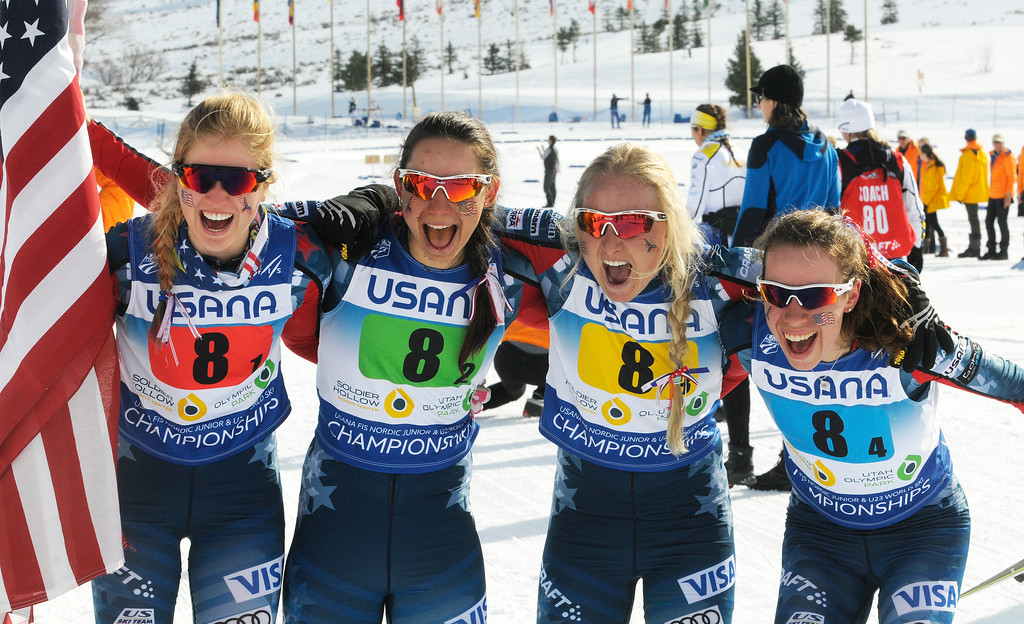
The U.S. women’s relay after taking a historic third in the 4 x 3.3 k relay at 2017 Junior World Championships on Sunday at Soldier Hollow in Midway Utah, with (from left to right) Hailey Swirbul, Julia Kern, Hannah Halvorsen, and Katharine Ogden. (Photo: U.S. Ski Team/Tom Kelly)
Reflecting on this achievement, Ogden shared, “Because I haven’t really had a ton of podium results since then, on an international scale, that is something that my ski career often gets boiled down to. It’s really bittersweet for me because it was a really incredible achievement, especially the relay day, when I was able to work with three of my best friends to accomplish something pretty cool. I still have a lot of pride and such about that experience, but on the other hand, it’s really hard for me to remember that without remembering how awful I was feeling, and how that was really honestly one of the hardest parts of my life to date.”
Returning home to Vermont in early February, Ogden started just one other ski race that season, “I think I did one random Eastern Cup ski race that I ended up actually dropping out of,” she explained. “[After] that race I didn’t put on my skis or anything… I did not go for a ski or a run or do anything for the rest of that year, basically up until May.” At this point, Ogden thought her ski racing career might be over. However, the idea of collegiate skiing started to bring her back around.
Rewind to early December 2016, before World Juniors, and Ogden and the SMS team were in Silver Star, BC for the season-opening Nor-Am events. “My dad was on that trip, because he was helping SMS with some waxing and logistics, and we talked about how I wasn’t very happy, how I wasn’t feeling well, and I was struggling to want to ski and ski race,” said Ogden. While she had accepted a spot at Middlebury, she explained that “no part of me really thought I would go to college.” Examining this feeling, she reflected, “I think part of SMS is that, it’s an interesting environment where sort of everyone’s expected to got to college, but on the other hand, the people who are having a lot of success in their respective sport are almost really expected not to go to college.”
Referring to the infamous US Ski Team “pipeline” and expectations for members of the national team at that time, Ogden said, “I honestly didn’t think a ton about going to college. From pretty early in my high school experience I was like, ‘I’m not gonna do that, I’m gonna be like Liz [Stephen] and Kikkan [Randall] and Andy [Newell],’ and I have so much respect for their ability to focus on skiing that much,” she added, “Like Jessie [Diggins], those people who are really emotionally and mentally healthy and ready enough to be able to accomplish what they did in the ski racing world, without distractions, it’s amazing to me.”
Katharine Ogden, of the Stratton Mountain School and U.S. Ski Team D-team, in the women’s 20 k classic at 2017 U.S. nationals at Soldier Hollow in Midway, Utah. She finished second among the senior women. (Photo: U.S. Ski Team)
As the race season was about to get underway, Ogden was reexamining her priorities. Among the many skiers and teams present for these Nor-Am races was the Dartmouth Women’s Ski Team (DWST), who were wrapping up their annual Thanksgiving camp at Silver Star. “I was kind of watching the Dartmouth team from afar,” said Ogden, “they were always smiling, and they were nor-pining (alpine skiing on nordic skis), and they were going on long skis together. And something about seeing that, I was like, ‘That seems like something I want.’”
Recognizing this, though still not ready to fully commit, Ogden met with long-time Dartmouth coach Cami Thompson-Graves. Like many of the US Ski Team athletes, both alpine and nordic, who chose to attend Dartmouth, Ogden was drawn to the flexibility of the Dartmouth “D-plan”, and thought that perhaps she would take classes in the spring but continue ski racing full time in the winter. Breaking some rules with Middlebury, to whom she had already committed attendance, Ogden applied to Dartmouth that winter. When her acceptance letter arrived in the spring following World Juniors, she talked to Thompson-Graves again. “I was like, ‘I don’t really know what’s going to be the case by the time September comes around. I want to try to ski, but I’m going to ski for Dartmouth, I’m not going to ski for SMS or the national team.’”
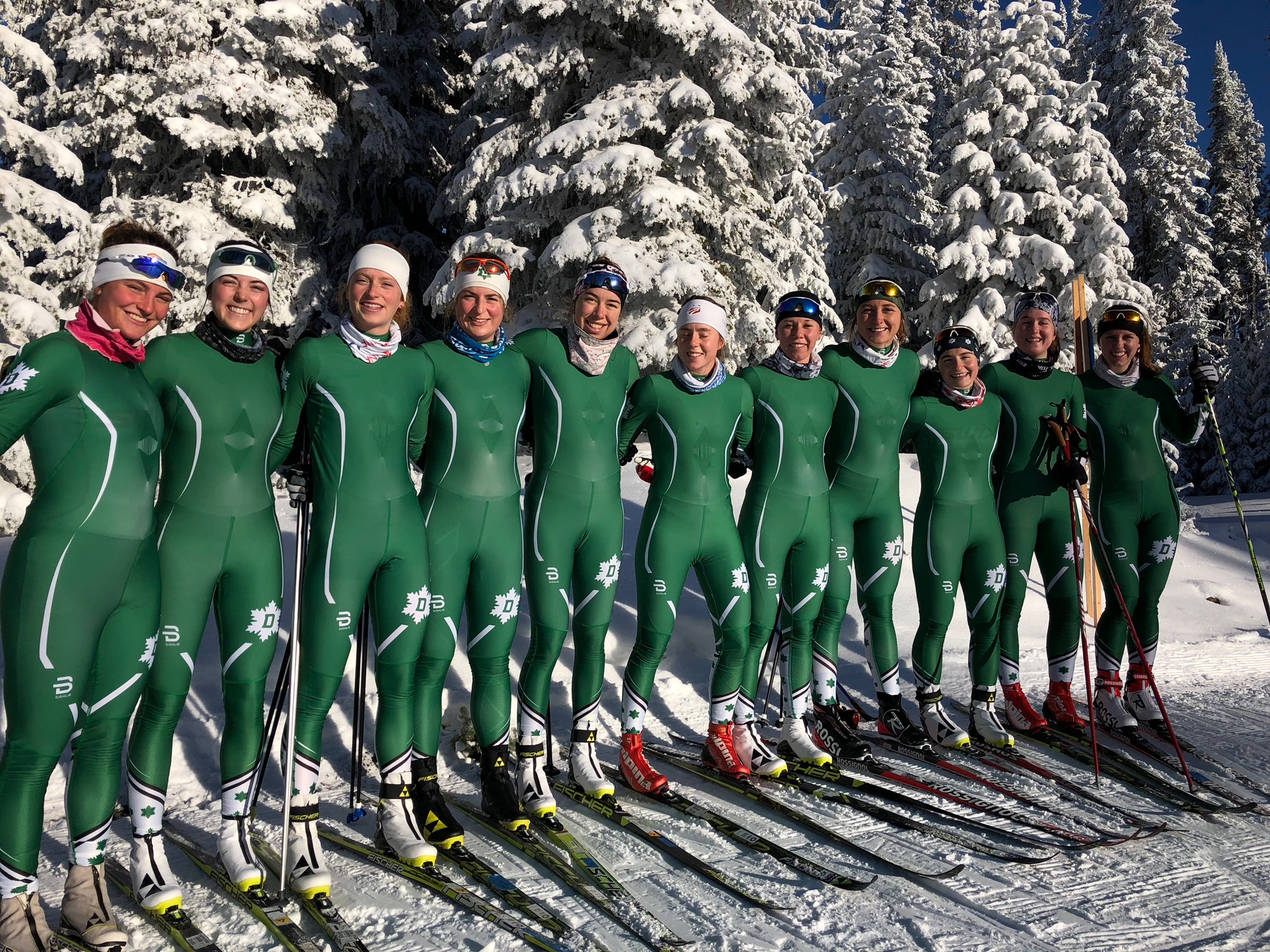
Katharine Ogden (fifth from left) with the 2017/18 Dartmouth Women’s Ski Team training in Silver Star BC. (Photo: DWST)
With this new plan in place, Ogden started to re-engage with training and the ski world. “That summer, I was back to training with Stratton some. I also worked at a preschool that summer, which I loved. I generally went on a bit of an upward trend,” she said. When fall rolled around, she showed up in Hanover unsure of what to expect. “When I got to Dartmouth, it was honestly life changing,” she said, “The team was incredible, full of inspiring and interesting and passionate women, people who were passionate about ski racing, yeah, but also a million other things, which was not something I’d really been exposed to. Stratton Mountain School is incredible in a ton of ways, and was instrumental in facilitating my ski career and getting me to where I got to, but that being said, there’s not a lot of diversity of opportunity there. Because it really is, as advertised, very focused on skiing and ski success.”
Ogden explained that arriving at Dartmouth opened her eyes to the many possibilities that existed beyond the realm of ski racing. “When I got to Dartmouth, it was kind of the first time I’d been able to be like, holy cow, there’s so much else out there that I could be passionate about, not just skiing.” She detailed how the team of women her freshman year displayed the many ways in which one could be both an amazing ski racer and also completely invested in an opposite pursuit. “Lydia [Blanchet] for example, to be so excited about skiing and so talented as a ski racer, but then also sometimes, she would prioritize whitewater kayaking. Or, Taryn [Hunt-Smith] who was casually one of the best skiers on the team but also getting citations in every class and being pre-med… I think that was really eye opening to me.”
Lydia Blanchet, Taryn Hunt-Smith, and Katharine Ogden (l-r) of the Dartmouth Women’s Ski Team celebrate post-race. (Photo: DWST)
With these role models and examples, Ogden allowed herself to pursue other things outside of skiing. She also devoted herself wholeheartedly to the team and racing collegiately and didn’t compete in any international races for those first two years of school. “My freshman year that was kind of on purpose,” she explained, “I just needed a break, and I just wanted to focus on college skiing.” In November of the following year, as she was warming up to the idea of returning to international racing, Ogden broke her hand. “I was like, man, I don’t need to do that, I’ll just ease into the season and get my hand healed. But in the process of not going to the U23 [Championships], I also got booted off the national team, because I didn’t do any international racing for two years at this point.”
This turned out to be a blessing in disguise for Ogden. “I think in the moment I was sad about it, I had been on the development team for three years at that point, and I was a little bummed to lose that,” she shard, “But also, I wasn’t as sad about it as I expected to be and that next season, when I wasn’t on the national team, it was like a huge sigh of relief, if anything, because I felt a lot less pressure to perform.”
Dartmouth Women’s Ski Team freshmen Sofia Shomento, Katharine Ogden and Maddie Donovan (l-r) happy and ready for Dartmouth Carnival. (Courtesy photo)
However, the lack of international racing didn’t stop Ogden from achieving outstanding results. In 2018, as a freshman named to the National Collegiate Athletic Association (NCAA) team for Dartmouth, she took the win in both events at the championships by astonishing margins. In addition she earned seven collegiate victories that season, landed on the podium ten times, and never finished lower than fourth place. The next year, recovering from a broken hand, Ogden finished on the podium in every collegiate race she entered, save for one fourth place finish at NCAAs.
Dartmouth freshman Katharine Ogden racing to her second-straight victory of the 2018 NCAA Skiing Championships in Steamboat Springs, Colorado. She won the 15 k freestyle mass start by more than 38 seconds. (Photo: Dartmouth Sports/Clarkson Creative)
Moving into her junior year of college, Ogden found herself back on the international stage for the Tour de Ski (2019/2020) as well as for the Scandinavian Ski Tour. “It was kind of a perfect system for a college student because it was a ton of World Cup racing, but really condensed, into just two weeks of missed school,” she explained. In this way, Ogden was able to accrue eight and six World Cup starts from each event series respectively, making for fourteen international appearances after several seasons away. “That year, I got pretty inspired to pursue that a little bit more fully. So throughout the winter, I started making the decision that I wanted to ski more for the national team and for Stratton again, instead of Dartmouth, the next year, after my three years of skiing for Dartmouth, so that I could take the winter term off from school and try to do a few more World Cups because I was feeling really excited about that, and had some success, especially in the Tour de Ski.”
Ogden finished in the top-thirty in her first attempt at the challenging multi-stage event, ending up 28th overall. “I was feeling confident in my ski racing, and excited and passionate about it again, so I wanted to pursue it,” explained Ogden.
Katharine Ogden during the 2019-2020 Tour de Ski. (Photo: NordicFocus)
If you’ve been following the timeline of this story, you will know what happens next. Enter COVID-19.
At the end of the 2019/2020 season, the World Cup finals scheduled to take place in Minneapolis, Minnesota were canceled and everyone headed home. For Ogden, the timing of the global pandemic happened to work in her favor. The following race season, 2020/2021 was virtually non-existent for the eastern collegiate circuit and with college classes moved online, Ogden was able to keep up with her studies no matter where in the world she was. “When COVID hit, no one was skiing for Dartmouth, it turned out, so I got really lucky on that one, and I was able to take some online terms and continue training with Stratton. So, it was really a year where I was skiing professionally, even though I was still in college.” Ogden reflected that she got “weirdly lucky” with the COVID, “because otherwise, I think I probably would have graduated late if I hadn’t been able to take those remote terms.”
As it was, Ogden graduated from Dartmouth in June of 2021, having completed school in just four years, and the 2020/2021 race season became the first season that she was fully on the World Cup circuit. Ogden wasn’t guaranteed a full season of World Cup racing to begin with but she had starts for Period I, and if she raced well there she could stay for Period II, and so on. Racing in Davos before Christmas break, Ogden finished 22nd in the 10 k skate, securing her ticket to later season races. “That worked out great for me, partly because of COVID, it meant that some of the World Cups were a bit poorly attended, so it was pretty easy to score points and keep on racing, whereas in a normally year it’s a little tougher to score points in Period One,” she explained.
Katharine Ogden, racing to 22nd in the Davos 10 k skate, 2020. (Photo: NordicFocus)
Although, there were other, less desirable outcomes from COVID. “I really enjoyed being on the road longer in the fact that I was able to get to know the team really well and feel like I was really a part of it, and feel really accepted in that environment and that group, but parts of it were also, really, really hard for me,” she said.
For one, as a COVID precaution, the US Ski Team implemented “bubbles” and athletes stayed with the same roommate all season, limiting interactions even among teammates. “One thing that was really tough was, because of the COVID travel restrictions, it was very claustrophobic because we weren’t really supposed to leave to go home at all, or leave the bubble,” Ogden explained. “And even if we could, like if we wanted to, for me it was hard because I was really worried about my parents.” At this point, Ogden’s father, John, was undergoing another round of chemotherapy for cancer, putting him in a high-risk category if he were to catch COVID. “So I didn’t want to travel home and get him sick, but I was feeling very stuck. I couldn’t leave, and I’m definitely a homebody, so being on the road for that long was really tough for me.”
American Katharine Ogden (SMS/USST) and her dad John celebrate her bronze medal in the women’s 10 k skiathlon at the 2017 Junior World Championships in Soldier Hollow in Midway, Utah. (Photo: U.S. Ski Team/Tom Kelly)
These feelings were building, particularly as Christmas break approached, “right before Christmas, I was definitely overwhelmingly homesick, where I was just like, I don’t even know what to do,” said Ogden. “I was feeling stuck, I couldn’t go home, the coaches didn’t want me to go home, and I didn’t really want to put my parents in any sort of danger because I was worried about that.” Thankfully, around this time, John became eligible for a vaccine which took some of the worry off his daughter’s plate. “[That] was one of the most exciting things, I was just thrilled about that because I had to worry a bit less about him, but also because it meant I could feel okay about going home.”
Ogden stayed in Europe to race the Tour de Ski, her second showing at the event. She finished 23rd overall, having posted two top-twenty finishes over the course of the Tour and several more top-thirties. After completing the Tour, Ogden returned home to Vermont for two weeks before the World Championships in Oberstdorf, Germany.
Katharine Ogden on her 30 k classic journey in Oberstdorf, Germany at the 2021 World Championships. (Photo: NordicFocus)
At the 2021 World Championships, Ogden was joined by her brother Ben, who made an impressive championship debut, qualifying 11th in the sprint and ultimately finishing in 17th. Regarding having her brother around, Ogden shared, “Having Ben on the World Cup was great. He’s an entertaining kid. It has also been really fun to watch him finding success and navigating the World Cup in his own unique way. I am really proud of the way that he approaches training and racing, he doesn’t let anyone tell him what he can and can’t do, and makes sure he prioritizes school and jobs and his teammates, even when it appears on the surface to be the detriment of a perfect training/racing plan.”
Ogden finished out the 2021/2022 World Cup season with the rest of her teammates in Engadin, Switzerland before returning home. “I was pretty excited to go home at the end of the season, but a little bit less desperate at that point.” In spite of this, Ogden had realized that being on the road for such a long time was a significant challenge and said it was “hard for me to rationalize doing it again.” Surrounded by older teammates who had been navigating this challenge for many seasons, Ogden asked for advice. “They [told me] this year has been really different than every other year, because of COVID, and you can’t judge the experience based on a COVID year.” Hearing this, Ogden decided to give it another year.
At the same time, she was wrapping up her time at Dartmouth. Given her gap year experience, Ogden was nervous about losing the balance and distraction that school provided from skiing. “I actually, that winter, started applying to grad schools with remote programs for social work,” explained Ogden, “I wanted to have something to do the next year and also, because I was kind of thinking maybe this [skiing] wouldn’t last that much longer for me, because I just really was not enjoying myself that much.” Ogden also pointed out that, perhaps an oft-underrated part of professional skiing is the challenge of earning money from it. “It’s pretty tough to do,” said Ogden, “and involves either being very fast, or extremely good at Instagram marketing… so [that] made it a little bit less sustainable for me, on top of the homesickness and not really enjoying the traveling too much.”
Katharine Ogden racing the App Gap rollerski race with SMS T2 teammate Evelina Sutro. (Photo: Reese Brown – xcski.org)
Recognizing this, Ogden started graduate school online in September (2021) through the Columbia School of Social Work. Having committed to these studies, Ogden would soon have to make another decision, given that part of the program requires a practical, internship component. “At the end of the winter, I had to decide if I would not be ski racing next winter so that I could do my practical, and I had pushed that off for a year, so that I could just do the online classes and some ski racing.” With this knowledge, Ogden entered the 2021/2022 season with an open mind, asking herself the questions, “is this sustainable? Is it something I want to do for longer? In which case I will apply for a leave of absence from school? Or is it something that I’m not really that excited about anymore and I will instead start the process of getting myself placed for that internship?”
An added boon to keep racing this season was the fact that it was an Olympic year. In the end, Ogden was not named to the 2022 Olympic team but she was quick to make it clear that this did not factor into her decision to retire at the end of the season. “I wanted to put my best foot forward, to see if I could qualify for the Olympics. Which obviously, I didn’t. But I would like to clarify that was not why I wanted to stop… I was thinking about it before that.”
Katharine Odgen after finishing 20th in Stage 5 of the 2021 Tour de Ski. (Photo: NordicFocus)
That being said, Ogden shared candidly that it was difficult not to make the team. “[I] can’t understate the fact that it was really hard emotionally to not qualify, to put that much effort and training and goals and everything into trying, and then fall short. That was definitely hard, emotionally.” But putting on a positive spin, Ogden noted, “I got really lucky, because when I was home, instead of going to the Olympics, I was in Vermont and I love it in Vermont.”
Taking a bit of a mid-season break, Ogden lifted a little pressure off herself for training and skied for enjoyment, rather than in pursuit of a goal. She also did some volunteer coaching for the local ski club, Ford Sayre Nordic. “I really loved doing that, and it got me really excited about that aspect of the ski world,” explained Ogden. “During that month of the Olympics, I was kind of sad from not qualifying but also kind of happy because I got to do this stuff where I was hanging out with kids and going skiing with different people, and skiing for fun and going to the eastern SuperTours… I sort of forgot how much it’s like a blast. The eastern ski community is pretty cool.”
Through these various outlets, Ogden was coming to a realization. “Showing up to a race where I knew so many people there and a community where I felt really valued for myself and not for how I ended up doing in the races, or that type of thing – it was just really amazing to see people and re-engage with that community in a way that reminded me that I’m a part of it because of who I am, and not because of any results I had.” The weeks that she spent in New England showed Ogden a path to fulfillment and engagement with the ski community outside of competitive racing, “I think over those few weeks, when I was home and racing in the east and really enjoying that, I started being ready to be done with skiing, in part because I was like, I’m really happy right now,” she explained.
Katharine Ogden celebrates a victory and fourth place finish at NCAA’s in Stowe, VT 2019. (Photo: DWST)
For someone whose life and identity has been so integrally tied to ski racing, making the decision to step away can be a frightening prospect. “Part of me was scared of losing the ski community,” reflected Ogden, “It’s been such a huge part of my life that I was really scared of not having it anymore, and part of that experience reminded me that I’m not going to lose it. It’s not ever going to be something that goes away, I’m going to be a part of this community and with these people forever. I think it hadn’t really occurred to me that that was the case. I’d never been a part of the ski community as anything other than an athlete.”
With this decision “figured out,” Ogden was ready to return to the World Cup season to get some closure and to go race for fun. She rejoined the US team abroad in Lahti, Finland and was able to race the legendary Holmenkollen 30 k event where she finished 37th, before a positive COVID test took her out of contention. “So I didn’t end up actually doing my last World Cups,” laughed Ogden, “But I still had a great time being quarantined with Hailey [Swirbul] (who also tested positive). We were kind of suffering, but once we were feeling a little better we got to explore Oslo. And Hailey is one of my best friends and a really important part of my ski career, so it was kind of fun, honestly, [to have] a little impromptu vacation with just Hailey at the end of the season.”
Katharine Ogden (left) and Caitlin Patterson (right) take to the course at the start of the women’s 30 k classic at the Holmenkollen, 2022. (Photo: NordicFocus)
Wanting to close out her career with her SMS T2 teammates, Ogden traveled to Whistler, BC for the combined Canadian Nationals/Super Tour Finals event once she was no longer contagious. Unfortunately, an untimely ear infection meant that she spent most of the week watching Netflix and taking antibiotics. “By the end of the week, [I] was finally able to rally for some races, where I truly had no expectations. I had literally not trained in the past month and still kind of had an ear infection and a cough from COVID, so not thriving, but it was pretty fun. It was nice to be able to celebrate the end of my career with my Stratton teammates who’ve been there, especially Julia [Kern] and Jessie [Diggins], since day one. So I was lucky to be able to do that, even though they were not the most enjoyable races of my life, per se,” she concluded.
Asked to reflect on her career highlights, Ogden mentioned the World Junior performances in Soldier Hollow, but added quickly, “I don’t like that to be my career highlight because I was not happy then. But I would say the 2019/2020 Tour de Ski was one of the real highs of my career. That was something that was a hard thing to do and I was really excited that I’d accomplished it.”
She also noted her first World Cup starts during the 2016 Canadian Ski Tour when she was a senior in high school were a high point. “I think it was an eight-stage tour, and the first World Cup I’d ever done, and that was really gratifying and exciting. Putting on my World Cup bib for the first time was a moment that I will not forget. I got to give my dad a hug on the side of the course when I was warming up, and he was crying. Very cute,” smiled Ogden.
Katharine Ogden crests a hill during the women’s 10 k freestyle at Stage 7 of the 2016 Ski Tour Canada in Canmore, Alberta. (Photo: Fischer/NordicFocus)
Her collegiate races were another notable experience for Ogden, “Almost all the races I did for Dartmouth were really up there,” she said, “but going to NCAA my freshman year was a pretty incredible experience. I had never really had the experience of racing on a team until college. I absolutely loved being able to go into races and know that my result was going towards something bigger and that I was working with a bunch of people to accomplish a goal.”
Offering advice to the next generation, Ogden said “my advice to younger skiers would be to make sure you’re thinking about what makes skiing fun and making sure you prioritize that the whole time. And also, not trying to be just a skier — trying to focus on everything that makes you a complete person, because if you focus on being 100% skier, sometimes it can make this game a little harder.”
Though she is stepping away from competitive racing, Ogden fully intends to remain involved in the ski community. She applied to be on the NENSA board and says, “I’m going to really throw myself into this community, but in a way that’s a little bit more sustainable for me and feels more fulfilling and exciting.” She is continuing to work her way towards a master’s degree in social work, in the specific track of clinical social work with a focus on working with children and families. The current plan is to start her internship for the program in September and eventually graduate in the spring of 2024. “After that I hope to get a job, but as to what job, I’m not sure!” Ogden said, “Hopefully by that point I will have more clarity on that.”
Katharine Ogden celebrates her last professional ski race with 45 k and a tutu. (Photo: Joern Rohde / www.joernrohde.com)
Each year at the conclusion of the race season, there are always a few athletes who hang up their skis and step away from professional racing. The end of the four year Olympic cycle inevitably means a higher concentration of such announcements. Whether it was a fourth or a first appearance at the Games, or a near miss, the Olympics are always a target and their completion provides a good moment to move on. While the retirement announcements will likely continue into the spring, here is a roundup and recognition of the international athletes who have shared the news that they will be ending their ski careers.
A scene from the cross country venue in Zhangjiakou, China, host to the 2022 Olympic Winter Games. (Photo: NordicFocus)
Four athletes from the Swiss team have announced that they will be moving on, chief among them – the king of the 15 k, Dario Cologna. At the age of 36, Cologna released his decision before the 2021/22 season even began, saying, “the decision came within the last months and after the Olympics, it will be the perfect timing for me. I have achieved everything I ever dreamed of in the sport.”
Switzerland’s Dario Cologna lunges to the line at the 2018 Holmenkollen 50-kilometer freestyle race in Olslo, Norway. (Photo: NordicFocus)
Cologna had his World Cup debut in 2006 and his first Olympic start came in 2010 in the 15 k skate event, where he finished first. This victory crowned him as the first Swiss cross-country skier to earn an Olympic gold medal. He went on to win three additional golds, in the 2014 Sochi Games he won both the skiathlon and the the 15 k classic, and in 2018 in PyeongChang added a gold in the 15 k skate. All told, Colgona had eighteen Olympic starts at four different games.
In between Olympic years, he was equally successful. He won the Overall World Cup globe four times, first in the 2007/08 season, again in 2010/11 and 2011/12 and a few years later in 2014/15. In the 2007/08 season he also earned his first Tour de Ski victory, in spite of the fact that he never took a stage win that year. He won the grueling event three more times, in 2010/11, 2011/12 and again in 2017/18.
Dario Cologna (SUI) with his trophy after winning the Tour de Ski in 2011 (Photo: Fiemme2013)
After his final outing in the legendary Holmenkollen 50 k, Cologna wrote on Instagram, “I look back on a beautiful and successful career. 15 years ago I never dared to dream that one day I would be a four-time Olympic champion, World Champion, multiple Tour de Ski- and overall World Cup winner. In addition, I was privileged to travel to places I would never have seen and met great people, who became good friends.”
Dario Cologna (SUI) after a 6th place finish in Val Mustair during the 2021 Tour de Ski. Photo: Nordic Focus
Cologna’s teammate, Jovian Hediger, also announced his retirement prior to the start of this season. Hediger was known as a sprint specialist and has 107 World Cup starts to his name, having made his debut in 2009. His first and only podium appearance came in 2021 during the team sprint event in Ulricehamn, Sweden, where he and Roman Furger finished second. Hediger represented Switzerland at three Olympic games, beginning with Sochi in 2014 and ending most recently in Beijing (2022).
Jovian Hediger (SUI) gets a boost from some happy teammates at the finish line in Ulricehamn Sweden. (Photo: Nordic Focus)
Ueli Schnider of Switzerland is also stepping away from elite competition. Schnider has 62 World Cup starts and made two Olympic appearances, both in 2018 in PyeongChang where he finished 37th in the classic sprint and 41st in the 50 k classic mass start.
On the women’s side, Laurien Van Der Graaff of Switzerland is moving on. Van Der Graaff has long been a staple in women’s sprinting, beginning in 2011 with her first World Cup podium in Duesseldorf, Germany. In doing so, Van Der Graaff became the second Swiss female athlete ever to reach the podium and over the years she continued to pave the way for young Swiss female athletes. Her first victory came in 2017 in a skate sprint Tour de Ski stage race on home ground in Lenzerheide, Switzerland.
The women’s sprint podium in Rybinsk Russia, 2015 (from l-r): Natalia Matveeva (RUS) second, Jennie Öberg (SWE) first, and Laurien Van Der Graaff (SUI) third.
Van Der Graaff partnered up many times with Nadine Fähndrich in team sprint events, resulting in four World Cup podium finishes. At the World Championships in Oberstdorf, Germany (2021), Van Der Graaff and Fähndrich teammed up again, earning a silver medal when they finished just hundreths of a second behind team Sweden.
Van Der Graaff shared with FIS, “for some time I was convinced that I would not continue skiing until Beijing 2022, but I made it and I am very proud of what I have achieved. However, now my time has come and I am excited for everything that is coming my way in this new chapter.”
The Swiss program celebrates the retirement of Laurien Van Der Graaff at the finish of the 4 x 5 k mixed relay in Falun. (Photo: NordicFocus)
While some athletes knew from the outset of the season that this would be their last, others only recently came to the decision. Such was the case for Swedish star, Charlotte Kalla, who just announced her intentions within the last month. The 34-year said, “the curiosity about life outside of elite sports weighs heavier than what a continued investment would entail.”
Kalla burst onto the World Cup scene at the age of eighteen. She earned her first victory in the next season, taking a stage win in Nove Mesto (2007) in the 10 k skate pursuit. In her first individual World Championships appearances, coming in Sapporo, Japan in 2007, Kalla finished 7th and 5th. To give you a sense of her consistency from then on, of the 34 World Championship events Kalla completed spanning 2007-2021, she finished in the top ten in 30 of those appearances with the exceptions being three 11th place finishes and one 18th.
Charlotte Kalla of Sweden on her way to Olympic gold in Vancouver 2010 (Photo: FS archives)
Kalla represented Sweden at four different Olympic Games, Vancouver 2010, Sochi 2014, PyeongChang 2018, and Beijing 2022. She came away from these events with five individual podiums, including two gold medals and three team medals including her jaw-dropping relay performance in the relay in 2014 when she made up a 25 second deficit to bring the Swedish women their first Olympic relay gold since 1960.
Since then, the Swedish women’s team has come to dominate the World Cup circuit and Kalla has taken on a mentorship role within the team. “It’s an inspiring team to be a part of and many girls who have the right mindset to do their very best every day,” said Kalla in 2020. On March 22, 2022, Kalla announced on Instagram that the Swedish national competitions would be her last as an elite athlete. She wrote, “here I took my first [steps] as a seven-year old and it feels nice to end my career here.”
Charlotte Kalla (SWE), Marit Bjoergen (NOR) and Heidi Weng (NOR) claim the podium in the women’s Olympic skiathlon, Sochi 2014. (Photo: Fischer / Nordic Focus.)
Elisa Brocard of Italy is ending her ski-racing career at the age of 37. Brocard had her first World Cup start in 2006 and went on to contest 162 World Cup events. She represented Italy in three Olympic Games, beginning in Vancouver 2010, through PyeongChang in 2018. Her best season came in 2018 when she finished in the top-30 distance World Cup rankings and 38th overall.
Nadine Herrmann of Germany is leaving elite competition as well. She is the younger sister of Denise Herrmann who raced the cross-country World Cup circuit until she transitioned to biathlon in 2017 where she went on to win gold in the individual event at the 2022 Beijing Olympics. Nadine Herrmann finished in the top-thirty in her maiden World Cup appearance in 2018 in the Dresden city sprints. She went on to earn a number of top-thirty finishes, including a personal best individual finish of 18th in Dresden in 2020. At the age of 26, Herrmann has decided to move on, she wrote “My active sporting career is coming to an end. The last 14 years of performance sports have shaped me into the person who today can say in the best of my conscience, I gave it my all.”
Adrien Backsheider of France has also announced his retirement. Backsheider began racing on the World Cup circuit in 2013. He earned six World Championships starts and helped propel team France to a bronze medal in the men’s 4 x 10 relay in Falun in 2015 and again in Seefeld in 2019. Backsheider also has four Olympic starts, as he represented France in Sochi 2014, PyeongChang 2018, and Beijing 2022. He was a member of the bronze medal relay team in PyeongChang when the French again earned a podium spot in the 4 x 10 relay. Backsheider’s personal best individual World Cup finish came in Östersund, Sweden in 2020 when he finished 7th in the 15 k skate stage race during the Tour de Scandinavia.
The men’s 4 x 10 k relay at 2015 World Championships in Falun, Sweden, Norway with gold, Sweden with silver, and France with bronze . (Photo: Fischer/NordicFocus)
Cendrine Browne of Canada is saying goodbye to professional ski racing as well, having concluded her career with a national title in the 45 k skate in Whistler, Canada. Browne made her World Cup debut in 2012 and went on to start 76 World Cup races. She made the Canadian Olympic team in 2018 and 2022 and also posted thirteen World Championships starts. Browne finished 16th in the 30 k skate mass start in Beijing, a personal best individual finish for her. In a statement to Nordiq Canada after the 45 k race, Browne said, “thank you to everyone in the ski community who has believed in me and cheered for me over the last ten years.”
Cendrine Browne reached a new personal best with her 16th place finish in the 30 k skate mass start in Beijing 2022 (Photo: NordicFocus)
The notable retirement of the extremely successful, Therese Johaug of Norway has not been missed but will be receiving its own feature from FasterSkier in the coming weeks. Additionally, US Ski Team members Katharine Ogden, Hannah Halvorsen, and Caitlin Patterson have all shared news of their retirement, in addition to top SuperTour athletes Ian Torchia and Adam Martin. (Read Torchia’s retirement story here.)
Stay tuned for more in-depth reporting on those athletes from FasterSkier.
Sadie finishes third in the women’s 10-kilometer freestyle pursuit at 2018 World Cup Finals in Falun, Sweden. (Photo: Fischer/NordicFocus)
Part I of this article examined Sadie Maubet Bjornsen’s childhood, World Cup debut, and the injuries that she overcame along the way. This article, Part II, starts with a frank look at some of the challenges of being an American World Cup skier, then discusses her overall career highlights, her final World Championships earlier this year, and what comes next.
In addition to the injuries, there are some challenges to life on the World Cup circuit, particularly as an American away from home for so long. Sadie is clear-eyed about these drawbacks, reflecting, “World Cup racing has its shine, but certainly there are things that are really tough. For me the toughest thing was always being away from home for that long, and then when things were more serious with Jo it was being away from him for that long. I would say, I managed the pressure of feeling like I needed to do well by having school. I think that was such a savior for me through the process. I think I never got too terribly wrapped up in doing perfect racing. I think the other thing that was really important for me was I developed some close friendships with my teammates. We had some things to talk about aside from ski racing. I think having these partnerships with people you are racing with makes you think about things aside from ski racing and having the capacity to laugh and not having everything result focused.”
APU teammates Sadie Maubet Bjornsen and Rosie Frankowski chat trailside during a training day before World Cup races in Lillehammer Norway in December, 2019. (Photo: NordicFocus)
There are also challenges to being an aspiring American junior skier in 2021, and to seeing the levels of performance that have become seemingly routine – as a ski nation, we’ve come a long way from the early-Randall period, when a single top-30 result would cause the FasterSkier comments section to fill up with jubilant congratulations. While this is hardly the fault of any current World Cup athlete, the rousing American success can make it daunting for juniors trying to keep up. Sadie is asked what she would say to a hypothetical American junior following pro skiers on social media, and thinking to herself something like, “If I’m not training 700 hours a year at age 17 or I’m not on a World Juniors relay podium team by age 18, I’m a complete failure; that’s what it takes to be successful on the national team these days.”
Sadie has thoughts on this: “I think there will always be a standard to compare yourself to. I think that is how the world works, and the more things go on social media, the more visual that standard is. I think that is going to be our biggest challenge going forward. When I was younger, I did not even know who World Cup athletes were; I did not watch the World Cup. I hardly knew what cross-country skiing was, so I had a really soft entrance into what I wanted to accomplish. I think that before people go too far, I think they have to work on the true goal-setting process. And that sounds funny, but it is as simple as, ‘Okay, I want to get better next year. I am training 450 hours right now.’ Well, of course you are not going to train 800 hours next year. Instead, you need to take the time to identify, Where am I, where do I want to go. You need to be sure you are not just skipping that whole process and just using a standard to compare yourself to.
“I think really working on the goal-setting process from a young age and identifying yourself as an individual is really important, because we will always be comparing ourselves to some standard like, ‘Do you I have a six pack, I do not have a six pack at all, everyone seems to.’ You know what, not everyone is going to have a six pack. Or, ‘Everyone seems to be training at 800 hours, but I take 400.’ Again, not everyone does that, not everyone can. I think that we just have to be – as a junior you just have to recognize that not everyone is the same and you are never going to escape the comparison game. But that is what is going to help you create your own path, is being able to identify your strengths and your goals. I think that is such a necessary part that can be easy to skip when all you think about is where you want to go.”
* * *
Sadie’s words are wise, but this is a retirement article, so we’re going to move on to where she ended up going: to the top of the sport, or very close to it. She was on the U.S. Olympic team in 2014 and 2018, and all six American World Championships teams from Oslo in 2011 through Oberstdorf in 2021.
Sadie Bjornsen skis the second classic leg in the women’s 4 x5 k relay at the Sochi Olympics in 2014.
Sadie was on American relay teams 14 times in senior-level international competition, half of them at the Olympics or World Championships. There have been five times in, well, ever that the U.S. women notched a podium finish in a World Cup relay; Sadie was on the team for four of them. Each time, she skied the second classic leg, historically where each nation places its strongest classic skier in an attempt to string out the field. She filled the same role in two Olympic relays and three World Championships (2017–21), too, after skiing the scramble leg in 2013 and 2015.
And while Sadie won her World Champs medal in the classic team sprint, at Lahti in 2017, she was the first alternate for the epochal skate team sprint, at Pyeongchang in 2018, winning universal praise from her coaches and teammates alike for the poise and magnanimity with which she handled being, in effect, the first person left off this team. (Her blog post about this moment is better written and more insightful than anything in this article: “A small piece deep inside my heart crumbled at the same time, knowing that I had missed such an amazing opportunity,” Sadie wrote after the fact, while also lauding the team and its accomplishments with surpassing grace.) She would later team up with Rosie Brennan for the skate team sprint in Oberstdorf this March, coming one ill-timed “that’s sprint racing” final-leg tangle away from contending for a medal there as well.
Sadie Maubet Bjornsen in her yellow World Cup leader’s bib and her new wax tech, Per Erik Bjornstad of Norway, in November 2019.
Oh, and she was also the first American woman ever to wear the yellow overall World Cup leader’s bib, early in the 2019/2020 season, followed this past season by first Brennan and then Diggins, marking a moment when she literally did reach the top of her sport. (Other moments: the four separate times that she posted the fastest time in a World Cup sprint qualification, two in sprint and classic.) She earned the yellow bib by placing third in a sprint and fourth in a 10 k on successive days in Ruka. And she ranked 16th or higher in the overall World Cup standings for five consecutive years, often slightly higher in sprint than in distance but with strong results in both disciplines.
table: Gavin Kentch for FasterSkier
As this (partial) palmarès shows, Sadie is an exceptionally well-rounded athlete – balanced, even. In fact, she was the first American ever to post a podium finish in all four World Cup disciplines (classic sprint, freestyle sprint, classic distance, freestyle distance) and is still one of only two to do so, with Diggins being the other. (Diggins got there first if you count a “time of day podium” in a pursuit race as a standalone classic distance podium, which most people probably would not.) She retires as the second most well-rounded or broadly competitive American skier ever, after only Diggins.
This “career slam” was a longtime goal for Sadie.
“Since I was a young girl I always used to get so frustrated when somebody would tell me that I was just a sprinter,” Sadie notes, “or I was just a distance skier, or anything like that. I hated being identified by something; I wanted to be the person that could do it all. As I progressed and made the national team, I remember there being this talk about this classic deficit, and when will Americans have ‘real’ classic skiers. That used to make me so mad because I did not feel like we had any classic skier specialists, I thought we were all just skiers! So there are always these little motivators that push me to keep improving all elements in my skiing and it has been something that has been a personal goal.
Sadie racing in the FIS Ski Tour 2020 in Trondheim, Norway. (Photo: NordicFocus)
“It is hard to be the first to do something on our team, because everyone is so darn good. It feels like they have kind of reached a level already before you. So that was kind of my own personal thing, that was going to be my goal. I did not really feel like it was specifically anybody else’s at the time. That was going to be my thing, to be the one who was going to do everything. I could be ready to be on the podium on any given day, I could be on the relay on any given distance or any given position, and so I started slowly working towards that mission. Part of doing it – I can’t remember what came first, getting the yellow jersey or when I got that sprint podium, because that completed the cycle; I can’t remember what it was. But for both of those moments, the achievement I felt was so huge because I knew it was the thing I had been working on. So it definitely gave me a lot of happiness just knowing there was no limit to what I could do. It could be any given day, any given race, so that is actually my greatest achievement is accomplishing that.”
Finally, here’s longtime USST coach Matt Whitcomb on what Sadie brought to the starting line on race day: “I’m feeling grateful for Sadie’s commitment to a long career with the team, but this retirement hurts a lot. The first time I met her was in 2007 at World Juniors in Tarvisio, Italy, so my entire existence with the U.S. ski team has had Sadie as a part of it. She’s one of those athletes that keeps coaches coming back every year. Her style of racing is an inspiration to watch; she can really hurt herself. Coaches and scientists talk a lot about the importance of athletic talent, but they don’t talk enough about the importance of being willing to access that 100% effort. Anyone has that choice, but it’s not so easy. I’ve never heard Sadie say, ‘I think I could’ve gone a little harder.’ If she’s on the starting line, she’s there to give it. As I look back on her career, I know she could not have tried harder. She did her best, and that deserves a standing ovation.”
This undated, uncredited photo is the oldest image of Sadie in the current FasterSkier image library. It seems to be from the 5 k classic at 2008 World Juniors in Italy. Sadie placed 24th in the interval-start race, 59.7 seconds behind winner Therese Johaug.
* * *
However, not all goals come true – as a wise person named Sadie Maubet Bjornsen once said, sometimes you have to announce a goal that is “really risky and really scary and really intimidating to say.”
And so, as Sadie recently wrote on Instagram, hearkening back to summer 2020 and her decision to dedicate herself to one more year of training, “Last summer I danced between hanging up my skis, or continuing on. There was one last goal I wanted to accomplish not just for myself, but for the team that taught me what it meant to dream bigger than big. This goal was an Olympic/World Championship 4×5 podium. I knew in my heart we were forming into the strongest relay team we had ever had, and I felt the need to lay it all on the line for my team in @oberstdorf2021.”
Sadie training at Hatcher Pass in Alaska (with, from left, APU teammates Rosie Frankowski, Sadie, Hailey Swirbul, Becca Rorabaugh, and Caroline Brisbois) in May 2020, Covid-era social distancing in effect. (photo credit: courtesy Sadie Bjornsen)
Sadie continued on for one more year, one more season of intervals in the sun and ODs in the rain and logging her total tendon load following each workout. She stayed in Alaska in the summer while the world shut down for Covid. She was on snow early in the fall. She skied a ton. She trained hard. She stayed home in Anchorage through all of World Cup Period I, all of Period II (Tour de Ski), and the first half of Period III to better peak for World Champs. She donned a mask and flew over to Europe in mid-January, after doing just one citizens race and two Anchorage FIS races that winter, and promptly placed 10th in her first World Cup race in nearly a year – despite having abstained from hard intensity for the previous five weeks while nursing a back injury. She would finish 15th, 15th, and 4th in her next three World Cup races, then 11th in her first race at World Champs. All the pieces were in place.
When race day dawned in Oberstdorf, it was the 15th, and final, international relay of Sadie’s career. While there was, technically, one race remaining at World Champs, the 30-kilometer classic two days later, her teammates knew that this was the race she had stayed in the sport for. As she had told them the previous summer, “I am staying one more year with ski racing and this is why.”
Put another way, Sadie had literally dedicated one year of her life to ski for less than 15 minutes – one last classic leg on one last American women’s relay team, “for the team that taught me what it meant to dream bigger than big.” Try not to get goosebumps while you read that.
Her teammates were not unappreciative of her dedication. Their mindset going out to the start line, Sadie recalls, was, “okay, if we can see when we tagged each other, we know we did not give enough.” She adds, “We all knew how invested we were and I really felt like that was the strongest ski race we had ever had, and the most ready we had ever been.”
Sadie Maubet Bjornsen (far right, green bib 5) is tagged by Hailey Swirbul in the women’s 4x5km relay in Oberstdorf. (photo: Modica/NordicFocus)
After a year of preparation, Sadie’s relay leg – the second classic leg, one last time – took her 14 minutes and 40.5 seconds. She took the handoff from Hailey Swirbul in eighth after the chaos of the scramble leg, 13 seconds out of third. Halfway through her 5-kilometer leg, she was still 11 seconds off the podium. Less than a kilometer later, she had moved the Americans up into third. She would tag off in fourth, 0.3 seconds out of third, having done precisely what she needed to do to help her team.
If you watch the replay, it is very plausible to conclude that Sadie could not indeed see by the end of her leg.
If you’re reading this website, you probably know what happened next: Sadie tagged off to Rosie Brennan for leg three; Brennan pushed hard but was unable to drop anyone around her, tagging off to Diggins in a virtual tie for third; Diggins took off for her anchor leg alongside Finnish anchor Krista Pärmäkoski; Diggins skied her heart out; it wasn’t quite enough; Finland took the bronze, with the U.S. 0.8 seconds back in fourth. It was the American women’s, and Sadie’s, fourth fourth-place finish in the last five World Championship relays. Between the relay and the team sprint, Sadie would leave Oberstdorf a combined 3.17 seconds out of taking home two medals and realizing this whimsical GIF after a year of training.
Sadie digging deep on leg two of the 4 x 5 k relay. (Photo: NordicFocus)
Sadie has no regrets: “We wanted to go to the point where we could not even see where we were going anymore,” she reflected on the relay after the season ended. “I think we literally did that. There were no regrets with that day. … It’s just an achievement in itself to know that there are no regrets. Of course you feel different when you also get the medal but I am so glad I came back for another year. This just felt different than any of the other relays I have been part of so it was certainly worth it.” Sometimes you have to set dream goals that scare you.
* * *
Sadie spent her ski career setting results goals, but she also spent it pursuing a rigorous course of study. She earned two degrees – not a double major, but two separate B.A. degrees – from Alaska Pacific University (the school, not the eponymous domestic ski club), in accounting and nonprofit management. She has embarked on coursework for her M.B.A. She has passed the first of four sections of the fiendishly difficult Uniform CPA Examination to become a certified public accountant, and sat for the second section last weekend.
She studied in the team van by headlamp while driving to and from Hatcher Pass for early-season skiing. She attended class remotely from all around the world, years before “Zoom” became a part of everyone’s lexicon. The former NCAA athlete did, in fact, go pro in sports, but she ably laid the groundwork to go pro in something other than sports now that her ski career is over.
To hear Sadie tell it, these academic demands helped, rather than hindered, her ski career. She explicitly says that doing both at the same time helped her to stay in “a perfect balance”: “When I was trying to do the best that I could in school, when you have the personality that you’re just, like, a bit of a perfectionist, it’s easy to kind of get out of balance. So for me, with ski racing, it was easy to try to perfect every single thing. And when it couldn’t happen, I would really struggle. And so school always provided that balance for skiing, and skiing provided that balance for school. And so I never looked at it that I was like, doing either of them imperfectly. I was just in a perfect balance of challenging myself both physically and mentally. So I think that it just took the pressure down enough to do both of them really well.”
Sadie Maubet Bjornsen (left) and Rosie Brennan (right) stride in sync during the 2020 Tour de Ski in Toblach, Italy. (Photo: NordicFocus)
Balance sometimes comes at a cost. The World Cup end-of-season celebration, notorious as the first time in months when a group of the most highly disciplined athletes on earth can finally let their hair down? She pre-gamed for that by signing on to class. The morning of her first ever Olympic race? Class was at 7:30 to 9:30 p.m. Alaska time the night before, which was 5:30 to 7:30 a.m. Sochi time. Sadie, who woke up early to attend the class, appreciated the timing, as only someone who has negotiated balky European wifi for a decade can: “That was great, because that’s before anybody wakes up and breaks the internet or shuts you down.”
“That is what makes things so rewarding,” Sadie reflects on the school–skiing balancing act, “is working really hard at them and giving up things for them. Again, it was something that worked really well for me to do them together.”
Verrier, the UAA volunteer coach and longtime friend, makes similar observations.
“Sadie said something to me recently that I’ve been thinking about a lot,” Verrier wrote to FasterSkier this spring. “She told me that the most unpleasant and darkest time in her ski career was when she decided to put everything else aside and focus solely on being a professional ski racer. That approach just didn’t work for her at all. She found that she actually needed something else – her academic studies – to keep the skiing from becoming too ‘heavy.’ When she recently started working toward becoming a CPA, while still ski racing, she immediately felt much ‘lighter’ – and more successful. When I think back to when I was first getting to know Sadie at UAA, it all starts to come together and make a lot of sense to me. I don’t think she’s ever been one who thrives best with a singular focus. I think Sadie’s at her best in more complex environments. Whether it’s focusing on academics and athletics at the same time, or having chronic health issues thrown up in front of her skiing goals, I think Sadie’s most at home when there’s more than one thing going on at a time. And I don’t think I realized that about Sadie when she was a freshman at UAA. And maybe she didn’t either.”
Another consistently strong performance by Sadie Maubet Bjornsen (9th) at the 10-kilometer skate race in Davos, Switzerland, in December 2019. (Photo: NordicFocus)
Everyone needs to figure out the version of balance that works well for their lives. For Sadie, this ultimately involved earning multiple degrees and studying for one of the most difficult professional licensing exams out there. Here’s Verrier again: “Now that she’s shifting her focus to a career in accounting, she recently told me she’s totally loving the challenge of being the ‘minnow’ again, instead of the ‘shark.’ And when she says it, you can see her eyes light up and you know she’s enjoying starting something new that she feels she’s not very good at yet.”
* * *
So, what’s next? For the immediate future, prepping for the CPA exam is pretty much a full-time job. Sadie passed one section, out of four, this spring, and just sat for the second section. Eventually, she will have passed all of Auditing and Attestation, Business Environment and Concepts, Financial Accounting and Reporting, and Regulation, and will be qualified to work in any of a broad range of fields, from assurance and attestation services to forensic accounting to regulatory compliance.
She has already started a business, Bjornsen Bookkeeping, and is providing simple accounting services on the side in addition to studying. She is also transitioning to a life in which she has to specifically carve out time to exercise outdoors, as opposed to automatically doing so twice daily for her job. “Being physically active used to be my job, so it was easy,” she recently wrote on Instagram in a post advocating for physical activity through local group Healthy Futures. “In the past month I have learned how easily a busy day doesn’t include activity… and it makes me feel horrible!”
Sadie plans to stay in Alaska for the time being; it is a good place to be active outside. “I do plan on staying in Anchorage and staying involved in this community despite the fact that I am done racing as a professional athlete,” she says. “I found it really inspiring this winter that Holly Brooks is still racing. She is not the Olympic athlete that she was six years ago, but she is still out there enjoying the process and racing with no shame and I found that so inspiring this winter. I also hope that I can stay involved without having such a high standard as I would have had as a professional athlete.”
Sadie Maubet Bjornsen at a Healthy Futures community event, ca. 2017 (photo: Instagram/Anchorage Salmon Run)
An Anchorage citizens race can often boast five former Olympians in the field; Sadie may make it six. She may also continue to lend her presence to the various outreach groups and activities – Fast and Female, Healthy Futures, Tuesday Night Races – that have ensured that hundreds of kids in Anchorage already have a signed Sadie poster on their walls, or have had her lead warmups before their race.
And finally, speaking of kids, when Sadie spoke with FasterSkier for a 2016 profile, she answered the “where do you see yourself in five years” question with, “Anywhere in the world, hopefully starting a family.” It’s now five years later. While Sadie and Jo’s personal life is their own and this is emphatically not intended as a birth announcement, it seems safe to say that, should children indeed be in the picture some time soon, Sadie is well qualified to take on the prodigious balancing act that is modern motherhood.
* * *
Disclaimer: Anchorage is a small town, and Sadie and I are both affiliated with the same club program, Alaska Pacific University Nordic Ski Center. Over the years, Sadie has signed multiple posters for my children (okay, also for me as well); I have trained with her a handful of times in APUNSC program-wide bounding sessions; and my wife and I are currently hiring her husband to do light handyman work at our house. If you conclude from all of this that I cannot be completely unbiased toward her, that is, frankly, correct. However, I promise that anyone on the FasterSkier team, let alone anyone involved in American skiing over the past fifteen years, would speak of Sadie in roughly the same glowing terms that I have done here. That does not mean that this article is unbiased; it does suggest that it is representative.
* * *
Further reading (if this wasn’t enough):
Anchorage Daily News: This January, local photojournalist Marc Lester wrote and photographed a superb photo essay on Sadie’s approach to what she knew at the time was her final season of World Cup skiing
Alaska Public Media: Earlier this winter, Sadie spoke with Adam Verrier for local public radio show Outdoor Explorer, pairing with UAA/USST skier JC Schoonmaker in an hour-long episode entitled “Starting and ending World Cup ski careers”
Nordic Nation: Sadie spoke with Jason Albert for the FasterSkier podcast in 2018 about the “Sadie System,” the approach she took to managing tendon load and overall life balance alongside of competing as a professional skier
U.S. Ski & Snowboard: Sadie spoke with Tom Horrocks immediately after this season for an interview that is a far shorter version of this article and that provides a fine complement to some topics discussed here
NBC New York, “Sadie Bjornsen and Jessie Diggins explain cross-country skiing with Legos”: A delightful two-minute video that is precisely what the title promises. Plus, your chance to see Sadie enact a finish-line lunge using Lego characters.
Sadie Maubet Bjornsen (left) skis alongside Yana Kirpichenko (RSF) in the 30 k classic in the 2021 World Championships in Oberstdorf. The race closed out Maubet Bjornsen’s international race career. (Photo: NordicFocus)
To classic ski, and to do so well, requires an athlete to perform an almost stupidly large number of tasks at the same time. You have to move two arms, two legs, and two ankles in alternation, in almost infinite variations depending upon the snow, the wax, the course, and your remaining energy. You have to mediate between power and finesse, kick and glide, stimulus and weight transfer. In short, you have to balance a whole lot of things.
If you’re this country’s most beautiful classic skier of the past decade, you’re going to have a pretty darn good sense of balance. If you’re going to train at international levels while also earning multiple degrees… and call into class the morning of your first Olympic race… and earn World Cup podiums in all disciplines… your sense of balance is going to be off the charts.
If you can do all these things, your name is Sadie Maubet Bjornsen, who retired from professional skiing after this year’s World Championships in Oberstdorf. If you’re anyone else, read on for a look at her career, and what she brought to American nordic skiing over the past decade-plus.
* * *
Sadie’s ski career had humble if bucolic beginnings in Washington’s Methow Valley. She skied, of course. The Methow is a pretty good place to do so. She attended an Olympic homecoming parade for neighbor Laura McCabe after Nagano, and realized that the Olympics were something you could do.
But she also ran and biked and played in the woods, and worked on construction sites moving boards around, and in general had an active and, well, balanced childhood. She didn’t rollerski till high school. She trained 250 hours as a high school freshman, up to only 380 as a senior (some high-level American juniors now train twice as much). The humorless application of a rigid and dogmatic training schedule it was not.
“I am not a good ski racer because of what I have done in the past five years, but because of the way I was raised,” Sadie noted in an April phone interview with FasterSkier. (Such a childhood seems pretty well suited to making ski racers; her younger brother, Erik Bjornsen, was also a longtime member of the national ski team.)
Sadie was not unskilled at skiing; she represented the U.S. at World Juniors at Kranj, Slovenia, in 2006, alongside future USST teammates Liz Stephen and Morgan Arritola. But, tellingly, those races in 2006 are the very first FIS races in her profile; she hadn’t been, say, shuttling between U.S. Nationals and RMISA from a young age. Sense of balance, indeed.
Sadie decided to continue skiing in college, heading north to join head coach Trond Flagstad and volunteer assistant coach Adam Verrier on the ski team at the University of Alaska Anchorage in fall 2008. On paper her results were hardly bad – she was third at 2009 NCAA Championships in the 5-kilometer classic race, for example, slightly ahead of Rosie Brennan, Caitlin Patterson, and Sophie Caldwell Hamilton, and her coaches were thrilled for her potential – but things were not going well for her as she began life as a college student. When she moved across the street to Alaska Pacific University, or APU, after the 2008/2009 season, it was as a somewhat broken athlete.
Sadie (bib 17) competes at 2009 NCAA Championships in Rumford, Maine, for UAA. (photo: Trond Flagstad)
“I came in [to APU] kind of as a broken, injured race car,” Sadie recalls. “I could not train for more than 30 minutes and I was not training much, under 500 hours, and somehow [APU head coach Erik] Flora believed in me. I have no idea why; I still wonder that to this day, what gave him the belief because I was not racing well the year that I came here. I had had my worst season ever, I dropped out of college and I had my worst season ever because like I said, I need balance. He took a chance on me, and I remember telling him I wanted to make the World Championships team. And that was certainly a laughable thing to say, but he was totally supportive and he designed a program for this girl who could only train 30 minutes at a time.”
Reader, she made the World Championships team. She made the team for Oslo, in 2011; for Val di Fiemme, in 2013; for Falun, in 2015; for Lahti, in 2017; for Seefeld, in 2019; and for Oberstdorf, in 2021. She also made two Olympic teams in that time, in 2014 and 2018. We’ll have more on her results later, but that’s a heck of a CV for someone who couldn’t train for more than 30 minutes at a stretch two years before her first World Cup podium.
* * *
Sadie, of course, did not know that any of this would come to pass when she toed the line in her first-ever World Cup weekend, a skate sprint and 10 k classic in Drammen, Norway, in February 2011. 1.2 kilometers for the qualifier, go as fast as you can, top 30 athletes make the heats and get to keep on racing. Everyone else goes home.
There were 71 athletes in the field that day. Maiken Caspersen Falla of Norway won qualifying. Kikkan Randall won the final. Sadie, then 21 years old, finished 42nd, nearly two seconds out of qualifying – frankly, in sprint racing, at least a 1.2-kilometer sprint covered in roughly 2:16, that’s not particularly close. Sadie’s name appears nowhere in this website’s contemporary race writeup, not even a half sentence at the end giving a cursory listing of other North Americans who also raced.
Sadie in her inaugural World Cup weekend, in February 2011, in the 10 k classic. (There are no photos of her in the sprint qualifier in the FS database.) This photo was originally captioned, “Sadie Bjornsen (USA) with her sharp classic form.”
Was Sadie surprised that she didn’t make the heats? Oh yes.
“I had a really strong memory from that first one,” she now reminisces. “I remember crossing the line after the sprint and going up to [USST head coach Chris] Grover and saying, ‘There is no way I did not qualify. I think the timing is wrong.’
“I cannot believe how sure I was of myself at that age, because now I look at the young kids and think, Wow, how do they think they can win? That is incredible, I think I missed that! I was not thinking that I was winning, I was just sure that I had qualified. I think there is something to be said about being young, just having so much confidence. After asking him, ‘Did they mess up?’ my next question was, ‘What did I do wrong? Where did I lose that time, because I know I did it perfectly!’ He went on to explain, ‘Oh, well, in this finishing stretch there is a lot of time you can lose,’ and so on.
“It was a little bit of a learning experience for me. It turns out World Cup skiing is pretty darn fast, I just had no idea.”
Less than a year later, Sadie was standing on the World Cup podium: Sadie Bjornsen and Kikkan Randall, second, team sprint, Düsseldorf, Germany, December 2011. It was the first World Cup team sprint podium in American history. FasterSkier’s race recap was headlined “Americans pull off surprise second,” and expressed sentiments such as, “the American pair, while talented, was going to have to have a good day to make the final.” No insult was intended, it was just a very, very different era in American skiing.
Randall (L) and Bjornsen (R) on the podium in Düsseldorf, Germany, December 2011. Team Sprint World Cup silver. Photo: Kieran Jones
Both athletes, when asked about this race a decade later, independently sound similar notes as they recall this moment: Randall was the seasoned veteran with multiple podiums to her name who knew what she was doing; Sadie was the 22-year-old rookie who had never made the World Cup sprint heats in her life, with a 34th in qualifying on the same course the day before serving as her previous highwater mark through that point in her career.
Here’s Randall, in a recent email to FasterSkier: “One great memory was in 2011 when Sadie and I teamed up for the World Cup team sprint in Düsseldorf. In between the semis and finals Sadie was so nervous she could hardly sit still. I managed to fall asleep for a few minutes and she couldn’t believe I was able to be so calm. Once we got out on the snow, Sadie found her composure and we went on to win the silver medal together for the first ever World Cup team sprint podium result.”
And, in much the same vein, here’s Sadie, earlier this spring: “I would say Kikkan did the brunt of the work in that race but it was like a race car driving race. All I had to do was stay on my feet. Somehow I did that and she had that killer finishing sprint. But it was a great moment.”
(For historical perspective, here’s Sadie’s quote to this website in December 2011, from the race writeup linked above: “It’s the greatest thing to happen so far! It hasn’t even sunk in yet! It helps to have a sprint champion like Kikkan on your team, that’s for sure.”)
Hindsight is, famously, 20/20, and we all know now that both athletes would earn a World Championships medal in this event within their careers, Randall in 2013 and Sadie in 2017 (in each case teaming up with Jessie Diggins). But what was Sadie thinking at the time?
U.S. Ski Team teammates Jessie Diggins (l) and Sadie Bjornsen celebrate their bronze medal in the women’s 6 x 1.3-kilometer classic team sprint at the 2017 Nordic World Championships in Lahti, Finland. (Photo: John Lazenby/Lazenbyphoto.com)
“I definitely did not expect that,” she says now, “and I would say that was a shiny moment before the next three years of near misses. I think it took me about three years to consistently qualify top-30. … I do remember that podium being like, Oh wait! I might actually be good after all! You know, World Cup racing does not make you feel good about yourself when you are never racing top 30. That Düsseldorf podium was definitely the thing that fueled me for the next three years as I went through the tough process of making the steps to being a World Cup racer.”
* * *
This process is tough for any World Cup skier; any athlete competing at this level is working her butt off to excel in a sport where small margins mean medals. But few athletes did this work against such a consistent backdrop of injury and limitations as Sadie dealt with throughout her entire career.
When Sadie was 16 years old, she took an antibiotic, Levaquin, that had been prescribed for a sinus infection. It had enduring and devastating effects: “it had this side effect of permanent damage to your tendons and your ability for your tendons to recover,” as Sadie puts it.
Sadie Bjornsen, of APU and the U.S. Ski Team, during a SkiErg interval workout at her home in Anchorage, Alaska. She didn’t have to do this workout in sandals or some other form of heel-less shoe, as was sometimes the case. (Courtesy photo)
The result was, in Sadie’s words, “continuous injury” for the next 15 years of her life, variously manifesting as, among other things, foot tendonitis and/or elbow tendonitis and/or knee tendonitis – these are sort of important joints and body parts for a pro athlete. Most World Cup skiers spend, in round numbers, 40 percent or more of their average annual training hours running. Some years, Sadie couldn’t run at all. Some years, it was SkiErg, and aqua jogging, and ski walking, or even skipping, sometimes in 30-minute increments or less when that was all that her body could handle, as many times a day as she could manage and her tendons could bear. Sadie estimates that she was able to consistently run for only around a fifth of her competitive career.
It seems slightly dismissive to call all of this “injuries” – an injury is typically something that you come back from, recover from, and move on, maybe even stronger than before. Sadie’s tendinopathy was far more endemic, insidious, ever-present. You don’t have an independent blank in your training log for “overall tendon load,” in which you carefully estimate the strain placed on each of several large tendon groups in the body, with an eye to curtailing or cancelling the next day’s training session if that cumulative load is too high, a decade after a broken bone. You don’t literally drill a hole in the back of your ski boot a decade after a stress fracture. There are injuries, and then there’s continuous injury.
Sadie recovers after the 10 k interval start skate at this year’s World Championships in Oberstdorf. (photo: Modica/NordicFocus.)
Whatever you call it, it would be blithe to dismiss its deleterious effects on Sadie’s career: In a sport defined by physical performance, any limitation on what you can do, physically, is not going to help you, physically. But mentally, or conceptually, or holistically, or on some other facets that help to make up a complete athlete? The entirety of Sadie’s career makes a profound argument that there are some silver linings to be found here.
Here’s Adam Verrier, the longtime UAA volunteer, reflecting on these issues. He doesn’t quite say “talent needs trauma,” a shorthand for the notion that talented potential is often well-served by some form of challenge, but it’s close:
“As I’ve watched Sadie’s athletic career and her academic path, it’s become clear that she really enjoys the process of trying to accomplish a goal that is so challenging that she doesn’t know whether she’ll be able to succeed or not,” Verrier wrote to FasterSkier. “Sadie’s tendon problems have been a constant throughout her entire career, and they’ve hampered her training to the extent that she can’t train in the ‘typical’ way at all.
She’s relegated to lots of aqua-jogging and Ski-erging, and I don’t mean to talk shit about aqua-jogging, but it’s not the typical path to the World Cup ski podium.
“I’ve sometimes wondered, though, whether Sadie would have done as well as she did if she didn’t have her health problems. I’ve wondered if her chronic tendon issues have put up the roadblock that she’s needed – as a foil – something to fight against. I wonder if her chronic tendon issues are the thing that’s made this whole thing interesting for Sadie and has kept her attention throughout her ski career and has, in fact, enabled her success. I recently asked her about that, and she agreed that perhaps the whole experience would have been less interesting and compelling if she could run a lot and rollerski a lot, like most everybody else.
“Sadie’s a problem solver by nature, and she has the patience and the resolve to take on big goals and try to find a way over, around, or through the roadblocks to reach her ultimate goal. Watching Sadie’s career over the years, the thing that has stood out for me has been her willingness to embrace difficult challenges and go into the fight with one hand tied behind her back.”
Randall, writing separately, observed almost exactly the same thing: “I don’t think I can recall a time when Sadie wasn’t dealing with an injury,” she told FasterSkier. “Yet she never let the injuries be setbacks or excuses. She was always so determined and creative in finding ways to train in alternative ways and she made the adversity into her own magic. Her example helped influence a positive can-do culture on our teams. … Sadie got so good at managing her alternative training and I wonder if it actually gave her an advantage in the long run. Kind of like tying one hand behind your back and then all of the sudden having two hands to work with. It takes incredible mental fortitude and belief, but it has its upsides too. You could say that is Sadie’s super power!”
And, just to complete the trifecta, here’s Sadie herself on this issue: “Things have never been steady, smooth sailing for me. But sometimes that is what created who I was. It actually forced me to make my brain the strongest muscle in my body, and I think we do not always train the brain enough. We think about training our quad muscles or our arm muscles the best, and so something that was a bit of a challenge to me actually created some strength of its own.
Sadie Bjornsen (USST/APU) rollerskiing at Soldier Hollow in Midway, Utah, in 2014, a loop course unlike the one-way uphill climbs on the Anchorage Hillside. (Photo: USSA)
“It definitely was unbelievably frustrating when I am on the tenth injury of the summer, I am having to do my own thing and I cannot come to normal training, and I have to make Flora carry my classic skis in the car because I can only ski for 30 minutes and I will be way out on the Hillside and cannot get back to my car. Often I just felt like a pain in the butt, like why does this keep happening to me? It was something that I always had to work around and I think that it actually made me stronger in the end. Because when I did have the chance to race, it was such a gift, it was never something that I took for granted because I never knew that I was going to actually show up and be able to do it.”
Sadie continues, “A part of being injured all the time is you have to learn to forget it, or not let it hold you back. I would not say I ever truly conquered that, but I made sense of it. I do remember summers where … literally I would not classic ski the whole entire summer. Or, I believe, there was a summer that it was skating. I do remember when you are showing up at Ruka [for the opening World Cup weekend], I had not been able to ski for basically two months before I showed up. I had literally had to hole out the back of my boot. I showed up to the organizers and asked permission to modify my equipment, and my tech just took a knife and made a bolt hole out the back. Then I went out the next day and I won the qual. Nobody believed it, I did not believe it, but I think that fight that keeps you pushing through injuries gives you so much power.”
U.S. Ski Team and Alaska Pacific University teammates Sadie Bjornsen (r) and Kikkan Randall during a ski-walking workout on Gasline in fall 2016. (Photo: courtesy Sadie Bjornsen)
Call it what you will – flexibility, response to adversity, talent needs trauma – but these themes came to a head in summer 2016. Randall had just had a baby, developed diastasis recti during pregnancy, and didn’t get back into running until six or seven months after Breck’s April birth. Sadie was suffering from worse tendinopathy than usual, and couldn’t run. Or classic ski. And so that summer, the two of them ski walked up Gasline, a rolling, five-mile climb at the edge of Anchorage, at least, literally, 100 times. Meet at Glen Alps, stash a car, carpool down to Hillside, ski walk up, drive back down to Hillside. Repeat. Watch out for bears.
“Sadie and I did a bunch of Gasline and alternative training sessions” that summer and fall, Randall recalls. “I remember it being so nice to have those workouts to talk and push each other and feel like we weren’t totally alone and away from the team. It almost didn’t seem like we were missing anything because those workouts were so enjoyable and productive. I appreciated the time to spend one-on-one with Sadie and get to have fantastic conversations, and jokes.”
“We had to come up with something to talk about all 100 days,” reminisces Sadie. “It takes about an hour and 20 minutes to walk up that hill and there are bears along the way so we had to be loud. I remember bonding with her that year like I never had and developing an incredible friendship with her. I think we both went through it that summer because she was coming back from having a kid and you know there are challenges with that. … I think that day after day we believed that it did not matter that it was weird or different or imperfect, we both were bonding together knowing that we could make it happen. … It definitely is a great example of being in an individual sport with a team. I bet we both carried each other a bit that year.”
Sadie Bjornsen (r) tends to her U.S. teammate Jessie Diggins after Diggins outlunged Sweden’s Stina Nilsson (not shown) for the bronze medal in the women’s 6 x 1.3-kilometer classic team sprint on Sunday at the 2017 Nordic World Championships in Lahti, Finland. (Photo: John Lazenby/Lazenbyphoto.com)
After ski walking through summer and fall of 2016, both athletes would medal at World Championships in Lahti in spring 2017 – Randall in the individual skate sprint, Sadie in the classic team sprint, skiing in a technique that she literally had been unable to do all summer.
“When I did have the chance to race,” Sadie says now, “it was such a gift. It was never something that I took for granted because I never knew that I was going to actually show up and be able to do it.”
At the time, a day after the medal in Lahti, Sadie gave an interview to FasterSkier in which, referring to setting the goal of medaling in this event when she couldn’t even classic ski, she said, “If you don’t have those dream goals, then maybe you don’t belong here, because you’re not reaching for the highest level. … Or maybe you’ll never reach this level, because you never put something out there that was really risky and really scary and really intimidating to say, even. And I think that’s really important in making this step, and maybe even a really integral part of our team.”
In part two: some not-so-glamorous parts of the World Cup grind; Sadie’s overall career accomplishments; and why she trained for one more year to race for 15 minutes.
The 2019/2020 World Cup season is nearly upon us; Americans are preparing to cheer on those athletes currently wearing red, white, and blue for the U.S. Cross-Country Ski Team, or USST. But before you turn all your attention to this year’s national-team athletes, FasterSkier wanted to take a moment to remember those skiers no longer named to the USST.
Ogden’s update, and current career path, are interesting but perhaps not too surprising: After the application of age-graded national-team criteria left her 23 spots back from being re-named to the D-Team when she was ranked “only” 123rd in the world on the latest FIS Distance List, Ogden is happily continuing her collegiate ski career at Dartmouth, where she has been wreaking a path of destruction through the EISA carnival circuit.
Paddy Caldwell racing to 53rd in the World Cup 15 k freestyle in December 2017 in Toblach, Italy. (Photo: Fischer/Nordic Focus)
Which is all well and good, but what happens when overtraining and an overuse injury run into the development pipeline? Life happens. And that’s the short version of explaining why Paddy Caldwell will be spending this ski season working in the renewable energy sector in Denver, and not pursuing full-time cross-country skiing for the first time in several years.
Caldwell, like Ogden, answered questions via email earlier this summer. His responses have been reprinted verbatim. FasterSkier’s questions have been paraphrased from what this reporter originally asked for the sake of narrative flow.
Caldwell is asked, in so many words, “What happened?” That is, and while acknowledging that every athlete is a real person who gets to lead his or her own life, the move from a steady trajectory and a rise up through the pipeline to retiring from high-level skiing at age 25 took many by surprise. Here’s Caldwell:
“This last season was a challenging one for me. Starting in August [2018] I have been dealing with an elbow overuse injury (medial epicondylitis or ‘golfer’s elbow’). This is still bugging me now [summer 2019] as I never gave it adequate time to heal. The larger – and related – issue was overtraining. I struggled with getting my heart rate up all year starting in mid-late summer. I made the mistake of putting my head down and grinding through it despite obvious signs of overtraining as well as deteriorating performance. Of course it is easy to see in hindsight but in the moment it felt like what I had to do to achieve my goals and to improve on the World Cup. The big mistake was not giving myself time to recover from either the injury or overtraining. Both issues just got worse and worse as the year went on.
Although I might not have achieved my ultimate result-based goals in skiing I have gotten so much from our sport and I have had so many positive experiences. Regrets? None! I am proud of what I have accomplished in our sport and am so grateful for all of the experiences, friendships and opportunities I have had. Wouldn’t change a thing.
“Starting the year [that is, the 2018/2019 World Cup season] I was not in a great place physically or mentally. I got sick twice in the first few weeks in Europe and eventually decided to fly home after getting sick again in Lillehammer. It was more of the same at nationals in Craftsbury [in January 2019]. After racing at Nationals I acknowledged that I was not going to recover in time for any of the races I wanted to participate in so I decided to take dedicated time off to rest and let my elbow heal. I had a procedure done on my elbow a week or two after nationals then took six weeks totally off from skiing.
“Finding the right balance in skiing has always been a challenge for me. I am someone that will always tend towards doing more rather than less and I set very high expectations for myself. I always performed best when I had other things going on like school or work.
“During my time off this winter I had time to reflect on skiing and realized that I was ready for new challenges. Although I might not have achieved my ultimate result-based goals in skiing I have gotten so much from our sport and I have had so many positive experiences. Regrets? None! I am proud of what I have accomplished in our sport and am so grateful for all of the experiences, friendships and opportunities I have had. Wouldn’t change a thing.
“I will always be a cross country skier. This sport has been my life and it will continue to be a defining part of who I am. Skiing is a family tradition that I cherish and hope to continue. I think it is safe to say that I am done with high level competition, though I certainly have more racing in me. I’ve been feeling the Birkie fever coming on recently… And I would love to do some running races sometime this summer. I’m still getting out the door to ‘train’ everyday and I don’t think that will change anytime soon.
“I am working for Invenergy LLC in Denver, CO. I am on the renewable energy development team. Our projects are focused on wind and solar energy as well as energy storage. I am really excited about this opportunity and I am loving the job so far. It has been a big change and a fun and exciting new challenge.
“And lastly I would like to thank everyone in the ski community – teammates, friends, competitors, coaches, fans, volunteers and supporters. I can’t thank you all enough and am so grateful to be part of such an amazing community.”
Ida Sargent of the U.S. Ski Team racing in Québec City at the 2019 World Cup finals. (Photo: John Lazenby/lazenbyphoto.com)
As winter wanes and spring looms, many athletes choose to announce the bittersweet change of their own season of life, retirement from the sport to embark on a new pursuit. This March, after seven seasons on the U.S. Ski Team, 31-year-old Ida Sargent decided the time had come for something new.
“I knew after Sochi that I wanted to go to one more Olympics,” Sargent told FasterSkier in a call. “So at that point, I committed to another four years and then figured at that point that I would just reevaluate and take it year by year. People had said in the past that you’ll know when you’re ready, and I have to admit that I was a bit skeptical on that and I wasn’t really sure that I would know. But this winter, I was ready. It hit me and I just knew.”
When she towed the line in Ruka for her first World Cup of the season, the classic sprint where she took 27th, she was not aware that it would be her last year doing so. Her decision to retire was formalized as the year progressed.
“It wasn’t even until the season started,” said Sargent. “I was still – I had a great training year, I was pretty fired up. But the beginning of the season I was sick a lot, and I found myself looking at plane tickets home more often than I normally do.”
At a glance, Sargent has competed in two Olympic Games, Sochi and PyeongChang. She started 148 World Cup races with over a third of those starts resulting in a top-30 finish. Known more for her sprinting than her distance skiing, she was top-10 in nine individual sprint events and one distance event. She contributed to two podium finishes in the team sprint with her teammate at both Dartmouth College and the U.S. Ski Team, Sophie Caldwell, once in PyeongChang in 2017 and again in Dresden in 2018. She also landed on the podium individually by taking third in the classic sprint in the PyeongChang World Cup races. Domestically, she has 12 individual wins at SuperTour events or U.S. Nationals, and was this year’s national champion in the classic sprint. Her consistency at the top level throughout her career speaks for itself.
The women’s freestyle team sprint podium at the PyeongChang World Cup on Sunday in South Korea, with Sweden’s Elin Mohlin and Maria Nordström (c) in first, Norway’s Anna Svensen and Silje Øyre Slind (l) in second, and USA I’s Ida Sargent and Sophie Caldwell (r) in third. (Photo: FIS Cross Country/Twitter)
While these results and the journey to attain them have been a positive and satisfying experience, life on the road has its disadvantages. As the novelty of the World Cup athlete lifestyle wore off, the transience and singular focus weighed on Sargent and became a significant factor in her decision to step away.
“I still love the training and I love the racing,” she explained. “But it’s all the time in between the training and racing that I just don’t love – the hanging out in hotel rooms and the time away from home, living out of a duffel bag. That part has been wearing on me, and that was what made me realize that I was ready for a change.
“And while I still love racing,” she continued, “I just am not quite as driven any more and achieving a goal no longer is quite as satisfying. I think the singular pursuit and focus on just racing is not as engaging as it used to be for me. I’m more excited about a broader range of things and new challenges, all of those combined its becoming quite apparent to me that I’m ready for something new.”
While she was burdened by this readiness for change, Sargent was cognizant of not seeming jaded, particularly in front of the group of younger athletes, like USST D-Team members Hailey Swirbul, Julia Kern, Katherine Ogden, and Hannah Halvorsen, who were pulled up to compete at some of the World Cup events this season. She wants only to encourage these women as they continue to chase their dreams.
“I have loved the lifestyle and was so thankful for it at the time, I think it’s just an amazing pursuit,” said Sargent. “I feel lucky to have had the time on the World Cup and on the U.S. Ski Team and going to World Championships and the Olympics. But yeah, for me personally, I’m ready for something new, but that doesn’t mean that those aren’t awesome goals and great trajectories.”
Sargent has been a member of the U.S. Ski team alongside other women who have contributed to the rise and success of American skiing. While the names and faces are changing, Sargent does not feel the momentum will be lost during this transition.
“This year has been really exciting actually – we had big retirements last year,losing Kikkan [Randall] andLiz [Stephen] on our team, who are just such leaders,” explained Sargent. “And I think we were all kind of wondering what the energy would be like without those two. But immediately from the first camp of the year, the energy that the young ones – we call them ‘the guppies’, the development team girls – they just brought this new energy. So it’s been fun to see this new crew coming up and to race some World Cups with them this winter and racing here with them. It’s nice to see that amazing energy that they’re bringing up, and it’s nice to know that the work that we’ve laid down is just going to be built upon and that they’re going to bring lots of great success to the team.”
Ida Sargent takes the U.S. national championship classic sprint title in Craftsbury, VT. Julia Kern in red (USST D-Team/SMS T2) out lunged Hannah Halvorsen in blue to take second place. Halvorsen placed third. (Photo: John Lazenby)
“I think the day that I look back on and remember when I realized I was going to be done was actually after winning Nationals at home,” Sargent shared. “It was really fun, but I was like ‘I think it’s time.’”
She had discussed her decision with her sister and her boyfriend, Pat O’Brien, but had not formally shared her retirement more broadly. Her first time sharing the news beyond that was seemingly equal parts disclosure and realization.
“I think that it was actually just an off-hand comment to a friend who was watching, they were talking about maybe coming up to watch the races in Quebec City,” she recalled. “I was like, ‘Oh, yeah, I think those are going to be my last races.’ I remember saying that and being like, ‘Huh, that feels pretty good actually. That make’s sense to me’. And obviously, I didn’t fully finalize my decision until later, but this year I’ve just kind of known from the beginning and have been trying to embrace all of the opportunities and the team and the amazing lifestyle as much as possible rather than focusing on results at that point.”
In almost 23 years of skiing, Sargent remarkably had only two primary coaches. Her first coach wasPepa Miloucheva, who first worked with Sargent from the time she entered the Bill Koch league at Craftsbury and has since become the director of competitive skiing and the head coach of the Craftsbury Green Racing Project (CGRP) team. When she entered high school at Burke Mountain Academy, Sargent began working with Matt Whitcomb, who is now a coach for the U.S. Ski Team. The only time she was not working with either Whitcomb or Miloucheva was during her time at Dartmouth College, where she was coached by Cami Thompson, and even then, she trained in Craftsbury during the summers.
Ida Sargent hugs her longtime coach, Pepa Miloucheva (CGRP), after racing her final World Cup at the 2019 World Cup Finals in Quebec City. (Photo: Instagram Screenshot @idasargent)
In her professional career, Sargent has trained with Miloucheva and CGRP throughout the summer, transitioning to working with Whitcomb at USST camps and throughout the winter race season. Sargent attributes the steady progress she made throughout her development into an elite skier to predominantly working with these two.
“I’ve been very lucky to have a lot of consistency in my coaching,” she explained, “and I think that’s allowed me to make gradual consistent progress throughout my career without having any major changes.”
While these coaches certainly impacted Sargent’s development, career, and life, her impact on her coaches was equally great.
“Ida is definitely one of those athletes that’s more like a gift to the coaches, than the coaches are a gift to the athlete,” Matt Whitcomb shared in a call. “She’s one of the few reasons that has made coaching for so long so easy to do.”
He added, “People like Ida are so important to the longevity and the well being of the teams that they’re on. So I’m just feeling really lucky as I reflect on her career.”
Even from a young age, Sargent loved to compete and demonstrated the potential to be great.
“She really likes racing, she was really fun to work with,” said Miloucheva. “Even when she was really young, she was really really quick with transitions, and she had this ability to accelerate. I knew from a young age that she could be a really good sprinter.”
Coupled with her natural talent, Sargent is fiercely competitive, but this drive is tempered outside the realm of competition by a genuine care for others.
“She was and always has been extremely competitive,” Whitcomb explained. “We laugh about that on our team a little bit – whether it’s a small game in the evening that we’re playing with the team or a World Cup sprint, she’s extremely competitive.
“What stands out in contrast to that level of competitiveness is that she’s one of the athletes that will always take time to search her surroundings and see how people around her are doing,” he continued. “She’s been one that – before I even knew that I was starting to stress out, she would ask me how I was doing. She just has a good sense for people and an incredible sense of caring.”
After guiding Sargent from her junior years through her retirement, both Whitcomb and Miloucheva have plenty to be proud of, but the memories the two will look back on most fondly arrived at opposing ends of her career.
Ida Sargent poses with her longtime coach, Matt Whitcomb, after racing her final World Cup at the 2019 World Cup Finals in Quebec City. (Photo: Instagram Screenshot @idasargent)
“It’s always fun watching athletes at the podium,” shared Whitcomb. “Ida had three World Cup career podiums, each of which brought a tear to my eye, but perhaps the moment that I was most proud of was just watching her last race. She did not put together the season that she had hoped to, as is often the case with retiring athletes. It is just difficult to stay fast and something was missing a little bit this year. But she crossed the finish line at her last race in Quebec with a fist over her head in celebration that I was able to see from across the stadium. That was probably my proudest moment, just watching the actual conclusion of an athlete’s World Cup career.”
Miloucheva looks back to Sargent’s youth and to her first World Cup race.
“When they were young kids, I used to just love when they finish and just look at me and say, ‘Are you proud of us?’” Miloucheva remembered nostalgically. “That was really amazing. I loved when she came from her World Cup and brought me her bib and said ‘Thank you for getting me there.’ It’s all just pretty amazing.
“It’s still such a great feeling that she got so far,” she continued. “She’s such a great human being.”
Ida Sargent (bib 46) retired from World Cup racing after Sunday’s race.
As she reflects back on her own highlights and fondest memories, Sargent sees past her top results to the people with whom the journey was shared.
“I think looking back, it will definitely be the times we spent as a team just out training and at the races and living on the road – I think that those moments will stand out much more than any race result,” Sargent shared. “It’s that community and having that support system and being part of something bigger than yourself is going to be my lasting memory from the sport. I think that individual pursuit is great, but it’s the community and the inspiration for the younger generations and the teammates who have supported me and I’ve been able to support back… We’ve worked together to build something bigger than just our individual results. That’s what I’ll look back on.”
In addition to contributing to the rise of women’s skiing on the national team, Sargent has represented Craftsbury during a time where the center has blossomed into a rich nordic ski community. Her love for the center and gratitude for what is has provided her is clear.
“The Craftsbury community is really a special place,” shared Sargent. “I feel very lucky to have been part of the community there and to continue to be part of the community there. When I was first part of the Craftsbury Nordic Ski Club as a junior or as a young skier, there were probably 10 or 15 of us skiing at any time, but now because of the work that Anna [Shultz, head junior/Bill Koch League coach] and the other junior coaches have done, and Pepa, and just the work of Judy and Dick Dressigacker [who own the center], now there are over 100 kids in the competitive ski programs and almost that many more in the recreational ski programs. So to be part of that is something that I will always be very proud of and something that I am also very thankful for.”
National champion classic sprint winner in Craftsbury, VT., Ida Sargent gets a hug from her mother Lindy Sargent moments after Ida claiming the title. Ida Sargent grew up skiing in the Craftsbury area. (Photo: John Lazenby)
While Sargent was served by the Craftsbury community, the community was perhaps equally served by her presence.
“As Ida is on the National Team, all the younger generation of kids, they can look up to her,” Miloucheva explained. “All the younger kids – everybody knows Ida, and when she’s around and when she goes and skis with them, it’s just such a fun way to have practice.”
The fruits of Sargent’s hard work have been an inspiration to other Craftsbury skiers, young and old.
“All the younger kids, for them, Ida is like an idol, even now,” said Miloucheva. “When she announced her retirement, all the younger kids, they’re all so sad about the fact that she’s retiring.
“The same thing with the masters,” she added. “Everyone knows who she is. She grew up there, it is her home.”
In the next chapter of her life, Sargent will be heading back to her alma mater, Burke Mountain Academy, where she will teach Biology, Chemistry, and Statistics. She will also live on campus and serve as a dorm parent for boarding students. She does not see herself taking on a major coaching role in the near future, but she does hope to help with the local Bill Koch League to help regrow the cross country ski program in the Burke area. While Burke and Craftsbury are roughly an hour apart, Sargent also hopes to stay involved and to continue to contribute to the community there.
“I will continue to be looking for ways to give back to the community or to stay involved even if I’m not living at Craftsbury in the next year or two or wherever I end up,” said Sargent. “I think that extends beyond just the Northern Vermont community to greater Vermont and New England and just the entire US ski community. It’s a small sport, but we’re all very close, and I think it’s a very supportive community, and together – there’s so much individual energy that combined, we can create something bigger than just all of those individual skiers.”
The Craftsbury community will certainly welcome Sargent back with open arms in whatever capacity she chooses to stay involved.
World Cup and USST skier Ida Sargent, home for the holidays and the Tour de Ski break, high fives a BKL lollipopper after the lollipop run. NENSA Eastern Cup. (Photo: John Lazenby)
“I still hope that she’ll be back,” said Miloucheva optimistically. “She’s going to have her job at Burke, but she’ll still be visiting, she’ll still be working with the younger kids, she will still join us for some workouts, especially when I need her to push a little bit of speed for the other athletes.”
Finally, Sargent left young skiers with some advice on their journey in the sport based on her own experiences.As Alayna Sonnesyn illuminated earlier this year, after high school, the “pipeline” to making the national team or the Olympics can be difficult to navigate. Sargent explained that the path doesn’t need to be as linear as one might think.
“The advice that I would give to young skiers is that there is no one right way to do it. If you start on one path, that doesn’t mean that that is the ultimate path that you’re going to take, it’s easy to do one thing and then if that’s not working or is not what is best at that moment, switch and do something else. After high school, I thought that I wanted to ski full time and wanted to make the national team and just wanted to do that solely and I wasn’t that interested in going to college.
“So I took a PG year at Burke,” Sargent continued. “But once I was actually trying to train full time, I realized that I wasn’t quite ready to do that. So after one PG year, I went to Dartmouth and raced for Dartmouth for three years. In my junior year, I made the US Ski Team and then finished out my college career with more part-time college, and then became a member of the Craftsbury Green Racing project and have been training with Craftsbury and the national team since then. So I guess I did the PG year, I did full-time college, I did part-time college and full-time skiing over the course of my career and I think that was what was best for me at those times.”
Germany’s Tim Tscharnke racing at 2013 World Championships in Val di Fiemme, Italy. His best result there was 14th in the 15 k freestyle, which stood as his best individual result in three World Championships appearances. In his eight seasons on the World Cup circuit, he reached the podium four times, two of which were individual victories.
At the conclusion of last season in late March, German cross-country national team member Tim Tscharnke still wanted to keep going for one more Olympic highlight year. He was eager to redeem himself after a disappointing 2016/2017 season — by his standards — in which he started only eight World Cup races. His best result of last winter came at the Tour de Ski in Val Mustair, Switzerland, where he placed 24th in the 10-kilometer classic mass start. Due to a respiratory illness, he was not selected for Germany’s 2017 World Championships team, also missed the national championships and finished the season on the European Continental Cup.
Tim Tscharnke (l) celebrating with his teammate Axel Teichmann after finishing second in the men’s team sprint at the 2010 Vancouver Olympics for a silver medal. (Screenshot: Olympicvancouver2010 YouTube video)
His health problems lingered through the spring. Unable to train as intensively as he wanted to, 27-year-old Tscharnke reconsidered his future in the sport and ultimately announced his retirement on Facebook late last month.
“The last three years of my career were riddled with many mediocre months, punctuated by health problems and athletic setbacks,” Tscharnke wrote, according to a direct translation. “For this reason I will end my athletic career.
“I consider it impossible to once again get back to the top of the world. Yet that has always been my standard: to compete against the best and fight for top results,” he continued. “However I had to realize that respectively my body no longer can absorb the training volume and methods from the good years, and therefore it is impossible for me to compete against the strong international competition on an equal level. Especially my back and my feet, which time and again had to be treated between training camps in order to even ensure a basic level of training, in combination with results I could not deliver, have let the motivation sink into a deep hole over and over again.”
He explained that he did not just want to make the team for PyeongChang 2018 as a “tourist”:
“The attempt for the next season to secure a ticket as an Olympic tourist on the very last fumes and then just ski around there without any chance at positioning in the front… no, that is not up for debate,” he wrote. “It would not be justified to miss my family for another year and potentially damage the body even more. Nevertheless I look back on a good time. A time during which it was possible for me to achieve some great successes, which I am proud of!”
Back in 2012, Germany’s Tim Tscharnke celebrated his 23rd birthday with a World Cup win in the 15 k classic mass start in Canmore, Alberta. It was his second-career World Cup victory.
At the 2014 Olympics in Sochi, Russia, Tscharnke and teammate Hannes Dotzler nearly took another medal in the team sprint, winning their semifinal and leading a three-person group in the final, before Tscharnke tangled with Finland’s Sami Jauhojärvi coming down into the finishing stretch and crashed. Tscharnke took a long time to stand up and ultimately finished seventh for Germany.
After that, Tscharnke got back on track to become the last German skier to-date to win a World Cup race: the 15-kilometer classic mass start stage of the 2015 Tour de Ski in Val di Fiemme, Italy. His other World Cup win was in the same format (15 k classic mass start) in 2012 in Canmore, Alberta.
“I want to thank everyone who accompanied me on my way, during my active time: my family, my friends, my faithful sponsors, and last but not least of course also my fans and supporters, who were excited for me and cheered for me during the last years,” Tscharnke concluded in his Facebook post. “I say, Thank You and wish you all the best for the future!”
Tscharnke has not revealed what he plans to do next. In the last few months, he has teamed up with an advisor to the German national team to offer weekend rollerskiing courses. Tscharnke is employed as an officer with the German border patrol.
Alysson Marshall (c) with two other “retirees,” Perianne Jones (l) and Brittany Webster (r) at their last race at 2015 Canadian nationals in March. (Photo: Russell Kennedy/alyssonmarshall.blogspot.com)
After six years of skiing at the highest level — in more than 40 World Cup races, two U23 World Championships and Junior World Championships— Alysson Marshall announced on her blog this spring that she’s retiring from professional racing.
The recently engaged, 27-year-old athlete from Salmon Arm, British Columbia, decided to start a new chapter in her life, with plans to start medical school in the next few years with a focus on biology.
Alysson Marshall got started with the Larch Hills Ski Club. “I did my first loppet at age 4 (6km) and apparently loved it!” she wrote of this photo her blog. (Photo: alyssonmarshall.blogspot.com)
She first took up cross-country skiing on single-track trails at Larch Hills, playing in the powder before making major strides in the sport. Her move to Sovereign Lake in Vernon, B.C., and subsequently the BC Ski Team marked her more serious introduction to racing. In 2008, when the Alberta World Cup Academy was established, Marshall was one of the first to join and she remained on the national-training-centre team until the end of her career.
She was selected to the Canadian national team in 2009, after the disqualification of a Russian athlete for doping elevated her to a 12th-place result in the classic sprint at the 2009 U23 World Championships in Praz de Lys Sommand, France. She took her spot on the Senior Development Team, traveling in Europe and competing at nearly a dozen different World Cup venues over the next two years.
Health issues during the 2012/2013 season derailed her preparation for the following Olympic year. After missing the cut for the 2014 Winter Olympics in Russia, she approached her final training year and race season differently, taking two months off from skiing in the spring of 2014. While December marked a positive start and encouraging results, Marshall struggled with fatigue and saw her performances slip later last winter.
“While letting go of a dream is never easy I have come to terms with it,” Marshall wrote in mid-April. “The last few years of racing have been tough for me and although I’ve had glimpses of success, I am not consistent and there have been more tough races then good ones. I have struggled with my health and feel like I can no longer handle the level and quality of training necessary to achieve my athletic goals. I have truly learned so much from my time in the sport. The people, experiences and personal strength I have gained is invaluable and I feel like it has made me a better person.”
In an in-person interview in June at Sovereign Lake and follow-up phone interview with FasterSkier, Marshall reflected on her ski career and shared her thoughts on retiring from racing and what’s next for her.
FasterSkier: What was your favorite ski-related moment?
Alysson Marshall: [Laughs] It’s a hard question to answer, but I think I’m going to go with the World Cup [classic] sprint in downtown Stockholm [in 2012], where I got my first World Cup points in front of the Royal Palace! I loved the city and it was my best result so far. [She placed 28th.]
FS: When and how did you make the decision to retire?
AM: I think I knew mid-winter. I wanted to give myself another year after the [2014] Olympics to try to come back and see if I could get myself feeling good again. By mid-winter, I realized that that wasn’t really happening. I definitely wasn’t where I needed to be to succeed internationally, so that made the decision. I was happy to complete the season with races in Europe and end it with Nationals.
FS: You mentioned not feeling well two seasons ago — were you struggling with illness or fatigue or something else? How did you manage to recover from it?
AM: I started having thyroid related health issues in the 2012/2013 season and I feel like I never fully bounced back from that. We put our bodies under a lot of stress and I think I hit a point where my body rebelled and my thyroid was my weakest link. I may have been able to come back from that if I had given myself enough rest after that season but the next season was an Olympic year and though we adapted my training I still pushed my limits and I wasn’t able to fully recover and race at my best.
AM: It was fun! My fiancé [Chris Hamilton] was there so being with him was nice. Thunder Bay is such a great ski community. It was a great place to have my last nationals.
FS: You’ve had a pretty long career, starting as a club skier and moving up. How was the experience of working your way up to the World Cup level?
AM: It took a while for sure [laughs]. I wasn’t someone who came out immediately and was doing really well internationally. It took some time to get more confidence. I think we missed opportunities probably when I was a U23. We weren’t given as many opportunities then as we would have been today. It’s a point where I could of made a bigger jump, but with my fair amount of international experience afterwards, it was definitely a good run.
FS: How did you get from being a skier with Larch Hills to being someone who got to go to U23 World Championships?
AM: One step at a time I guess. I chose Sovereign Lake, then BC Ski team, climbing up the ladder one step at a time and kept focusing on the next big thing, whether it was nationals, world juniors or the World Cup. There was always something to go after.
Alysson Marshall (r) racing in a World Cup sprint heat in 2012 in Stockholm, Sweden.
FS:You spent some time at various levels of the national team. How was that experience and how do you think it differed from other cohorts?
AM: I was never really part of a stand-alone national team because my cohort was always embedded into the training centre. In 2012, we had the most camps with the national team. That probably wasn’t the best setup because it’s hard being part of two different programs and switching back and forth from different coaching philosophies. The national team was there for support, but not so much for day-to-day training. It was more the [Alberta World Cup] Academy filling that role.
FS: The Alberta World Cup Academy looks like it changed a lot since last year, with people leaving, new coaches. Can you tell us anything about that?
AM: I think it’s good to have a younger team. I’m not really a fan of the way it’s been the last few years … with the B-team training outside of the academy framework. … In terms of the other older athletes, that’s more a problem with the broader Canadian skiing situation going on right on. It’s very expensive for international opportunities, and I think people are debating whether it makes sense to continue racing when the focus is completely on the next generation of younger skiers. That’s why you see so many older athletes leaving.
FS: The opportunities in Europe have changed a lot during your career, from not many to a lot, to more-again-but-you-have-to-pay. Which era do you think was working the best?
AM: Honestly, we haven’t had any success transferring anyone on the World Cup, other than last year. But really, in the entire time I’ve been racing, it has been the same group of people on the World Cup, and we haven’t transitioned many others. We haven’t figured out the correct way of doing it, so it’s kind of a hard spot we’re in right now.
FS: There was a time when senior racing really only existed on a self-funded basis. Do you see any way to get from here to a system where people can progress?
AM: It’s hard to pinpoint what the exact problem is. I think we just need to get a strong group of people that are supported and given the time to develop, instead of always having that big crunch where you have to perform at this event this year, otherwise you’re going to loose your funding or your spot on the team. Honestly, it’s more a support culture that we need, where we really believe in our athletes and we provide the framework to let people succeed.
FS: How difficult was funding your skiing career?
AM: Not easy, that’s for sure [laughs]! My parents helped me out a lot. I had a few good sponsors, with Buff Canada being my best corporate sponsor. They’ve been amazing to me, but it still wasn’t an easy thing to do! It’s hard having to rely on the family to help pay the trips. It’s not a cheap sport, that’s for sure.
FS:If you’re looking at the younger people just getting going to late teenagers, are you going to tell them to dive in and see what they can do, or start looking at the financials?
AM: That’s a hard one! I’m a big believer in doing school while skiing and making that more possible and feasible. I think that’s a good way of doing it because then, you have a few more years to see if you really want to commit and you can actually get some education when you’re done, before fully committing to the expenses of the ski world. It’s not a very encouraging environment for a 18 year old looking to become a skier. It’s a little daunting looking at the potential costs for a ski career!
FS: You headed up the Canadian Excellence Fund last season: how and why did you get involved, and how effective was it?
AM: As the NST athlete representative, I was frustrated with the expense that was being put on development athletes. It was at the point where I felt like I couldn’t justifiably advise a promising high school student to pursue skiing as the cost is so high for so long. I started the fund hoping to get community support for the development level. The fund had a late start and due to some charitable donation rules, it ended in December so we had a small window for last season. Hopefully the new marketing director for CCC will support it for next season as I think it has the potential to make a ski career more attainable for young athletes and help maintain a healthier base of strong skiers in Canada.
FS: During your ski career, how much time were you able to dedicate to school? How do you feel about how the education component is set up within the training centres?
AM: I was lucky in that I had a good setup in Vernon with their club team after high school so that when I moved to Canmore I had already completed two years of my degree at Okanagan College. I picked up some courses in Calgary in the early years on AWCA but the 1-and-a-1/4 hour commute each way made it really difficult. I am grateful that I was able to do as much as I did early on. It was always positive for me to have another focus in addition to skiing. The Eastern training centres have been doing a good job encouraging academics and I hope that all the training centres continue to move towards facilitating school, especially for younger athletes.
Marshall (second from l) with her support crew: her parents and fiance, Chris Hamilton (l). (Photo: alyssonmarshall.blogspot.com)
FS:Who were some of the people who had the biggest impact on your career?
AM: My parents and family, obviously! I’ve had many good coaches, from my club coach to Doug Egan in Vernon, and all the Academy coaches have been really great as well. They all had a big impact, playing a different role in my career. There’s not one that was more important than the other.
FS: What are you going to do next?
AM: I’m [taking the] MCAT [Medical College Admission Test] exam in June. I’m going back to school in Thunder Bay in September to keep working on my undergrad [in biology], and then I’ll try getting in medical school in the next two years.
FS: What sort of medicine are you interested in?
AM: Family medicine. I really like the idea of a relationship with people over their lives, rather than a specialist who doesn’t necessarily have as much follow-through with patients.
AM: I’m planning to stay involved … I wouldn’t say I’d be coaching necessarily, but I definitely want to stay involved in the clubs, maybe at the provincial level programs. Growing up, I really appreciated having national-team athletes at training camps. That made a big impact on me, so I want to try getting more involved with the next generation, especially when B.C. got some really strong results at nationals, and there are strong athletes coming up. It’s nice to actually know them instead of just seeing their names on the results list.
Kristin Størmer Steira (second from l) with the Norwegian gold-medal relay team at 2013 World Championships with teammates Marit Bjørgen (l), Therese Johaug (second from r) and Heidi Weng in Val di Fiemme, Italy.
Last Monday, April 20, Norwegian national-team veteran Kristin Størmer Steira, 33, announced her decision to retire following several seasons of injuries and illness, the most recent of which came just prior to 2015 World Championships in Falun, Sweden, and kept her from racing the 30-kilometer classic mass start there.
“I’ve experienced so much as a cross-country skier and I love ski racing, but the time has come to find a new track. And that won’t be a ski track,” Steira said in a translated team press release.
“I feel privileged to have had the chance to work with the best ski racers and coaches in the world,” she added. “There have been rough times, sacrifices, blood, sweat and tears too, but those are valuable experiences that I will carry with me.”
And she will be missed, by both her teammates and coaching staff.
“I am sad to see her quit now,” Marit Bjørgen told TV2. “Kristin and I have been teammates since 2003, so it will be strange to continue without her, but I respect her decision. She has meant so much to me, both as a teammate on the course and as a friend outside the track, and she has been an important part of Norwegian cross-country skiing for over a decade.”
“She has been an important part of Norwegian cross-country skiing for over a decade.” — Marit Bjørgen, on Norwegian teammate Kristin Størmer Steira’s retirement
“Kristin is not only a solid skier. She is a fantastic person with a great personality and contributes to a positive atmosphere wherever she goes,” said national-team director Åge Skinstad.
During her career, Steira participated in three Olympics: 2006 in Turin; Italy, 2010 in Vancouver, Canada; and 2014 in Sochi, Russia. She earned an Olympic gold medal in the relay in 2010, and her first individual Olympic medal in 2014 with bronze in the 30 k freestyle mass start.
Kristin Størmer Steira after taking bronze in the 30 k mass start at the 2014 Olympics. (Photo: FIS)
Steira competed in six World Championships: 2003 in Val di Fiemme, Italy; 2005 in Oberstdorf, Germany; 2007 in Sapporo, Japan; 2009 in Liberec, Czech Republic; 2011 in Oslo, Norway; and 2013 again in Val di Fiemme. During that time, she helped Norway win three World Championships golds in the relay in 2005, 2011 and 2013. Additionally, she earned four individual World Championships medals: two silvers in the 30 k classic mass start in 2007 and 15 k pursuit in 2009, as well two bronze medals in the 15 k skiathlon in 2005 and 15 k pursuit in 2007.
She also holds two individual Norwegian national titles in the 15 k pursuit in 2014 and the 30 k classic in 2010, along with two silver and three national bronze medals.
Steira first entered the World Cup circuit in 2002, when she raced the 30 k classic on home turf in Holmenkollen and came in 46th. She started 181 World Cups, tallied six individual World Cup victories and reached the World Cup podium 22 times.
Kristin Størmer Steira racing in the 10 k classic mass start at 2012 World Cup Finals.
In 2012, the national team sidelined her in the middle of the season due to weight concerns, with a BMI under the team’s minimum limit. She told NRK that she has fought weight problems throughout her career.
“It is something that has been challenging for me through my whole sports career. I’m naturally thin, and when I train my body reacts with that I lose weight,” she said, according to a translation. “I have worked hard, and it has been challenging since I have been on the border many times.”
She reiterated that she did not have an eating disorder and was happy to talk about the subject.
“People have wondered and I have tried to be as open about it as I could,” she said. “This is particularly true with teammates and the others we have worked with on the team … But it’s not something I feel … has been a major problem.”
For the rest of the spring, Steira will continue to study full time, stepping up her academic pursuits of earning a business degree. In July, she has a wedding date set with Canadian World Cup skier Devon Kershaw, and the couple hopes to start a family soon.
A “vintage” photo of Glens Falls Head Nordic Coach Bill Parks (r) with Doug Gaulin after a sectional victory at Central Park in Schenectady, N.Y., in 1977. (Courtesy photo)
The following is “but a small tribute to a man who has impacted hundreds of high-school athletes in northeastern New York,” submitted by one of his former athletes. If you have a coach or mentor you’d like to honor, email info@fasterskier.com.
“A man likened to ‘God,’ Mr. Bill Parks recently wrapped up his final ski season as head coach at Glens Falls High School in Glens Falls, N.Y., after serving the school for three-and-a-half decades. With two grandchildren now in the mix of things, he will move from being a coach to a self-named ‘child-care specialist.’ He will be greatly missed from the Section 2 arena, but I believe we can all agree that being coached by Mr. Parks was a pleasure and privilege, and moments he spent inspiring us will not soon be forgotten.
***
When I was in ninth grade at a cross-country running race, a man I knew by reputation alone came over to me and introduced himself. After going through some pleasantries about how my race went, he asked if I did a winter sport. I proudly told him I played hockey and basketball. Nodding his head, with a slight look of disappointment, he told me to come see him if those sports didn’t work out, that he was the Nordic ski coach and would love to have me on his team. I politely replied that I would do that, without the intention of that ever happening.
But as it turned out, a few weeks later I ended up in classroom 102, the designated meeting place of the Nordic ski team. Feeling more than a little out of place, I piled into an old, red 12-passenger van with the rest of the skiers. We traveled the short distance to the local bike path, a 12-mile stretch of pavement that I would end up spending hundreds of hours of my life rollerskiing on over the next few years. And so began my introduction not only to a new sport, but to a new way of life, new friends and new opportunities.
Glens Falls High School Nordic Coach Bill Parks doing his thing on the trails. Parks coached the team for 3 1/2 decades (Courtesy photo)
My recruitment experience was no doubt similar to that of many other Glens Falls skiers, just as the love I developed for the sport is likely similar to other Glens Falls skiers.
Throughout my four years at Glens Falls High School, Mr. Parks taught me more about the sport of Nordic skiing and helped me to discover more about myself than another other singular person. Whether he was motivating me with words of encouragement, timeless jokes, or his defining whistle that would echo through the woods and instantly incite better technique, what I always knew to be true was that Parks was a coach that believed in his athletes, oftentimes more than they believed in themselves.
He would tell us that, “Dedication to improving your technique every practice is practice for real life” or “practice doesn’t make perfect, perfect practice makes perfect.”
Parks always expected the best out of each of us, from the most to least motivated athletes, and he had a way of dragging the best out of his athletes without us even realizing it was happening.
Whether he was motivating me with words of encouragement, timeless jokes, or his defining whistle that would echo through the woods and instantly incite better technique, what I always knew to be true was that Parks was a coach that believed in his athletes.
Parks continued to inspire success during the 2014/2015 season, what would be his last as head coach. Mr. Parks started with a group of forty athletes due to his recruiting efforts at the middle-school level, not only did Parks manage to bring in numbers but he sent five athletes to the state meet this past season, with the Glens Falls women representing a third of the Section 2 team. The women were led by senior Mayr Sawyer, a member of the Section 2 bronze-medal relay team as well as the female recipient for Section 2 sportsmanship award at the state meet. All in all, a great note to end a career on.
***
About the author: Kate Mulcahy graduated from Glens Falls High School in 2011. Currently a senior at St. Lawrence University, she captained the Saints Ski Team her junior and senior seasons. She has a double major in English and Government as well as a minor in Peace Studies and will attend Vermont Law School after graduation.
Kristin Størmer Steira (r) on the podium at the Sochi Olympics closing ceremony with teammates Marit Bjørgen (jumping) and Therese Johaug, after Norway swept the podium in the women’s 30 k freestyle mass start, the last cross-country race of the Olympics. (Photo: Wikimedia Commons)
Note: This article has been updated to include Kristin Størmer Steira’s most recent athletic accomplishment as 10,000-meter champion at Norwegian Athletics Championships on Sunday. It was her first time running the 10,000, according to VG.
***
If you asked Kristin Størmer Steira about the ‘R’ word six months ago, the Norwegian national-team member might’ve told you she was considering it.
A not-so-hot start to her third Olympics had left the then-32-year-old Steira contemplating retirement. Never before had she been outside the top 10 at the Olympics, and in two previous 15-kilometer skiathlons at back-to-back Olympic Games, she placed fourth.
Kristin Størmer Steira in 2012 (Photo: Wikimedia Commons)
But in Sochi, she was 23rd — not bad, but not to her standards.
Her next chance came in the 30 k freestyle mass start, the final race of the Sochi Games.
In a seemingly seamless race for three Norwegians, Steira placed third behind her two teammates Marit Bjørgen and Therese Johaug, respectively. It was her first Olympic medal in eight individual starts.
“My Olympics went from the worst competition I’ve ever had to maybe the best,” Steira said on the phone from Norway earlier this summer. “It was a special Olympics for sure.”
Before the races began, her team had to cope with the sudden passing of teammate Astrid Jacobsen’s brother, a skier whom many of the national-team members were close with.
“It was a lot of feelings, a lot of emotions,” Steira recalled. “We had a rough time in our team … but in the end, to have a medal in the 30 k … I really, really felt that I worked hard for that and to be able to do it when it counts was a great feeling.”
She also had the unique experience of standing on the podium at the closing ceremony in front of 40,000 spectators and millions more who watched on TV.
“It was maybe the best day for being on the podium,” Steira said. “You felt kind of small getting up on stage with the crowd and the stadium. I’ll never experience [that] again.”
One might ask, why not? With four individual World Championships podiums and 22 World Cup podiums in the last 12 years, and after placing second in the rollerski hill climb at the Blink Festival in Norway earlier this month, how does she know when it’ll be over?
She doesn’t, but she was thinking about it after Sochi.
“I was more towards not doing another year and I guess the medal in the 30 k both made me kind of feel [like] I could stop skiing — I managed to do what I planned to do: have a medal individually in the Olympics,” she said. “On the other side, it also makes you so motivated to do another year. I guess when I was thinking about it, it counted both ways.”
“I want to learn something other than classic and skating and technique, to put my mind a bit on other stuff and also start preparing for the next step — whatever that will be.” — Kristin Størmer Steira, Norwegian national-team member & three-time Olympian
So here she is, 33 and revving up for the 2015 World Championships in Falun, Sweden.
“It’s close to Norway,” she said of her decision to focus on Falun and race for another season. “I think it will be amazing [at World Championships] … a lot of people, but I guess in the end mostly the motivation was still there and I love skiing and I wanted to give it one more year, mostly because it was so fun.”
Kristin Størmer Steira rappels during their Himalayan trek. (Photo: Devon Kershaw)
In late April, she got sick during a three-week excursion in the Himalayas. She left Kathmandu with a ring on her finger, thanks to fiancé Devon Kershaw, but it took her some time to shake the parasite she contracted on her way up the 6,476-meter (21,000-foot) Mera Peak.
“Early summer was not quite as planned … I still struggled to recover after illness in Nepal,” she wrote on her blog.
After spending some time with family, “hiking, swimming, grilling,” she worked back into her full-training load before Blink and her team’s training camps in August.
Steira missed the women’s team’s June camp in Hemsedal because she wasn’t fully recovered, but was back with them in Lillehammer earlier this month. She said they planned to train in Italy in late August-early September, and will be back in Norway in October.
“We normally have been in Italy in the last week of June-first week of July, but since worlds is not at altitude we decided not to,” she said of the altitude camp.
On Sunday, she ran the 10,000-meter distance event at Norwegian Athletics Championships and won it by a minute and 46 seconds. Norway’s VG asked Athletics Association Director Ronny Nilsen whether that was embarrassing for the sport.
“No, it is not,” he said, according to a translation. “Kristin is strong, and there were several good runners that were missing at the starting line.”
Steira said “it was a pity” that so many top runners didn’t start, but it wasn’t embarrassing. She simply dropped the pack early.
“Ten-thousand [meters] is a distance that suits a skier well,” she told VG. “But athletes certainly wish there were more people to compete with.”
After the race, she tweeted that she was celebrating her 10,000-meter debut with coffee.
“Ten-thousand [meters] is a distance that suits a skier well.” — Steira on her 10,000-meter win in her debut at Norwegian Athletics Championships
Back to Skiing
Looking ahead to Falun, Steira couldn’t say exactly what was next — except for no more Olympics.
“I do not have a long-term plan for my skiing, but I learned from my earlier mistakes saying this is my last year,” she said. “But I don’t think longer than Falun this year of skiing, then we’ll see. It’s a pretty sweet life so it’s hard to stop doing the thing you love the most. I’m getting older and it’s other things I want to do and have a family and stuff so we’ll see. I will not take another Olympic year, that’s for sure.”
She has a bachelor’s degree in marketing and is starting an MBA program this fall.
“I’m going part time back to school this year mostly because I feel it’s time,” she said. “I want to learn something other than classic and skating and technique, to put my mind a bit on other stuff and also start preparing for the next step — whatever that will be, I’m not sure.”
Her focus will be human resources: mostly concerning personal relationships and working in teams.
“I’m still hoping that Oslo will get the Olympics for 2022, so maybe I’ll get some work for that,” she said. “That could be interesting.”
Fast and Female founder/president Chandra Crawford retired from competitive-nordic racing this spring after 14 years in the sport (and five more in biathlon). She was recently accepted into the University of Calgary’s business school. (Photo: Chandra Crawford/chandracrawford.com)
Chandra Crawford knows a thing or two about headspace, and as she smiled at the program director for the University of Calgary’s Executive MBA (Master of Business Administration) program as the they reviewed admission requirements, the director told her she’s never met anyone so excited to take the GMAT (Graduated Management Admission Test).
Born and raised in nearby Canmore, Alberta, Crawford, now 30, finished high school 14 years ago and catapulted into competitive nordic racing. Before that as a junior, she had been a biathlete for five years, but by age 22, she was known on the world scope as one of the most promising cross-country sprinters — a surprise gold medalist in the skate sprint at the 2006 Torino Olympics.
Crawford celebrating her gold medal in the freestyle sprint at the 2006 Olympic Winter Games in Turin, Italy.
That moment changed her life forever, defining her career and who she was as a skier.
Crawford put off education in pursuit of loftier goals in skiing — but after a gold medal, where does one go from there? She went on to win her first World Cup gold in Canmore in 2008 and repeated the feat two months later at a World Cup sprint in Lahti, Finland. She competed at two more Olympics in Vancouver in 2010 and most recently in Sochi, Russia.
In her blog, Crawford recalled her former teammates and Canada’s gold and silver medalists, Beckie Scott and Sara Renner, saying it would take “ten years to get good.” That kind of commitment is was kept Crawford onboard through the Sochi Games, after she opted to train apart from the national team last spring and spent much of last season playing catchup.
Gold medals six years ago weren’t enough to secure her international starts this past season without first proving herself, and Crawford went through the process just as any Canadian not on the World Cup Team would — by giving it all she had at trials. In January at the Canadian Olympic trials in Canmore, Crawford won the freestyle sprint to earn her trip to Sochi. She had previously raced two World Cup sprints in December in Davos, Switzerland, and Asiago, Italy, placing 43rd and 45th, respectively.
Back on the World Cup in February in Toblach, Italy, she finished 34th in the freestyle sprint, just shy of the top 30 needed to make the sprint rounds. Crawford went on to race one event at the Olympics — the skate sprint — where she placed 44th.
“Looking back on it now, it seems like things never really came around physically,” she said on the phone from Canmore in late April. “How much I had burned out from my tough years — I didn’t really have the time to recover from it.”
Two seasons ago in February 2013, Crawford had put racing on hold after the pre-Olympic World Cup in Sochi — flying home to Canmore to recover before her last season-long Olympic push. She didn’t race again that 2012/2013 season, and resumed training last spring as a member of the newly formed Team Ninja, a band of four independent female racers in Canmore.
Crawford in what would be the final race of her career, the Sochi Olympics freestyle sprint qualifier, in which she placed 44th. (Photo: Fischer/Nordic Focus)
While she had always hoped for a comeback story, it didn’t come to fruition. Her energy levels went through highs and lows, something she attributed to thyroid and iron issues, which she explained as a direct result of overtraining.
“It’s not bad luck, it’s just what happens,” she said of her underactive thyroid, which doctors discovered last fall. “Your endocrine system just gets blown out.
“The energy was different at different points throughout the normal training and racing year, but I never really got going fast,” she explained. “I was always working hard, but I was never really [skiing] hard. I was maximizing other aspects, like am I doing everything I can technically? … I always came out that I’m going 10 out of 10 on the process. This normally works.”
Come spring, she was about ready to be finished altogether.
“I was on the fence if I would continue through Sochi or not,” Crawford said. “I redefined success into my own terms. That’s what enabled me to carry on and ski through Sochi. It was a great feeling, like the feeling you get from the last rep and last international race of a career — everything leading up to it was my last taper or my last World Cup…”
Crawford was optimistic at the Olympics, and she enjoyed what turned out to be the final race of her career while back with the national team.
“This year was amazing,” she said. “The less I needed from the team, the more I enjoyed it.”
“It was a great feeling, like the feeling you get from the last rep and last international race of a career — everything leading up to it was my last taper or my last World Cup…” — Chandra Crawford, on ending her racing career with the Sochi Olympics
Rosanna (l) and Chandra Crawford on one of their bike outings during the Gold Medal Plates trip last month in Provence, France. (Photo: Rosanna Crawford)
Crawford spent the rest of the Olympics cheering on her younger sister, Rosanna, a Canadian biathlete in her second Olympics. There, Rosanna posted her Olympic best of 25th in the 7.5-kilometre sprint.
“Chandra has been one of the major factors in my career, watching her get her gold medal when I was 18 really helped motivate me to strive for the Olympics,” Rosanna, 25, wrote in an email. “It was always a dream of mine to go but once I saw her go and win it made me realize that if she can then I could too! She has always been my biggest fan and always rooting for me.”
The sisters recently spent two weeks wining, dining and biking in Provence, France, with Gold Medal Plates (GMP). The foundation auctions exotic destinations as a fundraiser for Own The Podium and to support “Canadian Excellence in cuisine, wine, the arts and athletic achievement,” according to its website. This marked the Crawford sisters’ second-straight trip overseas with GMP; last year they visited Tuscany, Italy. Chandra was on year No. 6 with the program.
“I feel so lucky to have such an awesome sister that’s taught me it’s ok to be strong and powerful and to follow your dreams,” Rosanna added. “Her work with Fast and Female has also motivated me to be a good role model and know that there are always people looking up to you.”
Nearly nine years ago, Crawford founded Fast and Female, a series of sports-based events designed to empower females ages 9 to 19, with the help of her teammates on the Canadian National Team in 2005. The concept took off and spread throughout the nation by 2007, at which point the program became a registered-nonprofit corporation with a board of directors. Crawford became president, overseeing the nonprofit’s mission and vision while focusing on her job as an athlete — which Fast and Female championed front and center.
It wasn’t long before the series caught on the U.S. and other countries overseas. According to Crawford, Fast and Female had 105 ambassadors in 24 sports as of April, and was on track for a record-smashing 3,000 participants this year.
“Fast and Female really took itself internationally,” she said, pointing out events in Sweden and Norway this past winter, and a presence in Australia. “We’re running with a lot of volunteer-based energy. We’re a really small team based here in Canada with how big we are.”
Looking forward, she’s like to make the series “more profound,” extending beyond sport experience to working together to “create solutions in the environment,” she said. “I just can’t say enough about the American program and how I learned from everything Kikkan [Randall] and [U.S. women’s coach] Matt Whitcomb and the American team create.”
Chandra Crawford during a Fast and Female event in 2009.
Fast and Female celebrates its nine-year anniversary in November. While Crawford will remain president/founder, she’s going to spend the next two years learning how to be a better business leader and generate more revenue for her program moving forward.
That’s right, Crawford go into Calgary’s Haskayne School of Business, scoring a 540 on the GMAT “with about 25 hours studying math and by being a positive game-day performer,” she wrote in an email.
“It was so fun to wake up on test day with the exact feeling of a race morning: ‘Today is the day I get to do the thing I prepared for!’ she recalled. “ ‘Right on!’ ”
In addition to a score of at least 500, she needed 10 years of work experience to get in (without a university degree). Everything she learned with Fast and Female — from brand marketing to relationships — qualified, she explained.
“It’s going to be extremely challenging to do two years of business school, but I’m ready to get growing way out of my comfort zone and am at a great time in my life to invest in my skills through education,” she added.
“It was so fun to wake up on test day with the exact feeling of a race morning: ‘Today is the day I get to do the thing I prepared for! Right on!’ ”
Her goals with the program include becoming a better leader for Fast and Female and a more-effective motivational speaker for business groups, all while staying open to possibilities “because at least half of the amazing things in anyone’s life could not have been predicted,” she said.
“It’s great to see Chandra so excited about this next phase of her life,” her father, Glen Crawford, wrote in an email. “I think I can speak for both Louise & myself when I say, as a parent, our biggest priority was giving our 3 children the opportunity to experience many things. We started doing that really early on. I think it was a good move because it seems that with kids, by the age of about 5 or 6, they already know what they like and what they don’t like.”
The key was choosing activities they had fun with at an earlier age.
“The other thing that was key was raising our kids in Canmore,” Glen added. “I think Chandra & Rosanna are testament to the fact that if you build facilities, you will train Olympians. Without the ’88 Olympics and the Canmore Nordic Centre, I’m sure our girls would have still gone on to do great things, but it probably wouldn’t have been Nordic ski racing.”
The owner of his own media-production business, Glen made the following video for Chandra’s retirement party last month, which highlights some of the great moments he shared with her as a cameraman at many of her races.
Dasha Gaiazova of the Canadian World Cup Team racing to 44th in the 10 k classic individual start at the 2014 Olympics in Sochi, Russia. After 10 years of World Cup competition and two Olympics, Gaiazova recently decided to retire.
Two-Time Olympic Cross-Country Skier Daria Gaiazova Calls it a Career
—World Cup medallist to retire after back-to-back home Olympics—
CANMORE, Alberta — It turns out Daria Gaiazova took her final international cross-country ski race where her career all began – in her native Russia at the 2014 Olympic Winter Games.
The dual citizen, who along with teammate Ivan Babikov had the rare opportunity to race back-to-back home Games in Canada and Russia, has decided to call it a career. The 30 year old, of Banff, Alta., raced 10 years on the World Cup circuit where she captured two bronze medals.
Canadians Dasha Gaiazova (r) and Perianne Jones celebrate bronze in the Sochi pre-Olympics World Cup classic team sprint in 2013. (Photo: Chandra Crawford)
“I thought I had a little more left in the tank, but having some good discussion with my dad while on a bike trip in Scotland, I realized the time is right to leave the competitive side of sport,” said Gaiazova. “Truly I can’t think of a better way to go out. To have a rare opportunity to race two Olympic Games in my home countries.”
The top-ranked female skier over the last four years in Canada, Gaiazova twice climbed onto the podium in team sprint races. Her first medal came with Chandra Crawford in Dusseldorf, Germany, in 2010. She then teamed up with Perianne Jones to win another bronze medal at the Olympic test event in Sochi one year out from the Games. Her best individual World Cup finish came in a classic-sprint race in Liberec, Czech Republic in 2013 where she placed fourth.
“As much as I’d love to race competitively forever, there comes a time when the body says it is time to go,” said Gaiazova. After 10 years of intense training, and living out of a suitcase while competing around the world, Gaiazova is thinking of settling down in Alberta’s Bow Valley Corridor in search of the next opportunity life presents her.
“The last four years have been nothing short of a grind, and right now I want to take some time this summer and research what I want to do next,” said Gaiazova. “I know one thing for sure is I still want to be involved in sport at some capacity. I love giving back and inspiring our country’s next generation of Olympic and Paralympic athletes. I will take some time and do something that I love.
“I will miss the countless hours of training alongside the girls and all of my teammates. My team and I have been through a lot in all corners of the planet. I will miss all of the great coaches that have pushed me to be my best, but I will take the precious memories that I have accumulated to the next stage in life. I can’t thank every one enough in the Nordic community for your incredible support. It has been an exciting ride.”
Longtime Bridger Ski Foundation skier Leif Zimmermann exploring the redwoods along the Avenue of the Giants in northern California in April. A former U.S. Ski Team member and 2006 Olympian, he retired from competitive nordic skiing this spring. (Courtesy photo)
Three years ago, Leif Zimmermann decided to go for it. A talented cross-country skier since he picked up the sport at 13, Zimmermann knew he was on the cusp of something great.
In 2003 at the age of 20, the Bozeman, Mont., native broke through with a fifth-place finish at Junior World Ski Championships in Sollefteå, Sweden – the best American result. He excelled in another skate sprint a year later at U.S. Cross Country Championships, winning his first national title in 2004. That followed six Junior National wins, and Zimmermann went on to achieve three more senior national titles.
In 2006, he went to the Olympics in Turin, Italy.
“I feel fortunate to be able to have experienced that,” Zimmermann said on the phone Tuesday in Bozeman. “It was a full month of the whole Olympic movement. You can go to the Olympics, which is awesome as a spectator, but to go behind the scenes as an athlete is special.”
Zimmermann en route to winning the 15 k freestyle at the 2011 SuperTour in West Yellowstone, Mont.
Four years later after the 2010 Winter Olympics (and 2009 World Championships), he realized what was required to make the team again. A U.S. Ski Team member for five years, Zimmermann knew he needed to fully commit with hard work, mental perseverance and a strategic plan.
“The level I was skiing in maybe 2008, 2010-ish was right below being able to ski competitively on the World Cup,” said Zimmermann, who’s started more than dozen World Cups with an individual best of 38th. He wanted to crack into the 20s.
“I felt like I was on the verge of getting up to that level, and I knew I wasn’t going to do it in three months,” he added. “I needed sustained training, multiple years to build that up. You have to go about it systematically. That was the basis of me developing a plan.”
He did so with longtime coach Dragen Danevski, the Bridger Ski Foundation director who had mentored Zimmermann since he began as a biathlete. In his third season of carrying out the plan (which carried into 2014/2015), Zimmermann made another decision earlier this year: it was time to step away from full-time, competitive racing and retire.
“The last couple seasons I’ve had a hard time keeping the fun up enough for me to be able to do this,” he said. “In turn, I was training about 75 percent than I needed to and working 25 percent.”
Employed in the offseason part-time by a contractor in Big Sky, Mont., Zimmermann traveled to Peru last summer for 10 days of guiding clients along the Inca Trail. An athlete ambassador to Inca Runners, he visited Lima beforehand for a few days of surfing. He returned to Bozeman in July and resumed full-time training with BSF.
Zimmermann finishes fourth for a season-best 2012/2013 SuperTour result in the 10 k classic in Aspen, Colo., in early February.
Last winter in Aspen, Colo., Zimmermann posted his season-best SuperTour result of fourth in the 10-kilometer classic. He was 47th in the freestyle sprint at nationals, and at the American Birkebeiner 52 k skate race in February, Zimmermann placed 28th.
“I’ve skied well the last couple years but not like I had planned to,” he said. “Physically my body needed a break and I was satisfied with what I’d done. I’m not disappointed; it was a good time to transition to the next phase of my life. All of my adult life has been skiing.”
Nearly 16 years ago, Zimmermann started skiing with Danevski. A multi-sport athlete who played baseball and soccer, one of his soccer buddies prompted him to try biathlon. Zimmermann liked hunting; he’d appreciate the marksmanship, his friend’s father reasoned.
“I enjoyed biathlon and started to improve a lot,” Zimmermann said. “My skiing came quickly, especially skating.”
A year later, he realized his true calling was cross-country as the BSF biathlon program started to fizzle. He hasn’t done any biathlon races in eight years, but still has his rifle. “It just didn’t pan out,” he said.
Fortunately, his ski career did.
“I really enjoyed World Juniors and U23s and being able to learn and develop at all those entry level world championships,” he said. “I think that’s a pretty cool phase of your career as a junior. You just learn so much and experience so much in such a short amount of time. I don’t think you really appreciate it as it’s happening.”
Zimmerman enjoying a snack on top of Mount Shasta, an active volcano and fifth-highest peak in California, in April. (Courtesy photo)
He does now.
“I don’t necessarily have any regrets,” Zimmermann said. “I would’ve liked to have put 100 percent into skiing … I could’ve done a little more fundraising, done things a little bit differently, maybe moved to another spot. It was a tough time for all skiers the last five years with all the economic instabilities…
“I’m definitely pleased with all the things I’ve been able to do with my ski career,” he added. “I wasn’t able to fulfill that goal to reaching the World Cup or going to Sochi, but I’m definitely pleased with how it turned out.”
This spring, he started an adult baseball league and played again for the first time in 10 years. After his last races at Spring Series in Truckee, Calif., Zimmermann drove up along the northern West Coast in April, visiting friends and family in Oregon. He climbed an active volcano called Mount Shasta, the second-highest peak in the Cascades and fifth highest in California.
He’s currently working full-time with the Big Sky contractor on custom and remodeling projects, but won’t be far from skiing come winter. Zimmermann anticipated he’ll jump into a SuperTour now and then, and continue helping new BSF elite athletes get settled in Bozeman.
“I’m going to be involved with BSF,” he said. “I don’t know exactly what I’m going to do this winter. I might go to some junior qualifiers or help out with the elite team a little bit.”
Perhaps he’ll assistant coach or help wax, but ideally, he’s looking for something full time in the nordic industry. Until then, Zimmermann said he’ll enjoy a less hectic fall and spend more time in the woods, setting up camp and bow hunting.
A few weeks ago, 2010 Olympian Garrott Kuzzy, 30, came to Bozeman and the two had dinner. Kuzzy retired in 2011, and Zimmermann the decision to step away from racing is a generational thing with skiers his age.
“A lot of it is, it’s time to move on to different phases in your life,” he said.