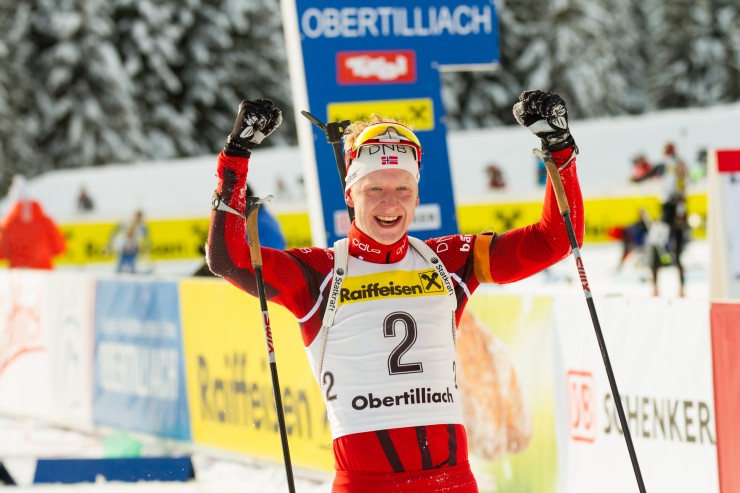
Tag: Richard Boruta

  • From Biathlon to XC: Kocher Un-Retires for a Run at PyeongChang

    From Biathlon to XC: Kocher Un-Retires for a Run at PyeongChang

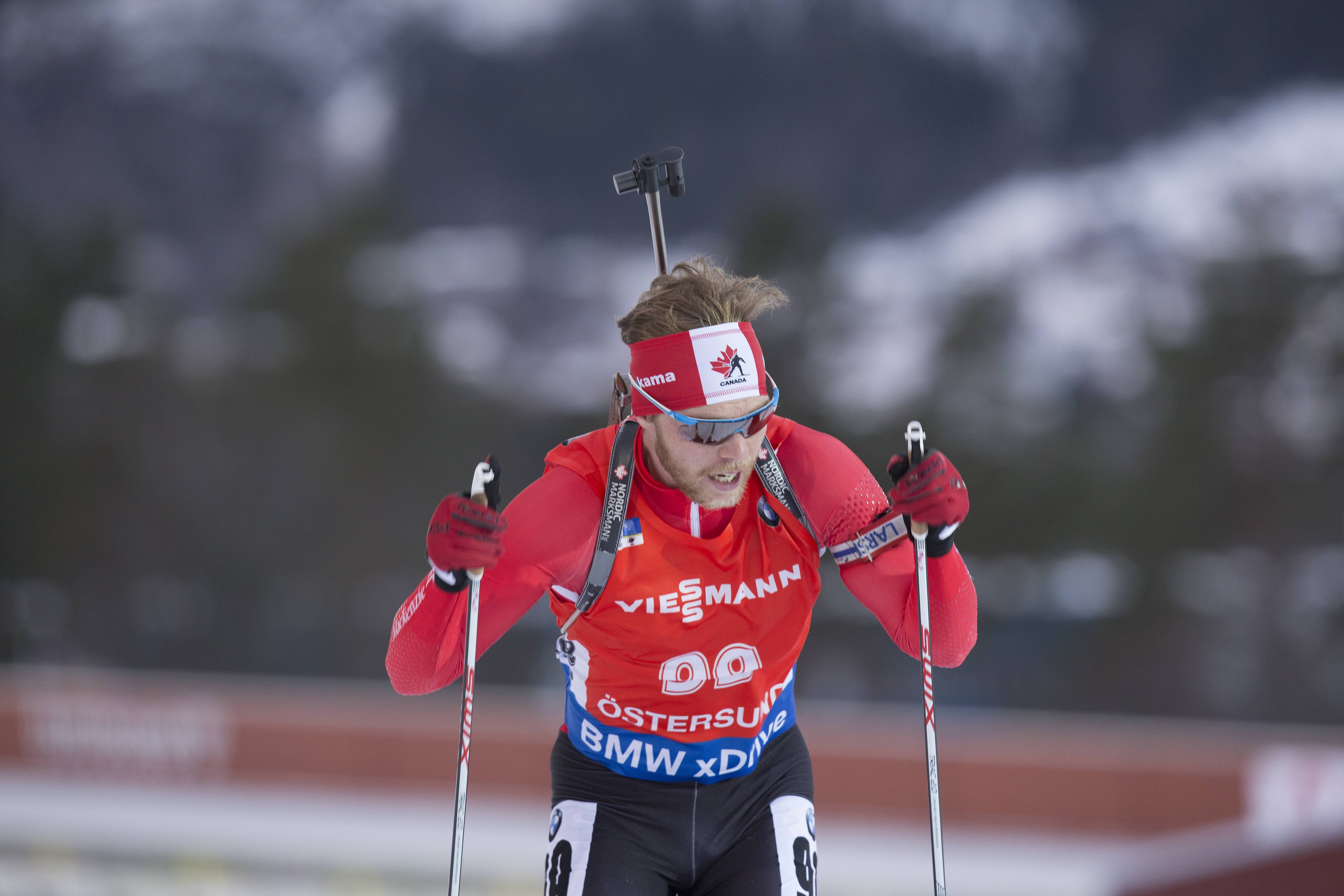
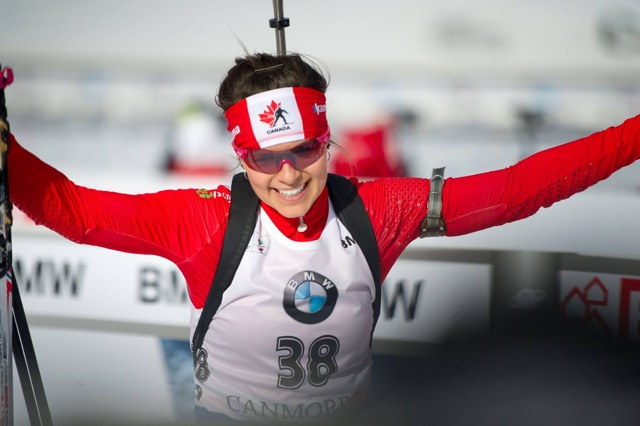
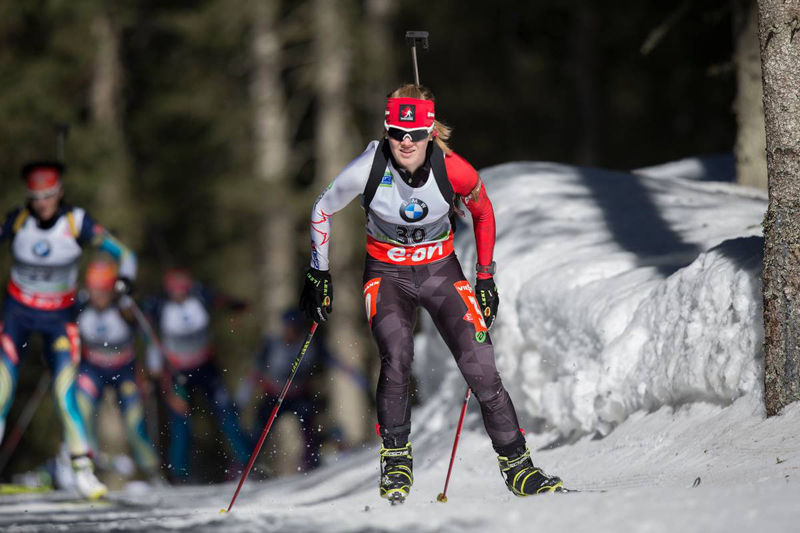
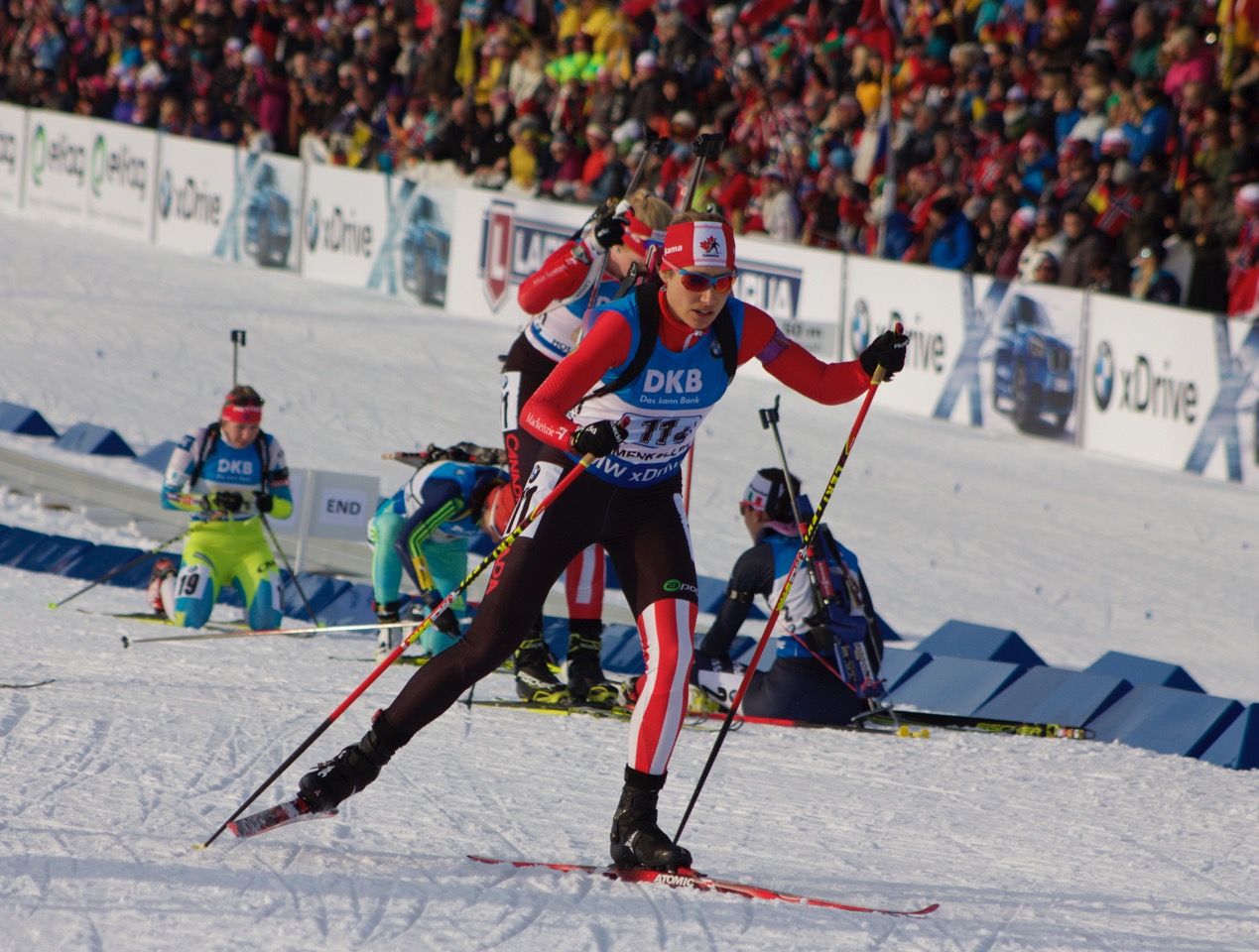
    Canada’s Zina Kocher heading out for the final leg of the women’s 4 x 6-kilometer relay at 2016 IBU World Championships in Oslo, Norway. Her team went on to place 15th. (Photo: JoJo Baldus)

    “I’m un-retiring for six months,” 34-year-old Zina Kocher said with a laugh on the phone earlier this week. 

    Kocher, who lives in Canmore, Alberta, announced via Instagram on Oct. 2 that she was returning to elite-level racing with the one-and-done hope of making the 2018 Winter Olympics in PyeongChang, South Korea. As she referenced in her social-media post, Kocher’s return to the trails will be “4k” (kilograms) lighter — her current run at the Olympics Games will be in cross-country, not biathlon.

    For sixteen years, Kocher trained and raced as a top-tier Canadian biathlete. She was a three-time Olympic biathlete and raced at 12 World Championships. After the 2016 race season, Kocher pulled the plug on her ski career. She worked as a doula, completed her first year of massage-therapy school at Calgary’s Mount Royal University, and married Alex Lawson this past summer.

    The question for Kocher was what to do with all her pent-up energy? Like many endurance athletes, she’s wired for movement.

    “I guess for the first few months after I retired, I didn’t exercise much,” Kocher said. “I traveled, I went to Turkey and Greece, I rock climbed a lot. … Actually in January 2017, when I started school full time, I just felt that I needed something. When I left school each day, I was like a caged animal and I had to go and be physical because I had had enough of sitting in a chair for hours and listening.”

    That restlessness was partially tamed with bi-weekly gym sessions, running and occasionally, cross-country skiing in the evening. All this was simply to burn extra fuel.

    “My body had a hard time with being sedentary,” Kocher said. “There was no thought about being in the Olympic Games. It was just, I need to be physically active. That was my only thought. I actually would often study for one of my classes while I was on a bike in the weight room because I had to go through flashcards for anatomy. So I would study and work out at the same time.”
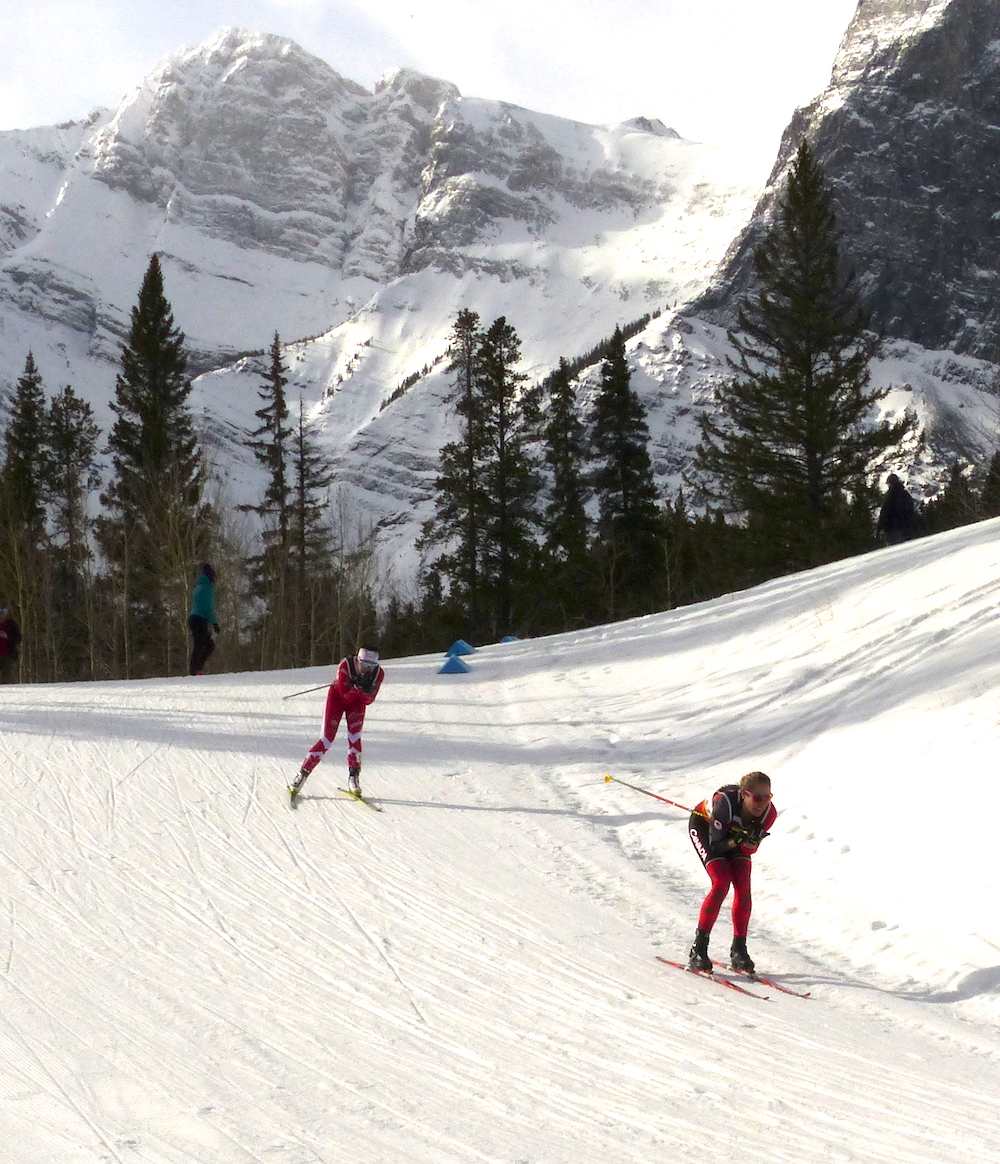
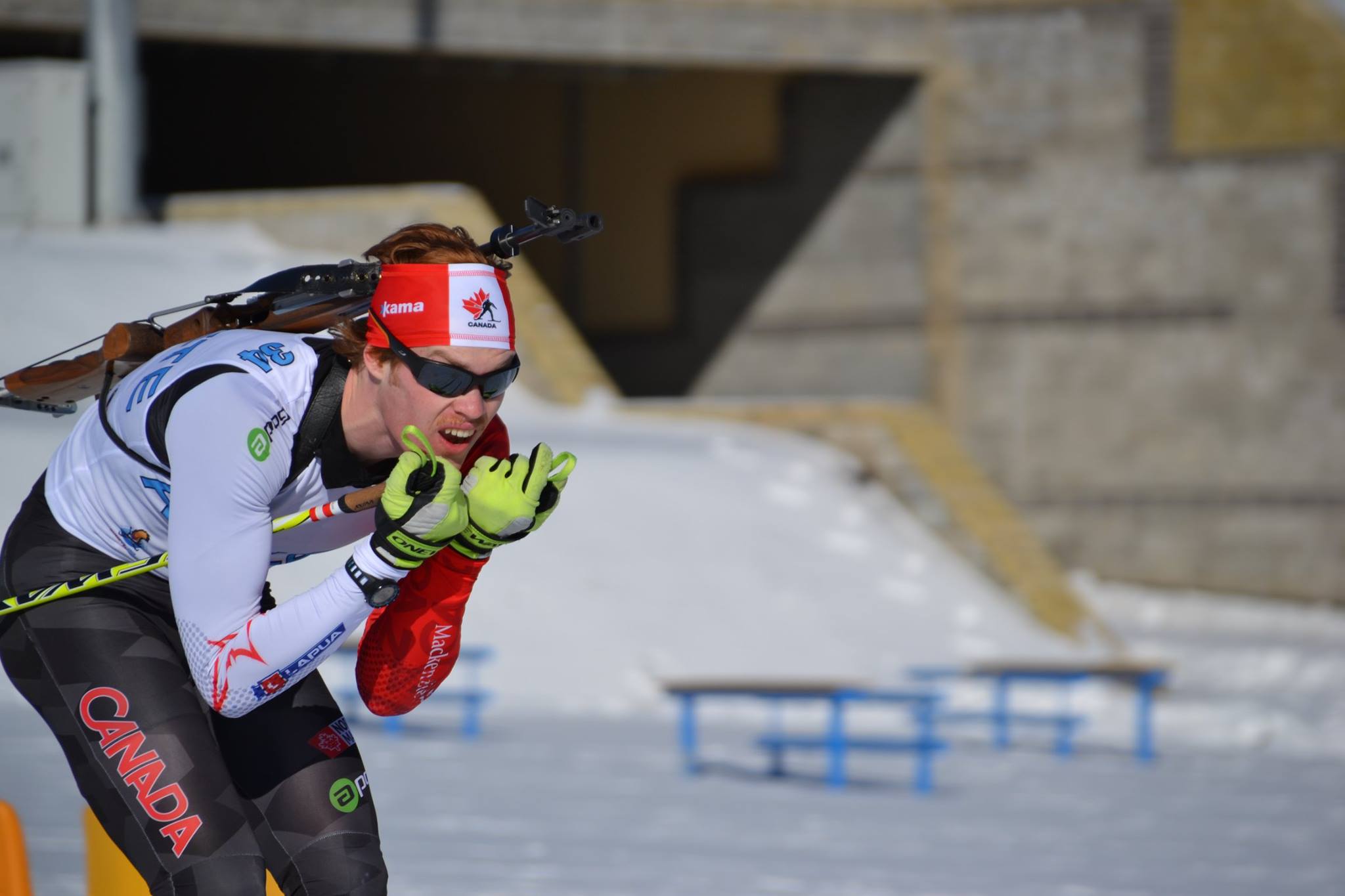
    Zina Kocher (r) leads Emily Nishikawa in the 30 k freestyle mass start at the 2017 Canadian Ski Nationals. (Photo: Peggy Hung)

    Flipping through flashcards, passing classes and pumping the blood wasn’t enough. Considering Kocher’s athletic resume, she needed something more. She signed up for the Cross Country Canada (CCC) 2017 Ski Nationals in Canmore. No travel, no stress finding a wax guru to prime the skis — a Canadian nationals in her backyard would simply be a carrot to motivate her while in school.   

    Kocher is known as one of Canada’s best skate skiers — at the 2017 Canadian Ski Nationals in March, she won the 5-kilometer freestyle and placed second to CCC World Cup Team member Emily Nishikawa in the 30 k freestyle mass start.

    “There were definitely side comments after those races from people, like, ‘Are you training?’ and ‘You should maybe think about maybe training full time again,’ and ‘Have you thought about the Olympics?’” she reflected.

    The 2018 Olympics were not part of the plan. But Kocher’s results at nationals started the wheels turning.

    For 10 years, Kocher was coached by Richard Boruta. On Sept. 9 of this year, Boruta died in a climbing accident outside Canmore.

    Last April, Kocher said Boruta made a few passing jokes about qualifying for the Olympics. Initially, she was tepid about the prospects of a comeback. Her primary goal remained finishing her education. She did, however, ask Boruta and her former physiologist if she could mount a viable comeback if she delayed full time training until this September.

    “Basically their thoughts, Richard’s thought and the physio’s was, yeah, I have a huge base behind me and I haven’t exactly laid on the couch and done nothing for a year and a half,” she said. “So we can do this.”

    In a sad twist of timing, Kocher said the day she contacted Boruta to confirm she was ready to begin his training plan was also the day of Boruta’s accident.

    “Richard knew we still wanted to do it, but he was waiting for me basically to be ready to start a full program,” she said. “I think I would have had regrets if I hadn’t done this, and it was going to be our fun challenge together. I think in a way it’s my way to honor Richard.”
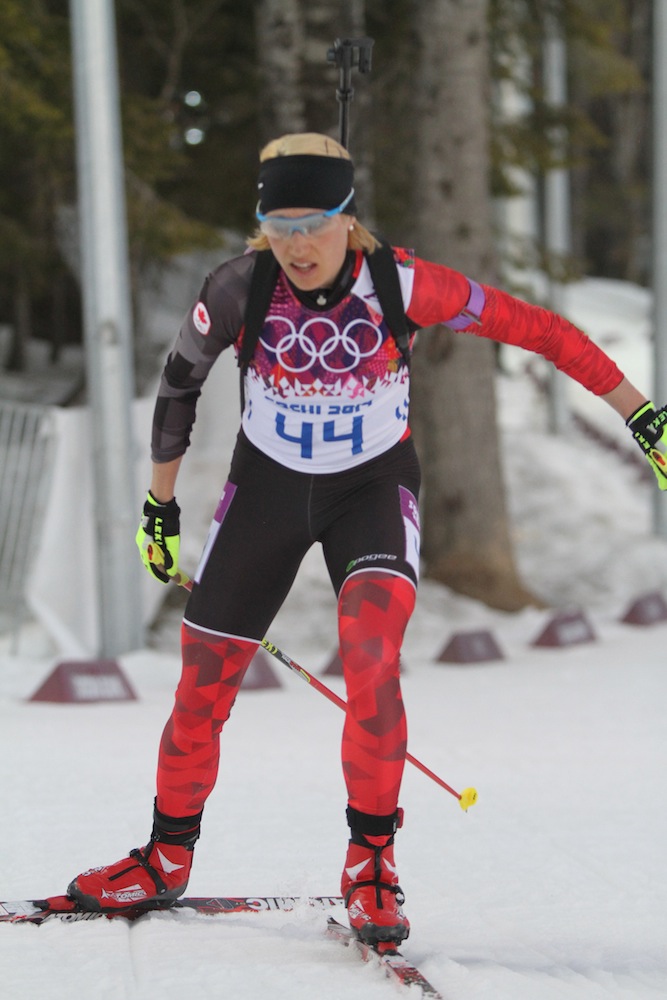
    Zina Kocher racing the 15 k individual at the 2014 Sochi Olympics. (Photo: FasterSkier)

    Committed to the comeback, Kocher reached out to former CCC national-team head coach Justin Wadsworth for assistance. Wadsworth also lives in Canmore and is now coaching Kocher.

    “We have had Zina at our training camps in the past and Zina is just a real pleasure to have around,” Wadsworth said on the phone. “She is easygoing and she has always been positive. So she asked me if I would be interested to help, especially in light of what happened with Richard I told her I would be more than happy to do what I can, and so we set out on this journey together.”

    Kocher appears to have all the parts to make an Olympic return. Yet one critical aspect of the comeback is a work in progress. For all of her adult life (up until a year and a half ago), Kocher trained full time as a biathlete. In that world, classic skiing expertise is not a requirement.

    “I feel confident in skating,” Kocher said with a slight laugh. “I don’t feel confident in classic, but I hope that in a couple months I will feel confident in classic.”

    On the International Biathlon Union (IBU) World Cup circuit, her career best was third place in the 15 k individual in 2006 in Östersund, Sweden. In reaching that podium, she was the first Canadian to earn a medal in over a decade. She went on to record several top-1o finishes and was a member of the Canadian women’s 4 x 6 k relay team that placed fourth at a World Cup in 2013, with Megan Imrie, Rosanna Crawford and Megan Tandy. At the Sochi Olympics, her 4 x 6 relay team placed eighth for the best-ever Canadian Olympic result in that event, and she was the top Canadian in 25th in the Sochi 10 k pursuit.

    But all of those events were skate. The classic-technique piece is critically important for Kocher’s PyeongChang quest. The Canadians will host Olympic Trials in January in Mont Sainte Anne, Quebec. At those trials, Kocher will have to contest, and most likely win, a 10 k classic and a skiathlon in hopes of qualifying. (The PyeongChang women’s distance events are a 10 k skate, 30 k classic and 15 k skiathlon.)

    With limited time and limited classic experience — Kocher said she only used classic technique as recovery when she was a full-time athlete — Wadsworth has an abridged plan for Kocher. He also understands the challenges at play. 

    “I’ve seen Zina classic ski a tiny bit over the years,” Wadsworth said. “And classic skiing is got to be right in there with one of the most technical athletic things that you can do. The motion, kicking the ski, it is quite hard to become efficient at.”

    Wadsworth admitted he likes the challenge and has laid down a practical approach to hone Kocher’s classic skiing.
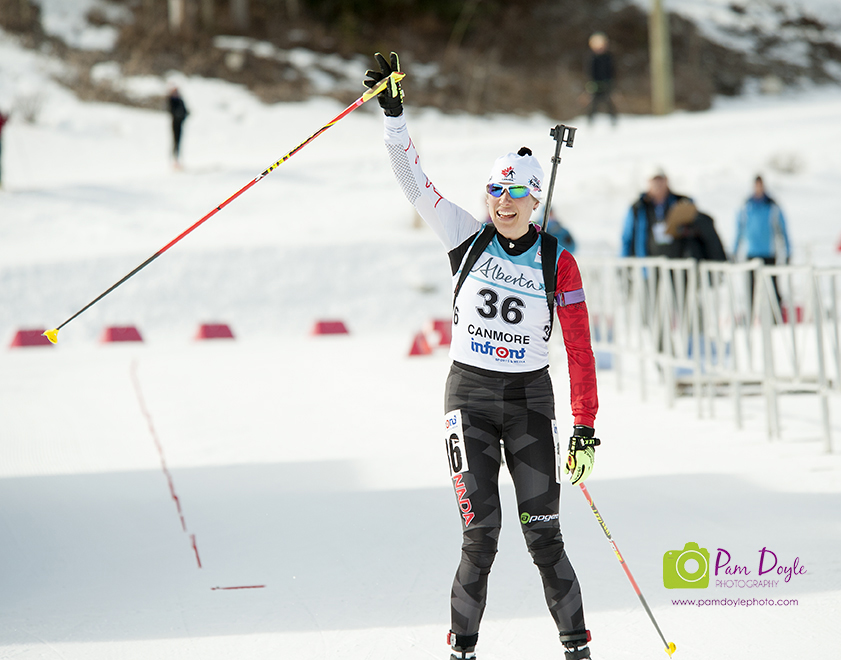
    Zina Kocher waves to the home crowd after placing second in an IBU Cup sprint in Canmore, Alberta. (Photo: Pam Doyle)

    “We have a few strategies,” Wadsworth said. “We have just focused on double poling and skating. And then we are going to start working on actual classic technique once we get on snow so there are no bad habits developed on the rollerskis. We don’t have a lot of time, a couple of months here, but I think she can get to a place where on the right day with the right skis she could stay near enough to the leaders in a skiathlon to let her skating take over.”

    It appears since retiring and un-retiring, Kocher’s high quality, low-volume training has her motor primed. Back in the late spring, Kocher received some data indicating she had not lost much fitness since retiring as a biathlete.

    “I did do a treadmill test just because they needed some subjects for some students, and that was in May or June,” Kocher said. “Everything was totally normal to how I always am in the spring. It was the exact same baseline.”

    More recently, Kocher displayed an effort indicating her temporary comeback may be for real.

    “I will say at this point — we’ve trained for about three or four weeks and then kind of officially together — she did the Norquay uphill time trial and I think she posted her second-best time there as an athlete and among the better times that I have seen from cross-country skiers,” Wadsworth noted. “Fitness-wise she is back in good shape, and I think she is ready to give a good stab at this. … Definitely some really good women are preparing for the Olympics and probably have a leg up on her, but you know, there are some spots available. And I think she has a good opportunity and she has a lot of experience. She is approaching her training plan very wisely and with a lot of experience it might pay off.”

  • At 49, Richard Boruta Leaves a Biathlon Legacy

    At 49, Richard Boruta Leaves a Biathlon Legacy

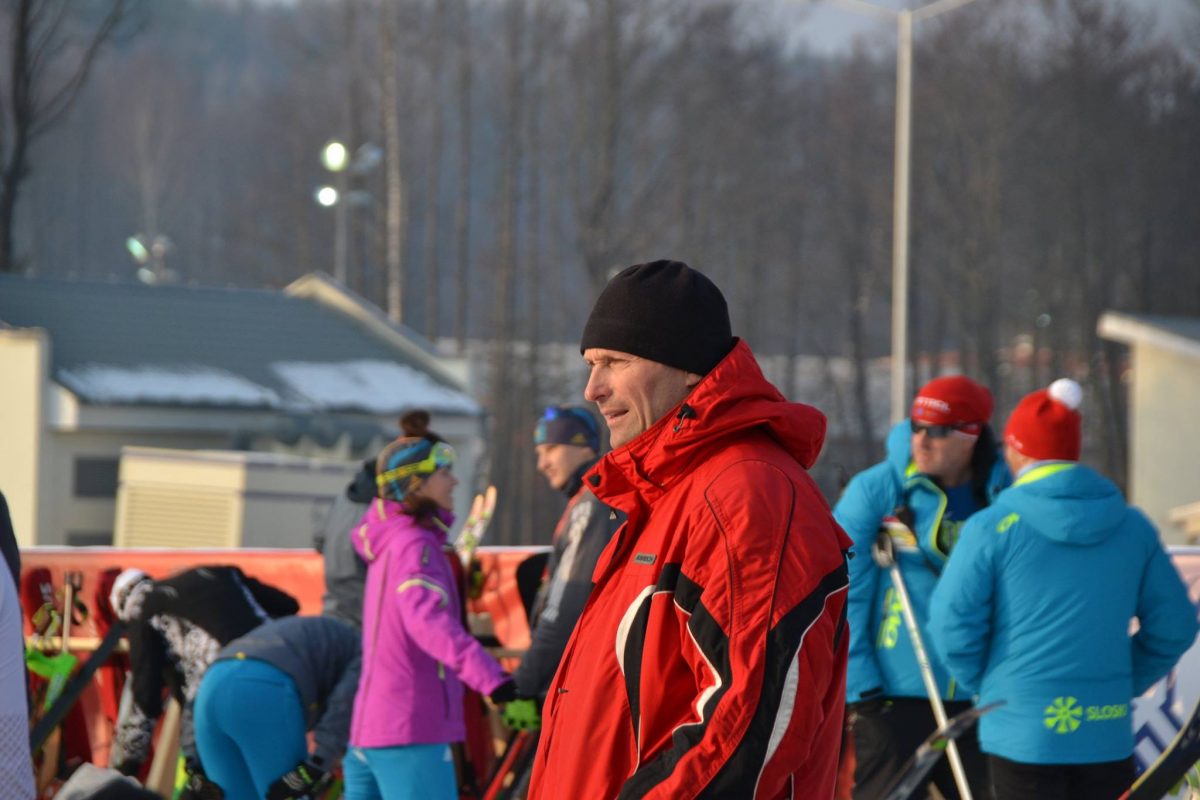
    Richard Boruta, head coach at the Biathlon Alberta Training Centre, died in a climbing accident on Aug. 9. (Photo: Jane Robertson)

    Few nordic ski racing and biathlon venues are as awe-inspiring as the Canmore Nordic Centre in Alberta, Canada. Just south of the venue, amidst the geologic upheaval that is the Canadian Rockies, punches the Three Sisters — a string of iconic Canmore mountains. While descending from a technical route on the Middle Sister earlier this month on Aug. 9, Richard Boruta, a seasoned climber, died in a climbing accident. He was 49.

    At the time of the accident, Boruta was attempting the Three Sisters Traverse as part of his 50th year, as he was turning 50 in October. It was Boruta’s first time on the climbing route.

    Boruta was a fixture of Canadian biathlon’s high performance and development scenes since 1998 when he immigrated to Canada from his native Czech Republic. Most recently, he was named Biathlon Canada’s male coach of the year for 2017. It was his third time receiving the award.

    His Canadian coaching career began with Canmore’s Rocky Mountain Racers (RMR). Boruta advanced to become the Canadian national team’s head coach in 2002. He remained in that position until 2006, after seeing his athletes compete at the Torino Olympics. Post-Torino, Boruta left the national team to become more involved in the development side of the sport.

    In 2011, Boruta became the head coach of the newly formed Biathlon Alberta Training Centre (BATC).

    Zina Kocher waves to the home crowd after placing second in an IBU Cup sprint two seasons ago in Canmore, Alberta. (Photo: Pam Doyle)

    Zina Kocher, a three-time Canadian Olympic biathlete, fostered a deep connection to Boruta as she emerged onto the Canadian biathlon radar. Kocher told FasterSkier on the phone that she qualified for the national championships in 12th grade at age 17. To her surprise, she placed in the top 10, and Boruta took notice.

    At biathlon nationals, the arrangement was for athletes to attend with the regional coach, not their specific club coach. Boruta was the Alberta regional coach for the event and by default helped guide Kocher. Boruta asked Kocher to join RMR, where he was then coaching.

    “I had friends already on that team,” Kocher said. “I decided to try for the summer.”

    That short-term arrangement quickly evolved. Kocher decided to bump the summer commitment up to a year long stay.  

    “I was enrolled in college and then I decided to train full time and do it for one year and see if I could make the world junior team,” Kocher recalled. “They had a lot of faith in my ability and they pushed me to go for it. I made the world junior team … I made my first Olympics in 2006, and I spent all that time being coached by Richard.”

    Kocher remained on the national team from 2006 to 2011. During that time she worked primarily with other coaches. After a performance downturn in 2011, Kocher decided to train with Boruta and BATC. Until her retirement in 2016, Kocher was coached by Boruta for all but the year following the Sochi Olympics when she trained with the national team. (For the 2016 competition year, Kocher was coached by Boruta as a member of BATC.) From 17, until her retirement at 32 years old, Boruta helped shape Kocher.

    “I feel like he changed a lot himself from the time he was first coaching to the end,” Kocher reflected. “At the beginning, he was quite Eastern European, he was strict. I cried a lot. It was hard. He pushed me, he constantly challenged me, he always expected more from me. If he said ‘good job,’ you did awesome. Those comments he kept to the end, but he turned maybe more Canadian. Near the end, if I got emotional, he would just give me a big hug. He didn’t say anything. It was just a hug.”

    Macx Davies (Biathlon Canada) racing to a career-best 10th in the IBU World Cup 10 k sprint in Ostersund, Sweden, last December. (Photo: Biathlon Canada/NordicFocus)

    Macx Davies, of Biathlon Canada’s national senior team, was also mentored by Boruta at BATC. For his first two years after high school, Davies said Boruta helped him form a knowledge base that eventually led him to a national-team nomination.

    “During those two years we developed a working relationship and he taught me how to be a full-time athlete,” Davies wrote in an email. “From how to train in proper zones, to hitting targets, to being a well-rounded individual, Richard helped shape who I am today.”

    Davies reiterated a point that Kocher made several times: that Boruta was even-keeled, calm and perfectly suited for a sport like biathlon where unsteady nerves can sink an otherwise stellar ski performance.  

    “As a coach, Richard was the most calm and soft-spoken I ever had,” Davies wrote. “Whether you are racing for a spot on the Olympic team or doing a time trial at home, he was the same calm, supportive and helpful coach, always there to give you a smile, head nod, and if you did really well an illusive high-five!”

    Boruta’s life work was still firmly immersed in the present as he coached Megan Bankes, a rising star for Biathlon Canada. At 19 years old, Banks is coming off a season where she won two individual gold medals at the 2017 IBU Junior World Championships. Despite being named to the senior national team, Bankes still trained with Boruta as a member of BATC.   

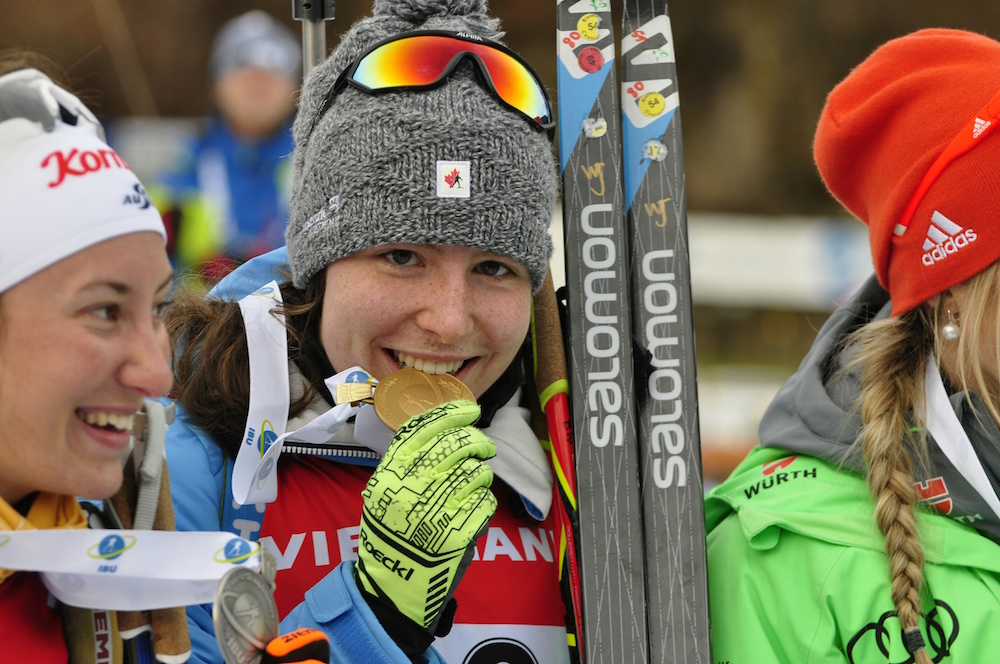
    Canada’s Megan Bankes takes a bite out of her gold medal after winning the junior women’s 12.5 k individual at 2017 IBU Junior World Championships in Osrblie, Slovakia, and becoming the first Canadian woman to do so at Biathlon Youth/Junior Worlds. (Photo: Airat Aitniakov)

    Helping athletes reach their potential was Boruta’s bread and butter. And for Boruta’s clan of biathletes, that potential often meant the international stage. According to Roddy Ward, Biathlon Canada’s high-performance director, half of the current national team moved through BATC under Boruta’s tutelage.

    “Richard was a key player in helping Canada close the gap to the international podium,” Ward wrote in an email.

    Ward first met Boruta while competing as a junior biathlete. In 2006, when Ward returned to Canmore for a coaching position, he became professionally linked to Boruta.

    “Since 2011, Richard coaching BATC and myself coaching National Team we worked more closely together, often working together with athletes in a NT camp based program (Megan Bankes, Julia Ransom, Emma Lunder, Sarah Beaudry), combining for many training sessions, camps, testing, races etc.,” Ward explained.

    The data and spreadsheets, the periodization and hours trained are part of developing an athlete. A coach may tinker with more technique one year, more volume the next. Yet one aspect of the coaching equation difficult to change is the personality each coach brings to the athlete-coach relationship. Ward noted that by observing Boruta, he came to understand that some of what Boruta practiced could, in fact, make his own coaching more effective.

    “Early in my career I would notice a contrast to Richard and myself on the range while explaining the day’s training,” Ward emailed. “I would be almost yelling the directions while athletes chatted among themselves and ran around not listening (I’d often have to give directions multiple times), while Richard would talk very quietly (like he always does) while all his athletes listened very closely so they could actually hear the directions. I thought there was something to that and started to apply this technique in my own way.”

    Kocher said Boruta understood his inherent strengths. “One time we did this one truth and two lies,” Kocher said. “I’ll never forget because the truth was ‘I believe in nonverbal communication.’ That was him. He didn’t say a lot of words and what he said was valuable and it meant a lot.”

    Ward also absorbed the Boruta “less-is-more” tenant.

    “Talk less and listen more,” Ward wrote. “When you do say something it will have a bigger impact. I used to talk too much, give too much direct feedback, be too assertive. Now I let the athlete lead more, don’t always give them answers immediately, try to listen more than talk. It’s made me a better coach and teacher.”

    But there were days when Boruta could scream encouragement. And in those moments, when the coaching lessons had been ingrained, Boruta revealed his love for seeing others achieve.

    “He was someone who didn’t show a ton of emotion,” Kocher said. “Yet when he showed emotion it was passionate. I remember this happened a few times. A long time ago, for the first time, I was going to make a pursuit. I was a first year senior and had just done a World Cup as a junior. Back then I had never made the top-60. Then in the third World Cup in December, in 2003 I guess, I was in Slovakia. It was a windy day and I shot zero-zero. I just remember leaving the range just like super confidently. I had just shot clean for the first time in my life. Literally, Richard was running beside me on the hill. Somehow he had left the range and he was on the hill and he was cheering me on telling me I could get a top-10. And the course was really open and he was able to come out while I was finishing the climb and hitting the next downhill. Then he was suddenly on the next hill. He was cheering me on that one, and then he was near this bridge near the finish. He just found his way onto all these spots on the course to get me to go harder, and he was at the finish line. I remember his passion a lot from that day.”

    Boruta is survived by his wife Kamila and three sons Michal, Thomas and Lukas, his mother Jirina, father Richard, and granddaughter Sophie.

  • Bankes Gets Gold #2 for Canada with Perfect Shooting at IBU Junior Worlds

    Bankes Gets Gold #2 for Canada with Perfect Shooting at IBU Junior Worlds

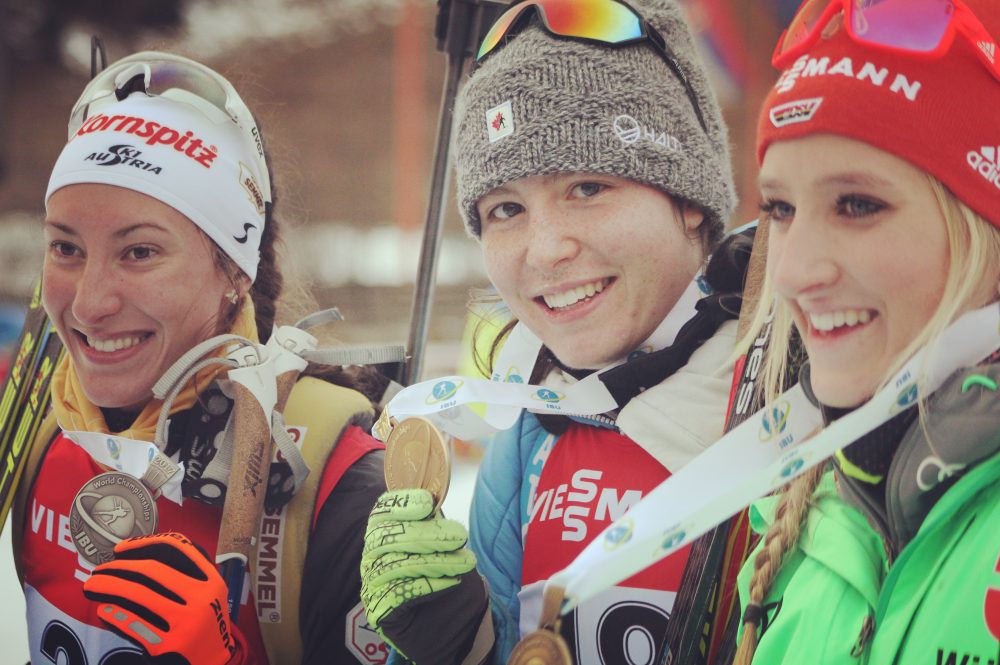
    Canada’s Megan Bankes flashes a smile and her gold medal after winning the junior women’s 12.5 k at IBU Junior World Championships on Thursday in Osrblie, Slovakia. individual podium on Thursday at IBU Junior World Championships in Osrblie, Slovakia. Joining her on the podium are Austria’s silver medalist Julia Schwaiger (l) and Germany’s bronze-medalist Anna Weidel (r). (Photo: Jacqueline Akerman)

    (Note: This article has been updated to include comments from Megan Bankes.)

    Just to review:

    • 2004: Jean-Philippe “JP” Le Guellec becomes first Canadian to win an International Biathlon Union (IBU) Youth World Championships title (in the youth men’s sprint).
    • 2009: Kurtis Wenzel becomes second Canadian to win at IBU Youth Worlds, with a gold medal in the youth men’s sprint.
    • 2012: Wenzel does it again as a junior, winning the 15-kilometer individual at IBU Junior Worlds.
    • Feb. 22, 2017: Leo Grandbois shoots a perfect 20-for-20 to become the third Canadian to be crowned a world champion at Youth/Junior Worlds, winning the youth men’s 12.5 k individual in Osrblie, Slovakia.
    • One day later: Megan Bankes repeats the 20-for-20 shooting feat in the junior women’s 12.5 k individual in Osrblie and becomes Canada’s first woman to win at Youth/Junior World Championships.

    And just like Grandbois, Bankes had never hit 20 consecutive targets without a miss in a race before. In fact, she had never cleaned a race of any length before. Doing so earned her a gold medal in her first race of her fourth Youth/Junior Worlds.

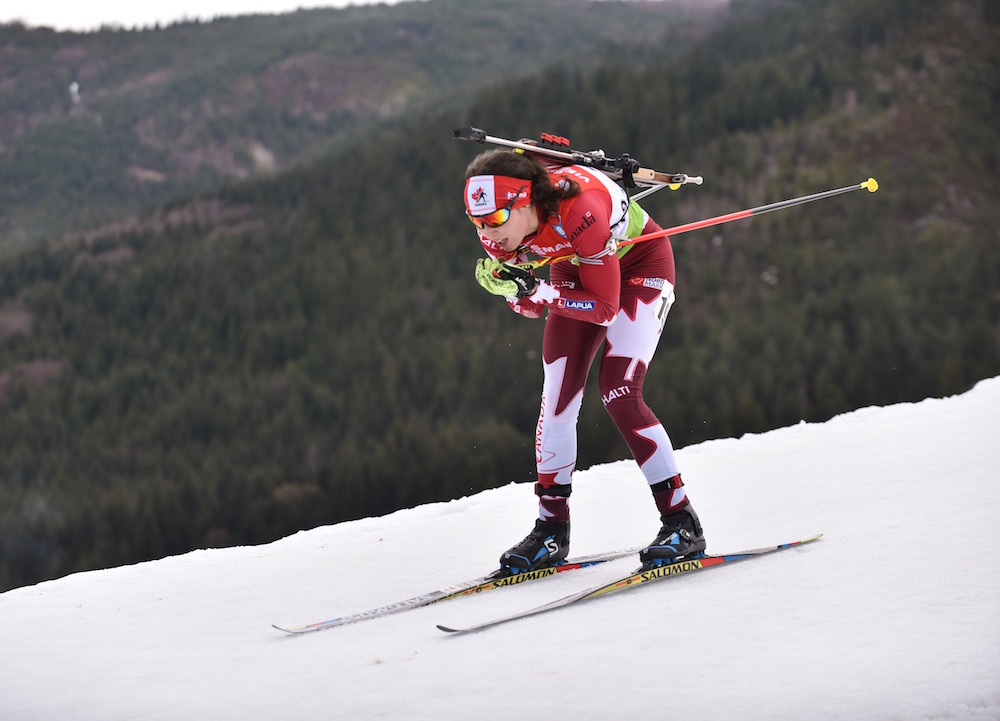
    Megan Bankes racing to an unprecedented gold for a Canadian woman in the junior women’s 12.5 k individual on Thursday at 2017 IBU Junior World Championships in Osrblie, Slovakia. (Photo: Bryan Dickson)

    “I watched Leo yesterday and gained a lot of inspiration from him,” Bankes said, according to a Biathlon Canada press release. “I saw how calm he was on the range and just felt if he can do it then I can, too. I just wanted to go out there – shoot clean and ski fast.”

    As the 19th starter in a field of nearly 70 women, the 19-year-old Bankes, who trains with the Biathlon Alberta Training Centre (BATC) in Canmore, set down the performance to beat with clean shooting and a finishing time of 37:22.0 minutes. She bumped Germany’s Anna Weidel, the 13th starter, to second place with a time that was 1 minute and 20 seconds faster. Weidel had missed just one shot — still an impressive performance in a four-stage race — in the first standing stage (0+1+0+0). Each miss adds a minute penalty to a racer’s total time.

    “I was incredibly stoked to clean my last standing, and then knew I just had to push super hard up the last 2 hills and ski smart all the way to the finish,” Bankes wrote in an email to FasterSkier. “When I crossed the finish line I was really excited, but I didn’t really think my result would hold up because there were a few girls who were skiing fast and had hit 15/15, but then when a bunch of them started missing, and I realized my position was going to hold, it was incredible.”

    Her overall course time ranked 11th, comparable with the two women she ended up sharing the podium with. Weidel was ultimately pushed to third when Austria’s Julia Schwaiger in bib 26 finished 32.1 seconds faster for silver. With one costly miss in her final standing stage (0+0+0+1), Schwaiger’s finishing time was 47.9 seconds short of gold.

    Canada’s Megan Bankes takes a bite out of her gold medal after winning the junior women’s 12.5 k individual at 2017 IBU Junior World Championships in Osrblie, Slovakia, and becoming the first Canadian woman to do so at Biathlon Youth/Junior Worlds. (Photo: Airat Aitniakov)

    That medal went to Bankes, one of five women in the race to hit every target.

    “I shot with a lot of confidence today. It came really easy,” Bankes told Biathlon Canada.

    But, as there usually is, there was a backstory on Thursday.

    “She had a what she said was a ‘horrific’ zero,” her coach Richard Boruta explained of her pre-race target practice, in an email co-written with Canada’s trip leader/head coach Jacqueline Akerman.

    Boruta tried to calm Bankes down, assuring her that she had the self confidence to execute strong shooting.

    “My coach Richard just told me to go out pretty hard and not lose too many seconds up the first couple hills, and then settle into my race,” Bankes recalled in the email. “The range entry is pretty easy, because you’ve got a bit of downhill into it, so you can push pretty much as hard as you want (or can).”

    “Megan had been focused the whole day on the race and she new what she needed to do and was able to pull it through,” the two coaches wrote. “The trail conditions and weather have been challenging with all the rain and slush, but Megan managed to ski very tactically along the flats and paced herself well on the two major climbs in the course.”

    According to them, one of Bankes’s longtime goals had been a top eight at these championships. That changed after she broke through on the IBU Junior Cup earlier this month, placing second in the 10 k pursuit at IBU Junior European Championships in Nove Mesto, Czech Republic. After that, she visualized herself in the top five, maybe top three, in her first year as a junior at world championships. Bankes had previously notched 18th in the pursuit and 19th in the individual at last year’s Youth World Championships in Romania.

    “Junior OECH was a pretty big confidence boost, but coming into the race, I didn’t totally know what to expect,” Bankes wrote. “I knew that if I had a really good day on the range and on the course, then I could do well, and maybe podium, but I didn’t really imagine that I would hit 20/20, and win!”

    Individual-format races require solid shooting and fast skiing, just like any biathlon race, but the one-minute penalties as opposed to penalty laps put an emphasis on shooting accuracy.

    “I can’t say they have ever been my strong suit!” Bankes wrote of individual-format races. “So for me the goal was to start pretty fast on skis, stay calm in the range, and then see what happened.”

    “After I got the silver [in Nove Mesto], I knew if I shot and skied well, I could get a medal here,” she told Biathlon Canada. “It takes a long time to get to this point. I think having been here [at Youth/Junior Worlds] four times now I have the experience to do this. I have everything around me here that I need to be successful.

    “It is pretty exciting,” she added. “This is the first time I’ve shot 20 for 20. It never crossed my mind, but to be the first Canadian [woman] to win is very cool.”

    According Akerman and Boruta, they had anticipated that Grandbois and Bankes would have “a respectable chance” at a medal, along with other team members as well. But two gold medals in two days?

    “We have had good results and medals in the past, but it has been up and down with a few top athletes hitting the top 10 or reaching the podium,” they wrote. “Now we see the group as a whole rising together.”

    Megan Bankes (second from l) with her Canadian support crew, including her former coach Tyson Smith (c), wax techs Andrew Chisholm (l) and Andrzej Lesnik (second from r) and Canada’s trip leader/head coach Jacqueline Akerman (r), after Bankes won the junior women’s 12.5 k individual for Canada’s second gold medal of 2017 IBU Youth/Junior World Championships in Osrblie, Slovakia. (Photo: Airat Aitniakov)

    They credited “consistent and qualified coaching support in yearly developmental stages”, and explained that Bankes started the sport with coach Iaroslav Khomiak at Foothills Nordic in Calgary. She was later coached by Tyson Smith (Nathan Smith’s brother, who is assisting the team at Youth/Junior Worlds) before joining the BATC group in Canmore in 2015.

    Last summer, Biathlon Canada launched a funded “Shooting Stars” camp, which brought national-team staff and coaches together with athletes and their coaches in Canmore. The team also added IBU Junior Cup tours to the schedule to give young athletes opportunities to experience international competition in Europe and “get to know each other before WYJCHs.”

    “My observations of this current group; they are pretty grounded, are very motivated, focused and are they are both pushing and supporting each other in all aspects of their performance,” Akerman and Boruta wrote.

    So what does two gold-medal performances mean for Canada?

    “There is now a great opportunity for an greater amount of exposure for our athletes and our sport,” the coaches wrote. “… More solid results ahead for us this week, there are other realistic opportunities within the group. The whole team, including staff are motivated and focused for that. … Of course Leo and Megan have both shown what they are capable of, and will be eager for more. Right behind those two in our Jr Women and Youth Men categories are others skilled enough to be right up there with them. Our youth women are a younger crew, but are learning and applying new skills daily, so I am excited to see some PB’s from them tomorrow. The relays also present us with exciting and realistic chances of podiums, it will continue to be an exciting week and championships!”

    Canada’s Emily Dickson (66) racing to 28th for her first top 30 at IBU Junior World Championships in the women’s 12.5 k individual in Osrblie, Slovakia. (Photo: Jacqueline Akerman)

    In the junior women’s race, Canada had two in the points (top 40) and one just outside with Emily Dickson in 28th (+4:21.3) with one miss (0+1+0+0). Nadia Moser finished 41st (+5:55.8) with four penalties (2+0+0+2). Charlotte Hamel did not finish.

    For the U.S., Siena Ellingson placed 50th (+7:11.5) with four penalties (0+1+2+1) and Nina Armstrong 65th (+14:15.3) with eight misses (4+1+2+1).

    Earlier in the day, the junior men raced a 15 k individual, which Norway’s Sindre Pettersen won in 40:17.2 minutes. He started 68th and cleaned three-straight stages before missing two on his last standing (0+0+0+2), but managed a 51.2-second win over Germany’s David Zobel. An early leader in bib 26, Zobel had three penalties (0+2+1+0) yet his time held up for silver despite a challenge from Russia’s late starter Nikita Lobastov (bib 84). Lobastov shot 19-for-20 (0+1+0+0) and finished just four seconds short of Zobel for third place (+55.2).

    Only one athlete in the junior men’s race cleaned: Latvia’s Ingus Deksnis in fifth.

    In his first year as a junior, Canada’s Zachari Bolduc led the North Americans in 34th (+3:44.7) with two penalties (1+0+0+1). He later told FasterSkier his goal had been a top 30, and he was 8.4 seconds short of it on Thursday.

    “I’m happy with this shooting but I was very very slow on my skis,” Bolduc wrote in an email. “The course was a mix of soft snow, ice and slush so it was not easy conditions! I hope I will have better feelings on my skis for the sprint. But, I’m happy with my race today!”

    He was followed by Canadian teammates Trevor Kiers and Jules Brunette in 54th (+5:21.6) and 55th (+5:27.4), respectively, after each shot five penalties. Pearce Hanna finished 65th (+6:38) with seven misses (1+2+2+2).

    The top American on Thursday was Cody Johnson in 50th (+5:08.3) with two penalties, both in the last stage (0+0+0+2). Cameron Christiansen followed in 72nd (+8:10.6) with six penalties (1+1+2+2), and Peter Carroll was 79th (+10:36.4) with four misses (0+3+0+1). Travis Cooper did not start.

    The youth men’s and women’s sprints are scheduled for Friday in Osrblie.

    Results: Junior women | Junior men

  • Biathlon Canada Announces World Cup, IBU Cup, Jr. IBU Cup Teams

    Biathlon Canada Announces World Cup, IBU Cup, Jr. IBU Cup Teams

    Biathlon Canada logo

    On Tuesday, Biathlon Canada published its final roster for the first trimester of the International Biathlon Union (IBU) World Cup, IBU Cup and Jr. IBU Cup. Below is the official announcement:

    Team Announcement Trimester #1

    World Cup, IBU Cup, and Jr. IBU Cup

    The following athletes are nominated to the World Cup, IBU Cup and Jr. IBU Cup Teams for Trimester 1 in accordance with the National Team Program:


    World Cups #1,#2, #3

    Ostersund, SWE, Pokljuka, SLO, Nove Mesto, CZE

    Coaches: Matthias Ahrens, Roddy Ward, Joar Himle

    Service Team: Raphael Grosset, Pavel Stolba, Martin Struna


    MEN

    1. Nathan Smith (National Eh! Squad/Foothills Nordic)

    2. Brendan Green (National Eh! Squad/Hay River Nordic)

    3. Scott Gow (National Eh! Squad/Rocky Mountain Racers)

    4. Christian Gow (National Eh! Squad/ Rocky Mountain Racers)

    5. Macx Davies (National Eh! Squad/Canmore Nordic)

    WOMEN

    1. Rosanna Crawford (National Eh! Squad/Canmore Nordic)

    2. Julia Ransom (National Eh! Squad/Telemark Nordic)

    3. Megan Tandy (National Eh! Squad/Caledonia Nordic)

    4. Sarah Beaudry (National B Squad/Caledonia Nordic)

    IBU Cups #2, #3

    Ridnaun, ITA & Obertilliach, AUT

    Coach: Richard Boruta

    Service Team: Andrjez Lesnik

    MEN

    1. Carsen Campbell (National ZED Squad/BATC/Biathlon PEI)

    2. Pearce Hanna (Edmonton Nordic)

    3. Matthew Neumann (Caledonia Nordic)

    4. Matthew Hudec (BATC/Biathlon Saskatchewan)

    WOMEN

    1. Megan Bankes (BATC/Foothills Nordic)

    2. Nadia Moser (BATC/Biathlon Yukon)

    3. Emma Lunder (National B Squad/ Rocky Mountain Racers)

    4. Erin Yungblut (Rocky Mountain Racers )

    Jr. IBU Cups #1, #2

    Lenzerheide, SUI & Hochfilzen, AUT

    Coach: Jacqueline Akerman

    Service Team: Andrew Chisholm

    JUNIOR MEN

    1. Zachari Bolduc (La Poursuite/Biathlon Quebec)

    2. Adam Runnalls (Calgary Biathlon Racers)

    3. Trevor Kiers (BATC/Timmins Biathlon)

    4. Teo Sanchez (BATC/Chelsea Nordiq)

    JUNIOR WOMEN

    1. Charlotte Hamel (Club plein air biathlon Estrie/Biathlon Quebec

    2. Darya Sepandj (BATC/Foothills Nordic)

    3. Emily Dickson (BATC/Caledonia Nordic)

  • 17 Questions for 2017: Carsen Campbell

    17 Questions for 2017: Carsen Campbell

    Carsen Campbell running Corey pass in Banff national park. (Courtesy photo)
    Canadian biathlete Carsen Campbell running Cory Pass in Banff National Park. (Courtesy photo)

    Welcome to “17 Questions for 2017″, where we are catching up with American and Canadian national-team members before the beginning of the winter season. 

    ***

    Canadian biathlete Carsen Campbell spent his first year as a senior last season, primarily traveling the IBU Cup circuit in central Europe. At the end of the year he got a reward: his first World Cup start, in Presque Isle, Maine, where he finished 78th in the 10-kilometer sprint.

    The 21-year-old Prince Edward Island native long represented Canada in the youth and junior ranks and is now moving toward contributing to its senior team.

    1. Biggest change in your life in the last five or so months since the ski season ended?

    Carsen Campbell competing at 2015 World Junior Championships. (Photo: Jake Ellingson.)
    Carsen Campbell competing at 2015 World Junior Championships. (Photo: Jake Ellingson.)

    This year I have a D card [for funding from Sport Canada]. It lets me work less and train and recover more!

    2. Biggest change in your training?

    This year I was invited to two camps with the A and B team. The first was a volume camp in Jasper, the second a Altitude and Volume camp in Park City. I have also extended the length of my long rollerskis significantly.

    3. Major areas of improvement you’ve seen so far?

    It will all come to light as soon as we start racing, but I’m pretty happy with everything so far. I’ve put down some pb’s in our up hill tests!

    4. Whom you’ve been working closest with this offseason (coaches or training partners)?

    My coach Richard Boruta has been leading my program.

    5. Best trip in the last five months (and why)?

    This was my first time to Utah and I was taken by the long passes and beautiful fall colors.

    6. Favorite cross-training?

    Mountain runs, preferably long ones!

    7. Favorite non-athletic activity or pastime this summer?

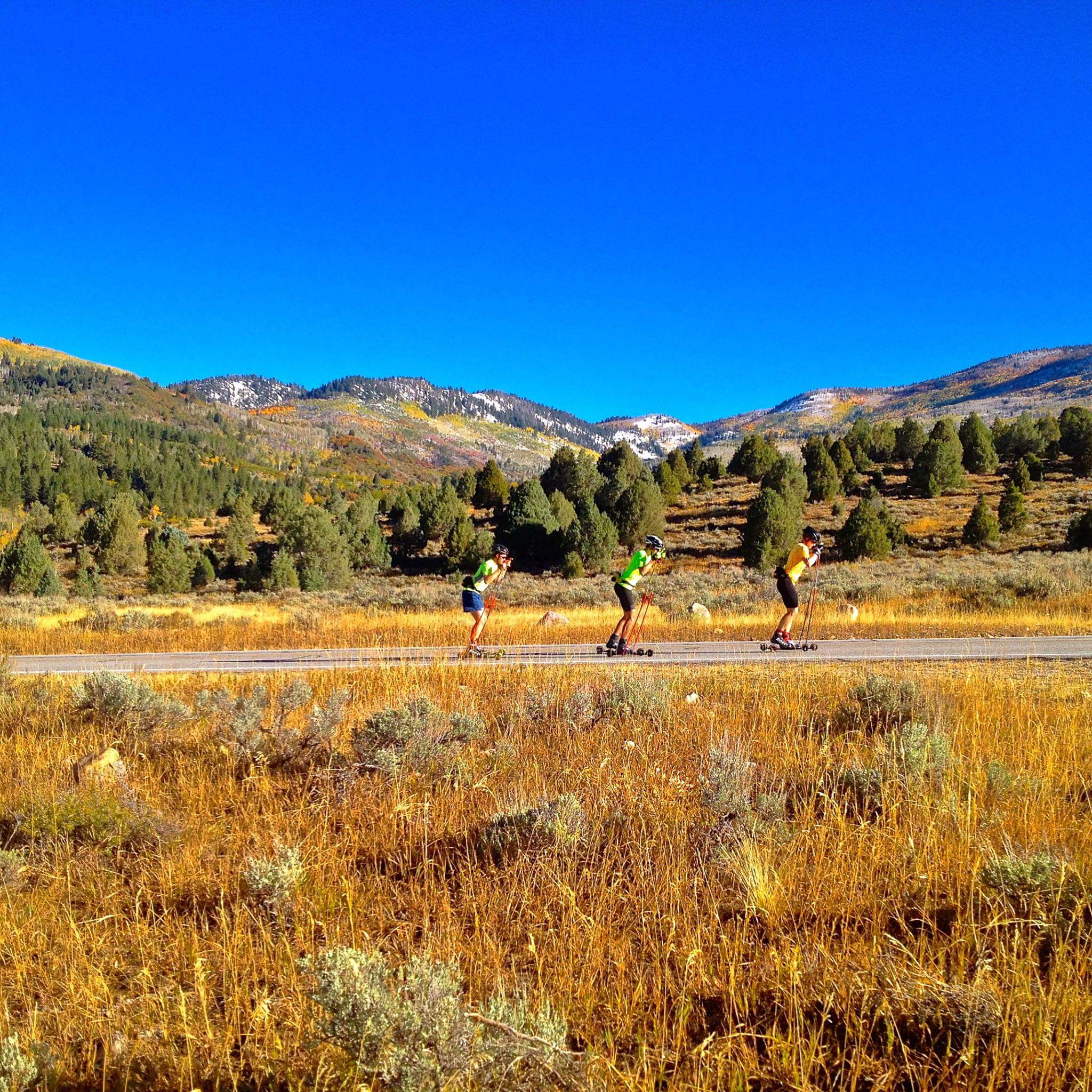
    Campbell and teammates rollerskiing at a recent camp in Park City, Utah. (Courtesy photo)
    Carsen Campbell and his teammates rollerskiing at a recent Biathlon Canada camp in Park City, Utah. (Courtesy photo)

    Swimming at Quarry lake

    8. Song that was your jam this summer?

    Gonna, Blake Shelton

    9. All-time favorite race moment?

    That’s way too hard a question. I had a good shooting streak going towards the end of last season, that was pretty fun.

    10. First thing you pack in your bag when you leave for Europe?

    My Hammock! Never know when you’ll have to sleep in an airport.

    11. Venue/event you’re most excited to visit this season?

    I’m excited to race XC nationals at the end of the year in Canmore. We rarely race the XC guys so this will be new and fun!

    12. Who will win the men’s and women’s World Cup titles this year?

    Who won’t get caught doping is a tougher question?!?!

    13. Biggest sacrifice you feel you’ve made choosing this career path?

    Probably being broke all the time and not being able to pursue education and a career.

    14. If you could change one thing about your sport, what would it be?

    I wish there were more races in North America so we wouldn’t be dealing with jet lag and fatigue as much throughout the season.

    15. What did you have for breakfast this morning?

    Cream of wheat, left over from yesterday morning.

    16. In 5 years, I’ll be ____?

    26…that’s scary.

    17. In 50 years, I’ll be ____?

    Hopefully sitting on the porch telling my grandkids about how fast I was in my younger days!

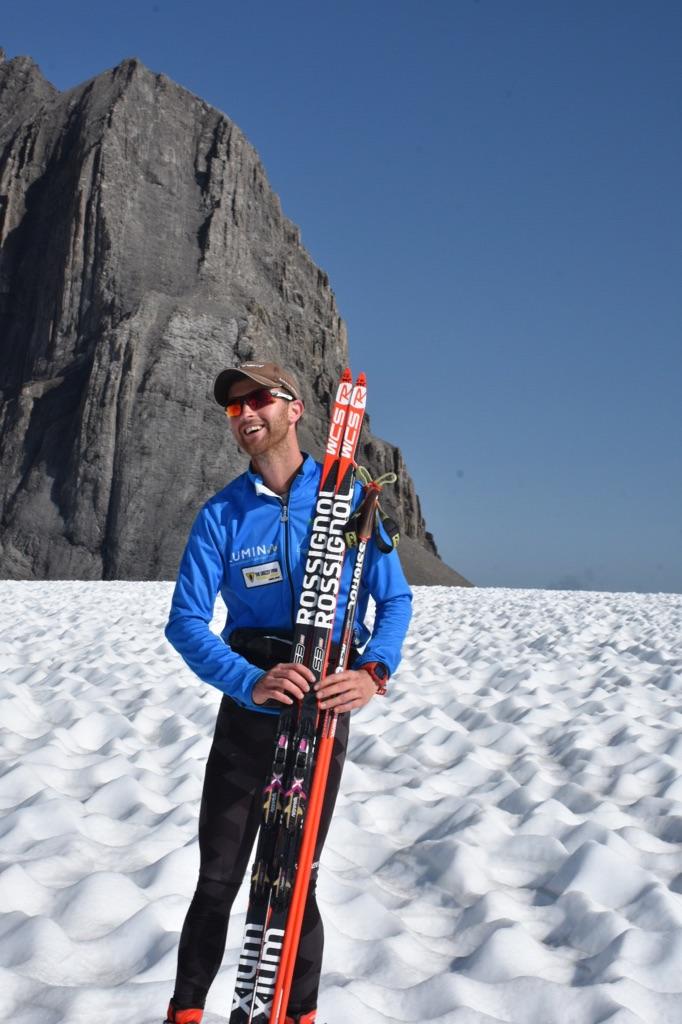
    Campbell on the snow of the Haig glacier in Kananaskis, Alberta.  (Courtesy photo)
    Carsen Campbell on snow at the Haig glacier in Kananaskis, Alberta. (Courtesy photo)
  • No Longer a Rookie, Ransom Enters Second Year on Biathlon Canada’s ‘Eh!’ Team

    No Longer a Rookie, Ransom Enters Second Year on Biathlon Canada’s ‘Eh!’ Team

    Julia Ransom celbrating after a career best World Cup finish of 19th in Canmore, Alberta. (Courtesy Photo)
    Biathlon Canada’s Julia Ransom celebrating after a career-best World Cup finish of 19th in Canmore, Alberta, last winter. (Courtesy Photo)

    Two years ago, Biathlon Canada knew exactly whom to recruit for its women’s roster. A junior skier with seven top-10 finishes including a silver medal at 2012 Youth World Championships, Julia Ransom was a no-brainer. By the end of the 2012-2013 season, Ransom, originally from Kelowna, British Columbia, was offered the opportunity to represent Canada in every competition she entered.

    Ransom, however, had other plans.

    Having spent the previous four years working with Richard Boruta of Biathlon Alberta and seeing solid results in her skiing, Ransom, now 23, did not want to give up what she and Boruta had built. She was also worried about the teammates she would leave behind: Sarah Beaudry and Emma Lunder.

    “I was approached by the national team … I said no I don’t want to,” Ransom recalled during a recent phone interview from her training base in Canmore, Alberta. “[I said,] ‘I’m with Richard and really happy with Richard, and I’ve got a great group of girls and I don’t want to go to the national team.’ ”

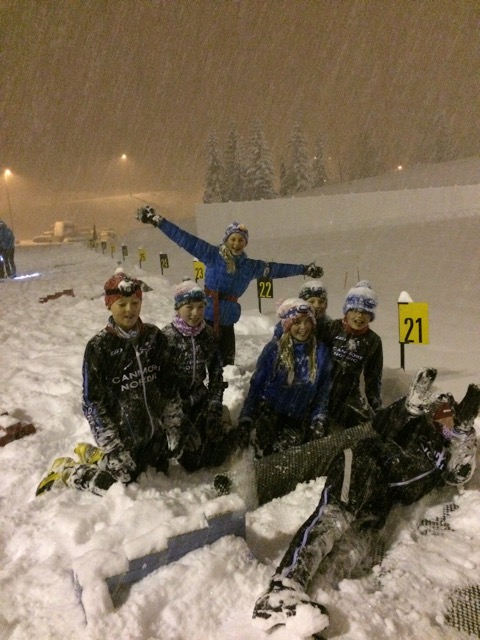
    THe Canmore Biathlon Bears, a youth biathlon program Ransom volunteers with, during a particularly snow practice last season.  (Courtesy Photo)
    The Canmore Biathlon Bears, a youth biathlon program Ransom volunteers with, during a particularly snow practice last season. (Courtesy Photo)

    Ransom declined her spot and continued to train with Boruta for another year. That season she earned three top-10 results at 2014 Junior World Championships in Presque Isle, Maine, just missing the podium in fourth in the junior women’s 10-kilometer pursuit.

    Following these performances, Ransom was once again approached by the national team prior to the start of the next season. This time, however, national-team coach Roddy Ward won her over.

    “They [Biathlon Canada] actually sat me down and were like, ‘OK, seriously, we’re going to move [Sarah Beaudry and Emma Lunder] up.’ You don’t just turn this down,” Ransom explained. “I wanted to be with all the girls because we work really well together … I’m glad that I stuck with Richard for as long as I did, but the change was also good.”

    In 2015, Ransom raced a handful of World Cups and made her senior World Championships debut while also competing on the second-tier IBU Cup circuit.

    Last season was Ransom’s full year on the World Cup, and she earned a breakthrough result after finishing 19th in the women’s 10 k pursuit in Antholz, Italy. She later tied that at a home World Cup in Canmore.

    And she made good on her second trip to World Championships, finishing 20th in the 15 k individual.

    Entering her second year on the national team and selected to the newly named ‘Eh!’ Squad this spring, Ransom is also currently attending school at the University of Athabasca, working toward a bachelor’s degree of management with a major in marketing.

    “I wouldn’t describe myself as a complete academic, but I really love learning,” Ransom explained. “So keeping up with current events I find really valuable. Mainly also to not be focused on skiing all the time because it’s nice to have other things.”

    Ransom has plenty of “other things” that hold her attention, including her education, volunteering with the Canmore Nordic Biathlon Bears program, and spending time with her eight nieces and nephews, one of which has Trisomy 18.

    “I think it’s 1 in 6,000 babies make it to birth with this genetic condition, and then past that it’s 10 percent of those make it to their first year and 5 percent of the 10 percent make it to five years,” Ransom said of her niece Isla, who is now 7 years old.

    “Seeing her makes you realize what happiness is all about,” she continued. “It’s not about the perfect race. It’s not about the finances. It’s not about the anything. For her it’s just about living to the next day and that’s a nice reminder to have. Appreciating life and appreciating everything you have now.”

    The verve of kids like Isla and the skiers in the Canmore Nordic Biathlon Bears program keep Ransom’s sport in perspective.

    “I really love kids and working with kids I think is just so much fun,” Ransom said of her volunteer work. “It’s also really refreshing to experience your sport in way that’s, it’s totally different. It’s 100 percent fun focused. And I try to go at least 95 percent super fun focused in my own training … at the very core of it, [skiing] is supposed to be fun.”

    ***

    We asked Ransom to give our ’17 Questions for 2017′ a go. Here are her responses:

    1. Biggest change in your life in the last five or so months since the ski season ended?

    Since the ski season ended, the only big change has been that of my address! My wonderful roommates and I moved up closer to the Nordic Centre. No matter how much one can prepare for a move, it’s never easy. Especially when you are in New Zealand for the month before you receive the keys!

    2. Biggest change in your training?

    There haven’t been many drastic changes. I have simply been focusing on improving weaknesses and polishing up strengths, day by day, with the goal of seeing big changes where it counts on the race track!

    3. Major areas of improvement you’ve seen so far?

    I’ve seen pretty big jumps in my strength, power, speed. This year I was focusing on those areas and I’m very happy with how it’s come along.

    4. Whom you’ve been working closest with this offseason (coaches or training partners)?

    This year our team has split more into Men’s and Women’s teams to accommodate our different needs. Our women’s team (and of course, coach Roddy Ward) has really bonded this year and has created a super strong training group that I love being a part of every day.

    5. Best trip in the last five months (and why)?

    Julia Ransom, enjoying some respite in a geothermal pit in HOt Sands, New Zealand while vacationing on the north island prior to Biathlon Canada's week long training camp at Snow Farm, New Zealand this past August. (Courtesy Photo)
    Julia Ransom, enjoying some respite in a geothermal pit in HOt Sands, New Zealand while vacationing on the north island prior to Biathlon Canada’s week long training camp at Snow Farm, New Zealand this past August. (Courtesy Photo)

    Best trip was by far New Zealand. My boyfriend came down to help out the team with waxing and range work and we were able to sneak in a little vacation on the North island before the camp started. We rented a van and travelled where ever we pleased, picnicking on beautiful beaches and enjoying the North Island at our own pace. The three weeks of training afterwards was also fantastic. Probably some of best snow conditions we’ll see all winter!

    6. Favorite cross-training?

    Mountain biking!

    7. Favorite non-athletic activity or pastime this summer?

    I love to cook and eat with others, especially when we are pairing fresh, local food with wine. Growing up in the Okanagan, I have developed a passion for wine and really enjoy reading and learning about different regions, varietals, tasting notes, etc.

    8. Song that was your jam this summer?

    Roses- The Chainsmokers
    Never Be Like You – Flume Ft. Kai

    9. All time favorite race moment?

    Favorite race moment was during the World Cups in Canmore. It was hearing my mom and dad cheering and seeing my mom tear up when I had a career best result.

    10. First thing you pack in your bag when you leave for Europe?

    Fresh coffee beans, a grinder, and aeropress.

    11. Venue/event you’re most excited to visit this season?

    I am really excited to see Pyeong Chang! I have never raced in Asia and am looking forward to the change.

    12. Who will win the men’s and women’s World Cup titles this year?

    This year, I am betting on Johannes Bø and Dorothea Wierer

    13. Biggest sacrifice you feel you’ve made choosing this career path?

    The biggest sacrifice I’ve made has been delaying my education, giving up university running scholarships, and being apart from my boyfriend. That being said, I am happy with my decision and have no regrets.

    14. If you could change one thing about your sport, what would it be?

    I would change the mentality of those who still think it’s okay to dope. Clean sport should be the reality but unfortunately it’s still a struggle our sport faces.

    15. What did you have for breakfast this morning?

    Red river cereal with blueberries, coconut, and Hemp Hearts. And coffee. Always coffee.

    16. In 5 years, I’ll be ____?

    In 5 years I hope to have an Olympics under my belt and my business degree well completed!

    17. In 50 years, I’ll be ____?

    Adventuring!

  • That’s a Wrap: Norwegian Women, Russian Men Win Junior Relays on Last Day in Romania

    That’s a Wrap: Norwegian Women, Russian Men Win Junior Relays on Last Day in Romania

    (Note: This article has been updated to include comments from Canadian coach Richard Boruta after Tuesday’s junior relays.)

    It was the last day of IBU Youth/Junior World Championships, and for several juniors racing on Tuesday in Cheile Gradistei, Romania, the idea was to have fun. Maddie Phaneuf said that was a priority on U.S. women’s 3 x 6-kilometer relay team: “We hadn’t really set a goal for the day…I was just reminding the girls to have fun out there and do their best,” she wrote in an email.

    Personally, she wanted to hand off to second-leg Siena Ellingson in a good position. Phaneuf did so, skiing the second-fastest scramble leg of 16 teams and coming into the first exchange in fourth, 42 seconds behind the leaders.

    While she avoided the penalty loop on both shooting stages, Phaneuf used a total of three spare rounds to clean: two on the first prone, which put her back in 12th, and one in standing.

    “It was fun to pick off the girls on the last loop and move up to 4th from 7th after my standing stage,” she wrote. “I felt really strong today and my skis were fast thanks to our wax techs.”

    The Norwegian women’s team (Anne Marit Bredalen, Turi Storstrøm Thoresen and Ingrid Landmark Tandrevold) skied to the win in 55:26.3, passing Sweden on the last loop to win by 15.6 seconds with a team total of five spares (0+2, 0+3). Sweden took second with four spares (0+0, 0+4), and Austria reached the podium in third, 55.5 seconds back with seven spares (0+2, 0+5).

    The U.S. finished 12th (+5:55.2) with one penalty and nine spares (0+4, 1+5). Ellingson shot identical to Phaneuf, cleaning with the help of two spares in prone and one in standing, and anchor Claire Waichler cleaned prone but had to ski a penalty lap after using all three spares in standing.

    Fifteen teams finished. Canada did not. Kendall Chong started the team off with three penalties and six spares (0+3, 3+3) and tagged teammate Charlotte Hamel in 16th. While Hamel cleaned both stages without any spares, she couldn’t move up from that position. The third Canadian, Leilani Tam von Burg did not start.

    “Leilani was getting sick and it was not sure until the last moment whether or not she will be able to race,” Canadian trip leader and Biathlon Alberta Training Center coach Richard Boruta wrote in an email.

    The fourth junior woman on the team, Caitlin Campbell was hospitalized after crashing in the sprint last Saturday.

    “She is not allowed to exercise much at this moment,” Boruta explained. “We did’t have any other chance than to include Leilani and hope for the best. However, it didn’t work out with her, but the other girls still felt that they would like to have one more opportunity to compete against the strong international field, one of the important things missing in Canada / North America.”

    For Phaneuf, in her third and final Youth/Junior World Championships, she explained the relay was a good way to end the week in Cheile Gradistei. Individually, she notched three top 10’s: fifth in the 12.5 k individual, seventh in the 7.5 k sprint, and ninth in the 10 k pursuit.

    “I think I ended my junior career on a really solid note,” Phaneuf wrote. “It was exciting to reach my goals and end I can’t wait to see what the rest of the season brings.”

    Next up for the 20-year-old US Biathlon development skier? Phaneuf said she’s headed back to the U.S., where she’ll spend just under a week training and recovering in Lake Placid, N.Y., before heading to Presque Isle for the IBU World Cup next week.

    “During those races I have the opportunity to qualify for the World Championship team, so that’s definitely a goal of mine,” she wrote. “We’ll see what happens! Either way, I’m happy with how my season has turned out so far. It’s great to see how much I’ve improved from last year.”

    (Story continues below)

    Start of the junior men's 4 x 7.5 k relay  at IBU Junior World Championships on Tuesday in Cheile Gradistei, Romania. (Photo: IBU YJWCH Cheile Gradistei 2016/Facebook)
    Start of the junior men’s 4 x 7.5 k relay at IBU Junior World Championships on Tuesday in Cheile Gradistei, Romania. (Photo: IBU YJWCH Cheile Gradistei 2016/Facebook)

    In the junior men’s 4 x 7.5 k relay, the Russians dusted the field by two minutes in 1:23:56.7. All four men (Dmitrii Shamaev, Viktor Plitcev, Nikita Porshnev, and Krill Streltsov) shot flawlessly in prone and everyone but Streltsov cleaned standing without any spares (Streltsov used two — the team’s only spares).

    Germany claimed second (+1:59.6) with eight spares (0+4, 0+4), and the Czech Republic took third (+3:05.8) after using six spare rounds (0+1, 0+5).

    Alex Dupuis (Canada) racing the second leg of the men's 4 x 7.5 k relay at IBU Junior World Championships on Tuesday in Cheile Gradistei, Romania. (Photo: IBU YJWCH Cheile Gradistei 2016/Facebook)
    Alex Dupuis (Canada) racing the second leg of the men’s 4 x 7.5 k relay at IBU Junior World Championships on Tuesday in Cheile Gradistei, Romania. (Photo: IBU YJWCH Cheile Gradistei 2016/Facebook)

    The Canadian men finished 14th (+11:12.1) after skiing eight penalty loops and using 18 spares. Matthew Strum opened with one penalty and five spares (0+2, 1+3) and tagged the team in 16th, Alex Dupuis cleaned both stages, using one spare in prone (0+1, 0+0) to tag off in 14th.

    The Canadians held onto the position from there, despite Aidan Miller skiing five penalty loops and using six spares (3+3, 2+3), then tagging Pearce Hanna in 14th. Hanna shot skied two penalty loops after prone and cleaned standing with three spares (2+3, 0+3) to finish about a minute behind 13th and 19 seconds ahead of 15th.

    According to coach Boruta, top 10 was a reasonable goal for the junior men’s relay.

    “Alexandre Dupuis was the only one who did have a good relay performance…,” Boruta wrote. “Charlotte [Hamel] did have a good day on the range as well, unfortunately her skiing is quite far off of the pace.

    “Overall, all the top 20 (or even 30) placings are very respectable results and we should be happy, that we have at least few athletes who can be at that level,” he reflected on the team’s overall showing at the championships. “The competition is becoming stronger and more nations are in a position for good results.”

    Biathlon Canada doesn’t fund programming for junior or youth athletes, so essentially “there is also no high expectation for their performance,” Boruta explained. “Those athletes are spending around $20,000 – $30,000 a year for the privilege to train full time and represent Canada internationally, but sometimes this makes it frustrating for the coach, because there is no real leverage if there is a need to change their attitude or anything.

    “Our mandate is to develop athletes to such a level that they can make the jump from juniors to seniors and become competitive within a reasonable time frame,” he added, explaining that’s working so far.

    The U.S. men’s team of Paul Everett, Brian Halligan, Brendan Cyr, and Travis Cooper finished 18th of 20 teams, with seven penalties and 17 spare rounds.

    Results: Junior women’s relay | Junior men’s relay

  • Sanchez’s Second-Straight Top 20, Moser 19th for Canada in IBU Youth Worlds Sprint

    Sanchez’s Second-Straight Top 20, Moser 19th for Canada in IBU Youth Worlds Sprint

    Megan Bankes racing to 26th in the women's 6 k sprint at IBU Youth World Championships in Cheile Gradistei, Romania. (Photo: IBU YJWCH Cheile Gradistei 2016/Facebook)
    Megan Bankes racing to 26th in the women’s 6 k sprint at IBU Youth World Championships in Cheile Gradistei, Romania. (Photo: IBU YJWCH Cheile Gradistei 2016/Facebook)

    Note: This article has been updated to include comments from Canada’s Adam Runnalls as well as photos of the American men.

    The snow is melting in Cheile Gradistei, Romania, and it’s melting fast as organizers work to cover parts of the track with manmade snow, but the Canadians seem to be handling it just fine.

    For the second-straight youth race at the International Biathlon Union (IBU) Youth/Junior World Championships, three Canadians landed in the top 21 and one more was within the top 30 on Friday. Teo Sanchez recorded his second top 20 in as many races so far, placing 17th in the men’s 7.5-kilometer sprint on Friday after taking 13th in Wednesday’s 12.5 k individual.

    “I was feeling ready for it, but still nervous,” Sanchez, 18, of Wakefield, Quebec, wrote in an email about Friday’s race — his second ever at a world championships.

    After a clean prone, he finished out the sprint with one penalty in the standing stage. His goal coming into the race had been perfect 10-for-10 shooting, and he ended up 9-for-10, still “as a whole, good,” he wrote.

    “Unfortunately my legs were shaking a bit during my standing shooting and that caused me to miss my second last standing target,” Sanchez explained. “I felt really strong skiing but I need to loosen up a bit and get my technique more together.

    “I think 17th in the world is a pretty good result,” he added. “I think it will put me in a good place for the pursuit [on Sunday] as I’ll have lots of people to ski with while I’m racing. Pursuits are my strongest race format, I love the chasing and being chased. My goal will be to match my shooting score in the individual [18/20], and to transition between techniques as smoothly as possible.”

    In the men’s race, Adam Runnalls, who placed 17th on Wednesday, finished 21st in Friday’s sprint with two standing misses. Coming into these championships, Runnalls explained he had not hit more than 70 percent of his targets in any race.

    “80% shooting has always been a bench mark for me. I gives me some where to set my sights (literally) when shooting other than just wanting to shoot clean,” Runnalls wrote in an email, after his second-straight race shooting 80 percent. “Today though I feel that 80% was a little disappointing. Having shot clean in the prone I wanted to shoot a little better in the standing because I felt that another clean shooting was not out if reach I was just not able to get it.

    “I fell apart mentally in my standing shooting predicting the outcome before I began shooting,” he continued. “As I was skiing and before the first shot all I could think was clean, clean, clean and that’s where it all went wrong. So 80% was not a bad shooting for the day just a bit disappointing.”

    Friday’s sprint marked his second top 21 in his debut world championships.

    “I felt really good about my result today just barley missing the top 20,” Runnalls wrote. “When I came across the line I was in the 7th position and was slowly dropping down into the high teens. As I was watching my placing drop all I could think about was what would have happened if I had kept a clear head and hit one more target. But all and all I was happy with the result.”

    “Teo and Adam … proved that biathlon is a complex sport and that you need good skiing and shooting combined together in order to do well,” Canadian trip leader Richard Boruta wrote in an email. “I know that Teo is pretty good shot and he is showing this here as well, Adam has been good skier in a last year or two, but he will need to improve especially his standing shooting if he wants to become a really successful biathlete. I think they perform at a level where they are comfortable with and chances are that their Pursuit performance will be also close to those results.”

    The youth men's podium (and top six) at the flower ceremony on Friday at IBU Youth World Championships in Cheile Gradistei, Romania: 1. Russia's Igor Malinovskii (11), 2. Norway's Endre Strømsheim (77), 3. Russia's Viacheslav Maleev (81), 4. Norway's Aleksander Andersen (48), 5. France's Morgan Lamure (12), 6. Sweden's Sebastian Samuelsson (5).  (Photo: IBU YJWCH Cheile Gradistei 2016/Facebook)
    The youth men’s podium (and top six) at the flower ceremony on Friday at IBU Youth World Championships in Cheile Gradistei, Romania: 1. Russia’s Igor Malinovskii (11), 2. Norway’s Endre Strømsheim (77), 3. Russia’s Viacheslav Maleev (81), 4. Norway’s Aleksander Andersen (48), 5. France’s Morgan Lamure (12), 6. Sweden’s Sebastian Samuelsson (5). (Photo: IBU YJWCH Cheile Gradistei 2016/Facebook)

    On Friday, Sanchez finished 2:20.4 behind the winner, Russia’s Igor Malinovskii, who tallied his first youth worlds victory (and podium) in 20:32.9, despite one prone miss (1+0). Runnalls finished 2:43.1 back.

    Norway’s Endre Strømsheim claimed second, 26.3 seconds back, after cleaning all his targets for his first world championships podium as well. Just over a second later, another Russian, Viacheslav Maleev took the third spot on the podium (+27.4) with one miss in each stage (1+1).

    Norway’s Aleksander Fjeld Andersen was 17.2 seconds away from his second-straight podium, placing fourth, 44.6 seconds behind Malinovskii.

    Moser Climbs to Career-Best 19th

    In the youth women’s 6 k sprint, Canada’s Nadia Moser shot 9-for-10 to take 19th, 1:32 behind the winner, for her best result at worlds by nearly 30 places. She finished 47th in Wednesday’s individual with eight penalties. On Friday, the 18-year-old Canmore resident missed one in prone and cleaned standing.

    “Nadia has been showing really strong training performances lately and it has been just matter of time before she will gain the confidence to show the same in an important race,” Boruta reflected. “She felt good skiing and also her skis were quite fast and combined with solid shooting performance it has all helped to achieve first great result.”

    “I felt good skiing and … I always strive for strong shooting,” Moser said in a Biathlon Canada press release. “The course was hard and the conditions were challenging because some parts of the downhills were icy. Overall, I’m happy with how I competed and looking forward to the pursuit race.”

    After placing 19th on Wednesday with seven penalties, another Canadian, Megan Bankes finished 26th in the sprint with five misses — two in prone and three in standing. Her course time was fifth fastest out of 91 women on Friday.

    “Having good skiing Wednesday definitely gave me confidence to see what I am capable of this week, and I have been stoked with my skiing performances in both races,” Bankes wrote in an email. “I certainly need to work on my shooting in the races, but I am confident in my training and know that everything will come together.”

    The youth women's sprint podium (and top six) at the flower ceremony on Friday at IBU Youth World Championships in Cheile Gradistei, Romania: 1. Norway's Karoline Erdal (2), 2. Norway's Emilie Kalkenberg (72), 3. Ukraine's Anna Kryvonos (26), 4. Czech Republic's Marketa Davidova (4), 5. France's Lou Laurent Jeanmonnot (51), 6. Kazakhstan's Arina Pantova (38). (Photo: IBU YJWCH Cheile Gradistei 2016/Facebook)
    The youth women’s sprint podium (and top six) at the flower ceremony on Friday at IBU Youth World Championships in Cheile Gradistei, Romania: 1. Norway’s Karoline Erdal (2), 2. Norway’s Emilie Kalkenberg (72), 3. Ukraine’s Anna Kryvonos (26), 4. Czech Republic’s Marketa Davidova (4), 5. France’s Lou Laurent Jeanmonnot (51), 6. Kazakhstan’s Arina Pantova (38). (Photo: IBU YJWCH Cheile Gradistei 2016/Facebook)

    She finished 2:14.8 behind the winner, Norway’s Karoline Erdal, who started in bib 2 and held off all challengers to take the victory in 18:17.7.

    Norway dominated the top two with Emilie Aagheim Kalkenberg in second (+28.5), and Ukraine’s Anna Kryvonos four seconds behind in third (+32.4) after a downhill crash on the final loop cost her more than 20 seconds and second place, according to an IBU press release.

    Six seconds out of third, Marketa Davidova of the Czech Republic missed her second-consecutive podium (after placing third on Wednesday) in fourth with two misses (0+2).

    All three podium finishers cleaned prone and missed one in standing (0+1). Just two women in the top 20 cleaned both stages: Austria’s Tamara Steinar, who finished eighth, and Kazakhstan’s Yevgeniya Krassikova in 16th.

    “It was hard, but it is really nice to finish first,” Erdal said in the post-race press conference. “I am really happy with the shooting. It was a good race and I am really satisfied. I don’t know yet what I am going to do in pursuit. I am starting first so I just need to do my own race and focus on my work.”

    According to Bankes, the course in Cheile Gradistei — a mountain resort about 3,000 feet above sea level — “is pretty hard, but quite fun to race on, with a couple steep uphills and some technical downhills,” she explained. “The snow conditions have been pretty good as the organizers have worked very hard to insure there is adequate snow, with some warmer temperatures.”

    Also for Canada, Emily Dickson placed 41st (+2:48.7) with two standing penalties. India McIsaac was 54th (+3:27.8) with five misses (1+4). In the men’s race, Zachari Bolduc also had five misses (2+3) and finished 65th. Lucas Boudreau was 76th with three penalties (1+2).

    Brendan Cyr was the top American in 46th, finishing 3:39.5 behind the men’s winner with three penalties, all of which came in standing (0+3). Cody Johnson placed 50th in the same race (+3:47.5) with two misses (1+1), Peter Carroll was 69th with four misses (2+2), and Vaclav Cervenka was 72nd with five misses (2+3).

    In the women’s race, Amanda Kautzer led the U.S. in 52nd (+3:24.2) with three penalties (1+2), Claire Waichler was 58th (+3:45.6) with five misses (2+3), Chloe Levins 65th with five misses, and Ariana Woods 76th with five penalties as well (1+4).

    Results: Youth women’s sprint | Youth men’s sprint

  • Aidan Millar Posts Career-Best with Eighth in World Juniors Sprint; First Canadian Top-10

    Aidan Millar Posts Career-Best with Eighth in World Juniors Sprint; First Canadian Top-10

    Aidan Millar (Canada/Biathlon Alberta Training Center) racing to eighth place in the 10 k sprint at biathlon World Junior Championships in Raubichi, Belarus. (Photo: Jane Robertson)
    Aidan Millar (Canada/Biathlon Alberta Training Center) racing to eighth place in the 10 k sprint at biathlon World Junior Championships in Raubichi, Belarus. (Photo: Jane Robertson)

    Canmore, Alberta’s Aidan Millar was the third man onto the course in Saturday’s individual-start 10 k sprint at World Junior Championships for biathlon in Raubichi, Belarus.

    With little information about his competitors, Millar had to just ski his own best race. He had a penalty in prone but then cleaned in standing, and was unsurprisingly the race leader when he crossed the line. The thing was waiting for the other 90+ racers to finish as well.

    “As soon as I had gotten my stuff I left the finish area and went and cooled down away from the TVs and the stadium,” he wrote in an email. “I knew I would probably stay in the top 10 but it was way too hard to watch the results.”

    As his team had predicted, it was a top-10 finish when all was said and done. Millar’s time put him in eighth, 44.9 seconds behind Russia’s Aleksandr Dediukhin, who won with a time of 24:49.0.

    Millar’s split after the last shooting had him in fifth place, but he was unable to hold onto that position, and lost about 20 seconds to the leaders over the final 3.3 k.

    Canada's Aidan Millar racing in the individual competition earlier this week at World Junior Championships. (Photo: Jane Robertson)
    Canada’s Aidan Millar racing in the individual competition earlier this week at World Junior Championships. (Photo: Jane Robertson)

    Still, the result was a major recovery after the individual competition, where Millar missed nine shots. He was frustrated with himself and vowed to do better.

    “The individual was pretty disappointing shooting-wise,” he explained. “So for the sprint I tried to shoot more in control and not get caught up in shooting fast.”

    Despite those goals, Millar actually had the eighth-fastest shooting time in the field. That speed and accuracy helped him to his best-ever result in an international competition. It was also the best result for Canada so far at the Championships, including in the youth competitions which are held on alternating days with the junior races.

    At last year’s World Youth Championships in Presque Isle, Maine, he placed ninth in the sprint. But this year is completely different, and not just because the junior field is older and more experienced than the youths, Millar explained.

    “I would say it’s definitely a huge step up,” Millar wrote. “With last [Championships] being in North America some of the better countries didn’t send full teams so the field wasn’t as strong. So with the jump from Youth to Junior already making it more competitive the fact that it was in Europe made even that much more competitive than last year. With those things in mind, I’m finding it hard to believe that I was actually able to get that result.”

    Millar’s coach at the Biathlon Alberta Training Center, Richard Boruta, is the leader of Canada’s team on the trip and expounded a bit more on the jump Millar has made.

    “While in the Youth category lots depends on biological age and other factors, in the Junior category the results are much more representing the quality of training and future potential of the athlete,” he wrote in an email. “By staying in (or at least being capable of) the top ten at [Junior Worlds], athletes are showing that they are on the progression curve necessary for future good performance in the World Cup.”

    The age category is not the only change Millar has made this year. He also transitioned from the Canmore Nordic Ski Club to training with Boruta’s training center.

    “He has the benefit of training with strong juniors on our team and after his recovery [from a concussion in the fall] his ski speed kept improving during all of our tests and early season races,” Boruta wrote.

    He hopes for even more from Millar in the future, but is also content to have eighth place as a standout result.

    “Aidan is a prototype of modern high performance biathlete (tall and strong), and I am sure we will hear about him in the future again,” Boruta wrote. “I am really happy for his result today and his goal for Pursuit is to learn how it feels to compete head-to-head with the best in the world. I would like to think that another top ten is possibility, but the field is very competitive, so it will likely come down to shooting performance during the entire race.”

    As for Millar, he professed to have no results-based goals for the pursuit, which will be held on Sunday.

    “Try and stay calm, shoot in control and see what happens,” he wrote.

    But regardless, the top-ten is a confidence boost that still leaves him marveling.

    “I’m super happy with the result,” he wrote. “I didn’t really have a results goal coming in to the Championships but 8th was beyond my expectations.”

    Also in the junior men’s sprint, Matthew Strum finished 46th with one penalty, and Carsen Campbell 55th with three. Both made it inside the 60-man cutoff to compete in Sunday’s pursuit.

    Stuart Harden, one of Canada’s top young biathletes, did not start the race. He explained in a facebook post that he woke up with a cold and is trying to recover in time for the relay early next week.

    In the junior women’s 7.5 k sprint, Sarah Beaudry placed 38th with three penalties.

    Results: men / women

  • What a Little Success Can Do: Lunder Boosted by World Cup Debut in Push for 2015

    What a Little Success Can Do: Lunder Boosted by World Cup Debut in Push for 2015

    Emma Lunder competing in the World Cup pursuit in Pokljuka, Slovenia, in March. Photo: NordicFocus.com
    Emma Lunder competing in the World Cup pursuit in Pokljuka, Slovenia, in March. Photo: NordicFocus.com

    When Emma Lunder made her World Cup debut last season, she met with immediate success.

    Taking advantage of a roster spot left open by Megan Imrie, who retired immediately after a successful Sochi Olympic appearance, the Canadian biathlete accrued a single penalty in her debut World Cup sprint race in Pokljuka, Slovenia, and placed 30th – scoring points on her very first try.

    “I think one of the major factors in making a jump in results was believing in myself,” she wrote in an e-mail to FasterSkier last week. “Even though it was my first World Cup, I made sure to focus on the process rather than the outcome, and treat it like any other race I’d ever done. I think in the past I haven’t had as much confidence in racing, especially after bad races, where I’d really dwell on them, rather than taking lessons from them and moving on.”

    National "B" team women
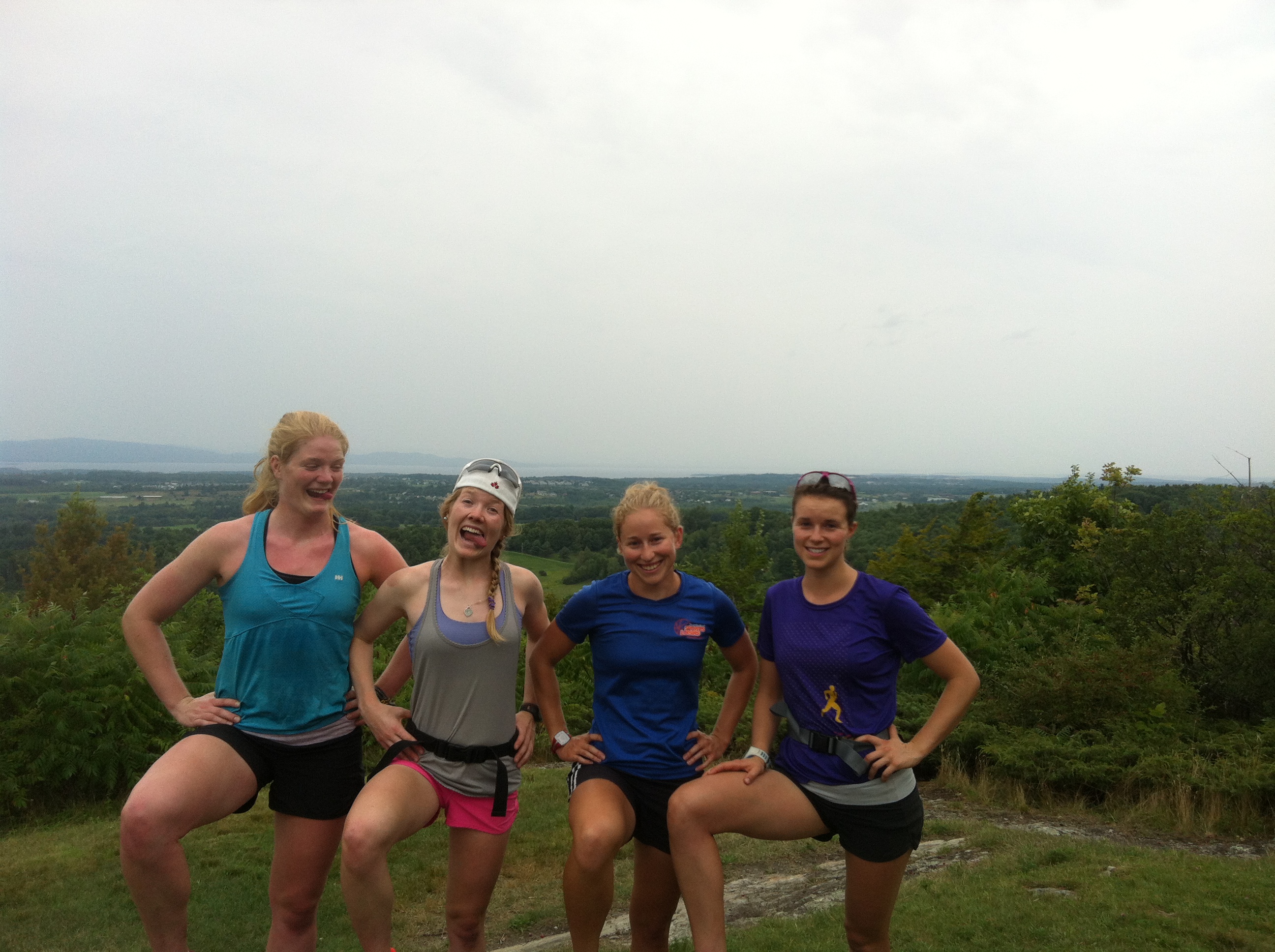
    Canadian national “B” team women (l-r) Sarah Beaudry, Emma Lunder, Audrey Vaillancourt, and Julia Ransom on a run in Jericho, Vermont, this summer. Photo: Emma Lunder.

    Now Lunder is looking forward again. The 23-year-old was a many-time World Junior Championships competitor, but her World Cup result netted her a senior national team nomination for the first time. That has afforded her a few more opportunities in the off-season than she is used to having.

    “My World Cup results last year qualified me for a development card, so that has made a world of a difference,” she explained, referring to the Canadian “carding” system of athlete assistance. “Having some financial stress lifted is such a relief. Even though it doesn’t cover a whole year of training, it’s enough that I was able to cut back at work (Starbucks) to just two days a week, and it’s meant I need a lot less financial support from my parents.”

    A couple of sponsor partnerships are also in the works, she added.

    Besides being named to Biathlon Canada’s “B” team, Lunder has signed on with the Biathlon Alberta Training Center, a Canmore-based team headed by former national team coach Richard Boruta.

    That has given her solid training partners in Julia Ransom and Sarah Beaudry, younger women who each have a World Junior Championships individual medal to their name.

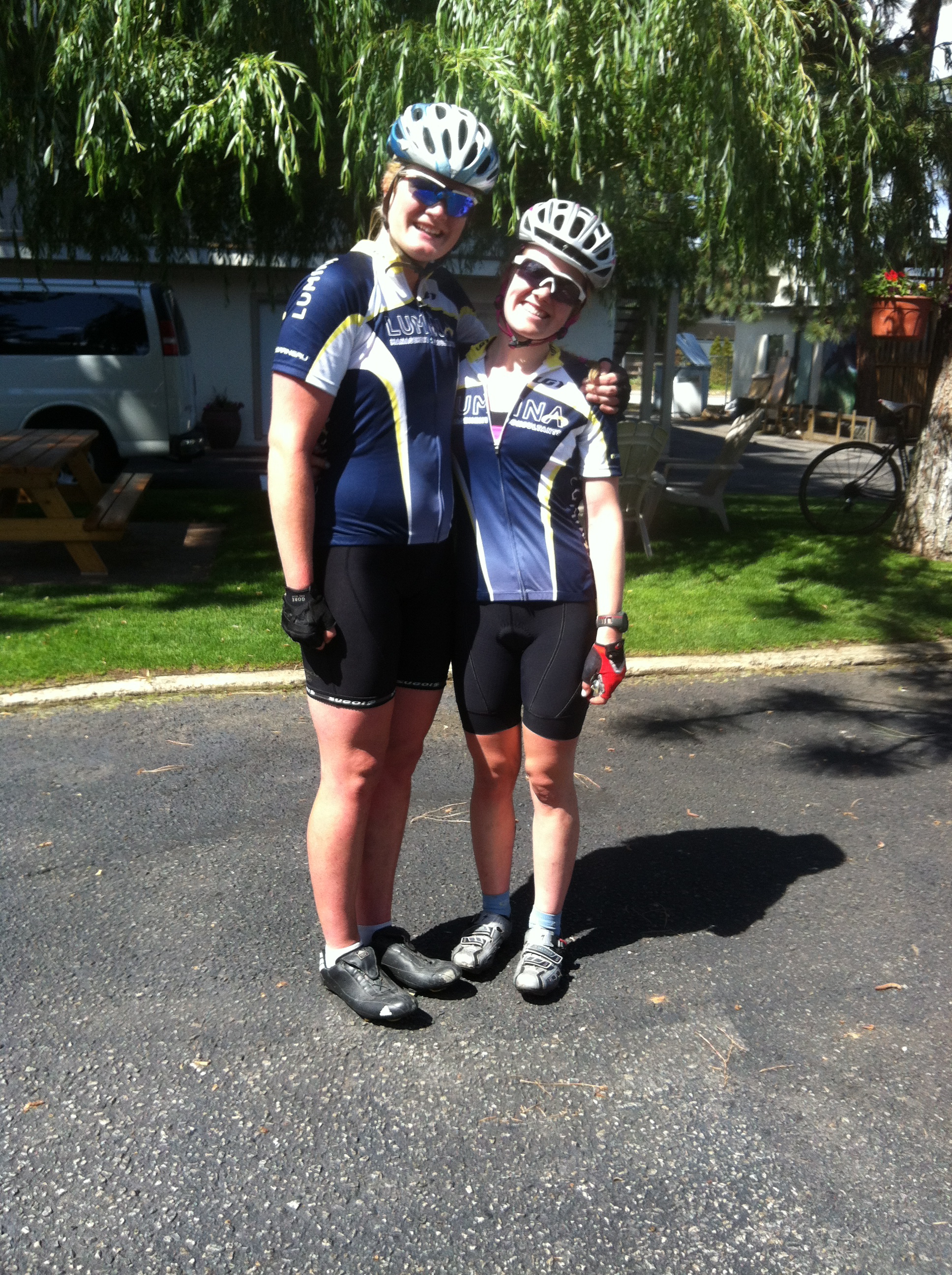
    Emma Lunder (r) and Sarah Beaudry after completing the 172k IronMan bike loop around Penticton, British Columbia. Photo: Emma Lunder.
    Emma Lunder (r) and Sarah Beaudry after completing the 172k IronMan bike loop around Penticton, British Columbia. Photo: Emma Lunder.

    “To have a close group of female teammates has definitely been one of the main differences [this year], just for the fact that on so many workouts you’re able to push each other, and help each other ski faster then you would on your own,” Lunder wrote.

    It’s also fun: one of the highlights of her summer was a team camp in Penticton, British Columbia.

    “Our longest [bike] ride was the IronMan Loop, which ended up being 172km, and to be honest when we started I wasn’t sure if I’d complete the whole thing!” she explained. “But I did, with Sarah Beaudry by my side the entire 6 hours, and getting off the bike at the end was probably the best feeling in the world. We also did some rollerski intensity up Apex Mountain that week, rollerskied past thousands of vineyards, and went zip-lining!”

    The national team nomination allows her to occasionally jump in with the older, more experienced women, like Rosanna Crawford and Zina Kocher (Canada’s other remaining Olympic veteran, Megan Heinicke, lives in Germany in the off-season). Lunder hopes that this experience will help her be even better-prepared when she returns to the World Cup.

    “It’s definitely super beneficial for the younger team members to have some training with the Canadian veterans, as they have so much to teach us,” she wrote. “In Jericho [Vermont] I tagged along behind Rosanna for all of the intensity sessions which was really constructive for me.”

    Lunder says that her goals for the upcoming season are more process-based: to ski faster and shoot cleaner, as “comedic” as it seems. The annual summer biathlon competitions in Jericho provided a clue of what’s to come: she placed ninth, the fourth Canadian, in the sprint, and sixth, the third Canadian, in the mass start.

    “I didn’t race quite as well as I’d liked, but there were lessons I took out of both days,” she wrote. “It was such a good feeling to be racing again, and it got me pumped for the winter. I’m definitely looking for more World Cup action this season – there’s still quite a bit of time between now and then, so for now I’m trusting in the process, and looking forward for the first flakes to fall.”

    And with the lure of another World Cup appearance on the horizon, Lunder is finding herself even more motivated than before: “Anytime I’m doing a really brutal workout, I just think to myself, if you can get through this, you’re one step closer to racing in Pokljuka again!”

    Emma Lunder competing at the 2014 North American Rollerski Championships 7.5 k sprint at Ethan Allen Firing Range in Jericho, Vt.
    Emma Lunder competing at the 2014 North American Rollerski Championships 7.5 k sprint at Ethan Allen Firing Range in Jericho, Vt.
  • After Jet Lag and ‘Okay’ Opening to Youth Championships, Canada’s Beaudry Gets What She Came for with Fifth Place in Individual

    After Jet Lag and ‘Okay’ Opening to Youth Championships, Canada’s Beaudry Gets What She Came for with Fifth Place in Individual

    Sarah Beaudry of Canada celebrates as she heads to the podium ceremony to be honored for her fifth-place finish. Photo: Hugh Harden via Biathlon Canada.
    Sarah Beaudry of Canada celebrates as she heads to the podium ceremony to be honored for her fifth-place finish. Photo: Hugh Harden via Biathlon Canada.

    For some North American athletes who earn a trip to World Junior Championships, just making the team is something to celebrate – a long-planned goal, an accomplishment that defines a season.

    But once the roster is named, those athletes get serious about what they might accomplish. And this is especially true for those who are returning for their second, or even third or fourth, international tour.

    “We had two goals for the Championships,” Biathlon Canada High Performance Director Christ Lindsay told FasterSkier in an interview on Tuesday. “One is in a participatory and preparation context, where we see that athletes who have been exposed to international competition come back refocused, and they know where they are in relation to the rest of the world and are able to use that experience as a springboard for future success. The other side of our goals are in the performance area.”

    The team set specific goals for its elite athletes going into World Youth and Junior Championships in Obertilliach, Austria, and Sarah Beaudry of Prince George, British Columbia, had among the toughest of tasks: “For Sarah, the goal was top 12 results,” Lindsay said.

    After the sprint and pursuit races this weekend, Beaudry was unsatisfied. A three-time competitor in the youth division of biathlon’s championships, as well as a participant in last season’s Youth Olympic Games, her 36th and 28th-place finishes were solid – but not anything exciting.

    “Both the sprint and the pursuit went okay,” she wrote in an e-mail on Monday. “Both days I felt like I wasn’t skiing my best. I was really happy with my shooting in the pursuit but it would have been nice to hit a few more in the sprint. I was definitely hoping for a little bit better results, but I still have the individual tomorrow to improve on my current results.”

    Well: mission accomplished. On Tuesday Beaudry jetted into the spotlight, collecting only two penalties in the 10 k pursuit race and placing fifth, 25 seconds off the podium.

    “It was more of a fresh start after Friday’s race, where I was very nervous and wasn’t quite feeling quick after the long travel,” Beaudry wrote after the individual. “Surprisingly, I managed to not let my nerves get in the way during the shooting. I knew this was my chance and I knew if I wanted it I would have to shoot well.”

    Beaudry on course in Obertilliach. Photo: Hugh Harden via Biathlon Canada.
    Beaudry on course in Obertilliach. Photo: Hugh Harden via Biathlon Canada.

    The result was better than any of Beaudry’s previous international races, a testament to how hard she has trained this year. After graduating from high school last spring, she joined the Biathlon Alberta Training Centre in Canmore and has been working full-time with coach Richard Boruta, who is also the head of the Canadian team at the Championships.

    That, says Lindsay, has allowed an experienced junior to have the kind of breakthrough that put her so close to the podium even though Beaudry, a strong skier and sprinter in particular, admitted that “I wouldn’t say the individual [where each missed shot is penalized by a minute of added time] would be my strongest format.”

    “I do expect my athletes to perform to the level of their abilities, so in that regard I knew that Sarah had the potential to do just that,” Boruta wrote in an e-mail regarding Beaudry’s finish. “However, in biathlon, more than many other sports, it is very difficult to expect podium performances, because in elite racing an error on the shooting range can often cost you as many as 10 or more places. She did today exactly what she has been training for, which for sure is a good thing for her future.”

    With one penalty in each standing stage – which came second and fourth out of the four stages – Beaudry was always close to the top. After one stage she ranked sixth and a stage later seventh; for the rest of the race she hovered between fourth and fifth. But although she knew she was having a good race, Boruta didn’t add any pressure by telling her how close she was to the podium.

    “In this age group we usually try to keep our athletes on their race plan until the shooting is over,” he explained. “Most of the information is related to ski speed and technique, but we didn’t share with her the exact position. Usually, they will either start skiing too hard or thinking too much and the last shooting is important enough to change the race outcome completely. She knew on the last 2.5 km loop where she is and what she needs to do and she did her best to keep the position.”

    The last loop was actually Beaudry’s slowest – try as she might, she couldn’t make up ground. But it didn’t matter, because the next finisher was 20 seconds behind.

    “I was definitely tired by the last lap but was feeling a lot better than the other races,” Beaudry wrote.

    And she was never in a position to win; Uliana Kaisheva of Russia completed a clean sweep of the youth events, winning by a whopping 1:20 despite two penalties, the same as Beaudry’s score. In fact, both Beaudry’s success and her distance from the winner were characteristic of important lessons that Lindsay hopes Canada’s young athletes will learn. First of all, the best in the world are very, very good. Not only in the youth women’s division, where Kaisheva has dominated, but also in the junior men’s division, a group of athletes have been head and shoulders above the rest.

    “We were quite surprised at the level of quality at the very top end,” Lindsay said. “And I think, specifically, with a few of the winning athletes – some of them we’ve already seen – but some of them are now registered for the World senior Championships. But some of them are athletes that we have not seen before in competition. It’s tough, but it’s also a reminder that we can’t be complacent back here. Just because you’re the number one in the U.S., or in Canada, or in North America, really doesn’t give you a good gauge on how you’re going to do when you compete against the Europeans.”

    But the second message is hope.

    “A lot can happen for an athlete at 17 or 18 years old within six months,” he said. “Just because you feel a little sluggish here doesn’t mean that you can’t become that person who wins the medal.”

    And that’s especially important for Beaudry’s teammates. Another top Canadian youth, Danielle Vrielink, broke a bone in her wrist while tobogganing. So the other three members of the youth women’s squad are young – 16 years old, the bottom of the age group as opposed to Beaudry’s 18 years – and have never before raced in Europe.

    “I think it is a great eye-opener for these girls and they will have better understanding now what is really expected from athletes competing at this level,” Boruta wrote. “And I believe that it is motivating to see your team-mate do this well, that it is not only a privilege of Germans or Norwegians or Russians.”

    Lindsay called Beaudry “a leader,” but said that he was also impressed with the younger athletes: in the individual, for instance, Leilani Tam Von Burg placed 50th, Emily Dickson 54th, and Charlotte Hamel 61st. While Dickson had six penalties, Hamel and Tam Von Burg had just three and four.

    “I’m not disappointed by any means with the performances, and quite frankly I’m happy at the number of younger athletes we have there and how they’ve been able to put themselves together to get through races successfully and not have blow-ups, and to be able to learn something,” Lindsay said.

    For Beaudry, though, leadership isn’t a chore – it’s a treat.

    “It is fun being with the new girls who were all so excited for their first international race and remembering what it was like for me the first time racing in Europe,” she wrote in an e-mail.

    * * *

    In the youth men’s 12.5 k pursuit, Canada was left without its top racer, Stuart Harden, who Boruta said had “some quite serious health problems” and may or may not be back for the relay.

    As such, he had nothing to add when Aristide Begue of France repeated his world title in the event from last season, or when Sean Doherty of the U.S. placed second, collecting his third medal of the championships – a record for a U.S. biathlete.

    Instead it was Carsen Campbell leading the way in 37th. After three stages Campbell, of Prince Edward Island, seemed to be headed to his second top-30 finish of the Championships, but two more penalties in the last stage dropped him down the list.

    “He started with two misses in first prone, which in this type of race is very discouraging,” Boruta wrote. “You have to be very good skier to keep the hope of having a good result with so many shooting penalties. He doesn’t have much perspective about how well you actually need to ski at this level, so he will probably learn a lot. He is also interacting with other athletes and it helps him to become better athlete himself.”
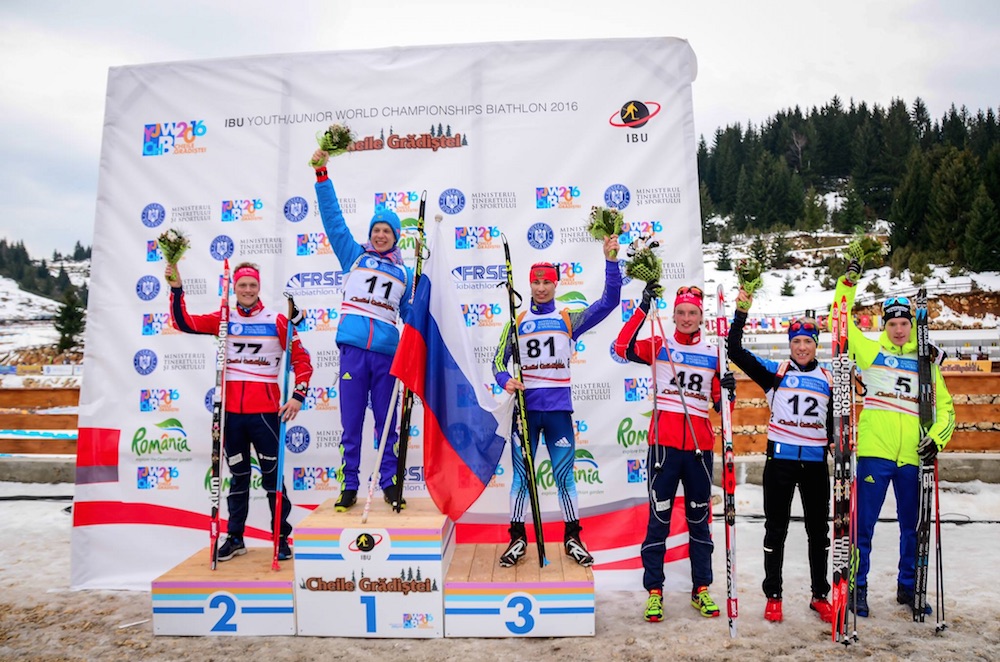
    Matthew Strum placed 67th and Arthur Roots 86th to round things out for Canada.

    results: men / women


  • Led By Ransom’s 15th, Five Canadian Women Improve in Youth and Junior Pursuits

    Led By Ransom’s 15th, Five Canadian Women Improve in Youth and Junior Pursuits

    Olga Podchufarova (RUS) after winning the junior women's pursuit. Photo: Mario Danzl/Obertilliach 2013.
    Olga Podchufarova (RUS) after winning the junior women’s pursuit. Photo: Mario Danzl/Obertilliach 2013.

    With Sean Doherty stealing the show in the youth pursuit, there was plenty for North America to be excited about in the third day of racing at World Youth and Junior Championships for biathlon in Obertilliach, Austria.

    “It was great day for all of us here and biathlon fans,” Doherty’s coach Algis Shalna wrote in an e-mail to FasterSkier.

    But with the gold medal heading to the United States, it was perhaps easy to forget that the youth men were actually the fourth group to race on Sunday, and there were many other strong North American performances before that. Canadians Stuart Harden, Julia Ransom, and Christian Gow each scored their second top-20 finish of the Championships, while American Casey Smith had a phenomenal pursuit, jumping up about 20 places based on strong shooting.

    * The first race of the day was the youth women’s 7.5 k pursuit, where Uliana Kaisheva of Russia thoroughly crushed the field, expanding her lead from the sprint into a 1:15 victory over Galina Vishnevskaya of Kazakhstan despite four penalties.

    This race generated the least buzz for the U.S. and Canada. Both teams had big hopes in this division, with U.S. biathlete Anna Kubek and Canadian Sarah Beaudry coming off strong seasons last year that included trips to the Youth Olympic Games.

    After placing 34th and 36th in the sprint, the pair broke into the top 30 in the pursuit, with Kubek moving up to 25th with just two penalties in the 20-shot race. Beaudry improved to 28th with one more penalty.

    “Sarah Beaudry is still young, but she has been to this last year and she also went to the Youth Olympics last year,” Canadian team leader and Biathlon Alberta Training Centre Head Coach Richard Boruta told FasterSkier. “She is still fighting with jet-lag and not feeling best on skis. The expectation is that she will possibly improve her ranks as the week will move on.”
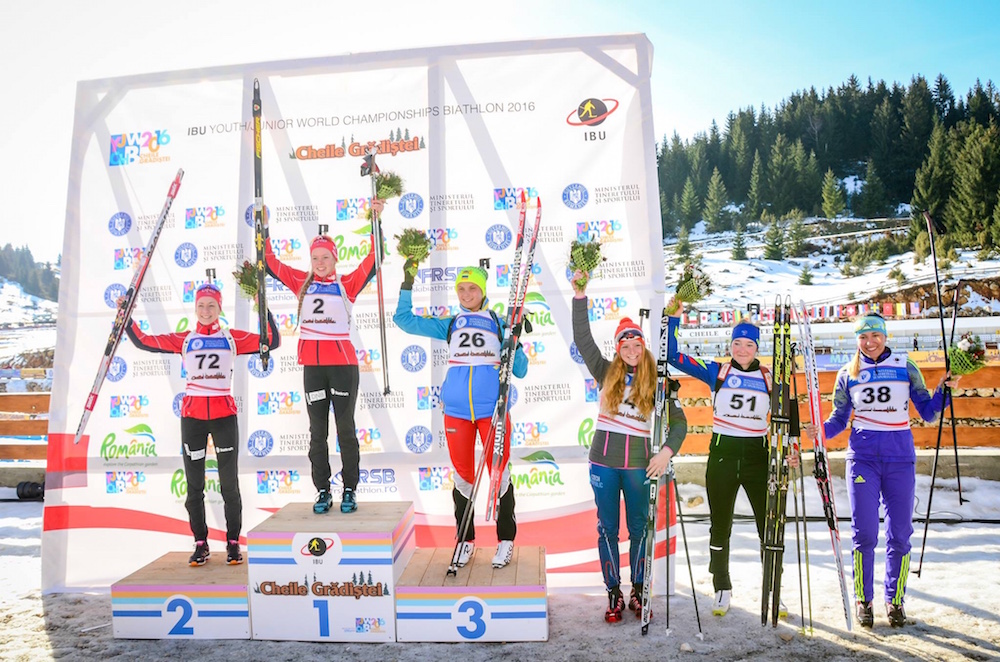
    * Next up were the junior women. While no Americans qualified for the 60-woman, 10 k pursuit, Canada was impressive in placing all four of its team members in the race. Furthermore, all four improved.

    They were led by Julia Ransom, who started in 16th position after the sprint. With a penalty early and then two clean stages, she moved into the top ten before slipping back to 15th after two missed shots in the final standing stage.

    Ransom was ultimately 3:09 behind the winner, Olga Podchufarova of Russia, who swept summer biathlon World Championships this past season and won by 17 seconds after sprint winner Laura Dahlmeier of Germany collapsed in the final stage, missing two shots to Podhufarova’s one. It was still a good day for Germany, though: Franziska Preuss earned bronze and Vanessa Hinz was fourth.

    After earning silver in the youth pursuit last year, Ransom was up against some tougher competition this time around.

    “The competition in Junior seems to be a little more competitive than Youth,” she wrote in an e-mail. “There are a lot of fantastic athletes looking to make it to IBU/World Cup and you can tell they are hungry! I was happy with my race both yesterday and today. I thought my shooting was solid in the sprint and may have lost a little focus in my pursuit (missed 2 on last bout). The sprint was a good wake up for my legs as I felt a lot better skiing today.”

    Boruta, who coaches Ransom year-round in Canmore, said that her races so far were solid performances.

    “Performance wise, I think Julia and Christian [Gow] as first-year juniors are right on target, they didn’t have any extraordinary races, but they did perform at the current level of their abilities and this is were they are in the world right now,” he wrote in an e-mail.

    Emma Lodge and Rose-Marie Côté started 41st and 43rd, and improved a few places to 36th and 38th. But they couldn’t actually work as a team as they moved up on the trails.

    “Rose and I both started in the wave start 4:00 min behind the leader, but didn’t spend much time together as I only hit 3 on the first prone when she cleaned so I spent much of the race playing catchup,” Lodge explained in an e-mail. “It wasn’t until the last lap when I left the penalty loop just ahead of her that I saw her again, so that was helpful having her chasing me down to the finish line!”

    Lodge had five penalties after that frustrating first stage, while Côté limited herself to three. She had climbed up to 33rd before taking two penalties in the final stage; both were over seven minutes behind Podchufarova, having lost an additional three minutes in the pursuit.

    “Today’s race felt better than yesterday, with more spark in my skiing,” Lodge wrote. “I guess I needed a really hard effort to get my legs going! My prone was a bit off today which is frustrating as usually I can count on it, but I am happy with my 8 standing hits. We have two days off before the Individual on Wednesday and I’m feeling really prepared for the next races as I had a great training season and both my skiing and shooting improved. I’m excited for the next races, it’s awesome racing here under the sun and with so many competitive athletes around.”

    Erin Yungblut, the only one of Canada’s junior women to come to Obertilliach as a first-timer on the international scene, improved from 59th to 52nd with four penalties.

    Results: youth women / junior women

    continued with men’s reporting here.


  • Gow, Harden Notch Their Second Top-20’s of the Weekend; Casey Smith’s Flawless Shooting Gains 20 Places in Junior Pursuit

    Gow, Harden Notch Their Second Top-20’s of the Weekend; Casey Smith’s Flawless Shooting Gains 20 Places in Junior Pursuit

    Johannes Thingnes Bø of Norway skied deliberately early in the junior men's pursuit, then capitalized on shooting errors by the Russian leaders to take the win. Photo: Mario Danzl/Obertilliach 2013.
    Johannes Thingnes Bø of Norway skied deliberately early in the junior men’s pursuit, then capitalized on shooting errors by the Russian leaders to take the win. Photo: Mario Danzl/Obertilliach 2013.

    This is a continuation of reporting on the third day of biathlon World Youth and Junior Championships; for part one, on the women’s races, click here.

    * The transition to men’s racing in the afternoon was exciting as Russians Maxim Tsvetkov and Alexandr Loginov, both very successful in last year’s Championships in different divisions, took control early and duked it out as Norway’s Johannes Thingnes Bø tried to play catch-up. But in the final stage, the Russians faltered, each collecting several penalties. That left Bø a fighting chance, and he came onto the range, cleaned his targets with impeccable efficiency, and left with the lead, which he never relinquished.

    Behind them, Christian Gow was chasing hard. Starting 14th after the pursuit, he had a shot at moving into the top ten. But the field continued to stratify and with five penalties, he slipped to 16th.

    “There are some big gaps in the category, mainly because the top four guys are almost out of the rest of the competition’s league,” Gow told FasterSkier. “The gaps have not made it harder to achieve better results, for me all it would have taken was a few more targets. I was in the top 10 for awhile today, but really fell back with some poor standing shooting.”

    Gow believes that he has a good chance to improve in the individual race, where each missed shot accrues a one-minute time penalty.

    “The top guys are fast, but with one minute penalties there is a lot more room for guys to break in to the top three,” he wrote in an e-mail.

    Overall, he was pleased with his race, but knows that he needs to improve on the range for the rest of the week.

    “My shooting was a bit of a disappointment,” Gow wrote. “I had a miss in each prone, but one of them I rushed a lot which I could have easily avoided.  My first standing was terrible, but I brought it back for the last one which I’m happy about.”

    Behind Gow, teammate Macx Davies also had a shot to move up after starting 31st. But despite making it into the top 25 in the middle of the race, three penalties in the final stage bumped him back down to 33rd. Despite the 21st-fastest ski time, seven penalties were too many for the Canadian.

    “Coming into the last standing with my legs were aching and my heart rate was high, but not too different from the first standing bout,” Davies explained. “However I got a bit excited after my first hit and failed to maintain a good sight picture for the rest of the shooting. The shooting conditions are not difficult looking at the range, little to no wind and light isn’t affecting the shots, but the mats are a slippery, especially standing, and the course allows little recovery time with all the flat terrain and quick down hills.”

    Davies said that his skiing was “at an amazing level,” so he hopes to improve in the upcoming competitions. Both he and Gow are from Canmore but on separate teams, although, as Gow said, “we have been racing together forever though and if our schedules mesh we will often ski together.” Despite the different training schedules each has seen a similar ramping-up of training this year.

    “The biggest difference in my training was the volume of hours and the focus that I brought to each session,” Gow said of his improvement on skis.

    Finally, American Casey Smith started behind the Canadians in 43rd.

    “After the sprint race I was defiantly disappointed with my standing shooting,” he told FasterSkier. “My prone went alright with only one miss and that one was a split. Then in my standing I was not very settled and should have paused for a second to get things right, but I didn’t. I felt that my skiing went well though, that it was good enough that if I hit my targets I could be right in the mix.”

    With an obvious goal for the pursuit, Smith set about achieving it. His single penalty was only matched by two other competitors and he moved all the way up to 23rd – the second-biggest move of the day. That result represented Smith’s best finish ever in a total of four World Championships appearances.

    “With my shooting I was just thinking about taking good shots and making sure my mechanics were correct,” he said. “I don’t think that the conditions were tricky at all. There was no wind and everything was pretty consistent. There is an uphill range approach which I think could easily throw you off if you are not paying enough attention… I was very happy with my pursuit race it is my best Junior Worlds finish ever and I also moved up 20 places which is a good feeling.”

    * Finally, it was Sean Doherty’s turn – and Stuart Harden’s. The Canadian, who like Doherty had competed at the Youth Olympic Games with great results, had placed 20th in the sprint and was looking to move up.

    “I wasn’t totally satisfied with my sprint performance, my shooting wasn’t where it needed to be both accuracy and time wise,” Harden told FasteSkier. “My skiing was enough to get me into the top 20, but I’ve felt better in earlier races so far this season.”

    Luckily, he had a plan for the pursuit.

    “I knew I had to speed up my range times a bit, and I hoped my steady shooting would cope,” he explained. “I had a vague plan to stick with the guys around me off the first few loops, because I know from the Youth Olympics and WYJCH last year that we have close ski speeds. After that, I was banking on staying out of the penalty loop and seeing how much left I had for the last lap. Sometimes plans don’t work out unfortunately.”

    With one penalty in the first prone stage and then a clean second stage, Harden did move into the top ten. But then the wheels came off, and he picked up three more penalties in the next two standing stages. That left him in 18th – still an improvement, but not what he was hoping for.

    “It was a hilly loop, but a quick one as well so I made sure to keep the pressure on each loop – it’s pretty obvious from my lap times that my shape wasn’t good enough to make that happen today,” Harden wrote. “I was in more of a ‘limit your losses’’ mindset, which can’t happen if I want to do well.”

    Like Davies, he noted that the mats in Obertilliach were especially slippery, which was a challenge in standing and provided “less stability that I’m used to,” Harden said. In the television broadcast of the junior races, the men could be seen coming into standing much more slowly and deliberately than usual, and taking their time setting their position on the mats.

    But all excuses aside – even the reasonable ones – Harden says that he’s just not where he was hoping to be this year. At the Youth Olympic Games, Harden had moved from fourth in the sprint to first in the pursuit, but had missed a penalty loop and was penalized by two minutes, dropping him to seventh; excruciatingly, his 38-second lead at the finish would have still left him with the win even if he had done the extra loop.

    Knowing what he was capable of left him with high hopes for 2013.

    “I set higher goals for myself this year without a doubt, which I could justify with my results from last season,” Harden wrote. “A place on the podium in Obertilliach isn’t unreasonable I think, but I’m re-evaluating the rest of my week based on how I’ve been feeling on and off the skis for the past few weeks.”

    Canadians also had their hopes pinned on Carsen Campbell, who had placed 30th in the sprint. But eight penalties were too many and the Prince Edward Island native fell to 42nd in the pursuit.

    “In the sprint my focus was good and the shooting went pretty well as planned,” Campbell wrote in an e-mail. “This was not the case today, I just couldn’t get my head in the right place. I am a bit disappointing with my race today, my skiing felt really good and I had great skis but with eight misses you don’t get very far here.”

    After three misses in the first prone stage, Campbell turned his skiing up a notch to try to compensate, turning in the tenth-fastest second-loop time and jumping back into the 30’s. But another penalty in the second stage, then two in each standing, tired him out. At 150 meters apiece, Campbell skied a full 1.2 k more than the course length itself.

    Still, he’s not discouraged for the rest of the Championships.

    “I am feeling a lot stronger than last year, my form is better am I am mentally much better prepared and the adjustment to Europe was pretty easy this year,” he said. “I feel confident that it will be back in order for the individual… [but] the competition is really stiff, in the sprint the top 30 were all within 1:30 so there is no room for error.”

    The third Canadian in the youth pursuit, Arthur Roots, finished 60th.

    Overall, the youth category is a tough place to race, as athletes are generally talented, but not used to the world stage.

    “For the [less experienced] of the crew, this is a big eye-opener, but very important for their next development,” Canadian team leader Richard Boruta said. “Back home, you finish in top four and it is very easy to start thinking that you are one of the best, but than you come here and you realize that within the minute or two between you and the next Canadian guy ahead could be easily 20 or 30 other athletes.”

    As we’ve discussed on FasterSkier before, U.S. and Canadian teams have the added challenge of developing strong juniors despite the fact that many don’t take up biathlon, or even skiing, at a particularly young age.

    “Especially for the youth athletes as well, the performance is somewhat dependent on their biological age and number of years in a regular training program,” Boruta said. “Most of the North American are late-starters, so they are catching up in later age.”

    Even for experienced athletes like Harden, there are challenges that can be chalked up to simply growing up.

    “I think a more experienced athlete may have done that sooner, but I’m just confronting it now,” he said of the realization that he’s not where he wants to be. “Regardless of my ranking in each race, I’m still really happy to be here, I’m really happy for Sean [Doherty] and all the other athletes I’ve raced and gotten to know, and I’m looking forward to the rest of the week.”

    Results: youth men / junior men


  • Elena Ankudinova, the Russian Nobody Expected, Picks Up First World Juniors Win in Kontiolahti Sprint

    Elena Ankudinova, the Russian Nobody Expected, Picks Up First World Juniors Win in Kontiolahti Sprint

    Canada's Emma Lodge and U.S. biathlete Kimberly Del Frate on course in Kontiolahti. Photo: Judy Geer.

    Despite the presence of several former champions in the field, a new gold medalist rose to the top at biathlon’s World Youth and Junior Championships in Kontiolahti, Finland on Saturday: Elena Ankudinova.

    The diminutive Russian was perfect on the range and collected an eight-second victory in the junior women’s 7.5 k sprint. She bested, among others, Tuesday’s individual champion, Chardine Sloof of the Netherlands; last year’s youth individual champion, Thekla Brun-Lie of Norway; and teammates Elena Badanina, who won both the youth sprint and pursuit in 2010, and Olga Galich, that year’s youth individual champion, who also tied for the youth sprint title in 2009.

    It may not have had quite the story of Sloof’s first-ever Dutch victory earlier this week, but Ankudinova’s dominance was definitely a surprise. This is her first trip to the Championships, and after finishing 17th in the individual race she hadn’t even been selected for Russia’s relay team on Thursday.

    Ankudinova told the IBU that her win was a relief to the whole team. The Russian women had previously received only one medal in these Championships, a third-place finish by Badanina in the individual, and both their youth and women’s teams placed fourth in the relays.

    The team tripled their medal count on Saturday, with Margarita Phillipova taking home bronze 16 seconds behind Ankudinova. The teammates were separated by Anais Chevalier of France, who told the IBU after the race that she has gold in her sights on Sunday’s pursuit.

    And looking back? Perhaps the Russians wish they’d put Ankodinova on the relay team, after all.

    Vaillancourt 16th for Canada

    Keely MacCulloch en route to 40th place. Photo: Judy Geer.

    For the second time this week, Audrey Vaillancourt led the Canadian contingent with a result in the mid-teens. After finishing 15th in the individual race, the Quebec City native almost repeated her performance in the sprint, placing one spot down the ladder in 16th. Vaillancourt had a single penalty and finished a minute and a half behind Ankudinova.

    “I indeed had a very good race today,” Vaillancourt wrote in an e-mail. “My plan was to have a strong start and try to keep that pace all the way through the race, so I had a very fast first lap. Unfortunately in my last lap I couldn’t push the pace any faster, so I just made my way to the finish line with the very little energy I had left! It was worth going as fast as possible from the beginning though; every second counts in a sprint.”

    Vaillancourt’s penalty came in her prone stage, but she said the error did not affect her confidence, and that she was pleased with only a single penalty.

    Emma Lunder and Keely MacCulloch placed 39th and 40th, just over three minutes out of the win. Canadian coach Richard Boruta said that “the current ski speed is not quite where it needs to be for this level of competition.”

    But the result was actually a strong showing for MacCulloch, for whom this is the first international race trip.

    “It has been such an exciting experience,” MacCulloch told FasterSkier. “Honestly I didn’t have a clear goal set up for World Juniors because I was just thrilled that I even made the team. Finishing in 40th place today was exhilarating especially since I wasn’t able to race the relay, not to mention I moved up ten places from the individual.”

    After the individual race, where she placed 50th, MacCulloch did have a tiny bit of experience to draw on, and used it to stay focused. Like Vaillancourt, she ran out of gas on the last loop.

    “I left the penalty loop ahead of several of my competitors and tried to ski as fast as I could for the last lap… I think most of those I’d left in the range caught up to me on the downhill,” MacCulloch said. “The course has one long, steep hill that competitors must go down and then back up. Going up that hill the final lap as fast as I could was extremely tiring, and I do wish I could have pushed myself a bit harder.

    “However it was still a terrific experience and I’m so glad it went as well as it did.”

    Emma Lodge will join the team in the pursuit after placing 56th.

    Tough Day for U.S. Women

    Kimberly Del Frate racing down the finishing stretch. Photo: Judy Geer.

    The Americans were dismayed that, Kelly Kjorlien, who had placed 39th in the individual race, encountered major equipment problems and had to drop out of the sprint.

    “Our top athlete Kelly Kjorlien’s rifle started malfunctioning for prone shooting, and then stopped firing during standing,” said U.S. coach Algis Shalna. “Kelly had to stop the race. The biggest disappointment for Kelly and us was that she is not in the pursuit now, and competition is over for our top junior woman.”

    The other U.S. entrants were Alaskan twins Kimberly and Amanda Del Frate, who missed four and five shots to place 55th and 60th.

    “We do not consider it a big success to just to make pursuit, but for them being their first time at Worlds, it’s a respectable performance,” Shalna said.

    Kimberly Del Frate told FasterSkier that her experience so far had been “eye-opening.”

    “I guess for today’s race you could say I’m not unhappy with my shooting because it could have been worse, but it also could have been better,” she said. “I try to take each race as it comes and not stress the small things too much. Biathlon being what it is, you can’t really focus too much on what has happened or what you want to happen. You just have to trust your training, be confident, and focus only on what you can control. That’s really all you can do.”

    Full results

    Vaillancourt leading Amanda Del Frate. Photo: Judy Geer.
  • Canada’s Ransom Posts First Clean Sheet, Races to Fifth in World Juniors Sprint; Four Seconds From Podium

    Canada’s Ransom Posts First Clean Sheet, Races to Fifth in World Juniors Sprint; Four Seconds From Podium

    Julia Ransom (far right) at the podium ceremony after Friday's sprint. Photo: Richard Boruta.

    On Friday, Julia Ransom came thisclose to picking up Canada’s second medal of the week at biathlon World Youth and Junior Championships in Kontiolahti, Finland.

    Thisclose, it turns out, means four and a half seconds over six kilometers and two shooting stages. That’s the margin that separated Ransom, who wound up fifth in the youth women’s sprint, from third-place Lisa Theresa Hauser of Austria.

    Ransom on course. Photo: Judy Geer.

    If she had any regrets about missing the podium, Ransom kept them under wraps. In an e-mail interview after the race, the Kelowna, British Columbia native conveyed only glee.

    “I couldn’t have asked for a better day!” Ransom told FasterSkier.

    The fifth-place finish is the best of Ransom’s career, eclipsing the eighth-place effort she turned in for the individual race on Monday. After that result and the third-fastest time for her leg of the youth relay, she couldn’t help but feel a little pressure, and told FasterSkier that she was “nervous” going into the sprint.

    But coach Richard Boruta handed her a war plan and sent her off to battle – and Ransom simply went to work, forgetting about her nerves.

    “[Boruta] really helped me focus in on strategic racing,” Ransom said. “I went into today just looking for a good placing for the pursuit, which I have found to be my strongest race. Top five made it all the better! I am going into Sunday hungry for hardware.”

    The highlight of Ransom’s race was perfect shooting, which she achieved for the first time in three years of World Junior Championships racing. Out of the 79-woman field, Ransom was one of only eight athletes to knock down all ten targets, and of that select few only second-place Niya Dimitrova of Bulgaria was able to match Ransom’s ski speed.

    Ransom recovering from her blazing fast final loop. Photo: Judy Geer.

    “This was the first time that I have cleaned a race and I am so happy that it happened at World Juniors,” Ransom wrote.

    Her shooting enabled Ransom to be competing in a very tight race for the podium; while Hilde Fenning of Norway was in a league of her own, racing to a 20-second victory, and Dimitrova was similarly untouchable, the next eight skiers all finished within 20 seconds of each other, and the race for third was particularly close. Hauser was 53.1 seconds behind Fenning, fourth-place Galina Vishnevskaya of Russia 57.5 seconds back, and Ransom 57.6 seconds back.

    “On my last lap, I heard that I was fifth out of the range,” said Ransom, who with bib 24 started before the women who eventually beat her. “Once I reached the top of the hill, Martin [Tremblay, a coach], told me I was two seconds off first! I was in a large pack of girls at that time, and had to push through them to make up some ground.”

    By the time she crossed the finish line, Ransom had made up the time, and was the leader for about five minutes before Fenning and Dimitrova bumped her down.

    The feeling of winning – even if it only lasted a few minutes – was something special.

    “When I finished, I was ranked first,” Ransom said. “I was so happy because I knew my parents had stayed up and were watching the live results back at home. Mom and Dad have supported me so much over the years; they are truly amazing! I was slowly edged out of the medals, but am still thrilled with my performance today.”

    Sarah Beaudry, second for Canada. Photo: Judy Geer.

    Boruta was impressed with how well their plan – which involved focusing on specifics instead of worrying about results – had worked.

    “[Ransom] stayed focused during the race and was able to post quite a strong finish loop,” he told FasterSkier. “Her early start number gave her a chance to enter the race without too much of second thoughts, but it was also a chance for the other competitors to get a good splits and try to sneak ahead. Still, it is only 4.5 seconds to third place, which is a very good result.”

    Sarah Beaudry was the next Canadian in the women’s race, finishing 26th with two penalties. Like Ransom, she will start the pursuit as part of a tight pack, and is just over one penalty-loop’s-worth of time from the top 20.

    “Sarah has been struggling with her shooting and race tactics this winter, but she was given clear tactical goals and she followed them as much as she could,” Boruta said. “Her two penalties were very, very close shots, and there is also still potential for improvement in the pursuit.”

    Rose-Marie Cotê placed 50th with one penalty and Erin Oliver-Beebe 74th to round out the results.

    * * *

    Christian Gow, 26th place. Photo: Judy Geer.

    While their finishes may not have matched Ransom’s – or their expectations – Stuart Harden and Christian Gow are definitely not out of the picture for Sunday’s pursuit.

    The pair, close friends who Harden said have spent most of their time together since arriving in Finland, placed 25th and 26th, separated by just two tenths of a second. They sit 2:17 behind winner Johannes Thingnes Bø, and roughly a minute and twenty thirty seconds off the podium.

    “I’m not ecstatic with my result but I’m not really upset about it either,” Gow wrote in an e-mail after the race. “I felt good on the skis, but in a sprint two penalties is not good enough. I like to look at each race as an opportunity to learn new things – tonight I will better analyze my race with my coaches in order to try to improve on it for the future.”

    While Gow missed a shot in each stage and paced a very even race, Harden’s effort had more ups and downs. Harden cleaned his prone stage, which left him sitting in tenth place. While his ski splits were fairly even over the three 7.5 k loops, his ranking took a tumble after he missed two shots in standing.

    “Though it’s nice to finally clean a shooting bout, [my shooting] is still not where I need it to be to reach a top ten finish,” Harden said.

    Stuart Harden, edging Gow by 0.2 seconds. Photo: Judy Geer.

    But he wasn’t discouraged.

    “I’ve got a really positive feeling after this race,” he said. “My ski times are faster than most of the guys I’m aiming to beat, and at this point in the season, that’s a good feeling.”

    Gow thought that “nerves played a factor in my misses,” and Boruta agreed.

    “Christian has clearly got a few more expectations, maybe perhaps putting little too much pressure on himself,” the coach explained. “His zeroing was quite good and everything worked well until the start, but even his ski performance was probably not as strong as he would like to see.”

    After identifying the problem, Gow now has an additional goal for the pursuit: he not only wants to move up the results sheet, but also ditch the nerves.

    “For the pursuit I’m going to try to not over-think the shooting and just focus on gaining places wherever I can,” he said.

    They will be joined in the pursuit by Albert Bouchard, who finished 48th with three penalties; Carsen Campbell, who is a first-time World Juniors competitor, missed the cutoff with his 78th-place effort.

    Results: youth men’s sprint / youth women’s sprint

    Ransom at the podium ceremony. Photo: Richard Boruta.
  • Norway Sweeps World Junior Biathlon Relays; Canada’s Junior Men Are Best Shots in Field, Race to Sixth Place

    Norway Sweeps World Junior Biathlon Relays; Canada’s Junior Men Are Best Shots in Field, Race to Sixth Place

    Marion Rønning Huber crosses the finish line for Norway's 16-second victory in the junior women's relay carrying her nation's flag. Photo: Judy Geer.

    In the opening junior men’s race of biathlon’s World Youth and Junior Championships in Kontiolahti, Finland, Canada’s Kurtis Wenzel used near-perfect shooting to demolish the field and collect his second world championship title. His teammates, however, were less successful, shooting 80%, 60%, and 40%.

    “After the individual race I was a little bit down,” said Maxc Davies, who had missed 12 shots and placed 72nd.

    How things change. In Thursday’s junior 4 x 7.5 k relay, the team came together on the range and turned in the best performance in the field, using a total of four spare rounds in 80 shots and completely avoiding the penalty loop. Wenzel missed two of those four shots, while Davies and Jasper Mackenzie missed one apiece and Aaron Gilmor stayed perfect.

    Wenzel starting out the anchor leg of the relay. Photo: Judy Geer.

    The Canadians’ sharpshooting, matched with solid performances on skis, netted them sixth place in the relay and put them three and a half minutes behind the winning Norwegian team. Surprisingly, the victory was something of a landmark for Norway; despite their several overall World Cup champions in the last several years, they hadn’t won a junior men’s relay since 1977.

    The sixth-place finish was not quite as historic for Canada, although coach Richard Boruta still believed it was significant, saying “It seems that this was one of the best relay performances in a long time in this category for Canada.”

    The finish was the best for a Canadian men’s squad since Wenzel, Gillmor and Scott Gow teamed up for second place in the youth division in Canmore in 2009. The last time a junior relay team did as well was when Marc-Andre Bedard, Yannick Letailleur, Maxime Leboeuf, and Brendan Green placed third in 2007.

    “It was a very good race for the junior men,” Boruta wrote in an e-mail. “They all did their very best and there wasn’t much more that they could have done.

    The Canadian team gives the thumbs-up at the podium ceremony. Photo: Richard Boruta.

    The hero of the day was Davies, who told FasterSkier that his scramble leg was “one of the best races I have put together on the international stage.”

    After cleaning his first stage effortlessly and then using a single spare round in standing, Davies was sitting in fourth place. A charge on the final 2.5 k loop moved him up to third, just 33 seconds behind the Russians, who were leading at the time (and ultimately finished third).

    “I was very excited to be starting the relay,” Davies said. “I’ve always loved mass starts, working through the chaotic first few kilometers and getting to shoot with all the other athletes. I was a bit nervous for the standing shooting, but to only use one spare is still a good result and I could not stop smiling after tagging Jasper Mckenzie in third position.

    “At that point I knew I had done the most that I could have, and now it was up to my teammates.”

    They didn’t let him down. First-time World Juniors competitor Mackenzie dropped the team to eighth, but was skiing in a group of other racers.

    “Jasper tried his best and it was probably one of his best races in his life,” Boruta said. He has never had before the opportunity to compete in such a strong field, and he was handling it well.”

    Ethan Dreissigacker, scramble leg for the 14th-place U.S. team. Photo: Judy Geer.

    Perfect shooting from Gillmor moved the Canadians up to sixth, a position that Wenzel was able to maintain as the anchor leg.

    Gillmor said that Davies’ success as the leadoff skier gave him an added boost.

    “I felt confident seeing how Macx had improved his position, and that also told me that the skis were running very well,” he wrote in an e-mail. “As for the podium (and even tagging off in the podium) I try to stay focused on what I can do, however it is nice knowing that if everything goes well we can fight for a podium.”

    Davies and Gillmor both said that they had spent time working with coach Martin Tremblay to improve their shooting after the individual races; Gillmor worked not only on his accuracy but also on his shooting speed, which he said had held him back in the opening race.

    For Davies, a good relay result was the perfect cure for a case of the blues after Tuesday’s frustrations.

    “I managed to regain confidence in my shooting at training on Wednesday,” he explained. With a few wise words from my coaches and some time spent pondering myself, I got around the poor first performance to bring my best out for the team event. luckily all our team managed to put together good performances to land us in sixth.”

    * * *

    Kelly Kjorlien kicking things off for the U.S. women. Photo: Judy Geer.

    The Canadian junior women didn’t have as much success on the range, using 11 spare rounds and skiing three penalty loops en route to 14th place in their 3 x 6 k relay. The finished 6:47 behind the winning Norwegian team.

    “Today was a frustrating race for our team,” anchor leg Emma Lunder wrote in an e-mail.

    But despite the poor shooting, she said that the team actually skied well, and that the performance gave made them optimistic for the upcoming sprint and pursuit races.

    “During my leg of the race I was really able to relax and let my skis glide, and at the same time found myself able to push a lot harder than during the individual,” Lunder explained. “Our wax techs did an extremely great job with the skis, and all three of us were flying on course. The relay was definitely disappointing for our team, because we knew that if we had all had regular races we could have a good result, but it was beneficial for us to do another race on this course to work out the kinks, and I think it will allow us to make some small adjustments that will help us in the races to come.”

    The U.S. men and women finished 14th and 18th.

    Results: junior men’s relay / junior women’s relay

    Canada's Emma Lodge (number eight) fighting it out in the mass start. Photo: Judy Geer.
  • French Men, Ukrainian Women Post Big Victories in Youth Biathlon Relays

    French Men, Ukrainian Women Post Big Victories in Youth Biathlon Relays

    The start of the youth men's 3 x 7.5 k relay in Kontiolahti, Finland on Wednesday. Photo: Judy Geer.

    On Wednesday, Kontiolahti, Finland, became a venue that was hospitable for biathlon for the first time in perhaps several weeks.

    After the bitter cold of the World Cup races two weeks ago, a general lack of sunlight, and a persistent wind that has dogged even the best shots at World Youth and Junior Championships this week, today’s balmy sunshine was a welcome reprieve.

    Geraghty-Moates in action. Photo: Judy Geer.

    “Today was an amazing bluebird day and there was almost no wind,” U.S. racer Tara Geraghty-Moates told FasterSkier in an e-mail. “We couldn’t really have asked for better conditions. My favorite thing about Finland so far is the snow – unlike at home we have a ton of it here!”

    No team capitalized more on the relative calm than the Ukrainian youth women, who over eight shooting stages, or a total of forty shots, missed just four and thanks to the use of spare rounds avoided the penalty loop completely. Yuliya Zhuravok, Yuliya Bryhynets, and Anastasiya Merkushyna raced to a 58-second win in the 3 x 6 k relay, besting runner-up Sweden by a landslide.

    Bryhynets took the lead after her first shooting stage, and by the time she tagged off to anchor Merkushyna had amassed a lead of almost a minute – which actually intimidated her teammate.

    “It was very difficult to go with such a big lead,” Merkushyna told the IBU news service after the race. “My legs were shaking; that is not normal. My hands were shaking and my head stopped working. I only thought ‘please shoot as normal as possible.’”

    Good shooting was the order of the day for the women’s race: the Swedes used six spare rounds and the third-place Austrians five. The same could not be said of the youth men’s  x 7.5 k relay, where only three of the 22 teams used fewer than ten spare rounds and most ended up in the penalty loop at least once.

    While the French led the men’s relay from start to finish and ultimately won by 38 seconds, that outcome didn’t seem certain when the racers entered the range the final time. French anchor Aristide Begue, who won the individual competition on Monday, needed all three spare rounds to clean his targets, and almost all of the leaders missed with at least one bullet.

    That was what saved Begue, who was able to leave the range with a 22-second lead and then extend it in the last loop of skiing to hang onto the win for teammates Clement Dumont and Florian Rivot.

    The Swedish youth men’s team placed second and the Germans third; the most exciting finish of the day came when Kazakhstan, Italy, and Belarus sprinted to the line for fourth-place honors, with the Kazakhs beating out the Italians by just 0.1 seconds.

    Top-Ten Finishes For Both Canadian Teams

    Sarah Beaudry anchoring the Canadian women to eighth place. Photo: Judy Geer.

    The Canadian women placed eighth today and the men ninth; coach Richard Boruta was satisfied with the results, but no more.

    “I think it has been a relatively good day, probably reflecting our current position in this category in the world,” he told FasterSkier in an e-mail.

    The women used only six spare rounds, all in prone. Rose-Marie Cote used two in the opening leg, and tagged off in 13th, roughly a minute and a half behind the leadrs.

    “Rose-Marie had a good shooting day, but her ski speed this week is not quite there,” Boruta said.

    The performance of the day came from Julia Ransom, who is fresh off a top-ten finish in the individual race. Using a single spare round in prone and cleaning her standing stage, Ransom also excelled on the trails, turning in the third-fastest time for second-leg skiers and moving the team up to eighth. Sarah Beaudry held the team’s position despite hitting the penalty loop once.

    “Julia actually had a really good race,” Boruta said. “She was third overall in her leg and she had a good shooting performance as well. And for Sarah, her ski speed is fine, but her shooting seems to suffer this winter a little bit.”

    Albert Bouchard. Photo: Judy Geer.

    In the youth men’s race, both Stuart Harden and Christian Gow turned in strong performances, and after two legs the Canadians were sitting in sixth place, just 30 seconds behind the winning French team – despite having already used eight spare rounds. After anchor skier Albert Bouchard was stuck skiing three penalty loops, the team dropped to ninth.

    “It was a very interesting race for first two legs and both Stuart and Christian raced up to their potential,” Boruta said. “Christian has been skiing really well and he has a good chance to do very well in the sprint race.”

    Gow placed 11th in the opening individual race, and after that effort told FasterSkier that he was looking forward to races that placed more of an emphasis on skiing rather than shooting.

    “Looking at the results though I am happiest at the potential I see moving foward into the upcoming races,” Gow explained. “I now know that I am very competitive with the top of the competition. I think that in the sprint, pursuit, and relay to come I will be able to really push on the skis, and I would consider my skiing to be my strength in biathlon.”

    Gow mixes straight cross country races into his competition schedule in Canada, so he knew that he’d be ready in that regard.

    “I have done more biathlon than cross-country races [this year], but not much more,” he said. “I find that doing the ski races helps to keep myself in check with my ski speed; they are the best test to see how fast I am going at any point in the season.”

    Young Americans Gain Experience With Relay Finishes

    Anna Kubek kicking things off for the U.S. Photo: Judy Geer.

    If the Canadians were lukewarm about their relay results, then the Americans were luke-cold after placing 13th in the women’s relay and 15th in the men’s.

    “I can’t say we are happy with their results, but we are happy seeing kids racing hard and giving their best,” U.S. coach Algis Shalna told FasterSkier.

    The women’s team matched their result from the 2011 event, but second-leg skier Geraghty-Moates pointed out that the Americans had actually skied a better race, despite being comparatively younger than last year’s squad.

    “There was a much larger field from last year, so I think our overall performance was much better,” she wrote. “Last year we were close to 13 minutes off the pace, this year we were only 6:53 off the pace. When Anna tagged me she was a minute back. I was able to hold her tenth place, but I lost some more time off of the leaders.”

    In Shalna’s view, that’s not bad given that leadoff racer Anna Kubek and Geraghty-Moates are both relatively new to the sport, having started in 2010, and anchor Melissa Manning is at her first World Junior Championships.

    Kubek coming in for the tag to Geraghty-Moates. Photo: Judy Geer.

    “Two girls had good performances, especially Anna, who shot well – no penalty loops – and skied well, tagging to Tara in tenth place one minute back from the leader,” Shalna said. “Tara skied very strong but had a penalty in prone, but she is second year in biathlon and this is a very respectable performance. Her range times were slower than top biathletes in the world, but she just needs more practice time and experience racing.”

    Manning also hit the penalty loop, and dropped the team to 13th.

    “Melissa, as a first year on the team, worked hard to keep us where we were,” Shalna said. “Is not easy to compete at this level the first time, with a lot of excitement and a fair amount of pressure.”

    Geraghty-Moates was honest in her assessment of the team’s performance, but still positive.

    Sean Doherty awaiting the handoff. Photo: Judy Geer.

    “We are definitely off the European pace but we’ve made huge progress from last year,” she said. “For me it’s important to keep it all in perspective and just focus on making improvements one at a time.”

    The youth men finished 15th after a promising start by Sam Dougherty, who hovered around tenth place for most of his leg.

    “The boys could have done a little better and placed around tenth to twelfth place, but few penalties did not favor them,” Shalna said. “The best race was for Sam who had good start, them cleaned his prone shooting and used only one extra round to clean the targets. It was solid performance for him skiing and shooting.”

    Sean Doherty kept the momentum going and lost only one place over the course of his leg despite hitting the penalty loop twice; Nick Proell replicated Doherty’s shooting errors, and the team eventually slipped to 15th.

    “Sean skied well but struggled on both shooting staged and had one penalty on each,” Shalna said. “He was making time on skiing, but the extra time on the range to use spare rounds kept us from getting any closer [in the last two legs].”

    Results: youth women’s relay / youth men’s relay

  • Canada’s Lone Ranger, Zina Kocher, Nets Season-Best 12th in Kontiolahti Sprint; Studebaker 15th for U.S.

    Studebaker leading Kocher in Oslo, Norway last week. Photo: NordicFocus/USBA.

    Kontiolahti, Finland, didn’t seem like a logical place for either Canada’s Zina Kocher or U.S. biathlete Sara Studebaker to excel on Saturday. Kocher is traveling on her own, without the support of the Canadian team staff, while Studebaker raced in Friday’s mixed relay, unlike most of the top female competitors.

    And in fact, on Saturday morning, it almost seemed like none of the women would get a chance to do their best.

    “There was so much traffic with spectators on the road to the venue that [the athletes’] bus was completely stuck and not going anywhere,” Studebaker explained. “All the athletes on that bus ended up jumping out and walking almost two kilometers to the stadium in order to make it there in time for zero.”

    With the temperature hovering around five degrees Fahrenheit, the extended warm-up wasn’t so warm, and the women were forced to hurry their way down the road.

    “It was a bit chaotic and hectic, but also a little funny,” Studebaker said.

    “Today was a far from ordinary day,” teammate Susan Dunklee agreed. “Due to the cold, the courses [also] got changed last minute and many people weren’t aware of it until they went to warm up. It was a day to roll with the punches.”

    Unsurprisingly, World Cup leader Magdalena Neuner of Germany rolled with the punches, picking up the 32nd victory of her career. But Kocher and Studebaker adapted as well, each notching their best result of the season in the 7.5 k sprint: 12th place for Kocher, and 15th for Studebaker.

    Kocher, On Her Own, Holds Her Own

    For Kocher, the result was not only a recent best, but also came because she dodged what she has called the “3-miss curse”, in which shooting errors pile up on the range during these shortest of biathlon races. Today, she knocked that number down to two misses.

    “This week I’ve been focusing on a few technical aspects in shooting, and my goal today was focused on perfecting these technical aspects,” Kocher told FasterSkier. “I’ve been struggling with shooting in the sprint competition this year, and today I left with a higher level of confidence.”

    In fact, Kocher was very close to having just one penalty, which would have placed her in the top eight. Her last shot of the competition landed on the edge of the target and “split.”

    “[It] went halfway up and fell back down to black… a very close split!” Kocher said. “I was probably just slightly too fast in squeezing the trigger before the sight picture was perfect.”

    While the rest of the Canadian team is at home in Canada preparing for World Championships, Kocher decided to stay in Europe and contest this eighth weekend of World Cup racing. Since she is no longer a member of the national team, she had the flexibility to do so; personal coach Richard Boruta, who heads the Biathlon Alberta Regional Training Center, has been on hand to work with her one-on-one. [Biathlon Canada later clarified that they are, in fact, still paying for Kocher and Boruta to be in Kontiolahti.] She’s still getting wax help from Jarkko Siltakorpi, who helps the Canadian team and happens to be the fiancé of Finnish biathlete Kaisa Makarainen.

    “The goal of the next few weeks is to be in the best possible form for World Championships, and Richard and I decided that staying in Europe was the better option,” Kocher said of her decision. “I don’t have to deal with jetlag back and forth, the risk of getting sick is lower, and I can focus on recovery after this weekend and then recharge with some training before Ruhpolding, without dealing with all this travel.”

    The rest of the Canadian team has also been enjoying having time for family and friends, a rare commodity for North America’s elite racers, and Kocher didn’t deny that it was tough to see them all head for home.

    “I’m definitely missing my team and the energy,” she said. “It’s a really long time to be away from home, but so far I’ve been managing this well. The internet and skype are amazing inventions!”

    Studebaker Perfect on Range to Net Second-Best Career Result

    After the fireworks put on by the American men earlier in the morning, the U.S. women had a tough act to follow.

    Studebaker said that her teammates’ performances hadn’t “really sunk in” until after her own race, due to the logistical problems with arrival at the venue.

    But Annelies Cook, who had a later bib and was less affected by the walk in, had plenty of time to digest the news.

    “It was pretty inspiring to go out after all of the guys came in with awesome results!” she wrote in an e-mail.

    Studebaker, who said that she seems to do well in chilly conditions, had her first clean sheet of the season, which netted her a 15th-place finish. That represented her best result of the season and the second-best of her career.

    “I was really excited to finally have a clean race, since I know I am capable of that but just haven’t quite been able to put it together this year,” she said.

    On the trails, the American told FasterSkier that she actually didn’t feel like she was in top form, which was another reason to be glad for perfect shooting.

    “I think the result is especially great for me, because I didn’t feel 100 % in my skiing today,” she said. “I was definitely a bit tired from yesterday’s race, and the uphill here is really tough… It was nice to do well today already having raced in tough conditions yesterday when some athletes sat out. In fact, despite being tired I think it helped me to have a hard effort yesterday. I felt more prepared mentally to race today, and I think that definitely helped on the range!”

    Cook, who had also raced in the relay, collected the second-best World Cup result of her career, placing 39th with one penalty. Only in Oslo last week did she do better, placing 33rd in the sprint. Like Studebaker, she said the relay had done a number on her body.

    “I felt okay racing, but I was surprised at how sore and tired I was,” she wrote in an e-mail.

    The last American, Susan Dunklee, struggled on the range and missed five shots, or half of those taken.

    “I’d been feeling caged at the hotel all week (sore throat and cold) and it was wonderful to finally get on skis again and shoot for the first time at this venue,” Dunklee said, determined to look at the positives from her race.

    Full results

  • Kocher Regroups and Moves Forward as Part of New Biathlon Alberta Regional Training Center

    Canada's Zina Kocher on the World Cup range. (Photo: Christian Manzoni)

    When two-time Olympian Zina Kocher was left off of Biathlon Canada’s “A” team this spring, she was surprised.

    “Criteria was never set before the season started,” Kocher told FasterSkier in an interview; it wasn’t until after the season was over that athletes learned whether their results were good enough for a nomination.

    Instead of simply adjusting and continuing on with the national team, Kocher turned down the “B” team nomination altogether and joined another squad, the newly formed Biathlon Alberta Regional Training Centre. While in some ways she’s stepping into uncharted territory, in others Kocher is returning to her roots: she began her career in Canmore with the Rocky Mountain Racers. That’s not where the symmetry ends, because when Kocher began her career, Richard Boruta was her coach at Rocky Mountain Racers, and he’s now the head coach at the regional center.

    The veteran hopes that going back to the basics will get her skiing faster, shooting straighter, and returning to the World Cup podium for the first time since 2006.

    Success, Then a Slump

    Zina Kocher (CAN) racing at the Vancouver Olympics.

    Kocher started biathlon in 2000, and the very next season made the Canadian team for World Junior Championships. In three trips to the event – Khanty-Mansiysk, Russia in 2001, Antholz, Italy in 2002, and Koscielisko, Poland in 2003 – she never placed outside of the top 20, and finished 11th twice.

    “When I first started biathlon, I was in Canmore, and then I made the national team as a junior and started training right away with the national team,” Kocher said.

    Even as early as 2002, she began receiving World Cup starts. At first her results weren’t impressive. But after more training with the national team – which Boruta had moved up to coach – she cracked the top ten for the first time in 2003. Over the next few years, Kocher continued to show flashes of brilliance, but as a young athlete she was inconsistent: in 2005 she finished fifth in a World Cup sprint in Slovakia, but at the same event she was 74th in the individual race.

    After Boruta left the national team in 2006, Kocher’s results finally took the next leap. Instead of turning in the occasional strong performance, she was frequently placing in the top twenty, and even notched a podium finish in a sprint in Sweden. That year, Kocher ended up ranked 26th on the World Cup.

    She seemed to be on an upward trajectory, but things started to fall apart when Kocher missed the 2008 season due to a bout of mononucleosis. After struggling with back injuries as well, she had a disappointing Olympics in Vancouver, where she finished 65th and 72nd in the two races she started. (Maybe she had the jitters: in the World Cup races directly after the Olympics, she finished 12th and 20th.)

    “My performance has gone down a little bit and I was quite disappointed with my results the last couple of years, coming back from having mono and a back injury,” Kocher said.

    The 2011 season was especially grim: Kocher failed to crack the top 40 in a single race.

    Rejuvenation in Canmore

    Zina Kocher focuses as she lines up a shot in the range.

    Even without the team nomination issue, Kocher was beginning to feel that she needed a change. In the interview, she expressed “reservations” about the national team.

    “I needed to get away from an environment where I had grown stale, to some degree,” she said. “I don’t think it’s anyone’s fault, but I think I need to go back to what made me happy and why I enjoy the sport and something that gave me a lot of confidence.”

    But even though she knew that she needed a change, Kocher wasn’t exactly sure what to do. In April, Biathlon Alberta announced the new development center, and Kocher waited for new details. Even though the program was designed for U23 athletes, when the board hired Boruta as the head coach, Kocher knew she wanted to join the team.

    “I asked, well, can I join this team?” she laughed. “And yes, they have some exceptions [regarding age].”

    The first order of business was to shore up a training plan. After a season where her skiing felt “blah,” Kocher had ideas about how to get back to the level where she was racing before.

    “Richard and I talked quite a bit about it and I felt that I was lacking in a lot of intensity, especially in the last year,” Kocher said. “And intensity with shooting, as well. I could shoot fine in easy practice but as soon as I got to a race I just couldn’t pull it together.

    “So that’s what we focused on a lot, was upping the intensity level. I think that’s the biggest thing. And shooting: going back to some of the basics of shooting.”

    Now that she’s back with her very first coach, Kocher believes that she’ll be able to train better and make it out of her slump.

    “It is a comfort [to be training with Boruta again] because I know what to expect,” she explained. “I have full confidence in the direction with Richard and which in turns brings confidence into yourself. I know that I’ve had tremendous success with him in the past and so that adds onto the confidence building.”

    For the veteran biathlete, the new Alberta program had one more thing going for it, and that was youth. While some older racers might be less than thrilled to be training with a group of developing athletes, Kocher saw it as a benefit – and the fact that the group sometimes trains with the highly successful Alberta World Cup Academy ski program was another plus.

    “They have a lot of energy and are high-spirited and are super psyched about biathlon, and sometimes you forget about the reason why, or just how exciting biathlon can be when you’ve been doing it for so many years,” Kocher said. “Maybe you lose some of that excitement and you just know what hard training is. So it’s good to have that energy around.

    “And you can always learn something from someone, even if they are younger,” she concluded.

    Team Nominations: What Criteria?

    But even though she’s happy with her move to the Alberta team, Kocher hopes that Biathlon Canada will change the way it chooses the national team. She did not enjoy her experience this spring.

    “When the season came to a finale, the criteria came out,” Kocher said. “I was put on a squad that I didn’t even know existed. I didn’t even know that there were two different squad levels.”

    Surprisingly, it’s not that unusual for teams to set criteria after the season has already ended, or to have discussed the criteria but not published them until it was too late for athletes to do anything about their results.

    Lanny Barnes (USA) after the 23rd-place Olympic performance that didn't gain her a spot on the national team.

    The U.S. Biathlon Association has done the same thing in the past, notably after the Vancouver Olympics, where Lanny Barnes posted the top finish by an American woman in 16 years. While most athletes would assume that a landmark performance would land them on the national team, Barnes was surprised to learn a few months later that she had not been named to the squad.

    Situations like that, Kocher said, were unfair.

    “It just seems so logical, I guess, to me,” she told FasterSkier. “You should have an idea of what you need to accomplish to be on the national team by the end of the season, so that you fully understand why you’re on one team and not the other, and you can take your own responsibility for not achieving that during the season.”

    If throughout a season an athlete knew that they were not measuring up to criteria, then they could accept that it was their fault that they did not make a team. But when selections come as a surprise, it’s harder to take responsibility.

    “I can totally understand using [coaches’ discretion to name team members], but I think that there needs to be some kind of standard that you’re supposed to make, that’s published before the season starts so that you can set your goals,” Kocher said. “You can have that in the back of your mind – even though it’s not going to take precedence over what you are going to do in a season, and it shouldn’t be your focus.”

    In order to accomplish this, Kocher suggested publishing the next year’s selection criteria before the current season even began. Because this year, when she races at World Cup trials and, she hopes, on the World Cup itself, she wants to know whether her results are good enough.