Tag: Richard McLaren

  • Nine Fascinating Bits from the Legkov CAS Decision (Updated)

    Nine Fascinating Bits from the Legkov CAS Decision (Updated)

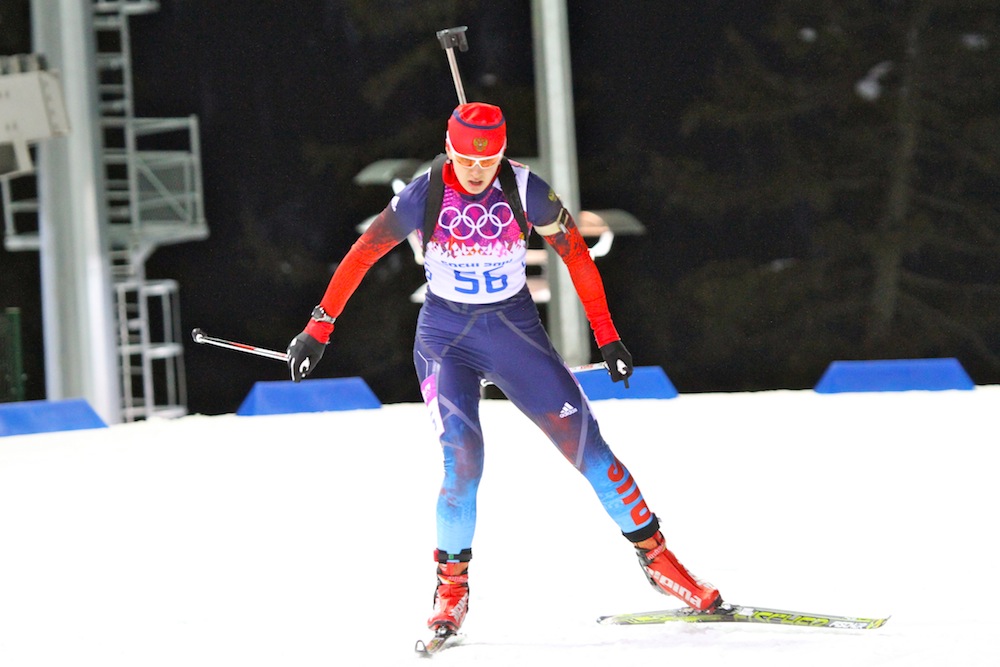
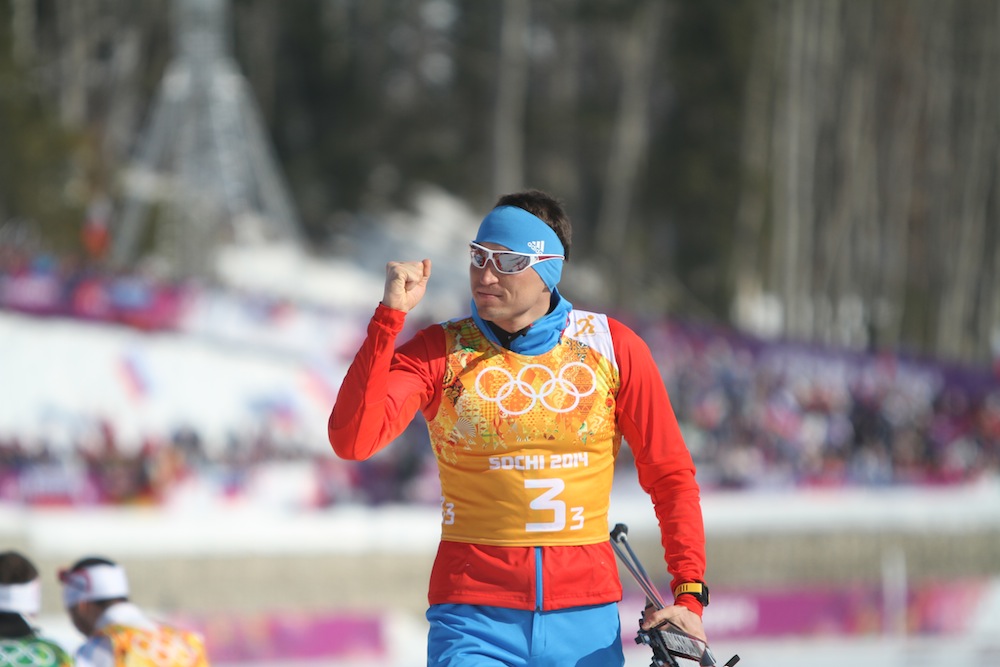
    The Court of Arbitration for Sport decided that there was a “reasonable possibility” that Alexander Legkov had doped at the 2014 Olympics. Here, he pumped his fist after Russia claimed silver in the 4 x 10 k relay, their nation’s first medal in cross-country at the Sochi Olympics.

    Nearly two weeks ago now, the lawyer for Russian cross-country skier Alexander Legkov published the decision a panel at the Court of Arbitration for Sport (CAS) had come to after a hearing in May.

    Legkov has been suspended by the International Ski Federation (FIS) since December, 2016, because of his presence in the McLaren Report, an investigation commissioned by the International Olympic Committee (IOC) to assess potential state-sponsored doping by Russia at the 2014 Olympics in Sochi. Legkov won a gold medal in the 50-kilometer freestyle in Sochi, and is mentioned in multiple places in the McLaren Report’s evidence packet.

    As we summarized last week, CAS agreed that it was justified for FIS to provisionally suspend Legkov pending further investigations into whether he committed a Anti-Doping Rule Violation (ADRV).

    However, CAS decided that this provisional suspension could not be infinite and gave it an Oct. 31, 2017, deadline. After that point, FIS must either bring a full ADRV case against Legkov, or drop the provisional suspension until they have new information.

    Besides the new deadline, there were a number of interesting details in the 51-page decision from CAS.

    Before diving into them, the background: the IOC and FIS are considering a specific ADRV for Legkov: “tampering or attempted tampering with any part of the Doping Control”, outlined in the IOC Anti-Doping Rules for Sochi.

    That’s because one of Legkov’s urine sample bottles showed suspicious marks when examined by a forensic expert in the McLaren Report. The conclusion was that the bottle must have been opened after the sample had already been collected, presumably in order to swap out a “dirty” urine sample for a “clean” one. This was the scheme outlined by the McLaren Report as well as news outlets such as The New York Times, whereby the Russians systematically cheated the anti-doping system.

    Thus, the case hinges not on one doping sample: a urine sample collected on Feb. 23, 2014, the day Legkov won the 50 k.

    1. Provisional Suspensions Don’t Have the Same Standard as Final Decisions
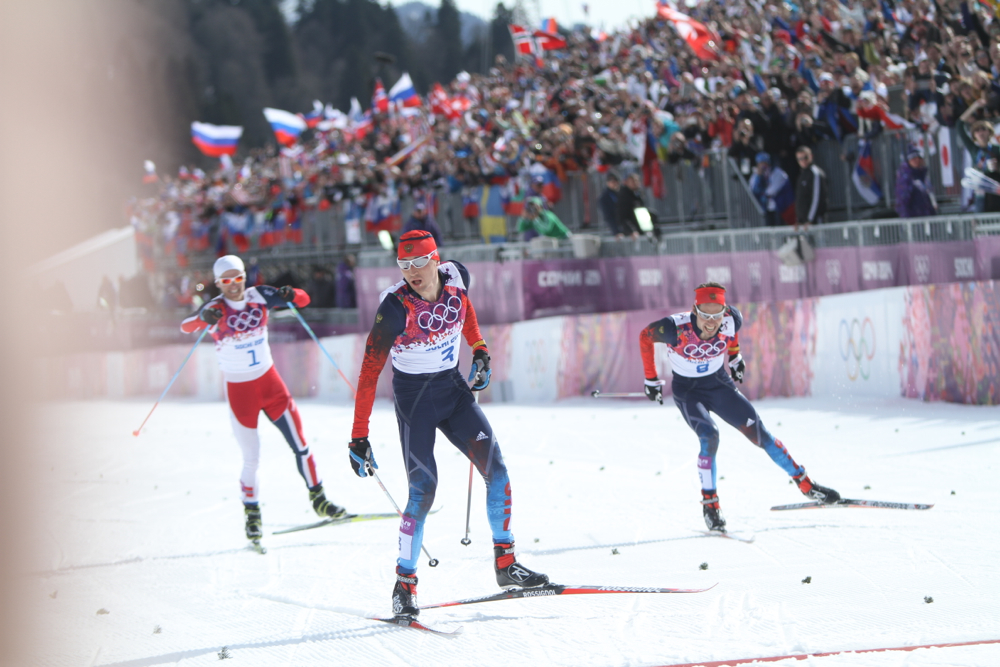
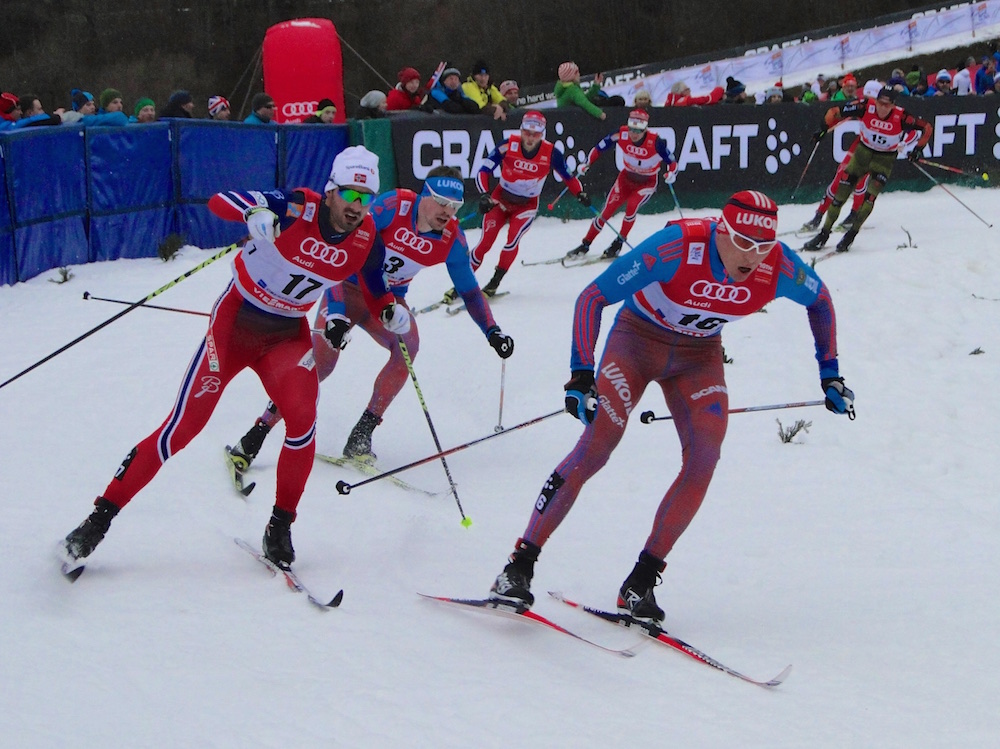
    Alexander Legkov (3) beat out fellow Russians Maxim Vylegzhanin (not shown) and Ilya Chernousov (r) for gold in the Sochi Olympics 50 k freestyle mass start — the last race of the 2014 Games. The sample bottle for Legkov’s anti-doping urine sample collected the same day showed signs of tampering.

    The suspension that Legkov was appealing was a provisional suspension, not a final one. FIS is still considering whether and how to bring a doping violation case against him, at which point there will be a different set of hearings and, if he’s found guilty, the implementation of a ban. (The long delay is because FIS is waiting on evidence from another IOC panel in order to bring their case.) In that case, the standard suspension for a first-time doping offense is four years; as of today, Legkov has been provisionally suspended for nearly 10 months.

    FIS outlined in their pleadings why it is important to keep suspected dopers out of competition while their cases are investigated:

    “Maintaining the suspension mitigates the ‘serious further risk’ of requiring retroactive disqualification of the Athlete (should he be found guilty of an ADRV),” the CAS Panel wrote in summarizing FIS’s position. “The potential need to revisit rankings, re-distribute medals, or otherwise modify competition results would ‘diminish the value’ of competition for participants, sponsors, and the viewing public.”

    CAS did not have a problem with this system, writing that “the provisional suspension occupies a space in which an ADRV is asserted, but not yet proven.” This is important, as it is likely to be used more and more frequently as the types of doping cases being tried gets more diverse.

    When there is a positive drug test, things often move forward fairly quickly. A mandatory provisional suspension is automatically triggered with a positive “A” sample (once it is established that the athlete does not have a Therapeutic Use Exemption for the substance), and there’s not much debate as to whether this is justified or not. From there it is on to analyzing the “B” sample and having hearings.

    But in non-traditional cases, which are becoming more and more common, provisional suspensions might play a bigger role – and putting them into place will have more gray areas. This includes cases like autologous blood doping, where athletes extract some of their blood, save it for later, and then re-infuse is to get a boost of red blood cells and oxygen-carrying capacity. There are (at the moment) few good chemical markers of this type of blood doping and all evidence must be observed directly.

    Other cases, too, sometimes rely on direct observation of doping, police finding doping materials, or paper or electronic files indicating wrongdoing, even in the absence of a positive doping test. The four-year ban of Austrian cross-country skier Harald Wurm is one example.

    Because provisional suspensions are intended to keep athletes out of competition while their cases are being fully investigated, the standard of proof required to implement and maintain a provisional suspension is less stringent than it is for an actual doping violation. By definition, evidence is still being gathered.

    In American civil law, the approximate analogy is to the situation in which someone seeks a temporary restraining order to protect themselves from a partner whom they fear will cause them domestic violence. The standard of proof that must be met to receive such an order is one of the lowest standards used in American law, because it is important to act quickly in this situation and because a longer follow-up hearing will be held soon after at which more evidence can be developed.

    Thus, merely having doubts about the evidence is not enough to overturn such a suspension: “In this appeal, a provisional decision is overturned if it has ‘no reasonable prospect of being upheld,’” the Panel wrote.

    So: a provisional suspension can be put in place if there is a “reasonable possibility” of a doping violation existing, and can only be overturned if there is “no reasonable prospect” of a doping violation being proven.

    In CAS’s view, FIS was justified in putting the provisional suspension into place last December. And secondly, CAS did not think that Legkov had proved that there was ‘no reasonable prospect’ of further developing their case, so the provisional suspension was upheld, albeit with a deadline.

    1. CAS Generally Trusts McLaren and Rodchenkov, With Caveats

    Legkov and his legal team argued that the McLaren Report was riddled with errors and that it was never meant to establish the guilt of specific athletes anyway, only to investigate the mechanism of systematic doping. As such, he argued, the report shouldn’t be weighed too heavily in proceedings.
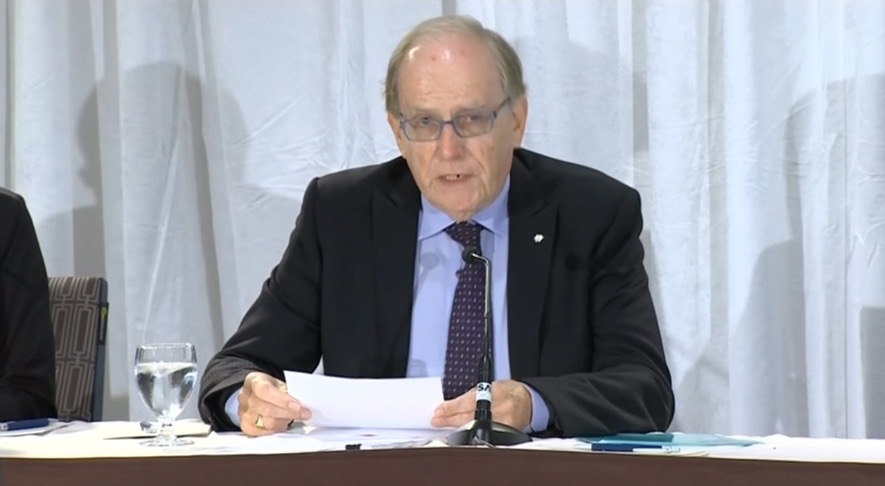
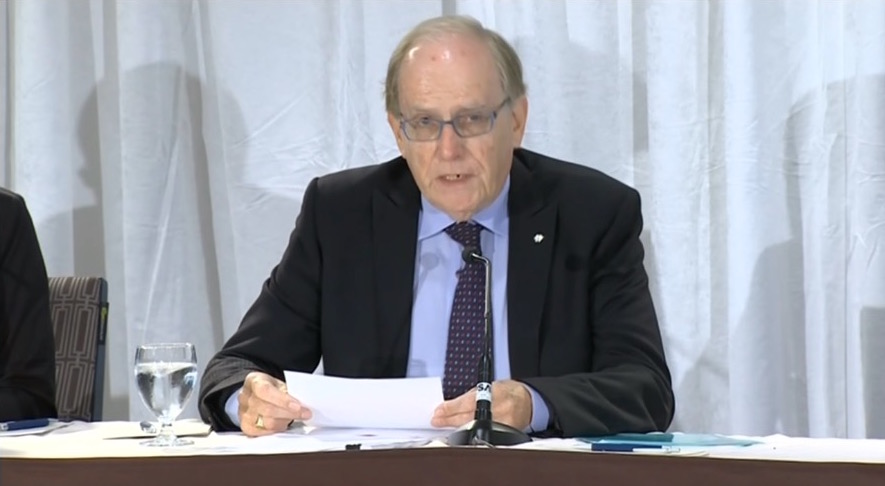
    Richard McLaren speaking at a news conference in Toronto regarding his WADA-commissioned report on state-sponsored doping in Russia.

    Likewise, the team painted Dr. Grigory Rodchenkov, the biggest whistleblower in the Russian doping scandal and a major source for McLaren’s report, as an unreliable source.

    Quite separately from Legkov, the Russian government has also been seeking to discredit Rodchenkov. Prime Minister Dmitri Medvedev called him “scum”, his assets were seized, and there’s currently a warrant out for his arrest.

    While agreeing that the evidence in the McLaren Report was not enough to prove a doping violation, CAS signaled that in general it trusted the evidence and that it certainly shouldn’t be ignored completely.

    “It would however follow from the report’s findings as to the corruption of an entire system, devised to favor selected athletes, that some individual athletes must have benefited,” CAS wrote of the argument that the McLaren Report was not intended to identify individual athletes for disciplinary measures. “It could not sensibly be concluded that whereas the system was corrupt in the manner identified nonetheless no athlete drew advantage.”

    The one exception: emails that Rodchenkov shared with McLaren. The emails are fascinating, but CAS wrote that they were “without context” and therefore very difficult to rely on as indicators of anything in particular.

    On Rodchenkov, too, CAS indicated that they value the testimony of whistleblowers, even and especially if those individuals have broken the rules in the past.

    “Although the Appellant has strongly challenged the credibility of Dr. Rodchenkov, the Panel observes first of all that the testimony of persons guilty of wrongdoing themselves can be decisive in establishing the guilt of others, and that the extent of their own culpability may even add to their value, since it is likely to be the result of their extensive involvement, at high levels, in the unlawfulness being examined,” the decision said.

    Relatedly, CAS recently used evidence from the McLaren Report to uphold the ban of a Russian triple jumper. According to documents in the evidence packet, she had participated in a “washout” scheme where she took performance-enhancing drugs at home in Russia, where positive tests were suppressed, and then traveled to international competitions once the drugs were undetectable.

    1. McLaren Didn’t Show

    All parties probably would have loved to ask Professor Richard McLaren, who assembled the McLaren Report, some questions. But they couldn’t. The Canadian was invited to the hearing but declined – CAS wrote that he “chose not to make himself available.”

    “From its perspective, the Panel regrets Professor McLaren’s absence and unavailability for questioning,” they wrote. “In any event, neither the Appellant nor the Panel has been able to pose questions to the person under whose supervision and control the evidence that fundamentally informs the suspension under appeal was gathered and organized.”

    McLaren did give FIS a sworn statement, but it was after the deadline had passed for the two legal teams to exchange evidence. So it was not permitted to be used in the proceedings.

    McLaren’s absence would have had stronger implications than simply the panel’s disappointment were this an American criminal case. The United States Supreme Court has interpreted the Confrontation Clause of the U.S. Constitution as requiring that a criminal defendant be able to cross-examine (that is, to “confront”) a witness against him, and specifically that prior out-of-court statements by a now-unavailable witness may not be used against hi at tria. McLaren’s physical absence from this hearing, in a case based almost exclusively on evidence he had previously gathered (but that the parties had not previously had a chance to ask him about), would have sufficed to overturn a conviction obtained on this basis under American criminal law.

    1. ‘I Live in Europe’ Is Not Enough

    One of Legkov’s main refrains through this whole ordeal has been that he was training outside of Russia for the time leading up to the 2014 Olympics, and so could not have participated in a state-sponsored doping program.

    Indeed: Legkov and a few other athletes made their own training group based primarily in Davos, Switzerland, with a non-Russian coach and physiotherapist.

    Legkov and Swiss physiotherapist Isabelle Knaute at the finish of the 35 k stage of the Tour de Ski in 2012.

    “To the extent that any opportunity might have existed to tamper, moreover, the Appellant considers it precluded by virtue of his geographical isolation from Russia,” the CAS Panel wrote in its summary of Legkov’s arguments. “The Appellant’s trainings have taken place outside of Russia since 2011, under the supervision of non-Russian coaches and personnel. Similarly, the Appellant has ‘used exclusively medical services in Davos,’ Switzerland (stemming from an apparent disappointment with Russian doctors following a bout of exercise-induced asthma in 2008).”

    But at some other point in the hearings, Legkov seems to have made the argument that Russian officials could have taken urine provided during medical tests he occasionally had to undergo in Moscow, and swapped it out from his Sochi sample without his knowledge or consent. Legkov’s Instagram does show him spending at least some time in Russia at a few points in the last few years – as would be expected. It’s his home country.

    Furthermore, with the Olympics being in Russia, Legkov was by nature back in Russia before the Games. This was the time period the CAS panel seized on in agreeing that yes, there was a “reasonable possibility” that he could have committed a doping violation.

    “While Mr. Legkov’s geographical distance might complicate day-to-day participation in the ‘chain of distribution’ of performance-enhancing drugs prior to Sochi, it does little to quell the reasonable suspicion arising from his appearance on lists relating specifically to the Olympics.”

    This is interesting because the International Association of Athletics Federations (IAAF), the international governing body for track and field, suspended the Russian track federation after the first part of the McLaren Report came out. As a result, Russian athletes could not compete in international events. But the IAAF made exceptions for athletes who lived and trained outside of Russia and were assumed to be tested routinely by non-Russian doping agencies.

    The difference may be that in that case, the IAAF was assessing athletes’ current status and trying to protect current competitions. They knew which athletes to track; further testing can be ordered, to the extent that the federation trusts an athlete is clean at, say, World Championships.

    In this case, FIS is trying to adjudicate a case from years past, rather than prevent doping in the future.

    1. ‘I Passed Many Tests’ Is Not Enough, Especially Since the McLaren Report Says Tests Were Suppressed

    Like many other doped and non-doped athletes before him, Legkov argued that he had passed so many doping tests that his reputation should help absolve him from suspicion.
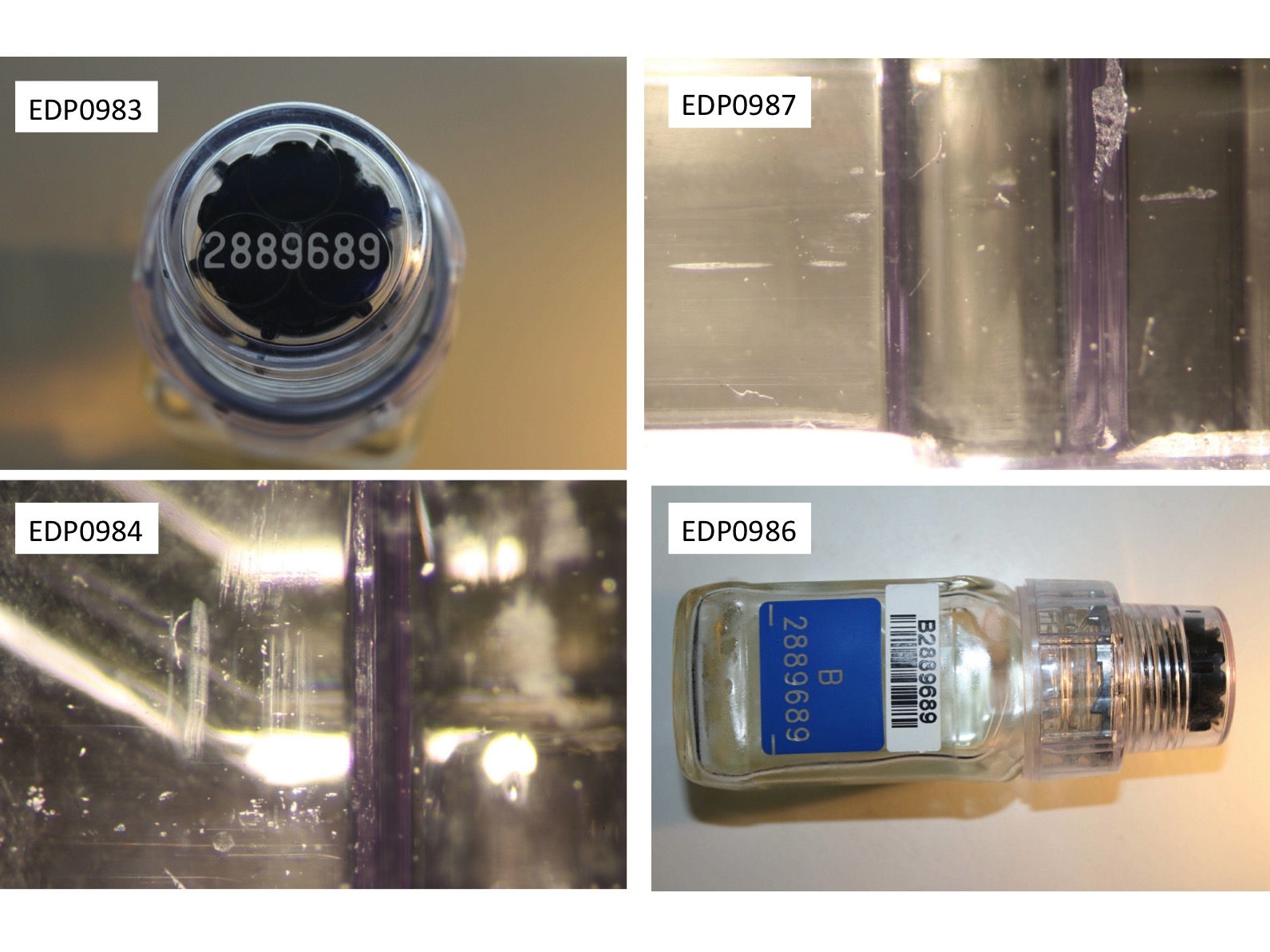
    Photos of a sample bottle from the McLaren Report’s evidence packet.

    CAS didn’t buy this argument, and indicated that Russian athletes may in fact have a much harder time using it in the future. The McLaren Report indicated that one of Russia’s strategies to get their doped athletes to competition was to simply alter test results in ADAMS, the international anti-doping results management database, from “positive” to “clean”.

    As such, the database can’t be relied upon.

    “The Panel considers it difficult to draw a conclusion from an athlete’s appearance or absence in ADAMS, given Professor McLaren’s indication that the Moscow Laboratory routinely manipulated and concealed test results,” the Panel wrote.

    Legkov was tested at least once by Russian authorities between Jan. 1, 2014, and when he arrived in Sochi for the Olympics.

    “The Appellant provided at least thirteen samples between 1 January 2014 and 5 February 2014, the date of his arrival in Sochi; at least twelve of these tested clean by laboratories outside of Russia and ‘without any chance’ to be manipulated,” CAS wrote in their summary of Legkov’s legal team’s arguments.

    In an email to FasterSkier, Legkov’s lawyer Christof Wieschemann wrote that the one remaining test was collected by the Russian Anti-Doping Agency (RUSADA) in Switzerland, and analyzed in Moscow. However, the very next day FIS collected “a sample for blood, blood passport and urine, [and] analyzed in Cologne [Germany].”

    (Note: a previous version of this story assumed that the RUSADA test had taken place in Russia. According to Wieschemann, that is incorrect.)

    1. ‘I Passed a Test Two Days Before’ Is Not Enough

    Legkov provided three urine samples and one blood sample at the 2014 Olympics; only the last urine sample showed signs of tampering. He argued that since the other samples were clean, he could not have doped at the Olympics.

    “During the Olympic Games themselves, the Appellant adds, three urine samples were submitted, including one sample on 21 February 2014, i.e., a mere two days before the urine sample which according to the IOC exhibited signs of tampering and which triggered the provisional suspension,” CAS wrote of Legkov’s argument. “The Appellant accordingly considers it ‘evident that he did not use the cocktail prior to or within the Olympic Games.’”

    CAS found this, well, ridiculous, especially given that the “Duchess Cocktail” – the mixture of illicit drugs alleged to be given to top Russian athletes whose “dirty” urine samples were later swapped out for “clean” ones – quickly disappears from the body, becoming undetectable.
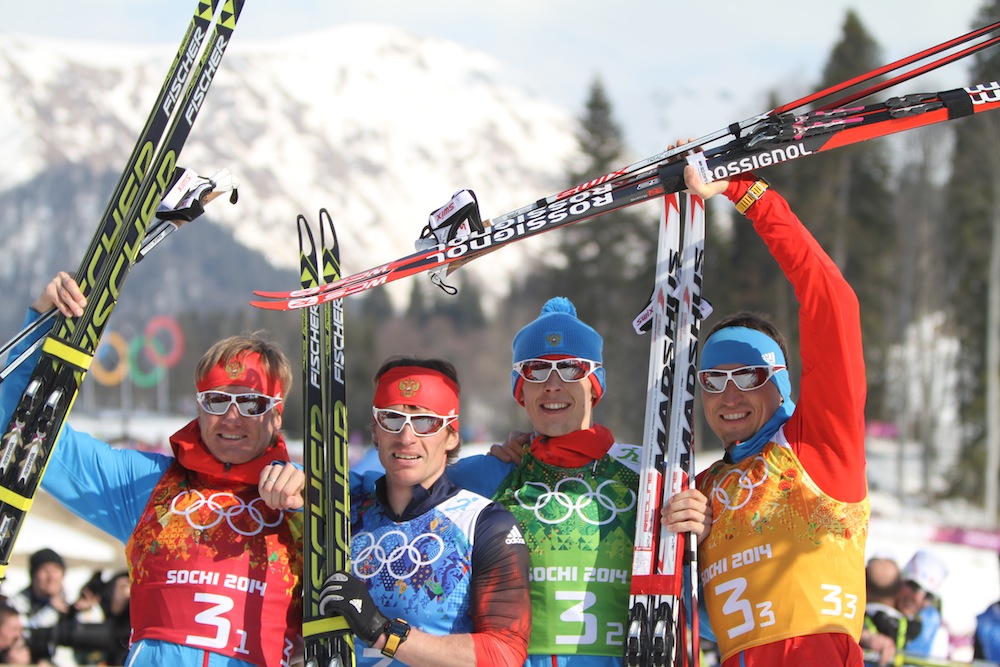
    The silver-medal Russian men’s relay team at the 2014 Olympics.

    “Intermittent consumption aimed at exploiting the cocktail’s short wash-out periods is entirely possible and, potentially in the Appellant’s case, desirable (given strict controls he faced in Europe prior to his arrival in Sochi),” CAS wrote.

    “It is hardly unusual for doped athletes to start and stop the consumption of performance-boosting substances abruptly, evading detection,” the panel continued. “Sufficient time (nine days) lapsed between the first and latter two samples for traces of the Duchess cocktail to dissipate; similarly, to the extent that the Appellant may have waited until shortly before his Gold medal-winning event to begin taking the cocktail, the two-day period separating his second (clean) and third (suspected) urine samples does not lift the cloud of suspicion established by this inclusion in the Duchess List and related documents.”

    1. What Was FIS Doing About the Other 40 Cases? 

    In its arguments, FIS repeatedly held up the McLaren Report as a reliable source of evidence.

    Furthermore, the arguments indicated that FIS had been paying attention since the day the report dropped, Dec. 9, 2016.

    “The IOC’s notification letter dated 22 December 2016 laid out compelling evidence [about Legkov] that had been known to the Federation since at least 9 December 2016,” the CAS panel wrote in summarizing FIS’s position. “The unprecedented scale of Professor McLaren’s allegations in combination with athlete-specific data in the EDP, FIS insists, required an immediate and resolute response.”

    While FIS may have made a relatively fast response with regard to Legkov and five others, it appears to have not taken public action in other cases. From FasterSkier’s assessment of the Evidentiary Disclosure Package (EDP), there were 46 skiers who were mentioned in the McLaren Report. This represented 99 anti-doping samples. FasterSkier summarized all of them in a database and wrote about the cases.

    To public knowledge, however, FIS only issued provisional suspensions to six athletes: Legkov, Maxim Vylegzhanin, Evgeny Belov, Alexei Petukhov, Julia Ivanova, and Evgenia Shapovalova.

    These were the six who seemed to be under investigation by the IOC for doping in Sochi. To public knowledge, FIS has not issued any formal sanctions or charges based on any of the other, non-Olympic, evidence in the McLaren Report.

    FIS did, however, allow Legkov to keep training with the Russian National Team as of Jan. 18, 2017, “an accomodation intended to allow him to maintain his competitiveness pending the resolution of his case.”

    1. Competing in Sport Is Not a Fundamental Right or Liberty

    Legkov made the argument that his right to a fair trial was being infringed upon, because he was being suspended without any charge. His legal team called on Swiss law to overturn the FIS suspension; in the CAS summary, they wrote that Legkov alleged “the provisional suspension’s incompatibility with Swiss fundamental rights.”

    CAS was not sympathetic, noting that the components of due process under Swiss law – “the Appellant’s right to understand, confront, and refute the evidence against him” – were being followed by the very fact that the hearing was taking place.

    “The question under Swiss law, moreover, is not whether the Appellant enjoys certain protections but rather to which degree they find expression vis-à-vis competing notions of associational autonomy,” the Panel wrote. “An athlete subject to sanctions proceedings internal to an association does not ‘require protection in the same measure as, for example, the accused in a criminal proceeding’… CAS sanctions result in a period of ineligibility to compete and forfeiture of prizes, not deprivation of liberty.”

    1. Anti-Doping Rules Are Hard to Write

    In determining the “reasonable possibility” standard for proof of a doping violation with regard to provisional suspensions, the CAS Panel waded through several provisions in the FIS Anti-Doping Rules.

    They found unclear the order in which provisions were supposed to be considered, and found that some provisions might even be inconsistent with others. While the Panel eventually decided that there was a clear way around this problem, they were not complimentary of the FIS rules.

    “Though both options [for interpreting the FIS Rules] have merit, ambiguous drafting frustrates attempts at a definitive interpretation of the FIS Rules’ intended order of precedence,” the Panel wrote at one point.

    “A literal focus on the word ‘assertion’ may therefore prove elusive,” they wrote at another. “The drafters’ intent finds no expression in a uniform, literal construction of Articles 7.7 and 7.9.”

    It is the second time in just over a year that FIS has been rebuked over clarity of rules, although the first was not fully the fault of the federation.

    The case of Norwegian skier Martin Johnsrud Sundby hinged on how to interpret rules about how much salbutamol, an asthma medication, can be inhaled in a certain period of time – and whether a nebulizer counts as an inhaler.

    The rule in question was the WADA Code – written by the World Anti-Doping Agency (WADA), not FIS – but in this case, FIS was applying the rule and thus was party to the proceedings.

    “The Panel considers that the Athlete genuinely misunderstood the meaning of the β2A Provision, and also itself considers that the β2A Provision could have been drafted more clearly in certain respects (an issue the Panel will return to when discussing the appropriate sanction),” CAS wrote in that decision.

    The notion of an adjudicative body critiquing a legislative body for unclear statutory construction is not unusual. The solution is, ideally, for the relevant legislative body to clarify the relevant text in a future session. In the case of asthma medication, the 2018 WADA Prohibited List updated its text on β2-agonists.

    It remains to be seen whether FIS (or WADA, the IOC, or other sporting federations which use the same or similar language in their rules) will respond to this portion of CAS’s Legkov decision in the same manner.

  • A Database of the 78 Biathlon Anti-Doping Samples in the McLaren Report

    A Database of the 78 Biathlon Anti-Doping Samples in the McLaren Report

    screen-shot-2017-01-19-at-4-26-39-pm


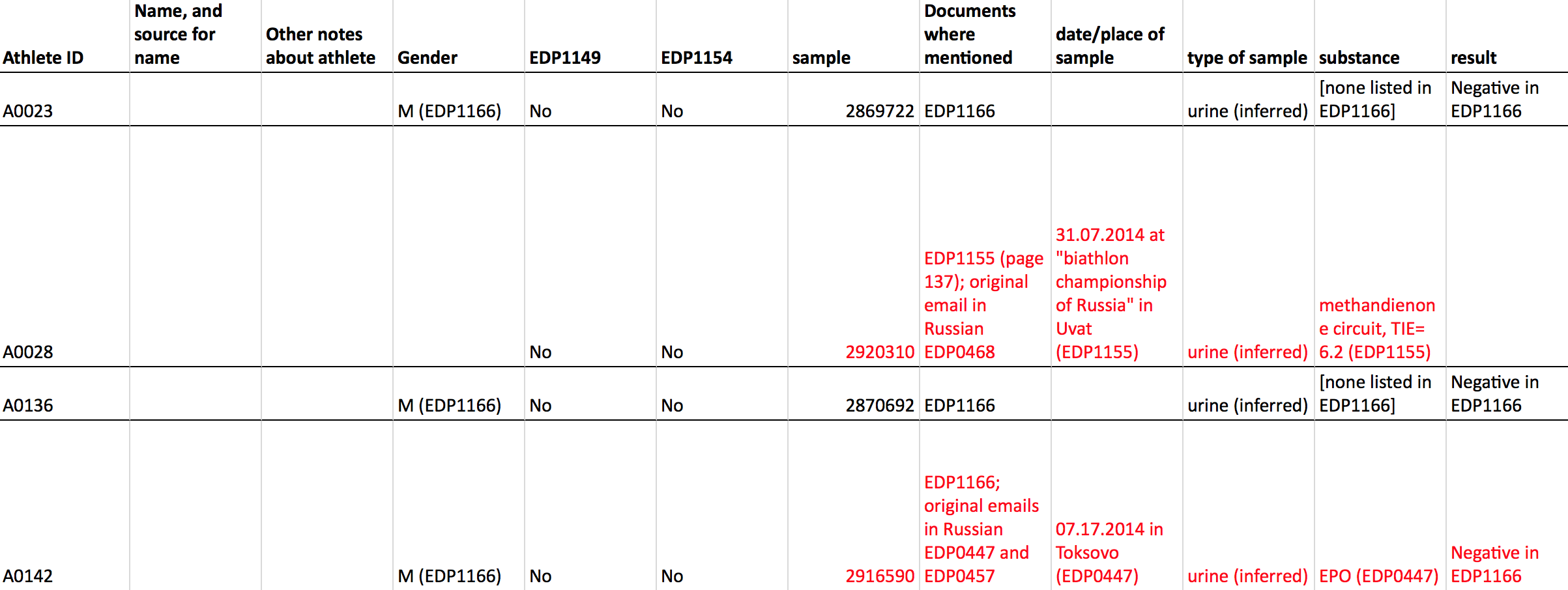
    78 samples from 38 biathletes are mentioned in the McLaren report, an independent investigation commissioned by the World Anti-Doping Agency to assess doping by Russian athletes.

    The following is a database we have assembled of all the mentions of these athletes and tests. For each piece of information, we have listed which document in the McLaren report’s Evidence Disclosure Package holds the information. You can find those documents on the Evidence Disclosure Package webpage by searching for the name of the document (for example, “EDP1151”). Some of the evidence documents are also described and discussed in the McLaren report itself. Otherwise, they do not have any titles, metadata, or descriptions.

    Below, positive tests are highlighted in red (13 cases), and samples which showed signs of tampering based on forensic investigation are highlighted in blue (seven cases).

    Link to the database: Biathletes in the McLaren Report

    In a number of cases, Vice Minister for Sport Alexey Velikodniy gives “save” or “quarantine” orders for positive tests to either be disappeared, or for athletes to be retained in Russia so that they cannot fail external doping tests.

    Note 1: EDP1149 and EDP1154 are two different planning documents for the 2014 Olympics in Sochi. As we discussed in a previous piece, they should not be considered accurate information about whether an athlete did or did not compete in a particular event in Sochi. However, an athlete’s mention in these documents indicates that they were at least competing at a level where their inclusion in the Olympics was possible.

    Note 2: This is a deeper dive into the evidence after our initial review, which identified four biathletes by name in the McLaren report. This document will be updated as new information becomes available. Updates will be announced and discussed on our “Doping in Nordic Sport” blog.

  • 19 Sample Bottles from Seven Paralympic Skiers Tampered With in Sochi

    19 Sample Bottles from Seven Paralympic Skiers Tampered With in Sochi

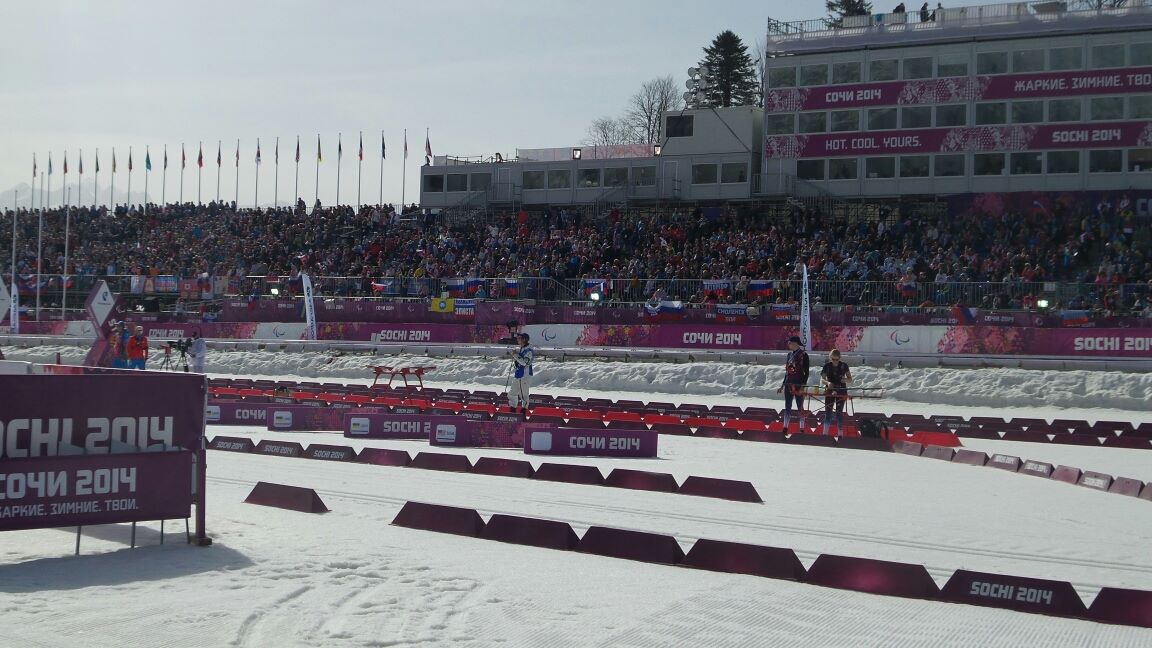
    A packed cross country stadium at the 2014 Winter Paralympic Games sprint races.
    A packed cross-country stadium for the sprints at the 2014 Winter Paralympic Games in Sochi, Russia.

    Anti-doping sample bottles belonging to seven Russian skiers at the 2014 Winter Paralympic Games were tampered with, according to the McLaren report.

    Russian cross-country skiers won 12 gold medals, nine silver and 11 bronze at those Games. Some of the same athletes also helped win 12 gold medals, 11 silver and seven bronze in biathlon.

    The report, which was commissioned by the World Anti-Doping Agency (WADA) and undertaken by Canadian law professor Richard McLaren, found that more than 1,000 athletes may have benefitted from tampering by Russian anti-doping authorities: either manipulation of samples, not reporting samples to WADA’s test-result database (ADAMS), or reporting positive tests as if they were negative.

    Among the findings were that Russian staff had discovered a way to open anti-doping sample bottles, produced by the German company Berlinger and long assumed to be tamper-proof.

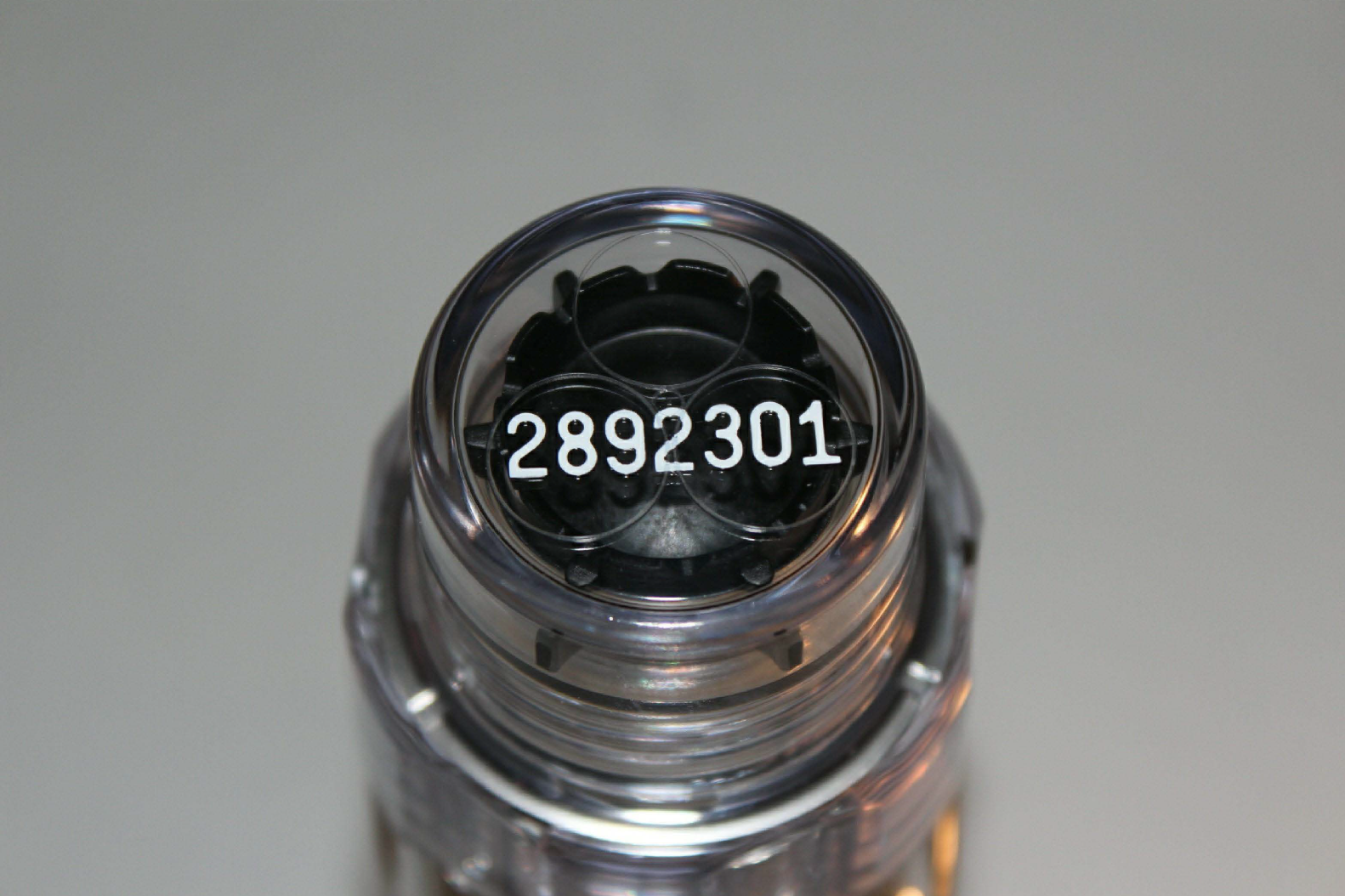
    The sample bottle belonging to a Paralympic cross-country skier. (Photo: McLaren report)
    The sample bottle belonging to a Paralympic cross-country skier. (Photo: McLaren report)

    The finding supported claims made by Dr. Grigory Rodchenkov, the former head of the Moscow Anti-Doping Laboratory, that at the 2014 Olympics in Sochi, Russia, he and others had unscrewed the lids of some sample bottles and replaced “dirty” urine with previously collected “clean” urine.

    “As the start of the Games approached, Dr. Rodchenkov recalls that he was not confident the bank of clean urine was adequately organised and he asked the [state security service] FSB to see it,” McLaren wrote in his report. “… Dr. Rodchenkov was allowed access to the part of the Command Centre where the samples were stored. The room contained 3 or 4 full size freezer units. Inside were numerous shopping bags labelled with the athlete’s family name and he was advised they were filled with bottles of that athlete’s pre tested clean urine.”

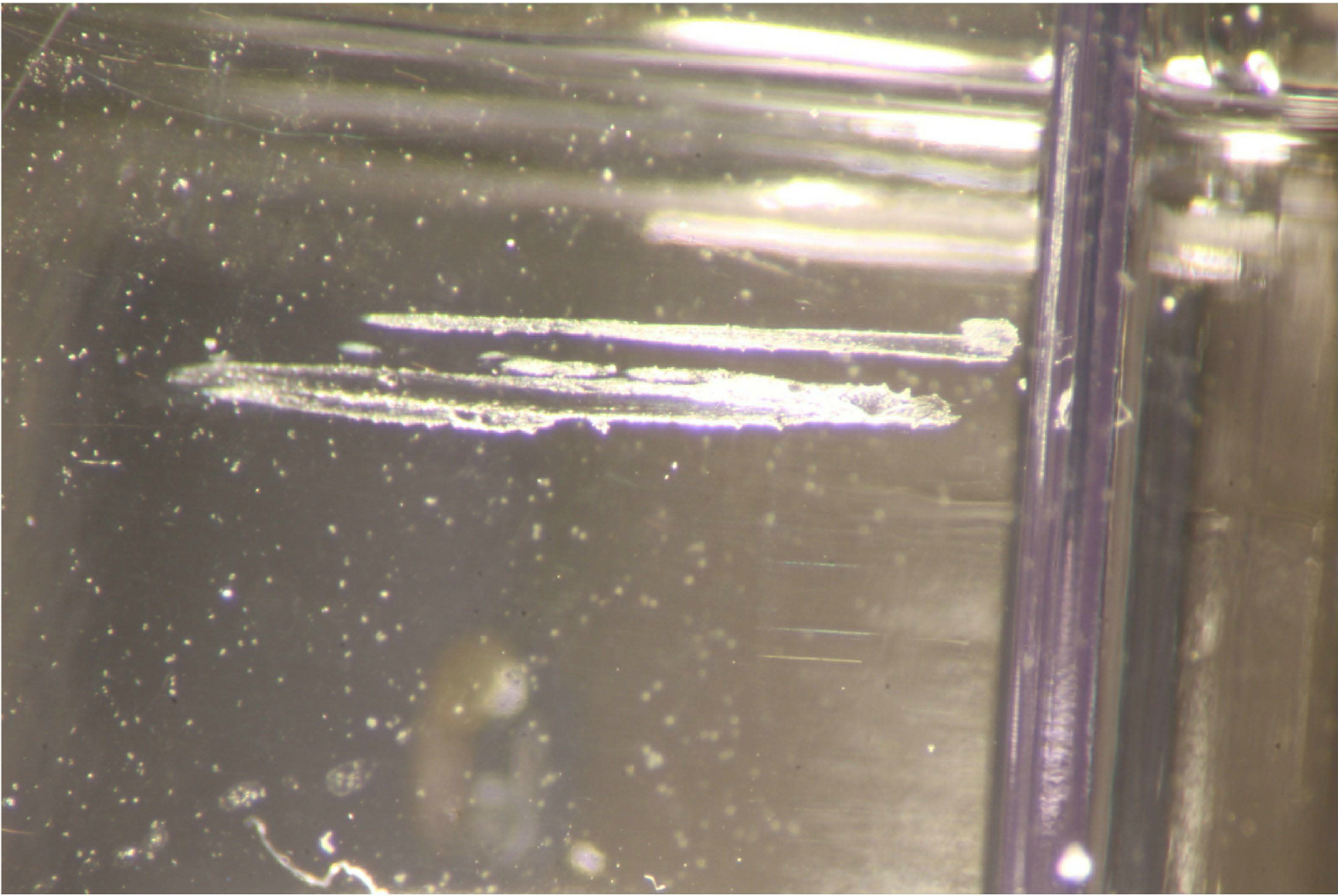
    Scratched marks on the same bottle shown above. (Photo: McLaren report)
    Scratched marks on the same bottle shown above. (Photo: McLaren report)

    Based on those claims, McLaren commissioned an investigation by a British Forensic Firearms and Tool Marks Examiner. His or her (the name is redacted) report, which can be found here, details the normal working of the tamper-proof bottles.

    The investigator came to the conclusion that the most likely way to open the bottles was to insert a thin metal or plastic object between the lid and the side of the bottle, and open the bottle from the inside. Depending on what type of material was used for this object and how carefully the bottles were opened, this procedure would leave marks on the bottle and/or lid, in some cases detectable only with a microscope or special lighting.

    Almost all of the sample bottles sent to the examiner by McLaren showed these marks. Among them: 19 bottles belonging to seven different IPC cross-country skiers.

    Athlete ID Samples Named in Forensic Investigation
    A0389 2890467, 2890467
    A0469 2892301, 2889197, 2888781, 2890593
    A0501 2891821, 2890557, 2889145, 2889128
    A0546 2889181, 2890105, 2890786
    A0656 2892161, 2891761, 2889127
    A0704 2890874
    A0705 2890793, 2892237

    The sample numbers are also reported in another document in McLaren’s evidence packet, EDP1166. This document is a list of test numbers associated with athlete ID numbers.

    “The IP has identified more than 1231 samples where the Moscow Laboratory communicated the presence of a prohibited substance in a Russian athlete’s sample to the [Ministry of Sport] and later reported that sample as negative in ADAMS or did not report the sample at all.”

    EDP1166 lists those 1231 samples. In the cases of the Paralympic skiers’ samples, they are associated with the alpha-numeric code of an athlete, but nothing is listed as a substance for which a positive test may have occurred, and the sample is also not listed as being reported as either positive or negative to the ADAMS database.

    Because this document was assembled to be a list of samples which were reported to the Ministry of Sport as being positive, it’s not clear what to conclude from this combination of facts.

    Other than in the forensic report and this document, neither the samples nor athletes are mentioned anywhere else in the McLaren report’s extensive evidence packet. There’s not even any listing of whether the athletes are male or female.

    The lack of a positive test result for any of these samples may be because there was previously-collected clean urine inside them, as described by Rodchenkov. Because no other discussion or information about the samples was found, it may never be known whether the athletes were actually doping or not; if replacing samples with previously collected urine was a policy, it may have been done without even testing to see whether the original samples themselves were clean.

    Even without that information, however, this could lead to suspension of the athletes.

    “246 athletes can be identified as potentially knowingly participating in manipulation thereby raising the possibility of a violation of WADA Code Article 2.5 (tampering),” McLaren wrote. “Athletes who provided clean urine to the CSP in advance, which was then swapped for a dirty sample, which he or she provided during the Sochi Games, could be in violation of Code Article 2.5.”

    In a statement on its website, the International Paralympic Committee (IPC) wrote that “The full findings of the report are unprecedented and astonishing.” Russia has been suspended by the IPC since Aug. 7, 2016.

  • Four Biathletes’ Names Not Scrubbed from McLaren Report; 31 Still Unnamed

    Four Biathletes’ Names Not Scrubbed from McLaren Report; 31 Still Unnamed

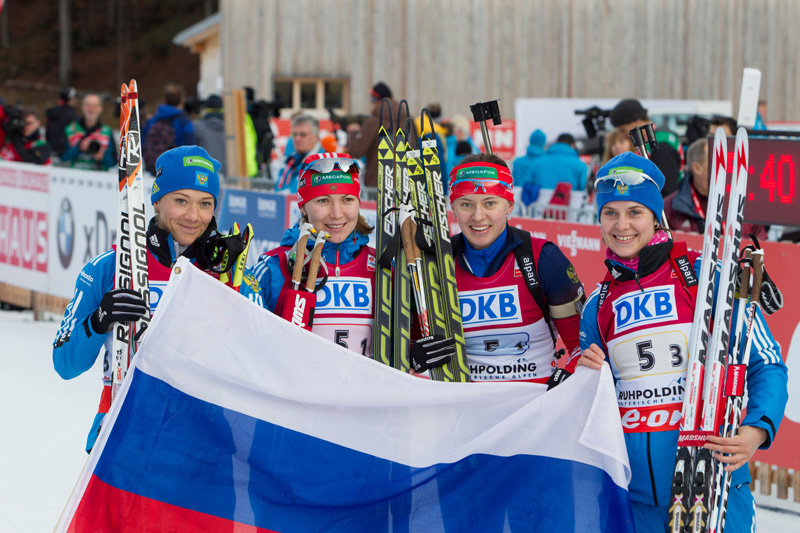
    Olga Zaitseva, Ekaterina Glazyrina, Olga Vilukhina, and Irina Starykh celebrate their IBU World Cup biathlon relay victory in Ruhpolding, Germany in January 2014. (Photo: Fischer/Nordic Focus)
    Olga Zaitseva, Ekaterina Glazyrina, Olga Vilukhina, and Irina Starykh celebrate their IBU World Cup biathlon relay victory in Ruhpolding, Germany in January 2014. (Photo: Fischer/Nordic Focus)

    The International Biathlon Union (IBU) has received a list of 31 Russian athletes involved in doping, IBU President Anders Besseberg told Norway’s VG newspaper.

    The information came from an Independent Person investigation completed for the World Anti-Doping Agency by Canadian law professor Richard McLaren.

    “Some of the 31 athletes are already banned, others have retired, but the most urgent thing is to assess the biathletes who are now participating in our international competitions,” Besseberg said. “I reckon that we on the board will make recommendations within a week… of those athletes who the Committee believes should be provisionally excluded.”

    Some information about the athletes, however, can already be gleaned from the McLaren report.

    For example, one document in the Evidence Disclosure Packet (EDP) failed to redact the names of four biathletes and replace them with alpha-numeric code identifiers. The four athletes were the planned roster for the women’s 4 x 6 k relay at the 2014 Olympics in Sochi, Russia: Olga Zaitseva, Olga Vilukhina, Yana Romanova, and Irina Starykh.

    Starykh had already been suspended before the Olympics began; she had tested positive for the blood doping drug recombinant erythropoietin.

    While the document identifying the women and their code numbers did not contain any evidence of doping, it means that any references to their code identifiers in other evidentiary documents can be connected to them.

    For instance, such cross-referencing reveals that one of several samples deemed to be too dilute to be an authentic urine sample by the Drug Control Centre at King’s College London, used by the investigation for external analysis of suspicious samples, belonged to Romanova.

    The team – with Ekaterina Shumilova replacing Starykh – won silver in the 4 x 6 k relay in Sochi.

    Zaitseva retired after Sochi, as she had long planned to do. Romanova retired after the 2014/2015 season. Vilukhina took that year off and made an unsuccessful return last season, before announcing her retirement on November 14 of this year.

    Nine other unnamed biathletes were shown in various documents to have tested positive for banned substances. In at least four of these cases, the results of the test were reported to the World Anti-Doping Agency’s ADAMS reporting database to be negative tests.

    And at least 20 more athletes in the report belonged to biathlon, although in those cases there is no specific information about what substances they may have used.

    Here is an extensive list of all the biathlon athletes mentioned in central documents from the evidence disclosure packet.


    About the Documents

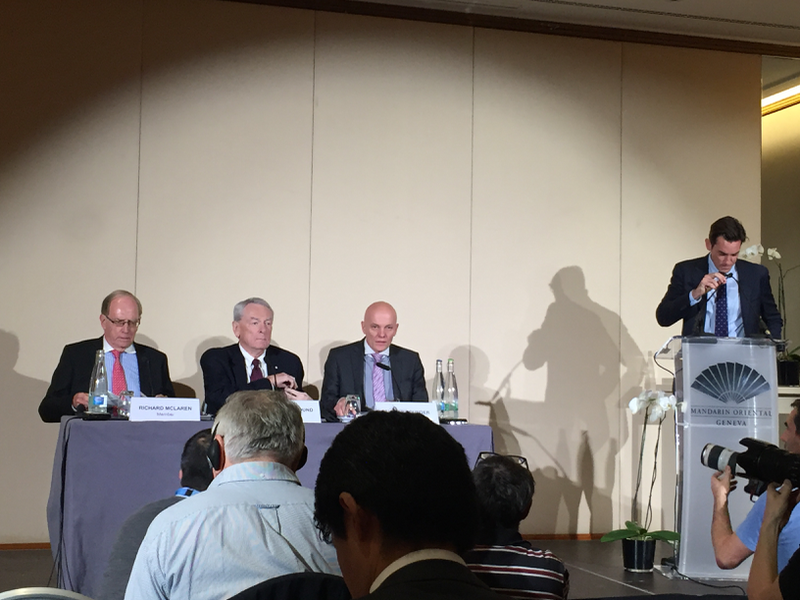
    Professor McLaren (c) addressing the media after the his second report on systematic, state-sponsored doping in Russian summer and winter sports. (Photo: WADA/Twitter)
    Professor McLaren (c) addressing the media after the his second report on systematic, state-sponsored doping in Russian summer and winter sports. (Photo: WADA/Twitter)

    EDP1162 and EDP1149: Professor McLaren describes this document in his report: “Alexey Velikodniy created a daily competition schedule that identified protected athletes. The schedule was continuously updated during the Games and included all those on the Sochi Duchess List and athletes added during the Games, such as the female hockey team.”

    EDP1149 includes English translation of the original EDP1162, and on page 44 of EDP1149 the names of the women biathletes are not redacted. Why redaction was successful in all other parts of the document, but not there, is questionable. Additionally, the document still seems to have been a planning document, as Staryk is still listed as competing in the relay even though she had long been off the Olympic team.

    EDP1156: A list of sample numbers and collection during or immediately before the 2014 Olympics in Sochi, from protected national team athletes. Some data about the urine tests, like pH and specific gravity, are included, indicating that this was not merely a planning document but that the tests took place.

    EDP1141: Results of a study done at King’s College London assessing whether the sodium concentration and specific gravity of some doping control samples were abnormal. (They were: in some cases, though none in biathlon, sodium concentrations were consistent with having added a teaspoon of salt to a one-cup urine sample.)

    EDP1155: Translations of emails involving Grigory Rodchenkov, the former head of the Moscow anti-doping laboratory who became a whistleblower and took his story to the New York Times.

    EDP1166: A list of test numbers, mostly associated with athlete ID numbers, identified by the investigation. “The IP has identified more than 1231 samples where the Moscow Laboratory communicated the presence of a prohibited substance in a Russian athlete’s sample to the [Ministry of Sport] and later reported that sample as negative in ADAMS or did not report the sample at all.” This document lists those 1231 samples.

    There are columns for which substances were positive in the sample (this column is often blank) and how the report was filed in the ADAMS database. Many samples were filed as “negative”, but this column is also often left blank. This may mean that the sample was never reported in ADAMS at all – as McLaren says was fairly common – or simply that there was no information about it.

    In general, the investigation’s translations from Russian into English are not always smooth. This is particularly apparent in reference to competitions: the name or level of a series is hard to interpret. It’s possible that the anti-doping staff themselves were not familiar with the different race circuits because they were not necessarily biathlon experts, and worked more generally in all sports.

    A further note: some documents are scanned and thus not searchable by text. Thus some names and numbers may be referenced in places where we have not yet found them.


    The Biathlon Relay Team

    A0944, Olga Vilukhina

    Olga Vilukhina won a silver medal in the sprint at the 2014 Olympics.
    Olga Vilukhina won a silver medal in the sprint at the 2014 Olympics.

    Why do we know her name? Listed in position “1” on pages 44 and 45 of EDP1149, in the 4 x 6 k relay

    Evidence of being a protected athlete? Yes, in multiple documents (although those documents may be redundant; without metadata, it is difficult to tell).

    Evidence that positive tests were covered up? Maybe. In EDP1166, one of Vilukhina’s samples (2870741) is listed as being reported “negative” to the ADAMS database and referred to in a document titled (in Russian) “Biathlon 3”, indicating a date of 06.01.2014 for the sample. But there is no substance listed for this sample in EDP1166. Because this document was assembled to be a list of samples which were reported to the Ministry of Sport as being positive, it’s not clear what to conclude from this combination of facts.

    Other tests? Besides that one sample, there are several other samples listed for Vilukhina: urine samples collected January 31, February 9, and February 16, 2014, and a blood sample collected February 15, 2014. While the urine samples are referenced in EDP1166, no substances were listed and the test does not seem to have been entered into ADAMS. February 9 was the day of the women’s sprint in Sochi, where Vilukhina won a silver medal. February 16 was the day before the women’s mass start, where Vilukhina placed 21st.

    A0983, Olga Zaitseva

    Olga Zaitseva blows kisses to the crowd as she brings Russia the gold in the Olympic biathlon relay in 2010.
    Olga Zaitseva blows kisses to the crowd as she brings Russia the gold in the Olympic biathlon relay in 2010.

    Why do we know her name? Listed in position “3” on pages 44 and 45 of EDP1149, in the 4 x 6 k relay

    Evidence of being a protected athlete? Yes, in multiple documents (although those documents may be redundant; without metadata, it is difficult to tell).

    Evidence of positive tests? Maybe. In EDP1166, one of Zaitseva’s samples (2870735) is listed as being reported “negative” to the ADAMS database. But there is no substance listed for this sample or date of collection and it is not referred to in any other documents. Because EDP1166 was assembled to be a list of samples which were reported to the Ministry of Sport as being positive, it’s not clear what to conclude from this combination of facts.

    Other tests? Besides that one sample, there are several other samples listed for Zaitseva. Around the time of Sochi, urine samples were collected January 31, February 14 and February 19, 2014, and a blood sample collected January 31, 2014. An additional undated urine sample is referred to in EDP1166. For these samples, no substances were listed and the test does not seem to have been entered into ADAMS. February 14 was the day of the women’s 15 k individual, where Zaitseva placed 15th, and February 19 was the mixed relay, where the Russian team including both Zaitseva and Vilukhina placed fourth.

    A0714, Yana Romanova

    Yana Romanova competing in Kontiolahti, Finland, in 2010. (Photo: Peter Porai-Koshits/Wikimedia/Creative Commons)
    Yana Romanova competing in Kontiolahti, Finland, in 2010. (Photo: Peter Porai-Koshits/Wikimedia/Creative Commons)

    Why do we know her name? Listed in position “4” on pages 44 and 45 of EDP1149, in the 4 x 6 k relay

    Evidence of being a protected athlete? Yes, in multiple documents (although those documents may be redundant; without metadata, it is difficult to tell).

    Evidence of positive tests? The report from King’s College London indicates that one of Romanova’s samples (number 2889617, collected on February 2, 2014, just before the Sochi Olympics began, according to another document) was too dilute to be an authentic sample. In the report and the New York Times investigation, Rodchenkov described adding water or salt to samples that were being manipulated. The King’s College London test suggests that this may be one such sample.

    In EDP1166, one of Romanova’s samples (2870745) is listed as being reported “negative” to the ADAMS database. But there is no substance listed for this sample or date of collection and it is not referred to in any other documents. Because EDP1166 was assembled to be a list of samples which were reported to the Ministry of Sport as being positive, it’s not clear what to conclude from this combination of facts.

    Other tests? Besides those two samples, there are several others listed for Romanova. Around the time of Sochi, urine samples were collected January 31, February 2, 13, and 21, 2014, and blood samples collected February 14 and 15, 2014. An additional undated urine sample is referred to in EDP1166. For these samples, no substances were listed and the test does not seem to have been entered into ADAMS. February 14 was the day of the women’s 15 k individual, where Romanova placed 53rd, and February 21 was the day of the women’s relay.

    A0856, Irina Starykh

    Targeted testing based on data from the IBU's Athlete Biological Testing program led to the suspension of Irina Starykh, above, and another Russian biathlete for blood-doping. The IBU fined Russia for a cluster of doping cases.
    Targeted testing based on data from the IBU’s Athlete Biological Testing program led to the suspension of Irina Starykh, above on her way to fifth place in the World Cup pursuit in Hochfilzen, Austria, in 2013, and another Russian biathlete for blood-doping. The IBU fined Russia for a cluster of doping cases.

    Why do we know her name? Listed in position “5” on pages 44 and 45 of EDP1149, in the 4 x 6 k relay

    Evidence of being a protected athlete? Yes, in multiple documents (although those documents may be redundant; without metadata, it is difficult to tell).

    Evidence of positive tests? In EDP1166, two of Starykh’s samples (2870740 and 2870745) are listed as being reported “negative” to the ADAMS database. But there is no substance or date listed for either sample, and they are not referred to in any other documents. Because EDP1166 was assembled to be a list of samples which were reported to the Ministry of Sport as being positive, it’s not clear what to conclude from this combination of facts.

    Other tests? No tests are listed for Starykh at the Sochi Olympics, because she was not there. However, there are five more samples of hers listed in EDP1166, for which no substances were listed and the test does not seem to have been entered into ADAMS.


    Other Athletes with Positive Tests Described in Documents

    Thirty-one other athlete ID numbers are associated with the sport of biathlon, and three additional mentions of biathletes which are not associated with any ID number. This means that they could belong to some of the 35 numbered athletes (the four named women plus the 31 unidentified, but numbered, athletes), or they could be completely separate cases.

    Of those 31-34 other biathletes, here are the ones for whom positive tests for prohibited substances are explicitly mentioned in the documents.

    A0241, female

    Evidence of being a protected athlete? Maybe. This athlete was certainly competing internationally. By the time Russian anti-doping staff were discussing her case, she was in Ruhpolding, Germany, and then was set to travel to Antholz, Italy – consistent with the World Cup schedule – before checking into the Olympics. This plan does not seem to be jeopardized by her positive test, although the staff notes that she is at risk. After the positive test, Rodchenkov notes that “it is necessary to hide her immediately.”

    Besides the four athletes named above, Shumilova competed in Sochi, along with Olga Podhufarova and Ekaterina Glazyrina. Several others were competing on the World Cup, but were unlikely to have been slated for Sochi participation because they did not have strong results so far in the season – the possible exception being Ekaterina Yurlova.

    Evidence of positive tests? In EDP1166, this athlete’s sample (2866518) is shown as testing positive for methenolone, oxandrolone, and trenbolone, all anabolic steroids. The test was allegedly collected on 12.19.2013 in Izhevsk, Russia, at the biathlon championships.

    How was the test handled? In the emails, which you can see in Russian here, this sample is given a “save” order, meaning that it should be reported as negative. And in EDP1166, the sample is shown as being negative in ADAMS. She may have additionally been quarantined: the anti-doping staff write in emails that if she was to be subjected to an international test (for instance, but the International Biathlon Union), she would certainly test positive and it would be “a very ugly situation for the lab if we ‘found nothing’ in such concentrations and for those substances.”

    Other tests? In EDP1166, two of this athlete’s samples (2870746 and 2867708) are listed as being reported “negative” to the ADAMS database. But there is no substance or date listed for either sample, and they are not referred to in any other documents. Because EDP1166 was assembled to be a list of samples which were reported to the Ministry of Sport as being positive, it’s not clear what to conclude from this combination of facts. An additional blood test is listed in EDP1166 with no substances listed, and the test does not seem to have been entered into ADAMS.

    Unnumbered Athlete, male

    Evidence of being a protected athlete? No. The only other information about this athlete is that it was a man.

    Evidence of positive tests? The emails refer to this athlete’s sample (2759623) being positive for 16a-hydroxyprednisolone (budesonide metabolite). Budesonide is a corticosteroid which is used in asthma medications such as Pulmicort inhalers, but it is also used in other forms: as pills, nasal sprays, and as a rectal foam to treat intestinal problems. The sample is written to have been collected on 11.1.2013 at in international competition in Ostrov, Russia. That day, IBU Cup sprints were held in Ostrov, with three Russian men (race winner Alexey Slepov, plus Sergey Korastylev and Sergey Klyachin) in the top six.

    How was the test handled? There’s no information about how this test was handled. It is discussed in the email, but no conclusion is reached. It also does not appear in EDP1166.

    Other tests? None listed.

    A0028

    Evidence of being a protected athlete? There’s no other information about this athlete.

    Evidence of positive tests? In the emails, athlete A0028 is described as having tested positive for “methandienone circuit” at the Russian biathlon championships in Uvat on 31.07.2014. It’s unclear what “circuit” refers to – it may be an awkward translation – but methandienone is an anabolic steroid. In addition, the testosterone to epitestosterone ratio is listed as 6.2. A high ratio can indicate that an athlete was using exogenous testosterone, and a finding of a ratio above 4.0 triggers further investigation. The original email can be seen (in Russian) here.

    How was the test handled? In the emails, the word “Quarantine” appears above the description of this athlete’s test results. This likely means that the athlete was kept in Russia until they could pass an anti-doping test. There’s no information about whether the test was reported to the ADAMS database or not.

    Other tests? None listed.

    A0179, female

    Evidence of being a protected athlete? No. The only other information about this athlete is that it was a woman.

    Evidence of positive tests? Document EDP1166 states that on 09.28.2014 at Russian biathlon championships in lzhevsk, a sample tested positive for isomers of amphetamines, which are banned stimulants. There is also discussion of the sample in the emails, with someone writing, “find out what she took!” The group seems to suspect that the substance came from a dietary supplement. The email (in Russian) can be seen here.

    How was the test handled? In the emails, this case is listed with a “save” order: that means that a positive test should be turned into a negative one. Indeed, document EDP1166 states that this test was reported as negative to the ADAMS database.

    Other tests? None listed.

    A0461, male

    Evidence of being a protected athlete? No. The only other information about this athlete is that it was a man.

    Evidence of positive tests? EDP1166 shows that one of this athlete’s samples (2867705) tested positive for tuaminoheptane, a prohibited stimulant which is used in nasal decongestants. The emails (here) show that this sample was collected on 12.21.2013 at a Russian Cup race in lzhevsk.

    How was the test handled? The emails are unclear, with someone writing, “and this one still does not have a decision (or I missed it).” However, in EDP1166 the test is listed as having been reported to ADAMS as negative.

    One staff member, perhaps assumed to be Rodchenkov, writes this regarding the sample: “Alex, come on, I’ll close the whole shop… They are imprudent beyond measure… and then I will go to other laboratories after February 2014.”

    Other tests? In EDP1166, two of this athlete’s samples (2918636 and 2870699) are listed as being reported “negative” to the ADAMS database. But there is no substance or date listed for either sample, and they are not referred to in any other documents. Because EDP1166 was assembled to be a list of samples which were reported to the Ministry of Sport as being positive, it’s not clear what to conclude from this combination of facts.

    A0751, female

    Evidence of being a protected athlete? No. The only other information about this athlete is that it was a woman.

    Evidence of positive tests? EDP1166 shows that one of this athlete’s samples (2945500) tested positive for pthalates, which are plasticizers. They are prohibited because they are thought to indicate the use of blood transfusions, with the plasticizers being used to soften the plastic in blood bags and then diffusing into the blood. The emails show that this sample was collected on 09.28.2014 at Russian biathlon championships in lzhevsk, That email (in Russian) can be seen here.

    How was the test handled? EDP1166 shows that this test was reported as negative to ADAMS.

    Other tests? None listed.

    A1244, male

    Evidence of being a protected athlete? No. The only other information about this athlete is that it was a man.

    Evidence of positive tests? The sample (2868394) is not listed in EDP1166, but only discussed in the emails (in Russian here). The emails refer to a positive test for trimetazidine, a metabolic modulator which protects against angina and heart problems, much like meldonium. According to the emails the sample was collected in Uvat at Russian biathlon championships on 6 April (assumed to be 2014).

    How was the test handled? There’s no information about how this test was handled.

    Other tests? None listed.

    Unnumbered Athlete, male

    Evidence of being a protected athlete? No. The only other information about this athlete is that it was a man.

    Evidence of positive tests? In the emails, one of this athlete’s samples (2689927) is written to contain methylhexanamine, a banned stimulant common in dietary supplements (it is in fact the same substance which German biathlete Evi Sachenbacher-Stehle tested positive for at the 2014 Olympics). The sample was collected on 2012-12-17 at all-Russia competitions in Ekaterinburg.

    How was the test handled? There’s no information about how this test was handled. In the emails, it is clear that nothing was done about the test until the following year (2013), but the final action is not discussed. It also does not appear in EDP1166.

    Other tests? None listed.

    Unnumbered Athlete, male

    Evidence of being a protected athlete? No. The only other information about this athlete is that it was a man.

    Evidence of positive tests? One of this athlete’s samples (2746493) is discussed in the emails as having tested positive for furosemide, a diuretic and masking agent. The sample was collected on 01/09/2013 at all-Russia competitions in lzhevsk.

    How was the test handled? There’s no information about how this test was handled. Other than reporting the sample, there is no discussion of the test in the emails, and also does not appear in EDP1166.

    Other tests? None listed.


    Other Athletes Mentioned in the Documents

    For the rest of the biathletes, sample numbers are listed in EDP1166, but no substances are listed and positive tests are not discussed described in any of the other documents. Because EDP1166 was assembled to be a list of samples which were reported to the Ministry of Sport as being positive, it’s not clear what to conclude about the samples.

    Here is what we know about them.

    ID Number Gender Samples reported as negative Samples with no information about reporting
    A0023 Male   2869722
    A0136 Male   2870692
    A0157 Male 2867964  
    A0201 Female 2869837  
    A0232 Male 2870747 2889906, 2890603, 2890739, 2944467
    A0282 Female 2866843  
    A0321 Female 2868243  
    A0491 Male 2870733 857444 (blood)
    A0508 Male 2868236  
    A0521 Male 2870742 857581, 857105, 857600
    A0548 Female 2869752  
    A0567 Female 2867862  
    A0576 Male 2866527  
    A0579 Female 2870697  
    A0598 Female 2847214  
    A0639 Female 2869643  
    A0640 Male 2869203  
    A0687 Male 2867881  
    A0795 Male 2870739 2944657, 2890878, 2890855, 2889922, 2889808
    A0804 Male 2869859
    A0808 Female 2870743 857613 (blood)
    A0930 Male 2870744 857573, 857440 (blood)
    A0950 Male 2870748
    A1031 Male 2869912

    In addition:

    A0142, male

    Mentioned in EDP1166: Sample 2916590 is listed as having been reported as negative in the ADAMS database. There is no information listed about substances in the sample.

    Other mentions: The same sample is described in an email which does not seem to have been translated into English. The sample was collected on 2014-07-17 in Toksovo, outside of Saint Petersburg.

  • World Cup Skiers Wrestle with McLaren Report, Want Action From FIS

    World Cup Skiers Wrestle with McLaren Report, Want Action From FIS

    Andy Newell (U.S. Ski Team) on his way to 40th in the men's classic-sprint qualifier in the first race of the 2016/2017 World Cup season in Kuusamo, Finland. (Photo: Fischer/NordicFocus)
    Andy Newell (U.S. Ski Team) on his way to 40th in the men’s classic sprint qualifier in the first race of the 2016/2017 World Cup season in Kuusamo, Finland. “This is a serious situation that has affected our sport over the years and in a very negative way,” he said of the systematic doping of Russian athletes detailed in the McLaren report. (Photo: Fischer/NordicFocus)

    DAVOS, Switzerland — The evening before the skate sprint in Davos – Andy Newell’s last World Cup competition of 2016 – the U.S. Ski Team veteran stood in the dark outside the temporary trailer his team was using as a wax cabin and talked about doping.

    In particular, he talked about systematic doping in Russia and the revelations of the McLaren report, which had dropped just the previous day.

    “It’s unfortunate,” Newell said. “You know that there are athletes who have been under suspicion from this McLaren report who are still racing both in biathlon and cross-country, and they are still on the World Cup. I think that is a shame because they are taking away valuable opportunities from other people.”

    When Canadian law professor Richard McLaren filed his report on Friday, his team also posted online much of the evidence they had used to build their case.

    The names of athletes were blinded in all the documents, replaced by alpha-numeric codes. But connecting the dots between different documents, it was easy to guess who some of the codes referred to.

    For instance, A0467: probably Alexander Legkov. In a document listing Russian national team athletes competing in the 2014 Olympics in Sochi, A0467 is referred to as winning gold in the 50 kilometer mass start. That could only refer to one person.

    In another document, athlete A0467 is listed as testing positive for the steroid budesonide. The document shows that the test was reported as “negative” in the World Anti-Doping Agency’s (WADA) test management database, ADAMS. If that’s true, it means that Legkov was never suspended after testing positive for a banned performance-enhancing drug.

    Alexander Legkov of Russia leads Martin Johnsrud Sundby of Norway and Sergey Ustiugov of Russia in the 15 k classic mass start stage of the 2016 Tour de Ski in Oberstdorf, Germany. (Photo: Harald Zimmer)
    Alexander Legkov of Russia leads Hans Christer Holund of Norway and Sergey Ustiugov of Russia in the 15 k classic mass start stage of the 2016 Tour de Ski in Oberstdorf, Germany. Legkov has been implicated in the Russian doping scandal since he was named in a New York Times investigation in May, 2016. (Photo: Harald Zimmer)

    The Russian, who has maintained his innocence since being named in a New York Times investigation months ago, was in Davos. That day he had placed fifth in the 30 k skate. Newell and others wrestled with that.

    “I do still believe in some sort of rule by law,” Newell’s teammate Noah Hoffman had said just after placing 44th in that 30 k. “It needs to be consistent and transparent, and absolutely every athlete has a right to protest any findings. I can’t imagine anything worse than being accused of something that you didn’t do. As a clean athlete, being labeled a doper would be my worst nightmare. … but I want a commitment, I want a showing of support [in the investigation].”

    Shortly after Hoffman was interviewed, Legkov walked through the mixed zone, where radio, newspaper, and online journalists clamored behind a makeshift fence, and did not take questions.

    Many of the documents uploaded as part of the evidence packet contain inconsistencies. The documents were also uploaded without metadata, making it difficult to judge their provenance or reliability. When were they created, by whom and why? Were they planning documents or notes taken after the fact?

    The documents, along with an index of which names correspond to which code numbers, were forwarded to relevant international federations (like the International Ski Federation, FIS). Those organizations will have their work cut out for them sifting through the evidence and trying to tease out unimpeachable facts.

    If they find that anti-doping rule violations have occurred, they are responsible for determining the sanctions and consequences, amending results from international competitions, and redistributing prize money.

    But regardless of whether an athlete such as Legkov doped or not – or whether that can be proven, which is a different question – he and others appear in the documents multiple times.

    And more than any individual case, it’s the volume of athletes involved that impressed World Cup competitors interviewed last weekend. McLaren said that more than 1,000 Russian athletes across multiple sports benefitted from having their samples manipulated or their negative tests “disappeared” in recent years.

    “I think a lot of us are surprised just by the sheer numbers of people involved,” Newell said.

    “I’m not shocked to read that there’s cheating going on at the highest level,” Canadian World Cup Team member Devon Kershaw said. “To be honest, I think that anyone who is shocked hasn’t read the long list of athletes from certain countries that are busted for really, really bad drugs. I’d say the thing that really shocked me or disappointed me was really the depth of it, and how sophisticated it all was to cheat.”

    The Ripple Effect

    The implications of that number – 1,000 athletes — is huge.

    “You have people out here that are racing– you know, the ripple effect is amazing,” Newell said. “There could be five or six skiers on the start list that shouldn’t be starting because they have made bad choices in the past.”

    The emotional cost of an Olympic medal awarded too late, in a makeshift ceremony away from the cheering crowd, has been well documented, especially in light of the International Olympic Committee’s (IOC) re-testing scheme which has resulted in over 100 retroactive disqualifications from the 2008 and 2012 Olympics (not just of Russian athletes, either).

    So, too, has the economic implication of missing a medal moment. The difference between being on the podium or not carries a high cost in terms of prize money and sponsorship. It may affect an athlete’s desire or even ability to continue their career, especially in less lucrative sports.

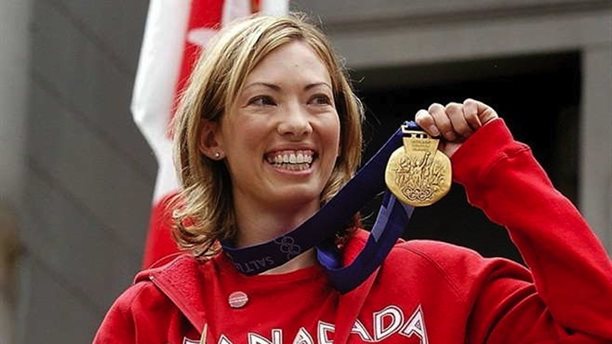
    Beckie Scott with the gold medal she was awarded at a ceremony in Vancouver in June 2004. A former Canadian cross-country skier, Scott finished third in the 5 k pursuit at the 2002 Olympics but was later awarded gold when the two women ahead of her were disqualified for using performance-enhancing drugs. (Photo: Cross Country Canada)
    Beckie Scott with the gold medal she was awarded at a ceremony in Vancouver in June 2004. A former Canadian cross-country skier, Scott finished third in the 5 k pursuit at the 2002 Olympics but was later awarded gold when the two women ahead of her were disqualified for using performance-enhancing drugs. (Photo: Cross Country Canada)

    ESPN’s Bonnie Ford, in her extensive investigation of retroactively-awarded Olympic medals, called this “the butterfly effect of an altered trajectory.”

    But it’s not just the best of the best whose results will be altered should 1,000 athletes, including some who were juniors at the time, be cited for doping violations. It’s also the athletes finishing tenth, 20th, 30th, or 40th in a race.

    “That affects people’s criteria,” Newell explained. “There are athletes that might miss a chance to race at World Championships because they didn’t achieve a certain result. So the ripple effect goes way down the start list. It’s really a big ripple effect, which is sad. That’s why I think athletes who are under suspicion shouldn’t be allowed to start these kind of races.”

    Many teams use specific results as criteria for World Championships and Olympic selection, as well as national team nominations. For instance: the U.S. Ski Team’s 2016 national team criteria required a top-50 overall World Cup ranking, a top-30 Sprint Cup or Distance Cup ranking, or podiums at U23 or Junior World Championships.

    And this season, a top-eight finish in certain race formats on the World Cup earns a spot at World Championships, regardless of how many athletes reach other criteria.

    To score World Cup points requires a top-30 finish in a race. What if a 32nd-place finish was really a 28th-place finish, and points were scored where they weren’t before?

    Even more points are awarded at the top of the result sheet. What if a 10th-place finish was really an eighth-place finish? Or fifth-place finish was really a third-place finish? How many careers would be changed?

    A Silent Federation

    Many skiers tried not to think about those questions over the weekend, or to wonder if the athlete in their sprint heat was connected to a particular alpha-numeric code in the McLaren report’s evidence packet.

    “It doesn’t change how I feel, how I attack every weekend,” Newell said. “Every weekend that I come to a World Cup is an opportunity to do my best and an opportunity to win. I am not really thinking of my competition, whether that’s who is next to me on the start line, what country they are from, or whether they are a suspicious name or not. I’m not thinking about all that on race day.”

    Alex Harvey of Canada leading Noah Hoffman of the United States in the 30 k skate in Davos, Switzerland.
    Alex Harvey of Canada leading Noah Hoffman of the United States in the 30 k skate in Davos, Switzerland. Both said they are hoping for a strong response from FIS on the doping situation.

    “I’ve taken the attitude that I’m trying to be the best that I can, ethically and cleanly and taking care of me and my stuff,” Hoffman agreed. “And so, I encourage FIS and the IOC to be decisive and transparent and to take significant action to clean up sport. But it’s not my job. It doesn’t affect me.”

    And yet, at a FIS-sanctioned World Cup, athlete after athlete voiced their desire for a strong response from the federation.

    “It’s discouraging to me,” said the U.S. Ski Team’s Ida Sargent. “I kind of think of sport as this inspiring thing. So I think this is the moment that we need to take a stand and clean it up… it should be a very strong stance. This is the moment. I hope that those with the power will go where they need to go now.”

    So far, FIS has not released any statement about the McLaren report via press release or any official channel. They emailed a statement to FasterSkier and other members of the media when specifically asked about the matter, but declined to answer follow-up questions.

    “Until we have received this information and reviewed the report, we cannot give any indication of timelines,” FIS Secretary General Sarah Lewis wrote in an email on Friday. “By the end of next week we hope to have further information about our next steps, subject to when we receive the summaries from WADA.”

    By comparison, the International Bobsleigh and Skeleton Federation released a short press release the day the McLaren Report dropped, while the International Biathlon Union took until Sunday to publicize their own short statement.

    “There hasn’t been a FIS response so far, so it’s hard to be satisfied,” Kershaw said.

    But then he capitulated, slightly.

    “It’s only Day 2, and they are trying to get their ducks in order,” he continued. “But there’s some pretty damning stuff in there, and I hope FIS looks into it and makes appropriate recommendations… I was a little disappointed with Kasper’s comments at the end of November. That’s disappointing from a president. But, you know, it’s par for the course.”

    He was referring to FIS President Gian Franco Kasper’s statement a few weeks earlier that anyone who assumed sport was clean was deluding themselves. Kasper had this to say about clean sport: “It’s a noble principle, but in practice? It’s entertainment. It’s drama.”

    So were athletes confident that their federation would act on the information quickly?

    “Pfffff,” was the response from Canada’s Alex Harvey. “Not super confident. I think there’s a chance, but I wouldn’t bet the house on it.”

    What Athletes Are Doing

    One common action by the athletes interviewed in Davos was joining a petition begun by U.S. Track and Field’s Athlete Advisory Committee, which calls on WADA to “protect clean athletes globally.”

    In an interview after finishing fourth in the 15 k skate on Saturday, the U.S. Ski Team’s Jessie Diggins said that her own statement mirrored the statement of the petition.

    Kikkan Randall (U.S. Ski Team) racing to 43rd in the women's 10 k classic at the Ruka World Cup in Kuusamo, Finland. A day earlier, she placed 52nd in the classic sprint. (Photo: Fischer/NordicFocus)
    Kikkan Randall (U.S. Ski Team) racing to 43rd in the women’s 10 k classic at the Ruka World Cup in Kuusamo, Finland. As the FIS athlete representative, she may play a key role in pushing the federation to respond to the crisis. (Photo: Fischer/NordicFocus)

    “That’s probably the best thing we can do,” Harvey said. “It’s better when we do something collectively. As one individual I think you’re wasting more energy than anything else, but collectively it’s good. One athlete on your own, I don’t know how far you can go.”

    As the cross-country athlete representative to FIS, American four-time Olympian Kikkan Randall is trying to organize some of the athlete responses and leverage the federation to act on the McLaren Report.

    “There’s a lot of discussion,” Randall said. “Again, just everyone kind of saying, like, ‘We want to do something about this,’ and especially throw our support behind making WADA a stronger, more independent body. Everyone’s sad, but excited to try to figure it out… I hope this is an opportunity for the world to wake up a little bit, and recognize that a massive change needs to happen. You know, I think the athletes really want to all come together to find some positive solutions.”

    Others, too, were more willing to spend some of their energy advocating for change.

    “I think the power the athletes have– we want to make sure FIS and the IOC do what they need to do to make this a level playing field and a fair playing field,” Newell said. “You know it’s no secret that it is not in FIS’s best interest to make a big splash about this. That’s why those athletes are out there still racing when they are under suspicion. It’s because FIS doesn’t want to say no, we don’t want you out here. They don’t want to bring attention to the fact that there’s widespread cheating going on in the sport.”

    Athletes speaking out could change that equation.

    “I think if anything the athletes can just put pressure on FIS to actually, you know, to use the swift hand of justice when it needs to be used,” Newell said.

    “I think we have to be honest and voice how we feel,” Kershaw agreed. “The sad reality is, yeah, they say it’s for the athletes. And it is fun. This is all for us. We get to put on a show. But it’s a business, too. And people are concerned with keeping sponsors and keeping a clean image, so every once in a while athletes can be sort of pawns in the whole game. So I think all we can do really is be true to ourselves and voice our opinions.

    Sport is a privilege,” Kershaw concluded. “It’s not your right to compete in sport. I think that until we have lifetime bans for things like EPO, human growth hormone, and blood doping, those sorts of things, I think we will see more of this, sadly. It makes me sick to my stomach.”

  • FIS President Kasper: ‘We Need to Stop Pretending Sport Is Clean’

    FIS President Kasper: ‘We Need to Stop Pretending Sport Is Clean’

    Johannes Duerr (second from right) during the Tour de Ski's 35 k pursuit from Cortina to Toblach, Italy, in December. Duerr was since kicked out of the 2014 Olympics for doping.
    Johannes Duerr (second from right) during the Tour de Ski’s 35 k pursuit from Cortina to Toblach, Italy, in December. The Austrian was since kicked out of the 2014 Olympics for doping.

    Doping has been in the news again, with the International Olympic Committee (IOC) announcing on Thursday that 16 more athletes from the 2008 Summer Olympics in Beijing had tested positive for banned substances, then adding 12 more to that tally on Monday from the 2012 Summer Olympics in London.

    That brings the total number of athletes disqualified for doping at those two Olympics to well over 100.

    The World Anti-Doping Agency (WADA) also held its Foundation Board meeting in Glasgow, Scotland, this weekend, agreeing on a whistleblower-protection program as well as a system of graded sanctions for countries who do not comply to the World Anti-Doping Code.

    “The decision by the Board to grant WADA authority to develop a new, meaningful graded sanctioning system is welcomed by athletes; particularly, as it provides a direct answer to the call made by athletes earlier this year for a stronger, meaningful system of consequences for non-compliance,” WADA Athlete Committee Chair Beckie Scott, a former Canadian cross-country skier, said in a WADA press release. “If we all agree that WADA should be independent and empowered as the regulator of doping in sport, then how could we not agree to equip WADA with the tools it needs to do its job fully… On behalf of athletes, I feel confident in saying that we are pleased that this decision has been made today in the interest of clean sport.”

    The system will reportedly have three tiers of sanctions, with countries committing the most serious and recurring offenses being barred from hosting the Olympics, World Championships and other major events. That would be applied to countries where the government interferes with anti-doping work or manipulates the testing sytem.

    The first level of sanctioning would be a result of administrative problems, and is proposed to bring in assistance from WADA in order to return to Code compliance. The second level of sanctions would apply when there are problems in testing procedures, at which point countries will be assessed a fine.

    Five countries are currently deemed Code non-compliant: Russia, which has been out of compliance since November 2015, but which has not faced any of the sanctions suggested above, although athletes in some sports have been barred from competing by their individual sports federations; Spain, which has been noncompliant since March 2016; and Brazil, Azerbaijan, and Indonesia, which were declared noncompliant at the Glasgow meeting.

    In the future, such countries could face sanctions. But International Ski Federation (FIS) President Gian Franco Kasper does not see it as WADA’s place to offer such punishments.

    “Sanctioning entire countries is purely political and I do not agree with this,” Kasper told Insidethegames. “WADA should not be a body which gives sanctions.”

    He also did not appear optimistic about the future of clean sport.

    “We need to stop pretending sport is clean,” he told New York Times reporter Rebecca Ruiz. “It’s a noble principle, but in practice? It’s entertainment. It’s drama.”

    Russia, which is currently non-compliant with the WADA Code, is hosting World Cups in multiple ski and snowboard disciplines later this season, and FIS has made no public show of moving them.

    Similarly, the International Biathlon Union (IBU) will see Russia hosting World Cups in March 2017, and also recently awarded Russia the 2021 World Championships.

    That was a topic of discussion at the WADA Foundation Meeting. The Compliance Review Committee is beginning action against the IBU, which it sees as having jeopardized its own compliance by awarding a major event to a country which does not comply with the Code.

    The Code states that international federations like the IBU must “do everything possible to award World Championships only to countries where the Government has ratified, accepted, approved or acceded to the UNESCO Convention, and where the National Olympic Committee, National Paralympic Committee and National Anti-Doping Organisation are in compliance with the Code”.

    The IBU has been given until January to offer a satisfactory explanation to WADA for why the Russian city of Tyumen was selected as the World Championships host site.

    Meanwhile, Russian IOC member Vitaly Smirnov asserted that Russia “has never had a state-sponsored doping system”, contrary to a WADA investigation published this year.

    The second part of that investigation, headed by Richard McLaren, is set to drop on Dec. 9.

  • Russian Doping: McLaren Report Confirms Cover-Up of Positive Samples in Sochi

    Russian Doping: McLaren Report Confirms Cover-Up of Positive Samples in Sochi

    Richard McLaren speaking at a news conference in Toronto on Monday regarding his WADA-commissioned report on state-sponsored doping in Russia.
    Richard McLaren speaking at a news conference on Monday in Toronto regarding his WADA-commissioned report on state-sponsored doping in Russia.

    In a press conference in Toronto on Monday, the long-awaited McLaren report confirmed allegations of state-sponsored doping in Russia.

    The World Anti-Doping Agency (WADA) gave Professor Richard McLaren, a Canadian lawyer, a mandate to investigate claims about doping during the Sochi Games in 2014. The report, however, made claims that the system to protect dopers was in place from late 2011 until August 2015.

    This confirmed statements by whistleblowers, including Vitaly Stepanov to German broadcaster ARD and Grigoriy Rodchenkov to The New York Times. When the initial allegations were made, they were strenuously denied by Russian officials including those named and identified in the McLaren report as having helmed the doping cover-up.

    The 97-page report itself made no recommendations for action, but McLaren said that standards of criminal law were followed and the findings were passed on to relevant authorities. Those findings were severe enough that following the report, the WADA Executive Board met and released a seven-point recommendation including that individual international federations bar all Russian athletes from competing at the 2016 Summer Olympics in Rio de Janeiro, Brazil.

    In terms of the report’s basics, here’s what McLaren concludes.

    Two labs responsible for anti-doping testing were investigated: the Moscow laboratory and the Sochi laboratory, its “satellite” facility for the 2014 Olympics. Both labs, according to the McLaren Report, were guided by the Ministry of Sport to ensure positive tests were removed and replaced by clean samples. The Ministry of Sport did not act alone. According to McLaren’s findings, it was aided in the cover-up by the Russia’s state security service (FSB).

    McLaren described two similar, but distinct, efforts to protect doped Russian athletes. The Moscow laboratory was responsible for ensuring clean samples for both summer and winter Olympic sports. Based near the highest powers of government, “The Moscow Laboratory was the final failsafe protective shield in the State directed doping regime,” the report stated.

    McLaren called this lab’s deceptive process the “disappearing positive methodology”. Positive tests were labeled “Save” or “Quarantine”. The “Saved” samples were swapped for clean ones, whereas the “Quarantine” samples were reported as failed drug tests.

    The Sochi laboratory helped protect Russian athletes from popping a positive specifically during the 2014 Sochi Olympics. The FSB, Russian Ministry of Sport, and the Moscow laboratory all assisted with planning and executing the sample swapping methodology used during the Games. The Sochi methodology was more complex — tamper-proof bottles were manipulated.

    Since their introduction at the 2000 Olympics in Sydney, it was assumed that the bottles could never be opened without showing a mark. But McLaren explained that they had been — small scratches on the bottles remained as proof of manipulation, but the marks were not visible to the naked eye. This confirmed a major allegation by Rodchenkov, which had been met with some skepticism by those who assumed that the bottles were indeed tamper-proof.

    Small scratches on the bottles remained as proof of manipulation, but the marks were not visible to the naked eye. 

    Other claims of Rodchenkov were not fully proven, although also not disproven. Rodchenkov, the former head of the Moscow laboratory, had said that there was a list of pre-approved athletes whose samples would be protected. He named Russian cross-country skier Alexander Legkov as one of them.

    McLaren, however, did not mention athletes by name. But he did confirm that there was a “pre-selected” group of Russian athletes that benefitted from the Sochi lab’s clandestine work.

    With all of his findings, McLaren made clear he used the threshold of “beyond a reasonable doubt,” when writing the report and substantiating any claims.

    According to page 41 of the report, since 2011, Russian winter sports athletes were implicated in the “disappearing positive methodology”: 10 positive tests were rendered clean in biathlon with 13 in “skiing”, although this was not broken down into disciplines such as alpine or cross-country. It should be noted that Russia qualified a small team of alpine skiing athletes for the Sochi Games.

    The WADA Executive Board called on all international federations whose athletes were included in the report to take investigative action. So far, neither the International Ski Federation (FIS) nor the International Biathlon Union (IBU) have made official statements.

    “The findings of the report show a shocking and unprecedented attack on the integrity of sport and on the Olympic Games,” International Olympic Committee (IOC) President Thomas Bach said in a press release. “Therefore, the IOC will not hesitate to take the toughest sanctions available against any individual or organisation implicated.”

    International Paralympic Committee (IPC) released a reactionary statement on Monday, quoting its president, Sir Philip Craven: “The IPC will now analyse the report’s findings in detail to evaluate what impact they have on the Paralympic Movement and Para Sport,” he said. “After an initial review of the report, we note the 35 ‘disappearing’ positive samples from Paralympic sport between 2012 and 2015 and have sent a letter to WADA and the report’s author Richard McClaren seeking further information on these samples.  We have also requested urgent clarification from both parties to better establish how the findings implicate the Sochi 2014 Paralympic Winter Games and Russian Para athletes as the report defines the Sochi Games as the XXII Olympic Winter Games…”

    The U.S. Olympic Committee (USOC) also weighed in: “The McClaren Report confirms what we have stated previously: the current anti-doping system is broken and urgently requires the attention of everyone interested in protecting clean athletes,” USOC CEO Scott Blackmun said in a press release. “We look forward to working with the IOC, WADA and the entire Olympic family to address the flaws in the current system so that a uniform approach to anti-doping can be implemented and enforced around the world. In the meantime, we are focused on preparing Team USA to compete at the upcoming Rio Games and will rely on the IOC, WADA and the international federations to impose sanctions that are appropriate in relation to the magnitude of these offenses, and that give clean athletes some measure of comfort that they will be competing on a level playing field in Rio.”

  • WADA Independent Commission Strongly Implies Winter Sports at Risk From Doping

    WADA Independent Commission Strongly Implies Winter Sports at Risk From Doping

    The WADA Independent Commission
    The WADA Independent Commission (l-r) Richard McLaren, Dick Pound, and Gunter Younger wait to discuss their findings as WADA’s Ben Nichols mediates questions from the ravenous press.

    GENEVA —“It’s pretty disturbing,” former president of the World Anti-Doping Agency (WADA) Richard Pound said in a press conference in Switzerland this afternoon about a special investigation into systematic doping in Russia.

    “We are not dealing with a he-said-she-said, we actually had documents and recordings,” he continued. “It’s disappointing to see the nature and the extent of what was going on, and to reach the conclusion that it could not possibly have happened without everybody knowing about it and consenting to it. It’s worse than we thought.”

    And then, after confirming that he would call this an instance of “state-sponsored” doping, the head of the Independent Commission said this:

    “Tip of the iceberg? I’m afraid you’re right. We don’t think that Russia is the only country with a doping problem, or that athletics [track and field] is the only sport with a doping problem.”

    The investigation was spurred by a documentary made by German filmmaker Hajo Seppelt, in which he talked to former Russian athletes and heard tales of doping, cover-ups, and extorting money from athletes who tested positive in order to allow them to continue competing.

    (An English transcript of the documentary can be found here.)

    In August Seppelt later partnered with the Sunday Times to further his investigation, finding a document with blood test results for 12,000 tests administered over a 10-year period leading up to the 2012 Olympics.

    Hundreds of these tests showed abnormal blood profiles that suggested, but did not prove, doping by Russians but also other athletes. This led to the assertion that the International Association of Athletics Federations (IAAF), the international governing body for track and field, did not do enough to protect clean athletes.

    Pound congratulated Seppelt and ARD on their “fine piece of investigative journalism,” saying that it not only sparked the investigation but made their job much easier.

    “The commission also wants to congratulates the individuals who were courageous enough to be whistleblowers in this matter, despite knowing that the outcomes are often attacks on their character,” he added.

    The Independent Commission, made up of Pound along with longtime sports arbitrator Richard McLaren and Gunter Younger, the head of the Department Cybercrime with Bavarian Landeskriminalamt in Germany, found widespread corruption in Russian track and field. Most allegations from the documentaries were upheld.

    While Pound said that “the athletes have always been the ones who get caught,” he shifted much of the blame for the doping to coaches and ministry officials.

    He revealed that the Independent Commission had found multiple ways that that Russian officials shielded its athletes – whom they were encouraging to dope – from getting caught.

    Many were tested in a Moscow laboratory before leaving the country for competitions, and not allowed to compete unless they first tested clean.

    “We had reports of athletes in London going back to Moscow to be tested, and then came back to London when it was clear,” he said of the 2012 Olympics. “That has been a feature starting in the old Soviet days, which is that they never tested positive in competition. What you have to watch for is purported injuries, purported illnesses, which may not be the real reason that an athlete is not competing.”

    The implication here is that many results sheets included athletes who had been using banned substances during training, even if they could not use them at actual competitions.

    In other cases, coaches lied about whether athletes were present when doping control officers came to test.

    Over 1,400 samples at a Moscow laboratory were also destroyed once WADA made it clear they were coming to check the laboratory. No believable explanation was ever given for this occurrence, after WADA had explicitly requested that the samples be kept.

    “We came to a dead end, but we wanted everybody to know that we weren’t entirely satisfied with the explanation we got,” Pound said.

    This was one of just several instances where what the commission, originally convened to investigate doping in Russian track and field, found information that implicated other sports as well.

    “It likely was spread across many sports, not just athletics,” Pound said.

    This occurred in December 2014, meaning that samples were likely taken from winter sports athletes in the run-up to and beginning of the 2014/2015 competition season.

    Furthermore, the commission found that Russian security service FSB was present in the laboratory which tested samples at the 2014 Olympics held in Sochi, Russia.

    “The Moscow laboratory is not operationally independent from RUSADA or the Ministry of Sport,” the Commission wrote in its full report, which is available online. “Its impartiality, judgment and integrity were compromised by the surveillance of the FSB within the laboratory during the Sochi Winter Olympic Games.”

    So does that mean that the results of Sochi might not stand?

    “I don’t think we can be confident that there was no manipulation done there,” Pound said. “But we don’t have any hard evidence that there was. We simply know that they were there. It’s hard to know what the Russian state’s interest in athletes’ urine would be.”

    Asked by FasterSkier specifically about cross-country skiing and biathlon, two winter endurance sports where Russians have had positive tests in the last decade at a much greater rate than other countries, he said suspicions were well-founded.

    “Certainly the two sports you mentioned are known to have had a lot of doping problems, and probably not just Russia,” he said.

    There is the possibility for WADA to investigate more broadly, either on other Russian teams or other sports in general. But Pound made clear that he was not interested in leading such an effort.

    “I hope that some other independent commission will do that!” he laughed, and McLaren and Younger also smiled at this, clearly tired from a massive amount of work done in a relatively short amount of time. “We feel we have kind of done our job for the moment.”

    The commission concluded with a list of recommendations for various sanctions. Some were for direct sanctions or further investigation of a number of athletes and staff in Russian track and field.

    Another obvious suggestion was to withdraw the accreditation of the Moscow laboratory.

    “We found very few analytical errors coming out of the Moscow labs … in terms of straight faulty analysis, aside from one test this summer where the A and B didn’t match, I don’t think we found that,” Pound said. “The problem was people hiding samples or altering them or losing them or substituting them, in return for cash. The people broke down.”

    The commission also suggested that Russia’s athletics federation and its anti-doping agency, RUSADA, be found noncompliant with the WADA Code. That could keep Russian runners, throwers, and racewalkers from competing at the Olympics in Rio de Janeiro, Brazil, next year.

    Should the Russians come into compliance, Pound suggested that they may be able to compete in Rio. But they would have to start cleaning house soon.

    “If they do the surgery, do the therapy, I hope they can get there and compete,” he said. “The idea is not to exclude people from the Olympics if you can possibly avoid that. … But sometimes, that’s the price you pay for it.”

    When some in the audience balked at the possibility that Russia could compete at the Olympics just a year after such a major scandal, saying that a penalty should be more severe, Pound emphasized that positive encouragement may be key to helping Russia clean up.

    Yet he was also aware that the carrot had to be accompanied by a stick, so to speak.

    “If they do the surgery, do the therapy, I hope they can get there and compete.” — Dick Pound, former president of the World Anti-Doping Agency, who chaired an independent commission to investigate systematic-doping allegations in Russia

    “I do think that we have been a little diffident in using our muscle,” he said of WADA. “We have spent most of our time trying to persuade people to become Code compliant… but if you haven’t become Code compliant [the last 17 years], that tells me that you’re not trying very hard…. I think that those decisions should be taken away from the political table and be put in the hands of a compliance committee which will report whether there is in fact compliance or not. At that point it’s very hard for the political bodies not to act.”

    Separately, the commission suggested suspension of the Russian athletics federation by the IAAF.

    The group found evidence that the IAAF had been complicit in covering up Russian doping, but did not comment much on that today. They had passed evidence first to Interpol, and then to authorities in France, to possibly begin criminal proceedings. Once the relevant criminal investigations are concluded, Pound said that the commission would happily discuss that aspect of their findings.

    Importantly, since the alleged criminal activity took place – in which Lamine Diack, the former head of IAAF, is purported to have taken bribes – a new leader has taken control of the organization.

    But Lord Sebastian Coe, a Brit who now heads the group, has not been particularly sympathetic in responding to the allegations so far.

    In August, Coe called the German documentary and the articles in the Sunday Times a “declaration of war on my sport — there is nothing in our history of competence and integrity in drug testing that warrants this kind of attack.”

    That seems naïve in light of the commission’s findings. So will any of their recommendations come to pass? Pound stressed that the Independent commission was just that independent. WADA itself had not seen or influenced the report before Thursday, and the commission has no power over what the IAAF does or does not decide to do.

    But there is evidence that the IAAF may be capitulating. During the press conference, it was also reported that the IAAF would at least consider sanctioning Russia.

    As for WADA, the executive board has a meeting coming up in Colorado Springs. It remains to be seen what they can, and will, do to combat the Russian problem given the tools they have at their disposal.

    “While the contents of the Report are deeply disturbing, the investigation is hugely positive for the clean athlete as it contains significant recommendations for how WADA and its partners in the anti-doping community can, and must, take swift corrective action to ensure anti-doping programs of the highest order are in place across the board,” Craig Reedie, the current WADA president, said in a press release after the conference. “WADA is fully committed in its role of leading the charge to protect the rights of clean athletes worldwide.”