Hayward, WI – Fischer Sports is proud to team up with CXC Skiing to be part of the first annual CXC Thanksgiving Nordic Festival at the Telemark Resort in Cable, Wisconsin. Running from Friday November 20th through Sunday, November 29th, Fischer will join industry manufacturers with demo product for the latter days of the camp beginning the 26th.
“I’ve got a lot of great memories of when Telemark hosted some very serious racing during the Thanksgiving holiday in the late 70s and early 80s. I can’t wait to return to Telemark for serious skiing again,” explained Nordic Promotions Specialist, Rick Halling.
High caliber skiing is the goal of CXC’s snowmaking crew, a perfect kick off to the season and a chance to feel out Fischer’s newest product offerings. Open to all skiers, the camp promises early conditioning and snow acclimation.
Fischer Demos will include the new Speedmax Boots, as well as the updated Speedmax Skis. Look for the new Twin Skin ski in limited quantities for demo as well.
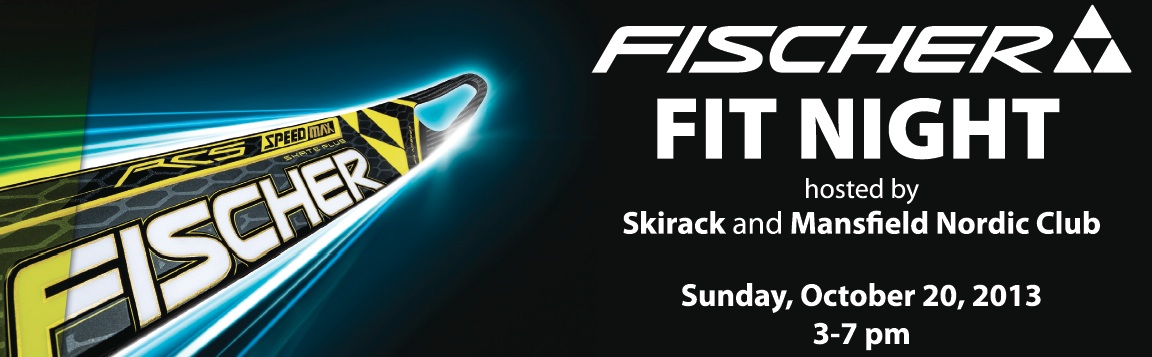
You’re invited to a special evening of Fischer products, prize drawings and pro race fits. Skirack, Vermont’s only Fischer Nordic Race Center, and Mansfield Nordic Club, 2013 NENSA Club of the Year, are proud to host Fischer Nordic Racing Director Chris Hall and Rick Halling, Fischer Nordic Promotions Specialist.
Come in and check out the 2013/14 line of Fischer Skis, Boots, Bindings and Poles, including the revolutionary new Speedmax Skating and Classic skis, which utilize cold base bonding technology that protects the homogenous molecular structure of the base, increasing wax absorption and maximizing ski speed. See why seven out of the eleven athletes on the US Cross Country Team have committed to race on Fischer Skis through the 2014 Games in Sochi, Russia.
Event Highlights
5 p.m.: NENSA award presentation & Mansfield Nordic coaches intro
Snacks & refreshments * Pro ski & boot fitting * Waxing tips and tricks
30% OFF last season’s Fischer Carbonlite Skis, Skate & Classic
Fit Night special price: $437.50
Special team pricing on all Fischer Race Equipment, including special orders
Team Wax forms for 30% off this season’s Toko Products
Industry Veteran Tapped to Grow Cross Country Ski Participation in the U.S. By the World’s Winningest Brand
AUBURN, N.H. — On Monday, Fischer Skis announced it has hired Rick Halling as Nordic promotions and customer service specialist. In the newly created position, Halling will work directly with Peter Ashley, vice president of the Fischer Skis U.S. Nordic Division, to grow and support American sales of the world’s winningest cross country ski and boot manufacturer. Rick brings 30 years of Nordic ski experience to Fischer, having most recently spent 20 years as Nordic product category manager at Atomic.
Halling
“We are truly excited to welcome Rick. His passion for the sport, technical insight and rich history working in key markets are just what we need to spur sales growth and popularity of cross country skiing,” said Peter Ashley.
Halling begins at Fischer today and will be based out of the company’s U.S. headquarters in Auburn, N.H. His broad range of responsibilities includes providing support for Fischer’s Nordic sales representatives and dealers as well as Nordic marketing and promotions efforts.
“I look forward to working with Peter to show Americans the new face of cross country skiing. From the technology and innovation that powers world-class athletes to the exercise and overall enjoyment afforded by the sport, Fischer truly offers something for everyone” said Rick. “It’s great to be joining the industry leader and to have this unique opportunity to grow the sport.”
During his 20 years managing Atomic’s Nordic division, Halling managed sales, marketing and racing, and helped turn an obscure Austrian brand into a major Nordic supplier in the U.S. Prior to that Halling sold Nordic equipment at Hanover, N.H., ski retailers Omer & Bob’s Sportshop as well as Art Bennet’s. In addition, he previously managed the Nordic ski retail shop at Royal Gorge in Donner Summit, California, America’s largest cross country ski area. He has also worked at Scandinavian, a Nordic ski retailer in New York City, and worked in various functions at Telemark Resort in Cable, Wisc., home of the American Birkebeiner.
About Fischer Sports Nordic Ski Division
Founded in Austria in 1924, Fischer Sports is the world’s preeminent Nordic ski manufacturer, with a long history of dominating the race circuit as well as recreational sales. Fischer Skis U.S. is the top-ranked Nordic ski brand sold in America today. The Company also markets bindings, boots and poles for Nordic racing, cruising, touring, jumping, backcountry and recreational skiing. For more information please visit www.fischerskis.com.
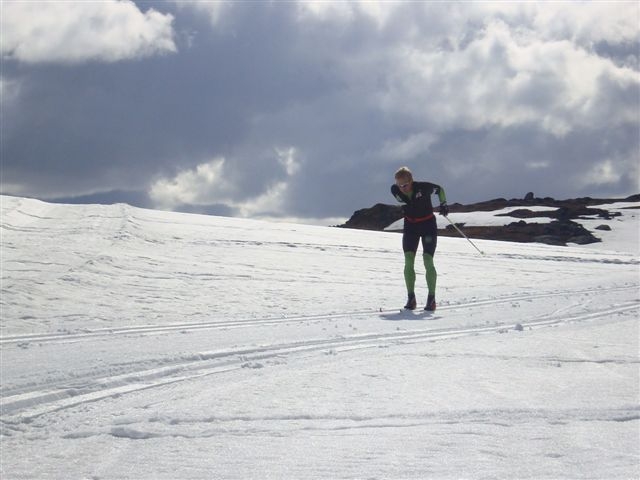
For many years, top Norwegian and Swedish athletes have ventured north at the end of spring for extensive on snow training at the Sognefjell glacier in Norway. This spring, more US skiers have made the trip to Sognefjell than at anytime before. Sognefjell is becoming more than a backyard training facility for top Scandinavians, it is evolving into the premier place for all nationalities to come to early in the summer. It only makes sense that the leading race companies would join these athletes for both recruitment and on snow testing. We caught up with Atomic’s indefatigable Roman Toferer for a better picture of what goes on up at Sognefjell.
What makes Sognefjell so appealing for athletes and ski companies?
We have been testing skis there for over 12 years. There is a good mix of wet to universal snow conditions. This means what we test up there is very close to race conditions for most of the winter. Also the crew up there improved heavily on track preparation and grooming , we found perfect training and testing possibilities every day!!!
It looks pretty Spartan up there. What do you have for lodging, what do you have for meals?
Lodging is pretty simple with two shower for a lot of people, food is simple but taste is great , everything you need to concentrate on doing a good basement job is there.
Roman was not kidding when he said “Basement Job”.
What are the ski companies hoping to accomplish by going to Sognefjell?
For us it’s mostly the first meeting with the different teams as a kind of starting the new season. We get the chance to test new laminates, new core constructions, new base materials, new sidecuts… no end to new stuff we test. The athletes are great testers and Sognefell is a great place to work with plenty of very good testers.
Feedback from top athletes is a primary reason for going to Sognefeldt.
So what percentage of your time is spent testing new prototypes and what percentage is spent working with athletes?
We mostly share the service team , at this year we had
– Myself 100% focused on new developments together with athletes
– Bartl and Peter 80% on athletes 20% proto with athletes
– Kai Egil and Jo 100% with Juniors and youngsters
Didn’t you actually sign a contract with Marthe Kristoffersen right at the dormitory at Sognefjell when you originally recruited her?
Correct, Mathe was signed at Sognefjell a couple of years ago. This year we finished contracts with the guys from long distance team NPRO ( Havard Hansen and Svein Tore Sinnes) and renewed the contract with Tord Asle Gjerdalen ( Gold and Bronze at WCH Oslo).
What goes on indoors is as important as what happens on the snow. Marthe Kristofferson was recruited in between courses of ludevisk and krumkake.
What new athletes did you recruit this year at Sognefjell?
Norwegian National Junior team members Göran Tefre and Simen Krüger, together with sondre Fossli we work now with 3 guys in that team on fully Atomic package.
Do you have full on winter conditions for testing at Sognefjell?
Mainly temperature around 0 this year.
What new products were you testing at up there?
New grinds, new base materials, variations of laminates and Skintec. No company would talk too much about new things. Sorry, no details for now. Were you able to test the new Soft Track? Or, is it too early to even talk about that ski?
Athletes love the new prototype. Too early to talk about it.
Work hard at Sognefell and the others will have to work even harder at Sochi.
Final question. When are you going to come to an US location like Bend, Oregon for summer testing?
Good question but seems a bit complicated to bring all our normal Sognefjell equipement there
About 2 Vans with
400 Pairs Racingskies
45 Pairs different Prototypes
Waxing equipment
Boots bindings
Private equipment for 4 hours skiing every day for 5 people
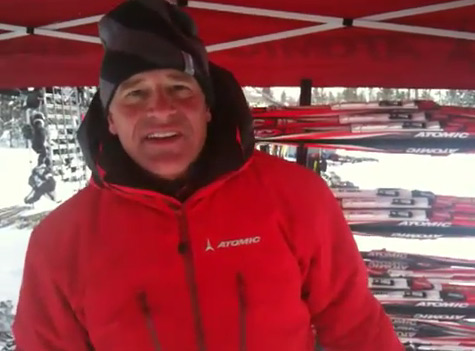
Our final stop on our SIA Show tour brought us to the Atomic booth, where we met up with Rick Halling. He talked to us about the new camber construction of their classic skis and the changes to their World Cup boots.
The 2012 Nordic World Championships proved to be one of the best championships in Nordic history. Great crowds, spectacular racing and beautiful tracks. The nordic community expected nothing less when the event took place in the acclaimed birth place of skiing. We called Atomic’s Nordic Race Director, the outrageous Roman Toferer, to get his perspectives on what it is like to be a technician at the World Championships.
RICK HALLING: Congratulations, you turned in some pretty impressive results. Your boys and girls from Norway, Sweden, Germany and Finland won Gold, Silver and Bronze. Are you happy with your results?
ROMAN TOFERER: Sure, we are happy with the results. The Atomic athletes we thought would win medals did win medals except for Hanna Falk in Sprint. It means that selection of athletes has been well done, that we need more is clear but that is in progress.
ROMAN TOFERER WAS NOT THE ONLY ONE WHO WAS HAPPY WITH THE RESULTS. TORD GJERDALEN OF NORWAY LANDED HIS FIRST EVER INDIVIDUAL PODIUM FINSIH AT A WORLD CHAMPIONSHIPS.
RH: Roman, a lot of people wonder what it is that company reps do at an event like the World Championships. The national teams have their own wax technicians and equipment coaches. What did you and your team actually do at Oslo?
RT: It is nordic skiing. The conditions change every day. The job of our team is clearly to test new things like adjustments in wax pockets, new bases, new grindings every day. We react on change of conditions and we are in close contact with the National teams to adapt to those changes.
So, we will primarily test grinds and choice of wax. This is done first within the staff of Atomic. When we have data and decisions, we meet with the national team coaches. We both discuss what is working best. Of course, the technicians from Atomic and the national teams will ski together and test what is working. But you know, the final decision is the athletes. They ski and test one more time, they choose what is working best for them.
RH: Tell us about the facilities that the organizers provide for the ski companies for waxing and working on skis?
RT: Was done very good in Oslo. We worked in a 30 square room with air-condition, cleaning equipment already there, we took measure instruments, waxing facilities and approximately 400 pairs of skies with us.
NICE WAX FACILITY WITH OVER 400 PAIRS OF SKIS.
RH: 400 pairs?! Was that really necessary?
RT: Yes, we have developed a new Hard Track Skating ski and this was our opportunity to put athletes on this ski. We also have a new classic ski with synthetic kick material. This ski was very popular with athletes.
RH: So you brought the new Skintec waxless skis to Oslo. What were some of the reactions by coaches and athletes to this new waxless technology?
ROMAN USED THE WORLD CHAMPIONSHIPS AS A CHANCE TO INTRODUCE NEW WAXLESS TECHNOLOGY THE WORLD’S ELITE!
RT: They want us to provide them with these skis as soon as possible. Spring classic races are soon, very hard to wax for. But Skintec is for all conditions, not just Spring.
RH: Did any of the wax technicians react negatively to Skintec because no more kick waxing might jeopardize their jobs?
RT: No. Much classic racing will still be on waxable skis.
RH: It was the World Chapionships. Not only was it a very major event, but it takes place toward the end of the year. It must be very difficult to get athletes to try new gear at such a major event at the end of the season.
RT: No not at all, skiers always want to test when there is new things, especially now when everyone saw what skis Tord had at 50km.
MEDALISTS LIKE FRANZ GOERING WERE NOT ONLY WILLING TO TEST NEW TECHNOLOGY LIKE THE HT SKI, THEY CHOSE TO RACE ON IT AS WELL.
RH: It is a pretty amazing setting. You have the world’s best athletes on perfect tracks as well as the most knowledgeable equipment coaches all in one place for more than two weeks. Can you take advantage of whom and what is there to test some new designs and technology?
RT: That’s the reason why I spend so long time up there as well, this is the place where a lot of new experiences get born to develop further. This is why I just arrived to Khanty today directly from Oslo.
It must go on!!!!!!!!!!
THE WORLD CHAMPIONSHIPS GIVE COMPANIES THECHANCE TO MEET WITH THE BEST IN THE WORLD FOR TESTING AND FEEDBACK.
RH: Did you learn anything at these World Championships about the new gear that you did not already know?
RT: Yes this is a never ending process, anyway conditions was really not easy, think everyone saw how difficult some races was. Details out from new experiences need to be worked out now after season.
RH: What is the next event for you and your team?
RT: Like I mentioned above, I am in Khanty now for Biathlon World Championships. Our Nordic service team is testing at home and then they will go to the finals in Falun, Sweden next week. Then, the whole team will again go to Scandinavia after the season, recruitment and testing goes on!
The original SNS Wedge (top) and the new SNS Wedge 60.
Now available at your favorite Atomic dealer is the new SNS Wedge 60. Putting these on your skis is almost like giving them a banned substance, only these new 60mm Wedges have been approved by the FIS and IBU. The cheating is figurative, of course, not literal — these bindings will give your skis an unfair advantage over the folks you ski with. The new wedge is perfectly legal.
Last year, the regular SNS Wedge (42mm wide under the ball of the foot) was introduced at the Vancouver Olympics with outstanding results. This wedge is a sloping ramp that fits under the bindings and lifts the toe 4mm while leaving the heel alone. It is not a cant, there is no angling of the foot to the side, it is purely a lifter.
Why does this lifter make you a faster skier? Have you ever mounted your skis a few centimeters too far behind the balance point? By being that far back from the peak of the camber, the skis glide like rockets. This greatly decreases the pressure on the key part of the forebody and being mounted too far back greatly increases the speed of any skating ski. Important to note, this is for skating skis only. These bindings won’t work on classic skis.
Why doesn’t everyone just mount their skis back 5 or 6cm from the balance point if this makes the skis so fast? Once you go more than one or two cm behind the balance point you will have a ski that gets pretty hard to control and turn. Therefore, what you would gain in speed would be lost in lack of control. The SNS Wedge that was introduced last year has the speed effect of being mounted too far back. Raising the toe a little bit, leaving the heel alone, changes the weight distribution on the camber and gives the ski the fast glide of being a little too far back. However, your binding is in the proper location so you still have the control and stability that comes with mounting the binding just one cm behind the balance point. This wedge was widely used at Vancouver by all SNS athletes and has been available to the general public since last fall.
New and just arrived is the wider version, the SNS Wedge 60 which is a full 60mm wide under the ball of the foot. Don’t worry, the wedge won’t touch the snow no matter how much you lean the ski over.
Atomic's Rick Halling explains the new binding concept to an athlete.
The SNS Wedge 60 was mounted on a number of demo skis at West Yellowstone. A wide range of skiers of all abilities gave them a try and feedback was unanimous. The new wider wedge gives better stability and control than the original wedge or having no wedge at all.
Look at the picture above of the new wedge and you will notice that is has a cavity in the middle. The binding fits right into that cavity so that the wider wings are flush with the binding, there is no gap between the boot sole and this wedge. The end result is noticeably better control than having the original wedge or no wedge at all, especially when pushing off on hard tracks.
Atomic’s top international athletes have fully endorsed this new wedge. It’s not surprising that Atomic would be this innovative: more US Nordic Skiers have won Olympic medals with Atomic bindings and boots than all other brands combined.
The thermometer is stuck on -5F, the wind is blowing, and the schedule calls for a six-and-a-half hour shift. But people don’t flock to West Yellowstone over Thanksgiving just to ride the water slide at the Day’s Inn or have a go at a beginning pilates class. They are here to ski, and to ski on the latest and greatest equipment.
Representatives for all the major ski gear companies set up shop as part of the West Yellowstone Ski Festival “Try It and Buy It On-Snow Gear Demo”. Whatever the weather brings, they man their posts at the trailhead handing out demo gear, answering questions, and doing their best to stay warm.
FasterSkier pulled aside two reps to see how they were holding up midway through a long day.
The first Worldcup of the new season is November 20th in Gallivare, Sweden. It begins with the Women’s 10K Skate in the morning and the Men’s 15K Skate in the afternoon. The next day is followed up with relays. Sit in a room right now with a few coaches, athletes and industry folk and you can feel the anticipation. The coaches and athletes are excited, but not tense. The extensive hours spent on glaciers, in ski tunnels, in weight rooms and trail running lead to a thrilling sense of anticipation that is sharpened with a feeling of confidence.
Same with the industry reps. Very few of them are nervous about the Worldcup opener. While everyone else has been enjoying the summer weather, top reps have spent the off season on Europe’s glaciers and ski tunnels. New designs, new constructions and new technologies have been tested and carefully vetted. However, it will be on November 20 that the new products are truly “combat tested.”
The Sognefellt Glacier in Norway. Cold and snowy even in July. This is the lab where World Cup Technologies are born.
We caught up with Atomic’s International Race Director, Roman Toferer, to talk about the opening race.
RICK HALLING: I hear mixed things about the opening Worldcup. Some coaches claim it is not that important. They say that athletes who are winning in November will not be winning at the World Championships. Then I have talked with other coaches who are full charged bent on victory for that opening race. What are your feelings?
ROMAN TOFERER: Rick, this is the Worldcup. All spring, all summer and all fall we have been waiting for the Worldcup season to begin again. Yes, the opening race is very important. It will set the tone for the entire season. If an athlete is fast at Gallivare, the other athletes watch him or her the rest of the year with very careful eyes. The athletes, they have so much hunger at this very first race. It is maybe the best of the year.
RH: In a way, it’s sort of like a first date. You have recruited some pretty impressive athletes over the summer. You and the new athletes have gotten to know each other on the glaciers, but the opening race is the first real test of how you are going to work together, isn’t it?
RT: Ja, with the new athletes there is some nervous things. We want to prove that they made the right choice to switch to Atomic, they want to show us that we were smart guys to recruit them. You can see that in the wax trailers. The first race of the year the reps and the new athletes are a little nervous with each other. The reps and the athletes who have been together for a few years are more relaxed, but still they desperately want to win that first race.
RH: You really went to town in regards to recruitment. You signed quite a few of Norway’s top skiers this summer. We know what Norwegian journalists are like. What do you think they will say if one of their top skiers has skis that are a little off at their first race ever on Atomic.
RT: They will show me no quarter, but then, I have not asked for any. It is not just Norwegians we have recruited this summer, athletes of many nationalities made the switch to us. The opening race on a new brand, this is part of what makes Gallivare so exciting! And remember, they want to prove themselves to me too!
New recruit Monique Siegel of Germany. The next Claudia Kunzel-Nystad?
RH: Let’s talk about equipment. You have developed a new skate ski…
RT: No, no, I interrupt you right now. We are still making the skate ski we had at the Olympics. But we are developing a special ski for certain conditions, it is too early to talk about this new ski.
RH: The second day of racing will be relays for the men and women. This means Classic legs. You have a new waxless material that…
RT: Stop, stop right here! You can show this new waxless material to dealers this winter, but do not talk too much about it now.
Roman Toferer showing the new waxless material to Vasaloppet Champion Oskar Svard. It will be used extensively on the World Cup this year.
RH: We should point out to readers that this material is for all conditions. It is not limited to 0 degrees C. It can be used for both hard wax and Klister conditions as well.
RT: It is best if we just plain do not talk about it at all right now.
Rick Halling is the Nordic Director for Atomic USA
Two things are going on when a ski shop measures the flex of a race ski for a customer. One, they are looking at the stiffness of the ski and making sure it is the right flex for the weight and ability of that customer. Two, the shop is making a final “quality control” inspection to make sure the customer is getting a ski of the highest quality. It doesn’t matter if the shop is using the traditional paper test or if the shop has a very sophisticated high tech flex tester, they are looking for fit and quality. Last year Atomic spent over $400,000 on a new flex testing machine to help our dealers with this process.
This machine slides up and down the ski. No need for feeler gauges!!
We have two goals with this new equipment. The first is to make sure that every ski sent to dealers worldwide has a flawless flex pattern. We want to make sure that Atomic race skis at any given dealer are of the same quality as the skis that Billy Demong used to win Olympic Gold. The second goal is to make it as easy as possible for ski shops to provide a perfect fit for their customers. We have come up with a new sticker (pictured below) we place on the Worldcup skis that provides all the flex information a consumer would need for a perfect fit. We provide formulas dealers can use to take the data on the sticker and use them for fitting the customer. With minimal training, any authorized Atomic dealer should be able to provide a perfect fit.
The sticker
All Worldcup Skate and Classic skis will come with the sticker pictured above. This particular sticker is for a 206 Classic Cold Medium. The first thing we do is place 35 kilos of weight on the Load Point of the ski which is 2cm behind the balance point. We place different amounts of weight on different lengths of skis. The amount of weight we put on the ski is referred to as “Kilo Force” and this particular ski has a Kilo Force of 35 kilos. We use different weights for different lengths and our shorter length skis can be as low as 25 kilos. You will notice the first number to the left and below the picture of the ski is -35.0 with L1 under it. This means that with 35 kilos of weight on the ski, it is a distance of exactly 35.0cm from the balance point to the point at the front of the ski that is .2mm above the surface. The second number to the right is 30.0 with L2 under it. This means you will go backward exactly 30.0cm from the balance point on this ski until you reach a point behind the balance point that is .2mm above the surface. We do this for two reasons. One, this makes sure that both skis within a given pair are perfectly matched. And two, we have established distances fore and aft from the balance point that we want each model and each length of ski to meet when it comes to being .2mm above the surface. This is a very effective way to measure quality control and to make sure the skis have the desired flex.
You will notice the next row of numbers begins with 40.0kg over MF. The MF stands for Mid Flex. This means at 40.0 kilos of weight this particular ski is .2mm from bottoming out. The formulas described below use this number for determining the right skier weight for each individual skier. We use this measurement as the primary basis for fitting skiers and we also use it to make sure that both skis within a given pair have identical flexes.
The next number to the right, in this case 24.00mm, is the VSP height and it refers to how high the ski is when unweighted. This might seem unnecessary, but it is actually a very good measure of quality control. Any variations of more than five one hundredths of a millimeter within a pair are considered unacceptable.
The bottom number on the right is the L3. This tells us how far you have to go from the balance point to reach the highest point of the ski. We have set standards on how far in front of the balance point every ski, ranging from 172cm skate skis to 206 classic skis, should go.
The final number in the lower right hand corner is how high the ski rests above the surface with that length’s Kilo Force of pressure. This amount of pressure is changed for each length of ski. This gives you an idea of how high the ski should be above the surface at half body weight. This is an important flex number for assuring quality control and for observing how this ski makes the transition for glide to kick zone.
Now you know what these numbers mean. We will now give you formulas for skier weight to determine what these numbers should read for individual athletes. Before we do that, here is a general guide to determine what length you should have to begin with:
1. MEN FROM UPPER 140’s (pounds) TO UPPER 160’s: This is probably the single most common body type of racers out there. These guys should be on 190 Softs for Skating. If you have a fairly senior customer in this weight range who is much over 60 years old and does not seem especially athletic, then you may want to drop him down a size to a 184 Hard. For Classic, most of these guys will prefer 201 Softs for Hard Wax, 201 Mediums for Universal, and 201 Hards for Klister.
2. WOMEN FROM 140 (pounds) TO THE UPPER 150’s: These women should be on 184 Hards. Try to discourage these customers from going with 178 Hards. Even though men who are in the 150’s prefer 190 Softs, it seems almost all women in the 150’s prefer 184 hards. Women who are much over 160 pounds and getting close to 6 ft. in height do prefer the 190 Softs. Keep in mind that fairly senior women who are much over 60 years old, or less athletic women in this weigh range, prefer dropping down a size, so they may prefer a 178 Hard. Most women in this weight range like 196 Mediums, or if they are fairly tall, 201 Softs for universal to hard wax Classic skis. Depending on height and ability they will prefer 196 Hards or 201 Mediums for Klister conditions.
3. MEN OVER 170 POUNDS: These guys should be on 190 Hards. This is one of the most interesting developments we had this past year after extensive testing. An athlete who is 230 – 240 pounds should not be on a ski that is any stiffer than what works for a guy in the mid 170’s. A stiff skating ski has diminishing returns. A ski can reach a maximum stiffness, and then it is no longer beneficial to be any stiffer. This is because a ski is flexing and riding on snow, not pavement or a hard wood floor. A ski reaches a maximum stiffness for snow (and this includes very hard packed conditions) and the performance decreases if it is too stiff regardless of the weight of the skier. Classic is easy for these guys. A 206 Soft will be purely a hard wax ski for them, a 206 Medium can be a good universal flex and a 206 Hard makes for a good Klister flex. Really big guys will need 206 Hards for all conditions.
4. WOMEN FROM MID 120’S UP TO 140 (pounds): Women in this weight range ski best with 184 Softs. However, women in this weight range who are much under 5’4” will sometimes prefer a very stiff 178 Hard. The choice of a 178 Hard vs. 184 Soft for shorter women at the lower end of this weight range usually depends on experience and ability, more advance women prefer the 184 Softs. Men or boys in this weight range are also best on 184 Softs. These women should go with 191 or 196 Classic skis depending on their ability, height and where they fall in the weight range. Entry level women at the bottom of this weight range should go with 191 Mediums for hard wax and universal, 191 Hards for Klister. Advance women at the bottom of this range and women at the top of this range should look at 196 Softs for hard wax, 196 Mediums for Universal and 196 Hards for Klister. Advance women who are close to 140 pounds may choose 201 Softs for hard wax and 201 Mediums for Klister.
5. SKIERS FROM LOW TEENS TO MID 120’S (pounds): Virtually all skiers in this range prefer the 178 hards for skating. The best classic choice for these skiers are 191 Softs for hard wax, 191 Mediums for Klister.
5. SKIERS FROM 105 (pounds) TO MID TEENS: Place these skiers regardless of gendre on 178 Softs. You may want to put them on 172 Hards if they are much under 5’2”. For classic these skiers should be on 191 Softs for hard wax and universal, they should be on soft flexing Hards for klister.
6. SKIERS FROM THE LOW 90’s TO ABOUT 105: These skiers are best on 172 Hards. These skiers can be on either 185 Junior Classics or Soft 191’s.
7. SKIERS FROM ABOUT 80 TO LOW 90’s (pounds): I recommend 172 Softs for this range of skier. This size skier can use adult skating skis in 172, but they should be on 185 or 175 Junior Classic skis.
Those are the basic parameters in fitting skating skis. You can always drop down a size if the customer seems like he or she is not very athletic and will never ski very aggressively. It is best to go with a “Hard” and not a “Soft” in any length when you drop down one size.
FOR SKATING
Take the skier’s weight in Kilos and divide it in half. Add 25 and the number on the piece of tape should be within 5 below that number and 5 above that number for 190’s and 184’s. For the shorter lengths, 172’s and 178’s, you should add 15 to the skiers weight in Kilos after divided in half. The number on the piece of tape should be within 5 above and 5 below for a universal flex. The number on the piece of tape should be 5 – 10 below this number for a very soft track only flex. The number on the piece of tape should be 5 – 10 above this number for a hard track only flex.
FOR CLASSIC
KLISTER: Take the skier’s weight in Kilos and divide it in half. Add 10 and the number on the piece of tape should be within 5 below that number and 5 above that number for all lengths of classic skis.
HARD WAX: Take the skier’s weight in Kilos and divide it in half. Add 5 and the number on the piece of tape should be within 5 below that number and 5 above that number for all lengths of classic skis.
EXAMPLES:
150 POUND MASTER SKIER LOOKING FOR UNIVERSAL SKATE SKI: Divide 150 by 2.22 and that gives the skier’s weight in Kilos, this comes to 67.56 and we will round it off to 68. Now we divide 68 in half which comes to 34. Add 25 to 34 and you get 59. This athlete should be on a 190 with the MF number between 54 and 64.
130 POUND COLLEGE ATHLETE LOOKING FOR HARD WAX CLASSIC SKI: Divide 130 by 2.22 and that gives the skier’s weight in Kilos, this comes to 58.55 and we will round it off to 59. Now we divide 59 in half which comes to 24.5 and we will round off to 25. Add 5 to 25 and you get 30. This athlete should be on a ski with the MF number between 25 and 35.
The new flex tester helped Billy Demong win Gold at the Olympics. The same tester and the same formulas are used to put fast skis on every consumer.
This year’s annual International Ski Federation (FIS) Congress included the selection for the 2015 Nordic World Championships. Held in Turkey, the finalists included Sweden, Finland, Poland and Germany. Sweden was smart. They brought along some of their top athletes to be part of the presentation to bring Worlds to Falun. Nothing like hearing it straight from an athlete’s mouth. It definitely worked, because Sweden beat their key rivals to become the hosts for 2015. Key in that presentation was Olympic medallist Anna Haag. She took a short break from her training to talk with Atomic’s Rick Halling about the World Championships, and what it means for the event to come to Sweden.
Sweden's Anna Haag (L), at a World Cup race with teammate Charlotte Kalla.Rick Halling: Congratulations on winning the bid for the 2015 World Championships. I watched your presentation for Sweden, and I watched Justyna Kowalczyk’s presentation for Poland. It was obvious that the athletes who went to Turkey were not there simply because their federations told them to come. It was quite clear that the athletes truly cared about being the hosts for the World Championships. Why was it so important for you to bring the World
Championships to Sweden?
Anna Haag: I was born in the area, so for me it’s a dream come true, having a new world championship in my home region. I remember the last one, 1993, and I think that my interest in cross-country skiing grew just because of that. So, for many reasons, I really want to ski and have a championship in Sweden and in Dalarna (the region).
RH: Aren’t there also some major drawbacks with Worlds taking place in your own country? You have to admit that there is far more pressure on the home athletes than on the visiting teams. Swedish journalists can be pretty tough on Swedish athletes–don’t you think they will be even tougher when the event is at home?
AH: I’m pretty sure they’ll be tough, but that is also one of the things that makes it even more special and charming. If you can handle the pressure and take a medal at a championship in your home country, you’ve really made something special and a really, really fantastic memory for the rest of your life.
RH: Can you describe your role in representing Sweden at the FIS conference? Do you think you made much of a difference?
AH: I don’t know. But I think that we (me, Emil Joensson and Charlotte Kalla) helped a bit. We are young, and every one of us will ski (hopefully) in Falun, so everything that we said was true. We really wanted the championship to go to Sweden! And we did get it!
Cultural opportunities abound near Falun, host of the 2015 World Championships.RH: You convinced the FIS representatives to hold the World Championships in Sweden. Now, persuade American masters that it will make for a great vacation to fly to Sweden and attend Worlds in 2015.
AH: Oh, that’s a hard one. But to see a ski competition “for real” is something really special. And in Falun 2015, there will be a lot of things to do besides just sport. Falun has a lot of culture and a great surrounding area, with a lot to do and see. I think it will be a great experience!
RH: One thing that prevents Americans from attending events like the World Championships is that they are concerned there will be no place for them to ski when they are there. There may be no trails for spectators or there will only be a very short loop open to the public. Will the Worlds in Falun be like that? Or, will average folk find plenty of nice and convenient trails to ski on between watching races?
AH: If it is a great winter, like the last one, there will be a lot of tracks and cozy trails around in the village and neighborhood.
RH: I have not seen a schedule yet, and I don’t know if there is one. But how many days between when the World Championships end and when the Vasaloppet takes place? Will that be a realistic option? Can tourists attend Worlds in Falun, stay in Sweden for a few more days and then be a part of the Vasaloppet?
AH: The management from the Vasaloppet said in Turkey that if Falun got the championships, they would have to move the date of the Vasaloppet for the very first time in history. Ever since the earliest days of this race, it has been held the first Sunday in March. If it is not rescheduled, the 50 K and the Vasaloppet will be on the same day. So let’s hope that the Americans can both watch the World Championships and ski in the Vasaloppet.
RH: Final question. Let’s say a visiting family goes for a nice ski in the morning, watches the races that afternoon, and then they are very hungry and want a traditional Swedish dinner that night. What do you recommend they order at one of Falun’s better restaurants?
AH: They should order elk and potato–grilled elk, or steaked elk. That’s my favorite!
There is no question that the Tour de Ski grows in interest and popularity every year. It is also true that the Nordic World Championships are highly prestigious as the Nordic community gathers to watch its best. However, the Olympics are still number one as the event that Nordic athletes and their supporters want to win most. We have to admit that Nordic skiing is one of those sports that only receives truly extensive worldwide viewership once every four years at the Olympics. The end result is epic pressure will be placed on coaches, athletes and manufacturers to perform at the highest possible level. We called Roman Toferer, Atomic’s Nordic Race Director, to discuss what it is like the summer leading up to the Olympics.
RICK HALLING:Roman, the pressure is on. I know that if Atomic does not bring home a required number of Gold and overall medals you are out of a job. Not only are you out of a job, but I know the Pongau valley has a zero tolerance policy for failure. What will life be like in Altenmarkt for the Nordic race director if Atomic fares poorly at the Olympics?
ROMAN TOFERER: I have discussed this with my friends and family. They realize that a bad Olympics means I would be forced to move to another part of Austria. I am very skilled with my hands, perhaps I would make violins in Vienna. I am not too old to begin an apprenticeship.
Roman's new profession?
RH:Don’t be talking that crazy talk!!! You can be such an Austrian sometimes. Athletes and coaches have been telling me that the new Featherlight construction is sinfully fast and stable. Some of the Finns told me the new ski is basically a form of cheating. The boots are pretty well dialed in and just look at the athletes you have on board. There is no way that the Thin Red Line could end those Olympics without a hefty medal haul.
RT: Ja, but I tell you this. When you are like the big rooster in a farm full of hens and you strut around thinking you are the big thing, that is when you get into trouble. It does not matter how good your skis are or how strong your athletes are. Leading up to the Olympics, you must tell yourself that nothing is good enough and you have to keep working to be ready.
Obsession with perfection. Roman works around the clock for dominance in 2010.
RH:Okay then. Instead of worrying about the Olympics, just remember that you are working hard to make sure things go right. Step one must be to make sure the skis are fast and the boots do what they are supposed to do.
RT: We are definitely doing that. Did you see the Worldcup at the end of the year in Falun, Sweden? Riita-Liisa Roponen started the skating leg so far behind the rest of the field and then she pass them and win by big margin! Did you see her on the downhills? She just pull away from the other skiers. Most people do not know her. I hear the coaches ask what is going on here? They talk about the new skis and they say the new Featherlights must be evil, they must be bad they go so fast. I just say ha, ha, ha!
Riita-Liisa Roponen was overwhelmed when she tried the new Featherlight in competition. (AP Photo)Riita-Liisa at the factory reviewing her base grinds from the past season. Data was stored on every grind that was test for each race.
RH:Well, let’s talk about these new Featherlight skis.
RT: No, shut up. It is too early, we should not talk about this design yet.
RH:Okay, but another reason you don’t need to worry is the athletes. You have the two American rocket boys, Todd Lodwick and Billy Demong, it’s going to be pretty exciting when one of them wins America’s first Olympic Gold in a Nordic event. You have Riita-Liisa who proved to be the fastest woman at the end of the season. You have Giorgio di Centa, the Gold medalist in the 50 K at the last Olympics and he is looking strong. You are pretty much guaranteed Gold in Biathlon with Andrea Henkel. Who am I missing?
RT: The young Norwegians. They are calling me. They want to be part of the Thin Red Line. We now have a contract with Norway’s top girl, Marthe Kristoffersen. She has best long term potential of any Norwegian skier now. Also, do not forget what James Southam did in Pursuit at Liberic. He can beat the best in Europe. James was your country’s best results at Distance Nationals, that makes him America’s number one skier for distance events. James is on our skis and boots. He could do something.
Marthe Kristoffersen. Part of the next generation of Norwegian super stars.
RH: So, you have the skis and boots, you have the athletes, I think your biggest fear should be if you will have enough clean skis on hand for athletes to carry to the podium.
RT: Look at US Track Team at the last summer Olympics. They were supposed to dominate. But both the men and women dropped the batons in the relay, they tripped on hurtles, they made so many little mistakes. Jamaica came home with more medals than USA for sprinting. I will not stop worrying until the Olympics are over.
RH:Worrying like that is just crazy. No wonder Sigmund Freud was an Austrian.
When the “How It’s Made” series was proposed, I planned to cover each piece of equipment (skis, boots, poles, etc.) with a 1000-1200 word overview of the process; however, I soon realized how naïve this notion was.
So far, I’ve determined that each company that manufactures skis has its own methods, materials, and philosophies, and that each company therefore deserves a unique explanation. Fortunately, several ski companies responded to my inquiries.
The Nordic ski industry is a small, and many of the technical design personnel wear several hats. In addition to working with designers, attending races, customer service and more, the manufacturers have little time for interviews; however, several manufacturers will be featured in successive articles.
I finally caught up, via telephone, with Atomic’s Rick Halling. We discussed Atomic’s entire line of Nordic skis—from entry level touring to those destined for use on the World Cup racing circuit. It was all very interesting, and this installment of “How It’s Made” will focus on the race line of Atomic skis.
Rick and all of his employees are proud of Atomic’s racing and winning legacy as well as the company’s commitment to environmentally friendly manufacturing methods. One concern with green manufacturing is how much it will improve the performance of the skis; however, research shows that new eco-friendly materials and methods actually can produce faster skis. Using environmentally friendly resins, fibres and manufacturing techniques is also important because of the workers’ direct contact with all of Atomic’s skis.
Rick estimated that it requires almost three hours to build one pair of top-of-the-line race skis. (This does not include the time the ski sits in the press, allowing the epoxy resin to cure.) An entry level ski still requires two hours of hands-on time.
Much of the time building the race skis is spent shaping the core material. A slight difference in core thickness has a great effect on the flex or stiffness of a ski; in addition, the presence of camber in the core increases the cost and time needed to manufacture the ski.
Making skis with consistent camber and flex is practical for Atomic. Because of the time the company spends on one pair of skis, it becomes too expensive to have a wide variety of flex patterns from ski to ski.
The details of how Atomic creates its cores came from Christian Rainer, the Head of Research & Development at Nordic Gliding Products’ factory in Austria:
(Fig. 1) Cores with wooden sidewalls.
The honeycomb Nomex core makes up most of the ski’s volume (Fig. 1). Manufacturers wet out each layer of the core by hand, a method that is time consuming but yields a lighter, higher-quality end product.
Prior to the layup process, manufacturers attach a scrim sheet to the top and bottom (open ends) of the Nomex core to prevent resin from filling the spaces of the core. The layers, or plies, of the ski are cut and taken to the press for the hand layup process.
The layup is a puzzle in the sense that workers must place each layer in its proper place, following a single construction drawing. Manufactureres apply epoxy resin to each layer before they are all placed into the press for curing.
The chosen layers of base material are precut; another two layers of carbon laminate are in direct contact with the core scrim sheet.
The layer directly under the cap is a layer of reinforcement cloth. This layer can be one of several fabrics depending on the style of ski (skate or classic). The orientation of the fibres (along the ski or at an angle to the edge) determine the characteristics of the ski.
The top layer, or cap, consists of ply carbon laminate. This layer adds stiffness to the ski and also helps control the flex pattern. Cap is made from transparent polyamide. Manufacturers add graphics to the cap through a process called sublimation, in which they transfer ink from a paper design into the capsheet.
After the epoxy resin between layers cures and manufacturers cut the core to the correct height, they glue a wood sidewall onto the Nomex core. The wood adds stiffness and allows for further shaping, and adding glue to the surface helps keep the fabric in proper alignment.
These layers of the Nomex core resist tension where carbon fiber is present. As the ski is compressed, the ski tips move apart, pulling the carbon taught throughout. After shaping, the core is ready to go to the ski press.
The press is computerised and able to alter its shape to fit each ski. A graphic display predicts the flex pattern, making slight adjustments to meet the designer’s flex goals. Atomic’s new variable press allows the company to achieve a higher quality product and rejects fewer skis during flex matching.
(Fig. 2) Variable ski press.
When the ski is removed from the press, material often hangs over the edge of the ski, and the base is dirty from excess epoxy squeezed out during the curing process. Manufacturers clean the ski and mount it onto a separate machine to cut away the edge overhang. After shaping, the skis are sent to the grinding street to prepare the base and add structure.
(Fig. 3) Flex examination and quality control.
Quality control is consistent throughout the manufacturing process, and before the skis leave the factory, they are subject to final inspection and flex matching (Fig. 3). To ensure the proper grind has been added to the base, a stylus similar to a phonograph needle makes several passes along the ski base to be certain the structure is uniform and true to its specifications. Atomic workers pair the skis, send them to the warehouse, and prepare them for shipping to retailers or selection by national teams. Skis used by national teams come of the same production line as those used by citizen racers.
I was curious about the amount of time and effort Atomic needs to create a new model of a ski. What is the concept, development, design and production that goes into this? One benefit to the variable press is having the ability to experiment with new designs without having to build a complex tool. This saves time and also allows engineers to build several pairs of skis with different shapes and camber. With the Dauchstein glacier right up the road from the factory in Austria, workers can test skis at lunch that have been built just that morning.
Rick has several articles in the Fasterskier archives explaining the benefit of having the glacier so close.
A definitive answer to the number of hours going into a new design could not be determined, but Christian did note that Atomic is currently working on new designs for the 2010 Olympics.