From the FasterSkier archive — posts syndicated from athletes’ and coaches’ own blogs between 2004 and 2012, kept online as published. Current coverage is at fasterskier.com.
At the end of the 2018 season after being on the wrong side of the cusp of making the Olympic team, Erika Flowers made a transition in her ski career. She left her Stratton Mountain School T2 training group and returned home to Bozeman, MT where she began a role as the Associate Director at Profitable Ideas Exchange. However, Flowers did not hang up her skis — it was not retirement, just a transition and a new work-life-training balance to navigate.
And she has done so swimmingly. It has been one of her career best seasons, including a sprint and distance podium performance and racing in the final of three additional sprints. Flowers currently sits in second in the overall SuperTour standings, less than 30 points behind leader Kaitlin Miller (CGRP).
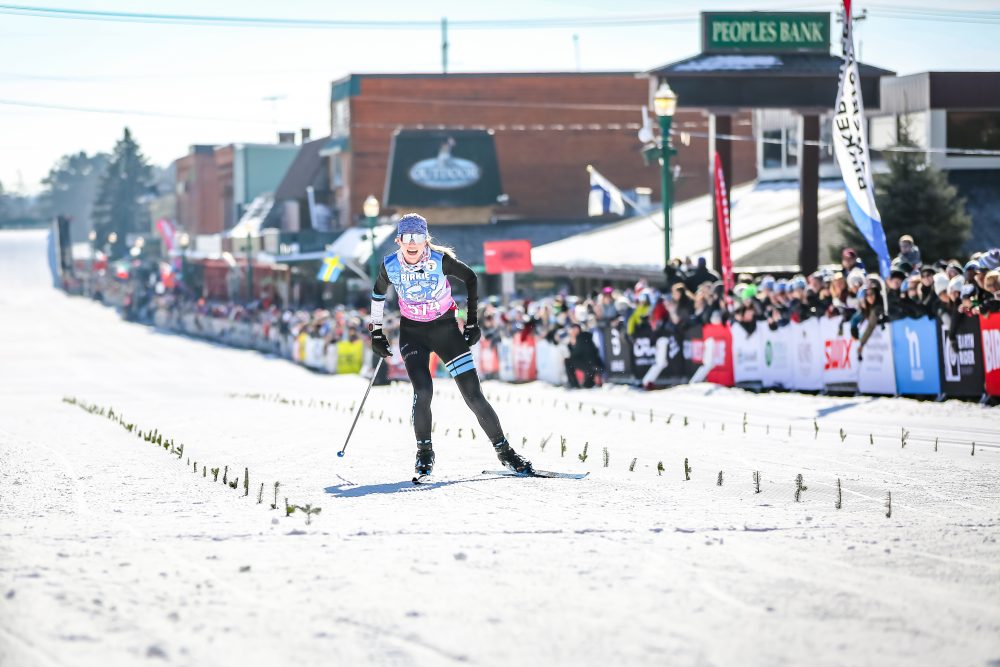
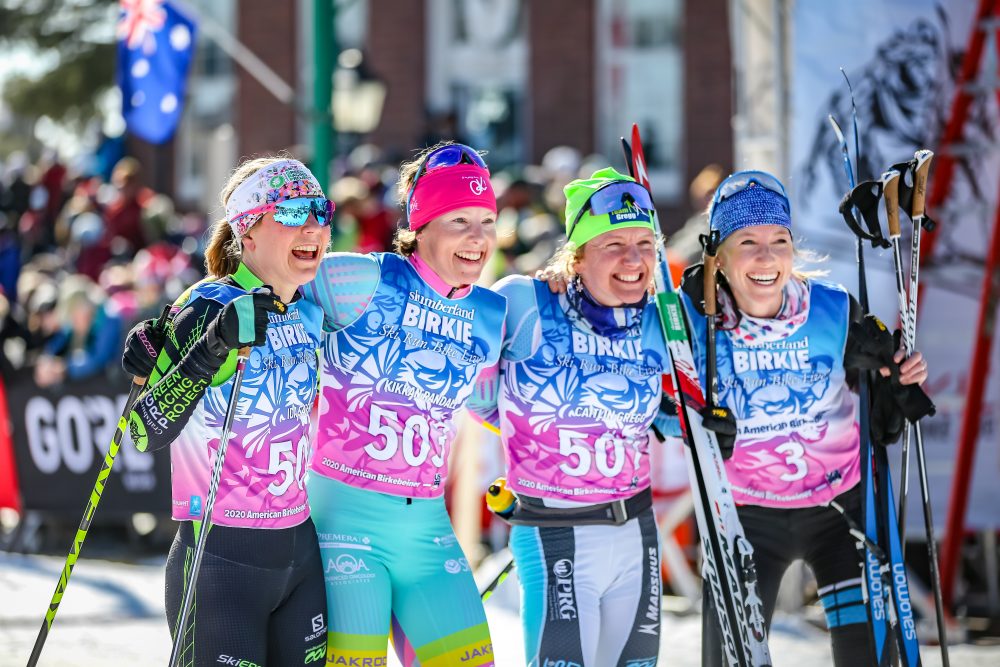
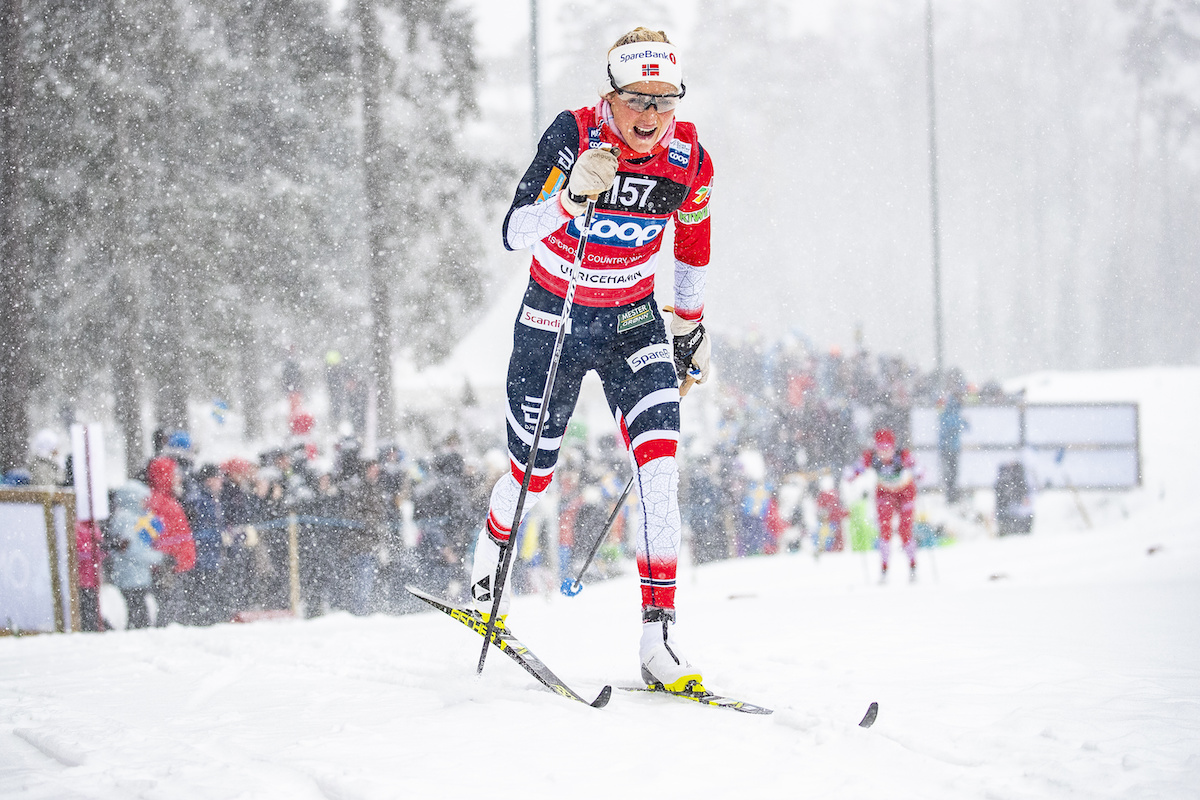
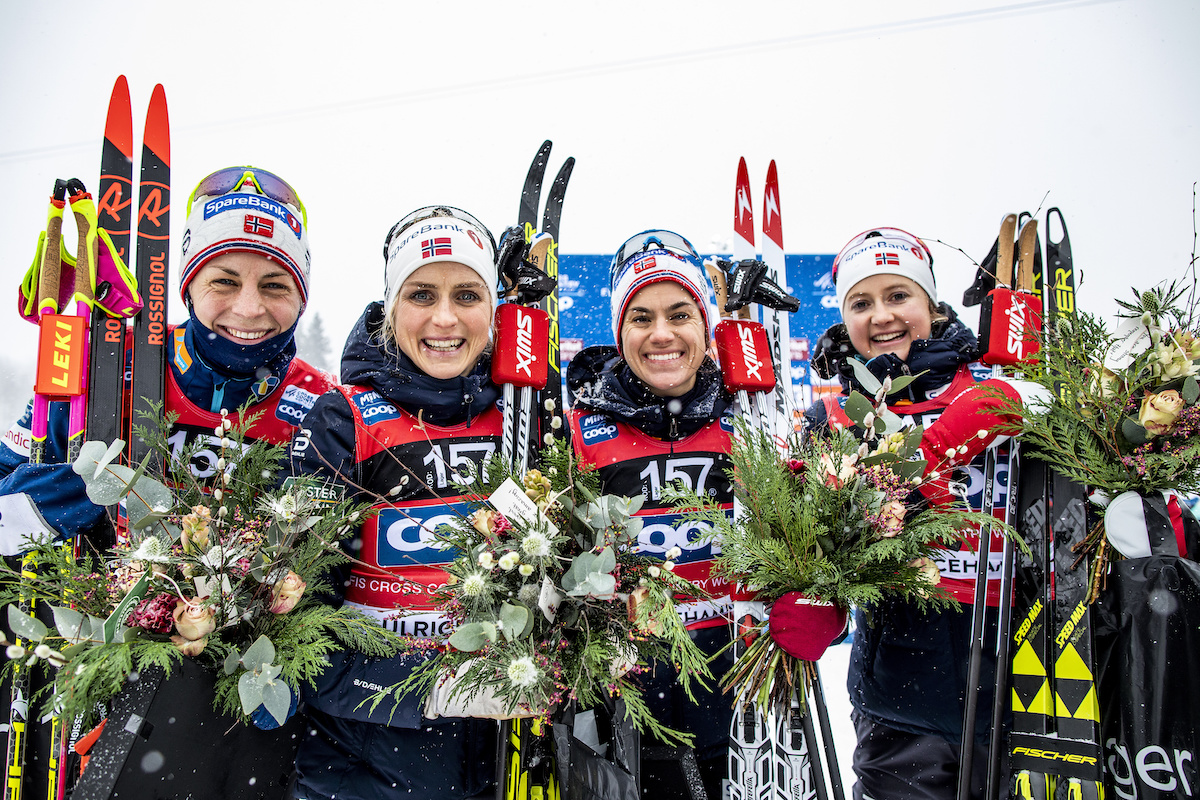
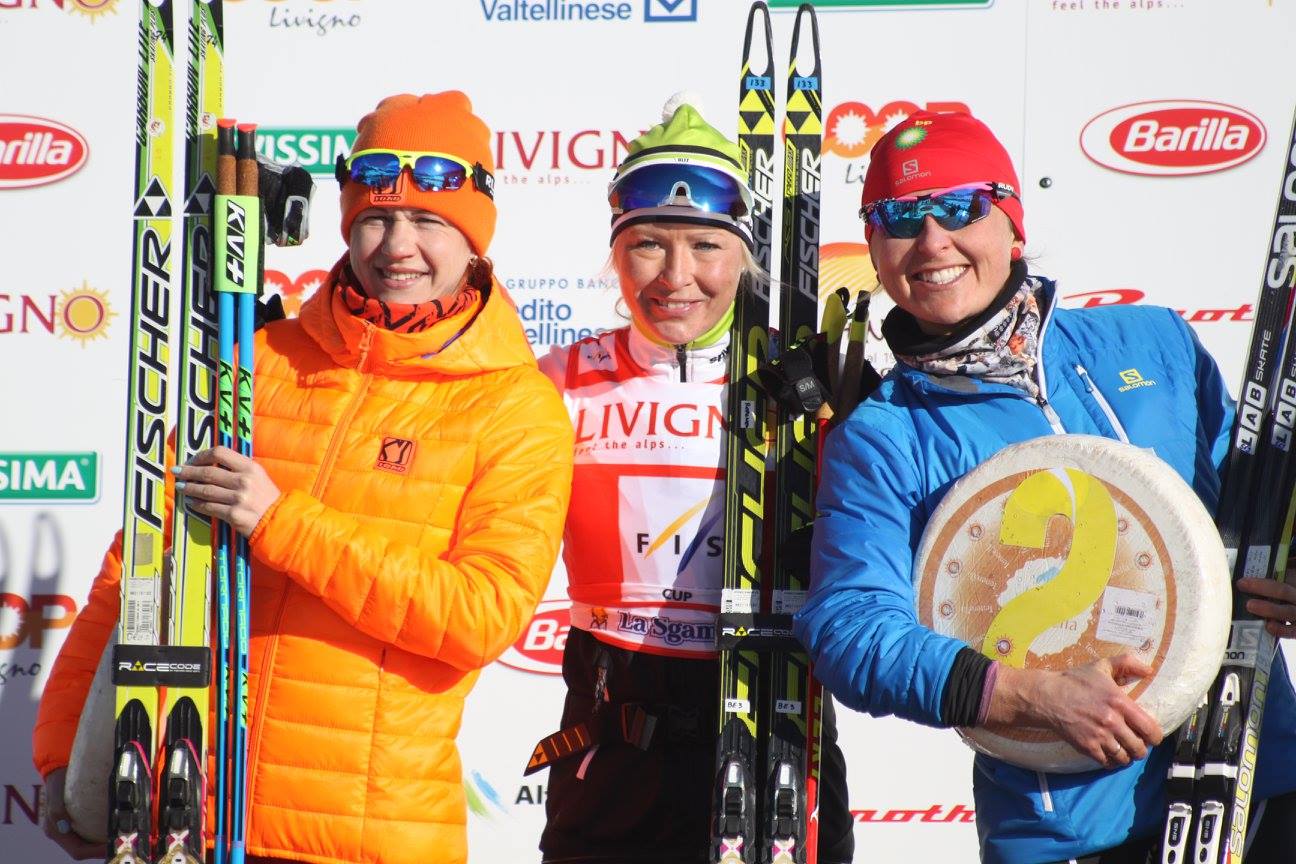
Most recently, Flowers was the top American and third overall at the Birkie 50-kilometer skate with a time of 2:15:00 (+1:39.4). After Jessica Yeaton charged off the front at OO (roughly 20 k in), Flowers worked with a chase pack that included Riitta-Liisa Roponen and Kaitlynn Miller.
Additionally, in the Minneapolis SuperTour events the week before the Birkie, Flowers popped the fastest qualifying time in the freestyle sprint and ended the day second overall, and was just off the podium in 4th in the 5 k classic.
In this conversation, Flowers shares further insight into how she fits her training, which she plans with her husband Andy Newell, into her work schedule and discusses what she has learned through this transition. She explains that the saying “happy skiers are fast skiers” has given her a sense of freedom to do things a different way that she was accustomed to.
“There’s so many things that the athletes who are racing full time do to perform at that level and I think that you have to do those things to some degree. But I’m someone who always did things by the book and if someone told me to do eight intervals of this type, I would always do eight and maybe nine. That made me very fit, but I think it also maybe sacrificed some of the flexibility that’s also required to be a good athlete, and maybe at times, I was not as happy doing it that way as I could have been.”
Flowers also discusses her goals for the remainder of the ski season, which include racing in the Minneapolis World Cup sprint and the World Cup finals in Canmore.
We also discuss her summer plans to continue challenging herself in mountain running races, including her the 50 k at Run the Rut in Big Sky, MT. She also shares that she has recently received a nomination to the North Face trail running team and is currently looking through additional race options with them. Thanks for listening.
Interview with Erika Flowers following the 2020 American Birkie.
When we reviewed this year’s results for the elite women’s field at the American Birkebeiner, we did a double take. Jessica Yeaton sets a new course record and beats Riitta-Liissa Roponen of Finland, a favorite for the win, by over 40 seconds.
The surprise was not because Yeaton’s name didn’t belong there; the 28-year-old Perth, Australia native who has skied for APU has a list of SuperTour podiums and a wealth of international racing experience that includes the 2018 Olympics. Last year, she was 22nd in the 7.5/7.5 k skiathlon at the World Championships in Seefeld, Austria and finished 30th in Holmenkollen 30 k classic.
Along the way, she has also demonstrated her prowess in mountain running, winning the 2018 Mount Marathon race in Seward, AK and the Alyeska Cirque Series race.
This year, however, Yeaton was a relative unknown as she began full time Physical Therapy school at the University of New Mexico in Albuquerque this fall. As such, her race schedule has been squeezed into the school calendar, keeping her out of the SuperTour and racing significantly less than previous years.
In fact, Yeaton’s trip to the Birkie was a prime example of this. After taking an exam in the anatomy lab last Friday, she hopped on a plane and flew to Minneapolis, arriving in Hayward the evening before the race. She flew back the day after, heading into a week full of five additional exams.
Yeaton’s other domestic race experience this season was a 5 k skate in West Yellowstone during her Thanksgiving break, where she took second. She also spent a few weeks in Europe during her winter break training and racing in Austria, followed by finishing 38th overall in the Tour de Ski.
During the interview, Yeaton shares how she has adapted her training to accommodate the demands of her schooling and the lessons she has learned through the process.
Of course, we also talk about how the race unfolded and whether she caught the fever in her first year at the Birkie. Thanks for listening.
Post-race interview with full time student and Birkie champ Jess Yeaton
Several course records were shattered on Saturday in a largely faster-than-ever 46th annual American Birkebeiner, with temperatures steadily rising from the 20s at the start into the 30s by the finish of the point to point race from Cable to Hayward, Wisconsin.
Eight men broke the two-hour mark in the Birkie’s 50-kilometer skate race, half of which are American, and an Australian national team member who trains in the U.S. broke the women’s race record by nearly three minutes.
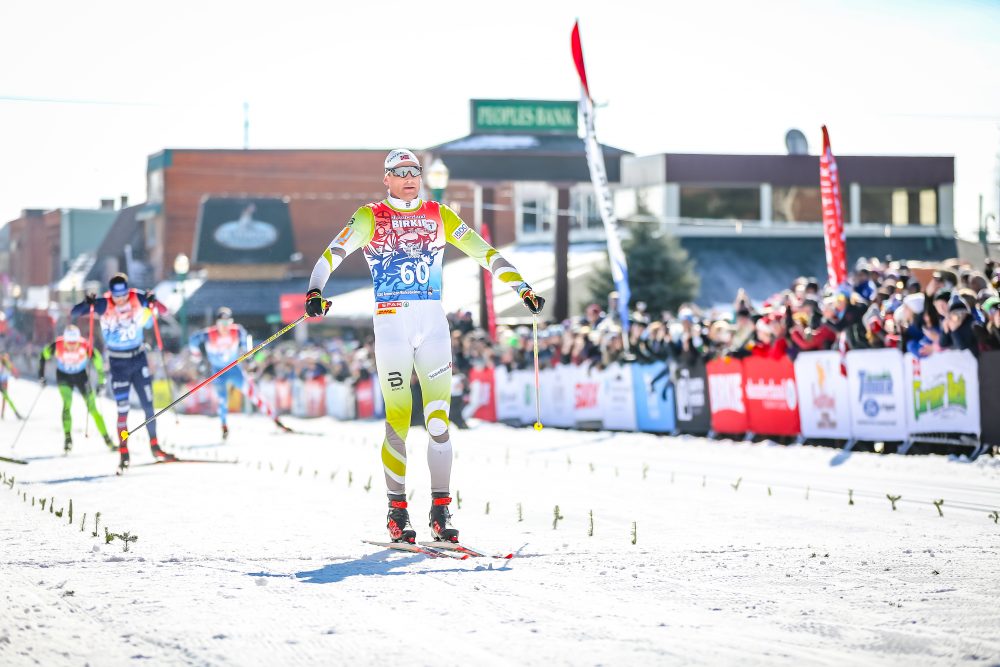
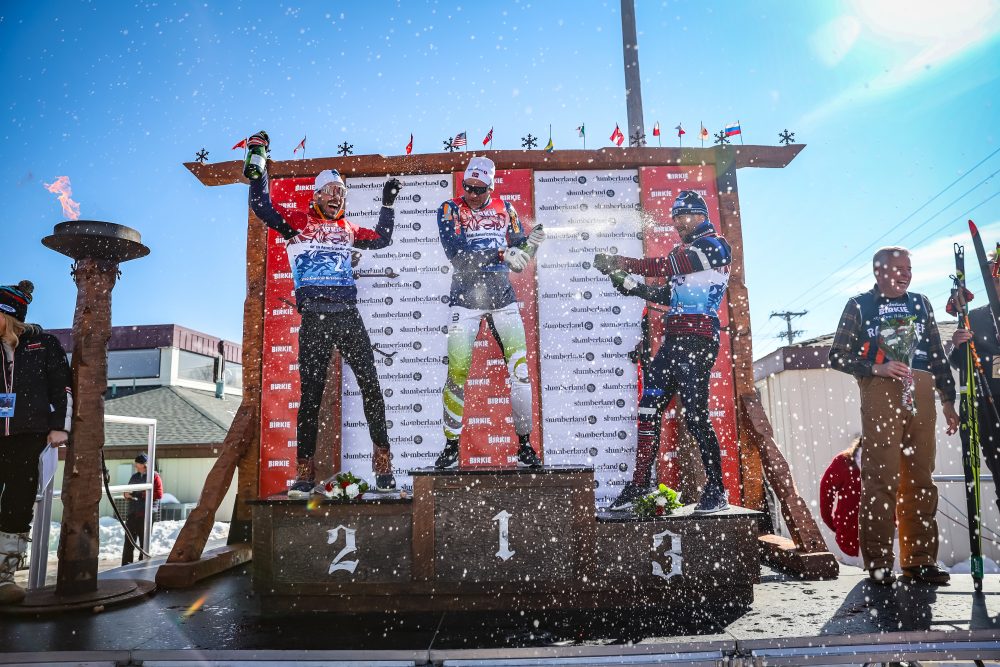
Niklas Dyrhaug, a 32-year-old Norwegian Olympian and former World Cup regular, reached the finish line first on Hayward’s snow-covered Main Street in 1:59:01.7 hours. While he missed the course record of 1:56:58.6 set by Italy’s Fabio Santus in 2010 by just over two minutes, Dyrhaug earned his spot in the Birkie books on Saturday. He held off second-place finisher Ian Torchia, a Minnesota native who trains with the Stratton Mountain School (SMS) T2 Team, by 1.6 seconds and France’s Robin Duvillard, another Olympian and multiple-time World Championships racer, in third by 1.9 seconds.
Wisconsin’s own Adam Martin, who trains with the Craftsbury Green Racing Project, narrowly missed the podium in fourth (+2.7), while Norway’s Anders Gløersen was just behind in fifth (+3.0) and U.S. Ski Team/Alaska Pacific University (APU) member Erik Bjornsen next in sixth (+3.6).
Another Craftsbury racer, Akeo Maifeld-Carucci followed in seventh (+8.0), then France’s Benoit Chauvet in eighth (+12.0). Sam Wood of Idaho placed ninth, 1:42.5 minutes behind the winner with a cumulative time of 2:00:44.2, just ahead of Kyle Bratrud of Minnesota and the SMST2 team in 10th (+1:47.6).
Dyrhaug, who has two World Championship gold medals in the men’s 4 x 10-kilometer relays (in 2015 and 2017), was a Birkie rookie but hardly a surprise winner. In World Cup 50 k classic mass starts in Oslo, Norway, he placed second in 2016 and fifth in 2017. On Wednesday of this week, he placed second in the SuperTour 1.6 k classic-sprint qualifier in Hayward — part of the Birkie Week festivities — finishing 1.07 seconds off the winning time of U.S. Ski Team member Gus Schumacher.
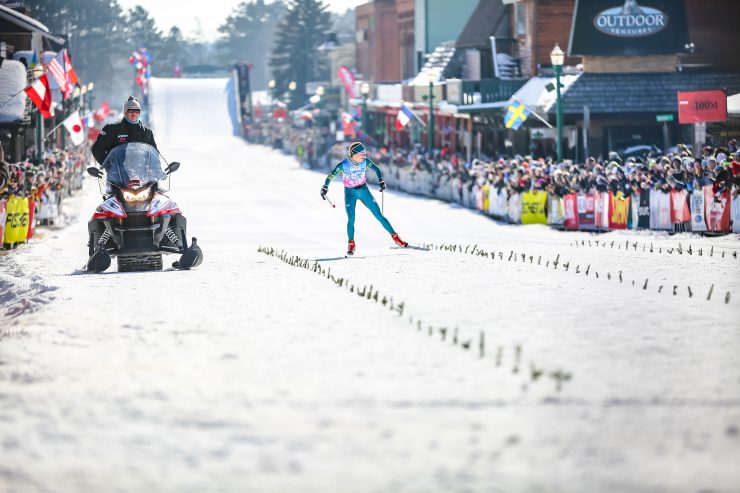
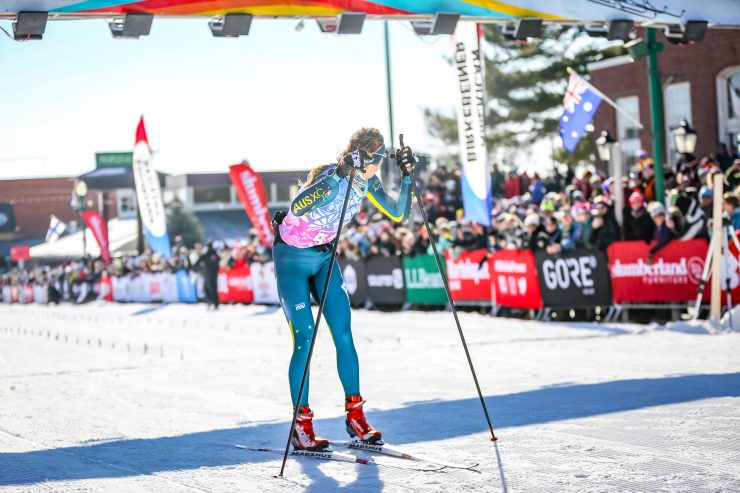
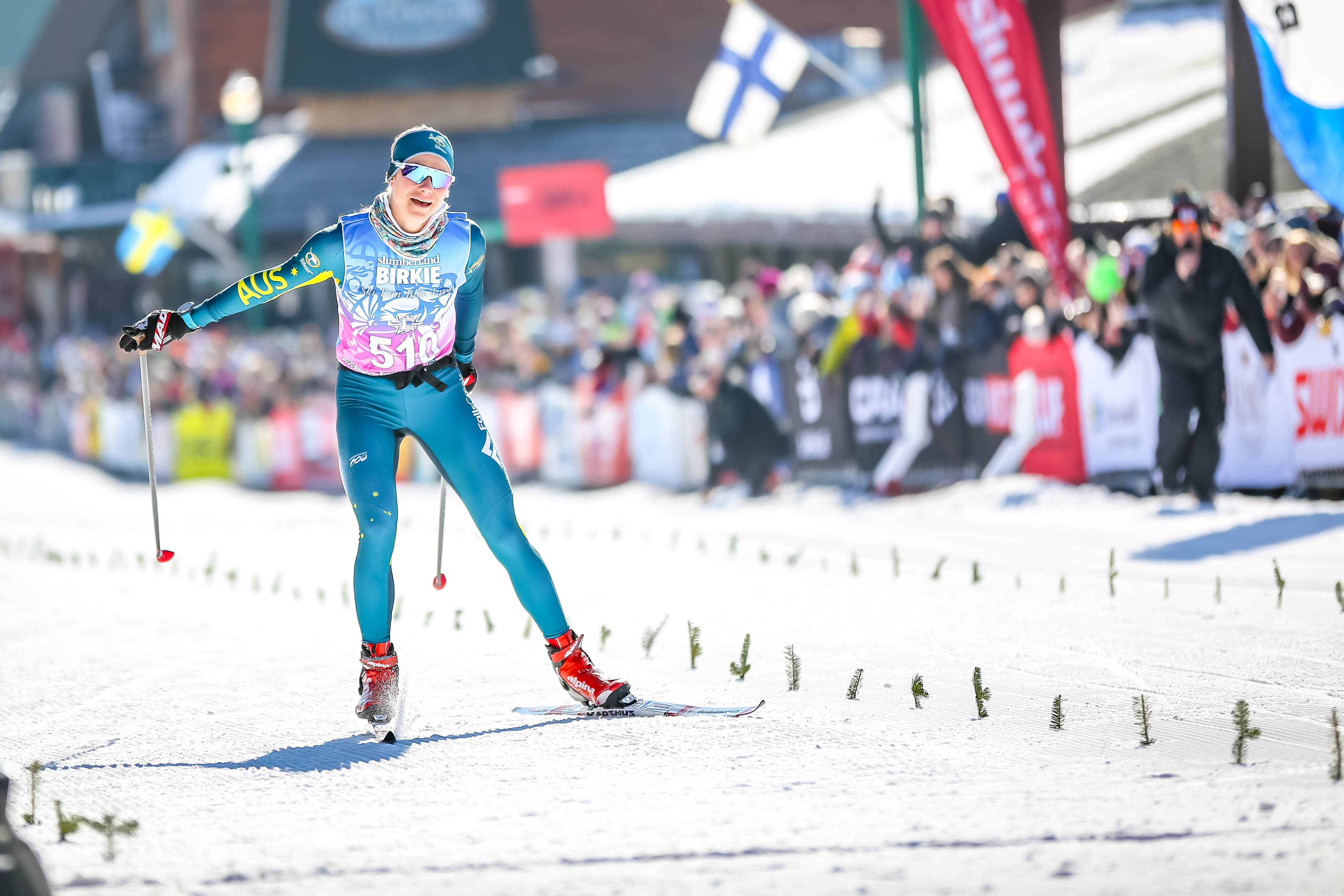
Meanwhile, Jessica Yeaton, who races for Australia and APU, set a new women’s Birkie 50 k skate course record in 2:13.20.6. The 28-year-old Olympian broke Caitlin Gregg’s record of 2:16:07 and placed 67th overall in Saturday’s 50 k skate. Finland’s 41-year-old Riitta-Liisa Roponen, a five-time Olympian who notably placed sixth in the 10 k skate at last year’s World Championships, was the second woman on Saturday, 41.7 seconds behind Yeaton. Former pro racer Erika Flowers, of Montana, placed third, 1:39.4 minutes out of first.
Saturday’s 55 k classic race saw record-setting times from both the winning man and woman, with Peter Holmes of the Sun Valley Ski Education Foundation (SVSEF) defending his 2019 title with a time of 2:26:46, nearly 2 minutes faster than Juergen Uhl’s winning 54 k classic time of 2:28:39.4 in 2010. Holmes won Saturday’s race by nearly 12 minutes, with two Wisconsin skiers — Chris Pappathopoulos (+11:52.4) and Evan Wetzel (+11:54.3) — following in second and third place, respectively.
Wisconsin native Nichole Bathe, who trains in Norway and skis for the British national team, became the new women’s 55 k classic champion in a blistering 2:49:47.0. She beat out Jennie Bender’s 2011 Birkie classic record of 2:50:53 and finished more than five minutes ahead of Colorado runner-up Anja Gruber (+5:33.3) on Saturday. Wisconsin’s Delaney Fitzpatrick finished in just over 3 hours for third place, about 11 minutes behind Bathe.
To view Riitta-Liisa Roponen’s complete FIS profile requires a lot of scrolling and selecting “show more.” The 41-year-old raced her first World Cup in Munio, Finland on November 28th, 1998. More than 20 years later, she raced her final World Cup event, helping the Finnish relay team to 3rd in Ulricehamn, Sweden on January 27th, 2019.
She went on to race at the World Ski Championships in Seefeld, Austria, placing 22nd in the 30-kilometer mass start skate, then ended her season racing on the Finnish national circuit.
In between November 1998 and March 2019, Roponen competed in five rounds of the Olympic Games, earning a bronze medal in the 4 x 5 k relay in the 2010 Vancouver games. Her best individual finish was 6th, 10 seconds from a medal, in the 10 k freestyle, also in Vancouver.
Krista Parmakoski tags Riitta-Liisa Roponen for Finland while Sweden’s Stina Nilsson heads out on her last lap after being tagged by Maria Rydqvist n the 4 x 5 k relay at the 2015 FIS Nordic World Ski Championships. (Photo: Fischer/NordicFocus)
She also earned six World Championship medals, four in the relay and two in the team sprint, and seven individual World Cup podiums.
Most of the accomplishments came while also being a parent. Long before Kikkan Randall and Marit Bjørgen, Roponen navigated the waters of training through pregnancy and continuing her World Cup career afterward. She gave birth to her daughter, Ida, in 2004, returning to the World Cup later that year with a 17th place finish in her first race back.
Riitta-Liisa Roponen on her way to a win in the 10-kilometer skate at 2020 U.S. Nationals. (Photo: Reese Brown)
No longer racing on the World Cup, she has continued to train and compete at a high level, adding a new international twist to the American and Canadian women’s field racing the SuperTour circuit. Roponen won the 10 k skate in Sun Valley, then repeated her win in the same event at U.S. Nationals. Two days later, she took 3rd in the 20 k classic.
After a quick trip to Finland to race the 10 k classic at the Finnish National Championships (see her comments below), Roponen is setting her sights on Hayward as she prepares for the American Birkebeiner. Given her results on the domestic circuit, Roponen is viewed as a favorite for the Birkie win.
Adjusting to life at altitude, Riitta-Liisa Roponen rollerskis up Lookout Mountain outside of Denver, Colorado. (Photo: Instagram @rlroponen)
FasterSkier connected with Roponen over email this week to discuss the longevity of her career, her transition to life in the U.S., and her feelings on her first season away from the World Cup.
FasterSkier: How have you maintained both the physical capacity (speed, fitness, health) and the motivation to train and compete at the highest level for so long?
Riitta-Liisa Roponen: I have been training for skiing since I was very young, but when I was under 22 I did not train as hard and as much as others (I feel that my club coach was smart). That way I have been able to increase my training year by year and always find something new to develop. The main reason is that I love training and racing.
FS:Speak to the evolution of your career over the last five years. In a video interview last March (embedded below), you said: “I believe that skiing will never end in my life. If I don’t train, I can still enjoy when I ski. Skiing is mental and physical well-being. It doesn’t stop even if it ends as a job.” Where do you see yourself as a professional athlete now?
RLR: I have been training this year as a professional athlete (about 800 hours) but my race goals have been here in the USA — US Nationals and the American Birkie.
FS: What has it been like moving to the United States? Have you enjoyed your experience in Colorado so far?
RLR: This has been my long time dream to move here with my family. We have been very happy here all the time. The weather, people, food.. all is great! This is also a great opportunity for my daughter. Moving here has been her dream for a long time also. This is a big adventure for all of us.
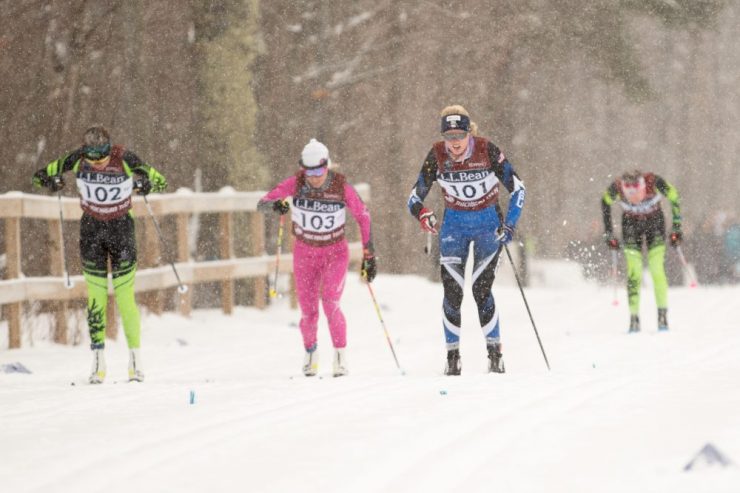
Caitlin Patterson (left), Ritta-Liisa Roponen (bib 103), and Hailey Swirbul (bib 101) lead the way in the 20-kilometer classic at 2020 U.S. Nationals. (Photo: Reese Brown)
FS: How have you found your experience racing SuperTours and US Nationals? How does the level of competition compare to what you experience racing in Finland? What has your focus been this season?
RLR: The level of competition is very high and I think that level will be even higher in the future — you have already a very strong women’s national team. It looks like your big clubs and national team know what to do. You have lot of very fast juniors coming and I believe in 2-4 years the USA national team will be even stronger than now (also on men’s side). Our National teams are now about the same level, but behind the national teams, the level is higher here in the USA .
FS: How are you feeling leading into the Birkie?
RLR:I am really looking forward to racing the Birkie and it is great to see the biggest ski event here in North America. My season has been very good so far and I am feeling still very good, so I can not wait to start! I am expecting to see a lot of other good skiers on the start and it will be fun to race with them.
A quick mother-daughter selfie trail-side during a Thanksgiving camp in West Yellowstone. (Photo: Instagram @rlroponen)
FS: You also raced the 10k Classic at Finnish Nationals this season. What was the motivation there?
RLR: That was part of the plan. Ida was at school and I wanted to see my parents. The plan was to do those competitions because of my home town club. I was 5 th place in the classic race with very bad skis, so I was actually very strong in that race.
FS: Now that Ida is 16 and also training for skiing, does your own focus change? How has it been training with her and counseling her as a developing athlete?
RLR: Ida was a swimmer earlier (from 6 years) and she wanted to start skiing when she was 13 . We are excited to see how independent and motivated she is. Sure I want to help her in many ways, but the main priority is that she really loves the sport.
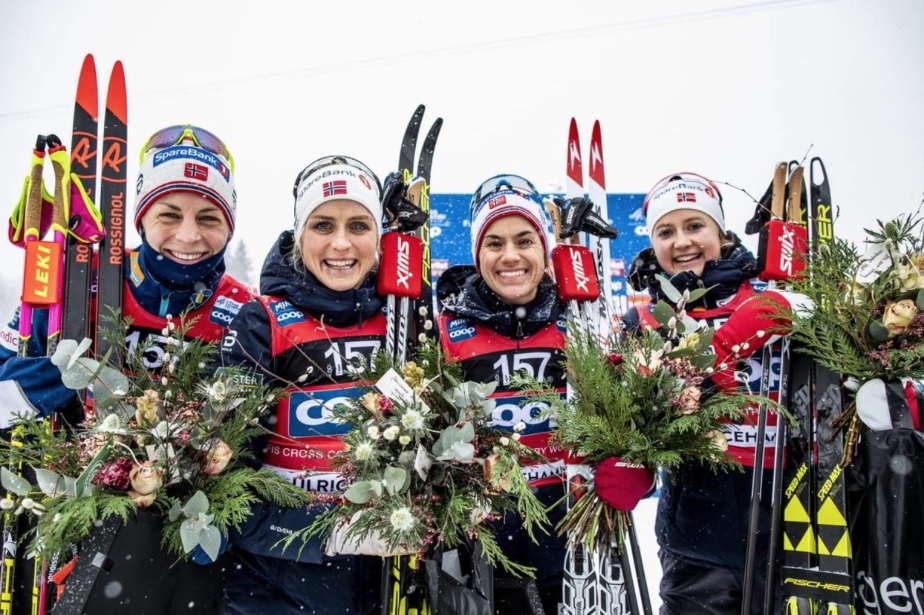
The women’s 4 x 5 k relay winners from Ulricehamn, Sweden’s World Cup. From left to right, Norway’s Astrid Uhrenholdt Jacobsen, Therese Johaug, Heidi Weng, and Ingvild Flugstad Østberg (Photo: Fischer/Nordic Focus)
“We have a strong team, many girls are going fast. We do this together so we are really happy,” Therese Johaug told the International Ski Federation (FIS) after Sunday’s 4 x 5-kilometer relay in Ulricehamn, Sweden. With wind, snow, and crowds lining the course the 4 x 5 k women’s relay appeared to simply be an illustration of Norway’s astounding plug-and-play depth. Sunday marked Norway’s 11th 4 x 5 k consecutive relay win dating back to 2011.
When Johaug makes a move expect gaps to form. Norway’s Therese Johaug, making her move during the women’s 4 x 5 k relay in Ulricehamn, Sweden. (Photo: Fischer/Nordic Focus)
Whether the race is tight, or a runaway, Norway’s benchmark is the win. In 57:06.3 minutes, the winning time on Sunday, Norway I illustrated that over four legs of skiing, they remain peerless.
At the first tag after 5 k, Weng came in among a cluster of nine teams all within 8.1 seconds. Russia I was first, Norway I second (+0.5). The gift that is Johaug took over for Norway I on the second classic leg. Nothing earth-shattering, but Johaug kept the pace high enough to tag Jacobsen for a 9.3 second lead on chasers Russia I. A bit more than 15 seconds back were Sweden I and Finland I.
Sweden’s Charlotte Kalla during the women’s 4 x 5 k relay in Ulricehamn, Sweden. (Photo: Fischer/Nordic Focus)
With Kalla taking over for Sweden I on the initial skate leg, empowered by the frenzied crowds, one could envision a Kalla-catch where she powers and glides into contact with Norway I. That simply did not happen.
Kalla’s magic was subdued on Sunday. Jacobsen added more time to Norway I’s lead. As Jacobsen tagged Østberg skiing the anchor leg for Norway I, Jonna Sundling waited 21.4 seconds for Kalla to come through.
Five k later, Østberg came through for the win and a comfortable 37.4-second gap on second place Sweden I.
Sweden I’s team consisted of Evelina Settlin, Ebba Andersson, Charlotte Kalla, and Jonna Sundlin. In third was Finland with Laura Mononen, Krista Pärmäkoski, Riitta-Liisa Roponen, and Evelina Piippo. Finland was 41.2 seconds behind Norway I’s winning time.
For the U.S., Sadie Bjornsen, Rosie Brennan, Caitlin Patterson, and Jessie Diggins finished in sixth (+1:26.6). The order of the U.S. lineup was a carbon-copy of December’s 4 x 5 k team in Beitostølen. Back then, the foursome placed fifth, 48 seconds back, in what was a tighter race for second and third place. In that race, the U.S. was 10.7 seconds from the podium’s second step.
Sunday in Ulricehamn, Bjornsen kept the U.S. in contact, tagging Brennan in fourth, 4.5 seconds behind. Brennan lost some ground, losing contact with chasers Finland, Sweden I, and Russia I. She tagged Patterson in fifth place, 44.9 seconds behind Norway I in the lead.
In bib 4- the U.S Ski Team’s Sadie Bjornsen is locked on during the women’s 4 x 5 k relay in Ulricehamn, Sweden.( Photo: Fischer/Nordic Focus)
“I knew that it was going to be challenging to break the race up,” Bjornsen emailed to several outlets. “That said, I was going to do my best to do so. On the two climbs, I moved to the front, and tried to push the pace. On the flat section following the second climb, I was doing my best to push the double pole, but the draft seemed to keep the race as one. As we rounded a corner into the stadium, suddenly six people passed, and I was stuck back in the pack. With little room to move, I felt like a tiger in a cage as I was trying to make my way back to the front in the final 1.3k loop. Unfortunately, I got stuck behind Germany and Norway team 2 when those front two girls made a small break, so I wasn’t able to respond as I would have liked. With two tracks, and v-boards on both sides of those tracks, it is way too easy to get stuck at the wrong place at the wrong time.”
Patterson found herself in that place of fending off skiers from behind and attempting to gap up to those in front. She tagged Diggins at 15 k in seventh, with a 1:20.3 deficit.
Diggins kept firing as she skied the anchor leg. Even if a podium spot was out of reach, the immediate task of catching Russia II was her carrot. At the 15 k mark, when Diggins took the team on her own 5 k journey, Russia II has already tagged off roughly 18 seconds ahead of the Americans. By 17.2 k, Diggins had Russia II almost in contact, and by a kilometer later, she had passed Russia II to gain sixth place.
The U.S. was able to put nearly 20 seconds on Russia II, who placed seventh overall, by the finish.
“I’m so proud of my teammates for going out there and fighting as hard as they can!” Diggins emailed to FasterSkier. “I had fun hunting down Russia and practicing my tactics, all-out race effort, and pacing and I’m really looking forward to the World Champs relays! I’ve been feeling great this weekend and finally absorbing the fitness boost from doing the tour de ski, so I’m happy with where I’m at as we ramp up preparations for the Seefeld.”
The relays are a moment to assess a team’s collective standing on the World Cup — to find areas to improve upon during the podium quest.
“Rosie [Brennan], I think she’s wishing she pushed a little bit harder at some points in her race; I haven’t had time to talk to Caitlin [Patterson] or Jessie [Diggins] after the race but I think we had a little bit of what we had at Beitostølen, which was two really strong legs and then two decent legs, medium legs, but we just don’t have quite the four extraordinary legs to put together right now to stay in the mix as long as we need,” U.S. Ski Team Head Coach Chris Grover explained in a post-race phone call.
Caitlin Patterson for the U.S. during the women’s 4 x 5 k relay in Ulricehamn, Sweden. (Photo: Fischer/Nordic Focus)
The nature of powerhouses like Norway in the women’s field is that reality reveals itself with large sample size datasets. Eleven wins in a row are, within the world of World Cup skiing, statistically significant. Even more, all four members of Sunday’s relay team for Norway I placed in the top-8 in Saturday’s 10 k skate. In the quest for relay podiums, none of this is lost on Grover, who remains optimistic and grounded in the U.S. quest to remain podium viable in the 4x 5 k relay.
Asked if Norway’s power comes into the calculus when planning for relay day, the longtime coach kept the tangible goal of catching second and third place as the benchmark.
“We’re always trying to put together a team that might be third, on the right day if everything could come together,” Grover added. “We’re trying to compete for a medal spot, but we don’t feel like we have the team to win that race, and I think other nations are probably looking at it in a similar way.”
The World Cup takes a break from racing and will commence again in Lahti, Finland on Feb. 9.
The winners of the 2019 4 x 5 k relay in Ulricehamn, Sweden: (l-r) Norway’s Astrid Uhrenholdt Jacobsen, Therese Johaug, Heidi Weng, and Ingvild Flugstad Østberg. (Photo: fis-ski.com screenshot)
FIS World Cup Ulricehamn, Sweden 4 x 5 k / 4 x 7.5 k relay
The sun rises, the sun sets, and Norway wins the women’s 4 x 5-kilometer relay in Ulricehamn, Norway on Sunday. For the 11th time in a row, a Norwegian women’s team bested the world in the storied race format.
Heidi Weng, Therese Johaug, Astrid Uhrenholdt Jacobsen, and Ingvild Flugstad Østberg won in a time of 57:06.3 minutes. For the first tag, nine teams came in separated by 8.1 seconds. Johaug, skiing the second leg for Norway, opened a gap of 9.3 seconds over Russia I by the 10 k mark.
The time back to second-placed Sweden I stretched to 37.4 seconds by the finish.
Sweden I’s team consisted of Evelina Settlin, Ebba Andersson, Charlotte Kalla, and Jonna Sundling.
Finland I placed third (+41.2) wth Laura Mononen, Krista Pärmäkoski, , Riitta-Liisa Roponen, and Evelina Piippo.
The U.S. team of Sadie Bjornsen, Rosie Brennan, Caitlin Patterson, and Jessie Diggins finished in sixth (+1:26.6).
In the men’s 4x 7.5k relay, Russia II and Russia I came away in first and second place respectively.
Russia II’s team of Evgeniy Belov, Alexander Bessmertnykh, Denis Spitsov, and Artem Maltsev won in a time of 1:17.53.2 hours.
Russia I’s Andrey Larkov, Alexander Bolshunov, Andrey Melnichenko, and Sergey Ustiugov finished 20.8 seconds back.
In third was Norway, 35.8 seconds behind. Hans Christer Holund, Didrik Tønseth, Sjur Røthe, and Simen Hegstad Krüger, Norway’s foursome, were 35.8 seconds back. On the first leg, at 9.7 k, Norway was in ninth place, with a 43.1-second deficit.
The U.S. team of Erik Bjornsen, Scott Patterson, David Norris, and Ben Lustgarten placed 13th (+4:10.8).
IBU World Cup Antholz, Germany 12.5 k / 15 k Mass Start
On Sunday in Antholz, home country athlete Germany’s Laura Dahlmeier won in 35:32.8 minutes while skiing a single penalty lap during her first prone stage. The Czech Republic’s Marketa Davidova placed second (13.1, 0+0+1+0), with Vanessa Hinz of Germany in third (+16.4 1+0+0+0).
“It’s a fantastic feeling to be right at the top again,” Dahlmeier told the IBU. “I started very badly and I felt slow. But I came back strongly and I remained virtually without error in the shooting. It was a good weekend for me.”
US Biathlon’s Clare Egan raced and shot to 15th overall, 1:05.8 back, with two penalties in her first prone stage, otherwise she shot clean.
Rosanna Crawford of Canada placed 28th (+3:50.2, 0+1+3+1).
In the men’s 15 k mass start, there was one new development: Johannes Thingnes Bø of Norway did not win. He did, however, place second to France’s Quentin Fillon Maillet. He won the race in 34:39.4 seconds while shooting clean in all four stages. Depositing between PLN 60 and PLN 199, we will receive a bonus of 125% of our deposit (a maximum of PLN 1,600), as well as a package of 50 free spins Vulkan Bet on the Doom of Dead slot machine. On the other hand, if we deposit at least PLN 200, we will get 100 free spins after the game as a reward, as well as a bonus of as much as 200% of our own deposit (a maximum of PLN 2,800 to visit).
Bø was 14.3 seconds back in second place, with a single miss in each of his standing stages. Germany’s Arnd Peiffer was third (+24.6, 0+0+0+0).
Christian Gow of Canada was the sole North American in the race. He placed 27th (+3:22.5, 1+1+0+1).
Lake Placid SuperTour 10 k/15 k mass start classic
Kaitlynn Miller (CGRP) won the women’s 1o k classic mass start in 36:12.7 minutes. Coming in 2.9 seconds back was Jessica Yeaton(APU/Australian National Team) in second place. In third, skiing for Dartmouth, was Katharine Ogden (37:27.8).
Kyle Bratrud (SMS T2) won the men’s 15 k classic mass start in 46:41.3 minutes. In second place was Adam Martin (CGRP) who raced to a time of 46:55.0. Canada’s Andy Shields (Lappe Nordic) placed third in 47:41.6.
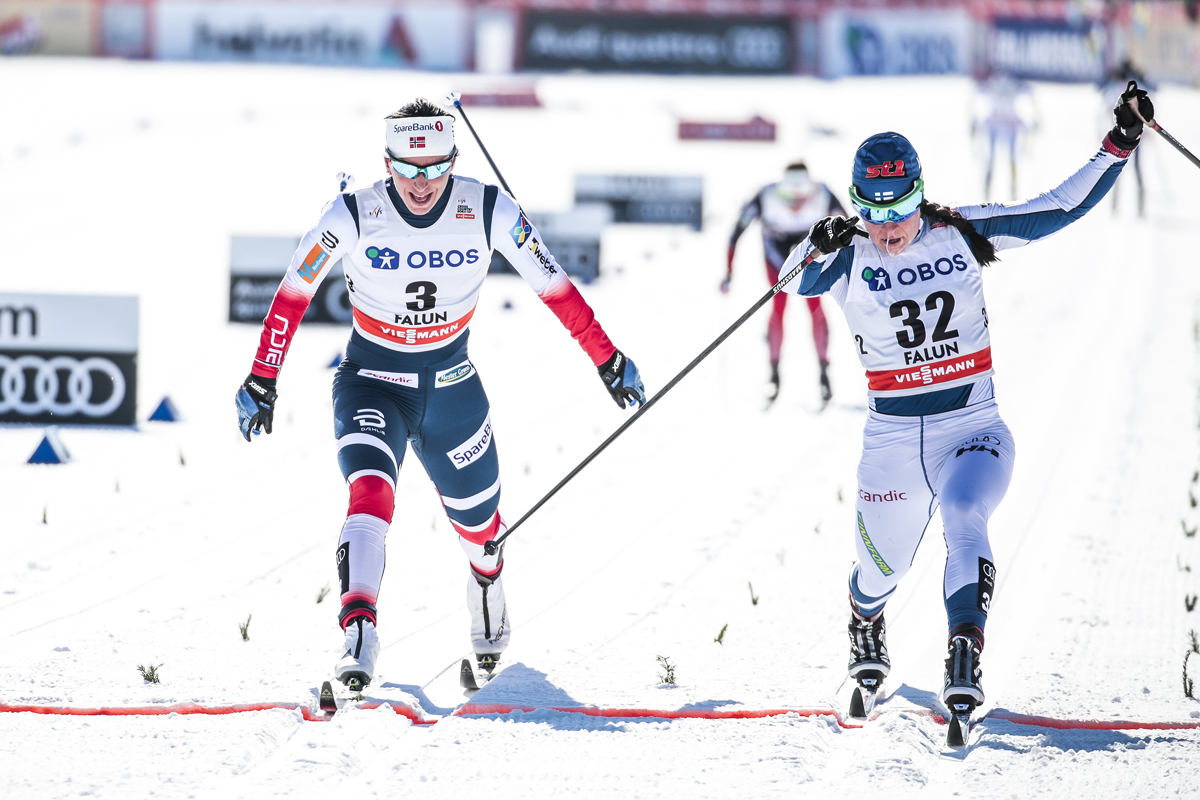
Finland’s Krista Pärmäkoski (32) edges Norway’s Marit Bjørgen for the win in the women’s 10 k classic mass start at 2018 World Cup Finals in Falun, Sweden. (Photo: Fischer/NordicFocus)
Welcome to FasterSkier’s World Cup Preview, where we check in with the top-10 teams from last year’s FIS Cross Country World Cup tour before the season starts with the Ruka weekend in Kuusamo, Finland, on Nov. 24 with a classic sprint.
***
Finland
Overall in Nations Cup Last Year:4th
Women’s Ranking 2017/2018: 4th
Men’s Ranking 2017/2018: 7th
Finnish Skiers to Watch:
If there are two names Finland’s cross-country ski fans loves to cheer–and will be looking to chant again this season–it’s Krista Pärmäkoski and Iivo Niskanen. And with good reason.
Pärmäkoski opened Period II of last season with a win, cruising to first in the 10-kilometer classic race in Planica, Slovenia. Pärmäkoski racked up two more 10 k victories after Planica, winning both the Lahti 10 k and the Falun 10 k. Altogether, Pärmäkoski landed on the World Cup podium seven times last season, capping off the FIS 2017/2018 season ranked fourth, just ahead of Norway’s Marit Bjørgen in fifth.
Outside of the World Cup, Pärmäkoski also came away from the 2018 Pyeongchang Winter Olympic Games with three individual medals, one silver and two bronze.
ComplimentingPärmäkoski on the men’s side, Niskanen, earned two World Cup podiums last season, placing third in the Ruka 15 k and third in the Lahti 15 k. He landed in the top-20 twelve times during last year’s World Cup season, and finished 15th in the FIS overall.
Like Pärmäkoski, he also departed the Winter Games with hardware, a gold medal from the men’s 50 k mass start.
Pärmäkoski and Niskanen aren’t the only Finns capable of pushing into the top tiers of World Cup skiers. With the retirement of Aino-Kaisa Saarinen this past spring, the women’s side will look to Kerttu Niskanen (Iivo’s sister), Riitta-Liisa Roponen, Anne Kyllönen and Laura Mononen–all of whom scored World Cup points more than once last season– to keep the women’s team’s forward momentum.
Following Niskanen, Matti Heikkinen and Ristomatti Hakola are two veteran Finnish names who are not about to let up as the 2018/2019 season prepares to get underway.
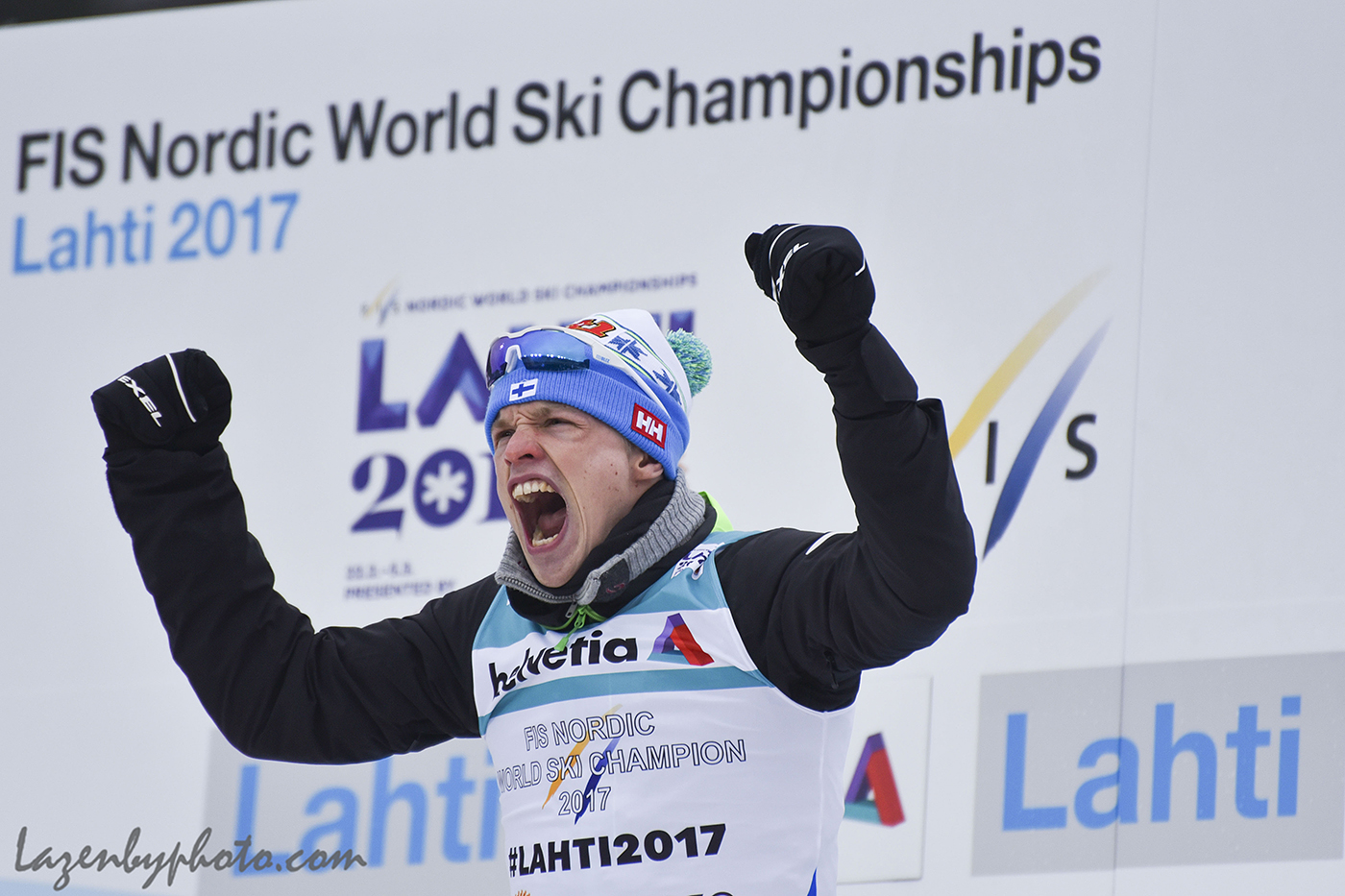
Finland’s Iivo Niskanen celebrating his first World Championships gold in the men’s 15 k classic on March 1, 2017, in Lahti, Finland. (Photo: John Lazenby)
Norway’s Ragnhild Haga leads Switzerland’s Nathalie von Siebenthal during the 4 x 5-kilometer team sprint on Saturday at the 2018 Olympics in PyeongChang, South Korea. (Photo: FlyingPointRoad)
PYEONGCHANG, South Korea — Three days before the 4 x 5-kilometer women’s relay event, Norway’s Marit Bjørgen sat in the PyeongChang Olympic press-conference room. A table and a black mic served as the only separation between the five-time Olympian, and a group of reporters eagerly awaiting to pick her brain.
She had just tied for third in the women’s 10 k freestyle and had been fielding questions about her bronze-medal performance when the conversation took a momentary turn.
The inquiry on the table prodded Bjørgen for her thoughts about the upcoming team relay. The Norwegian’s response seemed simple, yet seasoned with wisdom: “The relay is the relay,” she said with a laugh.
Going into Saturday’s team competition, many may have assumed that the relay was Norway’s race to lose. But Bjørgen’s remark hinted at the broader felicitousness of predictability on the stage of events like the Winter Games. In the last five Olympic cycles, Norway has taken first only once. That gold came at the Vancouver Games in 2010.
All but two of those Olympic relay teams have featured Bjørgen. Her comment in the PyeongChang press conference may be a tacit reminder that a relay podium, even for a powerhouse cross-country nation like Norway, is never secure until every racer crosses the line.
On Saturday it seemed she and her team would relive their more frequent results of the past. Racing the first leg, Norwegian Ingvild Flugstad Østberg kept the team in the mix. She chased down Russia’s Natalia Nepryaeva throughout the blistering first-classic leg pace and the two came into the exchange together along with Slovenia’s Anamarija Lampic.
Almost 20 seconds behind the lead group was Finland’s Aino-Kaisa Saarinen and another 5 seconds behind the Finn was Sweden’s Anna Haag. In the lead group’s exchange, Østberg tagged off to Astrid Uhrenholdt Jacobsen, Nepryaeva to Yulia Belorukova, and Lampic to Katja Visnar for the second classic leg.
As the those three began striding the initial climb, Saarinen came into the exchange to tag off to Finland’s Kerttu Niskanen, while Haag handed off to Sweden’s Charlotte Kalla.
“I did what I could to keep up with them, just trying to not lose that [many] seconds,” Haag said during a press conference. “I really did what I could, but then I was so tired on the top of the last uphill that I could barely ski downhill.”
Sweden’s Charlotte Kalla racing the second leg of the 4 x 5-kilometer team sprint on Saturday at the 2018 Olympics in PyeongChang, South Korea. (Photo: FlyingPointRoad)
If Kalla wanted to put Sweden in the mix for a medal, she would need to make up 25.5 seconds over the course of 5 k.
It didn’t take long for the Swede to silence any doubt as to whether she could. She raced the fastest second classic leg, catching not only Niskanen in her first 2.5 k lap, but later swallowing Jacobsen and Visnar during her second lap. The Swede found even more seconds in the final climb and Team Sweden was in second by the time Kalla rounded the course’s final turn back toward the stadium.
“It was a very inspiring position to go out hunting,” Kalla said at Saturday’s post-race press conference. “And I know that it’s important for me to take some time to get in the right mode and not stress too much. I had really good skis, so it was just to relax in my shoulders and try to have a good position in the double poling. I knew that every second that I could catch up for Ebba and Stina would be important.”
Team Russia was number one through the second exchange, with Belorukova tagging off to Anastasia Sedova for the first freestyle leg. Hot on the Russian’s heels was Sweden’s Ebba Andersson, spurred by Kalla’s strong classic leg.
Yulia Belorukova (5) skiing the second leg for the Olympic Athletes from Russia in the women’s 4 x 5-kilometer team sprint on Saturday at the 2018 Olympics in PyeongChang, South Korea. (Photo: FlyingPointRoad)
Niskanen was the next skier through in third, skiing just 8.4 seconds away from the silver medal. She tagged off to Riitta-Liisa Roponen for Finland’s first skate leg.
After having bled even more time, Jacobsen came through the exchange in fourth. Almost 30 seconds now separated Norway from the win and even a shot at the bronze was 19.7 seconds away.
Jacobsen tagged off to Norwegian Ragnhild Haga, a good pick if Norway wanted to return to the top three. Haga earned her first Olympic gold medal in Thursday’s 10 k freestyle, and on Saturday she appeared to be searching to add one more.
Within the first 2.5 k, Haga reeled Roponen in and left her in the dust as she headed out for her second lap. She continued to push the pace and by the end of her 5 k leg, Haga put her team back into contention for gold. As Team Norway came through the exchange, their time back from Sweden and Russia was no longer 30 seconds, but down to three.
Andersson tagged off to Sweden’s Stina Nilsson, while Sedova handed off to Russia’s Anna Nechaevskaya. Taking the anchor leg for Norway was Bjørgen.
The Norwegian quickly chased down the three second gap to Nilsson. Their red and white Scandinavian suits soon broke free of Russia in maroon.
At this point, the safest way for Bjørgen to secure gold would be to avoid a sprint between herself and the Swede. However, the two raced in tandem throughout the first 2.5 k, Nilsson shadowing the Norwegian’s every move. As they started their second lap, Bjørgen still couldn’t shake her from the back of her skis. Heading into the final climb it was Norway and Sweden together, Bjørgen leading by just half an inch.
The Norwegian women’s celebrates after taking gold in the 4 x 5-kilometer relay on Saturday at the 2018 Olympics in PyeongChang, South Korea. (Photo: FlyingPointRoad)
Halfway through, Bjørgen put in a surge. The gap was not much, but perhaps just enough. She crested the hill ahead of the Swede and led the final descent. The two cornered to the final 100 meters, Bjørgen barely poling ahead. The Norwegian managed to hold off any attack from the Swede and crossed first with a team time of 51:24.3 for gold.
“Stina looked really strong. We all know how strong she is in the last 100 meters,” Østberg said during a press conference. “But Marit, she is one hell of a skier … I was so nervous and extremely happy when she managed to beat [Nilsson] in the last 100 meters.”
Nilsson crossed 2 seconds later bring Sweden silver, and Nechaevskaya crossed third (+43.3) to earn Russia bronze.
“First of all I am extremely happy I must say, that’s number one. And secondly it’s true that we are going exactly in the right direction,” Belorukova said at the press conference. “We are getting stronger year on year and more powerful, and I should say given the current situation maybe we are also getting more [tough] as we fight our way along. And this is not going to be the last medal.”
Just outside the medals, Finland placed fourth (+1:02.6) and the U.S. finished fifth (+1:20.5) for its best Olympic result. Germany was sixth (+1:49.4), Switzerland seventh (+1:51.5), Slovenia eighth (+2:31.4), Italy ninth (+2:57.7), and Poland 10th (+3:06.6). Canada finished 13th (+4:50.3) of 14 teams.
— Jason Albert, Harald Zimmer and Alex Kochon contributed
The Norwegian women’s celebrates after taking gold in the 4 x 5-kilometer relay on Saturday at the 2018 Olympics in PyeongChang, South Korea. (Photo: FlyingPointRoad)
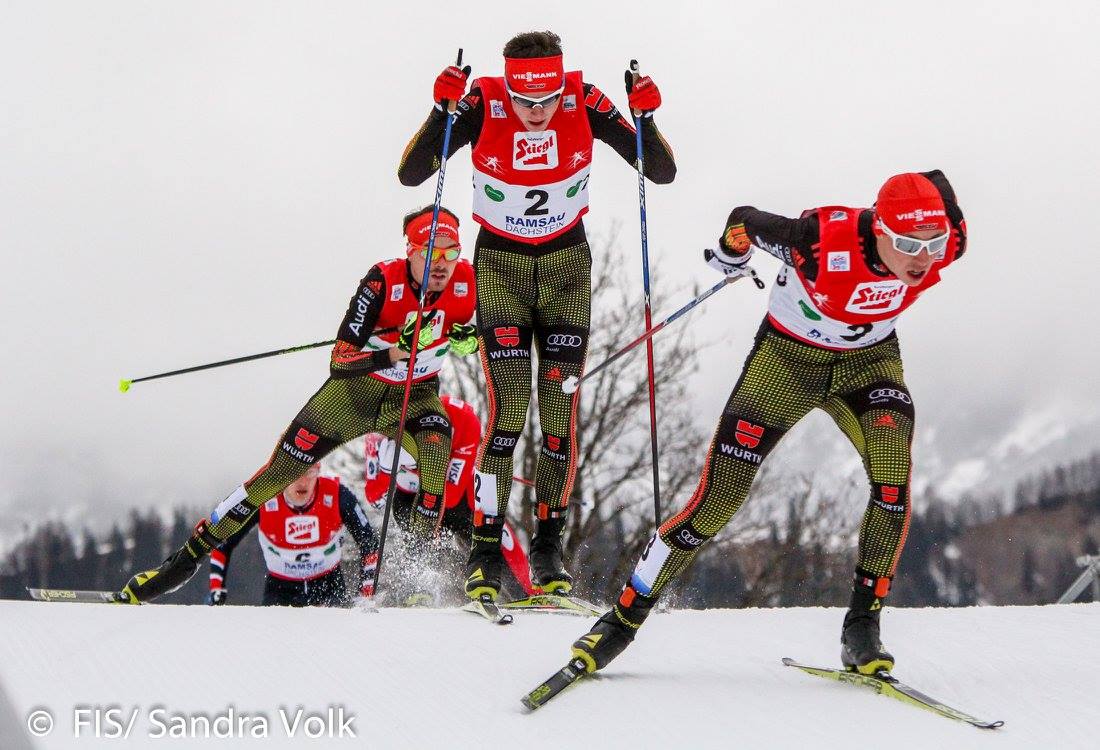
Eric Frenzel (r) leads German teammates Vinzenz Geiger (c) and Fabian Rießle (l) toward a sweep of the podium in the Nordic Combined World Cup individual normal hill/10 k on Sunday in Ramsau, Austria. (Photo: FIS Nordic Combined/Facebook)
Welcome to The Rundown, your quick primer of need-to-know information about the day’s racing. We’ll be updating this digest as the day goes on with additional results, photos and quotes. The Rundown is NOT a race report; stay tuned for complete race reports later today with interviews from the day’s top racers.
***
FIS Nordic Combined Continental Cup in Klingenthal
[UPDATE] Ben Loomis tallied two top 10’s and his U.S. Nordic Combined teammate Ben Berend notched eighth place this past weekend at the Continental Cup in Klingenthal, Germany.
Loomis ended the three-day series on Sunday by placing fifth in the large hill/10 k for his second-best result at the Continental Cup level (he finished fourth last year in the normal hill/10 k competition in Park City, Utah). Loomis put himself in position by jumping to sixth then racing to fifth, 49.9 seconds behind Japan’s winner Go Yamamoto, who finished in 24:06.4.
Florian Dagn of Austria placed second (+6.0) after jumping to first. Yamamoto jumped to second and headed out on the course seven seconds behind him.
Norway’s Sindre Ure Soetvik placed third (+28.8), after starting the 10 k in third. Germany’s David Welde finished fourth (+36.0), moving up after jumping to eighth.
Also on Sunday, Berend placed 15th (+2:25.3) and Jasper Good was 35th (+3:07).
Berend started the long weekend out with an eighth-place finish in the large hill/5 k on Friday. He jumped to fourth and finished the ski race in eighth, 1:09.2 minutes behind Germany’s Maximilian Pfordte, who won in 10:58.9.
Pfordte posted the best jump to start the 5 k first, then held his lead for a 16.4-second victory over Yamamoto in second. Dagn placed third (+18.3) after jumping to second, and Yamamoto’s jump ranked third.
Also for the U.S., Good finished 21st (+2:05.8) for his best result of the weekend, Loomis was 28th (+2:50.5) and Stephen Schumann 29th (+2:52.1).
On Saturday, it was Loomis who tallied another eighth place for the U.S. in the large hill/10 k. He jumped to 10th then improved to eighth, finishing 58 seconds behind German winner Tobias Simon. While Simon dominated the jump as well as the race, winning by 10.1 seconds, Yamamoto repeated in second place and Austria’s Thomas Joebstl reached the podium in third (+38.3).
Berend finished 25th (+1:45.9) and Good 45th (+3:24.9) on Day 2.
The Nordic Combined World Cup resumed this weekend in Ramsau, Austria, with Germany not only topping but sweeping the podium in both individual normal hill/10 k competitions.
On Saturday, Team Germany swept the top four, with Johannes Rydzek notching his third individual win of the season, ahead of teammates Fabian Rießle (+1.5) and Eric Frenzel (+8.7). Vinzenz Geiger completed the sweep in fourth (+15.0), a career best for the 19 year old after placing seventh earlier this month in Lillehammer, Norway.
Frenzel led after the jump on the 98-meter hill, which put him 2 seconds ahead of the second-best jumper, Austria’s Mario Seidl, in the 10 k Gundersen start. (Seidl went on to place seventh.)
Rydzek posted the third-best jump and started 10 seconds back, while Rießle started another 10 seconds later in seventh. Rydzek went on to ski the fifth-fastest course time and Rießle was third fastest en route to first and second at the finish.
Americans Taylor Fletcher and Bryan Fletcher finished 27th (+1:17.6) and 29th (+1:18.4), respectively, and Adam Loomis was 47th (+3:16.2).
Taylor started 41st, 1:18 back, and Bryan started five seconds later in 43rd. Bryan posted the seventh-fastest course time and ended with a photo finish with Finland’s Arttu Maekiaho, which Maekiaho took by 0.1 seconds for 28th. Loomis started 50th.
Day 2 in Ramsau went to Frenzel, who won the normal hill/10 k in 22:49.4. Rießle repeated in second (+0.8) and Geiger improved on his career best for his first podium in third (+23.4). Seidl again jumped to first and this time ended up fourth (+24.3).
Frenzel started third and raced to first, Rießle moved up from fourth in the jump to second, and Geiger made the most of his second-best jump.
Taylor Fletcher skied the third-fastest course time to move up from 46th after the jump to 22nd at the finish (+1:20.2). Bryan Fletcher finished 32nd (+1:33.5), losing one place after starting 31st.
The Nordic Combined World Cup goes on holiday break until resuming Jan. 7-8 in Lahti, Finland.
The NorAm mini tour in Rossland, British Columbia, wrapped up with a classic pursuit race on Sunday.
In the women’s 10 k classic, APU’s Chelsea Holmes continued her strong form, winning the mini tour with an aggregate time of 1:08:04.4. Holmes finished the 10 k in 35:35.4 minutes, 6.2 seconds behind fastest woman of the day, Katherine Stewart-Jones (NTDC Thunder Bay).
SMS Elite’s Erika Flowers continued her podium-filled visit to Canada with the third-fastest ski of the day, 48.1 seconds behind Stewart-Jones, to take second overall, 2:23.9 behind Holmes. AWCA’s Olivia Bouffard-Nesbitt was the fifth fastest in the 10 k to hold on to third overall (+3:25.2), while Stewart-Jones was just 0.5 seconds back in fourth overall.
NTDC Thunder Bay’s Evan Palmer-Charrette used a fourth-fastest ski in the 15 k to keep the overall title, with an aggregate time of 1:28:54.0. Alexis Dumas (CNEPH) skied 1:14.7 faster than Palmer-Charrette to climb from sixth at the start to second overall (+52.2). AWCA’s Jack Carlyle had the second-fastest time of the day, 29.9 seconds behind Dumas, to climb into third overall (+1:10.1).
National Para-Nordic guide Erik Carleton had the third-fastest 15 k time, 1:01.3 back, but it wasn’t enough to catch Team R.A.D.’s Russell Kennedy, who placedfourth overall (+1:20.8).
Full results (with tabs for the overall and time of the day)
***
FIS Cross-Country World Cup in La Clusaz: Men’s and women’s relays
Team Norway I emerged victorious in Sunday’s men’s 4 x 8 k mixed relay event in La Clusaz, France, with Didrik Tønseth leading the winning group’s first classic leg.
After crossing in seventh, Tønseth handed off to Martin Johnsrud Sundby for a second classic leg. Sundby dropped a spot, finishing his classic leg in eighth. Sundby tagged off to Anders Gløersen for the first freestyle leg.
Gløersen rocketed the team to first, and held the position straight through his 7.5 k. The final leg for Norway’s winning team went to Finn Hågen Krogh. The Norwegian men’s team completed the relay event in a total time of 1:11:25.7
Second place overall, two-tenths of a second behind, was team Russia, led by Evgeniy Belov for the first classic leg. Belov handed off to Alexander Legkov for the second classic leg, with Legkov putting down the third fastest time by the time he returned to the exchange zone.
The third and first freestyle leg for Russia went to Alexey Chervotkin, who maintained the team’s third place position. Anchoring the team was Sergey Ustiugov, who managed to maneuver the team from third place to second during his final freestyle leg.
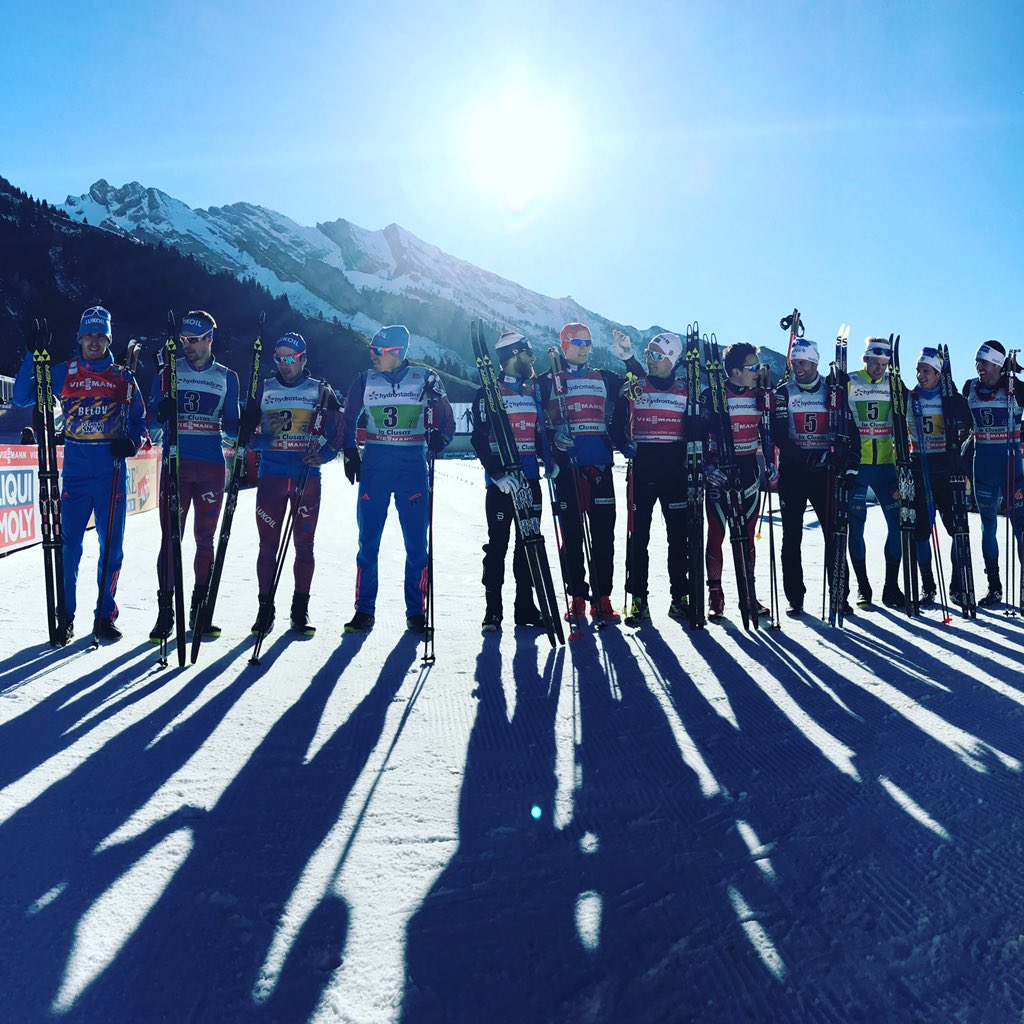
The men’s 4 x 8 k relay podium on Sunday in La Clusaz, France, with Russia in second (left four) Norway first (center four) and France third overall. (Photo: FIS Cross-Country/twitter)
Rounding out the men’s mixed relay podium on Sunday was France I (+7.7).
Jean-Marc Gaillard led team France’s first classic leg, racing in a sixth position into the exchange zone. Gaillard handed off to Alexis Jeannerod, who moved up to fifth place by the end of his classic leg.
Skiing the third and first freestyle leg was Clement Parisse who held onto fifth place and tagged off to Maurice Manificat for the final freestyle leg. Manificat managed to move around Sweden’s Axel Ekstrløm and Germany’s Lucas Bøgl for third place overall.
Neither Canada or the U.S. entered a men’s relay team due to illness.
In the women’s 4 x 4 k relay event, it was another Norwegian team who stood atop the podium.
Ingvild Flugstad Østberg led the women’s first classic leg, skiing in first place until her hand-off to Marit Bjørgen. Bjørgen maintained the first place position during her classic leg, tagging off to Ragnhild Haga.
Haga completed the first freestyle leg for Norway, handing off to Heidi Weng, who anchored the team’s last freestyle leg. The Norwegian women finished in a total time of 39:23.3.
In second was team Finland, 50.2 seconds behind Norway’s winning time. Aino-Kaisa Saarinen started the first classic leg for Finland, passing off to Anne Kyllønen.
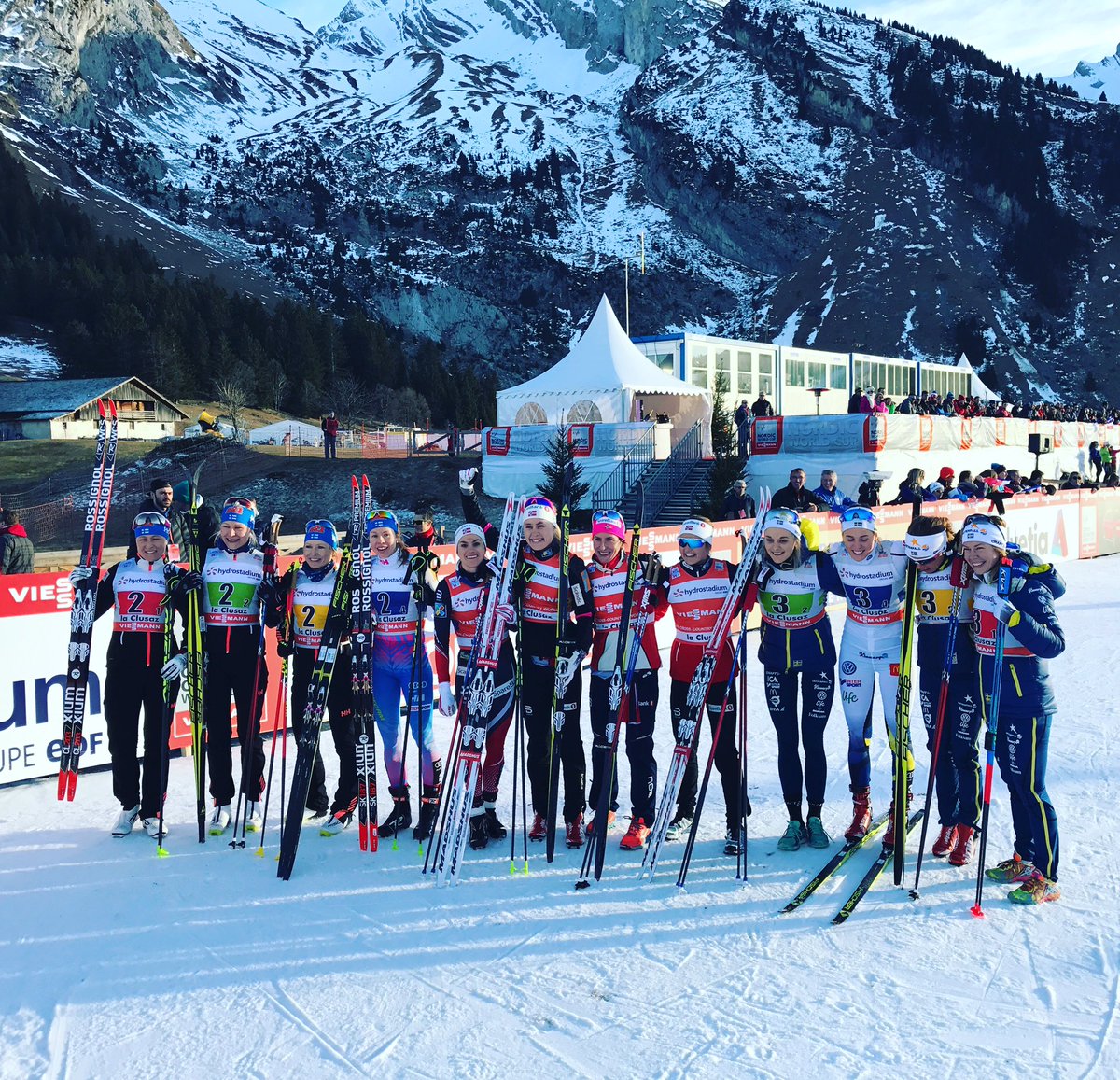
The women’s 4 x 4 k mixed relay podium on Sunday in La Clusaz, France. Norway (c) took the win ahead of team Finland in second (l) and Sweden in third. (Photo: FIC Cross-Country/Twitter)
Taking on the first freestyle leg for Finland was Riitta-Liisa Roponen, who tagged off to Laura Mononen for the final freestyle leg.
Rounding out the relay podium in third overall was team Sweden (+1:08.9). Emma Wiken raced the first classic leg, who tagged off to Stina Nilsson for the second classic leg. Maria Rydqvist raced the first freestyle leg and handed off to Anna Dyvik, who anchored the team to third.
Only one U.S. women’s relay team was entered on Sunday, with both Jessie Diggins and Sadie Bjornsen out due to illness. Sophie Caldwell led the U.S.’s first classic leg, followed by Rosie Brennan. Liz Stephen followed Brennan, taking on the first freestyle leg. Anchoring the team was Kikkan Randall in the final freestyle leg. The Americans finished in seventh overall (+2:26.0).
Canada also entered a women’s team in Sunday’s relay. Emily Nishikawa led the first classic leg, and handed off to Cendrine Browne for the second classic leg. Dahria Beatty raced the first freestyle leg and tagged off to Sophie Carrier-Laforte, who anchored the team to 12th overall (+4:07.9).
IBU World Cup in Nove Mesto: Men’s and women’s mass starts
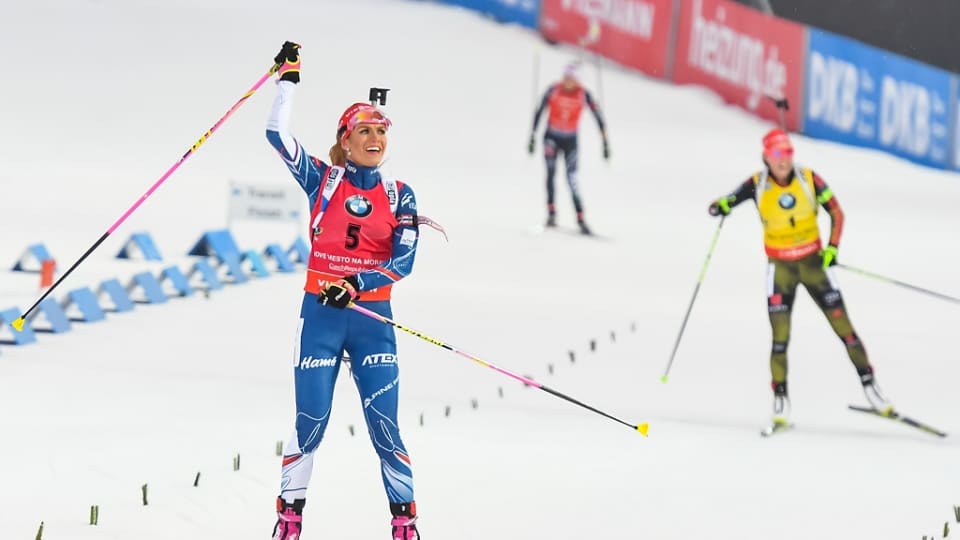
Gabriela Koukalová of the Czech Republic looks to her home crowd as she wins the women’s 12.5 k mass start on Sunday at the IBU World Cup in Nove Mesto, Czech Republic. She fended off Germany’s Laura Dahlmeier (r), who took second. (Photo: IBU)
Despite skiing in 14th at one point in the men’s 15 k mass start on Sunday, France’s Martin Fourcade came back to win the International Biathlon Union (IBU) World Cup in Nove Mesto, Czech Republic.
That makes him seven for eight in individual races so far this season.
Fourcade started with bib 1 as the overall World Cup leader and finished first in 36:18.9 minutes, despite a penalty on his second prone that put him in 14th and 22 seconds back heading out on his third loop.
He rebounded with a clean third shooting to move into third, 2.5 seconds behind Ukraine’s Dmytro Pidruchnyi in first and 1.3 seconds behind Russia’s Anton Babikov in second.
By the final shooting stage, Fourcade was back in first with clean shooting (0+1+0+0), 28 seconds clear of Babikov in second. Babikov had his first penalty of the day on the final stage (0+0+0+1) to drop out of contention.
Germany’s Simon Schempp (1+1+0+0) came out on top of an eight-way battle for second place on the final loop. Schempp took it, 8.3 seconds after Fourcade and 1.1 seconds ahead of Babikov in third (+9.4).
The Czech Republic’s Ondrej Moravec was 0.3 seconds off the podium in fourth (+9.7), Pidruchnyi placed fifth (+10.2), Russia’s Matvey Eliseev finished sixth (+11.0), Norway’s Ole Einar Bjørndalen was back in the top 10 in seventh (+11.3), France’s Quentin Fillon Maillet notched his second-straight top 10 in eighth (+13.7), and Norway’s Johannes Thingnes Bø finished at the back of that pack in ninth (+19.8).
American Lowell Bailey missed the top 20 by 10 seconds in 21st (+1:17.1). He had three penalties, two of which came on the last stage (0+1+0+2) to drop him from ninth to 20th at the start of the final loop.
Bailey retained his spot in ninth in the overall World Cup standings, while Fourcade continues to lead, 158 points ahead of Shipulin in second.
In the women’s 12.5 k mass start, Gabriela Koukalová delivered to her home fans in Nove Mesto, Czech Republic, racing to her second win of the season in 34:42.1.
“I was so nervous before the race so it was amazing,” Koukalová said, according to an IBU press release. “I have so many emotions; it’s even more emotional than at the Olympics. I would like to say thanks to all the spectators and I hope I was able to make a nice Christmas present to all of them.”
The defending World Cup champion beat the current World Cup leader, Germany’s Laura Dahlmeier, by 3.1 seconds after shooting a single penalty and cleaning the last two stages (0+1+0+0) to move into first. Dahlmeier missed two on the first stage to drop 23rd, but cleaned her last three stages (2+0+0+0) to capture second at the finish. She passed three athletes on the last lap, including Italy’s Dorothea Wierer, who ended up third (+9.7) with one miss (1+0+0+0).
“I don’t really know what happened with those two misses,” she told German broadcaster ARD. “But in terms of skiing I had a great day on the course, and I had skis that were the bomb. It’s just a lot of fun when you can make the podium reaching the second place despite a large deficit in the beginning. I am overjoyed.”
Germany’s Vanessa Hinz rebounded from Friday’s sprint (where she placed 73rd) to end up fourth (+15.5) with a single penalty (0+0+1+0). None of the 29 finishers hit every target, and American Susan Dunklee did not start.
Dahlmeier leads the overall World Cup standings by 98 points over Finland’s Kaisa Mäkäräinen, and Koukalova is third, just seven points behind Mäkäräinen. Dunklee is 11th.
The IBU World Cup now goes on holiday break until resuming Jan. 5 in Oberhof, Germany.
The third IBU Cup was held on Dec. 16-17 in Obertilliach, Austria. In the men’s 20 k individual on Friday, the top three finishers were France’s Antonin Guigonnat, with a winning time of 49:58.6, Russia’s Yury Shopin in second (+32.2), and Germany’s Florian Graf in third (+35.6). Each of the top three had one miss, and Canada’s Matthew Hudec was the top North American in 34th (+4:11.3) with two penalties (0+2+0+0). Also for Canada, Carsen Campbell finished 38th with three penalties (1+2+0+0), Matthew Neumann was 53rd with three penalties (0+2+0+1) out of 118 finishers.
In the women’s 15 k individual on Friday, Germany’s Karolin Horchler took the win with clean shooting (0+0+0+0) in 44:54.7. France’s Coline Varcin was 1.1 seconds back in second with one penalty (1+0+0+0), and third went to Russia’s Daria Virolaynen (+30.2), who had one miss as well (0+1+0+0). Canada’s Nadia Moser was the top North American in 35th (+5:10.8) with two penalties (0+1+1+0). Also for Canada, Erin Yungblut placed 66th with five penalties (0+3+0+2).
In the men’s 10 k sprint on Saturday, two Norwegians took first and second with Henrik L’Abee-Lund winning in 23:29.9, and Vetle Sjastad Christiansen 13.9 seconds back in second. Third was claimed by Germany’s Phillipp Nawrath (+29.5) and all of the top three shot clean. Neumann led Canada in 47th (+2:20) with one miss (1+0). Campbell missed two (1+1) and finished 59th (+2:47.4), and Hudec was 64th (+2:58.9) with two penalties as well (1+1). Canada’s Pearce Hanna finished 87th, with two misses (2+0), out of 125 finishers.
In the women’s 7.5 k sprint, Russia swept the podium with Virolaynen winning in 20:31.5, followed closely by Uliana Kaisheva (+3.7), and then Anna Nikulina (+23.1). Virolaynen missed one (0+1), Kaisheva cleaned (0+0) and Nikulina had a standing miss as well (0+1). The top North American was Canada’s Megan Bankes in 30th (+2:08.1), with one prone penalty (1+0). Also for Canada, Sarah Beaudry finished 34th (+2:18.1), with two standing misses (0+2), Yungblut was 45th (+2:40.6) with clean shooting (0+0), and Moser finished 49th (+2:45.5) with two misses (1+1), out of 85 women.
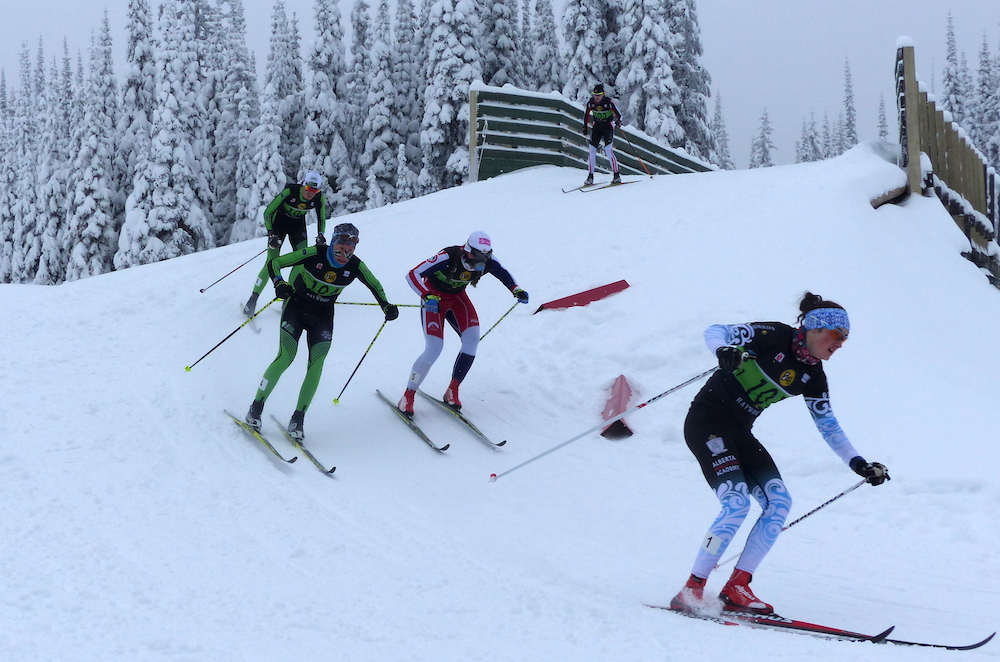
Olivia Bouffard-Nesbitt of the Alberta World Cup Academy (AWCA) leads the American train around the bridge corner into the finish straight in the A-final of Saturday’s NorAm classic sprint at Sovereign Lake in British Columbia. She went on to finish fourth behind Julia Kern (second from r), Liz Guiney (back left) and Kaitlynn Miller (l), respectively. (Photo: Peggy Hung)
Welcome to The Rundown, your quick primer of need-to-know information about the day’s racing. We’ll be updating this digest as the day goes on with additional results, photos and quotes. The Rundown is NOT a race report; stay tuned for complete race reports later today with interviews from the day’s top racers.
***
Canadian NorAm/U.S. SuperTour at Sovereign Lake: Classic sprint
[UPDATE] U.S. skiers filled the open category podiums on the first fully North American NorAm event in recent years on Saturday at Sovereign Lake near Vernon, B.C. With NorAm points, SuperTour points and FIS points on the line there was a great turnout of the top skiers.
In the open women’s 1.2-kilometer classic sprint, Julia Kern of the Stratton Mountain School (SMS) won in 3:17.04 after qualifying fifth. Liz Guiney of the Craftsbury Green Racing Project (CGRP) finished second, 0.67 seconds back, and her CGRP teammate Kaitlynn Miller rounded out the podium in third (+0.91). Olivia Bouffard-Nesbitt (Alberta World Cup Academy) was the top Canadian in fourth (+1.49) and the lone Canadian in the final. Jennie Bender (Bridger Ski Foundation) placed fifth (+3.8) and Heather Mooney was sixth (+19.84).
On the same 1.2 k course, Reese Hanneman (Alaska Pacific University) made up for his 15th qualifying time to take the men’s final win in 2:38.08. Cole Morgan of the Sun Valley Ski Education Foundation (SVSEF) took second in the final (+0.87) after winning the qualifier, and Ben Saxton (SMST2) was third (+1.92). Matt Gelso (SVSEF) finished fifth (+3.88), after precipitating a semifinal crash that took three Canadians (Angus Foster, Simon Lapointe and Evan Palmer-Charrette) out of contention, but didn’t result in a protest. The lone Canadian man in the final, Antoine Briand (Pierre-Harvey Training Centre) placed sixth (+11.98).
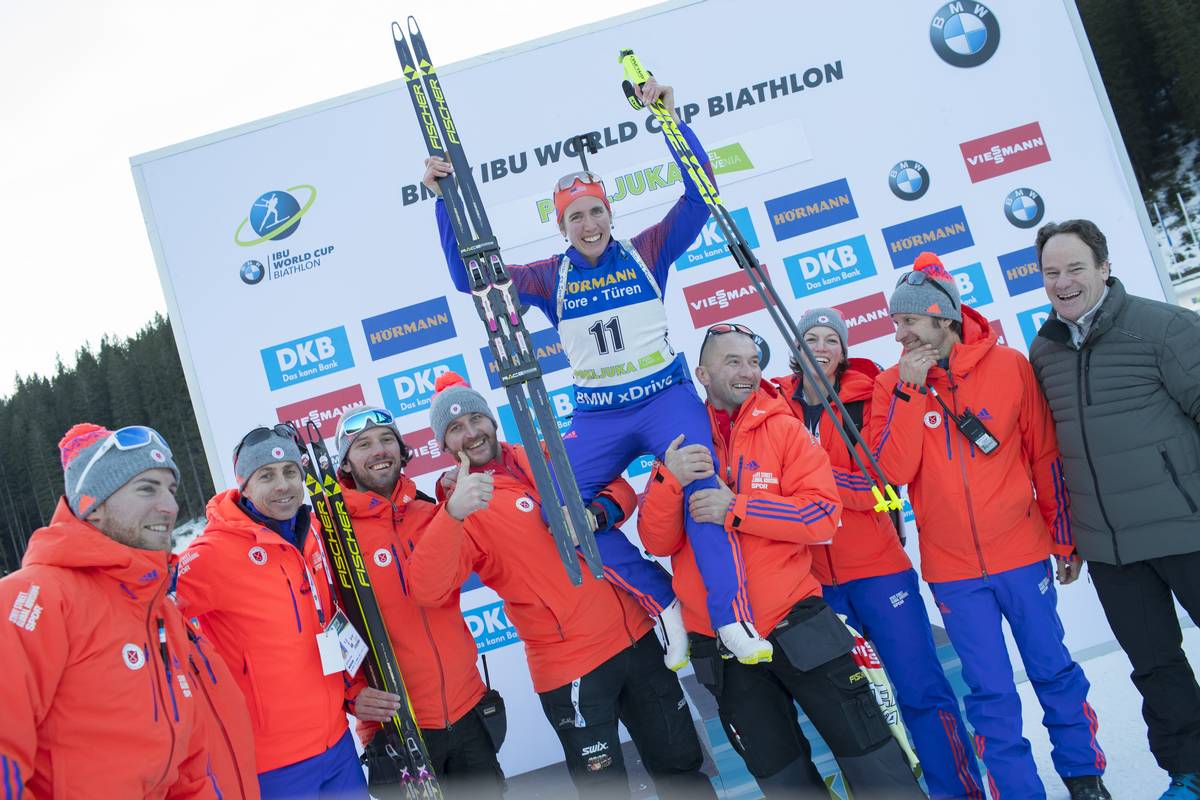
Susan Dunklee being hoisted up by her US Biathlon support team at the IBU World Cup in Pokljuka, Slovenia, after tying her career-best result in a pursuit. Dunklee placed fifth on Saturday for a season best as well. (Photo: USBA/NordicFocus)
Another day at the front of the pack, and another day of (nearly) perfect shooting for Susan Dunklee, who raced from 11th to fifth for her first flower ceremony (top six) of the season at the IBU World Cup in Pokljuka, Slovenia.
Dunklee (US Biathlon) cleaned the first three of four stages in Saturday’s 10-kilometer pursuit to move into second with one standing stage remaining. In that final shooting stage, she had her first miss of the day, yet still left the range in second, 22 seconds behind Germany’s Laura Dahlmeier in first. Dunklee finished out the race with the 21st-ranked course time on the last loop (her first-loop time was the fastest in the 56-woman field) and placed fifth, 24.1 seconds behind Dahlmeier — who won her second-straight race in Pokljuka. Dahlmeier finished first in 30:43.1 despite two prone misses on the second stage, which put her as far back as fifth (0+2+0+0). Finland’s Kaisa Mäkäräinen finished second, 16.8 seconds back, with two penalties as well (0+0+1+1), and Eva Puskarcikova of the Czech Republic reached the podium in third (+18.7) with a single miss followed by three clean stages (1+0+0+0). One spot ahead of Dunklee, reigning World Cup champion Marie Dorin Habert of France clawed her way up to fourth (+18.8) after starting 17th, with one penalty (0+0+1+0).
For Dahlmeier, it was her 10th World Cup victory and fifth in a pursuit.
“My motto is ‘Scheiß da nix, dann feid da nix’,” Dahlmeier told Germany’s ZDF, which vaguely translates to “Don’t worry be happy,” or “Just do it.”
“That was worth gold today. I was a bit surprised about my two misses in prone. Apparently I already had an aberration in the first stage, then I clicked [adjusted the sights] and was a bit surprised that the two misses still happened,” she added. “… Then came the standing shooting, and there I tried to keep calm again. The race is only over once you cross the finish line, and that became true again today. I am happy that the race flipped again like this.”
Canada’s Julia Ransom cleaned three consecutive stages before missing two on the last standing. She finished 34th for the second day in a row, 2:33.5 behind Dahlmeier. Rosanna Crawford placed 49th with three penalties (2+1+0+0) and Clare Egan of the U.S. was 56th with six misses (2+0+1+3). Canada’s Megan Tandy, with seven penalties (1+1+3+2) did not finish.
In the men’s 12.5 k pursuit, the first man out of the start, Martin Fourcade of France, held his lead to the finish, hitting all 20 targets and winning in 30:27.4. Norway’s Emil Hegle Svendsen rose from fourth at the start to second at the finish (+6.0) with clean shooting as well, and Russia’s Anton Shipulin placed third for the second-straight day (+6.2), with one penalty in the last stage (0+0+0+1).
Friday’s sprint runner-up, Johannes Thingnes Bø of Norway, ended up fourth (+48) with two misses on the last stage (0+0+0+2), Germany’s Simon Schempp placed fifth (+59.8) after starting sixth, and had one miss (0+0+1+0), and Michael Rösch of Belarus cleaned for sixth place (+1:21.0) after starting 16th.
Lowell Bailey (US Biathlon) finished 18th (+2:01.6) for the second day in a row, with one prone penalty in the first stage (1+0+0+0).
Biathlon Canada’s Christian Gow picked off two places for a new career best in 31st (+2:41.7) with a single prone penalty (0+1+0+0).
Tim Burke placed 42nd (+4:09.8) for the U.S. (after starting 53rd) with five standing penalties (0+0+2+3), Canada’s Scott Gow finished 48th (+4:39) with five misses as well (2+1+0+2), and the third Canadian in the race, Brendan Green was 57th (+5:36.4) with five penalties (+5:36.4).
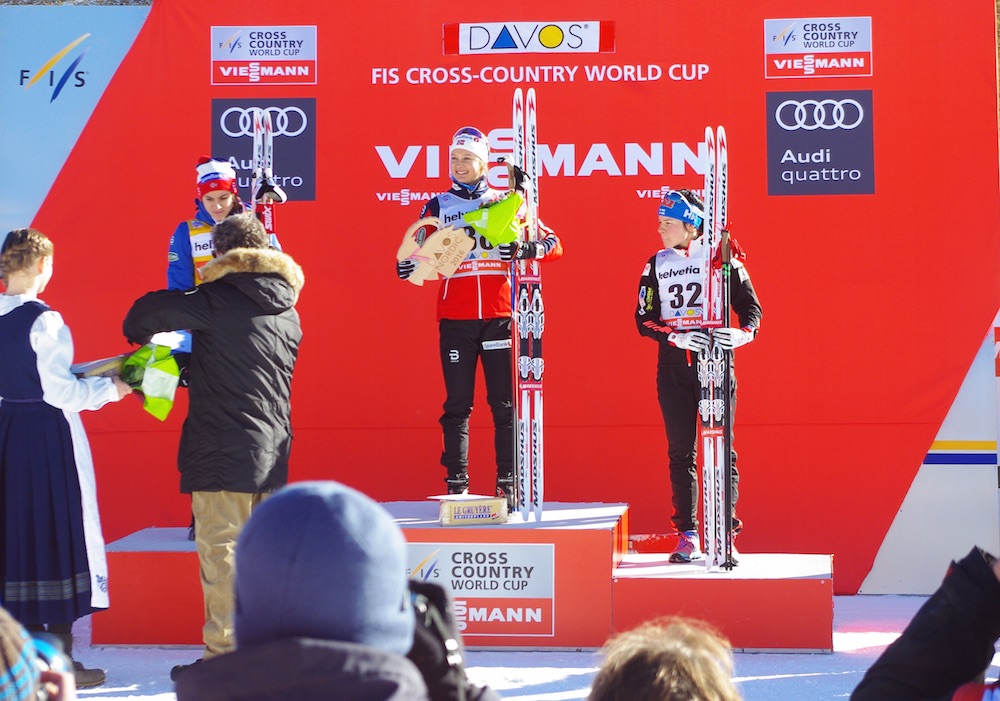
Norway’s Ingvild Flugstad Østberg (c) won her first World Cup race of the season on Saturday in the 15 k freestyle individual start in Davos, Switzerland. Joining her on the podium: Norway’s Heidi Weng (l) in second and Finland’s Krista Parmakoski (r) in third.
Norway’s Ingvild Flugstad Østberg is back on top of the podium after a 7.9-second win in Saturday’s 15-kilometer freestyle in Davos, Switzerland, over — you guessed it — her teammate Heidi Weng.
Østberg started 38th (out of 59) and led at every split to take the win in 37:44.4, her first this season and her first in a 15 k. Weng started a minute ahead of her in bib 36 and ended up second, while Finland’s Krista Parmakoski notched third (+16.7) for her third podium of the season, ninth in her career and second skate podium.
The next fastest woman, American Jessie Diggins finished 37.6 seconds off the podium in fourth (+54.3), ahead of Russia’s Yulia Tchekaleva in fifth (+1:00.5) and Switzerland’s Nathalie von Siebenthal in sixth (+1:05.6). Ragnhild Haga of Norway was seventh (+1:10.8), Finland’s Riitta-Liisa Roponen eighth (+1:21.4), Italy’s Ilaria Debertolis ninth (+1:32.2), and Sweden’s Anna Haag 10th (+1:35.5).
The U.S. had two in the points with Liz Stephen in 28th (+2:17.5). Kikkan Randall was 2.3 seconds outside the top 30 in 33rd (+2:30.2), and Caitlin Patterson placed 44th (+3:21.6). Rosie Brennan did not start.
Emily Nishikawa led Canada in 34th (+2:33.5) for her best result this season, Dahria Beatty was 42nd (+3:15.2), and Cendrine Browne 54th (+4:07).
Weng remains the Overall World Cup leader by 70 points over Østberg, Parmakoski ranks third, and Norway’s Marit Bjørgen, who is not competing this weekend in Davos, is currently fourth.
[UPDATE] In the men’s race earlier on Saturday, Martin Johnsrud Sundby racked up another victory in Davos’s 30 k freestyle, beating his fellow Norwegian Anders Gløersen by 13.7 seconds with a winning time of 1:07:31.6 hours. Gløersen took second for his first podium in a year (he was third in the Davos 30 k last December) and Finland’s Matti Heikkinen reached the podium for his second-straight race in third (+25.7).
Canada’s Alex Harvey placed 12th (+1:29.4) and his teammate Graeme Killick notched 21st (+2:24.2) for his second-best World Cup result (after placing 19th in a skiathlon last March at the Ski Tour Canada).
Devon Kershaw was the next top North American in 43rd (+3:52.9), six seconds ahead of the lone American in the race, Noah Hoffman in 44th (+3:58.9). Canada’s Andy Shields placed 64th (+6:33.9).
Jessie Diggins of the Stratton Mountain School (SMS) T2 Team and U.S. Ski Team (USST) powers through the women’s 10 k freestyle en route to a victory on the first day of racing at SuperTour Finals in Craftsbury, Vt. (Photo: John Lazenby/Lazenbyphoto.com)
It had been 116 days since the season started with the November World Cup and SuperTour races and just nine days since the conclusion of the Ski Tour Canada. Needless to say, it has been a long season.
U.S. SuperTour Finals, held this week in Craftsbury, Vt., is a unique season-ending series. The senior men’s and women’s fields are a conglomerate of domestic racers (which compete all winter on the SuperTour circuit), collegiate racers (some of which are fresh off NCAA Championships), and the U.S. Ski Team (with several members returning from nearly four months abroad on the World Cup circuit). Also known as Spring Series, the U.S. finals give World Cup racers the opportunity to reconnect with their programs and race alongside their club teammates.
Consistent with the snow struggles all season across the U.S. and Europe this season, Monday’s individual start races were held on a manmade 3.4-kilometer loop in Craftsbury. However, athletes commended the challenging course organizers and volunteers laid out.
In the women’s 10 k freestyle, U.S. Ski Team (USST) member Jessie Diggins, racing for the Stratton Mountain School T2 Team, started third and quickly posted the fastest splits to cross the finish line first in a time of 24:26.9.
Jessie Diggins (Stratton Mountain School T2 Team/U.S. Ski Team) celebrates her win in the women’s 10 k freestyle on the first day of U.S. SuperTour Finals on Monday in Craftsbury, Vt. (Photo: John Lazenby/Lanzenbyphoto.com)
That time held up throughout the day and when the final results were posted, only two racers managed to keep Diggins within 36 seconds of them: USST teammate Sadie Bjornsen and Riitta-Liisa Roponen of Finland, respectively.
Bjornsen, of Alaska Pacific University (APU) bested Roponen, a 37-year-old Finnish A-team member, by just 0.2 seconds for second place, clocking 36.2 seconds behind Diggins. Due to nagging injuries and sickness, this will be Bjornsen’s only race this week.
“Today was a challenging and fun grand finale,” Bjornsen wrote in an email. “I am still pretty sick and managed to get a little overuse shoulder injury at the end of the tour. So I have decided to pull the plug and head back home tomorrow. When you are so exhausted, it becomes a bit dangerous to race when you are sick.”
Although SuperTours are usually devoid of overseas national-team racers, Finland and Italy were represented in Craftsbury on Monday.
“Riitta-Liisa and Virginia [De Martin Topranin, of Italy] are here racing to have fun and see the U.S. while getting some racing in,” Diggins explained in an email. “I think it’s so great to have an international field here at Spring Series.”
Roponen last race at the Worldloppet at home in Lahti, Finland, which she won. Her best individual World Cup result this season was fifth at the Lahti World Cup 15 k skiathlon. Topranin, 28, placed 11th on Monday, more than two minutes back. She is coming off a 22nd-place overall finish in the Ski Tour Canada (STC) and a top individual result of seventh in a 10 k classic mass-start stage at the Tour de Ski.
Diggins finished fifth overall in the STC and has broke through with five World Cup podiums this season, including a win in the 5 k freestyle at the Tour de Ski.
Finland’s Riitta-Liisa Roponen racing to third in the women’s 10 k freestyle on Monday at SuperTour Finals in Craftsbury, Vt. (Photo: John Lazenby/lazenbyphotos.com)
“In all honesty, racing again after the tour was tough!” Diggins wrote. “The World Cup season took quite a lot out of me, but after a total rest week with my boyfriend in Boston I’m happy and healthy again and excited for one last ‘hurrah’ to close out the season.”
About 50 seconds off the podium and nearly 1 1/2 minutes behind Diggins, fourth through seventh place all finished within 7.5 seconds of one another. Chelsea Holmes (APU) led them in fourth (+1:25.4), followed closely by Liz Stephen (Burke Mountain Academy/USST) in fifth (+1:26.5), Ida Sargent of the Craftsbury Green Racing Project (CGRP) and USST in sixth (+1:27.8) and Caitlin Patterson (CGRP) in seventh (+1:32.9).
Overall, echoes of fatigue resounded among the racers.
“I feel pretty beat up and tired, but I think I am one of many who have that feeling,” Holmes wrote in an email. “When you race it doesn’t really matter how you feel, you just do your best.”
Coming off of a fifth- and an eighth-place finish at NCAA Championships, Emilie Cedervaern of the University of New Mexico was the top collegiate skier in 10th (+2:07.2).
Ahead of her, two women who represented the U.S. at the STC, Annie Hart (SMST2) placed eighth (+1:45.0) and Rosie Brennan (APU/USST) was ninth (+1:56.1).
Racing continues Tuesday with the men’s and women’s 1.5 k classic sprints. Heats begin at 11:30 a.m. Eastern time.
“It was so nice to be racing in the U.S. again and to see everyone!” Diggins wrote. “That’s why I come to spring series — it’s all about the awesome people that I never get to see enough!”
Jessie Diggins (c) of the Stratton Mountain School T2 Team and U.S. Ski Team topped the podium in the women’s 10 k freestyle individual start on Monday, the first day of racing at U.S. SuperTour Finals in Craftsbury, Vt. Sadie Bjornsen (second from left) of APU/USST placed second and Finland’s Riitta-Liisa Roponen (second from r) placed third. Chelsea Holmes (not pictured) was fourth, Liz Stephen (l) fifth and Ida Sargent (r) sixth. (Photo: John Lazenby/Lanzenbyphoto.com)
Finland’s Krista Parmakoski (l) and Norway’s Therese Johaug (r) leading the pack early in the women’s 15 k skiathlon at the World Cup in Lahti, Finland. Less than 1 k into the race, Johaug and her Norwegian teammate Heidi Weng had broken away from the pack. (Photo: Fischer/NordicFocus)
LAHTI, Finland – The next time the FIS Cross Country World Cup visits Lahti, it will be for 2017 World Championships. Sunday was the second and final day of pre-World Championship racing at the Lahti ski stadium, heightening the level of significance of these races for the teams and athletes.
After Saturday’s freestyle sprints, where American Jessie Diggins pulled out a silver-medal performance, it was time to switch gears to a 15-kilometer skiathlon for the women (30 k for the men). At the end of the day, Norway’s Therese Johaug continued her domination of distance races, winning by more than a minute over teammates Heidi Weng and Ingvild Flugstad Østberg, who completed the Norwegian podium sweep in second and third, respectively.
The women’s race format consisted of a 7.5 k classic, followed by 7.5 k of freestyle, kicking off with a mass start. The classic and freestyle legs both included two 3.75 k loops, with racers passing through the stadium a total of four times, where they met a roaring crowd.
The gun sounded and the 62 women were off. To the local fans’ excitement, Finnish skier Krista Parmakoski initially led out of the stadium.
But after just a couple hundred meters, Johaug took the lead and immediately began her relentless pushing of the pace. She’s used this tactic time and time again on the World Cup, yet it’s effectiveness remains rather impenetrable. Quite simply, very few have have been able to match her.
Sunday marked Johaug’s 15th World Cup win this season; only her teammate Marit Bjørgen has won more (17 times in 2011/2012).
By one kilometer into the race, Weng stood as the only one able to stick with Johaug. The main pack chased seven seconds behind, led by Norwegians Astrid Uhrenholdt Jacobsen, Maiken Caspersen Falla, and Parmakoski.
Then, Johaug began to steadily put distance between Weng and herself as well. At 4.8 k, Weng slipped 9.7 seconds behind Johaug, but by now she had an 18-second gap over the chase group. The race continued to unfold in a similar fashion.
Polish veteran and four-time Tour de Ski winner Justyna Kowalczyk led the chase pack for most of the first lap of the classic leg, with Falla and Østberg also up front. Two Americans, Diggins and Sadie Bjornsen, skied together in the pack throughout the first lap. In the second classic lap, a pack of 10 skiers had broke off the front, while Diggins and Bjornsen fell behind.
By the transition to freestyle at 7.5 k, Johaug held a 15.8-second lead over Weng, who had also developed an even bigger gap to the chase pack, 28.5 seconds behind. Østberg led them, and Bjornsen and Diggins came through the transition about 10 seconds behind the lead group in 13th and 21st, respectively.
Norway’s Therese Johaug racing away uncontested to her 15th World Cup victory this season at the 15 k skiathlon in Lahti, Finland. (Photo: Fischer/NordicFocus)
With Johaug and Weng expanding comfortable gaps in first and second, the highlight of the freestyle leg became the race for third place.
At the 8.7 k checkpoint, 1.2 k into the skating leg, the pack racing for third consisted of 11 women, led by Østberg and Falla, and Finland’s Riitta-Liisa Roponen. Diggins and Bjornsen led a secondary chase pack, trailing the group ahead of them by 6.3 seconds.
Meanwhile, Johaug and Weng both remained untouched and continued to ski alone towards their medals. Johaug became even quicker on the initial part of the skate leg, holding a 34-second lead on Weng at 9.7 k.
At 12.5 k, Østberg raised the pace and the third-place pack began to deteriorate. Roponen and Falla surged to stick with Østberg, but a space grew between them and the rest of the pack.
“I realized quite early that I had to focus on the third place and when it was 1.5 kilometers left, I tried to increase the speed, on the last uphill and tried to attack,” Østberg said in a post race press conference. “I got some meters on Maiken and the rest of the group and I think it was good I had some meters on Maiken because I know how strong she is in the finish. I am really happy with how the race went today for sure.”
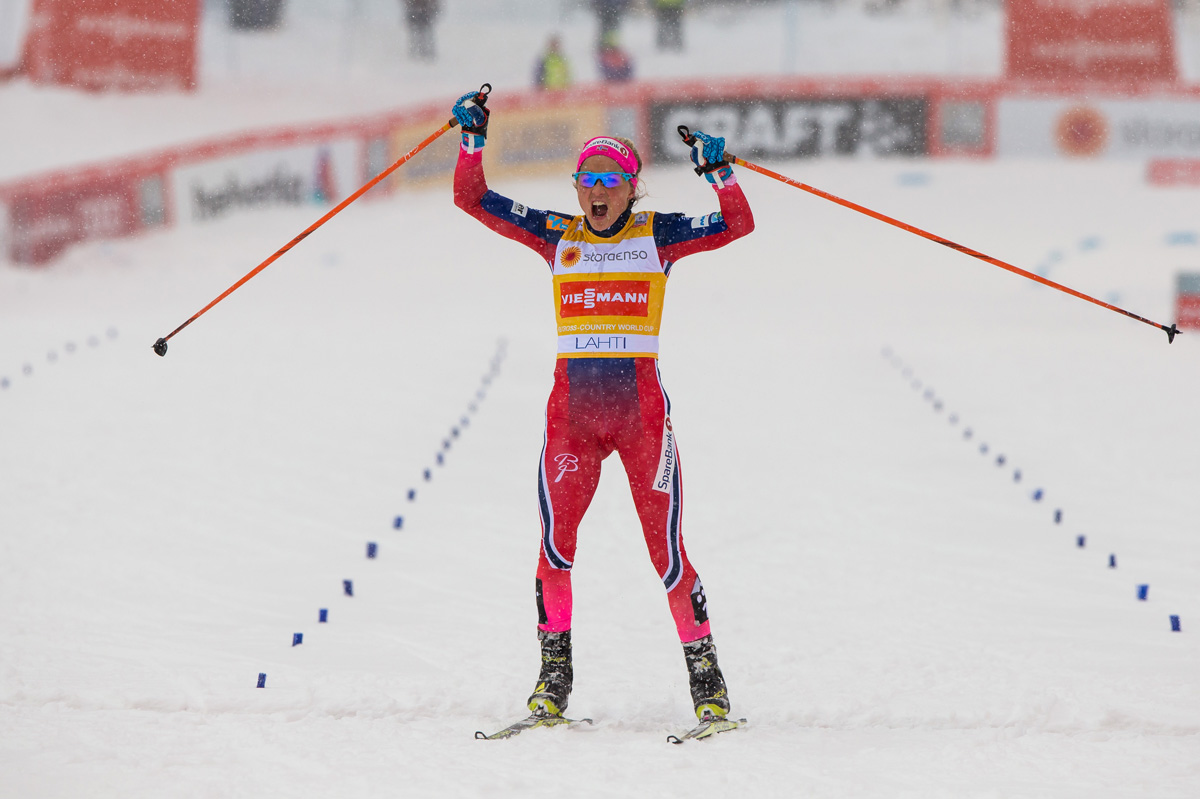
Norway’s Therese Johaug winning Sunday’s 15 k skiathlon in Lahti, Finland, for her 15th World Cup victory this season. (Photo: Fischer/NordicFocus)
As they were duking it out, Johaug cruised home with a fist pump and a scream, winning in 38:59.9.
“It was an amazing day today,” Johaug told FIS in a post-race interview. “I love these tracks here. The hill is so steep. Those are perfect tracks for me. And I think the weather was good for me today, too. I had really good skis, so the wax team has done a really good job. It was difficult conditions today with all the snow, but for me it was perfect. It’s good to have good memories from here for next year when the World Championships [are here].”
Weng finished 1:05.5 minutes behind in a comfortable second place. According to FIS, it was her first podium in Lahti.
“I like the track in Lahti. … I felt I had perfect classic skis,” she said. “When Therese went away I was on my own and had to find my own pace.”
As the others flew into the stadium for the last few-hundred meters, small gaps had formed. Østberg won the race for third, 1:31.9 behind Johaug and 4.7 seconds ahead of Falla in fourth (+1:36.6). Roponen as the first non-Norwegian placed fifth (+1:39.0).
“I am really, really happy! It was impossibly nice to ski,” Roponen told Finnish broadcaster YLE after the race, according to a translation.
Her fifth place at home marked her first top 10 of the season.
“I really liked a lot of these new tracks,” she said.
Two other Finnish women landed in the top 10, with Anne Kyllönen in ninth and Parmakoski in 10th.
Bjornsen 15th; Three Americans in Top 30
Of the three U.S. women on the start line Sunday, all three finished in the points within the top 30. Bjornsen led the charge in 15th, 2:26 seconds behind Johaug, while Jessie Diggins finished close behind, in 17th (+2:29.2).
Americans Sadie Bjornsen (front) and Jessie Diggins (behind, left, in white) chasing the leaders during the women’s 15 k skiathlon on Sunday at the World Cup in Lahti, Finland. They went on to place 15th and 17th, respectively.
Despite being comfortably into the top 30, Bjornsen and Diggins both struggled to navigate the chase packs as it split.
“It was an up and down, roller-coaster-feeling day,” Bjornsen said in an in-person interview after the race. “The classic was especially challenging today because of the [slow, fresh-snow] conditions. It didn’t stretch out, so when you are in the middle of that front pack, you just stop-go, stop-go, stop-go, fight for position, stop-sprint, and I never felt like I got in a classic groove. And I mean that is the challenge of classic mass start, but I think especially with these conditions, it intensifies it.”
As the chase group split in the second lap of the classic race, neither Diggins nor Bjornsen were able to stay with the front end.
“I just was not at the right place at the right time when they broke on that second loop of the classic,” Bjornsen said.
Jessie Diggins (U.S. Ski Team) celebrates second place, her career-best sprint result at the Lahti World Cup skate sprint on Saturday. (Photo: Salomon/NordicFocus)
“[Yesterday] definitely took a toll [on me],” Diggins said after the race. “I was pretty tired after doing all the [sprint] rounds and doing such a long sprint yesterday. But you know, it is good to practice the skiathlon when you can and I thought, even if my body doesn’t feel like it is there, I will practice my tactics, work on everything else and try to have some fun out there.”
The freestyle leg went better for Diggins and Bjornsen, with both of them gaining spots back, but neither was able to reattach to the leading chase pack.
“The first lap I was having a hard time hanging onto the pace,” Bjornsen said. “But I just tried my hardest to just stay with that group that I went through the exchange with, and then the second lap of the skate felt a lot better.”
Notably, Bjornsen had the fastest mid-race transition time, switching from classic to skate faster than anyone else.
To her surprise, Caitlin Patterson, of the Craftsbury Green Racing Project, finished 29th (+3.22) for her second-career top-30 result in the last two weekends.
“I was really happy to hear that apparently I was 29th, so back into the top 30!” she exclaimed. “I didn’t feel like I had that today, especially when I was out there on that classic leg, so I was really happy to do that after all.”
After catching a few days rest at home, the U.S. Ski Team will launch into action at the eight-stage Ski Tour Canada, beginning in Gatineau, Québec, on March 1.
About the Author: JoJo Baldus is a nordic skier from snowy Minneapolis, Minn. Currently living the dream as a volunteer journalist and photographer for FasterSkier while enjoying a gap year before starting at Macalester College in St. Paul. He could not be more excited to attempt to stagger across the finish line of 8 different WorldLoppet ski races this winter!
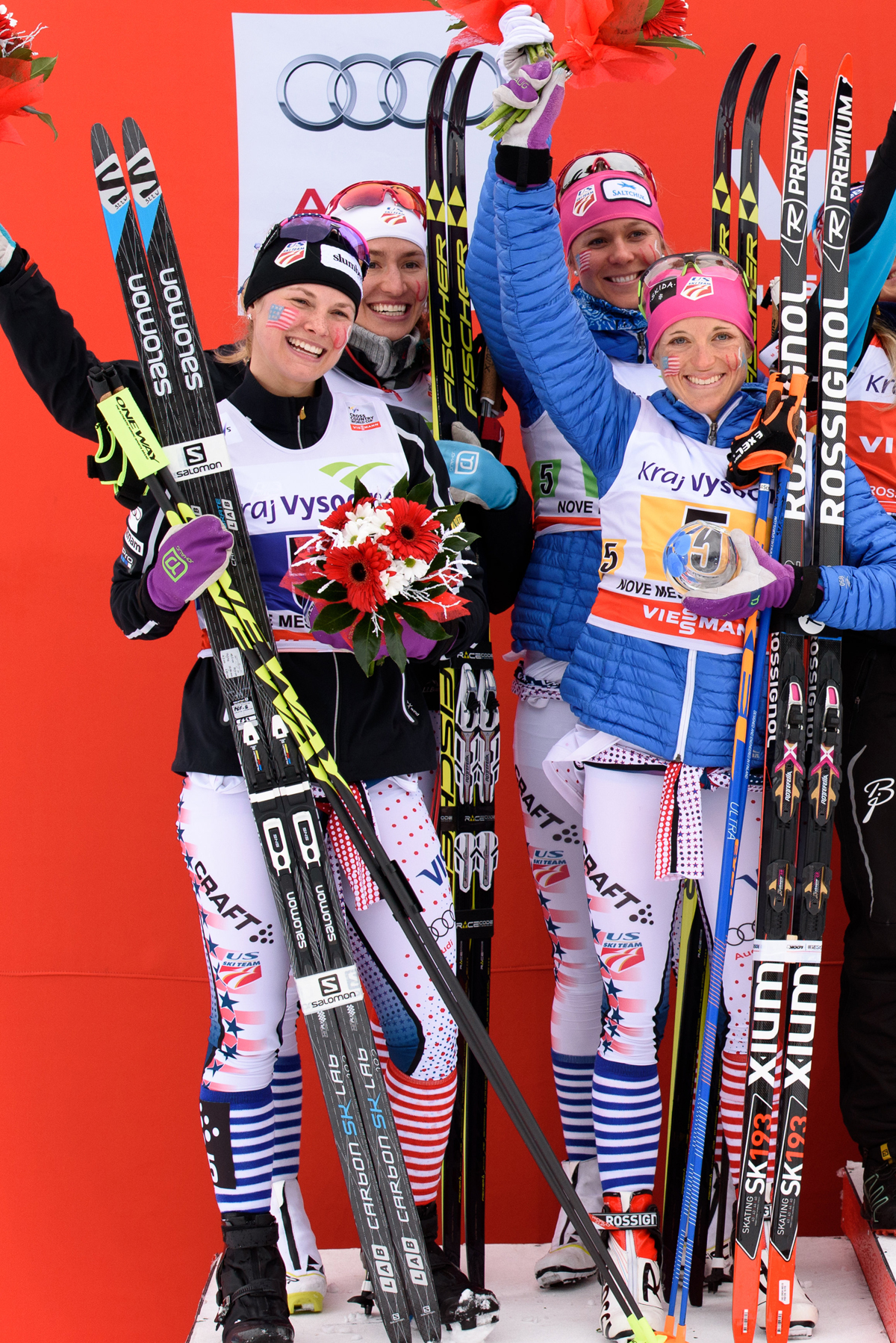
The U.S. women placed a historic second for their best-ever relay finish on Sunday at the World Cup 4 x 5 k in Nove Mesto, Czech Republic. From left to right: Jessie Diggins, Sophie Caldwell, Sadie Bjornsen, and Liz Stephen. (Photo: Fischer/NordicFocus)
From a clinical standpoint, the women’s 4 x 5-kilometer relay in Nove Mesto, Czech Republic, on Sunday became a time trial for the Norwegian women. That TT began 2.5 k into the first leg, as Norway’s Ingvild Flugstad Østberg came through the stadium for her second lap, 0.4 seconds back in second place, behind Finland’s Anne Kyllönen. By the time Østberg tagged off to Heidi Weng, she had a 27.5-second gap on the next-closest team. The combination of the four Norwegian speedsters, Østberg, Weng, Therese Johaug, and Astrid Uhrenholdt Jacobsen, won the relay in 50:17.2. Norway, with Sunday’s win, extended their unbeaten relay streak to 10.
But sport, at it’s best, is about drama and emotion. That type of racing belonged to the U.S. women’s relay team.
With a combined effort from Sophie Caldwell, Sadie Bjornsen, Liz Stephen, and Jessie Diggins, the U.S. women’s team placed second in a relay for the first time, after having reached the podium three times before in third. Diggins anchored them to the next step up, finishing 42.1 seconds after Norway and 13.8 seconds ahead of Finland, the team that beat them for second in the last World Cup relay in Lillehammer, Norway. On Sunday, Finland fell off the U.S. pace and settled for third, 55.9 seconds behind Norway. (In the last three World Cup relays, Finland has finished second to Norway.)
Whether or not it was considered an upset is debatable, as podiums for the U.S. women’s relay team have become a staple of their success. But anytime a relay is on the schedule, they are now considered podium favorites. Of the last five women’s World Cup relays, Sunday marked the Americans’ fourth podium.
Four Legs to Go
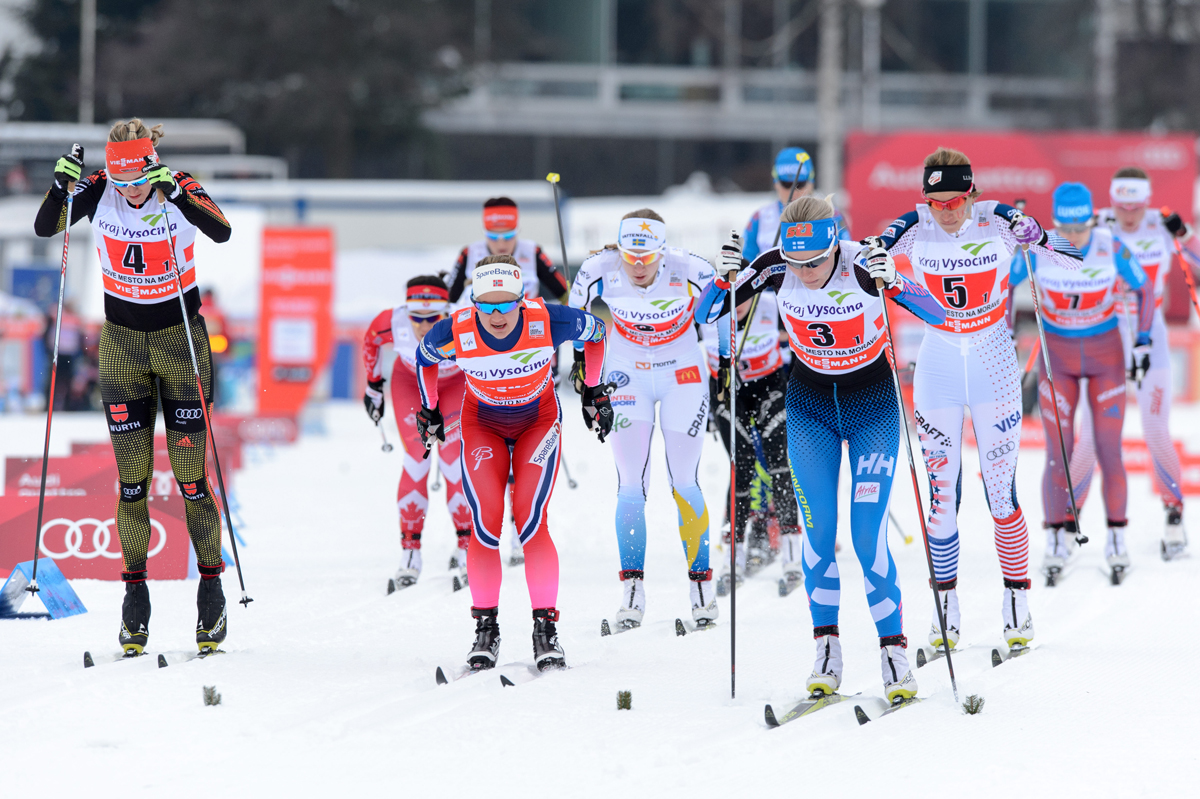
The start of the women’s World Cup 4 x 5 k relay on Sunday in Nove Mesto, Czech Republic, with American Sophie Caldwell (bib 5) following Finland’s Anne Kyllönen (3) while Norways’ Ingvild Flugstad Østberg (in red) and Germany’s Denise Herrmann (4) also lead the way. (Photo: Fischer/NordicFocus)
The newest addition to the relay, Caldwell skied the opening “scramble” classic leg, keeping the U.S. in contention and podium within sight.
Initially, Germany’s Denise Herrmann and Finland’s Kyllönen set the pace, with a large group of trailing skiers in their draft. Caldwell came through the 2.5 k mark in sixth place, 1.2 seconds back — striding within a long line of teams about to be steadily broken apart.
Through the stadium, Østberg led a group of nine teams, all within 1.6 seconds of the lead. This is when Østberg made her move, showing her strength at the front. Half a kilometer later, Caldwell was gapped by 7.8 seconds. The U.S. Ski Team (USST) sprinter remained in a tight group, which included Germany I, Finland, Germany II, and Sweden, with the remaining teams following within sight.
“I assumed that someone was gonna start pushing the pace at some point, but I didn’t anticipate [Østberg] taking off at that speed,” Caldwell recalled during a phone interview with the rest of her relay teammates. “I knew that, while it would’ve been awesome to try to keep up with her, trying to keep up with her and then imploding would’ve been a lot worse than trying to stay with that second-place group and coming in in a solid position. So instead I just focused on staying with those next girls and trying to hold off the people behind us.”
U.S. Women’s Coach Matt Whitcomb has shepherded the team along as podiums and individual top-20 results have become regular occurrences in recent years. In a phone interview on Sunday, he reduced the team’s relay strategy to what he referred to as a game of contact.
“When you can hand off to your teammate with one of the key players in contact with you, you do them a huge favor,” he said. “They can just hop in the draft or work with that team … It’s a big piece of relay. It’s not just head down, hammer. You have to know when to hammer, when to strategically sit in and recover, and when to attack.”
Caldwell kept contact and pace, keeping her sight on the relay’s long-term endgame. She tagged off to Bjornsen in third place, right there with Germany I in second, and 27.9 seconds behind Norway.
Next up, Bjornsen
Sadie Bjornsen (in white) racing with Finland’s Krista Parmakoski during the second leg of the women’s 4 x 5 k World Cup relay on Sunday in Nove Mesto, Czech Republic. (Photo: Fischer/NordicFocus)
According to Whitcomb, Bjornsen’s classic leg proved to be another turning point.
“When Sadie got tagged off in the position that Sophie handed it to her, it was just a sensation of confidence, knowing that Sadie was no longer chasing, she was going to be commanding with Finland,” he said. “And they skied a pretty exciting race. When one was going a little bit too slow, the other one would attack and they just spent the whole race trading attacks.”
Bjornsen skied a leg that provided a simpler overall narrative — her efforts made it a two-team race for second. She lead the hunt early on, setting a tone that her effort would make a statement. At each of her intermediate time checks, Bjornsen, working with Finland’s Krista Parmakoski, broke apart the chase. First the two German teams fell seven seconds back at 2.5 k, halfway through that leg. Half a kilometer later, Germany’s first and second teams were 11 and 14 seconds out of third, respectively.
“I just tried to go out and stay a little more relaxed in the beginning, but then take the chance to try to break some of the people that were skiing in our group,” Bjornsen said. “Krista [Parmakoski] is one of the better classic skiers, so I was thinking to just sort of work together with her and make some time on those girls behind us and hopefully make some time on the one girl [Weng] in front of us as well. It ended up going really well.
“That’s the cool thing about a relay day, you’re not racing for yourself. You’re just finding all these crazy extra gears,” she added.
Stephen’s Turn
At the second exchange, where Bjornsen tagged off to Stephen, Norway lead by 24.5 seconds, while Finland came through in second (+24.5) and the U.S. just 1.2 seconds farther back in third.
Stephen’s skate leg was a point where the team could get comfortable with their odds for a podium, or make a kill-shot. With a high-tempo, head down, grind-it-out pace, Stephen kept the pressure on Finland’s Riitta-Liisa Roponen, and distanced any teams with thoughts of working their way back into podium contention. Three kilometers into her leg on the course’s biggest climb, Stephen took charge; she put two seconds into Roponen, but from the looks of Stephen’s determination, it might as well have been twenty. Stephen had broken Roponen down — the Finn had the look of a hanger-on.
With three top 20’s this season (including 19th overall in the Tour de Ski), it can be argued that Stephen should be popping top 10’s in the World Cup’s more demanding distance races. This season, something just hadn’t clicked for the 29-year-old team veteran.
“I think I’m beginning to feel a little bit better physically, and kind of like these girls were saying, it’s a little different when it’s a relay,” Stephen said. “In any other race, you have to find your own confidence in yourself and in the relay, you find confidence in the other girls. And the fact that we’re handed off in second or third or whatever it was at that moment, that’s confidence in itself. I’ve been struggling finding that a little bit since part of the season, for me individually, but today I was just working off their confidence.
“I was determined today,” she added. “You never want to be somebody that’s handed off third in the relay and you blow up. So definitely there’s a little extra motivation there. I tried to ski a smartly paced relay leg. I have a tendency to go flying like a bat out of hell. So Riita-Liisa and I worked together for a lap and then the second lap, you do what you can.”
Stephen handed Diggins a 5-second margin over the Finns at the final exchange.
The Difference Maker
Jacobsen anchored Norway’s team. Like the seasoned veteran that she is, she never relented, — skiing the fastest skate leg of the day, even besting Johaug’s third-leg time by 16.6 seconds. Out in front, but within site of Diggins on the straights, Norway’s top spot remained secure.
Jessie Diggins (c) celebrates with teammates Sadie Bjornsen (l), Sophie Caldwell (r) and Liz Stephen (not shown) after anchoring the U.S. women’s 4 x 5 k relay to a best-ever second in the Nove Mesto World Cup on Sunday in the Czech Republic. (Photo: Fischer/NordicFocus)
Diggins on the other hand, skated out of the exchange zone with Finland’s Kerttu Niskanen close behind. Her first-lap-strategy, go full gas — and she did so a day after achieving her second-career individual podium in the 10 k freestyle.
“On a windy course like this, my strategy was, if I can put time into [Niskanen] right off the bat, like in the first 3 k and totally drop her, then that’s it. That will decide it right there because when you can’t see someone, that is incredibly mentally challenging,” the 24-year-old Diggins said. “So my goal was to just put the hammer down right away, get far enough that she thinks she has no way of getting to me and then settle in. And the second lap I was just trying to ski very carefully. Like, OK, don’t fall, don’t trip, don’t make any bobbles, because if I can just get across the finish line, we’ve got it. I just have to ski cleanly and make no mistakes.”
Diggins made no mistakes.
In the end, Diggins celebrated across the line with several elated fist pumps before her three teammates surrounded her with a group hug. The U.S. team finished in 50:59.3, 42 seconds behind the Norwegian winners and nearly 14 seconds clear of Finland in third.
“We belong in the race for those medals just as much as any other nation and I think we’re all starting to ski that way,” Diggins reflected.
More Dissection
Sophie Caldwell opened for the U.S. women’s relay team on Sunday at the World Cup in Nove Mesto, Czech Republic, tagging them in third, immediately behind Finland (not shown) in second place en route to the U.S. women’s team’s best-ever result of second place. (Photo: Fischer/NordicFocus)
In December, when the U.S. women placed third in the last World Cup relay in Lillehammer, Rosie Brennan skied the scramble leg. With Caldwell’s success on Sunday’s first leg, Whitcomb has options.
“With Sophie, it was one of the interesting components of today,” he reflected. “We had a really difficult decision to choose between Rosie and Sophie for the classic leg. I do believe that we would have been on the podium with Rosie, I know she could have skied a great leg. We just felt that this course and conditions really suited Sophie. But it was one of those things we could have gone either way on. So with Soph, we just talked about conserving as much as possible, using the corners to position herself near the front third of the pack, and to just have a good time out there.
“She’s a racer, she knows she needs to stay in contact, she knows when Norway makes an incredibly decisive move, whether that move is for her or not,” Whitcomb continued. “I think she skied a really brilliant race today, that was a key component in our success.”
Caldwell skied the third-fastest scramble leg. Bjornsen skied the second-fastest time among the second-leg skiers, even 2.2 seconds faster than Weng, who was roaring off the front. For Stephen and Diggins — they both posted the second-fastest times for their respective legs as well. (Diggins’ 5 k time of 11:48.2, was second overall for skaters. To put that in perspective, Johaug’s 5 k split took 11:55.2.)
The Canadian Side
Sunday’s race was also the first time Canada has fielded a women’s relay since 2009. On that day, the team did not finish.
In Nove Mesto, it was the first World Cup relay for all four women. Emily Nishikawa, Dahria Beatty, Cendrine Browne, and Maya Macisaac-Jones skied to 12th place (+5:02.4).
Chris Jeffries, head coach of the Alberta World Cup Academy who assisted the Canadians the last two World Cup weekends, wrote in an email that this was a solid stepping stone for their women’s program.
“Really happy we could get these girls into a team event. Message to them before the race is that this is the beginning, not the end,” he wrote. “We have a very young group of female skiers in Canada, and a great racer in Emily to help lead them forward on the world stage.”
Nishikawa opened for the team on Sunday, tagging Beatty, also of the senior national development team, in seventh, 45.3 seconds back. While Beatty slipped to 12th, 2:21.8 behind at 10 k, another development-team skier, Browne brought them back to 11th (+3:05.9). MacIsaac-Jones (Rocky Mountain Racers) anchored them to 12th.
“We knew it was going to be tough, 3 of the 5 girls were not healthy this week with colds, and you need 100% health if you are a development skier on the World Cup to have a good result,” Jeffries wrote. “Both Emily and Cendrine have been healthy, and both put up very strong races today. Emily fought hard and made up a lot of spots in the second half of her leg, but got taken down entering the exchange and lost contact. Cendrine put together what I though was one of her best races ever, really close in time to the top girls. We have a lot of hope for future women’s teams in the next few years.”
On the first lap of the final leg, Nicole Fessel skiing for Germany’s first team and Sweden’s Marika Sundin literally went astray. About 24 seconds out of third in fourth and fifth, respectively, and a minute behind Norway, Fessel led Sundin as they went off course, following the classic track and missing the skate turn. Several meters later, they realized their mistake (see the video on Norway’s TV2). Fessel estimated in a post-race interview with ARD that it cost them 30 seconds.
The next time through the stadium, with 2.5 k to go, they were about a minute out of the fight for the podium. Ultimately, Fessel finished fourth for Germany I, a minute out of third and 1:56.1 behind Norway. Sundin placed fifth for Sweden (+2:14.9).
World Cup racing takes a break until Feb. 3, when men’s and women’s sprints will be held in Drammen, Norway. The next distance events will take place Feb. 6-7 in Oslo, Norway.
The Norwegian relay team of Heidi Weng, Therese Johaug, Astrid Jacobsen, and Marit Bjørgen pose after winning the 4 x 5 k relay at the 2015 FIS Nordic World Ski Championships in Falun, Sweden. (Photo: Fischer/NordicFocus)
FasterSkier’s coverage of the 2015 FIS Nordic World Ski Championships in Falun, Sweden, is brought to you by the generous support of L.L. Bean, now featuring a complete line of Kikkan Randall training wear.
FALUN, Sweden — When you’re part of a World Championship team it’s hard to suppress the excitement of winning. Such was the case for Heidi Weng in Thursday’s 4 x 5 k relay at the 2015 FIS Nordic World Ski Championships. With Marit Bjørgen carrying the Norwegian flag down the final meters, Weng sprinted from the finish zone to celebrate the victory. However, as Weng ran to her teammate the Norwegian almost beat Bjørgen to the line, forcing the finisher to increase her speed so that she crossed the line first.
“I was worried I would come to the finish line after Heidi,” Bjørgen said with smile in a post-race press conference.
Bjørgen ultimately beat Weng to the line, giving Norway a time of 49:04.7. They were followed by Sweden, who was in a close fight for silver with Finland. The two teams finished 29.2 and 30.9 seconds behind the winners. Trailing by 1:49.9, the U.S. team crossed the line in fourth ahead of Poland and Germany.
Norway’s third consecutive World Championships relay gold wasn’t guaranteed by any means. They were heavily favored entering Thursday’s competition, but the same could be said of the 2014 Olympics where the team finished fifth. Furthermore, the Norwegian women’s best result in Tuesday’s 10 k freestyle was 22nd.
Finland’s Anio Kaisia Saarinen led the charge out of Falun’s Lugnet Ski Stadium to the cheers of 32,000 fans. She was joined by Russia’s Anastasia Dotsenko, and the two led a large pack of eight skiers tackled the first 2.5 k lap of the race. Just behind the leading women were Norway’s Heidi Weng and U.S. skier Sadie Bjornsen.
Norwegian Therese Johaug tucks into the stadium in the second leg of Thursday’s 4 x 5 k relay at the 2015 FIS Nordic World Ski Championships in Falun, Sweden. (Photo: Fischer/Nordicfocus)
The large pack remained tight as they entered the second lap of the first leg. As the skiers rounded the corner into the stadium, however, a tangle on course sent Bjornsen spinning. The mishap left the U.S. in eighth and losing ground, as Weng and Saarinen surged ahead to tackle their second lap.
Finland and Norway increased their lead throughout the majority of the first leg’s second lap and ultimately tagged their teammates in first and second. Over 12 seconds back, Sweden’s Sofia Bleckur overcame Dotsenko to enter the exchange in third.
With Norwegian powerhouse Therese Johaug on course the pace quickened and Johaug’s Finnish counterpart, Kerttu Niskanen, was unable match the tempo, losing contact. Sweden’s Charlotte Kalla was not far behind, however, and by the end of the second leg she made up ten seconds on the Norwegian.
When asked how she was able to decrease the distance between her and Johaug, Kalla said that encouragement from the many Swedish fans in addition to speedy skis helped her achieve what was the fastest classic leg of the day.
Johaug explained to the press her decision to remain in the tracks on the course’s downhills helped Kalla decrease the Norwegian’s lead. “On the downhill I was in the track and I think a lost a lot of the seconds there,” she said. “Charlotte told me she stood out of the track, and there it was ice.”
After the second exchange the two Scandinavian rivals began the freestyle portion of the race, giving spectators a thrilling duel. The fight was short lived, however, as Sweden’s Maria Rydqvist crashed on the first downhill of the course. The crash gave Norway’s Astrid Jacobsen the opportunity to create a lead, and by the lap’s 0.7 k mark the Swede was trailing by just under 10 seconds.
“I got caught up in my own boots,” Rydqvist said to the press. “I was a little excited from the start. But I just tried to forget what happened and get into the skating again.”
“At first I thought it was a disaster.” she added. “You have to forget about it and move on, and I think I did that.”
Astrid Jacobsen tags off to Marit Bjørgen in the 4 x 5 k relay at the 2015 FIS Nordic World Ski Championships in Falun, Sweden. The Norwegians won the race by over 29 seconds. (Photo: Fischer/NordicFocus)
The Swedish fall was also advantageous to Finland’s Riitta-Liisa Roponen, who caught Rydqvist by the end of the leg. The two tagged their respective teammates at an identical 17.8 seconds behind Norway. “I heard [she fell] and that was my point to get her,” Roponen said of her race. “I couldn’t do it immediately but I had power left.”
Norway’s anchor leg, Bjørgen, attacked the 2.5 k course from the start and increased the team’s lead throughout the final 5 k. At the start of her final lap the Norwegian had added over 20 seconds to her team’s lead. Bjørgen explained she was thankful her teammates created a lead for her so that she didn’t have to battle Sweden’s Stina Nilsson in the final leg.
“Thanks to the girls to give me the gap I wanted,” she said in a press conference. “Stina didn’t follow me. I really felt good from the beginning and my skis was perfect.”
While the Norwegian’s solidified the win the battle for second between Sweden and Finland intensified. For the majority of the 5 k leg Finland’s Krista Parmakoski led Nilsson on the relatively flat course. It was only until the final climb that Parmakoski allowed Nilsson to the front. At the crest of the hill, the Finnish skier came to a near-stop. As she stood, the two skiers paused before Nilsson pushed into the descent. Parmakoski tucked close behind.
Parmakoski’s strategy was simple – follow Nilsson into the stadium and use the draft to overcome the Swede in the final meters. The plan did not work as Nilsson, silver medalist in both the individual and team sprints, accelerated in the final meters to secure the silver for Sweden.
“I felt my tactic was that I had to push hard after one kilometer, but then I saw Stina was still behind me,” Parmakoski said. “I changed my plan and I know that I have to be second in the last downhill, but that was not enough and Stina was better.”
Krista Parmakoski tags Riitta-Liisa Roponen for Finland while Sweden’s Stina Nilsson heads out on her last lap after being tagged by Maria Rydqvist n the 4 x 5 k relay at the 2015 FIS Nordic World Ski Championships. (Photo: Fischer/NordicFocus)
Nilsson said the Swedish coaches instructed her to stay behind Parmakoski until the final meters of the relay.
“I got really clear directives as to how to control the race today, and I think I succeeded to apply our tactics,” she said to the press. “It was really nice to coast on the back of the Finnish.”
Norway cleared several historic benchmarks with Thursday’s win. Prior to 2015, only Russia and the former Soviet Union had ever won three back-to-back World Championships relay titles. Norway now has three consecutive titles as well. With 79 medals to its name, Norway also equals the former Soviet Union in total medals in World Championships competition.
Additionally, the relay victory gives Bjørgen her 14th career gold medal. The total matches Elena Välbe of Russia for the most wins of any skier at a World Championships. Despite the groundbreaking achievement, Bjørgen said at this point in her career she cared little for medal statistics.
“I have no thoughts about it now. As long as you are active you are focused on new tasks and flows, and I have no relationship to how many medals,” she said, adding that she would count her medals when she was old and “in a rocking chair.”
Stina Nilsson, Charlotte Kalla), Sofia Bleckur, and Maria Rydqvist (l-r) jump after placing second in the women’s 4 x 5 k relay at the 2015 FIS Nordic World Ski Championships. (Photo: Fischer/NordicFocus)
The entire Norwegian team explained they were ready for revenge after their fifth-place finish in the 2014 Olympic relay. The poor results in the 10 k freestyle only added fuel to the fire. Bjørgen said the win was not only redemption for the four women, but also for all Norwegians. “At five in Sochi and in the 10 k two days ago we were not good,” she said. “To come back and give the people at home and the people here a gold, it’s incredible.”
Although Sweden failed to match their victory from the 2014 Olympics they described skiing to silver in front of a home-crowd as “amazing.”
“The attitude we set for ourselves today was to be tough. To ski fearlessly. I think all four of us did that,” Kalla said. The silver medal gives the Swede a complete trifecta of medals from competition in Falun. Kalla earned bronze in the skiathlon and gold in the 10 k classic. Nilsson now has three silver medals from Falun.
In third place, Finland notched its first medal of of the Championships. Saarinen expressed hope that the podium would be first of more podiums to come in the remaining three competitions.
“I think we have now opened the game,” she said. “Hopefully there is coming. We inspire the guys tomorrow and of course the other team. This is a good start for us.”
The 2015 FIS Nordic World Ski Championships continue Friday with the men’s 4 x 10 k relay.
The La Sgambeda women’s podium on Friday in Livigno, Italy: with Finnish winner Riitta-Liisa Roponen (c), who notched her third-consecutive victory at La Sgambeda, American Holly Brooks (r) in second, and Ekaterina Rudakova of Belarus in third. (Photo: Worldloppet/FIS Marathon Cup Facebook)
They called her a wild card — the International Ski Federation (FIS), that is. And according to Holly Brooks, she wasn’t sure what she was capable of, either.
“The marathon world is a new can of worms for me, and I’m essentially going to a race which I know nothing about,” Brooks, a two-time Olympic cross-country skier and former U.S. Ski Team member, explained in an email earlier this week.
“I don’t have a team, or a regular wax tech for that matter,” she added. “But, I’ve met some great people through the process already, and I have a certain amount of faith that it will all work out.”
Without an early season race to test the waters, Brooks, 32, dove right into La Sgambeda on Friday: a 42-kilometer freestyle mass start in Livigno, Italy.
“I was nervous!” she reflected after the race. “It was the first race of the season for me and I usually don’t wait this long to start racing.”
She flew into Zurich last Saturday and spent her first few days training in Davos, acclimating to the time difference from Anchorage, Alaska.
“It almost felt like ‘coming home’ because of all places in Europe, I’ve spent a lot of time in Davos,” she wrote in an email. “It was also really nice to see all my World Cup friends and of course the U.S. team. It provided a nice transition before heading out into the ‘unknown.’ ”
La Sgambeda runner-up Holly Brooks with her skis and the 15-pound wheel of cheese, which she received as a prize on Friday in Livigno, Italy. (Photo: Holly Brooks/Facebook)
For Brooks, that mysterious-and-nerve-racking first race was all about chasing Finland’s Riitta-Liisa Roponen, the defending FIS Marathon Cup champion who had one the two previous La Sgambedas.
“Unfortunately I was never in contact with Riita Lisa,” Brooks explained. “She had a faster start than me and she got lost in the crowd of men. There were tons of people between the two of us and I couldn’t weave through to catch her.
“Many of these marathons don’t have women’s waves so a big part of the race is eluding the other women,” she added. “I would prefer our own wave but in the meantime I will have to work on my mixed-gender racing tactics. Once gaps open up in the big groups, it’s impossible to ‘ski up’ without a good draft.”
Brooks managed to ski up to second-best for second place overall. While she was 3 minutes, 12.1 seconds behind Roponen (who won in 1:40.42.8), Brooks outlasted Ekaterina Rudakova of Belarus by 8 seconds for silver and a 15-pound cheese wheel.
Three-and-a-half seconds later, Olga Mikhailova of the Russian marathon team finished fourth (+3:23.6) and France’s Aurelie Dabyduk took fifth (+3:39.4).
“Whenever you land on the podium it’s a good day,” Brooks wrote. “After a couple years of racing World Cup you forget what it feels like and honestly, it’s really fun.”
“After a couple years of racing World Cup you forget what it feels like and honestly, it’s really fun.” — Holly Brooks, after placing 2nd in first marathon of season at La Sgambeda on Friday
Benoit Chauvet claimed the La Sgambeda men’s crown in 1:32.11.4, just four-hundredths of a second ahead of fellow Frenchman Robin Duvillard and the Czech Republic’s Petr Novak, who tied for second.
The La Sgambeda men’s podium on Friday in Livigno, Italy: with French winner Benoit Chauvet (c), Petr Novak (l) of the Czech Republic and France’s Robin Duvillard, who tied for second. (Photo: Worldloppet/FIS Marathon Cup Facebook)
Switzerland’s Toni Livers was another 0.6 seconds back in fourth, Sergei Dolidovich of Belarus was fifth (+1.9), and the top-11 men all finished within 8.8 seconds of one another.
“The conditions were AMAZING,” Brooks explained. “Livigno is picturesque – perfect! Pure sun, gorgeous mountains, really perfect. My skis were awesome too… but it was a stressful situation leading up to having great skis.”
The night before the race at the captain’s meeting, she still wasn’t sure who would wax her skis. Fortunately, she found some “local Italians” who were up for the job — a man named Enzo, who spent 16 years on Italy’s national-ski team, was one of them, she explained. She repaid him with an iPhone.
Brooks, who switched from the World Cup circuit to the Worldloppet and FIS Marathon Cup this season, is one of the racers receiving a lot of international attention on the eve of the Marathon Cup opening.
“It will be interesting to see how Holly Brooks, who is fully concentrating on the long-distance scene this season, will do,” a FIS and Worldloppet press release stated before the first race of the season.
Marathon weekend
There are three races this weekend, including the 15 k ProTeam Tempo classic “prologue” on Saturday and 35 k classic on Sunday, both of which are part of the Swix Ski Classics.
Brooks is competing in all three, after recently signing with a Pro Swix Ski Classics team. “But more on that later,” she wrote. Before she knew she’d race the prologue, she was aware two marathons in one weekend was ambitious.
“Sunday’s race course is somewhat of a double-pole derby, and honestly, I’m looking at it as more of a training race for me,” she explained. “Many of those girls train specifically for double-pole, which I do not do.”
While Brooks is viewed as a serious contender for the long-distance events, she’ll have plenty of experienced competition in her quest for an overall podium at the end of the season.
Italy’s Antonella Confortola, who has competed on the FIS Marathon Cup for years, is no doubt hungry for the overall title and reported to be in killer shape again.
Veteran favorite Seraina Boner of Switzerland will definitely be a very strong contestant for the overall title, but how she does could depend on how many races she enters. The same goes for Roponen, last year’s overall FIS Marathon Cup winner, according to FIS.
Men’s outlook
On the men’s side, last year’s overall winner Tom Reichelt of Germany is not racing after his team dissolved in September. Chauvet, who won Friday’s La Sgambeda and was second overall last year, is eager to make it to the top of the overall podium this season. So is Novak, who was second at last year’s La Sgembeda and second again on Friday.
Aliaksei Ivanou of Belarus, who was third last year, Italy’s Sergio Bonaldi and Simone Paredi, as well as France’s Christophe Perrillat Colomb and Adrien Mougel also raced Friday and all of them finished in the top 15 (with the exception of Paredi in 25th).
Including the World Cup racers
Scheduling La Sgambeda for the day before the World Cup in Davos, Switzerland, on Saturday and Sunday allows World Cup racers to race La Sgambeda, as Davos is fewer than 70 kilometers from Livigno.
Accordingly, several World Cup skiers entered the race this year. France’s Jean Marc Gaillard followed teammate Duvillard (who was second) in sixth. The two teamed up for bronze from last year’s sprint relay at the Sochi Olympics. Livers is another World Cup regular, along with Dolidovitch, Spain’s Imanol Rojo, Denmark’s Martin Moeller, and Estonia’s Madis Vaikmaa.
Norway’s Peter Northug won the race last year but did not compete on Friday — no Norwegians did.
Tough but scenic course
The 42 k marathon consisted of two laps on a 21 k course that runs along the Spöl river and winds through all the villages along it: Florin, Pont Lonc, Limina, Tresenda, and runs as far as Campaciol. From the Hotel Forcola at 12.5 k, the course turns back toward the cross-country stadium, which marks the start, finish and halfway point.
Livigno, normally known as having snow from early November on, had to work hard last year to put the 21 k course together as snow was hard to come by. However, this year, conditions were notably better.
“Livingo is amazing. More North Americans should come here!” Brooks summed up.
Next FIS Marathon Cup: The Dolomitenlauf 42 k freestyle on Jan. 18 in Austria
In total more than 220,000 Euros ($274,000 dollars) will be distributed as prize money this season. Each race offers a minimum of 21,000 Euros ($26,150 dollars) worth of prize money per race. Additional prize money of over 31,000 Euros ($38,600 dollars) will be handed out to the top six men and women in the overall FIS Marathon Cup at the end of the season.
Like every year, the FIS Marathon Cup kicked off with La Sgambeda in the Italian valley of Livigno.
This season, the FIS Marathon Cup consists of nine races total, with a new final in Russia: the Ugra Ski Marathon 50 k skate in Khanty-Mansiysk, Siberia, caps the season in mid-April. Khanty-Mansiysk is best known for its biathlon World Cups and World Championships.
The Lahti World Cup women’s 10 k freestyle podium, with Norwegian winner Marit Bjørgen (c), Sweden’s Charlotte Kalla (l) in second, and Norway’s Therese Johaug in third. (Photo: Fischer/Nordic Focus)
Not too long ago, there were times when Marit Bjørgen fell flat on her face in the Olympic freestyle sprint, when she was nowhere near contention in the Sochi 4 x 5-kilometer relay (no thanks to a waxing fiasco), and when, in her second-straight individual sprint, she failed to make the finals.
The latter moment came Saturday in the first World Cup race since the Olympics ended in Russia a week earlier. One day later, the 31-year-old Norwegian was at the top of her game, unsurprisingly and as usual.
Marit Bjørgen racing to a World Cup win on Sunday in the 10 k freestyle individual start in Lahti, Finland. (Photo: Fischer/Nordic Focus)
While her occasional blips prove she’s human, Sunday’s effort showed Bjørgen is as primed as ever for a run to clinch the overall World Cup title.
“I’m very satisfied,” Bjørgen told NRK after winning the 10-kilometer freestyle individual start in Lahti, Finland, according to a translation. “Today, everything was perfect.”
That’s good news for the Norwegian squad, but one of her teammates wasn’t so psyched on Sunday. Therese Johaug, who took silver to Bjørgen in the last women’s race of the Olympics, the 30 k freestyle mass start, placed third in the Lahti 10 k, 0.7 seconds behind Sweden’s Charlotte Kalla in second and 27.6 seconds behind Bjørgen.
“Right now, it really sucks,” Johaug told NRK. “I am disappointed and sorry. I hoped for at least second place.”
While Johaug still leads the overall World Cup standings by 150 points over Bjørgen, the 25 year old know she has her work cut out for her if she’s going to stay ahead with five more races to go this season. Two are classic sprints, and while Bjørgen hasn’t been in the top six in recent sprint races, she’s been a lot closer than Johaug.
“There are many races left and I must try to get as many [points] as I can,” Johaug said.
After posting the fastest split times for more than the first half of Sunday’s 10 k freestyle individual start, Therese Johaug of Norway finished third, more than 27 seconds behind teammate Marit Bjørgen (not shown). (Photo: Fischer/Nordic Focus)
The difference between the two came in the way they approached the challenging two-lap course in soft, cumbersome and artificial snow — with real flakes falling as they raced.
Bjørgen in bib 64 of 81 started with some restraint, feeling out the first lap and a half before putting the pressure on for the last few kilometers.
Johaug started a minute behind, and by the first 1.3 k checkpoint, held the lead by 4 seconds over Bjørgen. Another Norwegian in the hunt for overall World Cup glory, Astrid Uhrenholdt Jacobsen ranked third early in the race, 9.7 seconds back from Johaug. By 6.3 k, Jacobsen was 12.8 seconds back in third.
Known by some as the “Tiny Terror,” Johaug continued to post the fastest times through the ensuing checkpoints up to 6.3 k, where she was 2.3 seconds ahead of Bjørgen.
But Johaug started to look rattled in the second half of the race, gasping for air as she usually does, but this time lacking the power to hold her position.
By 8.4 k, Bjørgen was 11.7 seconds ahead of Johaug, and 24.3 seconds up on Kalla, who started earlier in bib 56. Kalla had also eased into her race, accelerating over the last few kilometers, and took the lead at the finish by 2.5 seconds over Jacobsen.
Jacobsen had previously topped fellow Norwegian Heidi Weng by 4.8 seconds for a moment in first place. Weng initially bumped Finland’s Riitta-Liisa Roponen, who started and finished more than 15 minutes before her, out of first.
Sweden’s Charlotte Kalla racing to second in the Lahti World Cup 10 k freestyle on Sunday. (Photo: Fischer/Nordic Focus)
All of those women and more moved down as Bjørgen barreled toward the finish. Without any signs of faltering or slowing down, she finished nearly 27 seconds faster than anyone else, with Kalla and Johaug coming closest.
For Kalla, it was the kind of result she needed following a couple of crashes in Saturday’s sprint that left her in 11th, one place behind Bjørgen.
“I’m glad for second place,” Kalla told FIS. “My plan was to start slow and speed up during the race. We had challenging snow conditions but I felt strong. … I am really looking forward to the last competitions of the season especially to the World Cup Final in Falun, [Sweden].”
Jacobsen finished fourth, 30.1 seconds behind Bjørgen and narrowly off the podium. She’s currently third in the overall standings, 51 points down to Bjørgen.
Weng placed fifth, Roponen was sixth, and Finland put a total of three in the top 10 with Kerttu Niskanen in seventh, and biathlete Kaisa Makarainen in ninth.
Sweden’s Emma Wiken was eighth, and France’s Coraline Hugue placed 10th.