From the FasterSkier archive — posts syndicated from athletes’ and coaches’ own blogs between 2004 and 2012, kept online as published. Current coverage is at fasterskier.com.

Tag: Ristomatti Hakola

  • Norway Goes 1-2 in Freestyle Team Sprint; Americans 7th

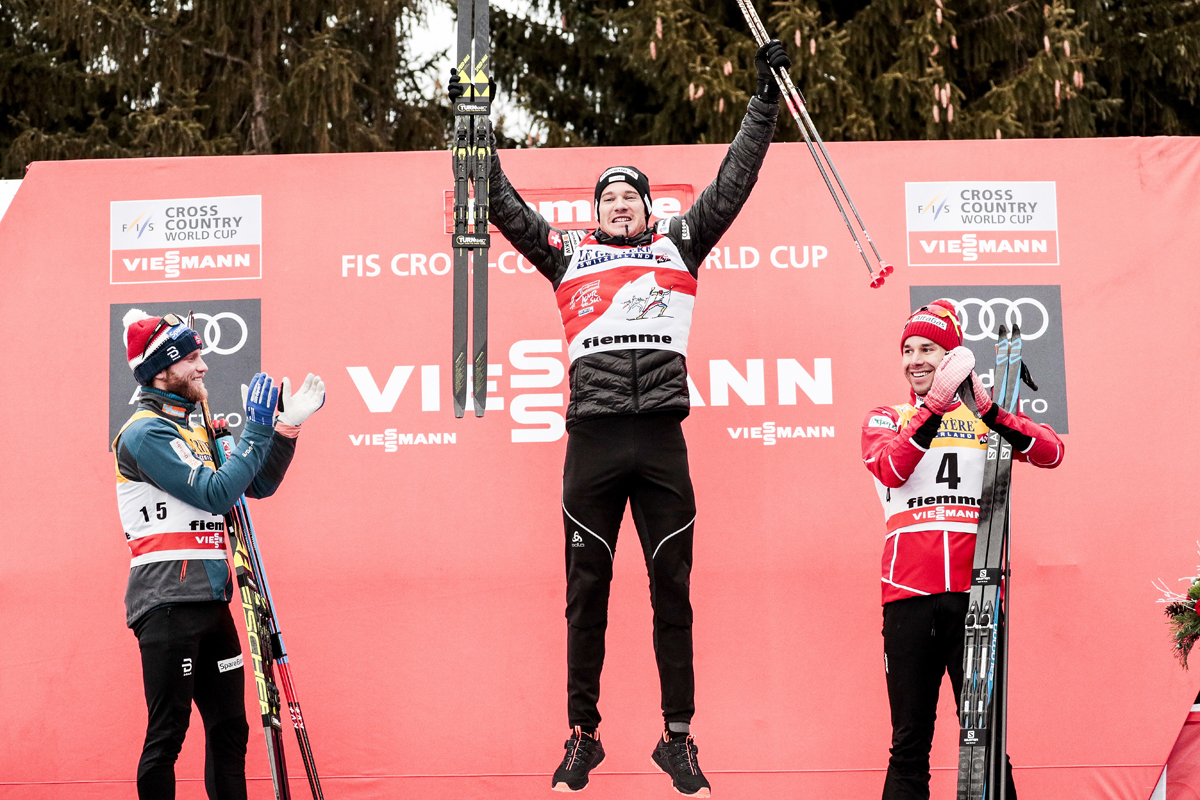
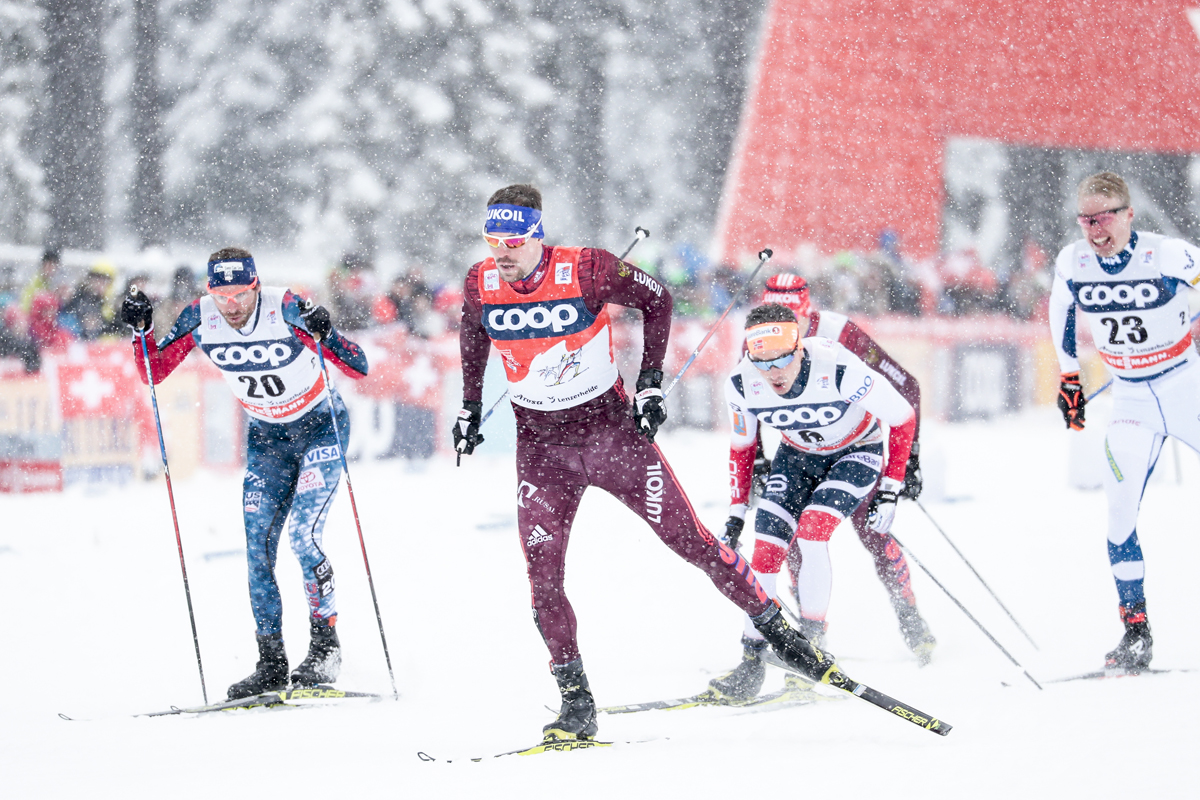
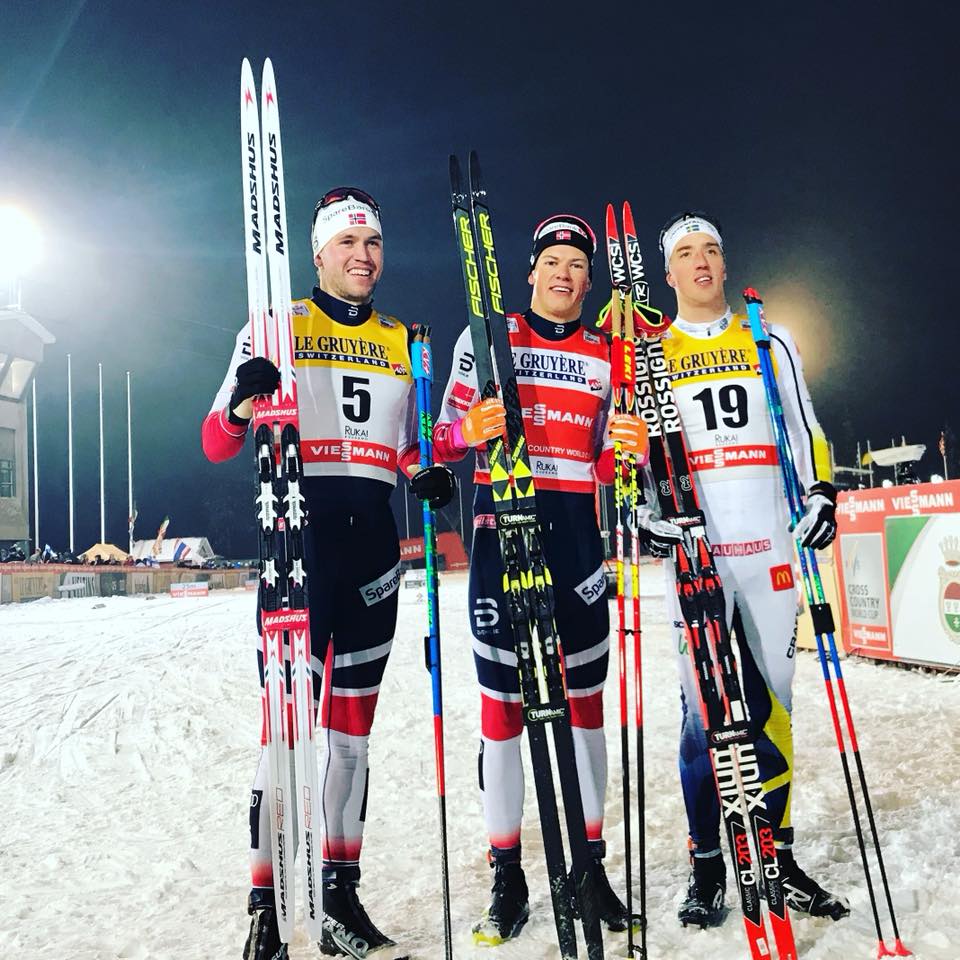
    The men’s podium of the freestyle team sprint in Planica, Slovenia. The Norway I team of Sindre Bjørnestad Skar and Erik Valnes took the win over the Norway II and Finland teams. (Photo: NordicFocus)

    From under the umbrella to inside the snow globe. Fat flakes were falling in Planica, Slovenia at the start of the freestyle team sprint. A painful mix of speed and endurance, each team member skied three 1.2-kilometer laps for a total of 7.2 k. Comprising the victorious Norway I team, Sindre Bjørnestad Skar and Erik Valnes stopped the clock at 16:54.52. Fellow countrymen Håvard Solås Taugbøl and  Gjøren Tefre took the Norway II team to second place (+1.29) followed by the Finnish team of Ristomatti Hakola and Joni Mæki in third (+1.43). 

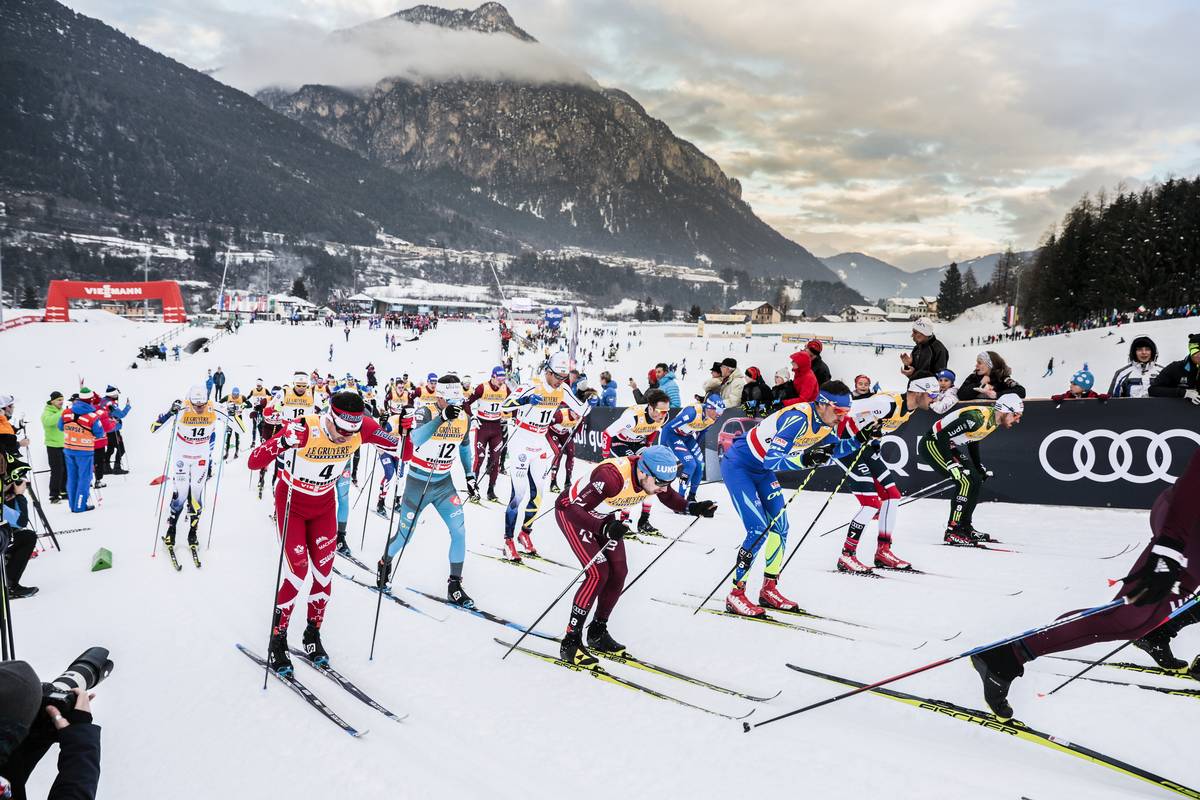
    Coming into the third exchange at the halfway mark of the race, the pack of athletes included all ten teams, no one able to break apart the masses in the slow conditions. A variety of teams including Norway, Finland, and France took turns trying to create a gap, but wasting energy too early in the slow snowy conditions risked hazard. 
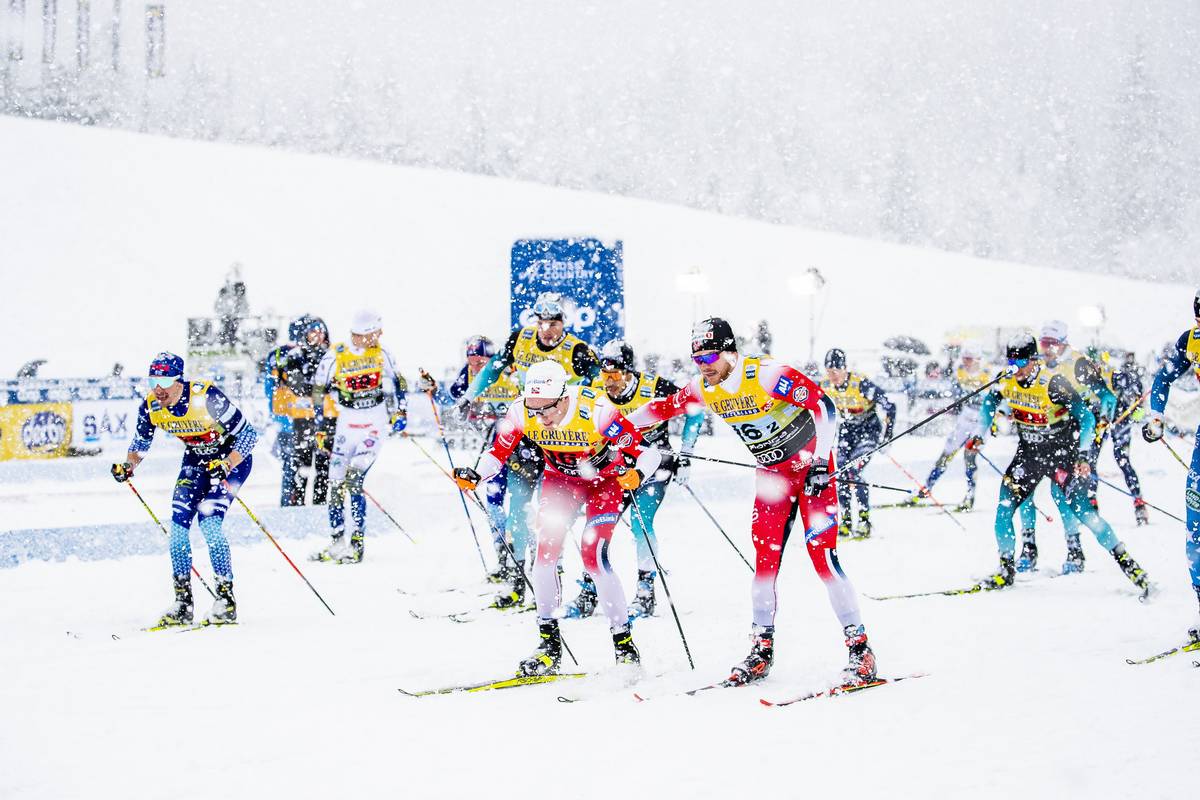
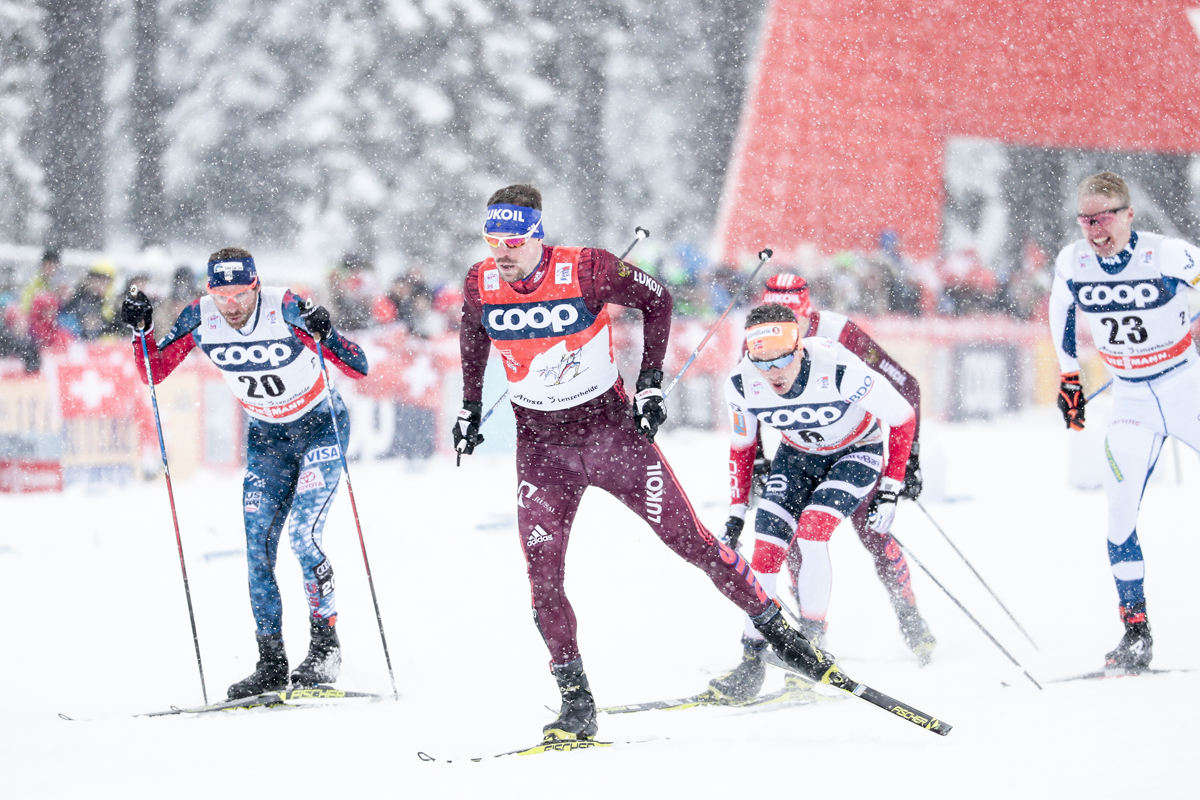
    The Norway II team of Håvard Solås Taugbøl and Gjøren Tefre tag off in a tight field during the freestyle team sprint in Planica, Slovenia. (Photo: NordicFocus)

    By the fourth exchange, there was no longer time to wait. Skar of Norway I pushed by Tefre of Norway II began to surge. He quickly created a small gap to all but Richard Jouve of France and Hakola of Finland I who went with the leaders in red.

    Though the density was lowered, the spread of the top eight teams was less than nine seconds as they made the final exchange. Having mingled with the leaders throughout, the American duo of Kevin Bolger and Logan Hanneman sat in fifth, less than three seconds back on the Norwegians. 
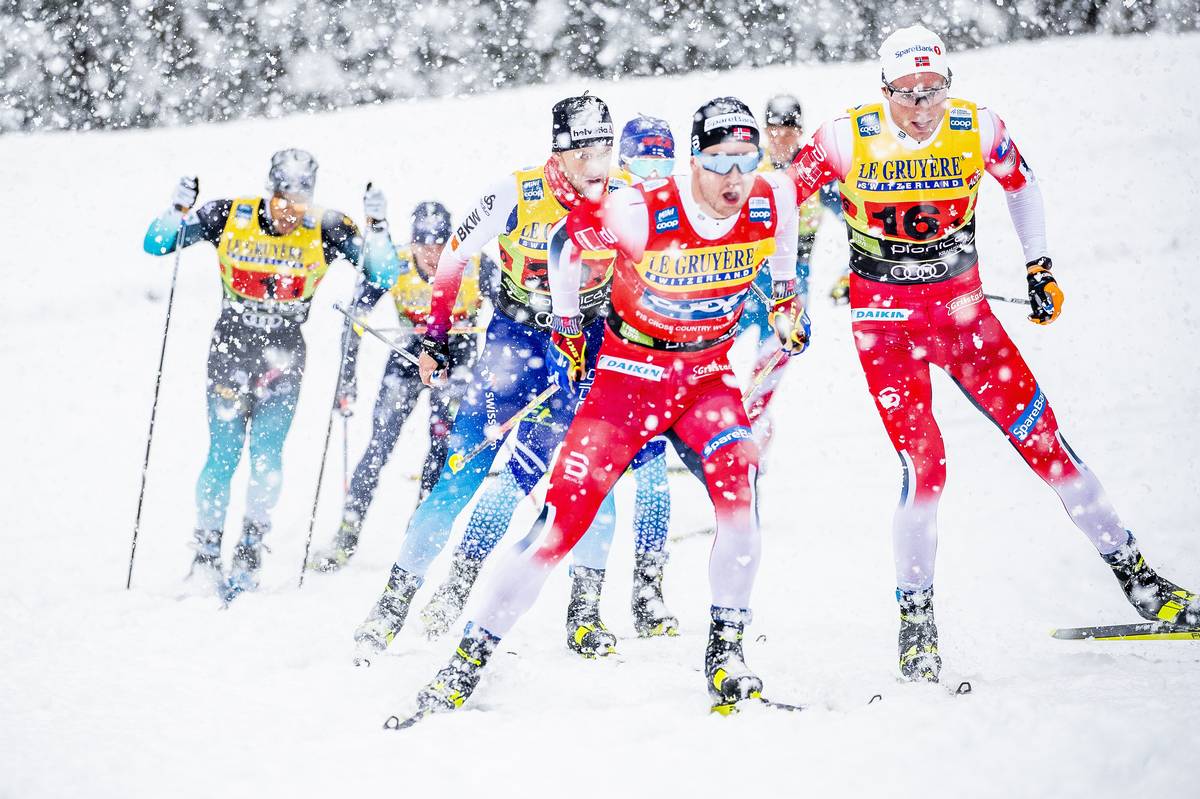
    Densely packed inside a snow globe, Norway pushes toward a 1-2 sweep in the freestyle team sprint in Planica, Slovenia. (Photo: NordicFocus)

    Winding up the energy in the final leg, Norway again made a push to break apart the field. Allowing them to lead to the climb at halfway, then working his way around the outside, yesterday’s sprint champion Chavanat made a go at the lead. Cresting the hill, Chavanat’s V2 was outmatched by two men in red jump-skating as though indefatigable even after 3.5 k’s of sprinting. 

    Valnes exploded off the front, leaving the threesome of Tefre, Mæki, and Chavanat duking it out to a close finish. Bobbling as he crossed into an opening, Tefre tangled skis with Mæki, but both men lost little momentum as they headed into the final straightaway. 

    Perhaps spent from his attempt to lead, Chavanat’s tempo could not match the others and he was overtaken in the final meters. Tefre slid his boot over the line just ahead of Mæki, leaving the French team 0.07 seconds off the podium.
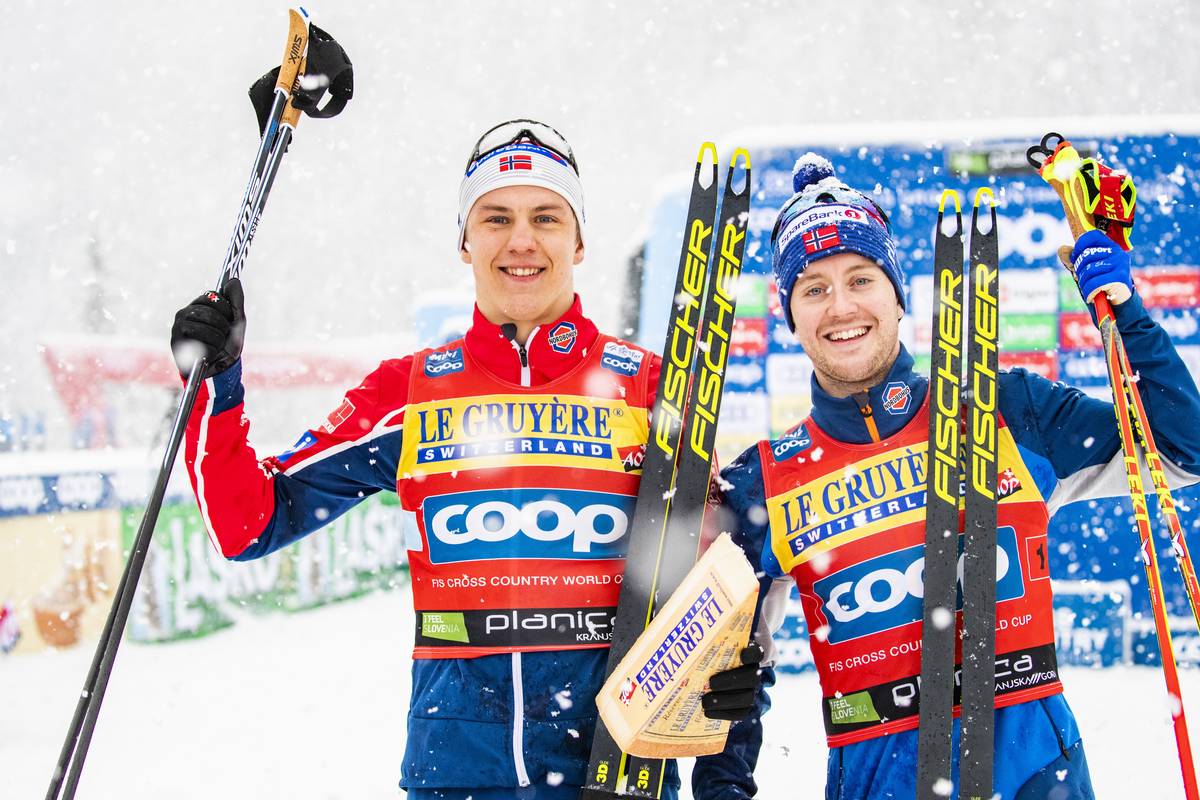
    The Norway I team of Sindre Bjørnestad Skar and Erik Valnes took home the cheese at the freestyle team sprint in snowy Planica, Slovenia. (Photo: NordicFocus)

    “It was a challenging day [for conditions], just as yesterday,” Skar told FIS at the finish line. “But it’s the same for everyone so you just have to deal with it and do your best.”

    The veteran duo of Skar and Valnes also won the team sprint in Dresden in January, and their teammates Johannes Høsflot Klæbo and Emil Iversen won the subsequent event in Lahti in February, making this three for three for Norway in team sprinting. 

    He explained how the wet falling snow affected tactics and how the race unfolded for the Norway I team.

    “It was so close and then with this weather it is almost impossible to go alone in the front. I tried the last half, but it was difficult, but we had to try and Erik was the best guy at the finish.” 

    Kevin Bolger accelerates out of the exchange during the freestyle team sprint in Planica, Slovenia. (Photo: NordicFocus)

    After losing contact with the leaders in the final lap, the Americans held on for 7th place (+21.19). 

    In a post-race call, Whitcomb explains that the team of Bolger and Hanneman was not finalized until the morning, when original anchor Simi Hamilton, who took 12th in the rain yesterday, was forced to withdraw after coming down with a cold. Because of the adjustment, the team lost their start position in the semifinal and began at the back of the field. The men finished eighth in the fast first round, from which the top three teams went on to be the top three teams in the final. The Americans advanced to the final with the last lucky loser spot. 

    Post-race interview with Matt Whitcomb on the men’s team sprint.

    Kevin Bolger (second from left) keeps the USA team in contact during the freestyle team sprint in Planica, Slovenia. (Photo: NordicFocus)

    “Logan and I had the weather on our side today!” wrote Bolger in an email. “I was skiing well but punched it to the front of my semi-final on the second lap and got a bit flooded from that. Luckily, Logan skied really well on his final lap to bring us into qualifying contention!
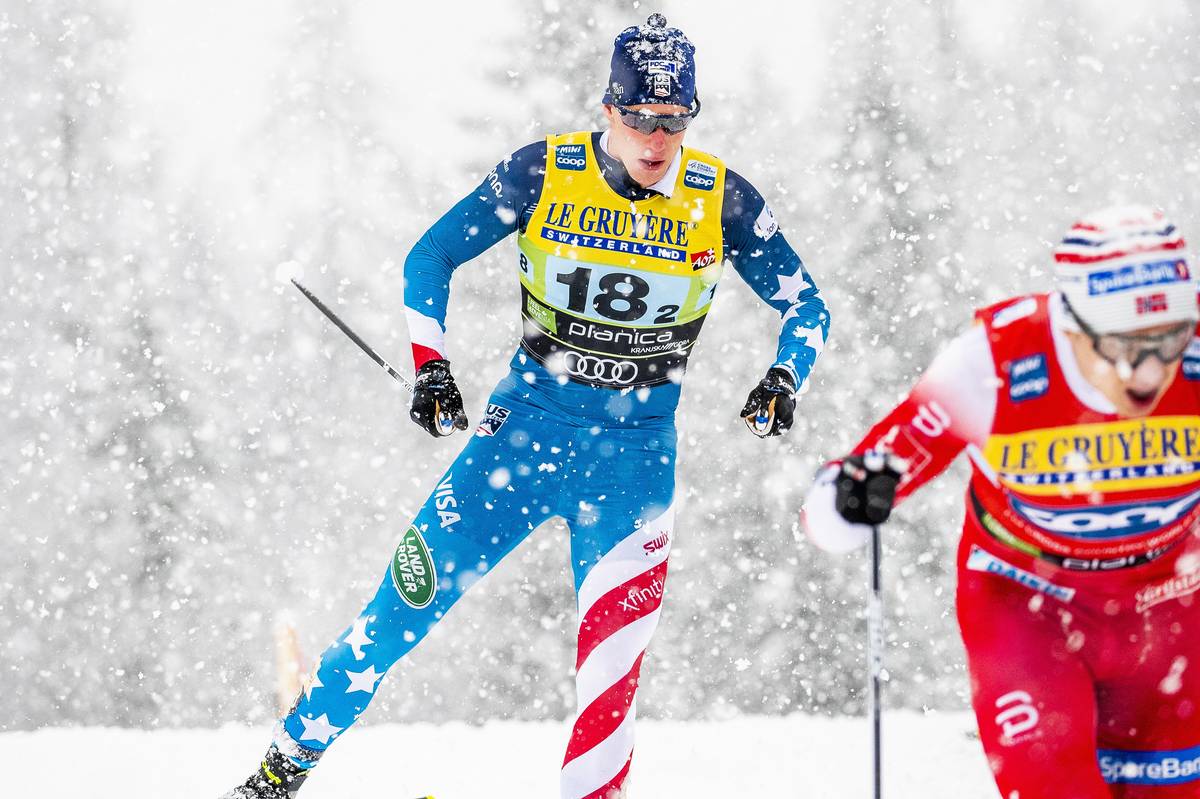
    “The Final felt a lot better,” he continued. “I skied a lot more conservatively and tactically better and am happy with how I moved forward. I was a bit surprised when Logan came into the Tag zone leading but was ready to head out and give it my all for the last lap!”
    Logan Hanneman stays in the mix behind Norway during the freestyle team sprint in Planica, Slovenia. (Photo: NordicFocus)

    At 26-year-old, Sun Valley native Kevin Bolger is in the midst of his third season of World Cup starts, landing inside the top-30 on eight occasions. Hanneman, who hails from Fairbanks, AK, has much less experience on the World Cup. Whitcomb explains how weekends like this one, where many of the all-arounders are resting for the Tour de Ski, consequently narrowing the field and improving the odds of sprinters like Hanneman who are often on the cusp of qualifying for the rounds. 

    Post-race interview with Matt Whitcomb on Logan Hanneman’s development on the World Cup.
    “The final was just nuts,” wrote Hanneman in an email about his day. “It was snowing so hard. The pace was much more pedestrian than the semi final. I found myself with an open lane up the last hill of my second lap, and made what I thought was a low energy move up into the lead… turns out it was all adrenaline because come my last lap I was dying. But Kevin skied great during the whole final, and we were able get beat some teams in the final. Very happy with the day for sure!”

    Final Results

  • Back Where It All Started, Klæbo Wins Otepää Classic Sprint; Newell 15th

    Back Where It All Started, Klæbo Wins Otepää Classic Sprint; Newell 15th

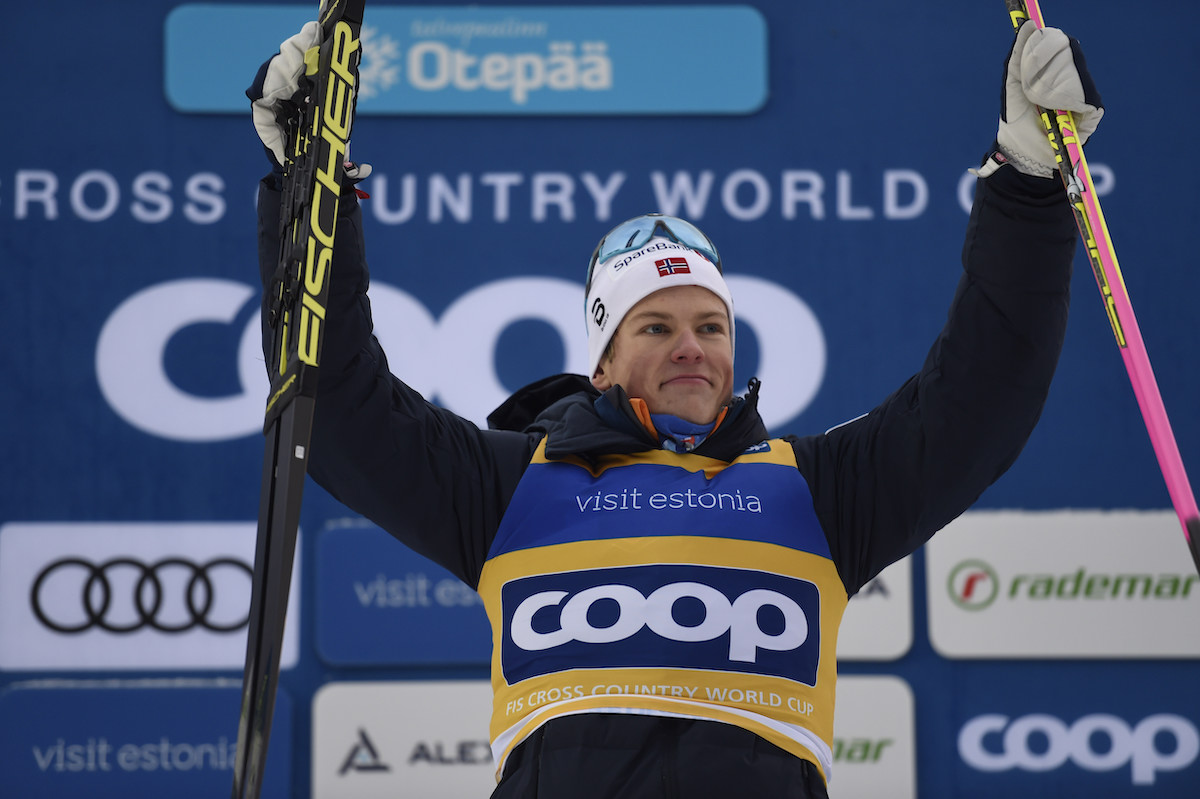
    Norway’s Johannes Høsflot Klæbo winner of the men’s 1.6-kilometer classic sprint final on Saturday in Otepää, Estonia. (Photo: Fischer/Nordic Focus)

    If Norway’s Johannes Høsflot Klæbo felt any nostalgia stepping out onto the men’s 1.6-kilometer classic sprint course in Otepää, Estonia–it is where he earned his first World Cup sprint victory back in 2017–it by no means slowed the 22 year old down.

    After winning Saturday’s qualifier in a time of 3:21.99, Klæbo went on to win both his quarter and semi. He eventually crossed the final first in a time of 3:20.05 to complete his sweep of the day’s rounds.

    “It’s very cool to win here again,” Klæbo said during an interview with the International Ski Federation (FIS) after the race. “And I have a grandpa who is living here so that’s even better now, so I want to enjoy this.”

    With the win, his 18th individual World Cup victory (12th in sprint), Klæbo could be on his way to his most winningest season yet. Last winter he departed the World Cup with 10 wins total. Thanks to a strong Tour de Ski and a few sprint races this year, Klæbo has already accumulated six individual victories in the 2018/2019 season.

    The win this Saturday came in good company, as he raced the six man final with four other Norwegians: Pål Golberg, Eirik Brandsdal, Mattis Stenshagen and  Erik Valnes. Alexander Bolshunov was the lone non-Norwegian to make the final.

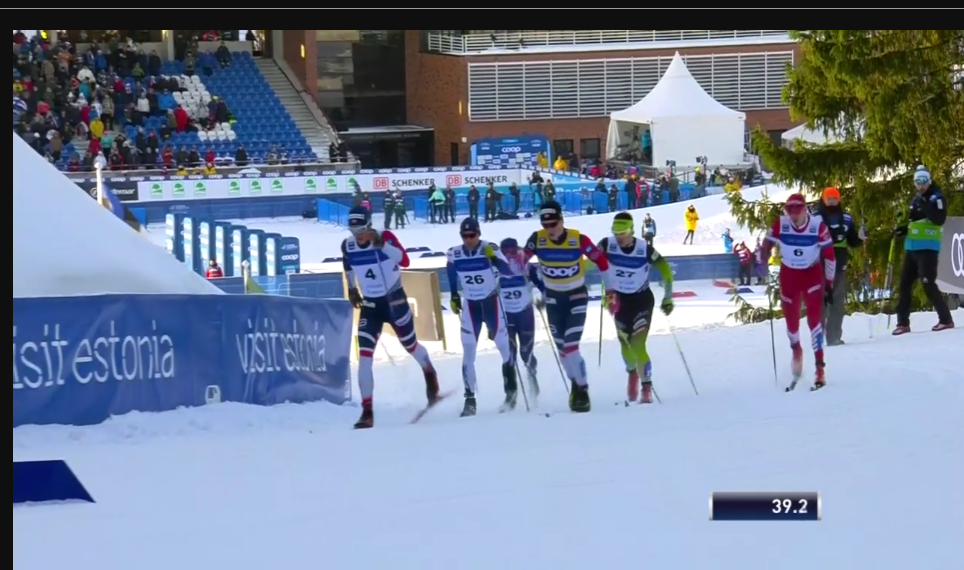
    American Andy Newell (bib 26) racing the first quarterfinal of the the men’s 1.6-kilometer classic sprint final on Saturday in Otepää, Estonia. (Photo: NBC Gold screenshot)

    Pitted against each other, Bolshunov appeared to be the only one in the final willing to challenge Klæbo. The two went head-to-head in the first major course climb, and by the following series of downhill S-turns, Bolshunov had positioned himself in the front. A brief double-pole section found Bolshunov and Klæbo side-by side once again, with Brandsdal and Stenshagen just behind.

    As the six finalists geared up for the second major climb, a steep nearly vertical pitch that forced all racers to herringbone, Klæbo maneuvered to the outside right of Bolshunov. Using a quick, herringbone clip that almost made his skis look like a fish out of water, Klæbo passed Bolshunov by the top of the ascent.

    After two double poles at the crest of the hill, Klæbo was tucked and descending back toward the stadium. His skis proved unmatchable by the Russian’s and by the bottom of the hill, he had put close to two meters on Bolshunov. Another meter behind Bolshunov was Golberg.

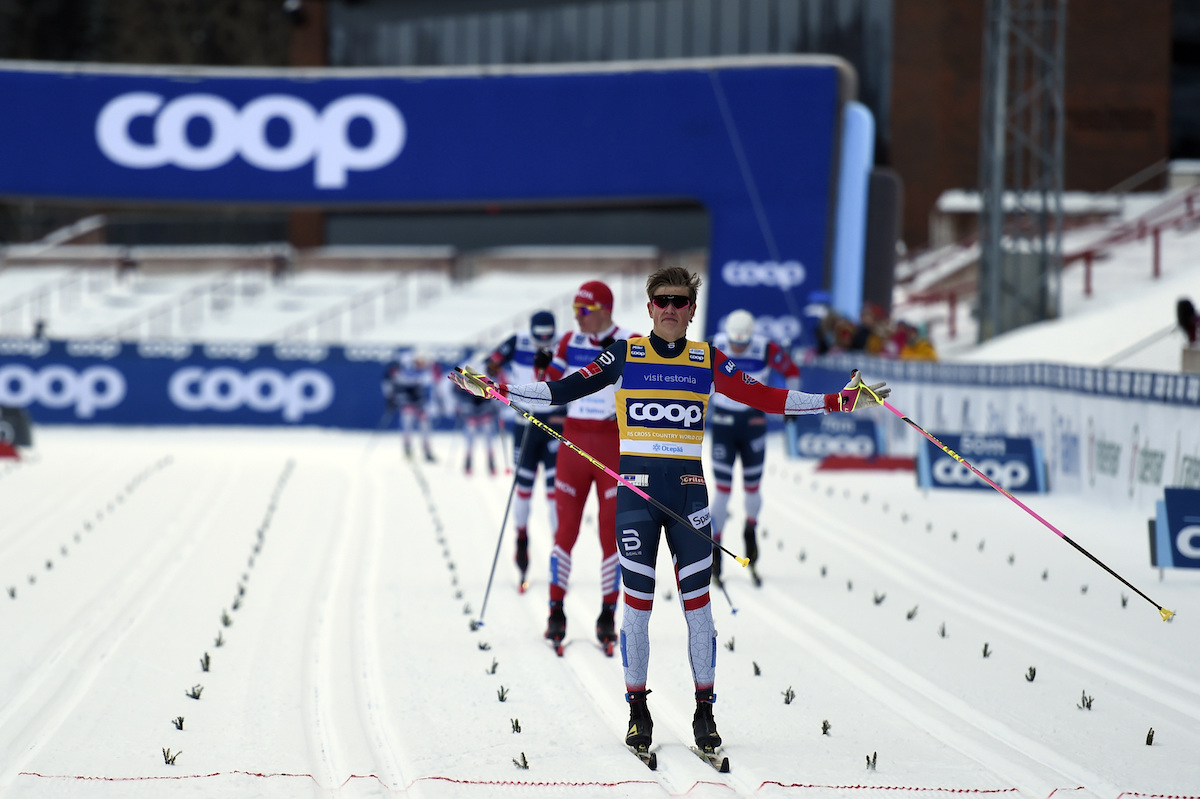
    With no foreseeable challenge to the win, Klæbo double poled breezily to the finishing stretch and crossed first, arms outstretched in his signature celebratory gesture.

    Norway’s Johannes Høsflot Klæbo (yellow bib) crossing first in the men’s 1.6-kilometer classic sprint final on Saturday in Otepää, Estonia. (Photo: Fischer/Nordic Focus)

    Bolshunov crossed second (+1.51) for his seventh World Cup podium of the season.

    In a lunge to the line, Golberg claimed third (+2.53) over Brandsdal in fourth (+2.57). Stenshagen crossed fifth (+7.69) and Valnes sixth (+11.99).

    Rounding out the top ten was Norwegian Sindre Bjørnestad Skar in seventh, Sweden’s Viktor Thorn in eighth, Norway’s Sondre Turvoll Fossli in ninth and Italy’s Federico Pellegrino in tenth.

    The U.S. had two men qualify, with Erik Bjornsen qualifying in 23rd (+8.20) and Andy Newell 26th (+8.75). Newell went on to race the first quarterfinal with Klæbo. Avoiding a crash from Russia’s Andrey Sobakarev in the herringbone hill, Newell crossed the quarterfinal in third to end the day in 15th overall.

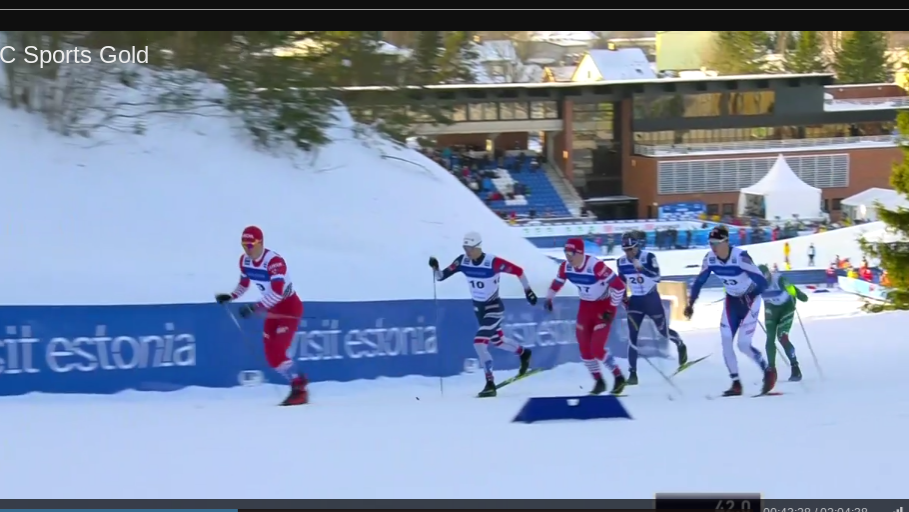
    American Erik Bjornsen (bib 23) racing the first quarterfinal of the the men’s 1.6-kilometer classic sprint final on Saturday in Otepää, Estonia. (Photo: NBC Gold screenshot)

    Bjornsen, who was slotted into the second quarterfinal, jockeyed for position throughout his heat, taking aggressive lines during the course’s sweeping S-turns to move from fifth to third. He dropped back once again in the herringbone hill and crossed his heat in fifth for 24th overall.

    “I was happy to qualify well today,” Bjornsen wrote in an email. “This season hasn’t gone as well as I hoped but I think I can turn things around before world champs. Today was a step in the right direction. Positioning was quite important in the second half of the course. Unfortunately I wasn’t where I needed to be before the steep climb.”

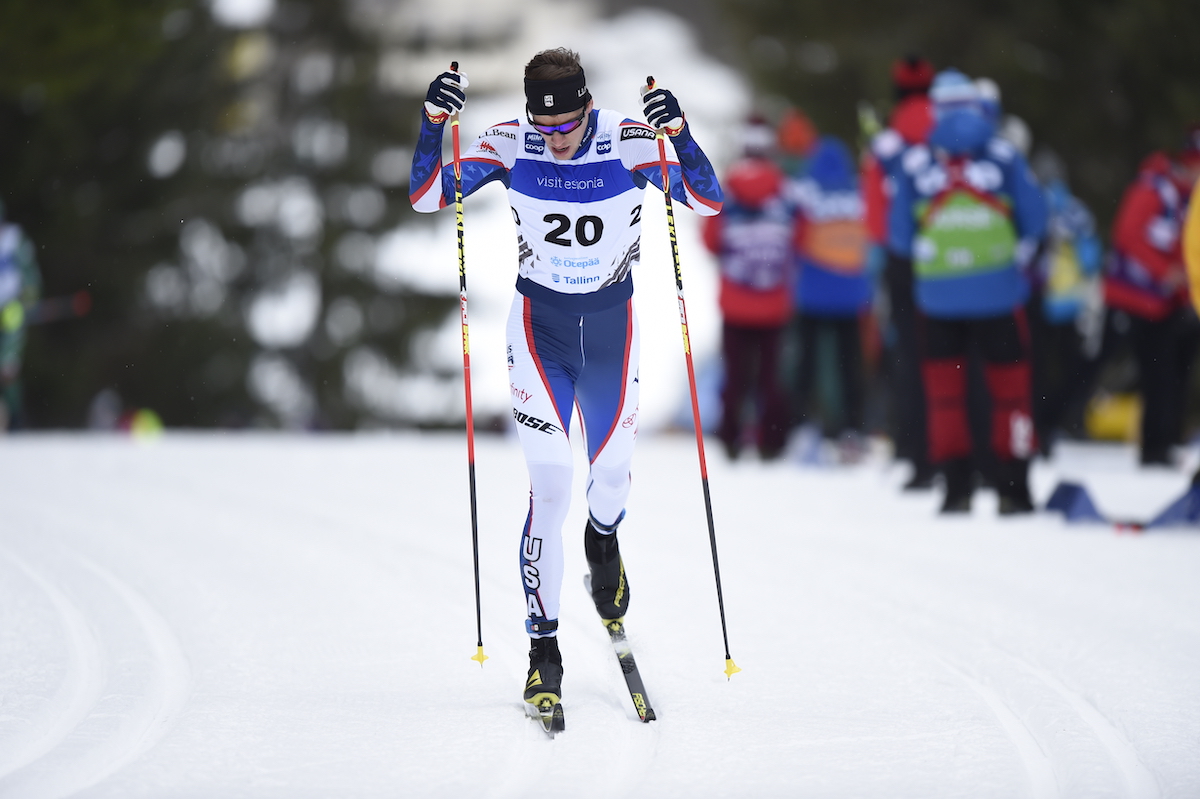
    The U.S. Ski Team’s Kevin Bolger during his qualifier
    on Saturday in in Otepää, Estonia. (Photo: Fischer/Nordic Focus)

    Also racing for the U.S., American Kevin Bolger finished in 41st (+13.13) and Ben Saxton in 44th (+14.16). Len Valjas racing for Canada finished in 43rd (+13.61) and Bob Thompson, also for Canada, placed 51st (+15.96).

    Results: Qualifier | Final

  • 2018/2019 Tour de Ski Preview (Updated)

    2018/2019 Tour de Ski Preview (Updated)

    The start of the men’s 15 k classic mass start at Stage 6 of the 2018 Tour de Ski on Saturday in Val di Fiemme, Italy, with (front row, left to right) Canada’s Alex Harvey, Russia’s Sergey Ustiugov, Kazakhstan’s Alexey Poltoranin, Norway’s Martin Johnsrud Sundby, and Switzerland’s Dario Cologna. (Photo: Salomon/NordicFocus)

    Beginning this Saturday in Toblach, Italy with a freestyle sprint is the 13th edition of the Tour de Ski (TdS). According to the International Ski Federation (FIS), over the course of seven stages the men will race 80.918 kilometers, the women 60.67 k. 

    The TdS has become both a staple and a spectacle of the annual World Cup calendar. With a jam-packed series of races primacy is placed on both the ability to recover well and wither less as the TdS transpires.

    Prognostication can be tricky in a long-form template like the TdS. So much can go astray during seven races not to mention the travel and dicey germ-avoidance. 

    Last season’s winner on the women’s side, Heidi Weng of Norway, sits 18th overall in the World Cup standings (14th in distance). She has four top-20’s in the four distance events she’s contested with her best result an eighth in Lillehammer’s 10 k skate. Although featuring two sprints in the first three stages, the TdS remains a distance skier’s paradise.

    Weng has skied solidly on the World Cup, but she has yet to show the form that made her a TdS overall winner in 2017 and 2018. Norway has won the last five iterations of the TdS: Marit Bjørgen won once in 2014/2015, Therese Johaug twice (2013/2014, 2015/2016), and Weng the last two years.

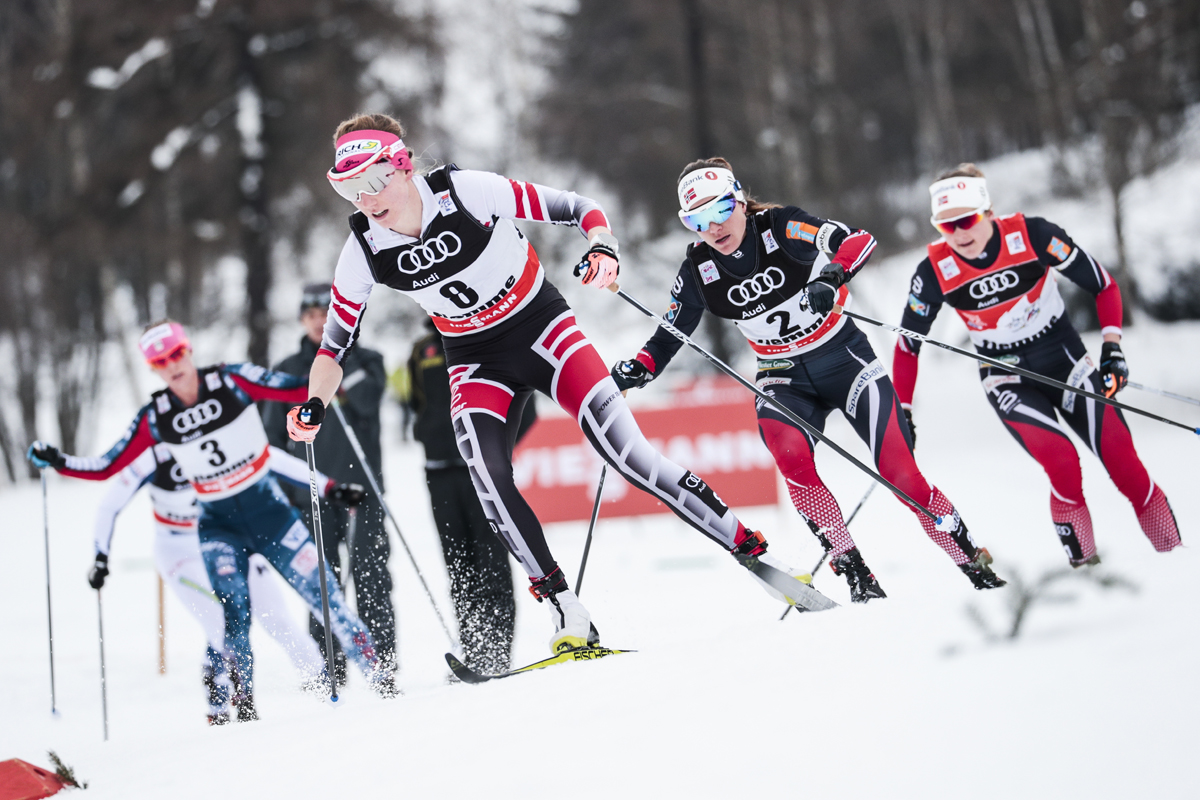
    Austria’s Teresa Stadlober leads Norway’s Heidi Weng (2) and Ingvild Flugstad Østberg, American Jessie Diggins (3) and others around a downhill corner during the women’s 10 k classic mass start at Stage 6 of the 2018 Tour de Ski in Val di Fiemme, Italy. (Photo: Fischer/NordicFocus)


    If Norway is to keep the streak alive, Ingvild Flugstad Østberg, last year’s TdS runner up, could be the heir apparent. She currently ranks second in the World Cup overall and 15th on the sprint list.

    Johaug, having returned from an 18 month doping ban, has been on a distance race tear. She has won all five World Cup distance events this season. Johaug, however, will not be lining up for the TdS.

    Only five different women have earned distance podiums this season — Johaug, Østberg, Sweden’s Charlotte Kalla and Ebba Andersson, and Finland’s Krista Pärmäkoski. Along with Johaug, Kalla and Andersson are skipping the TdS. (Andersson sits third overall on the World Cup, Kalla fifth.) With the TdS missing three of the five top ranked World Cup distance skiers, daily stages and the overall podium are up for grabs.   

    Last season’s third overall finisher, Jessie Diggins of the U.S. Ski Team (USST), often cites the TdS as a point in the season when her form trends towards podium performances. She sits eighth in the current distance standings and could very well have a stout TdS. 

    Russia’s Natalia Belorukova and Yulia Nepryaeva look strong as does Sadie Bjornsen (USST), and Austria’s Teresa Stadlober.

    With less than predictable distance stage podiums for the women, it may simply come down to a drag race on the Alpe Cermis final climb Jan. 6.

    Switzerland’s Dario Cologna (c) celebrates his fourth Tour de Ski overall title. He was joined by Norway’s Martin Johnsrud Sundby (l) and Canada’s Alex Harvey (r) on the podium in second and third, respectively. (Photo: Fischer/NordicFocus)


    The men’s scene is also open to interpretation. Last season’s TdS winner, Switzerland’s Dario Cologna, was in fact a surprise victor. Prior to Cologna’s stage two win in last year’s TdS, it had been nearly three years since the four time TdS overall winner had won a World Cup. Cologna sits 21st overall on the World Cup currently. Given last year’s resurgence, anything is possible for the Swiss skier.

    Then there’s Martin Johnsrud Sundby form Norway. He finished on the TdS podium the last three years. At thirty-four-years-old, Sundby is ranked first on the distance list, with a second, a third, and a fourth place in distance races this season.

    Sundby won the TdS on two occasions – in 2013/2014 and in 2016. His 2015 win was stripped after he tested positive for excessive levels of Salbutamol. He placed second in the past two Tours.

    In a field rife with talent, Sundby’s ability to race and rebound and race and rebound will be tested. Sjur Røthe, Emil Iversen, and Didrik Tønseth— all from Norway— look in form. And there’s Norway’s Johannes Høsflot Klæbo. The winner of last season’s overall World Cup has had flashes of his past explosive self. He could be a TdS protagonist.

    The men’s field is notably tight. Along with the Norwegians, several Russians could pop a podium, a stage win, and the overall. Russia comes with a loaded team ready to exploit. Alexander Bolshunov leads the overall World Cup – he’ll turn twenty two on Dec. 31st. He’s backed by teammates Evgeniy Belov, Andrey Melnichenko, and Denis Spitsov. 

    Canada’s Alex Harvey placed third overall last year and he looked stronger as the TdS progressed.

    The Stages

    Stage 1:  Dec. 29, skate sprint in Toblach, Italy.

    Stage 2: Dec. 30, 10 k/15 k skate in Toblach, Italy.

    Stage 3: Jan. 1, skate sprint in Val Müstair, Switzerland.

    Stage 4: Jan. 2, 10 k/15 k classic mass start in Oberstdorf, Germany.

    Stage 5: Jan. 3, 10 k/15 k skate pursuit in Oberstdorf, Germany.

    Stage 6: Jan. 5th, 10 k/15 k classic mass start in Val di Fiemme, Italy.

    Stage 7: Jan 6th, 9 k final climb skate pursuit in Val di Fiemme, Italy.

    Teams

    United States

    Women: Sophie Caldwell, Sadie Bjornsen, Jessie Diggins.

    Men: Ben Lustgarten, Simi Hamilton, Erik Bjornsen, Kevin Bolger.

    U.S. Ski Team Head Coach Chris Grover noted in a text that Caldwell, Hamilton, and Bolger will likely cease the TdS after the stage three sprint. Additionally, this is a small team for the U.S. at the TdS. Several athletes turned down TdS nominations including Scott Patterson (USST), Andy Newell (SMS T2/Salomon), Kyle Bratrud (SMS T2), Rosie Brennan (APU), Rosie Frankowski (APU), Caitlin Patterson (CGRP), and Julia Kern (SMS T2). These skiers plan on racing U.S. Nationals this January in Craftsbury, Vermont.

    Canada

    Women: Emily Nishikawa, Dahria Beatty

    Men: Alex Harvey, Lenny Valjas, Bob Thompson

    Norway

    Women: Ingvild Flugstad Østberg, Maiken Caspersen Falla, Astrid Uhrenholdt Jacobsen, Kari Øyre Slind, Kathrine Rolsted Harsem, Heidi Weng, Lotta Udnes Weng, Tiril Udnes Weng Mari Eide, Anna Svendsen

    Men: Martin Johnsrud Sundby, Hans Christer Holund, Emil Iversen, Didrik Tønseth, Simen Hegstad, Krüger, Sjur Røthe, Johannes Høsflot Klæbo, Martin Løwstrøm Nyenget, Eirik Brandsdal, Finn Hågen Krogh

    Russia

    Women: Yulia Belorukova, Lidia Durkina, Anna Zherebyateva, Mariya Istomina, Natalia Nepryaeva, Anna Nechaevskaya, Anastasia Sedova, Elena Soboleva

    Men: Evgeniy Belov, Alexander Bolshunov, Maxim Vylegzhanin, Andrey Larkov, Andrey Melnichenko,  Gleb Retivykh, Andrey Sobakarev, Denis Spitsov, Sergey Ustiugov

    Sweden

    Women: Mia Eriksson, Ida Ingemarsdotter, Moa Molander Kristiansen, Stina Nilsson, Maria Nordström, Linn Sömskar, Lisa Vinsa

    Men: Calle Halfvarsson, Simon Lageson, Teodor Peterson, Daniel Rickardsson, Oskar Svensson, Viktor Thorn, Karl Johan Westberg

    Finland

    Women: Mari Eder, Anne Kyllönen, Laura Mononen, Krista Pärmäkoski, Susanna Saapunki

    Men: Ristomatti Hakola, Matti Heikkinen, Lauri Vuorinen

    Italy

    Women: Elisa Brocard, Anna Comarella, Ilaria Debertolis, Caterina Ganz, Greta Laurent, Sara Pellegrini, Lucia Scardoni

    Men: Francesco de Fabiani, Stefano Gardener, Enrico Nizzo, Dietmar Noeckler, Federico Pellegrino, Maicol Rastelli, Giandomenico Salvadori

    Switzerland

    Women: Nathalie von Siebenthal, Laurien van der Graaff, Nadine Fähndrich

    Men: Dario Cologna, and Jovian Hediger, Jonas Baumann, Livio Bieler, Roman Furger, Käser Erwanm, Beda Klee, Toni Livers, Jason Rüesch, Schaad Roman

    Austria

    Women: Therese Stadlober

    Germany

    Women: Julia Belger, Victoria Carl, Pia Fink, Laura Gimmler, Katharina Hennig, Sandra Ringwald, Elisabeth Schicho, Anne Winkler

    Men: Thomas Bing, Lucas Bögl, Janosch Brugger, Jonas Dobler, Sebastian Eisenlauer, Andreas Katz, Valentin Mättig, Florian Notz, Max Olex, Thomas Wick

    France

    Women: Anouk Faivre Picon, Delphine Claudel, Laura Chamiot-Maitral

    Men: Maurice Manificat, Lucas Chanavat, Adrien Backscheider, Jean-Marc Gaillard, Baptiste Gros, Renaud Jay, Richard Jouve, Jules Lapierre, Clement Parisse

    FasterSkier will update team start lists as we gather more information.

    antibiotics

  • World Cup Preview #4: Finland

    World Cup Preview #4: Finland

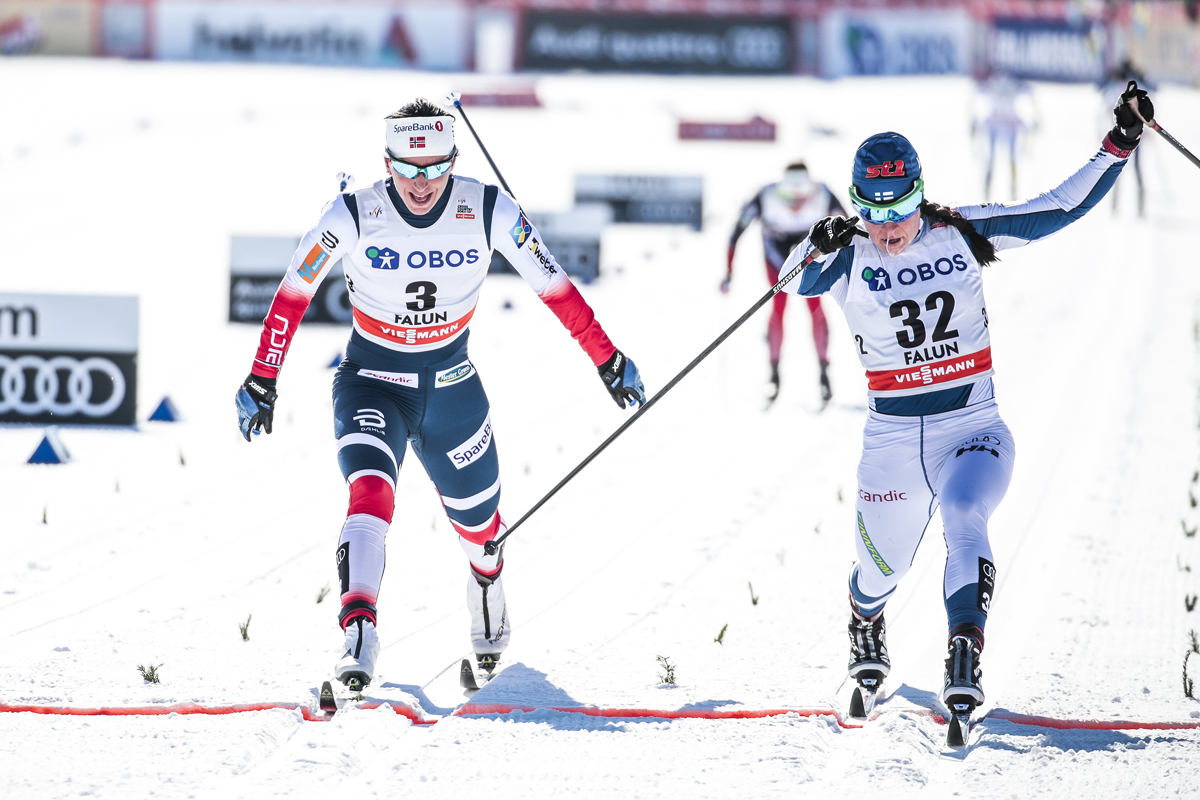
    Finland’s Krista Pärmäkoski (32) edges Norway’s Marit Bjørgen for the win in the women’s 10 k classic mass start at 2018 World Cup Finals in Falun, Sweden. (Photo: Fischer/NordicFocus)


    Welcome to FasterSkier’s World Cup Preview, where we check in with the top-10 teams from last year’s FIS Cross Country World Cup tour before the season starts with the Ruka weekend in Kuusamo, Finland, on Nov. 24 with a classic sprint.

    ***

    Finland

    Overall in Nations Cup Last Year:4th

    Women’s Ranking 2017/2018: 4th

    Men’s Ranking 2017/2018: 7th

    Finnish Skiers to Watch:

    If there are two names Finland’s cross-country ski fans loves to cheer–and will be looking to chant again this season–it’s Krista Pärmäkoski and Iivo Niskanen. And with good reason.

    Pärmäkoski opened Period II of last season with a win, cruising to first in the 10-kilometer classic race in Planica, Slovenia. Pärmäkoski racked up two more 10 k victories after Planica, winning both the Lahti 10 k and the Falun 10 k. Altogether, Pärmäkoski landed on the World Cup podium seven times last season, capping off the FIS 2017/2018 season ranked fourth, just ahead of Norway’s Marit Bjørgen in fifth.

    Outside of the World Cup, Pärmäkoski also came away from the 2018 Pyeongchang Winter Olympic Games with three individual medals, one silver and two bronze.

    Complimenting Pärmäkoski on the men’s side, Niskanen, earned two World Cup podiums last season, placing third in the Ruka 15 k and third in the Lahti 15 k. He landed in the top-20 twelve times during last year’s World Cup season, and finished 15th in the FIS overall.

    buy celebrex online

    buy celebrex online

    Like Pärmäkoski, he also departed the Winter Games with hardware, a gold medal from the men’s 50 k mass start.

    Pärmäkoski and Niskanen aren’t the only Finns capable of pushing into the top tiers of World Cup skiers. With the retirement of Aino-Kaisa Saarinen this past spring, the women’s side will look to Kerttu Niskanen (Iivo’s sister), Riitta-Liisa Roponen, Anne Kyllönen and Laura Mononen–all of whom scored World Cup points more than once last season– to keep the women’s team’s forward momentum.  

    Following Niskanen, Matti Heikkinen and Ristomatti Hakola are two veteran Finnish names who are not about to let up as the 2018/2019 season prepares to get underway.  


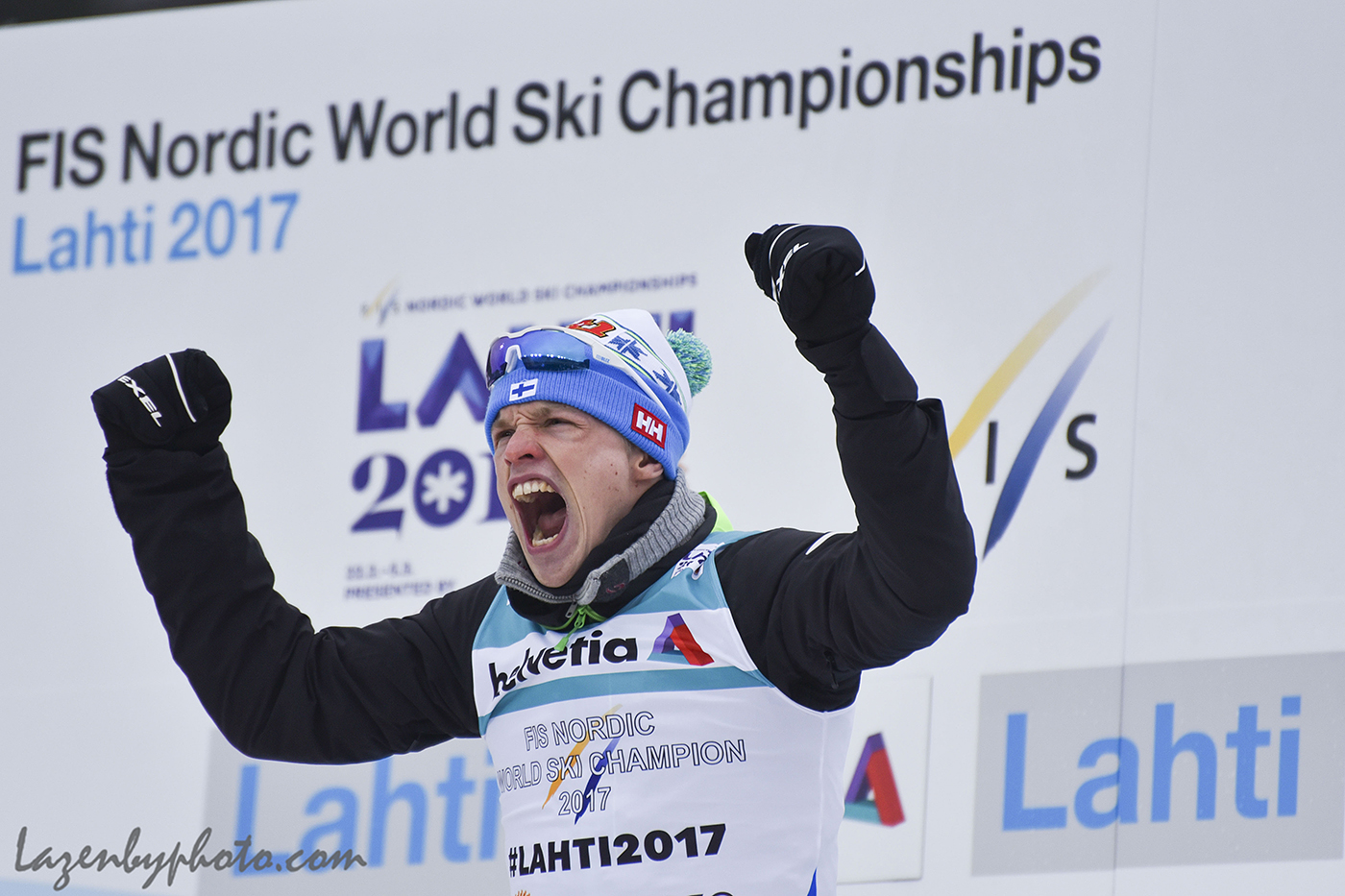
    Finland’s Iivo Niskanen celebrating his first World Championships gold in the men’s 15 k classic on March 1, 2017, in Lahti, Finland. (Photo: John Lazenby)
  • Friday Rundown: Falk, Klæbo Win Last Sprint of Season in Falun; Caldwell 6th

    Friday Rundown: Falk, Klæbo Win Last Sprint of Season in Falun; Caldwell 6th

    Sweden’s Hanna Falk (r) smiles as she wins the fourth World Cup race of her career and first race in Falun, Sweden, with a victory in the women’s freestyle sprint at 2018 World Cup Finals on Friday. Her teammate Jonna Sundling (l) placed second while Norway’s Marit Bjørgen finished third. (Photo: Svenska Skidspelen/Instagram)

    FIS Cross Country World Cup Finals (Falun, Sweden): Freestyle sprints

    Women’s report

    Men’s report

    In the last sprint of the season and the first race of the three-day World Cup Finals in Falun, Sweden’s Hanna Falk and Norway’s Johannes Høsflot Klæbo won their respective 1.4-kilometer freestyle sprint finals, while Norway’s Maiken Caspersen Falla and Klæbo claimed the season-long Sprint Crystal Globes and Sophie Caldwell of the U.S. placed third in the Sprint World Cup.

    Falk started Friday by topping the women’s qualifier on home turf in 2:59.88 minutes, 1.65 seconds ahead of American Jessie Diggins, who qualified in second. Russia’s Natalia Nepryaeva qualified third (+2.73), while American Sadie Bjornsen raced to the fourth-fastest qualifying time (+2.96), ahead of Norway’s Marit Bjørgen in fifth (+3.72).

    Falk then won the first quarterfinal and first semifinal before taking control and dusting the field in the women’s final. She essentially led the final from start to finish, but slowed her pace and the five women behind her as she ascended the last climb. As she reached the 180-degree turn at the top, Falk launched into high gear, leaving the rest of the field chasing. Bjørgen was closest to her in second, but still several meters back, as they descended down into the stadium, and Falk skated away from her pursuers for her fourth-career World Cup win (and first victory in Falun) in 3:08.25. Sweden’s 23-year-old Jonna Sundling came on strong in the finishing straight for her first World Cup podium in second (+0.53), Bjørgen took third, and Sweden had three in the top four with Anna Dyvik in fourth (+1.72).

    Norway’s Silje Øyre Slind finished fifth (+4.3), and Caldwell, who had qualified for the heats in 16th then won her quarterfinal and advanced in third in the second semifinal, placed sixth overall (+6.99).

    Four American women posted top-20 qualifying times, with Kikkan Randall advancing as well in 18th. Diggins placed seventh overall after finishing third in the first semifinal, 0.42 seconds behind Falk in first and just 0.08 seconds behind Sundling, who advanced to the final in second.

    Bjornsen was ninth on the day after placing fifth in that semifinal, 0.85 seconds out of first. Randall finished 15th overall after placing third in her quarterfinal, 3.14 seconds behind Diggins, who won that heat.

    Also for the U.S, Ida Sargent missed the top 30 needed to qualify in 36th, as did Rosie Brennan in 49th, Caitlin Patterson in 63rd, Liz Stephen in 66th, Kaitlynn Miller in 69th, and Rosie Frankowski in 75th.

    Canada’s Emily Nishikawa placed 40th, Dahria Beatty was 48th, Cendrine Browne 60th, and Zina Kocher 71st.

    Norway’s Johannes Høsflot Klæbo (yellow bib) celebrates his 11th World Cup victory of the season in the men’s freestyle sprint at 2018 World Cup Finals in Falun, Sweden, ahead of Italy’s Federico Pellegrino (l) in second and France’s Lucas Chanavat (11) in third. (Photo: Svenska Skidspelen/Instagram)

    In the men’s race, Russia’s Alexander Bolshunov qualified first in 2:36.23, 0.46 seconds ahead of Klæbo in second. Klæbo then won the first quarterfinal, first semifinal, and you guessed it, the final as well, backing off before crossing the finish line for the last time in 2:37.03.

    Italy’s Federico Pellegrino powered past France’s Lucas Chanavat in the finishing stretch of the final to claim second, 0.39 seconds behind Klæbo. Chanavat completed the podium in third (+1.76), Finland’s Ristomatti Hakola finished fourth (+3.26), and Sweden’s Oskar Svensson and Teodor Peterson placed fifth (+3.88) and sixth (+6.17), respectively.

    Two American men qualified for the heats, with Simi Hamilton advancing in 13th and Kevin Bolger in 29th. Hamilton went on to place 14th on the day after finishing third in the first quarterfinal, 0.61 seconds behind Klæbo. In his second-career World Cup sprint, Bolger placed 30th overall after finishing sixth in his quarterfinal, 2.21 seconds behind Peterson in first.

    In the overall Sprint World Cup, Klæbo took his second-straight title by a whopping 243 points over Pellegrino in second, while Falla won her third-straight Sprint Crystal Globe by 78 points over Sweden’s Stina Nilsson, who was out sick for Friday’s race. Nilsson joined her at the Sprint World Cup podium ceremony on Friday, as did Caldwell, who achieved her best overall sprint standing in third.

    Falla placed eighth overall on the day after being eliminated in the semifinals (she finished fourth behind Falk, Sundling and Diggins, respectively).

    For the U.S., Erik Bjornsen narrowly missed qualifying in 31st, Andy Newell placed 43rd, Paddy Caldwell was 60th, David Norris 84th, and Scott Patterson 87th.

    For Canada, Julien Locke placed 32nd, Alex Harvey 34th, Devon Kershaw 74th, and Graeme Killick 81st.

    Results:

    Women: Qualifier | Final | Women’s Sprint World Cup (final standings) 

    Men: Qualifier | Final | Men’s Sprint World Cup (final standings)

  • Klæbo Takes a Bow in Drammen Classic Sprint; Erik Bjornsen 18th

    Klæbo Takes a Bow in Drammen Classic Sprint; Erik Bjornsen 18th

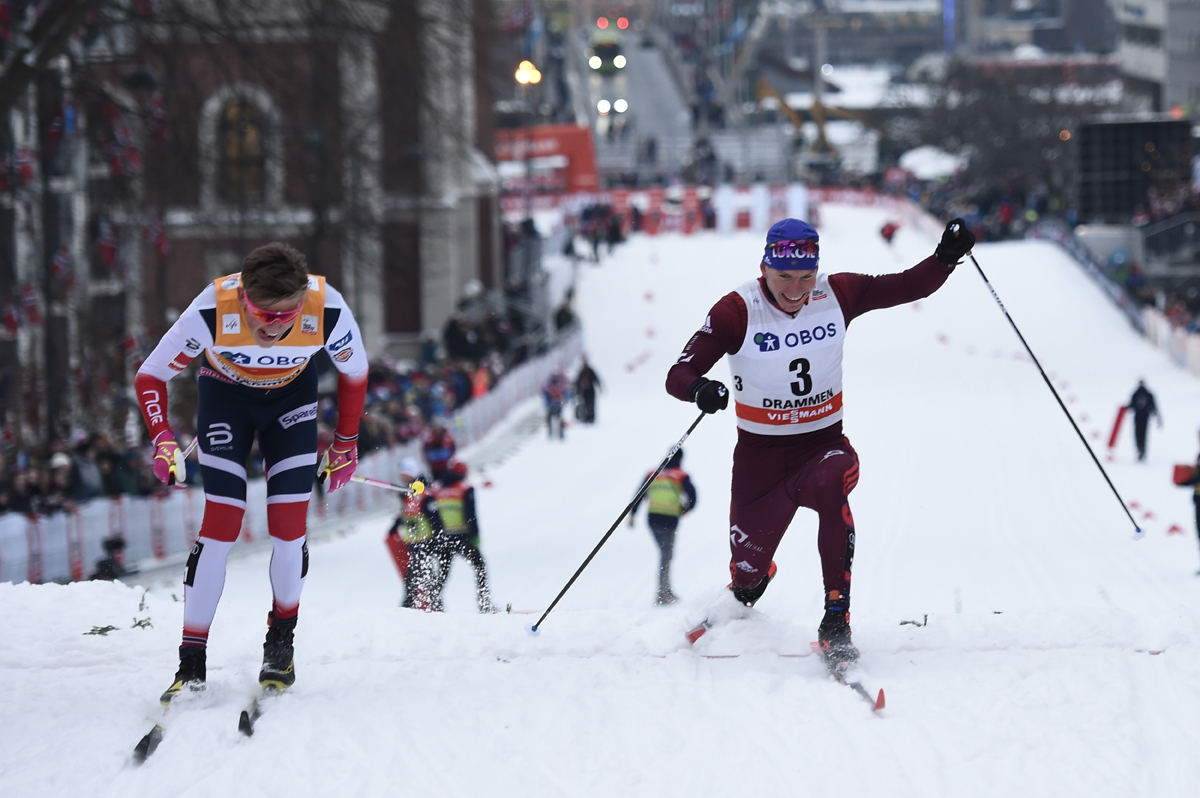
    Norway’s Johannes Høsflot Klæbo (l) edging Russia’s Alexander Bolshunov (3) and Norway’s Eirik Brandsdal (not shown) in the first semifinal of the men’s classic sprint at the World Cup in Drammen, Norway. Klæbo went on to win the final, ahead of Brandsdal in second and Bolshunov in third. (Photo: Fischer/Nordic Focus)

    In the classic venue that are the Drammen city sprints, it was a singular affair from start to finish during the men’s World Cup 1.2-kilometer classic sprint on Wednesday. In a race format that tapered from a field of 61 skiers to the winner, one only needs to track the skier in the overall World Cup’s leader bib to follow along.

    The yellow-bibbed skier, Norway’s Johannes Høsflot Klæbo, didn’t surprise with his sprint win in Drammen as much as place another high performance stamp on his 2017/2018 campaign.

    Klæbo won the qualifier in 2:49.32 minutes. Teammate Eirik Brandsdal skied to second in the qualifier, 3.5 seconds behind Klæbo. Russian Alexander Bolshunov skied the third-fastest qualifying time, finishing 4.48 seconds back. This puts some things in perspective, if anybody thought Klæbo would bloat in his post-Olympic gold medal glow — he won three golds in PyeongChang — you’d be wrong.

    Klæbo would have have good reason to cash it in. What exactly does the 21 year old need to prove? Coming into Wednesday’s race, Klæbo had already captured the Sprint World Cup Crystal Globe. It’s the Norwegian phenom’s second-consecutive overall sprint title.

    Yet Klæbo is also on the verge of sealing up his first Overall World Cup title. After the Drammen sprints, Klæbo leads the overall standings with 1308 points. Behind him, Martin Johnsrud Sundby of Norway (who did not contest Wednesday’s sprint), trails in second place with 980 points total.

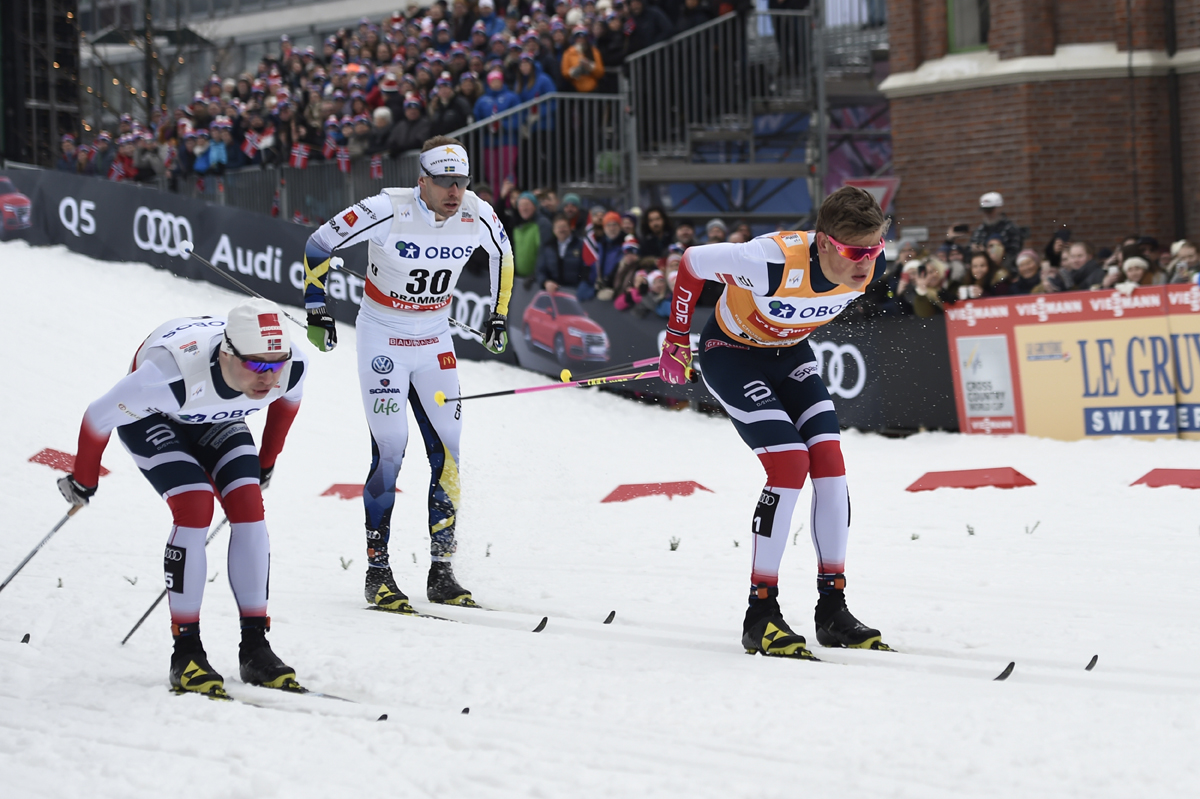
    Johannes Høsflot Klæbo leads his quarterfinal with fellow Norwegian Fredrik Riseth (l) and Sweden’s Emil Jönsson (30) at the World Cup classic sprint in Drammen, Norway. (Photo: Fischer/NordicFocus)

    “It was really important to me to get the 100 points today,” Klæbo told the International Ski Federation (FIS) after the race. “I need as many points as I can get against the other guys for the [overall] Crystal Globe. I will race the Holmenkollen 50 k this weekend and I know it will be tough. Also it’s great to win here in front of all the people. I was second here last season and I’m really happy to now have won Drammen.”

    Let’s circle back to what Klæbo needs to prove, beyond padding his overall lead by another 100 points by winning the Drammen sprint. He’s proving at his young age, pending any monumental flameout, that he’s setting the stage for a historic international cross-country ski career.

    This season alone, Klæbo has won six of nine individual sprint World Cups. He’s won 10 World Cup races in total. That win total puts Klæbo in rarefied company: in the men’s field, only Petter Northug (with 10 wins) and Sundby (16 wins) have won 10 or more World Cup races in a single season.

    Winners want to win. Amidst the five-deep crowd surrounding the sprint course featuring Drammen’s iconic Bragernes Church, with his pink-themed flare, Klæbo proved once again he is a consummate winner.

    There was his dominating qualifier. Then there was Klæbo’s quarterfinal, in which he looked less threatening. He won the first quarterfinal by 0.7 seconds in a photo finish with Brandsdal. That heat seemed to be a test run, as if Klæbo were feeling the course out and asking himself how it skied with five other bodies jousting for tracks and inside lines. There was never the hallmark Klæbo burst of speed or any real dominance. Klæbo kept in contact up the long initial uphill, and down through the tight and sinuous S-turns after the course’s highpoint.

    If in fact the first quarterfinal was a dress rehearsal, Klæbo must have realized that any real podium threats would be drag racing up the final quarter-kilometer climb that finished nearly smack-dab in front of the church.

    The first semifinal featured the day’s top-three qualifiers: Klæbo, Brandsdal and Bolshunov. (Bolshunov advanced by winning the second quarterfinal.) The three skiers finished 1-2-3 with Klæbo taking the win in another photo finish with Brandsdal.

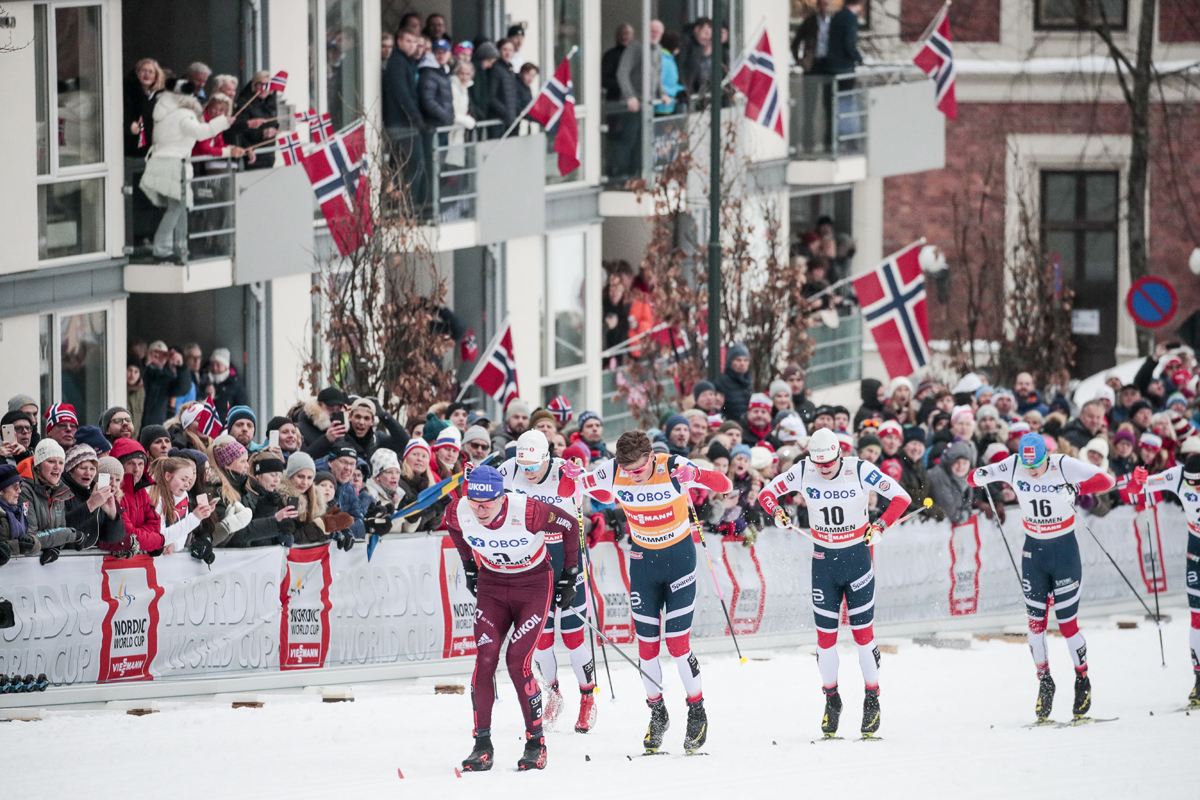
    Russia’s Alexander Bolshunov leads five Norwegians in the men’s classic sprint final at the World Cup in Drammen, Norway: (from l to r) Eriik Brandsdal, Johannes Høsflot Klæbo (yellow bib), Sindre Bjørnestad Skar (10), Kasper Stadaas (16), and Emil Iversen. (Photo: Fischer/Nordic Focus)

    Tactically, Bolshunov played his hand early. Determined to break Klæbo, the Russian led out hard and took the sharp end of the race in earnest. At the top of the course, Bolshunov had strung the five other skiers out behind him. Moments before the highpoint and entering the technical downhill S-turns, Bolshunov and Klæbo gave a burst of speed and distanced themselves by 10 meters. As Klæbo learned in his heat, even with speedy skis, the downhill is not decisive. It’s more a function of skiing out front, staying on your feet and entering the final straight with enough high-octane gas to turbo the finish.

    Up the final climbing stretch, which seems as eternal as some flame burning inside the Bragernes Church, Bolshunov faded slightly, while Klæbo and Brandsdal pulled ahead.

    Klæbo’s second takeaway: he already knew the course was won on the final straightaway climb. If he could match Bolshunov on the remainder of the course, Bolshunov could not mirror him in the final meters.

    The final played out like Klæbo’s semi. Bolshunov punched it early. Klæbo sat behind the Russian, matching him pole for pole, stride for stride. Up front was as good a place as any for Bolshunov. Besides the Russian, it was an all-Norwegian final. There was Klæbo and Brandsdal, along with Sindre Bjørnestad Skar, Kasper Stadaas and Emil Iversen.

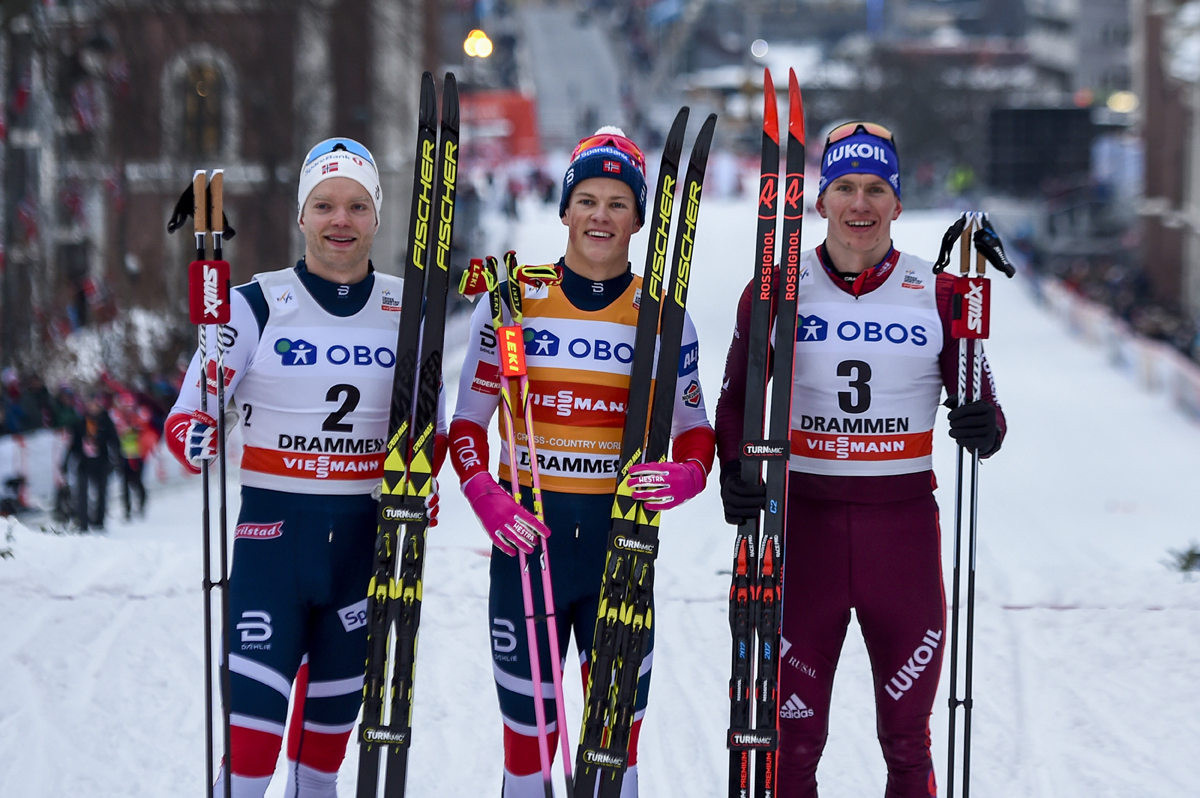
    The men’s podium from Drammen’s 2018 classic sprint. Norway’s Johannes Høsflot Klæbo (c) placed first, his teammate Eirik Brandsdal (l) was second, and Russia’s Alexander Bolshunov (r) finished third. (Photo: Fischer/NordicFocus)

    Bolshunov again led up and over the top of the course, through the S-turns and through the tucking downhill. Brandsdal trailed by 10 meters, but by the final turn before the uphill to the church’s front door, the threesome had regrouped. Again, as the double poling got down to business, Bolshunov faded, Klæbo pulled away and Brandsdal could only stay a second behind the day’s winner. And of course Klæbo was able to toe the line as he bowed to the frenzied crowd. Nothing to prove except he can win with panache and win in style when the Norwegian cameras turn out in force.

    Klæbo won the final in 2:44.69 minutes. Brandsdal followed 1.04 seconds back in second place, Bolshunov finished third (+3.78), Bjørnestad fourth (+6.55), Kaspar fifth (+8.71), and Iversen sixth (+11.45).

    Bjornsen Reaches Quarterfinals, 18th Overall

    Erik Bjornsen was the lone North American who advanced to the heats, qualifying in 26th and finishing the day in 18th.

    “I was feeling good,” Bjornsen told FasterSkier after the race. “It’s a tight course. It was a bit scrappy. … It’s my first time here qualifying for the heats, so I’m learning some things, for sure.”

    Bjornsen skied in the fifth quarterfinal with Iversen, Russia’s Alexander Panzhinskiy, Finland’s Ristomatti Hakola, Emil Nyeng of Norway, and France’s Lucas Chavanat.

    The American skied near the back of the group but avoided any real mishaps. Although the sport is not roller derby, Drammen’s tight-and-rutted corners offer up a close cross-country skiing cousin.

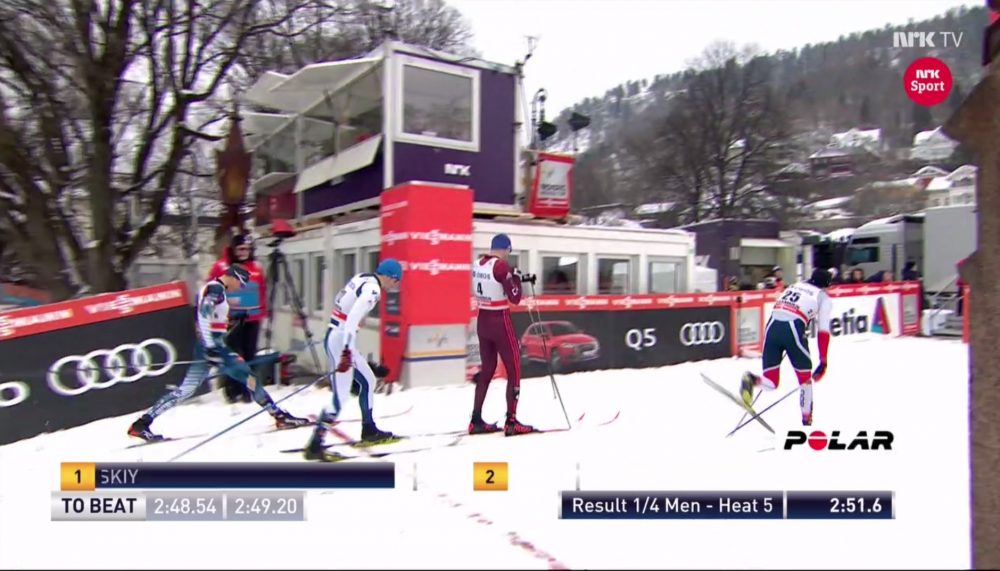
    The U.S. Ski Team’s Erik Bjornsen toeing the line in fourth during Wednesday’s fifth heat in Drammen, Norway. Bjornsen placed 18th on the day. (Screenshot: NRK broadcast)

    “I feel like – I kind of missed a few spots,” Bjornsen said.  “At the bottom corner I was pushed to the outside. I was almost moving up into second, and looking back maybe I should have gone around him on the other side.”

    Up the never-ending final straightaway, Bjornsen poled himself into a position to potentially advance to the semifinals as a lucky loser. However, that didn’t pan out for Bjornsen. Iversen won the heat in 2:51.96 minutes, Panzhinskiy placed second (+0.20), Hakola third (+0.99), with Bjornsen in fourth (+1.18).

    Andy Newell racing to 33rd in the men’s classic sprint qualifier at the World Cup in Drammen, Norway. (Photo: Fischer/NordicFocus)

    Also for the U.S., Andy Newell missed the quarterfinals after finishing 33rd in qualification, 0.9 seconds out of 30th. Logan Hanneman and Kevin Bolger finished 49th and 50th, respectively, and Reese Hanneman 56th. The U.S. Ski Team’s Simi Hamilton sat out Wednesday’s sprint as he is recovering from an illness.

    For Canada, Julien Locke finished 51st in qualifying, Alex Harvey was 54th, and Andy Shields 58th.

    Results: Qualifier | Final

  • Saturday Rundown: Lahti and Otepää

    Saturday Rundown: Lahti and Otepää

    The men’s 1.6 k freestyle sprint podium at Saturday’s World Cup in Lahti, Finland, with Italy’s Federico Pellegrino (c) in first, Russia’s Gleb Retivykh (l) in second and Norway’s Johannes Høsflot Klæbo (r) in third. (Photo: FIS Cross Country/Twitter)

    FIS Cross Country World Cup (Lahti, Finland): Men’s & women’s freestyle sprints 

    Women’s report

    Men’s report

    The defending world championships from the 2017 freestyle sprint prevailed again in Lahti on Saturday, with Norway’s Maiken Caspersen Falla winning the women’s 1.4-kilometer freestyle sprint final and Italy’s Federico Pellegrino coming out on top in the men’s 1.6 k final at last year’s World Championships venue.

    Falla’s rise to the final started with her qualifying in 12th, 7.96 seconds off the fastest qualifying time set by Sweden’s Hanna Falk in 2:54.72. Russia’s Natalia Nepryaeva qualified second (+0.63) and Finland’s Krista Pärmäkoski third (+3.62), just ahead of Germany’s Victoria Carl in fourth (+3.88) and American Sadie Bjornsen in fourth (+3.88). Four American women qualified for the heats, with Sophie Caldwell in 17th, Ida Sargent in 21st and Rosie Brennan in 29th.

    The women’s 1.4 k freestyle sprint podium at Saturday’s World Cup in Lahti, Finland, with Norway’s Maiken Caspersen Falla (c) in first, and Sweden’s Stina Nilsson (l) and Hanna Falk (r) in second and third, respectively. (Photo: FIS Cross Country/Twitter)

    Falla went on to place second in the first quarterfinal, 0.71 seconds behind Sweden’s Stina Nilsson in first. According to the race jury’s ruling, Carl obstructed Pärmäkoski coming out of the last downhill before they entered the finishing straight and both crashed out of contention, with Pärmäkoski finishing fifth in the heat (+12.11) and Carl sixth (+49.5). Carl was relegated to last (30th place) for the obstruction.

    Falla then won the first semifinal by just 0.04 seconds over Nilsson in second. The two other Swedes in that heat, Falk and Ida Ingemarsdotter, advanced to the final as well as lucky losers with fast-enough times.

    In the final, Falla found herself at the front of the pack early then held her position to the finish, crossing the line in 2:54.83 and beating Nilsson by 0.36 seconds. Sweden had two on the podium with Falk in third (+0.78), Germany’s Sandra Ringwald placed fourth (+0.88), Ingemarsdotter was fifth (+1.83), and Switzerland’s Laurien van der Graaff placed sixth (+3.02).

    Caldwell was the lone American woman to make it past the quarterfinals, as she placed second in her quarterfinal, 0.25 seconds behind Ringwald in first, then fourth in the second semifinal, 1.46 seconds behind Ringwald, who also won that heat. Overall, Caldwell finished the day in eighth.

    Bjornsen placed 17th overall after finishing fourth in her quarterfinal, 2.84 seconds behind Falk in first. Sargent had been second in her quarterfinal until the final tight lefthand corner into the finishing straight, where she slipped to sixth and ultimately finished sixth, 1.07 seconds behind Sweden’s Anna Dyvik in first. Overall, Sargent finished the day in 27th, and Brennan placed 29th overall after finishing sixth in her quarterfinal, 4.91 seconds behind Ingemarsdotter in first.

    Two American men advanced to the heats as well, with Kevin Bolger of the Sun Valley Ski Education Foundation (SVSEF) qualifying in 16th in his World Cup debut, 6.38 seconds behind Norway’s Johannes Høsflot Klæbo, who topped the qualifier in 2:59.06. Erik Bjornsen of the U.S. Ski Team qualified 29th, 8.29 seconds back.

    Meanwhile, Pellegrino qualified for the heats in third (+1.9) behind France’s Baptiste Gros in second (+1.23).

    There, Pellegrino won the first quarterfinal by 0.19 seconds over Klæbo, with the Norwegian visibly backing off before the finish — comfortable enough to automatically advance to the semifinals in second place. But Klæbo showed Pellegrino what he’s made of in the first semifinal and beat the Italian by nine-hundredths of a second.

    Bolger also raced in that first semifinal after placing fourth in his quarterfinal, 0.73 seconds behind Russia’s Gleb Retivykh in first. Bolger’s time was good enough for one of two lucky loser spots in the semifinals, where he went on to finish sixth, 1.86 seconds after Klæbo. Overall Bolger finished the day in 11th.

    Erik Bjornsen placed 20th on the day after finishing fourth in the first quarterfinal (with Pellegrino and Klæbo), 1.56 seconds out of first.

    In the final, Klæbo set the tone, slowing the pace to almost a stop at one point, while he and Pellegrino stood side by side at the top of the course. On the way down, they accelerated, but Norway’s Sindre Bjørnestad Skar was the one who truly attacked. It might’ve been a bit too early, as Pellegrino caught him by the top of the final climb and took the lead on the following downhill into the stadium. Pellegrino held off his challengers, including Retivykh who came on strong out of the downhill, to take the win in 3:16.73, 0.77 seconds ahead of Retivykh in second and 0.9 seconds ahead of Klæbo in third. Skar settled for fourth (+1.3), Finland’s Ristomatti Hakola placed fifth (+1.44) and France’s Lucas Chanavat finished sixth (+7.55).

    In the qualifier, Canada’s Dahria Beatty finished 34th, +13.39 and just 0.9 seconds from making the quarterfinals. She was the only Canadian woman competing.

    American Kelsey Phinney (SVSEF) was also close to making the cut. In her first European World Cup, she placed 36th in the qualifier, +13.74. Caitlin Patterson and Kaitlynn Miller, both of the Craftsbury Green Racing Project,  placed 56th (+20.12) and 61st (+21.70).

    Mathilde Petitjean of Togo, a primarily Quebec-based skier, finished in 59th (+20.80).

    In the men’s qualifier, Logan Hanneman (APU) placed 49th (+11.45). Paddy Caldwell (U.S. Ski Team/SMS T2) finished 59th (+13.55), and APU’s Reese Hanneman and David Norris placed 61st (+14.33) and 67th (+19.27).

    Julien Locke led Canada in 42nd place (+9.78), and Andy Shields finished 60th (+14.29).

    Qualifier results: Women | Men

    Final results: Women | Men

    ***

    IBU Youth World Championships (Otepää, Estonia): Junior women’s and men’s sprints

    Full report

    American Chloe Levins racing to seventh in the junior women’s 7.5 k sprint on Saturday at IBU Junior World Championships in Otepää, Estonia. (Photo: Terri Dickson)

    Poland’s Kamila Zuk won her second race in a row, taking gold in the junior women’s 7.5 k sprint after also winning the individual at World Junior Championships. Zuk had one penalty to two by second-place Marketa Davidova of the Czech Republic, who finished 26.0 seconds back. Bronze went to Myrtille Begue of France, who shot clean to finish 52 seconds back.

    The sole U.S. starter, Chloe Levins followed up her sixth-place finish in the individual with seventh place in the sprint. Levins had a single penalty and finished +1:31.7.

    For Canada, Megan Bankes was close behind Levins in ninth, with two penalties and +1:49.5. Teammate Nadia Moser was 21st, also with two penalties, +2:46.2. Emily Dickson finished 36th, +3:50.5 with two penalties, and Zoe Pekos just missed the pursuit cutoff in 66th (+6:22.4) with four missed shots.

    In the junior men’s 10 k sprint, Vasilii Tomshin of Russia took the gold with perfect shooting. France’s Martin Perillat Bottonet was second, less than a penalty-loop’s worth of time back at 20.5 seconds – and he did have one penalty. Norway’s Sverre Dahlen Aspenes took bronze (+29.4) with two missed shots.

    Trevor Kiers led Canada in 16th, a breakthrough result; his previous World Juniors best was 39th in the pursuit last season. Kiers missed two shots, both in prone, and finished 1:34.9 behind the time set by Tomshin.

    Adam Runnalls placed 26th for Canada (+2:08.3) with three missed shots. Teo Sanchez also qualified for the pursuit by placing 53rd (+3:19.2) with one penalty, and Angus Tweedie was left on the outside looking in with 69th place (+4:41.3) with three missed shots.

    Cody Johnson led the Americans in 37th, with clean shooting, 2:31.1 back from Tomshin’s time. Tim Cunningham was the next finisher in 71st (+5:13.5) with seven missed shots, followed by Jacob Pearson in 79th (+6:24.2) with two penalties and Cam Christiansen in 86th (+7:52.5) with three penalties.

    Results: Junior women | Junior men

  • Tuesday Olympic Rundown: Nilsson & Klæbo Win Sprint Gold; Diggins 6th, Valjas 7th, Caldwell 8th

    Sweden’s Stina Nilsson (center) won gold in the classic sprint at the 2018 Olympics, with Norway’s Maiken Caspersen Falla (left) taking silver and Russia’s Yulia Belorukova bronze. (Photo: FlyingPointRoad)

    FasterSkier would like to thank Fischer Sport USA, Madshus USA, Concept2, Boulder Nordic Sport, and Swix Sport US for their generous support, which made this coverage possible.

    ***

    2018 Winter Olympics (PyeongChang, South Korea): Classic Sprints

    Women’s international report | American women’s report

    Men’s international report | North American men’s report 

    Post-qualifier notes & quotes

    After winning the sprint qualifier by 0.39 seconds over defending gold medalist Maiken Caspersen Falla and then besting the Norwegian by 0.03 seconds in her semifinal, Sweden’s Stina Nilsson captured Olympic gold in a dominating performance in the classic sprint final, ultimately besting Falla by 3.03 seconds.

    Falla had to fight to even keep silver, as Olympic Athlete of Russia Yulia Belorukova pushed the pace on the final uphill and came close to outsprinting Falla in the finishing straight. However, the 23-year-old Russian couldn’t quite sneak past and settled for bronze, 0.34 seconds behind Falla.

    Jessie Diggins of the United States after finishing sixth in the classic sprint in PyeongChang. (Photo: FlyingPointRoad)

    Her teammate Natalia Nepryaeva finished fourth (+9.14 in the final), Sweden’s Hanna Falk fifth (+11.16), and the United States’ Jessie Diggins sixth (+11.23).

    Diggins’s teammate Sophie Caldwell finished unlucky number eight, and based on time was the last woman not to make the final after finishing a close fourth behind Nilsson, Falla, and Falk in her semifinal. Both semifinal heats were fast, with one lucky loser coming from each, and Caldwell was 0.18 seconds off that time.

    Also for the United States, Sadie Bjornsen finished third in her quarterfinal heat, 2.46 seconds behind Belorukova and also behind Norway’s Heidi Weng. That put her 14th on the day.

    In the men’s final, it was a fight to the final uphill when 21-year-old Norwegian phenom Johannes Høsflot Klæbo ran away from the field over the top of the climb and sailed to the finish to become the youngest ever gold medalist in cross-country skiing at the Olympics. Alexander Bolshunov of Russia had matched Klæbo for most of the race but ran out of steam at the top, allowing Italy’s Federico Pellegrino to catch onto his tails before the downhill. While Klæbo widened his lead, Bolshunov and Pellegrino battled to the finish line and Pellegrino ultimately won in a photo finish, securing silver (+1.34) while Bolshunov took bronze (+1.36).

    Johannes Høsflot Klæbo won the men’s Olympic sprint in dominating fashion while Federico Pellegrino just edged Alexander Bolshunov for silver. (Photo: FlyingPointRoad)

    Norway’s Pål Golberg finished fourth (+3.81 in the final) and Sweden’s Oskar Svensson fifth (+7.73). Top qualifier Ristomatti Hakola of Finland didn’t have it in the final, finishing sixth (+20.72).

    Canada’s Len Valjas finished third in his semifinal, but well off the pace (3.98 seconds behind Hakola) and did not advance as a lucky loser to the final. That put him seventh overall, Canada’s best result in two Olympic cycles.

    Both American men, Erik Bjornsen and Simi Hamilton, were eliminated in the quarterfinals. Hamilton’s quarterfinal was marred by a crash involving nearly the entire group, and he ended up fourth with a slow time as a result, and landed 20th on the day. Bjornsen finished fifth in his heat, 1.63 seconds behind Klæbo in one of the tightest quarterfinals of the day, good for 25th overall.

    Norway has now won both men’s gold medals in cross-country skiing, while Sweden has swept the women’s gold medals.

    Women’s sprint final results / Men’s sprint final results

    2018 Winter Olympics (PyeongChang, South Korea): Cross-Country Skiing Men’s & Women’s Sprint Qualifiers

    Sprint racing at the PyeongChang Olympics kicked off on Tuesday, with Sweden’s Stina Nilsson setting the pace in the women’s qualifier just 0.39 seconds ahead of defending Olympic champion Maiken Caspersen Falla of Norway.

    The rest of the field couldn’t touch those two. Krista Parmakoski of Finland, the bronze medalist in the 30 k skiathlon, came closest, notching a time 3.56 seconds slower. Sweden’s Hanna Falk qualified fourth (+3.80), Slovenia’s Katja Visnar  fifth (+6.50), Olympic Athlete of Russia Natalia Nepryaeva sixth (+6.91), American Jessie Diggins seventh (+7.02), Sweden’s Ida Ingemarsdotter eighth (+7.32), American Sadie Bjornsen ninth (+7.38), and Norway’s Heidi Weng tenth (+7.54).

    For the United States, Sophie Caldwell also qualified for the quarterfinals in 12th position (+8.32). Ida Sargent, who recently had surgery on her thumb, did not, notching the 33rd-best time of the day – 17.06 seconds off the pace and 1.78 seconds out of the heats.

    For Canada, Emily Nishikawa led the team in 34th, 2.73 seconds out of quarterfinals. Dahria Beatty finished 42nd (+21.03) and Cendrine Browne 51st (+25.56).

    CU student Petra Hyncicova of the Czech Republic finished 45th (+23.29). APU’s Jessica Yeaton, racing for Australia, finished 48th (+24.27), and Aussie teammate Casey Wright (University of Alaska Anchorage) 63rd (+41.06). Canada-based Mathilde Petitjean of Togo finished 59th (+37.19).

    Women’s Qualifier Results

    In the men’s sprint qualifier, Ristomatti Hakola of Finland turned heads by posting a time that last year’s Sprint Cup champion Johannes Høsflot Klæbo of Norway could not beat. The Norwegian posted a time 0.19 seconds slower than the Finn.

    The men’s field was much closer than the women’s, with just 9.51 seconds separating the top 30 finishers who would move on to the quarterfinals. The third qualifier was young Olympic Athlete of Russia Alexander Bolshunov (+1.66), with Italy’s Maicol Rastelli a surprise fourth-place finisher (+2.78). Sweden’s Teodor Peterson qualified fifth (+3.01), Olympic Athlete of Russia Alexander Panzhinsky sixth (+3.09), Sweden’s Oskar Svensson and Viktor Thorn seventh (+3.48) and eighth (+3.65), and Italy’s Federico Pellegrino ninth +4.64. Calle Halfvarsson notched the tenth-best time (+4.73) and gave Sweden four qualifiers in the top ten, while Klæbo was the lone Norwegian in the top ten.

    For the United States, Simi Hamilton and Erik Bjornsen made the quarterfinals, qualifying in 19th (+7.59) and 29th (+9.15) respectively. Bjornsen actually tied for 29th with France’s Richard Jouve, making him the last man to make the cut, so to speak. Canada’s Len Valjas will be the lone representative of his country in either the men’s or women’s heats after qualifying 26th (+8.57).

    Alex Harvey just missed the quarterfinals in a tie for 32nd (+9.41), with Canadian teammate Jesse Cockney close behind in 35th (+10.00). Russell Kennedy rounded out the Canadian team in 54th (+14.83).

    For the U.S., Andy Newell was also on the outside looking in, placing 37th in the qualifier (+10.82). So was Logan Hanneman in 42nd (+12.20).

    Men’s qualifier results

  • Tour de Ski Rundown: Sadie Bjornsen 3rd; Østberg Posts 25-Second Win; Cologna Wins at Home

    Tour de Ski Rundown: Sadie Bjornsen 3rd; Østberg Posts 25-Second Win; Cologna Wins at Home

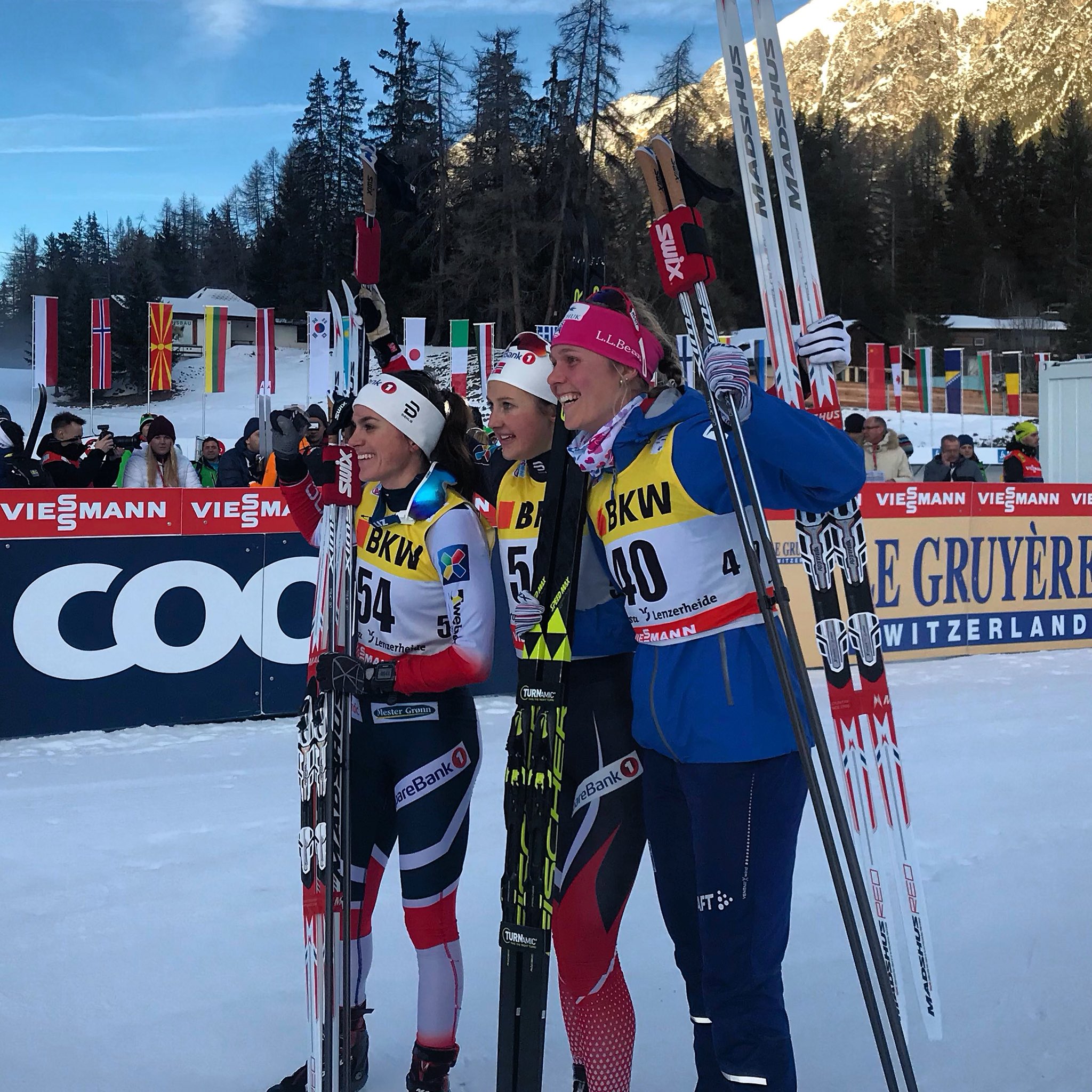
    The women’s 10 k classic podium at Stage 2 of the 2018 Tour de Ski, with Norway’s Ingvild Flugstad Østberg (c) in first and Heidi Weng (l) in second, and American Sadie Bjornsen (r) in third in Lenzerheide, Switzerland. (Photo: FIS Cross Country/Twitter)

    Tour de Ski Stage 2 (Lenzerheide, Switzerland): 10/15 classic

    Women’s report

    Men’s report

    For the second-straight day of the Tour de Ski, an American landed on the podium, with Sadie Bjornsen placing third in the women’s 10-kilometer classic individual start on Sunday in Lenzerheide.

    For Bjornsen, it was her third individual podium of the season and first in a race longer than 5 k.  She finished behind two Norwegians, Ingvild Flugstad Østberg, who took the win in 26:59.4 minutes, and Heidi Weng, who was 25.7 seconds back in second.

    Bjornsen was 42.2 seconds out of first and 6.7 seconds clear of Finland’s Kerttu Niskanen in fourth (+48.9). Sweden’s Anna Haag placed fifth (+52.6), Germany’s Nicole Fessel finished sixth (+58.2), and the second American in the top 10, Jessie Diggins in seventh (+1:04.4).

    Switzerland’s Nathalie von Siebenthal placed eighth (+1:08.3) on home soil, just ahead of Germany’s Stefanie Böhler in ninth (+1:08.8), and Slovenian U23 skier Anamarija Lampič placed 10th (+1:08.9).

    For Østberg, the win came two seasons after she won her very first distance World Cup race in Lenzerheide. With the win she leads the Tour standings by 32.8 seconds over Weng in second. Diggins is up to third overall (+1:04.9) and will start Monday’s 10 k freestyle pursuit accordingly, 1:05 seconds after Østberg, who will head out of the gate first.

    Bjornsen is fourth overall (+1:15.4), just ahead of Russia’s Natalia Nepryaeva in fifth (+1:17.3) while Niskanen is another 15 seconds back in sixth (+1:32.0), and will start the pursuit with American Sophie Caldwell, who was second in Saturday’s Stage 1 skate sprint and ranks seventh overall (+1:32.0). Caldwell placed 21st on Sunday, 1:40.6 behind Østberg.

    “It’s has been a huge goal of mine to be on the distance podium,” Bjornsen said, according to a FIS press release. “It felt really crazy out there today. At the 6.0 km I got the information I was in 2nd place. I had to ski a lot out of the track. I had to give everything I had in the last 2.5 km. I was little bit disappointed yesterday, I was hoping for more so today feels really great.”

    The U.S. had five in the top 30 with Liz Stephen in 28th (+2:04.8) and Ida Sargent in 30th (+2:06.7). For Stephen, it was her first time in the points (top 30) this season. Rosie Brennan placed 38th (+2:20.5). Kikkan Randall did not start and thus withdrew from the Tour.

    Dario Cologna rose to the challenge on Sunday, winning the second stage of the 2018 Tour de Ski for his first World Cup victory in three years.

    The 31-year-old Swiss skier completed the men’s 15-kilometer classic individual start in 35:29.5 minutes, besting the time of Kazakhstan’s Alexey Poltoranin by 0.6 seconds to win in front of a home crowd in Lenzerheide, Switzerland.

    Cologna started 62nd and sped up as the race progressed, clocking the fastest times from 6 k on. Russia’s Alexander Bolshunov started behind him in bib 68 and topped Cologna’s time at every checkpoint, skiing 7.4 seconds faster than him at 10 k. But over the final 5 k loop, Cologna prevailed and Bolshunov faded, with the Russian U23 skier finishing fourth, 14 seconds off Cologna’s winning time.

    “It’s amazing, the first victory in Switzerland,” Cologna told Swiss broadcaster SRF. “I think it’s my 22nd [World Cup win], but the first one at home, which is very beautiful. And after a two-year break it really is a great satisfaction.”

    Poltoranin started 27th and claimed his second podium of the season and first one of the tour, while Norway’s Martin Johnsrud Sundby scored his first podium since early December. Sundby placed third, 13.1 seconds out of first. Russia had two in the top five with another U23 skier, Alexey Chervotkin in fifth (+16.2). Norway’s Hans Christer Holund was sixth (+21.2), Finland’s Iivo Niskanen seventh (+22.9), Italy’s Francesco De Fabiani eighth (+27.2), Norway’s Didrik Tønseth ninth (+37.1), and Russia’s Sergey Ustiugov 10th (+37.1).

    Canada’s Alex Harvey placed 20th (+57.9) and slipped two places in the overall standings to ninth. Russia’s Sergey Ustiugov, who won yesterday’s Stage 1 skate sprint, still leads the standings while Cologna is up to second, just 1.6 seconds back heading into Monday’s freestyle pursuit in Lenzerheide. Bolshunov is third, 12.7 seconds back, Poltoranin fourth (+22.0), Finland’s Ristomatti Hakola fifth (+27.7), Sundby sixth (+39.1), Niskanen seventh (+46.4), Chervotkin eighth (+49.8), Harvey ninth (+53.8), and Holund 19th (+54.5).

    In Saturday’s 15 k classic, Erik Bjornsen led the U.S. men in 27th (+1:22.4), Simi Hamilton finished 58th (+2:41.8), Andy Newell was 71st (+3:11.5), and Paddy Caldwell 75th (+3:36.2).

    Eighty-five men finished the second stage of the Tour de Ski; Canada’s second man, Devon Kershaw, did not race on Sunday and withdrew from the tour due to illness.

    Results:

    Women’s 10 k classic | Women’s Tour standings (through Stage 2) 

    Men’s 15 k classic | Tour standings (through Stage 2)

    Monday start lists: 

    Women’s 10 k freestyle pursuit | Men’s 15 k freestyle pursuit

  • Ustiugov Sets Stage, Wins Tour-Opening Skate Sprint in Lenzerheide

    Ustiugov Sets Stage, Wins Tour-Opening Skate Sprint in Lenzerheide

    Russia’s Sergey Ustiugov (front) leads American Andy Newell (20), Norway’s Finn Hågen Krogh, Russia’s Andrey Larkov (behind Krogh), and Finland’s Iivo Niskanen in Quarterfinal 1 of the Tour de Ski 1.5-kilometer freestyle sprint on Saturday in Lenzerheide, Switzerland. Krogh won that heat, Ustiugov finished second, Larkov was third, Newell fourth, and Niskanen fifth. Ustiugov went on to win the men’s final while Krogh placed fifth overall. (Photo: Fischer/NordicFocus)

    For Sergey Ustiugov, the Tour de Ski (TdS) is picking up where he left it last year. Last January, the 25-year-old Russian finished 2017 Tour’s final competition as the overall winner, earning his first TdS title over Norway’s Martin Johnsrud Sundby. In this season’s first stop — a freestyle sprint in Lenzerheide, Switzerland — the Russian reclaimed the coveted leader’s bib, earning not only the stage win, but the Tour’s overall lead with six stages remaining.

    “I really wanted to win today to start the Tour strong,” Ustiugov said, according to an International Ski Federation (FIS) press release.

    Ustiugov’s opening day began with his qualifier, which he won after covering the course in a time of 2:58.46 minutes. Italy’s Federico Pellegrino posted the second-fastest qualifying time, 1.08 seconds back from the Russian.

    Ustiugov then advanced to the first quarterfinal, along with his teammate Andrey Larkov, Norway’s Finn Hågen Krogh, Finland’s Iivo Niskanen, Sweden’s Calle Halfvarsson, and American Andy Newell (Newell previously qualified in 20th (+5.94)).

    The six balled together into a tight group from the start, with Krogh setting the pace up front and Ustiugov positioning himself at the back heading into the first climb. Halfway through the hill, Ustiugov surged, moving from sixth to second before cresting the top. The Swede’s skis proved faster, however, and by the first descent, Halfvarsson had surpassed Ustiugov, while Newell tucked into fifth between Niskanen and Larkov.

    At the bottom of the course’s second climb, a misplanted pole brought Halfvarsson down. Just behind him, Newell narrowly quickly maneuvered to the right of the fallen skier’s skis to stay in contact with the leaders.

    By the time Halfvarsson picked himself up, the group had reach the top of that climb and a break was beginning to form. Ustiugov and Krogh cruised in the front while Newell chased in third.

    Heading into the final 100-meter stretch, the battle for the top two spots was on: Krogh, Ustiugov, Newell, Niskanen, and Larkov all in the mix. In the end, it was Krogh and Ustiugov who went 1-2, with the Norwegian besting the Russian by 0.07 seconds.

    Larkov finished third (+0.36) and Newell crossed in fourth, 0.55 seconds behind Krogh. Neither Larkov nor Newell advanced to the semifinals, and Newell ultimately placed 19th on the day.

    American Andy Newell racing the men’s 1.5 k freestyle-sprint qualifier at Stage 1 of the Tour de Ski on Saturday in Lenzerheide, Switzerland. He qualified 20th and went on to finish 19th overall. (Photo: Fischer/Nordic Focus)
    “Despite not a great result today my strength, speed, and fitness are all feeling pretty good at the moment so I’m optimistic about the races to come,” Newell wrote in an email. “Always frustrating when you are feeling better than what the results show but sometimes that is sprint racing.
    “I selected a tough heat on purpose to shoot for the A final but as always the quarters were tight and competitive and I was left wishing I could have made better attacks,” he added. “Stoked for the races to come.”
    From there, Ustiugov left no doubt as to how he wanted to start the 2018 TdS and finish Saturday’s sprint. He and Krogh advanced to the first semifinal, along with Pellegrino, Finland’s Ristomatti Hakola, Russia’s Alexander Bolshunov, and Norway’s Emil Iversen.

    In the semifinal, the Russian again took to the back of the pack for the first half of the course, a calibrated move for a racer who is known to prefer to control the pace from the front. The Russian would wait until just before the course’s second major climb to make a move. Nestled behind Krogh with one downhill left, Ustiugov waited for his chance to charge. It came in the final corner.

    As the group rounded the final turn together, Ustiugov, Pellegrino and Krogh skied side by side, as if their skis were linked together with string.

    In a photo finish, it was Ustiugov who crossed first in the semifinal, 0.04 seconds ahead of Pellegrino, who was just 0.02 seconds ahead of Krogh. The first of the day’s two lucky loser spots went to Krogh, the second went to Hakola in fourth (+1.11).

    Heading into the final, it was Ustiugov, Pellegrino, Hakola, Krogh, Jouve, and another Frenchman, Lucas Chanavat, who had won both his quarterfinal and semifinal after qualifying in third.

    By this time, Ustiugov’s tactic had changed. The cat was out of the bag and he was ready to lead. From the start he raced at the front, and Chanavat positioned to his left as they moved through the first climb. Pulling hard to their right was Pellegrino in third.

    Ustiugov drove the front, pulling the rest of the finalists behind him. By the second climb it became obvious the Russian was ready to get what he came for. He gapped the field, leaving everyone but Pellegrino and Chanavat behind. In the finishing stretch, Ustiugov continued to distance himself from his competitors, finishing first in 2:57.28 while Pellegrino crossed 1 second later in second place and Chanavat finished 2.76 seconds back in third.

    “The result is fine but I had some troubles with my legs today and I think that is from the training period before the start of the Tour,” the 27-year-old Pellegrino said, according to FIS.

    France’s Lucas Chanavat (3) racing to his first individual World Cup podium at Stage 1 of the 2018 Tour de Ski, the men’s skate sprint in Lenzerheide, Switzerland. (Photo: Fischer/NordicFocus)

    For Chanavat, 23, Saturday marked his first individual World Cup podium.

    “I knew the second lap is going to be the most important one,” Chanavat told FIS. “Ustiugov was really strong on the flats but I could keep up with him. I was little bit struggling on the uphill. In the end I was lacking the speed on the home stretch but I am very happy for my first podium.”

    Hakola finished fourth (+5.91), Krogh fifth (+14.39) and Jouve sixth (+21.01). Rounding out the top 10 was Canada’s Alex Harvey in seventh, Switzerland’s Jovian Hediger in eighth, Bolshunov in ninth, and Great Britain’s Andrew Young in 10th.

    Harvey’s seventh place was the top North American finish on Saturday and puts him in seventh in the overall standings. After qualifying 18th (+4.98) he advanced to the fifth quarterfinal. There, he took a lesson from Ustiugov’s book and paced the first half of the course before making his move. It was not until halfway through the second climb that the Canadian made his way from sixth to second, slipping in behind Switzerland’s Roman Furger. By the final descent, Harvey had moved into the front. Waving to the crowd as he crossed first in his heat was Harvey in a time of 2:58.8, 0.56 seconds clear of Young in second place.

    Both Harvey and Young advanced to the second semifinal, where the Canadian finished third, 0.01 seconds behind France’s Jouve, who automatically advanced in second (0.34 behind Chanavat in first). For Harvey (and for Young, who placed fifth in that heat), that was the end of the road. He missed the final by one-hundredth of a second.

    “Body felt great again. I feel like I did 2 mistakes though, first one was when I took the lead heading into the 2nd lap,” Harvey wrote in an email. “I kinda eased up a tiny bit and Chanavat took me by surprise when he launched into the hill, he gapped me instantly. I should have driven it hard as soon as I took the lead.

    “Second mistake was when I was trying to overtake Jouve, I tried to take go by him on the outside right at the bottom on the downhill, and then again in the last corner before the finish,” he continued. “Looking back I should have just chilled behind him in those two corners, not ski the longer way outside and where the snow was a bit slower and the just have a tiny more power for the finishing stretch…0.02s more extra power could have gone a long way.”

    “It’s still very early in the Tour but so far so good,” Harvey concluded. “I have a bit of an advantage on the allrounders, other than Finn and Usti, so that’s nice.”

    Leading the U.S. men was Simi Hamilton, who qualified in 15th and advanced to the second quarterfinal. Out of the start, Hamilton stayed in the back of the pack, pacing off Pellegrino in fifth. Hakola manned the front through the first climb. Heading into the first descent, Hamilton picked off two positions, moving into fourth behind Hakola, Norway’s Sindre Bjørnestad Skar, and France’s Baptiste Gros.

    After a tight corner with Gros, Hamilton edged into third for the course’s flatter V2 section before the second major climb. The group continued uphill, Hakola and Pellegrino now charging up front. Corning into the final stretch, Pellegrino had created enough of a gap to ease into the finish, crossing first 0.35 seconds ahead of Hakola in second and 0.56 seconds ahead of Hamilton in  third. That finish put Hamilton in 15th at the end of the day.

    Two Americans finished in the top 10, with Newell in 19th, and Erik Bjornsen qualified for the heats in 27th and went on to place 25th overall after finishing fifth in his quarterfinal.

    “Andy and Simi were right there in the middle of their heats, but today you just needed to be in a more aggressive position later in the course because the moves that these guys are often able to make weren’t possible today, so they’re a little frustrated I think,” U.S. coach Matt Whitcomb said on the phone. “And I think if we were to go back and do this again, we would ski the middle section of the course very aggressively and just put ourselves in front.”

    Last year, Bjornsen completed the Lenzerheide freestyle sprint qualifier, cooled down and went back to the hotel without racing the heats. He had finished 69th, missing the top 30 necessary to qualify by 5.76 seconds.  

    “I’m not a regular heat skier, so just making the heats is usually my goal going into them,” Bjornsen wrote in an email on Saturday. “Today I was happy to feel strong in the heats and mix it up a bit.”

    To kick off the 2018 TdS, Bjornsen bettered his finish by almost threefold. He qualified in 27th, 6.95 seconds behind Ustiugov, and then faced off with Jouve, Hediger, Bolshunov, Iversen, and Finland’s Martti Jylhä.

    “Hopefully I can get some more practice in them because every time I  feel a little more comfortable,” Bjornsen continued. He is currently 29th in the tour standings, based on adjustments for qualifying time and time bonuses. “Being in 29th is great but it’s really to early to start looking at overall tour position for me. The distance races are usually what start spreading people out.”

    Out of the gate, Bjornsen tracked to the back, skiing in fifth just behind Iversen and Jylhä, while Hediger and Bolshunov commanded the front.

    By the top of the first climb Bjornsen had moved around the inside of Jylhä and up into third. With the cheers of a homecrowd pushing him along, Hediger continued to lead up the second major climb. Bjornsen slightly lost contact in fifth as the group descended toward the finishing stretch, and in the final meters, it was Iversen clinched first, 0.2 seconds ahead of Jouve in second. Bjornsen finished fifth, 0.82 seconds out of first, to end up 25th overall.

    Also racing for the U.S., was Paddy Caldwell who finished the qualifier in 74th. Devon Kershaw, the only other Canadian racing this year’s TdS, placed 86th out of 94 racers on Saturday.

    Results: Qualifier | Final | Tour standings (through Stage 1)

    –Harald Zimmer, Jason Albert, and Andrea Potyondy-Smith

    Russia’s Sergey Ustiugov (c) after winning the first race ot the 2018 Tour de Ski, the men’s 1.5-kilometer freestyle sprint on Saturday in Lenzerheide, Switzerland. Italy’s Federico Pellegrino (l) placed second and France’s Lucas Chanavat (r) finished third. (Photo: Fischer/NordicFocus)
  • Tour de Ski Rundown: Caldwell 2nd on Day 1; Van der Graaff and Ustiugov on Top

    Tour de Ski Rundown: Caldwell 2nd on Day 1; Van der Graaff and Ustiugov on Top

    The women’s top-three finishers (below) after Stage 1 of the 2018 Tour de Ski, with (from left to right) American Sophie Caldwell in second, Switzerland’s Laurien van der Graaff in first, and Norway’s Maiken Caspersen Falla in third. Above, van der Graaff acknowledges her home crowd after winning her first World Cup in Lenzerheide, Switzerland. (Photo: FIS Cross-Country/Twitter)

    FIS Cross-Country Tour de Ski (Lenzerheide, Switzerland): Stage 1 freestyle sprint

    Women’s report

    Men’s report

    Sophie Caldwell is back on the podium. It’s been two years since the 27-year-old U.S. Ski Team sprinter won an individual World Cup race and became only the third woman in U.S. history to to do so. That was also in the Tour de Ski — but in a classic sprint.

    In the time since, the U.S. women’s team has racked up several more podium accolades. Jessie Diggins has recorded three individual World Cup wins (and two World Championships medals), Sadie Bjornsen has notched three individual podiums (and a World Championships team sprint silver with Diggins) in the last year, and Kikkan Randall raced to bronze in the 2017 World Championships skate sprint.

    But Saturday, the first day of the 2018 Tour de Ski, was Caldwell’s moment to stand on the second step of the podium. She started the morning by qualifying third in the women’s 1.5-kilometer freestyle sprint in Lenzerheide, Switzerland, 2.33 seconds behind Norway’s Ingvild Flugstad Østberg, who won the qualifier in 3:29.19 minutes. Diggins qualified second, 1.41 seconds off Østberg’s time.

    Five out of the seven U.S. women entered in the Tour qualified in the top 30 to advance to the heats, with Bjornsen clocking the 13th fastest time (+5.20), Rosie Brennan 15th (+5.27), and Ida Sargent 30th (+8.69). Randall finished 44th and Liz Stephen 66th out of 71 in the women’s qualifier.

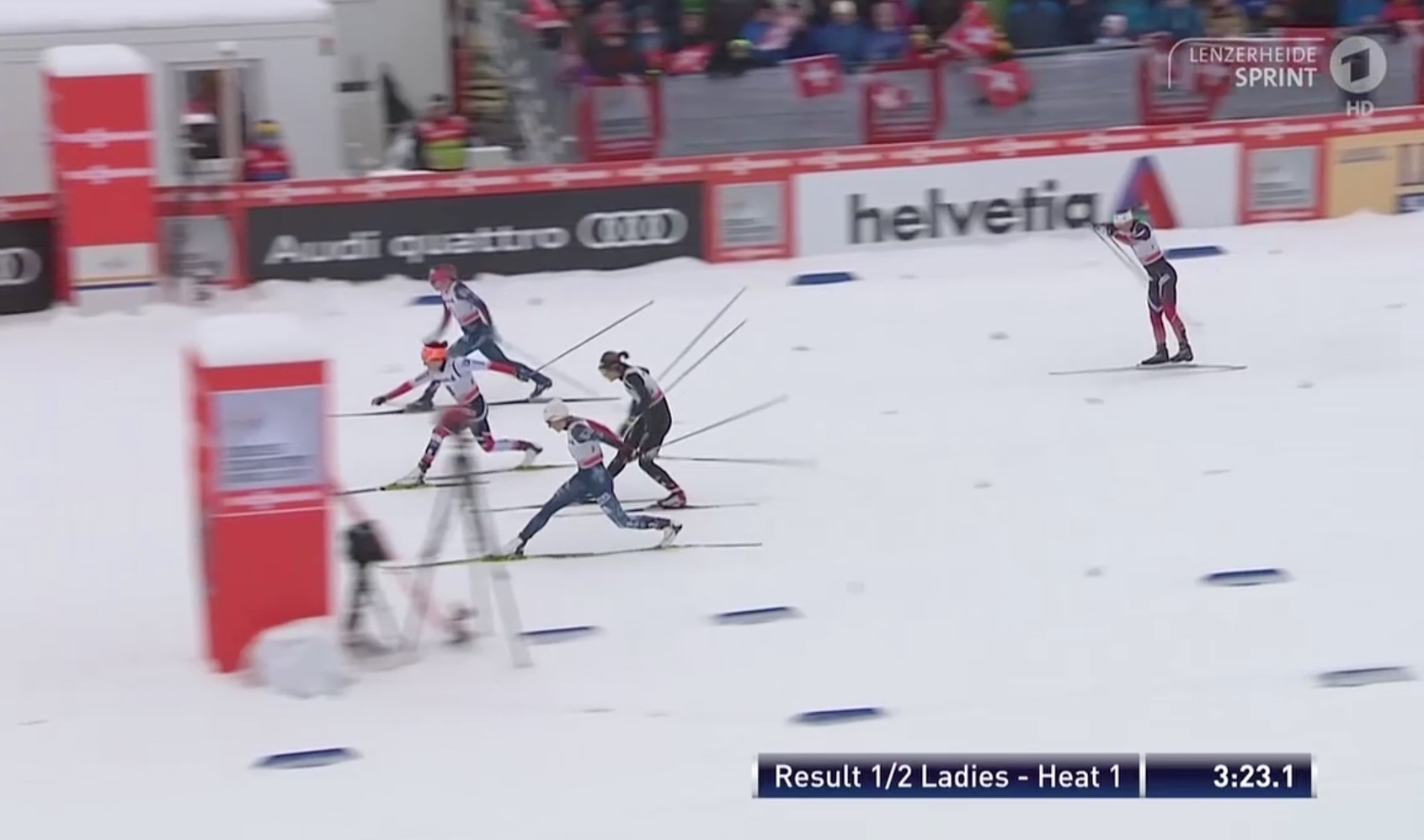
    A three-way photo finish for first in the first women’s semifinal, with Americans Jessie Diggins (far side) and Sophie Caldwell (near) lunging at the line with Norway’s Maiken Caspersen Falla (pink headband). Falla won that heat, Caldwell was second and Diggins third, while all three plus Switzerland’s Laurien van der Graaff in fourth (in black) advanced to the final. (Screenshot: ARD broadcast)

    Caldwell went on to win the first quarterfinal and place second in the semifinal by just six-hundredths of a second (behind Norway’s Maiken Caspersen Falla, who won the first semifinal).

    Diggins advanced in second in her quarterfinal, 0.54 seconds behind Østberg who won that heat, then raced to third in the first semifinal, just another hundredth of a second behind Diggins. The final featured the two Americans as well as local favorite, Laurien van der Graaff of Switzerland, Falla, Russia’s Natalia Nepryaeva, and Germany’s Sandra Ringwald.

    In front of friends and family, Van der Graaff went on to take the win — her first and Switzerland’s first on home soil since Toni Livers won in Davos in 2007.

    She won the final in 3:25.8, 1.42 seconds ahead of Caldwell in second. Falla placed third (+1.86), Nepryaeva took fourth (+3.17), and Diggins finished fifth after breaking her second pole of the day (she previously broke a pole and skied a while without one in the quarterfinal). Ringwald fell and finished sixth (+31.68).

    Van der Graaff had previously qualified fourth then won her quarterfinal and advanced as a lucky loser from the first semifinal, where she placed fourth behind Falla, Caldwell and Diggins.

    “It’s incredible. I mean, to win on this course, home, is just crazy,” van Der Graaff said in a post-race interview with the International Ski Federation (FIS).

    Bjornsen and Brennan finished the day in 14th and 15th, respectively, after placing third in their quarterfinals. The U.S. had five in the top 20 with Sargent in 20th, after she placed fourth in her quarterfinal.

    The men’s podium after the Stage 1 freestyle sprint of the 2018 Tour de Ski, with Russia’s Sergey Ustiugov (c) in first, Italy’s Federico Pellegrino (l) in second, and France’s Lucas Chanavat (r) in third. (Photo: FIS Cross Country/Twitter)

    In the men’s 1.5 k freestyle sprint, the defending Tour de Ski champion, Sergey Ustiugov of Russia, won his first World Cup race of the season by 1 second over Italy’s Federico Pellegrino.

    Ustiugov started off by winning the qualifier in 2:58.46, and Pellegrino qualified second, 1.08 seconds off the Russian’s time. Ustiugov then raced to second in the first quarterfinal, just 0.07 seconds behind Norway’s Finn Hågen Krogh in first. In the second quarterfinal that followed, Pellegrino took the win over Finland’s Ristomatti Hakola in second (+0.35).

    The first semifinal featured a three-way photo finish for first, with Ustiugov edging Pellegrino by 0.04 seconds and Krogh by 0.06 seconds. Hakola finished fourth (+1.11) in that heat to advance to the final as well.

    There, the 25-year-old Ustiugov was first across the finish line in 2:57.28. Pellegrino claimed second (+1.0), and France’s Lucas Chanavat — whom had qualified third and won both his quarterfinal and semifinal — reached the podium in third (+2.76). Hakola was fourth (+5.91), Krogh fifth (+14.39), and the second French skier in the final, Richard Jouve sixth (+21.01).

    Canada’s Alex Harvey missed reaching the final by one-hundredth of a second, placing third in Chanavat’s semifinal after a photo finish for second place. While Chanavat won that heat by 0.34 seconds over his French teammate Jouve, Harvey was another 0.01 seconds back in third. Ultimately, Harvey placed seventh overall (he started the day by qualifying in 18th).

    Three out of four American men qualified for the heats, with Simi Hamilton in 15th, Andy Newell in 20th and Erik Bjornsen in 27th. Hamilton finished the day in 15th as well after placing third in his quarterfinal, Newell ended up 19th after finishing fourth in his quarterfinal, and Bjornsen was 25th after taking fifth in his quarter.

    Paddy Caldwell finished 74th in the qualifier for the U.S. Canada’s second man in the Tour, Devon Kershaw finished 86th out of 94.

    Qualifier results: Women | Men

    Final results: Women | Men

  • Closing the Gap: Racing in the Dark

    Closing the Gap: Racing in the Dark

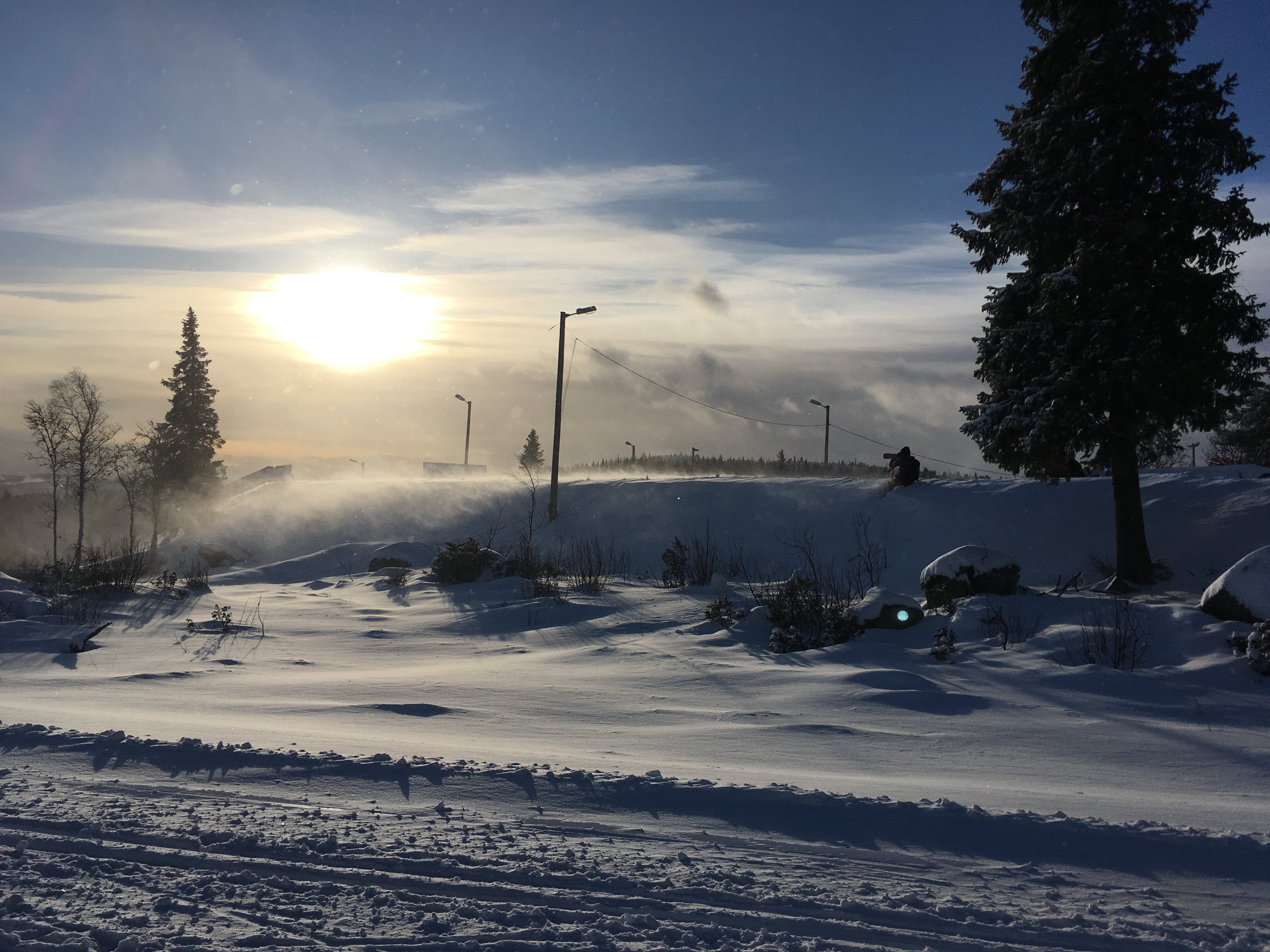
    Soft Scandinavian Cup track as seen last weekend at the Dec. 15-17 Scando Cup in Vuokatti, Finland, “the same conditions for Sundby all the way down to me,” author Maks Zechel writes.

    Editor’s Note: The following is part of a series proposed by Maks Zechel, a 20-year-old Canadian cross-country skier embarking on his first season training abroad. In August, he made the big move to Norway, where he’ll be training and racing with Team Asker for the entire winter. Through these updates, Maks hopes to share his personal “observations, stories and lessons learned” to help close the gap between North American and Scandinavian nordic skiing. Previous posts: #1, #2, #3, #4, #5, #6, and #7.

    ***

    Part 1: Vuokatti

    It’s Thursday morning and I’m in the Oslo airport, waiting to catch a flight to my second Scandinavian Cup race weekend of the winter. I haven’t seen the sun yet and, from what I’ve heard, my destination of Vuokatti, Finland, doesn’t look much like a Caribbean postcard either.

    Two flights and an hour on a bus later, we arrive in Vuokatti. There is something about 3 p.m. total darkness that I suspect I will never grow accustomed to; it’s the impending sense of urgency that I need to go to bed soon. Or maybe that’s just coming from the fact that I still have to check into the hotel, ski the race loop, test skis, eat dinner, and then write my final exam for my online university course. By the time I start my exam, and reboot my laptop after it crashes, it’s 8 p.m. … classic.

    We wake up before the first race in the dark. The sun allegedly rises into the cloudy, snowy sky at 9:59 a.m. and sets at 2:07 p.m. Despite our noon start time, the trails remain cast in dusky shadows, and the entire race loop, and ski jumps overlooking the stadium, remain lit 24/7. For the record, I spent approximately 72 hours in Finland, and I can’t confirm that the sun actually touches that part of the world; for all I witnessed they might just brighten the streetlights every morning.

    We jog a few hundred meters from the hotel to the race site, located by the Vuokatti Olympic training center. All the racers are staying in two large hotels within walking distance of the race site, which creates an exciting “athlete village” atmosphere. Vuokatti is an epic training and racing location with 7.5 k+ of lit world class ski trails, early season snow making, a ski tunnel, and ski jumping and biathlon venues. Nordic countries don’t seem to like hosting races anywhere with a big chalet, or with any chalet at all, so we set up base in the snow. Luckily for us, the infamous Finnish cold weather decided to leave for the weekend. The stadium is tiny, hardly wide enough for a finishing straight, miniscule individual start corral, and a lap lane. It’s easy to feel lost amongst the tall, uniform pines of a snowy Finnish forest, but the Vuokatti course has something for everyone. Each day, 200-250 participants are on the senior men’s start line, with Norway, Sweden and Finland well represented; the top 100 doesn’t get more competitive than this anywhere in the world.

    As I’m warming up for my 15 k skate race, I have never recognized so many people that I’ve never seen before in real life: “Oh hey random Norwegian skier, congrats on beating your 3000-meter track PB this summer! By the way, say hi to your dog for me.” The potential for a seriously awkward conversation with one of my idols is too high, so I try my best to avoid in-awe-eye-contact…

    Norway’s Johannes Høsflot Klæbo in his debut race of his record-setting 2017/2018 season. In eight World Cup starts so far, he’s won seven of them. Here he’s shown racing at Norway’s FIS season opener in Beitostølen last month. (Photo: Maks Zechel)

    At the end of the first day our teammate, Erland, placed 19th, with Ryan and I at 107th and 132nd. After racing in the Beitostølen Scandinavian Cup and Gålå Norwegian Cup race weekends in November, it remains hard to swallow our pride as we race better than we ever have, but still fall far short of our lofty goals.

    However, the lessons that we learn in every international race that we compete in are crucial to our development. During the 15 k classic race in Vuokatti, my teammate, Eirik, was caught by the eventual top-two skiers of the day, Ristomatti Hakola (Finland) and Martin Nyenget (Norway). Eirik is a strong double poler, so he was impressively able to stay with them until the set of steep hills in the last 2 k of the course, where they put around 50 seconds into Eirik per lap. What he was unable to match, was the insane power that Hakola and Nyenget were kicking their skis with, giving them big glides on even the steepest pitches where I had to run out of the tracks

    Racing with athletes who are able to ski at this level creates an unforgiving racing environment if you are unable to push yourself to new heights. After a poor race, the performance is reflected by a drop of dozens of spots down the results sheet. Scandinavians respect the high level of these races and they know that there are hundreds of skiers working just as hard as them, ready to take their place if they don’t race fast. Poor races by even the best cause them to disappear down the results (Petter Northug finished 17th in a Norwegian Cup race this winter). Although Erland is an incredible skier who is capable of top-20 Scandinavian Cup results, he had placings of 89th and 47th in Beitostølen. This is nothing to be ashamed of, but the results clearly represented that he was not in top form at the time. Good performances are rewarded in the opposite manner. That is the nature of these races, where 1 minute gained or lost can mean 30-50 spots. In the Vuokatti sprint, the top-30 men in qualifying were all within 5.87 seconds, with the top 58 within 10.55 seconds, and top 84 within 15.15 seconds. The reality is harsh, but it feels productive to know exactly where I stand against the best.

    World Cup racing is ridiculously hard, and that is a lesson that should be experienced as early as possible. When I was 132nd in the 15 k skate race in Vuokatti, a good race for me, it felt like a smaller reward than I was used to for my efforts. It’s easy to feel overwhelmed by the sheer number of competitors, but it helps to look at the time gap when looking for achievable next steps. In this race I was 4:38 minutes behind race winner, Daniel Stock (Norwegian skier with a World Cup podium from last year). It’s a lot over a 38-minute race, but if I can shave off 1 minute by the end of the season, then I’m in the top 100. Wherever I place, at the end of the day I know how far away I am from top World Cup contenders. Doing these races doesn’t make getting fast easier, but it does put into perspective exactly how much my efforts and improvements mean on an elite level.

    Every weekend these races feel a little more familiar, a bit more like home. The competition is intimidating, but every race still has the same enthusiastic community of athletes, volunteers, coaches, wax techs, friends, and families that we are used to in Canada. In Beitostølen, a stressed Ryan was enthusiastically interviewed four minutes before his race start and the NRK commentators talked about our goals in Norway and this FasterSkier blog for over a minute on national television. In Vuokatti, the race announcer introduced us as the two Canadians living in Asker, Norway, with their goal of becoming two of Canada’s best World Cup skiers. It’s flattering to be known like this, despite struggling to come even close to the top 100, and it makes us feel like we belong. Soon enough we will make sure we are known for more than just booking a couple of plane tickets to Norway.

    Part 2: Getting to the Top

    Author Maks Zechel repping the Asker Skiklubb white and blue.

    Racing in Scandinavia is like getting on the freeway out of the city at 5 p.m. on the Friday of Thanksgiving weekend; everyone is heading in the same direction, and no matter who you are, you have to be patient and observant in order to seize the opportunities that will bring you to the front of the never-ending queue. In Canadian racing, we often lack this traffic, and this causes skiers to race at their own level, because there aren’t enough skiers of similar abilities to push each other to the top. I believe that it is still possible to become a great skier from racing in North America, but we have to be prepared to take even bigger risks than our Scandinavian counterparts, as we can be sure that they are encountering far more opportunities than us.

    From my experiences watching NorAm, SuperTour, Scandinavian Cup, and World Cup results, the best skier of the day will often win a three-lap 15 k with a certain order of lap times: the first lap is the fastest to take advantage of fresh legs, the second lap is the slowest, and the the third lap is the second fastest. These margins are small, but they indicate a skier who has skied a smart and controlled race, riding the edge of blowing up in order to expend energy perfectly and close fast where weaker skiers tire. This is how a winner skis a race. The skiers who don’t win the race ski differently because they are not at the same level. If they ski in the same controlled manner, they fall short of the win because they cannot maintain the same pace/execute the same pace changes. A dark horse who is trying to win, or merely trying to break through the ranks, gives everything in an effort to ski at a level that is higher than they can actually maintain. They may try to go out as hard as possible, risking blowing up early with the hope that they will be able to maintain a “suicide pace”. The skiers who don’t control the race usually ski with positive splits, becoming slower each lap on a good day, because if their splits are negative it means they will lose too much time at the start of the race.

    In North America, we get comfortable skiing like winners. The shock comes when we try to make the jump to World Cups, and we suddenly have to relearn how to ski like developing skiers, to ski like we are trying to break through to the top.

    Here’s a fact: nobody comes to World Cups from North America and starts winning right away. The jump is too big to make all at once. Scandinavians can sometimes go straight to the top, because they had to grow up skiing like losers, or at least skiing like winners who had to fight against 30 other winners every race. The issue is that North Americans begin to relearn the lessons of devastating time gaps at an important point in their careers, when ideally they would be fighting competitively for coveted World Cup top 30s. We’re not developing as much as we could at home, because we’re not desperately fighting just to come top 50 or top 100 as juniors and U23s. Not to say that you can’t develop hugely between the ages of 25 and 35 (many do), but we rarely see this happen in North America because the attrition rate of skiers in that age range is so high. Many skiers never see their full potential realized.

    In North America, we get comfortable skiing like winners. The shock comes when we try to make the jump to World Cups, and we suddenly have to relearn how to ski like developing skiers, to ski like we are trying to break through to the top.

    In Vuokatti, numerous small skiing nations were well represented, countries that we North Americans would see as “lesser” skiing nations, when in fact they’re doing things better than us. The Vuokatti Scandinavian Cup saw a large contingent of Chinese national-team skiers compete, and at Beitostølen, Japan was well represented. I even saw a couple of Mongolian skiers in Finland. These national-team skiers are consistently starting Scandinavian Cups in their pursuit of becoming competitive on the World Cup (zero Chinese skiers started the Toblach World Cup, while 10 Chinese men and women started in Vuokatti the same weekend). These small skiing nations recognize that they cannot develop all of their athletes through World Cup starts, so they send their remaining skiers to the next best thing. This mentality has led Japan to produce podium-capable World Cup skiers such as Masako Ishida and top 15 contenders such as Keishin Yoshida.

    We need to fill up our quota spots on the World Cup, but for the rest of us, Scandinavian Cups are an equally good opportunity to develop. A month of World Cup racing can cost a Canadian National Team member upwards of $5,000 Canadian dollars (not including flights). Last winter Team Hardwood Elite ran a one-month trip from Canada to Norway for $2,700 CAD (flights included) per athlete, where they raced nine Scandinavian- and Norwegian Cup-level races. We shouldn’t scoff at local-level Norwegian races either, which can be found all over the country every weekend of the winter. Sondre Turvoll Fossli, a World Cup medalist, won a local race, with a senior men’s field of 12, in Lier, the same weekend as Toblach and Vuokatti. At a local race in Konnerud the weekend before, I was bib number 1051 as the last starter of the day. Only 17 senior men raced, but the winner has placed top five in Norwegian Cups.

    Many North American skiers want to break through on the World Cup, but there are limited World Cup starts that offer a small and difficult opportunity for us to impress on a stage that we have never experienced before. The chances of breaking through this way have proven nearly impossible for numerous talented North Americans. For the countless incredible skiers who didn’t even receive those World Cup opportunities, the chance of World Cup success is a long-dissolved dream. This builds the impression that only a select few North American skiers can ever be great. This is untrue. The truth is that only a select few will ever break through when offered a handful of World Cup-level racing opportunities. The truth is also that us remaining North Americans have the ability to achieve that same level, but we must do so more patiently and down a less traditional path. If you truly want a chance at becoming competitive on the World Cup, you don’t have to fight for years to qualify for a World Cup development experience that most of us cannot afford. Instead you can race as many Scandinavian/Norwegian Cups as you like, every year, at a far cheaper cost, which will allow you to race against skiers who are already at the World Cup level that many of us dream to achieve. These skiers are no more talented than our skiers, they just have had the time and the countless opportunities to race at a level that most of us never have the chance to see.

    This leaves an important question: who is left to race in North America? It is hard to develop our best senior athletes to become World Cup podium contenders, it is harder still to do this in such a way that will allow all of our younger skiers to develop, too. My experience in Norway has been a positive one so far, and I will continue to promote what I am doing. But I should not have to come to Norway to develop. The simplest way for an individual to learn to race like the Scandinavians is to come to a country like Norway, but by individually developing overseas, we put a stop to the widespread development that we could be doing back home.

    Norwegians are successful at skiing because they love it; skiing is everywhere in Norway, and for that reason Norwegians never have to go far from home to ski fast. Top Norwegian skiers race in local races because they know that good racing is great development, no matter who you’re racing against. If we want races to be competitive, then it’s up to us to race fast.

    Youth and masters alike getting some early season ‘ k’s in on Nakkertok Nordic’s “Nakkertrak” on opening day Nov. 11, 2017. (Photo: Nakkertok Ski Club)

    My home club, Nakkertok Nordic, was able to purchase snowmaking equipment last year. Due to the enthusiasm and incredible dedication of the parents and volunteers who are the backbone of Nakkertok, they were able to host two early season race weekends this year, just outside of Ottawa (a city of 900,000 people). Ottawa is in an excellent central location for Eastern Canadians and Americans. The same weekend as the Dec. 15-17  NorAm race weekend in Rossland, over 200 people raced the Candy Cane Cup on the “Nakkertrak” early season snow loop. In the future, I see this becoming a main event in an early season racing series, where athletes race in Craftsbury, Vermont, at their annual early season races, then drive the mere four hours to Ottawa for two back-to-back high level FIS races. Eastern Canada and the U.S.A. are full of the skiing culture that makes Norway so great, our issue is that we fail to coordinate to create the fantastic race opportunities that we could have. Many top Canadian skiers already travel to Craftsbury at the beginning of the winter to be in a race where Patrick Caldwell takes the win and the field is deep with professional, university, high-school, and part-time racers of all levels. There is a fear in Canada of burning young athletes out by letting them race up. I agree, we shouldn’t just allow our “prodigies” to race up; I think that everyone from age 16 and up should race together. Development as a skier is only loosely correlated to age, and I am grateful at every training session with Team Asker for the young junior skiers that kick my butt in workouts. Our egos have to be thrown aside, because the more we segregate our racing categories, the less we can help each other get faster in the way that the Norwegians do.
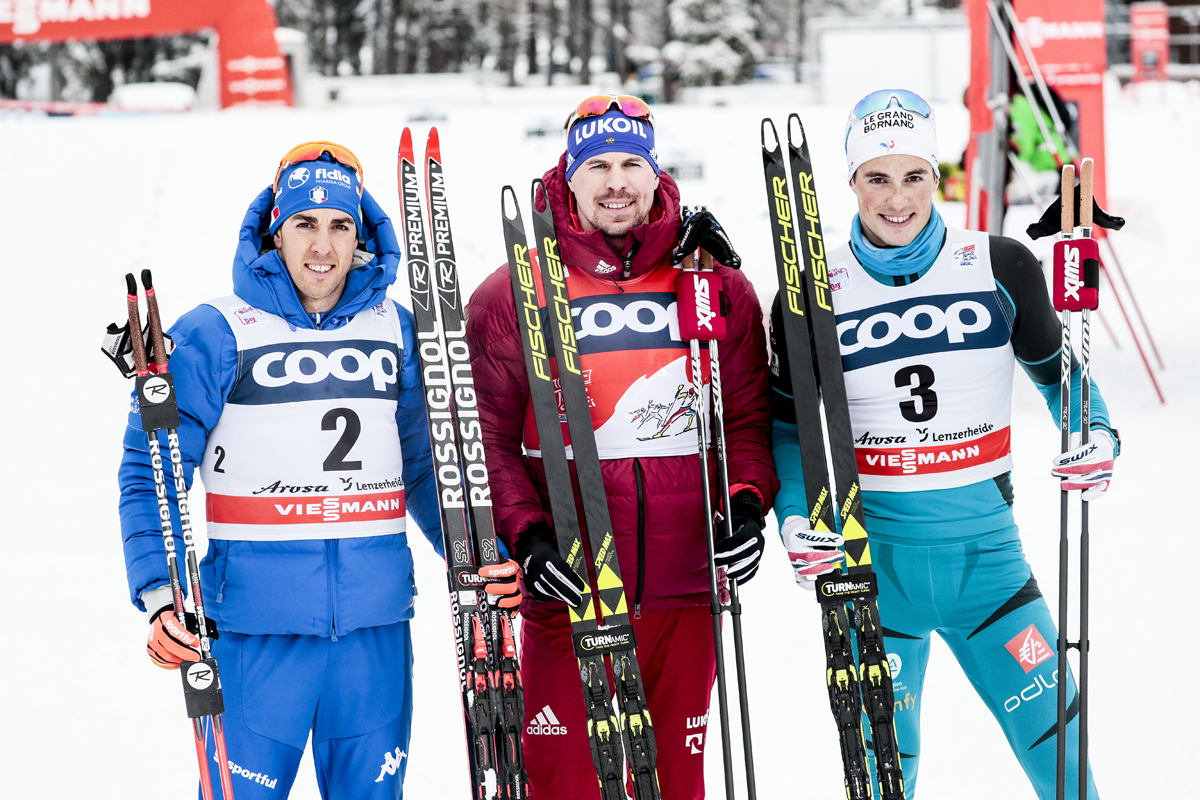
    The simplest way for an individual to learn to race like the Scandinavians is to come to a country like Norway, but by individually developing overseas, we put a stop to the widespread development that we could be doing back home.

    Many Norwegian skiers race almost every weekend, all winter long. We have to create these same local racing opportunities, and if we make them accessible, they will soon turn into world-class events. Nakkertok took a race, which has simply been a club time trial in past years, and turned it into a CPL (Canadian Points List) level race with a field of 68 open men and 45 open women in one year (that is a bigger field than the Rossland NorAm). The depth of such events, with their diverse assortment of competitors, creates an environment where both our top racers and our developing racers can grow. An athlete is much less likely to quit skiing if they are regularly racing in a field with dozens of skiers at their level and with similar ambitions of going to university or working full time, all while skiing as fast as they can. Because you know what, racing is really fun, but only if it is a commodity made accessible to every North American skier, not just our Olympic hopefuls.

    A local race in Sjusjøen, Norway, with hundreds of racers of all ages. (Photo: Maks Zechel)

    About Maks: Maks Zechel is a competitive cross-country skier who secretly wants to become a professional mile runner. He loves hiking and going on canoe trips with his family, as well as peanut butter cups in ice cream. Johan Olsson is his favourite skier and he hopes to race the Cortina-Toblach stage of the Tour de Ski one day. He enjoys writing about his experiences. Follow him on Instagram @makszechel.

  • Saturday Rundown: Davos, Hochfilzen and Sovereign (Updated)

    Saturday Rundown: Davos, Hochfilzen and Sovereign (Updated)

    Bob Thompson (304) of NTDC Thunder Bay leading Sun Valley’s Jack Hegman (307) and Patrick Stewart-Jones (317) of the AWCA during their quarterfinal of the NorAm men’s 1.3 k classic sprint on Saturday at Sovereign Lake near Vernon, B.C. (Photo: Peggy Hung)

    NorAm/SuperTour (Sovereign Lake near Vernon, British Columbia): Classic sprints

    On the opening day of the NorAm Continental Cup series in Canada (which doubled as a U.S. SuperTour), American Kaitlynn Miller of the Craftsbury Green Racing Project (CGRP) started Saturday with a nearly three-second win in the classic-sprint qualifier at the Sovereign Lake Nordic Centre, then went on to win her quarterfinal and semifinal before topping the final as well.

    The women’s 1.3 k classic sprint podium and top five at the first NorAm of the season on Saturday at Sovereign Lake near Vernon, B.C., with (from left to right) Caitlin Patterson (CGRP) in second, Kaitlynn Miller (CGRP) in first, Hannah Halvorsen (APU/USST) in third, Kelsey Phinney (SVSEF) in fourth, and Liz Guiney (CGRP) in fifth. (Photo: Peggy Hung)

    Miller was the fastest women’s qualifier by 2.87 seconds on the 1.3-kilometer course with a time of 2:59.39. Ultimately, she won the final in 2:57.53, 0.93 seconds ahead of her teammate Caitlin Patterson in second and 2.59 seconds clear of the third American on the podium, Hannah Halvorsen of Alaska Pacific University (APU) and the U.S. Ski Team (USST) D-team, in third place.

    Halvorsen previously qualified third behind Kelsey Phinney, of the Sun Valley Ski Education Foundation (SVSEF) in second. Phinney finished fourth in the final (+2.85), while a third Craftsbury skier, Liz Guiney placed fifth (+3.53). The lone Canadian in the six-woman final, Sophie Carrier-Laforte of the Pierre-Harvey National Training Centre (CNEPH) placed sixth (+4.38).

    Thompson Fends Off Five Americans

    Of the six racers in the men’s 1.3 k freestyle sprint final, five of them were American. Bob Thompson, of the Thunder Bay National Team Development Centre (NTDC), bested them all for the win in 2:29.31, just 0.03 seconds ahead of Ben Saxton, of the Stratton Mountain School (SMS) Elite Team, in second place. Cole Morgan (SVSEF), the qualifying winner who had so far dominated all of his heats, ended up third overall, 0.48 seconds behind Thompson.

    Sun Valley and APU each had two athletes reach the men’s final with Jack Hegman (SVSEF) taking fourth (+0.51), and APU’s Reese Hanneman and Tyler Kornfield placing fifth (+7.75) and sixth (+7.9), respectively.

    To start the day, Morgan posted the fastest men’s qualifying time in 2:31.00, while last weekend’s SuperTour skate sprint winner Nick Michaud, of the Bridger Ski Foundation (BSF), qualified in second, 0.78 seconds back. Americans took the top-three qualifying spots with Logan Hanneman (APU) in third (+1.59), while Thompson was the top Canadian qualifier in fourth (+2.34).

    Morgan won both his quarterfinal and the first semifinal to advance to the final, along with Thompson who placed second in that semifinal (and placed second to Hegman in the quarterfinals). Saxton won the second semifinal (after finishing second to Logan Hanneman in the quarterfinals) and Kornfield was second behind Saxton in that semifinal to automatically advance to the final. Reese Hanneman and Hegman made it to the final as lucky losers after placing third and fourth, respectively, in the first semifinal.

    Live results

    Qualifier results

    ***

    IBU World Cup (Hochfilzen, Austria): Men’s and women’s pursuits

    Men’s report

    Norway’s Johannes Thingnes Bø notched his second-straight win in Hochfilzen after Martin Fourcade of France missed three on the final shooting stage of the men’s 12.5 k pursuit on Saturday. Bø, who started the race 12 seconds ahead of Fourcade in second, cleaned the final standing stage to leave the range nearly a minute ahead of Slovenia’s Jakov Fak in second. Meanwhile, Fourcade, who had been skiing in first just ahead of Bø before the last stage, dropped 1:19 minutes back to fifth.

    Norway’s Johannes Thingnes Bø (1) heading out of the start, 12 seconds ahead of the second starter, France’s Martin Fourcade (yellow bib), on Saturday in the IBU World Cup men’s 12.5 k pursuit in Hochfilzen, Austria. (Photo: IBU/biathlonworld)

    While Bø skied the win in 36:41.1 minutes and Fak, the third starter, finished 58.8 seconds later in second place, Fourcade made up two places on the final loop to place third (+1:10.0) after passing Germany’s Simon Schempp and Russia’s Maxim Tsvetkov.

    Schempp settled for fourth (+1:10.5), and Bø’s older brother, Tarjei Bø, passed Tsvetkov as well to claim fifth (+1:11.9), while Tsvetkov finished sixth (+11:12.3).

    On another snowy afternoon in Hochfilzen, Johannes Bø had three penalties, two of which came in the first stage (2+0+1+0). Fak was one of four men in the race with just one miss (0+0+1+0) — no one cleaned — while Fourcade missed five (1+0+1+3). Schempp had four penalties (3+1+0+0) but held onto his starting position in fourth, Tarjei Bø improved from 14th at the start to fifth with just two misses (1+0+1+0) and Tsvetkov raced up from 20th to sixth with a single miss (1+0+0+0).

    American Sean Doherty tied his second-best World Cup result in 17th (+2:12.8) after starting 23rd and 1:39 out of first. He had two penalties (1+0+1+0).

    Canada’s top finisher, Nathan Smith placed 31st (+3:02.2) after starting 19th and missing three shots (1+1+0+1). His teammate Brendan Green rose to 33rd (+3:15.7), up from 52nd at the start, with three penalties as well (1+0+1+1).

    Four Canadians qualified for the pursuit, with Scott Gow placing 48th (+5:08.4) with seven penalties (1+1+3+2). His younger brother Christian Gow crossed next in 49th (+5:13.7) after missing five (+5:13.7).

    The other American man in the race, Lowell Bailey placed 36th (+3:20.6), up from 53rd, with three misses (0+2+1+0).

    Kuzmina Gets First Win in Three Years

    Slovakia’s Anastasia Kuzmina cleaning one of two standing stages in the women’s 10 k pursuit at the IBU World Cup in Hochfilzen, Austria, en route to a 10-second win. (Photo: IBU/biathlonworld)

    In the women’s 10 k pursuit that followed, Slovakia’s Anastasia Kuzmina overcame a 22-second starting deficit to win her first race in three and a half years, shooting 19-for-20 (1+0+0+0) and finishing in 34:31.2. Kuzmina (the sister of Russia’s Anton Shipulin) started second behind Friday’s sprint winner Darya Domracheva of Belarus. Domracheva had a single miss as well in Saturday’s pursuit (0+0+1+0) but slipped to second after her penalty in the first standing stage, while Kuzmina cleaned the last three stages to take the win.

    Domracheva settled for third (+11.8) and Finland’s Kaisa Mäkäräinen rose to second (+10.2) after shooting 18-for-20 (1+0+0+1) and skiing the fastest course time to rise from her starting position in sixth.

    Italy’s Dorothea Wierer slipped one place to fourth (+51.6) after starting third and missing two (1+0+0+1), while Norway’s Marte Olsbu raced up from 13th to fifth (+58.2) with a single penalty (1+0+0+0). Ukraine’s Yuliia Dzhima improved from 20th to sixth (+1:08) with one miss as well (0+0+0+1).

    Canada’s Emma Lunder achieved her second-best career World Cup result in 27th (+2:31.6) after starting 42nd and cleaning three stages after missing one in the first prone (1+0+0+0). Her teammate Rosanna Crawford improved from 49th at the start to 39th at the finish (+3:44.3) with four penalties, one in each stage (1+1+1+1).

    The U.S. had one woman qualify for the race, Clare Egan, who finished 53rd (+5:21.6) with seven penalties (2+2+2+1).

    For the third and final day of World Cup racing in Hochfilzen, the men’s and women’s relays will be held Sunday.

    Results: Men | Women

    ***

    FIS Cross Country World Cup (Davos, Switzerland): Freestyle sprints

    Women’s report

    Men’s report

    The women’s skate sprint podium at Saturday’s World Cup in Davos, Switzerland, with Kikkan Randall (r) of the U.S. Ski Team in third place, Sweden’s Stina Nilsson (c) in first, and Norway’s Maiken Caspersen Falla (l) in second. (Photo: Reese Brown/US Ski & Snowboard)

    Kikkan Randall returned to the podium on Saturday in the first freestyle sprint of the 2017/2018 World Cup season, placing third in the women’s 1.5-kilometer skate sprint behind Sweden’s Stina Nilsson and Norway’s Maiken Caspersen Falla, respectively, in Davos, Switzerland.

    Americans made up half of the women’s final, with Jessie Diggins racing to fourth and Ida Sargent sixth, with Norway’s Ingvild Flugstad Østberg between them in fifth.

    Nilsson started the day by winning the qualifier in 2:51.71 minutes, while Østberg had the second-fastest qualifing time, 2.57 seconds back. Switzerland’s Nadine Fähndrich posted the third fastest qualifying time (+2.73), and for the U.S., Diggins qualified fourth (+3.37), Sargent fifth (+3.78), Randall sixth (+4.11), Sophie Caldwell ninth (+4.87), and Sadie Bjornsen in 11th (+5.38).

    Nilsson then won her quarterfinal and the first semifinal before outlunging Falla by eight-hundredths of a second for the final win in 2:47.99. Randall (who won her quarterfinal and advanced to the final as a lucky loser in third in the first semifinal) finished 2.53 seconds after Nilsson for third overall, and Diggins (who won both her quarterfinal and the second semifinal) was 4.41 seconds back in fourth. Østberg finished 5.62 seconds back in fifth, and Sargent crossed the line 14.49 seconds back in sixth.

    Caldwell placed eighth overall after winning her quarterfinal then placing fourth in the second semifinal, behind Diggins, Sargent and Germany’s Sandra Ringwald, respectively. Ringwald did not advance to the final, either, for seventh overall. Bjornsen placed 13th on the day after finishing third in her quarterfinal.

    Also for the U.S., Julia Kern (U.S. Ski Team D-team) finished in 57th in the qualifying round, 16.55 seconds out of first.

    Dahria Beatty was the top Canadian in 53rd (+15.53), followed by Katherine Stewart-Jones in 55th (+16.18) and Cendrine Browne in 64th (+18.27). 

    In the men’s 1.5 k skate sprint, Norway’s Johannes Høsflot Klæbo rocketed to his sixth-straight win in as many World Cup races this season, topping the qualifier in 2:23.10 (by 1.27 seconds over France’s Lucas Chanavat and 1.73 seconds over Italy’s Federico Pellegrino in third) then winning his quarterfinal and semifinal comfortably before capping the day with a victory in the final in 2:28.07. Pellegrino placed second in the final, 1.8 seconds back, and Russia’s Alexander Bolshunov tallied his third podium of the season in third place (+4.64). Finland’s Ristomatti Hakola placed fourth (+5.39), France’s Richard Jouve was fifth (+8.65) and Russia’s Gleb Retivykh was sixth in the final (+18.34).

    Americans Andy Newell and Simi Hamilton both qualified for the heats in 10th and 12th, respectively. Hamilton went on to place ninth overall after finishing second in his quarterfinal (behind France’s Renaud Jay) and fifth in the second semifinal (which Hakola won). Newell’s day ended in the quarterfinals, where he placed fifth, 2.44 seconds behind Klæbo, who won that heat. Overall, Newell was 21st.

    Canada’s Alex Harvey qualified for the heats in 21st and went on to place 23rd overall after finishing fifth in his quarterfinal, 1.14 seconds behind Retivykh in first.

    Also for Canada, Julien Locke missed qualifying in the top 30 by 1.07 seconds in 36th (+7.84). Russell Kennedy placed 48th (+9.39), Knute Johnsgaard was 52nd (+10.35), Jess Cockney 54th (+10.83), Devon Kershaw 63rd (+11.78).

    For the U.S., Erik Bjornsen finished 58th (+11.12) and Paddy Caldwell 108th (+24.04) in the qualifier.

    Results:

    Women’s final | Women’s qualifier

    Men’s final | Men’s qualifier

  • Klæbo Commands Kuusamo Classic Sprint; Harvey 21st, Bjornsen 24th

    Klæbo Commands Kuusamo Classic Sprint; Harvey 21st, Bjornsen 24th

    Left to right: Norwegians Pål Golberg and Johannes Høsflot Klæbo and Sweden’s Calle Halfvarsson after placing third, first and second, respectively, in the men’s 1.4-kilometer classic sprint on Friday in Kuusamo, Finland. (Photo: FIS Cross Country/Facebook)

    There was no mistaking Norway’s Johannes Høsflot Klæbo in Friday’s 1.4-kilometer classic sprint, even with no natural light illuminating the course in Kuusamo, Finland, by the time the men’s final left the start line. The 21 year old’s distinct runner-like, high-tempo stride could be seen leading the five other men’s finalists on every climb, distinguishing him from the light fog and densely packed trees lining the course’s firmly packed tracks.

    Making his World Cup debut in the spring of 2016, Klæbo has since racked up four-regular season World Cup individual sprint podiums — of the eight World Cup sprints that he has entered — and ended last season as the men’s U23 World Cup champion as well as the overall Sprint World Cup winner, all at the age of 20.

    Last weekend at Norway’s first International Ski Federation (FIS) races of the season in Beitostølen,  Klæbo not only won the classic-sprint final, but he also topped the men’s qualifier, his quarterfinal and his semifinal.

    Klæbo repeated the feat this weekend in Kuusamo, starting first with the qualifier, clocking the fastest by 2.26 seconds over Finland’s Anssi Pentsinen in a time of 2:46.53 minutes. He then won his quarterfinal by 0.6 seconds over fellow Norwegian national-team member Pål Golberg. In his semifinal, Klæbo bested Sweden’s Calle Halfvarsson by 0.29 seconds and then, with a convincing gap on the rest of the field, crossed the finish line first in the final in 2:48.19, kick starting his 2017/2018 World Cup season with a win.

    “It was not my plan to ski away so early but before the final hill I was told I had a five-minute lead so I went for it all the way to the finish,” Klæbo sai,d according to a FIS press release.

    Even before the course’s last climb, Klæbo had already set himself apart from the rest of the racers in the men’s final: Finland’s Ristomatti Hakola, Italy’s Federico Pellegrino, Sweden’s Calle Halfvarsson, and Norway’s Golberg and Sondre Turvoll Fossli. By the bottom of the first major climb he had double poled his way to a three-meter gap. 

    Klæbo already in his descent, Hakola, Golberg, Pellegrino, Fossli, and Halfvarsson crested the top of the climb in a pack and settled in for the chase. But Klæbo continued to hold them off into the second major climb, extending his gap by another two meters. As the others reached the second major climb, the race became one for second place between Halfvarsson and Goldberg. Hakola, Pellegrino and Fossli had all fallen back.
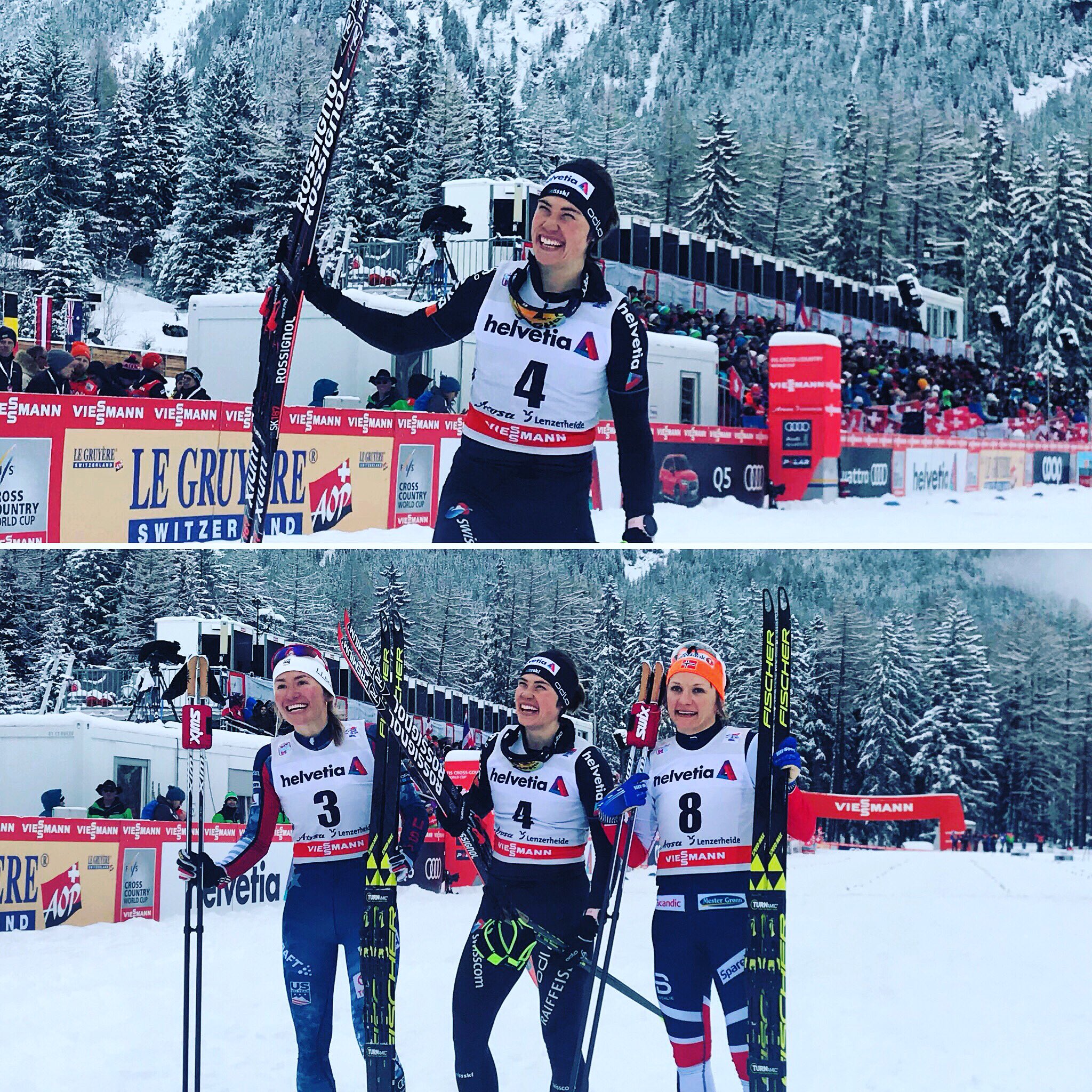
    Finishing with no one close enough to challenge him, Klæbo took the win in in 2:48.19. Goldberg crossed 1.35 seconds later for second place, while third went to Halfvarsson, 4.03 seconds after Klæbo.

    “I’m happy about the third place, but I was quite behind Klaebo,” Halfvarsson said according to a FIS press release. “I will try to catch up for the [Olympic] Games. He was impressive today.”

    Rounding out the top 10 was Finland’s Lauri Vuorinen in seventh, Russia’s Alexander Bolshunov in eighth, Switzerland’s Jovian Hediger in ninth, and Finland’s Martti Jylhä in 10th.

    Canada’s Alex Harvey advanced to the quarterfinals after qualifying in 13th (+6.13), the fastest North American in the preliminary round.

    “The goal was to execute a solid day of racing since it’s the first time I put a bib on this year!” Harvey, of the Canadian World Cup Team, wrote in an email to FasterSkier. “I was pretty happy with my qualifier, it’s a short sprint here so 13th for me was a great start.”

    In his quarterfinal, Harvey went up against Finnish skiers Vuorinen, Iivo Niskanen, and Toni Ketelä as well as Estonia’s Marko Kilp, and Japan’s Hiroyuki Miyazawa. However, a loss in positioning before the major climb cost him a few seconds, and he finished his quarterfinal in fifth, 2.16 seconds behind Vuorinen, who won the heat in 2:47.40.

    “In the 1/4 final I did 1 or 2 mistakes that just cost me in term of positioning before the big hill,” Harvey wrote. “I felt great technically and actually pretty good physically too especially for the time of the year.”

    “Like normal the steep terrain is a bit of a weakness for me so again in the final wall I don’t think I was moving fast enough there,” Harvey continued. “The rest of the course I think I skied well.”

    The only other North American to qualify on Friday was Erik Bjornsen of the U.S. Ski Team (USST) in 26th (+8.71).  Racing in the same quarterfinal as Klæbo, Golberg, Finland’s Juho Mikkonen and Matias Strandvall, and Russia’s Gleb Retivykh, Bjornsen ultimately crossed in fifth, 5.12 seconds behind Klæbo.

    “We are really proud of [Erik] to qualify as strong as he did, in Scandinavia, in a classic sprint,” USST coach Matt Whitcomb said on the phone. “This is one of the hardest races of the year to do this, and it bodes really well.”

    “Talked to him between the qualification and the quarterfinals, and he was just exuding confidence and commented on how strong his double pole is feeling,” Whitcomb continued. “We saw him fire that jet in the finish stretch today. He had a really fast heat and it stressed him out a little bit, don’t know exactly what happened, but he was in the mix today and we are psyched.”

    Another USST member, Andy Newell missed qualifying by 0.38 seconds in 34th. He was 9.38 seconds off Klæbo’s top qualifying time.

    “It was frustrating to be so close and just on the outside of the qualification bubble,” Newell wrote in an email. “Just a few tenths of a second out of the top 25. I felt like I struggled today to get the right amount of glide vs kick… which is just as much on me as the tech. Grateful to be feeling healthy and looking forward to big races to come.”

    Julien Locke of Canada’s National U25 Team was the next-fastest Canadian, placing 59th (+12.07) in the qualifier. Locke finished 0.04 seconds ahead of the American Simi Hamilton (USST) in 60th (+12.13).

    “A little bit of an off day for Simi and Andy,” Whitcomb said. “For Andy on a course that is particularly good for him and he is in really good shape right now, I think he struggled with some glide.”

    Canadian World Cup Team member Len Valjas finished 63rd (+12.58). Before departing Gällivare, Sweden — where he and most of his teammate had been training and raced the opening FIS competitions — Valjas suffered a shoulder subluxation and was not “back to full health” by the time Friday’s sprint rolled around, he explained in an email.

    “I took the week really easy on the shoulder to let it recover, and gave it a try in today’s race,” Valjas wrote. “I didn’t have my normal strength in the double pole sections of today’s race. I just felt weak and couldn’t hold any speed on the flats.

    “I was happy that I was able to compete today, but I am definitely not skiing at 100%,” Valjas continued. “The shoulder is pretty sore and stiff from the qually this morning. Huge thanks to Pete Dickinson (USA physio) for taking care of me this week and helping me speed up my recovery.”

    Also competing for Canada was Knute Johnsgaard in 73rd (+12.58), Devon Kershaw in 74th (+14.01) Graeme Killick in 85th (+14.01), Jess Cockney in 95th (+18.83).

    Three additional Americans raced in the qualifier, with Scott Patterson (USST) finishing 84th (+16.14), Patrick Caldwell (USST) finishing 103rd (+21.43) and Noah Hoffman finishing in 105th (+21.85).

    Canada’s Continental Cup leader, Russell Kennedy (Team R.A.D.), who earned Period 1 World Cup start rights after ending winning last season’s overall NorAm title, did not start Friday’s sprint race.

    Results: Qualifier | Final | Ruka Triple standings (Day 1)

  • Friday Rundown: Sadie Bjornsen Opens with Career-Best Second in Ruka

    Friday Rundown: Sadie Bjornsen Opens with Career-Best Second in Ruka

    The women’s podium for the first race of the 2017/2018 World Cup season, the Ruka classic sprint in Kuusamo, Finland, with (from right to left) American Sadie Bjornsen in second, Sweden’s Stina Nilsson in first, and Russia’s Yulia Belorukova in third. (Photo: U.S. Ski Team/Twitter)

    FIS Cross Country World Cup (Kuusamo, Finland): Classic sprints

    Women’s race report

    Men’s race report

    In the first race of the 2017/2018 cross-country World Cup season, U.S. Ski Team (USST) member Sadie Bjornsen, who turned 28 on Tuesday, raced to the best result of her career, placing second to Sweden’s Stina Nilsson in Friday’s classic sprint in Kuusamo, Finland.

    Last season, Bjornsen notched her first World Cup podium in third place in the 5-kilometer freestyle in Toblach, Italy, and teamed up with USST teammate Jessie Diggins to take third in the 2017World Championships classic team sprint. Friday’s 1.4-kilometer classic sprint — the first race of the Ruka Triple mini tour to kick of the 2017/2018 World Cup season — was Bjornsen’s first race of the season. She did not participate in any preseason International Ski Federation (FIS) races.

    Bjornsen started out the day by clocking the fifth-fastest time in the qualifier, 1.98 seconds behind Sweden’s Ida Ingemarsdotter, who won the qualifier in 3:11.69 minutes. Bjornsen’s USST teammate Sophie Caldwell qualified third (+0.59) after another Swede, Hanna Falk in second (+0.19), and a total of four American women finished in the top 30 to qualify for the heats. Ida Sargent finished 22nd (+8.70) and Rosie Brennan was 26th (+9.51) to reach the quarterfinals.

    There, Bjornsen won her quarterfinal by 0.39 seconds over Russia’s Yulia Belorukova. Caldwell also advanced to the semifinals by placing second in her quarterfinal, 0.7 seconds behind Sweden’s Charlotte Kalla in first.

    Sargent finished third in her quarterfinal, 0.65 seconds behind the winner of that heat,  Sweden’s Anna Haag. Brennan placed sixth in her quarterfinal, 4.3 seconds behind Sweden’s Nilsson in first. Neither Sargent nor Brennan advanced to the semifinals.

    In the semifinals, Bjornsen again raced to first, and once again held off Belorukova — this time by just one-hundredth of a second. Caldwell followed in fourth in that semifinal, 0.5 seconds behind Bjornsen in first and 0.11 seconds behind Russia’s Evgenia Shapovalova in third (+0.39). Neither Caldwell nor Shapovalova advanced to the final.

    In the final, Nilsson took the overall win in 3:17.62 and Bjornsen captured a career best in second place, 0.24 seconds out of first. Belorukova rounded out the podium in third (+0.91), while Ingemarsdotter placed fourth (+2.72), Norway’s Kathrine Rolsted Harsem was fifth (+3.54), and Finland’s Krista Parmakoski sixth (+18.62).

    Overall, Caldwell placed eighth, Sargent 15th and Brennan 29th for the U.S. Diggins and Kikkan Randall missed out on qualifying in 34th and 36th, respectively. Julia Kern placed 57th, Liz Stephen 70th, and Chelsea Holmes 86th.

    None of the Canadian women qualified, with Dahria Beatty in 64th, Emily Nishikawa in 74th and Cendrine Browne in 87th.

    (Continues below)

    In the men’s 1.4 k classic sprint, Norway’s Johannes Høsflot Klæbo won out the day after winning the qualifier, quarterfinal and semifinal en route to another dominant performance in the final.

    Klæbo started off by winning the qualifying round by 2.26 seconds in 2:46.53. Finland’s Anssi Pentsinen qualified second and another Finn, Ristomatti Hakola, qualified third (+2.35), ahead of Italy’s Federico Pellegrino in fourth (+2.66).

    Cross Country Canada’s Alex Harvey was the top North American man in the qualifier, finishing 13th (+6.13), while Erik Bjornsen of the USST qualified in 26th (+8.71).

    Both Harvey and Bjornsen finished fifth in their quarterfinals and did not reach the semifinals. Harvey ended up 21st on the day, after finishing 2.16 behind the winner of his heat, Finland’s Lauri Vuorinen. Bjornsen was 24th overall after finishing 5.12 seconds behind Klæbo, who won the first men’s quarterfinal.

    Klæbo used the extra recovery time he had from racing an early quarterfinal to prime himself for another win in the semifinals, where he beat Sweden’s Calle Halfvarsson by 0.29 seconds. Another Norwegian, Pål Golberg, followed in third (+0.49), and Hakola placed fourth in that semi (+1.72). Both Golberg and Hakola had fast enough times to advance to the final, where they met Pellegrino — the winner of the second semifinal — and Norway’s Sondre Turvoll Fossli, who was second in the second semifinal (+0.1).

    In the final, Klæbo once again won convincingly, this time by 1.35 seconds with a finishing time of 2:48.19. Golberg took second place and Halfvarsson reached the podium in third (+4.03), while Hakola placed fourth (+5.65), Pellegrino fifth (+8.87), and Fossli sixth (+17.31).

    For the U.S., Andy Newell missed qualifying by 0.38 seconds in 34th and Simi Hamilton finished 60th. Scott Patterson was 84th, Paddy Caldwell was 103rd, and Noah Hoffman was 105th.

    For Canada, Julien Locke, of the national U25 Team, finished 59th, Len Valjas was 63rd, Knute Johnsgaard 73rd, Devon Kershaw 74th, Graeme Killick 85th, and Jesse Cockney 95th. Last year’s NorAm winner Russell Kennedy did not start.

    Results: 

    Women’s qualifier | Women’s final

    Men’s qualifier | Men’s final

  • Finns, Russians, Norwegians & Swede Nab Early-Season Wins; Vylegzhanin Competes Despite IOC Ban

    Finns, Russians, Norwegians & Swede Nab Early-Season Wins; Vylegzhanin Competes Despite IOC Ban

    (l-r) Anna Svendsen of Norway, Natalia Nepryaeva of Russia, Justyna Kowalczyk of Poland, Lovise Heimdal of Norway, and Leena Nurmi of Finland receive prizes after rate women’s classic sprint in Muonio, Finland, on Friday. (Photo: Ski Muonio/Instagram)

    FIS races are already being contested in Finland and Sweden this weekend, with most top Scandinavian racers sitting out but a few national-team members and others picking up their first victories of the season.

    The competitions in Muonio, Finland, drew the most diverse field, including racers from Norway, Russia, Japan, China, Canada, Estonia, and Slovakia, among other countries. In the men’s classic sprint on Friday, the home team got a win from Ristomatti Hakola; he and Russia’s Alexander Bolshunov went 1-2 in both the qualifier and the final. Russia’s Andrey Parfenov rounded out the podium. In the women’s sprint, Anna Svendsen took the win over Russia’s Natalia Nepryaeva, with Justyna Kowalczyk of Poland finishing third.

    On Saturday, racers moved up in distance. In the 10 k classic, Bolshunov – a U23 World Champion last season – bested Russian teammate Alexey Chervotkin by 20.6 seconds, with Andrey Sobakarev making it a sweep another 21.6 seconds back. Brian McKeever and Graham Nishikawa of Canada finished 56th (+2:10.6) and 63rd (+2:18.5), respectively.

    Also in the men’s race was Maxim Vylegzhanin. The International Olympic Committee (IOC) decided on Thursday to strip the Russian skier of three silver medals from the 2014 Olympics for doping violations and ban him from all future Olympic Games. However, the International Ski Federation (FIS) has not yet taken any action since he and five other skiers were banned from the IOC, meaning that all six athletes are currently free to take part in non-Olympic ski competitions. In a press release, FIS stated that “the next steps will be the review by the FIS Doping Panel of the six verdicts upon the receipt of the reasoned decisions” but did not provide a time frame for these decisions.

    In the women’s 5 k classic, Finland’s Krista Parmakoski posted an 18.4-second win over Nepryaeva, with Kowalczyk third again, +24.2.

    Bruksvallarna, Sweden, hosted races on Saturday as well, with a primarily Swedish and Norwegian field but some other racers as well. Norway’s Chris Andre Jespersen topped the 15 k skate, posting a 31.4-second win over Simon Lageson of Sweden. Norwegian Tore Leren was third, +53.1. Canada’s Jack Carlyle finished 38th, +2:29.5. Petter Northug and his brother Even were in Bruksvallarna this week but decided at the last minute not to race, with Northug making his debut in Beitøstolen, Norway, next weekend instead.

    In the women’s 10 k skate, Swedish national team member Emma Wiken bested Lina Korsgren – a long-distance specialist who finished eighth in the Visma Ski Classics standings last season – by 9.8 seconds. Berit Mogstad of Norway finished third, +15.3 seconds.

    https://www.instagram.com/p/BbW-cRsn14l/

    Results

    Muonio

    Classic sprint: men’s qualifier – men’s final – women’s qualifier – women’s final

    Classic distance: men’s 10 k – women’s 5 k

    Bruksvallarna

    Skate distance: men’s 15 k – women’s 10 k

  • Thursday Rundown: Silver and Bronze for Diggins, Randall at Lahti World Champs; Bankes Golden at IBU Junior Champs

    Kikkan Randall (l) and Jessie Diggins celebrate their bronze and silver medals, respectively, in the women’s individual freestyle sprint on Thursday, the first day of 2017 Nordic World Championships in Lahti, Finland. (Photo: John Lazenby/Lazenbyphoto.com)

    FIS Nordic World Championships (Lahti, Finland): Freestyle sprints

    Women’s report | Men’s report

    [UPDATED] Two medals for the U.S. on Day 1. That’s exactly what happened Thursday in the first medals race of 2017 Nordic World Championships in Lahti, Finland, where American Jessie Diggins raced to second and her U.S. teammate Kikkan Randall third in the women’s 1.4-kilometer freestyle sprint final, right behind Norway’s Maiken Caspersen Falla, who took gold.

    Two Americans reached the podium in the women’s freestyle sprint on the first day of 2017 Nordic World Championships in Lahti, Finland, with Jessie Diggins (l) placing second and Kikkan Randall (r) third, behind Norway’s Maiken Caspersen Falla (c) in first. (Photo: FIS Cross-Country/Twitter)

    While Falla crossed the finish line first in in 3:02.34 minutes, Diggins finished 1.66 seconds back in second and Randall 3.76 seconds behind in third. Three U.S. Ski Team members reached the six-woman final, with Sophie Caldwell placing sixth (+5.37), behind Sweden’s Hanna Falk (fourth) and Ida Ingemarsdotter (fifth).

    Race favorite Stina Nilsson of Sweden ended the day in 12th overall after being relegated to last in her semifinal.

    Diggins won her quarterfinal and semifinal before finishing second for her second individual World Championships silver medal (she previously earned silver in the 10 k freestyle at the 2015 World Championships in Falun, Sweden, and before that, gold in the freestyle team sprint with Randall at 2013 World Championships in Val di Fiemme, Italy).

    It’s the second-straight championships that the U.S. has had individual medalists in the same race. Caitlin Gregg captured bronze in the 10 k freestyle, just behind Diggins. Four U.S. women qualified for the heats, with Ida Sargent finishing fifth in her quarterfinal for 24th overall.

    U.S. Ski Team head coach Chris Grover was universal in his praise when asked about the personal significance of Thursday’s two-medal night. “I am just really proud of the athletes — all of the athletes that were competing today,” Grover said after the women’s final. “All the athletes in the US program that were not competing today that were cheering in front of the television I’m sure this evening and are getting ready for races coming up. I am really proud of the team that we have collected here in terms of service team, and coaching team, and medical and support team … And everybody that is surrounding the event for the U.S.A. It’s just been a team over the last few World Championships that yes there has been a few people that have come off and come on, but there has really been a core group that provide this kind of stability on which we can have these kind of results.”

    In the men’s 1.6 k freestyle sprint final, Italy’s Federico Pellegrino outlasted three others within 0.7 seconds of the win, crossing the finish line first in 3:13.76.

    Russia’s Sergey Ustiugov missed out on the gold by 0.15 seconds and Norway’s Johannes Høsflot Klæbo took bronze (+0.44). Three Norwegians reached the final, with Finn Hågen Krogh placing fourth (+0.67), Petter Northug fifth (+12.13), ahead of Finland’s Ristomatti Hakola in sixth (+12.28).

    Canada’s Alex Harvey was the lone North American to reach the semifinals, where he was relegated to last in his heat for 12th overall.

    For the U.S., Andy Newell placed 21st on the day after finishing fifth in his quarterfinal and Simi Hamilton was 28th after taking sixth in his quarterfinal.

    Results: Women’s final | Men’s final

    Qualifying results

    All four of the U.S. women’s starters qualified for the heats to start the day, with Randall leading them in 10th, followed by Caldwell in 13th, Diggins in 19th, and Sargent in 27th.

    Norway’s Falla put down the fastest time in the women’s sprint qualifier in 3:03.14, Finland’s Mari Laukkanen was 2.37 seconds back in second, and Slovenia’s Katja Visnar 2.42 behind in third.

    Randall’s time was 4.45 seconds off Falla’s mark, Caldwell +5.66, Diggins +7.97, and Sargent +9.37.

    Canada’s Dahria Beatty missed the top 30 necessary to qualify by 3.67 seconds in 37th, 13.66 seconds behind Falla. Canada started three women with Cendrine Browne finishing 48th (+20.42) and Katherine Stewart-Jones 58th (+26.29) out of 107 women.

    In the men’s 1.6 k freestyle sprint qualifier that followed, Hamilton qualified 11th and Newell 20th for the U.S., and Canada’s Harvey qualified 13th.

    Russia’s Ustiugov topped the men’s qualifier in 3:11.72, while Norway qualified second and third with  Norway’s Krogh (+2.71) and Sindre Bjørnestad Skar (+3.39), respectively.

    Hamilton clocked in 7.6 seconds back in 11th, Harvey +7.85, and Newell +8.9.

    Also for the U.S., Erik Bjornsen missed qualifying by 2.22 seconds in 36th (+12.59), and Cole Morgan, in his first World Championships race, placed 54th (+18.41).

    Canada’s three other men entered in the sprint, Jess Cockney, Len Valjas and Knute Johnsgaard finished 47th (+16.82), 48th (+17.16) and 53rd (+18.39), respectively, to miss advancing to the heats.

    Qualifying results: Women | Men

    ***

    The junior women’s 12.5 k individual podium on Thursday at IBU Junior World Championships in Osrblie, Slovakia, with Canada’s gold medalist Megan Bankes (c), Austria’s Julia Schwaiger (l) in second and Germany’s Anna Weidel (r) in third. (Photo: IBU Junior Cup/Twitter)

    IBU Youth/Junior World Championships (Osrblie, Slovakia): Junior individual races

    Race report

    [UPDATED] To say Canada is on a roll at the International Biathlon Union (IBU) Youth/Junior World Championships would be a massive understatement. On Thursday in Osrblie, Slovakia, Megan Bankes raced to a world title in the junior women’s 12.5-kilometer individual, hitting all 20 targets and finishing first in 37:22.0 minutes. After starting 19th, her time held up through 67 finishers, with Austria’s Julia Schwaiger coming closest for second place, 47.9 seconds back.

    Bankes was one of five women to clean the four-stage race on Thursday. Her teammate Leo Grandbois did the same in the youth men’s 12.5 k individual race the day before and won by nearly a minute and 15 seconds to become the third Canadian to win at Youth/Junior Worlds. Bankes is the fourth (second at Junior Worlds).

    Joining Bankes and Schwaiger on the podium was Germany’s Anna Weidel in third (+1:20.0). Like Schwaiger, Weidel shot 19-for-20. Schwaiger’s miss came in the last standing stage; Weidel’s in the first standing.

    Also for Canada, Emily Dickson placed 28th (+4:21.3) with one miss (0+1+0+0), and Nadia Moser was just outside the points (top 40) in 41st (+5:55.8) with four penalties (2+0+0+2). Charlotte Hamel did not finish.

    Americans Siena Ellingson placed 50th (+7:11.5) with four penalties (0+1+2+1) and Nina Armstrong 65th (+14:15.3) with eight misses (4+1+2+1).

    In the junior men’s 15 k individual earlier in the day, Norway’s Sindre Pettersen won by 51.2 seconds, after cleaning the first three stages then missing two on his final standing stage (0+0+0+2). After starting 68th, he finished in 40:17.2 minutes, knocking Germany’s David Zobel out of the lead. Zobel had started 26th and shot three penalties (0+2+1+0) but held the fastest time until Pettersen crossed the line. Zobel’s time held up for silver despite a challenge from Russia’s late starter Nikita Lobastov (bib 84), who shot 19-for-20 (0+1+0+0) and finished just four seconds short of Zobel for third place (+55.2).

    Canada’s Zachari Bolduc led the North Americans in 34th (+3:44.7) with two penalties (1+0+0+1).

    Cody Johnson finished 50th for the U.S. (+5:08.3) with two misses, both of which came in the last stage (0+0+0+2).

    Canada’s Trevor Kiers and Jules Brunette placed 54th (+5:21.6) and 55th (+5:27.4), respectively, each with five penalties. The fourth Canadian, Pearce Hanna finished 65th (+6:38) with seven misses.

    For the U.S., Cameron Christiansen placed 72nd (+8:10.6) with six penalties, and Peter Carroll was 79th (+10:36.4) with four misses. Travis Cooper did not start.

    Results: Junior women | Junior men 

  • First World Cup Win for Klæbo; Hamilton 8th in Otepää, Misses Final by Inches

    First World Cup Win for Klæbo; Hamilton 8th in Otepää, Misses Final by Inches

    Norway’s 20-year-old Johannes Høsflot Klæbo won his first World Cup on Saturday in the men’s 1.6 k freestyle sprint in Otepää, Estonia, while Russia’s Sergey Ustiugov (6) placed third. (Photo: Fischer/NordicFocus)

    Johannes Høsflot Klæbo is young enough that he could have started at the U23 World Championships in Soldier Hollow, Utah, earlier this month. And the 20-year-old Norwegian probably would have done well there.

    But the 2016 Junior World Champion in the freestyle sprint and 10-kilometer classic races held in Râsnov, Romania, already has his sights set much higher this season, targeting next week’s senior International Ski Federation (FIS) Nordic World Ski Championships in Lahti, Finland.

    And on his steep career ladder progression, he took another important rung on Saturday by stepping on the top of the podium for his first World Cup victory in the men’s 1.6 k freestyle sprint in Otepää, Estonia. In the final, Klæbo pushed hard right out of the start gate and never relinquished his lead, crossing the line first in convincing fashion in a time of 3:06.53. He also won the qualifier earlier in the morning, and advanced with relative ease through the rounds, winning his quarterfinal heat and placing second in his semifinal.

    “I felt strong today and knew that those who were in the final [with me] are strong in the finish stretch, so I thought my chance would be to just go for it and that worked,” Klæbo told Norwegian broadcaster NRK, adding with a smile that he might use the same tactic for the World Championships.

    The men’s freestyle sprint podium on Saturday at the World Cup in Otepää, Estonia, with Norway’s Johannes Høsflot Klæbo (c) taking his first World Cup win, Norway’s Finn Hågen Krogh (l) in second, and Russia’s Sergey Ustiugov (r) in third. (Photo: Fischer/NordicFocus)

    His teammate Finn Hågen Krogh — who had narrowly beaten Klæbo in the semifinal — placed second in the final (+0.60) after taking the inside lane in the last turn and staying far right in better groomed snow to push past Tour de Ski winner Sergey Ustiugov of Russia on the finishing stretch. Ustiugov ended up third (+1.0).

    “To win here, it’s unbelievable,” Klæbo told FIS in a finish-line interview. “I think I have learned a lot and it’s tough to be in the final because everyone is so good, but I am very satisfied with this race.”

    Norwegian media have already started to compare him to his star teammate Petter Northug Jr., a comparison Klæbo is not too fond of insisting that he is his own man. And at Norwegian national championships in Lygna a week ago, Klæbo was eager to prove that he is more than a sprint specialist, winning the freestyle sprint but also the silver medal in the 15-kilometer classic race, only behind Didrick Tønseth but ahead of overall World Cup leader Martin Johnsrud Sundby.

    At the start of this season, Klæbo placed second in the World Cup mini tour in Lillehammer, Norway, finishing behind Sundby in the 15 k classic pursuit. On Saturday, Sundby broke his pole right at the start of the sprint qualifier and quit the race skiing into the woods, while the young Klæbo left his more experienced national and international competitors no chance in the final.

    “This is huge,” Klæbo told NRK. “I’ve been in so many finals, and I feel that this was due. It’s kind of crazy to do this before the World Championship”

    “I was struggling in the quarterfinal, I did not feel that good,” Krogh told FIS, according to a press release. “I changed skis and then I felt better in every heat. In the final the lane I chose in the last corner was faster and I could carry on good speed in the homestretch.”

    “To finish third is nice,” Ustiugov told FIS. “I would be disappointed if I had not finished in top three today. Finn was very fast on the homestretch today.”

    Last season’s World Cup sprint winner Federico Pellegrino of Italy placed fourth (+4.77), ahead of two more Norwegians with Sindre Bjørnestad Skar in fifth (+15.53) and Håvard Solås Taugbøl in sixth place (+32.94). Klæbo now also sits in second place in the World Cup sprint standings behind Pellegrino.

    Narrow Misses for Best North Americans

    For the U.S., Simi Hamilton started his race day with a solid qualification in seventh position just 4.01 seconds behind the winner Klæbo; despite having to race on a newly modified course in Otepää that he believes doesn’t favor his strengths.

    “I definitely felt good in my qualifier,” Hamilton told FasterSkier on the phone after. “There are two really big climbs in this course, and I think they kind of suit the more distance-type skier a little bit better because both of them are just pretty long 30-45 second climbs, and the conditions were definitely getting pretty slippery out there even by the qualifier. So that’s kind of an environment I struggle in a little bit or at least have in the past.”

    “I was psyched with a seventh [place],” he commented on his qualifying result. “It’s a long course which I tend to struggle a little bit with, too, but being able to qualify in the top 10 on a course that is a little over 3:10 [minutes long], I think that’s a good time for where I am with my fitness right now especially leading to World Champs.”

    American Simi Hamilton (7) chasing down Norway’s Eirik Brandsdal (13) in the quarterfinal. Brandsdal won the heat in a photo finish, two-hundredths of a second ahead of Hamilton in the World Cup freestyle sprint in Otepaa, Estonia. (Photo: Fischer/NordicFocus)

    In his quarterfinal, Hamilton faced Krogh, Norway’s Eirik Brandsdal and Russia’s Gleb Retivykh, the winner of last week’s sprint in PyeongChang, South Korea.

    “The tactic that I was focusing on the most all day was just trying to ski the first half of the course as efficiently as possible,” Hamilton explained. “I felt like I did that pretty well, slipped into second and felt really good about that position. I was able to take my own lane coming up that really long hill on the backside and I think that was tactically really good, because I could just ski that hill the way I wanted to and I wasn’t in danger of getting boxed out or anything.”

    Hamilton came onto the finish stretch behind Brandsdal, pushing next to him before lunging in a photo finish to narrowly place second (+0.02), and was able to keep Krogh just behind him in third (+0.22). Krogh still advanced as a “lucky loser” with his time, while Retivykh finished fourth (+1.14) and was out.

    “I felt good for the V1 part and just tried to punch it over the top and get a really good draft off of Brandsdal,” Hamilton said. “I just focused on getting in his stream and coming into the stadium, I still felt like I had some energy in my legs and was able to turn on a pretty decent finish stretch. I was psyched about that for sure.”

    In a stacked semifinal heat and in worsening snow conditions, Hamilton had to race against the dominant Tour de Ski winner Ustiugov, Skar, Taugbøl, and the two Finnish skiers: Ristomatti Hakola and Martti Jylhä.

    “In my semis, I toasted my legs a little bit on the first climb just trying to get through that really deep snow,” Hamilton explained. “Coming over the top, I think I was still in a good position. I think I was third there but I couldn’t get an open lane on the long climb coming up the backside, so I just kind of struggled behind I think Taugbøl … and I think Ustiugov was on my left coming up that and he did a really good job punching it up and over that V1 section and with really good speed into that long downhill.”

    Hamilton tucked down trying to conserve energy and momentum on the downhill section, and with only Jylhä and Hakola gapped a little had to go into a four-way finishing sprint.

    “I took a really good move coming into that last 180 into the finish stretch and Ustiugov was right in front of me, and then the Norwegians were in front of him, and they were all staying close to the V-boards on the right side because they were trying to ski that corner really narrow,” Hamilton recalled of the final turn. “I just took it a little bit wider and then cut narrow at the end of it, and I was able to basically get past Ustiugov a little bit … But that move spit me into the middle lane at the finish stretch, and that lane was getting pretty chewed up with so much traffic all day. It was definitely pretty soft in there and I think Ustigov’s lane on the left was staying pretty firm and icy all day. So I was bummed I couldn’t really throw down a better last 100 meters. I did what I could, but I was definitely getting a little caught up in that soft stuff and couldn’t really rely on my power to try to get down the home stretch.”

    Simi Hamilton (U.S. Ski Team) racing to seventh in the men’s 1.6 k freestyle sprint qualifier on Saturday at the World Cup in Otepaa, Estonia. (Photo: Fischer/NordicFocus)

    Skar won the semifinal ahead of Ustiugov (+0.15) to advance directly, with Hamilton (+0.33) ranked just behind Taugbøl (+0.29) as the outcome of the photo finish. Taugbøl’s time was enough to advance as a lucky loser. Hamilton ended up eighth overall on the day.

    “Regardless I was happy with the fourth [though I] obviously would have liked to advance into the finals,” Hamilton said. “And I feel good about where my fitness and speed is right now, and just kind of one or two things didn’t line up for me in that semi and you know it’s a bummer. But at the same time Thursday [the freestyle sprint in Lahti] is a big day and hopefully some more things will line up on that day and that is the main goal. So I feel good about where everything is going for World Champs right now.”

    Hamilton stated that he does not to plan to race on Sunday, training and then traveling in the evening to Finland a day earlier to be rested before the sprint at World Championships.

    Canadian World Cup Team member Alex Harvey, who had skipped the World Cup trip to Korea for a recovery and training block, snuck into the sprint heats in 29th place (+10.26) after a mishap, avoiding elimination by less than a second.

    “I felt good in the qualifier but right out of the start, in the first corner, I hit an icy patch and almost crashed, right at the base of the first uphill,” Harvey wrote in an email. “My ski hit my pole and I broke a basket. After that I had to get my momentum back and I think that I actually skied pretty decent but lost some time and speed there. So I guess you can say I got lucky to end up on the good side of the top 30!”

    Canada’s Alex Harvey (29) chasing Great Britain’s Andrew Young (11) and Italy’s Federico Pellegrino (l) in the quarterfinal of the men’s 1.6 k freestyle sprint at the World Cup in Otepaa, Estonia. Harvey finished third in the heat for 15th overall. (Photo: Salomon/NordicFocus)

    Harvey believed the redesigned course in Otepää suited him relatively well, though he was not too stoked about one modification:

    “I think the length of the course suits me well,” he wrote. “The only thing I didn’t like was a short finishing stretch…we are used to a really long one here so I was looking forward to that, but this year there was a 180-degree turn just before the finish so that made the opportunity to pass in the finish not as good.”

    In his quarterfinal, Harvey had to race against Pellegrino, Norway’s defending sprint world champion Northug (who’s been trying to round back into shape in time for this year’s championships), as well as Andrew Young of Great Britain.

    “My quarterfinal was super slow, from the start I knew I had to be top 2 to move on,” Harvey recalled. “Young kinda picked it up right at the top of the second climb (the steeper wall) so he tried to gap the field or at least stretch it for the long downhill into the stadium.”

    Pellegrino managed to pass Young on the final turn into the finish stretch and created a little gap gliding the last meters over the line in first, while Harvey had to sprint for second place against Young who lunged across the line falling down. After a photo finish, Harvey was determined to be 0.04 seconds behind Young to place third (+0.60), while Northug was fourth (+1:45). Harvey’s time was not fast enough for a lucky loser spot and he finished the day in 15th. Young went on to finish last in his semifinal for 12th overall.

    “I feel good about my finish, I was able to re-accelerate quite well after that 180 degree turn and almost got by Young in that short finish so that was a good sign for my finishing speed. Now I just gotta work on my lunging game…” Harvey wrote. “15th is not too good but I think the most important in a pre-worlds weekend like that is the feeling you have on the skis, and today it was very good.”

    Harvey wrote that he plans to race the 15 k classic individual start on Sunday in order to keep his strong position on the overall World Cup ranking, though he doesn’t intend to race this distance at World Championships.

    “I’m feeling good heading into Lahti,” Harvey concluded. “I did a very similar camp as I did before the 2013, 2014, 2015 championships and the 2016 Tour of Canada so I know it’s the right thing for me!”

    Andy Newell (U.S. Ski Team) racing in the quarterfinals of the men’s 1.6 k freestyle sprint on Saturday at the World Cup in Otepaa, Estonia. He finished sixth in the heat for 27th on the day. (Photo: Fischer/NordicFocus)

    Hamilton’s teammate Andy Newell started the day by qualifying in 16th.

    “Qualifying today I felt decent,” Newell wrote in an email. “I think my legs are still recovering a little bit from last week [a training block in Valadalen, Sweden]. I was missing a little bit of that pop on the steep climb. That was a decisive part of the heats as well, so if I were a little stronger there it would have been a much better day.”

    In his quarterfinal with the finalist Skar as well as the semifinalists Jylhä and Hakola, Newell could not quite keep up in the finish sprint and placed sixth (+1.89), for 27th overall.

    “Positioning in the heat was tricky,” Newell wrote. “It’s always hard to pass in skate sprinting so I should have positioned myself better before the last S-turns.”

    “I’m feeling healthy and strong going into this weekend and into Worlds so I can’t complain,” he added. “I wish today would have gone better because its always great practice to race as many rounds as you can leading into the championships, but in general I’m in a pretty good place leading into Lahti.”

    Canada’s Len Valjas missed qualifying for the heats in 40th, as did his teammate Devon Kershaw in 50th.

    Erik Bjornsen of the USST was 53rd, Canada’s Jess Cockney was 54th and Knute Johnsgaard 56th, and the fourth U.S. starter Ben Lustgarten in his first World Cup finished the qualifier in 64th place.

    According to U.S. coach Matt Whitcomb, Bjornsen and Lustgarten planned to compete in the men’s 15 k classic race on Sunday. Fellow distance specialist Noah Hoffman originally had looked forward to that race as well, but decided to not make the trip to Otepää after an illness last week.

    For Canada, Harvey, Valjas, Kershaw, Cockney, Johnsgaard, and Graeme Killick were all listed to start Sunday.

    Results | 15 k classic start list