From the FasterSkier archive — posts syndicated from athletes’ and coaches’ own blogs between 2004 and 2012, kept online as published. Current coverage is at fasterskier.com.
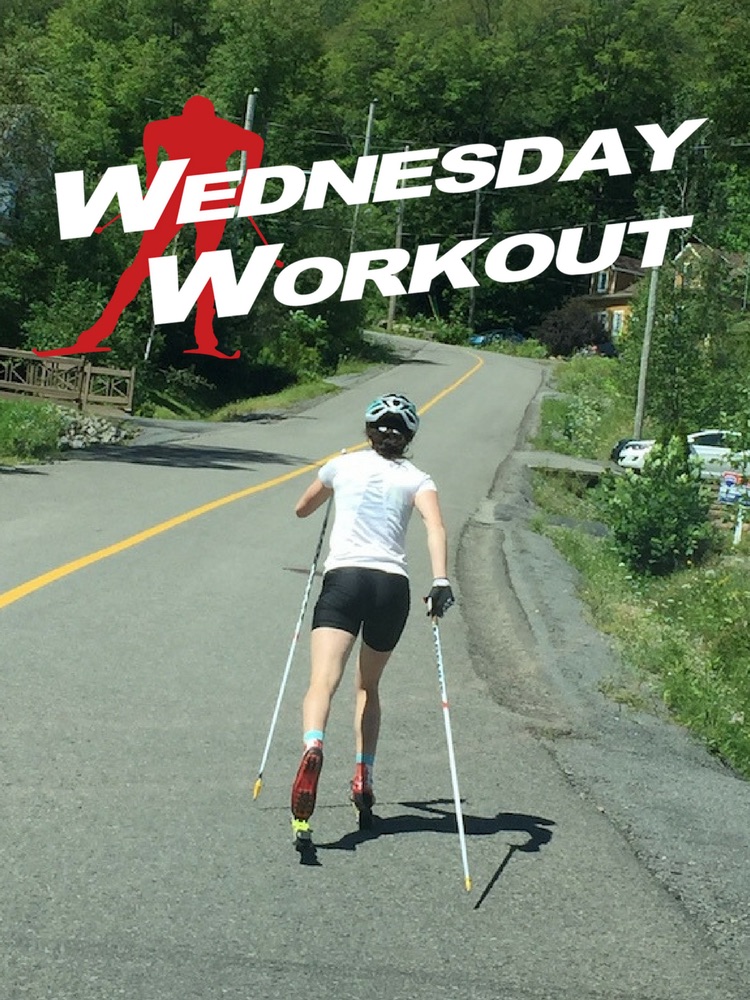
Olivia Bouffard-Nesbitt rollerskiing in Sainte-Anne-des-Lacs, Quebec, last summer. (Courtesy photo)
It’s May 2 and the overall NorAm leader heading into the 2018/2019 race season, Olivia Bouffard-Nesbitt, is champing at the bit to get back at it. Like most other pro nordic skiers, the 25-year-old Morin Heights, Quebec, native spent the last month getting some off-ski R & R, which wasn’t completely devoid of snow. In April, Bouffard-Nesbitt and her boyfriend went surfing at Lawrencetown Beach near Halifax, Nova Scotia (brrr!).
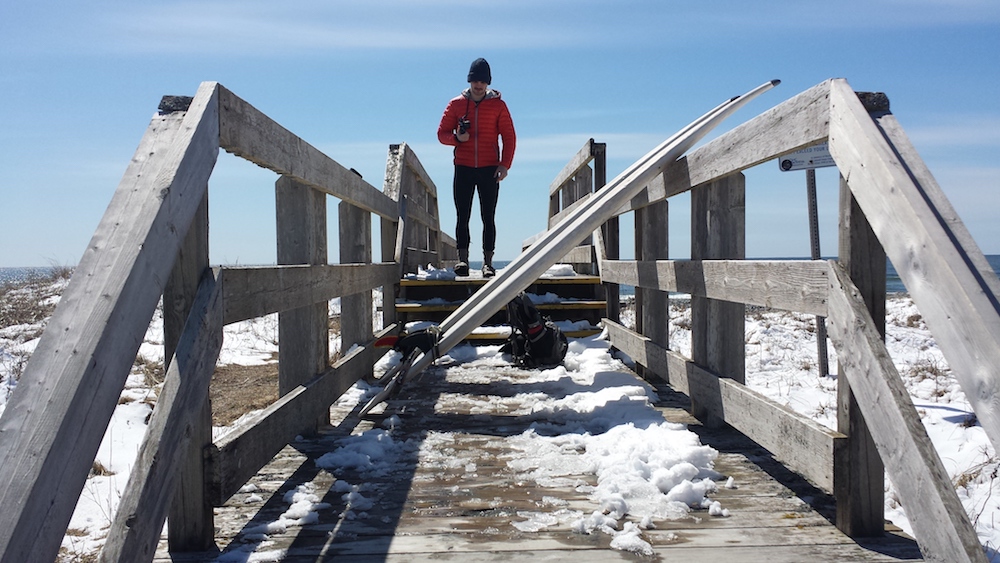
Olivia Bouffard-Nesbitt snaps a photo of her boyfriend Stuart and their boards while surfing in April near Halifax, Nova Scotia. (Courtesy photo)
“I was planning to travel somewhere a little more exotic later in April but opted to get all my wisdom [teeth] pulled out instead,” Bouffard-Nesbitt wrote in an email.
She planned to return to her training base in Canmore, Alberta, next week, where she’ll be “jumping right back on snow and right into some training camps” with her team, Rocky Mountain Racers (RMR). They’ll start the training season at Sovereign Lake in Vernon and Penticton, British Columbia, then head south to Bend, Oregon, in early June.
“I can’t even tell you how excited I am to dive head first into this training season!” wrote Bouffard-Nesbitt, who has had previous seasons derailed by a myriad of injuries.
Despite a late start, she finished last winter as the first Canadian woman in the overall NorAm standings, earning World Cup starts in November and December later this year.
So what’s one of the workouts she’s looking forward to this spring? That would be Rocky Mountain Racers’ “most tried and true workout”, which can be done skiing, rollerskiing, ski striding, or even biking.
“It’s simple, it’s appropriate for pretty much any time of the year, and it’s reliable,” Bouffard-Nesbitt explained. “I found myself really looking forward to doing these intervals after coming back from injury. This workout kind of feels like ‘home’ for me, and I trust it to get me fit in a short period of time.
“It’s funny, even just thinking about this workout makes me happy, that’s how good it makes me feel,” she added. “When I got back to Canmore and started doing some on-snow intensity last December I was nervous about my fitness, but after a few of these types of workouts, within two weeks I already felt way more confident in my fitness and my race readiness.”
The workout: 6-8 x 5-minute Building Intervals
Warmup: 15-30 minutes of easy Zone 1 skiing
“We usually do a lap or two of the predetermined interval course to get familiar with it. I like to get up into zone 2 near the end of the warm up to get my technique right and set my technique intentions for the intervals.”
Intervals: 6-8 times 5 minutes, building from interval to interval, with around 3 minutes of rest.
First interval: Below threshold to wake up the body.
“The goal after the first one is to increase the distance you cover over every consecutive interval.”
Last two intervals: should be harder, “definitely into race pace. On the last two intervals we also like to increase the effort within the interval, so the last minute would be flat out.”
More on “building”:
“I like the building aspect because you’re not demanding a huge effort of yourself right off the bat. You get really familiar with how much your body can handle, and I love the feeling of just having the reins cut loose for the last interval and seeing how much further I can push.
“Mentally it just feels great to go further and further every interval, and I love the challenge near the end of the set to make sure you’re primed to push harder in the next interval, and to convince yourself that you always have more in you. The last interval is usually pretty hard, but you rarely get to the end of the workout feeling crushed, because the intervals aren’t too long and you’re really only pushing hard at the end. So it covers everything from threshold to race pace and gives you a great race feeling by the end.”
Cool down: As long as you need, usually around 30 minutes.
“I love this workout because I feel like it gives me everything I need, including a bit of mental conditioning and confidence,” Bouffard-Nesbitt wrote. “It’s nice to start the intervals with a controlled effort to get a sense of how your body feels that day. Building from interval to interval allows you to work on your pacing because you’re always trying to make it further than the last interval while conserving just enough energy to go further on the next one. Seeing how much your increase in effort translates to the extra distance you covered also helps you become more efficient.
“I’m paraphrasing my coach John [Jaques] here to summarise – this workout is great because you are taxing different energy systems all within the same interval set,” she concluded. “And it’s a low-risk and adaptable workout in that you only continue to build if you can handle the previous interval.”
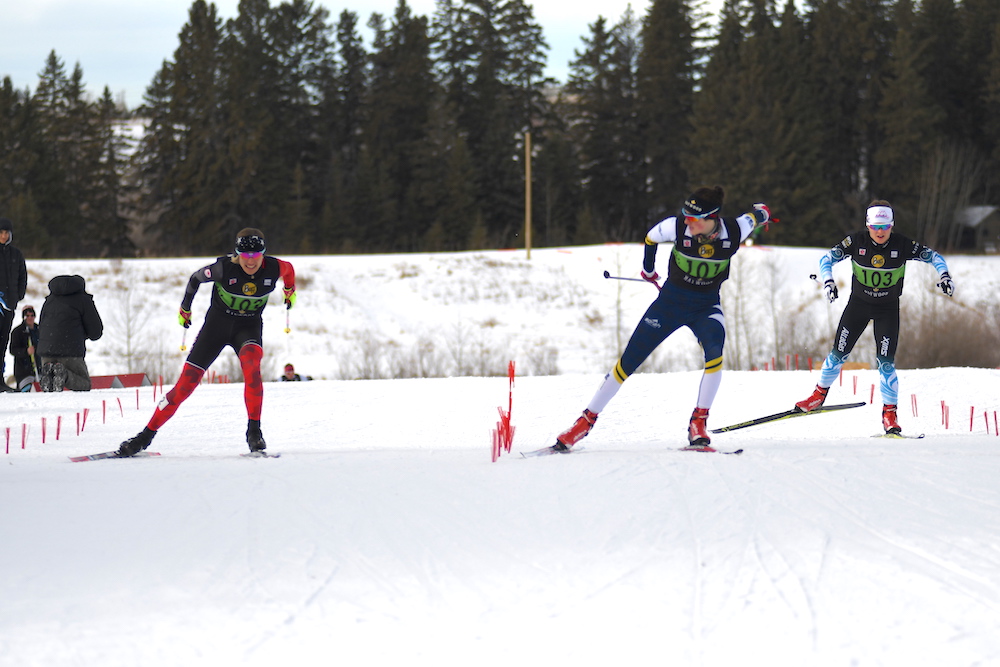
Olivia Bouffard-Nesbitt (c) holds off Zina Kocher (l) and Annika Hicks (r) to win the women’s freestyle sprint final at 2018 NorAm Western Canadian Championships in January in Red Deer, Alberta. (Photo: Doug Stephen)
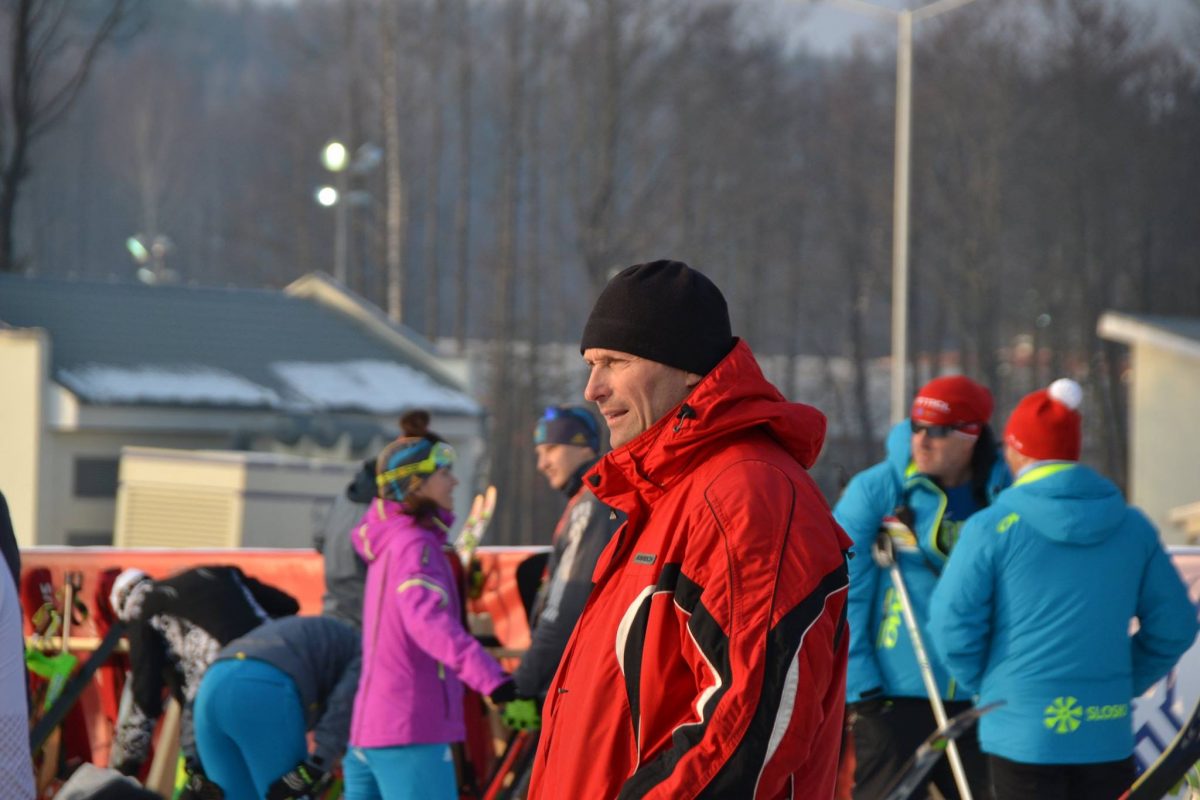
Richard Boruta, head coach at the Biathlon Alberta Training Centre, died in a climbing accident on Aug. 9. (Photo: Jane Robertson)
Few nordic ski racing and biathlon venues are as awe-inspiring as the Canmore Nordic Centre in Alberta, Canada. Just south of the venue, amidst the geologic upheaval that is the Canadian Rockies, punches the Three Sisters — a string of iconic Canmore mountains. While descending from a technical route on the Middle Sister earlier this month on Aug. 9, Richard Boruta, a seasoned climber, died in a climbing accident. He was 49.
At the time of the accident, Boruta was attempting the Three Sisters Traverse as part of his 50th year, as he was turning 50 in October. It was Boruta’s first time on the climbing route.
Boruta was a fixture of Canadian biathlon’s high performance and development scenes since 1998 when he immigrated to Canada from his native Czech Republic. Most recently, he was named Biathlon Canada’s male coach of the year for 2017. It was his third time receiving the award.
His Canadian coaching career began with Canmore’s Rocky Mountain Racers (RMR). Boruta advanced to become the Canadian national team’s head coach in 2002. He remained in that position until 2006, after seeing his athletes compete at the Torino Olympics. Post-Torino, Boruta left the national team to become more involved in the development side of the sport.
In 2011, Boruta became the head coach of the newly formed Biathlon Alberta Training Centre (BATC).
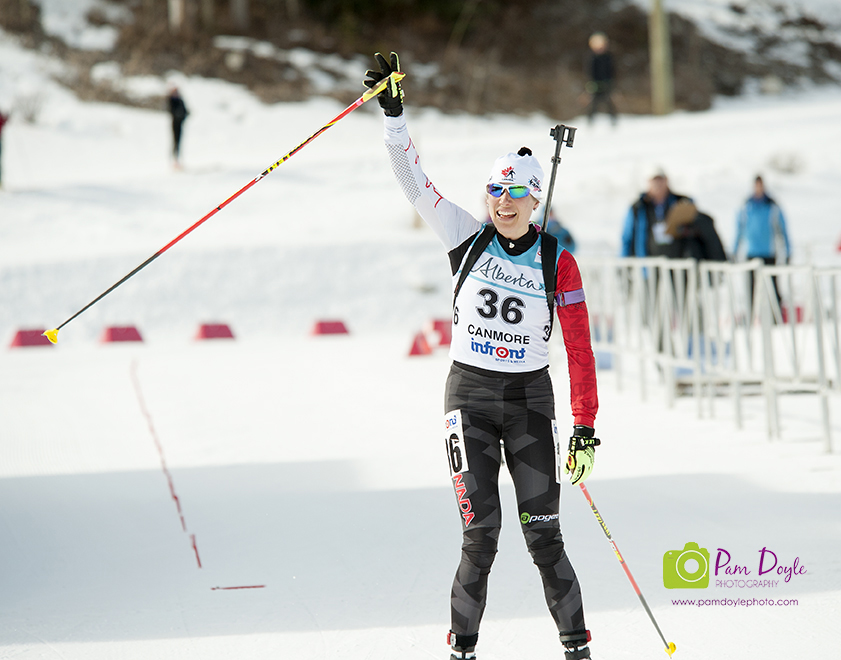
Zina Kocher waves to the home crowd after placing second in an IBU Cup sprint two seasons ago in Canmore, Alberta. (Photo: Pam Doyle)
Zina Kocher, a three-time Canadian Olympic biathlete, fostered a deep connection to Boruta as she emerged onto the Canadian biathlon radar. Kocher told FasterSkier on the phone that she qualified for the national championships in 12th grade at age 17. To her surprise, she placed in the top 10, and Boruta took notice.
At biathlon nationals, the arrangement was for athletes to attend with the regional coach, not their specific club coach. Boruta was the Alberta regional coach for the event and by default helped guide Kocher. Boruta asked Kocher to join RMR, where he was then coaching.
“I had friends already on that team,” Kocher said. “I decided to try for the summer.”
That short-term arrangement quickly evolved. Kocher decided to bump the summer commitment up to a year long stay.
“I was enrolled in college and then I decided to train full time and do it for one year and see if I could make the world junior team,” Kocher recalled. “They had a lot of faith in my ability and they pushed me to go for it. I made the world junior team … I made my first Olympics in 2006, and I spent all that time being coached by Richard.”
Kocher remained on the national team from 2006 to 2011. During that time she worked primarily with other coaches. After a performance downturn in 2011, Kocher decided to train with Boruta and BATC. Until her retirement in 2016, Kocher was coached by Boruta for all but the year following the Sochi Olympics when she trained with the national team. (For the 2016 competition year, Kocher was coached by Boruta as a member of BATC.) From 17, until her retirement at 32 years old, Boruta helped shape Kocher.
“I feel like he changed a lot himself from the time he was first coaching to the end,” Kocher reflected. “At the beginning, he was quite Eastern European, he was strict. I cried a lot. It was hard. He pushed me, he constantly challenged me, he always expected more from me. If he said ‘good job,’ you did awesome. Those comments he kept to the end, but he turned maybe more Canadian. Near the end, if I got emotional, he would just give me a big hug. He didn’t say anything. It was just a hug.”
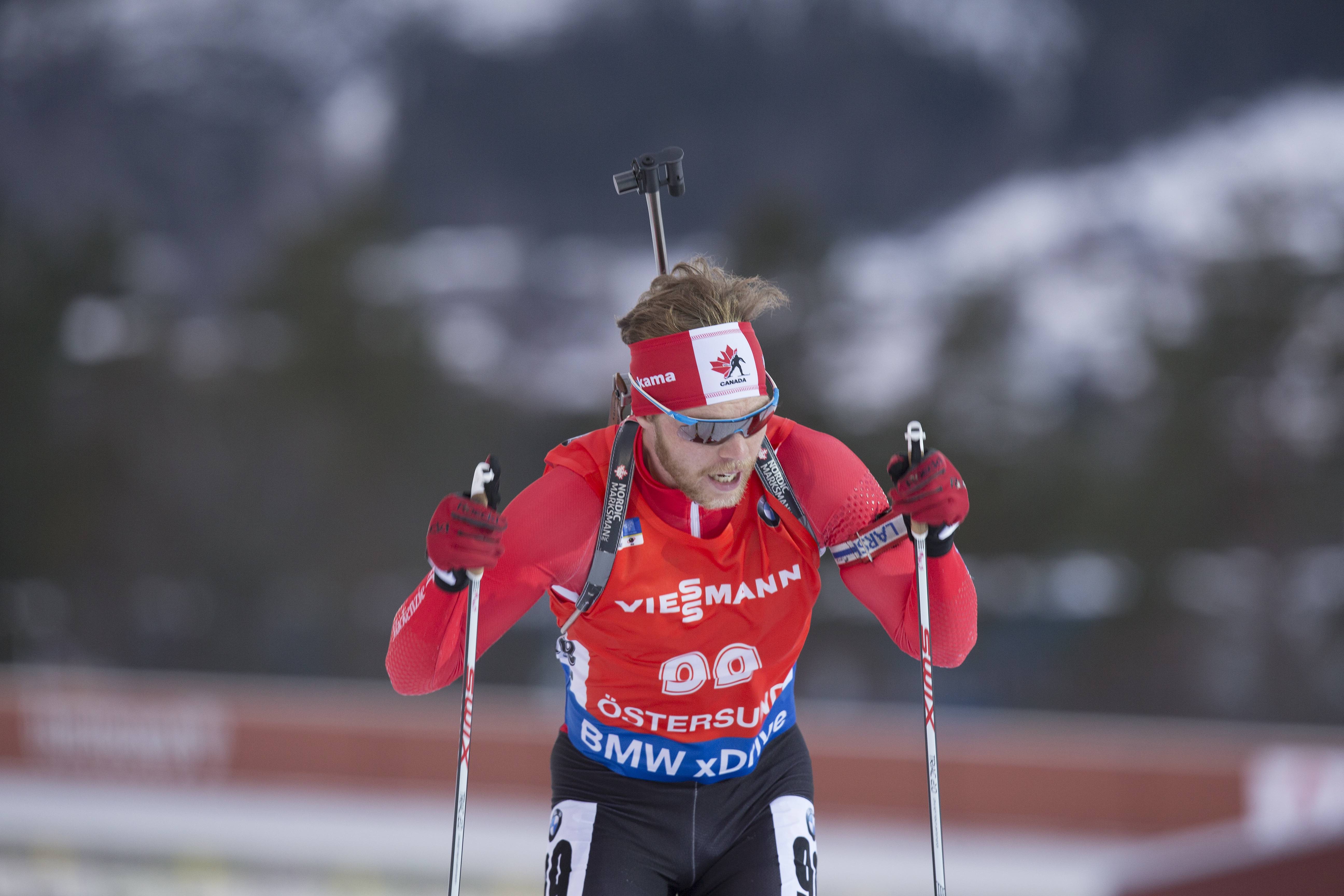
Macx Davies (Biathlon Canada) racing to a career-best 10th in the IBU World Cup 10 k sprint in Ostersund, Sweden, last December. (Photo: Biathlon Canada/NordicFocus)
Macx Davies, of Biathlon Canada’s national senior team, was also mentored by Boruta at BATC. For his first two years after high school, Davies said Boruta helped him form a knowledge base that eventually led him to a national-team nomination.
“During those two years we developed a working relationship and he taught me how to be a full-time athlete,” Davies wrote in an email. “From how to train in proper zones, to hitting targets, to being a well-rounded individual, Richard helped shape who I am today.”
Davies reiterated a point that Kocher made several times: that Boruta was even-keeled, calm and perfectly suited for a sport like biathlon where unsteady nerves can sink an otherwise stellar ski performance.
“As a coach, Richard was the most calm and soft-spoken I ever had,” Davies wrote. “Whether you are racing for a spot on the Olympic team or doing a time trial at home, he was the same calm, supportive and helpful coach, always there to give you a smile, head nod, and if you did really well an illusive high-five!”
Boruta’s life work was still firmly immersed in the present as he coached Megan Bankes, a rising star for Biathlon Canada. At 19 years old, Banks is coming off a season where she won two individual gold medals at the 2017 IBU Junior World Championships. Despite being named to the senior national team, Bankes still trained with Boruta as a member of BATC.
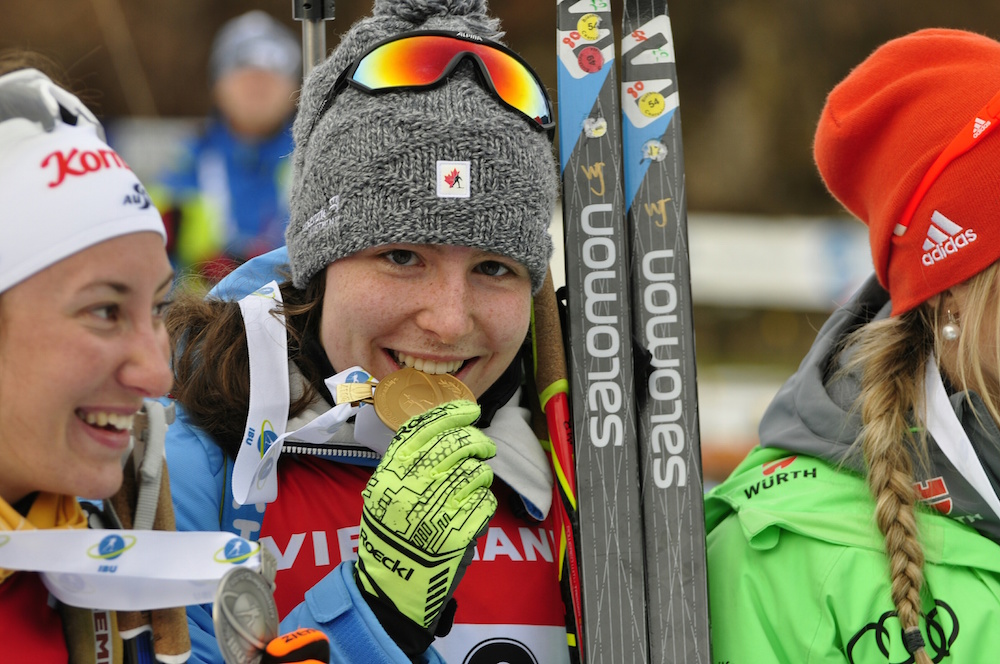
Canada’s Megan Bankes takes a bite out of her gold medal after winning the junior women’s 12.5 k individual at 2017 IBU Junior World Championships in Osrblie, Slovakia, and becoming the first Canadian woman to do so at Biathlon Youth/Junior Worlds. (Photo: Airat Aitniakov)
Helping athletes reach their potential was Boruta’s bread and butter. And for Boruta’s clan of biathletes, that potential often meant the international stage. According to Roddy Ward, Biathlon Canada’s high-performance director, half of the current national team moved through BATC under Boruta’s tutelage.
“Richard was a key player in helping Canada close the gap to the international podium,” Ward wrote in an email.
Ward first met Boruta while competing as a junior biathlete. In 2006, when Ward returned to Canmore for a coaching position, he became professionally linked to Boruta.
“Since 2011, Richard coaching BATC and myself coaching National Team we worked more closely together, often working together with athletes in a NT camp based program (Megan Bankes, Julia Ransom, Emma Lunder, Sarah Beaudry), combining for many training sessions, camps, testing, races etc.,” Ward explained.
The data and spreadsheets, the periodization and hours trained are part of developing an athlete. A coach may tinker with more technique one year, more volume the next. Yet one aspect of the coaching equation difficult to change is the personality each coach brings to the athlete-coach relationship. Ward noted that by observing Boruta, he came to understand that some of what Boruta practiced could, in fact, make his own coaching more effective.
“Early in my career I would notice a contrast to Richard and myself on the range while explaining the day’s training,” Ward emailed. “I would be almost yelling the directions while athletes chatted among themselves and ran around not listening (I’d often have to give directions multiple times), while Richard would talk very quietly (like he always does) while all his athletes listened very closely so they could actually hear the directions. I thought there was something to that and started to apply this technique in my own way.”
Kocher said Boruta understood his inherent strengths. “One time we did this one truth and two lies,” Kocher said. “I’ll never forget because the truth was ‘I believe in nonverbal communication.’ That was him. He didn’t say a lot of words and what he said was valuable and it meant a lot.”
Ward also absorbed the Boruta “less-is-more” tenant.
“Talk less and listen more,” Ward wrote. “When you do say something it will have a bigger impact. I used to talk too much, give too much direct feedback, be too assertive. Now I let the athlete lead more, don’t always give them answers immediately, try to listen more than talk. It’s made me a better coach and teacher.”
But there were days when Boruta could scream encouragement. And in those moments, when the coaching lessons had been ingrained, Boruta revealed his love for seeing others achieve.
“He was someone who didn’t show a ton of emotion,” Kocher said. “Yet when he showed emotion it was passionate. I remember this happened a few times. A long time ago, for the first time, I was going to make a pursuit. I was a first year senior and had just done a World Cup as a junior. Back then I had never made the top-60. Then in the third World Cup in December, in 2003 I guess, I was in Slovakia. It was a windy day and I shot zero-zero. I just remember leaving the range just like super confidently. I had just shot clean for the first time in my life. Literally, Richard was running beside me on the hill. Somehow he had left the range and he was on the hill and he was cheering me on telling me I could get a top-10. And the course was really open and he was able to come out while I was finishing the climb and hitting the next downhill. Then he was suddenly on the next hill. He was cheering me on that one, and then he was near this bridge near the finish. He just found his way onto all these spots on the course to get me to go harder, and he was at the finish line. I remember his passion a lot from that day.”
Boruta is survived by his wife Kamila and three sons Michal, Thomas and Lukas, his mother Jirina, father Richard, and granddaughter Sophie.
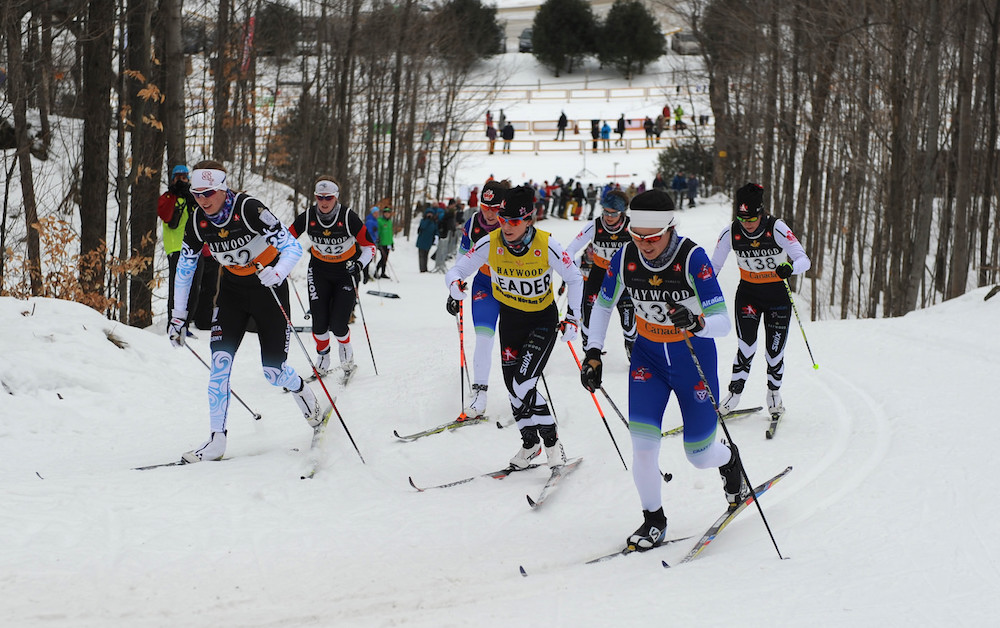
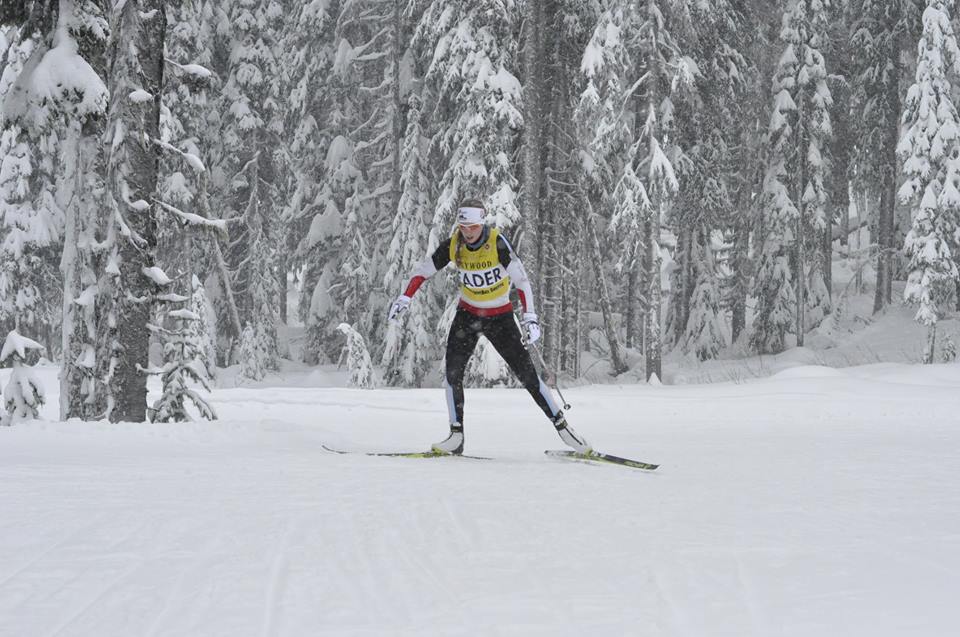
The women’s leaders in the 15 k classic mass start on Day 3 of Eastern Canadian Championships on Feb. 7 in Cantley, Quebec, with Dahria Beatty (l), Cendrine Browne (c), and Jenn Jackson (r) at the front of the pack. Beatty went on to win by 7.7 seconds over Browne, in the NorAm leader’s bib. (Photo: W. James MacLean)
Though patterns develop and race favorites exist, winning is never a given. At least according to Cendrine Browne, the NorAm leader and overall champion of the women’s 10-kilometer freestyle at Eastern Canadian Championships last Saturday, Feb. 6, at the Nakkertok Nordic Ski Centre, Cantley, QC
“I don’t think you can get used to winning. Winning is great but every day is different,” Browne, a member of Canada’s U23 Development Team and the Pierre-Harvey National Training Centre (CNEPH), wrote in an email.
“I chose to ski on white bases today at everybody’s surprise, but they were really fast,” Browne explained after winning in 27:10.8 minutes.
“I didn’t pace myself, I just went hard all the time and it worked pretty well,” she added. “I felt good mentally and physically, and that helped a lot.”
Finishing 9.1 seconds behind Browne was her biggest NorAm distance rival, fellow U23 Development Team member, Dahria Beatty, of the Alberta World Cup Academy (AWCA).
Beatty and Browne also both recently returned from World Cup races in Europe, where they teamed up with Emily Nishikawa and Maya MacIsaac-Jones in the first World Cup relay for all four women.
Rounding our Saturday’s top three for the women was Olivia Bouffard-Nesbitt, of the U23+ Development Team and Rocky Mountain Racers (RMR), who finished 21.8 seconds off Browne’s winning time.
“I was getting really good splits in the first 5k (being told I was leading) and I was having a lot of fun on course,” Bouffard-Nesbitt wrote in an email. “I faded in the second half of the race, but that can be a consequence of going hard at the start, so I have no regrets.”
Also of RMR, MacIsaac-Jones, who won Friday’s freestyle sprint on the first day of Easterns, was pleased with her fourth-place finish, 43.8 seconds behind Browne.
“My race today was really good — I was 4th, which is my best distance NorAm result this year!” MacIsaac-Jones wrote in an email.
Somppi Dethrones Sandau in 15 k Skate
Also on Saturday, Michael Somppi, of the Thunder Bay National Development Centre (NDC),claimed a decisive win in the men’s 15 k freestyle. Somppi completed the course in a time of 34:45.1, besting second-place finisher Kevin Sandau (AWCA) by 25.3 seconds.
“I’m super happy I was able to get back to feeling like myself in a skate race. I was really pumped to get back onto the top step at the NorAm,” Somppi wrote in an email.
The winner of every NorAm distance race he has competed in this season (with four victories total; he skipped the M.S.A. NorAm), Sandau regarded his next few weeks of race efforts as most important.
“Western’s has always been part of the plan leading up to the Tour,” Sandau wrote in an email, referring to the second set of championships, Feb. 19-21 in Prince George, British Columbia.
“Even with a [Ski Tour Canada] spot locked up now unofficially, I’ll be using it as some final hard efforts before flying out East,” he added.
The Ski Tour Canada, doubling as World Cup Finals, starts March 1 in Gatineau, Quebec, and extends through March 12 with the last four races in Canmore, Alberta.
Noting he was “pumped” to be on the podium on Saturday, Russell Kennedy, of the Canmore Nordic Ski Club, finished third, 31.2 seconds behind Somppi.
“I nailed my pacing. That was huge it really helped me as I made up a lot of time at the end,” Kennedy wrote in an email.
Kennedy also pointed to external sources of motivation during his race, including the man who started just ahead of him, Brian McKeever, of the Canadian Para-Nordic Ski Team.
“It also was good to have Brian there. He was super motivating,” Kennedy wrote.
McKeever, visually impaired, raced to fifth overall, 1:01.9 out of first and 19.6 seconds behind Knute Johnsgaard (AWCA/U23+ Development Team) in fourth.
Though Saturday left her chasing downBrowne,Beatty positioned herself as the woman to beat by the Nakkertok course’s final climb on Sunday in the women’s 15 k classic mass start.
“My plan going into today was to stay in contact until the final climb and leave everything on that final climb,” Beatty wrote in an email on Sunday.
Despite losing contact at one point during her third lap of the 5 k loop, Beatty managed to stick to her plan. Amidst Sunday’s snowfall, the Whitehorse native left everything on the last uphill and came away with the win in 46:54.4.
“I was able to regain contact with Cendrine and my skis were gliding especially well so I was able to carry good speed into the final climb and get a gap before the downhill into the finish,” Beatty wrote.
Browne finished 7.7 seconds later in second place.
“A second place is great but I could have won…My skis were so slow!” Browne wrote in an email.
Finding herself at the back of the lead pack during the downhills, Browne put her focus into Sunday’s course climbs.
“I told myself that if I wanted to win, I would have to give everything I had in the uphills because I couldn’t count on my skis in the downhills,” Browne wrote. “So in the second last uphill, I tried to break away from the pack. It worked. I had a 10-meter gap before the second last downhill.”
However, by the bottom of the hill, Beatty caught back up to Browne.
“As I was going down, Dahria passed me like I was still,” Browne added. “I tried to catch up in the last up hill and fell. So I didn’t catch her. I finished 2nd. I was disappointed. I hate giving excuses but I think I could have won.”
Finishing just 2.0 seconds behind Browne, and 9.7 seconds behind Beatty, was NDC Thunder Bay’s Katherine Stewart-Jones in third place.
“There was a big lead pack for a lot of the race. It was easy to stay relaxed because I had very fast skis,” Stewart-Jones wrote in an email. “I think the race came down to the last couple of hills of the course, whoever had energy left in the tank.”
She pulled some energy from fans on from the trailside.
“It was amazing to see the support from my home club,” Stewart-Jones, who grew up training with Nakkertok, wrote. “There were so many people out there cheering me on!”
After a large crash in the first lap, Bouffard-Nesbitt lost contact with the front group and raced to a 10th overall (+2:01.0).
“I’ve hardly classic skied this winter due to my stress fracture, and I’ve really been struggling in classic races,” Bouffard-Nesbitt wrote in an email.
“As a whole I’m happy with the weekend. I’m going to try to not be too hard on myself for this last classic race,” she added.
Shields Takes All in 20 k Mass Start
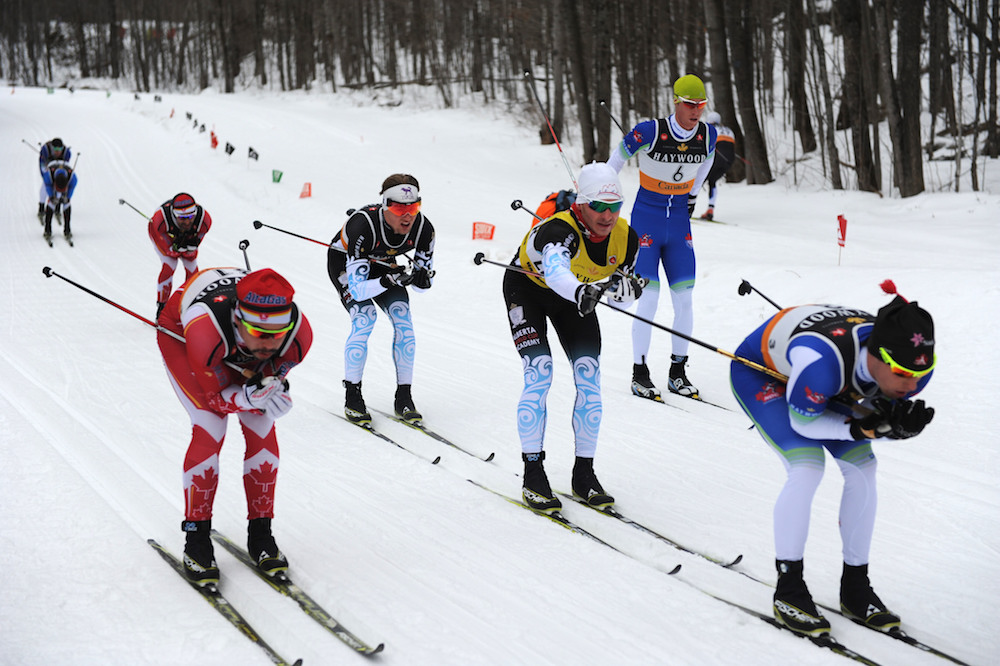
The men’s leaders during the 20 k classic mass start on Feb. 7 at Eastern Canadian Championships in Cantley, Quebec, with Andy Shields (r) leading, Brian McKeever (l), Sandau (yellow bib), with Sandau’s AWCA teammate Knute Johnsgaard behind him, and Scott Hill (6) of NDC Thunder Bay right there in the lead pack. (Photo: W. James MacLean)
En route to his third-career NorAm win, Andy Shields (NDC Thunder Bay), came away victorious in the men’s 20 k classic mass start on Sunday.
Shields completed the four-lap race in 52:53.6, besting second place finisher Jesse Cockney (CNEPH/NST) by 12.1 seconds.
“The herringbone sections were coved in deep sugary snow but I felt comfortable on them,” Shields wrote in an email.
With 2 k to go, Shields gapped the field during a herringbone hill and skied comfortably away to first place.
“It never felt like the pace was unmanageable so a ‘thank-you’ to the body for being in good shape today,” Shields wrote.
Cockney confirmed that Shields’ skiing on Sunday was left unrivaled by any other skier on course.
“Andy definitely won with stronger legs today. He was skiing the steep climbs really well and had lots left for the final lap,” Cockney wrote in an email.
After starting in bib 31, Cockney was happy to have maneuvered his way up to the front of the pack.
“I’m quite happy to have moved up from bib 31 to near the front. The distance races here have also been better feelings pushing hard than the rest of the year,” he wrote.
Finishing just 1.3 seconds off of Cockney was Johnsgaard in third, 13.4 seconds behind Shields.
“Kevin and I were leading a lot on the first lap, but there was a bit of fresh snow in the tracks and it was hard to drop the group,” Johnsgaard wrote in an email.
“We’d get a gap on some climbs and then it would come back together on the downhills. The course was basically double pole and then herringbone up steep climbs in ankle deep corn snow,” he added.
According to Johnsgaard, the herringbone sections played to Shields’ strength, but not his own.
“Not exactly my idea of a nice classic course,” Johnsgaard wrote. “Andy had some super herring bone on the last major climb and broke away a bit.”
Sandau, who had been skiing in the front pack with Shields, Johnsgaard and Cockney, crashed, which he wrote cost him “a podium spot.”
Despite his fall and fifth-place finish, 20.4 seconds off of first place, Sandau was satisfied with how he felt during the races.
“The past couple weeks had a really good chunk of volume and I was happy how I felt in both distance days and had some good fight,” Sandau wrote.
Ahead of Sandau in fourth, McKeever was half a second off the podium and 14 seconds behind Shields.
— Gerry Furseth and Alex Kochon contributed reporting
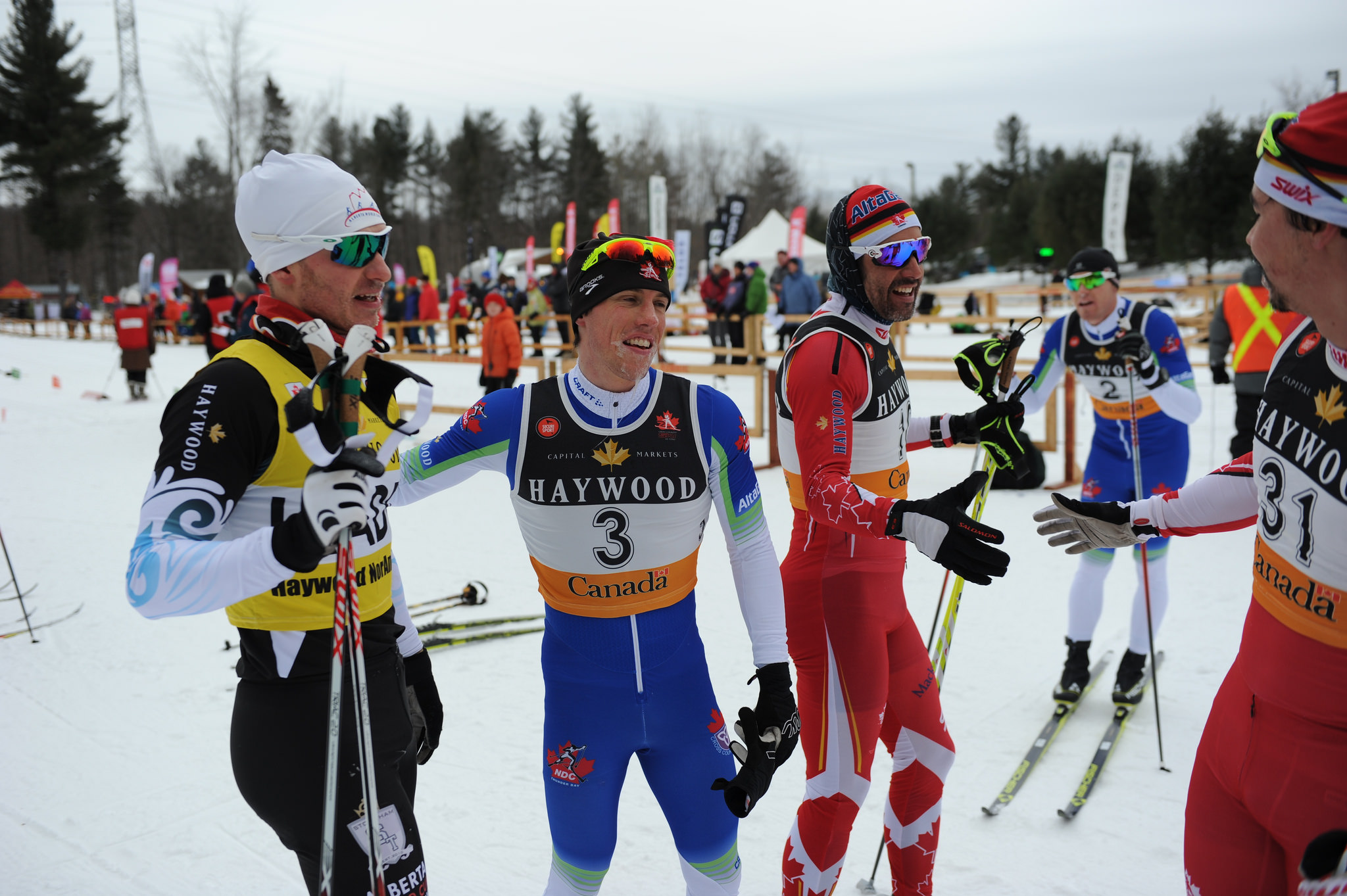
(From left to right) Kevin Sandau, Andy Shields, Brian McKeever, Michael Somppi, and Jess Cockney after the men’s 20 k mass start on Sunday, Feb. 7. Shields won by 12 seconds over Cockney, Knute Johnsgaard (not shown) placed third, McKeever was fourth, Sandau (the NorAm leader) fifth and Somppi eighth on the last day of Eastern Canadian Championships in Cantley, Quebec. (Photo: W. James MacLean)
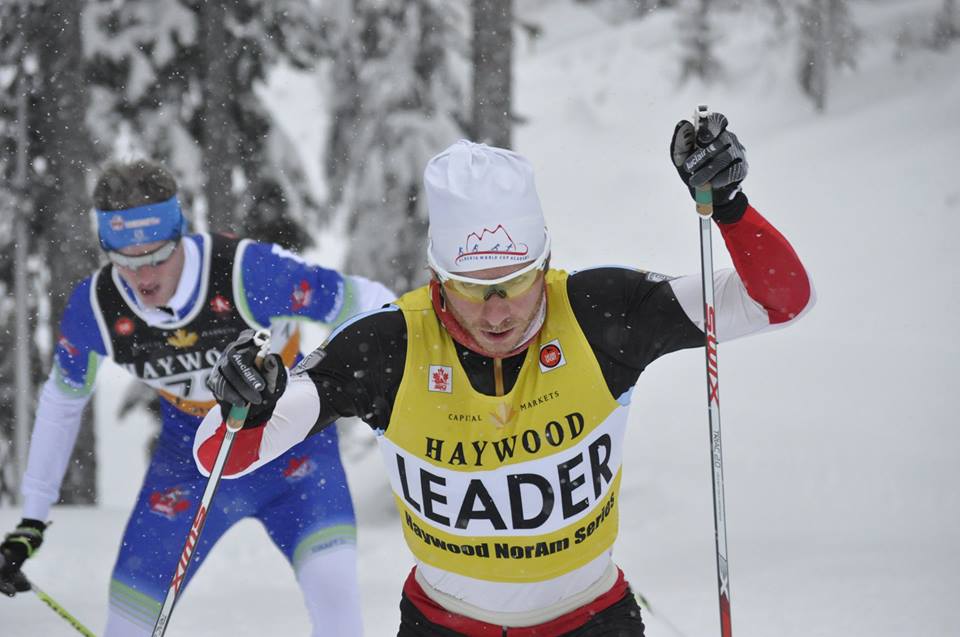
Race winner Kevin Sandau (AWCA) in the leader’s bib ahead of Bob Thompson (NDC Thunder Bay) during the men’s NorAm 15 k freestyle individual start on Sunday in Vernon, British Columbia. (Photo: XTS Photography)
VERNON, British Columbia — Kevin Sandau of the Alberta World Cup Academy (AWCA) has no time for quitters, including himself. Despite not being renominated to the Canadian National Senior Team this spring, Sandau’s decision to carry on with his career as a professional nordic ski racer proved to be worthwhile as he won his third-consecutive distance race of the NorAm season (in as many races) on Sunday, the men’s 15-kilometer individual start freestyle race at the Sovereign Lake Nordic Centre.
“Going up the climbs, I felt super smooth with my V1 skate,” Sandau, 27, said during an in-person interview after winning Sunday’s race by 37.3 seconds in 39:05.9. “I made sure to push the flats using a strong V2 to keep the speed up. … It was one of those days where I just felt invincible.”
Though doubt shrouded Sandau’s ambition for the sport earlier this year, his latest performances appear to cast all queries aside.
After two weekends of NorAm races, the Canadian will head into the New Year with three distance titles already under his belt, which puts him in a position to potentially earn future World Cup starts as the NorAm (Continental Cup) leader.
“Third distance win in a row, I think that is a good way to end the 2015 year,” he said.
Part of Sandau’s first-place performance on Sunday stemmed from not just his in-race focus, but his pre-race routine and weekend training, he said.
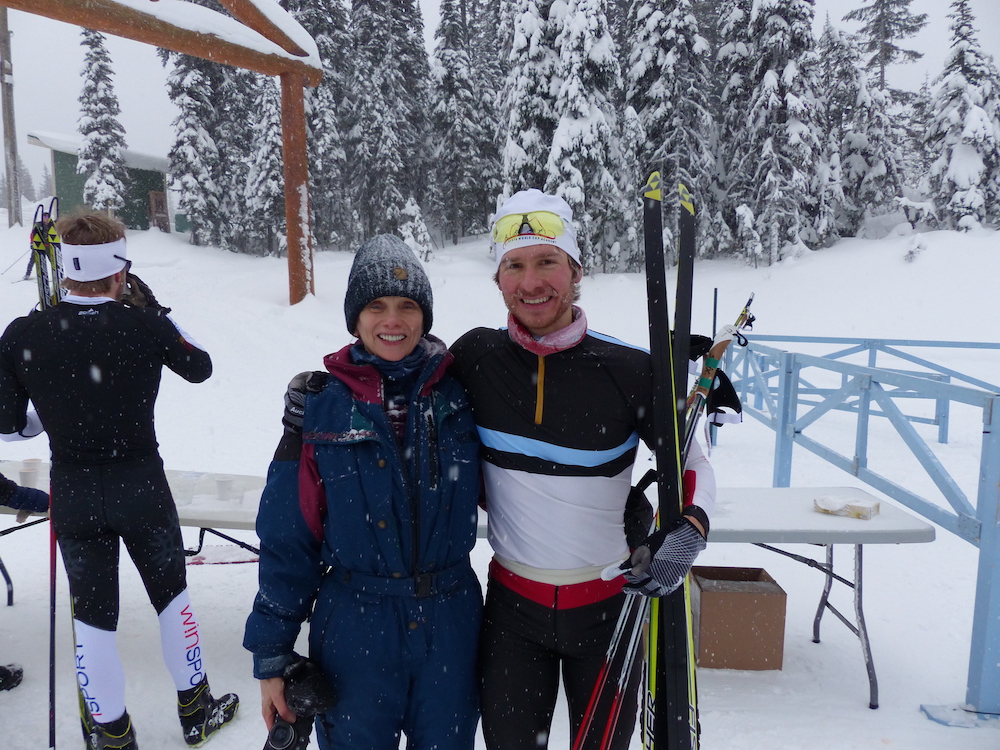
Kevin Sandau and his mom after the men’s NorAm 15 k freestyle individual start on Sunday in Vernon, British Columbia. (Photo: Gerry Furseth)
“My warmup this morning felt bombproof,” Sandau said. “I also took [Saturday] off, didn’t do the sprint race, and did volume instead. … It [was] interesting to see how the body reacted to that.”
While Sandau sat out the sprint, his AWCA teammate and second-place finisher for the men’s 15 k, Knute Johnsgaard, of the national U23+ Development Team, competed both days, and reached the podium in second in both races.
“I thought I skied a good race and I am pretty happy with second,” Johnsgaard, 23, said. “But I’m still chasing that win.”
Johnsgaard’s podium on Sunday came from course knowledge and tact.
“I’ve skied this course so many times,” he said. “You’re able to push pretty hard on the uphills because there is quite a few tucking sections where you can recover after the climbs.”
While course experience was on Johnsgaard’s side, he left the Sovereign NorAm wanting a different kind of experience.
“I have a very large stack of silver medals now, and I’d like to get gold soon,” he said.
Just over 41 seconds behind Sandau, Russell Kennedy (Canmore) in third also craved the top spot on the podium.
“Everyone wants to win from the start, but I’m hoping to get better and better as the season goes on,” Kennedy said. “I feel like I’ve got a good stepping stone, and I’m going to try to keep building off of that.”
Kennedy spent most of his race getting splits for second behind Sandau, but and initially finished second 41.2 seconds after him. A later starter, Johnsgaard bumped Kennedy to third by 3.9 seconds.
On the women’s side, Dahria Beatty (AWCA/U23 Development Team) won the women’s freestyle distance race at Sovereign Lake for the second year in a row.
“I love this course,” the 21-year-old Beatty said after winning in 30:30.2, more than 32 seconds ahead of runner-up Jaqueline Mourao, originally from Brazil who trains with the Pierre Harvey Training Centre (CNEPH) in Quebec.
“I’ve been racing on this course since I was 15; I raced here with the Yukon [team when] I was a junior,” Beatty added.
With her course knowledge and Sunday’s snowfall during the race, she powered into the first climb.
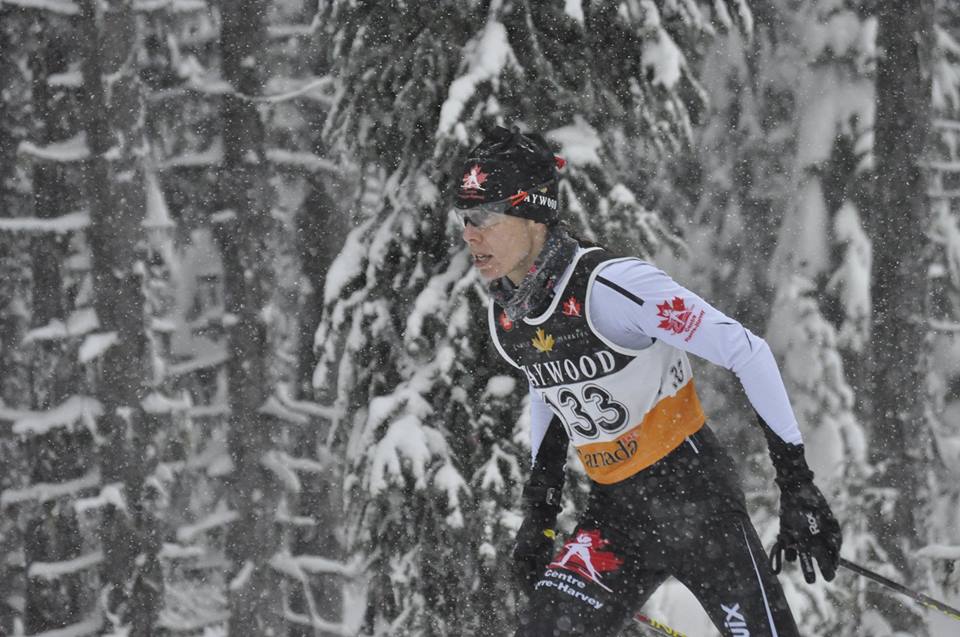
Dahria Beatty (AWCA) in the leader’s bib during a snowy women’s NorAm 10 k freestyle individual start on Sunday in Vernon, British Columbia. (Photo: XTS Photography)
“A lot of people take the first climb conservatively because they are worried about blowing up,” Beatty said. “So I skied as hard as I could and as smooth as possible. I think that’s the key to this course, especially when it is snowing.”
On the podium for the second-straight day, Andrea Dupont, (Rocky Mountain Racers) finished third, 1:02.7 after Beatty.
“Today was okay,” Dupont, 25, said. “It was a bit of a slog because it really started dumping snow when the girls got on course.”
A sprint specialist, Dupont found pacing helped her to another top finish.
“I wanted to not go out too hard, because I’m definitely a sprinter and I characteristically go out too hard and can’t hold it,” she said. “[Sunday] I went out easy and tried to hold it … and I think I’m on track.”
Another sprint favorite, Beatty came into Sunday on the hunt for a win after missing out on Saturday’s A-final.
“I was a little disappointed with not making the A-final yesterday,” she said. “I wanted to come hard today and I knew that I could do well.”
After charging up the first climb, Beatty continued to get positive splits and raced to a 32.2-second win over Mourao.
“I kept getting splits saying I was 25 seconds up on second,” said Beatty, “When you get splits like that, it makes you ski faster because of the confidence boost,” she added.
A three-time Brazilian Olympian, Mourao also felt a confidence boost after her race.
“I’ve never thought about podiums,” said the 40 year old, who’s also competed in biathlon. “And now, with the right preparation, the right skis, the opportunity I’m having, I can dream more.”
Also an adept mountain biker, Mourao believed her time spent on the bike helped her during her time spent climbing on Sunday’s course.
“I’m a mountain biker and I like climbing so the course was perfect for me,” she said.
The last weekend of racing until the New Year (and the next NorAm Jan. 14-17 in Thunder Bay, Ontario) for many of the Canadians, most feel the Sovereign Lake NorAm races were a solid close to 2015.
“This is my last race of 2015,” said Beatty. “I won’t be racing until I head to Europe after Christmas [as the Continental Cup leader] and it’s nice to finish on a positive note.”
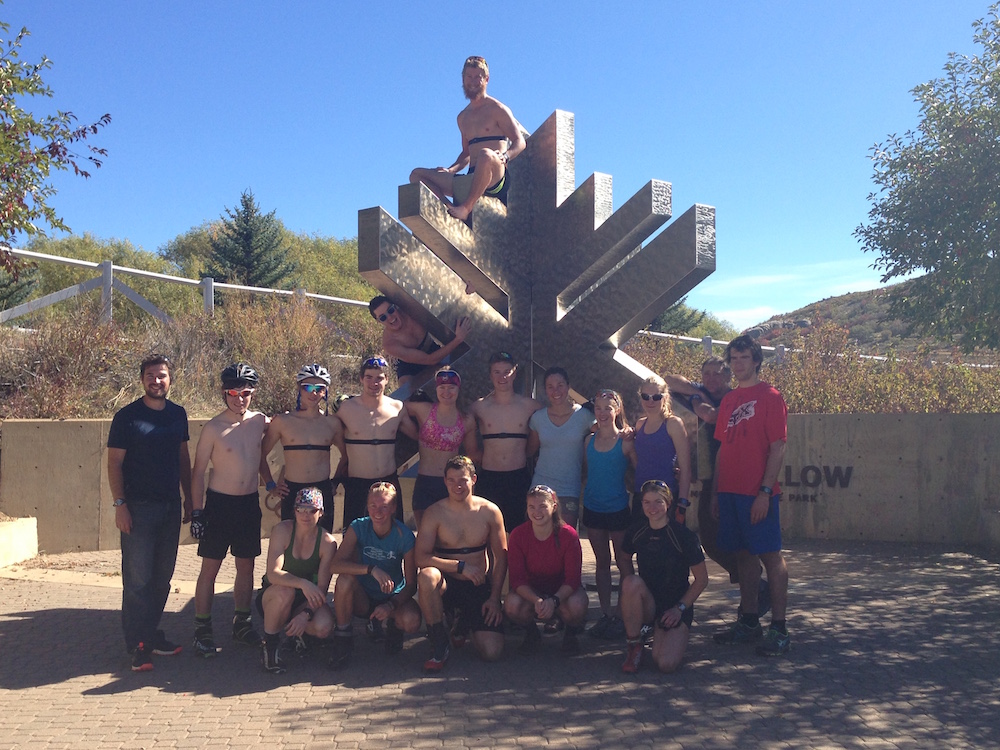
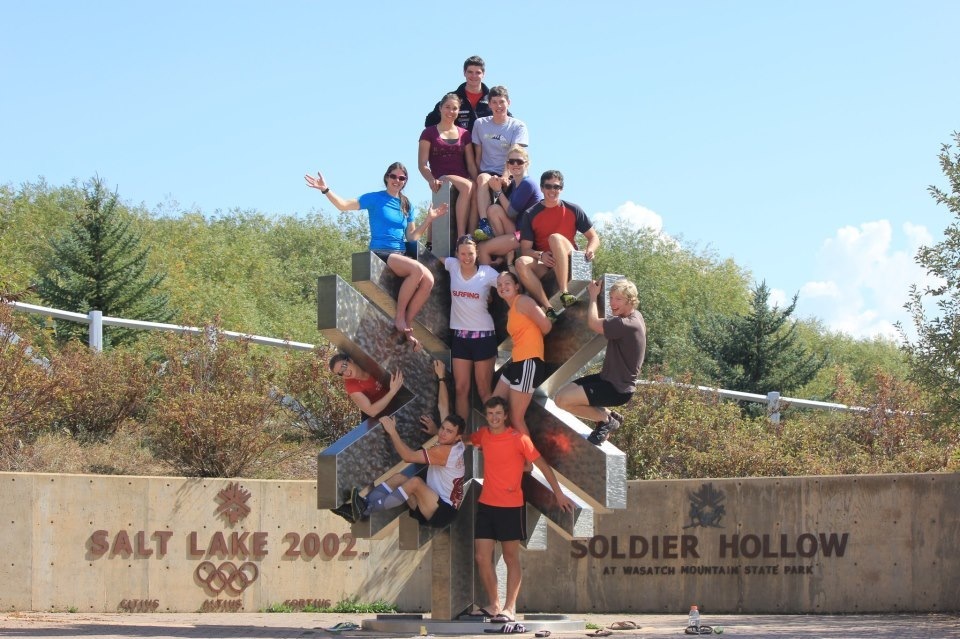
The Rocky Mountain Racers pose for a team photo during their two-week training camp earlier this month at Soldier Hollow in Midway, Utah. (All photos: Maya MacIsaac-Jones/Rocky Mountain Racers)
Editor’s Note: The following training-camp recap was written by Maya MacIsaac-Jones, an athlete on the Rocky Mountain Racers ski team in Canmore, Alberta. She and her teammates recently returned from their annual two-week camp in Park City, Utah. To submit your own camp writeup, please email info@fasterskier.com with the subject line: “Camp Recap.”
***
From Sept. 27 to Oct. 11, Canada’s Rocky Mountain Racers headed to Park City, Utah, for their annual fall training camp. The team, which is made up of twenty biathletes and cross-country skiers from across the country, took advantage of the region’s high altitude while putting in big volume hours and intensity.
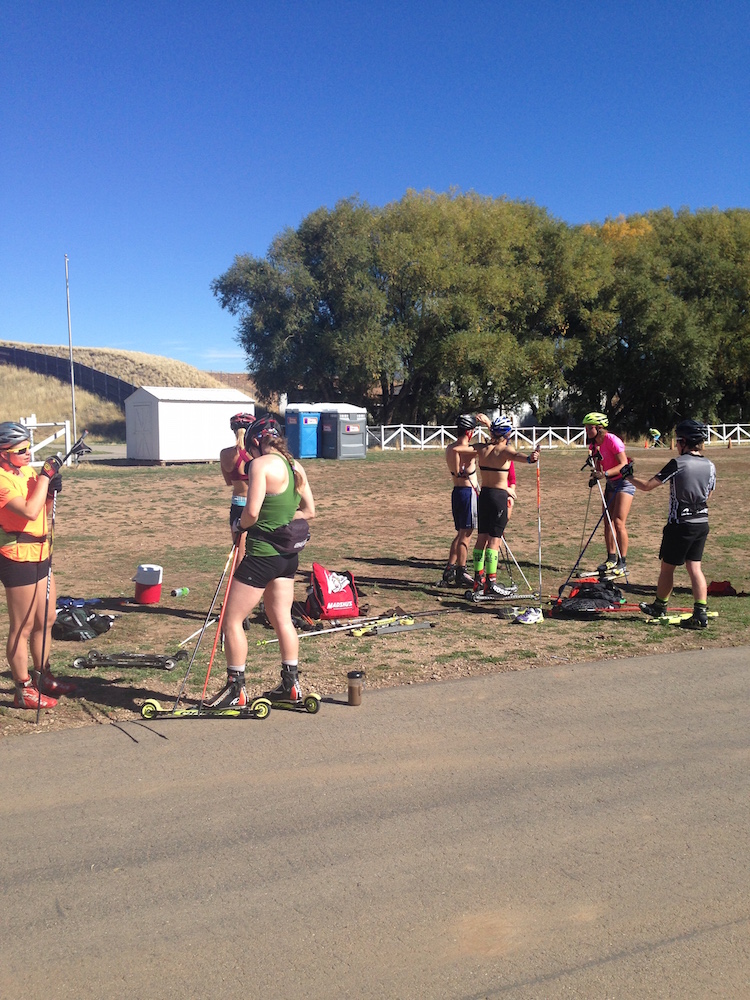
Coaches John Jaques and Luke McGurk led RMR athletes during two grueling weeks of training with 3-5 hour volume days up Mirror Lake Pass, Wolf Pass, Emigration Pass, and Big Cottonwood Pass. For intensity sessions, the team went to Soldier Hollow, where the former Olympic venue’s paved rollerski track and biathlon range provided an opportunity for the biathletes and the cross-country skiers to train together.
For many RMR athletes, this was their first time coming to Park City.
Group training at Soldier Hollow.
“Skiing at Soldier Hollow was one of my favourite parts of the trip,” said Donny Boake, 15-year old RMR skier from Yellowknife, Northwest Territories. “The rollerski track there has steep climbs and technical descents, so it was a great place to practice attacking the climbs and taking the descents aggressively.”
For returning athlete Ember Large, the camp provided a great opportunity to connect and work as a team.
“It was great to have the entire team together for two weeks, both for intensity and long easy days,” she explained. “Having everyone there made for a really fun atmosphere, and we were able to learn a lot from each other.”
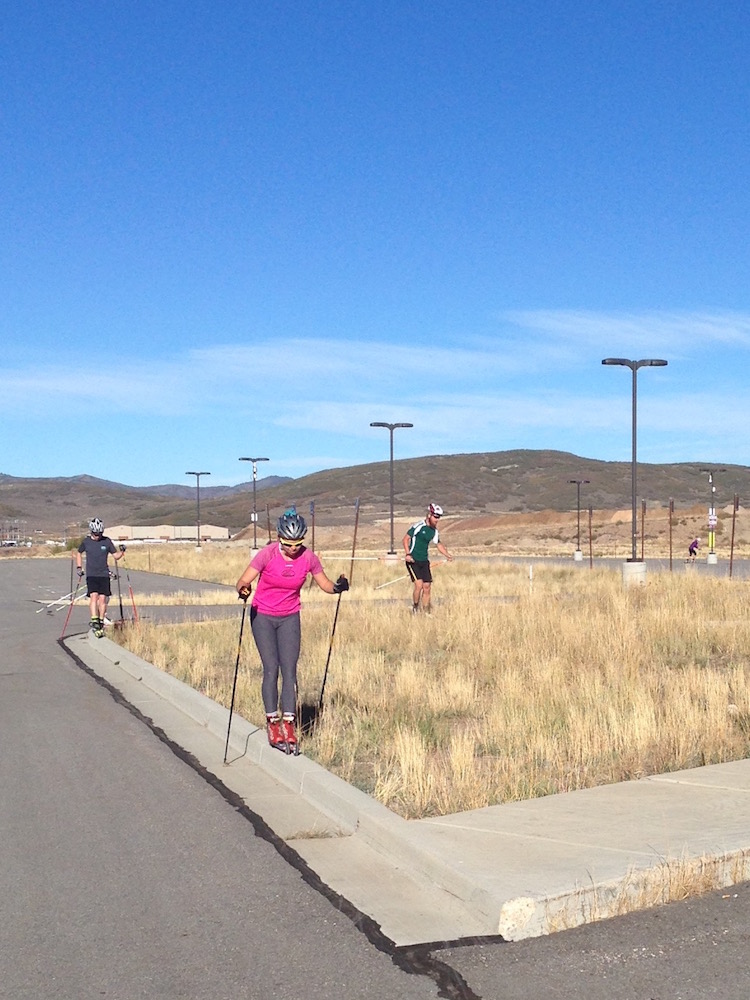
This year, the team added something new to their training camp: agility practice. Armed with empty parking lots, sharp corners, and sidewalk curbs for the athletes to jump off of, RMR coaches prepared obstacle courses for the athletes to help improve their confidence on rollerskis. The sessions focused on honing the athletes’ ability to ski in a pack, corner, navigate obstacles, jump, and rollerski.
RMR’s Emma Camicioli, Thomas Stushnoff and Evan Girard attacking the curbs during agility.
According to Coach McGurk, the agility sessions allowed athletes to “become more comfortable on their skis and give them the confidence to make decisions quickly when faced with a difficult situation.”
“The camp at Soldier Hollow is always an excellent starting point for the year as it offers a wide variety of terrain that we can use to test our athletes as well as most of our athletes will be in attendance,” he added.
The camp finished off with a sprint time trial at Soldier Hollow, where RMR athletes were joined by Wasatch Nordic Ski Academy for the day. Athletes completed a qualifier, three heats, and another qualifier to finish off the day. Heats were organized according to qualifying time, with similar speed athletes placed in the same heats to make for optimal competitiveness.
RMR’s youngest cross-country skier, Anna MacIsaac-Jones, was happy to tackle a challenging course in the sprint.
“It was a great experience to be able to race with some other girls that we don’t get to see in Canada,” she said. “It was a tough course with lots of hard uphills and downhills that really helped improve my skiing.”
Now done their last camp of the season, RMR athletes have headed back to Canada for some final training on Canmore’s Frozen Thunder before the season kicks off at the end of November.
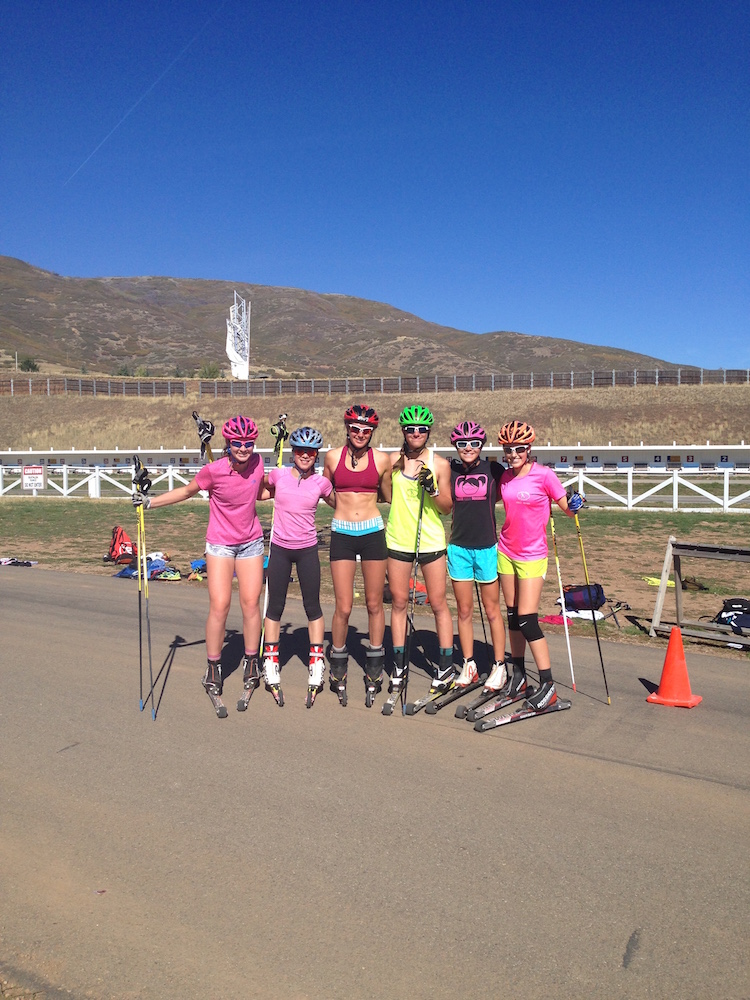
RMR and Wasatch Nordic girls after their sprint simulation at Soldier Hollow in Midway, Utah.
The Rocky Mountain Racers crew after a training session in Soldier Hollow in 2012. (Courtesy photo)
Maya MacIsaac-Jones, 19, of the Canadian National Junior Team and Rocky Mountain Racers (RMR) in Canmore, Alberta, submitted the following article about her RMR’s recent dryland camp in Park City, Utah, to info@fasterskier.com. Born and raised in Athabasca, Alberta, MacIsaac Jones lives in Canmore and is a student at Athabasca University.
***
From Sept. 27 to Oct. 11, one of Canada’s high-performance racing teams, Rocky Mountain Racers (RMR), headed down to Park City, Utah, for their two-week long high altitude training camp.
RMR is comprised of just over 20 high-performance athletes in both cross-country and biathlon from all across Canada. Led by coaches John Jaques and Luke McGurk, the team’s athletes focused on both high volume and high intensity during their camp.
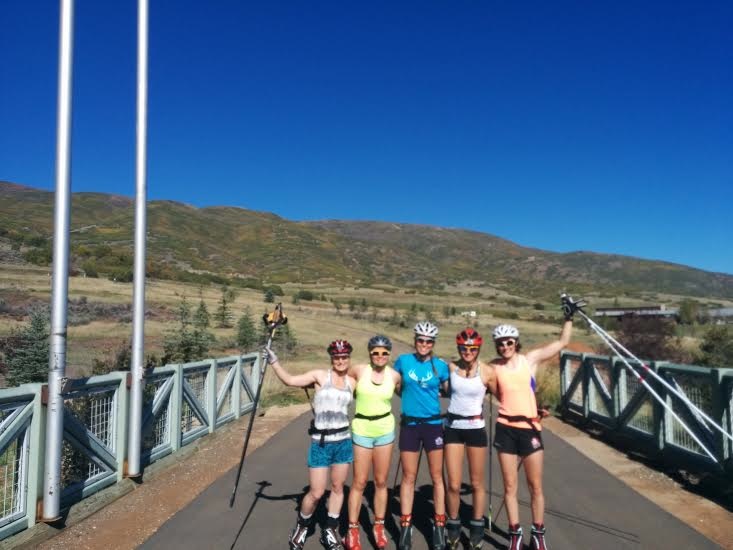
RMR girls after a time trial at Soldier Hollow last month (from left to right): Andrea Dupont, Emma Camicioli, Maya MacIsaac-Jones, Ember Large, and Olivia Bouffard-Nesbitt. (Photo: Ember Large)
Long 4-5 hour workouts were completed on the various mountain passes surrounding Park City and Salt Lake City while intensity sessions, time trials and shooting practices were reserved for the excellent facilities available at Soldier Hollow in Midway.
Because of RMR’s cross-country/biathlon mix, Soldier Hollow was the perfect place for training sessions to occur; coaches were able to coordinate shooting practices for the biathletes with simultaneous rollerskiing sessions for the cross-country side of the team.
Utilizing Soldier Hollow’s biathlon range, extensive set of rollerski tracks and advantageously close proximity to Park City, RMR held several intensity sessions and time trials at the former Olympic site. The hilly climbs the facility offered also gave the athletes an opportunity to have a dryland time trial with a course very similar to what they will face during the ski season.
“It’s inspiring to train in the exact spot that I saw my Olympic heroes win medals at during the 2002 Olympics,” RMR athlete Andrew Brisbin stated. “[Soldier Hollow] is the most difficult and technical rollerski track that I’ve been on, meaning it most closely resembles a World-Cup caliber ski course through its lung and leg busting climbs and quick descents.”
Stuart Harden, RMR athlete and one of Canada’s top junior biathletes, also enjoyed training at the former Olympic site: “Soldier Hollow was a great asset to have at our Park City training camp. For biathletes, having a range and full rollerski loop close by made the trip feasible. As far as rollerski tracks go, Soldier Hollow is considerably challenging. Some steep, sustained climbs coupled with the altitude can really make you hurt, and can definitely make training there worthwhile.”
When not focusing on intensity sessions or shooting practices, the team explored the many other mountain roads available for rollerskiing in the area, including Mirror Lake pass, Wolfe pass, and Guardsman Pass. They concluded their camp with a 4-5 hour altitude run at 9000 feet on the trails above Park City.
With their last camp of the season complete, RMR athletes are now in their final stages of preparing for the racing season and the upcoming [SuperTour and] NorAm races at West Yellowstone, Bozeman, Rossland, and Whistler.
For any athletes or coaches interested in exploring Soldier Hollow as a future training possibility, please use the following contact information: