Tag: road biking

  • Wednesday Workout: Threshold/VO2 Max with National NoCo Champ Bryan Fletcher

    Wednesday Workout: Threshold/VO2 Max with National NoCo Champ Bryan Fletcher

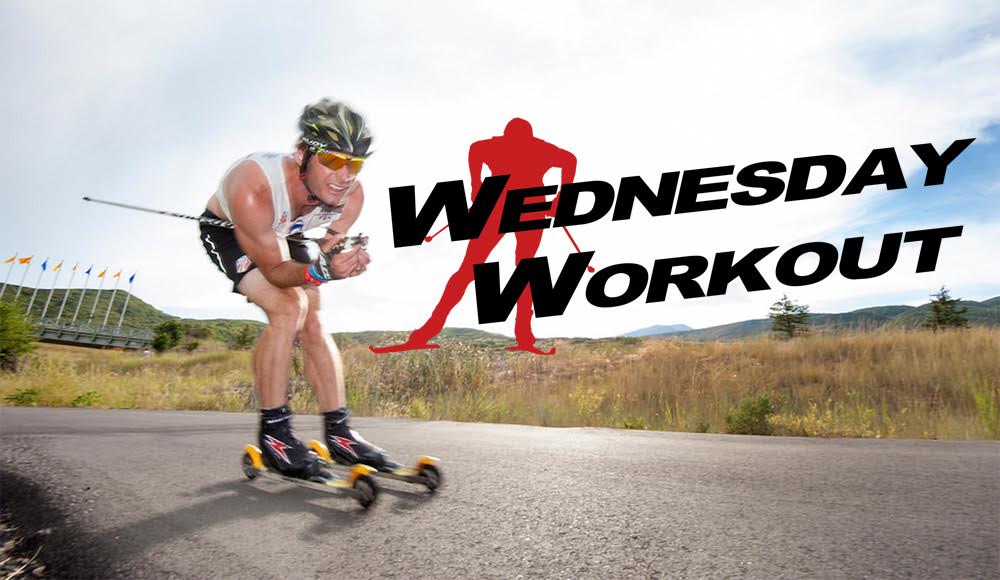
    U.S. Nordic Combined's Bryan Fletcher tucks around a high-speed corner at Soldier Hollow en route to a repeat national title at the U.S. Nordic Combined Championships in Midway, Utah. (Photo: USSA/Tom Kelly)
    U.S. Nordic Combined’s Bryan Fletcher tucks around a high-speed corner at Soldier Hollow en route to a repeat national title at the U.S. Nordic Combined Championships in Midway, Utah. (Photo: USSA/Tom Kelly)

    For this week’s workout, we sought the expertise of the reigning national champion, Bryan Fletcher, who won his second-straight title at U.S. Nordic Combined Championships last weekend in Park City, Utah.

    The older of two brothers on the U.S. Nordic Combined Team, Fletcher led the championships jump on the large hill and held off his hard-charging teammate, Adam Loomis, in the 10-kilometer rollerski race for the win. Fletcher, 29, edged the 23-year-old Loomis by 5 seconds after starting 26 seconds ahead of him and beat his brother Taylor by 47 seconds after starting 1:04 before him. Loomis placed second and Taylor was third.
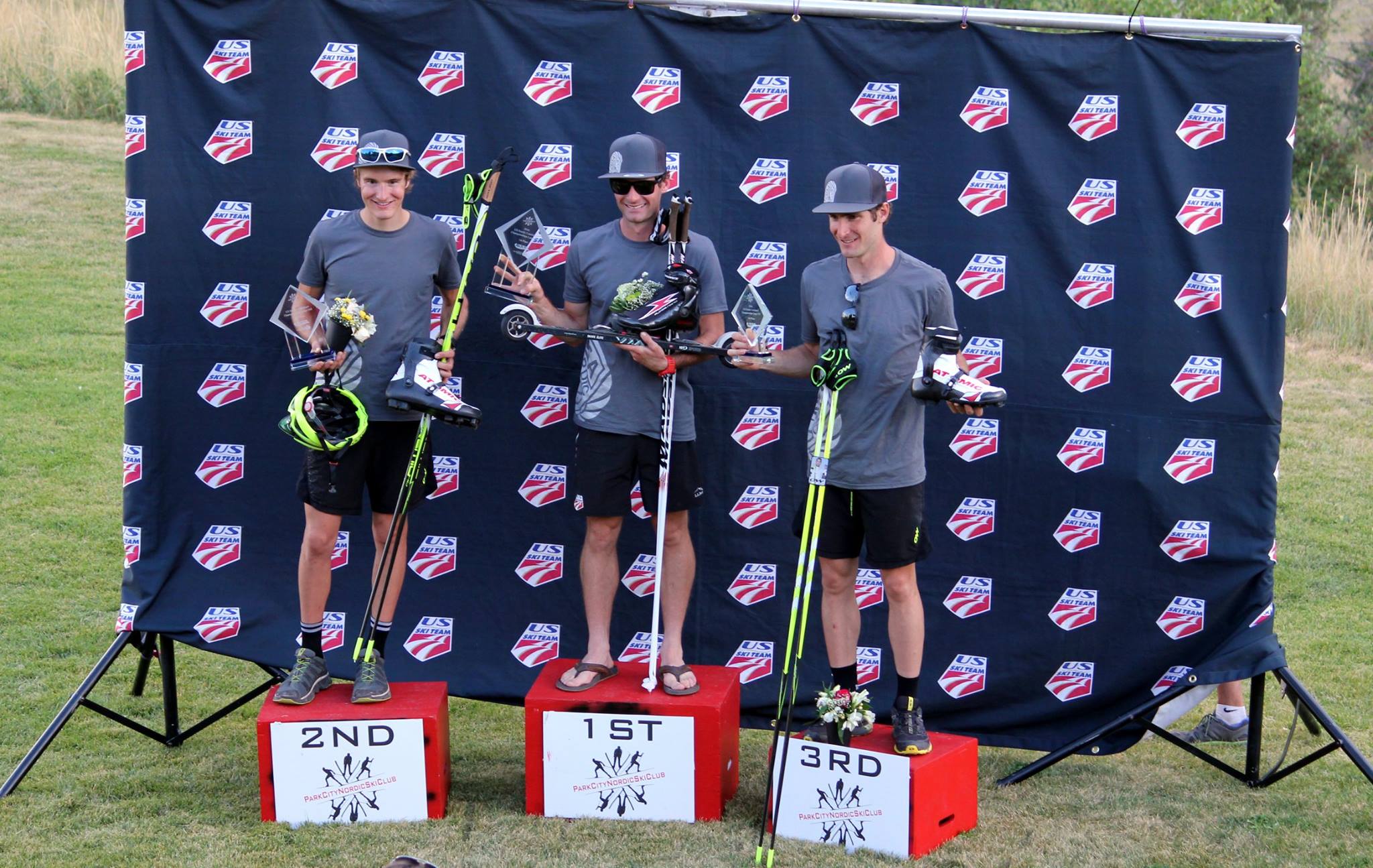
    The podium at the 2015 U.S. Nordic Combined Championships, which were held in Park City and Midway, Utah: with winner Bryan Fletcher (c), second-place finisher Adam Loomis (l) and Taylor Fletcher in third. (Photo: USSA/Tom Kelly)
    The podium at the 2015 U.S. Nordic Combined Championships, which were held in Park City and Midway, Utah: with winner Bryan Fletcher (c), second-place finisher Adam Loomis (l) and Taylor Fletcher in third. (Photo: USSA/Tom Kelly) Complete gallery

    “Nationals last week was awesome,” Fletcher wrote in an email. “The comps were intense because the level was high and everyone had a shot at the podium.  I was super stoked to feel the pressure the team put on me the whole time, there was no easy victory to be had.”

    Loomis had a “career day,” he added and noted that Taylor’s jumping had improved as well.

    “That made me nervous too because in most of our summer time trials he has beaten me by almost 2 minutes,” Bryan wrote. “I knew I need a good race to stand a chance.”

    Heading into the 10 k rollerski at Soldier Hollow, Bryan focused on pacing — starting conservatively and skiing methodically and controlled throughout the race.
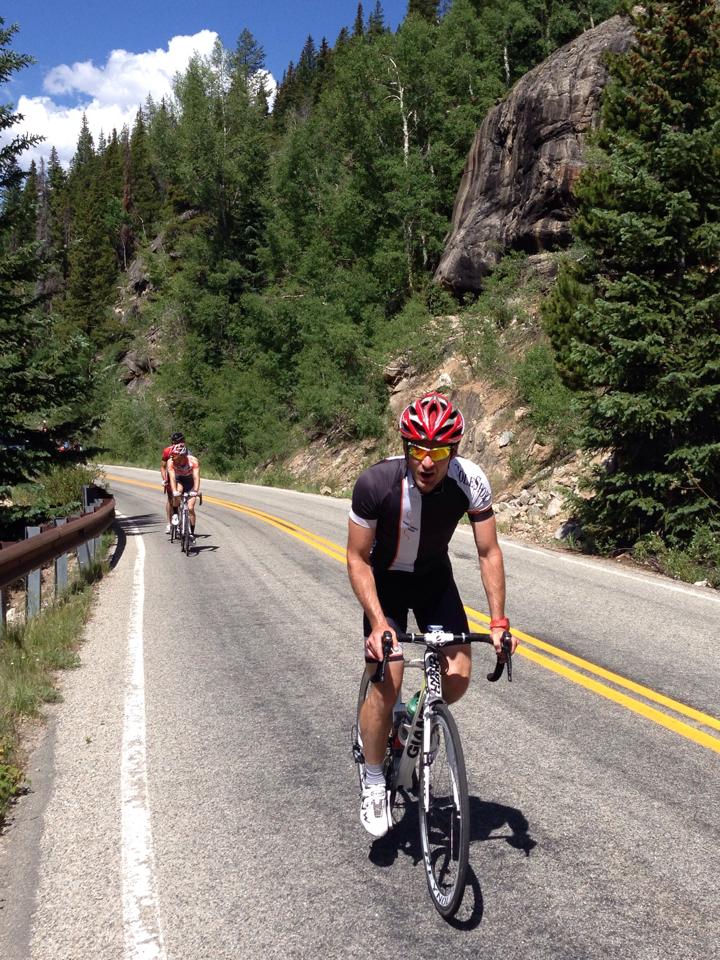
    Bryan Fletcher (front) riding up Independence Pass in the Rocky Mountains last year during a cycling camp in central Colorado. (Courtesy photo)
    Bryan Fletcher (front) riding up Independence Pass in the Rocky Mountains last year during a cycling camp in central Colorado. (Courtesy photo)

    “I needed to have some in the tank for the sprint but the goal was not to let it come down to that,” he wrote. “Luckily the plan worked and I executed it to the best of my ability and came away with the victory. This was a huge relief for me after a long week of school finals, moving to a new apartment, and of course training for the competition.”

    In terms of how much a national title means to him, albeit on dry land, he explained he weighed the championships heavily.

    “It’s a result a lot of people love hearing about, it adds validity to your resume as a career athlete to be a national champion,” he wrote. “I definitely put some pressure on myself to come away with the win and I am happy I was able to come through on that.”

    For a workout he’d recommend, Fletcher picked out one increasingly used by road bikers, and one he assigns some of the athletes he coaches through the Hunter Allen Peaks Coaching Group.

    “The cycling world cites the benefit is that it works on both your VO2 max zone and Threshold zone. Or Level 3/4 zone depending on what system you use,” he wrote. “This workout should be done once a month, probably in combination with normal threshold/threshold-plus work.”

    The workout is designed for cyclists, but can be done skiing or running, too. “Just adjust the tempo to the corresponding exertion level,” Fletcher explained.

    Warm Up: Start with a 20- 30 minute warm up. Include a few pick ups to no longer then a minute and space them out throughout the warm up.

    Workout:

    – Start with 30 seconds at race pace (90% of max heart rate for the XC crowd) (150% of Functional Threshold Power* for you cyclists)

    – Then 30 seconds at Level 2 (60% of max heart rate) or (50% of FTP cyclists)

    – Keep this alternation of race pace/Level 2 up for 10 minutes.

    – Take a 5 minute break and repeat for a total of 3 sets.

    So in total you have, 3 x 10 minutes at 30 seconds on, 30 seconds off.

    Cool down: 15-30 minutes at level 1-2 and don’t forget to do your dynamic stretching after!

    *FTP or Functional Threshold Power: a term used by many cyclist and cycling coaches. I learned it through Peaks Coaching Group and it simply is the power you can sustain during a 1 hour max TT.  This is a cyclist’s true threshold. Many people try to derive this average by only doing a 20 min power test and extrapolating it out to a threshold but often a cyclist has to take 5% of a 20 min test to get a true FTP.  
  • Wednesday Workout: Throwback Cycling with Tad Elliott

    Wednesday Workout: Throwback Cycling with Tad Elliott

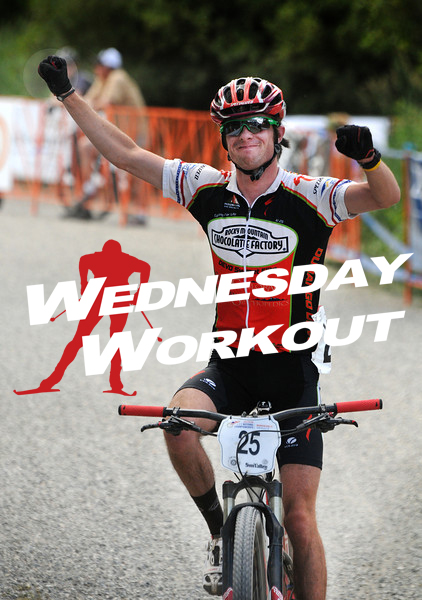
    Tad Elliott, formerly of the U.S. Ski Team, celebrates after a top-10 finish in the 2011 USA Cycling Mountain Bike Championships cross country event in Sun Valley, Idaho. (Photo: Tom Kelly/USSA)
    Tad Elliott, formerly of the U.S. Ski Team, celebrates after a top-10 finish in the 2011 USA Cycling Mountain Bike Championships cross country event in Sun Valley, Idaho. (Photo: Tom Kelly/USSA)

    Some days you just want to ride, but are possibly unsure how to make that an effective training tool. We have some suggestions from Tad Elliott, a two-time mountain bike U23 champion and former U.S. Ski Team member, who shared the following road-bike workout from 2010. See the original pro workout here.

    ***

    [circa October 2010]

    There are workouts where you finish battered and beaten, muscles packed with lactate. And then, there are days when you just go out and ride your bike.

    Tad Elliott does 70 percent of his training on two wheels, but there’s one workout that he especially relishes: a 68-mile loop near his home town of Durango, Colorado, that he rides with his friend Troy Wells.

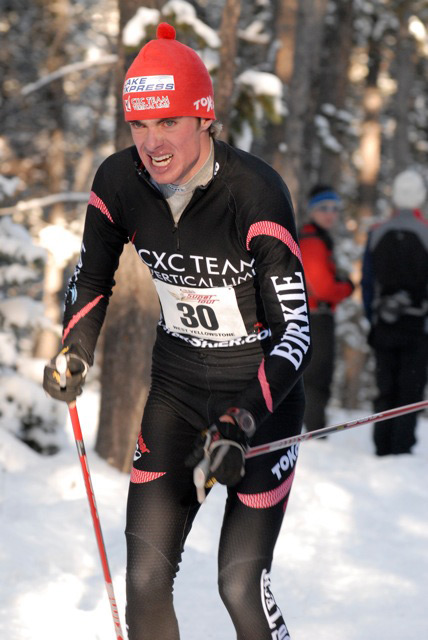
    Tad Elliott while racing for CXC Team Vertical Limit. (Photo: Win Goodbody)
    Tad Elliott while racing for CXC Team Vertical Limit. (Photo: Win Goodbody)

    Unlike some of the more painful sessions one might do on foot or in the gym, Elliott calls this ride a “free workout” — its psychological toll is minimal. And spending over three hours on the bike prepares Elliott well for those longer rollerski workouts that are the bread-and-butter of the fall.

    “Coming off the bike, I’m used to putting in big hours — I’m used to work like that,” he said. “Especially working your legs, going into skate skiing — for some reason, cycling into skate skiing transfers really well.”

    Elliott’s loop starts with a long climb — about 45 minutes. He said that he and Wells usually ride side-by-side, at a steady pace, without drafting. They’re not going threshold — Elliott pegged his effort at upper Level 2.

    It’s still a conversational pace, but Wells, a professional mountain biker and cyclocross racer, is a little faster than Elliott, “so he does a lot more talking.”

    The climb is paved, but the rolling terrain afterwards is mostly dirt — Elliott described the roads as “haggard,” with “big rocks” and “big truckers passing us.”

    Both riders are sure to have their food and drinks ready before they start — it helps that Wells’s main sponsor is Clif Bar — and they eat consistently. There’s no stopping, except maybe for a chocolate milk or Coke towards the end of the ride.

    The Workout

    Distance: 68-mile loop, or a route that will take you about three hours

    Start: with a long climb if possible, about 45 minutes. Level 2 pace.

    Bring: Food and drinks for nourishment

    End: with a good lunch, nap and “recovery walk” in the afternoon

    “We just ride smooth,” Elliott said. “I just end up laughing the whole time, and enjoying it.”

    The whole loop takes about three hours, or just over, for an average of about 23 miles per hour. (Amateur cyclists may find that pace slightly on the ballistic side — try shooting for an average of 16 to 20 miles per hour, at least for your first few rides.)

    When Wells and Elliott are done with the ride, they usually go get wraps at a local sandwich shop, then take a nap. The afternoon is reserved for nine holes of golf — the  “recovery walk.”

    The workout is a blast, Elliott said, but that doesn’t mean it can’t be beneficial — “it’s not like I do it to mess around,” he said.

    Elliott says he reaps rewards from the ride in longer skate races, where he’s comfortable at a higher pace. And the three-hour duration also teaches his body to burn fat stores towards the end of the session, which will be necessary for marathons during the ski season.

    Elliott said he usually starts doing the ride in the mid-summer, but he’ll keep at it through the fall. He sees no problems with doing the workout up until November, since the fun format makes it easy to get out the door.

    “I enjoy it — I enjoy going out with my friend and riding. I don’t have to drag myself out of bed, or anything, to go do that workout. I look forward to it,” he said. “I know I’m going to laugh and enjoy myself eventually that day. …You’re going to be tired, but you’re going to have fun.”

  • Wednesday Workout: Wednesday Night Worlds with Taylor Fletcher

    Wednesday Workout: Wednesday Night Worlds with Taylor Fletcher

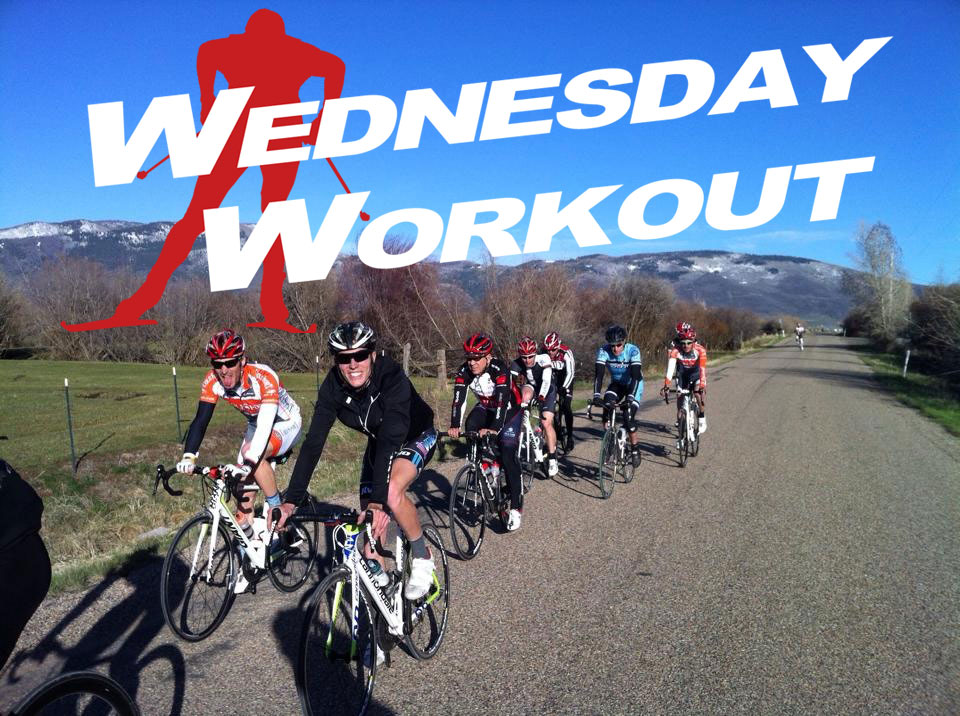
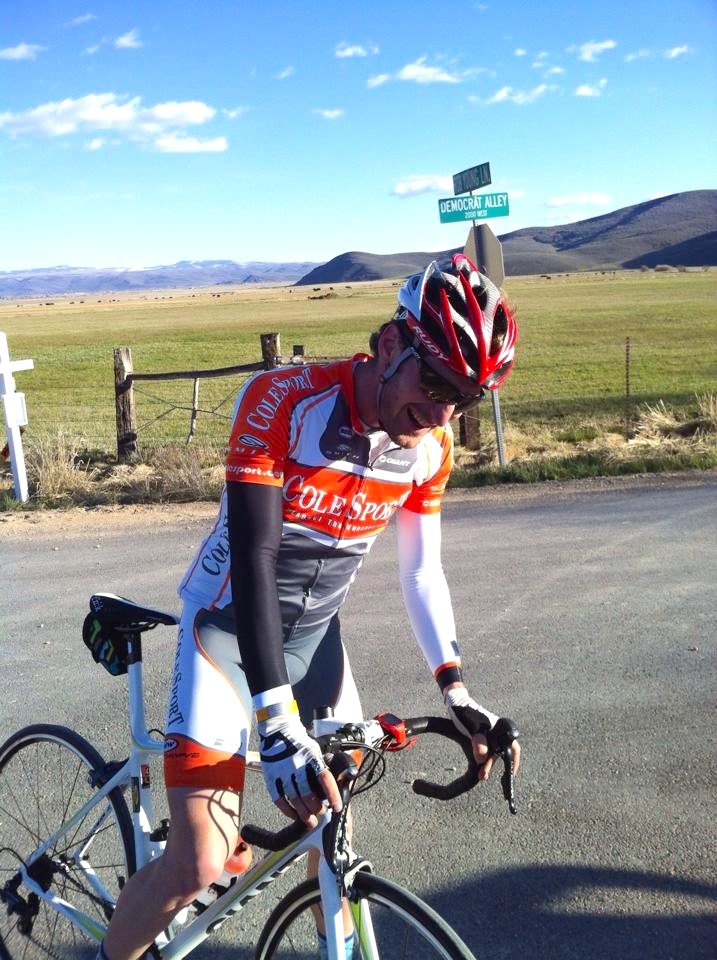
    The Wednesday Night Worlds ride on Democrat Ally in Kamas, Utah, near Park City on April 30. (Photo: Taylor Fletcher)
    The Wednesday Night Worlds ride on Democrat Alley in Kamas, Utah, near Park City on April 30. (Photo: Taylor Fletcher)

    What do Wednesdays typically bring for the U.S. Nordic Combined team? According to Taylor Fletcher, who turned 24 on Sunday, hump day means midweek intensity.

    He likes to road bike with a group — and most towns with a recreational community like Park City’s have what’s known as Wednesday Night Worlds. For Fletcher’s crew, that entails five hard efforts: three climbs and two flats.

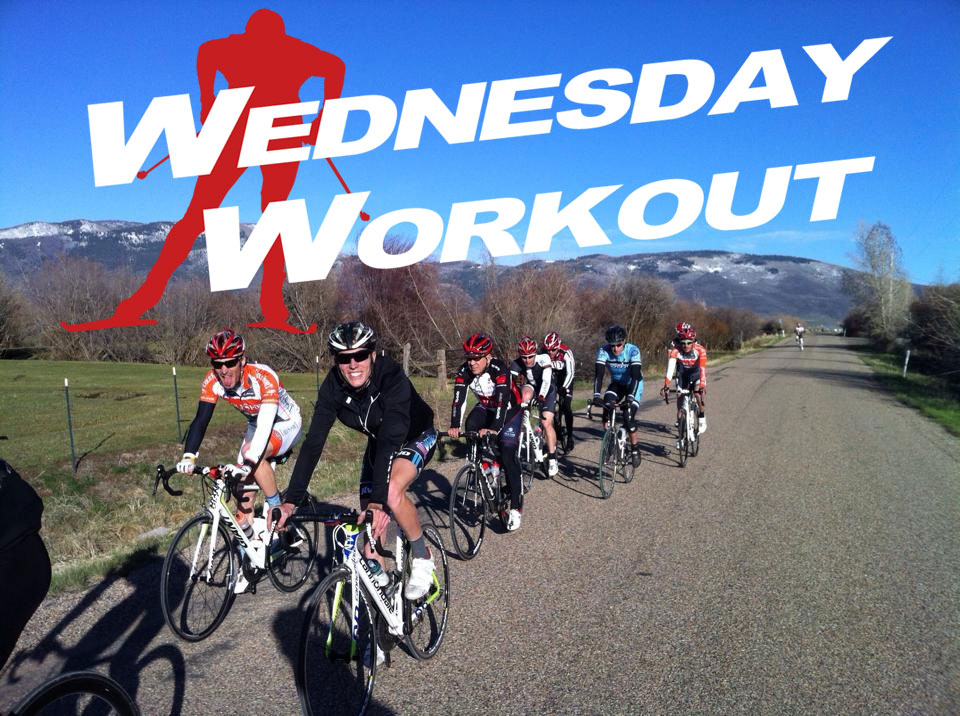
    Taylor Fletcher during a Wednesday Night Worlds ride on Democrat Ally in Kamas, Utah, on April 30. (Courtesy photo)
    Taylor Fletcher at a Wednesday Night Worlds ride on Democrat Alley in Kamas, Utah, on April 30. (Courtesy photo)

    “We go hard to the top of the segment and regroup with all the riders,” he explained in an email. “Then proceed to the next segment to start all together again. This [takes] about 2 to 2.5 hours.”

    If he’s not doing that, Fletcher’s meeting with his nordic-combined teammates on Wednesdays for one hour of steady state, which can be broken up in many ways: 2 x 30 minutes, 3 x 20 minutes or 1 x 60 minutes.

    “Both of these segments are meant to be in the 3-4 mmol of lactate zone,” he wrote. “It is very important to get a good warm up and cool down of 30 minutes.”

    But let’s go back to Wednesday Night Worlds, probably called that because of all the riders who work 9-5 and are bursting at the seams for some good ol’ competition at the end of the day.

    In Fletcher’s case, he’s riding with mostly accomplished road cyclists, ranging from the Category 3 level and up to pro.

    “I do this workout mainly in the spring and early summer when I don’t want to be roller skiing hard yet,” he wrote. “But also when we start skiing, it is good to mix it up to do something else so your muscles stay fresh. In a given month, I probably will do it 2-3 times with most of our team (Billy, Bryan, Brett, Michael, Adam).”

    Fletcher explained the U.S. nordic-combined guys tend to do a lot of road biking in the summer because of Billy Demong, who rode professionally four years ago in the Tour of Utah and Tour of the Gila in New Mexico.

    “When he was doing that he was the fastest in the world for nordic combined,” Fletcher wrote. “He is the reason that I got into it. I can say for myself that roller skiing all spring and summer will burn you out and demotivate you when it is very important to roller ski in the fall. Biking has become a way to push myself to become faster with goals of doing well at races. It is also very nice as your can get lots of minutes of training during your big weeks without trashing your body running and sometimes roller skiing. It’s a good balance in building strength and endurance.”

    Wednesday Night Worlds

    Where: In Park City, start from Kimball Junction. Head out on Frontage Road toward the USSA Center of Excellence (COE) and turn left towards Kamas.

    Who: Anyone that wants to push themselves — as riders regroup after each segment — but one should be experienced bike handler or racer. (Fletcher crashed on one high-speed downhill last year and suffered a minor concussion.)

    Difficulty: “I try to do it in level 3, But sometimes I go a little harder which I am fine with,” Fletcher wrote. “I really try to think about average power (watts) and just keeping a very solid pace, but then also watching out for someone that might try to jump around your wheel.”

    The Workout:

    • Warmup: By heading out of Park City, or out of whatever town you’re in, toward the hills.
    • Segment #1: Climb up Jordanelle (state park) towards Kamas. About 3 miles long, 6 percent average incline to the top.
    • Regroup at the top, grab a drink and spin easy to next segment.
    • Segment #2: Dead flat on dirt (and wind can make it tricky). Flat section is 1.2 miles long. “Since it is hard to really attack on this segment, it is a pure effort grinding and holding yourself to the side of the road where the dirt is usually smoothest.”
    • After dirt section, dust yourself off and head to Browns Canyon — the longest, steepest climb of the ride.
    • Segment #3: Climb the first part of Browns Canyon: 3.4 miles, 5 percent average incline.
    • Then it’s your choice: depending on headwinds and crosswinds, either turn around or continue on. Determine the strength of the field and assess how you’re feeling that day. Keep going if you choose and try to stay away on the next climb. Beware of random dead deer on the road.
    • Segment #4/5: Continue beyond Browns Canyon for a second climb that averages about 2 percent for 1 mile. “That is almost an all-out sprint,” Fletcher wrote of the final sprint, which works out to be the fifth segment as well.
    • Cool down: Regroup and ride back to the start: about 6 miles, for a total of about 45 miles from start to finish. Cool down for about 40 minutes.
  • Clegg in Hospital, Myslicki and Crooks Act Against Aggressive Driving

    Clegg in Hospital, Myslicki and Crooks Act Against Aggressive Driving

    Winter Olympians Jason Myslicki (l) and Robin Clegg (yellow/red leaders jersey on the right) competing in the Banff Bikefest in June. Teammates on the Canmore-based Rundle Mountain Cycling Club, Clegg won the overall Category 3 title on June 17 to earn Category-2 status. Myslicki won a race later this summer to also achieve Cat. 2. (Courtesy photo)

    The average adult makes somewhere around 35,000 decisions per day. Before setting out for a road ride on Sunday, three retired Olympians made a couple of casual ones.

    First, former Canadian national-team members Robin Clegg (biathlon), Jason Myslicki (nordic combined) and Sean Crooks (cross-country skiing) decided to ride between 80 to 100 kilometers just outside Calgary, Alberta. Second, they picked a quiet township road, which would lead them to a coffee shop in the suburb of Cochrane.

    In a phone conversation on Tuesday, Myslicki said he initially didn’t want to go that way. His friends and Rundle Mountain Cycling Club teammates out of Calgary and Canmore, Alberta, convinced him the road was newly paved and seldom used.

    Cruising along the same road in a sport utility vehicle, one driver made some choices of his own. Upon approaching the three cyclists from behind, he honked his horn and buzzed by them, yelling that they shouldn’t ride on a road with no shoulder, according to Myslicki.

    They reacted to the close call between the car and their bodies by yelling back, and the male driver responded by slamming his brakes just ahead of them. Myslicki and Crooks veered to the left to avoid colliding with his tailgate, and Clegg, who was behind them, went toward the opening on the right. The driver then allegedly accelerated, hitting Clegg with the front of his car and sending him crashing onto the ground.

    A three-time Olympian who helped Canada place 10th in the relay at the 2010 Vancouver Games, Clegg, 35, never lost consciousness, but took the brunt of the fall on his right side. An ambulance transported him to the hospital, where he later had surgery to insert a plate in his broken elbow. According to Crooks, Clegg also broke his collarbone and potentially some ribs.

    A 2006 Olympian who spent seven years on the Canadian National Ski Team, Crooks, 29, wrote in an email that he visited Clegg on Tuesday. “He is pretty beat up,” he wrote, but Clegg expected to be out of the hospital by Wednesday. Doctors estimated it would take 12 weeks for his elbow to heal.

    “I’m frustrated with how some drivers perceive athletes training on the road,” Crooks wrote. “There are too many drivers out there who, for whatever reason, think it is a good idea to bully the athlete with their vehicle.”

    As a competitive cyclist living and training in the area, he’s had several run-ins with drivers before. Unfortunately, Calgary is notorious for driver aggression toward bikers, he wrote. But he had never witnessed anything as bad as this.

    “The guy was trying to scare us, and it went too far,” Crooks wrote. “I’ve had a few verbal confrontations in the past, but, honestly, when I see a vehicle stop to get angry for me being on the road, I’m not excited about what’s coming. With the skier/cyclist physique, I’m not looking for a physical confrontation. Also, chances are, this person is obviously irrational and is likely wearing much more stable footwear than I am.”

    Myslicki said he threw up his hands as many cyclists do when drivers intentionally get too close. He pointed toward the road as if to say, ‘What’s your problem? It’s a wide-open road; it’s straight, it’s flat.’

    “If it was a tractor driving on the road, you wouldn’t buzz them and honk,” Myslicki, 34, recalled thinking.

    “It’s definitely a greater hatred towards cyclists,” the two-time Olympian said. “I feel a bit sorrowful for those people; I wonder how bad their lives are that they’re willing to go out of their way and ruin someone else’s life.”

    After the incident, in which the Cochrane police, Royal Canadian Mounted Police, emergency services and a fire crew responded, Myslicki and Crooks continued on their ride. At the time, they hadn’t been identified as Olympians – no one knew who they were – and they decided to keep the story under wraps.

    Myslicki later reconsidered and made perhaps his second-most important choice that day, after his split-second reaction to swerve left and avoid the SUV. He wanted to go public with this.

    He thought about his girlfriend and her family and all the other people he had turned onto cycling. After retiring, he, Clegg and Crooks became teammates at the Rundle Mountain Cycling Club (RMCC). They biked as frequently as they could together and each achieved the prestigious Category 2 in road racing.

    “I’ve got to use this platform because it’s an opportunity to raise awareness for cycling,” Myslicki told himself Sunday. “If I can prevent even one person from bullying a guy on a bike then we’re getting somewhere as far as that’s concerned.”

    He contacted the Calgary Herald that evening, and by Monday morning, his phone was lighting up with press inquiries. Myslicki said he also spoke with Calgary’s mayor and several administrators about the incident, which was still under investigation.

    According to Myslicki, there was at least one witness – a woman in another vehicle who was an unknown distance behind – but he wasn’t sure what she reported.

    “I haven’t heard of what precedent is out there,” he said of the punishment for aggressive driving toward cyclists. “We’re hoping that someone makes an example of it.”