From the FasterSkier archive — posts syndicated from athletes’ and coaches’ own blogs between 2004 and 2012, kept online as published. Current coverage is at fasterskier.com.
In 2014 NENSA began the tradition of honoring the top ranked male and female Eastern Cup skiers with the Gallagher Cup. NENSA is honored to announce that Rena Schwartz (GMVS) and James Kitch (CSU) are the 2018 Eastern Cup Champions – their inspired efforts are a perfect way to celebrate Mike Gallagher’s legacy as an athlete, coach, and community leader. The two skiers who win this award each year do so by being consistently dominant in New England’s premier race series (winners are determined by averaging points from 7 of 8 EC events).
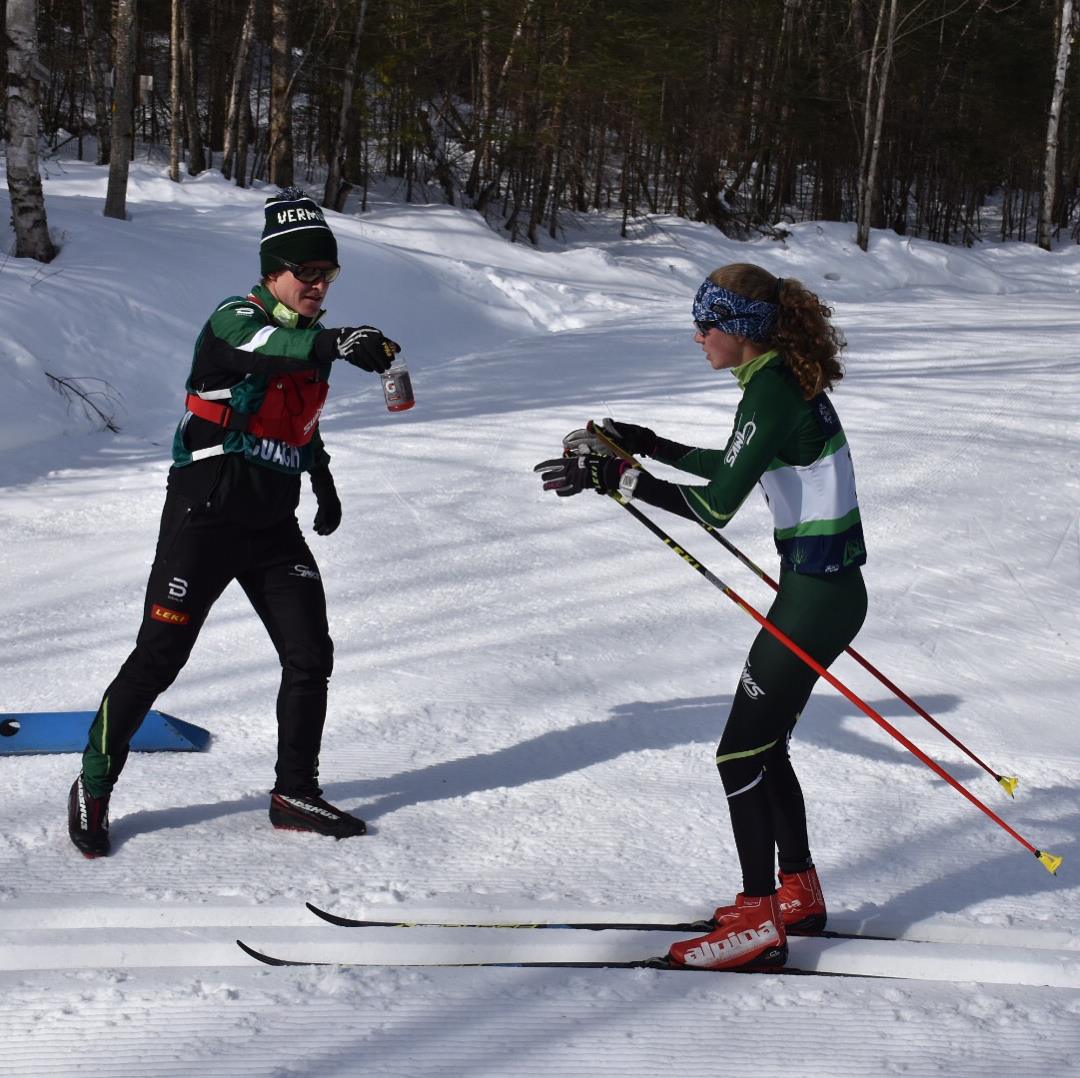
Schwartz receiving a feed from coach Colin Rodgers during Super Tour Finals at the Craftsbury Outdoor Center.
Rena Schwartz skied for the Green Mountain Valley School, raced in seven Eastern Cup races, with one victory and three podiums, and ended the year atop the New England Junior National Ranking List. She competed at Junior Nationals with a top finish of 4th place in the 10km freestyle event. Schwartz also competed at US Cross Country Championships and Super Tour Finals ending the year the 51st ranked female skier in the country.
Coach, Colin Rodgers, describes Schwartz as a leader, “Rena is an impressive role model for all of the student/athletes on the team, and her drive for success motivates those around her. Not only does she have extraordinary competitive results, but Rena is a pleasure to spend time with, exuberating kindness, honesty, and dependability. If you ask anything of Rena, you can expect it to be done with focus and attention to detail.” Outside of skiing, Schwartz was the Vermont cross-country running champion and a Gatorade Runner of the year, where she won a $10,000 spotlight award to donate to her club of choice (Craftsbury Outdoor Center).
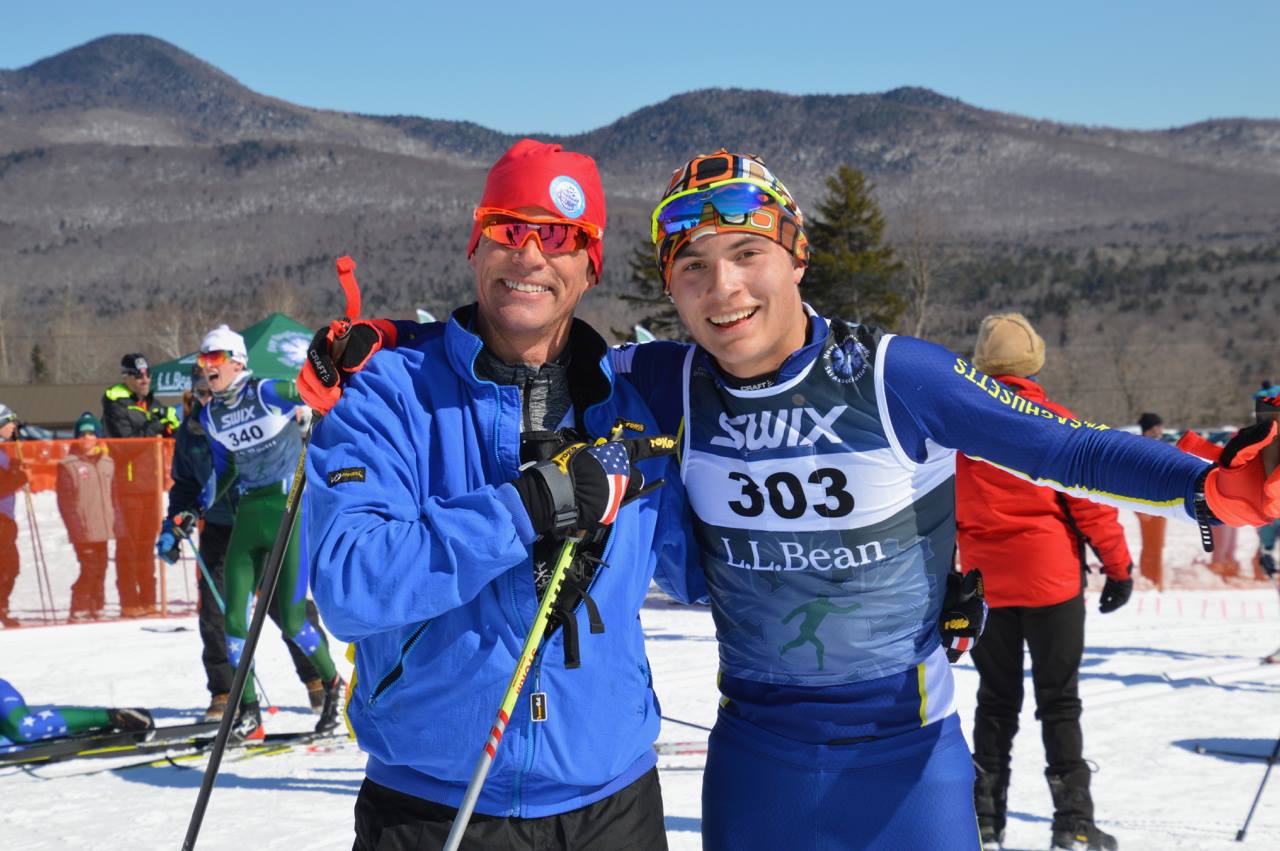
Kitch with Coach Rob Bradlee at the finish of a Eastern Cup race at the Rikert Nordic Center this season. (Photo: NENSA)
James Kitch, from the Cambridge Sports Union, competed in all eight Eastern Cup races, where he was consistently in the top-10, and finished 5th on the year-end New England Junior National Ranking List. Kitch saved his best game for the 2018 Junior National Championships in Soldier Hollow, Utah where he had two top-ten distance finishes, scrambled for the winning U18 relay team, and won his first National Championship in the freestyle sprint. At the conclusion of the 2018 season he is the 82nd ranked male skier in the country.
CSU coach, Rob Bradlee, describes James as someone, “who correctly assumes that everyone would like to be his friend and so treats everyone regardless of age or status with equal respect and affection. He has been a leader in CSU and on Team New England in creating a positive team vibe. He pushes himself hard to be his very best and competes not to beat others but to explore how fast he can be. I think he became a national champion because that attitude kept his mind open to possibilities and he could see opportunity when it presented itself.”
We congratulate these skiers and thank them for reminding us of Mike Gallagher’s competitive spirit. Mike was a three-time Olympic cross-country skier and the Head Coach of the US Ski Team from 1980-86. You can read more about Gallagher here on Fasterskier.com
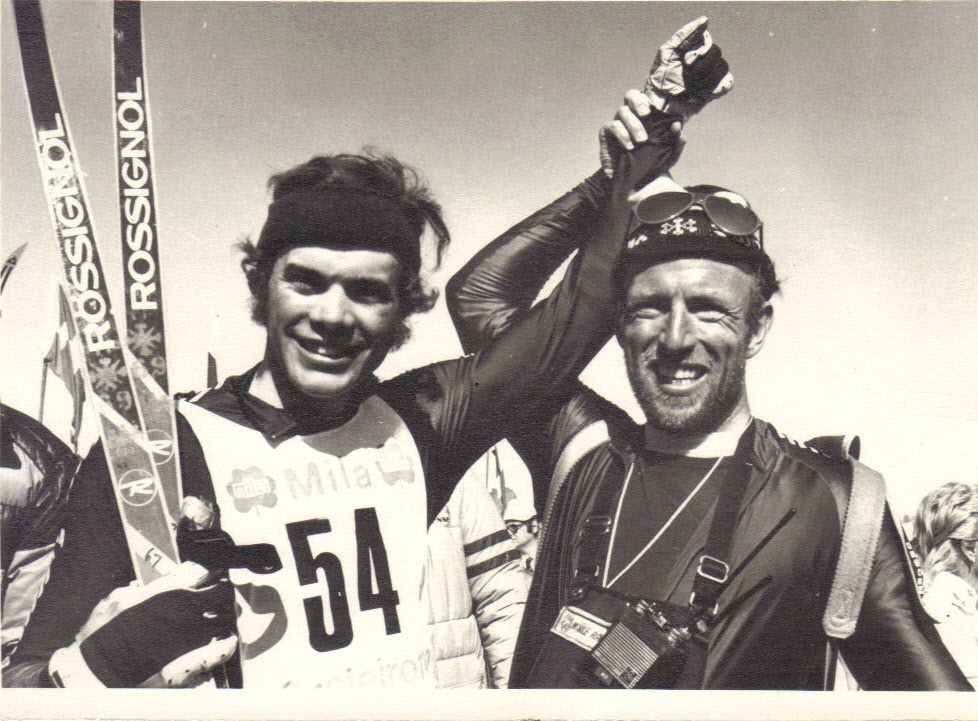
Picture of Vermonter Bill Koch celebrating his winning the FIS Overall WC crown with a very happy coach, the late Mike Gallagher. A very special moment. (Photo and caption courtesy of Peter Graves)
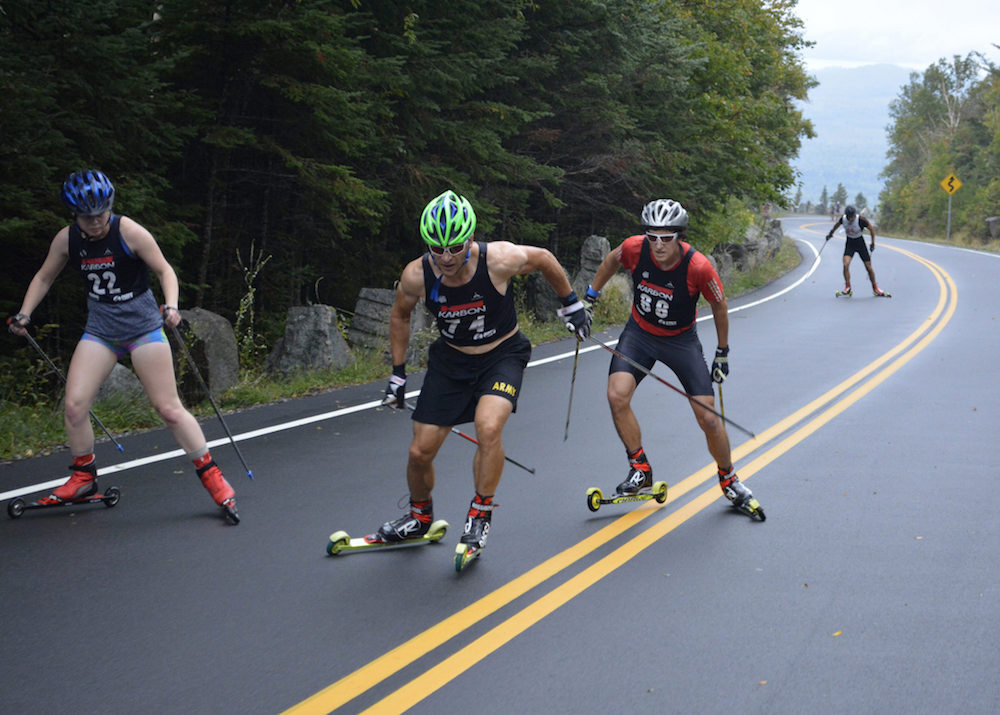
Duncan Douglas (74) leads biathletes Russell Currier (in red) and Paul Schommer (back right) in Sunday’s Climb to the Castle rollerski race up Whiteface Mountain, while Clarkson’s Jenevieve Broadwell (22) looks on. Douglas held off Currier by eight seconds for his third victory in four times racing the Climb and Schommer finished third. (Photo: NYSEF/Flickr)
(Note: This article has been updated to include comments from third-place finisher Paul Schommer and NYSEF’s cross-country head coach Margaret Maher.)
WILMINGTON, N.Y. — Four appearances and three wins is an enviable record. On Sunday, 50-year-old Robert Duncan Douglas, the “Jacked Up Old Man” from Honeoye Falls, N.Y., won his third Climb to the Castle (C2C) rollerski race, a five-mile freestyle hill climb up the Whiteface Memorial Highway.
Douglas previously won the race in 2007 and 2008, with a personal-best time of 34 minutes, 56.6 seconds in 2007 (he was 2 1/2 minutes faster on a shortened course in 2008, when racers were unable to reach the summit because of snow).
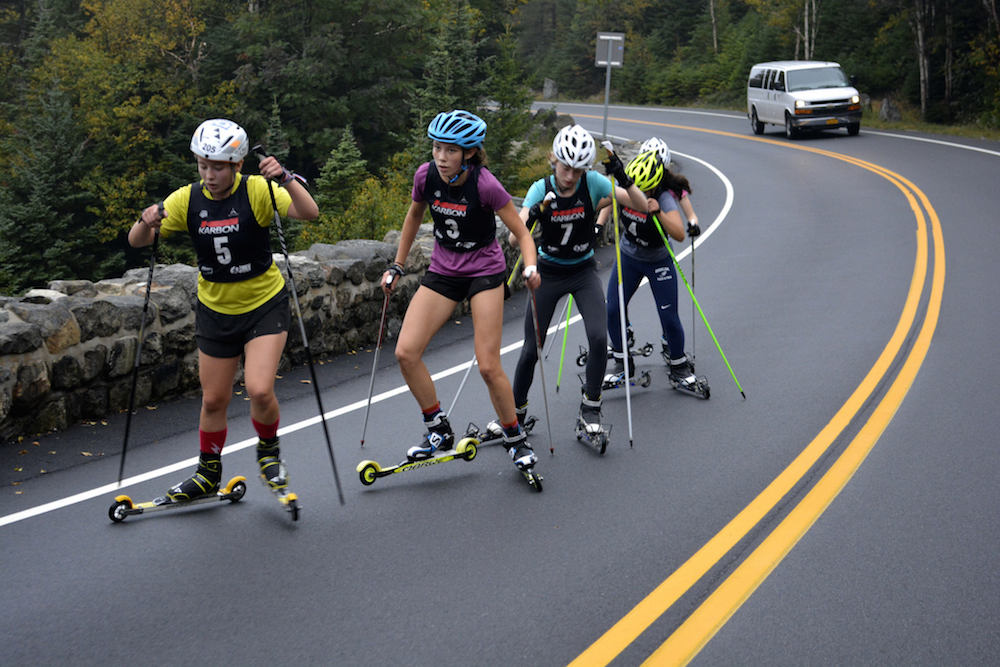
St. Lawrence’s Jackie Garso (5) leads Stratton’s Anna Lehmann (3), and CSU’s Hannah Rieders (7), Gabby Vandendries (4) and Madeline Rieders (in back) during the women’s Climb to the Castle rollerski race up Whiteface Mountain on Sunday in Wilmington, N.Y. (Photo: NYSEF/Flickr)
Hannah Rieders, a 17-year-old Cambridge Sports Union (CSU) skier whose initial goal was an age-group podium, won her first C2C, on the race’s 10th anniversary.
Finishing in 37:15.6 this year, Douglas was 8.3 seconds ahead of runner-up Russell Currier, a biathlete who trains with the Outdoor Sports Institute in Maine. Paul Schommer, a senior member of US Biathlon’s National Development Group, placed third overall, 3:02.6 minutes behind Douglas.
Rieders, a high-school senior from Wellesley, Mass., was the first woman across the line in 55:03.1. She beat Anna Lehmann, a ninth grader representing the Stratton Mountain School (SMS), by 15.7 seconds, and Rieders’s twin, Madeline (also of CSU), finished 1:23.3 minutes back in third.
“I kind of thought maybe Anna would beat me,” Hannah Rieders said in a post-race interview. “At the start, I just wanted to pace it well. I stayed behind other people for the first three miles.”
Overnight rain left the road damp. At the toll-booth start in Wilmington, temperatures hovered around 65 degrees under cloudy skies, with sultry humidity. Low clouds at the start turned dense up high near the summit. Unless you were really close to skiers in front of you, it was hard to gauge how far up the road they were, and how much energy one should expend to attack.
Margaret Maher, head coach of the New York Ski Educational Foundation (NYSEF) cross-country program, explained in an email that she learned in April that the U.S. Ski Team would not be comping to Lake Placid for its usual dryland camp this year. To accommodate the US Biathlon team, she originally scheduled this year’s Climb for next weekend, Sept. 25, but that date conflicted with other races NYSEF’s skiers planned on competing in.
Maher had to move the race up one week in order for her athletes to attend. Regardless, 85 athletes registered this year, which was on par with the “73-108 athletes” that the race has previously attracted.
Of the top-five female finishers on Sunday, four were under the age of 18, and Lehmann is a U16. With Jackie Garso (St. Lawrence University) placing fourth and Gabby Vandendries (CSU) finishing fifth, CSU had three in the top five.
“First time [at C2C] for all three girls,” CSU coach Rob Bradlee wrote in an email. “All three also ran Mt. Washington for the first time in June. Tough kids! I don’t have them do any special prep for this race. Their regular six-days-per-week training clearly is enough to get them ready. All three are very hard workers and have been training hard all summer. I think their results show that.”
Hannah Rieders explained that five women formed the lead pack. Around mile three, the eventual top three broke away. They skied together until mile four, “then I went ahead,” Rieders said.
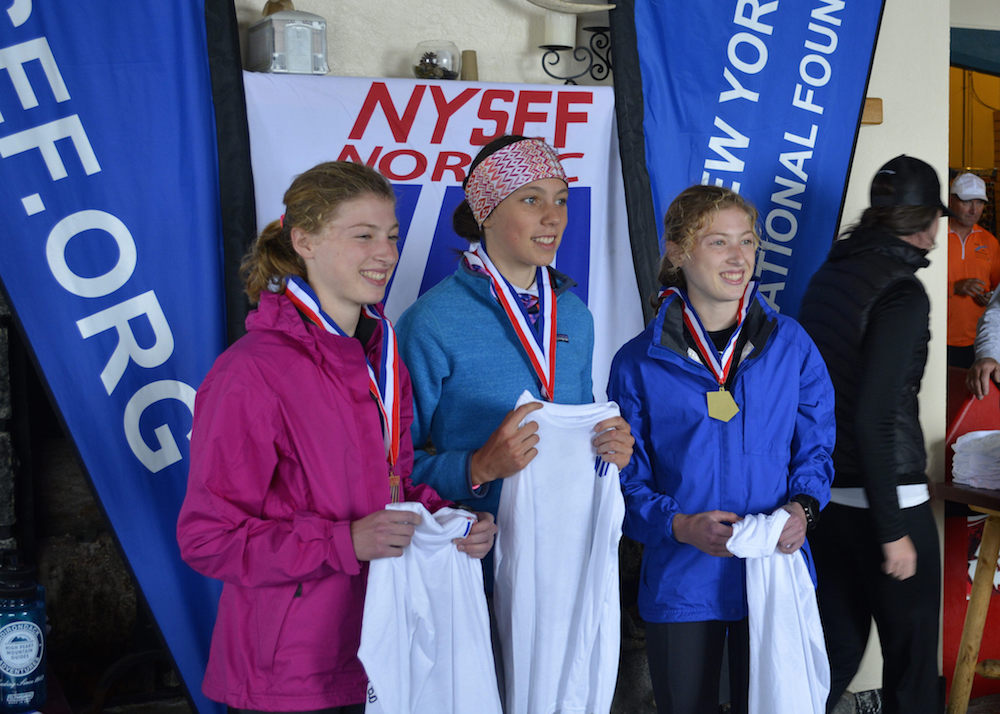
The women’s podium at the 10th Climb to the Castle rollerski race up Whiteface Mountain’s Memorial Highway on Sunday in Wilmington, N.Y. With all of the top five under 18, Hannah Rieders (CSU) placed first, Anna Lehmann (SMS) was second, and Madeleine Rieders (CSU) was third. (Photo: NYSEF/Flickr)
Madeline Rieders said she skied in the pack until mile three, then pulled away with Hannah and Lehmann. While she lost contact with them on the road, which has an average grade of 8 percent, she maintained a steady gap to the finish and held off fourth place by 50 seconds.
For the men, it was down to three from the start, according to Currier.
“Paul, Duncan and I all took turns leading,” he wrote in an email.
“I’m in better shape this year, but not rollerski shape,” Douglas said.
For most of the summer, Douglas focused on bike racing, winning his 50-59 age group and placing 25th overall at the Leadville Trail 100 mountain-bike race. He said he just started rollerskiing two weeks before the Climb.
Douglas, a two-time Olympian who will be 51 in November, had a simple race plan. “Go out, ski hard, have fun,” he reflected.
For most of the race, Douglas skied with Currier. He dropped Currier once, but the 29-year-old former national-team biathlete regained contact. Douglas said that at the Lake Placid corner – a hard left where the grade eases and one can transition to V2 strides – he broke away to the finish.
“Once the flat section towards the end started, I wasn’t able to match Duncan’s speed,” Currier wrote. “He was never very far out but enough to make a difference at that point in the race.”
Of his race, Currier described it as “a solid effort. I really tried to use good technique. For a race that’s nothing but uphill, there’s not much else you can do.”
In an email, Schommer explained this was his first Climb to the Castle.
“I went into it with an open mind, knowing that if I killed myself in the first half the second half would be a death march,” the 24-year-old Wisconsin native wrote. “I would say it went decent for me as I was able to stay pretty strong most of the way, despite losing Russell and Duncan about 1.5 miles into the race.”
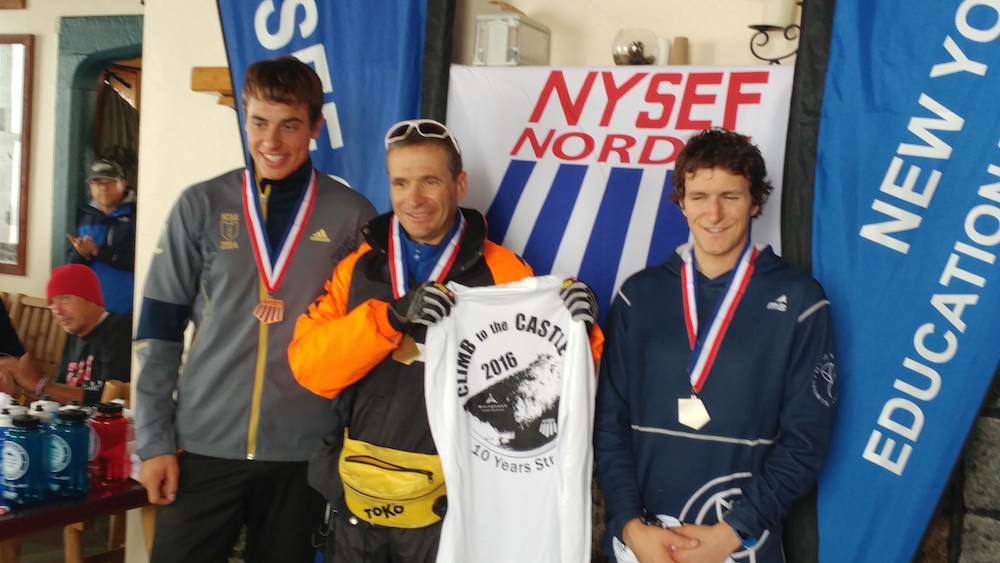
The men’s podium at the 10th Climb to the Castle rollerski race up Whiteface Mountain’s Memorial Highway on Sunday in Wilmington, N.Y. Duncan Douglas (c) won, Russell Currier of the Outdoor Sports Institute (r) placed second and US Biathlon development skier Paul Schommer (l) was third. (Photo: Peter Minde)
Is the Climb to the Castle a data point for winter fitness?
“It’s a good, effective workout, really good training,” Currier explained, adding that he didn’t think it was a good indicator of fitness in December or February.
“I was really happy with how it turned out,” said Adam Glueck, a Ford Sayre U18 skier who finished seventh (+7:52.4) in his first C2C. “I didn’t want to go too hard out of the start. I followed some friends and threw in some double pole to rest my legs.”
Glueck skied in a small group he eventually lost contact with about halfway through.
“I managed to catch them on the V2 straight [the Lake Placid corner]. After that, my friend Henry McGrew [eighth overall] was right behind me,” he said. “I had to push hard through the headwind [the last 500 meters] to beat him. I was basically in agony for the last three or four minutes.”
Agony and clouds: good metaphors for the Climb to the Castle. When athletes returned to the base, the sun was breaking out.
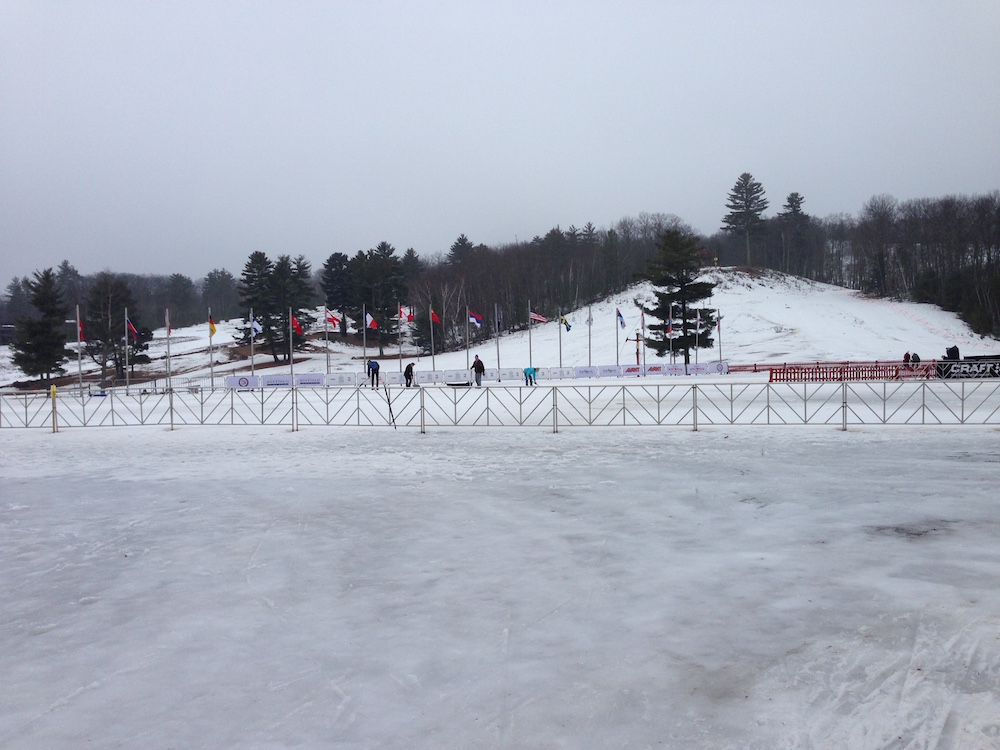
Wednesday was an off day at 2016 Junior Nationals, but it wasn’t originally scheduled to be. Warm temperatures and melting snow in the stadium and on the trails at Telemark in Cable, Wis., forced organizers to postpone the races one day and shift the formats to a freestyle individual start on Thursday, freestyle sprint on Friday, and freestyle relay on Saturday. (Photo: Hailey Swirbul)
The good news: “We’ll have a race tomorrow,” Chief of Competition Gary Larson said Wednesday of the Junior National Championships currently taking place at the Telemark Trail System in Cable, Wis. Due to exceedingly warm temperatures on Tuesday reaching into the 60’s, the 5-kilometer and 1.3-kilometer race courses have been jeopardized.
“It was impossible to realize how much this weather did to the snow. This is very unusual for Wisconsin,” Larson said. “The snow was good up until Saturday.”
On Monday, the racers and coaches representing regions from across the U.S. began to notice the deteriorating conditions as they fought through spring-like ski trails during the 5/10 k classic individual start races. The following day, a small section of the course was opened only to coaches to test classic kick for the following classic sprint, while all athletes were redirected to sections of the American Birkebeiner trail to ski for the day. Eventually, the organizing committee decided to change and postpone the planned events for the rest of the Junior Nationals.
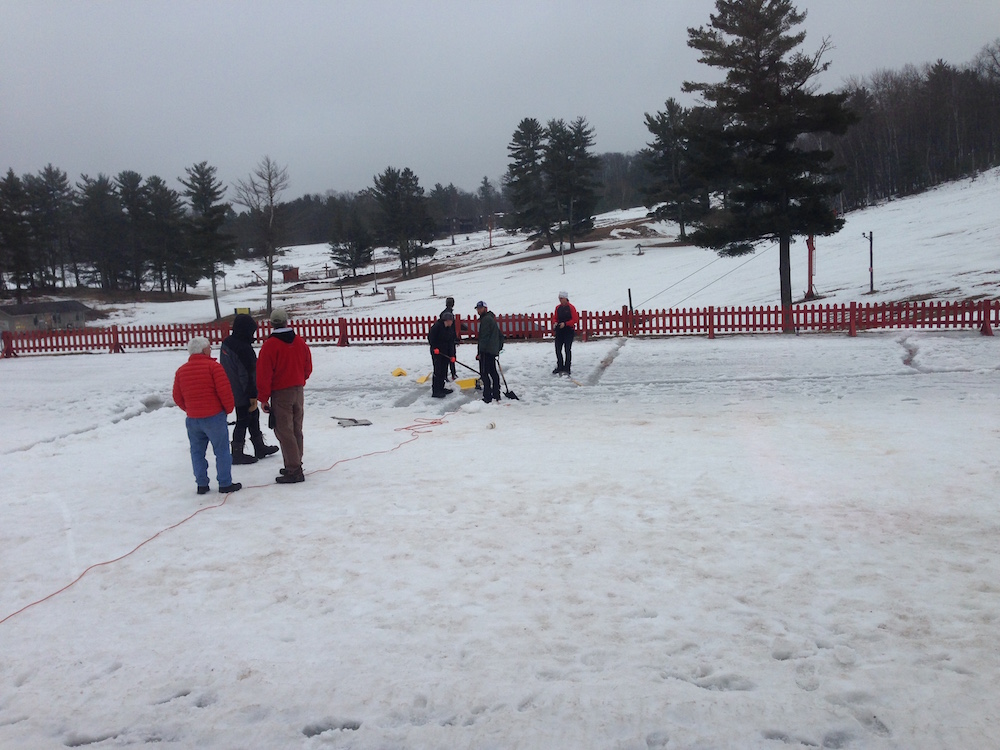
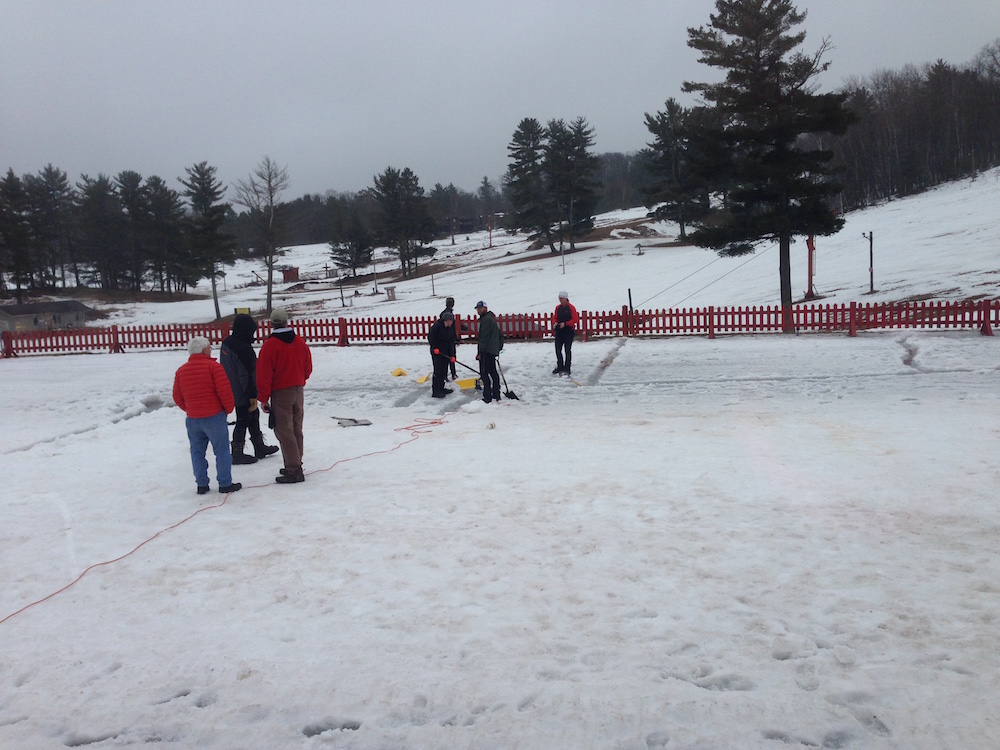
Junior Nationals volunteers work on draining water from the stadium at Telemark in Cable, Wis. Hundreds of volunteers made the event possible, and even in adverse conditions, “Our problem is we don’t have enough shovels,” Chief of Competition Gary Larson said Wednesday. (Photo: Hailey Swirbul)
“We ended up changing the schedule a lot,” Larson said. “We just can’t get [classic] tracks in, so the sprint is going to be skate on Friday. We still at this time don’t know whether or not we are going to be able to do heats, or if it is just going to be a prologue.”
Instead of the original classic sprint, freestyle distance mass start, and freestyle relay set for the week, athletes are preparing for a freestyle individual distance race, freestyle sprint and a freestyle relay.
“At first I was pretty upset, but then I realized the course changes were made for the best,” Rocky Mountain athlete Nolan Herzog said. “It is kind of a roll-with-the-punches scenario right now, because we don’t really know what is going to happen.”
He hopes that there will be adequate snow for the three scheduled remaining races.
According to Larson, the prolonged above-freezing temperatures in Cable have created the issues with the course. The lack of snow on the trails is not the problem, it is the water that pools at low points on the trail and softens the snow due to lack of drainage.
Larson, for the most part, has received supportive responses from parents, coaches, and athletes about this unexpected turn of weather.
“I’m glad that the organizing committee is as committed as they are to trying to deliver a good quality race,” Intermountain coach Rick Kapala said. “I think that if they can put the big climb in, the A-climb, we are going to have a really, really good athletic test.”
The organizing committee and Larson are striving to maintain as much of the original 5 k loop as possible to ensure that athletes are met with a fair and challenging series of races thanks to hundreds of volunteers.
“Our problem is we don’t have enough shovels,” Larson noted. As chief of this event, he said he has received “unbelievable” response from service people, coaches and parents eager to help distribute snow throughout the manmade and natural snow course.
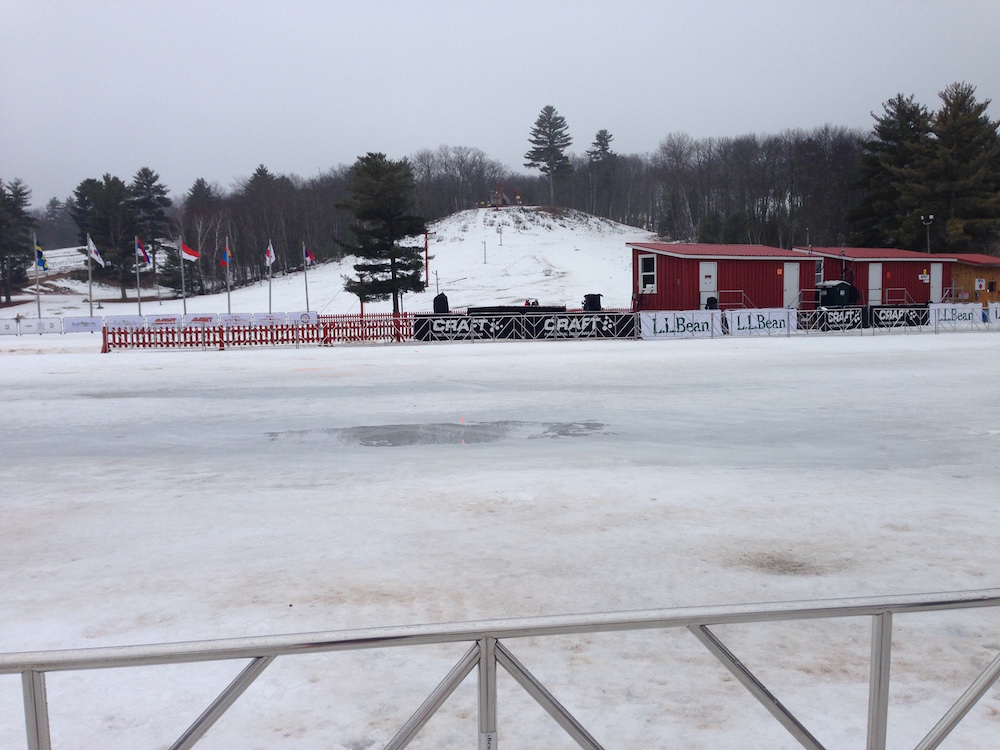
A puddle in the center of the stadium, where the 2016 Junior Nationals races both start and finish, as seen Wednesday at the Telemark Trails in Cable, Wis. (Photo: Hailey Swirbul)
“They have been exceedingly understanding, and out here helping. It takes that kind of effort and that kind of understanding to make it work,” Larson said.
Reflecting on the preparation for such unpredictable conditions, Larson acknowledges that the one thing that may have helped prevent this would have been to put “thicker snow on the trail that we can access with the snowmaking.” Despite the fact that the 5 k course at Telemark was the first ever World Cup course, requiring reliable snowmaking, the pipes used for snowmaking are damaged except for a small loop. The Telemark Trail System has not utilized the snowmaking tools since November.
“The future of our cross-country ski sport is going to be tough. Make snow and place the snow early, as insurance,” Larson suggests to future hosts of events like Junior Nationals.
Back to the good news: there will be a race tomorrow. New England coach Rob Bradlee acknowledges that he is “impressed how everybody is dealing with very, very difficult conditions that are way outside our control. I’m admiring everyone’s spirit, both the organizers’ and the participants.”
Despite the sporadic drizzles of rain in Cable, Bradlee is feeling what most are; the anticipation and excitement are high among athletes, coaches and organizers as the rest of the week unfolds.
Update: Wednesday’s course will be a 3.7 k loop involving two laps for 5 k, three laps for 10 k, and four laps for 15 k. Temperatures were expected to drop below freezing on Wednesday night and organizers planned to salt the course. Regardless, they have still ruled out classic races.
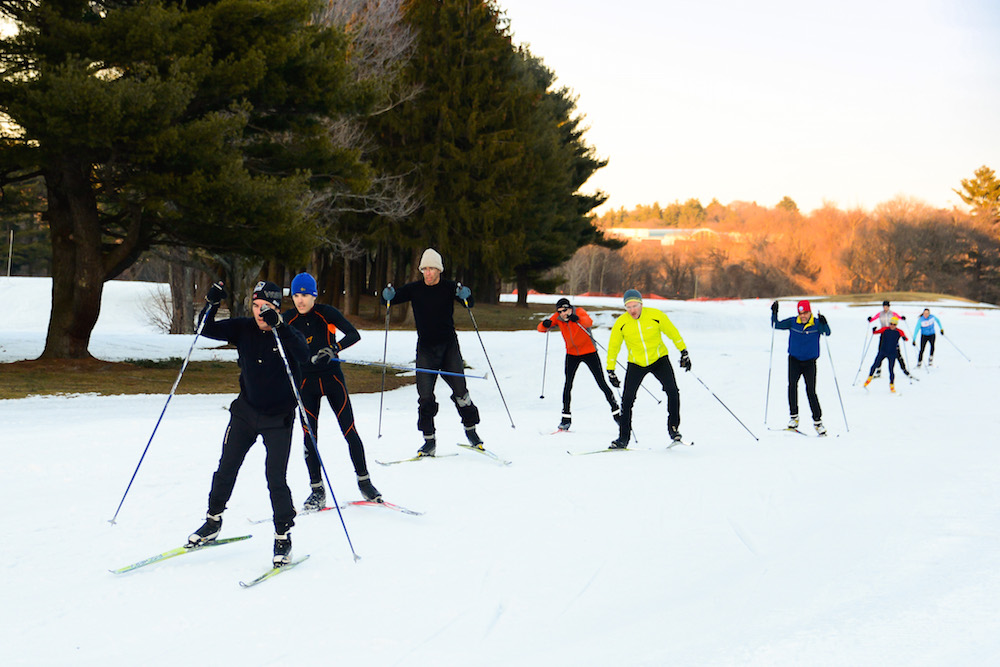
Skiers get on snow at the Weston Ski Track in Weston, Mass. (Photo: Jamie Doucett)
It’s a transition that has some of the Boston ski community nervous. But after initial skepticism, there may be reconciliation as Boston’s most accessible nordic-ski area, the Weston Ski Track, opens this winter under new management.
This winter, the Massachusetts Department of Conservation and Recreation (DCR) will take over the ski operation on the state-owned Leo J. Martin golf course in Weston, Mass.
In a 12-hour span on July 31, the DCR informed both Larry Smith, the owner of Charles River Recreation, which has run Weston for the last 40 years, and the Friends of Leo J. Martin Skiing (FOLJMS), a nonprofit that advocates for Boston-area skiers, that the state would take over ski operations this winter.
“It caught everybody by surprise,” Smith said in a phone interview.
The proprietor for Charles River Recreation (CRR), which also runs Charles River Canoe & Kayak and Community Ice Skating in nearby Cambridge, Mass., Smith has operated his business by partnering with the DCR and local municipalities for decades. While he will no longer be in charge of Weston, he remains a consultant for the DCR.
Skiers compete in a nordic race at the Weston Ski Track in Weston, Mass., outside of Boston. (Photo: Jamie Doucett)
With 42,000 skier visits last winter, the Weston Ski Track is a key resource for local skiers. In contrast, New York’s Regional Olympic Development Authority (ORDA) reported 35,000 skier visits last season at Mount van Hoevenberg in Lake Placid, N.Y.
Weston’s 15-kilometer trail system hosts a wide range of skiers, including the Harvard nordic team, the Cambridge Sports Union’s (CSU) juniors and master programs, an adaptive program, a high-school league, as well as thousands of recreational skiers who want to get out and glide after work.
After 40 years of management by Smith and CRR, skiers were concerned about the future. Part of the community’s concern was the DCR’s lack of ski expertise, and part is due to recent history.
“We have been wrestling with the DCR for the past two years,” Rob Bradlee, CSU’s head coach and a member the FOLJMS advisory board, wrote in an email.
“[The previous administration] tore down the old driving range poles and nets and in the process tore down Weston Ski Track’s lights and electric power,” Bradlee wrote. “They did this without any warning or consultation. Weston had to use temporary construction-site lights for the past two years.”
“Last year, they closed off two very hilly fairways that we use with natural snow,” he added. “So, in the best snow winter ever we couldn’t ski on the few decent hills the place has.”
There are concerns about snowmaking. Twelve miles outside Boston, the old Weston depended as much on snowmaking as natural snow.
According to Bradlee, because the DCR failed to sign a contract with CRR in time to allow snowmaking at the start of a warm December, Weston wasn’t open for skiing until after Christmas last year.
The New England Nordic Ski Associaton (NENSA) 2015 Club of the Year, CSU is a powerhouse local club with a strong junior program. The bulk of its winter training takes place at Weston, thanks to its central location and night skiing. If DCR stumbles and the worst happens, there aren’t convenient alternatives.
“There is NO alternative,” Bradlee wrote. “We’d rely on dryland training and driving on the weekends to find snow.”
“I don’t think it’s an option for [DCR] to fail. That’s not to say I don’t think it will be rough.” — Chris City, head coach of the Harvard University nordic team
Windblown in southern New Hampshire is one of the closest alternatives, but it’s a 90-minute drive from downtown Boston and doesn’t offer night skiing. By contrast, Weston is a 30-minute drive for many Bostonians and has illuminated trails at night.
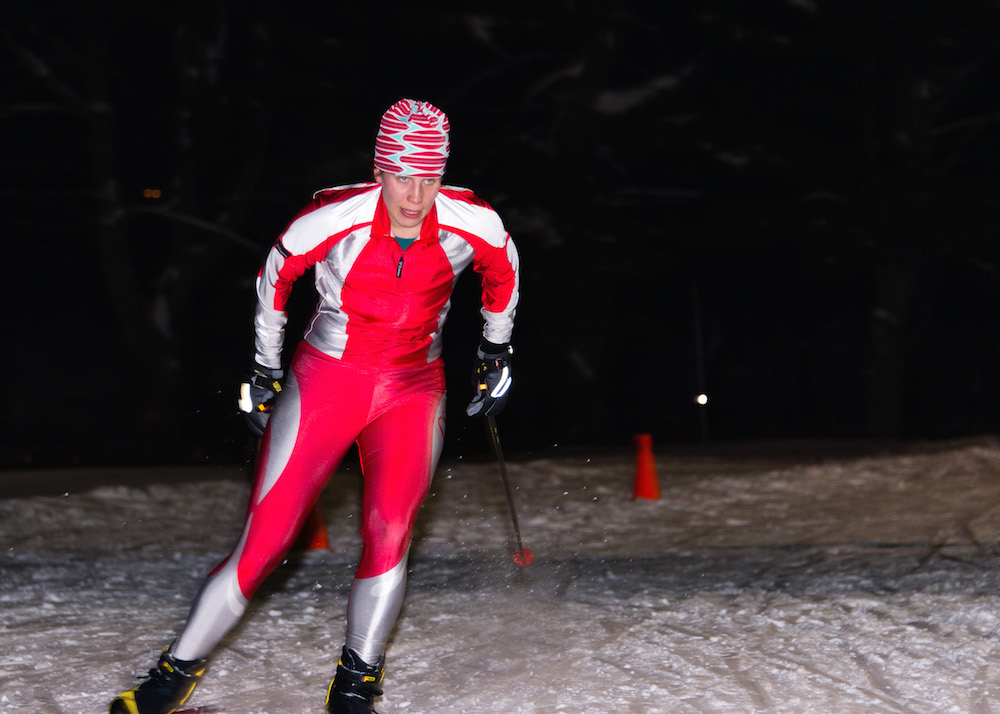
An athlete trains at night on the illuminated trails at the Weston Ski Track in Weston, Mass. (Photo: Jamie Doucett)
“They’re not skiers, they don’t know anything about operating a ski facility,” Chris Doyle, FOLJMS’s board chairman, said in a phone interview. “They clearly were not going to be able to do this on their own without any advice. We’d end up by default with a bad product. We reluctantly decided we had to tell them what’s needed in order to run the place.”
DCR Deputy Commissioner Matthew Sisk said on the phone that the decision to takeover Weston had “nothing to do with protecting the interests of golf and all to do with fulfilling our mission here at DCR, which is to conserve open land, protect and provide high quality recreation opportunities.”
Sisk acknowledged that it was a big change, adding, “This is going to be a good experience. We’re going to have a great season this year, people are going to see an increase in the amount of skiing they have available to them.”
FOLJMS had developed a master plan for skiing at Weston, which they submitted to the DCR in August. They envisioned FOLJMS managing skiing there, and their plan details short- and long-term infrastructure improvements, including new ski trails, a rollerski loop and an expanded lodge. Doyle said that while the DCR was impressed with the scope of the document, it decided to pursue its own course.
Since then, FOLJMS and DCR have met several times to discuss operations.
Asked whether DCR would implement any of recommended improvements, Sisk said, “Speaking specifically to their master plan is not something I’m going to do. I can tell you we’ve actively worked with [the FOLJMS] president, board, and membership to make this a smooth transition.”
This winter, DCR plans to re-open the Mount Weston hills and make snow on three kilometers of track, up from 2.5 k during the CRR era.
“I wouldn’t have discovered skiing without Weston,” said Harvard’s head nordic coach Chris City.
He began skiing at Weston in 1985. While City wasn’t pleased how the change transpired, he said the DCR has been receptive to the ski community’s input on running Weston.
Junior and master skiers share prime-skiing space at at the Weston Ski Track in Weston, Mass., outside of Boston. (Photo: Jamie Doucett)
Like CSU, Harvard depends on Weston as a training venue. Without it, he said they’d have find alternate places to ski, but he doesn’t expect they’ll have to.
“I don’t think that’s in realm of anybody’s expectations this winter,” he said. “[The DCR] has purchased some good snowmaking and grooming equipment.”
Whatever the past history, the DCR appears to be putting its best foot forward. It purchased a new PistenBully and four Snow Machines, Inc. (SMI) Super PoleCat snow guns, and bought CRR’s water supply system.
“We’re going to be doing more night skiing because of the close to $1 million lighting project that we did,” Sisk said.
According to the MetroWest Daily News, the state is replacing older lighting with modern, energy-efficient systems. In addition, trail fees will be lower than last winter. According to a fee schedule forwarded by DCR, adult day passes will be two dollars less than last year, and an adult season pass will be $189 as opposed to $225.
Running Weston with a series of a short-term contracts from DCR, Smith said it would have been difficult to make the sort of capital investment that DCR did.
Although CRR may not run Weston per se, DCR hired Smith to consult on snowmaking. While state employees will make snow and groom trails, Smith will provide training and guidance, and, for this winter at least, CRR will operate rentals and ski instruction.
“I don’t think it’s an option for [DCR] to fail,” City said. “That’s not to say I don’t think it will be rough.”
City added that coming in brand new, DCR don’t have the institutional knowledge Charles River Recreation (CRR) acquired over 40 years.
“With anything this complicated, you expect some bumps in the road,” City said.
“Lots of capital investment, much more willingness to listen to our ideas, but a huge assumption that [DCR] can run the operation,” Bradlee wrote. “It’s going to be an interesting winter.”
In a follow-up interview, Doyle explained, “Given that this is the path that they’ve chosen, we feel like they’re making good progress,” while adding, “It’s not clear to us that they’re going to open on time.”
The lighting project, which will benefit skiers in the long term, may not be completed by the end of November, she explained. It was supposed to open the first week in December, and the DCR is now saying skiing will start in mid-December.
CSU’s Hamish McEwen and Ian Case, and several others, train on the illuminated Weston Ski Track in Weston, Mass. (Photo: Jamie Doucett)
It’s a park with dual personalities.
Owned by Massachusetts’s Department of Conservation and Recreation (DCR), the Leo J. Martin in Weston, Mass., is a golf course during the summer and morphs into the Weston Ski Track when manmade snow flies.
Twelve miles outside Boston, Weston could be considered an unlikely area for a ski center. But with more rural, hilly ski centers at least 1 1/2 hours away by car, it’s a key resource for local skiers. Three million people live within a 30-minute drive of the park. Depending on the weather, between 25,000 and 35,000 skiers frequent Weston each year, and the area boasts 1,100 season-pass holders.
Weston sprang up as a winter expansion of founder Mike Farny’s first business, the Charles River Canoe Service. Larry Smith and Dave Jacques partnered with Farny to run a bike-and-ski shop in Lincoln, Mass., and developed Weston. In the mid 1980s, they assumed ownership of the canoe service and Weston Ski Track. Since then, Weston has become a go-to spot for city and suburban skiers in the Boston area.
With nature’s help, Smith can open 10 to 15 kilometers of trails groomed for both classic and freestyle. But so close to the Massachusetts’ coast, Weston depends on snowmaking, covering two to three kilometers of trails with manmade snow.
In just four months of the 2012/2013 season, Weston Ski Track recorded over 30,000 visits, close to 75 percent of the golf course’s traffic throughout the remainder of the year.
In just four months [between 2012/2013], Weston Ski Track recorded over 30,000 visits, close to 75 percent of the golf course’s traffic throughout the remainder of the year.
And Weston has helped to produce a number of junior-national champions, including Dartmouth’s Corey Stock. A member of the local Cambridge Sports Union (CSU) ski club, she trained extensively at Weston. Later, she earned starts in the 2012 Quebec World Cup and 2013 Junior World Championships in the Czech Republic.
A busy night-skiing scene at the Weston Ski Track in Weston, Mass. (Photo: Jamie Doucett)
Harvard University, Wellesley College and numerous local high schools also train at Weston. In addition, the Eastern MA Bill Koch Club and an adaptive program run by the New England Nordic Ski Association (NENSA) are held there.
But as Smith drove by the ski-area-turned-golf-course one day last summer, he saw that the snowmaking power lines had been taken down.
While making improvements to the driving range, the DCR inadvertently removed power lines and phone poles that supported Weston’s snowmaking and lighting for night skiing.
“It wasn’t a question of being malicious,” said Rob Bradlee, CSU’s head nordic coach. He suggested that the local ski community hadn’t adequately informed DCR about its needs.
“We’ve invested a lot in both snowmaking, lighting and grooming equipment,” Smith said. “We had gotten permission to do it initially, but that was many years ago, and [DCR] personnel change over time.
“I don’t know that the current management knows anything about the history [of the snowmaking improvements,” he added. “They were tasked with upgrading the golf course. … The hope is that everything will be better than it was.”
Last winter, Weston made do with a temporary solution for lighting and power, renting diesel-powered lights.
The DCR will install LED lighting around the driving range and some of the fairways for night use. The new lighting, Smith said, “will be better than what we have.”
The DCR could not be reached for comment.
“The ski community is stepping up and getting organized,” Bradlee added. “[And] looking to see how they can help DCR make the Leo J. Martin a better park.”
To that end, local skiers formed the Friends of Leo J. Martin Skiing (FOLJMS), which aims to publicize information about the metro-Boston ski scene. Their website shares articles on the success local skiers have had at the national and international level. They’ve applied for and are awaiting approval of non-profit status.
According to FOLJMS Assistant Director Elizabeth Wilcox, their aim is to “preserve and enhance cross-country skiing in the greater Boston area.”
With regard to Leo J. Martin, Wilcox explained that they’re endeavoring to get DCR to make golf-course improvements that would enhance, or at least not impede skiing.
Skiers round a corner while night skiing at the Weston Ski Track in Weston, Mass. (Photo: Jamie Doucett)
And DCR has been listening. One of the main ski trails went behind a driving range down a short, steep hill. While upgrading the driving range, DCR changed the steep hill into a “precipitous drop” that made the trail unskiable.
“When we showed them, to DCR’s credit, they brought the contractor back and put in an incline to make it skiable again,” FOLJMS Director Chris Doyle said.
However, limiting the amount of skiing on fairways has been raised as a “point of discussion” by DCR. Although the ski trails avoid the golf tees and greens, “We’ve always skied on the fairways,” Doyle explained.
Due to the volume of skiers, he said it was important to ski the fairways of the four holes closest to the clubhouse, where artificial snow is made. On the other 14 holes, they try to stay off the fairway.
Trail designer and 1976 Olympic biathlete John Morton saw Weston’s potential early on. During his tenure as men’s ski coach at Dartmouth in the 1980s, numerous CSU alumni skied for Dartmouth. He said he “became more and more impressed” with CSU skiers, who competed well despite the “geographical disadvantage” of their location.
Last March, FOLJMS contacted Morton for input on how Weston might improve. Morton attended meetings with the DCR and FOLJMS.
“The DCR is now much more aware of [Weston’s] needs,” Morton said. “We’ve had a number of collaborative meetings about how to make Leo J. Martin more successful,” both in summer and winter.
Morton sees opportunities based on the success Weston has had to this point. With no nearby alternatives, Weston is crowded. He described an idea to create a beginner/novice area separate from more demanding trails. Additional trails on “humane terrain” would require lighting and snowmaking.
If a novice ski trail could be developed, that would open the way for creating longer, more technically demanding trails for advanced skiers.
“It’s a unique recreational facility for cross-country skiing,” Smith said. “[The DCR] should take credit for some of that, which would help them realize they need to work to continue to improve it.”
Mike Gallagher, a three-time Olympic cross-country skier and former U.S. Ski Team head coach, at his home in Pittsfield, Vt., on Nov. 1, 2011. Gallagher died last week on Oct. 3, his 72nd birthday.
Note: This tribute has been updated to include comments from Mike Gallagher’s wife, Tyna, and additional photos from John Estle.
Mike “The Eagle” Gallagher was a diehard baseball fan. Several springs ago, he accompanied his nordic-skiing cronies, John Estle and Peter Ashley, to Tampa, Florida for some sunshine and the rituals of spring training. A three-time Olympic cross-country skier and head coach of the U.S. Ski Team from 1980-86, Gallagher was in hog heaven hanging with his buddies and watching his beloved New York Yankees tuning up for the season, Estle said recently on the phone.
Mike Gallagher gets some help from his wife Tyna before being inducted into the Mount Washington Road Race Hall Of Fame in 2011. Gallagher won all four years he entered the race from 1968-71. (Photo: Jim Fredericks)
The trip to Florida was the invention of Estle and Ashley, also former U.S. Ski Team (USST) coaches, who convinced Gallagher to join them. It took a little coercion, because Gallagher was scheduled to get a hip replacement that same week. In the end, Gallagher rescheduled the surgery and left muddy Vermont for balmy Florida. The trio bunked up with Estle’s partner’s family in Tampa.
During their stay, their host family held a Passover celebration. In remembering the trip, Estle chuckled and said Gallagher was quite caught up in the traditional Jewish celebration. This Irish-Catholic boy from Vermont had never experienced anything like it and loved being included in the large family gathering. In fact, after a week of watching his heroes Derek Jeter and Mariano Rivera playing the game, it was the Passover that Gallagher raved about.
A “man’s man” is how Estle described Gallagher, who passed away at home in Pittsfield, Vt., on Thursday, his 72nd birthday.
“He embodied physicality and sport, yet he was very spiritual and humanistic at the same time,” Estle said. “When you visited, you were the best friend he ever had. He always made you feel good.”
The Man, The Legend
On Oct. 3, 1941, Gallagher was born in Yonkers, N.Y. Raised in Rutland, Vt., Gallagher got his first ski lessons from his father, who served in World War II in the fabled 10th Mountain Division. He went on to become an accomplished runner and alpine skier, laying the foundation for nordic skiing, which would eventually become his life.
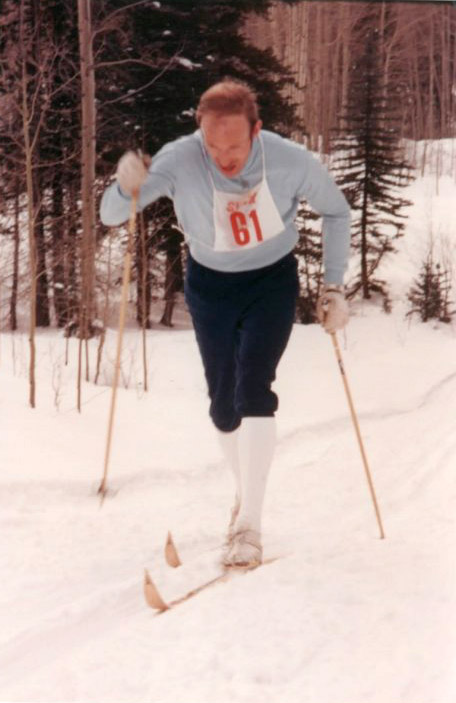
Mike Gallagher at a small race in Europe the early ’70s using Scott poles. (Photo: Marty Hall)
Kicking and gliding on wartime skis he modified for racing, Gallagher won his first high school race as a member of the Rutland High School team. He went on to captain his team, and won a Junior National championship in 1959.
After graduating from Rutland High, Gallagher took a post-graduate year at Vermont Academy then set his sights on Colorado. He attended the University of Colorado, motivated by training with friends Bob Gray and Mike Elliott. This was the beginning of a long-term friendship and the rock upon which U.S. cross-country skiing would grow for many years.
“That trio of Elliott, Gray and Gallagher carried the program for a ton of years, made huge sacrifices, and were all wonderful people living life to the fullest,” their former U.S. Ski Team (USST) coach Marty Hall wrote in an email.
Life was good in Colorado for Gallagher’s freshman year, but then Gray and Elliott moved on, forcing Gallagher to carry on without his training buddies for three more seasons. Seeking more opportunity in skiing, Gallagher set off for Norway, where his ski training took off.
He went on to make three Olympic teams in 1964, 1968, and 1972, and three World Championships. In addition, Gallagher notched nine national titles. His proudest result was 19th in the 50-kilometer classic race at Holmenkollen, Norway, in 1968. He accomplished all of his off-season training while holding down a full-time job. Gallagher’s love for skiing and legendary work ethic is what defined him for the rest of his life.
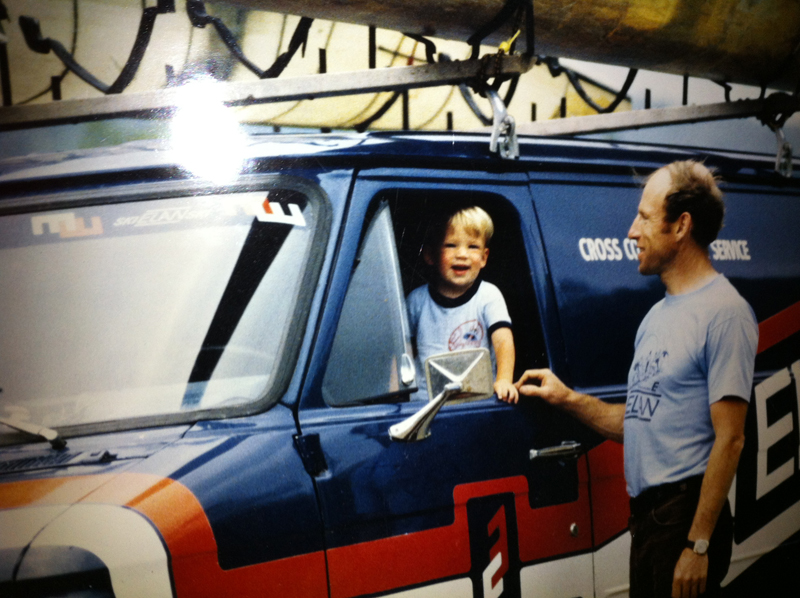
Gallagher (r) with his son, Jesse, in his Elan work van. (Photo: Mike Gallagher)
Gallagher applied his talent and formidable energy to bike racing in New England, a sport in which he excelled for many years. In 1972, he was the 25-mile road biking national champion.
Retired from racing, but still enthralled with the sport, Gallagher turned to coaching. He was head coach of the USST from 1980-86, Olympic-team coach in 1980, 1984, and 1992, and a high-school coach for 17 years. With Gallagher at the helm, Bill Koch won the overall World Cup title in 1982.
The nordic vice president of Fischer USA, Ashley summed up Gallagher’s insightful coaching style in a 2011 interview with FasterSkier. “Mike was the perfect guy for Kochie because he allowed him to do things in a different way, was flexible when he needed to be and would stand on things when he needed to.”
Gallagher vast knowledge of all things nordic led him to employment in several ski companies over his career, among them Splitkein, Hexcel, Edsbyn, and Elan.
For many years, Gallagher shared his love and expertise of skiing as the nordic director at Mountain Top Inn in Chittenden, Vt. He also taught skiing at the nearby Mountain Meadows in Killington.
In 2007, Gallagher was inducted into the Vermont Skiing Hall of Fame. He was also into the Mount Washington Road Race Hall of Fame in 2011, a race he won from 1968 to ’71.
Gallagher is survived by his wife, Tyna, sons Sean and Jesse, and a grandson.
Athlete, Coach, Mentor, Friend: Remembering Mike Gallagher
Some people are larger than life. Gallagher was one of them. When you think of throwing rocks into a pond, the largest ones make the biggest splash and send the ripples furthest. Gallagher touched the lives of many because his ripples reached the far edges of the pond. – Nancy Fiddler
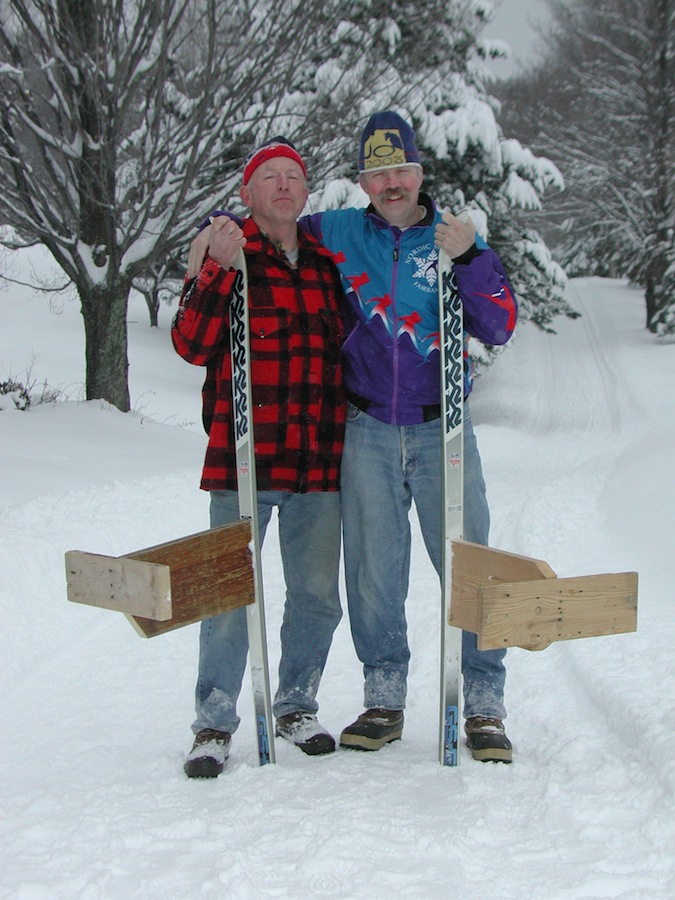
Mike “Jumpin’ Jack” Gallagher (l) and longtime friend John Estle in April 2003 in Pittsfield, Vt. (Photo: John Estle and Norma Haubenstock)
Many people met Gallagher through cross-country skiing and then became friends for life. Famed nordic announcer Peter Graves is one, remembering in an email message how he met Gallagher.
“I first met Mike in the late ’60s when he came to my high school to do a clinic. With his typical verve he talked about what a great sport XC was,” Graves wrote in an email. “With that and his sparkling USA warm-up, I became a follower. Over the years, we shared special moments of reflection in his sauna and pondered things, sport and the meaning of life. What was said in the sauna always stayed in the sauna. What he leaves is a rich tapestry of goodness, of inspiring countless people to ski and enjoy the richness of life. He was a smart guy with deep feelings, and as an Irishman myself, I could always understand the joy he felt in singing his Irish songs. He touched so many people, I’m going to miss him for a long, long time.”
Teammate and close friend Elliott recounts in an email how, on a 2012 visit to New Hampshire, he drove 330 miles round trip just to have dinner with Gallagher and Gray. The three remained friends for years after they dominated the U.S. skiing scene.
Elliott and Gallagher had the best kind of competitive relationship. They raced against each other at Junior Nationals and in college, and ended up teammates on the 1964, 1968, and 1972 Olympic teams as well as the 1966 and 1970 World Championship squads.
“We met in 1959 at the Junior National Championships. We always had a friendly rivalry training and racing,” Elliott wrote in an email. “Michael had ‘XC1’ on his Vermont vanity license plate. That license plate was a huge motivating factor for me because I wanted my results to force him to change his vanity license to ‘XC2’. Whenever I did not want to train, I just had to think of that license plate and then I was out the door training.”
Elliott also remembers Gallagher’s infectious singing. “When he called his friends on the telephone and they answered, he would often break into an Irish song. We all knew who was on the other end. He cultivated many friends from all walks of life. He really was such a good guy.”
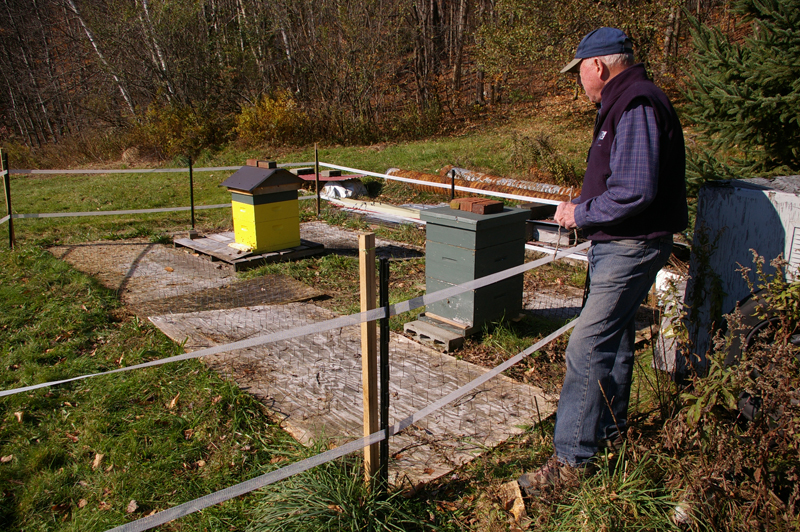
Gallagher checking on the beehives in November 2011 at his home in Pittsfield, Vt. Seventy years old at the time, he said he spent most of his time gardening and mowing nine acres of his 50-acre property.
Gallagher was the consummate tough mountain man, but Elliott saw a gentler side of him on their many travels together. “He once dressed as Santa Claus and passed out presents to children at a resort where we were staying in Scandinavia,” Elliott wrote. “His wonderful laugh and his accent made him a believable Santa Claus to the children. I have nothing but the fondest memories of my life with Michael.”
As competitors and avid outdoorsmen, Elliott and Gallagher shared many adventures. “Gallagher came out to Colorado in 1973 and we went backpacking,” Elliott explained. “He was not really fond of heights and I really took advantage of that fact and enjoyed scaring the hell out of him in the Colorado mountains. He was a very good sport about the whole situation. He loved fly fishing in those high mountain lakes.”
One of the many athletes Gallagher coached, Kevin Brochman remembered how Gallagher used humor to get him through tough situations, a behavior Brochman still resorts to. A two-time Olympian, Brochman also recalled Gallagher’s discomfort in high places, something that seemed to make him more human.
“Mike was a great coach and led the team to a US men’s best, 4th in the world, in 1982,” Brochman wrote on Facebook. “I felt honored to be part of his tenure from 1981-86. HE LOVED TO LAUGH. He did not care too much for the gondola ride up to Dachstein Glacier though!”
Former U.S. Ski Team head coach Mike Gallagher with one of his athletes, Jim Galanes, after a 1984 World Cup race. (Photo: Mal Lockwood)
As a coach, Gallagher set the bar high for his athletes, yet he stood behind them in every situation. The U.S. men’s squad, under his direction, achieved huge success.
“When Michael was the USST XC coach, he often traveled to where the national team skier lived to help them individually with their training,” Elliott explained. “He was instrumental in helping Bill Koch win the World Cup. Bill has nothing but kind, complimentary things to say about the job Gallagher performed.”
Ashley’s long friendship with Gallagher began at Colorado, where Gallagher helped save Ashley from a near-death experience following a collision with a tree. Later, Ashley and Gallagher coached the USST together. Ashley will always remember what he believes to be one of Gallagher’s major contributions to the sport of skiing in this country.
“Gallagher was a man who stood by his decisions, which served him well during the skating revolution,” he said on the phone. “He advocated for allowing the athletes to move the way they wanted to on a race course at a time when many of the international ski leaders were against skating. Gallagher was able to represent the USA’s desire to skate in the international coaching arena. We have a lot to thank him for, in that regard.”
Ashley, Gallagher, and Ruff Patterson brought skating back from the World Cup to the U.S. racing and recreational-skiing population. Their dissemination of skating knowledge put many Americans on skate skis in the ’80s.
Gallagher’s energy and personality were the driving forces in his coaching. As 1984 Olympian Sue Long Wemyss stated online: “I was fortunate to be on the USST and to get to know Mike during the years he was head coach. He was so lively, so positive. He leaves a huge hole.”
Helping Koch top the World Cup was just a small part of the impact Gallagher had on nordic skiing in the U.S. His knowledge was vast, his reach deep and his vision global. According to Ashley, “He had a huge influence on the younger skiers and was something of a father figure to many. The kids really looked up to him.”
Mike Gallagher enjoying some playtime at his Pittsfield, Vt., home in April 2003. (Photo: John Estle and Norma Haubenstock)
Former USST skier Tim Kelley was one of the many juniors inspired by Gallagher. He also weighed in on his memory of Gallagher on Facebook.
“Besides being a hero for U.S. cross-country skiing, Gallagher was always very supportive of the young guns. He enthusiastically welcomed newcomers into the XC skiing cult. I remember once at a junior camp at his place doing a circuit strength workout at his stations in the woods. And then we finished off the workout by helping him lift logs up for the cabin he was building.”
University of Denver Head Coach David Stewart echoed Kelley in another comment: “Gallagher was a big influence on me when I was just a Bill Koch League racer, inspiring me and many others with his enthusiasm for every level of the sport.”
Gallagher expected a lot, but gave a lot. His dreams are being carried on by the many who were influenced by his spirit. Cambridge Sports Union Head Coach Rob Bradlee carries on some of the best Gallagher traditions in his own work.
“I remember him coaching me at a training day at Putney when I was 15,” he wrote online. “With his enthusiastic urging, I did more push-ups than I thought I could ever do. His energy was infectious.”
There were valuable lessons beyond the push-ups, Bradlee explained. “As a non-competitive skier I was always impressed by how kind and encouraging he was to me. That I loved skiing was good enough for him. And in the long run, he helped me be a better coach by modeling that inclusive behavior.”
Dartmouth coach Ruff Patterson and Gallagher go back a long ways. They have worked together, recreated together, and shared a lot of good times. Patterson was Gallagher’s best man when he married Tyna in 2002.
“Gallagher was a strong man who expected things from people,” Patterson said on the phone. “He was direct and didn’t mind saying what he thought. He pushed all of us as hard as he pushed himself. I wanted to strangle him one day and hug him the next! We were incredibly close.”
The Quintessential Vermonter
“Taking in nature and spending time outdoors is what life was like with Mike. It could be as simple as sitting on our deck, looking out at the mountains sipping coffee and just taking in the beauty of our surroundings. Even though it was peaceful and it was also energizing. Mike was an avid fisherman and hunter, who could turn almost any outing into an adventure with his gift of storytelling. Mike had a joke or two for almost any topic, it was truly amazing how he could remember so many jokes. Even though he loved living off the beaten track, almost recluse, whenever there was a gathering Mike was sure to be the center of attention. With a twinkle in his eyes and his voice booming with excitement he would draw everyone into the story or joke he was telling. While his accomplishments were bigger than life, he was modest and would only talk about them when asked. He was warm, affectionate and fun-loving, he enjoyed putting a smile on someone’s face. He touched so many lives in a positive way, including mine. I am so proud of the man known as Michael Gallagher, he was the love of my life, my soulmate and my heart is breaking.” — Tyna Gallagher
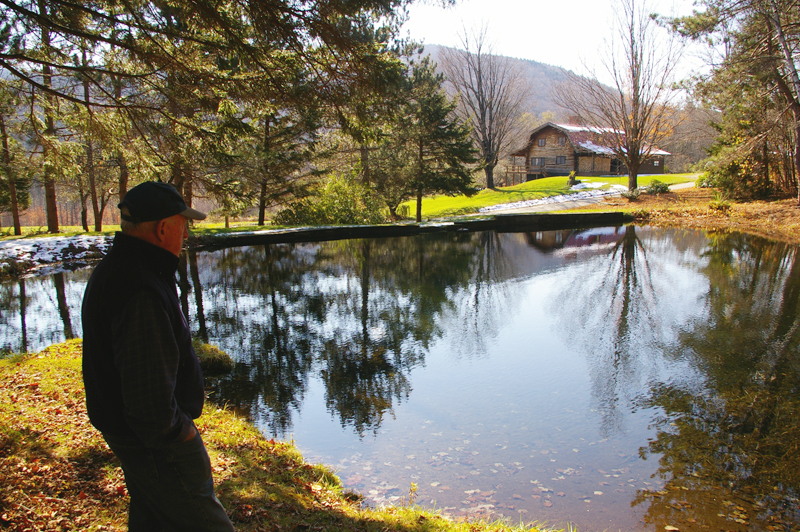
Gallagher beside his heart-shaped pond, where he married his wife Tyna, at their home in Pittsfield, Vt. Gallagher gave FasterSkier a tour of his 50-acre property in November 2011.
Gallagher embraced the Vermont lifestyle; he built the home he lived in and stayed busy and active to the end of his life by tending his garden, mowing, keeping bees, cutting wood, and hunting and fishing.
He raised his boys, Sean and Jesse, to be strong outdoorsmen as well as excellent skiers, and loved the time he spent in the woods with them.
Visitors to his Pittsfield home remember the sauna sessions. Between plunges into the refreshing pond, Gallagher told his famous stories and occasionally broke into song. Gallagher delighted everyone who took part in living large with him.
Elliott succinctly put into words what many are thinking: “I wish I would have spent more time with him.”
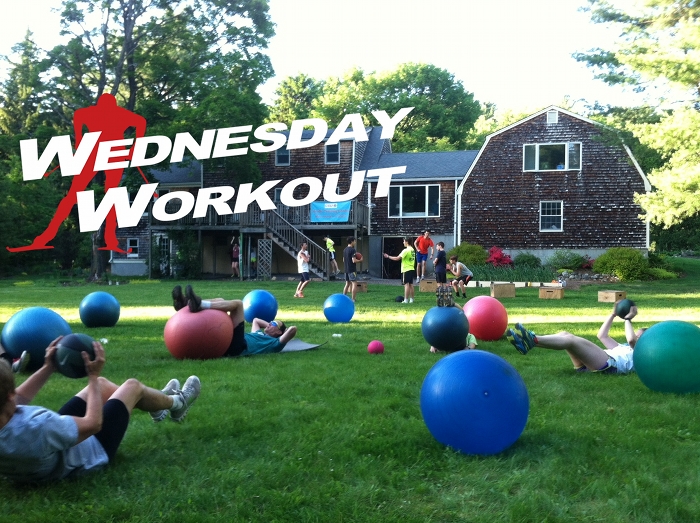
For CSU’s functional strength workout, you need an exercise ball, a medicine ball, a bench, a pull-up bar and a stopwatch. (Courtesy photo.)
Skiing is an upper-body sport. It doesn’t pay just to have a strong engine; if you want to win sprint finishes you’d better have a strong double-pole, too.
As Cambridge Sports Union head coach Rob Bradlee puts it, “it’s not running on skis. When I was a lad, if you were a good runner you could jump on the skis and run with wooden skis and bamboo poles. You didn’t get much out of your arms then, but not anymore.”
To properly build complete body strength in his athletes, Bradlee develops both their specific strength and something he calls functional strength. The workload he recommends for each age group varies (Olympic lifting is for more mature athletes only) but the principles are the same: strong skiers are fast skiers.
He can back his program up with results, too: at this year’s Junior Nationals in Fairbanks, Alaska, CSU ranked fourth amongst junior clubs throughout the country and he had multiple individual top-10s across age groups.
The key to those results, Bradlee says, was strength.
Which brings us to today’s Wednesday Workout, one of the two “functional strength,” workouts his athletes do twice a week in the summer and fall. On Monday and Friday nights, Bradlee’s athletes do circuits of full-body exercises mostly with body weight — “pull-ups, push-ups, squats, step-ups, those types of things,” he says.
There was a popular article in the New York Times recently called “The Scientific 7-Minute Workout,” which Bradlee says is a good, simple starting point for building all-around strength.
“[It] was wonderful,” he said. “It’s a pretty good description of what you can do.”
To complement the twice-a-week functional strength workouts during the summer, Bradlee also has his athletes do specific strength on their own time once or twice a week — namely, double-poling on an erg or on rollerskis with added resistance.
“Skiing is a whole-body movement requiring dynamic balance with decisive, explosive application of power from arms, legs, and core in a completely coordinated fashion,” he writes in the workout instructions. “To ski fast the athlete must gain strength performing the exact motions of skiing in a manner as close to actual skiing condition as possible.”
Specific strength is a topic for another day, however. For now, here one of CSU’s functional strength workouts. It may look like a long list, but you only have to do each set of exercises once unless otherwise noted.
“We do a much bigger variety of exercises with fewer sets than other programs,” Bradlee says. “Why? Because Coach Bradlee is easily bored and hates doing strength work so the idea of, say, having six exercises and doing three sets is horrifying to me even though I know it’s the accepted wisdom for strength. Seems to work out alright.”
Equipment: medicine ball, exercise ball, step-up box or bench, bar for pull-ups
Group Warm-Up
15 x Wood chop with medicine ball
15 x Rotation with medicine ball
10-20 meters: High knee skip
10-20 meters: High knee run
10 x Heel up walk with straight leg dead lift
5-10 x Lunge walk
5-10 x Inchworm
10 x Burpees
Balance
30 secs each leg: quiet balance
30 secs each leg: balance with arm waving and eyes shut
15+ each leg: balance with leg swing
Play catch with knee on ball
Core Stability, Hip Stability and Mobility
1 minute: Front bridge
1 minute: Side bridge
1 minute each: Back bridge (1 leg back, alternate march, 15 x ham curls)
15 x Cook Hip Lift (4 inch lift, 6 inch lift, on medicine ball)
15 x Bent Leg abduction
15 x Straight Leg
Plyometric (Explosive speed) Drills (AMAP = As Many As Possible)
The women’s 10 k freestyle podium at U.S. Nationals this January. Would it have looked differently if World Cup athletes like Kikkan Randall and Liz Stephen were in attendance?
In an interview with a Norwegian television channel last week, Petter Northug, Jr. admitted to faking illness in 2011 to get out of racing at Norwegian Nationals (NM) prior to the Oslo World Championships. Norwegian national team members are contractually obligated to make an appearance at NM every year, and Northug dropped a bomb on the Norwegian sports pages by saying he skipped it and fabricated an excuse to do so. For the record, he went on to win three World Championship gold medals for Norway in front of a gigantic home crowd at Holmenkollen.
Petter Northug celebrating a win at the 2011 World Championships in the 30 k pursuit.
“I felt pushed ahead of World Championships in Oslo,” Northug said. “I wanted to go to NM; I wanted to take the championship gold. Then it hit me that I had gone to the Tour de Ski, [too]. I thought, ‘Be [tired] and get [sick] now, and you’re home exercising by yourself. Stay away from people when you say that you are sick to the media, and then you start working on what is important, what you will experience once in a lifetime.’”
The revelation that golden-boy Northug lied to get out of showing up at one of the biggest events in Norway sparked vigorous debate throughout the country last week. At the heart of the discussion was a question of whether Norwegian Nationals should be positioned to suit Norway’s World Cup team.
John Northug, Petter’s father and manager, suggested NM be moved to another time of year, to avoid conflicts for athletes who have big races like Worlds or the Olympics to focus on. NM might be better split into two parts in mid-winter and the spring, he said, so that World Cup athletes can still compete for a national title when they’re no longer concerned with major international championships.
Norwegian Ski Federation (NSF) cross-country committee director Torbjørn Skogstad responded on Saturday with the statement that the organization will not reschedule NM in 2014, an Olympic year. He cited impracticality in moving the national event for only a few national team athletes.
“The National Championship is in many ways an institution and an important meeting place for the entire ski Norway,” Skogstad said on the NSF website. “National Championship this year may not account for all national team [skiers], but is definitely the highlight for the rest of the senior athletes… We should be very careful not to upset the status of the National Championship today.”
The Federation’s relationship with NRK, the national TV station that has broadcasting rights to NM, dictates a certain order of events: first Nationals, then World Championships or the Olympics.
“Any relocation of the National Championship or changing the program of events requires political treatment,” the NSF press release explained.
The debate should sound familiar to Americans. Though the U.S. doesn’t have to consider TV rights when it schedules nationals, a more complex logistical dilemma has arisen in recent years: how to time the championship so that national team athletes can compete, but also give officials a single major in-season event from which to pick junior, U23, world championship and Olympic teams.
Kikkan Randall, Andy Newell & Co. haven’t raced at U.S. Nationals in years — as the U.S. Ski Team has become more competitive internationally, more of its athletes have chosen to remain in Europe for most of the season, either for the Tour de Ski or in-season training. Is U.S. Nationals still a true championship without them? And if it’s not, does that warrant a change?
The cross-country committee at the U.S. Ski Association (USSA) is currently considering the question. Coaches from around the nation discussed the issue at the annual congress last spring and formed a sub-committee to present possible solutions this May. USSA Nordic Manager Joey Caterinichio says that, depending on what this group finds, the governing body is open to the possibility of moving nationals to the spring.
“We’re not in Europe,” Caterinichio said a few days after nationals concluded in Soldier Hollow in January. “This year, it worked out pretty well to get our fastest skiers where they’re supposed to be, head to head, and still have a super quality event. We’ll definitely continue to look, moving forward, if that’s the best for the U.S.”
Currently, the U.S. technically splits its championship races between the winter and spring. U.S. Nationals are every January, with two sprints and two shorter distance races, and then 30/50 k Nationals take place in April as part of SuperTour Finals. Likewise, Canada hosts its championships after the World Cup season ends, before SuperTour Finals, and holds separate trials in January to pick athletes for its international teams. Typically, U.S. and Canadian national teams have participated in their spring championships after returning from Europe, keeping event visibility high and race organizers happy.
Some still don’t think the system is perfect. In the U.S., the January event still calls itself a national championship even though these days, the best American skiers are in Europe. Titles are on the line, and SuperTour points and prize money is doubled. But at the end of the week, those titles aren’t always in the hands of the country’s best skiers, leaving room for dispute when it comes time to name world championship teams.
The complexity of the scheduling problem is still relatively new. As Americans have improved their standing on the World Cup in recent years, greater numbers of World Cup team members have decided to skip Nationals and remain Europe to compete in the Tour de Ski—an event that itself is only seven years old. Simi Hamilton and Ida Sargent, who were not on the 2013 Tour roster, still skipped Nationals in order to fly back to Europe directly after the holidays, readjust to the time zone and train for the races that are important to them.
After five months on the World Cup circuit, Liz Stephen (l), Kikkan Randall and Holly Brooks (r) duked it out in the 30 k freestyle at U.S. Distance Nationals in Craftsbury, Vt. Right now, it’s the only national title they compete for.
By most accounts, that’s a good position to be in. Randall, for example, last competed at Nationals in 2010. Now that she’s among the best skiers in the world, she has bigger things on her plate than affirming her position as top dog in the U.S.
On the surface, the primary purpose of a national championship is to award meaningful national titles. If that were truly the only point of the event, the problem would have an easy fix: push the whole thing to the spring, in place of SuperTour Finals. It’s the simplest way to allow the U.S. Ski Team’s athletes to compete for titles, if they want to. Junior/U23 World Championship teams would be named from a January Trials, which is what Canada — a country with the same logistical challenges as the U.S. — already does.
But this solution ignores the full spectrum of what U.S. Nationals accomplishes. It may not even solve the problem of naming a true national champion. After months of travel and racing a full World Cup schedule, athletes say they are completely spent. Contrary to what Northug and his father would like to see in Norway, the last thing Americans want to do when they get back is compete for national titles for a week straight against a rabid domestic field.
“It is unfortunate that we can’t be at nationals, but at the same time, the way the schedule is these days, I don’t really know when we could fit it in,” Randall said in an interview during the Tour de Ski, just before U.S. Nationals began at Soldier Hollow. “By the time we get to the end of the season, when you’re done putting everything into the World Cup and those final races, it’s hard for us to think about going hard at a full nationals schedule.”
Newell, whose last U.S. Nationals appearance was in 2007, agrees with Randall — his career objectives have surpassed domestic achievement. At SuperTour Finals last April, Newell decided to sit out the competition when he got sick on the flight back to the U.S. after his last World Cup race.
Andy Newell (USST/SMS T2), sprinting at SuperTour Finals in 2011.
“We just don’t have the luxury of living on the same continent we race on most of the time,” he said. “And I think it’s because of this that U.S. Nationals has a different feel to it. From a national team skier’s perspective, and at least from my perspective, I don’t think we care about national titles or anything just because that’s the way the ski culture has been in the U.S. for my whole career. It has always been about proving ourselves on the World Cup and not racing in the U.S., because geographically you can’t do both.”
Though his personal priorities don’t involve racking up national championships, Newell realizes that his own presence at the event would boost its visibility and help the development of skiing in the U.S.
“I think it could do great things for our sport in the U.S. if we could manage to make Nationals bigger,” he said. “Attract all the big names in U.S. skiing and it will bring in more media, bigger exposure in the U.S., and hopefully grow the sport some more. So it’s frustrating that it can’t be that way.”
The opportunity for developing athletes to race against athletes like Newell or Randall is potentially another reason to move nationals. When junior athletes went to Soldier Hollow this January, they were exposed to a higher level of skiing. Add the country’s very best into the mix and young skiers could see firsthand what world-class speed and technique looks like.
“I think it would be great to move senior nationals to the end of the season into the time slot where we know have the Super Tour finals,” said Rob Bradlee, head coach of the Cambridge Sports Union in eastern Massachusetts. His program has produced athletes like Corey Stock, who raced at the Quebec World Cup this season as a college freshman, and he believes the value of a national championship partly comes from the development opportunity it presents young skiers.
With nationals in the spring, Bradlee says, “All national team members could attend and ambitious young skiers would get the chance to compete with them and see what it takes to be on the World Cup… All I’m really saying is to change the names and descriptions of the two events. I don’t think the group of racers attending would be much different. It would just mean that Kikkan could be National Champion along with being World Champion.”
If nationals moved to the spring, there would still need to be a quality trials event in January to name Junior/U23 Worlds, J1 Scando, and (in theory) Olympic and World Championships teams. This presents another trade-off; some worry that in non-championship season that come around every three years, field depth and quality would suffer at the revamped January races. Strip U.S. Nationals of its name and associated prizes and there’s no guarantee that the top senior athletes would show up without the need to qualify for an international championship.
“If the January trials are part of the SuperTour, folks would still go for sure. But it’d be like the Midwest or the Eastern sections of the SuperTour,” says Dakota Blackhorse-von Jess, who won a sprint national title last month. “Those that can make it will, but it won’t be the same, unless they offer double points still. If I had to fly to Fairbanks, for example, and there wasn’t any special incentive, I might not. Certainly, there isn’t enough money in prizes to cover it.”
Bradlee had a simple suggestion to maintain incentive for seniors: keep the points and the money.
“I’d say that the first week of January should [name] the World Juniors team and Nations Cup team qualifiers and [be] a Super Tour,” he said. “That would make the event essentially exactly as it is now since all the best skiers not on the World Cup would be there to get SuperTour and USSA points.”
Titles awarded from a spring nationals might still be problematic, however. As Newell mentioned, competing for a championship after World Cup Finals would be a challenge. It would be nice to point to results from such a race and say it actually named the best skiers in the country, but Blackhorse-von Jess, for one, doesn’t know if this is possible, given the disconnect between World Cup results and domestic American results.
“Races here don’t play out like they do on the World Cup,” he said. “This is relevant because… let’s say Newell comes and races and gets beat. Say he gets second or third. That doesn’t make the guy on top of the podium a ‘better’ skier or even show indication of how they’re going to perform on the World Cup. I’m a great example — I didn’t race the heats very well in Bozeman. In fact, I sucked. I qualified okay…and didn’t even earn a start right. But when Torin [Koos] got sick and I got a chance, I showed up and raced and beat all the domestic racers.”
A spring nationals might have participation problems, too, which would further damage the credibility of results. Once college athletes put the NCAA Championships behind them and juniors wrap up their season at Junior Nationals, how many of them would show up for the senior-level event?
The nationals scheduling issue is undoubtedly a complicated one. The U.S. will always have to weigh conflicting viewpoints from the national team, from domestic seniors and from juniors as long as most of the international circuit takes place across the pond and Americans continue to be competitive on it. At USSA, the collection of feedback on the national calendar is an ongoing process.
“It’s definitely been thought about,” Caterinichio said. “So I think now that we’ve got some data we could look at moving it or we could look at keeping it.”
The Cambridge Sports Union (CSU) waxing staff (Caldwell Sport photo)
This article is a paid advertisement by Caldwell Sport, a ski-grinding service and new-ski retail shop operated by Amy and Zach Caldwell in Putney, Vt. We ride the coattails of any successes that we can claim an association with. This week we’re taking credit for the astonishing successes enjoyed by the Cambridge Sports Union (CSU) in recent years.
Last spring, USSA named Rob Bradlee domestic coach of the year, recognizing the rapid ascent of the Cambridge Sports Union to the upper ranks of U.S. Junior clubs. Rob is quick to point out that the award may be in his name, but it recognizes the contributions of many coaches, volunteers and athletes. CSU has about 55 kids involved in the program, and 20 to 25 of them regularly attend Eastern Cup (Junior Olympic Qualifier) events. Six years ago they placed no skiers on the New England JO Team. Then, for a couple of years they got two kids onto the team. Then seven, and nine, until last year they claimed 12 spots on the perennially strong NE team. At JOs last year they had the top girls club, and second overall club score. They had three individual JO champions, and five all-americans.
CSU is the only major club in the greater Boston area. The skiers are the normal brand of bright stars that we see involved in Cross Country everywhere, multiplied by the intensity of a major urban environment. Skiing competes for attention with a huge number of scholastic sports and extra-curricular activities. They ski primarily on short loops of manmade snow at the Weston Ski Track. In a time when standard complaints and excuses from clubs all over the country are focused on bad snow and too many other commitments, CSU makes you wonder what most other clubs in the country are waiting for. How do they do it?
CSU head nordic coach Rob Bradlee (Caldwell Sport photo)
It’s the skis.
No, it’s not actually the skis. But the CSU approach to skis gives some insight into the way the club is organized and how they have formulated their recipe for success. And while skis may not be the key to success, CSU does a great job, week after week, of competing with various ski academies and eastern colleges. It’s notable these days when they don’t have among the best skis in the race. And they do it with a big team, using an army of volunteer parent-waxers. There is no top secret wax-guru mixing up fancy solutions in the background. There is, instead, a system.
This might be a good time to introduce Jim Stock. Jim is a quiet and intense guy with a brain that is wired to create order out of chaos. He is a Harvard professor of economics, and in his spare time he quietly shapes global macro-economic policy. No, really, he does. In his other spare time he coaches the Eastern Mass BKL group, otherwise known as the CSU farm-team. In the ski world he’s better known as Chris and Corey Stock’s dad.
I don’t actually know how the system was developed, but I’ve been involved picking and grinding skis for the club for the past four or five years. I imagine that Rob and Jim sat down and made a list of variables, assets and liabilities. The liabilities are what most clubs offer as excuses; we don’t have any waxing gurus, we don’t have great opportunities to test, we’ve got a ton of kids with a limited number of skis, we’ve got to get wax on all these skis really quickly. These liabilities got recast as limitations – the framework within which the club had to operate to produce good skis. And the most important thing they did was make a creative assessment of their assets. What do they have a lot of? Parents.
Normally, in junior ski racing, parents find themselves in the role of helpless bystander, and potential liability. I can’t count the number of times I’ve seen one or two coaches scramble to get kick wax on skis for a dozen kids while a dozen parents hover nearby hoping that everything works out. CSU parents are involved with their kids, and concerned for their success. In different circumstances we’d be talking about an epidemic of helicopter parents. But at CSU the parents find themselves in the “assets” column, and they have klister on their hands. How do you get 25 kids waxed for an Eastern Cup race? You deputize parents as waxers! The CSU waxing juggernaut can race-wax 25 pairs of skis in 40 minutes. And they’re loud and boisterous – quite obviously having a great time. In the noise contest it’s a toss-up between the Dartmouth girls and the CSU waxers.
Cambridge Sports Union (CSU) hard at work. (Caldwell Sport photo)
In order for relatively inexpert (at least at first) parents to do good work waxing skis, there have to be clear instructions. And this is where the CSU system really shines. Starting four or five years ago, Jim and Rob have clearly defined what they’re looking for in skis. When we started working together they were quick to point out that they often need to deal with klister, and that really soft classic skis were hard to work with. The majority of the CSU kids have one pair each, skate and classic, and so we worked together to define, specifically, what a single-pair CSU classic ski needed to be.
And then, with help from Chris Li at Bikeway Source in Bedford, Mass., we developed a way to quantify and mark the pockets. CSU was among the first clubs to identify, appreciate, and utilize residual camber as a characteristic in their classic ski. They developed a standardized system of marking skis so that they could give specific instructions to parents for precisely how to wax whichever pair of skis was on the bench in front of them. And it worked! The skis come from one source, they are selected to fit one system, they are measured and marked using one system, and chaos has been given a time-out.
It’s not just classic skis and kick waxing either. Rob has been a Toko guy for years, and had no desire to change to a completely different system. But he asked for suggestions on specific products that could broaden the range of wax possibilities for glide, and he introduced them, a couple at a time, to a contained testing process. He bought test skis, and a Finite Finish structure tool, and we discussed basic standard structure modifications. And then we standardized grinds for the whole club. As I type this we are processing final structure on some of the 154 pairs (including some for Masters) of CSU skis that we’re grinding this Fall. On any given race day the CSU waxers should be working with only one or two different structures, so testing hand structure and modifying skis is a controlled and sensible process.
In part, the CSU approach to skis and ski service is representative of a willingness to invest. As a rule, the kids going to Eastern Cup races all have top-of-the-line hand-picked skis that are up to date. This costs money, and parents are expected to support the system. But because there is a system, the investment in equipment isn’t a leap of faith – it’s an integrated part of the program. We do a huge amount of work with teams from all over the country, and often we’re grinding a mish-mash of skis that have been assembled from various brands and various sources over the past decade. When we work on these skis it’s no mystery to us why CSU might have more success than some of these clubs. CSU is one of our most satisfying partnerships because their systematic approach and willingness to invest makes our work look good.
Corey Stock (CSU) skiing into the stadium in Rumford. Photo: Flying Point Road.
Highlighted by her fourth-place performance in the senior freestyle sprint at U.S. Nationals, 17-year-old Corey Stock (Cambridge Sports Union) earned her first trip to Europe with the U.S. Ski Team’s (USST) World Junior Championship squad this coming February.
It’s difficult to determine the most remarkable part of that statement. For starters, Stock’s age would normally make her a candidate for the J1 trip, and yet as the top junior finisher in the skate sprint in Rumford, she skipped that step and is headed for a major championship stage with her inaugural trip to Europe.
Even more impressive, however, is what Stock has managed to accomplish despite the less-than-ideal path she’s had to take. Two years ago, doctors diagnosed pain in her legs as compartment syndrome. She underwent surgery in the summer of 2010, and recovery was slow going.
“All the time her leg was injured, she was on the Ski Erg,” CSU coach Rob Bradlee said.
Upper-body work was all Stock could do to keep in shape.
After her surgery, the pain didn’t completely go away. She had been looking forward to competing at U.S. Nationals in 2011, but she and Bradlee decided not to sacrifice doing lasting damage for the sake of a trip to Europe and skipped Rumford entirely.
For someone of Stock’s competitive nature, a lengthy injury could have easily brought her down psychologically. When all she could do was double pole on a machine, she conceded that she definitely had her low moments. But she also saw the bright side.
“I know in the long run it’s been a good thing,” Stock said. “With athletes, it’s inevitable that you’ll encounter obstacles. I learned how to deal with them, I guess.”
Forced to adjust, Stock set her sights to one year into the future. Despite being held back over the summer, she went on last season to win two out of three individual races at Junior Nationals in Minneapolis, Minn., earning herself a spot on the National Training Group.
New England's Corey Stock on her way to her second national title in Presque Isle, ME in 2010. Photo: Flying Point Road.
A trip back to the doctor in the spring revealed that the return of pain in her legs was not compartment syndrome — it had been a trapped nerve all along. Stock underwent surgery for a second time, and this time was able to bounce back and start training again in full.
Healthy again, Stock reentered a normal training plan from square one. Bradlee said he had to be careful not to bring her back up to speed too quickly, fearing overtraining.
“My big goal for the year was to do a reasonable amount of training, but not break her,” he said. “It would be so easy to overdo it.”
Bradlee described Stock’s fourth-place finish at her first U.S. Nationals race as the product of smart training and perfect timing. When Stock started showing signs of tiring at the end of the summer, he scaled back her intensity work and had her focus on getting enough sleep and recovery.
After winning the sprint qualifier at the Eastern Cup in Craftsbury, Vt., by over six seconds at the end of December, Stock put in another week of work. This was just enough time, in Bradlee’s opinion, for her to be ready to roll in Rumford.
“When she killed that opening sprint race, it was a big sigh of relief,” said Bradlee. “I though we were doing the right thing, but I didn’t know for sure.”
Natural speed and hard work haven’t been the only factors at play in Stock’s success. Her mental toughness, explained Bradlee, is exceptional.
“The tougher the race, the calmer she gets,” he said.
After every race, Bradlee has his CSU athletes go around in a circle and talk about their day. When it was Stock’s turn to describe her experience moving through the heats, she explained that she’d enjoyed herself as the competition got progressively tougher.
Stock, in CSU blue, competing in the women's A-final in Rumford.
“She talked about how her heats were so much fun, duking it out with these really big girls,” said Bradlee. “That’s not something I taught her, you have to arrive with that, I think.”
At the end of the day, Stock was still processing her fourth-place finish, which for her was a surprise.
“It’s slowly sinking in,” said Stock. “I’m realizing how much I learned throughout the day. For every [heat] I learned a lot about tactics, and how exciting it is to ski with so many amazing skiers.
“I saw my confidence in my skiing; I definitely felt better on each heat, more peppy and sharp, and it worked out well.”
As a member of the USST’s National Training Group this summer, Stock had the opportunity to join the training camp in Alaska, and skied on Eagle Glacier with the fastest women in North America. More than anything, said Stock, the experience gave her the self-confidence to believe she belonged in a race against the likes of U.S. Ski Team members Jessie Diggins (CXC) and Ida Sargent (CGRP).
Stock, far left, on Eagle Glacier this summer. Photo: Matt Whitcomb.
“I realized how these amazing women, who I look up to so much, are actually just real people,” she said. “It helped when I raced them today; it wasn’t as intimidating.”
After opening nationals with a bang, Stock went on to ski to 33rd in the senior 10 k freestyle and then second in the junior 5 k classic.
With the completion of racing in Rumford and the naming of the World Junior team, the moment she’d been looking forward to for so long had finally arrived. Stock was understandably thrilled.
“I’ve been getting advice from athletes who have already been,” she said in Rumford. “I know it’s a big step up the first time you race in Europe, but I’m excited, too.”