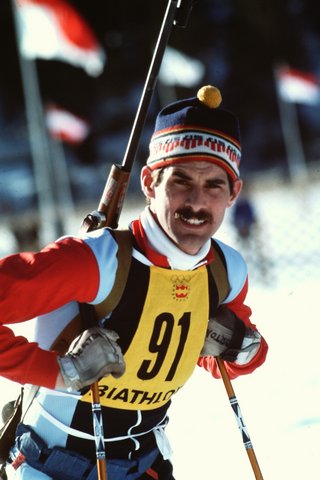
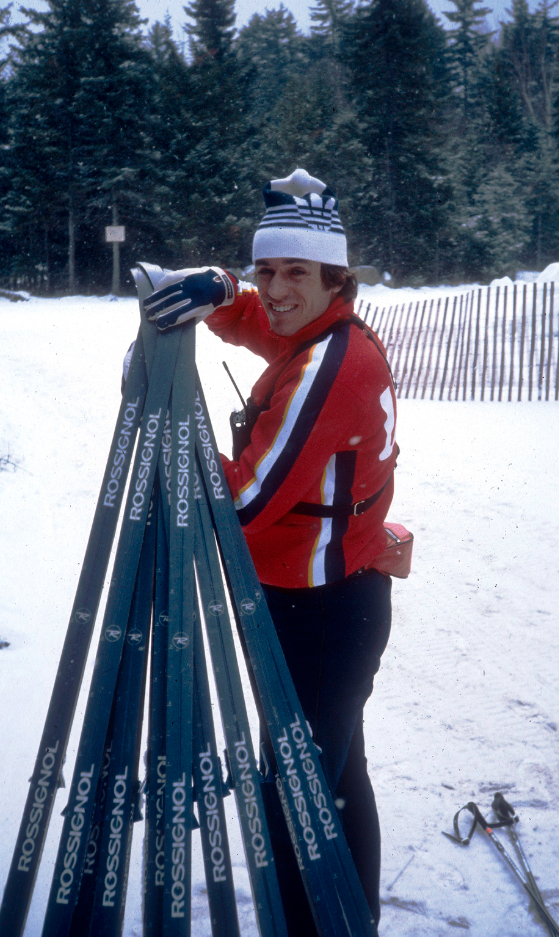
John Morton at the 1976 Winter Olympics in Innsbruck, Austria (Courtesy photo)
The following was submitted to FasterSkier by John Morton, a former U.S. biathlete and two-time Olympian (1972 and 1976) who has attended 10 Winter Olympics as “either an athlete, a coach, the Biathlon Team Leader, Chief of Course or, more recently as a spectator,” according to his bio (at end of article). Today, Morton, 71, lives in Thetford, Vermont, and works in trail design.
***
I’ve had the remarkable good fortune of attending 10 Winter Olympic Games. I was a member of the U.S. Biathlon Team in 1972 at Sapporo and again in ’76 at Innsbruck (where, following a workout, a few of U.S. ski-shooters wandered over to the adjacent cross-country stadium and watched Bill Koch win his monumental silver medal in the men’s 30 km). I was an assistant coach for the U.S. biathletes at the 1980 Games in Lake Placid, where late in the schedule, I accepted a complementary ticket to a hockey game, not even knowing which teams were playing. It turned out to be the USA’s remarkable victory over the Soviet Union, probably the most inspiring sporting event I’ll ever witness. I served as Team Leader for the U.S. biathletes at Calgary in ‘88, Albertville in ‘92 and Lillehammer in ‘94. Then, in 2002, I was the Chief of Course for the biathlon events during the Salt Lake City Olympics, a volunteer position that was every bit as stressful as competing back in ’72 and ‘76.
At the most recent three Winter Games, Vancouver, Sochi and PyeongChang, my wife and I have enjoyed the relative luxury of attending as spectators, cheering on America’s cross-country skiers and biathletes. As the jet lag from out trip home from South Korea begins to wear off, I can’t help thinking about the dramatic changes these two sports have experienced over the past 46 years. It seems to me that many of these changes can be traced to three factors: innovations by the athletes, technological improvements and the influence of television.
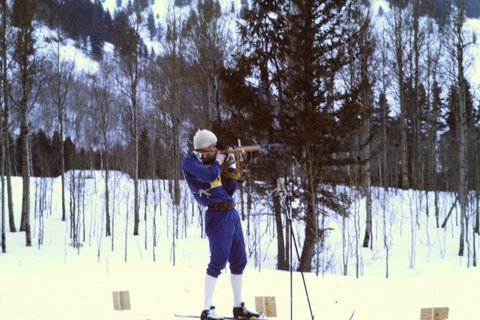
John Morton at 1972 biathlon Olympic trials in Jackson, Wyoming. (Courtesy photo)
Back in ’72 we were on wooden skis, kick-waxed the entire length. There were two biathlon events, the 20 km individual and the 4 x 7.5 km relay. We shot large-caliber rifles on a 150-meter range using paper targets for the 20 km and glass disks for the relay. It was impossible to determine the winner of the 20 km until all the paper targets had been carefully inspected, sometimes hours after the conclusion of the event. A typical biathlon course consisted of three, independent, 4 km loops, with cutoffs for the relay. Women didn’t compete in biathlon at the Olympics until Albertville in 1992.
Men’s cross-country has been part of the Winter Olympics since the beginning in 1924 at Chamonix, France, when there was a 15 km event as well as the legendary 50 km. The first cross-country event for women was a 10 km, which debuted in 1952. In those days, Nordic race courses consisted of roughly one-third climbing, one-third descent and one-third relatively flat terrain. Well into the 1960s, courses were prepared by soldiers boot-packing or snowshoeing the course, followed by skiers stomping in the parallel tracks through the forests and fields. Competitors typically started at one-minute intervals, disappeared into the woods, only to reappear exhausted, often hours later, covered with frost and mucus. The men’s 50 km cross-country event at the 1932 Winter Olympics in Lakes Placid consisted of a 25 km loop skied twice, and was won by Finland’s Veli Saarinen in 4 hours, 28 minutes.
In my view, the first significant change came at the 1974 Nordic World Championships when Sweden’s Thomas Magnusson won the men’s 30 km on Kneissl synthetic skis. Fiberglass and metal had replaced wooden Alpine skis years earlier, but the faster, plastic bases wouldn’t hold Nordic kick wax. But in wet, heavy, painfully, slow snow, Magnusson took a chance on the fiberglass Austrian skis and dominated the race. The headline in the Oslo paper the next day read something like, “Magnusson wins gold, Norwegian ski industry in peril.”
The next major breakthrough occurred at the 1976 Innsbruck Olympics two years later. Marty Hall, head coach of the U.S. Cross-Country Team recruited Rob Kiesel from Alpine skiing as his assistant. Together they determined that it was possible to wax the tips and tails of the new fiberglass skis for speed with Alpine wax, restricting the much slower cross-country kick wax to a short segment under the athlete’s foot. This made the skis of the Americans faster than those of their European rivals and certainly contributed to Bill Koch’s memorable silver medal in the 30 km, America’s first, and only Olympic medal in Nordic skiing until Kikkan Randall and Jessie Diggins struck gold in PyeongChang.
Following the success of the Innsbruck Olympics, expectations were high for U.S. Nordic skiers at the 1980 Olympics in Lake Placid. With a theoretical “home court advantage,” Bill Koch’s 13th in the men’s 50 km and Lyle Nelson’s 19th in the biathlon 10 km sprint fell short of the results which the public had been led to expect.
Discouraged, Koch elected to ski the international ski marathon circuit the following year rather than the Nordic World Cup. There, on trails groomed wide by Alpine-area Sno-Cats for thousands of citizen racers, he observed elite competitors pulling away from the throng by putting one ski in the set track and pushing off, skating-style with the other. He quickly mastered this marathon-skate technique and began to experiment by skating with both skis. When he returned to the World Cup circuit a year later, he threw the Nordic world into turmoil by abandoning the relatively slow kick wax altogether and skating entire courses on skis waxed purely for speed. The result of Koch’s persistence and innovation was a cumulative World Cup victory for the season, America’s first in cross-country skiing.
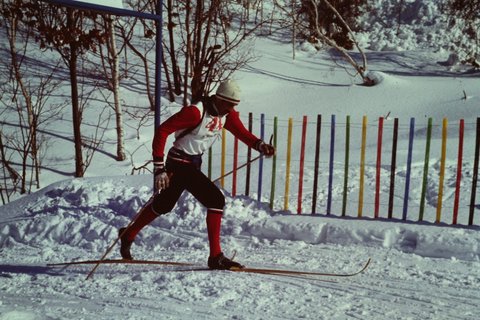
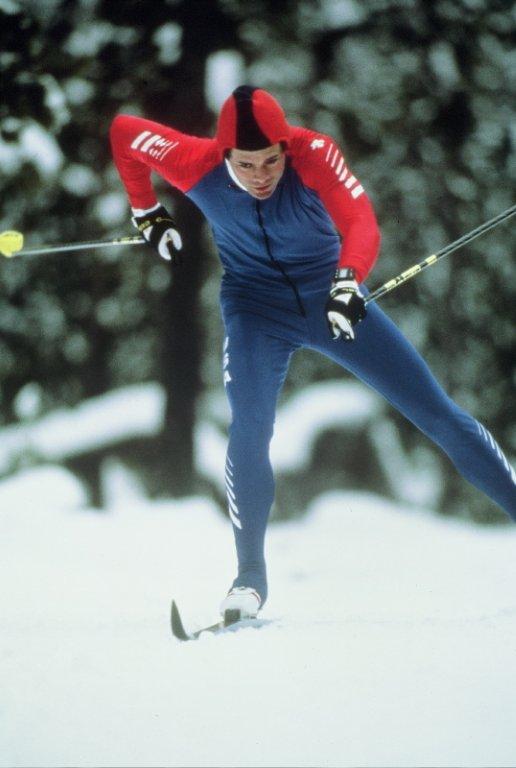
U.S. biathlete John Morton racing at the 1972 Winter Olympics in Sapporo, Japan. (Courtesy photo)
When the dust (or more accurately, snow) finally settled, Nordic skiing had two disciplines, classic (the traditional kicking and gliding) and freestyle (skating). Because biathlon was already complicated enough with skiing and shooting, they decided to go with skating as their designated technique, as did Nordic Combined. In a type of mutual re-enforcement cycle, the use of large, Sno-Cat-type grooming machines on cross-country trails, which originally made the evolution of the skating technique possible, became a requirement once skating was accepted as a part of the sport.
Enter television. The first Winter Olympics to be televised were the 1956 Games in Cortina, Italy, and it quickly became apparent how powerful the new medium could be. Figure skating, ice hockey and ski jumping immediately gained popularity, largely because they were relatively easy to cover. Alpine skiing, bobsled and Nordic skiing lagged behind because they were more difficult and expensive to film. The sports favored by TV prospered, enjoying increased funding from sponsors and a wave of young Olympic hopefuls. Meanwhile, those sports that were less telegenic scrambled to make their events more appealing to the camera. Nordic skiing and biathlon added mass-start and pursuit format events, making it easy for spectators to see who was winning. In terms of spectator interest, biathlon had the advantage of the shooting range. With the adoption of the modern, knock-down targets and television cameras’ abilities to zoom in on an athlete’s targets as he/she is shooting, the popularity of the sport took off. In recent years, biathlon has become the most-watched winter sport in Europe with World Cup events rivaling the popularity of Monday Night Football in America.
In cross-country, one of the unintended consequences of the skating revolution was a focus on upper-body strength, which in turn, led some athletes to abandon kick wax in classic events and double pole the entire course, especially in the shorter, sprint races. This led the FIS (the international governing body for skiing) to require tougher courses with more challenging climbs.
Finland’s Iivo Niskanen after winning the men’s 50 k classic mass start at the 2018 Winter Olympics in PyeongChang, South Korea. (Photo: FlyingPointRoad)
As a result, what we saw in PyeongChang for both cross-country and biathlon, were trails 30-feet wide, capable of accommodating three skaters, side by side (without obstructing each other), with steeper climbs and faster, more challenging descents. Aside from the spacious start/finish stadiums, the traditional one-third of relatively flat terrain has disappeared. There was also an effort to loop the trails back within sight of the spectators so that they saw more than just the start and finish of the events. For example, the men’s 50km, perhaps the most iconic of the cross-country events, was conducted on two, 4.16 km loops which brought the competitors through the stadium, in front of the cheering crowd a dozen times. The men’s 50 km classic in PyeongChang was won by Finland’s Iivo Niskanen in a time of 2 hours, 8 minutes (less than half the time it took for his countryman to complete the same distance in 1932 at Lake Placid).
Perhaps the most dramatic change, was the scheduling of many of the Nordic skiing events at night (which allowed them to be televised live in Europe and the eastern U.S. at a reasonable hour). In addition to the expense of lighting and minimizing the number of TV camera platforms, another motivation for shorter ski loops is the growing need, thanks to climate change, to cover the entire trail with machine-made snow. Early in the winter the biathlon and cross-country courses were blanketed with a deep layer of machine-made snow, enough to survive warm temperatures and thaws well beyond the Olympic schedule in February.
While there have been advancements and technological improvements in other Winter Olympic sports, I can think of none more dramatic than what we’ve experienced in Nordic skiing. From a single biathlon event held at the 1960 Squaw Valley Games, there were 10 biathlon competitions on the schedule in PyeongChang. With the advent of the skating technique, fiberglass skis and fluorocarbon waxes, times for cross-country events have been cut in half in less than a generation. Thanks to machine-made snow, the 2022 Winter Olympic Games will be hosted by Beijing, China, a city previously not known for winter sports. And through the development of LED lighting and high-definition television, the excitement of Nordic skiing events can be broadcast live, in prime time, to homes around the world.
*****
John Morton has participated in ten Winter Olympic Games as either an athlete, a coach, the Biathlon Team Leader, Chief of Course or, more recently as a spectator. He has published two books and numerous articles dealing with Nordic skiing.
After 11 years as Head Coach of Men’s Skiing at Dartmouth College, he founded Morton Trails, and has spent the past 28 years designing more than 220 recreational trails and competition venues across the country. He currently has projects underway in a dozen U.S. states as well as two projects in China. More information regarding his trail design work can be found at www.mortontrails.com. He lives with his wife Kay, at the end of a dirt road in Thetford, VT, surrounded by trails.
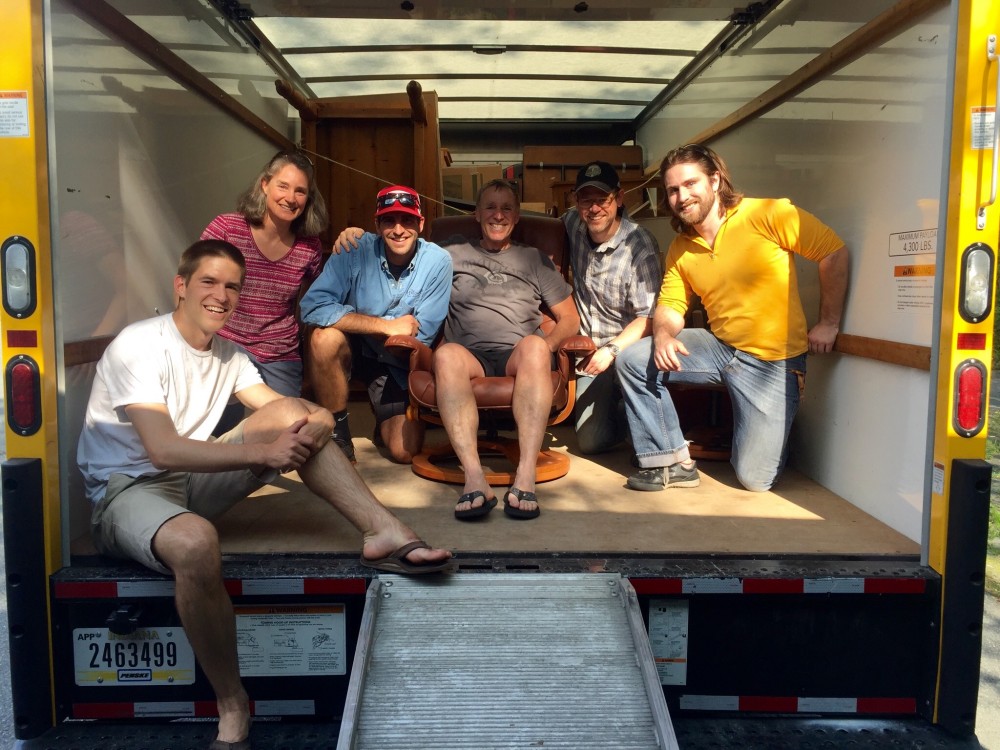
(From left to right) Austin Caldwell ’14, Scottie Eliassen ’90, Sam Tarling ’13, Ruff Patterson, Erik McEwen, and Leif Johnson ’13 in the back of Patterson’s U-Haul last Tuesday, May 24, prior to Patterson’s departure west. (Photo: Sam Tarling)
In late March, Ruff Patterson, 61, announced he was stepping down as head coach of the men’s nordic team at Dartmouth. This is a story of his impact and legacy as a coach, first as a U.S. Ski Team assistant and later at Dartmouth in Hanover, N.H.
“There were no non-heroes out there today.” — Ruff Patterson, after a four-hour rainy run with the Dartmouth men’s nordic team, circa 2007
***
Twenty-seven years ago, a group of men convened in the basement of Robinson Hall, home of the Dartmouth Big Green ski team. Veteran faces intermingled with those of eager newcomers — including the likes of current U.S. Ski Team Head Coach Chris Grover.
Wisecracks and an accompanying chorus of chortles percolated amongst those assembled, drifting up into the stairwell. A few shuffled their feet as they awaited their coach’s arrival for the first fall practice of the ski season.
However, the figure that eventually greeted the gang beneath the building’s floorboards was not that of John Morton — the coach who recruited Grover the prior spring and whom Grover expected to work with during his four years of undergraduate study at Dartmouth.
That autumn afternoon, September 1989, the individual who approached the group was as novel to the Dartmouth ski team as any of Grover’s fellow freshman teammates. With time, however, he would become synonymous with the school’s ski program.
“This was all happening pre-internet, pre-email, pre-mobile telephones,” Grover on the phone of his recruiting process to Dartmouth. “There was never any sort of news release or anything that went from Hanover to where I grew up in Anchorage, that would’ve said, ‘Hey, by the way, John Morton quit and there’s a new coach named Ruff Patterson and he’s going to be taking that coaching place.’ So here I was that following September, expecting to see John Morton show up for practice, when Ruff Patterson rolls in … That was an interesting transition. We were all getting to know somebody new on the first day.”
The Patterson Siblings, Sun Valley and the USST
“You gotta love it!” — Ruff Patterson on skiing, racing and training with the Dartmouth men’s nordic ski team, circa 2013
Situated nearly 6,000 feet above sea level, the city of Sun Valley, Idaho, holds a unique history as one of the first destination ski resort areas in America. Famed names such as Dick Durrance, Ernest Hemingway and Picabo Street have carved the region’s mountainside slopes and the locals’ love for skiing, particularly alpine, goes almost unparalleled.
Ruff Patterson coaching with the U.S. Ski Team in the 1980s. (Photo: Gordon Vermeer and Eric Packer)
This held especially true for Susie, Pete, Barbie and Matt Patterson, Ruff Patterson’s four younger siblings. Surrounded by Idaho’s Sawtooth Mountain Range, and with support from their parents Joannie and Jim Patterson, all five developed a deep devotion to skiing. To many in the community, they became known as Sun Valley’s “First Family” of skiing.
In a way, however, Ruff was the ‘black sheep’ of the household. Susie became a two-time national champion alpine skier, Pete qualified for the Winter Olympics in downhill skiing twice, and both Barbie and Matt established themselves as adept alpine skiers. Meanwhile, Ruff chose a slightly different ski path than his siblings. He chose cross-country.
“[In] high school, I had a brother and sister who were both traveling, very young, for the national alpine team and I was kind of the guy in the background helping them get through school and fixing skis and stuff like that,” Ruff said in a phone interview in April, shortly after he announced his retirement from Dartmouth. “Contact with people, having to deal with traveling and and competing started really young for me, but [ski coaching] was not something I planned on doing after college.”
As a student enrolled at the University of Colorado Boulder (CU), Ruff originally intended to become a doctor. He placed himself on the pre-med track and graduated with a degree distributed in the fields of biology, chemistry and psychology. Ruff also competed for the Buffs’ ski team. During his undergraduate years, CU won four NCAA Championship titles — though in his senior year the title, ironically, ended in a two-way tie with Dartmouth.
Despite his initial plan, post-grad life did not leave Ruff pouring over MCAT entrance exams or medical-school applications. Instead, he found himself back in his beloved hometown, ski coaching with Rob Kiesel, the founder of the Sun Valley Ski Education Foundation (SVSEF) nordic program.
The first few years of coaching for Ruff were far from glamorous. He spent most of his time supporting the SVSEF junior racing team and acting as a professional porter and nordic roadie for the U.S. Ski Team (USST).
“Rob hired me as the national team coach, and you know when you start out, you’re carrying a lot of ski bags and traveling a lot,” Ruff said. “Those first years I was traveling internationally with the team and just doing a lot of the groundwork. I don’t think a lot of the groundwork has changed for those poor guys. They earn every cent.”
Kiesel, the man who hired Ruff, influenced Ruff’s path into coaching. As Ruff put it, Kiesel was more than just a family friend. Kiesel was Patteron’s role model and mentor.
“I wouldn’t be coaching today, nor begun coaching if it weren’t for Rob,” Ruff previously wrote in an email after Kiesel passed away in 2011. “Both my sister Susie and brother Pete wouldn’t have had the Alpine skiing careers they had if it weren’t for Rob. My brother Pete wouldn’t be guiding in Greenland or Nepal if it weren’t for Rob. More importantly, Rob was an integral part of our family.”
As Patterson’s grip on the nordic race world grew, he began to move up in position and expertise. For 10 years, he worked for the USST, a better part of those alongside Mike Gallagher. While co-coaching with Gallagher, Ruff assumed the role of “primary assistant” coach to the USST, often working with the women.
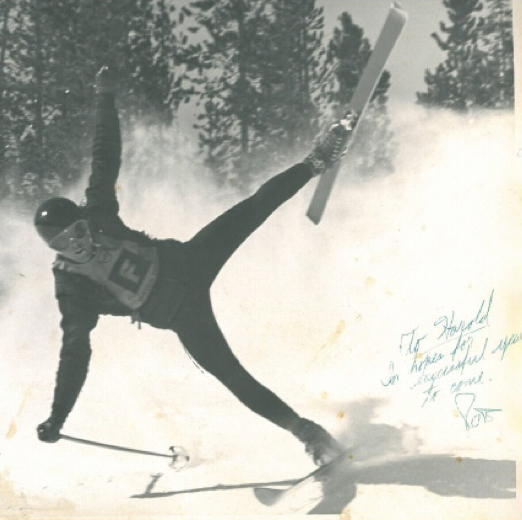
Rob Kiesel, Patterson’s coach, showing off his downhill skills at Winter Park in 1964 (Photo: Harald Bjerke)
“[Mike Gallagher] and I would worked really closely together and I was sort of his primary assistant as the year grew on,” Ruff said. “When we’d split up, I would end up taking the women and there were a few years where I was actually labeled the women’s coach. But for the most part, he and I were more of a team and I was more of his assistant during my primary coaching year.”
Ruff’s stint with the USST brought him to the Olympics, alongside Kiesel at the 1980 Winter Olympics in Lake Placid, N.Y., and with Gallagher at the 1984 and 1988 Games in Sarajevo, Yugoslavia and Calgary, Alberta, respectively. He mentioned working alongside U.S. Ski Team coaches Torbjørn Karlsen and Peter Ashley as major influencers in his career as well.
His work for the USST helped women like current Methow Valley Nordic Team head coach, Leslie Hall –the sister of Patterson’s future Dartmouth College co-coach, Cami Thompson-Graves — to the Olympics.
“He was one of the main coaches at the 1988 Olympics, my first Olympic experience and the main memories that stick with me are his smile, laugh and bad jokes!” Hall wrote in an email. “My relationship with Ruff has evolved so much over time, from being an admiring junior who wanted his attention and help, to being a friend on mountain biking trips to Moab, to being the sister of his co-coach at Dartmouth.”
He also helped current Middlebury College assistant coach and University of New Hampshire alum Patty Ross, and Bates College alum Nancy Fiddler to Olympic levels of racing.
“Ruff was always there with a joke or someway to diffuse a tense situation,” Fiddler said on the phone. “Everybody gets so caught up in [skiing] and if you were feeling kind of involved in a way that wasn’t healthy, he just brought you back and reminded you that, ‘Hey it’s ski racing it’s supposed to be fun, and if you’re not having fun, what the hell are we doing.”
Changes To Hold Onto: Skating and the Mental Breakthrough
“Weight shift, weight shift, that’s the key.” — Ruff Patterson during a skating technique workout with the Dartmouth men’s nordic ski team, circa 1989
Little did Bill Koch know that when he entered Sweden’s 1980 Worldloppet marathon, he would rock the ski world forever. During that winter’s fated 50-kilometer ski race, Koch witnessed what has since become a staple in cross country skiing: the skating technique.
After Koch began to implement skate skiing into his own national and international races, the sport changed forever — a change Patterson perceived first-hand.
U.S. cross-country legend Bill Koch pioneering the skating/freestyle technique in the ’80s. (Photo: Peter Ashley)
“I was incredibly fortunate to live through the skating revolution,” Patterson said. “To see the live world change, everybody else’s world change and how people react to that, that whole thing was, man, something to live through.”
“You can sort of compare it to — right now there’s this big double poling thing,” he added. “Skating was very much the same thing. It was a complete unknown. So for everybody, including sports staff like myself, it was like, ‘What’s going to happen here?’ ”
What happened was rattling to some and rectifying for others. Patterson pointed out that he saw many attempt to prevent the change, but the skating technique, ultimately was here to stay.
“You know, they were trying to do everything possible to make it less possible to skate,” Patterson said. “A lot of the controls they tried were almost laughable now.”
As Patterson sees it, there are certain circumstances when evolution of the sport is inevitable. Occasionally, adaptation outweighs resistance.
“What I’ve discovered during those periods is … if you’re here to play the game, you have to figure out a way to go with it,” he said.
Skating and double poling aren’t the only areas Patterson says he has seen development in skiing. To Patterson, the mentality of American ski racers is what has changed the most. Especially for the U.S. women.
“When Kikkan [Randall] opened the door, the barrier, for Americans to do well in Europe, I think the whole mental game changed,” Patterson said. “I’m hoping that this mindset moves into the boys’ group [in the U.S.], that mentality of just, ‘Hey, we can compete and win against the big boys and the big girls.’ That’s probably one of the most significant changes I’ve seen since I’ve started coaching.”
Dartmouth Dudes and Loving What You Do
“Boys, I want medals!!” — Patterson to the Dartmouth men’s nordic ski team, circa 2012
Freezing rain. Mosquitoes. Heavy, humid heat. The Northeast Coast makes many westerners go weak in the knees. Patterson was one of them. Located in the heart of Hanover, N.H., a move to Dartmouth promised Patterson the very bipolar weather, bug bites,and Vitamin-D deficiency he dreaded the most.
Ruff Patterson discovered that the eastern biking may make up for his dislike of East Coast climate. (Photo: Dartmouth Ski Team Facebook)
“When I first took the job I was a western guy and I thought, if I lasted three or four years I’m going to be lucky,” Patterson said. “I was terrified of bugs and humidity and once I got here the bugs and humidity were terrible, but then I realized that the road biking and other stuff in the East were just incredibly great. But I never planned on being here as long as I did.”
Patterson’s original estimated three-to-four-year window turned into seven, soon 11, and eventually 27. Overcoming his fear for East Coast climate was only part of it. His deepening devotion to the Dartmouth men’s team also drew him to stay.
“I just kept saying over and over again ‘I love what I do,’” he said. “Just absolutely love what I do and I just felt that it stayed like that all the way through.”
Patterson’s philosophy to love what you do and see it through transferred to his athletes. During his 27 years at Dartmouth, he coached three men to individual NCAA Championship titles — Glen Randall in 2008, Sam Tarling in 2011, and Patrick Caldwell in 2015 — and he also helped Dartmouth to an NCAA team title in 2007, with All-American athletes Mike Sinnott and Ben True.
“When I came in as a freshman, I was very hesitant to fully buy into his philosophy of training,” Tarling, a 2013 grad, wrote in an email. “After my first year working with Ruff, our relationship strengthened and I decided to stay in Hanover for the summer and work with him. I discovered that some of the silly things we did in training had the most influence on my performance, and that what seemed like random workouts and drills had a purpose. I ended up staying every summer after that to work with Ruff.”
Tarling was not the only athlete who at times questioned some of Patterson’s practices. Both Grover and Carl Swenson, a 1992 graduate and three-time Olympian, recalled recovery runs with Patterson as conclusively easy, in spite of athletes’ attempts to do otherwise. Patterson wanted his skiers to be fast when they needed to be and to step back and enjoy training the rest of the time.
“We’d go out for a ‘Ruff Waddle’ recovery run,” Swenson said. “Ruff would make us run behind him. It was to teach us to go easy … because all we wanted to do was race every workout.
“He was just the right coach at the right time for me,” Swenson added. “He kept me at it, really. I think it’s a period where a lot of people get interested in other things and, as everybody knows it takes some time to develop as a distance athlete, and he really kept me on track as best as anybody could have in a period when I was not on track by any means.”
Gaining credence with athletes like Tarling and Swenson and witnessing their progress, for Patterson, was another piece of what made college coaching worthwhile.
Just a few of “the kids” as Ruff Patterson (not shown) calls them (left to right): Nils Koons, Sam Tarling, and Eric Packer (Photo: Ruff Patterson)
“Winning over athletes and gaining their trust, I can’t tell you the rewards behind something like that,” Patterson said. “That’s just another piece of this overall puzzle, but sort of everything. Once again, it’s the people and stories behind them that have made it for me.”
Though Tarling, who is now working as a software engineer in Denver, Colo., indicated he’s “happily enjoying being a recreational athlete for a change,” he still feels indebted to Patterson for all that he’s helped him achieve.
“Our relationship began with many conversations about how we could best work together to help me achieve my goals in ski racing, but progressed to the point where Ruff was much more than my ski coach,” Tarling wrote. “He was – and is still – my mentor, my confidant, my hero, my friend.”
Patterson was much more than a coach to many of his athletes. He was a pillar, the adviser and ally searched for not only on the trails, but off them as well. He did not force his athletes to grow. He fostered them to take the steps on their own. As numerous athletes indicated, his door was always open to whoever happened his way.
“Ruff impacted my life on so many different levels beyond skiing,” Patrick O’Brien, current head coach for Stratton Mountain School T2 Team and 2010 graduate, wrote in an email. “He wanted you to grow as an athlete and an individual. He was always there for support when you needed him but understood many decisions or choices had to be yours alone to make. He asked for, and brought out the best people had to offer.”
Patterson did bring out the best people had to offer, but in ways beyond just results. He saw value in every athlete, carnival circuit caliber ski racer or not.
“The guy who never makes it, the ones who just make these incredible strides … the really talented guys,” Patterson said, “All athletes are rewarding.”
Ruff Patterson on Mt. Moosilauke in New Hampshire’s White Mountains with the Dartmouth team (Photo: Gordon Vermeer and Eric Packer)
Patterson’s ability to work with athletes of all kinds, stems from his coaching style. Passionate, patient, perceptive, he held the unique capacity to turn the complexities of cross country skiing into common sense.
“Ruff has that elusive quality you see only in the very best of coaches — he makes skiing seem simple,” Packer, who graduated in 2012 and is now racing for Alaska Pacific University (APU), wrote in an email. “He has the ability to use just a single suggestion to make really dramatic improvements in your skiing.
“Hand in hand with that, Ruff really believes in the importance of building a quality training group, and holds that at the core of his coaching philosophy,” Packer added. “You learn from the group, push the group, and rely on the group. In an atmosphere like that, when everyone is working together, pushing each other in a competitive but also fun atmosphere, everyone improves.”
Humor and having fun was also a training philosophy greatly prized by Patterson.
“I call them the kids.The gang. The team. I’ve been so lucky to be able to work with these guys. Even the ones that have been nightmares, looking back that’s what’s kept me here. The people, for sure.” — Patterson on his 27 years as the Dartmouth men’s nordic head coach
“One of my favorite memories started about midway through my time at school when he would finish every pre-race meeting with a story from his previous coaching experiences,” O’Brien wrote. “All would have you rolling over laughing and reminding you that although the sport may change over the years, the spirit of it never did. It made you feel connected the people who have come before you, understanding the challenges they faced were the same as the ones in front of you now.”
However, Patterson’s impact on the nordic community cannot be pinned solely to skiers he worked with directly. As Sinnott pointed out, numerous of individuals have been influenced by the former Dartmouth head coach, whether he realizes or not.
Ruff Patterson
In two words or less… “A Mentor” — Thompson-Graves “Unassuming” –– Tarling “Wise” — Tarling “Passionate”— O’Brien “Remarkable”— Sinnott “Solid”— Grover “Supportive”— Grover “An Icon”— Packer
“You go through his office and he’s got handwritten thank you notes from John Nystad from when John Nystad was skiing for UVM [University of Vermont],” Sinnott said on the phone. “Ruff had these powerful impacts on skiers that he wasn’t even mentoring or that weren’t in his program.”
With the women too, Patterson was — and still is — a hit.
“Ruff used to get more Valentine’s Day cards than anyone else on the team,” Sinnott reflected, referring to the Dartmouth Carnival tradition of ‘Carni Crush.’ “Everyone on the circuit felt the warmth and the magnitude of Ruff. And that’s the cool thing. It’s not just the people that are obvious on a piece of paper, but it’s everyone else that might have glossed by him.”
While many of Patterson’s athletes cite him as the reason they are where they are today, Patterson is adamant that his athletes are the ones who’ve kept him in the game.
“I call them the kids,” Patterson said. “The gang. The team. I’ve been so lucky to be able to work with these guys. Even the ones that have been nightmares, looking back that’s what’s kept me here. The people. For sure.”
Dartmouth’s Dynamic Duo: Patterson and Cami Thompson-Graves
“Are we having fun yet?” — Patterson to the Dartmouth men’s nordic ski team, circa 2010
Bonnie and Clyde. Ernie and Bert. Starsky and Hutch. Cami and Ruff. While not many modern day duos find themselves in competition with the infamy of the previous pairs, Cami Thompson-Graves and Patterson are two that do.
In a coaching partnership that’s lasted longer than some marriages, the two have carried each other through the numerous highs and lows of coaching a Division I college ski program.
“We’ve been together longer than most people have been married,” Patterson said. “We’ve definitely had our ups and downs, but because of it, the two of us have become incredibly close.”
Though the two admit they’ve spat like siblings at times, they also agree that what they have gained out of their 27 years together is irreplaceable.
“She’d be the first one to tell you, it’s not like it was all wine and roses the whole time,” Patterson said. “ It’s just we’ve been through a lot together.”
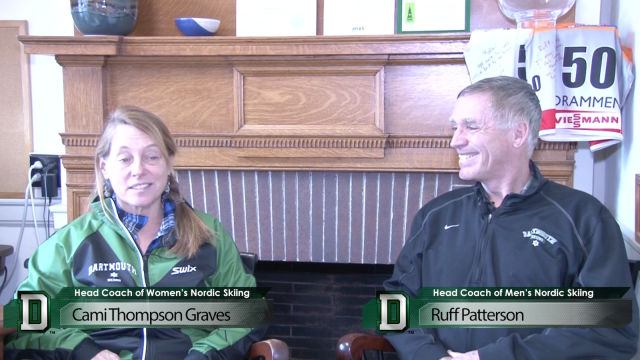
Dartmouth’s longtime duo Cami Thompson-Graves (l) and Ruff Patterson during a 2015 interview .(Photo: DartmouthSports.com)
The two have also supported each other — and their teams — through the loss of Dartmouth athlete, teammate and friend, Torin Tucker. Tucker, who died of a heart anomaly while competing at the Craftsbury Marathon two years ago, was also from Sun Valley and described by many as having a similarly contagious smile.
A rare verve to come across, no loss the magnitude of Tucker’s is easy. For Patterson, learning to live in the memories and moments of Tucker as the epic adventuring, intellectually curious and compassionate mountain town-er he was, no matter the time it took to get there, helped he and the Dartmouth community move forward with Tucker in their hearts.
“There’s no way you can tell somebody to get over stuff,” Patterson said. “You just have to deal one day at a time, one minute at a time.”
The support and history between Thompson-Graves and Patterson, therefore, goes far beyond just van rides, wax benches, and debates over who’s who.
“We had some great moments, talked about skiing endlessly and also fought and bickered like siblings at times,” Thompson-Graves wrote in an email. “But, along the way, there were many fun race days where we worked hard, shared our nerves, and when things had to come together, they did!”
More than anything during their time together, Thompson-Graves was a firsthand witness to the dedication Patterson put towards his athletes and coaching.
“Ruff loved his guys, they meant everything to him,” Thompson-Graves wrote. “He was there, day in and day out and knew them all well. Some of them might have driven him crazy but, even with the frustrations, he loved the times when it all came together for them.”
All in all, it takes a special circumstance for two individuals to work together toward a common goal for that length of time.
“When you sum it up, I wouldn’t have traded that for anything,” Patterson said. “Because being able to figure out a way for two quite different people to work together and do as well as we have done together … boy, that doesn’t happen very often in life.”
What’s Next?
“Don’t overthink it.” –Ruff Patterson to the Dartmouth men’s nordic ski team, circa 2006.
Forty years ago, Patterson — clad in a black graduation cap and gown — strolled across the CU stage to receive his diploma. Like many of the student athletes he would eventually coach, he had post-college plans that would inevitably change, a passionate fervor for cross country skiing, and an anything but linear trajectory ahead.
Forty years later, with his final cohort of college senior skiers before him, not much has changed. As Patterson departs Dartmouth, there is a piece of him that feels as if he is once again striding across the graduation stage, leaving school behind to discover what’s next.
“It wasn’t until the day before I resigned that I actually knew I was going to do it,” Patterson said. “I didn’t sleep that night, I can tell you that much.”
“It sort of feels like I jumped off a cliff doing this,” Patterson said of his resignation. “I was in a little bit of a shock for a few days, but I’m going to sell my place here, pack up a U-Haul and return west, which I’ve been wanting to do forever. And then stir the pot up a little bit and try to find something else to do. I have no idea what that’s going to be. I feel like a college kid again.”
2015 NCAA Champion Patrick ‘Paddy’ Caldwell (l) with coach Ruff Patterson. (Photo: Dartmouth Ski Team Facebook)
Even if Patterson is now physically distanced from Dartmouth — he headed west last week Tuesday — his legendary role and presence is not. His impact extends beyond Dartmouth, into the lives of past, present and future mentees — some of which he will never meet in person. Many he will have infiltrated with his coaching philosophy alone.
“Ruff was really responsible for creating that atmosphere with the [Dartmouth men’s] team, in terms of camaraderie he created in the group,” Grover said. “And certainly, as you know, that’s a big thing for us these days with the USST. The team and the athletes are quite successful on an individual basis because we tend to try to build a family atmosphere around the team. Ruff really did the same.”
Patterson’s stamp survives in the USST, the skiers who are now software engineers, lawyers, coaches, writers and more.
“You know, I came into a great group early on,” Patterson said of his first few years coaching at Dartmouth. “It took a while to establish my own style. It doesn’t mean that the style that Mortie [John Morton] had way back when was, there’s no way you could say it was bad or good … I absolutely know that the next person that’s going to come in in my place is going to be exactly the same; have their own style … I got to put my stamp on things and the next person here is going to put their stamp on things.”
Semi-uncertain of what his future holds beyond bike trails, mountain towns, and some RV roaming, Patterson is certain that Dartmouth has green grass ahead and he, a wanderlust for western blue skies.
“I know they’ll find somebody good,” Patterson had said of prospective coaches for the Dartmouth head coaching position, prior to the hiring of Brayton Osgood in May. “And I know that the school will always support skiing … My personal opinion is that they’re going to just keep going and there’s nothing wrong with that … Field of dreams.”
Former USST coach Rob Kiesel died in Joseph, Ore., on October 24th. While the nordic community across the globe mourns his loss, Kiesel was also remembered for his innovative work during the glide-wax revolution. Marty Hall, a former US Ski Team coach in his own right remembers Rob in this piece. You can read the FasterSkier article on Rob here.
I feel a responsibility to relate a piece of history that Rob was very involved with that is still impacting every classical skier whether they are on no-wax or waxed skis. But, just in case you are seeing this for the first time and don’t even know who Rob Kiesel is, please read this earlier article from October on Rob’s passing away.
Rob had just become my Assistant Coach in the Spring of 1975 and that fall in the very first days of November we started our on-snow efforts on really good snow in Cooke City, MT., which is reached by coming out of Yellowstone Park’s northeast exit. It is sort of the unknown exit or entrance and in the winter the plowing stops here in Cooke City—like it is the last outpost to no where.
Here we were, at least 30-40 strong with both the XC and Nordic Combined National Teams in full preparation for the ’76 Olympics in Innsbruck, Austria just a few months away. We were here until just a couple days before Thanksgiving when everyone would go home for a 5 day break and then onto Quebec City for more training and racing.
The weather changed on us and soon we were skiing on a double tracked loop that was circular and maybe 800-900 meters long and existed only because it was in the shadow of a mountain. Even though the days were cold the snow was evaporating. The USST was in its first year of a contract with Subaru—we had about a dozen of their little station wagons that became our snow haulers, so we could keep the track replenished and eventually build a small hill into the loop. We were skiing weeks before we normally would , so the kids had no problem staying in the harness(tracks)–it amazed me.
Some time in the early days of the camp, Don Johnson, Product Manager, for Trak Ski company showed up at the camp much to our surprise. I think there had been some discussions about no-wax skis for racing in the future as they had just started using the fish scale(FS) base on their skis. He now had a dilemma, as they had applied the FS base on their skis the previous year, covering the whole base with this pattern. Needless to say they had enough kick on these skis to climb a wall and hardly any glide to come back down, so he was here to work with us to come up with the ideal wax pocket-giving their touring skis the best kick and glide dynamics. Little did we realize where this was going to lead us!
Of course we were now beginning our 2nd year on the new synthetic skis that had been introduced by Fischer and Kniessl at the ’74 World Championships in Falun, Sweden that had started the equipment revolution. The ski companies were advocating a wax pocket that was equal in length starting at the balance point(BP) and going 12-15 inches forward and backwards from this point. Also, the SOP for glide waxing was to use a Universal wax that Toko put out and would come under our scrutiny before we left Cooke City.
Well, we had a starting point and the heavy thinking and discussions began for a number of evenings over a few beers. Discussion points were the forward body position, how fast the ski left the snow after the legs together position when kicking. Two things stood out real quick the forward body position applied pressure to the front part of the kick zone and the ski leaving the snow in the back started us on the path of doing away with the kick behind the heal of the ski. All of this would have been a lot easier if we had any form of video or Polarvision, but we didn’t. Observation in the tracks was the best we could do.
So, to the tracks we went. Because of the short loop we could adjust the wax pocket on the skis and give them to the skiers in a blind test and get immediate feed back on how they liked one ski versus the other as the pockets had been adjusted differently in length. The new concept was in play. It wasn’t many days before we, the coaches and Don realized that we were on to a revolution of our own. The wax pocket as we knew it was going to be different and we had a “secret”. Our testing now took on a different focus. Rather then just a few loops on our short track now we were doing whole workouts and we were learning about the fact every ski had its own wax pocket, not some pre-determined number of inches in front of the BP and behind the DP. We lost no performance when it came to shortening all kickers to the heel of the boot and sometimes into the arch, but we had also soon discovered that because of the shortening, that our skis were faster—WOW—we did have a real secret! The modern wax pocket was conceived!
When we went to Europe we kept this under our hats and it wasn’t long before Gerhard Thaller, the Fischer racer chaser boss, was on to us—he knew we were doing something different , but not what we were doing. We cleaned our wax cabin every night, took all the garbage with us and really had the kids tuned into not giving our secrets away. We made it through races in Reit-im-Winkl and Ramsau and almost all the way through the Olympics before the cat got out of the bag.
Gerhard had given Kochie a pair of skis with mohair strips relieved into the ski base and Kochie was giving them a try and kind of liked them. Only the strips were too long and he went to Gerhard and had him adjust them to our parameters for a kick pocket. Gerhard now knew that secret. Gerhard, still did not know about us using alpine wax for glide and what our testing process was for finding the right glide wax for the day. Yes, Kochie ended up using this pair of skis in the relay and as he said after the race—he had the fastest skis on his leg and wasn’t man enough to use all the kick they gave him. He ran the 3rd leg on the team and left us in 3rd place when he tagged off to our 4th leg skier, Ron Yeager. We ended up in 6th place, a best ever for this team in US history.
Rob, was a huge part of all this and his mark is still on every pair of classic skis be it recreational, no-wax or racing when you go classic skiing—this all took place 36 years ago—-and that is the history of it.
Rob Kiesel — Photo courtesy of Sun Valley Ski Heritage Museum
“Perhaps it was the wine of the cool autumn breeze. Or perhaps as climbers sometimes we meet, we met. Rob Kiesel was an aggressive downhill racer. Perhaps it was his single-minded drive, which induced success. Nevertheless he was somewhat new to climbing and this would be no leisurely climb.”
— Excerpt from Gregory Lowe’s “Half Dome in the Winter” as it appeared in The American Alpine Journal (Vol. 15, Issue 1) by the American Alpine Club.
***
Note: This story has been updated to include additional photos and comments from Harald Bjerke, as well as a quote from Ruff Patterson.
One of Kiesel’s longtime friends, Bob Rosso, laughed as he remembered a photo of the climb — one of the first winter ascents of Yosemite’s 4,737-foot granite dome. A rope jutted straight out from the rock to support Kiesel and his companions as they hovered in a cloud 3,000 feet above ground.
Rob Kiesel built his first log home in Ketchum, Idaho, as pictured here in 1977. Photo courtesy of Harald Bjerke.
That year in 1972, Kiesel was a mountaineer as well as a skier. He started as a competitive alpine racer, making the U.S. ski team and breaking his leg in Sun Valley, Idaho. Upon leaving the hospital there, he decided that was the area he wanted to live in. That was the story he told Marty Hall, his predecessor as head of the U.S. national cross-country ski team. It was Hall who more or less discovered Kiesel through their interactions in Sun Valley, where Kiesel helped found the first nordic team around the time he summited Half Dome.
Kiesel always had questions — good, pointed ones — and great ideas, Hall said. His extensive knowledge of alpine wax gave made Kiesel a nordic pioneer in the glide-waxing revolution, and he went on to a 28-year career with Swix Sport.
On Monday, Kiesel died suddenly near his small ranch in Joseph, Ore., after apparently having flu-like symptoms. Private and unassuming by nature, he did not worry too much, delayed a doctor’s visit and may have passed away while outside exercising. Friends estimated he was 65 or 66 — a testament to the fact that he never drew attention to himself and preferred seclusion.
That’s why he chose Joseph as his home upon retiring from Swix a few years ago.
“He just loved being there, removed from everybody and everything,” said Rosso, who owned an outdoors shop in Ketchum, Idaho. “He’s just one of those people with enormous accomplishments, but just shy.”
Born in Ventura, Calif., in 1945, Kiesel was the son of an Olympian — Bob Kiesel — who won gold and set a world record in the 4×100-meter relay at the 1932 Los Angeles Games.
The younger, more snowbound Kiesel moved to Ketchum in 1971. There in the same building that Rosso now owns, Kiesel started a climbing and backpacking store called Snug Mountaineering with Bob Gorton, who went on to a lengthy career at North Face. Rosso helped them develop a climbing school, and it wasn’t long before Kiesel delved into nordic.
Recognizing a rising interest in backcountry ski touring, Kiesel decided to sell cross-country items. He also kept an eye on what was going on in Sun Valley, where he first started working with children in alpine. In 1971, Leif Odmark initiated the area’s first nordic team, attracting a small group of high-school athletes to the sport and coaching them for one race of the season — the Sun Valley Club race — with about 30 competitors.
“I wouldn’t be coaching today, nor begun coaching if it weren’t for Rob. Both my sister Susie and brother Pete wouldn’t have had the Alpine skiing careers they had if it weren’t for Rob. My brother Pete wouldn’t be guiding in Greenland or Nepal if it weren’t for Rob. More importantly, Rob was an integral part of our family.”
— as written in an email by Ruff Patterson, Dartmouth College men’s nordic ski coach
The following winter, Kiesel took over the program after convincing the Sun Valley Ski Education Foundation to incorporate nordic. At the time, it was an alpine-only operation in an area that had just recently discovered cross-country skiing.
The organization agreed to let Kiesel head a nordic team, and he chose Rosso — who said he only knew how to coach swimming — as his assistant. Over the next few years, Kiesel developed the program and attracted skiers to Sun Valley for its racing culture and innovative grooming.
According to Rosso, Kiesel liked to tinker and experiment. He spent time finding new ways to set cross-country track, perhaps most notably along the 32-kilometer Harriman Trail. There in the Wood River Valley, Kiesel helped develop one of the country’s first distance races for cross-country skiers — the Boulder Mountain Tour — in 1973.
“There were these epic stories of Rob grooming a point-to-point trail with archaic 1970s snowmobile stuff,” said SVSEF Nordic Program Director Rick Kapala.
One of the first to dream up a year-round trail from Galena Lodge to the Sawtooth recreation area near Sun Valley, Kiesel had to route the trail. Kapala recalled stories of him driving into the river on his snowmobile.
In recent years, the annual race closed out at about 1,000 participants. Since Kiesel did not want a memorial service, Rosso said the race organizers intended to quietly dedicate the 2012 Boulder Mountain Tour to him.
“It’s so hard for the rest of us to have closure,” Rosso said. “You want to celebrate his life and his accomplishments.”
“Young and stupid, I didn’t realize then how valuable Rob’s largessewas to our small program. (Young and stupid, I also didn’t know thenhow largely Rob had contributed to skiing.) Older and slightly lessstupid, I know now that I’m indebted to Rob, very personally for thetime and kindness he showed me, but also as a member of the larger USski community, since Rob belonged to a very select group of US skiingpioneers, who help to carve out a place for us at the larger table ofskiing and who invited anyone who cared to pull up a chair.”
– Andrew Gardner, Middlebury College head nordic ski coach
Forward Thinking
Not long after Kiesel began working with young skiers and creating programs to certify adult instructors, he made an impression on the USST. Regular rendezvous in Sun Valley gave Hall — the U.S. head coach at the time — an opportunity to meet Kiesel, and he noticed Kiesel’s direct contributions there.
Meanwhile, the U.S. team was eager to get on snow as early as possible. Around 1974, Hall and his staffers discovered a small patch of snow at the northeast entrance of West Yellowstone in Cooke City, Mont. The team began a season-opening ritual there, beginning as early as October and staying in a nearby hotel for almost month. While the racers skied in circles, the coaching staff experimented — most notably with the wax pocket.
Kiesel came onto the national ski scene in 1975, when Hall hired him as assistant coach. His extensive knowledge of the alpine glide wax, which was leaps and bounds ahead of nordic technology, gave the U.S. team an edge and helped them gain recognition internationally.
“We had a wax combination that I’m sure the Europeans knew about,” Hall said of their trip to the 1976 Innsbruck Olympics. “But they didn’t pay much attention to us.”
That February in Austria, Bill Koch put the Americans on center stage, winning a silver medal in the 30 k. He finished an impressive sixth in the 15 k, and his relay team missed the podium by about 30 seconds in the 4×10 k relay.
“We had some guys on radios, and they said these (coaches) out here don’t have a clue what we’re doing,” Hall said. “But the athletes were screaming at their coaches saying their splits are screwed up. … Not only had we hit the wax, but out skis were way faster than their skis.”
It wasn’t long before their competitors realized what the Americans were doing in their wax room. Soon, the brown universal blob of wax was out, and Kiesel’s use of alpine wax, with different temperature and humidity ranges, was the norm.
“He was the perfect guy at the perfect time,” Hall said. “The kids loved him. He and I got along real well. … He was really instrumental at that time.”
Kiesel as the USST head coach in 1980. Photo courtesy of Harald Bjerke.
In 1978, Hall left the USST and put Kiesel in charge. He filled the head coach role through the 1980 Olympics in Lake Placid, N.Y.
One of his athletes, Tim Caldwell, remembered him as an innovator in the mid ’70s, when the world was switching from wood to fiberglass skis.
“He knew a lot of stuff about this part of the sport that we knew nothing about,” Caldwell said. “He helped us a lot certainly with that transition … and trying to lead us, but without being too overly controlling with what we were doing. I think we all enjoyed working with him.”
Known for his steady attitude, Kiesel reacted similarly to good and poor performances, which Caldwell liked. Kiesel wasn’t one for excessive attention and seemed puzzled when he received any.
“He wasn’t interested in talking to the press; he was just a quiet guy,” Hall said. “Great worker, great thinker. It just popped into my own brain, ‘Marty, you did a good thing (hiring him).’ I liked him.”
Keep on Giving
After leaving the team in 1980, Kiesel moved back to Idaho and landed a research and development position with Swix Sport. Through the company, he worked closely with his college roommate from Denver University, Harald Bjerke, now the chief hardgoods product manager at Swix.
The two met regularly in Norway during Kiesel’s annual trips to the mountains to brainstorm waxing methods with the gurus. Roger Knight, the director of team and eastern operations at Boulder Nordic Sport, said Kiesel might have been the only American invited to the exclusive meetings with the Europeans.
“He was sort of a mythical figure, so to speak,” said Knight, who was personally mentored by Kiesel.
Former USST alpine racer, Kiesel showing off his downhill skills at Winter Park in 1964. Kiesel was on the alpine team at Denver University before taking up nordic in the 1970s. Photo courtesy of Harald Bjerke.
When Knight began working for Swix in the late ’90s, he said it was Kiesel who helped him earn a full-time position as the Swix USA nordic product manager. Later on, Kiesel regularly came to help at big racing events, such as nationals, Knight said. He wasn’t paid, but wanted to work.
“He’d never tell you what to do, but he’d always offer wisdom if you needed it,” Knight said. “People would say, ‘Who is this old guy in the way room?’ and he would leave, and I would say, ‘That’s the guy who invented fiberlene and fibertex.’ ”
Another one of his disciples, Chris Hall started as an assistant ski coach at Sun Valley. Kiesel knew he was interested in ski service and recommended him to Swix Norway. From there, Chris began working with the Swix Racing Service on a special project before the 2002 Olympics, and went on to become the head service tech for the USST.
Now the nordic race director for Fischer Skis US and also the Swix US nordic racing service director, Chris said Kiesel gave him the opportunities and confidence to move forward.
He remembered thanking him at an SVSEF team banquet about eight years ago.
“One of my speaking points was to thank Rob for the opportunity to take the ball and run with it, so to speak,” Chris wrote in an email. “Rob was a little taken back, as I believe he saw it as just doing the right thing.”
Last January, Kiesel was inducted into the first annual Sun Valley Ski Hall of Fame. Kapala and Rosso were among those who helped select the nominees, and both were nervous Kiesel wouldn’t show.
“When we talked to him about it, he couldn’t have been happier,” Kapala said. “He was just so gracious.”
For many, it was the last time they caught a glimpse of the man, whom a few described as reclusive. Rosso said he occasionally drove 5 ½ hours from his ranch to visit him at the shop in Ketchum, but the visits dwindled once he retired.
Kiesel was survived by his two children: his 28-year-old son, Jess, and younger daughter, Kaelin, 26, who had her first child a few months ago. Kapala said he coached Kiesel’s two children at Sun Valley, and both won junior national championships. Back then, Kiesel kept a respectful distance while supporting Kapala was in the coaching role he founded some 30 years earlier.
“It’s just sort of a very abrupt ending,” Kapala said.
“There’s just a lot of people out there that knew him well,” Rosso said. “He was just larger than life.”
***
An excerpt from an email written by Harald Bjerke, Kiesel’s longtime friend and college roommate:
Rob never talked loud about his achievements. He did not want to be in focus. Rob had a lot of interests from gardening, reading, mountain climbing, cycling and food to motorcycles. It was always interesting to discuss with Rob because he had such a broad perspective of life.