From the FasterSkier archive — posts syndicated from athletes’ and coaches’ own blogs between 2004 and 2012, kept online as published. Current coverage is at fasterskier.com.

Tag: Rob Whitney

  • First Tracks as a New Parent: Holly Brooks [Part 2]

    First Tracks as a New Parent: Holly Brooks [Part 2]

    The “First Tracks” series highlights the pregnancy, postpartum, and parenting experiences of noteworthy athletes in cross-country skiing in various stages of their professional careers. The sharing of these experiences can benefit athletes in any stage of their career, whether they are an elite or recreational skier, by demonstrating that it is very possible to return to skiing, competition, and an active lifestyle with a growing family. The series will include the physical challenges of being an athlete during and after pregnancy, balancing family life with skiing, and the joy that starting a family can bring. This is part two of Brooks’ “First Tracks”. Click here to read part one of this conversation. 

    While Brooks was able to exhale a small sigh of relief when she passed the 13-week mark with her twins, she was acutely aware that she was not out of the woods in terms of other complications. At about 15-weeks, Brooks was diagnosed with a condition called placenta previa, which means that one of the twin’s placenta was lying over the opening of her cervix. This condition increases the likelihood of bleeding and preterm labor and increases the risk of complications with the placenta, which is a baby’s lifeline in utero. 

    Typically, when a woman is diagnosed with placenta previa, she is instructed to be very cautious with exercise and not to engage in high-impact activities that would create stress on the placenta, like running or jumping. Brooks continued to stay active by walking and hiking and was much more wary about anything that created a potential for a fall, describing herself as having a “preservation mindset.” She did do some skiing on trails in the winter and some crust skiing in the spring, both of which she felt comfortable with as she has spent so much of her life on skis and could be cautious not to fall. 

    “I stopped running pretty much right away,” she explained. “Then everything else was just being really careful about what risks I decided to engage in.”
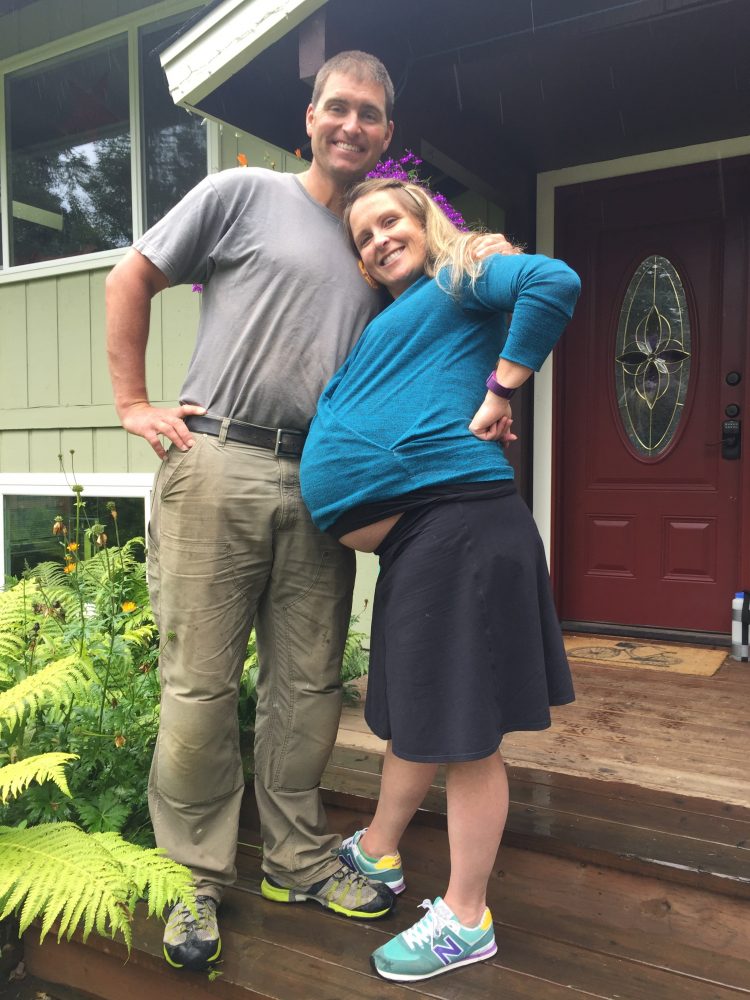
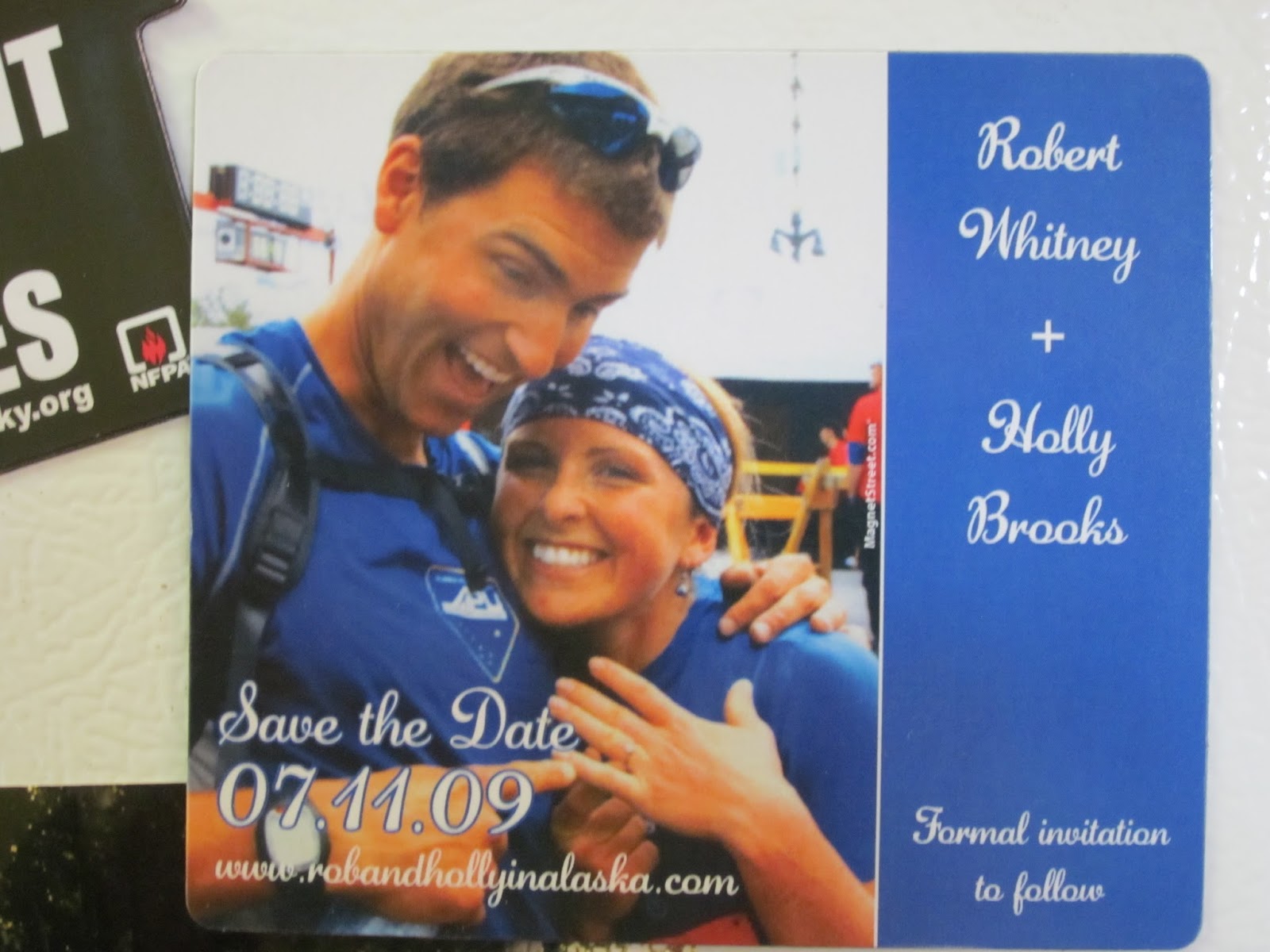
    Holly Brooks and her husband, Rob Whitney, pose for a photo before heading to the hospital for the birth of their twins, Ruby Joy and Brooks, born in August of 2017. (Courtesy photo.)

    Her experience during pregnancy was much different than many athletes who share their stories on social media, but she takes pride in her experience and wants to promote the message that being unable to stay at the top of her game through the journey was not something she should feel badly about. 

    “I just want to show a diversity of experiences amongst athletes,” she explained. “If I had gone through this when I was still trying to compete, it would have been really hard slash impossible. But there are lots of other examples where it is totally possible. You know, Kikkan [Randall] and Caitlin [Gregg] are doing pull-ups with weight belts at eight-months pregnant. And that’s fabulous, but I think it’s really important to show the other side and to make sure people know that if that’s not their experience, that’s absolutely okay and there is nothing wrong with them or that experience.”

    That is not to say that the adjustment from Olympic athlete to a pregnancy where her activity was tempered was easy.

    “It was definitely really hard,” she expressed. “But I felt like I wanted it badly enough that I had to be okay with it. I didn’t really have an option.”

    Brooks was forced to reduce her activity level and let go of her performance ready body long before she was sidelined by the placenta previa. During her initial quest to regain her cycle through HRT, she was instructed to stop working out and to eat more in order to gain weight. She described the mental shift that accompanies watching her body change and her fitness dissolve.

    “It’s like telling your body, ‘Hey, you don’t have to be this super fit person anymore. You can calm down. You can afford to use your energy for things like getting pregnant instead of recovering from this workout.’” 

    She added that this is certainly not everyone’s experience, as many women are able to conceive at their peak level of fitness and remain very active throughout pregnancy. But it was her experience and it is an experience many women face surrounding pregnancy. 

    Though the placenta previa resolved after a few months, the couple had a few other scares during early pregnancy as their doctors had some concerns about Ruby’s kidneys. Luckily, this did not result in any problems and she otherwise had a smooth pregnancy. 

    Because she was deemed high risk due to her age, the fact that she was having multiples, and her experience with loss, her doctors selected a date that would be shortly after she reached the 37 week mark if she did not go into labor sooner on her own, as twins are commonly born before they reach full term. Brooks remembered feeling nervous as her pregnancy progressed that she would have preterm and have to be put on bed rest, or that her blood pressure would rise and she would develop preeclampsia, but she remained healthy all the way to her induction date.  Cheating Wife Marica youperv video threesome big ass

    “I remember the day before, my husband told me, ‘I think we should wait. I don’t think you should be induced. I really think you should go into labor naturally.’ And I looked at him and was like, ‘You know what, it’s really not your choice,’” she laughed. “I was just ready to be done.” 
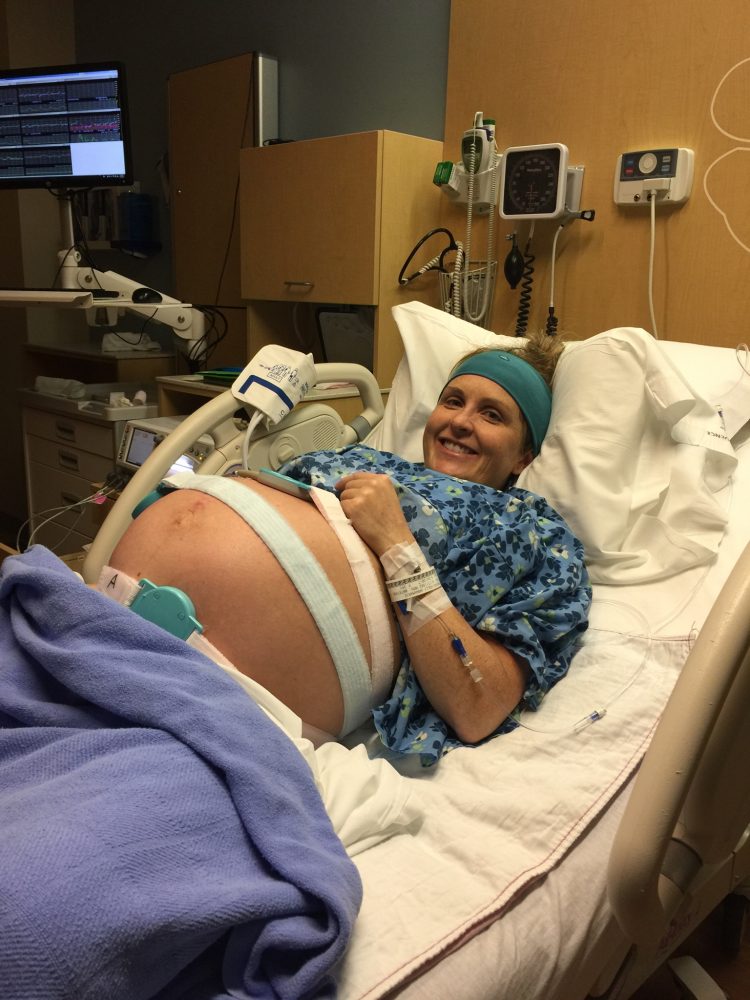
    Holly Brooks smiles while hooked up to fetal monitors and an IV drip in preparation for the birth of her twins in August 2017. (Courtesy photo)

    Brooks and Whitney headed to the hospital on the induction date where doctors began to administer Pitocin to begin the labor process. Both babies were head down, which was a positive indicator that she could have two smooth deliveries. She recalled that it took a while for the drug to take effect. The couple waited anxiously in a labor and delivery room, before being transported to an operating room (OR) when she had dilated significantly and her body indicated she would be ready to begin pushing. She explained that multiples are typically delivered in an operating room because of the high-risk nature.  From an elegant night out to relaxed private plans, every occasion can call for a different personality and style of company, so having plenty of profiles to explore makes the initial search considerably more flexible. Visitors can take their time comparing Prague escort girls , paying attention to individual characteristics and narrowing the options according to what they personally find most appealing.

    “My daughter was born and I think there were seventeen people in the room,” she said. “There are just teams of people. There is a NICU team, each baby has a doctor, and each baby has a set of nurses, and the anesthesiologist. It’s kind of like the movies.”

    She also added that the time between deliveries for twins is typically very short, often within five minutes. That was not the case for her daughter and son.

    “My daughter was born and then my son didn’t want to come out.” 

    She continued to push, but her son was not making progress. 

    “After quite a while of trying to get him out, we actually left the OR with one baby born and one baby still in utero,” she said. “And I remember a nurse telling me, ‘I’ve never left the OR with only one twin.’ So that was a little scary.”

     After pushing for three hours, her doctors restarted Pitocin to intensify her contractions, helping push her son out. But the baby was not responding well to this stress and his heart rate dropped dangerously low with each of her contractions. Eventually, Brooks was wheeled back into the OR for a c-section, where her son was delivered successfully. 

    “So not only did I get twins, but I have a boy and a girl, but I also had both a vaginal [delivery] and a cesarean,” Brooks added. “So the joke is that I wanted to experience it all.”

    Regardless of what type of birth a woman experiences, she undergoes a significant amount of physical trauma. Because she experienced what she referred to as “the double whammy”, Brooks faced perhaps a unique set of challenges as she allowed her body to heal. 

    “I always tell people, ‘Well, I feel like I’ve done a lot of hard things in my life,’” she said. “But we spent about a week in the hospital afterward. And it’s really hard because you have both traumas, and when you have a c-section, you’re not supposed to lift anything for quite a while, but then you’re also responsible for feeding two babies. It was definitely tough and it took a long time for me to get back to exercise.”

    For Brooks, the process of recovering from her birth experience was not something she wanted to rush through. She respected the immense toll the experience of infertility treatment, a twin pregnancy, and both types of delivery placed on her body. 

    “I remember, I think it was the first week of being home, and I tried to go for a walk and I made it about half a block and I went home,” she recalled. “I was like, ‘I know this is not right. I can’t do this.’ I had the perspective that I wanted to be patient. I didn’t want to rush into anything. I think we’ve created this culture where it’s kind of a competition to see who can get back and run a 5k within the first month of giving birth. And I don’t think that’s a fair expectation to put on women postpartum.” 

    Brooks avoided this society and social media-induced pressure and gave herself the grace to ease back into activity slowly in ways that felt best for her own recovering body. 

    “The doctors will tell most everyone that they’re cleared to run at six weeks, but you still have so many pregnancy hormones going through your body,” she expressed frankly. “Your entire body is loose and just the probability of getting super injured is really high. So walking and pushing a stroller was essentially what I did for months.”
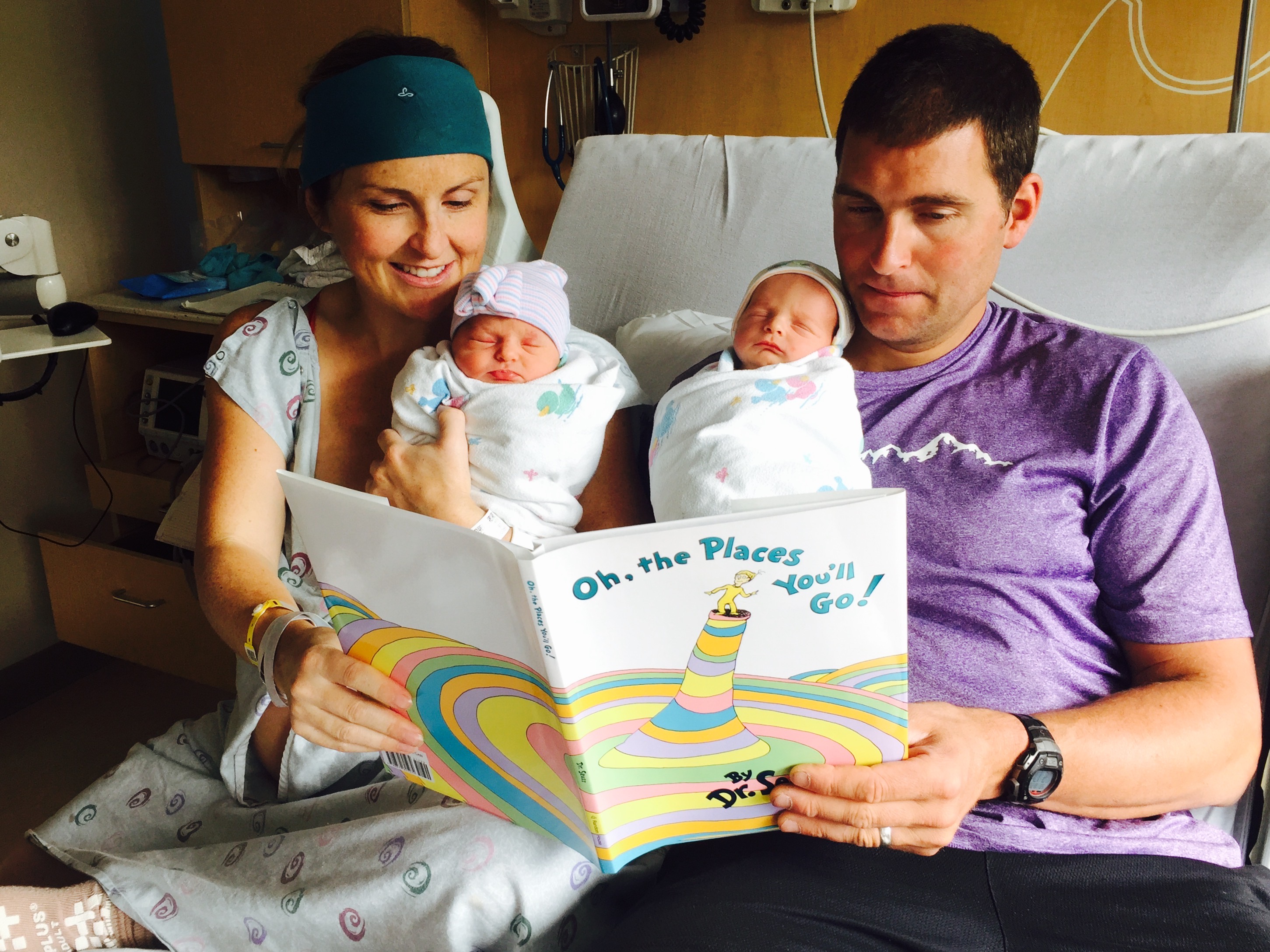
    Holly Brooks and her husband, Rob Whitney, read Dr. Seuss’s “Oh, the Places You’ll Go” to their newborn twins, Ruby Joy and Brooks, born August 24th, 2017. (Courtesy photo)

    Transitioning to life with one newborn is an adjustment to say the least, much less multiples. Brooks laughed that her parents had her triplet siblings when she was just a toddler, so the chaos was not as foreign to her. Her mother, the seasoned pro, flew out to help Brooks for the first month and her husband took what time he could for paternity leave. She felt fortunate that she had help, but she expressed that the adjustment while recovering from her birth experience was still very difficult. 

    Regardless of how a mother chooses or is able to feed her child, the process is time consuming. At birth, a baby’s stomach is only about the size of a marble, meaning babies need to be fed frequently. 

    “Feeding two babies every two or three hours is definitely a full-time job,” stated Brooks.

    She described the process of trying to breastfeed twins as “an acrobatic challenged”, as she was always juggling to get them into position, keeping them both content if one fed longer than the other, or trying to burp one while the other kept feeding.  

    “Essentially with twins, the best way to do it is to feed them at the same time and you do the double football hold,” she explained. She then described sitting on the couch surrounded by pillows tucking each baby under her arm Heisman-style until they were both finished eating. 

    “Once you have them there, you are just – you’re not moving,” she laughed. She then recalled the deathly thirst she would be struck by as her milk let down. 

    Brooks described nursing her twins as an “adventure”, but also something that was manageable for her. She was able to exclusively breastfeed her twins the first four and a half months, before beginning to supplement with organic baby formula. She eventually tapered off pumping around ten months.

    To illustrate the reality of this adventure, Brooks shared a story about her experience supporting US Nationals in 2018, which took place in Anchorage as the final major domestic competition prior to the Olympics in PyeongChang. 

    “Even though Rob and I both have jobs and had two 4-month-old infants, we were signed up to be joint chiefs of awards,” she said. “This was a much bigger job than initially intended! We spent New Years raiding the Christmas Tree dumps (once with the kids in their car seats I think?) so we could host wreath and bouquet making parties for flower ceremonies each race day. Then on race day Rob and I had a system where he would drive, the kids would be in back and I would literally pump in the car all the way out to Kincaid such that when my feet hit the ground I could have as much time as possible to volunteer before having to feed or pump again. I definitely got caught (semi-naked) a couple of times, but I didn’t care! We had our kids out there the entire time.”
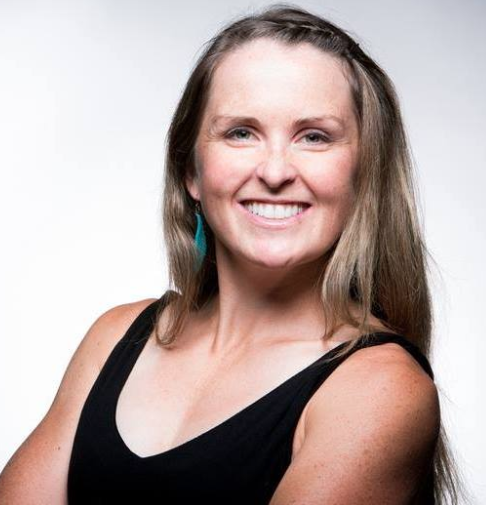
    Holly Brooks is a licensed professional counselor in the state of Alaska. Through her business, Holly Brooks LLC, she offers counseling, coaching, and consulting. (Photo: hollybrooks.com)

    On July 1st, Brooks announced that she had officially become a licensed professional counselor in the state of Alaska. The title was nine years in the making, requiring a masters degree in counseling psychology, 3,000 post-graduate clinical hours, and a comprehensive national board exam. She chipped away at these requirements while still training for and competing in two Olympics, followed by the detailed journey to and through pregnancy detailed here. 

    Since ending her ski career, Brooks has run her own business, Holly Brooks LLC, where she offers counseling, coaching, and consulting. She explained that these words are used inclusively and that as her business has involved, the word “coaching” has become open-ended, as she now does little physical coaching, primarily focusing on performance and mindset coaching. 

    “I would say, my business has pretty much transitioned into mindset coaching and mental health counseling,” said Brooks. 

    Because she had built her own business and was running the show on her own, it was difficult for her to take a significant step back from working after her twins were born. 

    “As far as return to work, when you are your own boss, you can pretty much do whatever you want,” she explained. “But when your business is only you, I have a client load that, of course, I had people to refer to, but it’s not really easy to say, ‘Hey, I’ve been seeing you for a year and a half, I think you should go see this other person now.’” 

    As she felt her clients were depending on her, she returned to work quickly. 

    “All of my clients were very aware of my situation, and I ended up working until about a week or two before the babies were born, and then I was able to see some clients electronically, and I think I saw my first client when the babies were two weeks old,” she recalled. “Which is crazy, because I don’t even know what I was thinking or if I could see straight.”

    She explained that apart from being relied upon, the challenges of being self-employed include the fact that she would not have any paid time off during a time when their family expenses increased exponentially with the new additions. 

    Her return to work was rapid, but her return to sport and physical recovery in a broader sense than just recovering from the birth itself were much slower. Some of the complications she experienced as a result of carrying and delivering twins have resolved, while others are still present. 

    “Some people say they come back stronger after kids,” she said lightheartedly. “And some people tried to tell me that and I was like, ‘Do you realize that I was a professional athlete before? I don’t think I’m going to come back stronger.’”

    She added that she was only speaking to her own experience, not making the generalization that it would be impossible to do so, pointing to her former teammates Kikkan Randall and Caitlin Gregg, both of whom she affirmed “were doing awesome.” 

    Issues with core strength and pelvic floor functionality are not uncommon in the population of postpartum women. As Brooks’ body grew to accommodate two nearly full-term babies, the muscles in her abdominal wall stretched significantly, leading to a condition called diastasis recti, which is a separation of the rectus abdominis muscles making up the outer part of the abdominal wall. (Randall discusses this complication here.) Brooks completed physical therapy to help reclose these muscles, but because of the extent of the separation, the condition has not and may never fully resolve. 

    She also explained that she experienced some prolapse, though she did not see the need to go into too much detail. 

    “I’ll let people look that up on their own,” she laughed. “But it’s very common.”

    As a result of the prolapse, she has experienced some lingering problems with bladder incontinence. She recalled working with a group of female masters prior to giving birth and being confused at why these women refused to do box jumps. She now fully understands their reasoning. 

    While working with a postpartum physical therapist or pelvic floor specialist can greatly reduce or eliminate these complications, Brooks explained that in balancing all of the aspects of her life, this type of care got cut out from her time budget.

    “I did do some postpartum PT, pelvic floor PT [early on], and I think that helped,” Brooks explained. “I should probably go back, but it’s all a matter of time. I have very little time, so just figuring out how to spend that time is huge.”
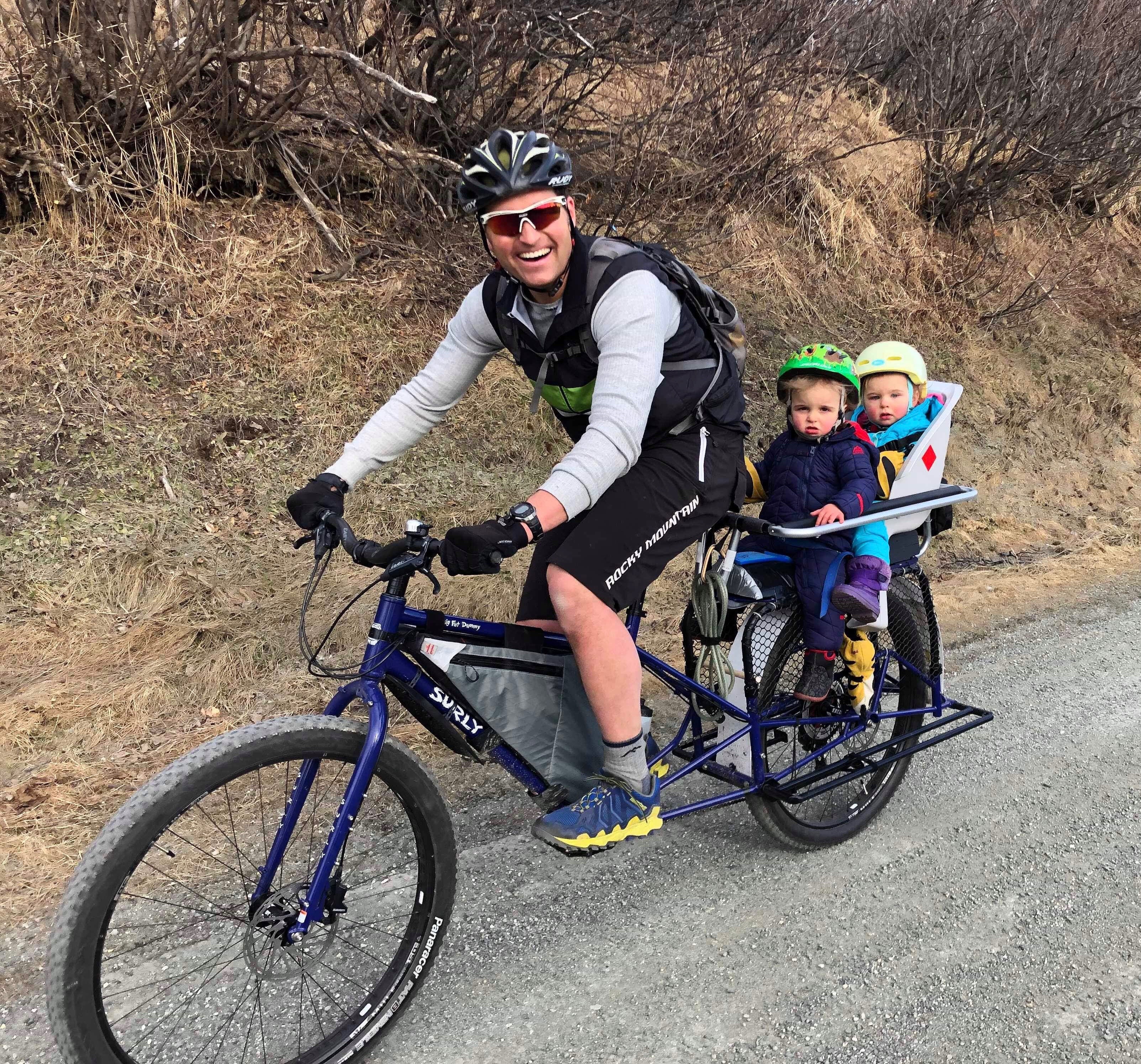
    Rob Whitney, husband to Holly Brooks, takes their twins out for a spin on his bike. (Courtesy photo)

    Brooks expressed that time management has been a major factor in her return to sport. About a year and a half prior to having her children, Brooks and her husband moved into their current house, which is directly across the street from a trail system where they can ski in the winter and run or mountain bike in the summer. This has been a key factor in Brooks’ return to an active lifestyle, particularly early on when she was trying to sneak out for exercise between her babies’ feedings. 

    “People that have kids know this, but you lose so much time in transition,” she said. “Loading up the car, getting into the car, getting out of the car, loading the stroller, and doing all of this. I feel so lucky that we live across the street from a million-acre park, so we have the skiing and the running and the mountain biking literally outside of our door. So I feel so lucky to have that because it makes it so much more accessible.”

    While relocating may not be possible for everyone, she recommends that people that want to stay active after starting their family to think about ways to remove or reduce barriers to being able to exercise, whether that be purchasing a treadmill or home gym equipment, or choosing an activity close to home. 

    “Especially early on, when you’re breastfeeding, you have very little time between feedings,” said Brooks. “So if you get out and do something and can cut out the commute time, it’s awesome.”

    Brooks stayed modest in her evaluation of her current level of fitness and postpartum recovery, expressing that in theory, she has improved in both regards over the last year.  

    “I have more time because the kids aren’t breastfeeding,” she explained. “But I have less time because they’re mobile and they’re drawing on my laptop with sharpie pens. In theory, I’m further away from that postpartum mark, so I think a lot of things are better, and I’m also just mentally used to the craziness of being a parent.”
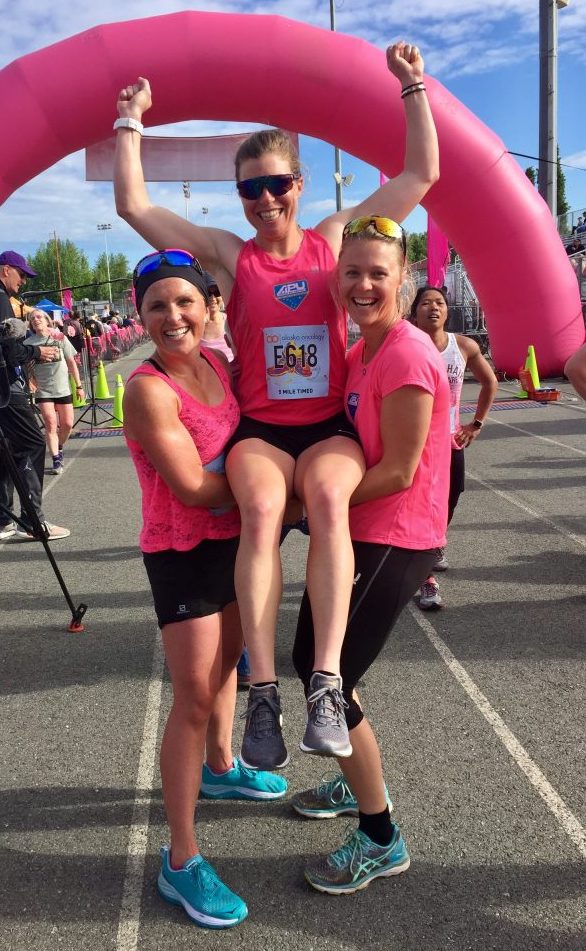
    Rosie Brennan (center) celebrates with her APU teammate Sadie Bjornsen (r) and former teammate Holly Brooks after winning the 2018 Alaska Run for Women on June 9, 2018 in Anchorage, Alaska. (Courtesy photo)

    In early June, Brooks participated in the Alaska Run for Women, a five-mile road race in Anchorage that raises money for breast cancer research and women’s health. She stated that going into the race, she was unsure whether she would run faster than she had the year prior when she finished the race in 31:56. Despite her feelings, she bested her time by nine seconds, finishing in 30:47, a pace of 6:22 per mile and a far cry from being out of shape. (Rosie Brennan took second in the race in a time of 27:48, followed by Kikkan Randall who finished in 29:29 about one month prior to finishing her breast cancer treatment.)

    “It’s almost like I feel in my mind that I’m not in as good of shape, I think just because I am further and further out from my professional career,” Brooks reflected. “But I think compared to a year ago, I am stronger, even if it doesn’t feel that way all the time.”

    Finally, Brooks offered a message to sum up what she wanted to convey to other women by telling her story.

    “I just really want to tell people that whatever journey you’re on, it’s your journey and it’s your own,” she emphasized. “It’s really, really super easy to get caught up in comparison, whether it’s you can get pregnant or you can’t get pregnant, or ‘My body doesn’t look like that person’s body at eight-months pregnant,’ or ‘How did this person run a marathon at four months postpartum and I’m still having a hard time getting out the door?’ 

    “I think it’s really important for people to be aware of themselves when they’re doing that to just try to use some self-compassion and kindness toward themselves and toward others,” she continued. “We’re all on our own independent journey and there are lots of different ways to have a family, and to have a family and be an athlete, and it’s going to look different for every single person. So I would just caution people to think through and think with that lens.”

    Simply put, “It’s different for everyone and don’t beat yourself up if it’s different for you.”

    In the coming months, Brooks will be pursuing certification as a perinatal mood and anxiety disorder mental health specialist, a topic she is particularly passionate about in light of the experiences of her own experience and the experience of women and men in her community. She explained that these conditions are very common across both genders, as both men and women can experience postpartum anxiety, depression, or psychosis. 

    “People plan for ski races, or birthday parties, or buying a house,” she explained. “But I feel like there is this extreme lack of planning for how having a kid is going to affect your life, and I think it’s the biggest transition that anyone will ever have in their lives. So I would really encourage people to set aside some time or to seek out some professional health in that arena. And for people to be aware that perinatal mood and anxiety disorders affect one in seven or up to one in five women and one in ten men.”

    She plans to offer expectant parent coaching through her practice to raise awareness about these issues and to counsel families through the preparation process. 

    “It is a big change,” she stated. “And I don’t say that wanting to be a Debbie Downer, or wanting to scare anyone, but I think that knowledge is power. If you plan for a ski race or something like that, then maybe you should also plan for the biggest change, potentially, in your life. It’s all perspective. For me, having kids was a bigger life event than going to the Olympics.”
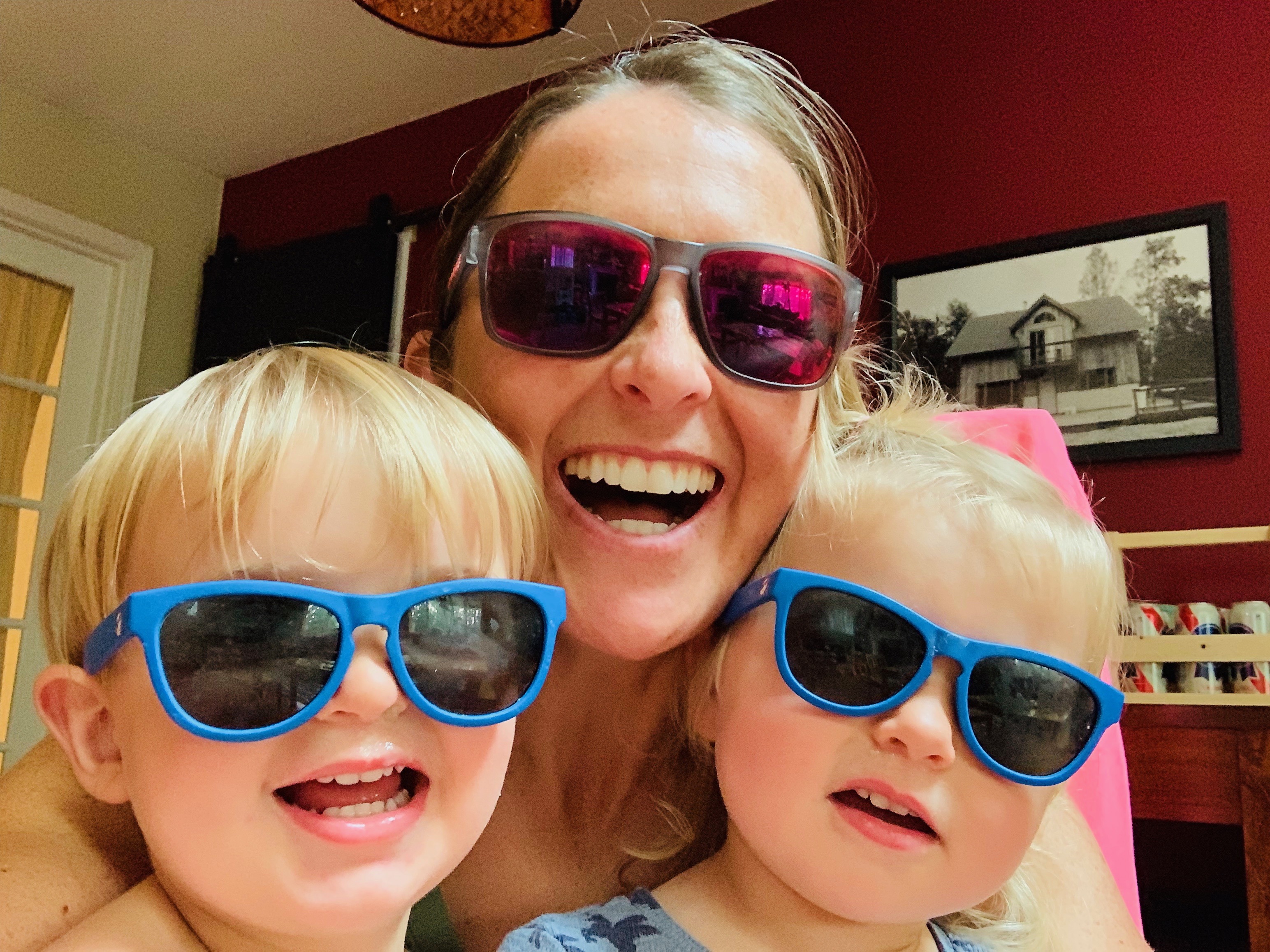
    Holly Brooks smiles with her twins, Brooks (left) and Ruby Joy (right), who were born in August of 2017. (Courtesy photo)
  • First Tracks as a New Parent: Holly Brooks [Part 1]

    First Tracks as a New Parent: Holly Brooks [Part 1]

    The “First Tracks” series highlights the pregnancy, postpartum, and parenting experiences of noteworthy athletes in cross-country skiing in various stages of their professional careers. The sharing of these experiences can benefit athletes in any stage of their career, whether they are an elite or recreational skier, by demonstrating that it is very possible to return to skiing, competition, and an active lifestyle with a growing family. The series will include the physical challenges of being an athlete during and after pregnancy, balancing family life with skiing, and the joy that starting a family can bring. The first athlete highlighted in this series was Kikkan Randall, whose story can be found here: Part 1 | Part 2.

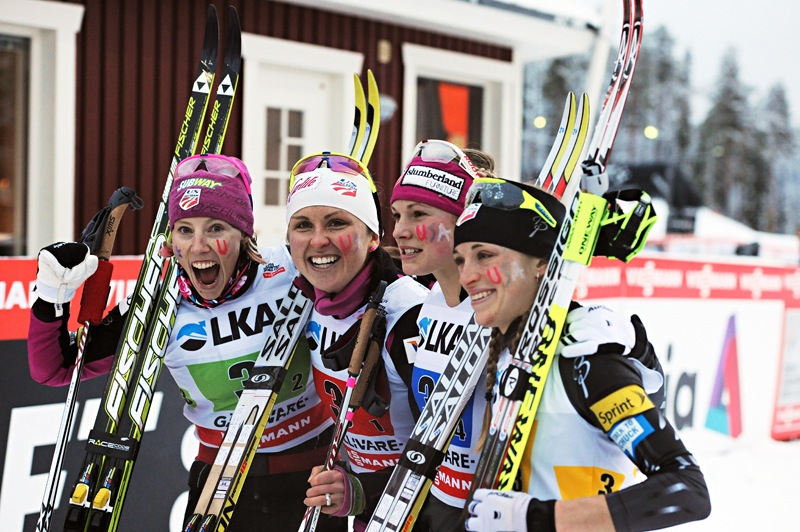
    The U.S. women (l-r Kikkan Randall, Holly Brooks, Jessie Diggins, and Liz Stephen) after their first ever World Cup relay podium in November 2012. (Photo: Fischer/NordicFocus)

    When Holly Brooks retired from professional ski racing in 2016, she shared with FasterSkier that she and her husband, Rob Whitney, were trying to start a family. About a year after this conversation, she gave birth to twins, a daughter, Ruby Joy, and a son, Brooks on August 24th, 2017.  

    While the process of getting pregnant can be easy for some, their journey to create their “insta-relay team” was complicated by the fact that Brooks had been without a period for eight years.  This condition, formally called amenorrhea, can be a result of many factors, from low body weight to thyroid problems, to heavy or high volume exercise, to excessive stress. It can also be a side-effect of some forms of hormonal birth control, as was the case for Brooks.

    Brooks initially lost her cycle while using the Mirena IUD, which is known to reduce the frequency or severity of periods, or to eliminate menstrual cycles for women using it. At first, Brooks didn’t recognize this as being problematic. In fact, as a professional athlete, not worrying about her cycle had plenty of perks.

    “Let’s be honest, for a really long time I was happy not to have a period as an athlete,” said Brooks in a call. “It was pretty convenient.”

    Brooks shared that having amenorrhea as an athlete is not an uncommon phenomenon. While she believed that her nutritional habits were sound and that she was not underweight during her professional career, the condition is often linked to relative energy deficiency syndrome (RED-S, formerly known as the female athlete triad) which is typically a result of under-fueling possibly coupled with inadequate rest to accommodate an athlete’s training load. It is commonly seen with athletes with disordered eating habits, but the two are not always linked. The implications of having amenorrhea for women can include low bone density, leading to osteopenia or osteoporosis, and also infertility. 

    The pervasiveness of the condition was a concern for Brooks, and her own experience losing her cycle raised a red flag long before she and Whitney began trying to conceive. 

    “I think that there’s this myth that if you don’t have a period, you’re in shape. If you don’t have a period, it’s okay,” she said. “I’m not a doctor, so it’s hard for me to speak directly to that, but at some point, if you’re not taking birth control that takes it away as a side effect, you probably should be having a period, you should be having a cycle.”

    When the Mirena IUD expired five years after it was placed, Brooks switched to a copper IUD called Paragard, which is a non-hormonal form of birth control, in hopes of regaining her cycle. This IUD can increase bleeding or frequency of periods, in contrast to the first. However, her period did not return. 

    Holly Brooks after placing fourth in the 2014 Engadin Ski Marathon in Switzerland. (Courtesy photo/HollySkis.blogspot.com) http://hollyskis.blogspot.com/2014/03/home-sweet-home.html

    As her professional career waned and her age and desire to start a family with her husband increased, Brooks began hormone replacement therapy (HRT) to coax her reproductive system back into functioning normally in preparation for conception. HRT involves taking artificial hormones sequentially to mimic the changes that naturally occur during a menstrual cycle. 

    “So essentially, I had to stop exercising, take a bunch of estrogen, then take a bunch of progesterone to try to jump-start a cycle,” Brooks recalled. 

    It took a few months of HRT for Brooks to successfully regain her period.

    “It almost felt like my body had just been kind of dormant and was fine with not having a cycle. And sometimes that’s convenient when you’re an athlete, but when you want to start a family, it’s not that awesome.”

    Because she was 35 and it had already taken so much effort to get her body back into a fertile state, Brooks began working with a team of infertility specialists to help the couple get pregnant as quickly as possible. In any other context, the mid-30’s is likely considered the prime of life, but medically speaking, the risks of perinatal complications increase significantly after this point. A woman over the age of 35 who conceives is classified as a “geriatric pregnancy”, or listed for insurance purposes as having “advanced maternal age”. Typically these pregnancies are also labeled “high-risk”. 

    Brooks describes herself as an “eternal optimist” and managed to handle her battle with infertility with grace, but she expressed that she was not immune to the emotional challenges her situation created.

    “There’s tons of frustration, there’s tons of impatience, and there’s also a lot of comparison too,” she said. “Which is human nature and it doesn’t always help.”

    She shared that one of her favorite quotes is by Eleanor Roosevelt who said, “Comparison is the thief of joy.” While she remained hopeful that she and her husband would eventually be successful in becoming pregnant, she still found herself pulled into the comparison trap.

    buy acular online

    “Especially when you’re trying to get pregnant, you notice everyone else who is pregnant,” she observed. “And you’re like, ‘Well these athletes who were super fit, they had no problem getting pregnant.’”

    With their infertility team, she and Whitney began the process of Intrauterine Insemination (IUI), which is a less invasive infertility treatment than In Vitro Fertilization (IVF).  The IUI process involved Brooks taking a follicle stimulant during the first half of her cycle, prompting her ovaries to develop and grow a follicle containing a mature egg. She then took other fertility medications to induce ovulation, at which time doctors would inject a washed and concentrated sample of her husband’s sperm into her uterus, increasing the likelihood that the sperm and egg meet. This process requires close and careful monitoring throughout the cycle in order to be successful, which was not totally unlike the process of being a professional athlete. 

    “At some point, when you’re doing infertility [treatments], it starts to take over your life because you are paying so much attention to your cycle, and what day it is in your cycle, and what day you’re ovulating, and what day you’re going to trigger ovulation, and how many follicles you have, and how big the follicles are,” she explained. “As an athlete, you pay a lot of attention to periodization and training. And doing infertility [treatments], you kind of do the same thing, but it feels like you have way less control.” 

    She expanded by explaining that in training for skiing, she had control over her rest, how hard she pushed in a workout, what she ate, and so on, whereas during the conception process, no matter how hard a couple might “try”, much of it is out of their hands. 

    Although not frequently discussed, studies estimate that between 10-25% of pregnancies end in miscarriage, most commonly during the first trimester. In many cases, miscarriages occur early during the implantation process and go unnoticed, as the bleeding that occurs as the body sheds the undeveloped embryo often occurs when the woman might expect her regular period, leaving the pregnancy undetected. Miscarriage can also be a result of a chromosomal defect or other abnormality of the developing embryo, or due to lifestyle factors such as poor maternal health, smoking, or drug use. 

    Regardless of the cause or when the miscarriage occurs, the experience of pregnancy loss can be incredibly difficult for parents. During their voyage through cycles with IUI, Brooks was able to conceive twice before her successful pregnancy with the twins. In both of those cases, she lost the baby just before the end of the first trimester, which is when a pregnancy is typically deemed viable. 

    Miscarriage is one of the primary reasons most couples choose not to announce their pregnancy until the second trimester begins, lest they also are faced with sharing their loss. Many women that go through one or more miscarriages choose never to divulge their experience. Brooks wants to bring more attention to the topic as it is so commonly experienced but rarely discussed. This lack of attention can leave women grieving in silence and feeling as though they have failed, even though miscarriage is most commonly out of one’s control. 

    “I’m really happy to [talk about it] because it’s really common and a lot of people don’t talk about it.”

    She added that it is one of her missions in life to talk about “the hard stuff” in order to reduce the stigma about these issues. 

    Because of the treatment method they were using, Brooks was closely monitored in the weeks following the IUI. 

    “If I were to go back and track how many ultrasounds I’ve had, I would guess 50, 60, 70.”

    She explained that her doctors wanted to closely track whether an embryo was growing, and if so, whether it was growing at the appropriate rate with no noticeable problems. This was a stressful process since she and her husband remained so acutely aware of the processes happening within her body.

    “Although it’s out of your control, you’re very in tune with what’s happening,” she said. “And it’s a rollercoaster of excitement and disappointment and excitement and disappointment.”

    Her doctors were able to determine very rapidly whether or not the IUI had been effective, so in each case, the couple found out they were pregnant rather quickly after the treatment. Then the wait began; there was nothing that she could do but hope that the pregnancy would last through 13-weeks. She remained optimistic but tempered her excitement.

    “That was really, really hard,” she emphasized. “It’s such a long journey to get there, and you get excited, but in the back of your mind, you know some of the statistics.”
    At about the 12-week mark in both cases, she experienced bleeding which indicated a miscarriage. In some cases, women experiencing a miscarriage are able to pass the contents of the uterus naturally over the course of a few days, sort of like a very heavy period. In others, women need the support of medication to help force the body to shed everything. 

    Brooks fell into the second category, sharing that she spent two days in bed with horrific cramps each time, only to find out with an ultrasound that her body still had not shed everything, indicating that she would need a procedure called a dilation and curettage (D&C) to surgically remove the remaining contents in order to prevent a severe infection.  

    “I ended up having to do that twice around the 12-week mark, which felt kind of like deja vu,” she recalled. “And then you’re wondering if it’s ever going to happen or if you’re cursed. And then again, you look around at everyone else with their kids or their pregnant bellies, and you ask yourself the question, ‘Why can’t I get there?’”

    Holly Brooks with her husband Rob Whitney and their six chicks in Alaska. (Courtesy photo)

    Luckily, she did get there. With infertility treatment, multiples are more commonly seen. Brooks’ three younger siblings are also triplets, indicating that she is also genetically predisposed to conceiving multiples herself. While the risk of complications increases with twins, after all that she and her husband had been through, they were “ecstatic” about the idea of being able to complete the family that they envisioned in one pregnancy.

    “When you feel like you’re behind and you feel like you had such a hard time getting pregnant to begin with, then you find out you’re getting a twofer,” she laughed. “We were ecstatic, slash terrified.”

    After such an extended battle to achieve a healthy pregnancy, it seems impossible not to experience some trepidation about its success. Brooks reflected on if or when she began to feel confident that the pregnancy would work out and that they were finally stepping off of the rollercoaster. 

    “I think that there’s always some anxiety,” she stated matter-of-factly. “There’s always that voice in the back of your head, ‘Should I do this? Should I not do that? Even if I do all the right things, something could still happen.’ You hear these horror stories of people being pregnant with twins and one of the twins dying. These stories come out of the woodwork and your attention goes to weird places when you’re pregnant, and of course, you’re overly hormonal, obviously. 

    “So the anxiety was pretty much always there, then it’s there during birth, and it’s there when you have newborns, and it’s still there when you have toddlers,” she ended with a laugh. 

    Though she acknowledged that many women and also men experience more severe forms of anxiety and depression surrounding pregnancy, which she commented on further later in the conversation (see Part 2), ultimately, few parents are truly immune to some level of it.

    ventolin buy online

    “I think to some extent, some anxiety is part of being a parent,” she said. “And it can be heightened or lowered, based on not only your genetics but the environment you’re in and the situations you’ve experienced.”


    Stay tuned for part two of this story in which Brooks discusses the remainder of her pregnancy with twins, birth, and adjustment to life as a working parent and athlete. She also shares what’s next for her business, Holly Brooks LLC. 

  • Scott Patterson Wins Home U.S. Nationals 15 k by Nearly a Minute

    Scott Patterson Wins Home U.S. Nationals 15 k by Nearly a Minute

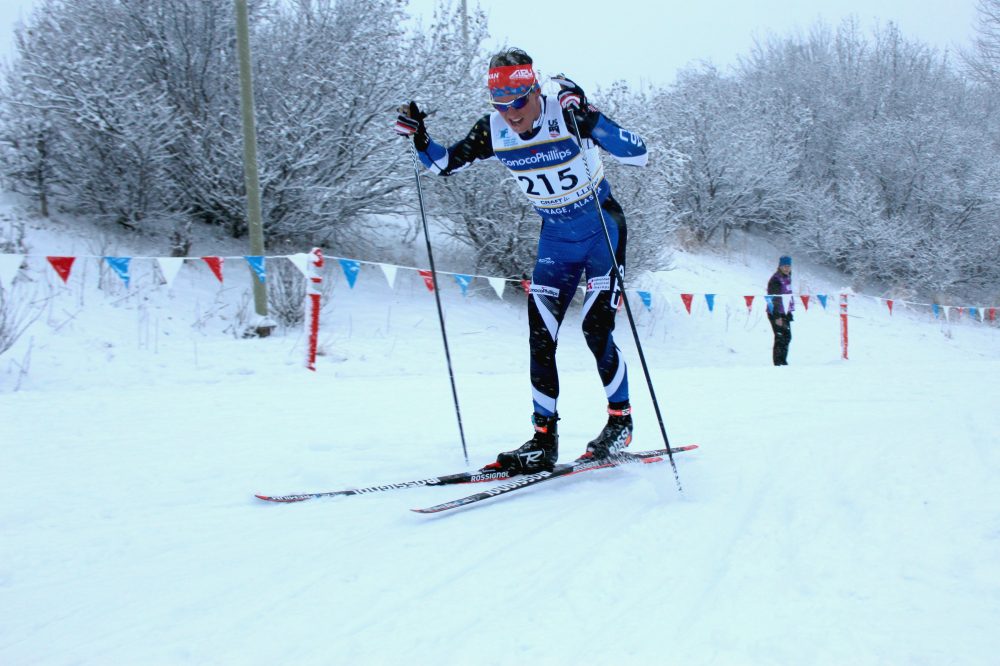
    Scott Patterson (Alaska Pacific University/U.S. Ski Team) racing to first in the men’s 15-kilometer freestyle individual start on Wednesday at 2018 U.S. Cross Country Championships in Anchorage, Alaska.

    (Note: This article has been updated to include comments from Noah Hoffman.)

    ANCHORAGE, Alaska — It was a day of homecomings and returns at snowy Kincaid Park for the first day of the 2018 U.S. Cross Country Championships. Scott Patterson returned to his childhood training grounds with a convincing victory, Noah Hoffman returned to racing at U.S. nationals with second, and Matt Liebsch returned to the nationals podium with third in the men’s 15-kilometer freestyle individual start on Wednesday afternoon. All of them overcame notably difficult conditions to do so.

    While there were several strong contenders in the field of 181 starters, many had tabbed Patterson, of Alaska Pacific University (APU), and Hoffman, affiliated with Ski & Snowboard Club Vail (SSCV), among the favorites coming in. They weren’t wrong, given both the pair’s recent World Cup experience and their domestic history at this distance.

    For both athletes in the top echelon of U.S. men’s distance skiing, the 15 k race has long been their bailiwick. Coming into this week’s races, Patterson, of the U.S. Ski Team B-team, had reached the podium in six of his last eight 15 k races at the SuperTour or national championships level (plus wins in two competitive Alaskan 15 k FIS races in that time). While Hoffman, a former U.S. Ski Team member, has raced in this country less frequently over the past several years, he had achieved that mark in three of his last four domestic 15 k races. For a pair of high-training volume athletes with remarkable aerobic capacity, there is clearly something about this distance that lets them do well.

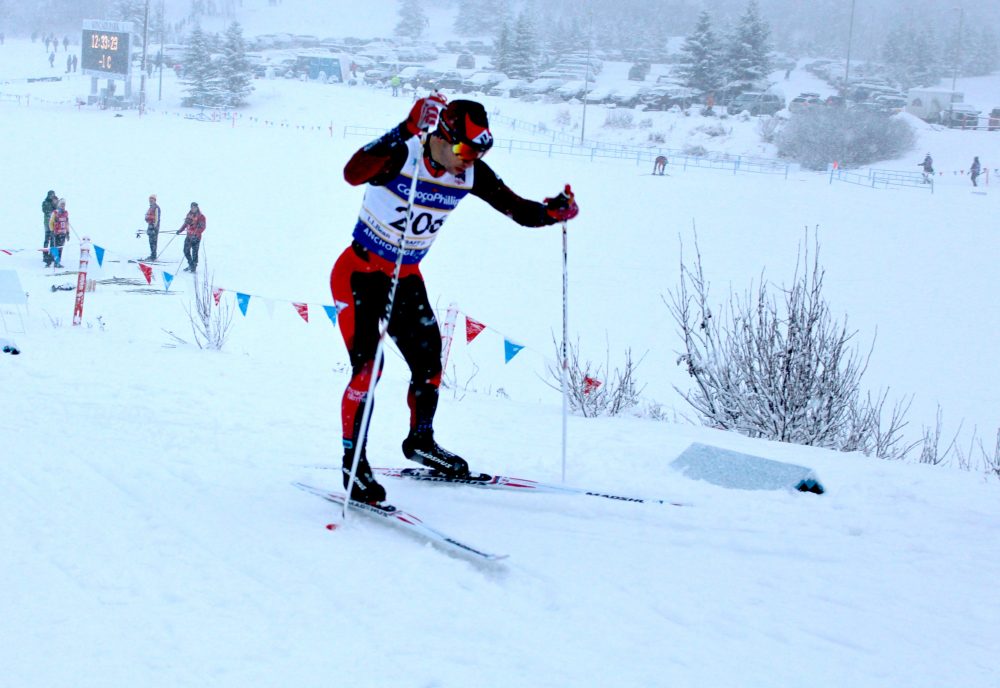
    Noah Hoffman racing to second in the men’s 15-kilometer freestyle individual start on Wednesday at 2018 U.S. Cross Country Championships in Anchorage, Alaska. It was his first January nationals appearance since 2012.

    On Wednesday, Hoffman did well, but Patterson did better.

    “I was impressed by him and happy to see him skiing so well, I mean he handled the condition and that course really well and…he has trained a bunch, but you know I also think that I can ski at that level and I didn’t do that yesterday,” Hoffman said on the phone on Thursday. “In that sense there is more out there, but I am definitely satisfied with second place, I think it sets me up well for going into Sunday in terms of like qualifying for the Olympic team or just having a good week in general.”

    Starting in bib 215 in the middle of the A-seed group, nine spots after Hoffman in bib 206, Patterson led wire-to-wire throughout the six-lap race. After one lap, his time advantage over Hoffman was 7.9 seconds. After two laps, it was up to 11.8 seconds. Patterson’s edge grew steadily from there – 24.1 seconds at three laps, then 41.4 seconds at four laps, then 52.2 seconds through five laps.

    Patterson received an early clue he was having a good day when he passed Kyle Bratrud, of Central Cross Country (CXC), during the first lap.

    “The full confirmation came from my coach, Erik Flora, just after the first lap when he gave me a split that I was leading,” Patterson wrote in a post-race email to FasterSkier. “From there it was mostly just building time against the clock rather than any competitor specifically.”

    Patterson finished in 36:33.7. Hoffman was 55.2 seconds back in second.

    Hoffman was similarly in second each time he came through the stadium on the 2.69-kilometer lap course. (The race may therefore have been closer to 16.1 k than 15 k, according to the map published on the U.S. nationals website.)

    The first lap saw more variability for several skiers, with some eventual top-10 finishers ranking as low as 28th after their first time around the course. Liebsch, representing Pioneer Midwest, was in seventh after Lap 1. But by the end of Lap 2, Liebsch was up to third overall, and he held that position all the way to the finish.

    Matt Liebsch (Pioneer Midwest) racing to third in the men’s 15 k freestyle on Wednesday at the 2018 U.S. Cross Country Championships in Anchorage, Alaska. It was his first U.S. nationals appearance in two years and his first national podium since placing second in 2012 in a 15 k freestyle in Rumford, Maine.

    Liebsch finished 21.3 seconds back from Hoffman in second, and 1:16.5 behind Patterson in first. Liebsch nipped fourth-place finisher Rogan Brown (Sun Valley Ski Education Foundation) by 3.7 seconds for the final podium spot.

    The rest of the top 10 went to Tad Elliott (SSCV) in fifth (+1:24.4, Gus Schumacher (Alaska Winter Stars) in sixth (+1:27.7), Brian Gregg (CXC/LNR/Team Gregg) in seventh (+1:31.3), Jack Hegman (SVSEF) in eighth (+1:36.0), Benjamin Ogden (Stratton Mountain School) in ninth (+1:42.1), and Adam Martin (Craftsbury Green Racing Project) in 10th (+1:44.2).

    Conditions for Wednesday’s race were markedly different from the “firm and fast” courses observed last week. Temperatures above 40 degrees Fahrenheit during the day on Tuesday softened the top few inches of manmade snow on the snowmaking loop and left two to three inches of soft slush on the course’s first main uphill. Above-freezing temperatures Tuesday night, some light rain and a steady snowfall at temperatures hovering around 31.5 degrees all day Wednesday, made for a challenging race.

    For the men, that came after 147 women did four laps each in the day’s first race. Then the men skied a cumulative thousand-plus laps in the day’s second race. By the end of the day on Wednesday, the day’s final starters pushed to glide through four to five inches of slush on the first climb, Gong Hill.

    Despite the conditions, or maybe even because of them, U.S. Ski Development Coach Bryan Fish said that Wednesday’s race courses were a worthy test for American athletes being chosen for international championship teams.

    “I think it was actually good that it snowed,” Fish told FasterSkier in person after the race. “Not only for the long-term of the whole week, but also the fact that the course – just due to the fact that the limited amount of snow, they weren’t able to run it on a fully homologated course. So what I think this did, at least from my perspective, is that it was much harder because of the snow conditions. And I think that creates a better environment to pick the right athletes to go onto these championship courses that they’ll be racing in Europe and in PyeongChang.”

    “The conditions were definitely tricky,” Patterson observed. “Yesterday for our prerace training we had crazy ice and wind in classic Anchorage Chinook style, but even then the forecasts were calling for something different today. Looking out the window in the morning, I knew it was going to be interesting with snow rapidly accumulating and a temperature around 35 degrees.”

    “There were definitely some rough patches with soft deep snow,” Patterson wrote, referring to Wednesday’s race. “Also in many places, maintaining speed meant staying in the skied-in lane. Thus passing was difficult in some areas. Overall, racing fast was about getting through the tough areas quickly but not burning too much energy. Then really focus on the other areas where I could ski hard and put time into people. These conditions didn’t make the skis feel super fast, but I think the APU techs did a great job with the conditions out there to give me some of the fastest skis in the race.”
    Patterson was the only athlete in the men’s race whose overall pace exceeded that of the fastest woman’s lap in the day’s first race, as continued snowfall made the course ski harder for everyone.

    Despite the weather, Patterson wrote to FasterSkier, he felt confident going into Wednesday’s race.

    “But I was also expecting a tight battle with Noah Hoffman and maybe some others,” he wrote. “We had been racing at quite a similar level on the World Cup, but I think the combination of home course advantage and a bit of rough travel for Noah tipped the scale in my favor.”
    (Hoffman recently posted, in a series of Instagram video updates chronicling his travel misadventures, that it took him over 24 hours to successfully leave Hartford as he attempted to fly to Alaska, and that it ultimately took him 56 hours to travel to Anchorage from Putney, Vermont, by plane. “16 hours short of the drive time,” Hoffman wrote.)

    “Scott was world-class today,” Hoffman said, according to a U.S. nationals press release. “I hope he can bring that back to Europe and I hope to be there with him.”

    “You know I continue to feel that I am really looking for my skiing to click,” Hoffman later said during a phone conversation with FasterSkier. “I am really looking to figure out how to ski as well as I had in the past and as I know how… if I am skiing the way that I can, I am going to have all the opportunities I want…everything else really falls into place if that goal does.”

    Hoffman hopes to qualify for PyeongChang, but still remains most concerned with his skiing, believing that performances will follow once he clicks in.

    “I am just focused on trying to put together a representative effort of my fitness because I continue to believe that I am one of the fittest athletes in the world, and that the skiing that I did in 2013-14 wasn’t some miracle or some fluke, I want to give myself more opportunities to prove that, but that’s the goal,” Hoffman continued. :So making teams, and the politics of all of it, is really not, not what I am caught up in. I am focused on trying to ski as well as I can and as I have. I skied best in the world I know I can do that, its been a long time, and its been extremely frustrating, but that continues to be the focus. You got to focus on skiing fast and that’s all you can control.”

    “Overall I felt quite good,” Patterson wrote. “I was getting a lot of good information and splits from my coaches so I had a good understanding of the race the whole time. I kept the pace steady throughout and made sure to work with the conditions instead of fighting against the tricky snow.”

    Patterson had more support out there than just his coaches, on a day when the large parking lots at Kincaid filled to capacity and parked vehicles lined the road up the hill from the stadium at some points.

    “Racing at home is always special,” the 25-year-old Patterson wrote, “both in terms of fans and having the home-course advantage. I have raced at Kincaid more than any other place in the world and I feel like I know how to ski well there. It does have its tricks that take some time to learn. In addition to that, there are the fans. The first time up to the course high point or the Gong Hill, I felt like every person on the sidelines was cheering for me. There were several instances where I would recognize someone’s voice and start to try and figure out who it was before going back to focusing on the race. It’s even more special with all the Olympic hype today.”

    It was his second national title after winning the 15 k classic two years ago in Houghton, Michigan. Patterson, who attended high school in Anchorage, had more experience at Kincaid than anyone else on the podium, but Liebsch is also a fan of the city’s biggest cross-country ski area.

    “I’ve always raced really well here,” Liebsch, 34, told FasterSkier on the phone Wednesday evening. “This is my third time up here, and I’ve had a third, a fourth, and a third. So I like racing at sea level; Kincaid seems to be good to me. So when I saw that Nationals was here this year, I was like, ‘Oh, I gotta go to that for sure.’ ”

    Liebsch most recently made a U.S. nationals podium in 2012 at Rumford. This was also the last time, before Wednesday, that Hoffman raced at the full-fledged U.S. nationals in January; he has competed at U.S. Distance Nationals (an annual 50 k mass start) in the spring several times since then. (This season, Hoffman raced Period 1 of the World Cup. After not being offered a start spot in the Tour de Ski, he chose to come to U.S. nationals instead. Patterson was offered a Tour de Ski start spot, but declined that in favor of coming to nationals.)

    These days, Liebsch works full time at Pioneer Midwest.

    “When I saw that [nationals were in Anchorage] I got really excited to try to train well this summer,” he said. “I never really stopped training. Sometimes I’m exercising, sometimes I’m training. I actually trained this year. Last year I exercised.”

    (He later mused, “I’m less than 20 months removed from World Cup racing, so everyone thinks that I just rolled over and died. But I kept training, and I kind of had it in the back of my mind that I may take another swing, see what happens.”)

    Liebsch came to Anchorage “with the expectation to win today,” he said. But he was quick to credit Patterson for his dominant performance: “Obviously Scott just sent it,” Liebsch said. “Scott was on his own planet today.”

    For “everyone else” in the race, Liebsch said of the challenging and variable conditions, “it was kind of like you had to ski relaxed, and just kind of let the ski scoot along on the snow. Because there were like trenches, and then there was like mashed potatoes, and then there was like new snow. It was kind of weird.”

    So what happens next? Short-term, Liebsch does not plan to contest Friday’s sprint, so he’s going to go skiing at Hatcher Pass instead.

    He also has big technique plans, with an eye to qualifying for the upcoming Olympics in PyeongChang.

    “I have a chance to probably go ski in Korea, potentially, after the points reshuffle from today,” Liebsch said. “They’re going to have to take a bunch of domestic guys, I think, and … I think I’m in the mix. If I can figure out how to classic ski between now and Sunday, it could be real exciting.”

    Patterson has comparable goals in advance of Sunday’s 30 k classic mass start.

    “For PyeongChang, today’s race feel like it puts me in the driver’s seat for the distance spots. Through the early season SuperTour, no one really stood out above the rest for distance races. Today, Noah Hoffman and I showed that we might not have scored many World Cup points, but we are still forces domestically. The 30k classic on Sunday will be my other big focus to get an Olympic spot.”

    Two Juniors in the Top 10

    https://www.instagram.com/p/BdgdIgbB92S/

    While there was a separate podium ceremony on Wednesday for the top-three junior boys (after athletes of all ages raced together), you don’t have to go too far down the results sheet to find the top-three finishers under age 20: Gus Schumacher (Alaska Winter Stars) was sixth overall, Ben Ogden (Stratton Mountain School) was ninth, and Hunter Wonders (APU) was 21st. Schumacher and Ogden are still U18 skiers; Wonders is a U20.

    Schumacher’s sixth overall is a quantum leap from his previous best finish at a U.S. nationals: he was 43rd in the 15 k classic at Houghton in Jan. 2016.

    “I guess I wasn’t expecting this specific result,” Schumacher, 17, wrote to FasterSkier, “but I knew that on home snow I could possibly put up a pretty fast time and be competitive with the seniors.”

    As for his mindset in conditions like those found on Wednesday, Schumacher wrote, “I guess my approach is that it’s the same for everyone and as long as I don’t get freaked out I can race as well as normal. So the goal is really to stay calm and try to adjust my technique in warmup to be more efficient.

    “I was super stoked about today’s race,” he continued. “I think it is a great sign for the future, hopefully I can keep this pace up!”

    Count Fish, the development coach, among those also stoked about Wednesday’s race. Fish is attending U.S. nationals for a number of reasons, he explained, including to help support the naming of various international championship teams (Junior Worlds team, U23 team, and the U18 Nations Trip team). And while he looks at results, to be sure, it’s more than just that.

    “We’re also looking at results versus age as well,” Fish said. “And not only the result itself, but what were the times, and what were the time gaps. … Really exciting to see a couple of young men, like Gus Schumacher and Ben Ogden, sixth and ninth. And those two were back and forth. And I had Ben as high as eighth, and Gus in 10th, and Gus had an incredibly fast last lap, to put time not only into the other juniors but into the whole field, to finish sixth overall. So that was really exciting to see, to have two young athletes like that finish that high.”

    Results

  • Wednesday Workout: Make Your Own Agony Hill

    Wednesday Workout: Make Your Own Agony Hill

    Peter Wolter, of the Sun Valley Ski Education Foundation, racing to the fastest time up Agony Hill during the 2017 Western Regional Elite Group (REG) time trial in Salt Lake City, Utah. (Photo: Matt Whitcomb)

    When it comes to U.S. Regional Elite Group (REG) training camps, there are a few running themes that remain consistent across the country and from year to year. In the East, West and Alaska, participants in the U.S. Ski Team’s development program are tested with an uphill run, agility course and a roughly half-mile double pole, all of which are timed and done individually.

    Western REG coaches Mike Elliott and Bill Hokanson explained how the run is done at Agony Hill, adjacent to the University of Utah in Salt Lake City. The “hill”, on the 6,348-foot Mount Van Cott, has been an REG staple since 2006, according to Elliott, a three-time Olympian and former U.S. Ski Team (USST) member. It has been used since the 1990s by the USST, the University of Utah Ski Team, Wasatch Ski Academy, The Utah Nordic Alliance, Park City Nordic Ski Club, and Soldier Hollow Nordic Ski Club, Elliott wrote in an email.

    The Agony Hill course records set more than a decade ago still stand, which Hokanson explained was partially due to trail construction since.

    “We’re not 100% convinced the modern course is exactly equivalent to the historical one,” wrote Hokanson, head coach of the Wasatch Nordic Ski Academy in Park City and Salt Lake City.

    For instance, Morgan Arritola set the junior women’s record of 16:55 minutes up the 1.7-kilometer climb in 2004. The rest of the course records were set before that by John Aalberg (12:46), Nancy Fiddler (15:46) and Rob Whitney (reportedly under 14:00) for senior men, senior women and junior men, respectively.

    “Variations in the Agony Hill TT course over the past 3 – 4 decades may in part account for the difficulty contemporary athletes have faced in trying to set new records,” Hokanson wrote.  “However the records are held by 4 of the toughest, fittest, most talented athletes of all time, which may fully account for the tenacity of their record efforts.”

    Here’s how you can replicate the Agony Hill time trial in your own backyard:

    “Agony Hill can be developed anywhere and it does not have to be all uphill,” wrote Elliott, now executive director of Rocky Mountain Nordic in Durango, Colo. “My coach, Dolph Kuss, used a course on the edge of Durango when I was in college a Fort Lewis college in 1965 & 1966.  It was a loop next to the local cemetery.  The area is still called test tracks.”

    Elliott recommends a climb lasting 12 to 15 minutes for athletes 18 and older. He also suggested starting athletes individually (via interval starts).

    “It can be all out for one lap or Level 3 below threshold intervals,” Elliott added. “Try and have around the same time each time.  It can be a 15-minute run to see how far you can go.  Like Agony Hill, it can be all uphill.”

    He explained that these kind of time trials measure fitness, pacing and rate of improvement over time, and recommended doing this workout once every other week or once every three weeks.

    The Workout: Agony Hill uphill time trial

    1. Warmup: Light running and stretching for 30-40 minutes

    2. Uphill Run: Interval-start recommended

    • Option 1: One time, all-out effort: see how far up the hill/mountain you can go
    • Option 2: Level 3 intervals: aim for consistent times

    3. Cool down

    Agony Hill specifics:

    • Where: Mount Van Cott, east of the University of Utah in Salt Lake City
    • Course map
    • Course length: 1.7 kilometers
    • Peak Elevation:  6,348 feet
    • Vertical climb: 367 meters
    • Unofficial course records:
      • Senior men: John Aalberg (12:46)
      • Senior women: Nancy Fiddler (15:46)
      • Junior Men: Rob Whitney (reportedly under 14:00)
        • 2nd fastest junior male: Glen Randall (14:34)
      • Junior Women: Morgan Arritola (16:55)
    • This year’s winners:
      • Peter Wolter (Sun Valley Ski Education Foundation): 15:40
      • Novie McCabe (Methow Valley Nordic Ski Club): 17:29
  • O’Harra, Frankowski Claim Solo Victories in Tour of Anchorage

    O’Harra, Frankowski Claim Solo Victories in Tour of Anchorage

    Midpack racers ski on the Coastal Trail, with the Pacific Ocean to their right and downtown Anchorage in the background, in the Tour of Anchorage on March 5 in Anchorage, Alaska (Photo: Robert Arnold video screenshot)

    ANCHORAGE, Alaska — There are several strategies for winning the Tour of Anchorage, the annual 50-kilometer freestyle marathon from one side of town to the other that is the unofficial citizens’ race championship for the State of Alaska. There is one obvious way to lose it: Go out too hard on the climbs of the first 10 k, only to lose steam and be swallowed up by a chase pack at some point in the 40 k of flats and rolling downhills that follow.

    But Alaska Pacific University skiers Thomas O’Harra and Rosie Frankowski were undeterred by these risks, as both got a gap early in the race and held it to reach the finish line unchallenged, claiming victory in the 30th Tour of Anchorage on a bluebird Sunday morning.

    For Frankowski, pushing hard from the start was her plan all along. “I went off the line,” she told FasterSkier during an in-person interview after the race. “I knew that the only place where it’s easy to build a gap is Spencer’s, and I would much rather ski uphill any day than ski on a flat downhill course. So from the gun I went for it. I tried to ski relaxed, and then the minute I got to even the climbs heading up to the Gasline, I just hammered as if I was in like a 20 k race.”

    Despite the fast pace at the start of a long day, Frankowski was relatively unconcerned about her effort level. “I knew that there’d be tons of recovery, even on Spencer’s,” she said. “We raced a 30 k there a couple years ago [at Spring Series 2014], and you hammer the uphills and you get two minutes of recovery on downhills. So I just went for it. I caught some groups, I had people to chase, people from the men’s waves, and had a lot of local support that definitely moved over.” By the bottom of the Spencer Loop, Frankowski was hearing that she had a five-minute gap on her nearest pursuer.

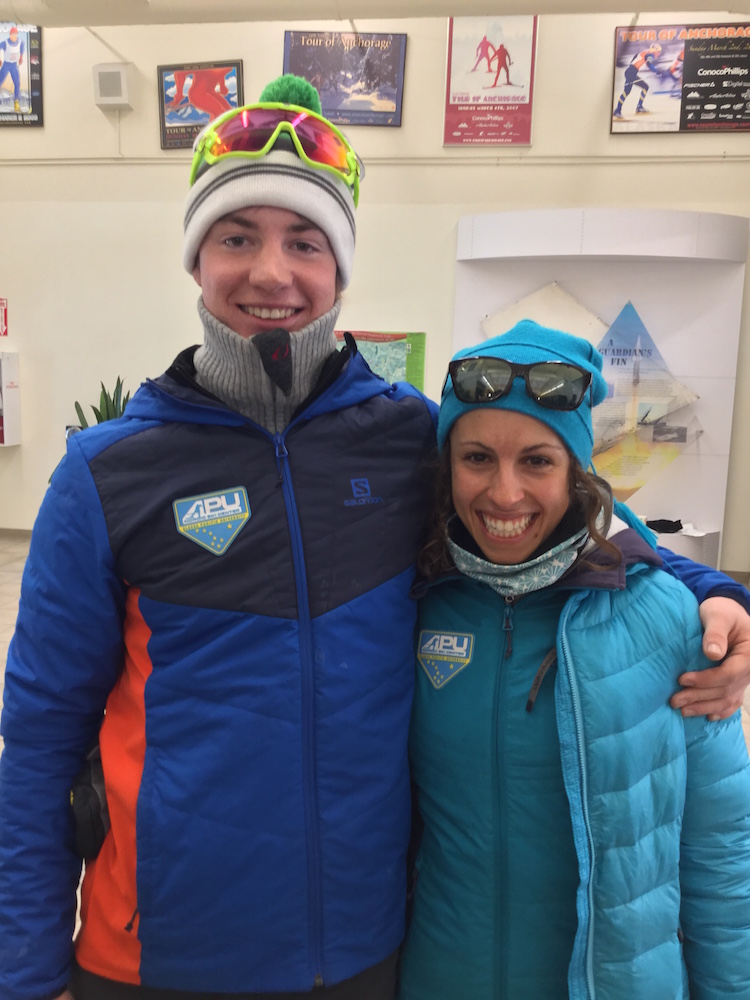
    Alaska Pacific University (APU) skiers Thomas O’Harra (l) and Rosie Frankowski in the Kincaid Chalet after winning the 2017 Tour of Anchorage on March 5 in Anchorage, Alaska. (Photo: Gavin Kentch)

    “And so I just tried to hammer” at that point and catch the next group, she recounted, “because I wanted to catch a group to draft for the mid-part of the race, and I caught Rob Whitney’s group.”

    Frankowski had nothing but praise for her on-course treatment from Whitney, once a leading American junior and now a formidable Masters skier. “And with Rob and three other guys, we traded off the lead. And it was fun, because they were psyched to have me in the group, compared to – I mean, you hear about sometimes some of the male skiers being annoyed, but they were awesome. And we had this little group going with switching the lead every minute toward the end to try to catch some of the APU guys we could see in front of us. It was really fun.”

    Ahead of all those APU guys was the fastest skier on the day, Thomas O’Harra. The 20-year-old junior and Anchorage native was skiing alone on familiar trails, at one point passing the house he had grown up in. “My season hasn’t really gone the way I’d hoped and so today felt awesome to have a good race at home, on trails that I grew up learning to ski on,” O’Harra said in an APU press release.

    Like Frankowski in the elite women’s wave starting two minutes behind him, O’Harra led the race off the line. While Frankowski dropped the other women almost immediately, O’Harra had somewhat more company, leading a pack that included fellow APU skiers Reese Hanneman, Tyler Kornfield, and Jack Novak up through Gasline, roughly four kilometers into the race. O’Harra sat in second through the ensuing climbs of the Spencer Loop, until, he recounted, “I made a move going up Wall Street [at the top of the main climb] on Spencer, and I led from there to the finish line.”

    O’Harra was pleasantly surprised that the gambit worked. “My plan coming into the race was to see how my skis were running and decide from there,” O’Harra told FasterSkier after the race, “Once I figured out that my skis were running pretty well compared to everybody else, I decided to go for it and try and stretch it out. I expected – I didn’t expect to ski alone the whole 50 k. I expected everybody else to chase me. And they tried, I heard, but I had a little bit too much of a gap.”

    O’Harra crossed the line in 2:10:49.2. Hanneman (+2:11) and Kornfield (+2:54.8) made up the rest of the podium, with Novak finishing several more minutes back in fourth (+7:21.8). APU skiers took six of the top seven spots in the men’s race, including APU Masters Coach Galen Johnston and former Tour champ Dylan Watts.

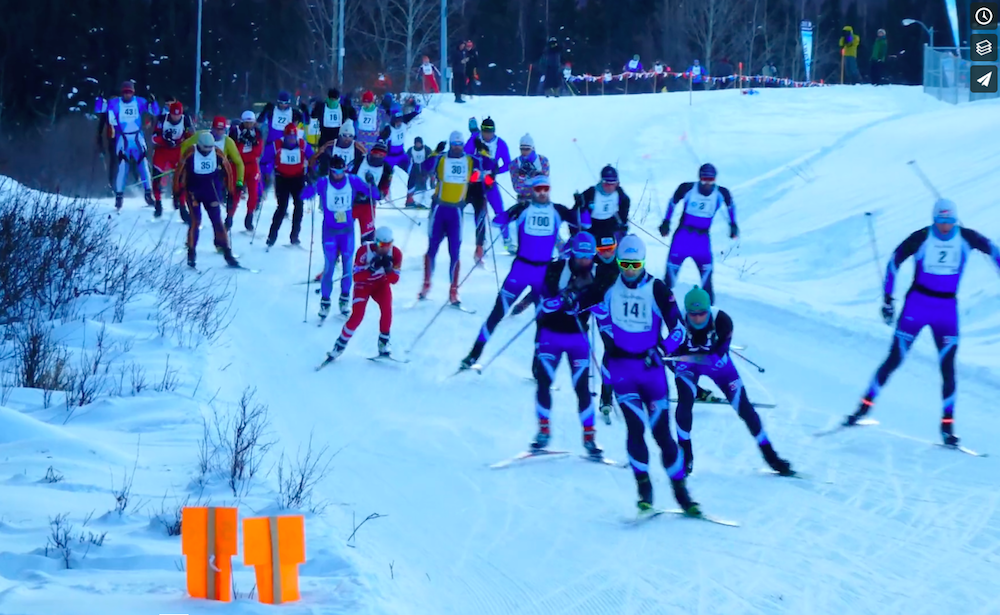
    Eventual podium finishers Thomas O’Harra (14), Reese Hanneman (100) and Tyler Kornfield (2), all APU, lead off the starting line of the 2017 Tour of Anchorage on March 5 in Anchorage, Alaska. (Photo: Robert Arnold video screenshot)

    Breaking away at the 7 k mark carries risk in any 50 k, because of the differences in efficiency between leading solo versus skiing in a chase pack that characterize any long race. It is particularly fraught in the Tour, given the elevation changes and topography of the point-to-point race from one side of town to the other.

    Briefly put, the Tour goes up for the first 10 k, but down or flat almost all the rest of the way. More specifically, the 50 k course ascends the rolling uphills of the Hillside ski trails for around 5 k, then tackles the Spencer Loop. Spencer is locally notorious for having more climb than is allowed under International Ski Federation (FIS) regulations – the maximum climb of 104 meters readily exceeds the 80-meter limit permitted for an A-climb on a FIS-homologated course of any distance. Within the first 7 kilometers of the Tour, skiers have climbed more than 150 meters above where they started. (For comparison, the American Birkebeiner, famous for its hills, climbs roughly 105 meters over 11 kilometers.)

    But it’s virtually all downhill from there. Racers descend Spencer, ski on rolling downhills back through the Hillside lighted trails, drop down through Campbell Tract, and then cruise on greenbelt trails until the 44 k mark before climbing up to the finish at Kincaid over the last six kilometers. For parts of the course skiers are on the Coastal Trail alongside the ice floes of Cook Inlet, elevation approximately one meter. All of which is to say that a chase pack has a lot of time to work together on the flats to reel in an early solo breakaway.

    Oh, and it was not warm out there, so leaders were dealing with slow snow as well. Race-time temperatures Sunday morning were -4 degrees Fahrenheit at the starting line, down to -12 degrees in a notorious icebox spot in the black spruce forest of Campbell Tract. Skiers sported the latest in face-tape fashion – Frankowski carried the day with her pink tape and pink buff ensemble – and race photos show a series of frosty faces, ice beards, and clouds of frozen breath.

    Even Frankowski, who dominated the women’s field en route to finishing sixth overall in 2:23:42 (Shalane Frost and Nicole De Yong followed roughly 15 minutes back), noticed the cold.

    “I don’t think it was particularly fast,” Frankowski said. “I never race with a watch, but definitely the snow was slow. … It was not a warm day out there. And by the end – normally I die with 10 k left in all the 50 k’s I’ve done, so today I died with four k left, which was a vast improvement. And the worst part is, I had to stop like four times during the race, because I dropped my waterbottle, or it froze and I couldn’t get it back in my pack. So at one point at Westchester Lagoon I dropped it, my whole group had to go around me because I snowplowed to a stop to pick it up, and then I just threw it onto the Lagoon. So I have to go find it after the race.”

    O’Harra also had plans for after race: “I was informed after the awards ceremony that there is a bottle of wine for me, waiting for when I turn 21, which is next Sunday, and I get it then.”

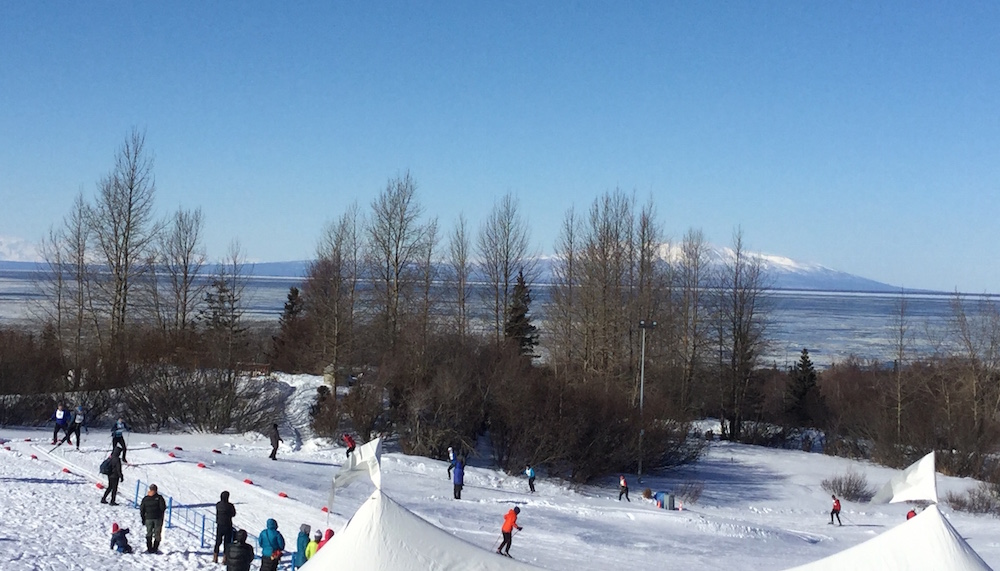
    With the roof of the beer-garden tent in the foreground and Mt. Susitna in the background, skiers approach the finish line of the 2017 Tour of Anchorage on March 5 in Anchorage, Alaska. (Photo: Gavin Kentch)

    But last Sunday morning, as skiers flocked to the outdoor beer garden following the race, O’Harra was left inside. Let his former roommate Frankowski graciously explain: “I am really excited mostly for my teammate Thomas O’Harra’s win. Thomas and I had been roommates, until December, for about a year, and Thomas now has my room on the APU campus. Which, obviously, the karma contributed to why he won. And in fact, Thomas isn’t even 21, so he can’t go to the beer garden that the Tour of Anchorage and [Nordic Ski Association of Anchorage] has graciously provided for us. So unfortunately, the Tour winner’s stuck inside.”

    Other than bottles, of either wine or water, what were the winners’ future plans? Frankowski, reflecting the realities of life as a professional cross-country skier, was planning to use her $500-dollar winner’s check toward rent money. And as for the rest of her first-place prize, the roundtrip Alaska Airlines plane ticket? “You can’t fly to Cuba” with it, she lamented, “which is basically the main destination I wanted to go to. So now I have to find another destination where Alaska flies. Honestly, I’ll probably go to Minnesota, where I’m from.”

    O’Harra, meanwhile, was planning to put in a three-week training block, “and be in good shape for Spring Series in Fairbanks” in late March.

    O’Harra explained that he had been planning on racing this year’s Birkie before it was canceled, “so that would have been my first 50 k. This instead became my first 50 k. So hopefully my second 50 k, in Spring Series in Fairbanks, will be just as good.”

    For Frankowski, Sunday marked the fourth-career 50 k for the Midwest native, including two Birkies and a win in last year’s Great Bear Chase in Calumet, Mich. “This is definitely the prettiest 50 k I’ve ever done in my life,” Frankowski said of a perfect day when mountains and ocean were visible in all directions throughout the course. “It was beautiful out there.”

    A triumphant return

    Frankowski’s sentiments were clearly shared by many in the crowd of 872 finishers, which marked both the smallest Tour field in over twenty years but also, with this year’s Birkie washed out, the largest ski race in the country this winter to date. Although the Tour was held over its full course 25 times in its first 26 years, the race only went halfway across town in 2014, and was confined to a lap race on Kincaid snowmaking trails in 2015 and 2016 as snowfall was scant and participation numbers plummeted.

    But this year the Tour returned to Anchorage, and Anchorage returned to the Tour. Families raced. Parents raced. Grandparents raced. Anchorage Mayor Ethan Berkowitz raced. Alaska State Representative Matt Claman (D–Anch.), whose house lies within 100 meters of the course, raced. A 9-year-old completed the 25 k (in a healthy 2:08), and 87-year-old Reno Deprey classic skied the 40 k in 4:47. It was a great day for skiing in Anchorage.

    It was also an historic day: March 5, 2017, was just over one century removed from the first recorded ski race in Anchorage, a town founded in 1914 as a construction camp for workers on the Alaska Railroad.

    As former U.S. Ski Team athlete Tim Kelley recounts in more detail on his blog, a 10-mile race was held, starting and finishing on Fourth Avenue in downtown Anchorage, on March 4, 1917 (start line photo here). The winning time was a solid 1:08:30 for 10 miles, more than respectable considering what we would now term the primitive ski technology involved. First place went to a John Aho, with one Emil Gustafason second. A man whose given name was literally “Young Viking” served as race director. They raced again the following weekend, by which time the winning time was down to 57:25 for 10 miles. O’Harra posted a faster pace in March 2017 for 50 k, but not that much faster.

    Other races

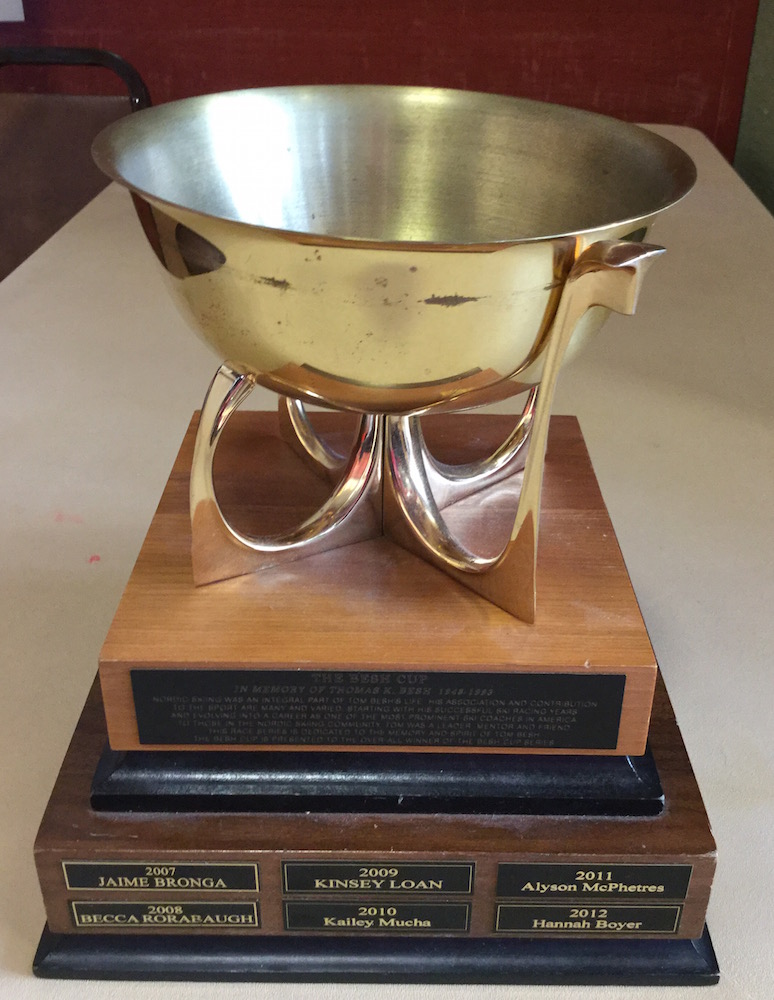
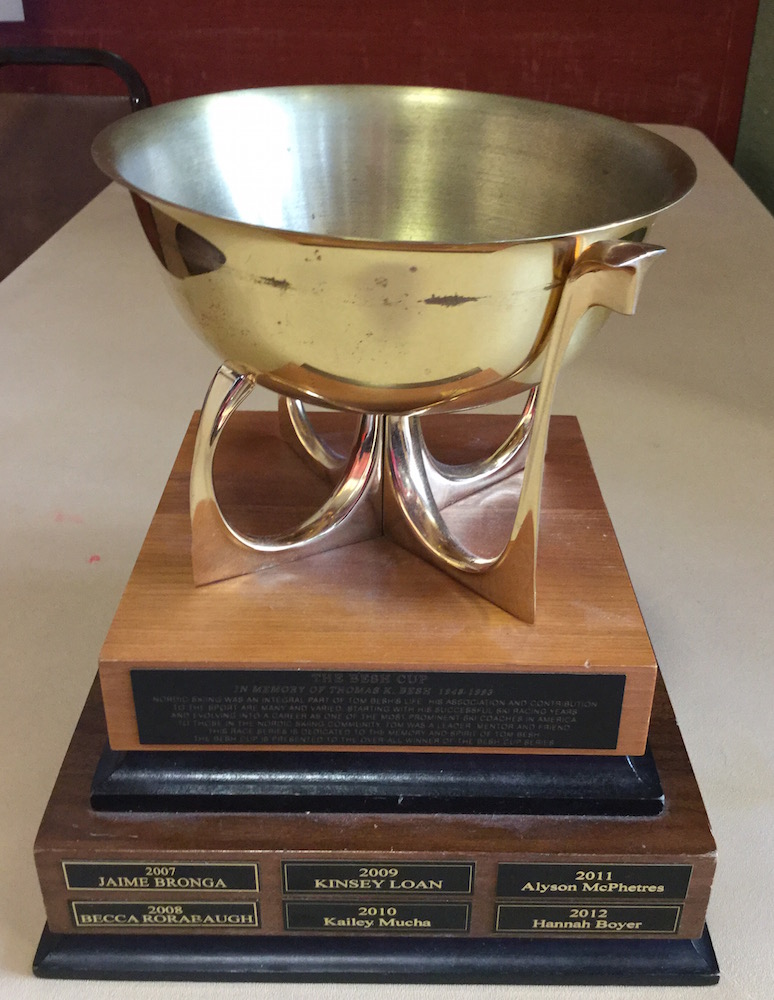
    Three other races were held on Sunday. In the 40 k, which skips Spencer Loop and most of the Hillside trails, first place in the women’s division went to former junior standout and Besh Cup Trophy winner Jaime Bronga in 2:05:15.1. Christina Pohl and Melina Park followed.

    In the men’s 40 k, three local juniors used the 40 k to once again unofficially see who is the fastest local junior not selected for Team Alaska for Junior Nationals. (One has to be 18 years old to race the 50 k. The 11 year old who skied this year’s 40 k in 3:06 suggests that there may be no lower age limit for the 40 k.) This year it was Chip Schoff, 17, who took the victory in 1:48:16.3, over 17-year-old Trent Fritzel and 16-year-old Hans Personius.

    In the 25 k skate race, Jasmine Maurer of Homer took the victory for the women in 1:32:59.9, followed by Clare Ross of Anchorage and Mallory Conger of Nome, reflecting the fact that the Tour draws racers from the entire state. For the men, it was Kai Meyers, 16, in first in 1:12:22.6, Kevin Donley, 51, in second, and Dale Baurick, 14, in third.

    And first overall in the 25 k classic was University of Alaska Anchorage skier Sadie Fox in 1:30:28.1, followed by Alison Arians and Anna Rix for the women. First among men, and second overall, was Erik Hjelm in 1:31:42.6, followed by Paul Kari and Karl Volz.

    Next year’s Tour is scheduled for March 4, 2018.

    Results (all races) | Race video

  • Besh Cup Series Wraps up in Fairbanks as Team Alaska is Named

    Besh Cup Series Wraps up in Fairbanks as Team Alaska is Named

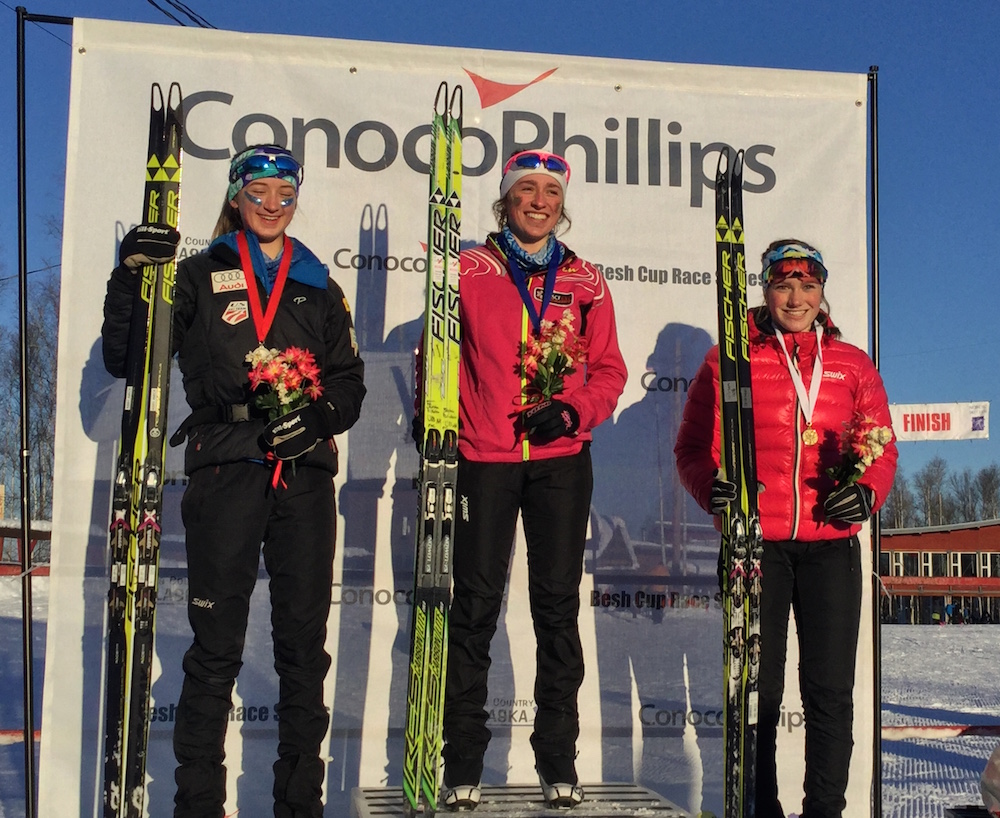
    Jenna DiFolco (c) of FXC, Abby Amick of APU (l), and Addison Gibson of ANR (r) on the podium for the U18 girls division of the Besh Cup 5 k skate race in Fairbanks, Alaska, Feb. 4, 2017. (Photo: Gavin Kentch)
    Jenna DiFolco (c) of FXC, Abby Amick of APU (l), and Addison Gibson of ANR (r) on the podium for the U18 girls division of the Besh Cup 5 k skate race in Fairbanks, Alaska, Feb. 4, 2017. 

    FAIRBANKS, Alaska — Alaska Airlines operates roughly 10 flights a day between Anchorage and Fairbanks. Last Friday morning many of those flights were packed with skiers, and ski bags piled up at baggage claim in Fairbanks, as Anchorage skiers streamed north for the final weekend of Besh Cup racing to select Alaska’s representatives to next month’s Junior Nationals in Lake Placid, N.Y. Two days later many of those same skiers returned south with plans to fly all the way to Lake Placid, where Team Alaska will have roughly equal representation from the state’s two largest cities.

    The 2016/2017 Besh Cup series concluded with a pair of distance races at Birch Hill ski area: freestyle interval start on Saturday, classic mass start on Sunday. The weather for both days was Fairbanks at its mid-winter best, clear and sunny and relatively warm. Cold powder and hard glide waxes were de rigueur.

    (The emphasis here is on relatively, as national FasterSkier readers might find Saturday’s race-time temperature of 10 degrees Fahrenheit, or Sunday’s reading of 2 degrees, objectively not all that warm. But it was -16 degrees at the airport on Sunday – Birch Hill’s elevated location on a hill above town often keeps it significantly warmer than the low-lying areas of central Fairbanks where official temperature readings are taken – and it is forecast to be -35 degrees in Fairbanks by later this week. So, relatively warm.)

    The first race on Saturday was the boys 10-kilometer freestyle individual start for racers in the U18 division and older, 45 starters in all. The overall podium on Saturday was U18 skier Ti Donaldson of the Nordic Ski Club Fairbanks racing team (FXC), Senior skier Cody Priest of Alaska Nordic Racing (ANR), and U18 skier Josiah Alverts (ANR).

    Among U20 men, FXC skier Benjamin Koenig was first, leading his teammate Logan Mowry in second and Dax Cvancara of ANR in third.

    The U18 boys division, which saw two of the top-three overall finishers, had Donaldson in first, Alverts in second, and APU skier Tristan Wiese in third.

    U16 boys raced a 5 k skate individual start, covering one lap of the blue course that 10 k skiers completed twice. Eli Hermanson of Alaska Winter Stars (AWS) led the all-Anchorage-area podium in the 5 k, followed by George Cvancara of ANR and Zanden McMullen of APU.

    Finally, the U14 boys raced a 1 k skate ski-cross event, with jumps, gates, slaloms, and other technical challenges. The event is a crowd favorite that, race organizers wrote, “helps develop skiers’ abilities to ski in a ‘pack’ along with developing technical skills.” (It may also soon be coming to a race series near you! Here is an example from the 2016 Youth Olympic Games in Lillehammer.) In another Anchorage-area sweep, Aaron Maves of APU took the A-Final, followed by Rudy Schumacher of AWS and Konrad Renner from ANR.

    On the girls side, a field of 57 racers (U16 and older) contested a 5 k skate individual start. At the end of one lap around the blue course, APU skier Maggie York took the overall victory by 40 seconds over FXC skier Jenna DiFolco, with Kendall Kramer (FXC) another 14 seconds back.

    York also topped the U20 podium. She was followed there by Alyeska Daniels and Lupua Oba, both of FXC.

    DiFolco, second overall, was first among U18 girls. Second in this division was Abby Amick of APU, with ANR’s Addison Gibson third.

    U16 girls took third through fifth overall in the combined U16/U18/U20/Masters field for the 5 k (there were no Senior skiers in the race). Locals Kendall Kramer and Kaya Ratzlaff of FXC led this division, with Annika Hanestad (ANR) third.

    U14 girls also raced a 1 k ski cross. First here was Quincy Donley of AWS, continuing her winning ways from the Anchorage and Soldotna Besh Cup weekends. She was followed across the finish line of the A-Final by Marit Flora of APU and Katey Houser of ANR.

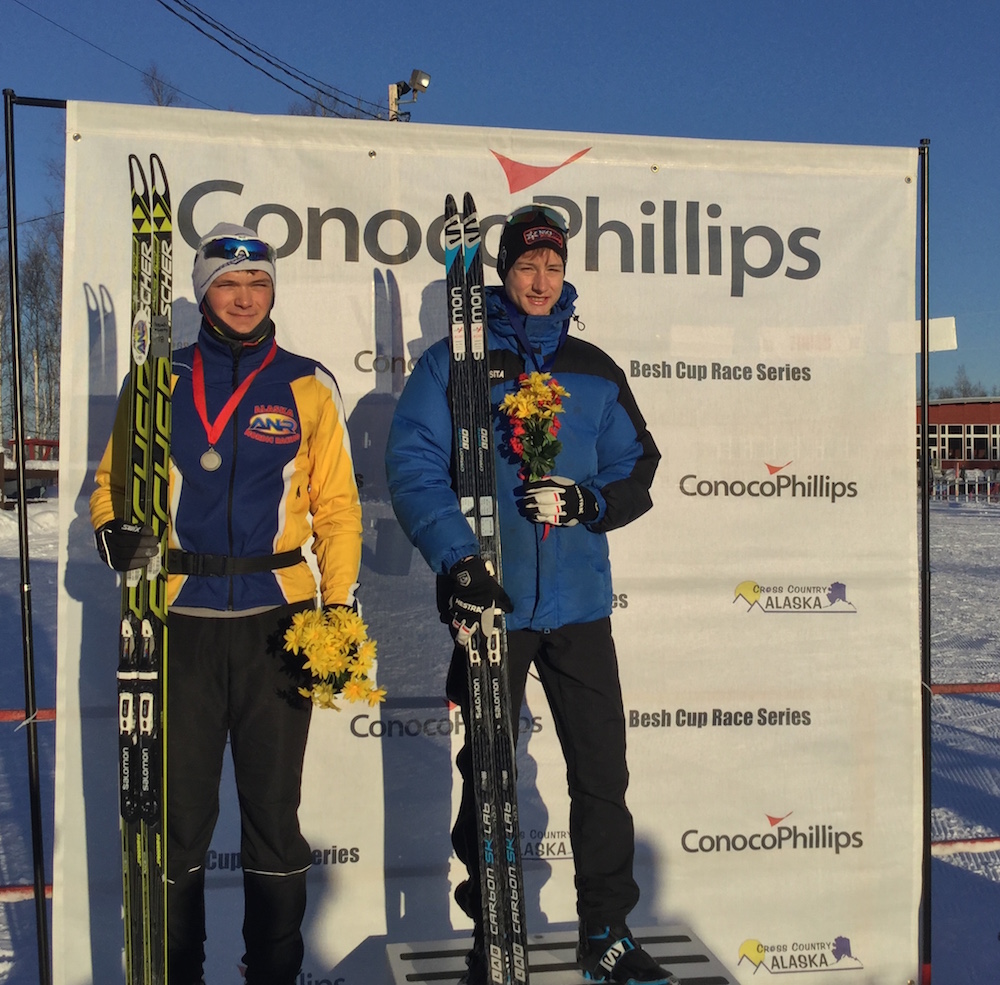
    Ti Donaldson of FXC (r) and Josiah Alverts of ANR (l) on the podium for the U18 boys division of the Besh Cup 10 k skate race in Fairbanks, Alaska, Feb. 4, 2017. (Photo: Gavin Kentch)
    Ti Donaldson of FXC (r) and Josiah Alverts of ANR (l) on the podium for the U18 boys division of the Besh Cup 10 k skate race in Fairbanks, Alaska, Feb. 4, 2017. 

    Saturday’s overall winner for the boys race, U18 skier Ti Donaldson, was racing on home turf. “I’ve had a few wins [in the Besh Cup series] in the past,” Donaldson told FasterSkier in an in-person interview following the race. “Most of them have been in Fairbanks. I’m from here, so definitely a home-field advantage.”

    Donaldson came in expecting a “brutal” race, based on his knowledge of the course and his time previewing it. “But I knew it would be pretty fast conditions,” he continued – “it was nice and hard, and it wasn’t too cold. So I was pretty excited to see how it would go, and really just wanted to work the transitions and stay strong on the climbs, and crest over. So I stuck to that plan, and it worked out pretty well.”

    Donaldson was looking forward to 2017 Junior Nationals in March.

    “I’d be thrilled with a top-five finish,” Donaldson said of his goals for next month. “Two years ago, when I was racing the same kids, I placed fourth in a race, and so I’d like to repeat that result. That would be a good goal of mine.”

    Jenna DiFolco, the U18 girls winner and second-place overall skier, was also racing at home. She credited “my FXC coaches” for waxing her winning skis, and had hot cereal for breakfast, with raisins and dried cranberries, at home before heading out to Birch Hill.

    The race was “really fun,” DiFolco recounted in an in-person interview. “Warming up, I didn’t feel so good, I was feeling kind of tired, maybe I’d overdone it this week. And then I expected this course to be really hard, because there are so many hills. And it was definitely, like, it was a rough course. But it went a lot better than I expected it to.”

    DiFolco described her strategy for racing a one-lap 5 k course with nearly constant climbing or descending: “The first part is mostly downhill, so I kind of just started out like a sprint almost, because I knew I’d be able to recover on the downhill. And the first couple of hills I was just trying to keep it light, keep it relaxed, and then really start hammering up South Tower [the high point of the course], because I got a big break after that. And then the last two hills are basically just hard, really hard.”

    Looking ahead to Lake Placid, DiFolco said that she was “hoping to get a couple top-10 finishes.” She added, “A big dream, it’d be a big stretch, but I’m hoping to get, like, a podium would be really, really cool. But top 15, top 10 would be awesome.”

    Sunday saw classic mass starts instead of freestyle individual starts, and temperatures around 10 degrees colder, but otherwise it was more of the same. Seven of eight age-group winners from Saturday picked up a second victory on Sunday, as a pair of distance races rewarded skiers who were consistent in both techniques. (The first two weekends had featured one sprint and one distance race apiece, leading to greater variability in the podium finishers.)

    Sunday’s classic race also rewarded skiers who were good at traditional classic skiing, in light of the relatively slow snow and the impressive elevation change of a Birch Hill race course.

    The trails at Birch Hill are built on the side of, well, a hill (also, there are birch trees). The courses used for this weekend’s races were marked by an impressive Height Difference (the elevation change between the lowest and highest points on the course) of 89 meters within a 5-kilometer course. The World Cup skiathlon race that was contested in South Korea the same weekend, on the trails that will be used for the 2018 Winter Olympics in PyeongChang, featured height differences of only 58 and 41 meters on the two skiathlon courses.

    In fact, a height difference of 89 meters is a greater elevation spread than was present on most of the traditional World Cup courses this season, including in Davos (84m), Lillehammer (74m), Falun (69m), and Ulricehamn (57m). That said, some of those courses had more average climb per kilometer than the Birch Hill 5 k course. But only some of them. This may help explain why the winning time for a 10 k skate on Saturday was 29:22 for the men, and 16:15 for 5 k for the women, in a race with some of the top junior skiers in the country. (Winning times for Sunday’s 10 k classic races were 32:17 and 37:53.)

    Coaches compete in the final ski-cross heat of the day, the coaches' race, on Feb. 4 in Fairbanks, Alaska. Racers include Galen Johnston (129), Eric Strabel (125), Anson Moxness (126), and Pete Leonard (101). (Courtesy photo)
    Coaches compete in the final ski-cross heat of the day, the coaches’ race, on Feb. 4 in Fairbanks, Alaska. Racers include Galen Johnston (129), Eric Strabel (125), Anson Moxness (126), and Pete Leonard (101). (Courtesy photo)

    APU Devo and Master Coach Galen Johnston shared his thoughts on the effects of such a course profile after spending the weekend watching his athletes race up and down these hills. “One of the best parts of the weekend was to see how the combination of slow snow and lots of strideable sustained climbing put the focus of the [classic] races on striding and fitness rather than simply double pole strength,” Johnston wrote to FasterSkier on Monday.

    “Courses designed like this can keep striding a viable, and even necessary part of classic skiing,” Johnston continued by email. “Birch Hill has some of the most progressive course designs that I’ve seen and it’s paying off. Skiers ski differently than they did even 10 years ago, and it’s really neat to see a course that can accommodate and challenge that change in style without turning things into an unskiable death march. Estle is keeping people very honest, but still allowing for ample fun,” Johnston concluded in reference to longtime Fairbanks race director and ski-course designer (and former U.S. Ski Team coach) John Estle.

    On Sunday the best strider was DiFolco, who took first place in the 10 k classic mass start race by 19 seconds over Saturday’s winner York. Third overall was ANR skier Heidi Booher (ANR), another 23 seconds back.

    York was again first in the U20 women division. The rest of the podium was also unchanged from Saturday, with Daniels in second and Oba in third.

    DiFolco was again first among U18 girls. Second on Sunday was Booher, with Emma Nelson of ANR third.

    There was a substantial drop-off in distance from U18 girls to U16 girls, with the latter group racing not 10 k but a 3 k classic mass start. First after just under 10 chaotic minutes was Kramer again, edging out her FXC teammate Ratzlaff by 0.7 seconds. Tjarn Bross rounded out the all-FXC podium in third.

    U14 girls raced the same 3 k course as the U16 girls. And after 11 to 12 minutes of racing, it was precisely the same U14 girls podium as on Saturday: Donley, Flora, and Houser.

    On the boys side, U18/U20/Senior/Masters skiers raced a 10 k classic mass start on the same course as the girls. First overall was Lukash Platil (officially unaffiliated, but listed on the University of Alaska Fairbanks (UAF) ski team roster), followed by Donaldson of FXC and Wiese of APU.

    Platil was also first in the Senior men’s division. He was followed there by Kenny Brewer (now unaffiliated, formerly of UAF) and Matt Muffoletto (The Other Guys).

    Among the U20 men, Koenig picked up his second first place of the weekend, and Mowry his second second place. Hamish Wolfe (APU) was third.

    Donaldson and Wiese led the U18 boys. They were followed by Alverts, as the age group podium remained largely unchanged from Saturday.

    The U16 boys raced a 3 k classic mass start. This was the only age group to see a new winner on Sunday, as Cvancara moved up from second the day before to nudge Hermanson down a step on the podium. Everett Cason of APU was third.

    And the U14 boys (also 3 k classic) were again an all-Anchorage affair: Maves once again in first, Rowan Morse (APU) in second, and Schumacher in third.

    Later Sunday afternoon a crowd gathered in the Birch Hill Recreation Center, ignoring Super Bowl LI then in progress, for the naming of Team Alaska for this year’s Junior Nationals (JNs).

    The Besh Cup Trophy, photographed in Fairbanks, Alaska, in February 2017. (Photo: Gavin Kentch)
    The Besh Cup Trophy, photographed in Fairbanks, Alaska, in February 2017. 

    Cross Country Alaska also awarded the Besh Cup Trophy, given to the U18 or U20 skier with the greatest number of JN qualifying points across all six races combined. This year’s winners were Josiah Alverts for the boys and Jenna DiFolco for the girls. Their names will be added to a trophy, Stanley Cup-style, that includes on its plinth recognizable names from American skiing such as David Norris, Becca Rorabaugh, Reese Hanneman, Andy Liebner, Zach Hall, Eric Strabel, Kate Pearson, and Rob Whitney.

    While winning the Besh Cup Trophy is undeniably prestigious, it also necessarily rewards the best skier who was in Alaska all winter for the races, as opposed to competing Outside or internationally. For example, among U18/U20 girls, you may have heard that the University of Alaska Anchorage’s Hailey Swirbul was racing in Soldier Hollow, while Molly Gellert was on the Scandinavian Cup trip in Norway.

    DiFolco graciously acknowledged as much, telling FasterSkier on Sunday soon after receiving the trophy, “I think some of the fastest skiers are not here, because they pre-qualified [for JNs] and they went on big trips.” But DiFolco still skied the races and earned the results, including two firsts and two seconds in the final four races of the series.

    “It’s pretty cool,” DiFolco said of the season-long honor. “I never would have really expected this to happen a year ago. … I’m pretty proud of it. I’m happy with it.”

    Shortly after the awards ceremony ended the migration began to repeat itself in reverse, as out-of-town skiers loaded up cars in the Birch Hill parking lot for the 7-hour drive south to Anchorage or paraded ski bags through the Fairbanks airport. The flight home for Anchorage skiers was marked by ski hats, team jackets, and quiet chatter, as athletes talked about next month’s trip to the East Coast and parents fretted about missed school days and makeup work.

    Junior Nationals begin in Lake Placid in early March. The first race is a 5/10 k freestyle individual start on March 6.

    Results: skate interval start | classic mass start | overall points lists

    ***

    FasterSkier is seeking contributions (written, photography or videography) from regional race circuits across North America. Please email info@fasterskier.com if interested.

  • FS Podcast: Holly Brooks Retires, Now the Work Begins

    FS Podcast: Holly Brooks Retires, Now the Work Begins

    Holly Brooks inspiring local you in Alaska. (Courtesy photo)
    Holly Brooks (in purple Olympic bib) inspiring local youth in Alaska. (Courtesy photo)

    Prior to her emergence on the national and then international cross-country ski scene, Holly Brooks, now 34, wasn’t exactly relay sock worthy, but that too would eventually transpire.

    A graduate of Washington’s Whitman College in 2004, Brooks hadn’t tapped her potential as an athlete. Upon graduation she moved to Anchorage, Alaska, and took a part-time job coaching West Anchorage High School. Two years later, she was hired by Alaska Pacific University (APU) Nordic Director Erik Flora as a coach. In 2008, after thousands of kilometers coaching/skiing, she won the Tour of Anchorage.

    In 2010, Brooks made the U.S. Olympic team and headed to Vancouver, British Columbia, for what would be the first of her two Olympics. The next year, she qualified for 2011 World Championships, and in 2012, Brooks won the American Birkebeiner was named to the U.S. Ski Team.

    Holly Brooks with her parents at her recent graduations. Brooks received a Masters in Counseling Psychology from Alaska Pacific University. (Courtesy Photo)
    Holly Brooks with her parents Don Brooks and Chris Syrjala at her graduation in April. Brooks received a master’s in counseling psychology from Alaska Pacific University. (Courtesy photo)

    Although a late career move, Brooks had arrived.

    At the start of the 2012/2013 season in Gällivare, Sweden, along with Kikkan Randall, Liz Stephen and Jessie Diggins, Brooks proved the infamous relay socks had legitimate mojo: the foursome were the first Americans to podium in a 4 x 5 k women’s World Cup relay.

    The following spring, she was promoted to the national A-team. She spent one more season on the World Cup before declining a spot on the national team in 2014 and giving the FIS Marathon Cup circuit a go instead. She ultimately placed third overall in the 2015 standings.

    Brooks’ retirement, as she explains, became “official” just weeks ago. But she hasn’t really considered racing for a bit over a year. As mentioned in the podcast, she and her husband, Rob Whitney, himself an accomplished cross-country skier and former national-team member, began thinking about starting a family. The backstory to all this: during her serious training and racing, Brooks was without her period for eight years.

    As she has navigated the complexities of fertility, Brooks has found new meaning in her master’s degree in counseling psychology — she’ll be starting a business with a focus on helping female athletes.

    Holly Brooks with Husband Rob Whitney and chicks in Alaska. (Courtesy photo)
    Holly Brooks with her husband Rob Whitney and their six chicks in Alaska. (Courtesy photo)

    There’s a lot more in the podcast as we go beyond simply scratching the surface. Brooks also reads a poem by runner Lauren Fleshman, “From Retiring to Rewiring“.

    Press play (the arrow) to listen.

  • Not on the U.S. Ski Team List, Brooks Still in the Hunt for International Podiums

    Not on the U.S. Ski Team List, Brooks Still in the Hunt for International Podiums

    Brooks racing to third for APU's second team in the 4 x 5 k mixed relay at U.S. Distance Nationals in late March in Anchorage, Alaska. (Photo: Rob Whitney)
    Holly Brooks locks up third for APU’s second team in the 4 x 5 k mixed relay at U.S. Distance Nationals in late March in Anchorage, Alaska. (Photo: Rob Whitney)

    Holly Brooks isn’t retiring. Some people might assume that because, at 32, they think of her as a U.S. Ski Team veteran with two Olympics in the bag — and she wasn’t listed on the recently published U.S. Ski Team (USST) 2014/2015 nominations.

    She thinks the veteran misconception is funny considering she’s only been on the national team for two seasons. In a way, she’s just warming up.

    On the phone Monday from her cabin in Hope, Alaska, Brooks said that any time someone declines a national-team nomination, or gives their coaches a heads up that they’d like to train and race on their own terms for the upcoming season (like she did this spring), it raises some reactions.

    Holly Brooks, who was first named to the U.S. Ski Team in 2012 at the age of 30.
    Holly Brooks, who was first named to the U.S. Ski Team in 2012 at the age of 30, holding an American flag while awaiting the awards ceremony at the Quebec World Cup in December 2012. (Photo: FlyingPointRoad.com/Proceeds from photo sales go to NNF)

    “[One coach] called and left a message that, ‘Wow, that’s a really bold decision, but we support you,’ ” Brooks said with laugh. “I don’t know that they’re entirely surprised, but at the same time it wasn’t something I was openly talking about last season.”

    She had been thinking about the possibility for some time and brought it up to women’s coach Matt Whitcomb before leaving Europe in March. She hadn’t made up her mind, but wanted to have some conversations about the possibility of training apart from the national team in 2014/2015.

    “[Last] season was definitely my hardest year in a while,” Brooks said. “When I went on this whole role of being an elite skier, I told myself I’d do it as long as I was improving.”

    After making the 2010 Winter Olympics while working as a nordic coach at Alaska Pacific University (APU), she spent the next three years competing and feeling like she was steadily improving. Last season, she trained extremely hard and reflected that might’ve been too dedicated, to a fault. This year, she knew something had to change if she wanted to continue.

    “I feel like when you take your name out of renomination to the U.S. Ski Team everyone thinks that you’re retiring,” she said. “I just want to do it almost a little on my own terms.”

    At the Sochi Olympics in February, Brooks ended the trip to Russia with her career-best Olympic result: 27th in the 30-kilometer freestyle mass start. While a top 30 was something she’d grown accustomed to on the international circuit, it wasn’t the podium or top 10 she continually strived for.

    Ask Kikkan Randall, ask anyone on the U.S. team, she said: being on the podium is fun. All of them are competitive, and at that level, medal contention is always the goal.

    Holly Brooks after placing fourth in the 2014 Engadin Ski Marathon in March in Switzerland. (Courtesy photo/HollySkis.blogspot.com) http://hollyskis.blogspot.com/2014/03/home-sweet-home.html
    Holly Brooks after placing fourth in the 2014 Engadin Ski Marathon in March in Switzerland. (Courtesy photo/Hollyskis.blogspot.com)

    Brooks came frustratingly close at the Engadin Ski Marathon in Switzerland this year. Fourth in the 42 k skate marathon, she had been in the hunt for first with 15 k to go. A momentary lapse in focus sent her crashing to the ground, and ultimately dropped from the pack. It was a good result nonetheless and hardly the end-all to her season, but it reminded Brooks she wanted more.

    “It’s exhilarating being up in the lead pack; that’s something you don’t always feel on the World Cup when you’re not in your top shape,” she said. “Some of these marathons I’d like to go in with a goal of winning. … Not to discount myself, but it’s pretty hard to win a World Cup [and] it’s pretty fun to stand on a podium. I’m excited to have the possibility back in my life.”

    In the World Cup’s red group at the end of 2012/2013, an achievement which helped elevate her to the USST A-team last spring, Brooks fell out of it after the first period of 2013/2014. That left her with some “out-of-pocket expenses,” including some lodging, food and travel (FIS covers travel and several nights of room and board for red-group athletes on World Cup weekends, scheduled around the sprint or distance races a given athlete is in the red group for).

    Originally planning to skip the Tour de Ski and fly back to the U.S. to train in late December, Brooks stayed in Europe to try to boost her World Cup ranking and qualify for the Olympics. She started the Tour and didn’t finish it, but was able to meet the USST’s objective criteria for Sochi.

    In early January, she resumed her plan to take a break and train for two weeks in Park City, Utah. The problem with North American teams on the World Cup circuit, she said, is there’s nowhere to go when you need to get away from the racing scene for a week or two, she said. Even if you’re not competing, you’re still at the race.

    “That’s a tough thing that we’re going to have to address,” she said. “The team has talked about how ideally, if the team had this limitless budget, we’d have an apartment [in Europe] where [members] could go and take a rest.”

    Until the team finds that amount of money or someone opens their home or part-time residence to them, she said it’ll be a challenge they’ll continue to face.

    After getting back up to speed in terms of training and fitness in January, Brooks rejoined the USST in Toblach, Italy, where she scored her first World Cup sprint points of the season (qualifying in 27th and placing 29th overall). From there, she attended the pre-Olympic camp with the team in Seiser Alm, Italy, and went on to compete in three events at the Olympics (15 k skiathlon, 10 k classic and 30 k skate).

    She closed out her season with the World Cups in Lahti, Finland, and Drammen, Norway, just before the Engadin in early March. At the end of the month, she raced in front of a home crowd at SuperTour Finals and U.S. Distance Nationals in Anchorage, Alaska.

    Holly Brooks early in the women's Olympic 15 k skiathlon.
    Holly Brooks early in the women’s Olympic 15 k skiathlon.

    In the final World Cup standings, she ranked 56th in distance, 76th in sprint, and 84th overall (compared to 27th in distance, 43rd in sprint and 35th overall the year before). She spent a few weeks finalizing her decision regarding her plan for next season, and reached out to her coaches before they met to start planning for 2014/2015.

    “It feels funny declining a spot on the U.S. Ski Team,” she said. “I think I may be the oldest person to be named as a rookie … and I worked really hard to be on the team. It feels a little weird to be giving that up, but at the same time … the team in and of itself is fantastic. That’s one of the hard things to step away from … but I’m hoping I can be an honorary member of the team.”

    Very much interested in competing in at least a couple marathons next season, perhaps Worldloppets or Ski Classics (and potentially considering joining a European marathon team — or North American-based one if it existed), Brooks, the 2012 American Birkebeiner champion, didn’t rule out aiming for World Cup starts if they’re available.

    “I need a little bit of time to come up with my ideal schedule,” she said. “I feel like I haven’t quite had time to settle into my home life.”

    USST Head Coach Chris Grover said the decision was entirely hers. “From our perspective, she is invited to every camp that she wants to attend,” he said on Monday. “There will be World Cup opportunities for her; I would not be surprised if she qualified for the [2015] World Championship team.”

    That said, with a 2014/2015 national quota of five distance and five sprint spots for the women (to be shared among six women on the USST), it’s not going to be easy to secure those starts.

    “Caitlin Gregg and Reese Hanneman have the Period 1 spots locked-up,” Grover explained in an email, referring to the female and male Continental Cup (SuperTour) leaders.

    “We may award a start spot at a given World Cup based on the kind of fitness we see in camp this summer and fall, and it will be awarded purely on Coaches’ Discretion,” he added. “We haven’t had the staff resources to cover providing service for invited athletes, so there is a good chance we will ask invited athletes to bring a tech/coach with them. This will be case by case and depends on what the race format is and how many staff we currently have assigned to the WC weekend.”

    While Brooks wasn’t sure how many national-team camps she’d attend (not Bend, Ore., in May, but certainly Alaska in July) and whether she’d pursue World Cups by leading the SuperTour circuit early next season, she knew she hadn’t determined which races she wanted to do — or how she wanted her winter to play out.

    Holly Brooks and Rob Whitney were engaged two days before Brooks' Mount Marathon debut in 2008. (Courtesy photo)
    Holly Brooks and Rob Whitney were engaged two days before Brooks’ Mount Marathon debut in 2008. (Courtesy photo)

    She had spent some 200 days on the road away from Alaska each of the last several years. She was married, hadn’t seen her brother in four years (until recently), and her sister got married last winter. Instead of catching up with family on the phone during airline layovers, Brooks wanted to see more of her loved ones in person, including her husband, Rob Whitney. A former national-team member, Whitney gave Brooks — a self-proclaimed “mediocre” junior and collegiate skier — the confidence to chase a career in professional racing five years ago.

    “He’s been my biggest fan and biggest supporter, but at the same time I think he misses a wife that’s present,” she said. “A funny little analogy that I came up with, it’s a lot like a little deployment. It’s not like war or anything, but you leave for winter and come back. … He’s been the one holding down the fort. I think he’s really excited to spend more time together.”

    With the help of his parents, Whitney has spent much of his time building a 1,600-square-foot, wood-heated cabin in Hope, about a 1 1/2-hour drive south of Anchorage. Reminiscent of her family’s cabin in Snoqualmie Pass, Wash., which Brooks used to ski to and from as a child, it’s already larger than their 900-square-foot home in Anchorage, and Brooks was excited to help him finish it. With three acres and wilderness all around them, she said they plan to build some trails and invite friends and the Ski Team to join them there in the future.

    The upcoming World Championships in Falun, Sweden, remain high on her list, but Brooks said she’d have to see how financing her ski career and associated travel go. She contacted her sponsors informing them of her decision, and hoped they’d stay onboard.

    “I’m hoping that some of my local sponsors still see value in what I’m doing, she said. “I’m going to be able to spend more time in Alaska, and one of my favorite parts about being an elite athlete is being able to give back to the community I live in. If I had to quit skiing and had no sponsorships I’d have to go out and do a traditional job. I wouldn’t have time to do the projects that I’m doing [with the community].”

    Brooks will continue to race for APU and one day, she might consider resuming coaching part time. For now, she’s working on earning a master’s degree in counseling psychology at APU, and is about a third of the way through a hefty 60 graduate credits.

    “I am looking forward to just having more flexibility with my schedule so I’m probably not going to eight training sessions a week,” she said. “Maybe a little more training with Rob. I think it’ll be a combination of what I think I need to do and I can bounce that off [APU head coach] Erik [Flora] and work in some team sessions as well.”

    “She’s a pro,” Grover said. “She, just like the rest of the group, leads by example, trains hard, races hard, is a great competitor — just a positive person and professional athlete. We’ll miss her from the group.”

    Come May 19, when the USST starts its first official camp in Bend, Brooks said she won’t necessarily miss training on snow. But she knows she’ll miss the team.

    “I don’t think it’s really set in that I’m not on the team, but I think on May 19 that will set in,” she said. “I know in advance that’s going to be really hard. I love my teammates …I’ll miss them but I’ll see them in Alaska.”

  • Salmela and Whitney to Call the Shots as NBC Olympic Commentators

    Salmela and Whitney to Call the Shots as NBC Olympic Commentators

    Chad Salmela and Al Trautwig prepare for a biathlon event in a booth overlooking the stadium during the Vancouver Games in 2010. (Photo: Chad Salmela)
    NBC Olympic commentators Chad Salmela (l) and Al Trautwig prepare for a biathlon event in a booth overlooking the stadium during the 2010 Vancouver Games in Whistler, British Columbia. (Photo: Chad Salmela)

    Olympic commentary is nothing new for Chad Salmela, head coach at the College of Saint Scholastica in Duluth, Minn. In February, he’s headed to Sochi, Russia, where he’ll be one of NBC’s main commentators for the 2014 Winter Games.

    Because the Olympics’ official broadcast network hasn’t given him a production schedule yet, Salmela was unsure which sports he’d be covering. Regardless, the former US Biathlon member and national-team coach is looking forward to working alongside NBC’s long-time legend Al Trautwig.

    “For what NBC is looking for, Al is beyond great,” Salmela says of his colleague. “For the most part, I think he’s brilliant.”

    Salmela, who got his commentary starts as an in-stadium color commentator at the 2002 Olympics, says working with Trautwig sets his mind at ease. He lets Trautwig drive the storytelling when it comes to interpreting races.

    “He’s definitely the most experienced guy I have ever worked with,” Salmela says.

    The 2014 Olympics will be Salmela’s fourth time covering the Games, but he hasn’t always had a seat in the booth at the finish line. Long before NBC tapped him, he was the voice behind a PA system. In 1998, he was asked to announce the US Biathlon Team trials, just a year after he retired from the sport.

    Chad Salmela interviews Ole Einar Bjørndalen after Norway wins relay gold in the mixed zone during the 2010 Olympic Games in Vancouver. (Courtesy photo)
    Chad Salmela (c) interviews Norwegian biathlete Ole Einar Bjørndalen (l) after his men’s relay team won gold at the 2010 Olympics and he became the most successful biathlete in Olympic history with nine career medals. (Courtesy photo)

    “Everyone was like ‘Wow! You’re really good at this,’ he recalls. ” I was just kind of like a hack.”

    Salmela worked the Junior Olympics the next year, “for, like, a few hundred bucks a week,” he says. But word gets around and that’s how he ended up at the Olympics.

    “My reputation as a commentator had kind of grown within the small community of nordic skiing,” he says.

    His big break came in Salt Lake City in 2002, where he commentated biathlon as well as the women’s 30-kilometer cross-country race.

    “I’m genuinely excited when I see the defining moves in an event, and other sports have plenty of people who do the same thing,” Salmela says. “John Madden or Cris Collinsworth is doing it with the NFL right now. One things that [they’re] very adept at is having a very conversational analysis and identifying things that some people might miss in the way a game is unfolding.”

    It helps that Salmela is well-connected, working alongside Emmy award-winning producers and others who have produced sports shows for cable television for years. But he says his connections have only gotten him so far, adding that he has natural skill. And he doesn’t practice out of fear it might get in his way.

    “I feel like my strength is that I have a genuine delivery,” he says. “I’ve always been obviously a talker. I’ve always been very analytical, which is what makes me a strong coach, and I’ve been involved in the sport as an athlete and coach at a very high level and you put all those pieces together and that’s what John Madden had.”

    Salmela was first told he would only call biathlon, but it looks like he may also work the cross country races and nordic combined as well. He commentated all three sports at the 2010 Vancouver Olympics in British Columbia, and in 2006, he worked as a biathlon analyst at the Torino Winter Games.

    This time around, he asked a few friends and contacts to join him in Sochi, including former teammate Stacey Wooley, a 1998 Olympic biathlete.

    “She’s going to be kind of learning to do it on the fly as the back-up color commentator for biathlon,” Salmela says.

    He may be biased, after eight years on the national team and several more coaching and developing biathlon, but he says it’s one of the better sports to call.

    “Biathlon inherently has a lot of pieces to it that are very dramatic on television,” he says. “I would say it’s like golf tournament on speed,” he laughs. “A golf tournament has these very poignant moments that are high pressure, but they’re very slow in coming and it takes four days … If you compress a golf tournament into a half hour, you’ve got biathlon. Everything is intensified.”

    Whitney Onboard

    While Salmela is in the driver’s seat, former U.S. Ski Team member Rob Whitney will work behind the scenes. Whitney describes himself as the “stats guy.”

    “I’m the guy that is the extra ears, watching other screens, sliding them sticky pads with quick facts, sending one-liners to Facebook,” Whitney says of his rookie gig.

    “In preparation mode,” is how Salmela describes the scene just before the start of a biathlon event he called with Al Trautwig for NBC in 2010. (Courtesy photo)
    “In preparation mode,” is how Salmela describes the scene just before the start of a biathlon event, which he commentated for NBC with Al Trautwig in 2010. (Courtesy photo)

    Married to U.S. Ski Team member and Olympic hopeful Holly Brooks, Whitney isn’t worried about being stuck in a booth.

    “I’m going to have the best seat in the house!” he exclaims. “[It’s] like front row seats at the hockey game here.”

    Solely committed to the cross-country races in Sochi, he’s not exactly sure what will happen if his wife is racing. “If it looks like Chad and Al have it under control, maybe I’ll be out there roaming around,” he says.

    Whitney admits he’s nervous when it comes to his position, but even more so, the mystery of Russia has him wondering what exactly might go down.

    “Russia is kind of a mysterious place, I think,” he says, adding that his opinion could stem from his American roots and a continued memory of the Cold War, or maybe just the distance. “It’s really far away.”

    But that seems ironic, coming from an Alaskan native.

    “It’s not like we just be-bop over!” he jokes.  “You know, go to Sarah Palin’s place and see where it is and get in an airplane and fly straight there!”

    But overall, Whitney’s pretty excited, knowing that he’ll look back in a decade or two and think the experience was “rad!”

    “I mean, I could be helping announce history,” he says.  “Kikkan Randall might win a gold medal!”

  • Reigning Champ Brooks Opts Out of Mt. Marathon; Recalls Memories Good and Bad

    Reigning Champ Brooks Opts Out of Mt. Marathon; Recalls Memories Good and Bad

    The fabled Mount Marathon, more than 4,000 feet above sea level, in Seward, Alaska.
    The fabled Mount Marathon, more than 4,000 feet above sea level, in Seward, Alaska. (Photo: Holly Brooks/hollyskis.blogspot.com)

    Editor’s note: The following was written by U.S. Ski Team member and 2010 Olympian Holly Brooks of Anchorage, Alaska. In her blog post, Hard Decisions, Obvious Decisions, the 31-year-old Washington native talks about the race she won last year — one which is widely considered the Olympics of Alaska. Despite all of Mount Marathon’s epic qualities, there are still some memories she’s forced to reckon with, which is why she decided to sit out the hill climb before an Olympic year.

    ***

    This upcoming July 4th will be spent entirely different than my last couple. For the past four years I’ve raced Mt. Marathon in Seward, Alaska. Mount Marathon – they claim, is the Nation’s second oldest foot race behind the Boston Marathon and this year will be the 86th running.

    Holly Brooks on the descent of the 2010 Mount Marathon Race. (Courtesy photo)
    Holly Brooks on the descent of the 2010 Mount Marathon Race. (Courtesy photo)

    It’s a tradition for Alaskans on Independence Day and the small town of Seward swells from 3,000 people to 30,000 thousand overnight. While only 500 or so people actually compete in the race, the rest crowd main street eating ice cream, socializing, and watching the race unfold. For those unfamiliar with the format, the race starts on main street, runs 3,022 feet directly up a mountain, rounds a rock at the top and descends 3,022 feet.

    To put it in perspective top female racers take approximately 38 minutes to get to the top and last year Eric Strabel (Friend and APU coach) set a new downhill record by getting from the top of the mountain to the finish line on main street in a stunning ten minutes and eight seconds!

    Last year’s race had a tragic twist in that one man, Michael LeMaitre, disappeared entirely while another well-known Alaskan Mountain Runner fell down a cliff and suffered a Traumatic Brain Injury. (Recent front-page article on Matt Kenney in the Anchorage Daily News can be read HERE.)

    Runner’s World took notice of the horrendous events and freelance journalist Christopher Salomon wrote an amazing piece titled, “The Last Man Up” which can be read HERE. If you have time I highly recommend taking the time to read this.

    Michael LeMaitre, who disappeared while competing in last year's Mount Marathon Race in Seward, Alaska. Another Alaskan, Matt Kenney, fell down a cliff and suffered a traumatic brain injury. (Photo: Holly Brooks)
    Michael LeMaitre, who disappeared while competing in last year’s Mount Marathon Race in Seward, Alaska. Another Alaskan, Matt Kenney, fell down a cliff and suffered a traumatic brain injury. (Photo: Holly Brooks)

    I don’t have a sparkling history with this race either. In 2009 I was leading at the top of the mountain and midway down what Alaskan’s call “the gut” when I slowed, everything became foggy, and I passed out in the arms of Erik Flora’s mom directly in front of the Seward Emergency Room (ironically located on the race course). My eventual diagnosis was that I suffered from a rare form of exertional rhabdomyolsis. In layman’s terms, severe muscle damage & potential kidney/renal failure.

    2009 saw near record temperatures and on the trip up the mountain I literally sweat out all the liquid in my body. The trip down features extreme eccentric loading on your body as parts of the course literally run down a waterfall…… some might describe it as a controlled fall and it’s all racers can do to descend as fast as possible without falling. Once the water from my body was dried up, the decent literally tore my muscles apart.

    Once in the Seward ER it took the medical staff literally an HOUR to start an IV in my arm. Funny enough, after the IV was started and my body soaked up a couple liters of fluid I checked myself out of the ER against the doctor’s orders to walk across the finish line and come back. (Because – if you don’t finish, you don’t have an automatic start the following year!)

    After reading this you might wonder, why in the heck would I even consider racing this race at all, let alone in an Olympic year? Well, the short of it is that Mount Marathon has signified some monumental moments in my life. Two days before my Mount Marathon debut in 2008 Rob and I got engaged – and then shared our happy news at the race with family and friends.

    Holly Brooks and Rob Whitney were engaged two days before Brooks' Mount Marathon debut in 2008. (Courtesy photo)
    Holly Brooks and Rob Whitney were engaged two days before Brooks’ Mount Marathon debut in 2008. They were married seven days after the race in 2009. (Courtesy photo)

    In 2009 I suffered my accident and then proceeded to get married seven days later. A blood blister covered the diameter of my entire heel and my opposite big toe was enlarged with pussy fluid that I couldn’t fit into my high heels. Ultimately I burned a hole in my toenail with a red-hot safety pin and relieved the pressure, fitting into my bridal shoes just in the nick of time! (Sorry, that was graphic, I know.)

    My 2009 accident also had another side effect – an epiphany that struck me while I was laying in the Seward Emergency Room. I’ve honestly never had an idea hit me so hard… it was like something that you read about it books….. but the clarity of the idea was something that I’ll always remember. Hopped up on adrenaline and a bit loopy from the overall experience I decided then and there that I would try and make the 2010 Olympics in Vancouver, literally seven months away. I temporarily kept this thought to myself until late August (2009) when I was finally healed from my “rhabdo” (as I affectionately called it) and decided to share the news with my coach (then boss), family & friends.

    Holly Brooks at the Seward Emergency Hospital after passing out during the 2009 Mount Marathon Race when she suffered from exertional rhabdomyolsis, severe muscle damage & potential kidney/renal failure. (Courtesy photo)
    Holly Brooks at the Seward Emergency Hospital after passing out during the 2009 Mount Marathon Race when she suffered from exertional rhabdomyolsis, severe muscle damage & potential kidney/renal failure. (Courtesy photo)

    This episode was almost four years ago to the day and if you’re reading my blog, you probably know how much the decision to go after skiing full tilt has affected my life.

    Since my 2009 Mt. Marathon Injury I’ve raced in the Olympics, quit my job as a full time coach, and this year will be my second on the US Ski Team. While the Sochi Olympic team hasn’t been named yet (and won’t officially until Jan/2014) I’m putting all my energy towards racing there, peaking in February, and attempting to help make US Women’s Cross Country Skiing history. This is a once in a lifetime opportunity and I’m not in a position to take any chances….

    So, come July 4th 2013 you won’t find me in Seward. As much as it seems like racing Mt. Marathon would feel like completing a circle – and my Olympic cycle, it’s just too risky. I’ve worked too hard, made too many sacrifices, and dedicated too much of my time and energy to get injured on the Mountain and put my Sochi Olympic bid in jeopardy. This is the year for the Olympics and fortunately, every year is a year for Mount Marathon.

    Despite it’s risks, I love the race dearly and while I won’t have a bib on the fourth I’ll be thinking about everyone who is participating and wishing, hoping, for a safe trip up AND down the mountain for each and every participant. (First AND Last!) I will most likely be off in the mountains somewhere else – only in a different direction, enjoying the raw beauty that makes Alaska home.

    Good luck to all the participants! Be safe and I’ll see you next year – Mark my words!

    U.S. Ski Team and APU skier Holly Brooks winning her first Mount Marathon in 2012. (Courtesy photo)
    U.S. Ski Team and APU skier Holly Brooks winning her first Mount Marathon in 2012. (Courtesy photo)

    2013 Mount Marathon results will be posted here

  • Rossland Sprint Photos

    Rossland Sprint Photos

    Sadie Bjornsen (APUNSC, 1st place) leads teammate Holly Brooks (APUNSC, 3rd place). Photo: Rob Whitney.

    As the competition heats up on the second day of the NorAm mini-tour here is a quick look back at yesterday’s sprint race through the lens of Rob Whitney.