From the FasterSkier archive — posts syndicated from athletes’ and coaches’ own blogs between 2004 and 2012, kept online as published. Current coverage is at fasterskier.com.
Several course records were shattered on Saturday in a largely faster-than-ever 46th annual American Birkebeiner, with temperatures steadily rising from the 20s at the start into the 30s by the finish of the point to point race from Cable to Hayward, Wisconsin.
Eight men broke the two-hour mark in the Birkie’s 50-kilometer skate race, half of which are American, and an Australian national team member who trains in the U.S. broke the women’s race record by nearly three minutes.
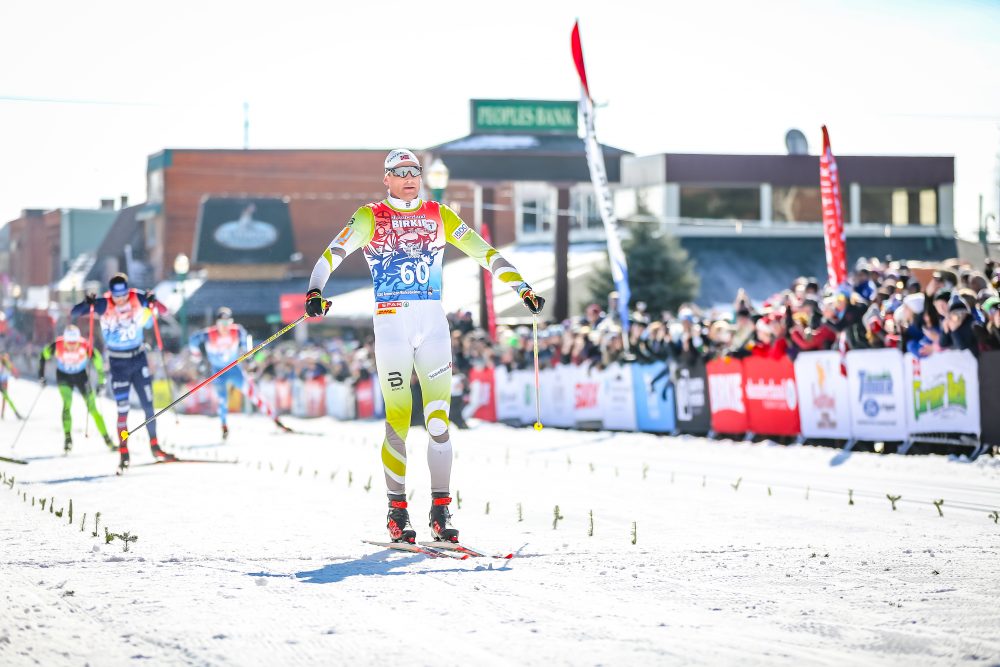
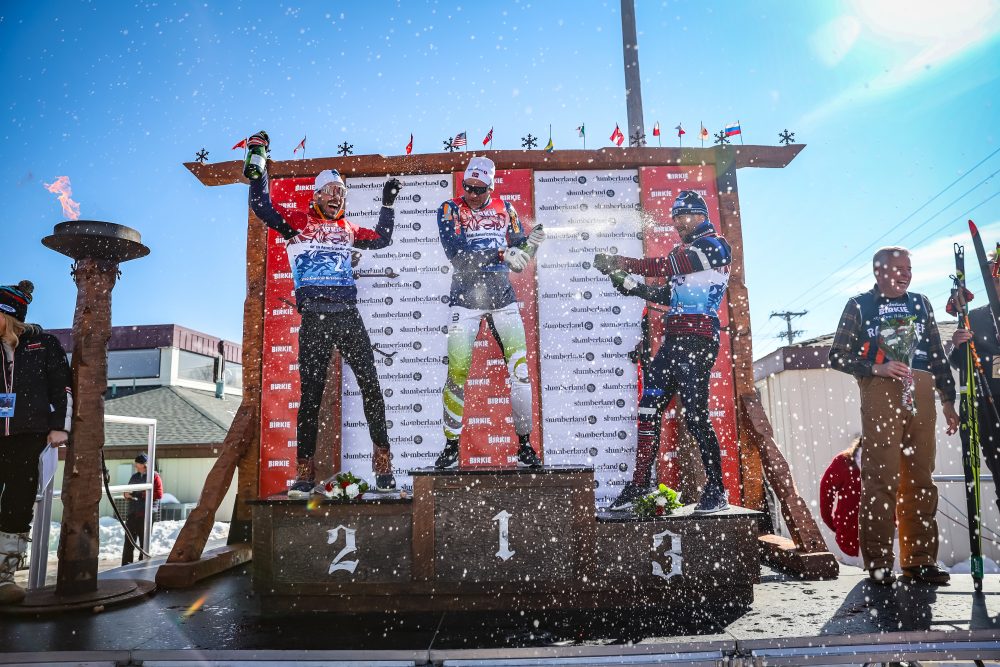
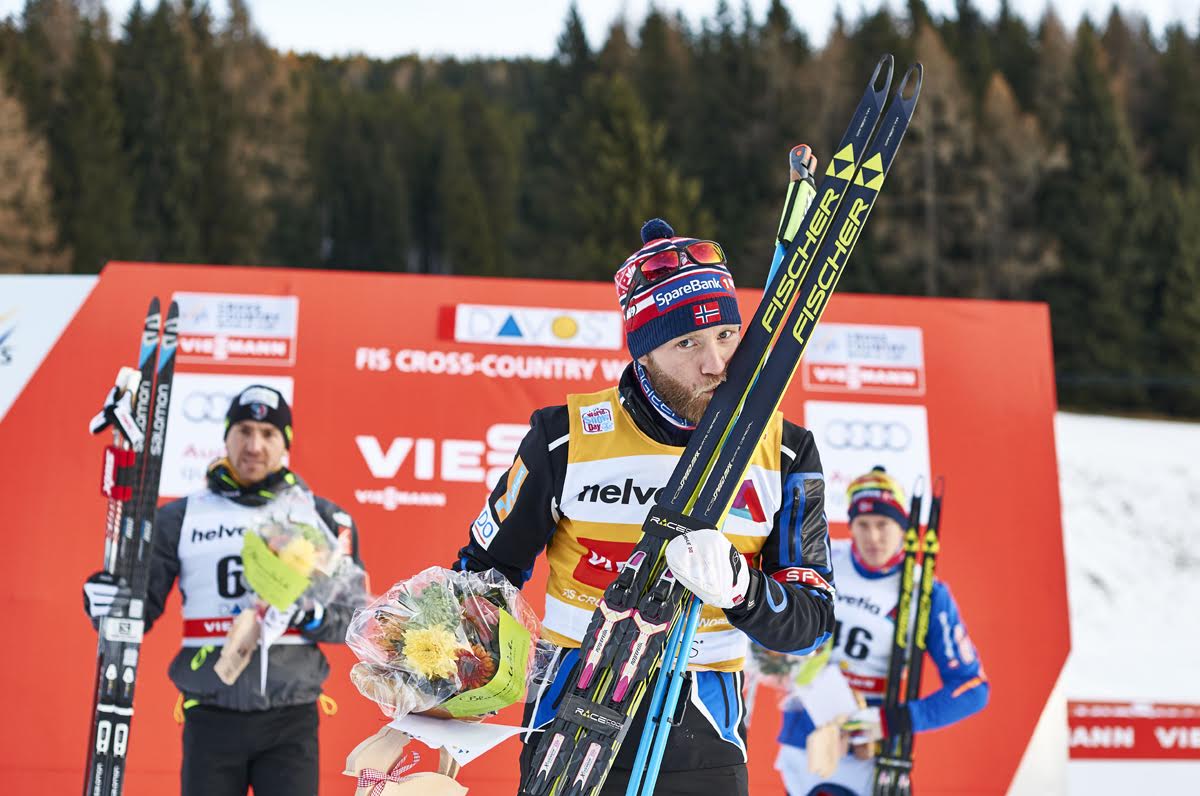
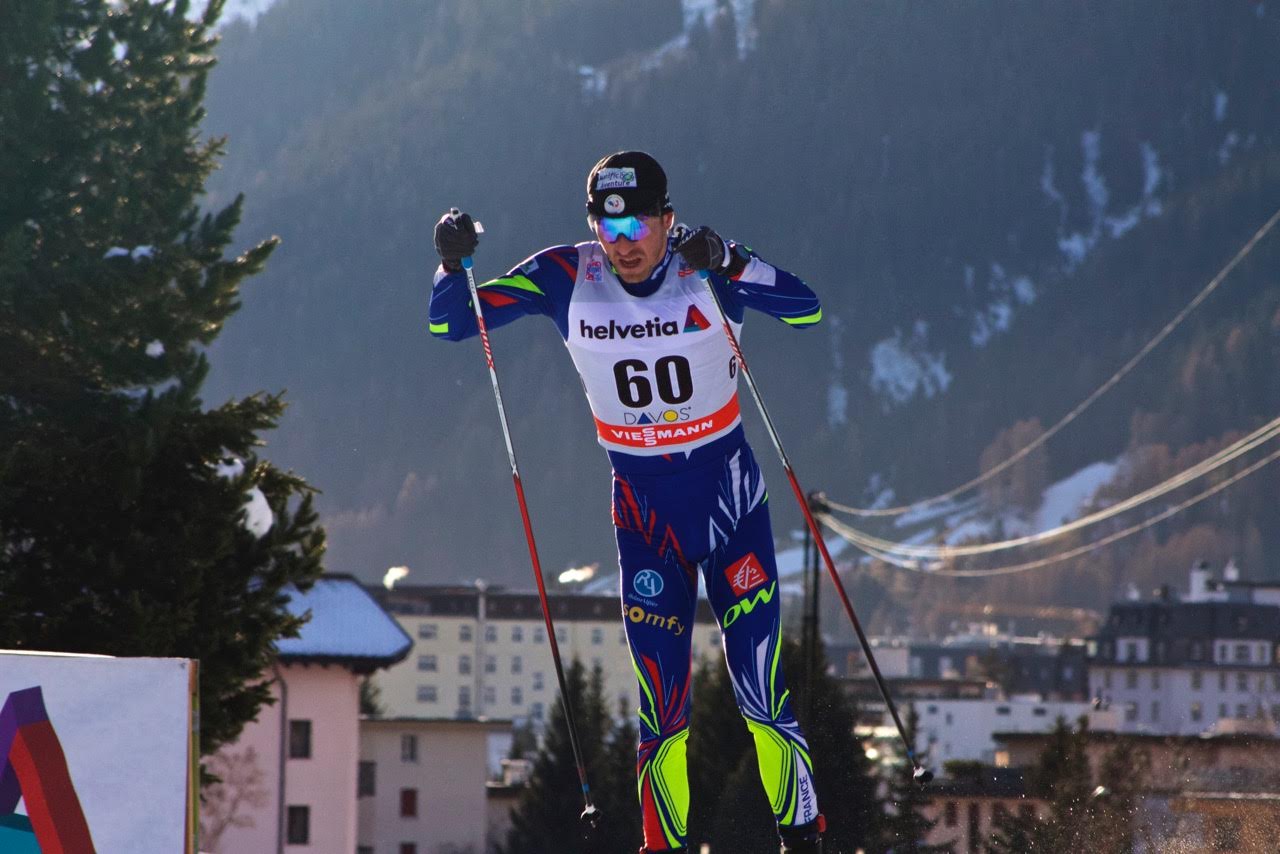
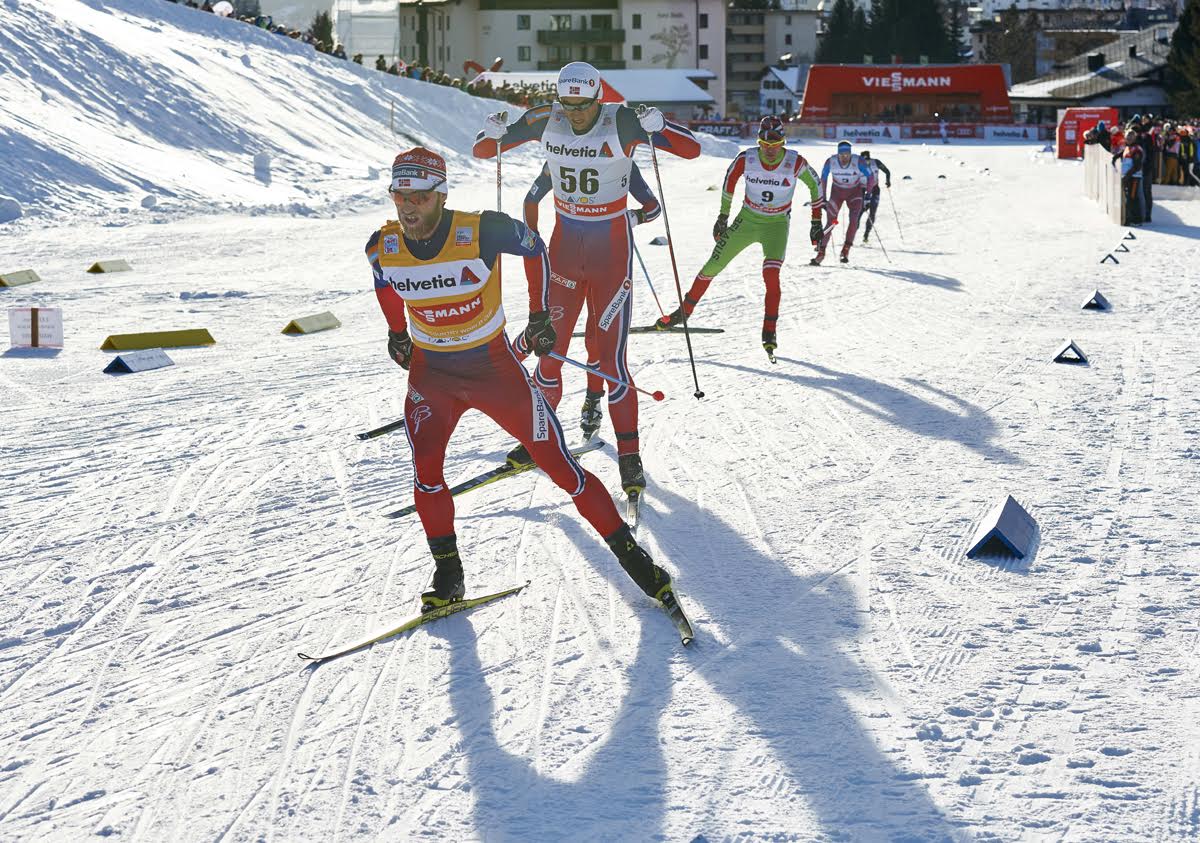
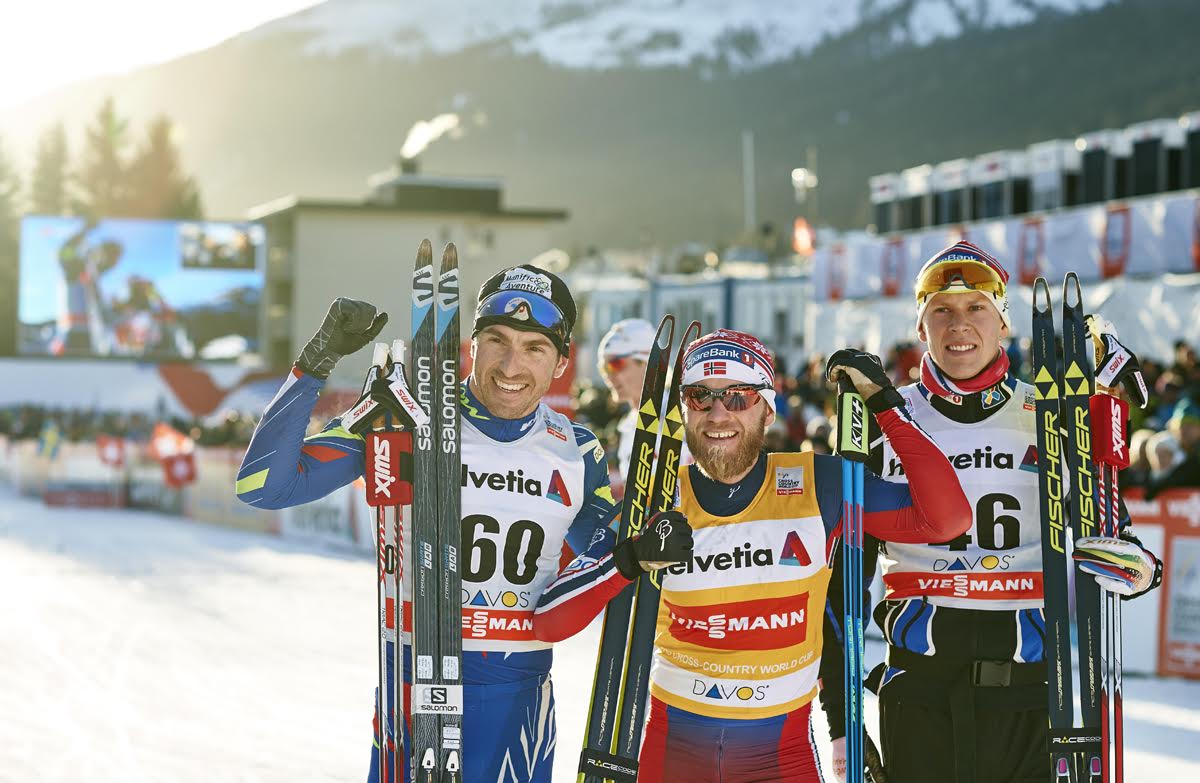
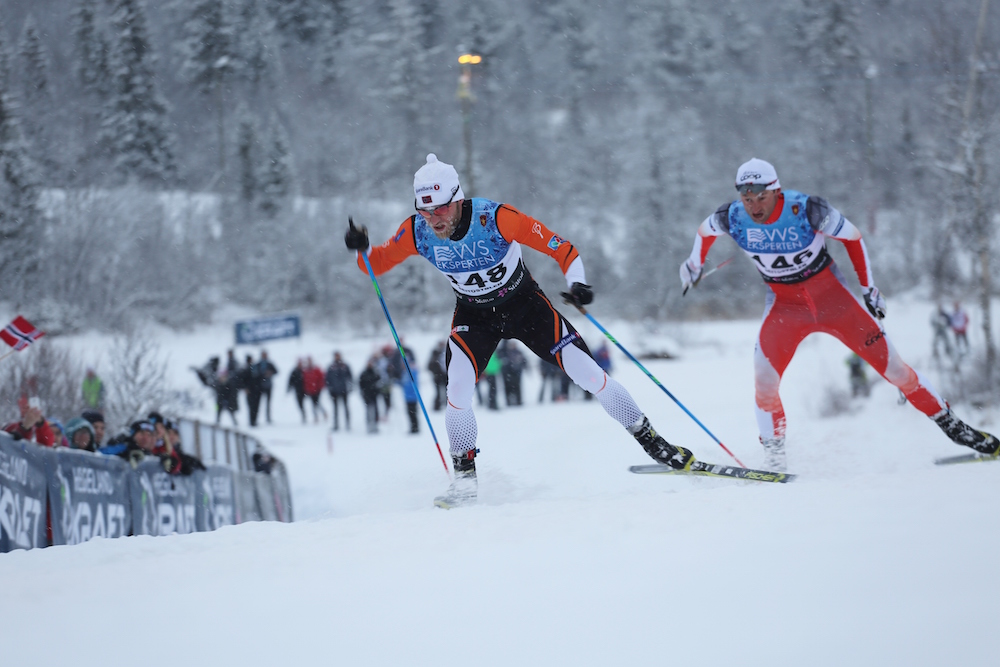
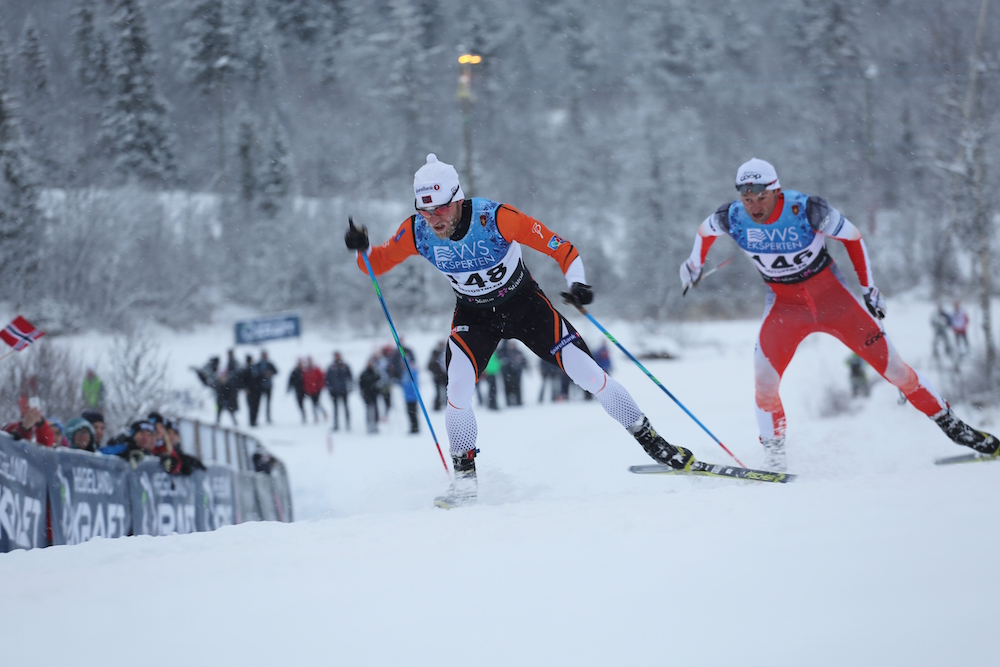
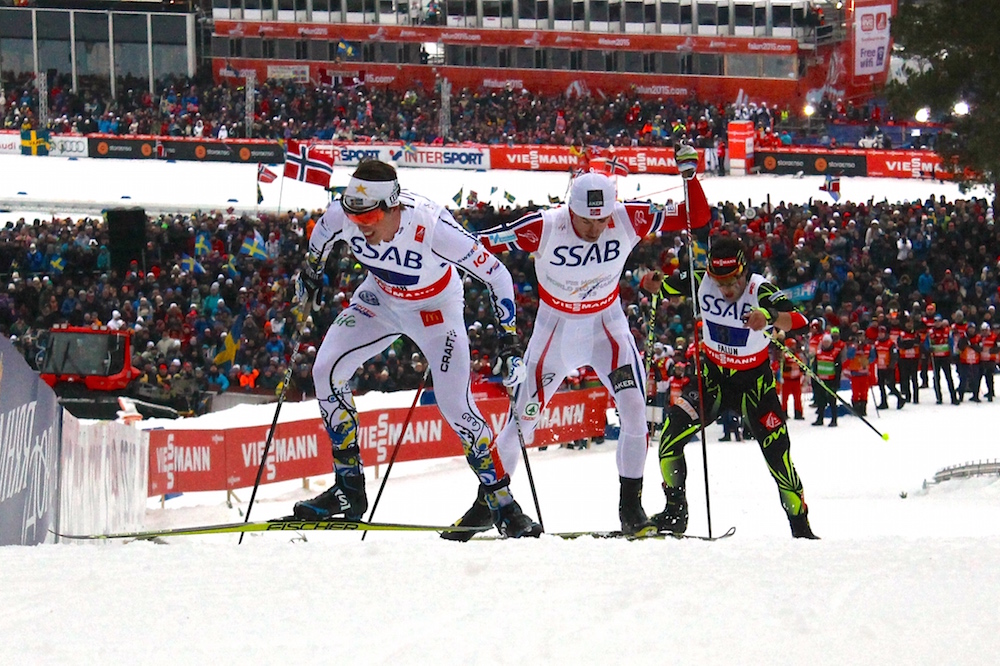
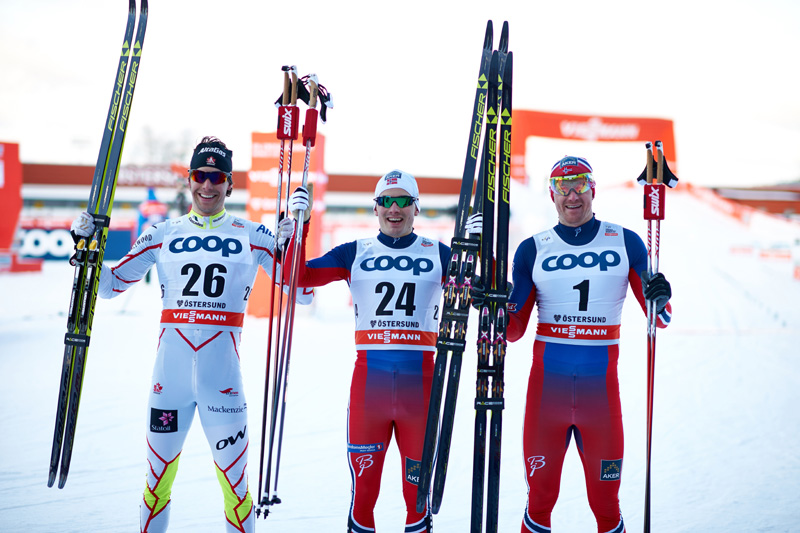
Niklas Dyrhaug, a 32-year-old Norwegian Olympian and former World Cup regular, reached the finish line first on Hayward’s snow-covered Main Street in 1:59:01.7 hours. While he missed the course record of 1:56:58.6 set by Italy’s Fabio Santus in 2010 by just over two minutes, Dyrhaug earned his spot in the Birkie books on Saturday. He held off second-place finisher Ian Torchia, a Minnesota native who trains with the Stratton Mountain School (SMS) T2 Team, by 1.6 seconds and France’s Robin Duvillard, another Olympian and multiple-time World Championships racer, in third by 1.9 seconds.
Wisconsin’s own Adam Martin, who trains with the Craftsbury Green Racing Project, narrowly missed the podium in fourth (+2.7), while Norway’s Anders Gløersen was just behind in fifth (+3.0) and U.S. Ski Team/Alaska Pacific University (APU) member Erik Bjornsen next in sixth (+3.6).
Another Craftsbury racer, Akeo Maifeld-Carucci followed in seventh (+8.0), then France’s Benoit Chauvet in eighth (+12.0). Sam Wood of Idaho placed ninth, 1:42.5 minutes behind the winner with a cumulative time of 2:00:44.2, just ahead of Kyle Bratrud of Minnesota and the SMST2 team in 10th (+1:47.6).
Dyrhaug, who has two World Championship gold medals in the men’s 4 x 10-kilometer relays (in 2015 and 2017), was a Birkie rookie but hardly a surprise winner. In World Cup 50 k classic mass starts in Oslo, Norway, he placed second in 2016 and fifth in 2017. On Wednesday of this week, he placed second in the SuperTour 1.6 k classic-sprint qualifier in Hayward — part of the Birkie Week festivities — finishing 1.07 seconds off the winning time of U.S. Ski Team member Gus Schumacher.
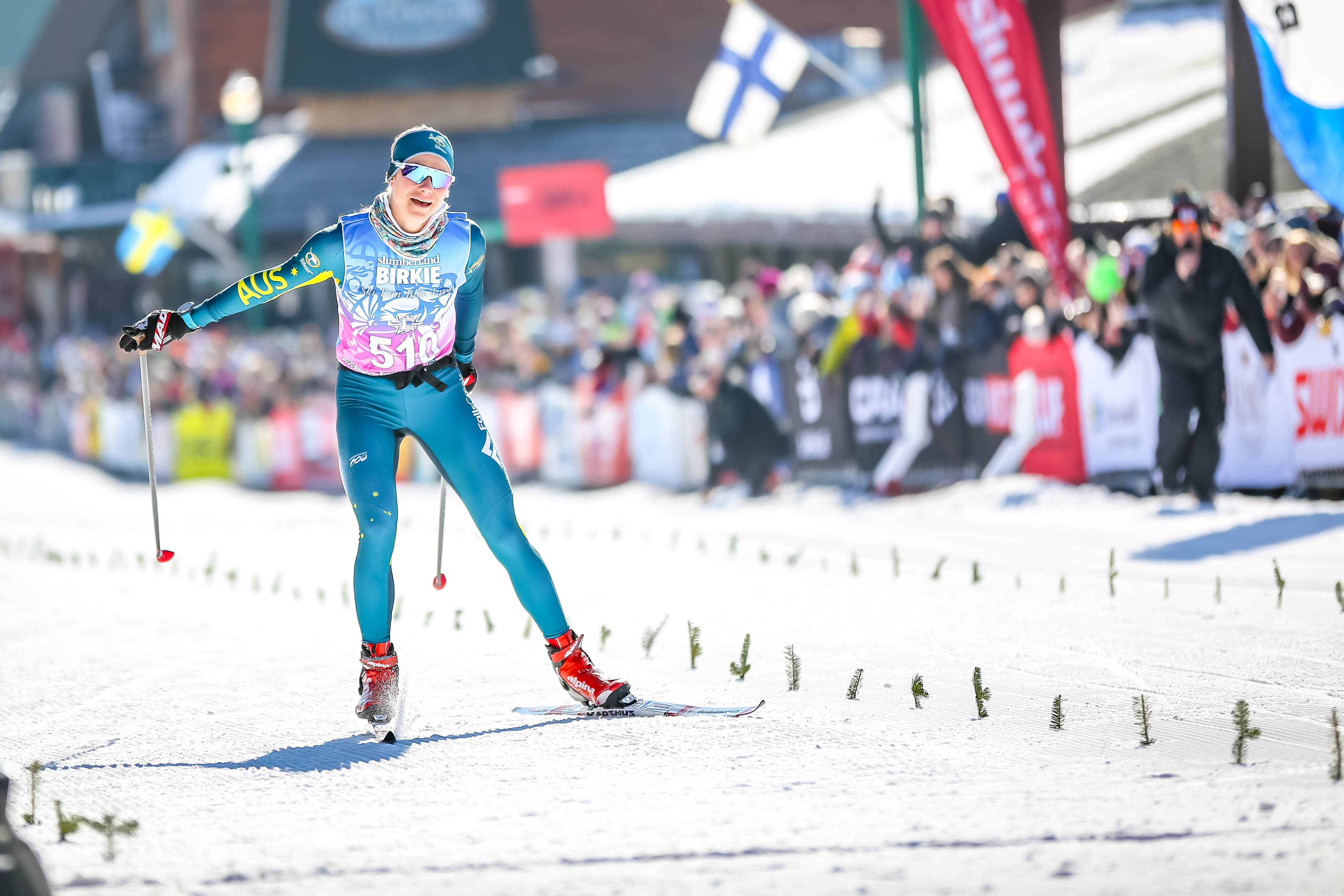
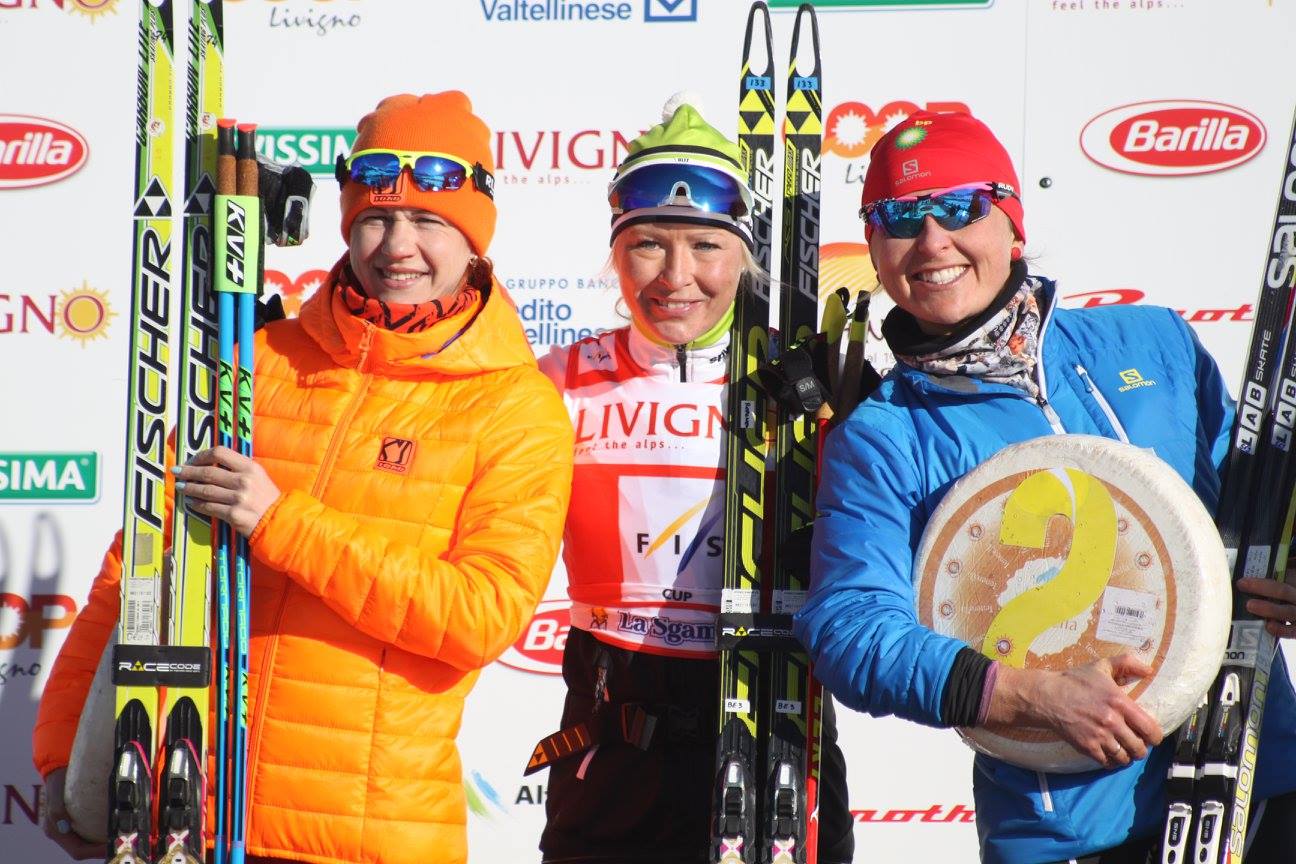
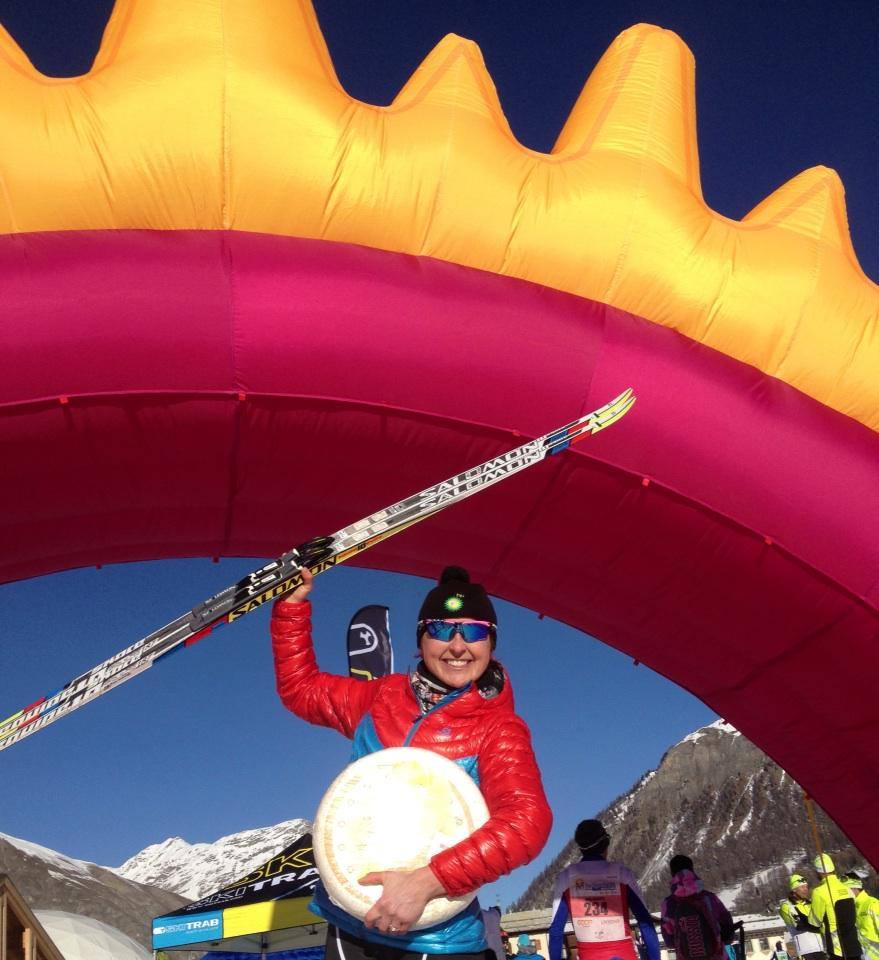
Meanwhile, Jessica Yeaton, who races for Australia and APU, set a new women’s Birkie 50 k skate course record in 2:13.20.6. The 28-year-old Olympian broke Caitlin Gregg’s record of 2:16:07 and placed 67th overall in Saturday’s 50 k skate. Finland’s 41-year-old Riitta-Liisa Roponen, a five-time Olympian who notably placed sixth in the 10 k skate at last year’s World Championships, was the second woman on Saturday, 41.7 seconds behind Yeaton. Former pro racer Erika Flowers, of Montana, placed third, 1:39.4 minutes out of first.
Saturday’s 55 k classic race saw record-setting times from both the winning man and woman, with Peter Holmes of the Sun Valley Ski Education Foundation (SVSEF) defending his 2019 title with a time of 2:26:46, nearly 2 minutes faster than Juergen Uhl’s winning 54 k classic time of 2:28:39.4 in 2010. Holmes won Saturday’s race by nearly 12 minutes, with two Wisconsin skiers — Chris Pappathopoulos (+11:52.4) and Evan Wetzel (+11:54.3) — following in second and third place, respectively.
Wisconsin native Nichole Bathe, who trains in Norway and skis for the British national team, became the new women’s 55 k classic champion in a blistering 2:49:47.0. She beat out Jennie Bender’s 2011 Birkie classic record of 2:50:53 and finished more than five minutes ahead of Colorado runner-up Anja Gruber (+5:33.3) on Saturday. Wisconsin’s Delaney Fitzpatrick finished in just over 3 hours for third place, about 11 minutes behind Bathe.
While we covered who’s still skiing — casually, recreationally, backcountry, basically anything other than full-on training — last week, the start of May marks the beginning of a new season for year-round skiers. And with the first few days of May have come some training pics via social media. Here’s a roundup of some that caught our eye on Instagram:
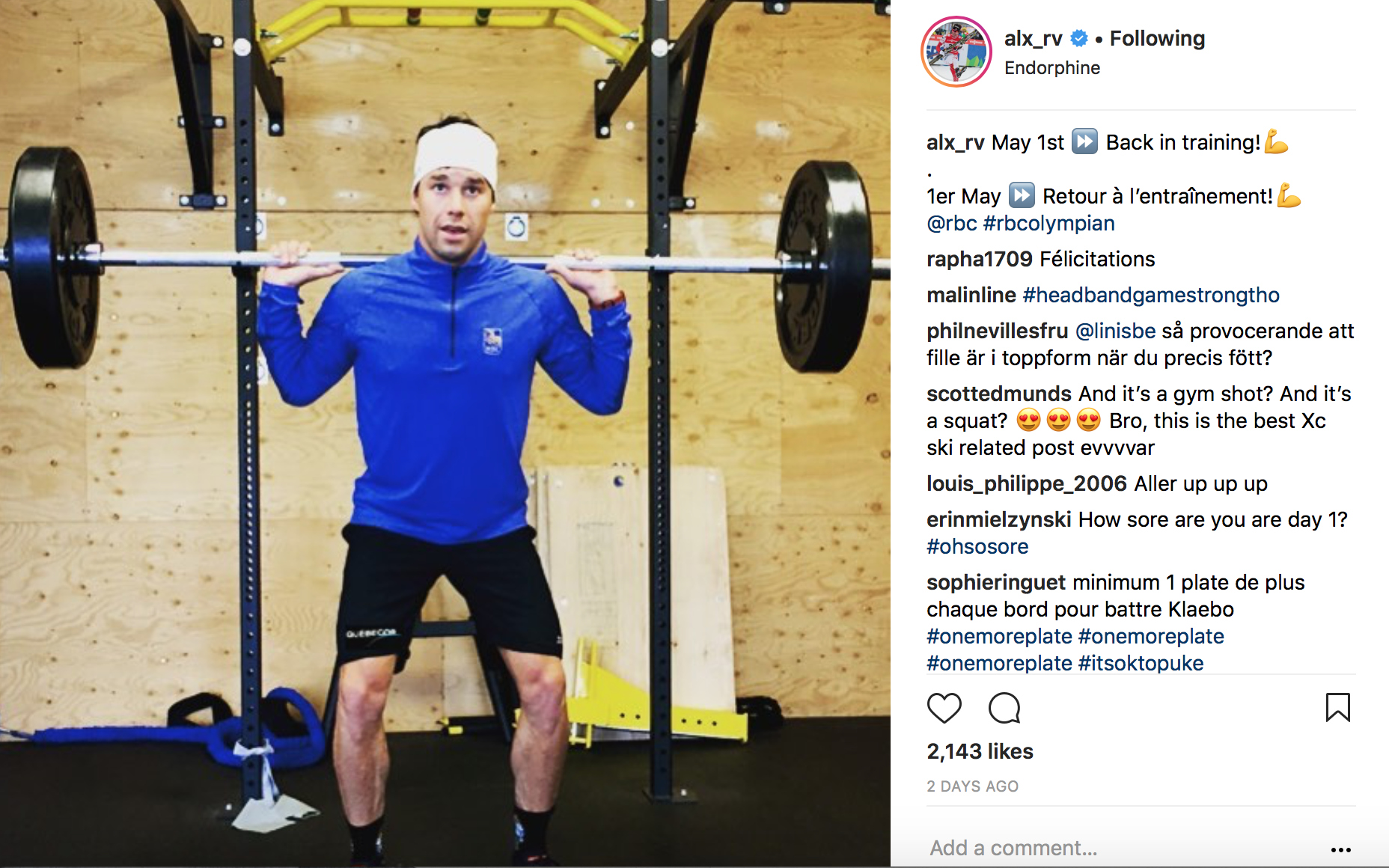
Alex Harvey:
Alex Harvey hitting the weights hard: “May 1st ⏩ Back in training!💪”
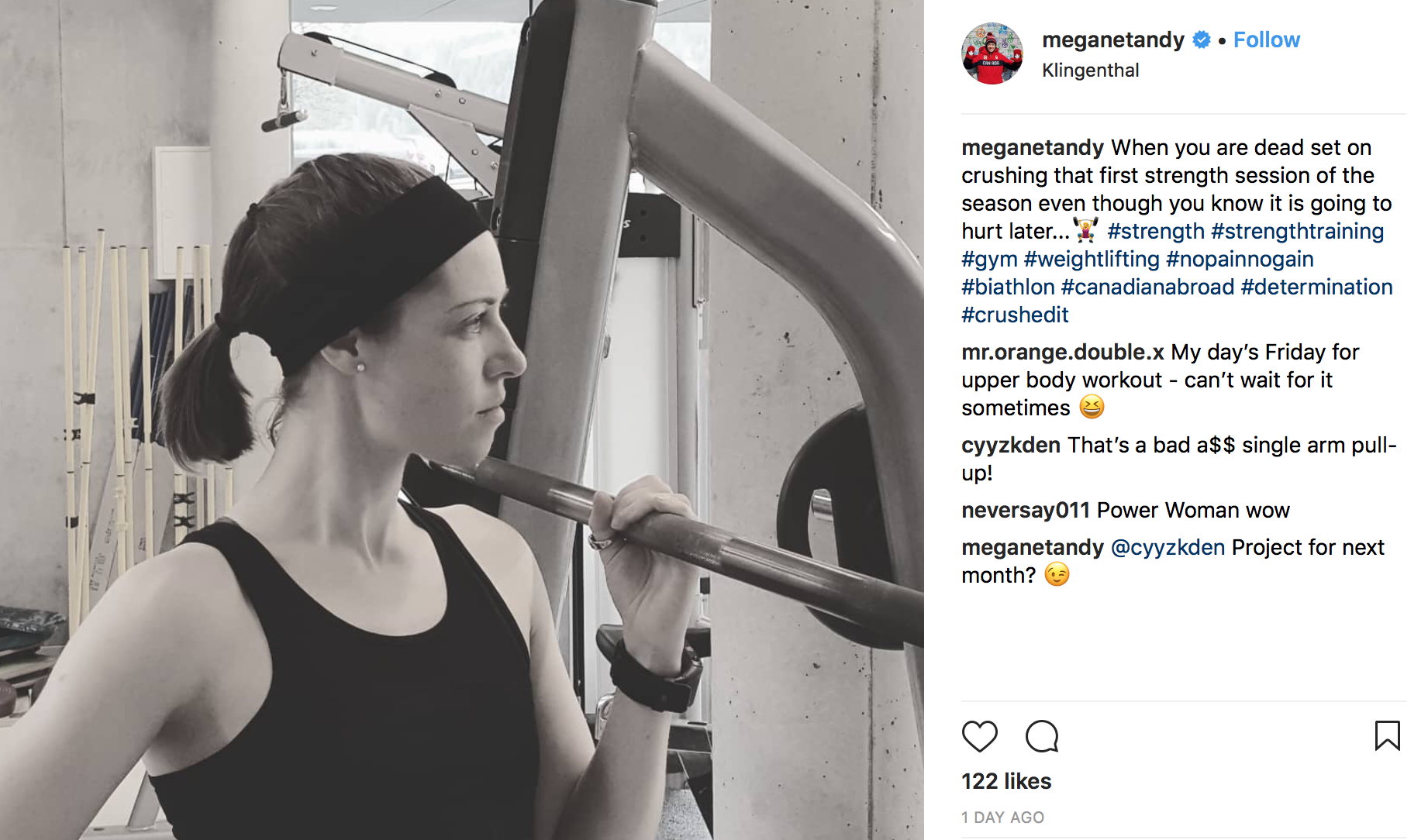
Megan Tandy:
Another determined Canadian athlete in the gym: biathlete Megan Tandy at her training base in Klingenthal, Germany.
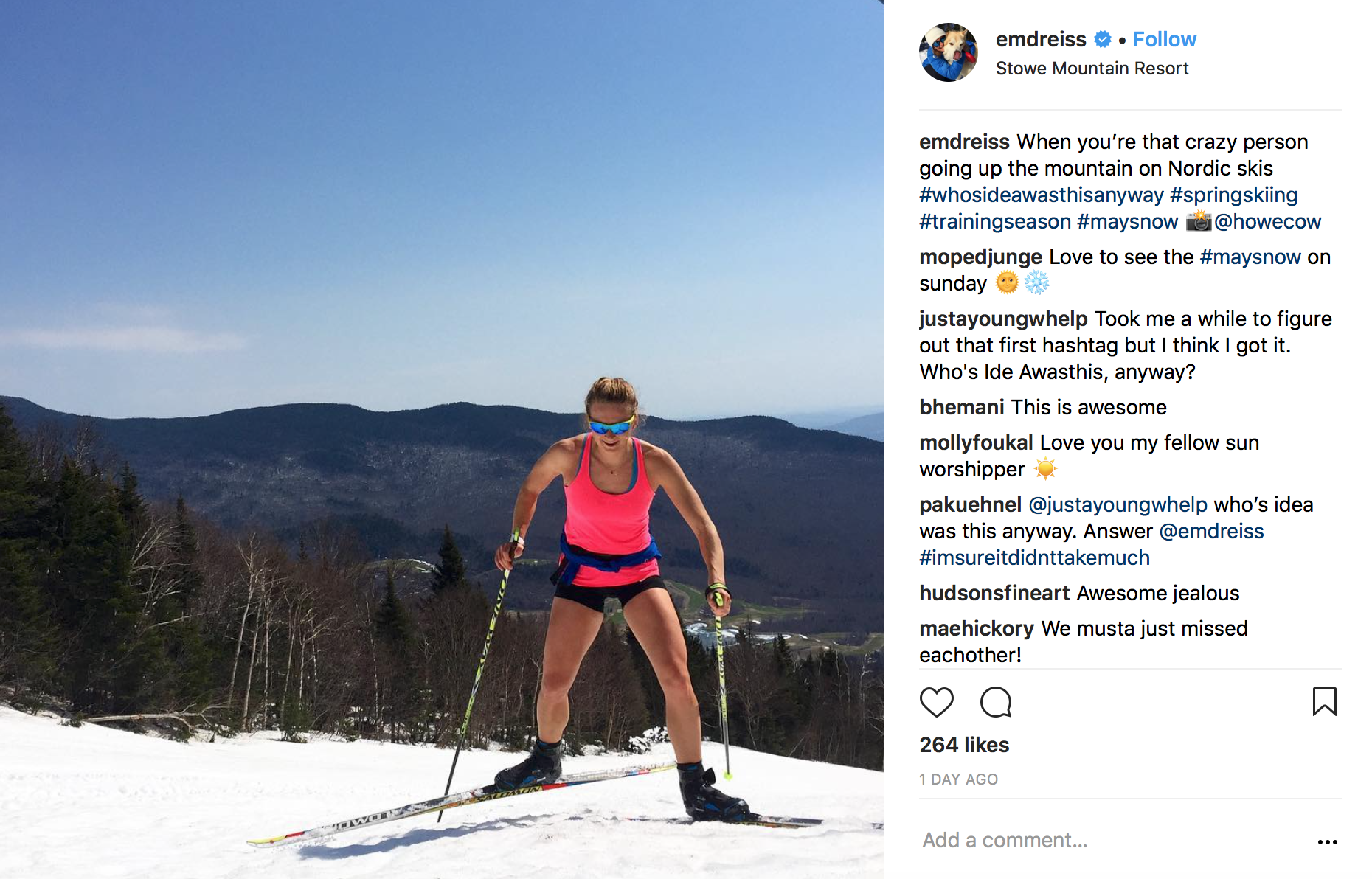
Emily Dreissigacker:
Newly minted US Biathlon High-Performance Team member Emily Dreissigacker skied up Stowe Mountain in Vermont on May 2.
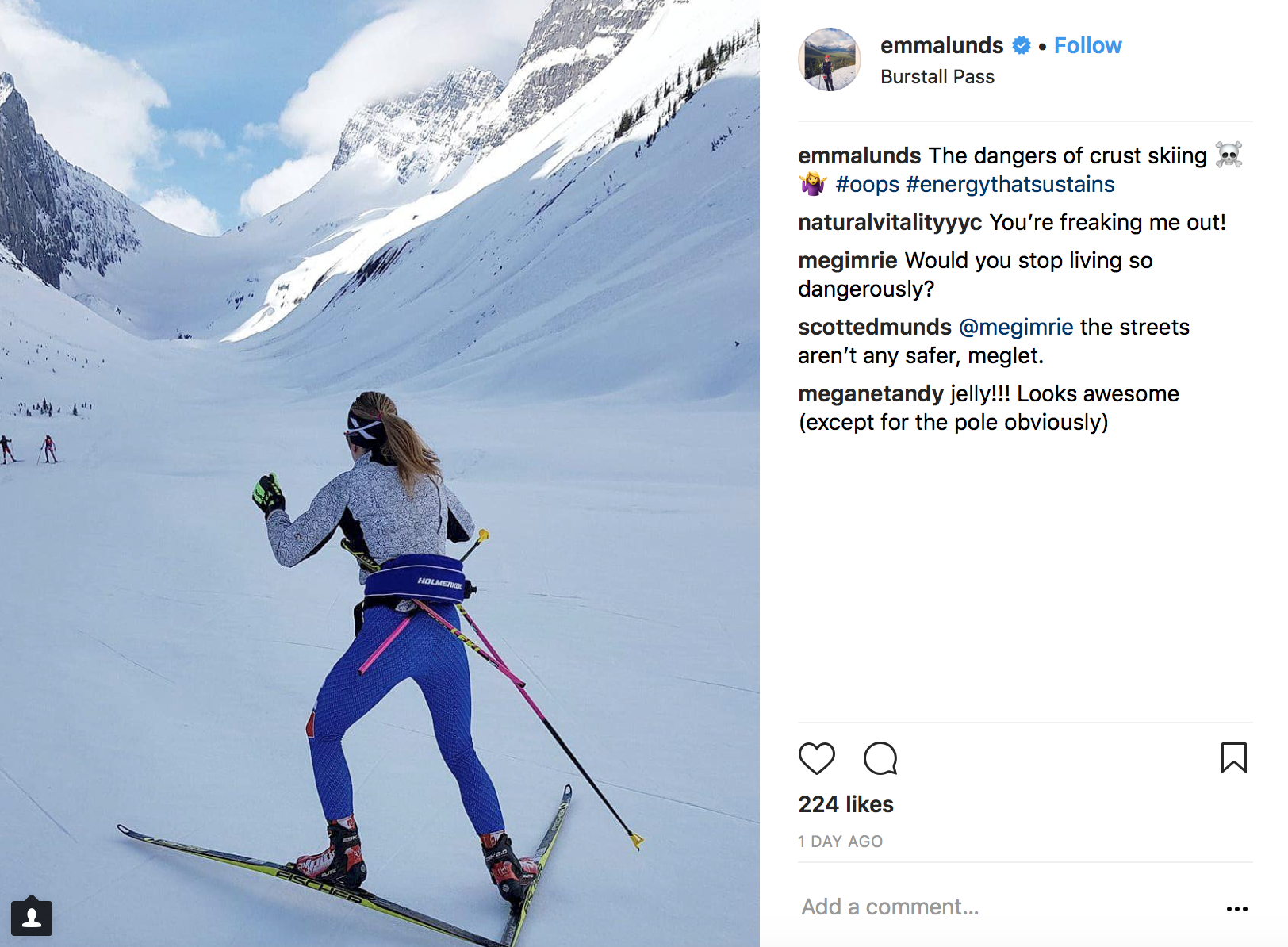
Emma Lunder:
Meanwhile near Canmore, Alberta, Canadian biathlete Emma Lunder broke a pole while crust skiing at Burstall Pass.
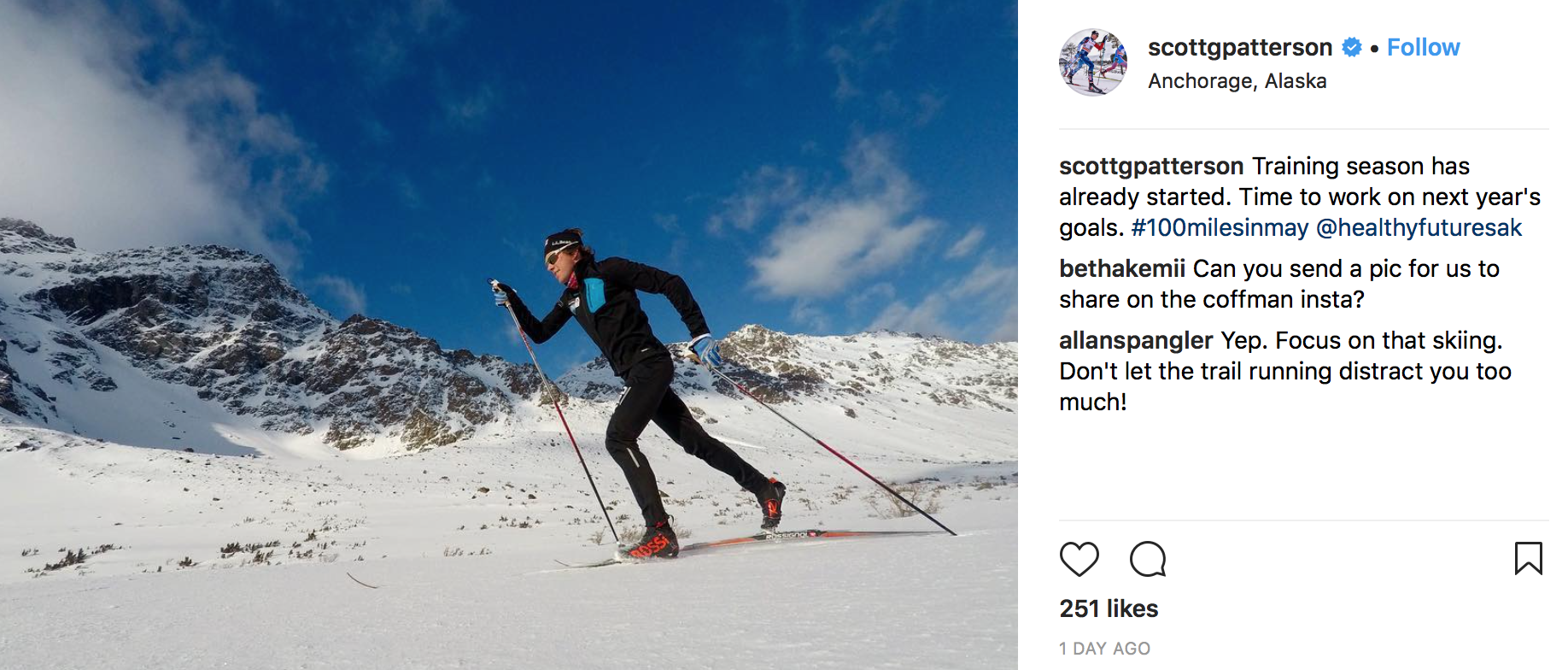
Scott Patterson:
Looks like Alaska Pacific University skier and U.S. Ski Team member Scott Patterson is ready to go the distance, specifically 100 miles in May.
Sadie Bjornsen:
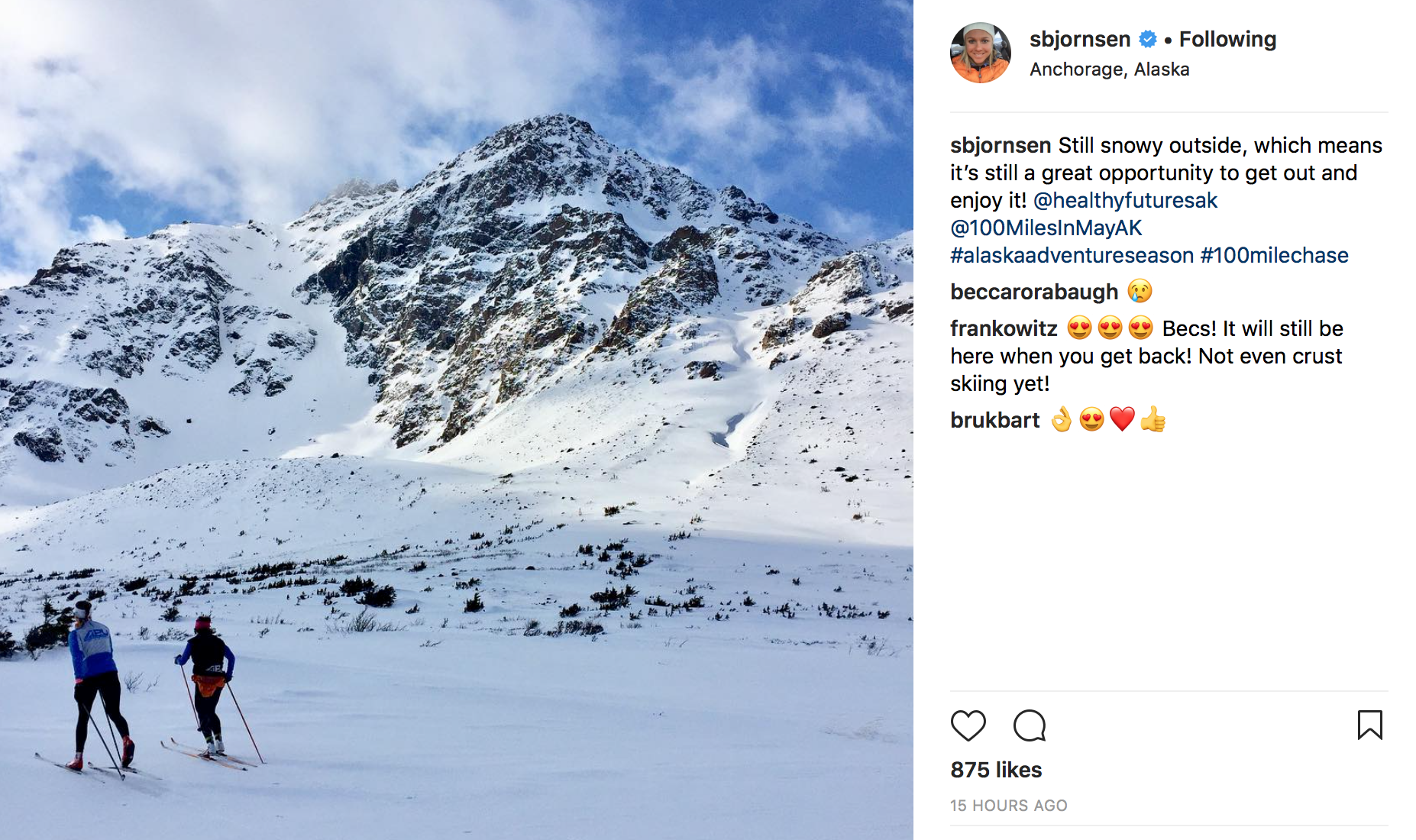
Scott Patterson isn’t the only one with a 100-mile goal for this month. His APU and U.S. Ski Team teammate Sadie Bjornsen is right there with him, getting out on snow in Anchorage, Alaska.
Erik Bjornsen:
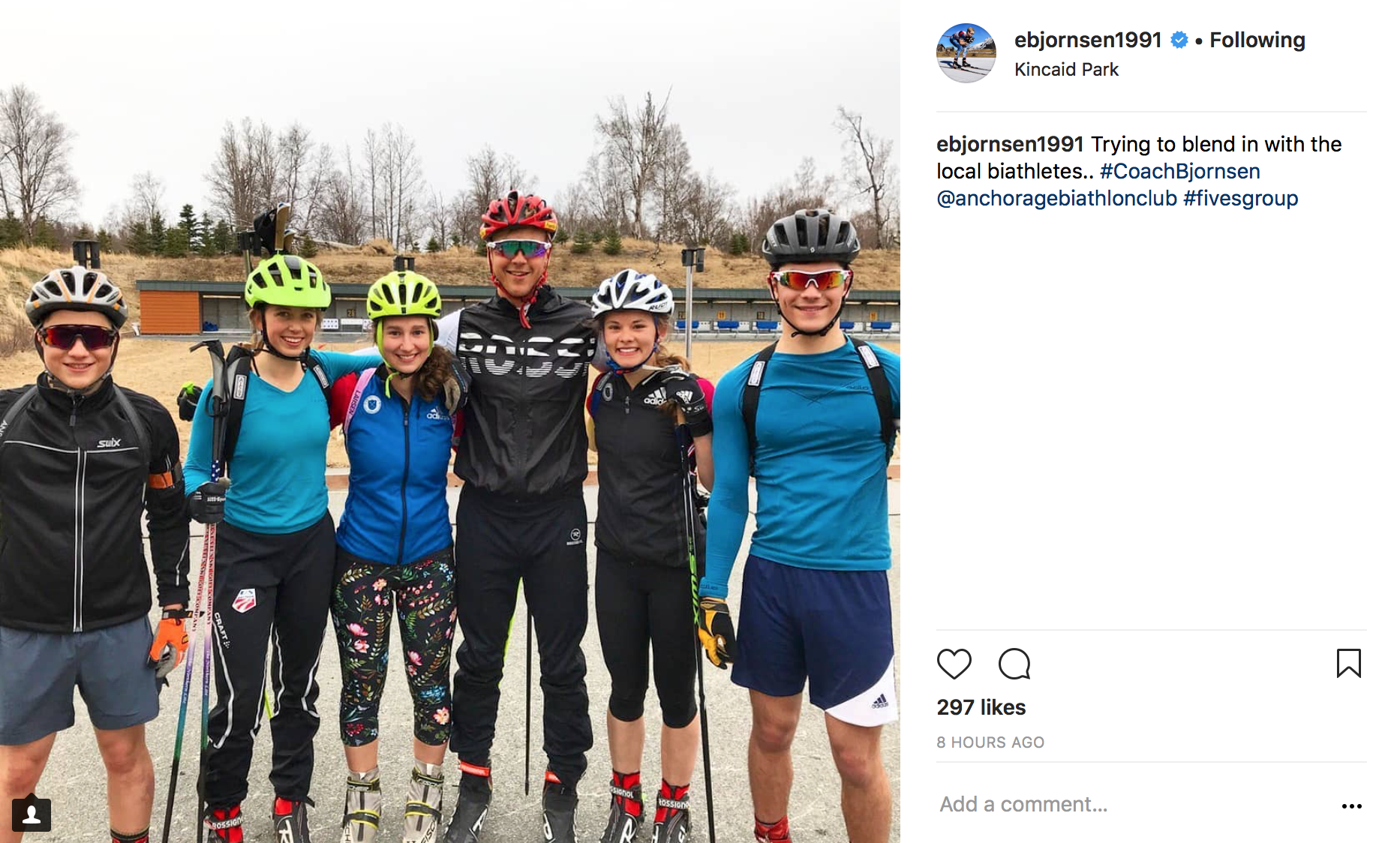
Speaking of the Bjornsens, Erik (c) got some ski-specific training in yesterday as a substitute coach for the Anchorage Biathlon Club at Kincaid Park in Anchorage.
Johannes Høsflot Klæbo and Eirik Brandsdal:
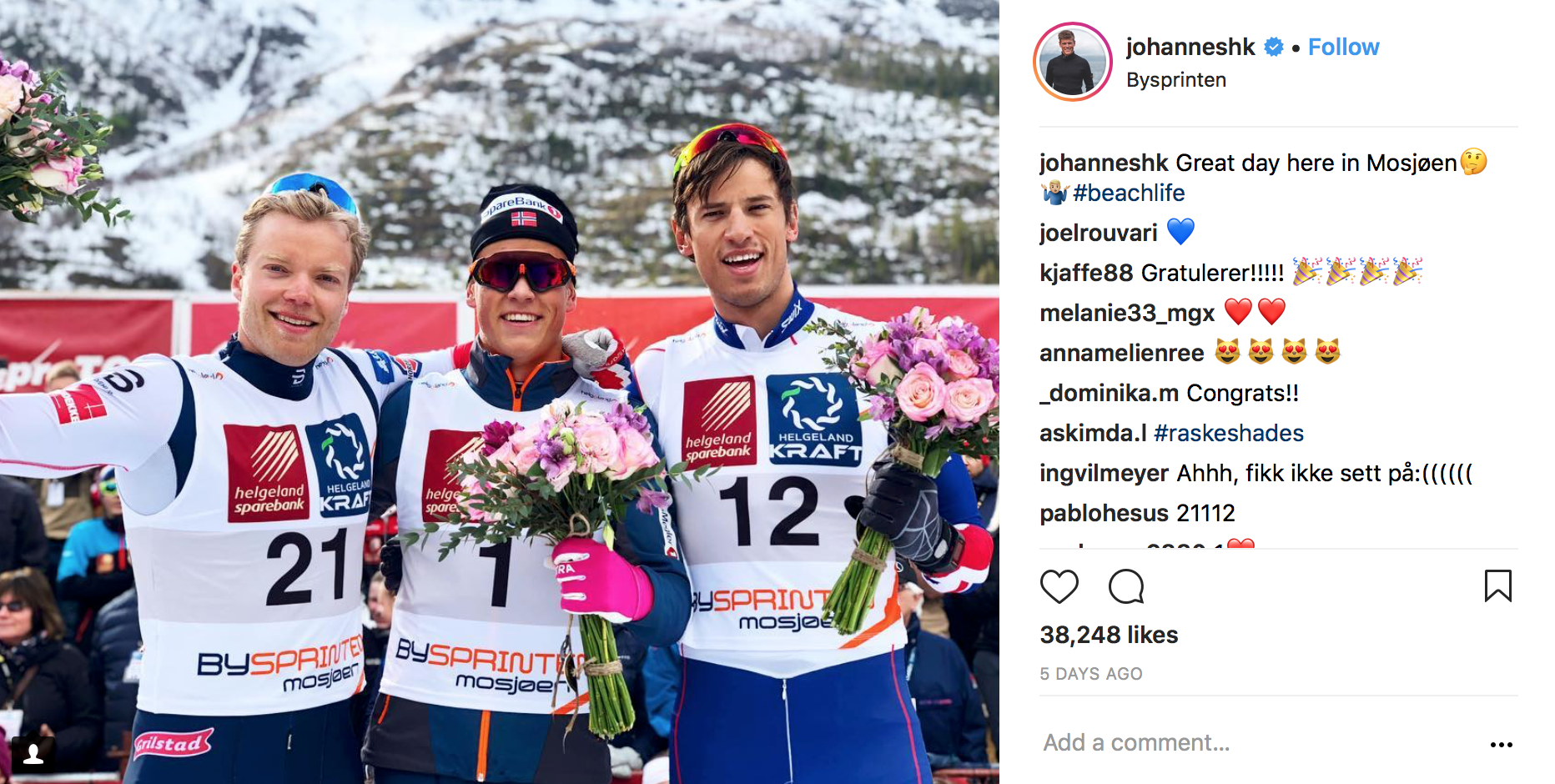
Norway’s Johannes Høsflot Klæbo (c) and Eirik Brandsdal (l) were still racing (and reaching the podium) last weekend at Bysprinten in Mosjøen, Norway.
Krista Pärmäkoski:
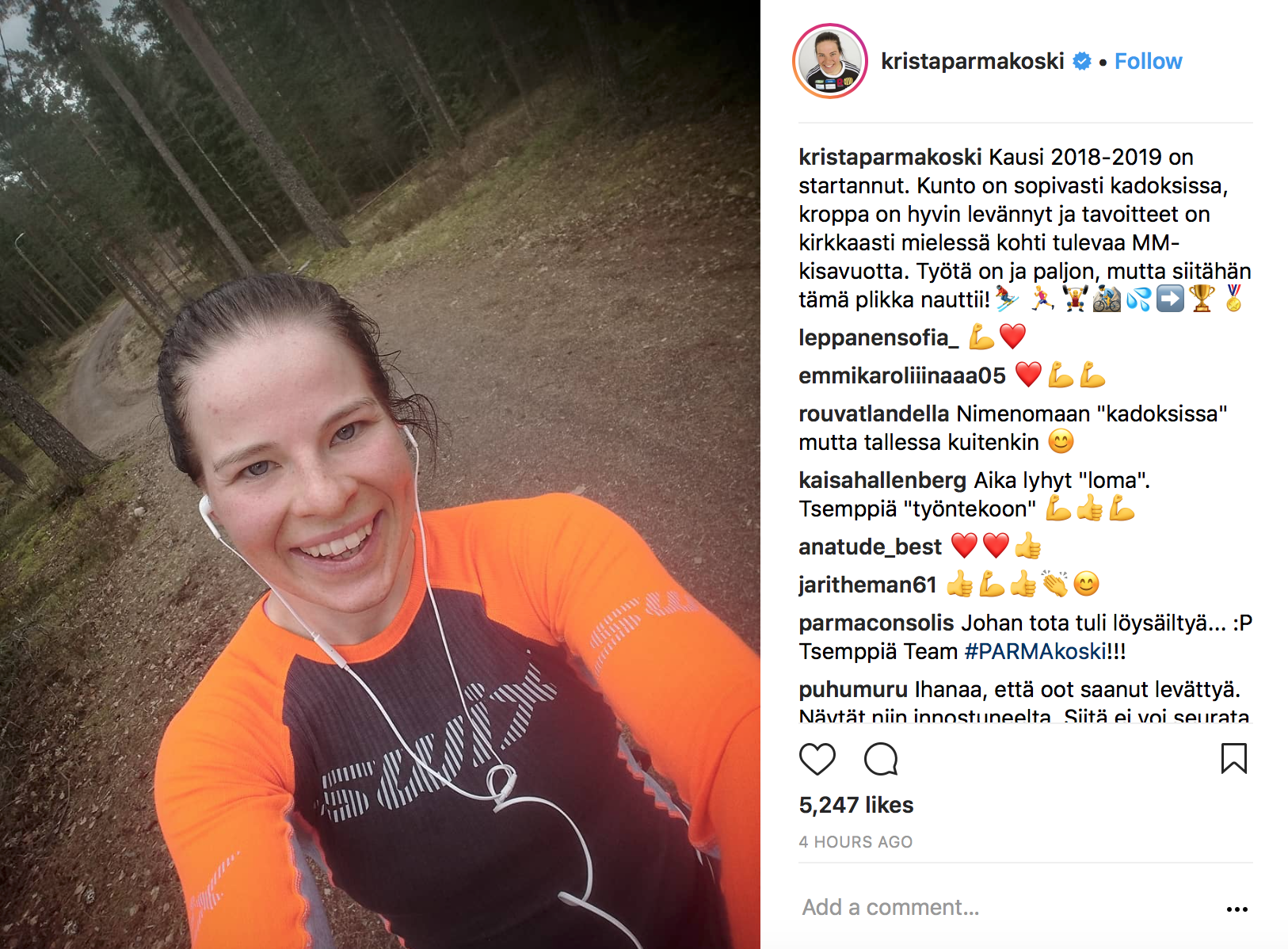
Finland’s Krista Pärmäkoski was all smiles while listening to some tunes during a recent dryland workout. She wrote about the start of the new season and being well-rested and focused on her World Cup goals. “There is work and a lot, but that’s what this is about.”
Dario Cologna:
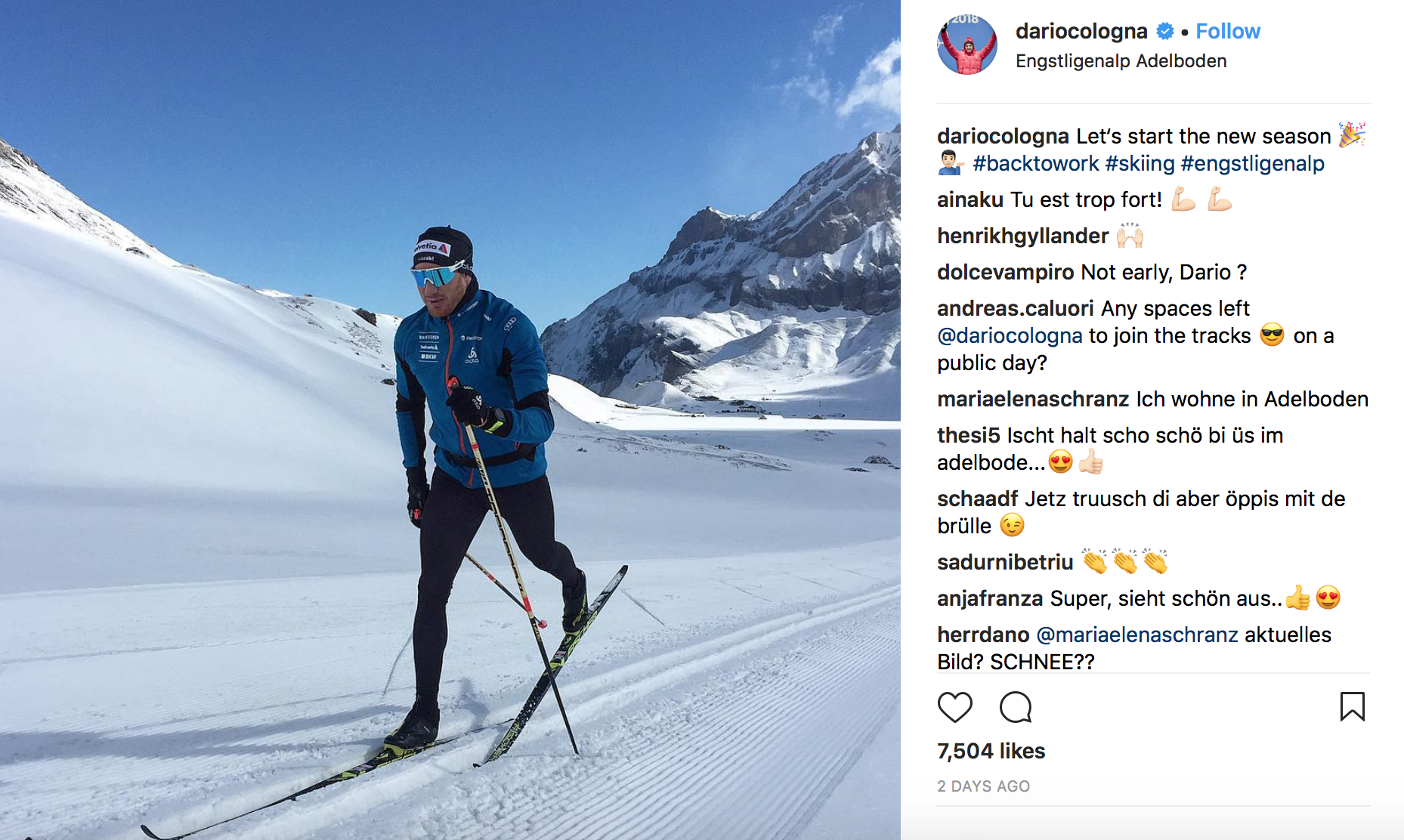
Swiss superstar Dario Cologna is “back to work,” according to one hashtag in this May 2 post, where he’s seen skiing on the Engstligenalp plateau in the Swiss Alps. “Let‘s start the new season,” he wrote.
Laurien van der Graaff:
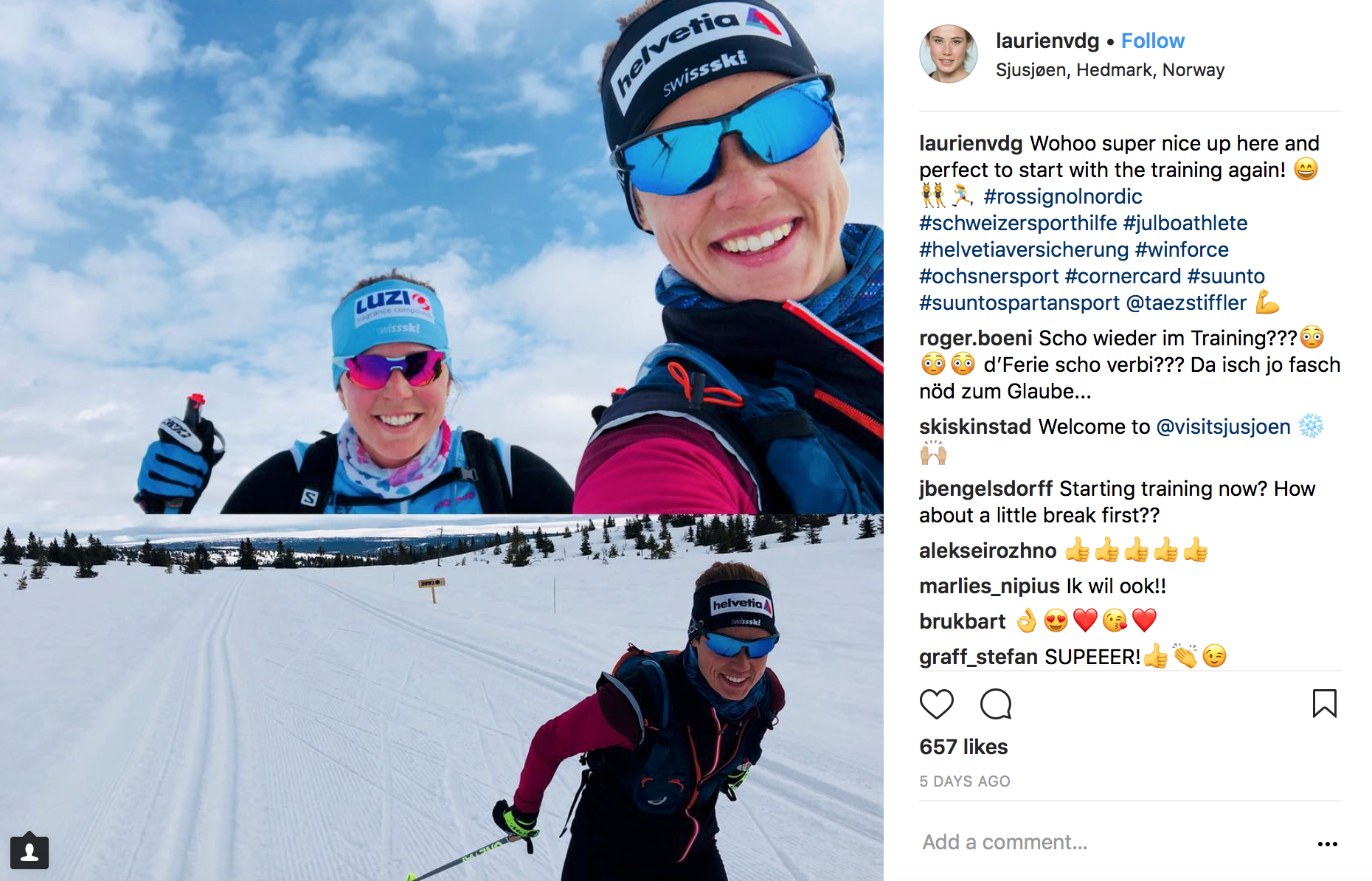
Another Swiss skier Laurien van def Graaff (bottom and top right) is back at it in Sjusjøen, Norway.
Charlotte Kalla:
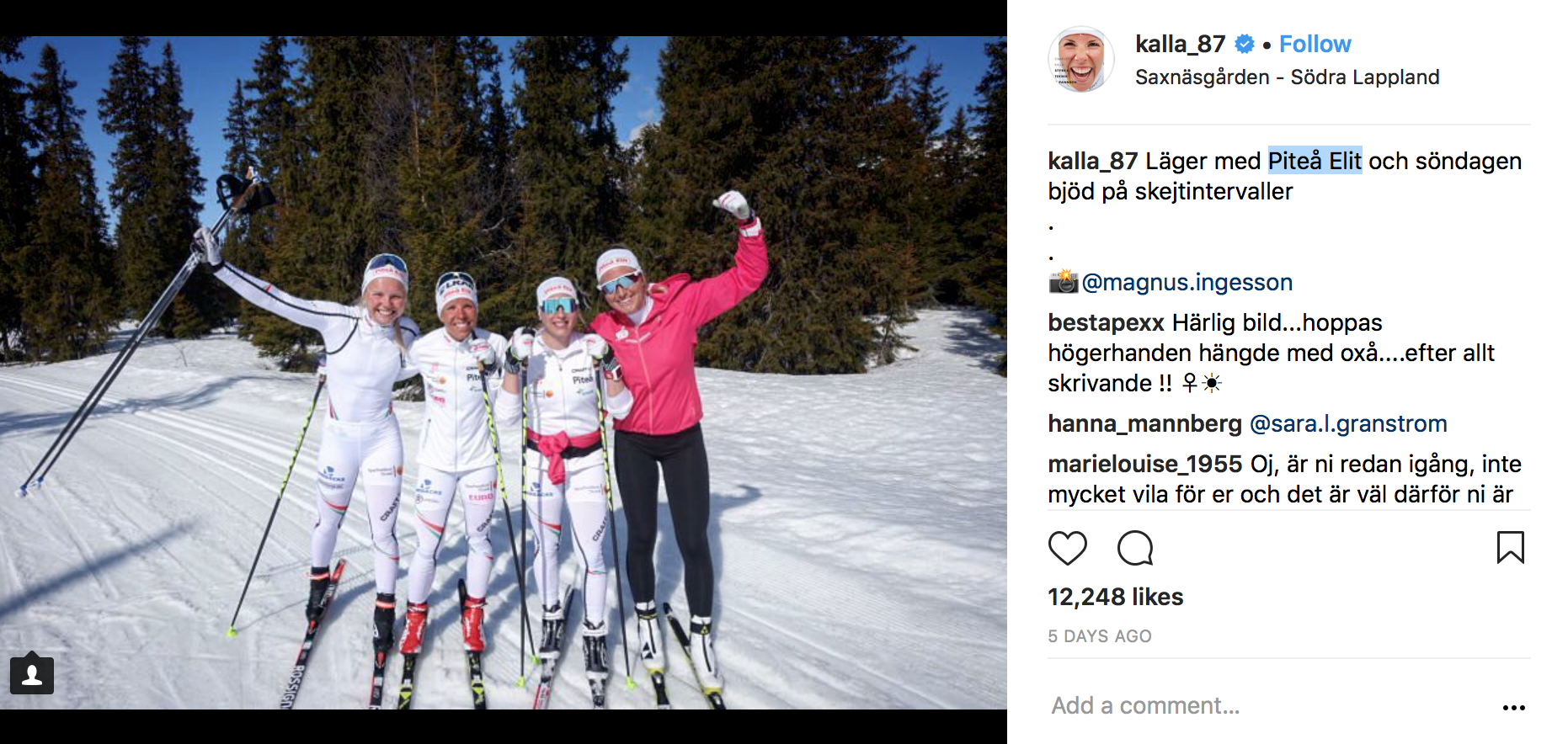
Sweden’s Charlotte Kalla (second from right) hasn’t wasted any time getting back on snow as evidenced by this photo she took with her Piteå Elit Ski Club teammates on Sunday in Finland’s Southern Lapland region.
Therese Johaug:
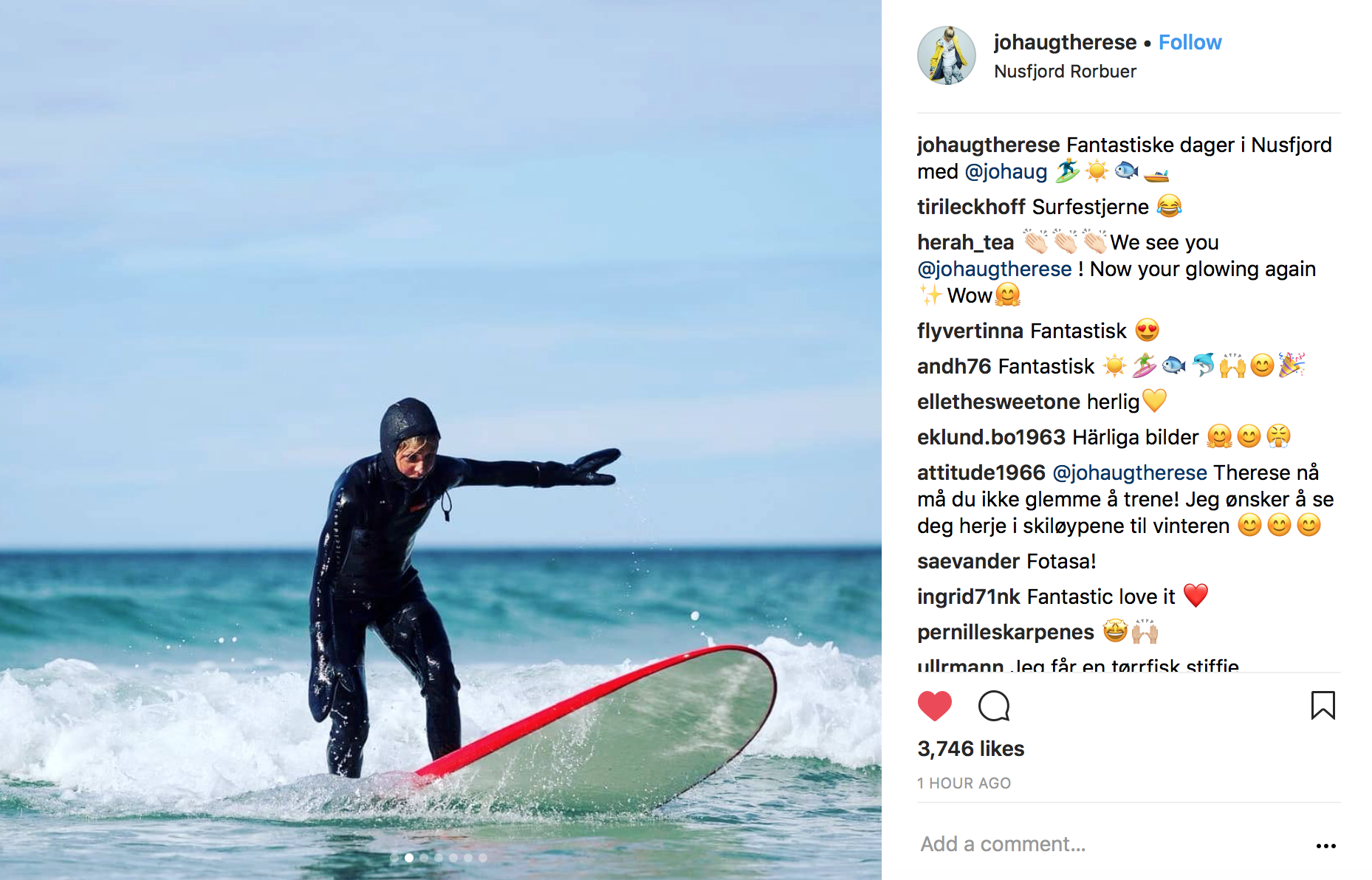
Looks like Therese Johaug has been logging some cold-water surf sessions on the Lofoten archipelago in northern Norway, as well as some fishing.
Martin Fourcade:
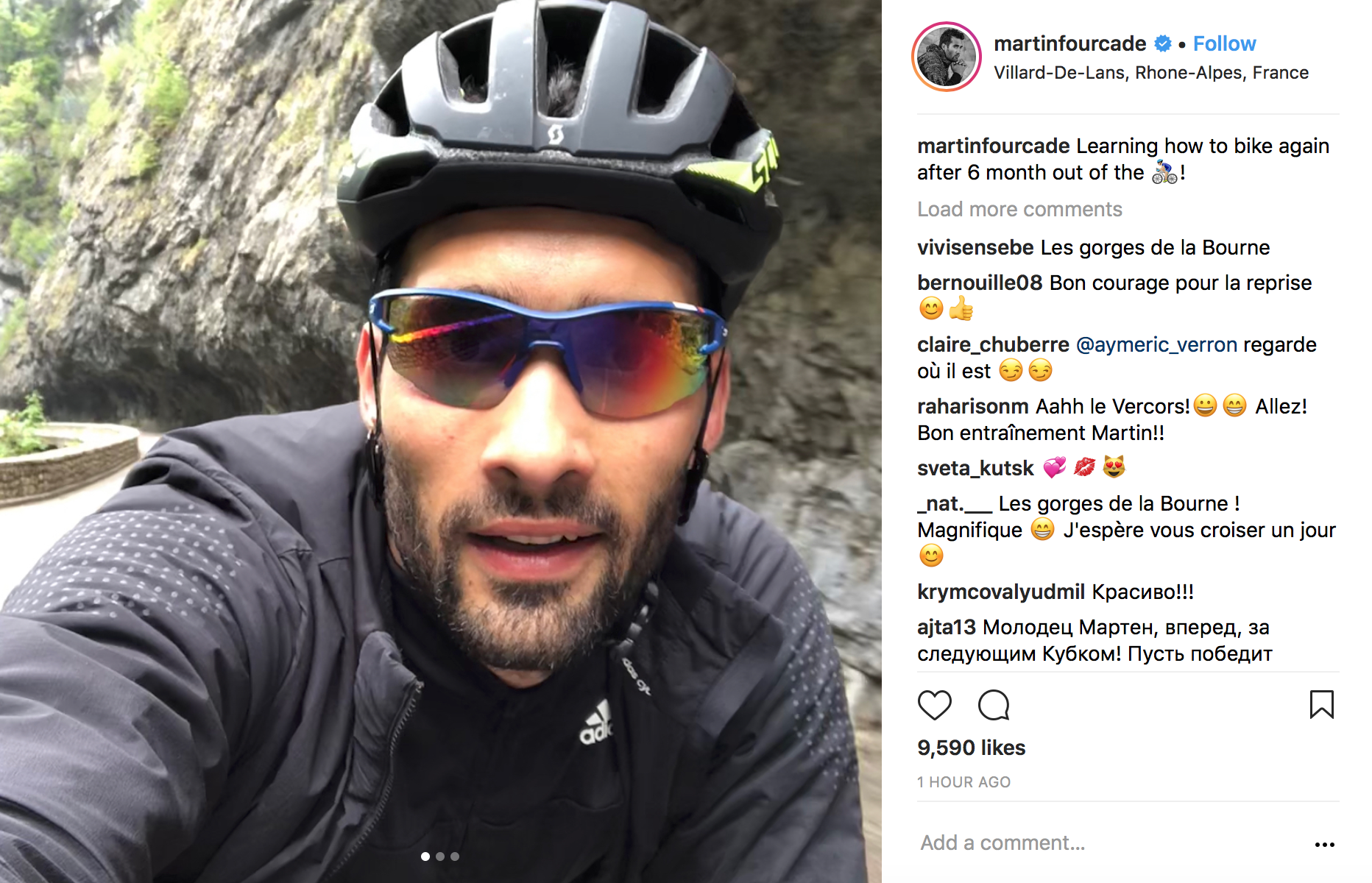
France’s defending IBU World Cup champ Martin Fourcade has been cross-training and logging some long-lost time in the saddle.
Franziska Preuss:
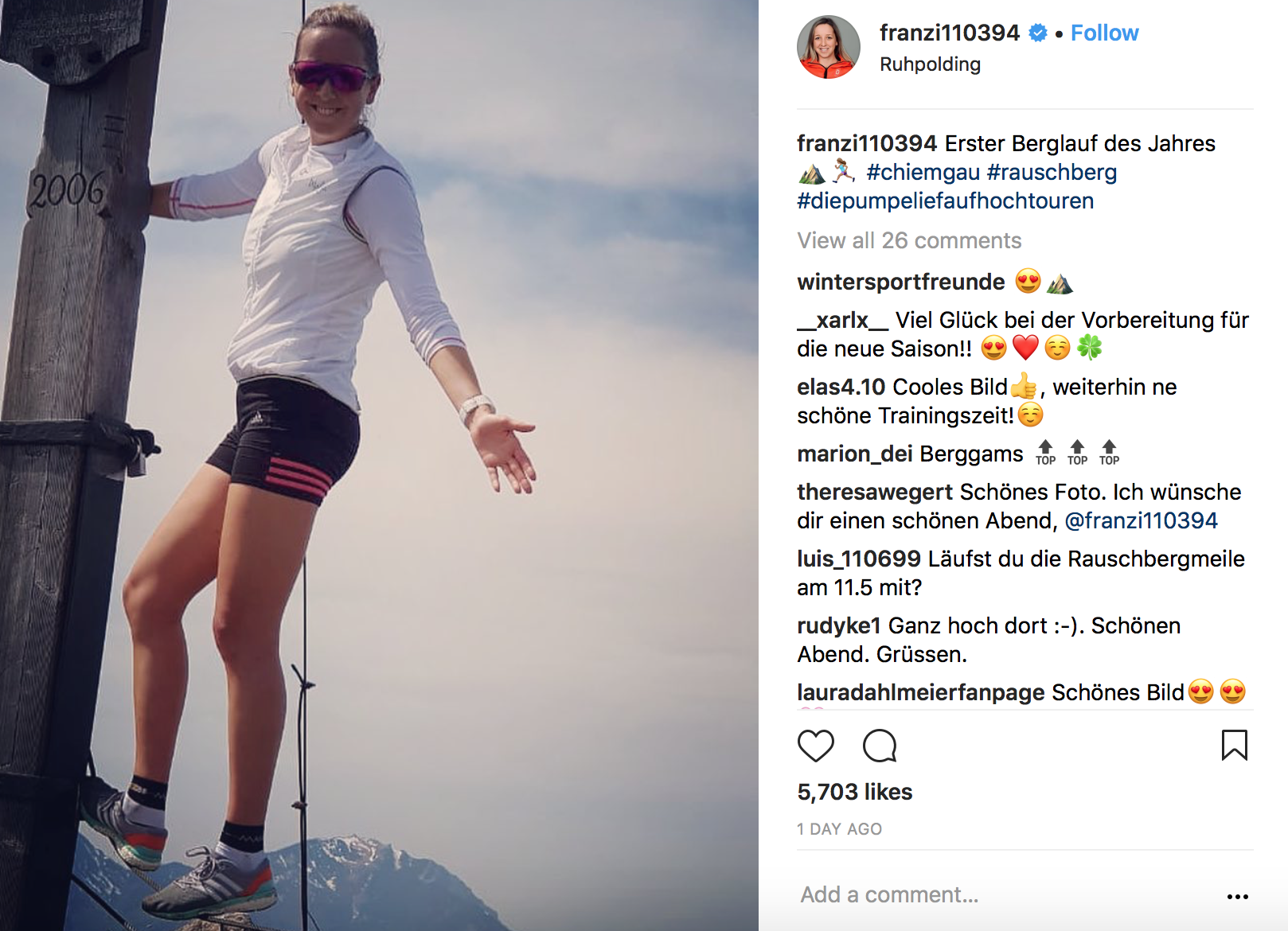
German biathlete Franziska Preuß (or Preuss) documented her “First mountain run of the new year” in Ruhpolding, Germany. And look, she’s higher than the mountains.
Leif Nordgren:
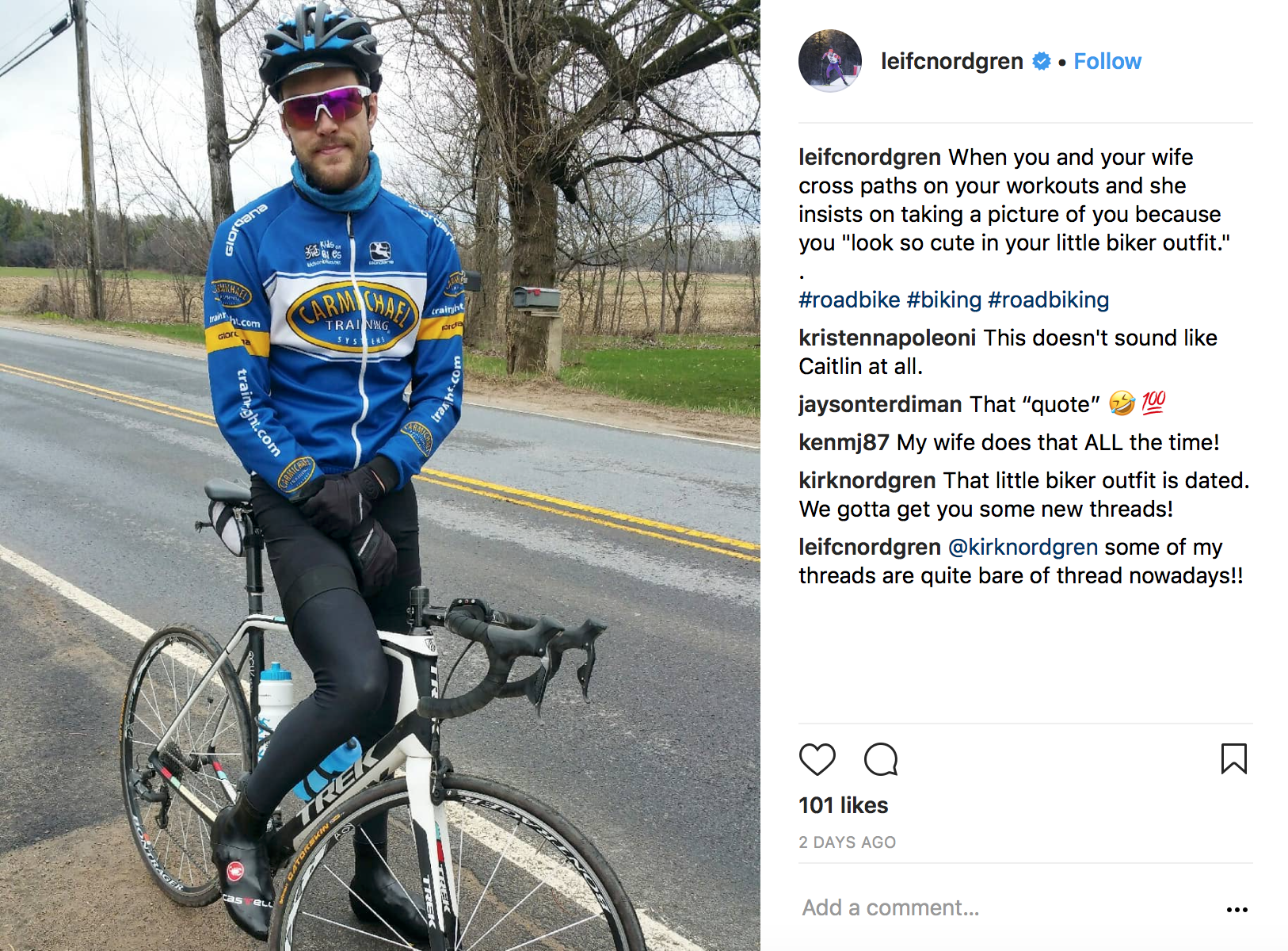
U.S. biathlete Leif Nordgren went road biking with his wife, Caitlin Napoleoni, whom he married in December.
Niklas Dyrhaug, Richard Jouve and Robin Duvillard:
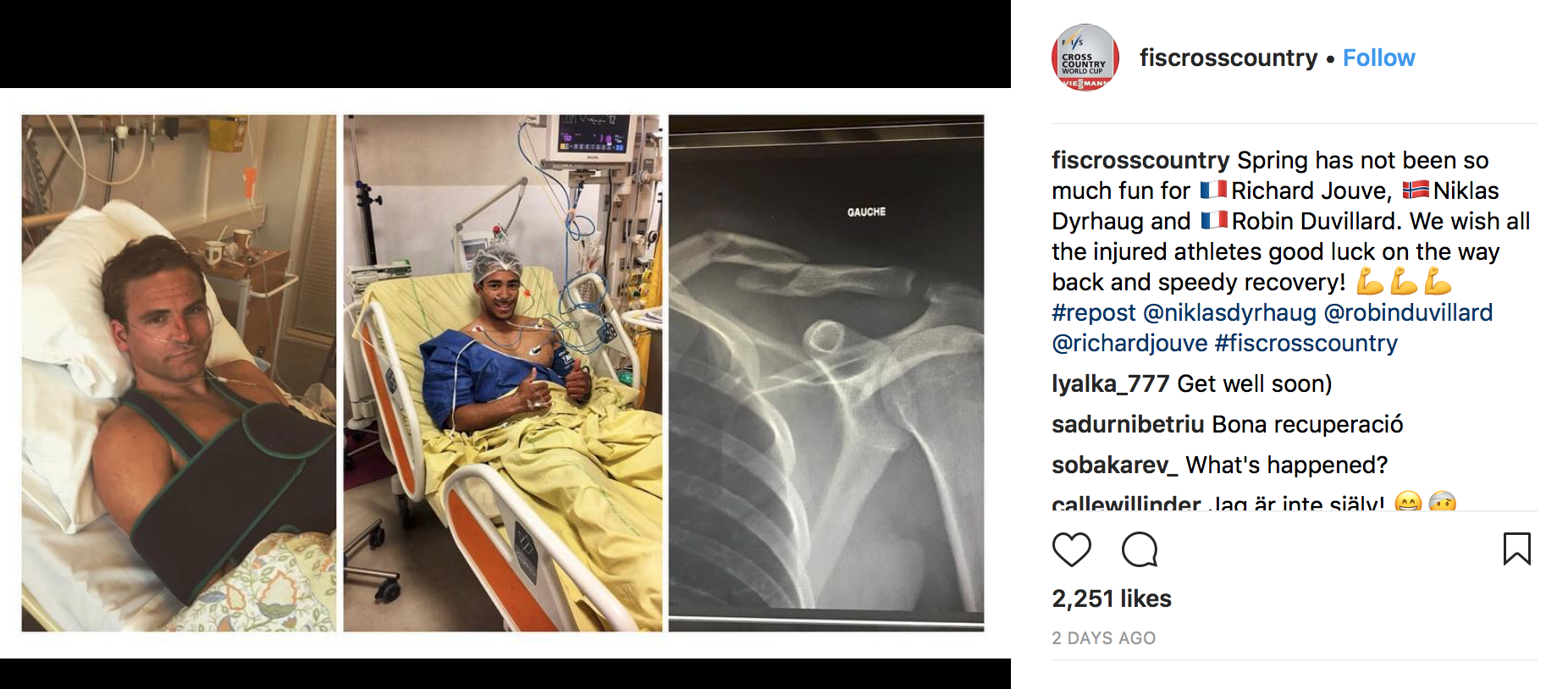
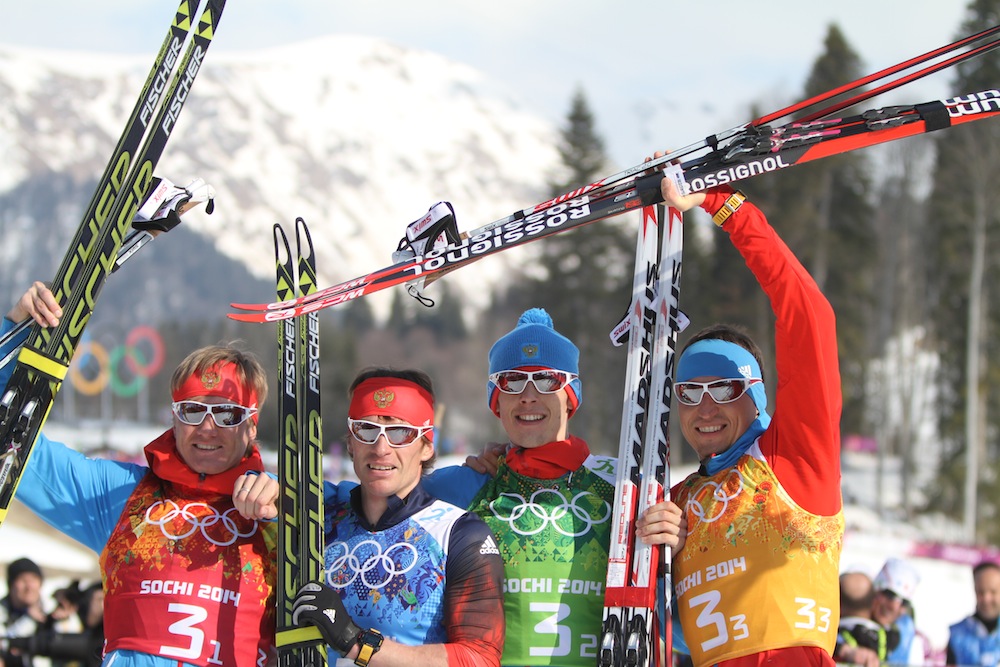
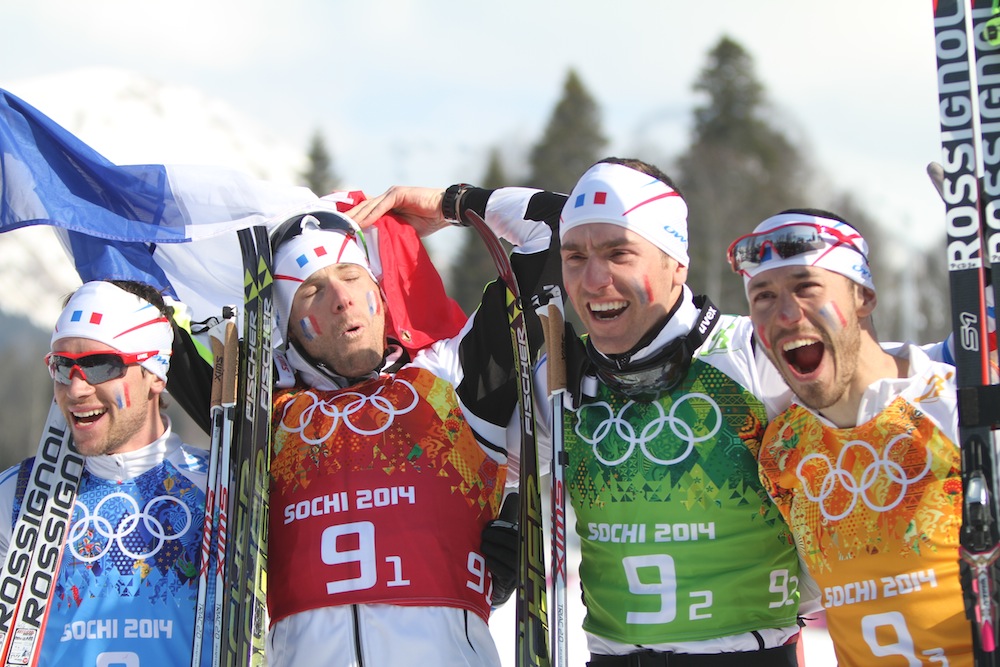
Meanwhile athletes like Norway’s Niklas Dyrhaug (l) and France’s Richard Jouve (c) and Robin Duvillard are on the road to recovery, according to this FIS Cross Country post.
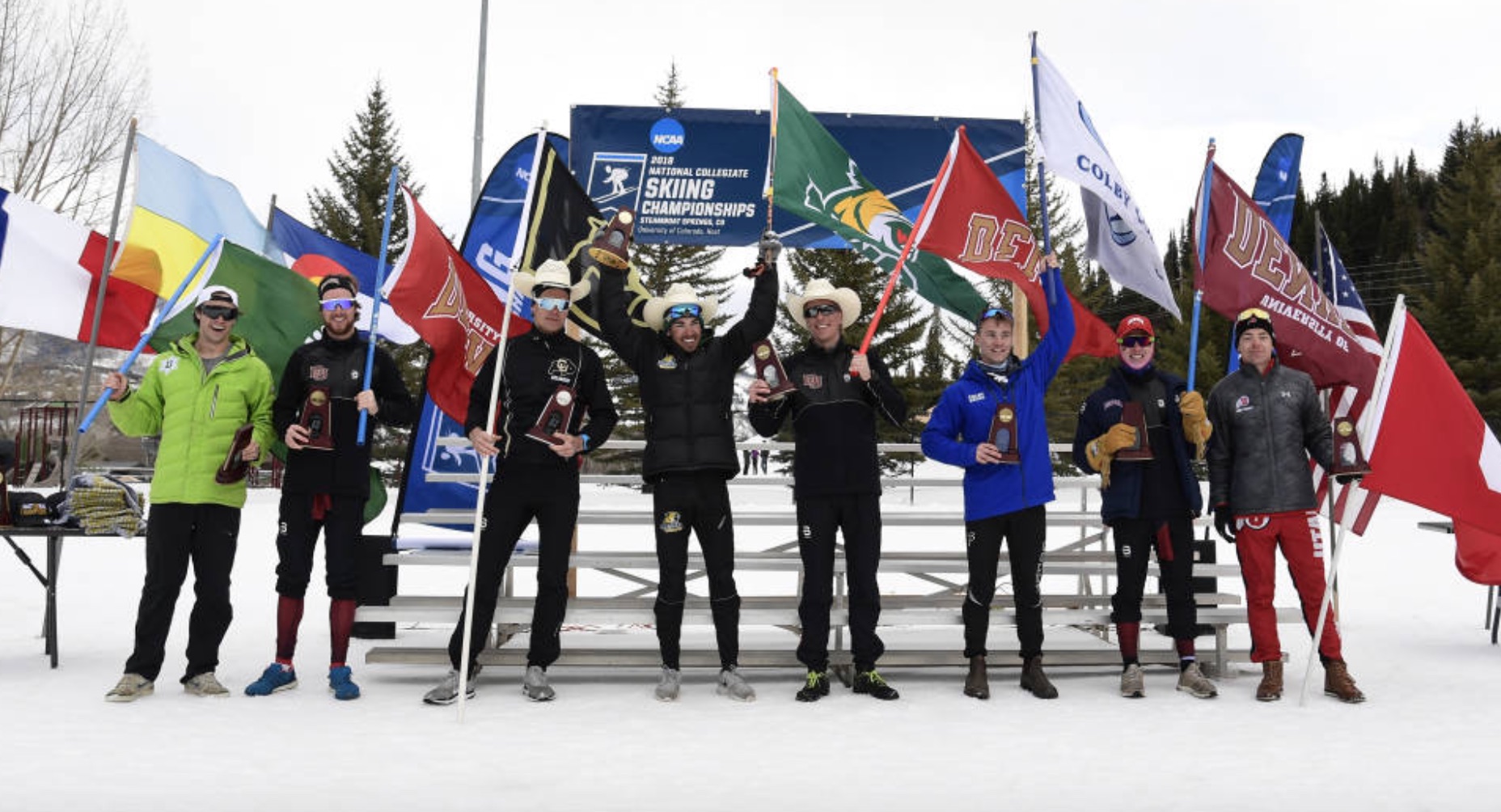
The top finishers in the men’s 20 k freestyle mass start at 2018 NCAA Skiing Championships in Steamboat Springs, Colorado, with Northern Michigan University’s Ian Torchia (c) in first. (Photo: Dartmouth Sports/Clarkson Creative)
NCAA Skiing Championships (Steamboat Springs, Colorado): 15/20 k freestyle mass starts
On the fourth and final day of NCAA Skiing Championships at Howelsen Hill in Steamboat Springs, Katharine Ogden skied to her second-straight national title, Ian Torchia became an NCAA champion and the University of Denver (DU) won its 24th NCAA National Championship.
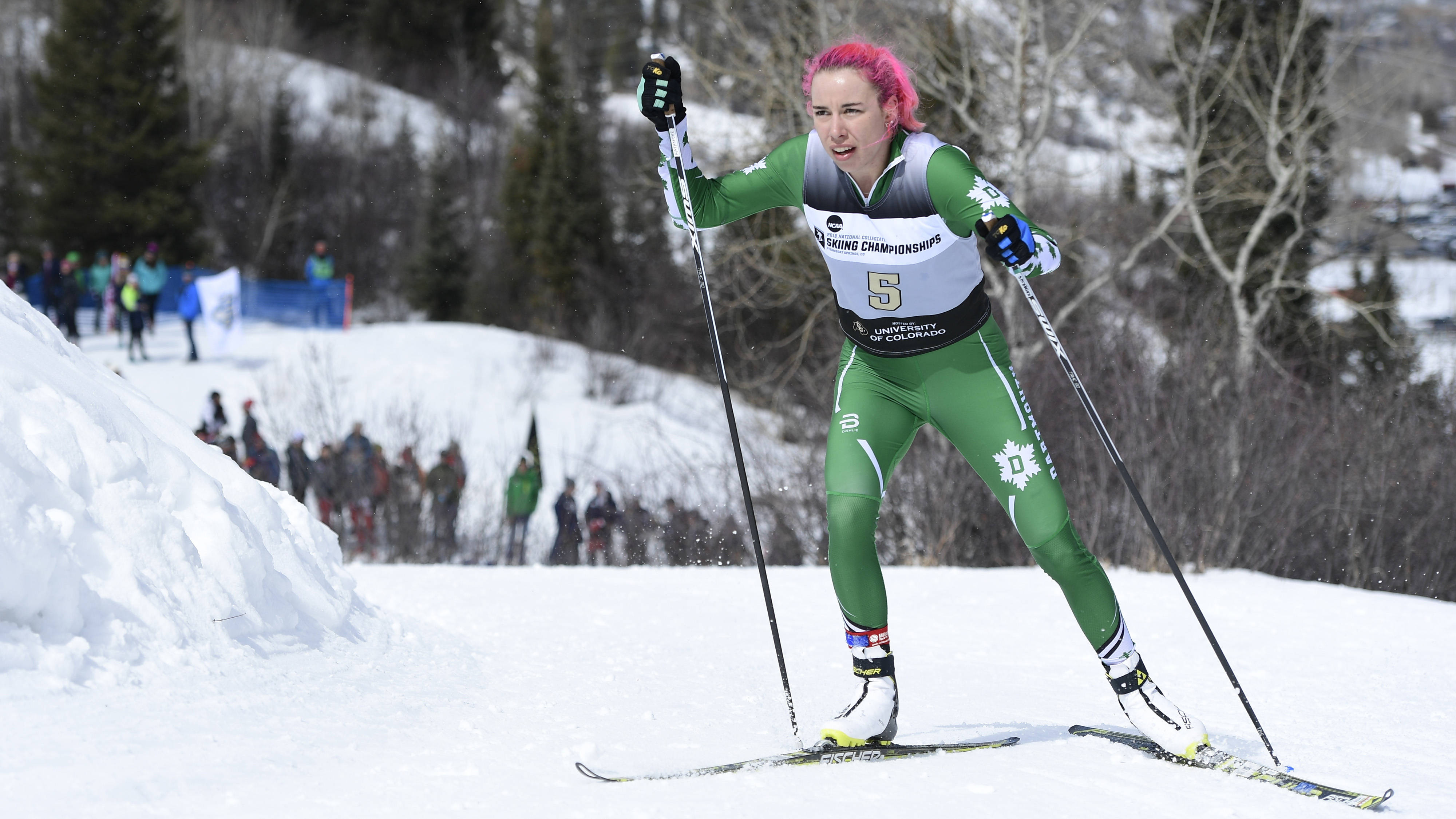
Dartmouth freshman Katharine Ogden racing to her second-straight victory of the 2018 NCAA Skiing Championships in Steamboat Springs, Colorado. She won Saturday’s 15 k freestyle mass start by more than 38 seconds. (Photo: Dartmouth Sports/Clarkson Creative)
Ogden, a Dartmouth College freshman, raced to a 38.4-second victory in the women’s 15-kilometer mass start, finishing in 43:22.0 minutes for her second win in as many races at 2018 NCAA Championships. She won the 5 k classic on Thursday and with her win on Saturday, she became the first Dartmouth skier in 56 years to win two national titles in the same year, according to a Dartmouth press release.
On the second of three laps, Ogden broke away early with close to 10 k to go. According to the press release, she had a “quick fall” near the end of the second lap, but that didn’t derail her as she had time to grab sunglasses from Dartmouth men’s coach Brayton Osgood and a Dartmouth Lone Pine flag before the finish.
At this year’s championships, Ogden’s two titles are accompanied by victories from Dartmouth men’s alpine skiers Brian McLaughlin (who won the giant slalom) and Tanguy Nef (who won the slalom). This marked only the second time that Dartmouth’s Big Green won four individual titles in a single NCAA Championships; that also occurred 61 years ago.
“Katharine absolutely wanted this one, and she really likes to win,” Dartmouth Director of Skiing and Women’s Nordic Head Coach Cami Thompson Graves said in the press release. “She wasn’t about to let a fall slow her down, she has such a great competitive fire. But she also showed her playful side grabbing Brayton’s glasses and smiling all the way to the finish line!”
Hailey Swirbul of the University of Alaska Anchorage placed second and Linn Eriksen (DU) reached the podium in third (+46.3). Denver had three in the top 10 with Jasmi Joensuu in ninth and Taeler McCrerey in 10th. Also landing in the top 10 for All-American honors were Guro Jordheim of the University of Utah in fourth, Emma Tarbath (Montana State University) in fifth, Petra Hyncicova of the University of Colorado Boulder (CU) in sixth, Christina Rolandsen (CU) in seventh, and Lauren Jortberg (Dartmouth) in eighth.
Torchia, an Northern Michigan University (NMU) junior and U.S. Ski Team Development Team member, became the seventh NCAA champion in NMU Wildcats nordic skiing history, according to an NMU press release. Fredrick Schwenke was the Wildcats’ last nordic champion; he won the 2015 NCAA Championships 20 k classic.
Torchia drew bib 1 for Saturday’s 20 k freestyle mass start and crossed the finish line first in 54:21.0, just 2 seconds ahead of CU’s Alvar Alev. Eivind Kvaale (DU) finished just four seconds back in third, and Denver had three in the top seven with Dag Frode Trollebø in fourth and Lars Hannah in seventh. Darmouth’s Cal Deline placed fifth, Zane Fields of Colby College finished sixth, and the 20 k freestyle’s 2017 NCAA champion Martin Bergström (Utah), who also won Thursday’s 10 k classic, placed eighth. CU’s Petter Reistad and Sondre Bollum finished ninth and 10th, respectively.
In the team standings, Denver beat Colorado by 41 points for the overall win with a total of 604 points between the nordic and alpine events at this year’s championships. Dartmouth placed third, 114.5 points behind Colorado, and Utah was another 63 points back in fourth.
According to a DU press release, Denver has won at least one national championship in each of the last five athletic seasons (skiing: 2013/14, 2015/16, 2017/18; hockey: 2016-17; men’s lacrosse 2014/15), joining only Stanford on the list of schools that have done so in the last five seasons. (Oregon, West Virginia, Penn State, Oklahoma, Ohio State and Florida could potentially join that list later this year.)
“It feels incredible,” said DU head coach Andy LeRoy said in the press release. “I am so happy for all of our athletes, they’ve been training all week and all season and to do it in Steamboat in front of our crowd is special.”
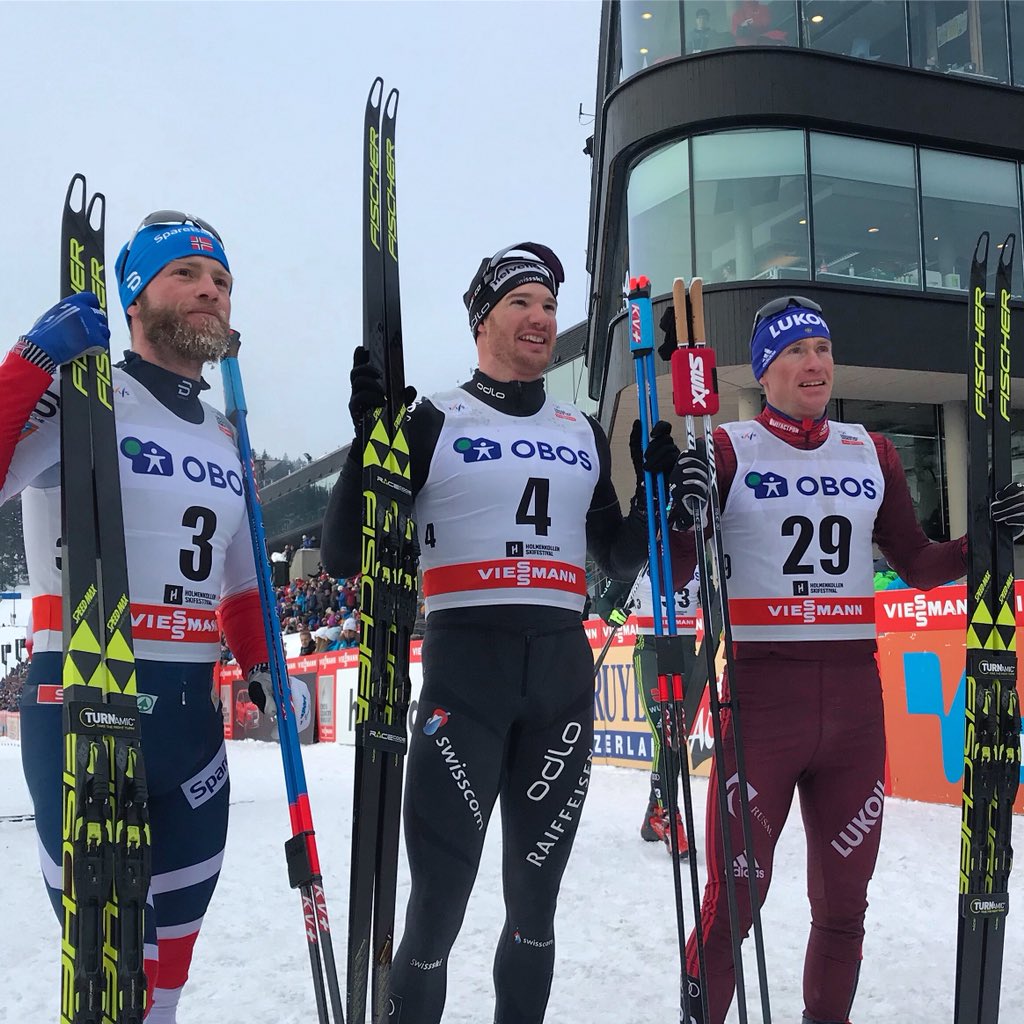
The Holmenkollen men’s 50 k freestyle mass start podium on Saturday at the World Cup in Oslo, Norway, with Switzerland’s Dario Cologna (c) in first, Norway’s Martin Johnsrud Sundby (l) in second, and Russia’s Maxim Vylegzhanin (r) in third. (Photo: FIS Cross Country/Twitter)
FIS Cross Country World Cup (Oslo, Norway): Men’s 50 k freestyle mass start
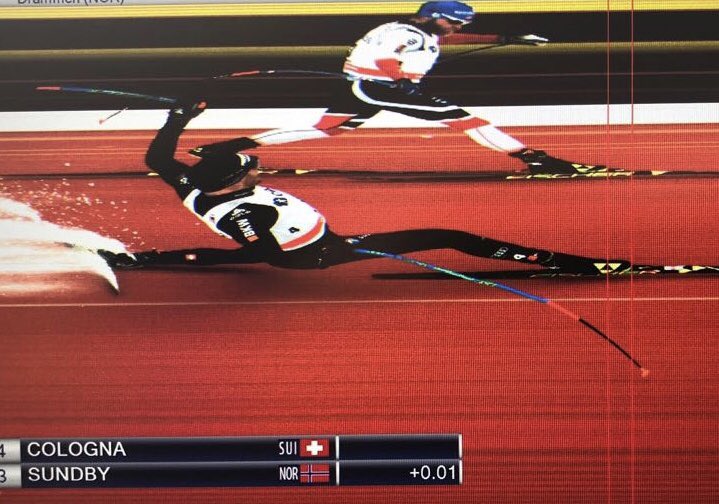
A four-time Olympic champion, Dario Cologna of Switzerland won his first 50-kilometer World Cup race on Saturday, topping the podium in the famous Holmenkollen 50 k freestyle mass start after outlunging Norway’s Martin Johnsrud Sundby (who won the event last year) for the win in 2:01:48.1. Sundby finished one-hundredth of a second behind for second place, ahead of Russia’s Maxim Vylegzhanin, who was 1.1 seconds back in third in his first World Cup race since November of last year.
The photo finish for first between Switzerland’s Dario Cologna (near) and Norway’s Martin Johnsrud Sundby at the Holmenkollen 50 k freestyle mass start on Saturday in Oslo, Norway. Cologna got it by 0.01 seconds. (Photo: FIS Cross Country/Twitter)
Norway’s Sjur Røthe came out on top in a race for fourth (+4.2), ahead of Russia’s Denis Spitsov in fifth (+4.4) and his Norwegian teammate Hans Christer Holund in sixth (+4.5). Great Britain’s Andrew Musgrave followed in seventh (+15.1), Germany’s Florian Notz placed eighth (+25.9) and Canada’s Alex Harvey finished ninth (+32.4), ahead of France’s Robin Duvillard in 10th (+33.5).
Scott Patterson led the U.S. in 16th (+56.3) coming off an 11th place in the 50 k classic mass start at last month’s Olympics, and Canada’s Devon Kershaw finished in the points in 28th (+3:43.6). Just outside the top 30, Canada’s Graeme Killick finished 34th (+4:55.1).
Also for the U.S, David Norris placed 38th (+6:19.7), Paddy Caldwell was 46th (+8:12.3), Noah Hoffman 49th (+10:27.9), Kevin Bolger 52nd (+12:44.2), and Simi Hamilton did not finish.
Canada’s fourth man in the race, Andy Shields finished 47th (+8:13.6).
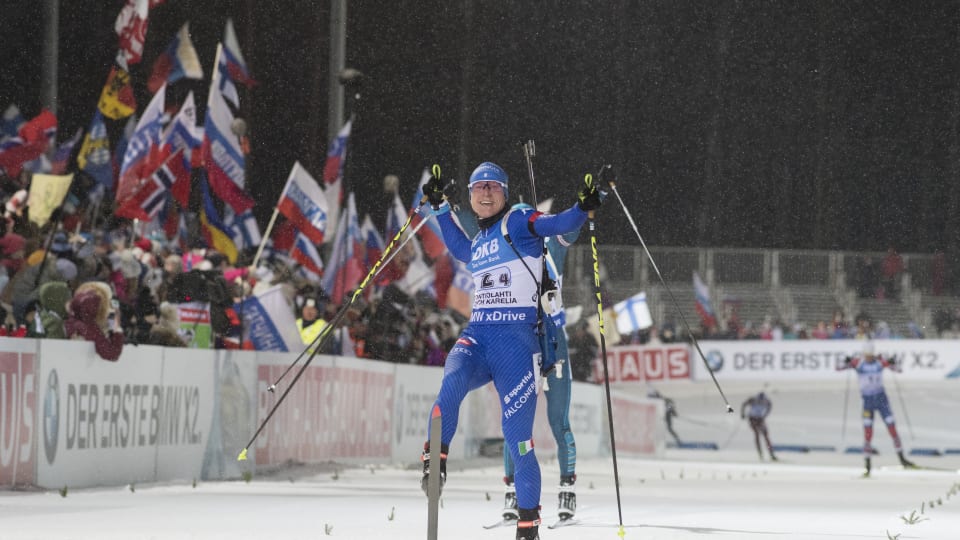
Italy’s Lukas Hofer celebrates his team’s win in Saturday’s mixed relay at the IBU World Cup in Kontiolahti, Finland. (Photo: IBU/Biathlonworld)
IBU World Cup (Kontiolahti, Finland): Single mixed relay & mixed relay
(Note: This rundown has been updated to include comments from Christian Gow and Sean Doherty.)
In the last single mixed relay and mixed relay of the International Biathlon Union (IBU) World Cup season, France and Italy came out on top, with France winning the two-person single mixed relay and Italy taking first in the coed mixed relay.
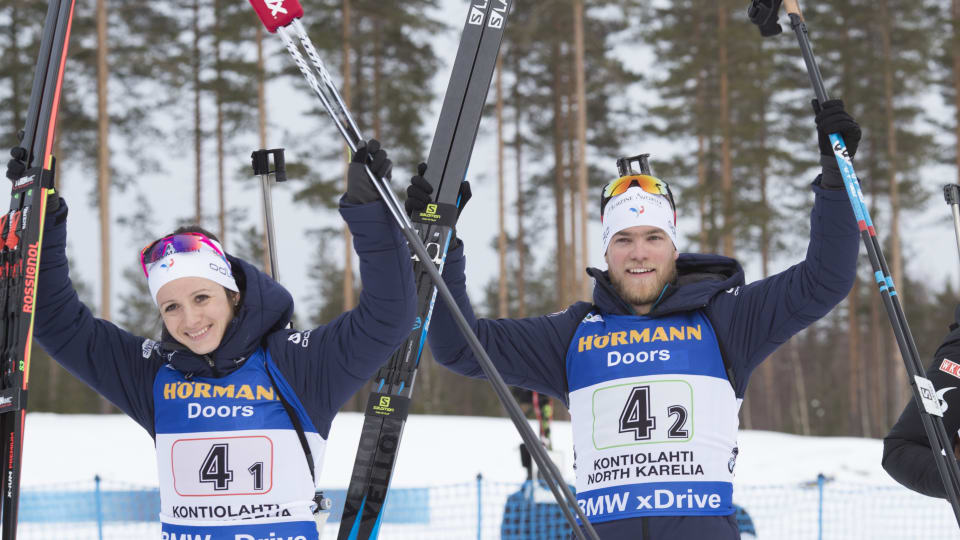
France’s Anaïs Chevalier and Antonin Guigonnat after winning Saturday’s single mixed relay at the IBU World Cup in Kontiolahti, Finland. (Photo: IBU/Biathlonworld)
France’s Anaïs Chevalier and Antonin Guigonnat combined for zero penalties and six spares to finish first in the single mixed relay in 33:29.1 minutes. Guigonnat as the team’s anchor secured the win by just 2.4 seconds over Austria’s Julian Eberhard while Norway’s Johannes Thingnes Bø finished 4.4 seconds back for third.
Chevalier put France in fifth after the first leg, 15.5 seconds behind Ukraine’s Iryna Varvynets in first. Guigonnat used just one spare on his first leg to move them into fourth, 9.2 seconds back while Norway led at the second exchange. On Chevalier’s second leg, she shot clean in both stages to lead through the final exchange, with Ukraine skiing just 6.2 seconds back in second.
On the final leg, Guigonnat used two spares and stayed out of the penalty lap, keeping the team in first through the finish. Eberhard skied the second-fastest course time on that leg to elevate Austria (with Lisa Theresa Hauser) from fourth at the tag to second place at the finish, and Bø skied all the way up from eighth to third place for Norway (with Marte Olsbu) with the fastest course time.
Ukraine’s Artem Tyschenko used just one spare but slipped to fourth with the 11th-ranked course time on that leg, as he finished 10.8 seconds behind Norway.
Behind Russia in fifth and Italy in sixth, Canada placed seventh (+23.8) with Rosanna Crawford and Christian Gow. The duo combined for zero penalties and six spares, and put themselves in third place early in the race. Crawford skied them into third on the first leg, using just two spares and tagging Gow 7.4 seconds out of first.
Gow went on to take the lead after cleaning prone without any spares, and he cleaned standing as well but slipped back to third while Bø took the lead. Gow tagged Crawford in third, 8.9 seconds behind Norway in first.
“I didn’t think too much about being tagged in third,” Gow recalled in an email to FasterSkier. “It was exciting for sure, but I let it fade to the background so that I could focus on my job both on the track and in the range. It was great to leave prone in first place! It was also surprising, but it was a good place to be in.
“My skiing was ok today,” he continued. “It is a really challenging and demanding race format that we don’t get a lot of practice with. I was sick after the Olympic Games and only finally coming around the past couple days. The Sprint race was horrendous for me, so today was much better than that. In the range I just focussed on myself and trusted my shooting. I tried my best not to get caught up in the race going on around me and it worked to my benefit.”
Crawford then slipped to seventh and 21 seconds back with three prone spares, but avoided the penalty lap, and Gow held onto seventh through the finish, using just one spare and skiing the eighth-fastest course time on that leg.
“We are both happy with this result,” Gow wrote. “I think that we are both looking at the 23 second gap to first and thinking that if things had worked out just a bit better we could be there. It can be both exciting and frustrating to be that close to the podium. We know we can do it, it’s just a matter of putting it together on the right day. We are happy with 7th, but hungry for more.”
Susan Dunklee and Lowell Bailey finished 14th for the U.S., 1:13.0 out of first with one penalty and 14 spares. The penalty came on Dunklee’s first leg during her standing stage, after she had cleaned prone without any spares. She tagged Bailey in 14th and he brought them up to 11th, using three spares on that leg, then Dunklee came through the final exchange in 13th after using four spares to clean. Bailey lost one place on the final leg, using four spares but staying out of the penalty lap.
Twenty-six teams competed in the single mixed relay, compared to 23 in the mixed relay that followed.
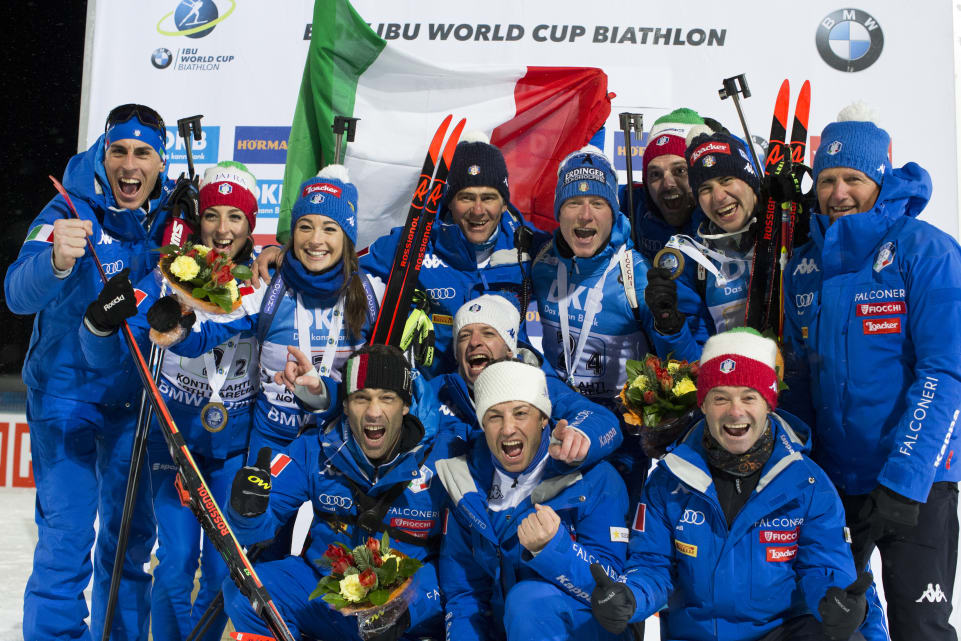
Team Italia celebrates its win in the IBU World Cup mixed relay on Saturday in Kontiolahti, Finland, with its relay members Dorothea Wierer, Lisa Vittozzi, Dominik Windisch, and Lukas Hofer. (Photo: IBU/Biathlonworld)
In Saturday’s 2 x 6 + 2 x 7.5 k mixed relay, Italy nabbed a 1.5-second victory over Ukraine in 1:15:08.3. Dorothea Wierer, Lisa Vittozzi, Dominik Windisch, and Lukas Hofer — the same Italian team that took bronze in the mixed relay at last month’s Olympics, although in a different order — combined for the win with one penalty and 13 spares.
Ukraine, with Anastasiya Merkushyna, Vita Semerenko, Artem Pryma, and Dmytro Pidruchnyi, had zero penalties and just three spares throughout the whole race. For the second-straight relay on Saturday, Norway placed third (+9.1) with Synnøve Solemdal, Tiril Eckhoff,Henrik L’Abée-Lund, and Tarjei Bø totaling zero penalties and nine spares.
Italy’s lone penalty came in Vittozzi’s second leg, but it didn’t derail the team as it improved from sixth to fifth with Vittozzi, who skied the third-fastest course time on that leg. She tagged Windisch 6.8 seconds out of first, and Windisch, who had anchored the team in the Olympics, took the lead by the final exchange after using two spares to clean. Hofer left the exchange just 3.3 seconds ahead of Norway’s Bø but used just one spare and skied the second-fastest anchor leg to finish first, beating his rivals up Kontiolahti’s infamous climb known as “The Wall”. Ukraine’s Pidruchnyi also shot clean with a single spare and clocked the fastest anchor leg to move his team from fourth to second place. Bø lost one place and finished third after using one spare as well and skiing the third-fastest anchor leg.
Russia followed in fourth, France fifth, Sweden sixth, Germany seventh, Austria eighth, and the U.S. ninth (+2:48.4). The U.S. team, with Clare Egan, Joanne Reid, Tim Burke, and Sean Doherty, had one penalty and 11 spares. Egan cleaned her first prone but had to ski a penalty lap after her standing stage, tagging Reid in 17th, 58.7 seconds out of first.
Reid used three spares on the second leg and moved up to 13th by the second exchange, and Burke used three spares as well to pick off one more place and tag Doherty in 12th. Doherty skied the eighth-fastest anchor leg and used two spares to clean to put the team in ninth at the finish.
“I don’t consider two spares to be anything special, but today it was enough to make up some ground,” Doherty wrote in an email to FasterSkier.”I felt strong skiing, more like myself which is fun even if it’s a little late in the season. We had very good skis which always helps. I have done quite a few laps on this course over the years so the lines and transitions are pretty refined, so that is where I made time on the course.
“I am happy with my leg. I enjoyed my little battle for 9th,” he continued. “I can’t speak too much for the other members of the relay tonight but I think 9th is a solid effort.”
Canada finished 17th (+4:34.9) with Emma Lunder, Julia Ransom, Scott Gow, and Brendan Green combining for one penalty and 13 spares. Lunder put them in 12th at the first exchange and Ransom skied up to 10th, but Scott Gow had a penalty on his standing stage to drop to 16th. Green lost one more place on the last leg despite only requiring two spares.
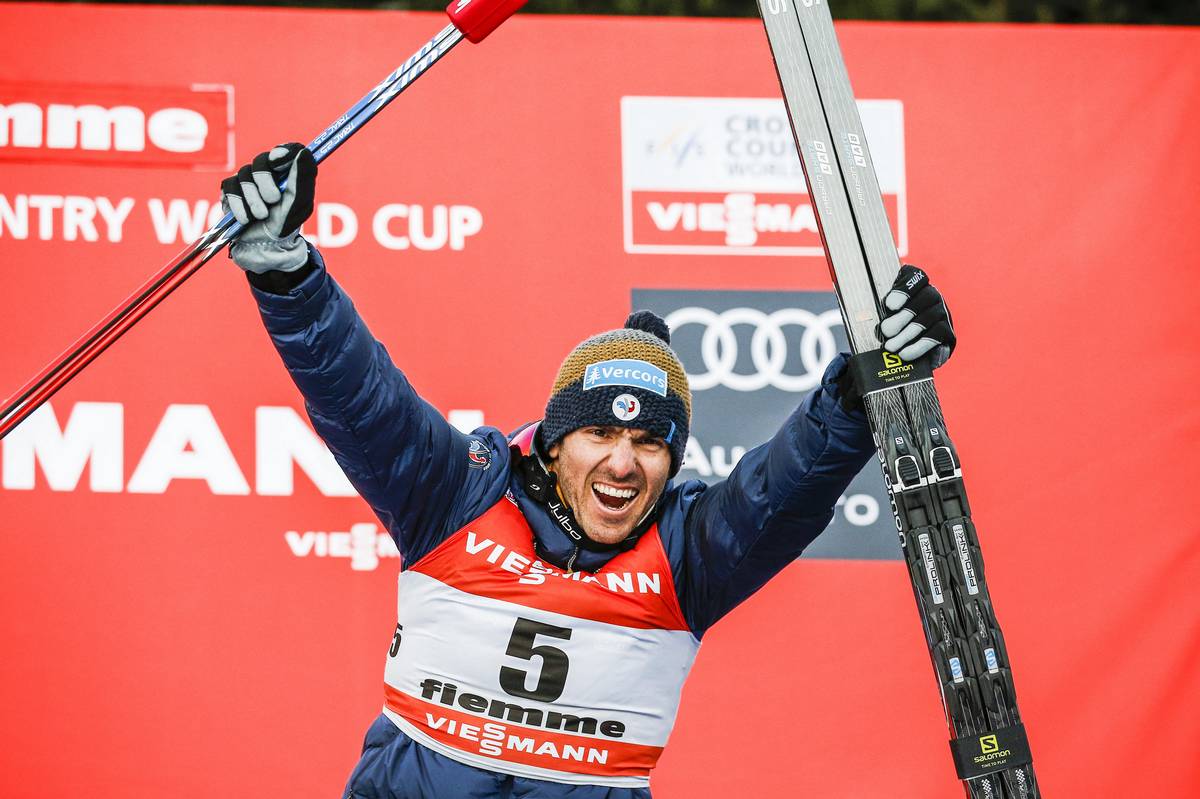
France’s Maurice Manificat celebrates his “time of day” victory in Stage 7 of the 2017 Tour de Ski, with the fastest time in the 9 k freestyle hill climb in Val di Fiemme, Italy. (Photo: Salomon/Nordic Focus)
Welcome to World Cup Windup, where we check in with the top-10 teams from last year’s FIS Cross Country World Cup tour before the season starts with the Ruka Triple in Kuusamo, Finland, on Nov. 24.
FRANCE
Overall in Nations Cup Last Year:Eighth
Women’s Ranking 2016/2017:15th
Men’s Ranking 2016/2017: Fifth
Who’s Back:
France’s Baptiste Gros leads teammate Richard Jouve in their semifinal of the freestyle sprint at the Ski Tour Canada in Quebec City in 2016.(Photo: John Lazenby/Lazenbyphoto.com)
Maurice Manificat, the fastest man up the Tour de Ski final climb last season, and a World Cup race winner previous seasons as well; Lucas Chanavat, a finalist in several World Cup sprints and third in the U23 standings; Richard Jouve, third in the sprint at World Cup finals and fifth in the U23 standings; the World Cup podium relay team of Manificat, Jean Marc Gaillard, Clement Parisse, and Alexis Jeannerod, as well as Robin Duvillard, a member of the World Championships relay team and the 2014 Olympic bronze-medal relay team (soon to be silver), and Baptiste Gros, who won a World Cup in 2016.
Who’s Missing:
A women’s team. Not a single French woman scored World Cup points in the 2016/2017 season. France didn’t even send a women’s team to 2017 World Championships. That’s right, there were no French representatives in the cross-country ski races at World Championships. French women competed at only two few World Cups: the home races in La Clusaz and the sprints in Toblach, Italy.
Pre-Season Results:
Lucas Chanavat of France had the fastest men’s qualifying time in the Davos World Cup freestyle sprint in 2017.
In early November, Lucas Chanavat won both the qualifier and final in a King’s Court style sprint in Davos, besting Italy’s Federico Pellegrino among others; Richard Jouve and Alexis Jeannerod were second and third, and Aurore Jean won a lightly-attended women’s race.
More recently, the French attended FIS races in Saariselka, Finland, where Maurice Manificat tore it up, winning the 10 k classic and, in a surprise, also winning the classic sprint ahead of his sprint-specialist teammates.
Recent Drama:
In the year or so after the 2014 Olympics, where the French women finished fourth in the relay, the women’s program lost its best skiers. Three started families, and Celia Aymonier became a biathlete (she now has several World Cup top-tens and a World Championships bronze medal in the relay).
For two seasons, the French women were nearly completely absent from the World Cup, but that may change this year, in part because the Olympics always bring out efforts to get each country represented. The three new moms are back training: Coraline Thomas-Hugue, Aurore Jean, and Anouk Faivre-Picon, who in the meantime won some big Worldloppet races like the Engadin Ski Marathon. Several younger skiers are also joining them. It’s not straight into the thick of things; the team will do some FIS racing throughout the season. There is the possibility of a few participating in the World Cup sprint in Ruka, Finland, but none will go to Lillehammer and instead a group will focus on competing at the third World Cup in Davos, Switzerland.
Aurore Jean racing in Davos in 2014.
“The atmosphere in the group is very good and it’s nice to see positive girls and a team in training,” coach Alexandre Rousselet told ski-nordique. “We will have a quota of four girls each [World Cup] but they will not be filled. We are waiting for the girls to have encouraging results at OPA Cup and FIS events before they register… We will first work on this 10 k skating goal. to try one or more qualifications for the 2018 Olympics. The relay and the other races would be a bonus… The Olympics are in their heads but for the moment, at this stage of the winter, it is still far away.”
(And yes, he refers to them as “les filles” rather than “femmes” or “dames”.)
In Saariselka, the women showed their stuff: Coraline Thomas Hugue won the 10 k skate over Anna Shevchenko of Ukraine, with Aurore Jean third, Poland’s Justyna Kowalczyk fourth, and Anouk Faivre Picon fifth. They did not fare as well in the classic technique, with Jean leading the group in fifth in the 5 k classic and Delphine Claudel finishing seventh in the classic sprint, where none of the team made the final.
Best Social Media Presence:
This year’s “One of Those Nordic Days” videos has been posted, featuring skiers acting silly and doing stunts on skis. It is made by Team Valoche and former biathlete Alexis Boeuf, and features many national team members as well as biathletes Martin and Simon Fourcade, the Italian women’s biathlon team, and alpine skiers Julien Lizeroux and Tessa Worley.
Maurice Manificat is fairly prolific on Twitter, posting content from his own Instagram and Facebook pages as well as re-tweeting content from other French sports personalities and engaging in conversation. His handle is a good way to keep track of what’s going on in nordic sport in France.
Richard Jouve posts beautiful photos of wherever he happens to be, both on his Twitter account and on Instagram.
And Lucas Chanavat also posts crisp photos of training and racing, and also shots of him upside down in different places.
For the day-to-day-to-day of training with the French team, follow Robin Duvillard.
And Anouk Faivre Picon is among those documenting life as a high-performance mom.
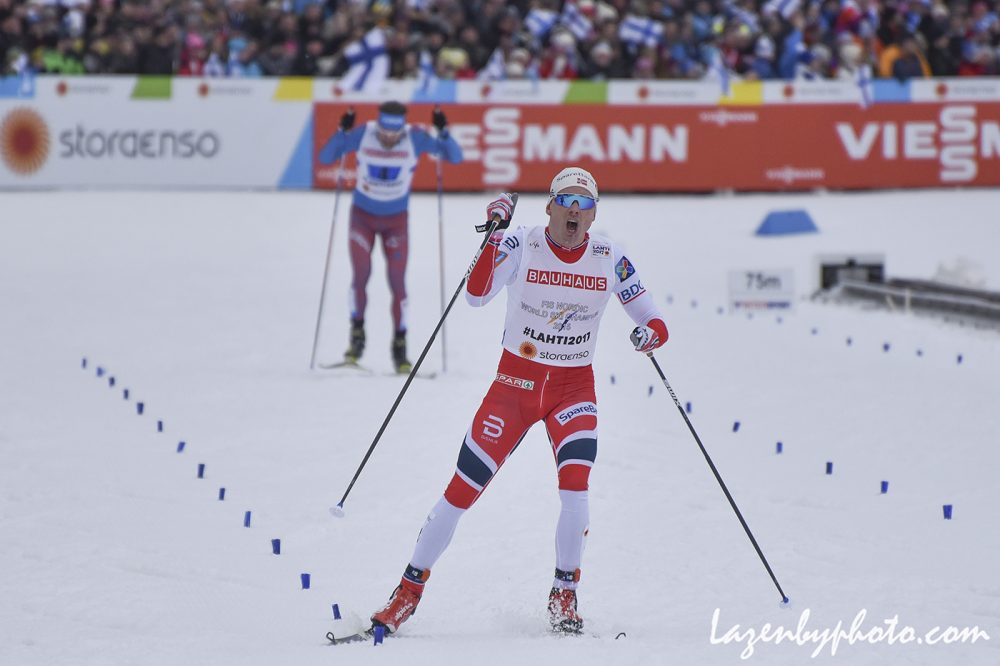
Norway’s Finn Hågen Krogh with the victory stoke as he wins the 4 x 10 k relay at the 2017 Nordic World Championships in Lahti, Finland, by 4.6 seconds over Russia’s Sergey Ustiugov (behind). (Photo: John Lazenby/Lazenbyphoto.com)
LAHTI, Finland — There were three medals up for grabs during Friday’s 4 x 10-kilometer relay at 2017 Nordic World Championships on Friday. Yet after the scramble leg, two distinct races: Norway and Russia’s dance for gold, and what eventually became a four-way tango between Finland, Sweden, Switzerland, and Germany for bronze and silver.
Russia’s Andrey Larkov and Norway’s Didrik Tønseth first strung out and then smoked the field late in their leg. By the tag to their second-leg skiers, Norway and Russia were twenty seconds up.
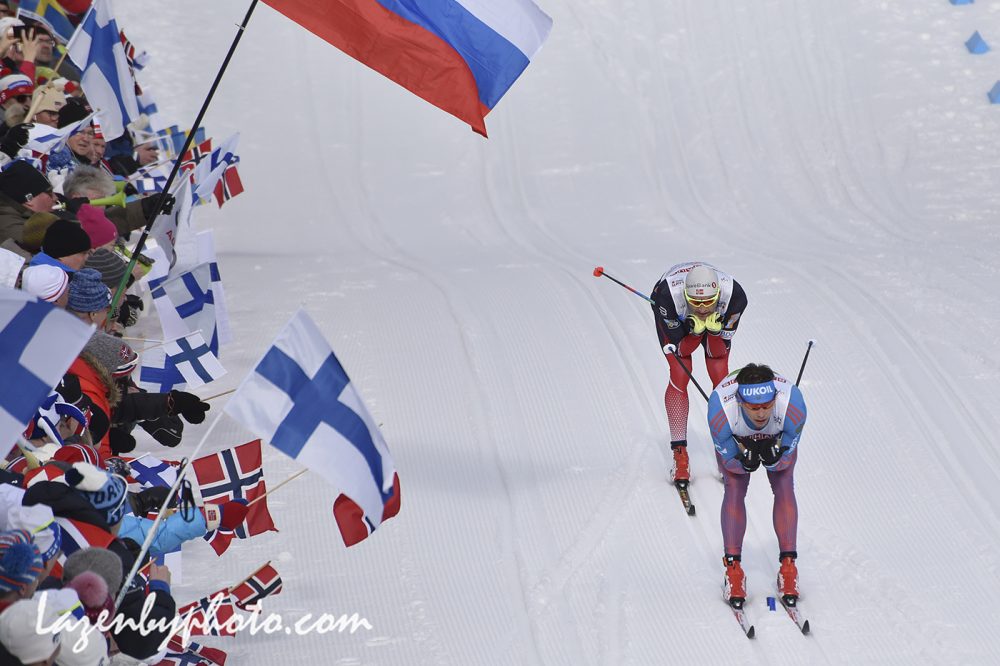
Russia’s Alexander Bessmertnykh leads Norway’s Niklas Dyrhaug as they sustain the break during the second leg of the 4 x 10 k relay at the 2017 Nordic World Championships in Lahti, Finland. (Photo: John Lazenby/Lazenbyphoto.com)
That margin grew to thirty seconds, as Russia’s Alexander Bessmertnykh and Niklas Dyrhaug finished Leg 2 and the transition to skating began.
Coming in just a half a minute later in third place, was Finland’s Iivo Niskanen, giving the fans a premature taste of the podium.
Racing the third leg was Norwegian Martin Johnsrud Sundby. Russia tried to match the Norway’s trump card with Alexey Chervotkin. The 21-year-old Chervotkin skied the third leg for Russia in both team relays that took place this season: the first in Nove Mesto, Czech Republic, the other in La Clusaz, France, where the team placed second both times to Norway.
However, the World Championship leg was the first time Chervotkin matched up against Sundby this year.
Late in the leg, it was unclear what Sundby’s strategy would be as the young Russian shadowed the 32-year-old Sundby move for move. With Sergey Ustiugov up for the Russians in the anchor leg against Norway’s Finn Hågen Krogh, many armchair-relay strategists would have thought the Norwegian’s line up ploy was a dud.
Not until 1.2 kilometers left in the leg did Sundby make a sufficient gap. At that point, the time spread from silver to gold was only eleven seconds. Not exactly a huge buffer for Krogh.
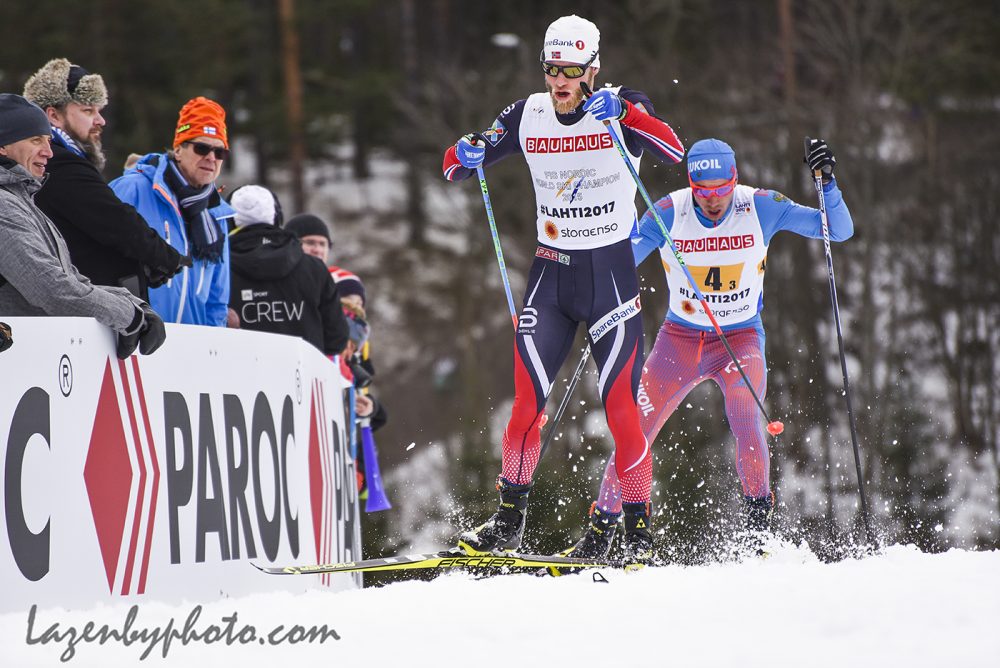
Norway’s Martin Johnsrud Sundby, marked by Russia’s Alexey Chervotkin (4), during a critical third leg of the 4 x 10 k relay at the 2017 Nordic World Championships in Lahti, Finland. (Photo: John Lazenby/lazenbyphoto.com)
By Sundby’s tag to the anchor skier, he had gifted Krogh a 17.7-second margin for error. The rhetorical question at the start of the fourth leg: when will Ustiugov catch Krogh?
“He’s the worst the worst guy you can have in back of you,” Krogh said during a press conference, referring to Ustiugov. “He made the race tough for me.”
At 1.3 k into that fourth leg, Ustiugov was 8.8 seconds back. In another 1.2 kilometers, it ballooned again to 11.6 seconds, and then it contracted again to 5 seconds with 3.8 k to go. But until the finishing stretch, when Krogh rounded the final turn with a 100-meter lead on the Russian, was Norway a sure win.
Krogh crossed first in a time of 1:37:20.1 hours for the ninth-consecutive Norwegian championship 4 x 10 k relay gold. Finishing 4.6 seconds later in second place was Russia’s Ustiugov.
“It’s not just for us, it’s the whole team,” Sundby said during a press conference of their ninth world-champs relay gold. “It’s for the waxers, it’s for the trainers. When you go the relay for the Norwegian team, you feel you’re going for your country. So it’s a massive victory for us.”
What kept the capacity crowd engaged was not so much the battle for gold and silver, but the fate of the on-again, off-again Finns.
Let’s back up to when Niskanen tagged off to Finnish skier Lari Lehtonen for the first freestyle leg. At that point, the Finns were in third, a solid 15 seconds ahead of France in fourth place, 32 seconds ahead of Switzerland in fifth, roughly 55 seconds ahead of Germany in sixth, and almost a minute ahead of Sweden in seventh.
“We are individual athletes, and you have to focus on your own leg,” Sweden’s Johan Olsson said after the race. “Both me and Daniel [Rickardsson] thought the medal chance was over when we had done two legs.”
The first sign that something was awry for the Finns was a restless home crowd. What may have been perceived as a plush-time cushion for Lehtonen was in fact cardboard thin.
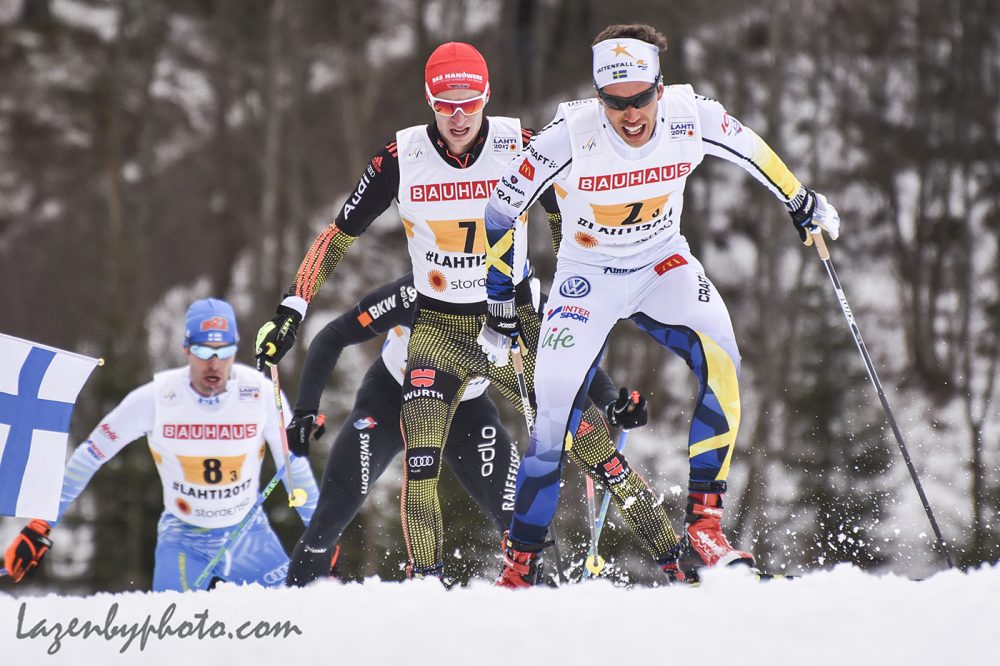
Sweden’s Marcus Hellner (r) leads Germany’s Florian Notz (7), Switzerland’s Dario Cologna (behind Notz), and Finland’s Lari Lehtonen (8) during the men’s 4 x 10 k relay at the 2017 Nordic World Championships on Friday in Lahti, Finland. (Photo: John Lazenby/Lazenbyphoto.com)
Sweden’s Marcus Hellner and Switzerland’s Dario Cologna were on the hunt. Seemingly an afterthought, Hellner skied the fastest third leg, animating the race for bronze by pulling Sweden back into contention.
These four teams — Finland, Germany, Switzerland, and Sweden — stuck together through the exchange into the fourth leg until the last headwall climb, called Indian Hill.
It was then that Finland’s Matti Heikkinen hop-stepped around Germany and Switzerland, bringing Sweden’s Calle Halfvarsson with him.
“I know that Matti will go on the last uphill and it was good game for me to go after him,” Halfvarsson said during the press conference.
The two appeared to have dropped Switzerland’s Curdin Perl, until Perl miraculously slotted behind the Finn-Swede duo. Finland entered the final 100-meter stretch in a sprint for bronze.
One errant pole plant as Heikkinen ramped up his gear, causing him to fall to the ground was Finland’s loss and Sweden’s gain. Halfvarsson crossed third for Sweden (+2:31.8) and Perl fourth for Switzerland (+2:32), and Finland ultimately crossed fifth (+2:42.4).
(Story continues below)
Sweden’s Calle Halfvarsson (2) crossing the line in third place, ahead of Switzerland’s Curdin Perl (5) in fourth at the finish of the men’s 4 x 10 k relay at the 2017 Nordic World Championships in Lahti, Finland. Finland’s Matti Heikkinen (far left) is seen after righting himself due to a errant pole plant. (Photo: John Lazenby/Lazenbyphoto.com)
The U.S. fielded a team comprised of Kyle Bratrud, Erik Bjornsen, Tad Elliott, and Simi Hamilton. Bratrud scrambled the first classic leg for the Americans, handing off to Bjornsen in 11th, 1:28.2 minutes behind the leader.
“I was definitely more nervous for this one because I was starting,” Bratrud said afterward.
While this is the second World Championships for Bratrud, a 24-year-old member of the Central Cross Country (CXC) Team, Friday was the first time he raced the scramble leg in a relay — he raced the third leg for the U.S. in the 2015 world champs 4 x 10 k relay in Falun, Sweden. Though he eventually lost contact with the front group, Bratrud was happy he was able to hold on for as long as he did, even if it caused him a yellow card for a technique violation.
“It was nice to at least see the front before they really picked up the pace,” Bratrud said.
“Props to Kyle on the yellow card,” Elliott wrote in an email. “Scrappy out there.”
Tad Elliott racing the third leg of the U.S. men’s 4 x 10 k relay at the 2017 Nordic World Championships on Friday in Lahti, Finland. (Photo: John Lazenby/Lazenbyphoto.com)
While Bratrud had company for approximately one lap, Bjornsen raced completely alone.
“It’s not the position you necessarily want to be in, but took it for what it was worth and tried to charge up to the group in front of me, which was [the Czech Republic’s Lukas] Bauer and [Germany’s Jonas Dobler],” Bjornsen said.
“But I mean…they were moving fast,” the 25-year-old U.S. Ski Team member added. “I tried to mentally just keep pushing, but it’s tough to be out there by yourself. I felt pretty good, it’s just a different type of race.”
Bjornsen tagged to Elliott, for the Americans’ first freestyle leg. He skied the eighth-fastest third leg, 1:47 behind Hellner.
“I was also getting great splits from the coaches on making ground on the group in front of me,” Elliott wrote.”I wanted to catch them, I just didn’t really get there for Simi to save it all for his sprint. Simi skied one hell of a leg.”
Elliott handed off to Hamilton, the anchor leg for the U.S.
“By the time he tagged off to me, I think I was 10 or 15 seconds from [the Czech Republic, Kazakhstan and Italian teams],” Hamilton recalled. “They fortunately started pretty conservatively, which was nice for me.”
Those three teams were in fact 16 seconds ahead of Hamilton. He eventually closed that distance, putting the U.S. in contention for a top 10.
“I wanted to start fast and see if I could make up some time on them,” Hamilton siad. “And I did, I ended up catching them by the top of the climb after the tunnel. So I was psyched about that.”
However, when Hamilton came through for his fourth and final lap, the hill-laden course had taken a toll on his legs. He finished in 10th (+5:31.3), just half a second ahead of the Czech Republic’s Petr Knop in 11th (+5:31.8).
Canada’s Alex Harvey racing the third leg of the men’s 4 x 10 k relay at the 2017 Nordic World Championships on Friday in Lahti, Finland. (Photo: John Lazenby/Lazenbyphoto.com)
“That last lap my legs were definitely feeling it a little bit and those guys are all really good climbers,” Hamilton said. “I couldn’t quite make the moves that I wanted to in the last kilometer because I was a little whupped by then … but I was still able to pick off Czech Republic at the finish. Maybe not the best day for us, but still a day that we were fighting.”
Canada’s team of Graeme Killick, Devon Kershaw, Alex Harvey and Lenny Valjas finished 12th, after being lapped and thus pulled from the race on Valjas’s final leg.
In January of this year, Canada raced to a historic third place at the Ulricehamn World Cup relay in Sweden.
“It just wasn’t our day,” said a dignified Valjas after Friday’s relay. “We’re all in shape, it’s just none of us were on our A-game today and that’s what it takes to be fighting in this.”
Erik Bjornsen (U.S. Ski Team) racing the second leg of the men’s 4 x 10-kilometer relay at the 2017 Nordic World Championships on Friday in Lahti, Finland. (Photo: John Lazenby/Lazenbyphoto.com)
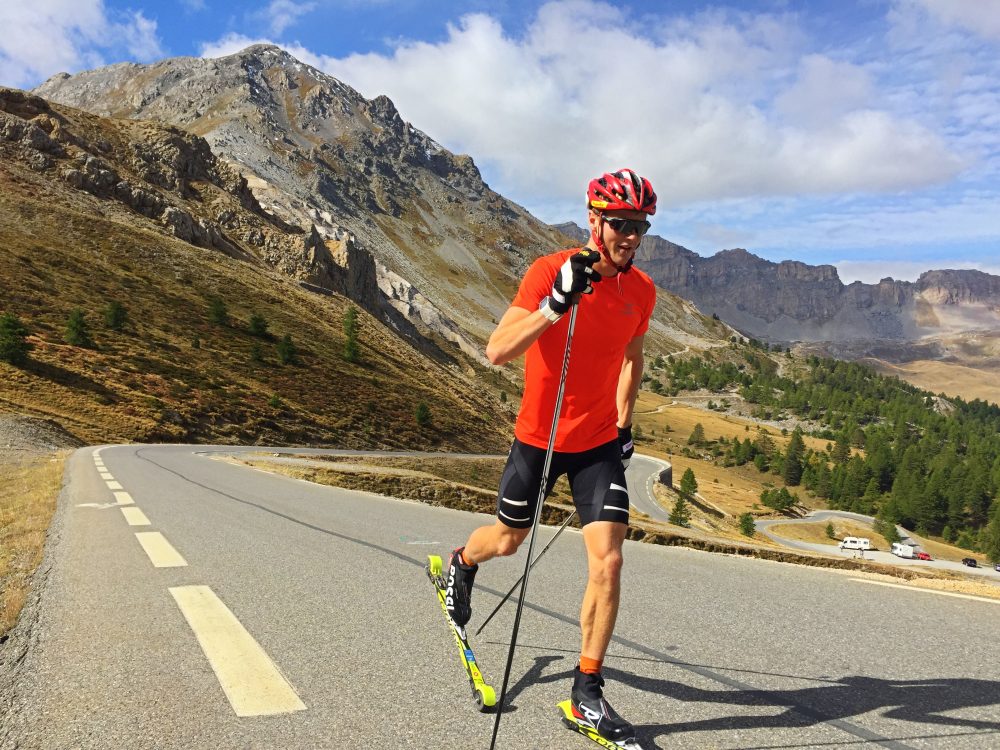
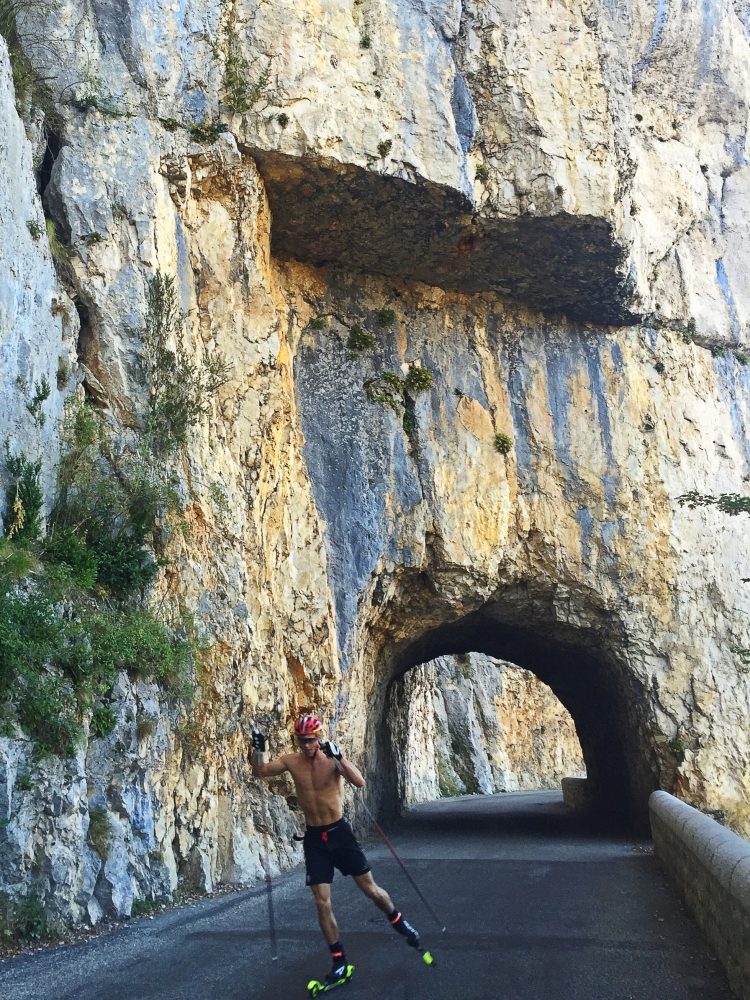
U.S. Ski Team B-team member Erik Bjornsen during a rollerski in France this summer 2016. (Courtesy photo)
A little less than two months ago, Erik Bjornsen found himself face down, breathing in some combination of medical mattress and bleached bedding. There was a sore tightness in his right shoulder, made all the more difficult to move due to the layers of salved gauze firmly taped to his skin. His training shorts had been modestly rolled down, revealing steak-sized road burns on both of his buns.
Had the U.S. Ski Team (USST) B-team member, by some happenstance, skipped the final rollerski races of the USST’s annual dryland training camp in Park City, Utah, he might have made it through the offseason unscathed for the first time in two years.
The Moirai of Bjornsen’s training, however, had other plans.
Erik Bjornsen (U.S. Ski Team/Alaska Pacific University) during a local running race this summer in Anchorage, Alaska. (Courtesy photo)
Bjornsen met up with his USST teammates at their Park City training camp, held Oct. 17-31. He competed in the camp’s final time trial: a skate sprint. He qualified for the quarterfinals and started the semis.
But instead of sending it across the finish line, while rounding one of the downhill corners on the sprint rollerski course in Soldier Hollow, he sent himself sliding butt-first across the pebbled pavement.
The incident left the 25 year old with road-rash raspberries on his right shoulder, left hand and total tail-end, as well as a desire to be done skiing on anything but snow, according to one of his Instagram posts after the crash.
But for the Methow, Wash., native — who currently lives in Anchorage, Alaska, and trains with Alaska Pacific University (APU) — a few less skin cells and a little more neosporin is not the worst preseason distress he could have, or has, endured.
“I was lucky, I mean last year I had hand surgery so I was away from using a pole for three months and then the year before I had some knee issues,” Bjornsen said on the phone in early November from Anchorage. “So I feel like I was very lucky to go through the summer without anything too major happening. Right now I’m just trying to heal up my hands from the road rash.”
Still working to heal his hands during the opening World Cup races in Kussamo, Finland (where he finished 42nd in the men’s classic sprint and 41st in the men’s 15-kilometer classic), Bjornsen was not too preoccupied with early season results.
“Both days I was pretty close to making top 30,” Bjornsen wrote in an email after the 15 k. “Personally this has always been the most difficult weekend of racing on the World Cup for me. That being considered I’m satisfied with my results. There is definitely more to come!”
When Bjornsen says ‘more to come,’ he means not only in events that he considers his forte, such as the distance classic races, but in his relay and sprint performances as well.
“There’s few [15 k classic events] this season and one in Lahti at World Champs, so I’m definitely looking forward to those, “ Bjornsen said on the phone in early November. “Last year I was able to get into the sprint heats twice and I love head to head racing … so definitely a goal is to get back into the heats and experience that a little bit more … We [also] have another couple of relays and I hope that I can throw down a strong leg.”
Bjornsen has already accomplished one of those goals. Earlier this month, he qualified 30th on Day 1 of the World Cup in Lillehammer, Norway, his first time advancing in a World Cup classic sprint. He was eliminated in his quarterfinal, finishing in 24th overall.
“Erik has not qualified for too many sprints, but to qualify specifically in Lillehammer, in the lion’s den is quite impressive,” USST Women’s Coach Matt Whitcomb said on the phone after the Lillehammer sprint.
His sister and USST teammate Sadie Bjornsen qualified first in the women’s classic sprint.
Although the U.S. men’s ski team was unable to enter a relay team in the first team event of the season, which took place last Sunday in La Clusaz, France, Bjornsen competed in the men’s 15 k mass start on Saturday, where he finished 20th and earned his first World Cup distance skate points.
“The course was littered with broken poles, lots of crashes I mean it was a super high speed tactical course and [Bjornsen] just stayed out of trouble and kept picking people off,” U.S. head coach Chris Grover said on the phone regarding Bjornsen’s performance on Saturday. “He just paced it perfectly.”
Erik Bjornsen during a rollerski in France this summer. (Courtesy photo)
Though Bjornsen has already witnessed a change in his performances with the conclusion of Period 1, not much had changed with regards to his preseason prep. This includes what has become an annual summer escape to France. Since Bjornsen’s girlfriend of three-and-a-half-years, Marine Dusser (a former French biathlete), lives in Villard, France, taking the opportunity to travel to a different country, train with the likes of Martin Fourcade, Simon Fourcade and Robin Duvillard, and experience a change in training scenery is warmly welcomed.
“This year I didn’t do any of the rollerski races like I’d done in the past,” Bjornsen, who previously raced at French rollerski nationals. “I was able to jump in and train with some strong French guys.”
Beyond buying baguettes and learning a few French phrases here and there while abroad, Bjornsen also spent some time exploring trails at home in Washington, with Sadie and his parents.
“Getting out and running some new trails every day was definitely a highlight to the summer,” Bjornsen said. “It’s always great to go home and visit the family.”
Entering the upcoming season a little tougher and a little rougher, Bjornsen indicates that he he’s ready to hit the road and bounce back, with more burn than ever before.
“I think it’s important for me to keep looking forward,” Bjornsen said. “I know that when the shape does come around, I think I can compete with the best in the world. Hopefully I can time that around world champs, but every weekend is an opportunity.”
***
We asked Bjornsen to give our ’17 Questions for 2017′ a go. Here are his responses:
1. Biggest change in your life in the last five or so months since the ski season ended?
Lots of good memories and experiences. I’m a completely different man!
2. Biggest change in your training?
Change is hard. I’ve made some subtle changes, but for the most part I’m just trying to perfect what I’ve done the last couple years. Staying injury free has been a huge help.
3. Major areas of improvement you’ve seen so far?
Little improvements all over the board. No LARGE improvements in one area. My hope is that all the small improvements in my dry-land training will add up to a major improvement in my skiing
4. Whom you’ve been working closest with this offseason (coaches or training partners)?
Scott Patterson
5. Best trip in the last five months (and why)?
That’s a hard question. That’s my favorite part of being a cross country skier. We get to travel a lot, and see a lot of amazing places. I spent a few days rollerskiing and running in the southeastern part of France, near the boarder of Italy. That trip was amazing!
6. Favorite cross-training?
Running
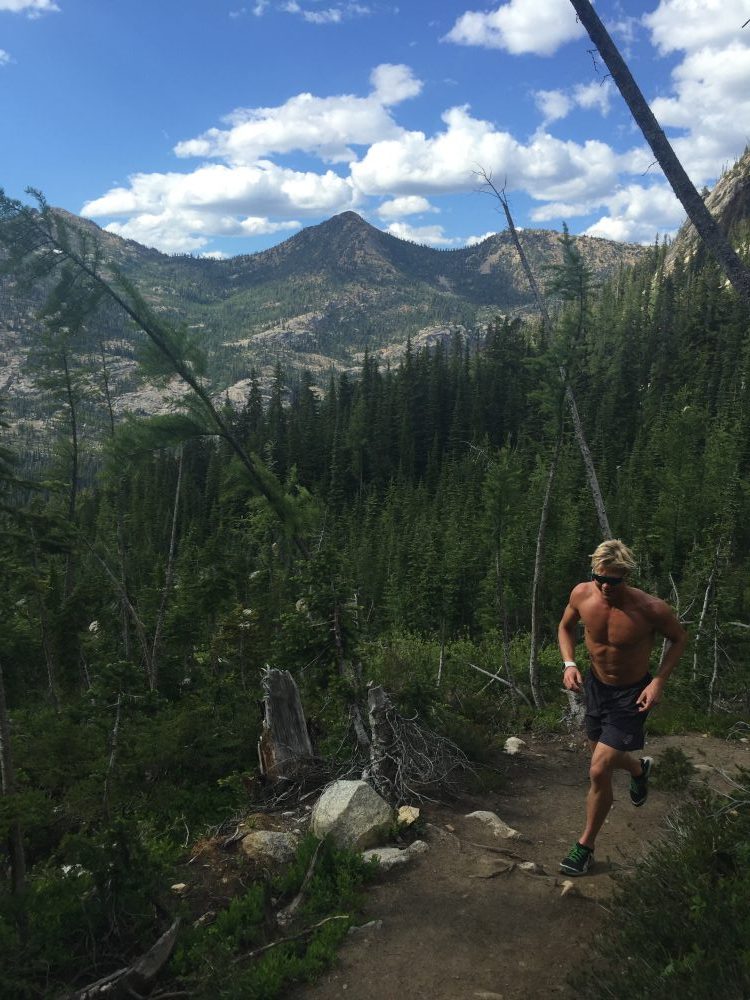
Erik Bjornsen during a run in the North Cascade Mountains this summer. (Courtesy photo)
7. Favorite non-athletic activity or pastime this summer?
I’ll let you choose one: Camping with good company, hot tubbing in glacier water, getting locked on some fish..
8. Song that was your jam this summer?
Railroad Man by Anna Lynch. Check it out! I was sitting around a campfire with mostly strangers one night and this girl started playing music. I was pretty impressed so I added her on spotify when I got home and ended up listening to her music a fair amount over the summer… Live music is always the best way to jam!
9. All-time favorite race moment?
2014 Sochi Olympics, Team Sprint.
10. First thing you pack in your bag when you leave for Europe?
I usually start with my boots and shoes because they go on the bottom of my bag. Boring, I know. Packing shouldn’t take longer than 30 minutes or your doing something wrong…Sadie….
11. Venue/event you’re most excited to visit this season?
La Clusaz
12. Who will win the men’s and women’s World Cup titles this year?
Sadie Bjornsen and Simi Hamilton
13. Biggest sacrifice you feel you’ve made choosing this career path?
I don’t feel like I have sacrificed much at all. To be the best in the world thought I think you have to focus a lot on yourself, and sometimes I think you’re forced to make selfish decisions.
I skipped my cousins wedding this summer because it didn’t fit in with my training schedule, sorry Tyler… Luckily I have a very supportive family!
14. If you could change one thing about your sport, what would it be?
I wish everybody was on a level playing field. Equal resources for everyone and no question whether of not people are doping. Doping is super lame!
15. What did you have for breakfast this morning?
Well today is a travel day, so it was a light breakfast. I had toast, cheese, eggs, ham, and a tall glass of raspberry lemonade.
16. In 5 years, I’ll be ____?
Oh, jeez. I could be doing just about anything, in just about anywhere..
17. In 50 years, I’ll be ____?
I’ll be splitting my time between my cabin in the Methow Valley and my chalet in France. You can call me on my cell phone, but you’ll probably just get my voice mail.
The day of the men’s 4 x 10 k relay at the Laura Cross-Country Ski Center at the 2014 Winter Olympics in Sochi, Russia. Sweden went on to take gold, Russia silver and France bronze in the event.
Max Cobb’s motivation to voice his disdain for doping dates back to the 1992 Albertville Olympics. Justin Wadsworth’s stems from being an athlete who had suspicions, but moreover, from watching his wife Beckie Scott miss out on her chance atop the Olympic podium after having been beat out by two Russians who were eventually disqualified for using performance-enhancing drugs.
For both, when it comes to Russia, they’re direct.
“The level of fraud and deceit that was allegedly put in place for the Sochi Games around the anti-doping effort is just a complete assault on everything that sport and the Olympic movement stand for,” Cobb, president and CEO of US Biathlon, told FasterSkier this past weekend.
He was reacting to The New York Times report, published Thursday, May 12, that suggested dozens of Russians, including 14 cross-country skiers, participated in a state-run doping program at the 2014 Winter Olympics in Sochi, Russia.
“There’s enough evidence in the past, with how many positive doping cases the Russians have had,” said Wadsworth, who recently left his post as head coach of the Canadian cross-country ski team after five seasons with the team. “I think that alone is enough to have reason to try to put some sanctions on them.”
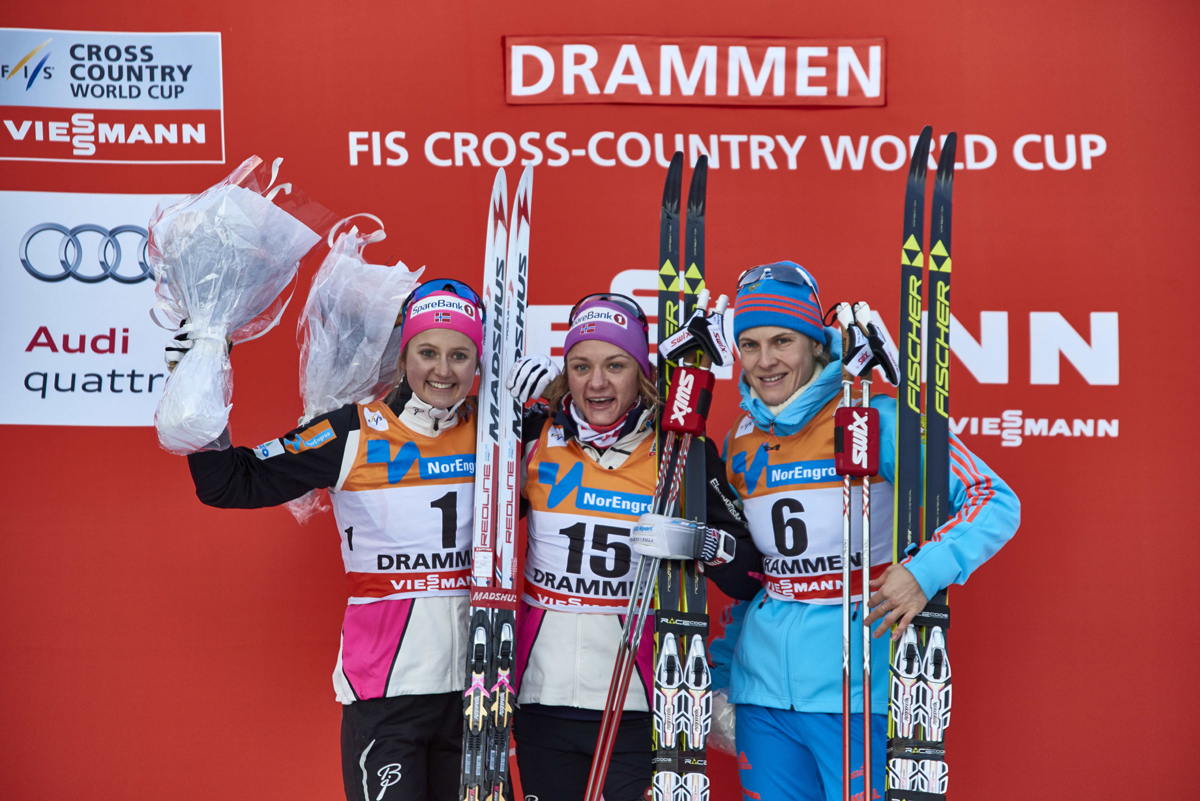
Russia’s Natalia Matveeva (r), who tested positive for recombinant EPO in 2009 and was suspended until March 2011, joins Norway’s Ingvild Flugstad Østberg (l) and Maiken Caspersen Falla (c) on the podium this past February at the 2016 classic sprint in Drammen, Norway. (Photo: Fischer/NordicFocus)
Wadsworth was referring to a trend leading up to the 2010 Olympics, in which about a dozen Russian cross-country skiers were suspended for failing drug tests between 2001 and 2009.
“When I first came onto the international scene in the late ’80s, I went to ’89 World Championships in Lahti, and during that whole time I was naive…,” Wadsworth, a former U.S. Ski Team member, recalled. “You learn over the years, you see enough stuff that you just know what’s most likely an athlete that’s doping. You can’t come out and say, ‘Yeah, for sure,’ unless you see the needle going in the arm.”
That’s what makes the current case so complex, with the head of the Sochi anti-doping lab, Grigory Rodchenkov, releasing a list of Russian Olympians handpicked to receive illegal drugs at the 2014 Games.
It’s his word — a man whom the World Anti-Doping Agency (WADA) accused of taking bribes and destroying more than 1,400 samples, who was forced to resign and now lives in Los Angeles — against the Russian government’s. The tests were allegedly tampered with, so investigators will have to find evidence elsewhere to convict athletes like Alexander Legkov, who won gold in the final race of the Sochi Olympics, the 50-kilometer freestyle mass start.
The Russian Sports Ministry might even sue The New York Times, according to RT, a Russian government-funded media outlet.
“We are considering a lawsuit,” Russia’s Deputy Minister of Sports Yury Nagornykh told the Russian News Agency TASS. “They asked us to give comments on 66 athletes who are a part of Russia’s ‘doping program’. We said that we don’t have such a program.”
Rodchenkov claimed he concocted a “three-drug cocktail of banned substances” mixed with liquor, with “one milligram of the steroid mixture for every milliliter of alcohol.”
Apparently, he dissolved the drugs in alcohol to speed up the absorption, making Chivas whiskey for men and Martini vermouth for women.
“All athletes are like small children,” Rodchenkov told The New York Times (NYT). “They’ll put anything you give them into their mouths.”
“Athletes drink Chivas before competing? I can’t take it seriously,” Russian cross-country skier Sergey Ustiugov, who was not named in the NYT report but competed at the 2014 Olympics, told RT.
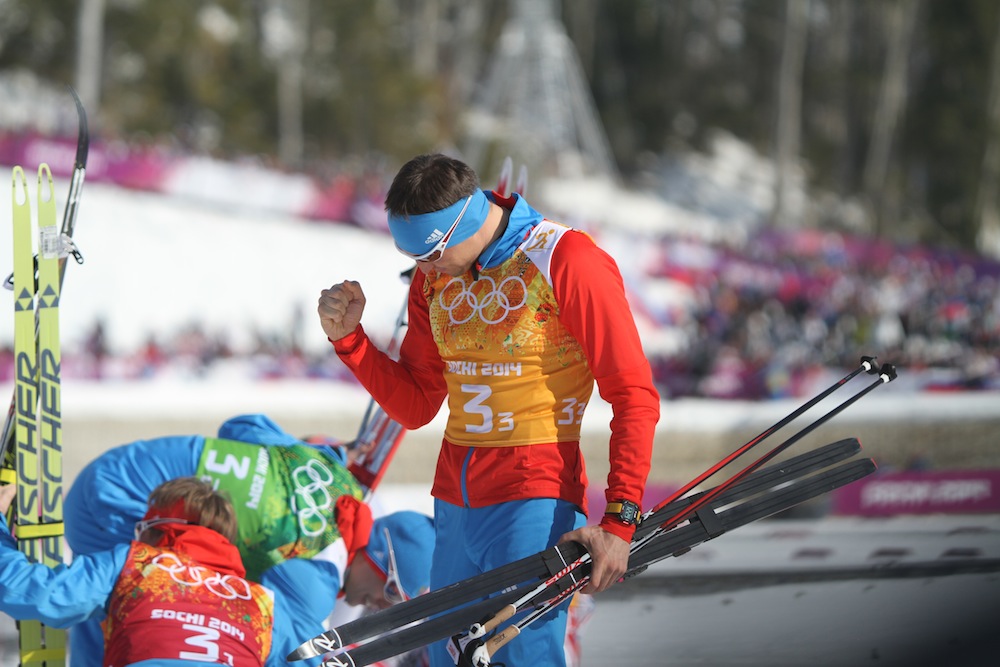
Alexander Legkov (standing) celebrates Russia’s silver in the men’s 4 x 10 k relay, their nation’s first medal in cross-country at the Sochi Olympics. He went on to win gold in the final race of the Sochi Games, the 50 k freestyle mass start, and Russia swept the podium.
“What happened yesterday [the release of NYT article] is totally absurd,” Legkov said at a press conference. “Alcohol with steroids is ridiculous. I didn’t take a sip of alcohol when I was meeting with friends because I was preparing for the Olympic Games. I know nothing about steroids, I don’t know how they look like. I took the article as an April [Fools’] joke.”
Legkov also called Rodchenkov’s comments groundless.
“It is a political game. Everybody is set against our country because it is one of the strongest in the world,” he said.
The NYT pointed out that, according to WADA statistics, Russia had the highest number of athletes caught doping in 2014.
While Russia fights to defend its winter athletes, its sport officials are simultaneously trying to ensure their track-and-field athletes can compete at the 2016 Summer Olympics in August in Rio de Janeiro, Brazil.
“Serious mistakes have been made by the federation management, along with athletes and coaches who have broken anti-doping rules and neglected the principle of fair play,” Russia’s Minister of Sport Vitaly Mutko wrote in a statement to the British newspaper, The Sunday Times, this weekend. “Let us be clear. We are ashamed of them.”
Track and fields’ international governing body, the International Association of Athletics Federations (IAAF), suspended Russia’s athletics team in November following a WADA investigation that found it guilty of state-sponsored cheating.
“We do not deny having a problem in Russia, and we are doing everything possible at state level to eradicate doping, including punishing athletes and coaches,” Mutko wrote.
Russia will find out June 17 whether its track and field team will be allow to compete in Rio.
“We are very sorry that athletes who tried to deceive us, and the world, were not caught sooner,” Mutko added. “We are very sorry because Russia is committed to upholding the highest standards in sport and is opposed to anything that threatens the Olympic values.”
‘The Needle Going in the Arm’
Cobb didn’t witness doping firsthand, but his opinion on the matter goes back to one of his first Olympic experiences, a night or two before the first race in Albertville, France.
“We were up in Les Saisies and one of our coaches who I was in the sauna with was dragged out to go help translate between a Russian coach and the village medical doctor,” Cobb recalled of the 1992 Games. “Because our coach’s English wasn’t that good, I went along to help translate as well. The situation was, the Russian coach said, ‘One of our athletes is very sick and will die if he doesn’t get a cortisone injection.’ So I was helping to translate that to the French doctor, who spoke English pretty well.”
While emphasizing that point over the next few minutes, the Russian coach explained that the athlete was having an allergic reaction to a protein injection he received.
“The French doctor said, ‘Yes, I know. I can see that he’s having an allergic reaction, but cortisone is a controlled and banned substance, and unless I can examine the athlete I can’t give it to him,’ ” Cobb recalled. “ ‘And yes, I know he will die if I don’t give it to him.’
“That was really how my experience at the Olympic Games began,” Cobb continued. “That was the case of [Russian biathlete] Sergei Tarasov, who was given an injection of blood that was either not his own or had been spoiled by not being refrigerated in an effort to blood dope him before the first race in Albertville.”
That story surfaced last year when Tarasov, who went on to win an individual gold at the 1994 Olympics, turned 50 and gave an interview to a Russian magazine.
Cobb recalled that story and compared it to the current accusations against Russian athletes across multiple Olympic sports.
“This is an issue that has been a violation of the basic principles of sport, that has been — because it was, in many cases forced on athletes with the threat of losing their support if they didn’t comply — an issue that needs to change,” he said. “I believe that with whistleblowers, athlete insiders and RUSADA [Russian Anti-Doping Agency] insiders coming forward at this time, taking the immense risk to come forward and tell what’s going on in an effort to change the system, that incredible sacrifice on their part needs to be met with support from sports leaders. If we don’t support that now, I’m sure it will be decades before it would ever happen again.”
Cobb didn’t see the needle going in Tarasov’s arm back then, and he, like everyone but Rodchenkov who has so far come forward about the 2014 Olympics, didn’t witness the Russians cheating in Sochi.
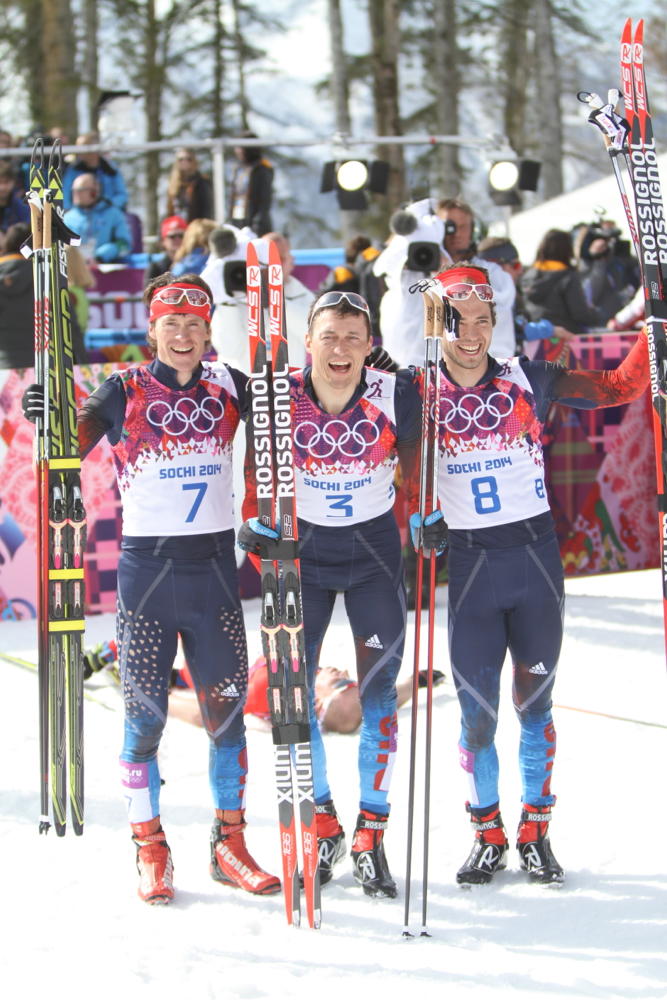
The all-Russian podium in the Sochi Olympics 50 k freestyle mass start, with Alexander Legkov (3) placing first, Maxim Vylegzhanin (7) in second for his third silver medal of the Games, and Ilya Chernousov (8) in third.
But Wadsworth claimed that’s what the Russians were up to immediately after they swept the podium in the 50 k, with Legkov leading fellow countrymen Maxim Vylegzhanin and Ilya Chernousov across the finish, respectively.
“If Rodchenkov knew my story, he would not even mention my name,” Legkov told MatchTV, according to a translation. “Since 2010, I have been working with foreign experts, I am absolutely not with Russian coaches, live all the time in Switzerland in an apartment in Davos. Before the Olympics, I have taken 33 doping tests.”
Meanwhile, Chernousov was another athlete who trained independently of the national team. After the Sochi Olympics in the spring of 2014, Chernousov began working with Vegard Bitnes, a Norwegian coach.
“We were one of the groups from [Russian] Federation, (Reto Burgermeister/Isabelle Knaute was an other),” Bitnes explained in an email to FasterSkier. “I planned all training, and had all control of training … we had our own camps and training.”
In the last two years, Bitnes explained that he and Chernousov only joined the Russian national team for two or three training camps, holding more camps with other national teams, like Sweden.
“We had some camps with Team Northug [Norwegian Petter Northug’s personal team], also with the Canadian team,” Bitnes wrote. “We was in some sport events in Norway, where we had trainings with French team, also US ski team athlete… So, we was almost never with the RUS team.”
Technically, Bitnes was a Russian national-team coach. He recently parted ways with Chernousov to become the head women’s coach of the Austrian biathlon team, effective May 1.
“The end of my work has nothing to do with the latest from RUS team,” he wrote. “I wanted to turn back to the IBU and Biathlon again. I hope for the best for Ilya and his training in the future.”
As for the allegations that 14 of 20 Russian cross-country skiers in Sochi — which may or may not include Chernousov — were doping, Bitnes wrote, “I can not comment so much, because it is from a time before I had anything to do with the RUS team. I can only say that it’s frightening to see/hear about this. Based on a general base. I hope WADA and IOC [the International Olympic Committee] will get to the bottom of those obligations, so we can clean up this mess. If this is true, its a very very sad thing.”
The Russians celebrate their silver medal in the men’s 4 x 10 k relay at the 2014 Sochi Olympics, with (from left to right) Dmitriy Japarov, Maxim Vylegzhanin, Alexander Bessmertnykh, and Alexander Legkov.
Wadsworth is confident it’s true. The former Canadian coach recalled suspecting something fishy was going on with the Russians during the men’s 4 x 10 k relay in Sochi as he watched Legkov put down the fastest time on the third leg.
“What I saw with the rest of his form that year and on that course, when I saw him hop-skating pretty much the whole course, especially the last hill coming into the stadium, the way he was looking on his face after pushing so hard — because the Russians were quite far behind and he really pulled them into medal contention in that race — and I just didn’t believe what I saw,” Wadsworth said. “And then in the 50 k, it was, at the end, the pace and the pushing. In the early part of the race, there were so many guys up toward the front, but in the last few kilometers, again, it just didn’t look right to me. And I always carefully think that through in my head as far as, is this a great performance we’re seeing or is this something else? And what I saw, I just thought it was something else.”
“I always carefully think that through in my head as far as, is this a great performance we’re seeing or is this something else? … I just thought it was something else.” — Justin Wadsworth
So he spoke out about the Russians after the 50 k and accused them of doping in a post-race interview with FasterSkier. FS then asked Legkov what he thought of Wadsworth’s accusation in the post-race press conference. Legkov laughed off the comment.
“I have to always be clear with this, I wasn’t making any excuses for our team, I was simply commenting on something I saw from the athletes on the field of play,” Wadsworth recalled this past Saturday.
“I fully accept our team’s preparation for the Games and our waxing issues … we had our own issues and we debriefed those and learned from those,” he continued. “But I think if I was potentially another coach who had athletes, like [Norway’s Martin Johnsrud] Sundby, who was fourth in that race and missed out on a chance at a medal … I guess I’m always surprised the Norwegians don’t speak out. They have so much power in our sport and they chose to do nothing with it except make things better for themselves on the World Cup.”
An email to Vidar Løfshus, director of the Norwegian Ski Federation, seeking comment on the recent allegations against Russia was not returned by press time.
“It’s just really surprising to me that nobody wants to speak out more. I can understand we all want to focus on our teams and on our own business, but that’s not to the point when there’s something going on like systematic doping,” Wadsworth said.
As for the athletes, “I expect them to focus on their training and themselves, but when it comes down to it, if there’s enough evidence and they’re tired of it, then they should probably speak up,” he added. “The athletes do have a powerful voice and they should use their athlete representatives to push FIS to do a better job and to push the IOC.”
Shocked But Not Surprised
One athlete who carefully crafted his responses in an email to FasterSkier was France’s Robin Duvillard, who placed sixth in the 50 k. Should the Russian cross-country team be disqualified and its results voided in Sochi, Duvillard would move up to third place and technically a bronze medal in that race.
France’s bronze-medal men’s 4 x 10 k relay team at the Sochi Olympics: (from left to right) Ivan Perrillat Boiteux, Jean-Marc Gaillard, Maurice Manificat, and Robin Duvillard.
“I would like to be clear about the fact that what I read in the newspaper yesterday are only suspicions,” Duvillard wrote on Friday. “I don’t want to blame them if some of the information is not true.”
If everything in the reports is true, “I am shocked, sure. But not really surprised,” the 32-year-old continued. “I am shocked about the fact that it was organized by the authorities. Not because some athletes are doped. In the past, we already discovered that athletes were doped, and I know that it can happen again.”
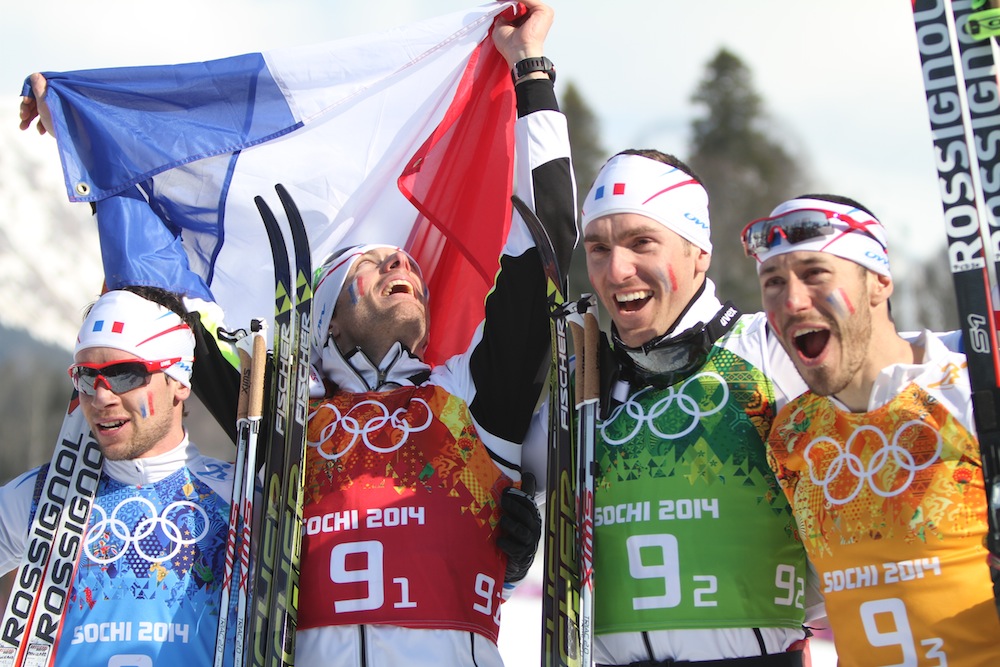
In Sochi, Duvillard stood on the podium with three teammates, earning bronze in the men’s relay behind Sweden in first place and Russia in second.
“The only thing we can do is to trust [WADA] AMA to achieve anti-doping tests,” he wrote. “And what I have read yesterday is that they failed in Sochi, because Russian authorities were more powerful than them. But now I need to keep my faith in AMA’s work if I want to live my sport serenely and not getting paranoiac.”
Considering the news that immediately followed the 2014 Olympics, in which Russian skiers stated they had used xenon gas in training — a controversial but not-yet-banned substance (before WADA banned it in May 2014) — along with the Russian-athletics scandal unveiled last year, Duvillard had his suspicions.
“I suspected that a doping scandal could break out in Sochi, considering the bunch of money they put into it, and because Putin wanted to show the world that Russia is still shining,” he wrote. “But I can’t say I really suspected the cross country athletes being doped in the 50k. Sure, they were way faster than me in the last hill, but they were faster many many times in the past, so why not once again?”
Since the NYT report hit the world wide web last Thursday, Duvillard has received numerous messages congratulating him on the potential bronze medal.
“In a way, I would be glad to get this medal, because that would award all the work I have done to get in shape on that race,” he wrote. “But in another way, the party would be spoiled forever! Because any time I would watch again that 50k, I would find myself crossing the line in 6th place, and any time I would watch the closing ceremony with that amazing podium into the stadium, I wouldn’t see me on it.”
“Sure, they were way faster than me in the last hill, but they were faster many many times in the past, so why not once again?” — Robin Duvillard, sixth in the men’s 50 k at the 2014 Sochi Olympics
The redistribution of medals is a drawn-out process that involves legal battles handled by the Court of Arbitration for Sport, but if you ask Wadsworth, whose wife fought for her medal two years after the fact, it needs to happen.
“If nobody does anything, nothing’s going to change,” Wadsworth said. “… It’s great for [Beckie] to have the gold medal in the house and get recognized for that, but on the day, that’s what you as an athlete, that’s what you dream about, that’s what you work hard towards and when you get that robbed from you, it doesn’t matter what happens in the future.
Alexander Legkov (3) beat out fellow Russians Maxim Vylegzhanin (not shown) and Ilya Chernousov (r) for gold in the Sochi Olympics 50 k freestyle mass start. Vylegzhanin took silver by 0.7 seconds, just a tenth of a second ahead of Chernousov in third, and Norway’s Martin Johnsrud Sundby (1) missed a medal by 0.2 seconds in fourth. Not shown: Sergei Dolidovich of Belarus placed fifth, 14.3 seconds after Legkov, and France’s Robin Duvillard was another 0.6 seconds back in sixth.
“I think what really needs to come out from all this is not the results getting stripped — you know, Robin Duvillard, he might get the medal, but he’s not going to get to feel what it felt like to stand on the podium in the closing ceremonies down in Sochi, to get a medal around his neck, so that whole thing is lost,” Wadsworth continued. “What really needs to happen is things change for the future so that clean athletes have an opportunity.”
Should the entire Russian cross-country team be suspended, some clean Russian athletes will get caught in the aftermath, he noted.
“But those athletes should speak out and say what they know as well because it’s the Russian athletes that’s getting cheated the worst in the very end,” Wadsworth said. “They’re the ones that are going to have the health issues in the future and they’re also the ones that are going to miss out on future opportunities if their team does get allowed to race. And they’re the ones at the end of the day that have to look at themselves in the mirror and know they cheated.”
FIS and the IOC
As for how the International Ski Federation (FIS), the sport governing body for cross-country (as well as several other winter sports), FasterSkier first obtained a statement on the matter via email.
“FIS is deeply disturbed by these allegations and will provide all possible cooperation to WADA and the IOC with the investigation,” the statement noted.
In a follow-up phone interview on Monday, FIS Secretary General Sarah Lewis said, “We also will make sure that we are looking into our processes which we can control, as opposed to the Olympics where we are playing a facilitating role but not directly controlling the testing.
“Certainly for everybody it’s a wake-up call to what may have happened and what therefore has the potential to happen,” she continued. “I’m very sure that there will be a very careful analysis of the situation to make sure that this cannot happen going forward.”
Kikkan Randall (U.S. Ski Team) at the 2014 Olympics in Sochi, Russia. (Photo: Fischer/NordicFocus)
Kikkan Randall, chair of the FIS Athletes’ Commission who competed for the U.S. in Sochi, wrote in an email that the latest news was “definitely disturbing and if it turns out to be true, it is really unfortunate and unfair for those athletes that competed clean in Sochi and missed out on medals.
“The FIS Athlete Commission had previously written a letter to WADA after the news came out about Russian Athletics calling for further investigations into other sports, especially cross country skiing,” Randall added. “We hope WADA can get to the bottom of this and I know FIS will be in full cooperation to help out however they can.”
As for the U.S. cross-country team, head coach Chris Grover said they’ve been following the news closely.
“I guess our initial reaction is that we are disheartened and disappointed, and really disappointed that there might be a tie to cross-country here,” he said on the phone this weekend before convening with the team for its first training camp of the 2016/2017 season.
“It’s something we’ll talk about as a group but we haven’t,” Grover said. “Every time any sort of doping scandal comes up, we definitely talk about it as a group. It reinforces our resolve by lead by competing clean. And the exciting thing that we have talked about before, is that we know that we can win when we are doing it clean, because we’ve done it so many times before. That’s the silver lining for us … We can’t get hung up in what other people may or may not be doing.”
“The exciting thing that we have talked about before, is that we know that we can win when we are doing it clean, because we’ve done it so many times before.” — Chris Grover
Asked if he had suspicions about doping in cross-country skiing, he said, “I’ve never felt 100-percent confident that the sport is 100-percent clean. I’ve felt that it’s clean enough that we can win. I think that all of us feel that it’s a lot cleaner than it was when we first got involved in the sport.
“We’re really interested in how this story unfolds,” he continued. “We are grateful to the media sources that are following this closely and are doing investigations. We will always, from the USSA [U.S. Ski & Snowboard Association] side, take an active role in working with the USOC [US Olympic Committee] and FIS to ensure that proper steps are taken, that we are getting a clean sport and a level playing field.”
Grover is also chairman of the FIS Cross Country World Cup and Continental Cup sub-committees. FIS plans to meet in Cancun, Mexico, for its 50th International Ski Congress from June 5-11.
“To be perfectly honest, the situation was and is on the agenda based on the WADA report on November,” Lewis said of the planned discussion of Russia at those meetings. “It’s on the agenda of the Council. The Congress is not dealing with daily business … The whole WADA report and the situation with the Russians is on the agenda of the Council already, and now obviously there is more information to be able to discuss and address.”
Update: The IOC Executive Board held a special meeting on Tuesday with IOC President Thomas Bach calling for additional anti-doping measures. The IOC retested 454 selected doping samples from the 2008 Summer Games in Beijing, China, and as a result, up to 31 athletes from six sports could be banned from the upcoming Olympics in Rio. The IOC is also planning on retesting 250 samples from the 2012 London Games.
“The aim is to stop any drugs cheats coming to the Olympic Games in Rio de Janeiro,” an IOC press release stated.
“Swift and decisive action will also follow the controversy surrounding the anti-doping laboratory in Sochi,” it continued. “Meeting Tuesday, the EB of the IOC has requested WADA to initiate a fully fledged investigation into allegations that testing at the Sochi Laboratory was subverted. The IOC for its part will instruct the Lausanne Anti-Doping Laboratory, where the Sochi samples are stored for ten years, to proceed in cooperation with WADA with their analysis in the most sophisticated and efficient way possible.”
The IOC has asked the Russian Olympic Committee to ensure the full cooperation of the Russian side in the WADA investigation.
“Based on the result of this investigation the IOC will take swift action,” the release said.
Martin Johnsrud Sundby thanks his lucky stars (and skis) after winning his fourth-straight individual race (and fifth race in a row) of the World Cup season on Saturday at the 30 k freestyle in Davos, Switzerland. He held off France’s Maurice Manificat (l) and teammate Anders Gløersen (r) for the win. (Photo: Fischer/NordicFocus)
If someone had to be a carrot, so to speak, Martin Johnsrud Sundby was the guy to go after in the men’s 30-kilometer freestyle individual start on Saturday at the World Cup in Davos, Switzerland.
Maurice Manificat of France started a minute behind the Sundby — and interestingly 30 seconds after Canada’s Graeme Killick — in bib 60 of 83. By the first timing point at 2.2 k on the 5 k course, Manificat had already put himself in a position to rival Norway’s defending overall World Cup champion.
But how long would it hold up?
One kilometer later, Manificat was just a tenth of a second faster than Sundby with the lead, and by 5 k, the he remained 0.2 seconds ahead in first.
Maurice Manificat pushed over every inch of the men’s 30 k freestyle individual start on Saturday in an effort to beat Norway’s Martin Johnsrud Sundby for the win.
“I started quite fast and had great skis,” Manificat told FIS after the race. “I was focused the entire time.
Manificat’s fast start held up as the 29-year-old Frenchman matched Sundby’s times for two-thirds of the six-lap race. Most of the time, despite not actually being able to see Sundby, Manificat had the edge — except for when Sundby was 0.6 seconds ahead at 10 k and then 0.3 seconds up 10 kilometers later.
That’s where Manificat’s race started to unravel. He later explained his back hurt for the final 10 k. By 22.2 k, he started to lose contact with Sundby, who was then eight seconds ahead at that checkpoint.
Sundby extended that gap to 9.5 seconds 1 kilometer later, then was 10 seconds ahead with 5 k to go. At 27.2 k, it appeared the race was over and in Sundby’s control, as the 31-year-old Norwegian led Manificat by 20.8 seconds.
Sundby went on to win by 20.7 seconds in 1:06.27.9, and Manificat held on for second place, 7.9 seconds ahead of Anders Gløersen of Norway. Gløersen won the shortened version of this race last year in Davos: the 15 k freestyle.
Throughout Saturday’s full-distance signature event, even tougher because it’s at altitude 5,000-plus feet above sea level, Gløersen had been in the hunt for a podium, skiing the same speed as Norwegian teammate Chris André Jespersen early. Both were about 18 seconds behind Manificat and Sundby at 8.2 k. Two kilometers later, Gløersen’s time still ranked third but Jespersen had dropped to fifth behind France’s Robin Duvillard.
An early starter in bib 22, Duvillard initially set the times to beat for the Norwegians following him. Duvillard’s teammate Jean-Marc Gaillard started 23rd and ultimately finished about 10 seconds faster than Duvillard, earning his seat in the leader’s chair until Norway’s Sjur Røthe in bib 34 crossed the line 1.3 seconds faster.
Gløersen topped Røthe by almost 15 seconds to take the lead, then was finally bumped to third by Sundby and Manificat. Røthe ended up fourth, Gaillard placed fifth, Norway’s Petter Northug came on strong later in the race to finish sixth (+46.2), Duvillard was seventh (+54.3), and Jespersen finished eighth (+1:03.5). Hans Christer Holund was the sixth Norwegian in the top nine in ninth (+1:07.5), and Switzerland’s Toni Livers placed 10th (+1:13).
Martin Johnsrud Sundby leads a train with some of his Norwegian teammates, including Petter Northug (56) on Saturday at the Davos World Cup 30 k freestyle in Switzerland. (Photo: Fischer/NordicFocus)
At the finish, Sundby appeared content with what he’d done — winning his fourth-straight individual race in as many distance races this season — without much showmanship. Truth be told, he was tired.
“I pushed a bit too hard the first 15 kilometers,” Sundby told FIS. “I did not feel that good after that. I was lucky I joined Sjur and Petter. Sjur did a great job in the fifth lap. I was able to catch some speed.
“The races in Davos kill me every year,” he added. “The last two kilometres were almost impossible to ski. I tried to ski easy on the way to the top but I was tired…”
“I’m glad that I won,” Sundby told VG, according to a translation. “This is the toughest [race] I’ve been in so far this year. This was no ‘walk in the park.’ ”
He would have preferred to have completed the course — lap after lap — with “steel control”, Sundby added, but that wasn’t in the cards.
“It was a tough race and Maurice had a hold on me…,” he said. “Today I had to fight. I luckily got good [skiing with] both Petter and Sjur the last two laps.”
The men’s 30 k freestyle podium at the World Cup in Davos, Switzerland, with winner Martin Johnsrud Sundby (c) of Norway, France’s Maurice Manificat (l) in second, and Norway’s Anders Gløersen (r) in third. (Photo: Fischer/NordicFocus)
Røthe explained he struggled to follow Sundby, but he stuck with the Norwegian train and it led him to fourth place.
“I asked Martin if he would pull a bit, but got no answer,” Røthe told VG.
Perhaps the most visibly gassed at the line, Manificat was initially frustrated with his 20-second loss, but he didn’t take long to recover, stand up and smile at the TV cameras. He had done his best and ended up on the podium.
“It is crazy to be on the podium again. It was great fight with Martin,” Manificat told FIS. “In the last two laps I had pain in my back. I was losing seconds on Martin and then I let it go…”
The last time Manificat reached the podium was last February in Östersund, Sweden, when he placed second in the 15 k freestyle at the pre-World Championships World Cup.
“We are delighted to be joining the fight,” Manificat said to VG about his French teammates, with three French skiers in the top seven.
As for what it will take to beat the Norwegians, he added, “We have to be in really good shape.”
Martin Johnsrud Sundby (148) leads fellow Norwegian national-team member Petter Northug during the 15 k freestyle FIS race in Beitostølen, Norway. Sundby went on to win by 47 seconds and Northug was a minute back in fourth. (Photo: Eirik Lund Røer/SKIsport)
Norway’s Martin Johnsrud Sundby, who was disqualified for skating in Friday’s classic FIS race in Beitostølen, Norway, returned to the course with a vengeance Saturday. He ended up winning the men’s 15-kilometer freestyle by 47.4 seconds over runner-up Hans Christer Holund (Lyn Ski), also from Norway.
And Sundby wasn’t even sure he’d race. He made up his mind just minutes before his scheduled start — which was last in a field of 148 men.
Norway’s Martin Johnsrud Sundby after winning the 15 k freestyle FIS race in Beitostølen, Norway, a day after he was disqualified in the 15 k classic season-opener.
“It was a good race for me, and I had fantastic skis,” the 31-year-old defending overall World Cup champion told NRK after racing in heavy snowfall. “That was a huge advantage in these challenging conditions. It was hard to get the timing just right with a lot of snow in the tracks that tended to make the skis go different directions than I wanted. But all that considered, I feel like I skied technically solid and was on the ball in the sections where it mattered.”
Sundby took the lead for good at 5.4 k after ranking fourth at 1.6 k behind France’s frontrunner at the time, Martin Fourcade, a multiple-time world champion biathlete. At 2 k, Sundby was up to second, just 1 second behind Fourcade.
“My body felt good, and it felt good to win,” Sundby added. “I took that jury decision sort of personal yesterday and it bothered me quite a bit. But I got a reality check later last night with all that happened in Paris.”
Fourcade went on to place 12th, finishing 1:38.5 off of Sundby’s winning time of 36:12.1.
“I had a good start, but I [couldn’t respond] later in the race,” Fourcade told NRK, according to a translation. “I was not in my best form … but I am confident for the start of the season even if I am not happy today. I’ll try to do better in the Kuusamo World Cup…”
Robin Duvillard of France approaches TV cameras with the message “Pray for Paris” at the finish of Saturday’s 15 k skate FIS race in Beitostølen, Norway.
A day after terrorist attacks in Paris killed at least 127 civilians, France ended up with three in the top 12 nearly 2,000 kilometers away in Beitostølen. National-team member Robin Duvillard led the way in third, 1.7 seconds behind Holund in second.
Duvillard started 140th and briefly took the lead from Great Britain’s Andrew Musgrave, who trains with the Norwegian team Røa IL and ended up sixth (+1:02.7). In the finish pen, Duvillard approached TV cameras urging viewers to “Pray for Paris.”
Less than a minute later, Holund, 26, bumped him out of the leader’s spot until Sundby finished and secured the win.
“It’s always fun to race fast at Beitostølen, but I will have to step it up a notch for the mini tour in Finland,” Sundby said of the World Cup opener in two weeks. “I’m excited.”
Holund was satisfied with his race and his second podium finish in as many days. He placed third on Friday.
“It was really fun to be on the podium today after skiing fast enough to be on the podium, not because someone faster than me was disqualified,” Holund said, referring to Sundby, who initially was thought to have won Friday’s 15 k classic.
Holund wasn’t concerned about the 47-second gap to Sundby.
“Martin is in a league of his own. I have never been even close to him in skate or classic,” he said. “For me, it was great to feel that my body felt good and that I am able to ski fast again.”
“Martin is in a league of his own. I have never been even close to him in skate or classic.” — Hans Christer Holund, 26, of Norway’s Lyn Ski club, after finishing second to Norway’s leading man, Martin Johnsrud Sundby
During a recent altitude camp with the Norwegian team in Val Senales, Italy, Holund was evacuated off the glacier during a workout. He recalled feeling weak at the start of the workout, and that feeling got worse. Suddenly, he was gasping for air and struggling to stay conscious. He was airlifted to the hospital and underwent a battery of tests. Ultimately, doctors could not determine the cause.
“I have to take their word for it, but I’m still curious given that it happened so suddenly and during an easy workout rather than while doing intervals,” Holund told the Norwegian newspaper Aftenposten.
Just off the podium in fourth, Northug raced for the first time this season after skipping Friday’s 15 k classic. He said he curious to see how his fitness would stack up, but coming off the altitude camp, he wasn’t expecting to be at peak performance this weekend.
“My body felt a bit slow after so long at altitude, and this was also my first hard effort after coming back down,” Northug said. “So it was a little too early for me, but the plan is to race fast in Kuusamo, so this was just a good hard effort..”
After the sprint race at Beitostølen on Sunday, Northug and the rest of the top Norwegians will continue their training regimens for the next two weeks, aiming to be primed for the World Cup opener in Finland Nov. 27-29.
“The courses in Kuusamo are tough and I know the mini tour there usually suits me well,” Northug said.
Erik Bjornsen (U.S. Ski Team B-team) leads French biathlete Martin Fourcade, a two-time Olympic gold medalist and six-time world champion, during a training session earlier this month in Villard-de-Lans, France. (Photo: Dauphi Nordique)
In a paparazzi-like post about Martin Fourcade, a French website featured nearly two dozen photos of the French biathlete rollerskiing on a recent autumn morning. One photo wasn’t much different from the next, except for the eight with Erik Bjornsen.
It wasn’t his French look-alike; he wasn’t photoshopped in there. Bjornsen, a 24-year-old U.S. Nordic Ski Team member, recently returned from several weeks in France, training near Grenoble with Fourcade — a two-time Olympic gold medalist, six-time world champion, and his girlfriend’s friend.
Erik Bjornsen rollerskiing this fall in Villard-de-Lans, France. (Courtesy photo)
“I’ve gotten to know him the last few years,” Bjornsen explained.
The photos were from an interval session they did on the track in Villard-de-Lans, where Bjornsen mostly trained during his stay. He’s been returning to France to visit his girlfriend, former French biathlete Marine Dusser, for the last three summers.
“There’s quite a few top athletes that are based out of that area, so I’ve gotten to know the crew around there pretty well,” Bjornsen said on the phone last week, a few days after joining the U.S. Ski Team for its annual fall camp in Park City, Utah.
In France, he has worked out with top French cross-country skiers like Robin Duvillard and Maurice Manificat, and this year, Bjornsen spent a good deal of time with Fourcade, 27, and his older brother Simon, 31, also an individual World Championships medalist. The two biathletes visited Villard-de-Lans between training camps, during which time Bjornsen joined them for a few interval sessions.
“You know, Martin’s going to be doing some nordic racing this year so he has been [working on] his classic skiing as well, so we got out for a lot of easy distance skis together,” Bjornsen said.
Instead of tagging along and trying to hang with the French national-team members during their workouts, Bjornsen explained he was more conscious about sticking to his own training plan this year.
“I’ve had kind of a tricky summer with a couple of injuries and surgery in July on [my right] hand so I’m kind of in a different spot,” he said. “I’m really trying to work on trying to build my aerobic base since I kind of missed a couple of months this summer. It worked out that Martin was pretty into changing his plan a little bit so he could match it up with mine, which is really sweet of him. We ended up doing [Level 3] workouts together and then for easy distance, it’s pretty easy to match up those workouts.”
FasterSkier: How did you injure your hand and when did you have surgery on it?
Erik Bjornsen: Last fall I had a ski crash with [my Alaska Pacific University teammate] Scott Patterson. I tore part of my tendon in the hand, and it was quite painful throughout the season. … I had a bunch of scar tissue built up and it kind of looked like I had like another knuckle on the top of my hand. It was just this big bump that [hurt] every time I was poling. The second glacier camp in July, I had been working on it throughout the spring and trying to naturally recover it and it just it wasn’t working so [APU coach Erik] Flora and I decided to make the call and get the surgery done. I had surgery in mid-July. I wasn’t able to rollerski really much for a month and a half. I actually had a little bit of a knee injury going on at the same time, so I had kind of a tough couple months of training and spent quite a bit of time in the pool swimming, doing some alternative exercises.
Erik Bjornsen after having surgery on his hand in July, “still feeling a little funny,” he explains. (Courtesy photo)
FS: What happened to your knee?
EB: I hammered one of my knees against a rock when I was running, like a week before the surgery. I took a couple of weeks to get better, but then after surgery I was supposed to keep my hand elevated. I was starting to get back into running, but running with one of my arms elevated. I think it just kind of threw off my body. It put a lot of torque on my left side of my body and especially on the knee. It stiffened up, especially my left hip, and that took a month to get over. It was just a lot of stretching and massage work. So I was able to get over that, but I mean, I haven’t really been feeling healthy for more than like a month now.
FS:Ouch. Back to your hand: what kind of surgery did you need?
EB: They went in and the tendon was actually looking like it was in pretty good shape so they didn’t do much work on that, but there was a big buildup of scar tissue and that seemed to be throwing off the the gliding of the tendon. It hurt when I was putting pressure on it with the strap, but after skiing like an hour, an hour and a half, it actually started getting like more painful. So they went in and mostly just took out the scar tissue.
FS:Are you pain-free now? Where are you at with your recovery and how are you feeling?
EB: I’ve been feeling great for the last month. Pretty much the last month I’ve been completely healthy and I’m ready to get some good training in. It was good timing to go to France and kind of have a little refresher after doing quite a bit of training on my own since July. I spent a lot of time in the pool, and then spent a fair amount of time doing some no-pole rollerskiing skate skiing, and those were kind of the two main exercises I was doing. So it’s been nice to kind of get back into some double poling using poles and starting to run some more. I’m starting to feel good again.
Erik Bjornsen mid-run, enjoying a change of scenery in Corsica, France. (Courtesy photo)
FS:This Park City camp is mostly focused on intensity training, right?
EB: This first week is building in some steady distance training. The last portion of the camp, we’ll have a mini tour so that’s kind of the focus of the camp, trying to get ready for that mini tour and trying to have three good intensity days [at the end].
FS:How are you feeling on Day 2 of camp, now that you’re working out with your teammates again?
EB: I don’t feel like I have a good sense of where I’m at compared to the [other] guys [on my team] right now, but as far as the last month I’m definitely starting to build my confidence back up a little bit. It was kind of a tough last part of the summer with all the injuries. I did a ton of training on my own and a lot of different training. So it can be a very interesting season to see how it all works out. I used to do quite a bit of swimming when I was younger … I was getting into swimming again, sometimes, like, a couple miles a day. I think I’m a pretty decent swimmer so I was lucky to have that background in the sport so that I was able to still use it for pretty good training.
It’s been interesting to get back into the skiing, and I feel like I’ve been moving a little bit differently. I don’t know if it’s better — I hope it’s better — it’s definitely, mentally, a different training schedule than I am used to. And I haven’t done a lot of the intervals. I’m starting to feel like maybe I didn’t lose as much as I was originally thinking, but it’s always so hard to tell on rollerskis. You never really know until the first couple of races or first couple of time trials, but I’m definitely starting to get a bit more confidence back, feeling like I’m in a decent place. I wouldn’t be surprised if I gradually build into the season this year. We’ll see.
Erik Bjornsen racing the sprint qualifier at 2015 French rollerski nationals in Bastia, Corsica. (Courtesy photo)
When I was in France, I raced the French rollerski nationals [in September in Bastia, Corsica]. It was a good opportunity to jump in with all the best World Cup guys. Everybody was there from the French team. After Norway and maybe Sweden, I would say they are the strongest team. I had some decent races there. I kind of got my butt kicked, but there’s some strong guys. I was decently satisfied with the way I was skiing. It’s always a little tricky when you jump in … they have matched roller skis there; skis I’ve never been on. It was pretty epic.
[Bjornsen said he finished seventh or eighth in the sprint, narrowly missing the final. In the prologue the next day, he estimated he finished in the top 20.]
FS: You mentioned focusing on sprints again this year. Without a World Championships to peak for, what kind of larger goals or events are you setting your sights on?
EB: I’ve been working out the schedule. I feel like there is actually a decent amount of classic skiing this year, which I’m pretty excited about. I think I’ll also try to finish the Tour de Ski this year, so that will be one of my focuses, and then for sure the Canadian [World Cup] races, especially Canmore. It’s pretty close to my home in Washington. I think a lot of my family will be up there and friends, and so I am hoping I’ll be in good shape for those races. I’ll be doing the same as last year, pretty much all the starts the coaches will give me. Just trying to gain experience on the World Cup, get closer to the podium, but I think, it’s not going to happen in a couple years. I mean hopefully I can, overall, just take one step closer.
Erik Bjornsen and Mannon, Martin Fourcade’s daughter, who was 6 weeks old at the time. (Photo: Erik Bjornsen)
FS:A lot of people might wonder what Martin and Simon Fourcade are really like. How would you describe their personalities?
EB: They are actually really good friends with my girlfriend’s family so I’ve known them for a few years now. They are pretty close. They were over for Christmas dinner last year. I feel like I’m starting to know them pretty well. I really enjoy spending time with them. They are both great guys, but they are also very different personalities between the two of them. They are super fun to hang with.
It’s crazy — Martin is one of the most famous guys in France. We were skiing one day together and he was telling me he was going to Paris, and then I saw him on television. It’s crazy to see how famous he is. He’s just a normal guy and really nice. He has a kid now. I met her. I know his wife so I spent some time with [them] outside of training. I think they are both pretty laid back … they seem like regular guys. They are the same kind of people as Simi [Hamilton] and Andy [Newell] or any of the guys back here, down to earth and laid back.
American Caitlin Gregg (Team Gregg/Madshus) placed third at the 2015 Engadin on Sunday, a 42 k freestyle marathon from Maloja to S-chanf, Switzerland. (Photo: Inge Scheve)
S-CHANF, Switzerland — Coming off a bronze medal at Nordic World Championships, American Caitlin Gregg (Team Gregg/Madshus) finished third in Sunday’s Engadin Skimarathon 42-kilometer freestyle from Maloja to S-chanf, Switzerland, just 7.6 seconds out from the win, which France’s Anouk Faivre Picon seized in 1:39:35.3.
Russia’s Ilia Chernousov won the men’s race by one-tenth of a second over France’s Robin Duvillard in 1:34:50.
Picon won the sprint finish, 0.8 seconds ahead last year’s Engadin champion Riita-Liisa Roponen of Finland. Gregg placed third and France’s Aurelie Dabudyk was 1:41.7 back in fourth. Two-time U.S. Olympian Holly Brooks (Team Santander) finished fifth (+1:53.3).
“My skis were awesome,” Gregg told FasterSkier after the race. “I felt so good in the race, and I’m so ready for the World Cups in Oslo next week.”
Gregg, who finished the Engadin Skimarathon for the first time, was surprised about the level of competition.
“The race was super aggressive from the start. The men come in on you all over, and it makes the whole thing really crazy,” she said, adding that it was difficult to keep track of where her opponents stood.
“I got to the hills by St Moritz, and I saw an opening, so I made a jump there and just kept hammering to get by as many guys as I could,” she explained.
Ropenen got a gap on Gregg, who also didn’t notice that Picon had passed her.
“The girls got cut off all the time, and during the sprint to the finish, about fifty guys swarmed around us,” Gregg said.
Caitlin Gregg (third from l) on the podium in third at the 2015 Engadin 42 k freestyle marathon in S-chanf, Switzerland. Two Americans made the flower ceremony, with Holly Brooks in fifth (second from right). France’s Anouk Faivre Picon won the women’s race, and Finland’s Riita-Liisa Roponen was third. (Photo: Fast Big Dog)
“It’s brutal out there for the women,” Brooks said, adding that she hopes the organizers will consider establishing a separate women’s wave to make the competition more fair.
The remains of the brutal battles were evident to the waves following the elite: the race course was littered with broken poles, baskets and equipment debris from start to finish.
The pile grew throughout the morning as more marathon racers descended on the track. In total, more than 13,300 skiers participated in the 47th Engadin Skimarathon, making the Swiss race the third-largest Engadin event on record.
Chernousov, who now lives near the Engadin finish in S-chanf with his wife Selina Gasparin of the Swiss biathlon team, secured a home victory in the men’s race. He won the photo finish over Duvillard by 0.1 seconds, while Switzerland’s Roman Furger was third 0.9 seconds back. Another Swiss skier Jason Rueesch, was just 0.2 seconds off the podium in fourth.
Brian Gregg (Team Gregg/Madshus) was the top American man in 24th, 26 seconds behind the winner. David Norris of Alaska Pacific University (APU) placed 32nd (+40.2), Sun Valley’s Miles Havlick was 35th (+51.5) and APU’s Tyler Kornfield finished 61st (+6:21.2).
In the women’s race, Canada’s Karen Messenger placed 29th (+24:34.2).
The battle of the FIS Marathon Cup
With fifth place in the Engadin Skimarathon, Brooks is back in the FIS Marathon Cup leader bib with one race remaining.
“I accomplished one goal today, and that was to take back the red bib, but I’m not so happy with my race,” Brooks said. “I’m not in top shape, and I definitely feel that I haven’t raced much at altitude. Once we hit the hills at St Moritz, it was so hard to follow.”
With fifth place in the Engadin, Brooks has 455 points in the overall FIS Marathon Cup and is now just 4 points ahead of Tatiana Mannima of Estonia with only one race to go in the race series. Mannima placed 11th on Sunday, 6:15.4 behind the winner. She is 47 points ahead of Dabudyk, who’s currently third overall. The final event is the 50 k freestyle Ugra Marathon on April 11 in Khanty-Mansiysk, Russia.
“It all comes down to that race in Russia now, and it’s over a month until we race,” Brooks said, adding that she was next headed to Norway for the Norwegian Birkebeiner and potentially some other races to stay focused until the Ugra.
Petr Novak, who was 29th on Sunday, is still leading the overall 2015 FIS Marathon Cup. With 404 points for the season, Novak has a comfortable gap on Benoit Cahuvet of France in second place with 347 points and Sergio Bonaldi of Italy in third place with 229 points.
Sweden’s Calle Halfvarsson leads Norway’s Petter Northug (c) and France’s Adrien Backscheider on the second-to-last major hill on the last lap of the men’s 4 x 10 k relay at 2015 World Championships in Falun, Sweden. Northug went on to edge Halfvarsson by 0.6 seconds for gold, Sweden took silver and France was 8.9 seconds back for bronze.
FasterSkier’s coverage of the 2015 FIS Nordic World Ski Championships in Falun, Sweden, is brought to you by the generous support of L.L. Bean, now featuring a complete line of Kikkan Randall training wear.
FALUN, Sweden — All of Calle Halfvarsson’s trash talking gave Petter Northug something to get fired up about in the last couple hundred meters of the men’s 4 x 10-kilometer relay at FIS Nordic World Ski Championships on Friday.
Trailing Halfvarsson down into the stadium and leading up to the final rise before the finish, Northug rode on the tails of the Swede and blew past him on the climb, before giving him the ultimate run on the descent toward the finish.
There, Northug, who had already racked up two golds at these championships (in the classic sprint and freestyle team sprint), V2-ed like a madman to keep the slightest edge on Halfvarsson over the finishing flat. The Norwegian did so, and Halfvarsson let up about 20 meters before the line to accept his defeat.
It’s a lesson as old as time: talk smack and be ready to deal with the repercussions. Halfvarsson had to settle for silver when he was leading the fight for gold, and then watch Northug shush him at the finish.
That’s right, Northug, the now 12-time world champion (with two Olympic golds as well), put his finger to his lips after crossing the line, looking at cameras rather than back at Halfvarsson to send a message to the Swede.
The French men’s relay team (right) skied the entire World Championships 4 x 10 k with the Norwegians (center) and Swedes, proving something to themselves and the ski world: they belong as championships medalists. (Photo: Falun2015.com/Flickr)
“When Calle crosses the finish line, [I wanted to] make it hurt so much that he takes [it] with him for a lifetime,” the 29-year-old Northug told NRK, according to a translation, after sealing the win for Norway in 1:34.18.5, six-tenths of a second ahead of Sweden.
So what exactly did Halfvarsson do to get him so riled? A year ago, he said he would beat Northug in a finishing sprint on home soil in Sweden. Unfortunately for Halfvarsson, in front of more than 41,000 spectators in Sweden on Friday, it didn’t happen.
The Swede led much of the last lap, countering Northug’s attack on the second-to-last major climb on the 2.5 k freestyle course while France’s Adrien Backscheider clung to the duo as well.
The three had skied on their own, a healthy distance away from Russia in fourth, since the end of the second classic leg. Sweden’s Johan Olsson had brought the team from seventh and 20 seconds out to first, ahead of France’s Maurice Manificat and Norway’s Didrik Tønseth, by the halfway point amid heavily falling snow — which lightened up considerably for the first skate leg.
“It was really nice to be able to exchange first,” Olsson said in a press conference, after tagging Swedish teammate Marcus Hellner with a 6.7-second lead on France’s third skier, Robin Duvillard. “I was a little bit worried before the race. Yesterday I didn’t recover so much after the 15 k race. Of course I’m really satisfied with my race and the other guys as well.”
After catching the leaders, Johan Olsson of Sweden (1) skied through to the lead on the second leg of the men’s 4 x 10 k relay in Falun, Sweden. Here he’s shown leading the third of four laps with Norway’s Didrik Tønseth (left) and Russia’s Alexander Bessmertnykh (2), and Maurice Manificat of France (3).
A two-time world champion, Olsson won Wednesday’s 15 k freestyle individual start by 17.8 seconds over Manificat in second, and Norway’s Anders Gløerssen took bronze, 19.2 seconds behind.
On Friday, Gløerssen skied the third leg for Norway, heading out 14.1 seconds after Hellner, and over the course of his four 2.5 k laps, he lifted Norway to first.
“I tried to set my own pace in the start and when I went out on the second lap, I was closing a little bit so I tried to speed up and close the gap,” Gløerssen said in the conference. “When I joined with the teams in front, I was a little bit tired so I tried to calm down. In the end i made a little attack just to see what happened.”
The result was Norway leading France by 3.8 seconds to start the last leg. Hellner tagged Halfvarsson in third, 6.4 seconds out of first.
“I think [Olsson] did a fantastic job and I was really satisfied with that gap, but I tried really hard but I wasn’t so strong today,” Hellner said. “The other guys were stronger and I lost some seconds to them.”
With one last skate leg to go, Northug led Halfvarsson and Backscheider out of the stadium. The Frenchman put himself in first for the first of two steeper climbs, both of which were used on the championships sprint courses, while Halfvarsson and Northug followed closely in second and third.
Meanwhile, Russia’s Evgeniy Belov pushed to catch the leaders, after his teammate Alexander Bessmertnykh brought his team from sixth to fourth on the second classic leg. Bessmertnykh finished his leg 32.4 seconds out of first and 18.3 seconds behind third. Alexander Legkov kept the Russians in fourth, tagging Belov about 40 seconds out of the mix.
From there, Belov — who ended up skiing the fastest anchor leg — cut the deficit in half early. Behind him, Italy’s Federico Pellegrino, Switzerland’s Toni Livers and the Czech Republic’s Petr Knop contended within a chase group. Germany’s Tim Tscharnke and Finland’s Ville Nousiainen skied together in eighth and ninth, and Simi Hamilton of the U.S. initially led Canada’s Lenny Valjas on the first of their fourth laps together in 10th and 11th.
Adrien Backscheider attacks around 3 1/2 k into his 10 k skate leg as the anchor for France in the men’s 4 x 10 k relay at 2015 World Championships in Falun, Sweden. He went on to place third behind Norway’s Petter Northug and Sweden’s Marcus Hellner, respectively.
About 3 1/2 k into the final 10 k leg, Backscheider decided to push the pace to ensure a medal. Russia was closing, or so he thought, and he didn’t want Belov to get anywhere near the top three.
“I started in second position and I just skied to make the gap with the Russian guy,” Backscheider told FasterSkier.
A 22-year-old bronze medalist from this year’s U23 World Championships, Backscheider’s timing wasn’t exactly spot on. While he slightly increased the distance to Belov to 26.7 seconds at 5 k and was seven seconds ahead of Halfvarsson and Northug at the halfway point, the Swede and Norwegian pulled him back in by the third lap.
On that same lap, Livers and Pellegrino two minutes behind the leaders dropped Knop, while Tscharnke and Nousiainen, Valjas and Hamilton, continued to ski in their own mini groups within the top 11.
With just over a kilometer to go, Northug upped the ante and tried to pass Halfvarsson on the first, longer climb. Halfvarsson stayed in front of him, while Backscheider matched them stride for stride in third over the top.
Not long after on the next steep uphill, Halfvarsson took his turn — looking at Northug and attacking at the base. Northug stuck on him, tucking behind him in second, while Backscheider hung on at the back.
“I didn’t want to be in front in the sprint hill; I wanted to stay in second, conserve power and I also didn’t want to [ski into] the wind,” Northug said in the press conference. “The last 150 meters was not that good, but I think it was pretty difficult today because it was really icy [in the finishing stretch].”
Racers had a mix of conditions, from light to heavy snow to in the classic portion, to hardly any precipitation for the skate legs. Organizers salted both courses beforehand to cope with the above-freezing temperatures and near-100-percent humidity, which has made the track increasingly soft throughout the week.
While most of the skate course was breaking down, the finishing straight was fast and hard-packed. There, Northug and Halfvarsson focused on skiing fast while staying on their feet.
“The most important thing is to cross the finish in first,” Northug said after racking up his fifth World Championships relay gold.
“You never know what’s going to happen in a relay, but we had a better chance this year on the last leg than in Sochi,” he added, referring to last year’s Sochi Olympics, in which the Norwegian men placed fourth behind Sweden, Russia and France, respectively. “It feels good to be back on top again. … It’s a lot of pressure on the Norwegian team before a relay. We knew before the championships that only gold makes the Norwegians satisfied.”
The defending Olympic relay champions, which came 0.6 seconds short of gold on Friday, Sweden took silver with essentially the same four-man lineup (except Halfvarsson in place of Lars Nelson, who scrambled for the team in Sochi).
Daniel Richardsson of Sweden and Niklas Dyrhaug of Norway leading the men’s 4 x 10 k relay in Falun, Sweden.
This time around, Richardsson led Swedes out instead, finishing his first leg in seventh behind Canada’s Alex Harvey in first, Finland’s Sami Jauhojaervi in second and Kazakhstan’s Alexey Poltoranin in third. Norway’s Niklas Dyrhaug tagged in fourth, followed by Germany’s Johas Dobler and Russia’s Maxim Vylegzhanin, respectively.
While the top six were within 5 seconds of one another at the first exchange, Richardsson was 20.5 seconds back in seventh. (France’s Jean-Marc Gaillard was another 0.7 seconds back in ninth, behind Italy’s Francesco de Fabiani in eighth.)
“Yesterday I was a little bit worried that we wouldn’t take a medal at all,” Olsson said. “We know that Norway is the team to beat, and with Petter as the last leg, he’s almost Mr. One-Hundred Percent at the finish. … We’re satisfied with the medal, but of course we would be more satisfied with the gold.”
For Halfvarsson, it was personally his first medal of his home championships. Two years ago at World Championships in Val di Fiemme, Italy, the Swedish men’s relay — with the same team and order — placed second to Norway by 1.2 seconds.
After Friday’s race, Halfvarsson realized his mistake.
“[Northug] came into my draft behind and got better speed and knew exactly how he’d run into the [downhill corner before the finish],” Halfvarsson told HD.se, according to a translation.
“I had trouble keeping track of where he was, then suddenly he just takes off. It might have been better to get in back of him before the stadium.”
He acknowledged that Northug was stronger, as did Backscheider, who finished 8.9 seconds back in third for bronze for France.
“The finish was hard — I need more experience to have a better finish,” Backscheider said at the press conference.
Regardless, France was pleased to repeat its bronze medal following the 2014 Olympics.
“We believed that it is possible,” Manificat said in the conference. “Championships is always a surprise, but we fight for this and … it’s really perfect.”
Russia’s Evgeniy Belov in fourth tries to close the gap to the top three, on his first of four laps in the men’s 4 x 10 k relay at 2015 World Championships in Falun, Sweden.
Belov finished fourth for Russia, 31 seconds after Norway, and Livers skied away from Pellegrino to finish fifth for Switzerland, 2:03 behind Norway and 24.2 seconds ahead of Italy in sixth.
Tscharnke and Nousiainen raced to a photo finish for seventh, in which Germany had the edge, while the Czech Republic placed ninth 5.6 seconds later.
Canada’s Valjas held off Hamilton by 1.4 seconds for 10th (+3:03.5).
Norway’s prime minister, Erna Solberg, attended the race and personally congratulated her nation’s four-man team after the finish.
“I enjoyed it very much,” she told FasterSkier. “But it became a bit too exciting. I always want them to have a bigger lead in the last part, but of course Petter Northug is like this. He keeps it until the last 200 meters. … He always makes me nervous.”
The French men’s relay team (right) skied the entire World Championships 4 x 10 k with the Norwegians (center) and Swedes, proving something to themselves and the ski world: they belong as championships medalists. They might have been the happiest team in the race by the time 40 kilometers of racing were complete. (Photo: Falun2015.com/Flickr)
FasterSkier’s coverage of the 2015 FIS Nordic World Ski Championships in Falun, Sweden, is brought to you by the generous support of L.L. Bean, now featuring a complete line of Kikkan Randall training wear.
FALUN, Sweden– When the French men’s ski team won bronze in the relay at the Olympic Games in Sochi, Russia, last year, they made history. Never before had the French made the relay podium in a championship event, and team members Jean-Marc Gaillard and Maurice Manificat said they were crying from joy.
But that medal came with a caveat: Norway, despite being heavy favorites, famously missed the wax for large portion of the Sochi Games. And so, once the event was over, the French cross-country skiers vowed to do it again, and this time with no asterisk.
“We were thinking about it since last spring,” Gaillard told FasterSkier at the finish of today’s World Championships 4 x 10 k relay in Falun, Sweden. “We knew that the Norwegians had not so good skis in Sochi and we were a little bit lucky. So we were just thinking about how to have a medal in Falun, but in a regular race.”
French dreams came true today when the team of Gaillard, Manificat, Robin Duvillard, and Adrien Backcheider repeated in bronze – with Norway at the top of the podium and Sweden second.
The French were closer to first place (just 8.9 seconds) than they were to fourth. It was a clear, decisive accomplishment for a team with just a fraction of the resources of the Swedes, Norwegians, or fourth-place Russians, and from a country where cross-country skiing is hardly a popular pastime.
“In the finish we had a medal, and that was a very great thing for the French ski team,” said 22-year-old anchor Backscheider. “It’s a dream.”
Jean-Marc Gaillard of France (left) following Russia’s Maxim Vylegzhanin in the opening leg of the 4 x 10 k relay in Falun, Sweden.
It was a true team effort, with all four skiers contributing to the overall result. Gaillard had the weakest leg – “not the best race in my career” – and tagged off in ninth, 21.2 seconds behind Alex Harvey of Canada.
But after that, Manificat, the silver medalist from the 15 k skate earlier in the Championships, set to work.
Following along with Johan Olsson of Sweden, Manificat first caught the lead pack. Then, as Olsson put in an incredible push and fractured the group, Manificat tried to go behind him. He wasn’t able to hold onto the Swede, but entered the exchange zone more than seven seconds clear of third-place Norway. Next to Olsson, Manificat had the second-fastest split time for his leg.
By that time, Robin Duvillard was thinking that the podium was definitely attainable. Rather than focus on Norway or Sweden, he tried to extend the gap to the Russians, who were skiing in fourth place. By putting in his time pulling the lead trio (Duvillard caught Marcus Hellner of Sweden, and then the pair was caught by Norway’s Anders Glöersen), he was able to put another eight seconds into the Russian team and come one step closer to securing a podium spot.
“Maurice did a great job in the second lap, and for me it was – it was not to think, I had to just follow Marcus and it was just amazing,” Duvillard said. “Then I tried to push and make the gap bigger to the Russians. We were just here to take medals, we didn’t care if it’s gold, silver, or bronze. And the last one [Backscheider] is young. I took responsibility, and it was good because the Russians pushed really hard on the first two loops.”
Robin Duvillard of France pushing the pace on the third leg of the relay.
Backscheider took the tag in second place, just ahead of Norway. He had recently returned from Kazakhstan, where he placed third in the 15 k skate at Under-23 World Championships, and had also turned in an admirable 19th-place finish in the World Championships 30 k skiathlon.
But skiing with the Norwegian and Swedish anchors, Petter Northug and Calle Halfvarsson, was another story. Nobody was quite sure what he could do.
Backscheider skied like a pro, however, and stuck with the superstars until the very finish. In fact, at times he pushed the pace and even began to drop them.
“I couldn’t stop because the Russian guy would come,” he said. “I tested the other guys, Northug and Halfvarsson. But they were very strong. I have to have more experience at the final sprint to compete there.”
In the end it was bronze for France, 8.9 seconds behind Norway. They were far from disappointed not to win gold. Their goal was a medal, no matter what color.
“Today it happened, and it’s just unbelievable,” said Gaillard, still ebullient from the team’s success.
“We knew that we were in good shape,” Duvillard said. “But in the relay, many things can happen. You can break a pole, fall, or have not good skis, or just find some team better than us.”
Despite wearing bib three as the Olympic bronze medalists, Duvillard asserted that there was no external pressure for the team to medal.
“We only took one medal in our history,” he said. “For us we are not here to defend something.”
22-year-old Adrien Backscheider of France leads Norway’s Petter Northug and Sweden’s Calle Halfvarsson in the final kilometers of the World Championships 4 x 10 k relay in Falun, Sweden.
That might be because, despite the recent success of the French team and the earlier success of stars such as Vincent Vittoz, cross-country skiing doesn’t get much press in France.
“Don’t worry, it changes nothing,” Gaillard laughed about the result. “That’s not the biggest sport for sure in France. It’s maybe the 25th sport. Maybe we have some place in the newspaper tomorrow. But a little one.”
The oldest member of the team at 34 years of age, Gaillard has put in his time on the World Cup circuit since 2002. And he has found success – individual podiums in Canada, Russia, Italy, and the Czech Republic, as well as relay podiums starting in Davos, Switzerland, in 2007.
But doing it at a championships event, with a team, is something special.
“It’s not that I deserve it, but I can feel that I know what is a medal and what is a good result,” he said. “If you are 20 years old when you get some medal, you think it’s easy and everything is possible. But when you don’t get a medal until you’re 44 years old, you can appreciate it. Really, it was a good idea to continue my career after the age of 30!
“With the team it’s more fun,” he continued. “When you have a medal individually, you can’t share with everybody because for sure you have some guy on the team who is disappointed about the race. When it’s a relay, it’s crazy because everybody is happy. You can really share it with the team.”
The men might get a few accolades back in France, but that’s not why he races, Gaillard said.
“The most important is to have fun with the team, and get the best results we can have,” he explained. “We can move mountains, sometimes even when you don’t have much support of your country. I think we have a good spirit in the team and I’m sure we train as much as the other ones. We have good conditions for training in France, nice mountains, everything. We just don’t have the money that the other teams have. So it really shows that everything can happen, even if you are not in the really strong country.”
Stay tuned for a complete international report and detailed reports on North American results.
Petter Northug (c) celebrates Norway’s freestyle team-sprint gold, which he won with teammate Finn Hågen Krogh on Sunday for his second title of 2015 World Championships in Falun, Sweden. (Photo: FlyingPointRoad.com)
FasterSkier’s coverage of the 2015 FIS Nordic World Ski Championships in Falun, Sweden, is brought to you by the generous support of L.L. Bean, now featuring a complete line of Kikkan Randall training wear.
FALUN, Sweden — Why waste time when you can get the job done? That was Petter Northug’s mentality on his second of three laps in the men’s 6 x 1.4-kilometer freestyle team sprint at 2015 FIS Nordic World Ski Championships on Sunday.
Already on a roll with one gold in the World Championships classic sprint three days earlier, Northug was on a quest for another in the only event he had yet to win at worlds: the team sprint.
With Norwegian teammate Finn Hågen Krogh, the two built an early lead in the final, and Krogh kept them in first on his second lap, handing off to Northug 2.79 seconds ahead of Sweden in second. Soon after, Northug attacked on the longest of the course’s two steep climbs, leaving Sweden’s Teodor Peterson behind.
“In the final, I looked for things to do pretty early,” Northug said in a press conference. “We thought that Sweden wanted high speed in the final when they put Calle [Halfvarsson] on the first leg. I was prepared to fight with [Peterson] on the last leg, but he was sitting on the bike when we were skiing fast.”
As Northug warmed up into his accelerated pace, Russia’s Nikita Kriukov led the chase, heading out six seconds after him. Teammate Alexey Petukhov had tagged him in third, just ahead of Italy and about two seconds in front of France and Germany, and Kriukov proceeded to lead Italy’s Federico Pellegrino and Germany’s Tim Tscharnke in pursuit of Peterson.
They caught the Swede on the second uphill, and the four descended into the stadium and second-to-last exchange together, led by Peterson about eight seconds after Northug.
One lap later, Krogh had increased Norway’s first-place cushion to nearly 16 seconds, while Italy’s Dietmar Nöckler and Halfvarsson raced behind him in second and third, respectively, up the first climb.
On the second uphill, Russia’s Petukhov was back in contact with the chase group, along with Germany’s Thomas Bing, Finland’s Ville Nousiainen, France’s Robin Duvillard, and the Czech Republic’s Ales Razym. Another five seconds back, American Andy Newell led a second group in ninth.
Krogh cruised into the final exchange in first, while Bing led the seven-man pack through 15.68 seconds later.
“Petter didn’t leave me much choice,” Krogh said in the conference about the lead. “When I saw he had the gap, I only had one thing on my mind, it was go hard the rest of the race.”
From there, Northug went through the motions, skiing the third-slowest anchor leg and looking back before the last rise in the stadium to see if anyone was charging from behind.
Nope.
The 2015 World Championships freestyle team sprint podium, with Norway (c) as the winners (Finn Hågen Krogh/Petter Northug), Russia (r) in second (Nikita Kriukov/Alexey Petukhov), and Italy (l) in third (Federico Pellegrino/Dietmar Nöckler). (Photo: FIS Cross Country/Twitter)
On that same stadium hill several seconds later, Kriukov attacked one last time to move into second ahead of Tscharnke and Pellegrino. He left both of them behind, securing silver for Russia, 5.64 seconds after Northug and nine-hundredths of a second ahead of Pellegrino, who claimed bronze for Italy.
“We lost only five seconds to Petter, but while we was [waving] the flag and drinking coffee, what can you say,” Kriukov said through a translator in the press conference. “The Norwegians were the best. We are really happy for them.”
The defending world champions in the 2013 freestyle team sprint in Val di Fiemme, Italy, Kriukov and Petukhov were also pleased with themselves.
“I’m happy today,” Petukhov said in the conference through a translator. “Because this silver medal, I have to work hard for it, but of course if you win the race, then you are even higher above, but still I am very happy.”
Tscharnke was 0.38 seconds short of the podium in fourth, which was Germany’s second wooden medal of the day after Nicole Fessel and Denise Herrmann placed fourth in the women’s team sprint.
Finland’s Martti Jylhä finished another 7.55 seconds back in fifth, 13.66 seconds after Northug, and the Czech Republic placed sixth with Dusan Kozisek coming through 16.73 seconds after the winners.
While Simi Hamilton skied the fourth-fastest anchor leg for the U.S., the Americans placed seventh (+17.48) ahead of Poland in ninth (+26.46), Sweden in 10th (+47.43) and France in 10th (+1:01.04).
Petukhov inadvertently took out Sweden — the silver medalists in the 2013 World Championships team sprint — when he came into the last exchange with such high speed that he fell and broke Peterson’s pole as Peterson was about to start on his last lap.
“I could not have done anything differently; I went to Teodor and apologized from the bottom of my heart,” Petukhov told Aftonbladet, according to a translation. “I cannot speak English so I do not know what he said, but I think we understood each other.”
“He arrived and apologized. There is no evil in him, but he knows he did wrong,” Peterson told Aftonbladet.
After breaking a pole in Saturday’s skiathlon, in which he placed sixth, Halfvarsson called the bad luck “just crap.”
“Why is this happening? I broke a pole yesterday and now we break a pole on the last lap. It is pure bad luck,” he said to Aftonbladet.
France also fell out of contention in the men’s final, after Duvillard had skied up to fifth at the halfway point behind Krogh. One lap later, they were still in the mix with Baptiste Gros in sixth, and Duvillard tagged them in seventh for the last lap, which was where they ran into trouble.
Coming down the last descent into the stadium, Gros crashed suddenly at the bottom; his ski popped off and he sprawled out on the ground for several moments. He ended up finishing, nearly 14 seconds after Sweden.
Earlier in the afternoon, France placed second to Italy in the first semifinal, one-hundredth of a second ahead of Sweden in third. While Italy and France automatically advanced, Sweden ended up moving on as well as one of the six-fastest lucky loser times among 28 teams. Finland and the Czech Republic also ended up advancing out of that semifinal.
Norway won the second, slower semifinal after Northug set the pace for that heat on his second lap and forced everyone else to contend for a top-two finish to guarantee a spot in the final. Russia placed second in that heat, ahead of the U.S., which also advanced in third, and Germany and Poland made the final as well.
Kazakhstan, which took bronze in the 2013 World Championships team sprint, did not advance to the final and placed 18th overall. Norway didn’t reach the team-sprint final in Val di Fiemme, where Pål Golberg and Northug finished 11th.
“We had a really bad team sprint in Val di Fiemme and also in Oslo [in 2011 where] we lost the team sprint in the last meters to Canada,” he said in the press conference. “So it feels really good to win the World Championships in a team sprint — it’s good to have checked off all the distances.”
With three races to go and 11 World Championships golds to his name, he’s still looking for more.
“I milk [my] base for all its worth,” he told NRK, referring to his altitude training before and after Norwegian nationals late last month. “That makes racing really fun, and I’m planning on riding that flow the coming week as well.”
Norway’s Finn Hågen Krogh gives a thumbs up in the leader’s chair during the men’s World Cup 15 k freestyle on Sunday on Ostersund, Sweden. Krogh won by 13.5 seconds for his second-straight win of the weekend. (Photo: FIS Cross Country/Twitter)
Finn Hågen Krogh’s only 24 years old and he’s been on the World Cup circuit since 2011, yet he’s one of those names we’ve been hearing a lot of lately.
Finn Hågen Krogh (c) of Norway after winning his the World Cup classic sprint on Saturday in Ostersund, Sweden, ahead of Canada’s Alex Harvey (l) in second and fellow Norwegian Timo Andre Bakken (r) in third. Krogh went on to win Sunday’s 15 k skate as well. (Photo: Fischer/NordicFocus)
This weekend, the Norwegian made headlines twice at the Östersund World Cup, winning both individual races with the classic sprint on Saturday and the 15-kilometer freestyle on Sunday.
But perhaps the bigger news is that Krogh — the Sprint World Cup leader — isn’t really known as a distance guy, and Sunday marked his first World Cup distance win.
“He’s Norway’s strongest skier now,” Sweden’s Calle Halfvarsson said an interview with NRK, according to a translation. “I’ve been waiting for this and am not surprised. He has been good a long time, but now he has really turned [the corner].”
According to Krogh, who won a freestyle sprint in Davos, Switzerland, and made the podium in four individual World Cup races in December, this was all part of his plan. He skipped the Tour de Ski, then placed second in the freestyle team sprint his first weekend back racing in Otepää, Estonia, with teammate Anders Gløerssen.
Krogh then sat out the World Cup in Rybinsk, Russia, and just under a month later, he was back on top in the last World Cups before World Championships begin this week in Falun, Sweden.
“The plan has worked well so far,” Krogh told NRK.
“I’m in good shape and had little gunpowder in the end,” he added, referring to his second-straight World Cup win on Sunday.
On a hilly three-lap course in Östersund, Krogh made yet another calculated approach and started conservatively, posting the eventual 17th-ranked time through the 1.8 k checkpoint. However, by 8.3 k, he was where he needed to be, in second, 8.4 seconds behind Norway’s Hans Christer Holund, who led through those timing points.
Holund, 26, thrust himself into the spotlight with some of the fastest splits all day, overtaking Swede Johan Olsson’s time by 18.3 seconds at 8.3 k. Holund started 30th and Krogh went out 49th on a minus-4-degree Celsius afternoon (25 degrees Fahrenheit), and Krogh gradually picked away time at the gutsy Norwegian.
At 5 k, Krogh was up to third, 9.7 seconds behind Holund and France’s Robin Duvillard in bib 45, respectively.
Holund powered through the finish to take the lead by 48.4 seconds over Lukas Bauer of the Czech Republic, who had previously topped Sweden’s Martin Johansson. Seconds earlier, Johansson in bib 25 unseated Japan’s Keishin Yoshida in bib 24 before Yoshida had the chance to enjoy the leader’s chair.
Holund remained in the hot spot for some time, as Olsson came up 6.4 seconds short to initially finish second after him. Meanwhile, Krogh took control at 11.8 k, clocking through 3.2 seconds faster than Holund. At the final 13.3 k checkpoint, Krogh had increased his lead to 7.6 seconds over Holund.
He finished 19.7 seconds ahead to bump Holund to second. After starting 61st, Sweden’s Marcus Hellner came through with the second-fastest time, 18.9 seconds after Krogh and 0.8 seconds ahead of Holund. Then it was France’s Maurice Manificat who pushed hard in the last several kilometers for second, coming up 13.5 seconds short of Krogh but finishing second overall.
Hellner ended up third and Holund narrowly missed the podium in fourth.
“I didn’t expect that I could win today,” Krogh told FIS after the race. “I just focused on my race plan and tried to ski fast at the end of the race and it worked. … I felt a little tired from yesterday’s sprint but I was prepared to race both races this weekend so I could show how good my shape is.
“I hope it’s enough now for a start at the World Championships,” he added.
Manificat started 71st and was able to see both Krogh and Martin Johnsrud Sundby, the overall World Cup leader from Norway, at different parts of the race, which he explained helped.
“I knew I was having a great race,” he told FIS after achieving his first non-stage World Cup podium since December 2013.
At 1.8 k, Manificat’s time ranked seventh, and he was up to third, 3.5 seconds behind Krogh by 8.3 k. With just over three kilometers to go, he remained in third, 1.2 seconds behind Holund and 4.4 seconds back from Krogh, and he was up to second, 5 seconds back, by 13.3 k.
“I really like this course. The climbs are very natural and it feels like a real track in the forest,” he said. “The spectators were great along the course. I think I saw a jacuzzi.”
One of the local favorites, Hellner paced himself from the 10th-fastest split at 1.8 k to sixth fastest at 13.3 k. With a strong last kilometer and a half, he secured his first podium of the season.
“It’s always nice to race in Sweden,” he told FIS. “You can feel the energy from the crowd and it’s nice to be on the podium here. It is good for the confidence heading to Falun.”
Hellner added that he plans to race the skiathlon, 15 k freestyle and team relay at World Championships.
“I am not sure I will do any other races as I haven’t been able to race too much this season without getting tired,” the 29 year old said. “So I will focus on those.”
Two Swedes finished in the top five with Olsson in fifth (+26.1). Norway’s Didrik Tønseth and Niklas Dyrhaug finished sixth (+28.5) and seventh (+29.2), respectively, and Duvillard ended up eighth (+29.7) after fading to 17th at 8.3 k. Russia’s Alexander Legkov took ninth (+32.1), and Chris Andre Jespersen was the fifth Norwegian in the top 10 in 10th (+34.9).
Two other Norwegians finished just outside the top 10 with Gløerssen in 11th (+35.2) and Sundby in 12th (+39.3). Switzerland’s Dario Cologna placed 13th (+42.1), and early podium contender Andrey Larkov of Russia was 14th (+43.6). Great Britain’s Andrew Musgrave was 15th (+44.6), 0.3 seconds ahead of Norway’s Petter Northug in 16th.
Halfvarsson finished 21st (+1:00.3), Bauer 22nd (+1:08.1), Norway’s Sjur Røthe 23rd (+1:09.1), Johansson 24th (+1:09.7), and Yoshida 25th (+1:11.2).
The La Sgambeda women’s podium on Friday in Livigno, Italy: with Finnish winner Riitta-Liisa Roponen (c), who notched her third-consecutive victory at La Sgambeda, American Holly Brooks (r) in second, and Ekaterina Rudakova of Belarus in third. (Photo: Worldloppet/FIS Marathon Cup Facebook)
They called her a wild card — the International Ski Federation (FIS), that is. And according to Holly Brooks, she wasn’t sure what she was capable of, either.
“The marathon world is a new can of worms for me, and I’m essentially going to a race which I know nothing about,” Brooks, a two-time Olympic cross-country skier and former U.S. Ski Team member, explained in an email earlier this week.
“I don’t have a team, or a regular wax tech for that matter,” she added. “But, I’ve met some great people through the process already, and I have a certain amount of faith that it will all work out.”
Without an early season race to test the waters, Brooks, 32, dove right into La Sgambeda on Friday: a 42-kilometer freestyle mass start in Livigno, Italy.
“I was nervous!” she reflected after the race. “It was the first race of the season for me and I usually don’t wait this long to start racing.”
She flew into Zurich last Saturday and spent her first few days training in Davos, acclimating to the time difference from Anchorage, Alaska.
“It almost felt like ‘coming home’ because of all places in Europe, I’ve spent a lot of time in Davos,” she wrote in an email. “It was also really nice to see all my World Cup friends and of course the U.S. team. It provided a nice transition before heading out into the ‘unknown.’ ”
La Sgambeda runner-up Holly Brooks with her skis and the 15-pound wheel of cheese, which she received as a prize on Friday in Livigno, Italy. (Photo: Holly Brooks/Facebook)
For Brooks, that mysterious-and-nerve-racking first race was all about chasing Finland’s Riitta-Liisa Roponen, the defending FIS Marathon Cup champion who had one the two previous La Sgambedas.
“Unfortunately I was never in contact with Riita Lisa,” Brooks explained. “She had a faster start than me and she got lost in the crowd of men. There were tons of people between the two of us and I couldn’t weave through to catch her.
“Many of these marathons don’t have women’s waves so a big part of the race is eluding the other women,” she added. “I would prefer our own wave but in the meantime I will have to work on my mixed-gender racing tactics. Once gaps open up in the big groups, it’s impossible to ‘ski up’ without a good draft.”
Brooks managed to ski up to second-best for second place overall. While she was 3 minutes, 12.1 seconds behind Roponen (who won in 1:40.42.8), Brooks outlasted Ekaterina Rudakova of Belarus by 8 seconds for silver and a 15-pound cheese wheel.
Three-and-a-half seconds later, Olga Mikhailova of the Russian marathon team finished fourth (+3:23.6) and France’s Aurelie Dabyduk took fifth (+3:39.4).
“Whenever you land on the podium it’s a good day,” Brooks wrote. “After a couple years of racing World Cup you forget what it feels like and honestly, it’s really fun.”
“After a couple years of racing World Cup you forget what it feels like and honestly, it’s really fun.” — Holly Brooks, after placing 2nd in first marathon of season at La Sgambeda on Friday
Benoit Chauvet claimed the La Sgambeda men’s crown in 1:32.11.4, just four-hundredths of a second ahead of fellow Frenchman Robin Duvillard and the Czech Republic’s Petr Novak, who tied for second.
The La Sgambeda men’s podium on Friday in Livigno, Italy: with French winner Benoit Chauvet (c), Petr Novak (l) of the Czech Republic and France’s Robin Duvillard, who tied for second. (Photo: Worldloppet/FIS Marathon Cup Facebook)
Switzerland’s Toni Livers was another 0.6 seconds back in fourth, Sergei Dolidovich of Belarus was fifth (+1.9), and the top-11 men all finished within 8.8 seconds of one another.
“The conditions were AMAZING,” Brooks explained. “Livigno is picturesque – perfect! Pure sun, gorgeous mountains, really perfect. My skis were awesome too… but it was a stressful situation leading up to having great skis.”
The night before the race at the captain’s meeting, she still wasn’t sure who would wax her skis. Fortunately, she found some “local Italians” who were up for the job — a man named Enzo, who spent 16 years on Italy’s national-ski team, was one of them, she explained. She repaid him with an iPhone.
Brooks, who switched from the World Cup circuit to the Worldloppet and FIS Marathon Cup this season, is one of the racers receiving a lot of international attention on the eve of the Marathon Cup opening.
“It will be interesting to see how Holly Brooks, who is fully concentrating on the long-distance scene this season, will do,” a FIS and Worldloppet press release stated before the first race of the season.
Marathon weekend
There are three races this weekend, including the 15 k ProTeam Tempo classic “prologue” on Saturday and 35 k classic on Sunday, both of which are part of the Swix Ski Classics.
Brooks is competing in all three, after recently signing with a Pro Swix Ski Classics team. “But more on that later,” she wrote. Before she knew she’d race the prologue, she was aware two marathons in one weekend was ambitious.
“Sunday’s race course is somewhat of a double-pole derby, and honestly, I’m looking at it as more of a training race for me,” she explained. “Many of those girls train specifically for double-pole, which I do not do.”
While Brooks is viewed as a serious contender for the long-distance events, she’ll have plenty of experienced competition in her quest for an overall podium at the end of the season.
Italy’s Antonella Confortola, who has competed on the FIS Marathon Cup for years, is no doubt hungry for the overall title and reported to be in killer shape again.
Veteran favorite Seraina Boner of Switzerland will definitely be a very strong contestant for the overall title, but how she does could depend on how many races she enters. The same goes for Roponen, last year’s overall FIS Marathon Cup winner, according to FIS.
Men’s outlook
On the men’s side, last year’s overall winner Tom Reichelt of Germany is not racing after his team dissolved in September. Chauvet, who won Friday’s La Sgambeda and was second overall last year, is eager to make it to the top of the overall podium this season. So is Novak, who was second at last year’s La Sgembeda and second again on Friday.
Aliaksei Ivanou of Belarus, who was third last year, Italy’s Sergio Bonaldi and Simone Paredi, as well as France’s Christophe Perrillat Colomb and Adrien Mougel also raced Friday and all of them finished in the top 15 (with the exception of Paredi in 25th).
Including the World Cup racers
Scheduling La Sgambeda for the day before the World Cup in Davos, Switzerland, on Saturday and Sunday allows World Cup racers to race La Sgambeda, as Davos is fewer than 70 kilometers from Livigno.
Accordingly, several World Cup skiers entered the race this year. France’s Jean Marc Gaillard followed teammate Duvillard (who was second) in sixth. The two teamed up for bronze from last year’s sprint relay at the Sochi Olympics. Livers is another World Cup regular, along with Dolidovitch, Spain’s Imanol Rojo, Denmark’s Martin Moeller, and Estonia’s Madis Vaikmaa.
Norway’s Peter Northug won the race last year but did not compete on Friday — no Norwegians did.
Tough but scenic course
The 42 k marathon consisted of two laps on a 21 k course that runs along the Spöl river and winds through all the villages along it: Florin, Pont Lonc, Limina, Tresenda, and runs as far as Campaciol. From the Hotel Forcola at 12.5 k, the course turns back toward the cross-country stadium, which marks the start, finish and halfway point.
Livigno, normally known as having snow from early November on, had to work hard last year to put the 21 k course together as snow was hard to come by. However, this year, conditions were notably better.
“Livingo is amazing. More North Americans should come here!” Brooks summed up.
Next FIS Marathon Cup: The Dolomitenlauf 42 k freestyle on Jan. 18 in Austria
In total more than 220,000 Euros ($274,000 dollars) will be distributed as prize money this season. Each race offers a minimum of 21,000 Euros ($26,150 dollars) worth of prize money per race. Additional prize money of over 31,000 Euros ($38,600 dollars) will be handed out to the top six men and women in the overall FIS Marathon Cup at the end of the season.
Like every year, the FIS Marathon Cup kicked off with La Sgambeda in the Italian valley of Livigno.
This season, the FIS Marathon Cup consists of nine races total, with a new final in Russia: the Ugra Ski Marathon 50 k skate in Khanty-Mansiysk, Siberia, caps the season in mid-April. Khanty-Mansiysk is best known for its biathlon World Cups and World Championships.
Sweden’s Marcus Hellner jumps out of his skis after anchoring his country to victory in the men’s 4×10 relay at the Sochi Olympics.
FasterSkier’s coverage is made possible through the generous support of Rudy Project.
SOCHI, Russia — All the buzz about the Laura Cross-Country Ski & Biathlon Center at the 2014 Olympics the last few days has been about how bad Norway’s skis have been — in both nordic and biathlon.
On the flip side, not many asked the Swedes why they were finding success on the warm and slushy snow, that is until Sunday.
After becoming the first country to win both the women’s and men’s Olympic relays in 42 years (the Soviet Union was the last nation to do so in 1972), the question became why are the Swedish cross-country skiers so fast.
The oldest guy on Sweden’s 4 x 10-kilometer relay team, 34-year-old Johan Olsson replied that it was in large part thanks to their skis.
Hellner skiing in Sunday’s relay.
“I think the biggest reason is, of course, this kind of conditions here in Sochi,” the team’s third leg and three-time Olympian said in a post-race press conference. “Very, very warm conditions that make the waxing very tough that make big differences between the skis and technical teams. We have really succeeded here with the skis and that’s the part of the sport that gives us the speed that we’re standing on.”
On Sunday, official race temperatures were listed just above 40 degrees Fahrenheit, but with intense sun shining brightly on the venue and its 3.3 k men’s course, it felt a lot warmer.
The course had been salted and re-salted over the last few races, with warmer temperatures near 60 degrees late last week. Sunday was cooler but still a waxing nightmare for some trying to find the optimal skis for the first two classic legs.
Sweden found it, and the rest was literally history.
The defending men’s Olympic relay champions from 2010, Sweden repeated the feat of winning back-t0-back men’s relays like it did in 1984 and 1988. Sunday’s team skied away from Finland, Russia and France to do so, dropping Norway as well early in the race.
Marcus Hellner anchored the win with a comfortable-enough gap to take a small plastic flag from his teammate Anders Södergren, who helped Sweden win gold in the last Olympic relay, at the top of the last climb before the finish. Hellner, who also anchored the 2010 team, waved it proudly as he skated into the stadium and finished without anyone else around him in 1:28.42.
Reaching down to eject himself from his skis, Hellner, 28, ran toward his teammates to celebrate his third Olympic gold. Maxim Vylegzhanin secured silver for Russia, 27.3 seconds later, outlasting France’s Ivan Perrillat Boiteux by 4.6 seconds to the finish.
For France, it was their nation’s 100th medal in the Olympics and their second-ever medal in cross-country (following Roddy Darragon’s silver in the 2006 Olympic sprint). For Sweden, it was another gold for three of the four original teammates from 2010,
The french relay skiers celebrate their bronze medal in the men’s relay.
including Daniel Richardsson.
“It means a lot, especially in Sweden, the relays are really prestigious to win because it’s the team,” Olsson said. “We see also that our waxing team, they’re even more happy when the relay goes well. I think we should just focus on enjoying this moment … It’s a big thing to win on the most important day for the whole team.”
The victory came even after the team’s newest addition, Lars Nelson, 28, fell early in the first 3.3 k lap of the race. In 12th of 16 teams halfway through the lap at 1.7 k, Nelson was up to fourth by the time he passed through the stadium.
“Lars lost his ski, but after that, I saw him in the front of the pack and I saw that it was no problem for him,” said Richardsson, who shared the podium with Olsson two days earlier in the 15 k classic individual start. Olsson had placed second to Switzerland’s Dario Cologna, and Richardsson notched bronze.
His teammate looked comfortable and “really strong,” he recalled.
By the end of the first classic leg, Nelson tagged Richardsson in first, 0.3 seconds ahead of Finland’s Sami Jauhojärvi in second. Jean Marc Gaillard led off France in third, 9.6 seconds behind Nelson at the end of the first 10 k leg.
The top three had already gapped the field by nearly 12 seconds, as Curdin Perl led the chase for Switzerland, tagging off to Jonas Baumann in fourth. Another 3.5 seconds bad, Dietmar Nöckler put Italy in contention in fifth, Eldar Rønning tagged Norway close behind in sixth and Russia’s Dmitriy Japarov came through the exchange within a second later in eighth.
“Nelson impressed most,” Södergren told Aftonbladet, according to a translation. “It was most unexpected that he would try to [lead] in the first leg.”
Yet Nelson not only fought his way back to the front of the 16-team pack on the second lap, but he tried to string out the group in doing so.
“It was so impressive what he did,” Sweden’s Sara Lindborg said.
The tactic worked as Finland’s Iivo Niskanen remained the only one capable of sticking with Richardsson on the second lap. The two tagged off together, 17.3 seconds ahead of Lukas Bauer in third.
Russia’s Alexander Legkov entering the stadium on the third leg of the relay.
Bauer had a race of his own to get from seventh to third, picking off Italy’s Giorgio di Centa first, then Norway’s Chris Andre Jespersen. By his second lap, Bauer was up to fourth after passing Russia’s Alexander Bessmertnykh and leading him into the lap lanes. For the final time around the 3.3 k loop, the Czech focused on catching Maurice Manificat — the Frenchman who had stuck with the two leaders before falling 11 seconds off the pace by 8.3 k.
“I saw him, that he’s losing and he’s very, very tired,” Bauer said. “I was maybe 10 seconds behind him. He was my motivation to overpass him for sure. When I overpassed him it was long moment because I had no energy.”
“First I had in my mind that I’d ask him, ‘How is it going?’ Because my feeling was, this will kill him and after that I will have no problem,” he added. “But I have no chance to breath enough to ask him and after that I was focused only on last uphill.”
Manificat finished 6.3 seconds later to send his teammate, Robin Duvillard in fourth. Bessmertnykh put Russia in fifth, another 17.7 seconds back and di Centa tagged Italy in sixth, just 0.4 seconds behind Russia.
Meanwhile, the Norwegians had slipped to ninth, nearly 1:03 behind Sweden. Germany’s Axel Teichmann led Switzerland’s Baumann into the lap lanes in seventh and eighth, respectively, 55 seconds after Richardsson and 7 seconds ahead of Jespersen.
From there on out, Olsson started to put the hurt on — like he’s been known to do (see: 2013 World Championships 50 k).
Halfway through the first skate leg, the Swede skied away from Finland’s 26-year-old Lari Lehtonen over the top of the course. Seven seconds behind at 5 k, Lehtonen slipped to more than 22 seconds back at the end of the second lap — with saliva streaming out of his mouth as he ascended the last hill.
With one lap to go in the third leg, Olsson continued to widen the gap and the Finn became a victim of a hard-charging chase pack. France’s Duvillard caught him first at the top of the climb out of the stadium, then Martin Jaks of the Czech Republic. Along with Russia’s Alexander Legkov and Norway’s Martin Johnsrud Sundby, the group skied right through him.
Legkov continued to work his way up to second, ahead of Duvillard and Jaks, and came through the exchange 14.3 seconds after Olsson. Duvillard tagged another 4.3 seconds back in third, 23.5 seconds ahead of Italy in fourth.
Suddenly, Russia had become a medal contender after skiing in fifth — and leading the largest chase pack — for the better part of the
Russian team staff cheer on Maxim Vylegzhanin, the country’s anchor.
race. Legkov clocked the fastest third leg to do so, and the Russian fans started to go wild as they lined the course with flags, noisemakers, and an amplified version of “Rus-y-ya!”
Also Hellner set out less than 15 seconds ahead of Vylegzhanin, the tension began to build. Would he be able to hold the gap over the next three laps on an ever-softening course?
By the end of the first loop, the answer became pretty clear. Hellner was extending his lead over not only Russia, but France as well, with Perrillat Boiteux more than 30 seconds back in third.
Less than 2 k later, Hellner was 30 seconds ahead of Legkov and had a nearly 40-second margin with one lap to go. Meanwhile, Perrillat Boiteux struggled to hang onto bronze with Norway’s Petter Northug gaining from behind. Northug had gone from sixth to fifth with the third-fastest anchor leg.
But France held on, finishing 31.9 seconds behind Sweden and 37.8 ahead of Norway in fourth (+1:09.7).
Hellner skied up the last killer climb without anyone testing his grit, glancing back near the top then grabbing the flag from his teammate.
“I was really focused during the whole leg and I tried to not think so much about the gold,” Hellner said. “I suppose it was when I saw Anders with the flag that I was absolutely sure and I could enjoy on my way down to the stadium and enjoy the teammates that I have.”
At the finish, they all celebrated together: another gold for Sweden in one of their most successful Olympics to date.
“I tried to make some good-looking show there at the end,” Hellner told Aftonbladet, with a laugh. “I did not fall.”
Russia captured its first medal in eight races at its own Olympics, and President Vladimir Putin was in the stands to watch it happen. Bessmertnykh said the team wasn’t aware of his presence until after the race.
“When I finished my lap, I looked at the [big] screen — I saw him close up on the screen,” he said through a translator. “We were not warned about it. Certainly we were really pleased the Russian president wanted to watch our competition so we are really grateful to him.”
The Russians celebrate their silver medal.
Legkov said the day turned out exactly as he had envisioned it — with a medal — even after breaking a pole early in his skate leg.
“I was really anxious after that,” Legkov said through a translator. “That’s why my responsibilities grew even harder.”
Vylegzhanin had initially tried to catch Hellner on the first lap, but once he was halfway though the second loop, he reevaluated.
“After that it was a tactical struggle,” Vylegzhanin said through a translator. “I started fighting for second place.”
France was all smiles after the race with its first-ever relay medal. Gaillard said it was especially meaningful after so much speculation and pressure from the media to win medals, and with most of its hopes pinned on biathlon and nordic combined.
“There wasn’t much talk about the cross-country team,” he said. “We are all friends … and for us, for the French sport, this is a great day for skiing.”
“I’ve never cried from joy before,” Manificat tweeted on Sunday night, according to a translation. “This relay medal is the best thing our team has ever done!”
Erik Bjornsen (APU/USST) reaches the top of a climb in the Pyrénées during a trip to France earlier this month. (Courtesy photo)
In Albu, Estonia, in 2012, there was a moment where Erik Bjornsen had an epiphany. He was there on a pre-U23 World Championship trip with other American athletes and had just completed two Scandinavian Cup races against Europeans doing a similar warm-up series before heading to Erzurum, Turkey, for the championships.
Bjornsen finished outside the top 30 in both the classic sprint and the 15 k classic in Estonia, and noticed that two of the podium finishers, Norway’s Pål Golberg and John Kristian Dahl, went one-two in both races. For Bjornsen, whose talents more heavily favored sprinting then, the realization made him resolve to become a better distance skier.
“I really got my eyes opened up,” Bjornsen said of the experience. “I just started realizing, even though you see those guys just race World Cup sprints — sometimes you’ll see them jump in distance races, but not often — people tend to think, ‘Oh, you need to focus on one [discipline].’ I just started realizing that in order to be a good sprinter on the World Cup, especially if you want to make it past the quarterfinals and the semifinals, you really have to be a good distance skier. And so I looked at that, and that’s why I was like, ‘I need to change my focus and try to become and all-around skier.’”
Erik Bjornsen (APU/USST) in the first stage of 2013 SuperTour Finals, which he ultimately won three events later. (Photo: Mark Nadell)
Last season, the 22-year-old Methow Valley, Wash., native proved he is well on his way to becoming that all-around skier. He and Alaska Pacific University coach Erik Flora increased his training load last summer and a few months later, Bjornsen won his first national championship in Soldier Hollow, Utah, in the 15 k freestyle, bringing confirmation that the changes were working.
He received further confirmation when, at the end of the season, he held off Kris Freeman in the final climb of SuperTour Finals in Truckee, Calif. Flora noted at the awards ceremony afterwards that Bjornsen’s performance that week was a slight surprise, even for them.
“Last summer we made a pretty big push in his training, and there’s always the chance that it goes great and there’s the chance that it doesn’t go as well,” Flora said. “You always have goals and think you can reach a certain level, but to see how strong he was during this tour, I think it surprised both of us.”
In the pursuit of even bigger goals for the upcoming season, Bjornsen has continued to fine-tune his summer training. Earlier this month he traveled to Villard, France, to both visit his girlfriend, University of Alaska, Anchorage’s NCAA Champion and former French biathlete Marine Dusser, and to train with French national team members in the Pyrénées.
Between the long mountain runs, rollerski intervals and speed sessions with athletes like Robin Duvillard, Bjornsen learned his training isn’t so different from his foreign competitors’. Just as Liz Stephen’s recent training trip to Norway boosted her confidence in her own program, Bjornsen came away from the training block in France more self-assured. He points to this lesson first as his most important takeaway from the trip.
Bjornsen pauses on a long run in the Pyrenees. (Courtesy photo)
“I pretty much felt like I did a normal week of training for me, right now, and it was cool to see,” Bjornsen said. “It definitely gave me confidence. It’s a little different setup than what we do here at APU, but it’s the same idea.”
For reference, Duvillard’s top World Cup result last season was a 13th-place in the Davos, Switzerland, 15 k freestyle, a ranking Bjornsen would like to see himself reach more frequently in the future. After beating Duvillard on a few intervals, Bjornsen says that goal feels a bit closer.
“I felt really fit and was able to push — especially on the classic speed day, [I] beat a lot of those guys, so I was psyched with that,” he said. “And they’re all really good skate skiers, so for the skate intervals it was interesting to train with them.”
One of the roads Bjornsen climbed with the French athletes on rollerskis has been used in past editions of the Tour de France. Bjornsen is not an avid cycling fan, but has immense respect for any athlete that can complete a multi-week tour.
“I didn’t know much about the Tour until this year, but it was fun to learn about and kind of follow,” he said. “Those athletes are crazy — that whole sport, being able to do a tour for 30 days or three weeks or however long it is, I can’t even imagine. The tours we do in cross-country are like five or six days and I feel like I’m wiped out.”
On one of the last days he was in the country, the day he turned 22, Bjornsen entered a 15 k trail race for fun, his first running race since high school. He finished second to Matti Haikinen, the Finnish World Cup veteran and 2011 World Champion.
Bjornsen and Haikinen after a 15 k trail race. Haikinen took first and Bjornsen was second. (Courtesy photo)
“I ended up being able to run with him until six or seven k, to the top of the course,” Bjornsen said. “He kind of took off on the rolling section at the top and on the downhill he put some time on me, so he ended up being me by like a minute and a half.”
In training with French national team biathletes and cross-country skiers, Bjornsen also learned they make more of an effort to seek out rollerski terrain that closely resembles World Cup homologated courses. Now that he’s back in Anchorage, Bjornsen has started applying this to his own training.
Bjornsen feels that another benefit the trip afforded was practice with travel, a necessary component of any North American’s international racing career. He’s learned that getting better at the small things — recovery, nutrition, international flights — goes a long way in producing better race results.
“I think it’s important to just get more comfortable with jet lag,” Bjornsen said. “It’s important to not think about it too much, and it’s something that, as Americans, we’re going to have to deal with our whole ski careers.
“For me, just getting more professional with the sport has seemed to help me make steps in my racing,” he continued. “Everybody, in order to reach the top, you really have to live cross-country skiing at every hour of the day.”
In addition to making an effort to dial in the details, Bjornsen has continued to make incremental jumps in his training to go along with stepwise racing goals. As one of the younger Olympic hopefuls on the U.S. Ski Team, Sochi is certainly one of them, but he is also focused on making another jump at the U23 level. He cracked the top 10 last year in Liberec, Czech Republic, in the classic sprint, but wants to do more in his final year of being eligible for the event.
“This year everybody’s excited about Sochi, and I’m trying to…not focus on that too much, but also focus on the big picture,” Bjornsen said. “I’m looking forward to U23s in Val di Fiemme this year — my parents are going over to watch and that’s their first time abroad — so I think that’s my main goal next year, is to have some breakout races in Val di Fiemme… This’ll be my sixth year going, and every year I feel like I’ve gotten a little closer to my big goal.
“And of course the Olympics would be awesome as well,” Bjornsen added, “but the goal is just to focus on the little things, and continue to up the training a bit and not make any radical changes.”
Beyond this season, Bjornsen wants to continue to develop his sprinting and distance skiing. He has ambitions of competing in the Tour de Ski one day, which he thinks of as the pinnacle event for a well-rounded skier. As an American, in particular, he thinks that’s a niche that still needs to be filled.
“Right now we have [Noah] Hoffman, who’s focused on distance skiing, and [Andy] Newell, who’s focused on sprinting, and Freeman, who’s a distance skier, and Simi [Hamilton], who’s a sprinter,” Bjornsen said. “And I wanted to be, maybe, one of the first guys in the U.S. that [could] be good at a tour race. The Tour de Ski is such a cool race; I’d love to compete in that some day.”
The Tour de Ski is further down the line, however. In the more immediate future, Bjornsen will start next season following a similar schedule to the one he’s had the last few years by focusing on performing well in familiar territory before heading to Europe. He’ll be at West Yellowstone and Bozeman, Montana, for the opening SuperTours, spend the holiday at home in Washington and race at U.S. Nationals in Soldier Hollow in January. After that, hopes to mirror his pre-U23 Championship schedule from last winter, when he was able to hop in a few World Cups before the championships.
From there, Bjornsen’s schedule is dependent on how fast he’s skiing.
“There’s a lot of different routes that could happen from there — if things are going really well, maybe Sochi,” he said.
Bjornsen at the top of Col du Tourmalet, the highest road in the central Pyrenees. (Courtesy photo)
Maurice Manificat, or Maurice the Magnificent, absolutely exploding onto the World Cup. Manificat could very easily be labeled the most improved skier last season. It’s tough to believe that in 2008 he scored only seven World Cup points, yet in 2010 finished fifth in the overall standings. He skied a very strong World Cup Final, as well as an impressive Tour de Ski. At only 24 years of age, Manificat has made it clear that he wants to be counted among the next generation of top skiers on the World Cup, and included in the conversation whenever the likes of Hellner or Cologna are mentioned.
Manificat sucking wind during the Olympic 4×10 k relay
And France reaped the rewards of Manificat’s jump, which gave them three men in the top 11 of the World Cup overall. Vincent Vittoz, a legend in French cross-country skiing, is aging surprisingly well, ending the season in ninth, but at 35, one cannot keep expecting him to keep posting top 10 results indefinitely.
Meanwhile, another French national team fixture, Jean Marc Gaillard, skied well all season, only to receive a bad blow to his points total on the very last race weekend of the season. In the 20 k pursuit at the World Cup finals, Gaillard was skiing well, battling at the front with Petter Northug for most of the race and picking up a pile of crucial bonus seconds. However, he briefly forgot that pursuit meant one technique and then the other, not both at the same time, and he received a dishonorable DQ for skating in the classic portion – losing out on a spot in the top 10, if not higher.
On the sprint circuit, the French deployed two Cyril’s, as well as the big guns. Cyril Miranda, and Cyril Gaillard (for those keeping track at home, he is the brother of Jean Marc), both skied well on occasion, but they failed to qualify consistently – the only way to become a successful sprinter.
As for the women, France did surprisingly well with very little. Karine Laurent-Philippot skied quietly, never finishing higher than sixth, and finishing in the top 10 a scant three times. Aurore Cuinet was a strong sprinter who started out slow, but gained momentum over the season. Six other women chipped in to help, but none of them are at a level where they’re competitive week in and week out.
In keeping with the theme of picking apart the French women’s personal lives, Aurore Cuinet married biathlete Frederic Jean last spring, and is sporting a new name: Aurore Jean.
Vincent Vittoz is apparently quite the drama queen, and gets some good mileage out of his Twitter account. Check this tweet that came after the Team Sprint at the Olympics.
The French women will struggle mightily this season, while if Manificat can build on his breakout 2009-2010 season, the men could have one of their best seasons ever. However, as a team, the French need to improve their classic skiing – both Manificat and Gaillard are better skaters, as is Emmanuel Jonnier, who anchored the French Olympic 4x10k relay.
That relay team proved that you can’t count out France, as the four men finished fourth at the Olympics. The one thing they are lacking is speed on the anchor leg, as Jonnier displayed when he lost the sprint to Petter Northug and Martin Koukal. Jonnier is 35, and compared to the other men now on anchor duty for the other top-tier countries, he lacks the closing speed. On the plus side, he does have a very entertaining blog, complete with pictures of skulls.
Who You Should Watch
Robin Duvillard can’t classic ski or sprint to save his life, but he is surprisingly good at distance skate races. He seems to hit 15 k freestyle out of the park on a regular basis, notching a sixth in Davos last year, and he also had a top 20 finish on the brutal Alpe Cermis in the Tour de Ski.
And if you’re familiar with Adam Sandler, Duvillard is a dead ringer.