From the FasterSkier archive — posts syndicated from athletes’ and coaches’ own blogs between 2004 and 2012, kept online as published. Current coverage is at fasterskier.com.
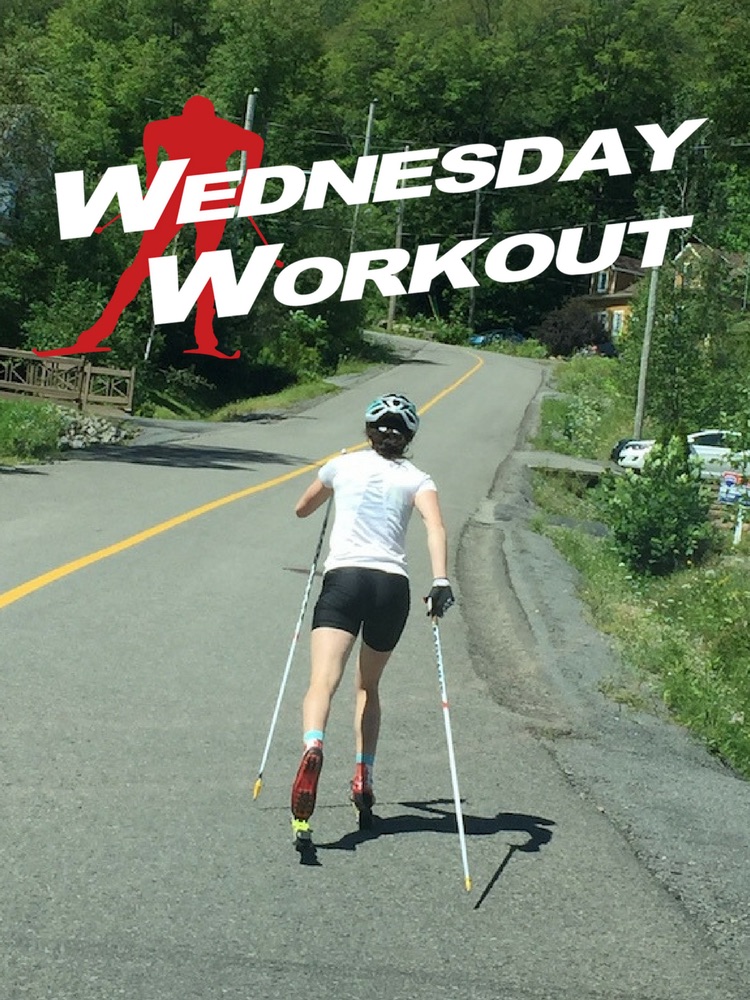
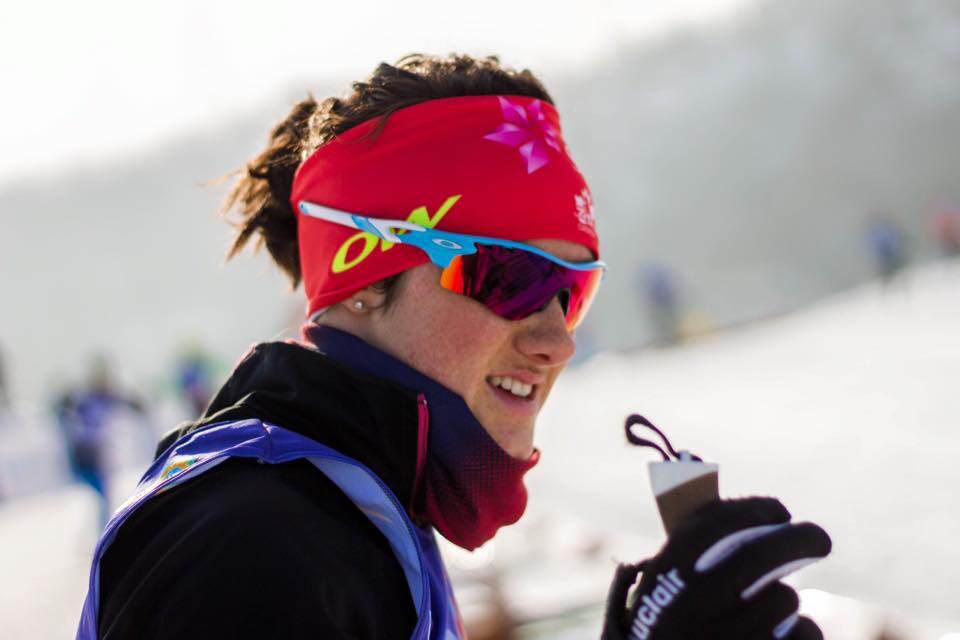
Olivia Bouffard-Nesbitt rollerskiing in Sainte-Anne-des-Lacs, Quebec, last summer. (Courtesy photo)
It’s May 2 and the overall NorAm leader heading into the 2018/2019 race season, Olivia Bouffard-Nesbitt, is champing at the bit to get back at it. Like most other pro nordic skiers, the 25-year-old Morin Heights, Quebec, native spent the last month getting some off-ski R & R, which wasn’t completely devoid of snow. In April, Bouffard-Nesbitt and her boyfriend went surfing at Lawrencetown Beach near Halifax, Nova Scotia (brrr!).
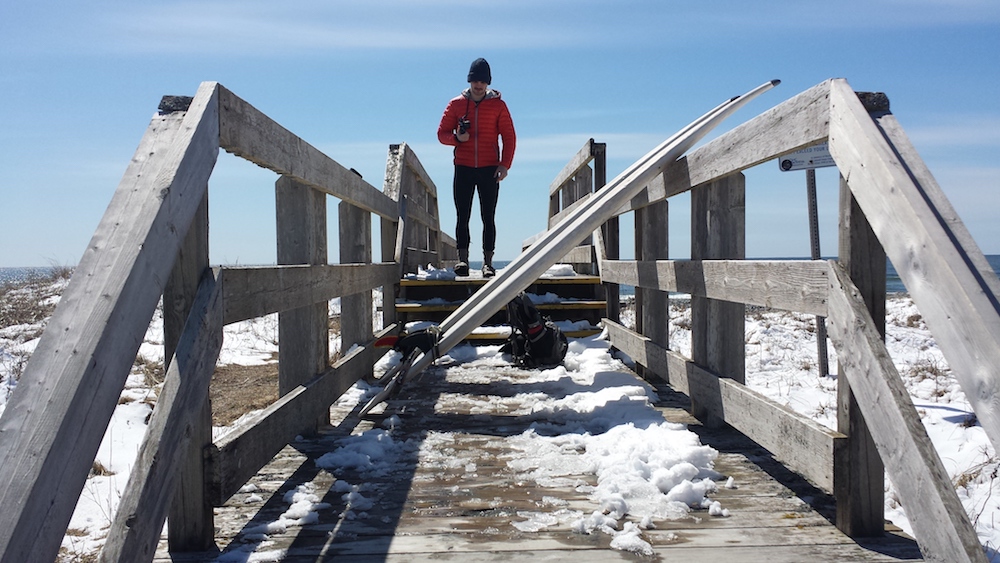
Olivia Bouffard-Nesbitt snaps a photo of her boyfriend Stuart and their boards while surfing in April near Halifax, Nova Scotia. (Courtesy photo)
“I was planning to travel somewhere a little more exotic later in April but opted to get all my wisdom [teeth] pulled out instead,” Bouffard-Nesbitt wrote in an email.
She planned to return to her training base in Canmore, Alberta, next week, where she’ll be “jumping right back on snow and right into some training camps” with her team, Rocky Mountain Racers (RMR). They’ll start the training season at Sovereign Lake in Vernon and Penticton, British Columbia, then head south to Bend, Oregon, in early June.
“I can’t even tell you how excited I am to dive head first into this training season!” wrote Bouffard-Nesbitt, who has had previous seasons derailed by a myriad of injuries.
Despite a late start, she finished last winter as the first Canadian woman in the overall NorAm standings, earning World Cup starts in November and December later this year.
So what’s one of the workouts she’s looking forward to this spring? That would be Rocky Mountain Racers’ “most tried and true workout”, which can be done skiing, rollerskiing, ski striding, or even biking.
“It’s simple, it’s appropriate for pretty much any time of the year, and it’s reliable,” Bouffard-Nesbitt explained. “I found myself really looking forward to doing these intervals after coming back from injury. This workout kind of feels like ‘home’ for me, and I trust it to get me fit in a short period of time.
“It’s funny, even just thinking about this workout makes me happy, that’s how good it makes me feel,” she added. “When I got back to Canmore and started doing some on-snow intensity last December I was nervous about my fitness, but after a few of these types of workouts, within two weeks I already felt way more confident in my fitness and my race readiness.”
The workout: 6-8 x 5-minute Building Intervals
Warmup: 15-30 minutes of easy Zone 1 skiing
“We usually do a lap or two of the predetermined interval course to get familiar with it. I like to get up into zone 2 near the end of the warm up to get my technique right and set my technique intentions for the intervals.”
Intervals: 6-8 times 5 minutes, building from interval to interval, with around 3 minutes of rest.
First interval: Below threshold to wake up the body.
“The goal after the first one is to increase the distance you cover over every consecutive interval.”
Last two intervals: should be harder, “definitely into race pace. On the last two intervals we also like to increase the effort within the interval, so the last minute would be flat out.”
More on “building”:
“I like the building aspect because you’re not demanding a huge effort of yourself right off the bat. You get really familiar with how much your body can handle, and I love the feeling of just having the reins cut loose for the last interval and seeing how much further I can push.
“Mentally it just feels great to go further and further every interval, and I love the challenge near the end of the set to make sure you’re primed to push harder in the next interval, and to convince yourself that you always have more in you. The last interval is usually pretty hard, but you rarely get to the end of the workout feeling crushed, because the intervals aren’t too long and you’re really only pushing hard at the end. So it covers everything from threshold to race pace and gives you a great race feeling by the end.”
Cool down: As long as you need, usually around 30 minutes.
“I love this workout because I feel like it gives me everything I need, including a bit of mental conditioning and confidence,” Bouffard-Nesbitt wrote. “It’s nice to start the intervals with a controlled effort to get a sense of how your body feels that day. Building from interval to interval allows you to work on your pacing because you’re always trying to make it further than the last interval while conserving just enough energy to go further on the next one. Seeing how much your increase in effort translates to the extra distance you covered also helps you become more efficient.
“I’m paraphrasing my coach John [Jaques] here to summarise – this workout is great because you are taxing different energy systems all within the same interval set,” she concluded. “And it’s a low-risk and adaptable workout in that you only continue to build if you can handle the previous interval.”
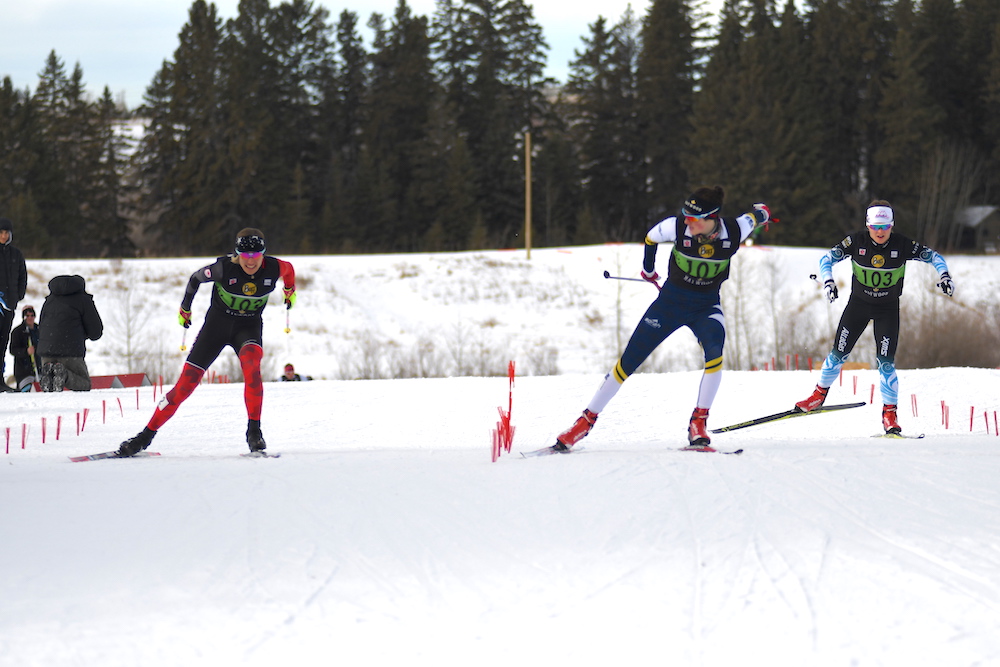
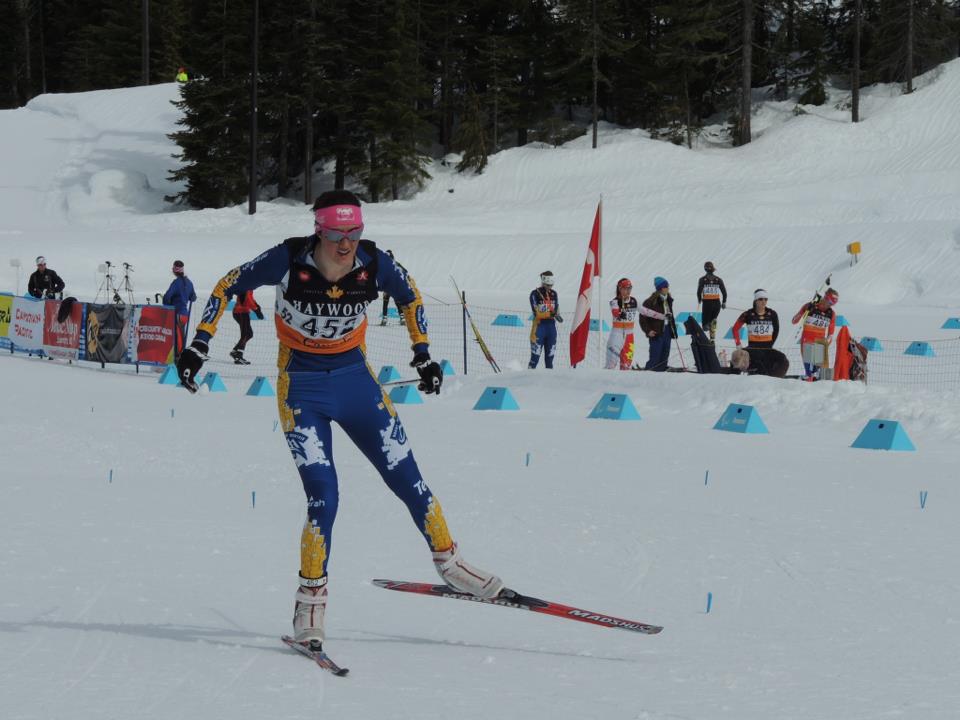
Olivia Bouffard-Nesbitt (c) holds off Zina Kocher (l) and Annika Hicks (r) to win the women’s freestyle sprint final at 2018 NorAm Western Canadian Championships in January in Red Deer, Alberta. (Photo: Doug Stephen)
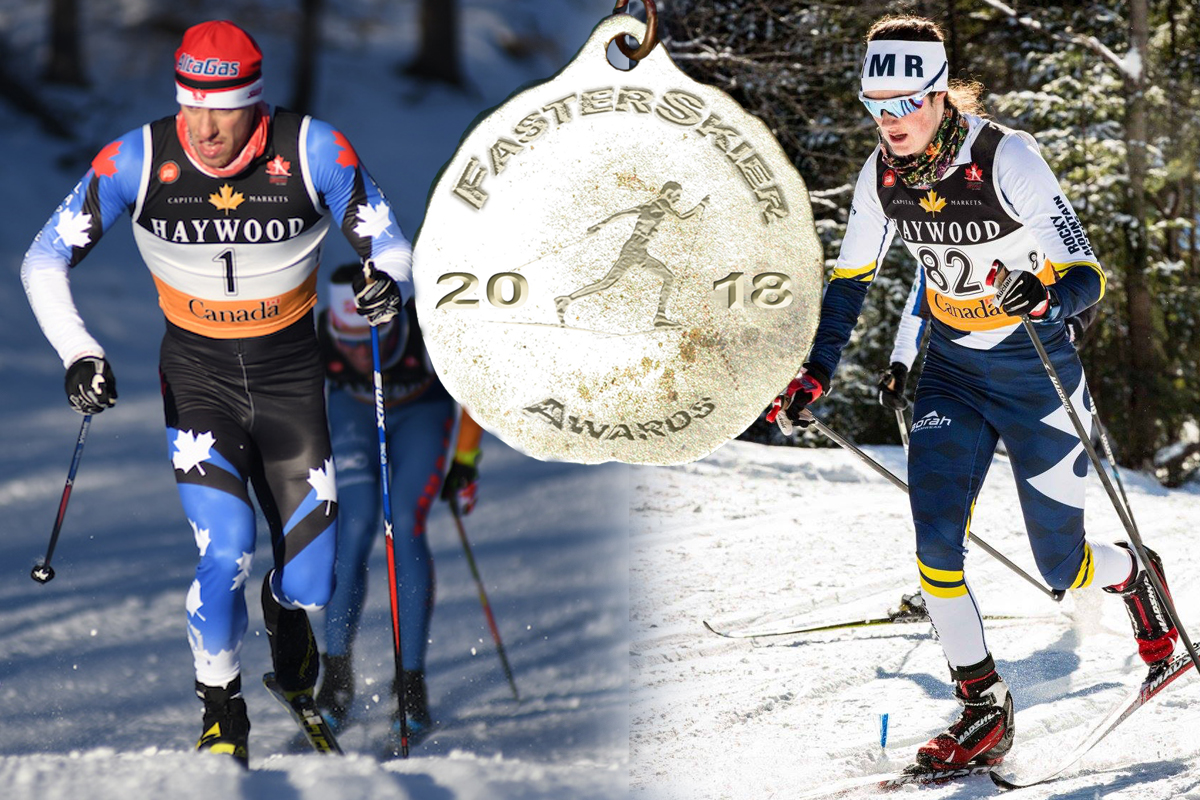
Andy Shields (l) of Lappe Nordic and Olivia Bouffard-Nesbitt (r) of Rocky Mountain Racers are FasterSkier’s 2018 Canadian Continental Skiers of the Year. (Photos: Doug Stephen & Mario Walker)
With the 2017/2018 season officially in the rearview, FasterSkier is excited to unveil its annual award winners for this past winter. Votes stem from the FS staff, scattered across the U.S., Canada, and Europe, and while not scientific, they are intended to reflect a broader sense of the season in review. This set of honors goes to the Canadian Continental Skiers of the Year.
Despite scaling back his training last year, Andy Shields had one of the most consistent seasons of any Canadian nordic racer, tallying five podiums between the NorAm and SuperTour circuit. That included a win in the 15-kilometer classic mass start at Western Canadian Championships in Red Deer, Alberta, and a runner-up finish in the skate sprint at Canadian Ski Nationals on the trails he trains on at Lappe Nordic in Thunder Bay, Ontario.
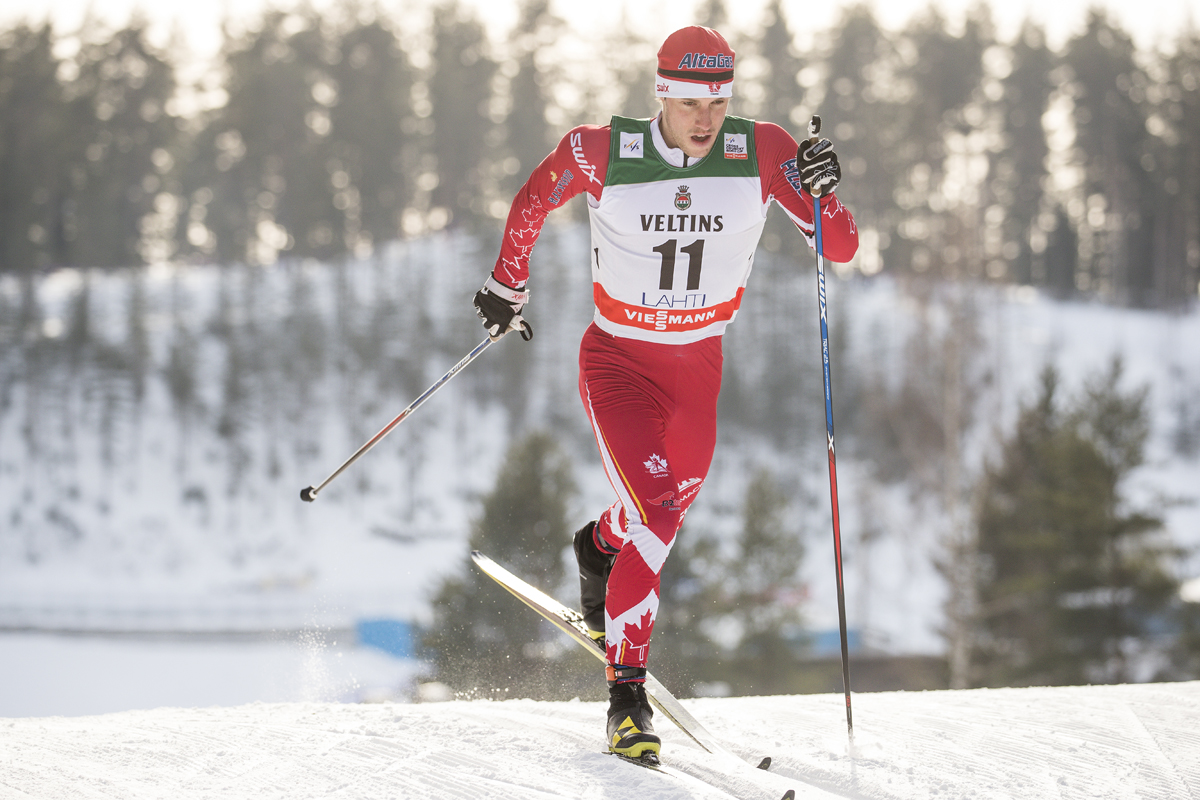
Andy Shields racing the 15 k classic at the World Cup on March 4 in Lahti, Finland. In his first World Cup distance race of the season, Shields, who won the NorAm overall and placed second in the NorAm sprint standings, finished 70th in that race. (Photo: Fischer/NordicFocus)
In an email to FasterSkier this week, Shields, 27, who grew up in Waterloo, Ontario, explained that last spring, he changed his mental approach to skiing.
“Before last April, I had seven years of experience as a full-time skier and I considered it my profession,” he wrote. “However, it was becoming quickly becoming a profession that caused bills rather than paid them especially with the loss of my Canada card. This contributed to an overall feeling of not being too jazzed about competing in another season of full-bore, focussed, make-all-the-little gains, maximum performance training and racing.”
He questioned whether he wanted to continue racing and how he was going to improve if he wanted to do so.
“After getting wrecked on the Period 1 World Cups the season before and coming nowhere near a top 30, I had serious doubts on whether it was worth it to keep trying to crack the ‘nut’ we call World Cup racing,” Shields wrote.
He wondered if he was physiologically and psychologically talented enough to compete at the World Cup level. He considered “setting the bar lower” to make himself happier, focusing solely on top NorAm and SuperTour finishes rather than making it to the World Cup.
“Obviously it was time to reframe things. It was an Olympic year so and I was still having lots of fun skiing so quitting wasn’t an option,” Shields wrote. “I needed cash so I bought Skiwax.ca and started a business selling ski wax and ski equipment online and became a BNS [Boulder Nordic Sport] Canadian sales rep for SkiGo and a few other brands.”
That summer, he also worked for his friend’s painting business in Thunder Bay.
“With cash taken care and the birth of a burgeoning career as a sales rep and business owner, I moved skiing squarely into the ‘hobby’ category,” Shields wrote. “I suspected I could still be reasonably competitive on the NorAm and SuperTour circuits with minimal training if I relied on my large training history — maybe even quick enough to earn an Olympic spot. I decided not to subject a coach to my misadventures and intention of not working too hard. If this new way of approaching things went bad, I wanted it to be my fault.”
He worked out less than usual last summer and fall (estimating he trained 600 hours total) and didn’t write a training plan nor keep a training log. He followed his intuition and didn’t bother to fix his heart rate monitor when it broke last June.
“Training was very unstructured and came second to my various jobs – except for a number of training camps with the Greggs, or Micheal Somppi, or others where I buckled down for brief periods of athlete mode,” Shields noted.
Still, his fitness gradually improved as the offseason wore on. By the time the race season arrived, he was raring to go and “hungry”, Shields reflected.
“Only one Olympic spot was available to domestic skiers and it was a classic sprint spot, which is my weakest event,” he wrote. “When the selection criteria came out for the Olympic team, it did take awhile to get over the fact that it was extremely unlikely I’d make it. I was able to reset my goal to doing well in the NorAm overall and it wasn’t long into the season before I was in the hunt for the NorAm overall.
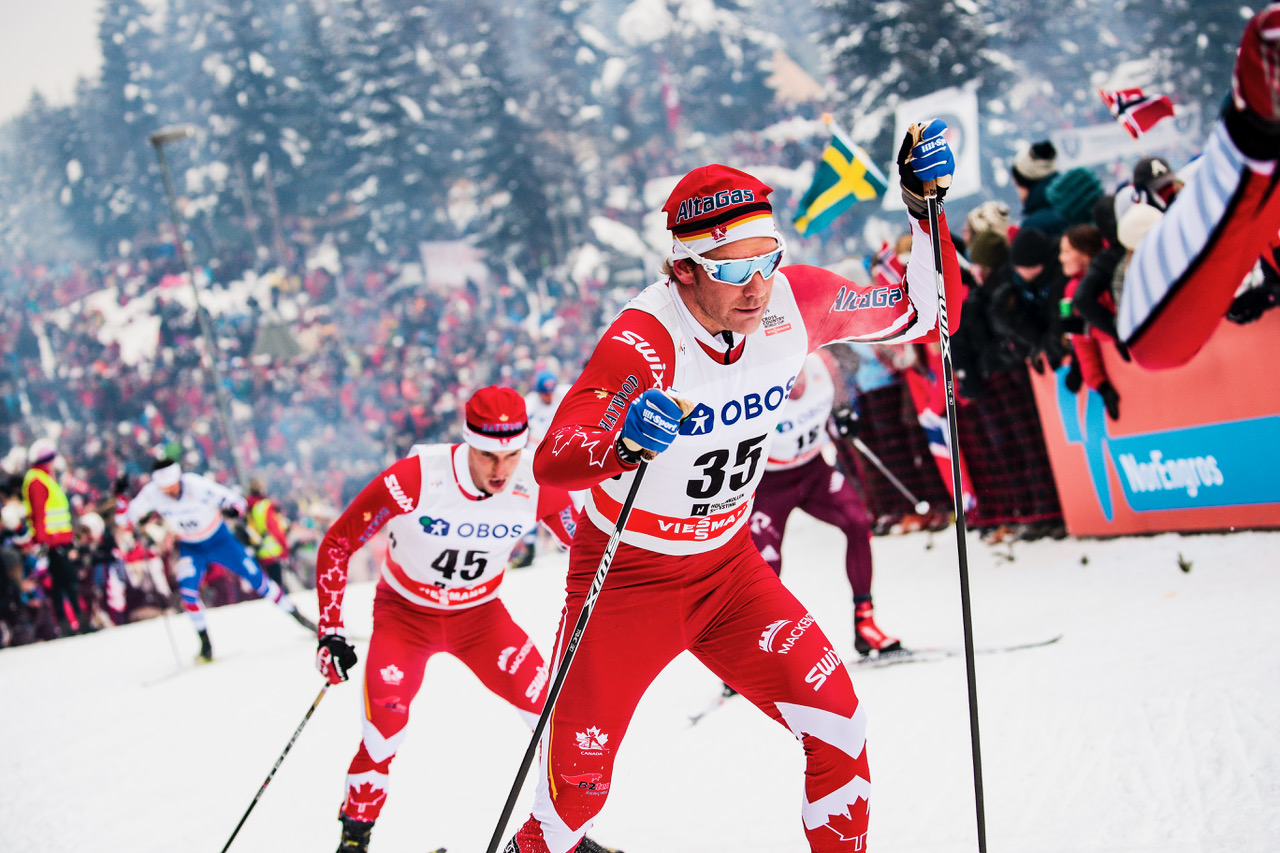
Canada’s Devon Kershaw leads Andy Shields during the Holmenkollen 50 k freestyle mass start on March 10 in Olso, Norway. (Photo: Fischer/NordicFocus)
“This was great!” he continued. “I was racing fast mostly and having a lot of fun kicking ass. When I got the opportunity to race period 4 on the World Cup, including the Holmenkollen 50km, it was a fantastic bonus.”
That iconic race in Oslo, Norway, he said, was the highlight of his season.
“I don’t know if I’ve ever raced so hard before,” Shields wrote. “Only 25km into the race, I was getting adrenaline rushes from the pain when I survived another climb. I had to skip World Cup Finals because I needed one more good race to lock up the NorAm overall so I came back to North America straight after the Holmenkollen to join Nationals partway through the event.”
Four days after racing in Oslo, he reached the podium in the Canadian nationals skate sprint.
“I dedicated that podium to Reijo Puiras who passed away over the summer and was the founder of the Lappe Ski Centre,” Shields wrote. “It turned out that final podium at Nationals was what I needed to secure the NorAm overall. It’s hard not to be satisfied with how this season turned out. I got a great sense of accomplishment from having done it on my own – financially and as my own coach. Of course, I had a lot of help in the wax room and my parents are great roommates.”
As he looks ahead to 2018/2019, Shields explained that he’s planning to continue down a similar path, while logging some more “serious training” before starting the season on the World Cup in November. World Cup Period 1 remains his main focus for next winer.
“It’s a chance at redemption for such an abysmal period 1 experience my first time over there,” he said. “World Cup Finals in Quebec City is also a huge focus. I have a number of top 50s in Quebec World Cups so I have a track record of good racing there to build on.”
Olivia Bouffard-Nesbitt, Rocky Mountain Racers
In what could very well be dubbed her comeback season, Olivia Bouffard-Nesbitt, 25, took it by storm after a rocky start. The Morin Heights, Quebec, native has dealt with an assortment of setbacks — both big and small — over the last several years. Hindered by stress reactions in her foot from 2013 to 2016, she was injured in a car accident in February 2017, which herniated a disc in her neck. She spent last summer rehabbing that injury, then last fall, discovered issues with her sympathetic nervous system.
After nearly a year away from the racing, Bouffard-Nesbitt started her season this past January at the Mont Sainte-Anne NorAm, which doubled as Canada’s Olympic trials. In her first race there, she raced to third in the classic-sprint qualifier and advanced all the way to the A-final, but was relegated to 25th overall for a technique infraction. Also at trials, she finished ninth in the 10 k classic.
“It was an absolute roller coaster (mostly uphill) getting to the start line of my first race of the season – the classic sprint at Olympic trials,” Bouffard-Nesbitt reflected in a recent email to FasterSkier. “But once the dust settled and I found my groove on the Noram circuit, the season actually turned out really well.”
Olivia Bouffard-Nesbitt (c) holds off Zina Kocher (l) and Annika Hicks (r) to win the women’s 1.2 k freestyle sprint final on Friday at the NorAm Western Canadian Championships in Red Deer, Alberta. (Photo: Doug Stephen)
At Western Canadian Championships in Red Deer, she earned her first NorAm win in four years, topping the freestyle sprint. She also placed second in the 10 k classic mass start there.
Bouffard-Nesbitt ended the year with a national title in the 5 k classic as well as the 10 k freestyle pursuit (as the first Canadian/second overall in the latter race) at Canadian nationals. She also placed fourth in the 30 k classic mass start.
With a strong three months of NorAm/SuperTour racing, Bouffard-Nesbitt ended the season as the first Canadian in the overall NorAm standings (she was second to American Caitlin Gregg, who led the aggregate standings with 830 points). Bouffard-Nesbitt had 635 points, as did Annika Hicks of the Alberta World Cup Academy, but Bouffard-Nesbitt won the tiebreaker based on number of wins.
Asked about the highlight of her season, Bouffard-Nesbitt said it was winning the 5 k at nationals. More specifically, it was the “unexpected flood of emotion and sense of validation I felt after learning I had won” that race, she wrote.
Olivia Bouffard-Nesbitt (Rocky Mountain Racers) racing to second overall (first Canadian) in the women’s 10 k freestyle pursuit on March 13 for her second national title of the week at 2018 Canadian Ski Nationals in Thunder Bay, Ontario. (Photo: Doug Stephen)
“Really it felt like my ‘comeback’ had culminated in that moment,” she continued. “I felt like I’d shaken that monkey off my back and I felt so invigorated. I felt like I had finally proven myself. More broadly though, a major highlight was putting so many solid races together back-to-back. For the COC [Continental Cup] standings they count your best 10 races. So after a scrapped trials, I had eleven races to get there, thirteen if you count each pursuit race as two. Finishing the season as the COC leader was the best case scenario. It’s amazing and I’m ecstatic about it!”
Going into the season, her primary goal had been to take care of herself and make sure she didn’t re-injure her neck. Secondly, she wanted to qualify for the Olympics, and when that didn’t pan out, she shifted her focus to finishing on top of the NorAm circuit.
Moving forward, Bouffard-Nesbitt plans to continue training with Rocky Mountain Racers in Canmore, Alberta.
“While I was rehabbing in Quebec, I was itching to get back to Canmore because I had equated being in Canmore to being healthy enough to take up my normal training routine,” she wrote. “… It’s tough to enter a race season, both physically and mentally, when you’re really under-trained. Like I said though, after I recovered from Olympic trials, I was healthy and continuously gaining fitness all winter. It felt great.”
Next year, she aims to continue building on the work she’s done and gains she’s made over the last year while staying “hyper in tune with my body.”
“I’m just going to train as usual, and catch up on all the fun I’ve missed,” she wrote. “I’ve been dreaming of putting together a full summer of training for a while, and I’m optimistic that it’s going to happen this year.”
Honorable Mention: Evan Palmer-Charrette, National Team Development Centre Thunder Bay
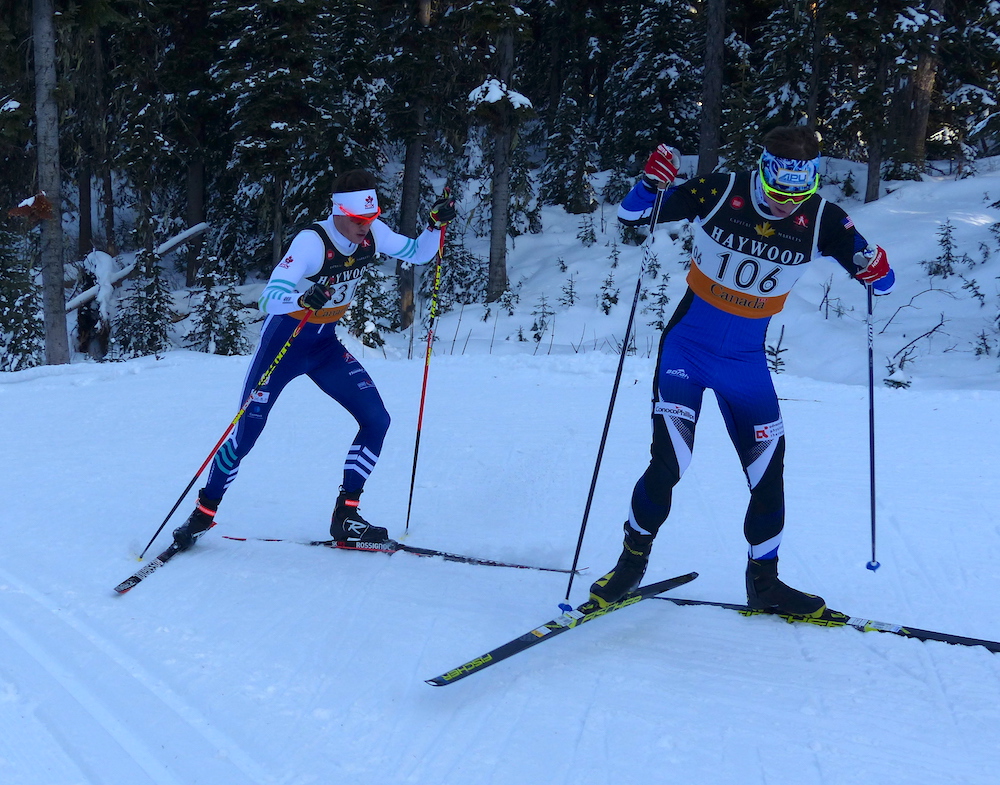
Evan Palmer-Charrette (l) chases American Thomas O’Harra in the 15 k skate at the Sovereign Lake NorAm near Vernon, B.C. (Photo: Peggy Hung)
Evan Palmer-Charrette, our Canadian Continental Skier last year, had another stellar season, finishing the winter out with a national title in the 50 k classic mass start and third-place finish in the freestyle sprint at Canadian nationals. There, in Thunder Bay, where he lives and trains with the National Team Development Centre (NTDC) Thunder Bay, he also placed fourth in the national 15 k freestyle pursuit and seventh in the 10 k classic.
Overall, he ended up third in the NorAm standings, behind Shields and Canadian World Cup Team member Jess Cockney. Earlier in the season at a NorAm mini tour in Rossland, B.C., he raced to second in the skate sprint and fourth in the 15 k skate pursuit for fourth overall in the mini tour.
He also placed fourth in the classic sprint at Mont Sainte-Anne NorAm Olympic trials. In all, he recorded 15 individual top-10 results between the NorAm and SuperTour in 2017/2018.
“I like to think, and try to be, a well balanced skier,” Palmer-Charrette wrote of his equal focus on sprints and distance races in an email after the Rossland NorAm.
“… Overall period one has been a struggle coming into it after be being quite sick,” he wrote at the time. “That being said I think I haven’t burnt my brightest match of the season and have as good of a shot as anyone. I would like to have strong races in both the sprint and distances races in Quebec, but with the sprint being the only race with an Olympic birth that will be the main focus of the event for me.”
He didn’t make the Olympics, but at 23, Palmer-Charrette still has plenty of racing years ahead of him.
Zina Kocher (Foothills Nordic) racing to 11th in the 10 k classic on Jan. 10 at the Mont Sainte-Anne NorAm in Quebec. (Photo: Mario Walker/NorAm MSA 2018 Facebook)
A former national-team biathlete, Kocher was our pick for Canadian Breakthrough Skier of 2018 after coming out of retirement in an effort to make the 2018 Winter Olympics in cross-country skiing.
She went all-in in an attempt to qualify for her fourth Olympics and ultimately came up short, but she still ended up third in the overall NorAm standings, behind Bouffard-Nesbitt and Hicks, respectively. The 35-year-old Red Deer native reached the NorAm podium in seven individual races and won the 51 k freestyle Gatineau Loppet in mid-February. As the NorAm leader for Period 3, she earned late-season World Cup starts and raced the Holmenkollen 30 k freestyle mass start as well as World Cup Finals. Kocher opted out of Canadian nationals and still finished as the third Canadian in the aggregate NorAm rankings. For now, she is once again retired.
“I think what I loved the most about this season was the challenge, being pushed out of my comfort zone, and trying a lot of firsts,” Kocher wrote in a recent email to FasterSkier. “And knowing if the big goal didn’t work out, I did have something else I was fully committed to outside of racing. (My massage therapy diploma, I had 3 courses in the fall & 2 during the winter).”
She made a point to thank former national team coach Justin Wadsworth for coaching her over the last season and for “his enthusiasm & teaching me the classic basics, convincing me I got this,” she wrote.
“It was really fun to do the NorAm circuit,” she reflected. “I had a really fun time, racing at new places, new formats, and many ‘firsts’ – like classic racing. The biggest challenge was classic! Doing something new and totally out of my comfort zone. And the other big challenge I was feeling, was being ok and comfortable with digging deep and the pain associated with pushing your max efforts. Was also really great to make and also re-establish old connections with the xc community.”
Just over a week ago, on April 10, Kocher survived a scary incident in an avalanche.
“I slid 350m, somehow missed a small cliff/rock band, and remained on top though I was in a cloud of snow pretty soon after it started moving, until it stopped and I saw the sky again,” she reflected, crediting her late coach Richard Boruta for saving her life. He passed away in a climbing accident almost exactly eight months earlier, on Aug. 9, 2017.
“Angel Richard probably scooped me out of there,” she wrote.
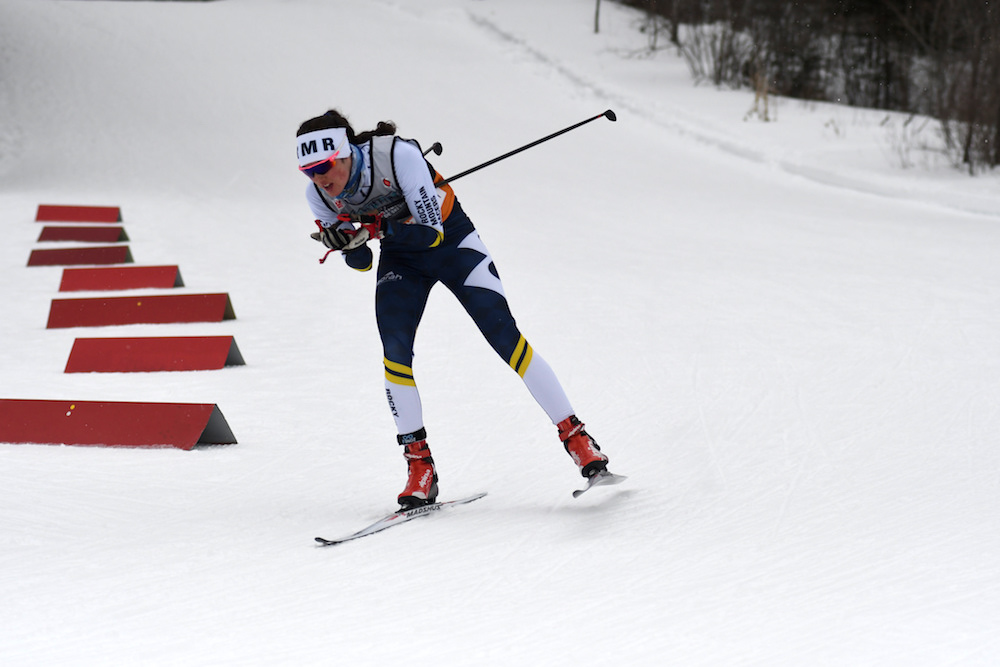
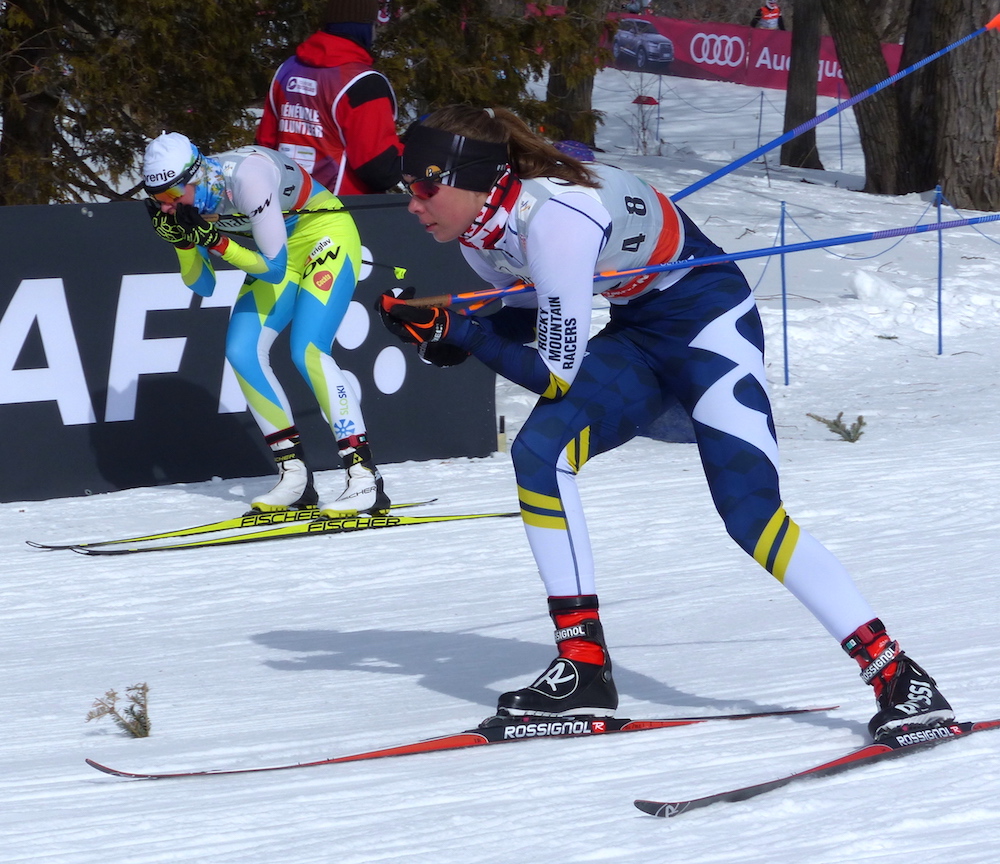
Maya MacIsaac-Jones (Rocky Mountain Racers/Canadian U25 Team) racing to fourth in the women’s 10 k classic on Jan. 10 at NorAm Olympic trials in Mont Sainte-Anne, Quebec. (Photo: Mario Walker)
In an effort to showcase the North Americans competing at this week’s International Ski Federation (FIS) 2018 Nordic Junior/U23 World Championships in Goms, Switzerland, we asked those qualifying athletes several questions about themselves — actually, we had them fill in the blanks. Here we have 22-year-old Maya MacIsaac-Jones, of the Canadian National U25 Team and Rocky Mountain Racers, who’s representing Canada at her second U23 Worlds.
“My full name is Maya Anna-Christina MacIsaac-Jones, but you can call me Maya.
Maya MacIsaac-Jones in Goms, Switzerland, two days before the firs race of 2018 U23 World Championships on Monday. (Photo: Maya MacIsaac-Jones/Instagram)
I was born and raised in Athabasca, Alberta, and I learned to ski at our family’s farm (while imagining I was either Sara Renner or Beckie Scott).
I spent the time between Mont Sainte-Anne trials and Junior/U23 Worlds in Chelsea, Quebec, and then in Praz-de-Lys, France with Team Canada.
The strangest workout I did in the last training year to prepare for this was swimming intensity that included butterfly (a.k.a. trying not to drown).
This is my first time in Switzerland and fifth time racing internationally, and so far it’s been easier to adjust to jet lag.
One difference I’ve noticed between Switzerland and Canada is that the people here are fluent in so many more languages.
Skiing and racing in the Alps makes me feel like I’m in the Sound of Music. Usually racing at altitude is hard but manageable for me because I live and train at altitude in the summer. There are lots of mountains around where I live.
One of the things I’m most excited about for Junior/U23 Worlds in Goms is cheering on our speedy Juniors in the relay.
One race I’m especially targeting there is the skate sprint.
I really hope I can chat/make friends with someone from Team USA and ask them if the old Taylor really is dead.
My favorite thing at the breakfast where we are staying is the abundance of kiwis (the fruit, not the people).
Fondue is delicious. The cheese here is great. And the chocolate is to die for.
If I had a totally free day here and didn’t have to worry about race fitness or training, I’d spend it adventuring on skinny skis with a thermos of hot chocolate and some Brie & baguette.
Richard Boruta, head coach at the Biathlon Alberta Training Centre, died in a climbing accident on Aug. 9. (Photo: Jane Robertson)
Few nordic ski racing and biathlon venues are as awe-inspiring as the Canmore Nordic Centre in Alberta, Canada. Just south of the venue, amidst the geologic upheaval that is the Canadian Rockies, punches the Three Sisters — a string of iconic Canmore mountains. While descending from a technical route on the Middle Sister earlier this month on Aug. 9, Richard Boruta, a seasoned climber, died in a climbing accident. He was 49.
At the time of the accident, Boruta was attempting the Three Sisters Traverse as part of his 50th year, as he was turning 50 in October. It was Boruta’s first time on the climbing route.
Boruta was a fixture of Canadian biathlon’s high performance and development scenes since 1998 when he immigrated to Canada from his native Czech Republic. Most recently, he was named Biathlon Canada’s male coach of the year for 2017. It was his third time receiving the award.
His Canadian coaching career began with Canmore’s Rocky Mountain Racers (RMR). Boruta advanced to become the Canadian national team’s head coach in 2002. He remained in that position until 2006, after seeing his athletes compete at the Torino Olympics. Post-Torino, Boruta left the national team to become more involved in the development side of the sport.
In 2011, Boruta became the head coach of the newly formed Biathlon Alberta Training Centre (BATC).
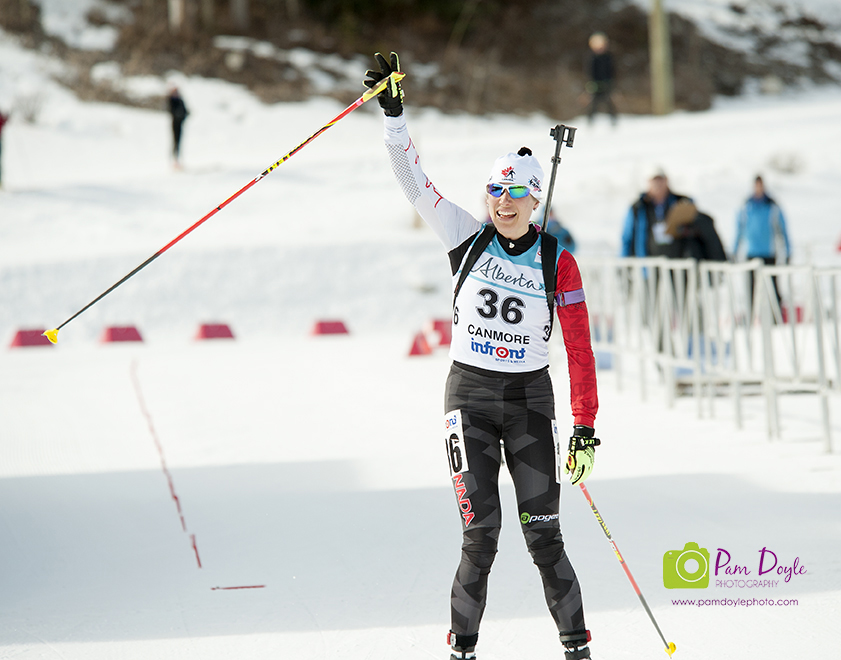
Zina Kocher waves to the home crowd after placing second in an IBU Cup sprint two seasons ago in Canmore, Alberta. (Photo: Pam Doyle)
Zina Kocher, a three-time Canadian Olympic biathlete, fostered a deep connection to Boruta as she emerged onto the Canadian biathlon radar. Kocher told FasterSkier on the phone that she qualified for the national championships in 12th grade at age 17. To her surprise, she placed in the top 10, and Boruta took notice.
At biathlon nationals, the arrangement was for athletes to attend with the regional coach, not their specific club coach. Boruta was the Alberta regional coach for the event and by default helped guide Kocher. Boruta asked Kocher to join RMR, where he was then coaching.
“I had friends already on that team,” Kocher said. “I decided to try for the summer.”
That short-term arrangement quickly evolved. Kocher decided to bump the summer commitment up to a year long stay.
“I was enrolled in college and then I decided to train full time and do it for one year and see if I could make the world junior team,” Kocher recalled. “They had a lot of faith in my ability and they pushed me to go for it. I made the world junior team … I made my first Olympics in 2006, and I spent all that time being coached by Richard.”
Kocher remained on the national team from 2006 to 2011. During that time she worked primarily with other coaches. After a performance downturn in 2011, Kocher decided to train with Boruta and BATC. Until her retirement in 2016, Kocher was coached by Boruta for all but the year following the Sochi Olympics when she trained with the national team. (For the 2016 competition year, Kocher was coached by Boruta as a member of BATC.) From 17, until her retirement at 32 years old, Boruta helped shape Kocher.
“I feel like he changed a lot himself from the time he was first coaching to the end,” Kocher reflected. “At the beginning, he was quite Eastern European, he was strict. I cried a lot. It was hard. He pushed me, he constantly challenged me, he always expected more from me. If he said ‘good job,’ you did awesome. Those comments he kept to the end, but he turned maybe more Canadian. Near the end, if I got emotional, he would just give me a big hug. He didn’t say anything. It was just a hug.”
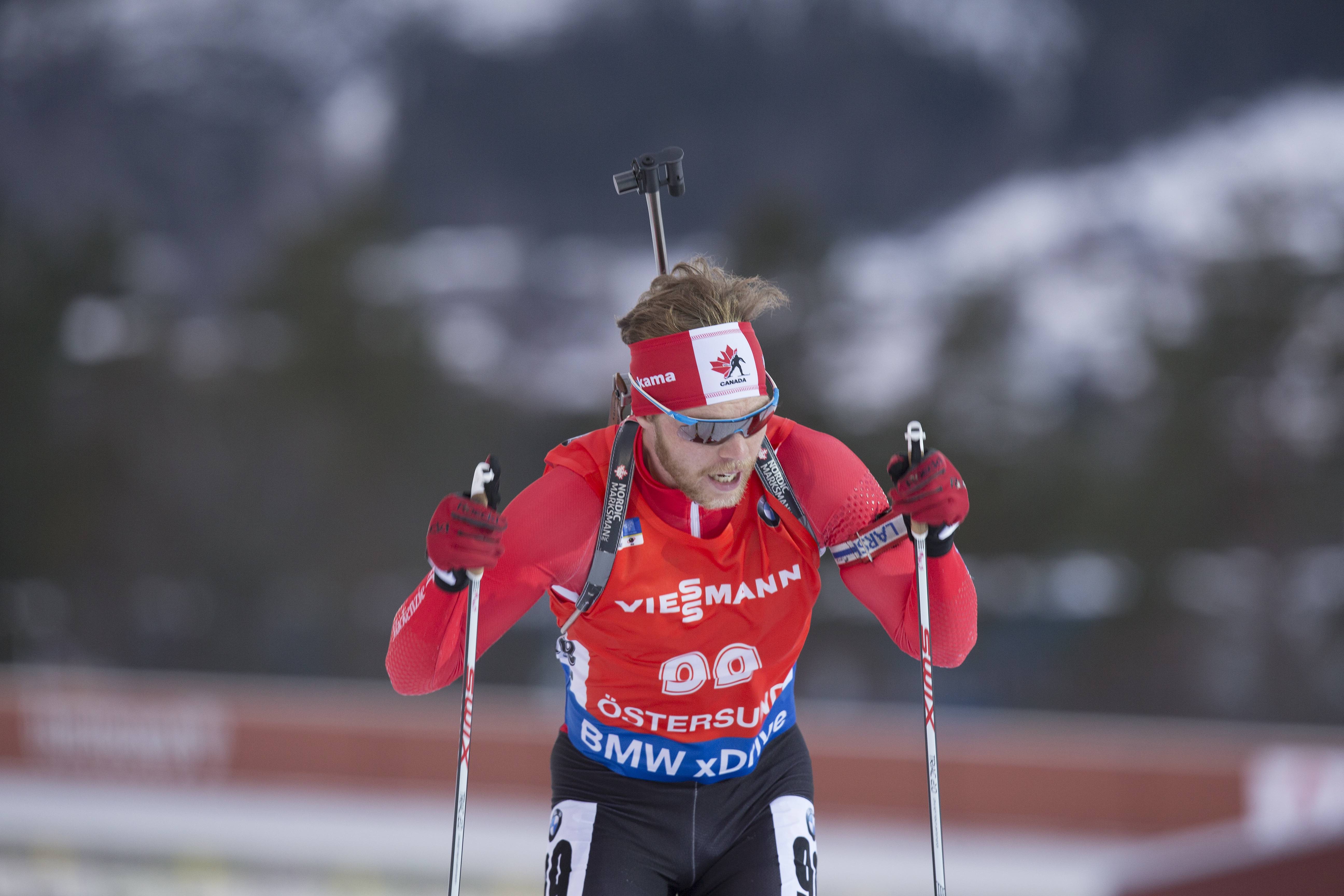
Macx Davies (Biathlon Canada) racing to a career-best 10th in the IBU World Cup 10 k sprint in Ostersund, Sweden, last December. (Photo: Biathlon Canada/NordicFocus)
Macx Davies, of Biathlon Canada’s national senior team, was also mentored by Boruta at BATC. For his first two years after high school, Davies said Boruta helped him form a knowledge base that eventually led him to a national-team nomination.
“During those two years we developed a working relationship and he taught me how to be a full-time athlete,” Davies wrote in an email. “From how to train in proper zones, to hitting targets, to being a well-rounded individual, Richard helped shape who I am today.”
Davies reiterated a point that Kocher made several times: that Boruta was even-keeled, calm and perfectly suited for a sport like biathlon where unsteady nerves can sink an otherwise stellar ski performance.
“As a coach, Richard was the most calm and soft-spoken I ever had,” Davies wrote. “Whether you are racing for a spot on the Olympic team or doing a time trial at home, he was the same calm, supportive and helpful coach, always there to give you a smile, head nod, and if you did really well an illusive high-five!”
Boruta’s life work was still firmly immersed in the present as he coached Megan Bankes, a rising star for Biathlon Canada. At 19 years old, Banks is coming off a season where she won two individual gold medals at the 2017 IBU Junior World Championships. Despite being named to the senior national team, Bankes still trained with Boruta as a member of BATC.
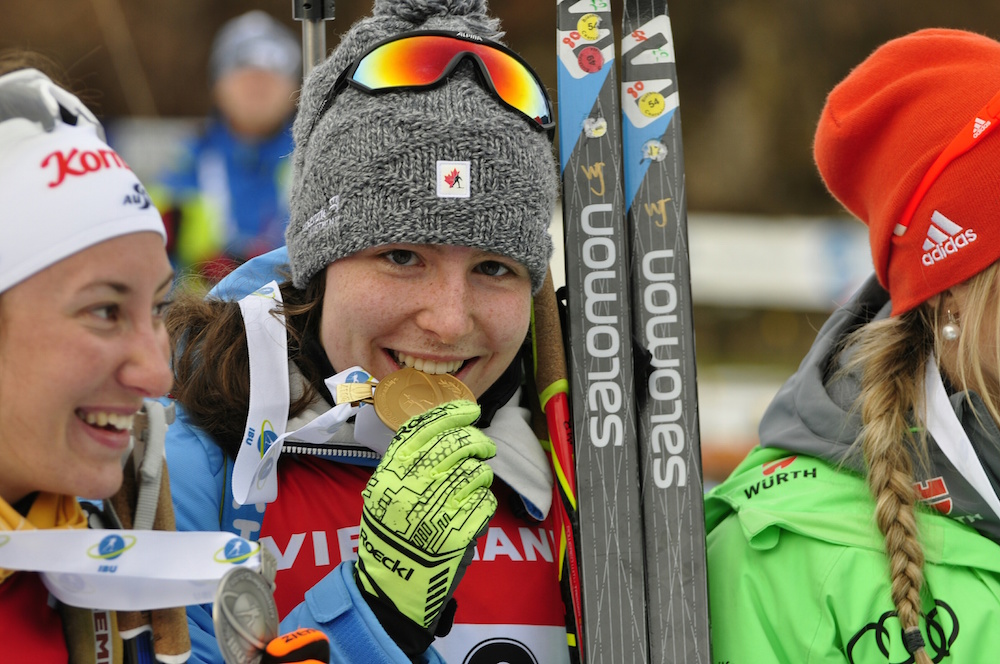
Canada’s Megan Bankes takes a bite out of her gold medal after winning the junior women’s 12.5 k individual at 2017 IBU Junior World Championships in Osrblie, Slovakia, and becoming the first Canadian woman to do so at Biathlon Youth/Junior Worlds. (Photo: Airat Aitniakov)
Helping athletes reach their potential was Boruta’s bread and butter. And for Boruta’s clan of biathletes, that potential often meant the international stage. According to Roddy Ward, Biathlon Canada’s high-performance director, half of the current national team moved through BATC under Boruta’s tutelage.
“Richard was a key player in helping Canada close the gap to the international podium,” Ward wrote in an email.
Ward first met Boruta while competing as a junior biathlete. In 2006, when Ward returned to Canmore for a coaching position, he became professionally linked to Boruta.
“Since 2011, Richard coaching BATC and myself coaching National Team we worked more closely together, often working together with athletes in a NT camp based program (Megan Bankes, Julia Ransom, Emma Lunder, Sarah Beaudry), combining for many training sessions, camps, testing, races etc.,” Ward explained.
The data and spreadsheets, the periodization and hours trained are part of developing an athlete. A coach may tinker with more technique one year, more volume the next. Yet one aspect of the coaching equation difficult to change is the personality each coach brings to the athlete-coach relationship. Ward noted that by observing Boruta, he came to understand that some of what Boruta practiced could, in fact, make his own coaching more effective.
“Early in my career I would notice a contrast to Richard and myself on the range while explaining the day’s training,” Ward emailed. “I would be almost yelling the directions while athletes chatted among themselves and ran around not listening (I’d often have to give directions multiple times), while Richard would talk very quietly (like he always does) while all his athletes listened very closely so they could actually hear the directions. I thought there was something to that and started to apply this technique in my own way.”
Kocher said Boruta understood his inherent strengths. “One time we did this one truth and two lies,” Kocher said. “I’ll never forget because the truth was ‘I believe in nonverbal communication.’ That was him. He didn’t say a lot of words and what he said was valuable and it meant a lot.”
Ward also absorbed the Boruta “less-is-more” tenant.
“Talk less and listen more,” Ward wrote. “When you do say something it will have a bigger impact. I used to talk too much, give too much direct feedback, be too assertive. Now I let the athlete lead more, don’t always give them answers immediately, try to listen more than talk. It’s made me a better coach and teacher.”
But there were days when Boruta could scream encouragement. And in those moments, when the coaching lessons had been ingrained, Boruta revealed his love for seeing others achieve.
“He was someone who didn’t show a ton of emotion,” Kocher said. “Yet when he showed emotion it was passionate. I remember this happened a few times. A long time ago, for the first time, I was going to make a pursuit. I was a first year senior and had just done a World Cup as a junior. Back then I had never made the top-60. Then in the third World Cup in December, in 2003 I guess, I was in Slovakia. It was a windy day and I shot zero-zero. I just remember leaving the range just like super confidently. I had just shot clean for the first time in my life. Literally, Richard was running beside me on the hill. Somehow he had left the range and he was on the hill and he was cheering me on telling me I could get a top-10. And the course was really open and he was able to come out while I was finishing the climb and hitting the next downhill. Then he was suddenly on the next hill. He was cheering me on that one, and then he was near this bridge near the finish. He just found his way onto all these spots on the course to get me to go harder, and he was at the finish line. I remember his passion a lot from that day.”
Boruta is survived by his wife Kamila and three sons Michal, Thomas and Lukas, his mother Jirina, father Richard, and granddaughter Sophie.
Maya MacIsaac-Jones (l), of the Alberta World Cup Academy and Canadian National U25 Team, with her younger sister Anna (r) at their home trails in Athabasca, Alberta, in late December. (Courtesy photo)
In an effort to showcase the North Americans competing at this week’s International Ski Federation (FIS) 2017 USANA Nordic Junior World Championships and U23 Cross Country World Championships at Soldier Hollow in Midway, Utah, we asked those qualifying athletes several questions about themselves — actually, we had them fill in the blanks. Here we have 21-year-old Maya MacIsaac-Jones, of the Alberta World Cup Academy, Rocky Mountain Racers and the Canadian U25 Team, who’s representing Canada at her first U23 World Championships after competing at Junior Worlds last year. On Tuesday, the U23 championships begin with classic sprints.
***
“My full name is Maya Anna-Christina MacIsaac-Jones, but you can call me Maya. I was born in Westlock, Alberta, raised in Athabasca, Alberta, and one thing you should know about my hometown is the ski trails are great and the people are even better!
Maya MacIsaac-Jones (AWCA/Canadian U25 Team) during a NorAm freestyle race in December in Rossland, B.C.
I started cross-country skiing when I was four, thanks to my parents. I currently train in Canmore with Alberta World Cup Academy / Rocky Mountain Racers.
If I’m not skiing, you might find me reading. If I had to pick a favorite book, it would be ‘Harry Potter and the Deathly Hallows’.
One of the things I’m most excited about for U23/Junior Worlds at Soldier Hollow is watching my teammates kill it out there! One race I’m especially targeting there is the classic sprint.
The best advice anyone ever gave me about skiing or racing was to listen to my body and trust my own judgment. One of the best race memories I have is winning the team sprint at Nationals 2015 with Andrea Dupont.
If I could meet one World Cup skier, it would be Kikkan Randall.
If I don’t end up being a professional skier, I would love to be a professional fiddle player, but considering I can’t play the fiddle, that probably won’t happen.
I’m missing zero days of school to be here; I take online school through Athabasca University, so I don’t have to miss any school to ski race!
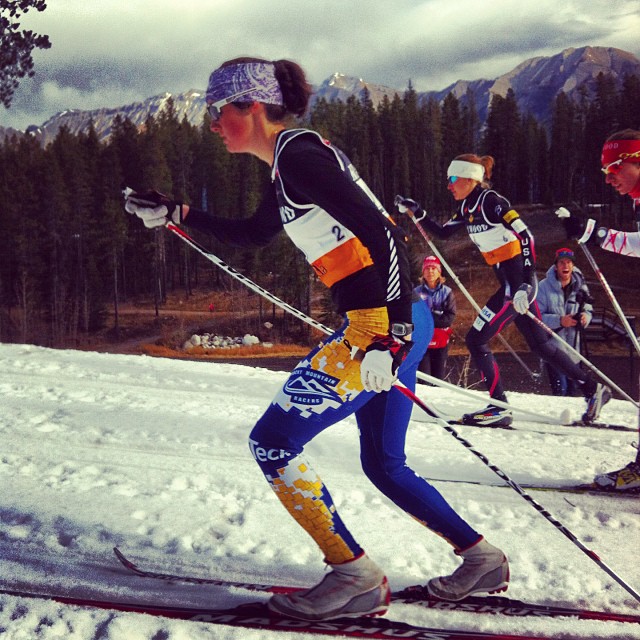
India McIsaac (Rocky Mountain Racers) striding during the Frozen Thunder classic sprints on Nov. 1, 2016. (Photo: Jenn Jackson)
In an effort to showcase the North Americans competing at next week’s International Ski Federation (FIS) 2017 USANA Nordic Junior World Championships and U23 Cross Country World Championships at Soldier Hollow in Midway, Utah, we asked those qualifying athletes several questions about themselves — actually, we had them fill in the blanks. Here we have 16-year-old India McIsaac, of Rocky Mountain Racers, who’s representing Canada at her first Junior Worlds.
***
“My full name is India Rose McIsaac but you can call me India. I was born in Calgary, AB, raised in Calgary, AB, and one thing you should know about my hometown is we have great running paths by the river.
I started cross-country skiing when I was nine (although technically it was biathlon), thanks to someone in my competitive swim club. I currently train in Canmore with Rocky Mountain Racers.
If I’m not skiing, you might find me driving 2.5 hours to get to and from training. If I had to pick a favourite book, it would be anything Harry Potter.
One of the things I’m most excited about for Junior Worlds at Soldier Hollow is familiar food and no time change. One race I’m especially targeting there is 5 k skate.
The best advice anyone ever gave me about skiing or racing was ‘Just go’. One of the best race memories I have is racing any first race of the season, as it’s so nice to pop on real skis and race on snow.
If I could meet one World Cup skier, it would be Jessie Diggins.
If I don’t end up being a professional skier, I’ll probably be a Doctor.
I’m missing 12 days of school to be here, and my teachers are probably thinking, ‘Well there goes her grades 🙂‘
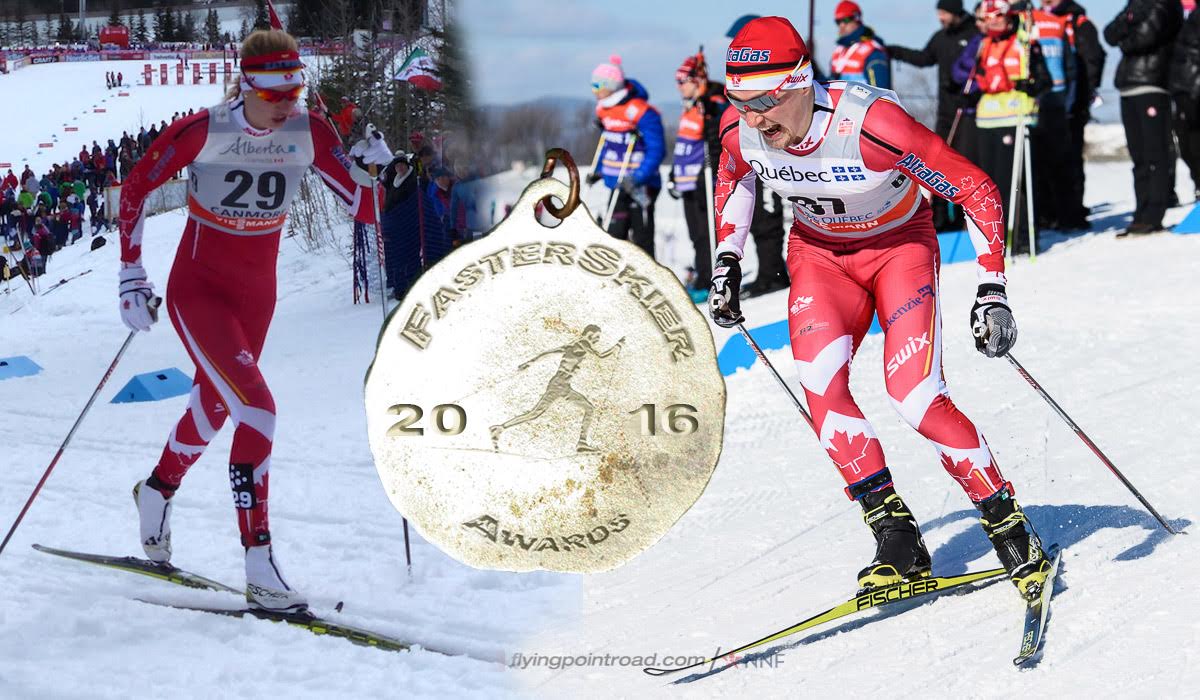
Dahria Beatty (l) and Knute Johnsgaard (r) are FasterSkier’s Breakthrough Skiers of the Year for Canada. (Photos: Peggy Hung & Flying Point Road)
The 2015/2016 awards continue this week, chosen by the FasterSkier staff based on performances from last season. While not scientific, these points of recognition are intended to reflect a broader sense of the season in review.
Dahria Beatty, Alberta World Cup Academy/Canadian U23 Development Team
Dahria Beatty is the definition of breakthrough skier of the year for Canada, as the 22-year-old Whitehorse, Yukon, native placed 15th in a World Cup classic sprint in front of a home crowd at the Ski Tour Canada (STC) in Canmore, Alberta.
Before that, her best individual World Cup result had been 32nd in a freestyle sprint in January in Planica, Slovenia. That was two spots away from qualifying for the heats, two spots away from the points, and she blew both away by reaching the quarterfinals in Canmore.
And she almost made the semifinals.
“I pushed really hard and missed out on the lucky loser position by I think 0.3 of a second,” said Beatty, a member of Canada’s U23 Development Team and the Alberta World Cup Academy in Canmore. “It was by far my best result ever … My best result at World Juniors is [15th] so to have that on the senior World Cup level is amazing.”
Beatty opted out of U23 World Championships this year to focus on the STC, of which she raced seven of eight stages.
“You always feel a little bit like maybe I’m not quite good enough to be here,” Beatty told FasterSkier after the Canmore classic sprint. “But having a day like this makes me go, even if some days aren’t that great. There is something in there that I can be able to compete at this level and that’s nice to know.”
Beatty finished the NorAm season as the overall winner and tallied national titles in two out of the four races she competed in at Whitehorse in late March (the 10 k freestyle and skate sprint).
She rivaled World Cup regular and national B-team member Emily Nishikawa throughout the week at nationals, with Nishikawa tallying two titles as well (in the 5 k classic and 30 k classic mass start).
“Emily is a very strong skier, but I think we have a group of girls now ready to join her at the World Cup level,” Beatty told Cross Country Canada, according to a press release. “At least we are certainly ready to try. I think it is time we have a real women’s team over in Europe which is definitely going to make us stronger together if we continue to push each other.”
Beatty topped the overall NorAm standings after nationals with 960 points, 160 more than runner-up Cendrine Browne, of the Pierre Harvey National Training Centre. The NorAm winner for the last two seasons, the 26-year-old Nishikawa placed 14th overall after spending the entire season in Europe.
Knute Johnsgaard, AWCA/Canadian U23+ Development Team
Another Whitehorse native who spent the last season training with the AWCA in Canmore, Johnsgaard, 23, broke into the points in the first stage of the STC. After previously having placed outside the top 50 in World Cup races, Johnsgaard qualified 29th and finished 30th in the freestyle sprint in Gatineau, Quebec.
“Thanks to everyone who helped me score my first World Cup point yesterday!” Johnsgaard tweeted on March 2. “Hopefully many more to come.”
It was his sixth World Cup race. Johnsgaard raced a total of 10 this season, making his international World Cup debut in Planica, Slovenia, and finishing the winter on the overall NorAm podium in third (behind Andy Shields and AWCA teammate Kevin Sandau).
In the season-ending races at nationals, Johnsgaard placed third and fourth in the 10 k classic interval start and 50 k classic mass start, respectively — behind World Cup regulars Alex Harvey and Len Valjas to start the week, and trailing Harvey, Graeme Killick and Ivan Babikov in the final mass start.
Honorable mentions
Maya MacIssac-Jones, Rocky Mountain Racers
Canada’s Maya MacIsaac-Jones (Rocky Mountain Racers) on her way to 30th in the women’s 1.7 k freestyle sprint qualifier at the Ski Tour Canada’s opening stage in Gatineau, Quebec. She went on to place 29th for her first World Cup points. (Photo: Peggy Hung)
With a six-syllable, three-part name, Maya McIssac-Jones of Rocky Mountain Racers gets our vote for women’s breakout honorable mention. In a single season, this 20 year old won her first NorAm race then proceeded to place 31st in her first European World Cup in Planica.
“I was both shocked and very excited to finish 31st!” MacIsaac-Jones wrote in an email after the Planica skate sprint. “Although I would have loved to race in the heats, my result today gives me confidence and belief in myself that I am capable of top-30 results on the World Cup circuit.”
McIsaac-Jones qualified for the STC, then achieved her goal — finishing 29th in the Stage 1 Gatineau skate sprint.
“It really means a lot for me to be in the points today,” MacIsaac-Jones said afterward. “I hope this will help inspire the other Canadian skiers on the tour with me and I hope this shows we are capable of being in the mix.”
In Stage 3 in Quebec City, she placed 34th in another skate sprint and finished her first World Cup tour in 49th overall. In her final race of the season at nationals, she placed third in the skate sprint (behind Beatty and Olivia Bouffard-Nesbitt) and ended up second to Beatty in the NorAm sprint standings (25 points shy of first).
Jess Cockney, Canadian B-team
Jess Cockney racing to 29th in the freestyle sprint qualifier at Stage 3 of the Ski Tour Canada in Quebec City. He went on to place 10th after reaching the semifinals. (Photo: John Lazenby/Lazenbyphoto.com)
If we had an award for comeback skier of the year, Cockney would get it, but since we don’t — breakthrough honorable mention makes the most sense for this 26 year old from Yellowknife, N.W.T.
After starting the season on the World Cup and finishing outside the top 60 in individual sprints, Cockney returned to Canada for some NorAm racing and notched podiums in the skate sprint (third place) and 20 k classic mass start (second) at Eastern Canadian Championships.
He made the standard for the STC, and raced to 10th in the skate sprint in Quebec City. It was his best individual World Cup result since placing ninth in the skate sprint in December 2012 in Canmore.
“Man, I have had a really hard go of it this year,” Cockney told FasterSkier after the Quebec City sprint. “Nothing was working at the start of the year … So this is a big lift. I’m really happy with that. Skiing a semifinal is always awesome. Nice to have a two-heat day again.”
In his final race of the season, Cockney placed fourth in the nationals skate sprint behind Harvey, Valjas and NorAm overall sprint winner Julien Locke. He finished the NorAm season ninth in the overall sprint standings.
The 2015/2016 Rocky Mountain Racers jump for joy for a team photo. (Photo: Maya MacIsaac-Jones)
This week’s workout comes from Maya MacIsaac-Jones of Rocky Mountain Racers in Canmore, Alberta. A dryland workout, it’s meant for strength-and-technique prep for snow skiing, if not now, hopefully in the very near future.
***
To get ready for on-snow skiing, Rocky Mountain Racers increase their power and efficiency by pulling their coaches on a bike, uphill, while coaches apply brakes. This is the RMR dryland Ski Specific Strength (SSS). The workout, which is legs-only and arms-only, helps coaches and athletes easily identify technique issues, and athletes are able to see the immediate effect of any technique changes.
Andrea Dupont, RMR athlete and last season’s NorAm Sprint leader, uses SSS to help her prepare for the season’s sprint races.
“I find SSS to be the best way to teach your body to generate max power in each push, which is critical in sprinting,” she says. “When you’re pulling your coach up a hill, if you aren’t generating a lot of power, you literally don’t move. It’s pretty black and white if your power is going in the wrong direction.”
The Workout: Ski Specific Strength (SSS)
What you need: Skate rollerskis and poles, 3-4 mountain bike tubes tied together in a line, and a coach on a bike.
Warmup: Prepare for SSS as you would for any hard interval workout; your warmup should be between 30- and 45-minutes long, and include some Zone 3 and Zone 4 intervals. It also helps to add some easy legs-only and double poling into your warmup, so that your legs, core and arms are warmed up and ready for the workout.
Workout:
For this workout, during each set, you will be pulling your coach uphill on a bike. Ideally, your coach should be applying the brakes, timing you and yelling encouragement.
– 5 x 15 seconds of max effort with 45 seconds rest between each, double poling.
– Rest 5 minutes.
– 5 x 15 seconds of max effort with 45 seconds rest between each, legs only skate.
– Rest 5 minutes.
– 5 x 15 seconds of max effort with 45 seconds rest between each, double poling.
– Rest 5 minutes.
– 5 x 15 seconds of max effort with 45 seconds rest between each, legs only skate.
Cool down: 30 minutes easy ski in Zone 1.
Other SSS Workouts:
As you become more confident in your leg and arm strength, you may want to progress to new SSS workouts. SSS progressions include:
Replacing legs only with one-skate.
Replacing legs only with classic striding.
Lengthening the interval time from 15 max-effort seconds to 45 max-effort seconds (you will likely need to increase the rest to 4-5 minutes between each interval).
Lengthening interval time to 2 minutes of controlled Zone 3 intensity, with 10-second sprints throughout (you will likely need to increase the rest time to 5 minutes between each interval).
Andrea Dupont (Rocky Mountain Racers) pulls a coach on a bike during a Ski Specific Workout in Canmore, Alberta. (Photo: Maya MacIsaac-Jones)
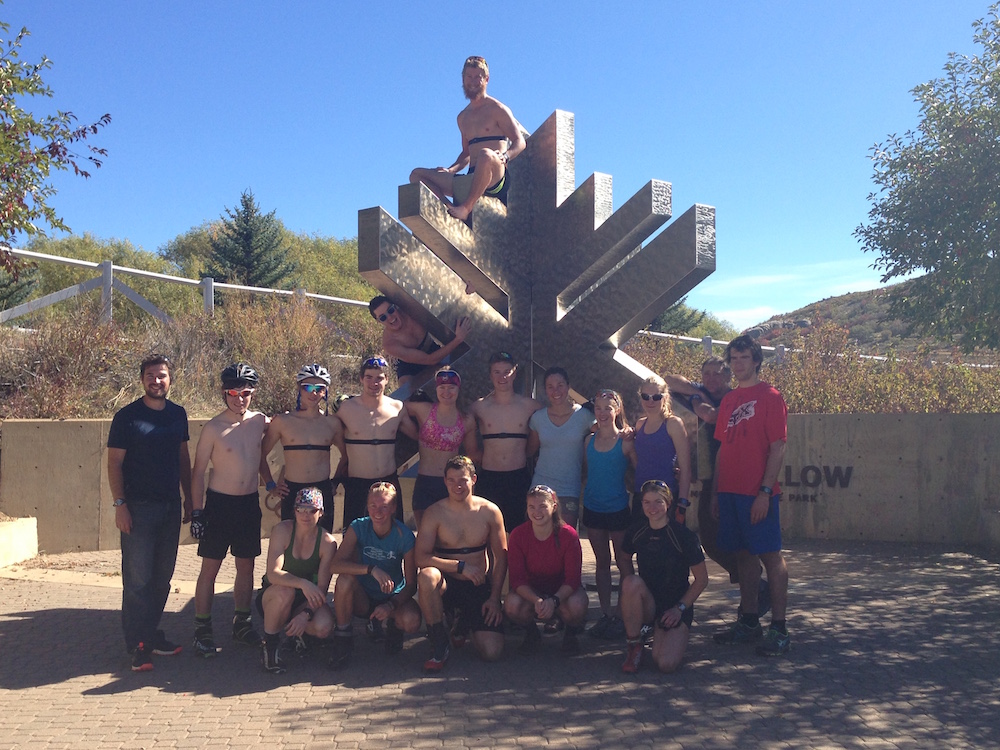
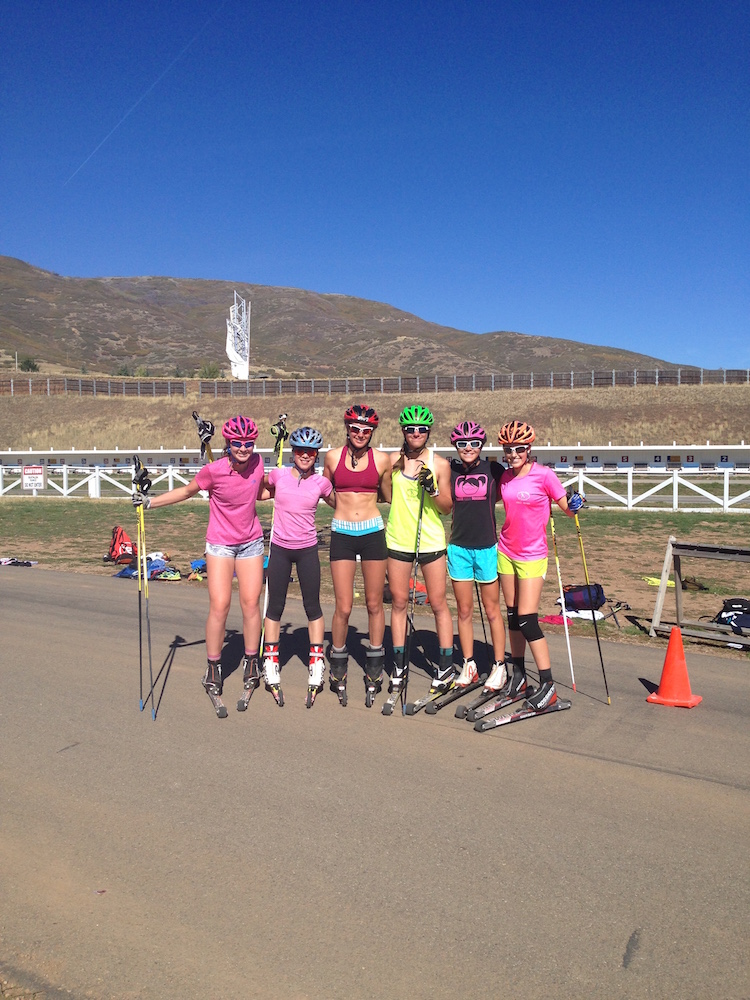
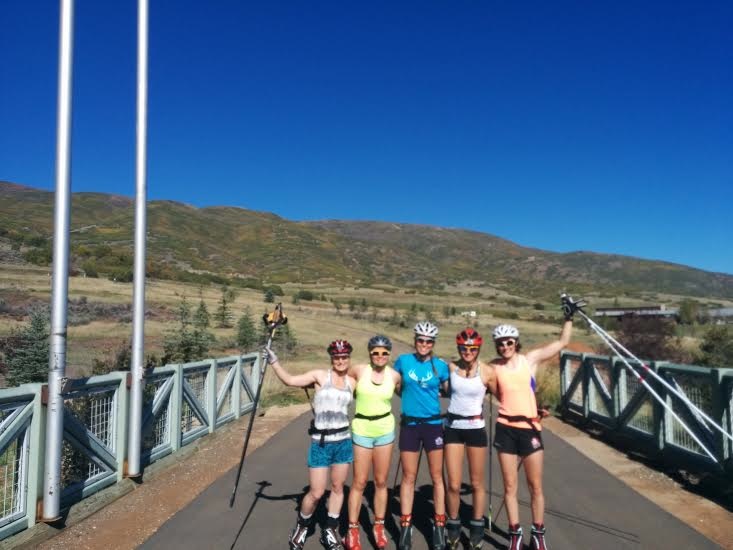
The Rocky Mountain Racers pose for a team photo during their two-week training camp earlier this month at Soldier Hollow in Midway, Utah. (All photos: Maya MacIsaac-Jones/Rocky Mountain Racers)
Editor’s Note: The following training-camp recap was written by Maya MacIsaac-Jones, an athlete on the Rocky Mountain Racers ski team in Canmore, Alberta. She and her teammates recently returned from their annual two-week camp in Park City, Utah. To submit your own camp writeup, please email info@fasterskier.com with the subject line: “Camp Recap.”
***
From Sept. 27 to Oct. 11, Canada’s Rocky Mountain Racers headed to Park City, Utah, for their annual fall training camp. The team, which is made up of twenty biathletes and cross-country skiers from across the country, took advantage of the region’s high altitude while putting in big volume hours and intensity.
Coaches John Jaques and Luke McGurk led RMR athletes during two grueling weeks of training with 3-5 hour volume days up Mirror Lake Pass, Wolf Pass, Emigration Pass, and Big Cottonwood Pass. For intensity sessions, the team went to Soldier Hollow, where the former Olympic venue’s paved rollerski track and biathlon range provided an opportunity for the biathletes and the cross-country skiers to train together.
For many RMR athletes, this was their first time coming to Park City.
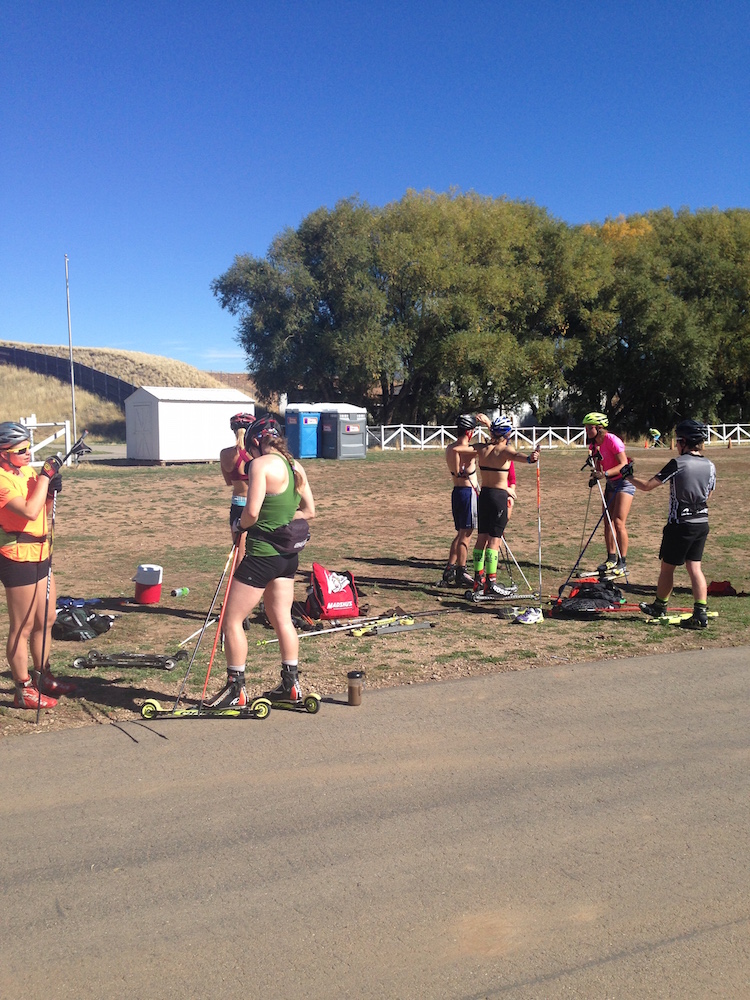
Group training at Soldier Hollow.
“Skiing at Soldier Hollow was one of my favourite parts of the trip,” said Donny Boake, 15-year old RMR skier from Yellowknife, Northwest Territories. “The rollerski track there has steep climbs and technical descents, so it was a great place to practice attacking the climbs and taking the descents aggressively.”
For returning athlete Ember Large, the camp provided a great opportunity to connect and work as a team.
“It was great to have the entire team together for two weeks, both for intensity and long easy days,” she explained. “Having everyone there made for a really fun atmosphere, and we were able to learn a lot from each other.”
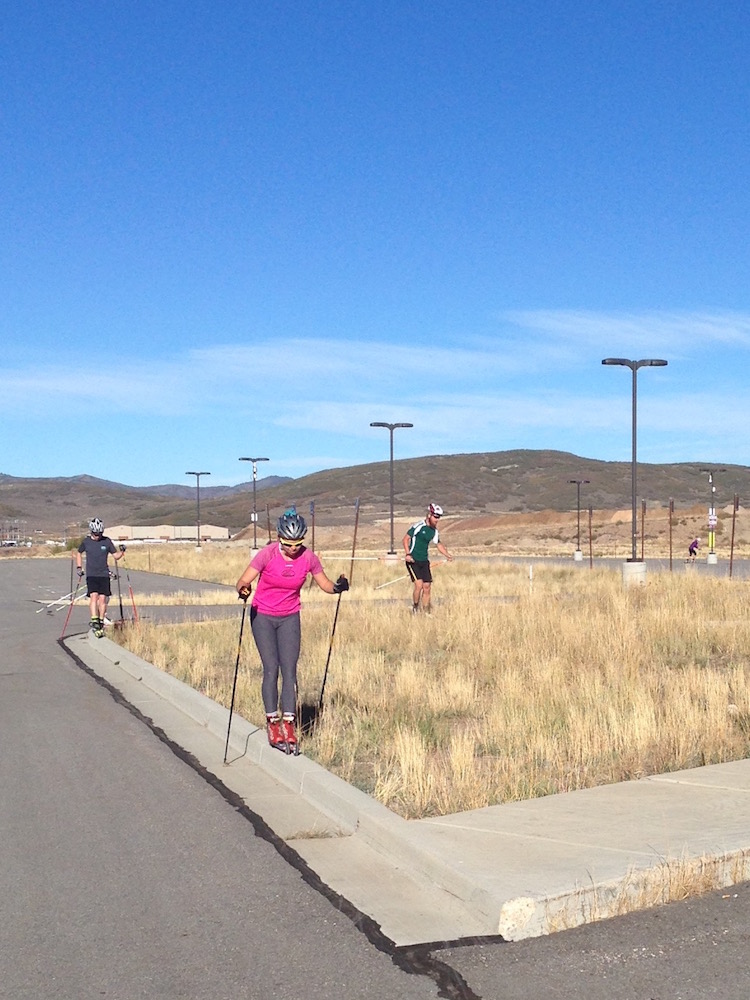
This year, the team added something new to their training camp: agility practice. Armed with empty parking lots, sharp corners, and sidewalk curbs for the athletes to jump off of, RMR coaches prepared obstacle courses for the athletes to help improve their confidence on rollerskis. The sessions focused on honing the athletes’ ability to ski in a pack, corner, navigate obstacles, jump, and rollerski.
RMR’s Emma Camicioli, Thomas Stushnoff and Evan Girard attacking the curbs during agility.
According to Coach McGurk, the agility sessions allowed athletes to “become more comfortable on their skis and give them the confidence to make decisions quickly when faced with a difficult situation.”
“The camp at Soldier Hollow is always an excellent starting point for the year as it offers a wide variety of terrain that we can use to test our athletes as well as most of our athletes will be in attendance,” he added.
The camp finished off with a sprint time trial at Soldier Hollow, where RMR athletes were joined by Wasatch Nordic Ski Academy for the day. Athletes completed a qualifier, three heats, and another qualifier to finish off the day. Heats were organized according to qualifying time, with similar speed athletes placed in the same heats to make for optimal competitiveness.
RMR’s youngest cross-country skier, Anna MacIsaac-Jones, was happy to tackle a challenging course in the sprint.
“It was a great experience to be able to race with some other girls that we don’t get to see in Canada,” she said. “It was a tough course with lots of hard uphills and downhills that really helped improve my skiing.”
Now done their last camp of the season, RMR athletes have headed back to Canada for some final training on Canmore’s Frozen Thunder before the season kicks off at the end of November.
RMR and Wasatch Nordic girls after their sprint simulation at Soldier Hollow in Midway, Utah.
Olivia Bouffard-Nesbitt (Rocky Mountain Racers) at U23 World Championships last week in Almaty, Kazakhstan. There, the 22-year-old Bouffard-Nesbitt posted the best result of her career: 12th in the 15 k skiathlon. (Photo: Raphaël Couturier)
We can’t imagine anything much more exciting than making an event like World Championships for the first time, so we contacted the North American skiers living that exact dream this year. The U.S. Ski Team announced its 16-strong senior World Championships team on Jan. 26, and Cross Country Canada selected nine to its squad on Monday. On Tuesday, the U.S. added Ben Saxton as its 17th member.
Instead of interrogating them with the usual “tell us how you’re feeling,” we decided to pose the following 10 questions to each of the North Americans headed to their first World Championships from Feb. 18-March 1 in Falun, Sweden.
***
Olivia Bouffard-Nesbitt, 22, has never been to the World Cup, and she doesn’t belong to a Canadian national training centre, either. Yet next week, she’ll be one of Canada’s select few racing at her first World Championships in Falun.
How did that happen? Bouffard-Nesbitt, who trains with Rocky Mountain Racers in Canmore, Alberta, placed 12th when it counted — last Saturday in the 15 k skiathlon, the last race of U23 World Championships in Almaty, Kazakhstan.
Two days later on Monday night, she arrived in Östersund, Sweden, to meet the rest of the Canadian World Cup team. This Saturday, one week after her breakthrough race, she plans to race the classic sprint in her first World Cup.
“I’m feeling pretty run down so I’ve mostly been resting, trying to get my energy back,” Bouffard-Nesbitt explained in an email. “As my first-ever World Cup, my only goals are to enjoy it, to absolutely make the most out of it, and learn!”
Olivia Bouffard-Nesbitt and Rocky Mountain Racers teammate Maya MacIsaac-Jones enjoy a nice outing on their first day in Almaty, Kazakhstan, where both raced at U23 and Junior World Championships, respectively. (Photo: Annah Hanthorn)
1. What was the first thing you did when you found out you were named to the World Championships team?
“I was up the night after the skiathlon and everyone had gone to bed, but our team leader told me to stay up to wait for an email that would be coming from our HP director. When the email appeared in my inbox, my heart raced and I couldn’t stop grinning, and then I just collapsed into bed, not to say that I actually slept though. How could I fall asleep after getting news like that!”
2. What’s been the biggest performance of your career so far? Which race stands out the most and why?
“Without the question the last race I did, twelfth place in the skiathlon at Worlds in Kazakhstan! Every one of the three races from Worlds this year are memorable for me. They were all great races, and after each one of them I was never able to contain my excitement. After I found out I was 17th in the 10k skate, I just jumped and hugged whoever was in the room with me at the time. A coach told me shortly after that had I not fallen I would have been top fifteen. All I could say was ‘I should probably be disappointed, but I don’t even care because I just came 17th!’ That was an unprecedented result for me!”
3. What are you most looking forward to at World Championships?
“Everything! It’s World Champs! It’s a huge dream realized. I honestly can’t pick out one thing, I’m just stoked for the experience!”
4. Whats your biggest motivation while racing?
I don’t want to have any regrets at the end of a competition, so I always tell myself to not leave anything out on the course. As my friend Sophie [Carrier-Laforte] would say: ‘Donne ta vie!’ [literally, ’Give your life!’]”
A happy Olivia Bouffard-Nesbitt (Rocky Mountain Racers) at U23 World Championships in Almaty, Kazakhstan. (Photo: Timo Puiras)
5. Which race(s) do you hope or plan to compete in?
“We will make decisions closer to the event about what races I will do, but right now I’m looking at the sprint and the 10k skate.”
6. If you could race the team sprint with anyone in the world, who would it be?
“Another Canadian. Anyone who I’ve trained with and shared the journey with.”
7. Which World Cup skier would you least want to meet in a dark alley (or in the last 100 meters of a race)?
“Hmmm probably Petukhov, but I’m sure he’s just misunderstood.”
8. What will be your key to success in Falun?
“I’m going to continue to focus on process over outcome, and I’m just going to try to do everything in my power to have the best possible races. I don’t have any loft expectations, so I’m really looking forward to just gaining some experience!”
9. Finish this sentence: If I made the podium at World Champs, I would …
“Get really funky and dance my way up to the podium and wouldn’t stop until we shut the after-party down!”
10. Name someone who’s had a major influence on your skiing career.
“Les Parsons. He helped me develop so much as a younger athlete and taught me everything I know about the mental aspects of racing and being an athlete. I owe him a lot and I am totally motivated by the time he’s selflessly invested in me and others.”
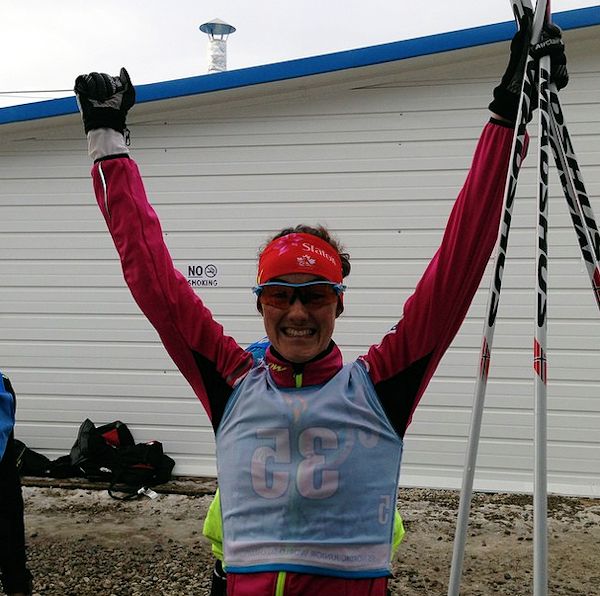
Canada’s Olivia Bouffard-Nesbitt (Rocky Mountain Racers) celebrates after finishing 12th in the 15 k skiathlon at Under-23 World Championships in Almaty, Kazakhstan. (Photo: Lisa Patterson/CCC)
Olivia Bouffard-Nesbitt (Rocky Mountain Racers) didn’t have the best start to Saturday’s 15 kilometer skiathlon at Under-23 World Championships in Almaty, Kazakhstan.
The Canadian cross country skier started at the back of the mass start, and she didn’t feel great on her classic skis.
“I was pretty much last starting the race,” she said in a phone interview.
But oh, how things picked up from there. After a fast transition to skate skis after 7.5 k, Bouffard-Nesbitt felt better and better. She soon found herself skiing with a pack of four or five other women, and picked off competitors who were tiring. Around 11 k, her coach told her that she was in 16th.
“It was super motivating to hear that,” Bouffard-Nesbitt said. “So I knew that at that point, I was at the back of my little pack so even within my pack, if I could beat the rest of them that would leave me in a good position. It really helped in catching the girls in front of us.”
She attacked with about 1.5 k to go before the finish, and ended up 12th for the best international result of her career and the best finish for Canada so far this week at World Junior and U23 Championships.
Bouffard-Nesbitt’s time was 1:32.3 behind winner Nathalie Von Siebenthal of Switzerland, and just 3.1 seconds outside the top ten.
“Especially in the last kilometer, it’s kind of a blur,” the Canadian said. “I’m thinking back to it and I can’t remember who I passed and who passed me, and where I was. But I just knew that I had to go. That was it. That’s all I remember.”
Besides being thrilled with her result, Bouffard-Nesbitt believes she found another silver line. She said that in a previously-published version of Cross Country Canada’s selection criteria for senior World Championships in Falun, Sweden, later this month, a top-12 distance result at U23’s was listed as one possible way to qualify.
“They always make discretionary choices and I don’t know what they’ll do with that,” she said of making the cut. “It’s an option. I’m crossing my fingers – it’s not something that I had even been thinking about for this season. I’ve never raced a World Cup and so it wasn’t in my plans. But I’d be pretty stoked.”
Bouffard-Nesbitt has met the organization’s eligibility requirement of scoring lower than 75 FIS points in multiple races so far this season. No Canadian women meet the primary objective criteria for World Championships, of having finished in the top 12 in an individual World Cup event, being in the World Cup “Red Group”, or having an individual podium in the last two seasons.
The currently-posted National Team selection criteria state the U23 World Championships performances can be used for selection to the senior World Championships team, but don’t outline how. They do, however, refer that a top-12 performance at U23’s should earn an athlete placing on the Senior Development Team. And it does state that top-12 finishes at U23’s qualify athletes for the B-Tour to Finland this month.
“Our team release date is Feb.9,” Cross Country Canada High Performance Director Tom Holland wrote in an e-mail to FasterSkier. “Olivia is certainly under consideration.”
So it’s unclear where she stands, but Bouffard-Nesbitt said she was sure she’d have an amazing time if she made the trip.
“I’ve never performed this well in my life,” she said of this week, where she also finished 17th in the 10 k freestyle and qualified 12th in the classic sprint. “I think the best thing it has done is to have given me confidence that I belong on the international stage. I’ve never raced this well, so the confidence is a big thing, and knowing that the girls I’m racing against aren’t superhuman, and that if I’m having a good race I can be right up there with them.”
Despite the strong results earlier this week, Bouffard-Nesbitt tried not to have expectations going into the skiathlon.
“I try not to go into races, especially at Worlds, with too many expectations,” she explained. “Especially because it kind of stresses me out personally. And I think that if you don’t go in with expectations other than trying to do your best, you can be happily surprised. I’ve been really happy with how I’ve approached the races mentally this week. Normally I go into races pretty anxious, but I’ve just been really excited all week to race.”
After the tough start in the classic section, she was able to ski more aggressively in the skate. She explained that she was working together with four other women, moving at a fast pace, and they eventually began to catch skiers who had excelled in the classic portion but were running out of gas.
“Halfway through the last lap of skate, I saw a big group of girls ahead of us who were all dying I think,” she said. “We were going at a pace I was able to maintain, and we were slowly catching them. When we actually caught them, that’s when I made my push. I thought, I have to go now, I have to go before the end, I should pass these girls now so they can’t latch on. So I went to the front of my little pack and pushed really hard at that part of the race. It just felt really good.”
It took a toll: by the finish she was exhausted. The top-12 nearly didn’t happen as Alisa Zhambalova of Russia came from behind and nearly passed the Canadian. Bouffard-Nesbitt held her off by 0.6 seconds.
“I actually wasn’t aware that she was behind me, and I only realized after the race was over that she was so close,” Bouffard-Nesbitt said, clearly still worried just thinking about it. “I’m really grateful that she did not get me before the line.”
This was the final day of competition at U23’s – World Junior Championships conclude on Sunday with relays – and Bouffard-Nesbitt says that World Championships selection is “in the hands of Cross Country Canada now.”
Regardless of where she travels next, it’s doubtful that she’ll forget this race.
“It was an amazing feeling,” she marveled. “I was just able to push it.”
Canadian teammate Cendrine Browne (CNEPH) finished 30th (+4:00.1) and Dahria Beatty (Alberta World Cup Academy) did not finish.
In the men’s 30 k skiathlon, Knute Johnsgaard (Yukon Elite Squad) led Canada in 32nd place (+3:49.7). Colin Ferrie (Blackjack), Scott Hill, (Thunder Bay NDC) and Raphael Couturier (CNEPH) followed in 44th, 45th, and 48th, respectively.
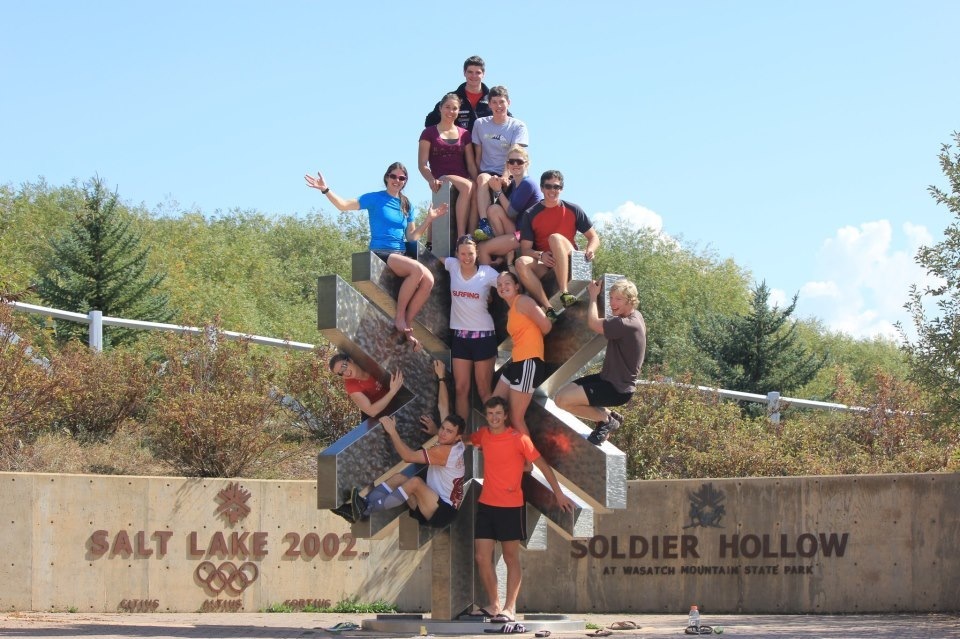
The Rocky Mountain Racers crew after a training session in Soldier Hollow in 2012. (Courtesy photo)
Maya MacIsaac-Jones, 19, of the Canadian National Junior Team and Rocky Mountain Racers (RMR) in Canmore, Alberta, submitted the following article about her RMR’s recent dryland camp in Park City, Utah, to info@fasterskier.com. Born and raised in Athabasca, Alberta, MacIsaac Jones lives in Canmore and is a student at Athabasca University.
***
From Sept. 27 to Oct. 11, one of Canada’s high-performance racing teams, Rocky Mountain Racers (RMR), headed down to Park City, Utah, for their two-week long high altitude training camp.
RMR is comprised of just over 20 high-performance athletes in both cross-country and biathlon from all across Canada. Led by coaches John Jaques and Luke McGurk, the team’s athletes focused on both high volume and high intensity during their camp.
RMR girls after a time trial at Soldier Hollow last month (from left to right): Andrea Dupont, Emma Camicioli, Maya MacIsaac-Jones, Ember Large, and Olivia Bouffard-Nesbitt. (Photo: Ember Large)
Long 4-5 hour workouts were completed on the various mountain passes surrounding Park City and Salt Lake City while intensity sessions, time trials and shooting practices were reserved for the excellent facilities available at Soldier Hollow in Midway.
Because of RMR’s cross-country/biathlon mix, Soldier Hollow was the perfect place for training sessions to occur; coaches were able to coordinate shooting practices for the biathletes with simultaneous rollerskiing sessions for the cross-country side of the team.
Utilizing Soldier Hollow’s biathlon range, extensive set of rollerski tracks and advantageously close proximity to Park City, RMR held several intensity sessions and time trials at the former Olympic site. The hilly climbs the facility offered also gave the athletes an opportunity to have a dryland time trial with a course very similar to what they will face during the ski season.
“It’s inspiring to train in the exact spot that I saw my Olympic heroes win medals at during the 2002 Olympics,” RMR athlete Andrew Brisbin stated. “[Soldier Hollow] is the most difficult and technical rollerski track that I’ve been on, meaning it most closely resembles a World-Cup caliber ski course through its lung and leg busting climbs and quick descents.”
Stuart Harden, RMR athlete and one of Canada’s top junior biathletes, also enjoyed training at the former Olympic site: “Soldier Hollow was a great asset to have at our Park City training camp. For biathletes, having a range and full rollerski loop close by made the trip feasible. As far as rollerski tracks go, Soldier Hollow is considerably challenging. Some steep, sustained climbs coupled with the altitude can really make you hurt, and can definitely make training there worthwhile.”
When not focusing on intensity sessions or shooting practices, the team explored the many other mountain roads available for rollerskiing in the area, including Mirror Lake pass, Wolfe pass, and Guardsman Pass. They concluded their camp with a 4-5 hour altitude run at 9000 feet on the trails above Park City.
With their last camp of the season complete, RMR athletes are now in their final stages of preparing for the racing season and the upcoming [SuperTour and] NorAm races at West Yellowstone, Bozeman, Rossland, and Whistler.
For any athletes or coaches interested in exploring Soldier Hollow as a future training possibility, please use the following contact information:
Olivia Bouffard-Nesbitt racing at the 2013 Canadian Nationals in Whistler, B.C. (Courtesy photo)
This ‘Pros of Tomorrow’ series, brought to you by the generous support of Fischer Sports, aims to highlight some of the most notable up-and-coming athletes around the world, which may or may not be Fischer-sponsored skiers. If you have an idea for a top-notch skier you’d like to read more about, please email info@fasterskier.com with the subject line: ‘Pros of Tomorrow’. We’re also looking for stories about intriguing juniors, collegiate skiers, or lesser-known athletes; please email us with names — subject line: ‘From the Pack’.
***
Olivia Bouffard-Nesbitt, 22, has been on skis as long as she can remember. Originally from Quebec’s Laurentides region, she started out on downhill skis until her parents deemed her “old enough to actually kick and glide,” she recalled. That was age 3.
Bouffard-Nesbitt went on to race for several nordic teams, including a training centre in western Canada before joining Rocky Mountain Racers (RMR) in 2013 in Canmore, Alberta.
Now readying for the 2014/2015 race season, she is in her last year as a U23 athlete. With experience competing overseas last winter, she’s a name to watch out for in North American ski racing and a likely candidate for Canada’s U23 World Championships and OPA tour. Last month, Petro-Canada named her its nordic-skiing recipient of its “Fuelling Athlete and Coaching Excellence” funding program.
Raised by Skiers
Bouffard-Nesbitt racing for Rocky Mountain Racers (RMR) at Frozen Thunder last fall in Canmore, Alberta. (Courtesy photo)
Although cross-country skiing in particular was an integral part of her childhood, Bouffard-Nesbitt enjoyed competing in several sports.
“As a kid, I was always really into sports and I knew I wanted to be an athlete,” she said in a phone interview. “I didn’t know what sport. It was either gonna be soccer, running or skiing.”
In her pre-teens, she played AA soccer, competed in both track and cross-country running and ski raced in the winter. But over the next few years her focus shifted more and more towards nordic skiing.
“I did Fast and Female when I was 14, so I got flown out to Canmore because I won a contest,” she explained. “They were flying two girls from every province to Canmore for this event. That was my first time out West and I got to meet Chandra Crawford, who was a celebrity to me at that point. That was super motivating and I was on a high from that for a really long time.”
Her inspiration from Fast and Female combined with the feeling that she was enjoying skiing the most out of all her sports prompted her to join the local Fondeurs Laurentides nordic team at 15. Two years later, she fully committed to skiing, leaving Quebec to train with coach Les Parsons in Edmonton, Alberta.
“I was at the end of high school in Quebec, I graduated and decided that my choices were to go to CEGEP [a general-and-vocational college] in Montréal, go to Nakkertok ski club in Gatineau or go to Edmonton,” she said. “I went to Edmonton because Les Parsons, who was coaching the [Edmonton Nordic] team at the time, invited me out there and found a family to host me.”
Having provided her with coaching advice in the past, Parsons positively influenced Bouffard-Nesbitt’s skiing and helped her overcome nerves in her earlier years of racing.
“He changed my way of thinking about competition,” she said. “He reminded me that, ‘You can’t do any better than your best’ and ‘If you’re not having fun, there’s no point in doing it.’ ”
After one year in Edmonton, Bouffard-Nesbitt decided it was time to make the next jump to one of Canada’s training centres and moved to Whistler to join the Callaghan Valley Training Centre (CVTC) in British Columbia.
“He changed my way of thinking about competition. He reminded me that, ‘You can’t do any better than your best’ and ‘If you’re not having fun, there’s no point in doing it.’ ” — Olivia Bouffard-Nesbitt on former coach Les Parsons
Overtrained
Looking back, she described that first year with Callaghan Valley as an exciting one.
“I felt like it was my first time being on a … I don’t wanna say real ski team, a more professional ski team, you know?” she said. “We had a team van and we all lived in the same place and our coach would drive us around everywhere. It was the first time I’d had a car drive beside me while I’m rollerskiing.”
That winter of 2010/2011, she had what she considered her breakthrough year.
“It was the year that I won the aggregate [overall] at nationals and I’d never done that before,” she said. “I’d never even medaled before at nationals.”
The second year was a different story. It was the first time Bouffard-Nesbitt trained full time in the summer, having worked at a summer camp in past years. With the excitement from last season, she felt more pressure in year two.
“After seeing how the team performed that first year, [CVTC coach] Chris [Manhard] expected a lot from us the second year,” she said. “It had been his first year with the team also, so the second year he was getting more pressure to have the team perform. The atmosphere changed.”
Manhard respectfully declined to comment.
As many athletes can attest to, it is much easier to push through the pain during training than to know when it’s time to call it. By the fall of 2011, Bouffard-Nesbitt was beyond the point of no return. In mid-January 2012, she was unable to finish a 10 k skiathlon in Whistler. After that, she went home to Quebec.
“Once I finally stopped training, it was like my body registered that I was giving it a break and then it just completely shut down,” she said. “I went from struggling in training to having heavy legs walking up stairs and sleeping like 12 or 13 hours a day. A month was pretty much sleeping. I went six months without training.”
Insight
Bouffard-Nesbitt stayed home until August 2013, when she decided to get back into skiing with RMR and moved to Canmore.
“There was never one doubt in my mind about wanting to keep going,” she reflected. “People thought I had quit or that I was going to quit, but I had never ever considered it. To me, when it was happening, it was just, like, a blip. I didn’t think ‘this is the end of my career.’ I knew I was gonna get over it.”
From left to right, Bouffard-Nesbitt, Dahria Beatty and Seb Townsend during the U23 World Championships trip last season. (Courtesy photo)
The toughest thing she recalled was knowing that she was out of the running for the U23 World Championships team that year. But she remembered the words of her former coach.
“Another thing that Les would always tell me was to think long term,” she said. “He’d say, ‘This year doesn’t matter, next year doesn’t matter, what matters is 2018 if that’s what you’re aiming for.’ ”
After six months of rest, she got back into training 30 minutes at a time and worked her way up to 50-minute workouts. For months, it was her fatigued legs that held her back. Finally, in the fall of 2012, she broke the 50-minute mark.
“It was around Frozen Thunder that one day, I just magically passed that 50-minute threshold and finally I just felt good,” she said. “I skied for way longer and didn’t get tired legs and from then on I was good to go.”
After a few months of training with RMR, Bouffard-Nesbitt posted a top-10 sprint result at 2013 Canadian nationals in Whistler and finished 22nd overall on the NorAm circuit.
“There was never one doubt in my mind about wanting to keep going … I didn’t think ‘this is the end of my career.’ I knew I was gonna get over it.” — Bouffard-Nesbitt
The Present
Looking back on last season, Bouffard-Nesbitt has mixed feelings.
“I was really excited; I’d made trips I’d never made before, I qualified for Worlds, which was a really big goal of mine, and then I got selected for the B-tour,” she said.
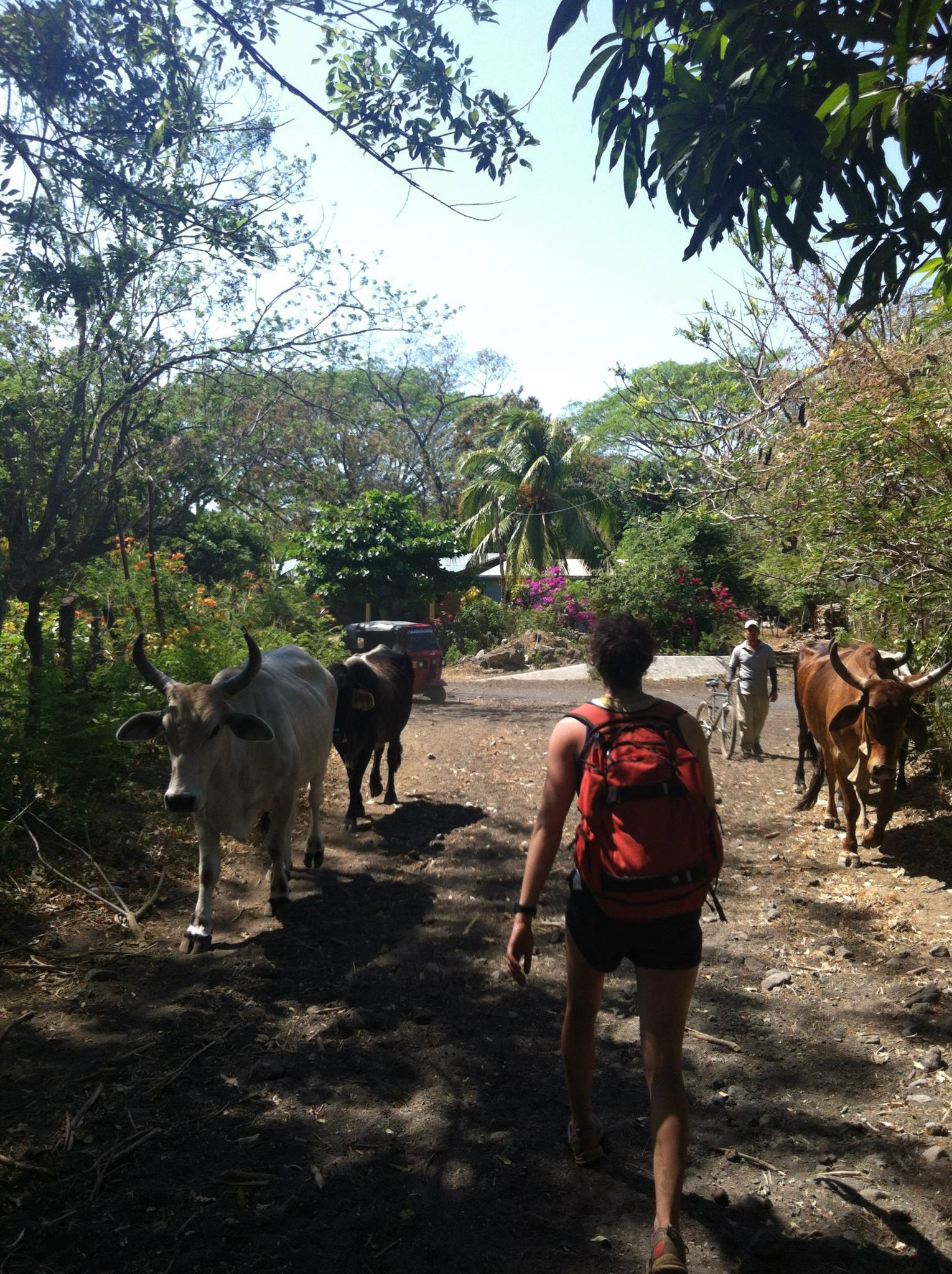
Bouffard-Nesbitt took part in the “Skiers4SchoolBox” Nicaragua trip planned by Perianne Jones, this spring.
All of that marked her first time racing against an international field and doing so in Europe.
At the same time, she was sick throughout the winter.
“My immune system was not super-strong and I just kept catching colds,” she said. “I caught a cold [at the start of the season] in Silver Star before Rossland. I got sick again right after trials — I was pretty sick that time. Basically I couldn’t go two weeks without getting sick.”
In Rossland, she pulled out a podium: third among the senior women. Other than that, she said she didn’t perform to her potential last season.
Currently Bouffard-Nesbitt is working towards her goal of making the upcoming U23 World Championships and, farther down the line, the Canadian World Cups in 2016 and the 2018 Olympics.
With RMR and her new home in Canmore, she thinks she’s in the right environment to achieve these goals.
Beyond Skiing
When she’s not skiing or training, Bouffard-Nesbitt can be found working for Buff Canada.
“I got the job because my teammate Andrea [Dupont] works there,” she said. “They dropped me in charge of what they call the professional collection. It’s a new collection of Buffs intended for industrial workers that isn’t really sold in Canada yet, but we’re trying to get it in stores. I work there part time, it’s about 20 hours a week if I am in Canmore. The boss knew I was a skier and it kinda transformed into a sponsorship. I still work there and I am still in charge of the professional collection and I’m also sponsored by them.”
This past April, Bouffard-Nesbitt traveled with a number of high-profile Canadian skiers, including organizer and two-time Olympian Perianne Jones, to Nicaragua to help build a school.
“We realized after a couple days at the work site that the people at SchoolBOX saw just as much value in having outsiders come and play with the kids, rather than just, like, digging a hole the entire time,” Bouffard-Nesbitt said in an earlier interview. “It means a lot to the kids to see that people are coming all the way from Canada and that people care that much about their school.”
Zoe Roy (RMR) leads Alberta World Cup Academy skiers Emily Nishikawa (c) and Kate Brennan (l) up a climb on the middle of their fourth of six laps in the 30 k classic mass start at Canadian Ski Nationals on March 24 in Mont Sainte-Anne, Quebec. Roy finished seventh to tie a personal best at Canadian nationals.
Maybe it was the transition to full-time racing or the fact that Zoe Roy was competing in her home nation last season. It could’ve been the back-and-fourth flights across the U.S/Canadian border, or one team’s hospitality that helped Roy reach new heights on the NorAm circuit.
Whatever it was, she wasn’t fighting it. After spending some 20 years in Bend, Ore., Roy, who turned 25 on Sunday, is moving to Canmore, Alberta. Starting Aug. 1, she plans to live and train at Canada’s cross-country epicenter with Rocky Mountain Racers (RMR), which took her in last year. Traveling with the club and taking advantage of its wax resources, Roy achieved her first NorAm podiums with second- and third-place in 10 k races, and tied her personal best at Canadian nationals in seventh.
Between races, Roy was studying at the University of Utah in Salt Lake City. In her fifth year there, she was done with collegiate racing and entering the pro scene as a founding member of StellaRacing – a Salt Lake-based women’s squad in its inaugural year. She was also in her first season with XC Oregon, making her club affiliation that much more confusing.
In committing to a domestic circuit, she chose Canada because she’s from there. Born in Ontario, Roy remains a Canadian citizen and doesn’t have dual ties despite growing up in Bend. She started last year with the West Yellowstone SuperTour, then spent the rest of her season in Canada (except for a convergence trip to Europe and local races in Salt Lake).
FasterSkier chatted with Roy on the phone last week shortly after her surfing vacation in El Salvador. Earlier this month, she and a childhood friend from Oregon flocked to the sea to learn the sport in a place they could do it every day. After fulfilling their goals and surfing under moonlit skies, Roy was back in ski mode in Bend.
***
FasterSkier: After more than a week of mostly surfing, are you a pro now?
Zoe Roy: Not a pro by any stretch, but I’m better than really bad. Took lessons the first few days to get the hang of it.
FS:What was the best part of your trip?
ZR: I’d say the highlight … was going surfing at night under the full moon. That and the fried plantains.
Zoe Roy working with a Fire and Ice Camp junior in late June at Mt. Bachelor in Bend, Ore. (MBSEF photo)
FS: Before El Salvador, you worked at the Fire and Ice Camp in Bend. How was that?
ZR: The day before we left, I was on snow. It was kind of funny going from that to surfing. … I coached for TUNA [The Utah Nordic Alliance] the week before [the Fire and Ice Camp] and then I did Fire and Ice for a couple days before I left. I was kind of an assistant coach for [that].
There were a ton of juniors there. It was pretty cool to be able to get all those kids together. At any age, it’s fun to see everyone else skiing, too. You see all your friends that you might not get to see the rest of the year.
FS: How long had you been back in Bend?
ZR: I came [back] after school at the beginning of June and I’m going up to Canmore in the beginning of August. … I actually graduated in May [with a degree in] exercise and sport science with a minor in entrepreneurial business and a TESOL certificate, which means I can teach English as a second language.
FS: Why did you decide to move to Canmore?
ZR: I had a good year last year and I got to travel with the Canadians a bit. I’m originally Canadian … so I thought I might as well move up there and spend the year skiing with them and see how it goes. That’s the main reason. I also have an aunt and uncle in Calgary so that’s nice, too. I’m on the team RMR, which I traveled with on the Canadian circuit last year. It’s based out of Canmore, so that seemed the natural place to go.
FS:How did your relationship with RMR start, and what about the team appeals to you?
ZR: They waxed for me at nationals two years ago so maybe that was the beginning of it, and then after that I got more connected with them.
It’s a fun team. They have the whole spectrum from juniors up to elite racers. Dasha [Gaiazova] is part of it and Andrea Dupont, those are probably the two main older girls on that team, and then John Jaques, the coach, is awesome, too. It’s probably a combination of who’s there and then John, too. I don’t know [new assistant coach] Mike Vierra too well, but he’s the new coach there, but I’ve heard great things about him, too.
I’m psyched to be [moving] up there. I feel like there’s a pretty solid group of, not just on that team, but the whole Canmore community. The [Alberta] World Cup Academy’s there so I’m excited to have that whole group of girls to train with. … That’s another big reason. I feel like it doesn’t get much better than that.
FS:When it comes to climbing the elite ranks of racing, why did you pick the Canadian route?
ZR: I think mostly because opportunities do exist for me to race in Canada. Those same opportunities don’t exist for me to race for the U.S. because I’m not a U.S. citizen, so I guess that’s the main reason. I thought, ‘If I’m going to see how fast I can race, I might as well go somewhere where there are opportunities to make teams’ … so I thought I’d go to Canada.
FS:We heard you were leaving XC Oregon, but what’s the status of StellaRacing?
ZR: As of this coming year we’re splitting up a few more different ways because it was really based out of Salt Lake. I’m heading up to Canada, Katie [Ronsse] is in PT school, Evelyn [Dong] is coming back to Bend.
It was great; we had an awesome time putting it together and have a team based in Salt Lake to work from and race with, but I’d say as of now, it’s splitting up a bit more. I’m sure some of us will still wear our suits at certain times, but I don’t know if it will be as much as a team as it was last year, but we had a great time doing it.
FS:What are your goals for this coming season?
ZR: Well, the World Cups are in Canada so if I qualified for that, that would be amazing, but who knows. If that could happen, that would be awesome, but other than that podiums at NorAms and another Scando Cup would be sweet, too. I don’t know exactly what the opportunities are for another Scando trip.
FS:What did you gain from the convergence trip?
ZR: It was cool to just race in Europe and see the other parts of the ski world. It’s good to race against those girls and see what level they’re at. I feel like just that in itself was a good experience.
[Note: After winning four state championships at Summit High School, Roy spent a year and a half in Austria training and racing at the University of Salzburg.]
FS: How did you feel last season went overall?
ZR: I was psyched about those [NorAm] results. What can I attribute it to? I don’t know exactly, but I mean, it’s hard to pinpoint one thing. I guess before that I was racing [collegiately] so I couldn’t come to Canada that much. I was on the NCAA circuit.
FS:What are your thoughts on truly making the next step to full-time racing?
ZR: It’s exciting. It’ll be interesting to sort of concentrate more on skiing than I really did before.
Rocky Mountain Racers are seeking an assistant coach to work with our high performance cross country and biathlon racing team based out of Canmore and Calgary. The assistant will report to Head Coach John Jaques and work with assistant coach Luke McGurk to deliver the cross country and biathlon training programs. The team is currently comprised of 29 men and women from 14 to 32 years of age. It is not necessary to have experience coaching biathlon.
Please send a letter of interest and a resume of coaching experience to RMR Vice President Jennifer Jones. macisaac.jones@xplornet.ca phone: 780 689 0988
Application deadline is Wednesday, April 14th 2012.
At a recent NorAm sprint in Rossland, British Columbia, the Albertan had the fastest qualifying time of any junior, covering the course more than eight seconds faster than any of her competitors. She went on to win the junior race, despite the fact that she’s only sixteen – three years younger than the other podium finishers.
And if that isn’t impressive enough, MacIsaac-Jones’ time in the qualifier would have put her seventh in the senior women’s race, sandwiched between 23-year-old Jennie Bender of CXC and 24-year-old Kate Brennan of the Alberta World Cup Academy.
For a skier like MacIsaac-Jones, it’s almost a shame that Canadian race protocols pull junior racers from the senior heats, even if they’re fast enough to compete, and relegate them to a separate race.
Luckily, the Athabasca, Alberta native isn’t lacking for opportunities to push herself. She regularly competes as a senior in distance races, where officials don’t kick here out – at Canadian national championships last year, she finished 11th in the 5 k freestyle.
And soon, she’ll have another chance. MacIsaac-Jones, who is a member of Canada’s junior national team, will represent her country at the inaugural Youth Olympic Games in Innsbruck, Austria in January.
Competing internationally and against much older racers might seem to be a fast track to burnout; in a newspaper interview last year, the then-15-year-old said that she was shooting for 550 hours of training.
But exhaustion doesn’t seem to be a problem for the perky junior, who said in the same interview, “I have so much fun while I’m doing it, and that provides me with plenty of motivation to keep on going!”
FasterSkier interviewed MacIsaac-Jones over e-mail to see how she was preparing for the upcoming Games.
FasterSkier: How long have you been skiing and how did you get started as a kid?
Maya MacIsaac-Jones: I have been skiing since I was 4 years old, when my parents put me on skis at our farm near Athabasca, AB. I skied in the Athabasca Nordic Jackrabbits program for several years. My first race was at the Tawatinaw Loppet, at 5 years old and I have been racing ever since.
FS: What ski club are you a part of now, and how has that community helped you develop as an athlete?
MMJ: I am currently racing with Rocky Mountain Racers, a club based out of Canmore, AB. I have two exceptional coaches, John Jacques and Luke McGurk, who provide me with training plans, camps, technique sessions and race support. Our club has many athletes with whom I train, and who push me to improve. My teammates and the RMR community are extremely supportive and a lot of fun.
I am still involved with my home club, Athabasca Nordic. My daily training is done in Athabasca under the supervision of my parents. I have great support from my family, friends and community.
I would also like to thank my sponsors, Rossignol and One Way for their continued support.
FS: How do you balance skiing with school and your other interests? It takes a lot of time and energy to be a good skier….
MMJ: Balancing school and skiing is sometimes difficult, but if I am efficient with my time I can successfully combine both. Due to training camps and races, I miss a lot of school. However, my teachers have always been very flexible and helpful so I can continue my studies while I am absent.
FS: What have been some of the highlights of your career so far?
MMJ: Racing highlights include a bronze medal in the team relay at the Halifax Canada Winter Games, and medalling twice at Cross-Country Nationals 2011. I enjoy traveling across the country to different races, as well as training at on-snow camps during the summer, in particular at the Haig Glacier.
FS: Have you raced internationally before?
MMJ: No; I am very excited to be able to compare myself to other international skiers my age for the first time!
FS: Have you raced yet this season? How have things started off?
MMJ: So far, I have raced at the Canmore Alberta Cup, the Sovereign Lake NorAm and Rossland NorAm. I am satisfied with my results and I am very happy with the beginning of my racing season. I think that having consistent races these past few weeks has helped me to prepare for the YOG.
FS: Are there any experiences, like competing against older or faster skiers, that you think have prepared you for the Youth Olympic Games?
MMJ: Racing against older and faster skiers has allowed me to learn more about racing strategy and tactics and has motivated me to work harder. RMR has many senior racers with a great deal of race experience such as Andrea Dupont and Dasha Gaiazova; they have helped me to learn a lot about racing and training.
FS: Has it changed your approach to the season to know that you will be on this trip, rather than having to focus on qualifying for it?
MMJ: Yes, it has helped to know that I am on this trip. I do not have to peak for a qualifier; all of my training is designed towards peaking for the YOG. I can use the races at the start of the season as part of my training, so that I can be my fastest in Innsbruck.
FS: Has the recent success of Canadian skiers at the senior level changed your expectations of what you can accomplish? What are your long-term goals?
MMJ: The current success of the Canadian National Team is inspiring. It shows that Canadian skiers are amongst the best in the world. Growing up, Beckie Scott was my hero; she grew up in a small, northern Alberta community and became one of the best cross country skiers in the world. My long term goal is to race on the World Cup circuit with the Canadian National Team.
FS: What are you looking forward to most about the Games?
MMJ: I am really looking forward to competing against the best cross-country skiers in the world that are my age, and experiencing racing in Europe. I am also looking forward to traveling to another country and experiencing a different culture, along with my teammates and friends!
Stuart Harden at World Junior Championships in 2011. Photo: Mark Gow.
Canada’s hopes for a biathlon medal at the Youth Olympic Games are probably riding on no single athlete more than Calgary’s Stuart Harden.
Harden is one of those athletes who seems to be a junior forever, simply because they find success at such a young age. Last season, he competed in his first World Junior Championships – mostly because before then, he had been too young to qualify. As it was, the then-16-year-old was still technically a year too young for the youth category.
It didn’t stop him from excelling, however. Harden had a top finish of 18th place in the individual race, leading a Canadian team of older athletes.
He continued to race up in age divisions, and at the Canada Winter Games he competed not as a youth but a junior, the designation for 20- and 21-year-olds. There, Harden picked up relay gold and three individual medals.
At Canadian national championships, he was forced to compete in his own age class simply to qualify for the Youth Olympic Games – something Harden appears to have found moderately frustrating. But now that he’s made the team, he’s looking forward to competing against athletes his own age, and has even higher expectations for the results he can achieve.
At 17, Harden is already experienced enough to thank his ski sponsors in interviews, and in a recent piece by Youth Olympic Games Young Reporter Emily Ridlington, he said he was aiming for a podium finish.
FasterSkier checked in with the young star over e-mail.
Harden racing to 23rd place in the pursuit at 2011 World Junior Championships. Photo: Judy Geer.
FasterSkier: How did you get into skiing when you were growing up?
Stuart Harden: Well, I’ve been cross country skiing since I was about eleven when my father enrolled me in a biathlon bears program at Canada Olympic Park. My family had an air rifle as a child that we’d shoot in the yard, and I’d always been the best kid with it, so once we moved to Canada with all our snow my parents introduced me to cross country skiing and biathlon. I’d never heard of cross country skiing before then, and now I spend most of my time on the trails.
FS: What made you want to compete in biathlon?
SH: My first competitive year in biathlon was when I was twelve years old and I had no role models or older siblings to follow into the sport. I didn’t know anyone who did it, so I have only my parents to blame for where I am now.
FS: You’re training out of Canmore, along with a lot of the other biathletes going to Innsbruck – what’s in the water there!?
SH: Funny – I have to give most of the credit to my long time coach John Jaques. He’s played one of the largest roles in my development and has given me great training opportunities and advice over the years. Being in such a nordic-oriented town gives me access to many resources I may not have otherwise have, such as early snow, a reliable range and the opportunity to make connections and strong ties to companies dedicated to the sport. In my case, I’m lucky enough to be able to ski for Rossignol and Oneway, two groups that have helped me tremendously so far.
FS: Can you tell me a little bit about your training there? Which of the clubs are you part of and who do you train with?
SH: Canmore is a great place to train and live. You’re surrounded by like-minded athletes and incredible winter terrain. It’s a perfect environment for training cross country skiers and biathletes. I’ve been with the Rocky Mountain Racers for five years now training with some great athletes with tons of racing experience. We’ve seen a lot of new faces in the club recently (such as some folks from Spain, Norway, BC, Ontario and others) and it’s great mixing it up with the regular crowd I’ve known for years. Biathlon Alberta also provides great racing and travel opportunities to young Albertans like myself.
FS: Last season seemed like kind of a breakout for you with your excellent World Juniors finish. Did that surprise you, or did you know you had it in you?
SH: I wasn’t concerning myself with results going into the races, there’s a lot to manage in your first Youth World Championships and just getting through each race without any mishaps was my priority. My finishes were a very pleasant surprise, and I had to have faith that I was capable of good results. If you go into a race without believing in yourself, you can only expect so much.
FS: What do you think changed you to allow you to make that jump last year?
SH: It was one of my first years being eligible to make the youth national team, otherwise I’ve been training as consistently and intensively as years past if not more so. Increased training hours and more on-snow summer opportunities at the Haig Glacier and Sunshine ski hill I think have contributed to my performance. With steady development like this, it gets me excited for the years to come.
FS: How did that experience help you prepare for this year – are there specific things that you came away knowing that you had to improve?
SH: It was a valuable racing experience, the World Youth Championships. I’ve been exposed to the different attitudes of foreign competitors and the seriousness of the officials and volunteers; it’s a great atmosphere in Europe and at the championships. After analyzing the results of each of my races, the most apparent and addressable differences that separated me from the top ten finishers were range time and ski speed. Ideally, my ski speed will improve over time, but my shooting time is something I can work on immediately.
FS: Do you feel like there’s more pressure on you after doing so well last year?
SH: I think we’ve seen pressure affect quite a few young athletes after their first or second year of international competition, so I’m approaching the Games with an open mind. However I plan to come into the Youth Games with a slightly different attitude than that of last year at worlds; I’m the top half of the age group this year and I know what to expect and solid results should follow.
FS: Did the fact that you were named to the team so far before the competition change your approach to summer and fall training at all? Are you doing anything differently to prepare?
SH: My summer and fall training plans haven’t changed since my naming to the team, but I’ll be racing as many cross country along with biathlon races as I need to prepare for the games. Cross country provides a high calibre of skilled athletes and allows me to focus on the skiing side of competition, and I get to practice hurting myself even more! Not to say that I won’t be shooting frequently, as I mentioned I’m working on my range times along with the usual precision drills on the firing line.
FS: What are you most looking forward to about the Youth Olympic Games, and do you think of it differently than the World Juniors?
SH: A chance to travel always sounds great in my books, and going to represent Canada makes it that much more meaningful. I’m especially excited to race of course. After a long off season of training I’m hungry to get out there and ski myself into the ground.
A winter-games style event is always different from single-discipline championships. Whether it’s Alberta, Canada or Youth Olympic Games, there’s always so much hype and attention that is well deserved of such events. The atmosphere that accompanies these races is great for the athletes, and it exposes events like biathlon to crowds that might otherwise just stick to hockey or alpine skiing. So I’m looking forward to a large, enthusiastic audience.
Coon Valley, WI. – Mt. Borah Custom Nordic has recently solidified a partnership program with Rocky Mountain Racers, the premier Canadian sports organization for cross country skiing and biathlon sports. Mt. Borah will be supplying RMR’s elite athletes with its full line of professional nordic apparel. “RMR will be instrumental in providing elite level feedback on our complete line of Nordic apparel, we will be working closely with RMR to continue evolving our line to the highest possible level”, said John Dyste Mt. Borah’s winter sports sales manager. In addition to providing product feedback to Mt. Borah, RMR will also be representing the companies already well established custom line to Canadian teams. RMR will be displaying Mt. Borah marketing materials at key events in addition to distributing sizing kits to Canadian clients, streamlining the entire ordering process. Over the past several years, Mt. Borah has manufactured hundreds of custom nordic suits for the Canadian market. The 2010/2011 season marks the companies first season of manufacturing exclusively under its own brand name and Mt. Borah is no longer manufacturing suits for competing brands.
John Jaques, RMR head coach, is also excited about the partnership with Mt. Borah Custom Nordic. “RMR is all about excellence, once we reviewed the Mt. Borah Custom product line we immediately realized that the company is a perfect fit for our organization, the quality of their product line is top notch”. “Mt. Borah offers a very complete line of custom nordic products, from junior suits and jackets all the way up to the pro line, Canadian clients will find what they need with Mt. Borah”.
For more information about Rocky Mountain Racers, please visit www.rmracers.ca. For more information about Mt. Borah and their line of custom nordic apparel, please visitwww.mtborah.com or contact the company directly at 800-354-2825, M-F 9-5 CST.