From the FasterSkier archive — posts syndicated from athletes’ and coaches’ own blogs between 2004 and 2012, kept online as published. Current coverage is at fasterskier.com.
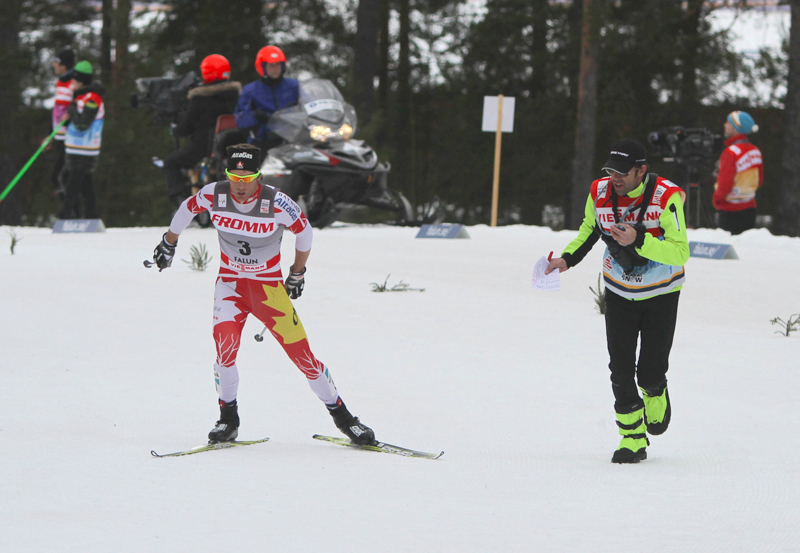
Canadian National Team Head Coach Justin Wadsworth (r) giving splits to Devon Kershaw at 2012 World Cup Finals in Falun, Sweden.
Last week, Biathlon Canada announced Justin Wadsworth as the Head Coach for the 2019-2020 season. In April, 2019, Wadsworth took on a temporary role as the team’s summer coach. That fill-in-the-gap stint will extend through this season’s racing. Wadsworth joins Canadian biathlon at a challenging time, with limited funding and after the retirement of many top athletes.
“My job is really just for the national team — we have 12 athletes and I would say that is my mandate to get those athletes working at their personal best and a world leading direction.” — Justin Wadsworth
Biathlon combines shooting accurately, skiing fast, and finding mental strength. Wadsworth has his focus on the ski speed. Pavel Lantsov, who joined the program part way through the 2018-2019 training season, will continue as shooting coach. Roddy Ward leads the development effort.
Wadsworth will make two trips to Europe during the season. As his wife’s career involves extensive travel, he has to manage his time away from the kids. Wadsworth took a five week summer break from coaching to get some quality family time. He has agreed to travel for the first IBU World Cup first period from November 17th to December 8th and then again for World Championships that will include a February pre-camp.
So how does a life-long cross country skier become not just a biathlon coach, but a national team head biathlon coach?
“That is a fine question because about six months ago I had no plan to coach anything let alone biathlon,” Wadsworth told FasterSkier on the phone last week from a Park City training camp. After originally agreeing to three months, he started work with the athletes on training and ski technique.
“Those three months kind of flew by and I had a lot of fun with the team.”
The 2019-2020 team is younger than in the recent past, with Emma Lunder, Scott Gow, and Christian Gow showing the most success in the last season.
“My main philosophy with training,” Wadsworth said of his focus with the young biathlon team, “is really just consistency. We don’t need to do the real radical things to get the extra one percent at the end of the day going into the season. We need consistent training with good technique and staying injury free and being healthy and that is going to bring this team the biggest rewards for this next coming year or two.”
Wadsworth ran the Canadian cross country team during the best funded period of its history, thanks to Vancouver 2010 and solid racing results. During his own racing career, he had a front row seat to watch the Canadian cross country team rebuild after Nagano 1998. While the latter has more obvious relevance in the current state of Canadian biathlon, he showed an ability to use money well [link to Canadian ski truck] when it was available. As he immerses himself in Biathlon Canada’s rebuild, he’s facing a stark reality when it comes to funding.
“I have never seen a team with a budget as small as this. Our athletes right now at this camp in Park City are paying for everything. No funding.”
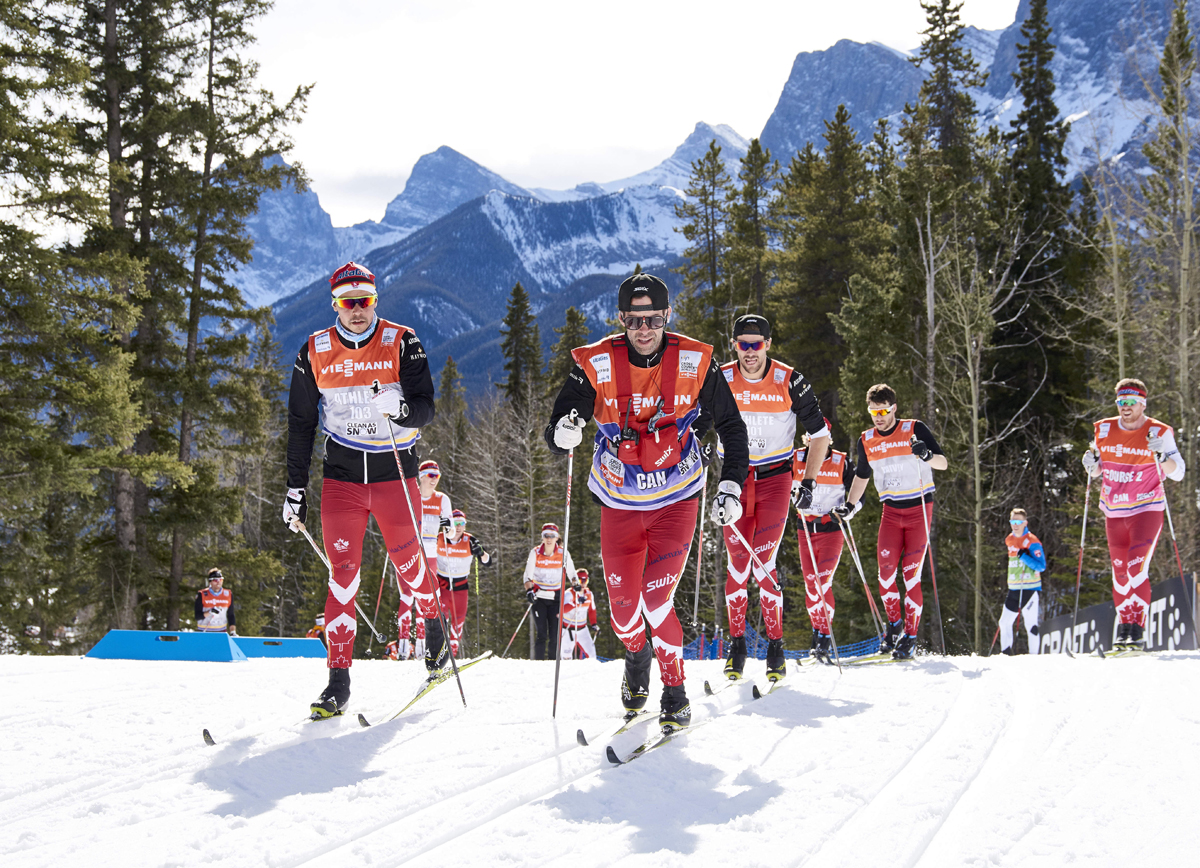
Canadian head coach Justin Wadsworth leads his team during a training session at the 2016 Ski Tour Canada in Canmore, Alberta, including athletes Jess Cockney (l), Len Valjas, and Alex Harvey. (Photo: Fischer/NordicFocus)
Who is Justin Wadsworth?
Wadsworth spent five years as the Canadian National Cross Country head coach and is often thought of as one of the most outspoken Canadian officials on the topic of doping in sport.
He presided over some of Canadian skiing’s ‘golden era’, including the arrival of Alex Harvey on the world stage, Devon Kershaw’s second overall in the 2012 World Cup, and Canada’s first World Championship gold. None were Wadsworth’s personal highlight, however.
“I would say the whole team during that 2012 season, where every member, male or female, of our national team, had a top three result on World Cup. That to me was the highlight. It was amazing. We had Perianne [Jones], we had Dasha [Gaiazova], we had Chandra [Crawford], we had all the guys. Everyone had been on the podium. A few podiums, like the girls, were double-podium with Peri and Chandra, or Chandra and Dasha in the sprint. The team energy was amazing. We went through the whole season and everyone was so focused and having so much fun. Really just a really strong team. Everyone thinks back to the guys, but before Christmas that year, Chandra, I think, was fourth on the overall sprint World Cup going into the Tour de Ski, and we had other great results. Lenny [Valjas] later that year had a podium in distance. Everything was just firing on all cylinders. That to me is what I remember. To me as a coach that felt the best and was kind of the highlight. Not just for the results, but the whole team really worked together hard, and everyone was accountable to everybody else. When that all clicked, and everybody got on the podium that year, it was really special.”
There is more to Wadsworth than coaching, as older ski fans may remember. He was a pivotal member of the U.S. Ski Team (USST). He competed at the most recent U.S. World Cup, producing the top American result with 8th in the 30-kilometer at Salt Lake City in 2001.
In 2002, he was sick at the start of his home Olympics before recovering to be part of the 5th place men’s relay (the best U.S. result ever, matched by the women in PyeyongChang 2018). He quarantined himself from his then-girlfriend to help her remain healthy and have the best chance at her own Olympic dreams.
On a call with FasterSkier shortly before the announcement of his new title, Wadsworth doubled down on the difficulty and importance of being a team player.
“Those are words that come out of my mouth with our current team here. If anyone gets sick, you have to pony up early on. Don’t be afraid about it. It’s one of the hardest things to say, ‘I might be getting sick’, early enough to prevent the whole team from getting sick.”
Wadsworth passed that test in 2002. He did, however, start his target event, the 30 k mass start freestyle.
“I should have not started, but I felt it was my best chance at a great result, and I started even though I was sick,” Wadsworth confirmed in an email about that DNF. “I wish someone had helped me to not start….”
When Wadsworth talks to athletes about trusting the process, they know that he has both lived it as an athlete and lead it as a coach. Wadsworth didn’t reach the top instantly himself, missing Albertville 1992 before qualifying for Lillehammer 1994, five years after his first World Cup start.
“Oh, I raced [a U.S. World Cup] one other time in 89 right here, down the road from where I am right now [Park City]. It was a Salt Lake World Cup, but it was held at a place called Mountain Dell. I think it was Bjørn Daehlie’s first ever World Cup, or first ever World Cup win.”
(FIS records are a bit sketchy that far back, but it was Daehlie’s first win.)
You might think Wadsworth’s strong opinions on cheating in sport come from being at Beckie Scott’s side through years of her very public challenges, but he does have first hand experience with dopers. When asked about his 2001 World Cup race, he said “I think [Johan] Mühlegg might have been ahead of me, but I always take him out [of the results].”
In that 2001 30 k, Mühlegg won as a Spanish athlete, having left the German team over a dispute about his personal doctor. Mühlegg would be banned after failing a doping test at the 2002 Olympics. The second place finisher, Christian Hoffman of Austria, was implicated in a different Olympic blood doping scandal in 2002, but wouldn’t be banned until 2009 after he was caught at Torino 2006.
If you take out the known cheaters, the upgrade to 6th place would give Wadsworth one of the best U.S. World Cup men’s results in history. By extension, Hoffmann wouldn’t have out-sprinted the U.S. closer Carl Swenson for fourth place at the 2002 SLC relay.
Wadsworth’s wide ranging experience as an athlete and coach leaves him with diverse tools to help Canada’s national biathlon team rise up.
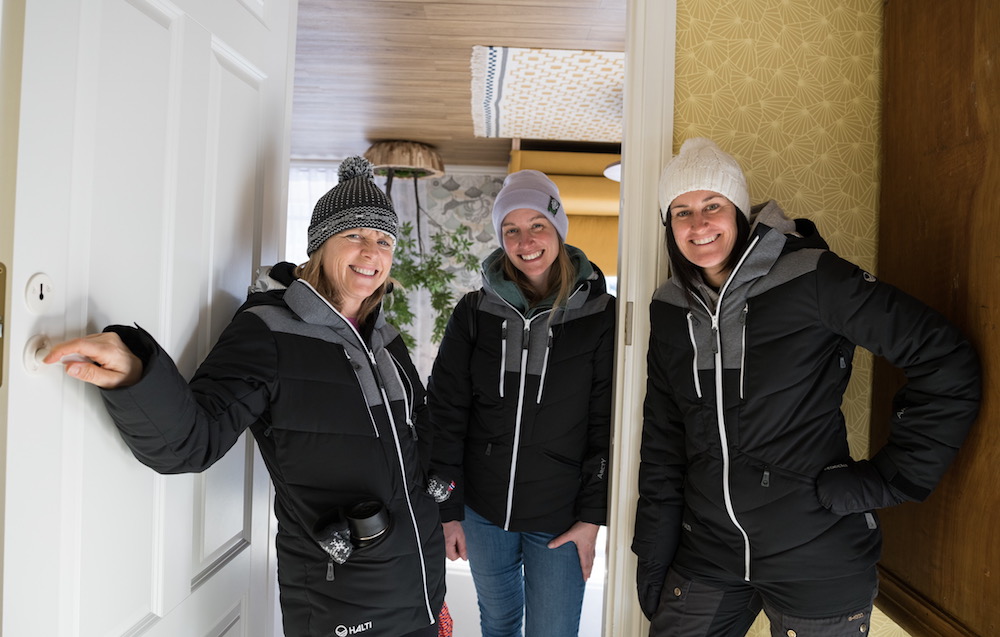
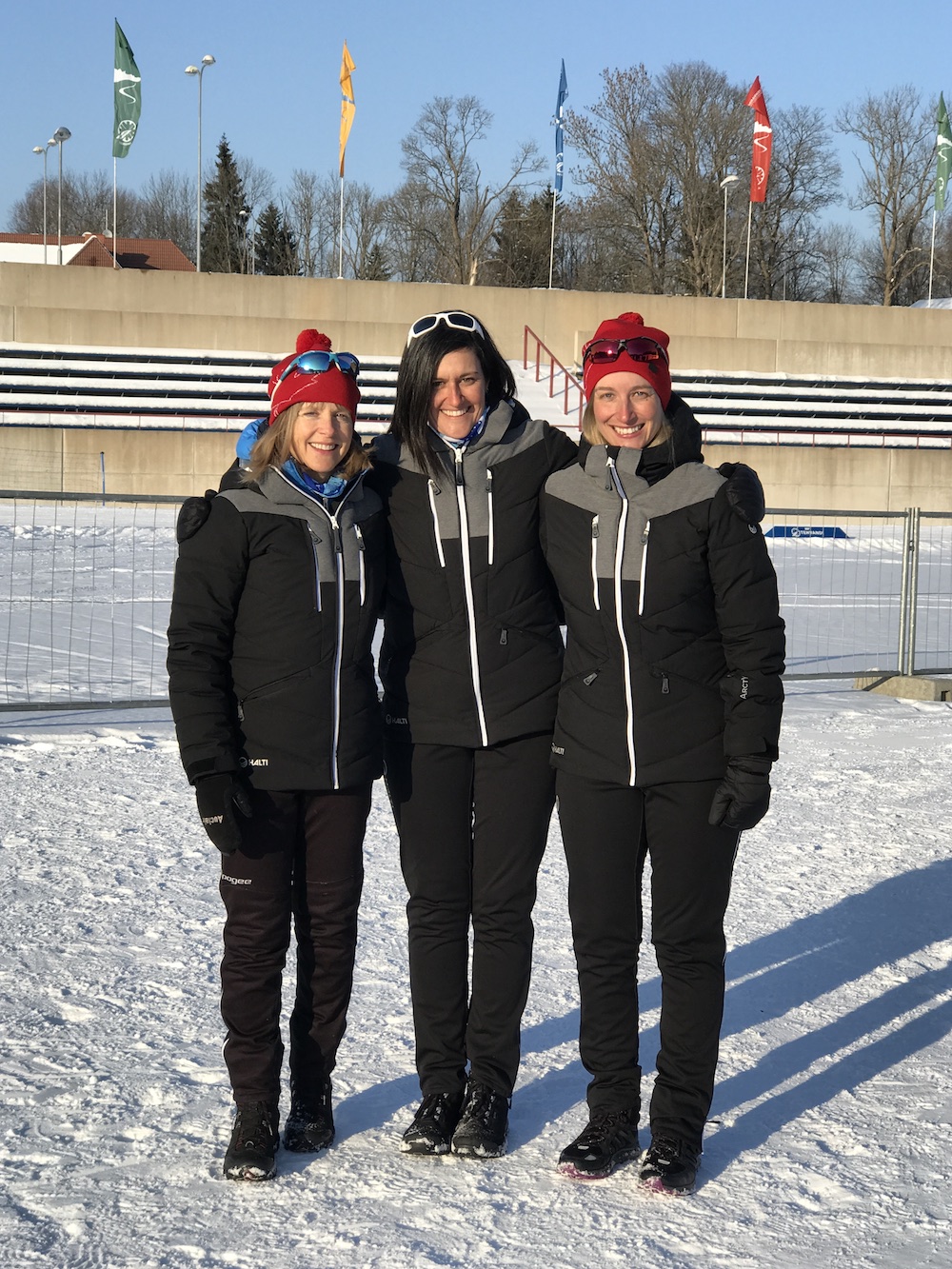
Biathlon Canada’s all-female coaching staff at 2018 IBU Youth/Junior World Championships in Otepää, Estonia. From left to right: Kathy Davies, Jessica Blenkarn and Jacqueline Akerman. (Photo: Emily Dickson)
Think about all of the exceptional female biathletes out there. Too many to count, right?
Now, if you watch biathlon at the World Cup level, think about how many women you’ve seen coaching there. None? One?
There are at least a couple, according to Biathlon Canada’s High Performance Director Roddy Ward, who’s been coaching biathlon internationally since 2011. The Slovakian women’s coach is one and the Austrian team also has a female coach, he wrote in an email to FasterSkier.
When it comes to wax techs, Ward wasn’t aware of any at the International Biathlon Union (IBU) World Cup level. The number of female race officials in that arena is similarly low.
Biathlon Canada is trying to change that. Not by consciously developing female wax techs or officials, but by presenting women with career opportunities after they retire as an athlete or if they show promise as a budding coach.
That emphasis on female leadership and coaching development is taking place in sports across Canada, Ward explained. Biathlon Canada is fully onboard with that movement and sent a clear message at this year’s IBU Youth/Junior World Championships — which took place last week from Feb. 26-March 4 — sending three female coaches to head up its team in Otepää, Estonia.
Last fall, Ward and Jacqueline Akerman, Biathlon Canada’s athlete and coach development manager, decided on their coaching staff for Otepää Youth/Junior World Championships. Akerman would be the head coach and trip leader, as she had for the previous two years, and joined by Kathy Davies, head coach of the Biathlon Alberta Training Center, and Jessica Blenkarn, who coaches at Sea to Sky Nordics.
The three women would make up the coaching staff and work with two male wax techs: head wax tech Andrew Chisholm and assistant tech David Bradley.
While the coaches were selected because of their qualifications (“we have these three great coaches who happened to be female,” Ward wrote), he also liked that female-to-male staffing ratio. It sent a message.
“Roddy and I went, ‘Oh, that would be cool, to be able to take an all-female staff,’ ” Akerman recalled of their conversation last fall. “… He said, ‘This is a really good thing for people to see, that we have three strong women coaching.’ ”
“It’s definitely important for us to have strong female leadership in our program,” Ward wrote to FasterSkier. “Truthfully, these are three great coaches who just showed up at my front door.”
Akerman had previously worked with Davies and Blenkarn on other international racing trips; Davies has been to several Youth/Junior Worlds and Blenkarn has coached at Open European Championships, the IBU Cup and IBU Junior Cup.
Asked if they’ve ever encountered an all-female or mostly female coaching staff in their sport, Akerman was quick to respond: “That’s an easier answer, two letters: NO.”
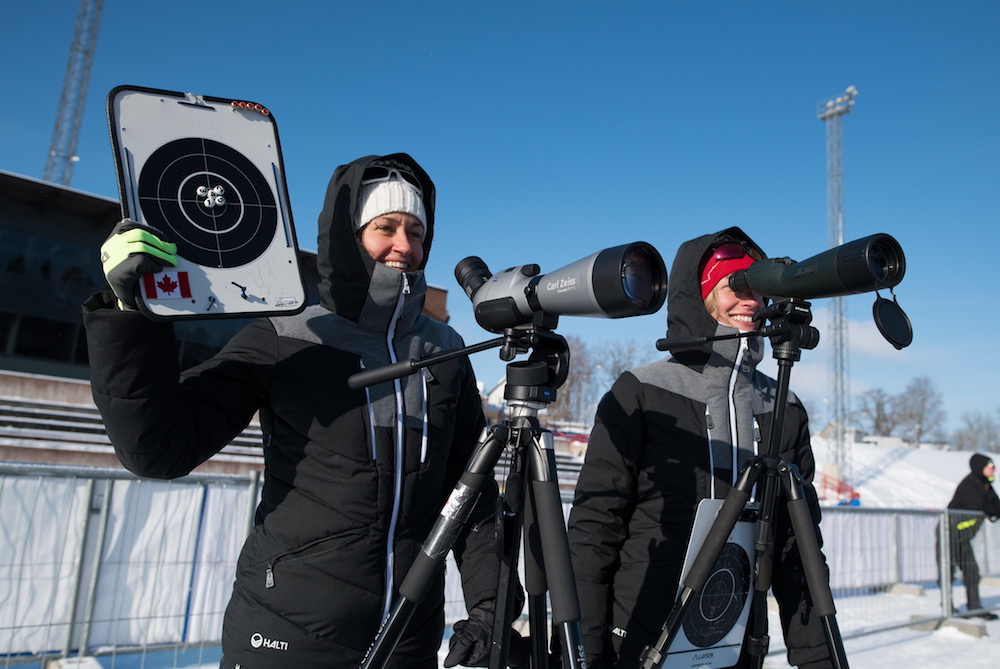
Jacqueline Akerman (l) and Jessica Blenkarn on the range at 2018 IBU Youth/Junior World Championships in Otepää, Estonia. (Photo: Emily Dickson)
At last year’s Open European Championships, Akerman and Blenkarn experienced some reaction from their peers when they were working together on the range.
“The amount of second glances that we got was incredible, and comments saying, ‘Oh, two female coaches! Two women coaches!’ ” Akerman said during a joint phone interview with Davies and Blenkarn in Otepää a few days before the championships began.
“We were a bit of a spectacle,” Blenkarn added.
“And we got lots of TV time,” Akerman continued. “The TV’s haven’t come out yet and not all the teams have arrived yet so we’re waiting to what kind of spectacle this will be with three of us.”
FasterSkier had yet to hear how the three coaches were received throughout the championships, but they stated they were off to a good start from an internal perspective.
“We’re all good communicators, and we’re all complimenting each other really well,” Akerman said. “For me, it seemed to just really flow nicely, maybe more so than other times.”
“I’ve been on a number of trips similar to this and it’s the first time I’ve have even another woman on a trip, except for athletes,” Davies said. “Those trips can be very, very isolated and very hard to sometimes fit in or even feel like part of the coaching staff when you’re the only female.
“It’s not a conscious thing on the men’s part necessarily, but it sometimes feels very isolating, so it’s just absolutely amazing to be with other women in the coaching position,” Davies continued. “What I love about it is it actually gives female athletes and idea that there’s more that they can do. It’s not just athletes, whereas most World Cup races, the women, that’s all they see is an athlete, because you see very few in the coaches’ world, you see next to none in the techs’ world and you also see a rare few in the officials’ realm as well, so it’s really nice to [show] women and athletes that there’s something else they can do as well.”
“I think we just support each other really well,” Blenkarn noted. “We have a good understanding of what female coaches go through and what kind of unique challenges they might face at an event like this so it’s nice to have other people around you to support you.”
Biathlon Canada’s all-female coaching staff at 2018 IBU Youth/Junior World Championships in Otepää, Estonia. From left to right: Kathy Davies, Jacqueline Akerman and Jessica Blenkarn. (Photo: Terri Dickson)
Asked more specifically about those challenges, Akerman referred to the term Davies used: “isolating.”
“It’s really hard to find your space in the room,” Akerman said. “It’s really easy for me right now to find my confidence with these other two that are here and sharing and supporting. Just them physically being here I feel more confident. So I can find my voice better. There’s just more space for you.
“Your space can sometimes get beaten up in a male-dominated place, so I feel that we need to be encouraged … and open and invited,” she continued. “I met Jess about three years ago and I just saw her skill and her ability and I was like, OK, we need her to be invited into this because she’s excellent. … Someone has to be opening the doors and allowing that space to happen, otherwise it won’t happen for women. I think when we see potential and, not just potential, when we see people who are experienced and they’re very good at what they do, we have to open the door for them. For the men, it’s already open, they just walk through. We need top open it. … I think that’s partly what Roddy’s doing … some men get it and they open the doors, but I think as women we can do it even more because we can understand what it’s like.”
At the Olympic level, biathlon dates back to 1924 when it was known in its ancient form as “military patrol”. A more modern form of biathlon debuted at the 1960 Olympics, but women’s biathlon didn’t become an Olympic sport until 1992. The sport’s military background paired with the relatively recent participation of women has led to some inherent challenges for women in the sport’s leadership roles.
“I can find my voice better. There’s just more space…” — Jacqueline Akerman, Biathlon Canada’s head coach and trip leader for the last three Youth/Junior Worlds, on having two other women on her coaching staff in Otepää
“2003 was the first time I worked the World Cup for biathlon and that was on the range with one of our male coaches and I was the only woman there,” Akerman recalled. “And people looked at me like I was an alien. Slowly over the years you see a few women. On the IBU Cup last year, actually, there was a fair amount of female coaches. I mean, the percentage is still ridiculously low, but you do see them now, and on the Junior IBU Cup as well…”
So the trend is in the right direction, and Biathlon Canada is more than happy to be at the forefront of that progression.
“It’s important for female athletes to have good role models,” Ward wrote. “I have seen firsthand what a good female coach can do for a female athlete and I see that is important for three reasons.
“1) to help athletes navigate life/struggles to turn into healthy and successful adults.
“2) I want our athletes to kick butt internationally and I believe strong female leadership can help us achieve this goal.
“3) I believe female athletes are more likely to give back to the sport (coaching, waxing, officiating etc) if they had female role models through their career that had a positive impact on their life.”
Last week in Otepää, outside of relays, Canada notched five top-10 results, five top-20’s and seven top-30’s, which were achieved by five different women and three different men.
“We’re building, practicing, focusing, training to be a well-oiled machine as a large group and as individuals,” Akerman said before the races began. “And we’re very confident in our ability to utilize those skills and abilities to our potential.”
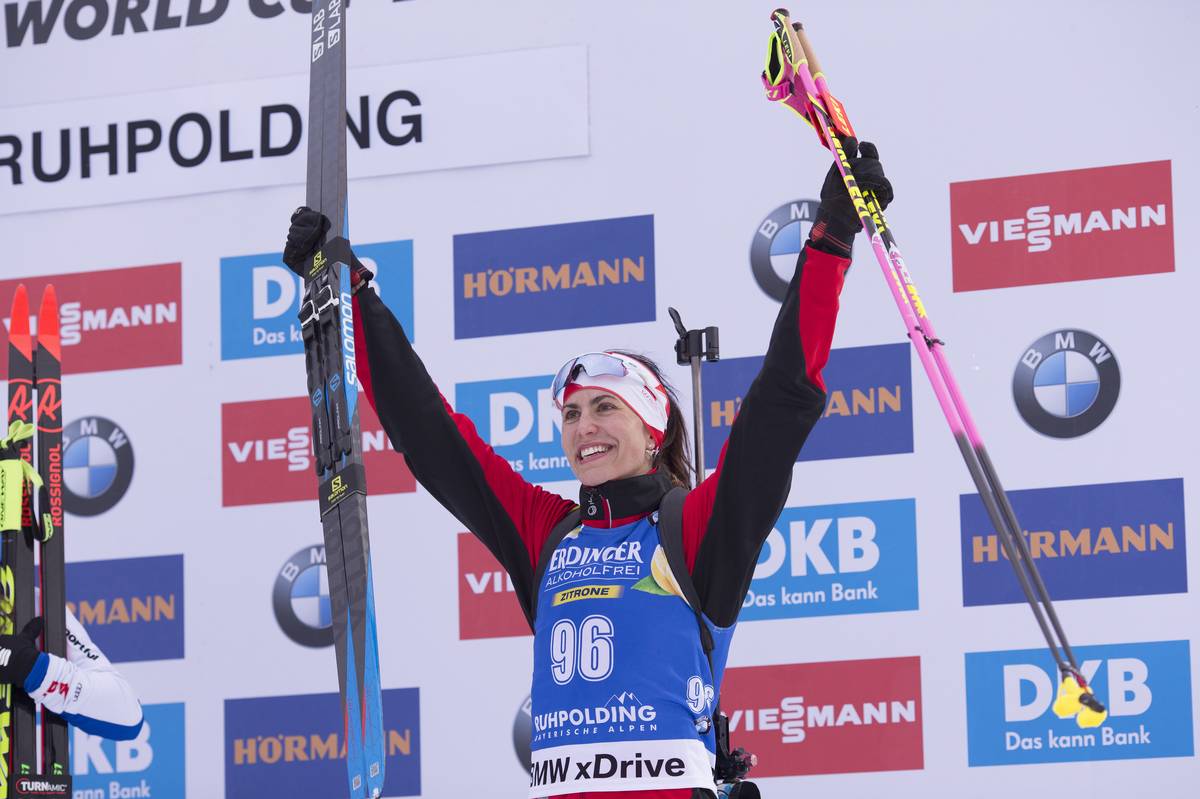
Rosanna Crawford (Biathlon Canada) celebrates her first-career IBU World Cup podium on Thursday in the women’s 15 k individual in Ruhpolding, Germany. (Photo: Salomon/Nordic Focus)
IBU World Cup (Ruhpolding, Germany): Women’s 15 k individual
It’s been a long time coming, but on Thursday, Rosanna Crawford, 29, achieved her first podium on the International Biathlon Union (IBU) World Cup circuit.
It came in Ruhpolding, Germany, in the longest-format race for the World Cup women: the 15-kilometer individual. In the four-stage race, which adds a minute penalty to a competitor’s time for each missed shot, Crawford of Canmore, Alberta, shot a perfect 20-for-20. She said she had never done that before in a World Cup race.
“I really like the Ruhpolding range,” Crawford said in a post-race phone interview, after finishing third behind Italy’s Dorothea Wierer and Finland’s Kaisa Mäkäräinen, respectively. “This was my first World Juniors, my first World Cup and now my first podium, so it’s a pretty special place for me.”
Wierer won the race with 20-for-20 shooting as well, starting 24th and finishing with the fastest time of 41:29.0 minutes. Mäkäräinen as the 12th starter missed out on first place due to a single miss in the first prone (1+0+0+0) and ended up 12.7 seconds back in second place.
Crawford, one of the last starters in bib 97, turned heads throughout the race with each passing clean bout. With one extra breath before her last shot, she successfully hit her last target and left the range with a huge smile.
“I think I almost started crying,” she recalled.
She finished 21.7 seconds out of first, and almost 25 seconds clear of fourth-place finisher Yulia Dzhima of Ukraine. Even a Ukrainian coach was cheering for Crawford on her last loop.
“That last lap was so cool,” Crawford said. “Right past the penalty loop, the Ukrainian coach was like, ‘You’re one second, — or whatever time I was — from first,’ and it was amazing. I think this really describes what the biathlon family actually is. It’s not the IBU. It’s the coaches and the athletes and the wax techs and the fans.”
Her teammates and coach, Roddy Ward, awaited her arrival in the finish pen.
“Canada’s not on the podium every day so they let them sneak by to give me a hug so that was really special,” Crawford said.
Her result is her first non-relay top 10 since a pursuit in December 2014, where she placed seventh in Pokljuka, Slovenia. The race before that, she placed fourth in the Pokljuka 7.5 k sprint, which was had been career best — until Thursday.
“Who knew that I would get my first podium in an individual?” Crawford mused. “I was laughing at that myself.”
The U.S. was led by Susan Dunklee in 27th (+3:02.7), who had one penalty in each of the first three stages (1+1+1+0).
Canada’s Julia Ransom placed 34th (+3:35.0) with two penalties (1+1+0+0), Sarah Beaudry was 53rd (+4:18.6) with two misses as well (0+1+1+0), and Emma Lunder finished 67th (+5:21.7) with four penalties (1+0+2+1).
Two Americans raced, with Clare Egan finishing 57th (+4:26.3) with three penalties (0+1+0+2).
“Certainly the highlight for me today was watching Rosanna crush it,” Dunklee wrote in an email. “Her whole team, athletes and staff, were overjoyed. It’s inspiring to see and lends positive energy to all the North Americans going forward.”
She also pointed out that her U.S. teammates Emily Dreissigacker and Maddie Phaneuf placed fifth and 11th, respectively, with clean shooting in the IBU Cup women’s 15 k individual, also on Thursday.
“That spark is exactly what our team needs right now and the timing is spot on,” Dunklee continued. “We will field our first women’s relay this weekend. It has been a challenging season so far living and traveling with such a small crew, trying to stay upbeat and carry the team with a skeleton group.”
The World Cup men’s 4 x 7.5 k relay is scheduled for Friday at 8:30 a.m. EST, with both Canada and the U.S. entering teams. (Men’s relay start list)
The women’s 4 x 6 k relay is on Saturday at 8:30 a.m. EST, with the men’s and women’s mass starts following on Sunday in Ruhpolding.
Slovakia’s double Olympic gold medalist Anastasiya Kuzmina en route to a huge win in her favorite race, the sprint, in Oberhof, Germany, on Thursday. (Photo: IBU biathlonworld)
For athletes who finished 2017 on a high note, the first race of 2018 can be a couple of two things. One is a continuation of the good competitions right like they left off. Another is a downgrade leaving them wondering if they’ve lost their mojo.
For some women in Thursday’s 7.5 k World Cup sprint in Oberhof, Germany, it was the former. Anastasiya Kuzmina of Slovakia started in the yellow bib denoting the leader of the overall biathlon World Cup, and she wore it all the way to the top of the podium after a 35.4-second victory over Kaisa Makarainen of Finland.
Despite being a double Olympic champion – she won gold in the sprints in 2010 and 2014 – Kuzmina had never worn the yellow jersey until this season. But she’s continuing to show why she deserves it.
“It’s my first win here in Oberhof, and it’s always a really good feeling,” she said in a post-race press conference. “I’m really happy that I had fast and good skiing, and I just enjoyed the race.”
Both Kuzmina and Makarainen was well as third-place Veronika Vitkova of the Czech Republic (+40.1 seconds) had one penalty, as storms lingered over Germany after having caused the cancelation of World Cup ski races the previous day. The women dealt with large gusts on the shooting range, as well as slow ski trails from the rain that continued falling.
The podium from the Oberhof sprint, with (l-r) Kaisa Makarainen, Anastasiya Kuzmina, and Veronika Vitkova. (Photo: IBU/biathlonworld)
“I was lucky at the shooting range,” said fourth-place Franziska Hildebrand of Germany (+47.0 seconds), who also had one penalty. “If you were lucky enough to catch a calm phase then you could have a good race.”
“It was not easy weather conditions, I think for everyone,” Kuzmina said. “Today in zeroing I saw that it was not easy to shoot clean. I understood that I needed to be really concentrated on the shooting range. After one mistake in the prone position I was just thinking, ‘okay, it’s still good, it’s still good.’ For everyone the conditions on the shooting range were changing. So I knew that with one you still have a chance.”
Only three women managed to shoot a perfect 10-for-10, and two of them were Canadian. Julia Ransom rode that shooting to ninth place (+1:13.6), and Sarah Beaudry to 23rd (+1:39.0) in her first World Cup start of the season.
“I didn’t have any crazy expectations going into this week, but I am happy to see that the level of performance is still there,” Ransom wrote in an email. “Today definitely felt like a bit of a blow out for the legs, so I am excited to see what the pursuit will bring!”
For Ransom, a winter break spent in Europe – unusually, as the Canadian “A” team usually returns home for Christmas and even skips the Oberhof weekend to get in more home-turf training – was the perfect thing keep up her level of performance. Ransom had started out the season with a ninth-place finish in the 15 k individual in Östersund, Sweden.
Julia Ransom (Biathlon Canada) racing to 39th in the women’s IBU World Cup sprint in Annecy, France, earlier this season. (Photo: Glen Crawford)
“My winter break was exactly what I needed,” she wrote. “My brother and nephew had come out to Le Grand-Bornand [for the last World Cup weekend] and then later spent a week with me in Annecy [France]. We went into full tourist mode, eating lots of cheese and drinking lots of wine. Even got some beautiful powder turns in Chamonix. I then went to Zurich for the Christmas weekend to visit one of my childhood best friends before joining the team again in Obertilliach for a week of training. Safe to say, a week completely free of biathlon followed by a week of training paradise made for some good race prep.”
Shooting was the key to good results for Ransom and Beaudry; their ski splits ranked 44th and 63rd, respectively. But Canadian women’s coach and High Performance Director Roddy Ward downplayed the conditions in discussing his team’s excellent shooting.
“Overall the shooting conditions were tricky but not too bad actually,” he wrote in an email. “I’d even say quite good for Oberhof! It was actually quite fair for everyone, which is nice. No big gusts then calm, wind was always present and a bit swirly. I’m actually not surprised they cleaned but more surprised there were so few in total that cleaned.”
That’s quite a difference from the assessment of some of the other athletes. For instance: “I’m really really happy that I had only one penalty today, because it was difficult conditions and changing all the time,” said second-place Makarainen. “In standing I really felt the wind. It was not easy. But shot by shot I managed with only one [penalty], and I was really, really satisfied with that.”
But Beaudry agreed with her coach’s assessment.
“Personally I didn’t find the wind to affect my shooting much today,” she wrote in an email. “Both times when I came in it wasn’t too windy, and I just tried to shoot confidently and have solid hits. I did for sure give my last shot an extra second because that one can be a little stressful, but I hit it and that’s what matters.”
Sarah Beaudry with friend Caroline Seip in the Oberhof stadium after notching a personal-best 23rd-place World Cup finish in the 7.5 k sprint. (Photo courtesy of Caroline Seip)
As for Ransom, she simply approached the day’s shooting with intention, and it brought her success.
“I was mentally prepared for hellish race conditions, so when I got to the site and didn’t see v-boards flying away or five inches of slush, I was pleasantly surprised,” she wrote. “It was a little blustery in both prone and standing, so all I could do was focus on making good shots. In the standing, I aimed to shoot in lanes 28-30 because it is a little bit more sheltered, but other than that, there wasn’t any special trick! After a break from racing, I was glad to come back with solid shooting.”
Beaudry was coming off of IBU Cup finishes of 23rd in Sjujøen, Norway; 36th in Lenzerheide, Switzerland; and tenth and 24th in Obertilliach, Austria. Along with Megan Tandy, she got pulled up to the World Cup with just two weeks of Olympic qualifying possibilities to go.
“Megan and Sarah both performed well on the IBU Cup in trimester 1,” Ward explained. “Therefore, they were given a chance at [Oberhof]. I didn’t really have any expectations, but felt if we gave them a chance we could see a good performance. Sarah produced a great performance.”
In fact, it was the best result of her career. Her previous top World Cup finish was 38th in the sprint in Canmore, Alberta, in 2016, with a somewhat reduced depth of field. Before that, she had finished 54th in a pursuit in Ruhpolding, Germany.
But since her sprint qualifies her for the pursuit on Saturday, where she is guaranteed to be in the top 60 if she finishes, she is fast-tracked to meeting one of Biathlon Canada’s Olympic criteria and could be either the fourth or fifth member of the team.
That’s not what she’s thinking about, though.
The Americans didn’t master the Oberhof shooting range as well as their Canadian counterparts, with both Susan Dunklee (above) and Clare Egan picking up four penalties. They finished 62nd and 86th, respectively. (Photo: USBA/NordicFocus)
“Like I have said before, this season I just really wanted to race well and show what I never was really able to show last season,” she wrote. “I was hoping for a solid result, but definitely not expecting the result I got today. The Olympic qualification definitely adds extra pressure but I know I race best when I am having fun. So I was trying to blast the dance tunes and just smile.”
The pressure came off in an unexpected way, too.
“In my warm-up I was trying out the big corner, as they had changed it from yesterday,” Beaudry explained. “I went a little hard and crashed and broke my ski — which weirdly had me laughing my entire warm-up.”
Joining the pair in the pursuit will be Tandy, who finished 59th (+2:37.5) with two penalties. Emma Lunder did not start for Canada, as she is recovering from a stomach illness that earned her a trip to the hospital, but Ward said that she should be ready to race in Sunday’s relay.
For the U.S., Susan Dunklee finished 62nd (+2:46.6) and Clare Egan 86th (+4:23.0), each with four penalties.
Although quite a number of competitors shot the same score or worse, it was nearly impossible to qualify for the 60-woman pursuit doing so: the only women to make it with four penalties were Germany’s Denise Herrmann (45th, +2:13.3), Switzerland’s Selina Gasparin (47th, +2:16.0), and Norway’s Hilde Fenne (56th, +2:29.0).
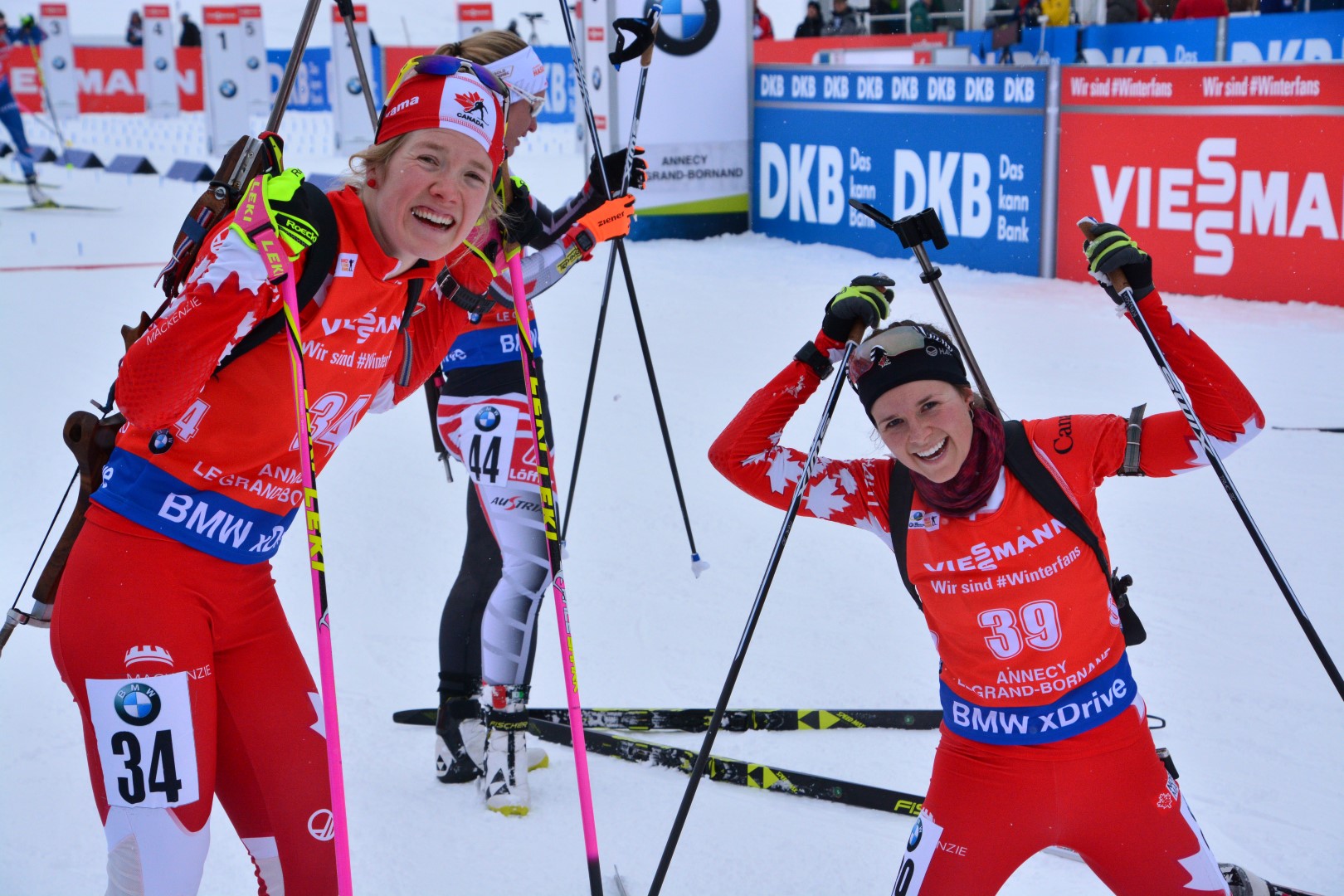
Biathlon Canada’s Emma Lunder (l) and Julia Ransom (r) after finishing 18th and 27th in the women’s 10 k pursuit on Saturday at the IBU World Cup in Annecy, France. (Photo: Glen Crawford)
Two hundred and thirty biathletes, 115 men and 115 women, will earn the right to be called a 2018 Olympian — 10 of whom will be Canadian.
The top-six teams in last season’s International Biathlon Union’s (IBU) final Nation’s Cup ranking can bring a full team of six men and six women to the Games. Canada’s men’s finished ranked 13th while the women ranked 15th, so each squad can bring five athletes.
Biathlon Canada’s criteria for the Games team are heavily weighted toward biathletes who can demonstrate success on the IBU World Cup. The Biathlon Canada High-Performance Working Group (HPWG) developed what it calls Internal Nomination Procedures (INP), which formulated the qualifying guidelines for PyeongChang. The Olympic qualification period, as established by Biathlon Canada, began last season on Nov. 25, 2016, and ends Jan. 22, 2018. Since the criteria began at the onset of last season’s World Cup, it also included results at the 2017 IBU World Championships.
The INP includes Priorities 1, 2, 3.1-3.7 and a Priority 4, a tiered and sequential system of results standards. Athletes meeting Priority 1 will be named to the team first, before those meeting Priority 2, and so on. In the event of a tie when determining rankings in the first three priorities, an athlete’s next-best World Championship or World Cup result during the qualification period will be used to break the tie.
It’s a tight go for all Canadian biathletes: there’s only 10 spots open, and each nation represented in the Olympics can field a maximum of four athletes in any individual biathlon race and a single team in the relay events.
“You can see pretty quickly here that the only way for anyone to get on the team now, and to supplant some of these people, is they need to score results on the World Cup,” Biathlon Canada’s High Performance Director Roddy Ward said on the phone in mid-November.
Ward was referring to this document detailing Olympic criteria standards met by specific athletes since June 1, 2017. Based on results from the first two World Cup weekends, positions have changed a bit when analyzing results through Dec. 9.
No Canadian biathletes have met Priority 1: a single top-eight individual or top-three relay result at a World Cup (WC) or World Championship (WCH).
Moving down one rung on the Olympic qualifying criteria standards and potential Olympic team spots begin to fill up. Prior to this year’s start of the IBU World Cup, Rosanna Crawford had already fulfilled Priority 3.1’s standard: three times in the top 30 on the World Cup or at World Championships (so had Scott Gow and Ransom, who will meet Priority 3.1 even if Ransom does not score another top 16 to meet Priority 2; she has turned in several more top 30’s, too).
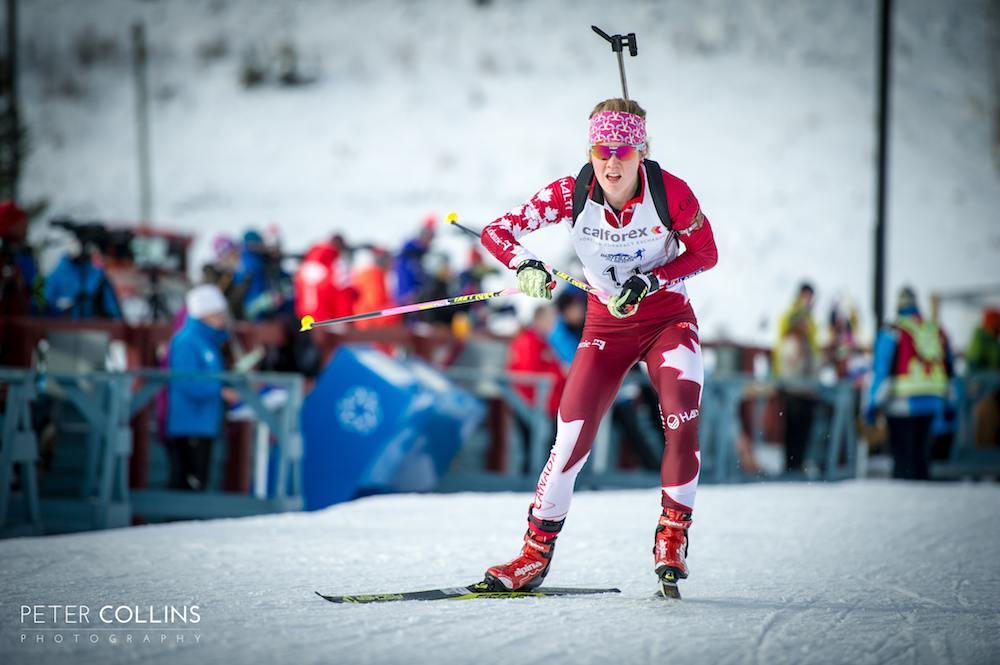
Christian Gow (Biathlon Canada Senior National Team) racing to ninth in the men’s modified sprint at Biathlon Canada’s team trials in Canmore, Alberta. With the third-best performance percentage of the trials, Gow was the fourth man named to Canada’s IBU World Cup team for the first trimester of racing, and he has since turned in four top-30 World Cup results. (Photo: Peter Collins/petercollinsphoto.com)
Christian Gow is also currently qualified under the 3.1 standard after placing 21st, 26th, 29th, and 30th in races this season, and shooting consistently well in the process.
By doing so, Smith has definitely met Priority 3.2 benchmarks — two top-40 WC/WCH results — as have Brendan Green and Megan Tandy, both two-time Olympians already.
Green has several top 40’s from last season, and a 33rd-place finish in the pursuit in Hochfilzen. Tandy turned in her top 40’s last season as she did not qualify for the World Cup tour at trials in November, but has since torn it up on the IBU Cup circuit, collecting finishes of ninth, 11th, and 18th over two weekends of racing.
Macx Davies currently meets Priority 3.3 criteria: two top-60 WC/WCH results. Like Tandy, he started the season on the IBU Cup; there, he collected two top-30 results. Megan Bankes partially meets 3.3 after her 60th place on the first World Cup weekend, and is locked in for Priority 3.4 — one top-three World Junior Championship (WJCH) result after winning the individual race at 2017 IBU Junior World Championships.
The objective criteria set forth by Biathlon Canada extends through Priority 3.7 to determine the Olympic team, but as five athletes on both the men’s and women’s sides have already met higher priority criteria, they will not be used.
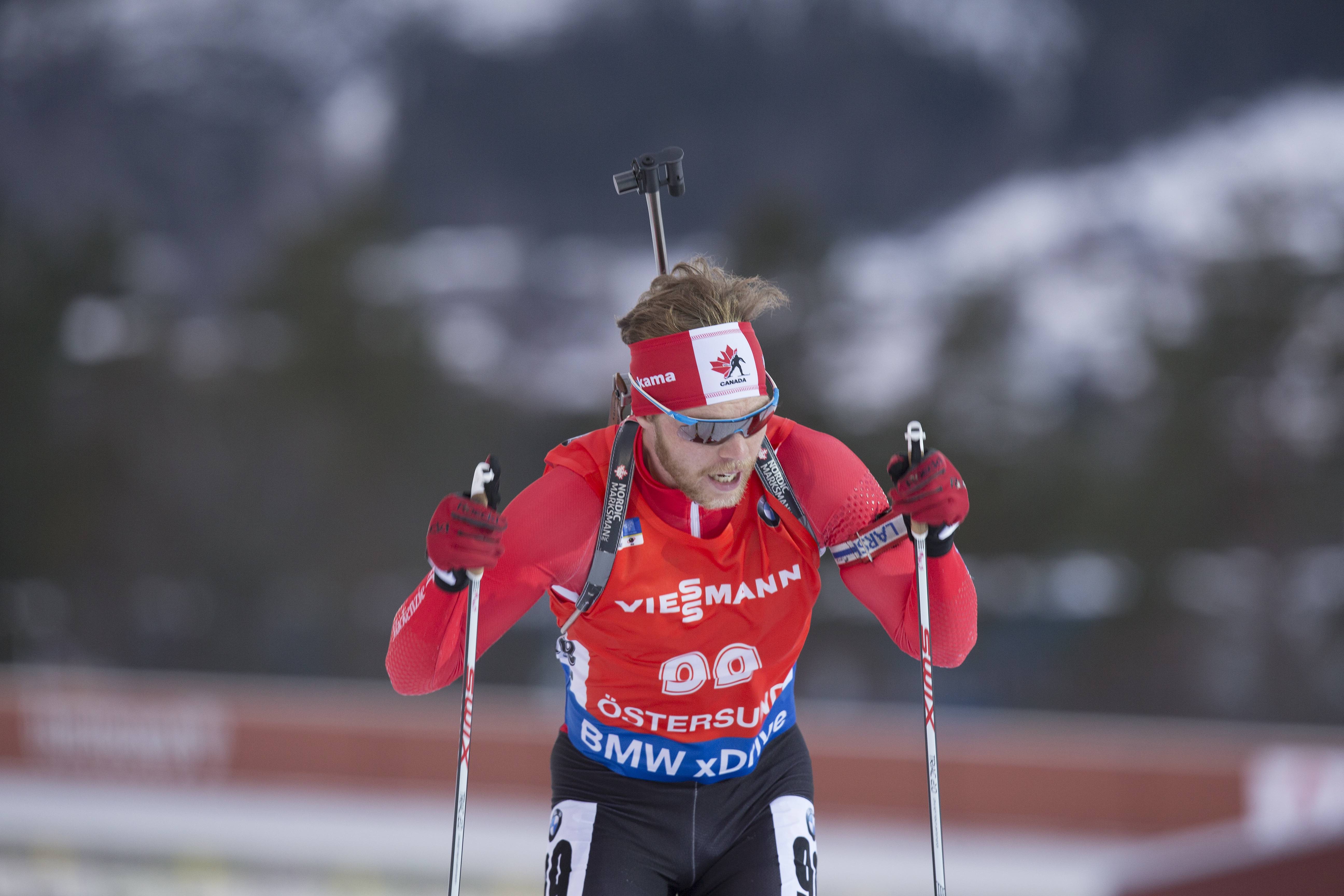
Julia Ransom (Biathlon Canada) racing to ninth in the women’s 15 k individual at the IBU World Cup opener in Östersund, Sweden. In her first World Cup race of the season, it was Ransom’s career-best result and Biathlon Canada’s best individual result since 2015/2016. (Photo: Biathlon Canada/NordicFocus)
Here’s the summary for the five available spots on the men’s and women’s side. Currently the women’s rankings are as follows: Ransom 1st, Lunder 2nd, Crawford 3rd, Tandy 4th, and Bankes 5th.
On the men’s side, it’s: Scott Gow 1st, Christian Gow 2nd, Smith 3rd, Green 4th, and Davies 5th.
As made clear by Ward earlier, the primary road to qualifying for PyeongChang is on the IBU World Cup. Even before this year’s results, the women already had four skiers meeting criteria from their World Cup results and a junior skier with a podium at Junior Worlds.
Similarly for the men, as of June 1, four skiers had fulfilled minimum criteria, while Smith recovered from illness he also had a 43rd place to partially meet Priority 3.4 — the two times in the top-60 benchmark.
“Just by virtue of this criteria, closed Olympic trials is not going to happen,” Ward said.
For now, 10 spots are open, and those spots are technically spoken for by skiers with World Cup opportunities.
Then there’s that 10-letter word — discretion.
This for sure can be debated, but in the case of making Canada’s Olympic biathlon team in 2018, it appears very clear what the criteria are.
“This is how we use discretion,” Ward began. “Either through current or historical results. That could be 50 results in the past or what is happening right now. For example, historical results would be how we prequalified Julia Ransom and Rosanna for the first tour here on the World Cup. That was based on last year’s results. Current result demonstrate the ability or the potential to meet Biathlon Canada’s objectives for the high-performance program.
“There is data on everything. But you know some form of discretion is necessary. You can never build criteria that is absolutely perfect in every scenario. Completely unrealistic. If you have to build with some notion of fairness and objectivity and also to give yourself a little bit of wiggle room to use discretion in those certain scenarios that pop up every year.”
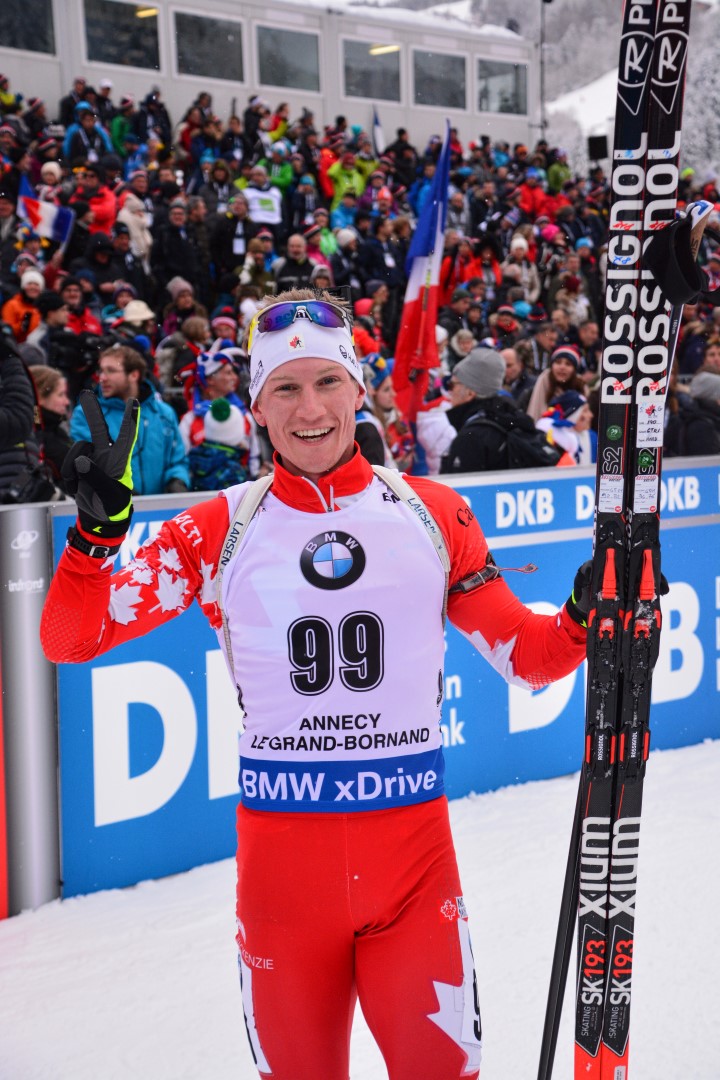
Scott Gow (Biathlon Canada) after placing 16th in the IBU World Cup men’s sprint last month in Annecy, France. (Photo: Glen Crawford)
Once at the Olympics, as previously mentioned, only four athletes can start for each country in each competition. That means that a fifth team member on both the men’s and women’s side will be watching from the sidelines. And who that is will be formally known: of the 10 Canadian biathletes headed to PyeongChang, the fifth qualifier for the men’s and women’s team will be considered an alternate.
“The top-four ranked athletes in each gender get individual start rights, and the relays are up to coach’s discretion,” Ward stated.
In an email from Ward on Dec. 27, he noted Tandy, Beaudry and Carsen Campbell would get World Cup starts when the IBU World Cup resumes Jan. 4 in Oberhof, Germany.
“Due to their strong results on IBU Cup, they have earned an opportunity on the WC and to score criteria for the Olympics,” Ward wrote. “With a Sprint, Pursuit, Relay in Oberhof this will very likely be the last weekend to change the Olympic ranking. Qualifications end January 15th after Ruhpolding WC.”
Those three biathletes will join Lunder, Random, Smith and both Gow brothers all of whom have been racing on the IBU World Cup.
“This means we will also have a very strong team at IBU 4 with Davies, Green, Crawford, Moser, Bankes,” Ward explained further. “After WC/IBU4 there will very likely be another change up as we shift gears towards Olympic preparation and finalizing our top 4 who will start the Individual races at the Games.”
Three World Cup weekends remain until the PyeongChang qualification period concludes.
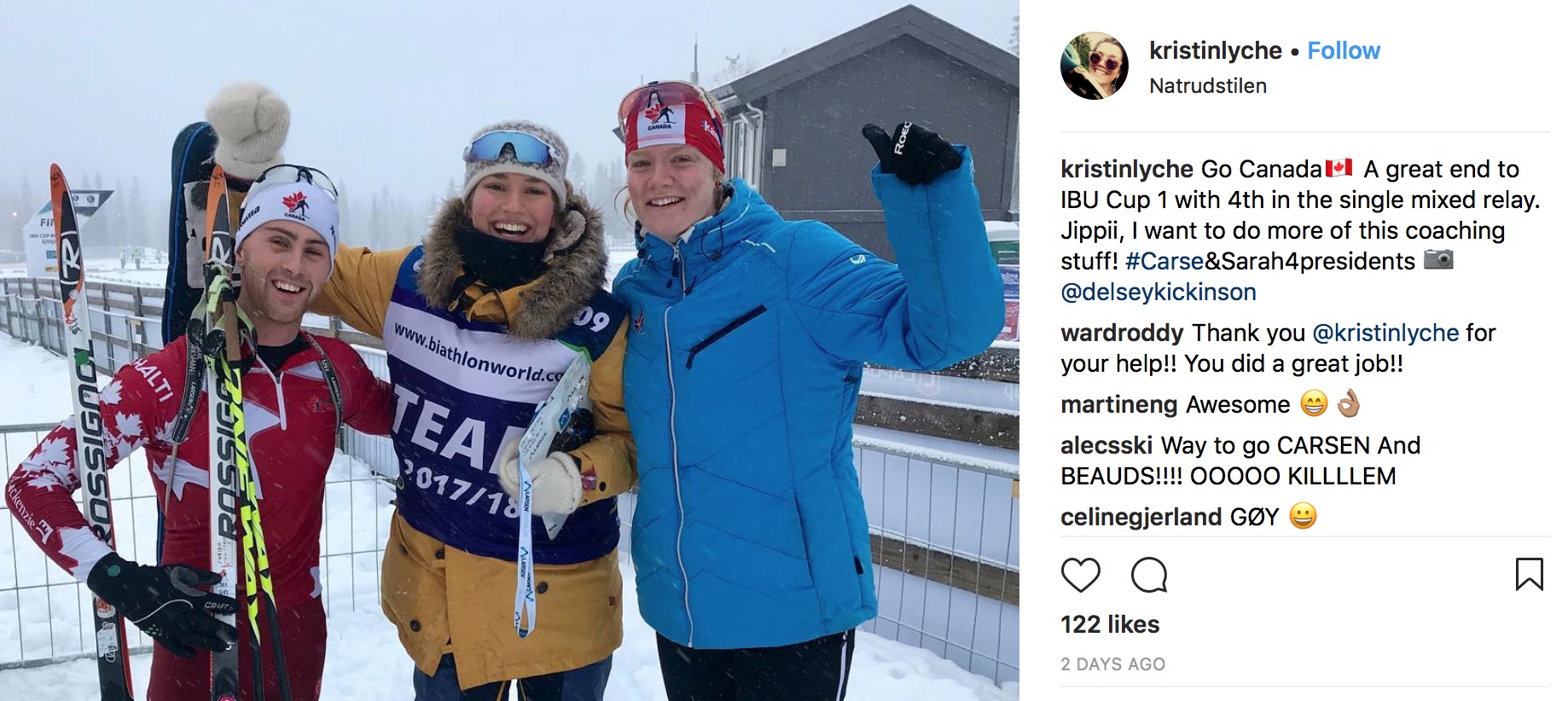
Carsen Campbell and Sarah Beaudry (Photo: Kristin Lyche Instagram)
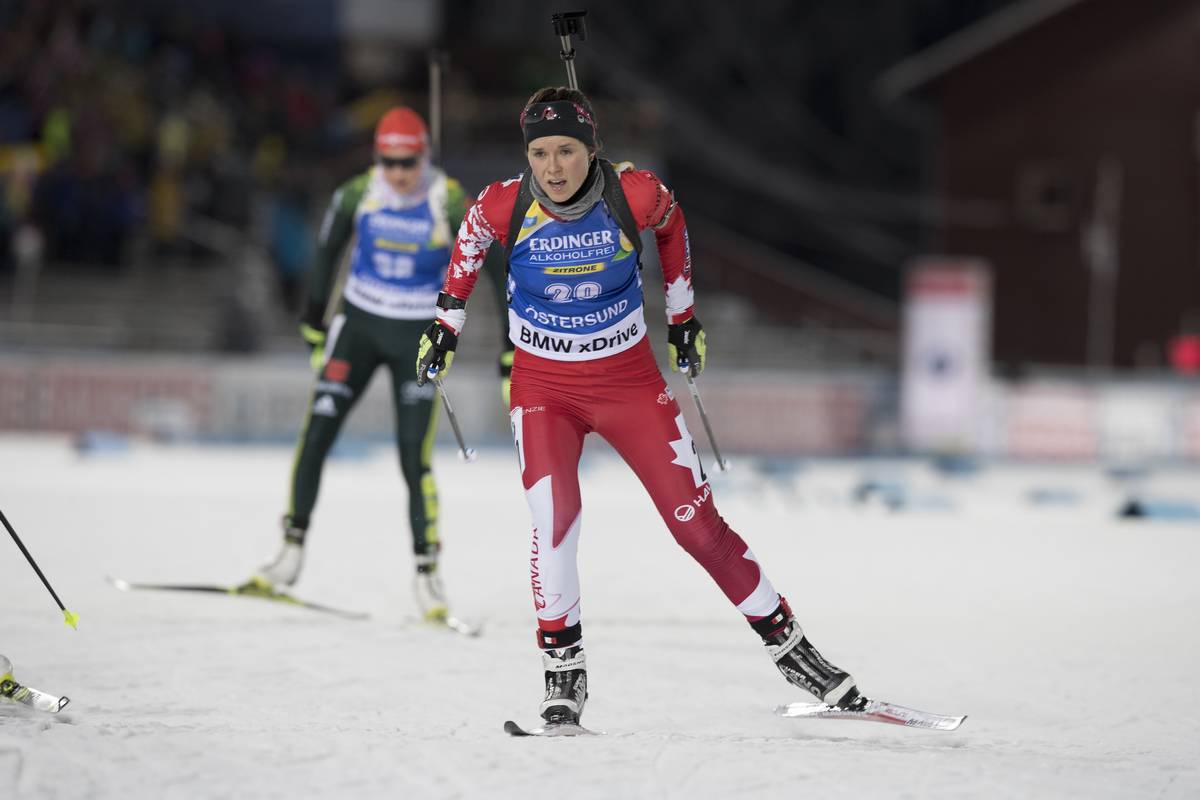
Three Canadians and one American competed at last week’s International Biathlon Union (IBU) Cup opener in in Sjusjøen, Norway, with Canada’s Emma Lunder posting an individual top 20 and her teammates Sarah Beaudry and Carsen Campbell teaming up to place fourth in the single mixed relay on Sunday, Nov. 26.
In an email, Biathlon Canada High Performance Director Roddy Ward explained that Canada did not send its full IBU Cup team to the season-opening races, as IBU Cup #1 was not part of the national team’s plan.
“Current [national team] athletes were sanctioned to race, at their own expense, if they felt it would prepare them better for the season,” Ward wrote.
That created some additional legwork for those three athletes, as well as fellow national-team members Scott and Christian Gow and Brendan Green, who arrived in Europe on Nov. 12 to race at Norwegian trials Nov. 18-19 in Sjusjøen.
“Scott Gow was in charge of booking accommodations for everyone, and we ended up in an awesome little cabin in the woods quite close to the venue [in Sjusjøen],” Lunder, a 26-year-old Senior National Team member, wrote in an email. She and Campbell, of the National “Z” Team, arrived in Europe on Nov. 16 in an effort to get some early season racing in as well.
Emma Lunder (Biathlon Canada Senior National Team) racing to second in the women’s modified sprint on Friday, Nov. 10, the last day of Biathlon Canada’s team trials. After reaching the podium three times in three races, she was selected to the IBU World Cup team for the first trimester. (Photo: Peter Collins/petercollinsphoto.com)
“I also wasn’t sure whether I’d qualify for [World Cup] or IBU Cup from our Canadian trials, so just having the trip booked was some security for me, knowing that no matter what happened with trials, the next goal was to go and perform well in Sjusjoen which definitely helped me feel less pressure at trials,” added Lunder, who earned one of two remaining women’s spots on Canada’s World Cup team based on her results at team trials earlier this month in Canmore, Alberta.
On Thursday, Nov. 23, Lunder placed 19th in the IBU Cup’s opening 7.5-kilometer sprint. After that, she headed to Östersund, Sweden, to prepare for the first World Cup of the season. In Östersund, she was part of Canada’s team that placed 15th in the mixed relay on Sunday.
“Emma had a solid first race considering travel,” Ward noted of her IBU Cup performance. “The plan was for Emma to go early and race one IBU Cup before heading to Ostersund. 19th was definitely a good showing but I believe we’ll see more from Emma this season.”
Lunder wrote that she was pleased with her sprint result on Thursday, especially considering the weather, which she described as “extreme fog and also a lot of wind.”
“During our zero the coaches couldn’t even use their scopes – they closed the range so coaches could run down, grab the paper that had been shot at, and then athletes made corrections off of that,” Lunder reflected. “I was happy that through all of it I was quite relaxed, even thought it was a very different situation than I’m normally used to pre-race!”
With three penalties, two in her prone shooting stage and another in standing (2+1), Lunder finished 2:18.5 behind Russia’s Uliana Kaisheva, who won in 21:49.8 with clean shooting (0+0).
“Of course I hoped to hit a few more targets, but I think given the conditions I did an okay job,” Lunder wrote. “My skiing felt pretty strong, and it was nice to get the season started in a low-stress environment.”
Norway’s Thekla Brun-Lie placed second in that race (+41.9; 0+1), and Russia had two on the podium with Olga Iakushova in third (+1:18.8; 0+1). In fact, Russia had four in the top five in the women’s opening sprint.
Sarah Beaudry racing in 2015 (Photo: Jake Ellingson)
Beaudry, who will be starting her season on Canada’s IBU Cup team, finished 49th (+3:57.1) with five penalties (4+1). American Kelsey Dickinson placed 76th (+6:05.0) with six penalties (3+3), out of 97 women.
“My first sprint just wasn’t so great,” Beaudry, a 23-year-old Senior National Team member, wrote in an email. “I didn’t have a great zero and found it pretty hard to see in the fog and missed 4 prone and then crashed in the penalty loop. … I was happy with my effort and got to shake out the early season jitters in some challenging conditions.”
Thursday kicked off with the men’s 10 k sprint, in which Campbell, also of Canada’s IBU Cup team, finished 35th with one penalty (0+1), out of 128 men. His time was 2:00.1 minutes behind French winner Emilien Jacquelin, who won in 25:26.1 with one standing miss as well (0+1). Jacquelin won by 5.7 seconds over Germany’s Johannes Kuehn, who placed second after skiing three penalty laps (0+3). Russia’s Alexey Slepov placed third (+8.1) with one miss in each stage (1+1).
Two days later on Saturday, Nov. 25, it was back to more sprinting for the men and women. Beaudry raced to 23rd in the women’s 7.5 k sprint (+1:15.5) with a single standing miss (0+1) and Dickinson finished 86th (+3:56.6) with three penalties (1+2). Campbell placed 76th in the men’s 10 k sprint (+3:21.3) with four penalties (2+2).
“I am happy with my second sprint,” Beaudry wrote. “I felt really good skiing but I think there is still room for improvement as the season goes on. I was also pretty happy with my shooting except kinda pissed that my miss was my last shot.”
“Sarah’s second sprint was very strong,” Ward noted. “Time back from leader was very good. Sarah made big gains this offseason and I know she’s happy with it but looking for more. Carsen had a good first race and then struggled in the 2nd race. Carsen has been looking solid all fall and I’d like to see him score some top 20 results.”
Germany’s Denise Herrmann won the women’s sprint in 20:43.9 with two penalties (1+1). Austria’s Katharina Innerhofer hit all 10 of her targets (0+0) to place second (+4.0), and Brun-Lie shot clean as well to reach the podium for the second-straight race, this time in third (+15.8).
Norway went 1-2 in the men’s sprint with World Cup biathlete Tarjei Bø beating Fredrik Gjesbakk by 23.7 seconds in 23:00.1. Both had one standing miss (0+1), and Russia’s Eduard Latypov shot clean to finish third (+31.2).
On Sunday, while Lunder was racing the mixed relay in Östersund, Beaudry and Campbell raced to fourth in the single mixed relay in Sjusjøen, missing the podium by 13.2 seconds and finishing 1:10.9 out of first. Together, they used five spares and avoided the penalty loop (0+5).
Carsen Campbell (l) racing in 2015. (Photo: Jake Ellingson)
“Carsen and I definitely put together a really strong relay and had some really good shooting which is key in the single mixed relay,” Beaudry wrote.
She used three total spares to clean, two of which were in her first prone stage. Campbell used two spares: one in each of his prone stages.
“I was very happy with my shooting today,” wrote Campbell, who turns 23 on Dec. 9. “My standing was as close to perfect as I have ever done and I made it through the prone with no major issues. I was near the front for the whole race so I felt a lot of pressure not to blow the good work Sarah had put down. It was nice to see that I was able to handle it without cracking.
“Hopefully we get the chance to try again in Lenzerheide, I think we could make the podium,” he added, referring to the next IBU Cup in Switzerland, which opens Dec. 8 with relays.
Ward explained that a relay podium was a realistic goal for Beaudry and Campbell.
“Single mixed is a bit of a different race and hard to completely compare to traditional race distances,” Ward wrote. “Sarah was born for this race, she has unbelievable speed in short distance and is a quick and accurate shooter. Carsen is also great in the range and can hold his own on course. I knew in the weeks leading up that they had a shot at the podium, and they were close.”
France’s Julia Simon and Antonin Guigonnat won the single mixed relay after leading from the first leg. Despite Guigonnat having to ski one penalty lap on the last leg, they won by 36.7 seconds in 37:33.1, with one penalty and seven spares (1+7). Sweden, with Elisabeth Hoegberg and Tobias Arwidson, placed second with no penalties and five spares (0+5), and Austria captured third place (+57.7) with Innerhofer and David Komatz (1+9).
“My plan since the summer has been to come here to get the bugs out and be ready to go 100% by Lenzerheide,” Campbell explained. “Having a good relay today was a bonus! My sprints need some work but that’s why I’m here. Overall I’d say IBU Cup 1 has been a success for me and I’m excited for the next one!”
“With last season being a really hard year for me I definitely went into the season nervous,” Beaudry explained. “I didn’t have any specific expectations I was just hoping for better feelings then last year. Considering I already have had a better IBU cup race result then last season and my best relay result on the IBU cup, I can say I am happy with how the season is starting.
“This trip to race the IBU cup 1 was on our own and I definitely owe a big thanks to Carsen and Emma for organizing it all and letting me tag along last minute, as well as our Norwegian friend Kristin Lyche for hosting, coaching and taking care of us here in Norway,” Beaudry wrote, referring to a Norwegian friend whom they spent several months training with in Canmore this summer.
Lyche housed Beaudry upon her arrival in Sjusjøen, and Lunder and Campbell moved from their cabin rental to Lyche’s place on Nov. 23.
“And to the Italian team for waxing my skis all week,” Beaudry added. “Going to races without an official team can definitely be a little more challenging but I think it has been super beneficial and I am really happy that I came to Norway.”
“I had contacted the Italian team back in the fall,” Lunder explained, “and when Sarah Beaudry booked her trip last minute after trials, they also agreed to support her which was great. The race skis they prepared for me for Thursday’s sprint were really, really fast, so I was extremely grateful to them! … Overall it wasn’t as stressful as I expected to organize our own trip, and I would plan on doing something similar again next year if need be!”
Emma Lunder, of Biathlon Canada’s Senior National Team, racing to second in the women’s modified sprint on Friday, Nov. 10, the last day of Biathlon Canada’s team trials. After reaching the podium three times in three races, she was selected to the IBU World Cup team for the first trimester. (Photo: Peter Collins/petercollinsphoto.com)
Note: This article has been updated to include comments and verification from Biathlon Canada High Performance Director Roddy Ward, and explain the modified shooting format used for Friday’s sprint.
***
Almost exactly two weeks before Biathlon Canada sends the rest of its World Cup team to Europe for the first trimeter of International Biathlon Union (IBU) World Cup racing, the national team held trials this past Tuesday through Friday on snow in Canmore, Alberta. Three sets of races in four days (all sprints*) determined which Canadian men and women will start the season at the World Cup opener in Östersund, Sweden, Nov. 26-Dec. 3.
The national-team trials, also known as the “Tour 1 Selection Trials”, ultimately boil down to what Biathlon Canada calls performance percentages, which measures an athlete’s finishing time in a given race against the average of of the top-three finishers’ times in that race. One bad race isn’t a deal-breaker; they consider the best two out of three. At the end of the trials, an athlete’s top-two results (specifically their performance percentages) are averaged for their overall ranking.
Going into the trials, two women and one man on Biathlon Canada’s senior team had prequalified for the first World Cup tour (World Cups 1, 2 & 3): Rosanna Crawford, Julia Ransom and Scott Gow, according to a national-team program dated Aug. 30, 2017.
According to the same document, two additional women’s spots and three men’s openings remained. Those went to the two highest-ranked women at the Nov. 7-10 trials — Megan Bankes and Emma Lunder, respectively — and the top-three ranked men — Nathan Smith, Brendan Green and Christian Gow, respectively.
Emma Lunder (r) with fellow Biathlon Canada national-team member Rosanna Crawford after the women’s modified sprint at Biathlon Canada’s team trials in Canmore, Alberta. Lunder placed second in that race to secure one of the last two spots on Canada’s IBU World Cup Team, while Crawford, who had been pre-selected for the team, placed sixth in that race. (Photo: Peter Collins/petercollinsphoto.com)
All of the eight aforementioned athletes were nominated to Canada’s 11-member National Senior Team in June. The three remaining biathletes are Sarah Beaudry, who had the third-best overall women’s percentage at trials, Megan Tandy, who ranked fourth and was reportedly coming off an illness after traveling from Germany, and Macx Davies, who ranked seventh in the men’s final percentages after Matthew Hudec of the Biathlon Alberta Training Centre (BATC) in fourth, Carsen Campbell (BATC) in fifth, and Jules Burnotte (Biathlon Estrie) in sixth. (Scott Gow, Crawford and Ransom were not factored into the final percentages.)
The eight athletes that just missed the World Cup team will start the season on the IBU Cup. Four men and four women earned spots on Canada’s IBU Cup team as a direct result of their performances at trials: Hudec, Campbell, Burnotte, and Davies, and Beaudry, Tandy, Nadia Moser (BATC), and Leilani Tam von Burg (BATC).
Biathlon Canada’s High Performance Director Roddy Ward described the recent team selections as “straight-up trials”. Based on its published criteria, Biathlon Canada has the option to use discretion in choosing a fourth man and fourth woman for its IBU Cup team, but instead stuck to results, selecting the fifth- through eighth-ranked athletes at trials.
“We filled the team based on trials,” he explained on the phone on Sunday.
Ward said he was “feeling really good” about how the World Cup team shook out, with four of their top men returning to the circuit. He mentioned that Smith is healthy and back at full strength, and noted Green’s consistency at trials.
“On the women’s side, it’s just really good competition … with places changing every day,” he continued.
Most of the 16 athletes selected to Canada’s World Cup and IBU Cup teams spent much of the offseason together “time-trialling and integrating,” Ward said, which has brought up the level of training as well as made for closer competition among them.
“My hope is we go to the World Cup and do well and go to the IBU Cup and do well,” he said.
The Canmore trials began with sprints on Tuesday, which Beaudry and American Lowell Bailey (US Biathlon) won. The only woman to shoot clean, Beaudry topped the women’s 7.5-kilometer sprint by 8.9 seconds over Crawford with a finishing time of 21:57.7 minutes. Crawford missed one in each shooting stage (1+1) for second place and Lunder placed third, 21.1 seconds back, after a single standing miss (0+1). Tandy followed in fourth (+1:05.5) with two penalties (1+1), and Joanne Reid was the top American in fifth (+1:13.9) with one miss (0+1).
Christian Gow (Biathlon Canada Senior National Team) racing to ninth in the men’s modified sprint on the last day of Biathlon Canada’s team trials in Canmore, Alberta. With the third-best performance percentage of the trials, Gow was the fourth man named to Canada’s IBU World Cup team for the first trimester of racing. (Photo: Peter Collins/petercollinsphoto.com)
In the men’s 10 k sprint, Bailey also cleaned to beat out Smith by 13.4 seconds with a finishing time of 25:02.5. Smith had to ski one penalty loop after a prone miss (1+0) and Green placed third (+14.5) after two prone penalties (2+0). Scott Gow and his younger brother Christian finished fourth (+29.4) and fifth (+38.8), respectively, and Tim Burke (US Biathlon) was the second American in sixth overall (+1:11.0).
On Thursday, Smith won the second sprint of the week outright with a 26.1-second victory in the men’s 10 k with perfect shooting and a finishing time of 24:25.3. Green once again followed in second with clean shooting as well, and Artem Prima of Ukraine took third (+1:09.3) with two misses (2+0). While the Americans didn’t compete on Day 2 of the trials, Team Ukraine did, accounting for nearly the same amount of competitors (40 in the men’s race, 20 in the women’s race, compared to 40 in the men’s race and 26 in the women’s race two days earlier).
Scott Gow finished fourth in the Day 2 sprint (+1:17.0), followed by Hudec in fifth (+1:29.4).
In the second women’s 7.5 k sprint, a new winner emerged, but second through fourth place were exact repeats from Day 1. Bankes claimed the win in 22:03.5 with clean shooting, while Crawford followed in second, 26 seconds back with two standing penalties (0+2), Lunder placed third (+1:02.8) with two prone misses (2+0), and Tandy was fourth (+1:16.2) with two prone penalties (2+0) as well. Beaudry placed fifth (+2:16.6) with three penalties (2+1).
After sitting out the first two days of trials, Ransom won Friday’s modified sprint (6.8 k for the women) by just a tenth of a second over Lunder. Ransom hit all of her targets and posted the win in 20:20.4, and Lunder was just off her mark in second place after “cleaning” as well. Per the modified format, each athlete could use up to three spare bullets per shooting bout, similar to a modified relay.
“We all know [sprints] are important races; they lead to pursuits they lead to mass starts,” Ward explained. “We want to make sure we’re picking good biathletes, but also favoring on the ski-speed side.”
In addition to giving an athlete more chances on the shooting range, the relay format showed who could excel in those types of races, Ward said.
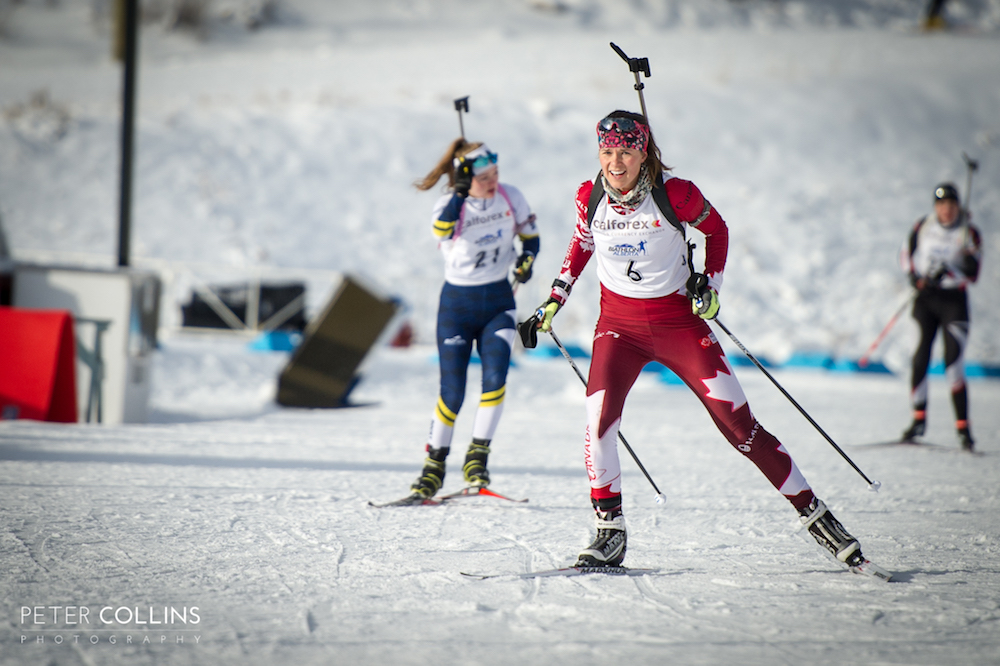
Julia Ransom (6) racing to the win in the women’s modified sprint on the last day of Biathlon Canada’s team trials on Nov. 10 in Canmore, Alberta. (Photo: Peter Collins/petercollinsphoto.com)
As a result of the modified-sprint format, the top-five women avoided the penalty loop. Bankes placed third, 6.7 seconds off Ransom’s time. Bankes’s BATC teammate Nadia Moser finished fourth (+8.6), ahead of American Susan Dunklee (US Biathlon) in fifth (+18.6). Crawford finished sixth (+48.0) with two penalties (2+0) and Tandy placed seventh (+1:13.9) with one miss (1+0).
In the men’s modified 7.5 k sprint on Friday, Smith emerged as the top Canadian for the third-straight race, winning in 18:42.0 with “clean” shooting. The top-eight men hit all their targets. Green finished second (+11.5) once again, and Scott Gow improved to third (+36.4).
Prima followed in fourth (+41.5), his Ukrainian teammate Sergey Semenov finished fifth (+1:05.9), Campbell and Burnotte tied for sixth (+1:08.2), and Davies placed eighth (+1:20.2). Christian Gow finished ninth (+1:40.9) with one penalty (1+0), Burke was the top American in 10th (+1:47.7), followed by Bailey in 11th (+1:47.9). Both Americans finished without any penalties.
Both the U.S. and Ukrainian teams raced two out of the three days of trials, contributing to the total field size of 45 men and 26 women on the last day. Ward emphasized that those teams’ presence made for “some really good competition”, and added that having Canadian juniors race alongside seniors (same distances, same races) showed them a clear path to reaching the World Cup level.
US Biathlon held the last of its own trials last month and planned to finalized its IBU World Cup team after its Canmore training camp.
For the Canadian World Cup team, Green and the Gow brothers planned to leave Sunday for Sjusjøen, Norway, where they’ll race at Norwegian biathlon trials. According to Ward, Lunder will depart on Thursday for Sjusjøen, where she’ll start her season with the first IBU Cup sprint on Nov. 23 before meeting the rest of the World Cup team in Östersund. Smith, Crawford, Ransom and Bankes planned to leave Canada on Nov. 22.
Most of the IBU Cup team will depart on Dec. 1, while Campbell and Beaudry will start their seasons earlier at the IBU Cup opener Nov. 23-26 in Sjusjøen.
(*Why were all of these trials sprint races? When it comes to individual events, IBU Cup and IBU World Cup venues typically open with sprints to determine which athletes qualify for the remaining races of the week at each stop. For instance, the top 60 in the sprint qualify for the following pursuit race, and approximately the top 30 in the overall World Cup rankings qualify for mass starts.)
Richard Boruta, head coach at the Biathlon Alberta Training Centre, died in a climbing accident on Aug. 9. (Photo: Jane Robertson)
Few nordic ski racing and biathlon venues are as awe-inspiring as the Canmore Nordic Centre in Alberta, Canada. Just south of the venue, amidst the geologic upheaval that is the Canadian Rockies, punches the Three Sisters — a string of iconic Canmore mountains. While descending from a technical route on the Middle Sister earlier this month on Aug. 9, Richard Boruta, a seasoned climber, died in a climbing accident. He was 49.
At the time of the accident, Boruta was attempting the Three Sisters Traverse as part of his 50th year, as he was turning 50 in October. It was Boruta’s first time on the climbing route.
Boruta was a fixture of Canadian biathlon’s high performance and development scenes since 1998 when he immigrated to Canada from his native Czech Republic. Most recently, he was named Biathlon Canada’s male coach of the year for 2017. It was his third time receiving the award.
His Canadian coaching career began with Canmore’s Rocky Mountain Racers (RMR). Boruta advanced to become the Canadian national team’s head coach in 2002. He remained in that position until 2006, after seeing his athletes compete at the Torino Olympics. Post-Torino, Boruta left the national team to become more involved in the development side of the sport.
In 2011, Boruta became the head coach of the newly formed Biathlon Alberta Training Centre (BATC).
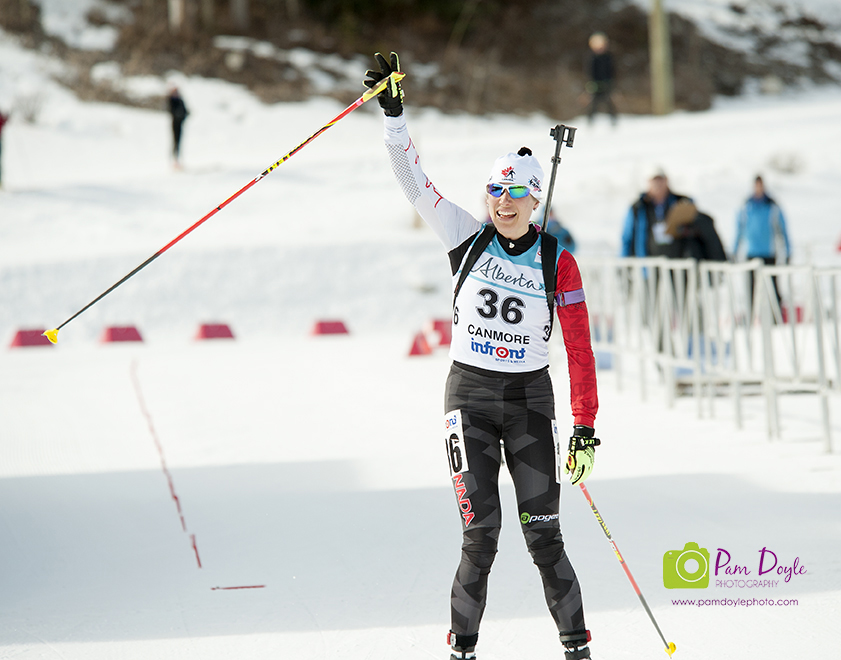
Zina Kocher waves to the home crowd after placing second in an IBU Cup sprint two seasons ago in Canmore, Alberta. (Photo: Pam Doyle)
Zina Kocher, a three-time Canadian Olympic biathlete, fostered a deep connection to Boruta as she emerged onto the Canadian biathlon radar. Kocher told FasterSkier on the phone that she qualified for the national championships in 12th grade at age 17. To her surprise, she placed in the top 10, and Boruta took notice.
At biathlon nationals, the arrangement was for athletes to attend with the regional coach, not their specific club coach. Boruta was the Alberta regional coach for the event and by default helped guide Kocher. Boruta asked Kocher to join RMR, where he was then coaching.
“I had friends already on that team,” Kocher said. “I decided to try for the summer.”
That short-term arrangement quickly evolved. Kocher decided to bump the summer commitment up to a year long stay.
“I was enrolled in college and then I decided to train full time and do it for one year and see if I could make the world junior team,” Kocher recalled. “They had a lot of faith in my ability and they pushed me to go for it. I made the world junior team … I made my first Olympics in 2006, and I spent all that time being coached by Richard.”
Kocher remained on the national team from 2006 to 2011. During that time she worked primarily with other coaches. After a performance downturn in 2011, Kocher decided to train with Boruta and BATC. Until her retirement in 2016, Kocher was coached by Boruta for all but the year following the Sochi Olympics when she trained with the national team. (For the 2016 competition year, Kocher was coached by Boruta as a member of BATC.) From 17, until her retirement at 32 years old, Boruta helped shape Kocher.
“I feel like he changed a lot himself from the time he was first coaching to the end,” Kocher reflected. “At the beginning, he was quite Eastern European, he was strict. I cried a lot. It was hard. He pushed me, he constantly challenged me, he always expected more from me. If he said ‘good job,’ you did awesome. Those comments he kept to the end, but he turned maybe more Canadian. Near the end, if I got emotional, he would just give me a big hug. He didn’t say anything. It was just a hug.”
Macx Davies (Biathlon Canada) racing to a career-best 10th in the IBU World Cup 10 k sprint in Ostersund, Sweden, last December. (Photo: Biathlon Canada/NordicFocus)
Macx Davies, of Biathlon Canada’s national senior team, was also mentored by Boruta at BATC. For his first two years after high school, Davies said Boruta helped him form a knowledge base that eventually led him to a national-team nomination.
“During those two years we developed a working relationship and he taught me how to be a full-time athlete,” Davies wrote in an email. “From how to train in proper zones, to hitting targets, to being a well-rounded individual, Richard helped shape who I am today.”
Davies reiterated a point that Kocher made several times: that Boruta was even-keeled, calm and perfectly suited for a sport like biathlon where unsteady nerves can sink an otherwise stellar ski performance.
“As a coach, Richard was the most calm and soft-spoken I ever had,” Davies wrote. “Whether you are racing for a spot on the Olympic team or doing a time trial at home, he was the same calm, supportive and helpful coach, always there to give you a smile, head nod, and if you did really well an illusive high-five!”
Boruta’s life work was still firmly immersed in the present as he coached Megan Bankes, a rising star for Biathlon Canada. At 19 years old, Banks is coming off a season where she won two individual gold medals at the 2017 IBU Junior World Championships. Despite being named to the senior national team, Bankes still trained with Boruta as a member of BATC.
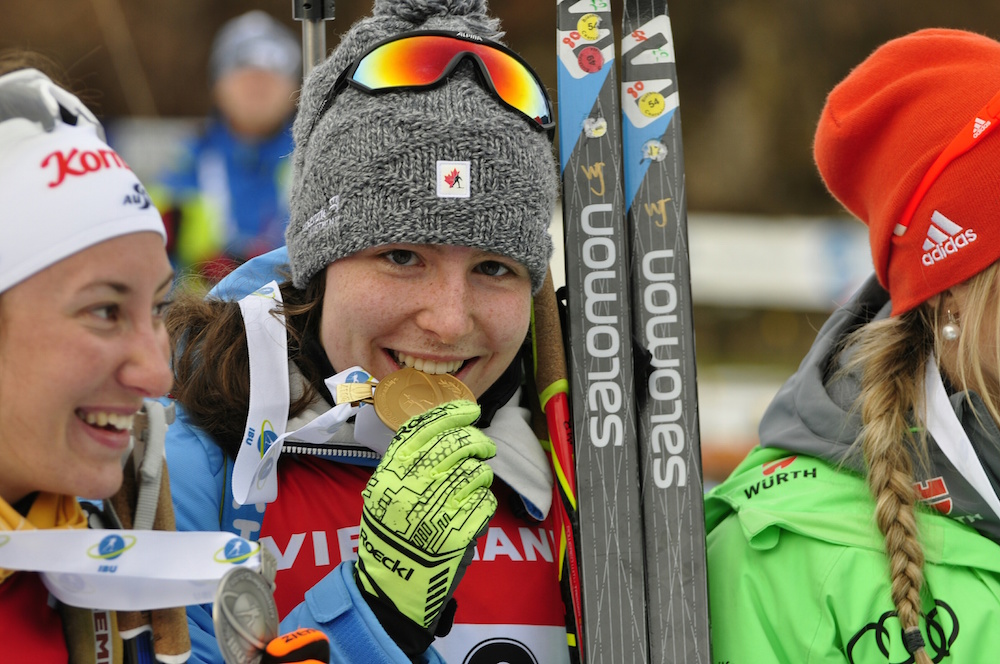
Canada’s Megan Bankes takes a bite out of her gold medal after winning the junior women’s 12.5 k individual at 2017 IBU Junior World Championships in Osrblie, Slovakia, and becoming the first Canadian woman to do so at Biathlon Youth/Junior Worlds. (Photo: Airat Aitniakov)
Helping athletes reach their potential was Boruta’s bread and butter. And for Boruta’s clan of biathletes, that potential often meant the international stage. According to Roddy Ward, Biathlon Canada’s high-performance director, half of the current national team moved through BATC under Boruta’s tutelage.
“Richard was a key player in helping Canada close the gap to the international podium,” Ward wrote in an email.
Ward first met Boruta while competing as a junior biathlete. In 2006, when Ward returned to Canmore for a coaching position, he became professionally linked to Boruta.
“Since 2011, Richard coaching BATC and myself coaching National Team we worked more closely together, often working together with athletes in a NT camp based program (Megan Bankes, Julia Ransom, Emma Lunder, Sarah Beaudry), combining for many training sessions, camps, testing, races etc.,” Ward explained.
The data and spreadsheets, the periodization and hours trained are part of developing an athlete. A coach may tinker with more technique one year, more volume the next. Yet one aspect of the coaching equation difficult to change is the personality each coach brings to the athlete-coach relationship. Ward noted that by observing Boruta, he came to understand that some of what Boruta practiced could, in fact, make his own coaching more effective.
“Early in my career I would notice a contrast to Richard and myself on the range while explaining the day’s training,” Ward emailed. “I would be almost yelling the directions while athletes chatted among themselves and ran around not listening (I’d often have to give directions multiple times), while Richard would talk very quietly (like he always does) while all his athletes listened very closely so they could actually hear the directions. I thought there was something to that and started to apply this technique in my own way.”
Kocher said Boruta understood his inherent strengths. “One time we did this one truth and two lies,” Kocher said. “I’ll never forget because the truth was ‘I believe in nonverbal communication.’ That was him. He didn’t say a lot of words and what he said was valuable and it meant a lot.”
Ward also absorbed the Boruta “less-is-more” tenant.
“Talk less and listen more,” Ward wrote. “When you do say something it will have a bigger impact. I used to talk too much, give too much direct feedback, be too assertive. Now I let the athlete lead more, don’t always give them answers immediately, try to listen more than talk. It’s made me a better coach and teacher.”
But there were days when Boruta could scream encouragement. And in those moments, when the coaching lessons had been ingrained, Boruta revealed his love for seeing others achieve.
“He was someone who didn’t show a ton of emotion,” Kocher said. “Yet when he showed emotion it was passionate. I remember this happened a few times. A long time ago, for the first time, I was going to make a pursuit. I was a first year senior and had just done a World Cup as a junior. Back then I had never made the top-60. Then in the third World Cup in December, in 2003 I guess, I was in Slovakia. It was a windy day and I shot zero-zero. I just remember leaving the range just like super confidently. I had just shot clean for the first time in my life. Literally, Richard was running beside me on the hill. Somehow he had left the range and he was on the hill and he was cheering me on telling me I could get a top-10. And the course was really open and he was able to come out while I was finishing the climb and hitting the next downhill. Then he was suddenly on the next hill. He was cheering me on that one, and then he was near this bridge near the finish. He just found his way onto all these spots on the course to get me to go harder, and he was at the finish line. I remember his passion a lot from that day.”
Boruta is survived by his wife Kamila and three sons Michal, Thomas and Lukas, his mother Jirina, father Richard, and granddaughter Sophie.
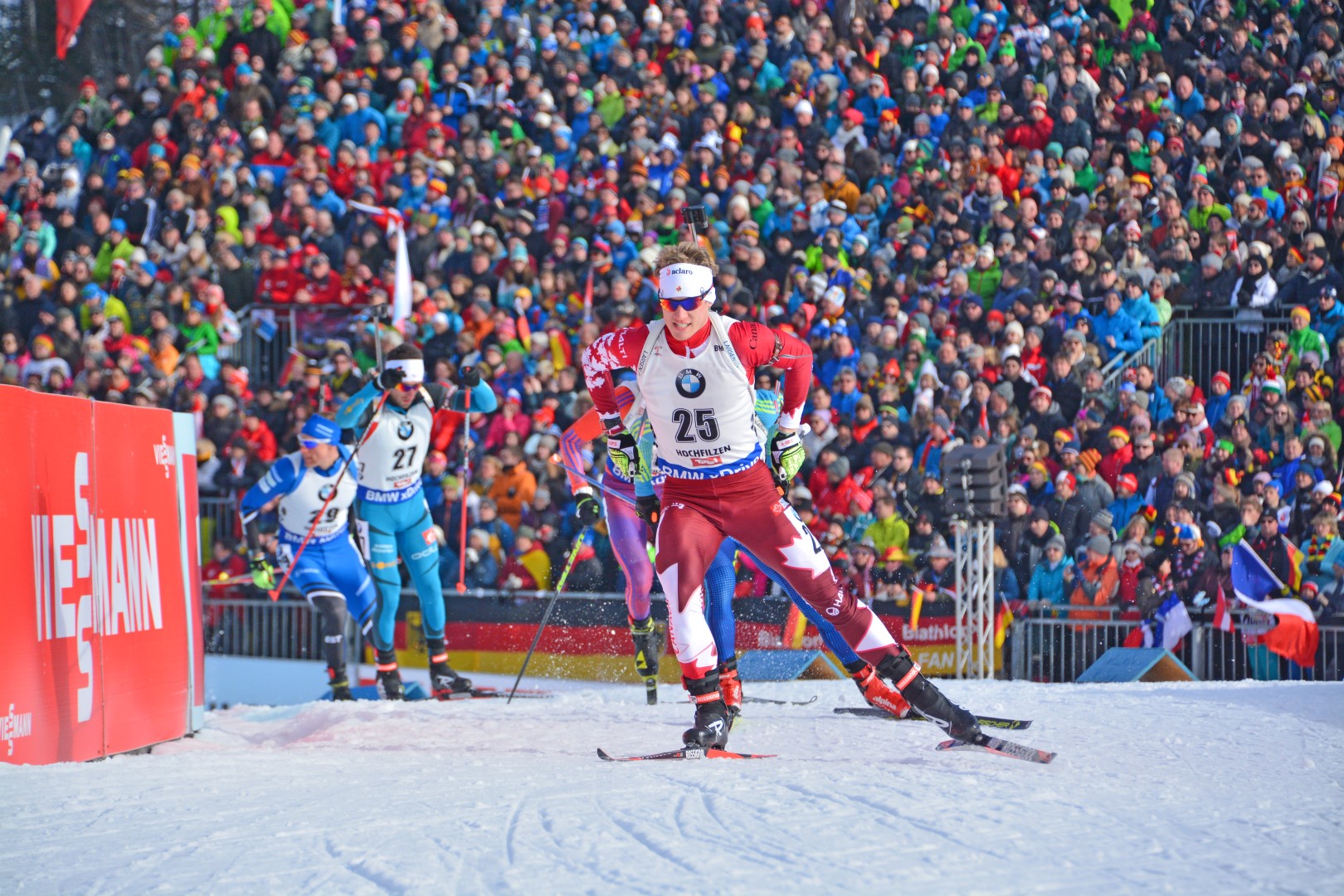
Biathlon Canada’s Scott Gow racing to 47th in the men’s 12.5 k pursuit at 2017 IBU World Championships in Hochfilzen, Austria. Biathlon Canada is facing a tightening of purse strings for the 2018 Olympic season as Own The Podium cut its base funding to zero. (Photo: Glen Crawford)
If you made it past the article’s title, then get ready to immerse yourself in the intricacies of Canadian high-performance sports funding.
OK, here it goes…money, money, money. Add this for effect, $.
Imagine for a moment you’re the CEO of a national sporting body and you’ve got high aspirations — things like championship and Olympic medals. There’s an infinite amount of puzzle pieces to organize and assemble. There are two critical pieces to even fathom success: the motivated athletes-coaches combo along with ample funding.
Biathlon Canada finds itself in a precarious position for the 2017/2018 season— a critical year considering that many athletes sharpied in the 2018 Winter Olympics in PyeongChang, South Korea, in mid-February as their performance peak just after the 2014 Sochi Olympiad.
The financial hammer fell in May when Own The Podium (OTP), a Canadian nonprofit focused on supporting Olympic medal contenders, cut its base funding to Biathlon Canada to zero dollars. ((Biathlon Canada is the National Sporting Organization (NSO) overseeing biathlon in Canada.))
Andy Holmwood, Biathlon Canada’s general manager (Photo: Pam Doyle)
During the final run-up to PyeongChang, Biathlon Canada must belt-tighten and evolve in a climate of continued funding scarcity. At the time of publication, the exact amount of Biathlon Canada’s budget was unclear despite a request to Biathlon Canada General Manager Andy Holmwood to confirm his organization’s 2017/2018 budget.
“I am not in a position to discuss any of our budget numbers,” Holmwood said in a phone interview on July 11th.
Biathlon Canada receives the majority of its funding from three major sources. There’s Sport Canada, a government agency providing funds to NSO’s through its Sport Support Program. Jon Schofield, a Sport Canada spokesperson and media-relations specialist, explained to FasterSkier in an email that Sport Support Funding is for a four-year cycle.
Then there are corporate and private donations made directly to Biathlon Canada.
Lastly, there’s funding from Own The Podium (OTP). According to Schofield, OTP makes the recommendations upon which other groups base their monetary support.
“Those sports that have athletes which have demonstrated the potential to achieve a podium result at the Olympics and Paralympics, are also eligible for enhanced excellence support,” Schofield wrote in an email. “The assessment of podium potential is done yearly by Own the Podium which provides funding recommendations to Sport Canada, the Canadian Olympic Committee and the Canadian Paralympic Committee – (the two latter) which in turn support the sports directly.”
It can be tricky and frustrating. Biathlon Canada is in a constant struggle to promote and financially support athletes who have already arrived while keeping promising athletes in the development pipeline.
The OTP Ask
Here’s how the basics work between OTP and Biathlon Canada. The NSO, or Biathlon Canada in this case, presents its supporting evidence — in both a formal proposal and in-person meeting — that its athletes have Olympic medal potential. OTP officials then recommend funding based on their assessment of the submitted evidence.
OTP funding is considered to be “top-up” funding, or monies for athletes at the very highest level of their respective sport. Amongst the high-performance scene in Canada, the philosophy of emphasizing those athletes already at the top is referred to “targeted excellence”. In total, OTP redistributes approximately $64 million annually. To put that in perspective, that $64 million is part of the larger $200 million the government invest in Canadian sport annually.
Anne Merklinger, Own The Podium chief executive officer (Photo: OTP)
“Our mandate, which is prescribed by the national funding partners, is to provide technical advice for National Sport Organizations and to provide investment recommendations for those sports organizations that have evidence of medal potential for the upcoming set of Games,” Anne Merklinger, OTP chief executive officer, said in a phone interview. “Secondly, we also provide investment recommendations for the subsequent set of Games, so in winter that would be for 2022. So those investment recommendations are being considered by the minister and they are not final yet.”
According to Holmwood, Biathlon Canada presented a portfolio highlighting the medal potential of its men’s relay team.
“I think we made a strong case for our men’s relay team as a medal hopeful,” Holmwood said. “I think it’s fair to say they didn’t agree with us completely. They didn’t share that perception. It is clear that OTP in an Olympic year, they refer to sharpening their pencils and really focusing the funding on strong medal contenders. In their eyes, we did not fit in that.”
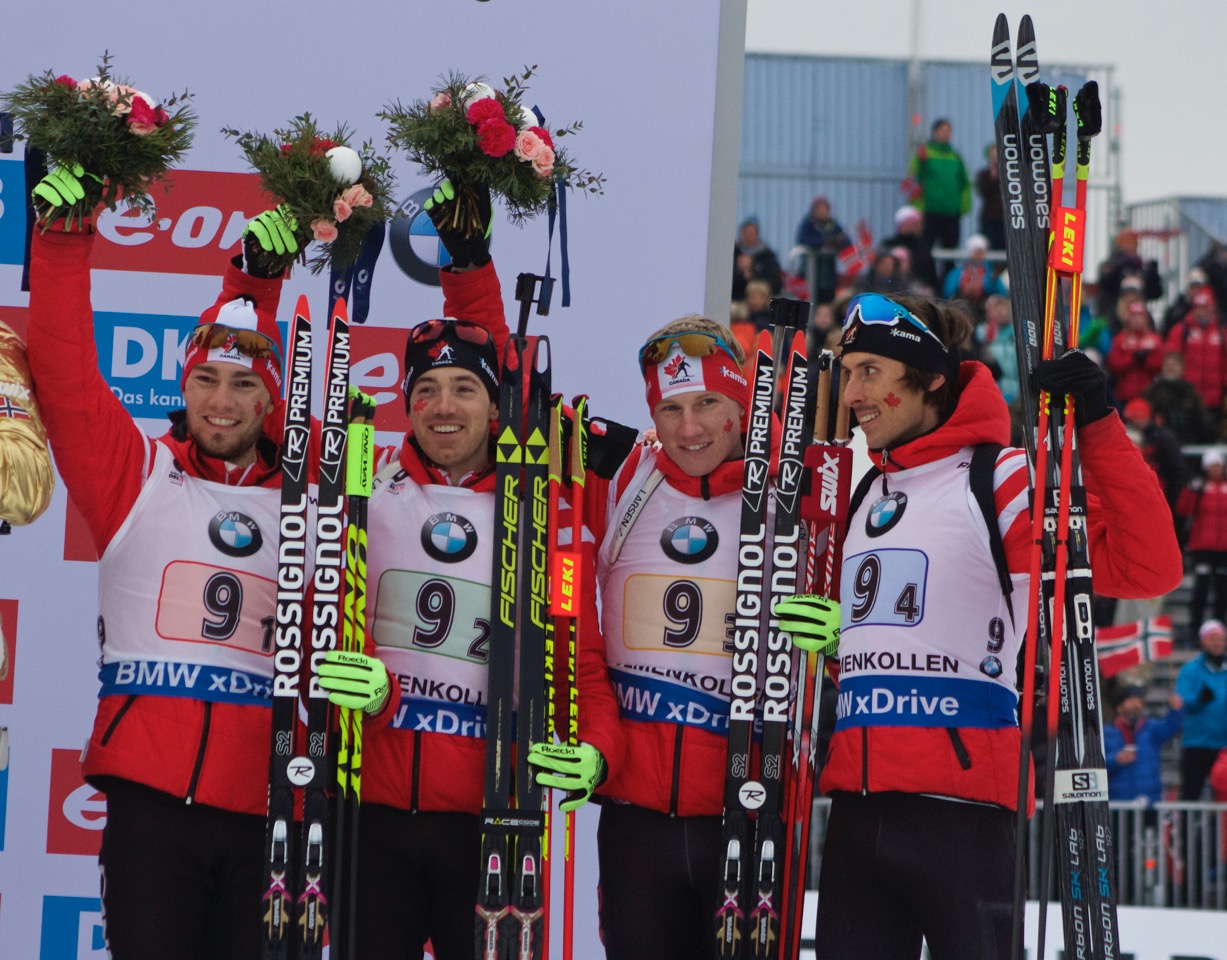
Two seasons ago, the men’s relay team earned a historic bronze medal at 2016 International Biathlon Union (IBU) World Championships in Oslo, Norway. Last season, their best finish was seventh at the World Cup in PyeongChang, South Korea, where many nations did not start all of their top athletes. (More on last season’s results later.)
“Their base funding for ’17-’18 is zero,” Merklinger said about OTP’s funding for Biathlon Canada. “But they are receiving $50,000 for the coaching position … to support a coach through the Olympic Legacy Coaching Fund. So that is the extent of the funding recommendation for biathlon for the ’17-’18 fiscal year.”
Starting at the top of Canada’s biathlon pyramid, the collective gasp came at the depth of the cuts, not that OTP cuts were made.
“OTP takes a very actuarial approach,” Holmwood said. “It’s not subjective. And to their credit, they are very clear in their mandate. It’s not a big massive surprise. I think what surprised us was just how deep the cut went.”
Roddy Ward, Biathlon Canada high-performance director (Photo: Ric Rowan)
“In the end, it seems as though they believe we have some up-and-coming athletes but no medal prospect for 2018 Olympics,” Ward said. “By their mandate, it means we get cut out of the pot of money for the Olympic season. I don’t doubt they followed through with their mandate, but ultimately, decisions like that undermine growth towards consistent podiums in our sport.”
Ward has a point about diminished funding decreasing the odds of future podiums. But OTP’s mandate only looks to a two-Olympic cycle “event horizon”. At the moment, OTP is not obligated to look further than Beijing 2022.
OTP publishes what it calls a Winter Historical Comparison on it’s website. It outlines OTP funding recommendations for Olympic winter sports by quadrennial. For the Vancouver quadrennial, Biathlon Canada received $1,784,173. It received $1,324,623 for the Sochi quadrennial.
According to Merklinger, for the ’14-’15 fiscal year, Biathlon’s base funding from OTP was $250,000, $400,000 for ’15-’16 and $435,000 for the ’16-’17 fiscal year. Accounting for the ’17-’18 cuts, and adding the $50,000 from the coaching legacy fund, the PyeongChang quadrennial total for Biathlon amounts to $1,135,000.
(On OTP’s website, a figure of $1,200,000 is used for the first three years of the PyeongChang quadrennial. Using that figure, an amount of $1,250,000 would have been recommended for Biathlon during the PyeongChang quad.)
Although Merklinger was clear in explaining to FasterSkier that Biathlon Canada’s base funding was “zero”, Holmwood said this about OTP’s potential allocations: “Our OTP funding for this coming season is uncertain. It is fair to say, I would say that we have received a substantial cut, but just what we will be getting from OTP is not certain.”
OTP’s Merklinger said the funding door as it applies to the medal potential of Canada’s national biathlon team isn’t exactly slammed shut. OTP maintains the administrative flexibility to infuse money into a high-performance program on short term notice.
“We can do that from today until the start of the Olympic Games,” Merklinger said when asked if OTP could recognize medal potential with monetary support if an athlete or team proves they are on form in races scheduled a few months before the Games. “We are eager to work with biathlon as the season unfolds to assess the progress of their preparations and their performance for PyeongChang and would be delighted to be in a position where we could provide a very specific incremental funding recommendation that is focused and that responds to a positive side of the program and indicates that they indeed have evidence of medal potential.”
The Potential
Medal potential is exactly that — potential. There are no absolutes. Although actuarial means may be used to determine the likelihood for an Olympic medal, sport is fickle.
Take biathlon, for example. There’s the shooting range and wind conditions, the rifle and its complex moving parts, the wax, the skis, and of course the athlete. The number crunching for potential would have to consider the likelihood of all things aligning for a Canadian athlete and the likelihood a veritable podium lock, like France’s Martin Fourcade, has an unlikely off-day. No matter where the OTP assessment falls, OTP’s job is a tough one — determining the likelihood of an event before that event transpires and basing its funding decisions on that likelihood.
The Canadian men’s team (from left to right) Christian Gow, Nathan Smith, Scott Gow, and Brendan Green celebrating bronze in the men’s 4 x 7.5 k relay at 2016 World Championships in Oslo, Norway. (Photo: JoJo Baldus)
One wouldn’t need to be transported back far in time to underscore Biathlon Canada’s positive medal potential. For starters, the time machine’s date could be set to March 12, 2016. In the pressure cooker of Oslo’s Holmenkollen stadium, Canadian biathletes Christian Gow, Nathan Smith, Scott Gow, and Brendan Green claimed bronze in the World Championships relay.
The past season was a down year for Canadian biathlon. Smith, the team’s highest-profile male skier, was sidelined for much of the season while he battled a virus. Brendan Green, another veteran with multiple top 10’s to his name, scored a single top-30 World Cup result in 2016/2017. Meanwhile, Scott Gow raced to three top 30’s, earning 23rd, 18th, and 17th places on the World Cup.
On the women’s side, Rosanna Crawford had been the team’s rising star, earning fourth-, fifth- and seventh-place finishes on the World Cup during the 2014/2015 season; she also placed 15th at 2016 Oslo World Champs in the 12.5 k mass start. Individually, Crawford scored six World Cup top 30’s this past season with a best result of 19th at the PyeongChang test event. She placed 26th in this year’s World Championship sprint.
As has been written before about Biathlon Canada’s tenuous funding, OTP considers medal potential at World Championships and Olympics. It’s not obligated to consider stand alone results on the World Cup circuit when making those judgments. So performance on the big stage matters.
In recent years, it has been rumored that Biathlon Canada has run a deficit.
“Biathlon Canada has always kind of operated in the red,” Crawford said in a phone interview.
It’s possible that the prospect of programmatic cuts due to the NSO’s financial standing wasn’t unforeseen. According to a February 2015 article in The Crag and Canyon out of Canmore, Biathlon Canada will maintain the same annual expenditures through 2018. In that article, that reporter states that Biathlon Canada’s annual budget is $1.4 million. This number reflects the NSO’s total budget, not the portion set aside for funding the high-performance program.
With a lack of substantial OTP support this year, Biathlon Canada is implementing a high-performance austerity program during the training season.
“We must move on and do our best to deliver on our results despite the massive cuts,” Ward said. “We have virtually cut everywhere; no funded camps, reduced IST (physiologist, strength coach, nutrition, sport psych etc), less staff, athletes will pay to compete on the World Cup. We are doing our very best to build a solid program for our National Team with limited resources, this means an ‘all hands on deck’ approach by staff. I can tell you staff are extremely motivated so in some way, it’s very exciting to be a part of and could be the perfect storm for us.”
Canada’s high-performance biathletes are accustomed to traveling for training camps. Athletes have experienced on-snow training camps in New Zealand, Park City, Utah camps, dryland racing and training in Jericho, Vermont, Haig glacier camps in the Canadian Rockies, as well as a Jasper, Canada camp. Other camps have included a Dachstein glacier camp and training in Norway. This dryland season will be more restrictive. According to Crawford, the women’s team traveled and trained in Kelowna, British Columbia, where costs were minimized: Ransom’s parents housed the team, and a sponsor donated funds for groceries.
Rosanna Crawford (Biathlon Canada) racing to 26th in the women’s 7.5 k sprint at 2017 IBU World Championships in Hochfilzen, Austria. (Photo: Glen Crawford)
Crawford also wrote in an email that both the men’s and women’s team will be spending two to three nights on the Haig glacier outside of Canmore later this summer, and Christian and Scott Gow will be attending a self-funded Park City camp.
“The majority of the cuts we have seen have been in those extensive trips, or out of country trips, maybe more precisely,” Holmwood said. “We were thinking of going to Jericho in August, but we removed that simply because the cost is pretty high. Our dollar is not strong right now, also. The U.S. is not typically a place we need to go to.”
New terrain, opportunities to thwart dryland-season staleness, and exposure to different athletes are value added aspects of training camps. Crawford, who is based in Canmore, home of Biathlon Canada and a world-class biathlon training facility, said the lack of camps are a setback, but not a season-killer.
“In some ways, it’s fuel for the fire, like, ‘We’re gonna show you’,” she said. “We don’t have to travel, we can do really good recovery, everyone can be with their significant others, and the coaches get to spend more time with their families so maybe they’ll be less likely to get burnt out in the winter. So I think we’re all just trying to find the positives from this scenario.”
With an important competition year looming, Crawford explained the real compromise may come if the funding limitations impact service on the international competition circuit.
“Truly I don’t think this summer is going to be the hard part. I have complete faith in our coaches and Jess Kryski, who’s our physiologist, that they know exactly what to do with us to get us nice and strong,” she said. “It’s more the concerns around the wintertime of how many wax techs we’re going to have, whether we’ll have massage therapists, whether athletes will have to pay to go and race. I think those are some of my bigger concerns.”
Holmwood stated that when snow flies and athletes toe the line internationally, the financial gut-shot will not impact athlete support.
“The key theme is that we are tightening our belts primarily with regard to camps,” Holmwood continued. “But come World Cup season, IBU Cup season, we will be supporting teams to the extent that we have in the past, and we will give them the resources they need to succeed.”
The Financial Seesaw and Its Cost: Reforms Coming
In 2010, Biathlon Canada’s charitable status was called into question and ultimately rescinded by the Canada Revenue Agency. Prior to the ruling, Biathlon Canada could issue tax receipts for donations. That’s no longer the case. As a result, corporate and individual donors must be compelled to contribute funds based on Biathlon Canada’s marketing exposure or simply the gift of giving.
Without the possibility of issuing tax receipts as a nonprofit, Biathlon Canada finds itself with hands wide open without a tax deduction incentive to attract corporate sponsors.
It appears Biathlon Canada has come to rely on OTP funding for its elite level athletes, despite the fact that in the Canadian sports system this funding is supposed to be a “top-up”.
“OTP makes up the bulk of the funding for the National Team and our winter competitive tours so it hit our National Team budget hard,” Ward said.
Exposed with OTP’s lack of funding is the cost of relying on a single source to meet the financial demands of running a NSO of a niche sport. The money is hard to come by.
Yet high-performance athletes in Canada have direct support from Sport Canada through what is called the Athlete Assistance Program (AAP). The requirements for athlete support through Sport Canada are different than OTP’s medal-driven approach.
“Support is provided yearly to those athletes whose sport has identified them either being or having the potential for a top 16 result in the world,” wrote Schofield, of Sport Canada. “Each sport has a number of stipends that they have access to, based on previous results and future potential.”
AAP qualifying athletes are considered “carded” athletes. Carded athletes receive a monthly check from the government to help offset living expenses while they train with the end goal of representing Canada at the Olympics or international competitions. Since 2004, $1,500 was the maximum monthly stipend an athlete could receive. As of this March, the federal funding for the AAP was increased 18 percent — eligible athletes can now receive up to $1,770 per month.
Here’s the verbiage straight from the AAP website: “AAP support seeks to relieve some of the financial pressures associated with preparing for and participating in international sport and assists high-performance Canadian athletes to combine their sport and academic or working careers while training intensively in pursuit of world-class performances.”
It remains to be seen if carded biathletes must use their monthly check for training necessities and sport recovery rather than rent or mortgage and food.
“We’ll still get the same,” Crawford said when asked if the OTP cut would impact the team’s carded athletes. “Each individual athlete will still get the same amount of money they’ve been getting in the past years from the government. Of course, it’s great for us to have funding, but it would be better if Biathlon Canada could also have a big funding partner so that we could do training camps and stuff like that, and the money we that we get could go toward groceries and the high cost of living in Canmore.”
As with the government’s intent to increase the maximum allotment to its carded athletes to compensate for a long overdue adjustment for inflation, reform minded stakeholders in government and the NSO’s should see changes to how the OTP “targeted excellence” philosophy is implemented.
Almost exactly a month ago, a report titled “Review of Sport Canada’s Targeted Excellence Approach,” was released on June 22. Essentially, the 72-page report highlights the underlying success of OTP — it has helped produce more Canadian Olympic medals — but also reports on findings that call for systemic change.
One of the main concerns raised in the report was that OTP funding decisions are made annually. The negative consequence for NSO’s and athletes is that a climate of instability persists in some sports when funding remains questionable from year to year. When cuts occur, it can leave less financially nimble NSO’s too little time to pick up the funding slack. And potential corporate sponsors shy away from longer-term sports sponsorships when defunding or deep cuts from OTP remain an ongoing possibility.
The report does suggest a model premised on funding obligations longer than a single year.
And for those in nordic sport concerned about the development pipeline, the report makes requests for a greater emphasis on longer-term funding. A common critique of OTP, as featured in a Nordic Nation podcast, is that investments in what in Canada is referred to as the “NextGen”, or up and coming athletes, are lacking.
Here’s a major concern: The medal bounty OTP has helped Canada haul in since the 2010 Vancouver Games could be a well that’s drying up. Without investing in developing its younger athletes, medal famine may be the new norm.
The Government of Canada mentioned in its April 2015 budget that increased monies for athlete development — the so called “NextGen” — would be forthcoming. The report released on June 22 recommends the following strategy when it comes to emerging athletes and allocating funds: “The current targeted approach should not be used with younger athletes deep in the ‘pipeline’. Instead, an approach that favoured focusing on training groups and larger numbers was recommended.”
For now, the brutal funding cycle continues for Canada’s biathletes and high-performance support team as feast and famine remain the backdrop to a strict definition of high-performance success: medals. The return on investment in the near term for all the stakeholders might be a zero-sum game, and in that case, who wins?
Rosanna Crawford with coach Roddy Ward after placing fifth in the IBU World Cup 10 k pursuit in Hochfilzen, Austria, in 2014. Biathlon Canada promoted Ward to high performance director, but he will also remain the women’s national team coach for this season. (Photo: Chris Lindsay)
Women’s National Team Coach Roddy Ward was picked to become the new high performance director going into the 2018 Olympics in PyeongChang, South Korea, and to helm the team afterwards.
“I’m excited to take an active leadership role with the entire development pipeline, while continuing to be involved and provide leadership with the national team,” Ward wrote in an email. “I believe we have potential to improve our entire system of athlete development from grassroots to World Cup medalists, and I want to be an architect of that system. We have a lot of people who are very interested to be involved, to help make the best situation for our athletes and become a top five nation in biathlon. I would like to help facilitate that growth.”
Ward had been planning to leave his role as a national team coach after PyeongChang in order to spend more time with his family; he and his wife, Melanie, welcomed their first child last August.
Instead, he will stay with the team but slot into a role that doesn’t require as much travel.
“I have a family at home now and wanted to find work that keeps me home more,” Ward explained. “However, I still really wanted to be involved. I have a lot of passion left for this! As a coaching team, we had been trying to figure out what that could look like, to have me involved still. The new role as [high performance director] is perfect for me that way.”
In the meantime, he will stick with the women’s team as a coach; Head Coach Matthias Ahrens works with the men. Ward answered questions from Kelowna, British Columbia, where six women were doing a training camp.
“It doesn’t make sense to change up personal coaches for the women’s team this close to the Olympics,” he explained.
Biathlon Canada’s funding from Own the Podium was cut substantially this year, giving them less to spend on the national team. But Biathlon Canada General Manager Andy Holmwood said that the funding cut was not a reason to ask Ward to do two jobs this season.
“He was our top candidate,” Holmwood said in an interview on Monday. “But at the same time, we don’t want to, and he doesn’t want to, remove himself from the coaching role this close to the Olympics… we have essentially tried to take the admin load off of that role, and try to make it a real leadership role with regard to high performance. Previously there was a lot of logistics work tied in with the high performance director position. But we will be spreading that around otherwise this coming year.”
“Every staff member has stepped up and taken on extra duties,” Ward agreed via email. “We will also expect a bit more planning work from coaches leading junior tours. First and foremost, my main focus is on the women’s team as their coach and to help Matthias with the men. Most important is to get results with the national team on the World Cup and/or Olympics so we have future funding. I will need to prioritize, delegate, and use my time efficiently.”
The funding cut came due to poor results last season from the team’s veterans. Rosanna Crawford and Brendan Green both have multiple top-10 World Cup finishes to their name – and Green finished ninth in the mass start at the 2014 Olympics – but in 2016-2017 Crawford had a top finish of 19th on the World Cup and Green of 28th.
For Smith, the health issues have passed and Ward reported that he was back to training a full load. Crawford and Green, he concluded, were overtrained. The winter taught the team some painful lessons that they are learning from and he is confident that the athletes will be back to their prior form this year.
“One thing as a team we have doubled down on is monitoring,” Ward wrote. “We have added extra heart rate variability and treadmill monitoring to the program to keep better track of athlete health and training readiness.”
While the veterans struggled last season, a nuslewmber of younger athletes made solid progress. Julia Ransom turned in a top-20 at World Championships, Scott Gow hit the top-20 on the World Cup, and Emma Lunder and Christian Gow both notched top-30 results.
Looking towards PyeongChang, Ward has high expectations for his team.
“We have a strong and very motivated team of men and women this year and our ultimate goal is to bring home a medal,” he wrote. “The most important things we are focused on are, one, to individualize each athletes training – they are all unique and therefore each athlete has a unique path to the top – and two, we will also closely monitor training so they show up at the Olympics healthy and in great shape.”
What would a medal mean? Ward explained that in 2010, at a home Olympics no less, Canada only qualified one man for individual biathlon competition. That was Jean Philippe Le Guellec, and he turned in a best-ever performance for a Canadian man.
Four years later, in Sochi, Le Guellec had two top-tens (one of which bested his own record result from Vancouver), Green had one, and Smith had two top-20’s.
“Since then we have had two World Championships podiums, a sprint silver by Nathan in 2015 and men’s relay bronze in 2016,” Ward added.
He clearly believes that his team can continue on its upward trajectory, undisturbed by a blip of a 2017 season.
And after PyeongChang, whatever the results may be, he’s committed to overseeing the country’s biathlon development pipeline as well as its elite athletes.
“I have seen many examples of how to run a national team and development pipelines,” he wrote of his experience coaching on the World Cup. “However, I strongly believe we need to create our own ‘Canadian’ way, given our unique situations, strengths, weaknesses etc. On the development side, I hope we can help to build programs that are fluid, adaptable but strong in certain program fundamentals. How exactly this gets executed in different areas of the country, under different coaches, can be unique to each situation but everywhere we need to have that intense drive to create high performance athletes all over the country.”
Biathlon Canada is a small organization with a small budget. Even when Own The Podium was funding the team more generously, that created serious constraints which are not faced by larger European teams.
“The biggest challenge is inconsistent funding,” Ward wrote. “It’s hard to maintain programs, let alone start new ones (like development programming), when you don’t know your funding year to year. However, this is our current reality in Canada so we have to get the job done regardless.”
On the other hand, it creates a nimble organization and staff.
“I think we are doing a good job given our limited resources (small staff, money etc),” Ward wrote. “We probably produce the ‘cheapest’ medals on the World Cup. We have a great staff that puts a lot of trust in each other and we will need that more than ever this year. We also have some good biathlon activity all around the country and definitely some talented athletes.”
“I very much hope we can retain our staff and athletes after this Olympics to continue to build on our current programming,” he concluded.
Julia Ransom racing to 18th place in the 15 k individual at 2017 World Championships; that result was a career-best, and tied her for the second-best result by any Canadian athlete all season. (Photo: Glen Crawford)
Biathlon Canada has named 11 athletes to its senior national team for 2017-2018. The group is headlined by three athletes who scored World Cup top-20’s last season: Scott Gow, Julia Ransom, and Rosanna Crawford. Also returning is 2015 World Championships silver medalist Nathan Smith, who sat out most of last season recovering from a virus.
The senior team does not distinguish between ‘A’ and ‘B’ squads this year, instead functioning as one group.
“We are one Senior National Team because 1) there is no differences in service or resources to the athletes in Canmore with respect to training this year, and 2) we are one team on this path to the Olympics together, on equal footing,” newly hired High Performance Director Roddy Ward wrote in an email to FasterSkier.
Biathlon Canada saw its funding from Own The Podium cut this season, which means that all of the athletes will be spending more training time in Canmore and less time on the road this summer and fall. (Note: stay tunedfor a follow-up piece on the funding situation in the coming weeks.)
The youngest member of the senior team is Megan Bankes, who received the nod after winning gold in the 12.5 k individual at World Junior Championships.
The national team will also include a ‘Z’ team of up-and-coming athletes transitioning to the senior ranks, a junior national team, and a youth development squad.
Matthias Ahrens continues as head coach, with Ward maintaining his role as the women’s national team coach while also taking on the high performance director duties. Andy Holmwood remains as general manager and Jacqueline Akerman as the athlete and coach development manager.
Senior National Team
Megan Bankes (Calgary, AB)
Sarah Beaudry (Prince George, BC)
Rosanna Crawford (Canmore, AB)
Macx Davies (Canmore, AB)
Christian Gow (Calgary, AB)
Scott Gow (Calgary, AB)
Brendan Green (Hay River, NT)
Emma Lunder (Canmore, AB)
Julia Ransom (Kelowna, BC)
Nathan Smith (Calgary, AB)
Megan Tandy (Prince George, BC)
On Tuesday, Biathlon Canada published its final roster for the first trimester of the International Biathlon Union (IBU) World Cup, IBU Cup and Jr. IBU Cup. Below is the official announcement:
Team Announcement Trimester #1
World Cup, IBU Cup, and Jr. IBU Cup
The following athletes are nominated to the World Cup, IBU Cup and Jr. IBU Cup Teams for Trimester 1 in accordance with the National Team Program:
World Cups #1,#2, #3
Ostersund, SWE, Pokljuka, SLO, Nove Mesto, CZE
Coaches: Matthias Ahrens, Roddy Ward, Joar Himle
Service Team: Raphael Grosset, Pavel Stolba, Martin Struna
MEN
1. Nathan Smith (National Eh! Squad/Foothills Nordic)
2. Brendan Green (National Eh! Squad/Hay River Nordic)
3. Scott Gow (National Eh! Squad/Rocky Mountain Racers)
4. Christian Gow (National Eh! Squad/ Rocky Mountain Racers)
Nathan Smith, of Biathlon Canada, skiing during a national-team training camp this August at the Snow Farm in Wanaka, New Zealand. (Courtesy photo)
Wake up: 7:30 a.m. Coffee: 7:45 a.m. Commute to work: 8:15 a.m.. Punch in at 9. Punch out at 5. While this may describe the daily routine of an average North American’s work week, it’s not the case for Biathlon Canada’s Nathan Smith. And to the 3o-year-old Calgary native, there’s nothing wrong with that.
While he maintains that putting his education on hold has been one of his biggest sacrifices by choosing biathlon as a career, Smith also sees his decision to take a few years and be his own boss as better than a bachelor’s degree — not only to make himself more marketable in the future, but more unique in his life experience.
“I guess my reasoning [for choosing this path] was, I could go to school and get my bachelor’s degree and then go and work,” Smith said recently on the phone. “But that’s kind of like, I guess I’ll put it as, that’s a normal career trajectory. That’s what everyone does.
“When I’m training, I’m like my own boss, kind of an entrepreneur,” added Smith, who has been taking a few college courses (mostly science) on-and-off since he graduated high school in 2004. “And I think it’s probably similar in the States, but unfortunately here in Canada, getting a bachelor’s degree isn’t even all that great. It just makes everyone overqualified.”
Nathan Smith with his girlfriend, Caroline. (Courtesy photo)
Instead, Smith has spent the past nine years (excluding the 2008/2009 season when he wasn’t named to the national team) sporting the red maple leaf of Canada. He’s also known to cruise the streets of Canmore, Alberta (where Biathlon Canada is based), on his 2007 Kawasaki ZZR 250 (at least when there’s no snow).
However, being a full-time biathlete was not always what Smith planned to do after high school. Before Biathlon Canada, he competed alongside his brother on Calgary’s local club biathlon team. And before that, he belonged to Calgary’s youth cross-country skiing program.
“I didn’t really know anything about the sport until I was doing Racing Rabbits which is [a program] for really young kids who [want to] cross-country ski in Calgary,” he said. “My brother and I were doing that and my mother was like, ‘Well, do you guys want to try biathlon?’ and we were like ‘Well, what’s that?’ and she was like, ‘Well, you shoot guns with skiing.’ I was 1o years old [at the time], so I was pretty excited about that … but I never really saw myself as staying in it past high school until I started to go to World Championships.”
Smith made his debut Junior World Championships appearance his sophomore of high school in 2002, and qualified again the following year, as well as in 2005 and 2006. From then on, he continued to build competition on competition, qualifying for his first World Championships in 2008, the Vancouver Olympics in 2010, five more World Championship events, and the Sochi Olympics in 2014.
During the 2014/2015 season, he had a breakthrough performance when he raced to a first place in the men’s 10-kilometer pursuit in Khanty-Mansiysk, Russia. While he hopes to once again medal this season, he indicated that this year, doing so will take even more accurate shooting on his part, as many athletes continue to improve the speed of the shots they take.
“There’s definitely been some big changes in the way athletes approach the shooting range psychologically,” Smith explained. “It used to be a lot more cautious, [but] because skiing is getting tighter and tighter you really have to set yourself apart by shooting as fast as you can on the range.
“I’ve always been a fairly fast shooter,” he added. “So I’ve been focusing a little bit more on trying to improve accuracy while maintaining the speed I’m at.”
“There’s definitely been some big changes in the way athletes approach the shooting range psychologically. It used to be a lot more cautious … you really have to set yourself apart by shooting as fast as you can on the range.” –Nathan Smith on recent changes in biathlon
With a solid summer of volume training behind him, a fall full of intensity, and a few sessions on snow at the Snow Farm in New Zealand, Smith is excited about the start of a new season, but especially the fact that his job for another year will take place on skis.
“Obviously you go out there sometimes and there’s tough training days or times where you’re super tired or you’re having bad races and you’re like, ugh, why do I do this?” Smith said. “But if you have a normal 9-5 job, you’d have a lot more of those days I think.”
Nathan Smith skating his way to 18th at the 2015 IBU World Cup pursuit in Hochfilzen, Austria, last December. (Photo: Fischer/NordicFocus)
***
We asked Smith to give our ’17 Questions for 2017′ a go. Here are his responses:
1. Biggest change in your life in the last five or so months since the ski season ended?
I’ve been making trips up to Grande Prairie to visit my girlfriend (and her kitten). It’s nice to get away from Canmore on rest weeks, decompress, and experience regular town life sometimes.
2. Biggest change in your training?
I haven’t had too many changes in over all training philosophy. The team was reorganized this spring so Matthias [Ahrens] is now my personal coach instead of Roddy [Ward]. They work closely together though so aside from feedback it hasn’t changed too much in day-to-day training.
3. Major areas of improvement you’ve seen so far?
I’ve made some good gains in lower body strength and double pole work.
4. Whom you’ve been working closest with this offseason (coaches or training partners)?
Aside from Matthias and Roddy, we also have technique coaching at some camps from Mats Larsson. Former athlete Andrew Chrisholm has also been helping out our team on the range so we can get more individualized attention.
Biathlon Canada’s Nathan Smith (r) and Scott Gow during a ski. (Photo: Nathan Smith)
5. Best trip in the last five months (and why)?
Even though its not far, I always enjoy going to Jasper [Alberta] for “ManCamp”. It’s an amazing roller ski and drive up the Icefields Parkway, and the options for varied training once we get there are awesome. We also get to stay in rustic cabins on the river and practice slammo.
6. Favorite cross-training?
Mountain Biking
7. Favorite non-athletic activity or pastime this summer?
Motorcycling, and trying to fly fish.
8. Song that was your jam this summer?
That would definitely be Justin Bieber – I’ll Show You
9. All time favorite race moment?
Winning the pursuit at the world cup final in Khanty-Mansiysk in 2015
10. First thing you pack in your bag when you leave for Europe?
Armband. Never forget it!
11. Venue/event you’re most excited to visit this season?
Tyumen. I’ve never been there and I’m sure its going to be impressive
12. Who will win the men’s and women’s World Cup titles this year?
Martin Fourcade and Laura Dahlmeier
13. Biggest sacrifice you feel you’ve made choosing this career path?
Putting my education on hold.
14. If you could change one thing about your sport, what would it be?
Can it be -3, hard packed, calm, and sunny every day?
15. What did you have for breakfast this morning?
I desperately needed to go grocery shopping, so 3 bowls of granola with milk and a banana.
Sarah Beaudry and her Biathlon Canada teammates having summer ski fun at the Snow Farm in New Zealand. (Courtesy photo)
Welcome to “17 Questions for 2017″, where we are catching up with American and Canadian national-team members before the beginning of the winter season.
***
22-year-old Sarah Beaudry is quickly becoming a contributing member of Canada’s senior biathlon team: she made her first trip to World Championships in 2016, as well as increasing her World Cup experience. That included racing the second leg of a sixth-place mixed relay team in Canmore, Alberta, and scoring her first individual World Cup points the same weekend.
The 2014 World Junior Championships bronze medalist in the pursuit, Beaudry is now a member of Biathlon Canada’s “B” national team.
1. Biggest change in your life in the last five or so months since the ski season ended?
Moving out of chaotic athlete housing known as Coda, to a much calmer house downtown, 1min from work and 2min from the grocery store.
2. Biggest change in your training?
Changing from working more closely with Matthias [Ahrens] to having Roddy [Ward] as my main head coach.
3. Major areas of improvement you’ve seen so far?
Endurance.
4. Whom you’ve been working closest with this offseason (coaches or training partners)?
Beaudry on a camping trip with Cross Country Canada’s Maya MacIsaac-Jones (right) and Quebec biathlete Chloe Selerier (taking photo).
Biathlon Canada’s wicked girls team.
5. Best trip in the last five months (and why)?
Skiing on snow in New Zealand followed directly by a rest week spent at a family cabin on British Columbia’s sunshine coast. To be able be to halfway around the world and be skiing in perfect snow for three weeks and then have some family time, eating fresh seafood and swimming everyday makes for the best combination.
6. Favorite cross-training?
Adventuring, whether it be a long mountain run hike or rollerskiing some far out roads, just getting out of the usual run, rollerski, bike routes that sometimes become habit.
7. Favorite non-athletic activity or pastime this summer?
Baking adventure, baking something new and exciting and seeing how it works out, making a complete mess of the kitchen and then sharing the results with friends.
8. Song that was your jam this summer?
I wouldn’t say I had one summer jam but I did forget my aux cable on my most recent drive back home to PG which resulted in driving back to Canmore with CDs from when I was a kid which was pretty fun. Some old school Avril and Hilary Duff along with some Big Fun Party mixes.
9. All time favorite race moment?
Beaudry finished 38th in the 7.5 k sprint at the IBU World Cup in Canmore, Alberta, in 2016, before making her first trip to World Championships. (Photo: Daniel S. Guay)
Moving up from 29th to third at World Juniors in Presque Isle and being able to share the flower ceremony with Julia!
10. First thing you pack in your bag when you leave for Europe?
My Onepiece.
11. Venue/event you’re most excited to visit this season?
I enjoy new races courses and countries so I think if I get to go to Pyeongchang that would be exciting.
12. Who will win the World Cup title this year?
Nathan Smith and Anais Bescond
13. Biggest sacrifice you feel you’ve made choosing this career path?
Putting my post secondary education on hold.
14. If you could change one thing about your sport, what would it be?
Beaudry celebrating fifth place in the youth sprint at 2013 World Youth and Junior Championships in Obertilliach, Austria. (Photo: Hugh Harden)
Well I feel like everybody agrees that having 100% clean sport and more races in North America would be awesome. So I will add another race that is a mass start and the leader gets to pick what position shooting the field does at each time you enter the range. That or you can tell a joke to count for penalty loops and based on how funny it is you have to do less loops.
15. What did you have for breakfast this morning?
Toast, eggs and an orange. I am not a huge breakfast fan except on off days. Then I usually have what me and some friends call Fat Amy day which is basically a pretty elaborate brunch.
16. In 5 years, I’ll be ____?
Well if Nathan and his girlfriend have their way and Calgary wins the Olympic bid I will be training for #Beauds2026.
Megan Tandy rollerskiing in Germany in August. (Courtesy photo)
Last season started solidly enough for Canadian biathlete Megan Tandy: in the opening World Cup race in Östersund, Sweden, the two-time Olympian finished 25th in the pursuit. In the points, and something to build on.
By the end of the season, things looked very different. Tandy fractured a bone in her wrist just before she was set to compete in the World Cups in Canmore, Alberta. That knocked her out of the rest of the season — and because she had not yet met the criteria for athlete funding (“carding”) through Sport Canada, threw her future as a biathlete into doubt.
But come spring, her medical exception was granted and Tandy was back to being funded.
“The carding doesn’t nearly cover the costs of being a full time athlete but it definitely helps pay the rent, and without it I would have likely retired,” she explained in an interview last week.
By the time she regained her carding, she was also able to train again. Life was back on track.
“I had a hard cast for almost 9 weeks so my arm looked was a bit on the pale skinny side for awhile, but I recovered well and have had no pain or other problems with my wrist since May,” Tandy wrote in an email. “The recovery process mostly just involved a lot of patience and playing with my hand strengthening rubber web or squeeze ball a few times a day. I had to ease into rollerskiing with my left pole slowly, but after a few weeks everything felt perfect!”
Based in Germany for the last several years, Tandy also has a new living situation. She is splitting her time between Klingenthal, where her ex-husband and son alive, and Siegsdorf, where she trains at the major German biathlon base in Ruhpolding with other international athletes constantly coming and going.
The previous summer she had been primarily in Klingenthal, which has few biathlon facilities. Between the ability to do more specific training and setting up house with her boyfriend, U.S. Biathlon wax tech Federico Fontana, Tandy sees herself having a much-improved situation.
Megan Tandy and her son kayaking near her family home in Prince George, British Columbia, this summer. (Courtesy photo)
“When I have my son then my #1 priority is being Mom,” she explained. “And when my son is with his father I can train at the world-class facility alongside many international athletes in Ruhpolding. It has truly taken some time to build a life for myself again and put things back together after the separation and custody battle more than 2 years ago – but right now this is the happiest, healthiest version of me since at least 8 years! … Siegsdorf reminds me little bit of [British Columbia] with the Bavarian alps and Chiemsee Lake right here. I can actually go for a 40km rollerski loop right from my driveway!”
She also trained with the Canadian National Team during the off-season for the first time in years.
“I was able to train in Canmore at our home training center for 3 weeks this July and have been following the national team training program since then,” she wrote. “Between Dropbox, Sprongo and Skype, long-distance coaching can offer a lot and I think this has been something really positive for me.”
Tandy doing some of her favorite cross-training, biking in Germany’s Chiemgau region. (Courtesy photo)
The national team is also happy with the arrangement. Tandy has primarily been working with National Team Coach Roddy Ward.
“Our hope was to provide Megan some guidance as we believe she has the potential for top results (which she began to show 2 seasons ago) and even more importantly, to be a contributing member of a medal winning relay team- that is the big goal for the women’s program,” Ward wrote in an email.
In the 2014-2015 season, Tandy had a breakthrough and notched four top-15 finishes on the World Cup.
“I have tried to help her with a training structure and some training ideas,” Ward continued. “Ultimately, given the distance and unique training environment/opportunities, she still drives her own day to day training. We have also setup some monitoring and have made some positive interventions. From what I can tell it’s been going well for Megan. She has stayed healthier than normal and has actually set up some great training opportunities so she is not alone. These include 2 camps with us, a camp with the US team, a stint back home in Prince George and some training with German and British athletes in Ruhpolding.”
Megan Heinicke (Biathlon Canada) racing to 59th in the 2014 Olympics sprint in Sochi, Russia.
Tandy joined the U.S. team for their summer training camp in Oberhof, where she was able to get in some on-snow time in the ski tunnel. She also joined the women for a relay effort at German National Championships.
“I had just packed my bags to leave when the women’s coach, Jonne [Kahkonen] asked me to race because one of the U.S. girls was sick,” Tandy wrote. “It was super fun to race, great to shoot under pressure again, but I was pretty tired and was not happy with the ski performance. All in all I actually feel like I am in better shape this fall than I have been for 3 years – I am feeling good, but I haven’t had a lot of opportunity for race pace comparison up until now.”
That will change. Tandy is in Canada for Frozen Thunder, to get some training time with her team and coaches as well as to compete in selection races for the World Cup. She is pre-selected to start the season on the second-tier IBU Cup circuit, but wants to grab one of the free spots to race on sport’s bigger stage.
A photo posted by Susan Dunklee (@susan.dunklee) on
Thinking back on her injury at the end of the season, it seems like Tandy has come a long way.
“I can honestly say there where some sad moments home alone in March with no snow while all the teams were racing!” she admitted. “I used the down-time to finish up some school work, which was good, and I also think I was lucky that the recovery period was in the spring so I was healthy and training normally for the whole summer.”
Eventually, Tandy sees herself helping and managing other athletes.
“I am have completed 3 out of 4 semesters of an MBA in Sport Management,” she wrote. “So right now I have achieved a Sport Management Certificate from the University of Bayreuth and am planning on completing my masters post season. Slowly but surely seems to be my approach to education!”
But for now, the focus is all on her own performance.
“Training has been much better and much more consistent this year,” she wrote.
And her coach, Ward, agreed.
“Megan has been very motivated and working hard on those areas she wanted to improve this year,” Ward wrote. “I’m looking forward to seeing her in a week.”
***
We asked Tandy to give our ’17 Questions for 2017′ a go. Here are his responses:
1. Biggest change in your life in the last five or so months since the ski season ended?
Setting up a second ‘’home-away-from-home’’ in Siegsdorf, GER – best decision ever!
2. Biggest change in your training?
A lot more rollerski hours….and less time on my beloved road bike.
3. Major areas of improvement you’ve seen so far?
Ski technique, I still have a lot of work to do but good changes are happening!
4. Whom you’ve been working closest with this offseason (coaches or training partners)?
Roddy Ward and the Canadian National Team (for the first time in 8 years!)
5. Best trip in the last five months (and why)?
Home to Prince George, BC with my son this August – there is nothing better than family (and getting to be the little princess again…at least for the first 5 days or so…)
6. Favorite cross-training?
Road biking, although I didn’t ride as much as usual this year.
7. Favorite non-athletic activity or pastime this summer?
BBQing….seriously, there were so many relaxed BBQ evenings with the kids playing on the trampoline or on the garden this summer!
8. Song that was your jam this summer?
I really started enjoying some German music! Bavaria by Voxxclub or Hulapalu by Andreas Gabalier
9. All-time favorite race moment?
World Cup 3 in Pokljuka, Slovenia 2014….my first ever world cup 20/20 shooting and moving from 41st to 14th.
10. First thing you pack in your bag when you leave for Europe?
Well, I basically live in Europe, but still….haha, I always pack my boots & shoes first.
11. Venue/event you’re most excited to visit this season?
I think Hochfilzen WCH will be amazing but I am pretty excited for the pre-Olympic World Cup in PyeongChang too.
12. Who will win the men’s and women’s World Cup titles this year?
Maybe Franziska Hildebrand! – I really enjoyed training a bit with her this fall, I think she is in good shape.
13. Biggest sacrifice you feel you’ve made choosing this career path?
Tricky….I think I need a whole page to answer this one 🙂
14. If you could change one thing about your sport, what would it be?
The sprint is too short for me…haha – I want a 12km sprint!!
15. What did you have for breakfast this morning?
It was a rest day so I had the epic traditional Barvarian breakfast at the Schuhbeck bakery in Ruhpolding with Federico: weisswurst (white sausage), sweet mustard and a pretzel. Although I had a coffee instead of the traditional wheat beer at 10am!!
16. In 5 years, I’ll be ____?
Retired from biathlon and working in sport – supporting athletes and healthy people one way or another!
Biathlon Canada’s Julia Ransom celebrating after a career-best World Cup finish of 19th in Canmore, Alberta, last winter. (Courtesy Photo)
Two years ago, Biathlon Canada knew exactly whom to recruit for its women’s roster. A junior skier with seven top-10 finishes including a silver medalat 2012 Youth World Championships, Julia Ransom was a no-brainer. By the end of the 2012-2013 season, Ransom, originally from Kelowna, British Columbia, was offered the opportunity to represent Canada in every competition she entered.
Ransom, however, had other plans.
Having spent the previous four years working with Richard Boruta of Biathlon Albertaand seeing solid results in her skiing, Ransom, now 23, did not want to give up what she and Boruta had built. She was also worried about the teammates she would leave behind: Sarah Beaudry and Emma Lunder.
“I was approached by the national team … I said no I don’t want to,” Ransom recalled during a recent phone interview from her training base in Canmore, Alberta. “[I said,] ‘I’m with Richard and really happy with Richard, and I’ve got a great group of girls and I don’t want to go to the national team.’ ”
The Canmore Biathlon Bears, a youth biathlon program Ransom volunteers with, during a particularly snow practice last season. (Courtesy Photo)
Ransom declined her spot and continued to train with Boruta for another year. That season she earned three top-10 results at 2014 Junior World Championships in Presque Isle, Maine, just missing the podium in fourth in the junior women’s 10-kilometer pursuit.
Following these performances, Ransom was once again approached by the national team prior to the start of the next season. This time, however, national-team coach Roddy Ward won her over.
“They [Biathlon Canada] actually sat me down and were like, ‘OK, seriously, we’re going to move [Sarah Beaudry and Emma Lunder] up.’ You don’t just turn this down,” Ransom explained. “I wanted to be with all the girls because we work really well together … I’m glad that I stuck with Richard for as long as I did, but the change was also good.”
In 2015, Ransom raced a handful of World Cups and made her senior World Championships debut while also competing on the second-tier IBU Cup circuit.
Entering her second year on the national team and selected to the newly named ‘Eh!’ Squad this spring, Ransom is also currently attending school at the University of Athabasca, working toward a bachelor’s degree of management with a major in marketing.
“I wouldn’t describe myself as a complete academic, but I really love learning,” Ransom explained. “So keeping up with current events I find really valuable. Mainly also to not be focused on skiing all the time because it’s nice to have other things.”
Ransom has plenty of “other things” that hold her attention, including her education, volunteering with the Canmore Nordic Biathlon Bears program, and spending time with her eight nieces and nephews, one of which has Trisomy 18.
“I think it’s 1 in 6,000 babies make it to birth with this genetic condition, and then past that it’s 10 percent of those make it to their first year and 5 percent of the 10 percent make it to five years,” Ransom said of her niece Isla, who is now 7 years old.
“Seeing her makes you realize what happiness is all about,” she continued. “It’s not about the perfect race. It’s not about the finances. It’s not about the anything. For her it’s just about living to the next day and that’s a nice reminder to have. Appreciating life and appreciating everything you have now.”
The verve of kids like Isla and the skiers in the Canmore Nordic Biathlon Bears program keep Ransom’s sport in perspective.
“I really love kids and working with kids I think is just so much fun,” Ransom said of her volunteer work. “It’s also really refreshing to experience your sport in way that’s, it’s totally different. It’s 100 percent fun focused. And I try to go at least 95 percent super fun focused in my own training … at the very core of it, [skiing] is supposed to be fun.”
Julia Ransom (r) during a cooking Class at the Ruhpolding World Cup between race weekends with Chef Johannes. (Courtesy Photo)
Julia Ransom (r) with her boyfriend Haakon Lenes during a backcountry ski last holiday season. (Courtesy Photo)
Left to right: Roddy Ward, Sarah Beaudry, Emma Lunder, Rosanna Crawford, Julia Ransom, Anais Bescond, Jim Bates post paddle boarding at Biathlon Canada’s “Wine Camp” in Kelowna this year. (Courtesy Photo)
Julia Ransom, Rosanna Crawford, Emma Lunder, Sarah Beaudry, and Haakon Lenes skiing the Snow Farm trails in New Zealand during Biathlon Canada’s training camp this past August. (Courtesy Photo)
Julia Ransom (r) with her boyfriend Haakon Lenes enjoying “van-life bacon breakfasts” during her time in Hot Sands New Zealand. (Courtesy Photo)
***
We asked Ransom to give our ’17 Questions for 2017′ a go. Here are her responses:
1. Biggest change in your life in the last five or so months since the ski season ended?
Since the ski season ended, the only big change has been that of my address! My wonderful roommates and I moved up closer to the Nordic Centre. No matter how much one can prepare for a move, it’s never easy. Especially when you are in New Zealand for the month before you receive the keys!
2. Biggest change in your training?
There haven’t been many drastic changes. I have simply been focusing on improving weaknesses and polishing up strengths, day by day, with the goal of seeing big changes where it counts on the race track!
3. Major areas of improvement you’ve seen so far?
I’ve seen pretty big jumps in my strength, power, speed. This year I was focusing on those areas and I’m very happy with how it’s come along.
4. Whom you’ve been working closest with this offseason (coaches or training partners)?
This year our team has split more into Men’s and Women’s teams to accommodate our different needs. Our women’s team (and of course, coach Roddy Ward) has really bonded this year and has created a super strong training group that I love being a part of every day.
5. Best trip in the last five months (and why)?
Julia Ransom, enjoying some respite in a geothermal pit in HOt Sands, New Zealand while vacationing on the north island prior to Biathlon Canada’s week long training camp at Snow Farm, New Zealand this past August. (Courtesy Photo)
Best trip was by far New Zealand. My boyfriend came down to help out the team with waxing and range work and we were able to sneak in a little vacation on the North island before the camp started. We rented a van and travelled where ever we pleased, picnicking on beautiful beaches and enjoying the North Island at our own pace. The three weeks of training afterwards was also fantastic. Probably some of best snow conditions we’ll see all winter!
6. Favorite cross-training?
Mountain biking!
7. Favorite non-athletic activity or pastime this summer?
I love to cook and eat with others, especially when we are pairing fresh, local food with wine. Growing up in the Okanagan, I have developed a passion for wine and really enjoy reading and learning about different regions, varietals, tasting notes, etc.
8. Song that was your jam this summer?
Roses- The Chainsmokers
Never Be Like You – Flume Ft. Kai
9. All time favorite race moment?
Favorite race moment was during the World Cups in Canmore. It was hearing my mom and dad cheering and seeing my mom tear up when I had a career best result.
10. First thing you pack in your bag when you leave for Europe?
Fresh coffee beans, a grinder, and aeropress.
11. Venue/event you’re most excited to visit this season?
I am really excited to see Pyeong Chang! I have never raced in Asia and am looking forward to the change.
12. Who will win the men’s and women’s World Cup titles this year?
This year, I am betting on Johannes Bø and Dorothea Wierer
13. Biggest sacrifice you feel you’ve made choosing this career path?
The biggest sacrifice I’ve made has been delaying my education, giving up university running scholarships, and being apart from my boyfriend. That being said, I am happy with my decision and have no regrets.
14. If you could change one thing about your sport, what would it be?
I would change the mentality of those who still think it’s okay to dope. Clean sport should be the reality but unfortunately it’s still a struggle our sport faces.
15. What did you have for breakfast this morning?
Red river cereal with blueberries, coconut, and Hemp Hearts. And coffee. Always coffee.
16. In 5 years, I’ll be ____?
In 5 years I hope to have an Olympics under my belt and my business degree well completed!
Russia’s Anton Babikov lunges across the line ahead of teammate Evgeniy Garanichev in the men’s pursuit race at the 2016 Open European Championships in Tyumen, Russia. The venue just won the hosting rights for 2021 World Championships. (Photo: IBU)
Note: In an interview with the Associated Press which was published the day after this story, IBU President Anders Besseberg suggested that if Russian biathletes’ anti-doping samples from the Sochi Olympics came back positive during the re-testing process, Tyumen’s hosting rights for World Championships 2021 could be revoked.
In July, the McLaren report dropped and the world learned that Russia had implemented a systematic doping program before the 2014 Winter Olympics in Sochi, Russia.
Then, there had been a parallel systematic program to cover it up, directed by Russia’s Ministry of Sport and its state security service. That had led to the infiltration of the International Olympic Committee (IOC) on-site anti-doping laboratory.
In the wake of the scandal, the IOC Executive Board suggested several guidelines for how to handle Russian winter sports. Among them was a call on “all International Olympic Winter Sports Federations to freeze their preparations for major events in Russia, such as World Championships, World Cups or other major international competitions under their responsibility, and to actively look for alternative organisers.”
And yet, over the weekend the International Biathlon Union (IBU) Congress, which includes 49 possible voting countries, voted to award 2021 World Championships to Tyumen, Russia. The venue in western Siberia will also host World Cup competitions in March 2017, and 2017 Youth and Junior World Championships in Ostrov, Russia, are also moving ahead as planned.
And the IOC did not object. What changed?
“Not only was it surprising, but it was also shocking that [Tyumen] got 25 votes,” Bernd Eisenbichler, chief of sport for the U.S. Biathlon Association (USBA) and the voting representative for the U.S. at the Congress, said in an interview on Tuesday. “I want to state that it is wrong. It is a very disappointing outcome of the vote.”
“It is a country that is under investigation and the IOC has in fact warned against giving new events to the country — that half of the delegates don’t understand what this means for the young international biathletes is disappointing,” Erlend Slokvik, president of the Norwegian Biathlon Federation, told his country’s NRK television station.
Public vs. private attitudes on Russia
Apparently, while stating one thing publicly – that plans for major competitions in Russia should be frozen – the IOC was telling winter sports federations something different.
A still from the candidature video of Tyumen, Russia, which won the hosting rights for 2021 Biathlon World Championships. The International Olympic Committee had previously recommended that no major competitions be awarded to Russia until it comes into compliance with the WADA Code.
“The IOC will not hesitate to take the toughest sanctions available against any individual or organisation implicated,” IOC President Thomas Bach said in July after learning about Russia’s widespread doping at the 2014 Olympics.
Once amongst its stakeholders, the IOC seems to sing a different tune, one which could hardly be described as the “toughest sanctions available.”
Last month, all seven international winter sports federations met with the IOC and World Anti-Doping Agency (WADA) in Rio de Janeiro, Brazil. All seven had competitions scheduled for Russia in 2017, and they wanted clarification about what to do.
What they got was the go-ahead to continue working with Russian organizing committees.
“They said, all competitions given to Russia which are taking place this winter, they should go on as planned,” IBU President Anders Besseberg told FasterSkier on the phone Tuesday. “This is what the IOC Sport Director clearly stated. About awarding them new competitions, the answer was also very clear. When they applied for this bidding process and it was in progress [before the McLaren report dropped], then this should also go the normal way.”
Secretary General of the International Ski Federation (FIS), Sarah Lewis confirmed this account of events in an email to FasterSkier.
Unlike competitions slated for this winter, 2021 is a long way off. World Championships easily could have gone somewhere else. Although the bid process was already started and Tyumen had filed its candidacy before the McLaren report came out, there were two other cities bidding, Nove Mesto in the Czech Republic and Pokljuka in Slovenia.
“There were three very correct candidates,” Besseberg said. “And there was a vote.”
When asked about how Tyumen had won the election given the ongoing discussion of sanctions, Besseberg objected.
“I am not the right person to ask,” he said. “It’s the Congress who is the highest authority in the IBU, it is the delegates in the Congress.”
Who voted for Tyumen?
And so, what did the delegates think?
In his remarks to the Congress at its opening, Besseberg explained that Tyumen’s candidacy was not against any IOC guidelines. That caused a stir.
Germany’s Florian Graf competing in the men’s 15-kilometer mass start at the 2016 Open European Championships in Tyumen, Russia, on his way to winning the gold medal. (Photo: IBU)
“This was very surprising because there was no official statement by either the IBU or the IOC before the congress,” Eisenbichler said. “I discussed with a few friends in other federations about this topic. I got the sense that we were pretty much in agreement.”
Regardless of IOC rules, some feel that biathlon and cross-country skiing should be especially wary of Russia, since they were acutely stung by the allegations in the McLaren report. That investigation implicated 10 biathletes and 13 cross-country skiers.
“The McLaren report is very clear and detailed about what happened in Sochi and mentions biathlon explicitly as one of the sports,” Eisenbichler wrote in an email. “As long as there are not clear signs, facts and proof about different future behavior, it is not time to have Russia get awarded a Biathlon World Championships.”
There has been no news on re-testing of the anti-doping samples in Sochi, and no revelation of which athletes might have been involved.
Clearly, however, there are two lines of thinking on the matter. There are those, like Eisenbichler and Norway’s Erlend Slokvik, who would never vote for Tyumen.
“The IOC letter, I disagree that the IOC took this step after [previously] declaring that the competitions should be frozen and should not be further planned on,” Eisenbichler said. “I’m not in favor of it. So that did not change anything, that I would vote for it or not.”
Murray Wiley, the president of Biathlon Canada, could not be reached for comment, but Canada’s national-team coach Roddy Ward said he was disappointed with the decision.
“Back here in Canada, we have been discussing where they would move [the Tyumen World Cup weekend] to this winter, given our assumption it must be moved after the McLaren report,” Ward wrote in an email. “After all, how can we race in Russia when that has come to light? However, not only does [the World Cup] remain but the IBU has now rewarded Russia with WCH2021!! This is a massive slap in the face to clean athletes.”
But then there are those who would vote for it.
“Western Europe understands that this is not good for the younger international biathletes,” Slokvik told NRK. “There are many nations that are distraught … It’s the small nations from Asia and the old East block that voted for Tyumen.”
Either way, minds appeared to be made up. After his presentation on the new IOC recommendations, Besseberg said he had welcomed discussion.
“They were asked if they had any questions about it and there was not a single question,” Besseberg said.
What now?
Eisenbichler had little doubt that the Tyumen organizing committee would do a good job with the championships.
The venue hosted 2016 Open European Championships, and although neither the U.S. nor Canada attended (nor a number of other countries), reports from those who did compete were positive. Tyumen also hosts a Champions show race, so many top competitors have been there for the cash-rich prize money. Simon and Martin Fourcade of France both tweeted their support for Tyumen along with Antholz, Italy, which was awarded 2020 World Championships.
The local organization is not what concerns Eisenbichler, who heads the U.S. national team along with domestic development.
“Hopefully the future will be showing us that Russia does a different job than they did in Sochi,” he said. “But the McLaren report is very clear. I just think that now, with all the news that we got from the report, it’s the wrong signal to the sports world, to the fans, to the youth athletes, to all the athletes who are fighting for clean sports, that it’s a very wrong signal to reward them right now with that event.”
The biathlon world is also waiting for the other shoe to drop, to find out whether or which of the Russian stars had doped in 2014.
“The McLaren report showed systematic doping in Sochi, with Russian biathlon and x-c implicated,” Ward wrote. “I have been waiting to hear from the IBU how they would respond to the report and I hoped it would be by throwing their weight behind clean sport and punishing Russia… The IBU have made it very clear now that Russia is above anti-doping, that they can get away with anything and that what they did in Sochi totally acceptable.
“Biathlon and all Olympic sport is in a dangerous time,” Ward concluded. “We are losing all credibility. IOC and IBU need to take a strong stand against doping and with the decision to award Russia with [World Championships] they have done the exact opposite.”
The Canadian men’s relay team (l-r) Christian Gow, Nathan Smith, Scott Gow, and Brendan Green on the podium at Holmenkollen ski stadium after claiming bronze in the World Championships relay. (Photo: JoJo Baldus)
OSLO, Norway—As Saturday’s men’s 4 x 7.5 k relay at biathlon World Championships progressed loop after loop longer, the Canadian team climbed to third position – and then stayed there.
And stayed.
And stayed.
Ultimately, the team claimed bronze.
“This is the sensation of the World Championships, perhaps the sensation of the season,” IBU Communication Director Peer Lange said to kick off the post-race press conference.
If the fans were surprised, so were the athletes. The Canadians themselves hadn’t expected such a breakthrough. Top five? Yes- that was a goal the team had set. But bronze?
“I didn’t think it would happen at World Championships, that’s for sure,” said Scott Gow.
“I think that we would have been happy with fifth or sixth today,” agreed Nathan Smith.
Never in the history of Canadian biathlon has a team won a relay medal at World Championships or the Olympic Games.
And today it happened.
Christian Gow (far left) mixing it up in the scrum of leg one for Canada. The leadoff leg was aggressive and physical, with crashes and several broken poles.(Photo: JoJo Baldus)
“I think that the potential has been there for a little while now,” said relay anchor Brendan Green. “There have been some ups and downs along the way. But in a relay anything is possible. Today we all really put it on the line together. Every single one of us raced really well. When that happens, when things come together like that, it’s really incredible.”
After a strong leadoff leg from Christian Gow, Smith took the team to the front, and they never left. After Scott Gow stuck to the Norwegian and German teams like glue on the trail, it was up to Green.
And Green proved why he was chosen to anchor the squad, staying cool under pressure and not even touching his spare rounds as he cleaned both prone and standing to cross the finish line in third, 23.4 seconds behind the winning Norwegian team. Germany placed second, +11.5.
So what came together for Canada?
“I would say everything,” laughed National Team Coach Roddy Ward. “Four guys having some of the best races of their lives, good shooting, good skiing, good skis. And the shape of our team I think has just come up every race at World Championships here, getting better and better… Every year you kind of think it’s coming. It’s close, it’s close, and we’ve been close for a couple of years. We were close enough, I guess, that on the right day we were there.”
Christian Gow is the youngest member of the team and hadn’t even been sure he would race the relay until late this week, after the 20 k individual. The Canadian team brought five men and hadn’t set its lineup; Macx Davies was ultimately left to watch and cheer his teammates.
Nathan Smith attacking on leg two. (Photo: JoJo Baldus)
“I was super pumped to be told I was racing today,” Christian Gow said. “I was doing most of the relays last season and this one. I was really excited to get the opportunity to do it. It’s one of the most fun races for sure. I was thrilled that [my brother] Scott also gets to race with me. And my dad is here to watch, too. I am sure he is just as thrilled.”
The Canadian team has been close in the early going of relays before- and Smith was an individual medalist at last year’s World Championships. So it wasn’t surprising that he took Christian Gow’s tag in seventh place, 14 seconds back, and by the end of the first loop had caught the leaders and took the prone stage in lane one.
“I didn’t on purpose pass them,” Smith said. “It was more like I got behind them and got really good draft. It wasn’t like I was going to stand up and push them. It was fun. Being in lane one is fun. It’s fun being in lane two and three too though.”
After Smith used one spare round in each stage, he skied to the finish even with Norway and Germany, tagging off 1.2 seconds out of first place.
So the pressure was on Scott Gow to hold the team’s position as the race went on. He left the stadium with Norway’s Johannes Thingnes Bø, and stuck on his tails.
Coming off a career-best 18th place in the 20 k individual, Gow had some added confidence, said coach Ward.
“I wanted to think I could,” he said of staying with the leader. “Watching Christian tag off really close, and then Nathan obviously moved us right into contention. And so I though okay, I have to, I don’t have a choice. I don’t know if I believed I could, but I had to, to try and keep our team in it. I’m just happy that I was able to stay right behind Johannes for most of it and hang on.”
Scott Gow shadowing Norway’s Johannes Thingnes Bø on leg three. (Photo: JoJo Baldus)
Scott Gow succeeded admirably, turning in the fifth-fastest time of his leg. Coming into standing, he missed one shot, and then had to take all three of his spare rounds to knock it down.
“Prone felt just on point,” he said. “Felt so calm, so steady, drilled them all, I was so happy with that. And then standing, I hit four, but I was so nervous. I couldn’t… I was like ‘okay just one spare’ and I knew Johannes had cleaned, so that put a lot more pressure to try and keep up.”
It was a nervous moment, but the Canadians were helped by the fact that other teams behind them also struggled on the stage and used spares, or in the case of Austria even went to the penalty loop. So Scott Gow left with over 30 seconds in hand over fourth place, and he maintained that gap to the tag.
Everything fell then on the shoulders of Brendan Green.
“I was definitely really nervous going into the race,” Green said. “I was following it up in the wax room. The whole race, the team was right in the mix up at the front. I was extremely nervous. But once I got the tag I was able to relax a little bit on course and zone out and just do my own race.”
Nerves or no, he not only held steady on the trails but shot with laser accuracy, confidently knocking down all ten targets. First five in prone: still Canada in third place. Then five in standing: Canada still in third place.
“All I saw really was Brendan’s last shooting, which was incredibly impressive,” said U.S. athlete Tim Burke. “There’s nothing harder in biathlon to do than that one in the relay. And he did an unbelievable job, and obviously the rest of the team did, too.”
By the time the relay reached the anchor stage, Brendan Green had third place all to himself. (Photo: JoJo Baldus)
Green still wasn’t quite sure how he did it, although he certainly has a years-long history of strong shooting on the World Cup.
“The focus is pretty high going into lane three each time,” he said. “On the range I would just try to focus on each shot and on my own shooting bouts. And not think about what Germany or Norway was doing. When it works out like that, it’s incredible.”
He left the range the final time with a remarkable 40 seconds on fourth-place Austria. Bronze belonged to Canada.
For Smith, who had already climbed the World Championships podium in the sprint in 2015, climbing it a second time with his teammates was even sweeter.
“I’d say it’s better,” he said. “We train together, every day, twice a day, for many years. I know, I can see that these guys saw last year’s success. They know that they train with me, and they beat me lots of the time.”
“Only when you’re slumming,” interjected Scott Gow.
“Everyone is fighting on our team,” Smith said. “We’re teammates, we’re friends, but we’re fighting every day to be better than each other. And it brings our whole team up. I knew that last year we were fifth here, so I knew that if we had an even better day it was possible. Not so likely, but possible.”
With none of the men qualifying for Sunday’s mass start, the guys can celebrate their medal already.
“Obviously, anyone here would like to be racing the next race,” Scott Gow said. “But since we don’t have to, we can let a little loose and really enjoy the whole experience.”
Julia Ransom (in black and red suit) helping the Canadian team to ninth place in the women’s relay in Ruhpolding, Germany, last week. (Photo: Biathlon Canada/Matthias Ahrens)
A lot of people on the Canadian biathlon team thought that Julia Ransom was going to have a breakthrough this year.
But few, including the 22-year-old herself, seemed to have thought that it would be this big, or happen this fast.
After shooting a perfect 20-for-20 in the 10 k pursuit in Antholz, Italy, Ransom was one of the biggest movers on the day, skiing from 46th up to 19th. She crossed the line 1:30.8 behind race winner Katja Yurlova of Russia.
“Top 20 is just… that was a pretty big stretch goal for me this year,” she said in an interview after her race. “Going into the season I wanted to get points, wanted to get my first-ever World Cup point [from being in the top 40], and then it happened. And then I thought last week ‘yeah, top 20 would be sweet. We should open some champagne for the top 20. That’s a champagne race.’ So then it happened. Woah that’s crazy.”
Those World Cup points came early in the year, in the sprints and pursuits in Östersund, Sweden, and then in the sprint in Pokljuka, Slovenia, all before the Christmas break.
Until Saturday, Ransom hadn’t broken into the top 30, much less the top 20.
It’s her first full year on the World Cup circuit. World Cup and World Championships starts in 2014-2015 gave her experience, which she’s happy to draw on now.
Ransom at 2015 World Championships in Kontiolahti, Finland. (Photo: Biathlon Canada/NordicFocus)
“I like to just be out there and have fun, and that’s no different than last year,” she said. “But it’s definitely nice to be skiing a little quicker. Making pursuits is also quite nice. So in that sense, yeah, that’s different, but I guess mentality towards racing is the same. Trying to do my best, but also enjoying the mountains, the spectators, and the energy and all of that in all the venues.”
So what, besides knowing what to expect, allowed Ransom to jump into the top 20?
In the past few days, she had gotten some good advice from teammates and coaches.
“In the Ruhpolding relay when it took me three spares to hit one target, I felt kind of shaken up,” Ransom said. “After the sprint when I was cooling down with Rosanna [Crawford], I was just like, ‘what do you do, how do you do it?’ And she kind of helped me out with a few things. She has definitely provided a lot of mentoring.”
Crawford wasn’t happy with her own race in the Antholz pursuit, where she missed six shots and finished 44th.
But she was thrilled to see Ransom succeed.
“It’s been really exciting to watch Julia, she is such a strong athlete and has really impressed me with her ski speed,” Crawford wrote in an email. “I knew that she was capable of a result like this, she just needed the shooting and skiing to come together at the same time and that was today! We had a chat about what I find works for me when I am shooting well and talked about what might help her in the range.”
The second key to success, apparently, came from a simple suggestion from National Team Coach Roddy Ward.
She’s come a long way: Ransom and teammate Emma Lodge with their first World Cup bibs back in January 2014. (Photo: Roddy Ward/Eat Sleep Train)
“Julia is a big time coffee fan,” Ward explained in an email. “After a sub-par practice yesterday (not focused enough) I found out she only had one cup of coffee that morning. In our pre-race meeting last night I advised she drink two today, as she did before the Sprint [where she shot 9 out of 10). I think we found the sweet spot for pre-race coffee intake.”
Ransom confirmed: it was a welcome suggestion.
With that renewed focus, she was one of only two athletes in the field to shoot a perfect race.
“It was a little windy, for sure,” Ransom said of conditions on the range. “I made wind corrections in both of my prone bouts. And I mean, I remember Antholz last year was crazy windy. So to just have a few clicks here and there was pretty good. I think a lot of the time the altitude can affect a lot of people because you don’t quite recover as well as soon as you come into the range.”
It was touch and go: the last shot was a split bullet, meaning that it hit the edge of the target with part of the bullet hitting the target and part the frame around it. But despite that, the target turned white and Ransom could head off to the trails without ever seeing the penalty loop.
“Cleaning 20/20 takes a great deal of focus and concentration,” Ward wrote. “She has been working on this a lot and its cool to see it pay off for her. I cheered quite loudly after her final shot was a hit… [a split] can go either way but you just need the target to go down! Doesn’t need to hit the middle…”
With Saturday’s result, the best 10 World Cup results of Ransom’s career have all come this season. She credits her teammates for a lot of the improvements.
“This year has been going really well, and I think a lot of it has to do training with some of the best guys in the world on this team,” she explained. “With Rosanna of course, and Nathan, and we’ve got a great group of girls, and we are all gelling, and trying to push each other and to create a good atmosphere. So I think that and the summer has really paid off this year.”
But Ward, who is Ransom’s main coach, said that she should be giving herself some credit too.
“Julia has worked very hard all training year,” Ward wrote. “I started to feel around August that it was paying off. She made a big jump this fall. I am still surprised by this result. This was beyond any of my expectations. She is a great athlete to coach, she is so driven and has a fantastic worth ethic. She also has a very good head on her shoulders… She has been quite consistent this season, which is impressive for a young athlete.”
Crawford agreed, saying that Ransom brings more than speed and straight shooting to the team.
“It’s been great having someone like Julia on the team,” she wrote. “She always looks at the positive side of things, which I have a hard time doing, and it’s been rubbing off on me.”
Up next for Ransom and her teammates is the 4 x 6 k relay on Sunday. In Ruhpolding they finished ninth and were close to the top six, and they hope to improve on that result.
“I absolutely love relays,” Ransom said. “It’s a time for all the girls to get together, kind of get fired up about everyone’s performances. It takes the selfishness out of racing a little bit, which I like. I like the team aspect. And we were so close to top six last relay, that I think it’s definitely doable. Definitely doable.”
“I think this will give our team a boost going into tomorrow’s relay,” Crawford added. “When someone has a [personal best] it really brings an exciting vibe to the team!”
And after that it’s home to Canmore for World Cups on the team’s home turf.
Ransom said she doesn’t have any specific results goals to thrill the Canadian crowd with, but she hopes she can get the community pumped up.
“Oh man, I am so excited to go back home,” she said. “I obviously want to perform at my best, and make the home-crowd excited to cheer for all the Canadians. Of course everyone is doing really well this year. And it’s just exciting to be home, and in your bed, with your friends, and get to see my boyfriend and my family. So that’s really exciting.”
Macx Davies of Canada racing to 10th in Saturday’s IBU World Cup 10 k sprint in Ostersund, Sweden. It was his career-best result by 30 places. (Photo: Biathlon Canada/NordicFocus)
Note: This article has been updated to include additional comments from Macx Davies.
It was a big day for Canadian men in Saturday’s International Biathlon Union (IBU) World Cup sprint in Östersund, Sweden. Two Canadians broke into the top 10, led by Nathan Smith in ninth, with one miss in both standing and prone. He finished 1:22.3 behind France’s Martin Fourcade, who won the 10-kilometer race in 24:02. And 22-year-old Macx Davies had the race of his career so far, finishing 10th, 10.9 seconds after his teammate Smith.
The up-and-coming Canadian biathlete’s previous best was 40th in a World Cup sprint two seasons ago in Oberhof, Germany.
Davies’ secret was simple: be the best shooter of the day. It was windy in Östersund, and he was the only man in the field to shoot clean on Saturday.
How he got to be the best shooter was more complicated. Certainly not by being the fastest — he forgot to load a second clip and had to load each bullet individually in standing.
“That really allowed me to stop thinking about results and focus on hitting every target,” Davies said, according to a Biathlon Canada press release. “I had to push each bullet in by hand, which slowed down my shooting and again forced me to think of each shot more individually than as a whole. It is funny now, but I think this really slowed me down and made me focus more.”
It wasn’t until the last lap that he realized how well he was doing.
“I was the whole Canadian wax crew that was yelling at me on the last lap, and my coach Roddy Ward,” he explained in an email. “I was a little in disbelief at the finish. First of all I was excited to have not lost a position on the last loop. Proving that I can ski with the best guys. And then I just was over the moon after it sunk in that I was 10th!”
Davies cleaned an IBU Cup sprint last season in Obertilliach, Austria. Saturday’s race marked his fifth World Cup.
“This result means I am doing something right with my training and that as a whole the Canadian team is ready to show off what we can do this season,” he wrote.
In an email, Canada’s head coach Matthias Ahrens explained the team aimed to start the season strong “for confidence and also Nation Cup points,” he wrote.
“The first World Cup is always a big question mark due to North America’s isolation during the training year,” he added.
While a strong start was ideal, Ahrens wasn’t expecting this from Davies — at least not right now.
“I did not expect this to happen so early since he had a period of sickness in the last training block, but I know that he is a great skier especially when he switches to snow,” he wrote. “Today everything aligned for him with good skiing and shooting in a challenging race were others had trouble in the shooting range.”
Meanwhile, Smith placing ninth, after he earned silver at 2015 IBU World Championships, was more on par with expectations, Ahrens explained.
Perhaps less surprised with Davies’ performance was Canadian National Team Coach, Roddy Ward.
“Macx can really throw down amazing performances each year. Now he has been given another World Cup opportunity and he has delivered another one of those special performances,” Ward wrote in an email. “He is very dedicated and has belief in himself that he can improve and be among the best. Results like today re-enforce that the effort is paying off.”
“Everything feels surreal at the moment,” Davies said in the press release. “I keep seeing the result sheet and not believing that I’m actually in the top-10. I knew today that good shooting would make a big difference and I felt good on my skis from the start of the race so I really tried to push myself as far as I could go. This result provides me with the confidence that the big names I have idolized growing up are in fact human, and I am competitive with them.”
Another standout performance among North American men belonged to another youngster, 20-year-old American Sean Doherty, who posted a career-best 17th on Wednesday in the 20 k, the first individual World Cup of the season. On Saturday, Doherty placed 25th (+2:13.4). for his second-best result to date, with one penalty in standing and two in prone.
“The sprint today was an interesting race,” Doherty said in a US Biathlon press release. “The wind conditions were very difficult. I felt strong on the course and I am very excited to start the pursuit in the middle of the action. Should be a lot of fun.”
Perennially atop the podium, Fourcade had a commanding victory, finishing 51.6 seconds ahead of second-place Arnd Peiffer of Germany. Crediting fast skis, Fourcade’s victory came in spite of two penalties — one in each stage. But while his competitors tried to wait out the gusting wind on the course, Fourcade shot quickly in order to get the 150-meter penalty loop over with. Peiffer’s clean shooting in prone gave him what he needed to edge Norway’s Ole Einar Bjørndalen, who took third place (+55.2) with two penalties.
Also qualifying for Sunday’s pursuit with a top 60 in the sprint, American Tim Burke placed 45th, (+2:45.8) with four penalties (1+3) and Canada’s Brendan Green was 55th (+3:12.2) with five misses (2+3).
Among the other U.S. finishers, Leif Nordgren placed 64th (+3:39.8) with four penalties (2+2), and Lowell Bailey was 68th (+3:46.7) with six misses (1+6). Canada’s Gow brothers, Scott Gow was 67th (+3:44.5) with five misses (3+2) and Christian Gow placed 70th (+3:49.5) with five missed targets as well (2+3).