Tag: Roland Clara

  • Legkov Wins Grueling Oslo 50k to Take Overall World Cup Lead

    Legkov Wins Grueling Oslo 50k to Take Overall World Cup Lead

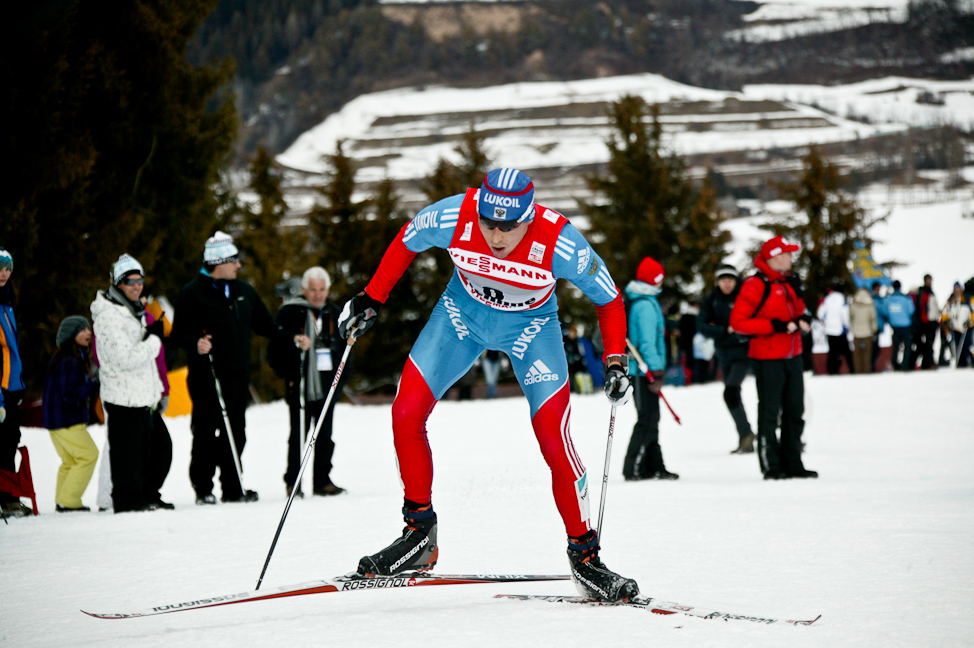
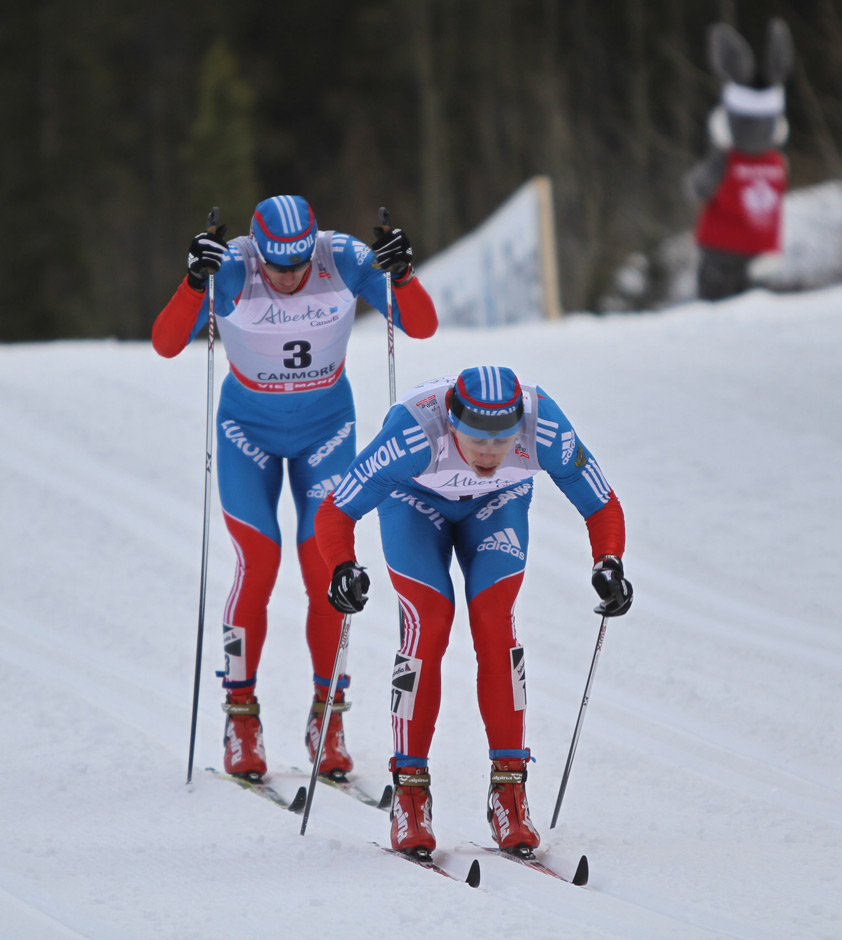
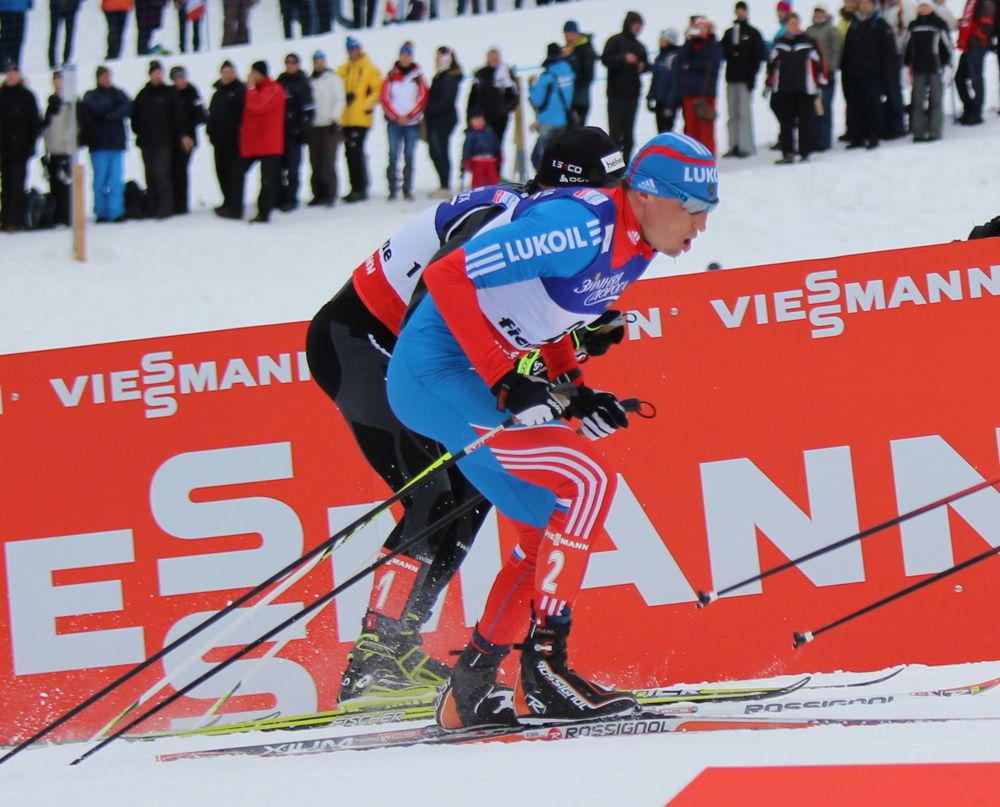
    Alexander Legkov (RUS), shown here skiing at World Championships, claimed a meaningful victory in the Oslo 50 k on Saturday, besting Martin Johnsrud Sundby (NOR) on his home course by 1.2 seconds.
    Alexander Legkov (RUS), shown here skiing at World Championships, claimed a meaningful victory in the Oslo 50 k on Saturday, besting Martin Johnsrud Sundby (NOR) on his home course by 1.2 seconds.

    When suffering is in order, the mind is almost more important than the body in determining the outcome of a race.

    On Saturday in Oslo, Norway, Alexander Legkov (RUS) triumphed on Holmenkollen’s notoriously brutal track, persevering through vicious pace changes, 2,000 meters of climbing, and warm, wet conditions.

    “I feel great,” Legkov said afterwards. “It is a big victory for me after not so good World Championships. My plan was to control the pace and to save some energy for the final lap and attack in the stadium. It worked perfect and I had great skis as well.”

    Legkov cross the line with his typical Russian reserve, belying the gravity of the moment. A win at Holmenkollen can make a career; for Legkov this achievement adds to a breakthrough season with an overall victory in the Tour de Ski and the top spot in the overall World Cup rankings before the finals in Stockholm and Falun, Sweden.

    No longer a nearly-man, the stuttering Legkov of old has been replaced by an athlete that rises to the big occasion. His win at Holmenkollen is representative of his progression as a ski racer as he showed patience and bottomless stamina to overthrow the favorites.

    The story line going into the competition was the presumed showdown between Dario Cologna (SUI) and Petter Northug (NOR), who were separated by a mere 23 points in the World Cup overall ranking.

    In addition to the drama in the fight for the overall, the course designers added a few novel hijinks designed to disrupt the rhythm of the race. Athletes were allowed five ski exchanges instead of the usual three, and the decision to take new skis typically cost them between 20 and 30 seconds with the addition of a few extra meters before the pit.

    What’s more, the rhythm of the race was affected by critical bonus sprints on each lap, which rewarded top athletes at each preem with precious World Cup points. And with Johan Olsson’s World Championship solo victory fresh in the minds of top competitors, the pack was less willing to cede too much of gap to breakaway attempts.

    When the race got underway on the fabled course, Anders Soedergren (SWE) and a unknown Norwegian continental cup skier named Simen Sveen broke away in the first few kilometers and left the pack trailing in their wake. As they passed the 8.3 k mark they had 20 seconds in hand. The chasing pack never let the gap grow more than that, with the evergreen World Cup veteran Giorgio Di Centa (ITA) hauling them back.

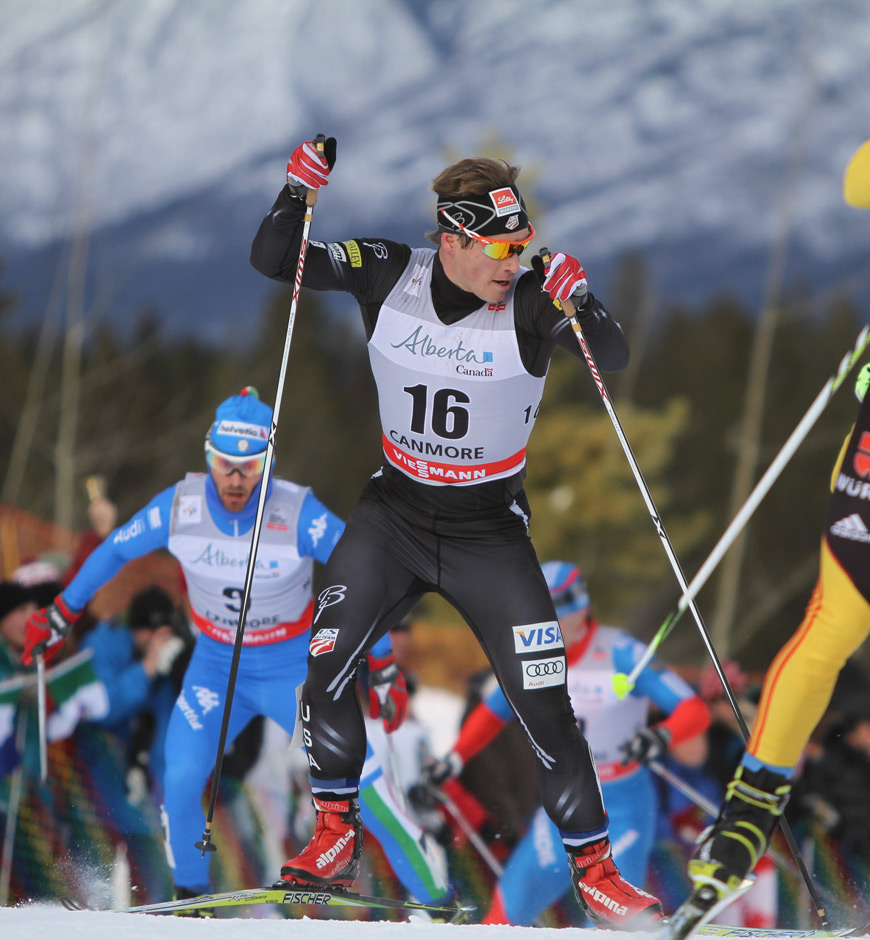
    By 14.2 k the two frontrunners had been absorbed, and the Russian duo of Chernousov and Legkov took up the donkey work, with Noah Hoffman (USA) making a notable appearance at the front of the pack.

    Favorites Cologna and Northug didn’t much away, both opting to slide into the pack and stay relatively close to the front to monitor pace changes.

    At the second of six 8.3 k laps most of the field elected to change skis, and Remo Fischer (SUI) and Curdin Pearl (SUI) pushed on, with the stocky Belarussian Michail Semenov tucked in just behind. One might have thought that the Swiss duo was employing team tactics to help Dario Cologna’s chances, but Cologna himself was the one who dragged the pack back to his teammates, preventing the group from idling into a middling pace.

    While Fischer, Pearl, and Semenov pushed on from the front, Northug began to slip backwards. His positioning in mass starts is usually erratic, but he normally makes a point to stay in the top 20 to cover any surges at the front.

    Not this time. Northug’s body language was labored, and he fell out of the top 30. The overall pace didn’t slacken, boosted by the work of Sjur Roethe (NOR) and Martin Johnsrud Sundby (NOR). Clearly team orders for Norway were every man for himself.

    At the third intermediate sprint Legkov charged in just ahead of Cologna, and Roland Clara (ITA) collected bonus points for third. The bonus points on offer had an obvious affect on the race, as the resulting surges in pace caused some racers to blow up prematurely.

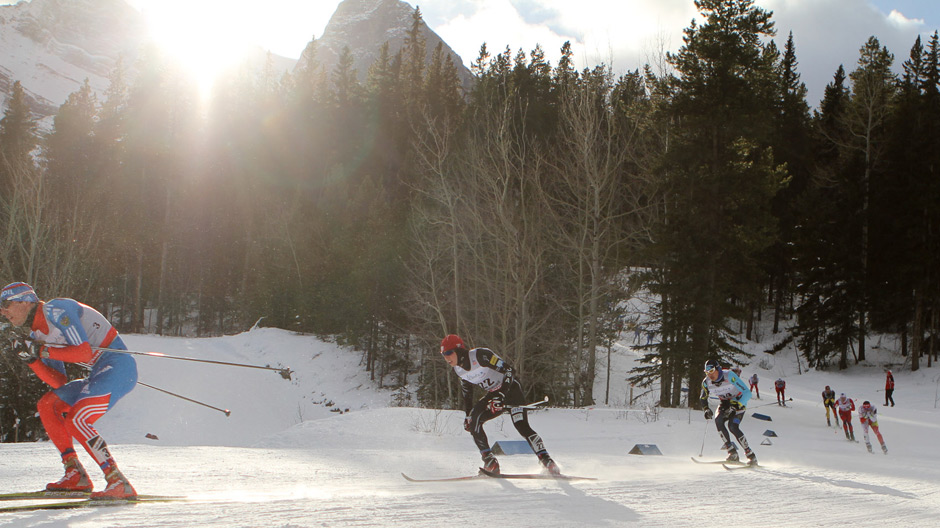
    A group of seven athletes soon began to break away, with a surprising Johannes Duerr (AUS) keeping the pace high. The leaders seemed to sense weakness in the chasing pack and began to drive the screw. Behind them, ragged on Holmenkollen’s punishing slopes, Tord Asle Gjerdalen (NOR) and Northug struggled to close the gap. They had 26 seconds to make up on Duerr, and thanks to Gjerdalen’s ceaseless labors the gap decreased, and by the 31.7 kilometer split they were less than 20 seconds away from joining the front group.

    By the time the leaders came through the stadium and took a well-earned feed, Gjerdalen and Northug were back in it. Now nine men strong, the group went into the exchange zone together and came out as one in no particular hurry.

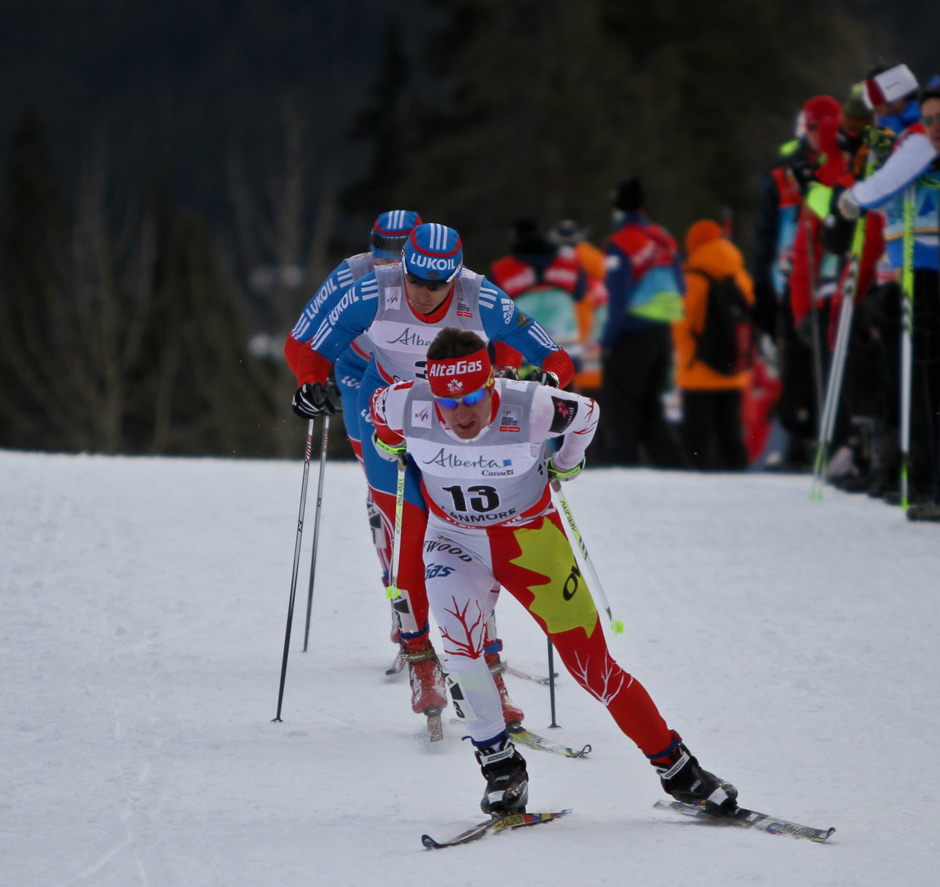
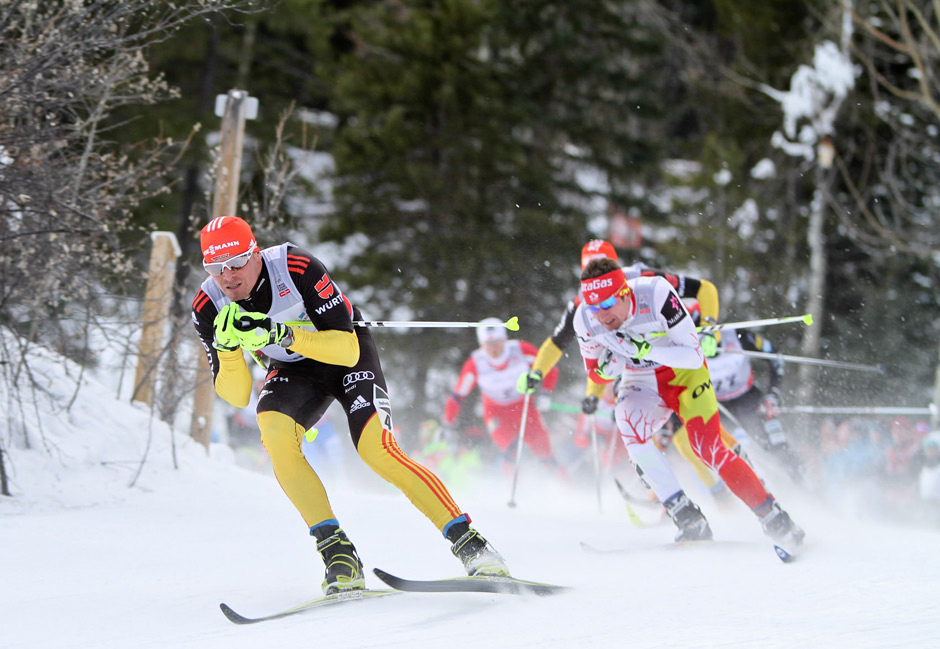
    Roland Clara kept the pace honest, taking the reins from Duerr all the way to the bonus sprint. The lead changed several times, with Petter Eliassen (NOR) in a sparkling form. Northug, Cologna, and Gjerdalen lingered at the back, and they clearly struggled with the pace. Cologna was the first to break and drifted backwards a few meters at a time with Gjerdalen, though the latter eventually found energy to reconnect with the leading group.

    At the 39.2 k mark it was Eliassen, Legkov, and Sundby in the lead and they weren’t giving much away, their technique smooth and crisp. Behind Roethe began to falter, and with him, Northug.

    Notably, on a hill moving toward the stadium Clara drove the pace and Northug began slipping further back. As they crested the hill Clara looked up to see who was around and saw Northug several meters detached behind him. Instead of pushing on he effectively stood up, and with him, the rest of the leaders. At the 44.6 k mark the leaders had 20.5 seconds on Northug, who was clearly suffering from his earlier effort to regain contact with the lead.

    Eliassen and Legkov weren’t having any of it. They lept to the front, and on the penultimate hill leading into the stadium they strung the group out, making sure that the likes of Gjerdalen and Northug couldn’t make their way back on because of a careless race pace.

    At the 47.5 k mark it was Eliassen driving from the front past the famous Holmenkollen ski jumping hill, with Clara and Legkov lurking just behind.  hey stole a few glances backward to check on the progress of Northug and Gjerdalen, but didn’t up the tempo upon seeing them significantly detached. The difficulty of Holmenkollen’s steep pitches could be read in the weary body language of the front-runners as they entered the steep, wall-like climb out of the stadium.

    The pace slowed at 48.4 kilometers and Ilia Chernousov (RUS), who had remained quietly attached at the back of the pack for most of the race, started to yo-yo, the elastic stretching to breaking as they crested the hill. Sensing weakness, Eliassen and Sundby punched it, with Legkov seemingly comfortable just behind.

    The group stayed together leading into ‘Hellner Bakken,’ the famous climb leading into the stadium, and even Chernousov was able to dig deep and hang on. It was all to play for as they swung round into the stadium, and Eliassena and Sundby led the charge for the line in front of a roaring crowd feverishly waving Norwegian flags.

    Legkov charged to the fore, attacking in a hop skate in the fashion of his beleaguered arch-rival Northug, distancing himself from Sundby and Chernousov. Legkov would never relinquish this gap, and glided in across the line to one of the most notable victories of his career in a time of 2:07.32.9.

    Sundby coasted in just 1.2 seconds behind for an impressive second place, some consolation after a disappointing world championships marred by sickness. His result on Saturday was especially meaningful for him as lives a short way from the course.

    “I can see my house from the highest point of the course at Frognersetern,” Sundby said. “I am training on these courses and it is always special to compete on Holmenkollen. I hoped for victory and wanted to be in front on Helnerbakken. My mind wanted to attack but my body did not respond. I had cramps going from my little thumb to the foot. I thought I would fall back to fifth place. At the end I took second place and I am happy.”

    Third place went to Legkov’s compatriot, Chernousov, whom recovered from some tough moments leading into the stadium to finish in 2:07.34.8.

    “No race on Holmenkollen is a piece of cake and today was not an exception,” Chernousov said. “My second pair of skis was not that fast and I was struggling to follow the guys. I am happy it was Alexander and me on the podium today.”

    Eliassen had to settle for fourth position, a lifetime best, but a tough reward for all the work he did at the front, finishing in 2:07.35.4.

    Roland Clara secured a commendable fifth place in 2:97.35.7. An exhausted Northug limped across the line in sixth position, 42 seconds behind Legkov. The result his fell short of expectations but it was enough for him to leapfrog Cologna in the overall world cup ranking, who had a miserable day and finished down in 19th position, a shocking 3:17.3 off the pace.

    Despite Northug getting the better of Cologna, Legkov’s win moved him into first place in the overall world cup, with Northug a scant 12 points behind in second. Cologna dropped down to third place overall, six points behind Northug.

    Legkov’s seminal victory earned him lasting reknown, the world cup lead, and a meeting with the king of Norway.

    “I am happy to be in the World Cup lead but there are four competitions to go,” Legkov said. “Petter as well as Dario have been in a great shape and it will be difficult to keep the yellow bib until the end of the season.”

     

    Results

    World Cup Overall Standings 

  • Cologna Pulls a ‘Northug’ for First Win of Season

    Cologna Pulls a ‘Northug’ for First Win of Season

    Switzerland’s Dario Cologna is so quietly consistent it is hard to believe he had not won a World Cup race this season — always in the mix but just off the top of the podium, until today that is.

    Taking a page out of rival Petter Northug’s book, Cologna bided his time in the men’s 30-kilometer skiathlon on the Olympic course in Sochi, Russia, before attacking furiously over the top of the lengthy final climb and opening an insurmountable lead.

    The overall World Cup leader was followed across the line by a quartet of Russians, with Ilya Chernousov besting teammates Alexander Legkov and Maxim Vylegzhanin in a sprint to the line.

    The race played out early on as most men’s mass start races usually  do — a large pack jockeying for position with no one willing to risk an attack.

    The only oddity was seeing Northug leading early. The Norwegian is usually content to let others do the work, but he made his way to the front on several occasions, though he made no move to push the pace except to challenge for the bonus points at four intermediate sprints.

    Cologna must be satisfied with his current set of wheels (the skier with the most xDrive sprint points at the end of the season wins a car) or was focused on the win and less so on total World Cup points.

    He has placed in the top-five nine times this season and came frustratingly close to a victory in Friday’s freestyle sprint, losing out to Northug in a tight battle.

    On the challenging Sochi courses, slowed by new snow, Cologna played his cards to perfection. He was always near the front, but never pushing.

    Dario Cologna (SUI)
    Dario Cologna (SUI) racing at World Cup Finals last year.

    After the equipment change at 15k, the attrition began, with skiers gradually disappearing off the back.

    Four times around a 3.75 k loop meant four times up a grueling climb lasting a solid minute and a half. While the pack compressed somewhat on the descent, each time around a few more found themselves unable to maintain contact.

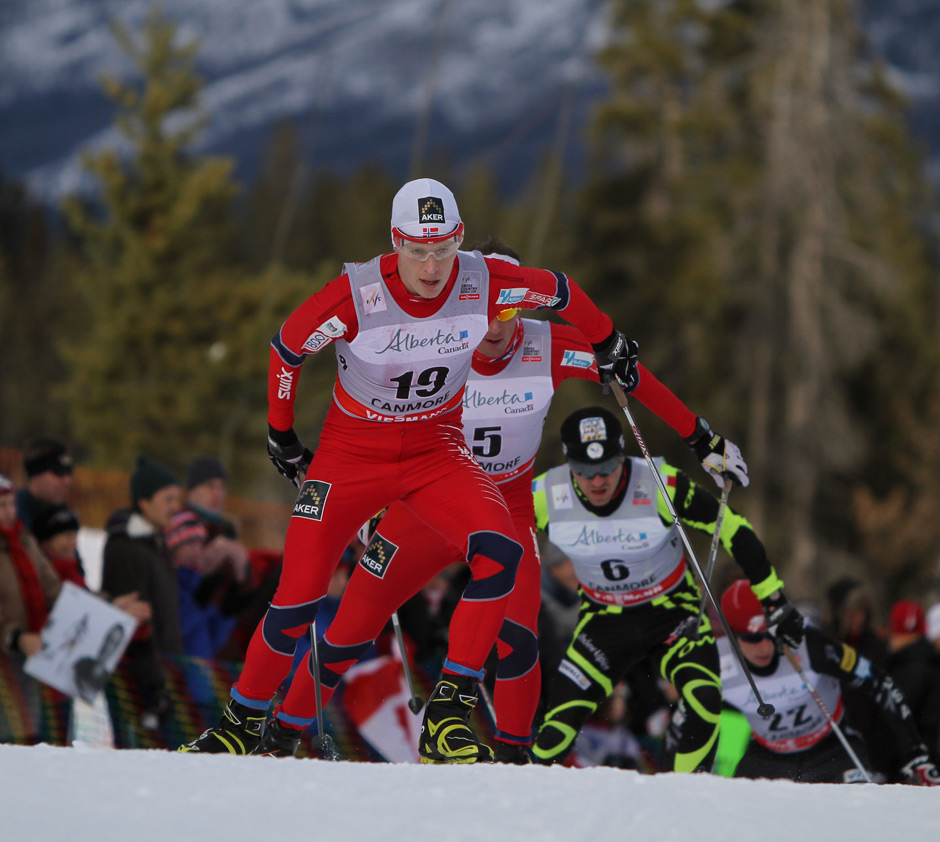
    As the race moved into the final lap, it was Roland Clara who made the first move. The Italian is decidedly not a sprinter and had little hope of prevailing in a head-to-head battle down the homestretch.

    Clara accelerated, further breaking down the group. He couldn’t get away, however, and Legkov took over on the first pitches of the big hill.

    An excellent climber, Legkov outgunned both Northug and Cologna on the Final Climb in the 2013 Tour de Ski, and while Northug quickly fell out of contention when the pace rose, Cologna would not falter.

    With just 30 meters left in the hill, Cologna came by Legkov with a fury, replicating an oft-employed strategy of Northug’s — sprint early and avoid a stadium run.

    In Sochi, with a significant descent into the stadium, wrapping up a position in the final 400 meters is challenging. Positioning becomes key and the hairpin at the end of backstretch adds another wrinkle.

    The safe thing, therefore, is to get away on the climb, exactly what Cologna attempted.

    A gap of almost 20 meters appeared almost instantly, and short of a crash, Cologna was in no danger of losing his spot.

    Legkov
    Legkov racing in the 2012 Tour de Ski.

    The three Russians came into the homestretch together with Chernousov ultimately gaining the advantage.

    Yet another Russian, Evgeniy Belov, fresh off success at the U23 Championships, placed 5th.

    Clara came across in 8th, just behind Tobias Angerer (GER) and Jean Mark Gaillard (FRA).

    Northug limped across in 12th, 23 seconds back. He expended significant effort fighting for bonus points and may have tried to do too much.

    A commentator for Norwegian Broadcaster NRK, Torgeir Bjorn, speculated that Northug was experimenting with different tactics in preparation for the Olympics.

    Regardless, the day belonged to Cologna

    “I like the last uphill. I skied it already in the sprint [on Friday],” Cologna told FIS news after the race. “I knew I was strong there.”

    Both Chernousov and Legkov sung the praises of a Russian team that put six skiers in the top eleven.

    “Of course we worked as a team, and not just me and Alexander,” Chernousov said at the post-race press conference. “The whole team worked together and really tried to do its best.”

    Chernousov appeared ecstatic on the podium while Legkov was less demonstrative. But he said he was satisfied with third, especially after being sick last week.

    Results

    Of Note

    –       Nikolay Khokhryakov (RUS) placed ninth, a career best for the 28-year-old. He had just seven previous World Cup starts.

    –       Curdin Perl (SUI) was often at the front early in the race and finished 14th.

    –       Andrew Musgrave (GBR), who has had a strong season thus far, struggled to 56th.

    –       The top Swedish skiers were not present.

    –       Legkov patted Northug on the back after one of the intermediate sprints when the Norwegian doubled over with effort. Northug would not tell Norwegian press what the Russian said.

    –       Paul Constantin Pepene picked up the first points of the season for Romania — or point to be accurate. Pepene was 30th.

  • Magnificant Manificat Takes Win in Dramatic Skiathlon

    Magnificant Manificat Takes Win in Dramatic Skiathlon

    Manificat celebrates his win.

    Coverage of the Alberta World Cup made possible through the generous support of Travel Alberta and Tourism Canmore.

    CANMORE, Alberta — Three days ago Maurice Manificat of France was dragging his black-and-fluorescent yellow-clad body up the famed Canmore “wall,” a death march of a ski race, a French bumblebee without buzz.

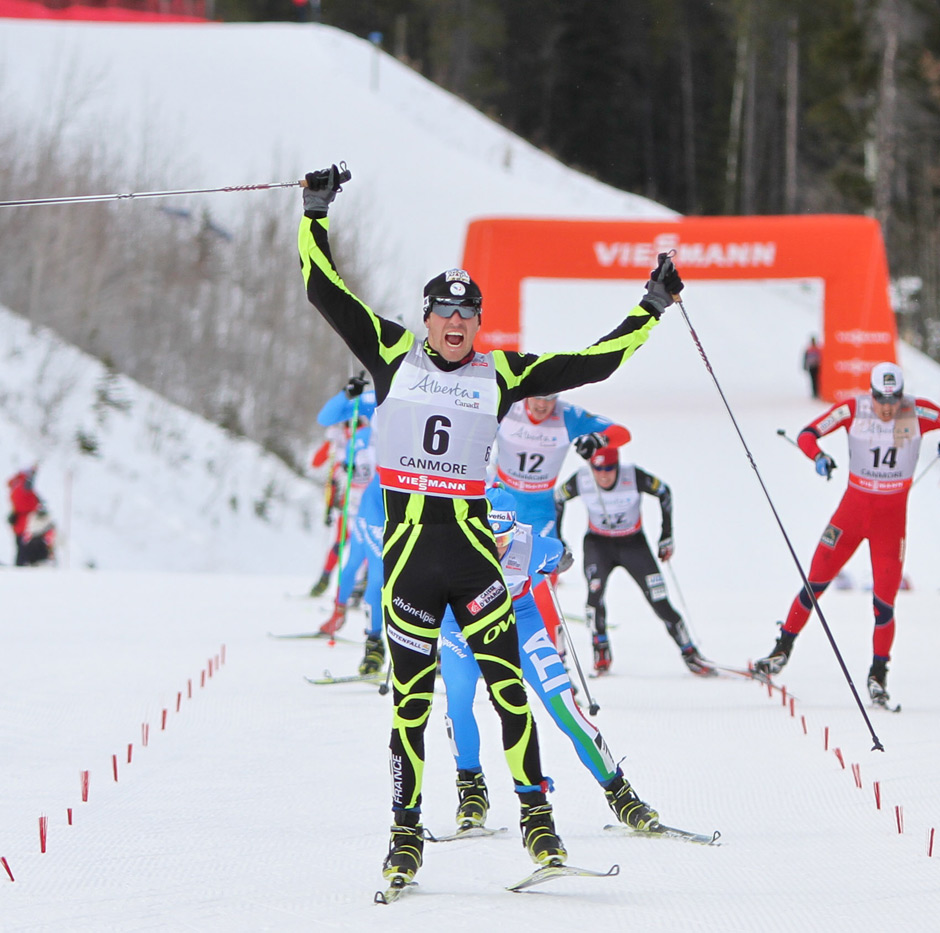
    Manificat, seeded fourth in that 15 kilometer mass start, struggled to 44th place, but Sunday brought another race and another chance, and the Frenchman had his wings back, flying by Italian Roland Clara in the homestretch to claim victory in the 30 k skiathlon.

    Challenging Canmore courses and an aggressive field ensured that this race would not play out as so many men’s World Cup races are wont to do — a sprint to the line by a herd of more than 20 skiers.

    Four 3.75-k classic loops up the steepest climbs were followed by the same number of skate loops, on a relatively more rolling course.

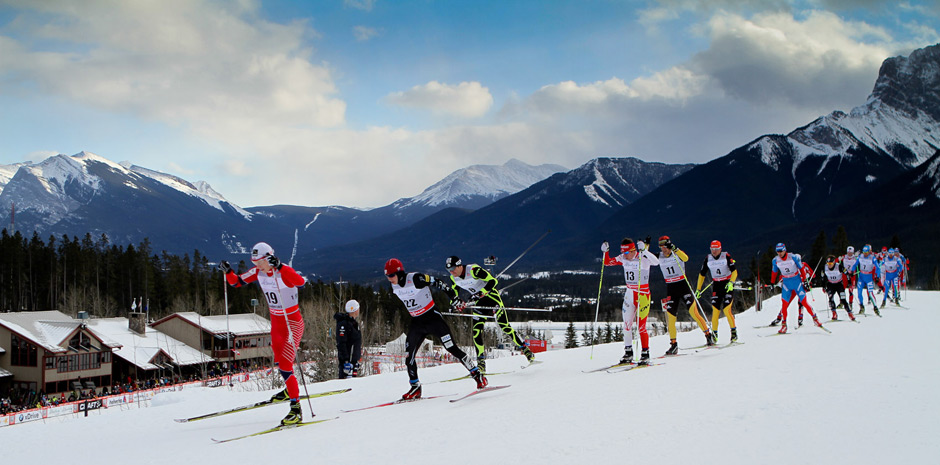
    The pack stayed tight for the first loop but the second time up the massive climbs, the field slowly began to string out, an inexorable process that would continue for the bulk of the race.

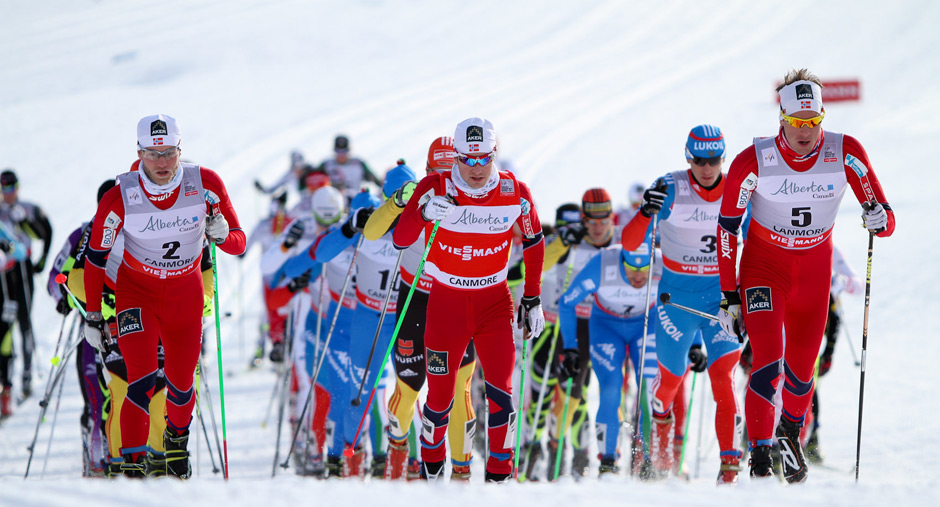
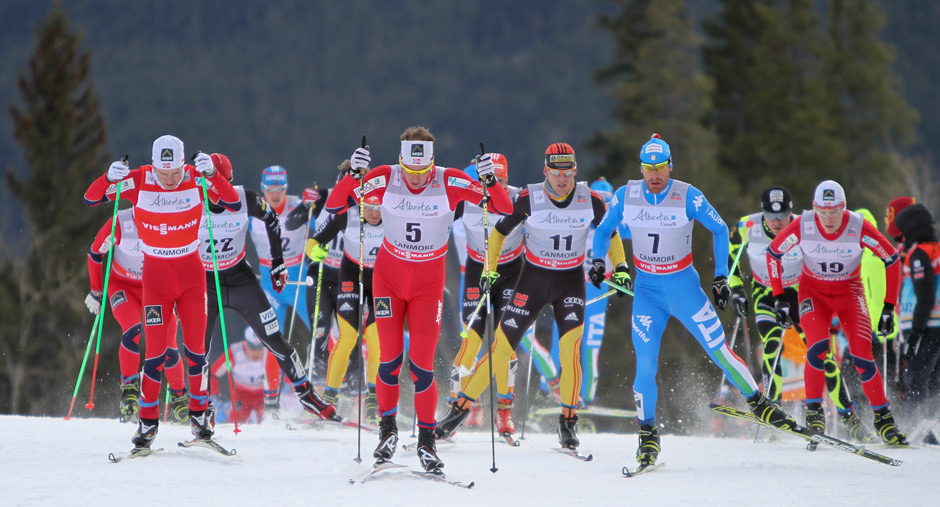
    Norway leads out of the start.

    Each time through the hills, another handful of skiers slipped off the back. At lap one, the pack was 62 strong. The second time through it was down to 36. Another 3.75 k and it was 32. Halfway through the race, only 26 remained in the hunt.

    While the lead changed frequently, several numbers remained consistently at the front — Sjur Roethe (NOR), who entered the race wearing the red bib of the distance World Cup leader; Jens Filbrich, the veteran German; gangly Russian Evgeny Belov; the ancient Italian Giorgio Di Centa; Ivan Babikov, the Canadian bulldog; and the upstart of the bunch, American Noah Hoffman.

    Hoffman never dropped far from the back, and was often in the top five, taking turns leading. In the classic portion he was aided by skis that he said “might have been the fastest in the field.”

    And while he was “gliding up to the front without really being able to help it,” he entered the day planning to ski at the front of the pack.

    “I’m more comfortable skiing in the top five, especially with the yo-yo effect you get in the back,” Hoffman said.

    He was looking to be aggressive, and stay forward where he could relax.

    Hoffman in second behind Eliassen.

    While the pace was high, Belov and countryman Alexander Bessmertnykh were not content to let the steady attrition continue. On the fourth ascent of the classic loop, the pair attacked, quickly pulling away to a nearly 20-second lead.

    At the transition the lead was down to 12 seconds, and Babikov, switching to his preferred technique, flew through the transition, bridging the gap over the next 200 meters.

    With the new blood in the break, the lead increased slightly to 15 seconds before stabilizing. Hoffman said he wasn’t confident that the trio would come back, but Tobias Angerer (GER) who ended up in fourth, laughed when asked about the bold attempt to open up the race.

    The Russians on the break.

    “It was no problem,” Angerer said, adding that a lead of 15 seconds is not enough to pose a threat. “We had everything under control with the Norwegians.”

    There was no explicit communication among the chasers, but Angerer said there was a clear feeling that “there was no danger.”

    Norway led the charge with Petter Eliassen, Chris Andre Jespersen and Roethe, joined by Hoffman, doing the work. The gap slowly closed down, though Hoffman felt that it had less to do with any increase in speed by the pack and was a more a function of the leaders tiring.

    At the end of the second skate lap, coming down into the stadium, Bessmertnykh crashed on the sweeping right-hand turn, leaving Babikov and Belov to try to hold the gap.

    Babikov, a native Russian, had been in communication with Belov and Bessmertnykh as the three worked together to pull away, coordinating efforts.

    After feeling “so good” in the classic, he pushed hard in the skate, but ran out of legs after two laps. The chasers closed the final distance early in the third loop, absorbing the two leaders.

    Bessmertnykh recovered quickly from his mishap, joining the main group as it came by, but whether he was spent from his early attack, or somehow hindered from the fall, he could not hang, slipping back through the field to finish 29th. Babikov settled back in, looking “to save some energy for the finish,” and recover from the push.

    “I used too much at the beginning of the skating leg,” he said, adding that he was “proud” of his classic leg, usually a weakness.

    Babikov leading the break.

    “That’s good for World Champs, Sochi, [site of the 2014 Olympics]. We have duathlon there, and maybe one of those days I’ll have the legs and be able to take them away,” Babikov said.

    Known for his tenacity, Babikov hung tough, but he was drained from his attack. A weak sprinter, he did not factor into the fight for the podium. He did finish a solid 12th, however, coming across the line in the main group.

    “We wanted Ivan to attack early,” Canadian head coach Justin Wadsworth said. But they “didn’t want it to be that early.”

    The breakaway defeated, the race continued to play out with less drama for the next lap. By the 20-kilometer mark, the pack was down to 18 skiers, a group that would remain in relative contact until the final climbs.

    Hoffman continued to sit toward the front, but was not the only North American battling for position. Both teammate Kris Freeman and Canadian Graham Nishikawa were present, though generally toward the tail end.

    Freeman was right where he wanted to be early on as he worked “to conserve as much energy as possible in the classic,” so he could “really jam in the skate.” In contrast to Hoffman, he would rather be in the slipstream than up front.

    “Hoff doesn’t like skiing in groups so he goes to the front, and I’d much rather be sucked along in the draft,” Freeman explained.

    Seeing Freeman in the top 20 is hardly out of the ordinary, but in recent years he has struggled to do more than just hold on. However, U.S. Ski Team (USST) coach Matt Whitcomb was unsurprised to see Freeman in the mix, saying that the veteran showed up in Canmore with “a totally different energy … you could tell he was ready to pop some races here.”

    The pack, hunting.

    Graham Nishikawa’s performance, on the other hand, was most certainly unexpected, even to himself. While he has cracked the top 30 before, he has never hung with the pack in a World Cup mass start.

    “I kept surprising myself, like oh, made another lap, made another lap,” the Alberta World Cup Academy and Canadian Senior Development skier said. “I was just trying to stay really relaxed and in contact with the leaders and just take one lap at a time.”

    And as the race wound toward its conclusion, he put his “head down and tried to hang in there as long as possible.”

    He crossed in 15th, not losing contact until the final kilometer, and finished just ahead of the likes of Jespersen, Martin Johsnrud Sundby (NOR), and Evgeniy Dementiev (RUS).

    “It was unbelievable,” he said. “I had a career best day in my hometown.”

    Eliassen.

    Back up at the front, the intensity increased as the skiers headed out for the final lap. Eliassen took a chance, pushing on the first climbs out of the stadium, opening a small five-meter gap. He couldn’t get away, with Hoffman doing the initial work of responding.

    “It was time to go so if no one else was, I was gonna try to pick up the pace and get him back on,” Hoffman said.

    He did pay a price, and “suffered a little bit as guys came around,” but he did not slip far.

    During all the excitement of attacks and responses, Clara waited patiently, opting to stay back and catch a ride.

    “Half of the race was, for me, fast training,” the Italian explained after earning his fourth career World Cup podium. “Only the last lap was hard.”

    On the last climb out on the loop, Clara finally played his hand, attacking hard. Only Manificat was able to respond, though Roethe made a valiant effort. The Frenchman said that the pace on the last lap was very high, with “everybody wanting to go ahead.”

    The wide Canmore trails made passing easy, however, and though he was uncertain if he wanted to attack himself, when Clara went, Manificat followed, cognizant of the long descents ahead and the need to get clear.

    “I tried to push and I see that only Maurice can follow me,” Clara said. “In the downhill he passed me, and I stayed on his back and we made a really good race together in the last k.”

    Freeman working in the pack.

    Clara made one more go of breaking away on the final short hill. But at only “50 or 60 meters” he said it wasn’t long enough, and he couldn’t get free.

    The pair swooped into the stadium, Manificat riding the draft, before stepping out and powering by. At that point the outcome was not in doubt. Manificat is the stronger sprinter, and had the slingshot effect.

    “The last few hundred meters to the finish line I come back on him, and then I push,” Manificat said. “It was only in the head, you are so crazy and you know you can win.”

    Clara was not at all disappointed with the outcome, giving Manificat his due.

    “It’s perfect to find again the victory,” Manificat said. “It’s totally different from a simple podium. Every year I make podium but victory is very good to find again.”

    His last win came back in 2010 in Lahti, Finland, also in the 30 k skiathlon.

    Roethe couldn’t quite keep contact, but he did ski clear of the now strung-out field to earn the final podium position and retain the red distance bib. He was followed across the line by Angerer, who couldn’t get clear at the top of the course to respond to the attack.

    “I was behind some skiers and they were too slow for me,” Angerer said. “There I lost the race.

    Hoffman crossed just seconds later in eighth place, easily a career best.

    “In order to win one of these I probably do need to be able to break the field a little because I’m probably not gonna win this final sprint,” Hoffman said. “But today I’m happy to be able to hold the position and stay in the top ten.”

    He added that he was in no place to be part of the final break, saying “I was hurting up there.”

    Angerer and Babikov.

    He didn’t lose any ground in the final 200 meters, an accomplishment in itself.

    “Hoff holding his ground in a sprint? What?” Whitcomb said. “It was absolutely amazing. It is a new skier out there.”

    Freeman had his own strong finish, picking up a spot in the homestretch when he outlunged DiCenta at the line.

    Hoffman was realistic about his result, recognizing a number of top distance skiers were not present, but he recognized the quality of his effort regardless.

    “Not all World Cup fields are created equal…but there are some amazing skiers here…so I’m psyched to be able to ski with them in a 30 k,” Hoffman said.

    “Eighth is sweet, hopefully there’s more to come in the future but I’m psyched right now,” he concluded.

    — Alex Matthews and Gerry Furseth contributed reporting

    Men’s results

    Cornering.
    Podium.
  • Odds + Ends From Kuusamo

    Annsi Pentsinen

    Doogiski over at NordicXplained asked how Pentsinen’s 4.3 second win in qualification on Friday stacks up historically. Quite impressively, it turns out.

    That’s the second largest qualifying round winning margin for the men’s field in WC, OWG or WSC races. The only larger one was almost 10 years ago, with a 4.7 second victory by Björn Lind in a freestyle sprint in Germany in December of 2001. So we’re reaching back to the very beginning years of sprinting here.

    Ola Vigen Hattestad came close to this once last season, winning qualification by 3.86 seconds.

    A winning margin greater than 4 seconds in qualifying has happened more often with the women: six times. And it’s basically a who’s who of dominant female skiers over the past decade: Skari, Neumannova, Bjørgen (twice), Kowalczyk and Majdic. Skari’s is particularly absurd. She won qualifying in a WC sprint in Italy way back in the day (December 2001 again) by 8.4 seconds! It was classic, so maybe waxing was an issue, or maybe Skari was just that fast. Interestingly, the woman she beat that day be 8.4 seconds was Petra Majdic.

    More generally, the typical winning margin in qualification is just under a second for the men and about 1.5 seconds for the women.

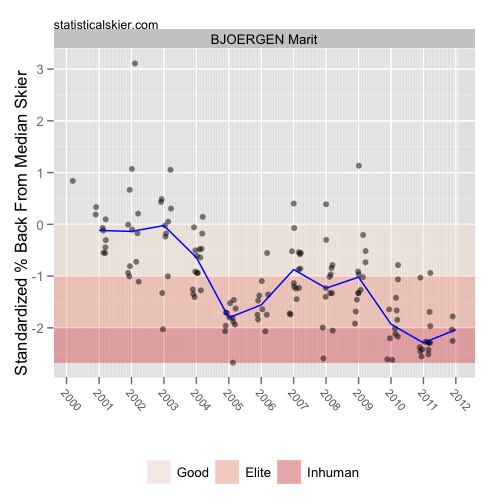
    Marit Bjørgen

    And how is Bjørgen faring so far this year?

    She’s certainly still winning everything in sight, but she’s not really faster than last year. Although, that’s not surprising, since “regression to the mean” would lead us to believe that she’s regress a least a little this season.

    Assorted Men

    A few of the men who had strong weekends:

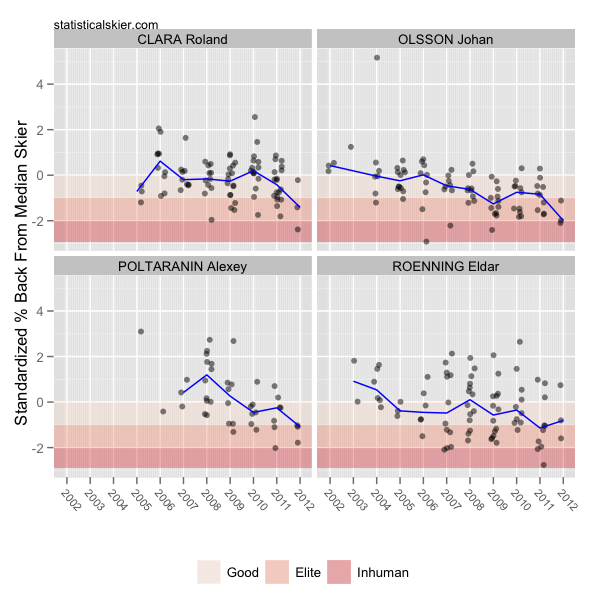
    Eldar Rønning ended up doing very well in the overall mini-tour thanks to some very strong classic skiing on the last day. But overall, his skiing hasn’t been out of this world, and might even be a bit of a step back from last season. Remember that overall tour placings are heavily dependent on the specific events. In this case, strong classic skiers had a lot more space to make up ground, and so the overall tour may have favored classic specialists somewhat. If the techniques had been reversed, Rønning may not have fared so well.

    On the other hand, Clara, Olsson and Poltaranin have all skied somewhat better so far this season overall. It’s particularly exciting to see from a guy I think a lot of people didn’t have on their radar (Clara), an older skier coming off a few bad-ish seasons (Olsson) and a guy from a “different” country (Poltaranin).

    I plan to talk about sprint heat times when I can, but FIS messed up the heat times royally (at least, the times that are available online), so not this week. Maybe next time. I’ll have words about the North Americans on Wednesday…

    Related posts:

    1. <Flashback: Kuusamo Sprint
    2. <TdS Classic Sprint: North Americans
    3. <Odds and Ends after Otepää


  • Northug Takes Over in Ruka Triple 10 k

    Norway's Petter Northug competing at the 2011 World Championships in Oslo, Norway. Photo by Geir Olsen/NSF

    Roland Clara had been second before. On Saturday in Kuusamo, Finland, the Italian looked pretty comfortable in the leader’s chair, bundled in a blanket and flashing a genuine smile. But the men’s 10 k freestyle race on the second day of the Ruka Triple mini-tour was only halfway through.

    With individual starts staggering the finishes, Clara could see his seat wasn’t permanent. With every checkpoint — 3.1, 6.4 and 8.1 k — his challengers closed in. Of the remaining men on the course, Norway’s Petter Northug was most threatening.

    After a steady start, the defending World Champion recorded the fastest time at 6.4 k. He was 11 seconds faster than any of the 100 or so men that started before him and reached that point.

    As Northug crossed the finish and collapsed into an exhausted heap, Clara relinquished his spot. He nearly achieved his first World Cup victory, but it wasn’t his day. After Northug finished 16th in Friday’s 1.4-k sprints, the champion reclaimed the No. 1 spot — both on the podium and in the World Cup standings.

    “I was tired at the end, but I managed to keep all the way,” Northug told NRK. “The plan was to attack. I tried to go out hard and finish hard. I think it was the key today.”

    Clara ended up second, 23.8 seconds off Northug’s winning time of 21:49.1. Starting nearly 40 bibs after Clara, Maurice Manificat (FRA) initially endangered his lead, setting a new best time at 6.4 k. Clara’s late push helped him stay on top, and Manificat finished 6.3 seconds behind him.

    Positioned in third after Northug (+30.1), Manificat awaited the result of Dario Cologna (SUI). At the halfway point, Cologna only trailed Northug by 6 seconds.

    By 6.4 k, Cologna was 11 seconds behind the eventual winner, but on par for a podium finish. In the end, Cologna was 1.6 seconds slower than Manificat and finished fourth (+31.7). Manificat was happy with the podium and relieved he wasn’t the only one who felt the wrath of the challenging course, which was intensified by strong winds.

    “I got a bit tired at the end,” Manificat told FIS Ski. “Luckily, Dario Cologna also got tired and I could keep the third place.”

    Clara, who was third last weekend in the 15 k freestyle in Sjusjoen, was also pleased with his early World Cup performances.

    The men's podium at last weekend's 15 k freestyle in Sjusjoen, Norway (left to right): Petter Northug (NOR), Johan Olsson (SWE) and Roland Clara (ITA). Photo:Fischer/NordicFocus.

    “Two races, two podiums,” he told FIS Ski. “It’s incredible for me to be in the podium all the time. Tomorrow I will give my best and try to make the gap closer.”

    Clara currently sits in third in the World Cup standings with 106 points after Northug (145 points) and Sweden’s Johan Olsson (132).

    A win in Sunday’s 15 k classic pursuit would guarantee Northug, the World Cup and Ruka Triple leader, the overall mini-tour victory and 200 World Cup points.

    A year ago, Northug wasn’t even a player in the three-day Ruka Triple. He sat out Kuusamo’s early-season competition because of illness. After Saturday’s race, he is well on his way to claiming another World Cup victory with an 11.8-second lead on Cologna (SUI) and 41.4 on Alexander Legkov (RUS).

    “Tomorrow, around 120 athletes will hunt me,” Northug said to FIS Ski. “I will try to keep the same shape for the whole season. After the Tour de Ski, we will see who will fight for the World Cup.”

    Other top contenders for the Ruka Triple crown include Clara (+47.8), Manificat (+48.3), and Olsson (+51.9). Marcus Hellner (SWE) is seventh in the stage standings, and Chris Andre Jespersen (NOR) moved to eighth with a fifth-place finish on Saturday.

    Rounding out the top 10, Russia’s Evgeniy Belov was ninth in the mini-tour standings and David Hofer (ITA) was 59 seconds behind Northug in 10th. After illness kept Lukas Bauer (CZE) from competing until this weekend, he finished 10th Saturday to move up to 11th overall.

    The top North Americans in the stage standings were Canada’s Lenny Valjas (17th, +1:08.2) and Ivan Babikov (20th, +1:16.4). While Valjas isn’t known for his distance races, Babikov is — along with teammate Alex Harvey, who currently ranks 24th after two days of races.

    Complete men’s 10 k results. 

    Read the overall women’s 5 k recap and the North American women’s highlights.

    North American men’s recap to follow.

  • Olsson Stuns Field With Big Win, Northug Sprints for Second

    Johan Olsson (SWE) celebrates the win in Sjusjoen, Photo:Fischer/NordicFocus.

    Petter Northug (NOR), famed for his unmatched finishing kick, fired up the afterburners once again, accelerating out of the final stadium hairpin and into the homestretch. The seconds ticked off the clock, and it seemed impossible that Northug would overtake his challenger.

    But lifting off the snow with each stride, Northug ate up the final meters, lunging across the line before collapsing in a heap, just two tenths of a second ahead of Roland Clara (ITA)…for second.

    Northug provided plenty of drama with a stunning finish, but his efforts would only be good for runner-up as Johan Olsson (SWE) outpaced the field by a substantial 31 seconds in the men’s 15km freestyle in Sjusjoen, Norway.

    Olsson, starting relatively early at bib 41, set a standard that the rest of the field was forced to try and match. Some, notably Northug and Dario Cologna (SUI), succeeded for a time, but none could maintain the pace for the full 15,000 meters.

    Johan Olsson (SWE) skates to victory in the opening World Cup of the 2012 season. (Photo: flyingpointroad.com)

    With one career victory under his belt, Olsson was hardly a favorite coming in. He had just three World Cup podiums to his name, all coming in 2009. Add to that a serious back injury that knocked him out of training for a good portion of the fall, and Olsson it is no surprise that Olsson said after the race “I absolutely did not believe I could win.”

    In the finish corral he told FIS Media Coordinator Sandra Spitz that he attempted to ski the race like one of his “big idols,” famed Norwegian biathlete Ole-Einar Bjorndalen.

    “I tried to ski my own race, like he did [in Bruksvalarna several years ago],” Olsson said.

    He clearly succeeded, accelerating over the duration of the race, and ultimately leaving his competition in the proverbial dust. While none of the racers mentioned it, he may have been aided a little bit by warming temperatures and a softening course. As the day progressed the snow transitioned from the rock-hard track to a wetter, and in some cases, mushy consistency.

    Northug, Cologna et al knew exactly what they needed to do. Cologna actually came through the half way mark a half second up on Olsson, but that was before the Swede surged. Four kilometers later and the defending overall World Cup Champion was twenty seconds down.

    Northug, on the other hand, fell back by the halfway mark, and never closed back up. But while he couldn’t close on Olsson, he did move past everyone else, climbing from 5th at 7.5k to his ultimate second place.

    “It was a tough race today,” Northug said at the post-race press conference. “In the last lap I heard it was pretty tight between the racers so I was fighting in every uphill and also on the easy terrain. I tried to give it all towards the end, and I’m happy to be second.”

    Petter Northug (NOR) grabs 2nd in the World Cup opener. Photo:Fischer/NordicFocus.

    It is hard to imagine Northug ever being truly satisfied with anything but the victory, but on this day there was no alternative. And his 2012 season is already off to a much better start than last year, when he missed the opening races due to illness and took nearly a month to round into form.

    With Olsson’s striking performance, and Northug’s impressive surge to the line, it is easy to overlook Clara, who earned his first ever World Cup podium.

    The 29-year-old Clara skied a consistent race, holding position throughout. He edged young Swede Calle Halfvarsson, at bib 19, the early leader, by 7.2 seconds.

    “It was a perfect race,” Clara said. “I did not think I could make it to podium today, but when I started I heard it was going good and then I was waiting [at the finish].”

    With 58 World Cup starts, Clara is hardly a newcomer. Halfvarsson, on the other hand, at just 22 years of age shows signs of breaking through this season. His previous best World Cup result was a ninth in a freestyle sprint event.

    Halfvarsson edged out another young – but more established –  name, Canadian Alex Harvey.

    Coming off an impressive 2011 campaign that included World Championship gold, Harvey is looking to battle in the overall World Cup standings. Today he finished 5th, two seconds in back of Halfvarsson.

    Harvey placed a solid 10th in last weekend’s FIS race in Sweden, but didn’t feel great out of the start in the first meaningful race of the season.

    “I felt pretty tired warming up today,” Harvey told FasterSkier in an email. “It took me a while to get going, and still on the first lap, I wasn’t 100% yet, so I lost quite a bit of time there, coming into 34th place after 3.75km.”

    But he was able to pick up the pace and finish strong. He was pleased with the result noting he had never cracked the top 30 in a 15km individual start race, though the performance was not completely unexpected.

    “I wouldn’t say I’m surprised because I worked pretty hard this summer to improve my individual starts and skating up steep hills, “ he said. “I’m just happy that the hard work is starting to pay off.”

    Canadian head coach Justin Wadsworth was pleased with his young star’s day. “Alex had a great race, really exciting to see him race well in what you’d call his weaker discipline [skate distance],” Wadsworth told FasterSkier in a phone interview from Norway.

    “This shows how well rounded he is. We as a team worked hard on skating technique, which seems to be working well for him right now, so we’re excited,” Wadsworth continued.

    Kris Freeman led the US men in 55th place. The rest of the squad was not far behind—Tad Elliott 60th, Andy Newell 63rd, and Lars Flora 65th , with the exception of Noah Hoffman, who struggled to 79th in the 92 skier field.

    Simi Hamilton (USA), originally scheduled to start, was a last minute scratch when organizers realized the US had been allocated too many start slots.

    Four other Canadians also competed. Devon Kershaw placed 37th, Ivan Babikov, just over from Canada, took 42nd, Len Valjas was 64th and Graham Nishikawa 71st.

    More details on the Canadians’ race can be found here.

    Much was made of the presence of many of the top Norwegian biathletes. Lars Berger, Emil Svendsen and Tarjei Boe make up a dream team on the biathlon circuit, but only Berger excelled, placing 8th, just two seconds behind Cologna.

    Berger is plenty experienced on the cross-country side, racing for the silver medal winning relay team at the Vancouver Olympics.

    Svendsen, known as one of the fastest skiers in biathlon was 15th, and overall biathlon World Cup Champion Boe placed 20th.

    Another biathlete, Ronny Haafsas, who made some noise at the World Cup opener two years ago, winning this same event, placed 38th.

    The World Cup opener often features highly variable results. With established stars like Sami Jauhojärvi (FIN), Axel Teichmann (GER), Tord Asle Gjerdalen (NOR) and John Kristian Dahl (NOR), among others finishing well off the pace, the race may not be the best indicator of the upcoming season.

    Men’s 15km Freestyle Complete Results

    Audrey Mangan contributed reporting

    The men's podium (l-r) Petter Northug (NOR), Johan Olsson (SWE) and Roland Clara (ITA). Photo:Fischer/NordicFocus.


  • Team 4: Italy

    Italy

    Nations Cup Ranking: 4th (4956 pts)

    Men: 5th (2226 pts)

    Women: 5th (2730 pts)

    2010/2011 A Team

    Men

    Valerio Checchi

    Roland Clara

    Giorgio Di Centa

    Giovanni Gullo

    David Hofer

    Thomas Moriggl

    Dietmar Noeckler

    Pietro Piller Cottrer

    Cristian Zorzi

    Loris Frasnelli

    Fabio Pasini

    Renato Pasini

    Fulvio Scola

    Women

    Elisa Brocard

    Virginia De Martin Topranin

    Arianna Follis

    Marianna Longa

    Silvia Rupil

    Antonella Confortolla

    Magda Genuin

    What you may have missed last season:

    Just how old the Italian National Team mainstays are. In the Olympic relay, the Italians ran three of the same four guys they used not just in their home Olympics in Torino four years ago, but eight years ago in Salt Lake City. There is something to be said for keeping a team together, but there is a massive difference between having Pietro Piller Cottrer, Georgio Di Centa and Cristian Zorzi all in their prime, and what happened in Vancouver.

    Di Centa is 38. Zorzi is 38. Piller Cottrer, or ‘Killer Piller’ as he is better known in the skiing world, is 36. If you add in the fourth man, the practically-in-diapers 30 year-old Valerio Checchi, the average age of the Italian men’s relay team is 35.5 years old! And it showed on the results sheet, as the Italians finished far back in ninth. Zorzi, who was known for his anchor-leg relay antics before Petter Northug began churning out highlight reel finishes, didn’t have any magic left for Vancouver.

    Also, in a fairly surprising move, Di Centa won his first ever World Cup this year, a 15 k freestyle in Canmore, Alberta. Surprising, because there are very few skiers of Di Centa’s caliber (16 straight years of scoring World Cup points, eight top-20 Overall finishes) who have failed to ever win a race. However, he still lags behind his elder sister Manuela, whose seven Olympic medals and five Olympic Games appearances are doubtlessly driving Giorgio to improve on his mere three Olympic medals.

    As for the women, the Italians had three top tier skiers. Arianna Follis was extremely competitive regardless of the distance or technique, one of the very few truly elite all-around women. Her teammate Marianna Longa was a solid distance skier, but like Di Centa, she struggled to find the podium. As a pure sprinter, Magda Genuin has emerged as a legitimate podium threat, but was no more than that last season, as her only podium was a silver in Rybinsk, Russia.

    What You Should Know For This Season

    The Italians need help on the World Cup, and bad. Di Centa finished 10th Overall, and Piller Cottrer finished 16th, but neither are all-around skiers at their current age. The next Italian in the pecking order was Checchi, in 31st, who like the other two cannot sprint. Between the three best Italian men, they managed to amass a grand total of five sprint points. In today’s World Cup, where being an all-around skier is becoming more of a necessity due to the prevalence of Tour-type events, the Italians are starting to look like dinosaurs.

    The younger crowd, relatively speaking, are all good skiers: sprinters Fabio and Renato Pasini, David Hofer, Thomas Moriggl and Roland Clara. But none of those athletes approach the level of Di Centa or Piller Cottrer, who have quarterbacked Italy to success for the last 10 years or so.

    Sabina Valbusa, after a long and illustrious career that included nine World Cup podiums and an Olympic bronze medal, joined many other top women and retired.

    If you’re struggling to pick out the Italians in a race, check the hat. They seem to go in for fancy hats that often include sparkles, big pom-poms and bright colours.

    Who You Should Watch

    While most of the buzz is about Federico Pellegrino, mainly because he had some decent World Junior results (and probably because his name is fun to say), FasterSkier would like to direct your attention to Gaia Vuerich.

    The 19 year-old Italian finished fourth at the World Junior Championships, and while it wasn’t behind Petter Northug’s little brother, it was behind Swedish sprint-superstar-in-the-making Hanna Brodin – and Vuerich still has another year of competing in junior competitions.

    Like Pellegrino, Vuerich scored World Cup points this past season, nipping Pellegrino’s total by 2. Sure, her amassing of 14 points from the one sprint race in Dusseldorf, Germany, isn’t earth-shattering, but she also managed to have some late-season success against some top tier competition.  Vuerich edged out none other than Justyna Kowalczyk in a downhill sprint event in the Russian sprint tour last spring – so if FIS manages to bring the new format to the World Cup, Vuerich could have potential.

  • The Hottest Skier – March’s Sweetest Sixteen

    The Hottest Skier – March’s Sweetest Sixteen

    What?  Yeah, that’s right, there are lots of great reasons to be a Nordic skier, but one of them is that there are a whole lot of fit, attractive people wearing spandex.  Here is a list of some of the hottest European skiers on the World Cup.  We may have forgotten a few so feel free to write them into the comment section and we will add them to the list.  We did not want the North Americans to dominate so we made an executive decision to eliminate all of them… sorry Andy and Morgan.

    Superficial?  Certainly, but remember that it is spring time, and you’re supposed to be having fun.

    All of our photos of these athletes are from races, so we are using google images to supplement.  If you don’t have a poster on your wall, google will provide.

    Please vote at the bottom of the page.  We will tally the scores and then enter a second round of voting to determine the winners!

    The ‘Research’ Center

    Therese Johaug

    Ladies:

    Sandrine Bailly: website , google images

    Marit Bjoergen: google images

    Stephanie Boehler: websitegoogle images

    Nichole Fessel: google images

    Arriana Follis: google images

    Ella Gjoemle: google images

    Anna Haag: websitegoogle images

    Nat Herz: google images

    Astrid Uhrenholdt Jacobsen: websitegoogle images

    Therese Johaug: websitegoogle images

    Charlotte Kalla: google images

    Magdalena Neuner: google images

    Madoka Natsumi: google images

    Stephanie Santer: google images

    Kristina Smigun: google images

    Kristin Stoermer Steira: google images

    Guro Stroem Solli: google images

    Evi Sachenbacher Stehle: google images

    Claudia Nystad: google images

    Petter Northug (photo: Ida Karlsson)

    Men:

    Roland Clara: google images

    Dario Cologna: google images

    Giorgio Di Centa: google images

    Valerio Checchi: google images

    Jens Filbrich: google images

    Jean Marc Gaillard: google images

    Ola Vigen Hattestad: google images

    Marcus Hellner: google images

    Nat Herz: google images

    Nikita Kriukov: google images

    Toni Livers: google images

    Petter Northug: google images

    Johan Olsson: google images

    Teodor Peterson: google images

    Daniel Rickardsson: google images

    Eldar Roenning: google images

    Josef Wenzl: google images

    Vote For Your Top 5 Favorite

    [poll id=”32″]