From the FasterSkier archive — posts syndicated from athletes’ and coaches’ own blogs between 2004 and 2012, kept online as published. Current coverage is at fasterskier.com.
This coverage is made possible through the generous support of Marty and Kathy Hall and A Hall Mark of Excellence Award. Learn more about A Hall Mark of Excellence Award—or about supporting FasterSkier coverage—by contacting info@fasterskier.com.
The Blink Festival 23 biathlon sprint was held in Sandnes, Norway. Featured here are Marthe Krakstad Johansen (NOR), Juni Arnekleiv (NOR), (l-r) (Photo: NordicFocus)
The Blink 2023 Nordic Ski Festival—the pre-eminent summer roller-ski event for cross-country skiers and biathletes—is at an end. Part of the schedule for the last day is the biathlon sprint for the men and women.
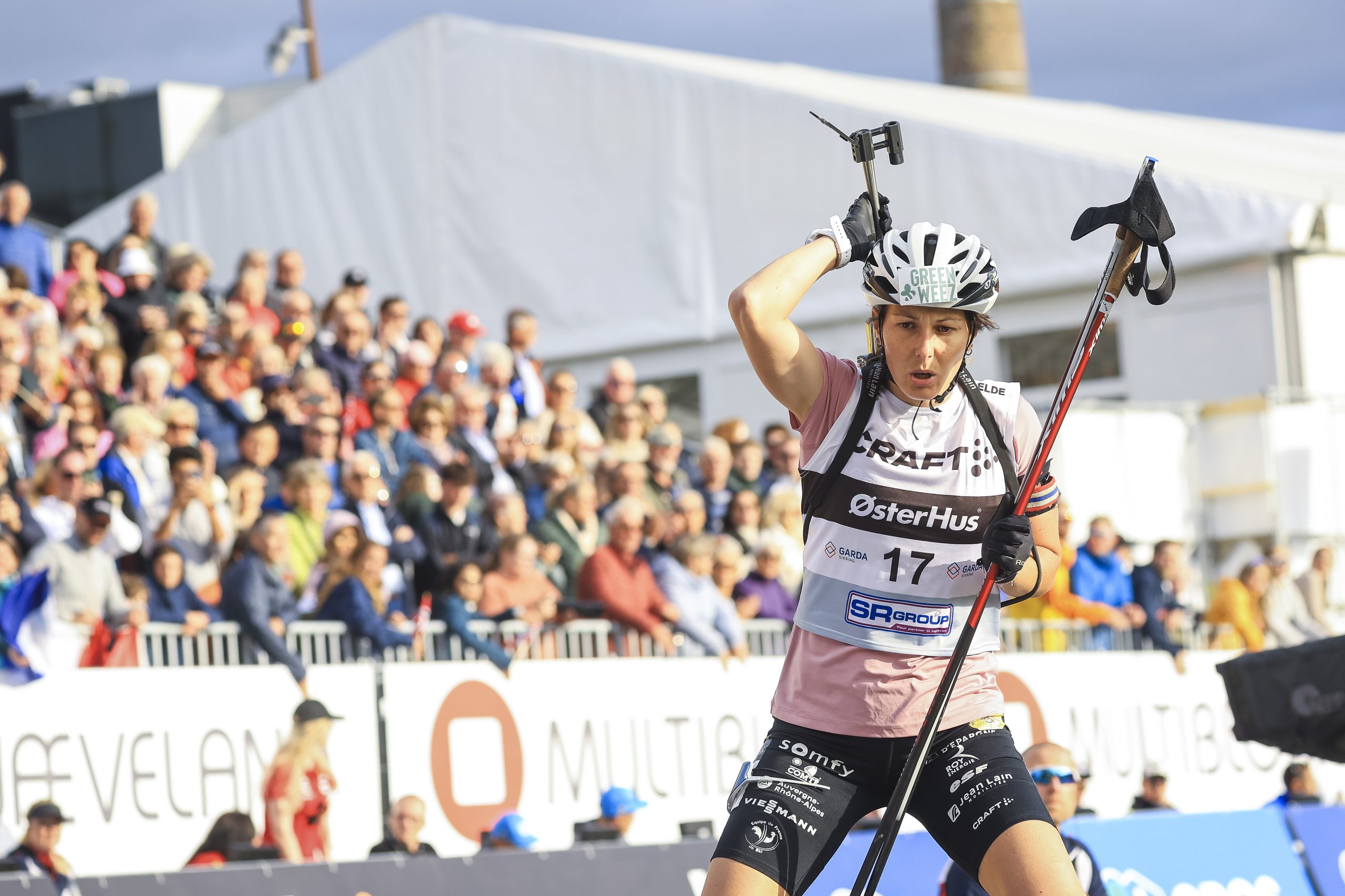
In the women’s race, Karoline Offigstad Knotten (NOR) took the victory, she was followed by Chloe Chevalier (FRA), and J. Amekleiv (NOR) in third.
In the men’s race, Vetle Sjastad Christiansen (NOR) took the top of the podium. Second place went to Sturla Holm Laegreid (NOR), with J.S. Saeter taking third.
Chloe Chevalier (FRA) gets ready to shoot at the BLINK23 Festival Biathlon in Sandnes, Norway. (Photo: NordicFocus)
Woodski announces the release of the new CT classic roller ski – the first of its kind with tracking adjusters. A simple, precise adjuster on the front wheel allows for simple tracking control as wheels wear. The CT comes with the XL brake (integral on all Woodski roller skis), a choice of wheel speed, and a lifetime warrantee on shafts. Woodski has also introduced ski carrying bags.
The Mt. Greylock Roller Ski and Roller Blade races are back. The event, a benefit for the Northern Berkshire Special Olympics, will be held on Sunday, October 16th, at 10:00 A.M. beginning at the Mt. Greylock Visitors’ Center in Lanesboro, MA. Brought to you by Berkshire Outfitters and FasterSkier.com the race will prove to be a great fall workout and a blast… after all there is just one hill, it just happens to be 8 miles long.
The challenging race features an eight mile climb that finishes at the summit of Mt. Greylock, Massachusetts’ highest peak with an elevation of 3,491 ft. The race is freestyle technique (roller bladers welcome) and athletes will be greeted at the finish with a gorgeous view of New England, post-race refreshments, and awards and raffle prizes.
This year the event will benefit the Northern Berkshire Special Olympics.
Helmets are required for all athletes. Day of race registration begins at 8:45 AM at the Visitors’ Center (located on Rockwell Road, off North Main St.). Cost of participation is $15 for preregistration at the Berkshire Outfitters in Adams, MA or by phone at 413.743.5900 through Friday October 14th and $20 on race day.
Williams College Nordic Ski Team during a workout up Mount Greylock.
Chris Block-Hanson of Fresh Air Experience (L) organizing a crowd of more than 250 rollerskiers
Usually when athletes go for a rollerski, they deal with a variety of challenges. Crappy pavement, angry drivers, and constant “where’s the snow” heckling is pretty standard no matter where you pick for a ski. But this past Saturday in Gatineau, Quebec, the greatest hazard was a rare one: other rollerskiers.
The 257 rollerskiers who gathered together in the Gatineau Park signed in, posed for a picture, and then skied en masse for about 2 kilometers while local media took video and still pictures. The event was organized by a local outdoor store, Fresh Air Experience, located just across the Ottawa River in Ottawa, Ontario. The massive group came out to the Gatineau Park to set the world record for the most rollerskiers in one place at one time.
According to Fresh Air Experience’s Chris Block-Hanson, the entire idea sprung from a picture of a few rollerskiers, and the knowledge that Ottawa as a whole had a great place to rollerski, with an enthusiastic ski community. As word spread, the event garnered the support of all the area ski clubs, which agreed to participate. Block-Hanson described Fresh Air Experience as “pleased as punch,” with the results of the event.
Just a few of the many rollerskiers who attended the event
While the category is not yet included in the Guinness Book of World Records, and had not been a recorded world record, a challenge has now been issued. While Block-Hanson was originally content just to hold bragging rights, V2 Rollerskis has now promised a pair of carbon rollerskis to the first person to beat the record set.
When asked if anyone else in North America could match him, Block-Hanson was confident. “Not even Canmore has the numbers…they have lots of clubs, but it’s all about the having the kids out there,” he said. Nakkertok Nordic Coach Pavlina Sudrich, who coaches a group of juniors aged 11 to 16 and convinced roughly 80 of her athletes to come out to the event was equally as confident. “I’m challenging the Norwegians to match our record,” she said, “specifically one Petter Northug Jr.”
Plans are already underway for next year, as Block-Hanson will attempt organize a group to top 257. “People are really proud to have been a part of this record,” he said.
After a seven year break while the access roads to Mt. Greylock got a much needed overhaul, the Mt. Greylock Roller Ski and Roller Blade races are back.The event, a benefit for the Northern Berkshire Special Olympics, will be held on Sunday, October 18th, at 10:00 A.M. beginning at the Mt. Greylock Visitors’ Center in Lanesboro, MA.Brought to you by the Berkshire Nordic Ski Club, Berkshire Outfitters and FasterSkier.com the race will prove to be a great fall workout and a blast… after all there is just one hill, it just happens to be 8 miles long.
The challenging race features an eight mile climb that finishes at the summit of Mt. Greylock, Massachusetts’ highest peak with an elevation of 3,491 ft. The race is freestyle technique (roller bladers welcome) and athletes will be greeted at the finish with a gorgeous view of New England, post-race refreshments, and awards and raffle prizes.
This year the event will benefit the Northern Berkshire Special Olympics and will honor Special Olympian Jenna Montgomery, a 15 year old resident of North Adams who competed in the World Special Olympics in Boise, Idaho in 2008.
The race is the brainchild of Steve Blazejewski, owner of Berkshire Outfitters. “After many years we had to discontinue the race after 2002 because the condition of the roads to Mt. Greylock were extremely dangerous for roller skiing. Now that the access roads have been newly paved and graded, we are excited to reestablish the race and hopefully attract a wide range of year-round Nordic skiers and in-line skaters,” stated Blazejewski. “We also want to recognize our local Olympian Jenna Montgomery and to garner support for the Special Olympics.”
Helmets are required for all athletes. Day of race registration begins at 8:45 AM at the Visitors’ Center (located on Rockwell Road, off North Main St.). Cost of participation is $15 on the NENSA website or at the Berkshire Outfitters in Adams, MA through Friday October 16th and $20 on race day.For insurance purposes, NENSA membership is required – a $5 donation to NENSA is requested for all non NENSA members. For more information, please contact Berkshire Outfitters at (413) 743-5900.
Strength is something that every competitive racer needs in order to be successful.Whether it is raw power and fast twitch muscles to help with a sprint, or the kind of strength it takes to grind out a hilly 20 kilometer course.
Whether it’s one or the other, one thing is for certain, it all begins in the off season.
There is more than one way to go about strength training.One of the more effective ways of gaining strength for skiing is through using natural ski motions, and the best way to do that off of snow is on roller skis.
Strength in skiing allows us to be able to perform well at all of the things that have been mentioned in previous roller ski articles.Without strength it would be hard to maintain good technique while doing level 3 or 4 workouts or even races.This would also affect how well a skier could ski a long distance race or training session.
On top of this, strength also helps with keeping correct body position, having good power application, and also helps with preventing injuries, according to University of Utah head coach Eli Brown.
Now I’m not talking about all out brute strength and being able to bench 300 pounds, but I am talking about strengthening specific muscles in your body that are going to be used during ski season.
“It’s important not to bulk,” said University of New Hampshire Associate Professor of Exercise Science Daine Laroche.“It’s important to only develop the muscles that are needed.”
There are many ways of going about developing only the muscles needed for skiing through roller skiing.
According to Stratton Mountain Head coach Sverre Caldwell, there are many variations of different workouts that help to strengthen upper body and legs.
Some of these variations consist of workouts such as skating with no poles uphill for intervals, or doing a long skate workout completely without poles.Some others would be pulling another skier up a hill with an elastic band around your waist while double poling or no pole skiing for 10-30 seconds.Another work out that would also work on ski specific strength would be single sticking during a classic workout.
The one workout that seems to come up as the most important for strength with most coaches is a good two hour double pole workout, because it works on much of your upper body, which is where the majority of a skiers power comes from.
According to Caldwell, these workouts are most effective if done in a progression, as the off season moves along.
Caldwell mentioned that during the summer, he likes to have his athletes focus on more endurance strength, with the long double pole workouts or no pole skis.As the year progresses into the fall and gets closer to race time, he like to change over towards max strength or power with workouts such as the elastic pull, or short hard uphill workouts.
The USST has a similar idea, “With the USST athletes, we have specific periods during the preparation season of max strength and power strength training.We use the max strength training to get stronger and then attempt to convert that strength to power (speed + force) through the use of powerful movement training,” said USST sprint coach Chris Grover.
All of these workouts are very important, because, as Grover says, “Building a broad base of general strength allows a skier to build his or her ski-specific strength to greater heights.”
This means that if you’re a distance skier, these workouts will help to keep you strong through the entire race.And if you’re a sprinter, these general strength workouts will help to build upon the strength that you would need to summon at any point of a sprint race.
UNH skier Steve Bedard getting in a good no pole skate workout
It’s the end of summer and you’re sweating in the 90 degree heat as you pound the pavement with your poles and glide smoothly over the road while your heart beats like a well oiled machine at 180 beats a minute and your whole body screams as it tries to clear lactic acid as quickly as possible.
This is level 4 training or race pace training. This training isn’t something that needs to be done all the time during training, but it is one of the workouts that helps to increase a skiers VO2 max.
The goal of level 4 training should be to work at around 90-93% of your hearts max stroke volume according to USST World Cup coach Justin Wadsworth. This training can be done through interval workouts or time trials which would help to work on 5 and 10k race paces for women and men respectively. Race pace training is used to strengthen your heart so that as training season turns into race season your heart will be able to pump more blood effectively through your body.Level 4 also helps increase VO2 max so that while racing or performing at a high level of intensity, your body and neuromuscular system can work more efficiently.This means that you as a skier can keep good efficient technique longer into the race or workout, which usually translates into faster skiing.
Intensity training isn’t all about speed; it should be looked at as a progression as the year goes on, according Wadsworth.It’s recommended that skiers start out at level 3 training or threshold training, where the skier’s muscles can effectively handle the amount of lactic acid that is being formed.
According to Wadsworth, at the beginning of the training season, intervals should be kept light at threshold.A good example of this would be a 20 minute pace workout or 4×4 minute intervals with equal rest.As the training season goes on, and a skier gets more fit through threshold training, they should start bumping up the intervals with variations such as 6×4, 5×5 or 4×6.As this progression goes on and a skier gets stronger they can then begin mixing in some easy level 4 intervals around mid July.These workouts would then revert back down to the 4×4 minute intervals and the progression can start again while also throwing in level 3 workouts once a week.
Interval training should be done at least once a week starting May 1 and carried out until the end of the training season.These intervals should be done with an activity that requires the whole body, such as skate or classic rollerskiing, according to USST sprint coach Chris Grover.
When it comes to interval training, “variety is the key.Mix up the methods, the type, duration, and intensity of intervals to keep variety and [to] work on different aspects of your athletics,” said University of Utah head coach Eli Brown.
Threshold training is crucial to being a faster more efficient ski racer.
“It gets your efficiency and your aerobic system more efficient, working all the time with oxygen will help your overall training. When you get to level 4 training more aerobically fit, [it] helps speed recovery and allows longer harder training, helping neuromuscular [transmission],”said Wadsworth.
For the sprinters in the crowd, there are some sprint specific workouts that can be done in order to gain speed and efficiency.
Some of these workouts consist of 30 and 90 second intervals that are done at sub-maximal effort or a little below as hard as you can go according to Grover.
Some examples would be 8×30 seconds with 30 second recovery in between intervals and then 10 minute break in between sets.Another would be 4x90seconds with a 2 minute recovery between intervals and another 10 minute break between sets.
While doing all of this intensity on rollerskis, and working towards the goals of becoming a fasterskier, it is important totry to picture yourself skiing on snow to help with technique, said Wadsworth.The most important of all is being safe and conscientious of cars on the road.So for intervals, try and find a small loop with one good hill and safe way down and just ski loops.


 This coverage is made possible through the generous support of Marty and Kathy Hall and A Hall Mark of Excellence Award. Learn more about A Hall Mark of Excellence Award—or about supporting FasterSkier coverage—by contacting info@fasterskier.com.