Tag: rollerski biathlon

  • Dickinson Books World Cup Spot; Schommer, Dreissigacker, Reid to National Team Camp

    Dickinson Books World Cup Spot; Schommer, Dreissigacker, Reid to National Team Camp

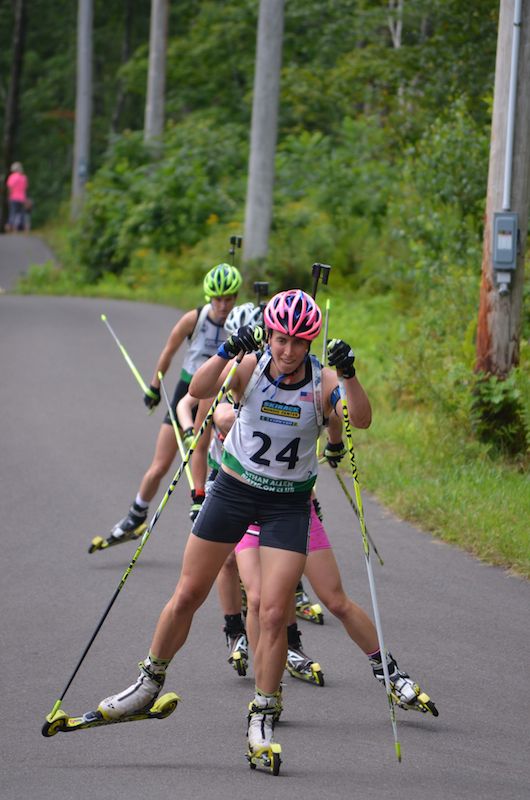
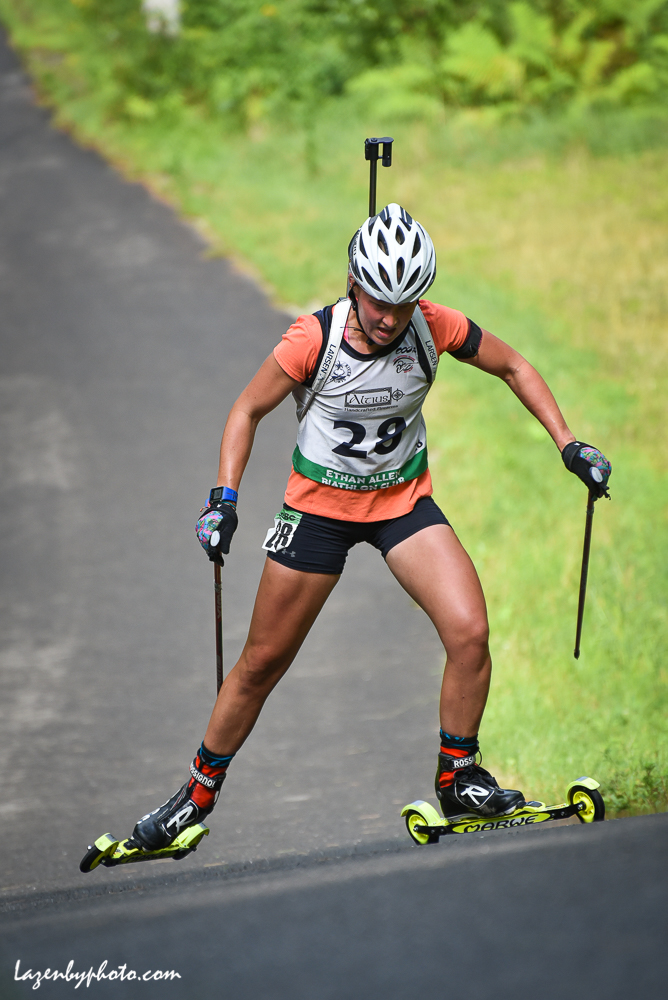
    Kelsey Dickinson (Craftsbury Collegiate Summer Team) racing to third in the women’s sprint at US Biathlon Rollerski Championships on Aug. 12 in Jericho, Vt. Dickinson had more strong performances this past weekend to secure a spot on the World Cup in December. (Photo: John Lazenby/Lazenbyphoto.com)

    For some American biathletes, there was a lot on the line in Jericho, Vermont this past weekend.

    Saturday and Sunday were rollerski biathlon competitions that served as the third and fourth of a four-race team selection series. Six athletes – Susan Dunklee, Clare Egan, Lowell Bailey, Leif Nordgren, Sean Doherty, and Tim Burke – had already booked their places for the first period of World Cup racing thanks to results from last season.

    But between one and three places still needed to be filled on the U.S. team, and the Jericho races – the first two were held at the Vermont biathlon complex in August – would be used to select a team for a pre-season camp in Canmore, Alberta. From there, the squad would be winnowed down for the December World Cup.

    Kelsey Dickinson (College of St. Scholastica) racing to 26th in the women’s 15 k freestyle mass start at 2017 NCAA Skiing Championships on March 11 at the Jackson Ski Touring Center in Jackson, N.H. (Photo: Flyingpointroad.com)

    One College of Saint Scholastica student, Kelsey Dickinson, booked her place on the World Cup. A St. Scholastica alumnus, Paul Schommer, all but did the same – he was selected to the camp, and is highly likely to also go on to the World Cup.

    Two more women, Joanne Reid of Colorado Biathlon and Emily Dreissigacker, of the Craftsbury Green Racing Project, were selected for the camp and will have to compete for the last World Cup spot.

    Even for the pre-qualified athletes, it was a weekend of important competitions, a chance to hone stills practiced over the summer and start visualizing the international competitions that will start in just six weeks.

    “It’s an important marker – it’s not nothing,” U.S. Biathlon Association Chief of Sport Bernd Eisenbichler said in an interview this morning. “We try to really run the trials like a national-level race. The Jericho crew led by John Madigan did an awesome job to put a real race on, not just a time trial. You have a bib number on, you want to perform and you want to execute the things you’ve worked on throughout the summer.”

    The Women: Three Trials Race Winners Heading to Canmore

    With the pre-qualified duo of Dunklee and Egan excluded from ranking results, Dickinson won the trials series in best-three-of-four scoring. Even with Dunklee and Egan in the results, she was only off the podium once in the four-race series.
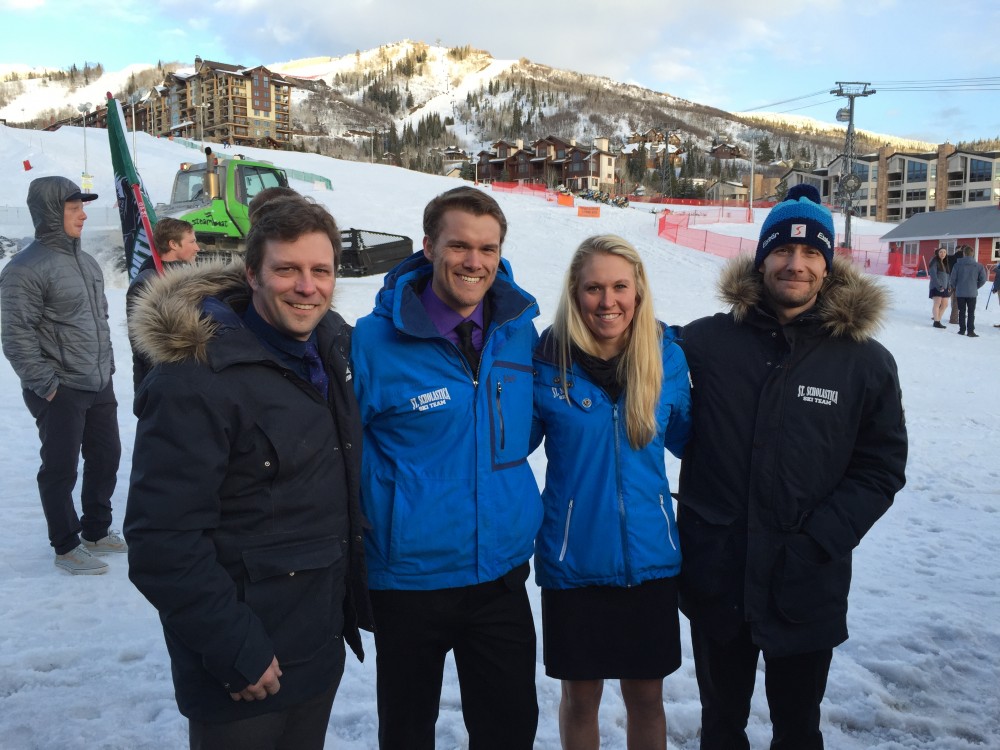
    Chad Salmela (far left) with 2016 NCAA qualifiers Reitler Hodgert and Kelsey Dickinson as well as assistant nordic coach Josh Tesch at 2016 NCAA Championships in Steamboat Springs, Colo. (Photo: Chad Salmela)

    “I’m really pleasantly surprised and impressed also with how she did that, with being outside the team environment,” Eisenbichler said.

    Dickinson was formerly an athlete at the Maine Winter Sport Center (now the Outdoor Sports Institute), but when that program shuttered its senior funding scheme in the spring of 2015 she felt she had no choice but to go back to school. Since then she has worked with coaches Chad Salmela and then Maria Stuber, and become an NCAA qualifier for Saint Scholastica in cross-country skiing.

    Dickinson spent this summer at the Craftsbury Outdoor Center training for biathlon, along with Dreissigacker and other development athletes.

    “I know that she worked quite a bit with the Craftsbury team, which was a smart move, but overall we have to give her a lot of compliments for really doing this development,” Eisenbichler said of the student-athlete. “I just talked very briefly with her on Sunday, to let her know that she won the trials… she told me pretty straightforward that biathlon is first, and she will make it work. So I have no doubt that she will make it work with her school.”

    Dreissigacker and Reid have shorter histories with biathlon, something that Eisenbichler highlighted. Dreissigacker ended up second on the ranking list, after winning Saturday’s 7.5 k sprint outright.

    “She hasn’t been in this sport not such a long time, and her biggest accomplishment right now is that she is so stable with the shooting part now already,” Eisenbichler said. “On the weekend, we had a pretty windy day on Sunday, and she was still able to shoot [just one penalty]. And the same thing on Saturday plus winning that race. I think that she really made the next step towards being a complete biathlete, although there is still some work to do from the physical side and on the skiing side.”

    https://www.instagram.com/p/BaSCsEllKbQ/?taken-by=emdreiss

    Dreissigacker has spent the last two seasons racing on the second-tier IBU Cup, where she scored her first top-20 finish in March.

    Then, there’s Reid, who made a fast jump to the World Cup when she started the sport. Last season, Reid hit the top-30 in the first World Cup competition of the year, and was also a World Championships team member.

    After the Jericho trials, U.S. Biathlon was only supposed to nominate up to two women: the trials winner (which turned out to be Dickinson) would receive an automatic World Cup spot, and one other athlete could be selected by discretion to go to the Canmore camp.

    But the International Competition Committee also selected Reid, who had beaten both Dickinson and Dreissigacker in one of the trials races.

    “It was an extraordinary discretionary choice,” Eisenbichler said. “She had, two times, health issues in the summer. I don’t want to get into details of that, but it was significant health issues that justify a discretionary choice in our eyes. And she was on the whole weekend the fastest skier last weekend.”

    https://www.instagram.com/p/BaSAnRPjQUg/?taken-by=jfiresteel

    So, five women are headed to Canmore, and either Reid or Dreissigacker will go on from there to the World Cup.

    “We are taking all the ladies who were able to win one of the trials races,” Eisenbichler said of the rankings system that excluded pre-qualified Dunklee and Egan. “The decision for the fourth World Cup starting spot… will be made after looking at the training in Canmore and also at the races we will do together with Biathlon Canada at the end of the camp. It’s not trials races. [The decision] is a combination of looking at the training, the performance level, and the racing at the end of the camp.”

    Athletes who didn’t make the cut, like 2017 World Championships team member Maddie Phaneuf, will have another chance to make the World Cup or Olympic team after Christmas based on a separate set of trials races.

    Dunklee qualified for the Olympic team after winning a silver medal in the World Championships mass start. At least one more woman will be picked for the Olympic team based on December World Cup results, but not more than two; that means at least one spot will be up for grabs come January.

    Men: Schommer Shines

    With four men already pre-qualified for the World Cup, there is only one quota spot up for grabs. The trials winner would be sent to Canmore and possibly one more athlete based on discretion.

    After the first two races, in August, both Schommer and National Guard Biathlon’s Travis Cooper had one “win” (excluding the pre-qualified athletes) to their name.
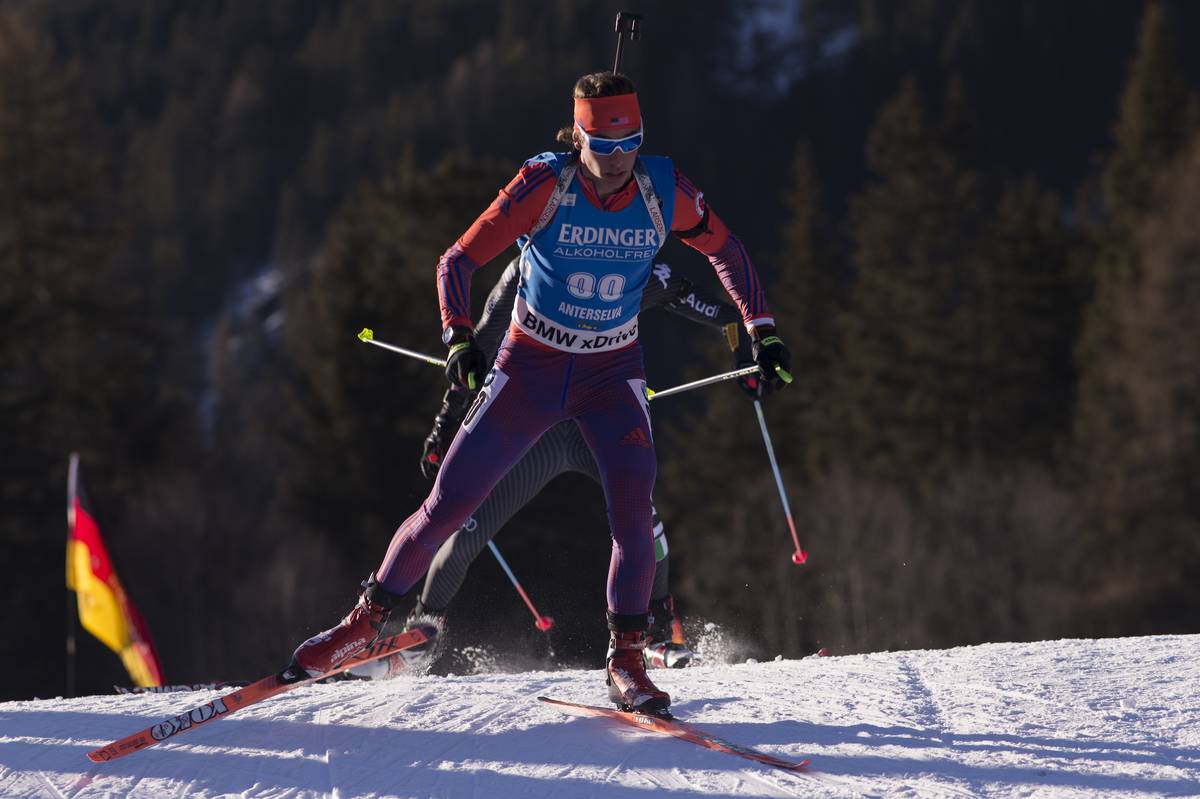
    Paul Schommer, of US Biathlon’s National Development Group, racing to 33rd in his first IBU World Cup race, the men’s 20 k individual in Antholz, Italy, in January 2017. (Photo: USBA/NordicFocus)

    But in the October races, Cooper didn’t continue the streak. Schommer did, placing second on Saturday just four seconds behind Bailey, and fourth on Sunday.

    “Paul is the clear winner of the trials by 5%,” Eisenbichler said. “If we look at the second place in the trial points, this is Russell Currier, and Paul beat him in every race of the four races. So Paul really made a big step forward this summer. He got himself mixed in with the World Cup athletes, the pre-qualified ones. He has a really high performance level right now and I’m really happy to see that… if everything goes normal he will also get the call for the World Cup team in December.”

    Currier was not chosen for the camp on a discretionary basis, so Schommer – who turned in a 33rd-place finish in his World Cup debut last season – is nearly a lock for the December competitions.

    He was new to biathlon after his time at Saint Scholastica, but has quickly made strides in the sport.

    “The goal of bringing this Talent ID project forward in 2014 was to have someone in contention for a relay spot, pushing the other four athletes on the men’s side, and having also a good shot at being very competitive at the Games,” Eisenbichler said. “And I’m again very pleased to see that this project worked.

    “Compliments to Paul with how he approached it,” he continued. “He has done it professionally now for just 2 ½ years. I think he learned a lot last season, being at the World Championships as a reserve athlete, doing some World Cups, and a lot of international races like European Championships and IBU Cups. He learned a lot, absorbed a lot. But he was also able also to put the work in during the spring, summer, and beginning of the fall to get to a higher level. I’m really pleased where he is right now – he will be a very strong contender for the Games.”

    As with the women, Currier and others will have another chance to qualify for World Cup and Olympic racing in January.

    World Cup Athletes On Track

    For these athletes, qualification woes are now mostly behind them. Up next is the camp in Canmore, which will start on October 23.
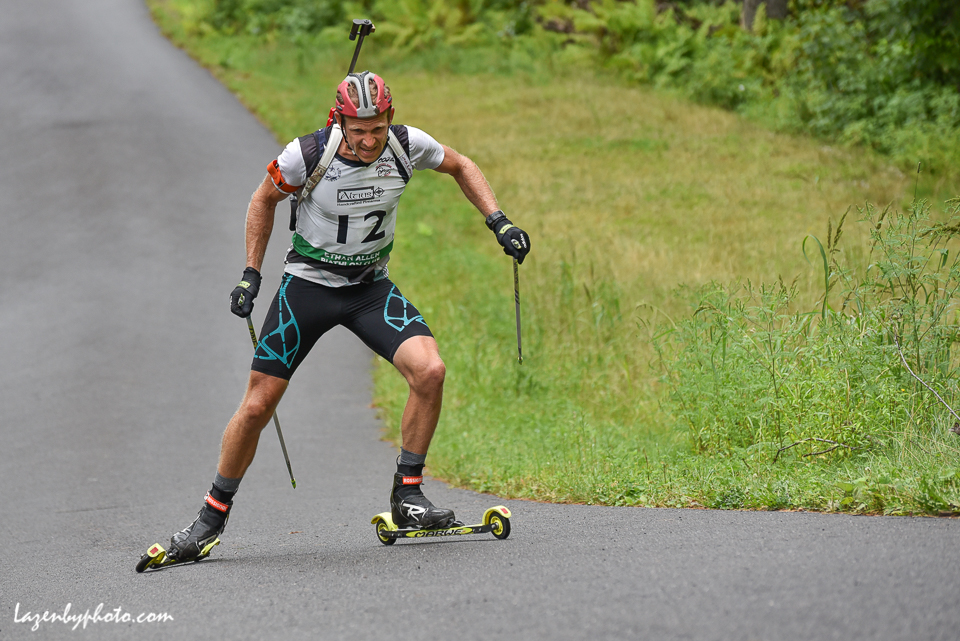
    Lowell Bailey (USBA) en route to second in the men’s mass start at US Biathlon Rollerski Championships on Aug. 13 in Jericho, Vt. (Photo: John Lazenby/Lazenbyphoto.com)

    “It’s most important to have snow kilometers and work on technique,” Eisenbichler said of the camp. “Per Nilsson, our technique guru, will be there for the entire camp so the focus for sure for most of the athletes is to work on technique on skis. Following up from the May work in Bend and the summer work in the Oberhof ski hall. For us it’s really important to have this frequent snow contact in summer and fall.”

    After that, athletes will have about ten days at home before heading over to the World Cup. There, a different kind of qualification may be on their minds. Dunklee and 2017 World Champion Lowell Bailey are qualified for the Olympics already, but one or two more athletes of each gender can make that team through strong performances at the December World Cup.

    And ultimately, they are looking to perform well once they get to the Olympics.

    For the athletes who didn’t have to worry about World Cup qualification last weekend, Eisenbichler said that the races were still an important marker, but also didn’t serve the same function as for those who still needed to snag their spots.

    “These races are kind of markers on the way for these pre-qualified ones, but it’s not really trials races for them,” he explained. “It’s a little bit different to come into the races with full training, compared to preparing at least a little bit for them as you have to if you need to qualify.”

    As a result, some of the World Cup regulars didn’t turn in their best days, but on the whole, that didn’t bother team staff.

    “He came out of a really good and hard block of training,” Eisenbichler said of Tim Burke, who finished fifth and seventh this weekend. “He had super time trials the week before in Lake Placid, so we feel very confident that he is on the right track. This week he was very tired from training, and then racing is not that easy on a high level. For sure he wanted and expected to be on a higher level, especially on the shooting part. But I’m not worried about him.”

    Likewise, Leif Nordgren placed 13th on Saturday with six penalties, but turned things around on Sunday to finish third overall.

    https://www.instagram.com/p/BaR6J7XjCtb/?taken-by=leifcnordgren

    “It was a really bad race on Saturday,” Eisenbichler said. “He really had to put his head down on Sunday. Even if you are pre-qualified, you have a responsibility to be competitive at these races. That’s clear. So he did that on Sunday, and that was good to see, it was really important for us.”

    Bailey won both races over the weekend and shot perfectly on both days. Dunklee didn’t race, as she was getting over a cold. Doherty placed third on Saturday and second on Sunday, and Eisenbichler was pleased with that.

    “Sean showed some really big improvement on the skiing, which was expected after he went through the mono stuff last year,” he said. “So that’s back on track. Still the prone shooting for Sean needs work and improvement for the World Cup. It’s not good enough right now.”

    And Egan won Sunday’s race.

    “We are pretty pleased with what we saw throughout the summer,” Eisenbichler said of her training. “With skiing especially, technique-wise she is getting on a higher level. She didn’t have a super race on Saturday, but had a better day on Sunday. And it’s still for her getting the momentum for a good complex biathlon performance. And that’s pretty normal for mid-October. I think she’s on the right way.”

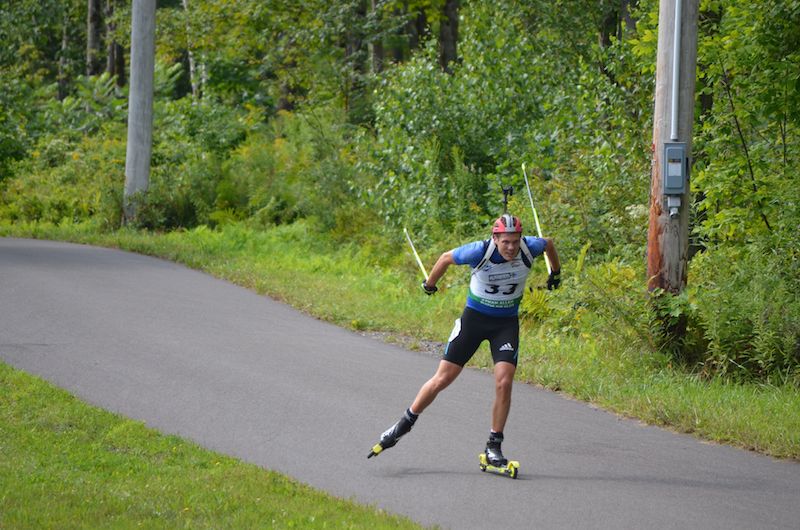
    Trials race results: Aug. 12 | Aug. 13 | Oct. 14 | Oct. 15

  • Burke, Smith, and Dunklee Take Wins at Jericho Biathlon Races (with Photo Gallery)

    Burke, Smith, and Dunklee Take Wins at Jericho Biathlon Races (with Photo Gallery)

    Tim Burke of the U.S. National Team on his way to a 4.5-second win over Canada's Nathan Smith in the sprint in Jericho, Vermont, on Saturday. (Photo: Paul Bierman)
    Tim Burke of the U.S. National Team on his way to a 4.5-second win over Canada’s Nathan Smith in the sprint in Jericho, Vermont, on Saturday. (Photo: Paul Bierman)

    More than 80 biathletes from across North America and even Sweden converged on Jericho, Vermont, this weekend for the annual rollerski biathlon championships race series.

    Tim Burke (USA) won the sprint and Nathan Smith (Canada) the mass start, for men, while Susan Dunklee (USA) swept the women’s races. The American “A” team as well as Smith had just returned from training camps in Europe.

    “I think it was a very good weekend,” U.S. Biathlon Association Chief of Sport Bernd Eisenbichler said. “I was especially happy that Nathan Smith decided pretty last minute that he would come too. The other Canadians had been confirmed for a while. So it was a very competitive field at the senior level, and it was pretty high numbers overall.”

    That meant nine Canadian clubs, 16 American clubs, juniors from the Solleftea Ski Gymnasium in Sweden, and a few without affiliation were all competing together, from a girls and boys age group for 14- to 16-year-olds, to a masters age group for 35+.

    With high temperatures, the weather presented an extra challenge to athletes. But they had the incentive of competing on the Ethan Allen Firing Range, which was just repaved in July and has had new Kurvinen automatic targets since last year.

    Susan Dunklee racing to a win in the mass start. (Photo: Paul Bierman)
    Susan Dunklee racing to a win in the mass start. (Photo: Paul Bierman)

    That makes it a perfect place for competition, and more biathletes are using the venue this year than they have recently.

    “We have communication and partnership with the army, so they will allow us to be there as much as we want from the national team side,” Eisenbichler said. “We will go four times this year. The range is also very challenging, so it’s good for training.”

    On Saturday, three-time Olympian Burke mastered that challenge by eking out a 4.5-second win over World Championships silver medalist Smith, despite having one more penalty than the Canadian.

    Burke’s U.S. national team teammate Leif Nordgren placed third, 16.5 seconds back, and Casey Smith of the Craftsbury Green Racing Project, recently recovered from breaking his back in a training accident this winter, placed fourth with perfect shooting.

    On the women’s side, Dunklee cruised to a big win in the sprint, despite having two penalties. Canada’s Emma Lunder followed in second with one penalty, a minute and two seconds back, with American Hannah Dreissigacker five seconds behind her.

    On Sunday, the seniors competed in mass starts, where Smith took a decisive 22-second win with four penalties.

    The breakout of the day belonged to 20-year-old Jakob Ellingson of Loppet Nordic Racing and Mount Itasca Biathlon, who had just two missed shots over the four-stage race to finish second.

    “He worked really really hard these last months,” Eisenbichler said. “You can see that. I was very impressed by his performance, especially yesterday but also on Saturday he had a good race.”

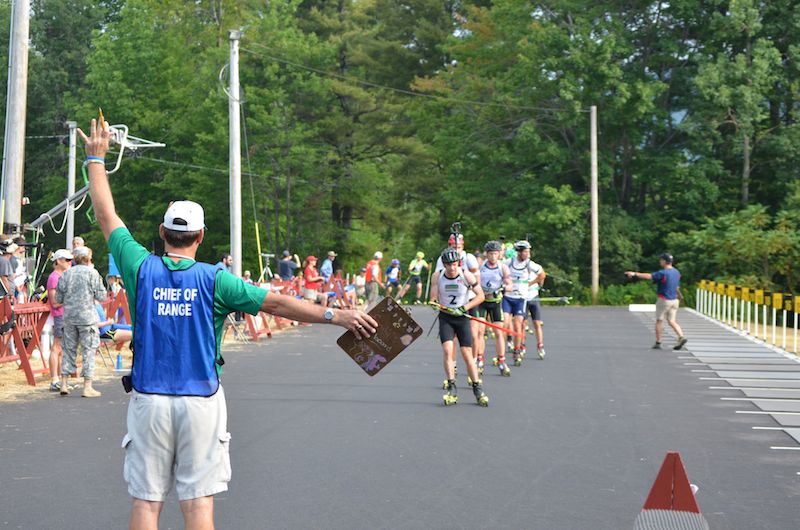
    Nathan Smith of the Canadian national team leading the men onto the newly paved range in the mass start. (Photo: Paul Bierman)
    Nathan Smith of the Canadian national team leading the men onto the newly paved range in the mass start. (Photo: Paul Bierman)

    U.S. national team members Sean Doherty and Nordgren placed third and fourth, with Scott Gow in fifth as the second Canadian.

    Dunklee again ran away with the women’s race, this time winning by a minute and a half over Lunder. The two had five and six penalties, respectively. U.S. “A” teamer Annelies Cook placed third with eight penalties.

    In the other age classes, Arvid Aronsson (Solleftea Ski Gymnasium) swept the junior men’s races, Bjorn Westervelt (Craftsbury Nordic) swept the boys’ races, Joseph Iwan (Saratoga Biathlon) swept the masters men’s races, and Emma Stertz (Mount Itasca) swept the girls’ races.

    For junior men, Matthew Forshey of HURT won the sprint but Cody Johnson of the Maine Winter Sports Center prevailed in the pursuit.

    For junior women, Siena Ellingson of Ginger Biathlon won the sprint but sat out the pursuit, where Charlotte Hamel of ACBQ (Quebec) took the win.

    For youth women, Amanda Kautzer of Loppet Nordic Racing and Minnesota Biathlon won the sprint, but was caught by Chloe Levins of Mountain Top Nordic in the pursuit.

    “For us it’s really important to keep the national team together with the younger athletes to make a good festival character for this weekend,” Eisenbichler said. “Plus with the Canadians coming and some junior Swedish athletes were there, it was an overall good competitive character.”

    Results: Saturday / Sunday


  • Continuing a Summer Tradition, Lanny Barnes Picks Up Two Rollerski Biathlon Titles in Jericho

    Continuing a Summer Tradition, Lanny Barnes Picks Up Two Rollerski Biathlon Titles in Jericho

    Lanny Barnes powering her way to a sprint victory at the North American Rollerski Biathlon Championships on Saturday in Jericho, Vt.

    JERICHO, Vt. – If one thing is constant in summer biathlon races here at the Ethan Allen Firing Range, it’s the sight of Lanny and Tracy Barnes near the top of the results sheets. Since 2009, only one of the sisters, Tracy, has been off the podium – and it was just once. Lanny has won the majority of the races.

    And the 2012 edition of the North American Rollerski Biathlon Championships was no different. Lanny Barnes won Saturday’s 7.5 k sprint by almost 20 seconds, and then doubled down to take the 10 k pursuit title by over a minute.

    Tracy Barnes placed third in the sprint, behind Claude Godbout of Quebec, before moving up in the pursuit to finish second behind her sister.

    The key for both of the Durango-based twins was shooting: over two days and a combined total of six shooting stages, or 30 shots, Lanny missed two targets and Tracy three. The other women in the race had at least four penalties in the pursuit alone.

    Neither Barnes was available for comment.

    Godbout approaching the range on Saturday.

    Godbout, a native of Valcartier whose only World Cup experience was at the 2011 races in Fort Kent and Presque Isle, Maine, was happy with her podium finish on Saturday, but hesitated to draw conclusions about how she would stack up against the U.S. national team women she beat once the races moved to snow.

    “It’s different, seeing that we all have different rollerskis and even if you have the same brand, sometimes the wheels are just used,” Godbout said after the race. “So yeah, you can compare with each other, but it’s never the same from the summer to the winter.”

    Nevertheless, she appreciated the chance to race against some more experienced Americans.

    “Susan [Dunklee] passed me on the second loop, and you see how she skis, and she’s really fast so you try to stay with her,” Godbout said. “And that’s fun because I’m training with three younger girls in Quebec City, so to be here training with older people who are super strong is always fun.”

    Godbout is in the midst of a major increase in volume, as part of her bid to make the Olympic team in 2014; Sochi, she said, is her main focus. As a result, she didn’t feel like she had her top gear with her this weekend. But that wasn’t the point.

    “It’s been a while that I’ve been training and always doing the same things,” she explained on Saturday. “So I’m trying this year to change my training a little bit and to do a lot of training, a lot of volume, and see how it goes. If it doesn’t work, then at least you tried and you still have one more year. So we’ll see how it goes. Right now I’m happy with today.”

    Dunklee, like many of her national team teammates, was undone by shooting in the sprint: along with Sara Studebaker, Hannah Dreissigacker, and Corinne Malcolm, she shot one penalty in prone and four in standing, for an overall total of fifty percent. But despite five penalties to Tracy Barnes’ two, Dunklee was just nine seconds behind her in fourth place.

    Tracy Barnes approaching the range on Saturday.

    “I just didn’t feel very settled,” Dunklee said of her standing stage. “Sometimes if I miss the first two shots I’ll kind of reset, put my head up, look at the targets and start over again, but I’m not really sure why [that didn’t help].”

    She did have one idea to explain her poor performance on the range. A fierce competitor, Dunklee had gotten wrapped up in trying to keep up with the men once they started the race a few minutes after the women.

    “On that second loop I got excited because they guys had started, and they began passing us and I’d say, ‘I’m going to stick on this one,’” she explained. “So I did these little miniature sprints all over the loop. I didn’t pace myself very well. I just really like trying to ski behind people who are faster, and trying to pick up on their technique… [skiing with the men] when we’re going hard doesn’t happen very often.”

    U.S. women’s coach Jonne Kahkonen wasn’t quite sure why his athletes struggled on the range on Saturday, but hypothesized that the first real races of each summer are always much more difficult than training. He also mentioned the heat and humidity, which sapped athletes’ energy this weekend.

    “I don’t know what reason, but it always seems like the first tough effort here takes some adjusting,” Kahkonen said. “For us coming from Lake Placid, it’s just a little bit different approach, maybe [the uphill into the range] and the different terrain. So it seems like that plays a role, but they can adapt pretty quickly now. I’m expecting a little bit better for tomorrow.”

    He was right: none of the women in the field shot fifty percent or worse in the pursuit, although none attained the Barnes standard of perfection, either.

    Studebaker competing in Saturday’s sprint.

    In part because she is pre-qualified for a training camp in Sweden in November, which these rollerski races serve as trials for, Dunklee skipped Sunday’s pursuit.

    “I feel like the last couple years every single race I’ve been in has been a trials race of some sort, and it was so nice to not have to deal with that,” she laughed.

    Instead, it was the other pre-qualified athlete, Studebaker, who broke into the top three when Godbout faltered with eight penalties. Studebaker had placed a disappointing seventh in the sprint, and started the pursuit about 80 seconds behind Godbout.

    “It’s always nice to move up in a pursuit, and today was no different,” Studebaker wrote in an e-mail this morning. “Going into the last loop Annelies [Cook], Claude, Yolaine [Oddou] and I all left the penalty loop right near each other so I had a good time chasing people down and trying to end on a high note. It was definitely nice having the Quebec biathletes come down and add some depth to our field since we get to race each other all the time.”

    Kahkonen said that he had been chatting with Jean Paquet, the Quebec-based Canadian men’s team coach, about how to have more joint race opportunities and even training camps.

    “I think it’s always good [to have them],” he said of the Canadian athletes. “I always say that there’s only so many of us, so we should try to get the North Americans together. I hope we can do this more in the future.”

    Results: sprint / pursuit

    Craftsbury Green Racing Project and USBA “B”-teamer Hannah Dreissigacker takes to the range in Saturday’s sprint race.