From the FasterSkier archive — posts syndicated from athletes’ and coaches’ own blogs between 2004 and 2012, kept online as published. Current coverage is at fasterskier.com.
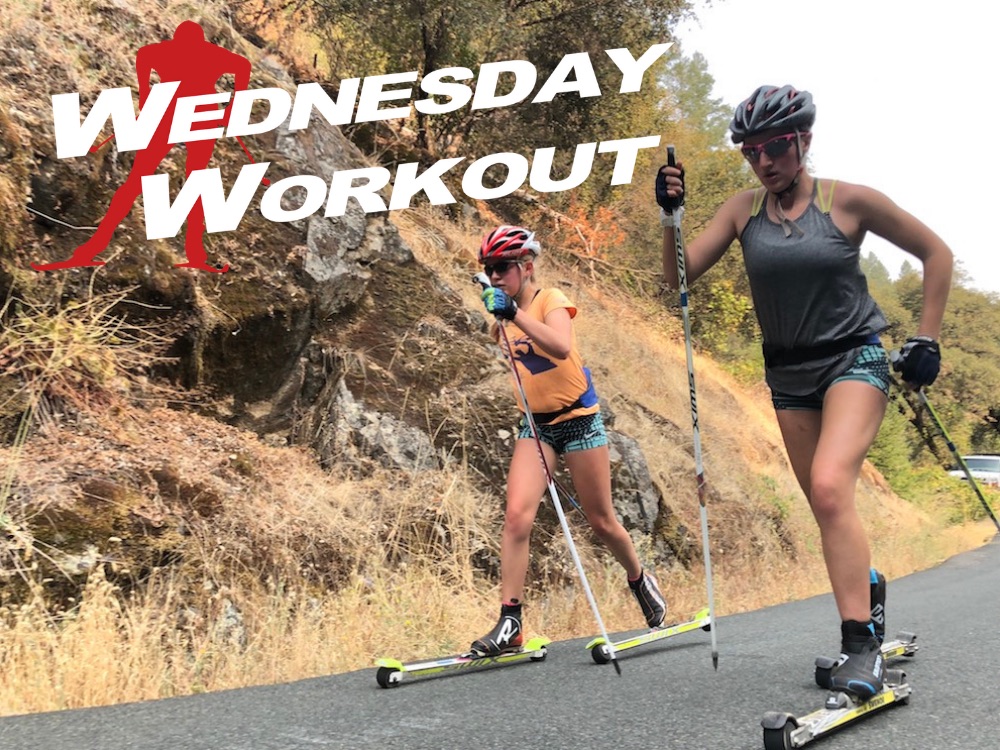
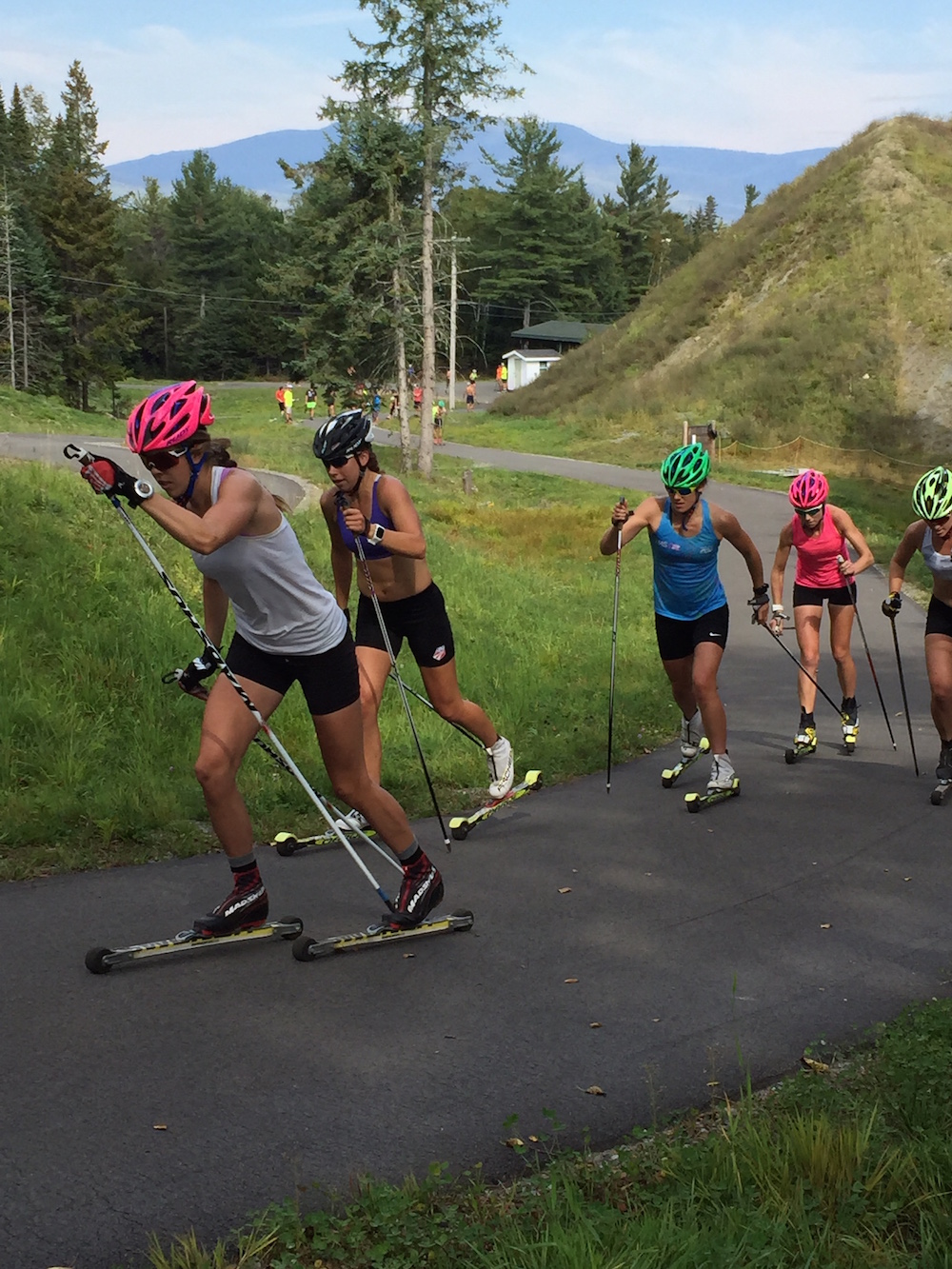
Kili Lehmkuhl (l) and Lilly Murnane of the Auburn Ski Club Training Center striding on Iowa Hill Road near Colfax, California, on Aug. 26. (Photo: Gus Johnson)
This Wednesday Workout came to us just over a week ago from Gus Johnson, nordic program director and head coach at the Auburn Ski Club Training Center (ASC-TC) on Donner Summit in California. Have a workout of your own (or one of your club’s) that you’d like to share? Send submissions to info@fasterskier.com with the subject line “Wednesday Workout”.
***
August proved to be smoke season in California for the Auburn Ski Club Training Center athletes, but a few days of clear air has given us the opportunity to put in some late summer intensity. Like many athletes across the west, ASC-TC athletes have had to adjust their training to be flexible with the wind and smoke patterns this summer. When the smoke outside became unhealthy, workouts consisted mainly of focusing on technique and shorter sessions, or finding alternatives for indoor training.
Auburn Ski Club Training Center is located on Donner Summit at 7,200 feet above sea level, but has easy access (within one-hour drive) to rollerski locations at elevations around 1,000 feet. This week, with a change in the weather and the sunny skies California is famous for, the Auburn Ski Club Training Center Comp Team headed down to Colfax, California, to rollerski Iowa Hill Road for some Level 4-5 (L4-L5) intervals.
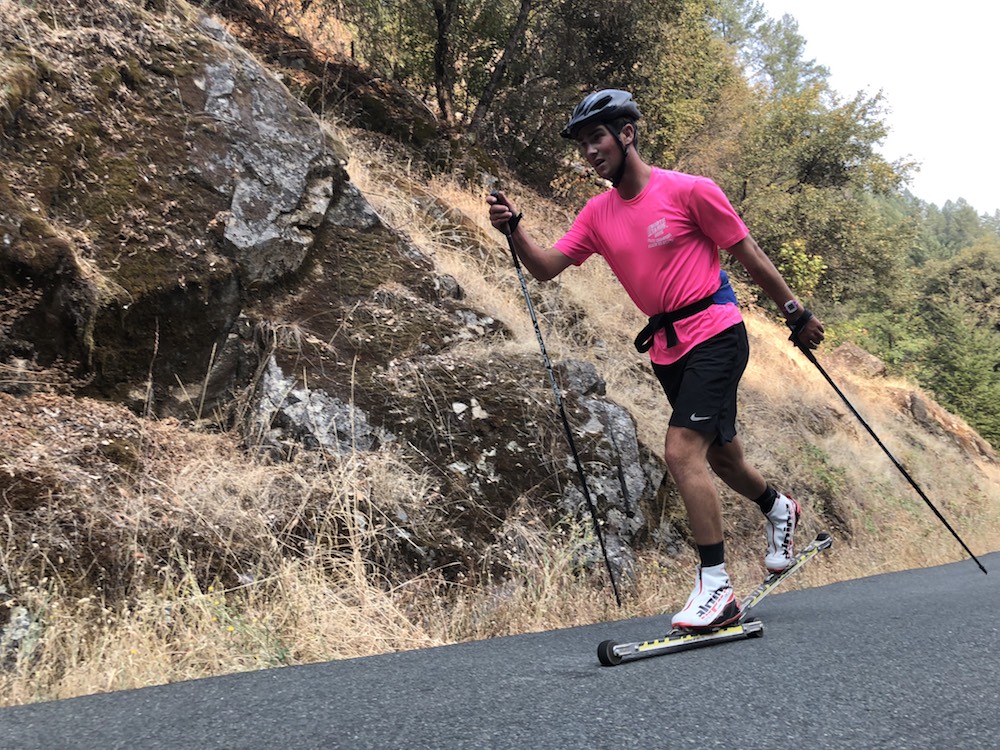
Max Roske of the Auburn Ski Club Training Center striding on Iowa Hill Road near Colfax, California, on Aug. 26. (Photo: Gus Johnson)
With Junior Nationals at sea level this year in Anchorage, our altitude athletes are looking for ways to inject some pace into their normal ski preparations. Our team typically plans at least one week-long training camp on the California coast, and several mini camps at low altitude for hard rollerski intervals and speed sessions. We’re lucky to be able to hop in the car on short notice and find cheap campgrounds to stay at for low-altitude over the weekends. It spices things up whenever we feel things getting stale at home in the mountains.
The base of Iowa Hill Road starts around 1,000-feet elevation in the river gorge of the North Fork of the American River and climbs up to Colfax at 2,100 feet. We find the session to be both a test of mental toughness and a great opportunity to challenge our fast-twitch muscles.
The workout:
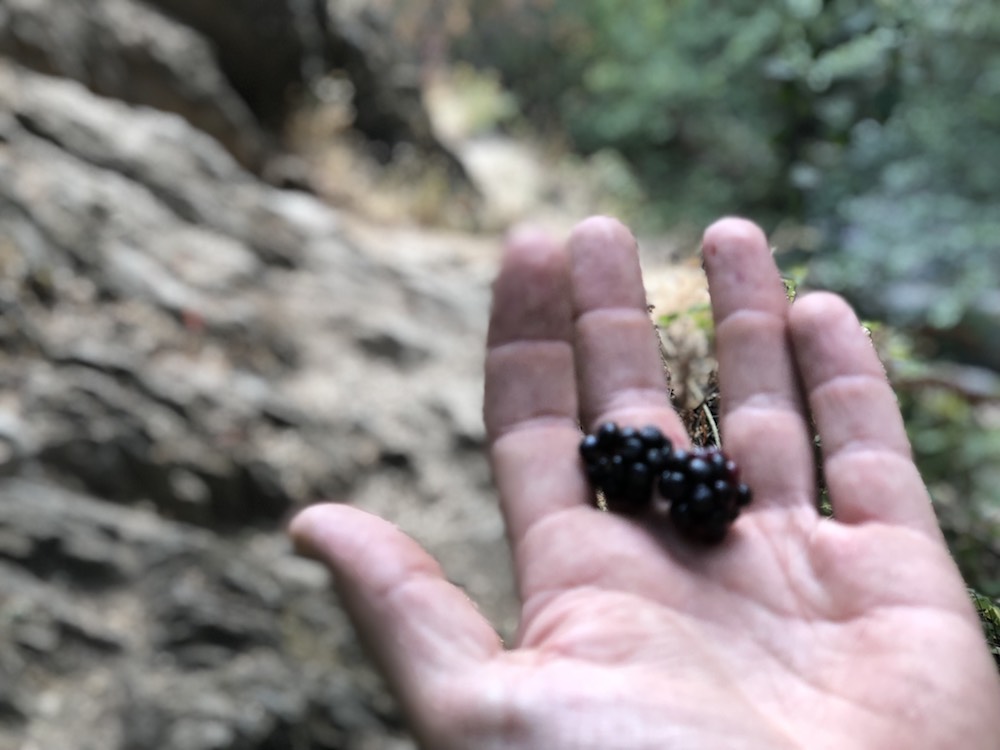
Blackberry picking doubles as a warmup for Auburn Ski Club Training Center athletes in California. (Photo: Gus Johnson)
Warmup (on foot): 10-15 minutes of easy jogging (hunt for blackberries)
– 5 minutes of dynamic warmup (A-skips, B-skips, agility ladders, and dynamic stretching)
Change into the rollerski gear
– 4-6 short speeds, starts, and lunges, each about 8-seconds long
– 4 x 1-minute classic rollerski intervals (L4+) uphill with 1-minute recovery, followed by 2 x 5 minutes with 3-minute recovery, and another set of 4 x 1 minute intervals.
Cool down
***
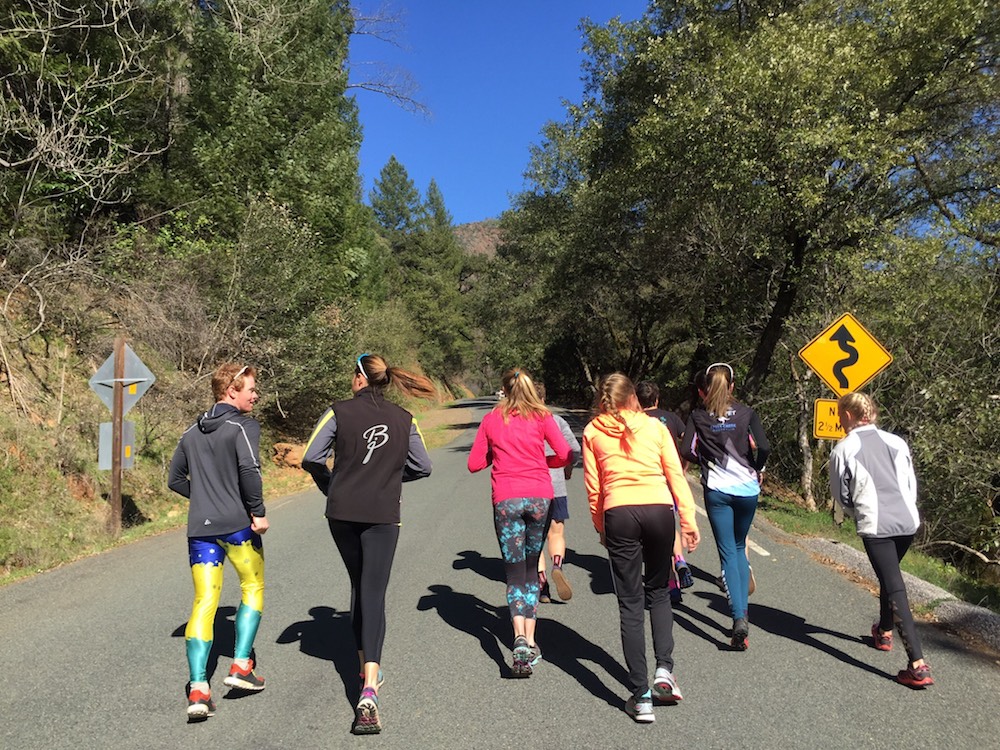
Auburn Ski Club Training Center skiers warm up on Iowa Hill Road near Colfax, California, on Aug. 26. (Photo: Gus Johnson)
About the Auburn Ski Club Training Center:
The ASC Training Center is a premier training and racing venue in the western U.S. with programming for all ages and ability levels across four ski and snowboard disciplines (alpine, cross country, biathlon, and snowboard). Our institution’s roots go back to the club’s founding in 1928 (we were instrumental in the development of ski culture and ski tourism in California), and that legacy continues today with a bid to host the 2020 xc junior national chamionships. We have hosted the XC Junior Nationals four times to date, the US Ski and Snowboard Supertours twice, as well as the NCAA National Championships and the US Biathlon Nationals. Whether it is as a training and racing venue for the region or as a part of our programming, it is safe to say ASC-TC plays a significant role in the development of all Far West Nordic skiers.
The ASC-TC Competition team is made up of athletes from all across the greater Northern California and Nevada region and is for athletes ages 14-19. The majority of Comp Team athletes live and train near the Truckee and Tahoe area, but some athletes are based out of the sierra foothills (Grass Valley, Colfax, Nevada City, and Auburn) and even some as far away from snow as the Bay Area will come up and ski with the team on weekends or gain race support at events. Our programming is year-round and strives for flexibility to support both elite junior racing as well as participation for athletes whom skiing is only one of their many passions.
Olivia Bouffard-Nesbitt rollerskiing in Sainte-Anne-des-Lacs, Quebec, last summer. (Courtesy photo)
It’s May 2 and the overall NorAm leader heading into the 2018/2019 race season, Olivia Bouffard-Nesbitt, is champing at the bit to get back at it. Like most other pro nordic skiers, the 25-year-old Morin Heights, Quebec, native spent the last month getting some off-ski R & R, which wasn’t completely devoid of snow. In April, Bouffard-Nesbitt and her boyfriend went surfing at Lawrencetown Beach near Halifax, Nova Scotia (brrr!).
Olivia Bouffard-Nesbitt snaps a photo of her boyfriend Stuart and their boards while surfing in April near Halifax, Nova Scotia. (Courtesy photo)
“I was planning to travel somewhere a little more exotic later in April but opted to get all my wisdom [teeth] pulled out instead,” Bouffard-Nesbitt wrote in an email.
She planned to return to her training base in Canmore, Alberta, next week, where she’ll be “jumping right back on snow and right into some training camps” with her team, Rocky Mountain Racers (RMR). They’ll start the training season at Sovereign Lake in Vernon and Penticton, British Columbia, then head south to Bend, Oregon, in early June.
“I can’t even tell you how excited I am to dive head first into this training season!” wrote Bouffard-Nesbitt, who has had previous seasons derailed by a myriad of injuries.
Despite a late start, she finished last winter as the first Canadian woman in the overall NorAm standings, earning World Cup starts in November and December later this year.
So what’s one of the workouts she’s looking forward to this spring? That would be Rocky Mountain Racers’ “most tried and true workout”, which can be done skiing, rollerskiing, ski striding, or even biking.
“It’s simple, it’s appropriate for pretty much any time of the year, and it’s reliable,” Bouffard-Nesbitt explained. “I found myself really looking forward to doing these intervals after coming back from injury. This workout kind of feels like ‘home’ for me, and I trust it to get me fit in a short period of time.
“It’s funny, even just thinking about this workout makes me happy, that’s how good it makes me feel,” she added. “When I got back to Canmore and started doing some on-snow intensity last December I was nervous about my fitness, but after a few of these types of workouts, within two weeks I already felt way more confident in my fitness and my race readiness.”
The workout: 6-8 x 5-minute Building Intervals
Warmup: 15-30 minutes of easy Zone 1 skiing
“We usually do a lap or two of the predetermined interval course to get familiar with it. I like to get up into zone 2 near the end of the warm up to get my technique right and set my technique intentions for the intervals.”
Intervals: 6-8 times 5 minutes, building from interval to interval, with around 3 minutes of rest.
First interval: Below threshold to wake up the body.
“The goal after the first one is to increase the distance you cover over every consecutive interval.”
Last two intervals: should be harder, “definitely into race pace. On the last two intervals we also like to increase the effort within the interval, so the last minute would be flat out.”
More on “building”:
“I like the building aspect because you’re not demanding a huge effort of yourself right off the bat. You get really familiar with how much your body can handle, and I love the feeling of just having the reins cut loose for the last interval and seeing how much further I can push.
“Mentally it just feels great to go further and further every interval, and I love the challenge near the end of the set to make sure you’re primed to push harder in the next interval, and to convince yourself that you always have more in you. The last interval is usually pretty hard, but you rarely get to the end of the workout feeling crushed, because the intervals aren’t too long and you’re really only pushing hard at the end. So it covers everything from threshold to race pace and gives you a great race feeling by the end.”
Cool down: As long as you need, usually around 30 minutes.
“I love this workout because I feel like it gives me everything I need, including a bit of mental conditioning and confidence,” Bouffard-Nesbitt wrote. “It’s nice to start the intervals with a controlled effort to get a sense of how your body feels that day. Building from interval to interval allows you to work on your pacing because you’re always trying to make it further than the last interval while conserving just enough energy to go further on the next one. Seeing how much your increase in effort translates to the extra distance you covered also helps you become more efficient.
“I’m paraphrasing my coach John [Jaques] here to summarise – this workout is great because you are taxing different energy systems all within the same interval set,” she concluded. “And it’s a low-risk and adaptable workout in that you only continue to build if you can handle the previous interval.”
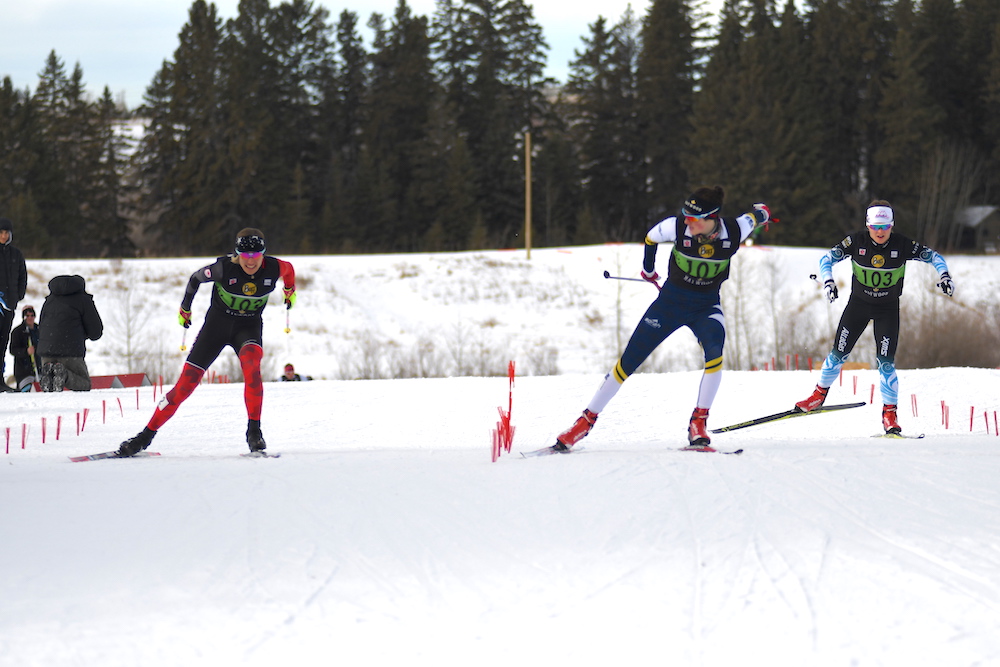
Olivia Bouffard-Nesbitt (c) holds off Zina Kocher (l) and Annika Hicks (r) to win the women’s freestyle sprint final at 2018 NorAm Western Canadian Championships in January in Red Deer, Alberta. (Photo: Doug Stephen)
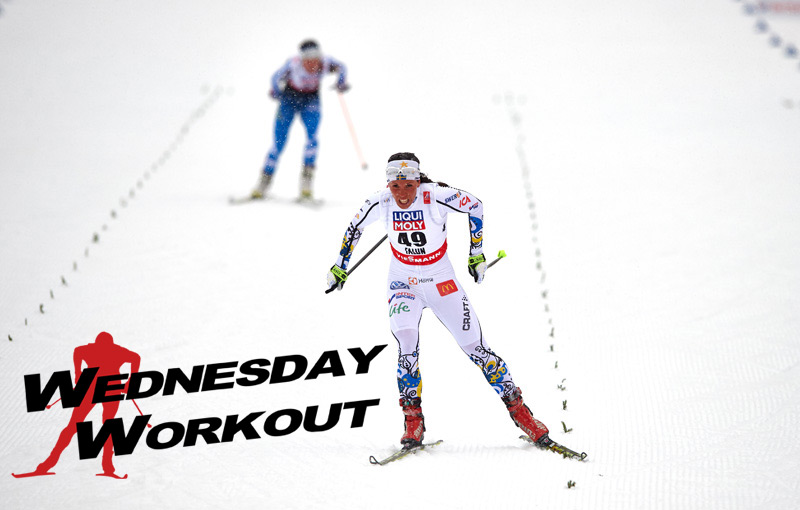
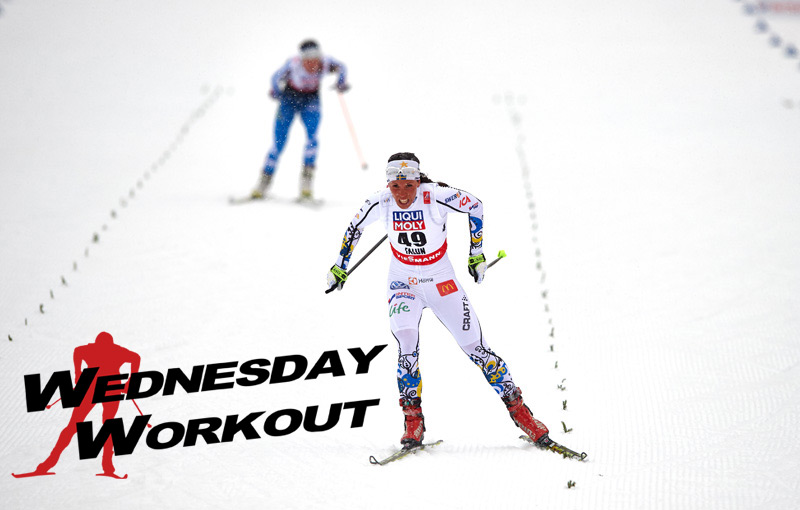
Charlotte Kalla of Sweden skiing to a monster win in the 10 k skate at 2015 World Championships on home turf in Falun, Sweden. (Photo: Fischer/NordicFocus.com)
Fresh off an interview with Nordic Nation, Sweden’s 29-year-old Charlotte Kalla offered up a Wednesday Workout for those looking for technical sharpness and speed on flatter terrain. Here’s the workout straight from the combined 17-time world champ and Olympic medalist.
“This time of year I take the opportunity to work on keeping my speed up also on flatter terrain,” Kalla wrote in an email. “I usually go interval training uphill during summer and fall. It is simple to just move yourself up to the top of the hill by roller skis and you know you will have a higher heart rate just by getting there. When I do intervals in flatter terrain I have to be more focused on my technique and to keep the speed up. It is important to be able to keep up the speed during competition also on the flat.”
The workout:
Warmup: 20 minutes easy skiing
10 minutes of intervals (85-90% of max heart rate). After that, easy skiing for 2 1/2 minutes. Repeat 5 times and focus on having a good technique and keeping up the speed.
Cool down: 20 minutes slow skiing
The video below provided by Kalla was taken on May 24 when indeed she worked on speed and technique in flatter terrain.
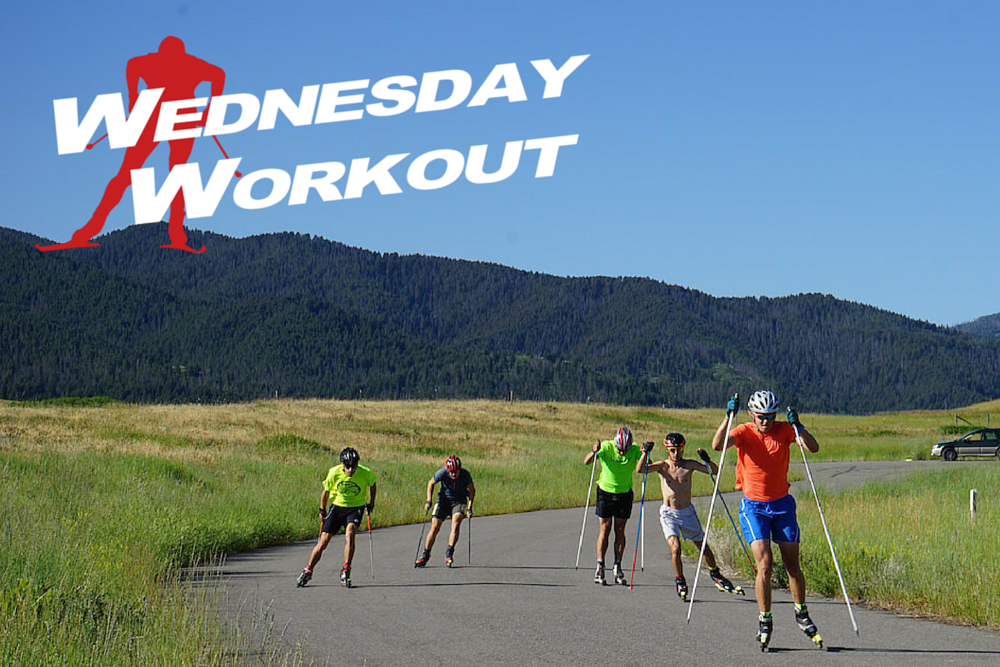
The Bridger Ski Foundation summer elite and post-graduate crew from left to right: Nick Power, Paul Everett, Silas Talbot, Max LaChance, and Logan Diekmann during a rollerski in Bozeman, Mont. (Photo: Austin Caldwell)
Along with fleeting daydreams of snow-covered fields, the summertime for many nordic skiers and coaches brings the search for another surface: perfect pavement. Afterliving in Bozeman, Mont., for the past two months working as the new head coach for the Bridger Ski Foundation (BSF) elite program, Austin Caldwell deemed the newly paved roads running past Triple Tree Ranch his rollerski route of choice.
The best part about the route for Caldwell, however, is not just that his athletes do not have to dodge potholes or endure the consequential leg gyrations from rollerski wheels passing over pebbles. It’s also the interval loop the location provides.
Performing interval pieces on the same loop, to Caldwell, offers athletes an opportunity to track their improvements not only through one workout, but over the course of many. Caldwell’s workout of choice is done at threshold on the same loop so that athletes can track improvements as the workout progresses.
The Bridger SKi Foundation summer elite and post-graduate crew during a roller ski in Bozeman, Mont. (Photo: Austin Caldwell)
Caldwell says that the athletes should then return to the same location and perform the same workout a grand total of four times in the summer and twice in the fall. In order to track performance gains, Caldwell has his athletes calculate their average heart rate during each interval piece, along with the amount of time it took to complete.
“The main thing that I like about this workout is that people can look back at it over time and see improvements,” Caldwell explained on the phone. “We look at the average heart rate and look at the times down for each interval and it’s a workout we’ll come back to a few times throughout the summer and a couple times in the fall as well, so you can see improvements throughout the year and I think that that is very motivating in the long run.”
The Workout: L3 Rollerski Intervals on a Loop
Find: A smoothly paved loop that takes 13-15 minutes to complete. Use this for the intervals.
Warmup: 30 minutes skiing easy Level 1 (L1) with one Level 2-Level 3 piece
The set: 4 x 15 minutes
Each interval piece should be done on the same loop
5 minutes recovery between each 15-minute interval
Cool down: 30 minutes easy L1
Total time: 2:15
Paving the Way to Better Performances: Caldwell’s Top Two Tips
1. Summertime = strategy testing. According to Caldwell, summer is the time to test different pacing strategies, transitions, and technique work, especially during longer threshold workouts such as the one outlined above. “I like this workout because it gets people to actually think about where they’re going hard, where they’re pushing themselves and where they can recover,” he said. “In a workout like this at this time of the year, I tell [my athletes] to try different things and see what’s working for them, what’s making it easier? Focus on a certain up hill or relax until the top of the hill and hammer the flat … hop in behind people, stuff like that.”
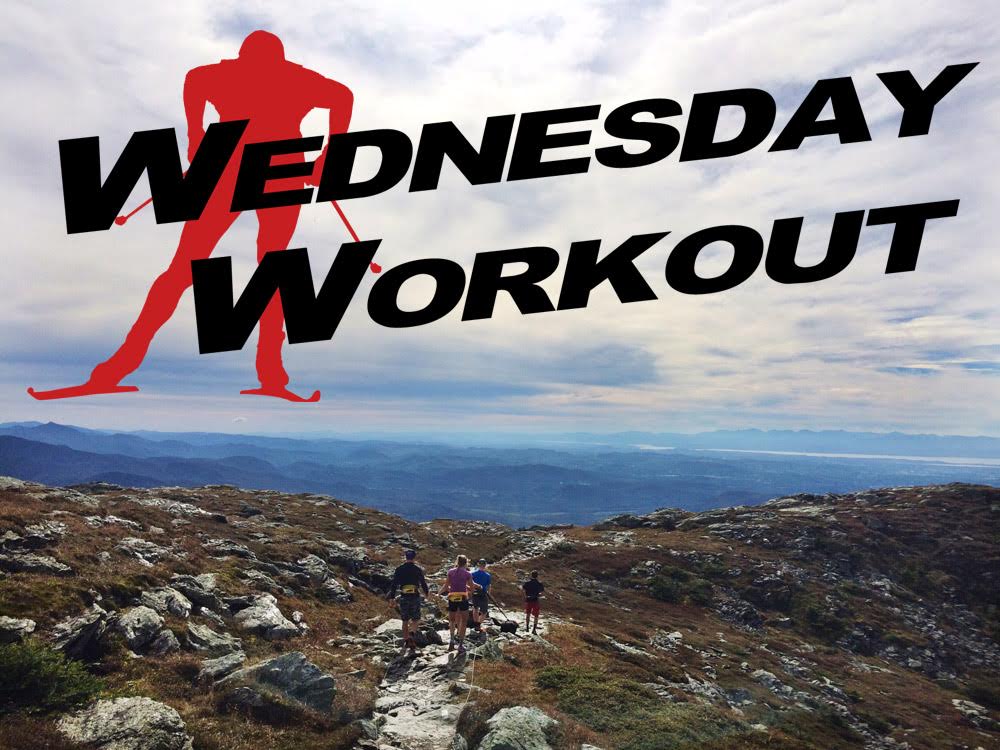
The Sun Valley Ski Education Foundation (SVSEF) Gold Team hiking down from Mount Mansfield, Vermont’s highest peak, in early September. (Photo: Paige Schember)
For this week’s workout, we turned to Mary Rose of the Sun Valley Ski Education Foundation (SVSEF) Gold Team. On Sunday, Rose, 24, won the ninth-annual Climb to the Castle by 32 seconds over US Biathlon’s Annelies Cook. After two weeks of dryland training on the East Coast, first with the Stratton Mountain School (SMS) T2 Team in Vermont, then with the National Elite Group (NEG) and U.S. Ski Team in Lake Placid, N.Y., Rose sent us this workout — Level 4 uphill rollerski intervals — from her travels.
***
Sun Valley’s Mary Rose (l) leads Katherine Ogden (SMST2/USST), Annie Pokorny (SMST2), Erika Flowers (SMST2), and Paige Schember (SVSEF) during a sprint simulation at the Olympic Jumping Complex rollerski trails in Lake Placid, N.Y. (Photo: Colin Rodgers)
Every individual has his or her strengths and weaknesses when it comes to cross-country skiing. It is important to train your weakness because there is usually a lot of room for improvement.
The Sun Valley SEF Gold Team spent two weeks out East in Stratton, VT and Lake Placid, NY for a low-elevation training block. This camp was extremely productive for all of us because we were able to train some of our weaknesses: speed and pacing at low elevation, and rollerskiing in steep terrain.
One of the most beneficial workouts during this training block was a Level 4 uphill rollerski interval session. This is a great session if you don’t have a strong V1, are not strong climbing in skate, or if you need to build capacity in your legs. For me, this was an important workout because living in Sun Valley, ID, we lack the super steep, sustained uphill terrain (for rollerskiing) that can be found on the east coast. This is ironic, I know but the roads in Sun Valley are in the bottoms of the valleys and there are not very many of them.
The Workout: Uphill Rollerski 4-6 x 4 minutes at L4
Where: Find a location that offers a long uphill climb (8%-10% grade)
Warmup:
Rollerski easy (Level 1) for 20-25 minutes. Start the warmup on rolling terrain and then gradually move onto steeper terrain to get the body used to climbing.
Do 5-10 minutes of mobility/stretching exercises, targeting every major part of your body. This part of warmup is important to help get the blood flowing to all parts of your body and to get all the muscles ready to work hard. Think of this as injury prevention!
Rollerski easy for an additional 5-10 minutes.
During warmup focus on where you can make technique gains and apply that to the workout.
Now the fun part: 4-6 x 4 minutes at Level 4.
The first interval should start at threshold (Level 3) or right above it and gradually work into Level 4. Take full recovery (4 minutes) between each interval. Make sure to ski very easy during the recovery. Intervals 2-6 should be at a solid Level 4 the entire time.
Try to complete at least four intervals, but listen to your body and take a moment to assess where you are at. If you feel completely drained and your technique has taken a turn for the worse or your pace has dropped off, call it a day and cool down.
Cool down: Should consist of 15-20 minutes of easy skiing. Once your cool down is complete, you should hydrate, eat and sleep!
During this workout, I did a total of five intervals and left one in the tank, meaning that I could have done one more quality interval, but I held back due of the amount of intensity sessions I had already done that week and the amount of intensity sessions yet to come.
You want to feel good for all of the intervals, so remember that before pushing yourself too much. There is no need to do all six intervals if you are feeling tired. In this case, less is more. Important thing to remember is that ALL the intervals should feel great!
Sun Valley Gold Team members Paige Schember and Mary Rose after the 2015 Climb to the Castle on Sept. 20. (Photo: Mary Rose)
Devon Kershaw going “freaking hard” at the 2010 Olympics in Vancouver, B.C.
Remember the Pro Workout? As you may or may not have already figured out, the Wednesday Workout is our weekly reincarnation. This week, we bring back a Pro Workout of the past, which Canadian World Cup Team veteran Devon Kershaw wrote almost exactly four years ago, just before leaving for Europe in early November. See the original, published Nov. 18, 2010, here.
***
[circa Nov. 2010] It’s getting close to the racing season – crazy close. My first race is on the 13th of November in Bruksvallarna, Sweden – a season opener/tune up race ahead of the World Cup opener a week later in Gallivare – way up there (latitude-wise) in Northern Sweden.
For that reason I’ve chosen to describe a workout which I completed just this morning out here in Canmore as I continue to prepare for the season.
Coming off a three-week altitude camp in Park City, and then some more higher altitude stints here at home in Canmore upon returning, I’ve been trying to get my body out of its labored/slow training mode that is the norm at high altitude and try and trick/remind it that I am indeed going to be racing in the very near future.
For today’s gem, it was out to our steep Canmore staple for uphill rollerskiing – Silver Tip (about 2-3km long and at times as steep as 14-15%) to bang out some quick stuff.
This workout is much like some fast 400-meter repeats on the track (if you were a distance runner). Most of it is diagonal striding only, as the hill is for the most part pretty steep, but up near the top there are some technique variations where the terrain lessens and you can bang out some kick double pole and even some double poling to break up the striding.
I try and go continually up the hill – taking my rest as I ski up slowly – but when I run out of hill I’ll turn the skis down and do embarrassingly slow shaky-legged, snow-plow type turns down the steep hill for a minute or so to keep the fun (ie. uphill) going if I am running out of real estate.
The actual workout is pretty simple:
– Warm-up classic rollerskiing for 30 minutes (or running, skate rollerskiing – it doesn’t really matter which mode you do this workout in, as long as you have a steep hill that’s long enough to continue working for the duration of the session – I mix it up, but today I happened to classic rollerski).
– Do 2×4 minutes at low-mid zone 3 (threshold) with four minutes rest. I did these double poling only, and on the first one it was on flatter terrain, and the second one was up a steep hill.
I do this type of warm up before any really “all out” type intervals. It gives your body a chance to react right from the start of the “actual” workout (kind of like a warm up you’d do for a ski race in the winter). I feel that if I just ski easy and start going bananas right from the first set, I’d be destroyed pretty quick (ie. lactate spike) and the workout would be pretty useless/over…
– Then the “actual” workout begins.
2 sets of 5 x 1.5 minute “freaking hard” with even rest (1.5 minute rest) and 10 minutes of zone 1/easy skiing between sets.
The key to the workout – like if you were running on the track – is to keep the speed the same through every interval, even though you are carrying a tougher and tougher load. The first two should feel hard but not desperate, and the last one or two of the set should feel damn hard. After the fourth and fifth interval on the second set it should feel “keeled over, breathing excessively loud, borderline dry heaving” type hard.
My lactates (if you have access to a coach/equipment with analyzers) were 11.0 after set one, and 12.7 after set two.
The key is to keep the speed high. If you start too hard, you’ll be blown up too early and you might as well stop the workout or the set (if you feel like I described how I feel on the fourth/fifth interval of set two after the third interval in set one – you messed up the workout – and your body is probably so flooded with lactic acid that you might as well stop and find the closest ice-filled bath).
After that, it’s a quick 30-minute easy zone 1 cool down and that’s the ball game.
Andy Newell leads Ben Saxton (second from front) and two others during a double-pole rollerski workout at Stratton earlier this summer. (Photo: SMST2)
This week’s workout comes from Ben Saxton of the Stratton Mountain School (SMS) T2 Team in southern Vermont. Now in his second season with SMS, the 21-year-old Minnesota native, Dartmouth freshman, and U.S. Ski Team D-team member explains that this double-pole workout is a staple at Stratton. Why? Because it works.
***
One of our summer workout staples at Stratton Mountain School is the Level 3 (threshold) double-pole intervals in Weston, Vt. SMS has been doing this workout for many years, and since I joined the crew in 2013 we’ve been doing this workout almost every other week in the summer months. It is perfect for building a strong base as we move forward into higher intensity intervals later on in the training year.
The workout is nothing crazy, it’s nothing groundbreaking, but that’s because it works. Everyone from the little kiddos in our Junior program to my teammates and I on the SMST2 team meet up at the infamous Weston playhouse before beginning the intervals.
The Basic Workout
30-minute warmup
5-7 by 8 minutes of double poling at threshold pace with 4 minutes of active recovery in between intervals
20-minute cooldown.
Total time: About 2 hours
Tips: Vary intervals on different terrain to mix up technique. “I generally follow the pattern of doing one interval on the flats followed by one of sustained climbing,” Saxton writes.
Try to repeat the workout at the same place to gauge your progress. “Returning to the same spot so often for similar intervals allows us to measure our fitness and our strength in a very simple way.”
Everyone’s on-time varies, but I usually do anywhere from 40-60 minutes of Level 3. The other week, I did 5 x 8-minute intervals. During the intervals, younger skiers are able to hop in behind us and mimic technique for a minute or two during each interval. Like our bounding workouts, we generally recover for about half the time of the intervals, in this case 4 minutes, which are spent milling around for active recovery.
SMST2 skiers during a rollerski workout near Stratton, Vt. (Photo: SMST2)
I love this workout because we get to practice all different types of double poling. Weston has long flat sections of skiing at the base of several mountain roads, which allows for sustained uphill intervals. I generally follow the pattern of doing one interval on the flats followed by one of sustained climbing in order to mix up the technique used in the intervals.
Our Coach Pat (affectionately referred to as “Herb” in honor of Herb Brooks who might be his only coaching equal) emphasizes varying our technique with the changing terrain.
Level 3 intervals can often be limited to one type of terrain (and subsequently one type of skiing) but in Weston we are able to mix it up and practice the long powerful double poling required on flats as well as the shorter faster double poling used when going uphill.
I also believe that returning to the same spot so often for similar intervals allows us to measure our fitness and our strength in a very simple way, which provides great feedback for the training we’ve been doing.
During the winter these are the workouts I often find myself thinking back on, because they give us the strength needed to kick butt on the snow!
Mats Resaland (front), Christian Otto (c) and Aku Nikander of the University of New Mexico training in early February. (Photo: Christian Otto)
Welcome back to our weekly workout! Now that the racing season’s (generally) over and the training season’s (mostly) beginning, we asked the winner of last Friday’s 50-kilometer classic at U.S. Distance Nationals, Aku Nikander, what his secret is while training at the University of New Mexico.
In his first season with the team, the Finnish skier trains with the team near the 9,700-foot South Sandia Peak in a national park just east of Albuquerque. When the Lobos are not on the road racing during the season, they ski two to three times at Sandia or Red River a three-hour drive north of the university at some 3,000 meters (9,800 feet) in elevation.
While the altitude piece isn’t key, and can actually be a killer to those not used to working out thousands of meters above sea level, Nikander recommends a particular skate rollerski workout: 3 x 3-minute Level 3 + 5 x 1-minute all-out sprints, with 3-minutes of recovery in between.
***
“Because we have kind of special conditions here in New Mexico I decided to choose a workout that we used as a race preparation or prerace training before all the college competitions. We did it 2-3 days before the race.
Training speed in high altitude is usually slower than training in sea level because there is less oxygen to use and the threshold limits are achieved faster. That is why it is important to keep up the speed capacity in your training.
Also because we don’t have snow in the city we are doing this exercise on roller skis. Of course it works perfectly out on snow too, but this shows that if there is a bad winter and no snow, it is not time to panic because once or twice a week you can easily replace the skiing on snow with roller skiing. I think the transfer effect works from roller skis to skis well. We usually do this training as a team.”
The Workout: Rollerskiing Intervals + All-Out Sprints
Warmup: 30 minutes easy rollerski
Part I Intervals: 3 x 3 minutes Level 3, with 3 minutes of rest in between each interval
“This helps muscles to warm up and helps your cardio to be ready for the next part.”
Part II All-Out Sprints: 5 x 1-minute all-out sprint, with 3 minutes of rest in between
“The loop or course should be like this: the last 15-20 seconds are supposed to be uphill.”
Cool down: 30-40 minutes very easy skiing so that the body can remove the lactate that has accumulated to the muscles.
“The most important things in this training are: the part 1 3 x 3 minutes is really Level 3 because too hard pace would otherwise effect too much to the second part; I recommend that the first part is performed individually;
Second part is good to do in group because when you have people around you sprinting, you can really push harder and get more out of your muscles than doing it alone. Also you have to really focus and mentally prepared so you can get as high power as possible.
If you are mentally well prepared you can recruit muscles faster and produce more power. It is also important that the sprint ends up on uphill (that should not be too steep, rather one you can go V2). This is kind of specific speed strength training that improves your ability to ski faster. Speed strength is scientifically proved to effect on the performance in skiing. Uphills bring out this dimension because you have to use higher strength level than doing it on flat part.
This season we did this training once a week and [as a result] our team improved a lot in skating mass starts.”
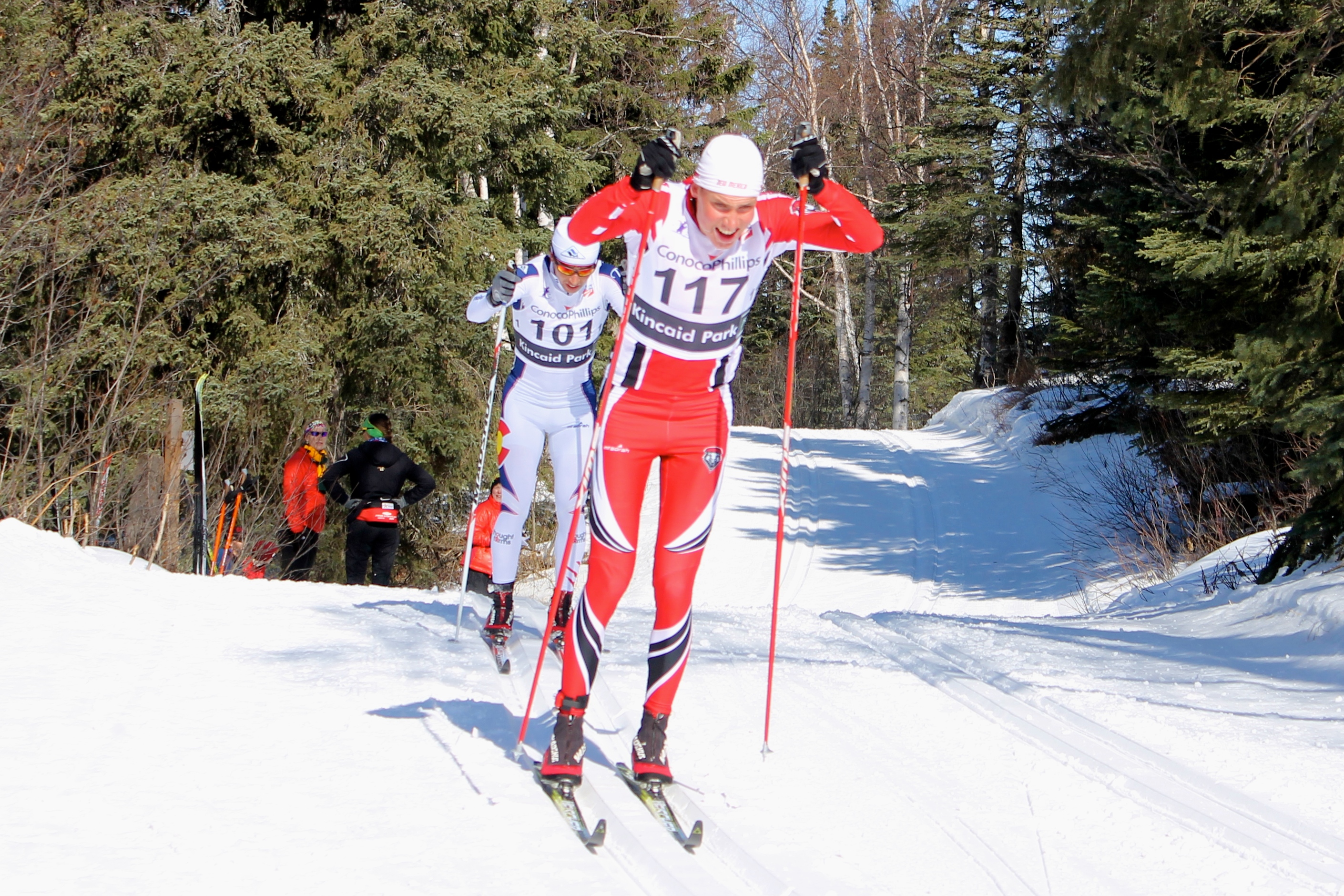
Aku Nikander (117) leads Noah Hoffman of the U.S. Ski Team with about 4 k to go in the 50 k classic mass start at U.S. Distance Nationals on March 28. Nikander went on to out-double pole Hoffman for the win.