Tag: rollerski race

  • Brown, Geraghty-Moats Win 2018 Climb to the Castle; Doubleday Race Format Unveiled

    Brown, Geraghty-Moats Win 2018 Climb to the Castle; Doubleday Race Format Unveiled

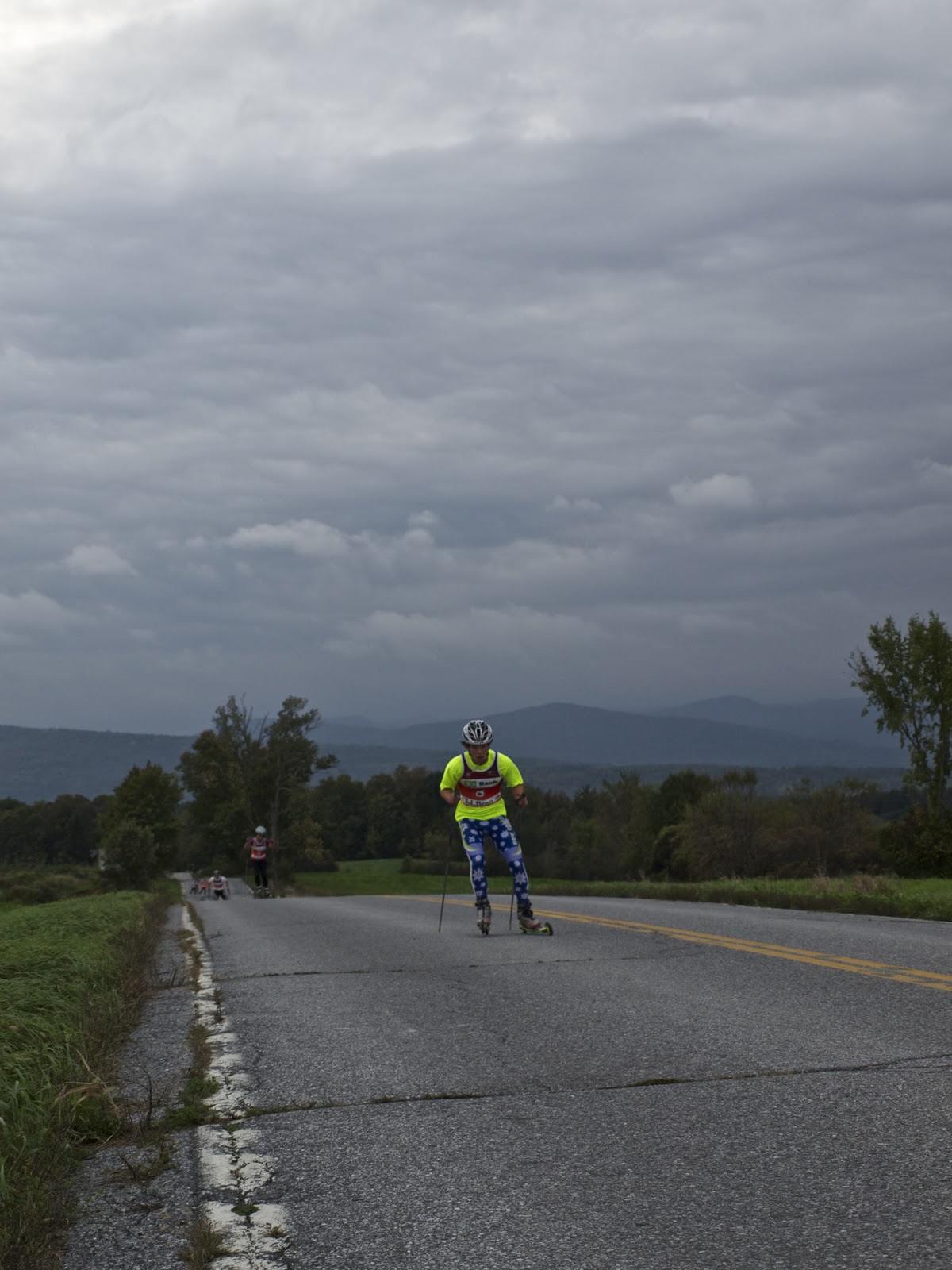
    Jake Brown (Craftsbury Green Racing Project/US Biathlon) racing to a sizable win at the 2018 Climb to the Castle on Saturday, Sept. 15 in Wilmington, N.Y. (Photo: Heloise Rolland)

    On a humid fall Sunday in northern New York where temperatures reached an uncharacteristic 80 degrees, Jake Brown of the Craftsbury Green Racing Project and US Biathlon Development Team and Tara Geraghty-Moats of USA Nordic won the 2018 Climb to the Castle.

    Brown’s time was 35:40.7, while Geraghty-Moats finished in 45:03.

    Big Gaps and Clear Wins

    On the men’s side, Brown’s Craftsbury teammate Raleigh Goessling finished second in 38:16.6, and Erikson Moore of the Fondeurs-Laurentides team in Quebec was third in 39:00.3.

    Among women, Jackie Garso of Saint Lawrence University was second, in 49:24.1, and Nakkertok’s Zoe Williams third in 49:40.6.

    This year was a high water mark for attendance, with 102 athletes finishing.
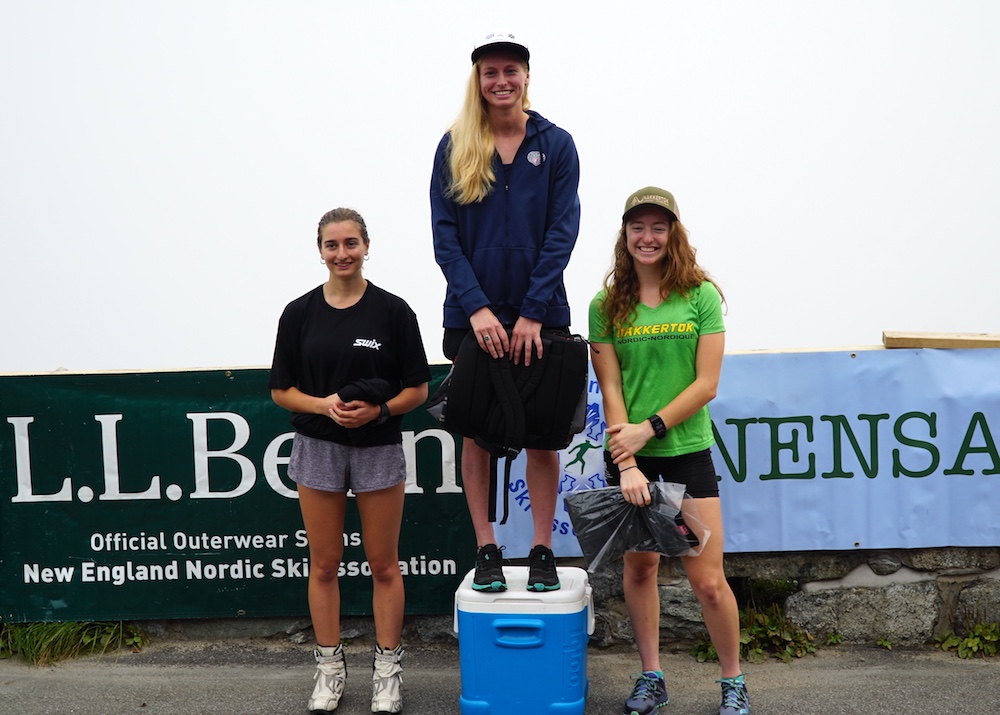
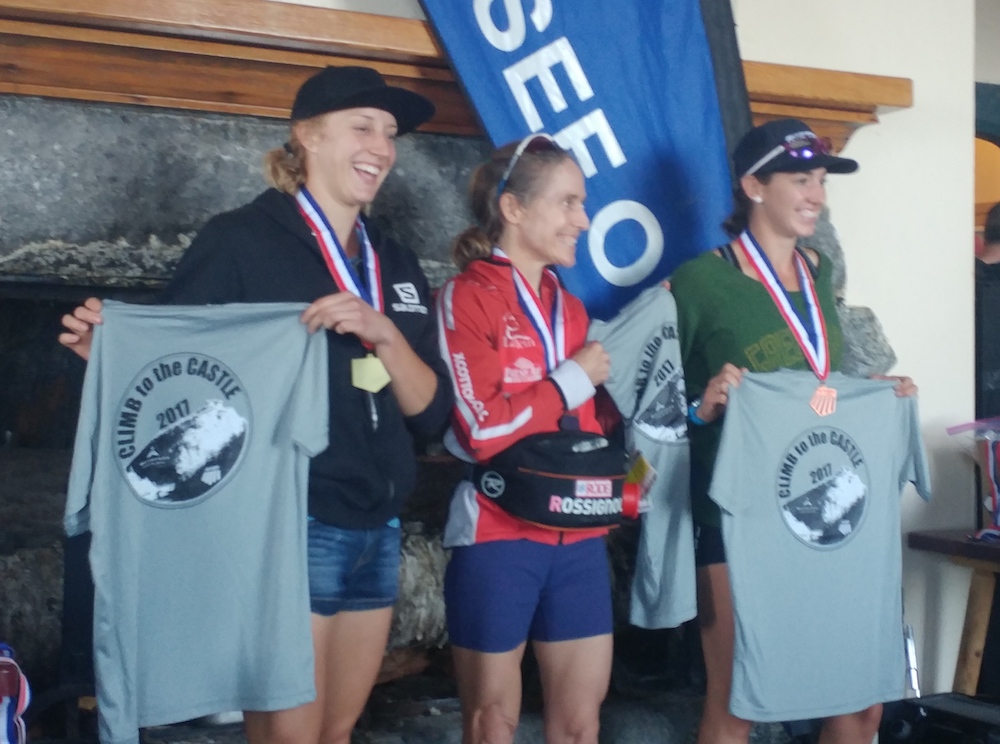
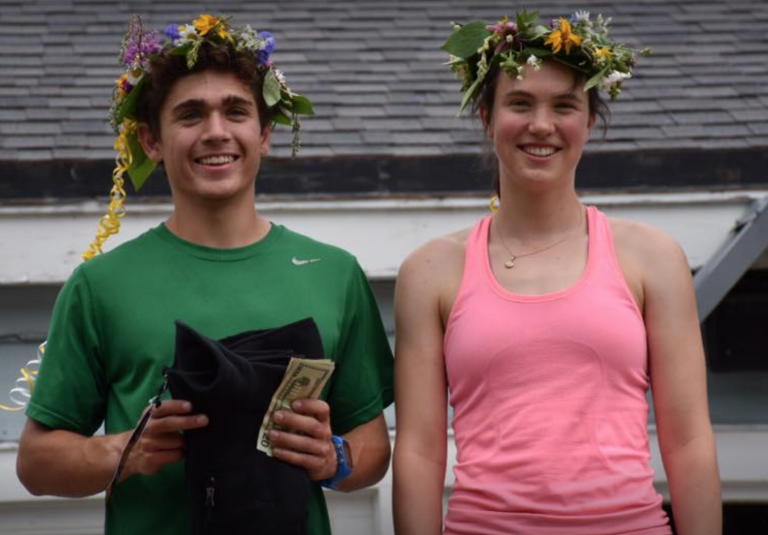
    The overall women’s podium at the 2018 Climb to the Castle at the top of Whiteface on Sept. 15 in Wilmington, N.Y., with winner Tara Geraghty-Moats (c) of USA Nordic, Jackie Garso (l) of St. Lawrence University in second, and Zoe Williams (r) of Nakkertok in third. (Photo: Colin Delaney)

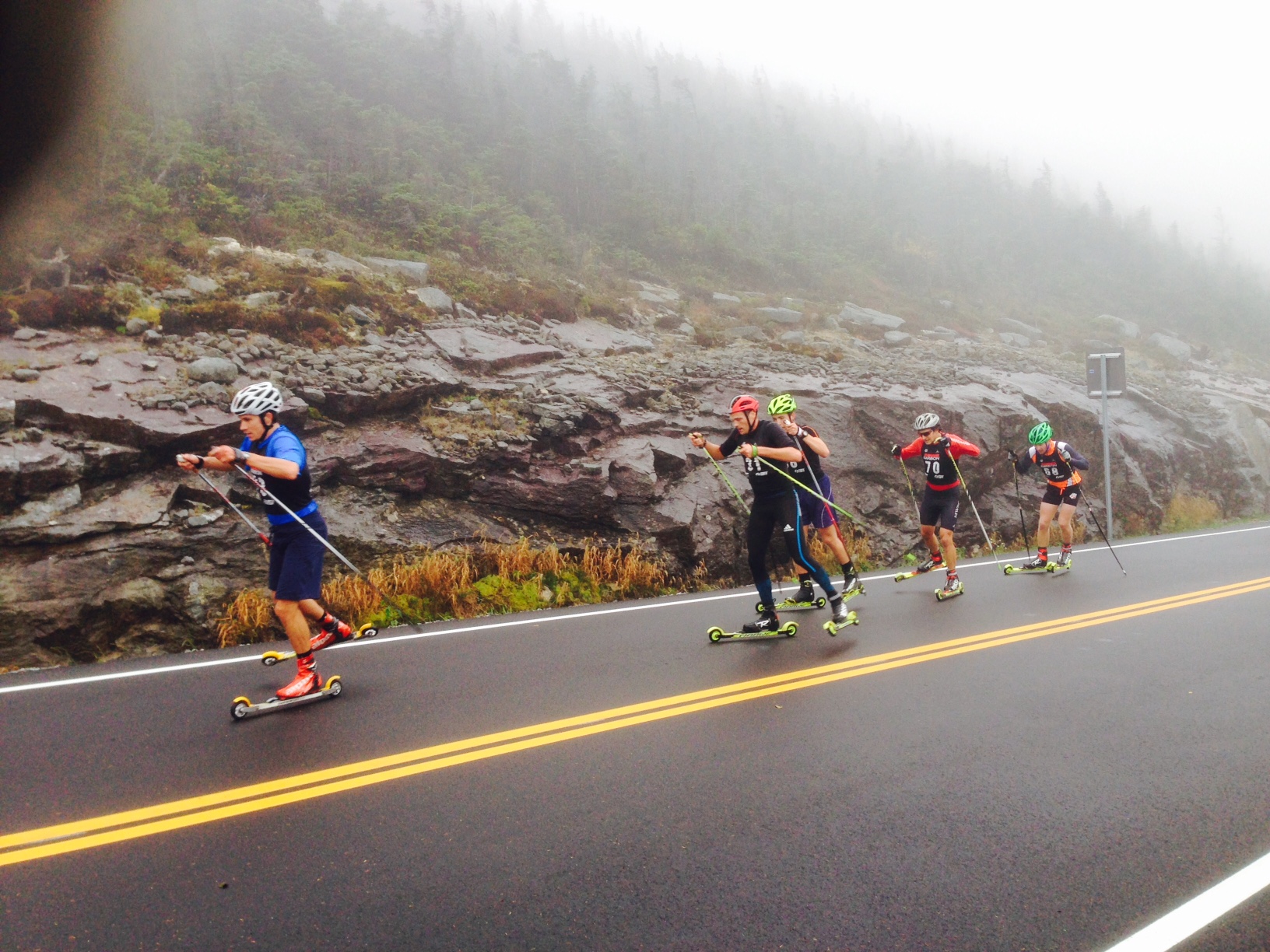
    While a few degrees cooler than last year, dank humidity settled like a blanket over the five-mile climb, with athletes moving through a couple of patches of dense fog on the higher reaches of the mountain.

    “It was a hard one today,” Brown said following the race. “Last year, I felt like I went a little too hard off the line, and kind of buried myself early. So I wanted to be a little more conservative and finish strong today. I tried doing that and it felt a lot better, and I skied a little faster. I was on different rollerskis, so it’s hard to be able to compare it to last year. I was happy with my effort and it was a good push today.”

    This year was Brown’s second consecutive win, and he beat his 2017 time of 39:01.9.

    “It’s always a tough race, but I’m happy with how my summer training has paid off,” Geraghty-Moats said. “I felt strong and I had a good race.”

    Asked if the race was part of her training plan, she replied, “I just finished competing in the Ski Jumping Grand Prix in Russia, so I’m still pretty jet-lagged. I love this race, NYSEF puts a lot of energy into putting it on every year, so I figured I’d make the trip over. It’s really fun and I enjoy racing with a good crew.”

    A ski jumper winning a cross-country ski competition? For those not in the know, Geraghty-Moats is one of the pioneers of the developing women’s nordic combined.
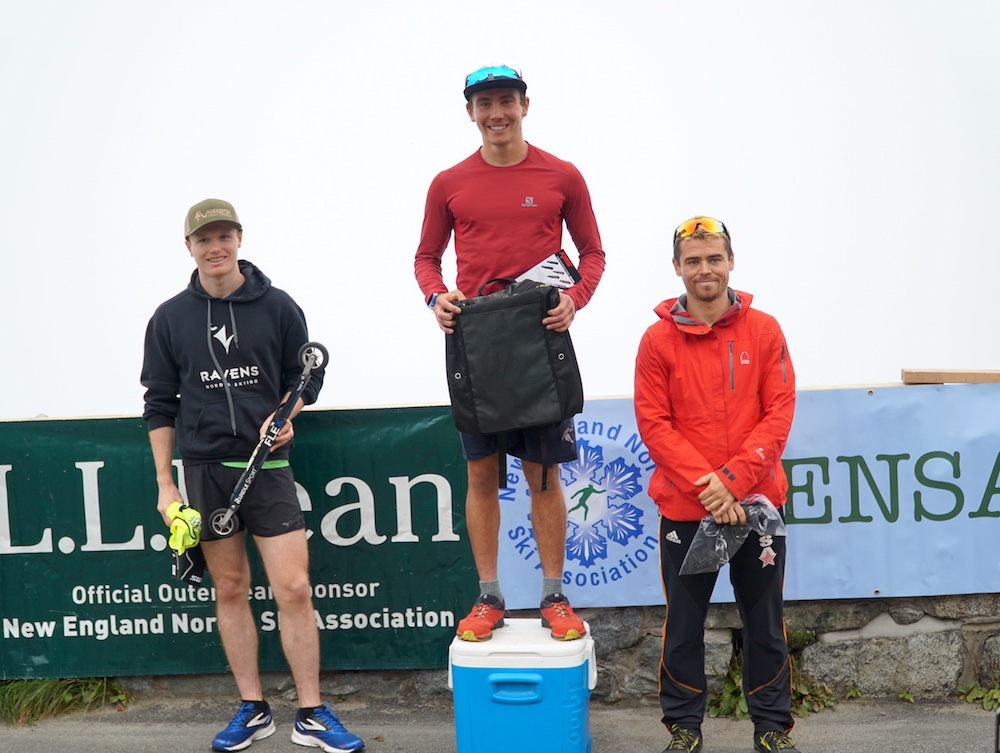
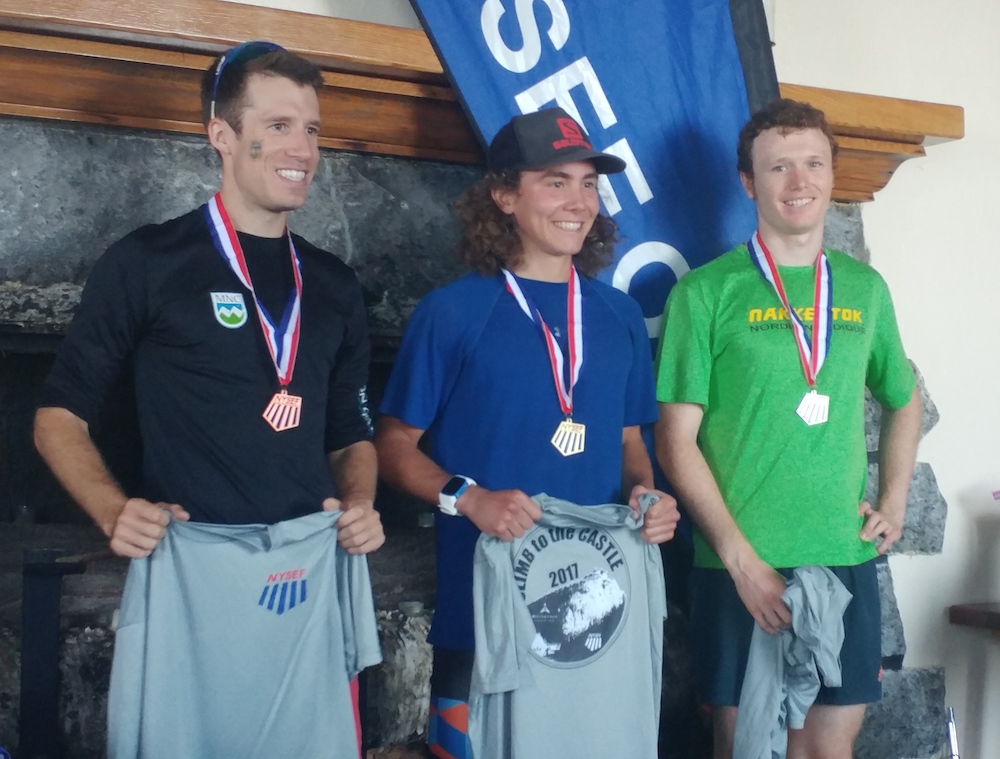
    The overall men’s podium at the 2018 Climb to the Castle at the top of Whiteface on Sept. 15 in Wilmington, N.Y., with winner Jake Brown (c) of the Craftsbury Green Racing Project (CGRP)/USBA Development Team in first, Raleigh Goessling (r) of the CGRP in second, and Erikson Moore (l) of Fondeurs-Laurentides in third. (Photo: Colin Delaney)

    “I’m on the women’s ski jumping team and I’ve been to a World Championship in 2015 and on the World Cup team for the past 4 years,” she explained. “Before that, I was a biathlete, so nordic combined was sort of a natural step for me. FIS has put in a lot of resources to developing women’s nordic combined. This year, they’ll have a Continental Cup circuit; next year, there’ll be a World Cup circuit; and the following year after that, there’ll be a World Championship. I’m starting to learn how to compete in nordic combined and I’m really enjoying it.”

    Zoe Williams, along about 60 other athletes, had participated in the previous day’s Doubleday events at the Intervale Ski Jump. (for more on the Doubleday, keep reading!)

    “I felt a bit tired in my warmup,” Williams said. “By the time I got to the start line and the race started, I didn’t feel as bad as I could have. My legs for sure felt tired in the first kilometer, but after the first k, I started settling into that rhythm and I ended up feeling pretty good for the rest of the race. Climb to the Castle, you just have to find that gear and grind away.”

     In 2017 she was fourth overall, five seconds behind biathlete Deedra Irwin.
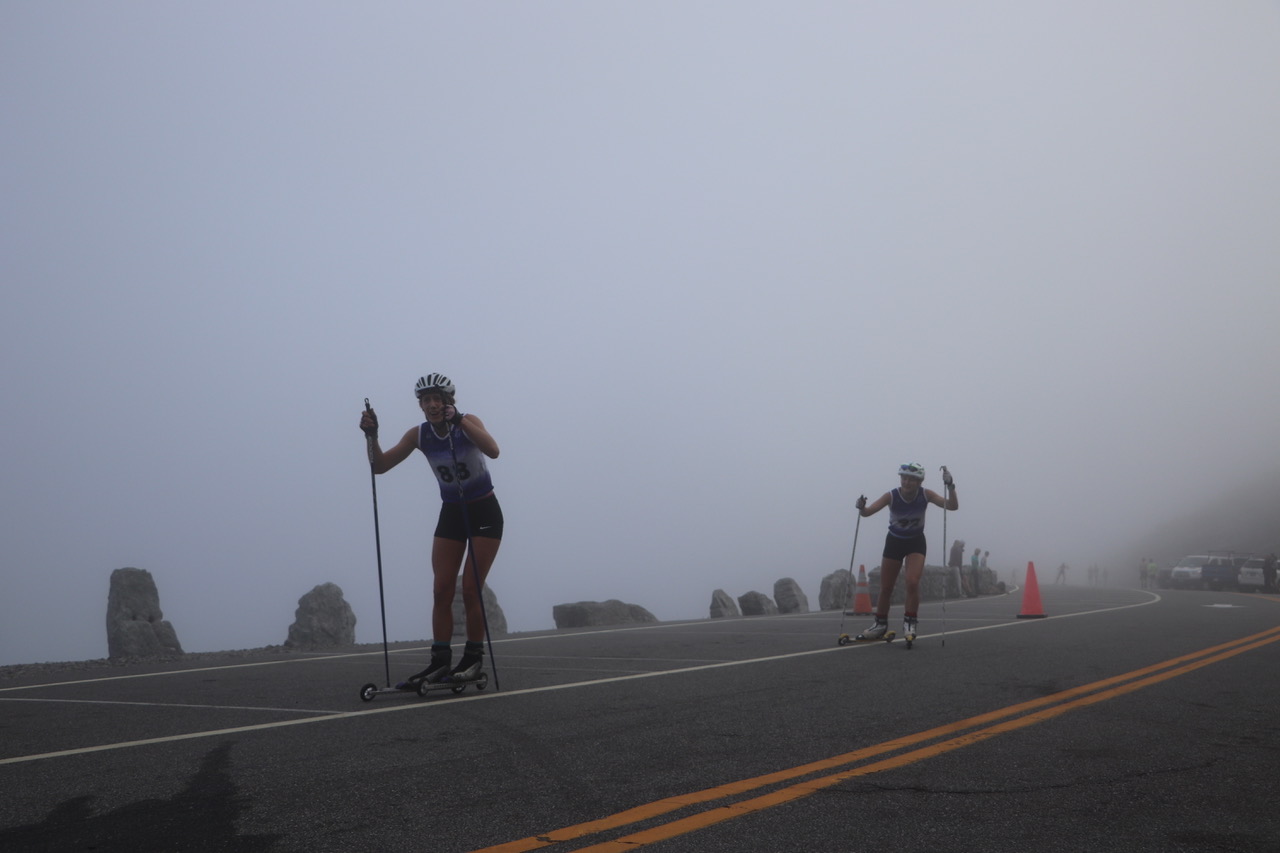
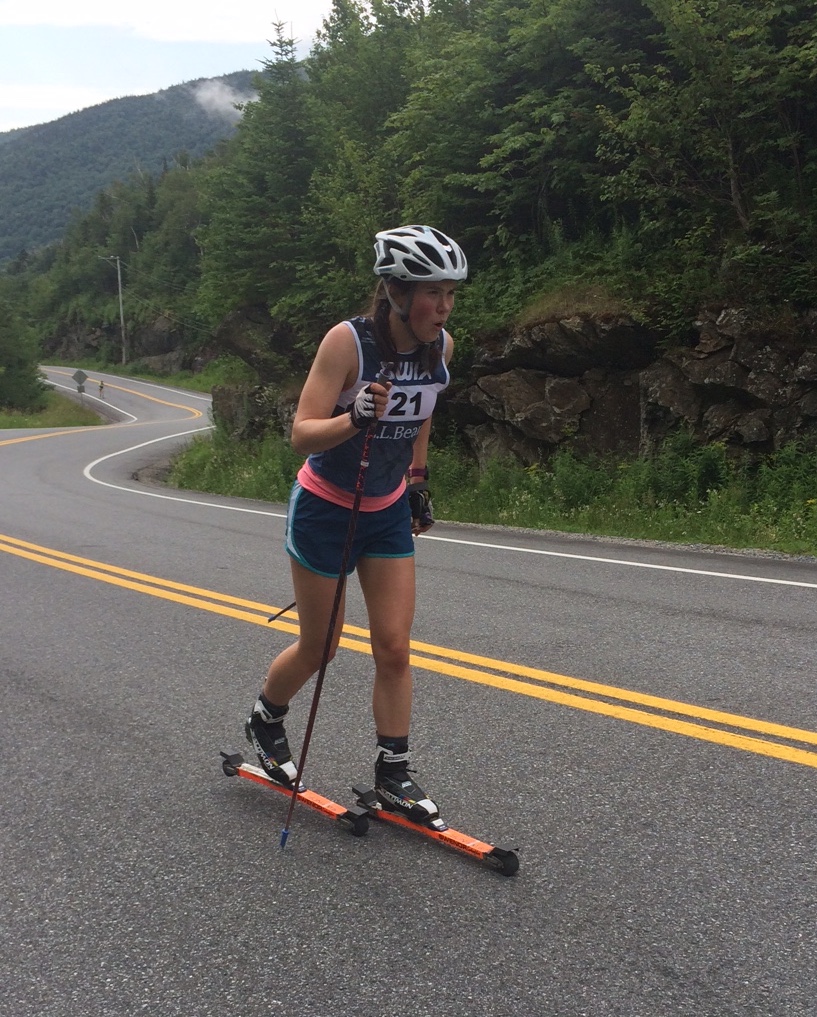
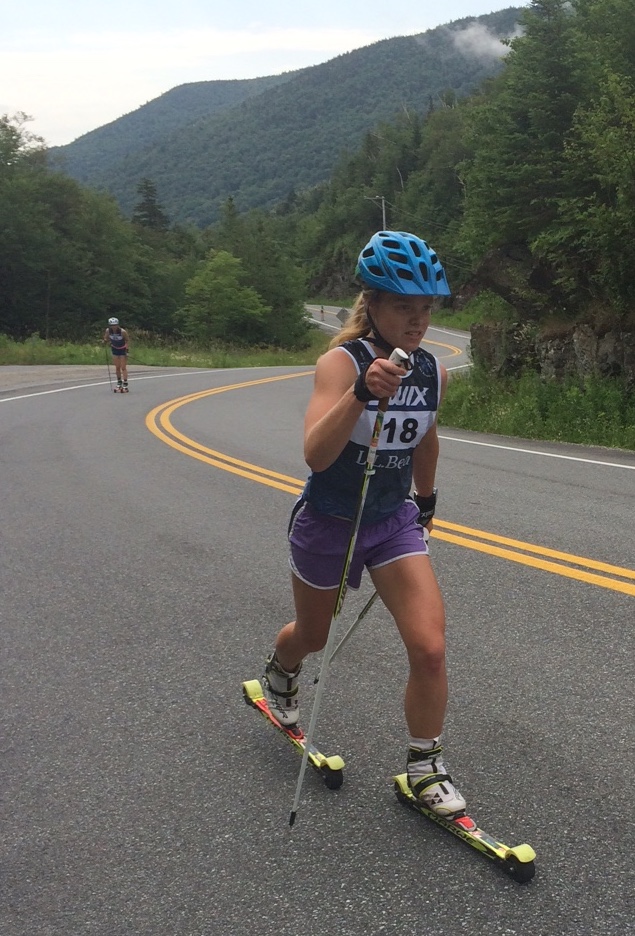
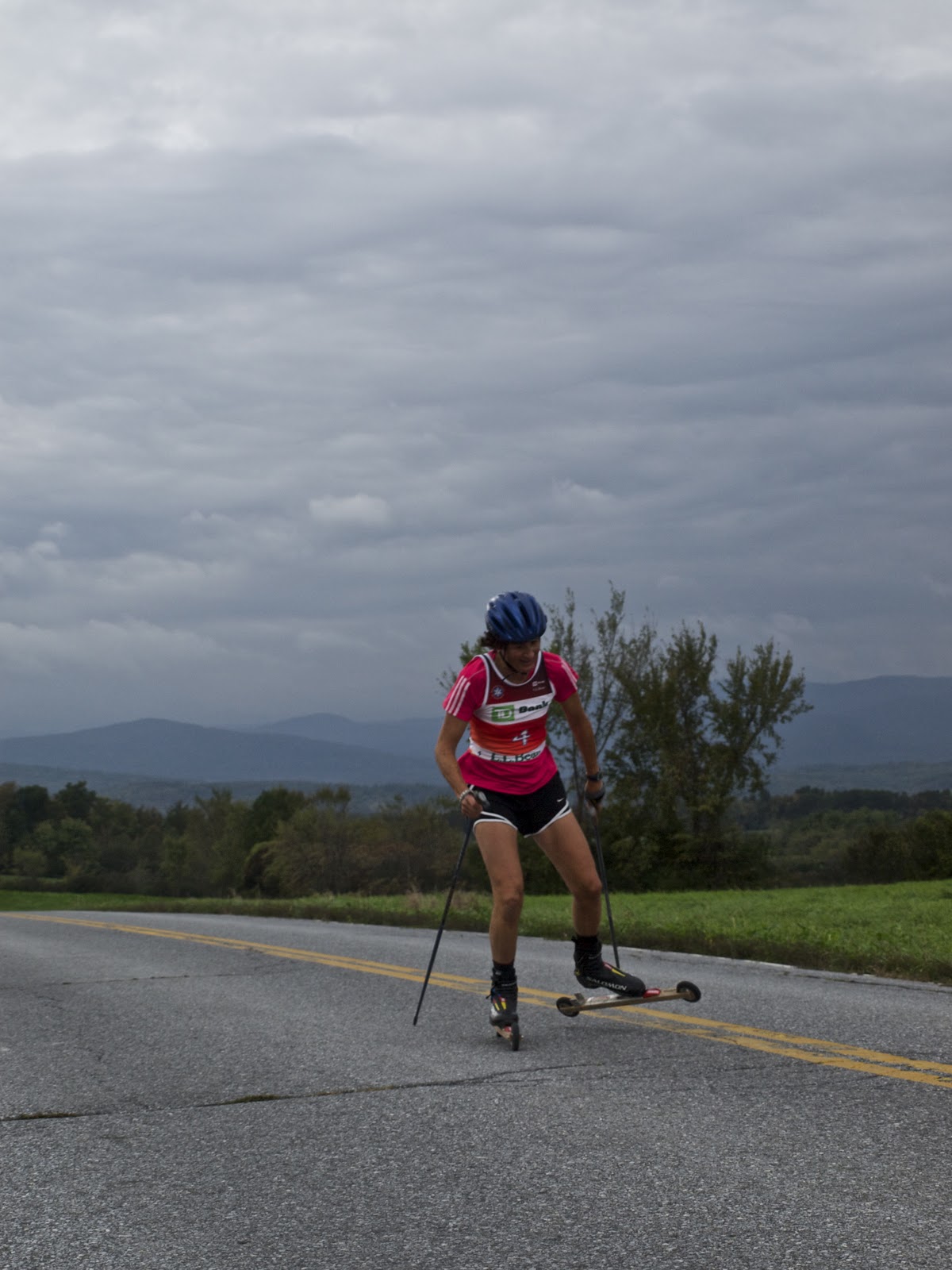
    Meredith Stetter (88) leads her Mansfield Nordic Club teammate Jennifer Wilbraham during a foggy Climb to the Castle rollerski race on Sept. 15 in Wilmington, N.Y. They finished 19th and 20th, respectively. (Photo: Heloise Rolland)

    “This year, I ended up leading the group that I was with, which was kind of a fun change,” Williams said. “But the whole time I was thinking ‘what did Deedra do here? We one-skated [V2’ed] here. I can one-skate here!’”

    Asked if Climb to the Castle was a good fitness benchmark, Williams said, “Because the next couple of months are where you start getting the really high intensity zone four, this is a really  good indicator of the base level fitness that you have, because of the endurance focus of the race.  But I’m for sure looking to find my top end gear in the next couple of months.”

    Full Climb to the Castle Results

    Doubleday Takes Off: New Events Added to the Climb to the Castle weekend

    On Saturday, the New England Nordic Ski Association (NENSA) and the New York Ski Education Foundation (NYSEF) collaborated on a new event held on the rollerski loop at the Intervale Ski jumps.
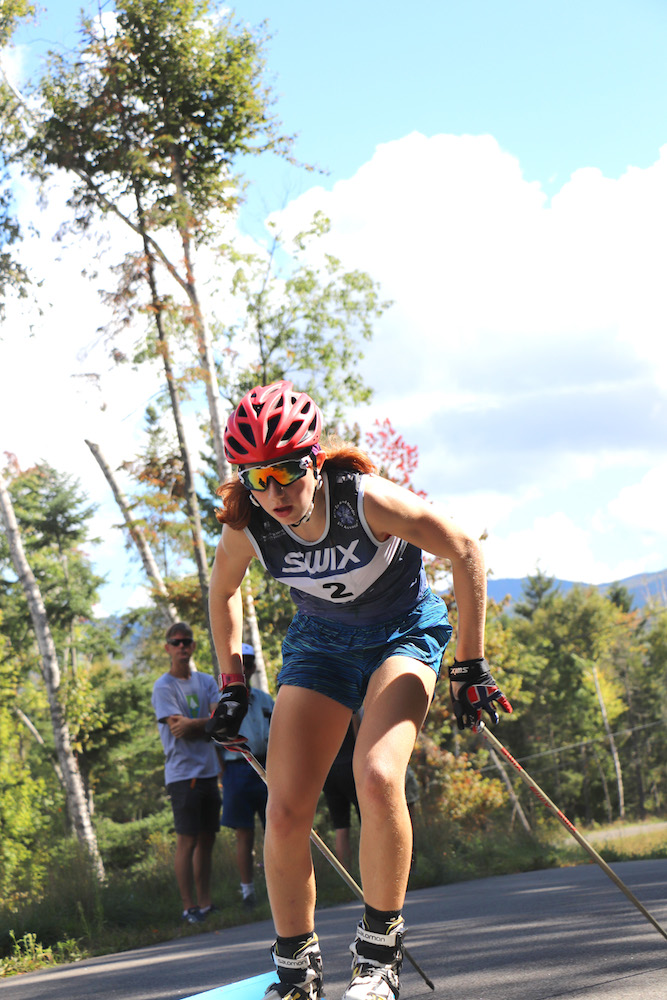
    Quincy Massey-Bierman won the junior women’s 3 k prologue. (Photo: Heloise Rolland)

    The Lake Placid Doubleday started with a three-kilometer prologue; after a break, there was a 1.5 kilometer sprint time trial. The results of the two races were aggregated to determine winners.

    Nicholas Clifford of Carleton University in Ottawa, Ontario, was the open men’s winner, while Nakkertok’s Williams was the open women’s winner before going on to be the runner-up in the Climb to the Castle.

    We’ve had the  Climb to the Castle for 11 years, and this year we wanted to expand it to a full weekend,” NYSEF head coach Shane McDowell said. “We started talking with Justin [Beckwith, NENSA Competitive Program Director] ] in the spring and he proposed the idea of trying [NENSA’s] new format of the doubleday, which will be used at the Eastern Cup scheduled for 23 February at the Dublin School.”

    “The format came out of discussions this spring,” Beckwith said. “Three kilometers is a national junior relay distance and we were valuing shorter, sprinting efforts in the results because we were usually a little heavy on the distance qualifications for our Junior National team in New England. When partnering with Shane and ORDA [the Olympic Regional Development Authority] to make it a reality, for us to test out the event which has a physiological effect of doing the 3k prologue in the morning and do a prelim in the sprint, the 1.5, would be the timing of a typical quarter final.”

    The roller ski loop at Intervale is serpentine and narrow, with fast downhills. In the pre-race meeting, Beckwith admonished the athletes to be conservative as they warmed up. As they warmed up, the rollerskiers gradually became more aggressive in their approach to the course.
    buy diflucan online, buy bactrim online

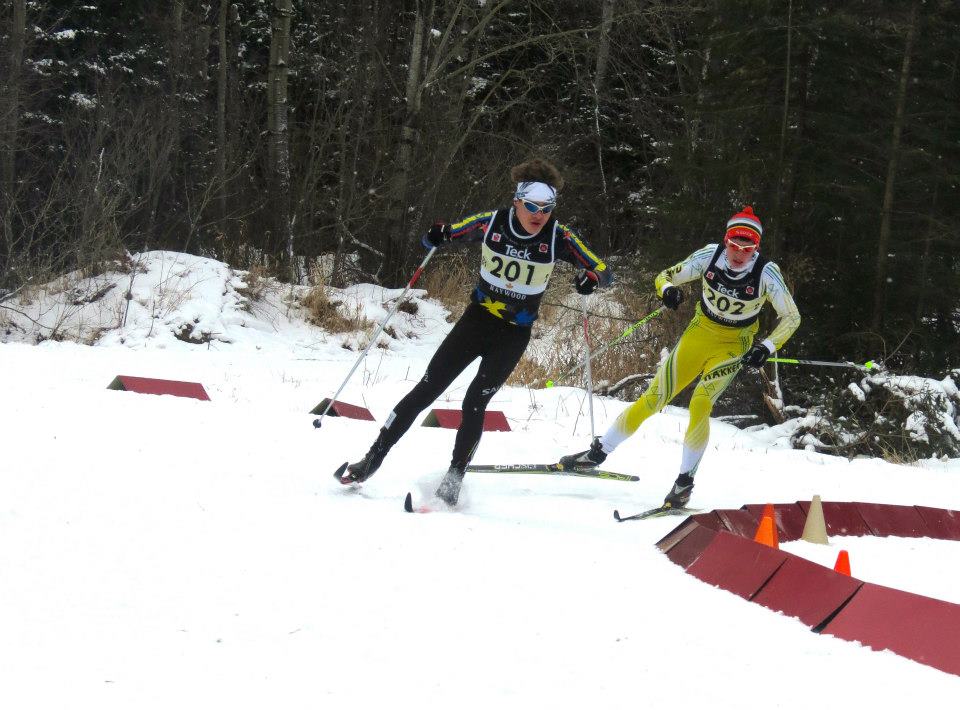
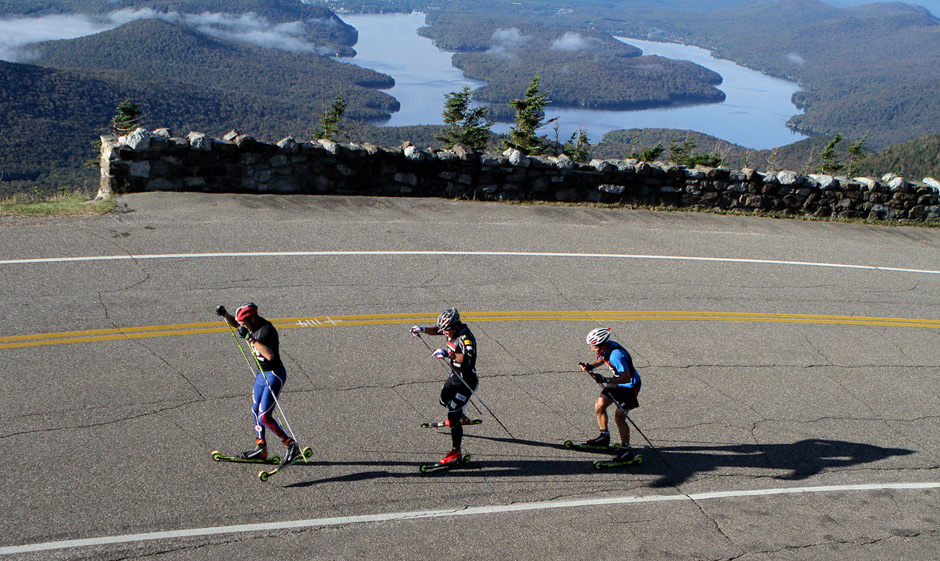
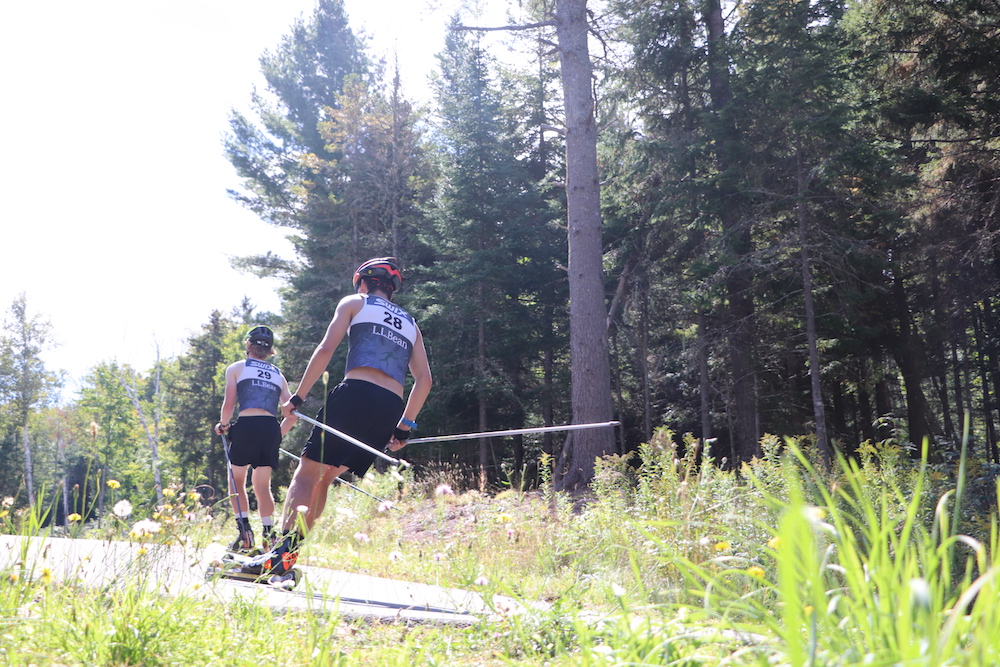
    Taking a corner on the Intervale Ski Jump loop during Doubleday. (Photo: Heloise Rolland)

    The race started and finished at the biathlon range located midway through the long climb from the lowest to the highest sections of the course.

    Clifford is the coach of the Carleton University ski team, located in Ottawa, Ontario.

    “It was really exciting,” he said. “It was the first time I’ve skied at [Intervale]. I’ve heard a lot about some of the sketchier downhills but it was actually really well done. It was just like ski racing.”

    Asked how he planned his races, Clifford said, “Not so much. I’m not a shorter distance guy, so the Climb to the Castle tomorrow is the real show and this was just a bit of a tuneup to get some speed in the legs.”

    Of the Doubleday format, the consensus was that it was tough.

    “The course here… It’s pretty much straight up and then you go down and come back up,” CSU’s Alex Burt said. “For the 3 k, you do it twice. It’s a lot more brutal. I had to actually pace it. For the1.5 k, my strategy was to go out as hard as I can and just keep it up.”

    But it was also fun, many participants agreed.
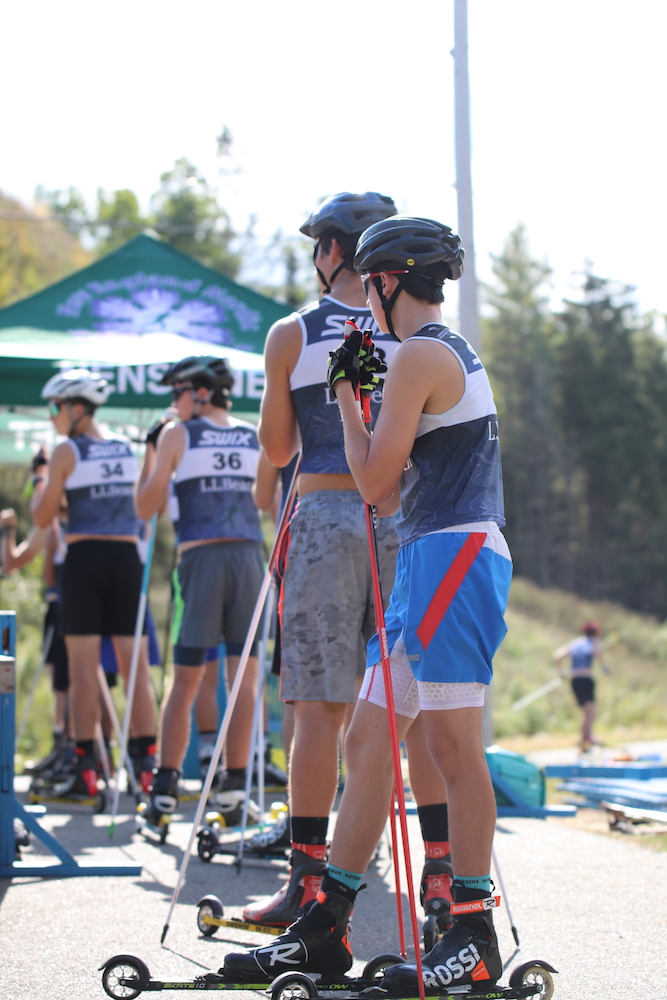
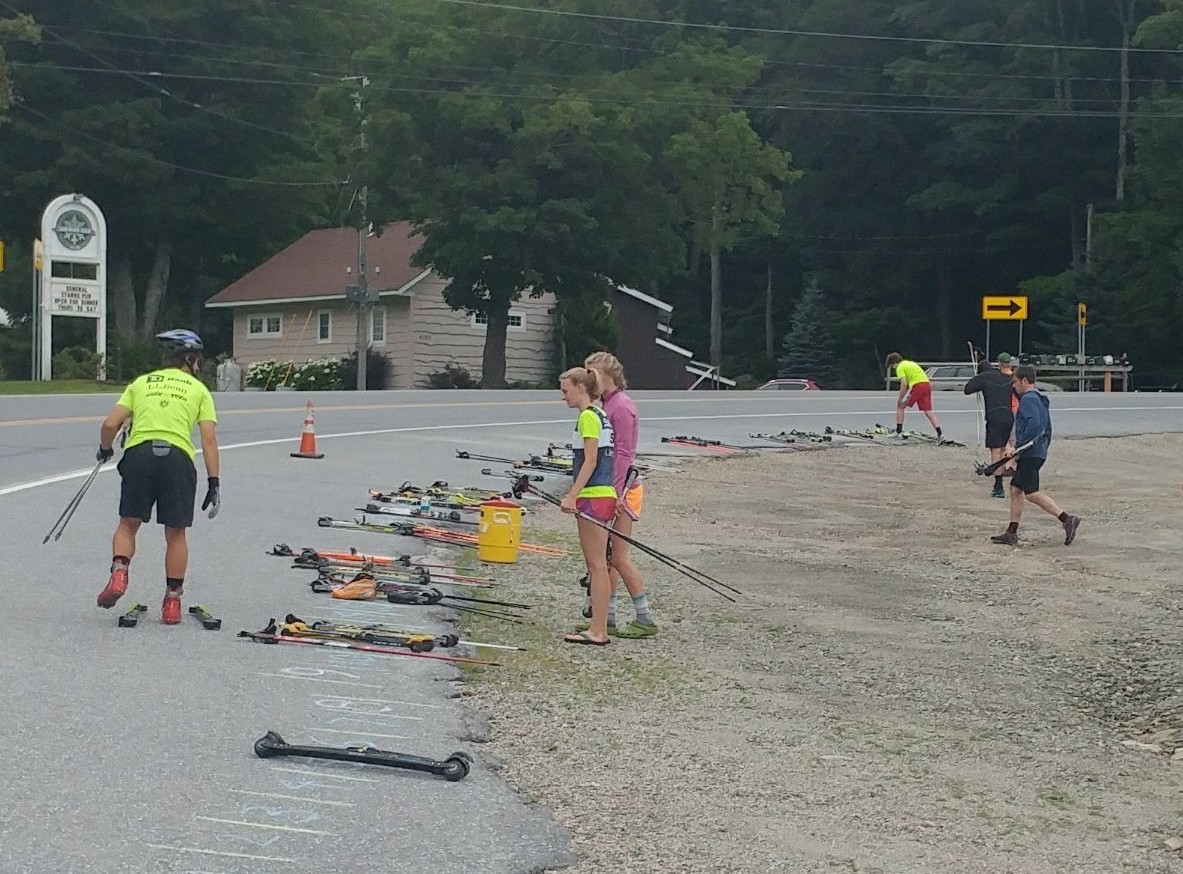
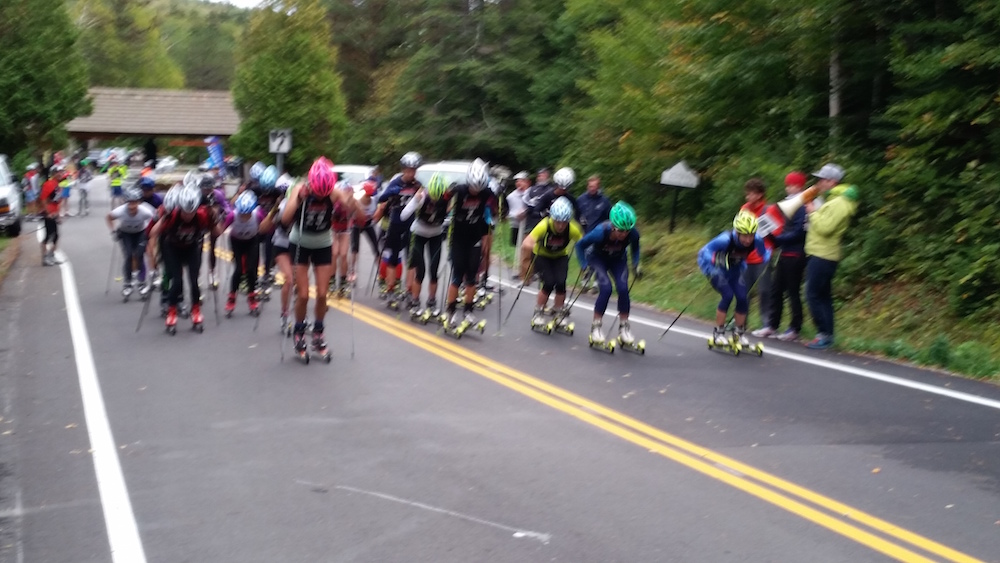
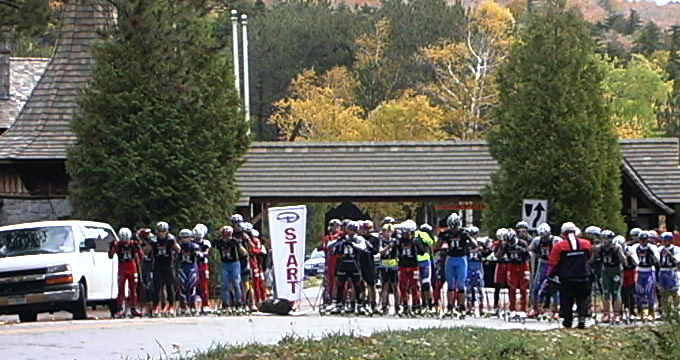
    Racers lined up at the start for a Doubleday competition. (Photo: Heloise Rolland)

    “It was fun,” said Williams of the Doubleday. “The course here was super awesome, because it was like actually skiing, whereas a lot of roller ski races are on roads. It’s so twisty and turns up and down, it’s a lot like actually ski racing.”

    On getting used to the downhills, Williams said, “It took me through mid warm up, to get used to the corners. In the race itself, I didn’t even think about it. It was super nice. I worried about it in the warmup, because there are some really gnarly corners, but when you’re racing, all your focus is on going fast.”

    Amy Duclos of Saint Michael’s College in Burlington VT, was the third overall female finisher at the Doubleday.

    “I wasn’t really sure about the course going into it, because of the turns, the hills, but it was a lot of fun,” she said. “I thought today was a good warmup to get the legs moving for tomorrow. It’s definitely a different type of race.”

    Laura Appleby, of Cambridge Sports Union (CSU), won the junior women’s division at Doubleday and was the fifth junior woman finisher at Climb to the Castle.

    “They went really well,” she said of the Doubleday races. “It was super fun. I liked the downhills… The first race was a little bit longer, so I was definitely pacing it a little bit slower. But generally just go out and ski the course, ski the transitions.”

    Shilo Rousseau, Chandra Rousseau, and Zoe Pekos, all of Barrie [Ontario] Cross-Country, sat for an interview in a downtown Lake Placid coffee shop following the Doubleday.

    ethings

    “It was a little scary at first with the safety meeting,” said Shilo, who finished third junior woman both at the Doubleday and C2C. “After skiing the lap a few times, you realize it’s not that bad.  As you go on, your laps get faster. You really have commit on roller skis.”

    Did she save energy for the C2C?

    “Full send every day,” Shilo replied. “I’m not leaving anything in the tank.”

    Chandra Rousseau said, “The last downhill was bad. The prologue wasn’t as good as I wanted it to be.  I probably could have pushed a little harder on the downhills. On the sprint, I was more used to the course.”

    Recovering in a bench outside the Castle, a reporter asked the Rousseaus and Pekos, so, did you go full send?

    In unison, they replied, “Full send!”

    Full Doubleday results

  • Elite Rollerski Invite Nov. 4 at Trapp Family Lodge

    Top American Cross-Country Skiers to Compete at Trapp Family Lodge November 4th in Elite Invitational Roller Ski Competition

    (Press release)

    Stowe, Vt – The New England Nordic Ski Association (NENSA) and the Trapp Family Lodge have partnered to create a roller ski race for an elite field of cross-country skiers including past and future Olympians.  Upwards of fifty athletes representing colleges and clubs from throughout New England will compete in a challenging 10-kilometer race that will finish at the top of Trapp Hill.  Spectators are encouraged to park at the Trapp Family Lodge Outdoor Center parking lot and cheer skiers to the finish.

    Top-ranked New England athletes in their respective age groups will join Olympians Elizabeth Stephen, Ida Sargent and Kris Freeman for this head to head competition designed to showcase Nordic Skiing.  The majority of the field is comprised of athletes who were named to the NENSA Elite and Development Teams – a group who has demonstrated national and international success.  Skiers from the University of Vermont, Dartmouth College, Stratton Elite Team and the Craftsbury Green Racing Project will be in attendance.

    The course will begin on Nebraska Valley Road before turning onto Barrows Road and conclude by climbing Luce and Trapp Hill.  The race begins at 3pm and skiers are expected to complete the course in approximately thirty minutes.  Racers will depart the start in thirty-second intervals, making for non-stop spectating for nearly an hour.  An award ceremony will be held at the von Trapp Bierhall at 4:30pm just before the Winter Kickoff Party.  Spectators are encouraged to attend the party where they can meet athletes and socialize with members of the New England skiing community – tickets can be purchased in advance at www.skireg.com/new-england-winter-kickoff-party or at the door.

    About NENSA:

    NENSA is the Community Olympic Development Program (CODP) for cross-country skiing in the East as well as the umbrella for most organized Nordic skiing events in the region. Cross-country skiing, as practiced by our youth skiers and families, is a lifetime activity firmly rooted in New England tradition. It is NENSA’s mission to sustain a vital and active skiing community in New England. Visit www.NENSA.net to learn more about our organization.

    Questions about the event should be directed to Justin Beckwith at justin@nensa.net

  • Closing the Gap: A Game of Seconds

    Closing the Gap: A Game of Seconds

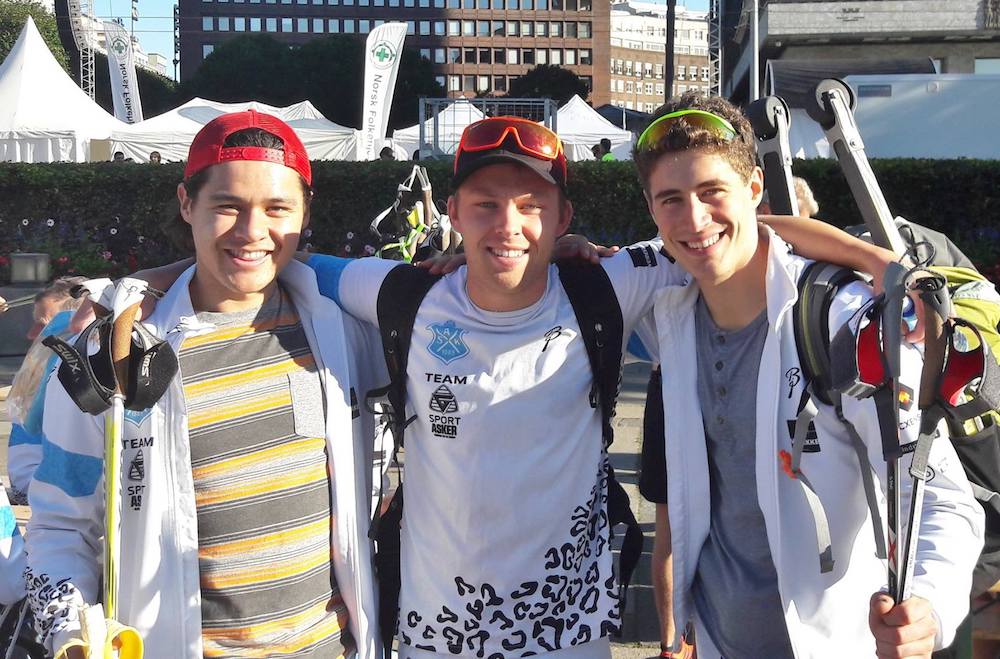
    Canadians Ryan Jackson (l) and Maks Zechel (r) with Team Asker coach Ola Kvisle at the Oslo Marathon 10 k rollerski race in Oslo, Norway. (Photo: Anne Haarstad)

    Editor’s Note: The following is part of a series proposed by Maks Zechel, a 20-year-old Canadian cross-country skier embarking on his first season training abroad. In August, he recently made the big move to Norway, where he’ll be training and racing with Team Asker for the entire winter. Through these updates, Maks hopes to share his personal “observations, stories and lessons learned” to help close the gap between North American and Scandinavian nordic skiing. Previous posts: #1, #2, #3#4, and #5.

    ***

    It was a typically frigid day of January ski racing in Thunder Bay, Canada (any Canadian cross-country skier will have grimaced just from reading that). Halfway through the A-final of the Ontario Cup U16 classic sprint, I was already far behind the leaders, Tony Gunka and Ryan Jackson. The previous day I had won the distance classic race, my first ever “O-Cup” medal, finishing only three seconds ahead of Ryan, and now my expectations were higher than ever. The margin between us in the qualifier that morning? Three seconds.

    Swinging around a fast corner into the last big climb of the race, already out of contention for the win, I looked at the ground in front of me and just skied as hard as I could. I had nothing to lose, so I skied my best. As I crested the hill, I suddenly noticed that I had caught Ryan and Tony and was dropping them. Elated by the empty track ahead, I double poled as hard as I could.

    Ryan Jackons (front) and Maks Zechel turning the final corner during a 2013 classic sprint in Thunder Bay, Ontario.

    Suddenly, Ryan and I were neck-and-neck again. We turned the final corner and could see the whiskers marking the finishing lanes, tantalizingly close. Side by side, neither of us able to see, just focusing on slamming those poles down. We remained stubborn until the finish, with Ryan pulling in front right before the line.

    The remainder of the season continued in much the same way, and strangely the margin between Ryan and I in most of our races, no matter the distance, was three seconds. We didn’t know it at the time, but every time one of us lost to the other, we both won.

    Since that year, Ryan and I have been close friends and competitors, even roommates for a year. We have both had good and bad years of results, but I have continually been inspired to push my own limits by his work ethic and accomplishments. On Sept. 15, Ryan joined me here in Norway, where we begin our latest venture to see how fast we can become.

    Ryan arrived in the middle of my second testing week with Team Asker, where I was happy to achieve new personal bests in the uphill running test, skate time trial (not too difficult as I went the wrong way last time…), and the double-pole sprint qualifier. Most of these improvements are likely due to being more familiar with the courses and being more comfortable here, but regardless it was nice to move forwards.

    Testing week was highlighted by the replacement of our regular uphill double-pole test with a 10-kilometer classic rollerski race in downtown Oslo, as a part of the Oslo Marathon race weekend. The week prior to this race, Team Asker held a 10 k qualification race, where the top-10 Asker skiers were selected to race in the Oslo Marathon for the team prize of $30,000 NOK (approx. $4,673 Canadian). This qualification race was the most tactical rollerskiing race that I have ever competed in. About 16 of us raced eight laps of a mostly flat 1.4 k loop. Like a road-biking race, positions were constantly changing. It was great for me to practice staying calm and absorbing speed changes so as not to waste energy, but I still regularly found myself catching up to the lead pack after being “accordion-ed” off the back of an attack. Having been sick that entire week, I didn’t have an excellent race, but it was enough for me to qualify (see a video of the race, and me flying off the course on the first lap, below).

    The night before the Oslo Marathon was not the usual quiet, pre-race evening. Having crossed the finish line of the uphill running race at around 7 p.m., I biked home where I met Ryan and helped him settle in for his first night in Norway. A long pre-race sleep was quickly lost to our excitement of having finally both made it to Norway, a trip that has been in various stages of planning since we first discussed the idea on an offseason run through Vincent Massey Park in Ottawa two years ago.

    After a short night, we were out the door before 7 a.m. to take the train to Oslo for a 9 a.m. race start. The big stress that morning was how we would survive the race without suffering broken limbs or equipment. I had skied the course the weekend before with Team Asker, and in just that easy ski through the streets of Oslo, we broke three pole tips. The race organizers were predicting that 50 percent of the field would break poles.

    I thanked the “ski gods” for the perfect sunny day and dry pavement that the morning had brought, as I outlined the obstacles of the race for Ryan: a fast downhill right after the start leading into a sharp turn and funneling the race through a narrow, cobblestoned street guarded by waist-high posts in the middle of the race course; multiple stretches of streetcar rails; sewer grates and small curbs to be hopped; more sections of cobblestones; and a downhill finishing stretch marred by manhole covers and pavement dished out by years of traffic. Oh, and then we had to jump two tall timing mats across the finish line. At least road cyclists can use bikes designed for cobblestones when they race Paris-Roubaix, not so with rollerski wheels that fit perfectly between cracks. It was an excellent opportunity to work on agility while racing with 60 other skiers and being filmed by NRK … at least that’s what I told myself. (See course preview below)

    https://www.youtube.com/watch?v=0i7U4lvBXOY&feature=youtu.be

    In typical skier fashion, we complained a lot about the race conditions until the race started, the field spread out and it ended up being surprisingly easy for most people to stay on their feet. Our team raced well and we won the team competition, with teammates Erland Kvisle and Harald Amundsen coming third and fourth behind Junior World Championships medalists Thomas Helland Larsen and Magnus Kim. Andrew Young, a World Cup sprint medalist, was fifth. I finished 18th, 1:45 minutes behind the winner.

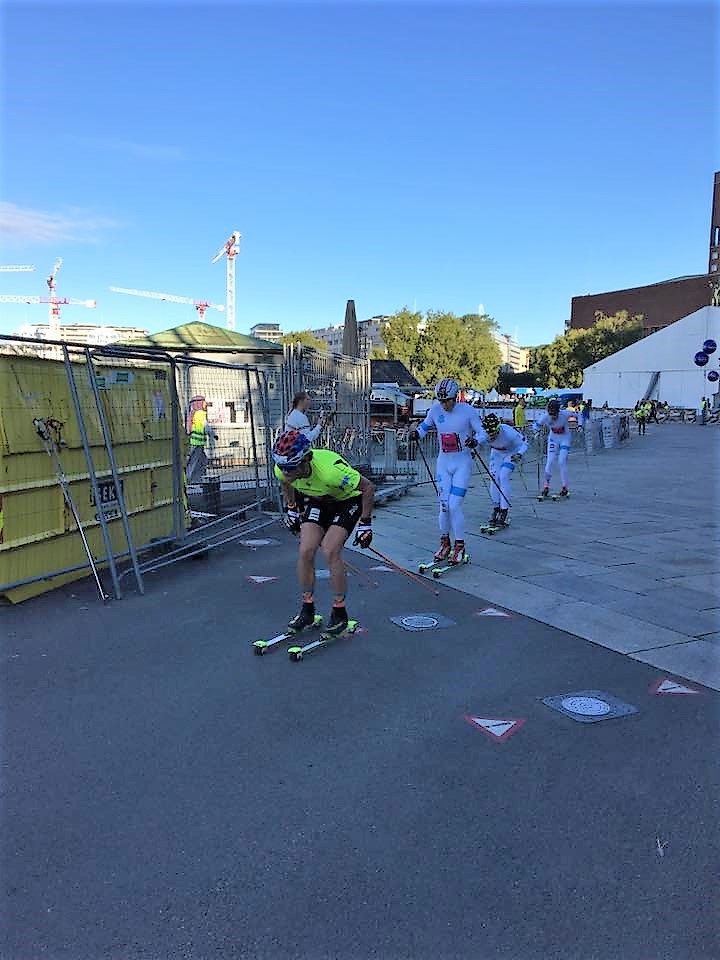
    Part of the lead group at the Oslo Marathon 10 k classic rollerski race on Sept. 16 in Oslo, Norway. (Photo: Sindre Ryan)

    How do I react to these results? I finished 19 seconds behind the winner in the qualification race and 1:45 back in the Oslo Marathon, both against world-class competition. On the outside, these margins seem like nothing, but in reality they represent a massive gap between where I am now and where I hope to be in the coming years. It is easy to dismiss seconds as being irrelevant, but these seconds mean everything in the winter. This winter, 19 seconds in a 10 k race at a Scandinavian Cup could mean the difference between finishing in the top 50 and finishing in the top 100. If I am unwilling to fight for those seconds now, then the winter’s results will reflect that. To close a gap of seconds, it will require a lot more than just improving my recovery strategies or drinking a litre of beet juice a day. My fight for seconds has to be taken to every interval session and time trial and become a mantra taken into race season.

    It may not be such a big gap now, but come winter, this game of seconds will become a real life battle for minutes. For Ryan and I, this is nothing new, but now the stage is bigger than ever before. To come three seconds behind the other will mean ten spots on the results sheet. It is a daunting reality for any skier, but I am lucky to have a friend from home to pursue these challenges with. In a foreign place, teammates and friends are more than just people to hang out with — they’re family.

    Norwegian Phrase of the Week

    It’s not the fart that kills you, it’s the smell. – Petter Solberg

    Translation: It’s not the speed that kills you, it’s the slam (crash).

    *A quote from Norwegian professional rally car racing legend, Petter Solberg, known for speaking “Noglish” (Norwegian-English), resulting in excellent quotes lost in translation.*

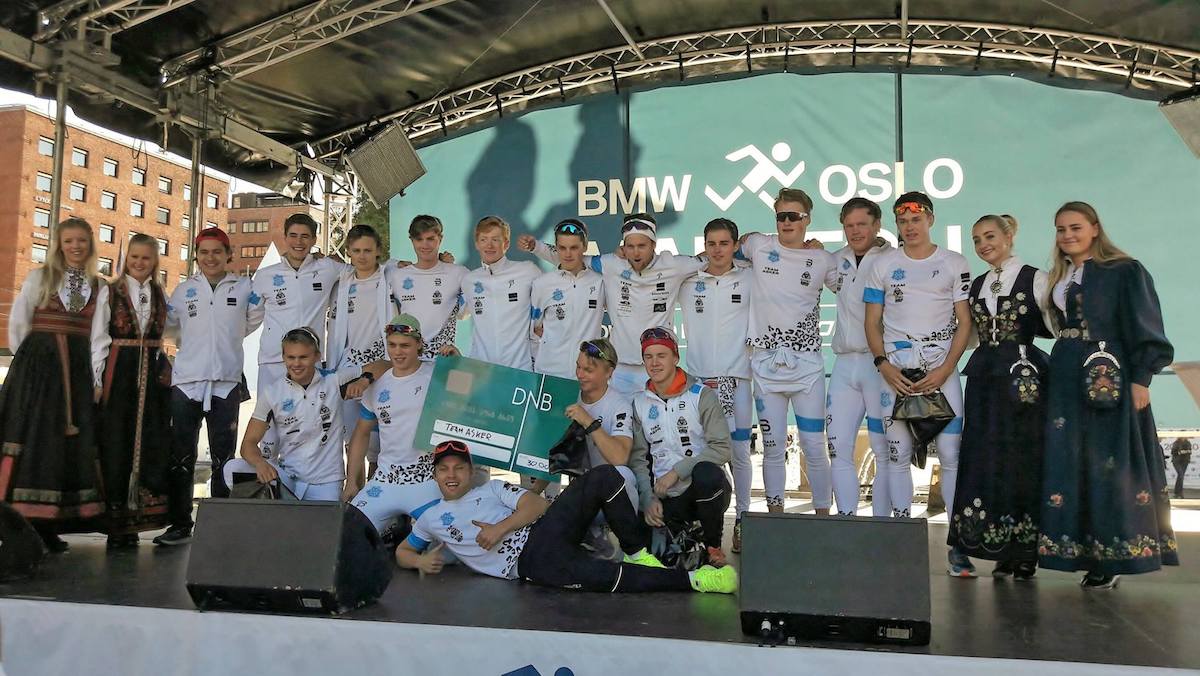
    Team Asker on the podium after winning the team competition at the Oslo Marathon 10 k classic rollerski race on Sept. 16 in Oslo, Norway. (Photo: Anne Haarstad)

    ***

    About Maks: Maks Zechel is a competitive cross-country skier who secretly wants to become a professional mile runner. He loves hiking and going on canoe trips with his family, as well as peanut butter cups in ice cream. Johan Olsson is his favourite skier and he hopes to race the Cortina-Toblach stage of the Tour de Ski one day. He enjoys writing about his experiences. Follow him on Instagram @makszechel.

  • Bender, Brown Top Balmy Climb to the Castle

    Bender, Brown Top Balmy Climb to the Castle

    The men’s top three finishers at NYSEF’s 2017 Climb to the Castle on Sunday, Sept. 24, at the top of Whiteface Mountain in Wilmington, N.Y., with winner Jake Brown (c) of US Biathlon, runner-up Aidan Kirkham (r) of Nakkertok Nordic, and Mansfield Nordic Club Head Coach Adam Terko (l) in third.

    (Note: This article has been updated with comments from Adam Terko in regards to rollerski safety.)

    WILMINGTON, N.Y. — On what may be the hottest day in memory for the annual Climb to the Castle (C2C) rollerski race, hosted by the New York Ski Educational Foundation (NYSEF) up Whiteface Mountain, Jake Brown and Jennie Bender were fastest to the top. Both have spent at least part of their summer training with the US Biathlon Association (USBA) in nearby Lake Placid, N.Y.

    Brown, a 25-year-old USBA X-Team member, finished the five-mile climb up Whiteface’s toll road on Sunday in 39:01.9 minutes, more than five minutes clear of runner-up Aidan Kirkham, a Canadian racer with Nakkertok Nordic, who finished in 44:16. Adam Terko, Mansfield Nordic’s head coach and executive director, placed third in 45:35.7.

    Bender, 29, racing under the team name of “The Dark Side”, which she later explained was a joke, topped the women’s race in 48:59.4. She finished 21.5 seconds ahead of 51-year-old (no, that’s not a typo) Sheila Kealey, who skis for XC Ottawa and coaches for Nakkertok. Deedra Irwin of the Sun Valley Ski Education Foundation (SVSEF) was third woman in 51:13.5.

    “I had put my name in the registration as ‘Darth Vader’, but they changed it on the other end,” Bender wrote in an email. “When I am in Bozeman MT I train with Bridger Ski Foundation, and when I am in Lake Placid, I train with USBA.”

    At the tollgate at 7 a.m., the temperature was already 66 degrees Fahrenheit with clear skies. With mild weather the previous two days, the pavement was dry for 83 skiers who rolled to the start line. At the castle at the summit an hour later, temperatures were upwards of 70, making an already grueling race even more fatiguing.

    The men’s and women’s races played out quite differently. According to Kirkham, Brown led “off the start and gapped the whole field.”

    Familiar with the territory in and around Lake Placid, which has become an annual training camp for Nakkertok, based out of Ottawa, Kirkham said it was one thing to ski the toll road in Zone 1 and another to race it.

    “I wanted to pace it well, and I think I did that,” he added. “I didn’t want to go too hard off the start because there’s no chance to recover on a course like this. … Once I got to the last mile I knew I could try to pick it up a little bit. But I was pretty tired. Just getting to the finish felt good.”

    Having completed five or six C2Cs, Terko said experience was his advantage. But he didn’t exactly have a race plan.

    “The field can vary wildly,” Terko said of the level of competition. “You’re never really sure how the start’s going to play out. I found myself near the front and there wasn’t a ton of US Ski Team or US Biathlon folks.”

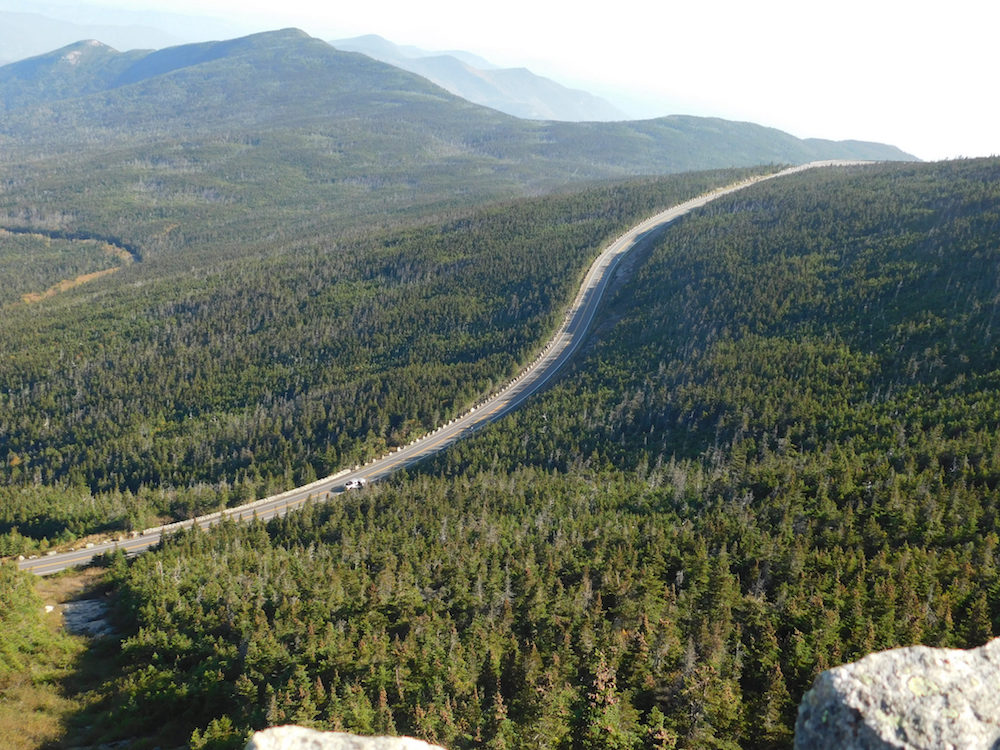
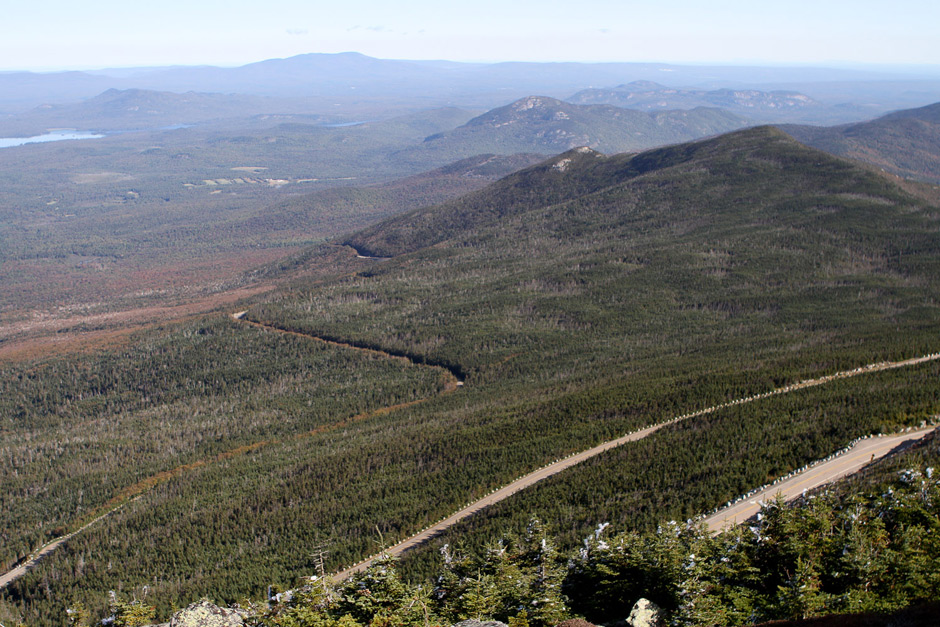
    Looking down at the Whiteface Veterans Memorial Highway, a five-mile toll road to the top of Whiteface Mountain in Wilmington, N.Y., as seen on Sunday, Sept. 24, for the 2017 NYSEF Climb to the Castle rollerski race. (Photo: NYSEF)

    As recently as a few years ago, the U.S. Ski Team held annual dryland training camps in Lake Placid and competed at the C2C. But that camp has been replaced by an on-snow camp in New Zealand. This year, US Biathlon’s top athletes recently spent several weeks training in Germany.

    “Jake Brown was right off the front so I realized that this could be a good day and I might as well try and hang in there,” Terko added.

    While Terko skis and rollerskis plenty with his athletes, he says it’s not always adequate training for a race like this.

    “As a coach, it’s more about generally making sure the workout is going well for the athletes,” he explained. “I’ve made an effort the last few weeks to get out after practice and ski around in the dark myself.”

    (Terko later clarified in an email that he was referring to Mansfield Nordic’s primary training venue, a paved and lit rollerski loop at Camp Ethan Allen in Jericho, Vermont. “Rollerskiing in the dark there is pretty standard as opposed to being in a dangerous road situation which I of course do not advocate!” he wrote.)
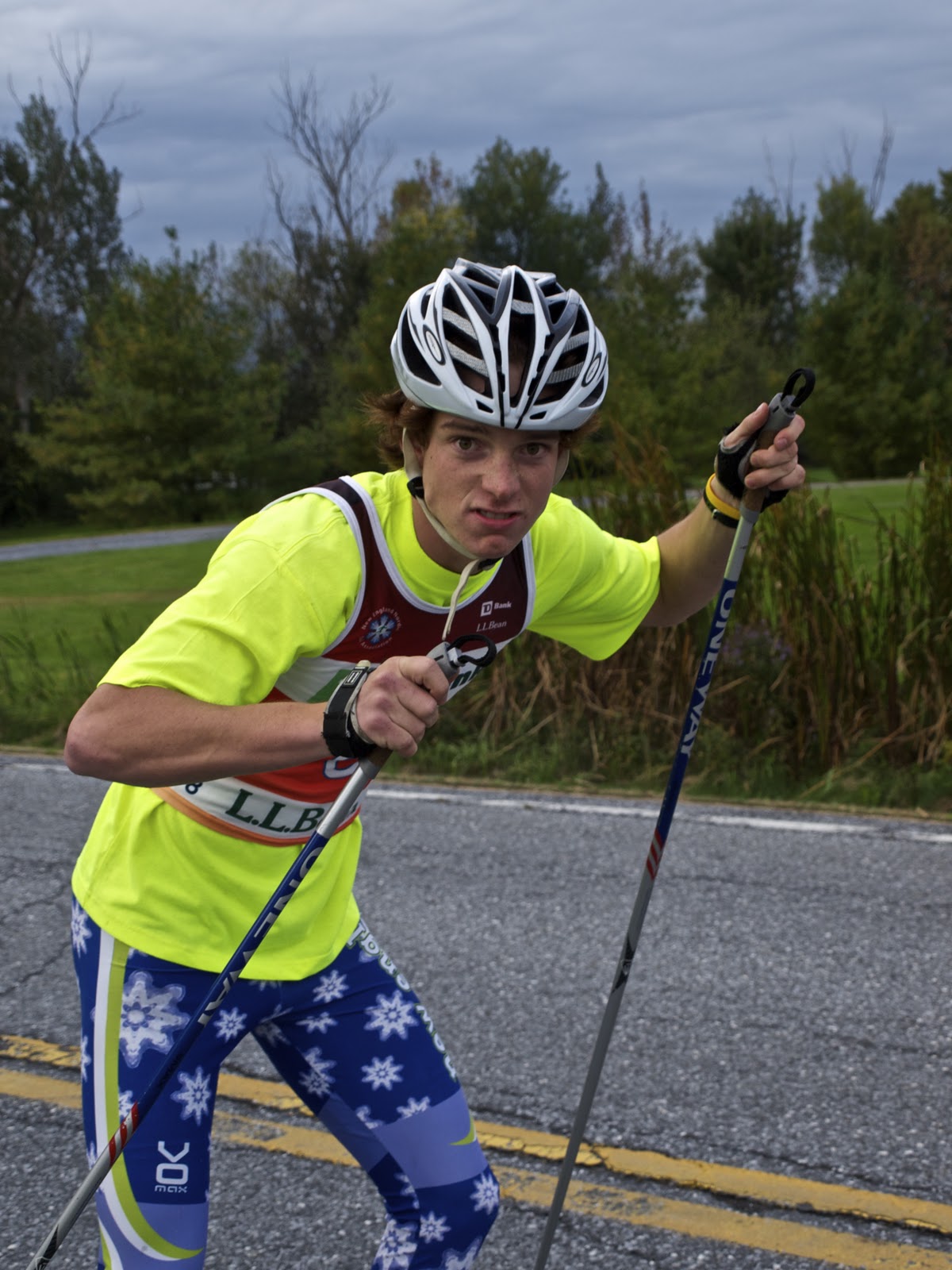
    As for Brown, a Northern Michigan University graduate student who is currently living and training with US Biathlon in Lake Placid, he had a slightly different recollection of the start on Sunday.

    “It wasn’t so much I dropped everyone. It was more like I just slowly pulled away,” Brown said. “Within the first 400 meters, I had a small gap. The gap got bigger and bigger as we went along. Maybe by the first mile, I couldn’t hear anyone behind me.”
    Sticking to his own race, he resisted the temptation to look behind.

    “I was trying to get a good effort today on the skis,” he continued. “I was hoping that some of the faster junior skiers would have some fast rollerskis and be able to push me, but pretty much right from the get-go I was on my own, so I was just trying to keep the pedal to the metal and make it a good effort, which gets tough at the end. It definitely helps to know the course.”

    The women’s top three finishers at NYSEF’s 2017 Climb to the Castle on Sunday, Sept. 24, at the top of Whiteface Mountain in Wilmington, N.Y. (From left to right) Jennie Bender in first, Sheila Kealey (XC Ottawa) in second, and Deedra Irwin (SVSEF) in third.

    In contrast, the women’s race swapped leaders. Clare Egan, a USBA national-team member and Craftsbury Green Racing Project (CGRP) member finished fifth (+5:02.4) after leading early.

    “I did lead a little bit at the beginning,” Egan said. “Jennie, Sheila and I were together for the first 1.5 or 2 miles, and then Jennie and Sheila pulled away, and I got caught by Deedra and Zoe [Williams].”

    “From doing this race in the past, the order doesn’t usually change so much after the first mile or so,” she explained. “It’s just so hard to make up gaps on this grade. I wanted to try to hang on for as long as I could and stay in front the whole way, but I wasn’t able to do that. So it was very hard work out there, and I didn’t have what it takes to stay with Jennie and Sheila. Respect to them.”

    Irwin explained in a post-race email that her plan was to pace off Bender and Egan and stick with them for as long as she could.

    “Jennie and Sheila pulled away just around mile two, I think,” wrote Irwin, a SVSEF Gold Team member who was invited to train with US Biathlon (following its Talent ID Camp) in Lake Placid this fall. “My race went really well. I’m really happy with my result. This was my first time doing Climb to the Castle. I didn’t really know what to expect, it’s a tough climb!”

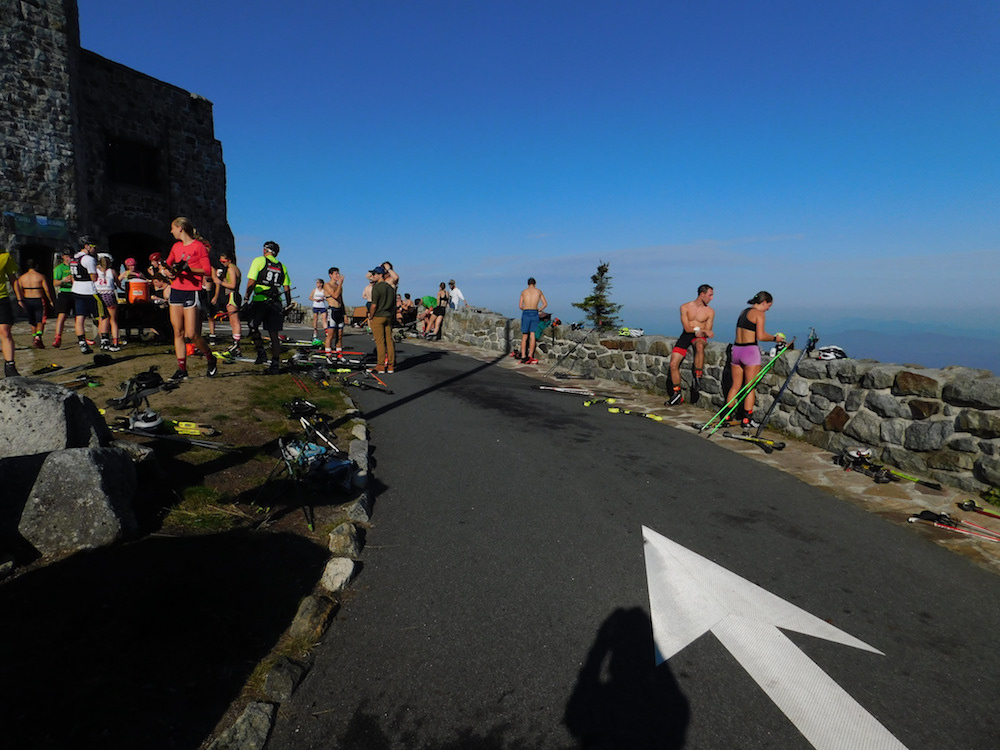
    Blue skies and no snow post-race at the castle atop Whiteface Mountain in Wilmington, N.Y., at the 2017 NYSEF Climb to the Castle on Sept. 24. (Photo: NYSEF)

    As for Kealey, a top-level masters racer on the Canada Cup, she had done the race a few times before.

    “Every year I did it, Liz Stephen did it, and it went out really, really fast,” she said of the U.S. Ski Team member who holds the women’s course record of 41:50. “Really hard at the beginning, and then people dropped off, but today’s pace was a good pace.”

    Kealey described wanting to keep a consistent rhythm all the way to the top. She spent much of the race trading off with Bender.

    “And then I managed to get a gap,” Kealey said. “I had a gap on [Bender] almost until the last 800 meters, and then she caught me. She was hurting, but she put the guns on at the last bit and just pulled away. She skied really well.”

    Reflecting on her win, Bender said, “It wasn’t snowing, and it wasn’t freezing, so that was awesome. My V1 has been getting a lot better. It was a small crowd, but I was stoked to feel good for the whole duration. I haven’t done this race in a long time. I did it probably in college, and it’s fun to see the giant progression since then.”

    She explained that she’s been working with US Biathlon in Lake Placid more this summer.

    “I think in the big picture, it’s fun to see that I’m not just a sprinter,” she said.

    On her race plan, Bender said, “The biggest thing, you have to pace it and not go out too crazy. We kind of started splitting up a bit, and I was going back and forth between first and second throughout the race. First with Clare, then with Sheila and then, near the last 200 to 400 meters, that tunnel, which is always so crazy with the wind, we both were like, ‘Oh.’ We were feeling it.”

    “I saw someone coming up behind us,” Bender continued. “I thought it was Clare, I didn’t realize it was Jake. And then I sprinted it in to the finish. I was stoked to get in under 50 minutes.”

    Bender, Egan, Irwin, and Brown all skied on matched Marwe rollerskis that they also used in time trials, Bender said.

    Zoe Williams, the fourth-place woman (+2:18.8) from Nakkertok and Carleton University, said she wasn’t sure what to expect for her first C2C.

    “About 15 minutes in, I kind of all of a sudden realized that it was all uphill,” Williams said. “I was like, ‘Whoa, what have I got myself into?’ But it was fun. I was following Deedra for most of it. I was trying to match her tempo.

    “The last mile was tough because you can see the castle,” she added. “I really wanted to try to stick with the lead pack as long as I could.”

    In the 11th year of the C2C, Margaret Maher, NYSEF’s outgoing head cross-country coach, said this was one of the warmest race days they’ve had.

    “We’ve had every kind of weather possible,” she said. “It’s just fun to see everybody out there getting ready for winter.”

    “It was really a blessing to have this awesome weather,” Brown concluded. “Normally you come up here and [the castle] is in the clouds, even if it’s sunny down low. It’s cool to do something here with NYSEF and show our support from US Biathlon.”

    Results: Men | Women

  • Race of Truth: Husain, Lawson Win App Gap Challenge

    Race of Truth: Husain, Lawson Win App Gap Challenge

    The winners of NENSA’s 2017 App Gap Challenge rollerski race, Kam Husain (who set a course record) and Alex Lawson, at the awards ceremony at Mad River Glen in Fayston, Vt. While Husain was awarded $100 cash for breaking the course record, he explained in an email that he donated it to NENSA to comply with NCAA rules. (Photo: Dave Priganc)

    FAYSTON, Vt. — This past Sunday, July 23, Kam Husain and Alex Lawson won the 2017 App Gap Challenge and set some of the fastest times on the grueling course in the process. Husain, a 19-year-old Vermont native and former Stratton Mountain School skier, set a new men’s course record of 30 minutes, 28 seconds. Lawson, a Craftsbury Nordic skier coming off her senior year at St. Johnsbury Academy, was the second-fastest woman ever on the course, winning in 26:58 and coming within 21 seconds off Corrine Malcolm’s record.

    Competitive cyclists refer to the individual time trial as the race of truth. It’s just the athlete against the course and the clock, and there’s no pack to hide in. On the steeps leading up to Vermont’s Appalachian Gap, men raced 7.5 kilometers and the women raced 5 k in Fayston, near Waitsfield, Vt. Since Vermont Route 17 was left open to traffic, the race was an individual start. App Gap may be the only rollerski skiathlon in the U.S. (if there are others, email peter (at) fasterskier.com), with the flip-flopped format of skate technique followed by a transition to classic.

    (Article continues below)

    “Last time I did it, I was only a J2, so I wanted to beat that,” said Husain, who will be a freshman at Dartmouth College this fall. “I’ve been working on my skate skiing, so I wanted to take my skate skiing out hard and see if I could hold it through the classic. And it worked out pretty well.”

    Husain broke a seven-year-old record set by former GMVS skier David Sinclair by six seconds.

    “I was definitely trying to gun for it, because I was feeling pretty good,” Husain reflected. “I’ve been really trying to work on my fitness, especially in a race like this. I’m glad my work has been paying off.”

    Alex Lawson (Craftsbury Nordic) with her game face as she approaches the summit and first place in the 2017 App Gap Challenge on July 23 in Fayston, Vt. (Photo: Laurel Minde)

    Lawson, of Bethlehem, N.H., explained that while she was new to the race, she was familiar with the territory and terrain.

    “I’ve never raced the App Gap before, but I’ve skied parts of it at a few camps that I’ve done at GMVS [Green Mountain Valley School],” she wrote in an email. “I didn’t really have too much of a plan for how to ski it, but I definitely took the skate part pretty conservatively and just tried to ski smoothly.”

    Her time was the second fastest of any woman in the race’s nearly 10-year history (Malcolm set the record of 26:37 in 2012). The race started in 2007 and was held every year thereafter, except last year, according to Justin Beckwith of the New England Nordic Ski Association (NENSA). Beckwith started the race as a finale to his junior camps at GMVS, where he was previously a coach and nordic director. After it went on hiatus for a year in 2016, Beckwith, NENSA’s new competition director, decided to revive it.

    “I think [the race] went really well and the event was a lot of fun,” Lawson wrote. “I haven’t really done many rollerski races before, but this one was a blast and certainly makes me want to do more in the future.”

    The second-overall woman, Callie Young, of Newport, Vt., finished 1 minute and 31 seconds behind Lawson. She was also unfamiliar with the course, but received some advice from a friend who had done it before.

    Callie Young, of Newport, Vt., racing toward the summit and second overall in the women’s race at the 2017 App Gap Challenge in Fayston, Vt. (Photo: Laurel Minde)

    “‘ Hammer the skate leg and just walk the classic section,’ ” she recalled. “I definitely didn’t want to take that advice … but decided to go out pretty hard for the skate leg then once I transitioned just focus on good technique and smoothness for the classic section. The only thing I had to know when I was close to the top was when I got to the record time I knew I was pretty close. At that point, I was going to try to push a little harder if I had anything left.”

    In retrospect, Young wished she had driven the course before the race.

    The Mad River Glen ski area served as race headquarters and also the transition zone.

    “My goal was to bring cross-country skiing to an alpine hill,” Beckwith said, adding that he wanted to recreate the vibe of European rollerski events like Norway’s Blink Festival. “The biggest clubs are so strong, they’re having their own time trials. Hopefully we’re creating more excitement for cross-country skiing and also rollerski races. Having this community event, it’s not just about who had the fastest time. You get together with your buddies.”

    Fifty-seven starters lined up Sunday under cloudy skies with temperatures in the low 60s. Right around the start, it began raining lightly, which continued for about 25 minutes. The terrain is markedly different from the Northeast’s other major uphill-rollerski race. Whereas the Climb to the Castle, up Whiteface Mountain’s toll road outside Lake Placid, N.Y., is a steady 8-percent grade, Route 17 from the men’s start teases you with mainly easier sections below 5-percent grade.

    Strava lists Route 17 to Appalachian Gap as a 5-percent grade, but that’s deceiving. As you get closer to Mad River Glen, the road pitches upward, with a 15-percent ramp right below the ski area to soften you up. Starting 2.5 k closer to Mad River, the women had maybe a kilometer of relatively easy grade before the steeps. The pavement is slow and you need to watch for cracks. There’s also the odd pothole that you wouldn’t notice while driving, but that would take you out on rollerskis.

    Pre-race at the 2017 App Gap Challenge in Fayston, Vt.: skiers setting up their classic gear in the transition area. (Photo: Peter Minde)

    From the exchange, there’s no relaxing, with regular grades over seven percent and several over 15 percent. The killer is a 20-percent incline right below the finish. At least the pavement is new and faster than the pavement for the skate segment.

    As with any other race, being familiar with the course helps.

    “I live right in the valley. I know this road,” said Elliot Ketchel, a four-time App Gap racer who won the junior men’s race in 31:18. A GMVS graduate, he’s headed to Bowdoin College this fall.

    At the finish, 1,509 vertical feet above the men’s start, skiers loaded their boards and boots into a sag wagon and changed into dry shirts and sneakers for a hike down the ski trails. With perfect timing, the sun came out for the barbeque and awards.

    Results

  • NENSA Presents App Gap Rollerski Challenge, Best Ball Tourney

    On Sunday, July 23, the New England Nordic Ski Association (NENSA) is hosting a dual-technique rollerski race/challenge, the App Gap Challenge, which climbs the Appalachian Gap in Fayston, Vt. The uphill event along Route 17 features a 5-kilometer women’s race and 7 k men’s race, with parking, registration and awards at Mad River Glen.

    The next day, Monday, July 24, a Best Ball Golf Tournament Fundraiser will be held at the Sugarbush Golf Course in Warren, Vt.

    More details on the App Gap below. Click here to register.

    When: Sunday, July 23rd 2017

    What: Dual technique Rollerski Race/Challenge. Uphill event 5km for women, 7km for men. **If any competitor is limited by equipment or preference they may classic the entire race.

    Where: Course follows Route 17 as it climbs Appalachian Gap. Parking, Registration and Awards: Mad River Glen.

    NENSA and the Central Vermont Co-Op are happy to host the App Gap Challenge after a two year hiatus.  Competitors ski a pursuit format, starting with skate, and transitioning to classic mid course at the parking lot of Mad River Glen, before making the push to the top.  Come and try and break the course record for 100 dollars cash or challenge yourself to a spectacular ski up the eastern slope of the Green Mountains.  Day of Race Registration at Mad River Glen from 8 to 8:30 as space permits.  Online registration closes on July 21st at 5pm.  Course inspection and transition set-up immediately following completed registration. 9:25am and 9:30am start.

    The field size will be limited to the first 100 registrants.  Running a safe event is our #1 goal.  For this reason we are limiting all two-way or downward travel on Route 17.  Helmets required.  Further race day instructions will be made available to you after registration.

    We kindly ask that all competitors park on the north side of the Mad River Glen parking lot.  As you arrive please Check In, Get your Bib, Finish Bag and set up your classic transition box.  We will then provide transportation (or arranged carpooling) to your respective start.  We ask that you strongly consider warming up on foot and plan on descending to the BBQ and awards via Mad River Glen’s trail network for cooldown.  We will provide transport for your running shoes, clothing and other personal items from the start to the finish.  We will also shuttle your rollerskis back to the parking lot where you can retrieve them near the transition.

    FOOD: Your registration fee includes a BBQ lunch at the Base Lodge starting at 11:30am (food and drink will be availble for purchase for spectators).  General Starks Pub will also open for the event and remain open to the public after the event.

    AWARDS: Stay tuned to @nensa_nordic and Facebook for updates on Awards.  There is $100 cash on the line for breaking the course records. There will be prizes for all ages.

    *we encourage the use of “regular training” not “race” wheels and the organizers have full judgement if they are “too fast” to qualify for an official record and prize money

    Historical Records:

    Women  – 5km        Skate Split     Classic Split     Finish          Date

    Corrine Malcolm      11:13            15:24            26:37        7/03/12

    Men       – 7.25km   Skate Split     Classic Split      Finish          Date

    David Sinclair                18:00             12:34             30:34          7/03/10

    More historical data here.

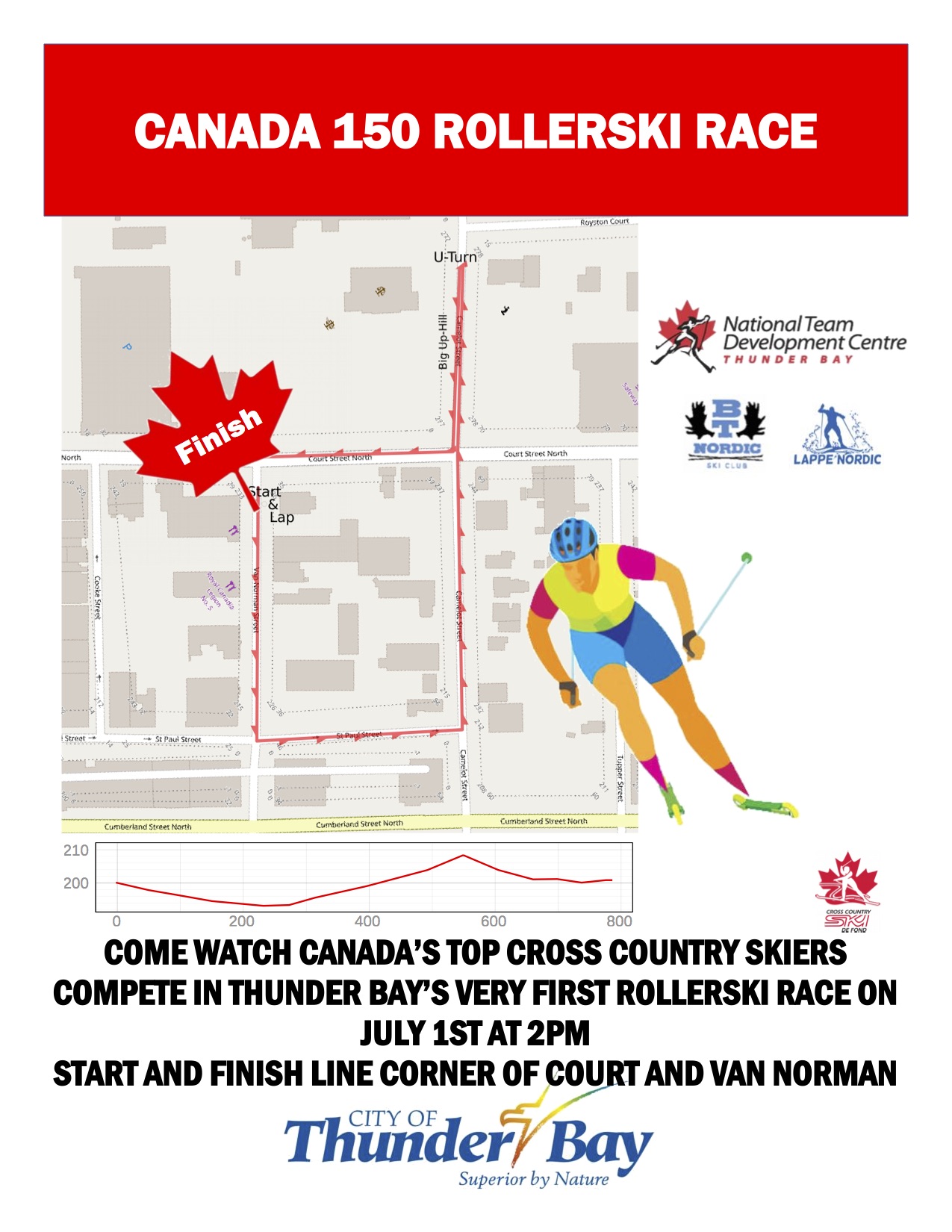
  • Thunder Bay to Host Canada 150 Rollerski Race

    Thunder Bay to Host Canada 150 Rollerski Race

    (Press release)

    Canada 150 Rollerski Race

    On July 1st, 2017, Thunder Bay, Ontario will be hosting its first ever Cross Country Canada sanctioned rollerski race. The race will feature more than 50 of Canada’s top nordic skiers racing around the closed streets of downtown Port Arthur. The race will start and finish at the corner of Court and Van Norman, commencing at 2:00 pm and finishing with awards at 6:00 pm.

    The event is organized by Lakehead Superior Nordic Association, Big Thunder Nordic Ski Club, Lappe Nordic, and the National Team Development Centre (NTDC) Thunder Bay.

    This event has been organized to coincide with the other exciting Canada Day celebrations planned for the downtown core.

    Among the racers will be top local skiers, Junior National Team members and other elite skiers who have come to Thunder Bay from across Canada for a training camp hosted by NTDC Thunder Bay. The field will include athletes who potentially will represent Canada in the upcoming Winter Olympics.

    Race format will include an interval start individual time trial with each competitor completing two laps of the course. Then the athletes will be seeded into waves of closely matched competitors. Each wave will complete a 12 to 20 lap race on the same circuit. Waves will progress from the slower competitors to the faster, with the top ranked skiers racing at close to 4 pm.

    Date: Saturday July 1st 2107 Time: 2:00-6:00 PM

    Location: Start/finish at corner of Court and Van Norman (see attached map of race course)

    Contact Timo Puiras (NTDC Thunder Bay Head Coach) at ndctimo@gmail.com for further information

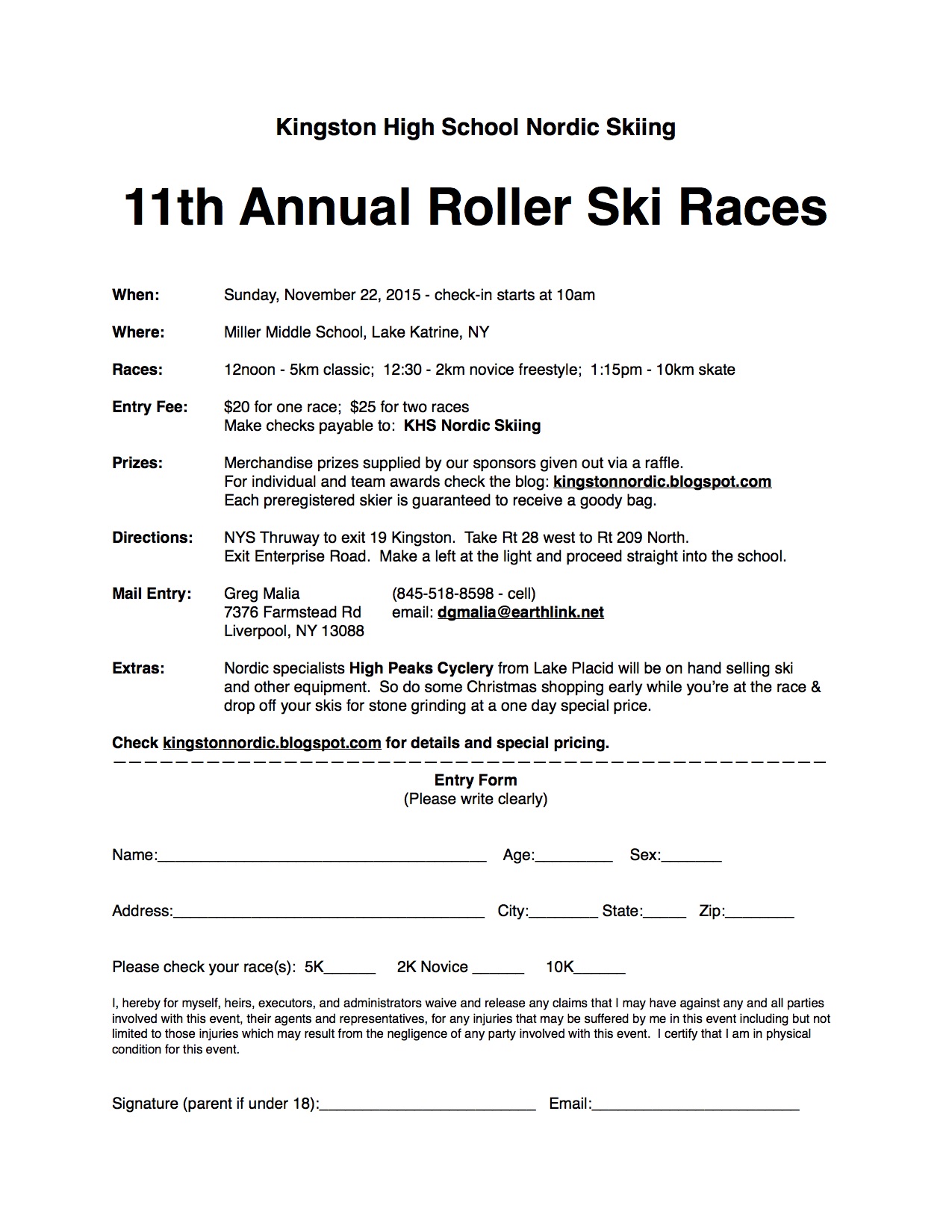
  • Kingston Roller Ski Race is Back: Nov. 22

    After a one year hiatus, the Kingston Roller Ski races are back with the 11th annual edition.  Scheduled for Sunday, November 22, 2015, this year is shaping up to be as good as any in the past.

    The sponsors are lined up and include Toko wax, Verge uniforms, Nathan hydration, Polar heart rate monitors, Concept2/SkiErg, Rudy Project, V2 roller skis, Accelerade sports drink, and Ear Mitts.  They all have donated great equipment and other merchandise to be given out to the race participants. We probably have at least $5000 worth of prizes including a pair of roller skis from V2 and some sport glasses and helmets from Rudy Project.  Everyone will go home with goods worth far more than the race fee.  High Peaks Cyclery, from Lake Placid, is scheduled to be on hand, once again, with their store on wheels offering great discounts for the day of the race on everything they have with them.

    Race application below:

    Roller Ski Race App copy

    More information is available on the race blog:  kingstonnordic.blogspot.com.

  • New to the Climb to Castle Winners’ Circle: Caldwell and Rose Top Whiteface Race

    New to the Climb to Castle Winners’ Circle: Caldwell and Rose Top Whiteface Race

    Paddy Caldwell of the U.S. Ski Team D-team and SMST2 Team won Sunday's Climb to the Castle up Whiteface Mountain in Wilmington, N.Y. Here, around mile four of five, he's seen leading the pack, which includes biathletes Russell Currier and Tim Burke, and Rogan Brown (SVSEF) and Kyle Bratrud (CXC). (Photo: Tim Cowan)
    Paddy Caldwell (black shirt, yellow helmet) of the U.S. Ski Team D-team and SMST2 Team chases Rogan Brown (l) around mile four of five in  Sunday’s Climb to the Castle up Whiteface Mountain in Wilmington, N.Y. Caldwell won the race, followed by biathletes Russell Currier and Tim Burke in second and third, respectively. Brown (SVSEF) placed fourth and Kyle Bratrud (CXC) was fifth. (Photo: Tim Cowan)

    Note: Two photo captions have been corrected to reflect the leader of the men’s race around mile four in the 2015 Climb to the Castle. Rogan Brown of Sun Valley led the pack at the time.

    For years, U.S. Nordic Ski Team athletes and their coaches trucked themselves up to the start of the Whiteface Veterans Memorial Highway, clicked into their rollerskis and allowed an ample amount of time for warming up before ascending New York’s fifth highest peak.

    Before it became an official race nine years ago, it was a workout: a five-mile grind to the summit of Whiteface Mountain, 4,867 feet above sea level in Wilmington, N.Y.

    Now, for many top-level skiers, especially those based on the East Coast, the annual Climb to the Castle an offseason staple. And if you win, you get a T-shirt and a medal for your efforts.

    Mary Rose (SVSEF) leads US Biathlon's Annelies Cook up the Whiteface Mountain toll road during the annual Climb to the Castle. Rose won and Cook finished second, 32 seconds later. (Photo: Tim Cowan)
    Mary Rose (SVSEF) leads US Biathlon’s Annelies Cook up the Whiteface Mountain toll road during the annual Climb to the Castle. Rose won and Cook finished second, 32 seconds later. (Photo: Tim Cowan)

    “Climb to the Castle was a blast this year!” wrote women’s winner Mary Rose of Idaho’s Sun Valley Ski Education Foundation (SVSEF) Gold Team. “My goal going into this race was to have good energy the whole time, focus on technique and hopefully put together a good effort.”

    She reached the top on Sunday in 45:15.1 and topped her competition — the closest of which was US Biathlon’s Annelies Cook — by 32.6 seconds.

    “It was a fun, tough effort,” men’s winner Patrick Caldwell of the U.S. Ski Team D-team and Stratton Mountain School (SMS) T2 Team said in an interview after the finish.

    The 21-year-old Caldwell outlasted biathletes Russell Currier and Tim Burke by 5 and 11.5 seconds, respectively. Caldwell won in 37:05.2, Currier was second and Burke was third.

    “Right from the start, we stayed pretty much together against a decent headwind,” Burke said after the finish. “I think a lot of us were fatigued at the end of a big camp, so I didn’t really want to push like crazy.”

    The US Biathlon and U.S. Nordic teams spent at least the last week training in Lake Placid, N.Y., with biathletes like Burke logging five race efforts in nine days preceding the Climb.

    “I decided today instead of going for time, I wanted to go for the win,” said Burke, a defending multiple-time Climb to the Castle (C2C) champion. “So I decided to sit in and push that last half mile.”

    Paddy Caldwell of the U.S. Ski Team D-team won today's Climb to the Castle up Whiteface. Here he's seen around mile 4 leading the pack, which includes veteran biathlete Tim Burke (who placed 3rd). (Photo: Tim Cowan)
    Rogan Brown (l) of Sun Valley leads Tim Burke (second from l) and Paddy Caldwell (third from l) and Russell Currier and Kyle Bratrud around mile four in Sunday’s Climb to the Castle up Whiteface Mountain in Wilmington, N.Y. (Photo: Tim Cowan)

    He said he “did a lot of pulling and got some help towards the end.” Rogan Brown (SVSEF) led around mile four, and Burke explained that five men battled in the lead pack for the last two miles.

    “I broke my pole in the last couple hundred meters, that kind of took me out of it,” he explained.

    Caldwell took the blame what he called an “unfortunate incident” in the final 200 meters. “I broke Tim Burke’s pole,” he said. He did so when Burke made his final attack toward the finish.

    “Aside from that, it was a good, solid race,” Caldwell said.

    “It’s a good way to end it,” Burke said after 10 days of hard training.

    Currier, who placed second, called it an “entertaining race” with five men contending throughout.

    “For a rare change I was able to be on the better side of tactics and consistently stay in the back of the pack,” Currier wrote in an email. “On the other hand, the final 100 meters came up a lot earlier than I expected and didn’t give much time to react. The pace picked up and Tim Burke lost a pole tip. The next thing I knew there was an opening for the lead. I’m not much of a sprinter and didn’t do much to challenge Patrick, but was I was still pleased to break out of the back of the pack just in time for the podium.”

    A former US Biathlon (USBA) B-team member, Currier, who trains with the Maine Winter Sports Center, was not renamed to the team this spring and is working towards making the cut via a series of trials ending in October.

    “The status for the National team is still very unclear,” he wrote. “… All I can do is make the best of every training session and go for better results. The second round of trials is coming up in October. A couple of good enough results there should help my cause for the coming race season.”

    Brown placed fourth in the men’s race, 4.3 seconds from the podium and 15.8 seconds after Caldwell. Brown edged Kyle Bratrud of Central Cross Country (CXC) by 0.3 seconds, and behind them, another CXC skier Duncan Douglas placed sixth.

    USBA’s Sean Doherty and Lowell Bailey finished seventh and eighth, respectively, Miles Havlick (SVSEF) was ninth and developing biathlete Max Durtschi finished 10th of 61 men.

    The start of the women's race at the 2015 Climb to the Castle up Whiteface Mountain in Wilmington, N.Y. (Photo: Peter Minde)
    The start of the women’s race at the 2015 Climb to the Castle up Whiteface Mountain in Wilmington, N.Y. (Photo: Peter Minde)

    In the women’s race, Rose and Cook pushed each other to the top. Rose recalled it being just the two of them shortly after the start. A perennial contender, USBA’s Susan Dunklee had some pole issues at the very beginning, Rose explained in an email.

    “I knew I needed to break away about 1/2 mile to the finish because I can’t beat [Cook] in a sprint,” Rose wrote. “I fought pretty hard through the ‘wind tunnel’ and I think that is where I broke away.”

    Overnight rain left the toll road wet, and wind dried out its lower sections. From about the halfway point to the finish, skiers pushed through mist on wet pavement and faced a steady wind blowing 10 to 20 miles per hour throughout the race. After starting in temperatures around 47 degrees Fahrenheit, they met temperatures in the mid-30’s at the top.

    “It sounds weird to say it aloud, but I actually had fun doing the climb to the castle,” Cook wrote in an email. “Mary and I skied together the entire time and switched leads back and forth. I usually get bored doing the climb and lose focus and switching back and forth with her kept me in the game mentally.

    “She got me at the last turn right before the finish when I suddenly flooded with lactic acid and had no chance,” she added. “But I don’t really think of myself as a climber and so it was fun to be the two people leading the race. That doesn’t happen too often! Of course, the usual suspects were not there and that obviously made it difference.”

    With the exception of Paddy Caldwell, the U.S. Ski Team (USST) skipped the Climb this year for the first time in years.

    “As hard as it is to miss it because it is a fantastic event, it just didn’t play well athletically for the needs of the group,” USST Head Coach Chris Grover said on the phone last week. “We wanted to do more sprint-specific training and short intensity as opposed to giving up a whole workout or two to do the Climb to the Castle.”

    The USST camp was also only a week long, compared to the two weeks the team usually spends in Lake Placid this time of year. On the other hand, the largely Lake-Placid-based US Biathlon team did either time trials or Level 5 (race-pace) workouts for last 10 days.

    “I had my personal best by quite a lot and I felt strong skiing,” Cook said of the Climb. “It felt good to end a really tough ten days on a good note. … I think we are all pretty glad to be done.”

    The Climb marked the end of a two-week training block for Rose and her Sun Valley teammates, who were in Stratton, Vt., with the SMST2 team for the first week.

    “We had some super hard intensity sessions over the past two weeks and all were very productive,” Rose wrote.

    USBA’s Hannah Dreissigacker, who placed third, 2:05.9 after Rose, explained in an email that the women’s race broke up quickly.

    “Mary and Annelies started off a little faster than I really wanted to be going, and I tried to hold on for a bit but then gave up pretty quickly and lost contact,” Dreissigacker wrote. “My goal in the Climb to the Castle is always to not start too fast and then blow up. Then I skied with Susan for a mile or so and then slowly inched ahead of her a bit. Eventually we skied into a cloud and I lost sight of Annelies and Mary and just skied the whole second half by myself.”

    She finished 1:10.9 ahead of Dunklee, who placed fourth, while wearing a figure-skating tutu she wore the first time she did the race.

    “The lacy elbows really allowed for added breathability and the rhinestones gave me some extra motivation on those long hard stretches when I was all alone,” Dreissigacker wrote.

    Another biathlete, Clare Egan finished fifth, Paige Schember (SVSEF) was sixth, Erin Perryman (St. Lawrence University) was seventh, Jackie Garso of the local New York Ski Education Foundation (NYSEF) was eighth, St. Michael’s assistant coach Silke Hynes was ninth, and Stratton U16 skier Anna Lehmann was 10th of 25 women.

    Results: Men | Women

  • NYSEF Whiteface Climb to the Castle Rollerski Race on Sept. 20

    Sunday, September 20, 2015

    Climb to the Castle

    Climb to the top of Whiteface, New York’s 5th highest peak for a 360-degree panoramic view of the Adirondacks, New England and Canada

    NYSEF

    WILMINGTON, N.Y. — The New York Ski Educational Foundation  and the Olympic Regional Development Authority invite athletes to the 9th annual NYSEF Whiteface Climb to the Castle Rollerski Race on Sunday, September 20 at 8 AM. The course starts at the Whiteface Toll Booth, climbing for 5 miles with an average 8% grade up the Whiteface Memorial Highway to the castle on the summit of Whiteface Mountain, New York’s 5th highest peak with an elevation of 4,867 ft. The race is freestyle technique and athletes will be greeted at the finish with a 360-degree panoramic view of the Adirondacks, New England and Canada. Athletes will have excellent road conditions with all new pavement to the summit.

    NEW this year is a team event! Fastest 3 times will be added together to name a Women’s Team Champions and Men’s Team Champions

    Link to race details: 2015 Climb to the Castle

    Link to race registration: AlpineReg

    Online registration closes Friday, September 18 at 9 AM


    Looking to help out at the awesome C2C race? sign up to volunteer here

    Questions? Email Margaret Maher margm@nysef.org

    Countdown to race day has started…watch the preview video here


    Awards by Mt. Borah

    MT Borah

  • Whiteface Road Work Could Impact Climb to Castle

    Whiteface Road Work Could Impact Climb to Castle

    The road well traveled...
    The Whiteface Mountain Veterans Memorial Highway, where NYSEF’s Climb to the Castle has been held for the past seven years in Wilmington, N.Y., as seen in 2011. The toll road is undergoing construction this summer and fall.

    There’s a race each year scheduled in line with the end of the U.S. Ski Team’s fall camp in Lake Placid, N.Y. You might have heard of it: the Climb to the Castle. Hosted by the New York Ski Education Foundation (NYSEF), the freestyle rollerski race starts at the entrance to a paved toll road, the Whiteface Mountain Veterans Memorial Highway, and stretches five miles up with an average 8-percent grade. The finish is marked by the castle at the top of New York’s fifth-highest peak at 4,867 feet above sea level.

    Try to rollerski up there now, however, and you’ll likely run into some heavy machinery.

    Construction has already begun on the eight-mile highway as part of a larger project to completely resurface the road over the next several months. The Adirondack Daily News reported Thursday that the upper, toll portion of the road — where the Climb to the Castle (C2C) takes place — will be closed weekdays during May, June and September, but open on weekends. It will be open on weekends and two holiday Mondays during these months: Memorial Day, May 26, and Labor Day, Sept. 1. Throughout July and August, the road is scheduled to be open during daytime hours, with work taking place at night.

    Tim Burke (USBA), Kris Freeman (USST) and Noah Hoffman (USST) leading the men's race.
    US Biathlon’s Tim Burke (l), and U.S. Ski Team members Kris Freeman (c) and Noah Hoffman (r) lead the 2011 Climb to the Castle race in Wilmington, N.Y.

    According to Chris Grover, the U.S. Ski Team will hold its Lake Placid training camp from Aug. 25-Sept. 8. So while there’s a chance construction could impact it, there’s a better chance the toll road will be open on Saturday, Sept. 6, when NYSEF scheduled the race.

    Margaret Maher, NYSEF’s head nordic coach and C2C organizer, wrote in an email to FasterSkier last week that they were “trying to figure out how the road work will influence the race. Hoping we can still have C2C!”

    In all, the highway is expected to be closed 54 days from this week until the end of the season, and open 88 days over the same period, according to the Enterprise.

    While the toll road has been patched periodically since it was opened in the 1930s, it has never been completely resurfaced. Whether rollerskiing, cycling, or running to the summit, it’s riven with frost heaves and cracked pavement. Regardless of what state the road is in this year, its sure to be a superior surface for rollerskiing next summer.

    Rifenburg Construction, based out of Albany, N.Y., will resurface the entire eight-mile length of the road, from the four-way intersection in the center of Wilmington to the summit. They’ll also rehabilitate rock walls and make repairs to the castle.

    The men's start.
    The men’s start of the 2009 Climb to the Castle.

    Rifenburg earned the project with a $11.2-million bid, and the company expects to complete the work by the end of 2015.

    Project manager Russell Huta said that the goal is to have a base layer of new pavement from the tollgate to the castle by the end of this fall.  In 2015, the toll section will be finished, and all work on the section from Wilmington town center to the tollgate will be completed.

    “Each project has its own set of unique challenges,” Huta told FasterSkier, when asked about the difficulty of working in the narrow confines of the toll road. When road work is in motion, the toll road will be closed to traffic.

    In September, Huta said, his company will have “full access” to the toll road Monday through Friday – except for Labor Day. “By the end of the day Friday, there will be a paved surface for [use by] cars, buses, pedestrian traffic” until Monday morning.  “On Monday morning, it’s ours again.”

    If for some reason, the C2C isn’t possible this year, Grover wrote in an email that it won’t be the end-all of camp.

    “We typically run a sprint or team sprint time trial along with the Climb to the Castle,” he explained. “If the Climb is not ready this season, we will employ other alternatives.”

    Before the C2C, a time trial was previously held up Gillespie Drive, now a warmup for athletes. The event is entering its eighth year. USST veteran Liz Stephen won the women’s race the last three years, setting a new course record last year in 42 minutes and 4 seconds. US Biathlon’s Tim Burke won the 2013 men’s race in 37:13.

  • 9th Kingston Roller Ski Race Set for Nov. 18

    The Kingston Nordic Ski Club is gearing up for its 9th annual Kingston Roller Ski Race on Nov. 18 at the Miller Middle School at Lake Katrine, N.Y. Races include a 5 k classic, 2 k novice and 10 k freestyle.

    Registration begins at 10.m.; races start at noon.

    (From kingstonnordic.blogspot.com)

    Well, that time of year has come for the traditional fall classic – the 9th Annual Kingston Roller Ski Race. Over the years, as the race has grown, so too has the fun everyone experiences coming to the event. Seeing old friends, making new ones, getting some great prizes and racing one last time on those roller skis before the snow comes and we put them away until next spring. And the snow will come this winter.

    The race is scheduled for Sunday, November 18th (always the Sunday before Thanksgiving) at the Miller Middle School in Lake Katrine, NY. Registration will begin at 10am with the races starting at 12 noon with the 5K classic, followed at 12:30 with the 2K novice, and ending at 1:15pm with the ~10K freestyle. As usual, food and refreshments galore will follow with awards starting around 2:30pm.

    The Races:

    People can register for the 5K &/or 10K Race(s). However, if you sign-up for the novice race, that’s the only race in which you may participate. The novice race is for people who are just beginning their roller ski training. The cost is $15 for one race and $20 for two races.

    Individual Awards:

    I. An overall male & female champion will be crowned based on their performances in both the 5K & 10K races.

    II. An overall male & female champion will be crowned based on their performances in the North Creek Race and their best performance at Kingston.

    III. The male & female winners in the novice race, the 5k race and in the 10K race will receive an award.

    IV. Age group winners:

    • high school & younger
    • out of high school to 29
    • 30-45
    • over 45

    Team Awards:

    A high school, college or club can enter as many teams as they like. If entering more than 1 team just list them as Team A, Team B, etc. We will be rewarding a trophy and a revolving trophy to the winning high school team and the winning college/club team. Each team must be set and a card filled out before the start of the first race at 12noon.

    H.S. Team Championship: A high school team will consist of 4 skiers – 2 guys and 2 girls. One guy and one girl must race in the 5K race and a different guy and different girl must race in the 10K race. Each skier can participate in both races, if they wish. However, only 1 race can count toward the team championship and that race must be decided before the races start at 12 noon.

    College/Club Team Championship: Basically, the same rules apply except a college/club needs only 1 woman skier.

    Special Team Pricing:

    The cost of the race is $15 for one race (novice, 5K or 10K) and $20 for two races (both the 5K and the 10K). However, a team or club that preregisters as a group at the same time, in the same envelope or in the same email, will receive a discount of $5/skier. This price is not available on race day. Coaches – this is a great opportunity to bring your entire team at a very reduced price. You can sign-up a team by sending me an email listing all the members, their race(s), their age, and their sex. We can take care of filling out the actual applications on race day.

    Race Timing:

    For the first time, we will be using chip timing. Peregrine Timing will be working with us on the event and it should help make the finish line and the awards go smoother.

    For more info, visit kingstonnordic.blogspot.com.

  • US Nationals Simulation Week: Day 1


    We’ve been back from Italy for a week now, and we’re settling into a routine that will carry us all the way through to November’s trip to West Yellowstone. This is arguably our most focused block of the year academically and athletically: we have an opportunity to make big gains in both arenas.

    It’s a good time to think about where we’re going: part of moving forward is reflecting on where we’ve been. What’s worked well and where do we need to be better?

    Many of our skiers have made serious goals for the races at US Nationals. In order to prepare, we’re skiing a simulated Nationals week, with three time trial efforts: a 10km skate, a skate sprint day, and a classic distance race. For the first day of this week we drove up over the gap to go meet up with Cam MacKugler and his Frost Mountain Nordic team for a 10km skate TT. I had a vision of Cam bending a Swix Star at the Bolton Eastern High School Sprint when I was in 9th grade (2005). I won’t tell you how long it took me to dredge up this photo, but the display of raw power is worth it.

    Cam had a group of four skiers who showed us the course. We skied it backwards (downhill) as a warmup, then threw on the bibs and got ready to go.
    The group was all smiles before the start. It’s always fun to meet up with different people for training. Thanks to Frost Mountain for letting us join in!
    Heidi starts up the course: her first 10k race!
    Our skiers are committed to so many things: Kaitlin’s balancing college apps, play, the Valley Reporter, and still skiing fast right now.

    Dev has made incredible gains this year (while playing soccer and having a lead role in play!). His game face is on 24/7.

    Night is falling quicker and quicker these days.

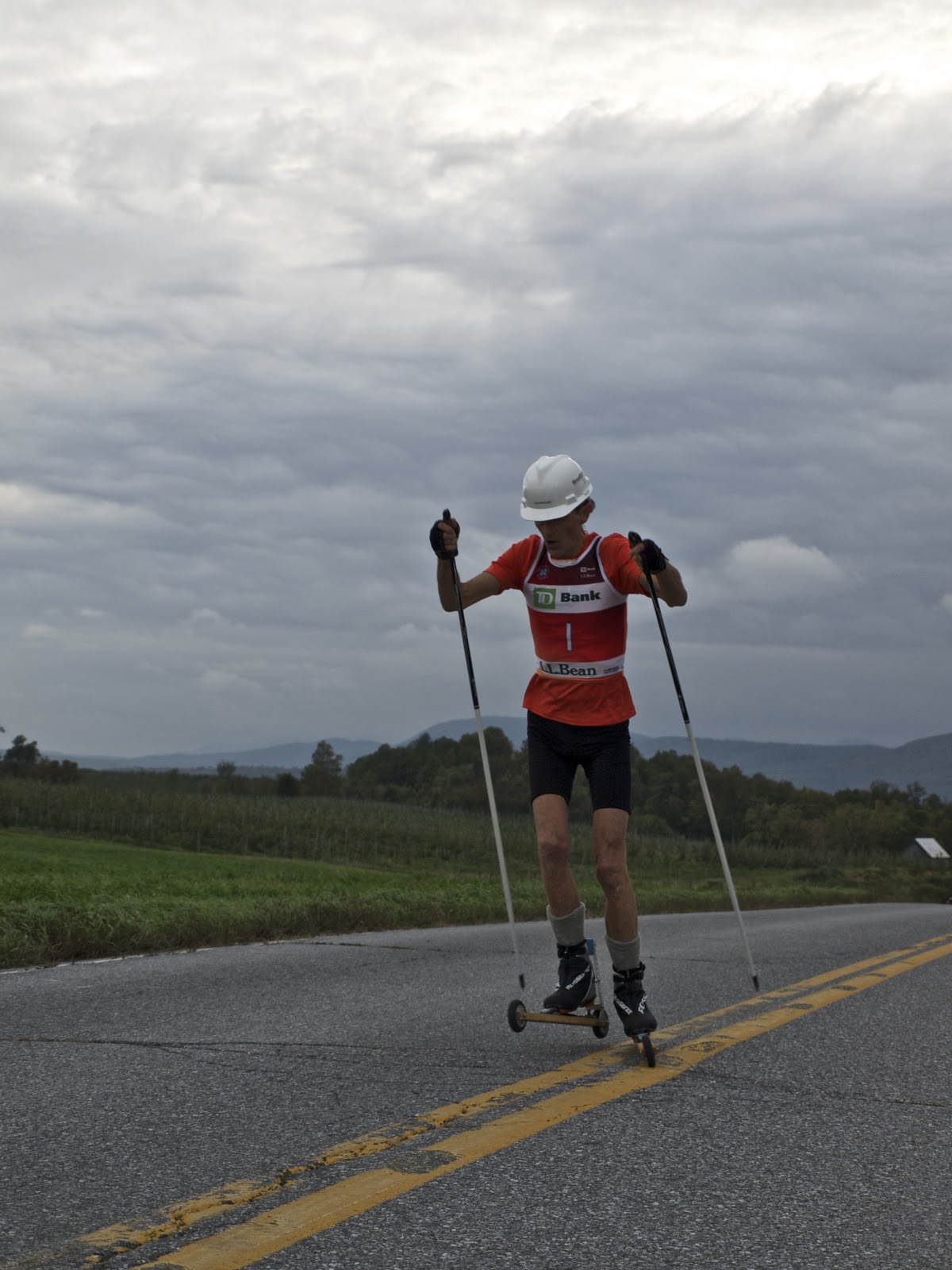
    Wood roller skis and a construction hard hat. Not a bad look for our Frost Mountain Friend.

    It’s beginning to feel like Fall in New England out here. Italy was sweet, but the scenery in Vermont is pretty striking as well, even on a cold, cloudy day.
    We had some awesome efforts yesterday: everyone skied hard on an unfamiliar and challenging course. Now it’s out for skate sprinting at Sugarbush!
  • US Nationals Simulation Week: Day 1


    We’ve been back from Italy for a week now, and we’re settling into a routine that will carry us all the way through to November’s trip to West Yellowstone. This is arguably our most focused block of the year academically and athletically: we have an opportunity to make big gains in both arenas.

    It’s a good time to think about where we’re going: part of moving forward is reflecting on where we’ve been. What’s worked well and where do we need to be better?

    Many of our skiers have made serious goals for the races at US Nationals. In order to prepare, we’re skiing a simulated Nationals week, with three time trial efforts: a 10km skate, a skate sprint day, and a classic distance race. For the first day of this week we drove up over the gap to go meet up with Cam MacKugler and his Frost Mountain Nordic team for a 10km skate TT. I had a vision of Cam bending a Swix Star at the Bolton Eastern High School Sprint when I was in 9th grade (2005). I won’t tell you how long it took me to dredge up this photo, but the display of raw power is worth it.

    Cam had a group of four skiers who showed us the course. We skied it backwards (downhill) as a warmup, then threw on the bibs and got ready to go.
    The group was all smiles before the start. It’s always fun to meet up with different people for training. Thanks to Frost Mountain for letting us join in!
    Heidi starts up the course: her first 10k race!
    Our skiers are committed to so many things: Kaitlin’s balancing college apps, play, the Valley Reporter, and still skiing fast right now.

    Dev has made incredible gains this year (while playing soccer and having a lead role in play!). His game face is on 24/7.

    Night is falling quicker and quicker these days.

    Wood roller skis and a construction hard hat. Not a bad look for our Frost Mountain Friend.

    It’s beginning to feel like Fall in New England out here. Italy was sweet, but the scenery in Vermont is pretty striking as well, even on a cold, cloudy day.
    We had some awesome efforts yesterday: everyone skied hard on an unfamiliar and challenging course. Now it’s out for skate sprinting at Sugarbush!
  • US Nationals Simulation Week: Day 1


    We’ve been back from Italy for a week now, and we’re settling into a routine that will carry us all the way through to November’s trip to West Yellowstone. This is arguably our most focused block of the year academically and athletically: we have an opportunity to make big gains in both arenas.

    It’s a good time to think about where we’re going: part of moving forward is reflecting on where we’ve been. What’s worked well and where do we need to be better?

    Many of our skiers have made serious goals for the races at US Nationals. In order to prepare, we’re skiing a simulated Nationals week, with three time trial efforts: a 10km skate, a skate sprint day, and a classic distance race. For the first day of this week we drove up over the gap to go meet up with Cam MacKugler and his Frost Mountain Nordic team for a 10km skate TT. I had a vision of Cam bending a Swix Star at the Bolton Eastern High School Sprint when I was in 9th grade (2005). I won’t tell you how long it took me to dredge up this photo, but the display of raw power is worth it.

    Cam had a group of four skiers who showed us the course. We skied it backwards (downhill) as a warmup, then threw on the bibs and got ready to go.
    The group was all smiles before the start. It’s always fun to meet up with different people for training. Thanks to Frost Mountain for letting us join in!
    Heidi starts up the course: her first 10k race!
    Our skiers are committed to so many things: Kaitlin’s balancing college apps, play, the Valley Reporter, and still skiing fast right now.

    Dev has made incredible gains this year (while playing soccer and having a lead role in play!). His game face is on 24/7.

    Night is falling quicker and quicker these days.

    Wood roller skis and a construction hard hat. Not a bad look for our Frost Mountain Friend.

    It’s beginning to feel like Fall in New England out here. Italy was sweet, but the scenery in Vermont is pretty striking as well, even on a cold, cloudy day.
    We had some awesome efforts yesterday: everyone skied hard on an unfamiliar and challenging course. Now it’s out for skate sprinting at Sugarbush!
  • US Nationals Simulation Week: Day 1


    We’ve been back from Italy for a week now, and we’re settling into a routine that will carry us all the way through to November’s trip to West Yellowstone. This is arguably our most focused block of the year academically and athletically: we have an opportunity to make big gains in both arenas.

    It’s a good time to think about where we’re going: part of moving forward is reflecting on where we’ve been. What’s worked well and where do we need to be better?

    Many of our skiers have made serious goals for the races at US Nationals. In order to prepare, we’re skiing a simulated Nationals week, with three time trial efforts: a 10km skate, a skate sprint day, and a classic distance race. For the first day of this week we drove up over the gap to go meet up with Cam MacKugler and his Frost Mountain Nordic team for a 10km skate TT. I had a vision of Cam bending a Swix Star at the Bolton Eastern High School Sprint when I was in 9th grade (2005). I won’t tell you how long it took me to dredge up this photo, but the display of raw power is worth it.

    Cam had a group of four skiers who showed us the course. We skied it backwards (downhill) as a warmup, then threw on the bibs and got ready to go.
    The group was all smiles before the start. It’s always fun to meet up with different people for training. Thanks to Frost Mountain for letting us join in!
    Heidi starts up the course: her first 10k race!
    Our skiers are committed to so many things: Kaitlin’s balancing college apps, play, the Valley Reporter, and still skiing fast right now.

    Dev has made incredible gains this year (while playing soccer and having a lead role in play!). His game face is on 24/7.

    Night is falling quicker and quicker these days.

    Wood roller skis and a construction hard hat. Not a bad look for our Frost Mountain Friend.

    It’s beginning to feel like Fall in New England out here. Italy was sweet, but the scenery in Vermont is pretty striking as well, even on a cold, cloudy day.
    We had some awesome efforts yesterday: everyone skied hard on an unfamiliar and challenging course. Now it’s out for skate sprinting at Sugarbush!
  • Climb to the Castle Preview and Pick the Podium Contest

    Every region in the U.S. seems to have its own iconic dryland hill climb. In Alaska, there’s Mount Marathon. Out west, it’s Agony. In the Midwest—well, uh… forget about the Midwest. But in the northeast, there’s one of the most brutal: the Whiteface Climb to the Castle.

    Okay, okay, we know. Mount Marathon’s got more history. Agony’s steeper. This year’s Climb to the Castle is only the fourth-ever edition of the event. But there’s no question that the race, which features over 2,000 feet of elevation gain over five miles, is a spectacle. And with just one month to go before the start of the 2011 race season, it’s also a good indication of who’s hot, and who’s not.

    Women's lead pack 2009 – Ida Sargent leading Arritola, Stephen, Strandberg, and Dreissigacker.

    This year’s field is a strong one, with Olympic gold medalist Billy Demong and U.S. Ski Team (USST) member Kris Freeman on the men’s side, and USST teammates Morgan Arritola and Liz Stephen headlining the women. Instead of making our own predictions, we’re asking readers to pick who they think will be the first to make it to the top (form below). To aid with prognostication, your cheat sheet is below.

    • A couple of nordic combined skiers ran away with last year’s men’s race, with the aid of their blistering fast Maplus rollerskis. (Most cross-country athletes use Marwes, which are substantially slower.) Those athletes—Nick Hendrickson and Taylor Fletcher—will be back this year, but according to their coach, Dave Jarrett, they’ll be on different skis—“probably slightly faster than Marwes, but not like last year.” Most of the other athletes should be on comparable equipment—but we make no guarantees.

    • Who are the contenders? Well, beyond the U.S. cross-country and nordic combined teams, Sun Valley, CXC, and the Craftsbury Green Racing Project will send full squads to the race. On the men’s side, Freeman and Demong are the obvious favorites, but the 20-year-old Fletcher served notice of his potential over the summer, setting the fastest rollerski time at an elite nordic combined competition in Germany in August.

    U.S. cross-country development team member Noah Hoffman can’t be counted out in an uphill climb, either—he finished second to Ivan Babikov in the race up the Lonesome Pines alpine ski area at the SuperTour Finals last March. And CXC has a threatening quadrumvirate in Brian Gregg, Tad Elliott, Garrott Kuzzy, and Matt Liebsch. Finally, a dark horse could be Australian cross-country Olympian and aspiring nordic combined athlete Ben Sim.

    • The women’s field isn’t quite as deep, but those with the fitness to test Stephen and Arritola include Dartmouth/Craftsbury’s Ida Sargent, CXC’s Brooke Gosling, and Craftsbury’s Hannah Dreissigacker.

    A full list of the entrants that FasterSkier could confirm at the time of posting is below. The initial version of this post left out the participation of Australian Olympian Ben Sim. If anyone wants to revise their entries, just submit a second one.

    Men’s Field

    U.S. Cross-Country Ski Team: Kris Freeman, Simi Hamilton, Noah Hoffman, Andy Newell

    U.S. Nordic Combined Team: Brett Camerota, Eric Camerota, Billy Demong, Bretty Denney, Taylor Fletcher, Bryan Fletcher, Nick Hendrickson, Todd Lodwick

    Central Cross-Country (CXC): Tad Elliott, Brian Gregg, Garrott Kuzzy, Matt Liebsch, Karl Nygren, Santiago Ocariz, Eric Wolcott

    Sun Valley Olympic Development Team: Matt Gelso, Colin Rodgers, Mike Sinnott

    Craftsbury Green Racing Project: Matt Briggs, Oliver Burruss, Dylan McGuffin, Patrick O’Brien, Tim Reynolds

    Ski Club Vail/Team Homegrown: Sylvan Ellefson

    Team Hardwood: Scott Hill, Nick Monette, Patrick Monette, Evan O’Dell

    Equipe Quebec: Mathieu Fortin

    Peru Nordic: Jerry Curcio, Jim Kobak, Joseph Korzenecki, Christopher Rose, Jon Santor

    New York Ski Educational Foundation: Zach Daniels

    Australian National Team: Jackson Bursill, Ben Sim

    FasterSkier Elite: Nat Herz, Peter Minde, Topher Sabot

    Women’s Field

    U.S. Cross-Country Ski Team: Morgan Arritola, Liz Stephen

    Central Cross-Country (CXC): Jenny Bender, Jessie Diggins, Brooke Gosling, Melissa Schwartz

    Sun Valley Olympic Development Team: Katie Bono

    Craftsbury Green Racing Project: Hannah Dreissigacker, Lauren Jacobs, Ida Sargent

    U.S. Biathlon Association: Laura Spector

    Maine Coast Nordic: Adele Espy

    And to get you in the right mood, here are some highlights of last year’s event, held in the rain, cold and wind.  The contest form is just after the video.

    Some cool FasterSkier schwag to the winner.

  • Kantack and Tory Lead Williams Sweep of Mt. Greylock Rollerski Race

    Kantack and Tory Lead Williams Sweep of Mt. Greylock Rollerski Race

    Headed out of the start and up.
    Headed out of the start and up.

    26 racers braved rain and snow to contest the Mt. Greylock Rollerski Race in Lanesboro, Massachusetts on Sunday. The road up the highest point in Massachusetts has been closed for two years for a complete overhaul. The result? Perfect pavement the length of the eight mile climb, and a rollerskier’s paradise.  The race returned to Mt. Greylock after a 7-year hiatus.

    The weather, however, did not cooperate and the race was shortened to 4.5 miles. The start was dropped down an extra mile creating a grueling 2 mile climb out of the start featuring the steepest grade of the day. The decision to finish lower down was made less than an hour before start when rain changed to snow, and concerns about ice accumulation at higher elevations became real.

    Women's winner Sarah Torey
    Women's winner Sarah Tory

    Williams College showed up in force, and dominated both the men’s and women’s races. Keith Kantack step the pace early, and pulled away from the rapidly spreading out field. Ian Nesbitt gave chase, and pulled even with Kantack before the Williams junior put the freshman upstart in his place with a strong finish. Kantack completed the course in a time of 28:22 with Nesbitt just four seconds back in second. Evan Dethier rounded out an all-Williams podium, crossing the line in 29:43.

    Sarah Tory made it a double win for Williams, skating to a dominant 2:30 victory over former Berkshire County and UNH standout Celeste Young. While most participants opted to skate, several, including, Young, chose classic. Alice Nelson gave Williams 5 of six podium spots on the day, finishing 41 seconds in back of Young.

    Nat Lucy, down from New Hampshire, won the over 40 division, finishing 7th overall and classic skiing to a time of 31:23.

    Hannah Hausman, yet another Williams College skier, took the victory in the under 17 women’s division, while local Hoosac Valley skier Dan Dermody was the top under 17 male.

    The race was a fundraiser for the Northern Berkshire Special Olympics and honored Special Olympian Jenna Montgomery, a 15 year old resident of North Adams who competed in the World Special Olympics in Boise, Idaho in 2008.  Jenna attended the race and displayed her gold medal.

    Kantack and Nesbitt
    Kantack and Nesbitt

    Thank you to sponsors Berkshire Outfitters, FasterSkier.com, Atomic, and Cricket Creek Farm for making the event possible, and to the volunteers who were willing to spend their Sunday morning outside in the freezing rain.

    Results

    Place

    Name

    Group

    Place in Group

    Time

    1

    Keith Kantack

    18-39 M

    1

    28:22

    2

    Ian Nesbitt

    18-39 M

    2

    28:26

    3

    Evan Dethier

    18-39 M

    3

    29:47

    4

    Topher Sabot

    18-39 M

    4

    30:15

    5

    Caleb Lucy

    18-39 M

    5

    30:47

    6

    Dimitri Leuthi

    18-39 M

    6

    31:17

    7

    Nat Lucy

    40+ M

    1

    31:23

    8

    Robby Cuthbert

    18-39 M

    7

    32:45

    9

    Chris Trager

    40+ M

    2

    33:40

    10

    Sarah Tory

    18-39 F

    1

    34:28

    11

    Dan Dermody

    17- M

    1

    35:07

    12

    Philip Tostesan

    18-39 M

    8

    35:39

    13

    Celeste Young

    18-39 F

    2

    36:54

    14

    Alice Nelson

    18-39 F

    3

    37:35

    15

    Holly Whitney

    18-39 F

    4

    37:36

    16

    Casey Jones

    18-39 F

    9

    38:11

    17

    Hannah Hausman

    17- F

    1

    39:38

    18

    Madeleine Wendt

    18-39 F

    5

    39:59

    19

    Cate Costley

    17- F

    2

    40:41

    20

    Blair Robinson

    18-39 F

    6

    41:43

    21

    Jen Mygatt

    18-39 F

    7

    41:50

    22

    Scott Bradley

    Rollerblade

    1

    46:01

    23

    Vic LaPort

    40+ M

    3

    46:15

    24

    Sidney Anderson

    40+ M

    4

    50:03

    25

    Chloe Anderson

    17- F

    3

    68:56

    25

    Haley Mahar

    17- F

    3

    68:56

    *

    Kurt Kuehnel

    Rollerblade

    Unofficial

    26:50

    Men's third place finisher Evan Dethier
    Men's third place finisher Evan Dethier
    Celeste Young - 2nd Place
    Celeste Young – 2nd Place
    Alice Nelson -3rd place and Holly Whitney - 4th place
    Alice Nelson -3rd place and Holly Whitney – 4th place