Tag: rollerski races

  • Two Years In, the BSF Pro Team is on the Rise: An Interview with Head Coach Andy Newell

    Two Years In, the BSF Pro Team is on the Rise: An Interview with Head Coach Andy Newell

    In the spring of 2020, the Bridger Ski Foundation (BSF) launched a new professional racing team, led by Andy Newell, who spent nearly two decades on the U.S. Ski Team as a staple and leader of the American men’s program. Launching early in the pandemic, the BSF Pro Team had few opportunities to show their strength in the first race season, but they came on strong in 2021-22. During U.S. Nationals in Soldier Hollow in January, the BSF Pro Team had at least one athlete in the top-10 in each race, except the men’s 30 k skate, with podium performances by Mariah Bredal in the 10-kilometer classic (3rd) and Logan Diekmann (2nd) in the 1.3 k skate sprint

    After growing up in Vermont and developing as a skier at the Stratton Mountain School, and later training with the SMS T2 elite team through most of his professional career, Newell moved to Bozeman, MT in 2018 with his wife and former SMS T2 teammate Erika Flowers, who had grown up in Bozeman and taken a job there. Both at a transitional point in their ski careers, Newell would continue to pursue World Cup skiing for another two seasons, while Flowers continued to train with her sights more focused on domestic racing.
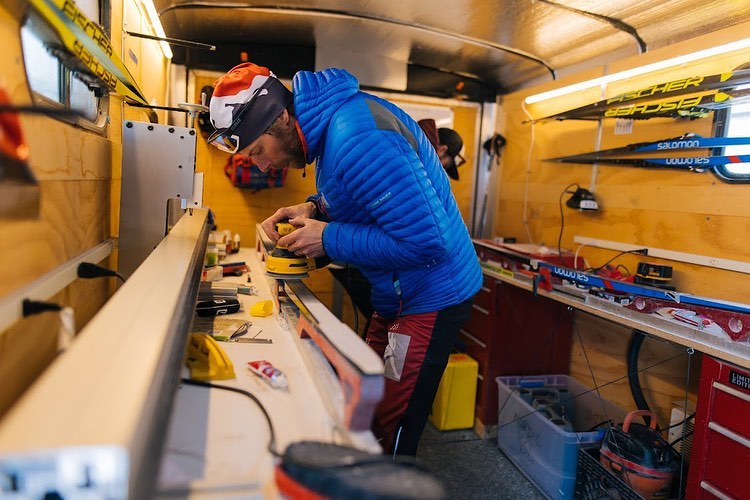
    Inside the wax cabin, Andy Newell prepares skis for his athletes during the 2022 U.S. Cross-Country Championships in Soldier Hollow, UT. (Photo: Arlin Ladue / BSF Pro Team)

    Over the last four years, this transition has seen Newell race his final World Cup events and officially leave professional ski racing behind, only to launch and support the thriving BSF Pro Team, alongside his online coaching business, Nordic Team Solutions. In this interview, which took place on Friday, June 3rd, Newell provides insights into this transition from athlete to coach, while also adding behind-the-scenes details of getting the Pro Team off the ground. He also speaks to the challenges of elite training groups, their role in supporting the trajectory of U.S. skiing at the international level, and what’s in store for the BSF crew this summer. 

    This interview has been lightly edited for length and clarity.

    FasterSkier/Rachel Perkins: Starting with the timeline, in the spring of 2018, both you and Erika started to transition to ‘retirement-lite‘. And at that point, you were already talking about doing some coaching and working in athlete development. Is that when you guys moved to Bozeman? And from there, what was the evolution of your relationship with the BSF program?

    Andy Newell: Well, I was actually still on the U.S. Ski Team in 2018, but we did move to Bozeman that year. I was still racing essentially full time, but at that time I started a business, Nordic Team Solutions, and with that, I launched a summer training program where I was coaching college kids, so summer of 2019 was my first year where I was kind of stepping more into a formal coaching role. Which for me felt natural because I’ve always kind of participated in and loved the whole training camp vibe.

    Growing up at Stratton, Sverre [Caldwell] always had these amazing summer camps for juniors that I participated in my entire life. And then, as I became an older athlete and a U.S. Ski Team athlete, I would actually help with some of these training camps as well. And then in my years with the U.S. Ski Team, I had this program that I started calling “speed camps,” which a lot of people might remember. We would host these free clinics around the country that would coincide with the U.S. Ski Team training camp. Basically we would reach out and have a bunch of juniors come and join us for an afternoon of rollerskiing and agility courses and fun stuff like that.

    So to me, it felt like a natural progression to take that a step further – once I launched the Nordic Team Solutions business, where I was running the website, to then pair that with a summer college training group. So my first year here in Bozeman, I actually ran that group independently from BSF… so I was actually not part of BSF in that first year of 2019. I was planning to race some World Cups, did race some World Cups in 2019-20, and then COVID put a quick end to our season when we were getting ready to race in Quebec and Minneapolis.

    I had planned on those being my final World Cup races as a professional, to go out racing in Quebec and in Minneapolis and had spent all year preparing for those specific races. And sure enough, they were canceled. So it was like, ‘Surprise! You’re officially retired now.’ And at that point is when I signed on with Bridger Ski Foundation to be the elite team coach.
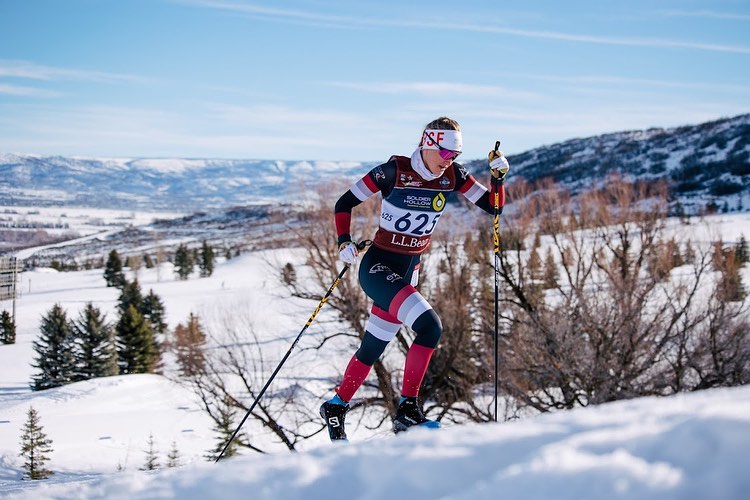
    BSF Pro Team athlete Hannah Rudd races the classic sprint qualifier during a post-U.S. Nationals SuperTour event. (Photo: Arlin Ladue / BSF Pro Team)

    FS: The announcement of your hiring went out in April 2020 – which kind of feels like a lifetime ago, but it also seems like it would have been a somewhat challenging time to launch a new elite team. Was the foundation already there with the BSF program or was this the onset of the elite team program?

    AN: There was an elite team in 2018, but it disbanded because the coach, Rogan Brown, went on to [coach at Denver University], and there were only a handful of athletes here in Bozeman at the time. So in 2019, there was no elite team tied in with BSF, and then in 2020 when I was hired, it was essentially my job to kind of relaunch this program, and to make it a successful program.

    There’s no reason why BSF should not have a successful elite team. The Bridger Ski Foundation has been around for over 70 years. It’s very well established here in Bozeman; we have a great pool of young athletes that participate in the youth skiing program – hundreds of athletes.

    Andrew Morehouse was signed on as the new nordic director in 2019, and then I came on in 2020. And we shared a vision that, in order [for BSF] to be a premier club, we should have an elite team. And then basically, I had free reign to kind of do what I wanted, which I’m super grateful for – that BSF has kind of given me the ability to choose the team makeup the way I see is best, and to choose how I run the program.

    We work closely with the juniors and Andrew Morehouse and the youth programs in town, so I very much have taken the model that I learned growing up at Stratton and tried to implement that here in Bozeman.

    At that point [in 2020], I basically just got on the phone and started calling some different athletes that I had met or worked with through NTG camps. The US Ski Team in 2018 and 2019 would hire me to come to NTG camps or development team camps – that was part of my business as well – so I started reaching out to different athletes and mentioning to them that we were going to start a new team here in Bozeman. So I was able to recruit nine athletes initially to come to the team, which was great.

    Here’s a preview of the 2021-22 BSF Pro Team. Note that one of the original 2020-21 athletes, Leah Lange, stepped back from her racing career after the team’s first season to begin coaching in Big Sky, MT. 
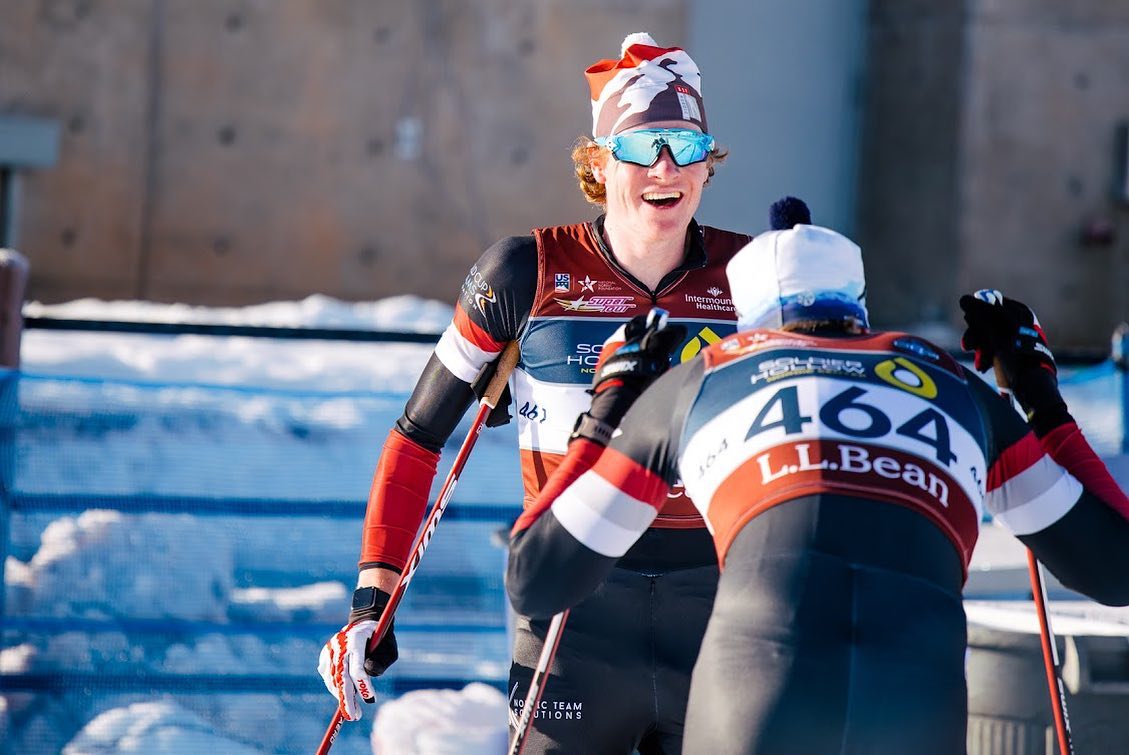
    BSF Pro Team athlete Finn O’Connell welcomes his teammate to the line during the U.S. Cross-Country Championships in Soldier Hollow, UT. (Photo: Arlin Ladue / BSF Pro Team)

    FS: Can you say more about getting the team off the ground?

    AN: So we launched [the Pro Team] in 2020 in the midst of COVID, which – there were so many unknowns and unique circumstances to try to convince these athletes to move to Bozeman and train here in the midst of all that was going on. And we essentially only had very unofficial racing our first season of 2020-21. Kind of a mismash of some official races, some non-official. But in hindsight, it was a nice opportunity for us to just build a team and spend a lot of time training with one another. 

    When you name a team like this as a coach, you have no idea what type of team culture or team vibe there’s going to be – you’re bringing all these different athletes from different colleges or different programs around the country. You want to create a team that really acts and feels like a team and you have no idea what type of form that’s going to take. So in hindsight, to have that COVID year where we just spent a lot of time training with one another, building the team here in Bozeman, was nice to lay that foundation so that we could have what was a very successful season last year in 2021-22.

    FS: You’ve still got Nordic Team Solutions going on also. Has your work there shifted in any way and how do you balance your time between both of those?

    AN: It has shifted in that, my first few years with NTS, I would actually hire [myself] out and go to more training camps. As I mentioned, I would help the U.S. Ski Team out with some of their NTG camps, or I would be hired by a club to go do a two or three-day training camp with them. And that has pretty much stopped, because my priority time-wise is with the BSF Pro Team. So I don’t travel so much for any other coaching duties, I mostly just travel to training camps with the BSF Team and work with them here in Bozeman.

    But I do still run the website, which is a great resource for training information for ski clubs, high school coaches, college coaches, or any individual that’s looking to learn more about training. I still run that [program] on a weekly basis and in published training plans and right strength plans for various individuals.
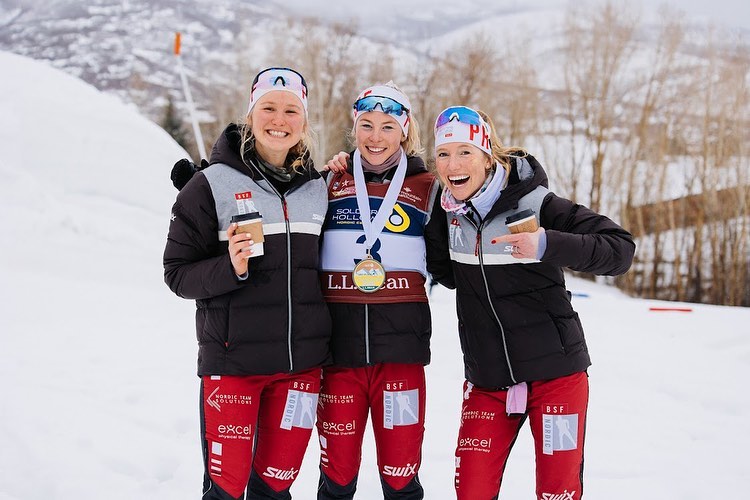
    BSF Pro Team athletes (l-r) Hannah Rudd, Mariah Bredal, and Erika Flowers celebrate Bredal’s third place finish in the 10 k classic during the 2022 U.S. Cross-Country Championships in Soldier Hollow, UT. (Photo: Arlin Ladue / BSF Pro Team)

    FS: In terms of Bozeman: you spent most of your career based in Vermont, though Erika has roots in Bozeman. How have you found that setting for leading this Pro Team and what are your thoughts on the training environment there?

    AN: The environment for training is fantastic here in Bozeman; we have access to mountains, access to a long season of skiing. We’re just an hour and a half away from West Yellowstone where we often have early FIS races, or we’re within driving distance of Sun Valley, Canmore, all these other places that historically have early-season racing. The rollerskiing is quite good here and there’s already a great support network within the Bridger Ski Foundation community.

    What is tough, with any elite team, is the fundraising aspect. I actually rebranded it as a Pro Team for a reason, because I want these athletes to be not scraping by, but to be actually making money while pursuing their dreams of being an Olympic-level racer. I think they deserve that, and I think that’s what all professional skiers deserve in the U.S.

    But it’s taken us some time to get there, and we’re not there yet. Fundraising is a huge part of my job on a yearly basis; we essentially have to fundraise from scratch all the money that it’s going to cost to travel around the country, or travel to Europe with these athletes who are making World Cup or World Championships. All the wax, all the hotels, all the logistics – all of that falls on a single program budget, basically.

    And I think there’s a huge potential for that in Bozeman. Bozeman is one of the fastest-growing towns in the U.S. and there are a lot of new businesses here, so I think our fundraising potential is huge. But given the fact that we started in COVID, and we’ve only been here for two years, we’re still trying to figure that piece out. And so that’s a place where we still have room to grow.

    And I would encourage anyone out there who’s reading this to realize the importance of these pro teams that we have in the country… We have Stratton, we have Craftsbury, we now have the Birkie Team, we have Sun Valley. And these clubs are essentially responsible for the development of the US Ski Team. This is the club model that we have adopted. Now, you know, it’s now been 30 years since we’ve, more or less, adopted this model. And we’re not getting any money from the U.S. Ski Team to develop these athletes. These clubs are and are all self-funded. APU is a little different since it’s tied in with the university.

    Unless you have a massive endowment or some other amazing bankroll that I am not familiar with, these pro teams and elite teams are fundraising their entire budgets on a yearly basis. Every single year, you have to raise the amount of money to send these [athletes] to these races. And that’s challenging, but it’s a hugely important piece of our development, because we wouldn’t have the U.S. Ski Team that we have now – we wouldn’t have the depth or the success on the U.S. Ski Team level – if we didn’t have these clubs as feeder programs. So I think it’s important that people help support these teams.
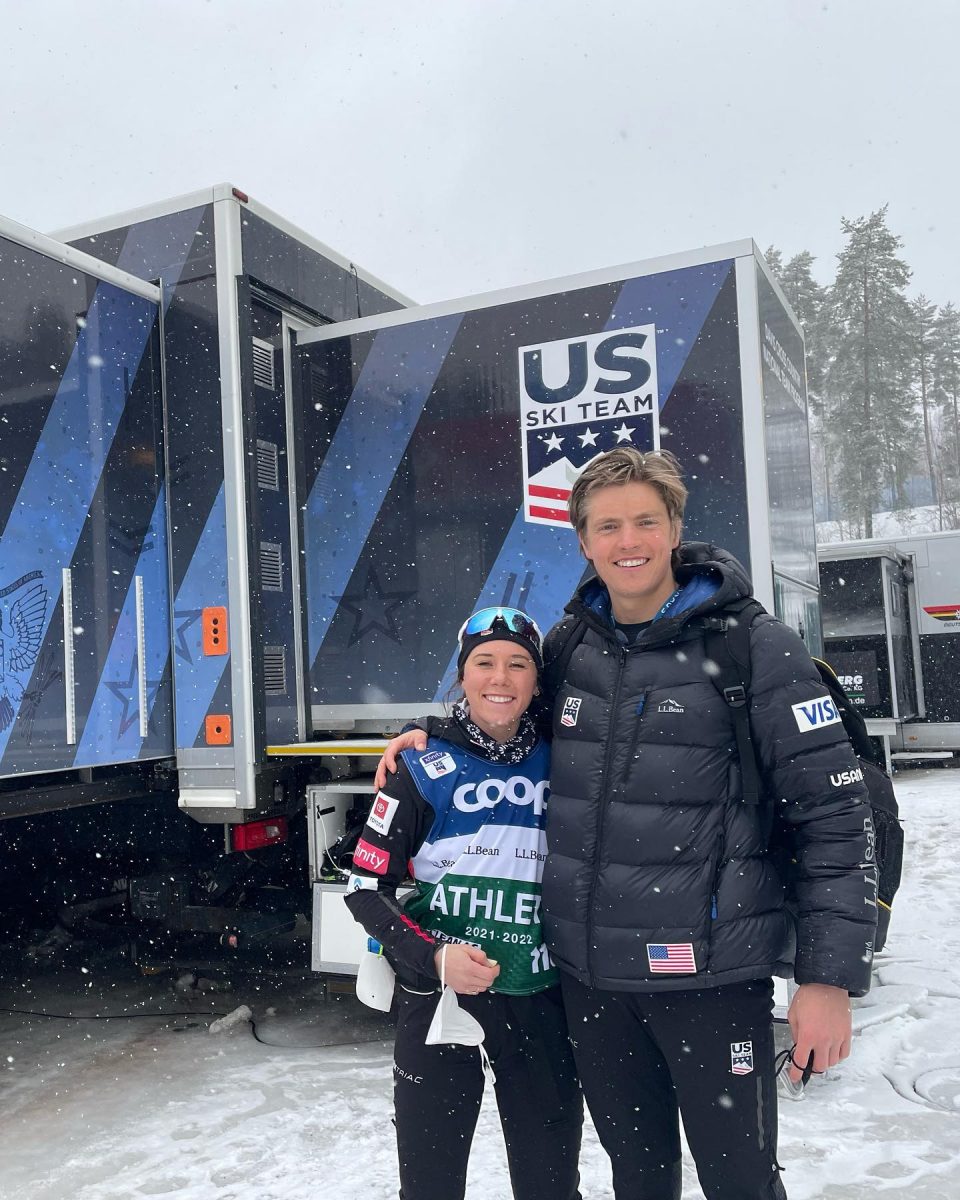
    BSF Pro Team athletes Lauren Jortberg and Logan Diekmann earn their first World Cup starts in Lahti, FIN in Mar. 2022. (Photo: BSF Pro Team)

    FS: Looking back over the last few years, what are some of the indicators of success that you look at in identifying what’s going well for the program? And what are some of your objectives in terms of heading into the next few seasons?

    AN: That’s a great question. The goal we have here with the Pro Team is international success, and that means I don’t bring someone onto the BSF pro team [whose only] ambitions are racing SuperTour and winning the Birkie, although those are amazing achievements. Those are, for sure, stepping stones in our development. But my goal is to put people on the U.S. Ski Team, and to qualify people for World Championships and Olympics.

    So international success is what we strive for, and that’s how we measure our season, and how folks are doing. Last year alone, we had three athletes achieve their first ever national podiums in Soldier Hollow. We actually qualified four different athletes for World Cup, although two of them – Finn O’Connell and Mariah Bredal – did not get to start there because they were canceled. But both Logan Diekmann and Lauren Jortberg started their first ever World Cups, which is great. We finished the year with Logan Diekmann as the overall sprint champion on the SuperTour. Finn O’Connell was the second best ranked distance skier on the SuperTour, and he also qualified for the U.S. Ski Team [as a B-Team member]. So for us, that was a solid year, and I was very proud of the way the team performed and much of the team, if not half the team, was able to have personal bests and be called up for some type of international racing, whether that was through World Cup or Opa Cup, and that’s exactly what you know I want to do. That’s my mission: to get these kids into those big international races and have them perform well.

    FS: Can you speak a little bit about the depth of the team, too? Momentum seems like an important thing with elite or pro teams. Just having that critical mass of athletes that are on the same level, or have similar objectives. Is that something that you’re seeing with the BSF crew?

    AN: Yeah, absolutely. I think the phrase ‘critical mass’ is for sure something that you see with these pro teams. I mean, it’s hard to deny the Jessie Diggins/Julia Kern effect that Stratton has right now. That’s a huge draw to their program.

    I think, for us, considering we started with zero members of the U.S. Ski Team on our pro team, and now we have one B-Team member – I’ve just been really excited with our success so far and how the team has stayed driven and motivated and helps push one another. That’s why I do this job – I love the team environment. That’s what I lived in my entire life; I was on the U.S. Ski Team from when I was 18 years old until I was almost 36 years old. 

    So the concept, the feeling of being part of a team, where people are genuinely supportive of one another you share in the training process and learning process, and you’re pushing one another, that’s the most valuable and successful scenario you can have. So I’ve been glad that we’ve somehow been able to find that nice mix of motivated individuals that genuinely get along and have fun with one another, and are able to travel the country and have put together successful race weekends.
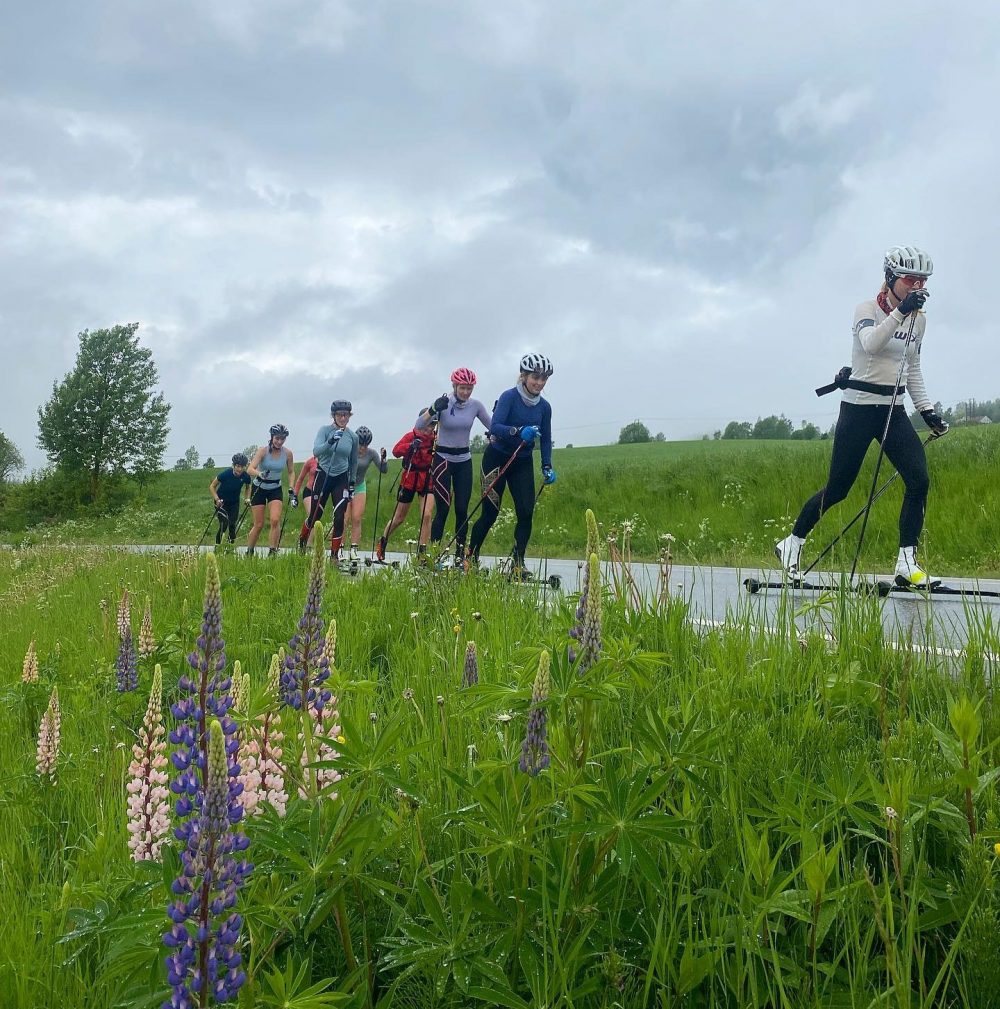
    The BSF Pro Team out for a rollerski during a June 2022 camp in Lillehammer and Sjusjøen, Norway. (Photo: BSF Pro Team)

    FS: Last program question: what’s new and what’s on deck for this summer? You mentioned that you guys are heading to Norway. What other summer/fall camps or projects are you guys working?

    AN: [Starting with the team roster:] so far this year, we’ve added Sarah Goble to our squad squad. She’ll be a new athlete with us next year. We also have her brother Reid Goble on the team, who has been great. I think those two have a ton of potential.

    We did lose Lauren [Jortberg] to Stratton – and you know how these clubs work, it’s a very friendly exchange. I’m sure we’ll find ways to collaborate, and that’s honestly what I find a lot of value in is elite teams collaborating with one another. Last year, we did a bunch of training camps with Sun Valley [Gold Team]. We joined Stratton and Sun Valley in Lake Placid training camp. We did some camps in the Midwest where we’ve had overlap with some Birkie athletes. And so I’ll continue to do that this year.

    We are scheduled to go to Norway next week for a two-week camp where we’ll be in Sjusjøen for five days, and then on Sognefjellet ski fields for five days. We’ll try to overlap with some fast foreign skiers while we’re there and try to learn from some folks over there, and we’re bringing a handful of college skiers with the Pro Team as well on that trip. After that, we’ll be back here in Bozeman for the main summer training block and that’s when we do our BSF college training group as well. That runs through the end of June and into the first week of August.

    So we have a solid six-week block of training here in Bozeman, which has been the staple of the BSF program the last couple years – having this really competitive college training group. It’s been so fun to see that program grow and see the success of the college training group. The first year with BSF, we had folks like Sophia Laukli on the team, and so many talented individuals. It was great to see them develop here in Bozeman and then have such amazing seasons that winter. So we’ll continue that program where for six weeks we’ll have a team of 12 collegiate athletes that join the Pro Team on daily training all the way through August.

    After the summer training group ends, we’re planning to head to the Midwest for another training camp, like we did last year. We try to get to low-altitude in August. Right now we’re looking at Marquette as our training destination, and we’ll try to collaborate with Team Birkie on some sessions out there. And then we’ll be going to Park City camp in October, like we always do, to join the many clubs from around the country and the U.S. Ski Team for their [fall] camp. And then we’ll probably get on snow early here in Montana or in BC as the snow flies.

    FS: How much crossover is there between the collegiate group that you have joining in the summer and the Montana State University (MSU) program?

    AN: Historically there are not many MSU kids that stay in town [over the summer]. This year I think we have two MSU kids in the college training group, so that’s great. If there are MSU athletes in town, we try to prioritize them to get them onto the team to keep them within the community. But a lot of college kids go home, whether it’s Alaska or back east or the Midwest. But we do have some good crossover and I have a good relationship with Adam St. Pierre and the university. We use their facilities all the time – we just did a round of testing on the rollerski treadmill at MSU – so it’s handy to have those types of resources nearby.
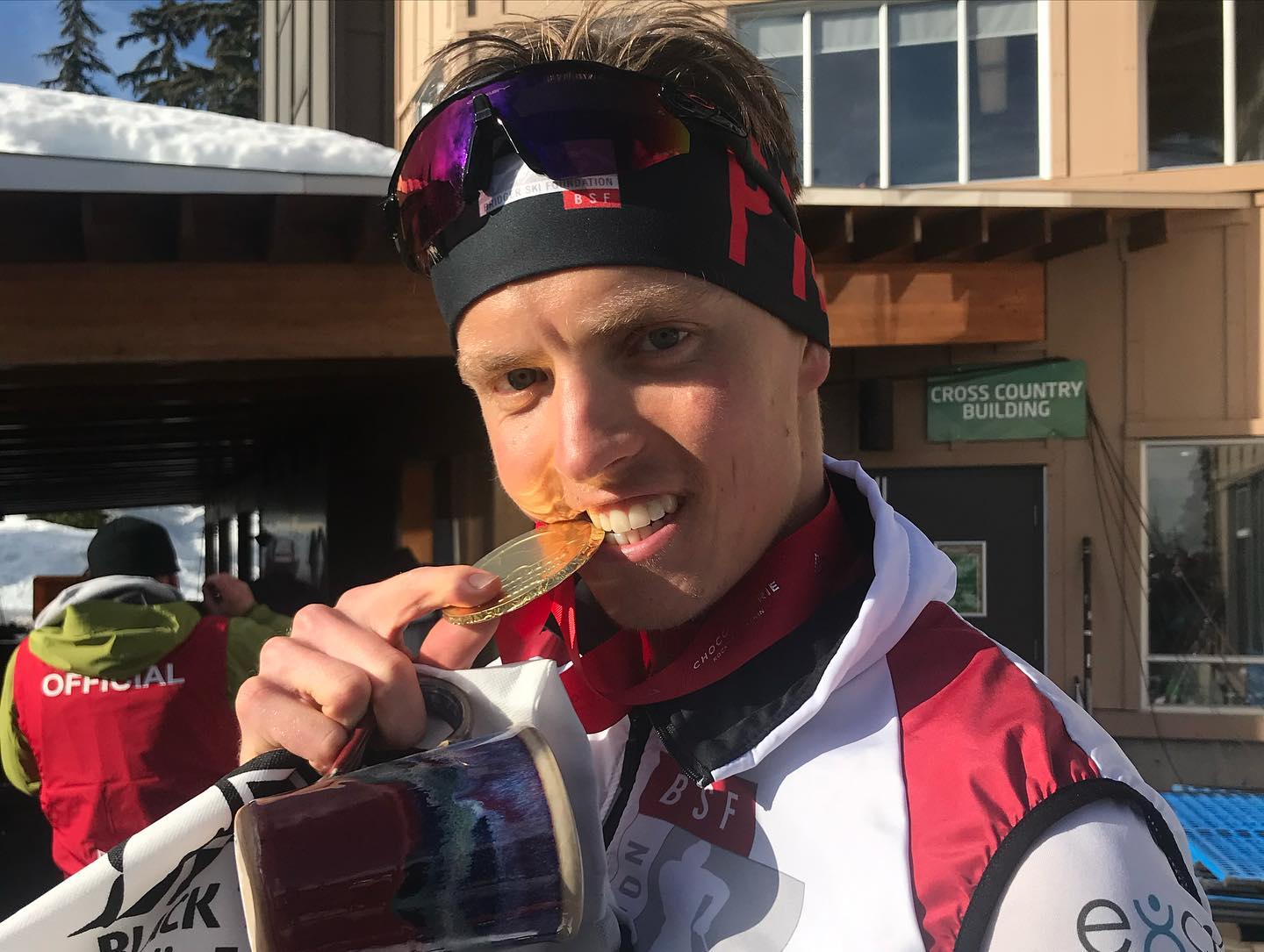
     

    Logan Diekmann bites his medal after finishing second in the US SuperTour standings in the classic sprint in Whistler, BC during Canadian Nationals/US SuperTour finals in Mar. 2022. (Photo: BSF Pro Team)

    FS: I know you’ve also got the Jim Bridger Trail Run coming up this summer, and there is a new rollerski race component. Can you share more information on that?

    AN: We’re doing our first ever Jim Bridger Rollerski Race at the end of July, which is paired with our annual trail run. I’ve been working with the town of Bozeman to shut down a city block behind where the MSU campus is, and we’re going to be hosting a crit-style rollerski race on the weekend in downtown Bozeman.

    We have prize money for that, and we’re getting some great sponsors on board. So that’ll be a cool event.

    FS: Can you also talk about how that event supports the BSF Pro Team?

    Yeah, absolutely. Like I mentioned, we as a Pro Team essentially need to raise $150,000 each year just to get the [athletes] to all the races and try to cover their expenses. That is a travel budget, a wax budget, everything – and that needs to be raised on an annual basis. For us, the Jim Bridger Trail Run is one of our biggest fundraisers.

    It’s an incredible amount of work. It’s a weird part of my job to be a coach, but also an event organizer. There’s a lot of weird things that go into being a ski coach. But, if we can make the Jim Bridger event big and successful, we can actually raise a lot of money for our budget. So that’s why we put so much attention and effort into it. It’s also a good chance for us to partner with local sponsors to raise money for the Pro Team, because all proceeds from these events go directly to the Pro Team.

    So historically, it’s just been a trail run, but this year I wanted to add a rollerski event for a couple reasons. One: I think it’s a huge development tool for BSF. We have so many talented youth skiers in this town. I want them to kind of be exposed to this type of high-level rollerski racing that we see in Europe. We see it all over Norway and Sweden and Germany; we need to have high-level rollerski races here in the U.S. So my secondary goal is to have this be an annual thing, where people know there’s going to be a quality rollerski race that’s super exciting to watch, fun to participate in, there’s going to be prize money and sponsors, so we can make it an annual thing and have it tied in with all the different clubs throughout the West. I’m hoping teams from Sun Valley, Park City, and all over the West will bring their athletes here to compete in this rollerski race on July 30th in downtown Bozeman.

    FS: And they’re staggered, right? So people could do both theoretically?

    AN: Exactly. The rollerski race is on Saturday, running races are on Sunday. The running race is 10 miles, but we also have a 5k option for the younger kids. And we have U16, U18, U20 and open class for the rollerski race. Swix and Salomon are sponsors of the event, and we’ll be getting a race rollerski fleet from Swix, so these are going to be matched rollerskis for the open men and women, so it’s going to be a legit rollerski race.

    We’re hoping to livestream it too. TBD on that, but check the BSF Facebook page for live streaming.
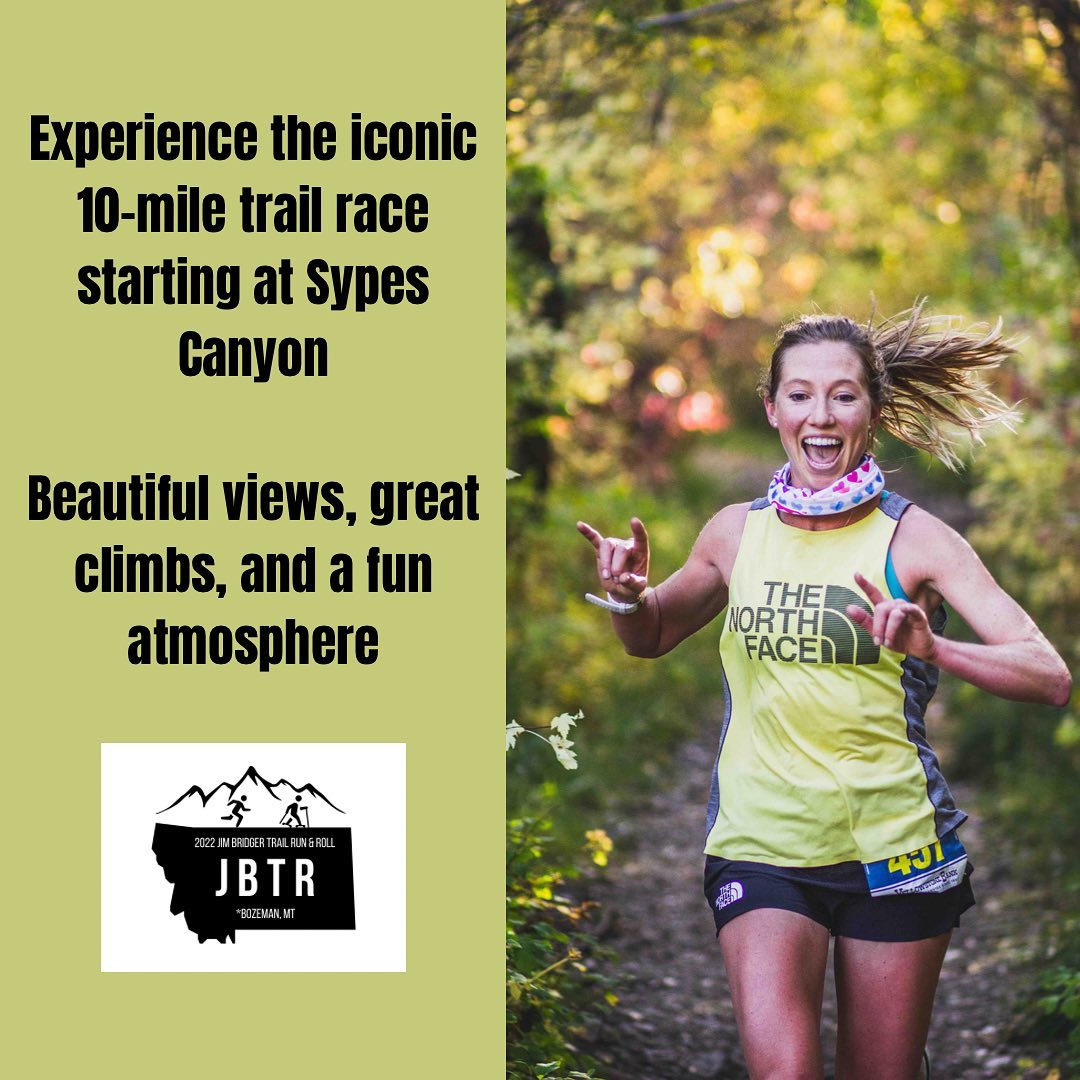
  • Patterson, Harmeyer Win ‘Largest North American Rollerski Race’, NENSA Fall Classic

    Patterson, Harmeyer Win ‘Largest North American Rollerski Race’, NENSA Fall Classic

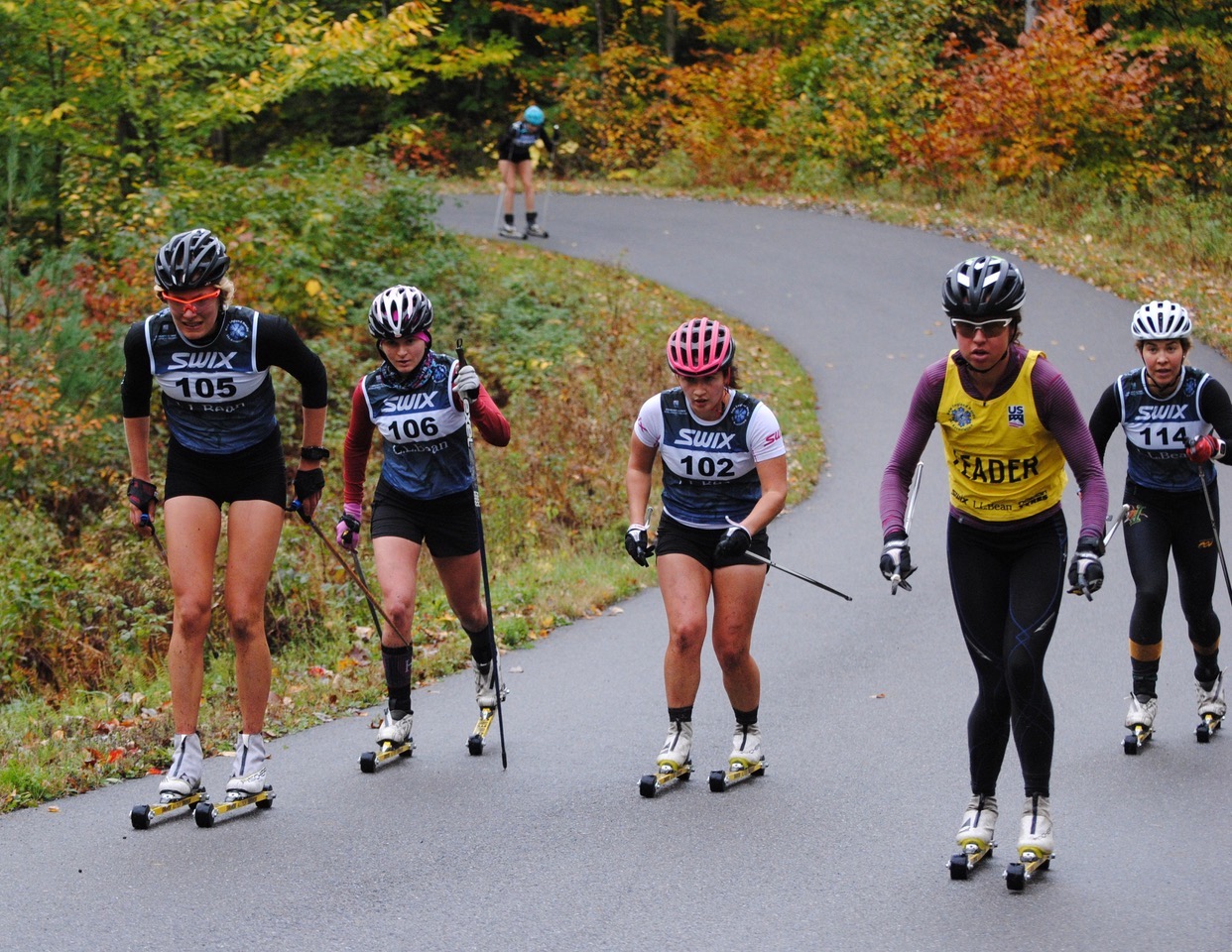
    2018 Olympian and Craftsbury Green Racing Project skier Caitlin Patterson (in the yellow bib as the NENSA Rollerski Race Series leader) en route to a win in the open women’s 10 k at the NENSA Rossignol Fall Rollerski Classic on Saturday, Oct. 13, in Jericho, Vt. (Photo: Dave and Carl Priganc)

    This past weekend, more than 170 skiers descended upon the Camp Ethan Allen Training Site at the Vermont National Guard base in Jericho, Vermont, for the New England Nordic Ski Association (NENSA) Rossignol Fall Rollerski Classic. According to NENSA Competitive Programs Director Justin Beckwith, the field size nearly doubled from last year, and he believed 172 finishers made it the largest North American rollerski race.

    The event was hosted in conjunction with the Mansfield Nordic Club on Saturday, Oct. 13, which was described as a “chilly morning replete with the first snow of the year on Mount Mansfield as a backdrop” and rain drizzling throughout the day, according to a NENSA press release.

    In the 10-kilometer open (over-18) women’s race, Caitlin Patterson of the Craftsbury Green Racing Project (CGRP), also located in northern Vermont, took the win with a time of 25:14.4 minutes, about 18 seconds ahead of her Craftsbury teammate Ida Sargent (of the U.S. Ski Team) in second. About 30 seconds back from the win, Lina Sutro of the University of Vermont (UVM) placed third.

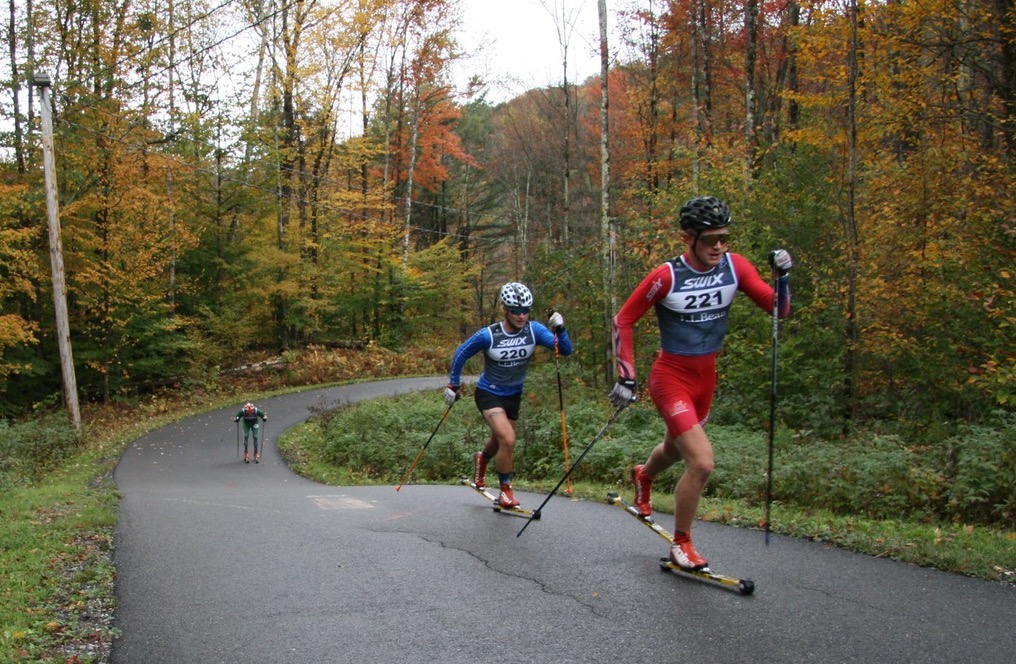
    Racers stride up a hill during the open men’s 10 k race at the NENSA Rossignol Fall Rollerski Classic on Saturday, Oct. 13, in Jericho, Vt. (Photo: Dave and Carl Priganc)

    In the open men’s 10 k race, another UVM skier and last year’s winner Bill Harmeyer won in 22:09.6, just 5.5 seconds ahead of Adam Martin (CGRP) in second. Another 12 seconds back, Kyle Bratrud, of the Stratton Mountain School (SMS) T2 Team in southern Vermont, placed third.

    Notably,  the top 30 in both the men’s and women’s senior races competed on matched Swenor Alutech Classic rollerskis. “We managed a fleet of 38 – 20 from our NENSA fleet and 18 sent out to us on loan from the Midwest fleet,” the press release stated.

    After the races, athletes were able to try out an agility ramp.

    “The whole day had a carnival-like feel with a balance of world-class competition and camaraderie,” the release noted.

    For more on this event and the highlights of the 5-kilometer U16 races, click here.

    Results

    Photos

    NENSA Rollerski Race Series standings (with two events left: Maine Agility Festival on Oct. 27 at Pineland Farms in New Gloucester, Maine, and Trapp Invitational Rollerski Race on Nov. 3 at Trapp Family Lodge in Stowe, Vt.)

    Series results

  • Big Results for Geraghty-Moats, Harvey at Summer GP, Toppidrettsveka

    Big Results for Geraghty-Moats, Harvey at Summer GP, Toppidrettsveka

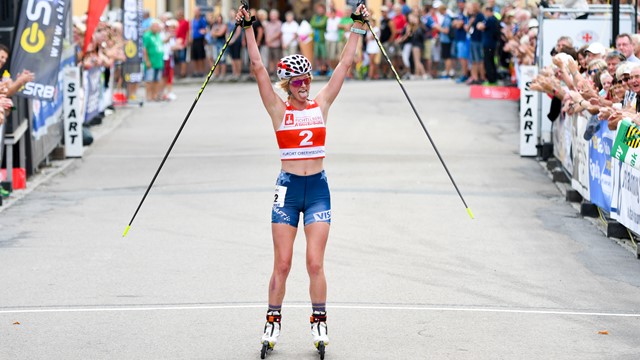
    Tara Geraghty-Moats winning Sunday’s normal hill/5 k Gundersen at the 2018 Women’s Nordic Combined Summer Grand Prix in Oberwiesenthal, Germany. (Photo: Romina Eggert/FIS)

    Two North Americans posted impressive results at nordic events in Germany and Norway over the last week, with Vermont native Tara Geraghty-Moats racing to first overall in the first-ever Women’s Nordic Combined Summer Grand Prix and Quebec’s Alex Harvey placing second, fifth and 10th in three races at the Toppidrettsveka rollerski series.

    Geraghty-Moats 1st and 2nd at Inaugural Women’s NoCo Grand Prix

    Brand new to nordic combined as well as the jump hill in Oberwiesenthal, Germany, Geraghty-Moats took the inaugural women’s Nordic Combined Summer Grand Prix by storm this past weekend, placing first and second in two competitions. That tied her for first place in the overall Grand Prix standings, alongside Russia’s Stefaniya Nadymova — the defending champion of last winter’s inaugural women’s Nordic Combined Continental Cup.

    On Sunday, Geraghty-Moats, 25, of USA Nordic and the New York Ski Education Foundation (NYSEF), handily beat Nadymova and the rest of the 10-woman field after starting the 5-kilometer Gundersen rollerski race in second, four seconds behind Germany’s Jenny Nowak. While Nowak had posted the best jump of 96 meters on Oberwiesenthal’s 106-meter “normal” hill, Geraghty-Moats tied for the second-best-scoring jump (94.5 meters), with Austria’s Lisa Hirner (95 meters). From there, Geraghty-Moats dropped Hirner, Nadymova and Nowak on the first of three laps in the rollerski race and went on to finish in 11:04.8. Nowak ultimately placed third, 1:29.2 behind Geraghty-Moats.

    ortho tri-cyclen, buy clomid online

    “I was really satisfied by how my first weekend of being a nordic combined-er went, and I think the patience of waiting to be a nordic combined-er really paid off,” Geraghty-Moats told the International Ski Federation (FIS) after. “I struggled with the jump a little bit the first couple days. I had never jumped this hill before, and I sort of figured it out today so I got to ski a little bit easier than yesterday, but I was also happy that yesterday I was able to have a good fight and ski fast to my potential and end up on the podium.”

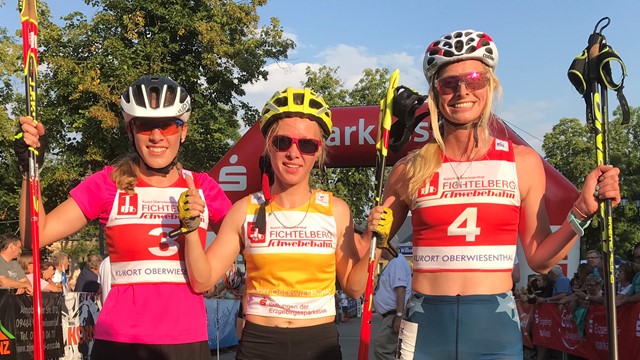
    The women’s individual normal hill/5 k Gundersen podium on Saturday at the 2018 Women’s Nordic Combined Summer Grand Prix, with Russia’s Russia’s Stefaniya Nadymova (c) in first, American Tara Geraghty-Moats (r) in second, and Germany’s Jenny Nowak (l) in third in Oberwiesenthal, Germany. (Photo: FIS/Silke Tegethof)

    On Saturday, the American (who started as a ski jumper, then raced cross-country before taking up biathlon, and finally returned to jumping) placed second to Nadymova, who won the individual 5 k Gundersen in 12:21.4. Geraghty-Moats finished just 3 seconds back after starting the race in fourth, 1:13 minutes behind Nadymova in first. Nowak placed third in that race as well, 50.3 seconds back.

    “It was a dream come true to finally be able to compete in women’s Nordic Combined on an international level,” Geraghty-Moats told FIS on Saturday. “I’m using this weekend to learn the level I have to be at to have success in Nordic Combined. I made some mistakes today and learned a lot but I came away with a good result and having had a huge amount of fun competing with small but strong field.”

    Eleven women competed in Saturday’s normal hill/5 k.

    Results:

    Day 1 (ski jumping | final

    Day 2 (ski jumping | final)

    Overall Grand Prix

    Harvey on Toppidrettsveka Podium

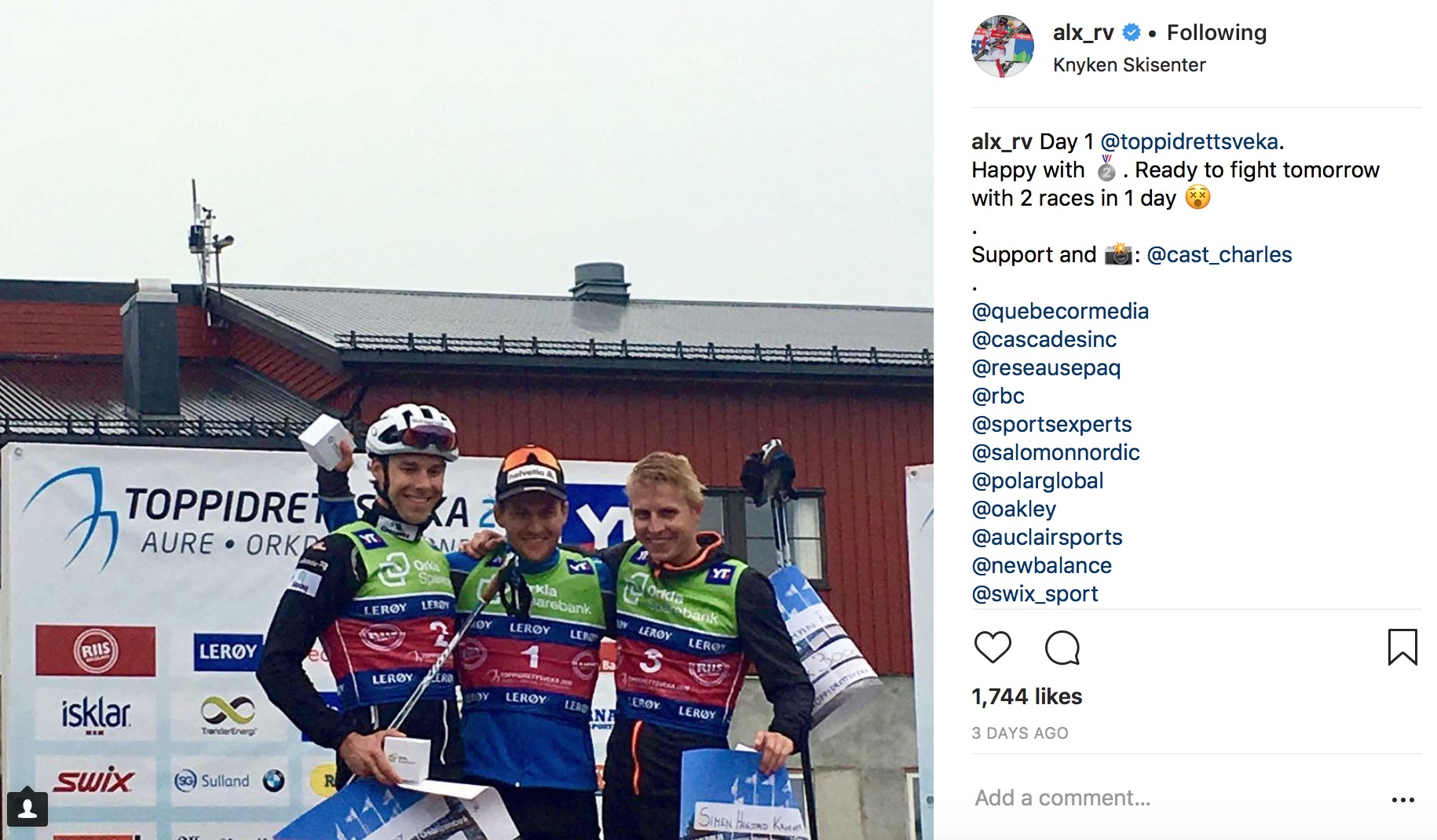
    Alex Harvey (l) on the podium with Roman Furger (c) and Simen Hegstad Krüger (r) at the 2018 Toppidrettsveka rollerski festival in Norway last Thursday, Aug. 16. (Photo: Alex Harvey/Instagram)

    At the Toppidrettsveka rollerski festival in Norway, Canada’s Alex Harvey raced to second in the 15 k skiathlon last Thursday in Orkdal, missing out on first by just 0.6 seconds to Switzerland’s Roman Furger, who won in 30:43.3. Norway’s Simen Hegstad Krüger, the reigning Olympic skiathlon champion, finished third, 1.5 seconds back. In a stacked international field of 125 men, Canada’s Evan Palmer-Charrette placed 75th in that race (+2:14.4), Bob Thompson was 84th (+2:32.7), and Scott Hill 89th (+2:52.5).

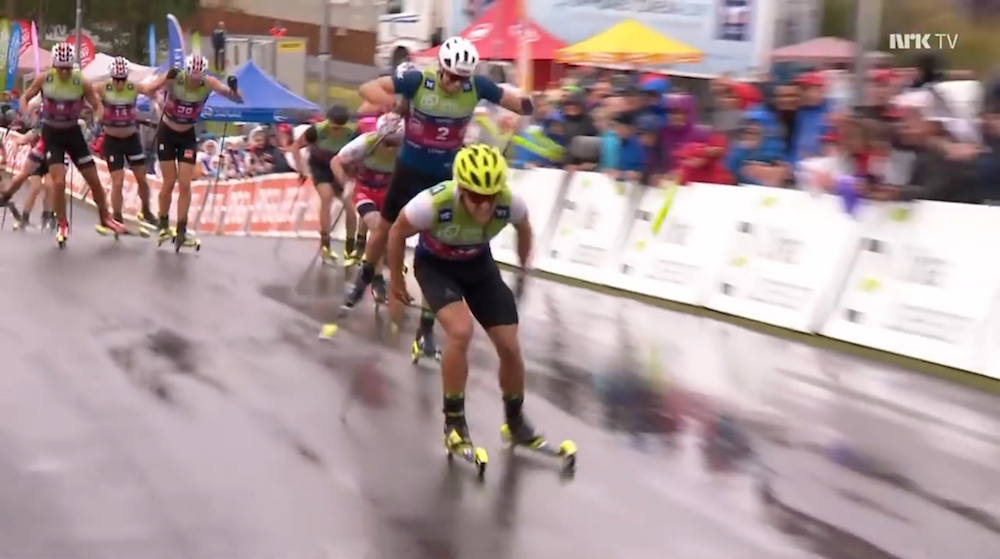
    Canada’s Alex Harvey (2) gunning for first in the men’s 15 k skiathlon on Aug. 16 at the Toppidrettsveka rollerski festival in Orkdal, Norway. (Screenshot: NRK broadcast)

    Heidi Weng beat her cousin Tiril Udnes Weng by 0.7 seconds in the women’s 10 k skiathlon that day, finishing in 22:52.1. Norway swept the top five of the women’s race, with Anne Kjersti Kalvå reaching the podium in third (+1.3), and national-team members Kathrine Harsem and Astrid Uhrenholdt Jacobsen placing fourth (+1.4) and fifth (+1.5), respectively, out of 43 women.

    In the men’s 24 k classic mass start around Aure/Brekka on Friday, Harvey finished fifth, 19 seconds after Krüger, who won in 59:57.5. Norway’s Hans Christer Holund placed second in that race (+2.6), Norway’s Magnus Stensås was third (+13.0), and Switzerland’s Dario Cologna fourth (+17.1). Also for Canada, Palmer-Charrette finished 61sth (+2:30.9), Hill 78th (+4:02.3), Thompson 86th (+5:40.3), and Maks Zechel 88th (+7:01.4) out of 125.

    Heidi Weng repeated in first in the women’s 24 k mass start, finishing in 1:10:02.4 hours, while Tiril Udnes Weng again placed second, 25.4 seconds back, and Jacobsen reached the podium in third (+27.7).

    Later on Friday in Aure, Norway’s Sondre Turvoll Fossli topped the men’s freestyle sprint final ahead of four other Norwegians, including Pål Trøan Aune in second and Jan Thomas Jenssen in third, and Switzerland’s Furger in fifth, while Harvey did not qualify for the heats and ended up 37th overall. Palmer-Charrette was once again 61st in qualification, Hill 107th and Thompson 109th out of 121.

    In the women’s sprint, Norway’s Mathilde Myhrvold won the final in 2:56.54, 1.05 seconds ahead of Slovenia’s Katja Visnar in second. Heidi Weng placed third in the final (+1.97), ahead of Tiril Weng (+2.64) in fourth, another Norwegian Anna Svendsen in fifth (+2.76), and another Slovenian Alenka Cebasek in sixth (+3.73). 

    In the final race of the series, the classic pursuit on Saturday, Harvey started second, 10 seconds behind Furger in first. The Canadian went on to place 10th, 4.2 seconds out of first, in the 15 k race, while Stensås took the win in 37:45.5 after starting seventh. (Furger slipped to 55th and 1:55.5 behind at the finish.) Norway’s Mikael Gunnulfsen rose from eighth to second (+0.7) and France’s Jean-Marc Gaillard made it all the way up to third (+1.7) after starting 15th. 

    Palmer-Charrette finished the pursuit in 59th (+2:04.2), Thompson placed 80th (+2:55.2), Hill 87th (+3:41.5), and Zechel 93rd (+3:48.9) out of 105. 

    Jacobsen ended the weekend as the women’s 12 k mass start winner, after the entire women’s field (of 33) started at the same time. She crossed the line first in 34:20.8, 0.4 seconds ahead of Heidi Weng in second and 1.2 seconds ahead of Kalvaa in third. 

    Results:

    Men’s skiathlon | Women’s skiathlon

    Men’s mass startWomen’s mass start

    Men’s sprintWomen’s sprint

    Men’s pursuitWomen’s mass start

  • How Blinkfestivalen Began and Where It’s Headed

    How Blinkfestivalen Began and Where It’s Headed

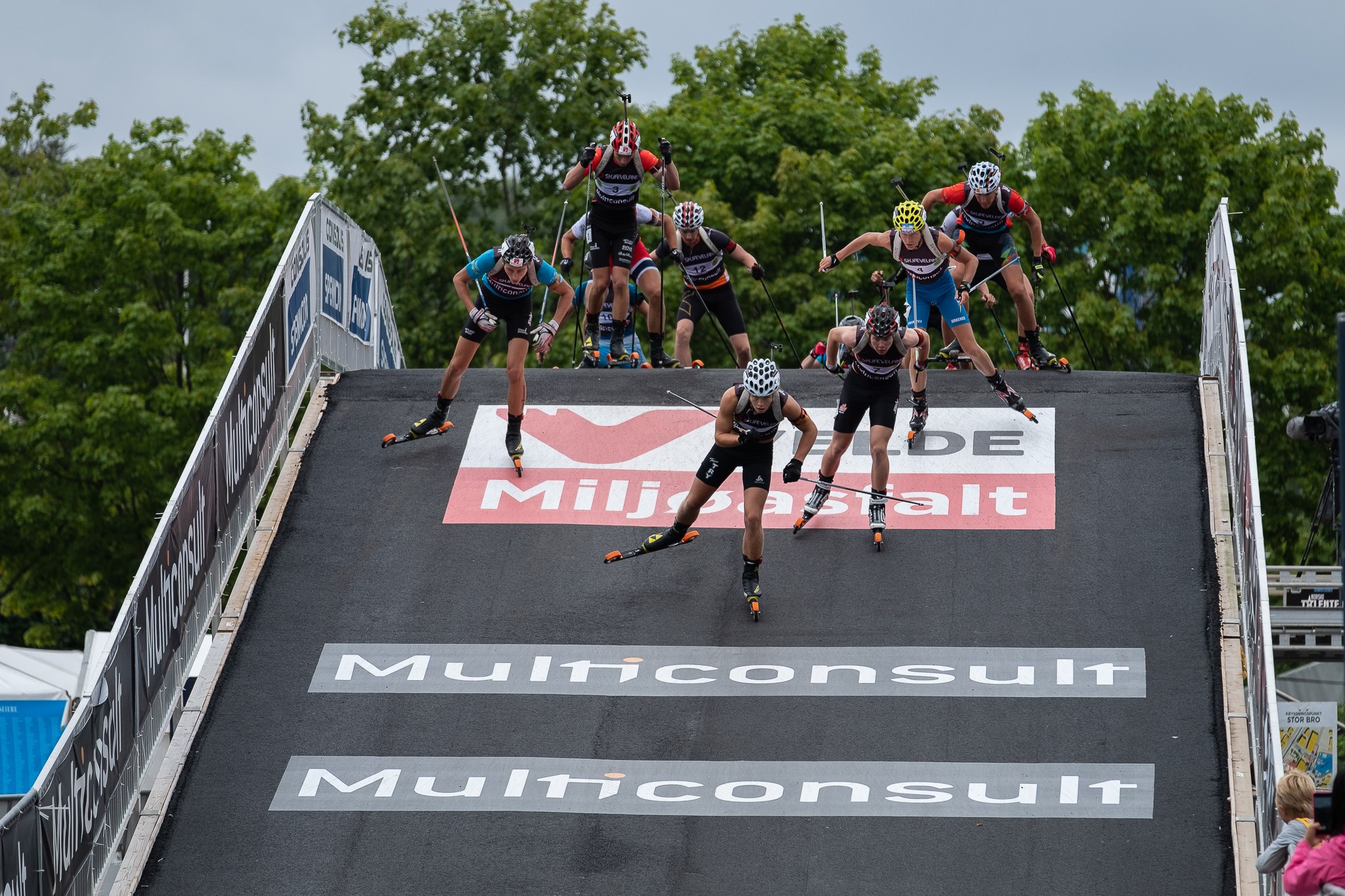
    Racers crest a hill at the 2018 Blink rollerski festival in early August in Sandnes, Norway. (Photo: Axelar / Arild Aarnes / Skifestivalen Blink Facebook)

    In 2005, Norway’s government-owned broadcasting network, NRK, lost production rights for its national football league. In search of a new program to air in place of summer soccer games, NRK, which still held broadcast rights for biathlon and cross-country skiing, approached the Norwegian Ski Federation and the Norwegian Biathlon Federation with a question: Could they find an organizer willing to create a large summer event encapsulating the winter sports of biathlon and nordic skiing?

    NRK’s answer came in Arne Idland.

    Idland was serving as the team manager for the Norwegian Biathlon Federation at the time and had planned to finish his term that same year. The 2006 Winter Olympics had just wrapped up, and Idland was ready for a change.

    Before stepping out of his role with Norwegian Biathlon, Idland become the chief of sport for Norway’s Blink Ski Festival, known as Blinkfestivalen.

    “I spent my last months in the biathlon federation just thinking about Blink,” Idland said in a phone interview.

    Biathletes racing in downtown Sandnes, Norway, during the 2018 Blink Ski Festival in early August. (Photo: Axelar / Arild Aarnes / Skifestivalen Blink Facebook)

    Originally from the city of Sandnes himself, Idland said he chose the municipality as a host city for Blink because, at the time, Sandnes “had no big events.”

    Since its inception in 2006, Blink has grown, becoming a premier international rollerski event. Organizers spent a grand total of 23 million Norwegian Kroner (about $2.75 million U.S. dollars) on this year’s Blink rollerski festival. That’s up from approximately 6,000,000 Norwegian Kroner (nearly $720,000 U.S. dollars) in its inaugural year.

    Even with the high price tag, Idland indicated that everything at Blink — entry, exit, and post-event concerts — are free. An estimated 70,000 thousand spectators attended Blink, and not one paid to get in.

    “That has been maybe one of the major key factors to our growth and our success,” Idland said. “Everything is free. We even have free concerts. No tickets to come in and that is the same today as it was at the start. Everybody can come and go just as they want.”

    But how has the city been able to sustain a “free” and accessible race to the public? Sponsors, Idland explained. Through their financial backing, Idland and three others staff members are paid to work full time, year round on Blink.

    When festival time rolls around, local cross-country and biathlon clubs near Sandnes pitch in to organize the multi-day event. And their time is paid. About 600 club members worked at this year’s Blink, and in total, were paid 750,000 Norwegian Kroner (about $90,000 USD).

    “That’s the most important income on an annual basis for the clubs,” Idland said. “It’s also a window to show all the people the sport and to get young kids and youth to start with biathlon and cross-country.”

    Much of Blink revolves around the concept of sport promotion, as opposed to pulling in dollars.

    “One major thing with Blink is that Blink is open for everybody,” he said.

    The festival not only includes an elite race series, but also junior and youth categories in both the biahtlon and cross-country divisions. Idland estimated that 3,000 children participated in Blink camp activities this year and 1,200 juniors entered Blink competitions. Last week, athletes from Russia, Italy, France, Sweden, Great Britain, Finland, Canada, and the U.S. made the trek to Sandnes to participate.

    “We have everything from — maybe you are four years old trying rollerskis for the first time — up to the athletes like [Martin Johnsrud] Sundby and [Therese] Johaug and the other big names,” Idland said. “It’s not only a show for the big stars. It has been important both for the development of the Norwegian Ski Federation and also for the youth and juniors.”

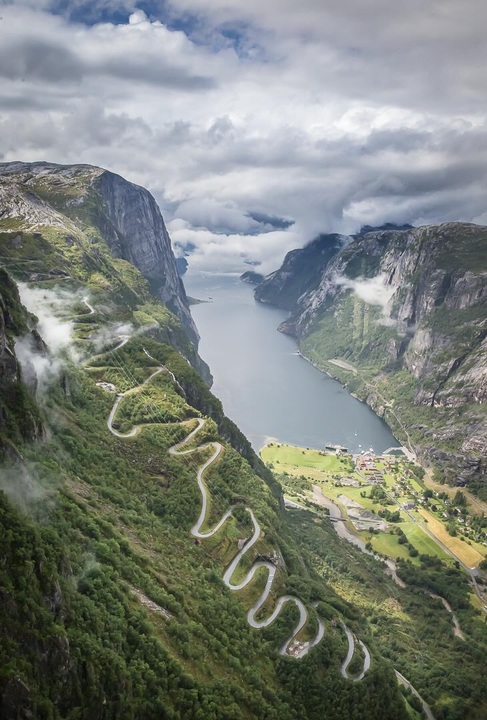
    The 7.5-kilometer race course for the Lysebotn Opp, an annual hill climb at the Blink Ski Festival in Lysebotn, Norway. (Photo: Blink Ski Festival/ Facebook)

    As Blink looks to develop Norwegian skiers, it also continues to develop its race series program. In 2010, organizers added the Lysebotn Opp uphill race, which begins in the fjord town of Lysebotn before climbing 640 meters above sea level.

    Three years ago, they introduced the Blink Classics distance races, which were 50- or 60-kilometers long for elite women and men, starting in the city center of Ålgård and finishing in Sandnes.

    Organizers have also been keen on safety for the high-paced rollerski events on asphalt. Few of its courses feature any steep downhills, all of its courses are fenced off to spectators, and every competitor must use the same speed of rollerskis. This year, Blink provided 1,000 unused rollerskis for racers. Next year they will do the same, with even slower wheel speeds, set to the same speed.

    “So next year we will use IBT 4, which are the slowest skis we have,” Idland said. “That is mainly for the safety, but also we also want the strongest athletes to win. The slower rollerskis you have, the more similar it is to winter time.”

    Winter is not something Blink hopes to compete with, Idland said. Climate change, however, may moot that point.

    “We do not want to become a threat to the traditional skiing on snow,” Idland said. “But … the winters get a little bit shorter and maybe also have to go a little further up in the mountains to find the snow, so I think rollerskiing will become more and more important as a supplement for skiing. Not instead of skiing, but maybe you do more rollerskiing.

    “We do not want to be a threat to the FIS World Cup either,” Idland continued. “We can play along with both FIS and the IBU. If at one time in the future there should be an interest that they would do something together with Blink, we would of course sit down and have a discussion with the FIS and the IBU.”

    Hopefully, that future interest is one made by choice.

    ***

    Related: Blink Ends with Jam-Packed Friday/Saturday | 2018 Lysebotn Opp | 2018 Blink Classics

  • NYSEF Rollerski Race Weekend Sept. 15-16

    (Press release)

    RACE WEEKEND WITH A 360-DEGREE PANORAMIC VIEW OF THE ADIRONDACKS, NEW ENGLAND AND CANADA

    WILMINGTON, NY – The New York Ski Educational Foundation (NYSEF), the New England Nordic Ski Association (NENSA) and the Olympic Regional Development Authority (ORDA) invite athletes to a rollerski race weekend, September 15-16 in the Adirondacks. We are excited to make this a two-day race series and to take advantage of the Olympic venues in our region.

    On Saturday, September 15, there will be a Lake Placid Doubleday consisting of a 3-kilometer freestyle prologue rollerski with an interval start followed by a 1.5-kilometer freestyle preliminary sprint. The Doubleday will take place at 9:00AM at the rollerski loop located at the Lake Placid Olympic Ski Jump.

    On the Sunday, September 16, the Climb to the Castle Skate Race will begin at 8:00AM. The course will start at the Whiteface Toll Booth, climbing for 5 miles with an average 8% grade up the Memorial Highway to the summit of Whiteface Mountain– New York’s 5th highest peak with an elevation of 4,867 feet.

    Following the race events there will be a brief award ceremony for Junior, Senior and Masters Classes.

    Participate, volunteer and/or cheer on Nordic athletes from around the country!

    To register or volunteer go to nysef.org/news.

    A detailed schedule of the weekend events will be posted shortly.

    Questions? Contact Shane MacDowell at shanem@nysef.org.

  • Norwegians Sweep Sprints; Newell Out in Quarterfinal on Last Day of Blink

    Norwegians Sweep Sprints; Newell Out in Quarterfinal on Last Day of Blink

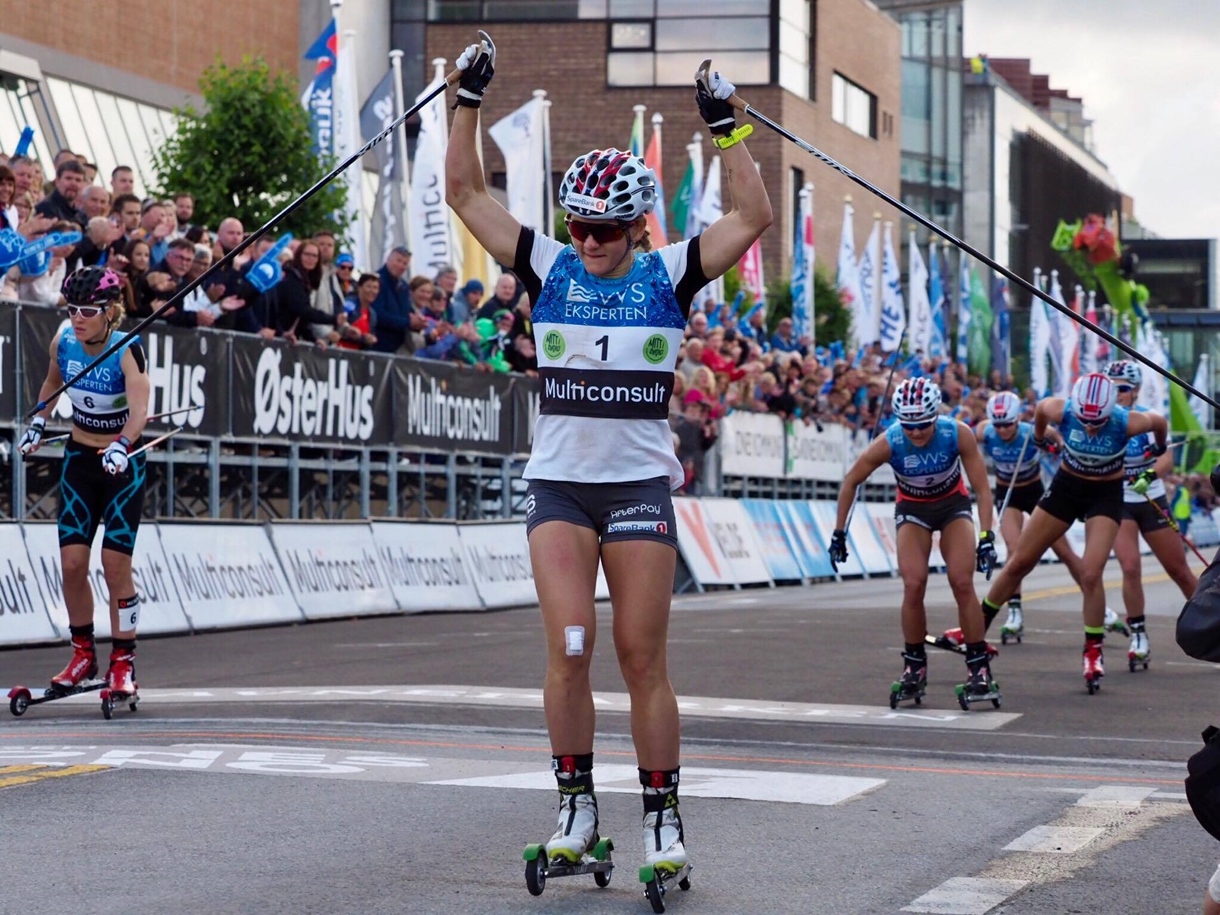
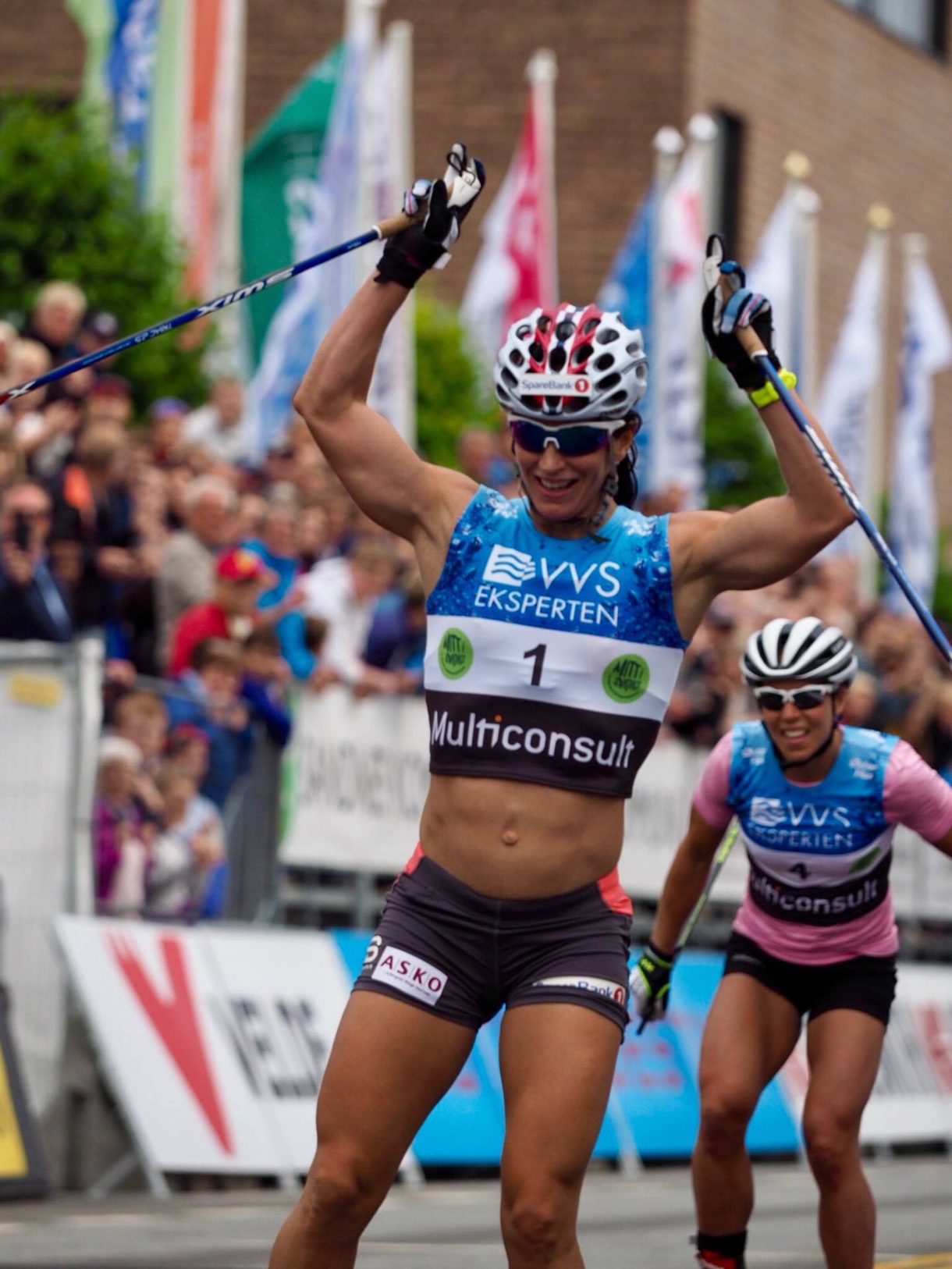
    Norway’s Maiken Caspersen Falla celebrates across the line after edging out Russia’s Natalia Matveeva and her Norwegian teammate Ingvild Flugstad Østberg in the women’s cross-country sprint on Saturday at the 2017 Blink Skifestivalen in Sandnes, Norway. (Photo: Axelar/Ørjan Dalseth)

    The fans in the well-filled stands of the 1-kilometer rollerski city course in Sandnes, Norway, had many reasons to cheer loudly on Saturday, as their local heroes claimed victories in all four sprint events that concluded the 2017 Blink Skifestivalen (Ski Festival).

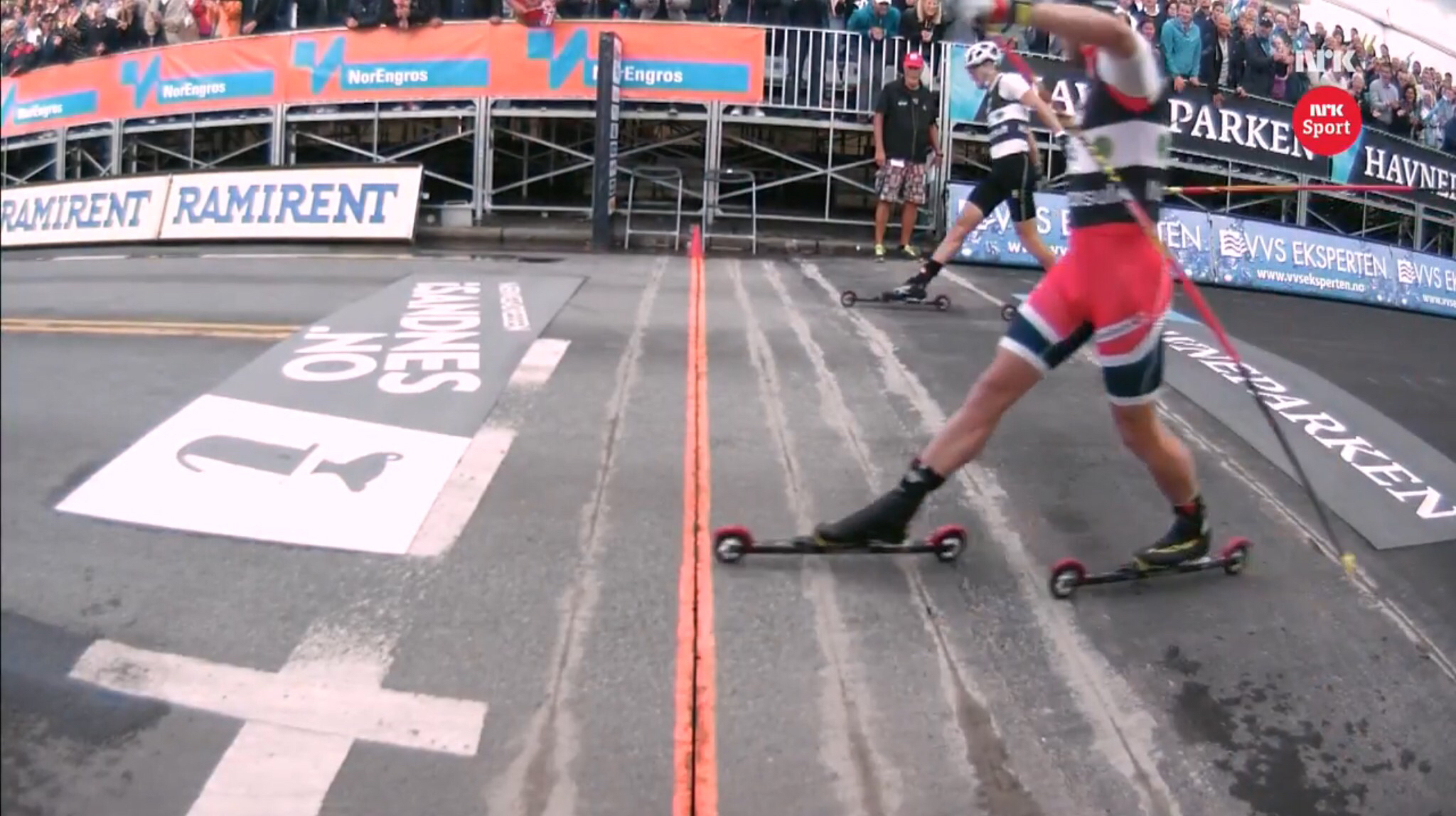
    In the final race of the day, the men’s cross-country sprint was decided by the length of a rollerski, with Norway’s Sindre Bjørnestad Skar crossing first, just 0.1 seconds ahead of Sweden’s Teodor Peterson. Skar took the win with a time of 3:27.6 minutes after two laps around the flat course, which featured two short climbs over a ramp and a bridge. The third place on the podium went to Kasper Stadaas, also of Norway, 1.9 seconds out of first.

    Norway’s Sindre Bjørnestad Skar (front) lunges across the line ahead of Sweden’s Teodor Peterson in the men’s cross-country sprint at the 2017 Blink Skivestivalen on Saturday in Sandnes, Norway. (Photo: NRK screenshot)

    Second in Friday’s mass start, Skar advanced through the rounds on Saturday with narrow victories in his quarterfinal and semifinal as well. Last season, Skar won a World Cup at the freestyle sprint in Toblach, Italy, and achieved two other podiums. He raced to third in the sprint qualification at the World Championships in Lahti, Finland, and went on to finish 13th.

    Andy Newell of the U.S. Ski Team (USST) was the lone North American starter of the day, and his run ended in the quarterfinal heats when he crossed the line in third, 1.1 seconds behind Norwegians Sondre Turvoll Fossli and 0.3 seconds behind Sivert Knotten. In an Instagram post, he mentioned breaking three poles in three races he competed in at this year’s Blink. He finished 16th in the 60 k classic and 18th in the 15 k freestyle mass start.

    (Article continues below)

    https://www.instagram.com/p/BXKYSBPhWK1/?taken-by=andynewellskier

    In the women’s cross-country sprint, a number of the last season’s top sprinters contended for the podium. Reigning Sprint World Cup champion Maiken Caspersen Falla emerged with the victory in the final with a time of 3:49.6 after keeping her challengers at bay in the long finishing straight. Russia’s Natalia Matveeva placed second (+0.8) and another Norwegian Ingvild Flugstad Østberg took third (+1.1).

    Earlier in the day, Falla won her semifinal, after she advancing from her quarterfinal with a wildcard. Originally Falla had finished the heat more than 30 seconds back, following a spill from which she emerged with a slightly bloody right knee.

    “Suddenly the asphalt was there,” Falla told Norwegian broadcaster NRK, according to a translation. “I am very happy that I was able to protect the face and head… I was really scared. I’m terrified.”

    She explained that it had been a long time since her last crash on rollerskis, and that she likely had placed a pole on her own shoe. No other athlete was involved in the incident, and her semifinal heat started with seven athletes.

    On Friday, Falla placed third in the women’s 10 k mass start after outlasting the group of skiers she was with in the finishing straight.

    USST member Liz Stephen opted not to start in the sprint on Saturday (after placing sixth in the hill climb and 25th in the 10 k freestyle mass start), instead continuing her European road trip to Östersund, Sweden, according to an Instagram post.

    Biathlon

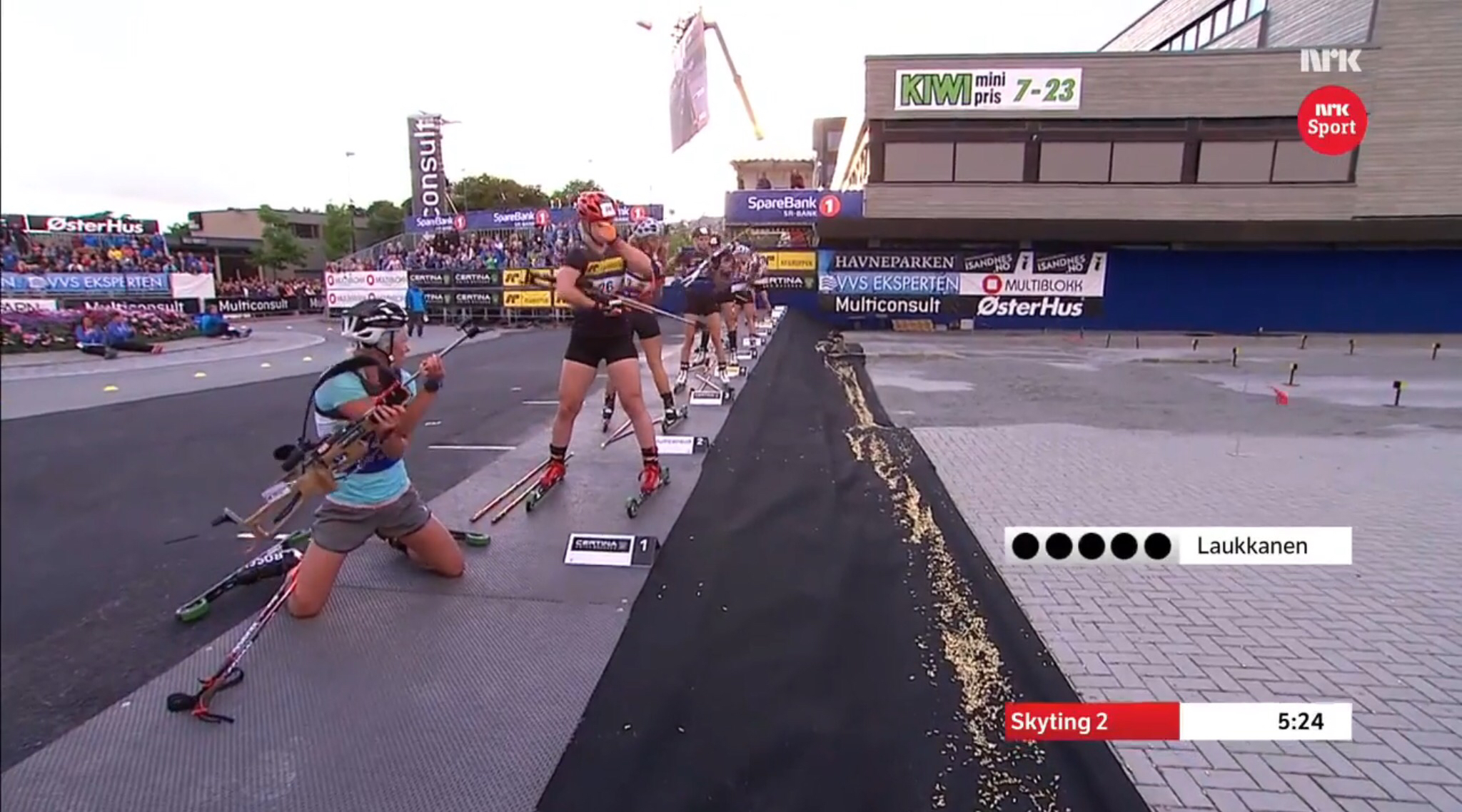
    In the women’s biathlon sprint, French veteran Marie Dorin-Habert made a minor rookie mistake while leading when she knelt down on the shooting mat for another prone shooting, before realizing that all her competitors had correctly taken a standing-position stance. Maybe she had assumed that — like the men in Saturday’s sprint format — they also would have to shoot four times.

    France’s Marie Dorin-Habert (l) erroneously kneels down to take the prone position in the second shooting stage of the women’s biathlon sprint at the 2017 Blink Skifestivalen on Saturday in Sandnes, Norway. In the lead until that point, she went on to finish third. (Photo: NRK screenshot)

    She quickly stood back up, but after incurring a penalty she was overtaken by Sweden’s Hanna Öberg and Norway’s Marte Olsbu. On the final lap Olsbu managed to pass the Swede to claim the victory in a time of 7:57.3 minutes with two penalties, while Öberg finished second (+2.8, with two penalties) and Dorin-Habert third (+5.0, with one penalty) ahead of Sweden’s Emma Nilsson (+9.4, with two penalties).

    Vetle Sjåstad Christiansen after winning the men’s biathlon sprint on the last day of the 2017 Blink Skifestivalen on Saturday in Sandnes, Norway. (Photo: Axelar/Ørjan Dalseth)

    In the men’s biathlon sprint, racers skied four loops and shot in four stages. Coming into the final shooting stage, Norway’s Lars Helge Birkeland and Vetle Sjåstad Christiansen, along with France’s Simon Fourcade, had created a small gap to the rest of the field. While Birkeland and Christiansen hit all their targets, Fourcade had to ski one short penalty lap through a traffic roundabout. Turning sharp left into the finishing stretch, Christiansen overtook Birkeland and pushed hard until the line in a time of 12:09.6 with two penalties, while Birkeland finished 4.6 seconds back in seconds place (with one penalty). Fourcade held onto third place (+16.2, with three penalties) ahead of a chase group.

    The excited fans also sang a little birthday tune for Norway’s Tarjei Bø — who turned 29 on Saturday — as he came into the finish in seventh place (+42.2) smiling and waving to the crowd.

    No North American biathletes raced at this year’s Blink.

    Saturday’s results:

    Cross-country sprint finals: Women | Men

    Biathlon sprint: WomenMen

  • Ustiugov, Bjørgen Rule Mass Start; Newell 18th After Breaking Pole

    Ustiugov, Bjørgen Rule Mass Start; Newell 18th After Breaking Pole

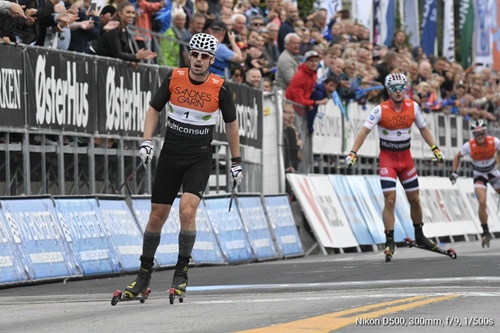
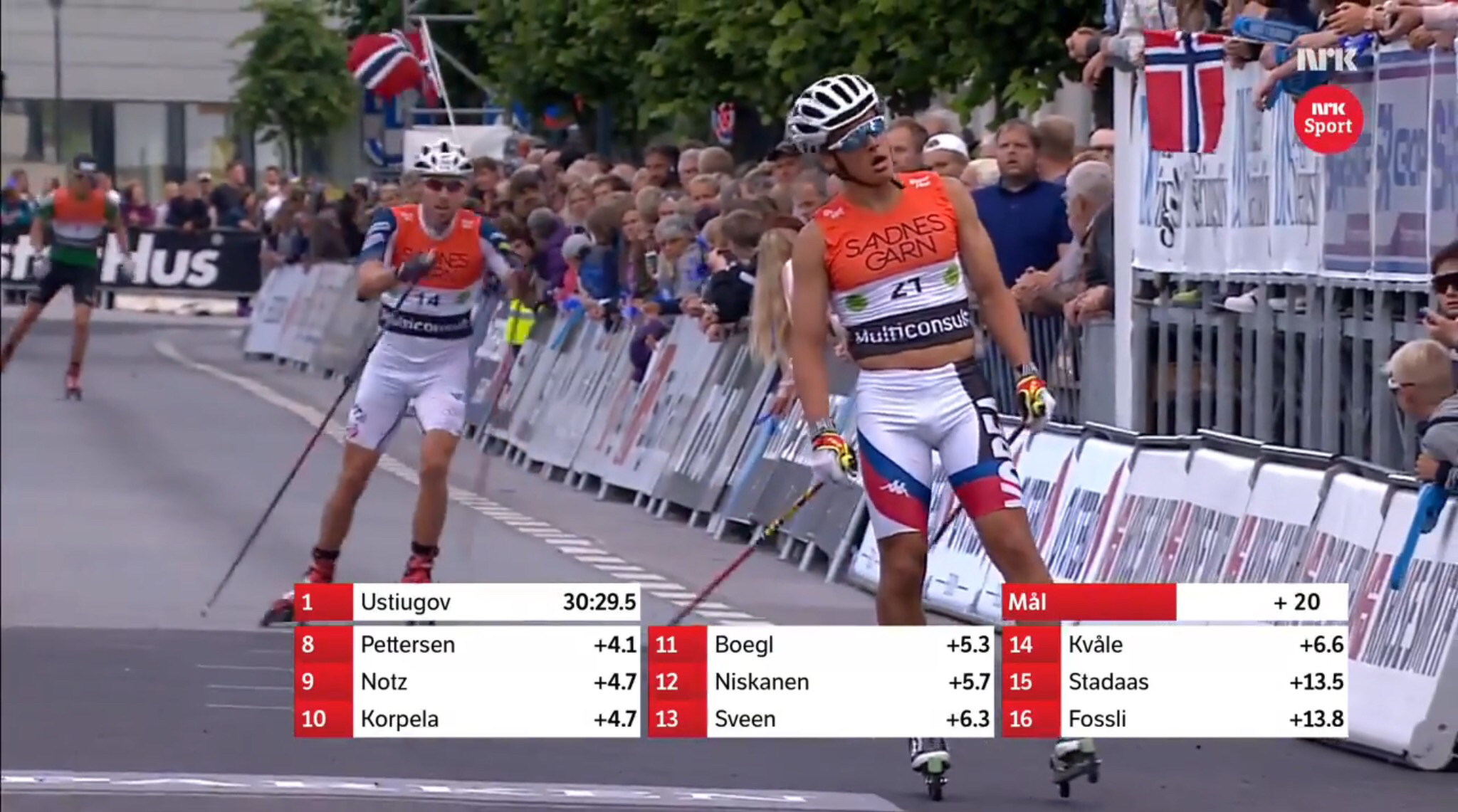
    Russia’s Sergey Ustiugov (1) winning the men’s 15 k freestyle rollerski mass start on Friday at the 2017 Blink Ski Festival. Norway’s Sindre Bjørnestad Skar (r) finished 2.2 seconds back in second. (Photo: Axelar/Rolf Gunnar Strand)

    In the men’s 15-kilometer freestyle rollerski mass start on the third day of the 2017 Blink Ski Festival in the coastal town of Sandnes in the southwest of Norway, U.S. Ski Team (USST) member Andy Newell constantly held a position in the first group, staying within a few seconds of the leaders. With two laps to go, he was in sixth place, less than two seconds back.

    “I felt good about the race,” Newell reflected in an email to FasterSkier. “I was able to ski up in the top 10 or so throughout the race.”

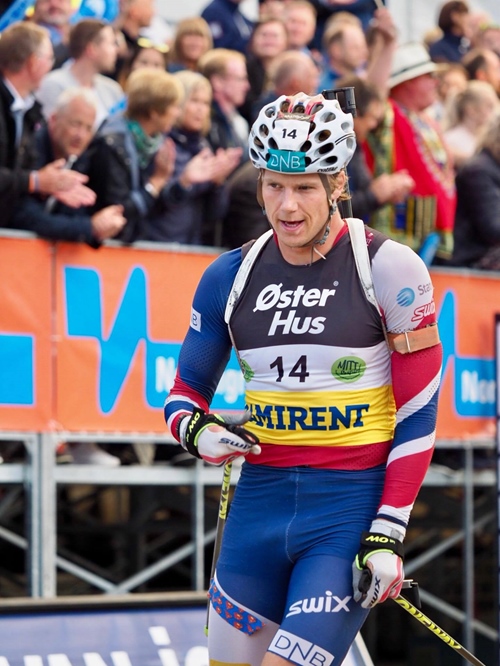
    U.S. Ski Team member Andy Newell (bib 14) finishing behind South Korea’s Magnus Kim in the men’s 15 k mass start on Friday at the 2017 Blink Skivestivalen in Sandnes, Norway. (Photo: NRK screenshot)

    But as the field heard the bell ringing that signaled the final lap, Newell suddenly skied out of the lead group and rolled to the right side of the city course waving his arm.

    “Just before the start of the last lap I tried to maneuver around a skier to try to get up into the top maybe 5 or 6 skiers and broke my pole on that guy,” Newell explained. “I only had to ski maybe 100 meters with one pole and got a spare but that was enough to lose a lot of places. I can’t feel too bad, there were a lot of broken poles out there, it was still really fun and exciting and a cool atmosphere.”

    After Russia’s reigning Tour de Ski winner Sergey Ustiugov prevailed in a group sprint to finish first in a time of 30 minutes, 29.5 seconds, Newell finished the race in 18th place, 24.1 seconds later. Second place went to Norway’s Sindre Bjørnestad Skar (+2.2), while Sweden’s Teodor Peterson claimed third (+2.9).

    Norway’s Marit Bjørgen winning Friday’s 10 k freestyle mass start at the 2017 Blink Ski Festival, just 0.6 seconds ahead of Sweden’s Charlotte Kalla (r) in second. (Photo: Axelar/Ørjan Dalseth)

    In the women’s 10 k freestyle mass start race, Norway’s Marit Bjørgen took her first win of the series in 21:25.8, narrowly outsprinting Sweden’s Charlotte Kalla by 0.6 seconds (a day after Kalla won the famous Lysebotn Opp uphill race by a comfortable 40-second margin). The duo gapped the field about 15 minutes into Friday’s race, after Kalla had caught up to Bjørgen and then took her turn up front. Winning the finishing sprint out of a larger chase group, third place went to Bjørgen’s teammate and defending Sprint World Cup champion Maiken Caspersen Falla, 8.3 seconds out of first.

    A day after finishing the Lysebotn hill climb in sixth place, USST distance skier Liz Stephen crossed the line on Friday in 25th (+1:29.2) on the flat city course with 1 k loops that suited sprinters, despite two short climbs over fairly steep ramps.

    While the 2016 edition of the festival was marred by some dramatic crashes on those ramps, this time the course remained manageable in cloudy-but-dry conditions, with the field of elite Norwegian and international athletes cheered on by several hundred enthusiastic spectators in the finish area.

    Biathlon

    Also on Friday, the Blink spectators could watch a number of biathlon competitions, both for various junior age groups and the senior fields.

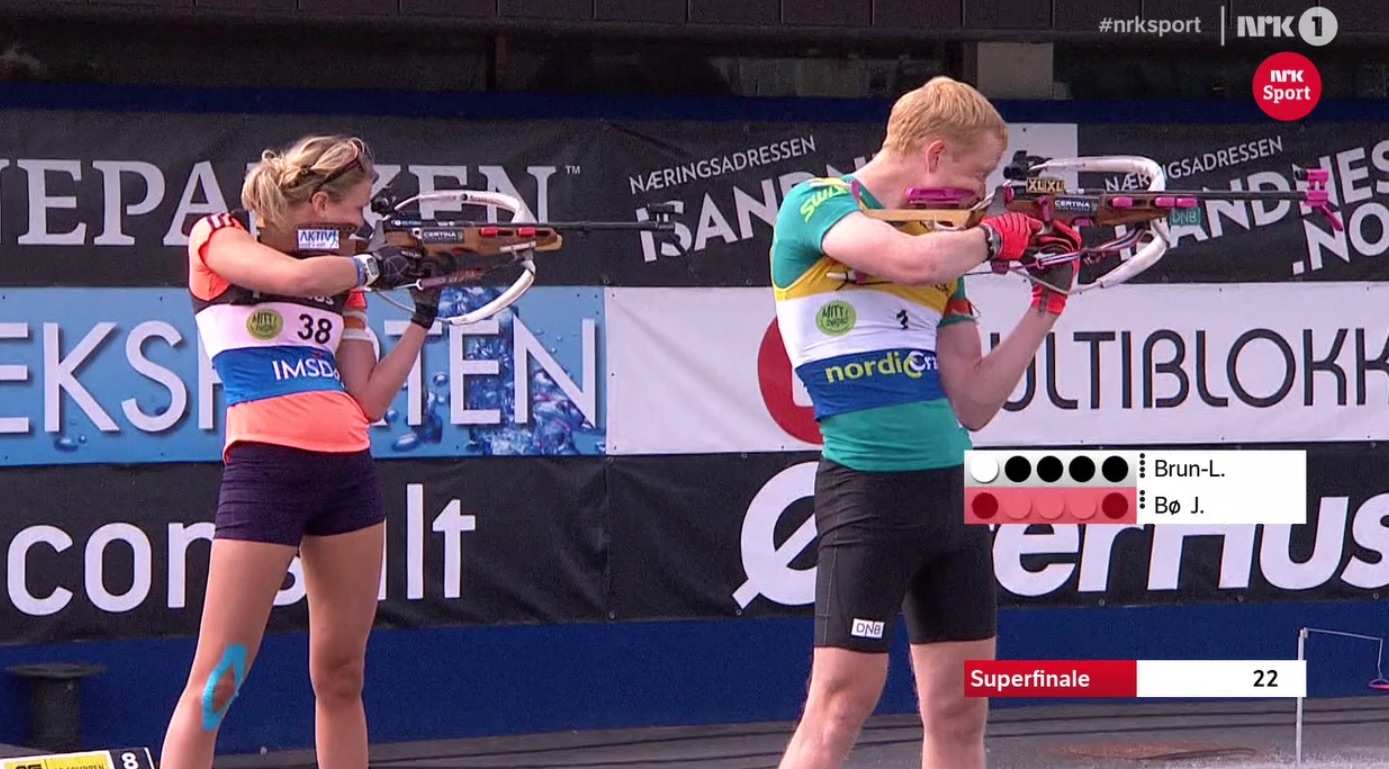
    In a pre-race event dubbed “shooting duels” with the athletes still not on skis, the local fan-favorites prevailed. Norway’s Thekla Brun-Lie won the women’s competition, moving through a series of rounds and cleaning the final in 20 seconds, while her teammate Johannes Thingnes Bø was successful in the men’s shootout, cleaning all targets of the standing shooting stage in a blazing-fast 15.7 seconds for the best time of the day. In a “superfinal”, Bø beat Brun-Lie head-to-head, despite requiring spares and about twice as much time as in the men’s final.

    Norway’s Thekla Brun-Lie (l) and Johannes Thingnes Bø competing head to head in the final round of a shooting competition at the 2017 Blink Skifestivalen in Sandnes, Norway. Both went on to win their respective mass start races later on Friday. (Photo: NRK screenshot)

    Both skiers made use of their excellent shooting accuracy and speed to win their respective races that followed (no exact distance was given). In the second half of the women’s biathlon mass start, Brun-Lie managed to overtake the Russia’s Ekaterina Yurlova-Percht with two clean standing stages, claiming victory in a time of 13:51.5 with one penalty. The penalty loops required rollerskiing on a traffic roundabout next to the range.

    Brun-Lie, 25, is the younger sister of Celine Brun-Lie (a former Norwegian cross-country team member) and a 2011 junior world champion.

    France’s veteran skier Marie Dorin-Habert finished second (+8.5 with four penalties), while Brun-Lie’s teammate Marte Olsbu also passed Yurlova on the final lap to place third (+14.3 with three penalties) and Yurlova finished fourth (+18.2 with two penalties).

    In the men’s biathlon mass start, Sweden’s Tobias Arwidson held the lead after the first two prone shootings, before Bø and teammate Emil Hegle Svendsen overtook him with two clean standing shootings. While both also hit every target in the final standing stage, Bø managed to do it faster once again, crossing the line first in a time of 17:57.8 with three penalties. Svendsen placed second (+12.3) despite cleaning all four stages, and Lars Helge Birkeland completed the Norwegian podium sweep in third (+21.2 with three penalties).

    Unlike in prior years, no North American biathletes have made the trip to Sandnes, Norway, for Blink. The event concludes on Saturday with sprint races for both the cross-country skiers and biathletes.

    Friday’s results:

    Cross-country mass starts: Women | Men

    Biathlon:

  • Kalla Cranks Out Win in Blink’s Lysebotn Opp; Stephen 6th

    Kalla Cranks Out Win in Blink’s Lysebotn Opp; Stephen 6th

    The 7.5-kilometer race course for the Lysebotn Opp, an annual hill climb at the Blink Ski Festival in Lysebotn, Norway. (Photo: Blink Ski Festival/ Facebook)

    There’s a little more than six months to go until the opening ceremony of the 2018 PyeongChang Winter Olympics. For the recently turned 30-year-old Charlotte Kalla, a two-time Olympic gold medalist and three-time silver medalist from Sweden, nothing would be sweeter than to capture another gold this winter in South Korea.

    Her last individual Olympic win came in 2010 in Vancouver, B.C., when she took first in the women’s 10-kilometer freestyle. A repeat podium in the PyeongChang 10 k skate is not far from her thoughts.

    “It is a race that is certainly on my mind,” Kalla told NRK on Thursday, according to a translation.

    What better way for Sweden’s 10 k favorite to practice than at the Blink Ski Festival’s Lysebotn Opp, an annual 7.5 k freestyle rollerski hill climb in Lysebotn, Norway? With names sure to contest her at the Olympics –including Norway’s Marit Bjørgen and Heidi Weng, as well as Finland’s Krista Pärmäkoski, Germany’s Stefanie Böhler and American Liz Stephen — on the start list for Thursday’s race, Kalla couldn’t resist entering herself.

    Sweden’s Charlotte Kalla (r) racing to the win in the Lysebotn Opp, a 7.5-kilometer uphill climb, at the 2017 Blink Ski Festival on Thrusday in Lysbotn, Norway. (Photo: Axelar/Arild Aarnes)

    If her performance in the rollerski race is any indication of where Kalla is headed this winter, it’s the direction she wants. After breaking away with Bjørgen, Pärmäkoski and Weng early on in the race to form a lead pack of four women, Kalla quickly decided to make the race her own.

    Within the next few kilometers, Kalla dropped the two Norwegians and Pärmäkoski and went on to finish first in a time of 33 minutes, 18.3 seconds. Weng followed 40.3 seconds later and Bjørgen crossed in third, 1 minute and 50.5 seconds back. 

    Notably, Kalla’s time was faster than 57 out of 100 elite men that raced the same 7.5 k course later on Thursday.

    “One shouldn’t focus too much on what happens in July, there is a lot left to be done before the season, but it’s been long since I’ve been in this good a shape in July. The last time was probably 2013,” Kalla told NRK.

    The Lysebotn Opp’s 2014 champion,Stephen finished sixth overall (+3:35.7) on Thursday, after  Norway’s Ragnhild Haga in fourth (+2:43.4) and Pärmäkoski in fifth (+2:47.0). Prior to winning three years ago, Stephen also placed third in the famous rollerski hill climb in 2012 (the Lysebotn Opp was added to the festival in 2010).

    (Article continues below)

    https://www.instagram.com/p/BXHv6bPB5Ln/?taken-by=lizhillstephen

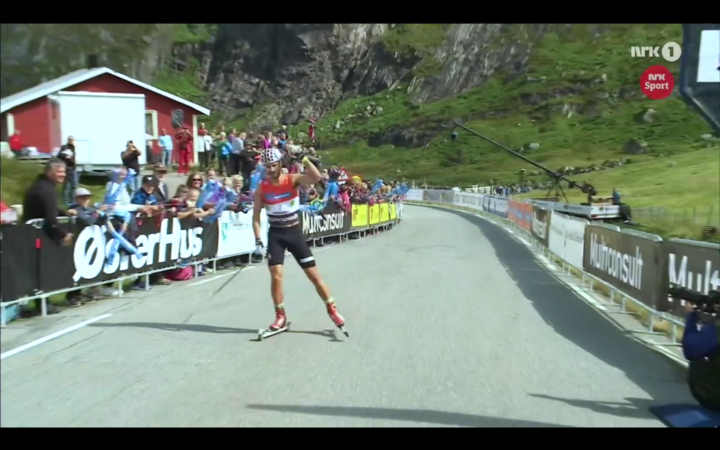
    In the men’s 7.5 k uphill race that followed, Hans Christer Holund broke away for the win in 27:37.6, besting fellow Norwegian Simen Hegstad Krüger in second (+1:13.9) and Finland’s Matti Heikkinen in third (1:25.6).

    Holund took it out strong from the start, holding his lead through the climb’s entirety.

    Norway’s Hans Christer Holund after winning the men’s 7.5-kilometer Lysebotn Opp rollerski hill climb on Thursday at the 2017 Blink Ski Festival in Lysebotn, Norway. (Photo: NRK screenshot)


    “I am healthy and have done some solid training this summer,” the 28-year-old Holund told NRK after. “It looks promising. There’s still a lot of time Olympics, but it does look promising. It is so competitive in Norway and it’s tough to just be selected. If I am selected for the Olympics when the time comes then I will be good enough and then an Olympic gold-medal is the next task.”
    Norway occupied seven of the top eight on Thursday, with Henrik L’Abée-Lund in fourth (+1:59.6), Sjur Røthe in fifth (+2:05.7), Martin Johnsrud Sundby (Wednesday’s 60 k winner) in sixth (+2:11), Simen Andreas Sveen in seventh (+2:12.4), and Gaute Kvåle in eighth (+2:14.7).

    Andy Newell of the U.S. Ski Team did not race the hill climb, but he was back for the 15 k mass start on Friday (as was Stephen for the women’s 10 k). Stay tuned for results in a separate report.

    Results: Women | Men

  • Burke, Smith, and Dunklee Take Wins at Jericho Biathlon Races (with Photo Gallery)

    Burke, Smith, and Dunklee Take Wins at Jericho Biathlon Races (with Photo Gallery)

    Tim Burke of the U.S. National Team on his way to a 4.5-second win over Canada's Nathan Smith in the sprint in Jericho, Vermont, on Saturday. (Photo: Paul Bierman)
    Tim Burke of the U.S. National Team on his way to a 4.5-second win over Canada’s Nathan Smith in the sprint in Jericho, Vermont, on Saturday. (Photo: Paul Bierman)

    More than 80 biathletes from across North America and even Sweden converged on Jericho, Vermont, this weekend for the annual rollerski biathlon championships race series.

    Tim Burke (USA) won the sprint and Nathan Smith (Canada) the mass start, for men, while Susan Dunklee (USA) swept the women’s races. The American “A” team as well as Smith had just returned from training camps in Europe.

    “I think it was a very good weekend,” U.S. Biathlon Association Chief of Sport Bernd Eisenbichler said. “I was especially happy that Nathan Smith decided pretty last minute that he would come too. The other Canadians had been confirmed for a while. So it was a very competitive field at the senior level, and it was pretty high numbers overall.”

    That meant nine Canadian clubs, 16 American clubs, juniors from the Solleftea Ski Gymnasium in Sweden, and a few without affiliation were all competing together, from a girls and boys age group for 14- to 16-year-olds, to a masters age group for 35+.

    With high temperatures, the weather presented an extra challenge to athletes. But they had the incentive of competing on the Ethan Allen Firing Range, which was just repaved in July and has had new Kurvinen automatic targets since last year.

    Susan Dunklee racing to a win in the mass start. (Photo: Paul Bierman)
    Susan Dunklee racing to a win in the mass start. (Photo: Paul Bierman)

    That makes it a perfect place for competition, and more biathletes are using the venue this year than they have recently.

    “We have communication and partnership with the army, so they will allow us to be there as much as we want from the national team side,” Eisenbichler said. “We will go four times this year. The range is also very challenging, so it’s good for training.”

    On Saturday, three-time Olympian Burke mastered that challenge by eking out a 4.5-second win over World Championships silver medalist Smith, despite having one more penalty than the Canadian.

    Burke’s U.S. national team teammate Leif Nordgren placed third, 16.5 seconds back, and Casey Smith of the Craftsbury Green Racing Project, recently recovered from breaking his back in a training accident this winter, placed fourth with perfect shooting.
    On the women’s side, Dunklee cruised to a big win in the sprint, despite having two penalties. Canada’s Emma Lunder followed in second with one penalty, a minute and two seconds back, with American Hannah Dreissigacker five seconds behind her.
    On Sunday, the seniors competed in mass starts, where Smith took a decisive 22-second win with four penalties.

    The breakout of the day belonged to 20-year-old Jakob Ellingson of Loppet Nordic Racing and Mount Itasca Biathlon, who had just two missed shots over the four-stage race to finish second.

    “He worked really really hard these last months,” Eisenbichler said. “You can see that. I was very impressed by his performance, especially yesterday but also on Saturday he had a good race.”

    Nathan Smith of the Canadian national team leading the men onto the newly paved range in the mass start. (Photo: Paul Bierman)
    Nathan Smith of the Canadian national team leading the men onto the newly paved range in the mass start. (Photo: Paul Bierman)

    U.S. national team members Sean Doherty and Nordgren placed third and fourth, with Scott Gow in fifth as the second Canadian.

    Dunklee again ran away with the women’s race, this time winning by a minute and a half over Lunder. The two had five and six penalties, respectively. U.S. “A” teamer Annelies Cook placed third with eight penalties.

    In the other age classes, Arvid Aronsson (Solleftea Ski Gymnasium) swept the junior men’s races, Bjorn Westervelt (Craftsbury Nordic) swept the boys’ races, Joseph Iwan (Saratoga Biathlon) swept the masters men’s races, and Emma Stertz (Mount Itasca) swept the girls’ races.

    For junior men, Matthew Forshey of HURT won the sprint but Cody Johnson of the Maine Winter Sports Center prevailed in the pursuit.

    For junior women, Siena Ellingson of Ginger Biathlon won the sprint but sat out the pursuit, where Charlotte Hamel of ACBQ (Quebec) took the win.

    For youth women, Amanda Kautzer of Loppet Nordic Racing and Minnesota Biathlon won the sprint, but was caught by Chloe Levins of Mountain Top Nordic in the pursuit.

    “For us it’s really important to keep the national team together with the younger athletes to make a good festival character for this weekend,” Eisenbichler said. “Plus with the Canadians coming and some junior Swedish athletes were there, it was an overall good competitive character.”

    Results: Saturday / Sunday


  • North American Biathlon Rollerski Championships in Photos

    North American Biathlon Rollerski Championships in Photos

    Lowell Bailey on his way to winning the 10 k sprint on Aug. 16 at at the North American Rollerski Championships at the Ethan Allen Firing Range in Jericho, Vt. He also won the mass start the next day.
    U.S. Biathlon’s Lowell Bailey on his way to winning the 10 k sprint on Aug. 16 at at the North American Rollerski Championships at the Ethan Allen Firing Range in Jericho, Vt. He also won the mass start the next day.

    JERICHO, Vt. — Nestled in a notch among the Green Mountains, in the middle of an 11,000-acre military training site, nearly 40 of the top biathletes in the U.S. and Canada competed in two races last weekend: a sprint and a mass start.

    Many considered the all-out efforts at the Ethan Allen Firing Range as a summer tune-up, with slightly higher stakes as the North American Rollerski Championships for seniors ages 21-34.

    U.S. Biathlon’s Lowell Bailey came out on top in Saturday’s 10-kilometer sprint, 7.6 seconds ahead of teammate Tim Burke in second. While Burke was later disqualified for skiing the different-length loops out of order, he was one of three men (out of 22) to hit all 10 targets. Bailey and Biathlon Canada’s Scott Gow (in fifth) were the two others who shot clean. U.S. Biathlon’s Sean Doherty ended up second with a single prone miss, Canada’s Brendan Green was third with one standing penalty, and American Russell Currier placed fourth with two prone misses.

    The wind picked up for the following women’s 7.5 k sprint, and while none of the 16 racers cleaned, Susan Dunklee (U.S. Biathlon) was the fastest by nearly 30 seconds with one miss in each stage. Biathlon Canada’s Rosanna Crawford notched second, 29.4 seconds back with one prone and one standing miss as well. Craftsbury’s Clare Egan stood on the podium in third, also with two misses, 44.9 seconds behind Dunklee. U.S. Biathlon’s Annelies Cook finished fourth, Canada’s Zina Kocher was fifth, and American Hannah Dreissigacker took sixth.

    Sunday’s mass start was a wet one, with Cook commanding the women’s race despite five penalties (two in the first standing and three in the final stage). She beat Crawford for the win by 47.4 seconds, after Crawford had six penalties to repeat in second. Dunklee placed third with eight penalties, 1:06.5 behind Cook. Dreissigacker finished fourth with seven misses, and Canada’s Audrey Vaillancourt tied for the best women’s shooting with three misses to take fifth.

    Bailey completed his weekend sweep, winning the men’s mass start by 38 seconds with a single prone penalty — the best shooting of the day. Currier notched second with three standing misses, and his U.S. Biathlon teammate Leif Nordgren was third with six penalties, 1:11.2 behind Bailey. Burke placed fourth with seven misses, and Canada’s Nathan Smith missed three to take fifth.

    More photos (by Gordon Vermeer of the Craftsbury Green Racing Project):

    Saturday’s sprints 

    Sunday’s mass starts 

    Complete results (including junior championships the weekend before)

  • Illinois Roller Ski Race Series Announces 2014 Race Dates

    Illinois Roller Ski Race Series Announces 2014 Race Dates

    illinois roller ski race series
    The Illinois Roller Ski Race Series consists of four 10 k races where the top 30 male, female and junior racers in each race earn points towards the season champion awards.

    1st, 2nd and 3rd place awards for the top finishing male, female and junior are hand out at a barbecue that follows each race.  The food is great and everyone has a chance to share stories, and to rest up to go out on an optional pick up training roller ski.

    100% of the net proceeds from the races are donated to support local cross country skiing, which include but not limited to Moraine Hills, Wisconsin Biathlon and the Wisconsin DNR.

    (every fall in Northern Illinois at Moraine Hills State Park in McHenry)
    Points are earned towards Season Championship Awards
    2014 Race Dates
    • Sat. August 2nd (Family day)
    • Sun. September 7th
    • Sun. October 5th
    • Sun. November 2nd

    About: The race series started in 2013 and was very well received by the racers; many of them commented that it helped them to focus and work harder on their summer training.  All commented that they really loved the food and enjoyed getting together with old friends and meeting new ones.

     Visit www.rollerskiraces.com for more info

    or like the Illinois Roller Ski Series Facebook group

  • Blink Festival Recap: Some Top-Notch Competition, Plenty of Fun

    Blink Festival Recap: Some Top-Notch Competition, Plenty of Fun

    Sondre Turvoll Fossli (NOR) skis into the lead of the cross country sprint final on Saturday in Sandnes, Norway. (Photo: blinkfestivalen.no)
    Sondre Turvoll Fossli (NOR) takes the lead in the cross-country rollerski sprint final at the 2013 Blink Ski Festival on Saturday in Sandnes, Norway. (Photo: blinkfestivalen.no)

    A freestyle sprint through the downtown streets of Sandnes, Norway, on Saturday wrapped up the three-day Blink rollerski festival, a selective event for both cross country skiers and biathletes.

    Ann Kristin Flatland on her way to winning the biathlon sprint on Saturday. (Photo: blinkfestivalen.no)
    Ann Kristin Flatland on her way to winning the biathlon sprint on Saturday. (Photo: blinkfestivalen.no)

    A tenth of a second separated Norwegian Barbro Kvåle from Ida Ingemarsdotter of Sweden, giving Kvåle her first win of the week after placing 14th in Thursday’s hill climb and fourth in the 10-kilometer mass start on Friday.

    “I know that I have good top speed,” Kvåle told NRK, according to a translation. “Now I’m approaching the best.”

    Sondre Turvoll Fossli pulled away from fellow Norwegian Øystein Pettersen to win the men’s cross country sprint, avenging Pettersen’s 1.1-second win in Friday’s 15-kilometer mass start.

    “In the winter it is valid, but it’s fun to win with so many people here and a good atmosphere,” Fossli told Langrenn.

    On the biathlon side, misses in the standing portion cost Norway’s Hilde Fenne the lead and ultimately the win, which Norwegian Ann Kristin Flatland claimed.

    The Boe brothers from Norway went 1-2 in the men’s race, with Johannes winning the final that included International Biathlon Union (IBU) World Cup champion Martin Fourcade of France.

    The biathletes and cross country skiers united for Thursday’s hill climb. First to the top were Switzerland’s Curdin Perl and Kaisa Mäkäräinen of Finland. Mäkäräinen also won the women’s biathlon mass start.

    Curdin Perl (SUI) celebrates atop the podium after winning the 7.5-kilometer hill climb at the Blink rollerski festival in Lysebotn, Norway on Thursday. (Christian Stahl- on FIS website)
    Curdin Perl (SUI) celebrates atop the podium after winning the 7.5-kilometer hill climb at the Blink rollerski festival in Lysebotn, Norway, on Thursday. (Photo: Christian Stahl via FIS)

    “It is great to win,” Perl told Langrenn. “In the years before I was number 4, 3 and 2.”

    Carl Johan Bergman of Sweden won the men’s biathlon mass start and Norway’s Maiken Caspersen Falla took the women’s cross-country mass start. Led by Falla, Norway placed five women in the top six.

    “I had never won here,” Falla told Langrenn. “This was cool.”

    The event included children’s activities, entertainment and a free brunch for the entire city. Blink attracts about 50,000 spectators annually. A record crowd of 5,000 lined the Lysebotn hill climb.

    Complete results

    Kaisa Mäkäräinen (FIN) climbs to victory in the Lysebotn hill climb on Thursday. (Photo: blinkfestivalen.no)
    Kaisa Mäkäräinen (FIN) climbs to victory in the Lysebotn hill climb on Thursday. (Photo: blinkfestivalen.no)