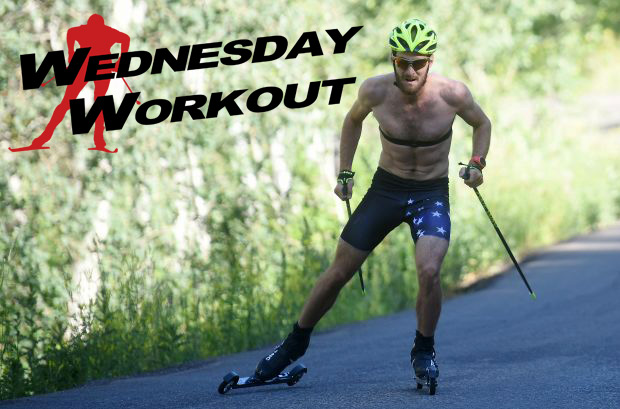
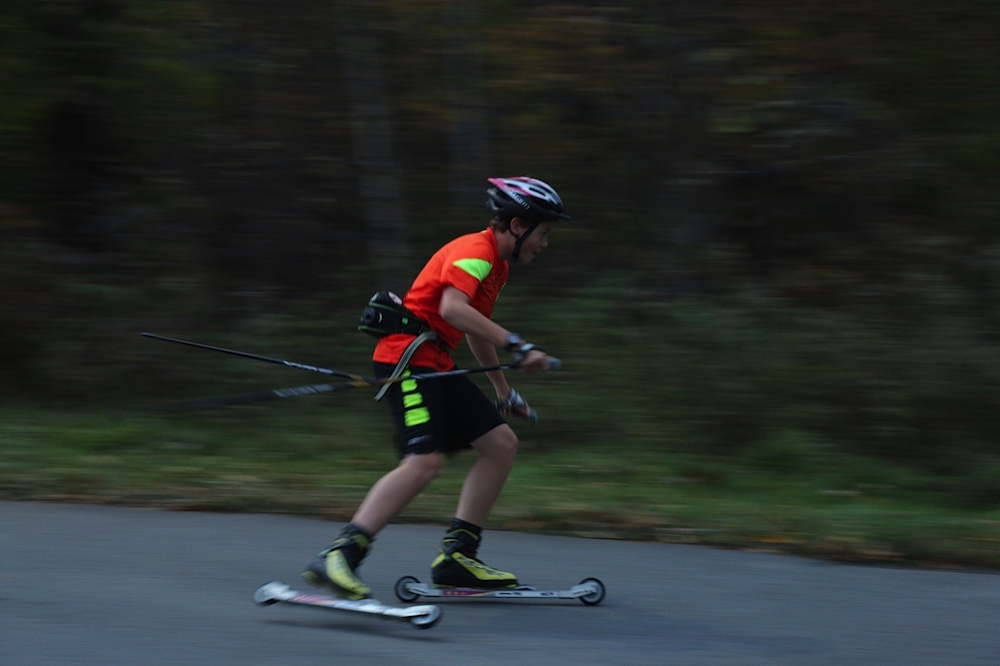
Taylor Fletcher cruising in the 2017 Fish Creek Time Trial in Steamboat Springs, Colo. (Photo: Jasper Good)
From late June into early July, U.S. Nordic Combined hosted a major training camp in Steamboat Springs, Colo. Among the sessions was the Fish Creek Time Trial, a skate rollerski race first held in 2007. That year, Johnny Spillane set down the first in a series of course records that would be improved by different athletes in the next decade.
The time trial is 8 kilometers and gains 885 feet of elevation, starting just south of Steamboat Springs and ending up in the Medicine Bow-Routt National Forest.
National team member Jasper Good is a Steamboat Springs native and remembers the first time he participated in the now-annual time trial.
“In 2012 Ben Berend and I miscalculated how long it would take us to get to the start,” he wrote in an email. “We proceeded to show up and were getting yelled at by everyone saying, ‘You’re starting right NOW, GO GO GO!’ Not the best first impression at a time trial with the National Team.”
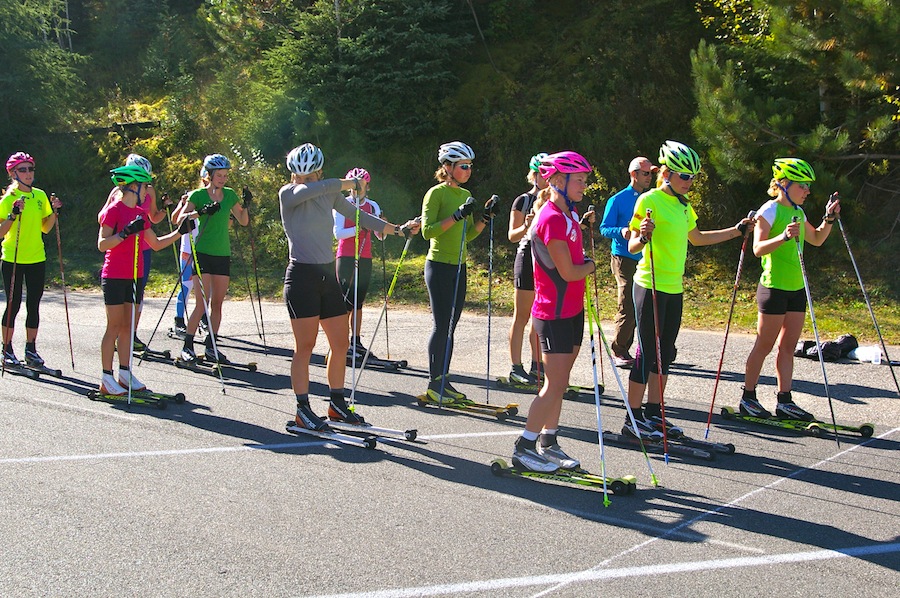
A group photo of participants in the 2016 Fish Creek Time Trial, from “young guns” to Olympians. That year, retired gold medalist Billy Demong competed. (Photo: Jasper Good)
OK, that first start was a snafu, but that’s one of the points of the time trial: getting young racers like Good and Berend were then on the same pavement with the national team veterans and staff. Good is now 21 years old and collected his first Continental Cup top-10 last season, so he’s on his way to being one of those veterans that juniors can measure their progress against.
“We do the annual Fish Creek Time Trial with everyone from national teams down to young guns,” Good wrote.
The time trial is a suffer-fest, starting with rolling terrain that must be worked very deliberately, and also featuring a few walls.
“The first half is a gradual but hard rolling uphill with a lot of V2 gradient, an important part to keep your speed up and use momentum over hills,” Good explained. “About [5.5 k in], you hit the first wall of the race. After the wall there is a false flat with another segment of rolling uphill V2 gradient before you hit the final climb. As it starts to kick up more and more, you hit the second wall where you really don’t want to bonk. Because after the top of that, you only have about 250 meters to the finish. But the last 250 at the very top is a false flat that hurts oh so much. The race finishes with all the racers sprawled out all over the parking lot.”
Because there are now ten years of data, performances can be compared both between athletes and from year to year for any individual racer.
“It has been helpful to see the results from this time trial over the years,” Good wrote. “With it being a mid-summer uphill time trial, it is good to see overall fitness and willingness to suffer, but it’s not always a key indicator of how an athlete may race in a NoCo race come winter. It’s more of a checkpoint mid-summer.”
Other things can change over the years, too: as the “suffer-fest” becomes more and more like a normal race effort over the years, athletes can change how they approach it. For instance, Good’s warmup has changed a lot since that first year when he nearly missed the start.
“My warm-up now resembles my winter time warm-up more than ever,” he wrote. “When I was younger it was mostly just warmup to the start of the race from downtown and then just send it into the race.”
How To Make a Great Time Trial Course
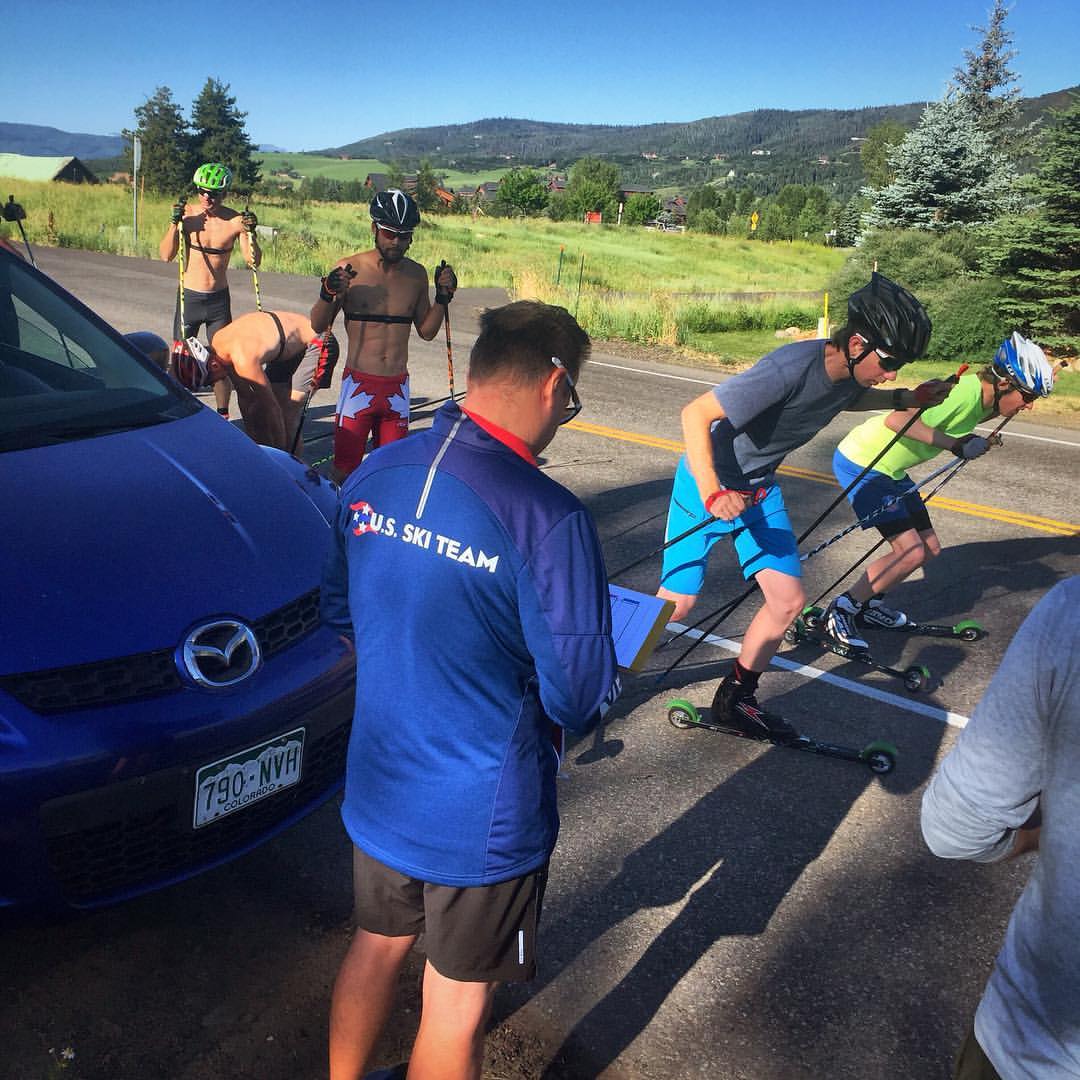
U.S. Nordic Combined Coach Martin Bayer starts athletes at the 2017 Fish Creek Time Trial in Steamboat Springs, Colo. (Photo: Jasper Good)
There are a few things to keep in mind while putting together a rollerski time trial course: just finding the biggest hill with a paved road is not enough. Here are some reminders from Good, who has done Fish Creek for several summers in a row now.
Not All Uphill. “The first part is all about pacing it right and not going out to hard,” Good wrote. “If you go too hard at the beginning the two walls [at the end] are absolutely brutal. Technique and momentum is key in the first half.” Choosing a course with a big chunk of rolling terrain will require athletes to use good technique, execute on their transitions, and maintain momentum. That means that finishing times will reflect not only the athlete with the biggest ‘motor’, but also to some extent that they are skiing well.
Overall Time. “Taylor Fletcher set the time trail record this year at 23:02,” Good writes. “But most of us race it in 23:30 to 26:00, so it is very similar to our typical 10 k times [in nordic combined competitions]. I think it is key that it is in a sense the same time as our typical race, and the same sort of mentality.”
When the Gun Goes Off. How will you set up your time trial? Mass start? Interval start? For Fish Creek, there’s a very deliberate seeding strategy. “It is an interval start with reverse order and the best skier starting last,” Good writes. “In that regard, it is good for every athlete to have someone to chase, and perhaps a stronger skier to go by them. This is good because everyone can try their best to hang on to faster skier and learn how they ski the time trial.”
Pick a Location. If your club is big, this isn’t a big issue — you will always have people to race. But potentially consider whether you can locate your time trial in a place where athletes from surrounding clubs might consider commuting to, or a spot where regional or national teams sometimes host camps. “It is important for all of the NoCo crew to do this time trial together so that every athlete can see where they are at in comparison to the best (i.e. Taylor Fletcher the last few years),” Good writes. “It is also an annual thing so everyone can go out and try and best their time from previous years.”
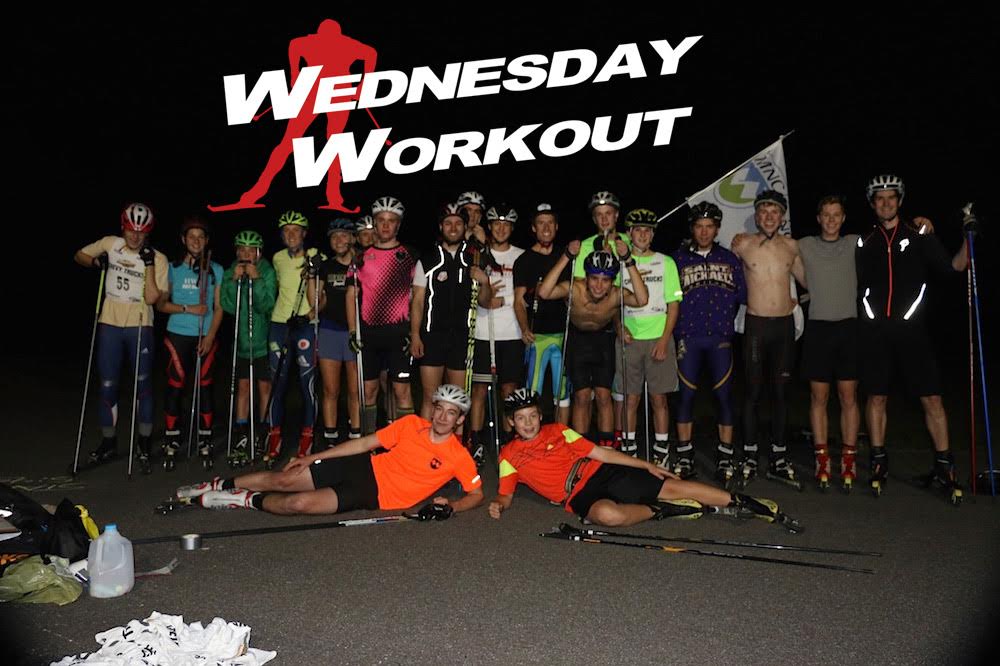
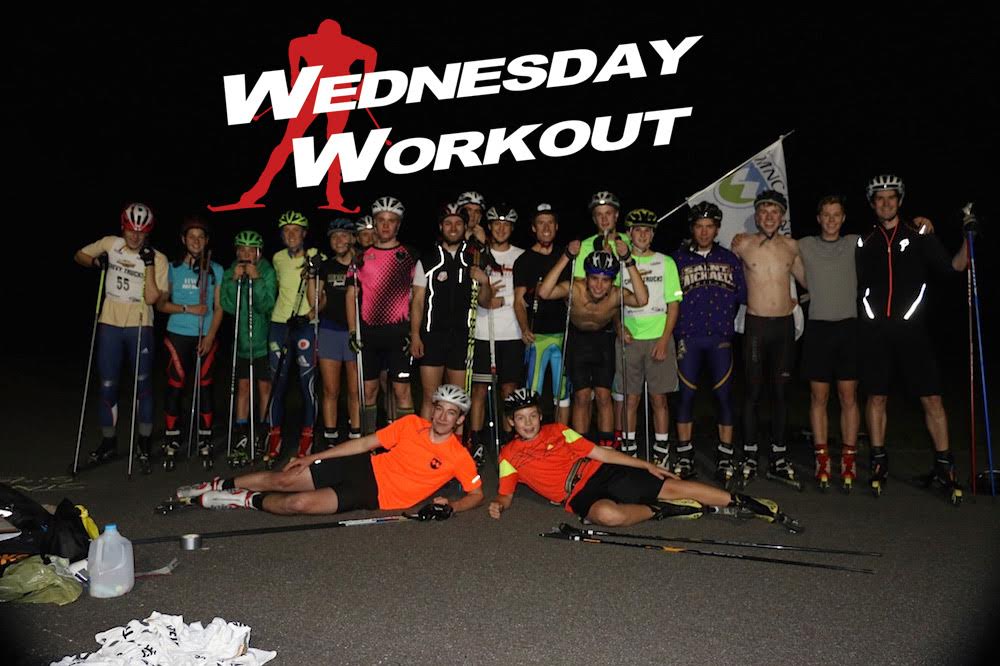
Group photo with Mansfield Nordic, GMVS, St. Michael’s College, and UVM club skiers after their evening skate sprint in Jericho, Vt. (Photo: Gary Solow)
On Nov. 1, the clocks turned against a skier’s favor, especially if you are used to training after an already-lengthy day at school. For many, this time of year brings about tough battles with motivation. The desire to even get out the door is often more difficult to swallow when the sun goes down, and cold weather combined with a lack of snow can add even more aggravation.
Bill Koch League skier Aidan Burt previews the sprint course in fading light at the Jericho range in Vermont. (Photo: Gary Solow)
Mansfield Nordic is incredibly fortunate to train at one of only a few paved, car-free rollerski loops in the country at Camp Ethan Allen in Jericho. “The Range”, as it’s known colloquially, also features lights along all 5.5 kilometers of trail, making it ideal for training in this tough shoulder season.
Although The Range is an amazing place to train, we don’t spend every workout on rollerskis. Recently we found a creative way to make our own lighted trail system in the woods with the help of some battery-powered infrastructure.
In this article I’ll share two workouts we’ve done this fall that were enhanced by the darkness rather than limited by it: A rollerski sprint time trial and bounding intervals in the woods.
Event 1: Skate Rollerski Sprint TT
After a late-summer timetrial with the Green Mountain Valley School (GMVS) in East Warren, coaches Garrott, Katrina and I began talking about the next time we could get the group together. The GMVS crew would not be able to get to the Range until 5 p.m. on weekdays, Garrott noted, when darkness would be coming up fast. Instead of changing plans, we decided to turn this into the plan!
A few weeks and a bit of outreach later, a hearty crew was up at The Range on a Tuesday night for some sprinting action. The competitors included athletes from Mansfield Nordic, GMVS, St. Michael’s College, and the University of Vermont (UVM) Club team.
The Workout
A qualifier was held in grainy, fading light, and by the time the heats began the lights along the trail were the only glow in the area as racers sped around a hilly 1 k lap. Organized in a modified “King’s Court” style, everyone got to race multiple heats against similar competition. With some diligent recording, every racer was tracked for every lap so that times could be compared. Pizza delivered after the final round was key, as the event wrapped up around 7 p.m.
Event 2: Bounding by Headlamp
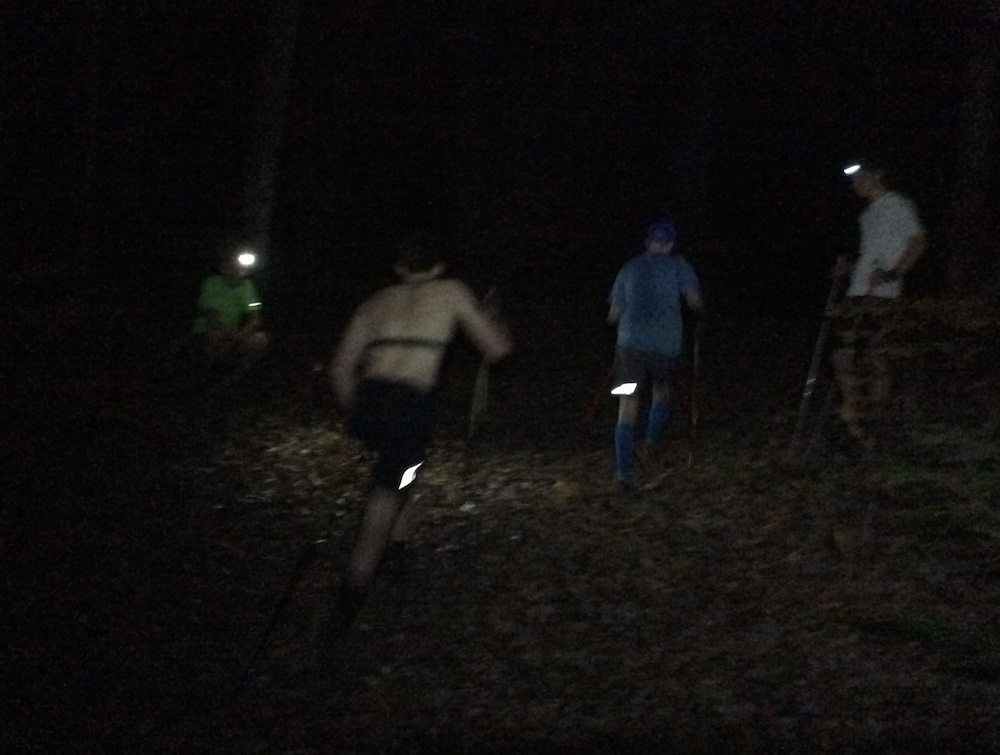
Although rollerski tracks with lights are not common, many racers are probably more familiar with training by headlamp, especially masters racers who are looking to train before and after long work days. We were able to do some bounding intervals at a popular training location, the Jericho Research Forest, with headlamps and more to light the way.
The location for this was key to enabling safe, effective training in the woods at night. This stretch of forest has a few great features that made the night workout possible:
Hills of varying length and grade (of course)
Snowmobile trails, which are wide and well-cleared of obstacles that could trip you up
A relatively short 1-2 k loop to avoid getting lost and help track athletes
The Workout
MNC skiers alternated jogging and bounding on portions of a 6-8 minute loop that included steep uphills, rolling terrain and flats. By doing the workout on a set course over and over, athletes became familiar with the terrain in the fading evening light. This made it easier to navigate the loop when the complete darkness arrived shortly thereafter.
The loop made a figure-8 style, and in the middle, a branch was posted into the ground with a LED light dangling off — the center hub and meeting spot, as well as the beginning and end of every interval. This made it easier to know where and when to find athletes … and to know where the water belts were.
Headlamps were donned to allow better visibility, and also give a pretty cool motivational boost. Is the competition outside training in the dark right now as well, or are they home watching “The Walking Dead”? Concluding the workout with some extra hard bounding with a partner, under the light of teammates’ headlamps lining a short section of the trail, made for a great finale.
The dark and cold days of autumn will always bring a tough challenge to skiers, especially before the snow has fallen. It doesn’t have to mean a lack of motivation or variety, though. If you can get creative with your workouts, you may even find a way to dig deeper and end up with a more memorable session than you planned.
The women get ready for the quarterfinals at the U.S. Ski Team Elite Camp classic rollerski sprints on Sept. 20 at the Olympic Jumping Complex in Lake Placid, N.Y. Up front, from left to right: Jessie Diggins, Sophie Caldwell and Ida Sargent.
LAKE PLACID, N.Y. — Exactly a week ago, 40 elite skiers threw down some solid efforts at a U.S. Ski Team (USST) classic rollerski time trial, with the fastest men and women moving on to their respective quarterfinals, semifinals and finals.
Sophie Caldwell and Andy Newell of the Stratton Mountain School T2 Team topped the women’s and men’s fields in the sprint workout. For more about the races, click here. Otherwise, enjoy the video below capturing the action at the Olympic Jumping Complex, from the qualifiers through the heats.
Sophie Caldwell (r) leads Ida Sargent (second from r), Caitlin Patterson (second from left), Jessie Diggins (behind Patterson) and Anne Hart (l) at the start of the big downhill in the first semifinal of the women’s 1.4 k classic rollerski sprint on Thursday. The time trial was the first of this year’s USST Elite Camp in Lake Placid, N.Y. and took place at the Olympic Jumping Complex.
LAKE PLACID, N.Y. – Flinging around a sharp corner about a ski length behind one another, Sophie Caldwell (Stratton Mountain School T2 Team), Ida Sargent (Craftsbury Green Racing Project), Caitlin Patterson (CGRP) and Jessie Diggins (SMS) each lowered into a tuck and prepared for a long, steep descent.
Diggins called out to the others just ahead of her in the classic rollerski sprint at Lake Placid’s Olympic Jumping Complex.
“That’s it,” the U.S. Ski Team (USST) member said. “Nice.”
Conversations like that, in the first of two women’s semifinals at the USST Elite Camp on Thursday, didn’t take place every heat. But they generally differentiated the women’s and men’s races.
According to Caldwell, who eventually won the women’s 1.4-kilometer final, nothing was too cutthroat about the sprint rounds. Caldwell finished first in the quarterfinal, semifinal and A-final, beating USST member Sargent in the latter by 1.4 seconds. Diggins finished third in the A-final, about four seconds back.
“We try to be nice,” Caldwell said. “We even talk to each other and let each other know how much space we have. I don’t know what the boys do.”
She laughed. Anyone who watched the men’s heats on Thursday knew exactly what they did.
Simi Hamilton (left) leads Skyler Davis (second from l) and Andy Newell (front right) into the long downhill during the quarterfinals of the men’s 1.5 k rollerski classic sprint on Thursday at the USST Elite Camp in Lake Placid, N.Y. Newell went on to win the A-final, Davis was second, and Hamilton was third.
In the first of four men’s quarterfinals, USST members Simi Hamilton, Andy Newell and Skyler Davis all battled for position on the same corner at the top of the long hill. Each had to pass through two narrowly spaced cones to make the turn.
All three of them did so and managed to stay on their feet, while Ryan Scott (Team HomeGrown), Tim Reynolds (CGRP) and Sylvan Ellefson (HomeGrown) worked hard behind to close the gap. Davis said he felt someone push his poles, which made him go uncomfortably faster on the ripping downhill.
In the end, they all made it to the finish. Newell ultimately won the men’s 1.5 k final, about two seconds ahead of SMS teammate Davis in second, and Hamilton (Sun Valley Ski Education Foundation) in third (+4.42).
“This course is pretty wild because there’s so much tucking,” Newell said after the race. “To have six people going around that course is pretty crazy. Skyler and I are used to banging heads with each other because we do it every day, but it was fun to have Simi and Ryan Scott and some of those other guys in there, fun to go really fast on the downhill and try to pass each other on some of the corners. Nobody crashed hard I think, so it was a good day.”
Davis, who was second behind Newell in the qualifier and every heat that followed, said his performance was a “confidence booster” after being sick at the Lake Placid camp last year and having to call it a day after the prelims.
“Coming in [to this workout], I was pretty tired. This camp’s been hard,” Davis said. “Once I started warming up I felt great.”
A competitive field of 26 men made for fast heats. On the same course last year, USST A-teamer Kris Freeman won the classic sprint in 3:30. Newell posted 3:22.38 in Thursday’s A-final and threw down a 3:18.91 in the qualifier.
In the women’s qualifier, which consisted of 14 skiers, Diggins was fastest in 3:42.20 – the same time Sargent clocked to win last year’s time trial. On Thursday, Caldwell qualified second 0.15 seconds back, and Sargent was close behind in third (+0.24).
Those kinds of measurements are what matter most this time of year, according to USST head coach Chris Grover.
“It’s too early to really hang your hat on any sort of results here,” Grover said. “It’s just kind of a road mark. I think for a lot of the athletes, we want them to take a look at what kind of lactates are they able to create, what kind of heart rates are they able to have. That gives us an indication of how much of their aerobic system they’re able to access, how much of their anaerobic system they’re able to access, those kind of feedback markers plus how they sustain the rounds.”
If they fade progressively after the prelims, something’s got to give. Grover said race scenarios give skiers an opportunity to assess where they’re at, and how to move forward.
“Like, ‘OK, I’m handling training well during this period,’ or, ‘I’m starting to get a little fatigued, I’ve really got to concentrate on rest for a few days, or for a week after this camp,’ ” Grover said. “So it’s not so much the placings that are critical; there’s a lot of different rollerskis out there, there’s a lot of different ski speeds. It’s more the individual feedback in terms of heart rate, lactate, times, technique.”
Sophie Caldwell (1st woman): “I felt good today. In the qualifier there were a few things that I felt like I didn’t do quite right. I took the corner on the bottom wrong, so I worked on those in the heats and it was good to be able to follow some people and see what they did, like Jessie was really good at going fast over the top of this hill and taking the corner down there.
“I didn’t really know what to expect. I wanted to be right up there with Jessie and Ida. … This summer we basically just did all Level 3, not many Level 4 workouts, and then we do some speed workouts. I think now we’re starting to do more Level 4, time trial, race pace stuff, but it feels good so far so it’s good to know you can still get fit just doing Level 3. … We all have different skis and everything, but I’m just happy to come out here and feel good and be in the mix with everyone.”
Ida Sargent (2nd): “It’s a rollerski time trial in September and everyone is on different skis,” she wrote in an email. “I wasn’t concerned with results, instead focusing on gettiing a hard workout and practicing some technique goals in a max effort. It was a really fun skiing with everyone and it felt good to feel the lungs burning with cold air this morning!”
Jessie Diggins (3rd): “During such a good intensity camp, my goal with this workout was to get in some good hard efforts, and really work on my qualifier,” she wrote in an email. “Classic sprinting is definitely my weakest area and epecially qualifying, and so I’ve been really focusing on, well, FOCUS during the qualifier.
“I definitely was feeling the fatigue in my body, but that was to be expected during this camp after a 4.5 hour training day yesterday [Wednesday], so I wasn’t super worried about it. However, it still doesn’t feel good to not be moving lactate out as fast as I want!”
Andy Newell (1st man): “I definitely feel so much better than I have in the past racing here. I’ve been doing a lot more hard stuff, a lot more speed, so it’s good. I actually feel like a sprinter again, which last year at this time and for most of the winter, I didn’t really feel like a sprinter so it feels really good to get that kind of power back.
“I’m usually not such a good classic rollerski sprinter, for whatever reason, my technique doesn’t translate that well over onto rollerskis, but it feels good to double pole well and I like courses that have lots of striding like this. … Last year, I was sick for this race or I’m [usually] really tired for Lake Placid camp because I’m coming in training too much volume. I tried to cut back [the week before] so I was able to really come into this camp and get the most out of each interval session and time trial. That was the goal of the camp and I think that worked out well. I’ve been feeling good all camp and hopefully will be able to absorb some of this hard training better than in the past.”
Skyler Davis (2nd man): “We had a sprint time trial about two and a half to three weeks ago in Maine. It was pretty similar to this except it was all double pole so I got to go head to head with [Newell] on that. This was the same type of thing, we were battling the whole time, especially coming up the hill. All those guys were pushing pretty hard … so all of our heats were pretty fast. It was really good training.”
Simi Hamilton (3rd man): “I felt pretty good today, considering that I’ve done pretty much no max efforts yet this year,” he wrote in an email. “I actually felt better today than I have in years past during the camp, so I am taking that as a good sign that my training is going in the right direction, especially in terms of overall fitness and improved endurance throughout heats. I ran into some slight equipment problems [blown-out rear wheel] today, so that was kind of a bummer, but other than that I am pretty happy with how the day turned out.
“My main goal today was to ski consistent efforts in the qualifier and each heat … And I think I did that, especially since my equipment problems required me to switch to a slightly slower pair of skis for the semis and finals.”
Chris Grover: “We’re toward the end of the camp now so people are starting to accumulate some fatigue. We’re actually doing threshold bounding intervals tomorrow [Friday], so I expect that just about everyone will need a few easy days following the camp and that’s normal.
“We like to push the athletes when they’re together and they have a chance to go head to head. At the same time, it looked like good movement out of a lot of the athletes. I really like this course because it has such a wide, steep finish hill, really a chance for athletes to demonstrate how their holding up through the rounds, if they’re able to carry good momentum up that hill and over the top and into the finish. I think it’s also great to have a big hill and then a long finish straight, especially like we have for the men on this course, because it replicates a lot of the courses that we encounter in the winter time.”