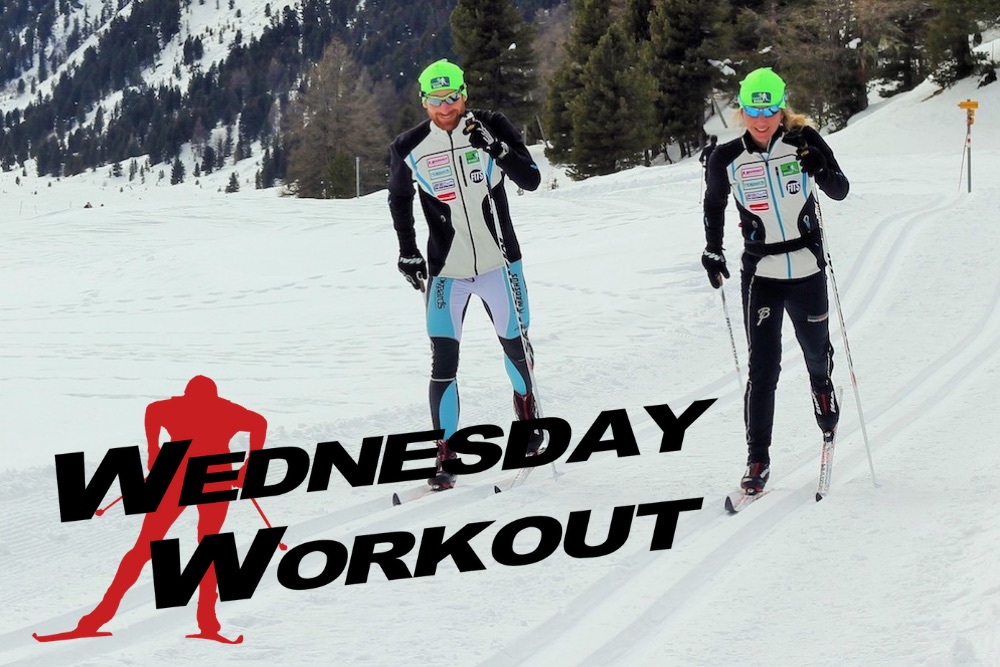
Team Gregg, Brian and Caitlin Gregg, out for an easy recovery ski together. (Courtesy photo)
This week, we’re featuring a workout from the training logs of Team Gregg. These days, husband and wife Brian and Caitlin Gregg are adjusting to life, training and bodily changes as Caitlin is pregnant with their first child (a girl), due in early February. Read the full story here.
Caitlin sent us the following “trailheading” workout, in reference to starting and ending a workout with someone else, which is how they often train together.
***
One of the challenges in training and racing is that it is often challenging to find training partners at the same speed and ability as yourself.I would argue that the best training partner is one who is just slightly faster than you.Brian and I have been blessed with opportunity to be a married couple who have both competed in the Olympics.
Here are a few ways we get creative to maximize our workouts and fun:
Every training partner can offer somethingand we enjoy large training groups.If you don’t have a training group, take it upon yourself to organize one.Utilize a loop so that the group can kind of stay together.If you are really searching, our neighbor’s house is for sale and you can join one of the many each cross-country ski groups in the Twin Cities.
Utilize different ski speeds as equalizers.On snow, put the slower person on the fast Redlines.If you are rollerskiing, give the person who is in the best race shape the slow, soft wheels.Using various rollerski wheels is a great way to prepare yourself for various snow conditions.
Brian and Caitlin Gregg enjoying the fruits (and added weight) of their workout during a hike this summer. Brian carried the watermelon in a backpack to slow him down. (Courtesy photo)
Another tool we use is a weight vest.For intervals, Brian will wear a weight vest and we can ski side by side pushing each other.This summer, I had Brian carry a watermelon during a hike so that we could relate, plus it was delicious.
In preparation for the 2015 World Championships, at 9,000 feet in Colorado we would Jetstream bloc my skis so that I could be skiing at speeds more similar to sea level.Plus, Brian and I could do intervals together.
Although Brian and I might have the same duration for an interval, he will start behind me with the goal of trying to catch me by the end while my goal is to try and hold him off. This also works really well for speed sessions.
Sample Workout: Team Gregg Husband/ Wife Intervals
We have a great hill in Afton, Minnesota, that Brian and I try and get out to about once a week in the fall. It’s steep and long (for the Midwest) but you can also safely ski down between repeats.
Warmup: Ski easy for 30 minutes with 15- to 20-second pickups. We usually start our warmup at the same time, but gradually over the 30 minutes, we separate and meet up again to do some pickups. We then do a set of pickups where Brian starts behind me and we try to finish the pickups together.
Intervals: The workout is usually 5-8 x 4-5 minutes (with 3-4 minutes recovery) depending on how we are feeling and what our goal for week is. Brian will either put slower wheels on or wear a weight vest for the session. I will either put faster skis on or start a little before him.
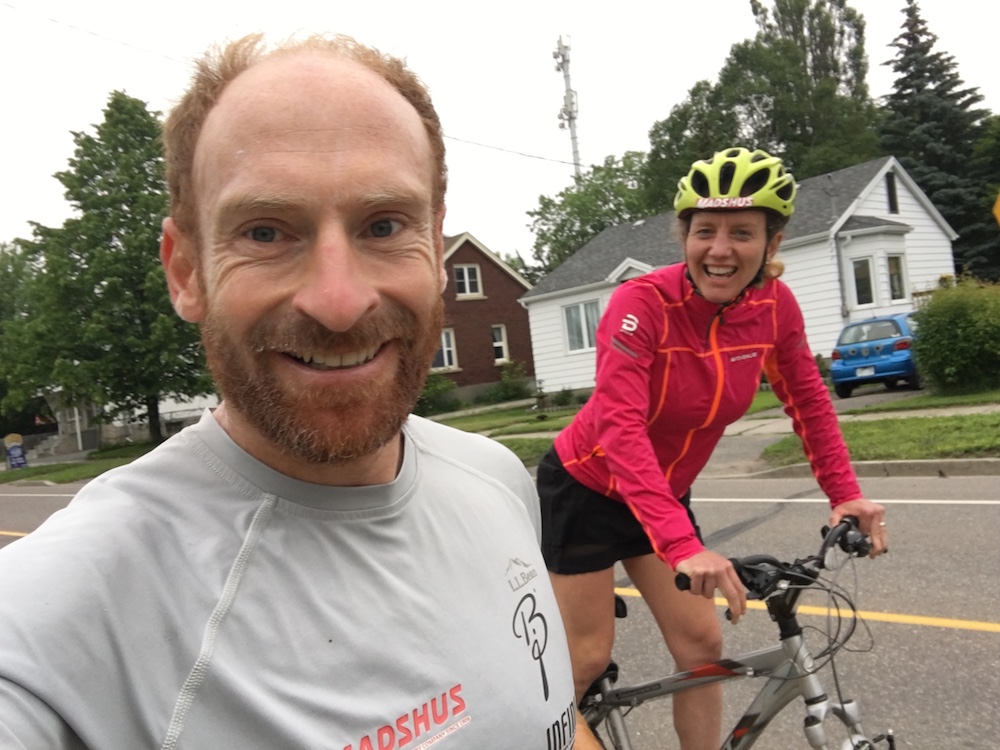
Brian Gregg snaps a selfie during a workout with his wife, Caitlin. (Courtesy photo)
The Game (Goal): If it’s just the two of us, we try and make the intervals more fun and exciting by challenging each other to get to the top first, but also try to maintain or drop our times from the start of the session to the end. For example, getting to the top first on the first interval but then falling back or skiing slower each subsequent interval isn’t the goal.We focus on negative splitting each interval in the set, which requires good discipline early on.
Cool down: We usually ski the cool down together and reflect on the session. Since we are out there together, we don’t always have feedback the way someone watching or filming the entire session from the sidelines would, but we can still be observant of how the other person is moving and offer some technique cues.
After the session: It’s been incredibly fun to travel the world training and racing together as a married couple. We are extremely lucky that we have both been able to follow our dreams. There are still added challenges to this approach, though… One of the hardest parts of finishing a hard race or interval session together is that we are both exhausted at the same time, which means that there has to be some way of deciding who is going to cook or do the dishes at the end of the night. This is where we put high stakes on who executes a workout better or has a better result at a race. The winner gets to relax on the couch while the loser has to wash and dry! Just kidding; we do the dishes together 😉
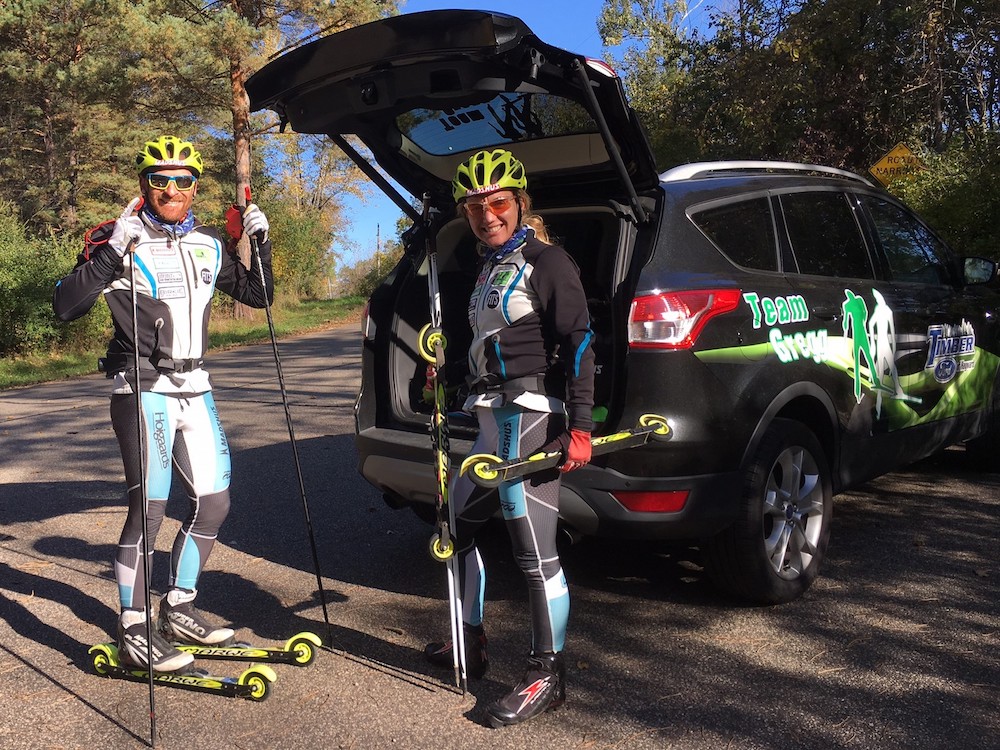
Brian and Caitlin Gregg (Team Gregg) out for a rollerski. (Courtesy photo)
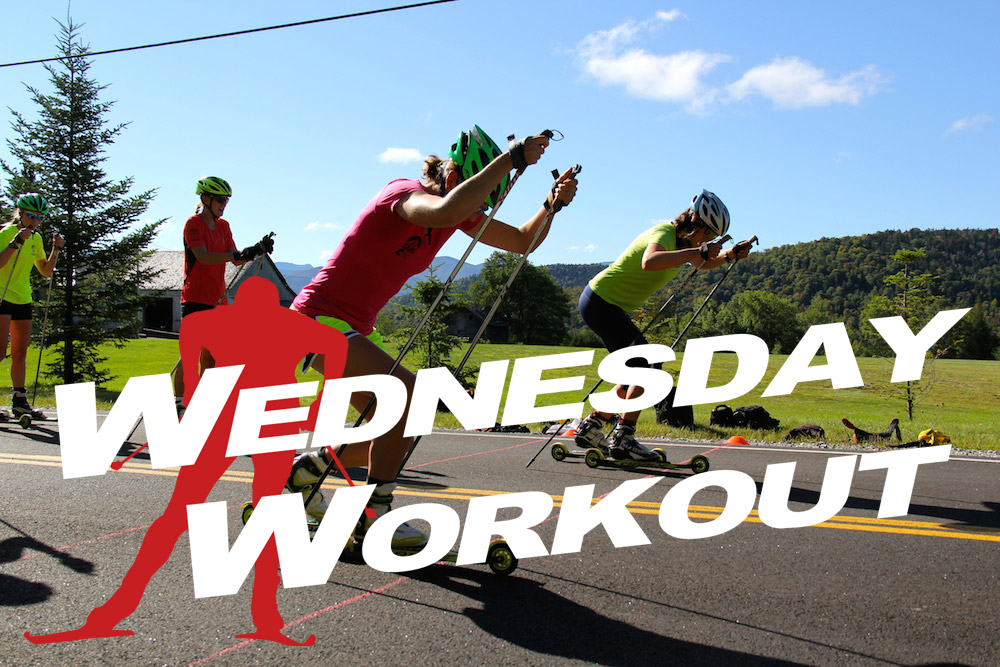
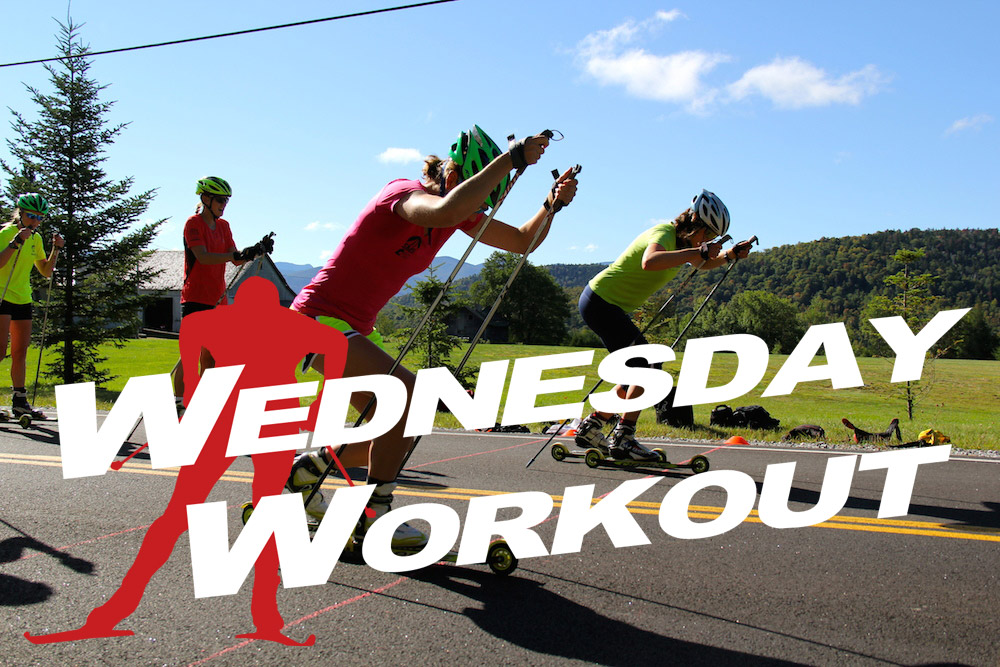
Stratton T2 skier Annie Pokorny (l) and Middlebury’s Heather Mooney (r) start together during the skate-speed session on Aug. 29 at the U.S. Ski Team camp in Lake Placid, N.Y. (Photo: Bryan Fish)
Growth is good, and when it comes to improvement, even the U.S. Ski Team has areas it wants to work on collectively. Sprinter or not, if racing’s in your future, chances are you could benefit from some speed work off the starting line.
That’s why U.S. Ski Team (USST) Head Coach Chris Grover adjusted one of his team’s workouts last week at its camp in Lake Placid, N.Y. Instead of doing 16 to 18 skate-speed accelerations on rollerskis (each lasting about 10 seconds), Grover and his staff decided to cut down the number of accelerations, or rolling speeds, and add some sprint starts (transitioning from double pole to skate).
The Workout: 4-5 x rolling speeds and 12 x sprint starts
Where: Bear Cub Road (about 2.3-miles long to a dead-end) next to the Olympic Training Center in Lake Placid
Why: “We decided that we wanted to change the focus of the session to improving skate sprint starting technique,” Grover explained in an email. “We had a very productive session where most athletes made some excellent changes, and we have a follow-up session scheduled for Park City in October.”
What: Warmup as usual, then begin rolling speeds: 4-5 accelerations (each lasting about 10 seconds), with about 3 minutes of recovery in between.
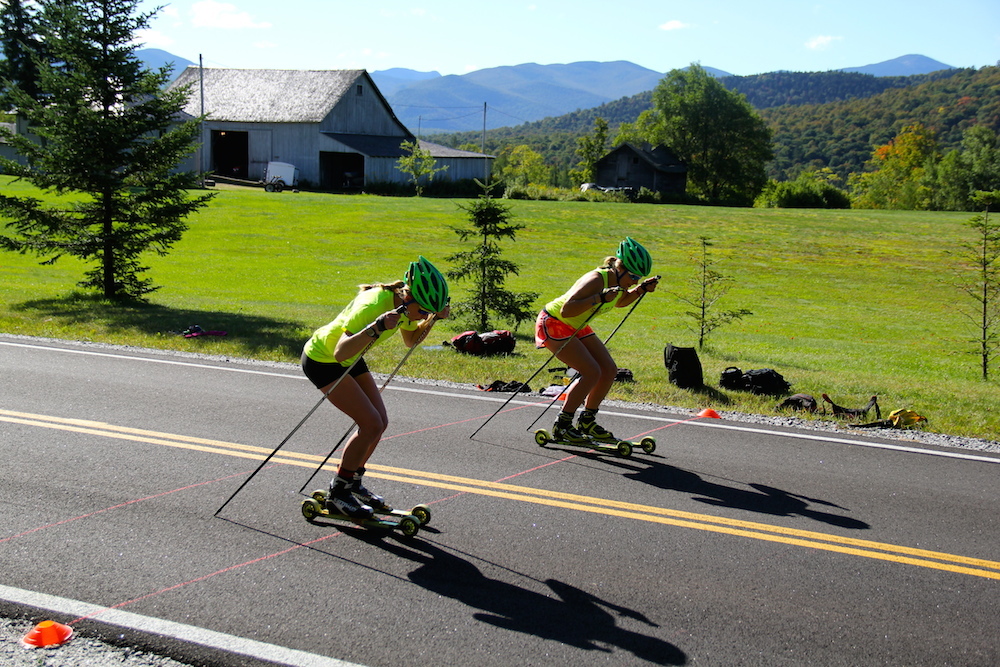
When you’re done with that, recover for 3 minutes, and move to skate-sprint starts. From a standstill, build speed off the line: double pole then transition to V2. After 10 seconds, stop, recover for three minutes, and start again (for a total of 12 times).
“We do practice starts regularly since they are important for certain sprints in some conditions,” Grover wrote. “We generally keep our speed training closer to 10 seconds for maximal neurological benefit and less fatigue.”
Length: The workout itself should take about an hour. With warmup and cool down, you’re looking at 2 hours.
Out of the USST’s 12 training days of camp in Lake Placid, there were about a dozen rollerski sessions scheduled and seven cross-training workouts. One of them was VO2-max bounding at Whiteface Mountain, an annual staple of their Lake Placid camp.
“Bounding/ski walking intensity is a go-to workout for most cross-country ski racers around the world, most likely because you can access grades that are not available on pavement for rollerskiing,” Grover explained. “You can find long, steep pitches that resemble some of the bigger hills you might find on a ski course, and the mechanics, body position, and power application of bounding is identical to good steep classic striding or herringbone.”
All of this can be done without worrying about cars or road hazards.
“The question has been asked many times why don’t cross-country skiers simply rollerski and ski for all training,” he added. “After all, runners run, bikers bike, and swimmers swim. For me, there are two answers to this question. The first is that the preparation period for cross-country ski racing is so long, and the training volume is so high at the elite level, that cross-training modes like running become essential for preventing over-use injuries and for keeping training mentally fresh for the athlete.
“Cross-training modes like running become essential for preventing over-use injuries and for keeping training mentally fresh for the athlete.” — U.S. Ski Team Head Coach Chris Grover
“The second is that running provides increased leg strength because the athlete actually carries 100% of their own body weight (unlike biking or rollerskiing) and lifts that weight off the ground repeatedly,” he continued. “Agility is also improved by running, especially if you are constantly hopping from rock to rock in the Adirondacks!”
The USST camp wraps up on Sept. 7 following the Climb to the Castle on Saturday, Sept. 6, of which Liz Stephen and U.S. Biathlon’s Tim Burke are the defending champions.
SMST2 teammates Erika Flowers (l) and Anne Hart work on skate-sprint starts on Aug. 29 at the U.S. Ski Team dryland camp in Lake Placid, N.Y. (Photo: Bryan Fish)