From the FasterSkier archive — posts syndicated from athletes’ and coaches’ own blogs between 2004 and 2012, kept online as published. Current coverage is at fasterskier.com.
Another first by www.RollerskiShop.com, these easy to add/remove steel weights increase the swing weight of rollerskis. While overall rollerski weight is important, weight distribution is also important in making a rollerski feel more like a long snow ski. Swing weight is the amount of effort required to swing both ends about its middle. Higher the swing weight the longer the rollerski feels. Build more leg strength on shorter workouts with a feeling similar to a snow ski with slush stuck to the top.
112 grams (4 oz) each including strap
Creates greater ski like swing weight
Moves the rollerski balance point further forward reducing tail drop
Increases leg workout
Universal rubber straps fit most rollerskis and allow for quick add/removal
Rubber under the steel weight eliminates vibration on the frame and allows for positioning over the fender screws on most rollerskis. The farther forward the higher the swing weight.
$25/pr including 2 extra straps.
Release strap tension when storing.
When we designed the #1 ranked Pursuit Fork Flex, weight distribution was on our minds as something that previously hadn’t been talked about in rollerskis, but is almost as important as the type of flex (Snappy flatter flex is more ski like than a lifeless concave flex) and top of frame height (Lower the better with the Fork Flex measuring only 50 mm to the ground unweighted). The Pursuit Fork Flex while lightweight at 1.69 kg/pr (620 mm wheelbase) has most of its weight distributed out towards the ends in the spring steel forks and wheels, with little weight in the middle as the aluminum main frame is so light. You want the weight out towards the ends, and with these strapped behind the front wheels, they seem longer and even more ski like allowing you to maximize your workouts with more variety.
The RollerskiShop’s T6004 Pursuit Skate Rollerski ($159.99)
FasterSkier recently had the opportunity to test a pair of pursuit rollerskis which are sold exclusively online the RollerskiShop.com. Read the review by FasterSkier staff below.
Pursuit T6004 Skate Rollerski Summary ($159.99): Great all-around rollerskis for skiers of all abilities. While it may not have the flex of a Marwe, it provides surprisingly smooth experience despite it’s alloy composition. Did we also mention that its sold at a fraction of a leading rollerski’s cost?
Pursuit Skate Rollerski Brake Summary – sold separately ($39.99): While this brake is a step in the right direction, it is most useful when rollerskiers have no need to slow down. Due to it’s ability to send a skier’s upper-body weight forward, this brake is better for the more experienced rollerskier who is better in-tune with their movements on rollerskis.
Review: The Pursuit T6004 has a very simple yet appealing aesthetic with an alloy aluminum structure. The addition of holes drilled in the sides gives the skis a bare-bones industrial look. According to the RollerskiShop this further cuts costs, and scratches will be less noticeable.
In terms of performance, the Pursuit T6004 gets the job done. It provides a surprisingly smooth ride for its alloy base, even on fairly rough roads. In addition, the T6004 allows you to completely shift your weight between each ski while feeling stable.
The Rollerksi shop gives customers several options of wheel speed and size, depending on skill level and training needs. Check them out here to find the best fit for you.
The Pursuit T6004 is a great all-around rollerski. While those on the elite level will likely opt for a more expensive option, this rollerski offers quality at a low price which makes it an appealing option for anyone ranging from a junior to master skier.
The RollerskiShop introduced a braking system for their Pursuit rollerskis, which FasterSkier had the opportunity to test as well. Before testing the braking system I was skeptical of their use, as most brakes that I have experienced are ineffective and more hassle than they are worth.
The Pursuit Skate Rollerski Brake ($39.99)
The Pursuit Skate Roller Ski Brake, is unlike other brakes in the fact that it connects a rounded metal piece to a stretchable cord that is tied to a waistband. Confused? I was too. However, once I was able to figure out the mechanics of the brake, the functionality finally made sense.
To engage the brake, one must slide their foot with the rollerski brake forward and slowly pull up on the cord that connects the brake and the waist band. There’s a handle on the cord to facilitate this process. By pulling the cord, the rounded metal piece is placed into contact with the wheel, thus causing friction and theoretically slowing the skier.
For more detailed instructions for installing and engaging the brake, read a description at RollerskiShop.com
However, slowing down with the Pursuit Skate Roller Ski Brake is sometimes too effective. There were multiple times when I was skiing down a hill where I would lightly pull the brake and feel as if I were about to fly face first into the pavement. To remedy this I decided to start braking throughout the entire hill instead of the near the middle or bottom. While the “jerking effect” was lessened I still felt as if my upper-body wanted to lurch forward.
In addition, for someone who is as tall as I am (6 feet – an average to slightly above-average height for most men in nordic skiing) the cord attached to the waistband was almost too short. Even with adequate slack in the cord I could feel a slight pull that would bring the rollerski to hit my heel every so often. While this might not be a problem for short rollerskis, it could become an annoyance after a two hour plus workout.
Overall, the Pursuit Skate Roller Ski Brake is a step in the right direction for the development of brakes. It is more effective than most other brakes I have experienced in the past and it can slow you down with ease on small hills. That being said, the times when the brake was most effective it was on a very gradual downhill, where one wouldn’t need to brake in the first place. As with all rollerski brakes, the Pursuit Skate Roller Ski Brake is ineffective and dangerous on longer, steep hills and abrupt stops. While the RollerskiShop advises that the brake is not for such circumstances, the instinct to brake in such situations might be too strong for some to resist.
For this reason I would recommend this brake for skiers who are experienced rollerskiers. However, most experienced rollerskiers probably feel as if they do not need a brake, thus making the market for this product a small one.
Pursuit T6004 Skate Rollerski:
Price: $159.99
Wheel diameter: 100 or 105 mm Wheel width: 24 mm Bearings: 608 2-RS Wheelbase: 600 mm Weight: 1.48 kg per pair with 100 mm wheels & 1.56 kg per pair with 105 mm wheels Color: Alloy
The RollerskShop advises against trying to put bindings on yourself. Due to the nature of the alloy base, drilling and attaching bindings can be a hassle. Save your self the trouble and have the RollerskiShop do it for $10.00.
Add fenders ($18.00 for a set of four) so you can limit any spray in wet conditions.
Pursuit Skate Rollerski Brake
Price: $39.99
Pursuit rollerskis are sold exclusively by the RollerskiShop, a business started in 2004 with a mission of providing low-cost rollerskis. The RollerskiShop introduced their own brand, Pursuit, in 2005. The RollerskiShop keeps costs down by using shafts extruded in the US and machined near the distribution center in Minnesota. Additionally, there is no physical store. Sales are online only. You can visit the Rollerskishop at www.rollerskishop.com.
Rollerskis from RollerskiShop.com. Owner Clayton Keim recommends inspecting the cord on Pursuit pull break periodically. (Courtesy photo)
Note: This is Part 1 of 2 in a how-to series about taking care of your summer skis — that is, your rollerskis. The first comes from Clayton Keim, owner of RollerskiShop.com.
Tip #1: When out rollerskiing, always swap your skis on your feet at the halfway point. This will help to ensure the wheels wear evenly and last longer. When it comes time to replace the wheels, replace all of them at the same time.
Tip #2:Check your wheels and bindings periodically for unusual wear. If you are using a 1/2- or 2/3-speed combo, put the speed 2 on the back as they have the best wheel life. The rear wheels take more friction so best-wearing wheels should always go on the back. It’s rare for binding screws to come loose, but it can happen. To check for this try pulling up on the bindings to see if loose.
From RollerskiShop.com owner Clayton Keim: “Ferrules should be sharpened with a diamond file.” (Courtesy photo)
Tip #3: Whenever maintenance requires installing or replacing any hardware, never over-tighten or under-tighten the nuts. Just make sure the hardware has been firmly tightened. Periodically check the nuts for tightness. Using lock nuts with nylon inserts are the best for staying secure.
Tip #4:Bearings shouldn’t be wiped. Dirt will build up on the shields, but wiping them can press dirt into the bearings. A sign of a bearing going bad besides bad noise is if it has play side to side. To test for this try twisting the wheel when it’s on the rollerski. Shouldn’t have any movement side to side.
Tip #5: Don’t spray any lubricant onto the bearings. Just leave them alone.
Tip #6: Avoid submerging bearings in deep puddles. Rollerskiing on wet pavement is fine but if bearings are submerged they can go bad.
Tip #7: Rollerskis are tough to keep clean, so using a rollerski bag is often an easy way to keep the road grime contained. Using fenders is another way to keep things a little cleaner as well.
Tip #8: As far as maintenance of our Pursuit pull brake, the cord should be inspected periodically to ensure no fraying. Shouldn’t have any problem unless you put it on without looking at it and it’s wrapped wearing on the wheel in which case you’ll notice it quickly. The lockwasher between the brake and forks prevent forward rotation, so if you’re experiencing forward movement, the axle bolt needs to be tightened more.
Tip #9: Periodically inspect [rollerskis]for cracks or signs of stress fractures. If you have a composite frame inspect the bottom for any deep scrapes that could create a weakness and place for moisture to sneak in. These gouges should be covered with a marine sealant to keep moisture out.
Tip #10:Ferrules [a.k.a. pole tips] should be sharpened with a diamond file. The diamond dust on the file is strong to sharpen the carbide tips. A regular file won’t do the job. Sharpen it to keep the same angles as best as possible meaning sharpen both sides. It should be sharp to touch just as they are when new. Many ferrules you can get over 1,000 miles out of. If using a bench grinder, don’t overheat your ferrules which will cause the plastic to melt. Dip them in water periodically to keep the temp down.
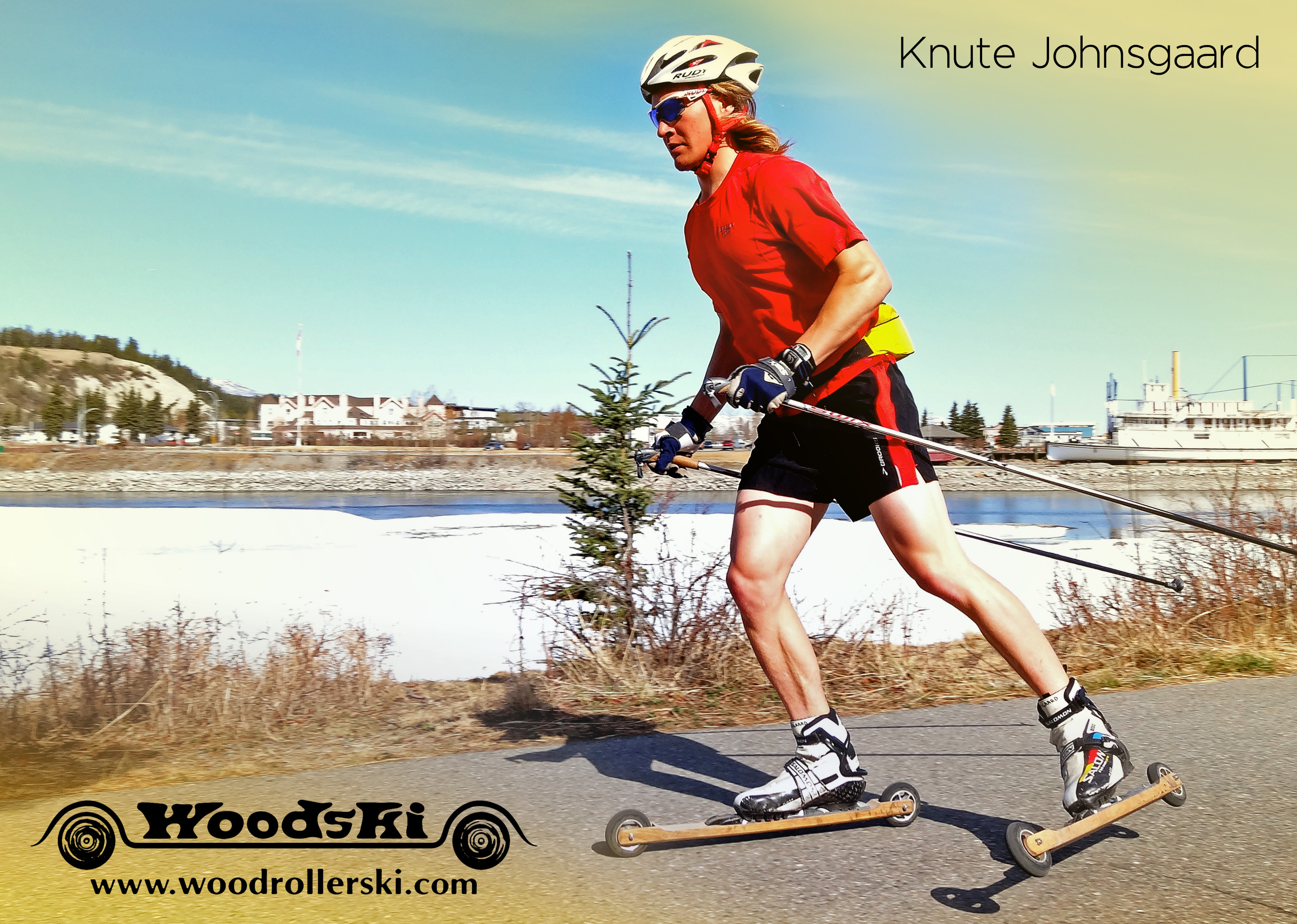
Knute Johnsgaard of the Yukon Elite Squad training on his wood rollerskis courtesy of Woodski, Inc
You asked, we answered! Welcome back to another installment of our Question and Answer series. This time around, the owners of RollerSkiShop.com and Woodski, Inc. shed some insight on rollerski speed and off-road models. Got questions of your own? Email questions@fasterskier.com.
***
1. What are the pros and cons of the various off-road classic roller skis? – Rick from Vermont
Clayton Keim, owner of RollerSkiShop.com, wrote in an email his company doesn’t carry off-road rollerskis, but listed some pros and cons:
“Pros: Can roll over bigger stuff for smoother ride, go on gravel and crushed limestone opening up more routes.
Cons: Bulky, heavier typically, if pneumatic wheels you can get a flat.
“Some people don’t have paved trails as an option and just have crushed limestone for training, in which case they have to get an off-road rollerski,” Keim writes. “For those that have paved trails or decent paved shoulders on roads I would suggest avoiding off road rollerskis. For skating get either 100 mm or 105 mm wheels and you can roll over a little more than a wheel that is smaller. Trying to skate on wheels that are less than 90 mm isn’t much fun and not very safe as every stick, crack, and little rock will jolt you more.”
Photo: Woodski, Inc.
2. Does rollerski speed change when it gets colder? I notice that my intervals around a set loop are not as fast as the weather gets colder. — Warren
“Rollerski wheels run slower in the cold,” writes Keim. “Prime example was this January after a meltdown and rain I went out rollerskiing in Minneapolis. Air temp was mid 20’s and rollerskiing was really slow compared to how it was late fall on the same setup. The cold will slow down the bearings causing this as the grease becomes thicker. I’m not sure at what temp you start to really notice it, but I feel it’s pretty cold like the low 30’s. Our bearings and most rollerski bearings out there are greased, but if someone has oiled bearings they shouldn’t slow down as much. The amount of grease in them would be a factor as well.
Most of the wheel speed under normal temps however mostly comes from the rebound of the rubber. Doing a spin out test isn’t a very accurate way to measure speed as that just looks at how much grease is in the bearings and how thick it is. A good way to compare rebounds at home between different wheels is drop them next to a wall and see how high they bounce. A faster wheel will bounce higher and a slow wheel won’t bounce much as the energy is absorbed. Under normal temps this is how we achieve our different speeds as greased bearings will only slow you down so much.”
But if it’s sizzlin’ hot, it’s going to be slower, explains Peter Breu, president of Woodski, Inc.
“You should be faster as the temperature drops as the rubber of the wheels will indeed be harder as they get colder,” Breu wrote in an email. “If I had to guess, I’d say that the difference between wheels at 80 [degrees] F and 32 [degrees] F would be quite noticeable – perhaps 5-10% faster. If the wheel bearings were packed in thick grease that would offset any increase in speed, but most bearings have very light and little grease so that would not normally be a factor.”
To celebrate reaching 1,000 fans, here’s a deal! Get a free pair of ferrules with $100 purchase. Just add a pair of ferrules to your shopping cart and $100 or more of other stuff, then enter coupon code “ferrules” to save $15.