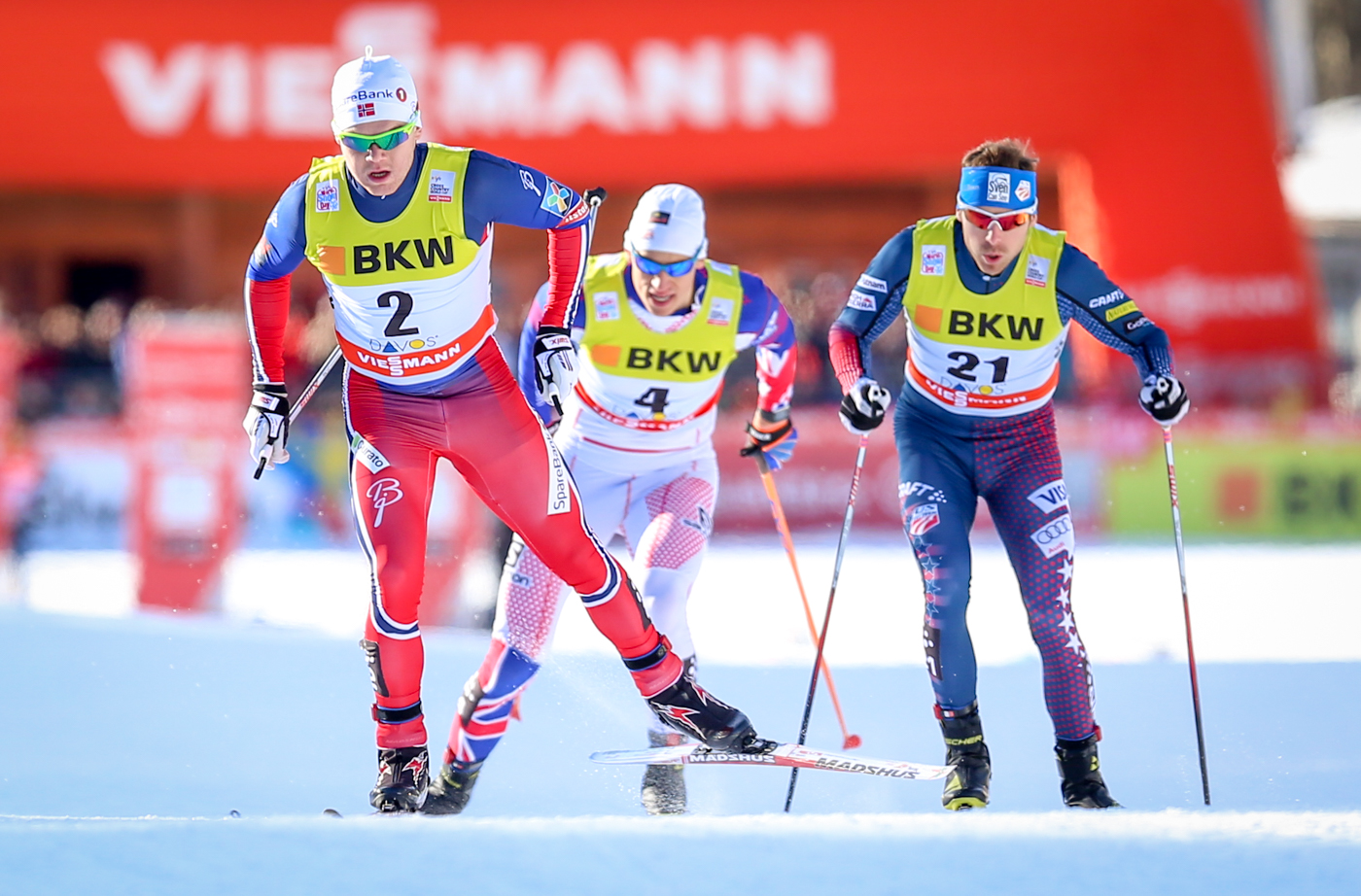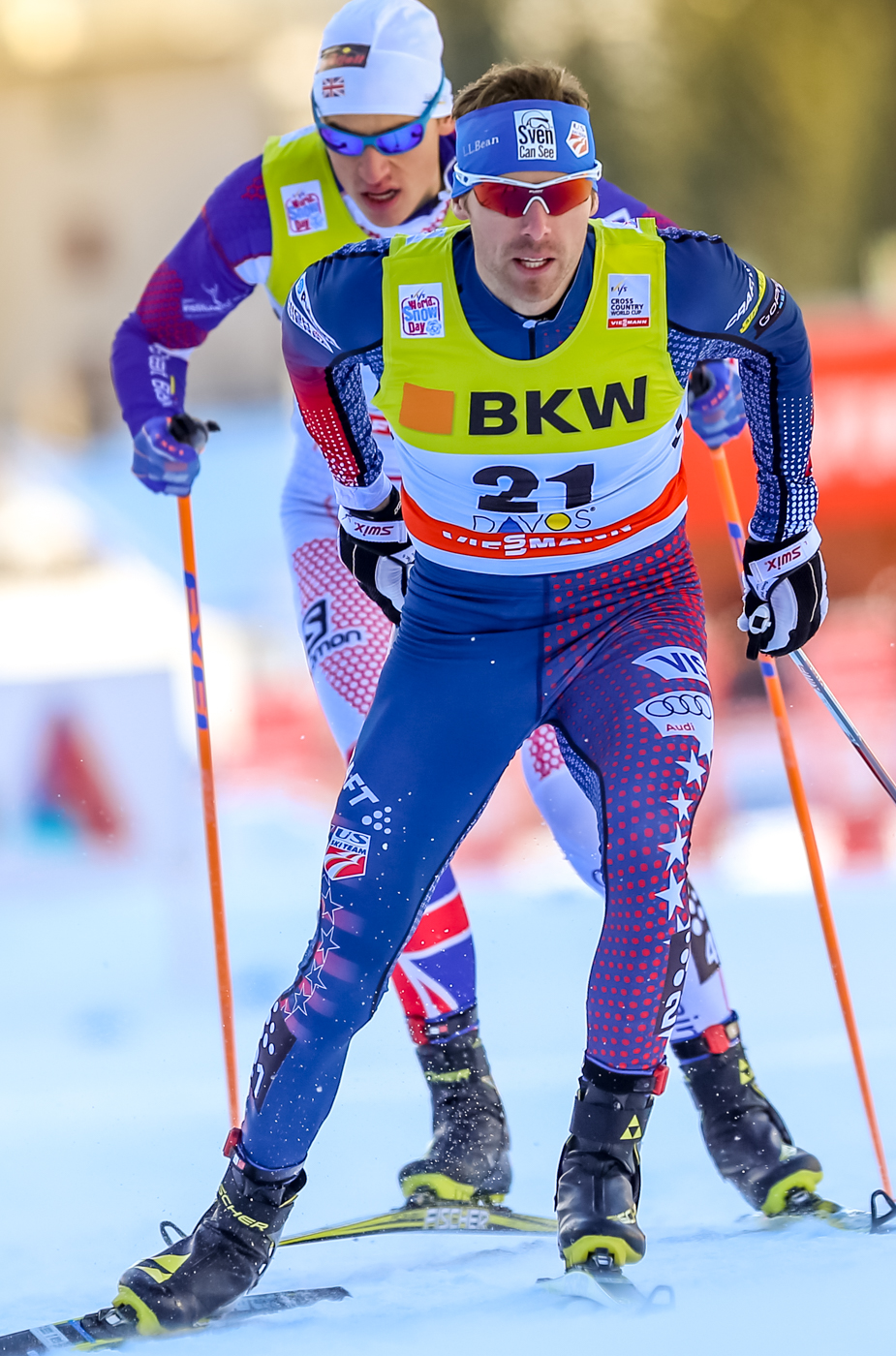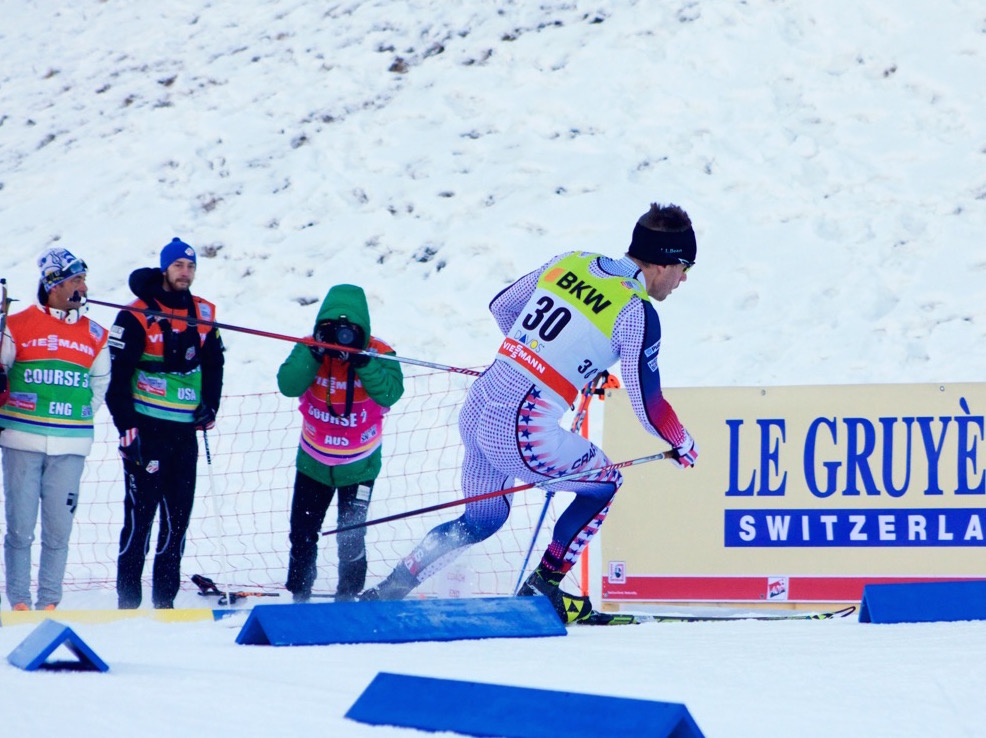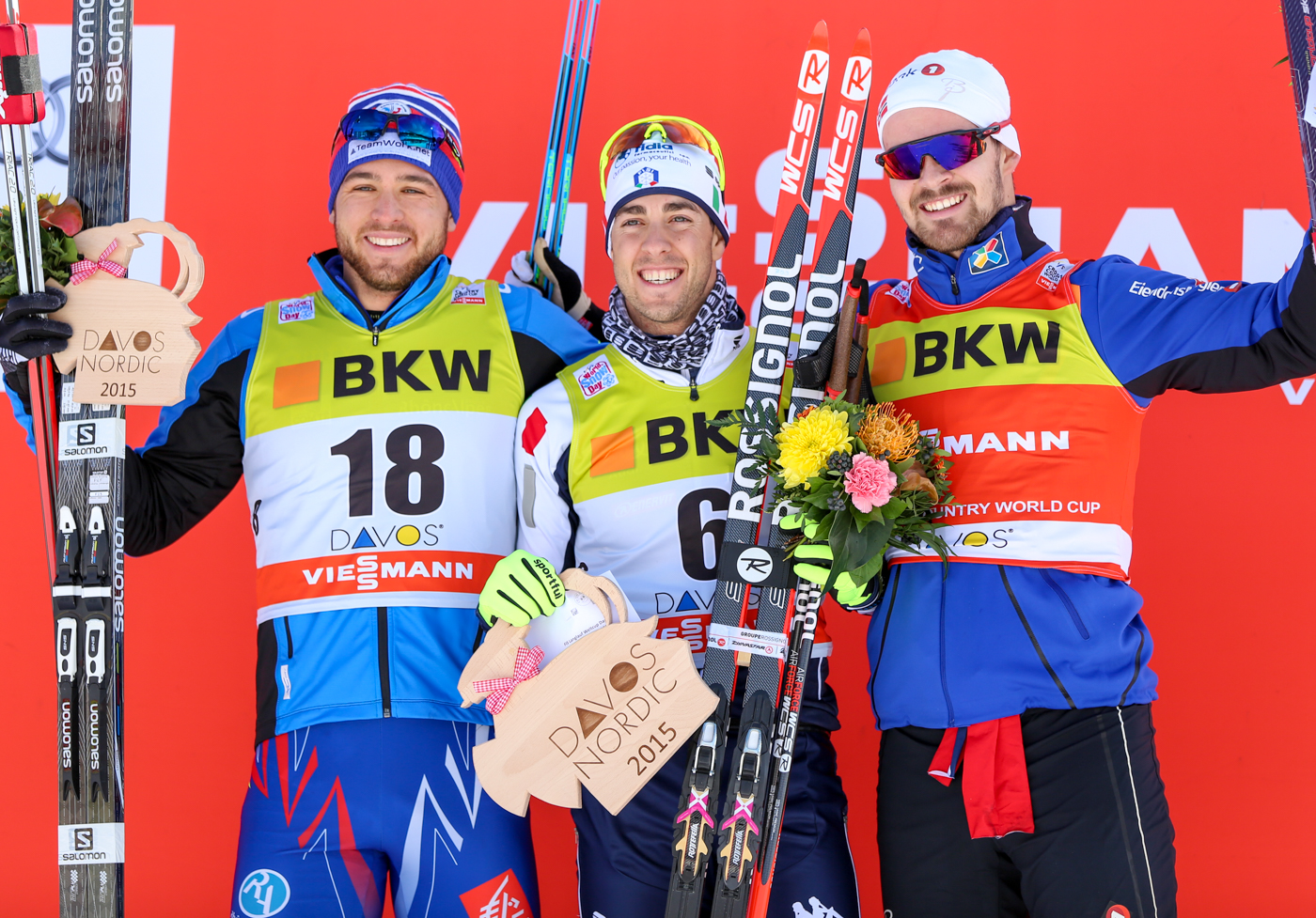
Tag: Roman Schaad

  • Pellegrino Anchors Italy to Another Dresden Win; Late Crash Takes Out U.S. Men

    Pellegrino Anchors Italy to Another Dresden Win; Late Crash Takes Out U.S. Men

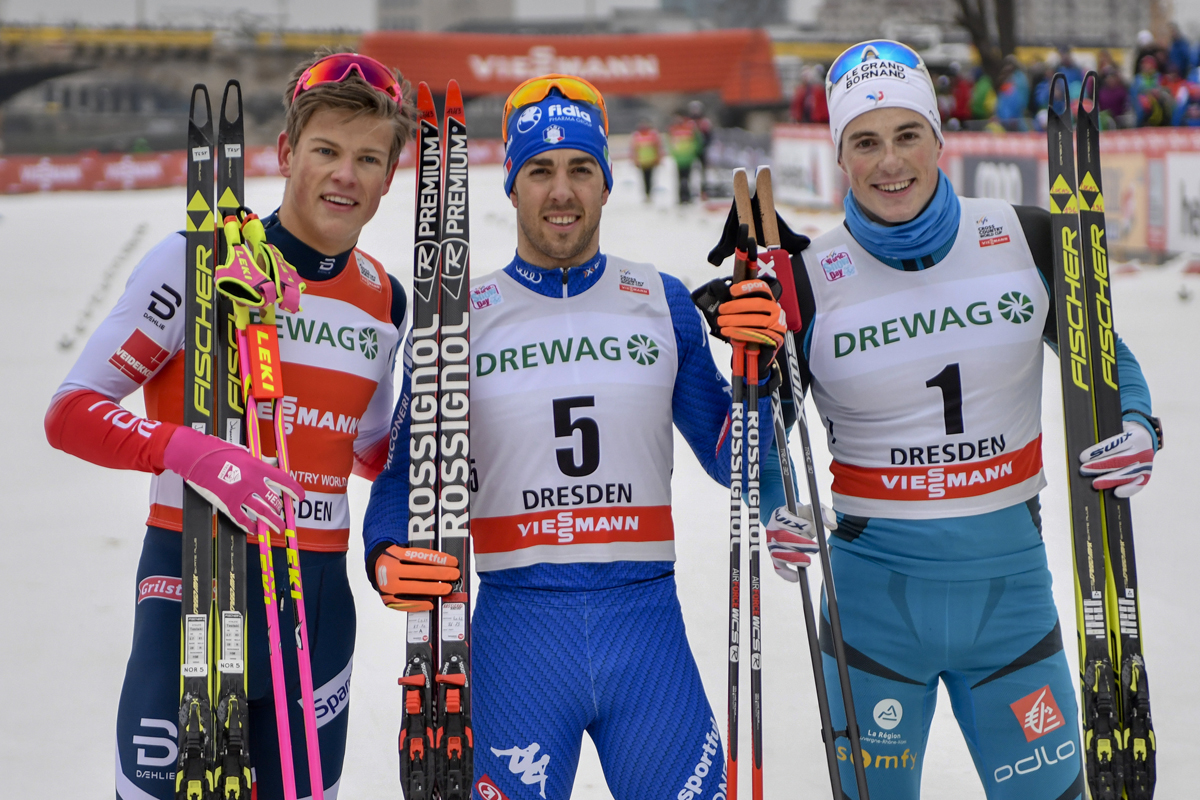
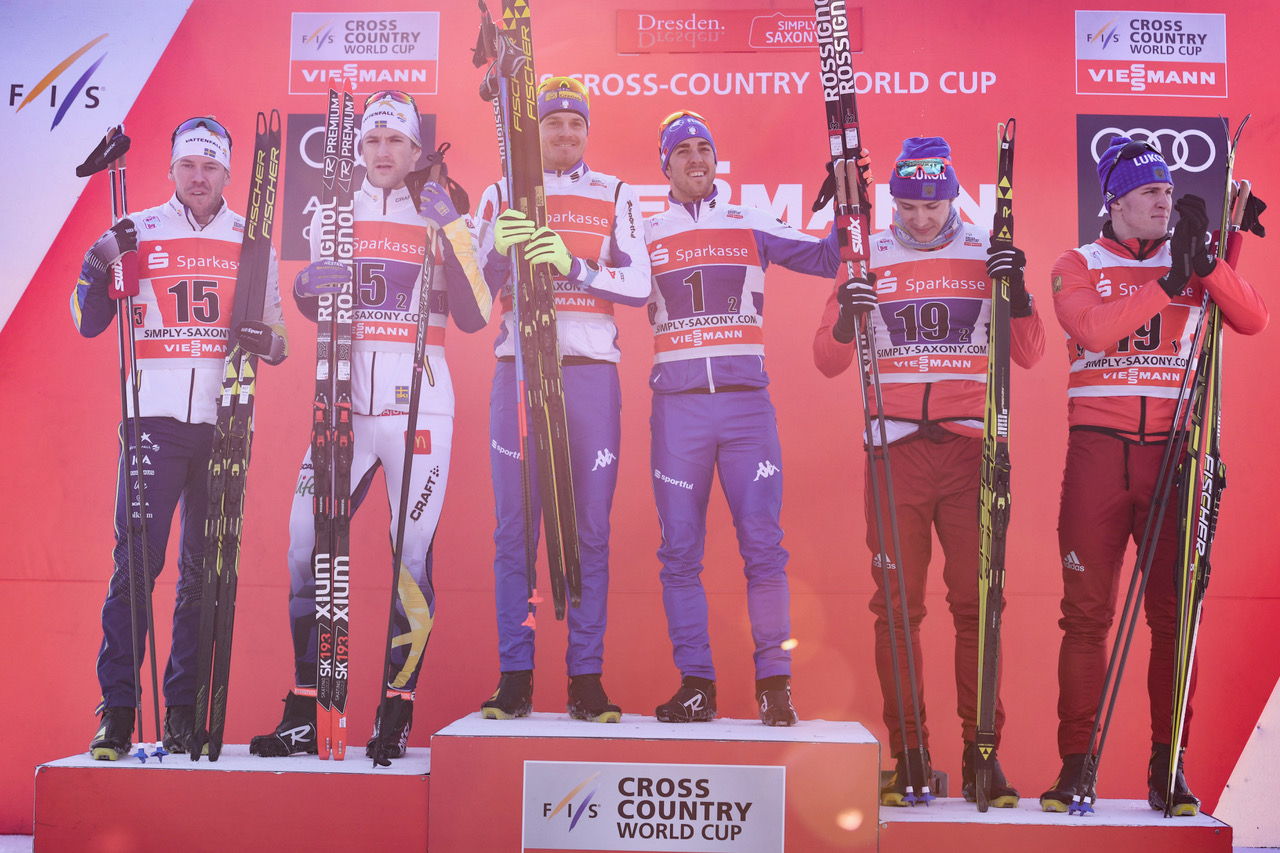
    The men’s 6 x 1.2 k freestyle team sprint podium at Sunday’s World Cup in Dresden, Germany, with Italy’s Dietmar Nöckler and Federico Pellegrino in first (c), Sweden’s Emil Jönsson and Teodor Peterson in second (l) and Russia’s Andrey Krasnov and Gleb Retivykh in third (r). (Photo: Fischer/NordicFocus)

    (Note: This article has been updated to include comments from Canada’s Bob Thompson.)

    Federico Pellegrino’s winning move in the men’s 6 x 1.2-kilometer freestyle team sprint on Sunday wasn’t exactly the same as yesterday when the Italian attacked on the final climb of the individual skate sprint.

    “Yesterday on the right side and today I tried on the left side and it was OK,” Pellegrino said in a post-race interview with the International Ski Federation (FIS).

    By “OK,” Pellegrino meant perfect.

    “Today everything was perfect, even the sun was super,” he said after winning his second race in as many days with team-sprint partner Dietmar Nöckler. “We can continue like this to the Olympics then catch the gold.”

    A number of teams were looking to do exactly as the Italians did on Sunday on a tightly woven city sprint course in the heart of Dresden, Germany. This race marked the last team sprint before the Olympics, which starts in less than a month in PyeongChang, South Korea. The Olympic team sprint, set for Feb. 21, is also freestyle. Sunday was the first team sprint so far of the 2017/2018 season.

    Pellegrino locked it up after Nöckler came through the last exchange in fifth, 2.6 seconds behind Sweden’s Emil Jönsson in first. On the final lap, Pellegrino chased Sweden’s Teodor Peterson and Switzerland’s Roman Schaad, before Pellegrino made his move past Schaad in first heading into the final rise before the stadium. The attack was just slightly before the one he executed to win Saturday’s skate sprint over Norway’s Johannes Høsflot Klæbo.

    “I had to use it,” he said of the move.
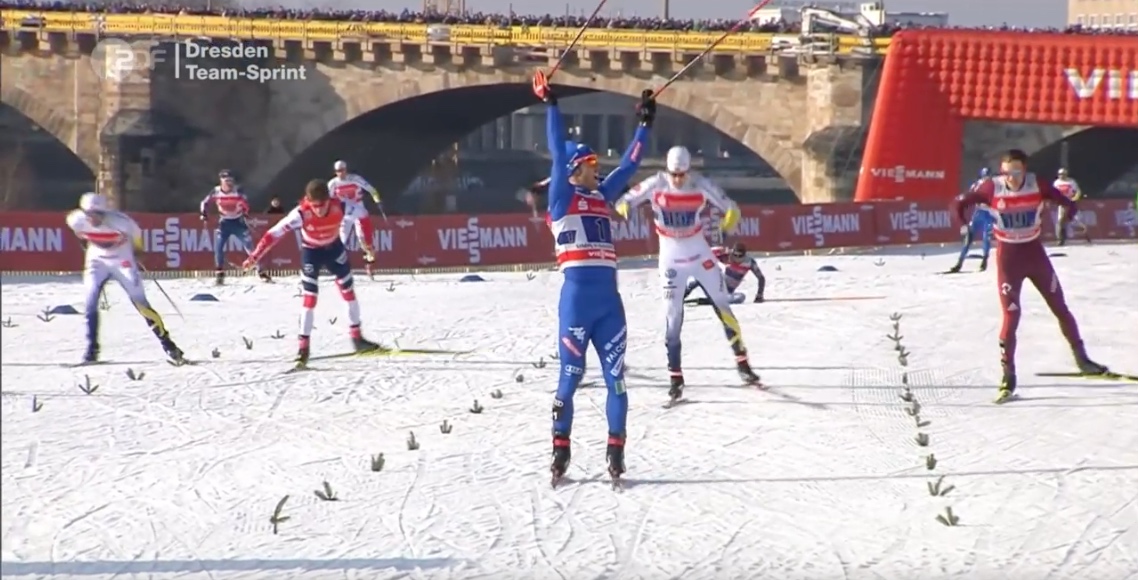
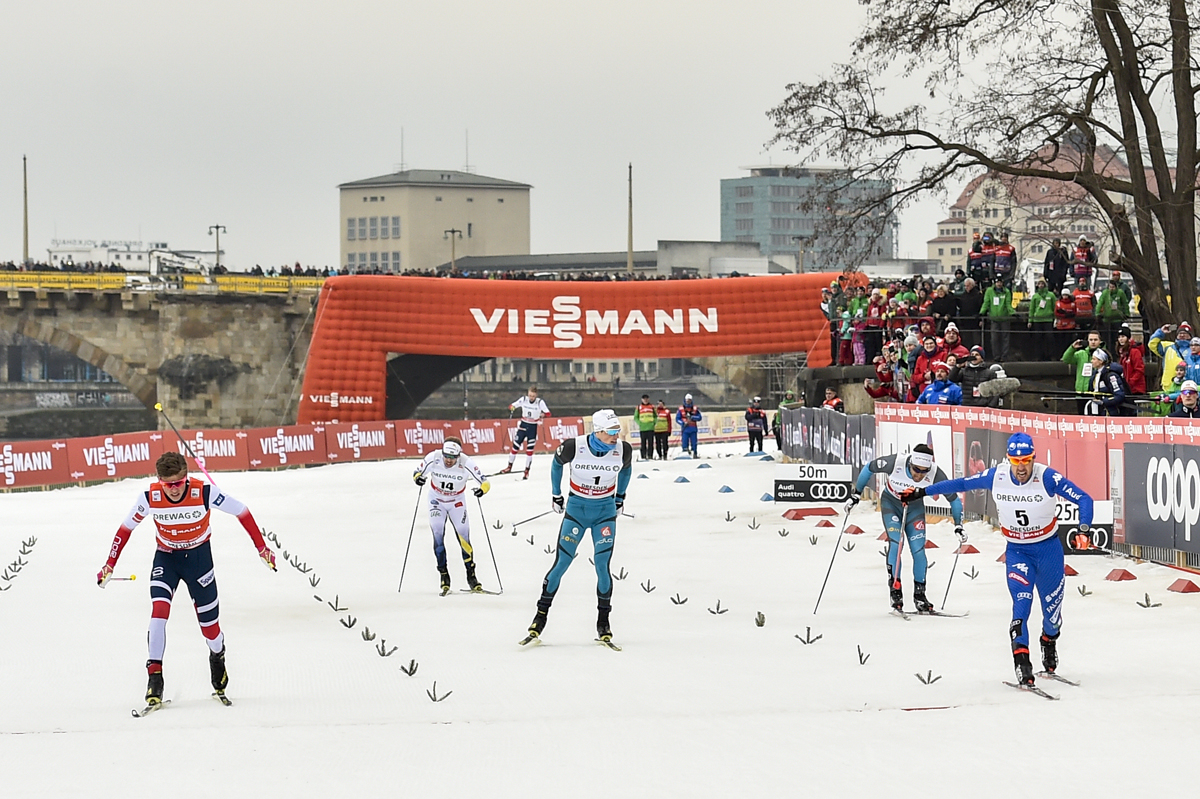
    Federico Pellegrino (front) celebrates across the line as he anchors Italy to a freestyle team sprint victory for his second-straight win at the World Cup in Dresden, Germany. Behind him, Sweden I’s Teodor Peterson (second from r) and Russia’s Gleb Retivykh (r) battled for second, and Sweden II’s Karl-Johan Westberg (l) and Norway’s Johannes Høsflot Klæbo (second for r) jockey for third. American Simi Hamilton (on the ground) is seen trying to recover from a crash. (Screenshot: ZDF broadcast)

    First over the top, Pellegrino pushed farther ahead of Peterson in second while Schaad, Russia’s Gleb Retivykh, Sweden II’s Karl-Johan Westberg, Klæbo, and American Simi Hamilton chased in third. Hamilton went down when he collided with Klæbo just before the finish line, but was able to get up and finish eighth, 14.28 seconds behind Italy in first.

    Pellegrino sealed the deal in 12:18.31, and Peterson crossed 1.07 seconds back for Sweden I in second place. Russia’s first team, with Andrey Krasnov and Retivykh, placed third (+1.23), just ahead of Switzerland I (Jovian Hediger and Schaad) in fourth (+1.45), Norway I (Kasper Stadaas and Klæbo) in fifth (+1.93), and Sweden II (Johan Häggström and Westberg) in sixth (+1.94). Italy II (Stefan Zelger and Giacomo Gabrielli) placed seventh (+7.31) ahead of the U.S. (Erik Bjornsen and Hamilton) in eighth.

    “When I arrived at the finish line, I could go slow and had some time to look to the people and say thank you for a great day,” Pellegrino told German TV broadcaster ZDF. “I had really good fun here in Germany!”

    “He showed all the world that today he is the strongest athlete on the track,” Nöckler said while standing next to his teammate Pellegrino in a televised interview with FIS. “And today we were both on the podium so we’re really happy.”

    Bjornsen, Hamilton in the Mix 

    The U.S. men were in contention to the finish, with Bjornsen putting them in third on the second-to-last leg. Norway’s Stadaas had been given a 1.3-second lead at the fourth exchange by his teammate Klæbo (who had previously made his way back into first after Stadaas tagged him in fifth). While Stadaas widened the gap for the first half of his last loop, Bjornsen led the chase, skiing several seconds behind him in second place.

    In an in-person interview with FasterSkier, Bjornsen recalled being tentative in the semifinals, where he and Hamilton finished fourth but advanced as lucky losers with a fast-enough time.

    “Going into the final, I was feeling good and I wanted to use my aerobic capacity,” Bjornsen said. “As soon as Simi handed off to me, I was kind of in the back end of that group and Norway had a good lead and I was like, I’m just gonna go for it.”

    Hamilton had tagged him in eighth, 2.5 seconds behind Norway in first. About halfway through the next 1.2 k loop, Bjornsen had bridged the gap to Stadaas, but brought a large pack of racers with him.

    “I went to the outside and was able to pass my group of like six or so, and I bridged up to Norway and tried to hit that corner pretty hard, then it kind of hit me,” Bjornsen said. “I was tired, that group had caught up to me and unfortunately I had pulled — some people jumped on the back of me, so then they kind of went by me, but I was able to hand off in third so I was happy with that. We were in the mix today.”

    Sweden’s Jönsson took the lead over the last rise before the stadium, and Switzerland’s Hediger slotted into second, coming through the exchange 0.9 seconds after Jönsson. Bjornsen tagged third, 2 seconds back.
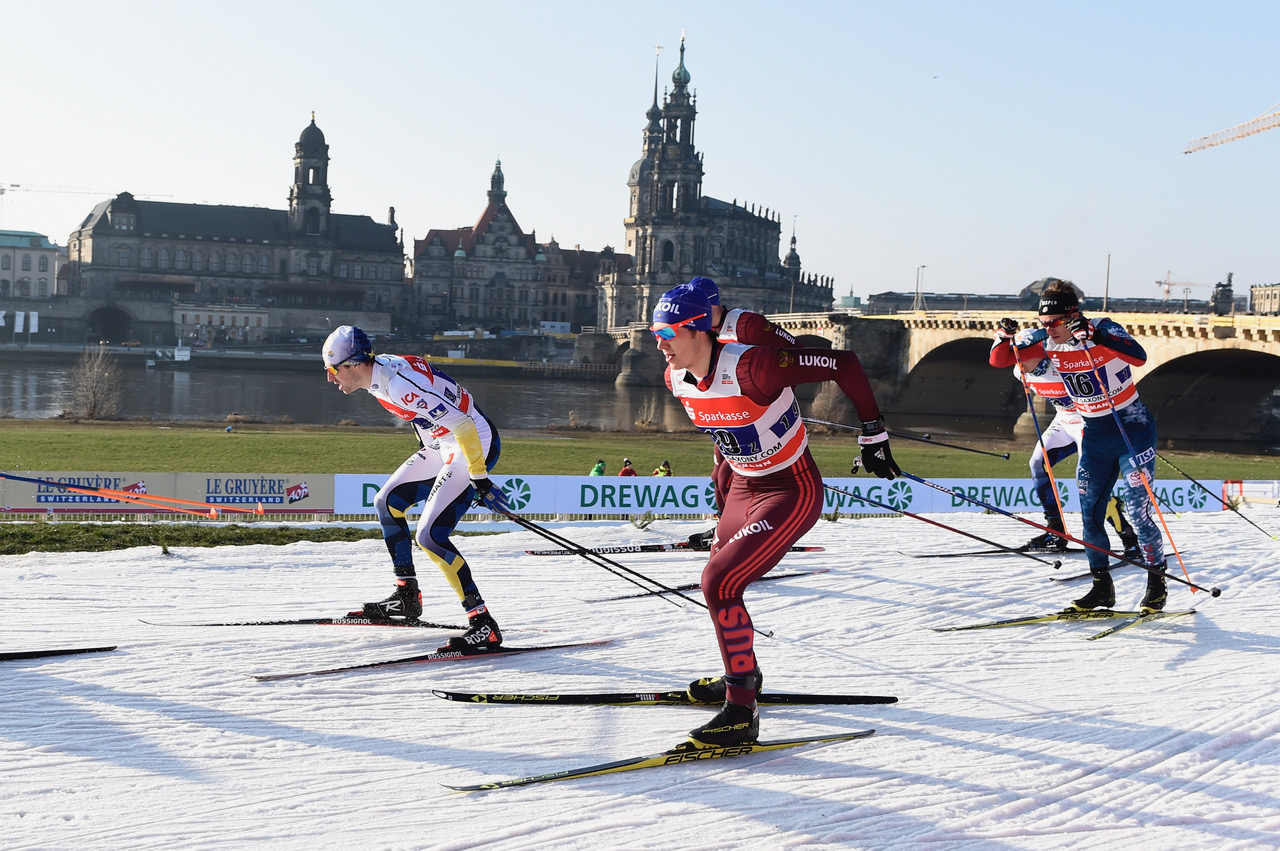
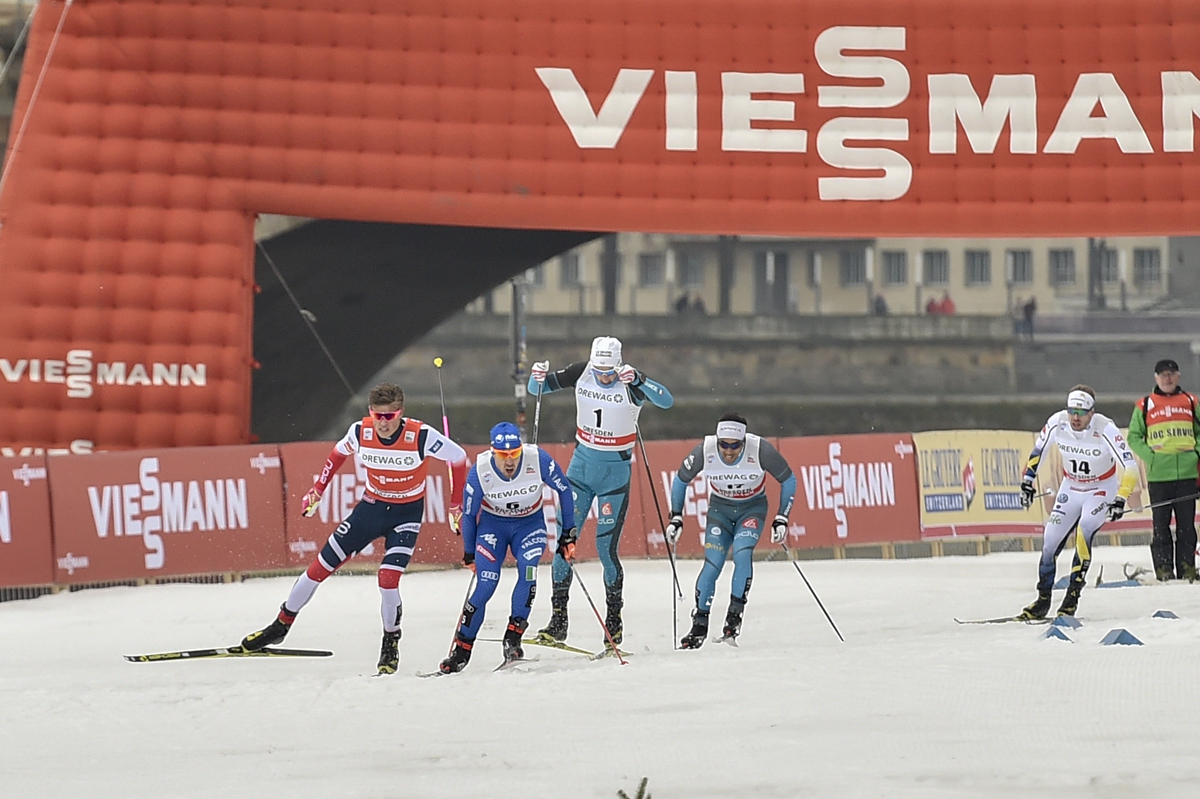
    American Simi Hamilton (r) chasing Russia’s Gleb Retivykh (19) and one of two Swedish teams the second semifinal of the men’s 6 x 1.2 k freestyle team sprint at the World Cup in Dresden, Germany. (Photo: Fischer/NordicFocus)

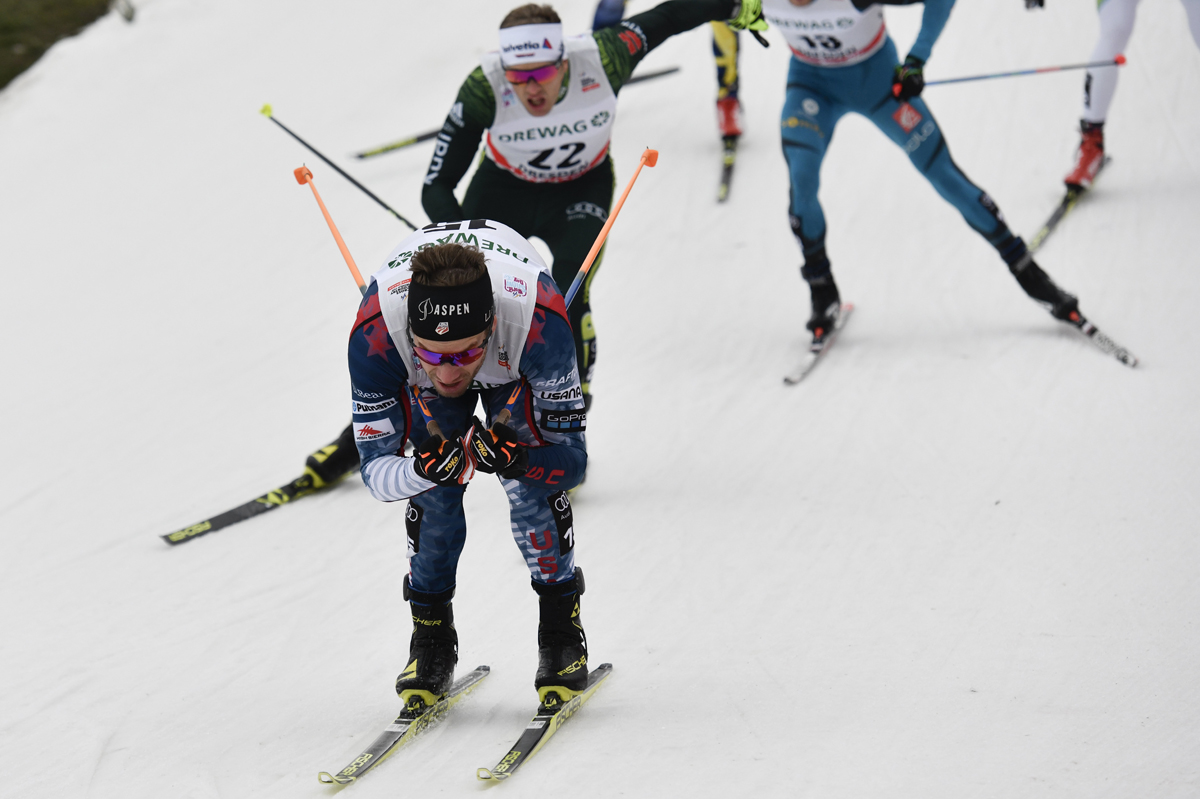
    From there, Hamilton kept himself in contention in the top five, hanging just behind Pellegrino and Peterson as the large group approached the finish. In the middle with several races on either side of him, Hamilton went down, hard, but stood back up again and finished eighth.

    “My crash wasn’t too terrible, but I did break Klæbo’s pole with my face and got a bunch of carbon fiber splinters in my upper lip. So once I got that cleaned up I was okay,” Hamilton wrote in an email. “Whacked my head a bit too, but I’ll be fine.”

    (Article continues below)

    https://www.instagram.com/p/Bd74ijTngPq/?taken-by=simihamilton

    He explained that he and Bjornsen had made a game plan to “ski towards the front, stay out of crashes, and figure out how the semifinal was going to play out while racing,” he wrote. “I thought we both skied the semi well, although I think I could have been a bit more aggressive on my last lap and done more skiing that would have assured us a spot into the final. But it turned out okay.”

    In the final, “Erik did an awesome job keeping us at the front and I just focused on doing the same for him,” Hamilton wrote. “He turned in a hell of a last leg, tagging me in 3rd for my last lap.”

    Bjornsen was pleased with his last lap, but would have like to have been first through the final exchange.

    “I wish I had a little higher speed that I could push past people quicker, but I find when I’m up against the best, my talent or whatever is to kind of press hard for a while,” Bjornsen said. “… So I just tried to send it hard for 45 seconds and it seemed to work out. I wish I could’ve handed off in first, but I’m happy to be in the mix there.”

    On the final lap, Hamilton recalled “a decent sized gap up to first and second, I think mostly because those were the only two teams that had perfect tags on that last exchange,” he wrote.

    Unsure whether to ski all out on his last of three 1.2 k efforts, while simultaneously pulling along competitors like Pellegrino and Klæbo, Hamilton focused on skiing fast, but not to his max.

    “On the far end, Pellegrino went by me and by that point we were really close to making contact with the top two,” he wrote. “I thought we were totally in the hunt for a podium until somehow I lost a second on the plateau [after the last hill] with about 15 seconds of racing left. “I don’t know how I lost it, if it was just entirely my fault or if something happened like I got punched from my line, but I am pretty bummed about it because that was where I felt like I let the podium slip through our hands,” Hamilton continued. “Coming in to the finish lanes, I got tripped up with Klæbo and my skis got clipped as were skiing for the same lane. It wasn’t intentional and he’s a very clean racer, but it was definitely a bummer to not be able to sprint it out for 3rd, 4th, or 5th with those other guys.”

    As for Norway, Klæbo told Germany’s ZDF he was out of the race at the start of that last lap: “After the last exchange it was too difficult, the gap was too large to the guys in front,” he said.

    Overall, Hamilton concluded that it was a great and interesting weekend of racing at a new venue in Dresden.

    “I think they could make some big improvements to the course with making it more technical, flowy, and wider, but I hope they continue to hold sprints here in the future,” he wrote.
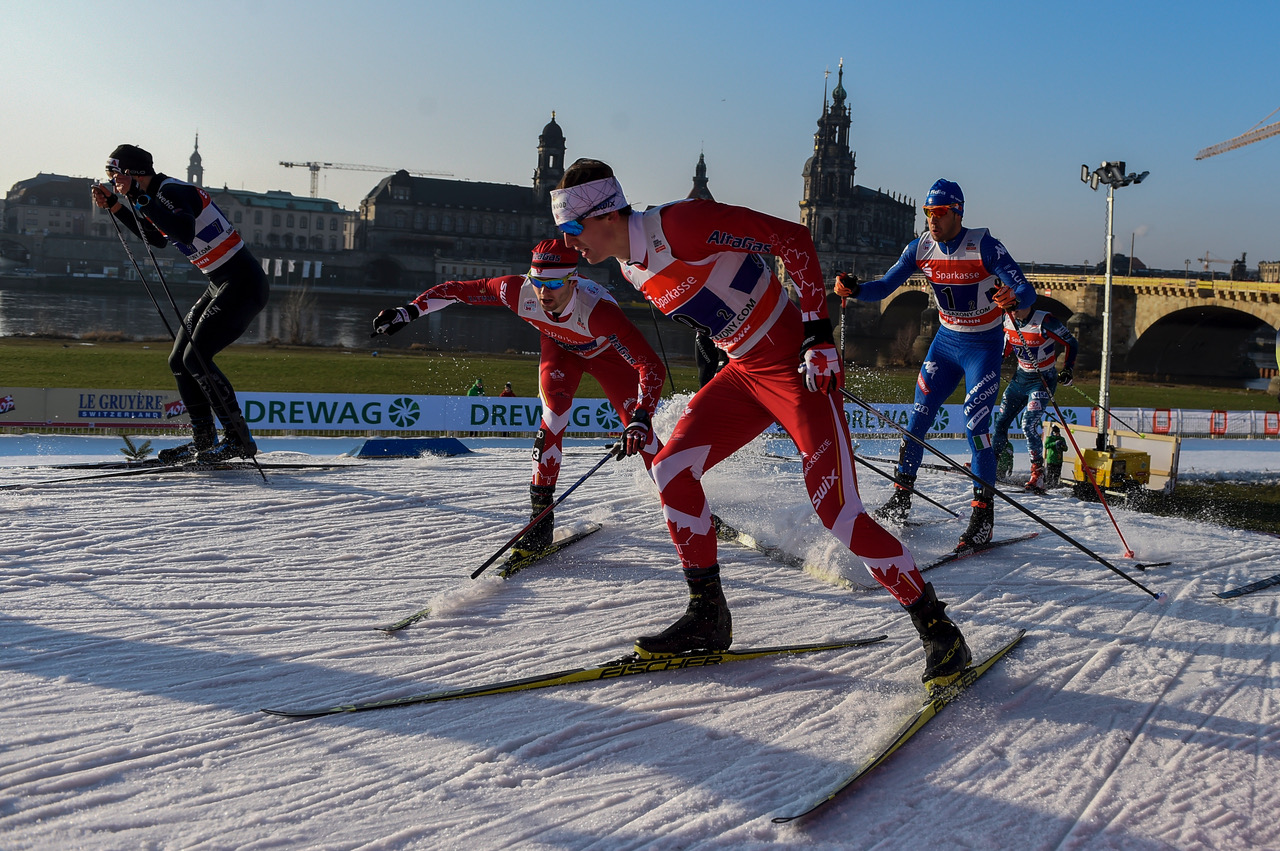
    Canada had two teams in the first semifinal of the men’s 6 x 1.2 k freestyle team sprint at the World Cup in Dresden, Germany, with Canada I’s Julien Locke (near) skiing just ahead of Canada II’s Dominique Moncion-Groulx, who caught an edge just ahead of Italy’s Federico Pellegrino (second from r) and American Ben Lustgarten (behind Pellegrino), over the top of a climb. (Photo: Fischer/NordicFocus)

    While the Bjornsen and Hamilton as the U.S. Ski Team’s first team on Sunday were the lone North Americans to reach the men’s final, Canada came close with Bob Thompson and Julien Locke.

    “The main points of our plan was make sure we stayed in the lead group and to take any easy opportunities to make up positions whenever we saw them,” Thompson, of the National Team Development Centre (NTDC) Thunder Bay, wrote in an email. “I started first as we were confident I could hang on to the pace and then after Julien’s excellent performance yesterday we felt he would have good speed to finish.”

    In Saturday’s individual sprint, Locke placed 15th for a career best.

    The two ultimately finished seventh in the first team-sprint semifinal, just one place behind Great Britain’s James Clugnet and Andrew Young. The Brits advanced to the final as lucky losers in sixth, 1.85 seconds behind Norway’s Stadaas and Klæbo in first, becoming the first team from Great Britain to reach the final in a World Cup team sprint. (In the final, they finished behind the U.S. in ninth, 14.68 seconds out of first.)

    After Thompson tagged Locke (Canadian National U25 Team/Black Jack Ski Club) in eighth in the last exchange of their semifinal, Locke picked off one place to finish seventh, 0.39 seconds behind Great Britain’s Young.

    “The third leg just started going from the exchange and I was able to hang on to the back and then dodge around the French teams who both crashed,” Thompson explained. “So I was able to tag off to Julien solidly in the mix of the lead pack. Julien had a pole break on the small hill with just 200m to go and had to free skate in, so the .15 seconds from making the final hurts a bit.

    “I’m happy with how we raced,” he continued. “We both stayed controlled and I think we had the pace well enough. I believe I skied it as well as I could have and being right up with those guys feels great.”

    The Americans’ second team of Andy Newell and Ben Lustgarten crossed the line 0.57 seconds later for eighth place (+2.81) in that semifinal. Newell had put them in second place at the last exchange, just 0.11 seconds out of first.

    “I felt good on my last leg and was able to make some moves and tag Ben in the lead going into the final lap,” Newell wrote in an email. “He skied really well to stay close to the leaders. If we were even less than a second faster I think we would have moved on as [lucky losers] instead of Sweden 2 and USA 1 from the next semi. So we were a bit unlucky there but it was a fun race.”
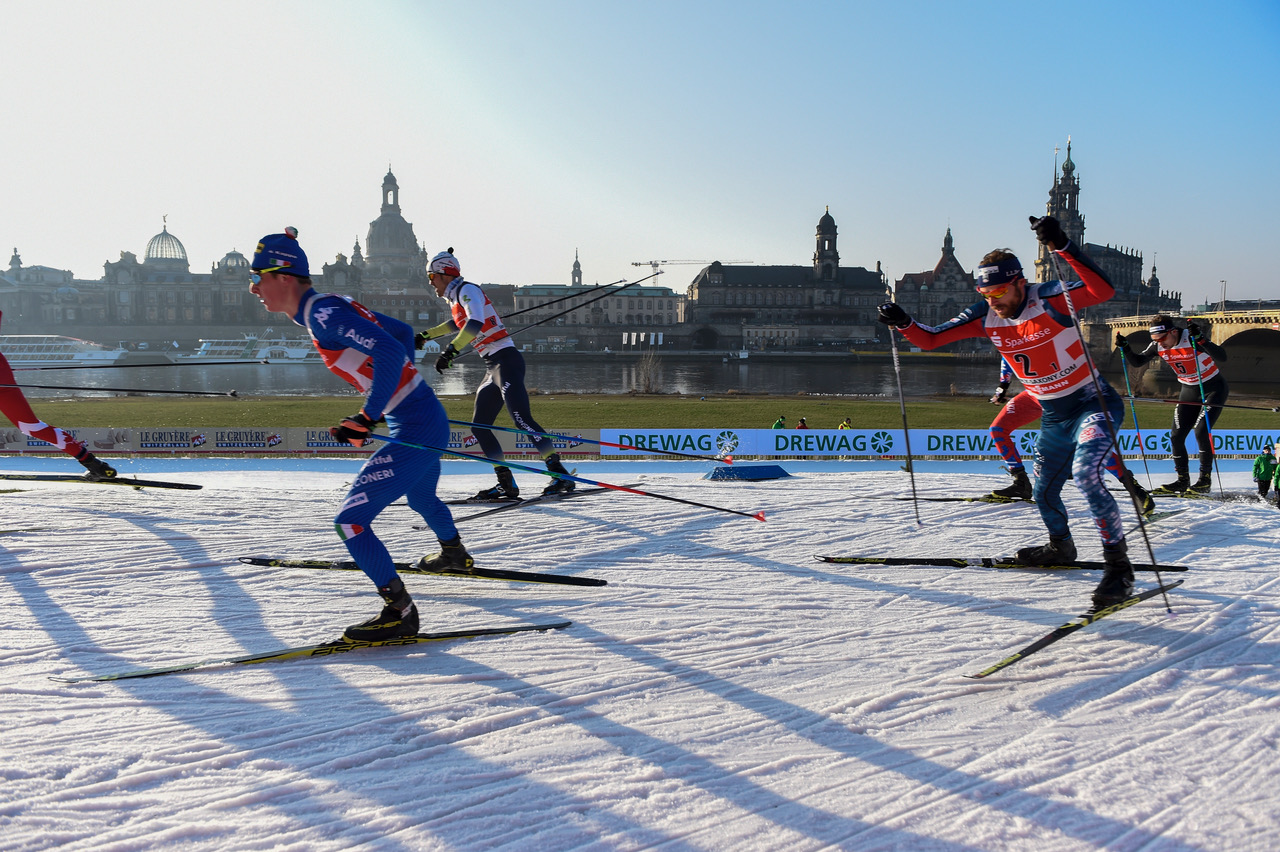
    American Andy Newell (2) chasing Italy II’s Stefan Zelger (in blue) during the first semifinal of the men’s 6 x 1.2 k freestyle team sprint at the World Cup in Dresden, Germany. (Photo: Fischer/NordicFocus)

    Previously, Newell had tagged Lustgarten in fourth at the first exchange, then Newell found himself back in 10th and almost 2 seconds back after his second leg.

    “Ben and I tried to ski up toward the front half of the pack but had a small crash on our second tag,” Newell explained.

    “The [second] handoff wasn’t clean but I got Newell just in time,” Lustgarten, of the Craftsbury Green Racing Project, recalled in an in-person interview with FasterSkier. “But there is so much happening and I obviously don’t have that much experience in this event, so it was just like a learning experience and trying to ski well. … On my last lap, Klæbo and Pellegrino went by and I am not really at that level yet so I didn’t really expect anything. I just tried to go as hard as I could.

    “I haven’t done a team sprint in eight years maybe, so it was a whole new kind of experience,” Lustgarten explained. “And obviously all these guys are so fast and strong that it was just an insane event.”

    Canada’s second team of Antoine Briand (Pierre-Harvey National Training Centre) and Dominique Moncion-Groulx (Alberta World Cup Academy) finished 13th in the first semifinal, 26.20 seconds out of first. Notably, Moncion-Groulx skied the fastest second leg of the race to bring them from 12th after the first exchange to sixth.

    The World Cup has two more weekends of racing before the Olympics, with all-classic races next weekend in Planica, Slovenia (classic sprint and 10/15 k classic individual starts), followed by freestyle races in Seefeld, Austria, on Jan. 27-28 (skate sprints and 10/15 k freestyle mass starts).

    Bjornsen said he was unsure whether he’d race next weekend in Planica, potentially opting for a training block before the Olympics instead.

    “I still have to talk to [U.S .SKi Team Head Coach Chris] Grover about which races I’m going to start at the Olympics and so if it looks like I’ll have a full schedule at the Olympics then I’ll try to do a training block,” Bjornsen said.

    Hamilton wrote that he was planning on racing the classic sprint in Planica, and was headed to Ramsau, Austria, with his teammates for a couple days of training first.

    According to Thompson, the four Canadians that raced in Dresden were also on their way to Ramsau, Austria, where they’ll train until Tuesday and then continue on to Planica.

    Results: Semifinals | Final

  • The Grandkids Will Love This: Pellegrino Beats Klæbo in Dresden; Hamilton 10th, Locke 15th

    The Grandkids Will Love This: Pellegrino Beats Klæbo in Dresden; Hamilton 10th, Locke 15th

    Italy’s Federico Pellegrino (5) getting a ski tip ahead of Norway’s Johannes Høsflot Klæbo (l) for the men’s freestyle sprint final win on Saturday at the World Cup in Dresden, Germany. France’s Lucas Chanavat (1) placed third for the second-straight World Cup sprint, another Frenchman Richard Jouve (second from r) placed fourth, Sweden’s Emil Jönsson (second from l) was fifth, and Norway’s Even Northug (behind) took sixth after breaking a pole out of the start. (Photo: Fischer/Nordic Focus)

    How do you beat Norway’s Johannes Høsflot Klæbo at his competition-crushing game? Take him by surprise with minimal time to recover. Italy’s Federico Pellegrino did just that on the last uphill rise of the 1.2-kilometer sprint course on Saturday in Dresden, Germany.

    Dresden, a historic city in eastern Germany, debuted its brand-new course along the Elbe River on manmade snow amid damp conditions and temperatures above freezing throughout the day. Pellegrino had done what he needed to advance through the rounds, clocking the first-fastest time in the qualifier, 2.9 seconds behind France’s Lucas Chanavat in first, then placing second in his quarterfinal and third in the first semifinal. Klæbo won that semi by 0.16 seconds over Chanavat in second and 0.3 seconds ahead of Pellegrino in third. With a fast-enough time, Pellegrino moved on to the final, where he met the 21-year-old Klæbo again.

    “I knew that at the beginning of the race, I’m becoming a little bit old so the younger Klæbo and Chanavat were faster than me,” Pellegrino, 27, said of the final in a post-race interview with the International Ski Federation (FIS). “So I just had to wait, but I wanted to attack in the longer race to the finish line.”

    The race from his point of attack might have seemed like an eternity, but in actuality, it was about 500 meters before the finish. Klæbo and Chanavat had burst out of the start at lightning speed, skiing “shoulder to shoulder,” as Chanavat later said in a press conference, and slightly gapping the four skiers behind them — one of which was Pellegrino.

    While Klæbo pushed the pace up front, Pellegrino kept the two leaders close, skiing just a couple strides back. France’s second man in the final, Richard Jouve slotted into fourth behind him and Sweden’s Emil Jönsson — in his first final in a year — followed in fifth. Behind them, Norway’s Even Northug (Petter Northug’s 22-year-old brother) worked to fasten a new pole after breaking his on the starting gate. That took him out of the race from the gun.

    Chanavat attempted to get ahead of Klæbo on a tight righthand corner, but Klæbo held the inside line and his position. Coming out of that corner, Pellegrino latched on to Chanavat and brought the rest of the group with him. Shadowing the two leaders’ every move, Pellegrino accelerated just before the final rise, taking just three V2 pushes to get to the top.

    Norway’s Johannes Høsflot Klæbo (l) and Italy’s Federico Pellegrino (second from l) jockey for position just before the finish of the men’s freestyle sprint final at the World Cup in Dresden, Germany, while France’s Lucas Chanavat (1) and Richard Jouve chase, followed by Sweden’s Emil Jönsson (14). (Photo: Fischer/NordicFocus)

    Even with Klæbo, the Italian took another push to move ahead and left Klæbo chasing. With about 75 meters to go, they began their all-out showdown to the finish, side by side, with Pellegrino staying just ahead to cross the line first in 1:52.77 minutes. Klæbo was just 0.18 seconds back in second and Chanavat 0.98 seconds behind in third.

    “When I will have grandchildren this will be the story I am going to tell them, that I beat Johannes,” Pellegrino said, according to a FIS press release.

    It was his first World Cup victory in nearly a year since winning a freestyle sprint in Falun, Sweden, late last January, and his 10th career individual World Cup win.

    “Klæbo is a really good guy because if he wanted to he could stop me,” Pellegrino told FIS. “… He tried to stay stay quiet to let me go … he’s really good to continue to win.”

    In the four sprints Klæbo’s contested this season, Saturday marked his first loss (he did not compete in the Tour de Ski, opting for a training block instead and racing at Norwegian nationals in Vang, Norway, where he won the classic sprint).

    “It was a tough one,” Klæbo said of Saturday’s final. “Me and Chanavat was trying to go pretty hard from the start of the final, and I think both of us went a little bit too hard. … I’m satisfied with second place here but I have to do something else to beat him next time.”

    Two seasons ago, Pellegrino was the overall Sprint World Cup champion. Last season, it was Klæbo as both the U23 and Sprint World Cup Champion.

    The men’s freestyle sprint podium on Saturday at the World Cup in Dresden, Germany, with Italy’s Federico Pellegrino (c) in first, Norway’s Johannes Høsflot Klæbo (l) in second, and France’s Lucas Chanavat (r) in third. (Photo: Fischer/NordicFocus)

    “I always try to do my best; if the best means the victory it’s great,” Pellegrino said, according to FIS. “It was a really good show. I prefer courses with more hills. Yesterday I changed the way I was thinking about the race.”

    “He was clever,” Klæbo said in an interview with NRK. “He skied like this in the semi and quarterfinal. Our strategies differed slightly.”

    While Pellegrino kept himself in contention in the heats by skiing from behind, Klæbo did as he usually does, by leading with a pace few, if anyone else, could match. Klæbo qualified second, 0.15 seconds off Chanavat’s top qualifying time of 1:50.42, then won his quarterfinal by a clear-cut margin of 0.6 seconds over Switzerland’s Roman Schaad. Chanavat won his quarterfinal by 0.12 seconds over Pellegrino, then hung with Klæbo once again in the semifinal.

    At the last World Cup sprint in Lenzerheide, Switzerland, the first stage of the Tour de Ski, Chanavat placed third in the skate sprint.

    “I did my best and I competed to try to get the victory today, but I was a lot focused on Johannes,” Chanavat, 23, said at the press conference. “So I was surprised when Pellegrino came pretty strong on the side in the race.”

    He added that the gap between him and Klæbo is getting closer. “So I’ll try to keep it shorter,” Chanavat said.

    Jouve finished 0.25 seconds off the podium in fourth, 0.98 seconds behind Pellegrino, Jönsson finished fifth (+2.36), and Northug sixth (+12.04).

    Hamilton 10th, Locke 15th

    American Simi Hamilton made it to the semifinals and finished the day in 10th overall after placing fifth in the second semi, 0.38 seconds behind Jönsson in first. That heat ended in a three-way photo finish for first, which Jönsson took ahead of Northug (+0.01) and Jouve (+0.04). Those three men advanced to the final, but Hamilton and Norway’s fourth-place finisher in that semifinal, Pål Trøan Aune (+0.23) did not.

    American Simi Hamilton (front) leads Germany’s Sebastian Eisenlauer during their quarterfinal of the men’s 1.2 k freestyle sprint at the World Cup in Dresden, Germany. (Photo: Fischer/NordicFocus)

    Before that, Hamilton had qualified in 15th and finished second to Norway’s Fredrik Riseth in his quarterfinal.

    “It was a really cool venue, great course,” Hamilton told FasterSkier in person after the race. “But it was really tight the whole way around so it was hard. My starts aren’t that good right now and so my quarter, I was basically trying to start as fast as I could and I still was second or third out of the blocks, so I wasn’t feeling super confident after that.”

    Going into the semifinals, he decided not to worry about his start and concentrate on moving up later in the course.

    “What ended up happening around that corner, I just couldn’t get around anyone,” Hamilton recalled. “Every time you get an opportunity to make a move, it gets shut down almost immediately, so that was really frustrating, but I was happy with how my body is feeling right now, and it’s fun to get into the heats.

    “I am always way more comfortable skiing towards the back of the pack and then making a definite move somewhere on the course, so unfortunately for me like this course doesn’t favor doing that too well,” he continued. “You can’t afford to ski at the back and then pass four five people, not enough room or time.”

    He added that he enjoyed how different the Dresden course was in comparison to other, much hillier World Cup terrain.

    “I think the only super-short flat course we race like this was in Milan [Italy] years ago, so its fun just doing something different,” he said. “The crowd is awesome here.”

    U.S. Ski Team Head Coach Chris Grover observed that Hamilton was at a disadvantage trying to move up from behind on Dresden’s course.

    “He made it work in the quarterfinal,” Grover told FasterSkier. “He’s so good when he gets that opening to go. I think we saw in the semifinal that he would be starting to go and then get blocked. And again after the corner, started to go, and got blocked. And under the bridge, started to go, and then got blocked. It’s nobody’s fault, nobody obstructed him or anything like that, it’s just not a course with many passing options. The guys are so well-matched, in a semifinal or final it becomes that much harder. So he’s a little bit frustrated, but I think he’s in good shape.”

    Andy Newell (U.S. Ski Team) racing to 18th in the men’s freestyle sprint qualifier at the World Cup in Dresden, Germany. He went on to finish sixth in his quarterfinal for 27th overall. (Photo: Fischer/NordicFocus)

    Two Americans qualified for the heats in the top 30, with Andy Newell finishing 18th in that preliminary round, but Grover noted the U.S. team’s qualifiers overall were “uncharacteristically poor”.

    “To have Erik Bjornsen just miss the qualification, to have Kikkan [Randall] just miss the qualification, to have the four athletes who did go in not have the best qualifications, something was a little bit missing,” he said.

    (Bjornsen placed 32nd and Randall 34th in their respective men’s and women’s qualifiers. Bjornsen was 0.23 seconds out of 30th.)

    Newell’s run ended in the quarterfinal, after he initially took the lead, ahead of Canada’s Julien Locke, but slipped to sixth on the second half of the course.

    “Andy didn’t have the best start, but he got himself to first and he was able to take the best line,” Grover reflected.

    He wasn’t sure why Newell then dropped to the back of the group, and Newell wrote in an email that he wasn’t sure what happened, either.

    “Felt like I was able to accelerate to the front well but then managed to get swarmed before the last little bump and then it was extremely tough to pass before the finish,” Newell wrote. “I should know better than to let myself get stuck in the middle… on narrow tracks like this if you get stuck in the middle with guys on either side you can’t get a full push and thats how you get swarmed, bad tactics on my part.”

    “Tomorrow should be fun, fast, and wild,” he added of Sunday’s freestyle team sprint. “Hopefully I’ll be able to be more aggressive tomorrow 🙂 Looking forward to it.”

    Julien Locke (Canadian U25 Team/Black Jack) racing to 16th in the men’s freestyle sprint qualifier at the World Cup in Dresden, Germany. He went on to place third in his quarterfinal for 15th overall, his best World Cup result. (Photo: Cross Country Canada/NordicFocus)

    He finished his quarterfinal in sixth, 1.54 seconds behind Northug in first, for 27th overall. Meanwhile Locke hung with Northug and Jouve up front and finished third, 0.62 seconds out of first and just 0.18 seconds out of second.

    While second place in that heat would have put him in the semifinals, 15th overall was still a career best for Locke, of the Canadian U25 Team and Black Jack Ski Club. Last March at World Cup Finals in Quebec, he placed 20th in the freestyle sprint. And just over a week ago at the NorAm Olympic trials in Mont Sainte-Anne (MSA), Quebec, Locke, 24, won the classic sprint final, but missed out on a potential Olympic spot by one place after qualifying second (the tiebreaker) behind Russell Kennedy (Team R.A.D.).

    The individual top 30 was the second of Locke’s career. Fresh off of competing in Canada, he arrived in Dresden a day and a half ago.

    “… A little bit of a tight schedule, but body feels great, and super-fun course out there with all these spectators,” Locke told FasterSkier after. “And yeah, short, very short. It was close to 1.1 [kilometers] and definitely the shortest sprint race I have ever done.”

    “I was prepared to hit it hard here and I was hoping for sure to get into the heats and then get into the rounds,” he added. “I don’t like getting knocked out, but I am content with how today went.”

    Bob Thompson (NTDC Thunder Bay) racing to 50th in the men’s freestyle sprint qualifier at the World Cup in Dresden, Germany. (Photo: Fischer/NordicFocus)

    Three other Canadian men met the Cross Country Canada (CCC) selection criteria for Dresden, where Bob Thompson (NTDC Thunder Bay) finished 50th in the qualifier (+8.67), Dominique Moncion-Groulx (Alberta World Cup Academy) 59th (+9.99) and Antoine Briand (Pierre-Harvey National Training Centre) 60th (+10.12).

    (Note: CCC High Performance Director Thomas Holland explained in an email that Briand was added as the fourth man, based on the U23 selection list, after Kennedy had to relinquish his starts in Dresden due to illness.)

    For the U.S., Period 2 SuperTour leader Ben Lustgarten (Craftsbury Green Racing Project) finished 49th (+8.64) out of 67 men.

    “I thought I skied well — usually this stuff is my weakness,” Lustgarten said after. “It’s like icy and slushy so usually when it’s like that skate skiing, I get off balance, but I was like trying really hard to stay focused and ski big. I only got bogged down a little bit on the big hill, but … I was only nine seconds out of first, so I think that is really good. I am really happy with that.”

    The U.S. and Canada each have two teams entered for Sunday’s freestyle team sprint on the same course in Dresden, with Bjornsen and Hamilton (United States I), Newell and Lustgarten (U.S. II), Thompson and Locke (Canada I), and Briand and Moncoin-Groulx (Canada II).

    “It’s going to be wild out there,” Lustgarten said. “[The Dresden organizers] pulled it off; they had to shorten the course a little bit because they didn’t have enough snow … but it was good. It’s the shortest sprint I have ever done in my life by far.”

    Results: Men’s qualifier | Men’s heats

  • Newell, Hamilton Reach Heats in Davos Skate Sprint, 23rd and 26th Overall

    Newell, Hamilton Reach Heats in Davos Skate Sprint, 23rd and 26th Overall

    American Andy Newell (r) and Great Britain's Andrew Young (c) trail Norway's Håvard Solås Taugbøl (2) in the quarterfinal at the Davos World Cup freestyle sprint on Sunday in Switzerland. Taugbøl won the heat, Young placed third, and Newell was fifth after missing out on a photo finish for fourth. Newell finished the day 23rd overall. (Photo: Marcel Hilger)
    American Andy Newell (r) and Great Britain’s Andrew Young (c) trail Norway’s Håvard Solås Taugbøl (2) in the quarterfinal at the Davos World Cup freestyle sprint on Sunday in Switzerland. Taugbøl won the heat, Young placed third, and Newell was fifth after missing out on a photo finish for fourth. Newell finished the day 23rd overall. (Photo: Marcel Hilger)

    DAVOS, Switzerland — A sunny Sunday morning in Davos held an exhilarating bout of freestyle sprints for the World Cup racers and fans alike.

    For the U.S. men, Simi Hamilton and Andy Newell both glided through the qualifiers with times ranking 10th and 21st, respectively.

    American Andy Newell (r) and Great Britain's Andrew Young (c) trail Norway's Håvard Solås Taugbøl (2) in the quarterfinal at the Davos World Cup freestyle sprint on Sunday in Switzerland. Taugbøl won the heat, Young placed third, and Newell was fifth after missing out on a photo finish for fourth. Newell finished the day 23rd overall. (Photo: Marcel Hilger)
    American Andy Newell (r) and Great Britain’s Andrew Young (c) trail Norway’s Håvard Solås Taugbøl (2) in the quarterfinal at the Davos World Cup freestyle sprint on Sunday in Switzerland. Taugbøl won the heat, Young placed third, and Newell was fifth after missing out on a photo finish for fourth. Newell finished the day 23rd overall. (Photo: Marcel Hilger)

    Hamilton suffered a broken pole about halfway through his quarterfinal, which forced him to call it a day as he finished sixth and ended up in 26th overall. Newell’s run also ended in the quarterfinals, where he finished fifth for 23rd overall, which bumped him up to seventh in the overall Sprint World Cup standings.

    Despite the results not going as they would have liked, both Americans reported feeling confident with their fitness and preparation going forward.

    The sprint day began at 8:30 Sunday morning, without much daylight.

    “You have to get down here in the pitch black for the first hour of skiing,” U.S. coach Matt Whitcomb said at the venue. “You see who remembered their headlamp and who didn’t. [We] had some near misses on the test track, but it makes for an adventurous day.”

    From this race, some athletes joked that they took away a goal of improving their “morning person” technique. Needless to say, the sun and its accompanying warmth came through, and were quite welcomed by the racers.

    The course warmed up, too, possibly becoming a little faster, but not necessarily easier for the skiers.

    “The field tires as the day goes on and you just have to operate knowing that,” Whitcomb explained. “You feel lousy and so do your competitors. It really grinds you up.”

    After 15- and 30-kilometer distance races on Saturday, Sunday held a 1.6-kilometer freestyle sprint, composed of two laps. It featured a long flat into gentle uphill straightaway out of the stadium start, followed by a hairpin turn into the one big climb of the course.

    The racers then flew down the other side of the hill into a fairly technical turn around to the wider section of the course, running through the stadium.  Along with many other racers, Newell spoke to the importance of this stretch where “everyone tries to pin it through the stadium on the second lap to try to get into a good position on the hill before the corner.”

    Passing on this course was especially difficult, so it turned out that the jostling in this wide, straight section tended to be crucial to any changes in position.

    The day started with a time-trial qualifier, and those athletes with the top-30 times advanced to the quarterfinals. One athlete starting every 15 seconds, there were 95 men vying for 30 spots to continue on to the next round. While Hamilton and Newell advanced, the third U.S. man in the race, Erik Bjornsen did not in 68th (finishing 9.06 seconds behind qualifying winner Sergey Ustiugov of Russia).

    Neither did any of the Canadians; Len Valjas missed 30th by four-hundredths of a second in 31st (+4.64). Alex Harvey placed 54th (+7.39), Jess Cockney was 62nd (+8.27) and Continental Cup leader Michael Somppi 85th (+15.36).

    “I skied well enough to move on. I was actually surprised I got knocked out,” Valjas said in a Cross Country Canada press release. “I was only .04 from moving on. There is no reason for people to panic. I felt great, I skied great. It is just unfortunate because I was that close to getting more World Cup points.”

    “The field is so deep right now,” he added. “There is just no margin for error. The learning is I need to ski more aggressive now in the qualifiers. You just can’t take any chances or anything for granted anymore. Even if I think I had a great qualifier, when I’m coming down the finishing stretch I have to throw down everything I have, and lunge across the line because you just never know.”

    If he could do it again, the 27-year-old Valjas said he would have approached the final curve more slowly to prevent from exiting it too wide.

    “We have another shot next week and I know we will be better as a team,” Valjas said.

    Hamilton Picks 1st Quarterfinal

    After the qualifier, the top-30 athletes took turns selecting their heats for the quarterfinals. The picking order started with 11th place, going down to first, and then 12th up through 30th. The brackets in the midst of forming were displayed on a screen, and in sequence, each racer walked up and selected their desired heat by pressing one of five big red buttons. This is a new aspect of the sprint system permanently implemented this season.

    Playing the popular tactic, Hamilton picked the first heat. He explained he wanted to maximize his recovery time between the first quarterfinal and first semifinal, should he advance. One of the risks in that is that he chose an empty heat that was known to be a popular choice.

    Simi Hamilton (U.S. Ski Team) rounds a tight corner in the men's 1.6 k freestyle sprint qualifier at the World Cup in Davos, Switzerland. He qualified 10th and went on to place 26th overall. (Photo: JoJo Baldus)
    Simi Hamilton (U.S. Ski Team) rounds a tight corner in the men’s 1.6 k freestyle sprint qualifier at the World Cup in Davos, Switzerland. He qualified 10th and went on to place 26th overall. (Photo: JoJo Baldus)

    “I think it was a little bit of bad luck that I had Ustiugov and [Norway’s Sondre Turvoll] Fossli and Roman [Shaad of Switzerland] all in my heat, who are really strong sprinters,” Hamilton said afterward. “… It is an interesting way to be doing things now. It is kind of fun, it makes it a little more of a thinking game.”

    After the strategy in picking the heat comes the racing strategy, which is frequently shaped around the opponents in that heat. Hamilton anticipated that Ustiugov and Fossli “would probably push the pace a little bit,” he said. “I also felt like this morning in the qualifier, I still had some really good pop at the top of the climb on my second lap. Those guys are really fast starters, so I knew that if I could kind of settle in behind them and ski really relaxed and smooth until I got to the climb the second time, then I could hopefully be able to push up and over that and either move into first or second on that climb.”

    There were two climbs on the course — one for each lap. Hamilton’s plan was going well in the quarterfinal until he broke a pole about halfway through while coming around the corner into the lap lane.

    Hamilton took the corner wide after the big downhill because of “personal preference,” he said. Afterward, he had to shift right to make the turn, and his right pole was clipped in the process. “It happens in tight sprints like this,” he said.

    In the moments after, Hamilton slipped into last place, sixth in the heat, while skiing to the sidelines to get a replacement. He was just starting his second lap.

    The men's freestyle sprint podium at the World Cup in Davos, Switzerland: with Italian winner Federico Pellegrino (c), France’s Baptiste Gros (l) in second, and Norway's Sondre Turvoll Fossli in third. (Photo: Marcel Hilger)
    The men’s freestyle sprint podium at the World Cup in Davos, Switzerland: with Italian winner Federico Pellegrino (c), France’s Baptiste Gros (l) in second, and Norway’s Sondre Turvoll Fossli in third. (Photo: Marcel Hilger)

    In the end, he finished sixth, 7.31 seconds behind the winner of his quarterfinal, Ustiugov. Schaad placed second (+0.74), and Fossli was third (+1.12). Fossli ultimately advanced all the way to the final, where the Norwegian placed third (behind Italy’s Federico Pellegrino and France’s Baptiste Gros, respectively).

    Also in Hamilton’s heat, Lucas Chanavat of France placed fourth (+1.33), and Sweden’s Simon Persson was fifth (+1.86).

    Despite his pole trouble, Hamilton remained positive after his race.

    “I am psyched. I feel like my fitness is good right now, it is great for this time of year,” he said. “It is still early December – we have a lot of sprints left this year.”

    Newell Goes for Last (Quarterfinal)

    Newell raced in the fifth quarterfinal. After qualifying with in 21st, 3.84 seconds behind Ustiugov, Newell selected the last quarterfinal heat.

    “I had a good look at the heats before I could pick,” he explained. “I chose the fifth [heat] because it looked like a good heat with people I thought I could beat, but it ended up being a really fast, tough heat.”

    On the first lap coming into the technical, downhill turn where Hamilton broke a pole, the group shifted and Newell lost a couple spots.

    Andy Newell (U.S. Ski Team) after finishing fifth in his quarterfinal for 23rd overall at the World Cup freestyle sprint in Davos, Switzerland. (Photo: JoJo Baldus)
    Andy Newell (U.S. Ski Team) after finishing fifth in his quarterfinal for 23rd overall at the World Cup freestyle sprint in Davos, Switzerland. (Photo: JoJo Baldus)

    “I kind of stood up a little bit; I went a bit conservative because I didn’t want to crash,” Newell said. “I ended up losing a position or two – I didn’t want to go too far inside because it was icy.”

    Then came the best opportunity for passing back: the wide stadium flat.

    “I thought I could get into a good position, but I pushed the flat hard and maybe didn’t have quite enough on the uphill,” he recalled. “I should have been able to pick off a skier or two on the uphill, which I wasn’t able to do, so that was a bummer.”

    Norway’s Håvard Solås Taugbøl won their quarterfinal in 2:20, just seven-hundredths of a second slower than Hamilton’s heat. Taugbøl beat Germany’s Sebastian Eisenlauer by 0.18 seconds for the win, Andrew Young of Great Britain advanced in third (+0.3), and Norway’s Anders Gløersen nipped Newell in a photo finish for fourth (+1.35) by 0.04 seconds.

    Newell took fifth in his heat for 23rd overall. After his quarterfinal, he mentioned that he had been feeling the effects of altitude around 5,000 feet above sea level in Davos.

    “My fitness is pretty good; I know that I can have strong finishes,” Newell said. “I didn’t have a super strong finish today but I know it will be there. It definitely is there. Hopefully next week.”

    The World Cup continues in Toblach, Italy, next weekend with another freestyle sprint on Saturday and 10/15 k classic individual starts on Sunday, Dec. 20.

    Hamilton said he’s also in shape for better results.

    “I felt really good on the climb both times,” Hamilton observed. “In the past [at Davos] I think I have been able to V2 the climb the first [lap] and then felt like I was pretty flooded the second time up, but today I knew that my fitness is at a spot right now where it hasn’t been at this time of year before.… I think my body is in a good place right now.”

    With a total of six U.S. skiers in the heats (four women and two men), Whitcomb said they’re leaving Davos with confidence.

    “Simi unfortunately broke a pole but he was skiing great, fast qualification. That’s a good sign he’s in form,” Whitcomb said. “Fans at home can expect big things in Toblach next week.  Andy will be back together, he’s been feeling a bit off all day today, but I’m not worried, he’s in great shape.”

    Complete results | Heats

  • Breakthrough Season Nets New Sponsors, Army Service for Young Swiss Phenom

    Breakthrough Season Nets New Sponsors, Army Service for Young Swiss Phenom

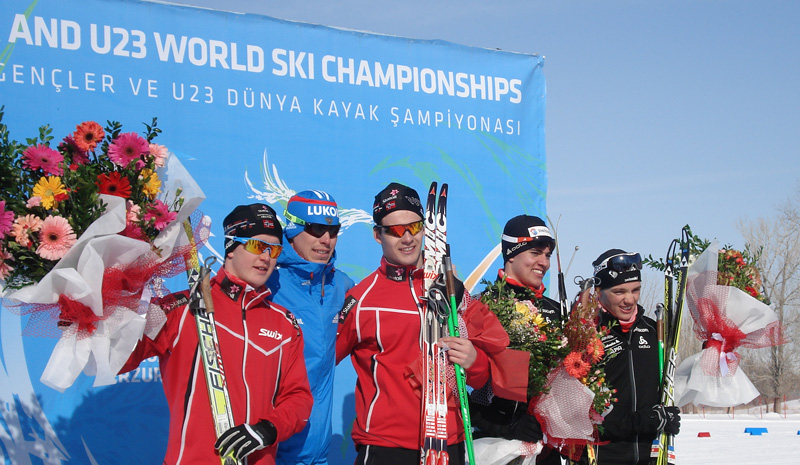
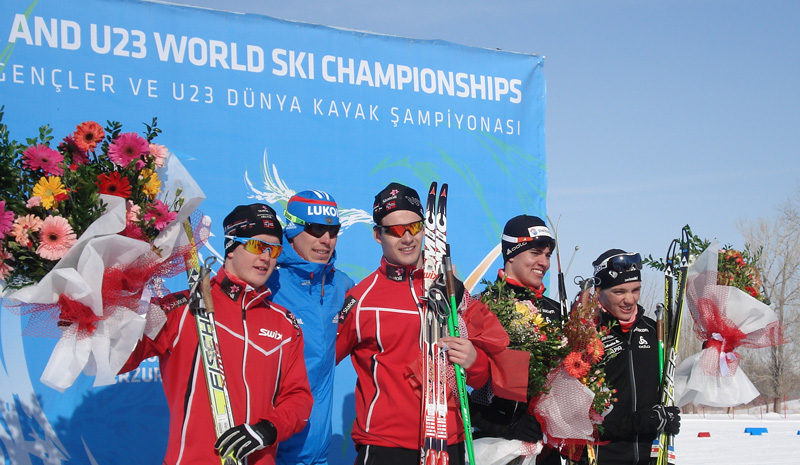
    World Junior men's podium (l to r): Sindre Bjoernestad Skar (NOR) 2nd place, Sergey Ustiugov (RUS) 1st place, Sondre Turvoll Fossli (NOR) 3rd place, Roman Schaad (SUI) fourth place and Emil Vokuev (RUS) fifth place.
    Roman Schaad (2nd from right) after placing 4th in the 2012 World Junior Championships sprint. Last season, he notched two World Cup top-10’s and qualified for the Olympics as a 20-year-old.

    At just 20 years old, Roman Schaad had a breakthrough last year – and on the biggest stage a Swiss skier can imagine. Starting his first-ever World Cup competition on home turf in Davos in December, he shocked the field by qualifying in seventh place, then went on to make the semifinals and end up 10th overall. The Swiss crowd went wild, rallying behind the previously-unknown skier with each progressive sprint heat.

    From there, Schaad’s dream season continued: he took third place in the sprint at U23 World Championships, finished ninth in the World Cup sprint in Toblach, Italy, and then went to the Olympics in Sochi, where he finished 83rd.

    With a few years of U23 eligibility left, Schaad is balancing big goals with manageable stepping stones. We checked in with him in Davos last week to see how his life has changed since that stunning, sunny Sunday back in December when he leapt into the collective consciousness of ski-crazy Switzerland.

    FasterSkier: You had a lot of success last year. A lot must have changed for you now?

    Roman Schaad: Not so much, I think, actually. After the season I started with the army. But yes, interviews and stuff, this is all new for me.

    FS: Is this the first year of your required service?

    RS: Yes. I have to do 18 weeks total. I started with five weeks with the real army, shooting and doing whatever. And then the other 13 weeks I am training in the sports center. It’s just the first five weeks that were crazy. But it was after the season. I had time, but at the same time I had no break, it was just the army!

    FS: Was the Olympics a big goal for you last year?

    RS: No! I started the season here in Davos. It was my first big race. Before this race, I never imagined to go to the Olympics. I always focused on other things. But yeah, after Davos, I thought I could do it.

    FS: What was it like to have your first really big race here in Switzerland?

    RS: Yeah. All the other Swiss guys were out [none of the other Swiss sprinters made the quarterfinals] and I was standing on the starting line, and I felt good. I knew I was strong because one week before I had a race in Goms and the Russian guys were also there, and I had the third best time. I had been very shocked there! And then here in Davos it was amazing. A beautiful day and so many fans, it was awesome.

    FS: Were a lot of people from your home able to come watch your first World Cup?

    RS: Yes, I knew that maybe ten people would come [from Unteriberg, near Zurich]. But in the end it was 30 or more people. It was cool.

    FS: What was it like to be in the semifinal of your first World Cup? Did you have a plan?

    RS: No [laughs]. Not in the semifinal. Well, yeah, I had a plan. I would start easy and in the second lap, on that long flat direction, I wanted to attack. It worked. I had enough power the first time [Schaad won his quarterfinal heat]. But then not enough power in the semifinal. It was tough.

    FS: You must have had a lot of interviews that day.

    RS: After the race I had two hours of interviews with radio and television. I live in Bunda, next to the start, but it took me two hours to get home. It’s very new for me. All the fans, it was cool.

    FS: Do you have more sponsorship now?

    RS: Yes, I have a new headwear sponsor, Helvetia, which is a really big insurance company. Here in Davos it’s not very cheap and of course we need the money. Now it’s a little bit easier to have a place to live here.

    FS: How is your training going this year?

    RS: I had an operation on my shoulder. I fell down in the Engadin Marathon and dislocated it [he still placed 27th, 23 seconds off the win]. Before the army started I had the operation, after the five weeks of basic training. And then I had rehabilitation. I think the last five weeks I have been able to train without troubles. But I hope I can train more than last year. Last year actually I didn’t have many hours because I also had an operation on my knee. I hurt some ligaments playing soccer.

    FS: Have you moved up in Switzerland’s team since last season?

    RS: Two years ago I was in the “C” team, and last year in the “B” team, and now I am in the “A” team. “A” team, yeah!

    FS: Were you training with Tor Arne Hetland last year?

    RS: Just a few times. He was my coach in the World Cups, so he looked after me and everything is okay. Here in Davos not so much. But I got some tips from Tor Arne, for sure [laughs].

    FS: So who do you train with now?

    RS: We have now a new coach, and five training groups. TG1, 2, 3, 4, 5. TG1 is the national team and maybe one from the “B” team because it’s better to train together. I’m in the TG2. TG2 and TG3 train together, with Albert Manhart [the continental cup coach]. The new coach, Ivan Hudec, is just with TG1. So the changes haven’t affected me much.

    FS: Swiss sprinters have been getting better and better.

    RS: Yes, I hope so! The sprinters train together with the distance skiers. I want to also do some distance races, not just the sprint races. This is a big goal for next year. Last season I only started the sprints, so that was not so good for the training. I had just five long distance races. It’s not so much.  The U23s are a big goal, and maybe the Falun team sprint in skating.

    FS: How were the Olympics?

    RS: I just realized where I was, when I was on the start. At first you think you are in a race, focused. Exactly for the start, I realized what I was doing! But actually my focus was really good. Maybe it was just too high [elevation] for me. It was a hard course.

    FS: What was it like to watch Dario and the other guys in the races?

    RS: Actually, I never saw the cross country races. I was always in the hotel, relaxed, jogging. But after my race, I was in the mountain village with the other Swiss guys who do halfpipe and downhill. After the race, a little bit more the experience.

    FS: Will the next Olympics be easier?

    RS: Yeah, I hope so! Maybe now I have more, I know how it works at the Olympics.

    FS: Your brother is also a skier, right?

    RS: Yes, I live with him, with two other guys, Phillip Haelg from Lichtenstein and Ueli Schnider. We have a good apartment!

    FS: Is your brother getting as fast as you?

    RS: This was the first year that I am better than he is. He was always better than me. So he is also a good sprinter, and in distance races we need more training. He will be trying to get faster than me again.