From the FasterSkier archive — posts syndicated from athletes’ and coaches’ own blogs between 2004 and 2012, kept online as published. Current coverage is at fasterskier.com.

Tag: Romania

  • Norwegian Nebulizer Use at World Junior Championships Stuns North Americans

    Norwegian Nebulizer Use at World Junior Championships Stuns North Americans

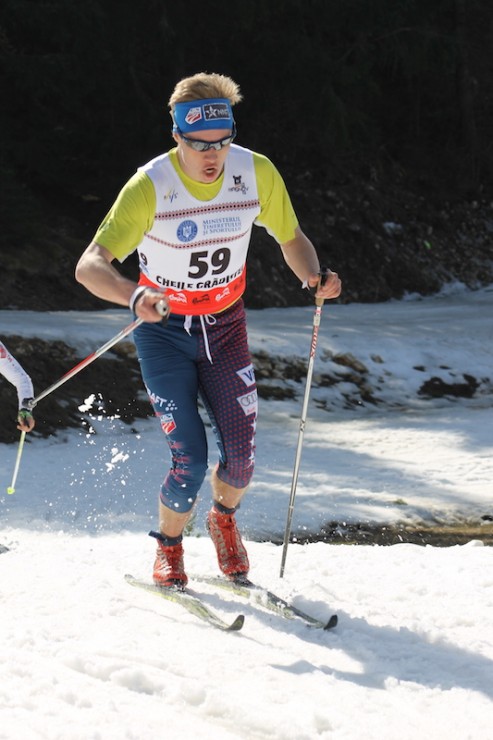
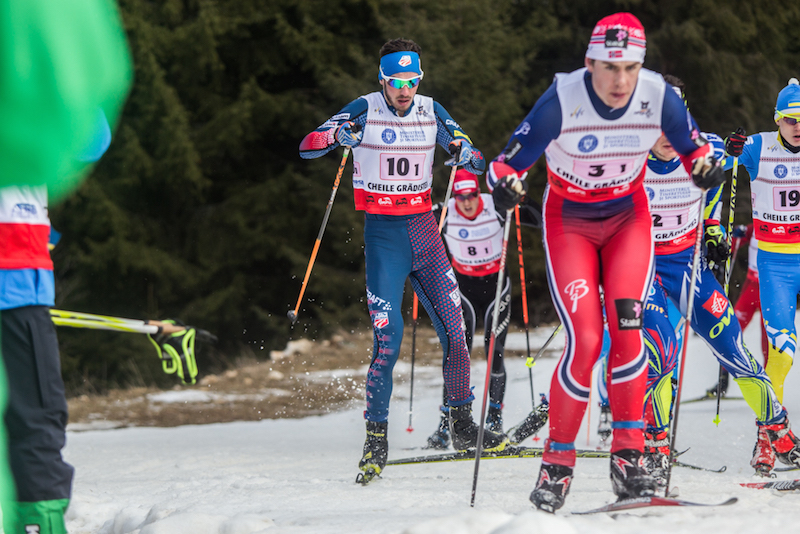
    Ian Torchia (10) chasing the Norwegian team (bib 3) in the first leg of the junior men's 4 x 5 k relay at 2016 Junior World Championships in Rasnov, Romania. (Photo: Logan Hanneman)
    Ian Torchia (bib 10) chasing a Norwegian (bib 3) in the first leg of the junior men’s 4 x 5 k relay at 2016 Junior World Championships in Rasnov, Romania. “When I first heard the news I was extremely fired up,” Torchia told FasterSkier after learning that some of the Norwegians had been taking asthma medication despite not being diagnosed with asthma. (Photo: Logan Hanneman)

    Norwegian team doctors prescribed asthma medication to young cross-country skiers without any diagnosis of the disease the country’s state broadcaster NRK reported. The incident occurred at 2016 Junior and U23 World Championships in Rasnov, Romania.

    Petter Olberg, who was a physician on the team staff in Rasnov, said that the treatment was due to air-quality issues which irritated the airways of some athletes.

    American and Canadian competitors and team staff at the event, however, did not recall any air quality problems. They expressed surprise that competitors who were still teenagers would be offered such drugs without a medical diagnosis of asthma.

    “I am shocked to hear about this story and I do not recall there being poor air quality in Rasnov other than the coal burning pollution,” Julia Kern, an American who had two top-20 finishes in Rasnov, wrote in an email to FasterSkier. “My hope is that the doping regulations are set up to only help fix a medical disease instead of giving people an advantage.”

    The medication allegedly prescribed, budesonide, is a glucocorticosteroid which is not prohibited for inhalation by the World Anti-Doping Agency (WADA). It was delivered by a nebulizer, rather than through inhalers; Olberg said he had also recommended that some athletes take a salt-water inhalation treatment through the nebulizer to improve their symptoms.

    The case has caused a stir partly because a more senior Norwegian skier, Martin Johnsrud Sundby, was slapped with a suspension after taking asthma medication from a nebulizer. However, that was a different drug – salbutamol, which is a beta-2 agonist rather than a glucocorticosteroid – which is prohibited by WADA when used in high doses.

    Air Quality Plagues FIS Site Selection, and Racers’ Lungs

    Air quality has been a major issue at past Junior and U23 World Championships.
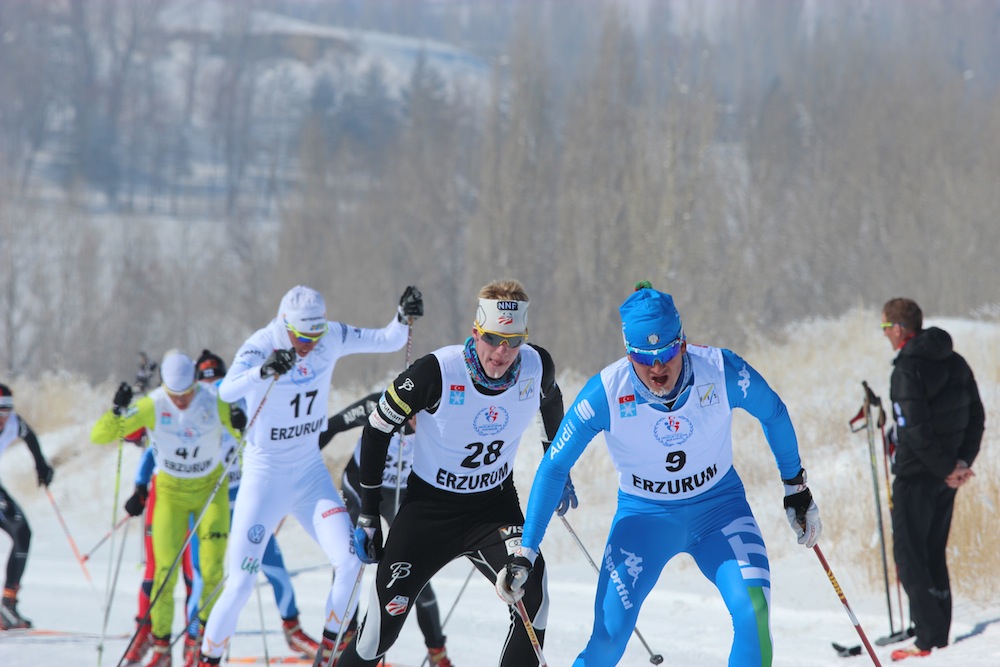
    Logan Hanneman competing at World Junior Championships in Erzurum, Turkey, in 2012. (Photo: Reese Hanneman)
    Logan Hanneman competing at World Junior Championships in Erzurum, Turkey, in 2012. (Photo: Reese Hanneman)

    “When the World Junior & U23 Championships were held in Erzurum, Turkey in 2012 and Almaty, Kazakhstan in 2015, the air was possible the worst I have ever seen at a race venue,” Logan Hanneman of Alaska Pacific University (APU) wrote in an email.

    Of the four Junior/U23 World Championships Hanneman has competed in, Erzurum and Almaty stood out for one reason: smog.

    “In both locations, it seemed that the pollution was caused by poorly-regulated and designed coal power plants,” he explained. “With the large surrounding mountains in both locations, the inversion that would form during the night would suppress the pollution down to the valley floor and into the town where the teams were staying. The race venue in Almaty was above the pollution, but only in the early morning before it began to rise up the mountains.”

    That was a nightmare for many athletes, including those who do suffer from asthma. Kern, now a U.S. Ski Team member based at Stratton Mountain School and Dartmouth College, remembers Almaty and its health challenges well.

    “I had the experience of having my worst asthma attack ever in Almaty and I attribute that to the poor air quality,” she wrote. “I know some of my teammates who have never had any issues breathing even mentioned having some issues in Almaty.”

    In fact, the International Olympic Committee released a consensus statement about asthma and elite athletes in 2008. In it, they addressed the influence of air pollution on the prevalence of airway problems during training and competition.
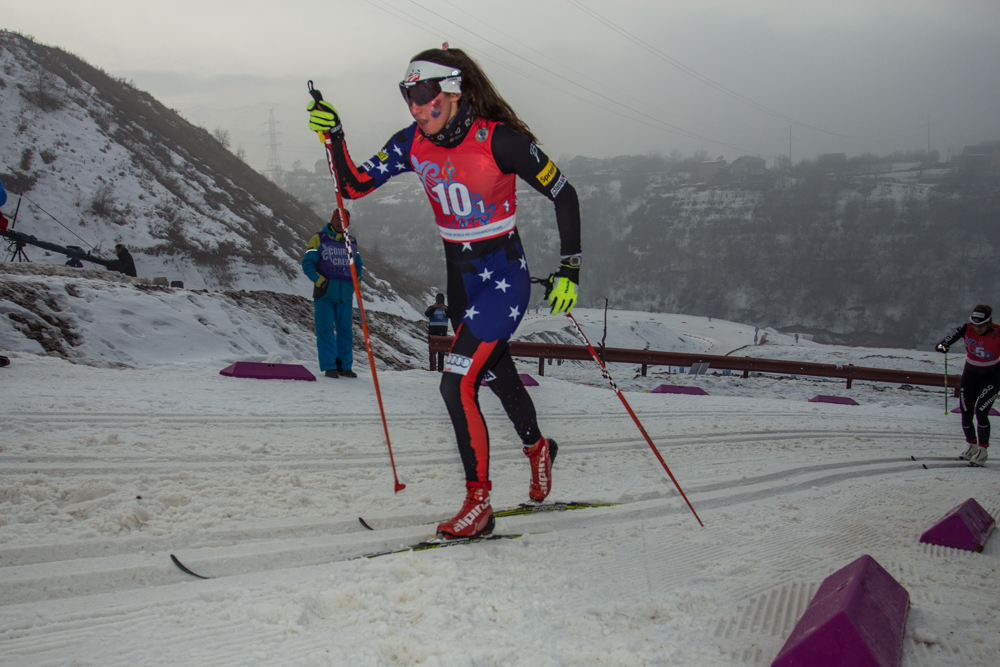
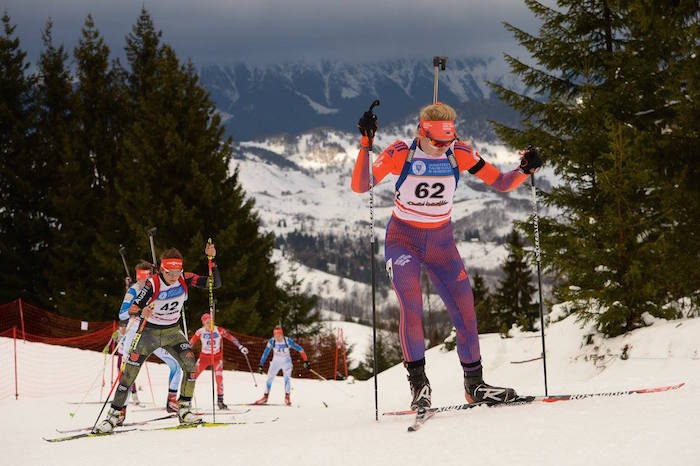
    Julia Kern (CSU) racing against a backdrop of smog in the first leg of the 4 x 3.3 k relay at the 2015 Junior World Championships in Almaty, Kazakhstan. The American team would go on to place eighth. (Photo: Logan Hanneman)
    Julia Kern (CSU) racing against a backdrop of smog in the first leg of the 4 x 3.3 k relay at the 2015 Junior World Championships in Almaty, Kazakhstan. The American team would go on to place eighth. (Photo: Logan Hanneman)

    “Airway function can be affected by exposure to seasonal and perennial allergens in sensitized individuals, dry/cold air, and poor quality air containing pollutants such as chlorine derivatives in swimming pools, ozone and oxides of nitrogen, and fine and ultrafine PM derived from combustion,” the group wrote. “The effects may be greater in subjects with asthma than without asthma.”

    Other air characteristics are sometimes considered in assessing safety. The International Ski Federation (FIS) has a cutoff of -20° Celsius (-4°F), below which it is not permissible to hold competitions; one reason is frostbite, but another is airway damage. FIS is considering raising that lower limit, perhaps to -12° Celsius, specifically to protect athletes’ lung function from long-term damage.

    But the pollution aspect of air quality does not appear to be a concern. Air quality is not discussed anywhere in the International Competition Rules (ICR), meaning that technical delegates and race juries do not have clear guidelines for deciding whether to adjust race schedules due to smog.

    And by selecting sites like Erzurum and Almaty that are clearly plagued by such problems, FIS does not appear to make the issue a priority when awarding event bids.

    They are not alone. The International Olympic Committee (IOC) awarded the 2008 Summer Olympics to Beijing, China, which has some of the worst smog in the world. That caused some long-distance runners to choose not to prioritize the marathon, for fear that prolonged exposure to the air while racing would cause asthma attacks.

    Such an attitude by governing bodies must be changed, a growing number of athletes assert.

    “My personal belief is that if we are racing in an area with high pollution, I think it is okay for people to use legal asthma medications at a legal dose in order to protect their lungs from damage,” Kern wrote. “But more importantly, I do not think races should be allowed to be held in places of pollution because it not only hurts the health of athletes in the short term, but in the long term as well.”

    Comparatively Clean Air in Rasnov

    Romania is not known for its clean air. The industrial sector burns coal, while coal and wood are used for home heating. Pollution from traffic emissions is also a concern. As a result, by several metrics Bucharest has the dirtiest air of any European capital.
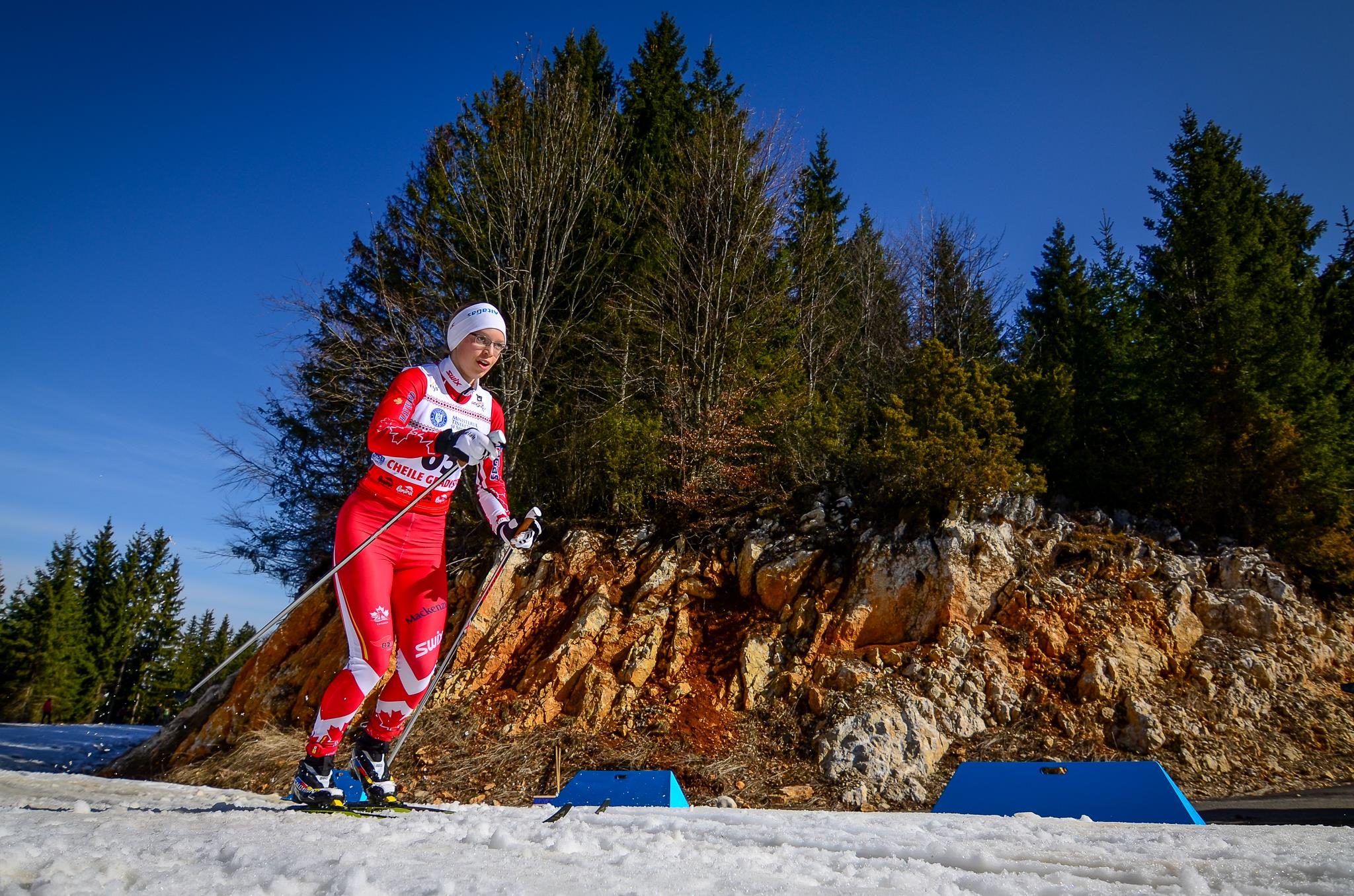
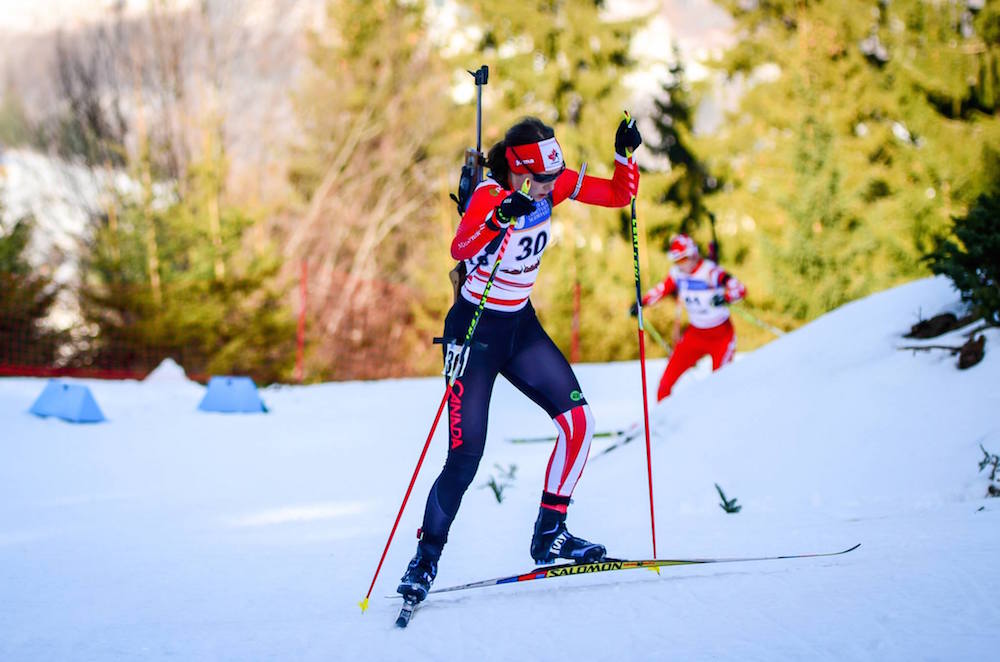
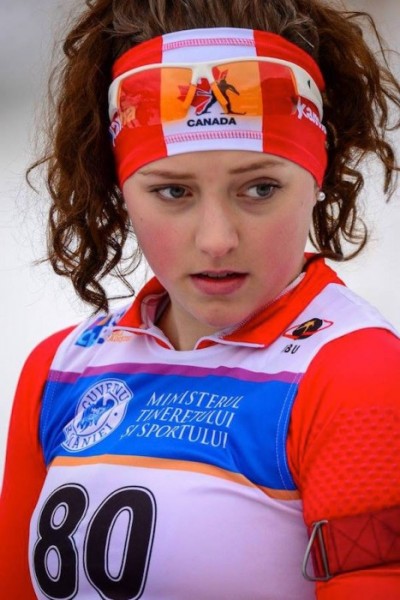
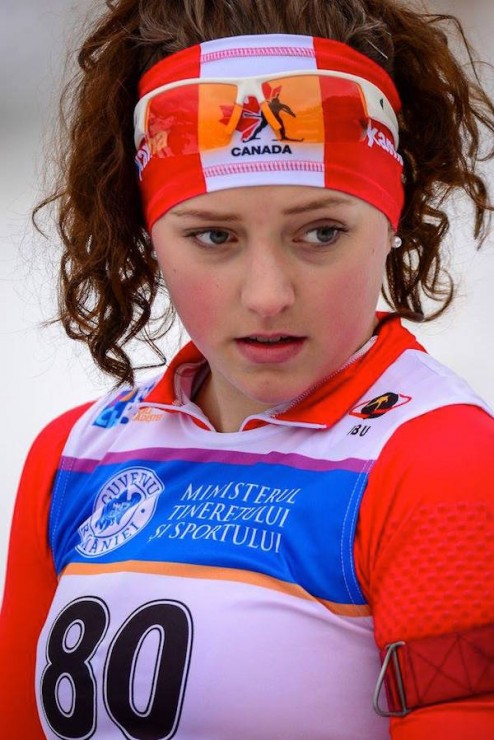
    There were blue skies as Canada's Hannah Mehain raced to 44th in the women's 5 k classic on at 2016 Junior World Championships in Rasnov, Romania. (Photo: FIS Nordic JWSC & U23 WSC 2016/Facebook)
    There were blue skies as Canada’s Hannah Mehain raced to 44th in the women’s 5 k classic on at 2016 Junior World Championships in Rasnov, Romania. (Photo: FIS Nordic JWSC & U23 WSC 2016/Facebook)

    At Rasnov, where the ski competitions were held, traffic exhaust was less of an issue.

    “The only thing that was polluting the air was the exhaust from coal burning, which is easy to recognize because it has a strong odor,” Kern wrote.

    Of all airborne pollutants this type of exhaust can be particularly inflammatory to airways, according to Dr. Michael Kennedy at the University of Alberta, who studies respiratory health of endurance sports athletes.

    “The ultrafine particles (UFP) are the most troublesome,” he explained in an email. “In any active person (most of the literature is from active transport — like bike commuting)… deposition of UFP in systemic circulation as well as lung function can be significant. Diesel is the worst of the polluters and fits with Romania and Kazakhstan, where High Emission Pollutants likely influenced lung health in all competitors. For those with [Exercise Induced Bronchoconstriction] it was likely worst.”

    So it’s not crazy to suggest that athletes could have struggled to race in particulate-laden air, as Olberg suggested was true for the Norwegians.

    But that’s not the way other teams remember Rasnov. Because of the way the venue was situated, American competitors did not notice the coal-produced UFP’s while they were skiing.

    North American Perceptions of Air Quality in Rasnov

    “I did not notice the ‘poor air quality’ in Rasnov as my biggest concern was the lack of snow. I think this is an excuse and if the air was bad in Romania I hate to think of what they were taking for Junior Worlds in Kazakhstan where the smog and air pollution was extremely prevalent.”

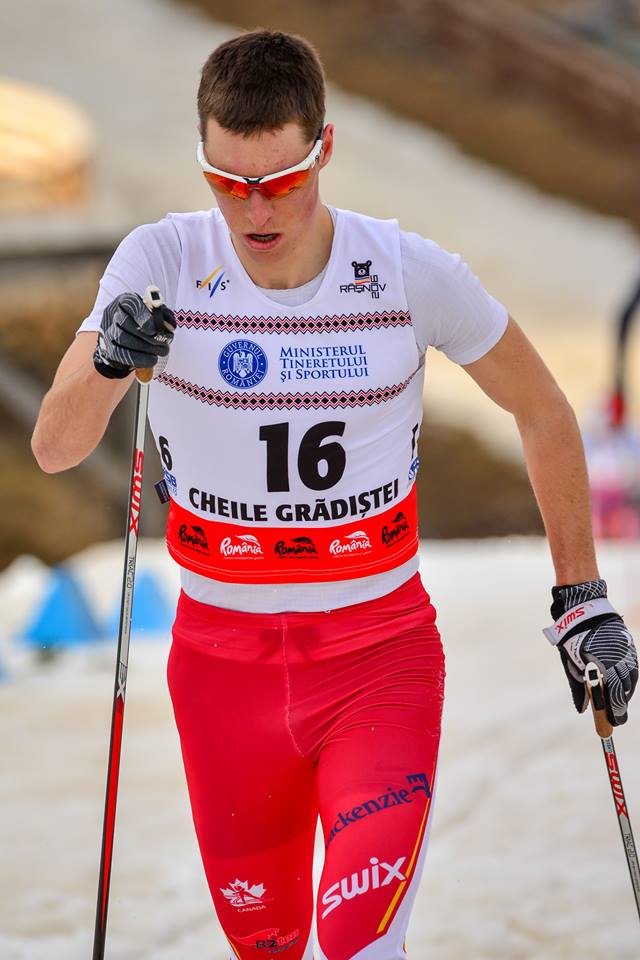
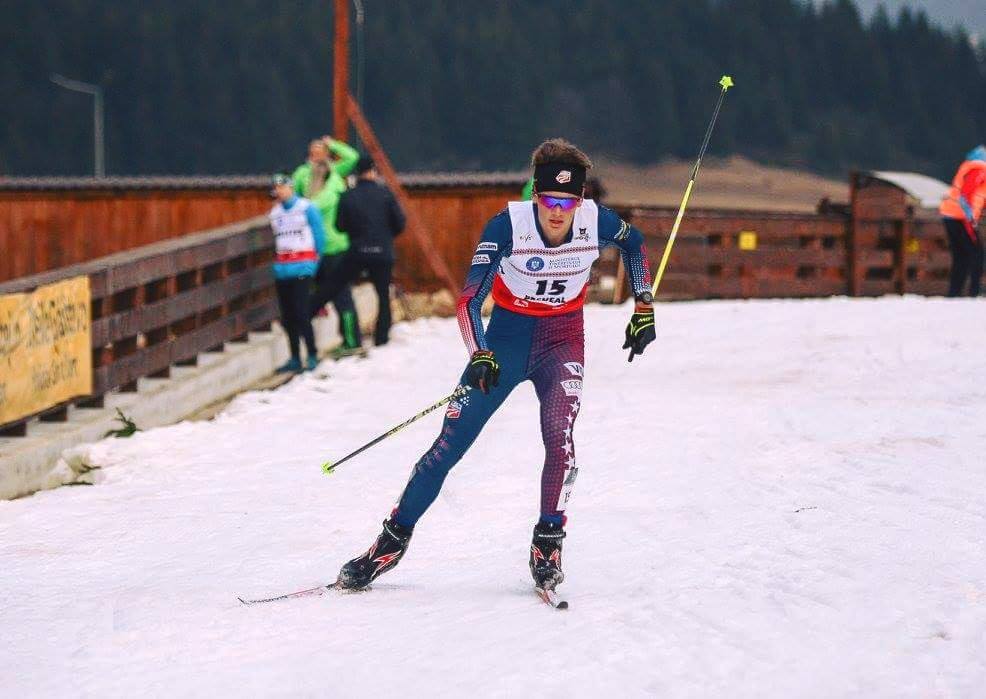
    –Ian Torchia, USA (Northern Michigan University): 15th in the junior 10 k skate 

    “In Bucharest, the city air was definitely thicker, but the venue (Cheile Gradistei) was quite remote, at least 20 or 30km from any major cities (or industrial sites, that I know of), out in the countryside, surrounded by rural farmland and fields. Water quality seemed to be a much greater concern in Romania.”

    – Jenn Jackson, Canada (NDC Thunder Bay): 29th in the U23 sprint

    “The air quality appeared okay to me, however there was heating with wood in the area. That can irritate some but no significant quality issues like we saw in Kazakhstan and Turkey. Romania was very warm and early warm conditions can bring on pollen, however I didn’t notice that either.”

    – Bryan Fish, U.S. Ski Team coach/trip leader 

    “While I’m by no means an air-quality expert, I wouldn’t say the air quality was bad in Rasnov, at least at the race site. The race site was up high on a hill in a very agricultural area, on the edge of some mountains… I never had a moment where I thought to myself ‘wow – this air quality is bad’ and as a coaching staff we never had a discussion that indicated that air quality was an issue with the site. We were mainly focused on having snow to ski on… That being said, in my opinion, it also wasn’t great. There was a big smokestack from what I’m assuming was some sort of boiler that burned wood. It was also pretty dusty from the overall construction.”

    – Kieran Jones, Nakkertok Nordic coach/Canadian team staff member

    Like Kern, Hanneman has been diagnosed with asthma. In his case, he believes that it is a result of growing up in Fairbanks, Alaska, and “racing and training in the very cold and dry air.” He said that he was prescribed a small inhaler to treat his symptoms after a major flare-up in Erzurum, but he didn’t experience a similar problem in Romania.

    “I seem to remember that my asthma related problems were not very present in Rasnov,” Hanneman explained. “I took my inhaler like I normally do for races, but the air did not seem to bother me as much as the previous locations. It helped that it was also 55 degrees.”

    Why Offer Athletes a Nebulizer?

    So, then, was giving new medications to some junior athletes necessary?

    “When I first heard the news I was extremely fired up,” wrote Torchia, who initially assumed that the juniors were prescribed the same drug which Sundby had used, rather than a non-prohibited one. “My initial anger eventually turned to being demoralized that doping had come down to the junior level. You hear about the scandals on the World Cup but when it comes to the people you race, it felt like a punch in the gut. The most frustrating thing I have heard was the Norwegian doctor offering asthma medication to healthy athletes. This shows a clear indication from the upper levels of the system to cheat their way to victory. If you can’t compete clean, don’t compete at all.”

    As it turns out, it was not salbutamol but budesonide which the athletes were using. Budesonide is not prohibited for inhalation, although like other glucocorticosteroids, it cannot be injected or ingested orally in or out of competition.
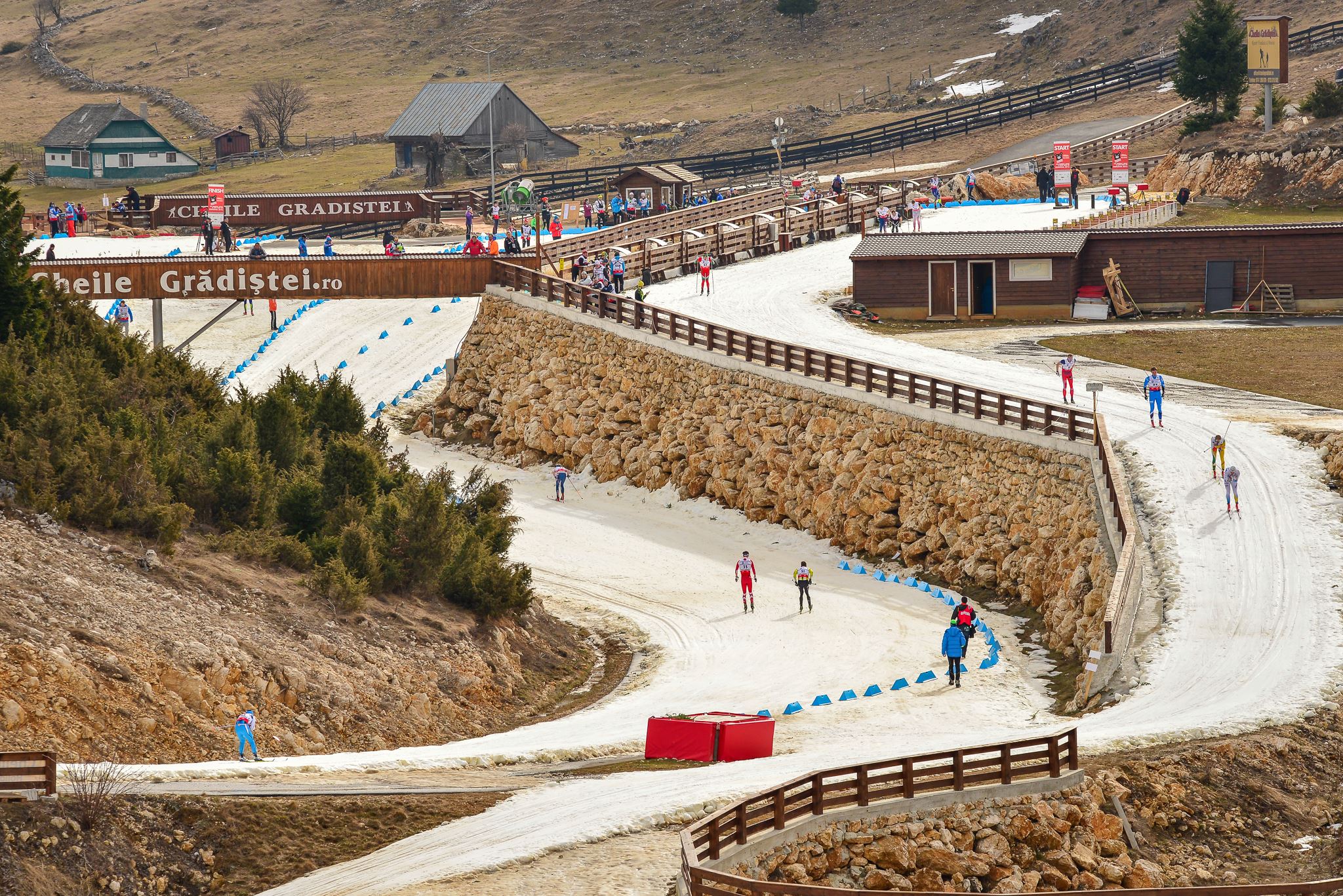
    A bird's eye view of the race course at U23/Junior World Championships in Rasnov, Romania. (Photo: FIS Nordic JWSC & U23 WSC 2016/Facebook)
    A bird’s eye view of the race course at U23/Junior World Championships in Rasnov, Romania. (Photo: FIS Nordic JWSC & U23 WSC 2016/Facebook)

    Olberg told NRK that from his viewpoint, saying that the athletes without an asthma diagnosis were “healthy” was incorrect. The athletes, he said, were sick because of the air quality.

    “I believe that we don’t medicate healthy people,” he explained to NRK. “If we medicate it is because they have gone ill. They have a symptom, a distress of some kind and then they reach out to me. We treat the symptoms…. I believe that to say that they are healthy is completely wrong, because if they’re healthy they wouldn’t have had the symptoms, and if that was the case they would not receive treatment.”

    The North American athletes seemed to struggle internally about whether this was appropriate – especially since it’s relatively unclear whether non-asthmatics even receive benefits of such drugs. That’s even true in the case of salbutamol, the beta-2 agonist which is prohibited at high doses.

    But the athletes felt that the intent of their competitors mattered, whether their performance was enhanced or not.

    “After talking with [Northern Michigan University coach] Sten [Fjeldheim] and my exercise physiology professors and doing some personal research, it seems unclear on the performance enhancing benefits of taking salbutamol, especially in healthy athletes as the oxygen uptake is already at maximum potential,” Torchia wrote. “However… whether it is performance enhancing or not, if you are a healthy athlete and are taking synthetic drugs with the intention of helping your performance, you are cheating, and there should be repercussions.”

    Hanneman and Kern, who take inhalers to treat their diagnosed asthma, had a hard time parsing whether it was wrong to use such medications without such a formal diagnosis.

    “My hope is that the WADA has set the limitations and bans on certain drugs in ensure that the drugs permitted at legal doses would not have a positive impact on performance, but would only help treat the illness of asthma for those with the ‘disease’ (not sure what technical term to use),” Kern wrote.
    American Logan Hanneman (c) racing to third in his quarterfinal of the freestyle sprint at U23 World Championships in Rasnov, Romania. He ended the day 15th overall. (Photo: Pete Leonard)
    American Logan Hanneman (c) racing to third in his quarterfinal of the freestyle sprint at U23 World Championships in Rasnov, Romania. He ended the day 15th overall. (Photo: Pete Leonard)

    “Having exercise induced asthma myself, and seeing the health benefit that the medicine provides, I support the use of prescribed medications, but in limited quantities,” Hanneman agreed. “People who have not been treated previously should not be allowed to use such a medicine I feel.”

    Many drew a distinction between whether such drugs were used as part of a long-time treatment plan, or prescribed more casually by doctors who are not intimately familiar with an athlete’s medical history.

    “I am very much opposed to widespread usage of any medication,” U.S. Ski Team development coach Bryan Fish wrote. “That being said, there are athletes that have unique respiratory issues & these athletes should go through testing by qualified medical staff. The qualified medical staff should then create a unique and specific plan for that particular athlete.”

    And as more and more such “gray area” incidents accumulate, it’s hard for athletes to interpret whether their competitors are seeking an unfair advantage or not – much less whether they are actually getting one.

    “I don’t understand how people can be so invested in maximizing their performance that they’re willing to leave the white area and step into the grey,” Jackson wrote. “Unfortunately, medicating and supplementing just seems to be the norm these days, in sport and everyday society. People will do what they’ll do, so long as they feel it’s ‘normal’ or ‘okay’ – whether that be Norwegian juniors using asthma medication at the World Championships, Russians using xenon for Sochi, [Poland’s Justyna] Kowalczyk taking injections for her foot in 2014, or [Norwegian Therese] Johaug’s doctor providing her that super skin cream. I suppose it’s inevitable, as you approach the limits of human potential, that you toe the line between white and grey, but I don’t feel like I’m close enough to that point to really understand why someone would.”
  • Ogden 13th, Kern 18th in Junior Worlds 5 k Classic; Good 11th in NoCo Opener

    Ogden 13th, Kern 18th in Junior Worlds 5 k Classic; Good 11th in NoCo Opener

    Katharine Ogden didn’t worry too much about the slush at Junior World Championships on Tuesday. She tested her skis once, remained confident in her kick and resolved to “hammer the whole thing” because 5 kilometers is pretty short, the 18-year-old Stratton Mountain School and U.S. Ski Team D-team member explained in an email.

    “I didn’t notice too much of a change in the conditions between laps, although by my second lap I’m not sure I would have noticed much, it was definitely a sufferfest out there,” she wrote.

    Ogden raced to 13th in the 5 k classic individual start on the second day of U23/Junior World Championships in Rasnov, Romania, leading the U.S. team on a classic distance day with temperatures in the mid-to-upper 50 degrees Fahrenheit.

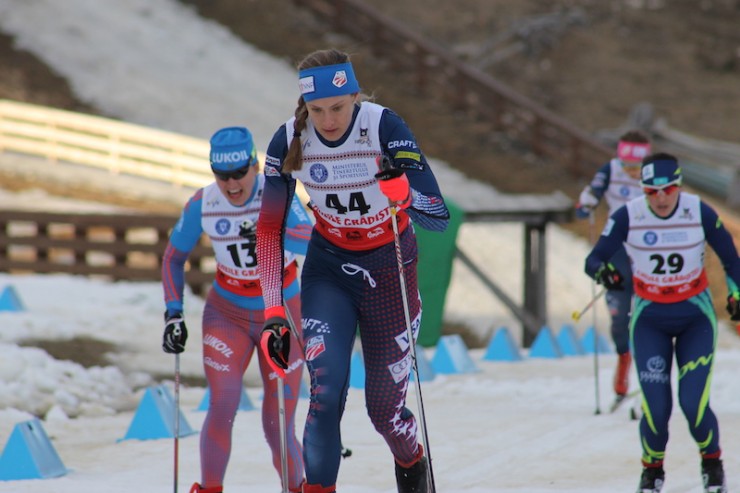
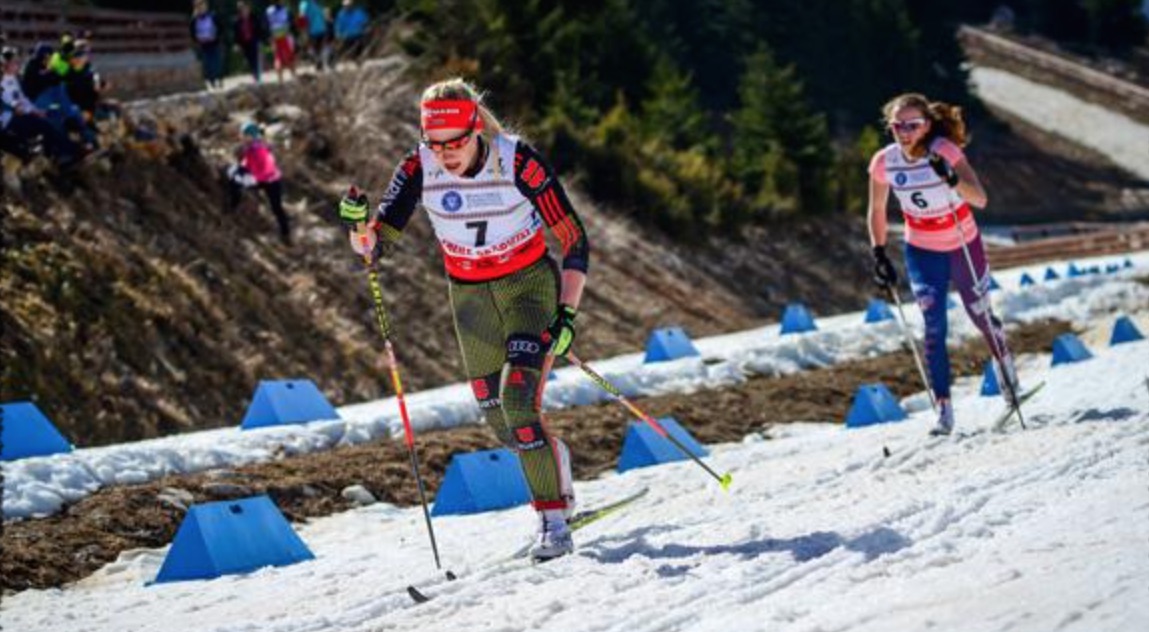
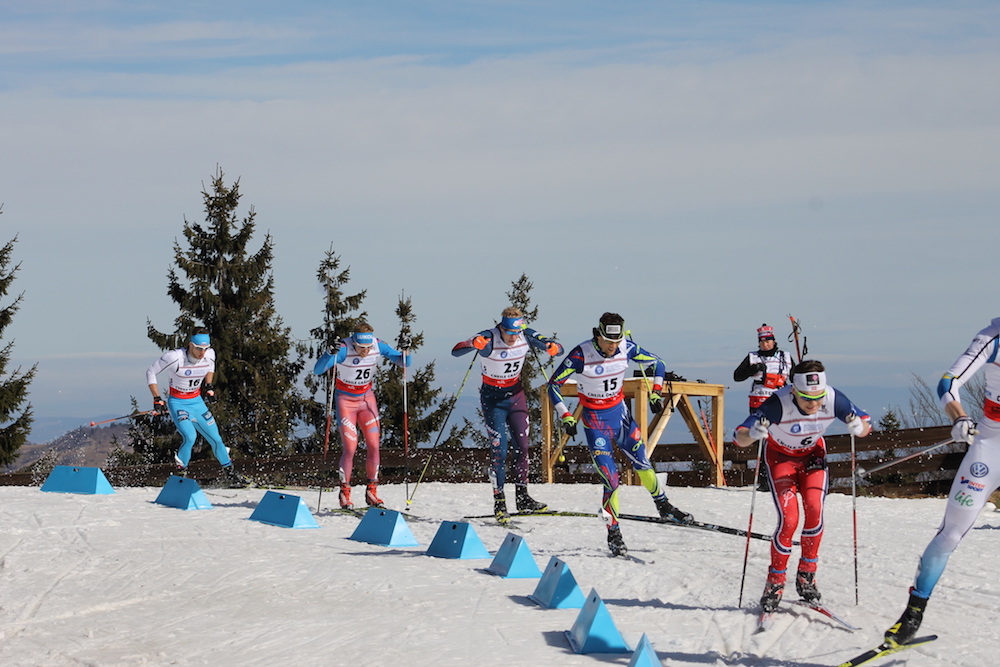
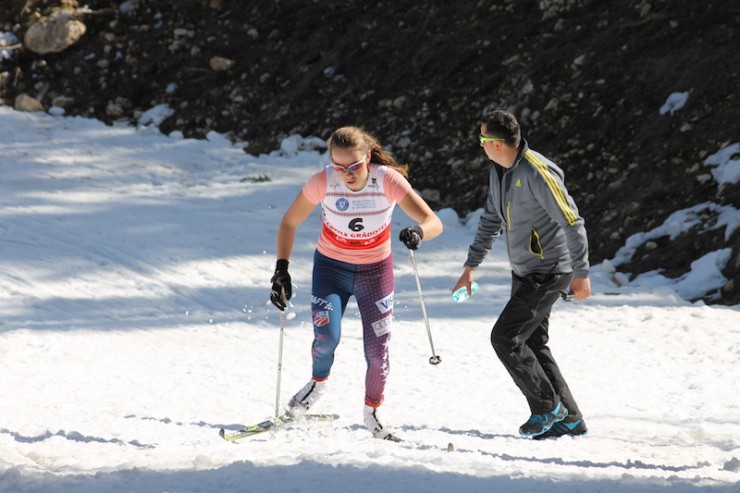
    American Katharine Ogden (6), of the Stratton Mountain School and U.S. Ski Team, chases Germany’s Antonia Fraebel during the junior women’s 5 k classic at the Junior World Championships on Tuesday in Rasnov, Romania. (Photo: FIS Nordic JWSC & U23 WSC)
    American Katharine Ogden (6), of the Stratton Mountain School and U.S. Ski Team, chases Germany’s Antonia Fraebel during the junior women’s 5 k classic at the Junior World Championships on Tuesday in Rasnov, Romania. (Photo: FIS Nordic JWSC & U23 WSC)

    The sixth starter, Ogden finished 56.8 seconds behind the winner Marte Mæhlum Johansen of Norway, who completed the two-lap race in 15:34. In Ogden’s second junior world championships, the result was her third best after placing sixth in the 10 k skiathlon and 11th in the 5 k freestyle last year in Almaty, Kazakhstan.

    “I’m psyched about my race and I’m hoping to carry the momentum into the skate 10k which is a much better event for me,” she wrote of Thursday’s race. “I’m mostly focused on the skate race here.”

    When asked how Rasnov compares to Almaty, Ogden explained they are “pretty similar in some ways but completely different in others.

    “Almaty was a huge industrial city while Rasnov is a small rural mountain town,” she wrote. “The low snow has been common to both venues, however the situation is much worse here in Romania. It’s pretty awesome that we get the opportunity to travel to these crazy places and race because neither place is one that I would ordinarily get to experience.”

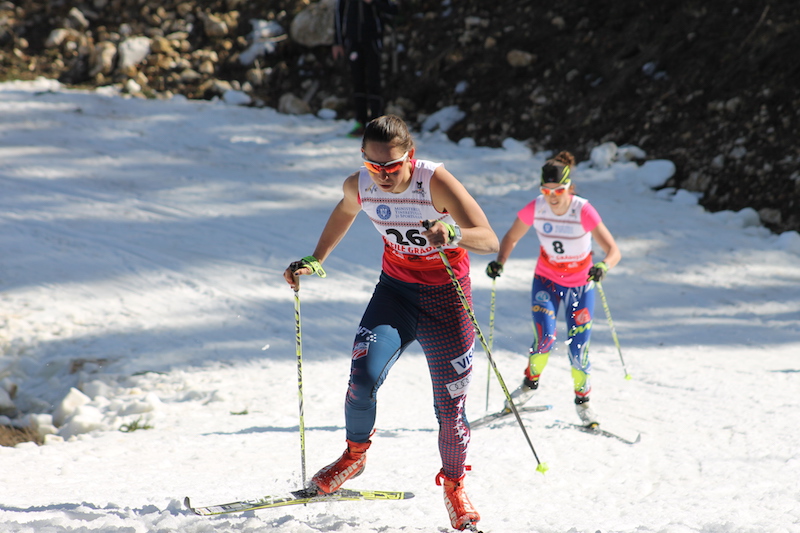
    Finishing 21.2 second off her teammate’s pace and 1:18 behind the winner, Julia Kern (SMS/USST) notched her second-straight top 20 in as many races at this year’s junior worlds.

    Kern finished 18th, and like Ogden, whose time ranked 18th at the halfway point, Kern sped up on her second lap to improve from the 24th-fastest split at 2.5 k.

    “Honestly, my plan was to feel it out as I went along because when I saw the first starters lap, they looked like they were in a lot of pain and that it was super slow and grueling,” Kern wrote in an email. “I also had talked with my coach Matt Boobar about water ‘feeds’, where he would dump cold water on me while I was racing so I could cool off a little. I found the cold water helped me cool off a little in the heat.”

    She started the race 26th out of almost 80 junior women and felt the conditions were likely similar for everyone: “hot, wet, slow, and slushy,” she wrote.

    “Quickly after I had started out, my body set into a pace automatically that was appropriate,” Kern explained. “Is was so slow out there that it was really hard to go significantly faster without wasting a lot of energy; it was almost like the speed you were going was hard to change. … I definitely didn’t feel like I was having a good race just by how slow I was skiing, but I guess the results showed otherwise.”

    Her goal had been a top 25, so 18th place exceeded that.

    “I am very happy with my result today and pleasantly surprised!” she added. “The coaches had done a great job giving splits out on course, but I knew that when they said I was top 20, there were plenty of fast girls still behind me. It is hard to tell how I feel about the actual race because I don’t think it felt good for anyone; it was all about who could fight through the pain the fastest.”

    Finishing 5.3 seconds behind the winner, Norway’s Lotta Udnes Weng placed second for the second-straight day and Germany’s Antonia Fraebel took third (+10.7).

    Canada's Hannah Mehain racing to 44th in the women 5 k classic on Tuesday at Junior World Championships in Rasnov, Romania. (Photo: FIS Nordic JWSC & U23 WSC 2016/Facebook)
    Canada’s Hannah Mehain racing to 44th in the women 5 k classic on Tuesday at Junior World Championships in Rasnov, Romania. (Photo: FIS Nordic JWSC & U23 WSC 2016/Facebook)

    Canada’s Marie Corriveau placed 37th, 2:04.8 behind the winner, and explained in an email that she found it difficult to push hard in the slushy conditions.

    “I am not used to skiing in those conditions,” Corriveau, of the Pierre-Harvey National Training Centre in Quebec City, wrote. “I know it was the same for everybody, but usually I take advantage because of my good technique, but today it was almost impossible to ski well.

    “I am not feeling bad [about] my race, because i know I gave everything!” she added. “For sure, I would expect better for a 5km classic, but with the circumstances, I am pretty happy with this 37th place!”

    Behind her, Canada’s Hannah Mehain placed 44th, Natalie Hynes was 58th and Sadie White 62nd. For the U.S., Vivian Hett placed 48th, and Leah Lange was 52nd.

    Junior women’s 5 k results

    Three Americans in the U23 men’s 15 k classic finished in the top 30, with Adam Martin of Northern Michigan University leading the way in 23rd. Paddy Caldwell (Dartmouth/SMS/USST) placed 27th and Kyle Bratrud (CXC) was 29th.

    Unlike the junior women, who raced two laps, the men rounded the 2.5 k loop six times. A few men opted to double pole on skate skis and two of them, including Canada’s Julien Locke, were disqualified for violating classic technique.

    “Preparing for this race presented some challenges I haven’t encountered before,” Martin, who previously raced at 2014 Junior World Championships in Val di Fiemme, Italy, wrote in an email. “To preserve snow, race organizers only allowed athletes to ski in short time periods on Sunday and Monday. I don’t think this affected me as I was able to pick my skis and execute the intervals I had planned, but it was definitely something new.”

    A bird's eye view of the race course at U23/Junior World Championships in Rasnov, Romania. (Photo: FIS Nordic JWSC & U23 WSC 2016/Facebook)
    A bird’s eye view of the race course at U23/Junior World Championships in Rasnov, Romania. (Photo: FIS Nordic JWSC & U23 WSC 2016/Facebook)

    The 21st starter out of approximately 70, Martin recalled the snow feeling significantly slower on his third lap.

    “I usually make an effort to start very hard, but considering the conditions, my focus was more on being relaxed at the beginning,” he explained. “I am happy with that strategy because it didn’t take long to feel the effort.”

    Considering this was his personal best at a world championships, after placing 26th in the 10 k classic at 2014 junior worlds, Martin wrote that it felt great to improve.

    “But to be honest it’s hard for me to celebrate too much when there are 22 guys beating me by up to three minutes at the event,” he added after finishing 3:02.2 behind the winner, Jens Burman of Sweden, who took gold in 40:02.

    Russia’s Alexey Chervotkin was 26.8 seconds back in second place, and Norway’s Mikael Gunnulfsen placed third (+36.6).

    In an email to FasterSkier, U.S. Ski Team Chris Grover recently explained that Martin had turned down World Cup starts for the Ski Tour Canada. In his place, there is one opening on the men’s roster that can be filled with an “outstanding performance” at U23 World Championships.

    “As a collegiate skier … I think in some sense NCAAs is my only obligation each year for NMU,” Martin wrote of his decision to decline the spot. “Furthermore, I think I have some improvements I need to make especially in sprinting before I am ready to race a World Cup. Finally, I’m very excited to race some fast guys at NCAAs in a few weeks; I think they will be very high quality competitions.”

    Finishing 25.2 seconds back from Martin on Tuesday, Caldwell placed 27th (+3:27.4) in his second U23 World Championships (after placing 15th in the 15 k freestyle and 20th in the 30 k skiathlon in Almaty last year). He started 19th and hung in the top 30 throughout his six laps.

    Also in his second appearance at U23 worlds, Bratrud, in bib 22, notched his second-career top 30 after placing 19th in the 15 k freestyle last year. On Tuesday, he finished 3:46.1 back after posting faster splits earlier in the race.

    Canada’s Scott James Hill racing to 36th in the men's 15 k classic at U23 World Championships in Rasnov, Romania.  (Photo: FIS Nordic JWSC & U23 WSC 2016/Facebook)
    Canada’s Scott James Hill racing to 36th in the men’s 15 k classic at U23 World Championships in Rasnov, Romania. (Photo: FIS Nordic JWSC & U23 WSC 2016/Facebook)

    “The race course today was pretty insane,” Bratrud wrote. “Originally it resembled Eagle glacier [in Alaska] which had me pretty stoked but as the race went on it broke down pretty bad. I’m not sure I have ever raced in conditions like that. Definitely an experience. Maybe the longest 15k I have ever done, at least feeling wise.

    “I have been targeting these races my whole season so I was definitely disappointed with my result, but all things considered I am not super worried,” the 23-year-old Minnesota native added. “I didn’t feel great warming up and I generally don’t classic well in these type of conditions nor have I raced on them this year or more then a handful of times in my entire career. The wax techs worked extremely hard to give us great skis in these extremely challenging conditions. I am really looking forward to the skate race and the races moving forward [this season] in Germany and Italy.”

    About 16 seconds outside the top 30, Canada’s Scott James Hill placed 36th (+4:03.3), Jack Carlyle was 42nd, and Alexis Dumas finished 53rd.

    American Logan Hanneman was 55th, coming off 15th place in the freestyle sprint on Monday. He started 53rd, the latest of the North Americans aside from Locke, of Canada, who started 59th but was disqualified for skating.

    U23 men’s 15 k results

    In the junior men’s 10 k classic, Norway’s Johannes Høsflot Klæbo claimed his second-straight gold in 28:57.8. Coming off three medals at the Youth Olympic Games, South Korea’s Magnus Kim (who is half Norwegian) placed second, 11.2 seconds back, and Finland’s Lauri Lepisto earned bronze (+25.4).

    American Cully Brown finished 35th (+2:01.9), Ian Torchia was 43rd, Thomas O’Harra 54th, and Henry Harmeyer 65th for the U.S.

    Ryan Jackson was the top Canadian in 46th, followed by Antoine Blais in 52nd, Joey Foster in 56th, and Philippe Boucher in 67th.

    Junior men’s 10 k results

    In the U23 women’s 10 k classic, Heather Mooney, a former Middlebury skier, was the top American in 38th (+4:27), just ahead of Canada’s Frédérique Vezina in 39th (+4:31).

    Russia’s Anastasia Sedova won gold in 28:49.4, while Germany’s Victoria Carl finished 13.1 seconds back in second, and Petra Novakova of the Czech Republic was third (+17).

    Also for the U.S., Kristen Bourne placed 40th, Felicia Gesior was 42nd, and Kelsey Phinney 44th.

    Canada’s Kendra Murray finished between Gesior and Phinney in 43rd, Jenn Jackson was 45th and Sophie Carrier-Laforte was 46th.

    U23 women’s 10 k results

    Jasper Good (U.S. Nordic Combined) racing to a career-best 11th in his fourth Junior World Championships on Tuesday in Rasnov, Romania. (Photo:  Romina Eggert/Facebook)
    Jasper Good (U.S. Nordic Combined) racing to a career-best 11th in his fourth Junior World Championships on Tuesday in Rasnov, Romania. (Photo: Romina Eggert/Facebook)

    Also on Tuesday, 19-year-old Jasper Good raced to 11th for U.S. Nordic Combined in the normal hill/10 k Gundersen. In his fourth Junior World Championships, it was his first individual top 20.

    Fifteenth on the hill, he posted the 13th-fastest ski time to finish 11th, 3:48.9 behind the winner, Austria’s Bernhard Flaschberger. Germany’s Vinzenz Geiger crossed the line nearly a minute later in second (+59.6). Germany’s Terence Weber held onto third (+1:08.5) by three-tenths of a second over Eero Hirvonen of Finland in fourth.

    “This year’s World Junior Championships are full of schedule changes and an extreme lack of snow here in Rasnov,” Good wrote on his Facebook page. “We were able to get the first individual competition off yesterday and I had a career best finish of 11th place! I didn’t ski my best race, but I was able to move up from 15th after jumping! I’m happy with this and excited to improve in the next competition! “

    Also for the U.S., Stephen Schumann placed 31st, Jared Shumate was 37th and Koby Vargas 44th.

    Nordic Combined results

    Racing continues Thursday with the cross-country 10/15 k freestyle individual starts, replacing the skiathlons. Friday’s junior relays have been shortened to 4 x 2.5 k for the women (and remain 4 x 5 k for the men), and Wednesday’s nordic combined event was postponed.

    Nordic combined has two remaining competitions: the normal hill/5 k on Thursday and normal hill/4 x 5 k team event on Friday.

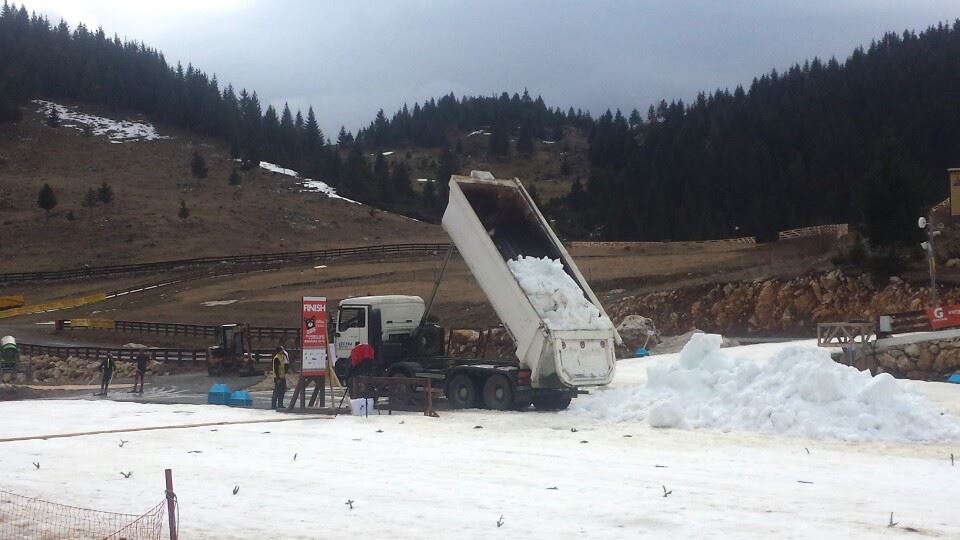
    Organizers unload snow onto the course Wednesday during the off-day at U23/Junior World Championships in Rasnov, Romania. (Photo: FIS Nordic JWSC & U23 WSC 2016/Facebook)
    Organizers unload snow onto the course Wednesday during the off-day at U23/Junior World Championships in Rasnov, Romania. (Photo: FIS Nordic JWSC & U23 WSC 2016/Facebook)
  • Logan Hanneman Sprints to 15th on 50-Degree Day at U23/Junior Worlds

    Logan Hanneman Sprints to 15th on 50-Degree Day at U23/Junior Worlds

    American Julia Kern (SMS/USST) racing to a career-best 16th in the Junior World Championships freestyle sprint on Monday in Rasnov, Romania. (Photo: Pete Leonard)
    American Julia Kern (SMS/USST) racing to a career-best 16th in the Junior World Championships freestyle sprint on Monday in Rasnov, Romania. (Photo: Pete Leonard)

    Note: This article has been updated to include comments from Canada’s Marie Corriveau and American Ben Saxton.

    Julia Kern’s biggest hurdle on Monday? Hands down: the heat.

    “The conditions today we’re a very good representation of how poor this winter has been,” 18-year-old Julia Kern, of the Stratton Mountain School and U.S. Ski Team D-team, wrote in an email on the opening day of U23/Junior World Championships racing in Rasnov, Romania.

    Kern placed 16th in the junior women’s 1.3-kilometer freestyle sprint, qualifying with the 14th-fastest time then placing fourth in her quarterfinal, 2.8 seconds out of first.

    “It was about 50 degrees and sunny, so pretty darn hot, and man made snow,” she continued. “Almost the entire course was deep slush, making it hard to power through a sprint like I usually do. My approach was to ski light and quick, but still getting power through the legs and poles. I hammered the first hill, leaving a little left in the tank to really work the flats and the finish.

    “The heat was definitely one of my biggest challenges today because I tend to overheat very quickly,” Kern, a Massachusetts native, added. “I found that pouring some water on my hair and staying in the shade before I started helped.”

    Sixteenth marked her career best at Junior World Championships since placing 32nd and 38th in the classic sprint and skiathlon, respectively, at last year’s junior worlds in Almaty, Kazakhstan.

    “My goals for these championships were pretty conservative because I wasn’t sure how I compared with others after having injuries this year and I also had no strong sprint results thus far,” wrote Kern, who had compartment-syndrome surgery last spring followed by a back injury at the start of the season. “My goal was to make the heats and I achieved that. Anything more than that was just a bonus!”

    She was one of two North American junior women to reach the heats on Monday: Canada’s Marie Corriveau qualified 29th and went on to place 25th when she finished fifth in her quarterfinal, 12.41 seconds behind the winner of that heat.

    Kern had qualified 14th, 9.63 seconds behind the top qualifier, Anastasia Kirillova of Belarus.

    “I was pretty confident about my qualifier,” Kern explained. “I felt like I was gaining on the Russian who started in front of me. By the time I was half way down the downhill, my legs were burning more than they ever have, to the point where I couldn’t feel them. I knew that I had given it my all. The heats were a lot different since the course is really tight, barely 2 people wide.”

    In her quarterfinal, she found herself in sixth early after what she considered “a really bad start”. The pack remained together until a 180-degree turn, where Kern recalled one of the two Germans in the heat stepping on the skis of France’s Delphine Claudel, causing Claudel to spin around and face Kern.

    “I tried to ski as quickly as I could around her, but had lost contact to the first 3 girls,” Kern wrote. “I worked the flat and downhill, almost catching up the 3rd, but not quite. I was still content with how I raced and was really excited to place 16th!”

    Sweden’s Emma Ribom won the heat in 3:07.28 and would ultimately place fifth in the final.  Norway took first and second overall with Amalie Håkonsen Ous, who won the final in 2:55.77, and runner-up Lotta Udnes Weng, 0.22 seconds back. Sweden’s Jenny Solin placed third, 0.71 behind the winner.

    In an email, Corriveau explained she started her quarterfinal with the goal of staying behind the leaders as long as possible.

    “I stayed with them the first part of the sprint, but after this point I was not able to follow anymore, they were really too fast for me,” the 18-year-old Pierre-Harvey National Training Centre (CNEPH) athlete wrote. Weng won her heat.

    “I am feeling very good about my result today, especially that it was my first international race, so I am very happy with a top 25 to start the week!” Corriveau wrote.

    After being officially named to the Ski Tour Canada team for the World Cups March 1-12, Corriveau explained she would likely leave for Ottawa on Friday.

    Also in the junior women’s sprint, Americans Sarah Bezdicek placed 36th, Leah Lange was 42nd and Nicole Schneider 52nd. For the Canadian team, Sadie White placed 44th, Hannah Mehain was 47th and Natalie Hynes 70th.

    Junior women’s results

    In the junior men’s 1.3 k sprint, Henry Harmeyer was the top American in 35th, Zak Katterson placed 51st, Thomas O’Harra was 58th, and Leo Hipp 66th. For Canada, Antoine Blais finished 41st, William Dumas was 44th, Philippe Boucher 52nd, and Joey Foster 63rd.

    Another Norwegian topped the junior field, with Johannes Høsflot Klæbo winning the final in 2:31.42, by 0.67 seconds over Korea’s Magnus Kim in second place. Italy’s Giacomo Gabrielli edged Russia’s Denis Spitsov by 0.07 seconds for third, 1.02 seconds behind Klæbo.

    Junior men’s results

    American Logan Hanneman (c) racing to third in his quarterfinal of the freestyle sprint at U23 World Championships in Rasnov, Romania. He ended the day 15th overall. (Photo: Pete Leonard)
    American Logan Hanneman (25) racing to third in his freestyle sprint quarterfinal at U23 World Championships in Rasnov, Romania. He ended the day 15th overall. (Photo: Pete Leonard)

    In the U23 men’s 1.3 k skate sprint, Logan Hanneman of Alaska Pacific University pulled out a career-best 15th at his second U23 World Championships (fourth including junior worlds as well). Hanneman, 22, had previously placed 16th in the classic sprint at 2013 junior worlds and 23rd in the classic sprint at Almaty U23’s last year.

    “After Nationals in Houghton, I headed home to heal and rest my back, as well as to put in some good weeks of training,” Hanneman, who placed ninth in the U.S. nationals skate sprint in January, wrote in an email. “The skiing back home in Fairbanks has been absolutely amazing, so I was able to get many weeks of very solid training in. Unfortunately, those amazing conditions were nowhere to be found here Romania. I probably should have gone training out in an ungroomed field if I wanted to be prepared for the slush that was on the race course today.”

    After qualifying in 25th, Hanneman raced to third in his quarterfinal, 2.57 seconds behind the winner.

    “Out of the start, I was last……I need to work on my starts,” he explained. “From there, I was just patient and kept making moves where I could. Coming down the downhill into the finishing rise, I was fourth and a little behind 1st – 3rd, but I just went really hard and was able to real another guy in and pass him. I was satisfied because the guy I passed in the finish [Norway’s Håvard Solås Taugbøl] was 7th in the Lahti World Cup Sprint just 2 days earlier. It was a great feeling.”

    While he finished 0.39 seconds ahead of Taugbøl, Hanneman was one place and 2.39 seconds away from automatically advancing to the semifinals.

    “My main goals were to make it out of my quarterfinal and place high in the sprint,” Hanneman wrote of his goals for the championships. “Perhaps a very good placing in this sprint may have given me a chance to race [at the Ski Tour] Canada, but who knows exactly. Due to the conditions that were not very well suited for me, I am very happy with the result. After skiing the little bit during my warm up, I honestly could tell that it was going to be a tough one.”

    “I probably should have gone training out in an ungroomed field if I wanted to be prepared for the slush that was on the race course today.” — Logan Hanneman, top North American in 15th in Monday’s skate sprint at U23 Word Championships

    Behind him, Ben Saxton placed 25th for the U.S., after qualifying in 29th then placing fifth in his quarterfinal, 10.59 seconds behind the winner of that heat. In an email, the 22-year-old Saxton, of the SMST2 Team, explained this would be his only race of the week.

    “I got a tough lane draw, but I won my start and slotted into second behind a German guy,” Saxton explained of his quarterfinal. “It was really relaxed up the hill, and when we hit the top everyone punched it as hard as they could. On the top section there was some real WWE style skiing going on, but that’s what these races are usually like, this time though it ended up with me in 4th place around the 180 degree turn and not much way to get back on the leaders. I think I felt quite good, I’m just mad at myself for not anticipating the physical contact that came up top and suffering because of it.”

    Also for the U.S., Paddy Caldwell finished 43rd and Akeo Maifeld-Carucci was 48th.

    “Logan and Julia were standouts at 15 and 16th, respectively but we felt like the day left us wanting more,” U.S. Ski Team Development Coach Bryan Fish wrote in an email. “Logan skied smart and surged from the 5th and out sprinted Haavard Taugboel (7th overall last weekend in the Lahti World Cup sprint) into 3rd in his heat.  Unfortunately, he did not move on as a Lucky Loser. Ben Saxton started strong in 3rd in his heat for most of his quarter, but ran into traffic and faded toward the finish.”

    Canada's Julien Locke (Black Jack) placed 16th in his first-ever race outside of North America -- the freestyle sprint at U23 World Championships -- on Monday in Rasnov, Romania. (Photo: CCC)
    Canada’s Julien Locke (Black Jack) placed 16th in his first-ever race outside of North America — the freestyle sprint at U23 World Championships — on Monday in Rasnov, Romania. (Photo: CCC)

    Canada’s top finisher on Monday, Julien Locke of Black Jack placed 16th on the day after qualifying 27th then placing third in his quarterfinal, 0.94 seconds out of first. Not only was it his debut U23 World Championships, but his breakthrough result came in his first race outside of North America.

    “Today’s race was my main focus for the week, and also for the year,” Locke, 22, wrote in an email. “My goal since May was to be in the A-Final, so to come up short is disappointing. Despite that, it was fun to be in the mix and I believe that while the level here is high, it’s well within reach.”

    He planned to race Tuesday’s 15 k classic individual start then return to Canada on Thursday morning. Locke was on the bubble of being selected to the Ski Tour Canada (STC), but was not on the final list released Monday.

    “It’s been quite neat to be here in Romania,” he wrote. “I had a few great rollerskis through some small villages down in the valley. The people (many of whom were working in their fields alongside the road) were very friendly and seemed very intrigued to see skiers on their roads. Up here at the venue, the organizers have been working very hard to put on the races. Given the weather, they have done an impressive job to make the races happen.”

    “Today’s race was my main focus for the week, and also for the year. My goal since May was to be in the A-Final … I believe that while the level here is high, it’s well within reach.” — Julien Locke, top Canadian in 16th in U23 World Championships skate sprint

    Locke led three other Canadian U23 men, with Scott James Hill in 39th, Angus Foster in 50th and Jack Carlyle in 56th.

    France’s Lucas Chanavat won the final in 2:35.78, outlasting Sweden’s Karl-Johan Dyvik by 0.92 seconds. The second Frenchman on the podium, Jean Tiberghien placed third (+1.11).

    U23 men’s results

    In the U23 women’s sprint, also 1.3 k long, Jenn Jackson of Canada’s Thunder Bay National Development Centre (NDC) placed 29th overall in her first world championships.

    In an email, Jackson, who turned 21 on Saturday, described being “on the edge with my health the week before leaving for Europe.” She took a turn for the worse upon arriving in Seefeld, Austria, on Feb. 13 and was unable to train for several days.

    “So I wasn’t as primed to race as I’d hoped, very well rested though,” Jackson wrote. “Being unable to deliberately prepare for the races was frustrating. On Saturday the tightness and pain in my chest had subsided enough that I was okay’d to do intensity. It was a painful wake up call after being without any hard efforts since Eastern [Canadian Championships], clearing the rust out of the pipes.”

    She raced to 25th in the qualifier before placing sixth in her quarterfinal, 2.63 seconds behind the winner.

    “I had a good start from an outside lane and held my ground to hit the hill in third,” Jackson wrote of her quarterfinal. “The two girls ahead of me spread across the trail and I swung to follow on the outside, which would ultimately be the end of my contention in the race. I got pushed to the edge of the track and lost a lot of speed running up behind the girl in front of me. The two of us got gapped by the rest of the field and I didn’t have the jam to get back on…

    “I didn’t feel outclassed by the competition and I know my decision on who to follow up the hill was my undoing,” she added. “But that was a decision in the moment, not a mistake, so again, I’m content with how I raced.”

    Jackson was one of 12 women chosen to represent Canada at the Ski Tour Canada. She plans to fly to Ottawa on Thursday.

    “My coach and I agreed that if I was going to make the most of the opportunities of both U23’s and Ski Tour that this was the best option,” she wrote.

    In terms of a goal for her last race of U23’s — Tuesday’s classic individual start — Jackson isn’t getting stuck on numbers.

    “As with today’s sprint, I don’t have a number goal because I don’t know how my body will handle the full race effort. A top 20 would be really great, another top 30 would be nice, and being the top North American is also on my check list,” she wrote.

    Two-hundredths of a second away from 30th, which would have qualified her for the heats, Canada’s Alannah Maclean placed 31st on Monday. She made the cut for the STC team, as did Sophie Carrier-Laforte in 40th, while Kendra Murray placed 47th for Canada.

    Kelsey Phinney was the top American in 34th (0.69 seconds out of qualifying), Felicia Gesior placed 39th, and Heather Mooney was 46th.

    Sweden’s Jonna Sundling topped the U23 women’s final in 2:52.14, edging Switzerland’s Nadine Fähndrich by 0.36 seconds. Another Swede, Maja Dahlqvist rounded out the podium in third (+1.33).

    U23 women’s results

    “Our athletes have done a good job staying composed and focused despite the schedule changes and inability to get on snow,” Fish wrote. “The athletes and staff hadn’t been able to ski until Sunday – the day before the sprint today. On Sunday, each gender got 1 hr to test their skis and ski the sprint course in preparation for the sprint race.”

    He explained that it was 11 degrees Celsius (52 Fahrenheit) on Monday, and the manmade snow was melting fast.

    “The competition schedule has been changed and condensed,” Fish wrote. “The skiathlon was replaced with a mass start skate and tonight it was decided to change it again to an interval start skate due to the narrow width. The [organizing committee] has worked hard to host these championships in the very warm conditions.”

    Updated U23/Junior World Championships schedule:

    – Tuesday: Junior 5/10k and U23 10/15 k classic

    – Wednesday: Course closed due to predicted rain throughout the day

    – Thursday: Junior 10/15 k and U23 10/15 k freestyle

    – Friday: Junior relays

  • That’s a Wrap: Norwegian Women, Russian Men Win Junior Relays on Last Day in Romania

    That’s a Wrap: Norwegian Women, Russian Men Win Junior Relays on Last Day in Romania

    (Note: This article has been updated to include comments from Canadian coach Richard Boruta after Tuesday’s junior relays.)

    It was the last day of IBU Youth/Junior World Championships, and for several juniors racing on Tuesday in Cheile Gradistei, Romania, the idea was to have fun. Maddie Phaneuf said that was a priority on U.S. women’s 3 x 6-kilometer relay team: “We hadn’t really set a goal for the day…I was just reminding the girls to have fun out there and do their best,” she wrote in an email.

    Personally, she wanted to hand off to second-leg Siena Ellingson in a good position. Phaneuf did so, skiing the second-fastest scramble leg of 16 teams and coming into the first exchange in fourth, 42 seconds behind the leaders.

    While she avoided the penalty loop on both shooting stages, Phaneuf used a total of three spare rounds to clean: two on the first prone, which put her back in 12th, and one in standing.

    “It was fun to pick off the girls on the last loop and move up to 4th from 7th after my standing stage,” she wrote. “I felt really strong today and my skis were fast thanks to our wax techs.”

    The Norwegian women’s team (Anne Marit Bredalen, Turi Storstrøm Thoresen and Ingrid Landmark Tandrevold) skied to the win in 55:26.3, passing Sweden on the last loop to win by 15.6 seconds with a team total of five spares (0+2, 0+3). Sweden took second with four spares (0+0, 0+4), and Austria reached the podium in third, 55.5 seconds back with seven spares (0+2, 0+5).

    The U.S. finished 12th (+5:55.2) with one penalty and nine spares (0+4, 1+5). Ellingson shot identical to Phaneuf, cleaning with the help of two spares in prone and one in standing, and anchor Claire Waichler cleaned prone but had to ski a penalty lap after using all three spares in standing.

    Fifteen teams finished. Canada did not. Kendall Chong started the team off with three penalties and six spares (0+3, 3+3) and tagged teammate Charlotte Hamel in 16th. While Hamel cleaned both stages without any spares, she couldn’t move up from that position. The third Canadian, Leilani Tam von Burg did not start.

    “Leilani was getting sick and it was not sure until the last moment whether or not she will be able to race,” Canadian trip leader and Biathlon Alberta Training Center coach Richard Boruta wrote in an email.

    The fourth junior woman on the team, Caitlin Campbell was hospitalized after crashing in the sprint last Saturday.

    “She is not allowed to exercise much at this moment,” Boruta explained. “We did’t have any other chance than to include Leilani and hope for the best. However, it didn’t work out with her, but the other girls still felt that they would like to have one more opportunity to compete against the strong international field, one of the important things missing in Canada / North America.”

    For Phaneuf, in her third and final Youth/Junior World Championships, she explained the relay was a good way to end the week in Cheile Gradistei. Individually, she notched three top 10’s: fifth in the 12.5 k individual, seventh in the 7.5 k sprint, and ninth in the 10 k pursuit.

    “I think I ended my junior career on a really solid note,” Phaneuf wrote. “It was exciting to reach my goals and end I can’t wait to see what the rest of the season brings.”

    Next up for the 20-year-old US Biathlon development skier? Phaneuf said she’s headed back to the U.S., where she’ll spend just under a week training and recovering in Lake Placid, N.Y., before heading to Presque Isle for the IBU World Cup next week.

    “During those races I have the opportunity to qualify for the World Championship team, so that’s definitely a goal of mine,” she wrote. “We’ll see what happens! Either way, I’m happy with how my season has turned out so far. It’s great to see how much I’ve improved from last year.”

    (Story continues below)

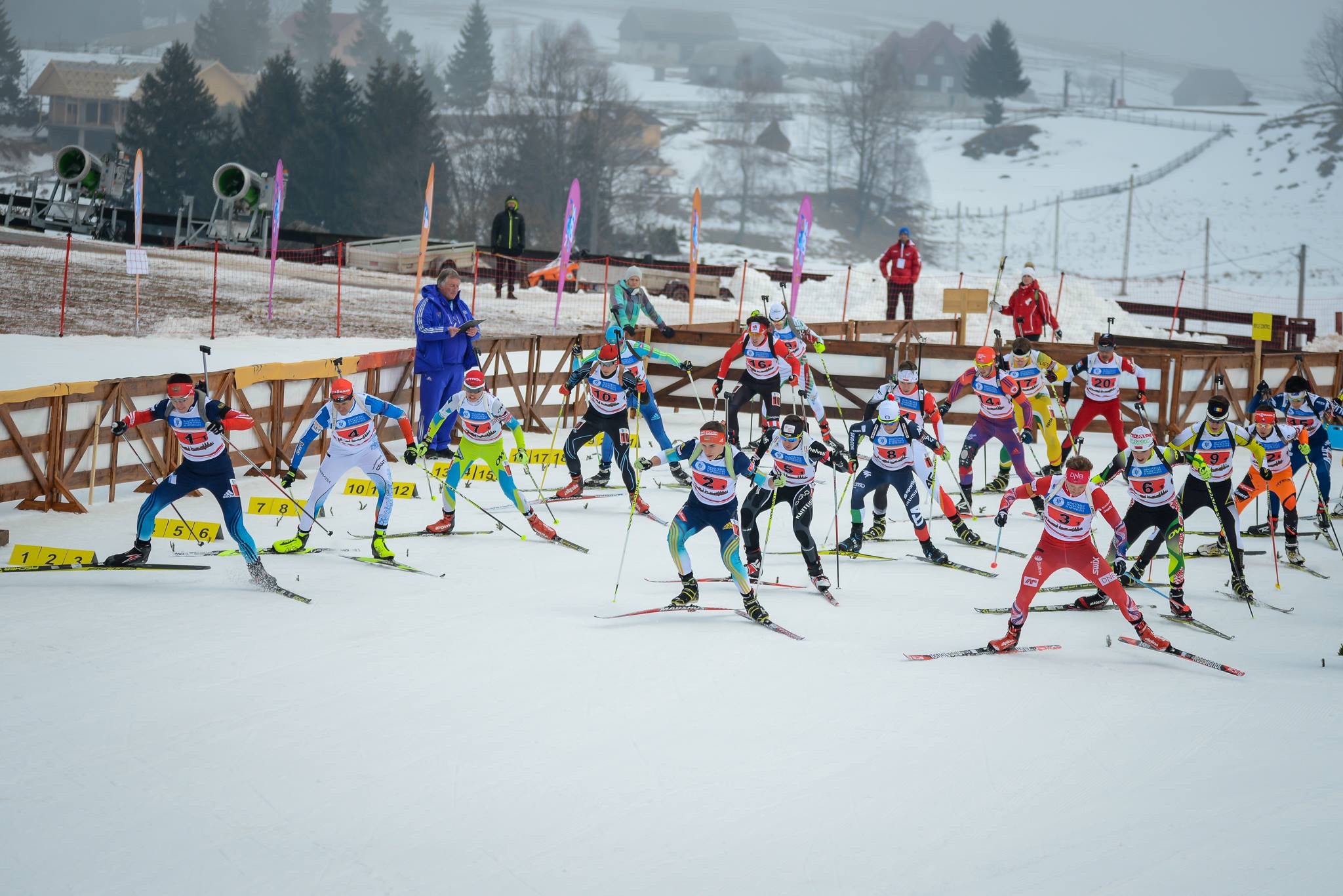
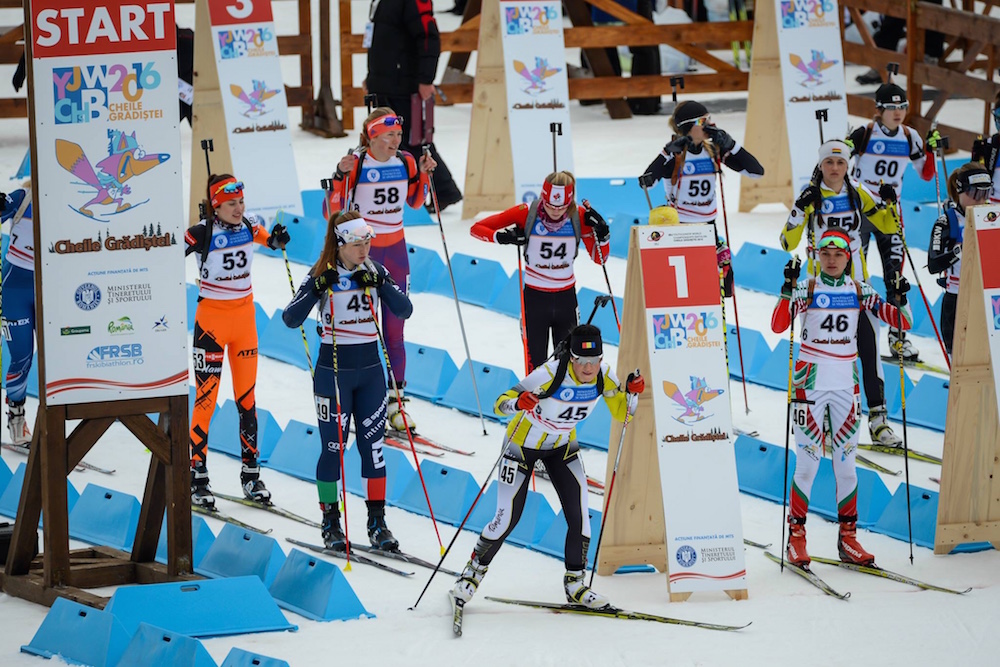
    Start of the junior men's 4 x 7.5 k relay  at IBU Junior World Championships on Tuesday in Cheile Gradistei, Romania. (Photo: IBU YJWCH Cheile Gradistei 2016/Facebook)
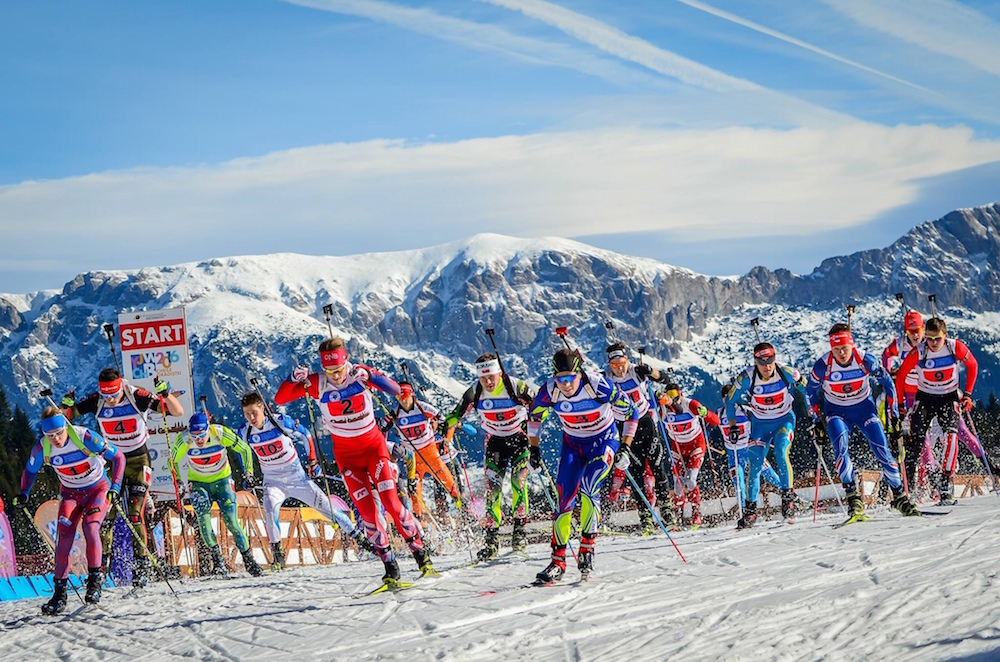
    Start of the junior men’s 4 x 7.5 k relay at IBU Junior World Championships on Tuesday in Cheile Gradistei, Romania. (Photo: IBU YJWCH Cheile Gradistei 2016/Facebook)

    In the junior men’s 4 x 7.5 k relay, the Russians dusted the field by two minutes in 1:23:56.7. All four men (Dmitrii Shamaev, Viktor Plitcev, Nikita Porshnev, and Krill Streltsov) shot flawlessly in prone and everyone but Streltsov cleaned standing without any spares (Streltsov used two — the team’s only spares).

    Germany claimed second (+1:59.6) with eight spares (0+4, 0+4), and the Czech Republic took third (+3:05.8) after using six spare rounds (0+1, 0+5).

    Alex Dupuis (Canada) racing the second leg of the men's 4 x 7.5 k relay at IBU Junior World Championships on Tuesday in Cheile Gradistei, Romania. (Photo: IBU YJWCH Cheile Gradistei 2016/Facebook)
    Alex Dupuis (Canada) racing the second leg of the men’s 4 x 7.5 k relay at IBU Junior World Championships on Tuesday in Cheile Gradistei, Romania. (Photo: IBU YJWCH Cheile Gradistei 2016/Facebook)

    The Canadian men finished 14th (+11:12.1) after skiing eight penalty loops and using 18 spares. Matthew Strum opened with one penalty and five spares (0+2, 1+3) and tagged the team in 16th, Alex Dupuis cleaned both stages, using one spare in prone (0+1, 0+0) to tag off in 14th.

    The Canadians held onto the position from there, despite Aidan Miller skiing five penalty loops and using six spares (3+3, 2+3), then tagging Pearce Hanna in 14th. Hanna shot skied two penalty loops after prone and cleaned standing with three spares (2+3, 0+3) to finish about a minute behind 13th and 19 seconds ahead of 15th.

    According to coach Boruta, top 10 was a reasonable goal for the junior men’s relay.

    “Alexandre Dupuis was the only one who did have a good relay performance…,” Boruta wrote. “Charlotte [Hamel] did have a good day on the range as well, unfortunately her skiing is quite far off of the pace.

    “Overall, all the top 20 (or even 30) placings are very respectable results and we should be happy, that we have at least few athletes who can be at that level,” he reflected on the team’s overall showing at the championships. “The competition is becoming stronger and more nations are in a position for good results.”

    Biathlon Canada doesn’t fund programming for junior or youth athletes, so essentially “there is also no high expectation for their performance,” Boruta explained. “Those athletes are spending around $20,000 – $30,000 a year for the privilege to train full time and represent Canada internationally, but sometimes this makes it frustrating for the coach, because there is no real leverage if there is a need to change their attitude or anything.

    “Our mandate is to develop athletes to such a level that they can make the jump from juniors to seniors and become competitive within a reasonable time frame,” he added, explaining that’s working so far.

    The U.S. men’s team of Paul Everett, Brian Halligan, Brendan Cyr, and Travis Cooper finished 18th of 20 teams, with seven penalties and 17 spare rounds.

    Results: Junior women’s relay | Junior men’s relay

  • Canada Fifth in Youth Men’s Relay at Worlds; Norwegian Men, Russian Women Tops

    Canada Fifth in Youth Men’s Relay at Worlds; Norwegian Men, Russian Women Tops

    Switzerland's Sandro Bovisi (foreground) and Canada's Zachari Bolduc get ready to shoot on the anchor leg of the youth men's 3 x 7.5 k relay at World Youth and Junior Championships.
    Switzerland’s Sandro Bovisi (foreground) and Canada’s Zachari Bolduc get ready to shoot on the anchor leg of the youth men’s 3 x 7.5 k relay at World Youth and Junior Championships. (Photo: IBU YJWCH Cheile Gradistei 2016/Facebook)

    (Note: This article has been updated to include comments from Canadian youth men’s anchor Zachari Bolduc.)

    With all but one day of racing completed at World Youth and Junior Championships in Cheile Gradistei, Romania, the youth men’s relay is sure to be a high point for the Canadian biathlon team.

    Teo Sanchez (Biathlon Quebec), Adam Runnalls (Calgary Biathlon Racers), and Zachari Bolduc (Biathlon Quebec) were in fourth place until late in the 3 x 7.5 kilometer relay, before Bolduc was ultimate passed by a blazing-fast Sandro Bovisi of Switzerland.

    Fifth place, though, was still a solid finish for three first-time World Youth Championships racers. The squad ended the day +3:44.5 behind the wining team from Norway, and their use of just five spare rounds tied them with Russia for the best shooting of the day.

    “After last shooting, it was safe to say that they will have a good race,” trip leader and Biathlon Alberta Training Center coach Richard Boruta wrote in an email. “After solid individual performances of Teo and Adam throughout the week, it has been a possibility that they can do well if they hold their shooting together.”

    The team did just that. Sanchez, who has been in the top 20 in every individual race so far at the Championships, used one spare in each of his two shooting stages and tagged off in seventh, 56.9 seconds behind the team from Ukraine, which was leading at that point.

    “The race was pretty smooth through the start,” Sanchez wrote in an email. “Mass starts are often a mess but this one was clean. I just went for it and ended up right with the top pack coming into the range for the first prone. Everything in this race went pretty well. I think I managed to ski quite well and my shooting was consistent. I only needed to use two spare rounds total.”

    Runnalls also used two spares, one in each stage. While he lost time on the leaders – the Norwegians moved into first and built up a huge time cushion they never relinquished – Runnalls was able to move into fourth by the exchange. The gap to third place and the podium was just 30 seconds.

    “Teo tagged in 8th position and my focus for the first loop was to post a decent ski time and hold my place,” Runnalls wrote in an email. “My first lap is always slower than the rest and I had a few guys skiing right on my tail. I managed to keep them behind me and come into the range with a good lap time.”

    Cody Johnson helping the U.S. youth men's team to 15th place in the 3 x 7.5 k relay. (Photo: IBU YJWCH Cheile Gradistei 2016/Facebook)
    Cody Johnson helping the U.S. youth men’s team to 15th place in the 3 x 7.5 k relay. (Photo: IBU YJWCH Cheile Gradistei 2016/Facebook)

    It was just to Bolduc to close things out. He did one better than his two teammates and used a single spare round, in prone, but the team slipped to fifth.

    “I just used strategy, the guy from Switzerland was faster than me on the second so I let him go beacuse I wanted to be able to do a good standing shooting,” Bolduc wrote in an email. “I pefered to let him go and to clean because in the other case I know that I had had a bad standing shooting. During all my race I just tried to say calm even [when] I was in 4th place.”

    He left the range in fourth for the last time and lost one spot to Switzerland on his final lap. But it was enough to let them leave Romania happy with what they’d done there.

    “I keep my focus and shot clean with no spare!” Bolduc said of his last stage. “I was back in 4th but [Switzerland’s] Bovisi was faster than me and he got on this last lap… I had really wanted to [get] him but I just didin’t have to energy … Anyway 5th is a strong performance at youth world junior even more if we consider that it was a fisrt international competiton for all of our team!”

    “The team felt really really good about the fifth place,” Runnals wrote. “It definitely exceed our expectations. We held our own against the international field and showed that not only are we strong as individuals but we are even stronger as a team. I will take a lot away from this experience, things from race tatics to the way I see home. I had never been to Europe before and also never raced at an international level. I think that both of these new experiences have taught me tons and I will never forget them.”

    That’s what Boruta was hoping for, because the trio will have more shots at Championships racing at the youth or junior level in coming years.

    “I’m pleased with the consistent Youth Men performance, there is some good base there and a hope for the future,” Boruta explained. “Often times, you can tell even in this age whether or not those athletes can make it far when they become older. I have been working with Teo this spring and summer and I think he is confirming here what he is capable of. I know Adam has been quite a fast skier even last year and if he can control his shooting (as he did today in relay), there could be a bright future for him as well.”

    Megan Bankes anchoring the Canadian women's relay. (Photo: IBU YJWCH Cheile Gradistei 2016/Facebook)
    Megan Bankes anchoring the Canadian women’s relay. (Photo: IBU YJWCH Cheile Gradistei 2016/Facebook)

    The Norwegians ultimately won by 39.1 seconds over Russia, with the Italian team finishing third, +2:06.9.

    The American team of Cody Johnson (Maine Winter Sports Center), Vaclav Cervenka (Mount Itasca), and Peter Carroll (Auburn Ski Club) finished 15th, undone by trouble on the range. The trio combined for eleven spare rounds and four penalty loops, all skied by Carroll, and finished 7:59.1 behind Norway.

    In the youth women’s 3 x 6 k relay, Poland was leading until the final leg, where Joanna Jakiela used two spares in prone and then skied two penalty loops in standing, dropping her team off the podium.

    Instead it was Russia who charged from third place to gold on the final leg, with the Czech Republic taking second and Norway third.

    The Canadian team of Emily Dickson, Nadia Moser, and Megan Bankes (all from the Biathlon Alberta Training Center) finished tenth, +3:51.2, with 14 spare rounds and two penalty loops (both by Bankes).

    “I have been also positively surprised with Nadia Moser, who is completely new to this environment, but adjusting quickly,” Boruta wrote. “I am pretty sure we will here more about these girls in next few years. Megan has been skiing here very well. Unfortunately, she is reverting on the shooting range to some of her old habits and not able to perform at the level where she was this fall. It is often the case with young athletes, I would like to think that next year she will come back much stronger.”

    The United States team of Chloe Levins (Mountain Top Nordic), Amanda Kautzer (Loppet Nordic Racing), and Ariana Woods (Bridger Biathlon) was a few minutes behind in 16th, +8:27.3, with eleven spare rounds and five penalty loops.

    Racing concludes on Tuesday with junior men’s and women’s relays.

    “The team was overall working very well together, we didn’t have any real issues with anybody,” wrote Boruta. “I think we did have some of the best skis here for the whole week, special recognition should go to our service team Andy Lesnik, Andrew Chisholm and Martyna Galewicz. Also Rachel Koroscil has done very good job and was helping to keep things running smoothly.”

    Results: youth women | youth men

    The start of the youth men's 3 x 7.5 k relay. (Photo: IBU YJWCH Cheile Gradistei 2016/Facebook)
    The start of the youth men’s 3 x 7.5 k relay. (Photo: IBU YJWCH Cheile Gradistei 2016/Facebook)
  • Doherty Takes Charge and Pursuit Gold in His Last IBU Junior World Championships Race

    Doherty Takes Charge and Pursuit Gold in His Last IBU Junior World Championships Race

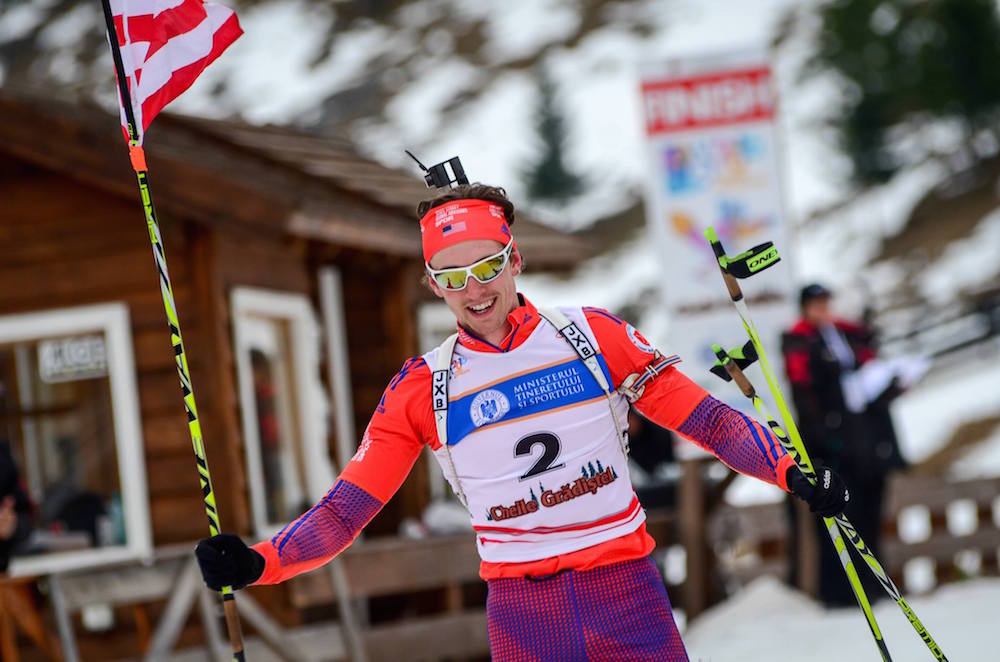
    Sean Doherty (US Biathlon) after winning the final race of his last IBU Junior World Championships in Cheile Gradistei, Romania. It was his 10th career medal in six IBU Youth/Junior World Championships. (Photo: IBU YJWCH Cheile Gradistei 2016/Facebook)
    Sean Doherty (US Biathlon) after winning the final race of his last IBU Junior World Championships in Cheile Gradistei, Romania. In winning the junior men’s pursuit on Sunday, it was his fourth gold and 10th medal in six IBU Youth/Junior World Championships. (Photo: IBU YJWCH Cheile Gradistei 2016/Facebook)

    (Note: This article has been updated to include comments from American Claire Waichler and Canadian Aidan Miller.)

    Imagine a race where you’re in second place for the first half of it, then suddenly, you emerge out of the third of four shooting stages in first (disclaimer: this is a biathlon race), 13 seconds ahead of second place.

    You cruise around the 2.5-kilometer course, entering the range for the fourth and final time, where you hit all five targets and set out on your final loop almost 40 seconds ahead of anyone else.

    What goes through your mind? For US Biathlon’s Sean Doherty, it definitely wasn’t damage control.

    “Let’s lock this up,” he recalled thinking in a phone interview on Sunday after the junior men’s 12.5 k pursuit at IBU Junior World Championships, the final junior race of his career.

    “The pressure kind of changes when you’re in the lead. A lot of people fall into a track where, ‘I don’t want to mess this up.’ That’s the wrong mindset. You’re still in charge,” he said.

    Sean Doherty on his way to securing a nearly 30-second win in Sunday's pursuit at 2016 IBU Junior World Championships in Cheile Gradistei, Romania.
    Sean Doherty on his way to securing a nearly 30-second win in Sunday’s pursuit at 2016 IBU Junior World Championships in Cheile Gradistei, Romania.

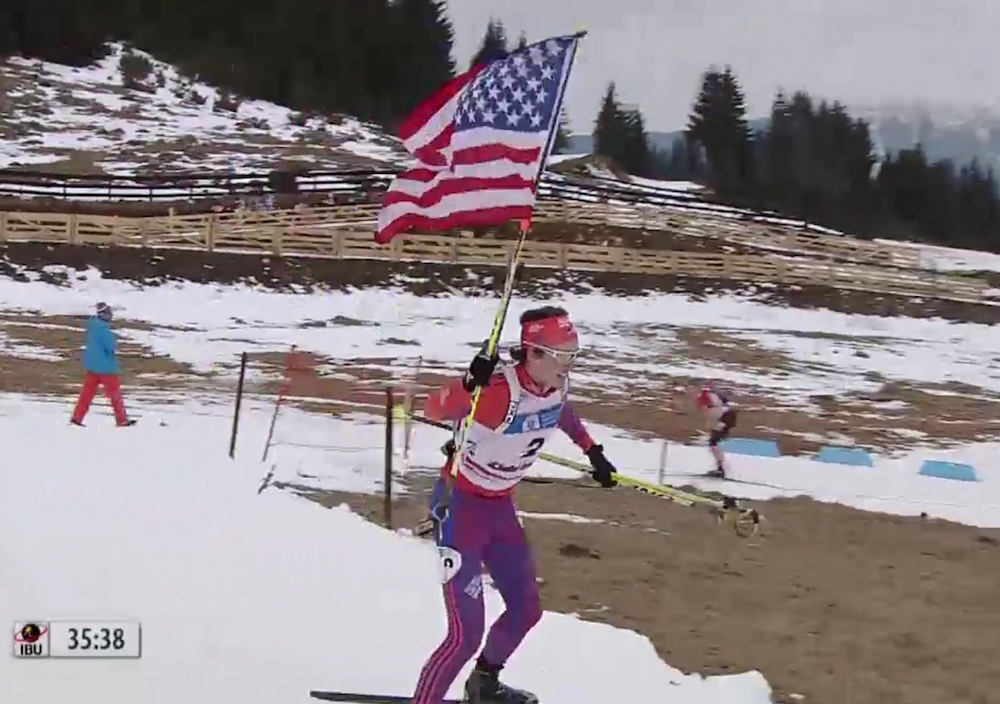
    Doherty, 20, didn’t lose sight of that and raced to his first win of the week in Cheile Gradistei, Romania, with enough time to grab an American flag from a teammate and wave it high above his head as he crossed the finish line in first. That moment meant a lot to him, he said.

    Previously, Doherty had placed third in the 15 k individual and second in Saturday’s sprint, behind Austria’s Felix Leitner, who won both previous races at this year’s worlds. On Sunday, Doherty hit 18 of 20 targets, missing one on his second and third stages, to secure the win by 29.6 seconds over Russia’s Nikita Porshnev in 36:01.1.

    Porshnev had one penalty in the first stage, then three clean stages and the fastest overall course time to rise from 12th at the start to second at the finish. Leitner recovered from three late penalties (0+0+2+1) to land on the podium in third, 38.8 seconds after Doherty.

    Before the flower ceremony, cameras panned on Doherty and Leitner, 19, casually chatting.

    “We’ve been racing together off and on a bit; we’re just kind of buddies,” Doherty explained.

    But do some of the other junior athletes look up to him?

    “I always like to talk and discuss race strategies,” Doherty said. “I’ve been in all sorts of different positions with this stuff.”

    Sunday marked his 10th career medal at IBU Youth/Junior World Championships. He had previously set the all-time record on Saturday with nine medals.

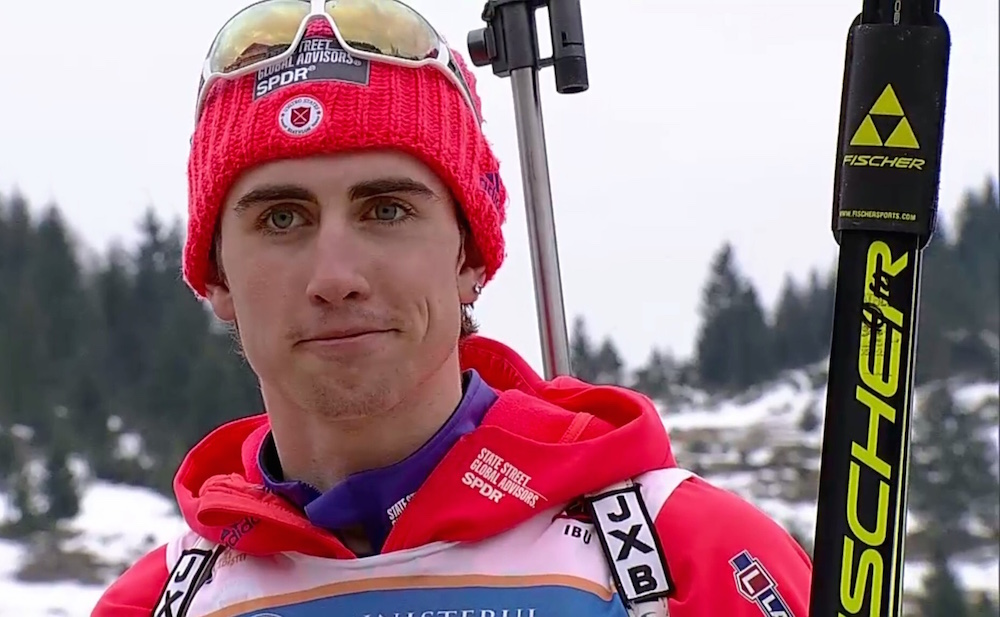
    Sean Doherty before the flower ceremony at IBU Youth/Junior World Championships, where he won the final race of his junior career (the junior men's pursuit)  in Cheile Gradistei, Romania. (Photo: IBU YJWCH Cheile Gradistei 2016/Facebook)
    Sean Doherty before the flower ceremony at IBU Youth/Junior World Championships, where he won the final race of his junior career (the junior men’s pursuit) in Cheile Gradistei, Romania. (Photo: IBU YJWCH Cheile Gradistei 2016/Facebook)

    “I didn’t know I had done it until a good ways after the [sprint] race,” Doherty recalled of becoming the most decorated biathlete at youth/junior worlds. “I was in the press conference [and a reporter] asked the question, and I didn’t know until that point that I had set a new record.”

    When it came down to it, he insisted he was just like every other junior at the championships. He woke up each morning on race days and had to kill time while staying focused until 2:30 in the afternoon. Then, he’d put on his race suit, get into his pre-race routine, and get down to business.

    “I get nervous just like any other human,” Doherty said. “There’s a lot of pressure for these races I just did, and I’m really happy with how I performed with it all, but it’s something that’s not that easy to deal with.”

    “I get nervous just like any other human. There’s a lot of pressure for these races … I’m really happy with how I performed with it all, but it’s something that’s not that easy to deal with.” — Sean Doherty, US Biathlon A-team member and IBU World Cup skier, on podium expectations

    He reached the podium in all three individual races at these championships and started Sunday’s pursuit 12 seconds behind Leitner as the second starter out of the gate. Mostly, Doherty said he focused on his own race and staying confident in his ability to catch Leitner.

    “Even though it’s tempting to charge out of the game and try to catch Felix on the first lap, it’s not smart,” he recalled.

    After cleaning his first prone stage, Doherty missed his first shot of his second prone. That wasn’t ideal, he explained, but he made a point to maintain his energy and keep a good headspace heading into his second loop.

    “That wasn’t damaging, that one miss,” he said.

    Meanwhile, Leitner cleaned the first two stages to remain in the lead, by 21 seconds over Doherty. He entered the range for the third time in first, well enough ahead of Doherty that he had fired off his shots before the American settled in.

    While Doherty knew it was best to focus on himself, he couldn’t help but notice Leitner had missed two in that standing stage.

    “I tried to stay to stay calm and not let what was was going on with him not affect me too much. I got a little excited and kind of jerked the last shot,” Doherty said.

    He missed one, but emerged out of the penalty loop 13.4 seconds before Leitner.

    “I just really wanted to finish the race off and I knew that I could do it,” Doherty said. “I just tried to think of it like training: I’ve done this before and nothing crazy needs to happen right now.”

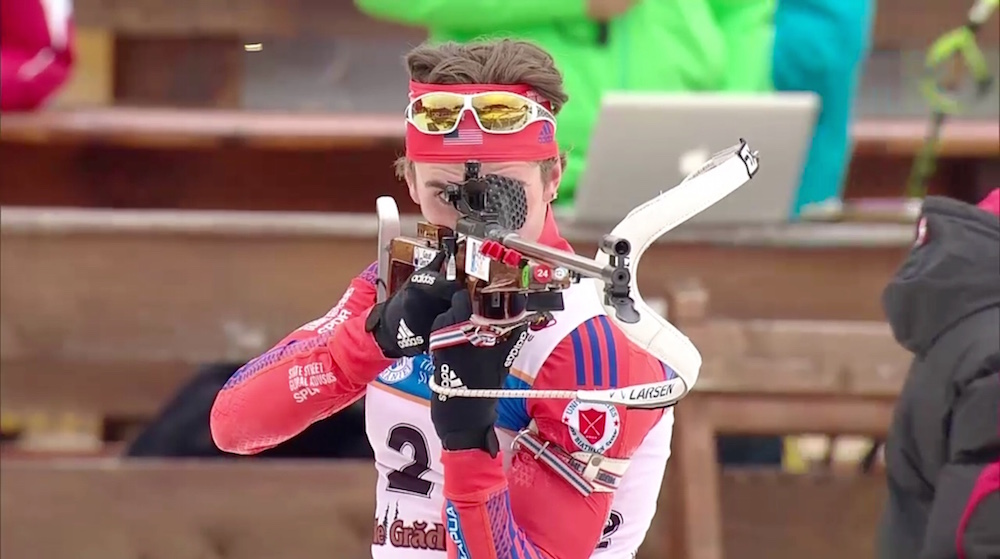
    Sean Doherty (US Biathlon) cleaned his final shooting stage to secure his lead (and ultimately the victory) in the junior men's pursuit at IBU Youth/Junior World Championships in Cheile Gradistei, Romania.
    Sean Doherty cleaned his final shooting stage to secure his lead (and ultimately the victory) in the junior men’s pursuit at IBU Youth/Junior World Championships in Cheile Gradistei, Romania.

    The Austrian went on to miss another in his final standing stage (while Doherty cleaned) to fall to third. Russia’s Porshnev cleaned his last three stages to take hold of second place.

    “This was my biggest comeback because in general, I am not so good with the shooting,” Porshnev said in the post-race press conference. “I was really lucky and I understood that if I want to be in the top I need to shoot well today.”

    Despite missing out on a sweep of the individual races, Leitner said he was happy with third.

    “At the moment I am really tired, but I am very happy with this whole week,” he said in the press conference. “It is like a dream. There are too many great athletes here, and I am happy with my [bronze] medal.”

    For Doherty, capping his junior career with gold in the pursuit was perfect.

    “I really couldn’t have imagined a better ending, really,” he said. “This is the perfect end to my junior career.

    “I’m still pretty over the moon,” he added.

    On Monday, Doherty planned to fly home to New Hampshire, where he’ll spend the next week recovering leading up to the IBU World Cup in Presque Isle, Maine — about a six-hour drive from his hometown. He is skipping Tuesday’s junior relay and the upcoming World Cup in Canmore, Alberta, which starts Thursday.

    (Story continues below)

    Another Top 10 for Phaneuf 

    In the junior women’s 10 k pursuit, 20-year-old Maddie Phaneuf (US Biathlon X-team) started seventh and finished ninth with four penalties (1+0+1+2).

    In fifth after the first prone stage and up to fourth following the second stage, Phaneuf slipped to seventh after a penalty in her first standing, then ninth with two more penalties on the final standing. She finished 2:08.8 behind the winner, Sweden’s Hanna Öberg, who won Saturday’s sprint and started the pursuit first, 1 second ahead of Switzerland’s Lena Häcki.

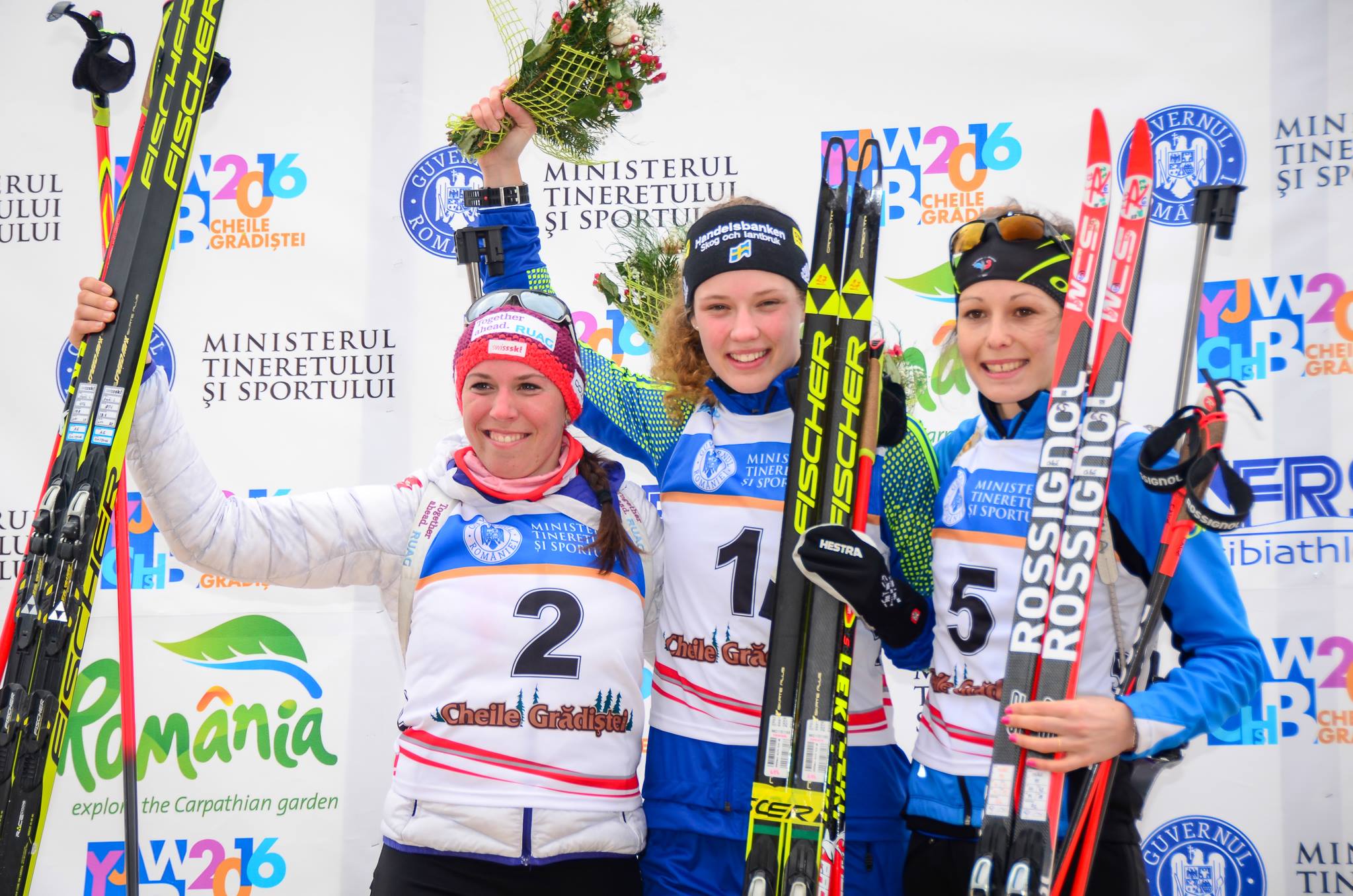
    The junior women's pursuit podium, with winner Hanna Öberg (c) of Sweden, Switzerland’s Lena Häcki (l) in second, and France’s Chloe Chevalier (r) in third. (Photo: IBU YJWCH Cheile Gradistei 2016/Facebook)
    The junior women’s pursuit podium, with winner Hanna Öberg (c) of Sweden, Switzerland’s Lena Häcki (l) in second, and France’s Chloe Chevalier (r) in third. (Photo: IBU YJWCH Cheile Gradistei 2016/Facebook)

    While Öberg cleaned the four-stage pursuit to win in 33:16.8, Häcki finished second, 13.7 seconds back, with six penalties (0+2+3+1) and the fastest overall course time by just over a minute.

    “I felt crazy good on the skis today, it just went all by itself,” Häcki said during a post-race press conference. “After the three misses in the third shooting, it was then very difficult for me. But after I got the info from my coaches that I was still on course for the medals, I could really turn it up again.”

    “I couldn’t believe I get the second gold medal in a row,” Öberg said, according to the event organizers’ Facebook page. “I was so tired during the race today. Lena is so great on skiing. I was not nervous on the shooting range and like yesterday, I was confident.”

    France’s Chloe Chevalier rose from fifth to third (+41.9) with two penalties, both in the first stage (2+0+0+0).

    “I am really happy to be on the podium,” Chevalier said. “After my first shooting it was very hard, but I was very motivated today so after that I did zero mistakes.”

    Maddie Phaneuf racing at 2016 IBU Junior World Championships in Cheile Gradistei, Romania, where she notched three consecutive top 10 results. (Photo: IBU YJWCH Cheile Gradistei 2016/Facebook)
    Maddie Phaneuf racing at 2016 IBU Junior World Championships in Cheile Gradistei, Romania, where she notched three consecutive top 10 results. (Photo: IBU YJWCH Cheile Gradistei 2016/Facebook)

    Phaneuf explained in an email to FasterSkier that she was hoping to reach the top six and flower ceremony that came with it for the second time this week. She placed fifth in the 12.5 k individual.

    “But I also just wanted to stay in the top ten!” she wrote on Sunday. “I found myself consistently in around 5th place throughout the race. I was not happy with missing one in my first prone, but glad to be skiing fast and holding my positions.”

    Despite feeling tired during the second half of the race, Phaneuf posted the sixth-fastest course time on the last loop.

    “I just tried to ski hard and not let any girls pass me,” she wrote. “I was skiing mostly alone on that loop I think, I didn’t even know there was a Russian behind me until the last 500 meters before the finish.”

    She held off Russia’s Kristina Reztsova by 3.6 seconds for ninth place, and finished 11.7 seconds out behind Germany’s Christin Maier in eighth. For Phaneuf, it was her third-consecutive top 10 of the week (after placing fifth in the individual and seventh in the sprint).

    “I was really happy and surprised with my results overall,” she wrote. “The training I’ve been doing with [US Biathlon development coach] Jean [Paquet] all year is showing in my skiing and strength and it’s been really great!”

    Also in the junior pursuit, Canada’s Leilani Tam von Burg placed 33rd (+6:13.2) after starting 28th. While the 20-year-old Ottawa native and Chelsea Nordic skier cleaned both prone stages, she missed three between the two standing stages (0+0+1+2). Siena Ellingson placed 50th for the U.S. after starting 48th, ending the day with six penalties (1+1+3+1). Canadian Kendall Chong finished 58th with eight penalties (3+1+3+2) after starting 51st.

    While Doherty was the lone American in the junior men’s pursuit, Aidan Millar led the Canadian men in 37th (+6:00). He improved 18 places with 19-for-20 shooting (0+1+0+0) to post his best result of these championships (his third).

    “I was pretty happy with how the race played out. Especially on the shooting range,” Miller wrote. “Felt pretty strong on my skis but faded a little in the last lap. Overall I was super disappointed with the championships. Going in I wanted a top 10 so obviously didn’t meet that. My shooting was no where near as good as it should have been which was the most disappointing part. Over the week my skiing felt better and better but still not as fast as it needed to be for a top 10.”

    Also for Canada, Matthew Strum finished 47th with four penalties (1+1+0+2) after starting 37th, and Pearce Hanna placed 49th with 11 misses (2+4+3+2), slipping one spot from 48th.

    Three Canadians in Top 20

    Megan Bankes racing to 26th in the women's 6 k sprint at IBU Youth World Championships in Cheile Gradistei, Romania. (Photo: IBU YJWCH Cheile Gradistei 2016/Facebook)
    Megan Bankes racing to 26th in the women’s 6 k sprint at IBU Youth World Championships in Cheile Gradistei, Romania. (Photo: IBU YJWCH Cheile Gradistei 2016/Facebook)

    Three familiar Canadian youth skiers again landed in the top 20: Teo Sanchez in 17th (+4:54.9) and Adam Runnalls in 19th (+5:10.5) in the youth men’s 10 k pursuit, and Megan Bankes in 18th (+3:47) in the youth women’s 7.5 k pursuit.

    The result stood as the second-straight 17th place for Sanchez, 18, of Wakefield, Quebec. He shot 95 percent with a single miss on the first standing stage (0+0+1+0). In all three races this week, Sanchez has shot 90 percent or better.

    “I’m a little disappointed with my result considering my skiing. It was kind of frustrating to shoot so well but not ski very fast,” Sanchez wrote on Sunday. His course time ranked 48th overall.

    “I feel like I could’ve been several spots higher,” he added. “17th place is still nothing to scoff at though. I think overall, three top 20’s is pretty awesome and it shows some pretty good consistency.”

    For Runnalls, 80 percent shooting with four penalties (0+0+3+1) was right where he had been all week.

    “I was a little nervous coming into today because I had never done a ‘real’ pursuit before,” Runnalls, 17, of Calgary, wrote in an email. “In Canada pursuits are usually started with 5 second gaps between starters but here at world juniors we start at the time we finished behind the winner of the sprint. This new style of pursuit was a little intimidating in the start gate.

    “After my second clean prone shooting I tried to keep a clear head and not get ahead of myself,” he explained. “I knew that with 2 clean prones I was in a good spot and need to nail my standing.”

    However, he described overthinking his first standing stage and slowing down too much.

    “I tried too hard to find the perfect shot and didn’t follow my normal pattern, which caused me to only hit 2,” Runnalls wrote. “Coming into my second standing I told myself that this was a do or die moment and to not overthink it, follow my normal pattern which worked out with me hitting 4.

    “I am super excited about my finishes here as it shows I belong here on the international stage,” he added. “I couldn’t be happier with the way I performed and with my overall result.”

    Russia’s Viacheslav Maleev won the youth men’s pursuit in 30:14 after starting third (based on his third-place finish in Saturday’s sprint). He won by well over a minute after overtaking another Russian, the sprint winner Igor Malinovskii and beating him by 1:07.6 after Malinovskii had seven penalties (2+1+2+2).

    Norway’s Harald Øygard, the 12.5 k individual champion, moved up from eighth at the start to third overall (+1:13.4) with two misses (1+0+0+1). Another Norwegian, Aleksander Fjeld Andersen placed fourth (+1:44.1) for the second-straight race.

    Canada's India McIsaac (54) and American Claire Waichler (behind, in bib 58) await their start during the youth women's pursuit at IBU Youth/Junior World Championships in Cheile Gradistei, Romania. (Photo: IBU YJWCH Cheile Gradistei 2016/Facebook)
    Canada’s India McIsaac (54) and American Claire Waichler (behind, in bib 58) await their start during the youth women’s pursuit at IBU Youth/Junior World Championships in Cheile Gradistei, Romania. (Photo: IBU YJWCH Cheile Gradistei 2016/Facebook)

    In the youth women’s pursuit, Kazakhstan’s Ariana Pantova started sixth and cleaned every target but one in her first stage to win her first world title in 27:15.2. Ukraine’s Anna Kryvonos rose from third to second place at the finish, 3.4 seconds back, and Germany’s Marina Sauter reached the podium for the second time this week in third (+1:02.9) after starting 14th. While Kryvonos had three penalties (0+0+1+2), Sauter had two (0+1+0+1).

    Canada’s Bankes missed seven targets (2+1+2+2), but skied the seventh-fastest course time to place 18th. It was her second top 20 of the week, after finishing 19th in the 10 k individual.

    “The goal for today was to continue my fast skiing in order to move up as many places as possible, and focus on hitting more targets,” Bankes wrote in an email. “Because the course and the race are both quite short, fast skiing was necessary, but good shooting was really important, especially in the first bout. My skiing felt pretty strong again today, however the snow on the course was pretty soft, which made my legs quite tired right off the start.”

    She lost track of her position rounding the penalty loop twice after the last stage, and explained she was excited to learn she finished 18th.

    “I knew today that my ski speed would definitely keep me in top 20 contention as long as I could hit a few targets,” she wrote. “Overall I’ve been very pleased with my skiing this week, and it’s nice to see my ski speed progressively get better over the last three years. My main issue this week was my shooting, which I was overall very disappointed with. … On a whole I am super stoked by the results I achieved this week, even if my races weren’t entirely perfect.”

    Six places behind her, another Canadian, Nadia Moser placed 24th (+4:52.4) after starting 19th. Moser had eight misses (1+2+3+2) on the day.

    American Claire Waichler started 58th and finished 33rd in the youth women's pursuit on Sunday at IBU Youth/Junior World Championships in Cheile Gradistei, Romania. (Photo: IBU YJWCH Cheile Gradistei 2016/Facebook)
    American Claire Waichler started 58th and finished 33rd in the youth women’s pursuit on Sunday at IBU Youth/Junior World Championships in Cheile Gradistei, Romania. (Photo: IBU YJWCH Cheile Gradistei 2016/Facebook)

    For the U.S., Claire Waichler picked off 25 places to end up 33rd (+5:29.5) with three penalties (0+1+2+0).

    “This is my first time at world juniors so I was hoping to just have fun and experience competition at a higher level,” Waichler wrote in an email. “My skiing had been going well throughout the week but the shooting had been unusually rough. So my goal for the pursuit was to keep up the skiing and shoot a cleaner race — at least 70%. When I shot 85% and cleaned twice I was stoked.

    “The competition is very strong and being able to chase down foreign girls during the whole race was educational,” she added. “And a top 20 isolate pursuit time was certainly more than I’d hoped for.”

    Canada’s Emily Dickson followed in 35th (+5:48.1) with five misses (0+0+3+2) after starting 41st, Amanda Kautzer of the U.S. slipped three places to 55th with 10 penalties (3+2+2+3) and Canada’s India McIsaac went from 54th to 60th with 13 misses (3+3+4+3).

    Two American men moved up in the pursuit, with Brendan Cyr rising to 35th (+6:49) with three penalties (0+1+2+0) after starting 46th. For the 18-year-old Maine Winter Sports Center biathlete, it was his first top 40 in his debut world championships.

    His teammate Cody Johnson finished 41st (+7:11.1) with two misses (0+2+0+0) after starting 50th.

    “I knew that I had plenty of time that I could make up in the Pursuit,” Cyr wrote in an email after starting in bib 46. “I knew that if I came into the range calm and focused on my own shooting process for each of the stages, while also keeping a good rhythm on the skis, I could put together a top-40 performance.

    “The key to my success on the range was just making sure that every time I came to the mat, I was not rushing any of my process,” he added of his 85-percent shooting. “On the skis, the key for me was just making sure I kept a good rhythm throughout the race, most importantly towards the end.”

    IBU Youth/Junior World Championships conclude with the three-person relays on Monday and Tuesday, with the youth relays on Monday.

    Chloe Levins, Kautzer and Ariana Woods are slated to start the youth women’s 3 x 6 k for the U.S., while Dickson, Moser and Banks represent Canada.

    In the youth men’s 3 x 7.5 k, Johnson, Vaclav Cervenka and Peter Carroll are listed for the U.S., while Sanchez, Runnalls and Zachari Bolduc are on the start list for Canada.

    Pursuit results: Junior men | Junior women | Youth men | Youth women

    Relay start lists: Youth women | Youth men

  • With Ninth Medal, Doherty Makes IBU Youth/Junior Worlds History (with Photos)

    With Ninth Medal, Doherty Makes IBU Youth/Junior Worlds History (with Photos)

    Sean Doherty (US Biathlon) racing to second in the men's 10 k sprint at IBU Junior World Championships in Cheile Gradistei, Romania. It was his ninth career medal in his sixth youth/junior worlds, making him the most decorated junior biathlete at that level of all time. (Photo: IBU YJWCH Cheile Gradistei 2016/Facebook)
    Sean Doherty (US Biathlon) racing to second in the men’s 10 k sprint at IBU Junior World Championships in Cheile Gradistei, Romania. It was his ninth-career medal in his sixth youth/junior worlds, making him the most decorated junior biathlete of all time at that level. (Photo: IBU YJWCH Cheile Gradistei 2016/Facebook)

    Sean Doherty went for it on Saturday and the dividends paid off. The 20-year-old New Hampshire native became the most decorated athlete in the history of IBU Youth/Junior World Championships with his ninth career medal — silver in the junior men’s 10-kilometer sprint in Cheile Gradistei, Romania.

    The 24th starter in a field of more than 100 men, Doherty, a US Biathlon A-team member and 2014 Olympian, established himself as the fastest skier almost immediately on a melting course amid balmy temperatures. By 1.7 k, he had put more than eight seconds into the field in first place. By the end of the first of three loops, he was 15 seconds of his biggest rival for the win: Austria’s Felix Leitner.

    The men's sprint podium at IBU Junior World Championships in Cheile Gradistei, Romania, with Austrian winner Felix Leitner (c), American runner-up Sean Doherty (l) and Germany's David Zobel (r) in third. (Photo: IBU YJWCH Cheile Gradistei 2016/Facebook)
    The men’s sprint podium at IBU Junior World Championships in Cheile Gradistei, Romania, with Austrian winner Felix Leitner (c), American runner-up Sean Doherty (l) and Germany’s David Zobel (r) in third. (Photo: IBU YJWCH Cheile Gradistei 2016/Facebook)

    The winner of Thursday’s 15 k individual race, Leitner started in bib 2 on Saturday. An early leader, he cleaned the first of two stages, then missed one standing, but remained ahead to set the time to beat at the finish in 26:27.1.

    Doherty emerged from the first prone with a single miss. The penalty put him 4.3 seconds behind Leitner heading into his second loop. During the second shooting, Doherty, a bronze medalist on Thursday, missed another in standing. He left the range 8.7 seconds down to Leitner and crossed the finish line in second, 11.5 seconds back.

    The top-two times held firm despite challenges from France’s Emilien Jacquelin, who started 31st, and Germany’s David Zobel in bib 80. Both cleaned prone, and Jacquelin ranked second to Leitner after the first shooting, about two seconds ahead of Doherty. Two penalties in his standing stage dropped the Frenchman to fourth, where he would end up, 46.7 behind Leitner.

    Zobel ended up on the podium with a single standing miss, leaving the range for the last loop in fifth and overtaking Jacquelin and Poland’s Mateus Janik to achieve third (+39.3). Janik slipped from third to 11th on the last loop with the 42nd-ranked course time on that loop.

    In an email, US Biathlon Chief of Sport Bernd Eisenbichler stated he knew Doherty was having another medal-worthy day after the second shooting. After the first stage, he could tell that “only Felix Leitner [had] the ski speed to beat Sean with 0 or 1 penalties today,” he wrote.

    Doherty posted the fastest overall course time by 6.5 seconds over Leitner.

    “He was very aggressive today from the start,” Eisenbichler continued. “This is how you have to go for a Sprint race like today and I was very pleased to see that.”

    This edition of Youth/Junior World Championships is Doherty’s sixth. Over the years, he has won three gold medals, earned four silvers and two bronze.

    “Today’s race was a great sprint for me,” Doherty said in a US Biathlon press release. “I felt really good on the skis and I was able to ski the aggressive type of race that I want to. I’m looking forward to the pursuit.”

    Doherty will start Sunday’s pursuit in second, 12 seconds behind Leitner, who has racked up three world titles in the last two years (including two this week).

    “I think right now I am the happiest men in the world,” Leitner, 19, said in a post-race press conference. “After I missed the [standing target], I was thinking that is going to be harder because it was so hot, but I knew I am in a good shape and I thought I could get a medal. It is going to be interesting tomorrow.”

    During the press conference, Doherty complimented the race organizers for their ability to deal with well-above freezing conditions this week. On Thursday, temperatures were around 7 degrees Celsius (45 Fahrenheit) under sunny skies.

    “The people from Cheile Grădiștei did a great job preparing the tracks,” he said. “This weather has been very warm, but the conditions were quite good today and I think it was a great day for racing. I feel great and my shape is really good I am really excited for tomorrow.”

    Zobel will start third in the pursuit, 27 seconds after Doherty.

    “It was a tough race, but I think I did my best and I am really happy with the third place,” the German said of the sprint in the press conference. “I nearly died at my last loop.”

    Sunday’s pursuits are the final individual races of the 2016 championships. Relays will follow on Monday and Tuesday.

    Top 7 for Phaneuf

    Maddie Phaneuf during her second shooting stage on Saturday at the women's 7.5 k sprint at IBU Junior World Championships in Cheile Gradistei, Romania. She placed seventh overall.
    Maddie Phaneuf during her second shooting stage on Saturday in the women’s 7.5 k sprint at IBU Junior World Championships in Cheile Gradistei, Romania. She placed seventh overall.

    In the junior women’s 7.5 k sprint, Maddie Phaneuf came within 0.9 seconds of her second-straight flower ceremony (top six) in seventh, 36.9 seconds behind the winner and 24.5 seconds off the podium.

    Phaneuf (US Biathlon X-team) started ninth, and proceeded to clean prone and miss one standing to initially finish third behind France’s Chloe Chevalier (bib 6) and Ukraine’s Anastasiya Merkushyna (bib 4), respectively.

    The 29th starter, Hanna Öberg of Sweden ultimately topped the field in 21:18.1 with perfect 10-for-10 shooting. She bumped Switzerland’s Lena Häcki in bib 11 out of first at the finish by 0.6 seconds for the win. Häcki took second despite two penalties (0+2) and another Swede, Anna Magnusson placed third (+12.4) with one miss (0+1).

    France’s Lena Arnaud cleaned for fourth (+28.2), Chevalier placed fifth (+35.9) and Merkushyna was sixth (+36.0).

    Overall, Phaneuf’s course time ranked ninth. The result was her third best in her third-and-final youth/junior worlds. Coming into these races, she explained in a previous email she had hoped to finish in the top 10.

    “The skiing is on a good level now and the shooting was before already,” Eisenbichler observed of Phaneuf. “Before she had to rely on her shooting to make a good result, but now she is a more complete biathlete. Still a lot of work to do, but very much on the right way.”

    Neither Doherty nor Phaneuf could be reached for comment on Saturday.

    The women's sprint podium at IBU Junior World Championships in Cheile Gradistei, Romania: with Swedish winner Hanna Oeberg  (c), Swiss runner-up Lena Haecki (l) and Sweden's Anna Magnusson (r) in third. (Photo: IBU YJWCH Cheile Gradistei 2016/Facebook)
    The women’s sprint podium at IBU Junior World Championships in Cheile Gradistei, Romania: with Swedish winner Hanna Oeberg (c), Swiss runner-up Lena Haecki (l) and Sweden’s Anna Magnusson (r) in third. (Photo: IBU YJWCH Cheile Gradistei 2016/Facebook)

    For Öberg, it was her first individual podium in five youth/junior worlds.

    “I wasn’t so nervous on the shooting range but on the last shoot I had to take an extra breath,” she said in the post-race press conference. “I was a little bit tired with the skiing. I knew at the beginning of the last loop that I have a few extra seconds but I didn’t know that the finish is going to be so tight. I am so happy I can’t believe it.”

    Six-tenths of a second short of first, Häcki told the Swiss Ski Federation that she knew it was going to be close on the final loop. Her medal was the first for Switzerland at Junior World Championships since Benjamin Weger placed second in the 2009 sprint in Canmore, Alberta.

    “My coaches informed me after the shooting that I only had a 15-second deficit to first place,” Häcki said. “I gave it all I had, but Hanna was a little faster than me in the end. But I won the second place and did not lose the first.”

    With one miss, Magnusson, who started six places behind Häcki, sat in second with one loop to go. However, the Swede failed to match Häcki’s time, finishing 11.8 seconds behind her in third.

    “I am really happy to be on the podium and especially with Hanna,” Magnusson said in the press conference. “We are both from the same small town from Sweden.”

    ‘It’s possible!’

    The U.S. team’s second junior woman, Siena Ellingson finished 48th (+3:41.9) with four penalties (2+2). Paul Everett was 62nd in the men’s race with three misses (2+1), followed by Travis Cooper in 86th with seven penalties (4+3), and Brian Halligan in 92nd with six misses (2+4).

    “Sean and Maddie showed the other US starters what’s possible of American athletes and that’s really important,” Eisenbichler wrote. “Needs very hard work to get there, but it’s possible!”

    For Canada, Leilani Tam von Burg led the team with her second-straight top 30 with a career best 28th (+2:18.8) with one miss (0+1). Kendall Chong placed 51st (+3:58.7) with the same 0+1 shooting, and Charlotte Hamel was 62nd with two misses (1+1). Caitlin Campbell did not finish.

    Matthew Strum was the top Canadian male in 37th (+2:37.1) with two penalties (0+2). Pearce Hanna was 48th (+3:06.9) with three misses (2+1), Aidan Millar 55th (+3:39.3) with five misses (2+3), and Alex Dupuis 69th with five misses as well (2+3).

    Results: Women’s 7.5 k sprint | Men’s 10 k sprint

    Start lists: Junior women’s pursuit | Junior men’s pursuit

  • Sanchez’s Second-Straight Top 20, Moser 19th for Canada in IBU Youth Worlds Sprint

    Sanchez’s Second-Straight Top 20, Moser 19th for Canada in IBU Youth Worlds Sprint

    Megan Bankes racing to 26th in the women's 6 k sprint at IBU Youth World Championships in Cheile Gradistei, Romania. (Photo: IBU YJWCH Cheile Gradistei 2016/Facebook)
    Megan Bankes racing to 26th in the women’s 6 k sprint at IBU Youth World Championships in Cheile Gradistei, Romania. (Photo: IBU YJWCH Cheile Gradistei 2016/Facebook)

    Note: This article has been updated to include comments from Canada’s Adam Runnalls as well as photos of the American men.

    The snow is melting in Cheile Gradistei, Romania, and it’s melting fast as organizers work to cover parts of the track with manmade snow, but the Canadians seem to be handling it just fine.

    For the second-straight youth race at the International Biathlon Union (IBU) Youth/Junior World Championships, three Canadians landed in the top 21 and one more was within the top 30 on Friday. Teo Sanchez recorded his second top 20 in as many races so far, placing 17th in the men’s 7.5-kilometer sprint on Friday after taking 13th in Wednesday’s 12.5 k individual.

    “I was feeling ready for it, but still nervous,” Sanchez, 18, of Wakefield, Quebec, wrote in an email about Friday’s race — his second ever at a world championships.

    After a clean prone, he finished out the sprint with one penalty in the standing stage. His goal coming into the race had been perfect 10-for-10 shooting, and he ended up 9-for-10, still “as a whole, good,” he wrote.

    “Unfortunately my legs were shaking a bit during my standing shooting and that caused me to miss my second last standing target,” Sanchez explained. “I felt really strong skiing but I need to loosen up a bit and get my technique more together.

    “I think 17th in the world is a pretty good result,” he added. “I think it will put me in a good place for the pursuit [on Sunday] as I’ll have lots of people to ski with while I’m racing. Pursuits are my strongest race format, I love the chasing and being chased. My goal will be to match my shooting score in the individual [18/20], and to transition between techniques as smoothly as possible.”

    In the men’s race, Adam Runnalls, who placed 17th on Wednesday, finished 21st in Friday’s sprint with two standing misses. Coming into these championships, Runnalls explained he had not hit more than 70 percent of his targets in any race.

    “80% shooting has always been a bench mark for me. I gives me some where to set my sights (literally) when shooting other than just wanting to shoot clean,” Runnalls wrote in an email, after his second-straight race shooting 80 percent. “Today though I feel that 80% was a little disappointing. Having shot clean in the prone I wanted to shoot a little better in the standing because I felt that another clean shooting was not out if reach I was just not able to get it.

    “I fell apart mentally in my standing shooting predicting the outcome before I began shooting,” he continued. “As I was skiing and before the first shot all I could think was clean, clean, clean and that’s where it all went wrong. So 80% was not a bad shooting for the day just a bit disappointing.”

    Friday’s sprint marked his second top 21 in his debut world championships.

    “I felt really good about my result today just barley missing the top 20,” Runnalls wrote. “When I came across the line I was in the 7th position and was slowly dropping down into the high teens. As I was watching my placing drop all I could think about was what would have happened if I had kept a clear head and hit one more target. But all and all I was happy with the result.”

    “Teo and Adam … proved that biathlon is a complex sport and that you need good skiing and shooting combined together in order to do well,” Canadian trip leader Richard Boruta wrote in an email. “I know that Teo is pretty good shot and he is showing this here as well, Adam has been good skier in a last year or two, but he will need to improve especially his standing shooting if he wants to become a really successful biathlete. I think they perform at a level where they are comfortable with and chances are that their Pursuit performance will be also close to those results.”

    The youth men's podium (and top six) at the flower ceremony on Friday at IBU Youth World Championships in Cheile Gradistei, Romania: 1. Russia's Igor Malinovskii (11), 2. Norway's Endre Strømsheim (77), 3. Russia's Viacheslav Maleev (81), 4. Norway's Aleksander Andersen (48), 5. France's Morgan Lamure (12), 6. Sweden's Sebastian Samuelsson (5).  (Photo: IBU YJWCH Cheile Gradistei 2016/Facebook)
    The youth men’s podium (and top six) at the flower ceremony on Friday at IBU Youth World Championships in Cheile Gradistei, Romania: 1. Russia’s Igor Malinovskii (11), 2. Norway’s Endre Strømsheim (77), 3. Russia’s Viacheslav Maleev (81), 4. Norway’s Aleksander Andersen (48), 5. France’s Morgan Lamure (12), 6. Sweden’s Sebastian Samuelsson (5). (Photo: IBU YJWCH Cheile Gradistei 2016/Facebook)

    On Friday, Sanchez finished 2:20.4 behind the winner, Russia’s Igor Malinovskii, who tallied his first youth worlds victory (and podium) in 20:32.9, despite one prone miss (1+0). Runnalls finished 2:43.1 back.

    Norway’s Endre Strømsheim claimed second, 26.3 seconds back, after cleaning all his targets for his first world championships podium as well. Just over a second later, another Russian, Viacheslav Maleev took the third spot on the podium (+27.4) with one miss in each stage (1+1).

    Norway’s Aleksander Fjeld Andersen was 17.2 seconds away from his second-straight podium, placing fourth, 44.6 seconds behind Malinovskii.

    Moser Climbs to Career-Best 19th

    In the youth women’s 6 k sprint, Canada’s Nadia Moser shot 9-for-10 to take 19th, 1:32 behind the winner, for her best result at worlds by nearly 30 places. She finished 47th in Wednesday’s individual with eight penalties. On Friday, the 18-year-old Canmore resident missed one in prone and cleaned standing.

    “Nadia has been showing really strong training performances lately and it has been just matter of time before she will gain the confidence to show the same in an important race,” Boruta reflected. “She felt good skiing and also her skis were quite fast and combined with solid shooting performance it has all helped to achieve first great result.”

    “I felt good skiing and … I always strive for strong shooting,” Moser said in a Biathlon Canada press release. “The course was hard and the conditions were challenging because some parts of the downhills were icy. Overall, I’m happy with how I competed and looking forward to the pursuit race.”

    After placing 19th on Wednesday with seven penalties, another Canadian, Megan Bankes finished 26th in the sprint with five misses — two in prone and three in standing. Her course time was fifth fastest out of 91 women on Friday.

    “Having good skiing Wednesday definitely gave me confidence to see what I am capable of this week, and I have been stoked with my skiing performances in both races,” Bankes wrote in an email. “I certainly need to work on my shooting in the races, but I am confident in my training and know that everything will come together.”

    The youth women's sprint podium (and top six) at the flower ceremony on Friday at IBU Youth World Championships in Cheile Gradistei, Romania: 1. Norway's Karoline Erdal (2), 2. Norway's Emilie Kalkenberg (72), 3. Ukraine's Anna Kryvonos (26), 4. Czech Republic's Marketa Davidova (4), 5. France's Lou Laurent Jeanmonnot (51), 6. Kazakhstan's Arina Pantova (38). (Photo: IBU YJWCH Cheile Gradistei 2016/Facebook)
    The youth women’s sprint podium (and top six) at the flower ceremony on Friday at IBU Youth World Championships in Cheile Gradistei, Romania: 1. Norway’s Karoline Erdal (2), 2. Norway’s Emilie Kalkenberg (72), 3. Ukraine’s Anna Kryvonos (26), 4. Czech Republic’s Marketa Davidova (4), 5. France’s Lou Laurent Jeanmonnot (51), 6. Kazakhstan’s Arina Pantova (38). (Photo: IBU YJWCH Cheile Gradistei 2016/Facebook)

    She finished 2:14.8 behind the winner, Norway’s Karoline Erdal, who started in bib 2 and held off all challengers to take the victory in 18:17.7.

    Norway dominated the top two with Emilie Aagheim Kalkenberg in second (+28.5), and Ukraine’s Anna Kryvonos four seconds behind in third (+32.4) after a downhill crash on the final loop cost her more than 20 seconds and second place, according to an IBU press release.

    Six seconds out of third, Marketa Davidova of the Czech Republic missed her second-consecutive podium (after placing third on Wednesday) in fourth with two misses (0+2).

    All three podium finishers cleaned prone and missed one in standing (0+1). Just two women in the top 20 cleaned both stages: Austria’s Tamara Steinar, who finished eighth, and Kazakhstan’s Yevgeniya Krassikova in 16th.

    “It was hard, but it is really nice to finish first,” Erdal said in the post-race press conference. “I am really happy with the shooting. It was a good race and I am really satisfied. I don’t know yet what I am going to do in pursuit. I am starting first so I just need to do my own race and focus on my work.”

    According to Bankes, the course in Cheile Gradistei — a mountain resort about 3,000 feet above sea level — “is pretty hard, but quite fun to race on, with a couple steep uphills and some technical downhills,” she explained. “The snow conditions have been pretty good as the organizers have worked very hard to insure there is adequate snow, with some warmer temperatures.”

    Also for Canada, Emily Dickson placed 41st (+2:48.7) with two standing penalties. India McIsaac was 54th (+3:27.8) with five misses (1+4). In the men’s race, Zachari Bolduc also had five misses (2+3) and finished 65th. Lucas Boudreau was 76th with three penalties (1+2).

    Brendan Cyr was the top American in 46th, finishing 3:39.5 behind the men’s winner with three penalties, all of which came in standing (0+3). Cody Johnson placed 50th in the same race (+3:47.5) with two misses (1+1), Peter Carroll was 69th with four misses (2+2), and Vaclav Cervenka was 72nd with five misses (2+3).

    In the women’s race, Amanda Kautzer led the U.S. in 52nd (+3:24.2) with three penalties (1+2), Claire Waichler was 58th (+3:45.6) with five misses (2+3), Chloe Levins 65th with five misses, and Ariana Woods 76th with five penalties as well (1+4).

    Results: Youth women’s sprint | Youth men’s sprint

  • Three Canadians in Top 20; IBU Youth/Junior Worlds Open in Romania (with Photos)

    Three Canadians in Top 20; IBU Youth/Junior Worlds Open in Romania (with Photos)

    American Amanda Kautzer (62) leads eventual winner Marina Sauter of Germany (42) during the youth women's 10 k individual at 2016 IBU Youth World Championships in Cheile Gradistei, Romania. Klutzier was the top American woman in 59th. (Photo: US Biathlon/NordicFocus/ Facebook)
    American Amanda Kautzer (62) leads eventual winner Marina Sauter of Germany (42) during the youth women’s 10 k individual at 2016 IBU Youth World Championships on Wednesday in Cheile Gradistei, Romania. Kautzer was the top American woman in 59th. (Photo: US Biathlon/NordicFocus/ Facebook)

    Note: This article has been updated to include comments from Canada’s Teo Sanchez and Adam Runnalls.

    Three Canadians in the top 20? Not a bad first day, considering it took them 38 hours to get to Cheile Gradistei, Romania, no thanks to a flight cancellation.

    All that behind them, two Canadian junior males and a female recorded the best races of their careers on the opening day of IBU Youth World Championships on Wednesday.

    “The first day of competition is always an exciting one as everyone has been raring to go,” Biathlon Canada High Performance Eric de Nys wrote in an email. “I know our travel to Romania was very long and difficult … So, to see that athletes end up where they did is very encouraging.”

    The women raced first in heavy fog, which initially postponed the youth women’s 10-kilometer individual race by 1 1/2 hours. Once they got off the start line, with 91 women heading out at 20-second intervals, 18-year-old Marina Sauter of Germany emerged as the winner in her international debut.

    Two weeks ago, Sauter told her hometown paper she was surprised to have made the team. She missed all of last season after having surgery on her foot and ankle joint.

    “After the surgery it was difficult,” Sauter said. “I could not jog or train on the track. Usually I just biked or rollerskied alone. I was still in pain after long distances. That’s why I was surprised myself by the performance level that was already possible this winter.”

    At her first world championships, she was hoping to validate her results from the German trials.

    “I just want to have good competitions,” she said at the time.

    On Wednesday, she won the 10 k individual by 2 seconds over France’s Myrtille Begue. Sauter had two penalties — each adding a minute to her time — but no one in the women’s field shot clean. She won in 35:14.2, Begue had two penalties as well en route to second, and Marketa Davidova (Czech Republic) had three misses and reached the podium in third (+12.7).

    Among the North Americans, Megan Bankes, 18, of Foothills Nordic, notched her first top 20 in her third IBU Youth World Championships in 19th (+3:21) despite seven misses (1+4+1+1).

    “Megan Bankes had a fantastic result in 19th considering she missed 7, this shows she is skiing fast,” de Nys wrote.

    In the men’s 15 k that followed, Canada’s 18-year-old Teo Sanchez (Chelsea Nordiq) placed 13th in his first international race. He had two misses, both in the first prone stage, then three clean stages to end up with just two total penalties and was 4:03.6 behind the winner.

    “After the first stage my coach gave me a correction for the wind, two clicks left on my sights and I cleaned the rest of my shooting,” Sanchez wrote in an email. “My goals for these championships were simply to keep a clear head through it all and just race like I normally do. I didn’t want any drama for my first international race, and I avoided that quite nicely. For me, just being excited and having fun is how I keep my performance where it needs to be.

    “So far this has been one of the most amazing experiences of my life,” he added. “Cheile Gradistei is beautiful and the race trails are really fun, though quite technical.”

    Another Canadian, 17-year-old Adam Runnalls (Calgary Biathlon Racers) placed 17th (+4:50.4) with four misses (1+2+0+1) in his first world championships.

    “I had really no idea what to expect and where my skills would land me,” Runnalls wrote in an email. “During the first race I tried to focus on the metal aspect of shooting, something I have been recently struggling with and it worked out.

    “I was happy with all aspects of my race, skiing was nearly perfect and shooting was where it needed to be to stay competitive,” he continued. “I would say that all aspects of my plan came together and a top 20 was the result.”

    “Teo and Adam had good all around races shooting well and skiing within the top 20,” de Nys wrote. “Zachari [Bolduc] also shot well and his skiing started slow but he was getting quicker with each bout of skiing.”

    Bolduc, 17, of Biathlon La Poursuite, placed 31st (+5:44.7) with three clean stages and two penalties in his second stage (0+2+0+0).

    The youth men's 15 k individual podium at 2016 IBU Youth World Championships in Cheile Gradistei, Romania, with Norwegian winner Harald Øygard (c), Aleksander Fjeld Andersen (l) of Norway in second, and Italy's Michael Durand (r) in third. (Photo: Norges Skiskytter Forbund)
    The youth men’s 15 k individual podium at 2016 IBU Youth World Championships in Cheile Gradistei, Romania, with Norwegian winner Harald Øygard (c), Aleksander Fjeld Andersen (l) of Norway in second, and Italy’s Michael Durand (r) in third. (Photo: Norges Skiskytter Forbund)

    Also in his first international race, Norway’s Harald Øygard won the youth men’s individual in 37:00.3 with a single penalty in the second stage. The Norwegians took the top two spots on the podium with Aleksander Fjeld Andersen in second place (+40.8) with one miss, and Italy’s Michael Durand was the only man out of 95 finishers to shoot clean and ended up third (+1:10).

    “This was great fun and something I did not expect!” Øygard said in a Norwegian team press release, according to a translation. “I debuted internationally today, and just went out to do my duties and have fun. But then worked out everything on the firing line and the track, and besides, I had fantastic skis.”

    Following two teammates in the top 20 and one just outside the top 30, Canada’s fourth man, Lucas Boudreau placed 66th with a clean first stage and three total penalties (0+1+1+1).

    Leading the U.S., Cody Johnson finished 43rd (+7:17.3) with three misses as well (0+2+0+1). The U.S. men took 67th through 69th with Vaclav Cervenka in 67th with nine misses (1+3+3+2), Peter Carroll in 68th with seven misses (2+3+1+1), and Brendan Cyr in 69th with seven misses (2+0+2+3).

    In the women’s race, Canada’s Emily Dickson placed 36th (+5:04.7) with four penalties (1+1+1+1), Nadia Moser finished 47th with eight misses (1+1+3+3), and India McIsaac was 74th with 12 misses (2+2+4+4).

    For the U.S., Amanda Kautzer placed 59th with six penalties (0+2+1+3), Claire Waichler was 67th with 10 misses (3+3+2+2), Chloe Levins 72nd with eight misses (1+2+1+4), and Ariana Woods 79th with 12 misses (3+2+3+4).

    Results: Youth Women’s 10 k Individual | Youth Men’s 15 k Individual