From the FasterSkier archive — posts syndicated from athletes’ and coaches’ own blogs between 2004 and 2012, kept online as published. Current coverage is at fasterskier.com.
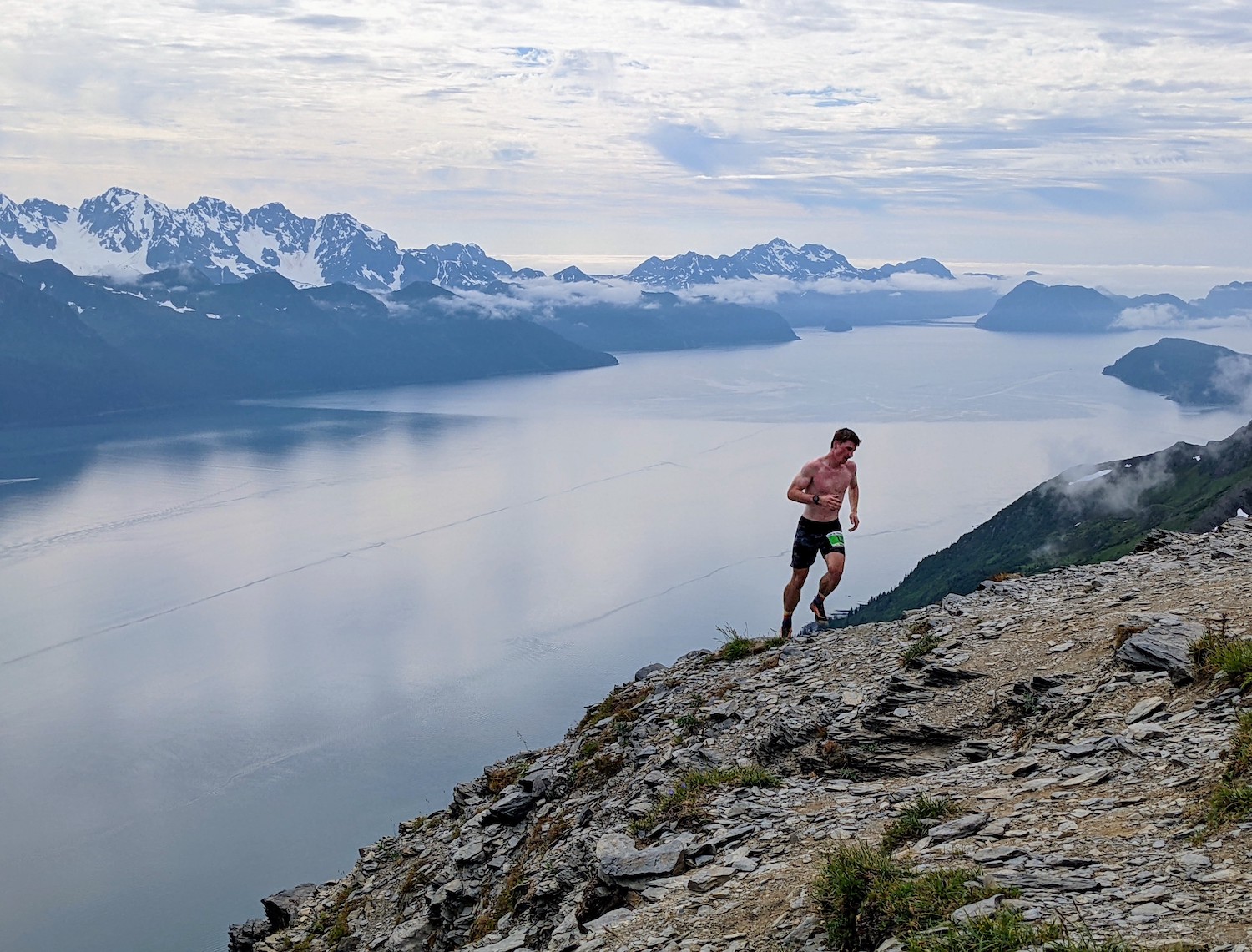
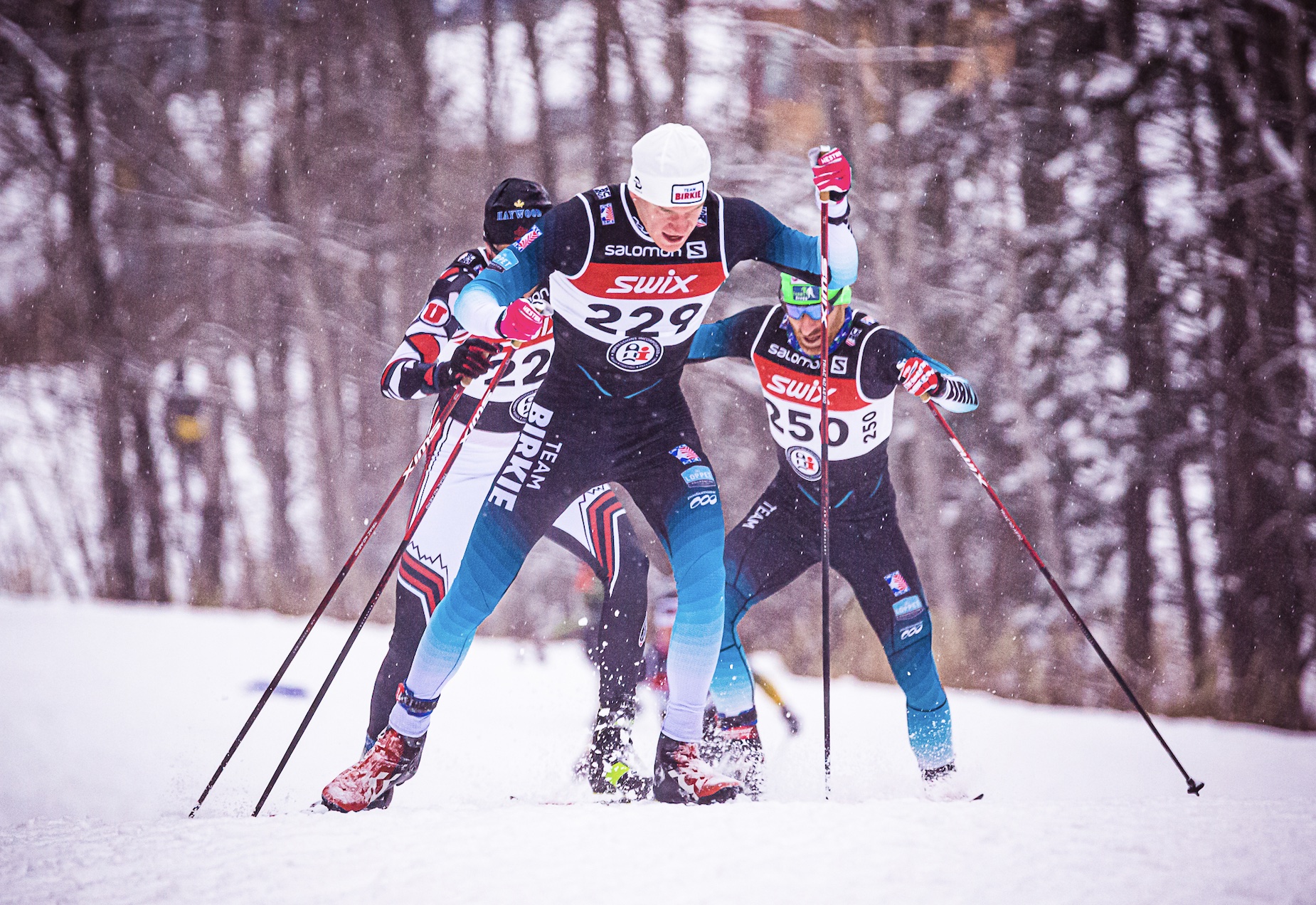
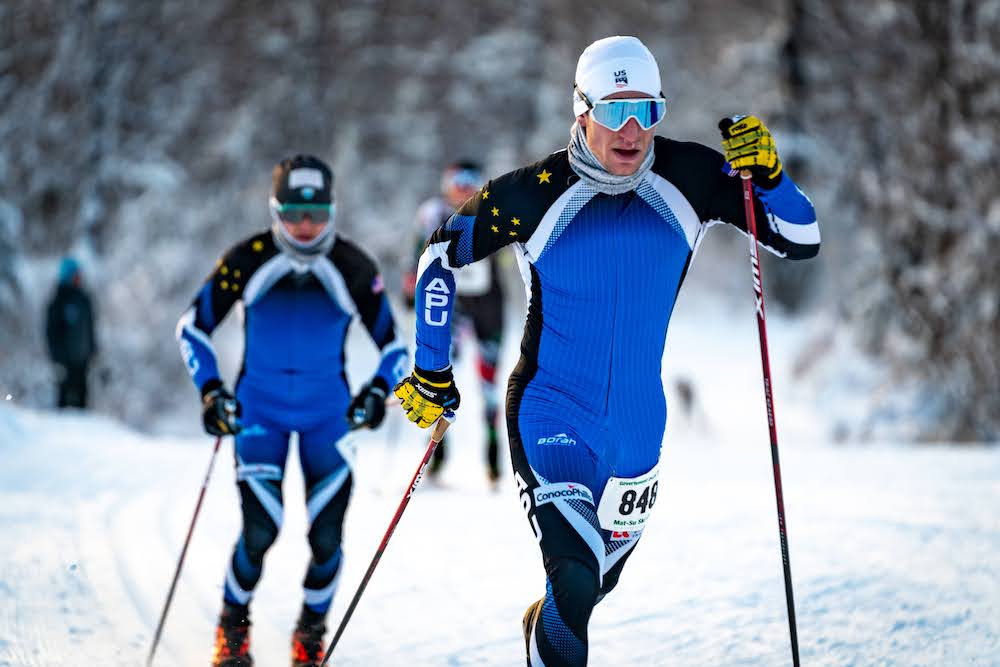
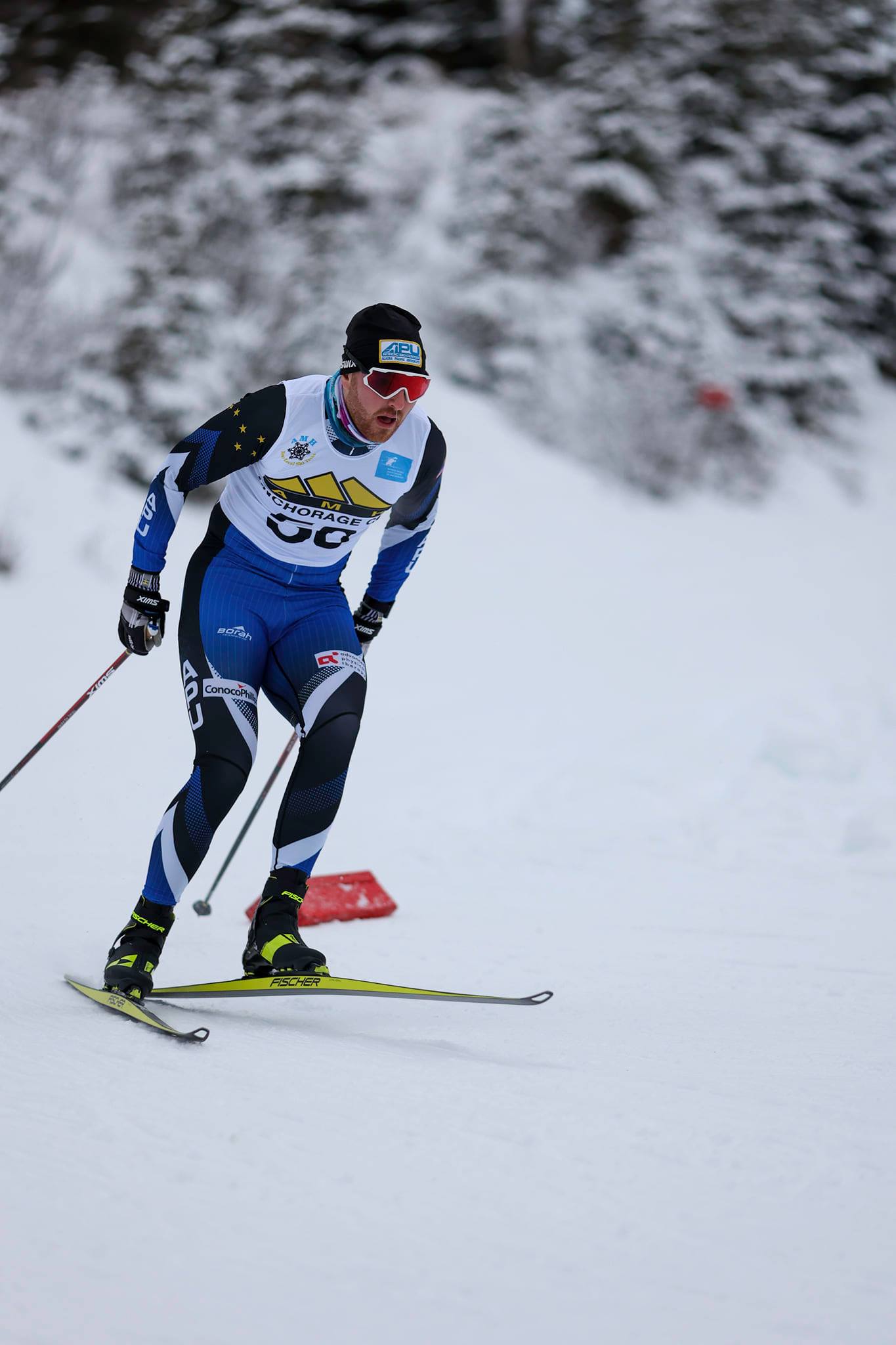
Thomas O’Harra (APU) approaches the turnaround point in the 2022 Mt. Marathon race above Seward, Alaska. (photo: Anna Engel)
Occurring annually on the 4th of July, and touted as the toughest 5 k on the planet, the 94th edition of the Mount Marathon race took place this past Monday in Seward, AK. Needless to say, the race is a storied tradition, beginning with its first “official” running in 1915. Over the years, participation has increased to such an extent that these days there are a number of complex ways for race entrants to register, including selection through a lottery system, petition for a race spot, or even buying a bib at a last-minute live auction.
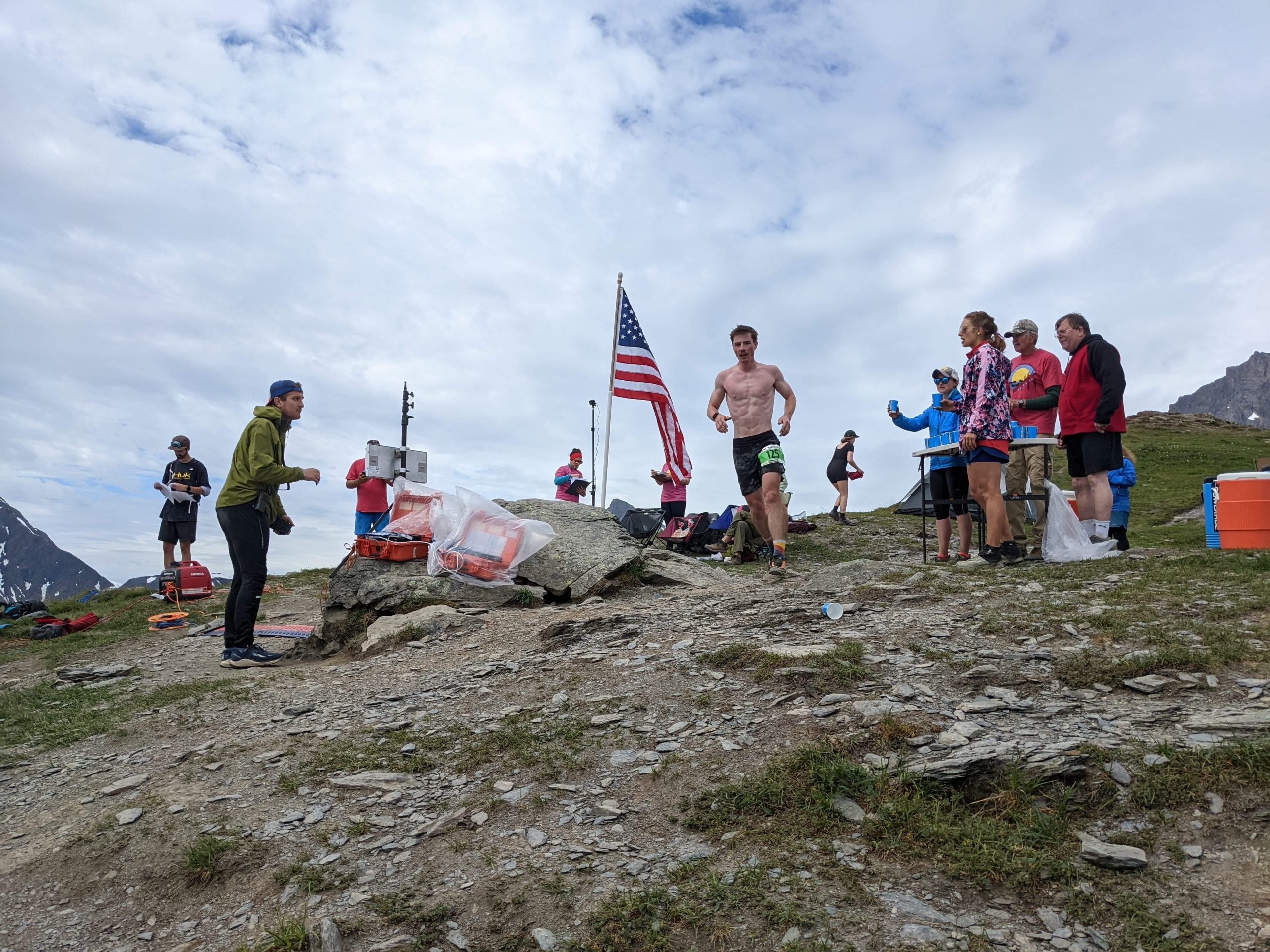
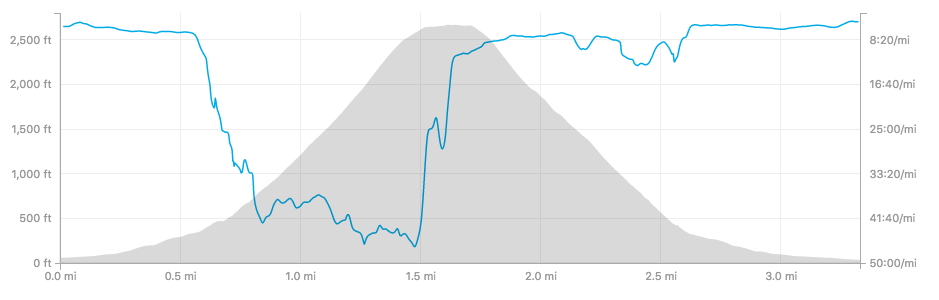
There is no set course up the mountain itself. Racers start on city streets, at sea level, and run through town for half a mile before starting the climb and heading straight up the mountain. During the climb, athletes cover roughly 2,675 vertical feet of climbing in less than a mile (0.9 to be exact). Once they’ve crossed the timing mat around the false summit at Race Point, they turn around and descend that same steep slope via a slightly different route. A junior boys and girls race is also run, in which the participants only ascend partway up the mountain before turning around.
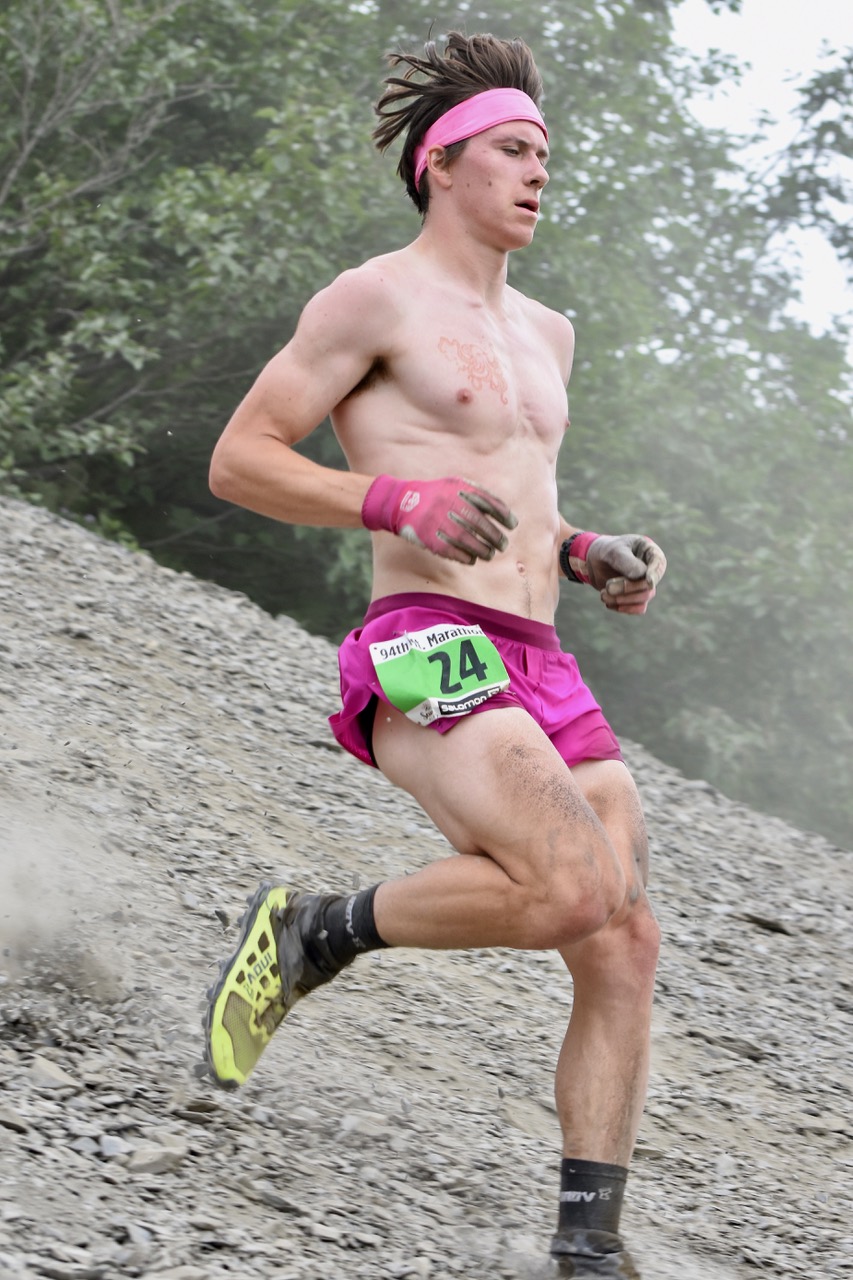
Runners bomb down scree back towards Seward and Resurrection Bay after turning around at Race Point. (Photo: Walker Hall)
This steep and challenging course has seen a number of nordic skiers succeed, including current men’s record holder, David Norris (41:26). Norris has won the race all three times he entered and took the record from mountain master, Kílian Jornet (41:48). Four-time Olympian, Nina Kemppel, holds the record for most race wins at an impressive nine victories. And until this year, three-time Olympian, Todd Boonstra was the oldest victor at age 41. However, at the conclusion of the 2022 edition of Mount Marathon, that crown went to a new champion.
The men set off at 11 a.m. local time and Max King of Bend, Oregon, took this year’s victory in a time of 43:37. At the age of 42, he became the oldest winner in the race’s long history.
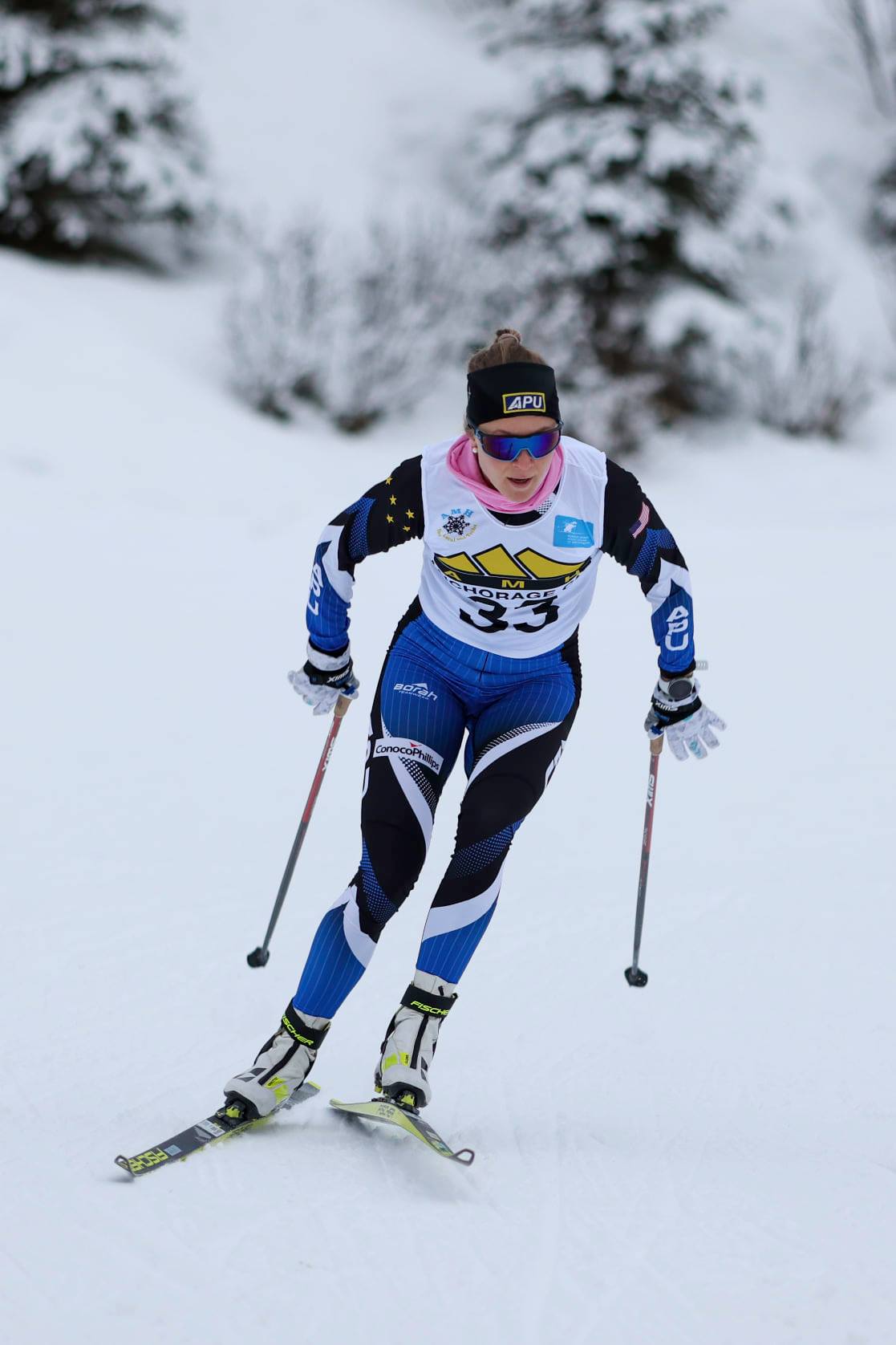
Behind King, APU skier Thomas O’Harra placed second in his Mount Marathon debut. “I really didn’t expect to do as well as I did,” shared O’Harra. “It’s such a strong field, even without David [Norris] racing this year.”
Just a few weeks before O’Harra took top spot in the Bird Ridge Hill Climb, so he had confidence heading into the uphill section of Mount Marathon. “I knew that I was in good shape for the climb at least, after Bird Ridge, so I figured that I could be in the top three to the top and then the downhill was a total unknown to me. I practiced it once, a week before the race, but I’ve never raced a downhill like that before so I had no idea what to expect.”
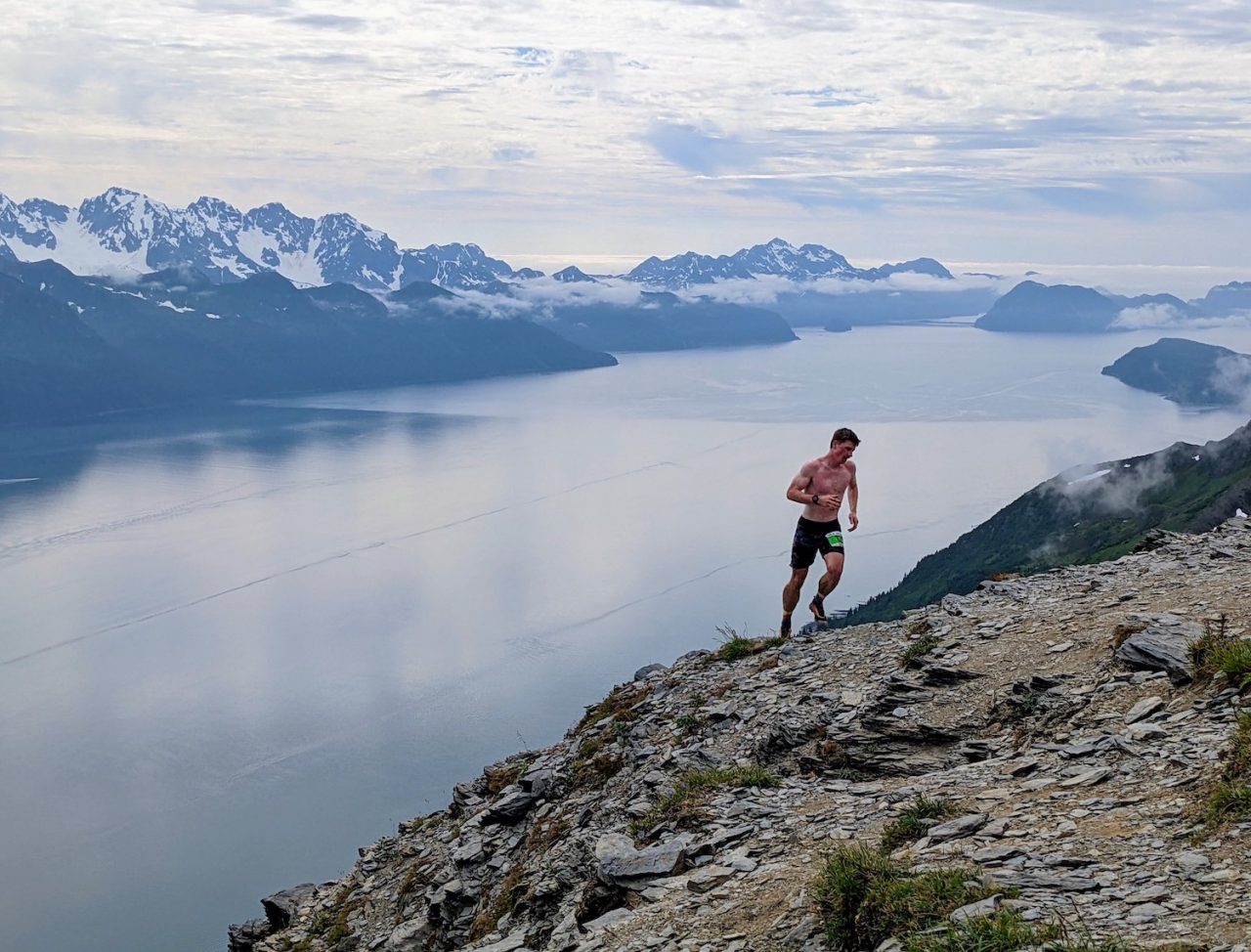
Thomas O’Harra (APU) rounds Race Point in second place in the 2022 edition of Mount Marathon (Photo: Anna Engel)
Plummeting down the scree slope, O’Harra said his main goal was to stay on his feet and not get hurt. “I was shocked that I was still in second coming off the mountain and suffered my way down the road to the finish, where I managed to sneak under 45 minutes, which was a kind of secondary, if-it-goes-well goal,” said O’Harra. “[It was a] super fun time though, the closest running race I’ve ever done to the Birkie, and I’m stoked to come back and race again next year!”
Canadian skier and current Ute (athlete at the University of Utah), Sam Hendry, finished second behind Norris in 2021. This year, Hendry placed 7th with a time of 47:39. Hendry shared that this year’s Mount Marathon “was a bit of a disappointment.” He continued, “I finished second last year and was really hoping for a strong result again. With some busy travel getting up to Alaska, I didn’t have the best preparation and my legs were just a little off.” Hendry raced both the Vertical Kilometer (VK) and 26 k at the Broken Arrow Skyrace mid-June and placed fourth in both, besting King by nearly a minute in the 26 k. Hendry said, “I had some good results there, and plan to add some more running competitions to the calendar for later in the summer. I really enjoy getting some competitions in during the summer and getting to feel stressed and nervous.”
Michael Earnhart descends a dusty slope towards Seward (Photo: Jim Jager)
New U.S. D-Team member and APU skier, Micheal Earnhart, finished his day in 15th (49:45). He wrote to FasterSkier, “I wasn’t stoked with my results by any means but I am happy that I’m at a point in my career where top-15 at Mount Marathon can be a bad day.” Earnhart was quick to praise his teammate’s success saying, “My main takeaway was how impressive it was to see my APU teammate, and race rookie, Thomas O’Harra get second place. Definitely a strong day for APU and skiers in general which is always fun to see.”
Fellow U.S. Ski Team athlete Luke Jager was shortly behind Earnhart in 18th.
With the men’s race concluded, the focus turned to the women, who started at 2 p.m. local time. (The men and women now race in the flagship afternoon slot in alternate years.) Breaking the seven-year-old women’s record, Allie McLaughlin of Colorado earned the victory in a time of 47:09. Previously held by Swedish runner, Emelie Forsberg, with a time of 47:48, McLaughlin created a margin of 39 seconds in her favor.
Rosie Frankowski, who finished 4th in 2021, and is perhaps one of the fastest climbers out there, came in sixth this year (53:19). Racing Mount Marathon for the first time, newly named U.S. Ski Team A-Team member, Novie McCabe placed 8th (56:27). About her race, McCabe shared, “Mount Marathon was crazy! So hard, but a very cool experience for sure. I’m pretty happy with it. I was nervous about the downhill and was honestly pretty happy with myself for just doing something a bit out of my comfort zone.”
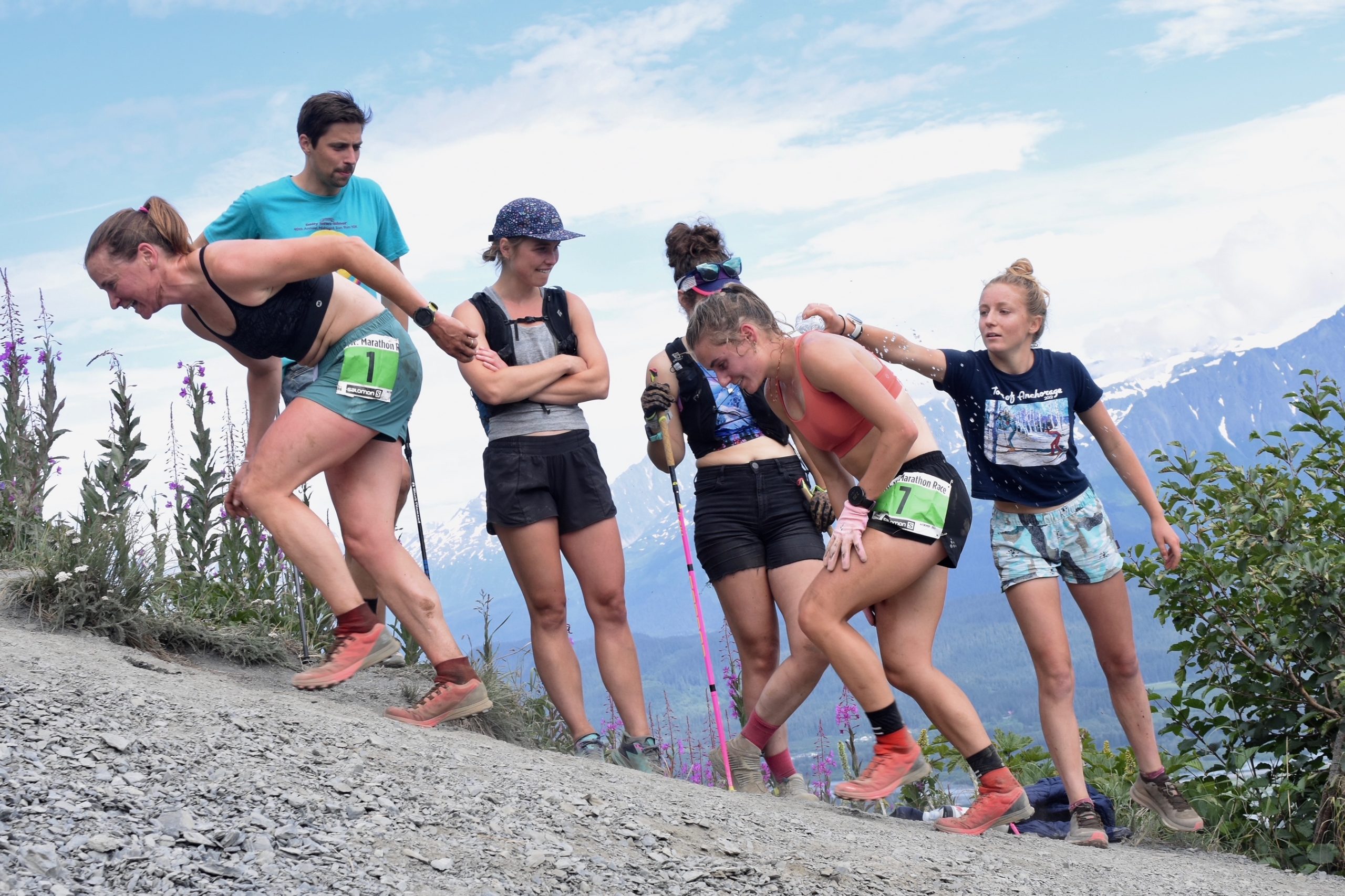
After racing the junior girls event, Dashe McCabe waters her sister, Novie (bib #7), on the climb (Photo: Jim Jager)
Kendall Kramer of UAF finished just outside the top-ten in 11th position (57:12). Kramer finished 9th last year (56:50) and was the junior girl’s race champion in 2018 (34:05).
Full race results of all the Mount Marathon events can be found here.
In other racing news, U.S.A. Track and Field Mountain Running Championships (USATF) in Wilmington, NY at the beginning of June saw two 2022 Beijing Olympians competing. Sophia Laukli finished third in a time of 1:29:03., and Caitlin Patterson came in sixth (1:35:52.3). Results for that event can be found here.
The Loon Mountain Race hosted Vertical U.S. Mountain Championships on July 10th, which a number of nordic and biathlon athletes attended. Alex Lawson representing Craftsbury Green Racing Project finished third, and posted the second fastest time on the “Upper Walking Boss,” a 40% grade ski hill for a half-mile at the end of the race.
Jake Brown (also of CGRP) had the second fastest time on the “Upper Walking Boss” and finished 9th overall. Full results for the event can be found here.
The Cirque Series mountain race circuit kicks off this coming Saturday (July 16th) at Brighton, UT. With a schedule of six U.S. based races taking place over the next few months nordic ski fans should keep an eye out for familiar names near the top of the results sheet.
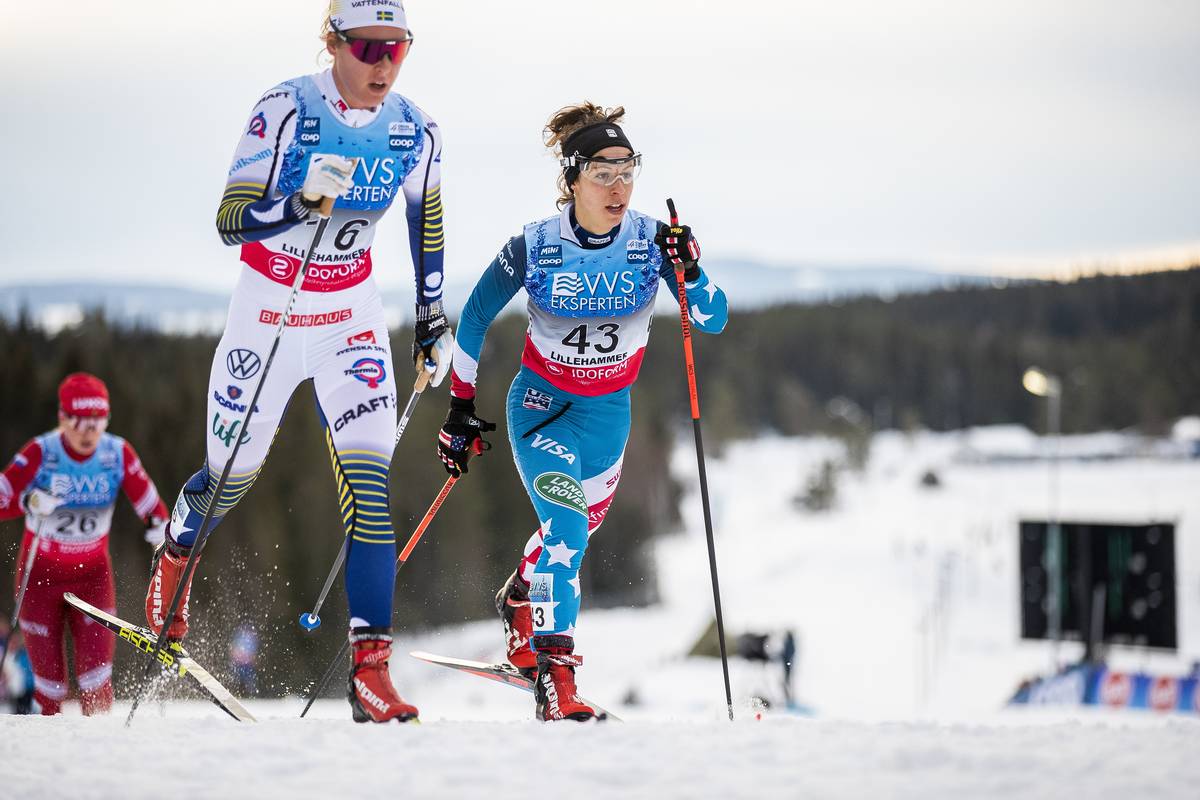
Rosie Frankowski races a December 2019 skiathlon World Cup event in Lillehammer, NOR. (Photo: NordicFocus)
The Olympic Dream.
Perhaps the opportunity to compete at the highest level of sport would not be as sought-after and revered were it not for the inherent scarcity of opportunities to achieve it. This year, only eight women and six men were able to represent the United States in cross-country skiing in Zhangjiakou, down from a total of twenty – 11 women, 9 men – who were selected for PyeongChang in 2018.
Among those who came up just shy was 30-year-old Rosie Frankowski, who has spent the last eight years training with APU under head coach Erik Flora. Frankowski is a 2018 Olympian and 2019 World Championship competitor, finishing inside the top-30 in both places – 21st in the 30 k classic in Korea and 24th in the 15 k skiathlon in Seefeld.
Rosie Frankowski skis through wet falling snow to win the women’s 10k at the opening SuperTour weekend in Duluth, MN. (Photo: Jordan Woods/Woods Creek Productions)
After strong early season results that included two wins and three third place finishes in early season SuperTours, Frankowski lined up in Soldier Hollow for a two-week stretch of racing that felt like it was for all the marbles. As many women had already met the objective criteria for team selection via results on the World Cup, it was only the final few spots that remained open for domestic racers; in the hungry pool all fighting for these spots via some combination of U.S. Nationals, Sun Valley SuperTour, and Tour de Ski results were Frankowski, Caitlin Patterson, Alayna Sonnesyn, Katharine Ogden, Novie McCabe, and Sophia Laukli.
As Frankowski describes in this episode, her opening races – the freestyle sprint and the 20-kilometer mass start skate – of U.S. Nationals went remarkably well; despite being known as a distance specialist, she won the sprint qualifier and finished sixth in the final, then won the race for second place in the 20 k skate, behind Rosie Brennan who had dropped the field from the start. From there, Frankowski faced a series of challenges – slick skis and variable klister conditions in the 10 k classic, a fall in the classic sprint, and a sublexed shoulder in the opening race in Sun Valley.
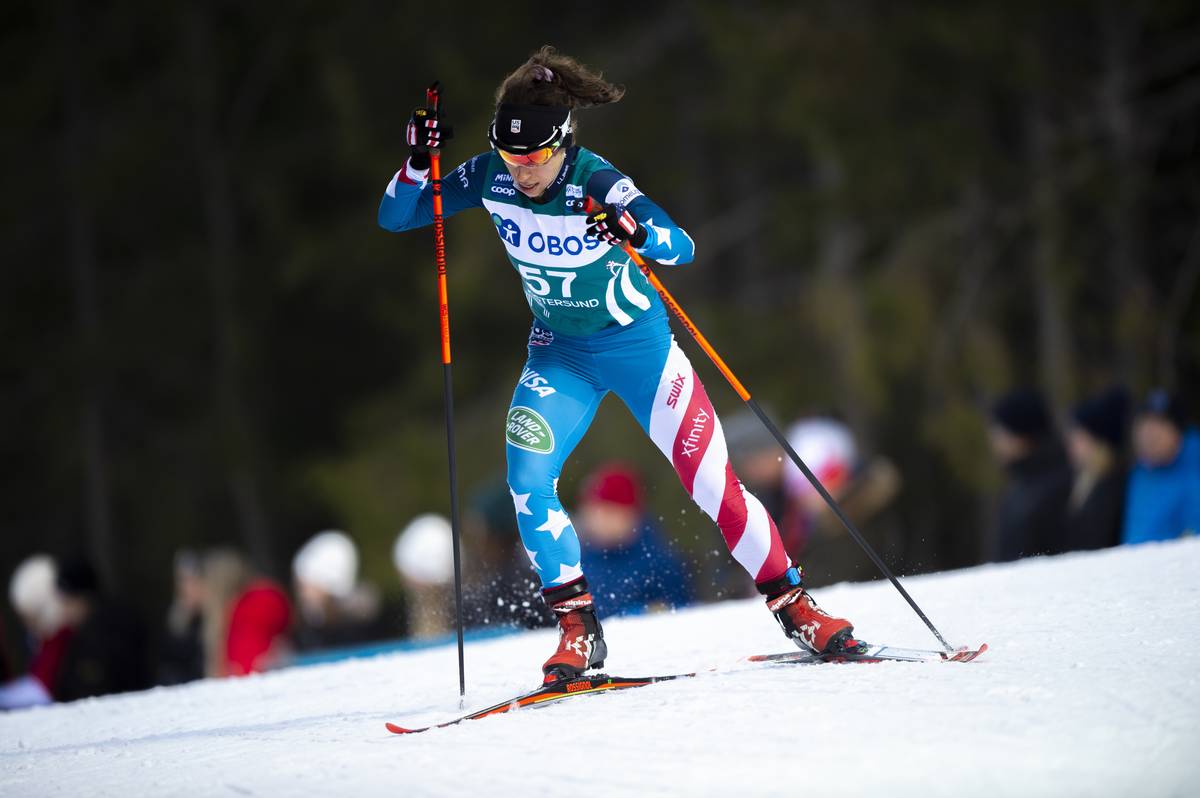
Rosie Frankowski on course during a February 2020 World Cup in Östersund, SWE. (Photo: NordicFocus)
The official team nominations for the 2022 Beijing Olympics were released the following week, and Frankowski was named as the second alternate for the women’s team. Five months later, Frankowski finds herself at a transition point in her career. It’s not a cut and dry retirement as she has earned Period I starts on the World Cup and has other race objectives next winter, but it’s a shift in focus as she and her partner prepare to relocate from Anchorage, AK to Durango, CO.
In this conversation, Frankowski shares the highlights and challenges of the 2021-22 race season, and provides invaluable insights into the experience of spending her career as a “bubble athlete”, fighting for international race opportunities and team selection, while juggling the financial realities of supporting her professional ski racing career. She reflects on her time with APU, and discusses defining success when surrounded by “more-accomplished” teammates, and how she expects the ratio of mountain running to ski-specific training to shift after this transition.
Thanks for listening and thanks to Concept2 for supporting this podcast.
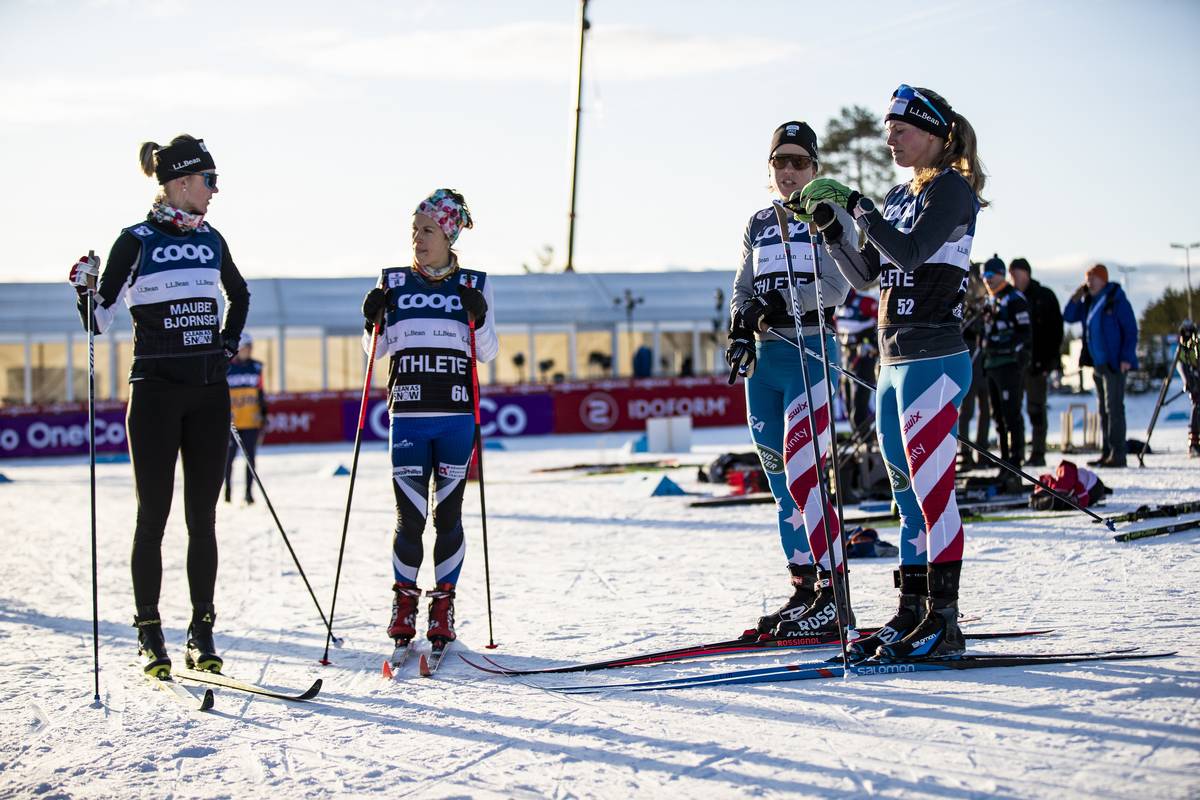
Scenes from a training day in Lillehammer in December 2019. From left to right, Sadie Maubet Bjornsen, Rosie Frankowski, Rosie Brennan, and Jessie Diggins. (Photo: NordicFocus)
This World Cup coverage is made possible through the generous support of Marty and Kathy Hall and the A Hall Mark of Excellence Award. To learn more about A Hall Mark of Excellence Award or to learn how you can support FasterSkier’s coverage please contact info@fasterskier.com.
There wasn’t much to be decided, only facts to reaffirmed.
In the last individual race of the World Cup season on Saturday, a 10-kilometer individual start freestyle in Falun, Sweden, the overall World Cup standings of consequence were already decided. Individual season goals for each racer were already moving towards reflection.
Off the course, bare patches of ground seemed to suggest that even the snow was ready to move on from this winter and this ski season. The air was in agreeance; it was 6℃ (44℉) at race start.
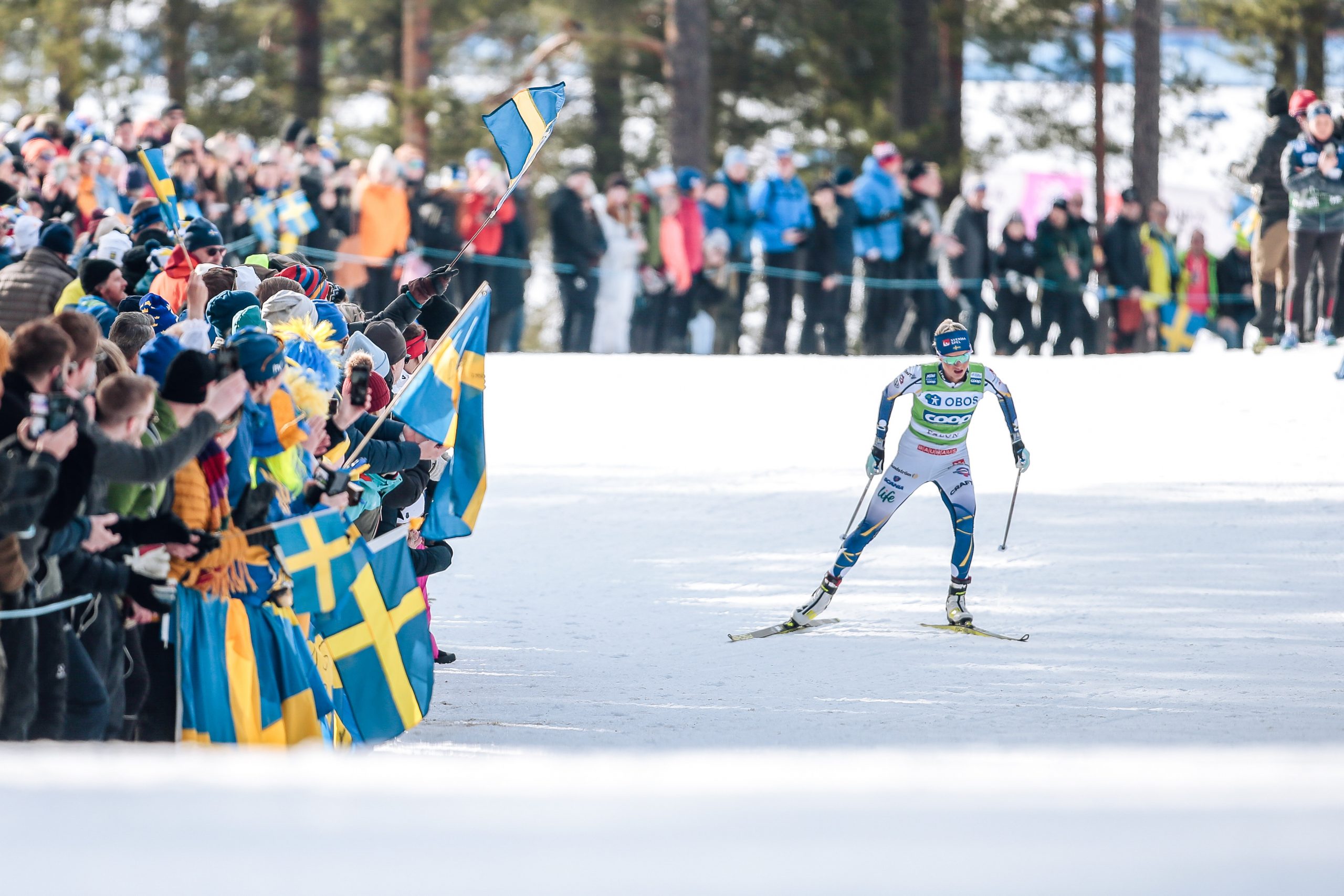
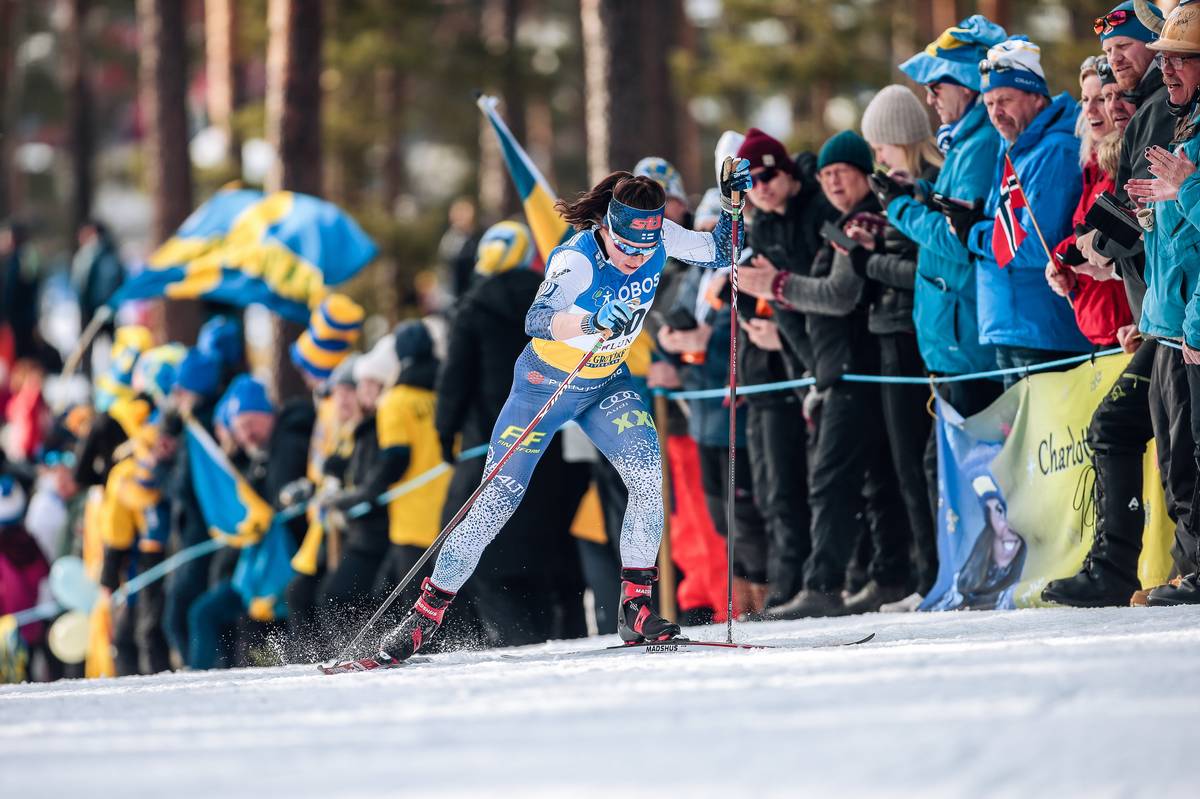
Frida Karlsson (SWE) skis past a vibrant Swedish scene in Falun. Karlsson finished 12th in the 10 k freestyle (+1:07:00), but ends the season as the World Cup Distance runner-up behind Therese Johaug (NOR). (Photo: NordicFocus)
And why wouldn’t they be? For all the hints of a return to some kind of normalcy this World Cup season – fans back at venues, a majority of courses covered with natural snow – the World Cup couldn’t out-ski the anxieties and the full-blown winds of change that the winter of 2021-22 has sent around the world. At its conclusion today, the World Cup overall will be awarded to a skier, Natalia Nepryaeva (RUS), who was barred from competing on account of the Russian government’s invasion of Ukraine. Nepryaeva sits atop a World Cup Overall points list that was shaped, and is shaped by, COVID-19 – which forced multiple cancellations of World Cup events in January, and across the season has seen individuals and teams miss races.
All we could hope for from skiing, across this season and at today’s race, was for some sort of center to hold. That we could watch and see something that we had seen before, and that it would bring light and levity to the challenges of the times.
For that type of drama? Well, while World Cup finals may have moved from Siberia to Sweden, their final destination could have been Shakespeare’s Globe.
Woven and interlocked throughout the 10 k individual start were acts ski fans have come to know by heart over the past few years and over the course of this season. But that didn’t make them any less impactful to watch. We would see valiant efforts from early starters, a women’s field where margins are only ever a few seconds throughout a race, capped off, apropos the start order,by the one question that has animated distance racing on the World Cup for nearly a decade, posed for the last time – what about Therese Johaug?
To get to the answer to that question, we would have to wait. In the meantime, the Falun course played host to narratives that followed the contours of its terrain. The 10 k was raced as 3 laps – one 2.5 k loop that was relatively flat, before two laps of a 3.75 k loop where the terrain was punctuated with a set of climbs that would look to separate the field.
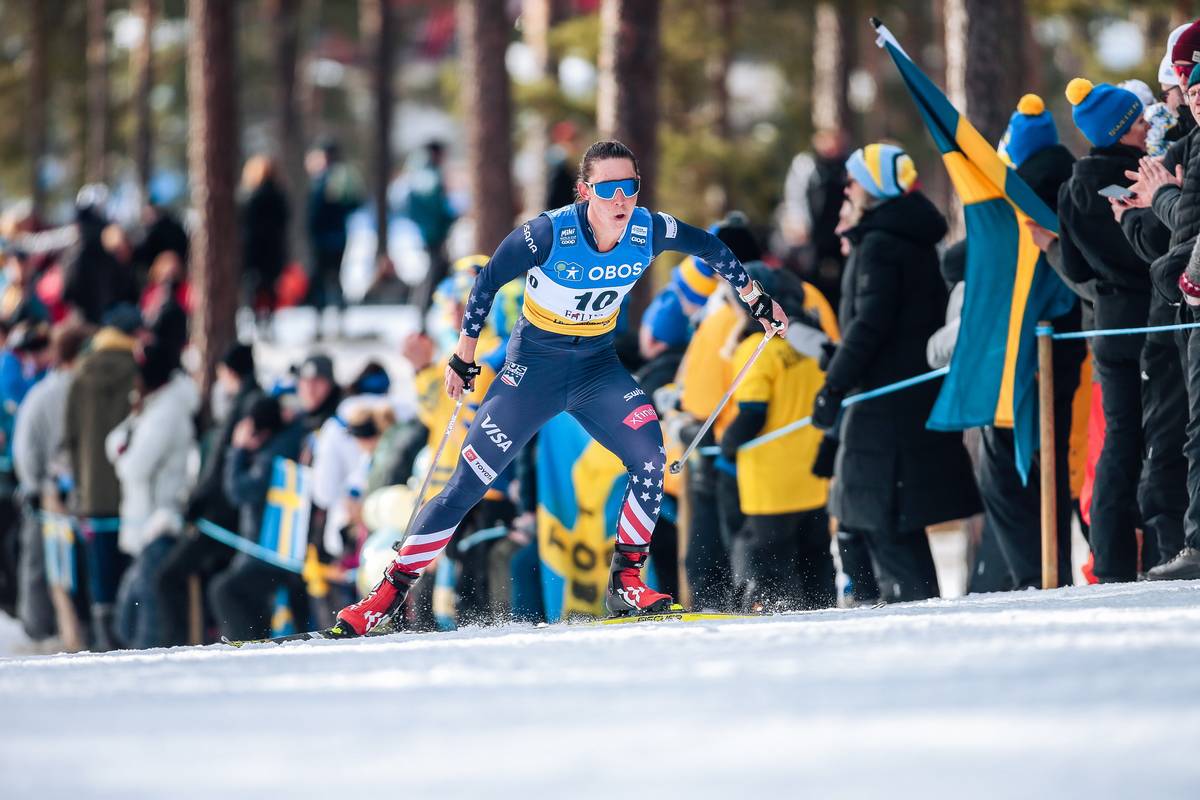
Julia Kern skis to 20th in Falun’s 10 k individual start skate. (Photo: NordicFocus)
The early racer to watch in the field was bib 10, Julia Kern, who came through the 1.5 k checkpoint 3.7 seconds ahead of the field. While the top racers would soon follow, with Frida Karlsson (SWE) eventually topping Kern’s mark as she moved through the course, Kern would prove to be a pace-setter for the earlier starters throughout her 10 k effort. She set the fastest time on course at the finish, but it would fall as seeded athletes followed. Her efforts though, ultimately yielded a 20th place finish (+1:30.3), and the image of Kern crossing the line as a champion (even if it proved temporary) seemed an appropriate conclusion to a season where she had battled to overcome the growing pains of World Cup skiing from last season and prove to be one of those American women that ought to be seen as a force on the start line.
“She raced four rounds yesterday. There was gonna be a limit to the energy, [and yet] she swung really hard today and came up with a big result today. I think a fresh Julia Kern can race with the top ten, and that’s not diminishing her 20th place today. There’s more to give, and that’s exciting” said US Ski Team Head Coach Matt Whitcomb on Kern’s result in an interview with FasterSkier.
Full audio interview with Matt Whitcomb.
Jessie Diggins races to third in Falun’s 10 k skate. (Photo: NordicFocus)
Joining her in the category of American women to be excited about throughout the season has been Rosie Brennan and Jessie Diggins. Brennan started in bib 38 today, with Diggins two minutes later in bib 42. They followed the lead of Frida Karlsson and Krista Pärmäkoski throughout the duration of the course. Karlsson, in bib 23, was the first skier to top Kern’s 1.5 k mark, coming in at 2.8 seconds over the field. Pärmäkoski, in bib 30, came through that checkpoint in 2nd, +1.6 back on Karlsson. When Brennan came through, she was +2.5 seconds off Karlsson and in 5th place, and when Diggins came through she was +0.2 off Karlsson and had put herself in 2nd place. The field, in other words, was tight, and those skiers, Karlsson, Pärmäkoski, Brennan, and Diggins – along with Ebba Andersson (SWE) and Kertu Niskanen (FIN) – would jockey and swap places through the remaining 8.5 k.
Krista Pärmäkoski races the 10 k individual start free in Falun. (Photo: NordicFocus)
At 4.3 k, Pärmäkoski had overtaken Karlsson by 1.2 seconds. Brennan came in +1.7 off of Pärmäkoski. Diggins moments later came in +1.8. Through the halfway point with the group the standings read: Pärmäkoski first, Karlsson second, Brennan third, and Diggins fourth, with less than 2 seconds between them.
By 7.7 k, the gaps had started to grow. Pärmäkoski came through with a 14.6 second advantage over Karlsson, while Brennan was +21.6 off the top and back in fourth place. The, in one of the familiar sights that colored the day, Jessie Diggins had started to somehow, someway, increase her pace. She came through 7.7 k now in second place, just +2.6 seconds off of Pärmäkoski.
Rosie Brennan on course Saturday. Brennan finished 8th in the 10 k freestyle. (Photo: NordicFocus)
At 9.1 k, Pärmäkoski still had first place, but Diggins had cut her deficit to a mere +0.6 seconds. As Pärmäkoski crossed the finish in first place with 21.8 seconds on the field, one started to get the exhilarating feeling that the camera would soon cut to Jessie Diggins doing what Jessie Diggins does best.
There was almost dramatic irony to it – we, the audience, just knew that there would be Diggins, free skating, looking ahead, and somehow increasing her tempo from 100% to beyond that. Then, she did it. Diggins crossed the finish line having not only erased her deficit, but gained a second on Pärmäkoski to finish in first place, 1.9 seconds ahead of the rest of the field.
In remarks to FasterSkier, Diggins said that her race today reflected renewed energy levels after her silver-medal winning 30 k at the Olympics, “Today was wonderful. After [sitting out the Holmenkollen race], I felt like I could go out and race the way I wanted to, having the energy to really attack the course.”
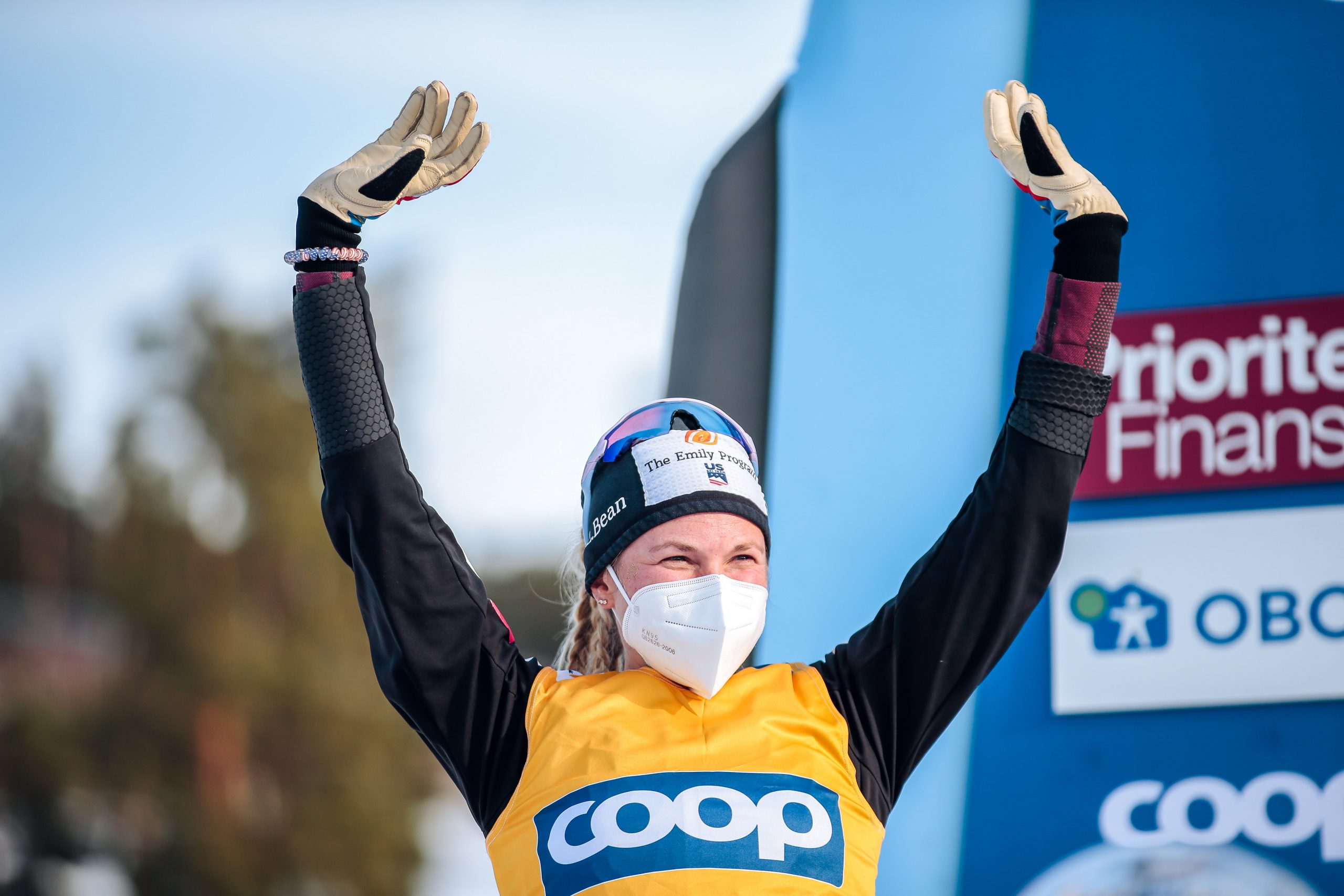
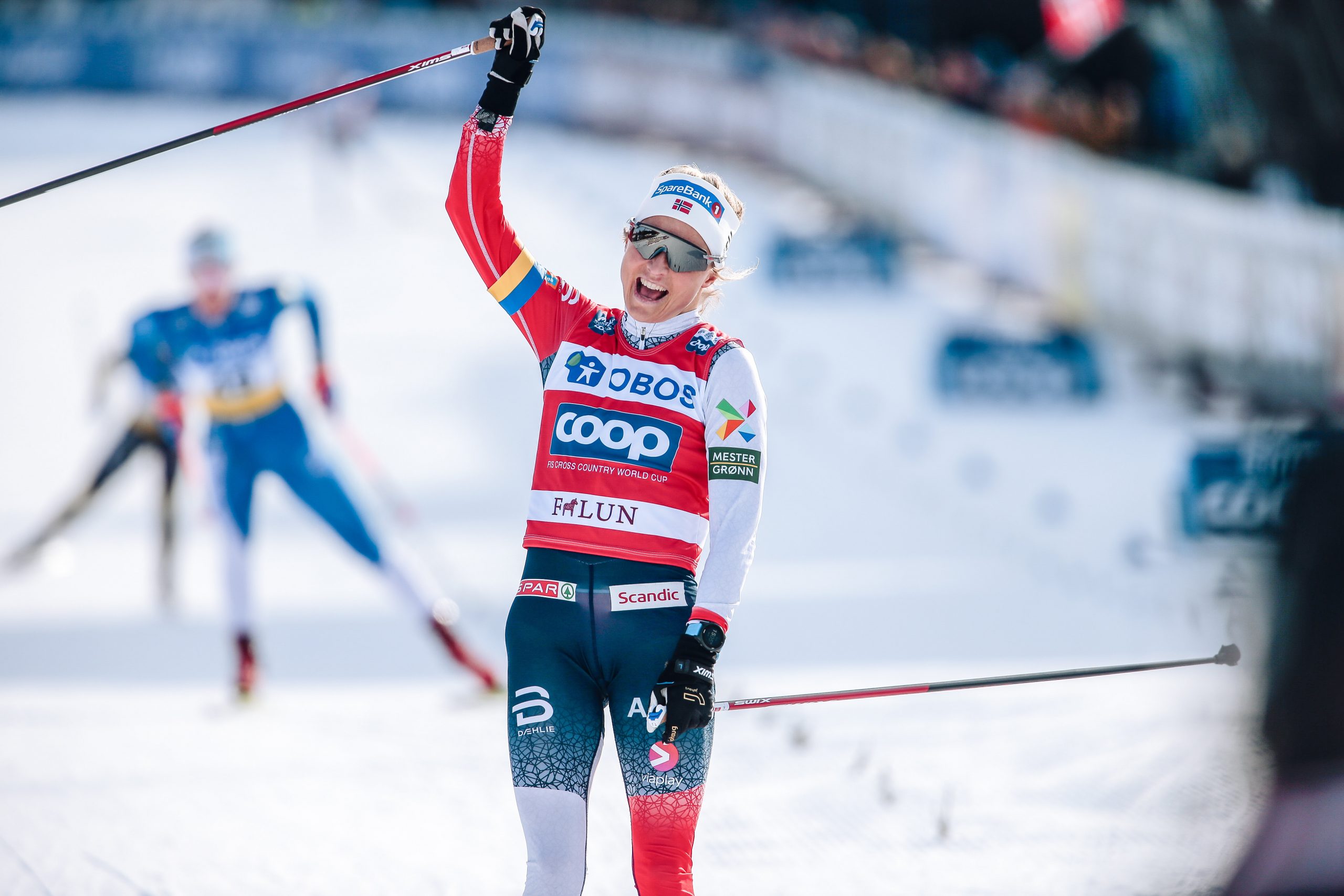
Jessie Diggins sits in the winner’s circle after crossing the line in first place on a sunny day in Falun. Diggins would eventually cede the spot to Jonna Sundling (SWE), before Therese Johaug (NOR) crossed the line in first. Final results: 1st Johaug, 2nd Sundling, 3rd Diggins. (Photo: NordicFocus)
Diggins’ result though, only was a subset of the dramatic irony that prevaded the overarching race. Behind her, wearing the red leader’s bib (56, last starter in the field), fresh off of a win at the Holmenkollen 50 k, and in her individual last professional ski race, was Therese Johaug (NOR). The immensity of her character in the drama of the day was hard to understate. Johaug had already secured the Distance World Cup title for the season – her record-breaking fifth time winning that title (breaking a record jointly held by Justyna Kowalczyk and Dario Cologna). Coming into today, she was looking for her 100th World Cup win. She had been on every World Cup distance podium except one (a 4th place in a 10 k classic two years ago) since 2019.
Posting outstanding results across all distances, Jonna Sundling takes second in Falun’s 10 k skate. (Photo: NordicFocus)
What she might achieve in today’s 10 k was continuously foreshadowed throughout the course by Jonna Sundling, who wore bib 50. The Swede, on her home turf, broke through the jockeying at the top of the field when she came through the 1.5 k checkpoint 8.1 sec ahead of the field. When Johaug came through behind her in 2nd place, +4.0 sec, the little separation the pair had created seemed to be a turning point in the race. Johaug might do it. She could do it. She would probably do it. And then, she was doing it.
“It,” of course, was opening a commanding gap on the best skiers in the world. At 4.3 k, she had a 14.1 second gap on Sundling. At 7.7 k, the gap was 30.6 seconds. At 9.1 k, the gap was 35.4 seconds. Building steadily, Johaug had set the stage for a final, triumphant act.
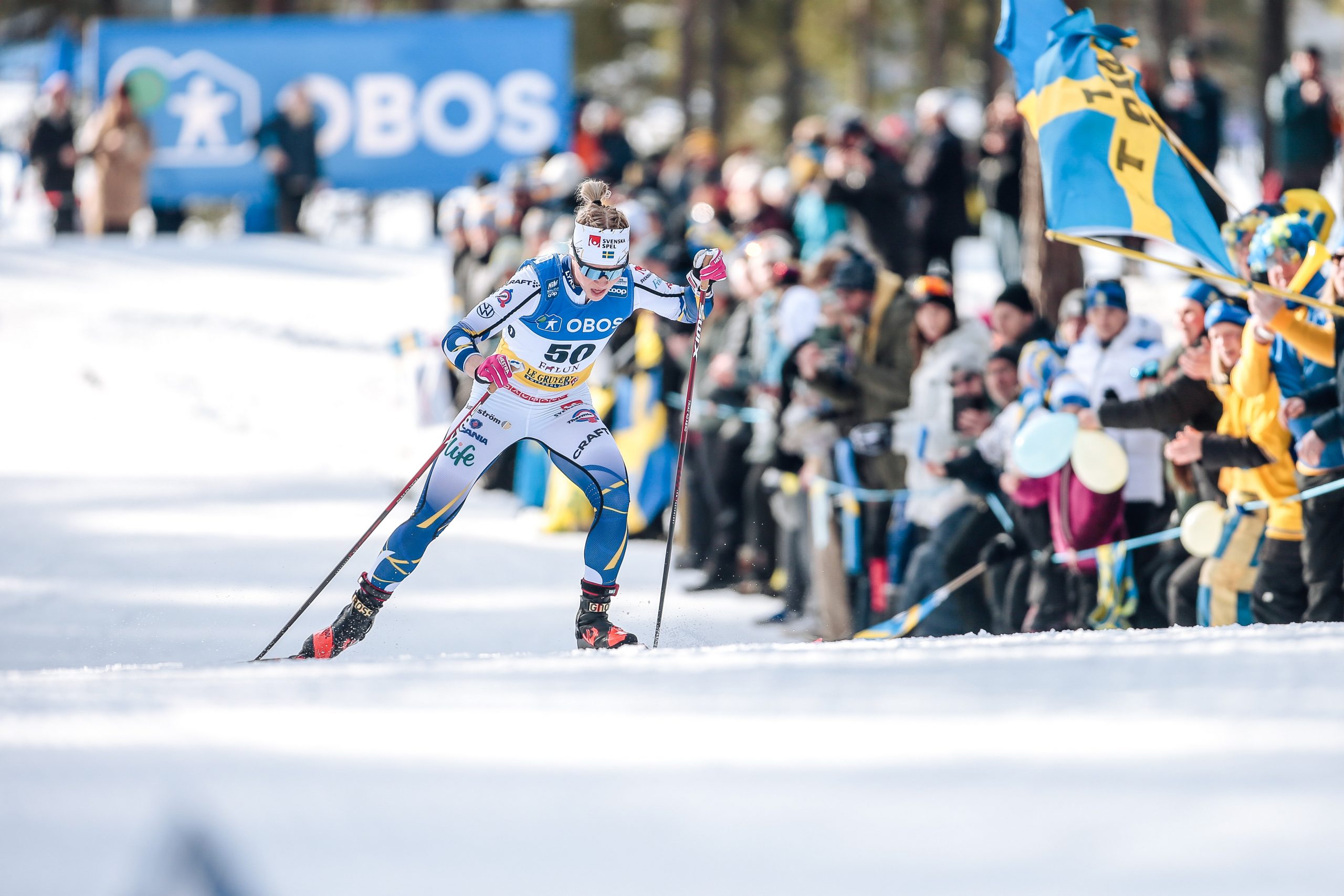
Jonna Sundling skis past her home crowd in Falun, Sweden. Sundling finished 2nd place, after a dramatic sprint to finish 0.4 seconds ahead of third place Jessie Diggins (USA) at the line. (Photo: NordicFocus)
First though, Jonna Sundling would add another scene. As she crested the hill going into the stadium the background was dotted by her country’s flags. The clock put her agonizingly close to Jessie Diggins. She did what she does better than any other skier at the moment – the Olympic gold medalist in the freestyle sprint unleashed a finish line burst that saw her come in 0.4 seconds ahead of Jessie Diggins in first place. The Swedish crowd let out a roar. It was the best that skiing as a spectator sport has to offer.
And then, it was surpassed by the best that skiing, period, had to offer. Therese Johaug finished in first place in a time of 22:34.4. To sum up her career, all you have to do is remove the last preposition.
Therese Johaug finished in first place.
Therese Johaug (NOR) crosses the finish line, in first place, for the final time in her remarkable career. Johaug won on the day (22:34.4), and also secured the distance World Cup title for the season in Falun. (Photo: NordicFocus)
Joahaug came across her last finish line with a yelp, and then quickly turned to her competitors still mulling in the finish area. In an instance, she had gone from racer to ambassador.
With the Norwegian at the back of the seeded group, this meant the podium would be Johaug on top, Sundling in second (+35.9), and Diggins third (+38.5). Rounding out the top-five, Pärmäkoski took fourth (+38.2), with Norway’s Heidi Weng in fifth (+42.7).
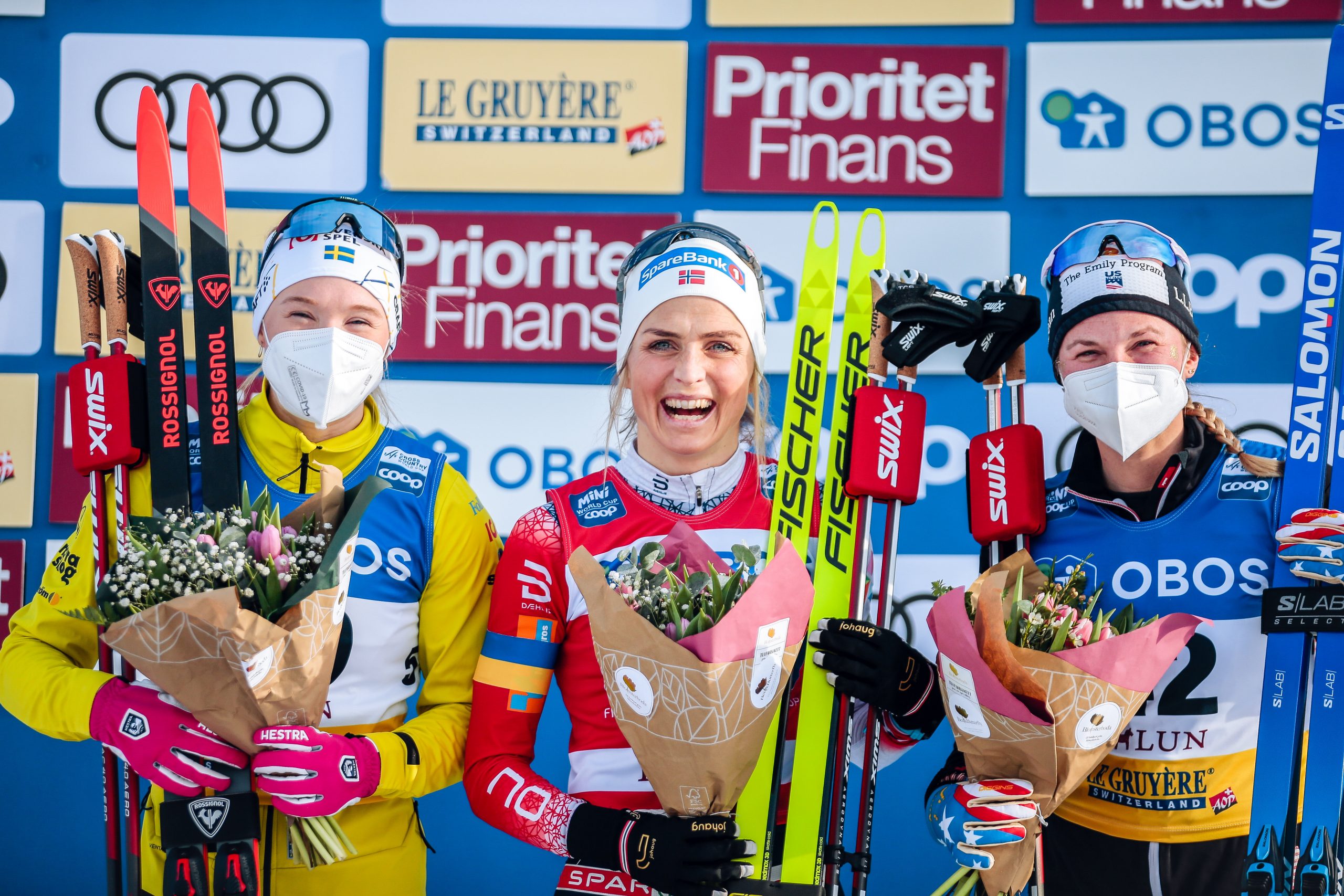
The Falun 10 k freestyle podium. (l-r) 2nd place Jonna Sundling (SWE), 1st place Therese Johaug (NOR), and 3rd place Jessie Diggins (USA). (Photo: NordicFocus)
Johaug leaves a sport that’s transformed since she first raced a World Cup in 2007. For one, it is a sport in which Therese Johaug has raced. Her ability to win races so decisively, and consistently, will cast a long shadow. She finishes her final World Cup Distance title with 177 point advantage over 2nd place Frida Karlsson (SWE), who at the young age of 22 looks poised to chart a course that follows in Johaug’s footsteps. 3rd place in the classification will go to Krista Pärmäkoski (FIN).
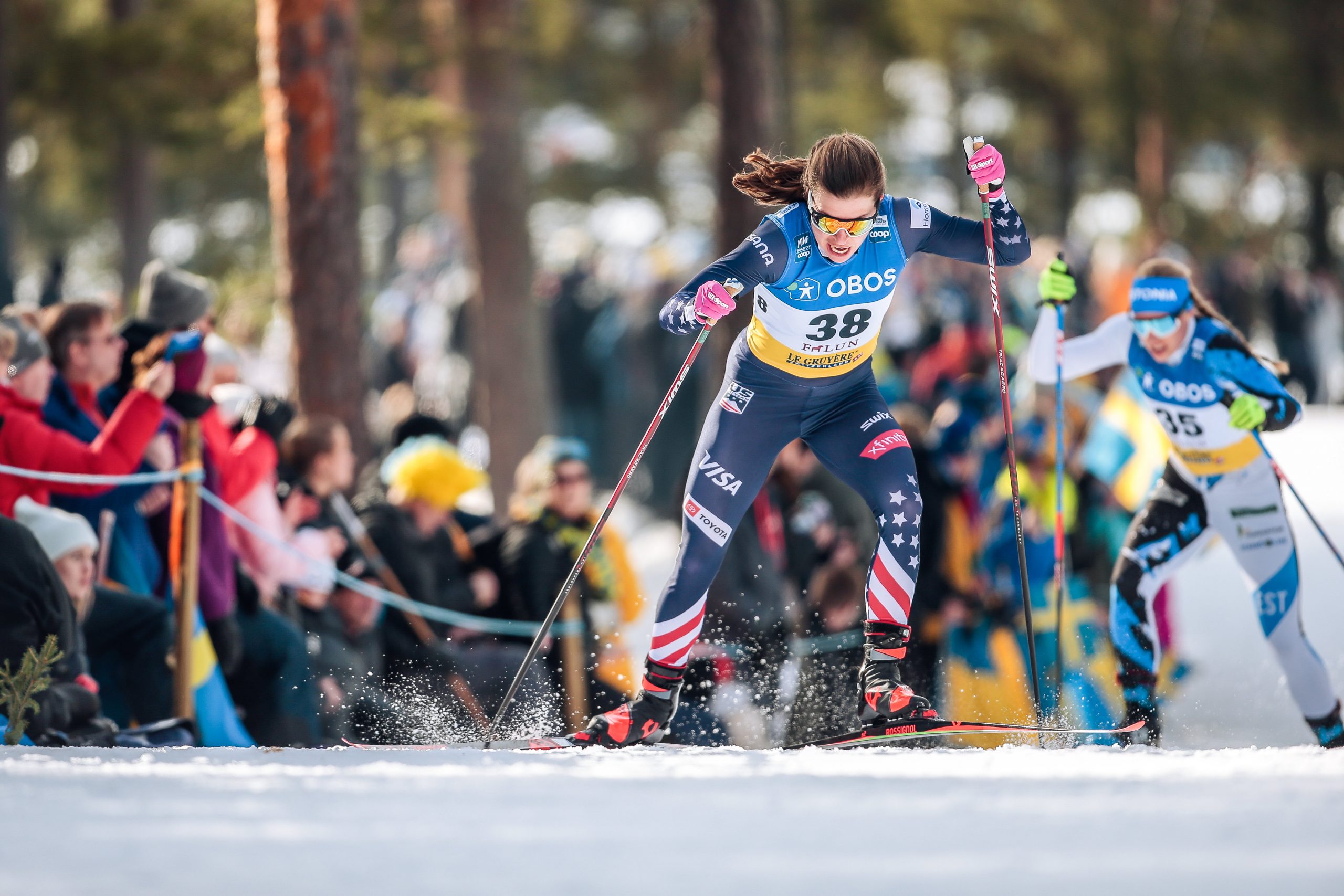
It’s also a sport where its leading star is an American, joined by her teammates who are now capable of putting two skiers in the top ten (Diggins 3rd and Brennan 8th), and three in the top thirty (Kern 20th, +1:30.3). The depth of the Americans, in fact, was one of the great takeaways from today’s race. Caitlin Patterson just missed a top thirty finish, coming in 31st (+1:49.5). Rosie Frankowski finished 41st (+2:26.4).
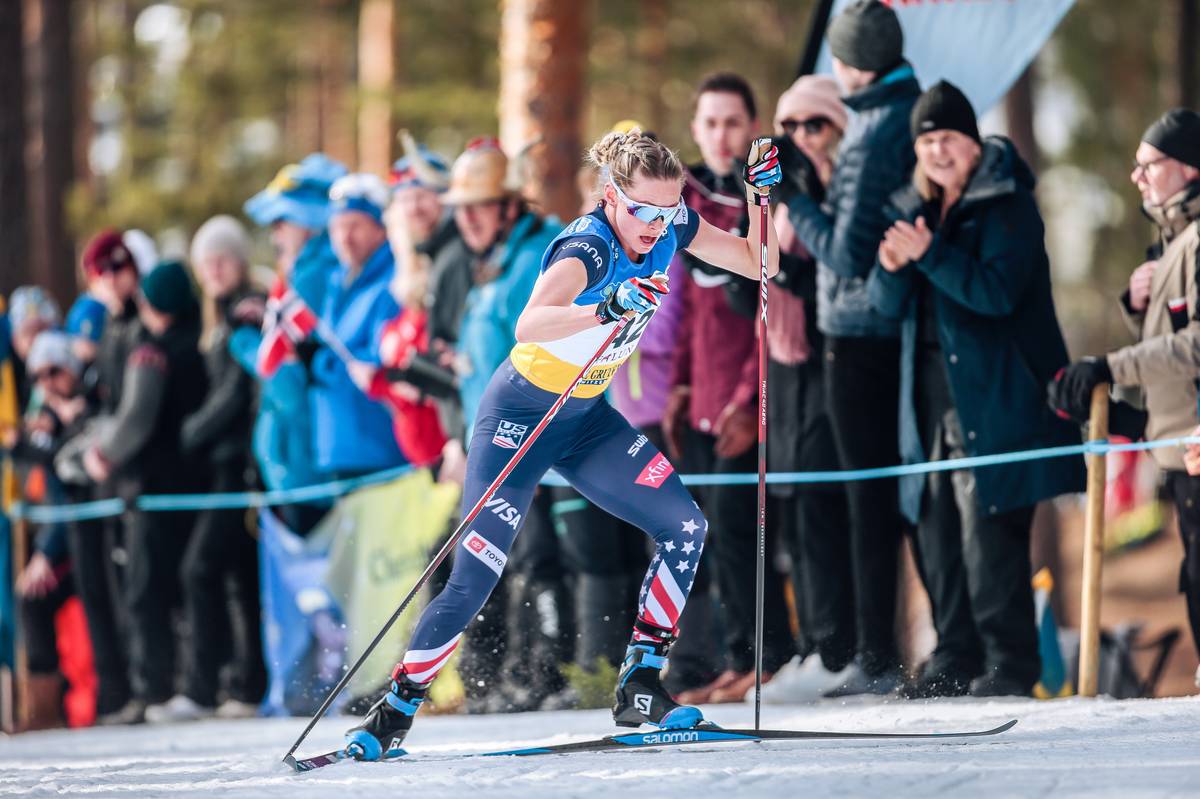
Rosie Frankowski (USA) comes down the final stretch in Falun. Frankowski finished 41st (+2:26.4). (Photo: NordicFocus)
Diggins, in particular, has proved skiing’s muse of fire, her grit and heroics adding to the depth of what ski racing purports to be the ideal for. Just today, she came into the race just one point ahead of Ebba Andersson (SWE) in the World Cup Overall. Between her and Andersson, the first finished today would secure World Cup runners-up. After Diggins podium finish today, adding to the mountain of evidence she’s accrued that belief and push are worth it, she secured that title. The overall champions’ title and crystal globe, meanwhile, will go to Natalia Nepryaeva (RUS).
Diggins said of her runners-up in the World Cup overall standings:
“It was really special to finish 2nd in the overall World Cup. I’m really proud. It represents a lot of hard work and consistently giving it everything I have everytime I race…
“I’m definitely still processing it. For me, this was a season where I came in with very concrete goals about my preparation physically and mentally for the Olympics. That was the big target. I’m really proud of how as a team (coaches and teammates) we handled that, and having World Cup wins and podiums was really just the icing on the cake.”
Full post-race audio clip from Jessie Diggins.
Therese Johaug holding her record 5th World Cup Distance crystal globe after winning in Falun. Johaug announced she is retiring from professional skiing last week in Holmenkollen. (Photo: NordicFocus)
Johaug leaves a sport too, at the end of a weary and winding road of a season. Not only out-skiing the best skiers in the world, but navigating the inextricable circumstances that surround the sport in our times. COVID-19, for one, but also the rapidly shifting planes of geopolitics – and the interplay between nationalism, identity, and narrative – that have always been at the heart of all sports, and in particular (as we’ll be reminded in the team event tomorrow) skiing.
That state of flux in the meanings surrounding the sport of skiing will continue. More so now than ever. As will the stories of athletes that are, in their pursuit of dreams, caught in contested ideas that animate the world way beyond this sport.
But then again, we have seen that all before. And as today showed, when in skiing we see something familiar, it is drive, passion, and joy in their pure human forms, that make us turn our heads and pay attention.
That is, after all, the drama of skiing, and in Falun today, we saw one of its best examples.
The Canadian women also had a string of strong results today. Katharine Stewart-Jones finished 33rd (+1:57.7), Dahria Beatty finished 43rd (+2:36.7), and Jasmine Drolet finished 52nd (+3:08.2).
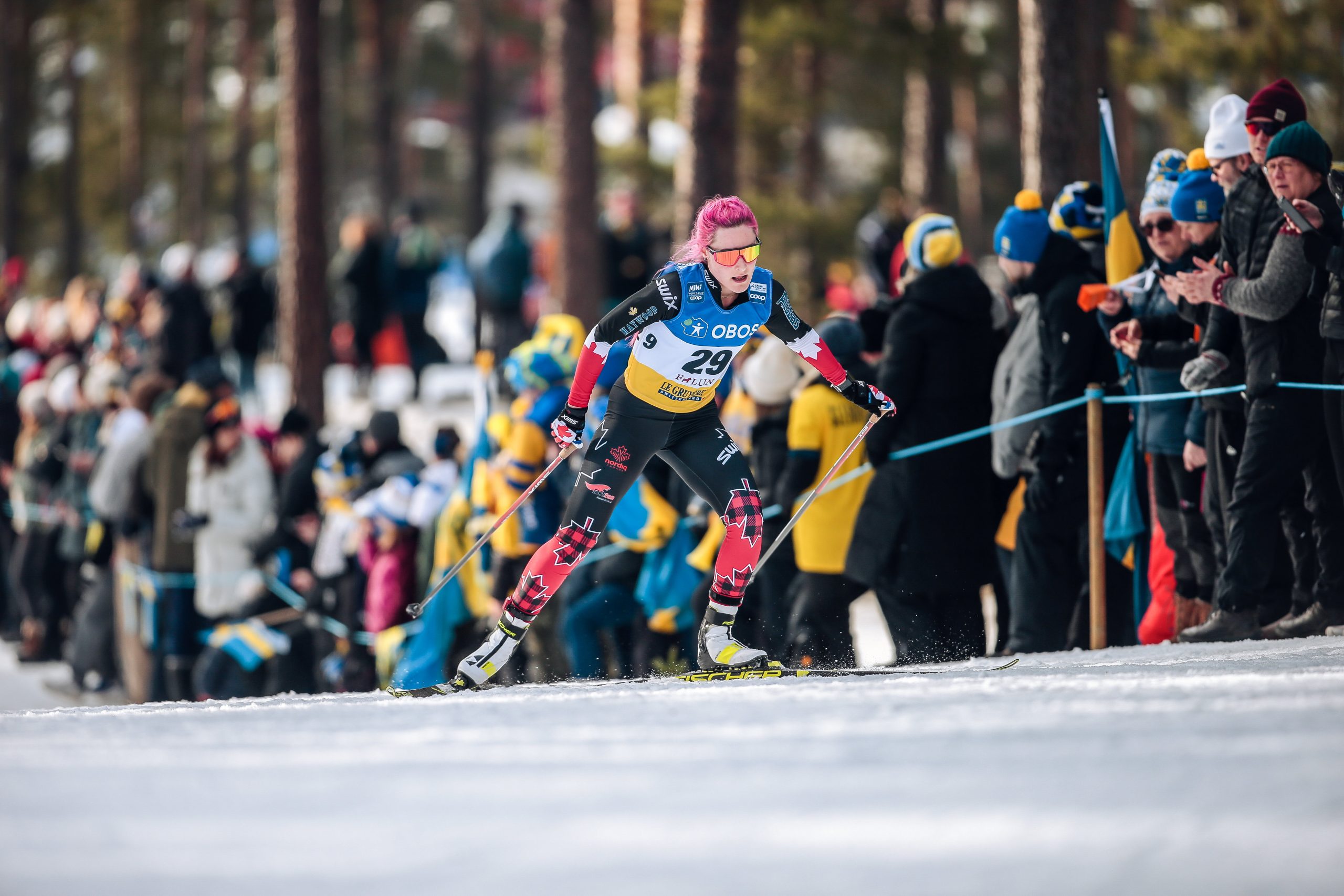
Canada’s Jasmine Drolet sporting Dartmouth’s signature pink-hair look as she raced her way to a 52nd on the World Cup in Falun. (Photo: NordicFocus)
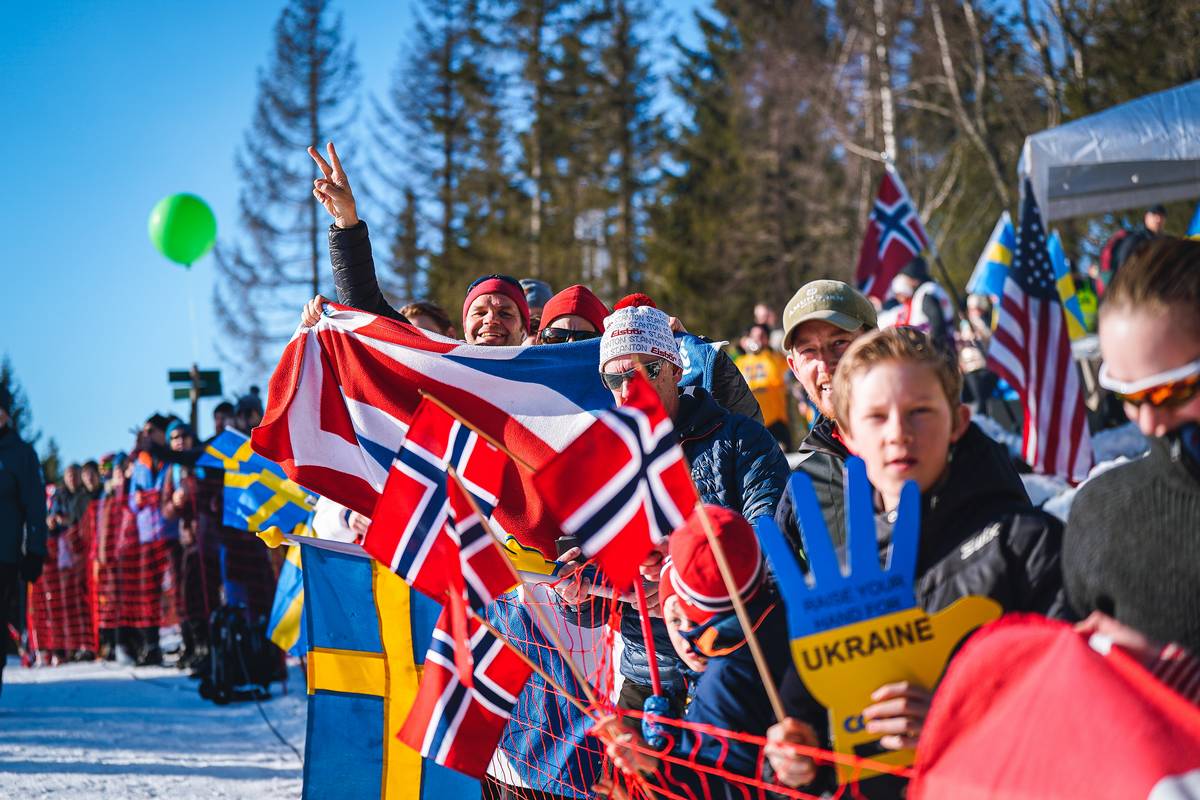
Crowds line the storied tracks at Holmenkollen during the women’s 30 k classic. (Photo: NordicFocus)
This World Cup coverage is made possible through the generous support of Marty and Kathy Hall and the A Hall Mark of Excellence Award. To learn more about A Hall Mark of Excellence Award or to learn how you can support FasterSkier’s coverage please contact info@fasterskier.com.
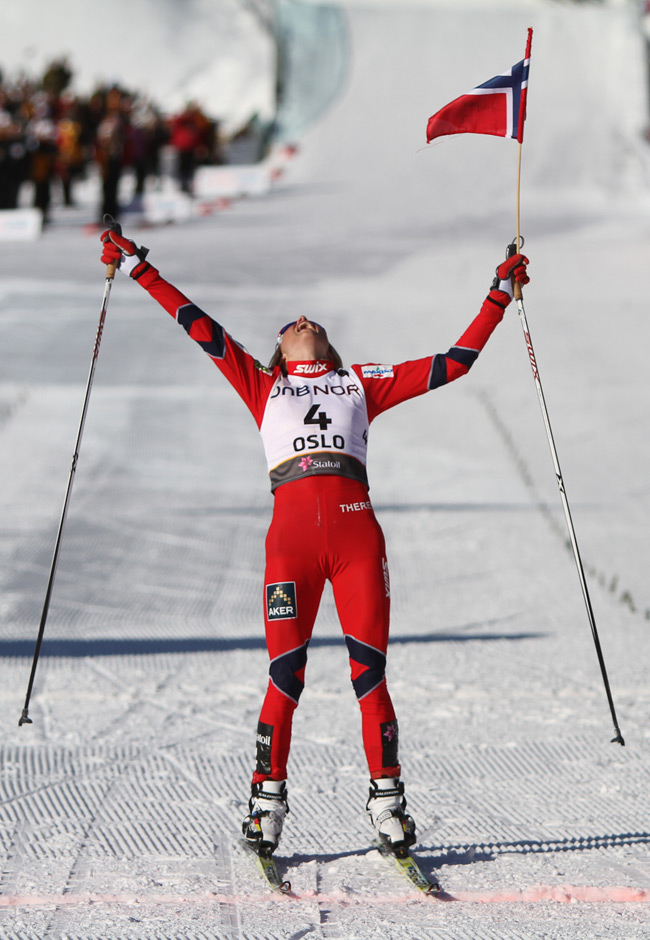
Terese Johaug wins her first individual World Championship gold medal in the 30 k mass start skate in Oslo, NOR. (Photo: FS Archives)
Eleven years ago to the day, racing the 30-kilometer mass start skate, a 22-year-old Therese Johaug won her first individual World Championship gold medal in a breakout performance at Holmenkollen near her home in Oslo, NOR. In doing so, she had broken apart a field of women considered legends of the sport on an equally legendary course known for long grinding climbs that require superior fitness and technique. Johaug won by nearly 45 seconds over one of the greatest cross country skiers of all time, her teammate Marit Bjørgen, and was 1:34 ahead of the Polish champion Justyna Kowalczyk.
“It was hard for me. It’s hard to see her go in front, and the gap [grow] bigger and bigger,” said Bjørgen that day. Then at the peak of her career, Bjørgen had gone four-for-four that week with gold medals in each of the previous World Championship races in Oslo, and the upset was a shock to those following along. “But I’m very happy for Therese. She is a young girl, and a girl for the future—and for Norway.”
Little did cross country ski fans know just how storied the athlete’s career would be.
Therese Johaug races in front of a home crowd during the 30 k classic at Holmenkollen. (Photo: NordicFocus)
Today, under clear skies that allowed for views of the city skyline and Oslofjord, Norwegian flags flying, and fans returning to the crowded stadium and partying in the woods, she did it again, as one of her final performances after more than a decade as the top female distance skiers of all time.
And what’s more, Johaug won today’s 30 k classic in the same dominant fashion that she did eleven years ago, and has done many time since, stopping the clock at 1:19:22.8.
Though the final results show just 19.4 seconds as her winning margin, this only tells part of the story. By 10 k, Johaug held a margin of over 23 seconds, which she steadily grew over the subsequent laps. At 25 k, she led by nearly a minute and a half.
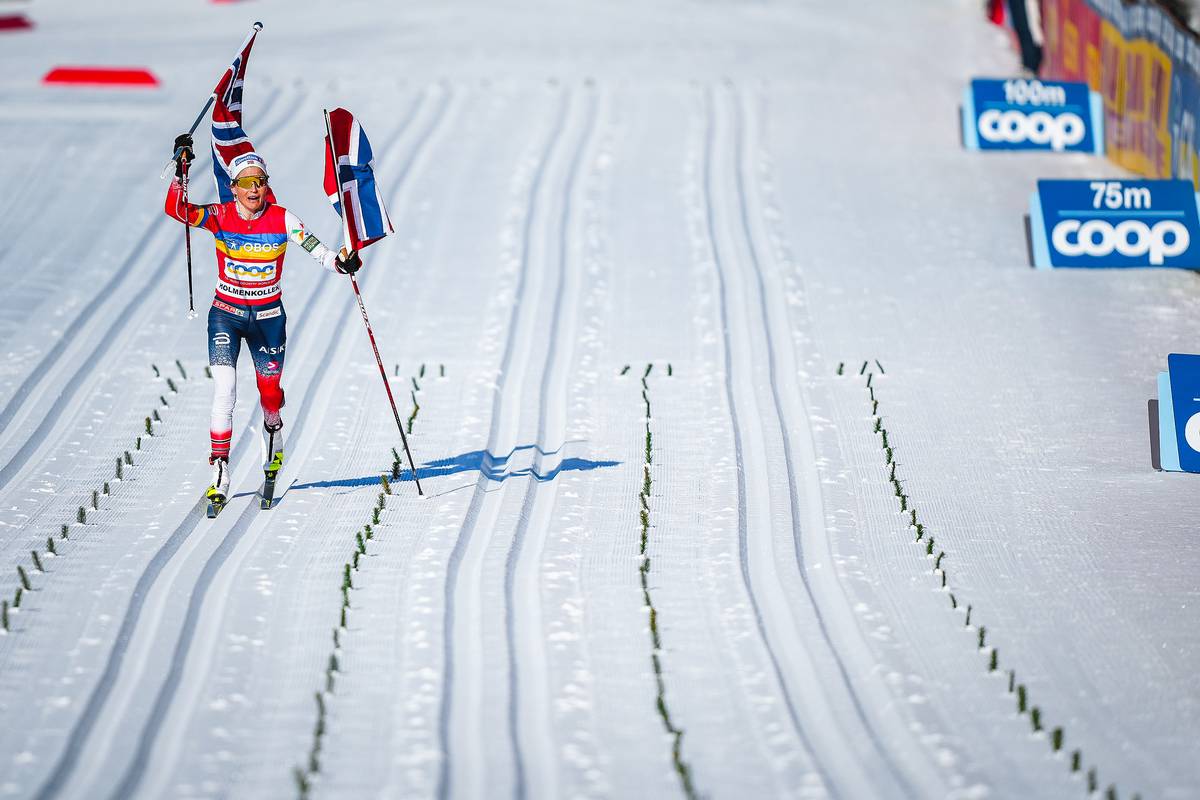
Therese Johaug waves Norwegian flags as she skis the final meters of 30 k classic at Holmenkollen. (Photo: NordicFocus)
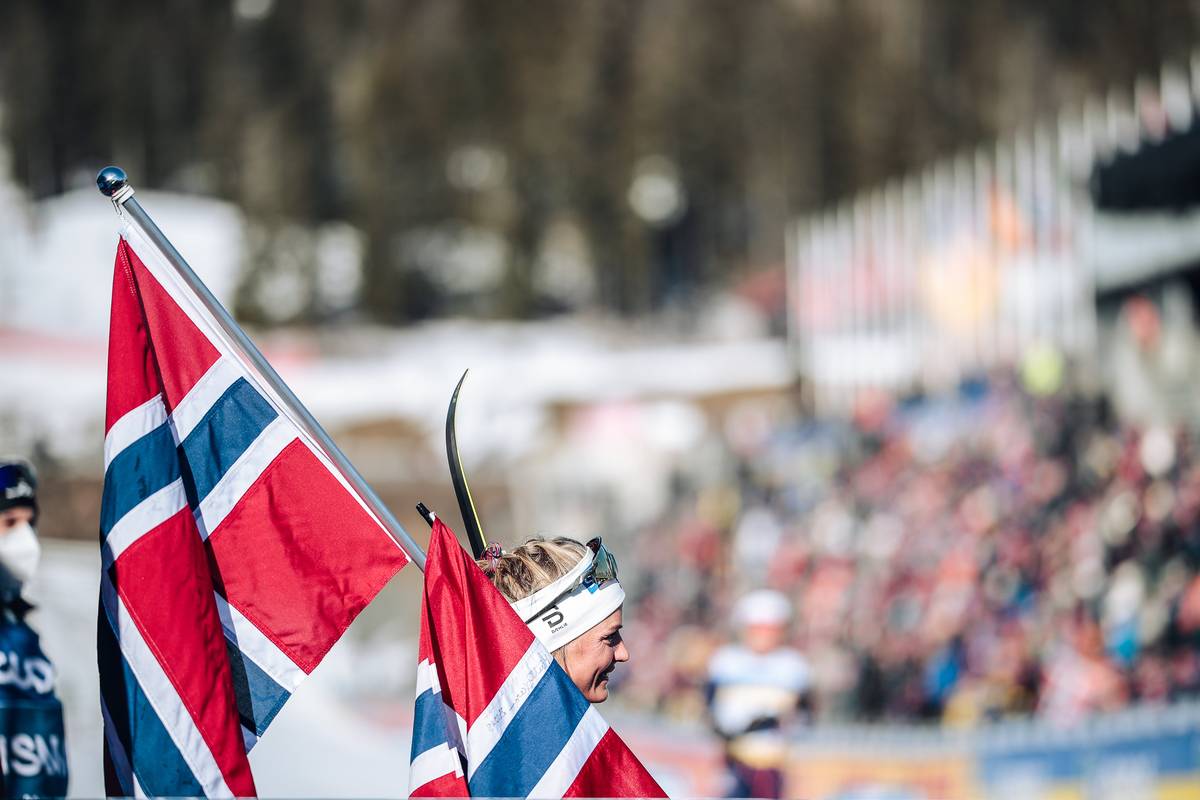
As she entered the stadium, Johaug was greeted by coaches and techs who handed her a flag for each hand, which she carried through the finish, waving, and stopping to take in the erupting cheers from the crowds.
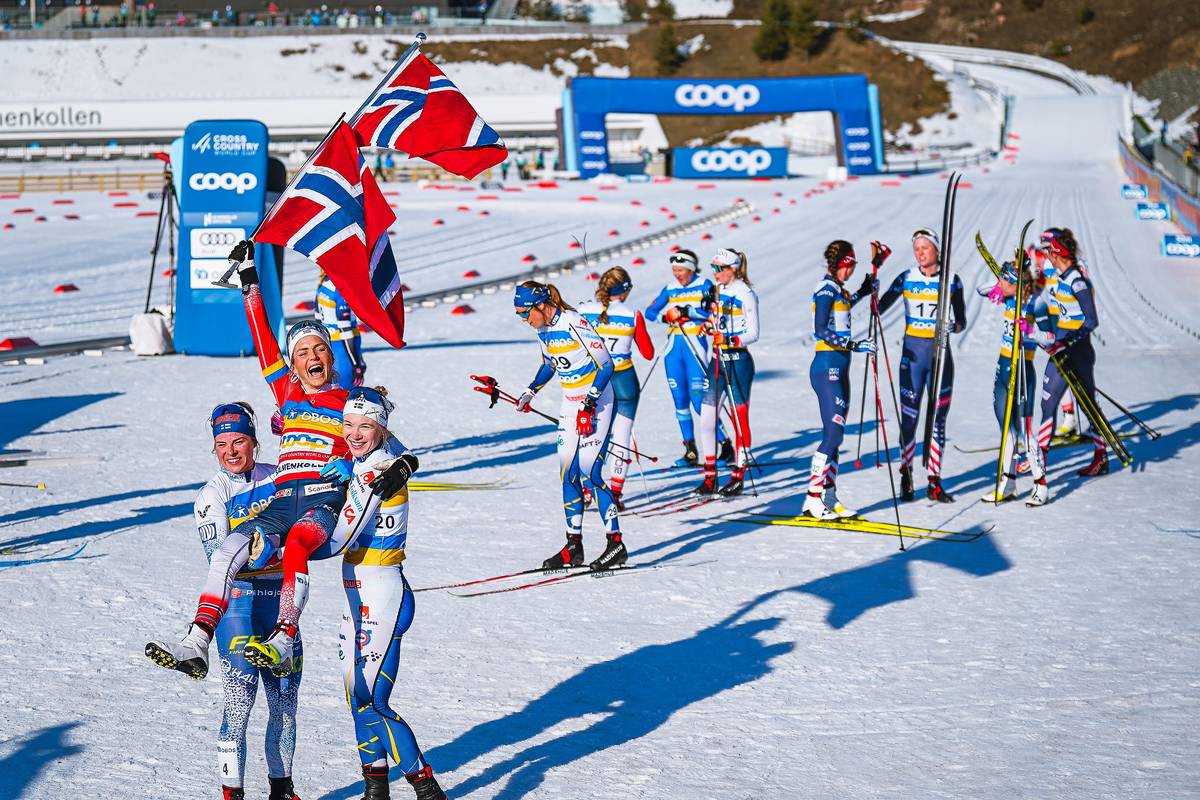
Laughing behind tears as the rest of the field began to trickle across the line, Johaug was hoisted onto shoulders, waving her flags for a loud Norwegian crowd who had supported and applauded her through fifteen years of racing on the World Cup.
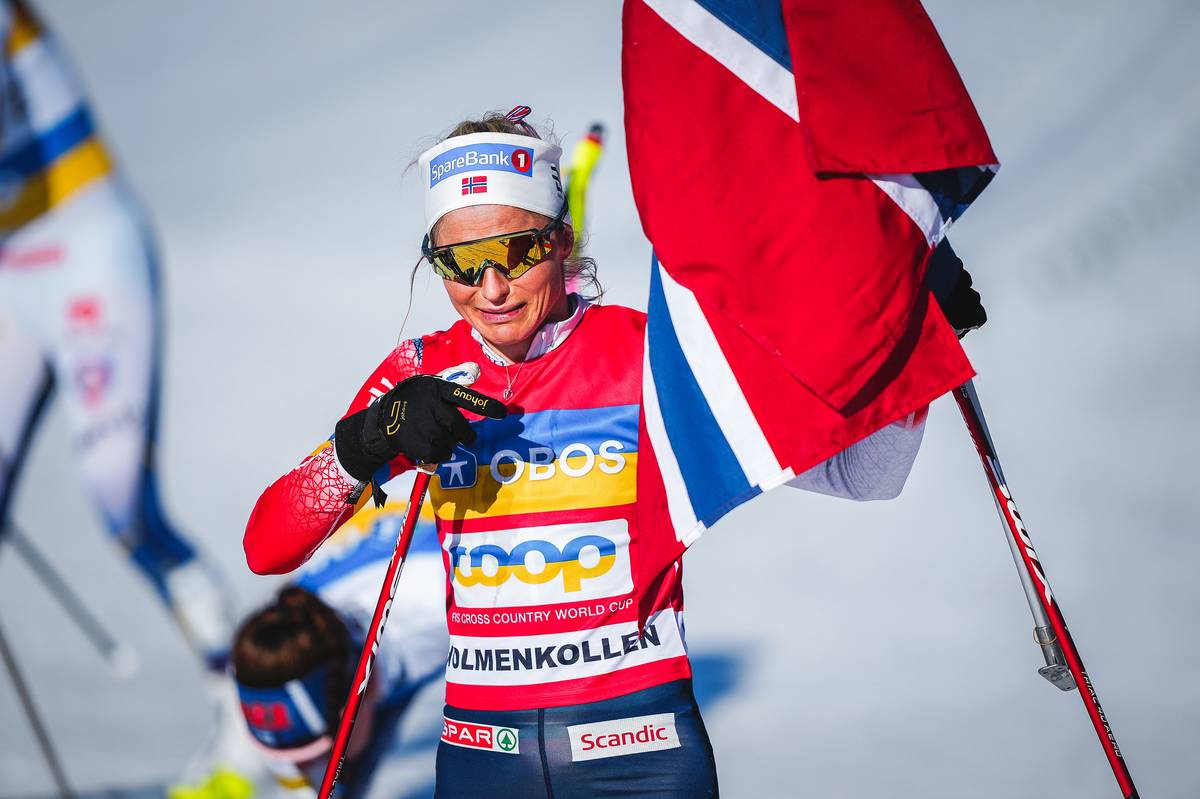
“It’s a lot of emotion now,” Johaug said at the finish. “I start here in 2011 with my first individual victory, and today is my last race here. It was sun and blue sky, the same as in 2011, and there were a lot of people around the track cheering for me. I’m so happy now, but also so sad that this is the end of my career.”
Therese Johaug was emotional at the finish of today’s 30 k classic at Holmenkollen, the venue where she won her first individual World Championship gold in the 30 k skate eleven years prior. (Photo: NordicFocus)Norway’s legendary Therese Johaug wins the 30 k mass start classic, exactly 11 years after her first individual World Championship gold medal was won on the same tracks. (Photo: NordicFocus)
While she indicated during the Olympics that she would not compete another four years, it was not until yesterday that she officially announced that this would be her final race at Holmenkollen.
“In many ways, it feels as if the [story] ends when on Saturday, March 5, 2022, I stand on the starting line for another 30 k in Holmenkollen. I really do not want the journey to end, but it is a time for everything,” she wrote to NRK. “In light of this, I look forward to a final fight at home with the flag on my chest, and I am grateful for everything the sport has given me.”
Therese Johaug is showered with champagne after winning the 30 k classic at Holmenkollen following her retirement announcement. (Photo: NordicFocus)Therese Johaug celebrates her final race race at Holmenkollen, winning the 30 k classic exactly eleven years after taking her first individual World Championship gold on these tracks. (Photo: NordicFocus)
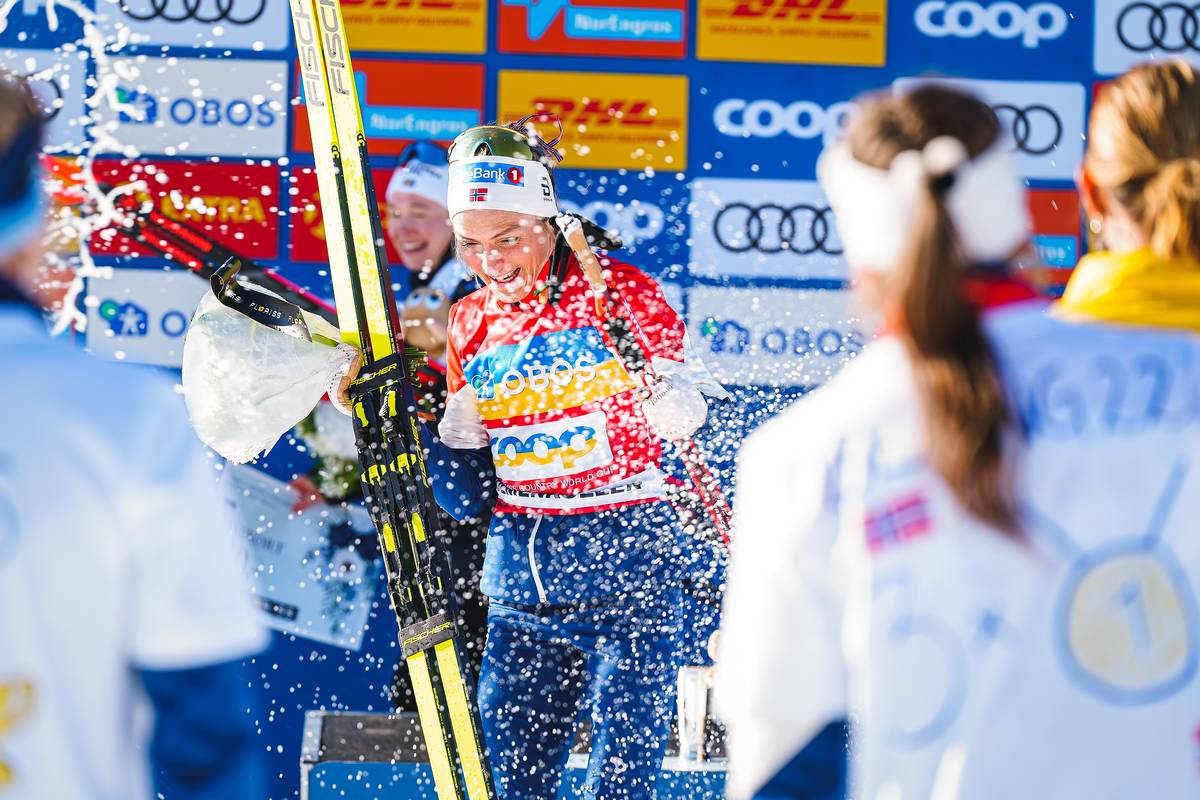
As Queen’s “We are the Champions” blared through the stadium, Johaug stepped off the podium only to be soaked by champagne sprayed by a flock of teammates wearing shirts spelling her name, with “takk” – thank you – written with a heart at the end of the row. It was a joyous celebration fitting for the moment, and perhaps also a refreshing distraction from the times at large.
“There are a lot of strong moments, but I am moved when so many people come here and see my last race. I must thank the Norwegian people who stand here today,” Johaug later said to NRK.
While you can certainly expect a more in-depth look at her storied career on FasterSkier, for now, we’ll echo the crowds in congratulating Therese Johaug, and we look forward to following along for the next chapters.
Therese Johaug celebrates her final race race at Holmenkollen, winning the 30 k classic exactly eleven years after taking her first individual World Championship gold on these tracks. (Photo: NordicFocus)Krista Pärmäkoski (FIN) and Jonna Sundling (SWE) lift champion Therese Johaug (NOR) for a podium shot at the finish of the 30 k classic in Oslo. (Photo: NordicFocus)
Behind the celebration, the lineup of women in today’s top-10 was remarkably similar to the Olympic 10 k interval start classic, with a few name swaps, and of course, a few noteworthy athletes missing – namely, Natalia Nepryaeva and Tatiana Sorina of Russia, and Jessie Diggins, who had been fourth, seventh, and eighth, respectively.
The volume of the ringing cowbells swelled as Finland’s Krista Pärmäkoski skied through the stadium on her own for second place, after pulling away from the first chase pack with 5 k to go and maintaining a healthy 10-15 second gap through the finish. Coming back on form after a few rocky seasons, Pärmäkoski had been third in the 10 k classic in Zhangjiakou, behind her teammate Kerttu Niskanen, who was fourth today (+33.8).
Finland’s Krista Pärmäkoski takes second in the 30 k mass start classic at Holmenkollen in Oslo, NOR. (Photo: NordicFocus)The women’s 30 k classic podium at Holmenkollen: Therese Johaug (NOR) took the win ahead of Krista Pärmäkoski (FIN) and Jonna Sundling (SWE). (Photo: NordicFocus)
Between the Finns, Sweden’s Jonna Sundling reaffirmed her talents across all distances, taking the third spot on the podium (+32.3) just two days after being second in Drammen’s classic sprint. Matching her fifth place result in the Olympic 10 k, Germany’s Katharina Hennig followed Niskanen to the line (+34.7) with Therese Stadlober, who was ninth at the Games, crossing after a gap in sixth (+46.7).
Leading the next chase group, and the American team, was Rosie Brennan in seventh (+1:12.3), bringing Norway’s Marte Skaanes and Sweden’s Ebba Andersson to the line just behind her for eighth (+1:13.1) and ninth (+1:13.8), respectively.
Rosie Brennan leads Norway’s Marte Skaanes and Sweden’s Ebba Andersson to the line. (Photo: NordicFocus)
“Today was huge for me,” Brennan wrote in a post-race email. “I have struggled here my entire career, and [though] it’s been a few years since I’ve raced here and I have improved a lot in the last few years, I still felt I lacked a lot of confidence and excitement coming here [today]. It’s also been a really stressful week for a variety of reasons, so I showed up today with an immense amount of anxiety that I needed to get a hold of before the race started.
“I am really proud of giving myself another chance to put together a good race here and to have managed the stress and anxiety well enough to do so. I wasn’t feeling in a place to shoot for the moon so I tried to start a bit a conservative the first 5 k and then reevaluate. I had a great ride with Ebba and really had an enjoyable time skiing out there today. The last lap, we had the chance to pick off a few from the lead pack and so I started to ramp things up to see what was possible. I felt strong on the last climb and felt I had a good shot at the sprint finish so I went on the last little bump before the [last 100 meters]. It felt great to finish strong and to put together a really solid race today.”
Rosie Brennan skis to seventh in the 30 k classic at Holmenkollen. (Photo: NordicFocus)
Following her classic sprint race in Drammen Thursday, Brennan joked post-race that she had lost out on yet-another boot slide. Today, the final sprint was hers. It was perhaps, also worth American fans celebrating that today that she won amongst her chase group, just under two weeks after a brave and gritty performance in the Olympic 30 k skate where she had pulled the chase group for much of the race, wearing herself out to break the wind, only to be dropped in the final 600 meters as Niskanen pulled away for a bronze medal. However, Brennan said she is not connecting any dots between the two.
“This race was nothing like Zhangjakou, really hard to even compare the two. 30 k’s are always an adventure and I am really happy to have put together two strong ones, in each technique.”
Rosie Brennan skis to seventh in the 30 k classic at Holmenkollen. (Photo: NordicFocus)
Commenting on how she is feeling, mentally and physically, with one final race weekend to go, Brennan concluded, “I am really bummed that the [World Cup] Finals were canceled. I haven’t raced a ton this season because of the earlier cancellations and while it has been a very high density block since the Olympics started, I am still feeling strong and wanted to see what I could do. But it will be really fun to end the season with the mixed relay event as that is a new one for us!”
Julia Kern was next for the US in 23rd (+3:37.2), followed by Hailey Swirbul in 26th (+3:57.8), and Caitlin Patterson – six days after taking second at the American Birkie – in 30th (+4:11.5).
Julia Kern skis to 23rd in the 30 k classic at Holmenkollen in Oslo, NOR. (Photo: NordicFocus)Hailey Swirbul skis to 26th in the 30 k classic at Holmenkollen in Oslo, NOR. (Photo: NordicFocus)
In a post-race call, head coach Matt Whitcomb shared that Kern’s result was perhaps especially noteworthy as she has been struggling throughout the season with nausea during distance races, making it difficult for her to keep down fluids taken in prior to the race, let alone receive feeds during. Whitcomb also explained that Diggins sat out today’s race as she was feeling lingering fatigue from the long, and successful, season of racing. He affirmed that she is healthy and will be ready to race for the final World Cup weekend in Falun, beginning next Friday. Listen to the full call with Whitcomb below.
Outside the top-30 for the US, Katharine Ogden was 37th (+5:54.1), followed by Rosie Frankowski, who has consistently landed on SuperTour podiums throughout the season, in 46th (+8:12.2).
Katharine Ogden (left) and Caitlin Patterson (right, bib 32) take to the course at the start of the women’s 30 k classic at Holmenkollen. (Photo: NordicFocus)Canada’s Cendrine Browne (bib 43) leads Katharine Ogden (bib 40) during the 30 k mass start classic at Holmenkollen. (Photo: NordicFocus)
Racing for Canada, Katherine Stewart-Jones led the way in 22nd (+3:25.0), with Cendrine Browne also inside the top-30 in 25th (+3:53.7). After a successful World Junior Championship in Lygna, NOR, Jasmine Drolet finished 42nd today (+6:53.2), with Olivia Bouffard-Nesbitt closing out the Canadian racers in 48th (+10:19.8).
FasterSkier’s American Birkebeiner coverage is made possible through the generous support of New Moon Ski & Bike in Hayward, Wisconsin. While you are at the Birkie be sure to visit New Moon Ski & Bike for all your local expertise.
Among the final major races in the ski world in 2020, the Slumberland American Birkebeiner pulled off an event with all the festivities for which the storied event is known. It was pure Birkie fever, with little concern for what other communicable diseases might be circulating at the time. A large snowstorm moved through the Northwoods of WI, followed by a bitter cold snap which let up just in time for a sunny day with mild temperatures on race day, setting up fresh, firm, and fast conditions that saw course records fall.
Flash forward through two years of pandemic and a non-traditional Birkie week format, and the weather gods delivered yet another pristine weekend for racing as the Birkie made its return, with all the Main Street revelry one could ask for.
This year’s Birkie also served as the final SuperTour of the season on American soil, with only Canadian Nationals which will be held in conjunction with SuperTour finals remaining on the calendar in late March. With several athletes who had been just behind the Olympic team cutoff appearing on the start list, along with a handful who declined World Cup starts in Lahti to race the Birkie and a few top international racers in the mix, the front lines of the elite wave were stacked. This set the stage for close racing and exciting final sprints on Main Street that kept the sound of the cheering crowds lining the finish at full volume.
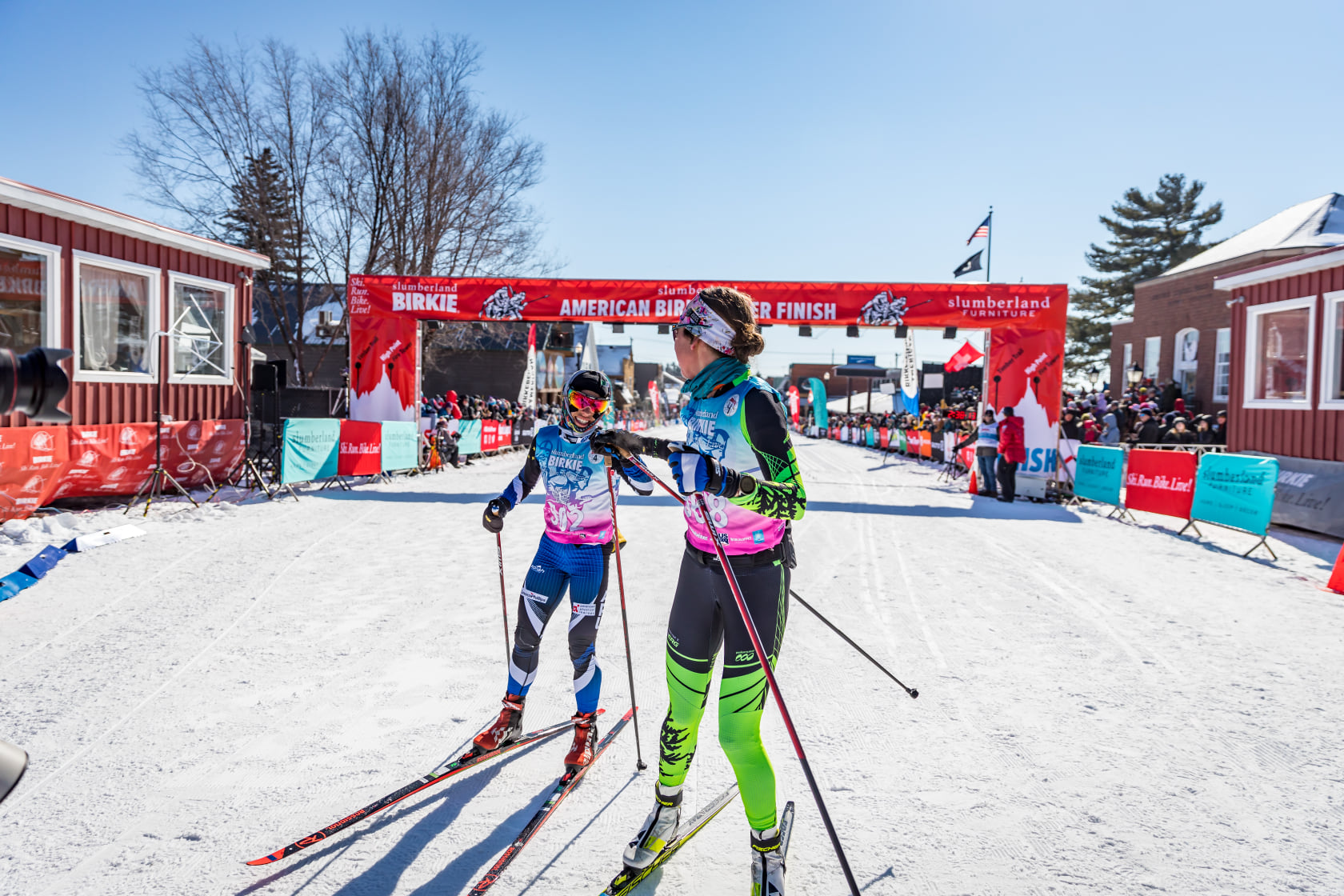
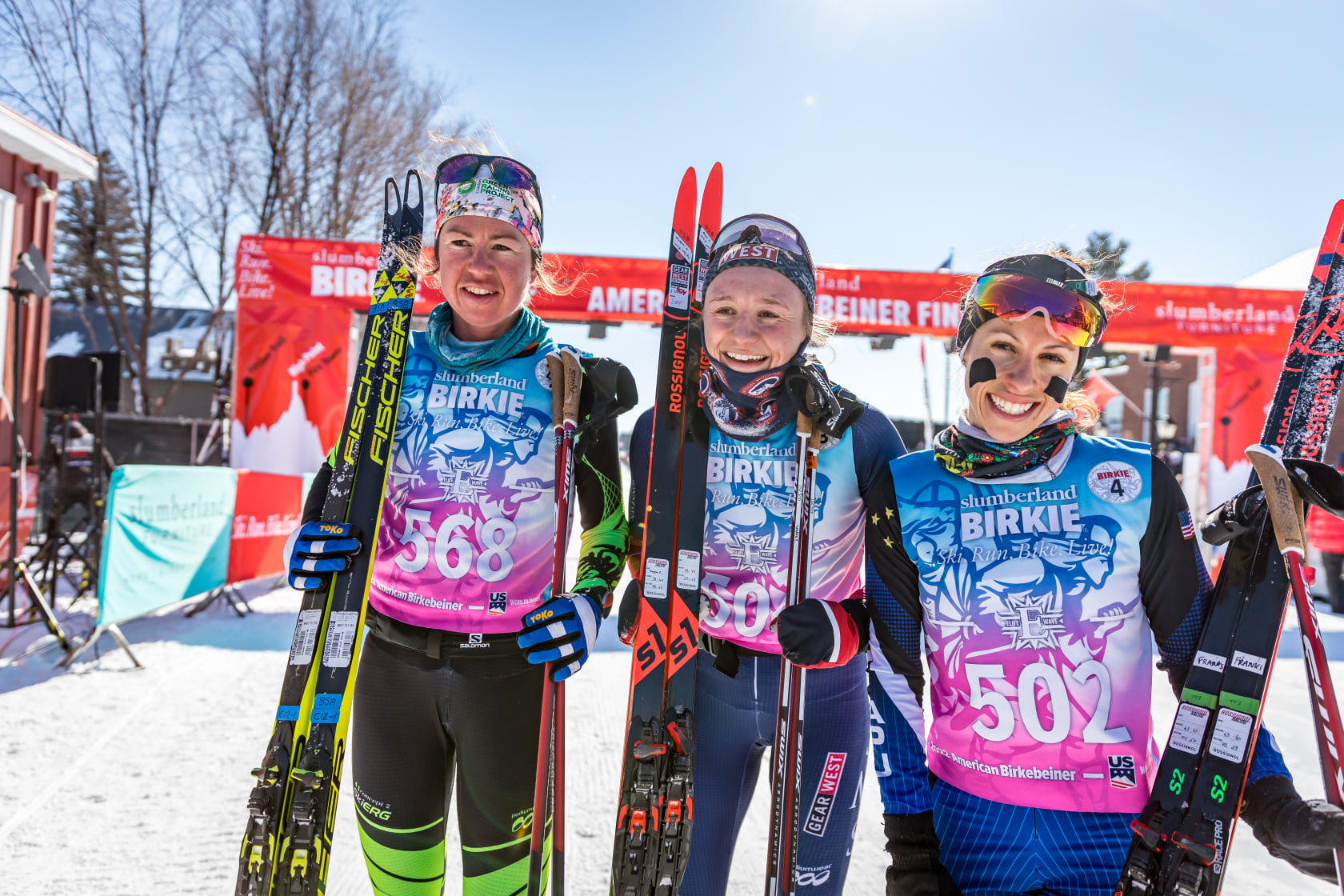
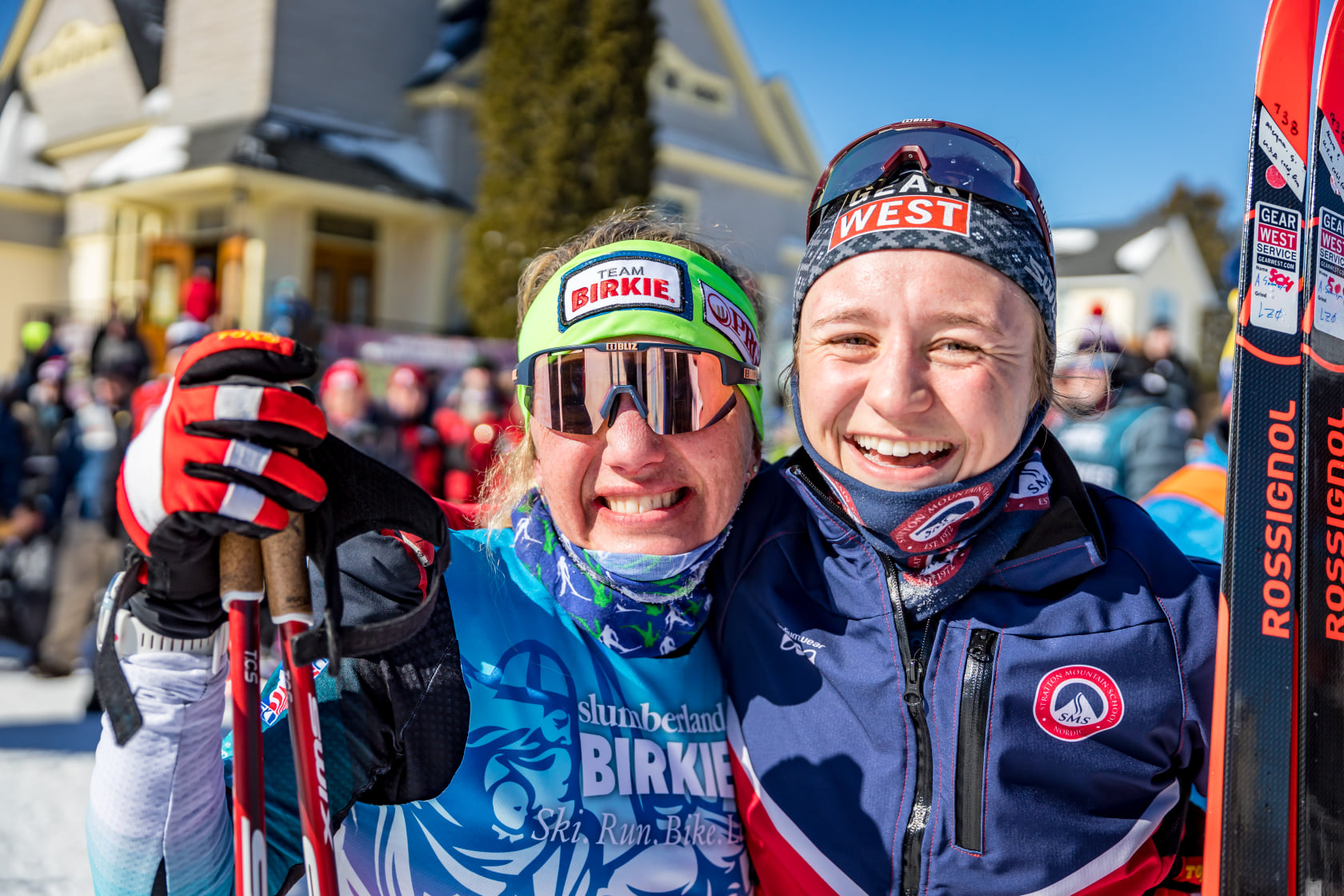
The women’s race was decided in the home stretch as Alayna Sonnesyn (SMS T2) took her third Birkie win in 2:22:52 ahead of Caitlin Patterson (CGRP) in second (+2.0), and Rosie Frankowski (APU) third (+9.0). Also racing for APU, Jessica Yeaton was the fourth woman to the line in Hayward (+27.0), with a retired-but-not-slow Sadie Maubet Bjornsen racing on the mountainFlow Eco Wax team taking fifth (+1:05.0).
Patterson had flown to the Midwest after spending three weeks in China as a member of the Olympic Team, however, she did not earn any starts there, calling it “#chinatrainingcamp” in a heartfelt social media post. Yeaton had also recently flown to the U.S. from Beijing after representing Australia at her second Olympic Games. Yeaton raced in five of the six events (Australia did not have enough women for a relay), with her top finish taking place in the opening 15 k skiathlon, where she finished 31st.
After winning the 2019 Birkie, Sonnesyn returned in 2021 for the unique opportunity to race both a skate and classic event in the same weekend. With pandemic restrictions in place, these races started and ended at the Birkie trailhead in Cable. Sonnesyn won the 45 k skate Birkie on Saturday, just four seconds ahead of Frankowski, then the two traded positions as Frankowski won the 45 k classic on Sunday, with Sonnesyn nearly a minute back in second.
“It feels so good to be here on such a beautiful day,” said in the livestream interview from the finish. “Last year, finishing back at the start was a really great time too, but there’s nothing like finishing on Main Street and hearing that blast of cheering as you come off the bridge.”
A Midwestern native for whom the Birkie has long been a family affair, Sonnesyn said each Birkie win has been special for her. While other women pushed the pace at the front, Sonnesyn had never been the first through the checkpoints. Commenting on her tactics in the post-race interview, she explained that this strategy played to her strengths.
“There are some spectacular distance racers in the field today, and I recognized that going into it and knew that they were going to push the pace and keep it hard through the entire race. I trusted my sprinting, I’ve been training a lot with Jessie Diggins lately and I’ve learned a lot from her, so I knew that I had an extra gear that I could use at the finish as long as I conserved [energy] throughout the race… There were moments where I didn’t think I was going to close those gaps, [and] I crashed with 4 k to go, so that was a little bit dramatic of me, but overall, I just knew that they were going to fight hard and that I would need to fight too.”
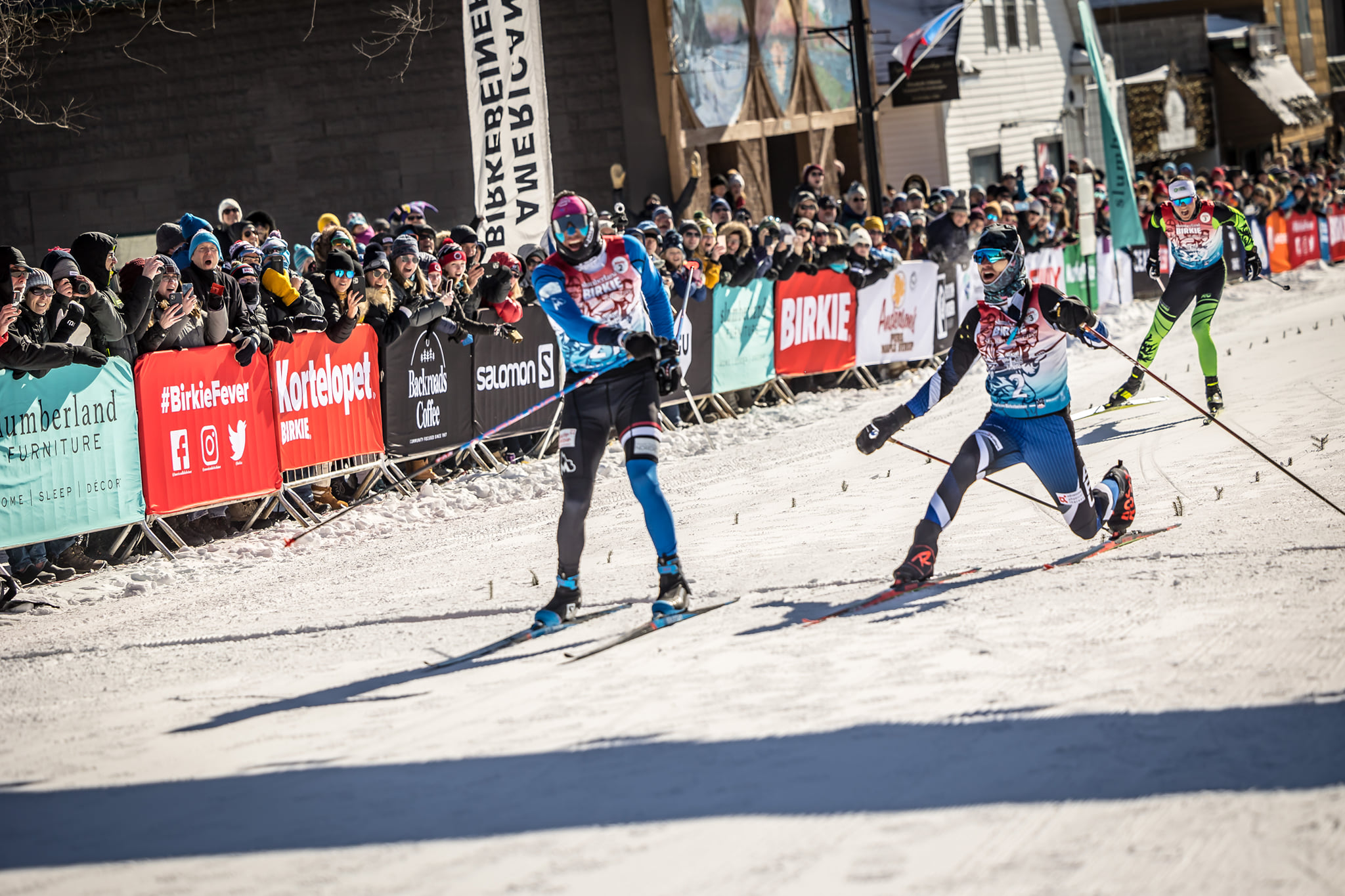
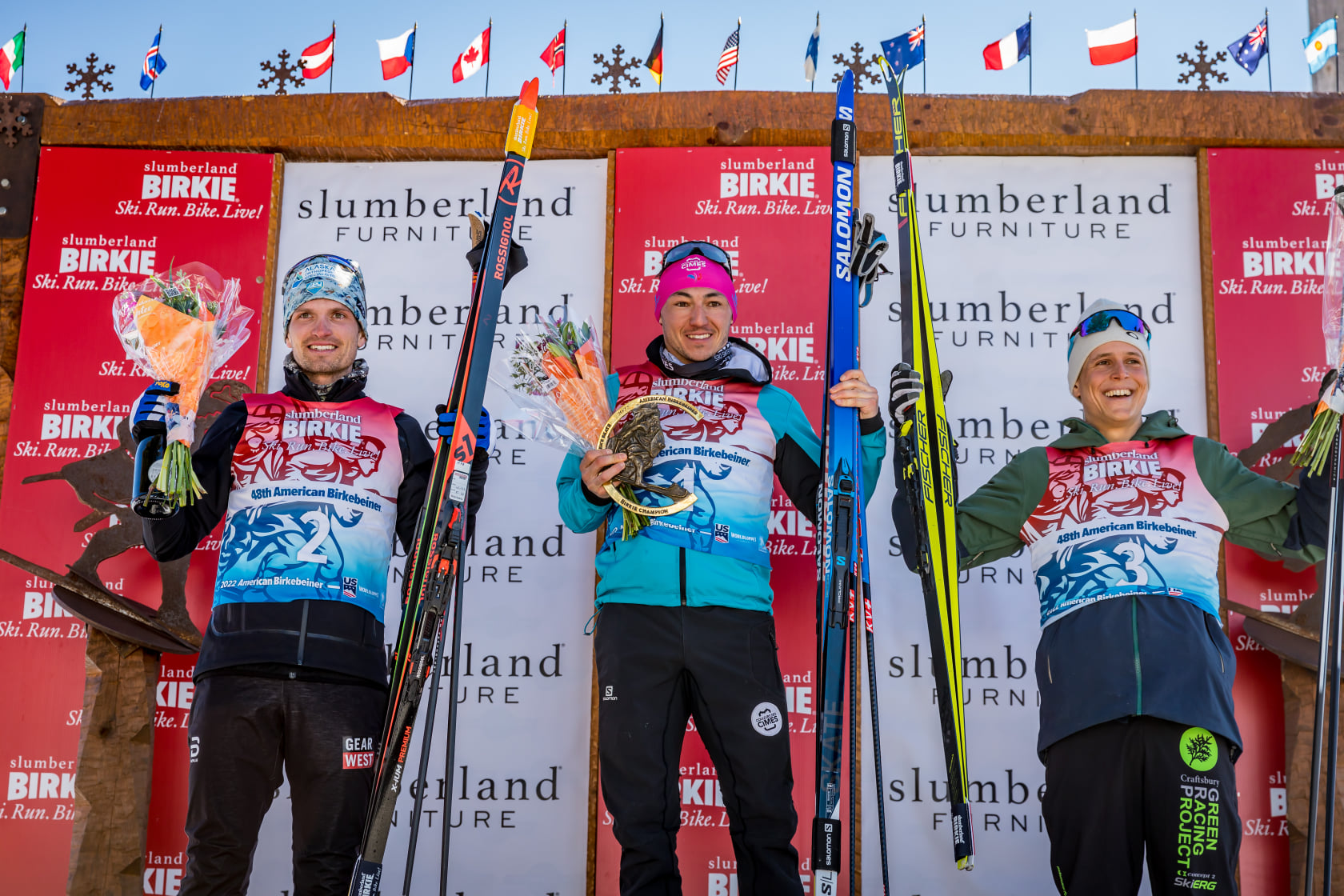
The men’s race saw an even tighter margin decide the winner. A threesome of David Norris (APU), Adam Martin (CGRP) and Gerard Agnellet of La Clusaz, FRA headed over the lake together, with a few chasers following at a distance, still in view of the cameras.
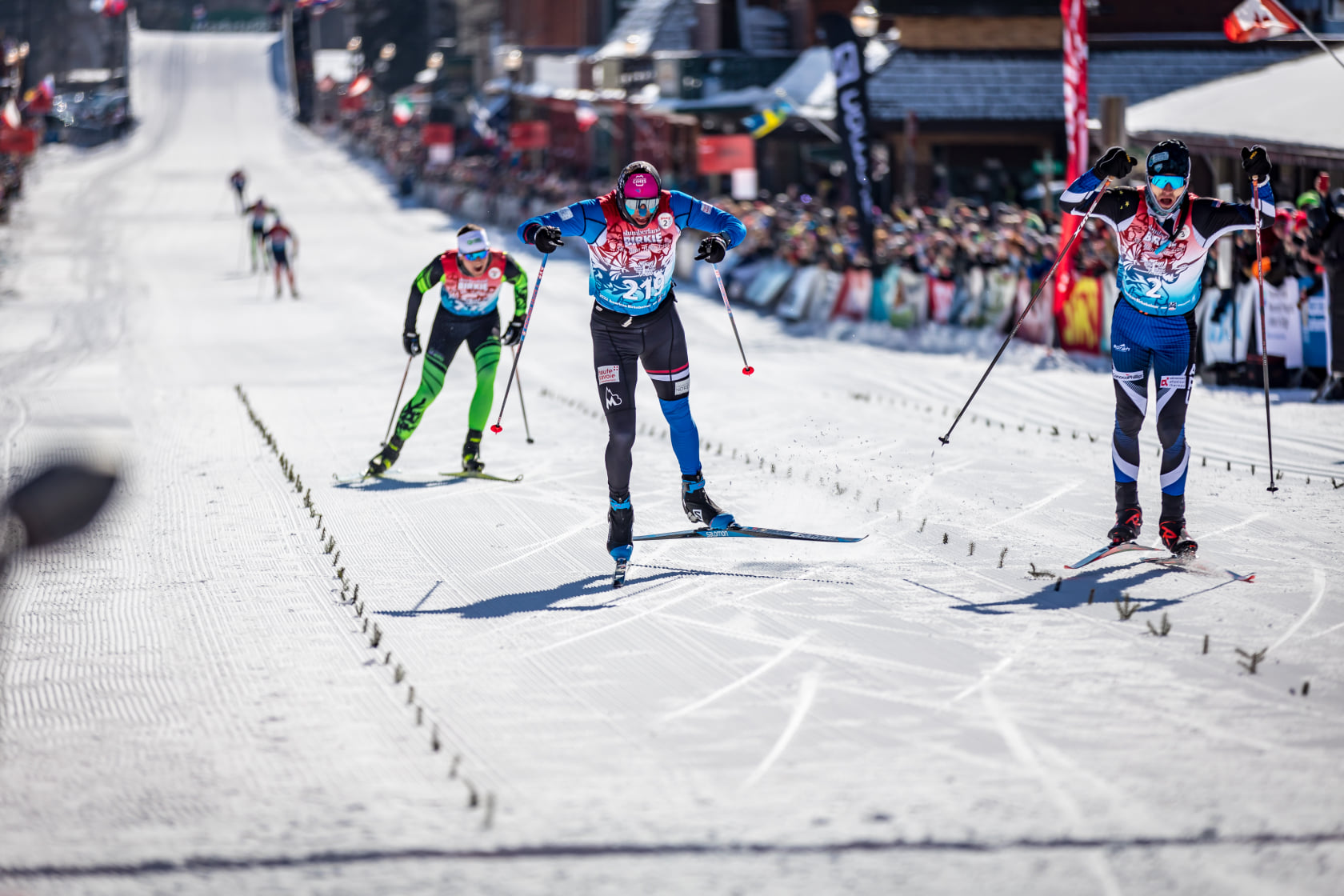
While Craftsbury’s Martin led over the bridge, it was Norris (APU) who looked to be the strongest in the final drag race up Main Street. Norris moved to the front and steadily gained ground on Martin, while Agnellet began a late surge from the back of the group.
In the closing meters, Agnellet accelerated to move alongside Norris’ right side, matching his pace just before the line where Norris threw his boot to keep his advantage. A photo finish decided that Agnellet had nipped Norris at the line – 50 kilometers of tactical racing decided by just centimeters of distance.
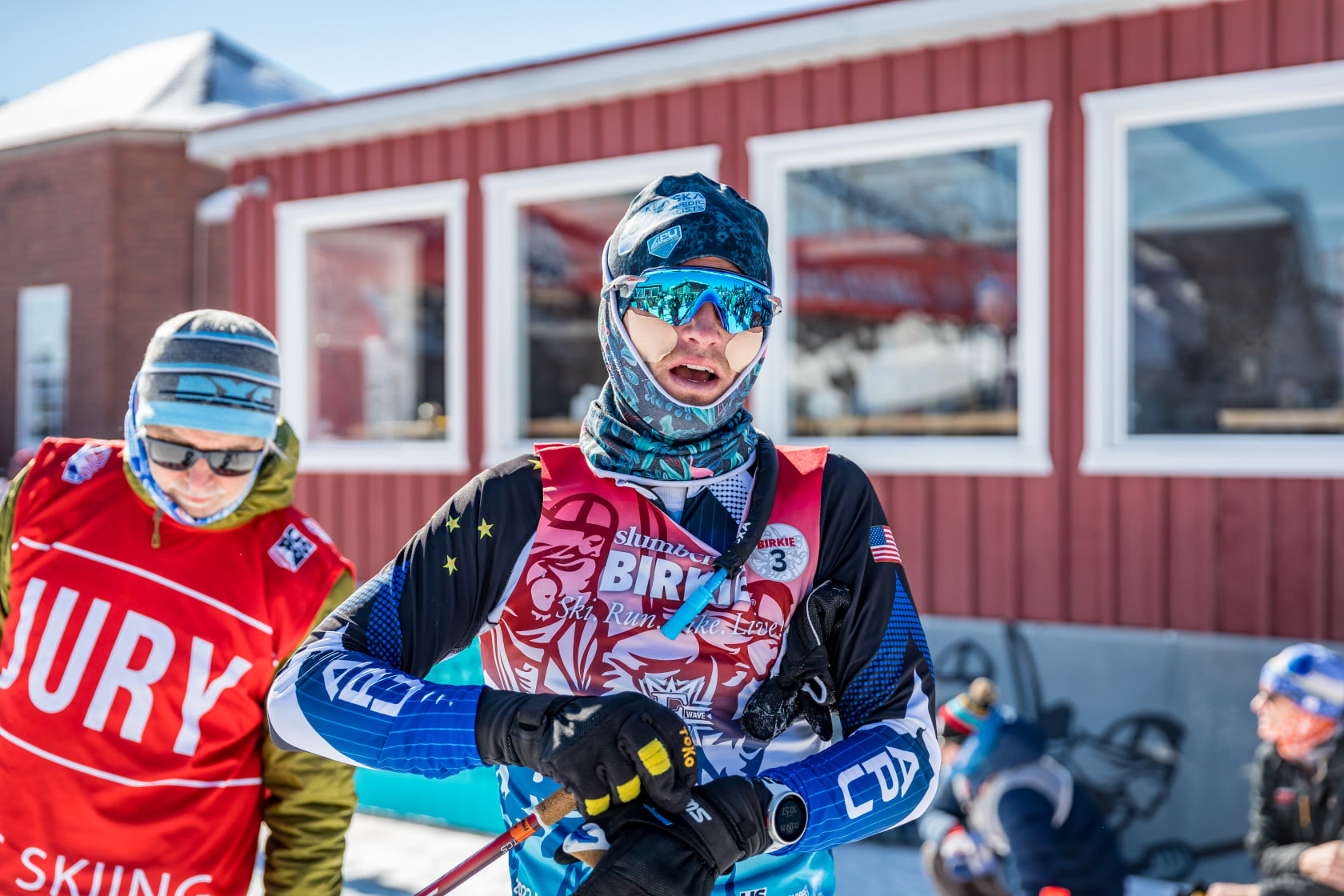
This is Norris’ third appearance at the Birkie. The 31-year-old won his first Birkie in 2016, then was fifth and second American behind Kyle Bratrud in 2018. Today’s result earns Norris $4,500 in prize money, plus a $2,500 bonus for being the top American male. Equal payout for the top male and female saw Sonnesyn earn $7,500 for the win plus the $2,500 bonus, perhaps easing the sting for both athletes who were just beyond the ranking needed for 2022 Olympic team selection.)
Just behind the excitement at the front, Adam Martin (CGRP) took third today (+2.0), while Ian Torchia (SMS T2) was fourth after a short gap (+15.0). Craftsbury’s Akeo Maifeld-Carucci, a 2019 Birkie winner, rounded out the top five men, +18.0 behind Agnellet.
Torchia would announce on Instagram the following day that the Birkie had been his final race as a professional skier.
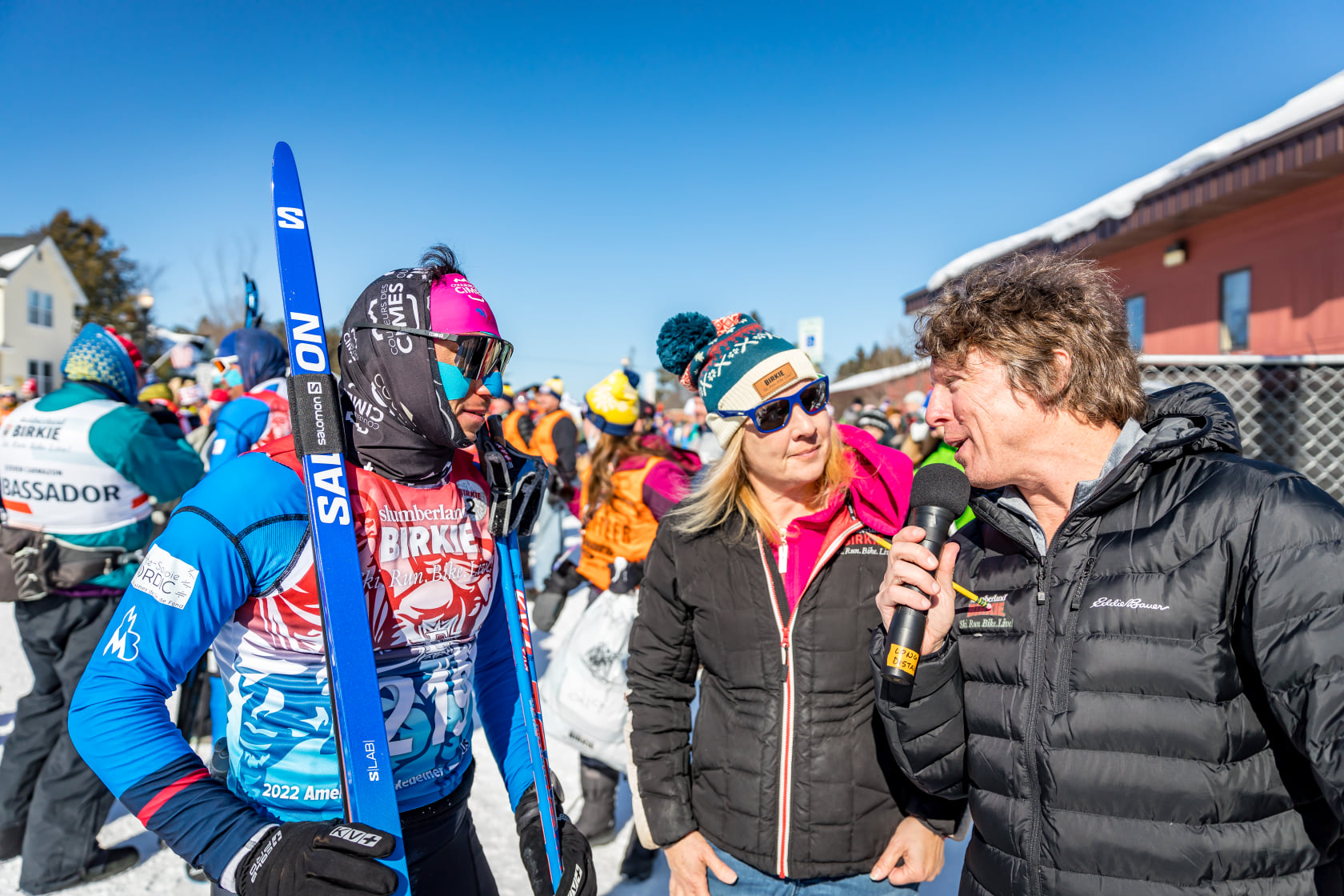
“Thank you very much,” Agnellet said through a translator at the finish. “I just loved the course here. It was fantastic and I’ve been very impressed with all the people I’ve met and all the encouragement I’ve received along the way. It’s been just a beautiful day here and I’m so excited to be on this great course, and to be representing France and to be the top man on the podium today.”
Agnellet was also asked about his strategy, in particular whether he had confidence that he could win in the final sprint and boot slide the line.
“My plan was to stay in contact with the front of the pack, and David Norris was looking so strong today. At a certain point I was thinking, ‘David has this and I’m racing for second place.’ But as the race went on, I was feeling stronger and stronger, and was happy to have come around David at the end.”
In the 55 k classic, Delaney FitzPatrick clocked the fastest time in the women’s race with 3:23:39, while Hayward native Josie Nelson was second (+5:26) and Molly Watkins of Duluth, MN was third (+8:10). For the men, Team Birkie coach Leo Hipp took the win in 2:51:57, while Chris Brunham of Stowe, VT crossed second (+20.0). Even Wetzel of Waukesha, WI rounded out the men’s classic podium in third (+2:24).
In the wake of a winter storm, athletes found ideal race conditions for a weekend of distance racing at the Craftsbury Outdoor Center, which hosted the Henchey Memorial Carnival. (Photo: NENSA Facebook Page)
By Ian Tovell and Rachel Bachman Perkins
Find FasterSkier’s coverage of Friday’s freestyle sprints here.
Saturday: 10 k Interval Start Classic
After another 4+ inches of snow fell throughout the day on Friday, NENSA described the conditions for today’s 10-kilometer interval start race as a “banner day for classic skiing” on the two-lap course at the Craftsbury Outdoor Center. The weekend of racing, titled the Henchey Memorial Carnival, included athletes of all levels, was described as “a celebration of the type of ski racing that [the late Bill Henchey] loved.” All three stages scored points toward the U.S. SuperTour Standings, while Friday and Saturday encompassed the UVM Carnival, and Saturday and Sunday’s distance races were part of NENSA’s Eastern Cup race series that allows developing athletes to qualify for Junior Nationals.
Results from the 10 k classic stage on Saturday established the start order and deficit for Sunday’s 7.5/10 k freestyle pursuit. The women took to the course first on Saturday at 9:45, with the men following at noon.
As the women lapped through the 5 k checkpoint, a familiar name topped the standings. Friday’s sprint winner Katharine Ogden (SMS T2) came through the halfway point in a time of 15:23.5. Rosie Frankowski (APU) was in second, 5.3 seconds back, while Alayna Sonnesyn (SMS T2) came through in third (+9.4). Second alternate for the Canadian Olympic Team, Jasmine Drolet (DAR) came through in fourth (+14.9), with Becca Rorabaugh (APU) right behind in fifth (+15.0). Ava Thurston (Mansfield Nordic Club) was 8th (+36.2), as the first U18 skier through the 5k mark.
Over the second lap, Ogden held onto her lead, claiming her second victory of the weekend in a time of 30:59.8. Though she has won all three SuperTour sprint races she has entered, this is Ogden’s first domestic distance win of the season. She was second to Caitlin Patterson (CGRP) in the 10 k classic in the U.S. Cross Country Championships in early January, then took second to Rosie Brennan in the same event the following weekend in Sun Valley.
“The race today was a lot of fun,” Ogden wrote to FasterSkier after the race. “It was a gorgeous Vermont day. Sunny, new snow, perfect grooming. Basically, a wonderful time. I love racing in Craftsbury with so many people I love. I also had some awesome skis, which is always a blast. It was especially fun to have my mom and dad and sister there! In terms of pacing and tactics, this course really has a lot of constant output, so I was mostly just focusing on skiing well and smoothly, and taking advantage of swapping between doublepole and striding to get little bits of recovery where I could. I got to ski with a little pack of EISA people (past and present) at the very end, which was fun.”
SMS T2 went one-two, as Sonneysn was able to catch and overtake Frankowski, placing second (+26.6) and third (+26.8), respectively. Yet another Sonnesyn-Frankowski matchup…
The women’s 10 k classic podium after the second day of SuperTour racing in Craftsbury, VT. (Photo: Craftsbury Outdoor Center/John Lazenby)
Rorabaugh crossed in fourth (+29.3), with Drolet rounding out the top-five (+34.4). Thurston was able to stay in the top-10 placing ninth (+2:18.5).
As the first collegiate racer, Drolet (DAR) topped the EISA podium with a time of 31:34.2. Yesterday’s collegiate sprint winner, Anna Bizyukova (UVM) was second (+36.1) and tied for seventh overall (+1:09.5). Erin Bianco (CBC) placed third (+58.3) and took the final spot in the top-10 overall (+1:31.7).
In the men’s race, it was between two athletes through the 5 k mark; Adam Martin (CGRP) went through with a time of 13:18.6 with Zak Ketterson (Team Birkie) only 2.1 seconds behind. Johnny Hagenbuch (SVSEF) was third (+9.3) at the half, with teammate Peter Holmes (SVSEF) in fifth (+15.0). Sitting in fourth was Finn O’Connell (BSF Pro), but his split did not register as he crossed the checkpoint.
Adam Martin races the 10 k interval start classic during the Henchey Memorial Carnival in Craftsbury, VT. (Photo: Craftsbury Outdoor Center/John Lazenby)
Martin was able to hold on for the win, closing the race with the fastest second lap split. Taking the win at home, he stopped the clock at 26:56.9. Martin took second in last weekend’s 10 k mass start free in Lake Placid, and won the 15 k classic at both the U.S. Cross Country Championships in Soldier Hollow, and the second SuperTour race weekend in Cable, WI.
Yesterday’s sprint winner Ketterson held solidly onto his position, finishing in second (+12.4), while Hagenbuch came through in third (+24.4).
“I’m really psyched to win today,” Martin wrote in a post-race email. “Interval start classic races are my favorite, so racing today at Craftsbury was close to my ideal race. A big snow storm came through Thursday night into Friday, so today’s near perfect conditions are a testament to our incredible grooming crew. I started toward the end of the A-seed directly in front of Zak Ketterson. I believe Zak put some time on me in the first 3 or 4 k, but I was able to claw that back by the lap mark and narrowly increase my lead by the finish. It deserves mention in all races, but at home when I know many of the volunteers, I especially want to thank everyone who came out to help put the races on, and as always our incredibly hard working wax techs.”
The men’s 10 k classic podium after the second day of SuperTour racing in Craftsbury, VT. (Photo: Craftsbury Outdoor Center/John Lazenby)
O’Connell finished fourth (+29.5) in the men’s overall, with Karl Schulz of Sun Valley next to round out the top-five (+38.1). It was a strong day for the Craftsbury Green Racing Project and the Sun Valley Gold Team, as both placed three skiers in the top-10.
In the collegiate race, Finn Sweet of UVM took first in a time of 28:08.5 beating two fellow Vermonters. Peter Wolter (MID) was not far behind, coming in second (+1.7). Fellow UVM skier, Gregory Burt finished third (+3.7). These athletes were 11th, 12th, and 14th in the overall standings, respectively.
The final day of racing in the Henchey Memorial Carnival featured a pursuit start for the 7.5/10-kilometer freestyle races, with start order and time back from the first starter determined by the previous stage’s results. Switching the order of the previous day, the men took to the course first, with Adam Martin (CGRP) heading out 12 seconds ahead of Zak Ketterson (Team Birkie). Johnny Hagenbuch (SVSEF) left the gate 24 seconds back, with Finn O’Connell (BSF Pro) next (+29.0), and Karl Schulz (SVSEF) starting fifth (+38.0).
With live timing giving splits solely based on time of day, overall position was tough to track from afar. As racers lapped through the 5 k checkpoint, Schulz had skied the fastest first lap, coming through midway in a time of 12:29.4. Goble Reid of BSF Pro came through with the second fastest time (+9.5), just ahead of teammate O’Connell (+10.3). Reid had started 13th, 1:18 back from Martin. Sam Wood (+12.9) of Sun Valley came through with the fourth-fastest time after starting 12th overall, 1:14 back. “Retired” long-time Craftsbury Green Racing Project team member Ben Lustgarten rounded out the top-five fastest splits at the midway point (+ 13.6). Both Martin (+37.8) and Ketterson (+25.4) were outside the top-10.
As mentioned, lap splits only tell part of the story. As the overall winner of the pursuit is whoever crosses the line first, moves and countermoves at the front of the field tell the true story of the day. Wearing a target on his back, Martin was quickly chased down by yesterday’s podium athletes, Ketterson and Hagenbuch. Lapping through the stadium, all three athletes raced together, heading out what would be a tactical second half. In the hunt were O’Connell and Schulz, both of whom were also within reach of the podium.
In the final kilometer, Hagenbuch began to lead the charge toward the finish, creating a small gap to Ketterson and Martin who were evenly matched as the leaders headed into the finish lanes. Hagenbuch held his advantage through the finish to stop the clock in a time of 26:02.0, which would also be the third fastest time of day.
Johnny Hagenbuch (SVSEF) pulls away for the win in the men’s 10 k freestyle pursuit, while Adam Martin (CGRP) and Zak Ketterson (Team Birkie) fight for second and third. (Photo: Craftsbury Outdoor Center/John Lazenby)
Dead even through the finish, Martin and Ketterson both crossed 1.2 seconds behind Hagenbuch, with second place going to Martin and third to Ketterson. O’Connell was next to the line for fourth (+3.3), with Schulz skiing the fastest time of day to take fifth (+13.0).
“It was a really fun weekend of racing in Craftsbury!” Hagenbuch wrote in a post-race email. “This was the first time I’ve competed here since I was a junior in high school in 2019, and happily the courses are much less intimidating now than they were then… The conditions for the classic race were just about as perfect as it gets; we may have raced on Blue Extra kickwax.”
Hagenbuch also provided a detailed look inside the men’s race, adding his own approach to the day, recognizing his time deficit and strengths.
“Being only 24 seconds back from Adam Martin at the start of the pursuit, I was pretty confident that I could at least catch him. I started with some intent, and I was able to reel in Zak Ketterson and Adam as Finn O’Connell and Karl Schulz reeled me in. The level of exertion dropped a lot once I caught the leaders, and I just tried to ski as smoothly as I could for the remainder of the first lap and the first half of the second five-kilometer lap. I picked up the pace at the start of the long climb from the low-point of the course – the one that includes ‘Screaming Mimi’ – and tried to hold high power through the climb. I established a decent gap – something that I didn’t necessarily expect – but had to keep pushing to hold off the chase group. Fortunately, I was able to maintain the lead and relax a little bit into the finish.”
The men’s podium after the 10-kilometer freestyle pursuit in Craftsbury, VT. (Photo: Craftsbury Outdoor Center/John Lazenby)
This is Hagenbuch’s third consecutive 10 k freestyle win of the season; he also stood atop the podium after racing on his home trails in Sun Valley, then again following the 10 k free in Lake Placid two weeks later. Putting together a solid weekend in Craftsbury, the 20-year-old was also third in the sprint qualifier on Friday, which he described as “one of his bests”. A member of the 2022 Junior World Championships team, and a soon-to-be Dartmouth College student, Hagenbuch concluded with insight into what lies ahead for him over the next few months.
“I’ll stay in Craftsbury this week, and then I’ll go directly to the pre-camp for World Juniors/U23s in Norway, which will actually be my first time to the country. Post-World Juniors, I’d like to remain in Europe for whatever competitions are offered to me. I would then go directly to SuperTour Finals in Whistler. From Canada, I would leave on March 28th to miss the first day of school and start classes on Tuesday in Hanover. It will be a whirlwind, but I’m really looking forward to it!”
As only Friday and Saturday’s events were part of the UVM carnival, collegiate race numbers dwindled on Sunday. The top EISA skier for the second day in a row was Finn Sweet (UVM) with a winning time of 27:44.6. Going one-two for UVM, teammate Bjørn Westervelt was the second collegiate skier across the line (+3:04.4), while Bowdoin’s Carson Williams finished third (+3:59).
Katharine Ogden leads the women’s 7.5 k freestyle pursuit in Craftsbury. (Photo: Craftsbury Outdoor Center/John Lazenby)
In the women’s 7.5 k pursuit, Katherine Ogden (SMS T2) was first on course with a sizable gap to the next racer. Her teammate, Alayna Sonnesyn, and APU’s Rosie Frankowski of APU Nordic headed out at 26 and 27 seconds back, respectively. Becca Rorabaugh of APU was next out of the start gate at 30 seconds back, with Alexandra Lawson of Craftsbury beginning 42 seconds back as the fifth starter.
Working to close the gap to Ogden during the first lap, Frankowski skied the fastest split through the 3.75k checkpoint with a time of 9:27.0 with Sonnesyn skiing the second fastest split (+1.9). Their work proved effective, as they caught the leader and lapped through the stadium as a group.
Rorabaugh had the third fastest 3.75 k split at the half (+14.7), while Lina Sutro (SMS T2) of SMS T2 skied the fourth fastest (+16.7) and Lawson the fifth (+15.9).
In Craftsbury’s Day 3 recap video (embedded below), produced by Mountain X Media, Frankowski described the second lap as “cat and mouse” as each of the athletes took advantage of her individual strengths to push different sections of the course. Eventually, Ogden began to fall off the pace, while Sonnesyn and Frankowski stayed tight through the final kilometer.
Rosie Frankowski (APU) leads Alayna Sonnesyn (SMS T2) and Becca Rorabaugh (APU) up a climb during the women’s 7.5 k freestyle pursuit in Craftsbury. (Photo: Craftsbury Outdoor Center/John Lazenby)
In the end, Sonnesyn found the advantage, heading into the finish lanes with a gap over the other two women to take the win in 19:40.5. Frankowski crossed 3.5 seconds back for second place, with Ogden taking third after a 23.5 second gap. Rorabaugh was fourth (+31.3), with Lawson fifth (+57.5). U18 standout Ava Thurston (Mansfield Nordic Club) skied her way from 9th to 6th (+1:31.8).
“I felt really good today and am excited about that!” Sonnesyn wrote to FasterSkier after the race. “It’s been a lot of racing the last 10 days and I was feeling the fatigue start to accumulate, but I’m also feeling confident in my distance skate skiing right now, so I was pretty excited to work hard out there.”
Over those ten days of racing, Sonnesyn has raced in five events and only missed the podium once in Friday’s freestyle sprint. She also won the 10 k mass start freestyle last weekend in Lake Placid.
“It was really fun to do a pursuit race today! We don’t typically do pursuits in the U.S. and the last few years I’ve only competed in World Cup pursuits where I started in the wave, so it was a unique and exciting day. I knew Rosie, Becca and I would want to work pretty hard in the beginning to chase down Katharine and that’s exactly what we did (although we never outwardly spoke about this plan with each other). We charged pretty hard from the start and once we became a full pack we started playing a little more cat and mouse on the second lap. We were all trying to conserve energy for the final few kilometers while also keeping up the pace, which made for some tactical racing.
“The last 1.5k are pretty much all uphill. From the bottom Rosie started charging again and I hung on. Prior to reaching the super steep pitch on Screaming Mimi, I put in a surge so I could take the most direct route around the corner. From there, I put my head down and gave it everything I had left up the last bit of the climb and into the finish.”
The women’s podium after the 7.5 k freestyle pursuit in Craftsbury, VT. (Photo: Craftsbury Outdoor Center/John Lazenby)
A graduate of UVM and now a member of the Stratton Mountain School T2 team, Sonnesyn has perhaps spent more of her competitive ski career based in the Northeast than near her childhood home in Plymouth, MN.
“The Midwest will always be my home but Vermont has become my second home the past eight years. It was pretty incredible hearing so many people cheering my name this weekend and definitely kept me charging up those hills. Really fun to be around such a great ski community and feel the love for the sport. Makes me appreciate this sport and all of the people in it!”
Wrapping up with her next steps, the two-time American Birkebeiner champion (2019 and 2021) has her eyes set on the Midwest’s marquee event.
“I’m currently en route back to the Midwest to spend a few weeks at home training for the Birkie. I’m excited to be back and the fever is definitely setting in!”
In the collegiate standings, UVM’s Annie McColgan took the win as the Catamounts topped both the men’s and women’s EISA podiums. McColgan’s time of 22:57.0 put her in 14th overall in the women’s standings. The second collegiate athlete was Emma Strack of St. Lawrence University (+2:20.9), with teammate Charlotte Browne in third (+6:15.5).
*****
As Period III draws to a close, the SuperTour race calendar breaks for the remainder of the 2022 Olympic Winter Games. The next race event will be the 50 k American Birkie, kicking off on February 26 in Hayward, WI.
SuperTour racing continued on Friday in Craftsbury, Vermont, as part of the Henchey Memorial Carnival, which also included Eastern Cup and collegiate racing. The three-day event is presented by the Craftsbury Outdoor Center, NENSA, U.S. Ski & Snowboard, and the University of Vermont (UVM), the EISA carnival host school.
Racers were faced with snowy conditions for the opening 1.4-kilometer freestyle sprint as a winter storm made its way across the Northeast. Friday morning’s grooming report mentioned 6 inches of fresh snow, as more continued to fall throughout the morning.
On the women’s side, last weekend’s 10k freestyle winner, Alayna Sonnesyn (SMS T2), won the qualifier in 3:58.27, ahead of BSF Pro Team’s Lauren Jortberg in second and APU’s Rosie Frankowski in third. Perhaps a nod to the wintery conditions, these top three finishers were separated by over six seconds.
Sonnesyn advanced from the first heat of the quarterfinals into the semis, where she finished third in the first heat behind Katharine Ogden (SMS T2) and Ava Thurston (Mansfield Nordic Club), who crossed the line together, roughly 0.4 seconds ahead of Sonnesyn. As the second semi, which was won by Jortberg, was roughly four seconds faster on average, Sonnesyn did not earn a lucky loser spot in the final. Instead, Jortberg advanced with Anna Bizyukova of UVM, Frankowski, and Craftsbury’s own Margie Freed.
Despite the trend seen in the qualifier, the final featured tight racing, with the top five athletes finishing within two seconds of one another. Just 0.6 seconds separated second from fifth.
A scene from the women’s final of the 1.4k freestyle sprint in Craftsbury. (Photo: Instagram @nensa_nordic)
Coming out on top was Ogden, who won the final in 3:59.08. After racing on the World Cup from the opening races in Ruka through the midway point of the Tour de Ski, Ogden has gone three-for-three in SuperTour sprints since returning stateside, winning classic sprints in Soldier Hollow and Lake Placid before checking off a skate win today.
Just behind, Jortberg took second place (+1.30) with U18 athlete Thurston closing in third (+1.78). Bizyukova was next to the line in fourth (+1.86), with Frankowski less than a meter behind in fifth (+1.91). Freed rounded out the women’s final in sixth (+4.51).
“I think that the biggest thing to note about today was that it was blizzarding!” wrote Ogden in a post-race email. “The heavy falling snow made the heat racing very tactical and rewarded being very quick off of the line. There was one lane on the course that was packed down by traffic and the other areas were pretty soft!”
Ogden was just 11 points behind Caitlin Patterson on the Olympic qualification distance list, based on the athletes’ best two distance races on the SuperTour or at the U.S. Cross Country Championships, during which Ogden competed in only one race – the 10k individual start classic where she was second to Patterson. The following weekend in Sun Valley, she was second in one distance race and fourth in the other, behind three Olympians and ahead of Patterson in each. As the races at U.S. Nationals were scored at a higher point value, Patterson took the final Olympic spot, leaving Ogden on the wrong side of the cusp.
Nevertheless, Ogden has found silver linings in the additional time back east.
“It was a blast to be able to race with the EISA. I miss skiing for Dartmouth (Ogden graduated in 2021), so it was fun getting to ski with some of my old teammates and some new Dartmouth skiers. It was also pretty great to ski in lots of natural snow, we rarely get a snowstorm this big anymore and it was undeniably very fun.”
The women’s podium after the opening freestyle sprint race which kicked off a weekend of SuperTour, Eastern Cup, and EISA racing. (Photo: APU Nordic Ski Center / Instagram)
As Thurston is, remarkably, still in high school, Bizyukova was the top collegiate racer to earn today’s EISA sprint title. The second and third placed collegiate racers both hailed from Dartmouth College, with Callie Young finishing fifth in the first semifinal and 10th overall, and Jasmine Drolet taking sixth in the second semi for 11th overall.
The men of the Sun Valley Ski Education Foundation (SVSEF) Gold Team swept the top-three spots in the men’s qualifier, with Karl Schulz leading the way in 3:23.48. Peter Holmes was 0.33 behind in second, with Johnny Hagenbuch in third (+1.21).
Schulz carried momentum from the qualifier win into the first quarterfinal, which he won by half a second, but his day ended soon after in the semifinal. Racing in a fast first heat that contained two eventual podium winners and found both lucky losers, Schulz was fifth in the heat, +1.72 behind winner Matias Øvrum of UVM. Sam Wood (SVSEF) was second in the heat, ahead of last weekend’s sprint winner Zak Ketterson (Team Birkie) and Gregory Burt (UVM).
In the second semi, which was nearly three seconds slower, Canada’s Étienne Hébert (CNEPH) edged out Holmes by 0.1 seconds to go 1-2 and advance to the final round.
Zak Ketterson leads up the final climb in the men’s freestyle sprint final in Craftsbury. (Photo courtesy Zak Ketterson)
The top two spots in the final were decided by a close finish between Ketterson and Øvrum, with Ketterson crossing 0.28 ahead in a time of 3:22.57 to earn his third SuperTour sprint title of the season. Øvrum was second, though he was named the collegiate race winner for UVM, with Hébert crossing the line a few meters behind on his own in third (+2.17).
“I’ve always really liked racing at Craftsbury,” Ketterson wrote to FasterSkier after the race. “It’s an awesome place and this year Team Birkie has been lucky enough to stay right at the Outdoor Center. The race course is right out our back door!”
Ketterson also provided insights to the final round for those following from afar.
“The final was really close! I gave it everything I had at the top of the last hill but I definitely started to get tired and bogged down a bit into the finish. Matias skied a smart race and gave me a really good challenge in the last few meters but luckily I was able to fend him off. It was a tricky day with super soft fresh snow and I’m happy I was able to execute.”
Zak Ketterson races a snowy freestyle sprint qualifier in Craftsbury. (Photo courtesy Zak Ketterson)
Wood was fourth in the men’s final (+6.9), with Burt fifth (+7.17), and Holmes sixth (+10.82).
The men’s freestyle sprint podium after the opening day of SuperTour racing in Craftsbury. (Photo: Instagram @nensa_nordic)
As mentioned, Øvrum was the top collegiate racer, with Burt second, going one–two for UVM. Third place among college athletes was Allan Luke of Dartmouth, who finished sixth in the first semifinal and 12th overall.
Craftsbury’s Day 1 coverage of the the 2022 Henchey Memorial Carnival: SuperTour, NENSA Eastern Cup and UVM EISA carnival.
Here’s a quick results recap from today’s SuperTour 10-kilometer mass start freestyle race in Lake Placid, NY. Stay tuned tomorrow for detailed coverage including comments from athletes.
Racing continued at Mt. Van Hoevenberg this morning in what Weather.com called “bitterly cold” conditions. Near-zero temperatures and skate skiing can be a challenging combination for a distance race on a World Cup–level course, but racers nonetheless put together strong performances on the three-lap 10-kilometer course.
In the women’s race, Rosie Frankowski (APU) set the pace with a fast start, leading through the 9k checkpoint. Having steadily reeled her in, Alayna Sonnesyn (SMS T2) caught Frankowski in the final kilometer, pushing ahead in the final meters to take the win in 28:57.1. Frankowski crossed the line in second (+3.7), with APU Teammate Becca Rorabaugh leading a chase pack to the finish to cross third (+36.6).
The men raced second today, with BSF Pro Team’s Finn O’Connell leading a sizable group through 6.6k. From there, SVSEF Gold Team member Johnny Hagenbuch turned up the pace, creating a gap over the final lap to finish unopposed in 24:35.3. Duking it out to the final stretch, Adam Martin (CGRP) took second (+11.6), roughly two seconds ahead of Peter Wolter (SVSEF) in third (+13.8).
After a brief break, the SuperTour picked up in Lake Placid this weekend, with a fluoro-free Period III kicking off with a 1.5-kilometer classic sprint. The frigid forecast called for overnight lows of -5 Fahrenheit, with a wind chill as low as -23F. Highs during the day were only predicted to climb into the low single digits. Qualifiers were scheduled for 10/10:45 am, with quarterfinals for the open men beginning at noon – hopefully, enough time for a few degrees of warmth to reach the trails.
The weekend competitions would be hosted on Mt. Van Hoevenberg’s new World Cup trails, which are paved for rollerski use in the summer, and played host to NENSA’s “Keys to the Castle” sprint event in September. For those familiar with the venue, the new courses are tucked into the north-facing hillside, just south of the 1980 Olympic stadium and biathlon range. The new serpentine loop intersects with the final Ks of the classic “Ladies 5” outer loop, but overall remains closer to the stadium to allow access to the recently improved snowmaking system.
Jessie Diggins (SMS T2/USST) pushes over the climb during the final round of the Keys to the Castle sprint. (Photo: Matt Whitcomb)
With a large reservoir and advanced technology, this new World Cup loop can be made winter competition ready within four days, though Van Hoevenberg’s nearly 50k of open trail might suggest that coverage is not currently an issue.
There was praise for the course from many athletes, including those that have seen both Lake Placid, and everywhere in the world beyond Lake Placid.
“It raced much more like a world cup course!” said Alayna Sonnesyn (SMS), in an email to FasterSkier. Katharine Ogden (SMS) too, said of the course, “it was WAY more fun than the old one…[which] was pretty flat.”
The course designers at Lake Placid seem to have carefully been taking notes on what makes sprint racing exciting over the course of its evolution as a discipline in the sport. An historic venue for American skiing, these developments may be a long-time coming for Mt. Van Hoevenberg, but it’s clear that they were executed with mastery so VanHo can continue to expand upon its legacy in the decades to come.
This course featured a long, final uphill climb to test a skier’s mettle, then a short, technical downhill into the finish to test their tactical brains. And in between; transitions, transitions, and more transitions.
Becca Rorabaugh (APU) said of this : “The final climb always turned into a drag race, and I liked the pitch because it favored a bit of a stride over an all-out run. Skiers still had to be alert through the downhill and finish, though; positions often changed in the stadium.”
The weekend, hosted by the Olympic Regional Development Authority (ORDA) in Lake Placid, also served as the second NENSA Eastern Cup weekend. Thus, senior athletes from American elite clubs lined up alongside regional junior racers, eastern collegiate racers, and Canadian athletes who traveled from Quebec, Ontario, and beyond. 382 athletes, 176 women and 206 men, on the start lists for the qualifier, and separate heats were run for the U18/U20 and U16 categories.
Without livestream, FasterSkier has relied on live timing and athlete interviews to shed light on how the sprint races unfolded.
Men’s 1.5-kilometer Classic Sprint
After returning from a stint in Europe where he raced the Tour de Ski, Team Birkie’s Zak Ketterson set the mark in the men’s qualifier, stopping the clock at 3:04.79. Sun Valley’s Peter Holmes skied the next fastest time in qualification (+0.72), while Étienne Hébert was just behind in third (+1.41). Hébert hails from Quebec and currently trains at the Centre National d’Entraînement Pierre-Harvey (CNEPH), based at Mont Ste Anne.
Each of these men moved smoothly through the rounds, with Ketterson getting edged out by Bill Harmeyer (SMS T2) in the first semi, and Homes and Hébert going 1-2 in the second. Racing in the second semi saw a tighter spread and faster times, bringing Julien Locke (Black Jack Ski Club) and Logan Diekmann (BSF Pro) who had finished a close third and fourth, respectively, along to the final as lucky losers.
The final featured a tight finish among the top four men, with Ketterson off the front to finish in 3:04.71, earning his second consecutive classic sprint victory. Ketterson had dominated the classic sprint in Cable, WI, and stood at the top of the SuperTour leaderboard, thereby earning start spots for the Tour de Ski. The timing of the Tour caused him to miss the subsequent classic sprint in Soldier Hollow, UT.
During the Tour, his first World Cup starts, Ketterson was less than a second shy of qualifying for the classic sprint heats in Oberstdorf, Germany, and had been roughly five second out of the Top-30 the day prior in a 15k skate. He was the only American on the men’s team to finish the Tour. After the Tour, Ketterson made a quick turnaround to attend the weekend of distance racing in Sun Valley, Idaho, where his results (15th in the 15k classic and 34th in the 10k free) were far below what might be expected from him.
Zak Ketterson races the freestyle sprint qualifier in Lenzerheide, SUI, the first event of the 2021/22 Tour de Ski. (Photo: NordicFocus)
In a post-race email to FasterSkier, Ketterson shared how he felt about the Tour and what the recovery process has been like for him.
“The Tour de Ski was a fantastic learning experience with lots of ups and downs. I am pretty happy with my performance on the Tour given it was my first time on the World Cup, but I definitely think I will be faster next time around now that I have had the experience. Post Tour I was incredibly empty, both physically and mentally. To have to change gears pretty much immediately after the last stage of the Tour and head straight to Sun Valley for some super competitive SuperTour races at high altitude was definitely a recipe for disaster on my body. I felt like I was just going through the motions and my body wanted nothing to do with those races.
“These last few weeks at home in Minneapolis provided me with some long-overdue recovery. My hunch after some really lackluster racing in Sun Valley was that there was no need to overthink anything and that the issue was probably just that I was tired. I took time at home to mentally and physically reset and started to feel a lot more like myself as the Placid races approached. Today, it all came together and I felt a lot more race-ready.”
Ketterson also commented on the improvements that have been made at the Mt Van Hoevenberg venue, explaining how it supports the growth and elevation of domestic skiing.
“I am blown away with the venue at Mt. Van Hoevenberg! The venue truly feels like it’s ready for World Cups, or even another Olympics. It’s really inspiring to see big investments into nordic skiing venues in the United States, and I can’t stress enough how big it is for us athletes. I can’t wait to come back to Lake Placid sometime later to really experience this place because I think it’s so awesome here.”
Behind Ketterson, just 0.26 seconds separated second through fourth in the men’s final. Holmes won the boot slide to snag second (+0.72), while Harmeyer took the final podium spot in third (+0.92). Hébert was just 0.06 seconds shy of the podium, ending the day in fourth (+0.98).
Harmeyer provided insights into his approach to the day, along with insights into the moves that contributed to the excitement at the finish line.
“I felt really good in the heats today,” he wrote via email. “The course was certainly difficult and tactical. Placement in the group was really important and that was especially apparent in the final. We had a group of four dudes going over the top of the final climb into the long descent before the finish. It was an absolute scramble trying to get into the tracks on that final downhill. At one point, I had my left ski in the right part of the track and Étienne had his right ski in the left side of the track. Not easy to squeeze two guys going 30+ mph into a single track but somehow, I came out ahead which was just enough to lunge at the finish for third.”
During Period I, Harmeyer took third in the classic sprint final in Cable, and was just off the podium in fourth the weekend prior after the freestyle sprint in Duluth, MN. After qualifying in fifth, a crash in the quarterfinal left him 24th in the freestyle sprint in Soldier Hollow during the U.S. Cross Country Championships. A few days later, he was 51st in the 15k classic. In the Soldier Hollow SuperTour classic sprint, Harmeyer qualified in fourth, and just missed the final to end his day in eighth.
Reflecting on the season as a whole, Harmeyer wrote, “I had a really good start to the season with some strong races in the Midwest. But overall, things have been frustrating. I’ve been struggling with some cold weather triggered exercise induced asthma that got really bad after the first supertours in the Midwest. I continued to struggle with it through a disappointing Senior nationals and decided to take a bit of time off to reset, recover and do some testing. I’m hopeful the worst is behind me and that I’ve got some good protocols lined up to prevent anything from happening in the future. My primary goal for the remainder of the season is to win the Stowe Derby, specifically the derby meister.”
Wrapping up with a comment on the venue, Harmeyer added, “The new courses at Lake Placid are sweet! The sprint course is incredibly tactical but also rewards tough, explosive skiing. I had an absolute blast out there in the heats. The distance courses are hard but I’m excited to be doing a mass start on those for this Sunday. Overall, Van Ho has done a great job with course management and their snowmaking to put together some killer courses.”
After a gap, Diekmann crossed the line in fifth (+5.81), while Locke rounded out the men’s final in sixth (+9.11).
The women’s field began right where it left off in SuperTour classic sprints, with the winner of the last race at Soldier Hollow, Katharine Ogden, (SMS) finishing the qualifier in first place (3:40.49). She was followed by Lauren Jortberg (BSF Pro Team) in second (+2.2), and Ava Thurston (Mansfield Nordic Club) in third (+6.1). The qualifier indicated, again, the overall strength of the field that has characterized this year’s SuperTour, with the heat qualifiers all within 30-seconds of each other (26.0 seconds to be exact).
That field remained tight in the quarterfinals as well. All five quarterfinals saw winning times within a mere five seconds of one other, with Katharine Ogden turning in the fastest time of the round at 3:42.77, and Alayna Sonnesyn winning her heat in 3:46.12.
Ogden commented to FasterSkier that she “didn’t really have any strategy in particular. I find that it is better for me to make strategy in the moment during sprint heats because you never know what’s going to happen out there… I just tried to conserve as much energy as possible in the quarter and semi.” It would pay off later on.
Meanwhile, also progressing to the semifinals was the APU one-two punch of Rosie Frankowski and Becca Rorabaugh out of quarterfinal 2. Despite being primarily known as a distance racer, Frankowski, came into today leading the SuperTour sprint classification and “set a blistering pace,” according to teammate Rorabaugh. With it, she pulled the duo into the semifinals together.
After all the quarterfinals were through, the semifinals were set with a who’s-who at the top of the SuperTour sprint standings, rounded out by Canadian Katie Weaver (Hollyburn XC Ski Club) and Minnesotan Margie Freed (Craftsbury).
The first semifinal featured a battle between two SMS T2 teammates, Katharine Ogden and Alayna Sonnesyn, and two APU teammates, Rosie Frankowski and Becca Rorabaugh. Frankowski again set the pace for the heat, with teammate Rorabaugh commenting that “[Rosie] is so strong on the uphills that she pulls the whole heat to a faster time.” Frankowski, however, couldn’t quite outlast Ogden and Sonnesyn, who used the downhill after the final climb to launch into the first two positions. Ogden won the heat in a time of 3:39.23, with Sonnesyn and Frankowski in second and third, respectively, by less than a second. Rorabaugh finished fourth, but along with Frankowski won the lucky loser spots into the finals – setting up another round of the SMS-APU duel.
In the other semifinal, a close battle throughout yielded a win for Lauren Jortberg (3:45.15) and a second place for Erika Flowers (+0.90). The result sent another teammate pairing into the finals, with both skiers coming from Bridger Ski Foundation (BSF).
At Lake Placid – a place that has over the past century proved to be able to gather the entire world around skiing – it was perhaps appropriate that the women’s final would bring together three teams from across the American continent. Two from Vermont (SMS), two from Montana, two from Alaska (APU), and away they went!
Katharine Ogden commented that the field didn’t waste any time: “It was pretty hard from the gun, as per usual.”
Rorabaugh, meanwhile, made a change in strategy, deciding to follow her teammate Frankowski more closely in the early part of the race. “I was trying to stay closer to the front of the pack since I had let a large gap form in the semifinal that I couldn’t make up,” she explained.
That adjustment was one that helped create a pack that was tight throughout the race, and that was a bit harder to find a position in.
Sonnesyn commented that this led to her having to adjust. “I had great energy but got tangled up a few times on the second hill, so I really had to ski from behind in the second half of the race,” she wrote. “Luckily, I had great skis and remained calm and was able to push through the final stretch.”
In that final stretch, on the final hill, a “drag race,” as Rorabaugh described it, ensued. It was instigated by Ogden, who saw the final climb as the place to make her move, and made it. She came over the top in first place.
“[I] got lucky,” she told FasterSkier. “Pat [O’Brien, SMS T2 head coach] had provided me with some really fast skis that allowed my move to stick going back down the hill.”
Perhaps it wasn’t all luck though. Ogden came across the finish line in first place (3:40.13) after winning the qualifier, her quarterfinal, and her semifinal. It was an all-around dominant performance for one of the U.S. brightest stars in the classic sprint.
Meanwhile, Becca Rorabaugh had powered through the transition into the final downhill and came up with the reward of second place (+3.40), She was followed by Alayna Sonnesyn, who remained cool, calm, and collected as she skied her way through the pack to third place (+4.29).
The final was rounded out by fourth place Rosie Frankowski (+4.74), fifth place Lauren Jortberg (+5.63) and sixth place Erika Flowers (+17.77).
The result was reached at the end of an exciting day that encapsulated the beauty of ski racing – with excitement and energy perfectly juxtaposed against the extreme absence of that energy in the air. Preparing for cold temperatures that are forecasted again for the 10k freestyle mass start tomorrow, the top finishers today all expressed that the temps are part of the appeal in the northeast this weekend.
From Rorabaugh, “I don’t mind cold temperatures – I grew up in Fairbanks, Alaska!”
From Sonnesyn, “I like to think the Midwesterner in me prepared well!”
And from Ogden, the perfect Vermont tip: “As Sverre [Caldwell] told us last night, tricky race conditions can work to your advantage if you prepare better than anyone else. Wise man :)”
The prepping of the boards: University of Alaska Fairbanks coaches prepare skis for their athletes at the 10/15k mass start classic races in Sun Valley. (Photo: Tobias Albrigtsen / @untraceableg)
Quick Recap: We’ll have a full race report up tomorrow, including athlete comments and photos, but here is a quick recap of the action in the men’s 15k and women’s 10k mass start classic, which took place this morning in Ketchum, Idaho.
The 2022 Sun Valley Nordic Invitational continued this morning with 10/15-kilometer classic races at the Lake Creek Ski Center in Ketchum, Idaho. While temperatures were warmer than at the start of yesterday’s skate races, it was still a brisk morning in Sun Valley, making for excellent classic racing conditions in the dry high-altitude natural snow.
The men kicked off the morning’s races, taking off in a mass start at 9:30am. Rebounding from sixth place in yesterday’s skate, David Norris (APU) took the win in 35:50.5, leading a train of teammates for an APU podium sweep. Hunter Wonders doubled up on his second place performance, finishing 8 seconds behind Norris. Wonders edged out Scott Patterson (USST/APU) at the line by 0.5 seconds, leaving Patterson in third. Ian Torchia (SMS T2) was next for his second fourth place finish of the weekend (+28.1), finishing in a three-way sprint with APU’s Zanden McMullen who took fifth (+28.2) and University of Denver’s Bernhard Flaschberger in sixth (+28.4).
Flaschberger was again the top RMISA collegiate racer, with Sam Hendry of the University of Utah in second place (8th overall), and fellow Denver athlete Andreas Kirkeng in third (10th overall).
The opening meters of the women’s 10k mass start classic, with Rosie Brennan setting the pace in her blue APU race suit. (Photo: Tobias Albrigtsen / @untraceableg)
From the looks of an SVSEF Gold Team Instagram story, Rosie Brennan (USST/APU) took the women’s race out hot. Following the theme of her domestic racing over the last two weeks, Brennan steadily grew her lead over the field, crossing the finish line in 29:35.3, nearly a minute ahead of her chasers. Katharine Ogden (USST/SMS T2) led the chase back to the finish to take second place (+55.4), with Novie McCabe (USST/U of Utah) close behind, again in third (+1:07.6). Rosie Frankowski (APU) was fourth for the women (+1:17.1), with Sydney Palmer Leger (USST/U of Utah) behind in fifth (+1:26.4), leading her teammate Sophia Laukli who finished roughly a second behind her in sixth (+1:27.2).
This time with McCabe on the top-step, these three University of Utah women again swept the RMISA collegiate podium for the second day in a row.
The final weekend of SuperTour racing in Period II, and the final weekend within the Olympic qualification window, kicked off Saturday at the Lake Creek Nordic Center in Ketchum, Idaho. Part of the 2022 Sun Valley Nordic Invitational, the SuperTour races were held in conjunction with a Montana State University RMISA event and an Intermountain XC junior national qualifier.
Highlighting the size of the event, there were 157 female athletes in the field. With 141 senior and U18 men racing in the 10k, and another 46 racing in the men’s U16 5k. Spanning all age groups, an additional 70 U14 athletes and another 18 U12 athletes raced a 3k and 2k course, respectively. In all, nearly 400 cross country skiers, from Olympians to 10-year-olds in their first seasons on skis, made their way around the tracks in Lake Creek.
An athlete races the 10k interval start free on the Lake Creek trails in Ketchum, ID. (Photo: Tobias Albrigtsen / @untraceableg)
As the World Cup events in Les Rousse, France and Planica, Slovenia were both cancelled due to rapidly increasing coronavirus caseloads with the omicron variant, several athletes who might have headed back to the World Cup for these events found their way to Sun Valley instead, meaning fields were more in line with the U.S. Cross Country Championships than a typical SuperTour.
On the women’s start list for the 5-kilometer individual start skate, which kicked off the weekend of distance racing, were six women who have spent at least part of their season racing on the World Cup: Rosie Brennan (USST/APU), Caitlin Patterson (CGRP), Katharine Ogden (USST/SMS T2), and three University of Utah athletes who are also members of the U.S. Ski Team, Sophia Laukli, Novie McCabe, and Sydney Palmer-Leger.
Likewise, the men’s 10k field included seven World Cup athletes: David Norris (APU), JC Schoonmaker (USST/UAA), Scott Patterson (USST/APU), Hunter Wonders (USST/APU), Zanden McMullen (USST/APU), Luke Jager (USST/U of Utah), and Zak Ketterson (Team Birkie).
Given Ketchum’s elevation of roughly 5,950’, approximately the same as the courses in Soldier Hollow, Utah and those Olympic team members will face in Ziangjiakou in February, the events provided another opportunity to spend time training at the elevation and to hone their approach to racing at altitude. Overnight lows in the single digits meant cold air and snow temps at the start of the women’s race, another important similarity to forecasted Olympic conditions.
According to co-chief of competition Kelley (Sinnott) Yeates, livestream was not available during the Sun Valley Nordic Invitational due to connectivity issues along the courses. As such, FasterSkier’s reporting this weekend is based on live timing and the feedback of those on-site.
Of the course, Sun Valley native Johnny Hagenbuch provided insight into the 5km loop that was raced today in an email to FasterSkier: “The new courses at Lake Creek are very difficult: they essentially removed all the flat from the old course and replaced it with the biggest climb at Lake Creek.”
Senior Women’s 5k Free:
Without the ability to view the race and no intermediate splits in the live timing, the women’s race results left little room for suspense. Given her dominant performance in the 20k skate during the U.S. Cross Country Championships, it was no surprise to see Rosie Brennan’s name top the list. Brennan smashed the 5k loop, finishing in 14:28.6, a full 48.6 seconds faster than the next woman.
Rosie Brennan enjoys a wintery training day before the weekend of World Cup racing in Davos, SUI. (Photo: NordicFocus)
“I decided to come to Sun Valley after the World Cups in France were canceled,” Brennan wrote to FasterSkier in a post-race email. “My coach, Erik Flora, has been up here all week with the rest of my APU teammates, so it made sense for me to come here to be able to work with my coach and teammates. That has been the total silver lining of the World Cups being canceled. Erik is not allowed to come to the Olympics, but is my personal coach and someone who I trust and value immensely, so getting this extra week to work on things with him has been such a welcome surprise.”
Now several weeks into an extended altitude block, Brennan has been training near her childhood home in Park City, UT. The races in Soldier Hollow put her back on familiar tracks with hometown advantage, and the nostalgia continued today.
“It has been a full circle moment for me this weekend as I spent many years racing JN Qualifiers in Sun Valley growing up, so to be back here doing so now as I prepare for the Olympics has brought back all kinds of memories from my whole ski career. My high school and college coach were also out there today cheering and it’s been really special to have this extra time in the U.S. to share moments with people like that who have helped in getting me to where I am today.”
Brennan had originally planned to rejoin the U.S. Team in Europe, but following the cancellations of the two remaining World Cups before the Olympics, has shifted her plans to limit her risk of covid exposure, as a positive test might jeopardize her ability to travel to China, regardless of the severity of her case.
“With travel being risky on all kinds of levels today, I decided to just stay put after the World Cup cancellations and make the most of the training opportunities I have here in the U.S. before heading to Beijing. This weekend is serving as a replacement for the races I would have done in France and also another opportunity to test my limits at altitude. We just incorporated the races into a little intensity block to get my engine running again after a good volume block.”
Rosie Brennan logs hours on home trails during an extended altitude camp near Park City, UT. (Photo: Instagram @rosiewbrennan)
Speaking to her feelings holistically as she prepares for the Olympics, entering the Games on the heels of a career-best 2020/21 season with a host of early-season indicators that she can be a medal contender, Brennan spoke to the stress athletes face amidst the pandemic, which has added layers of complexity in traveling to Beijing and entering the Olympic bubble.
“It’s definitely a stressful lead up to the Games with COVID raging everywhere, a multitude of requirements and things that need to get done to be allowed into China, and figuring out all the details of being prepared for such a long travel to a very foreign country with lots of restrictions. I am doing my best to just stay on top of all the requirements, stay far away from everyone I can, and chip away at the things I need to be prepared for. The training at home has been great and having a coach to work with is so helpful, so from an actual racing perspective, I am feeling good and optimistic. I feel very lucky to have a home base in Park City and that the venues in the area provide good preparation for the Games.”
Sophia Laukli races to second overall and finishes the top collegiate racer in the women’s 5k interval start free in Ketchum, ID. (Photo: Instagram @utahskiteam)
Recovered from racing the Tour de Ski, where both women notched top-10 finishes on the hill climb, Sophia Laukli (USST/U of Utah) took second place (+48.6) today, with Novie McCabe four seconds behind in third (+52.6). Katharine Ogden (USST/SMS T2) was fourth (+52.0) for the women, with Rosie Frankowski (APU) next (+59.8) to round out the top-five.
With their top-three overall finishes, Laukli and McCabe also took home top results in the collegiate standings on behalf of the University of Utah. With teammate Sydney Palmer-Leger in 7th overall (+1:32.5), the Ute’s swept the RMISA podium.
“Today was definitely quite the race,” wrote Laukli after the race. “I was really looking forward to it since I love 5k skates, and courses with lots of climbing. I was also excited to get back into racing after the tour, especially on the domestic circuit which I was starting to miss. I was very happy with how the race ended up today, and it was actually a bit of a surprise (results-wise) just based on how I felt during it. I know I was not alone by getting rather cold out on course, but it felt like quite the shock to the system and difficult to get in a good groove—sometimes that will happen though! While it was probably one of the hardest 5ks I’ve ever done, it’s an awesome course and I just had fun getting back into racing after a short break.”
Commenting on her recovery post-Tour de Ski and her goals over the next couple of months, Laukli continued, “I took the past couple weeks very easy in my training, with minimal intensity, to recover from the tour. I wanted to take advantage of that racing block to really get into my best racing shape so taking a step back in training right after was important. The rest of the season is still a bit up in the air, but I know these races at altitude will be great preparation if I do end up at the Olympics. Either way, I’m planning to continue doing some college races and hopefully NCAAs, so these races will be good prep for that as well.”
With Sophia Laukli and Novie McCabe also taking second and third on the overall podium, Sydney Palmer-Leger brought the Ute’s home for a collegiate podium sweep. (Photo: Instagram @utahskiteam)
Other noteworthy results include the retired, but nevertheless still a contender, Caitlin Gregg, who hopped into the race while still serving as a co-head coach of the Midwest’s Team Birkie. Gregg finished in 8th (+1:37.5), just ahead of the day’s top Craftsbury skier, Alexandra Lawson.
Also, Caitlin Patterson, who earned a spot on the podium in each of the events at the U.S. Cross Country Championships and SuperTour in Soldier Hollow, finished 17th, nearly two minutes behind Brennan. In a post-race Instagram story, Patterson wrote that she had been very cold during the race with numb legs and toes, which left her feeling like a “floppy fish popsicle.” Despite finishing below where she was perhaps aiming, Patterson remains in second place behind Frankowski in the SuperTour overall standings, and in second behind Brennan in the Olympic qualification rankings for distance racing.
Senior Men’s 10k Free:
The men’s field would race the same lap the women did, but twice. That meant there was a time checkpoint at the halfway mark to indicate how the race was shaping up, yielding interesting insights into just how tight a spread the top of US men’s skiing is right now. With World Cup athletes, elite-level domestic racers, and top collegiate skiers from the West, there were plenty of names to watch.
Ian Torchia (SMS T2) leads Sam Hendry (U of Utah) during the SuperTour 10k individual start in Ketchum, ID. (Photo: Tobias Albrigtsen / @untraceableg)
An Aspen, CO native and no stranger to altitude, Graham Houtsma (BSF Pro) was early off the line as the second starter in bib 172. Houtsma came across the 5km split as the early leader at 13:30.3. His mark would look to be the point around which the top of the field clustered for the first part of the race. Then, Scott Patterson (USST/APU) came through in bib 194 and raised the bar. His split topped Housma by a full 30 seconds (13:00.2), and would be chased as the remainder of top-seeded athletes lapped through.
Before diving into that group, however, a caveat. A couple of the top skiers today weren’t assigned splits at all in the live timing, including overall SuperTour leader Adam Martin (CGRP), Johnny Hagenbuch (USST/SVSEF), and top-collegiate finisher, Bernhard Flaschberger (U of Denver). That gave an incomplete picture of what the race looked like through one lap, setting the stage for a few surprises in the eventual final results.
Scott Patterson skis to fifth in the 10k individual start free in Sun Valley. (Photo: Tobias Albrigtsen / @untraceableg)
So what did we know through 5km? If you were just observing, you would have seen Patterson overtaken by one, and only one, skier. Teammate Hunter Wonders (APU) completed the first lap of the course 3 seconds ahead of Patterson at 12:57.9. The field that had splits looked to be shaping up into a tight affair, with the top 5 skiers all within 15 seconds of each other. That included Wonders in the lead (12:57.9), with Patterson next (+2.3), Ian Torchia third (+8.5) seconds, David Norris (APU) in fourth (+10.0), and Finn O’Connell (BSF Pro) in fifth (+12.1). Based on eventual results, it is safe to assume that Hagenbuch, Flaschberger, and Martin all went through in the 13:00 min pack too.
At the finish, Wonders would cross the line in first place at 26:28.7, and slightly increase his lead over the pack in the second lap. Over Torchia, it had grown to 8.5 seconds, and Patterson 20.9 seconds. But it would be the skiers of the “mystery 5k” splits that really made a difference in defining today’s results. Hagenbuch came in soon after Wonders, and crossed the line in 26:15.4. It would prove to be a mark no one could top on the day. Bernard Flaschberger too, would slotted himself into the top of the pack – finishing less than a second ahead of Ian Torchia to claim 3rd.
The top 5 of the final results then, looked finished like this: Johnny Hagenbuch with the win in 26:15.4, Hunter Wonders in second (+13.3), Bernhard Flaschberger in third (+27.0), Ian Torchia in fourth (+27.5), and Scott Patterson fifth (+34.2).
The men’s podium of the SuperTour 10k individual start skate in Sun Valley, including the top-six athletes. (Photo: Tobias Albrigtsen / @untraceableg)
In an email to FasterSkier, Hagenbuch pointed to an intimate knowledge of his home course in Sun Valley as being a key to his impressive margin at the top:
“The conditions were firm and well skied-in, and it was fairly fast. I have skied a whole lot here at Lake Creek in my years, and I knew the race was going to be super hard. I think it’s important to focus on the transitions and more rolling parts of the courses at Lake Creek, as just about everyone will be suffering on the climbs. I tried to ski [with a] really big, powerful V2 on the more gradual north end of the course; the strategy for the uphills was mostly to step on and off the skis quickly.”
With his results, Hagenbuch wins his first SuperTour of the season, on his home course, to boot. Not too shabby for a Saturday morning in Ketchum. He also did so in convincing fashion, rising above a field of seasoned SuperTour athletes to claim a definitive win by a stout margin. It will also improve his 5th place overall in the SuperTour standings, replacing two 6th place finishes from early in the season at Duluth.
On his win, Hagenbuch wrote, “frankly it’s quite a relief to have done well today, as I feel I haven’t really expressed my shape to the fullest for a variety of reasons this season… I’m just taking it day-by-day, [and] it was a real treat to have so many friends and family to cheer me on at home in a field that was deeper than U.S. Nationals.”
Hunter Wonders skis to second place in the men’s 10-kilometer individual start skate race in Ketchum, ID. (Photo: Tobias Albrigtsen / @untraceableg)
Elsewhere in the SuperTour standings, Wonders’ 2nd place finish will improve his distance standing going into today from 12th overall – replacing a 4th place finish in Soldier Hollow in the 15km Classic off his point standings. Overall SuperTour leader Adam Martin finished 7th (26:57.6) on the day, while 2nd place holder JC Schoonmaker was 21st (28:04.3).
“Today was a solid effort,” Wonders wrote to FasterSkier after the race. “It’s been a while since I’ve been home to Alaska and that’s started to weigh on me this week. Leading into the racing I was low energy trying to get my feet back under me after nationals in Utah. It was a good confidence boost and a pleasant surprise when I realized I was having a good day on the course today.”
Shedding light on the course conditions for those unable to watch, Wonders continued, “It was amazing conditions for a race, not too cold with firm grooming which is always welcome. 10k is pretty short, so I knew I had to take it out hot. I was a little concerned about blowing up, but realized that the course had more recovery when you’re at race pace versus easy skiing. The high part of the course is brutal but it sets you up into a ripping decent to the finish. Overall, it was a great day and I’m happy with my racing and thankful for my teammates keeping my spirits up this week and the coaches hooking me up with some great skis.”
In the RMISA collegiate standings, the Utes again had a strong podium showing. With Flaschberger taking the win for Denver, Walker Hall (U of Utah) Sam Hendry (U of Utah) skied into the next two collegiate spots to solidify the overall lead for Utah this weekend.
The RMISA men’s podium of the 10k interval start classic in Sun Valley: Bernhard Flaschberger took the win for the University of Denver, ahead of Utah’s Walker Hall in second and Sam Hendry in third. (Photo: Tobias Albrigtsen / @untraceableg)
By Gavin Kentch, Ella Hall, and Rachel Bachman Perkins
Tuesday brought distance races to Soldier Hollow, in the second full day of racing at 2022 U.S. Cross Country Championships. The story at the front of the field was strong performances by athletes who had begun the year racing on the World Cup, as Rosie Brennan dominated the women’s field to win by over a minute, and Scott Patterson took the men’s race by roughly twelve seconds.
U.S. Ski & Snowboard Development Team Coach Greta Anderson encourages athletes during the men’s 30k distance race in Soldier Hollow. (Photo: Tobias Albrigtsen / @untraceableg)
Brennan was followed by Rosie Frankowski and Caitlin Patterson. Scott Patterson was followed by David Norris and Hunter Wonders, giving APU five out of six podium spots on the day. Craftsbury athletes went 3-4-5 in the women’s race. Notably, four out of six podium finishers were on the north side of 30, with a fifth gaining Master status later this month, underscoring the lengthy developmental curve often required to achieve success in distance racing.
Women’s Race: Rosie Brennan Solos to Victory
Tuesday’s race, the women’s 20-kilometer freestyle race at 2022 U.S. Cross Country Championships, was, technically speaking, a mass start – but for Rosie Brennan, it skied more like an interval-start race. Brennan wore bib 101, at the sharp end of the chevron start in a field of 55 athletes, and led every one of 20,000 meters of the 20 k, pushing the pace right from the start and never looking back all the way through the finish line. She covered the challenging course in a speedy 53:16.9 to take her seventh national title, and first since 2015, in a dominating performance.
The race began under overcast skies and moderate temperatures. By one second into the race, Brennan (USST/APU) was in the lead. By one minute into the race, she was notably off the front, with only three athletes, Rosie Frankowski (APU), Caitlin Patterson (CGRP), and Sydney Palmer-Leger (USST/Utah) even contemplating whether to follow.
By two minutes into the race, Brennan had a sizable gap, as athletes in the Frankowski-led chase pack had decided that discretion was the better part of valor, and opted to ski their own race and focus on chasing the remaining two spots on the podium. No athletes other than Brennan would appear on screen again in the free livestream until the six-minute mark, in a wide-angle shot of the main climb up the Cabin Loop most of the way through the first lap. This is nothing against the production values of the online broadcast, which were once again superb, just a statement about how quickly Brennan distanced herself from the rest of the field.
Rosie Brennan (USST/APU) skis away with the women’s 30k mass start freestyle national title. (Photo: John McColgan)
After the first of six 3.33-kilometer laps, Brennan’s lead over the chase pack was roughly 26 seconds. After two laps, this gap had nearly doubled, to 49 seconds. The chase pack was now led by Patterson, who collected her tenth national championship earlier this week, and Frankowski, who has a 21st at the Olympics and World Cup top-30s to her name. These were not bad skiers; Brennan was simply unmatched on the day.
Over the next four laps, as the wind increased and a light snow began to fall, Brennan put on a clinic. She V2ed where others V1ed, and added a slight hop at the end of V1 strokes where others adopted a more labored V1 reflecting the tough terrain and elevation. She slowed down through the coaching zone long enough to get a full drink from her feed. She skied the downhills aggressively and took the best lines throughout. It was a 53-minute demonstration of the form and fitness that have already brought her a World Cup podium this season behind Frida Karlsson and Therese Johaug, and an additional five top-six finishes.
Brennan lapped her first skier midway through lap 4. She would ultimately lap 26 athletes in a field of 52 finishers before the end of the race, precisely half the field. In a national championship.
Brennan actually slowed slightly, or the chase pack may have sped up, as the race went on. Her gap over the Frankowski/Patterson duo was “only” 1:02 at lap 3, 1:17 at lap 4, and 1:21 at lap 5. It may have even shrunk by a fraction of a second over the final lap, as Frankowski and Patterson raced for second behind her. But the outcome was never in doubt – and barring multiple broken skis, a devastating earthquake or meteor strike, or some other truly unforeseen occurrence, the outcome was never really in doubt after the first minute of the race.
A young Rosie Brennan prepares to race at Soldier Hollow in a vintage Team Utah Nordic Alliance suit. (photo: @rosiewbrennan Instagram screenshot)
Brennan grew up skiing in Park City, starting in eighth grade, first with Team Utah Nordic Alliance, then with coach Gordon Lange at Park City Nordic. She won her first ever ski race, a Wasatch Citizens race, albeit aided by the fact that “there was only one other girl in my age group,” she told the Park City Park Record for a 2017 profile. She’s come a long way since then.
“It was so great to race at home and have my family and friends cheering me on the whole way!” Brennan wrote in a post-race email. “With COVID, even my Mom has been unable to watch me race for years so it felt really special to be able to race with a hometown crowd before heading to Beijing.”
On her approach to the race, Brennan explained the role that she hoped her effort would play in her preparation for the upcoming Olympics, concluding with her feelings about sitting out the Tour to instead join her club teammates in SoHo.
“I was feeling quite inspired after watching some great performances by the APU men this morning and that gave me faith that our fitness was high and we could grind away,” Brennan wrote. “I wanted to do my best to simulate World Cup racing so I wanted to start hard and then reassess based on what others in the field did and then ultimately keep grinding to get a long hard effort in at altitude, which we haven’t had the opportunity to do on the World Cup this year. The course we raced played into my strengths with a long gradual climb right out of the start so I felt I had to use that every lap to keep building on my strengths and do my best to work on relaxed, powerful skiing the rest of the lap. I am really happy that I had the opportunity to come home and race a long race! I think I may have lost my voice screaming Frankie into the finish as well. It was really awesome to see her dig so deep today and to have APU put in such strong performances all around today.”
Caitlin Patterson (CGRP) and Rosie Frankowski (APU) race through 20k to round out the women’s podium. (Photo: John McColgan)
Behind Brennan, Frankowski and Patterson were locked in a dogfight for second and third. The two women, age 30 and 31, respectively, have raced head-to-head frequently over the years. They have spent much of their careers in that liminal space between being some of the fastest domestic skiers and some of the slower American World Cup skiers, competing for limited start spots on the World Cup or at global championships. In the last Olympic-year National Championships, in 2018 at Kincaid, Patterson was the first American in every race; Frankowski was the 2nd and 4th American in the two distance races; ultimately both women went to Pyeongchang.
Four years later, there the two athletes were again, holding down the chase pack with potential Olympic berths on the line. Patterson, from Anchorage but now skiing for Craftsbury, is taller, with a more upright skate stance and a tempo that looks nearly languid when skiing behind Frankowski. Frankowski, from Minneapolis but now skiing for APU, is shorter, with a somewhat more hunched-over approach to attacking an uphill, and with a higher tempo. (see photo above)
The two are a study in contrasts, but their differing approaches left them evenly matched throughout Tuesday’s race, as they literally occupied the space between the top American World Cup skiers and the top domestic skiers. At the start of lap two, they were separated from one another by 1.6 seconds, skiing in a larger pack that at the time included Alexandra Lawson, Palmer-Leger, and Lina Sutro. By the start of lap three, the chase pack was down to two, Patterson and Frankowski, 0.5 seconds apart. Start of lap four: 0.5 seconds. Start of lap five: 0.5 seconds. You may sense a theme. It was, once again, going to come down to two athletes with divergent strengths.
Writing in the FasterSkier Slack channel on Monday morning, 24 hours in advance of Tuesday’s race, this reporter foresaw Brennan skiing away with the win with relative ease, then one of two things happening behind her, as he jokingly drafted an article for a race that had not yet happened: “Behind Brennan, Rosie F. pushed the pace hard from the start, attempting to create a gap over the rest of the field. She [was ultimately able to do so, and took second slightly ahead of Caitlin Patterson et al.] [was unable to do so, and was swallowed up by Caitlin Patterson/someone else] in the final kilometers.”
This is not to claim any great powers of prognostication. This is rather to say that everyone in the venue, the two athletes on course notably included, knew what Frankowski’s strengths were, and what she would aim to do over the final three kilometers: open up enough of a gap over Patterson that it would not come down to a sprint, or bury herself in the attempt.
A few minutes later, this is precisely what occurred. The sixth and final time up the main hill on the Cabin Loop, Frankowski came into view in the distance at the bottom of the climb, V1ing with an explosiveness and tempo befitting a sprint heat more so than the final lap of a tough 20 k. Patterson was being dropped, but not definitively so, as she followed up the climb with a more human tempo, keeping Frankowski in view the whole time.
Rosie Frankowski (APU) pulls away from Caitlin Patterson (CGRP) to take second in the women’s 20k mass start freestyle in Soldier Hollow. (Photo: John McColgan)
Fast forward to the finish a few minutes later: Frankowski’s surge on the final uphill proved to be just enough. Patterson made up time on the downhill return to the stadium… closed to within a few meters… but was unable to shrink the gap any more.
Frankowski held her off with a progressively ragged V2, crossing the finish line and immediately collapsing into a heap on the snow just past the line. Brennan came over to take off her APU teammate’s skis and offer support. A few minutes later, Frankowski was upright, and giving Patterson a Covid-safe congratulatory hug.
Frankowski’s time was 54:37.5, 1:20.6 back of Brennan. She was 1.9 seconds ahead of Patterson in third.
The women’s 20k mass start freestyle podium: Rosie Brennan (USST/APU) won the national title ahead of Rosie Frankowski (APU) in second and Caitlin Patterson (CGRP) in third. (Photo: John McColgan)
“Today was something I am really proud of,” Frankowski wrote to FasterSkier after the race. “I have targeted this race for the last year and although I was excited, over the days leading up to the race, I was dreading the pain level Rosie B would inflict on the field. My initial plan was to try to stay with Rosie for any length of time, but that plan went out the window in the first kilometer when I thought I would literally pass out at 2k in if I tried her pace. I then had to recover for a lap in the chase pack, and the downhills were giving me real grief so I kept having to surge to get back on the pack or back with Caitlin P. After a few laps, Caitlin and I had a gap and we worked together using our individual strengths to make that gap larger, and that was super fun! Caitlin and I have raced together many times throughout the years so it was great to have the chance to relive some of that today. I knew I was feeling strong on the uphills, and the downhill finish was definitely on my mind, so on lap 5 I tried to push the pace on the ups a bit, and then on lap 6 going up the hollow I just went for it with total abandon. I created a gap that Caitlin narrowed over the rest of the course, but I managed to not fall on the last hermod’s downhill and take 2nd. I could see Rosie B in the finish stretch cheering me on so I was just full speed til that line.”
Frankowski also shared her thoughts on whether or not the race played out as anticipated.
“I’d say one of the surprises was how terrible the wind made the Hermod’s downhill. As someone who struggles with downhills anyways (but has made a lot of progress the last year), the wind drifts and the blowing snow were really dicey. And you couldn’t see the glazed icy spots under the snow so it was very stop-go. Otherwise, the race played out pretty much how I expected (or hoped) and one of the best parts of the day was having my APU teammates and coaches cheering out there, especially on the final lap.”
Rosie Frankowski (APU) leads Sydney Palmer-Leger (USST/Univ. of Utah) during the women’s 20k mass start freestyle. (Photo: John McColgan)
“It was quite the battle between Frankie and I,” Patterson wrote post-race. “However we also had a great time skiing and working together for the first 3/4 of the race or so. At the end certainly it was a furious battle to the finish, but earlier in the race we worked together to use each of our strengths and pull away from the chasers. Frankie and I have quite different styles, uphill vs downhill strengths, but it was really fun racing… Of course I would have been happier to be 2nd and I have slight regrets that I didn’t work my strengths a little better, but overall it was a strong race.”
Also commenting on the effect of wind, Patterson continued, “That was definitely a factor and annoyance on a few parts of the course. The Hollow had a notable head wind as we climbed up, which just added to the grinding nature of that climb. From lap 3 or 4 on, on both the back-side sprint downhill and the big downhill off of Hermod’s hill, there were small pockets of wind drifted snow forming. Especially on the Hermod’s downhill, the wind pockets were blowing across the course and making the downhill a little less predictable as the wind pockets felt much slower than the glazed path. Weather is just an aspect of racing, and while it was annoying, I think we as xc skiers have to learn to adapt to anything and everything, so it just became another variable to work around in the race.”
Patterson concluded with a nod to her brother, acknowledging the setbacks he has faced this season, which are elaborated upon in the men’s recap.
“I was quite nervous this morning watching the men’s race on the live feed, but I’m really proud of my brother Scott for skiing so smoothly and controlling the 30k. It’s awesome to see him showing a return to form and winning, after a tough start to the season attributable to his summertime broken wrist.”
Rosie Brennan (USST/APU) and Caitlin Patterson (CGRP) share congratulations at the finish of the women’s 20k mass start freestyle in Soldier Hollow. (Photo: John McColgan)
Craftsbury skier Alexandra Lawson took 4th (+2:49.2), in a brave effort after skiing solo for basically the entire race. Her teammate Margie Freed came in 18 seconds later for 5th (+3:07.2), giving the green-clad skiers from Vermont 3rd, 4th, and 5th overall on the day.
In the other close finish of the top-10, BSF skier Hannah Rudd (+4:13.5) came in a few seconds ahead of Palmer-Leger (+4:17.6) for sixth, after skiing substantially above the seeding suggested by her 125 bib number. (The start list ranked athletes according to their current USSS distance points.)
Palmer-Leger, in seventh, was notable as one of only four juniors in this senior women’s field.
Looking ahead to the rest of this week, Tuesday marked Brennan’s only planned race in this series. Her plan coming into today was to rejoin the World Cup soon, though those plans may have become somewhat more fluid with the recent cancellation of the Les Rousses World Cup stop set for mid-January. Regardless, even if Brennan were to compete in and win both distance races this week, the second-ranking domestic woman at these championships is still eligible for consideration for potential Olympic selection, due to the precise phrasing of selection criterion four of the USSS criteria document, which excepts athletes otherwise nominated to the team on other grounds. (Brennan has achieved nomination already via criterion one, multiple top-eight finishes in specified World Cup races.)
That is, that second-ranked domestic woman (Frankowski or Patterson, for example, or someone else who does well in the classic race if both these women do not perform as expected) is not guaranteed to be selected, but she certainly could be alongside Brennan.
Kate Oldham (Middlebury) leads the junior women’s 7.5k during the 2022 U.S. Cross Country Championships in Soldier Hollow. (Photo: Tobias Albrigtsen / @untraceableg)
In the junior women’s race, Middlebury’s Kate Oldham paced the 7.5k freestyle ahead of the Ninas, Nina Seeman (Dartmouth) and Nina Schamberger (Summit Nordic Ski Club). The threesome pushed the pace from the front, maintaining a small gap over the remaining women throughout the two-lap course.
In a three-way sprint to the finish, Oldham snagged the win in a time of 20:17.7, +0.7 ahead of Seeman in second place and +1.1 ahead of Schamberger in third.
The junior women’s 7.5k mass start freestyle podium: Kate Oldham (Middlebury) took the win in a tight race ahead of Nina Seeman (Dartmouth) in second and Nina Schamberger (SNSC) in third. (Photo: John McColgan)Ian Torchia (SMS T2) leads the charge at the start of the men’s 30k mass start freestyle in Soldier Hollow. (Photo: Tobias Albrigtsen / @untraceableg)
Men’s Race: Scott Patterson Leads APU Sweep
The first race of the day was the senior men’s 30 k, with 73 athletes completing eight 3.75 k loops. From the gun, the race was about bib number one, Scott Patterson representing APU. Patterson returned to the US after racing most of Period 1 of the World Cup.
Missing only the opening weekend in Ruka, Patterson competed in each of the distance stages despite having surgery on his wrist in late fall, roughly five weeks before he returned to World Cup racing, and still needing a brace to protect the healing injury. After his first race of the season in Lillehammer, Patterson explained that this made it harder for him to use his poles, shifting his energy use more to his legs and altering his technique, which likely impacted his ability to capitalize on the high level of fitness he had built through the summer.
Scott Patterson (USST/APU) leads the men’s 30k mass start freestyle in Soldier Hollow. (Photo: Tobias Albrigtsen / @untraceableg)
Through the first lap most of the field held together, though as the leaders departed for lap number two, a group of fourteen skiers at the front had separated, led by Patterson. Trading leads with Ian Torchia of SMS and Hunter Wonders of APU, the gap to the rest of the field had widened although the front group was still largely together. Among those front fourteen skiers were Johnny Hagenbuch skiing for Sun Valley Ski Education Foundation, David Norris of APU, Peter Wolter (SVSEF), Braden Becker (CGRP), Adam Martin (CGRP), Torchia (SMS T2), Zanden McMullen (APU), Wonders (APU), and the leader, Patterson (USST/APU).
Finishing the third lap in a total time of 27:01, the lead group was down to nine, having lost Hagenbuch and Wolter. Norris (APU) moved to the front for the first time, as the group headed up the Cabin Loop climb on the fourth lap, and upped the pace. This briefly created a gap with Norris, Patterson, and Wonders, though that gap was closed with the downhill draft and the group passed through the lap lane as a group of six, having lost Becker (CGRP).
The lead pack of men push through the 30k mass start freestyle at U.S Cross Country Championships. (Photo: John McColgan)
Climbing the hollow, Norris again put in an effort as he and Patterson created a small gap. Wonders worked to close it, bringing Torchia and Martin with him and once more, they closed on the front two on the sprint course downhill.
Ending lap five and departing for lap six, Patterson had gained a five-second advantage over his teammate, Norris. Through increasing lap traffic, Patterson continued to grow his lead. Despite the windy conditions, Patterson seemed to have no problem out on his own. Initially, Torchia was the sole chaser in second, with a gap to Wonders, Norris, and Martin.
Scott Patterson leads the men’s 30k mass start freestyle during the 2022 U.S. Cross Country Championships in Soldier Hollow. (Photo: Tobias Albrigtsen / @untraceableg)
Entering lap seven, Patterson was well clear of any competition, +24 seconds ahead of Torchia. Over the course of this penultimate lap, Torchia was caught by Wonders, Norris, and Martin and the chase group was once again a group of four.
Patterson held strong out front and entered the last lap after 1:03:58.2 of skiing. Norris and Wonders pulled away from Torchia and Martin, settling into second and third position respectively. Over the final 3.75 k, Norris gained steadily on Patterson, though Patterson had developed such a solid lead he was able to remain unchallenged to the line. Crossing the finish in 1:13:25.0, Patterson claimed his first national 30 k title.
“I went out today with the intention to win and establish myself as a top contender after some tough races early in the season,” Patterson wrote to FasterSkier after the race. “My intention from the start was to keep the pace fast even if I had to do most of the work. It was awesome on the early laps having APU teammates in the pack with the same intention. Although we strung things out earlier, lap 5 and 6 were really the key ones for eventually pulling away. On lap 5, David put a hard move up the cabin hill that gave the two of us a little gap. The front pack came back together in the stadium, but it was clear the next time up the hollow that many others in the pack were tiring. On lap 6 up the cabin hill, I put in a hard effort and found I had space behind me. At that point, I decided to go for it as I was still feeling strong. Climbing the hollow felt like my strength and I solidified my lead there. From that point it was a time trial to the finish while holding off David’s late charge. David and Hunter coming in to sweep the podium for APU and many of our younger skiers posting strong results were cherries on top of my personal success.”
In terms of how the races at U.S. Nationals fit into his season plan and goals, Patterson explained that his wrist injury has forced him to adjust on the fly, making it difficult to set objective goals.
“My grand plans for this season were a bit derailed from the start with my wrist injury and surgery. Mid summer, my intention was to race the full World Cup, but going into Period 1, I knew I had to take everything with a grain of salt. Every week would help my wrist, but also I was just lacking a bit of form following three months of training with one pole, a brace, or other modifications. I felt confident that my general fitness was still strong, but it was buried under a lack of race fitness early on in the season. Period 1 has always been a bit difficult for me and adding a few extra factors didn’t help. Following Davos I knew it was time to regroup a little. Nationals seemed like the best bet with a little more time. Also looking at the Tour [de Ski] races, I didn’t think they really suited my style, especially given my wrist.”
Providing additional insight into his rehabilitation, Patterson also gave an optimistic update on the status of his wrist and it’s lingering impact on his racing.
“Today marked 10 weeks post surgery for my wrist. While over on the world cup for period 1, I raced Lillehammer in a large plastic brace and Davos with it extensively taped. Neither of these were great solutions especially given where I was in the recovery process. Since then it has continued to improve and show signs of healing in all my follow up x-rays. I have also dialed in my taping since Davos. Only in the last week has my wrist really begun to feel that it’s ready for racing (with copious amounts of leukotape).”
Concluding on his plans moving forward, Patterson wrote, “At this point, I’ve got a little more confidence in racing and am looking forward to Thursday’s classic race. I’m not sure what my plans are after that, especially with the recent cancellation of the French World Cup, so I’m focusing on the remainder of races here for now.”
APU teammates Scott Patterson (left) and David Norris (right) head to the start of the men’s 30k mass start freestyle at the 2022 U.S. Cross Country Championships in Soldier Hollow, UT. (Photo: Tobias Albrigtsen / @untraceableg)
Norris, who skied the final lap 11.2 seconds faster than Patterson, finished in second place, +11.7 behind his teammate. Norris won the last 30k freestyle he contested at the 2019 National Championships, ahead of now-retired Kyle Bratrud (SMS T2) in second and Patterson in third.
“I’ve been skiing poorly this season without any explanation as to why,” Norris wrote in a post-race email. “This week I am enjoying being back with my team and seeing tons of friends on the course each day.”
In terms of his race, Norris continued, “Today I felt bad from the gun, but I tried to ignore those feelings and focus on making a race. Although I struggled quite a lot I am still proud to pull out a podium finish and to be part of a strong day for APU. Our coaches did a great job and gave me every opportunity to ski well.”
While Norris is perhaps facing an unlikely reality in terms of his selection for the currently five-man 2022 Olympic Team, his conclusion on the day was process focused.
“Every season I ski much stronger in February and March so I’m sure good form is on the horizon, but that doesn’t help me achieve my goals when I need to be skiing well right now. All I can do now is focus on the 15km classic coming up and then rest and prepare for the next races. After that – I don’t know yet what that will be.”
The men’s podium of the 2022 U.S Cross Country Championships 30k mass start freestyle: Scott Patterson took the win ahead of David Norris in second and Hunter Wonders in third. (Photo: Tobias Albrigtsen / @untraceableg )
Closing out the APU sweep was Wonders, finishing third +27.9 back. A sprint for fourth position went to Martin, while Torchia took fifth.
In the junior men’s 10k, the pace started easy as 121 racers headed out for the first of three 3.3 k loops. Initially Wally Magill (Dartmouth), Will Koch (Colo. Univ), and Walker Hall (Univ. of Utah) traded off in the lead. Up the Cabin Loop hill on the second lap Hall picked up the pace and pulled away with Magill. Koch worked hard to bridge the gap and join the leaders though the effort cost him and as the front two upped the pace once more, Koch dropped off.
The junior men’s podium of the 10k mass start freestyle: Walker Hall (Univ. of Utah) won the event ahead of Wally Magill (Dartmouth) in second and Brian Bushey (Univ. of Utah) third. (Photo: John McColgan)
Cresting the final hill in the last lap, Hall was in the lead though Magill drew even with the draft on the descent. In a sprint finish, Hall crossed the line first in a time of 24:29.4, his second junior championship title of the week. Magill finished second (+0.5), while Brian Bushey (Univ. of Utah) overtook Koch at the line for third (+18.9).
This article has been corrected to reflect the fact that Rosie Frankowski was the fourth American in the 10 k freestyle at 2018 U.S. Nationals, not the third.
Quick Recap:We’ll have a full race report up tomorrow, including athlete comments and plenty of photos, but here is a quick recap of the action in the men’s 30k and women’s 20k, which took place this morning at the 2022 U.S. Cross Country Championships in Soldier Hollow, Utah.
Perhaps becoming a theme of the 2022 U.S. Cross Country Championships, the 20/30-kilometer mass start freestyle distance races were both won by athletes who have spent the last six weeks racing in Europe on the World Cup.
In the men’s 30k, Scott Patterson (USST/APU) led the lead pack of men through an eight-lap course to take the win in 1:13.25. David Norris (APU) was next over the line for second (+11.7), with Hunter Wonders (USST/APU) rounding out the podium in third (+27.2) for an APU sweep. This is Patterson’s first national title in the 30k, though he won the 15k interval-start race in 2016 and 2018.
The men’s podium of the 2022 U.S Cross Country Championships 30k mass start freestyle: Scott Patterson took the win ahead of David Norris in second and Hunter Wonders in third. (Photo: Tobias Albrigtsen / @untraceableg)
Continuing the theme of APU dominance, Rosie Brennan (USST/APU) led from the start to win the women’s 20k free in 53:16.9. Her teammate, Rosie Frankowski (APU), won the race for second place, crossing the line 1:20.6 behind Brennan. Coming down to a final sprint, Caitlin Patterson (CGRP) finished 1.9 seconds behind Frankowski to take third.
In the junior men’s race, Walker Hall (Univ. of Utah) won the 10k in 24:29.4, edging out Wally Magill (Dartmouth) who finished second (+0.5), and Brian Bushey (Univ. of Utah) in third (+18.9). In the junior women’s 7.5k, Kate Oldham (Middlebury) took the win in 20:17.7, ahead of Nina Seeman (Dartmouth) in second (+0.7), and Nina Schamberger (Summit Nordic Ski Club) in third (+1.1).
Stay tuned tomorrow for detailed coverage, athlete interviews, and more photos from the action.
Results, including splits from live timing, can be found here.
From left, Becca Rorabaugh (APU), Caitlin Patterson (CGRP), and Sydney Palmer-Leger (Utah) on the podium, 2022 U.S. Nationals. (photo: John McColgan)
By Gavin Kentch and Rachel Bachman Perkins
The 2022 U.S. Cross Country Championships began in Soldier Hollow, outside of Salt Lake City, Utah, on Sunday with skate sprints. JC Schoonmaker, recently returned from Europe, took his first national championship with relative ease for the men, while Caitlin Patterson, who was the first American in all four races at 2018 U.S. Nationals, returned to her Olympic-year winning ways by taking the victory for the women. Will Koch and Rosie Frankowski won the qualifiers, the race that matters for potential domestic Olympic qualification.
Men’s Race: JC Schoonmaker Wins First National Title with Tactics and Speed
JC Schoonmaker was born in August 2000. Eighteen months later, American skier and ski journalist Cory Smith, writing on a nascent website called FasterSkier.com, observed that race tactics were important on the sprint course being used for the 2002 Winter Olympics in Salt Lake City, and that it was generally disadvantageous to be leading into the final downhill as athletes approached the sweeping lefthand turn into the finishing stretch. He discussed Kateřina Neumannová’s quarterfinal heat as an example of the potential dangers of leading throughout, if that name gives you a sense for how long ago we’re talking about.
Twenty years later, in the opening race of 2022 U.S. Cross Country Championships, the names had changed but not the physics, as time and again it became apparent that athletes’ positioning on the final downhill was the single most important aspect of the course. Multiple heats saw athletes come back from fifth or even sixth to move up through the field and advance, and the one male athlete who tried to lead his heat from the gun paid for it in the end.
Schoonmaker, the U.S. Ski Team athlete who skis domestically for University of Alaska Anchorage, understood these tactics to perfection, using the experience gained from racing into 14th in the current World Cup sprint standings (despite missing two sprints in the Tour de Ski) to position himself exactly where he wanted to be throughout the afternoon. The result was his first national title, on a sunny, high-pressure, perfect day at Soldier Hollow.
JC Schoonmaker heads out in the qualifier. (Photo: John McColgan)
We’re not going to survey every heat from Sunday’s races, on the first of four days of competition at Soldier Hollow, but it’s worth looking at the fastest qualifiers, and the day’s first quarterfinal, to set a tone for what followed.
In the qualifier, 19-year-old University of Colorado skier Will Koch may have turned some heads when he notched the day’s fastest time, 3:07.88. Schoonmaker had the day’s second-best mark, 0.47 seconds back, with Bridger Ski Foundation athlete Logan Diekmann third by over a second more.
In the day’s first quarterfinal, Koch picked up where he had left off in the qualifier, blasting off the line to set a hot pace right from the start. He was probably the only athlete all day to V2 the entire first hill leading out of the stadium. He led up the first hill, down the first downhill, up the second and main climb on the course, and into the start of the final sweeping downhill into the stadium and the finishing lanes (see course map and profile below).
Course map and elevation profile for 2022 U.S. Nationals sprint course. (photo: screenshot from race website)
But then, for the first time on the day but not the last, the athlete who led into this descent was swallowed up by the rest of the field by the time they reached the final lefthand curve. Koch was caught up, gamely contested the group sprint that ensued, but barely ran out of gas after pushing hard for the entire heat.
Koch would finish fifth in a five-man heat – despite skiing faster than he had in qualifying. For his troubles, he towed the entire heat to the day’s fastest times by far, and both lucky loser spots; fifth in this heat would have won any other quarterfinal, semifinal, or final on the day. By nearly 5 seconds.
While the top qualifier was knocked out in the first quarterfinal, the effort is not to be diminished. Indeed, Koch chose a tactic, committed to it fully, executed it well, and came within 0.05 seconds of claiming fourth in his quarterfinal to advance as a lucky loser. With that in mind, this heat set the tone for the day, as a field of observant professional athletes noticed that there was maybe not a lot to gain by leading out the heat, and a lot to lose.
As Smith wrote of these dynamics on this course 20 years ago, “The ideal situation is to spend the first three-quarters of the race in the back, avoiding mayhem and drafting. Then move up to second coming into the final turn, and use the turn to shoot out and around the leader to win the sprint. But obviously that is easier said than done when everyone else is trying to do the same thing.”
In lieu of a play-by-play of the next six quarterfinal and semifinal heats on Sunday, let’s just survey some winning times: 3:06.09 (QF1, Koch’s heat); 3:15.31 (QF2); 3:13.97 (QF3); 3:16.83 (QF4); 3:10.99 (QF5); 3:13.16 (SF1); 3:20.04 (SF2). There’s a theme there: While the heat 1 lucky losers may see Koch’s reward for pushing the pace, no one else in the men’s field chose his approach. Racing was slower-paced, but it was hard to fault the results, at least for the athletes who advanced.
(The discrepancy is perhaps even greater than that, as local observers noted that the course got progressively faster throughout the day, as it warmed up from below-zero F temperatures the night before. On quiet moments in the livestream, the difference between notably squeaky snow (for the qualifiers) and not-squeaky snow (for the heats) was apparent.)
The other, related issue was falls at the bottom of the long runout, as trailing athletes accordioned back up to the leaders, and four, five, or even six men all sought to move from a narrow tuck to a wide V2 at the same time on the same stretch of trail. Through what consistently looked like incidental contact rather than malicious contact punishable by a yellow card or other formal sanction, Ian Torchia, Bill Harmeyer, Christopher Kalev, and Brian Bushey all hit the deck in their quarterfinals. The same thing happened in the semis, too, with Karl Schulz falling in the first semifinal and John Schwinghamer in the second. Again, it certainly appeared that it was not intentional, just the results of athletes all commencing a V2 at the same time at high speed.
After one fast heat and six slower heats, six men lined up for the final: JC Schoonmaker (UAA/USST), Noel Keeffe (University of Utah/USST), Logan Diekmann (BSF), Johnny Hagenbuch (SVSEF/USST), Magnus Bøe (University of Colorado), and Andreas Kirkeng (University of Denver).
Their average age was slightly less than 22; they had probably not read Smith’s coverage of the 2002 Olympic sprint when it was first published. But they had all successfully raced two heats on this course already, and they seemed disinclined to change what had got them there.
All of which is to say that Schoonmaker’s winning time for the final, 3:21.05, was the slowest of any men’s heat that day. (Indeed, this time would have placed him fourth in the first junior boys semifinal.) Diekmann led the pack out of the stadium in the final, closely tailed by the rest of the field. The men skied fairly leisurely up the first uphill, down the first downhill, and up the second uphill.
Finally, coming into the final downhill, Bøe moved, and Schoonmaker followed. The field started racing in earnest at this point, but there was still not much separation between six athletes traveling at high speeds: Here’s the men’s field, nearly three minutes into the final, about to come up out of their tucks, navigate the final lefthand turn, and sprint into the finish:
JC Schoonmaker (far left) leads the final in the men’s skate sprint at 2022 U.S. Nationals. (photo: screenshot from livestream)
That’s Schoonmaker in the lead, Keeffe just off his right shoulder in second, Bøe (bib no. 30) in third, then Diekmann, Hagenbuch, and Kirkeng trailing slightly behind in fourth through sixth, respectively, from left to right. And, spoiler alert, these were not their final finishing positions; there was more movement yet to come.
While the camera work, free live broadcast, and Adam Verrier’s announcing were consistently superb, the limitations of the available camera angles meant that a portion of the final lefthand curve was obscured from view for a few seconds. (That curve can be seen in the video in the second half of this Instagram post from BSF.)
By the time the athletes came into view once more, Schoonmaker had positioned himself precisely where he wanted to be, on the inside of the curve, carrying a lead of multiple meters. His gap was small but consistent through the finish, which he approached with sufficient time and space to stand up and celebrate across the line.
JC Schoonmaker celebrates across the line as he wins the men’s skate sprint at 2022 U.S. Nationals. (Photo: John McColgan)
Schoonmaker’s winning time was 3:21.05. Behind him, Diekmann (+0.83) outlunged Keeffe (+.91) for second by less than a ski. Hagenbuch was another 0.20 seconds back in fourth (+1.11) , followed by the two collegiate skiers, Bøe and Kirkeng, in fifth (+2.14) and sixth (+3.47).
“I’m feeling really good after a nice relaxing Christmas at home [in Tahoe City, CA],” Schoonmaker wrote to FasterSkier after the race. “It was great to have a mental break from racing and we got absolutely dumped on with snow so that was really fun too.”
Schoonmaker also spoke to his feelings in the sprint, after a successful, but potentially draining stint in Europe, where he skied into the semifinals three times, finishing as high as 7th in Ruka, Finland.
“Today I felt pretty good and felt like I was getting better throughout the day after a little break from racing. It’s a weird course with the last downhill being so tactical but I was happy with my positioning and how I skied it. I won’t race the 30k just to make sure I’m not overdoing it but I’m really looking forward to the 15k classic, almost more than the sprints since I haven’t been doing much distance racing. I’m also just super excited to be back racing in the US and seeing a ton of friends out there!”
From left, Logan Diekmann (BSF), JC Schoonmaker (UAA/USST), and Noel Keeffe (Utah/USST) on the skate sprint podium, 2022 U.S. Nationals. (Photo: John McColgan)
It was Schoonmaker’s first national championship. His trajectory to the top of American sprinting has been quick, and recent; he finished 13th in the skate sprint at 2020 U.S. Nationals, and 14th in the classic sprint at 2019 U.S. Nationals. The last time he raced a national championship at Soldier Hollow, in 2017, he was 165th, albeit also age 16.
Women’s Race: Caitlin Patterson Times Her Move to Take the Victory
The tactical theme held fast through the women’s heats. Athletes stayed relaxed through the first two climbs of the course, using the sweeping downhill in the middle to establish position heading into a final shorter climb. Pushing over the top and into the downhill, athletes benefited from tucking into the slipstream of the leader rather than being first in the glideout, conserving energy for the final explosive push over the bridge and up through the finish lanes to the line.
Perhaps the only skier breaking from this narrative was APU’s Rosie Frankowski. Though she was third in both Period 1 SuperTour sprint races this season, Frankowski has historically been better known for her distance chops. Perhaps recognizing she’d need a fast heat to ensure lucky loser opportunities, Frankowski took the first heat of the quarterfinal out hot, dropping the field on the opening climb only to be reeled back in on the subsequent descent. As the women left the critical descent and began to skate out of the subsequent glideout, Frankowski was within a group of four women.
Powering into the final stretch, it was Frankowski matched by her teammate Becca Rorabaugh leading the way to the line, with Sun Valley’s Samantha Smith and Northern Michigan’s Katarina Hyncicova close behind. Rorabaugh took the heat in 3:43.67 with Frankowski in second. Though she qualified automatically, Frankowski’s fast start achieved the objective; it was the fastest heat of the quarters, allowing both Smith and Hyncicova to advance to the semis.
A trio of APU women on site at US Nationals. From left to right, Annie Gonzales, Rosie Frankowski, and Becca Rorabaugh. (Photo: Instagram @frankowitz)
In the semis, Frankowski repeated her approach, again pushing the pace early to establish a fast heat. Sydney Palmer-Leger (Univ. of Utah/USST) looked comfortable and content with her position as she trailed Frankowski into the sweeping downhill. Rorabaugh and Anna Bizyukova (UVM) also caught the leaders in the glideout, with Bizyukova sliding around the outside to head over the bridge alongside Palmer-Leger, setting the stage for a tight four-way spread at the finish with Frankowski and Rorabaugh on their tails.
Finishing with what would be by far the fastest times of the day, Palmer-Leger took the win in 3:38.61, edging out Bizyukova by 0.14 seconds. Half a ski length behind, Frankowski crossed in third (+0.31), with Rorabaugh fourth (+0.46). Roughly seven seconds back, Hannah Rudd (BSF) was fifth in the semi, finishing just ahead of Hyncicova.
The start of the second women’s semifinal. (Photo: Julie Oldham)
In the second semi, SMS T2 athlete Lina Sutro set a more conservative pace, leading Middlebury athlete Kate Oldham through the first two climbs. Sun Valley’s Samantha Smith made some aggressive hop-skate pushes to take the lead on climbs, but she was caught and passed on each of the subsequent descents. Sutro and Oldham charged hard over the top of the final climb, pushing into the downhill, but a strong move around the curve by Mariel Pulles (UAF) shot her to the front from fourth, while Caitlin Patterson also accelerated into the lead group.
Coming into the final stretch, it was Pulles with a narrow advantage over Patterson, with Sutro and Oldham holding on for a fast time, but no longer within reach of automatic qualification. Pulles crossed the line in 3:45.15, well behind the previous heat’s benchmark, indicating that only she and Patterson, who crossed +0.10 behind, would advance to the final.
Sutro crossed the line just ahead of Oldham for third (+0.28), followed by Oldham in fourth (+0.74). Lucinda Anderson (UNH) and Smith rounded out the second semi in fifth (+1.04) and sixth (+2.72), respectively.
In the final, a broken pole early on put Pulles at a significant disadvantage, though she held contact with the leaders. Frankowski again pulled ahead from the start, looking to be at the front, and set a pace that would not leave her opponents fresh for a fast and tactical final push.
After maintaining her position at the front through the meat of the course, Frankowski was once again swallowed up in the glideout as Patterson, Palmer-Leger, Rorabaugh, and Bizyukoga each caught and passed her. Frankowski wobbled as she found her position, looking as if some unintentional bumping of skis had taken place at the spot where we saw many crashes in the men’s quarterfinals and semifinals.
Patterson led over the bridge with Rorabaugh on her tails and Palmer-Leger in a competitive position alongside. Creating a small gap ahead of the three women in pursuit in the final straightaway, Patterson, Rorabaugh, and Palmer-Leger skied three abreast, seemingly evenly matched in the closing meters. Palmer-Leger skied with the highest tempo, but Patterson’s smooth and powerful technique carried her through the finish with the advantage, stopping the clock at 3:42.60, with Rorabaugh half a ski length behind in second (+0.24), and Palmer-Leger spaced evenly behind in third (+0.57).
Caitlin Patterson (far right), Becca Rorabaugh (center), and Sydney Palmer-Leger (far left) race to the line in the women’s sprint final at 2022 US Nationals. (Photo: John McColgan)
Bizyukova won the second-wave sprint to take fourth (+1.57), with Pulles, still racing with a dysfunctional pole, next over the line in fifth (+2.28), with Frankowski finally losing steam to finish sixth (+2.52).
Patterson was realistic after the race when she assessed her chances, while also revealing it was no secret that the final downhill was the crux of the course.
“The sprint today was really fun,” she wrote to FasterSkier late Sunday. “I went into it in no way expecting to win, but believed that it was within the realm of possibilities. The key would be to see how the final downhill played out in the heats and and try to play it well myself.”
Patterson added, “I do love downhills, but this Soldier Hollow sprint course perplexes me somewhat because it feels hard to control what’s going to happen in the race, with the way the draft might play out in those final hundred meters. I didn’t feel particularly in control during my heats, but I took advantage of whatever I could work with for positioning and made it work to move on through the quarterfinal and semifinal. I felt better in the heats than during the qualifier, but in much of the heat race I felt that the packs moved around and stayed tight together in a way that I had to tap into surges here and there rather than a consistent effort throughout the whole course. There were a lot of really tight finishes today – my own and others – and I think there were a ton of super strong skiers out there who probably got edged out by the tiniest of margins, but so goes sprint racing.”
Caitlin Patterson won the opening freestyle sprint of the 2022 US National Championships in Soldier Hollow. (Photo: John McColgan)
Turning to the final, Patterson recounted, “I was forced out wide to the right at the base of the final climb, and had to tuck in behind some people skiing up that steep hill. It wasn’t necessarily my plan to enter the downhill in 5th, but then when I pushed super hard over the top of the hill, I caught several drafts and executed good passes. When I found myself taking the lead going into the final corner, I pushed to the finish with everything I had even as I started to get a bit wobbly, and fortunately managed to hold off Becca and Sydney!”
The 30-something Patterson added, “Becca and I would like to note that no one should count us Master’s racers out of the game!”
Patterson noted that she is pleased to achieve sprint success domestically, but is seeking more international opportunities in distance races.
“Period 1 racing on the World Cup was ok for me, but not great, it felt like a bit of a slow start to wake up the distance race speed. Undoubtedly the whole World Cup field is extremely competitive right now, and the other US women are super strong which is awesome to see, but I want to get up there myself into contention! Without scoring any World Cup points in P1, it wasn’t really an option to stay and race the Tour this year, so I came back to the US to regroup and focus on Nationals racing. I believe that with strong Nationals distance race performances I may be able to earn more upcoming international racing starts, so that is my focus looking ahead.”
Juniors
A full field of juniors raced as well, going through a complete set of heats and finals after the senior athletes. Kendall Kramer (University of Alaska Fairbanks/USST) took the junior girls final over fellow Alaskan Marit Flora (APU), with Erica Laven (Täby IS Skidor) in third. Laven is from Sweden; Lauren McCollor (Northern Michigan University), fourth overall, rounded out the domestic national championship podium as the third American.
In the junior boys final, Finegan Bailey (SMS) took the win, with Trey Jones (Steamboat Springs Winter Sports Club) in second. Aidan Burt (University of Vermont) was third.
More about the course
The Soldier Hollow sprint course has historical relevance looking back to the 2002 Olympics, as discussed above. It also has prospective relevance, to the 2022 Olympics that start in Beijing in roughly a month.
Notably, and speaking of this year’s Olympics, it is “only … qualification round finish placing” that is considered for the USSS 2022 Championship Selection List, i.e., Koch and Frankowski each received a full 45 points (30 points for first plus 15 points for the national championship bonus) for winning the qualifier, regardless of their final overall placing.
While it remains an open question how many domestic athletes will be selected to this year’s Olympic team off of these races, it would be hard to find a better course to use as a basis for comparison. As Rosie Brennan noted in explaining her decision to come back home during the Tour de Ski and experience an extended period of living and skiing at altitude, the two trail systems were even designed by the same person.
In addition to their more holistic similarities, their statistics are very comparable as well, particularly the overall elevation but also the more specific details of the course profiles:
Course information for 2022 U.S. Nationals and 2022 Olympics sprint courses. (FasterSkier table by Gavin Kentch)
If an athlete is indeed picked for the Olympic team based off of their performance in this week’s sprint races, it seems fair to say that they will have achieved success on the type of course they can expect to find in Zhangjiakou.
The Birkie Trailhead in Cable, WI hosted the second SuperTour weekend of racing, part of the Gitchi Gami Games. (Photo: American Birkebeiner Ski Foundation / Kelly Randolph.)
By Rachel Bachman Perkins and Gavin Kentch
After a successful opening weekend of SuperTour racing in Duluth, Minnesota, athletes, coaches, and techs made the short trek down to Birkieland for three days of racing out of the Birkie Trailhead in Cable, Wisconsin. APU skiers Rosie Frankowski and Tyler Kornfield came into Friday morning as the points leaders for the early-season SuperTour races. By Sunday afternoon, the leaders were, unofficially, Alayna Sonnesyn of SMS and Zak Ketterson of Team Birkie. Both athletes will presumptively receive World Cup starts for the Tour de Ski, should they wish to accept them, though they will have to choose between racing in Europe and staying in this country for U.S. Nationals in early January as they consider their overall winter racing plans and paths to potential Olympic qualification.
Friday – Mass Start 15k Freestyle
Kicking off the second SuperTour weekend, both men and women raced a mass start 15 kilometers, which required six laps of a 2.5-kilometer course. While the elevation stats for last weekend at Grand Avenue Nordic Center were relatively benign, with 31 meters of climbing per kilometer on the Duluth 2.5 k course, that figure was a stout 40 m/km on the 2.5 k loop in Cable. While the max climb of 25 meters meant that the course, literally speaking, had no A-Climb (a climb of 30m or more, according to FIS homologation standards), the elevation profile shows a fairly constant series of climbs and descents, with one extended climb starting midway through the loop.
On the women’s side, APU’s Rosie Frankowski took charge early in the race, opening a gap 2.5k into the race, which she held with command through the finish line to take the win in 40:19.99. The gap back to second was roughly 7 seconds at the 5 k mark, 15 seconds by 10 k, and 16 seconds by the final pass through the stadium at 12.5 k, before she added another 8 seconds over the final lap.
In the first group of chasers were SMS T2’s Alayna Sonnesyn and University of Utah athlete Abigail Jarzin. This chase group was able to keep the gap to Frankowski within 20 seconds, but could not gain significant ground to regain contact.
Rosie Frankowski lands back-to-back wins in the 15k freestyle in Cable, WI. (Photo: American Birkebeiner Ski Foundation / Kelly Randolph)
In the final kilometers, Sonnesyn surged ahead to successfully control the race for second place (+24.3), while a second group of chasers began to reel in the first group. In the closing meters, Bridger Ski Foundation Pro Team member Mariah Bredal overtook Jarzin, powering down the final straightaway for third (+56.1). Jarzin held on for fourth, roughly six seconds behind Bredal. A not-totally-retired Erika Flowers and Lauren Jortberg, both Bredal’s teammates with BSF, rounded out the extended podium in fifth and sixth.
Frankowski has had a strong start to Period 1 of the SuperTour. She was the winner of last weekend’s distance freestyle event and had placed third in the sprint, which placed her atop the overall SuperTour standings coming into this weekend.
“The course was really great,” Frankowski wrote in a post-race email. “A base of manmade snow covered by natural snow made it just really fantastic skiing. I had never raced on these trails and they were a good mix of steep climbs, a bit of gradual climbing, and some spicy downhills.”
Rosie Frankowski (APU) holds the top spot on the women’s podium for the 15k freestyle in Cable, WI. Alayna Sonnesyn (SMS T2) was second, with Mariah Bredal (BSF) in third. (Photo: American Birkebeiner Ski Foundation / Kelly Randolph)
Commenting on her tactics, and what ended up as a predominantly solo effort, Frankowski explained how the course favored her strengths, namely climbing and grinding.
“I didn’t actually intend to go out to the front right away, but I realized I had great skis (thank you APU wax techs) and also that on the top of the big climb, I could gain a few seconds so I just tried to ski smooth in front and ski my race style confidently. It ended up paying off, although was a bit tiring since most of the second half I felt a bit like a deer getting hunted down (when in Wisconsin…haha) by Alayna who is an incredibly strong skier and finisher.
“This course was more my style than Duluth because it was more grinding and rewarded fitness. I also love that we got to try a 15k, and the same distance as the men, because that spices up our normal boring 10k all the time schedule—and I think it is valuable experience and confidence building for skiathlons on the World Cup and World Championships. If I hadn’t raced 15k races most of my collegiate career, I would have been intimidated by the distance when I raced the Seefeld World Champs 15k skiathlon in 2019, and again in the Lillehammer World Cup and Trondheim World Cup in the 2019-20 season. When you’re racing the best in the world, it is reassuring to know you have raced that distance once or twice in recent seasons so I think it is very important for our domestic circuit to mix it up.”
Corrals are set at the start of the men’s 15k mass start freestyle in Cable, WI. (Photo: American Birkebeiner Ski Foundation / Kelly Randolph)
In the men’s race, racing was significantly tighter. At the 12.5k checkpoint, after lapping through the stadium, there were 16 athletes within 13 seconds of one another. Heading into the woods for this final lap, it was Canadian athlete Phillipe Boucher pushing the climb with Craftsbury’s Adam Martin and Braden Becker challenging alongside, and Team Birkie’s Zak Ketterson on their tails. APU’s Tyler Kornfield, who won the opening sprint last weekend in Duluth, also maintained contact, promising an exciting sprint finish over the final kilometer.
Down the serpentine hill with just a bump over a bridge to go before the final straightaway, Boucher led the way with a small gap to Ketterson and both CGRP men, who were still tightly grouped, with Kornfield a few seconds behind. Boucher held his position into the lanes, creating enough space to stand up before the finish line, which he crossed in 35:00.61 with his fist pumping into the air in celebration.
Without this luxury, Martin, Ketterson, and Becker pushed all the way through the line, crossing in that order, evenly spaced a ski length or two behind one another. Martin’s final time left him 2.5 seconds back of Boucher in second place, with Ketterson another 0.7 seconds back in third. Becker was fourth, with Kornfield a few seconds back in fifth. Thomas O’Harra of APU was the final athlete on the six-man podium.
After contracting COVID last year, Boucher struggled to put together the races he was looking for. The 24-year-old from Quebec had been 12th in the 30k mass start free during the 2020 U23 World Championships in Oberstdorf, Germany, but did not place in the top-30 at the senior level in the 2021 season. As he was left off the Canadian World Cup team for Period 1, these domestic race opportunities play a key role in opening doors for future racing.
“I came to race the SuperTour races to get some racing done in the best field possible, with the best distance skiers available at the moment in North America since I didn’t make it on the World Cup team this year. I targeted that 15km race as a chance of making a good result so it’s always fun when things turn out in your favor.”
Speaking to the tight spread of the men’s field, Boucher explained how the track in Cable lent itself to this style of racing.
“It was a chaotic race in the pack. The course wasn’t very selective so everyone was battling to get the best line everywhere on course. We bumped skis all race long as no inches were given. But still, very fun racing.”
Phillipe Boucher of Canada on the tracks in Cable, WI during the Gitchi Gami Games. (Photo: American Birkebeiner Ski Foundation / Kelly Randolph)
Boucher explained that his lackluster season and being left off the team helped fuel the fire heading into this season.
“I have been able to keep my mind in a racing mood and I am sure it helped for the motivation during the summer days… This result for me is an assessment that I can still ski fast and win races. My confidence took a big hit last year after very disappointing World Cups racing, both on the side of the results and on the side of the quality on my skiing. And I wasn’t healthy. So seeing I have been able to get a sense of speed and wellbeing on my skis is comforting and it gives me confidence that I will be able to race well for the rest of the winter.”
Logistical difficulties plagued the latter stages of the senior heats. The athletes in both men’s semifinals spent roughly five minutes standing at the start, warmups off and race suits on, before starting. Official results were still not available online as of 11 p.m. local time Saturday night, hours after the finals had been completed, leading to this caustic but humorous analysis of the day.
The women’s final featured the first, second, fourth, and fifth qualifiers from the morning: Alayna Sonnesyn (SMS T2), Lauren Jortberg (BSF), Julia (Univ. of Utah), and Alexandra Lawson (CGRP), respectively. Curiously, it also included the outliers who qualified in 17th and 18th, Erika Flowers (BSF) and Rosie Frankowski (APU). That said, it was all chalk going off the line in the final, with Jortberg first to the top of the small hill leaving the stadium, Sonnesyn immediately behind her.
Alayna Sonnesyn (SMS T2) chases Lauren Jortberg (BSF) during the A Final of Cable’s classic sprint. (Photo: American Birkebeiner Ski Foundation / Kelly Randolph)
Richter became tripped up on this climb, had difficulty immediately righting herself, and lost valuable seconds to the rest of the field.
Roughly twenty seconds later, Jortberg set a brisk pace up the course’s largest climb to stay well in the lead, with Sonnesyn chasing. Frankowski moved up nearly alongside Sonnesyn partway up the climb, but Sonnesyn pulled away over the top. By the time the athletes returned to view on the livestream, approaching the final downhill, it was Jortberg still in the lead, with Sonnesyn working hard behind her to create speed over the top of the hill and begin to close the gap. Frankowski followed a few seconds back, with a gap to fourth through sixth behind her.
Jortberg’s lead was down to a meter or so coming off the final downhill into the finishing straight, at which point Sonnesyn used a powerful doublepole to come around on the inside and create a small but undeniable lead on the uphill finish through the stadium. Sonnesyn crossed the line in 3:40.59 to take her first victory of this SuperTour season after three other podium finishes in second or third, with Jortberg 1.47 seconds back in second.
Rosie Frankowki races the classic sprint qualifier in Cable, WI during the Gitchi Gami Games. (Photo: American Birkebeiner Ski Foundation / Kelly Randolph)
“Rosie Frankowski, once again, not considered a sprinter, has become one,” Chad Salmela enthused on the CXC livestream, as Frankowski crossed the finish line solidly in third (+5.31), like Sonnesyn notching her fourth podium finish in four SuperTour races this month. A few seconds behind her, Lawson beat Flowers by a few ski lengths to solidify fourth (+8.04) and fifth (+9.71). Richter, who appeared to never truly recover from her initial stumble, rounded out the extended podium in sixth (+19.40).
“The sprint today was great,” wrote Sonnesyn in a post-race email. “I knew the technical descents could be tricky but also crucial to the outcome of the races. I went out hard in the qualifier and was very happy with the outcome. In the heats, I wanted to have a really good start going into some tight corners, and then I relaxed a bit to conserve energy. This ended up working really well as I had a great draft going down the final hill during each round and was able to pull ahead at the finish.”
Alayna Sonnesyn races through the heats to win the classic sprint in Cable, WI. (Photo: American Birkebeiner Ski Foundation / Kelly Randolph)
Having been on the podium, but not the top step, in each of the SuperTour races so far, Sonnesyn explained how she is assessing her performances as she looks to the season ahead.
“Overall, I’m really happy with the start of the season, although I’ve been searching for everything to come together on the right day. Each race has been almost perfect with just a few minor mishaps but leaving me wanting more. Today, all the pieces came together!
“It’s also been really fun to start the season back in the Midwest where I grew up. [Sonnesyn grew up in a suburb of Minneapolis.] I’ve heard a lot of people cheering my name and seen so many friends and family at the races, which makes racing feel extra special. After such a weird season last year, I’m really looking forward to doing a lot of racing this season!”
Zak Ketterson takes command through the heats to win the classic sprint during the Gitchi Gami Games in Cable, WI. (Photo: American Birkebeiner Ski Foundation / Kelly Randolph)
Racing in the men’s final were Zak Ketterson (Team Birkie), Antoine Briand (CAN), Bill Harmeyer (SMS T2), Daniel Streinz (NMU), Logan Deikmann (BSF), and Noel Keeffe (Univ. of Utah).
Ketterson took the lead up the opening climb, keeping his foot on the gas as the men wound into the woods and up the primary climb, which he attacked with a long and powerful stride. From there, cameras could not view the race for roughly a minute, but cheers of excitement from spectators lining the course hinted at the story as the men descended back into view.
Midwest favorite, Ketterson, had stretched out the men’s final, holding a sizable lead as he doublepoled toward the finish. He had plenty of time to stand up and wave as he slid comfortably over the finish line in 3:05.01. In Devon Kershaw’s words, “Gun to tape, annihilate.”
Zak Ketterson coasts over the finish after gapping the men’s field in the classic sprint final. (Photo American Birkebeiner Ski Foundation / Kelly Randolph)
A few seconds behind, Briand had the advantage over Harmeyer, who was a few ski lengths behind exiting the descent. Briand ended his day in second (+3.40) while Harmeyer held off the accelerating men behind him in the final lanes to finish third (+6.32). He was followed by Streinz, Deikmann, and Keeffe, in 4th (+7.55), 5th (+9.15), and 6th (+27.89), respectively.
Bill Harmeyer (SMS T2) hangs on for third with Daniel Streinz(NMU) and Logan Deikmann (BSF) closing in behind. (Photo: American Birkebeiner Ski Foundation / Kelly Randolph)
Though Ketterson won the distance race last weekend in Duluth, he did not advance beyond the quarterfinals in the sprints. He explained in a post-race email that he was ready to write off last weekend’s results and to capitalize on his strengths in classic skiing.
“Today was an awesome day. I came into the race with a lot of motivation to prove to myself that I can still compete at a high level in sprint races. The Duluth skate sprint was a big disappointment for me and I came into today much more focused and determined to do the job. I am really confident with my striding ability and today’s course was on very stride-heavy terrain. I was able to execute really well throughout the day and the whole experience was a lot more on point than the sprint last weekend.”
You can also find a post-race video interview with Ketterson from Pioneer Midwest here.
Coming into Sunday morning’s interval-start classic race, Rosie Frankowski and Alayna Sonnesyn were separated by a single point at the top of the SuperTour standings. Frankowski had won both distance races, and been third in both sprints. Sonnesyn had a first, two second place finishes, and a third through four races. Frankowski, by FasterSkier’s unofficial math, had 102 points; Sonnesyn had 101 points. Women’s SuperTour points leader after five races has the option to go to Europe for the Tour de Ski. No pressure, athletes.
American cross-country skiing is in many ways just one small town. The athletic CVs of the two fastest domestic women this fall bear that out.
Frankowski attended Southwest High School, in, well, southwest Minneapolis. Sonnesyn attended Wayzata High School, a 20-minute drive away in the Minneapolis suburb of Plymouth. The two athletes are five years apart in age, so they would not have raced head to head as juniors, but they would have trod roughly the same path along the local JOQ circuit. Both women pursued college skiing, at NMU for Frankowski and Vermont for Sonnesyn, where both were on the cross country running team as well as the ski team; both later moved to pro teams, APU and SMS, respectively. Both represented the U.S. at U23 World Championships.
Last season, they raced head to head at the American Birkebeiner, where Sonnesyn won the skate race (Frankowski was second) and Frankowski won the classic race (Sonnesyn was second). The season before that, they were both on the World Cup at the same time, where Frankowski finished 43rd overall in the Ski Tour 2020, and Sonnesyn 48th. Whoever came out ahead on Sunday, it was going to be a familiar face.
After 10 kilometers of classic racing on a hilly course, the answer was: Sonnesyn. Starting relatively late in the seeded field, with bib no. 35, the SMS athlete was over four seconds ahead of Frankowski (bib no. 11) after the first of three 3.3-kilometer laps, and never looked back. Her lead was up to roughly seven seconds after two laps.
A few bibs ahead of Sonnesyn, APU skier Becca Rorabaugh, in bib no. 29, was having a strong race. After a relatively slow start (13.2 seconds back of Sonnesyn through lap 1), Rorabaugh skied the fastest second and third laps in the field to move up to second overall by the finish.
Sonnesyn’s time for the hilly 10 k course was 30:17.66. Rorabaugh was 8.18 seconds back, and Frankowski 11.71 back. Sonnesyn and Frankowski both reached the podium in all five opening SuperTour races. Rorabaugh’s podium finish on Sunday bookended her win in the skate sprint in Duluth last Saturday.
“I was pretty tired going into the third day of racing this weekend so I knew it was going to be a tough race,” wrote Sonnesyn in a post-race email. “The course had a lot of punchy hills and technical corners so I knew that skiing the transitions well would make up a lot of time. I did my best to go out hard but continue to ski strong and smooth so I could take advantage of all those transitions. Super fun weekend!”
Alayna Sonnesyn on the tracks in Cable, WI. (Photo: American Birkebeiner Ski Foundation / Kelly Randolph)
The rest of the extended podium – SuperTour prize money goes six-deep – was Alexandra Lawson (CGRP, +37.77) in fourth, Margaret Freed (CGRP, +41.97) in fifth, and Mariah Bredal (BSF, +1:07.87) in sixth.
In the men’s race, the Zak Ketterson Show continued. After, by his own admission, a somewhat lackluster start in the Duluth sprint, Ketterson was first in the Duluth skate race last weekend, third here on Friday in the 15 k skate, and first on Saturday in the classic sprint. Sunday saw him fall to “only” second, behind Adam Martin of Craftsbury, but Ketterson’s string of solid races was more than enough to secure his spot as the unofficial men’s SuperTour leader after Period 1.
Adam Martin (CGRP) set the fastest time after four 3.75 km laps, crossing the line in 36:48.26. Martin started in Bib 39, chasing the splits of Ketterson who wore Bib 11. At the halfway mark, Martin had gained 18 seconds on Ketterson, which he nearly doubled by the finish.
Adam Martin (CGRP) stands atop the men’s 15k classic podium during the Gitchi Gami Games in Cable, WI. Zak Ketterson (Team Birkie) and Phillipe Boucher (CAN) took second and third, respectively. (Photo: American Birkebeiner Ski Foundation / Kelly Randolph)
“I love individual classic races, so I’ve been looking forward to this race,” Martin wrote to FasterSkier after the race. “The conditions were perfect, I had great skis, and I like the new Cable courses. I tried to attack the first lap right from the start, because I often lose the most time in the first few kilometers.”
As he looks back on the opening weekends of racing, and forward to the season ahead, Martin continued, “Finishing period 1 of the SuperTour, it feels great to find a good skiing and racing feeling, and it’s awesome to be back racing head to head with other skiers in the US.”
Ketterson’s splits held up for second place (+35.05), with Friday’s distance winner, Phillipe Boucher (CAN) in third (+38.19). They were followed by Johnny Hagenbuch (Sun Valley, +54.61) in fourth, Braden Becker (CGRP, +1:05.64) in fifth, and Sam Hendry (Canada/University of Utah, +1:17.97) in sixth.
The next national-level races in this country are 2022 U.S. Cross Country Championships, held at Soldier Hollow from January 2–7.
Fast racing on the manmade tracks during the men’s sprint heats in Duluth, MN. (Photo: Hansi Johnson)
By Gavin Kentch and Rachel Bachman Perkins
The SuperTour returned this weekend with races in Duluth, Minnesota, held on the new snowmaking courses at Grand Avenue Nordic Center. The weekend included all levels of racing, with green juniors lining up to race alongside the veterans racing on the SuperTour, and a strong sense of community and cross-country ski energy across the board. Skiers like to ski; athletes were glad to be back.
Alaska Pacific University Nordic Ski Center (APU) athletes had a strong showing for the weekend, winning three out of four races. Rosie Frankowski (APU) and Alayna Sonnesyn (SMS T2) each made the podium twice. FasterSkier unofficially calculates the current SuperTour leaders as APU skiers Rosie Frankowski for the women, with 51 points after two races, and Tyler Kornfield for the men, with 42 points. The overall SuperTour leaders at the end of next weekend’s racing in Cable should receive start rights on the World Cup for Period 2, the Tour de Ski. Official USSS standings, here, have recently been updated, and accord with FasterSkier’s math.
Saturday: Freestyle sprint
Alayna Sonnesyn started out the qualifier in style, destroying the field to set the day’s fastest time for the two-lap, 1.3-kilometer course by a staggering ten-plus seconds. Several heats later, she was joined in the women’s final by a largely chalk field: Becca Rorabaugh (APU), Rosie Frankowski (APU), Julia Richter (University of Utah), and Sarah Goble (Sun Valley), who had the day’s second, third, fourth, and ninth fastest qualifying times, respectively. Katerina Hyncicova (NMU), who had been 23rd in qualifying, was the main outlier here.
Becca Rorabaugh (Bib 102) races through the heats to win the opening SuperTour sprint in Duluth. (Photo: Hansi Johnson)
Roughly three minutes later, the two women who had consistently been the top athletes in the field all day, Sonnesyn and Rorabaugh, found themselves at the top of the long descent for the second and last time in the women’s final. Sonnesyn led going into the descent, but Rorabaugh skied this segment aggressively to slingshot around Sonnesyn and was able to significantly out-glide her by the bottom of the hill. Sonnesyn made up some ground as the two of them made the lefthand turn into the stadium and the uphill finish, but Rorabaugh was never seriously threatened on her way to the line.
Rorabaugh took the win in 3:11.49, with Sonnesyn 0.47 seconds back.
Roughly four seconds later, the compact powerhouse Frankowski, traditionally identified as more of a distance skier, led Richter to the line by nearly 1.5 seconds to take third. Goble in fifth and Hyncicova in sixth made up the rest of the final.
The podium of the women’s freestyle sprint in Duluth. Becca Rorabaugh (APU) took the win ahead of Alayna Sonnesyn (SMS T2) and Rosie Frankowski (APU). (Photo: Hansi Johnson)
It was Rorabaugh’s first SuperTour win since the skate sprint at Wirth Park in February 2020. It was Frankowski’s first SuperTour podium since she was first and second at West Yellowstone in a sprint and distance race in December 2018.
“The sprint went really well for me,” Rorabaugh wrote in a post-race email. “It was exciting to get to race at a Super Tour again! I love icy conditions, I love speed, and I love head to head racing, so it was pretty ideal for me. It’s also good to know that I’m sharpening up; these results show that I can hammer when I need to which is a good sign for the season.”
Reflecting on racing at the national level after a year away, Rorabaugh continued, “It feels really good to be back and to get to race against some of the people that I haven’t seen since early 2020. It seemed like Alaska was quite separate during last season, like maybe people forgot we were up there, so it’s fun to remind everyone that we’re a force to be reckoned with.”
Few athletes were familiar with the new course in Duluth. Rorabaugh also reflected on the course and the event as a whole.
“The sprint course in Duluth is fun and it suits me incredibly well. Some might say it’s lacking a long, steep climb, but I think most would agree that the downhill and the finish stretch are exciting and fun. The finish stretch is pitched up enough that you have to have a good sprint. You can’t just carry speed all the way to the line, which keeps things spicy at the end.
“The energy in Duluth has also been great, everyone has been very welcoming and combining the Super Tour with junior races means it’s a huge event. I always enjoy getting to see the younger skiers giving it their all, and the organized chaos of big races is exciting!”
Bryan Fish, U.S. Ski & Snowboard Sport XC Development Manager, reads the men’s heat list as it’s transferred onto a white board. (Photo: Hansi Johnson)
The men’s race featured more of the same: most top qualifiers making it through to the final, and an APU skier moving up from second to outglide a competitor on the final downhill into the finish. For the men, it was the first, second, third, eight, ninth, and outlier 27th-place qualifiers in the final: Tyler Kornfield (APU), Logan Diekmann (BSF), Bill Harmeyer (SMS), Adam Witkowski (Michigan Tech), Noel Keeffe (University of Utah/USST), and Kjetil Bånerud (NMU), respectively.
Two-plus minutes later, it was Keeffe leading Kornfield into the top of the final downhill. 15 seconds later, it was Kornfield leading Keeffe into the finish lanes, as APU’s skis were once again superior. Kornfield kept his lead through the stadium to take the win in 2:47.44, narrowly ahead of Keeffe (+0.23).
Tyler Kornfield (APU), right, wins the men’s freestyle sprint in a bootslide ahead of Noel Keefe (Univ. of Utah) at the opening SuperTour weekend in Duluth, MN. (Photo: Hansi Johnson)
A few seconds later, Witkowski (+2.90) outdistanced Harmeyer (+3.36) for the final podium spot. Diekmann and Bånerud followed several seconds later.
“It feels great to get to racing again,” Kornfield wrote after the race. “Last season, I was able to race two sprint qualifiers, but I failed to qualify for the heats in both. I love racing head to head and it was difficult at times to find inspiration. Fortunately, I have a great team at APU along with Gus and JC being in Alaska, we have been able to do a few time trials to prepare for the season. That allowed me to come to the races feeling calm and prepared. Though I never know exactly how I will perform early in the season, I have been cautiously optimistic about how my body has been performing in training. I hope that I can continue the trend into next week and onto the rest of the season. My mantra for the season is to make every race count and I think I did that in the sprint.”
Earlier that day, Kornfield’s longtime partner and fellow APUNSC athlete, Rosie Brennan, had made the podium in Lillehammer in a World Cup race. USST coach Matt Whitcomb congratulated the APU program on its successful day, alongside a heartwarming photo of the World Cup crew watching the CXC Live feed of the SuperTour races in a conference room at the Scandic Lillehammer.
“It is also easy to be inspired to race well when Rosie finishes on the podium of the World Cup,” Kornfield continued in his comments on the sprint day. “I often need to be careful because it is hard to fall back asleep after checking her results at three in the morning, but this morning, it was worth it.”
Kornfield also spoke to the course and event in Duluth, praising its challenges and how they might prepare athlete to race at the World Cup level.
“The course in Duluth was great! I think it was a perfect combination of long enough working sections that were wide enough to maneuver, as well as technical/icy turns that would cost someone who might lose focus either leading into, during, or coming out of the turns. If we have more courses like this one, I believe we can keep pushing the momentum of domestic racing that will prepare us for racing in Europe. It was also great to see so many people out watching. That can be rare sometimes on the SuperTour, but there is an obvious sense of excitement and passion in Duluth that will hopefully turn into a regular SuperTour venue!”
Fast racing on the tracks in Duluth as the SuperTour returns. (Photo: Hansi Johnson)
Sunday: Freestyle distance
While athletes raced on a white ribbon with bare ground exposed on either side during the sprint, what one might call a “wintery mix” arrived in Duluth on Sunday morning. Over four inches of fresh snow fell overnight, which turned into wet icy flakes as the races began. APU coach and tech Galen Johnston shared photos of graupel-encrusted skis, which left us wondering what skiers might have looked like at the finish.
In the individual start freestyle events, senior men raced five laps of a roughly 2.2-kilometer course while senior women raced three laps.
Team Birkie’s Zak Ketterson eked out a win on the men’s side in a time of 26:33.4, beating Northern Michigan University (NMU) athlete Kjetil Bånerud by 3.4 seconds. Bånerud had started three bibs ahead and held the fastest splits until Ketterson came through. Craftsbury Green Racing Project (CGRP) athlete Adam Martin skied the third-fastest men’s time (+8.6) to round out the podium.
“10 kilometers is a tricky distance because while it seems short compared to our normal 15k distance, it’s definitely still long enough to require some good pacing,” wrote Ketterson after the race. “I was fortunate to receive a lot of splits from my coaches, as well as my old NMU coaches and others.”
Zak Ketterson on course during the opening SuperTour races in Duluth, MN. (Photo: Hansi Johnson)
Originally from Bloomington, MN, on the south side of Minneapolis, Ketterson is an NMU alumnus. While other athletes on the podium, like Frankowski and Sonnesyn, are also originally from the Midwest, Ketterson has spent his entire ski career in the region, and he felt the community support during the race.
“It was a really great atmosphere at the Grand Ave Nordic center. I really like Duluth and have very fond memories from when I raced there last year with NMU at some NCAA qualifier races. My favorite part of racing in the Midwest is that there are so many friends that cheer for me. It really feels like a ‘home’ race.”
Commenting on the season ahead, Ketterson shared, “My goals for this season are to just take it one race at a time, trying to do my best in every opportunity I get. We will see where that gets me! For now, I’m just happy to be a part of such an amazing team (Team Birkie) and to be racing again.”
Zak Ketterson pushes uphill during the 10k skate, with Team Birkie “legend”, Brian Gregg (Bib 250), matching pace behind. (Photo: Hansi Johnson)
On the women’s side, with her second podium of the season, APU’s Rosie Frankowski edged out Alex Lawson (CGRP) by just 0.9 seconds. Lawson started behind Frankowski and had been sitting in third, powering through her final lap to create a nail-biter over the final kilometer. During this final lap, Lawson overtook Alayna Sonnesyn (SMS T2), who finished third (+6.1).
The women’s top-6 after the 10k distance race in Duluth. Rosie Frankowski (APU) topped the podium, ahead of Alex Lawson (CGRP) and Alayna Sonnesyn (SMS T2). (Photo: Hansi Johnson)
Frankowski shared the following reflections on her weekend in Duluth via email:
“Before heading down to Duluth, I was pretty nervous about this weekend and tried to have realistic expectations since these races were a short, relatively flat sprint and 5k—both events that I honestly don’t typically perform that well in. However, I have been focusing on speed work, downhills and carrying speed a lot this summer behind my speedy APU teammates so yesterday’s results on a very fast course was a great surprise that boosted my confidence for today’s 5k. Today out on the course was a whirlwind. We actually raced 3 laps of a bit over 2 kilometer lap so I lucked out that it was a bit longer and the snowfall from the night before and during the race made it slower than yesterday. The course held up surprisingly well and was really not that choppy or soft except the one V-1 hill.
“I went out as hard as I could since honestly my 5k race pace often accidentally is my 10k pace and I knew that I needed to be snappy. I did slow down throughout the laps, but I honestly think most of that slowdown was on the downhill section which was where I questioned whether I should free skate, tuck, V-2, etc. I was very early in the seeded group so I didn’t really have the chance to rely on splits back or watching my competitors to determine what seemed to work best. All in all, I am super excited to walk away with the win and I am hoping this weekend of racing gives me more confidence about my short race skiing abilities, and I have to give a hats off to our APU wax techs and all of the volunteers from Duluth that made this weekend possible.”
Rosie Frankowski skis through wet falling snow to win the women’s 10k at the opening SuperTour weekend in Duluth, MN. (Photo: Hansi Johnson)
On returning to racing with a widespread field of high-level athletes, Frankowski echoed her teammate Rorabaugh’s sentiments on feeling isolated as she stayed put in Anchorage. Her words embody the many challenges we have all faced in the calculus of travel and risk-assessment during the pandemic.
“It’s nice to be back racing on a national level circuit. Last season was really challenging since us Alaskans didn’t have much opportunity to race people from out of state (due to avoiding unnecessary air travel). We had a crazy strong early season circuit with Sadie Bjornsen, Jess Yeaton and Becca all in our races, but it felt like we were just not connected with the rest of the country. I personally really struggled with turning down Period 1 World Cup starts after a teammate contracted COVID and the financial implications that COVID created with race uncertainty. Then in January, I contracted COVID and it felt like it ended my opportunities to gain World Cup starts.
“I am just thankful that this year we have more certainty about what races will happen and what the road to opportunity looks like. I also feel that as I have gotten older, I have realized that while good results are fun and exciting, the true value in racing a circuit is the relationships you create with your competitors, other coaches, officials, etc. Returning to the Supertour and Duluth (as Minnesota is my home state), I found so much joy in chatting with my fellow racers, longtime club coaches, friends from NMU [Frankowski is also an alumna], Southwest High School and LNR, and just being part of a community that wants to spend their weekend working hard out in the cold. I’m hoping that no matter where my results fall this season, and whether I make the lofty goals I’ve laid out, I can appreciate the people and connections as the true value of ski racing.”
With a win in the distance and third place in the sprint, APU’s Rosie Frankowski leads the SuperTour point rankings. (Photo: Hansi Johnson)
Coaches: Erik Flora (head coach/director), Jack Novak (assistant coach)
Current roster: Penny Smyth, APUNSC Marketing & Communications, writes:
“Women’s Team: Rosie Brennan (USSS A Team), Hailey Swirbul (USSS A Team), Hannah Halvorsen (USSS D Team), Rosie Frankowski (World Cup Alternate), Becca Rorabaugh, Anna Darnell, Annie Gonzales, Marit Flora, Lily Pannkuk, Zoe Noble
“Men’s Team: Logan Hanneman (USSS B Team), Scott Patterson (USSS B Team), David Norris (World Cup Start), Hunter Wonders (USSS D Team), Zanden McMullen (USSS D Team), Luke Jager (USSS D Team), Tyler Kornfield, Michael Earnhart, Thomas O’Harra, Forrest Mahlen, Garrett Butts, Ari Endestad, Karl Danielson, Bjorn Halvorsen, Chip Schoff”
A total of nine APU athletes will be starting Period 1 World Cup races this season, though as we approach the Ruka opener later this week Smyth advises, “Scott [Patterson] won’t be joining the team until Lillehammer,” the season’s second race weekend, “due to hand injury.”
Who’s new or who’s moved on: Smyth writes, “Sadie Maubet Bjornsen, a two-time Olympian and World Cup skier, retired after last year. We have some new skiers that have grown up through the APU Nordic program join the Elite Team, including Marit Flora and Lily Pannkuk. New to the men’s team is Bjorn Halvorsen, younger brother of Hannah Halvorsen!”
Hailey Swirbul (left, third overall) and Rosie Brennan (first, wearing the yellow bib as World Cup overall leader) after the women’s 10 k skate in Davos, December 20202. (photo: Modica/NordicFocus)
Top results last season: Brennan was fourth in both the overall World Cup and distance standings, and for one magical weekend in December was the best skier in the world, winning back-to-back races in Davos. She became the second American woman ever to wear the yellow bib, after Maubet Bjornsen, and kept it for roughly a month. It was a well-deserved coming-out party for the longtime APU athlete (note that she was also on this team nine years ago) currently in her third separate stint on the U.S. Ski Team, after most recently being cut in 2018 after she raced poorly in PyeongChang while unknowingly suffering from mono.
Behind her, Swirbul finished the season ranked 23rd overall in the World Cup (21st for distance) and 4th in the U23 standings, picking up her first World Cup podium along the way, which she shared with Brennan. Maubet Bjornsen stayed home in Anchorage for the first half of the season, placed 10th in her first World Cup race in a year after returning to Europe, then at World Championships came within a combined 3.17 seconds of coming home from Oberstdorf with two medals.
Swirbul, Maubet Bjornsen, and Brennan formed the first three-fourths of the American women’s relay team at World Champs, which came 0.8 seconds away from medaling. Norris recovered from Covid to post some of his best results yet, including 16th and 17th at World Champs, and Patterson had his best season in years, highlighted by a 10th in the World Champs 50 km; the two of them formed half of the American men’s relay team in Oberstdorf. (The team sent seven athletes total to World Championships.) Jager was a tantalizing 0.09 seconds out of the heats in his World Cup debut. Hanneman made three World Cup heats and finished the year ranked 29th in the Sprint Cup standings. Halvorsen returned from a year of grueling rehab from a car accident to finish 23rd in her first race back in two seasons – which was not an OPA Cup or a local citizens race but rather the World Cup sprint in Dresden.
Hunter Wonders races at Government Peak Recreation Area, Palmer, Alaska, Nov. 14, 2021, in the season-opening Race to the Outhouse #1. David Norris is behind him. (photo: Eric Strabel for APUNSC)
Domestically, Jager, Wonders, and Maubet Bjornsen won the December Anchorage JOQ races that were the unofficial U.S. Nationals west (also on a podium in these races: McMullen, Mahlen, and Frankowski), and Frankowski and Kornfield picked up a combined four podium finishes at the American Birkebeiner, including Frankowski’s win in the classic race.
Smyth adds, “Locally, races happened for the rest of the elite team, where we had numerous podium sweeps and a Tour of Anchorage podium sweep in the women’s 50K with Rosie Frankowski (1) Becca Rorabaugh (2) and Anna Darnell (3) and then in the men’s 50K Tyler Kornfield (1) and Thomas O’Harra (2).”
APU head coach Erik Flora, Independence Mine, October 2021. (photo: courtesy APUNSC)
Coach’s comments: “The APU Elite team is more than 25 skiers strong. We had a great summer of training with a majority of the U.S. Ski and Snowboard D-Team joining us. U.S. Ski and Snowboard coaches joined the Elite team in July for training sessions, which was positive for the team! This brought some young energy to the daily grind along with a fun group to work with. October brought early snow in Hatcher Pass to finally get on skis for training with early November snow in town to follow. We feel ready for the race season to happen and are excited to see what the races bring moving into an Olympic year!”
Hailey Swirbul (second from right, pink elbow sleeves) tags off to Sadie Maubet Bjornsen (far right) after the opening leg in the women’s 4 x 5 km relay at FIS nordic world ski championships, Oberstdorf, March 2021. (photo: Modica/NordicFocus)
Disclaimer: I live in Anchorage, and have trained with the APUNSC Masters program for eight seasons and counting. On the one hand, the Masters group has been an important part of my personal and athletic life for many years now; on the other hand, on a day-to-day basis the Masters team has basically nothing to do and no overlap with the APU Elite Team, and is not coached by Elite Team coach Erik Flora. I don’t receive free gear from APU, or anything in that vein, in exchange for writing about the APU Elite Team.
Rosie Frankowski, left, and Hailey Swirbul race at Government Peak Recreation Area, Palmer, Alaska, Nov. 14, 2021, in the season-opening Race to the Outhouse #1. (photo: Eric Strabel for APUNSC)
GOVERNMENT PEAK RECREATION AREA, above Palmer, Alaska — High-end nordic ski racing was last seen in this country in mid-April, when a bevy of national-team members who call Alaska home competed in a pair of FIS races in mid-winter conditions, followed by a more vernal 2,000’ hill climb the following weekend. Less than seven months later, as Alaska kicks off another season of ski racing, little has changed: the country’s deepest domestic fields, single-digit temps, and fierce competition. The 2021/2022 American race season is officially underway.
The Mat-Su Ski Club has hosted the season-opening Race to the Outhouse #1 somewhere in the Matanuska–Susitna Valley, above Palmer, Alaska, for the past 13 years now. Typical locations are Archangel Road and Independence Mine. The race course at Archangel ends with a 240-meter climb; the race course at Independence Mine starts with a 145-meter climb over the first 1.8 kilometers. Both feature an eponymous state parks outhouse near the finish line. Neither is exactly FIS-legal.
This year, poor road conditions on the upper mountain caused by recent heavy snowfall necessitated a last-minute change to Government Peak Recreation Area, or GPRA, elev. 1,000′.
When the snow cleared and the new venue was announced on Friday morning, this year’s race was somehow even harder. The Government Peak 5k FIS course has 38.2 meters of gain per kilometer, on par with the Lahti World Cup course (38.5) that has hosted multiple World Championships. It has a height difference of 81m, more than Ruka or Lillehammer or Lahti or Falun or Oberstdorf or frankly most venues. After Sadie Maubet Bjornsen skied here for the first time, in October 2020, she called these “the most legit ski trails I have ever skied in the US,” and pronounced the venue World Cup-ready.
Hunter Wonders races at Government Peak Recreation Area, Palmer, Alaska, Nov. 14, 2021, in the season-opening Race to the Outhouse #1. (photo: Eric Strabel for APUNSC)
Overnight temperatures on Friday of nearly zero, rising to only 7° F in time for Saturday’s race, did not make the snow on an already difficult course ski any faster.
Rosie Brennan (USST/APU) was unfazed by the slow snow, covering two laps in 32:18.4 to take a commanding win in the women’s 10-kilometer mass start classic race. She was followed by Hailey Swirbul (USST/APU, +2:44.6), who was 0.7 seconds ahead of Rosie Frankowski (APU). Fourth place was another Olympian, Australian–American dual national Jessica Yeaton (Australia National Team/APU).
“I was looking for an opportunity to practice racing and shake some cobwebs off on the snow,” Brennan wrote to FasterSkier on Saturday. “It was absolutely incredible what Mat-Su Ski Club pulled off for us today. From one surprise storm they were able to set classic tracks on a 5k homologated loop. I honestly can’t think of a better way to get a good test race in than that. I am very grateful for the community support and effort to help get us ready to race before leaving. I am really happy with my effort and was able to find some race feelings and some good movements on snow. I am feeling on track and ready to hit the road.”
Swirbul sounded similar sentiments, writing, “I was hoping to get a good workout in and practice pacing. I don’t think time trials have to be great to have a good effect and shake some of the cobwebs out. Good to go hard with some great teammates!”
From left, David Norris, Gus Schumacher (red AWS suit), Hunter Wonders, and Tyler Kornfield charge up the first hill out of the stadium at Government Peak Recreation Area, Palmer, Alaska, Nov. 14, 2021, in the season-opening Race to the Outhouse #1. (photo: courtesy APUNSC)
For the men, Gus Schumacher (USST/Alaska Winter Stars) took the win in the 10 k classic, crossing the line in 29:29.2 in the mass start race. He was closely followed by Hunter Wonders (USST/APU) and David Norris (APU), 0.8 and 2.4 seconds back, respectively.
Schumacher had much the same reaction as Swirbul, writing to FasterSkier, “Today was mostly just to shake off some cobwebs and get a sense for where my race fitness is at. It went really well; I felt good and it was fun to end up ballpark where I want to be. It gives me some confidence just to have a solid race under my belt before travel.”
The World Cup athletes were concentrated in the 10 k classic. In the men’s 5k skate, Oskar Flora led a strong junior field to take the win in 15:50.4, followed by Liam Chisholm (+36.0) and Kyle Fischer (+54.7). In the women’s 5k classic, it was Meredith Schwartz first in 18:59.6, Alison Arians (Schwartz’s mother) 43.6 seconds back, and Tuva Granøien in third, 1:25.8 back.
In the men’s 10k skate, JC Schoonmaker (USST/UAA) led a small field to the finish in 29:35.1. He was followed by local juniors Skyler Amy and Cole Flowers in second and third several minutes later.
Anna Engel (45:26.7) appears to have been the only woman who did the 10k skate.
* * *
The races were a robust test of athletes’ fitness on a challenging course. They were also somewhat of an epistemological puzzle: Is it really an early-season race if you’ve been on snow for nearly two months already? Snow came to the Chugach foothills above Anchorage, ca. 2,000 feet, on September 24. By the time that early-season storm was melting out, race-skis skiing was online at Independence Mine – this photo was taken on October 10:
An Anchorage- or Palmer-based athlete in a position to drive could have logged seven full weeks on snow by the time race day dawned. APU head coach Erik Flora had 30 hours on snow by Halloween. Climate change is undeniably present in southcentral Alaska, but its effects in this La Niña winter have so far been kind to skiers.
Making the question of “what type of race is this, anyway” even more complicated was the depth of the fields. Alaska’s World Cup skiers are off to Europe soon, but not yet, and turned out in force for Saturday’s race – four out of five athletes on the U.S. Ski Team A-Team raced, and a total of six athletes who will be starting on the World Cup this fall were in the field (potentially seven depending on what happens with alternates).
Becca Rorabaugh races at Government Peak Recreation Area, Palmer, Alaska, Nov. 14, 2021, in the season-opening Race to the Outhouse #1. (photo: Eric Strabel for APUNSC)
FasterSkier unofficially calculates the race penalty for the men’s race as 23.7, and as 30.3 for the women, if these had been sanctioned as FIS races. U.S. Nationals, in Soldier Hollow in January, will likely have a higher number, reflecting the fact that the country’s fastest athletes are typically racing in Europe in January. Two out of three women on Saturday’s podium have World Cup podiums to their name; the third was 21st in the Olympics. For the men, Schumacher, Wonders, and Norris would not be surprising picks for the 2022 Winter Olympics American men’s relay team. Was this a free, low-key fun run involving a line in the parking lot to sign a waiver and pick up safety pins for your bib, or was it an unofficial U.S. Nationals? It’s complicated.
Racing continues in Alaska next weekend with the start of the town race series at Fairbanks’ Birch Hill ski area, then over Thanksgiving with races at Government Peak (the first annual Turkey Trax race) and Birch Hill (the 57th annual Turkey Day Relays). Domestic FIS racing gets underway in West Yellowstone the same weekend. The Midwest racing calendar at SkinnySki.com is currently unavailable, but the Duluth SuperTour races on December 4-5 are a notable early-season event. In New England, the NENSA calendar begins with the Quarry Road Opener on December 5. Wherever you are and whatever your local racing scene looks like, think snow.
(N.b., the results are slightly idiosyncratic, reflecting a free, low-key event in which athletes could choose between doing a 5k and a 10k up to the moment of the finish lane vs. lap cutoff. This manifests as all racers for both distances being listed together in a single results sheet, which is then further sorted by wave and gender. My sense of what’s what is: In the 10 a.m. men’s wave, places 9–11 did the 10k; in the 10 a.m. women’s wave, all athletes did 5k; in the 10:02 a.m. men’s wave, first place did the 5k and everyone else did 10k; in the 10:02 a.m. women’s wave, places 1–4 did 5k and the rest did 10k; in the 10:04 a.m. wave, places 23 and 24 for the men, and 9th place for the women, did 10k; everyone in the 10:06/10:08/10:10 a.m. waves did 5k, except that 8th place in the 10:06 a.m. classic did 10k.)
A composed David Norris talks with local media moments after winning the 2021 Mount Marathon race in Seward, Alaska. (Photo: Twitter screenshot from Alaska’s News Source)
Men’s race
Most athletes pay their dues as they work their way up the results list for Mount Marathon, the grueling 5-kilometer, 3,000-foot-gain out-and-back race in Seward, Alaska, that dates to 1915. There is no substitute for experience on the technical course, and most people need to get their rookie run out of the way before they can even think of challenging for the overall victory in subsequent times on the mountain.
David Norris is not most athletes.
Racing on an overcast Wednesday afternoon, Norris lodged his third-ever start in what is believed to be the country’s oldest mountain race. Roughly 43 minutes later, he had claimed his third-ever victory, continuing his winning ways as he ran down Fourth Avenue in downtown Seward before a crowd of thousands.
Norris’s time of 43:27, though well off his course record of 41:26, was still just outside the all-time top-10 list for a race that has was first held in World War I. He probably would have cracked the top 10 if he hadn’t slowed to high five children lining the final few blocks.
Norris’s aerobic fitness, even for a world-class cross-country skier, is superb. In June he lowered his own course record on the uphill-only Bird Ridge hill climb (3 miles, 3,400 vertical feet) to a frankly staggering 35:40, well over a minute ahead of anyone not named David Norris on a course that has been covered by virtually every Alaska-based nordic athlete in the past three decades.
On Wednesday, Norris used these skills to hit the halfway point of the climb in 18:25, already well ahead of Canadian skier Sam Hendry (second at this year’s NCAA Championships for University of Utah) in 18:59 and pro trail runner Darren Thomas in 19:21. By the turnaround, at 2,974 feet at a false summit midway up the mountain, the gap had grown to nearly two minutes: Norris in 31:54, Thomas in 33:48, and Hendry in 34:27.
David Norris descends a near-vertical shale field approaching the end of the 2021 Mount Marathon race in Seward, Alaska. (photo: Twitter screenshot from Alaska’s News Source)
Hendry overtook Thomas on the descent to move back into second, as the athletes plummeted nearly 3,000 feet in less than three kilometers, but Norris padded his lead as he ran alone to the finish. The final podium was David Norris, 43:27; Sam Hendry, 46:00; and Darren Thomas, 46:09, according to unofficial live results. Fourth went to Michael Connelly, a bronze medalist at 2019 Youth World Skyrunning Championships, and sixth to Lars Arneson, who holds the unsupported Grand Canyon Rim-to-Rim FKT, reflecting the depth of the Alaska mountain running community. (Another Salomon-sponsored athlete from Outside was seventh.)
“It feels good. I’m stoked to be back” at this race, a composed Norris told local television broadcasters after taking the time to put on a dry shirt and drink some water, looking barely winded and conducting his post-race interview while the rest of the podium was still on the course.
“I felt good,” he continued. “The mud [on the first part of the ascent] was super-slick, so I was just being patient till we got out of the trees. Then I figured, use the fitness where the footing’s good.”
“It’s great to see that we’re able to pull this off” again, Norris said, after the 2020 race was cancelled due to Covid and the 2019 race was marred by poor air quality due to wildfire smoke. “It’s fun to be out here with so many good friends, and the Alaskans who are psyched to run up a mountain.”
So what’s next, Norris was asked. “Now it’s just rollerski time trial time,” he said, as he looks ahead to this winter’s Olympics.
Norris holds the all-time course record for Mt. Marathon, 41:26, as well as the third-fastest time. Second place on the all-time list is held by Kílian Jornet (yes, that Kílian Jornet), from 2015. Other notable skiers in the all-time top-10 include former UAA and APU skier Eric Strabel, and 1988 Winter Olympian Bill Spencer.
Women’s race
Rosie Frankowski’s race began a lot like Norris’s: she was first by nearly a minute at the halfway point of the climb, and first by nearly two minutes at the top. Unfortunately for the APU skier and Olympic hopeful, the finish line is back down at sea level – and no one else in the top five needed to hold back a little on the descent to avoid incurring an injury in the run-up to the Beijing Olympics. Frankowski would ultimately finish fourth this year, after taking a notably non-aggressive line on the descent in 2018 to slip from first to seventh.
In this file photo, Rosie Frankowski races the first stage of the FIS Ski Tour 2020. (Photo: NordicFocus)
The uphill, however, was all Frankowski. She already had a gap of several meters by the base of the cliffs roughly a half-kilometer into the race, which she consistently stretched on the near-vertical climb through densely humid undergrowth. She emerged onto the stark shale slopes of the upper mountain to reach the halfway point of the climb in 20:19, substantially ahead of Ruby Lundquist (21:17), Hannah Lafleur (21:44), and Christy Marvin (21:45). It was more of the same at the turnaround point: Frankowski first in 37:06, then a gap of nearly two minutes to Lindquist (38:57) and three minutes to Marvin and Lafleur (39:38 and 39:40).
Frankowski’s ascent tied her 2018 effort for the third-fastest uphill since at least 2006, according to available records.
“The uphill was great,” Frankowski emailed. “It was definitely a bit slippery in the first half from recent rain and the top half was quite a bit softer than in 2018. I had quite a few slips where I had to catch myself with my hands, but I never did a total belly slide. Fog rolled in right when I was near the top and inexperience on the mountain made me think I had a lot further to go than I did, so I was surprised to see the American flag at the top and kind of bummed out that I didn’t put in a last uphill surge which I was waiting to do to run under 37 minutes.”
The descent, however, is not Frankowski’s forte, and she may have wished to exercise additional caution as a non-U.S. Ski Team athlete going into an Olympic year. Lafleur unleashed the day’s fastest downhill by a substantial margin, 11:44, to overtake all three athletes in front of her and win in 51:24. Lindquist was close behind in 51:38. Marvin, a 40-year-old mother of three, rounded out the podium in 52:21. Frankowski reached the finish, apparently uninjured, in 52:56.
“I have been focusing more on ski training than running this year since it’s an Olympic year and I want to put my best foot forward in trying to make that team,” noted Frankowski. “Nonetheless, I was still hoping to run a good uphill time and then just enjoy the downhill and not get injured. It’s hard not to get wrapped up in the hype of the downhill, but in order to hold off fantastic downhills like my friend Hannah (who won), I’d have to be so ballsy and sendy, and I am not willing to do that yet with skiing on the line (maybe someday or then again, maybe not haha!).”
In 2018, Frankowski notched the day’s 92nd-fastest time on the descent. She improved considerably this year, taking off nearly four minutes on the downhill to rank a healthy 24th among downhillers, out of roughly 230 women total, helping her to a fourth-place finish.
Other nordic skiers in this year’s top 10 included former Dartmouth skier (and current Salomon-sponsored pro trail runner) Taryn Hunt-Smith in eighth and current USST D-Team athlete Kendall Kramer in ninth. Nordic skiers in the all-time top 10 include Morgan Arritola in seventh and Jessica Yeaton in ninth.
“According to folklore, the tradition of the Mount Marathon Race began when two sourdoughs argued about the possibility of climbing and descending the mountain in less than an hour. ‘Impossible’ one said. To settle the argument, and the resulting wager, a race was held, with the loser to furnish drinks for the crowd. At the same time, enterprising merchants put up a suit of clothes and other attractions for the winner and proposed the race take place on a holiday – why not the 4th of July? The optimistic sourdough lost his bet. The winning racer took one hour and two minutes.”
The race was first formally contested in 1915, with a winning time of 1:02:02. There were no races held in the early 1920s, the mid-1930s, and for one year during World War II. The race has been held every year since 1943, always on the fourth of July. 2018 marks the 91st running of the race. [The 2019 juniors race would be cancelled due to poor air quality, and the 2020 race cancelled due to Covid.]
The first official women finishers were in 1963, nine years before women were officially allowed in the Boston Marathon and 21 years before women were allowed to race distances over 1,500 meters at the Summer Olympics.
Notable past Mount Marathon champions who were also skiers include, in reverse chronological order, Holly Brooks, Kikkan Randall, Nina Kemppel, Lynn Galanes, and Betsy Haines (Randall’s aunt). Notable male Mount Marathon champions who were also skiers include Scott Patterson, David Norris, Eric Strabel, Trond Flagstad, Toby Schwörer, Todd Boonstra, Bill Spencer, Jim Renkert, Tom Besh, and Sven Johanson. Kílian Jornet, who won in 2015 and held the course record before David Norris happened, may merit honorable mention as a ski mountaineer.
About that steepness: Elevation profile of Mount Marathon course, from an athlete (Jeff Levin) who finished 58th out of 306 men in 2017. Note the 35- to 45-minute pace per mile for much of the climb. (photo: Strava screenshot)
The race’s course description page reassures racers, “Mount Marathon is not quite as steep as has been previously reported. The true steepness – from the base of the mountain to the lip of the mountain just before the turnaround rock – averages 34 degrees. That figure was calculated using GPS data from several racers. Excluding the road approach, the vertical gain is about 2,675 feet in 0.9 miles.”
Max King, a professional runner who has raced all over the world for nearly twenty years, told Clint McCool that he “had never raced anything so steep, and had never come down anything so fast,” according to McCool’s comments on the broadcast.
Outside magazine has called Mount Marathon “the toughest 5k on the planet.” It is undeniably the most famous footrace in Alaska, and the second most famous athletic event anywhere in the state, behind only the Iditarod Trail Sled Dog Race. It has grown from its humble origins to a yearly spectacle that is sometimes covered by helicopter and drone and broadcast live on local network television, as well as online.
Sadie Maubet Bjornsen races at Kincaid Park earlier this month. (photo: Eric Packer)
This article has been updated with additional information about the history of the Kincaid Hairpin FIS course, and with a link to an article compiling national club time trial results.
ANCHORAGE — Sunday, the second day of FIS races in Anchorage, saw, at some level, more of the same: fresh snow (though much less than the day before), soft and slow conditions, and Sadie Maubet Bjornsen at the top of the results sheet. There were some changes on the men’s side, however, as Hunter Wonders finally reached the top step of the podium this season, after coming in second in last weekend’s citizens race and third in Saturday’s sprint qualifier.
Women’s race
Sadie Maubet Bjornsen did seven 10 k skate races on the World Cup last year. (Okay, eight if you count the Tour de Ski final climb up Val di Fiemme, which is in fact also a 10 k, but that has a 418m max climb, and so has been discarded as an outlier for this point about comparing times across more typical courses.) The fastest took her 23:41, albeit on a 9.4-k course. The slowest took her 29:33, on what was actually a 10.8-k course given the precise combination of laps used.
Two laps of the hardest 5 k FIS course at Kincaid is actually closer to 10.4 k… but nonetheless, Sunday marked Maubet Bjornsen’s slowest 10 k in years, non-Tour de Ski final climb division, as she finished in 30:58.45. And she won by over a minute. It was slow going out there. (If you go back far enough: When Maubet Bjornsen, at the time 20 years old and named Sadie Bjornsen, raced this course at 2010 Senior Nationals, she was even slower, finishing 19th in 31:36.9, nearly 3 minutes back of Kikkan Randall.)
If you’ve done a senior-level distance race at Kincaid in the past decade (exception: distance races at 2018 Senior Nationals), you’ve likely raced on the Hairpin FIS course. As UAF skier Kendall Kramer said in a pre-race Instagram story about the course profile, “I don’t really understand it, but it’s like all up and no down, so that’s good.”
From left, Sadie Maubet Bjornsen, Rosie Frankowski, and Zanden McMullen race at Kincaid Park earlier this month, not actually on the FIS course. (photo: Lex Treinen)
As she wrote to FasterSkier on Sunday, “These last few weeks as I have gotten to train twice a day, mostly in the dark (December in AK), I find myself falling in love again with the sport I get to do. Generally I’m traveling all the time, trying to recover on these super challenging courses, which largely amounts to waddling around on the walls. I forgot what it feels like to ski through the woods, and ski smooth and fast, and just be in the little dream state alone in the dark. I feel like I couldn’t be luckier right now!”
Maubet Bjornsen added, “I’m so thankful for all the years of hard work I put in, and learning the circuit, because it gives me the confidence and belief to design my own plan this year. This weekend was a fun reminder that this plan was designed with a lot of thought and purpose. I’m thankful I have my teams and coaches behind me on it!”
To hear Maubet Bjornsen’s teammate tell it, this psychological comfort is accompanied by a strong physical base: “I will say that the world better watch out when Sadie gets to the World Cup,” Rosie Frankowski wrote to FasterSkier. “Yes, she might be racing small races here in Alaska, but that girl is not in local race shape. She would still be a dominant force in a strong international field so I can’t wait to see her back on the circuit when the time comes.”
Frankowski isn’t skiing that badly herself, picking up her second second-place finish behind Maubet Bjornsen in as many days (third of the season if you count last weekend’s 10 k skate). Sunday, she started second and finished second, 1:14 behind Maubet Bjornsen.
Frankowski noted that it is difficult for her to divine what her current shape is “when you aren’t racing head to head against that many people. I had some good time trials before our World Cup crew left,” she wrote, “and I have had some good races since then I think. I definitely feel that I made gains this summer in my weaknesses like coordination and speed, but, again, it is hard to tell how I would do against a World Cup field.”
Regarding her racing outlook for the rest of the winter, Frankowski observed, with equanimity, “As for myself, I might have lost the opportunity to race in Europe this year by turning down Period 1 [starts after the Lillehammer races were cancelled] so I am just going to keep focusing on what I can control, which is racing locally and enjoying the good winter we have had so far.”
The women’s 20 k skate podium at the 2019 U.S. Cross-Country Nationals at Craftsbury, VT. From left to right, Jessica Yeaton (APU/Australian National Team) in third, Caitlin Patterson (CGRP) first, and Rosie Frankowski (APU) second. (Photo: John Lazenby)
Third place went to Jessica Yeaton, an Australian national who grew up largely in Anchorage and previously trained full-time with APU. Yeaton now attends school in Albuquerque, where she is in the University of New Mexico’s three-year physical therapy doctoral program, and spends far less time on snow than she used to. That said, she took time out from her studies this spring to win the American Birkebeiner in a 48-hour trip crammed in between exams, so her snow fitness remains decent.
The rest of the top ten was: Becca Rorabaugh in fourth, 2:05 back; Anna Darnell in fifth, 2:16 back; Kendall Kramer in sixth, 3:07 back; Garviey Tobin in seventh, 3:23 back; Mariel Pulles in eighth, 4:00 back; Aubrey LeClair in ninth, 5:09 back; and Marit Flora in tenth, 5:18 back. Kramer and Pulles ski for UAF; the rest of the top ten skis for APU.
The top three U18 girls were Marit Flora (APU), Meredith Schwartz (Alaska Winter Stars, or AWS), and Katey Houser (ANR).
The top three U16 girls, who skied a single lap of the 5 k course, were Sammy Legate (AWS), Amae Kam-Magruder (AWS), and Kiley Dennis (Alaska Nordic Racing, or ANR).
Men’s race
While Maubet Bjornsen destroyed the women’s field all weekend, the men saw a new name at the top of the results sheet, as APU skier Hunter Wonders took the win in 27:06.98. Wonders is currently on the USST D-Team by virtue of his top-10 finish in the 15 k classic at this year’s U23 Championships (he was eighth), which is the sort of result that would have made headline news on this site five or ten years ago, before Gus Schumacher and Hailey Swirbul et al. began destroying worlds. Wonders was second in this race at Kincaid last year (behind Schumacher), and took his first national championship in Houghton last January, in the classic sprint. Sunday’s victory appears to have been the first of his career in a senior-level FIS race (he finished behind a Canadian at nationals).
In this file photo, Hunter Wonders races at Kincaid Park earlier this month. (photo: Eric Packer)
“I’m super stoked” about the win, Wonders wrote to FasterSkier. “It’s a really competitive field that we have in Alaska right now, which is fun and keeps things interesting. It’s a good confidence booster going into the rest of the season to really see that training has paid off over the last year. I’m hoping that it puts me in a good position to make the U23 World Junior team, as well as maybe get some discretionary starts on the World Cup.”
Last weekend’s winner in the 10 k skate, Zanden McMullen, was on the podium again on Sunday, this time in second, 8.66 seconds back of Wonders. Forrest Mahlen was third, 56.30 seconds back. All three men on the podium ski for APU.
The weekend marked “the first FIS races for me since the Birkie last year,” Mahlen wrote to FasterSkier. (For details on some of the intervening FIS races that didn’t happen, see this fine piece on Alaska Public Media from mid-March by FasterSkier alumnus Nat Herz, poignant headline, “This Anchorage skier flew 3,000 miles to his first World Cup race. Now he has to quarantine.”)
“It was a strange combination of remembering how to ski race, and learning how to do it safely with all of the new Covid protocols,” Mahlen continued. “The NSAA [Nordic Skiing Association of Anchorage] put together a very impressive event and I have no doubt we will have a lot more racing opportunities in Anchorage this season.”
Forrest Mahlen races at Kincaid Park earlier this month. (photo: Eric Packer)
So speaking of this season, what’s next for Mahlen? “With the uncertainty of racing at all this year my plan has been to take advantage of the amazing skiing Anchorage has had for the past nine weeks,” Mahlen wrote. “Instead of traveling and racing the Supertour I’ve been able to ski right from my front door on the APU campus onto groomed trails. With no national level racing I plan to spend the winter training far more than I usually would, and taking advantage of any local races that happen. With that in mind I was pleased with my result in the 10k today, especially with such an impressively deep men’s field for a local race.”
Mahlen noted, in reference to the national championships that would typically follow two weeks after this race weekend, “The [December] Besh Cups are usually a strong predictor of US Nationals podiums, and I don’t think that has changed this year.”
The rest of the top ten was: Thomas O’Harra (APU) in fourth, 57.30 back and just a second off the podium; Kai Meyers (APU) in fifth, 57.99 back; Sam Hendry (University of Utah) in sixth, 1:21 back; Michael Earnhart (APU) in seventh, 1:22 back; Luke Jager (APU) in eighth, 1:36 back; Magnus Norøy (UAA) in ninth, 2:11 back; and Sigurd Rønning (UAA) in tenth, 2:19 back.
The top three U18 boys were Porter Blei (ANR), Aaron Power (AWS), and Mark Eggener (AWS).
The top three U16 boys, who skied a single lap of the 5 k course, were Cole Flowers, Elias Soule, and Skyler Amy, all of Alaska Winter Stars.
Memes, as humor often does, use comedy to express a difficult truth: This is a large country; head-to-head racing across different regions during a pandemic is ill-advised and logistically problematic (not to mention currently barred in some states); some athletes are potentially uncomfortable with the elevated role given to discretion when it comes time to select athletes for international championships.
In a mid-November email to USSS members, U.S. Ski Team Cross Country Program Director Chris Grover acknowledged the stress that race cancellations create “for athletes, coaches, parents and clubs, as they try to qualify skiers for international trips like the Oberstdorf Nordic World Championships, the World Cup, and the Vuokatti WJC/U23s.” Grover wrote, “We would like the community to know that the U.S. Ski & Snowboard coaching staff, and the various discretionary selection committees involved in selection of athletes to these trips, will now consider any type of race result that is submitted, including smaller non-sanctioned local races, and even a well-run time trial. Of course, the more professionally run the event, the easier it is to interpret the results and to weigh those results; so if official races can be run, that is ideal. But in these challenging circumstances, we want everyone to know that we will evaluate any results that you send to us for consideration. We will also continue to consider top international results from the 2019-20 season, as described in the discretionary selection criteria.”
A survey of informal time trial results this season is outside the scope of this article. (Also, it was done already, and better, on SkinnySki.) As for official races, the two Kincaid races are the first FIS races held on the continent this season, and, given their place on the calendar and the strength of their field, may be unofficially viewed as 2020/2021 U.S. Nationals West. They are the first USSS/NRL (national ranking list) competitions with results up in the MyUSSA results database. (It appears that ski races were also held this weekend for the Quarry Road Maine Cup with a few dozen athletes, though official results are not up yet, just live timing.) Races remain proscribed in Vermont, as in Minnesota. SkinnySki.com has compiled a virtual hot lap competition leaderboard for the best times on three snowmaking loops in the Minnesota area.
Racing is currently scheduled to continue in Anchorage in January with the next two races in a five-race citizens race series.
Covid reporting disclaimer: The weekend’s races occurred under the provisions of the Municipality of Anchorage’s Emergency Order No. 16 and Attachment E, which together set forth the rules governing outdoor sports competition. This includes an exception from the city’s 10-person gathering limit for outdoor sports, but bars spectators if there are more than 10 people at the venue, counting both athletes and volunteers.
This reporter watched portions of Saturday’s sprint qualifiers from home via the Kincaid stadium webcam. When he drove to Kincaid on Sunday, he found more than 10 people in the Kincaid Stadium between athletes, coaches, and volunteers (and, it must be said, a handful of spectators), and so he did not add to the total. He parked elsewhere and went skiing on other trails in a large park, then covered the races via email and Instagram direct message without needing to come close enough to anyone to stick a microphone in their face. He thanks all the athletes interviewed for their time in writing.