From the FasterSkier archive — posts syndicated from athletes’ and coaches’ own blogs between 2004 and 2012, kept online as published. Current coverage is at fasterskier.com.

Tag: Rosie Frankowskie

  • Diggins Goes All In for the Win, Bjørgen Earns 7th Holmenkollen Title

    Diggins Goes All In for the Win, Bjørgen Earns 7th Holmenkollen Title

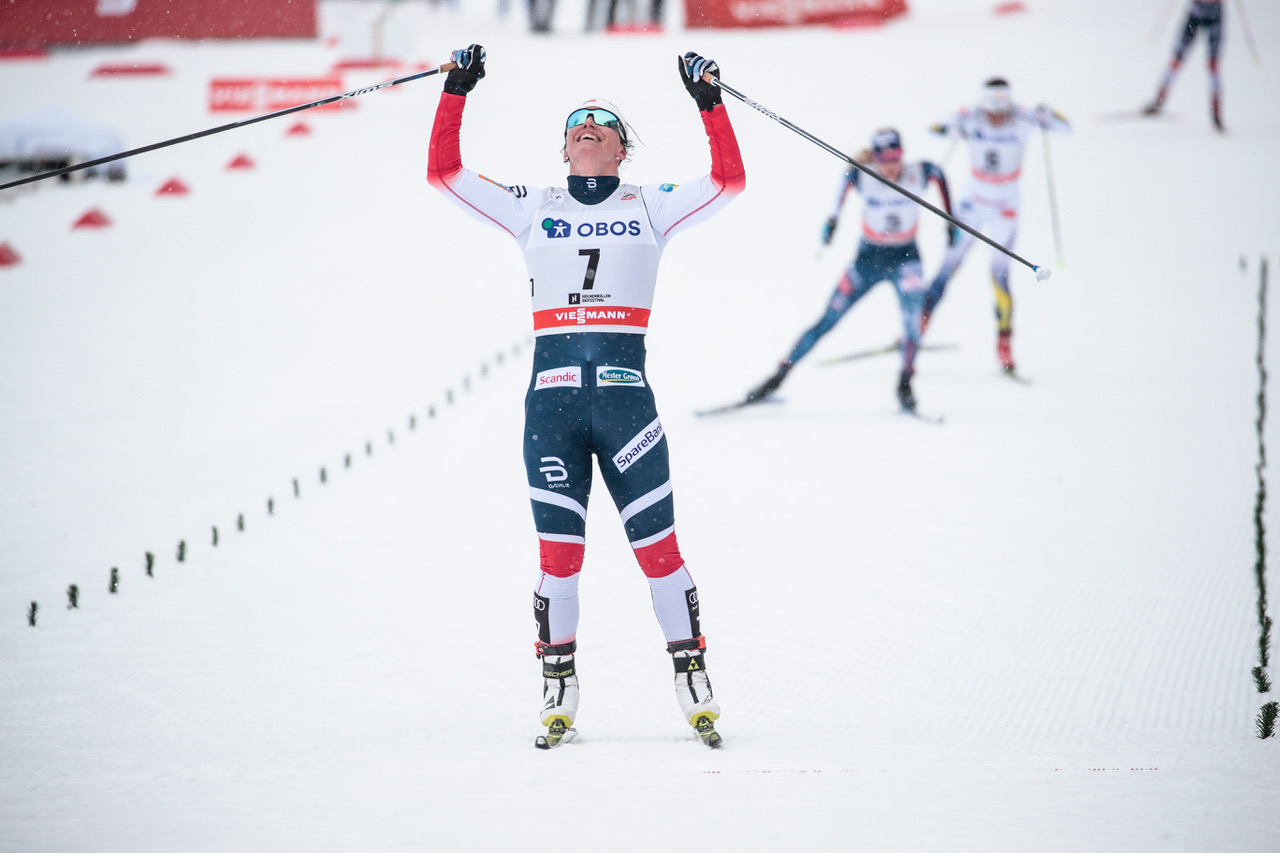
    Norway’s Marit Bjørgen celebrates her seventh Holmenkollen 30 k victory on Sunday in Oslo, Norway, ahead of American Jessie Diggins, Norway’s Ragnhild Haga (not shown) and Sweden’s Charlotte Kalla. (Photo: Fischer/NordicFocus)

    *Update: This article previously stated that Jessie Diggins was the first American woman to reach a podium at the Holmenkollen. Diggins is actually the first American woman to reach the Holmenkollen podium in the 30 k distance, second woman to podium at a Holmenkollen in history. In 1980, American Allison Owen reached the podium in the 10 k distance. 

    OSLO, Norway — Some pointed to the broadcast screen in disbelief. Others began waving their Norwegian flags with revitalized vigor. Twenty minutes earlier, Norway’s Marit Bjørgen appeared to be out of the running for another win in the women’s 30-kilometer mass start at Holmenkollen.

    She had lost nine seconds to the leaders by the 11 k mark and another 17.9 seconds had dissipated between her and the the leaders as they passed 13.3 k. A little over the halfway point, at 16.3 k, the 37-year-old Bjørgen was down 36 seconds.

    For any spectator familiar with Bjørgen’s race tactics, she does not favor come-from-behind style skiing. In this year’s Olympic 30 k classic mass start, she pulled away from the field in the first 8 k and went on to claim gold by a close to a two-minute gap.

    Exactly one year ago, in the 2017 Holmenkollen 30 k classic, she had put 33 seconds into the field by 8 k, tripling that in the following 10 k, before crossing the finish line more than two minutes ahead of the rest of the field. If racing to win, Bjørgen usually starts by burying the competition.
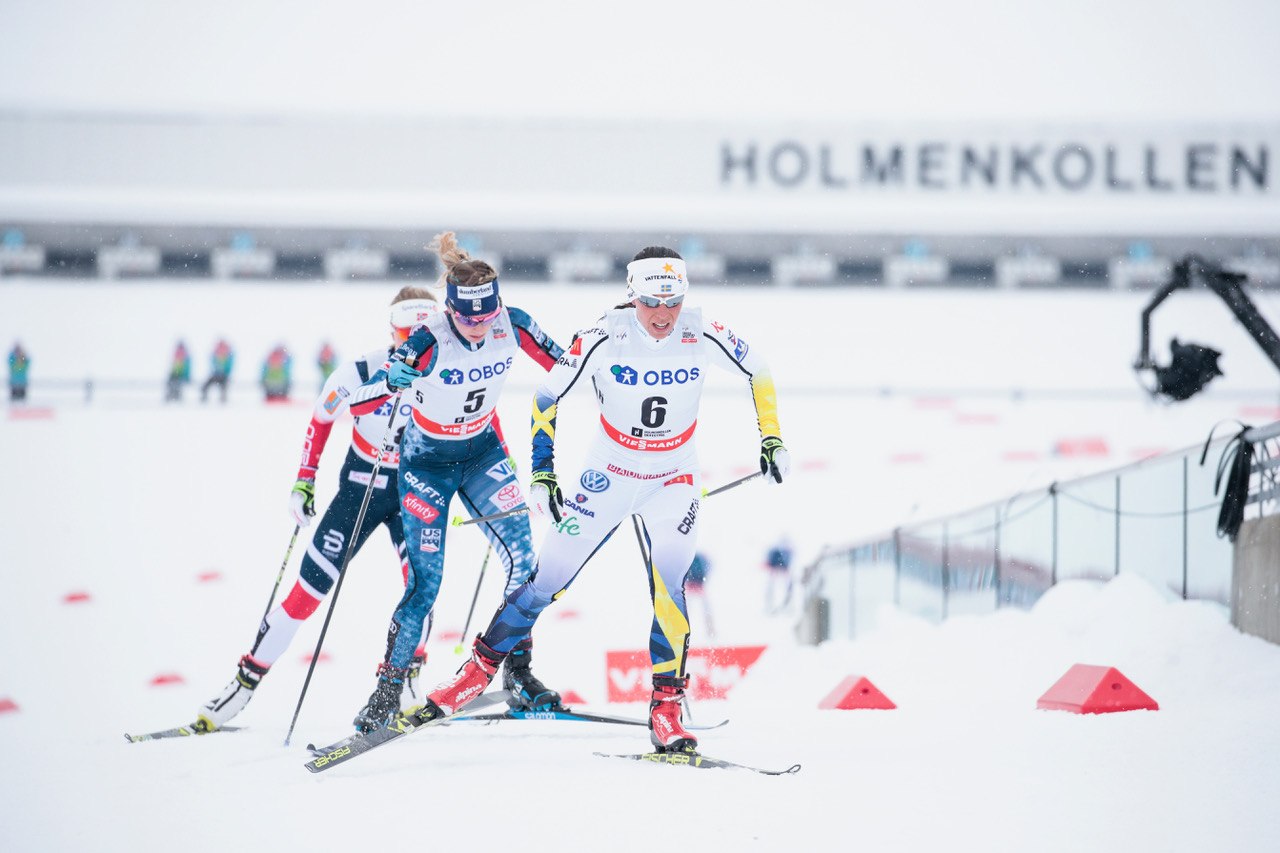
    Sweden’s Charlotte Kalla leads American Jessie Diggins and Norway’s Ragnhild Haga during the Holmenkollen women’s 30 k freestyle mass start at the World Cup in Oslo, Norway. (Photo: Fischer/NordicFocus)

    So when Sunday’s top three — Sweden’s Charlotte Kalla, Norway’s Ragnhild Haga and American Jessie Diggins — broke free, the predictions for the podium went with them. 

    “I thought I was fighting for the fourth place,” Bjørgen said at a post-race press conference.

    With Bjørgen out of the driver’s seat, the attention from the teleprompter and crowd turned to Diggins, Kalla and Haga. For the most part, the three skied in a line, with Kalla and Diggins exchanging leads. 

    Still anytime the Swede pulled at the front, her effort appeared to be a byproduct of Diggins. Every uphill churn from the Swede seemed like an attempt to stave off the American. Diggins continually reinstated herself ahead of Kalla in first: stars and stripes unmistakably spearheading the way.

    On a course that is fabled for Norway, in a sport that is historically Scandinavian, the U.S. skier repeatedly put the iconic suits of Sweden and Norway behind her. But this seemed to be more than just the dogged-skiing characteristic of Diggins’s race style. The 26-year-old Minnesota native was not just being gutsy. She was making a point.

    “I think there has been this myth that Americans, OK, maybe they can win short distances, and maybe Jessie can win a 5 k but there is no way she can hang in a 30 k,” Diggins told FasterSkier during an in-person interview after. “I was setting out to debunk some myths today.”

    For the first 8 k, Diggins charged the field of 54 skiers. Along with Kalla, she spurred the lead group’s gap that formed at the 13 k mark. In another 5 k from there, she had broken free of Bjørgen. Without looking back, Diggins was chasing down a Holmenkollen master head on. 

    “Maybe it wasn’t smart to be leading so much, but I was thinking this is my only shot and so I got to go for it,” Diggins said. “It was an incredible feeling to be leading the Holmenkollen … for me, trying to be competitive in every race that I enter has been a goal for a long time. I don’t want to be a specialist, I want to be a medal threat in every race that I do.”

    As Diggins continued to pose a threat in the front, danger lurked behind. Bjørgen cut through the course, the dreaded dorsal fin gradually on the rise. 

    At 18.3 k, the gap from Bjørgen to the leaders was 32 seconds. In two kilometers, that was reduced to 26 seconds. Another 2 k and Bjørgen was four seconds closer. Over the course of 5 k, Bjørgen had cut her time back from the leaders in half; another 5 k still remained and 15 seconds separated her from the top three.

    A wave of surprise and simultaneous excitement rolled over the spectators. Six seconds separated her from the lead group at 27 k. The Norwegian pushed closer and closer, and with 1.5 k left in the race, she was back in contact with the front pack.

    “It was amazing that I did it,” Bjørgen said. “I haven’t thought it was possible … but when we passed the stadium, the last time, before we go off Gratishaugen … I thought … I wonder if they want to change skis and they didn’t.
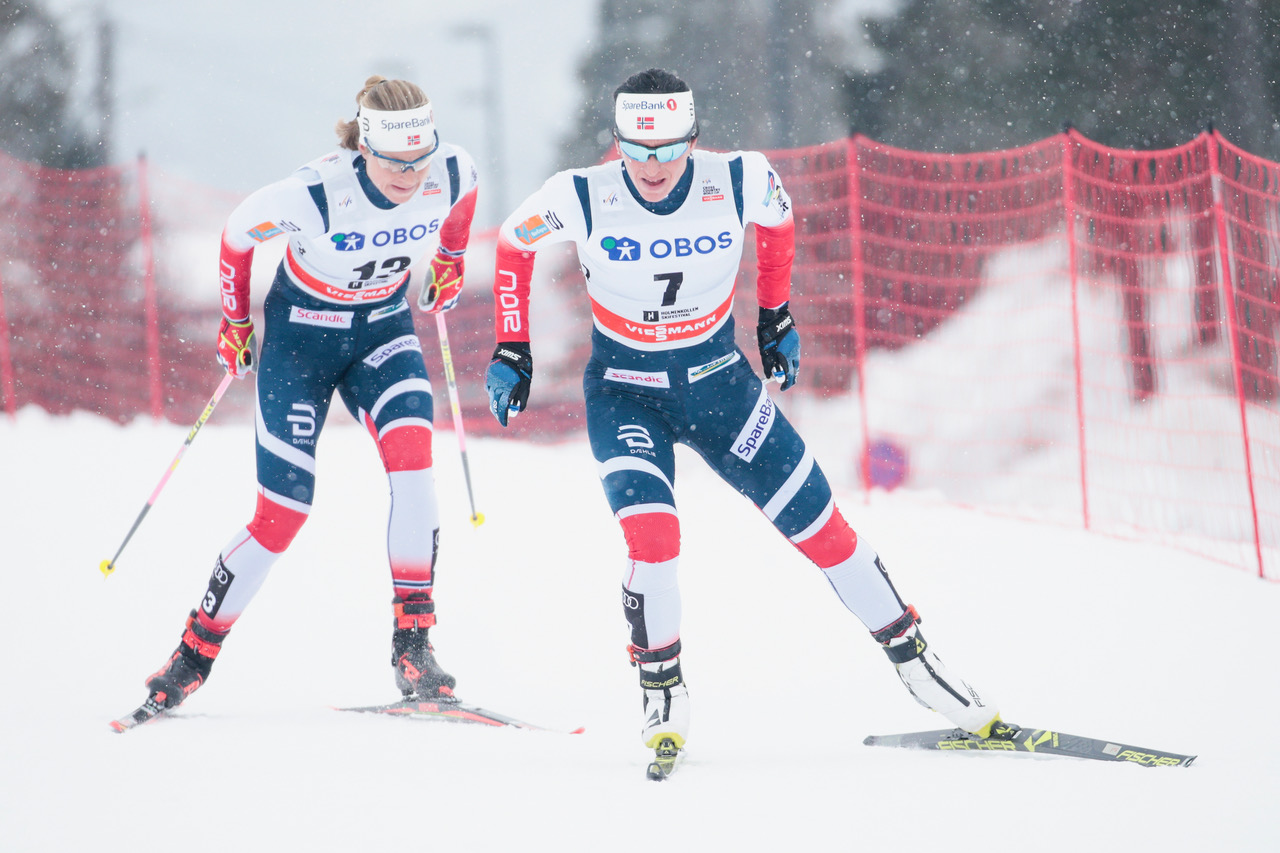
    Norway’s Marit Bjørgen leading teammate Astrid Uhrenholdt Jacobsen in the Holmenkollen 30 k freestyle mass start at the World Cup in Oslo, Norway. (Photo: Fischer/Nordic Focus)

    At 13.3 k Bjørgen stopped to switch skis, as did her Norwegian teammate Astrid Uhrenholdt Jacobsen. Kalla, Diggins and Haga did not. After the top three bypassed the ski exchange, one thing was on the Bjørgen’s mind.

    “I thought I had to push hard,” Bjørgen said. 

    Fueled by the energy of her home crowd, Bjørgen went on to pass Haga, Diggins and Kalla in the final kilometer. Alone, she raced toward the final stretch and crossed the finish line first in a time of 1:18:12.4 hours, earning her seventh Holmenkollen title in historic fashion. She now also holds the record for most Holmenkollen victories of any woman.

    “I haven’t won a competition like this, so it’s all so very special,” Bjørgen said. “To win at Hollmenkollen … for sure it’s the biggest you can do after the World [Championships] and the Olympics.”

    Crossing 3.6 seconds behind Bjørgen was Diggins in second place. She became the first American woman to reach the podium at Holmenkollen in the 30 k distance. 1980, American Allison Owen reached the podium in the Holmenkollen, which was raced as a 10 k. 

    “I didn’t know who it was [chasing the top three] I just heard that the gap was shrinking,” Diggins said. “I felt I was just sprinting the last 4 k. That was my only shot. We didn’t change skis which maybe was a mistake, but also you make the best call that you can at the time.”
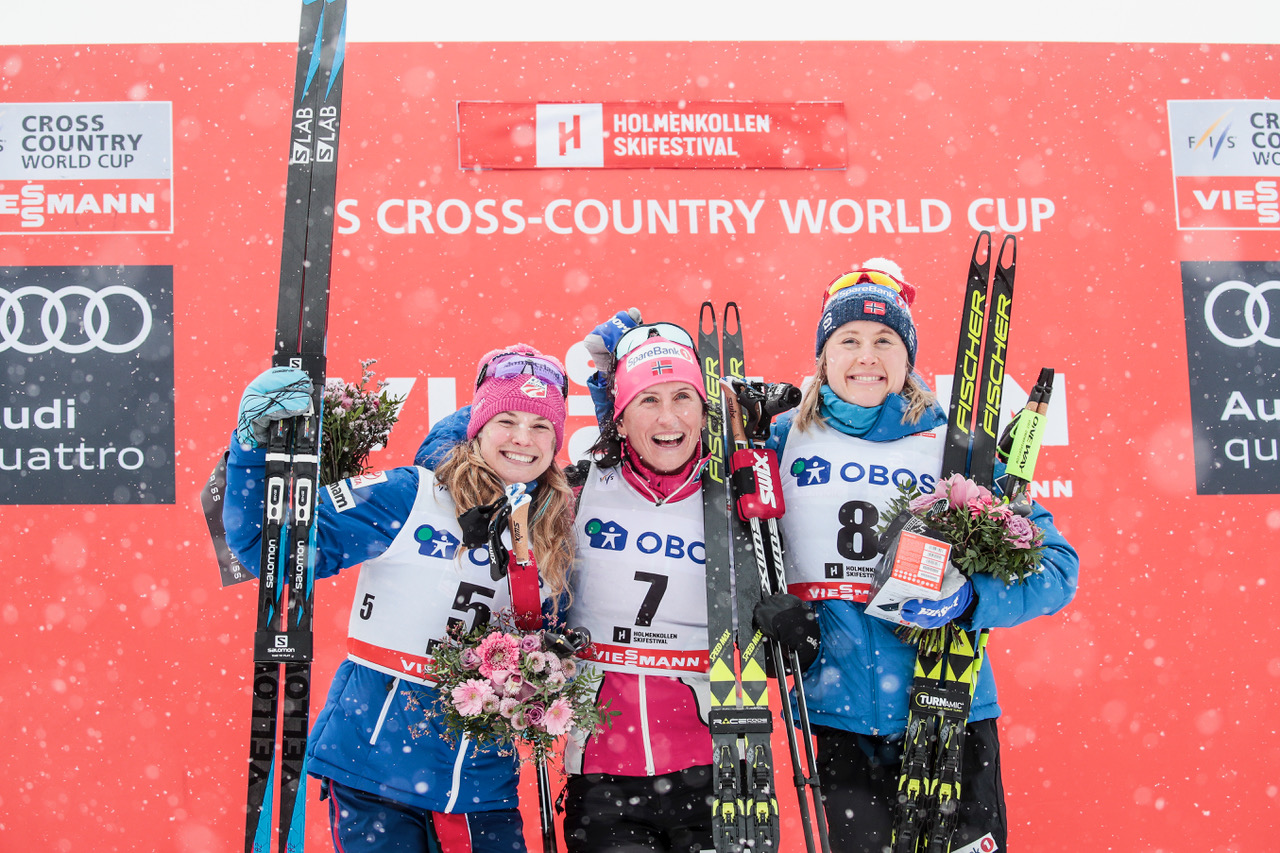
    The Holmenkollen women’s 30 k freestyle mass start podium on Sunday in Oslo, Norway, with Jessie Diggins (l) in second, and Norway’s Marit Bjørgen (c) in first and Ragnhild Haga (r) in third. (Photo: Fischer/Nordic Focus)

    While she held off Haga and Kalla, those two battled for third. Haga outlunged Kalla by a just one-tenth of a second for the final spot on the podium (+4.3).

    “I am very happy with my sprint, my finish against Charlotte,” Haga said. “I regretted that we didn’t switch skis when I heard that Marit caught many seconds there, but suddenly she just came up and, yeah, she is always there when it matters. So Marit is amazing today as well.”

    Rounding out the women’s top 10 was Kalla in fourth (+4.4), Jacobsen in fifth (+11.6), Ingvild Flugstad Østberg in sixth (+1:39.5), Finland’s Krista Pärmäkoski in seventh (+1:51.7), Germany’s Stefanie Böhler in eighth (+2:10.2), Austria’s Teresa Stadlober in ninth (+2:11.6) and Sweden’s Ebba Andersson in 10th (+2:11.9).

    U.S. skier Sadie Bjornsen finished 11.5 seconds outside the top 10 in 12th (+2:23.4) in what she described as her “best Holmenkollen finish.”

    “I was really looking forward to today. I had not too many awesome feelings lately,” Bjornsen told FasterSkier after.  “I was just looking forward to the simplicity of a skate race. I had a ton of fun out there.”
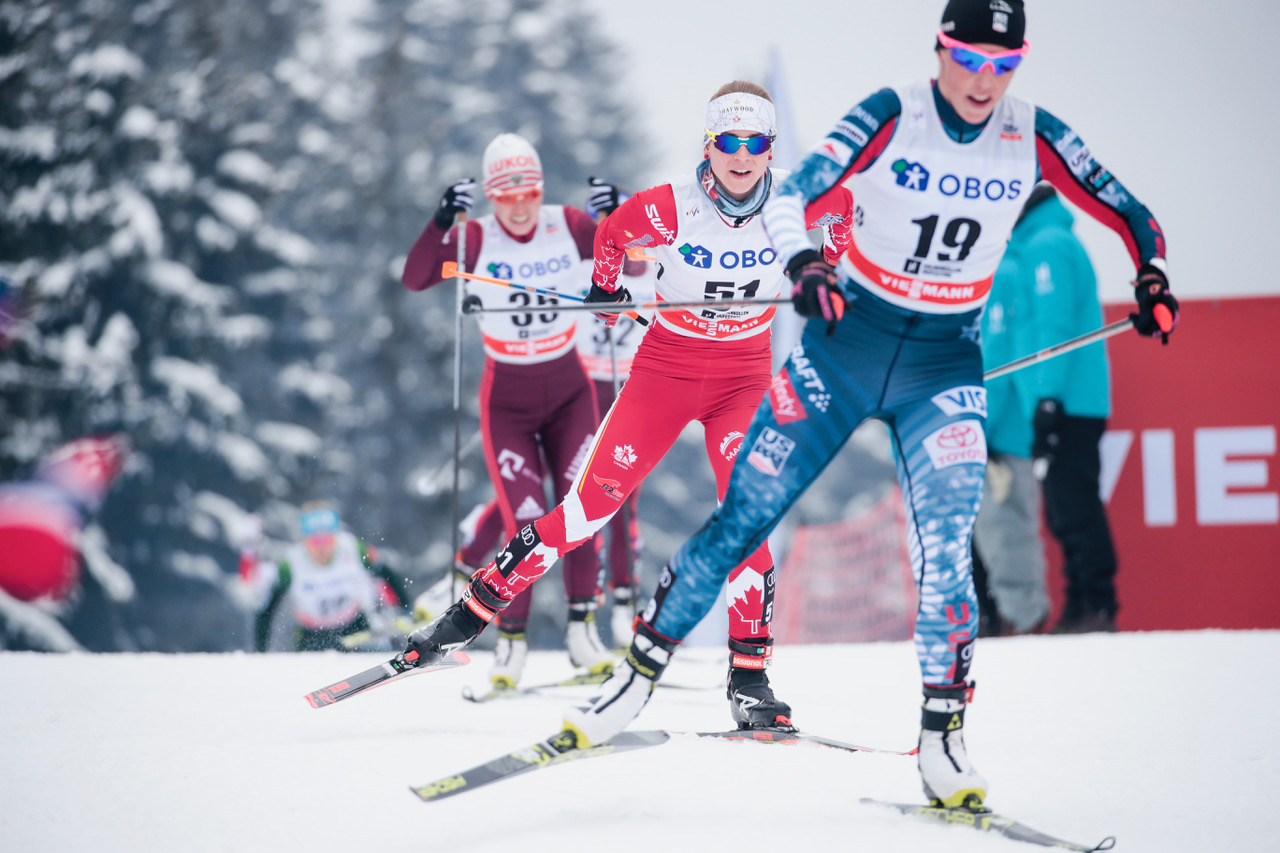
    American Kikkan Randall (19) leading Canada’s Cendrine Browne and Russia’s Alisa Zhambalova during the Holmenkollen women’s 30 k freestyle mass start on Sunday in Oslo, Norway. (Photo: Fischer/NordicFocus)

    Following Bjornsen, U.S. skier Kikkan Randall placed 19th (+3:21.9) in what will be her final Holmenkollen race. The first time Randall raced at Holmenkollen was in 2007. As she reflected on her years of racing there, the 35-year-old Olympic gold medalist remained humble of the time she had spent on the historically challenging trail.

    “This is probably one of the coolest places to race, with the atmosphere and the spectators,” Randall said. “It was definitely hard, but I really enjoyed it … there’s something that’s hard to put into words about pushing yourself over the course of an hour and twenty minutes. It just kind of feels good to finish a little bit empty.”

    After a photo finish with French skier, Anouk Faivre-Picon, American Caitlin Patterson finished 28th (+4:13.1), just behind Faivre-Picon in 27th. Sunday’s race was Patterson’s second Holmenkollen freestyle race, and the 27-year-old Craftsbury Green Racing Project member was happy to spend the first two-thirds of it with a large group of racers that included Randall.

    “This one was way better because I was actually in it. That other year I was just blown out,” Patterson said, referring to her previous Holmenkollen skate race, in 2015, when she placed 53rd. In last year’s Holmenkollen 30 k classic, she finished 36th.

    “Today my goal was to stay more relaxed and as much as I wanted to stay with the lead pack, but not burn all the matches right at the start,” Patterson added.

    “I switched my skis the last lap, with the snow starting to come down … and for better or worse, it did mean I lost the pack,” she continued. “But then I was able to ski with Anouk for the last lap and we reeled in that Norwegian and a Russian. … I always feel a lot better about races if I finish strong, whatever the place is.”

    Also for the U.S., Rosie Frankowski, of Alaska Pacific University, finished in 31st (+4:45.4), 28.3 seconds outside the top 30.

    Canada’s Cendrine Browne finished 36th (+6:16.1) followed by Emily Nishikawa in 44th (+7:36.1) and Dahria Beatty in 49th (+9:45.1).

    For the U.S., Liz Stephen finished 51st (+10:01.7) and Kaitlynn Miller 53rd (+16:05.0).

    Along with Randall, Stephen also completed her final Holmenkollen on Sunday. Stephen had her parents cheering her on after they made the trek to Norway to watch her race in person. Her closing words on her final time around the historic course were full of emotion, both happy and sad.

    “I think this is actually the first race that I have ever looked at Matt [Whitcomb] in the eye during the race and thanked him for the feed and kept going,” Stephen, 31, said. “It’s bittersweet. It’s certainly not the way I was hoping to end it but … it was really special watching Noah [Hoffman] hug his dad yesterday.

    “I mean this sport has been our life and it is hard to leave, but it is time,” she added, referring to her retirement at the end of the season. “And I am really lucky to have had such a good run with it. And to have an amazing team to let go forward.”

    Results

  • Caitlin Patterson Captures Third National Title in Anchorage 10 k Skate

    Caitlin Patterson Captures Third National Title in Anchorage 10 k Skate

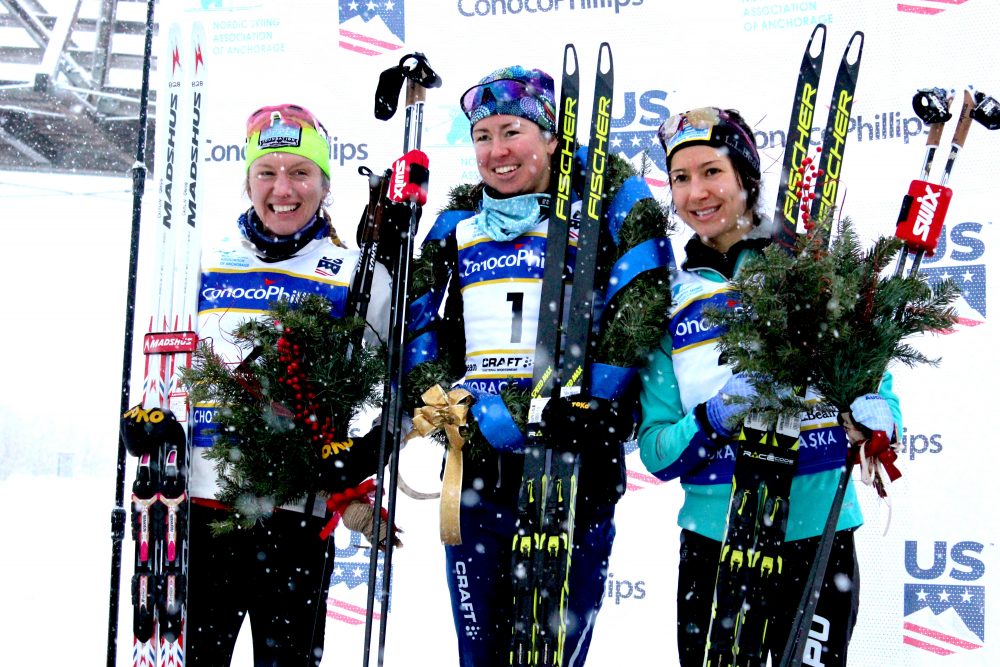
    The women’s 10 k freestyle podium on Wednesday at Day 1 of 2018 U.S. Cross Country Championships in Anchorage, Alaska, with (from left to right) Caitlin Gregg (Team Gregg) in second, Caitlin Patterson (Craftsbury Green Racing Project) in first, and Chelsea Holmes (Alaska Pacific University) in third.

    ANCHORAGE, Alaska — It was what most locals, or those familiar to the area, referred to as standard Anchorage weather: heavy, wet snow, temperatures reading around 31 degrees Fahrenheit, and a darkened sky that seemed to be brooding over whether or not to let the sun out of bed — the sky covered in a shroud of gray.

    With the Pacific Ocean just 600 meters to the southwest and Kincaid Park’s nordic venue, the host of this year’s 2018 U.S. Cross Country Ski Championships, nestled in the state’s gulf socket, low-visibility and unpredictable weather was, ironically, a foreseeable factor to Wednesday morning’s women’s race.

    After all, during the first week of January, sunrise in Anchorage is scheduled around 10:15 a.m. and the opening race of this year’s championship event, a women’s 10-kilometer freestyle individual start, was not slated to get underway until 15 minutes before then. The internal dialogue for a few early starters was whether a personal light might be a good addition to the commercial ones dotting the four-lap, 2.5 k manmade loop.

    “For a moment while I was warming up, I was wondering if I’d have to wear a headlamp,” Rosie Frankowski, who skis for Alaska Pacific University (APU) and started in bib number 20, said after the race. “But that’s Anchorage.”

    By the time the first women’s starter, Becca Rorabaugh, also of APU, departed the start gate, the continual glow from a few stadium lights outshone the dim carpet-colored sky. Close to half an inch of slushy snow covered the trail and more was well on its way.

    Skiers would not be deterred, however, as potential spots for the U.S. 2018 Olympic team were on the line.

    “I haven’t skied up here in a few years, but Alaska is sort of always unpredictable — this weird combo of manmade and freshly falling snow with bad visibility,” said Caitlin Patterson, who grew up in Anchorage, went to college at the University of Vermont, and currently trains and races with the Craftsbury Green Racing Project (CGRP) in Vermont.

    “Until yesterday, I’d never skied that wall hill before; we’d always used that as a downhill, but otherwise I’m pretty familiar with [the trail],” the 27 year old continued. “The loop in the stadium and all these things were ones we used for Alaska State over the years, so even when I couldn’t see through my glasses, to know the corners and so forth was good.”

    Caitlin Patterson (Craftsbury Green Racing Project) racing to first in the women’s 10-kilometer freestyle on Wednesday at the 2018 U.S. Cross Country Championships in Anchorage, Alaska.

    Familiarity with the course wasn’t the only edge Patterson had heading into the race. She also entered Wednesday’s 10 k as the overall SuperTour leader, an honor garnered thanks to her win in the 10 k freestyle at Sovereign Lake, British Columbia, and her second- and third-place finishes in the 10 k classic mass start and freestyle sprint qualifier, respectively, in West Yellowstone, Mont.

    The victory was her third national title. In 2016, she won both the 10 k classic and 20 k freestyle mass start.

    Combined with her World Cup performances in previous seasons, Patterson was a prime candidate for Wednesday’s win, which she claimed in a time of 27:09.1, though there were moments on course when she questioned the outcome of her race.

    “I wasn’t sure if it was going to turn into a win even midway through the race,” Patterson said.

    Patterson was the fourth starter to push past the wand and by the time she looped through the stadium for her second lap, APU’s Chelsea Holmes (bib 16) and Team Gregg’s Caitlin Gregg (bib 17), were starting their first laps. Though she was ahead of Gregg, Patterson received what she called “backwards splits”: Gregg’s pace on laps that Patterson had already completed.

    “I could see Caitlin [Gregg], see how the gap was progressing, and I also got some splits … how her first and second lap were comparing to my first and second, and I think I was running a few seconds down at that point,” Patterson recalled.

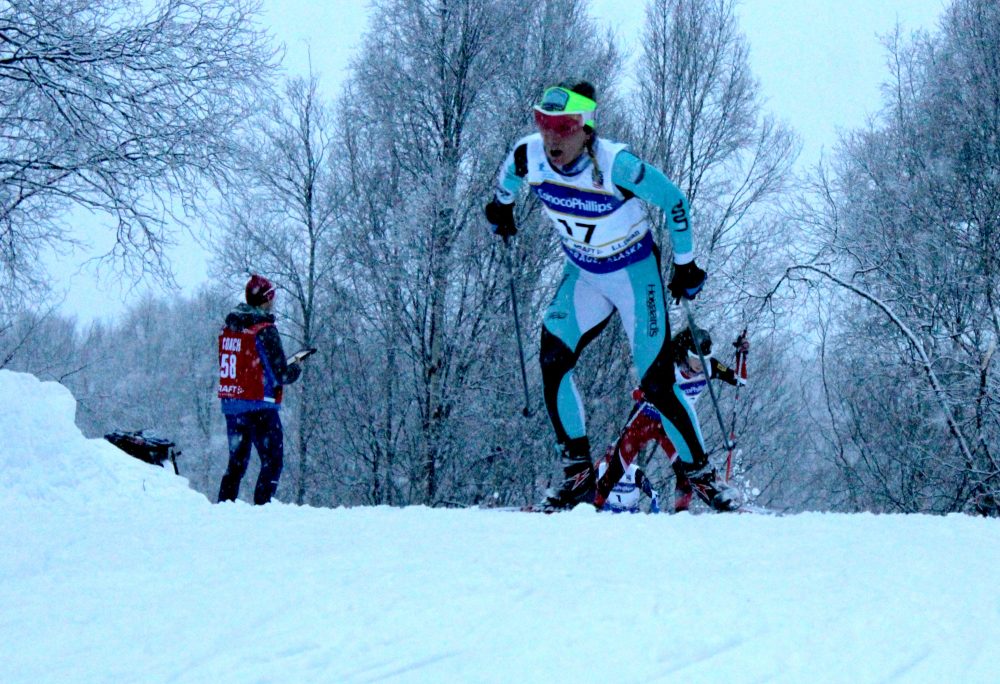
    Caitlin Gregg (CXC/Loppet Nordic Racing/Team Gregg) racing to second in the women’s 10 k freestyle on Wednesday at 2018 U.S. Cross Country Championships in Anchorage, Alaska.

    Gregg was also getting splits off Patterson, most of which informed her that the two were on par. It was in the final kilometer and half that Gregg learned she was losing time.

    “I was getting splits and I was pretty even for it seemed like three and half laps,” Gregg said after. “Then that last little bit she put a bit of a gap on me.”

    Patterson’s final half lap was fast enough to put close to 20 seconds on Gregg, and Gregg finished 19.7 seconds back in second. Having felt like she put in a solid race effort, Gregg was slightly surprised by the time gap, though quick to acknowledge Patterson’s strength on course.

    “I thought it was going to be really close there, but obviously she skied super strong,” Gregg said.

    Gregg, 37, who earned an individual bronze medal in the 10 k skate at 2015 World Championships and is aiming to qualify for her second Olympics (after making the Olympic team in 2010) holds high regard for the current women’s U.S. race circuit. Even after 19 years of U.S. nationals racing, the veteran skier is not immune to competition-day nerves.

    “I still get nervous,” Gregg said. “The weight of these races are super high and I think we have a lot of really fast domestic women right now, I mean Chelsea Holmes has been top 30 on the World Cup and last year Caitlin Patterson was in the top 30, so I’m really hoping that we get a good domestic representation at the Olympics.

    “We’re doing our part; working hard and skiing fast,” Gregg added. “Hopefully that gets recognized.”

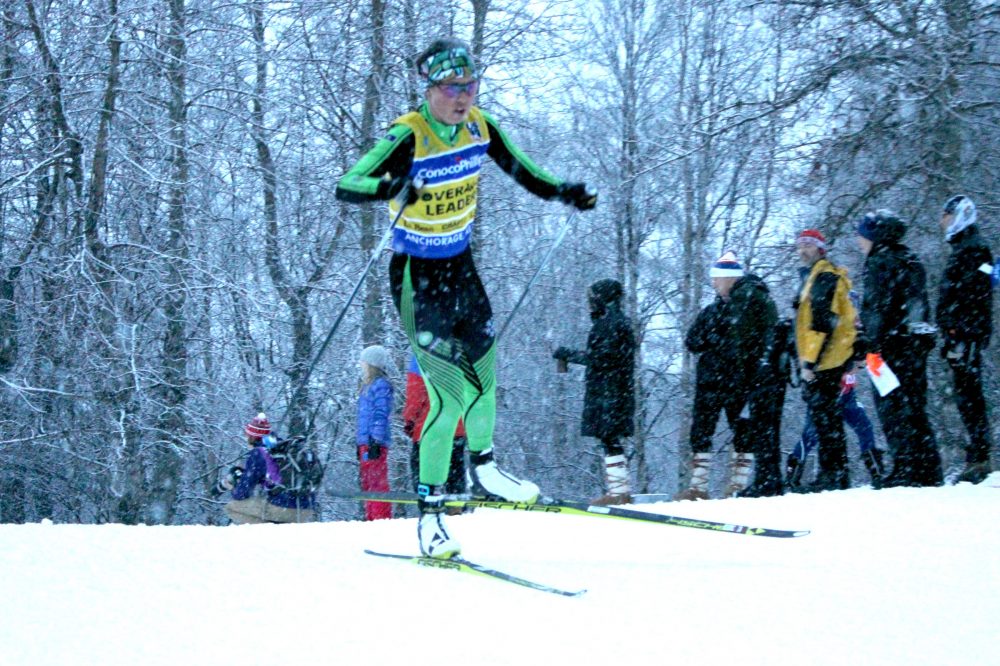
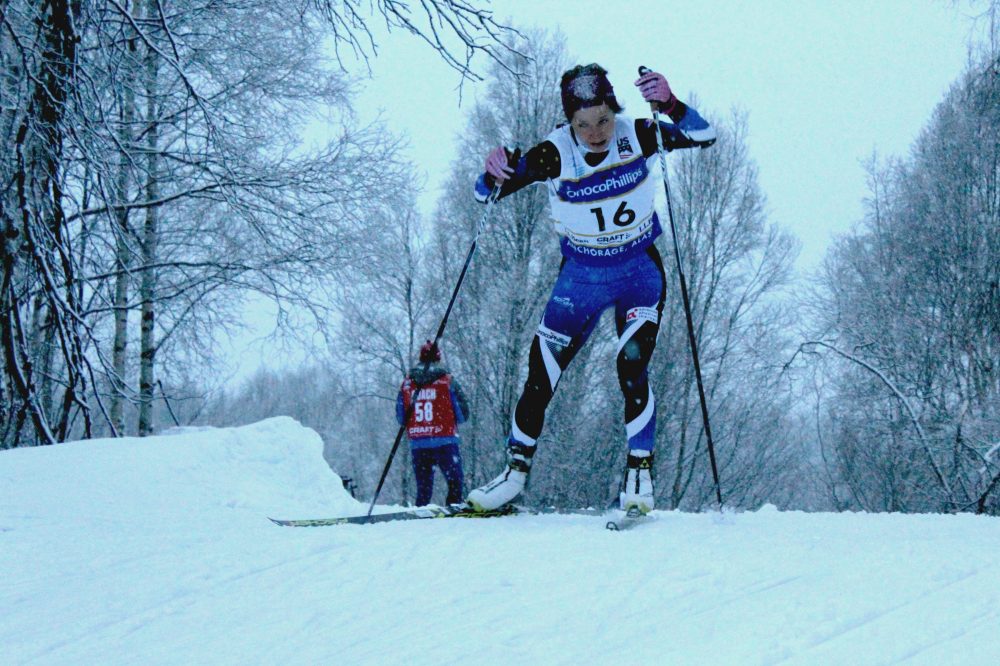
    Chelsea Holmes (Alaska Pacific University) racing to third in the women’s 10 k freestyle on Wednesday at the 2018 U.S. Cross Country Championships in Anchorage, Alaska.

    Rounding out the women’s podium on Wednesday was APU’s Chelsea Holmes, 24.4 seconds back in third. Holmes raced World Cup Period 1 this season, with a season-best of 29th in the 10 k freestyle last month in Davos, Switzerland.

    “My body didn’t have quite what I wanted today, but that’s OK,” Holmes, 30, who grew up just south of Anchorage in Girdwood, Alaska, wrote in an email. “I actually don’t mind the short course, the race felt like it blew by and it was fun to get to lap by friends and family.” 

    Also a hopeful for the 2018 U.S. Olympic team, Holmes indicated she would be leaving no race unanswered at this year’s U.S. nationals. She plans to compete in both sprints over the next week as well as the 20 k classic mass start, which she won last year.

    “I’ve been working on my ‘Klaebo’. It’s pretty legit,” she wrote.

    Pressure can encroach upon many athlete’s performances this week, especially with Olympic spots on the line. Processing that pressure, for Holmes, came in the form of the season’s preparation.

    “As for the pressure, for sure it is there — even if it’s only from myself. How could it not be? Certainly I care immensely and I will do my best when the time comes to race, but between now and then I won’t be doing anything special,” she wrote. “I’ve prepared the best I know how and hopefully that is good enough. If not, I’ll still be me.”

    Finishing in fourth (+41.7), 17.3 seconds off the podium, was Frankowski.

    “I am definitely satisfied with my result today. Honestly, the new snow played into my hands as I like mushy, soft courses,” Frankowski wrote in an email. “On the other hand, a course with no A climbs and only two uphills that take 30 seconds to a minute, is not a course I’d tend to excel on. So I was quite surprised with being that close to a US Nationals podium, especially when the podium is made up of three ladies who I believe could score World Cup points on any given day (as Chelsea proved multiple times in Period 1).”

    Frankowski, 26, who was born and raised in Minneapolis, Minnesota, indicated that her next target would be the 20 k classic (though she also maintains a ritualistic “season-long goal” of being in the top four of the SuperTour rankings to, as she puts it, “get free race entries.”)

    “In all seriousness, I do hope they can find a way to add some longer and more grinding climbs to the 20k classic course with all the fresh snow Anchorage received today,” Frankowski wrote. “I believe it is important to have a race that is even slightly comparable to the Olympic or a World Cup venue, and although the organizers did a good job with what Mother Nature dealt earlier last December, I hope the priority is on utilizing the new snow to create a course that challenges racers who will be representing our country on an international level.”

    Also in the top 10 were three University of Colorado Boulder (CU) skiers, with Petra Hyncicova of the Czech Republic in fifth (+56.7), Norwegian Christina Rolandsen in sixth (+1:02.4) and Swedish freshman Hedda Bångman in 10th (+1:37.8). Erika Flowers of the Stratton Mountain School (SMS) Elite Team placed seventh (+1:26.0), the University of Alaska Anchorage’s Hailey Swirbul placed eighth (+1:30.2), and Becca Rorabaugh (APU) finished ninth (+1:36.5).

    U.S. nationals continues Friday with classic sprints at Kincaid.

    Swirbul Top Junior in Eighth

    https://www.instagram.com/p/BdgT2kzhNtr/

    Hailey Swirbul, a U20 skier for the University of Alaska Anchorage, led a strong showing by several junior girls in eighth overall. Hannah Halvorsen (U20, APU) was 14th overall, with Novie McCabe (U18, Methow Valley Nordic) one spot back in 15th.

    “I’m really pleased with how my body felt today,” Swirbul wrote to FasterSkier after the race, “and the result I was able to pull off with the help of fast skis (thanks to my coaches) and pacing from the skiers around me. I think the key today was to not stress about whatever the weather was doing and be light and quick through the slushy sections. It was important to pace the race well for me, because the conditions were slower than what we all were expecting after skiing on the race course the previous few days. My main goal was to qualify for World Juniors, and shoot for notable results compared to the western NCAA Division skiers. Overall, I can’t complain about how my first race of the week went!”

    Swirbul almost wasn’t on the starting line in UAA green and gold. 14 months ago, she called it “ridiculous” and “outrageous” that the college ski team in Anchorage had been cut when U.S. nationals were on the horizon, and lamented that no UAA race suits were going to be at the starting line. But the decision was ultimately reversed, the ski team was reinstated, and six UAA skiers raced on Wednesday.

    Results