From the FasterSkier archive — posts syndicated from athletes’ and coaches’ own blogs between 2004 and 2012, kept online as published. Current coverage is at fasterskier.com.
The women Ski Coaches Association is excited to announce our new GearUP program. This program is designed to help reduce barriers for women ski coaches by partnering women coaches with an equipment brand rep to outfit them with gear, provide brand specific knowledge, and create industry connections.
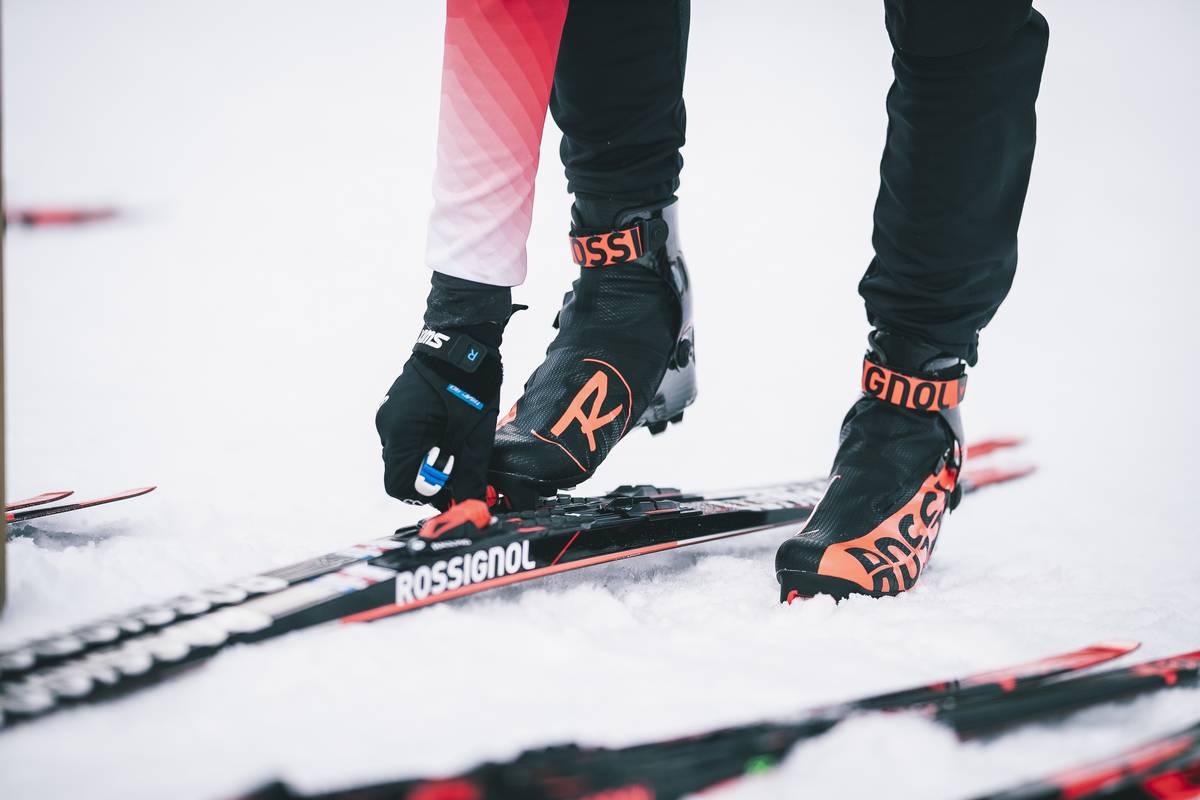
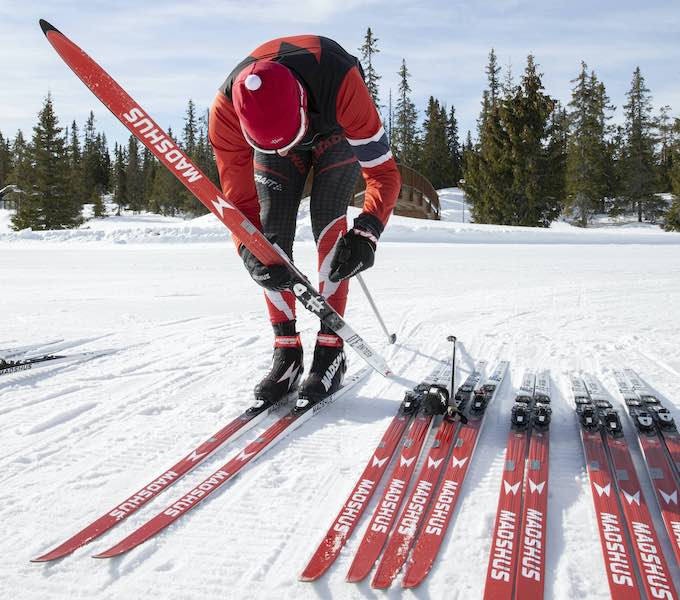
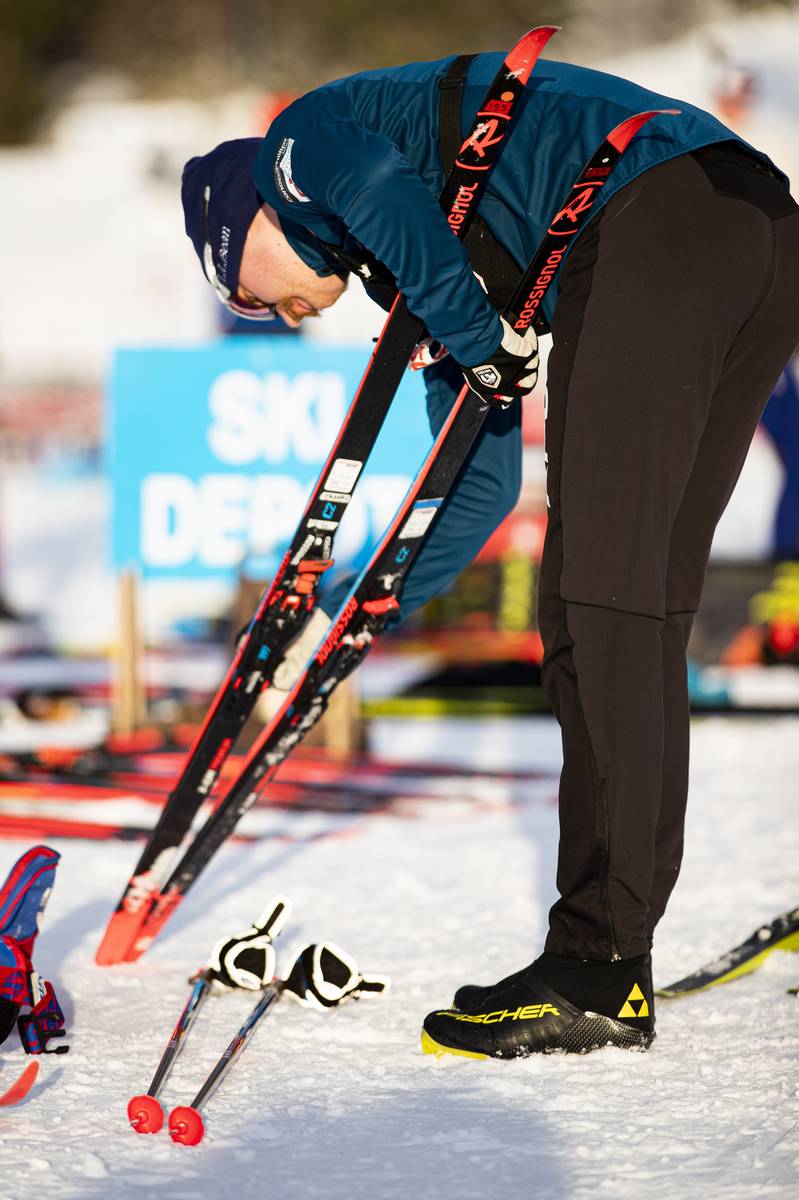
Madshus, Fischer, Rossignol and Salomon will each work directly with two women coaches for the duration of the 2022-23racing season.* The eight coaches selected for this program will be outfitted with at least one pair of classic and one pair of skate skis, two pairs of boots, two pairs of Swix poles and other coach-approved swag!
Why GearUP? We believe this program will help level the playing field for women in ski coaching careers through:
mentoring and networking with another male-dominated profession that is important for coaching success and advancement – the gear industry.
reducing the personal expense required to purchase and update racing equipment that can impact a coaches credibility in the profession.
increasing access to the gear related expertise required to excel on the snow everyday and behind the scenes on race day.
Developing and retaining women coaches at all levels of the sport supports athletes, other coaches, and the organization/ski community as a whole. Check out WSCA’s Why Women Coaches Matter page for more information!
Through the mentorship aspect of this program, coaches will increase their knowledge to accurately fit a ski to an athlete, understand what makes great skis for certain conditions and how to properly prepare them, have a contact list of connections from their partnered brand, understand the brand’s product line, and gain other useful skills. The program will include 3-4 structured sessions with reps and coaches through the season to increase networking and knowledge about gear and waxing.
Women with any levels of experience currently coaching at the middle school level or above are encouraged to apply.
Application period opens October 1 and closes October 14. Decisions will be communicated by the October 21st with program kickoff on the 30th.
Click here to read part 1 and part 2 of this series, which takes a look at international news surrounding the Russian athlete ban through the spring. For how these bans have impacted a broader cross-section of the sporting world and analysis of the complex questions surrounding whether Russian athletes should be able to compete, check out this recent Sports Illustrated article by Michael Rosenberg.
Historically, athlete bans meant to pressure a government have not been short. South Africa was banned by the IOC over its racial apartheid policies for 27 years from 1964 until 1991. In 1992 the U.N. sanctioned Serbia and Montenegro over the shelling of Sarajevo and urged their athletes to be banned from international competition. The IOC took up the ban, but reversed course and allowed Serbian athletes to compete under a neutral flag at the 1992 Olympics.
Stepanova has pointed out this example on her Instagram page as a precedent that should be followed, though it should be pointed out that Serbia was absent at the 1994 Lillehammer Games. All told, the Serbian state was largely exiled from international sport from 1992 – 1995.
Veronika Stepanova flexes with her Olympic relay gold medal during the 2022 Games in Zhangjiakou, CHN. (Photo: NordicFocus)
Stepanova’s request to compete under a neutral flag rings a little hollow: the Russian ski team is already a little over two years into its four year WADA ban for state sponsored doping that requires it to compete under a neutral flag at championships.
A similar neutrality option was offered as a solution to the Russian national soccer team which was due to face Poland in a playoff match for qualification at the FIFA World Cup. Poland rejected the idea saying, “We are not interested in playing this game of appearances.” The Polish refusal to play Russia under any terms helped to force the IOC’s swift decision to recommend banning Russia from all sports.
“If doping wounds were quite successfully treated by time, then here the situation is different,” wrote an anonymous Russian blogger. “In fact, government policy has come into direct and insurmountable conflict with the ability to participate in the global sports movement. And now it seems that all this will last for years, if not decades.”
***
Even if Russia were to return to the World Cup next season, it’s unclear that they would be able to operate at the same level as in the past, which has helped to fuel what US Ski Team Coach Matt Whitcomb refers to as a “waxing arms race” on the World Cup circuit.
According to Team Manager Elena Vyalbe, funding the Russian ski machine has been a challenge. She reported that the team’s budget in 2020 amounted to around 50 million rubles, roughly $600,000 at the time. According to Markus Cramer, who coached for Russia until this spring, the cost of supporting an athlete over the course of a year is more than $150,000—a figure that calls into question Vyalbe’s statement about the team’s budget.
However, the Russian funding structure is murky, with much additional regional support to athletes provided by local extraction industries. Vyalbe complained in 2020 that sponsorships were scarce, saying, “No matter how well [Bolshunov] performed last year, we did not have a single new sponsor. God forbid that the current ones do not go away.”
In an April 5th interview with Championat, Vyalbe clarified the sources of the team’s funding: “We get most of the funds from the Ministry of Sports, the [Russian Olympic Committee] gives money for some things,” and that sponsorship amounted to “not even tears, but some kind of snot. We have a small budget.”
The team’s primary sponsorship has come from Lukoil Oil Company since 1997. Whether or not Lukoil will be able to continue to fund Russian skiing remains to be seen. The company reported its highest annual profit in seven years at the same time that its shares plummeted on the London Stock Exchange after the invasion, losing 91% of their value before trading was halted March 3rd.
Though the ruble has recovered from its post invasion plummet, inflation in Russia is likely to reach at least 16% this year. That, coupled with uncertainty over the team’s competition status and the dismal prospects for the Russian economy, which is predicted by the IMF to contract 8.5% this year, has the potential to squeeze the team’s budget.
Individual athletes also find themselves in a difficult position. Brav, the parent company of Swix and Toko, was quick to cancel sponsorship agreements with Russian athletes, as did Kinetixx gloves. Expressen reported that Swedish ski company SkiGO was maintaining their partnership with Bolshunov, though SkiGO boss Christer Majbäck denied this, saying, “We don’t have any cooperation at all, it’s absolutely impossible. You don’t even have to ask me or SkiGO what we think about the war.”
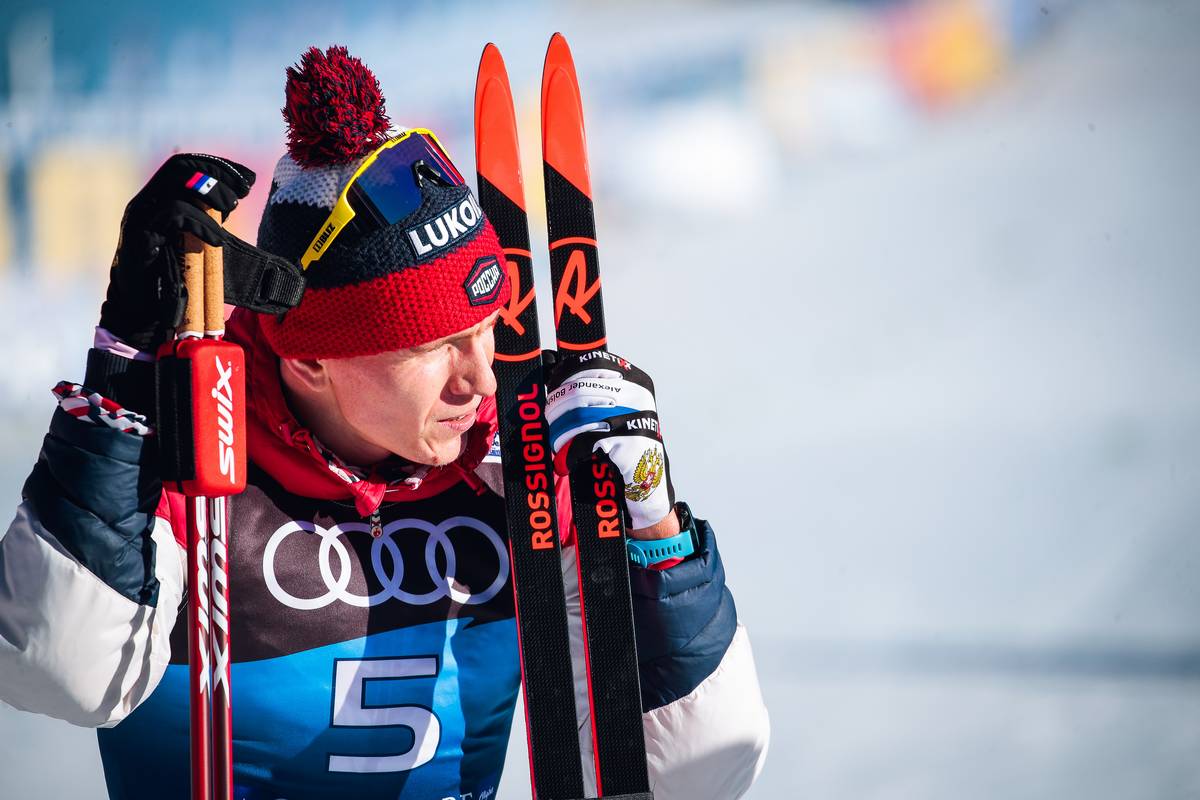
Alexander Bolshunov observes trailside during the 2021-2022 Tour de Ski in Oberstdorf, Germany. (Photo: NordicFocus)
Rossignol was standing by Bolshunov until an Instagram photo proved to be too much: not long after Russia was banned, Bolshunov visited a museum and posed for a photo in an old-timey Soviet race suit, captioning the photo “USSR 1980” —which happened to be the year that Soviet Union invaded Afghanistan, though it may also have been a reference to the 1980 boycott of the Moscow Olympics. In any case, Rossignol demanded Bolshunov remove the photo, which he did, but by the following day Rossignol said it was no longer supporting Russian athletes and removed them from its website.
Bolshunov could keep his skis, Rossignol said, but no new skis would be sent to Russia.
Similarly Fischer removed Russian athletes from its site. Fischer Communications Director Franz Fottinger wrote in an email, “All our contracts with athletes are based on their participation in World Cup races. If racers are excluded from the World Cup, there is no more basis to fulfill the contract.”
***
The Russian athletes have not exactly lost their ski partnerships, rather they are suspended until their return to the international circuit. Nevertheless, this has provoked a strong reaction in Russia, with calls to revamp ski production in the country.
The only significant ski production facility in Russia is the STC factory in Balabovo, around 100 km southwest of Moscow. It employs 350 workers making mostly recreational and kids skis. Whether the factory can be retooled to the demands of making race stock skis is questionable.
Alexander Pechersky, the head of service for the Russian ski team said that “No matter how optimistic I am, I understand that the process is not fast and it can take at least 4 to 6 years to produce skis of an acceptable competitive level.”
Pechersky continued, “Miracles do not happen, but I want to try … I still look at this idea with optimism, it is very interesting to deal with it. If things move forward, then the Russian sports market can get a model that, for relatively little money, will cover the needs of at least youth sports.”
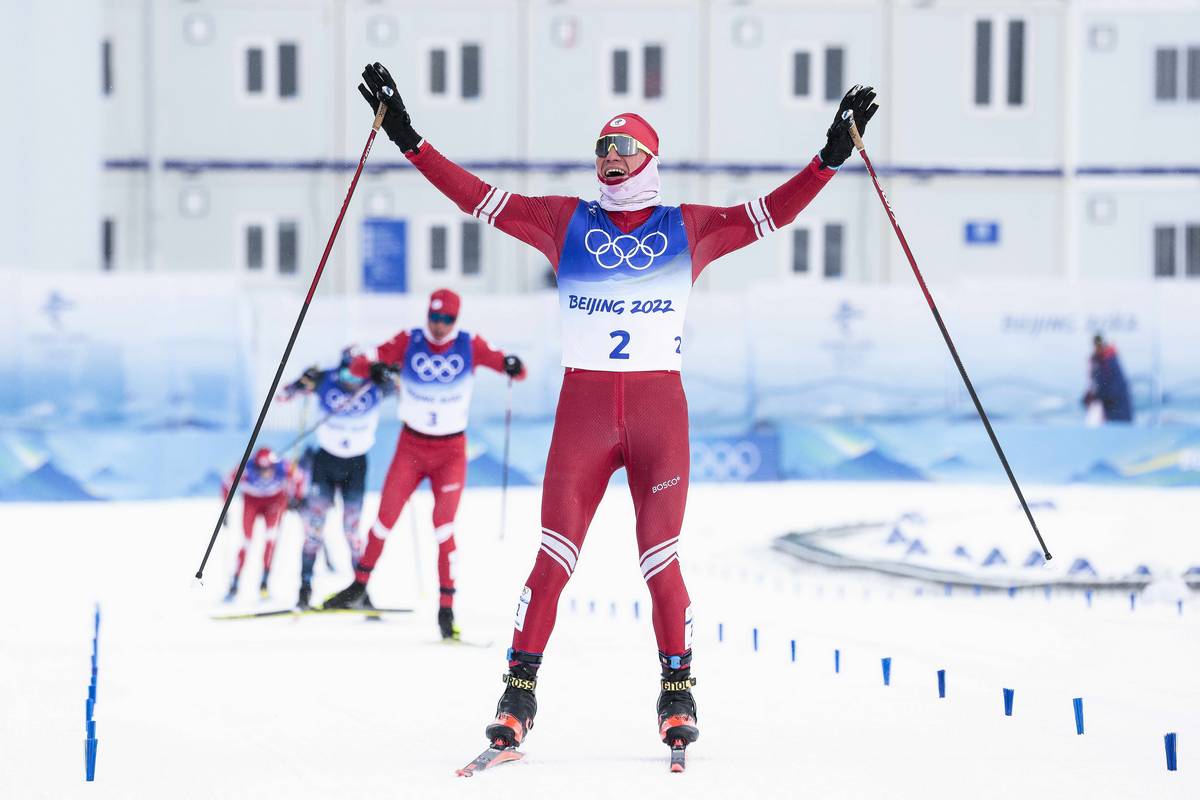
The Russian Olympic Committee takes gold in the men’s 4 x 10 k relay in Zhangjiakou. (Photo: NordicFocus)
Despite the public separation between sponsors and Russian athletes, some critical items are still quietly being made available to the team, according to Viktor Golovin, the deputy head of ski service for the Russian national team. “I will not name the companies, Golovin said, “but the Russian team at the start of the summer season is provided with new rollers in full, despite all the restrictions.
The conflict in Ukraine also threatens to continue to squeeze the international supply of skis. Europe’s largest ski factory is located in Mukachevo, Ukraine and has traditionally produced some 800,000 pairs of cross country skis annually, primarily for Fischer. After a fire destroyed the facility in October of 2020, the factory remained offline for all of 2021 and was rebuilt into a state of the art ski production center. Just as final certification for the factory arrived in early February, the war broke out.
The factory’s director, Andriy Ryabich, wrote on his Facebook page on February 26th that “The work of the Fisher-Mukachevo enterprise has been suspended and the majority of the people went to the army in different directions and will defend our city, region and all [of] Ukraine.”
With much of the ski factories workforce at war during the critical spring months of ski production, ski shortages could once again factor in next season.
***
For their part, the Russian Ski Federation has ordered the team to prepare with the expectation that they will compete on the World Cup, though their draft schedule indicates the team is planning to stay in Russia through next spring.
Curiously, in the face of unprecedented challenges the national team has expanded–to a historically large 46 skier strong team, divided into five training groups.
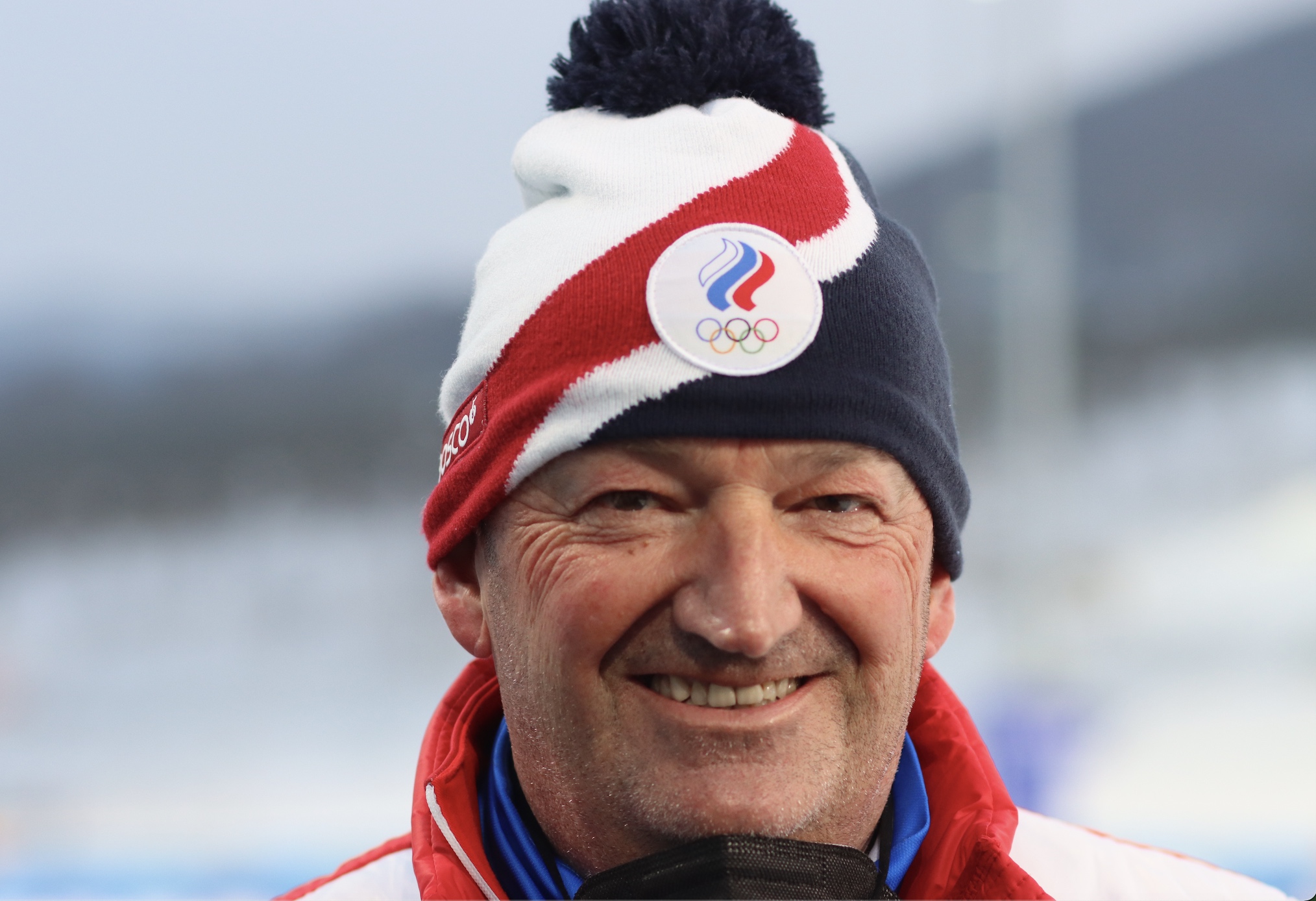
The team was dealt a blow with the departure of Markus Cramer this spring. He will join the Italian national team, though he will continue to coach Ustiugov from afar.
Former Russian ski coach Markus Cramer joins the Italian National Team for the 2022-23 season. (Photo: Nat Herz / ADN)
Cramer’s tenure was instrumental in revamping the team’s training methods. Of the five training groups, three are closely tied to his methodologies. Two groups are led by Cramer protégés Egor Sorin and Petr Sedov, and a third by Sorin’s former assistant—Andrey Nutrikhin.
The group led by Yuri Borodavko—who subscribes to a more Soviet era training philosophy and who was once suspended for doping activities—will add big names such as Yulia Stupak and Ivan Yakimushkin to an already impressive roster that includes Bolshunov and Neprayeva. Unmoved by the political climate, Borodavko’s group will begin the training year on May 15th with a controversial camp in Russian occupied Crimea.
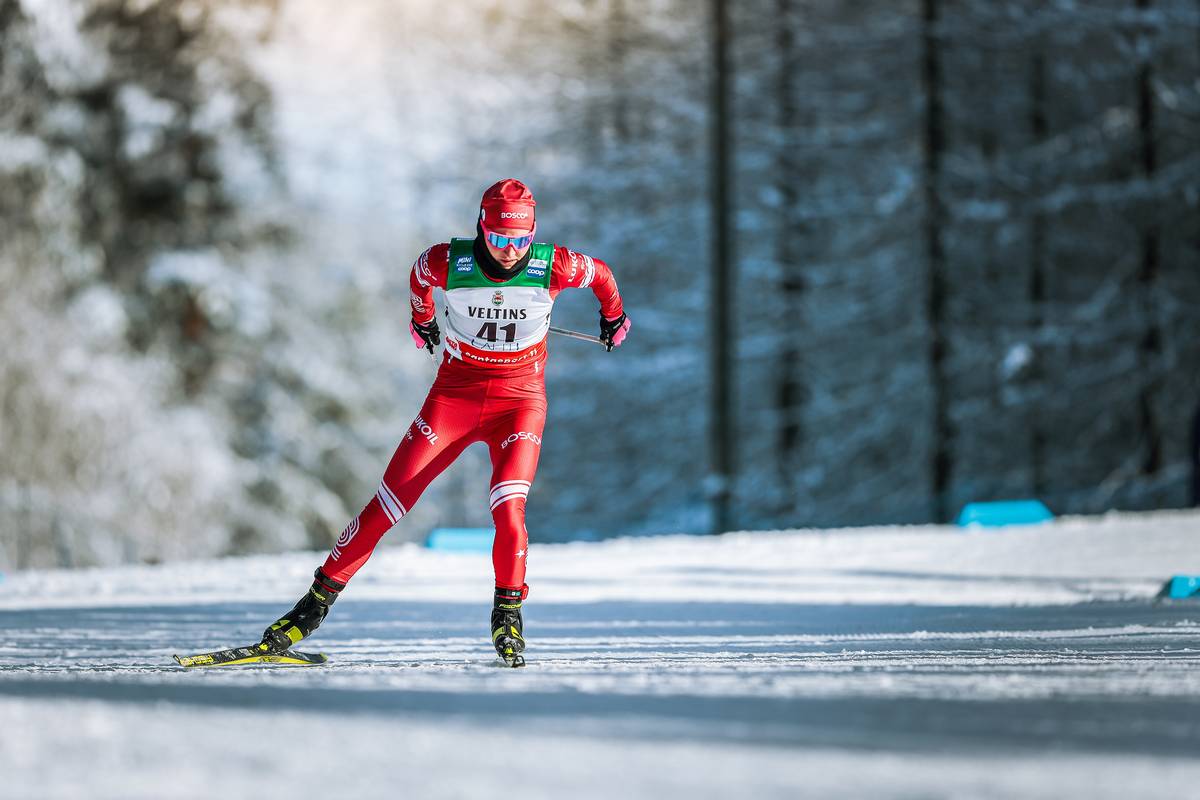
Yulia Stupak (RUS) races a freestyle sprint qualifier in Lahti, FIN in February 2022. (Photo: NordicFocus)
A Russian return to the World Cup is complicated by the unusually acidic edge the team has brought to the circuit, with acrimony spilling over into social media trolling and confrontations on the ski course.
Russian sport media has reacted strongly to the FIS ban by portraying the decision as a Norwegian power move and athletes such as Johannes Høsflot Klæbo who have supported the ban have been subjected to vitriol from Russian officials. Even before the invasion, Russian media has, in the post Sochi era, covered skiing in an increasingly strident and conspiratorial manner, dominated by a narrative of sporting victimhood and Russophobia.
Should Russia remain banned next season, or even longer, their absence may help FIS enact one of the most challenging maneuvers they have undertaken—the transition to fluoro-free racing, which FIS has now committed to enforcing next season.
Chris Grover downplayed the idea that Russia’s absence will make the transition easier, writing, “It doesn’t matter so much which nations are present at a given World Cup weekend. We need a testing system that all of the athletes, coaches, technicians and fans can trust.”
Fears of an imperfect test for fluoros have been punctuated with not so subtle hints of suspicion aimed at the Russian team. Golovin addressed these concerns, saying, “The Finns told us directly that the Russians are closed, no one knows what they do with skis. I suggested that they come to our wax truck and have a look…Come and see, and there is no need to make unfounded accusations.”
Nevertheless, Russia’s absence may lessen unstated distrust on the circuit, and perhaps improve cooperation and tolerance as the ban is enforced.
To that end, it may be a mistake for FIS to end the ban before next season regardless of whether or not the war in Ukraine ends in the interim. All of the justifications for the ban are likely to continue into next season: security threats to Russian athletes, the Kremlin’s use of skiers for pro-war propaganda, and the inability of Ukrainian skiers engaged in the country’s defense to prepare for next season. Finally, there has been no attempt at reconciliation by Russian skiing toward the wider ski world, with intransigent blaming of Norway for the present situation. In short, Russian skiing has rejected the rest of the ski world and has found itself in the cold.
Alexander Bolshunov takes Olympic gold in the men’s mass start 30 k, shortened from 50 k due to temperatures and extreme wind. (Photo: NordicFocus)
As Ulvang pointed out, skiing cannot be separated from society.
“It’s very important that we split [distinctions] between the sanction against a nation and the sanction against the Putin regime,” Ulvang told FasterSkier reporter Nat Herz in March. “I hope I’m still friends with the athletes and that we’re able to split between a reaction against the regime. It’s nothing personal. In the big picture we are all repping our nations and our regimes. We need legitimacy from society to exist. We need public money [for] our training facilities and to make tracks and courses and we need support.”
Rossignol Group appoints new U.S. Alpine Race Manager
World Cup veteran Shawn Gaisford to bring a wealth of race experience to U.S. market
Park City, UT – Aug 31, 2021 –Rossignol Group is pleased to announce the appointment of Shawn Gaisford as the new U.S. Alpine Race Manager, effective immediately. Gaisford will be responsible for working with Alpine Race coaches, athletes, and clubs across the country; overseeing the Group’s Junior Race and sponsorship programs; working closely with the Group’s dedicated network of Race dealers; and coordinating with the U.S. Ski Team for Rossignol, Dynastar, Lange and Look brands.
A former World Cup technician with 15 years of experience servicing athletes on the WC circuit, Gaisford experienced his first victory at the 2009 Kvitfjell Downhill with Manuel Osborne-Paradis. Working with a diverse roster of athletes from the U.S., Canada, Switzerland, and France throughout his World Cup career, Gaisford also attended the Winter Olympics in Vancouver (2010), Sochi (2014), and Pyeongchang (2018) as a supporting technician.
“We couldn’t be more thrilled to have Shawn come down and assume this role for us in the U.S.,” said Thor Verdonk, Global Race Business and Alpine Technical Product Director. “Shawn’s vast experience will be incredible assets as we continue to boost our race program in the U.S. After spending his entire professional career in the international race community and working closely with some of our top international athletes, I’m not only confident he’s up to the task at hand, but look forward to watching him cement our position on top of the podium and accelerate our presence in the U.S. marketplace.
“I’m very proud to be able to contribute to growing the passion for ski racing across the U.S. and very excited to take on this next challenge,” added Gaisford. “Racing is entrenched in the DNA of these legacy brands, I suppose much like myself. I look forward to getting to know and work with all of the coaches, race program directors, dealers, and athletes in the U.S. and driving our race programs in the years to come.”
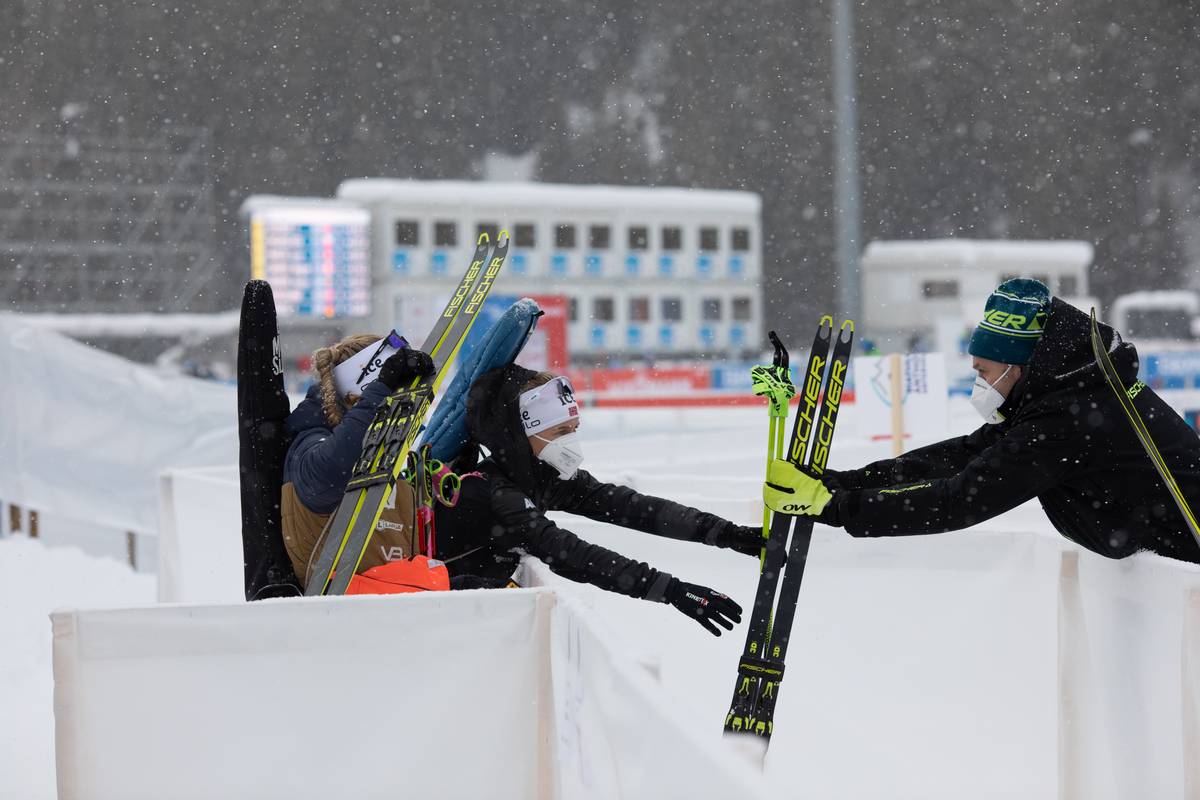
Biathete Tiril Eckhoff (NOR) hands over the skis to Gerhard Urain, Nordic Race Director for Fischer. (Photo: NordicFocus)
Will there be enough skis this season? That’s the question every ski shop and many consumers are asking. With demand predicted to remain high this winter, and some unique challenges faced by ski producers, ski scarcity may remain a reality.
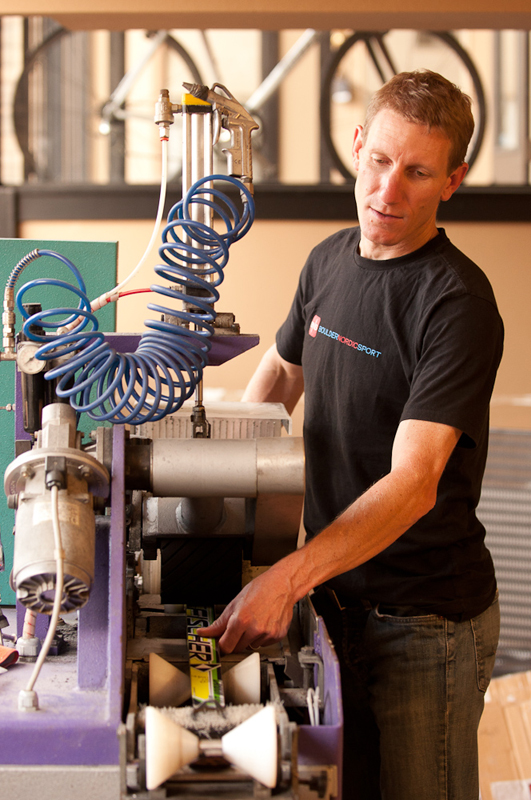
“I imagine if demand stays high we will see some significant shortages this season,” said Nathan Shultz, owner of Boulder Nordic Sport.
The problem, from a supply-side, started with the pandemic. People thought that the demand would be low and the most popular would be home-based activities like online games from Casinosters. “In the beginning, everyone freaked out and thought that no one was going to buy anything,” said Schulz. “Factories had to adapt to that expectation and then everything started going gangbusters, and demand escalated at a pace we haven’t seen. So on top of supply disruptions, there was a huge demand, everything sold out, and then the fire happened.”
In October 2020, a massive fire tore through the ski production line of Fischer’s factory in Mukachevo, Ukraine, requiring much of the production floor to be rebuilt. Most of the skis for the 20-21 season, however, had already been produced and were awaiting shipment in a separate facility.
Fischer—the world’s largest ski manufacturer—produced around sixty percent of its skis across all disciplines at the Ukrainian site, which handled ski production for several other brands as well. In all, it has been reported that a quarter of the world’s skis came out of the Mukachevo factory.
“Globally the loss of that factory is a big hit, and not only for Fischer but the brands that they manufacture for,” said Zach Caldwell of Caldwell Sport. Like many large ski factories, the Ukrainian factory produced cross country and alpine skis for a number of brands including Rossignol, Alpina, Scott, and Dynafit.
Jeff Courter, the Nordic Manager for Rossignol said the Fischer factory fire was, “shorting the worldwide ski supply because the factory made skis for a lot of different brands. When you think about finding a home for all those skis, not only for our brand, but for Fischer and anyone else they made skis for, that’s a lot of skis you have to find factories for. So that’s putting a lot of pressure on all the other ski factories as well.” (Rossignol’s high-end race skis are manufactured at their production facilities in Spain and France.)
“Without Covid, we might have been able to absorb [the Fischer factory loss]…but with Covid—impossible. So this is why all the big brands need to shut down for business early.” Said Robert Lazzaroni, the Regional Commercial Manager of Salomon, referring to the earlier than the normal deadline for retailers to order skis.
In a normal year, ski shops order equipment for the following season in the late spring and reorder products as demand requires. “Normally if we need something specific we call and get something,” said Schulz. “We do a lot of small juniors orders, because it’s so hard to know what juniors are going to need…we call Fischer if we need something.”
This year, the flexibility to order small batches on the fly has dissolved. “We’ve been told, ‘don’t expect any reorder capability,’” Schulz said. According to some ski reps, many retailers are left with little ski stock heading into the 2022 season and will have to rely on their preseason order made in March to get them through the winter.
“I believe the shops did learn the lesson last year with the crazy demand for our product,” said Lazzaroni. “And I think the shops did go a little bit heavier on the preseason versus the reorder.”
In recent years, with the retirement of Canada’s Alex Harvey, U.S. skier Jessie Diggins has become the face of the France based ski brand. (Photo: NordicFocus)
What was already a perfect storm of increased demand and faltering supply chains as the pandemic ensued, was only compounded by the Ukraine fire. Factories able to upscale their ski production worked at full capacity to meet the preseason order requirements.
Courter said that the Rossignol factories had been, “really maxing out on what it can make, and not only make, but ship in a timely manner. These production ceilings we have rarely, if ever, been bumped into until now—so it’s been a learning experience.”
Ski production has seasonal constraints as retailers need to receive products during their selling window, most of which happens between October and January. “We could keep making skis and boots all year,” said Courter, “but it’s not going to do the retailers any good if we send them a bunch of stuff in March.”
Fischer compensated for the production loss in part by transferring some of its Ukrainian ski makers to its factory in Ried, Austria allowing production there to ramp up, with the factory running additional shifts.
Steve Reeder, Fischer’s Nordic Sales Manager in the U.S., said that under the circumstances, Fischer was handling the demand well. ”Can we absolutely get as many as we want? No,” Reeder said, “but we’ll have more product out there this season than we did last season.”
Fischer’s high-end products are mainly produced in Austria and were unaffected by the fire. “The two factories have been separated on the nordic side by their core technologies,” said Reeder. “Ried [Austria] has specialized in Air Core, and the Ukraine is kind of a complete tree to ski facility. Everything other than our entry-level price point is Air Core, so it’s coming out of Ried.” Reeder continued, “For the FasterSkier audience there’s actually minimal impact from the fire. We’re still making the majority of our race ski product in Ried, Austria. So the supply concerns are focused more on the touring category which has been compounded by the impact that Covid has had on outdoor recreation sales, and the fact that the increase in business we’ve seen in the States is happening globally.”
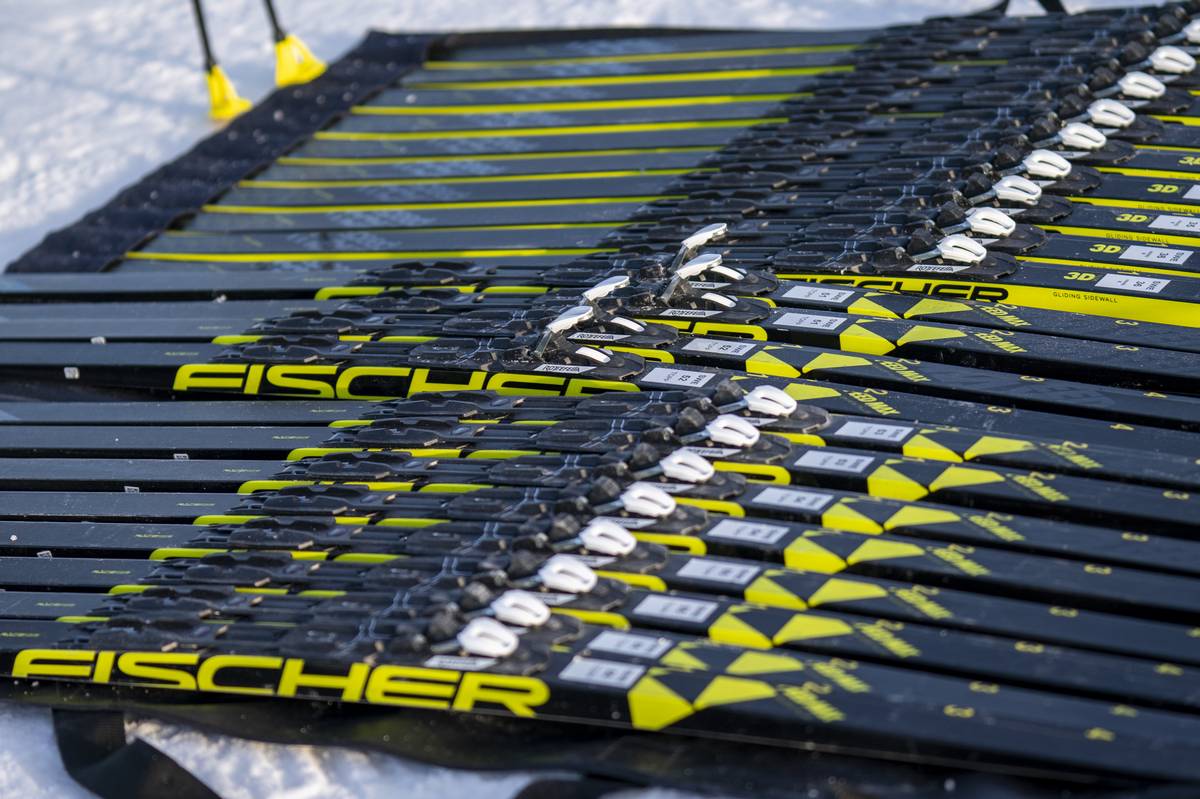
A fleet of Fischer race bred Speedmax. According to Fischer, production of the high-end race ski will not be affected by the Ukraine factory fire. (Photo: NordicFocus)
The supply-side strain is most acute on the recreational and backcountry ski category that sold so well last winter, according to ski reps and shops that spoke to FasterSkier. “Touring and backcountry is where, not only us, but a lot of the other brands will not have the availability, unfortunately,” Courter said.
“Already last year the supply [for touring] was very short, and this year we are facing known shortages,” Caldwell said. “I know we’ve been promised that our preseason orders would be filled, but on reorders we’re anticipating having zero availability.”
For high-end race skis, the situation is calmer, though demand for racing equipment has rebounded. “Even in the performance and race categories the demand is really high, which is great considering that last year was troubling to get races off the ground,” said Courter. With factories working at full tilt to produce orders, manufacturers are unable to produce an excess of high-end models. “With top-end race skis, we’re anticipating getting what we ordered,” Caldwell said, “but also anticipating some short supply as we get closer to winter.”
Apart from skis, there are ramifications for other nordic products due to the topsy turvy global supply chain.
“The wax folks I’ve talked to have acknowledged that material costs have gone up and their margins have gotten really lean. I wouldn’t be surprised to see costs go up at some point,” said Caldwell. “I bet some companies might introduce them already this year, but a lot of companies are stuck with what they’ve promised, so it might be something to recoup from in the future—but that’s a price thing. The absolute chemical that goes into it is pretty small, it’s not a big industry.”
Another question Caldwell has considered is whether ski poles will be affected by global pressures. “Who knows, maybe poles will be difficult with a ton of Asian carbon manufacturing,” said Caldwell who clarified that he was, “totally speculating.” He added that, “Pretty much every pole out there is made in Asia, and that Asian supply chain…I just don’t know at what point that becomes an issue. Because of the cross over into other industries, the ski pole factories aren’t always ski pole factories, so that introduces a level of vulnerability and knock-on effect from other supply chain issues and excess orders.”
While burgeoning demand, reduced stockpiles, and the loss of the largest ski factory have strained the industry, it is in a relatively better position than that of other outdoor sport manufacturers, notably the bike industry.
“I think everyone recognizes that the bike supply chain is really screwed up,” said Caldwell. “With skis, it’s a limited range of raw materials and according to the companies I’ve spoken with, they’re not seeing shortages in raw materials. So in terms of assembling the products, it’s not so much a problem, the problem is on the demand side and on the capacity of factories to produce the skis. The nice thing about skis is they make a finished product in one factory.”
The ski brands that spoke to FasterSkier were confident in their ability to deliver on their preseason orders, and to varying degrees, believe they may be able to offer reorders on high-end race skis. Shop owners, however, expressed some concern that orders would be delivered in full.
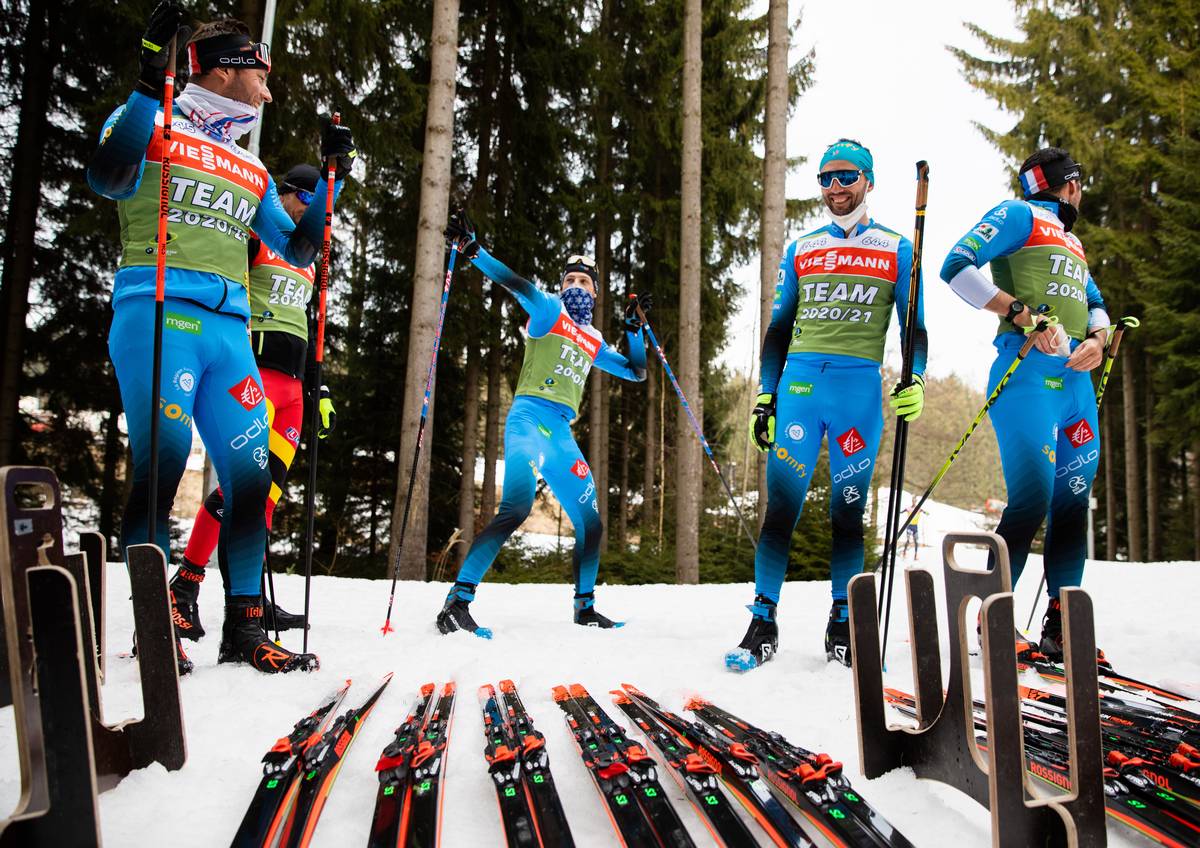
French World Cup athletes hover over the Rossignol goods. (Photo: NordicFocus)
In any case, possible ski shortages this upcoming winter will likely be decided by the size of retailers’ preseason orders and, most of all, snowfall. “Our sport is dependent on snow on the ground, so assuming that some of our markets like New England and the Midwest—if they get early snow, then there’ll be a point somewhere in the year that shops could get a little lean on in-stock product,” said Courter.
Lazzaroni put it succinctly, “If, and it’s always an if, we have a decent early winter, the industry will lack product. I do believe what we saw last winter will continue into this winter and there will be a crazy high demand for nordic product,” said Lazzaroni. “The question is, has our retailer network been optimistic enough, and crazy enough with their preseason order to cover future needs from the consumer? I don’t think so, to be honest.”
For skiers looking for new boards this winter, the message was clear: buy early. “People would be advised to get their names on orders early,” said Caldwell, “because I would be unsurprised to see some brands fall short
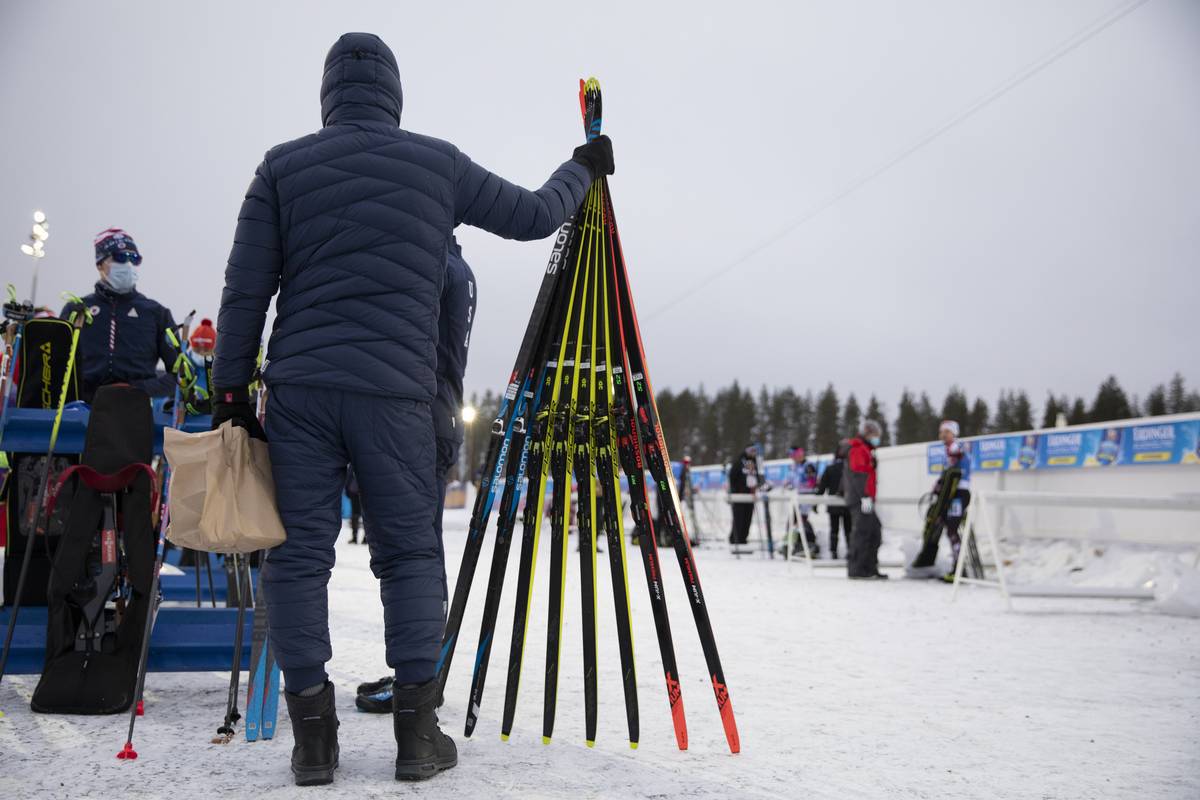
A U.S. ski technician holds different skis in the warm up area on the IBU World Cup. in Kontiolahti, Finland. (Photo: NordicFocus)
Rossignol Group a proud supporter of the Share Winter Foundation
The partnership will further Share Winter’s mission to increase participation and diversity in snow sports
Park City, UT – May 5, 2021 – Reinforcing the pillar of ‘Community’ within its broad-reaching Respect program, the Rossignol Group is proud to announce its support of the Share Winter Foundation.
A 501(c)(3) non-profit, the Share Winter Foundation works with local and regional programs to help foster efficient, effective, and sustainable winter sports programming through funding, thought-leadership, and community connections.
The Rossignol Group’s Respect platform is a key pillar of the Group’s long-term strategy, a wide-reaching CSR initiative addressing social and environmental responsibility through a combination of advocacy and action.
“Improving the lives, health, and fitness of youth through winter sports while creating a more diverse, inclusive, and welcoming community is Share Winter’s mission,” said Nick Castagnoli, Brand Marketing Director, Rossignol Group North America. “These goals couldn’t align more seamlessly with our own. Today’s kids are tomorrow’s life-long participants. Taking concrete actions that will expose more children to skiing and riding while creating a more welcoming, accessible, and diverse sport is critical to the long-term health of our industry.”
As a grant-making organization, Share Winter leverages its collective resources and influence to provide youth with skiing and snowboarding opportunities across the United States. Grantee partners including non-profits, schools, rec centers, non-profit ski areas, and clubs are vetted and then enabled to provide ski and snowboard programming to diverse groups of young people ages 5-18. These programs remove many of the financial barriers to inclusion by subsidizing or covering the costs of gear and/or instruction, providing free transportation to and from the mountain as well as having instruction take place during school hours so more kids can participate.
“Share Winter has quickly positioned itself as a leading organization in terms of growing participation and diversity in snow sports,” said Francois Goulet, President, Rossignol Group North America. “Their mission is one every brand, resort, and retailer in our industry can get behind. We’re grateful to Share Winter for the work they are doing and for the opportunity to work alongside them to help break down barriers and create the pipelines that will support and inspire the next generation of skiers and riders.”
In 2020 alone, the Share Winter Foundation reached 248 schools and 61 ski areas nationwide, helping more than 45,000 youth get on snow. With additional partners coming onboard in 2021 and a goal to reach 100k youth through its actions by 2028, the organization is already well on its way with its sights set on sustaining and expanding these programs for years to come.
GROUP ROSSIGNOL: Headed by its new CEO Vincent Wauters, Group Rossignol designs, manufactures and markets a broad range of winter sports and outdoor equipment. The Group’s brands provide a continuous, year-round experience accompanying consumers in every moment of sporting effort and leisure, from elite-level athletes to amateurs, from the mountains to the city. The Group’s global headquarters is located in the French Alps near Grenoble with five different industrial sites (Sallanches, Nevers, Saint Etienne de Saint Geoirs, Artès, Montebelluna) across western Europe and a U.S. headquarters in Park City, Utah. The Group houses a strong portfolio of complementary brands: Rossignol – the iconic brand for winter sports, and ready-to-wear fashion and apparel; Dynastar – the specialist ski brand; Lange – the iconic ski boot brand; Look – the long-standing premium manufacturer of ski bindings; Felt – the premium bike manufacturer; Risport – the reference for ice-skating; Kerma – specialized in ski poles and technical equipment; and Dale of Norway, an iconic Norwegian brand known for its high quality wool-based knitwear. Each has built their own unique identity and draws their inspiration from the mountains. Rossignol is majority owned by Nordic Private Equity fund Altor since 2013.
When the country began shutting down in March, sporting good retailers initially shuddered. It appeared many if not all sectors of the economy would bottom out.
“Everything was dicey in February and starting early March,” said Boulder Nordic Sport (BNS) founder Nathan Schultz about the onset of the Covid-19 pandemic. I was about to head off to Italy for the World Masters to wax there. Everybody in the Midwest was getting ready for the World Cup. And then everything got canceled. Things got serious really fast.”
Early on, Schultz decided to curtail BNS operations. He advised his employees to take advantage of the Federal Government’s Paycheck Protection Program (PPP) until he and his advisors could settle on a long-term plan of action.
For BNS and many ski purveyors, March can be a lucrative month – a time to create some financial padding before the dry season. By April, ski and winter accessory sales normally dip as the sun tracks higher in the sky. It’s a timeworn business cycle.
“This March and April were scary,” said Schultz who noted his March revenues dipped roughly 75 percent.“And in April, people were still kind of holed up and April is not usually a big month for us. But to have it go from a little bit to nothing is pretty hard. We were definitely scared about the end on the ski side.”
Back in 2018, Schultz merged BNS with Boulder Cycle Sport – a Boulder based specialty bike shop. Schultz’s close proximity to the bike side of the outdoor retail market was a front seat for the unexpected: a run on bikes during the pandemic’s onset.
In March and April, Boulder Cycle Sport’s bike staff agreed to reduce their hours by 50 percent. Doomsday scenarios were not so far fetched. But as the mercury rose and Colorado’s front range greened-up, Boulder’s denizens, known for their high output energy, became stir crazy like the rest of the nation under lock down. Schultz recounted, “everybody started riding bikes because that was all they could do. It went from zero to 500 percent.” With the uptick in sales, the bike staff transitioned to full time and any interested ski employees were offered hours on the bike side of the business. The experience in Boulder was no anomaly. Bike sales blew up across the nation. Mainstream media outlets reported that wait times for new bikes could be months. From kid-bikes, cruisers, road and gravel bikes, to fat tire steeds, they all were in high demand.
This was true for Boulder Cycle Sport where zero to 500 meant they could sell bikes as fast as they received them. According to Schultz, May, June, and July were all “crazy good”. “It went from ‘super scary’, to ‘wow are we going to be able to survive this?’ to ‘this is amazing we are selling everything that we have.’”
Boulder Cycle Sport does not simply cater to the high-end customer looking to drop 10 k on electronic shifting and featherweight carbon. “We definitely have everything,” added Schultz. “We want to be the neighborhood bike shop. So, we have all types of bikes.”
That bike spectrum spans starter kids bikes, to mid-price commuters, along with a full menu of price points for customers seeking an entry-level or pro-level race bike. No matter, the low, middle, and high end of the bike market was selling out. With brisk sales coupled with factory closures, supply chain disruptions became a common topic. Some bike models remain hard to come by as are some spare parts. “It is at the point right now in the bike world where the supply has been nearly exhausted,” said Schultz.
The exhaustion of the supply chain does not necessarily mean bike manufacturers will full-tilt-boogie ramp up production to meet demand. In an article and radio piece for Marketplace, Chris Rodgers, a supply chain analyst for S & P Market Intelligence said this: “The [bike] industry wasn’t running with lots of spare capacity to start with. What the industry doesn’t want to do is double its capacity to meet the increased demand, and then we turn round in the winter or next year when everyone’s got a bike and suddenly you’re left with a factory that’s too big and machinery or staff that aren’t being used anymore.”
In the short-run, we may see bike shortages persist as manufacturers remain cautious and steady in what could become a massive boom-bust cycle.
Retailers like BNS-Boulder Cycle Sport sell skis too. They know that as cycling use decreases during the winter, ski use increases. Needless to say, they have been informed by the cycling industry’s vagaries. That has shop owners like Schultz consumed with positioning themselves with just enough gear to meet a potential surge in demand for cross-country ski equipment.
Schultz received a positive data point early on. “On the rollerski side of things, it picked way up, about twice what it normally is,” Schultz said. “And it seems like more and more people are coming to us early and they are saying we want to get into nordic skiing this year and we don’t want to miss out. They are coming in at the end of August instead of October and November when they usually show up.”
Testing Madshus newest high end ski, the Redline 3.0 at Sjusjøen (NOR) this spring. Photo: Stefano Zatta/Madshus
The conversations on and off the record here at FasterSkier are the same regarding a potential boom in cross-country ski sales – bullish. One reason for the optimism is alpine areas are now revealing their winter operating procedures. Nationwide they include policies like online reservations for parking and skiing, limited if any food service, and a concerted effort to remain open and profitable by enforcing social distancing the moment a skier arrives, to the moment they leave. Industry wide, these are considered some of the best-practices to ensure financial viability and skier safety.
“People are going to be looking for other winter sports,” said Schultz. “Even if the alpine world were normal, I think the nordic world would still be blowing up because people are looking for a way to get outside and away from people. Backcountry skiing and nordic skiing are great opportunities to do that.”
Cross-country ski shops are figuratively grabbing the bull by the horns as they expect a similar dynamic to the bike industry: an increase in gear sales. However, there’s the hope that supply chains remain fluid. In other words, well supplied.
“The ski industry has had time to anticipate this, everybody I’ve talked to, they are bullish, they have raised production a huge amount and they are all in it,” Schultz said. “What we have been doing is we have been placing backup orders to bulk up and if we don’t sell what we think we will, we will probably modify those orders a little bit. I think all of those vendors are expecting it is going to be a big year and they are probably going to run out of product and they are trying to balance that equation — not get too bullish and have too much inventory because that kills. That is the biggest killer of retail, but we still need to have enough that we don’t run out.”
The Supply Side
Lillehammer, Norway World Cup, a USA Technician working on Rossignol Skis. (Photo: Nordic Focus)
“It is going to be an interesting year, from what we are seeing from the cross-country side, which I am sure you will hear from everybody, everybody is betting on nordic,” explained Jeff Courter, Nordic Category Manager for Group Rossignol North America.
Courter said he expects all segments of the nordic category to grow, yet the greatest increase is expected to come from entry and mid-price point models. The same trend as in the bike market.
Pre-season orders for skis are received almost a year in advance of the following winter. Skis for 2020-2021 were likely pre-ordered in the fall of 2019. That allows suppliers like Rossignol, Fischer, and Madshus, all of which were contacted for this story, to ensure the raw materials for ski production are secured and demand is met.
“We have multiple factories in various parts of Europe,” Courter said. “The difficult thing with us, as I am sure most of the other suppliers are coming up against this too, with all of this massive increase in demand the problem is that the timing of this is a bit off. We have to put in all of our orders almost, not quite, a year ago, last fall over the course of last winter. All of our orders were in with the factories before all of the lock downs when the quarantine happened and, of course, now, the subsequent massive increase in demand.”
Courter said that Rossignol was able to keep production going through August, a time when much of Europe normally shuts down for holiday. “Since everyone already had six weeks off in the spring, all of our factories kept working to catch up and gain ground to be back where we should be in terms of delivery date and also just availability of product,” said Courter.
For now, sourcing materials for skis has not been an issue for Rossignol. The same can be said for Fischer. Steve Reeder, Fischer’s National Sales Manager for Nordic Skiing in the U.S. said in many ways Fischer’s supply chain is almost totally vertically integrated. Reeder used the example of their wood core skis as evidence.
“The wood core skis are built in our Ukrainian factory and that is literally a tree to ski factory, there is a wood mill on-site,” said Reeder. “You pull in the driveway and giant logs are being fed into a building where they are turning them into sheets for cores.”
Fischer’s higher-end skis, those with more complicated builds like the Speedmax which offers a lighter “Air Core”, are fabricated at Fischer’s plant in Ried im Innkreis, Austria.
Globalization has become the norm. Ski companies, which also produce boots, are well versed in navigating complex supply chains when sourcing material from outside their vertical chain. “Base material, that is probably one of the things they have to buy,” said Reeder. “I believe we have a good supply of that on hand. Most of that is Central European sourcing so there were not big concerns. We do some boots constructed in Europe, but we do a good chunk in the Far East, Indonesia, Cambodia, and those facilities got all of their componentry out the door and on the way to the factory before things shut down in Europe. So they were actually in very good shape and we have had stellar delivery on those products this year.”
Lenzerheide, Switzerland World Cup: Sweden’s Ebba Andersson tests her Fischer fleet. (Photo: Nordic Focus)
Like Rossignol, Fischer took preseason orders for this winter’s stock nearly a year ago. Reeder also expects Fischer to have mid-season reorder capabilities for most of their lines. For some product, Reeder said stock vaporized in August when under normal circumstances he would have a supply buffer well into January. Fischer is now considering options to increase its production capacity on select models.
Norway based Madshus is known to operate a nimble factory able to produce small-batch ski runs. Bryan Cook, U.S. Sales Manager for Madshus, says they too are positioned to prevent ski scarcity.
The autumnal equinox just passed. In the market for news skis? This is often the time to begin sniffing around as dealers swap out spring and summer gear for snow sliding options. Time will tell if ski shops experience a supply pinch like bike retailers. It appears ski manufacturers have read the tea leaves. Optimism reigns. For now, it seems that optimism will be met with a solid supply of skis as the cross-country segment looks for a boost in sales.
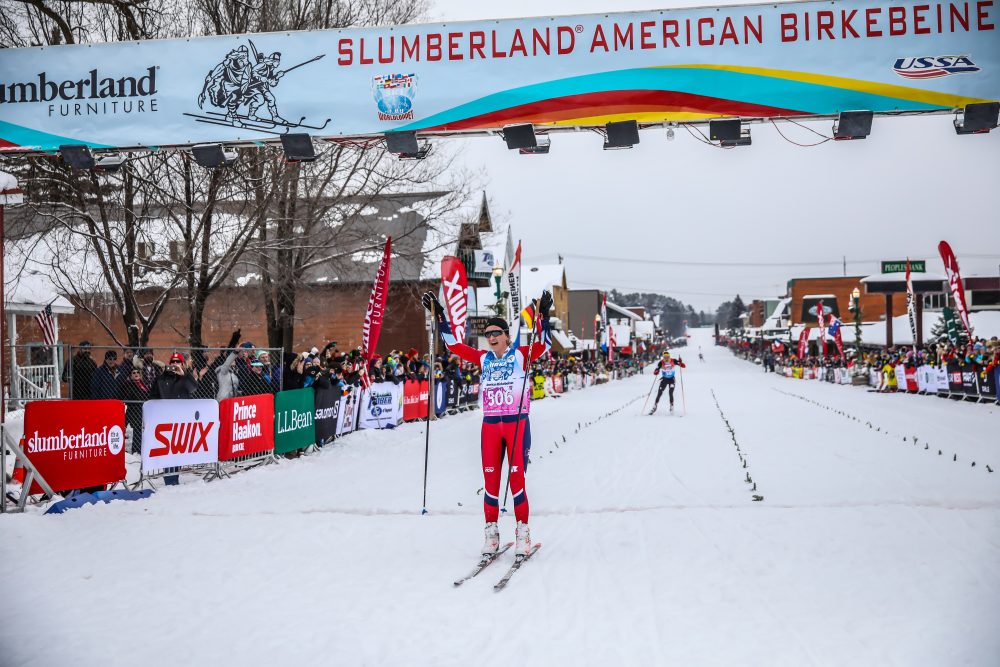
SMS T2 skier Alayna Sonnesyn with the 2019 American Birkebeiner win. (Photo: James Netz)
The countdown is on. Marathon season is underway and we are inside the final two weeks before theAmerican Birkie. At this point, “the hay is in the barn” when it comes to training, but there is still time to dial in a nutrition plan to stay fueled and all the way from Cable to Hayward.
For pro tips, FasterSkier reached out to last year’s Birkie winner, Alayna Sonnesyn (SMST2), for insight into the system that powered her performance. This season, 23-year-old Minnesota native earned three podiums at U.S. Nationals in Houghton, Michigan: 2nd in the 10 k skate, 3rd in the classic sprint, and 2nd in the freestyle sprint. She also earned her first European World Cup starts in Nové Město and Oberstdorf, improving on the results from her first World Cup starts in Quebec City the previous season.
“My dream came true.” An emotional Alayna Sonnesyn after winning the 2019 Birkie. (Photo: Screenshot asonnesyn.com)
For Sonnesyn, the Birkie has always been a family affair. In a blog post, she recalled watching through the fence as racers flew by like “superheroes.” All four members of her family raced the 2019 Birkie; her sister, Marit, took 7th, her mom was 72nd, and her dad 180th.
While bottle hand offs and extra supplies may not be a luxury available to the recreational skier, Sonnesyn’s fueling plan embodies the “eat and drink early and often” wisdom, finding a product that sits well and meets your needs, and erring on the side of over prepared.
Pre-Race Fueling:
The night before the race, I ate a ton of Rigatoni pasta (which contained beef for protein) that my mom made along with a salad.
On the morning of, I had a big bowl of oatmeal with a spoonful of Greek yogurt and a sprinkle of protein powder. I’ve found that extra protein before a big race can give me that extra energy to really dig deep later in the day. I also drank A LOT of coffee that morning, sipping it all the way until the start line.
During the Race:
Last year I carried a water bottle that had Tailwind Nutrition electrolyte mix in it. I’ve been using Tailwind for two years now and I LOVE IT! It’s so easy on your stomach and doesn’t taste overly sugary like Gatorade or Powerade. I prefer the “Naked” flavor which is essentially flavorless but also really like the Berry flavor. I know it’s sold at Gear West!
At about 15k I took a gel and chased it with water at one of the aid stations. It’s nice to know the trail so well that I could anticipate the aid stations well in advance.
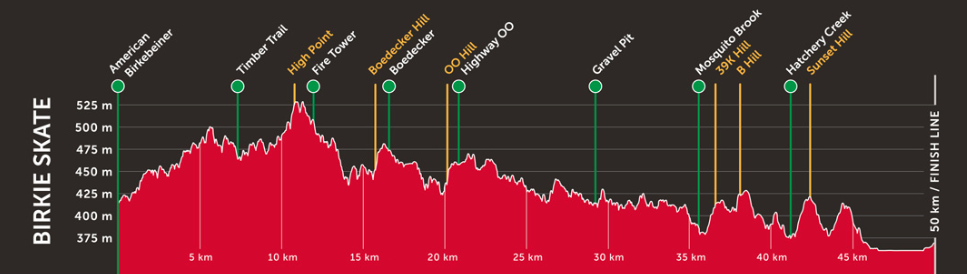
My goal was to have finished my first water bottle by the time I got to OO (kilometer 20.6) where I dropped my bottle and received a new one from my Rossignol rep. This second water bottle contained more Tailwind Nutrition mix and also a crushed up caffeine pill. Not sure if the caffeine pill helped much but I felt great!
At about 35k I took another gel that contained more caffeine and followed this up with water from an aid station. I had the option of getting another water bottle from my Rossignol rep at this point but I was feeling good and didn’t think it was necessary.
Finally, before crossing 77 (6 k to go), I received a “flat coke” feed from another Rossi rep, dropped my drink belt and put the hammer down!
Overall, I didn’t have a “calories/hour” goal but I wanted to take feeds early and often so that I could prevent any bonking. I’m not a fan of gels so I really wanted to be sure I had water after taking these to make sure I got them down well. Also, food and blocks are too much for my stomach during a race like that so I kept things relatively liquid.
The elevation profile of the American Birkebeiner. (Photo: Screenshot birkie.com)
The Race Logistics:
I was fortunate enough to have INCREDIBLE support from my Rossignol team. I gave a Rossi rep a spare set of poles that would be available about 10k into the race in case I needed them. Another Rossi rep had spare poles at OO. Luckily, I didn’t need to use these!
My aunt was also available at OO with extra everything. Poles, gloves, water, food… again though, I was lucky not to need any of this.
My race suit doesn’t have any pockets but my water bottle carrier did. I stored three gels in this pocket that I knew would be plenty to get me through the race (I used two of them). Last year it wasn’t too cold so I wasn’t worried about my feeds freezing, but keeping them close to my body made sure they would stay warm just in case.
Overall, I wanted to be over prepared rather than under. I made sure that if anything went wrong, I was prepared for it. Two days before the race, I practiced skiing at high speed with a water bottle carrier and taking a feed from it. Practicing this helped me feel way more confident in the procedure and all of the logistics for the race.
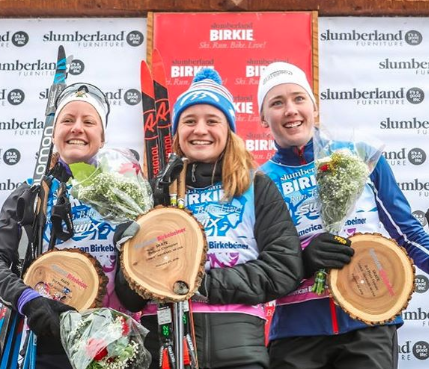
The women’s podium of the 2019 American Birkebeiner. Alayna Sonnesyn took first ahead of Anja Gruber and Katie Feldman. (Photo: Screenshot Instagram @asonnesyn)
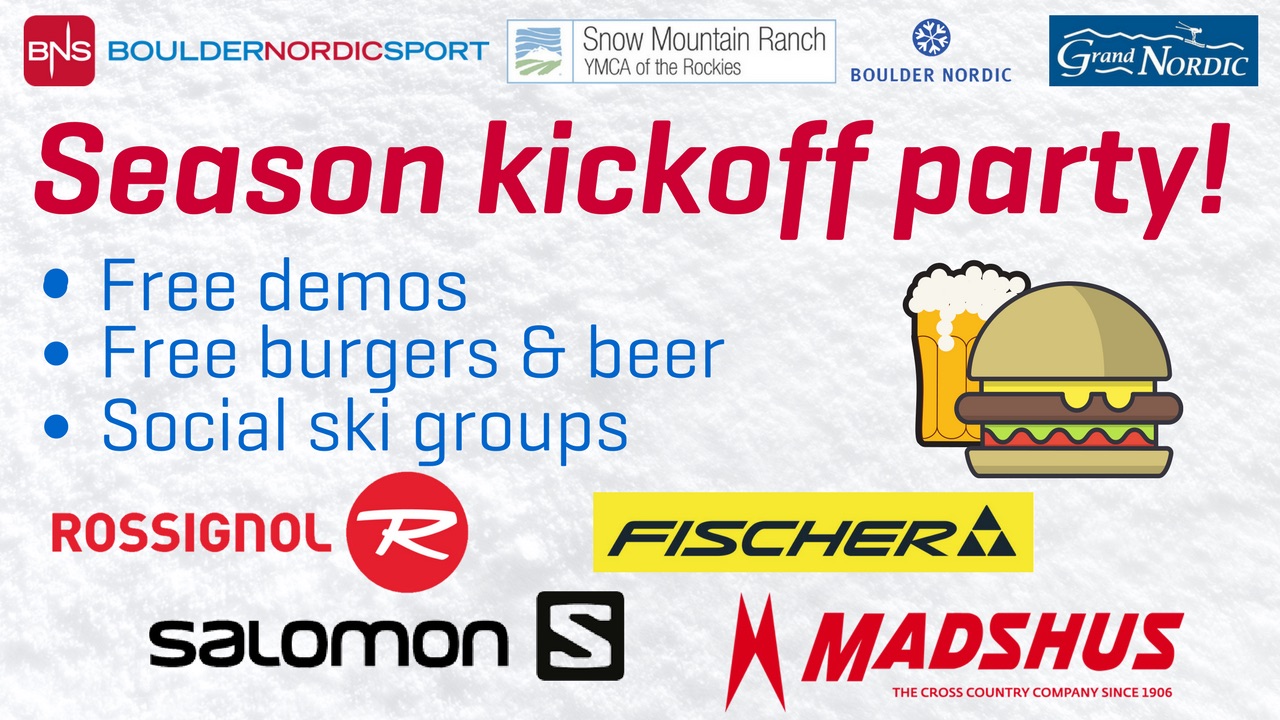
BOULDER, CO—Boulder Nordic Sport, is excited to announce the first-annual Season Kickoff Party at Snow Mountain Ranch on December 2, 2017. In partnership with YMCA of the Rockies, Rossignol, Fischer, Madshus, Salomon, Boulder Nordic Club and Grand Nordic, this is an opportunity to spend the day trying out the latest gear, connecting with skiing friends, and enjoying après ski fun!
Featuring free equipment demos throughout the day, the Season Kickoff party will include a complementary biergarten with burgers, beers, and brats; afternoon social ski groups, and more.
Want to make a weekend out of it? Snow Mountain Ranch offers lodge rooms and cabins, many of which are a comfortable walking distance from the ski trails. Off-season lodging prices are available the weekend of December 2-3 at snowmountainranch.org/lodging.
Tell your friends, bring your family, and join BNS to welcome the 2017-2018 ski season!
***
About BNS: Boulder Nordic Sport brings World Cup Service to everyone with full-service ski shops in Boulder, CO; Bloomington, MN, Portland, ME and online at bouldernordic.com. BNS specializes in professional ski service using Tazzari stone-grinding equipment as well as sales and advanced fit of cross-country skis, equipment, and technical apparel. BNS imports Holmenkol and SkiGo wax lines and carries a full line of wax and professional tuning equipment from over ten wax brands.
Information about Boulder Nordic Sport and the new BNS Magazine are available at www.bouldernordic.com.
PARK CITY, UT (March 28, 2016) – The USSA SuperTour and long distance races of the L.L.Bean U.S. Cross Country Championships at Craftsbury, VT closed out a very successful 2015-16 US. Ski and Snowboard Association cross country season. But even though the season is winding down, there¹s still time to support the successful athletes of the U.S. Cross Country Ski Team by joining the USSA as a general member. For just $15 you can be a part of the success of the U.S. cross country program. And, best of all, there¹s still time to win one of the great weekly prizes being offered by the USSA.
Each week, the USSA rewards a new member with a great prize from one of the USSA’s partners. Still up for grabs in the final weeks is an entry to the 2017 Slumberland American Birkebeiner, a separate entry into the Kortelopet and a pair of Rossignol skate skis. All you need to do to win is to join the USSA as a $15 general member today. Just a few more weeks remain. http://ussa.org/joinnordic
On Thursday, the U.S. Ski and Snowboard Association announced Robert Lazzaroni has accepted the position of nordic domestic program director, a new position within the organization meant to fill the vacancy of outgoing nordic manager Joey Caterinichio. (Photo: USSA)
(Press release)
PARK CITY, UT (Aug. 4, 2015) – The U.S. Ski and Snowboard Association (USSA) has named longtime nordic business leader and enthusiast Robert Lazzaroni as its new nordic domestic program director. Lazzaroni will be responsible for administering domestic programs in partnership with USSA nordic clubs, including membership, club development, competition management, rankings, judges/officials education and other overall program tasks in cross country, ski jumping and nordic combined.
Lazzaroni brings over 20 years of nordic knowledge, on both the athletic and sport business side, to the USSA’s team. He spent 17 years as the nordic division manager for Rossignol, helping to grow sales and market share to position Rossignol as one of the top nordic suppliers in the U.S. Lazzaroni most recently managed the nordic programs at the Utah Olympic Park where he doubled the number of participants and increased revenue by 40 percent in the first year.
“A key focus of this new position is to further grow and develop the USSA’s nordic programs,” said USSA Executive Vice President, Athletics Luke Bodensteiner. “Robert’s experience in this area, complemented by his business and management background, will be of great value as we look to better serve our current members and provide more opportunities for kids to get involved, particularly with cross country.”
This past season, the USSA empowered special task forces in each sport to look at the best ways to grow membership. A product of these task forces is the new membership structure present in cross country. Lazzaroni will continue to work with the cross country task force and sport committee to further expand membership.
As a club leader, master skier and parent of a junior skier, Lazzaroni has interacted with a variety of the USSA’s programs in different capacities. He actively engaged in the USSA’s Club Development process this past season, earning the Park City Nordic Ski Club a gold certification as well as USSA’s Club of the Year award. His experience as a club leader, and one that has been through the USSA Club Certification process, will serve him, nordic clubs and the USSA well in continuing to expand this program in the nordic sports.
“I see a great way to improve our sport by spreading best practices across the nation,” said Lazzaroni. “My ultimate goal is to help develop better programs across the country with well-educated coaches, a good understanding of long-term athlete development, better competition resources and an increased number of participants. The USSA is the legitimate organization in the country to lead these efforts and I’m proud the lead the charge.”
After incredible success at the 2014 Sochi Olympics with 22 medals, Rossignol strengthens an already impressive Nordic Racing roster with the addition of 2014 Olympian, Erik Bjornsen.
“Erik is not only young and hungry to win, but an incredible ambassador to the sport,” said Paul Clark, Rossignol US Nordic Racing Manager. “We are excited to start working with Erik over the course of this next season at both the national and international levels in order to help him reach all of his competitive goals.”
An increased focus on Nordic Racing over the past few seasons has allowed Rossignol to work more closely with athletes and coaches. “Our goal is to provide every athlete with the right equipment to win whether that athlete is already competing on the World Cup circuit or working their way up through the ranks,” said Clark. “Working one‐on-one with the athletes as they test product allows us to switch things out when they aren’t working and helps validate that every skier is on the fastest equipment.”
“Rossignol’s commitment to Nordic Racing is currently unmatched by way of service and product delivery,” said Bjornsen. “I’m stoked to be working with such a committed group. The products are some of the fastest I’ve ever skied on and the level of support the Rossignol Nordic team delivers gives me confidence I’ll have the competitive edge I need.”
###
Rossignol has been making winter sports easier, more inspiring, and more fun, since 1907. From competitive athletes to cautious first‐timers, Rossignol’s technical innovations in construction and design continue pushing the boundaries of what skiers and riders can achieve on snow. Wherever winter takes you, whether resort‐based or backcountry‐bound, Rossignol delivers the groundbreaking performance, versatility, and ease‐of‐use to ensure Another Best Day.
On Nov. 4, at the Rossignol Headquarters in Saint-Jean-de-Moirans, France, defending IBU World Cup champion Martin Fourcade introduced his “wall of trophies” in the presence of many journalists and employees of the factory.
Martin Fourcade with his “wall of trophies” on Nov. 4. (Photo: Rossignol)
The double overall World Cup winner and five time World Champion wished to display all his trophies in Rossignol’s factory, the brand of skis and ski boots he used since his childhood: “It was natural for me that my globes and my medals are exposed at Rossignol’s headquarters. It’s a company which I like and which returns it to me for years by allowing me to gain all these awards.”
The huge list of Martin Fourcade’s accomplishments are represented in this vitrine: 2 big crystal globes of Overall World Cup Winner, 7 small crystal globes : Sprint (2012 et 2013), Pursuit (2010, 2012 et 2013), Mass Start (2013) and Individual (2013), one silver Olympic medal in Mass Start 2010 and 12 World medals: five in gold, six in silver, one in bronze. We can also find a pair of skis in this vitrine. It’s the number 8554, the one with which Martin Fourcade won his first title of World Champion in Khanty- Mansiysk in 2011.
Rossignol and its CEO Bruno Cercley are very proud to share this “wall of trophies” with Martin Fourcade and wish for him to reach his main goal this season: win a gold medal in Sochi Olympic Games.“This vitrine symbolizes our attachment for the competition. We would like to thank Martin Fourcade for this wonderful present made for the staff and for our numerous visitors. It reminds us that the group exists and prospers above all thanks to the alchemy between athletes of exception and our teams. We have the common objective to win by pushing away a little more every time the limits, in particular on the material. The story which we write together with Martin is an example of passion and efficiency in the search for the better result.”
Martin Fourcade checking out a pair of Rossignol boards. (Photo: Rossignol)
The Utah Olympic Park is excited to announce the hiring of Robert Lazzaroni as program manager of Park City Nordic Ski Club. Lazzaroni will oversee the organization’s day-to-day operations and manage cross-country, Nordic combined and ski jumping coaching staff.
“We are very fortunate to have the caliber of experience that Robert brings,” said Marc Norman, vice president of sport and venues. “His proven leadership and management style will contribute greatly to the club’s future growth.”
Lazzaroni brings to the organization more than 25 years of Nordic experience. Most recently, Lazzaroni represented sales and marketing for Park City-based One Way Sport. His career also spans 17 years with The Rossignol Group. In progressively more senior management roles, Lazzaroni spent time in France, Finland and Vermont during his Rossignol tenure, relocating to Park City in 2006 to manage the Nordic Division. Lazzaroni has also served as a member of the Board of Trustees of the National Ski Foundation.
Lazzaroni was a member of the French Ski Team in Nordic Combined from 1983 to 1988. After pursuing a degree at IUT Annecy and an international business MBA at IAE of Grenoble, both located in France, he coached the French Nordic Combined B team from 1992 to 1994.
Beyond his passion for Nordic disciplines, Lazzaroni is also an avid alpine and telemark skier, mountain and road biker, and hiker. Fluent in English, French, Italian and Finnish, he lives in Jeremy Ranch with his wife, Susan, and two children, Julia and Joanna.
In his new role, Lazzaroni will work closely with cross-country elite team coach Gordon Lange and ski jumping elite team coach Alan Alborn to continue to provide leadership and guidance to the club’s elite team athletes. His focus will be in the areas of communication with parents and other stakeholders, evaluation of current offerings and the development of new programs, and ultimately, growing the Nordic culture in Park City and Wasatch Front.
Along with the hiring of Lazzaroni, the UOP is also excited to announce the promotion of Kris Seymour to full-time coach focused on the clubs’ outreach efforts, learn-to programs – Kickers and Gliders – and development programs. Seymour will work closely with development team coach Steve Cook as well as part-time coaches to develop and grow the critical programs that create a Nordic foundation for athletes moving though the club’s progressive offerings. Lazzaroni and Seymour began their new positions on April 15.
The Rossignol Group is pleased to announce the hire of Paul Clark as the new Nordic Racing Manager. The Nordic Racing Manager will be responsible for all things racing, with a primary focus the USSA and NCAA ranks.
“The addition of a new Nordic Racing Manager highlights Rossignol’s commitment to supporting Nordic racing at the highest competitive levels,” said Ron Steele, President, Rossignol Group NA. “Paul’s history with Rossignol, combined with his extensive experience in the racing community will prove invaluable.”
For the past 10 years Paul has worked at Jan’s/White Pine Touring, a Rossignol Race Center, and was most recently the Director of the White Pine Touring Nordic Center in Park City.
As a sponsored athlete, Paul switched brands to Rossignol after being impressed with the quality of the products that Rossignol athletes were receiving.
“Paul is well connected and respected within the Nordic Racing community. His athletic, technical and competitive experience will prove a valuable resource as we continue building upon the success of the Nordic Race program,” said Ryan Green, Rossignol Nordic Division Manager.
The Nordic Racing Manager is responsible for managing all aspects of the Nordic race department to achieve brand objectives within the race market. This will include developing and maintaining a strong presence in the race market at retail, with athletes and coaches. The racing manager will assist management with development and execution of the business strategy as objectives are achieved.
Primary Responsibilities:
Assist in the development of short and long term strategies for the category
Management of elite athlete programs • Inventory management
Assist with training on Rossignol product to retail partners, athletes, and coaches
Keep Rossignol top of mind for athletes and opinion leaders
Maintain a data base of racing programs
Management of equipment test fleet
Assist sales team with leads and identifying opportunities
Prepare and present reports for management, sales and related audiences
Position Requirements:
Education and Experience:
Bachelor’s Degree in Business, Communication or Marketing is preferred
Strong proficiency with MS Office applications, primarily Word, Excel and PowerPoint. Also, a working knowledge of various social media platforms
Expertise in strategic planning and marketing principles
Ski industry experience as a coach, program/team management or retail is preferred
Expert knowledge of Nordic ski racing and equipment is required
Experience as an athlete or coach in USSA or NCAA events is required
Skills and Abilities:
Strong analytical, decision-making and problem solving skills
Excellent verbal, written and interpersonal communication skills
Strong customer relations skills
Excellent time management and task prioritization skills
Ability to adapt to evolving priorities
Strong teamwork skills with the ability to establish and maintain working relationships
Ability to maintain professionalism in all situations
Ability to self-motivate and self-manage
Position will require travel up to 10 days at a time
Approximately 15 weeks of travel per year
This is a full time, year round position based in Park City, UT
To apply for this position, please send a resume and cover letter to nordicracingusa@rossignol.com
Rossignol Group is delighted to announce that its best athletes have extended their contracts up to the Sochi Olympic Games in 2014.
Heading the list is Carl-Johan Bergman, double medalist at the Ruhpolding World Championships in 2012.
Third in sprint and second in pursuit, the Swede has demonstrated his ability throughout the season, even wearing the yellow jersey of the World Cup leader in December. “The decision to continue with Rossignol was simple. To achieve my goals, I need the best skis and Rossignol is without doubt the best manufacturer for my skiing style. To be at my best, I need good support and Rossignol’s Team Service produces the best skis on the market year after year. I love that! With the new X-IUM boots and the new X-IUM WCS skis, I am ready to go in search of Olympic medals!”
On the other side of the Atlantic, the American and Canadian leaders have also decided to extend their journey with Rossignol. Canadian Jean-Philippe Leguellec and Americans Lowell Bailey and Tim Burke will be proudly competing in Rossignol’s colors.
Tim Burke: “I am continuing my association with Rossignol because I have 100% confidence in them. They always get me the best equipment. I am also very impatient to find out about the most recent innovations to be introduced. Rossignol is forward looking and goes on improving its products, good as they are already.”
We wish all of them a level of success to match their sports ambitions and the faith they have in our products.
There may not be snow in St. Croix Falls or the Metro area – but there is still plenty of skiing and racing to be had not far away! (Photo taken on 1-14-2012 on the Wolverine Trails in Ironwood, MI)
This brown winter of 2011 – 2012 is starting to bum us out, but we are recharged after a fantastic trip to Ironwood for this past weekend’s Sisu Ski Marathon. We figured this weekend would be a great time share some enthusiasm with our team mates and customers by putting together a fun program of events here at Cyclova XC and in the surrounding area!
We will kick things off with our Brown Winter 30% Off Of MSRP 4 Day Overstock sale – Thursday (1/19/2012) through Sunday (1/22/2012) with our lowest prices of the season on most of our top end xc ski race skis, boots, and poles – as well as in stock Tubbs Snowshoes! See the details on this sale below!
Thursday 6PM: Group interval workout at Trollhaugen (most people will be classic skiing, but you’re welcome to join as a skater)
Friday: (A variety of tasty craft carbonated beverages will be served from 6 to 9 – max of 2 per person) 6PM:
First in adveture stories stories – Frank Lundeen presents “Skiing in Australia” on Cyclova XC Big Screen 7PM: TBA Movie on Cyclova XC Big Screen
Late (9PM – 1AM): Concert by Charlie Parr at Trollhaugen
Saturday: 8AM: Group carpool leaves for a day trip to the Birkie trail. The shop will be open from 7:30 to 8 for any last minute pre-trip skiing needs you might have. 9AM: Group skate ski and lesson at Trollhaugen 6PM: Night Mountain Bike Ride on the Woolly Trails. Rolling at 6PM from Cyclova XC in downtown St. Croix Falls. Call ahead to arrange for a Salsa Mukluk demo bike for the ride! Bring your own lights & bike unless other arrangements have been made.
Sunday: 9AM: Group ski at Trollhaugen 3PM: 3 mile Group Trail Hike on the Indianhead Trail (meeting at Lion’s Park, just north of St. Croix Falls. Be sure to check out the 30% off sale on all in stock snowshoes prior to leaving!
Come this Thursday through Sunday for the best deals of the season on top end XC Skis, Boots, Poles, & Snowshoes!
Brown Winter 30% Off Of MSRP 4 Day Overstock sale on in stock snowshoes, top end race skis, boots, and poles. We are slightly over inventoried on the latest 2012 top end race equipment, and are going to offer the lowest prices of the season for 4 days only – Thursday, January 19 – Sunday, January 22. Products included in this incredible deal are: All in stock Tubbs Snowshoes Fischer Carbonlite Skate Skis (“the HOLE ski”) Madshus Nano Sonic Skate Skis Madshus Hyper Sonic Skate Skis Madshus Hyper Sonic Classic Skis Madshus Nano Sonic Skate Boots Rossignol X-Ium Skate Skis Rossignol X-Ium Classic Skis Rossignol X-Ium Skate Boots Salomon Equipe 10 S-Lab Skate Skis Salomon Equipe 10 S-Lab Classic Skis Salomon S-Lab Classic Boots Salomon S-Lab Skate Pro Boots Salomon S-Lab Poles Swix Star Poles
BURLINGTON, Vt. – Rossignol & Skirack are hosting a custom gear-fitting event on Friday, November 4th from 4 to 8 pm, featuring special guest Liz Stephen, US Olympic Skier and Rossignol athlete.
The event will allow local Nordic skiers the chance to meet one-on-one with professional boot fitters and factory representatives. Skiers of all ability levels will get customized guidance from Rossignol and Skirack fitters to make sure their skis and boots are ideal for their body, ability, maximum performance and enjoyment.
This event is free and open to the public. There will be refreshments, prizes and giveaways.
Participants will receive Team discounts on Rossignol Nordic Race Equipment and 30% off all Toko Wax products.
Liz Stephen, US Olympic skier, will offer a presentation about World Cup training and Dave Boucher, Toko Wax Technician, will offer a wax clinic.
For more information, visit www.skirack.com or call 800.882.4530.
Rossignol's new nordic division manager for the U.S. market, Ryan Green, poses for a photo on the Flume Trail at Lake Tahoe in August. A former field sales associate for the company, Green accepted the job in late September. (Courtesy photo)
When Rossignol first hired Ryan Green back in 1998, the field sales associate felt he should hide his nordic ties a little bit – at least when dealing with alpine companies.
A nordic rep as well, he had picked up the sport in college to stay fit during the cycling offseason. He developed his skill sets in both markets, and in 2006, delved further into downhill as product manager for Lange and Dynastar.
“I’ve always had the alpine stamp on my forehead,” Green said in a phone interview from Rocklin, Calif. “The joke I’ve had with everyone is, I’ve been a (secret) nordic skier all my life.”
He came out a little bit while at Rossignol, deepening his affection for the sport with racing. An alpine racer at a similar level, he had never been elite – he just loved to ski.
Still, he had to be careful of where he flaunted his skinny skis.
“When I was product manager, not many alpine ski companies want people to know their manager is a cross-country ski guy,” he said.
As of about two weeks ago, Green was proud to be branded as such. He accepted Rossignol’s position of nordic division manager for the U.S. market in late September, about two years after he left Lange and Dynastar for Superfeet.
According to Ron Steele, Rossignol’s vice president of sales, the company underwent major structural changes in 2006 as the economy turned sour, and Green was a casualty. He stayed close to Rossignol as product manager at its affiliated alpine companies.
Meanwhile, Rossignol moved its headquarters from Vermont to Park City, Utah, and brought longtime employee Robert Lazzaroni with it. Formerly a nordic combined athlete on the French National Team, Lazzaroni became the U.S. nordic manager in 2004 after representing Rossignol in Finland.
Robert Lazzaroni, center, with his two daughters in Park City, Utah, last winter. Rossignol's former nordic division manager for the U.S., Lazzaroni recently became the head of sales and marketing at One Way Sport. (Courtesy photo)
Seventeen years after he started with the company in France, Lazzaroni, 44, announced his departure from Rossignol this summer. He left to manage the new U.S. distribution branch of another company, One Way Sport, which began in Finland and struck a deal with Rossignol in 2007.
Back then, Lazzaroni facilitated One Way’s pole distribution, working closely with the company’s president and CEO, Andreas Bennert. A few years later, it became apparent that a separation was inevitable.
One Way wanted to sell its own skis and boots by 2012/13, which directly conflicted with Rossignol’s retail line, Lazzaroni said. He had also pushed for Rossignol to sell One Way’s soft goods, but its executives weren’t interested.
“I have been for many years with Rossignol so it was very difficult to make the move,” he said, adding that One Way would continue to distribute through Rossignol through the winter of 2012.
“Rossignol U.S.A., we have been so strong, the (market share) unbelievable, and I don’t see how we can make a step up,” Lazzaroni said. “If I could not do better, it’s not fun anymore. There is good possibility and good potential for the One Way product.”
In early September, he helped the company establish a base in Park City, just minutes away from his old workplace. There, Steele said Lazzaroni’s decision to leave was a loss, but he was excited to rehire Green.
“At least we know who we’re getting,” Steele said after first hiring Green in 1998. “We had an 11-year experience with Ryan and that was something that was weighed quite heavily.”
On Monday, the 37-year-old Green will start in earnest with a plane trip to France for an international meeting.
“It’s baptism by fire, if you know what I mean,” Steele said.
Moving about 700 miles east with his wife and 23-pound cat, Bernie, Green said he was looking forward to it.
“The most important aspect of my job going forward is really having an understanding of what the market needs,” he said.
An avid athlete in several endurance sports, including triathlons and various forms of cycling, Green said he knew what the demands were in terms of testing and product decisions despite not being an elite skier. On the recreational side, he said it was important to provide compelling products at appropriate price ranges.
His time spent as a sales rep at Superfeet improved his retail skills, he said, and gave him a unique understanding about how the foot works. That translated to product knowledge, especially with ski boots.
Despite being away from Rossignol, he kept skiing.
“In general, it’s like I haven’t left,” he said. “Just a little sabbatical.”