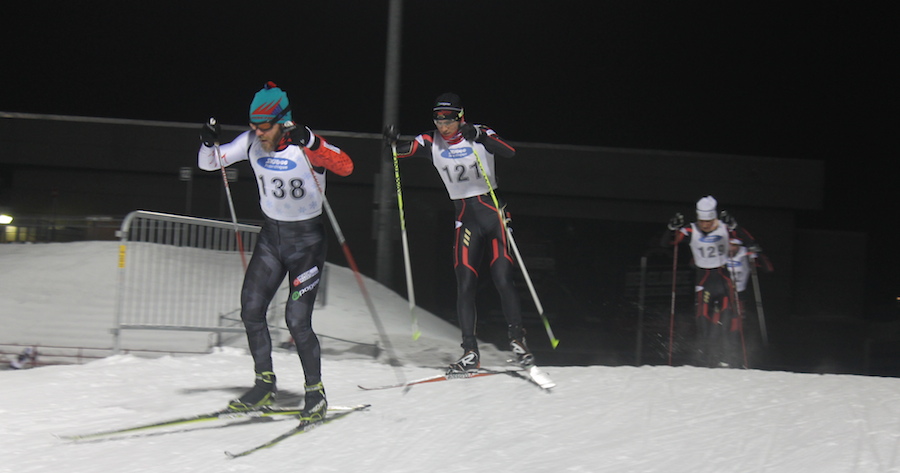
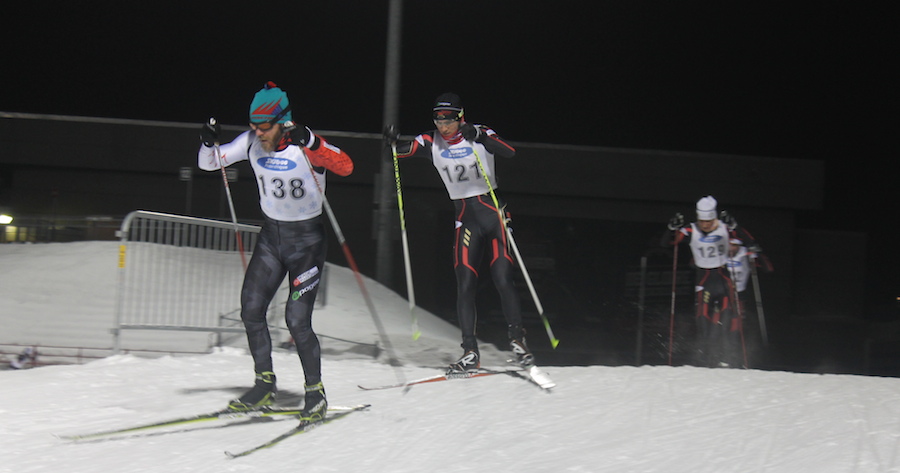
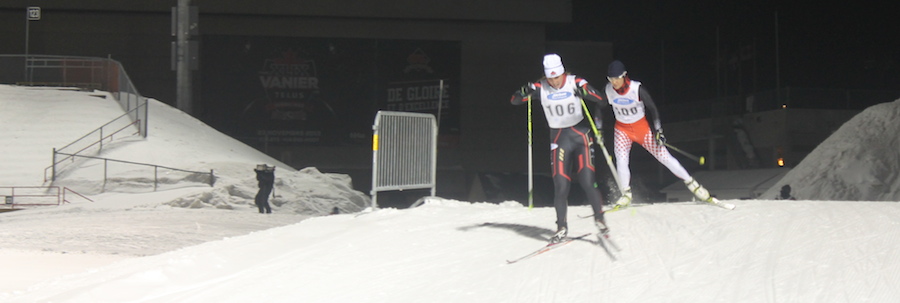
Marc-André Bédard (l) leads David Grégoire (second from l) in the first-ever Sprint Rouge et Or on Jan. 28 at Laval University’s football stadium. Grégoire went on to win the lap-by-lap elimination sprint, in which skiers rounded a 400-metre course designed by Pierre Harvey and tried to stay in the top six.
QUEBEC CITY — After the World Cup sprints took place in the historic part of the city last year, Quebec City recently saw another spectacle in cross-country skiing, with Laval University bringing the action even closer to the crowd. With the help of local Olympic skiing hero Pierre Harvey, organizers created Sprint Rouge et Or with a “last-to-go” formula, a new event on the athletics track at the Rouge et Or football stadium.
This past Tuesday night, close to 125 athletes participated in the inaugural race on manmade snow at the Laval University campus. The cold temperature didn’t stop the enthusiasm of skiers from ages 7 to 54, and a couple of “retired” skiers even put their skis on.
Harvey, the father of Quebec’s current nordic-skiing favorite Alex Harvey, designed he 400-metre track complete with several bumps — some as high as 10 meters — to challenge the skiers. On Tuesday, it was well-groomed with hard-packed snow.
Compared to other urban sprints, the biggest difference and advantage was that spectators could visually follow racers from start to finish, seeing all of the action. The big screen at the opposite end of the field was great for zooming in on the expressions and emotions of skiers as they passed by the camera.
With a friendly atmosphere, good vibes filled the stadium as well-known commentator Randy Ferguson gave the play-by-play. The evening started with a sprint prologue for all 11 categories. The beauty of the event was that anybody could enter it.
“We had a great participation of skiers in the region but also outside,” event director Martin Guay said in a Rouge et Or press release, according to a translation. “The course was world-class through the snow HKD Turbo and the work of the groomer Printoh, Inc., not to mention the efforts of volunteers and field staff of the Department of Sports Laval University.”
Camille Pepin leads Claude Godbout (r) in the women’s race at the inaugural Sprint Rouge et Or on Jan. 28 at Laval University’s snow-covered athletics track in Quebec City. Godbout went on to win and Pepin placed second.
Last-to-go
The big show started at 21:00 [9 p.m.] with the last-to-go: eight laps for the women and 10 for the men. Racers had two laps to position themselves in the pack before elimination started, after which the last four skiers on each lap were pulled out. The idea was to have six or seven skiers remaining for the final lap.
The women separated quickly after Canadian national-team biathlete Claude Godbout broke away at the beginning of the second lap. Only Camille Pepin of Laval could match her pace. There were a couple of good battles at the end of the pack to stay in the race. Godbout ended up winning, Laval’s Pepin and Myriam Paquette finished second and third, respectively.
The men’s race was closer to the finish with a pack of 20 fighting sticking together. After 10 laps, Laval’s David Grégoire outsprinted biathlete Marc-André Bédard and Frédéric Touchette (Laval) to take the win. Bédard placed second and Touchette was third.
Overall it was a great evening despite some delays; most everyone seemed to really enjoy the moment. After expecting a smaller turnout for its first event, organizers are planning future sprints there and hoping to one day fill the 15,000-capacity stadium.
While the spectacle drew participants from various regions in Quebec, organizers are considering inviting athletes from other Canadian universities as well as the U.S. According to the release, the Rouge et Or team already participates annually in about half a dozen of NCAA races in the northeastern U.S.
“We’re already thinking about next year!” Guay said.
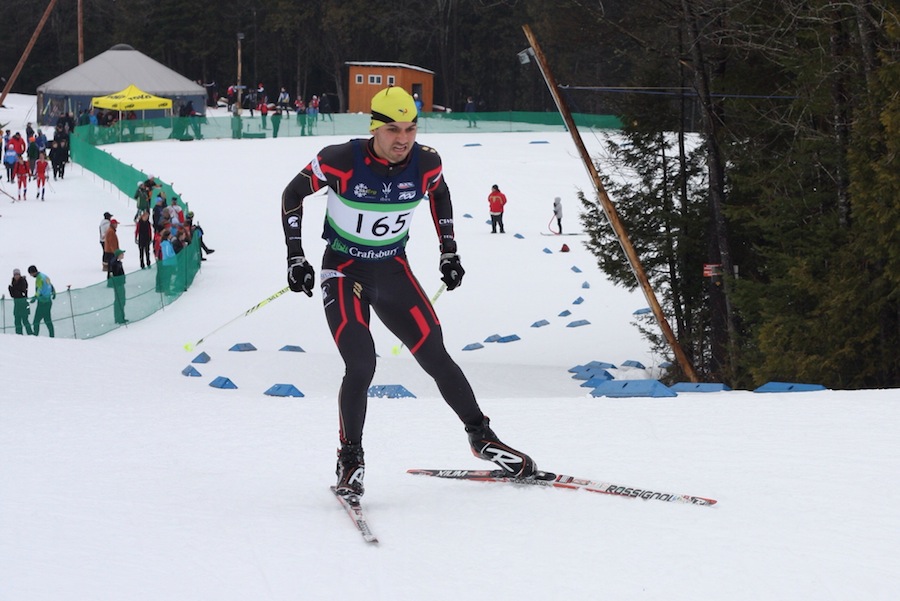
Frédéric Touchette (Laval University) en route to second in the Eastern Cup skate sprint Dec. 21 in Craftsbury, Vt. (Photo: Rouge et Or)
Luc Germain, head coach of Rouge et Or cross-country ski team at Laval University in Québec City, agreed to share part of the training plan of his student-athletes during the holidays as they are getting ready for racing the EISA circuit in U.S. in the upcoming weeks.
***
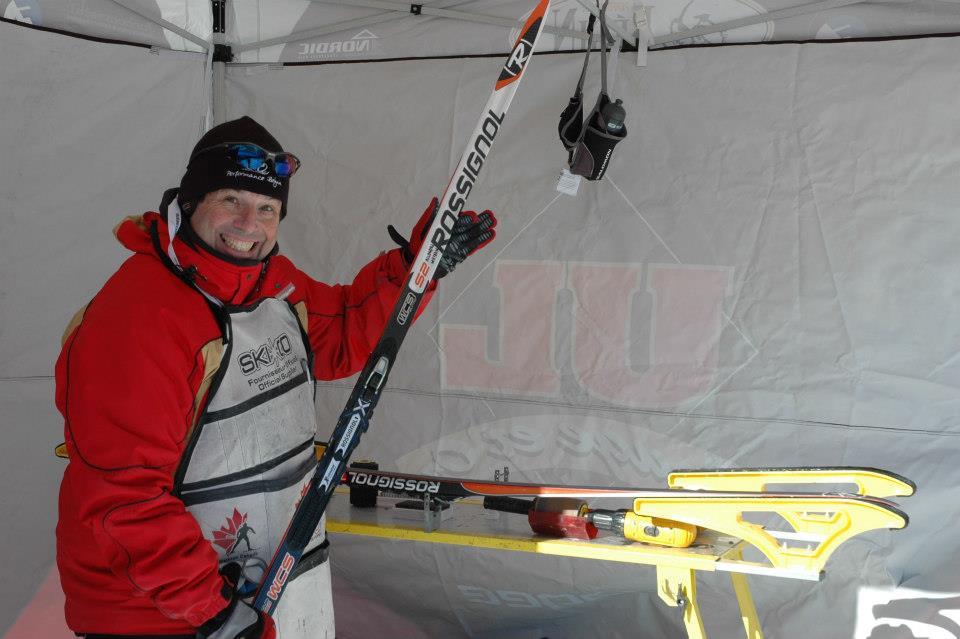
Laval head coach Luc Germain prepping skis for athletes (Photo: Rouge et Or)
“First of all, I wish Happy New Year to every skier!
For the university athletes that I coach, the holidays give them the chance to take time off school to do more distance and intensities training. During the semester, it’s almost impossible for my athletes to do long hours with their busy schedule, like most people working during the week.
The most important for us is to start with a couple of distance trainings before [revving] up the speed and do some intensities during the holidays in order to get the body in race shape.
Here’s typical training session I give to my athletes to do between family reunions.
I know that maybe on January 1st, some of my athletes will be tired after a good celebration of the New Year, so I suggest them to come back to the basics and concentrate on skiing well technically and do only the first part of this super session, but if they can handle more, then the whole workout will leave them tired and happy!
Super Session
Warm-up: Starting by doing a good 30 minutes warm-up at a slow pace before starting your intensities.
It’s also a good idea to include some drills to improve your technique and work on your weaknesses. Here are a couple of examples of what you can do; combine 1-2 of the drills below and adjust their length in function of the intensities that should remain your main focus.
Since it’s during holidays, you probably have friends or family at home, why not take your time warming up and ski with them and give them a few tips!
Find a challenging hill and try to stay in one-skate as long as you can while keeping your technique fairly good during the process.
Do offset [V1] with only one pole, the one that is giving the power climb a hill (the higher pole)
Do free skate during 10-15 minutes and make sure to use your legs efficiently and get your weight at the right place on the skis
Short Intensities:
Do two sets of five repetitions each x 1 min in Zone 4, recovery time should be the same as the intensities lengths (1 min). Between sets, take 5 minutes to rest and get ready for the next and final set. Your effort should be at approximately 90 to 100 percent of your maximum heart rate.
These short intervals will have an effect on both, maximal aerobic power and anaerobic capacity, two important qualities in skiing, but are only slightly developed through continuous training. Beware, not to go at your maximum at each repetition, but to choose a degree of intensity that you will achieve the expected number of times without having to slow down.
Cool-down: Make sure to take 10-15 minutes to cool-down the body after the intensities.
I think it’s a really good typical session for skiers whom will be starting their racing season mid-January. Finally, one last coach tip, don’t forget to take one day off per week, it’s as important as a training session, especially for the full time student and workers and even more during the busy holiday weeks.
I hope you [make] good skiers’ resolutions for 2014 and take advantage of the most awesome winter sport. Have fun on skis!”
David Grégoire (Laval University) racing to 15th in the Eastern Cup skate sprint Dec. 21 in Craftsbury. (Photo: Rouge et Or)
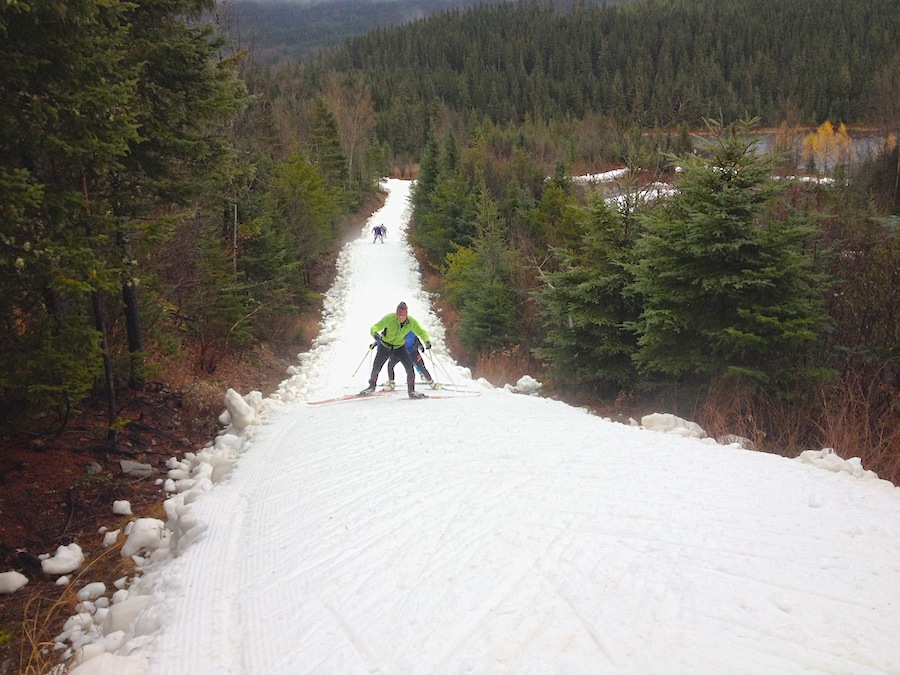
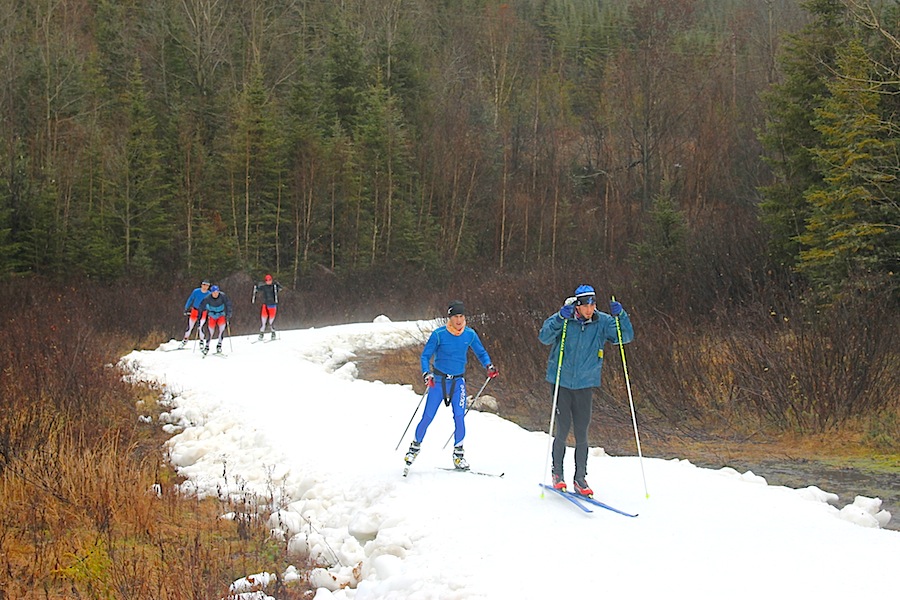
Led by Camille Pepin, Laval University Rouge et Or skiers ascend a hill at La Foret Montmorency an hour drive north of Quebec City.
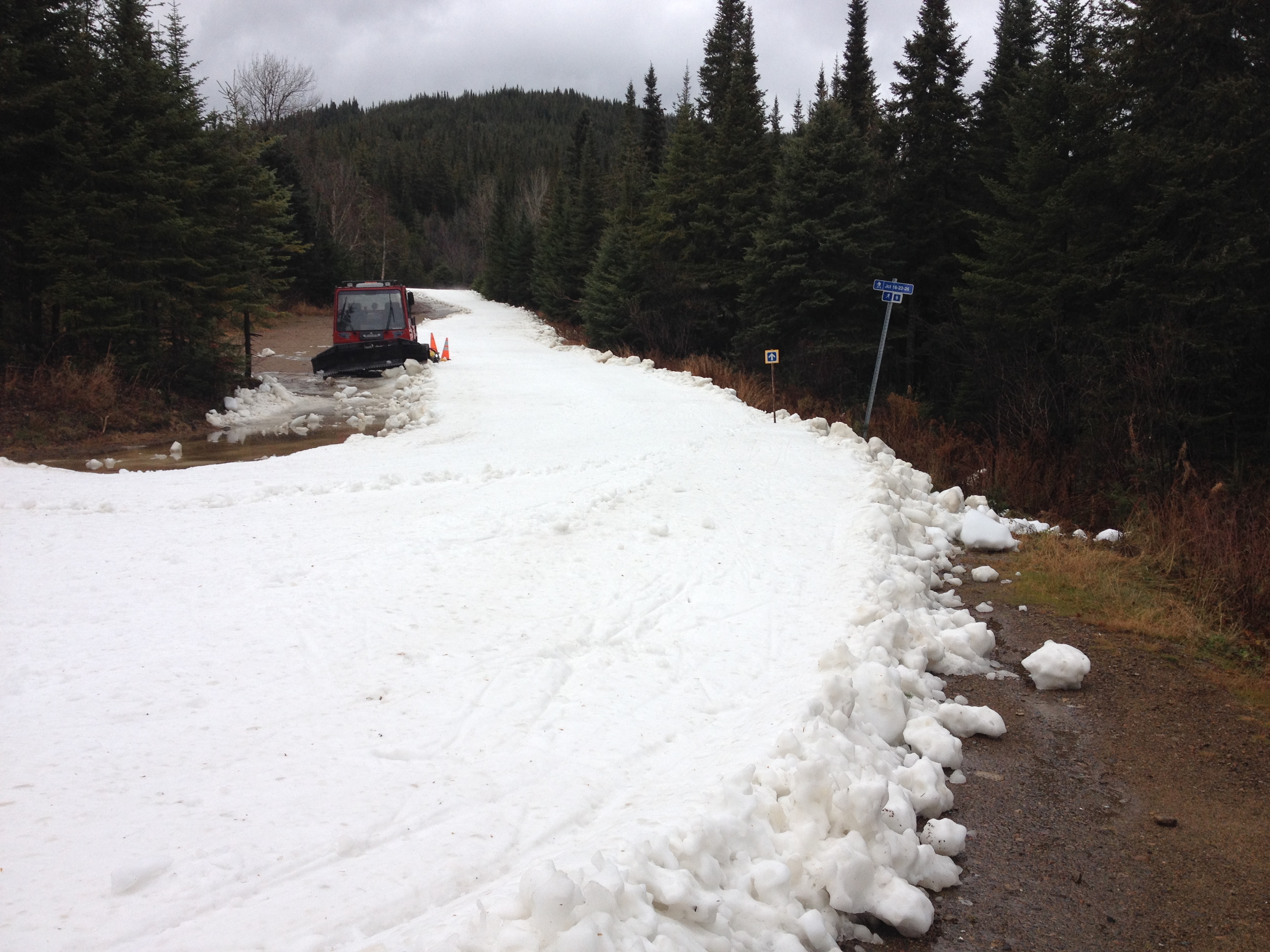
LA CÔTE-DE-BEAUPRÉ, Quebec – Pouring rain and 15 degrees Celsius may not sound good for a nordic skier, but since the opening of a 1.3-kilometre loop at the Montmorency Forest, better known as La Forêt Montmorency about an hour drive north of Quebec City, Nov. 1 was a happy day for skiers.
With manmade snow for the last decade, Laval University’s La Forêt in the Laurentides Wildlife Reservehas been well known for early season skiing by those living in eastern Canada and the U.S.. This year, however, university caretakers stepped up their game and stored a huge amount of snow last winter to be able to start this season on the date they wanted.
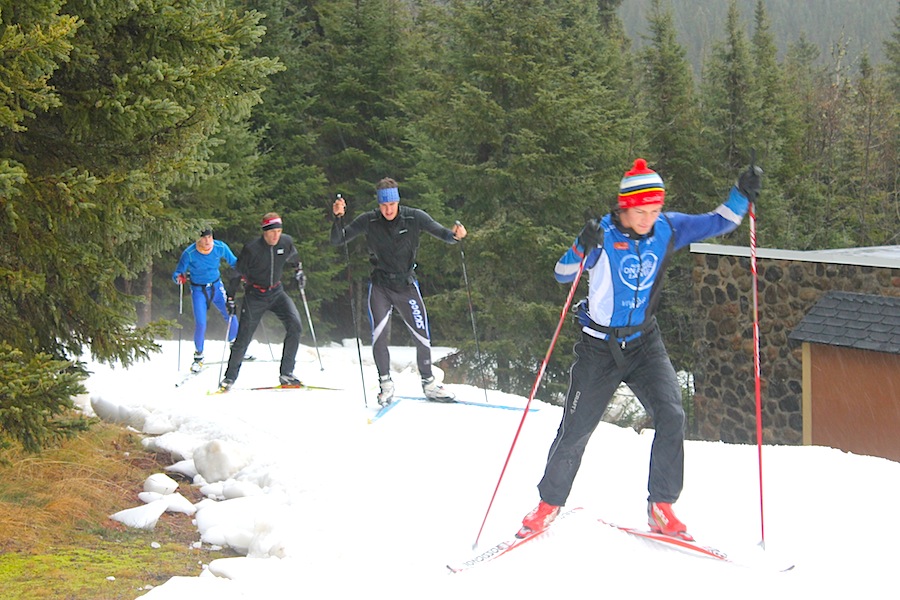
Several Skibec Nordique skiers, led by Jérémie Bonneau, get some on-snow time at La Foret Montmorency north of Quebec City on Nov. 1.
In Alberta, Canmore has Frozen Thunder. Now, Quebec finally has its own track, dubbed the “Boreal Glide.”
“Last December, we stocked 6,000 metres of snow and saved it under a thick coat of sawdust,” La Forêt’s outdoor activities coordinator Laurent St-Jacques explained last Friday. “Monday, we started to build the track and today [Nov. 1] we are opened, three weeks earlier than normal.”
As soon as the temperature drops, they will use snowmakers and expand the track, tapping into the rest of their snow-pile reserve as needed.
“If things go smoothly, we have four options of trails that will be connecting to the existing track and we planned to offer two-plus kilometres by the end of the month” St-Jacques said.
With expertise in snowmaking and preservation, and support by the cross-country community, it made the decision to expand the season easier. Forêt Montmorency is also favored by a microclimate that accounts for early snowfalls, which usually amounts to six meters of snow each winter.
“For us, it is mission accomplished,” St-Jacques said. “We have a few things to improve in the future, but overall it’s a great success. Now we can say we are open from Halloween ’til Easter!”
The Track
Upon firsthand inspection, the 1.3 k track, slightly longer than last year’s course, was challenging with a couple of hills, quick turns and good elevation some 900 metres above sea level.
La Forêt Montmorency’s 1.3-kilometre track, which Laval University caretakers extended by about 100 metres from last year and opened a few weeks earlier than usual on Nov. 1.
For November in Quebec, the conditions were good, mostly springlike – slushy and soft — but base was firm and the coverage was good. In some places, the snow was a bit dirty and the track had some bumps, but overall organizers did a great job preparing the track for athletes.
Approximately 30 skiers had made the trip to La Forêt for the opening morning, including the Laval University’s Rouge et Or team, Skibec Nordique as well as some biathletes, masters and recreational skiers. Although it was raining heavily, skiers kept coming as the day progressed, most staying on site in Laval’s dormitories and cabins, thus waving the $14.50 daily trail fee.
“I think they did a great job,” Rouge et Or rookie Camille Pepin said on Nov. 1. “We are lucky that they put the track together early because otherwise we didn’t when we would have been able to ski.”
“It’s super, a first in Eastern North America,” said Félix Bérubé-Larochelle of Quebec’s biathlon team. “It’s really fun that the track is opened on November 1st. I plan to come often in the upcoming weeks, that will be a good preparation for the races.”
The staff was proud of the track and made the opening day a happening one with music, hot chocolate and chicken broth for the skiers in a little shack alongside the track.
The next few weeks will be busy at Forêt Montmorency with teams coming from all over Quebec, Ontario, and New England for their annual trip to enjoy some quality time and training on snow.
Félix Bérubé-Larochelle of Quebec’s biathlon team leads skiers along the 1.3 k manmade loop at La Foret Montmorency north of Quebec City on Nov. 1.
***
(En français)
LA CÔTE-DE-BEAUPRÉ, Quebec – Pluie torrentielle et 15 degrés Celsius un 1er novembre, ce n’est jamais une bonne nouvelle pour un skieur de fond, sauf cette année à la Forêt Montmorency. Située à 1heure au nord de Québec dans la réserve faunique des Laurentides, la Forêt ouvrait sa boucle de ski de fond de 1,3km, de quoi rendre les skieurs plus qu’heureux malgré la météo difficile!
Reconnue depuis les dix dernières années pour sa production de neige artificielle, La Forêt était déjà l’endroit pour commencer tôt sa saison sur neige dans l’Est du Canada et des États-Unis. Cette année, ils sont allés plus loin en emmagasinant une énorme quantité de neige de la saison dernière sous une grosse couche de copeaux de bois de façon à être capable de débuter la saison à la date souhaitée et ne plus être dépendant d’une météo incertaine.
Depuis quelques années, Canmore en Alberta a son Frozen Thunder et maintenant Québec peut se vanter d’avoir sa propre boucle surnommée la Glisse Boréale.
“En décembre dernier, nous avons accumulé 6000 mètres de neige et nous l’avons entreposée en dessous d’une épaisse couche de copeaux. Nous avons commencé lundi à construire la piste et vendredi [1er novembre], nous étions prêts pour l’ouverture, environ trois semaines plus tôt qu’à l’habitude”, a expliqué sourire aux lèvres, Laurent St-Jacques, coordonnateur des activités récréotourisques à la Forêt Montmorency.
Dès que les températures baissent sous le point de congélation, les canons à neige s’activent. Ainsi, ils n’ont pas utilisé toute la neige en réserve de l’an passé pour s’assurer d’avoir de la neige sous la main et ainsi garder la piste en bonne condition et la plus blanche possible. “Nous avons quatre options pour agrandir le circuit principal existant. Logiquement, si tout va bien, à la fin du mois, nous devrions avoir plus de 2km à offrir”, a laissé entendre St-Jacques.
Avec leur expertise et le support de la communauté de ski de fond, c’était
une décision naturelle d’offrir cette opportunité de skier sur neige aussi tôt en saison. De plus, la Forêt Montmorency gérée par le département de foresterie de l’Université Laval peut compter sur un microclimat favorable avec des chutes de neige tôt en saison et un total d’environ 6 mètres de neige chaque hiver.
“Pour nous, c’est vraiment mission accomplie, bien sûr nous avons quelques petites choses à améliorer pour le futur, mais en général c’est un beau succès. Maintenant, nous pouvons dire que nous sommes ouverts de l’Halloween à Pâques!”, a dit St-Jacques.
La Boucle
La boucle, d’une longueur de 1,3km, comporte plusieurs montées et descentes, de même que quelques virages serrés et une dénivellation intéressante. Pour une première expérience du genre, les conditions de neige étaient bonnes, compte tenu de la température, les conditions ressemblaient à celles du printemps, néanmoins la base était solide et épaisse. À quelques endroits, la neige était un peu sale et la piste avait quelques bosses, mais en général, ils ont fait un excellent travail pour préparer la piste aux athlètes.
Dès l’ouverture, une trentaine de skieurs avaient fait le voyage à la Forêt incluant le Rouge et Or de l’Université Laval, Skibec Nordique de même que quelques biathlètes, maîtres et même un skieur récréatif. Malgré la pluie forte, les skieurs continuaient d’arriver plus la journée avançait.
“Je pense qu’ils ont fait une belle job, c’est vraiment beau. Une chance qu’ils ont fait ça, car on aurait peut-être pas skié avant un bout”, a commenté Camille Pepin, recrue du Rouge et Or.
“C’est super, c’est une première dans l’est de l’Amérique du Nord, c’est vraiment le fun que ça ouvre le 1er novembre. Je prévois venir souvent dans les prochaines semaines, ça va être une bonne préparation pour les courses”, a dit Félix Bérubé-Larochelle, membre de l’Équipe du Québec de biathlon.
Les employés de la Forêt Montmorency étaient fiers de leur boucle et avaient décidé de faire les choses en grand avec musique, chocolat chaud, bouillon de poulet offerts aux skieurs dans un petit chalet situé au milieu de la boucle.
Les prochaines semaines s’annoncent occupées à la Forêt avec des équipes venant du Québec, de l’Ontario et de la Nouvelle-Angleterre pour leur traditionnel camp sur neige de début de saison afin de profiter des conditions avantageuses et d’accumuler des heures de qualité sur neige avant le début des compétitions.
La piste est ouverte au public tous les jours et il en coûte 14,50$ par personne/jour pour skier et il y a aussi possibilité de réserver pour dormir sur place en appelant directement à la Forêt Montmorency.
***
About Stéphanie Drolet:
A former competitive cyclist and cross-country skier on Canada’s National Junior Team, StéphanieDrolet is a Canadian contributor at FasterSkier. She was a forerunner at the 2010 Vancouver Olympics and competed at the 2008 World Junior Championships. A journalism student at Laval University in Quebec, Stéphanie still skis and rides for fun and to stay in shape. Don’t be surprised to find a few of her articles in French!