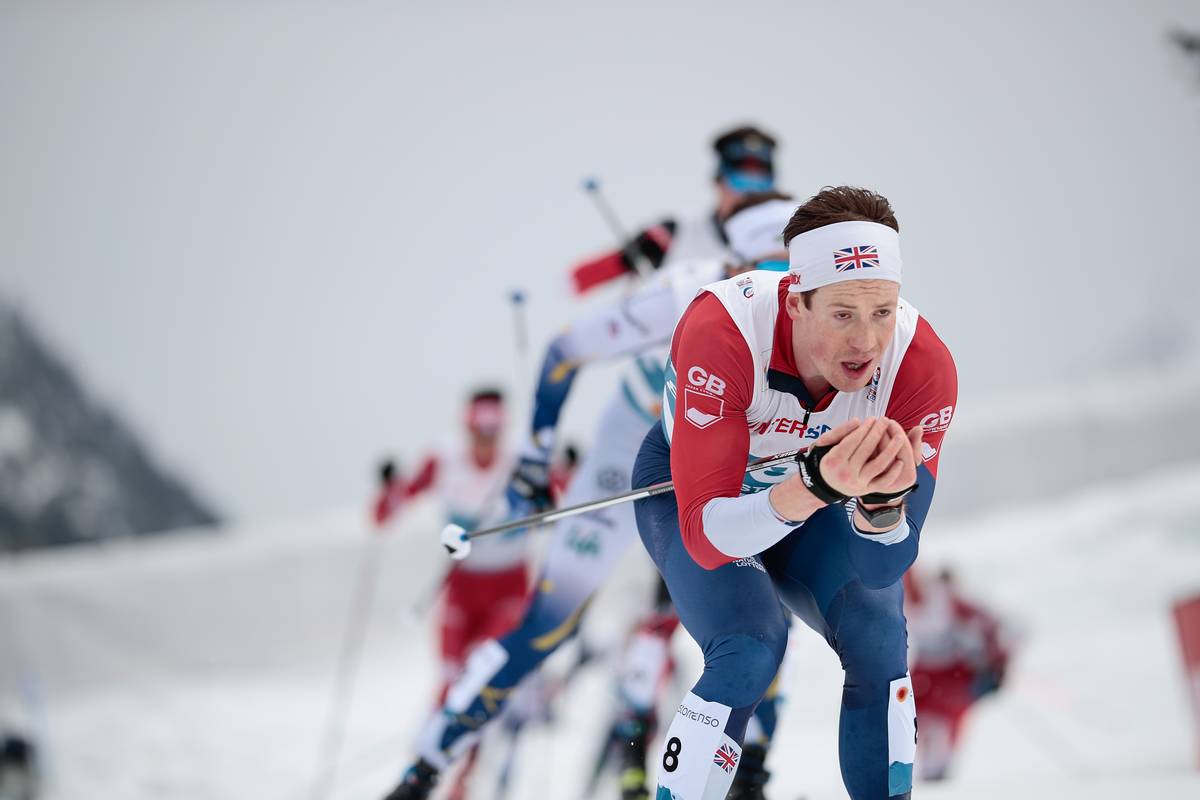
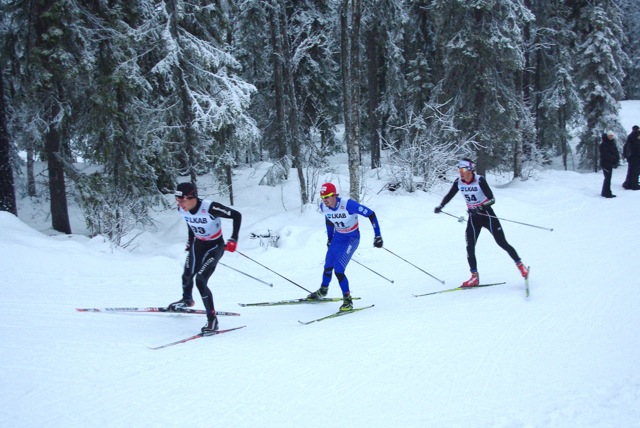
Andrew Musgrave is a mainstay of the World Cup cross-country skiing circuit and a two-time podium finisher, racing for a surprisingly strong British team. Devon and Nat chatted with him this week about a major budget cut for the British team that’s forced team members to fundraise; Muzzy also talks about his training, his life in Norway, his diet and his plans to start feuds on the World Cup.
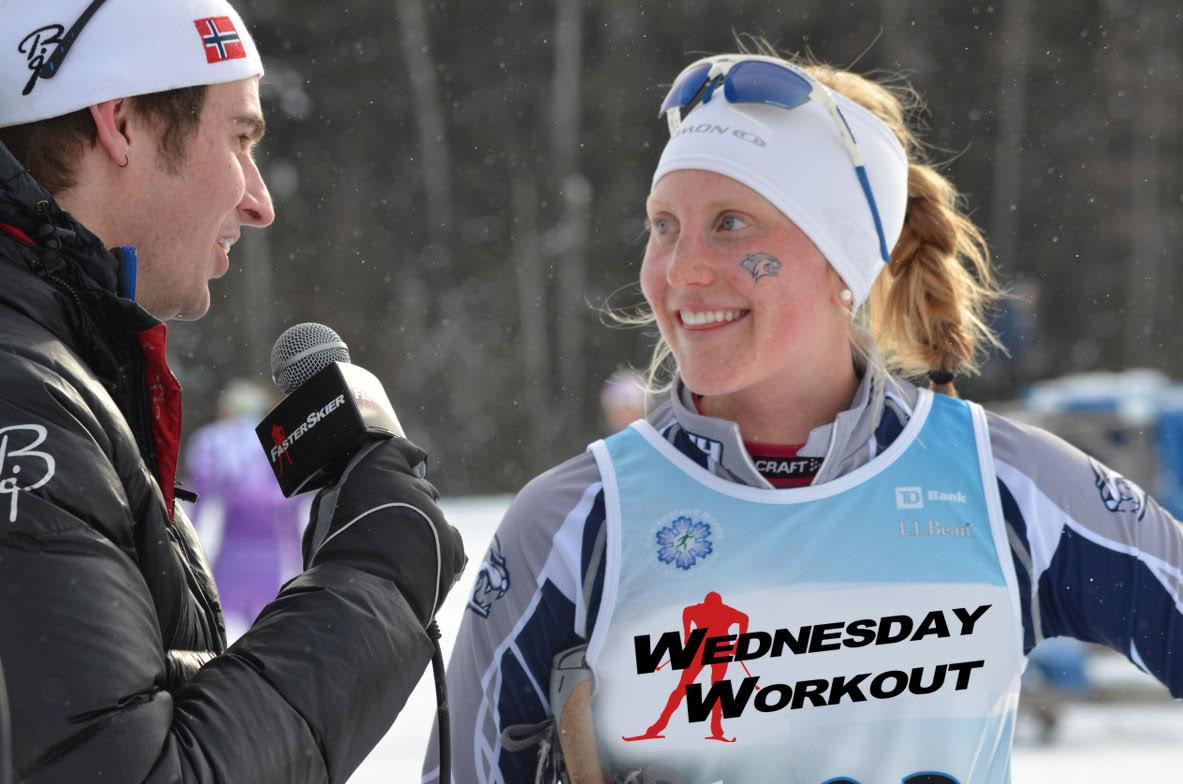
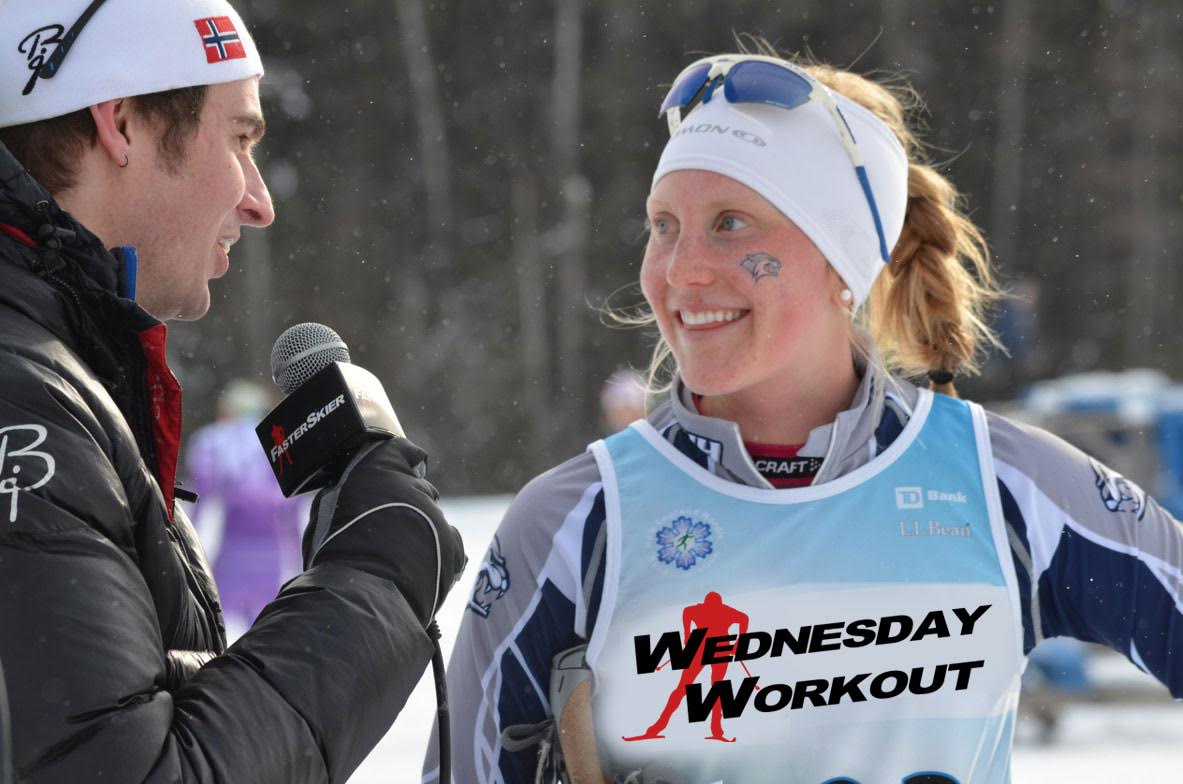
Former UNH skier Annika Taylor (r) during an interview with FasterSkier at the 2015 SuperTour in Craftsbury, Vt., last year.
With the demanding race schedules of World Cup athletes, mid-season workouts have to be effective without adding too much training stress.
Roy Young, the British Nordic Head Coach, developed a sprint workout that utilizes short intervals on varying terrain to focus on specific techniques during each effort.
Young has guided the British team to some of the country’s best World Cup results yet, including his son Andrew Young’s historic bronze in the freestyle sprint in Toblach, Italy, earlier this season.
Annika Taylor, a member of the British National team and Sugar Bowl Academy Elite Team, is skiing her first season under Roy Young and especially enjoys this speed workout. After graduating from the University of New Hampshire as an All-American last spring, this season is Taylor’s first on the World Cup.
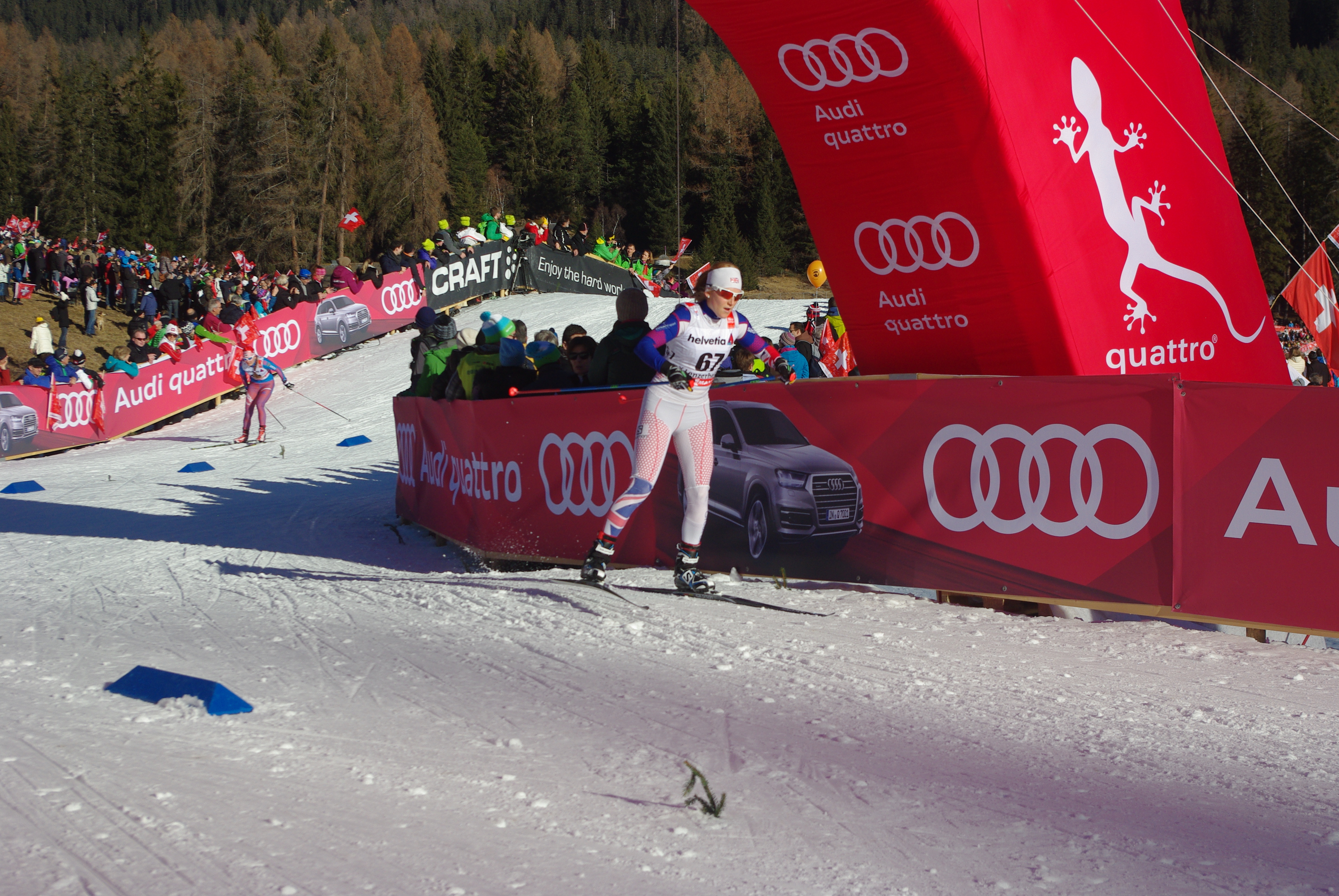
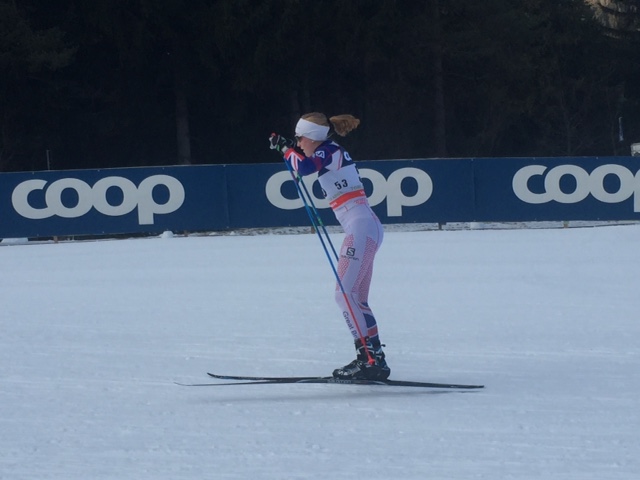
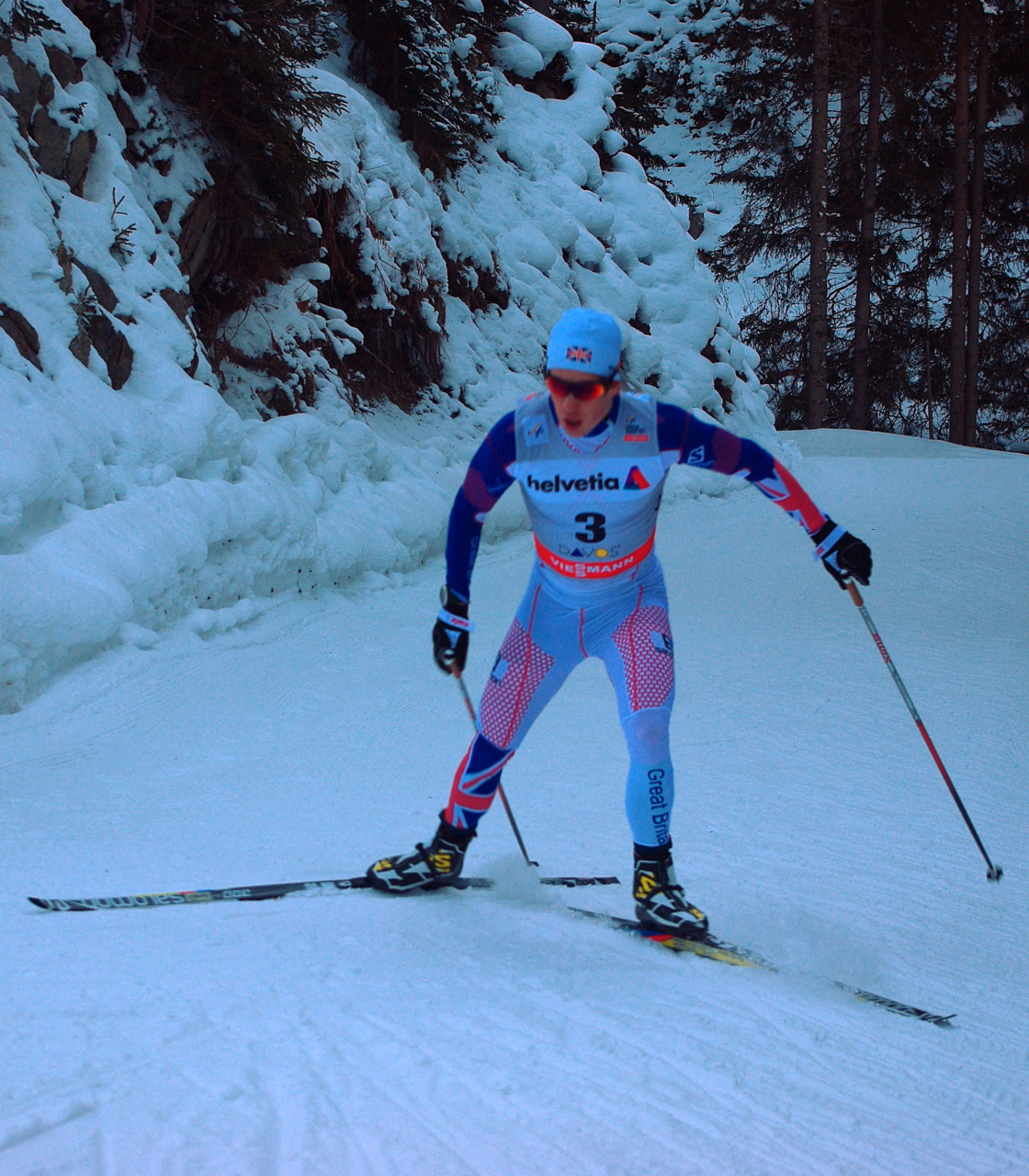
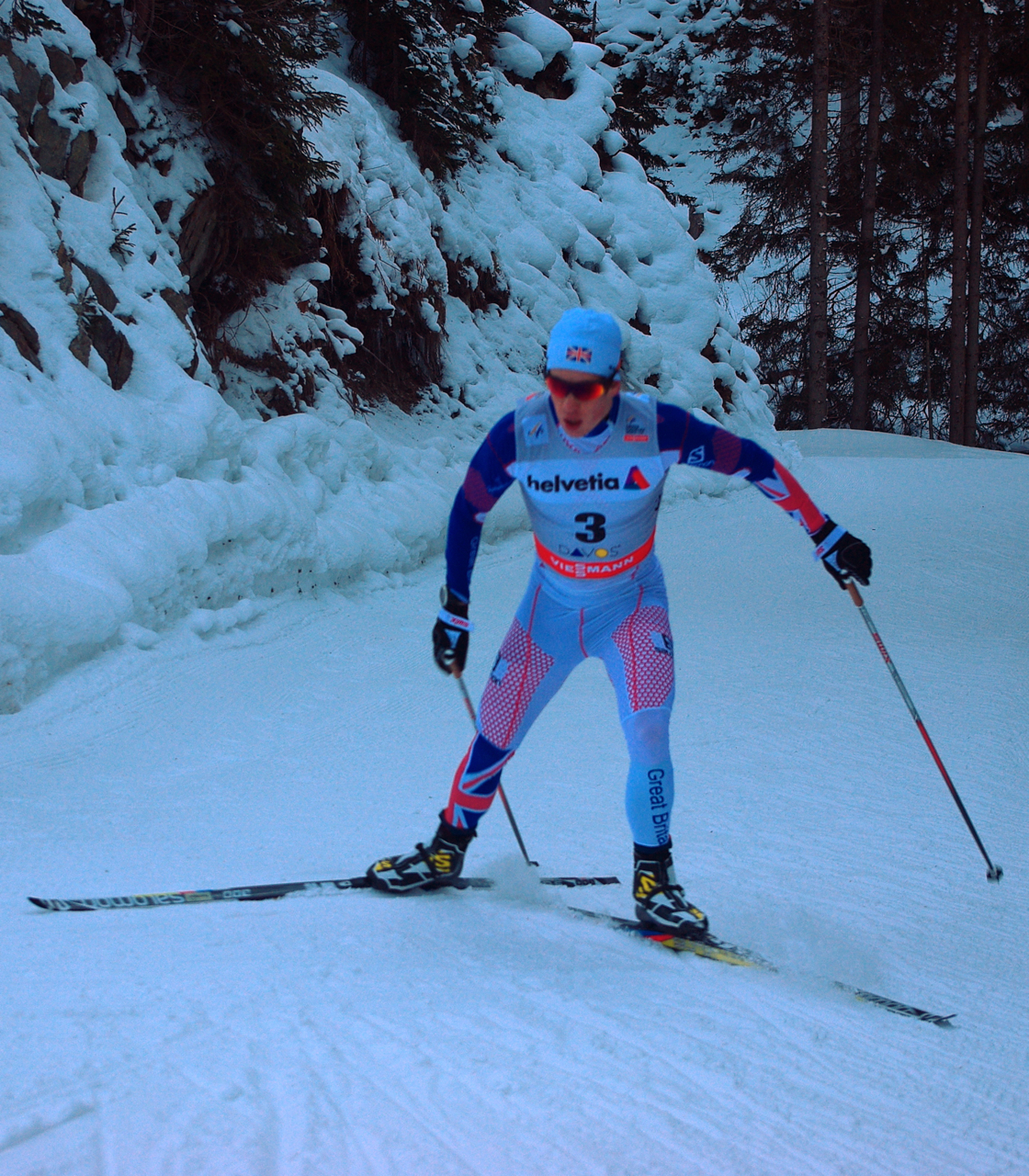
Annika Taylor (Great Britain) competing at the Tour de Ski In Lenzerheide, Switzerland.
“The workout focuses both on the neuromuscular (limb speed) required in sprinting and improving anaerobic capacity,” describes Taylor.
“I enjoy it because it is an efficient workout and that sprint improvement results after just a few focused sessions,” she added. “The most challenging part is keeping correct, efficient form and maintaining the same speed in the second set as was done in the first set.”
Taylor outlined an example of a freestyle workout that utilizes varying terrain to focus on transitions, V1, and V2 alternate.
The shortest intervals (20 seconds) are to be skied on a flat section of trail utilizing V1 to accelerate before transitioning to V2.
Next, the 30-second intervals are done on slightly downhill terrain into a slight uphill, with a focus on long V2 alternate strokes.
Finally, the focus of the 45-second intervals is changing V1 tempo in the transition from a gradual into steep uphill.
Taylor has also been working with exercise physiologist Kurt Rumley, from SportScotland Institute of Sport to develop a complete warmup for interval workouts and races which is described below.
Work into 4 minutes of Level 2, then easy ski for a four minutes.
Work into 3 minutes of Level 3 (10-15 kilometer race pace), then easy ski for 3 minutes.
Finally, work into full-on sprint race speed with 3 x 30-second efforts, with a few minutes rest in between each effort.
Speed Workout:
3 x 20-second, 2 x 30-second, 1 x 45-second efforts (with techniques as detailed above) followed by 10 minutes of easy skiing before repeating the progression for the second set.
Between each speed effort, take enough rest to get back to your starting point and for your heart rate to return to Level 1.
Cool down:
Finish with 20-30 minutes of easy skiing and foam rolling/stretching.
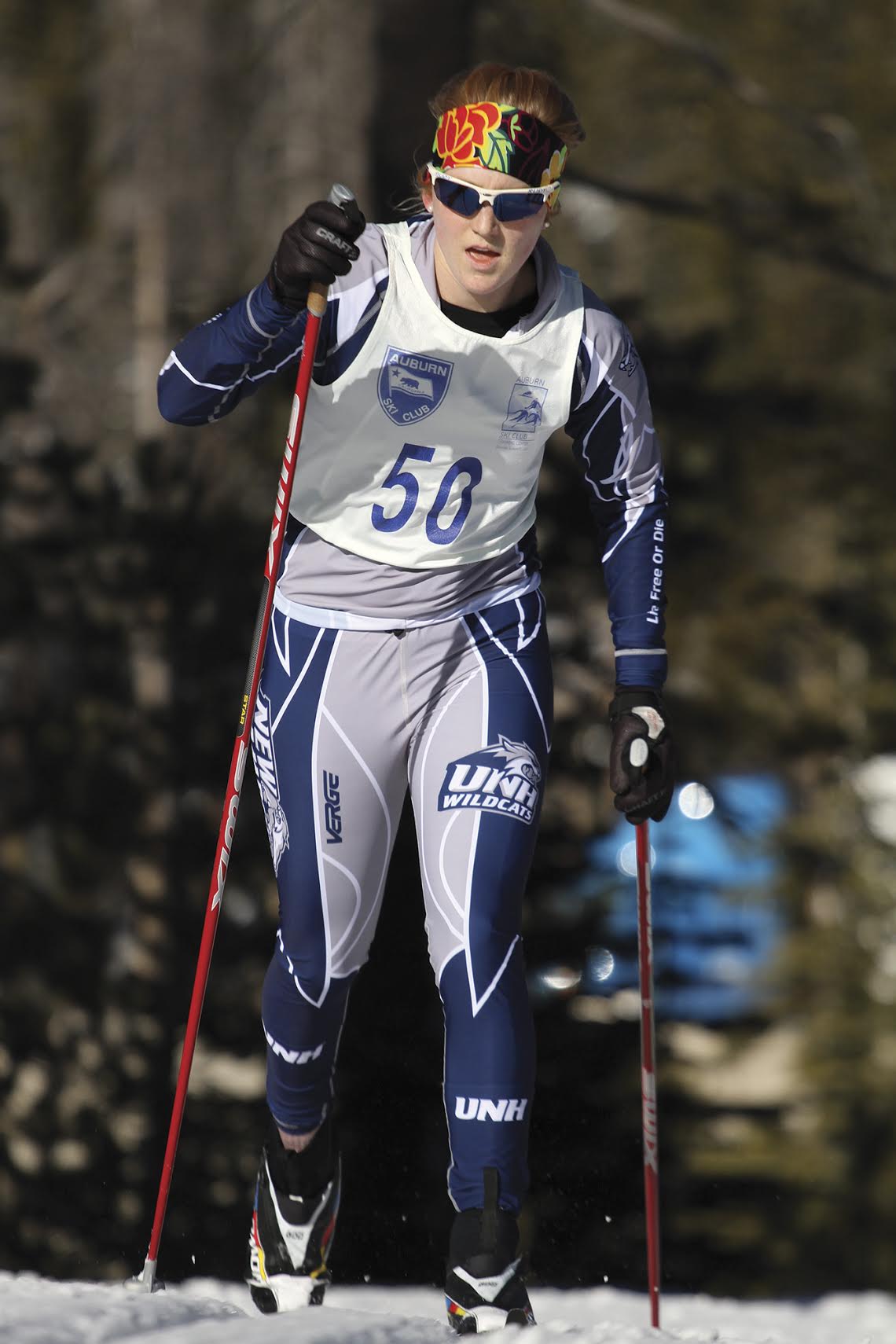
Annika Taylor, formerly of UNH, on her way to winning the women’s 5 k at the 2013 Snowshoe Thompson Classic at the Auburn Ski Club in Truckee, Calif. (Photo: Mark Nadell/macbethgraphics.com)
Although much of the focus of World Cup racing is on the stars from powerhouse skiing countries, the World Cup fields are filled with skiers who are working towards goals that don’t necessarily entail a podium. Racing on the World Cup is not always about the pursuit of medals but the experience itself.
For Annika Taylor, the World Cup experience hasn’t quite sunk in yet. Just six months after graduating from University of New Hampshire (UNH), Taylor, 22, found herself on the starting line of her first World Cup race in Kuusamo, Finland, in late November as the sole female representative of Great Britain.
A native of Truckee, Calif., Taylor holds dual British citizenship as her father is originally from the United Kingdom (her family now lives in Truckee). As a junior, she skied for California’s Auburn Ski Club and the Far West Ski Association, winning three California State Championships and notching three top-10 finishes at Junior Nationals. Taylor continued her ski career at UNH in Durham, N.H., under the guidance of head coach Cory Schwartz.
Annika’s first taste of international racing came in 2014 when she raced with the British national team at U23 World Championships in Val di Fiemme, Italy. Although she had inklings of future opportunities to race for Great Britain at that time, she realized she would need to continue to see improvement to make competing post-collegiately worthwhile.
These gains were realized in a breakthrough season her senior year, highlighted by a seventh-place finish in the 15 k classic at 2015 NCAA Skiing Championships. Earlier last season, she placed ninth in the 20 k classic mass start at U.S. nationals.
Upon graduating in the spring of 2015, Taylor was armed with both a chemistry degree, and the opportunity to continue skiing for Great Britain. Racing for the British team would mean more international competition and the chance to compete with the best skiers in the world on the World Cup — an opportunity she couldn’t pass up.
In May, Taylor joined the newly established Sugar Bowl Academy Elite Team based out of the Truckee/Tahoe region. The 2015/2016 season is the team’s debut as it aims to fill the gap left by the recently dissolved Far West Elite team and provide financial support, coaching, and training opportunities to its athletes.
After a summer training with the Sugar Bowl Elite Team as well as the British team in Scotland, Taylor started her first World Cup season in November with British Cross Country Head Coach Roy Young. Britain’s other female skiers opted not to race in Period 1 of the World Cup, leaving Taylor as the sole woman on the team. She joined a men’s contingent on the circuit, including recent World Cup bronze medalist Andrew Young.
FasterSkier caught up with Taylor about her World Cup experience over the holiday break. She spent the holidays training in Davos, Switzerland, sharing an apartment with U.S. Ski Team member Caitlin Gregg. The two met several summers ago, as Gregg visits Truckee in the summer to train at altitude and visit family.
After the holiday break, Taylor raced the first three stages of the Tour de Ski in Lenzerheide, Switzerland, before traveling to Östersund, Sweden, to compete in Scandinavian Cup races.
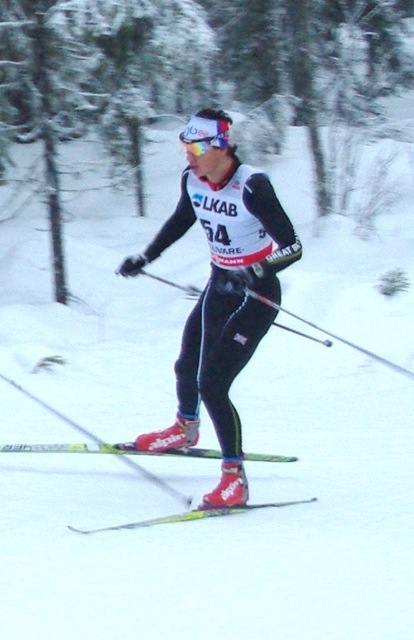
Annika Taylor racing for Great Britain in the World Cup freestyle sprint qualifier in Toblach, Italy. She placed 54th. (Courtesy photo)
FasterSkier: What is your favorite World Cup venue so far?
Annika Taylor: I really enjoyed Toblach [Italy]. They have a two-lap sprint course and I like V2 technique and I felt like it played to my strengths. And it was beautifully sunny so that always helps.
FS: What do you consider your best races so far on the World Cup?
AT: My best race was my first race: the classic sprint in Kuusamo [where she placed 50th in the qualifier]. It was best result so far and the whole experience came to fruition at that moment, too, so I’ll never forget that day. For everything to come together in the first race, I was really pleased with that.
The other races I was most pleased with were the opening races in Beitostølen, Norway. That’s where the Norwegian team started their season as well so it was World Cup caliber racing just with fewer countries. That was my very first taste of racing the best in the world so I was definitely a little star-struck that weekend.
FS:Do you prefer the sprints or the distance races?
AT: I would say distance has become my cup of tea. When I was a junior I was more of a sprinter but being at university for four years, I didn’t train much for sprinting. If I have a bit more sprint training in the next couple years I think I’ll really grow to enjoy it. Right now I do like distance racing a bit more. You can push yourself longer and harder and there is more time for tactical fixes. I like having that opportunity to turn things around.
FS: How is the intimidation factor racing the best skiers in the world?
AT: There’s definitely intimidation, but there’s also more a respect and awe for them. I am also just excited to be racing because I don’t have much pressure to perform this year. Obviously I want to ski fast, but I have to adjust to so many factors that I don’t have the energy to be nervous because I have to focus my energy on skiing the best I can technically, tactically, and physically in every race. But at the same time, there’s that moment that you think, “Woah, we are on the World Cup circuit, this is crazy.”
Annika Taylor (Great Britain) competed in the first three stages of the Tour de Ski In Lenzerheide, Switzerland.
FS: What was your favorite part of the Tour de Ski?
AT: My favorite part of the TDS has to have been the atmosphere and just the general excitement from both the fans and the athletes! You could sense the nervous energy bouncing around the wax cabins, and then going out to warm up on the race track with 12,000 fans (equipped with flags and cow bells) on the sprint day, with the sun shining down was a feeling I’ll never forget! Throughout the weekend fans and athletes enjoyed food vendors, opening ceremonies, performances from bands and dancers, and free swag. Cross-country skiing can feel a bit like an under-appreciated sport at times, but this was the polar opposite!
FS: What was the biggest difference racing the Scandinavian Cup races vs World Cup races?
AT: The Scandinavian cup races in Östersund were quite different from the World Cup races mainly in the sheer amount of racers competing in the Scandinavian cup (and the blisteringly cold -20 C temperatures compared with the mild temps felt at the World Cup venues recently). The level of competition is impressive in the Scandinavian cups as well, with the race leaders most likely fit enough to achieve a top-10 in a World Cup race.
FS: What race did you enjoy the most since the holiday break?
AT: I was quite pleased with how I skied the 10k freestyle race in Östersund! [She placed 21st.] Being back at low altitude made racing just that little bit “peppier,” and it was encouraging to be back in a field where I can be more competitive and “catch a ride” mid-race with the ladies racing around me.
FS: What are your goals for the season?
AT: My main goal this season is to race well at U23 Worlds because that’s where I can be the most competitive. But there are always goals week to week, even weeks I don’t have races I will focus on skiing technically well during each workout so that when my technique comes under pressure in a race, the foundation has been laid and I can ski technically well. I always have result based goals but this year is hard not really knowing what is going to happen competing against the best in the world. I can’t really measure success against them just yet.
At the Toblach 10 k classic Heidi Weng of Norway started behind me (in the interval starts) so my goal was to catch a ride with her when she passed me and match her technique, tempo and pace. The Norwegians know how to ski efficiently, ski fast and charge. That’s what I’m trying to learn this year is to find that extra level of intensity in a race necessary to do well at the World Cup level.
FS: Have you been enjoying the lifestyle?
AT: I wasn’t sure how I’d do because I chose not to go home for Christmas and I believe it will be a total of five and a half months on the road. I’m learning to be fine wherever I’m at with whomever I’m with, but also not feed into the ups and downs that go along with being an elite athlete. I’m actually addicted to the lifestyle because every weekend is a new experience. I’ve really enjoyed meeting new people and it has motivated me to learn bits of different languages.
FS: What is your schedule for the remainder of the season?
AT: Following the Scandinavian Cup, I will head to Ramsau, Austria to train for a few weeks. My next World Cup race in Lahti because Worlds will be there next year and I can get a feel for the course and the area. After that U23 Worlds in Rasnov, Romania then the day after fly out to Canadian Tour. Then I will race the Spring Series in Craftsbury, Vermont and finally home.
Great Britain’s Andrew Musgrave (pictured here at 2013 World Championships), who lives in Norway, got wax help at this weekend’s World Cup from the Norwegian national team. The arrangement benefits Britain, which has a tiny budget and can’t afford to fill its team staff quota, and also Norway – the dominant ski country can increase the number of technician bibs it is allowed on course. Musgrave finished the Kuusamo mini-tour ranked 16th and is in the top 20 in the overall World Cup.
As the FIS Cross-Country World Cup opened in Kuusamo, Finland, last weekend, Swedish media picked up on a strange image: Norwegian chief waxer Knut Nystad skiing around in a bib that said not “NOR”, but “GBR”.
Great Britain.
The news touched off a firestorm in Sweden, possibly caused by jealousy that the Norwegians had found a new rule around the FIS quotas on team staff.
The teams with the most ranked skiers have a cap off 22 staff members who can receive accreditation. In previous seasons, teams wanting to get more bibs to allow technicians on course could simply pay a small fee of 20 Euros per bib and end up with a maximum of 35 staff members.
This year, that extra possibility was removed. So Sweden, Norway, and Russia are capped at a total of 22 staff members – no more. Finland is next with 18, then Germany, France, and Italy with 16, and the United States and Canada with 14.
The rules were on one hand part of a FIS effort to level the playing field so that dominant ski countries don’t become even more dominant in a sort of positive feedback loop with resource wealth.
But it was also an effort to reduce the number of skiers on the race course before a competition. Too many trips around the track can cause snow conditions to break down, especially with more and more races being held in warm weather.
Norway had seemed to find a way around the cap by partnering with the British Ski Team.
“We have [made clear at] the team leader meeting that it is allowed to cooperate in ski preparation,” he told Norwegian broadcaster NRK, according to a translation. “We see it as positive that small nations are assisted by the major nations.This is competence that strengthens our sport.”
And if you ask the Brits, they don’t feel like they are being taken advantage of at all. With top skiers yet a miniscule budget, head coach Roy Young feels he has made a good deal.
“Our aim is to work with the Norwegian wax team – that is, our wax team will join them for testing & sharing information on test results,” he wrote in an email to FasterSkier. “The objective for us is to spend more time testing the athlete skis rather than testing wax. So we will still have our wax team and we will wax our own skis, we will have testing of skis. We hope to better prepare our athletes for the races, develop our technician team & perform better in the race while not increasing our costs.”
Other small teams don’t seem so bothered by this arrangement, conceding that it’s a smart move.
“It is very hard as you know for a small nation to fund the staff and waxing infrastructure that a big nation can,” wrote U.S. Ski Team Head Coach Chris Grover. “A small country always struggles to complete the myriad of waxing duties on a daily basis that are necessary to make fast skis… I know teams like Australia and Great Britain have teamed up before as well. Yes, this does effectively give Norway more service bibs but it also gives them a lot more skis to wax! Probably not a big advantage for them in the end, but a very helpful arrangement for Great Britain.”
“I think it’s good for smaller countries to get knowledge and support from the larger more experienced ones,” Canadian Head Coach Justin Wadsworth agreed. “But does Norway really need more of an advantage… We’ve talked in the past about potentially working with the US as a North American force, but when it comes down to it, it just isn’t realistic.”
In this case, the pairing is far from random. Two top British athletes, Andrew Musgrave and Andrew Young, are based in Norway. Musgrave is part of Team Leaseplan Go, a Norwegian ski marathon team, and both athletes already know many of the Norwegian athletes and staff. Musgrave even won a Norwegian national championship title, and often appears in the Norwegian media, where he speaks fluent Norwegian.
“My role is clear in that, I’m hired to enable the British Athletes to perform to the best of their abilities & I currently believe that a collaboration with Norway is a good way of potentially enabling the athletes to do this,” Young wrote. “As you suggest, the 2 Andrews live and train in Norway and are well known for the professionalism that they bring to sessions, which gives us a natural connection with the Norwegian team.”
The hopes of a whole country are pinned on Musgrave, Young, and their teammates, and yet in the past they have never had the type of resources which their competitors can rely on.
“When we reviewed how Sochi went for us we were very clear that the athletes did not get the amount of support they needed,” Coach Young wrote. “We identified roles we would like to see in our team and are trying to fill them. Help with wax testing allows us to cross some of the gap with little additional costs (and remember we are team struggling to find enough money to have 3 support staff at a Ruka World Cup even though we have an athlete that many people believe is capable of a top 10).”
Indeed, in Kuusamo Musgrave skied to 13th in the 10 k skate, then skied the 11th-fastest time in the 15 k classic pursuit to finish 16th in the overall mini-tour. He’s now ranked in the top 20 in the overall World Cup.
Although the Brits qualify for a staff quota of eight according to the FIS rubric, they can never fill all of those spots because of their small budget.
Young explained that the partnership was an ongoing discussion and would be re-evaluated, but that three bibs were given to Norway to help with wax testing in Kuusamo, and probably two would be shared at the next World Cup the team attends in Davos, Switzerland.
“Part of my discussion with Norway has been to make sure that there is transparency on what we are doing and that we would not transgress any rule (we Brits are very rule bound people),” Coach Young wrote. “I have written to FIS about what we are doing. Obviously, our collaboration on wax will only occur when we are racing at a world cup. Both Norway and Great Britain view this as a trial with a review on the benefits both teams feel they get from this, risks to the teams and where it can be developed.”
When asked about the arrangement by Scandinavian media, the Norwegians also stressed that FIS had been made aware of the situation and did not view it as a breach of the rules.
And in the end of the day, the goal of keeping the snow on the race courses nice and firm hasn’t been sacrificed.
“The course stays in good shape since the number of total service bibs hasn’t increased,” Grover concluded.
And Sweden? Maybe they can survive with “just” 22 team staff.
Or else they can find their own small nation to adopt.
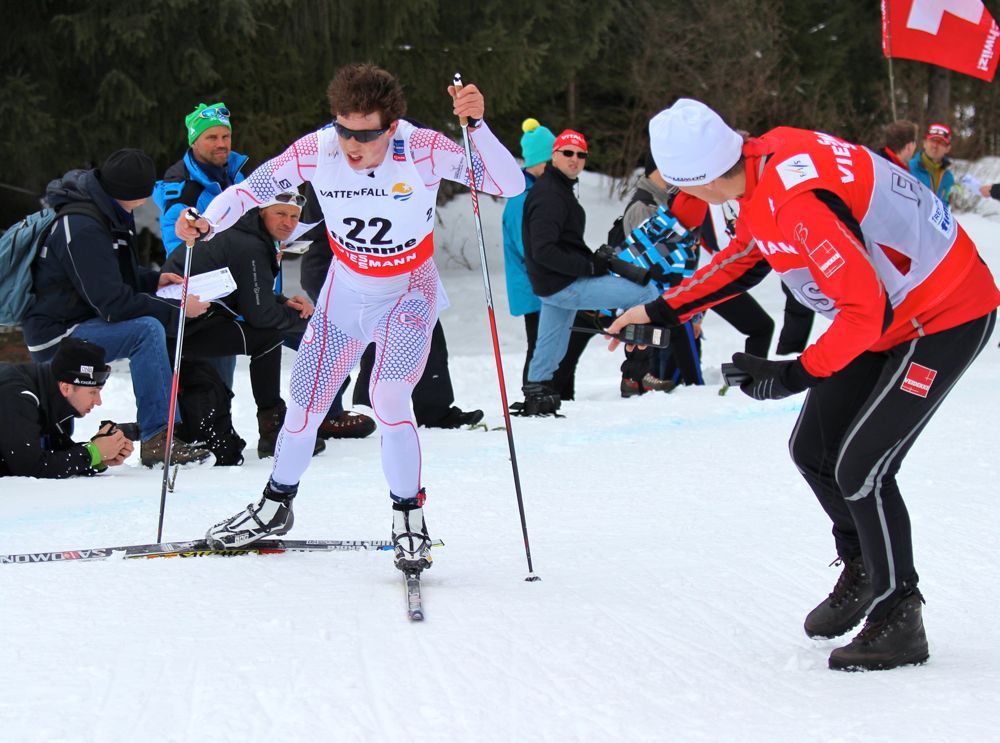
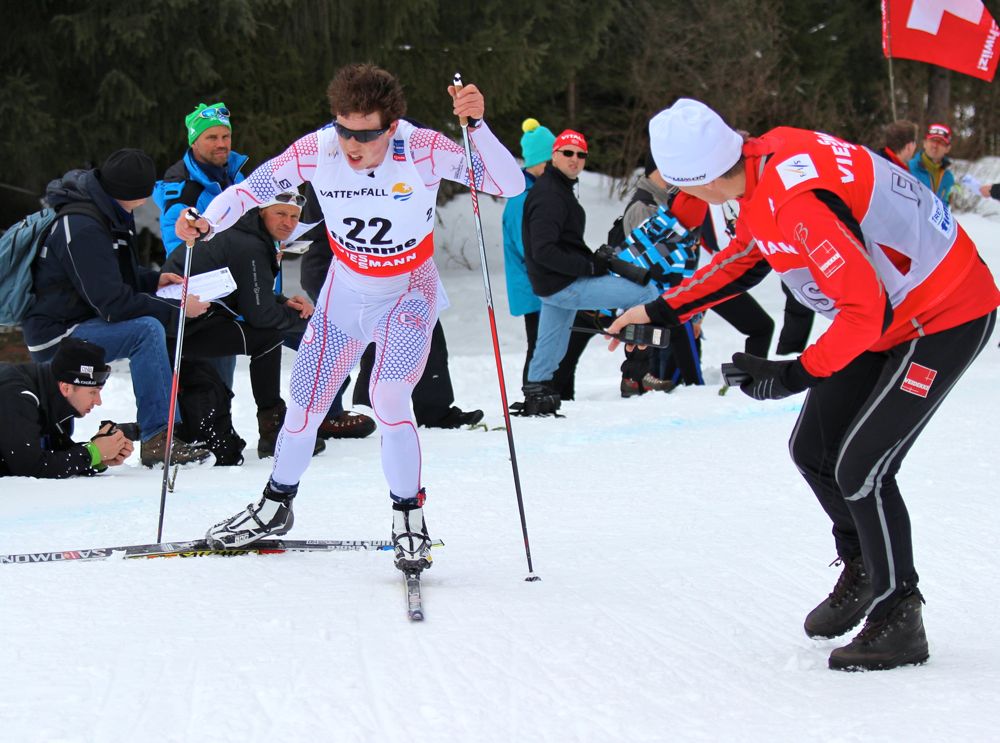
Britain’s Andrew Young (left) follows his competitors to the start of his quarterfinal heat in this weekend’s World Cup sprint: (r-l) Olympic team sprint bronze medalist Alexey Petukhov of Russia; Andy Newell of the U.S. Ski Team; and three-time World Cup winner Eirik Brandsdal of Norway.
DAVOS, Switzerland – Despite the strong results from Andrew Musgrave over the past several seasons, it’s still something of a shock to your average European ski fan to see a British suit go by.
“Wait, he’s from England?” me Swedish friend Sofia – a total ski nerd in most other respects – asked as Musgrave raced by on his first lap of the 30 k freestyle here on Saturday. “Really? He looks good.”
But if the British team has its way, those perceptions will be quashed in the next few seasons. Musgrave finished 36th in that 30 k, despite not feeling fantastic. He classified it as a solid race, nothing spectacular.
“The race was all right,” he said at the finish. “I felt like the first two laps were pretty good, like I was going easy, and keeping up the speed. But the last lap and a half I started to get a little bit tired. The last 7 k were tough. I felt like it was as good a race as I could have had today.”
The next day, Andrew Young – a 21-year-old who we interviewed this summer – made a splash when he qualified for the heats of the freestyle sprint. Starting in bib 69, he was one of a few late starters to surprise. The guy he bumped out of the top 30? Musgrave.
It was the first World Cup points Young, who ended up finishing 29th, had ever scored.
Musgrave was an early starter in Saturday’s 30 k.
“It was awesome,” Young said after his quarterfinal. “I’m skiing fast. Just to be top 30 is huge, so I’m happy. After that, it doesn’t matter if I didn’t ski so well in the heat.”
Britain now has three men (Musgrave, Young, and Callum Smith) who have achieved the Olympic “A” qualifying standard, and one woman (Posy Musgrave, Andrew’s sister).
This is not the British team you’ve seen before. Will it be their best Olympics ever?
“Oh yeah, definitely,” Andrew Musgrave said. “The team has developed massively since 2010.”
The improved results have come as a result of incremental buildups in support and training expertise, and, recently, a Crowdfunder campaign to raise money to send more athletes to more races this November and December. As Young told us this summer, the British team usually must decide how to use its limited budget, and choose just a few World Cups to attend.
In order to get more athletes qualified for the Olympics, they have turned that on its head. After raising a few thousand pounds, British skiers have attended more World Cup and FIS races than usual, and the results paid off. Smith, for example, competed in one World Cup race in Lillehammer, then traveled to FIS races in Austria and is now at World University Games in Trentino, Italy; Posy Musgrave also headed to Austria, but then returned for the Davos World Cups, where she placed 51st in the sprint.
“We have a lot of support through that Crowdfunder – a lot of people have been really generous and giving us some good donations,” Andrew Musgrave said. “So that has helped a lot. Right now we have four people qualified, and another girl is close. So that would be awesome.”
But the strategy highlights a dichotomy for the team: skiers like the Andrews (Musgrave and Young) were already qualified, and are going about their seasons in the usual way. Hence Andrew Musgrave’s lack of concern at his 36th-place finish, a pretty standard result. He ended up 34th in the sprint.
“It’s been kind of okay,” he said of the beginning of his season. “It’s not as great as I had hoped, but at the same time it’s still just early December. It’s a couple of months until the Olympics. The plan is to have the best races in the middle of February.”
For some of the rest of the team, a slow buildup into the season is an unaffordable luxury. Yet the focus, and perhaps the pressure, of using these early season races to meet qualification criteria has led to success. Skiers have flourished under the circumstances.
“It wasn’t so important for me to go fast in the start of the season,” Andrew Musgrave said. “Some of the other guys had to go pretty fast to get the qualification standard, and they are just skiing a whole lot better than they have been the last couple of years. So it has worked out pretty well.”
All that improvement isn’t going to lead immediately to a huge Olympic squad. At the moment, the British team will only receive two spots for men and one for women. If Smith wants to compete in Sochi, for instance, they’ll have to find him another spot. And that’s not easy.
The entire Olympic quota is 310 athletes, and currently those spots are divided up between nations based on how well their athletes perform. But not all the countries will likely use all their quota spots, for example if the same athletes will race multiple races (each country still only receives four starting spots per race, no matter how big their team is) or if their national federation rules set harsher qualification criteria than FIS itself (among the countries with this issue are Switzerland and Japan).
The unused spots will then be divvied up based on the “global list”. The committee will run down the FIS points list, offering a spot to the country of the next skier on the list, until all the spots are gone.
And then, it might happen again – for example, Canada might be offered another spot, but refuse it. Unfortunately, Britain can’t take these handed-back spots based on its own Olympic Committee’s rules. So their only chance is in that first rundown of the global list, which will take place on January 20th.
Finally, there’s the fact that Britain is, in fact, one of these countries that sets harsh rules for its own athletes. For instance, the Olympic “A” standard is 100 FIS points, but British women will have to do better than that.
“In the women we had a nightmare in setting the qualification standards because our Olympic association wanted top 2/3 of Olympic field – this lead to Sprint qualification being at average of 91 points while distance is 97,” British nordic coach Roy Young wrote in an e-mail. “However, I was really confident after Sochi last year that Posy [Musgrave] could meet the sprint, and she has now had two races in the 50’s for points. Fiona [Hughes] is just shy of the 97 average at the moment.”
Despite the difficulties, the team is looking forward to having not only its biggest Olympic squad in Sochi, but also its best. After this weekend, it’s possible to imaging both young and Musgrave, who is the 82nd-ranked sprinter in the World on the latest FIS Cross Country list, making he sprint heats in Russia.
“Sunday’s results were just amazing,” Roy Young wrote.
And for the athletes who had to peak a little early just to book their ticket? There’s a plan for them too.
“It is really tough having to go hard right now and then expected to do pretty well at Sochi,” Young wrote. “However, we are about to change the plans for Posy and Callum so they can rest up a bit now before going hard again. It is always tough as a small nation, but then the Norwegians won’t be guaranteed a place even if they did really well at Davos – so there are some gains in the smallness, too.”
Andrew Young of Great Britain (right) competing in the first World Cup of this season, in Gallivare, Sweden.
The last time Britain’s Andrew Young got interviewed was almost four years ago.
“The Olympics is the only time in four years that the British public cares about our sport, to be honest,” he told FasterSkier in an interview earlier this week. “It’s the one-off time in four years that we get to sell our sport and sell our results, maybe try to get a sponsor or something like that.”
At just 21 years old, Young is embarking on his second round of Olympic media hype (“Vancouver was pretty cool,” he said of his first Games experience). Such is the life of a British skier. There’s no adoring public, very limited funding, and not much snow. To be a good skier, Young believes that you have to leave the United Kingdom and move to a different country. It’s a tough row to hoe.
Yet the British team has been gaining a lot of respect in the last few years. Teammate Andrew Musgrave gets much of the attention – including from this site, which recently wrote about him joining a team headed by Norwegian legend Thomas Alsgaard – but Young is on the same trajectory. Just, well, younger. He started his first World Cup at 16, the youngest skier ever. Fast forward and this season, in his first year of U23 eligibility, the Lillehammer-based Scotsman finished in the top 30 in every race he entered at U23 World Championships.
Despite growing up in a country that doesn’t seem so ski-friendly, Young’s childhood in Huntly, outside of Aberdeen, Scotland, sounds a lot like any skier’s, anywhere. He started skiing when he was two, and was soon in the Huntly Nordic Ski Club. Among the first sorts of competition that he and his friends set their minds to: beating their sisters at skiing.
“My sister is three years older than me, and [Musgrave’s] sister is a few years older than him, so it was always a competition to beat the girls,” Young said. “They were older and they were just as good as we were, when we were 11 and 12. They were better than us.”
Those sisters – Sarah Young and Posy Musgrave – are also now skiing on the international circuit. It was a good atmosphere for a fledgling athlete.
“Once we could beat them, then it was a competition to beat ourselves,” Young said. “Then we started going to rollerski races and it was a competition to beat anyone else – like if there was an adult that showed up that was supposed to be good at rollerski racing. This was around the time when [five-time Olympian] Mike Dixon had just retired from biathlon so he would turn up to rollerski races and it was a competition to beat him and the other older biathletes.”
And all of a sudden, that cohort of boys has found themselves no longer boys, and periodically reuniting on the World Cup. The British team doesn’t have the funding to follow the circuit all year, nor is it a highly centralized team. Young lives in Lillehammer now, although he previously spent two years at the NTG in Geilo, Norway; Musgrave, for instance, went to a ski gymnasium in Hovden and now studies engineering in Trondheim in between training and racing. Their sisters and some other teammates are still based in Britain.
When they get together for training camps and races, though? Things still feel the same. It’s a family affair especially for Young, whose father coaches the British team, although some of the skiers work with their own coaches.
“It’s nice, and awkward,” Young said of the arrangement. “It’s always a bit awkward having laddish banter with your teammates and then your dad listening, there’s a lot of stories shared between teammates that you don’t want your dad to find out.”
The camaraderie that the group has developed over ten years has made them faster and supported a good team atmosphere.
“We don’t try to beat each other – of course we do in training, but the competition isn’t to be the best British person,” Young said of the team’s camaraderie. “That doesn’t play any role. It’s about being best. Just trying to be good, the best amongst everyone.”
With such lofty goals but also budget issues, the British pick World Cups carefully. This year, Young’s itinerary included the World Cup opener in Gallivare, Sweden (“all of the best guys are really out of shape, and the first courses are really flat so they don’t have the hills to get a really big advantage”); the first few stages of the Tour de Ski; U23’s, the Davos World Cup, and World Championships; and the last races in Drammen and Oslo.
His best results came at U23’s, which he says is a favorite event, and possibly in the sprint at World Championships, where he finished 45th. In World Cup racing, Young placed in the 60s and 70s.
As a 21-year-old, he doesn’t find encountering those results discouraging in the least.
“If you finish a bit down the field, you just set a benchmark and you know what you’re working for next time,” Young said. “I’ve always known that if I compare myself to the other guys who are my age, there aren’t that many people my age who can beat me. So I know I’m on the right path, it’s just to keep going. If you get beaten by seniors when when you’re a junior it’s not really that important.”
For the rest of the season, the British athletes attend lower-level races and often scatter to their various winter homes. In the last few years, Young has raced mostly in Scandinavia, where he believes he can get better development opportunities at the Norwegian Cup or Continental Cup levels.
He is coached by Geir Endre Rogn, a former NCAA podium finisher for the University of New Mexico who coaches the Geilo NTG. Rogn had helped the British team with a summer training camp; when he saw Young at Holmenkollen at the end of the 2010 season, he asked him what he was doing the following year. No plan, Young said. So he moved to Geilo and trained with 25 Norwegian men his age, improving his technique and his fitness.
It was a massive improvement on his previous situation: after deciding that he had to leave Britain if he wanted to be the best he could be, Young had spent the previous season entirely on the road, with no home base.
“The first year, after I left school, it was really hard,” he said. “Every Monday was a new hotel, and when you’re washing clothes in the shower it’s not really fun. You never have internet, you never have a washing machine – it’s the simple things that you just get a bit tired of.”
Geilo provided not just higher-quality training, but stability. Among the highlights of that time was a seventh-place finish in the 20k at Norwegian junior championships two years ago. Young bested, among others, biathlon World Junior Champion and current senior national team member Johannes Thingnes Bø, and Therese Johaug’s younger brother Karstein.
So when he moved to Lillehammer to get “better training opportunities,” as he writes on his blog, Rogn kept supervising from afar.
“Lillehammer is a bit ridiculous,” Young said of his current setup. “You go out training and you’re going to see someone you know. There’s so many skiers here, so the chances are there’s going to be someone else doing the same thing as you on the same day. I try to meet up with others to train three or four days a week and then maybe do the rest on my own, but oftentimes I bump into someone else out training anyway.”
Perhaps the current generation of skiers are paving the way for even more success in the future. Young and Musgrave are certainly broadening the network of contacts available in Norway, one of the best places a British skier could choose to relocate. And Young highlighted two clubs, his own Huntly Nordic Ski Club and Cairngorm Biathlon and Nordic Ski Club, as well as a group in London that introduces Brits, many of them kids, to rollerskiing.
Living outside the country, the current roster of athletes can’t always participate in this building of their own sport. Instead, they have to work from afar. On his blog, Young recently wrote an impassioned plea for his countrymen (and everyone else) to wear helmets while rollerskiing. He clearly cares about those following in his footsteps.
“I don’t really care what people do in there own time, how other people train,” he wrote. “But what I do care about is the future of British skiing, and the development of the sport. I urge you to have a helmet… not just for your own safety, but for the safety of other younger skiers who will, in all likelihood, copy you.”
And finally, he and his teammates have their big chance every four years, when the Olympics rolls around. When I asked Young whether seeing skiing on TV actually generates meaningful interest, he at first seemed doubtful.
“They see it on TV and then they go back to what they were doing – well, no, in some ways people get a bit interested, I guess,” he said. “I don’t know of anyone who just started skiing because they saw the British team on the Olympics.”
But thinking a bit more, he said that Sochi will likely gain them a few more fans.
“I guess there are people who start watching it more if they know it exists,” he said. “When I was younger I used to swim and my swim coach got addicted to ski jumping. He watched it at one Olympics and then watched it every winter all the time. So people do get hooked on sports, and if we get a few more fans then it’s better for us.”