From the FasterSkier archive — posts syndicated from athletes’ and coaches’ own blogs between 2004 and 2012, kept online as published. Current coverage is at fasterskier.com.
Royal Gorge Cross Country is seeking a full-time and a part-time groomer and a full-time ski instructor for the 2015/16 season. On-snow season runs December through April. Experienced candidates, who are willing to relocate to the Tahoe/Truckee area of California, please direct letters of interest to jtoeppner@sugarbowl.com.
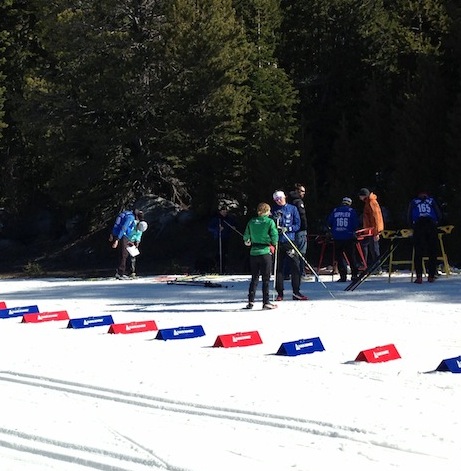
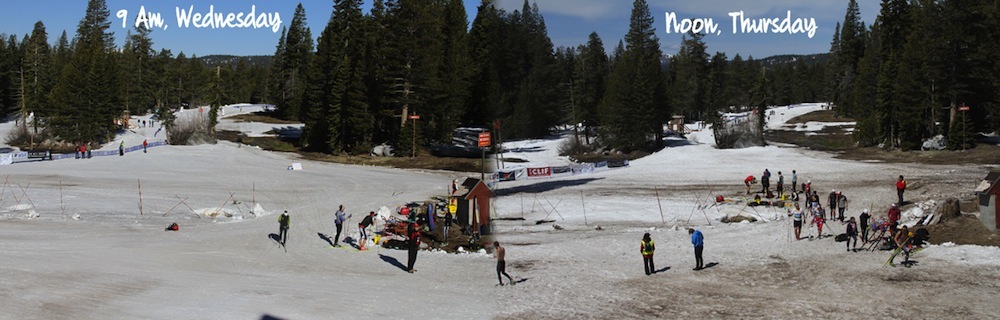
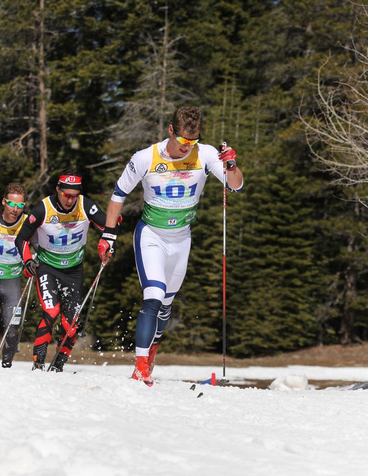
The stadium at Royal Gorge XC the morning of the 30 k classic on Wendesday and just after the 50 k on Thursday. Note no. 1: the season ended just in time. Photo: Mark Nadell/Macbeth Graphics.
FasterSkier’s coverage of SuperTour Finals and U.S. Distance Nationals was brought to you by the generous support of Concept2, the leading manufacturer of indoor rowers, racing oars, and the SkiErg.
The season may be over, but there were a few musings left floating around after last week’s 30/50 k National Championship that never made it into our original reports. Presenting the last edition of notes and quotes ‘til November, for the die-hard race junkies.
On the domestic debut of ski exchanges and penalties:
“I don’t really understand why they were trying to emulate a test event on the World Cup. In my opinion the course should have gone through the ski exchanges, which would have been an easy adjustment to make.”
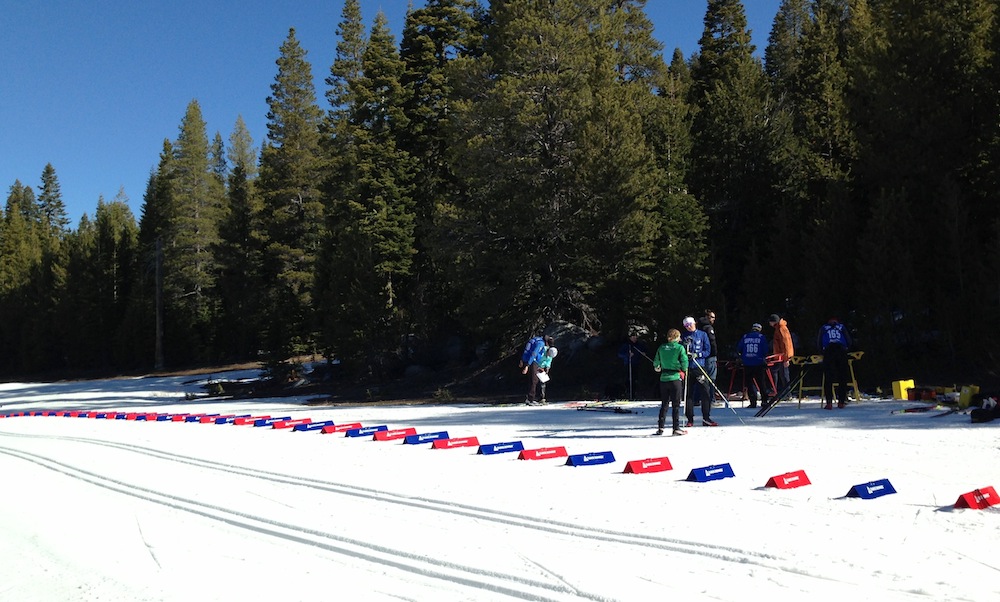
The ski exchange pit awaits skis prior to the start of the 30 k.
“I did a ski exchange after 20 k because I felt like they were a bit slick, but I don’t know — the ski exchange too maybe about 40 seconds or so. I don’t really think it was worth it in the end but I don’t think it really affected me that much, either. I think it sped up the skis for a couple k but once it softened up it started to be easier to kick. I don’t think the ski exchange was really worth it because it’s a bit long; it takes a while to do the exchange.”
— Knute Johnsgaard (Yukon Elite Squad/CAN), 4th
“When I had the gap it was hard to tell whether my skis were slow or not, because I wasn’t skiing with anybody. I mean, I knew mine were slow but everybody’s were slow, so I kind of had a last-minute, like, ‘Shoot, should I change?’ But then I figured I didn’t know how far it was until the next group of people so it was just kind of a last-minute decision out there.”
— Liz Stephen (Burke Mountain Academy/U.S. Ski Team), 1st
“I didn’t [change skis]. I was close enough to Kikkan and Liz to see that they weren’t, so I didn’t want to lose that potential ride. I just kept doing what they did; I figured I should learn from the best.
“I don’t like dealing with all that stuff, so I’d rather just not have it. It’s too much to think about, but if it had been faster today I think I probably would have [changed].”
— Rosie Brennan (APU), 3rd
“You get a new pair of skis and you want it to be so much faster, but it’s just so dirty out here that you forget that it doesn’t make a huge difference. It’s just so wet and sloppy. I knew that I lost time, but once I caught up I was like, ‘OK, back under control.’ But then the group started hammering again, so that was the toughest part of it.”
— Sadie Bjornsen (APU/USST), 8th
On posting a good final result:
“It was ideal. That was the best I’ve felt in a classic 50 k. That and World Champs. I’m happy I ended the season this way — third American, I’ll take it, [I’m] pretty proud of that. Especially behind Kris and Newell, they’re fantastic classic skiers.”
— Tad Elliott (Ski & Snowboard Club Vail Team HomeGrown), 5th
On mental strategy:
“Everybody’s burned out and, I don’t know, I ski my best when I’m relaxed anyway. I wish I could be this relaxed going into World Championships and the Olympics and all those other big races that I tend to get a little bit worked up about.”
— Liz Stephen
“I honestly tried to go with my insane mental approach that I did for the hill climb, which was just: absolutely don’t even think about it and just go ski. I didn’t really want to think about the hill climb and I didn’t really want to think about this, so I just kept skiing. The only goal I had for myself was to not ever go anaerobic — like ever, because I thought that would help me. It’s kind of hard to come back from that, for me, at altitude. It worked well and I just kept cruising along.”
— Reese Hanneman (Alaska Pacific University), 6th
Mid-interview congratulations:
“I just want to say congrats (to Liz Stephen). I just want to give her a hug and like, take her sweat and absorb it.”
— Caitlin Gregg (Central Cross Country), 9th
“Put that into writing: Reese [Hanneman] is the next Eldar Rønning.”
— Ben Saxton (F.A.S.T. Performance Training), 6th junior, 20 k classic
On crashing out of the last race:
“I was in a pack with Miles [Halvick] and David Norris and I think we were all back there suffering with a little bit of slick skis. Before the last climb on the first lap, coming down that hill there’s a lot of parts that are really icy and sluchy and I think I compressed a soft spot with a straight leg and my skis just went out and I landed right on my stomach. I was moving fast and slid headfirst into the woods. Downhills are where I like to make up my time so I kind of attack them, but I may have been a little aggressive…My legs were all crossed and my poles were underneath me and I was basically underneath the tree well.
“I really wanted to finish today and I still wanted to finish, but my coach thought it was probably the best idea [to drop out]; I’m not going to catch the pack at this point, so…start celebrating early. It’s OK. I’m happy with the season and looking forward to the Olympic year next year.”
— Sylvan Ellefson (Ski & Snowboard Club Vail Team HomeGrown), DNF
On racing for an American university:
“I’m so old that I only had this year of eligibility; I only came here this year. The reason why I came here is because my study in Norway is master of engineering. You are allowed to take on exchange year and you can go to another school. I got the classes sorted out and I knew I was going to get a year. I knew I was going to get accepted a year from my Norwegian school, then it was a good deal coming here, having fun skiing. I’m getting a little bit tired; like, it hadn’t been that good of a season in Norway. So I was like, ‘Ah, f— this, I’m going to the U.S. and trying to have some more fun with skiing.
“It was a really fun NCAA Championships, the last day. Having three guys top-five, that was so fun and we got from fourth to second and just crushed it that day. That one and this one was the best experiences this year.”
— Einar Ulsund (University of Utah/NOR), 3rd
On finding support with another team:
“It was really nice of the Craftsbury Green Team to invite me and kind of let me jump in with them, and itw as awesome that they hired four people to make the skis as good as possible. It’s fun to continue working with [USST technician] Randy Gibbs. He’s not my wax tech on the World Cup any more, unfortunately, but he was for many years and it’s nice to be able to work with someone I know and trust. I was part of, like, four different clubs this year, it was awesome. I stayed with APU, waxed with the Green Team, wore the Burke suit, and today I wore the U.S. Ski Team suit.”
— Liz Stephen
“I wasn’t very organized coming down here, and I don’t know what I wouldn’t done without APU. Erik Flora’s been a big help. I did a training camp with them on the glacier so I kind of got to know them there, and they’ve been super helpful for the last couple of days.
“It’s been awesome just to have a change from the NorAm circuit and to race these different guys has just been a great experience — making new friends and it’s been great racing new people. It’s been awesome; it’s really nice down here in Truckee. I’ll definitely be back for spring series next year.”
— Knute Johnsgaard
On vacation plans:
“I’m going surfing in Costa Rica next week and that’s it; [I’ll] take a few weeks off for sure. Running and surfing will probably be my training schedule for the next few weeks and then start back up in May.”
— Andy Newell
“It’s going to be a whirlwind. I’m staying here for a few extra days with Liz and Chandra [Crawford] to celebrate my 30th birthday — which actually happened on New Year’s Eve but it was in the middle of the Tour de Ski. Just going to alpine ski for a few days and just enjoy some time together as friends without the pressure of competition on, then home to Alaska. I’m really excited about it, because I haven’t seen it since November 4. Then a few more trips and pretty soon we’ll be in Bend. I’ll be in Maui in the beginning of May; that’s worked really well for me in the past couple years, so I’m just going to keep doing it.”
“I can’t even tell you how happy I am to be going home. It’s been four and a half months of hard racing. Every race has been hard. It’s been a great season, but now I need a break so bad.”
— Jessie Diggins (SMS T2/U.S. Ski Team), 4th
“I’m going to go with my boyfriend to Florida and we’ll have a family reunion. I’m just not going to do anything for 10 days.”
— Sadie Bjornsen (APU/USST), 8th
End-of-season reflections:
“To be fighting for a top-three spot overall was kind of exciting, it made the winter an exciting time for sure. So yeah, I’m psyched for an Olympic year next year.”
— Andy Newell (SMS T2/U.S. Ski Team), 2nd
“I’m really happy to be done… Happy to put together a strong one from beginning to end and now looking forward to time to rest, ‘cause next year’s going to be pretty exciting, too.”
“I think at Springs Series you really never know what you’re going to get. I’ve had years where I’m totally burnt out and ready to be done and this year I’m definitely ready to be done, but I’m not burnt out, so I think that’s a good sign. But also I think you tend to have really good races or really bad races, and I’ve seen some of each of those this week.
“I’m very happy with how the season went. I didn’t really know what to expect going into it, but I think I exceeded any expectations I did have and I’m still having fun with it. So I’m definitely excited to take a little break and then start training again for next year.”
— Sophie Caldwell (SMS T2), 5th
“It’s been different to move back home to Sweden again, but I’m super happy with my season. My goal was to do one or two World Cups representing Sweden and I did almost the whole season, so I’m really happy with that and hopefully I can step it up a little bit for next season.”
FasterSkier’s coverage of SuperTour Finals and U.S. Distance Nationals is brought to you by the generous support of Concept2, the leading manufacturer of indoor rowers, racing oars, and the SkiErg.
NORDEN, Calif. — Watch Kris Freeman (Maine Winter Sports Center/U.S. Ski Team) battle Andy Newell (SMS T2/USST) and Einar Ulsund (University of Utah/NOR) for the national title in the 50 k classic on the last day at spring series on Thursday. Freeman pulled away in the last 5 k to beat Newell by almost a minute.
Kris Freeman (Maine Winter Sports Center/U.S. Ski Team) claimed his third consecutive U.S. 50 k championship on Thursday at Royal Gorge. Photo: Mark Nadell/MacBeth Graphics.
FasterSkier’s coverage of SuperTour Finals and U.S. Distance Nationals is brought to you by the generous support of Concept2, the leading manufacturer of indoor rowers, racing oars, and the SkiErg.
NORDEN, Calif. — Competitors in the U.S. 50 k National Championship knew they were in for a trying few hours at Royal Gorge as they lined their skis up on the starting line on Thursday morning. It wasn’t just a 50 k — it was a 50 k mass start classic in changing conditions at 7,000 feet. As the final test of the year for a field whose season began in November, it was the final hurdle standing in the way of post-season festivities and a few weeks off from training. Whoever would be crowned the distance national champion after two-plus hours would be the victor in a war of attrition against the course, the field, the slush and the fatigue of an entire season.
After five laps, the last man standing was one Kris Freeman (Maine Winter Sports Center/U.S. Ski Team), winner of the last two consecutive U.S. distance championships and one of the most respected skiers in the U.S for the better part of a decade. When he crossed the finish line in 2:24:52.8 he was 53 seconds ahead of longtime teammate Andy Newell (SMS T2/USST).
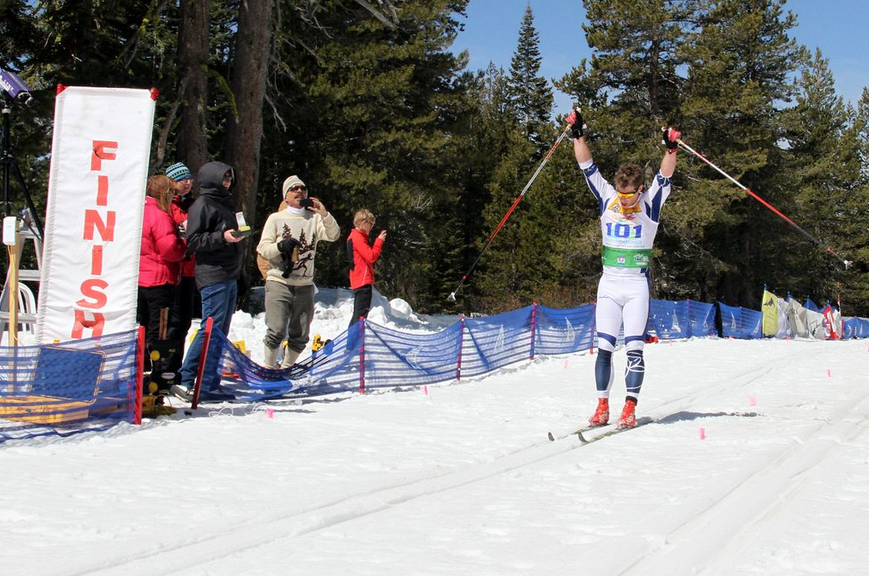
Freeman let his exhaustion show; after striding a sluggish finish stretch he would normally have double-poled, he raised his arms up triumphantly, grateful that such a race was finally behind him. As other finishers came through, he lay flat on his back in the snow, chest heaving.
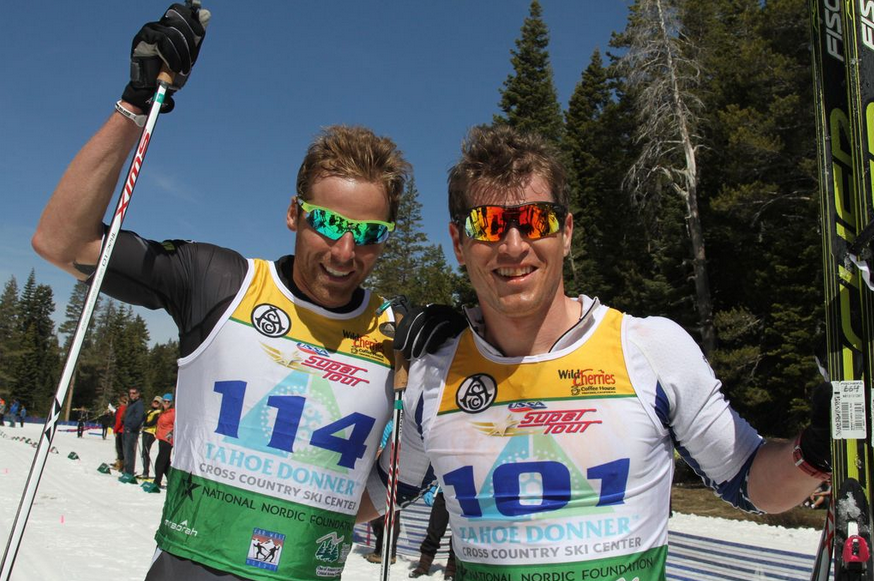
Andy Newell and Kris Freeman, one-two at U.S. 50 k National Championships. Photo: Mark Nadell/MacBeth Graphics.
“Today was a really rough 50 k,” Freeman said. “It was so slow and so high, the combination just — I don’t think I ever felt good at any point in the race.”
He wasn’t the only one hurting. Newell said his arms started seizing with 30 k to go, and Einar Ulsund (University of Utah), who finished 29.1 seconds behind Newell in third, felt his body cramp up halfway through the race.
“I first started feeling it in my triceps, and on the fourth lap the whole system from here; everything was cramping,” Ulsund said. “It was just a fight just getting to the finish line, trying to stay with Newell and Freeman as long as possible.”
There was no getting around the altitude or the fact of the 50 k distance, but there was one defense against slow snow: a good service crew. As the first domestic championship to test out both ski exchanges and an accompanying penalty loop, Thursday’s race was also a battle of the wax techs. Most top women in the 30 k the day before opted to ignore the exchange pit, but the men’s race was different. Snow temperatures warmed significantly between the 9:00 a.m. start and the finish over two hours later, and in a 50 k skiers were bound to want fresh wax if they could get it. Anything to ease their progress through California’s slushy snow was welcome aid.
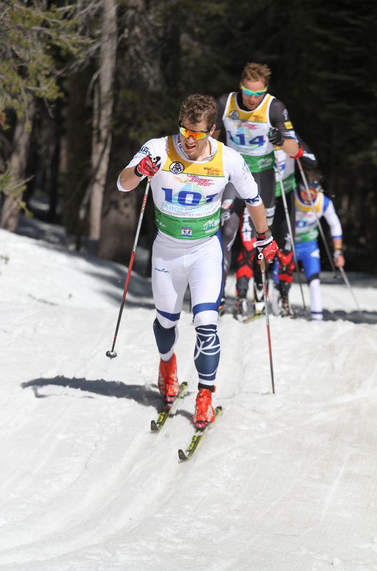
Freeman leading Newell, Ulsund and Elliott. Photo: Mark Nadell/MacBeth Graphics.
When the race got underway, the first 10 k weeded out who would likely be fighting for a podium. Ulsund, Freeman and Newell came back to the stadium for the first time with a seven-second gap on the rest of the field — small, but enough to show they were all going to be skiing well. As the snow was still relatively firm before 10:00 a.m., none of the trio stopped for new skis at the first exchange.
Behind them, Pat O’Brien (Craftsbury Green Racing Project), Rune Oedegaard (University of Colorado) and Tad Elliott (Ski & Snowboard Club Vail Team HomeGrown/USST) were spread out but conceivably still within striking distance. Erik Bjornsen (Alaska Pacific University/USST), Reese Hanneman (APU) and Torin Koos (Bridger Ski Foundation/Rossignol) followed after another small break, and since none of the leaders changed skis the first lap, they all went directly through the lap lanes without stopping.
Out in the woods for lap two, the leaders gauged each other’s ski speed and energy levels. To Ulsund, it was clear that he, Freeman and Newell were skiing better than the rest of the field.
“I knew it was me, [Freeman] and Newell probably that were the strongest guys in the field after that first hill,” Ulsund said. “After that it was more like, not being too eager to lead. Kris, he didn’t want to lead so much so I had to do a fair amount of [the] job. Newell, he helped, and Kris was mostly skiing hard in the hill.”
Newell’s strategy was simple: to follow other people and “not think about skiing 50 k’s.” In between taking pulls at the front he stuck behind Ulsund and Freeman like glue.
The size of the lead group fluctuated as skiers alternately regained contact and the dropped off the pace. O’Brien rejoined them over the next 5 k, and soon after so did Elliott. Bjornsen and Hanneman lurked another few seconds behind.
When the leaders reentered the stadium at 20 k for a second time, the snow had truly begun to break down. It was the moment that spectators, coaches and athletes had been waiting for — who would change skis, and who would keep going? The extra 150 meters it took to reach the exchange pit presented the same trade-off seen at the Holmenkollen test event on the World Cup this year. The choice to stop or not hinged on many factors in the moment: who you were skiing with, how your skis were running relative to others, and what the people around you decided to do at the fork.
With Freeman in the lead at the junction, Newell and Ulsund decided they would follow him no matter what — Freeman went left for new skis and the other two copied him. Freeman’s change wasn’t a last-minute decision: he planned on taking advantage of one change out of a possible two.
“I knew I’d probably be giving up about a minute, so I only wanted to do one ski exchange,” Freeman said. “I started on my slower skis and switched to my better skis [at 20 k], and second and third did as well.”
Elliott leading after the 20 k exchange, which he skipped. Photo: Mark Nadell/MacBeth Graphics.
Elliott, Bjornsen and Hanneman chose the opposite track and went right back out for lap three, becoming the the new race leaders as their competitors fiddled with bindings.
“It was just my goal to ski with Bird for most of the race, so I kind of followed him into the exchange zone because I thought it’d be a good choice to ski with him and it worked out well,” Newell said.
“I just decided I was going to follow the tactic of Kris,” Ulsund said.
Elliott, as the first man not to change skis, acted on faith that his first pair would continue to run as well as they were in the first two laps. Salomon over-nighted a new pair of skis to him for the 50 k, and he thought they would still be his best option for the remainder of the race.
“Two laps in our coaches said, ‘Look, what you have on is still what we think is the best; I think you need to skip,’” Elliott said. “So I skipped and I had a gap.”
He hoped Bjornsen, who also skipped the pit, would soon be skiing with him and they could work together out in front, but help from the SuperTour Finals champion never came. Instead Bjornsen and Hanneman bunched together in second and third while Elliott plugged away alone as Freeman, Newell and Ulsund closed in on fresh gear.
“I knew my skis were good out of the pack in the beginning,” Elliott said. “I was kind of hoping that by me skipping, Bjornsen and Kris would come up, but those other guys were skiing well. Huge credit to our wax techs; they kept me in the race for a long, long time.”
Elliott held Freeman, Newell and Ulsund off for almost a full lap, to the slight surprised of the hunters. They caught Hanneman and Bjornsen first within 3 k of the stadium, but Elliott put up more of a fight.
“Tad was giving her; he took a gamble there,” Freeman said. “I kind of thought he wouldn’t change because I was slick on the first 20 k and I watched him and he was just going right up the hills. I think he probably had the best skis of the group, early. So I think it was a smart gamble he took, but once we changed we were just faster.”
After the leaders reabsorbed Elliott he hung for another few kilometers. Hanneman had been swalloed up much earlier, but after the group passed him he kept a steady pace and successfully reattached to the five-man group.
“I was kind of dangling off the lead pack, and I just decided to close the gap down as quickly as I could without going anaerobic,” Hanneman said. “And I closed it down and that was a really good call for me, because I got to sit in there with the pack then just wait for the muscles to start cramping and keep trying to improvise from there.”
Freeman leading Ulsund and Newell. Photo: Mark Nadell/MacBeth Graphics.
Before the end of the second lap, muscle fatigue claimed its first victim and Hanneman began to drop off the pace. Bjornsen dropped off, too, and Elliott hung on until 35 k.
By the time the lead group came back into the stadium at 40 k, it size had shrunk back to where it started: just Freeman, Newell and Ulsund.
The kilometers ticked by, the snow got warmer and sloppier, and the race was reduced to a battle of wills and endurance. Freeman has the resume to easily be considered a favorite over the other two, but Newell and Ulsund stayed with him longer than he expected.
“It was pretty cool to see Newell skiing that fast,” Freeman said. “He had me nervous for a little while… It was really hard to break away because it was way faster to go down those hills in a group. Those guys would get to yo-yo around each other. They both had good skis — as good as mine — so one would pass the other and they’d catch up to me on the downhills. So I was working my ass off for the last 8 k, double-poling down hill.”
With 6 k to go, Freeman made a decisive move, accelerating up and over the top of the major climb to finally put a safe distance on Newell and Ulsund.
“I put in a pretty hard move in the first A-climb on the course on the last lap, and I didn’t look back until I had about 30 seconds on him — and thank God,” Freeman said.
The defending champion skied away, stopping to take another feed 5 k before the finish, where his coach told him he was almost half a minute up. The race wasn’t over yet, but all Freeman had to do was keep skiing like he was already and the title would be his again for the third year running and the fifth time in his career.
With Freeman out of sight, Newell made a move of his own 2 k before the finish. Ulsund couldn’t match it — this would not be a day for a photo finish on the podium.
“I took the lead from there and just upped the pace a little bit, and then looked back and saw he was dropping back,” Newell said. “So knew I could put the hammer down a little bit.”
Newell working through the slush. Photo: Mark Nadell/MacBeth Graphics.
“I was with [Newell] up there and then I was so tired,” Ulsund said. “I was like, ‘OK, I’ve got to get to the finish line now.’ I knew those other guys were pretty far behind, so I just had to get up that hill. I just didn’t have any power left to follow Andy; he was pretty strong on that last hill.”
In the last 5 k, Freeman expanded his lead over Newell by another 20 seconds — his final time showed a 53 second gap. When Newell skied over the line, Freeman was still there to congratulate him. This winter has been filled with high and low points for Freeman, and he was clearly happy to finish on a positive note and share a moment at the end of a long season with a teammate.
“It was really nice to get the top 10 in Canmore, then the blood-sugar problems at the Tour really derailed me for a long time, and because of that I’m just not going to do the Tour next year with the Olympics coming,” Freeman said. “There were highlights and there were lowlights, and I’m glad to just end it on a high note.”
Newell’s second-place finish is his best career 50 k championship and adds another accolade to one of the best seasons of his life.
“I’m psyched it was a good season,” he said. “The only thing I didn’t accomplish was getting on that podium, and I’m really hoping to do that more next year, for sure. But in general it was a great season; an improvement in my distance racing for sure.”
It was a stellar day for everyone through the top six finishers, in fact. Each of them in some way produced one of their best races of their careers. Ulsund, who finished half a minute behind Newell in 2:26:15.5, stayed with Freeman and Newell for an impressive amount of time. Knute Johnsgaard (Yukon Elite Squad/CAN) made a huge comeback in the last lap to move from behind Bjornsen, Hanneman and Elliott with 10 k left to finish in front of all three of them, five seconds ahead of Elliott in a sprint for fourth.
“I was seeded 35, so I was kind of in the back of the pack for most of the first part, but I think that might’ve helped me in the long run, just to take it out kind of easy and build throughout the race,” Johnsgaard said. “I was just picking people off one by one and I just managed to catch Tad right in the finish. I’m really happy.”
Though Johnsgaard nipped him at the line, fifth is Elliott’s career-best classic 50 k result. In terms of pure effort output, he said his last lap of the course on Thursday took second to only his World Championships relay leg earlier this season.
“That last lap I was dying,” Elliott said. “That’s one of the deepest I’ve gone. That and the relay in Italy are the deepest I’ve gone.
Hanneman, who finished 39 seconds behind Elliott for sixth in 2:29:17.6, might have to start thinking about becoming a distance skier after Thursday’s result. The experience of racing his second major 50 k and winding up as the fourth American appeared to slightly confound the sprinter afterwards.
“I feel good, I mean, it’s just that’s not really my race,” Hanneman said. “I never put a move on. But instead of letting yourself just crumple you just try to keep going, and in this race that serves as a move.”
As to whether he’ll start thinking seriously about distance races in the future, Hanneman wasn’t sure.
“God, I hope not,” he said. “I don’t want to have to do that more than just as a consolation prize race at the end of the season. But maybe I will.”
Seventh went to Torin Koos, who finished 11 seconds behind Hanneman. O’Brien faded to eighth, 24 seconds behind Koos, and Trygve Markset (University of Denver) took ninth another three seconds back.
As for the ski change component, there were mixed feelings about it in the field. Freeman, for one, didn’t think it belongs in a national-level race.
“I’m a little torn on whether or not we should do ski exchanges, because it does tax the wax staff,” Freeman said. “I have to really thank my team. I had my entire team out there feeding me and I had my entire team working on the wax…It kind of makes it harder and I don’t think we want domestic racing to end up being a wax tech challenge. So I’m a little torn on ski exchanges. Actually, I’m not torn — I don’t like ‘em. It can make the race easier but I just think it’s too much.”
With the season officially over, athletes will take breaks from skiing in varying ways before they begin training again for next year. Newell is headed to Costa Rica to surf for a few weeks while Freeman will be relaxing at a yoga retreat.
“I’m going to take three weeks off and then start training again,” Freeman said. “I’m going home and then my girlfriend has talked me into going to a Kripalu yoga retreat, so I’m going to come out really zen for my next training block.”