From the FasterSkier archive — posts syndicated from athletes’ and coaches’ own blogs between 2004 and 2012, kept online as published. Current coverage is at fasterskier.com.
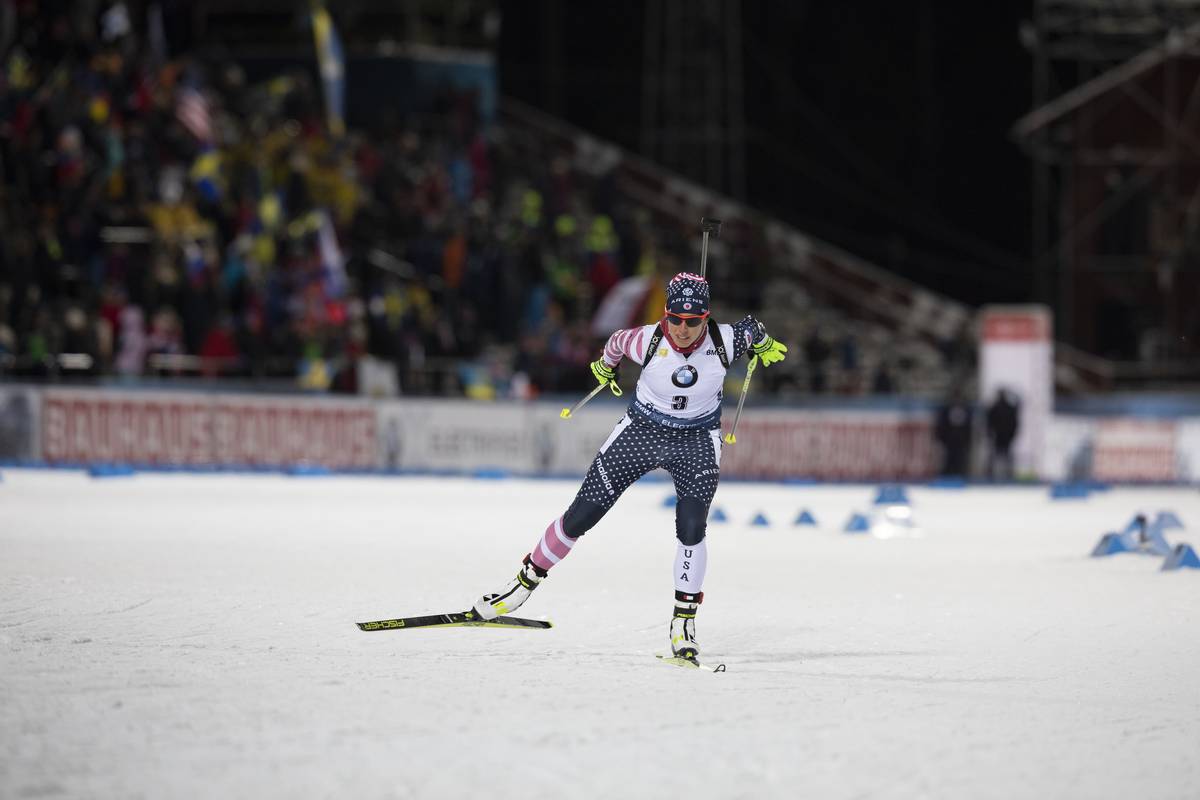
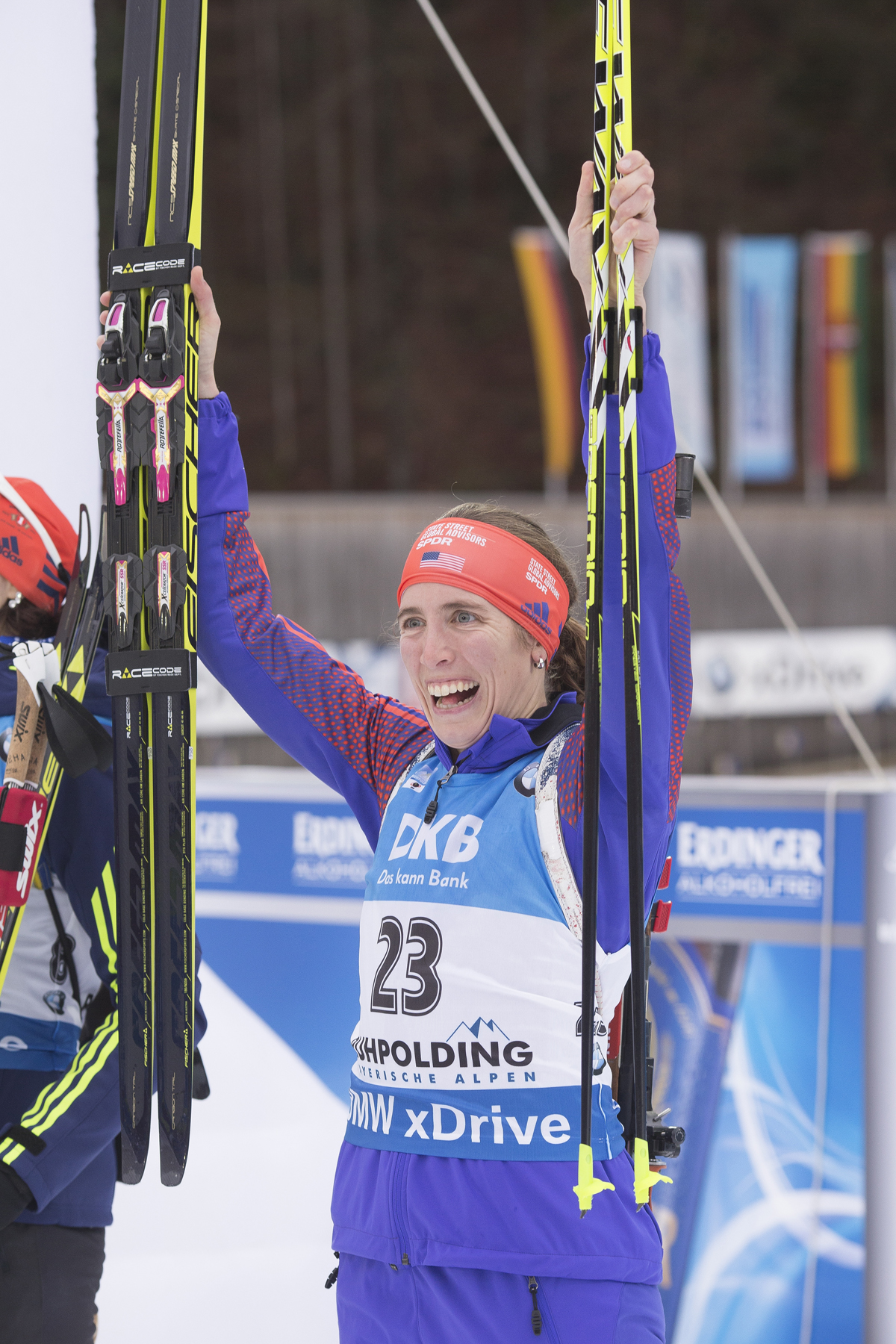
Susan Dunklee of the U.S. during the 7.5 k sprint in Östersund, Sweden in December 2019. (Photo: NordicFocus)
Success in biathlon can be fickle. With so many added variables, many outside an athlete’s control, the results page does not always align with the quality of the effort or performance. In an interview after a career best result in the 15k individual event in Pokljuka, Slovenia, Clare Egan explained that it is essential for a biathlete to differentiate between the two.
“We learn early on in biathlon to distinguish between [results and performance] because you can go out and say, ‘I felt great skiing and I thought I executed my shooting plan perfectly, but it just didn’t work.’ Maybe you had four shots that were really really close, but they were all misses, so you end up with a bad result and that result doesn’t reflect how you feel about your own performance.”
After eleven years on the national team and eight years of World Cup racing, Susan Dunklee understands this better than most. The 33-year-old Vermont native has weathered several dips in rank, and this season has been no exception. She placed 32nd with two penalties in her first sprint event in Ӧstersund, Sweden, followed by 73rd with seven penalties the following day and dipped to 95th in the next sprint event in Hochfilzen, Austria.
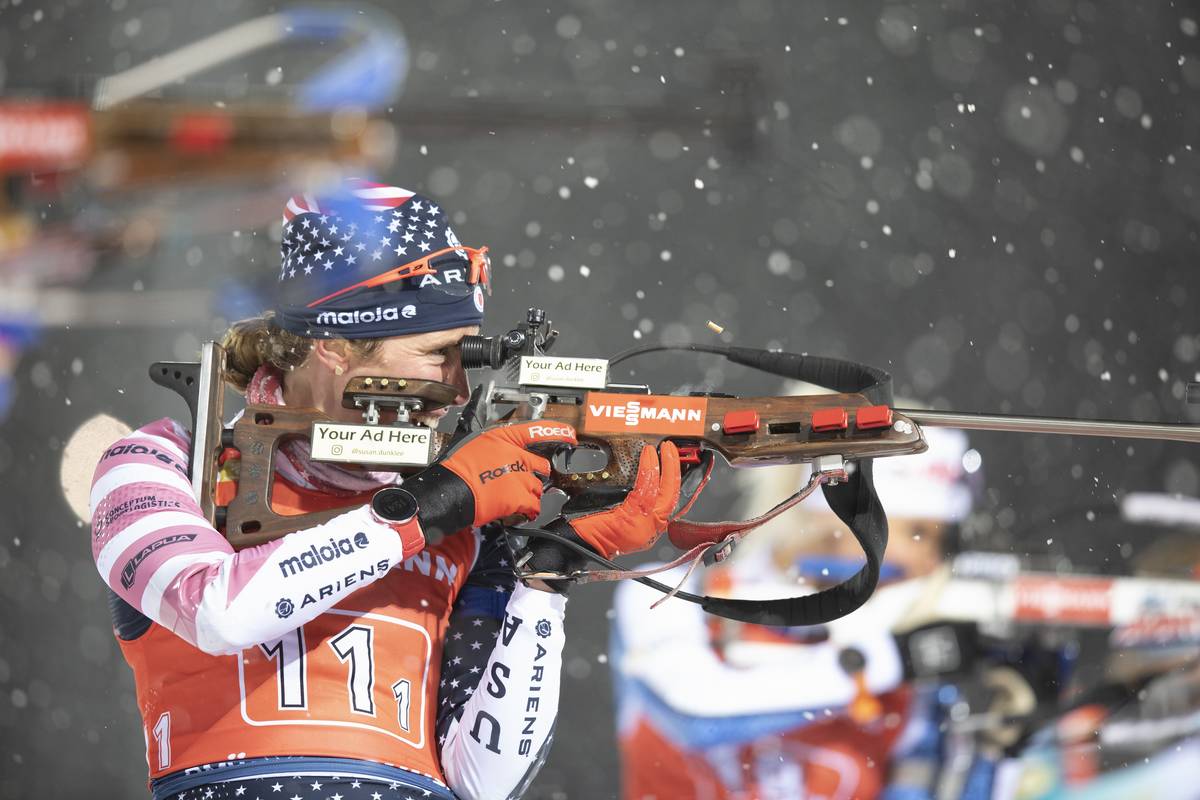
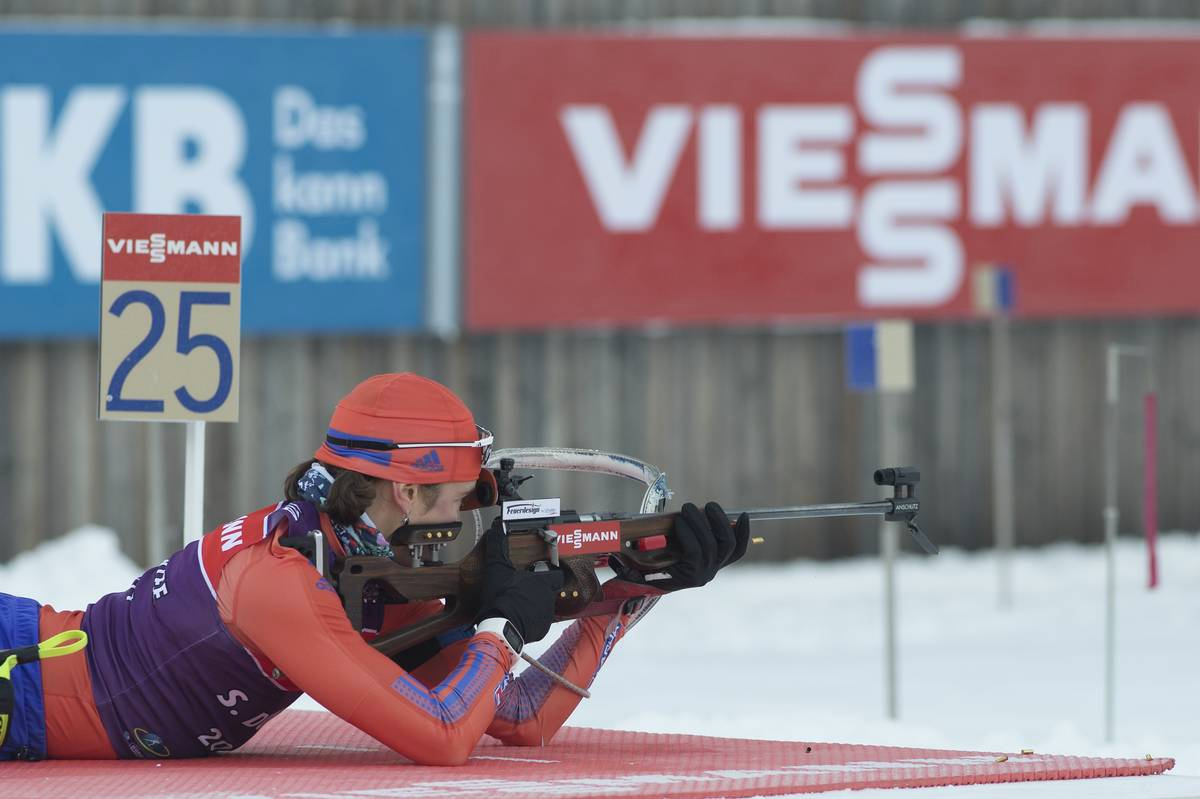
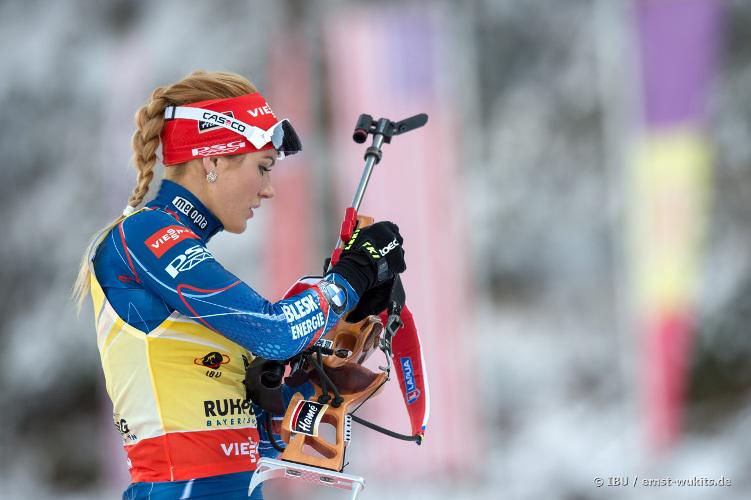
A mid-December shooting bout in Östersund, Sweden for Susan Dunklee. On the IBU World Cup circuit, Dunklee has of late been finding her form. (Photo: NordicFocus)
Dunklee has since rebounded to solid results in Ruhpolding, Germany and Pokljuka, Slovenia, where her shooting and skiing clicked for strong relay legs and a 10th place result in the pursuit.
Reflecting on her season in a call on January 29th, Dunklee shared that though she felt she was in good shape and had good focus during those early season races, she struggled with her shooting, particularly with standing.
“When you stand on the start line, you have a race plan in your head and after the race, rather than just looking at the results sheet, you ask yourself, ‘Did I do what I set out to do? How good was I about keeping my focus on what I was planning on doing?’ A lot of those races in December, I felt like I was doing a great job of that. I was very disciplined about how I approached the race and it was a little frustrating not to have the results come along.”
She continued that in order to succeed in biathlon, one needs to be patient and maintain self-belief even when you go through “funks” in results. Resilience and a process focus are also essential traits, since many variables are outside one’s control.
Dunklee also explains why the recent events have suited her strengths and preference for head-to-head racing and relays. She continues by illuminating the “electric” experience of racing in front of the roaring crowds in attendance at many venues and sharing how she is recharging during the break before the 2020 World Championships kick off in Antholtz, Italy.
Checking in with Susan Dunklee on January 29th.
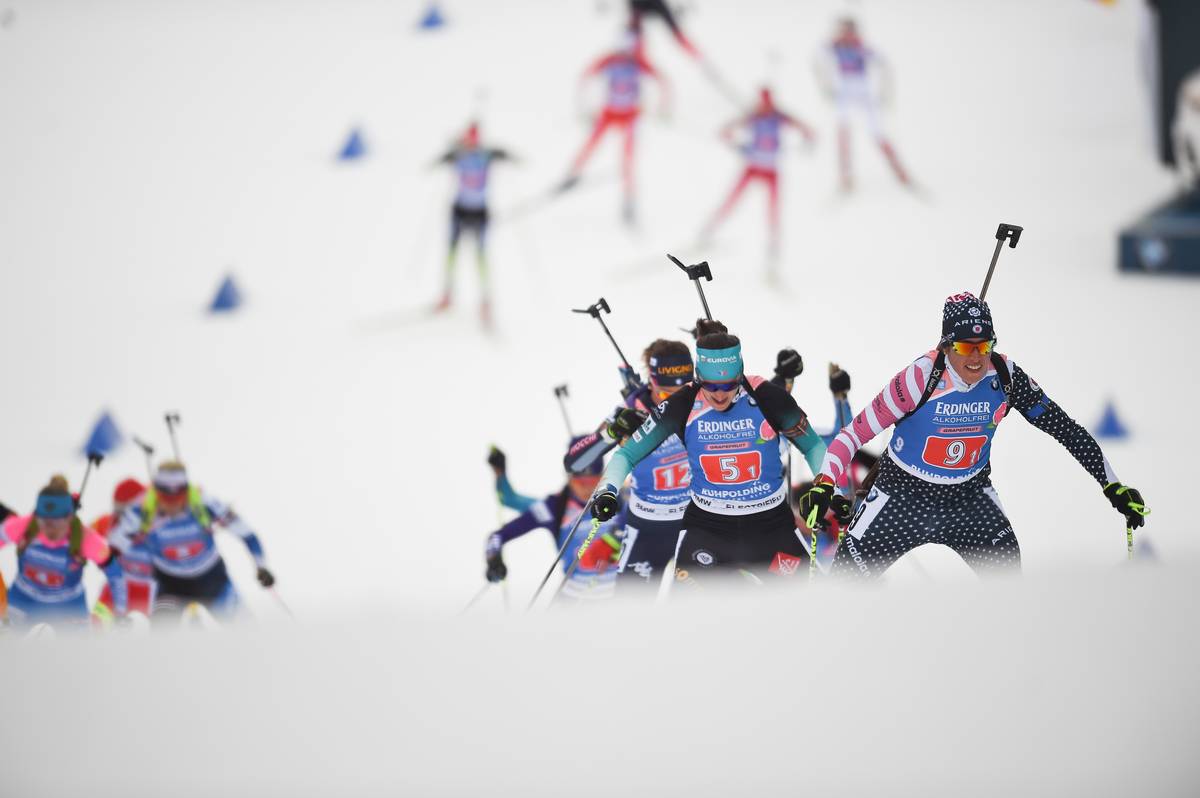
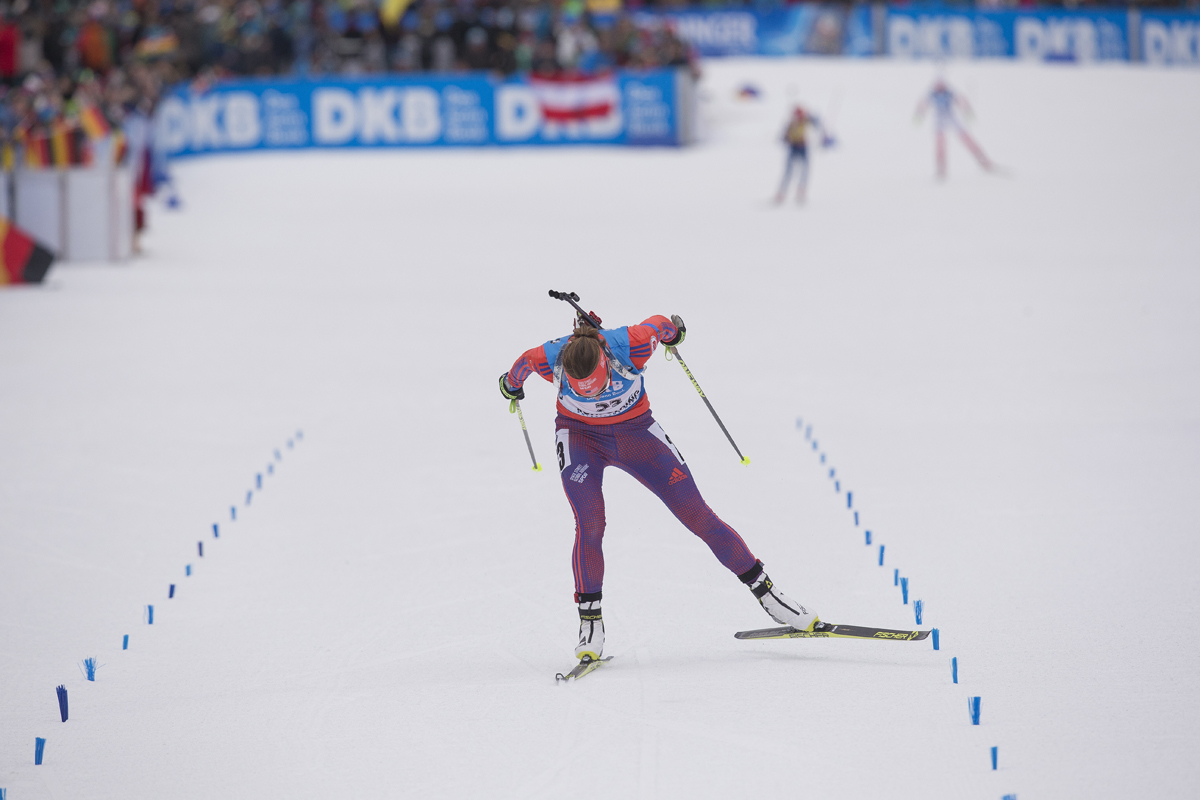
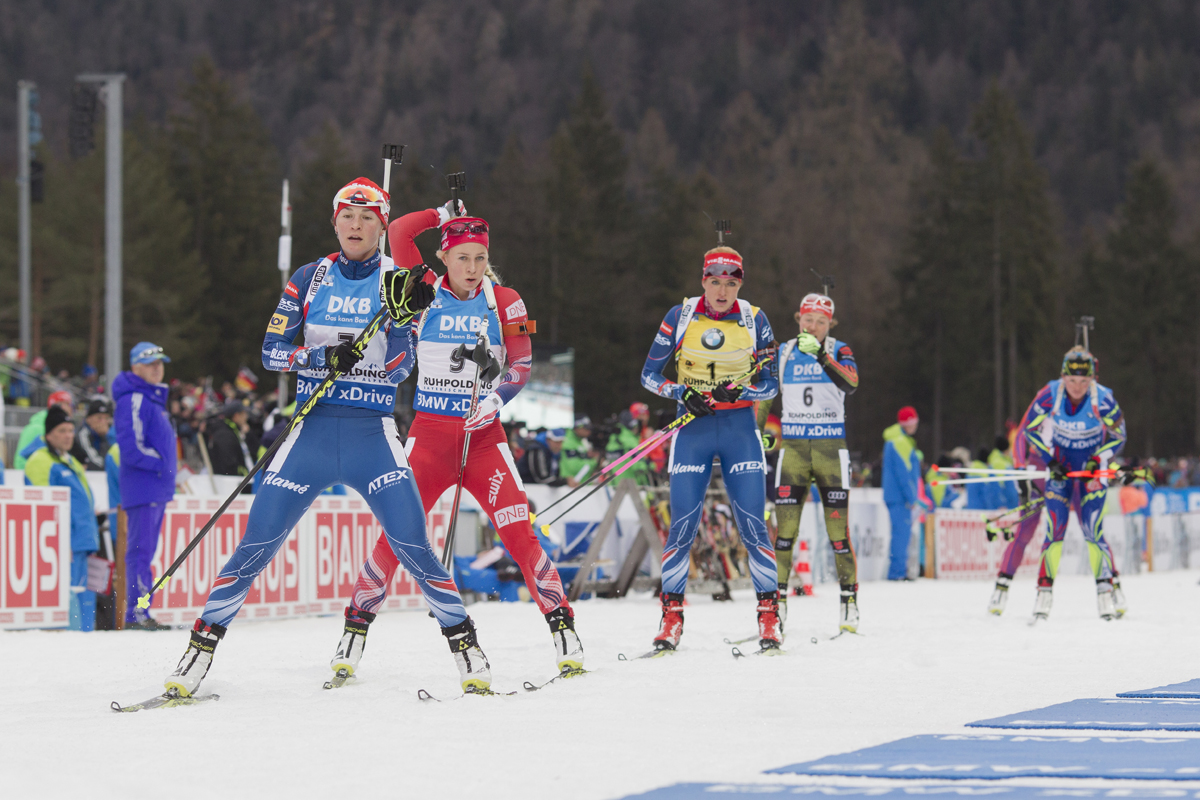
Susan Dunklee (bib 9) during the 2020 IBU World Cup women’s relay in Ruhpolding, Germany. (Photo: NordicFocus).
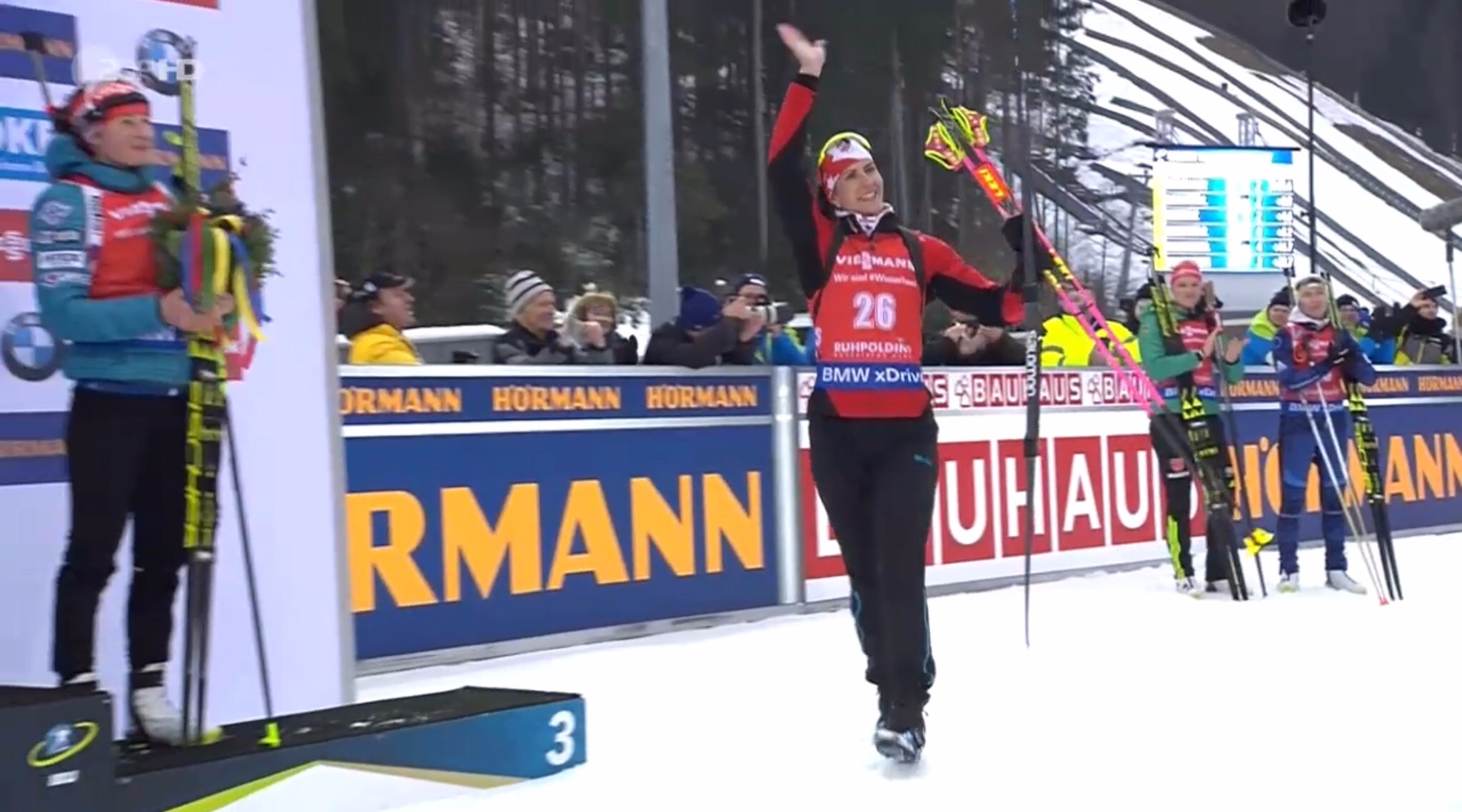
Biathlon Canada’s Rosanna Crawford (26) waves to some 20,000 spectators in the stands during the flower ceremony of the women’s 12.5 k mass start at the 2018 IBU World Cup in Ruhpolding, Germany, after finishing in fourth place. (Screenshot: ZDF broadcast)
Note: This article has been updated to include comments from Rosanna Crawford.
For a few minutes, it looked like Biathlon Canada’s Rosanna Crawford could clutch her second podium in her second-straight individual race in Ruhpolding, Germany, in the women’s 12.5-kilometer mass start on Sunday. Maybe it could even be the first World Cup victory of her career.
After cleaning also the 20th of 20 targets — as the only competitor to achieve that on Sunday in the elite mass start field of just 30 athletes — Crawford headed out on the final loop 16 seconds ahead of Czech Republic’s Veronika Vitkova, with Finland’s Kaisa Mäkäräinen and Germany’s Laura Dahlmeier a few additional seconds behind, all of them former World Cup winners and world champions.
“I was really surprised to leave the range in 1st, these are the 30 best women in the world,” Crawford wrote in an email.
On the prior loop, Crawford had lost just about ten seconds to those three and Darya Domracheva of Belarus, before passing them on the range with her flawless shooting. Mäkäräinen and Dahlmeier each incurred a penalty, having to ski 150 extra meters before they could return to the course to chase after her, while Vitkova had also remained clean in that stage.
But would the Canadian’s lead be large enough to reach the finish first, keeping some of the strongest skiers of the field at bay?
Anxiously looking behind several times, Crawford was overtaken by Dahlmeier and Mäkäräinen, but kept Vitkova behind her to stay in podium contention. Yet her lead was dwindling.
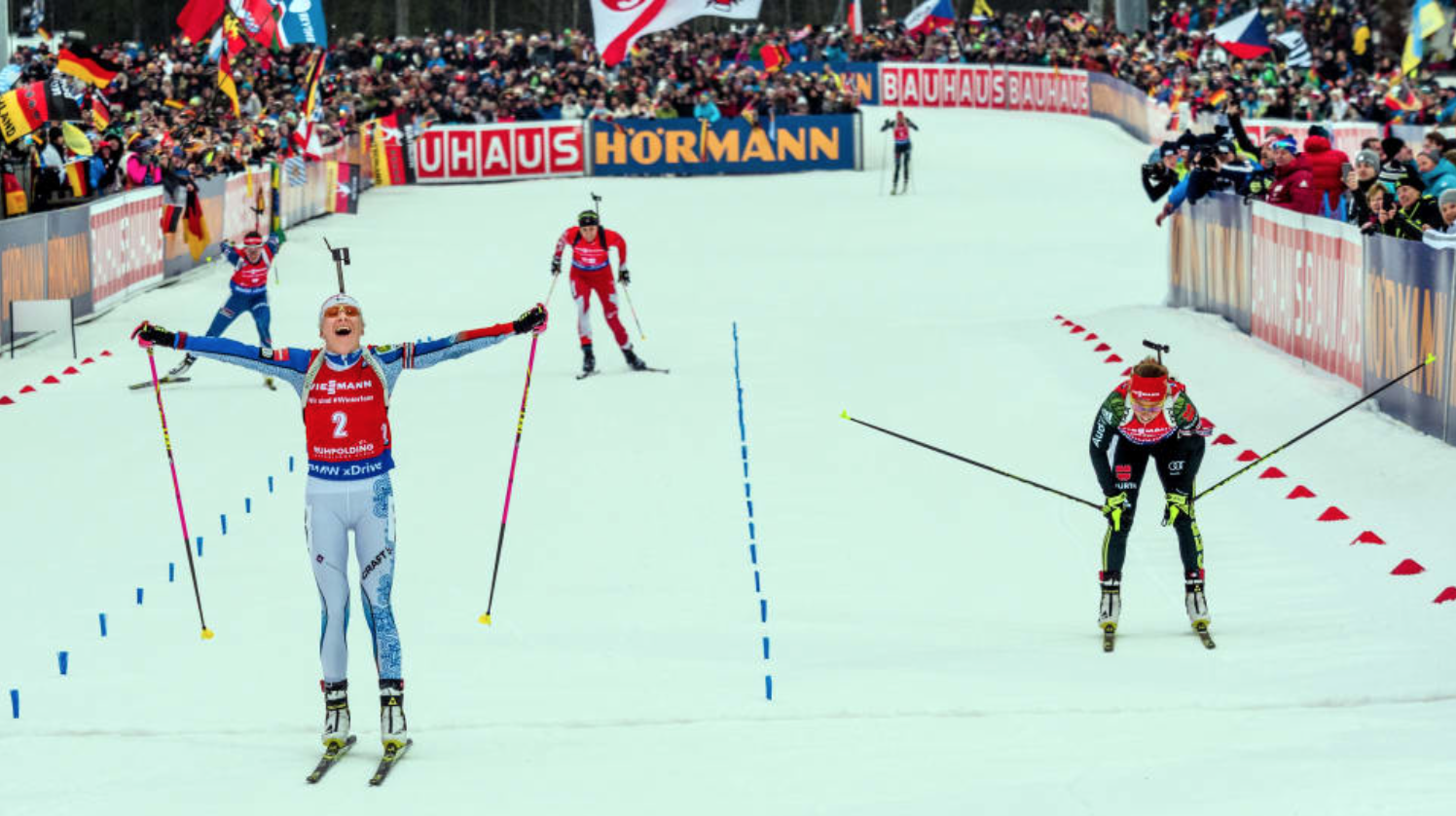
Kaisa Makarainen of Finland celebrates winning the women’s 12.5 k mass start in Ruhpolding, Germany, as Germany’s Laura Dahlmeier (r) takes second, Veronica Vitkova of the Czech Republic (far left) races to third, and Canada’s Rosanna Crawford (c) fourth. (Photo: IBU/Biathlonworld)
Out of the final downhill in a meandering section of turns, Mäkäräinen moved in front of Dahlmeier and held that ski-length lead into the finish. She crossed the line in a time of 34:05.6 minutes (with two penalties), with Dahlmeier just 0.8 seconds behind (also with two penalties) before collapsing to catch her breath.
Cheered on from the side of the track by coaches and teammates, Crawford remained in front right until the little tree branches marking the finishing lanes, but Vitkova was already on her tails.
“I really thought if I made it to the stadium in front of Vitkova I’d be able to hold her off, but she had the slip stream and I my legs just felt like concrete,” Crawford wrote.
Choosing the lane to her right, Vitkova pushed hard and managed to outsprint Crawford to the line for third (+4.6, with two penalties) while Crawford finished 0.6 seconds back in fourth (+5.2, with no penalties). For Crawford, the result was her career best in a mass start, and she received many congratulations from her peers and the ovations from thousands of spectators during the flower ceremony following the race.
“I would have love to hold onto a podium but was pretty dead on my last loop,” she continued, adding that she had woken up to a sore throat and congestion on Saturday, which persisted on Sunday. “In hindsight it was a mistake to be looking over my shoulder to see how close they were, I really should have just kept pushing, but this being a position I’ve never been in before I was pretty overwhelmed! Next time I will just keep fighting till I cross that red line in the snow! But having the two of the strongest women chasing me down was a bit scary! Kaisa is so fast and Laura I’m sure wanted to give the fans what they came for, a German podium!
“I was pretty disappointed when I crossed the line in 4th, but as time went by I got more and more happy,” she added. “To have hit another 20/20 is fantastic, especially in the high pressure situation of a Mass Start. With that race I went 50/50 in Ruhpolding!”
Germany’s Denise Herrmann followed in fifth (+16.7), almost making up for a penalty lap in each of the four stages by also skiing the fastest course time on each loop. Domracheva finished sixth (+23.7) after she had missed two more targets in the final standing stage (0+0+1+2).
For Vitkova it was the second podium of the season, after another third place in the sprint in Oberhof, Germany.
“I knew that Kaisa and Laura are behind me,“ Vitkova said of the exciting last loop in the post-race press conference. “My feeling on the skis was very good, and I believed that I can catch Rosanna. … It was very nice, now we have Olympic season and my results are better and better, so I am very happy.”
For Mäkäräinen, it was her first victory of the season and 22nd overall in her career. She also moved into the lead in the overall World Cup Total Score, 19 points ahead of Slovakia’s Anastasia Kuzmina in second.
“I appreciate silver and bronze a lot, too, since all podium places mean you had a good race, but victory is victory,” Mäkäräinen said in the press conference. “We were skiing quite fast all the last loop, I was on my limit all the time. … Happy that it ended this way.”
Dahlmeier, coming off a cold that forced her to forego the previous week of races in Oberhof, Germany, was satisfied with her result as well, despite narrowly missing out on another victory in front of her fans after anchoring her relay team to a win on Saturday.
“It was a lot of fun today, a really great race that had everything, suspense at the shooting range, a fight on the loop … and incredibly exciting with that finish sprint,” Dahlmeier told German broadcaster ZDF after the flower ceremony, according to a translation. “For me this was the perfect race to close out the week in Ruhpolding.”
“It was like Kaisa said, a really fast loop for us,” Dahlmeier later explained in the press conference. “We had really good equipment today, so for me it was a little bit easier on the downhill parts. We [caught] Rosanna Crawford, and I was in front on the last hill up the [shooting range climb]. Then we had the final sprint, and Kaisa was a little bit faster than me today. But I am very happy about this second place, and I think it is a really good sign that I am in good shape.”
As Crawford had told FasterSkier following her podium in the individual race, she considers Ruhpolding a “special place”, after she raced her first Junior World Championships there in 2008, her first World Cup in there in 2010, and on Thursday, her first World Cup podium (when she was third in the 15 k individual). She has followed that up with another one of her best results of her career.
“The crowd was amazing in Ruhpolding this whole week! I loved having my first podium at one of the most popular World Cup venues,” she wrote. “We had incredible skis all week and our techs worked so hard, a big shout out to them! I think none of them have voices this morning from cheering so hard in yesterday’s race!!”
And regardless of whether or not Crawford reached the podium on Sunday, multiple-time World Champion Dahlmeier pointed out, “There is no big difference even between a place in the 40s or a victory,” she said of the ups and downs of her weekend and the sport in general during the press conference. “With the shooting, you can have one or two [misses] more and you are somewhere out of the best 30. Then the next day you can win a race or be on the podium … That’s the difference between cross-country and biathlon, and that’s why we love it.”
J.T. Bø Wins Men’s Mass Start Ahead of Fourcade; Burke 21st
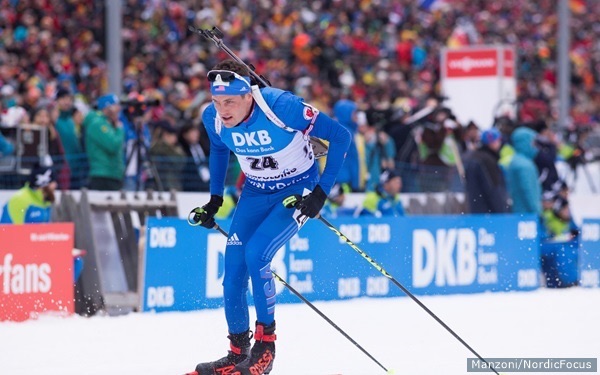
US Biathlon’s Tim Burke racing to 21st in the men’s 15-kilometer mass start at the 2018 IBU World Cup in Ruhpolding, Germany. (Photo: US Biathlon/NordicFocus)
Earlier on Sunday, US Biathlon’s Tim Burke successfully cleaned the first two stages in the men’s 15 k mass start to stay in contention for a top position. He left the range in 11th position and just 8 seconds behind the pace set by World Cup leader Martin Fourcade of France in first and his Norwegian rival Johannes Thingnes Bø in second.
“The atmosphere was great out on the course today with 25,000 fans,” Burke wrote in and email to FasterSkier. “No matter how many times I have done this, racing in that environment is always exciting.”
Then Burke missed the last shot in his first standing bout and had to ski a penalty lap. He came back on the course in 13th, just ahead of Fourcade who had incurred two penalties in that stage. Then Burke skied the fifth-fastest course time on the next loop, trying to again close a gap to the group ahead.
“I felt decent throughout the race but am definitely looking forward to racing on some different courses that better suit my strengths,” Burke wrote. “Ruhpolding is filled with short, steep climbs that are almost always followed by some type of recovery. Because of that, it ends up being an endless cycle of sprint then recover, which is definitely not my forte.”
After he missed two more targets in the final standing stage, Burke lost 10 positions and another 50 seconds to the leaders, leaving the range in 23rd. On the final loop he made up two places, passing Norway’s Lars Helge Birkeland and Bulgaria’s Krasimir Anev, to finish 21st (+1:30.2, with three penalties).
“Overall, I am happy with where I am at right now,” wrote Burke, who placed fourth in a 10 k sprint at the previous World Cup in Oberhof. “I just have to work on a few small details and then a top result should be possible.”
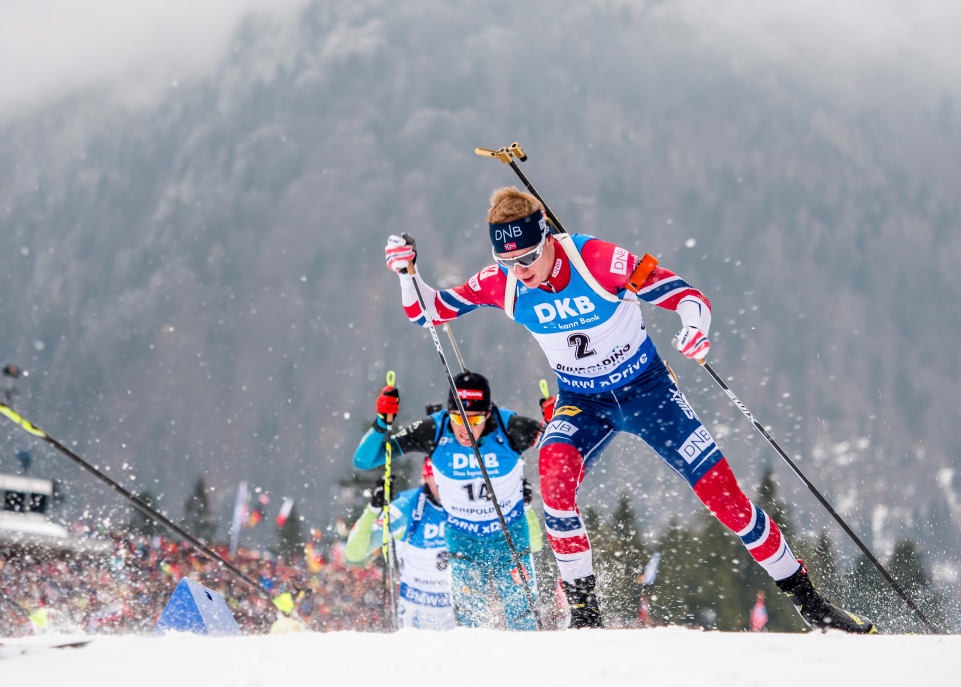
Ahead of Burke, the mass start was decided when Johannes Bø extended his lead on the fourth loop before the final shooting to almost 20 seconds, then returned to the course in first place despite a penalty in the last standing.
On the last loop he defended his lead ahead of three French athletes with Antonin Guigonnnat, Quentin Fillon Maillet and Fourcade chasing after him. Though Bø skied the second-fastest course time overall, he lost 14 seconds to Fourcade on the last loop and crossed the finish line 4.5 seconds ahead of Fourcade in 37:11.2 minutes (with one penalty).
Norway’s Johannes Thingnes Bø (2) racing to a win in the men’s 15-kilometer mass start at the 2018 IBU World Cup in Ruhpolding, Germany, with France’s Martin Fourcade behind him. (Photo: IBU/Biathlonworld)
At the press conference, Bø acknowledged that he was worried Fourcade would catch him.
“I was thinking about it when I saw him out on the tracks there, but I tried to just stay in my own lane for the tracks, and it was very good practice to stay on the lead on the last lap,” Bø said. “It’s very tough, mentally, and you just have to think forward and not so much about the people behind.
“When you fight for the win, you don’t want to be weak, you know?” Bø added when asked what gave him strength on that last loop. “So it’s just to be happy with the pain in the legs and ski as fast as you can.”
Fourcade — who temporarily dropped to 15th following two misses in the third stage — could not quite catch Bø and settled for second (+4.5), with two penalties (0+0+2+0).
“It was a really good fight at the front of the competition,” Fourcade said inatthe press conference. “I didn’t take enough time to be stable on my [first standing stage] and I missed two, but I think I could [have missed] three on that; it was a really bad one. … I knew that with two mistakes advantage, it would be really hard to come back on Johannes, and when I saw that he missed only one on the last shooting, I knew that it was already over for me.”
So he focused on at least catching his teammates Guigonnat and Fillon Maillet on the final loop, who had left the range in second and third, respectively.
“It was really special to fight with them because we know each other — our strong points and our weaknesses,” Fourcade said. “I knew that I had to be really faster than Antonin before the last finish [stretch], because he’s a really good sprinter.”
Fourcade’s 26-year-old teammate Guigonnat, who had been called up to the French World Cup team for the last three races, finished third place (+8.4, with no penalty). It was the second World Cup podium of his career, following up on another third place in the sprint in Annecy, France, earlier this season.
“I didn’t feel much pressure because I’m clearly an outsider, so nobody’s cheering for me, I think,” Guigonnat modestly said in the press conference. “And the other guys, they are fighting each other for maybe the yellow bib [of the World Cup leader] or things like this, and then I just do my job and that’s it.”
Fillon Maillet finished fourth (+12.6, with one penalty), and Bø’s older brother Tarjei Bø placed fifth (+14.2, with one penalty) after he made up by five positions on the final loop.
Burke learned Saturday that he could race the 30-man mass start, after being listed as the third alternate based on his current World Cup Total Score. After Sunday’s race, he’s up to 26th in the overall standings.
“A few athletes in front of me were sick so they decided to sit out,” Burke explained in his email. “This is very normal for a mass start, you can usually count on 1 to 3 athletes sitting out. I ended up doing that earlier this season [for the World Cup in Annecy] when I sat out the Mass Start because of a cold.“
Aside from Crawford and Burke, no other North Americans qualified for Sunday’s mass starts via the top-25 positions in the World Cup Total Scores, respectively the five best results of those outside those ranks in the individual race.
The IBU World Cup continues in Antholz, Italy, with sprints on Thursday, Jan. 18 for the women and Friday, Jan. 19 for the men.
“My fiancée will come down, so I’m looking forward to have her on her first World Cup outside Norway, so that will be fun,” Bø revealed when asked about Antholz at the press conference.
“That’s good news for me, because he will be really tired for competitions,” Fourcade quipped, as both laughed.
Fourcade continues to lead Bø in the Total Score standings, now just 44 points ahead with 666 points.
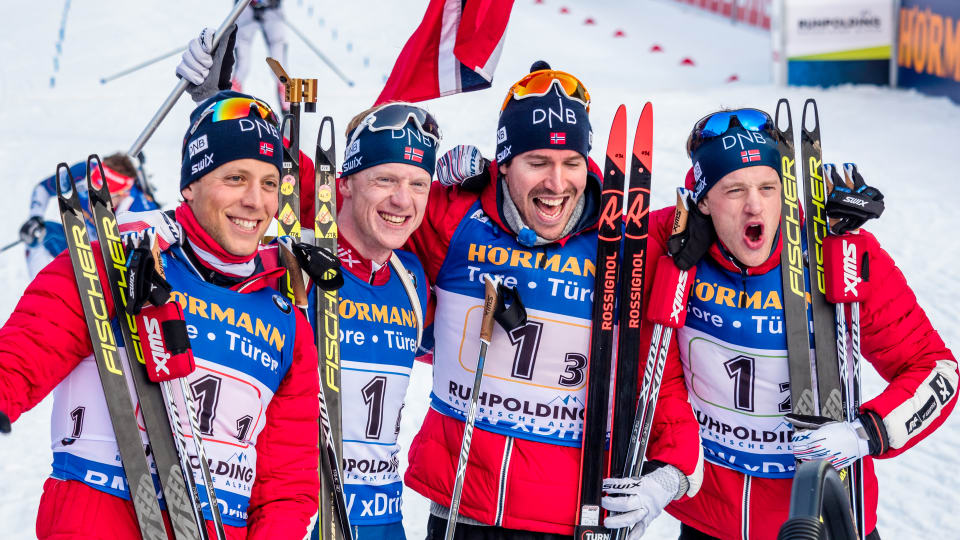
The Norwegian men’s relay after winning the 4 x 7.5 k on Friday at the IBU World Cup in Ruhpolding, Germany, with Lars Helge Birkeland (l), Tarjei Bø (far r), Emil Hegle Svendsen (second from r), and Johannes Thingnes Bø (second from l). It was their second win of the season (after winning with Ole Einar Bjørndalen, Henrik L’Abée-Lund, and Erlend Bjøntegaard, and Birkeland in the first men’s relay of the 2017/2018 season in Hochfilzen, Austria. (Photo: IBU/Biathlonworld)
IBU World Cup (Ruhpolding, Germany): Men’s 4 x 7.5 k relay
Less than a week after Sweden won the men’s 4 x 7.5-kilometer relay in Oberhof, Germany, with an up-and-coming group, Norway posted its second win (in three relays) this season, with an all-star lineup on Friday in Ruhpolding, Germany.
Lars Helge Birkeland, Tarjei Bø, Emil Hegle Svendsen, and Johannes Thingnes Bø took the lead during Johannes Bø’s anchor leg and ultimately the win in 1:13:11.1 hours, 24.9 seconds ahead of France in second and 53.4 seconds ahead of Russia in third.
On a bluebird day with no wind in the range, according to an International Biathlon Union (IBU) press release, the Norwegians avoided the penalty lap and used seven spares to clean. First-leg skier Birkeland put them in second with near-perfect shooting (0+0, 0+1), just 0.4 seconds behind Germany’s Erik Lesser, who cleaned without any spares, in first. (Birkeland was also on the Norwegian team that won the first relay of the season in Hochfilzen, Austria.)
Norway remained in second during Tarjei Bø’s second leg, in which he had to use three spares to clean prone (0+3, 0+0). He tagged Svendsen in second, 0.6 seconds behind Italy, which had risen to first thanks to Lukas Hofer’s fast skiing and solid shooting (0+0, 0+2).
Svendsen slipped slightly to third place by the final exchange despite only needing one spare to clean (0+0, 0+1), but was still just a second out of first at the tag. France had moved into first place with a predictably strong third leg from Martin Fourcade (0+0, 0+0), in which he brought the team from seventh to first place, just ahead of Italy’s Dominik Windisch and Norway’s Svendsen.
Johannes Bø skied the third-fastest anchor leg and cleaned prone and used two spares in standing (0+0, 0+2) to overtake France’s Antonin Guigonnat and Italy’s Thierry Chenal, who slipped to second and seventh, respectively, by the finish.
Guigonnat shot well, requiring just one spare (0+1, 0+0), but finished nearly 25 seconds after Bø for second place. Russia reached the podium with Anton Shipulin picking off two places, after being tagged in fifth.
In all, France had zero penalties and six spares, with Simon Desthieux, Quentin Fillon Maillet, Fourcade, and Guigonnat, and Russia used a total of just four spares and had no penalties with Alexey Volkov, Maxim Tsvetkov, Anton Babikov, and Shipulin.
Germany finished fourth (+1:26.5) with zero penalties and 10 spares, with Lesser, Benedikt Doll, Arnd Peiffer and Simon Schempp. After Doll dropped to fifth on the second leg, they skied in fourth on the last two legs.
Austria took fifth (+1:39.8) with zero penalties and six spares, with David Komatz, Simon Eder, Daniel Mesotitsch, and Dominik Landertinger. Sweden followed in sixth (+1:50.6) with zero penalties, six spares and three of the same men who won last Sunday’s relay (Sebastian Samuelsson, Martin Ponsiluoma and Fredrik Lindström) with new member Torstein Stenersen. Italy finished seventh (+1:58.5) with one penalty and 11 spares.
Of 26 teams in the relay, Canada placed 14th (+3:22.3) with one penalty and 10 spares, and the U.S. finished 24th (+16:21.6) with eight penalties (four of which stemmed from cross-firing) and 13 spares.
Notably, the U.S. had been fourth and just 3 seconds out of first after Lowell Bailey’s first leg, which he cleaned without any spares (0+0, 0+0). Leif Nordgren then dropped to 22nd with a penalty in each of his shooting stages (1+3, 1+3) and the 25th-ranked second-leg time. Tim Burke as the team’s third leg had to ski two penalty laps as well (0+2, 2+3), and anchor Sean Doherty was penalized for cross-firing in his last standing stage (0+1, 4+1), according to a US Biathlon press release, and the team was hit with four additional penalties.
“We have a solid team and I know we didn’t show our true potential today,” Bailey said, according to the release. “But the most important relay is still to come. We’ll just have to wait until then.”
“I was happy to put together a good race on the track and in the range,” he said. “The first lap was a bit of a roller derby with no easy way to get to the front. I was fortunate to clean without extra rounds because this allowed me to leapfrog up to the lead pack exiting the range. I tried to keep an even pace for loop two and I thought I would be able to hang in second or third, but no one wanted to pass so I had to lead for most of the loop.
“I had struggled in standing in the previous race so I wanted to get back to taking good shots in standing,” he added. “Although I didn’t shoot as quickly as some of the other guys, I felt good about the stage and the fact that I didn’t have to use extras. It was a fight to catch the lead group on the last loop, but fortunately I had some help from [Italy’s Thomas] Bormolini (of Italy) and we worked together to get back in contact with the lead group.”
Canada finished 14th with Christian Gow, Scott Gow, Macx Davies, and Brendan Green. On the opening leg, Christian Gow put them in 11th with clean prone shooting and just one spare needed to clean standing (0+0, 0+1), but they slipped one spot to 12th with a penalty on Scott Gow’s second leg (0+0, 1+3). Davies then dropped two more places to 14th despite avoiding the penalty lap (0+3, 0+1), and Green held that position to the finish (0+1, 0+1).
The women’s 4 x 6 k relay will be held Saturday in Ruhpolding, with Canada starting Emma Lunder, Julia Ransom, Sarah Beaudry, and Rosanna Crawford. For the U.S., it will be Susan Dunklee, Clare Egan, Emily Dreissigacker, and Joanne Reid. Watch it live on the Olympic Channel at 8:30 a.m. EST.
Rosanna Crawford celebrates with her Biathlon Canada teammates Emma Lunder (l) and Julia Ransom (r) after placing third for her first-career IBU World Cup podium on Thursday in the women’s 15 k individual in Ruhpolding, Germany. (Photo: Salomon/NordicFocus)
For a while it looked as if the podium in the women’s 15-kilometer individual at the Thursday’s IBU World Cup in Ruhpolding, Germany, had been all but decided with only a few more athletes circling the course. But then the favorites who had already finished had someone to worry about.
Along with some 13,000 spectators in the stands, they paid close attention to the video walls in the arena, as one late-starting Canadian — Rosanna Crawford — had just set the best split time after the third shooting by hitting every target for the third time in a row. She was even 1.8 seconds ahead of race leader Dorothea Wierer of Italy.
“I actually didn’t know I was fighting for a podium until the fourth loop,” Crawford told FasterSkier on the phone after the race. That’s where Czech wax technician, Tom Zidek, a former Biathlon Canada wax tech, told her she was is in first place.
Canada’s Rosanna Crawford (standing) celebrates her first IBU World Cup podium on Thursday after placing third in the women’s 15 k individual in Ruhpolding, Germany, while Sweden’s Emma Nilsson (who placed 36th) unclips. (Photo: Salomon/NordicFocus)
“I was like, Oh God!” she recalled with a laugh. “But I think that kind of helped as well because then I knew to expect the crowd for the last standing.”
Could this be Crawford’s big day? Coming into the range for the final standing shooting, the 29-yaer-old Canmore native knew she likely would get a season-best result if she did not totally implode, but needed to shoot clean again to stay in podium contention and not get hit with the individual race’s merciless one-minute penalty per miss.
“I made sure just to set up properly, and then I took an extra breath before my last shot and was pretty pumped to see it turn to white,” Crawford recalled of her last shooting stage. “I am a person who really likes cue words and I have a few sentences that I repeat over in my head. … I knew the only way I was going to hit the targets is if I only thought about the present moment.”
After she had cleaned all five targets for the fourth time, bringing her shooting percentage to a perfect 20-for-20 (the first time she had ever done so in a race), Crawford skated off the shooting mat with a smile on her face. She left the range now 7.8 seconds behind Wierer’s time (after the Italian had also hit all 20 targets), but was still more than 20 seconds ahead of Finland’s Kaisa Mäkäräinen (who had incurred one penalty in her first prone shooting but shot clean after that) and Ukraine’s also clean-shooting Yuliia Dhzima.
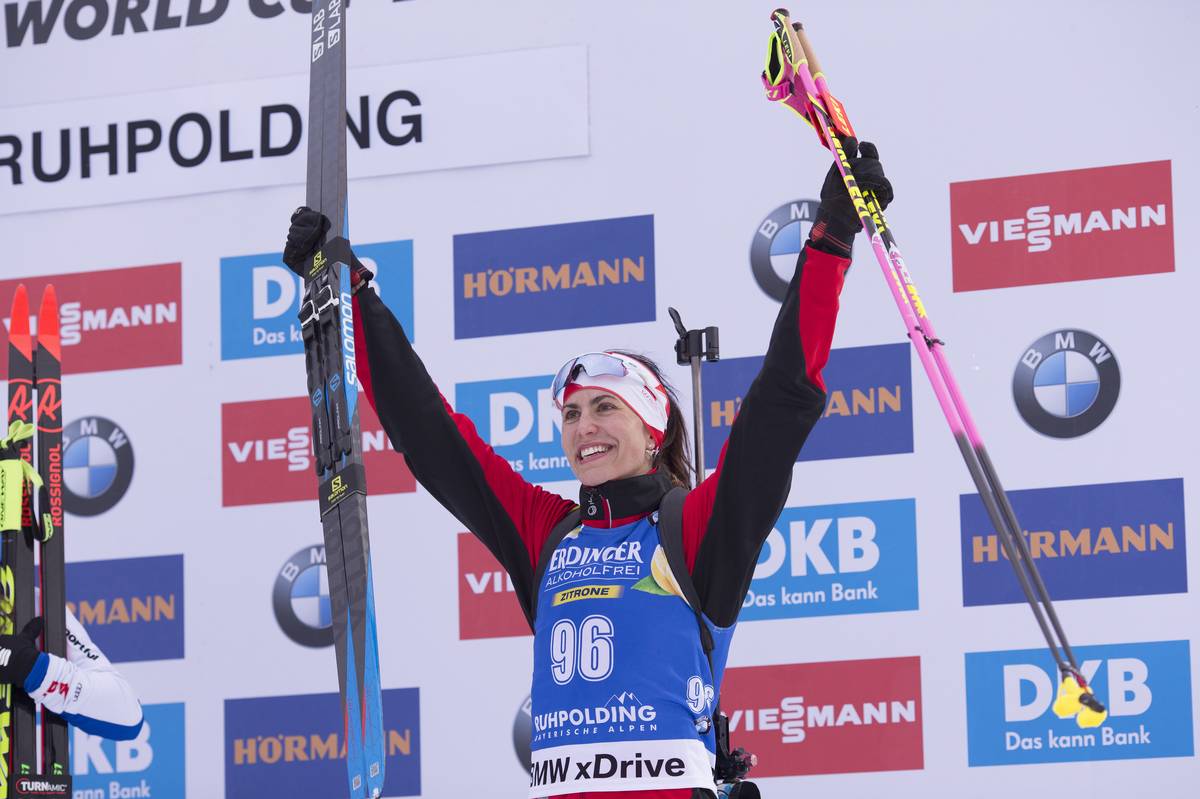
“Being one of the last competitors with bib 96 I had a lot of time to wait,” Crawford said at the IBU’s post-race press conference. “I knew all the eyes were on me probably for my last two shootings. That is something I have never experienced before, going from the third loop onwards where everyone was cheering for me around the loop. … It’s a feeling I have never had before to hit all 20, so I was really excited to ski out of the range.”
With her team staff, including head coach Matthias Ahrens running next to the track cheering her on, Crawford chased around the loop up the steep “Wall of Ruhpolding” climb. Overall she skied the 26th-fastest course time of the day, and on the final loop in softening conditions, her loop time ranked 48th. But she still hung onto the podium.
“The course had broken down a little bit, with a hundred-and-something starters, so by the time I went around I was really searching for the best line, which I think paid off as well,” Crawford said.
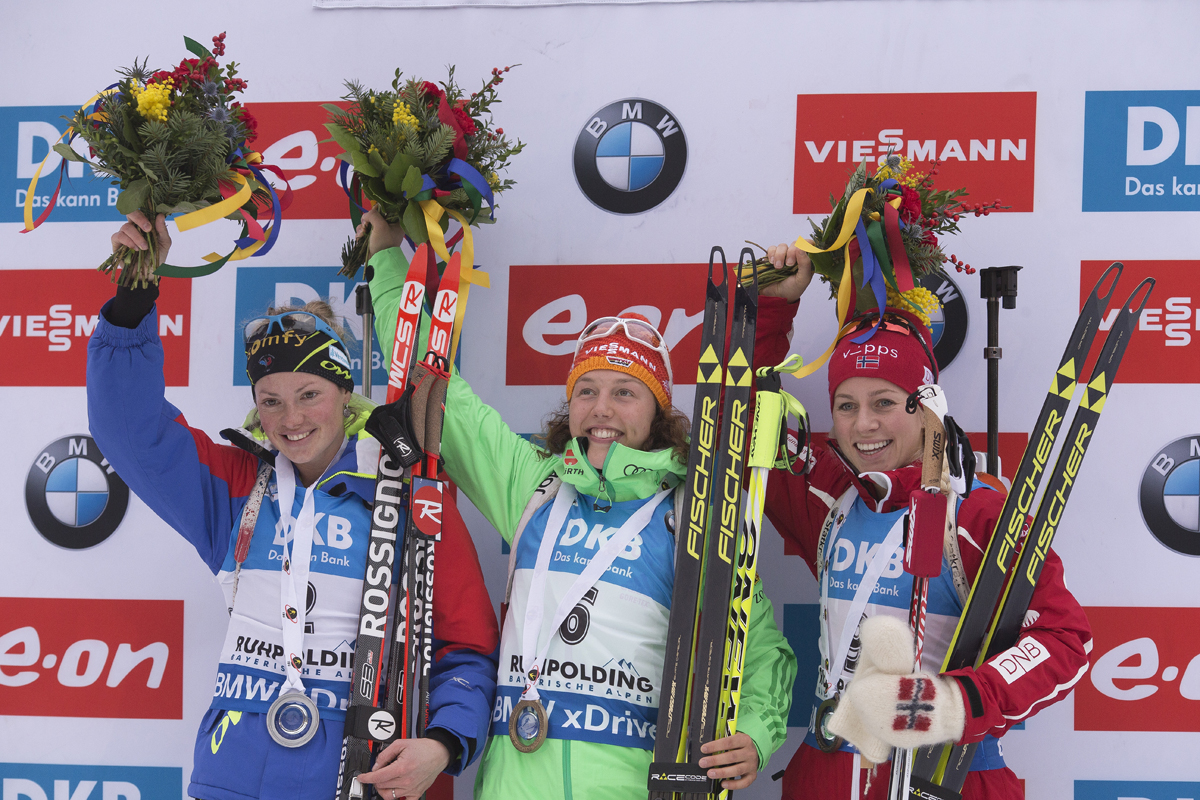
The women’s 15 k individual podium at the IBU World Cup in Ruhpolding, Germany, on Thursday, with Italy’s Dorothea Wierer (c) in first, Finland’s Kaisa Mäkäräinen (l) in second, and Canada’s Rosanna Crawford (r) in third. (Photo: Salomon/NordicFocus)
Coming out of the downhill and onto the finishing stretch with the thousands of spectators cheering her on, Crawford fought the clock. She was out of reach of Wierer, but still within striking distance of Mäkäräinen in second. At the finish, Crawford was third, 21.2 seconds behind Wierer and 8.5 seconds behind Mäkäräinen in second place (+12.7). The Canadian was comfortably ahead of Dhzima in fourth (+45.9), while another clean-shooting Ukrainian, Valj Semerenko, placed fifth (+52.6).
“I am so excited today, it was really special, my first time hitting 20-for-20 as well,” Crawford said at the press conference. “I really love Ruhpolding! It was my first World Juniors, my first World Cup, and my first podium, so it’s a very special place for me.”
As Crawford skied into the finish she looked up to the nearest video monitor to check if she indeed had managed to hold her position on the podium for the first time. But she didn’t have to wait long for confirmation as her teammates and coaches already rushed out into the finish to hug and congratulate her.
“Julia [Ransom], Emma [Lunder] and Sarah [Beaudry], they kind of pushed past the IBU guys, which I don’t think they were allowed to do, but Canada’s not on the podium every day so they let them sneak by to give me a hug so that was really special,” Crawford told FasterSkier. “I’ve been with these girls the past couple years now and so to be able to celebrate with them is amazing. Their results have been so inspiring for me … [My coach Roddy Ward] also jumped the fence, which I don’t think was allowed, so that was nice to be able to see him as well.
Biathlon Canada celebrates Rosanna Crawford’s podium on Thursday in the IBU World Cup 15 k individual in Ruhpolding, Germany, with (from left to right) coach Roddy Ward, Crawford, Emma Lunder, Julia Ransom, and Sarah Beaudry. (Photo: Salomon/NordicFocus)
“It’s just such a team effort to get to the podium,” she continued. “I’m the one out there skiing and shooting, but I couldn’t have done it without the amazing skis on my feet or my coaches behind the scope, so Matthias and Roddy were really important there, and I couldn’t have done it without the girls who I train with all summer. I’m just so grateful for this team that I’m on.”
“So proud!!!” her longtime boyfriend and teammate Brendan Green wrote on Instagram with a screenshot of Crawford finishing.
“Brendan is amazing,” Crawford said. “I’m sure he was pretty nervous. He was the first text messages and tweets and Instagrams that I had on my phone. Right now I’m having dinner with him and then we’ll go to the awards ceremony tonight. It’s really special.”
“It’s incredible for me, not something that I was really expecting this season,” she told German broadcaster ZDF in an interview immediately after the race. “I didn’t have the best summer of training so to be on the podium is really special for me.”
That was an understatement. Last spring, Crawford and her family dealt with a severe personal tragedy with the loss of her brother Jordan.
“It was such a hard summer for me, losing my brother in April,” she told FasterSkier. “I really wish he was here today so I could celebrate with him, too. I miss him a lot. Jordan was a huge cheerleader for me. He always believed in me. Whenever I was home, he was always cooking me food and helping me take care of the dogs, and he was always so concerned that he was causing me stress. … Jordan loved the outdoors so whenever I was out in a valley or skiing or mountain biking, he was always in my thoughts, and wishing I could share these things with him. It was really hard on the whole family, but it brought us closer together as well in some ways, to support each other.”
Asked if she had caught up with her family members yet, including her sister Chandra Crawford, a 2006 Olympic gold medalist in cross-country skiing, she said she had spoken to all of them.
“Training was always a little bit on the back burner for the first couple months while we were all grieving and then once finally the motivation came around again to start training, it felt right and proper,” she said of her offseason and transition to another race season. “But then again, the results just were not paying off through the first trimester [of the World Cup] and I didn’t know what I was doing wrong and I was really starting to lose hope.”
Crawford’s previous best non-relay result this season was 39th in the 10 k pursuit in Hochfilzen, Austria. And her last time in the top 10 outside a relay race was back in December 2014, where she placed fourth in a sprint and seventh in a pursuit in Pokljuka, Slovenia.
Coincidentally, Germany’s ZDF network featured the Canadian women’s team in a preview to the individual race, filming them and coach Ahrens while they attended a one-hour cooking class in Ruhpolding. But they certainly had not intended it as a segment on a likely podium finisher for the very next race.
“Yes, of course the Bavarian food fueled me around the course,” Crawford said with a laugh when ZDF asked about that.
“Just thank you so much to the fans. There is no way I would have been able to ski around that last loop without them,” she added.
“This really describes the biathlon family,” Crawford later explained in the press conference. “That it doesn’t matter which country you are from, people will be cheering for you. And not only the fans but also the techs. Jarko, Kaisa’s head wax tech, who used to wax for Canada, he was giving me splits off of Kaisa telling me, ‘You are ahead of Kaisa, go get her!’ So they might have to have a serious conversation tonight! It was really incredible.”
Rosanna Crawford (Biathlon Canada) finishing third in the IBU World Cup women’s 15 k individual in Ruhpolding, Germany. (Photo: Salomon/NordicFocus)
In her interview with FasterSkier, Crawford also spoke of a Ukrainian coach who cheered her on for the final loop. “I think this really describes what the biathlon family actually is,” she said. “It’s not the IBU. It’s the coaches and the athletes and the wax techs and the fans, that is actually the biathlon family.”
Despite all the support she had felt throughout the year, Crawford had a season she was not satisfied with so far, with two 39th places as her best results (excluding relays). Going into this race, she ranked 79th in the overall World Cup standings. Last weekend, instead of starting at the World Cup in Oberhof, Germany, she raced two sprints on the IBU Cup in Brezno-Osrblie, Slovakia, where she placed 15th and 22nd. More so than a demotion, that was a move Biathlon Canada made to give other women on the team a chance to qualify for the upcoming Olympics.
“This season has definitively not started out very good for me, and then getting sent to the IBU Cup was really frustrating,” Crawford said on the phone. “But I did really like the course in Osrblie, and it was the best skiing I’d felt all year so I really tried to carry that momentum into today’s race. … I think staying in Europe over Christmas was incredibly beneficial for us.”
Crawford’s previous career bests in non-relay races have come in sprints, with her fourth place in Pokljuka and a fifth place in Hochfilzen, both during the 2014/2015 season. She’s been on the podium before, placing second with teammate Nathan Smith in the single mixed relay in Östersund, Sweden, to open the 2015/2016 season.
“There’s just so many lessons you learn over the years, and trying to bring it all together and to have it pay off on one day is exactly what we’re all hunting for out there,” Crawford concluded.
Fourth Career Victory for Wierer
Italy’s Wierer, who frequently performs very well in this competition format and also won the individual in Ruhpolding in 2016 (Crawford placed 18th back then as the best North American) set the best time on Thursday, crossing the line after 41:29.0 minutes.
“I am really happy about this,” Wierer said at the press conference. “I knew that it’s all about the shooting. In the last individual competition I shot really bad, but the last weeks I feel really confident about my shooting. I think the track was really good, and hard conditions are much better for my skiing. The shooting range wasn’t difficult today, there was nearly no wind.”
Asked about having to wait if her time would ultimately be good enough for first place, she added with a laugh: “I was looking [at] Rosanna, and I was afraid of her. But finally I saw that she was some seconds behind me. I wasn’t sure because on the last round I lost a lot, I was really tired, but at the end she didn’t get me!”
On her 35th birthday, Mäkäräinen finished second (+12.7). She was the only finisher in the top five with a penalty, incurred during her first prone shooting.
“It’s a good present,” she said at the press conference when asked about her second place. “I have actually managed to do many good races on my birthday, so this is nice. … 19 out of 20 is really good for me, probably my best shooting this winter, so I am really happy about that and not thinking too much about that one penalty.”
“It’s an amazing place,” she added when asked about her tendency to do well in Ruhpolding. “I like it a lot here because the crowd is really close to us, and there were a lot of people from Finland here, also my parents and their friends. So it was a nice atmosphere today.”
She added that she did not intend to extensively celebrate her birthday with her family.
“I will celebrate by having a massage and good dinner,” Mäkäräinen said. “Just basic things, the athlete’s life goes on, we have more races to come.”
Dunklee 27th, Ransom 34th
For US Biathlon, Susan Dunklee finished 27th with three penalties (1+1+1+0), staying ahead of a number of competitors who performed better on the range thanks to her 14th-ranked ski time.
“Certainly the highlight for me today was watching Rosanna crush it,” Dunklee wrote in an email. “Her whole team, athletes and staff, were overjoyed. It’s inspiring to see and lends positive energy to all the North Americans going forward.”
“This was the first race that felt normal for me and not an extreme high or low,” she wrote of her own race. “It’s a relief. The skiing felt great today and I have no doubts in it going forward. Shooting is finally rounding into form; 85% is a solid result. My goals going forward are to stay healthy and happy and I believe that’s what I need most to perform well in February.”
US Biathlon’s Clare Egan in front of the stands in the finish of the women’s individual 15-kilometer race at the IBU World Cup in Ruhpolding, Germany. Initially she was ranked 35th, and ultimately ended the race in 57th. (Screenshot: ZDF broadcast)
Starting about in the middle of the field in bib 43, her teammate Clare Egan was initially 35th as she came into the finish, waving to the cheering crowd as she was shown on the video wall. As more athletes ended their races ahead of her, she ultimately finished 57th (+4:26.3) with three one-minute penalties (0+1+0+2).
“Finally a race I can be proud of!” Egan commented in an Instagram post.
“We will field our first women’s relay this weekend,” Dunklee wrote of their team, which will be joined by athletes who competed at the IBU Cup in Arber, Germany, on Thursday. “It has been a challenging season so far living and traveling with such a small crew, trying to stay upbeat and carry the team with a skeleton group.”
Starting the race early in bib 5 and thus completing her race before Crawford’s had even begun, Biathlon Canada’s Julia Ransom placed 34th (+3:35.0) with two penalties (1+1+0+0). Sarah Beaudry finished 53rd (+4:18.6) with two penalties (0+1+1+0), and Emma Lunder was 67th (+5:21.7) with four penalties (1+0+2+1).
After their own races had concluded, they could only wait for Crawford after learning about the great day she was having and excitedly ran out into the finish to greet her.
“It’s really amazing for our country and for our sport,” Crawford said in the press conference. “Hopefully there will be a few more eyes on biathlon during the Olympics. The last person to get a podium was Zina Kocher in the individual as well [a third place in Östersund during the 2006/2007 season]. So this is becoming a special race for Canada. Julia Ransom had a personal best with a ninth place in Östersund, so we seem to be individual specialists.”
Skardino Earns Individual Discipline World Cup
Since the IBU does not count the races at the upcoming Olympics for World Cup points and standings, this second individual race was also the last one on the competition calendar this season.
Thus Nadezda Skardino of Belarus, who won the first individual race of the season in Östersund, managed to claim the “crystal globe” award in that discipline by finishing seventh in Ruhpolding on Thursday (+1:04.8, with no penalty). It was Skardino’s first World Cup discipline title.
Despite finishing ahead of her in fourth on Thursday and another third place from the race in Östersund, Ukraine’s Dzhima could not make up enough points and placed second in the standings just five points back, while Mäkäräinen was third. Even without Crawford still finishing ahead of Skardino and Dhzima the outcome would have been the same.
“It was my dream, and now I’m minus one dream in my life,” a smiling Skardino told the IBU. “I am very happy, because I thought about it after my win in Östersund. … And now I did it! Today I was not very fast on the tracks, I only thought about my clean shooting. I understood that I can win [the discipline title] if I shoot clean. I knew if some more people stay between Yuliia and me I could lose more points and still lose this, but after all people finished I was very happy I did it!”
Crawford placed 12th in that ranking as the best North American, scoring 2 points for her 39th place in Östersund and 48 for the third place in Ruhpolding.
The women’s World Cup Total Score leader Anastasia Kuzmina of Slovakia, coming off two victories last weekend in Oberhof, placed eighth on Thursday (+1:32.3, with three penalties) to retain her lead there.
Races in Ruhpolding continue with a men’s relay on Friday and women’s relay on Saturday, before concluding with mass starts on Sunday. Crawford is now qualified for that race as one of the five best athletes this week not currently in the top 25 of the overall World Cup; she is now ranked 48th in the Total Score standings.
Rosanna Crawford (Biathlon Canada) celebrates her first-career IBU World Cup podium on Thursday in the women’s 15 k individual in Ruhpolding, Germany. (Photo: Salomon/Nordic Focus)
IBU World Cup (Ruhpolding, Germany): Women’s 15 k individual
It’s been a long time coming, but on Thursday, Rosanna Crawford, 29, achieved her first podium on the International Biathlon Union (IBU) World Cup circuit.
It came in Ruhpolding, Germany, in the longest-format race for the World Cup women: the 15-kilometer individual. In the four-stage race, which adds a minute penalty to a competitor’s time for each missed shot, Crawford of Canmore, Alberta, shot a perfect 20-for-20. She said she had never done that before in a World Cup race.
“I really like the Ruhpolding range,” Crawford said in a post-race phone interview, after finishing third behind Italy’s Dorothea Wierer and Finland’s Kaisa Mäkäräinen, respectively. “This was my first World Juniors, my first World Cup and now my first podium, so it’s a pretty special place for me.”
Wierer won the race with 20-for-20 shooting as well, starting 24th and finishing with the fastest time of 41:29.0 minutes. Mäkäräinen as the 12th starter missed out on first place due to a single miss in the first prone (1+0+0+0) and ended up 12.7 seconds back in second place.
Crawford, one of the last starters in bib 97, turned heads throughout the race with each passing clean bout. With one extra breath before her last shot, she successfully hit her last target and left the range with a huge smile.
“I think I almost started crying,” she recalled.
She finished 21.7 seconds out of first, and almost 25 seconds clear of fourth-place finisher Yulia Dzhima of Ukraine. Even a Ukrainian coach was cheering for Crawford on her last loop.
“That last lap was so cool,” Crawford said. “Right past the penalty loop, the Ukrainian coach was like, ‘You’re one second, — or whatever time I was — from first,’ and it was amazing. I think this really describes what the biathlon family actually is. It’s not the IBU. It’s the coaches and the athletes and the wax techs and the fans.”
Her teammates and coach, Roddy Ward, awaited her arrival in the finish pen.
“Canada’s not on the podium every day so they let them sneak by to give me a hug so that was really special,” Crawford said.
Her result is her first non-relay top 10 since a pursuit in December 2014, where she placed seventh in Pokljuka, Slovenia. The race before that, she placed fourth in the Pokljuka 7.5 k sprint, which was had been career best — until Thursday.
“Who knew that I would get my first podium in an individual?” Crawford mused. “I was laughing at that myself.”
The U.S. was led by Susan Dunklee in 27th (+3:02.7), who had one penalty in each of the first three stages (1+1+1+0).
Canada’s Julia Ransom placed 34th (+3:35.0) with two penalties (1+1+0+0), Sarah Beaudry was 53rd (+4:18.6) with two misses as well (0+1+1+0), and Emma Lunder finished 67th (+5:21.7) with four penalties (1+0+2+1).
Two Americans raced, with Clare Egan finishing 57th (+4:26.3) with three penalties (0+1+0+2).
“Certainly the highlight for me today was watching Rosanna crush it,” Dunklee wrote in an email. “Her whole team, athletes and staff, were overjoyed. It’s inspiring to see and lends positive energy to all the North Americans going forward.”
She also pointed out that her U.S. teammates Emily Dreissigacker and Maddie Phaneuf placed fifth and 11th, respectively, with clean shooting in the IBU Cup women’s 15 k individual, also on Thursday.
“That spark is exactly what our team needs right now and the timing is spot on,” Dunklee continued. “We will field our first women’s relay this weekend. It has been a challenging season so far living and traveling with such a small crew, trying to stay upbeat and carry the team with a skeleton group.”
The World Cup men’s 4 x 7.5 k relay is scheduled for Friday at 8:30 a.m. EST, with both Canada and the U.S. entering teams. (Men’s relay start list)
The women’s 4 x 6 k relay is on Saturday at 8:30 a.m. EST, with the men’s and women’s mass starts following on Sunday in Ruhpolding.
France’s Martin Fourcade after winning the men’s 20 k individual at the IBU World Cup in Ruhpolding, Germany, by more than a minute on Wednesday. (Photo: IBU/Biathlonworld)
IBU World Cup (Ruhpolding, Germany): Men’s 20 k individual
For France’s Martin Fourcade, the difference between a miss on the last shooting stage of the men’s 20-kilometer individual International Biathlon Union (IBU) World Cup on Wednesday versus perfect shooting wouldn’t have ultimately changed his result in Ruhpolding.
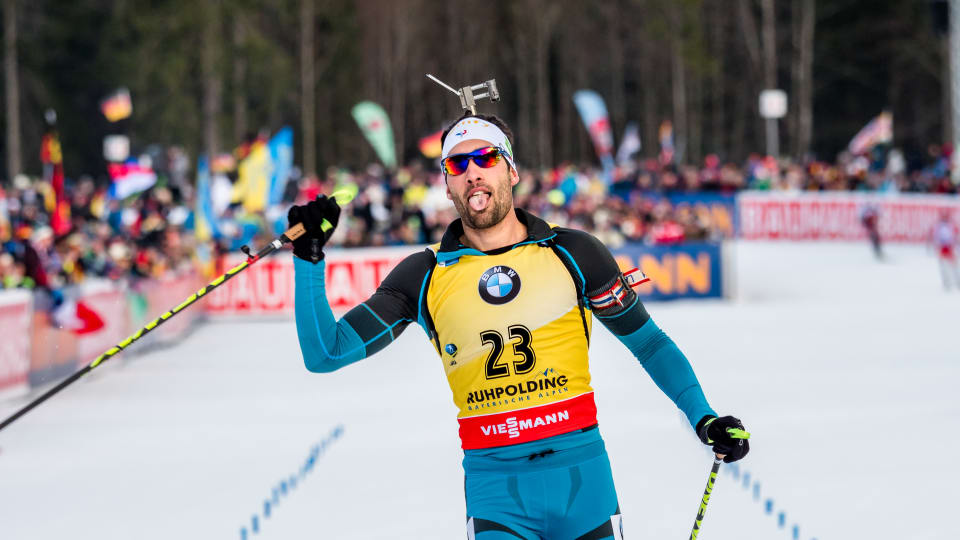
Despite the one-minute penalty, which was tagged onto his total time after his lone miss of the day, Fourcade still won by a minute. The Czech Republic’s Ondřej Moravec, who started 2 1/2 minutes ahead of him in bib 18 (while Fourcade wore bib 23), had successfully cleaned every stage, shooting 20-for-20, and initially crossed the finish line first — about a minute and 23 seconds ahead of former race leader Simon Eder of Austria.
But Moravec’s moment in first was fleeting as Fourcade burst into the stadium, not yet letting off the gas, seconds after Moravec finished. Fourcade took the win in 44:27.9, 1:01 ahead of Moravec in second. To indicate how fast Fourcade’s last loop was, it’s worth noting that he was 30 seconds ahead of Moravec with 4 k to go. On that final 4 k loop, he doubled his time ahead of second place.
Fourcade’s win came four days after his last race in Oberhof, Germany, the 12.5 k pursuit, which he also won.
“We are in a biathlon routine now,” he said, according to an IBU press release. “It was hard to find strong motivation with not much recovery or training this week. … Today I wanted to beat my record of podiums in a row. Today was my 14th [individual podium, including last season] in a row and I am really proud of this. I am very happy with my competition as well. Ruhpolding is place that I really love and I am happy that I continued my success here.”
Norway’s Johannes Thingnes Bø achieved his eighth-straight podium in third, 1:06.3 behind Fourcade with a single miss on the last stage as well (0+0+0+1).
“I heard the speaker, so I knew Martin had missed,” recalled Bø, who started behind Fourcade in bib 29. “I knew if I could shoot clean, there was a small chance I could beat him. I tried and missed. That was my tactic: to go for the win, not save the podium.”
He left the range for the last time 48.3 seconds back from Fourcade in first.
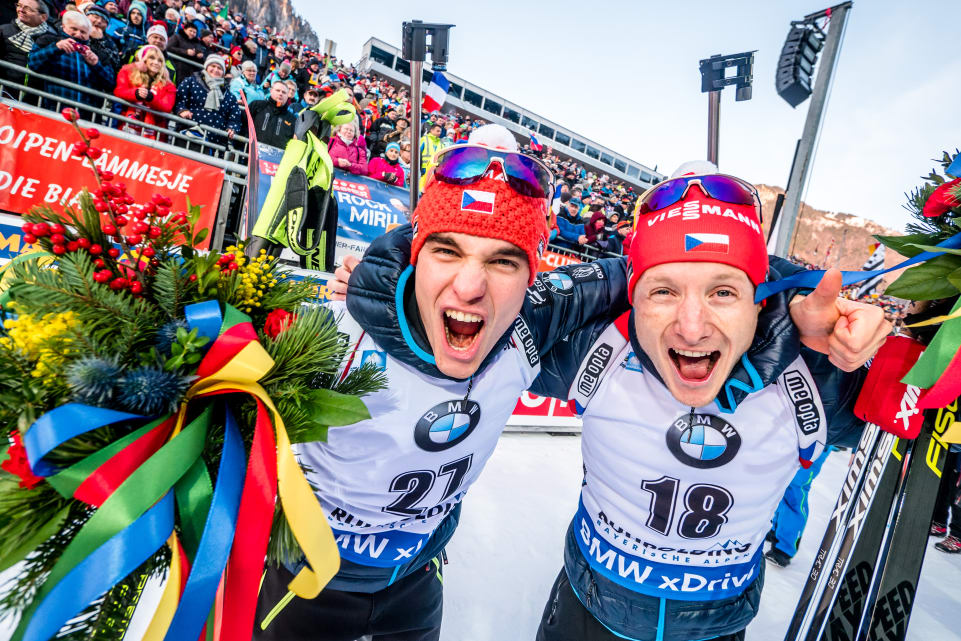
Michal Krcmar (l) and Ondřej Moravec (r) after reaching the flower ceremony in fifth and second, respectively, on Wednesday at the IBU World Cup in Ruhpolding, Germany. (Photo: IBU/Biathlonworld)
Germany’s Roman Rees shot clean and placed fourth (+1:19.1) for his first-career World Cup top 10, and the Czech Republic had two in the top five with Michal Krcmar in fifth (+1:36.6) for his best result of this season.
For Moravec, second place marked his season best as well, after finishing outside the top 10 in previous races this season.
“This podium is really important for me,” he told the IBU. “My first trimester was really bad; my shape was not good especially for the shooting. I also missed a lot of the summer training so did not have the best preparation … I am very please at how I was able to focus and have success in this race.”
Austria’s Dominik Landertinger followed in sixth (+2:21.9) with one penalty and Eder ended up seventh (+2:23.8) with one miss as well.
While the one-minute penalty per miss did not faze Fourcade, it led several North Americans to drop out of top-20 contention, particularly Tim Burke (US Biathlon), who had been in 16th after cleaning the third shooting stage. Burke had cleaned his first stage then missed one on the first standing, but was back in the top 20 with a clean third stage. On the final standing, he missed his first two shots, causing him to look up for a moment to refocus. He cleaned the last three, but still ended up with two additional minutes of penalties that put him 36th at the finish, 4:35.0 out of first (0+1+0+2).
Sean Doherty (US Biathlon) racing to 31st to lead his team in the men’s 20 k individual on Wednesday at the IBU World Cup in Ruhpolding, Germany. (Photo: US Biathlon/NordicFocus)
Sean Doherty led the U.S. men in 31st after missing two targets between the first prone and first standing stages. Ranked 76th after the second stage, he recovered to 53rd after a clean third stage and then 32nd after hitting all five targets on his last stage (1+1+0+0). With two penalties, Doherty finished the race 4:13.6 back in 31st.
“I am happy with the race today,” Doherty said, according to a US Biathlon press release. “I left some room for improvement on the range. It was a big step in the right direction from last week. We had very fast conditions on the course today and our waxing staff did a great job as usual.”
All three U.S. starters finished in the top 40, with Lowell Bailey in 37th (+4:36.4) with three misses (0+2+0+1).
Biathlon Canada was led by Christian Gow in 34th (+4:30.7), for his career-best in a 20 k individual race. After starting in bib 2, he cleaned his first and third stages to put himself in 32nd with one stage to go, within 28 seconds of the top 20. But a miss on his last standing put Gow in 39th leaving the range for the last time, and he ended up 34th at the finish (0+1+0+1).
“My shooting was just OK today,” Gow wrote in an email. “I would have liked to hit one more for sure and then I would have been completely satisfied with the race. I felt more nervous than normal in the range, and my two misses were a direct result of being a bit hesitant on the shooting mat.
“I am pretty happy with today overall,” he added. “I think this is the best skiing I’ve had in an Individual race and my best placing as well. I do wish I could have one or two shots back, but overall I am happy.”
Also for Canada, his older brother Scott Gow finished 55th (+5:13.2) with three penalties (0+1+1+1), Brendan Green placed 78th (+6:53.7) with four misses (1+0+2+1), and Macx Davies was 91st (+8:02.4) with five penalties (1+1+3+0), out of 107 finishers.
The Gow brothers and Green raced Sunday in the men’s 4 x 7.5 k in Oberhof, where they placed 10th.
“Honestly, I have been feeling pretty tired after the 3 days of racing in a row last weekend,” Christian wrote. “Our travel wasn’t too bad, but it still didn’t feel like much of a rest day.”
The Ruhpolding World Cup continues Thursday with the women’s 15 k individual (starting at 8:30 a.m. EST on the Olympic Channel). Another men’s 4 x 7.5 k relay will follow on Friday, then the women’s 4 x 6 k relay on Saturday, and the men’s and women’s mass starts on Sunday.
The women’s 10 k classic podium on Wednesday at the NorAm trials in Mont Sainte-Anne, Quebec, with Cendrine Browne (1) in first, Katherine Stewart-Jones (2) in second, and Anne-Marie Comeau (3) in third. Dahria Beatty (l) placed fourth. (Photo: Cross Country Canada/Instagram)
The NorAm trials at Mont Sainte-Anne (MSA), Québec, concluded Wednesday with the 10- and 15-kilometer classic interval starts. On the line were NorAm points, U23 and World Championships invitations, and for the women, what may well be the last Olympic spot on the Canadian team.
The action started with the men’s 15 k classic, which Ricardo Izquierdo-Bernier of the Pierre-Harvey National Training Centre (CNEPH) won in 39.07.8 minutes to punch his ticket to U23 World Championships later this month in Goms, Switzerland. He won the race ahead of Scott Hill of Barrie Cross Country (BXC) in second, who skied a fast final lap to come within 6.9 seconds of first.
Canadian Para-Nordic teammates Graham Nishikawa and Brian McKeever finished third (+30.0) and fourth (+37.4), respectively, with Nishikawa as McKeever’s guide in Paralympic events having the edge in the interval-start race the two skied on their own (Nishikawa started 64th and McKeever 55th).
According to Nishikawa, the two have been entering NorAm events that fit into their preparation for the PyeongChang Paralympics. Nishikawa wrote a quick email on his way to the airport on Wednesday.
“Happy with my week overall in MSA. Shape is good. Skis were good. Will keep improving into Korea for Paralympics,” he wrote after his second distance podium of the week.
In the women’s 10 k classic, Cendrine Browne (Canadian National U25 Team/CNEPH) continued her strong showing at trials with her second victory and fourth top-four result, taking the win in 29:47.0.
Katherine Stewart-Jones, of the U25 Team and National Team Development Centre (NTDC) Thunder Bay, and Anne-Marie Comeau (Université Laval) were virtually tied for second after the first lap, but Stewart-Jones held the speed to take second, 39.2 seconds behind Browne and 24.3 seconds ahead of Comeau in third.
About 16 seconds later, Maya MacIsaac-Jones, of the U25 Team and Rocky Mountain Racers (RMR), finished fourth (+1:21.0) ahead of Dahria Beatty, of the Canadian World Cup Team and Alberta World Cup Academy, in fifth (+1:26.6).
The selection criteria are complex, but a quick calculation suggests that Comeau, who placed second to Browne in Monday’s skiathlon, gets the provisional women’s distance spot for the PyeongChang Olympics (since Browne already established herself as the sprint leader), and Stewart-Jones, who was fifth in the skiathlon, gets the U23 Worlds berth. Stay tuned for updates and official selections.
The junior men’s 10 k classic podium on Wednesday at the NorAm trials in Mont Sainte-Anne, Quebec, with Antoine Cyr (c) in first, Félix Longpré (2) in second and Étienne Hébert (3) in third. (Photo: Cross Country Canada/Instagram)
CNEPH’s Antoine Cyr took his third win of the week in the junior men’s 10 k, finishing in 25:57.3, well ahead of local Félix Longpré (MSA) in second (+48.2) and Étienne Hébert (AWCA) in third (+55.6).
In the junior women’s 5 k, Hannah Mehain (Sovereign Lake Nordic/National Junior Team) took the win in 15:22.7, just 2.7 seconds ahead of skiathlon winner Natalie Hynes (Whitehorse Ski Club/National Junior Team) and 15.0 seconds ahead of Tuesday’s skate sprint winner Annika Richardson (NTDC Thunder Bay/National Junior Team) in third.
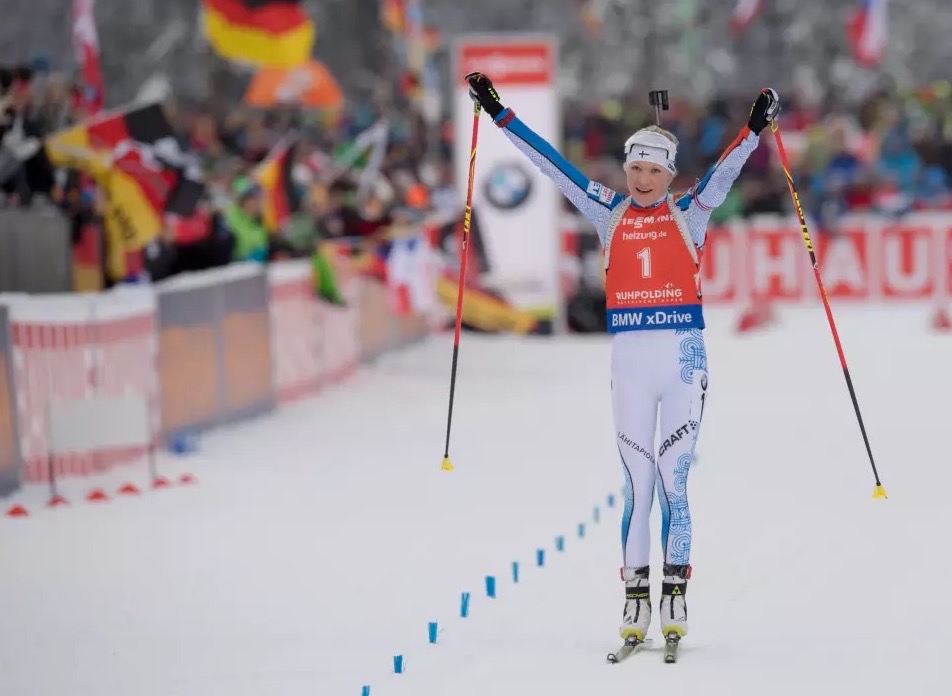
Finland’s Kaisa Mäkäräinen celebrates her victory in the women’s 10 k pursuit at the 2017 World Cup in Ruhpolding, Germany. (Photo: IBU)
Over her 12-year storied biathlon career since the 2004/2005 season, Finland’s Kaisa Mäkäräinen had failed to reach the spot at the top of the podium during any World Cup race in Germany despite more than 50 race starts there.
But this weekend at the International Biathlon Union (IBU) World Cup in Ruhpolding, Germany, the 34 year old ended that streak and made it two for two, following up a sprint win on Saturday with a victory in the women’s 10-kilometer pursuit on Sunday that seemed never in doubt. She crossed the finish line in 30:58.0 minutes with just one penalty (0+0+1+0), more than a minute ahead of her closest challenger.
Maybe not thinking too much about her lead after the sprint was the winning strategy.
“Sometimes I was thinking about the results too much before the race and I never got a good race,” Mäkäräinen explained at Sunday’s post-race press conference. “When I finished thinking about which place I will get I have got better races. In biathlon you never know what will happen, better to live in that moment.”
In significantly improved conditions compared to the heavy snowfall during the men’s pursuit on Sunday morning, the preliminary decision happened early in the race when the Czech Republic’s Gabriela Koukalová and Germany’s Laura Dahlmeier, who had started closest to Mäkäräinen each shot two penalties in the first prone stage while the Finnish biathlete stayed clean.
Her lead to Italy’s Dorothea Wierer, as the next challenger who avoided the penalty lap in the first stage, increased to 69 seconds. And after just one more miss for the rest of the race, Mäkäräinen’s lead didn’t dwindle much, as she repeatedly returned to the course before her competitors even had arrived for the shooting.
“It was fun, I was really enjoying the race,” Mäkäräinen said at the press conference. “Here in Ruhpolding there are a lot of people watching, a big support all the way. And on the shooting range I didn’t feel that much pressure. I tried to enjoy that moment, coming on the range alone with all the crowd cheering for me.”
The podium of the women’s 10 k pursuit at the 2017 IBU World Cup in Ruhpolding, Germany, with (left to right) Czech Republic’s Gabriela Koukalová in second, Finland’s Kaisa Mäkäräinen in first and France’s Marie Dorin Habert in third place. (Photo: IBU)
After her initial setback, Koukalová shot flawlessly in the next three stages (2+0+0+0), including in the critical last shooting to claim the second place on the podium (+1:00.9), while the next three women chasing her all had to ski a penalty lap.
“I am very happy that I am feeling a little bit more stable than in the beginning of the season,” Koukalová said at the press conference. “But it’s becoming harder and harder [with] every start… I don’t know what happened [in the first shooting], I tried to focus for all targets but, I don’t know, sometimes it happens.”
France’s Marie Dorin Habert finished third (1+0+1+1, +1:23.1), defending her position on the last loop against an attack by Dahlmeier, who struggled a bit more on the range to place fourth (2+0+1+1, +1:32.7).
“Of course I am very happy about this position,” Dorin Habert said at the press conference. “I was very afraid [of Dahlmeier] on the last loop that she will come back… I don’t know if I prefer the pursuit to the sprint, I try to be strong in each race. But yes, this year the pursuit is better for me.”
Dahlmeier managed to overtake Sweden’s Hanna Öberg on the final loop but could not catch up to Dorin Habert.
“I am totally knocked out, I really exhausted myself,” Dahlmeier told German broadcaster ARD. “I felt strong on the course, but already had to ski alone or in front a lot during the prior loops. In the end I tried to bring out everything I had left, but I was just knocked out … We will have to analyze why the shooting misses especially in standing happened, but a fourth place now isn’t bad. “
The 21-year-old Öberg finished fifth (+1:39.4) with just one penalty in the final stage (0+0+0+1) for the best result in her first World Cup season. Last season, Öberg had been one of the stars of the Youth/Junior World Championships in Cheile Gradistei, Romania, winning the sprint and pursuit there and finishing second with Sweden’s relay.
“This is crazy,” Öberg told IBU TV in a post-race interview. “Fantastic. I was really confident on the range today. I am just a little bit sorry the last [shot] went out, but it’s incredibly good … I am taking a huge step since last year, and it’s so fun to see that I am closer to the lead.”
Dunklee Improves to 24th
American Susan Dunklee’s plan to catch up after starting 33rd (based on her sprint result the day before) hit an early setback when she missed three targets in her first prone stage, where Koukalová and Dahlmeier also had two misses.
Former German biathlon head coach Uwe Müßiggang mused in an analysis for ARD that the venue in Ruhpolding sometimes can become tricky due to thermal lifts in certain weather conditions creating hard-to-predict wind shifts.
“I am not entirely sure what went wrong in my first prone,” Dunklee wrote about her shooting in an email to FasterSkier. “There was more wind than at zero [pre-race target practice], but I checked the wind flags and took corrections. I don’t know if there are any funky thermals here. I don’t have a whole lot of experience with prone shooting on point 1 in Ruhpolding; I’m more familiar with how the wind works on points 10-15. Overall I am very happy with my shooting times today.”
American Susan Dunklee on the course in the women’s pursuit at the 2017 IBU World Cup in Ruhpolding, Germany. (Photo: USBA/NordicFocus)
But Dunklee didn’t let herself get discouraged after slipping back to 51st place when she came back on the course.
“You can never count on your position to hold steady in a biathlon race,” Dunklee said, according to a US Biathlon press release. “Whether you are in the lead or bringing up the rear, the task is the same … focus on one lap at a time and one stage at a time. It was disheartening to miss three in the first shooting stage, but my job was to continue executing my race plan no matter what.”
She went on to hit all but one shot in the next three stages (3+0+1+0), while also posting the eighth-ranked course time of the day — including the fastest time on the last loop, where she passed four more competitors to finish 24th (+3:07.2).
“The course was not deep, but if you strayed out of the narrow skied-in track, the fresh snow was excruciatingly slow which made it very extra difficult to pass,” Dunklee wrote in her email. “I posted my best ski splits of the year. My race shape has taken longer to come around than I expected this winter and I was a little worried about it. This performance gives me lots of confidence going forward.”
After also incurring two penalties in her first prone stage, Biathlon Canada’s Julia Ransom skied near the back of the field throughout the race and finished 53rd (+6:21.2) with three penalties (2+0+0+1).
Her teammates Rosanna Crawford and Megan Tandy were slated to start the pursuit in 55th and 56th, respectively, but chose not to race Sunday to get some additional rest. On her Facebook page, Tandy wrote, “The #goodnews: I’m not sick, nor have I been kidnapped or snowed in! The #badnews: no race for me today. We decided at the last minute that resting and recovering for next week is smarter than racing today.”
The IBU World Cup continues next week in Antholz, Italy, with the women’s 15 k individual on Thursday, Jan. 19, and the men’s 20 k individual on Friday, Jan. 20.
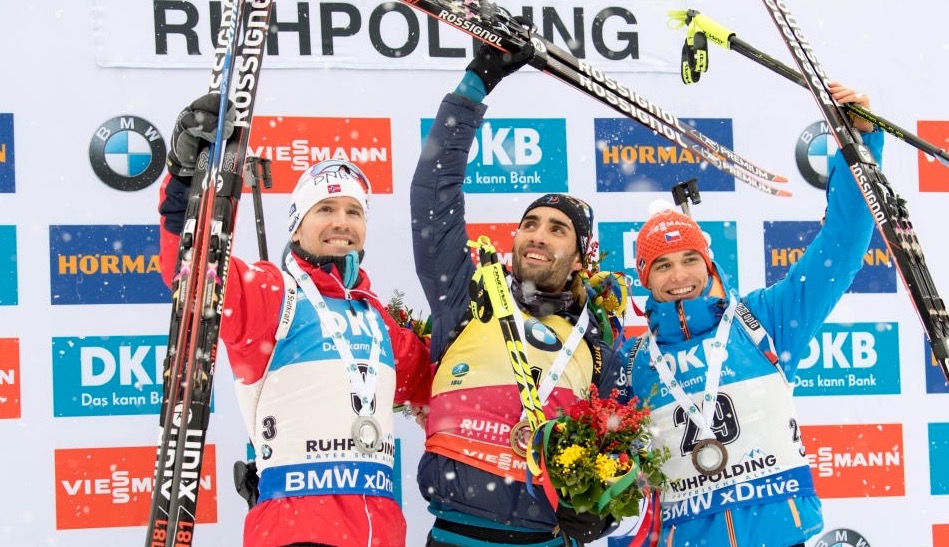
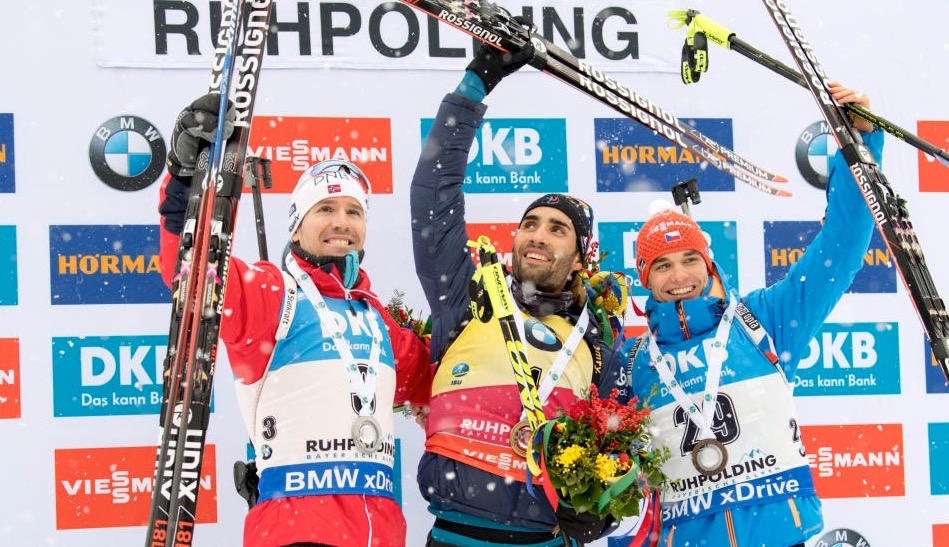
France’s Martin Fourcade (c) celebrates his 10th victory of the 2016/2017 IBU World Cup season in the men’s 12.5 k pursuit in Ruhpolding, Germany. Norway’s Emil Hegle Svendsen (l) placed second, and the Czech Republic’s Michal Krcmar (r) was third for the first podium of his career. (Photo: IBU)
Even Martin Fourcade himself seems surprised with his season so far in the record books.
“I know what I did this season is incredible,” the French biathlon star said in Sunday’s press conference in Ruhpolding, Germany. “Even in my best dreams I could never imagine that.”
Fourcade continued his series of stellar performances in the men’s 12.5-kilometer pursuit at the International Biathlon Union (IBU) World Cup in Ruhpolding, Germany. But he cut it close this time on his way to his 10th victory of the season.
In heavy snowfall on the course in the Bavarian Alps, Norway’s clean-shooting Emil Hegle Svendsen took the lead for a short time when Fourcade missed two targets in his second prone stage and added another penalty in the first standing stage, returning to the course 0.5 seconds behind the Norwegian.
But after initially letting Svendsen set the pace on the loop before the final shooting, Fourcade pushed the tempo up the “Wall of Ruhpolding” climb to create a small gap on a group of five others still fighting for the podium within ten seconds of each other. He managed to reach the range first, and had already hit his first targets before his opponents set up in their lanes. Fourcade took his time with his last shot before finally hitting that one, too. While Svendsen also avoided the penalty lap, he left the range 14.3 seconds behind Fourcade.
On the last loop the two athletes were satisfied to just defend their positions, with Fourcade crossing the line in 33:47.5 minutes, with three penalties (0+2+1+0), and Svendsen 18.3 seconds back with no penalties.
“On the fourth and the last lap I was really, really tired,” Svendsen said at the press conference. “And [with] the slow conditions, when you feel tired it gets even worse, you know. The snow was coming down, and it was a tough battle with my own inner demons and my legs … To be second with this kind of fatigue at the end of the race, I am happy I came to the finish before the other guys.”
Just behind Svendsen, the third place on the podium was decided in a three-way race between Russia’s Anton Shipulin, Czech Republic’s Michal Krcmar and Germany’s Arnd Peiffer. At first it looked like Shipulin would prevail when he built a small gap on the last loop, but in the finishing stretch, Krcmar pushed up to him and outsprinted the Russian to achieve his first-career World Cup podium in third (+19.5 with no penalties), moving up all the way from starting in 29th. His previous best results had been two fifth places last season, one of those also in Ruhpolding in a mass start.
“First time for me and a little bit nervous,” Krcmar said with a laugh in his opening remark at the press conference. “On the last shooting I was clean, and on the track I concentrated on the fight with Arnd Peiffer. But on the last downhill, I see Anton so close and I try it and done. A very amazing day for me, I am so happy. ”
Shipulin finished in fourth (+21.3 with one penalty) and Peiffer in fifth (+24.1 with one penalty).
A knowledgeable student of the history of biathlon, who frequently cites certain races or career achievements of his youth idols (including his countryman Raphaël Poirée), Fourcade acknowledged that he is keenly aware he already tied the best World Cup season of his career, and is motivated by the chance he may soon break Norwegian Ole Einar Bjørndalen’s record of 12 wins in one season.
“I know I already won so much this season,” Fourcade said at the press conference. “There is a big gap [already] in the overall rankings. So if I had not these kinds of statistics, I don’t like the word record, but if I were not fighting for these statistics, I will not stay as focused as I am now and have less victories.”
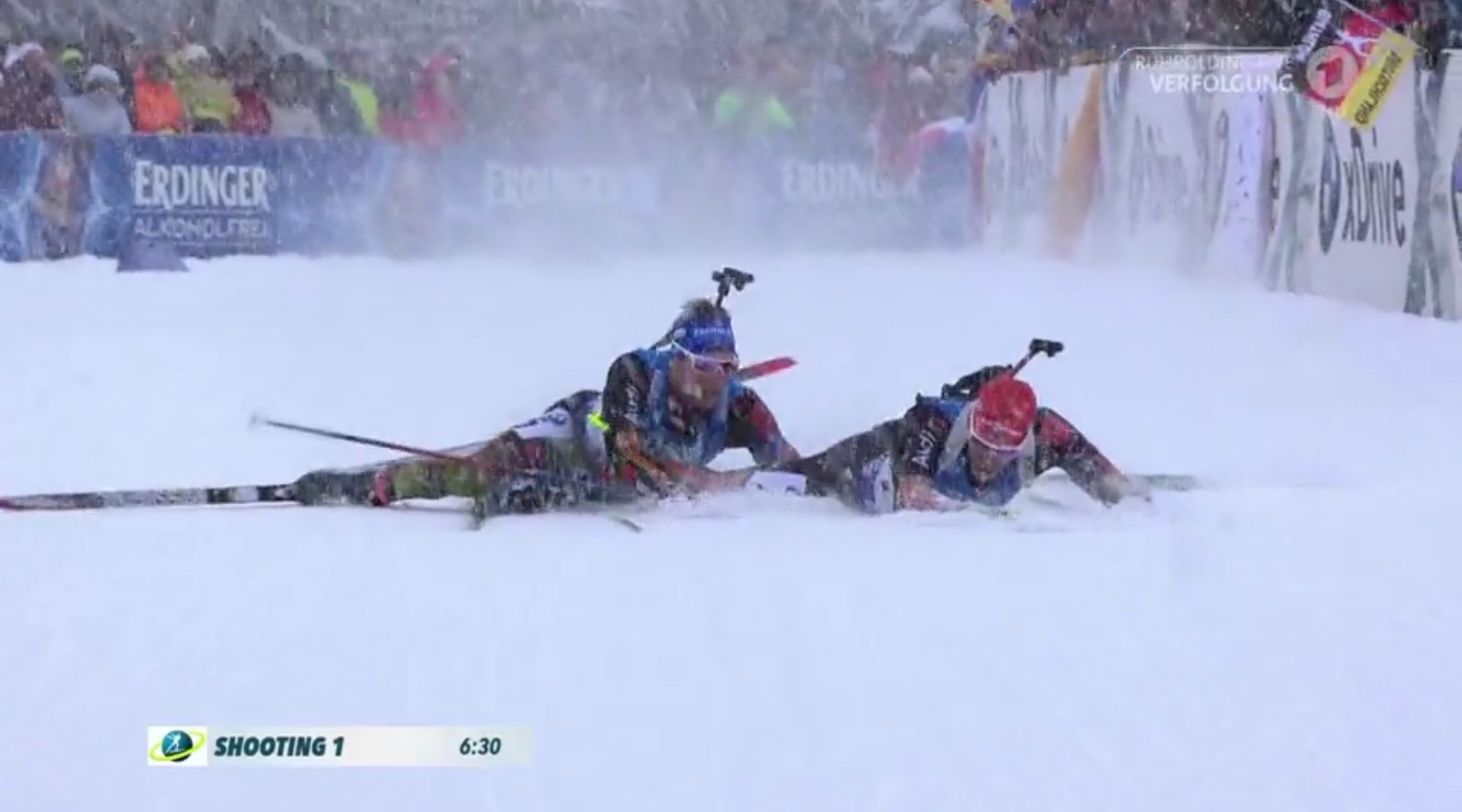
Germany’s Simon Schempp (l) and Arnd Peiffer (r) after tangling in the men’s 12.5 k pursuit on Sunday at the 2017 IBU World Cup in Ruhpolding, Germany. (Photo: ARD broadcast screenshot)
Peiffer’s race got off to a bad start when, on the first loop, he tangled and crashed with his teammate Simon Schempp. Peiffer broke a pole, but both fell flat on their bellies and at least their rifles remained undamaged.
“I can’t really explain what happened yet,” Peiffer told German broadcaster ARD after the race. “Simon was behind me on the downhill. And I believe the root cause was that my ski bumped to the side. In that moment Simon pushed into me, and then it all went so fast that I got an imbalance. Then I lay there, and oh, this was so annoying. I stood up, my pole was broken in three pieces. Simon had crashed with me, and a whole group skied past us. Then it took a while for me to get a spare. I may have to talk to our support staff about that because they stood there like stuffed dummies while I was yelling. Then I got a pole with a strap that was like glove size 5 [i.e. much too small]. Then I had to collect myself for the shooting range, and at least that worked kind of well.”
Schempp ended his race in seventh (+39.7) with two penalties (0+0+0+2).
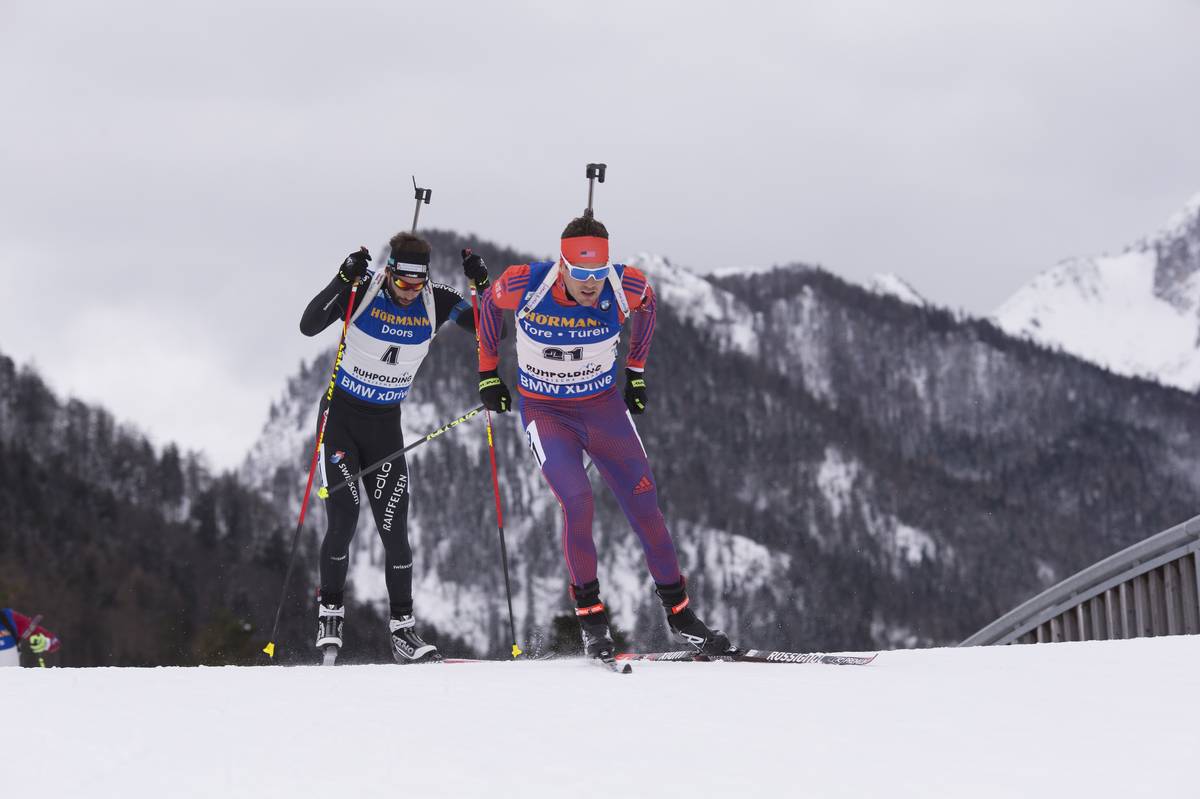
US Biathlon’s Tim Burke on course in heavy snowfall during the men’s 12.5 k pursuit at the 2017 IBU World Cup in Ruhpolding, Germany. (Photo: USBA/NordicFocus)
Americans Tim Burke and Lowell Bailey skied close together throughout the race, initially moving up several positions with two clean prone shooting performances after starting 12th and 18th, respectively. Burke left the range in 11th and Bailey in 13th place, both just a few seconds out of the top 10. But in the first standing shooting, Burke fell back to 28th with two penalties, and added another penalty in the final stage to finish 24th (+1:31.6).
“Today was another solid race for me,” Burke said, according to a US Biathlon press release. “I felt solid on the course but have not quite found my timing on the shooting range. I feel like things are headed in the right direction for me and I am looking forward to competing in Antholz next week, which has always been one of my favorite courses.”
With a penalty in each of the standing stages (0+0+1+1), Bailey finished 26th (+1:33.8), two seconds behind Burke.
“I struggled a bit on the skis today,” Bailey told US Biathlon. “No explanation, but I’m still happy with a solid top-30 going into Antholz. It was difficult conditions with falling snow, so I was satisfied with the shooting. Of course, I wish I could have those two misses back, but I’ll have to wait until Antholz.”
In his second World Cup week of the season, their teammate Sean Doherty finished 43rd (+3:22.1) with four penalties (1+0+2+1) after starting out in 40th position.
For Biathlon Canada, only Scott Gow qualified for the pursuit with his sprint result. He started 42nd and finished just ahead of Doherty in 41st place (+3:09.3) with three penalties (0+1+1+1).
“It wasn’t a huge move up today, but I still managed to gain one spot at the finish,” Gow wrote on Facebook. “Tricky conditions and heavy snow made for a challenging race! Lots of fun and looking forward to Italy.”
The IBU World Cup continues next week in Antholz with the women’s 15 k individual on Thursday, Jan. 19, and the men’s 20 k individual on Friday, Jan. 20.
Finland’s Kaisa Mäkäräinen on her way to a win in Saturday’s IBU World Cup women’s 7.5 k sprint in Ruhpolding, Germany. (Photo: IBU)
Kaisa Mäkäräinen skied in a league of her own on Saturday.
The five biathletes currently leading the International Biathlon Union (IBU) women’s overall standings also occupied the top five of Saturday’s 7.5-kilometer sprint in Ruhpolding, Germany. But when Mäkäräinen shoots clean in a race, even those fast skiers cannot keep up with “the Finnish flash,” as an announcer for German TV broadcaster ARD dubbed her, as she finished in 20:51.8 minutes for her first World Cup win of the season and 20th victory of her career.
The Czech Republic’s Gabriela Koukalová came closest (+22.0, with no penalties), knocking the German home-crowd favorite Laura Dahlmeier to third (+30.1 with no penalties).
“It was almost a perfect race,” Mäkäräinen told ARD after. “I didn’t feel super, super strong today, even though I had good skis and ski times, but it was quite the slow snow and really deep and tricky.“
“I was really tired in the finish because there are no places where you can rest, you have to work all the time here,” she added during the press conference.
While the course conditions weren’t exactly easy for Mäkäräinen, they were at least as difficult for her competitors, who might not have caught the Finn even if she had incurred a penalty.
In light snowfall and wind, the competitors nevertheless had to shoot near-flawlessly to be at the top on Saturday, which eight of the top 10, including all of the podium finishers, achieved. Mäkäräinen hit all of her targets for the first time in an individual race since almost a year ago at the same venue, also in a World Cup sprint in Ruhpolding.
“Quite slow, I took it like one shot at a time,” she said of her approach to ARD. “But in standing I feel better, especially after shooting clean there in the relay [on Thursday].“
Asked what was more important to her, winning the “yellow bib” of the overall World Cup (Total Score) leader or a medal at the upcoming IBU World Championships, she had to laugh.
“Both!” Mäkäräinen exclaimed. “Both! I would be happy with both, or one of them. It’s really hard competitions right now compared to last year, so every day has to be a good day.”
For now, Koukalová defended the yellow bib against her closest rivals, but explained in the press conference that this was not exactly her main goal for the year.
“Everybody asks me about the yellow bib all the time,” Koukalová said. “But I have to say again, this year it is not the main goal of the season to be the first one in Total Score. I try to focus for the World Championship in Hochfilzen [next month].”
She added that it was a good decision to start in a later start group as “conditions were getting better and better. It was very nice to ski on faster snow than for the first athletes.”
“It’s fun to race in front of this audience, to fully attack,” Dahlmeier told ARD. “You could see that Kaisa is in a bit of a different league in terms of ski speed. I couldn’t touch that today, but I still tried to give it my best. So I am super happy about another position on the podium.”
Starting late in the race with bib 75, France’s Marie Dorin Habert challenged for the podium, but with a miss in her standing stage (0+1) while the top three stayed clean, she came up 15.5 seconds short (no thanks to the 20-30 seconds it takes to ski through the 150-meter penalty lap) in fourth place (+48.6).
Also slated to start Sunday’s pursuit within a minute behind Mäkäräinen will be Italy’s Dorothea Wierer, who took fifth (+57.7) on Saturday with clean shooting, as well as Germany’s Franziska Hildebrand, who also cleaned for sixth place (+59.8).
“Of course it’s good, [shooting] zero-zero,” Wierer told IBU TV in a post-race interview. “But on the track I’m really not in a good shape at the moment. I don’t know what happened. I feel like I would be sick, but I’m not … [For the pursuit on Sunday] we have to shoot four times zero, if not Kaisa is really really fast at the moment. We have to hope that she has some mistakes and we [don’t], but that’s biathlon.”
Four North Americans onto the Pursuit
US Biathlon’s Susan Dunklee shooting prone in the women’s 7.5 k sprint of the 2017 IBU World Cup in Ruhpolding, Germany. (Photo: USBA/NordicFocus)
Susan Dunklee once again led the North American woman in the sprint in 33rd (+2:13.5), despite a penalty in each of her shooting stages (1+1). She had the 29th-fastest time on the range, and skied the 20th-ranked overall course time, including a very fast first loop where she skied right behind Koukalová, who was entering her second loop and ultimately posted the third-fastest course time of the day.
“I put myself in the race right from the start, taking advantage of a great ride behind Gabi for a loop,” Dunklee said, according to a US Biathlon press release. “Unfortunately, my pace fell off in the loops after that and my range performance was mediocre.
“I will have a great pack of athletes within two seconds ahead of me to chase tomorrow,” she added, referencing experienced competitors such as Germany’s Franziska Preuss (who placed 31st on Saturday, +2:12.8) and Ukraine’s Valj Semerenko (30th, +2:11.8).
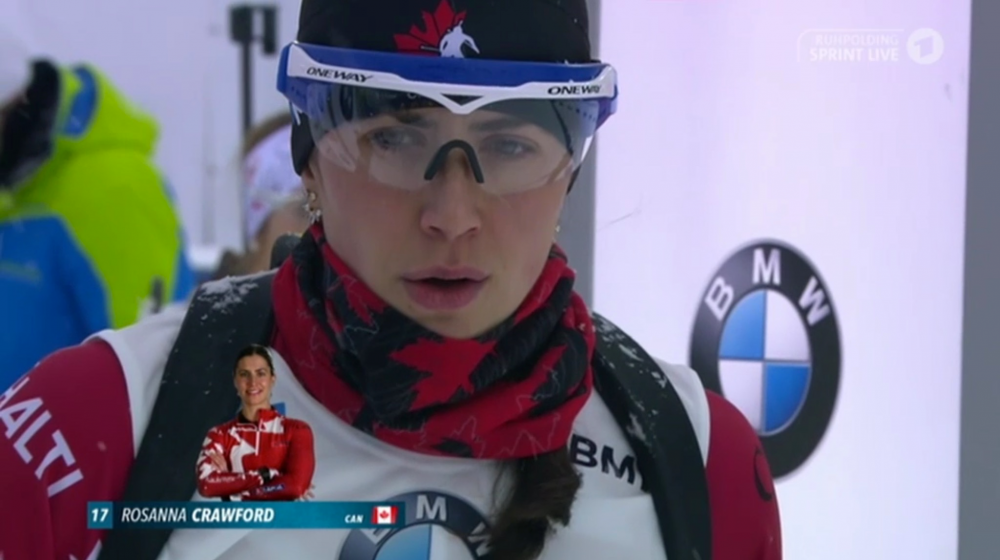
Biathlon Canada’s Rosanna Crawford at the start of the women’s 7.5 k sprint at the 2017 IBU World Cup in Ruhpolding, Germany. (Photo: ARD broadcast screenshot)
Canada’s Rosanna Crawford finished 55th (+2:54.0) with one standing penalty (0+1), also shooting fast with the 19th-ranked range time, but still searching for her ski speed from last season with the 78th-ranked course time.
Her Biathlon Canada teammate Megan Tandy, who lives and trains near Ruhpolding for part of the season, finished her race just one position and 0.3 seconds behind in 56th (0+1, +2:54.3).
Returning to the World Cup after a training block at home in Canmore, Alberta, skipping the races in Oberhof last week, the third Canadian Julia Ransom finished 60th (+3:07.2), also with one standing penalty (0+1) to make the top-60 cutoff for the pursuit.
Teammate Emma Lunder missed qualifying for the pursuit in 89th (3+0, +4:21.7).
Also missing the top 60 was Americans Joanne Reid in 71st place (0+2, +3:25.2), Clare Egan who was 77th (2+1, +3:51.0), and Maddie Phaneuf who finished in 94th place (0+2, +4:36.5).
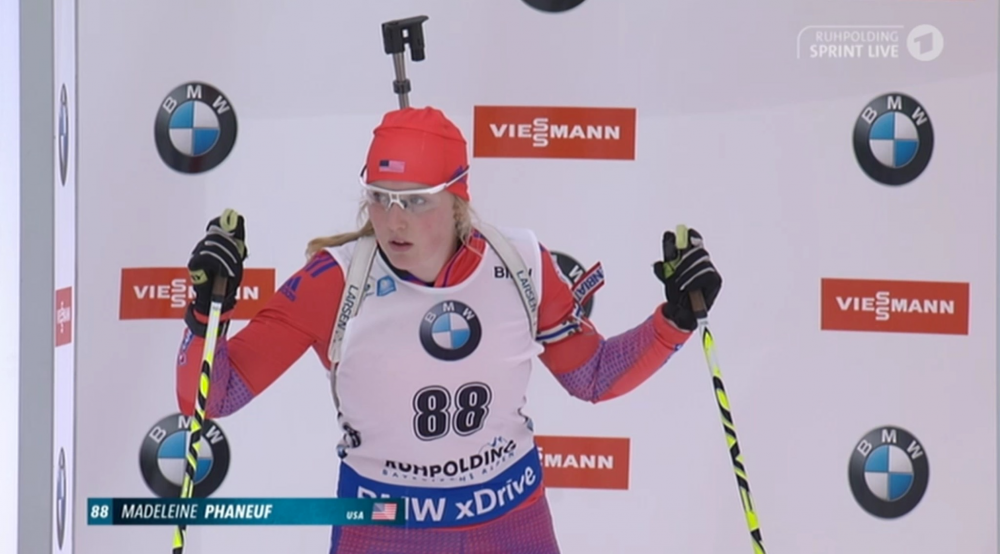
US Biathlon’s Maddie Phaneuf at the start of the women’s 7.5 k sprint at the 2017 IBU World Cup in Ruhpolding, Germany. (Photo: ARD broadcast screenshot)
“Well…feeling like garbage on the skis doesn’t help with racing fast haha!” Phaneuf commented on her race on Facebook. “Not super happy with my shooting, 0,2 and ended up 94th. No Pursuit for me tomorrow. But on the bright side, I have clean laundry, currently drinking a glass of wine, and my standing shooting was the 8th fastest of the day! Next stop…Antholz, Italy on Monday.”
It was the first World Cup week of the season for Phaneuf, who also raced the second leg of the U.S. women’s relay, which finished 17th on Thursday. She was called up after posting 10th- and 12th-place IBU Cup finishes earlier this month. She saw her first World Cup start last season on U.S. soil in Presque Isle, Maine, finishing 65th in the sprint.
Tim Burke (US Biathlon) leads Switzerland’s Serafin Wiestner in the IBU World Cup men’s 10 k sprint on Friday in Ruhpolding, Germany. Burke finished 12th for a season best, and Wiestner was 41st. (Photo: USBA/NordicFocus)
This week, Tim Burke reached a serious tipping point. A US Biathlon veteran with six International Biathlon Union (IBU) World Cup podiums to his name (including a silver medal at 2013 World Championships), Burke stated this past fall that he was going for the one medal that eluded him: an Olympic medal. That meant racing through 2018.
His last World Cup podium came four seasons ago when he placed third in a sprint in Östersund, Sweden. So far this season, Burke, less than a month out from his 35th birthday, had failed to crack the top 20. His season-best result was 26th in the pursuit last week in Oberhof, Germany.
Then, on Wednesday, he skied the second leg of the men’s 4 x 7.5-kilometer relay in Ruhpolding, Germany, using all three spares on his standing stage and ending up in the penalty lap. The team placed 12th, and Burke wasn’t happy with his performance.
“This year has been such a roller coaster for my ski form,” Burke wrote in an email on Friday. “After the relay on Wednesday, I really considered skipping the rest of the World Cups until World Championships.”
2017 IBU World Championships are set for Feb. 9-19 in Hochfilzen, Austria. Skipping “the rest of the World Cups” until then would have meant missing the Ruhpolding sprint and pursuit, as well as potentially three races in Antholz, Italy, Jan. 19-22.
Burke decided to give it one more shot — or 10 more, to be exact — and suited up for another race day in Ruhpolding: the men’s 10 k sprint on Friday.
After more than 100 racers had finished, Burke was glad he joined them as he ultimately placed 12th for his best individual result of 2016/2017.
“I decided to give it one more try today and was thrilled to finally feel better,” Burke wrote. “Because of my recent struggles, I was very careful not to push too hard early on in the race. I kept the pace just below ‘red line’ and then really went for it about 1.5k from the finish.”
Starting relatively early in bib 21, Burke cleaned the first prone stage and clocked the 13th-fastest course time on the first loop. His second loop was slightly slower yet still competitive as the 19th-ranked time, and he sped up considerably on the last loop after missing a standing target and having to ski a penalty lap. His last loop was seventh fastest in the field, and overall, Burke’s course time was ninth fastest.
“Considering the season so far, I am very satisfied with my course time today,” he explained. “I had probably the best training season of my career, so despite some poor results, I have tried to just stay positive and confident that things would eventually turn around.”
While Burke described his lone penalty (0+1) as “not ideal”, he expected more penalties from others, given the breezy conditions and light snow falling later in Friday’s race.
“It’s always tough to say, but without that miss, I probably would have been close to the podium,” he wrote. “Of course there are many others who can say that as well!”
Burke ended up 1:11.6 minutes out of first and about 32 seconds off the podium in 12th, after eight of the 11 finishers ahead of him hit every target.
Overall IBU World Cup leader Martin Fourcade of France racing to his ninth individual win of the 2016/2017 IBU World Cup season on Friday during the men’s 10 k sprint in Ruhpolding, Germany. (Photo: IBU)
France’s Martin Fourcade put together the fastest skiing and best shooting performance of the day, starting 60th and cleaning both stages to finish 18 seconds faster than anyone else with a winning time of 22:34.2 minutes. He posted the fastest course time by more than 20 seconds to achieve his ninth victory of the season, and for the runner-up, Austria’s Julian Eberhard (who also shot clean and posted the third-fastest course time), it was his second podium of the season and third of his career.
“That was a perfect race from the first to the last meter,” Eberhard told Austrian broadcaster ORF. ” I wouldn’t know where I could have gained additional time [on Fourcade].”
Eberhard started 27th, just behind Norway’s Emil Hegle Svendsen in bib 25, who also hit all 10 targets and took the lead briefly at the finish. Eberhard bested Svendsen’s time by 21.7 seconds to become the new race leader until Fourcade crossed the line, and all three remained on the podium.
“Already in the prone shooting I felt super,” Eberhard said. “In standing, I noticed a little pressure because I knew it could become a great result, but I worked through the sequence calmly, and then marched full throttle until the end.”
“During my [warmup], I was watching the screen, and I saw that Julian and Emil Hegle were shooting clean, and I wanted to match them,” Fourcade said, according to an IBU press release.
About 12 seconds off the podium, Germany’s Arnd Peiffer started 81st (directly behind American Lowell Bailey) and proved to be a threat with clean shooting, but his 15th-ranked course time didn’t quite stack up to the top three. Racing in front of a sold-out, home crowd at Ruhpolding’s Chiemgau Arena, Peiffer settled for fourth (+51.8), ahead of another German, Simon Schempp, who was the only man in the top five to miss a target (0+1) for fifth place (+52.8).
Lowell Bailey (US Biathlon) leading Slovenia’s Rok Trsan during the IBU World Cup men’s 10 k sprint on Friday in Ruhpolding, Germany. (Photo: USBA/NordicFocus)
“I would say it was a decent final loop,” Peiffer said of skiing with two Americans, Bailey and Sean Doherty, to German broadcaster ARD. “I noticed I wouldn’t be able to catch up to Emil [Hegle Svendsen]. That was too far away, and I couldn’t add any speed anymore. So I rather tried to keep the fourth place, and luckily had the advantage of knowing all the split times. I just managed to rescue myself into the finish, but I suffered quite a bit today.”
Bailey turned out to be the second U.S. man in the top 20 on Friday in 18th (+1:24.3). He started late in bib 80 and cleaned prone to put himself in the hunt for a top 10. In standing, however, Bailey missed his final shot to drop to 17th and he ended up 18th at the finish with a single penalty (0+1).
Doherty in bib 79 was the third American to qualify for Sunday’s pursuit, racing to 40th (+1:52.3) in his second individual World Cup race of the season (last week in Oberhof, the 21 year old placed 80th in the sprint).
“Today’s race was great,” Doherty said, according to a US Biathlon press release, after missing just one prone target (1+0). “I am continuing to feel better and better on the skis. It was very exciting to be in the mix and finish the last lap with the crowds yelling full force.”
Missing out on the top 60 necessary for the pursuit were Americans Leif Nordgren, who finished 71st (+2:41.2) with two misses (1+1) in his first individual race of the season (following toe surgery), and Russell Currier, who started in bib 1 and ended up 75th (+2:52.7) with four penalties (2+2).
Scott Gow was the lone Canadian to qualify for the pursuit in 42nd (+1:55.6) with one miss (1+0). Brendan Green missed the top 60 by 5.8 seconds in 64th (+2:27.1) with two penalties (1+1), Macx Davies was 82nd (+3:08.4) with three misses (2+1), and Christian Gow 88th (+3:19.8), also with three penalties (2+1).
On Sunday, Burke will start the pursuit 20 seconds after Peiffer in fourth place. Bailey will head out just 12 seconds after Burke.
“As always in Ruhpolding, the times stayed very close today so everything is still possible in Sunday’s pursuit,” Burke told US Biathlon.
The women’s 7.5 k sprint is scheduled for Saturday at 8:30 a.m. EST. Watch it live: eurovisionsports.tv.
France’s Martin Fourcade celebrating his ninth individual win of the 2016/2017 IBU World Cup season on Friday at the finish of the men’s 10 k sprint in Ruhpolding, Germany. (Photo: IBU)
Another impeccable outing for France’s Martin Fourcade, another incredibly memorable one for Austria’s Julian Eberhard. Both shot clean in both stages of the men’s 10-kilometer sprint on Friday at the International Biathlon Union (IBU) World Cup in Ruhpolding, Germany, with Fourcade racking up his ninth individual victory of the season in 22:34.2 and Eberhard notching his second podium of the season and third of his career, 18 seconds back.
Norway’s Emil Hegle Svendsen finished third (+39.7) with clean shooting, and Germany’s Arnd Peiffer also hit all 10 of his targets for fourth place (+51.8).
Out of the top seven, just one man had to ski a penalty lap: Germany’s Simon Schempp, who had one standing miss and ended up fifth (+52.8).
Tim Burke led the U.S. in 12th (+1:11.6) with one standing penalty as well (0+1) for his first individual top 20 of the season. His US Biathlon teammate Lowell Bailey was also in the hunt for a top 10 before he missed his final standing shot (0+1) and ended up 18th overall (+1:24.3).
Fourcade started 60th and posted the fastest course time en route to the victory, 20.6 seconds faster than Germany’s Benedikt Doll, who placed 20th with three penalties (0+3). Eberhard in bib 27 had the third-fastest course time, 22.2 seconds slower than Fourcade, and third-fastest range time.
Burke started 21st and his overall course time ranked ninth (+37.3), while Bailey in bib 18 posted the 36th-ranked course time and 14th-fastest shooting time.
Also for the U.S., Sean Doherty finished 40th (+1:52.3) with one miss (1+0) to qualify for Sunday’s pursuit. In his first individual World Cup race of the season, American Leif Nordgren finished 71st (+2:41.2) with two misses (1+1). Russell Currier — the first starter of the day in bib 1 — placed 75th (+2:52.7) with four penalties (2+2).
Leading Canada as the lone man to qualify for Sunday’s pursuit, Scott Gow finished 42nd (+1:55.6) with one penalty (1+0), while Brendan Green missed the top 60 in 64th (+2:27.1) with two penalties (1+1). Macx Davies was 82nd (+3:08.4) with three misses (2+1), Christian Gow 88th (+3:19.8) with three penalties as well (2+1).
Germany’s Erik Lesser celebrates his first victory of the season in the men’s 15 k mass start at the IBU World Cup in Ruhpolding, Germany. (Photo: IBU/Ernst Wukits)
In recent weeks, Germany’s Erik Lesser had become annoyed with questions on a single topic: whether he was concerned about not having fulfilled the “World Championships norm” yet.
German biathletes are required to post at least one top eight or two top 15’s in an IBU World Cup within a season to qualify for major championships. And Lesser, a gold medalist in the pursuit and relay at 2015 World Championships in Kontiolahti, Finland, was the only senior team member — male or female — who had yet to achieve that mark ahead of 2016 World Championships.
On Saturday evening, in front of a home crowd of more than 20,000 spectators in the biathlon arena and around the course in Ruhpolding, Germany, Lesser put all doubts to rest, winning the men’s 15-kilometer mass start in 40:29.3 minutes with perfect 20-for-20 shooting. Despite heavy snowfall, Lesser cleaned all four shooting stages, and on the final loop, he held his own ahead of France’s World Cup leader Martin Fourcade, beating him by 9.8 seconds.
Fourcade had a single penalty on the last stage to place second, and Russia’s Evgeniy Garanichev missed one on the last shooting to finished third (+13.1). Fourcade and Garanichev had come into the final stage just ahead of Lesser, but then had to complete the 150-meter penalty lap after each missing a target.
The two North Americans in the mass start, Canada’s Nathan Smith placed 15th (+1:20.8) and American Lowell Bailey finished 21st (+2:08.4), both with one penalty.
After the race, Lesser was highly satisfied, and claimed he never had any doubt about his ability to qualify for the upcoming IBU World Championships in Oslo, Norway.
“Now you have to shut up about that, huh. Now I don’t want to hear about that again after giving you what you wanted,” Lesser said with dry wit when he got interviewed by German TV broadcaster ZDF. “I couldn’t care less about the norm. I knew I had that in me; I just couldn’t put it together. Today thankfully everything worked out.”
Questioned again if his coaches were also as convinced, and whether he had been anxious to achieve that kind of result, Lesser added:
“Yeah, the next time I’m waiting for my World Championships norm, I’m taking you guys with me into the [athletes’] container, then you can watch us while you analyze our races, and there really was everything but a bad mood after my races. Everything was good, also between the coaches and me. Everyone was understanding,” he said.
Outside the top 25 in the overall World Cup standing, Lesser had to qualify for the mass start as one of five additional athletes with the best performances of the race week. He narrowly managed to do that by placing 17th in the 20 k individual competition on Wednesday, earning the final start in bib 30.
Since he thus had to start at the back of the field in the mass start, Lesser decided to set out at a steady pace allowing a little gap to form, in order to avoid what he called the “accordion effect” of constantly having to slow down and accelerate again as the field bunches up before climbs and then extends again like pearls on a string.
“The bib number at the start really doesn’t matter. But I always heard the public announcer in the arena bellowing, ‘Oh Erik Lesser runs behind the field on the first loop.’ But it was planned exactly like that,” Lesser told ZDF. “I could ski behind others for four loops, and then only had to lead on the last one; that suits me well. The [wax] technicians really put together great equipment again, like the whole time here in Ruhpolding, and that makes it a little easier.”
In the first prone shooting, 16 starters shot clean, including all of the eventual podium finishers, and US Biathlon’s Bailey. That put Smith, of Biathlon Canada, who had missed one target, at an early disadvantage, leaving the penalty lap and range in 23rd place and about 30 seconds behind the leaders.
“Since my miss came in the first prone, I ended up a little back heading out onto the second loop,” Smith explained in a Biathlon Canada press release. “With the next three cleans, I moved up a little each time, but the field as a whole was shooting so well today, it was tough to make any big moves.”
“I was aiming for a top 10 finish and knew that would take [hitting] 18 or 19 [targets] with strong skiing,” Smith wrote in an email to FasterSkier. “13 of the top 30 athletes shot 19 or better, even with snowy conditions. That’s some cut throat competition!”
After the second prone, a large group still remained in contention. However, this stage did set back a few favorites, such as Norway’s Tarjei Bø, who had entered the range in first and left in 20th after two misses. He would eventually finish in 11th (+1:07) with three penalties.
France’s Martin Fourcade leads the snowy men’s 15 k mass start on Saturday at the IBU World Cup in Ruhpolding, Germany. He went on to place second after a penalty on the last shooting. (Photo: IBU/Ernst Wukits)
On the third 3 k loop, Fourcade, Norway’s Johannes Thingnes Bø and Garanichev emerged as the top three, with five athletes not far behind them: Lesser, Russia’s Maxim Tsvetkov, Norway’s Emil Hegle Svendsen, as well as the Czech Republic’s Ondrej Moravec and Michal Krcmar.
At this point, slugging through the heavy snowfall was visibly hard, and several athletes took feeds to keep up their energy.
Lesser was able to separate himself from that chase group, slowly closing the gap. “Super equipment, super speed,” one of his coaches yelled from the side of the course.
Before the third shooting stage, Lesser had closed the gap, and while Johannes Thingnes Bø missed two of his targets to fall out of contention (he ended up 12th with three penalties), the other three leaders stayed clean, leaving the range together again, all within two seconds.
On the penultimate loop, Fourcade tried to force an early decision, jumping up the longest climb with great speed, and created a gap of a few seconds to Lesser. Garanichev followed in Lesser’s draft, and Moravec trailed the group by about 25 seconds in fourth.
“Martin did a really good fourth lap, and I had some problems in the uphills,” Lesser said during the post-race press conference.
In the final shooting, Lesser entered the range in third, but shot clean while his two opponents each missed their first and only target of the day.
Lesser headed out on the final loop just 12.3 seconds ahead of Fourcade with Garanichev 0.6 seconds behind as the two stormed out of the penalty lap eager to catch the German. On the first long climb it looked like his lead was starting to shrink, but at the next timing point, Fourcade was 12.6 seconds behind in second.
Then Garanichev started his final attack and overtook Fourcade, but was not able to create a significant gap, coming through the next split still 10.9 seconds behind Lesser.
“Nine seconds ahead, go Erik, go!” cheered a German assistant coach while running next to him on the side of the track.
The last loop took Lesser a little longer than most of his previous times around the track, but he was able to stay ahead over a flat section and downhill leading into the arena, finally coming into the finish with the welcoming roar from the sold-out arena, while Fourcade managed to take second back from Garanichev in the final sprint.
Asked to describe his feelings on the final loop, Lesser said at the press conference: “From happy, to exhausted, to really happy.”
“The relay yesterday was hard for me, I was really exhausted after the race” Lesser added in a video interview with the IBU’s Jerry Kokesh. “But I’m really happy that I had the right power for today’s last lap. After all the sh*tty races this season, yup, really happy to be on the podium again.”
“I did the grooming machine all the competition,” Fourcade said at the press conference of skiing at the front of the pack. “So I felt a bit exhausted on the last lap. In the beginning I thought I could catch Erik, but then I also wanted to keep my second place … So I focused on the Evgeniy fight, and am happy about my second place today.”
“I am really happy about my two weeks in Ruhpolding. I created a good gap for the overall ranking and am really satisfied, that was my main goal for January,” he added. “I must say that when I see the crowd today, and the atmosphere, it was something crazy, so I am a bit sad to move because it was better every day. Great competitions, great organization, and I think all the athletes really enjoyed their stay these two weeks.”
“Starting from the first stage in the World Cup season [in Östersund, Sweden] I have been good in speed, and just performing on the same high level,” Garanichev said at the press conference through a translator. “I am glad to be on the podium again, but I have to be careful about saying this is my best race so far because it was a really tough race, the sixth in ten days. So I would say it was a good race,”
“Martin is not the type of guy who will easily let someone go,” he said of passing Fourcade on the final loop, not really expecting to create a gap. “So I just focused on fighting with Erik, and tried to do my best.”
With a significant distance to the three podium finishers, Garanichev’s teammate Anton Shipulin placed fourth (+42.5) with one penalty, Krcmar was fifth for the best World Cup result of his career so far (+47.2 with one penalty), and Germany’s Simon Schempp finished sixth (+48.0, two penalties).
This was Schempp’s first race this year after returning from the lengthy aftereffects of a respiratory infection, which caused him to drop from third in the World Cup standings (after the races in Pokljuka, Slovenia, just before the holiday break) to seventh.
“I was really satisfied with my race,” Schempp told the IBU. “I was not so aggressive in the beginning, but I feel okay, and happy with sixth place…. It’s so much fun, especially because I’m at home here, training the whole year in this stadium. Really happy to see so many spectators, and the atmosphere is great.”
Lowell Bailey (US Biathlon) racing to 21st in the men’s 15 k mass start at the IBU World Cup in Ruhpolding, Germany. He shot 19-for-20 amid heavily falling snow. (Photo: USBA/NordicFocus)
“It’s always a great atmosphere here in Ruhpolding. I love the German fans!” Bailey wrote in an email.
Sweden’s Torstein Stenersen was the only athlete in the field besides Lesser who cleaned all four stage, but skied considerably slower to finish 20th (+1.54.4).
Smith skied the 23rd-best overall course time in the difficult conditions, but was able to move up a bit on each loop thanks to three clean stages after his early miss (1+0+0+0) to place 15th.
“The ski course was extremely slow going with the fresh snow falling. The 15 kilometre time was close to what the winning time was for the 20 kilometre individual race,” Smith told Biathlon Canada. “I had been feeling kind of fatigued the last few races, but I am happy that I was able to overcome that by performing well on the shooting range and end up with a very respectful final result.”
Bailey cleaned three out of four stages, missing one on his first standing (0+0+1+0) for 21st.
“I had the goal of staying with my shooting focus and not getting distracted by the excitement of the competition,” Bailey wrote. “I accomplished this, and overall I’m happy with the way shooting is going at the moment.”
Asked if his solid shooting throughout back-to-back World Cup weeks in Ruhpolding was a result of the range (which most athletes generally considered to be easy due to the downhill approach and good wind protection, though in heavy snowfall, that might be drastically different) or any newfound adjustments, he wrote:
“You work your whole career on the small little details that comprise a solid shooting approach, but at the end of the day, sticking to simple key cues has been what I’ve been using throughout the season. The fundamentals have to be developed, but then the key is getting your mind and body in a place where they can execute the things you’ve trained to do.”
After posting the 20th-fastest time on the first loop out of the start, Bailey’s skiing became a bit slower on the subsequent rounds, and he ended the day with the 28th course time.
“It was one of the more challenging races of my career. I just felt tired from the start,” Bailey wrote. “We’ve had six races in the last eight days, most of which occurred in slow conditions … I just think I reached my limit and didn’t quite have the energy required to ski with the best today”.
Bailey and Smith were certainly not alone feeling their energy run low after a hard block of races. Norwegian biathlon legend Ole Einar Bjørndalen finished last in 30th (+5:42.6), with 10 penalties and the third-slowest course time.
After two weeks in Ruhpolding, the World Cup tour now moves to Antholz-Anterselva, Italy, with sprints on Thursday and Friday, followed by pursuits on Saturday, and another relay on Sunday.
“Antholz is always really good competitions, good snow, good for fights, and most of all the weather is often good,” Fourcade said. “I am also really happy to move to Antholz, and to have some Italian food, too, that’s something I like.”
Italy’s Dorothea Wierer racing to the second IBU World Cup win of her career in the women’s 15 k individual in Ruhpolding, Germany. (Photo: IBU/Ernst Wukits)
The next time the women’s 15-kilometer individual race is scheduled on the IBU’s World Cup competition calendar will be at the 2016 World Championships in March in Oslo, Norway.
Italy’s Dorothea Wierer will be one of the favorites there after winning Thursday’s 15 k individual World Cup race in Ruhpolding, Germany, in 40:19.9 minutes, and thereby repeating her success in the same discipline from earlier this season in Östersund, Sweden. The 25 year old shot with both speed and accuracy to clean all 20 targets, securing the second World Cup victory of her career.
All biathlon races are heavily influenced by shooting, but in the somewhat old-fashioned individual discipline, misses are that much worse. Each missed target tags one minute onto the competitor’s time, in place of them skiing a penalty lap or being allowed to use spare rounds. This steep penalty leads many athletes to shoot more deliberately than in a sprint, for example. Not so for Wierer.
Italy’s Dorothea Wierer after notching the second IBU World Cup win of her career in the women’s 15 k individual in Ruhpolding, Germany. (Photo: IBU/Ernst Wukits)
“I usually shoot zero [misses] when I shoot faster, I don’t know why,” Wierer told Germany’s ZDF, with a laugh. “Maybe because I don’t think about it, it just works all by itself.”
“I don’t even like [individual] that much,” she added in the IBU’s post-race press conference. “It is too long, and I have so much time to think about it during the race.”
Wierer won by nearly a minute, finishing 54.9 seconds faster than Finnish runner-up Kaisa Mäkäräinen, who had one penalty in her first shooting and posted the second-fastest overall course time.
“It is my first time ever in Ruhpolding that I’m better than third place, so I am happy about that,” Mäkäräinen said at the press conference. “I am not thinking about the mistake today, one miss in four shootings is a good result. … I was not skiing that fast in the first four loops, so I had some energy left.”
Third place went to Gabriela Soukalová of the Czech Republic, 1:09.9 minutes back with one penalty. Soukalová posted the best initial times starting early with bib 7, before Mäkäräinen and later Wierer improved on them. She retained the “yellow bib” of the overall World Cup leader.
“I think I am getting older. I know what I want to do many times better than a couple years ago,” Soukalova said of her race and season so far at the press conference. “And I think I was training harder than the last seasons, so maybe that’s the reason. … I am very happy that I can race like this.”
Canada’s Rosanna Crawford recorded the best North American result in 18th (+2:52.6), with two penalties (0+1+1+0).
Almost 10,000 fans packed the stands in the arena in Ruhpolding on Thursday, with several thousand more out on the course.
“I love racing in Ruhpolding, the fans are great and cheer for everyone from every country,” Crawford wrote in an email. “They take the effort to learn our names and wherever you go there are people cheering GO CANADA! It’s really a fun atmosphere!”
Gabriela Soukalová on her way to third in the IBU World Cup women’s 15 k individual in Ruhpolding, Germany. (Photo: IBU/Ernst Wukits)
Before the holiday break, the the IBU polled athletes on their “favorite biathlete (not yourself)”. Norwegian legend Ole Einar Bjørndalen and perennial World Cup leader Martin Fourcade of France received several mentions, but Norwegian Tarjei Bø had someone else in mind, even above his brother Johannes:
“My favorite biathlete would be Dorothea Wierer,” Bø said. “She’s a funny woman, she’s a good biathlete, and I love to watch her race because she is one of the few girls who are really attacking on the shooting range. She’s a fast shooter, and a great shooter, and also she likes to have fun. So yeah, I like her.”
Thursday’s race was a good exhibit for that assessment. Wierer recorded the fastest shooting and range times, faster than many athletes are able to do in a sprint or pursuit, despite the one-minute penalty for each miss.
“I don’t know why, that sometimes happens,” Wierer said in her interview with ZDF. “When I think too much, the mistakes come.”
By winning both individual races this season, the Italian retains the “red bib” of the discipline leader.
“Honestly, I was expecting to wear it today for the last time,” Wierer said. “But four times zero [misses], that’s as good as it gets today.”
Last summer, Wierer supported an Italian charity providing disaster relief to victims of the earthquake in Nepal earlier that year, asking for donations for a chance to win her wedding dress. She had worn it in May, walking through an “archway of skis,” held by family and friends, including her teammates, after the ceremony.
Race conditions on Thursday were sunny (though much of the course is in the continual shadow of a mountain range) with fairly calm winds, unlike the snowstorm that plagued the men’s race on Wednesday.
“Thankfully it wasn’t as bad as the men had it yesterday, we were really lucky for that. I’m still feeling the effects of my illness [over the Christmas break], but it’s improving from week to week,” Wierer said of her skiing to ZDF, after recording the 11th-fastest course time on Thursday. “In the second and third loop today, I thought to myself, ‘Oh, I’m really tired, will I be able to make it?’ But yeah, then I fought through it, and am really happy.”
“I like these conditions very much, because there was no deep snow, so this is very comfortable to race,” Soukalová said. “Even though I felt like I was getting slower and slower.”
Rosanna Crawford (Biathlon Canada) during an IBU World Cup relay last season in Oslo, Norway. (Photo: Biathlon Canada/NordicFocus.com)
“Today we were a lot luckier than the men, it was hard packed and fair conditions for the whole race,” Crawford agreed in her email. “I didn’t get to race the Ruhpolding World Cup last year due to sickness, so it was a new track to me. I liked it, but the downhills are a bit easier than 2 years ago, which is too bad, because I for sure excel at downhills compared to most women!”
Fourth place and 0.9 seconds off the podium, Germany’s Franziska Hildebrand missed a shot in her first prone, but was still in contention for a spot on the podium in the final shooting. There she could be seen struggling before the final shot, having to get out of and back into her stance.
“For my last shot, so from four to five, somehow my breathing didn’t quite work out,” Hildebrand told ZDF. “Then I had the opportunity, I could have pulled the trigger two or three times already. I did not pull it, and instead decided to breathe deeply again, in order to really make the shot.”
Asked if that decision was a result of her increased experience instead of just firing a likely miss more quickly, she added: “Probably. In the last days it really dawned on me again how important a flawless shooting on the range has become. Especially in the individual, how much a [penalty] minute hurts, so it was really worth it to wait a bit.”
Selina Gasparin, 31, a Swiss biathlete and mom, in a video interview with the IBU following Thursday’s 15 k individual, where she placed fifth for her nation’s best result of the season. (Photo: IBU/Ernst Wukits)
Behind her in fifth place and 1:23.8 minutes out of first, Switzerland’s Selina Gasparin shot clean, something she last achieved at the 2014 Olympics in Sochi, Russia, where she took silver in the individual competition. It was the best result for a Swiss athlete so far this season, which she achieved despite a crash on the first loop.
“In the fall in the downhill, the barrel of my rifle hit against my head,” Gasparin said in Swiss Ski Federation press release. “Probably that sorted out my brain cells.
“My shape is quite good, but the shooting is my problem,” Gasparin told the IBU. “Only in Sochi I shot clean, so it’s the second time in my life, and I’m really happy because I worked so hard for this.”
On being both a mom and a professional biathlete, Gasparin, 31, added, “It’s quite hard. I have not so much time for other things. I have, like, two full-time jobs, but for me it’s really nice and fun to do both.”
She is competing in the World Cup with her two younger sisters Elisa, 24, and Aita, 21.
Along with Wierer and Gasparin, three other women also shot clean: Russia’s Olga Podchufarova in 10th, Norway’s Synnøve Solemdal in 13th, and Kazakhstan’s Galina Vishnevskaya in 15th.
France’s Marie Dorin Habert placed sixth (+1:25.6) with the fastest course time, but two penalties, and remains in second in the overall World Cup standings behind Soukalová.
Starting just a few positions behind Wierer, Norway’s Tiril Eckhoff had the best chance to challenge the Italian, shooting clean and skiing fast to chase down on Wierer’s split times after each of the first three loops and stages. But three penalties in the final shooting ended Eckhoff’s hopes at a podium, and she ended up 21st (+2:55.1).
Crawford in Top 20; Reid’s World Cup Debut
While Crawford finished 18th to lead the North Americans on Thursday, she said her goals going in had been related to the process rather than results.
“My races before Christmas weren’t that great so my expectations were low,” she said in a Biathlon Canada press release.
A cold kept her from racing last week in Ruhpolding; instead she continued to train at home in Canmore, Alberta, before flying to Germany.
“It felt better than it has this year, I felt like I could start strong and keep that going better than the first 3 World Cups,” she explained of her race on Thursday. Her ski time ranked 31st overall. “Our skis were also good today, the techs did a good job!”
Like Wierer, Crawford explained that she generally doesn’t go into individual races any differently than into a sprint or pursuit race despite the harsh penalty for a miss:
“I approach individuals the same as any other race, you don’t want to change your mentality just because misses add one minute, you need to shoot just like you do in training, just like you do in any other race. This is also one of the easiest ranges on the World Cup, no wind almost ever, so I knew that 90% would be the very lowest I could shoot if I wanted a chance at the mass start, and even with that I am on the edge of making it!“
Susan Dunklee (US Biathlon) skied the seventh-fastest overall course time but missed five targets for five minutes of penalties to end up 50th in the women’s 15 k individual at the IBU World Cup in Ruhpolding, Germany. (Photo: USBA/NordicFocus)
Coming off a career-best mass-start result of sixth last Sunday, American Susan Dunklee was the top U.S. women in 50th place (+5:13.9). Her course time ranked seventh-fastest overall, but five penalties kept her out of contention (1+1+2+1).
“This sport sure knows how to keep a person humble,” Dunklee said in a US Biathlon press release. “A mediocre range performance held me back today.”
In her very first World Cup, Joanne Reid started very late in bib 93 out of 96 starters, after first qualifying for and then being called up from the IBU Cup within the last few weeks. In fact, it was also her first race in the individual format ever, so she had to remind herself of some important details.
“Was I chanting prone, standing, prone, standing to myself (to remember the order) before the start? Yes, indeed!!” Reid, 23, wrote in an email.
She opted for a steady approach, though the former cross-country NCAA champion did ski the 47th-best time overall and a fast last loop: “I just wanted to try really hard not to miss. … And to do that I wanted to moderate my ski speed both coming into the range and a little bit on the standing loops, since standing is generally my weakest, and definitely slowest (slowest range time on the entire World Cup, thank you very much) section of a race. This is something I’ve been working on since [the US Biathlon tryouts in] Canmore, where I came flying into the range for a standing bout and hit only one target.”
She had one miss in the first prone shooting stage, then cleaned her first standing stage, before incurring two more penalties in the second prone shooting, and one more in the final standing stage (1+0+2+1).
“I’m just learning to deal with wind and corrections to the sights during racing, so any time there’s wind in the range it throws me off. But, I’m working on it,” she explained.
In the days before the race, Reid had a minor technical issue with her rifle, but she was able to get that fixed in time once she had the right tools available.
“Because of the way it’s assembled, it’s very hard to understand, my dad built and drilled all these pieces himself, and someone tried to put it back together incorrectly.”
2013 NCAA champion (in the 15 k freestyle mass start) Joanne Reid racing at last year’s U.S. Cross Country Championships in the women’s 10 k freestyle in Houghton, Michigan
During the race, Reid tried not to get too influenced by the many spectators watching the race, who often audibly react to every shot — especially those of local biathletes — with cheers or sighs which can be distracting for other athletes on the range at the same time.
“The Colorado biathlon club cheers just as loud per bullet as Ruhpolding, actually, so I’d say I’m pretty used to it. KIDDING. ;)” she wrote.
Reid finished her first World Cup in 72nd place (+7:20.5), but ahead of a number of more experienced athletes.
“I’m just really excited to be here with all these amazing athletes, and thrilled to be in the sport of biathlon. It’s an amazing sport, with amazing people, that I find twice as fun and twice as difficult as just pure skiing,” she concluded in her email.
“Our rookie, Joanne Reid, who recently switched over from cross-country skiing, put together a great World Cup debut and has been impressive in training all week,” Dunklee commented. ”I am excited to see what more she will accomplish!”
Teammate Clare Egan was 74th, incurring a penalty in her first prone shooting and three in the first standing stage, before being able to adapt to the conditions and cleaning the next two (1+3+0+0).
The fourth American, Annelies Cook opened the race in bib 1 to a huge cheer by the audience, excited that the competition was about to begin. After incurring two penalties in her first prone shooting, she skied most of her race outside the focus of the TV cameras, finishing 88th with eight penalties (2+1+2+3).
Canada’s Megan Tandy, who skipped the first weekend in Ruhpolding, finished 73rd with four penalties, 0.4 seconds behind Reid and 2.1 seconds ahead of Egan. Also for Canada, Julia Ransom finished in 78th with five penalties, and Zina Kocher was 94th with nine penalties.
The second-straight IBU World Cup in Ruhpolding continues with the men’s relay on Friday (at 9:30 a.m. EST, streamed live at www.eurovisionsports.tv/ibu), followed by mass starts on Saturday (for which Dunklee is qualified via her World Cup standing, and Crawford is on a reserve standby list), and concluding with the women’s relay on Sunday.
Susan Dunklee pushes for sixth, tying a season best, on Sunday at the IBU World Cup 12.5 k mass start in Ruhpolding, Germany. (Photo: Fischer/NordicFocus)
The third International Biathlon Union (IBU) World Cup race in the three-straight days in Ruhpolding, Germany, was one wild ride for American Susan Dunklee, but in a good way.
During Sunday afternoon’s 12.5-kilometer mass start, Susan Dunklee — who had made the top-30 cut for the race in 23rd — found herself in second place after the second of four shooting stages.
The 29-year-old American then incurred just one penalty in the first standing stage to remain in contention for a spot on the podium until the final loop. Ultimately, two competitors passed her the last time around Ruhpolding’s 2.5 k loop, and Dunklee finished sixth, 31.4 seconds behind Germany’s Laura Dahlmeier, who won her second-straight race of the weekend in 33:17.7.
“This is really fun for me,” Dunklee said in an IBU video interview. “I’m super psyched to shoot that well in a head-to-head situation. It’s taken me years to get to this level, and I’m happy to be there finally.”
For Dunklee, the result tied her season best from last month’s sprint in Pokljuka, Slovenia.
“I did put a lot of thought and work into cutting down my shooting times this summer and I have clearly seen that work paying off,” Dunklee wrote in an email to FasterSkier after hitting 95 percent of her targets on Sunday (0+0+1+0). “This was by far my best ever shooting performance in a World Cup.”
“I’m super psyched to shoot that well in a head-to-head situation. It’s taken me years to get to this level, and I’m happy to be there finally.” — Susan Dunklee, after placing sixth in Ruhpolding mass start
Dahlmeier Doubles Up in Ruhpolding
The women’s 12.5 k mass start podium at the IBU World Cup in Ruhpolding, Germany: with German winner Laura Dahlmeier (c), France’s Marie Dorin Habert in second (l) and Norway’s Tiril Eckhoff in third (r). (Photo: Fischer/NordicFocus)
Saturday’s pursuit winner, Dahlmeier also won on Sunday — in convincing fashion — as she cleaned in all four stages and skied to the third-fastest course time to beat runner-up Marie Dorin Habert of France by 15.3 seconds.
Habert had a single penalty in the first prone stage, and third place was decided in an extremely close photo finish between Norway’s Tiril Eckhoff, who had two penalties between the last two stages, and France’s Anaïs Bescond, who shot clean but was slower on the course.
A few years ago, the race might have been called a tie with both awarded the third place (i.e. 2003 World Championship in Khanty-Mansiysk, Russia, with the gold medal of the pursuit race awarded to both France’s Sandrine Bailly and Germany’s Martina Glagow). But with more advanced timing and imaging technology, the race jury ruled Eckhoff took third and Bescond fourth, both 21.9 seconds back from the winner.
Dunklee started out skiing fast with the seventh-best course time on the first loop. Once she reached the first prone stage, she also shot clean and fast with the fifth-best shooting time. Dunklee left the range in second, at that time just 0.3 seconds behind Germany’s Vanessa Hinz.
“Sometimes I have a habit of starting out a little too fast in the early loops and not having enough left to lay down a killer last loop,” Dunklee wrote. “I was actually talking with my coach before the start about maybe trying to pace a little more evenly. Then the gun went off and I just took whatever opportunities came my way. The reality is that I’d rather take some risk and put myself into the race early and then see if I can hang on.”
“For the shooting, my plan was to use the same rhythm and focus keys as I usually do and I did that,” she continued. “In mass starts, you shoot on the same lane as your bib number for the first stage and I got to my lane earlier than the ladies I was skiing around.”
After staying close to the front of the field on the second of five loops, Dunklee again managed to shoot clean and fast in the second prone (with the sixth-best time), leaving the range still in second, 2.2 seconds behind Eckhoff, with Dahlmeier trailing 2.7 seconds behind Dunklee.
A little surprised by this race development, a TV commentator for Germany’s ARD had to consult his notes: “Tiril Eckhoff, that was to be expected, but Susan Dunklee, she keeps up exceptionally well. She turns 30 next month; lives in Craftsbury, Vermont, the American here in second position. She shares hobbies with Laura Dahlmeier, mountaineering, especially when training in Utah, she has good opportunities for that.”
Susan Dunklee (US Biathlon) at the flower ceremony. Dunklee tied a season-best sixth on Sunday in the mass start at the IBU World Cup in Ruhpolding, Germany. (Photo: Fischer/NordicFocus)
On the third loop, Dunklee lost a few positions, coming through the next split times at 6.1 and 6.4 k in third, then fifth place, but still just 1.9 seconds back and a few meters ahead of the next chase group.
In the third shooting — the first standing stage — Dunklee missed one target and had to ski through the 150-meter penalty lap, leaving the range in sixth, 21.6 seconds behind Dahlmeier.
She kept that position on the loop, skiing just behind overall World Cup leader Gabriela Soukalová of the Czech Republic and ahead of Poland’s Magdalena Gwizdon.
In the final stage, Dunklee cleaned all of her targets in a high-pressure situation, standing in the range with a group of at least five others, where every miss would be one too many. She started out on the final loop in fourth, 24.5 seconds back, chasing Bescond who had left the range 10 seconds ahead of her, with Eckhoff and Ukraine’s Olena Pidhrushna (who had cleaned all four stages) within eight seconds behind her.
Dunklee’s US Biathlon coaches and teammates in their new brightly colored orange-and-purple uniforms cheered her on from the side of the course.
“I did hear my coaches and teammates cheering on all the loops,” Dunklee wrote. “Clare [Egan] had an American flag and was sprinting up the last hill, urging me to chase down Tiril and Anais. She gave me a tremendous burst of energy there.”
Dunklee tried everything in her power to reach the podium, but Eckhoff passed her on a climb shortly before the arena. Eckhoff quickly created a little gap and chasing down Bescond.
“Oh, I was so tired,” Dunklee explained in her interview with the IBU. “I don’t think my ski shape is perfect yet, but hopefully will be in Oslo [for World Championships]. I was a little bummed I couldn’t keep up with a couple of girls who passed me on that loop.”
Overall, Dunklee posted the eighth-fastest course time. She skied the fifth-fastest last loop.
The second-fastest on the last loop (and fourth-fastest overall), Eckhoff caught Bescond before the finishing stretch and outlunged her by about an inch to achieve her first podium of the season.
“It was really, really exciting on the last loop,” said Eckhoff in an IBU video interview. “I was really tired, so I was very luck to get the margins on my side, and I’m happy.”
“I haven’t actually been on the podium this year, so I really wanted to get on the podium,” she added. “So I just had to stick my [ski out]… Yeah, do whatever I could to be on the podium.”
In the finishing stretch, Pidhrushna overtook Dunklee and edged her by 0.9 seconds at the line. Dunklee ended up 9.5 seconds off the podium.
After a hard fight, Dunklee seemed happy with her result, kneeling in the snow for a while in the finishing pen to catch her breath, but smiling for the TV cameras and waiving to the large crowd in the stands.
From left to right: Veronika Vitkova of the Czech Republic, Norway’s Tiril Eckhoff, and Czech Gabriela Soukalova prepare to shoot during one of two standing stages in the women’s mass start on Sunday in Ruhpolding, Germany. (Photo: Fischer/NordicFocus)
On Sunday she succeeded at keeping a number of athletes behind her who already achieved World Cup victories this season, including Soukalová in seventh place, Finland’s Kaisa Mäkäräinen in 13th, and Germany’s Franziska Hildebrand in 17th.
“The conditions were so good today,” Dunklee commented in the video. “Yesterday was a little deep, was a little warped. Today it was all good; it was beautiful skiing.”
“Range race conditions were very similar to the zero for the women [target practice to adjust the rifle sights before the race]; no tricky winds like the men had,” she added in her email.
First and second place were already mostly decided after the last shooting, with Dahlmeier leaving the range 6.9 seconds ahead of Habert and extending that to 15.3 seconds until the finish. Habert skied the fastest course time of all athletes, but was visibly tired on that final loop only recording the 17th best time.
“I am hungry for other wins and I hope to be on the podium next week,” Habert said Sunday, according to an IBU press release. “I didn’t see a chance to catch Laura in this form, I knew she was strong. … I made a miss at the first shooting, and it was hard to come back to the top of the race.”
“This was definitely a perfect race for me,” Dahlmeier told ARD in a post-race interview. “Four times zero [misses], and skiing was good again, too. Really crazy, a dream, a wicked race today.”
Asked why she went all-out on the final loop when she appeared to be comfortably in the lead, Dahlmeier recounted a story from her early years of racing with a laugh:
“I had an experience at the student-level [youth], when I got still outsprinted in the finishing stretch of a cross-country race by the little sister of Miri Gössner [her current teammate on the German biathlon national team]. And I swore to myself that would never happen again in my life, unnecessarily giving away a race at the finish. That’s why it’s hard for me to ski relaxed on the final loop. I tried to not go full-throttle today, but didn’t really succeed at that. Main thing was to win.”
“I tried to not go full-throttle today, but didn’t really succeed at that. Main thing was to win.” — Laura Dahlmeier, winner of the Ruhpolding IBU World Cup mass start on Sunday
No other North American female athlete qualified for the mass start on Sunday, where only the top-25 in the overall World Cup standings plus five additional athletes with the best performances of the weekend are given a start.
The World Cup circuit stays in Ruhpolding, with races starting again on Wednesday with the men’s 20 k individual race , and on Thursday with the women’s 15 k individual race.
“We’ll hope our men can reach the podium again,” Dahlmeier told ARD. “We are in great shape. I particularly feel really strong right now. Each race is a lot of fun, and I’m looking forward to part two of our World Cup at home.”
Austrian Simon Eder celebrates his first victory of the season and the third one of his career on Saturday at the IBU World Cup in Ruhpolding, Germany. He won the men’s 12.5 k pursuit by 4.2 seconds over Martin Fourcade (not shown). (Photo: IBU/Eberhard Thonfeld)
On Saturday, the sixth starter and fast-shooter Austrian Simon Eder won the IBU World Cup men’s 12.5-kilometer pursuit in Ruhpolding, Germany. Thanks to his quick-trigger finger and a single miss in the first of four shooting stages, Eder moved up the field and jubilantly crossed the line in 33:19.1 minutes, tilting his head back and raising his arms to the sky.
A few minutes before, Eder had anxiously looked back repeatedly on the final loop. His lead kept shrinking, but he managed to hold off France’s Martin Fourcade, who had two penalties — one on each of the last two stages — to finish 4.2 seconds back in second, thereby extending his lead in the overall World Cup standings. Third place went to Michael Slesingr of the Czech Republic (+5.1) for his first podium of the season, one of only two men who shot clean.
The Norwegians, who swept the podium in Friday’s sprint, settled for fourth and fifth place on Saturday, with Tarjei Bø finishing last in the chase group in fourth (8 seconds after Eder) with three penalties, and Emil Hegle Svendsen placing fifth (+26.2) with two penalties.
Canada’s Smith Achieves Sixth
Nathan Smith (Biathlon Canada) racing to sixth for a season best on Saturday in the IBU World Cup 12.5 k pursuit in Ruhpolding, Germany. (Photo: Biathlon Canada/NordicFocus)
In a photo finish for sixth, Canadian Nathan Smith lunged across the line to beat Friday’s sprint winner Johannes Thingnes Bø, who had four penalties and ended up seventh, by 0.1 seconds.
The 15th starter, Smith rallied to sixth for his best result of the season, finishing 45 seconds behind Eder and 40 seconds off the podium.
After skiing a quick first loop (the ninth-fastest of the field), Smith had one miss in the first prone stage.
“It wasn’t the start I was hoping for but I just did my own race and steadily moved back up,” Smith wrote in an email. At the end of the day, his overall course time ranked 13th.
After his early penalty, he managed to avoid any more, shooting clean throughout the next three stages (1+0+0+0).
“I am really proud of my final standing. That is exactly what I need to do to get the best result I can,” Smith wrote. “I think [Bø] left a few seconds behind me and caught up by the last climb. Usually I’m pretty strong for the last 200 [meters] so I like my chances in sprint finishes. It doesn’t bother me to be toe to toe in those situations, and is preferable to crushing myself trying to maintain a gap the entire loop.”
“I’m super happy with it,” he said in a Biathlon Canada press release. “The best part is I shot clean on my last standing. I have had trouble with it a few times this year when I had the opportunity to finish in the top-six.”
Eder’s Quick-Draw Method
Eder, a 32-year-old left-handed shooter widely known among biathlon peers and fans as extremely fast while not always accurate, made use of his big strength on Saturday and posted the fastest overall shooting time of all athletes, twice staying under 20 seconds. He only slightly slowed during the final shooting, taking a few additional seconds to make sure he hit all his targets for the sixth-fastest time.
“After the first miss I honestly had already given up hope for a podium, but I felt extremely good skiing,” Eder told Austrian TV broadcaster ORF after the race. “When I was able to close the gap to Bø and Svendsen on the third loop, I knew a lot was still possible.”
The head of Austria’s biathlon association Markus Gandler was impressed by Eder’s strong nerves in the final shooting: “Hats off to Simon that he was so cool and crafty, that was a world-class performance,” Gandler told ORF.
Several years ago, a couple competitors nicknamed Eder “Lucky Luke,” after a cowboy from a Belgian comic book series, which started in the 1940s and became popular in German-speaking countries. The character is known for being able to “shoot faster than his shadow” and the name stuck as fitting for the Austrian biathlete.
“I think there are many talents who can shoot fast, but my strength is that I also dare to try it in competitions. I think it’s possible to shoot even faster,” he told ORF.
With thousands of fans around the course and in the arena cheering him on, including Eder’s father, Alfred, who currently works as a biathlon coach for Belarus, he managed to defend his lead after the final shooting against a chase group of Fourcade, Slezingr and Tarjei Bø.
“In the last round I went out full throttle and tried to somehow leave Fourcade behind me. To win here in Ruhpolding in front of this audience of course is a dream,” Eder said in an Austrian Skiing Federation press release.
This was Eder’s third-career individual World Cup win and his best result since a 2014 victory in Oslo, Norway, also in a pursuit. It was also Austria’s first podium of the season.
“I think there are many talents who can shoot fast, but my strength is that I also dare to try it in competitions.” — Saturday’s pursuit winner Simon Eder, of Austria
Fourcade told reporters after the sprint that he felt sick the night before, mainly starting because his biggest competitors for the overall World Cup title — Germany’s Simon Schempp and Norway’s Ole Einar Bjørndalen — had skipped this weekend due to illness.
On Saturday, Fourcade failed to post his usual No. 1 course times, instead recording the ninth-best time overall. A miss in each standing stage cost him a total of two penalty laps, and Fourcade could not quite make up a 16.9-second gap to Eder on the final round, finishing 4.2 seconds back in second.
“There are two ways you can look at my result today,” Fourcade said at the post-race press conference. “From one side, I am satisfied about being back on the podium and gain points for the [World Cup] Total Score. At the same time, we can also see it as a lost victory. This is biathlon, and I like to play; I think my mistake today was attacking too much.”
He considered Eder somewhat of a surprise: “I did not expect Simon to win, but when I saw him at the fourth loop, I knew he had a chance as he is a good shooter.”
The only man in the top 15 to shoot clean, Slesingr was satisfied with third place after a poor start to his season by his standards.
“My December was pretty bad. I put lots of pressure on myself because of my good results last season,” Slesingr said in the press conference. “This pressure affected my shooting. I had some time to focus on basic shooting skills this season.”
While the shooting was straightforward enough on a day with almost no wind, the podium finishers all commented on the difficult skiing conditions in mushy snow.
“Only when I came through the final turn without a crash I knew [Fourcade] could no longer catch up to me,” Eder told German TV broadcaster ARD. “It was really difficult today, very deep tracks on the loop, you really had to pay attention in the downhills because the drain on your strength is high, and then your coordination ability isn’t the best anymore.”
Johannes Thingnes Bø tries to blow snow out of his rear sight during Saturday’s pursuit at the IBU World Cup in Ruhpolding, Germany. The first starter, he placed seventh with four misses. (Photo: IBU/Eberhard Thonfeld)
“The skiing was tough out there,” Smith wrote in his email to FasterSkier. “I was a little tired compared to yesterday and the conditions were the worst I’ve seen this season. I was dealing with snow granules falling into my rear sight at every single trip to the range. I had to blow them out once or twice each time. I kept forgetting to close the cover. The soft snow sprays off skis and up into the air pretty high, apparently.”
“It’s a good course for me, although I still have more practice to do for skiing in slush,” Smith added. “It’s not a bad thing to have variety in course style from venue to venue. It showcases each athlete’s strengths and weaknesses. We’re racing to see who is the best biathlete. Not the best climber, the fastest on the flats, the downhills, or most efficient shooter.”
Bailey 22nd, Burke 26th for U.S.
Lowell Bailey (US Biathlon) led two U.S. men in Saturday’s pursuit at the IBU World Cup in Ruhpolding, Germany, finishing 22nd after starting 33rd. (Photo: USBA/NordicFocus)
Skiing through the softening snow about a minute behind Smith and the rest of the race leaders, US Biathlon’s Lowell Bailey had good success on the shooting range on Saturday, incurring only one penalty (0+0+1+0). He improved to 22nd in the pursuit (+1:45.3) after starting 33rd.
In an email after Friday’s sprint, teammate Tim Burke described his approach to the shooting range in Ruhpolding, coming out of a downhill and flat section with a fairly low heart rate, as trying to “stay aggressive and not give up too much time on the shooting mat.”
On Saturday, Burke posted the 11th-fastest overall course time, sixth-fastest shooting and 10th-fastest range time, but struggled with his standing-shooting accuracy, losing a few positions during the race after starting in 18th place.
He finished the day in 26th (+2:10.1) after skiing five penalty loops (1+0+2+2).
“Today was just one of those biathlon days that is best to forget,” Burke said in a US Biathlon press release. “I felt solid on the ski course and the shooting range, but all of my close shots ended up as penalties. I’m hoping to get a start in the mass start tomorrow and redeem myself.”
Canadian Macx Davies slightly improved to 50th after starting 55th, incurring four penalties between the first and last stages (2+0+0+2).
In a photo finish with his brother, Canada’s Christian Gow placed 53rd (+4:54) with two penalties (0+1+1+0). His older brother Scott Gow finished with the same time in 54th, following four misses (2+1+1+0).
On Friday, 22-year-old Christian achieved a World Cup personal best that allowed him to start the pursuit in 34th position.
Mass Start on Sunday
Smith and Bailey are qualified for the men’s 15 k mass start on Sunday (which includes the top 25 skiers in the overall World Cup standings, plus five additional athletes who posted the best results this weekend). Smith ranks 12th and Bailey 24th.
“I’m happy to have my first top 6 of the season,” Smith wrote. “Tomorrow I’d like to shoot at least as well and get another top 6.”
Burke would be the first to be called up from a “reserve standby athletes” list due to his World Cup standing, should one of the top 25 have to scratch (i.e. due to illness).