From the FasterSkier archive — posts syndicated from athletes’ and coaches’ own blogs between 2004 and 2012, kept online as published. Current coverage is at fasterskier.com.
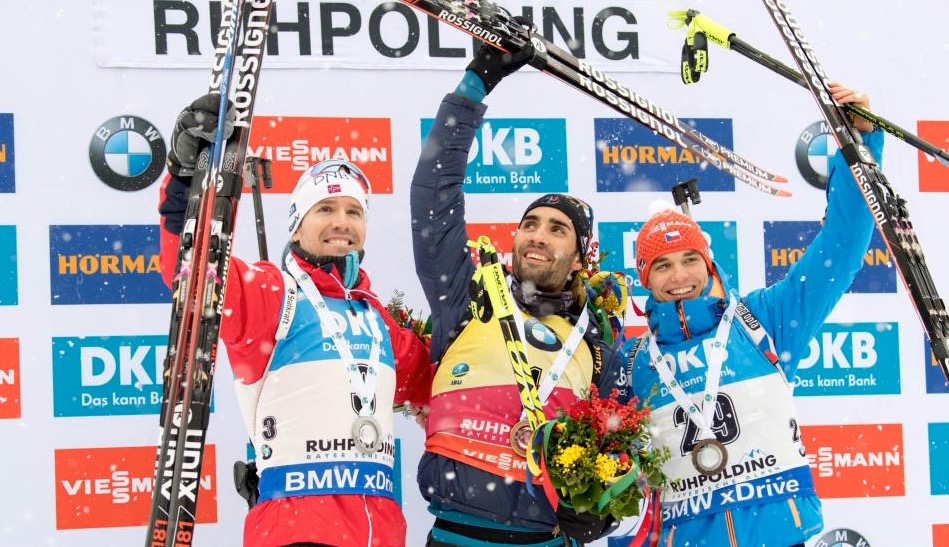
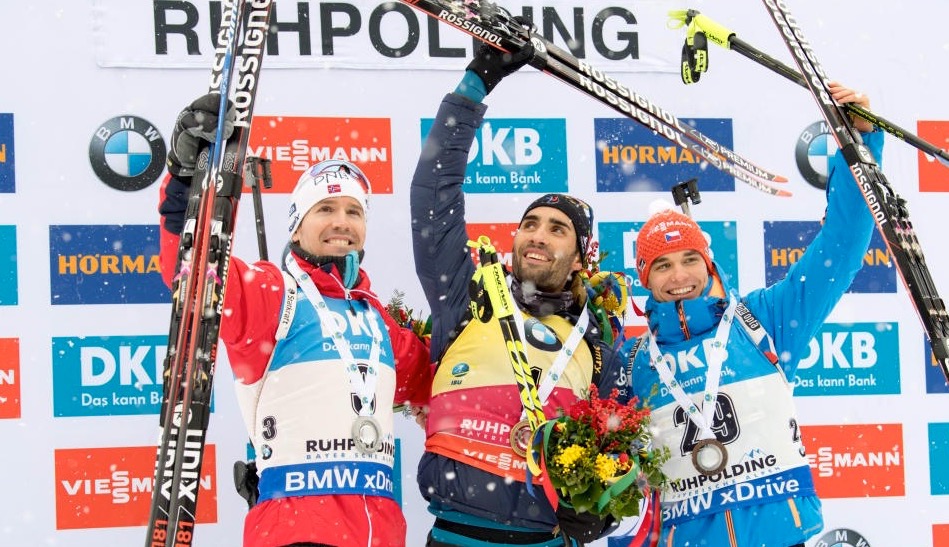
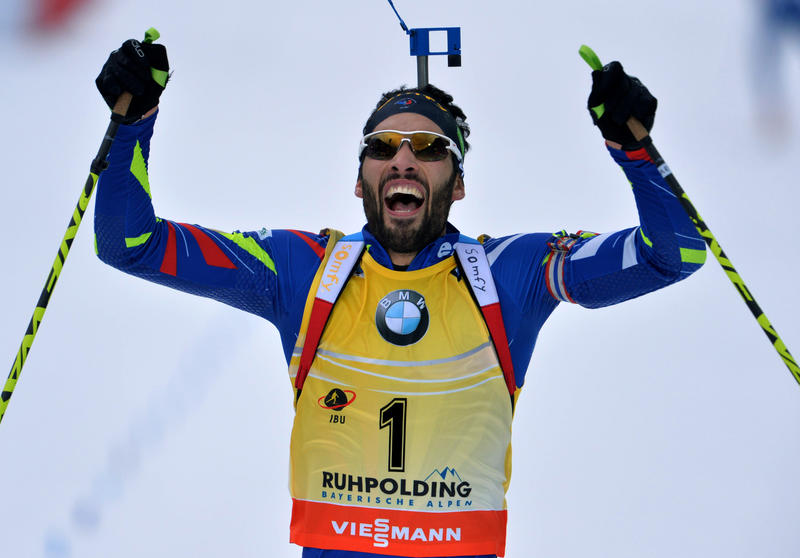
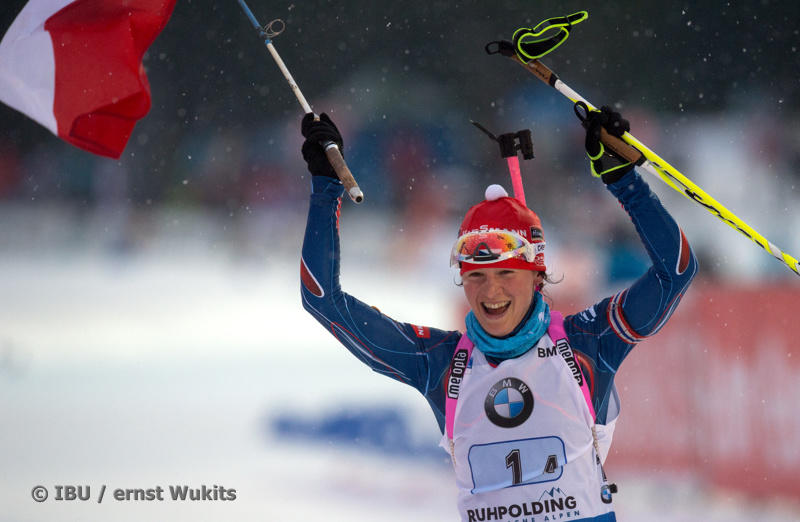
France’s Martin Fourcade (c) celebrates his 10th victory of the 2016/2017 IBU World Cup season in the men’s 12.5 k pursuit in Ruhpolding, Germany. Norway’s Emil Hegle Svendsen (l) placed second, and the Czech Republic’s Michal Krcmar (r) was third for the first podium of his career. (Photo: IBU)
Even Martin Fourcade himself seems surprised with his season so far in the record books.
“I know what I did this season is incredible,” the French biathlon star said in Sunday’s press conference in Ruhpolding, Germany. “Even in my best dreams I could never imagine that.”
Fourcade continued his series of stellar performances in the men’s 12.5-kilometer pursuit at the International Biathlon Union (IBU) World Cup in Ruhpolding, Germany. But he cut it close this time on his way to his 10th victory of the season.
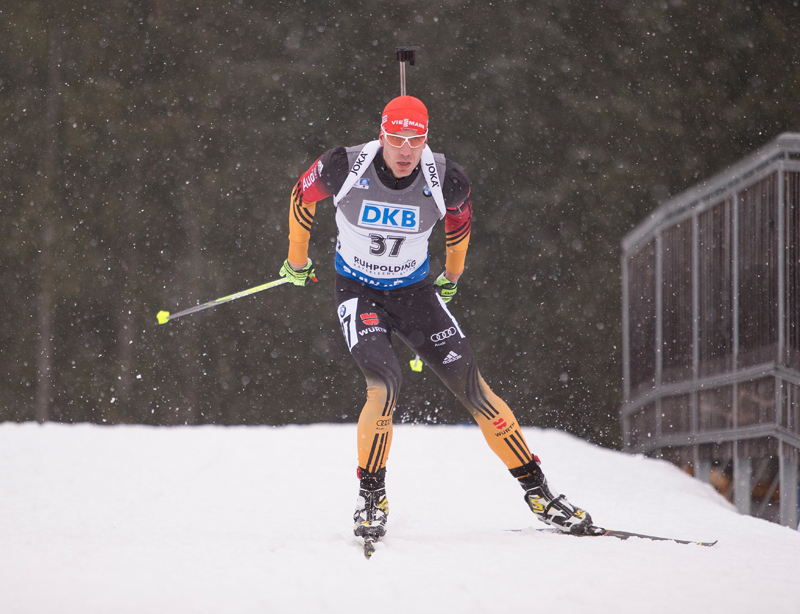
In heavy snowfall on the course in the Bavarian Alps, Norway’s clean-shooting Emil Hegle Svendsen took the lead for a short time when Fourcade missed two targets in his second prone stage and added another penalty in the first standing stage, returning to the course 0.5 seconds behind the Norwegian.
But after initially letting Svendsen set the pace on the loop before the final shooting, Fourcade pushed the tempo up the “Wall of Ruhpolding” climb to create a small gap on a group of five others still fighting for the podium within ten seconds of each other. He managed to reach the range first, and had already hit his first targets before his opponents set up in their lanes. Fourcade took his time with his last shot before finally hitting that one, too. While Svendsen also avoided the penalty lap, he left the range 14.3 seconds behind Fourcade.
On the last loop the two athletes were satisfied to just defend their positions, with Fourcade crossing the line in 33:47.5 minutes, with three penalties (0+2+1+0), and Svendsen 18.3 seconds back with no penalties.
“On the fourth and the last lap I was really, really tired,” Svendsen said at the press conference. “And [with] the slow conditions, when you feel tired it gets even worse, you know. The snow was coming down, and it was a tough battle with my own inner demons and my legs … To be second with this kind of fatigue at the end of the race, I am happy I came to the finish before the other guys.”
Just behind Svendsen, the third place on the podium was decided in a three-way race between Russia’s Anton Shipulin, Czech Republic’s Michal Krcmar and Germany’s Arnd Peiffer. At first it looked like Shipulin would prevail when he built a small gap on the last loop, but in the finishing stretch, Krcmar pushed up to him and outsprinted the Russian to achieve his first-career World Cup podium in third (+19.5 with no penalties), moving up all the way from starting in 29th. His previous best results had been two fifth places last season, one of those also in Ruhpolding in a mass start.
“First time for me and a little bit nervous,” Krcmar said with a laugh in his opening remark at the press conference. “On the last shooting I was clean, and on the track I concentrated on the fight with Arnd Peiffer. But on the last downhill, I see Anton so close and I try it and done. A very amazing day for me, I am so happy. ”
Shipulin finished in fourth (+21.3 with one penalty) and Peiffer in fifth (+24.1 with one penalty).
A knowledgeable student of the history of biathlon, who frequently cites certain races or career achievements of his youth idols (including his countryman Raphaël Poirée), Fourcade acknowledged that he is keenly aware he already tied the best World Cup season of his career, and is motivated by the chance he may soon break Norwegian Ole Einar Bjørndalen’s record of 12 wins in one season.
“I know I already won so much this season,” Fourcade said at the press conference. “There is a big gap [already] in the overall rankings. So if I had not these kinds of statistics, I don’t like the word record, but if I were not fighting for these statistics, I will not stay as focused as I am now and have less victories.”
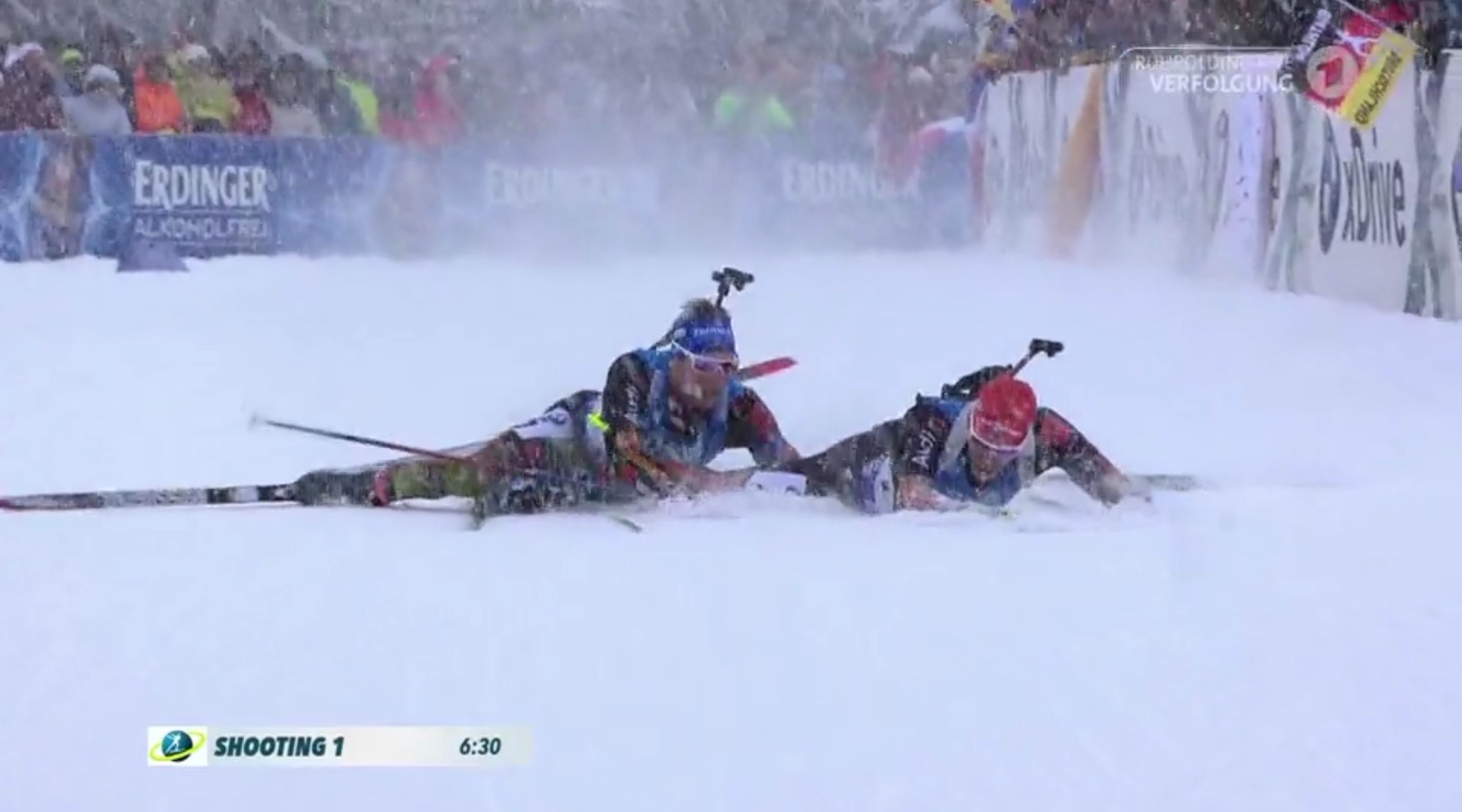
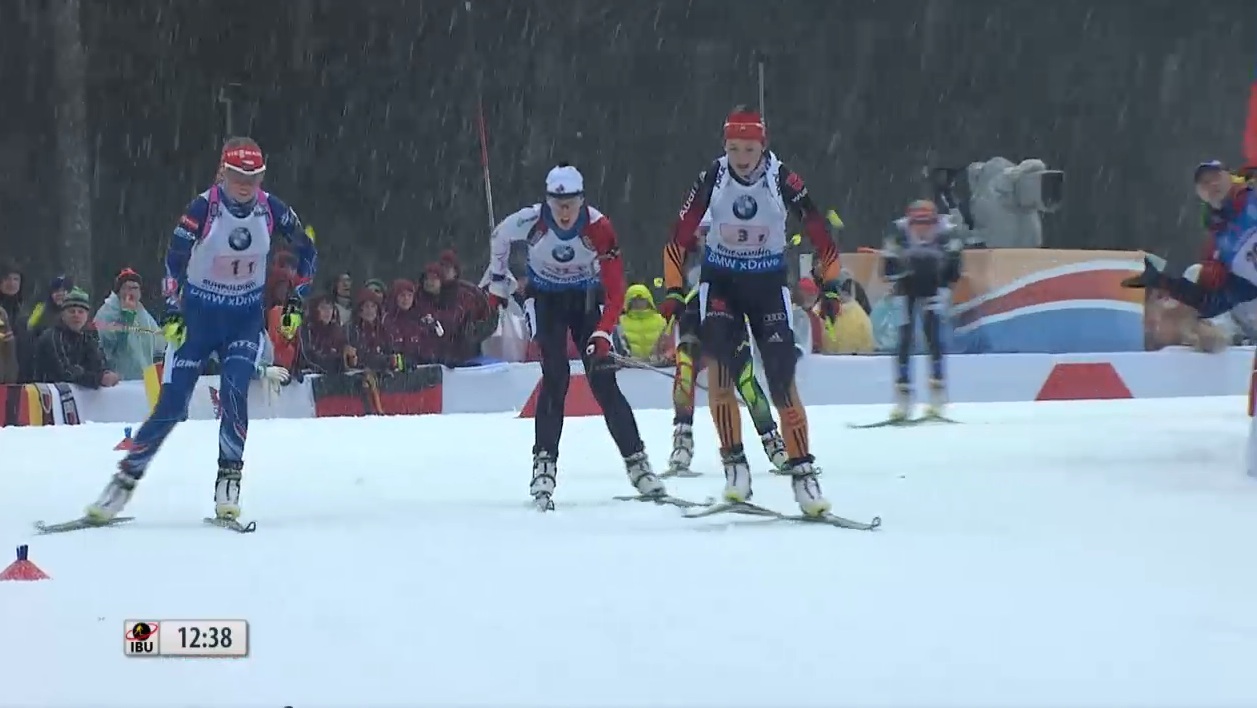
Germany’s Simon Schempp (l) and Arnd Peiffer (r) after tangling in the men’s 12.5 k pursuit on Sunday at the 2017 IBU World Cup in Ruhpolding, Germany. (Photo: ARD broadcast screenshot)
Peiffer’s race got off to a bad start when, on the first loop, he tangled and crashed with his teammate Simon Schempp. Peiffer broke a pole, but both fell flat on their bellies and at least their rifles remained undamaged.
“I can’t really explain what happened yet,” Peiffer told German broadcaster ARD after the race. “Simon was behind me on the downhill. And I believe the root cause was that my ski bumped to the side. In that moment Simon pushed into me, and then it all went so fast that I got an imbalance. Then I lay there, and oh, this was so annoying. I stood up, my pole was broken in three pieces. Simon had crashed with me, and a whole group skied past us. Then it took a while for me to get a spare. I may have to talk to our support staff about that because they stood there like stuffed dummies while I was yelling. Then I got a pole with a strap that was like glove size 5 [i.e. much too small]. Then I had to collect myself for the shooting range, and at least that worked kind of well.”
Schempp ended his race in seventh (+39.7) with two penalties (0+0+0+2).
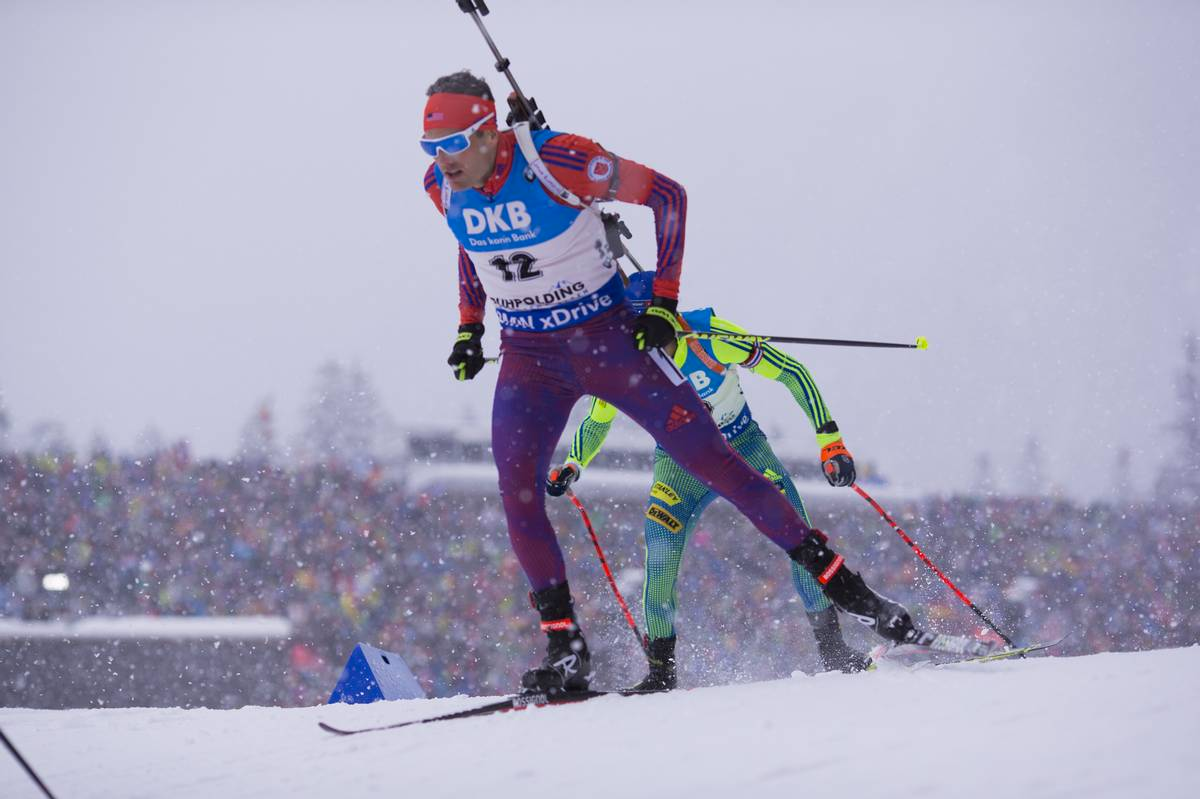
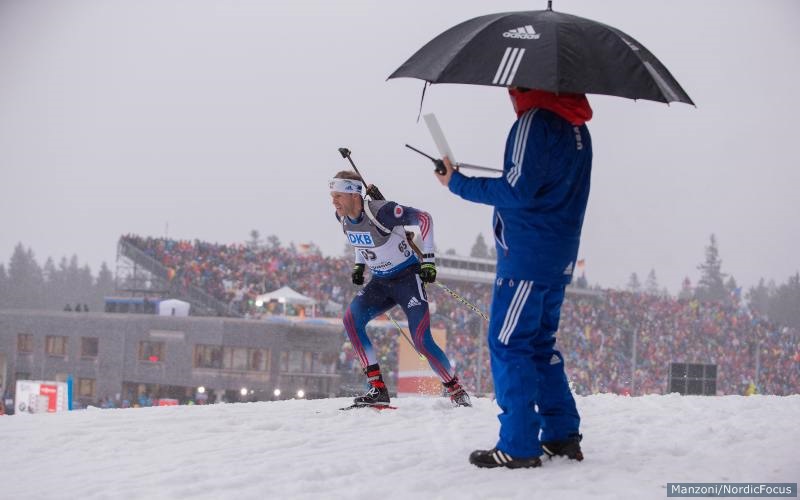
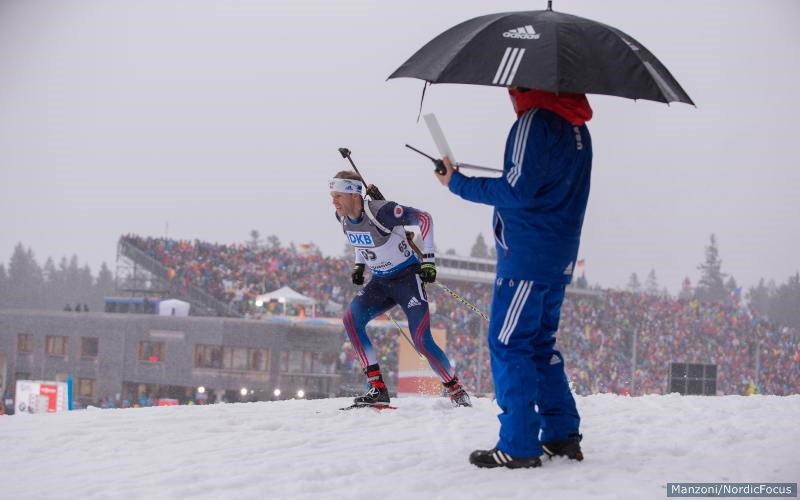
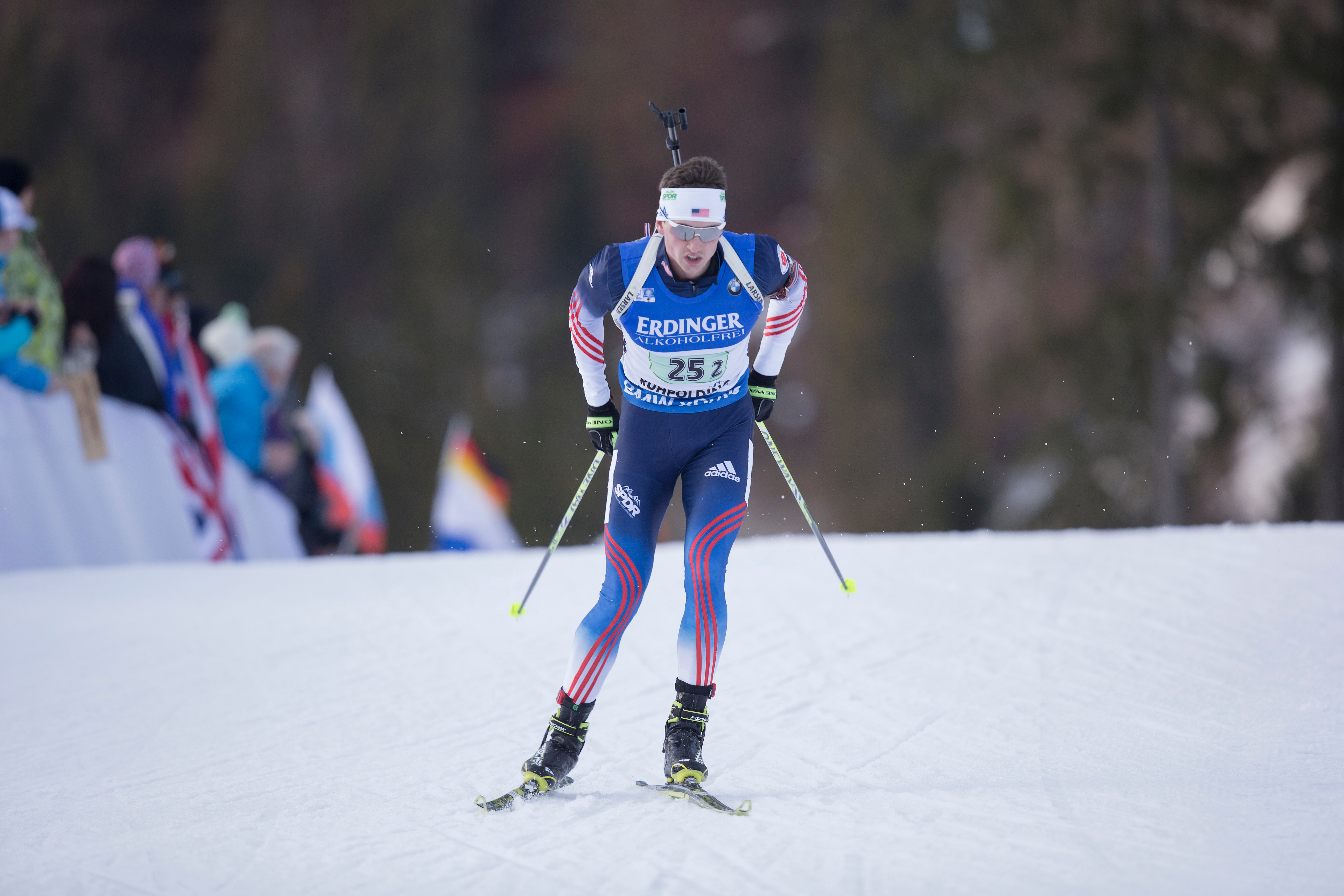
US Biathlon’s Tim Burke on course in heavy snowfall during the men’s 12.5 k pursuit at the 2017 IBU World Cup in Ruhpolding, Germany. (Photo: USBA/NordicFocus)
Americans Tim Burke and Lowell Bailey skied close together throughout the race, initially moving up several positions with two clean prone shooting performances after starting 12th and 18th, respectively. Burke left the range in 11th and Bailey in 13th place, both just a few seconds out of the top 10. But in the first standing shooting, Burke fell back to 28th with two penalties, and added another penalty in the final stage to finish 24th (+1:31.6).
“Today was another solid race for me,” Burke said, according to a US Biathlon press release. “I felt solid on the course but have not quite found my timing on the shooting range. I feel like things are headed in the right direction for me and I am looking forward to competing in Antholz next week, which has always been one of my favorite courses.”
With a penalty in each of the standing stages (0+0+1+1), Bailey finished 26th (+1:33.8), two seconds behind Burke.
“I struggled a bit on the skis today,” Bailey told US Biathlon. “No explanation, but I’m still happy with a solid top-30 going into Antholz. It was difficult conditions with falling snow, so I was satisfied with the shooting. Of course, I wish I could have those two misses back, but I’ll have to wait until Antholz.”
In his second World Cup week of the season, their teammate Sean Doherty finished 43rd (+3:22.1) with four penalties (1+0+2+1) after starting out in 40th position.
For Biathlon Canada, only Scott Gow qualified for the pursuit with his sprint result. He started 42nd and finished just ahead of Doherty in 41st place (+3:09.3) with three penalties (0+1+1+1).
“It wasn’t a huge move up today, but I still managed to gain one spot at the finish,” Gow wrote on Facebook. “Tricky conditions and heavy snow made for a challenging race! Lots of fun and looking forward to Italy.”
The IBU World Cup continues next week in Antholz with the women’s 15 k individual on Thursday, Jan. 19, and the men’s 20 k individual on Friday, Jan. 20.
France’s Martin Fourcade celebrates across the line as he won the men’s 15 k mass start on Sunday in Ruhpolding, Germany, for his 41st IBU World Cup win. (Photo: IBU/Eberhard Thonfeld)
Still suffering from the aftermath of an illness earlier this weekend, French biathlete Martin Fourcade was back to his usual strength in Sunday’s 15-kilometer mass start in Ruhpolding, Germany, winning in a time of 34:07.2 with one penalty while skiing the second-fastest course time of all starters. Ondrej Moravec of the Czech Republic finished second, (+13.7), and Norway’s Tarjei Bø third, (+29.7).
With the 41st win of his career, Fourcade extended his lead in the overall World Cup standings to his biggest rivals, and is now also leading the mass start score after two competitions.
Fourcade was one of the best performers in Ruhpolding, finishing fourth in the sprint and second in the pursuit.
“That’s cool, after two competitions close to the victory I am really satisfied to win this competition in Ruhpolding,” he added in an IBU video interview. “Yesterday it was a really close gap from the victory. Today I am satisfied about my whole competition, but especially my shooting spirit.”
Fourcade had one missed target in the first shooting stage, but then climbed up through the standings as he cleaned round after round.
On the penultimate loop, he caught the leaders and with Norway’s Emil Hegle Svendsen managed to create a gap to a chase group led by Moravec and Russia’s Evgeniy Garanichev.
Fourcade came into the last shooting stage with Svendsen. But while Fourcade managed to clean the stage again and leave it still in first place, Svendsen lost his position in the race by shooting three more penalties for four total. He only finished in 13th place, 1:12.3 minutes back.
Fourcade meanwhile took the lead after the final stage, and extended it from 5.8 seconds to his eventual comfortable margin.
“I was really confident on my last shoot, about my chances to shoot clean,” Fourcade said in a video interview after the press conference. “I thought that Emil will be with me on the last loop, but he had three mistakes and so he didn’t fight with me. And on my last loop I was confident to keep my gap to Ondrej Moravec. So that was a quite good and exciting competition.”
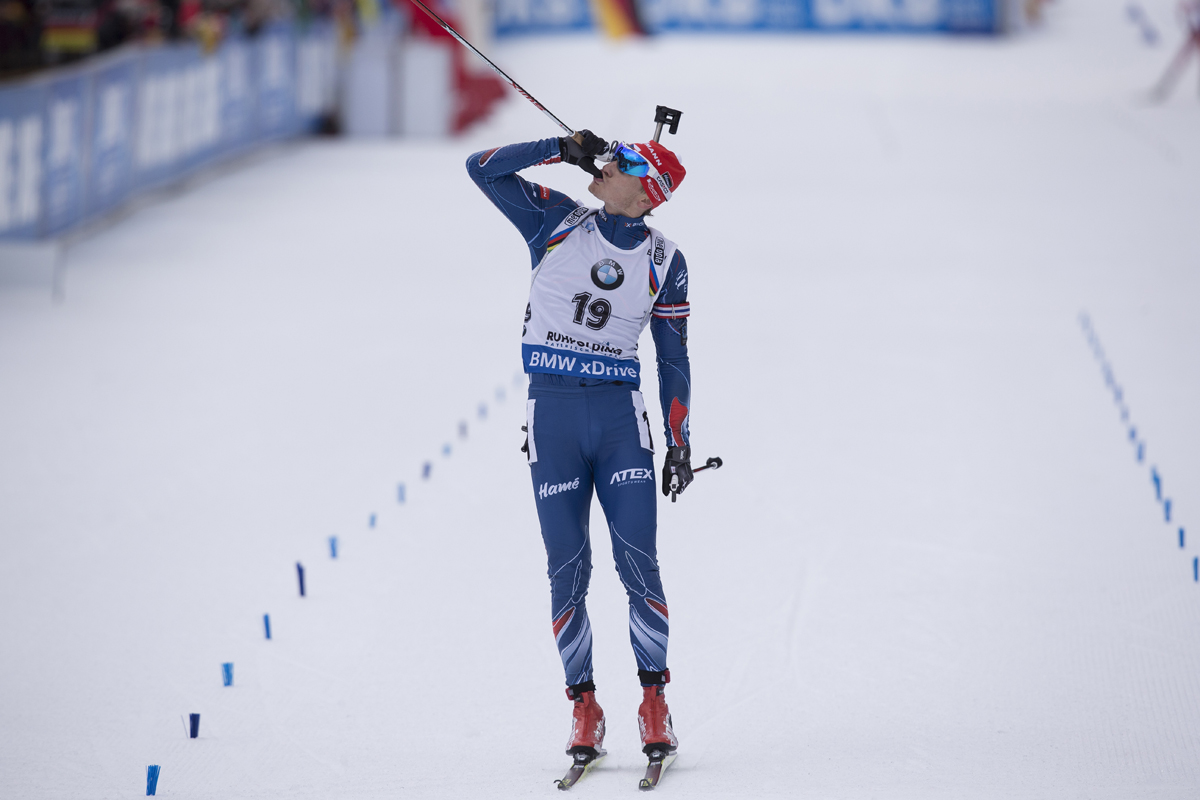
Ondrej Moravec of the Czech Republic after cleaning the 15 k mass start for his first IBU World Cup podium of the season on Sunday in Ruhpolding, Germany. (Photo: Fischer/NordicFocus)
Moravec was the only one of the 30-man field to clean in all four stages. It was the first podium of the World Cup season for the three-time medalist from the 2014 Olympics.
“For sure it is a relief; I feel much more comfortable now,” Moravec said in the press conference. “I think this is the third zero [shooting competition] in my life. That was good work … especially in standing, because yesterday I was too risky on the range in the pursuit. So today I am satisfied with my work on the shooting range, focusing on the job.”
Bø, who had placed second in the sprint and fourth in the pursuit this weekend, shot three penalties.
“I cannot quite understand that I managed to get back up there, because I got the worst possible start,” Bø told NRK. “There were strong winds on the first shooting, and I got two misses … I struggled my way into third. I was determined to go well on the last shooting.”
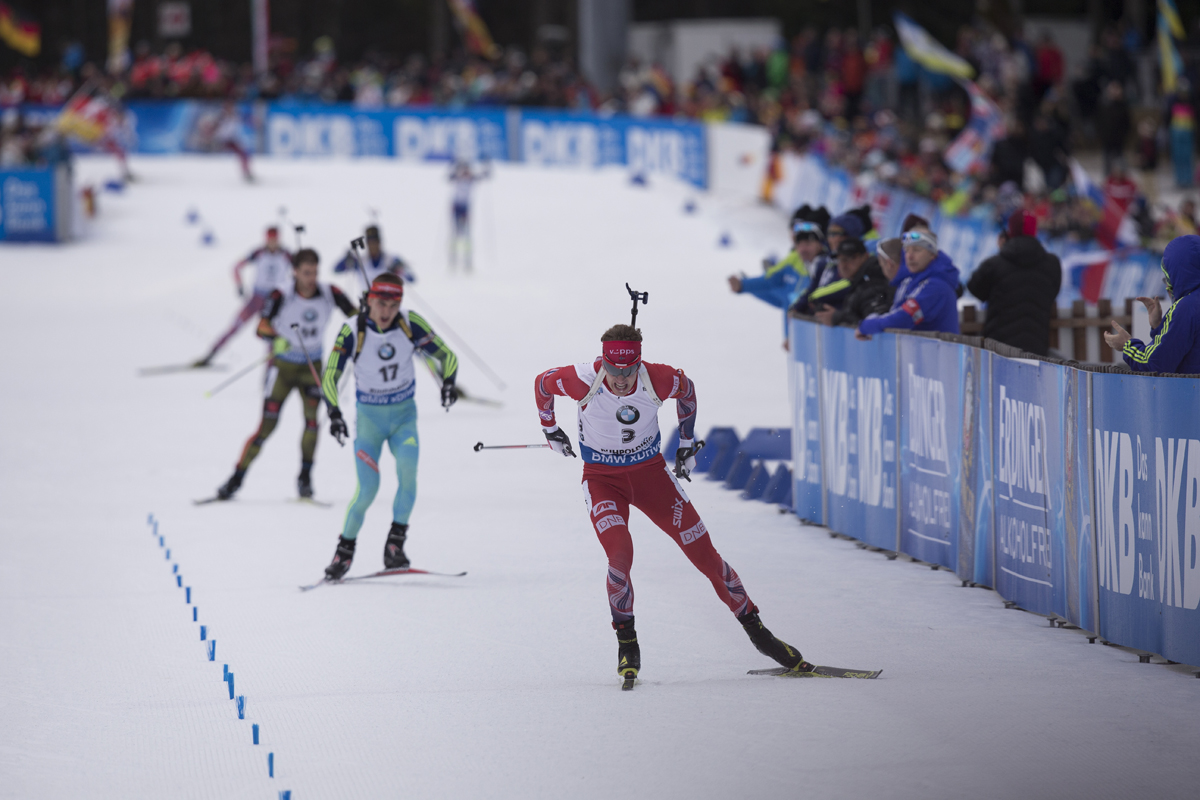
Norway’s Tarjei Bø (2) racing to third in the men’s 15 k mass start, at the IBU World Cup in Ruhpolding, Germany. He’s currently third in the overall World Cup standings as well. (Photo: Fischer/NordicFocus)
Even after cleaning the final round, Bø left the range in seventh place.
Fourcade’s older brother Simon left the shooting range in third position, skiing out on the final loop 27.3 seconds back. But three athletes from a chase group were still able to pass him, with Bø ultimately able to secure the last spot on the podium in a sprint on the finish stretch. He finished just ahead of Ukraine’s Dmytro Pidruchnyi in fourth (+31.4, two penalties), Germany’s Arnd Peiffer in fifth (+33.3 with one penalty), Simon Fourcade in sixth (+36.9 with one penalty), and Garanichev in seventh place (+38.4 with two penalties).
Bø skied the fastest course time of the day and was able to prevail in a larger chase group on the final loop.
“To be honest, I am not so surprised,” Bø said in the press conference regarding his season so far and this race in particular, achieving a podium despite three penalties. “I have not been so good on the overall World Cup in many years due to a lot of things, I missed events due to sickness, and so on. I was happy to win medals last year [at the World Championships], but in the total score I have been really bad for three years. This year I had no trouble at all, and I know I will fight every race. So I am really happy about the total score.”
Bø currently stands in third position after this race, behind Martin Fourcade and his teammate Svendsen.
Two North Americans in the Mass Start
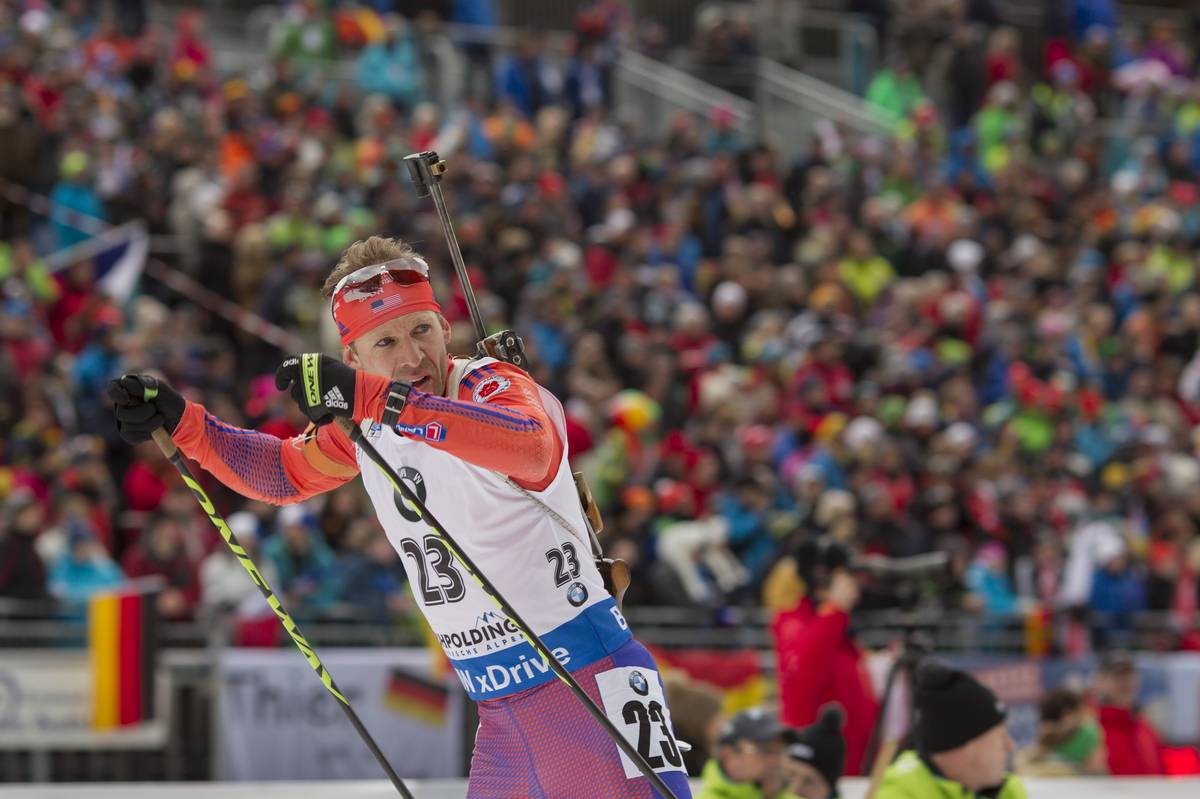
Lowell Bailey (US Biathlon) on his way to 16th in the men’s 15 k mass start at the IBU World Cup in Ruhpolding, Germany. (Photo: USBA/NordicFocus)
Two North American men — American Lowell Bailey and Canadian Nathan Smith — had qualified for the mass start by virtue of being ranked in the top 25 of the World Cup.
US Biathlon’s Tim Burke, who was narrowly outside that group and had hoped to be called up from a “reserve athletes standby list”, did not get his wish granted. Norway’s Ole Einar Bjørndalen, who is ranked ahead of him, returned from illness for his first race of the weekend. Bjørndalen finished the day in 12th place, with three penalties.
Bailey’s race got off to a good start, with clean rounds in both prone shooting stages despite difficult wind conditions. In the third stage, Bailey had the first miss of his day, and came out of the penalty lap still in ninth place, 27.1 seconds back, as several athletes at the top of the field incurred penalties as well.
He came into the last shooting stage in a pack of athletes still with a chance for at least a top-10 position, but two more misses set him back. He left the range and penalty laps again in 15th place. On the final loop he slipped to 16th, 1:15.2 back.
“Ahhhhhhh!!!!” That about sums it up! So close. Thx to USBA wax crew… INCREDIBLE SKIS!!!“ Bailey tweeted after the competition.
Canada’s Nathan Smith, who had hoped to build on the strong skiing and shooting form he had demonstrated to achieve a sixth place in the pursuit on Saturday, struggled through a difficult day on the shooting range.
With changing winds repeatedly forcing athletes to adapt their sights – for example blowing strongly left-to-right in the first stage and then almost not at all on the second stage – Smith recorded six misses on the day, only shooting clean during his final stage (1+2+3+0).
He finished the day in 25th place, 2:23.4 back from Fourcade.
Germany’s Franziska (1) leads Gabriela Soukalova of the Czech Republic (2) and German teammate Laura Dahlmeier in the women’s 10 k pursuit at the IBU World Cup in Ruhpolding, Germany. Dahlmeier started fourth and finished first, 7.3 seconds ahead of Soukalova. (Photo: IBU/Eberhard Thonfeld)
It was a pursuit race, but it must have felt more like a mass start.
The first four women all started within the first three seconds of one another in Saturday’s 10-kilometer pursuit at the IBU World Cup in Ruhpolding, Germany. Franziska Hildebrand of Germany started first, followed by Gabriela Soukalova of the Czech Republic, Finland’s Kaisa Mäkäräinen, and another German, Laura Dahlmeier in fourth.
Hildebrand and Mäkäräinen didn’t hold on to their top spots, each accruing too many penalties in such a tight field to remain competitive for a spot on the podium. After an initial miss in the first prone shooting took her out, Hildebrand ended up ninth and 1:24.3 behind the eventual winner with four penalties (1+0+1+2). Behind her, Mäkäräinen took 13th (+1:52.1) after skiing five penalty laps (0+1+2+2).
But Dahlmeier and Soukalova stayed neck-and-neck at the front of the race, each earning one penalty — Dahlmeier on the second-to-last stage, Soukalova on the final standing stage. Dahlmeier passed Soukalova on the last lap, much to the delight of the German crowd, holding on to win by 7.3 seconds in 32:35.9.
Ruhpolding’s already-sloppy course got worse, along with the weather, as the race went on. Light rain ensured mushy conditions, a factor that Soukalova cited in losing her lead to Dahlmeier. “Traditionally, I am not very strong on the last loop,” the runner-up said in a post-race press conference. “Besides, I am not very light for this kind of snow.”
Italy’s Dorothea Wierer moved up from sixth to claim the final podium spot in third (+53.6) despite two penalties (0+1+0+1). She led a tight pack into the finish, including Norway’s Tiril Eckhoff in fourth (+57.3), France’s Marie Dorin Habert in fifth (+57.5), and Slovakia’s Paulina Fialkova in sixth (+1:01).
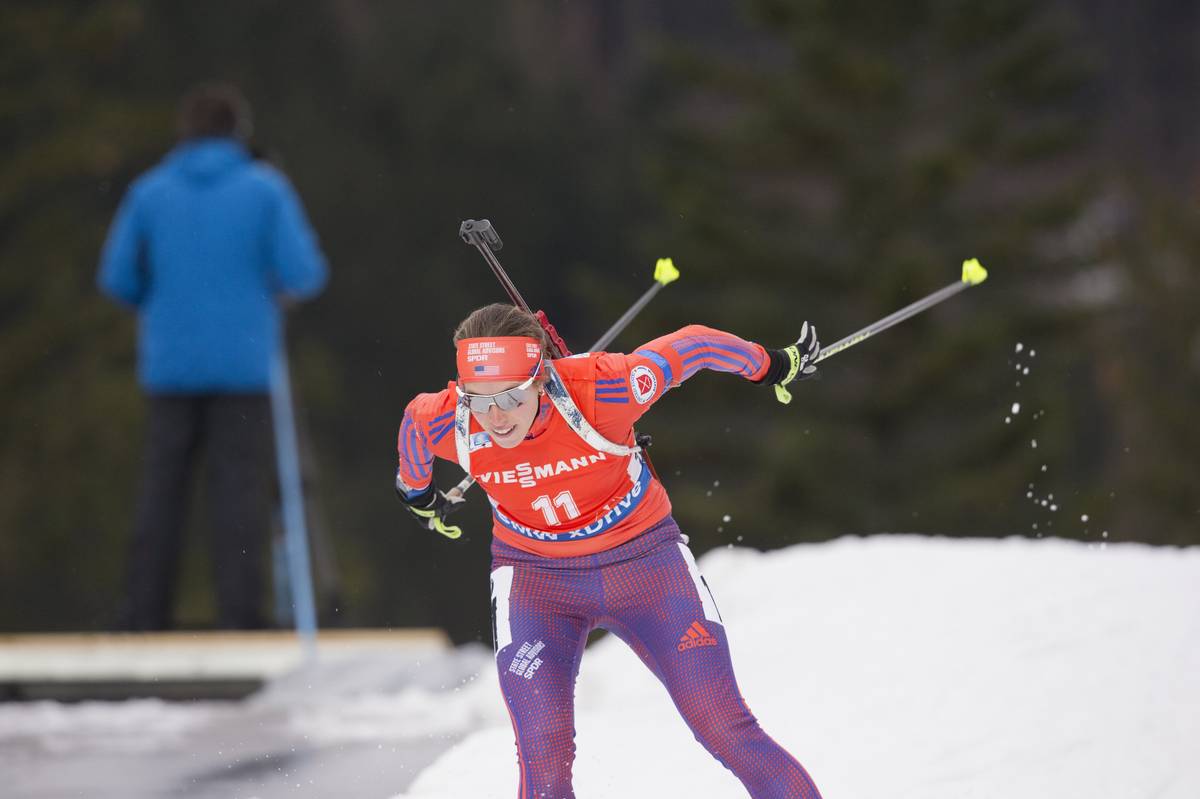
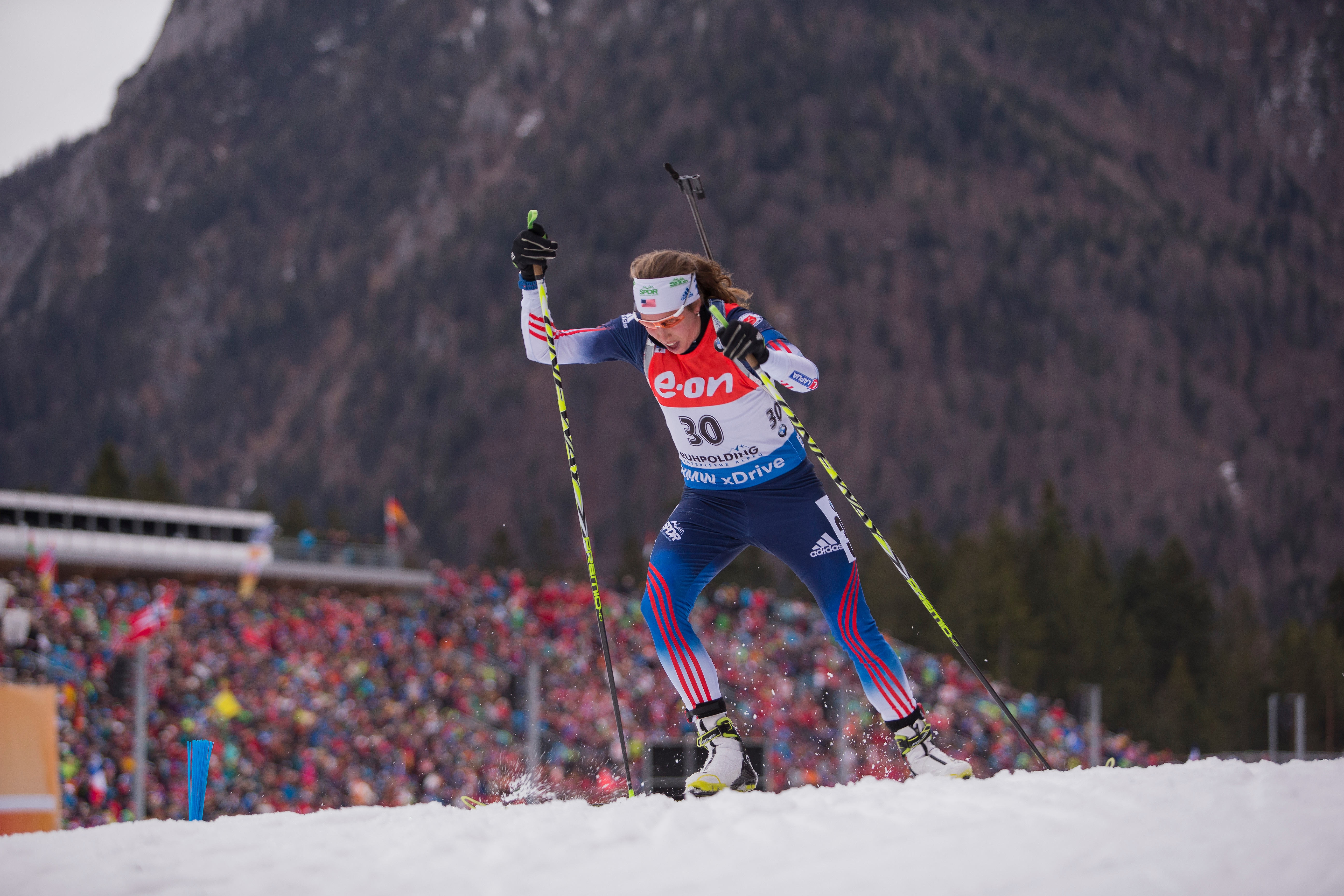
Susan Dunklee (US Biathlon) racing to 15th in the IBU World Cup women’s 10 k pursuit on Saturday in Ruhpolding, Germany. (Photo: USBA/NordicFocus)
American Susan Dunklee started 11th and finished 15th (+2:04.1) in a sprint to the line with Karin Oberhofer, edging the Italian by 0.1 seconds.
Over the four-stage race, Dunklee accrued three penalties, all of which came in the last two standing stages (0+0+2+1).
“It was one of those days when it is difficult to apply any sort of power effectively without simply wasting energy,” Dunklee explained in an email. “The race started great. … I moved up as far as 6th.”
However, she experienced some technical difficulties, and lost a clip while putting her rifle back on after the second prone stage. She got a new one, but “I didn’t do a perfect job of regaining control of my focus before beginning shooting,” she explained. She missed two shots in next shooting stage.
Julia Ransom was Canada’s top finisher, gaining four spots to finish 45th (+4:19.6), with two misses (0+0+1+1), followed by teammate Sarah Beaudry, who improved one place to 54th (+6:12.4) with three penalties (0+1+0+2). American Annelies Cook started 43rd and finished 58th (+7:50.6) with eight penalties (1+2+3+2).
“I had an exciting sprint battle with Karin Oberhofer of Italy for 15th place,” Dunklee wrote. “Inspired from watching the Tour de Ski all week, I thought it was the perfect opportunity to use a finishing lunge. The good news: I outlunged Karin. The bad news: I broke my rifle stock when I crashed after the line.”
Was it worth it?
“Worth it, I think. The stock will be fixed by tomorrow.”
Dunklee will start Sunday’s 12.5 k mass start in bib 23 (of 30). Race starts at 8:45 a.m. Eastern time. Watch here.
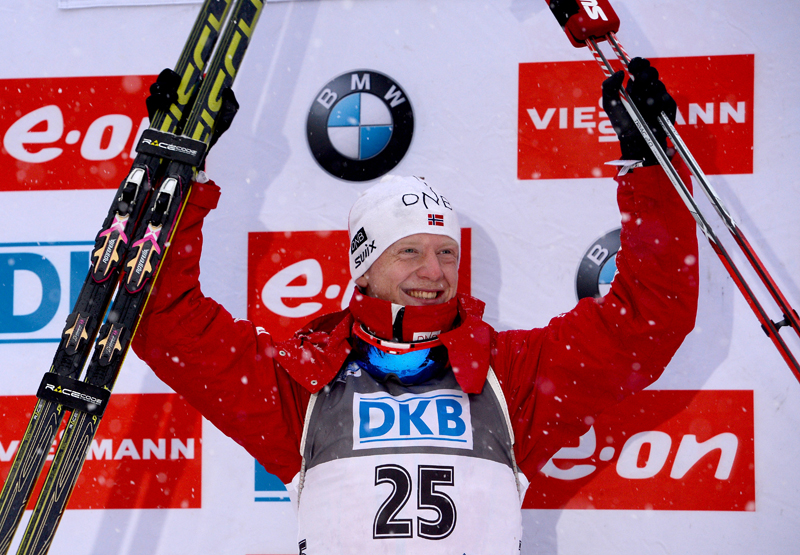
Johannes Thingnes Bø of Norway celebrates his IBU World Cup sprint victory on Saturday in Ruhpolding, Germany. He cleaned both stages and posted the fastest-overall course time to win by nearly 25 seconds. (Photo: Fischer/NordicFocus)
“It’s hard to escape Ruhpolding without racing in the type of conditions we had today,” Brendan Green wrote in an email on Saturday, following the IBU World Cup men’s 10-kilometer sprint in Ruhpolding, Germany.
One day, it’s pristine — like men’s relay on Thursday — with clear skies and fast, firm conditions, and little-to-no wind. Other days, it’s not, like the women’s relay on Wednesday, when rain pelted the stadium, or Saturday, when soft, heavily falling snow refused to let up as the men’s race wore on.
Some of the top-ranked competitors, like France’s Martin Fourcade and Germany’s Simon Schempp, opted to start later in the 102-man field, anticipating that the course would speed up with each passing skier. That didn’t exactly pan out.
If anyone, earlier starters seemed to have the benefit, but it was hard to say. The sprint was a slog-fest and most felt slow on their skis. Among those who found the most success were the ones who shot clean: eventual-winner Johannes Thingnes Bø of Norway, who started 25th and led from start to finish, and Schempp, who started some 23 minutes later in bib 71 and came within 24.5 seconds of Bø’s winning time of 23:59.2 to place second.
Germany’s Arnd Peiffer racing to third in the men’s 10 k sprint on Saturday in Ruhpolding, Germany.(Photo: Fischer/NordicFocus)
Germany’s Arnd Peiffer started 37th and placed third with a single penalty, 57.9 seconds behind Bø, with the fourth-fastest overall course time. His podium secured his spot on the German team at IBU World Championships in March.
And then there were two Canadians — Green and Scott Gow — who knocked down all their targets for flawless shooting, and despite not feeling fast, notched season and career bests, respectively.
Green started 79th and ended up 16th, 1:30.2 behind Bø, with clean shooting through two stages. After prone, his time ranked 38th, and he moved into 14th after hitting all five of his standing targets as well.
“It was really hard for me to judge how my skiing was going,” Green explained. “The conditions were frustrating to ski in for sure with deep slushy snow, but I did what I could to ski smooth and not let the conditions get the better of me. I opened up my race much slower than I would have hoped, but my speed and how I felt progressed steadily as the race went on.”
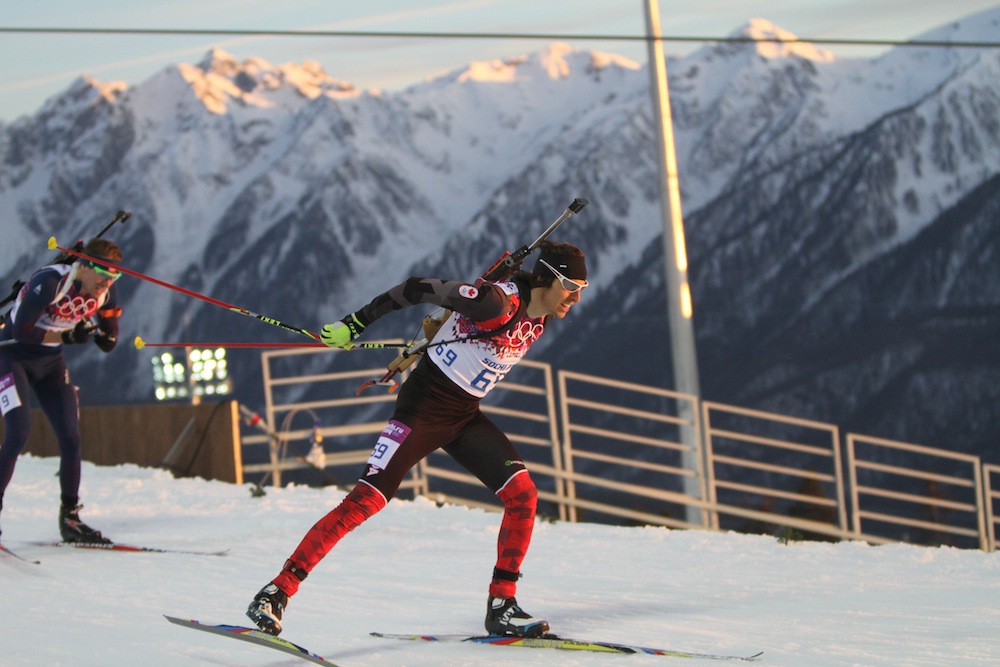
Canada’s Brendan Green on his way to his best Olympic result of 21st in the 20 k individual race at the 2014 Olympics near Sochi, Russia.
Starting later, he wasn’t able to warm up as much as he would have liked on the small, congested warmup loop, but Green wasn’t sure that had an impact on how he opened his race.
What matters is how he ended it, and he closed out his last lap with the 22nd-fastest time to place 16th for his best result of 2014/2015. It was the second-straight race he shot clean following the men’s relay.
“It’s hard to say exactly why my shooting has been so solid over the last two races, a bit of luck for sure, but I think I’m finally able to commit to a few small changes that I was working on over Christmas and fully trust my current position and mental approach,” Green wrote. “Any day you shoot clean it’s a bonus and I’m glad I was able to capitalize on that today and make it into the Mass Start tomorrow.”
Green was the lone North American male to qualify for the mass start, which kicks off Sunday with the women’s 12.5 k at 12:30 Central European Time (CET) and the men’s 15 k at 15:40 CET (9:40 EST).
He’ll start in bib 29 of 30. “I think I’m still capable of better results and tomorrow will be another good opportunity,” Green wrote.
“Brendan’s result is in line with our expectations,” Biathlon Canada High Performance Director Chris Lindsay said in a press release. “He has a pattern of success later in the season and this is a planned step on the way to peaking at the World Championships in March.”
Two years ago, Gow notched his previous World Cup career best of 29th in Ruhpolding, also in the sprint. While he explained that memory was “definitely in the back of my mind,” he added that he tried to keep it there to avoid distraction on Saturday.
Given the conditions, he knew he was going to need all the focus he could muster.
“I knew that good skiing and shooting could put me into the top 30, and that it was important to be focused on the entire process,” the 24-year-old Gow wrote in an email.
He ended up cleaning both stages to put himself in 31st overall heading out on his last lap, and he tied Green for the 22nd-fastest last-lap time to finish 27th (+1:53.5). He was just 1.8 seconds behind Fourcade in 26th, who had two misses and the 18th-ranked overall course time.
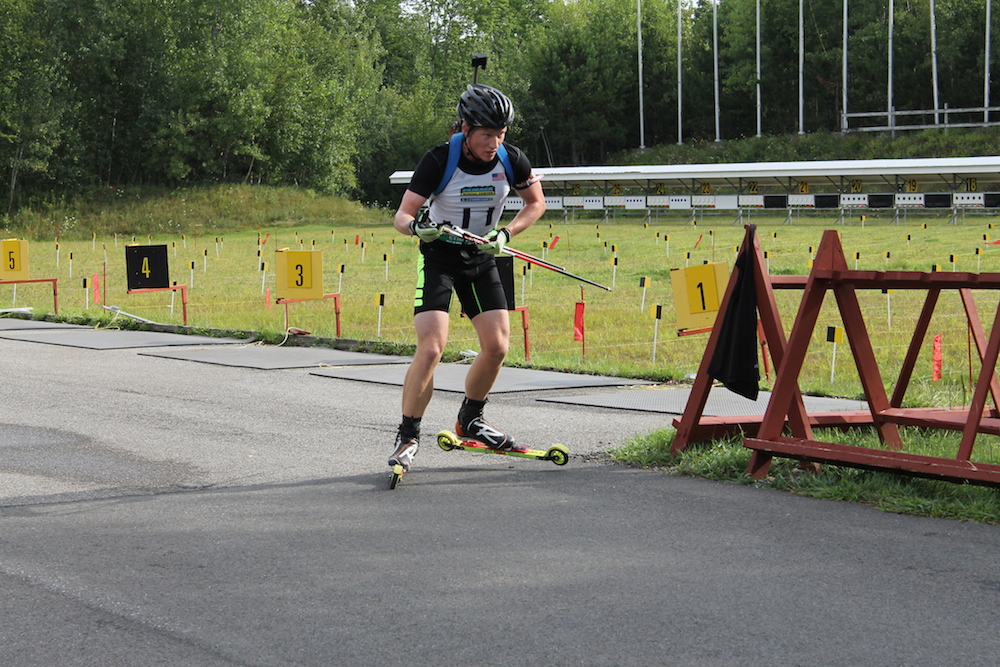
Canada’s Scott Gow leaves the range in the men’s 10 k sprint at the 2014 North American Rollerski Championships in August at the Ethan Allen Firing Range in Jericho, Vt.
“My main focus for the race was my skiing,” Gow explained. “I don’t always fare well in deeper, slushy snow, so concentrating on achieving the best glide possible was my biggest goal for the race. Of course shooting is also a priority, but it was definitely secondary to my skiing.
“I would have liked to ski a little better and end up in the top 20, but I will have to wait for that result,” he added. “I managed to finish the race with relatively strong last lap which I was very happy with. … This performance was important to me because it is a validation of my training this past summer, and shows that I have the potential to be a more consistent top 30 athlete.”
Lindsay said he was excited to see the depth of the Canadian men’s field starting to show, with Nathan Smith placing 35th (+2:06.9) despite three penalties.
“Three men in the top-40 is a metric that shows our status as a top-eight nation in the world,” Lindsay said. “Now we need to see more consistency, and work on getting all four men in the top-40.”
Gow’s younger brother, Christian, 21, raced through illness to place 81st with a single penalty.
Smith, who started 33rd, wrote in an email that he found the conditions to be fair given the weather.
“For sure the guys who were still out there at the end of the race were at a disadvantage when the newly fallen snow was being skied in less and less,” he wrote.
At the end of the day, he wasn’t sure what went wrong with his shooting, especially with two prone penalties, but he explained he was “definitely disappointed” with that first stage.
“It’s been feeling so natural and easy. Two misses was a bit of a shock,” he wrote.
Despite dropping to 48th after the second stage, Smith posted the 19th-fastest overall course time to end up 35th, 2:06.9 back from the winner.
“I actually didn’t realize my skiing was quite fast,” Smith wrote. “My end result is pretty good for having three misses. But this is biathlon and you need to have perfect or near perfect shooting to get top results. Today was one of those days where I did 50% of the sport really well.
“I was really hoping to get back into the top-25 overall with a strong result today,” Smith added, which is what he would have needed to guarantee himself a start in Sunday’s mass start. He’s currently 29th in the overall World Cup. “Unfortunately that didn’t happen … I’ll have to wait until Antholz next week to redeem myself.”
Lowell Bailey on his way to 41st in the IBU World Cup 10 k sprint on Saturday in Ruhpolding, Germany, with US Biathlon High Performance Director Bernd Eisenbichler at right. (Photo: USBA/NordicFocus)
Lowell Bailey was the top American in 41st (+2:22), with a single standing penalty, which he referred to as simply a bad shot.
“The conditions were deep and slow,” Bailey, who started 65th, wrote in an email. “It was a tough race and I definitely didn’t feel like I could get everything out of my skis. … There’s only so much you can when it’s changing so frequently. I might have done better by picking a different pair of skis. But there really was no way of knowing. All in all, not my best day. I hoped to be better.”
Tim Burke placed 50th (+2:46.3) with three misses, all in standing, and while Bailey and Burke remain in the overall World Cup top 30 (in 27th and 30th, respectively), they didn’t qualify for the mass start.
“Every day is different on the World Cup,” Bailey wrote. “There are so many variables that come into play; fitness feeling that day, weather, wind, shooting, skis, wax, crowds, etc. Some days are better than others. It’s been a bit up and down lately but I’ve been around this sport long enough to know that you just need to appreciate the good days, and learn what you can when things don’t go perfectly, then move on.”
Also for the U.S., Sean Doherty started last in his first individual World Cup of the season and finished 80th with one miss.
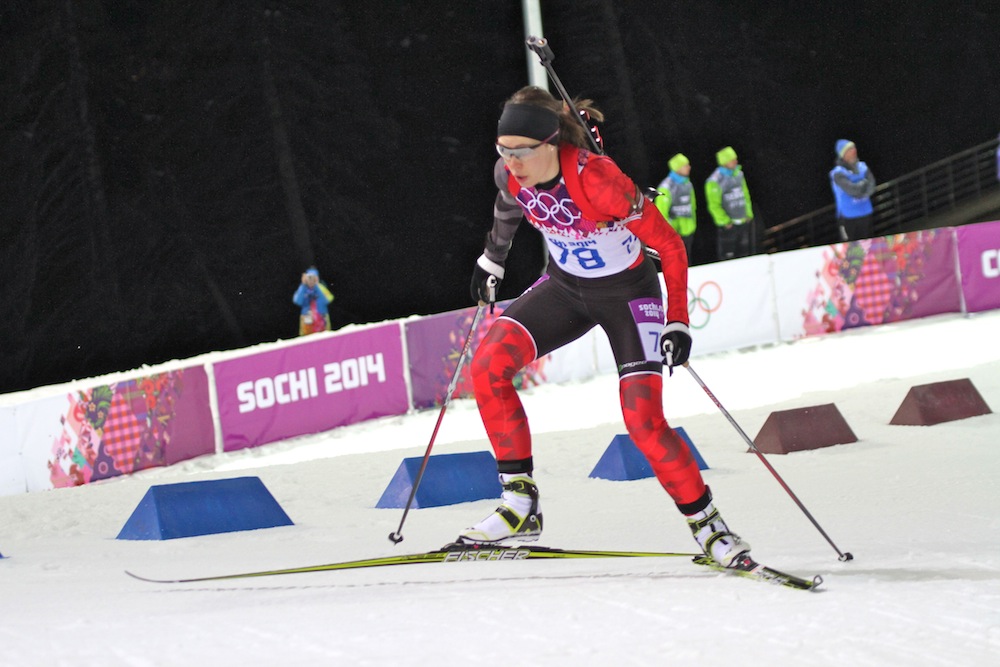
Megan Heinicke (Biathlon Canada) racing to 59th in the sprint at the 2014 Olympics near Sochi, Russia.
Megan Heinicke had a little something called home-course advantage working in her favor on Friday, and for that matter, on Wednesday and this Sunday as well.
The 26-year-old Canadian from Prince George, B.C., has called Ruhpolding, Germany, her home since September. Lucky for her, the fifth IBU World Cup stop of the season was there, with races Wednesday through Sunday. And on Friday, the six-year Biathlon Canada veteran qualified for her first-ever mass start after placing a career-best 11th in the 7.5-kilometer sprint.
“This was one of my strongest skiing performances ever,” Heinicke wrote in an email after Friday’s race, in which she topped her previous World Cup best by one place (she was 12th in the 15 k individual at the beginning of the season in Östersund). “I simply felt strong and there is nothing more fun than fighting hard when you feel strong.”
The 16th starter out of 98 women, she finished 52.3 seconds behind the winner after shooting 90 percent with a clean prone stage and one standing penalty.
That put her in third overall after prone, and while her standing miss set her back to 10th and she slipped one more spot to 11th on the last lap, Heinicke initially finished fifth of 16 women.
“I was well aware that starting with bib 16 meant that there were still a lot of strong girls behind me so I wasn’t disappointed to fall back a bit [in the final results],” she explained. “I was really hoping to stay in 10th, but 11th is a new personal best and I am really pleased with the result.”
Throughout the race, she heard she was in contention with top women like Darya Domracheva of Belarus (who started 14th and ended up second) and Italy’s Dorothea Wierer (who started 19th and placed ninth). She wasn’t sure what that meant or where it would put her, but she felt strong and assumed she was doing well.
Going into the race, Heinicke had hoped for a top 30, but more specifically, to “glide longer in the flat sections and be a bit more explosive with higher frequency on the few steep sections,” she wrote. “Shooting wise I had been trying out some keywords and those were all I wanted to think about on the range.”
On Wednesday, Heinicke had another first, racing to second in the opening leg of the women’s 4 x 6 relay and putting her team 25 seconds from the lead at the exchange. The Canadians ended up 11th — not quite the team-best fourth they accomplished just over a year ago — but Heinicke saw it as a stepping stone.
“I had a great relay leg this Wednesday and had also had a great relay leg in Oberhof which had me feeling determined and confident,” she wrote. “I am slowly starting to feel more confident and I have this fierce determination to shoot well which is enough to keep me focused.”
The level of support she’s received has helped her as well.
“I have had some big life changes this fall and am feeling like there is no pressure on me and I think that has been good for my head,” she explained. “I am really motivated by having several personal bests this season and I feel like the return of my self confidence is good for me. I am planning to keep racing with the same determined, task-oriented approach and who knows what can happen! I certainly wasn’t expecting these results to come this year!”
With Friday’s result, Heinicke was one of two Canadian women to qualify for Sunday’s 12.5 k mass start. Rosanna Crawford sat out Wednesday and Friday because of a cold, but is currently 12th in the overall World Cup (making the top-30 criteria) and listed to start in bib 12.
In her first-career mass start, Heinicke will start in bib 28.
“I am glad I have been able to start our relay a few times so I am not feeling too nervous about starting in the pack,” Heinicke wrote.
Also for Canada on Friday, Zina Kocher placed 48th, 2:18.8 behind the winner — Fanny Welle-Strand Horn of Norway. After starting 96th, Kocher found herself in the top 20 after a clean prone and the 23rd-fastest course time on the first lap. However, she missed three in standing, which put her back from 31st to 65th with one lap to go. Kocher posted the 13th-fastest course time overall.
Audrey Vaillancourt finished 68th (+3:13.7) with a single prone penalty, and Julia Ransom, in her second World Cup sprint, was 81st (+3:55.8) with four penalties: one prone and three standing.
Dunklee: ‘One of my best performances of the year’
Susan Dunklee (US Biathlon) on her way to 26th on Friday in the women’s 7.5 k sprint at the IBU World Cup in Ruhpolding, Germany. (Photo: USBA/NordicFocus)
US Biathlon’s Susan Dunklee led the Americans in what she considered one of her best performances of the year, in which she placed 26th, 1:44 behind Horn.
Dunklee started 30th and skied right around 30th for most of the race, cleaning prone and missing one in standing, and posted the 30th-fastest course time overall.
In an email, she explained her skiing felt “snappy,” which left her surprised with the splits she was hearing: why weren’t they better?
“There are always factors out of your control as an athlete,” Dunklee wrote. “Today we saw some tricky waxing conditions with wet snow and we didn’t nail it quite as well as we usually do.”
Skiing aside, she explained she had her best shooting day of the season, “which is a huge confidence booster going forward,” she wrote. “Plus I was happy, relaxed and focused this morning; I was just plain psyched to be racing, more so than I have been lately.”
On Sunday, Dunklee as the lone American in the women’s mass start will start in bib 23.
“I’m ready to try again in the mass start,” she wrote.
Her teammates, Annelies Cook and Hannah Dreissigacker, placed 52nd and 77th, respectively on Friday. Cook cleaned prone and missed one standing to finish 2:30.1 behind the winner, and Dreissigacker fell behind with two prone penalties and another miss in standing to end up 3:41.2 back.
Horn Surprises for First World Cup Win
While much of the attention in Friday’s sprint went to Domracheva, who started 14th and cleaned both stages despite using one spare in prone, there was also a lot riding on Norway’s Tiril Eckhoff, the 31st starter who came within 4.2 seconds of Domracheva’s time heading into the final lap.
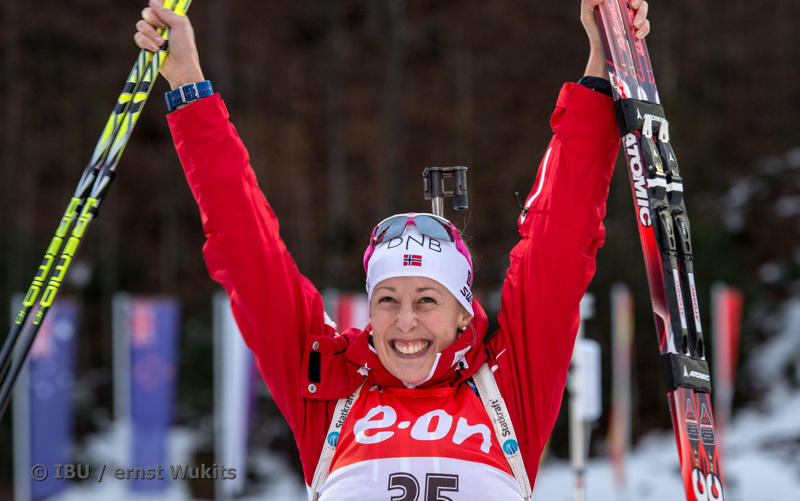
Norway’s Fanny Welle-Strand Horn celebrates her first IBU World Cup win and podium on Friday after the 7.5 sprint in Ruhpolding, Germany. (Photo: IBU/Ernst Wukits)
She couldn’t quite catch her, finishing 5.9 seconds behind Domracheva, but there was another Norwegian gunning for the win — Horn, who, at 26, had never before reached the World Cup podium.
Horn started 35th, two minutes after Eckhoff, and took the lead with a clean prone. She hit all her standing targets as well to stay in control, then raced the seventh-fastest last lap to edge Domracheva’s time by 3.4 seconds in 21:07.4.
“I have been in this game for a long time, five years in the World Cup,” she told the IBU afterward. “Today, everything worked out for me — skiing, waxing and shooting — I am really happy and I am really happy that I made 10 good shots.”
Norway took two of the top three with Eckhoff in third, after Domracheva in second.
“We had amazing skis today,” Eckhoff told the IBU. “We have a really strong team and it is really fun that I am on the podium with Fanny on top.”
While Domracheva lost a few seconds loading the spare, she was glad she was able to avoid a penalty loop.
“I am happy that I shot clean. Sometimes when things like that happens, an athlete misses the shot,” she said.
She also liked the modified course: “The new course is good; there were not so many girls falling anymore,” Domracheva said.
Ukraine’s Valj Semerenko placed fourth, 21 seconds after Horn, Finland’s Mari Laukkanen — an early leader after a clean prone stage — missed one standing to place fifth (+22.7), Germany’s Franziska Hildebrand cleaned for sixth (+28.6), and overall World Cup leader Kaisa Mäkäräinen missed one on each stage but skied the second-fastest course time to place seventh (+32).
Veronika Vitkova of the Czech Republic had the fastest course time, but missed three (one prone and two standing) to finish eighth (+41.2). Wierer was ninth for Italy (+43.3), and Czech Jitka Landova placed 10th (+50.9), 1.4 seconds ahead of Heinicke.
On Sunday, Mäkäräinen, who still leads the World Cup, will start the mass start in bib 1 alongside Domracheva in bib 2 and Semerenko in bib 3.
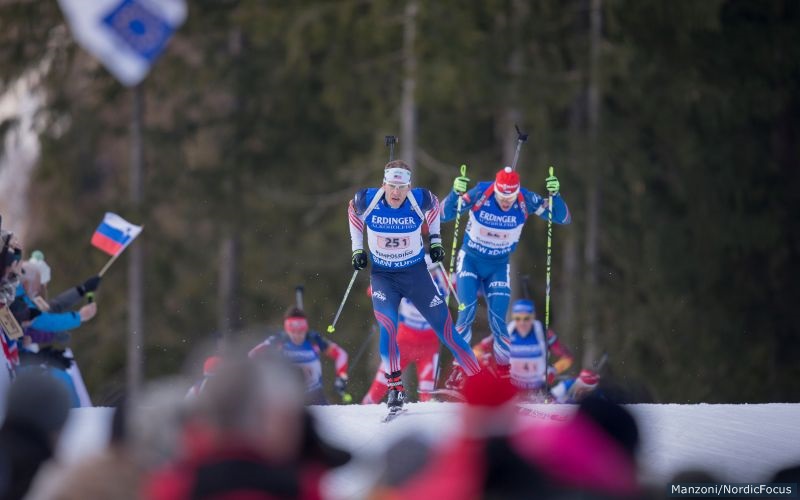
US Biathlon’s Lowell Bailey (l) leading Michal Krcmar of the Czech Republic and the rest of the field in the first leg of the men’s 4 x 7.5 k relay at Thursday’s IBU World Cup in Ruhpolding, Germany. (Photo: USBA/NordicFocus)
Emil Hegle Svendsen and Lowell Bailey had a few things in common on Thursday, despite not racing head to head in the men’s 4 x 7.5-kilometer relay in Ruhpolding, Germany. While Bailey started the four-leg race for the Americans in last of 25 teams and Svendsen anchored the Norwegians after starting in the top two, both led to the finish and capitalized on one critical hill to do so.
Bailey saw his opportunity on his last of three laps, after moving up from dead last in the mass start (where his team was seeded after missing last week’s IBU World Cup relay in Oberhof, Germany) and cleaning both his prone and standing stages to move into fifth.
Three seconds behind Norwegian race leader Ole Einar Bjørndalen at 6.1 k, Bailey latched onto the back of a chase pack two seconds behind Bjørndalen, with Michal Krcmar of the Czech Republic, Germany’s Erik Lesser and Bulgaria’s Krasimir Anev.
On the phone Thursday, Bailey said that he knew Lesser’s strengths — he has a strong finishing kick and is a “great tactician [who] knows when to tuck in behind people and when to push it.”
By clinging to the German, Bailey found himself in the top four and overtaking Bjørndalen. With three climbs remaining, the American anticipated Lesser’s next move: a push on the first big uphill. He was right; Lesser attacked and Bailey was able to stay with him and move into the top three.
“Then basically we were all in a line and everyone on that second-to-last hill went right,” Bailey recalled. That was the shortest line into the righthand curve at the top, but he saw an opening on the left and went for it.
“I put in a sprint there, which put me into the lead,” Bailey said.
At 6.4 k, with just over a kilometer to go, Bailey was up front, 0.3 seconds ahead of Bjørndalen and 1 second ahead of Krcmar.
“For the last hill, I just tried to give everything I had,” Bailey explained. “I pretty much knew if I could stay into the lead over the top of the last hill, I could keep a lead going into the stadium.”
Just as he’d hoped, the American stayed ahead on the long descent and straightaway into the exchange zone. He tagged Sean Doherty in first, 0.5 seconds ahead of the Czech Republic in second, 3.2 seconds ahead of Russia in third, and 3.7 seconds ahead of Norway and Germany.
“Any second or two advantage I could give to Sean is a second or two that he doesn’t have to make up,” Bailey explained. “I was just trying to key in on where he was and get him into a good spot … I didn’t know what was going to happen with Sean, being that this is his first time on the World Cup this year and definitely one of his first times getting tagged off in that first group, but he handled himself well. He stayed really relaxed and stayed right with it … and he did a great job.”
Sean Doherty skiing the second leg for the U.S. in Thursday’s IBU World Cup 4 x 7.5 k relay in Ruhpolding, Germany. After receiving the tag in first, he handed off to Leif Nordgren in sixth. (Photo: USBA/NordicFocus)
In his first World Cup of the season, Doherty, 19, grinned while looking back at Bailey.
“When Lowell was coming in, all I could do was smile, really,” Doherty said in a US Biathlon press release. “In front of one of the biggest and most exciting crowds of the year, to have the lead, these are the moments that you train all summer for — the position that I want to be in, even if it was a bit surprising.”
Not long after, Slovenia’s Jakov Fak took the lead after receiving the tag in sixth, 4.3 seconds behind Doherty. Russia’s Timofey Lapshin, Germany’s Andreas Birnbacher and Fak all entered the range together for their first stage, and Doherty followed less than a second back in fourth.
Fak cleaned to leave first, 4.4 seconds ahead of Norway’s Erlend Bjøntegaard in second and 5 seconds ahead of France’s Simon Desthieux in third, both of which also cleaned. Doherty used all three spares but avoided a penalty loop, setting out on his second lap in eighth, 27 seconds after Fak.
“For the first prone, it was a little rough,” Doherty recalled. “But the key is to forget that and reset for the next stage. I had super skis and just focused on keeping a good pace on the course, then to come into the range and let the training take over and skip the spares this time.”
He did so on the next round, cleaning standing to move into sixth, 36.9 seconds behind Fak in first and 0.3 seconds back from Czech Michal Slesingr in seventh. Fak cleaned his second-straight stage quickly to stay 10.6 seconds ahead of Birnbacher, who cleaned as well to move into second.
By the second exchange, Fak tagged teammate Rok Trsan in first with a 23.4-second gap to Norway in second and 23.7 seconds to Germany in third.
Doherty handed off to U.S. teammate Leif Nordgren in sixth, 59.1 seconds behind Slovenia and 9.3 seconds behind the Czech Republic in seventh.
After arriving in Ruhpolding two days earlier, Nordgren was still coming off a cold he’d been battling since the beginning of the month.
“I was hoping it wasn’t going to be much, in fact I never really felt too bad physically, but it’s just taken a long time to clear out of my sinuses and lungs,” he explained in an email.
Instead of racing in Oberhof, he recovered at home and explained that Thursday marked his first hard effort in almost two weeks.
Before his first shooting, Nordgren slipped one spot to seventh behind Austria. He entered the range 52 seconds behind Slovenia in first, and proceeded to miss three — using all three spares.
That put Nordgren in ninth and then 10th on the next lap. Heading into the second stage, he was 1:27.6 behind Germany’s Arnd Peiffer, who cleaned prone to take the lead, just ahead of Trsan, who used one spare.
Nordgren hit all five standing targets without a miss, improving to eighth and 1:18 back. Peiffer used one spare but stayed in first, eight seconds ahead of Norway’s Johannes Thingnes Bø in second, who had more trouble shooting with one prone spare and three spares in standing.
“My goal for today was more for the shooting,” Nordgren explained. “I wasn’t sure how the ski shape was going to be, so I was mostly focused on making sure I do a normal shooting routine. I wasn’t happy with prone obviously, but standing it came around and all in all I’m not too disappointed.”
While Peiffer led Bø into the last exchange, with just a second separating the two, and 28 seconds to Russia in third, Nordgren tagged Tim Burke ninth, 1:51.8 back but 0.2 seconds behind Slovakia.
Burke was also recovering from an illness he came down with last week. In an email, he explained he had not trained much in the five days before the relay.
“I would have liked a few more days to recover before racing again but we really needed to start the relay after skipping last week,” he wrote. “It was definitely a shock to my body to start racing and, as expected, I felt very flat.”
Burke remained in ninth until his first shooting, which he cleaned to improve to eighth, 2:04.9 behind the leaders. He went on to use three spares in standing, dropping to 11th and 3:05.2 back.
While Burke posted the seventh-fastest course time of the anchors on the last lap, he managed to pick off just one place to put the U.S. in 10th at the finish, 2:55.3 out of first.
“Today was definitely a challenge for me but overall I think it was positive for the team,” Burke wrote. “Using three extra rounds at this level is simply not good enough.”
In the final shooting, Canada moved ahead of the U.S. for the first time in the race. Nathan Smith cleaned prone, then used two standing spares to leave the range 3.5 seconds ahead of Burke in 10th.
“I was able to catch up and pass him, but I did not have enough gas to reach the finish,” Burke wrote.
The Canadians placed ninth, 2:53.9 back and 1.4 seconds ahead of the U.S.
“I was pretty worried with Tim breathing down my neck the whole lap,” Smith wrote in an email. “He attacked on the first big climb but I think that cost him later on. He was also sick last week so that probably helped to my advantage. On the last climb the [Belarusian] put in a very surprising attack and I couldn’t really answer. I clawed back most of those metres in the final strait but couldn’t quite do it.”
Yuryi Liadov edged Smith by 0.3 seconds for eighth.
“Since the course was quite icy and fast, I picked up most of my time in the range,” Smith noted. “Although perhaps the actual places were grabbed out on course. My skiing was good. About on par for this season. I’m happy with that but obviously I’m looking for an amazing day or two this weekend.”
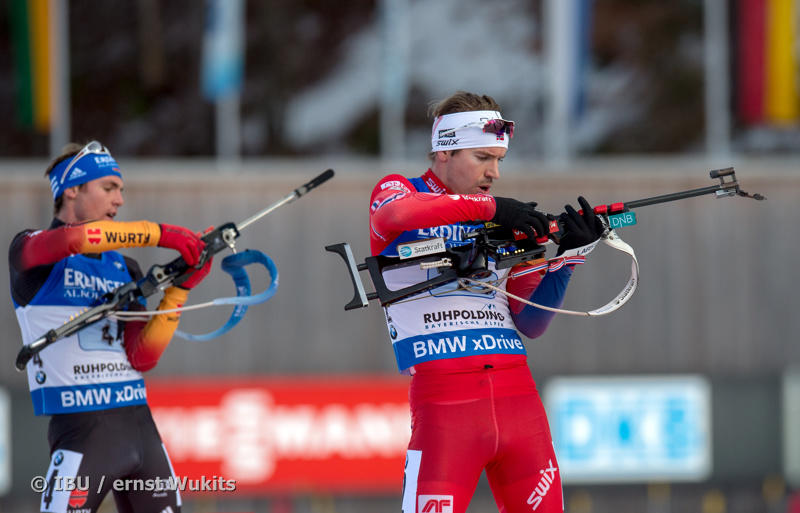
Germany’s Simon Schempp (l) and Norway’s Emil Hegle Svendsen go head to head in the final shooting stage of the men’s 4 x 7.5 k relay in Ruhpolding, Germany. (Photo: IBU/Ernst Wukits)
While the North Americans duked it out for a top 10, Norway’s Svendsen and Germany’s Simon Schempp switched leads at the front of the pack. Both used one spare in prone, as did Russia’s Anton Shipulin, but the two stayed 20 seconds ahead of Russia in third.
In the final stage, Schempp cleaned to leave the range 7.4 seconds ahead of Svendsen, but the Norwegian caught him a kilometer later.
Shipulin came within 10 seconds of the two leaders about 1 k before the finish, but that was where Svendsen turned it on — attacking on the same last climb before the stadium, just like Bailey.
Svendsen passed Schempp before the top and left him several meters behind while soaring down into the finish. He sealed the win for Norway by 4.6 seconds in 1:09:42.3, and Schempp held off Shipulin by 3.8 seconds for second place.
“I was not sure that I would catch a strong athlete like Simon,” Svendsen told the IBU. “It took a lot of energy to catch up, so I stayed behind him to recover some. I knew that I am good in turns so I waited to one of the last turns before the bridge. I think my plan worked pretty well.”
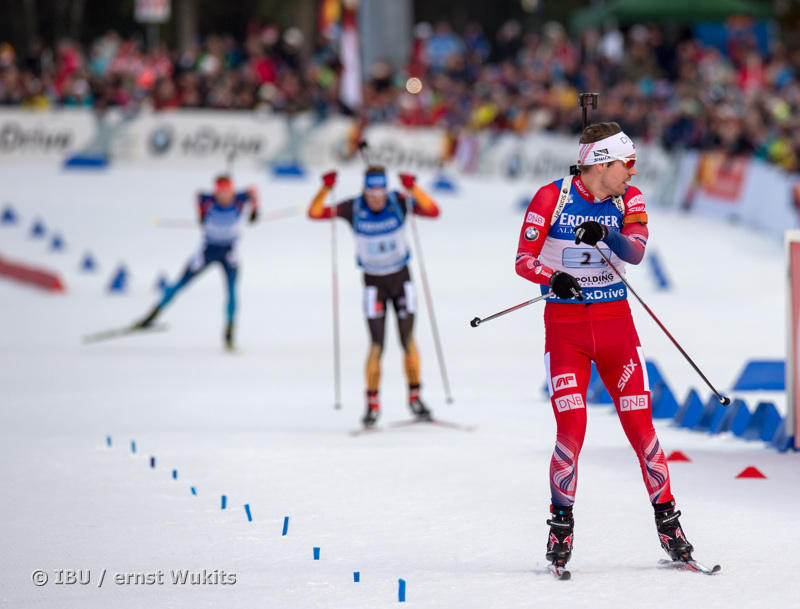
Svendsen (r) glances back before securing the victory for Norway in the men’s 4 x 7.5 k relay, ahead of Germany’s Simon Schempp (c) in second and Russia’s Anton Shipulin (l) in third. (Photo: IBU/Ernst Wukits)
Shipulin and the rest of the Russian team, which won last week’s relay in Oberhof, settled for third (+8.4). France took fourth (+23.8), ahead of Austria in fifth (+24.5), and the Czech Republic in sixth (+30.8).
More than two minutes later, Slovenia’s Janez Maric, who had two penalties and three spares, finished seventh (+2:46.8), Belarus was eighth (+2:53.6), Canada ninth, and U.S. 10th.
“We hope for the flower ceremony and a podium, but there’s been a lot of things leading up to this race definitely didn’t go in our favor,” Bailey said. “We definitely weren’t, as a team, at a hundred percent, so considering that we’re pretty happy with a top 10. It’s definitely better than the 25th rank that we had starting today.”
Canadians Improve from 15th to Ninth
With the Gow brothers entering their second World Cup weekend (after starting on the IBU Cup circuit) and Brendan Green back for his first race since the holiday break, the Canadians were somewhat of an unknown for Thursday’s relay.
However, a week ago, they placed eighth with two IBU Cup skiers — Christian Gow and Macx Davies — plus Marc-André Bédard and Smith.
“I would say our goal was to build on our relay performances from the season so far and with solid racing, discover what is possible,” Green wrote in an email on Thursday.
He arrived in Ruhpolding on Monday night after training in Canmore, Alberta, over the holidays.
“I feel as though I was able to bring better focus into a few aspects of my performance and hopefully that will show during this trimester,” Green explained of his training.
He skied the second leg for Canada, receiving the tag from Christian Gow in 15th and 59.2 seconds behind the leader. Gow posted the 15th fastest-course time of the first leg and used one spare in each of his two stages.
“During my leg of the relay I was hoping to move up the ranking a bit and keep the team in the race,” Green wrote after skiing up to 13th with 10-for-10 shooting.
“I’m for sure happy with my shooting today but my skiing was not as strong as it should be,” he added, after skiing the 12th-fastest course time of the second leg. “Maybe partially to jet lag, who knows.”
He tagged Christian’s older brother, Scott Gow, in 13th, 1:53.7 out of first. In his first World Cup relay of the season, Scott used three spares in prone and two in standing to slip to 15th, where he remained until the final exchange.
“It was a pretty tight field and I knew strong shooting would move us up there,” he wrote in an email. “Unfortunately I couldn’t keep myself together very well on the range … Shooting was bad today. I don’t have any excuses other than I was inside my own head too much, and just need to relax and not worry about my competitors when I’m on the shooting mat.
“I was a little anxious going into both prone and standing shooting because I wanted to hit all 5 quickly and get out of there. Ideally I would focus on the process and not trying to destroy my competitors. I’ll try harder for Saturday.”
Scott plans to race the remaining World Cup competitions in Ruhpolding this weekend and Antholz, Italy, next weekend.
“My goal for this season was to race mainly on the World Cup circuit, so I am happy to be starting here in Ruhpolding,” he wrote, explaining he arrived in Europe on Sunday. “If I can maintain good results and good form I should be able to stay on the circuit.”
Scott tagged Smith in 15th, 2:50.8 behind the leader and 11.6 seconds behind Belarus in 14th.
“I knew I was losing time on the leaders, so my goal was to try and bridge the gap to my closest competitors and give Nathan the best chance possible,” Scott added. “I’d like to think I made up some time on my last loop but it wasn’t as much as I would have liked. I’m happy with my race today but have a few things to focus on for the sprint race.”
According to Smith, the position was “not great but not a disaster yet,” he wrote. “I knew if I put in a really good leg I could move us back up to perhaps around 10th.”
Considering how fast and icy it was, he knew ski speed wasn’t going to make the difference — shooting would.
“Prone went amazingly well and I built on that through the race,” Smith wrote of his clean first stage.
He tried to be as precise in standing, but lost some focus on his final two shots, he explained.
“I would say we are satisfied with today but we are still capable of more,” Green summarized of the team’s ninth-place finish.
“The conditions today were probably the best we’ve had all year. Basically no wind, pleasant temperatures, and firm tracks,” Smith added. “I wouldn’t have minded a little less ice, but I’ll take that over what the women had to race in yesterday. It looked so slow.”
Bailey said it was the best conditions he’d seen all year as well, with perfect tracks, transformed snow, and not much wind.
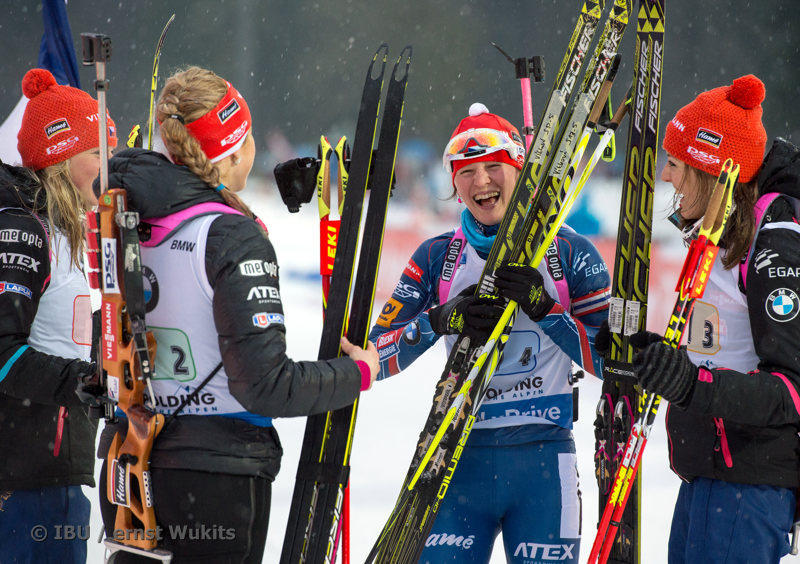
The Czech Republic women’s 4 x 6 k team celebrates its second-straight relay win on Thursday at the IBU World Cup in Ruhpolding, Germany. (Photo: IBU/Ernst Wukits)
All it took the Canadian women to have one of the greatest starts of their relay careers was a pep talk from a two-time Norwegian Olympic gold medalist, Halvard Hanevold, who notched 40 IBU World Cup podiums in his career.
According to Megan Heinicke, the team’s first skier in Wednesday’s 4 x 6-kilometer relay at the IBU World Cup in Ruhpolding, Germany, the Canadians had a team meeting with Hanevold on Tuesday night. She said it was “fantastic” and helped them going into the relay with “a really supportive team attitude,” she wrote in an email.
Whatever it was, it worked — and especially well for Heinicke — who shot out of the mass start with the leaders and put herself in fourth heading into the first shooting stage within two seconds of the Czech Republic, Finland and Norway, respectively.
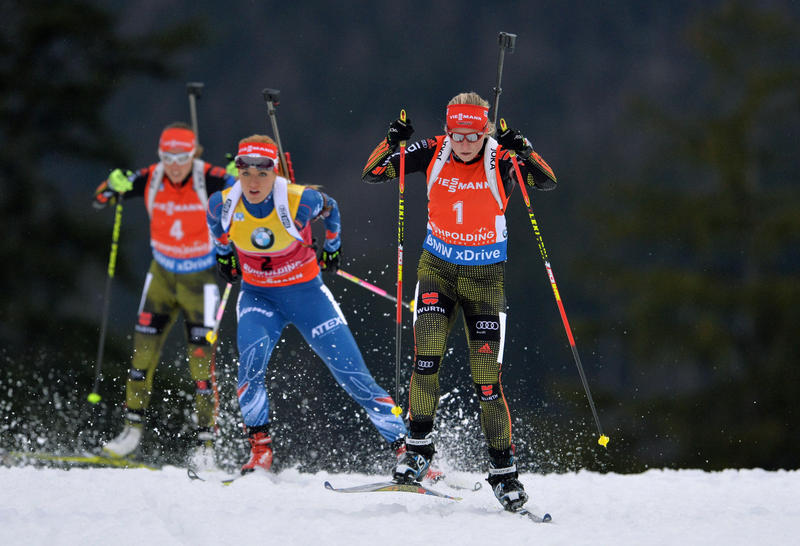
Germany’s Franziska Preuss (r) and Eva Puskarcikova of the Czech Republic (l) lead Canada’s Megan Heinicke (c) and Belarus’s Nadezhda Skardino (behind Preuss and Heincke) during the first leg of the IBU World Cup women’s 4 x 6 k relay on Thursday in Ruhpolding, Germany.
There, Heinicke shot fast and flawlessly to find herself in second coming out of the range, 1.3 seconds behind Eva Puskarcikova of the Czech Republic and just 0.1 seconds ahead of Germany’s Franziska Preuss in third.
“I was thinking ‘holy cow I’m up here again!’ ” Heinicke recalled. “I was excited and motivated. I also tried to think tactically and stay in our little group of 3 and not let myself do too much work.”
The Czech Republic, with Puskarcikova, Gabriela Soukalova, Jitka Landova, and Veronika Vitkova, was coming off a relay victory a week earlier in Oberhof, Germany. The German women had placed 10th in that race, but with a new lineup of Franziska Preuss, Franziska Hildebrand, Vanessa Hinz, and Laura Dahlmeier, respectively, they knew they could be in contention.
“We changed the team [with Hildebrand and Dahlmeier in place of Luise Kummer and Karolin Horchler],” Hildebrand told the IBU after the race. “That is all, but we were confident that we could be on the podium…”
So were the Canadians, but they were among the teams flying lowest on the radar after being lapped in the Oberhof relay.
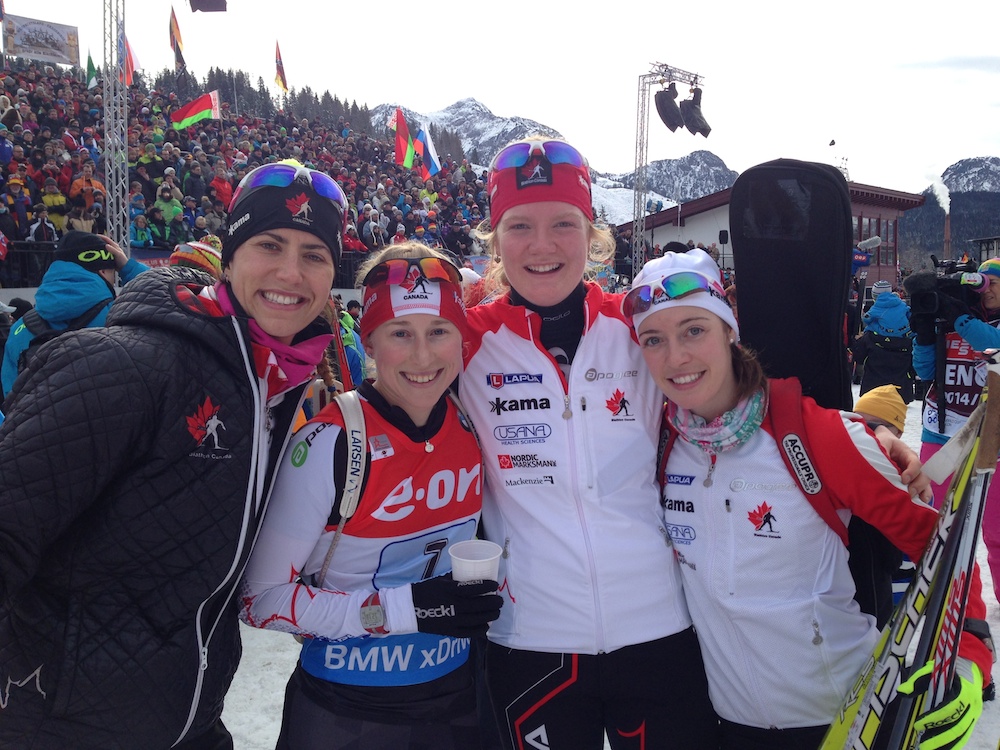
The Canadian women’s relay team after placing 11th earlier this season in Hochfilzen, Austria. (From left to right) Rosanna Crawford, Audrey Vaillancourt, Sarah Beaudry, and Megan Heinicke. (Photo: Rosanna Crawford)
Yet Heinicke, and the rest of her teammates — Julia Ransom, Audrey Vaillancourt and Zina Kocher — knew they had the potential. Hanevold reminded them of that. With Rosanna Crawford out with a cold, Heinicke explained they tried new relay combination, which was an important step before IBU World Championships in March.
Coming into the second shooting within a second of Preuss and Puskarcikova, Heinicke used one spare to leave the range in second, 17.6 seconds behind Puskarcikova, who cleaned.
“It was hard to shoot clean with the snow falling, but it was easier than in Oberhof,” Puskarcikova told the IBU. “I am not exactly sure how I shot 10 for the second week in a row.”
A rainstorm began before zero, 1 1/2 hours before the race on Thursday, and didn’t let up, coating competitors and spectators in a wet, slushy mixture between rain and snow. That made both skiing and shooting tough, but Heinicke didn’t notice.
“I was so focused on the race in the moment that the conditions didn’t effect me too much,” she wrote. “I think the pressure and excitement of being near the front of the race helps me have a sharper focus in a weird ‘heightened senses’ kind of way.”
Heinicke focused on her technique and held her position through the exchange, tagging Ransom in second, 25.2 seconds behind the Czechs and 2.5 seconds ahead of Poland in third.
“Sprinting is really not my strength and I was really giving my all so I was just mentally coaching myself along!” Heinicke wrote.
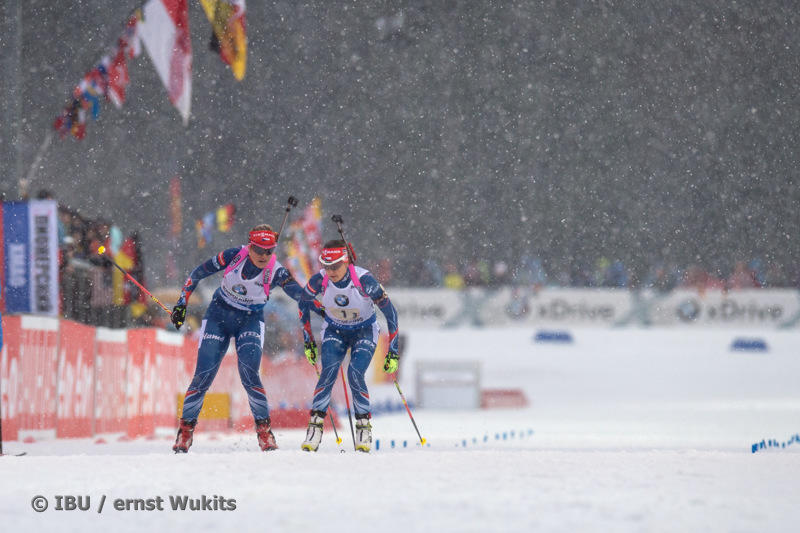
Gabriela Soukalova (l) tagging Czech teammate Jitka Landova in first in the women’s 4 x 6 k relay at the Ruhpolding IBU World Cup on Thursday in Germany. (Photo: IBU/Ernst Wukits)
Meanwhile, Ransom, in her first World Cup season at age 21, tried to control her excitement.
“Megan has tagged off to me in excellent positions twice now!” Ransom wrote in an email. “All I could think was that opportunity was there ready to be seized.”
She maintained second through the first shooting, which she cleaned, and up until her standing stage, where she entered the range 59 seconds behind Soukalova in first and 10 seconds behind Hildebrand in second.
“I would be lying if I said the conditions were easy, but I secretly love it when it’s miserable out there,” Ransom wrote. “Canadians are tough! And if you can be tougher than the others, a little bit of rain, sleet, wind, or cold will feel like nothing.”
In that second stage, she missed three but avoided penalty loops with three spares.
“I think my standing shooting was affected by my excitement. I know I can hit targets, but when I am not 100% ‘there’, that’s when things can get squirrelly!” she wrote. “I buckled down for the spares and got out as quick as I could. When there were three spares for three targets, I remember thinking, ‘I’m going to give my parents a heart attack.’ They watch the live stream back in Canada.”
Meanwhile, Soukalova and Hildebrand used two spares, and Belarus’s second leg, Iryna Kryuko, cleaned her second-straight stage to move into third behind the Czech Republic and Germany, respectively.
By now, Soukalova had built up a minute lead over Hildebrand, and Kryuko was 1:13 back, followed by Ukraine’s Natalya Burdyga in fourth (+1:18) and Norway’s Fanny Welle-Strand Horn in fifth (+1:22). Ransom left the range just another second behind in sixth, and tagged Vaillancourt in the same position, 1:53.1 behind the Czechs.
“Being the youngest on the team, I sometimes feel an internal pressure to prove myself and I believe I did today,” Ransom wrote.
Vaillancourt explained in an email that she was excited to start in a pack.
“I thought it was possible for us to finish in the top 6 if Zina and I both had a great race,” Vaillancourt wrote.
With Landova, the Czechs began to extend their lead on Germany. Entering their first prone, Landova was up to 1:15 ahead of Hinz. Ukraine’s Olga Abramova was 1:41 back, just 0.6 seconds ahead of Norway’s Elise Ringen and 2.4 seconds ahead of Nadzeya Pisareva of Belarus. Vaillancourt followed in sixth, 2:13 behind Landova.
In her first stage, Landova missed two shots and had to use a third spare to avoid her team’s first penalty loop of the day. She delivered and left the range still well ahead of Hinz, who cleaned to cut the deficit to 29.7 seconds.
Abramova cleaned as well to hold onto third, 52 seconds behind Landova. Pisareva and Ringen used one spare each and left in fourth and fifth, 1:02 and 1:05 back. Vaillancourt used one spare as well to stay in sixth, another 33 seconds behind.
One the next lap, Poland’s Weronika Nowakowska-Ziemniak passed Vaillancourt early on, and Canada slipped one spot to seventh.
Vaillancourt cleaned her standing stage and left the range still in seventh, but lost one more place by the final exchange.
“I was mostly losing time on the uphills,” she recalled. “I have been very sick in the past two weeks and hardly have been able to train, so I knew this was going to be a tough one on the skis. I am glad the ice is broken though.”
Landova held steady up front, missing her second-standing shot and using a spare, but leaving the range 29 seconds ahead of Hinz, who also used one spare to stay in second. Belarus jumped to third, 1:12 behind, with clean shooting from Pisareva, and Norway was another 6 seconds back in fourth despite Ringen using two more spares.
Abramova used three spares to fall to fifth for Ukraine, and Russia improved to sixth with 10-for-10 shooting from Ekaterina Shumilova.
By the last exchange, the Czech Republic had a 30-second cushion to Germany in second, and was a whopping 1:14 ahead of Belarus in third. Norway and Ukraine skied together in fourth and fifth, more than a minute and a half back, Poland moved into sixth (+2:10), and Russia tagged off in seventh (+2:12.5).
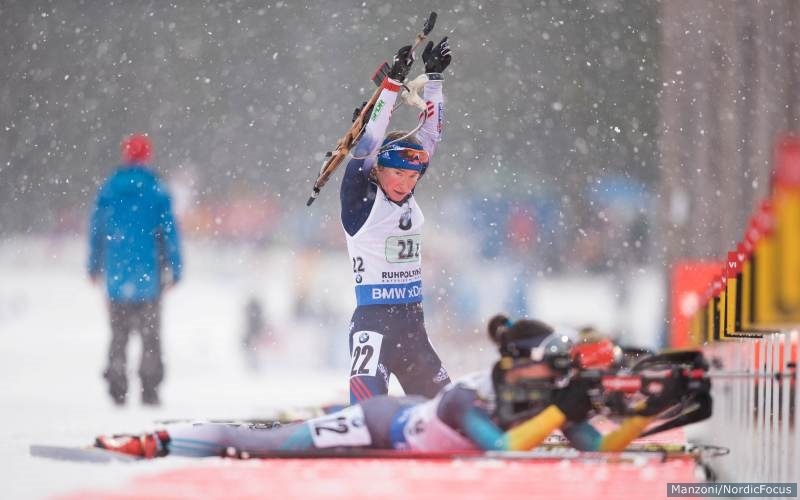
U.S. second-leg skier Hannah Dreissigacker after her prone shooting stage, where she used three spares and went on to keep her team in 10th in the women’s relay in Ruhpolding, Germany. (Photo: USBA/NordicFocus)
Canada was 2:37.1 back in eighth with one 6-kilometer leg to go, and the U.S. women, in their first relay of the season, started the last leg in 16th (+5:28.4).
Ninth heading into prone, Kocher used three spares and had to ski Canada’s first penalty loop to drop to 12th, 4:18 behind Vitkova, who used one spare to keep the Czechs in control.
Germany’s Dalhmeier and Domracheva of Belarus both cleaned after her, but were well out of sight by the time they left the range in second and third, one minute and 1:24 later, respectively.
“Shooting was basically catastrophic considering it wasn’t like last week in Oberhof,” Kocher wrote of Thursday. “Prone, I evaluated the wind flags wrong. Wind really picked up when I got into prone. I made a correction before I started shooting. But it was not enough for the change in direction. I corrected more once I was on spares and hit 3 shots with the 3 spares but then it was too late, I already had 4 misses.”
She skied up to 11th with the fourth-fastest course time on her second lap, but missed four again for another penalty loop, which put Canada 5:36 behind and still in 11th. Kocher posted the second-fastest last loop of the anchor legs to finish 5:33.8 behind the winner — Vitkova of the Czech Republic.
Vitkova had used a single spare on each stage to stay more than a minute ahead in first. Belarus moved to second with Domracheva skiing the fastest anchor leg and using a single spare throughout her two stages.
While Vitkova had enough time to take her poles off and grab a Czech flag from a spectator before casually skiing across the line, Domracheva entered the stadium uncontested as well and looked back before celebrating second, 1:13.3 behind the Czechs, who won in 1:23:57.7.
Veronika Vitkova anchoring the Czech Republic to its second-straight women’s relay win on Thursday the IBU World Cup in Ruhpolding, Germany. (Photo: IBU/Ernst Wukits)
“It was easier for me today because the other girls gave me such a big lead,” Vitkova told the IBU.
Germany hung on to the podium in third, 1:39.3 back from the winners, and a minute ahead of Norway (anchored by Tiril Eckhoff, who cleaned her first stage and used three spares on the second) in fourth.
Ukraine placed fifth (+2:49.7) with a clean final stage and one early spare from Valj Semerenko. France was sixth (+3:55.3) with 17 total spares, Poland placed seventh (+4:14.4) with two penalties and 10 spares, Russia was eighth (+4:36.5) with two penalties and 13 spares, Italy ninth (+4:44.6) with two penalties and 13 spares as well, and Austria took 10th (+4:51.2) with two penalties and eight spares.
Canada crossed the line 42.6 seconds later with two penalties and 11 total spares.
“Can’t say I feel great about my performance today. I skied strong but that doesn’t make up for the 2 laps,” Kocher wrote. “It’s great to see that there are younger athletes coming up showing such strong performances. It’s always motivating for the entire team.”
While Heinicke explained the race could have been better, she added that it also could have been worse. “We gave it our all,” she wrote.
“Our relay shows so much potential and I know that our day to shine will come,” Ransom wrote.
“It think we showed that if everyone has a good day, we can definitely be one of the top nations!” Vaillancourt added.
U.S. Women in 16th Before Being Lapped
The Americans stayed in the race until the final leg, when Maddy Phaneuf in her World Cup debut completed two stages and was lapped before coming into the finish. She had one penalty and three spares in prone, and used one spare in standing to bring the team’s grand total to three penalties and 19 spares.
The team’s opening skier, Susan Dunklee used two spares in each of her shooting stages to go from 15th to 12th, and finally up to 10th (+1:03.5) with the fourth-fastest, first-leg course time.
And she started in the back.
“I had the last row of the starting lanes all to myself,” Dunklee explained in an email. “I followed Mari [Laukkanen] from Finland (also seeded near the back) because she is a strong skier who knows how to maneuver in a crowd. That whole first loop was about being patient in the pack, moving when spaces opened up, but not wasting energy. The weather worked to my advantage today because I am a strong V1 skier and the entire course felt like one long uphill because of the resistance.”
Dunklee explained that the heavy rain caught the racers off guard.
“I think everyone assumed the crappy weather was behind us after Oberhof,” she wrote. “The snow behaved like sandpaper and we had to V2 many of the downhills. I used every change of dry clothes that I brought and still struggled to stay warm. It was especially difficult to keep enough feeling in our hands to shoot.”
U.S. third leg Annelies Cook during the women’s relay on Thursday in Ruhpolding, Germany. (Photo: USBA/NordicFocus)
Dunklee came through the exchange in 10th, and Dreissigacker held the position throughout the second leg, despite using three spares in both her prone and standing stages. She tagged Annelies Cook in 10th, 2:31.7 behind the leaders.
Cook dropped to 16th after her first shooting, with two penalties and three spares. She used two spares on the second stage and tagged Phaneuf in 16th (+5:28.4).
According to Dunklee, the team always aims for a top result each time they toe the line, but they were also simply excited to have enough women to field a relay for the first time this year.
“Maddie has never been on the World Cup before, but what an epic way to start!” she wrote. “She got the full experience with thousands of crazy fans and unpredictable weather. She is very young with lots of racing ahead of her, and I think she did a great job today taking it all in and staying level headed.”