 This World Cup coverage is made possible through the generous support of Marty and Kathy Hall and A Hall Mark of Excellence Award. To learn more about A Hall Mark of Excellence Award or to learn how you can support FasterSkier’s coverage please contact info@fasterskier.com.
Ruka, Finland sits at a northern latitude similar to Fairbanks Alaska, similar to the northern end of Canada’s Hudson Bay. By early winter, the sun is a weakened glow on the horizon, and then for only a few precious minutes each day. By midday, skiers vying for the win in today’s FIS Cross-Country World Cup Sprint were racing under Ruka’s stadium lights.
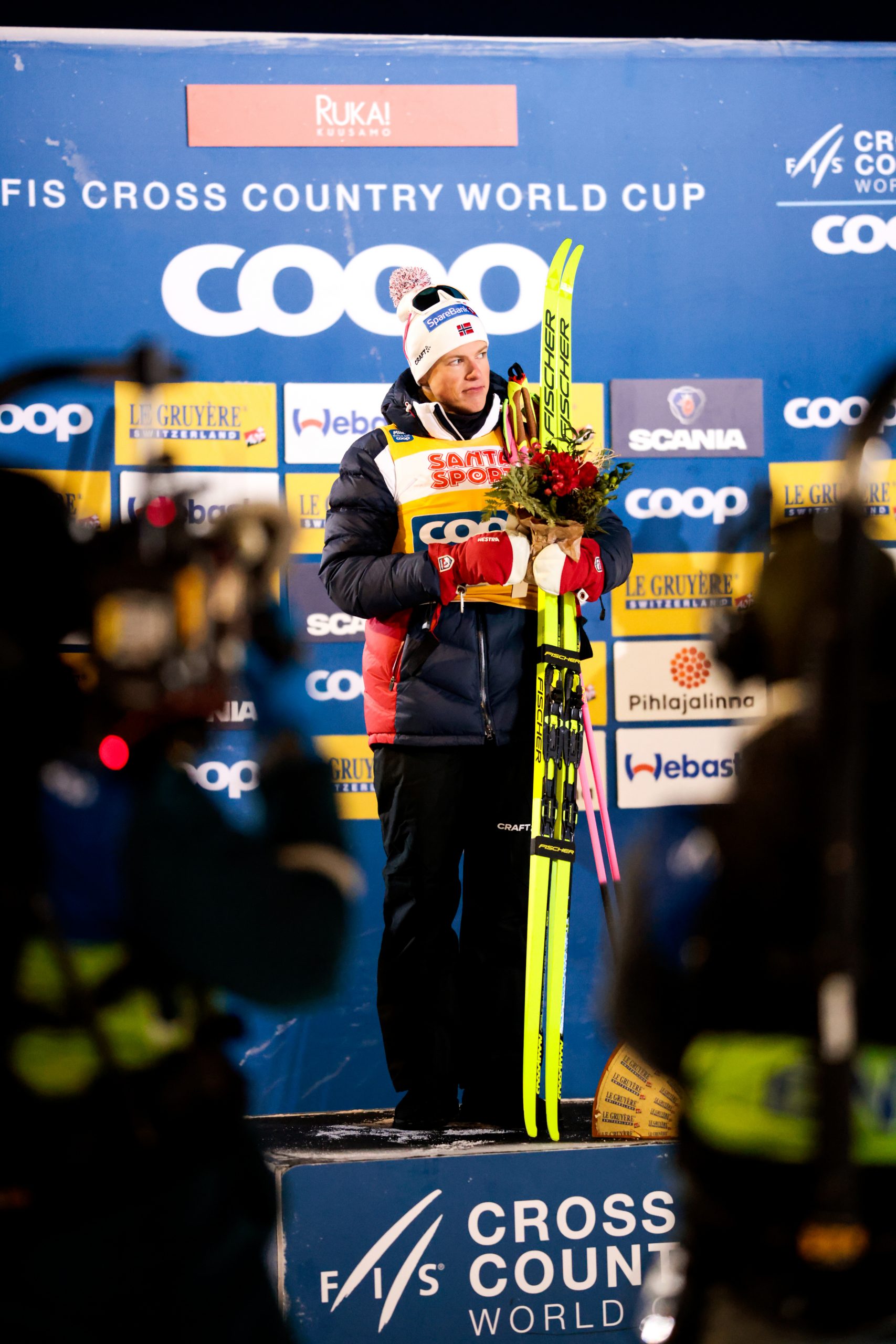
The first men’s events of the FIS World Cup Cross-Country season took place in cold conditions that left competitors wreathed in the steam of their own breath, and tested the skill of ski technicians charged with creating kick and glide. Johannes Høsflot Klæbo quickly dispelled any notion that he may be limited by a lingering hamstring injury: Klæbo qualified first, dominated all heats in a manner that appeared easy, even for him, and cruised to victory ahead of Norwegian countrymen, Even Northug and Paal Golberg.
Ben Ogden and JC Schoonmaker were the only North American’s advancing to the heats in the men’s field—Ogden 13th and Schoonmaker 19th—with a near-miss for Logan Diekmann who skied to 32nd place in qualifying. Luke Jager tied for 40th, and Kevin Bolger 46th.
Canada entered two skiers in sprint qualifying, with Graham Ritchie placing 53rd and Oliver Leveille 56th.
Ruka Men’s World Cup Sprint
While Klæbo’s first win of this World Cup season appeared leisurely, it was not without emotion. Ruka is where Klæbo was famously pipped at the line by Alexander Bolshunov in 2018. Ruka is also where Klæbo lost a World Cup sprint to Erik Valnes in 2020, and where Alexander Terentev outskied him in the opening World Cup Sprint in 2021. If Johannes Høsflot Klæbo were ever motivated by a desire for redemption, it would be at Ruka.
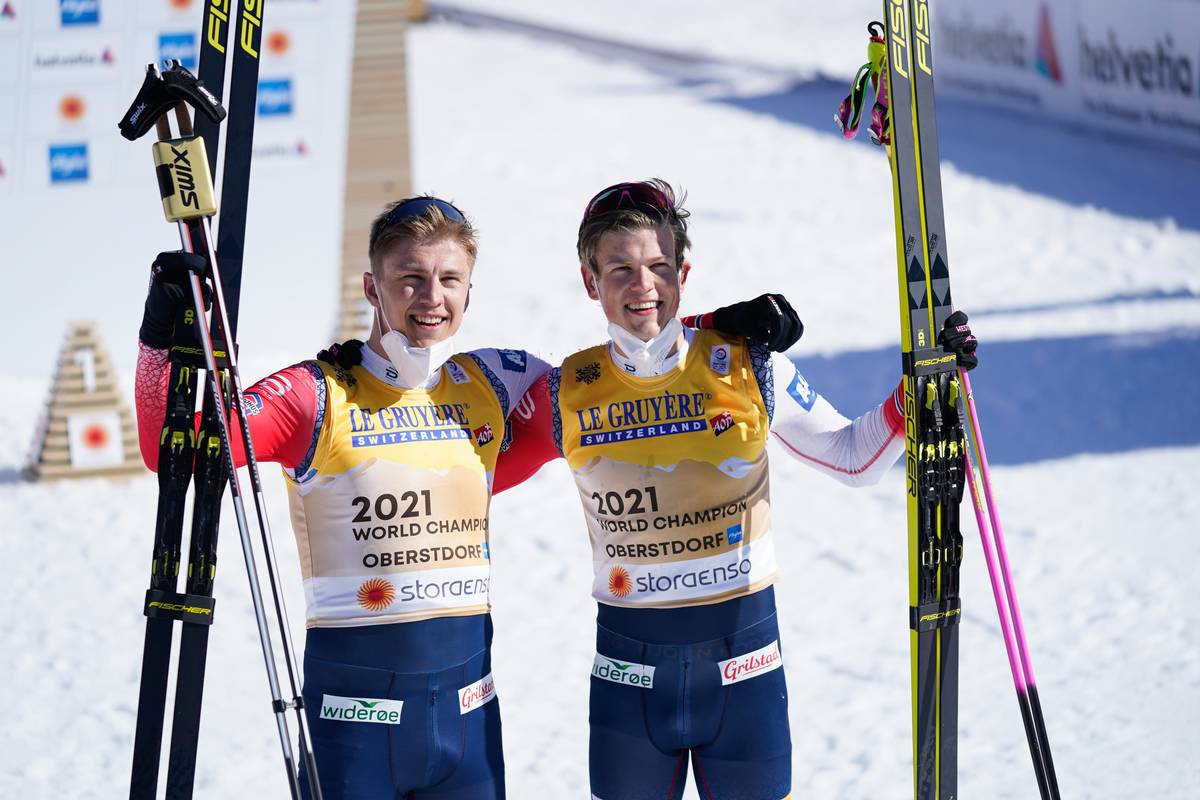
QUARTERFINAL 1—Klaebo and Valnes dominate
Norwegian skiers arrived for Quarterfinal 1 clad in truly confusing red racing uniforms (all but indistinguishable from what Russian team skiers have worn on the World Cup circuit for quite a few years). Except for Klæbo, most Norwegian athletes even raced in very Russian-looking red hats. At least the Swedes (mostly white) Finns (blue) and Americans (in blue with red/white stripe accents) remained recognizable.
Wearing the yellow bib of last year’s overall World Cup champion, Klæbo advanced easily by means of his now-familiar acceleration on Ruka’s signature hill, though he never needed to unleash the high tempo striding that has been his trademark in this event. His skis seemed to float along the finishing stretch, allowing him sufficient space in front of his rivals to stand up and remove his pole straps well before the line. Norwegian teammate, Erik Valnes, followed him across the line in second.
QUARTERFINAL 2—Halfvarsson advances
The day’s second heat saw American, Ben Ogden, joining Norwegian sprint specialist, Even Northug, and the rejuvenated Swede, Calle Halfvorsson. Finland’s Joni Maki displayed fast skis as he moved to the lead, with Ogden pressing forward on the course’s first uphill. Ultimately, Halfvarsson finished first in the heat ahead of Northug, with Maki advancing as a lucky loser. Ogden seemed to struggle with slow skis, ultimately finishing the heat in fifth.
QUARTERFINAL 3—Chanavat fades
Heat 3 was dominated by Norway’s Haavard Solaas Taugboel who sprinted the ultimate hill followed by an inspired Francesco De Fabiani. France’s perennial sprint contender, Lucas Chanavat, finished fourth without ever appearing sharp.
QUARTERFINAL 4—Schoonmaker comes close
Paal Golberg moved quickly to the front in Quarterfinal 4, with American JC Schoonmaker jumping in behind. France’s 2022 World Cup Sprint Champion, Richard Jouve, worked his way forward through the quarterfinal field to tuck in behind Goldberg. Schoonmaker raced cleverly through the final stretch with a smart move to the inside on the final curve, narrowly missing a lucky loser spot.
QUATERFINAL 5—Pellegrino climbs to the win
Beijing silver medalist, Federico Pellegrino wore Italy’s new black race suit, and advanced to the semifinal by moving efficiently through the quarterfinal field. Pellegrino went to diagonal striding early on the ultimate hill, allowing him to pull away from the field. The inspired Frenchman, Jules Chappaz, crossed the line second.

SEMIFINAL 1—both the lucky losers
Wearing a white hat that differentiated him from his Norwegian teammates, Klæbo moved easily to front of his semifinal field before abruptly easing up. Northug and Halfvarsson took over the pace-making: thereafter, the script was pure Klæbo: driving to the front on the hill before gliding unchallenged across the finish line. Halfvarsson, Valnes, and Northug all advanced to the final.
SEMIFINAL 2—Chappaz arrives on the scene
The 1.4 k Ruka sprint course incorporates a critical uphill groomed four lanes wide, continuing over the top and down the other side to a lefthand turn into a wide finishing straight. Commentators often become so focused on Klæbo’s quick-striding domination on Ruka’s signature hill that we may overlook the fact that many other skiers bide their time on the hill, using the finishing straight to pick off their rivals. Semifinal 2 looked to be competitive, with Goldberg, Pellegrino, Chappaz, Jouve, and De Fabiani seeming well matched. Early on, Jouve moved into the lead after a very tight move that cut off De Fabiani. Ultimately, Jouve faded badly on the uphill—as did Pellegrino—allowing Chappaz to storm ahead for the semifinal victory (though he may have used too much energy in achieving it). Golberg crossed the line second to advance to the final.
Sprint Final
Making only his 12th World Cup start, Jules Chappaz may have spent more energy than was necessary in winning his semifinal; he would not end up being a factor in the final. That left Sweden’s resurgent Calle Halfvarsson to face four Norwegians (Northug, Valnes, Golberg, and Klæbo). Golberg and Valnes maneuvered to the front after Klaebo had slowed the opening pace. Lingering mid-pack, Klæbo accelerated on the course’s primary downhill, and moved into a leading position before the hill. Klæbo never appeared to need his top gear, easily distancing the field on the hill. By the top, he had established a considerable gap which he handily maintained through the finish for his 49th World Cup victory. Northug won last week’s tune-up sprint Beitostolen, and his good form and good strategy brought him to the finish line second followed by teammates Golberg in 3rd, and Valnes in 4th.

While Klaebo had shown his early season fitness last week in Beitostolen with wins in Classic and Freestyle 10 k’s, his sprint-condition had remained in question. It wasn’t known (even by Klæbo) whether or not he would have the speed, the power, and the pop to contend in a World Cup sprint.
“I didn’t know how this should go,” Klaebo said in a post-race interview.” . . . [I’ve had] things to deal with the last three weeks (referring to his lingering hamstring injury). [But] I had a really good day today. It was a lot of fun.”
If there were any lingering questions regarding Klæbo’s fitness—or about his recovery from his summer-long hamstring injury—those questions have now been answered.
The World Cup Sprint podium ceremony was still fist bumps instead of handshakes, reminding viewers that Covid still threatens events such as these. That memory must be particularly poignant to Klæbo: in 2020, the Norwegian team was unable to compete in the final World Cup events, and in 2021 Klæbo, himself, succumbed to Covid in the final weeks of the year, allowing Richard Jouve to claim the crystal globe. Today, at least, Klæbo had achieved a level of redemption, finally exiting the Ruka stadium with the sprint win that we’ve all come to expect.
Full Results
RUKA MEN’S SPRINT: QUALIFYING | RUKA MEN’S SPRINT: FINAL RESULTS