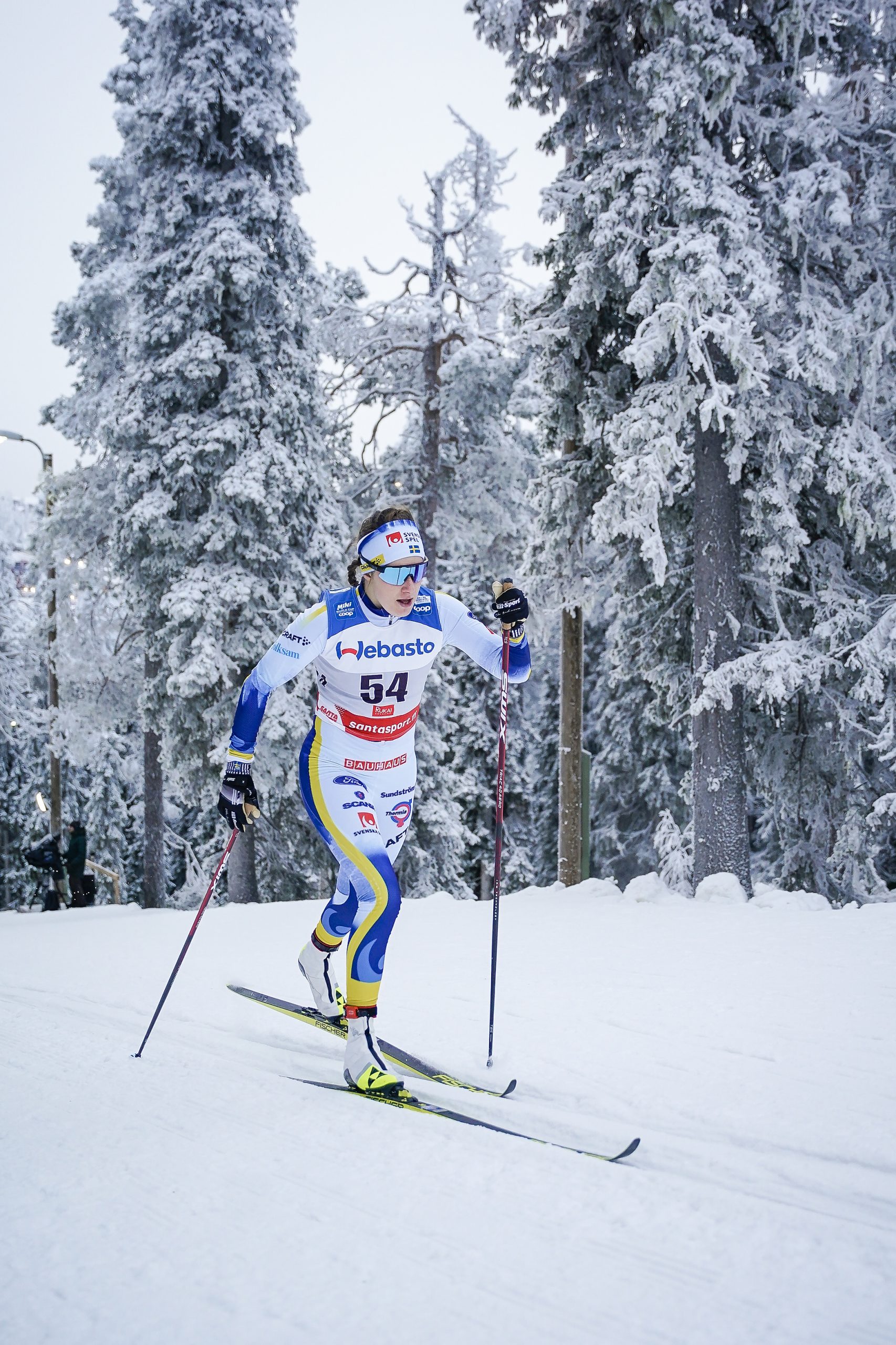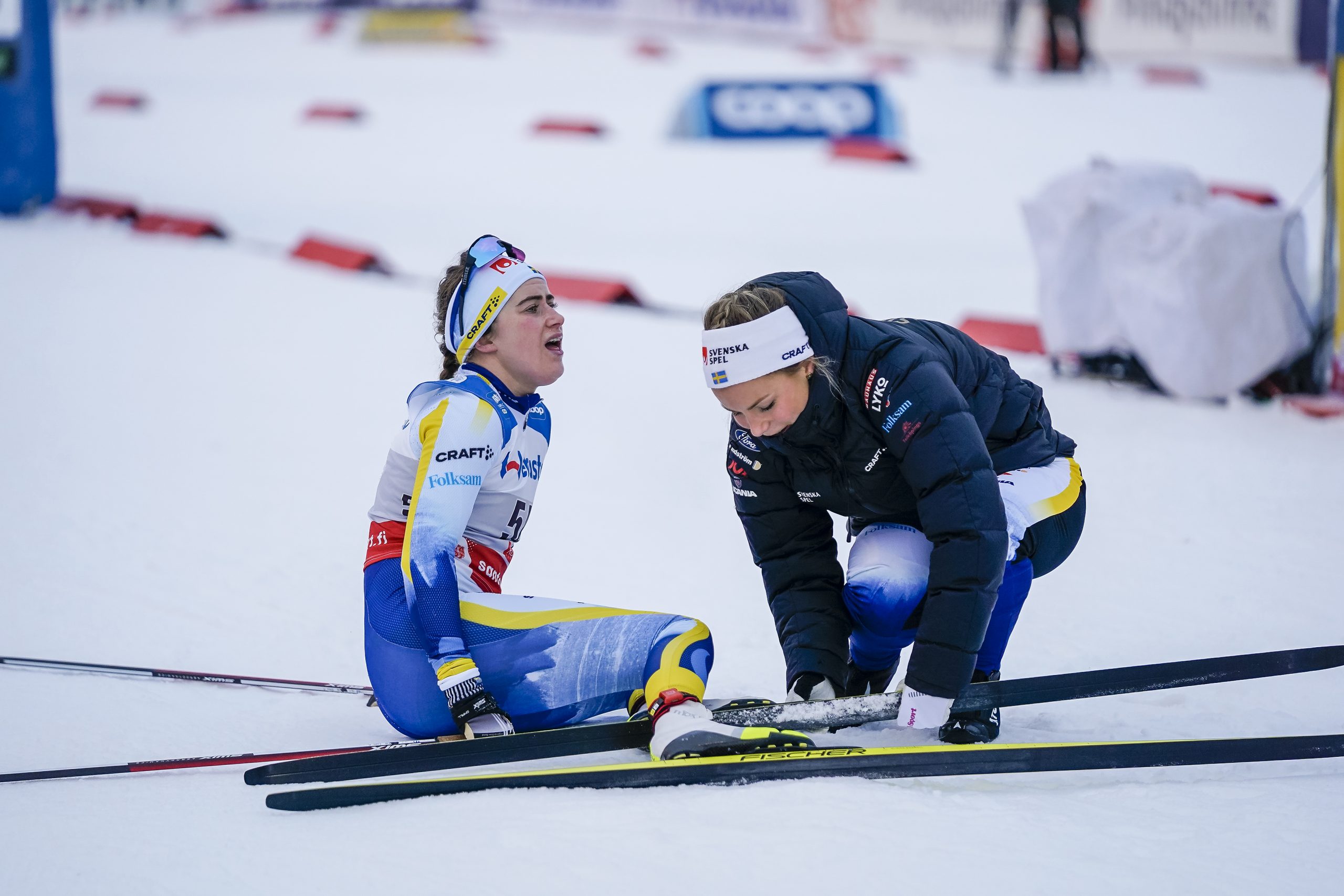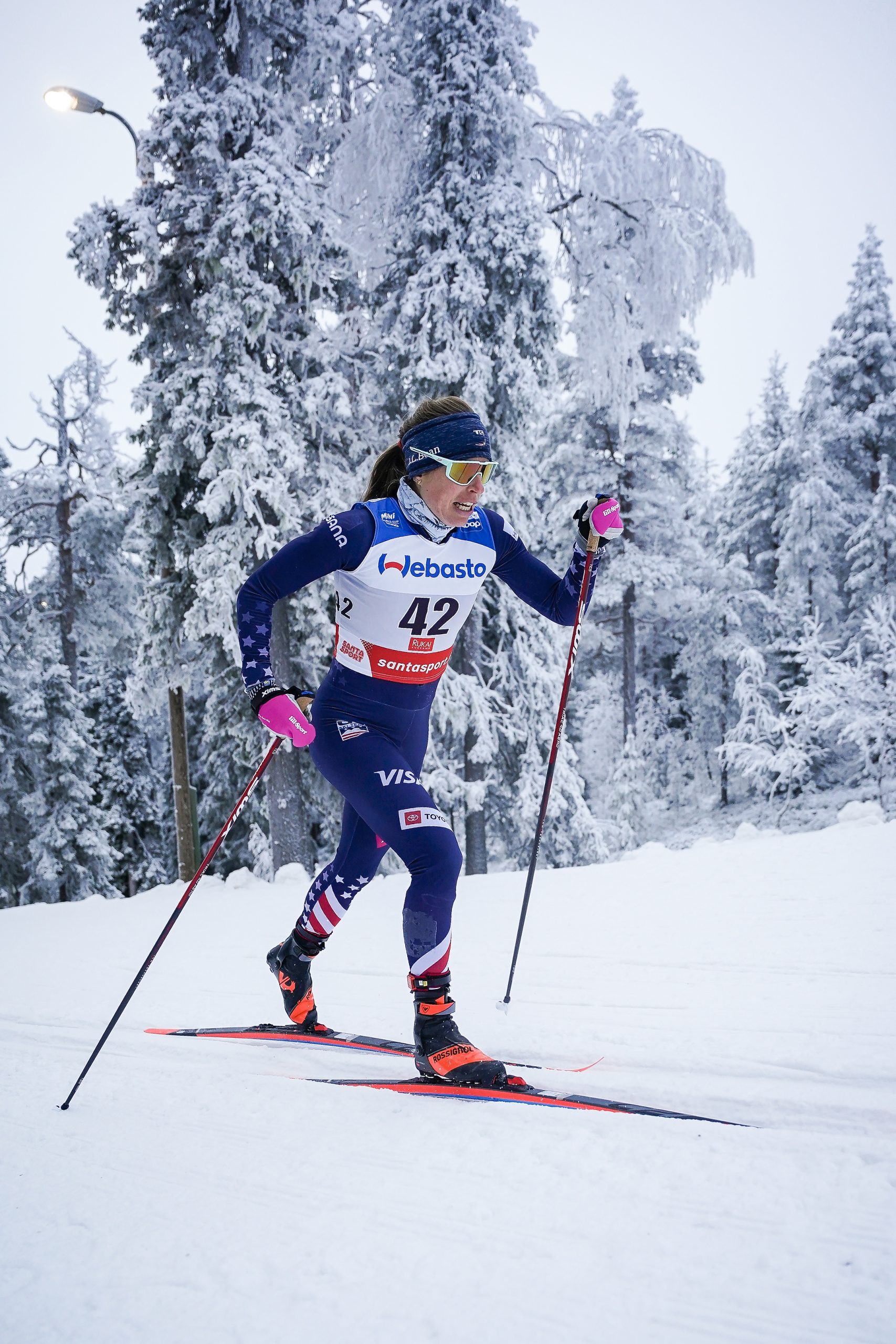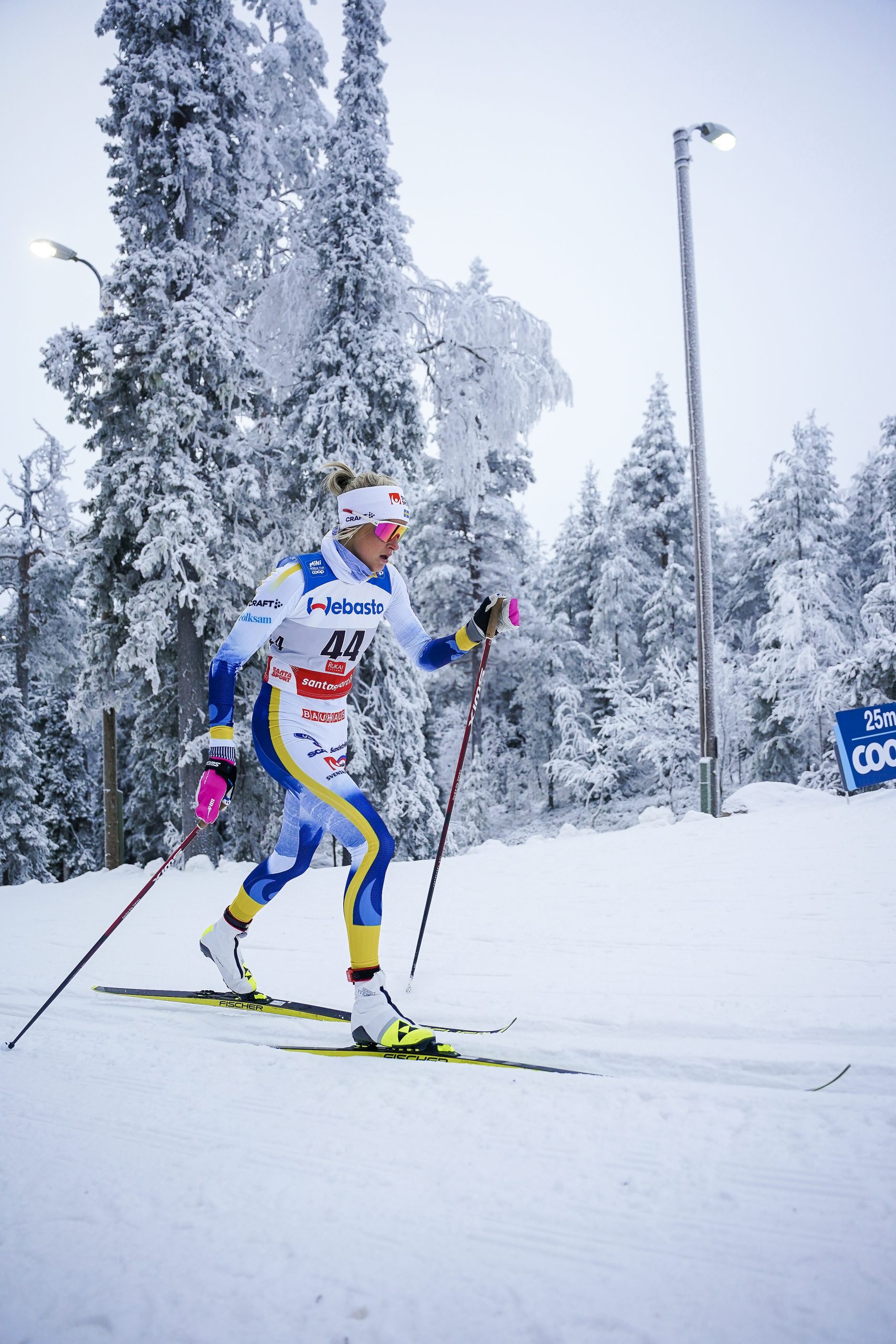

Tag: ruka 10 k classic

  • Nyenget Claims Ruka 10 k, But It’s Not Only Norway on the Podium

    Nyenget Claims Ruka 10 k, But It’s Not Only Norway on the Podium

    This coverage is made possible through the generous support of Marty and Kathy Hall and A Hall Mark of Excellence Award. To learn more about A Hall Mark of Excellence Award, or to learn how you can support FasterSkier’s coverage, please contact info@fasterskier.com.

    Martin Loewstroem Nyenget (NOR) was victorious in Ruka, Finland for the second time in his career. Norway continues its hold on the top of the podium, but more contenders are arising to vie for the remaining steps. (Photo: Modica/NordicFocus)

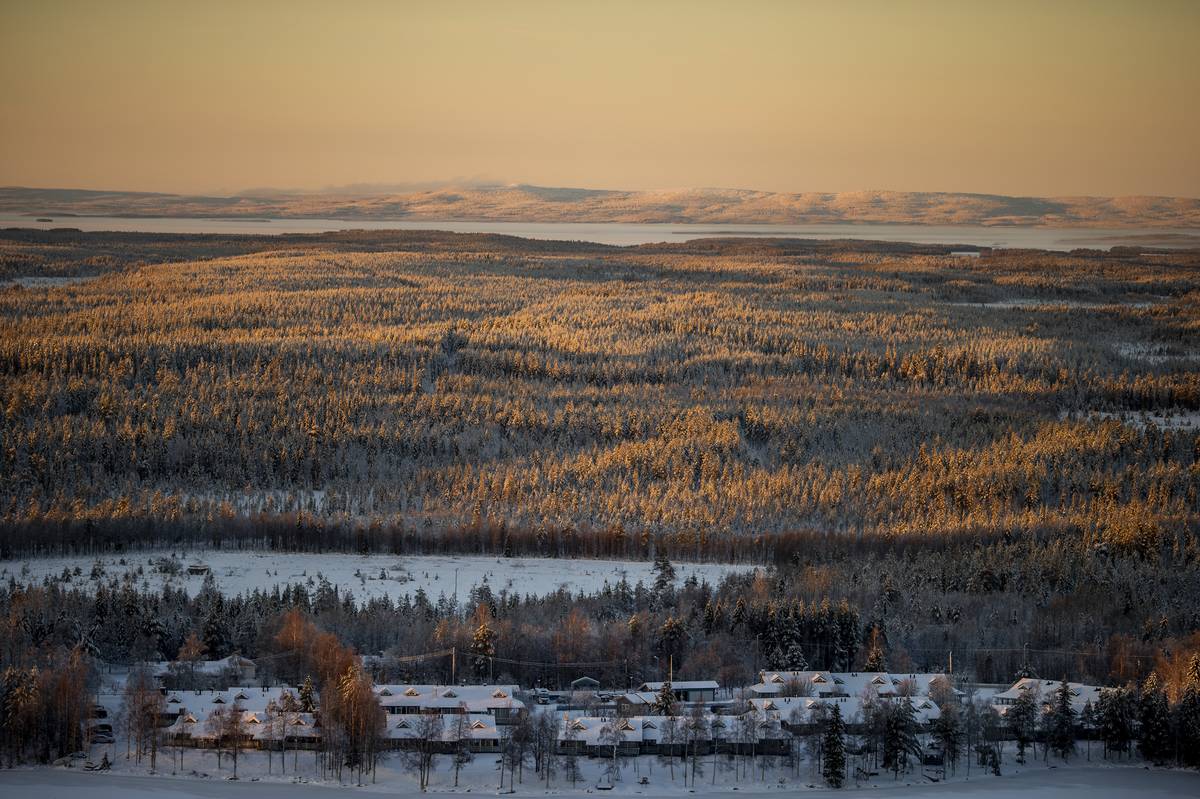
    Where skiing venues are concerned, winter arrives first in Kuusamo, Finland, site of the ski resort known as Ruka. It makes sense, then, that the 2025-2026 FIS World Cup season would begin in this far-northern place where sunrise and sunset are barely separated by actual daylight.

    The first races of the season are about straightening out the kinks and blowing out the cobwebs. Everyone needs to get back in the groove: athletes, coaches, wax techs, broadcasters, statisticians, reporters. Some pick up right where they left off, others stumble out of the gate, still others wonder why they’ve showed up at all. But the season is long, and performances in the first race (whether memorably good, or memorably bad) don’t forge a mold for the entire season.

    The first FIS World Cup broadcast of the 2025-2026 season suffered from many of the same problems befalling any local race conducted on slushy trails around a city golf course. Conditions are always challenging and stressful, waxing and ski selection make a difference, and the electric timing often fails to work perfectly. In Ruka, on-air commentators Chad Salmela and Kikkan Randall were often left with race splits that failed to update, or blank screens that gave them no information at all. But Salmela and Randall are seasoned pros: they rolled with the punches, and called the race that the cameras showed them. Likewise, most skiers hit their stride by race’s end, and the final results ended up looking like what many fans might’ve expected.

    In pre-race interviews, American, Ben Ogden, expressed the excitement at the start of a new season. “I’ve been hunkered down in Vermont, doing what I do,” grinned Ogden. “I’m excited to be traveling again . . . Nothing like a good ol’ Ruka 10 k to get your Classic skiing going again.”

    The 10 k distance is one requiring both endurance and speed, though neither quality is sufficient to guarantee success in this all-out event. Go out too fast, and you’ll flame out. Start too conservatively, and you’ll never catch up to faster starters. The winner will be the one who commits to the risk of a fast start, and is able to somehow pick up even a bit more speed at the end. Quite a balancing act, quite a miracle of modern athletic performance. Quite a harsh baptisim to start off a World Cup season. Let the racing begin!

    Mika Vermeulen (AUT) reminds us that more than just Norwegians have chances to earn glory in the season to come. (Photo:  Modica/NordicFocus)

    But nothing is certain when it comes to competing at this level—and even the most glowing reputations do not guarantee racing success. World Cup racing is FAST, and there’s no way to know if a racer has that speed until they pull on a bib and toe the starting line. Based on his unprecedented level of domination last season, we kind of expect Klaebo to win . . . but Klaebo didn’t win everything last season, and an interval start race is one in which just about anyone can pop up and deliver a good one. Ultimately, Klaebo earned a spot on the podium, but it seemed almost like an afterthought. Klaebo found himself in the unusual position of being overshadowed by not only the day’s winner—Martin Loewstroem Nyenget (NOR)—but also by the third place skier—Austria’s Mike Vermeulen. Norway had another big day, but it’s evident that Norwegians won’t be the only ones waving their flag on the World Cup podium this season.

    Americans were led by Zak Ketterson’s laudable 14th place finish. He was followed by Ben Ogden 33rd, Gus Schumacher, 36th, Zanden McMullen 47th, JC Schoonmaker 61st, John Steel Hagenbuch 62nd, Luke Jager 67th. No Canadian skiers were entered in this event.

    “I definitely made an effort to control my opening pace, and that’s been a huge focus of mine this offseason,” said Ketterson. “I had a lot of races in the past few seasons where I was top 10 in early splits before blowing up. I know I have this type of performance in me if I pace the race well and have good skis—today was both!”
    10 k Classic Interval Start

    Ten kilometers may not be a truly “classic” distance—the great events of our sports history were typically conducted over far greater distances—but beginning the season with a Classic Interval Start event seems like a tip of the hat to the long history of cross-country skiing. For generations, the races that mattered in cross-country skiing were those in which lone skiers strided into the forest, following narrow pre-set tracks, undertaking daunting solo time-trials toward distant finish lines.

    The lights had already turned on, illuminating Ruka’s ski jumping hill, before the men took to the trails for their 10 k Classic. Like the women’s field had done just a couple of hours before, the men raced two laps around a five kilometer course that climbed up and down Ruka’s steep, benchlike hill sides. The field of 109 starters included the flags of many nations not normally associated with cross-country skiing: Bermuda, Chile, Thailand, India, Peru, Armenia, Israel, Venezuela, Ecuador. It’s an Olympic year, after all, and races from many nations will want to carry their flags into that arena.

    The week leading up to today’s race had been very cold with no new snow, but temperatures approached freezing by race time. The difficulties of waxing and ski prep would be compounded by a light snow that began falling just before the start. Ski testing had all but concluded, setting the stage for any number of potential waxing disasters on Ruka’s steeply climbing course.

    Finland’s eyes were  on native son, Iivo Niskanen—a renowned Classic skiing specialist—who’s Classic skiing prowess was likely to impact the results. Win or lose, Niskanen races with passion and fire; he’s always likely to leave his heart on the course in Ruka. Wearing bib 51, Niskanen was the first of the pre-race contenders to test the course. All other chasers would judge themselves against Niskanen’s split times. Ogden’s pre-race enthusiasm had bubbled to the surface in the early kilometers, as he came through the 1.1 kilometer checkpoint first among early starters. His pace appeared even more solid when he was bettered by Niskanen, but only by a tenth of a second.

    Mika Vermeulen (AUT) was the surprise of the Ruka 10 k Classic. He raced hard from the gun, and secured a place for Austria on the podium. (Photo:  Modica/NordicFocus)

    Klaebo came through the first time check in seventh, a bit behind Niskanen and virtually tied with Edvin Anger (SWE). At 3.1 kilometers, the second time check showed a close race between Anger, Harald Oestberg Amundsen, Klaebo, and Niskanen. Mika Vermeulen (AUT) came surging through the field to put up the fastest split time at 6.1 kilometers.

    Wearing bib number 79, Nyenget possessed the advantage of being the latest starter of all the pre-race contenders. Nyenget used his late starting position to hunt down those who’d gone before, posting a time even faster than Vermeulen. Niskanen appeared to fade down the stretch, coming across as the fastest finisher at that point, just ahead of Mattis Stenshagen (NOR) and holding off Valnes by .1 seconds. Niskanen would finish the day in fifth. Like Niskanen, Anger faded late, ending his day in ninth.

    Nyenget came through with fastest splits at 8.1 kilometers (leading Klaebo by seven seconds). The race would depend on who finished with the most energy in the final two kilometers. Vermeulen crossed the finish line to displace Niskanen from the leader’s chair, but Klaebo and Nyenget were still on course and charging through the final kilometers. Vermeulen’s time in the leader’s chair was shortlived, as Klaebo drove across the line to push the Austrian into second place by 2.1 seconds.

    Seen here duroing the 10 k Classic from the 2025 World Championships in Trondheim , Zak Ketterson (USA) delivered a career-best performance (14th) in Ruka. (Photo: Modica/NordicFocus.)

    Nyenget began his drive to the finish at the same moment he caught up to American, Zak Ketterson.

    “When I saw pre-race that Nyenget was starting behind me, I figured he would catch me before the end of the first 5k lap,” Ketterson explained. “For him to not catch me until the very last hill at about 9.2k was a really nice surprise. It was just a case of matching his pace so that I didn’t get overexcited and go too fast up that hill.”
    Together, Nyenget and Ketterson powered up the final hill where Nyenget pulled away in the herringbone section after Ketterson caught a tip.

    “My plan was to ski fast over the top but I faceplanted at the top of the last hill when my kick wax iced up,” Ketterson said. “I tried to stomp off the snow that had built up, but the skis just stopped in their tracks and I faceplanted!”

    Ketterson would recover to claim his best-ever World Cup finish: 14th place, barely 30 seconds removed from the podium. Nyenget would hold on to best Klaebo by 2.1 seconds, earning the second Ruka Classic win of his World Cup career.

    In post-race interviews, Nyenget, himself, seemed a bit surprised by his victory. “When you hear Johannes is closing the gap—you know he has a beast of a finish,” Nyenget said. “I tried to just maintain my focus on myself.”

    10 K Classic Interval Start RESULTS

    Love Stories Like This? Help Keep Them Coming.

    Feature interviews like this one take time, access, and care to produce. If you value thoughtful storytelling and independent ski journalism, please consider becoming a Voluntary Subscriber. Your support directly fuels the work we do to cover the people, places, and moments that make our sport special.

    Join the FasterSkier community!


    First podium of the World Cup season: Johannes Hoesflot Klaebo (NOR), Martin Loewstroem Nyenget (NOR), Mika Vermeulen (AUT). (Photo: Modica/NordicFocus)
  • Rosie Brennan Skis to First Career Classic Podium

    Rosie Brennan Skis to First Career Classic Podium

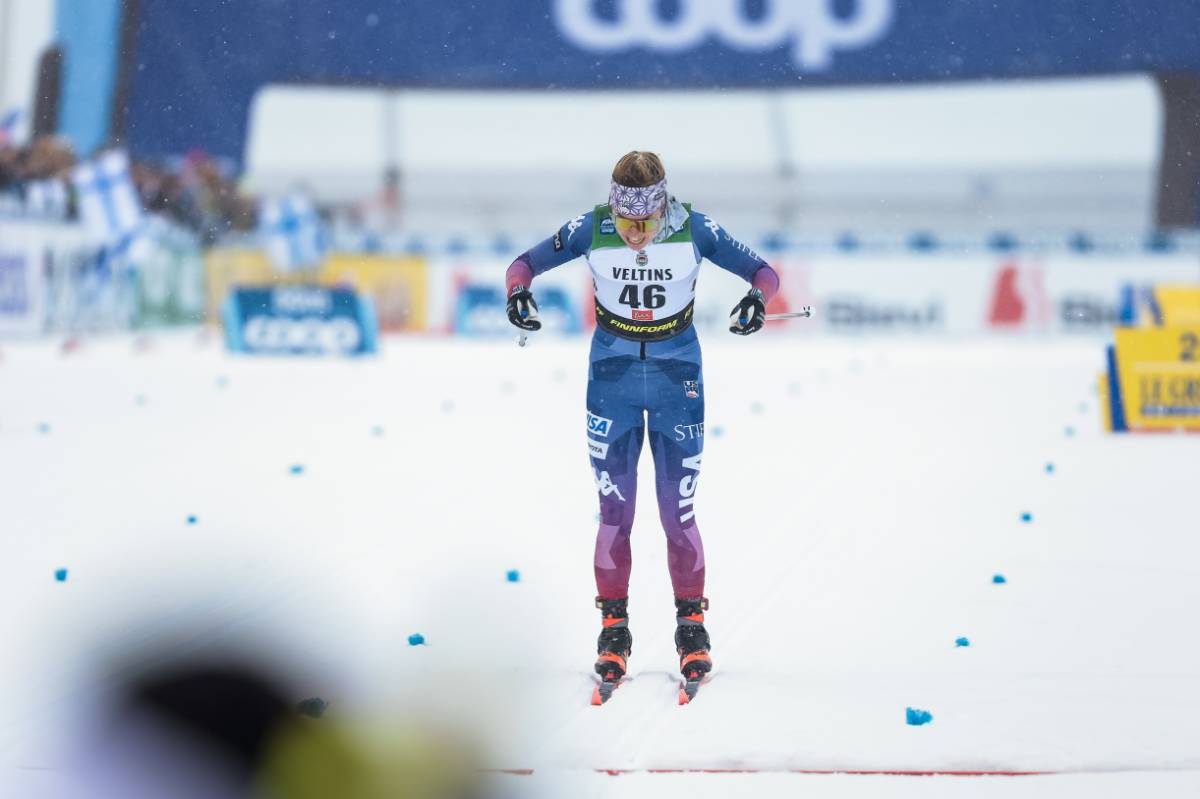
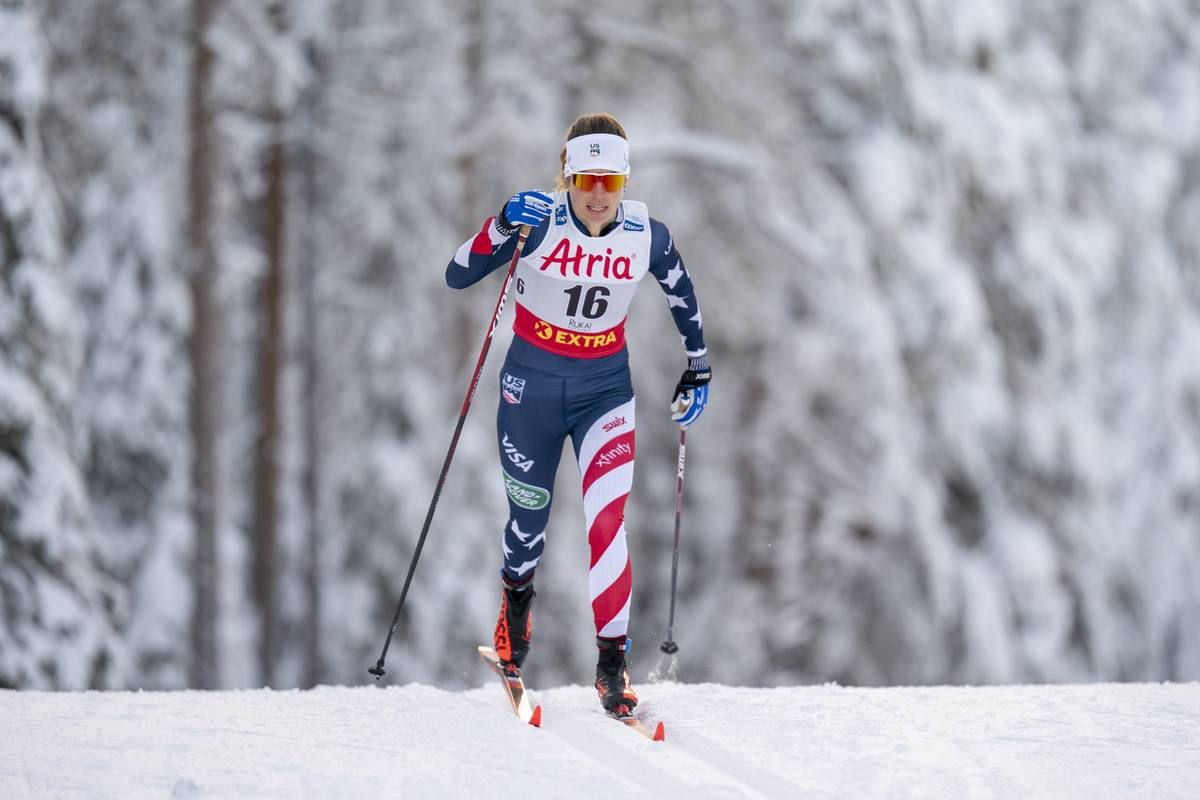
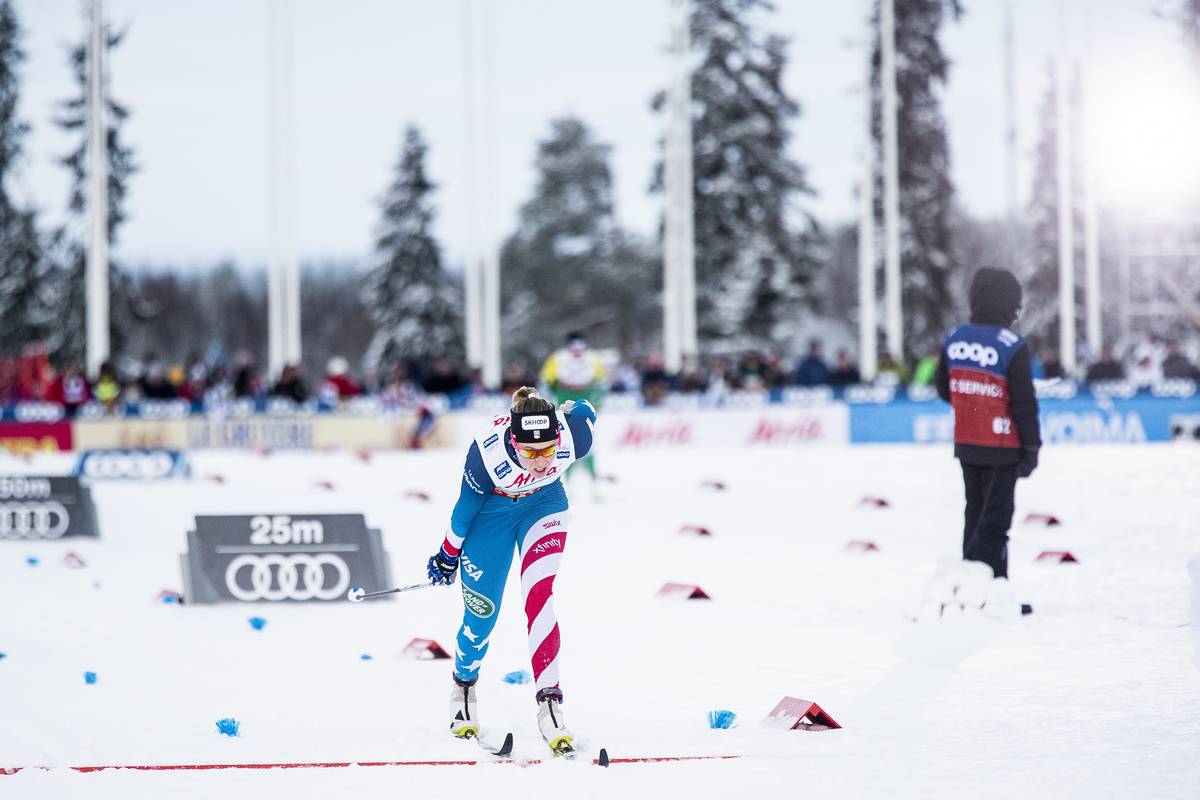
    Rosie Brennan (USA) double-poles across the line on her way to a second place in Saturday’s World Cup 10 k Classic race in Ruka, Finland. The result was Brennan’s first classic World Cup podium of her career. (Photo: NordicFocus)

    The first time Rosie Brennan stepped onto a World Cup podium, she was holding a pair of classic skis. That was in Lillehammer eight years ago, December 2015, when she skied the scramble leg in Team USA’s third place finish. Since then, there has been more team revelry, plenty of skate podiums, some fast-starts, some near misses, but never an individual classic podium. Above all, in the intervening time, there has been perseverance. Stride for stride, season after season, working in muted humility half a world away until the day that her classic skiing would make an entire ski community roar.

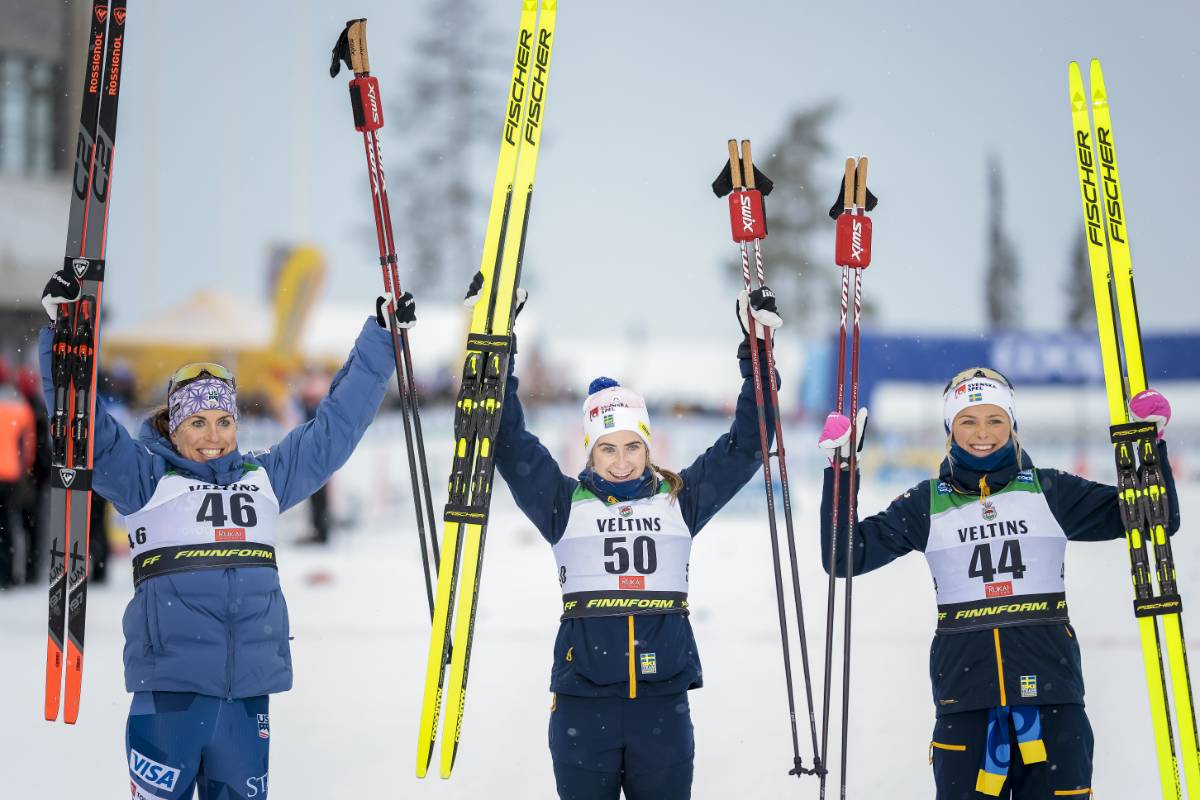
    On Saturday—under the Arctic skies in Ruka, Finland Saturday—that day came. A breakthrough and a milestone: Rosie Brennan’s first individual classic World Cup podium. She took second place in the 10 k Classic interval start, just five seconds off winner, Sweden’s Ebba Andersson, and another five seconds ahead of third place, Frida Karlsson (SWE).

    “[It’s been] a lot of hours of training, technique, and getting stronger,” said Brennan in post-race comments to FasterSkier. “I love classic skiing, and it’s been one those things I’ve been striving for because I knew it was possible.” 

    Brennan’s teammate, Jessie Diggins (USA), skied strongly to an 11th place finish. Other American finishers included Novie McCabe in 30th, Sophia Laukli 44th, and Julia Kern 50th. Canadian finishers included Katherine Stewart-Jones 25th, and Amelia Wells 53rd. 

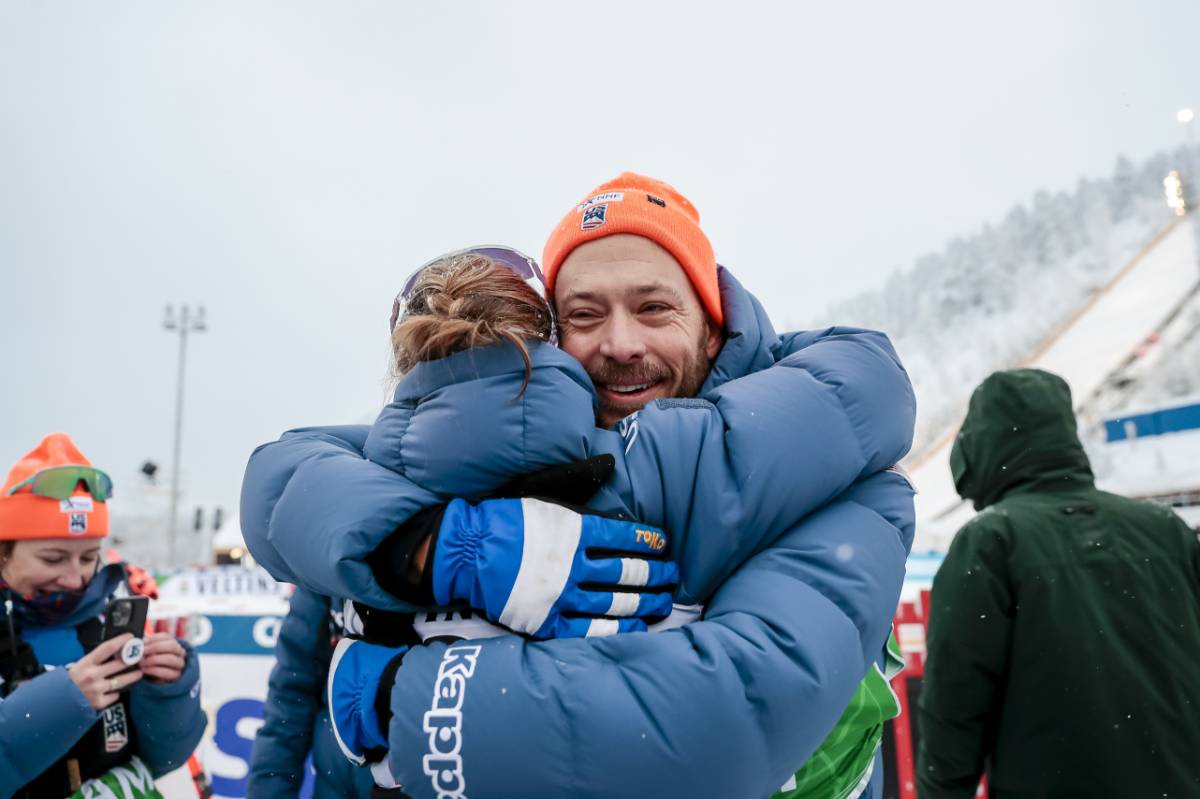
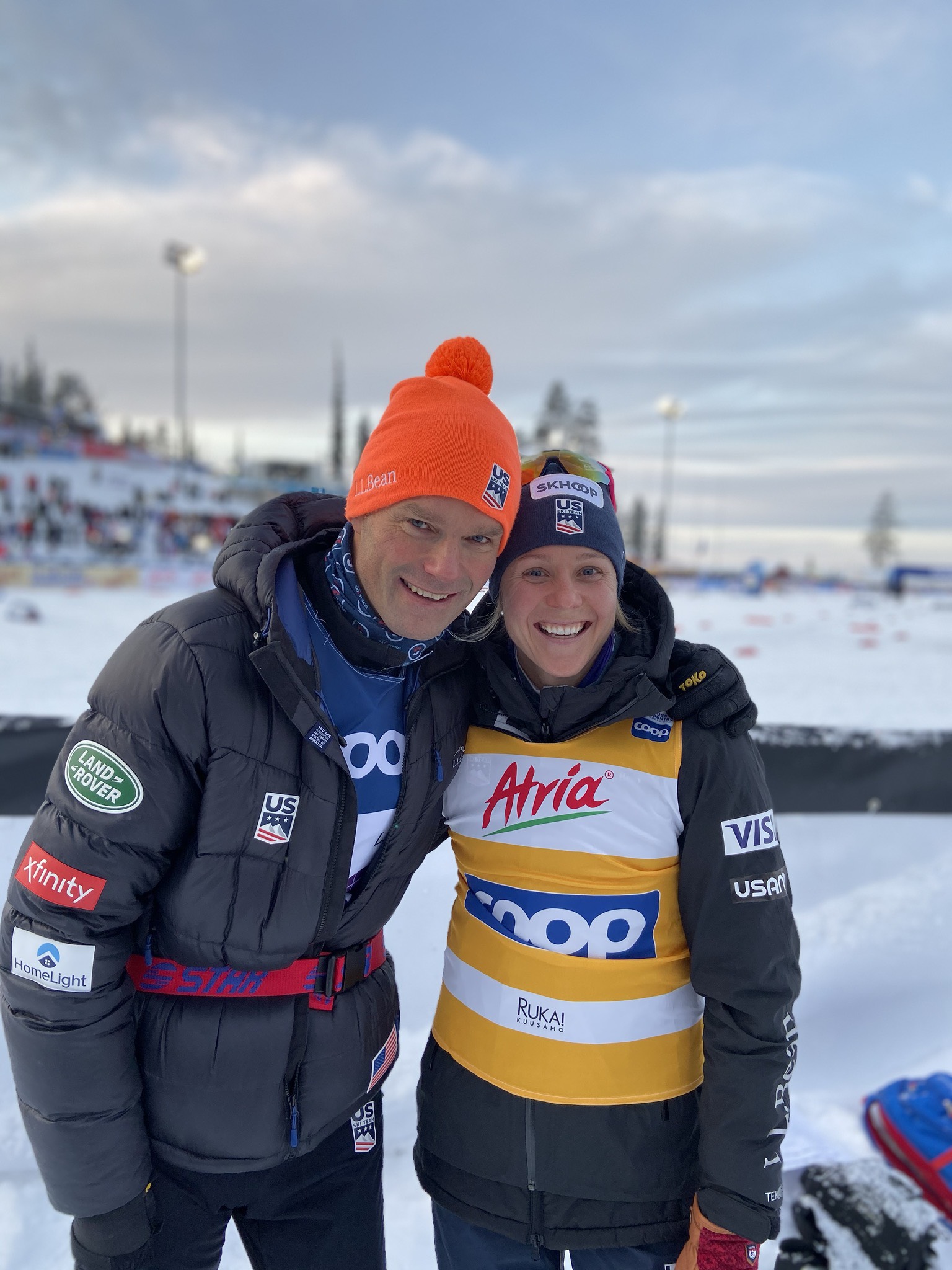
    Rosie Brennan (USA) and Stifel U.S. Ski Team Head Coach, Matt Whitcomb, embrace after Brennan skied to second place in Saturday’s 10 k Classic race. (Photo: NordicFocus)

    Through ten kilometers of punchy hills, fresh, frigid snow, and taut time checks, Brennan persisted. To boil down this career milestone to “Brennan persisted” is purposeful understatement. There’s been budding momentum for Brennan in classic skiing for a couple of seasons, but her biggest progressions up the World Cup rankings have come with heartbreaks that cut the other way. During 2023’s Tour de Ski she finished fourth in a 15 k classic mass start in Val di Fiemme: her best finish ever. But, she lost a ski toss to Kertuu Niskanen (FIN) for the podium. Later that month during the World Championship 30 k, Brennan gritted her way into the final kilometer in medal contention before finishing in fifth place. She remarked at the time that she “[was] feeling a mix of everything. I’m feeling I’m getting good at this fourth, fifth, sixth place situation.”

    At the time, Brennan’s close friend and former teammate Sadie Bjornsen said to FasterSkier’s Nat Herz that, “Ninety-nine percent of the time you’re fourth. That’s just the reality of life. And the way you keep coming back from that is what is really inspiring.” Adding that, “It’s such a theme of Rosie’s story: Knock me down, I’ll bend. But I don’t break.” 

    The race Brennan skied Saturday was extraordinary at first glance. For Brennan though, it was typical: she brought the special characteristics that, after many years of practice, are rising to both the top of people’s minds, and the top of the results sheet. After many seasons’ persistence, her patience is paying off. The first classic podium of Brennan’s career comes at the opening of a new season, and seems to open up a world of possibility for Brennan and her teammates. Stifel U.S. Ski Team Head Coach, Matt Whitcomb, commented to FasterSkier that “it was emotional, perhaps, the most amazing race she’s ever put together.”

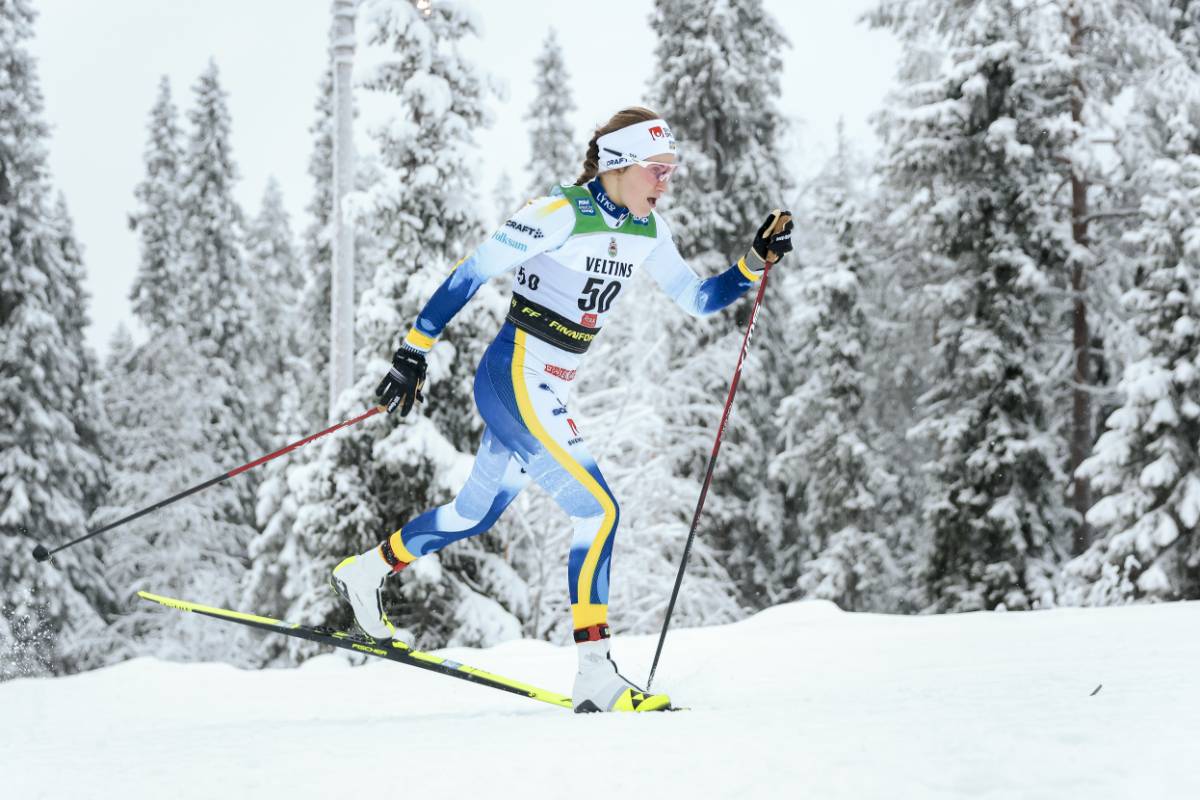
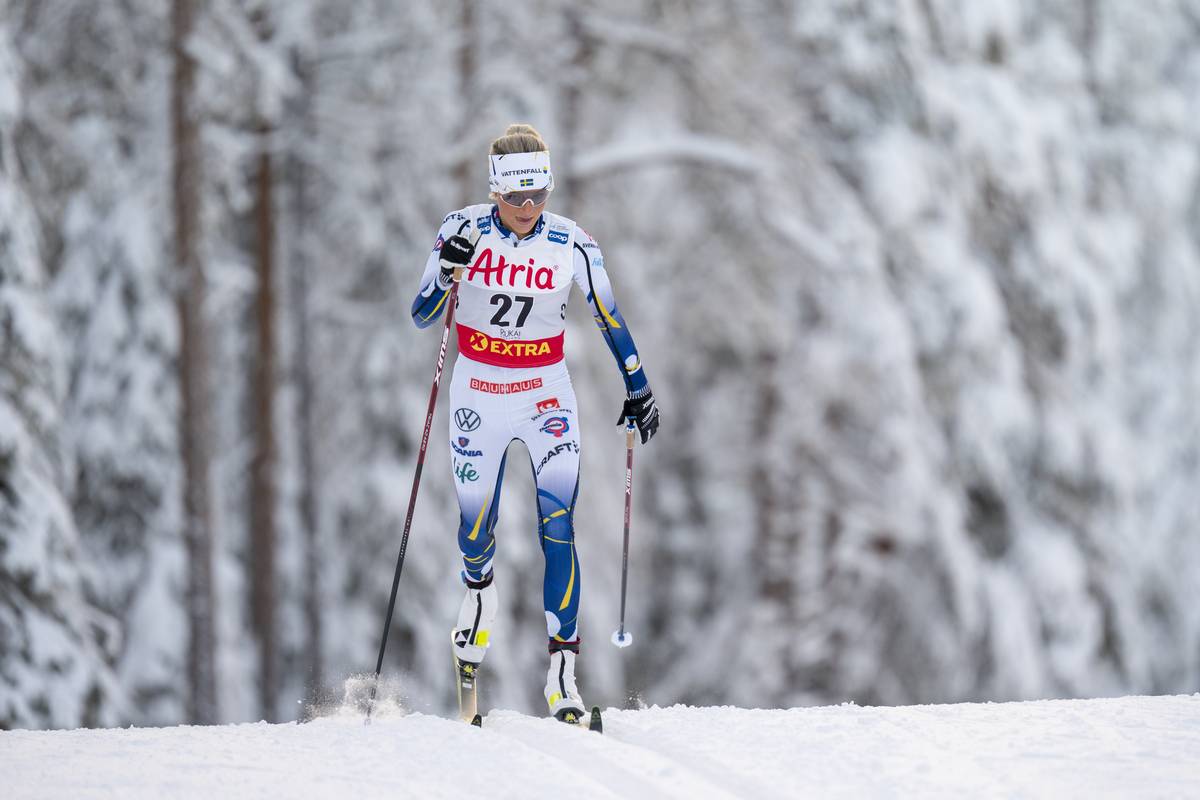
    Ebba Andersson (SWE) remained steady on her way to victory in Saturday’s 10 k Classic race. Andersson’s win marked her second consecutive year as Ruka’s 10 k Classic champion. (Photo: NordicFocus)
    Women’s 10 k Classic Interval Start

    Andersson’s own breakthrough at Ruka came a year ago when the Swede won her first classic World Cup race in last year’s 10 k interval start. A year later, she returned to Ruka’s start line having been crowned World Champion (twice), and looking to follow up on her teammate Emma Ribom’s own Ruka repeat in yesterday’s sprint

    By the end of the first lap on Ruka’s three-lap, 3.3 k course, Andersson had opened up a small but steady gap over Frida Karlsson and Rosie Brennan. Her finishing kick on the Ruka stadium climb that featured so significantly in Saturday’s Classic Sprint races confirmed the drive of her efforts through the entire ten kilometers, and earned Andersson a repeat victory as Ruka’s 10 k Classic champion.

    Andersson wore bib 50, which meant her time splits came at the tail-end of the main group of competitors. The field was especially stretched today as Linn Svahn (SWE), wearing bib 5 and on her way to a top ten finish, did much of the early pace-setting. German Katharina Hennig, bib 34, was the first in the field to match her efforts, and from that point on, the field was swapping seconds from checkpoint-to-checkpoint. Close to Hennig in the early-goings was Jessie Diggins, wearing bib 40, who would hold a strong position throughout the course and come home to finish 11th place, the second American on the day. 

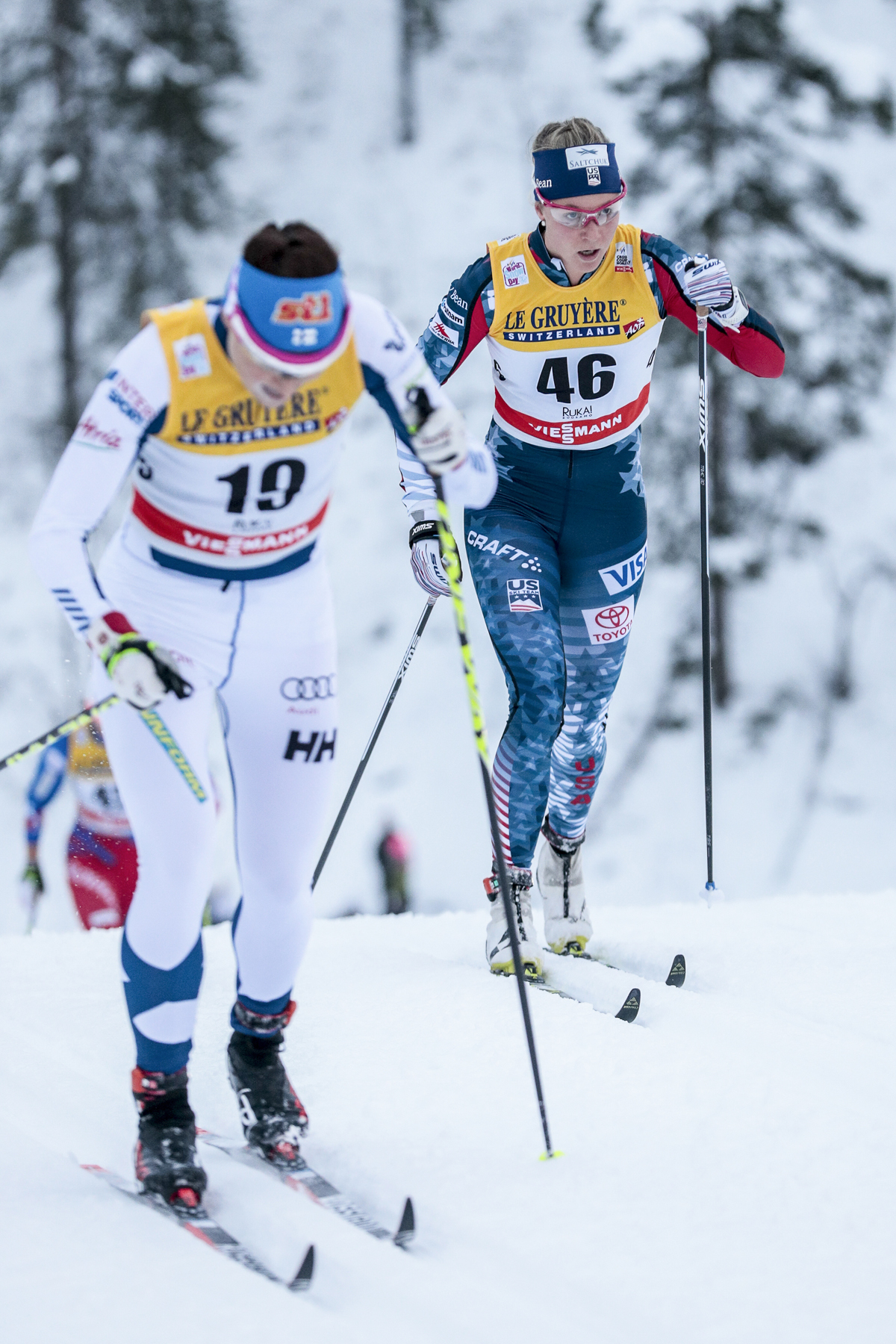
    Karlsson, wearing bib 44, would consistently outkick Katerina Hennig’s (GER) efforts into the time-checks, and when Brennan, bib 46, posted split times in and around Karlsson and Hennig, the race’s podium picture began to become clear. Karlsson enjoyed a one second lead over Brennan at the 5 k mark, but Brennan would close gap to the Swede, edging her out for second place.

    The tightly-grouped finishing times of Saturday’s 10 k bode well for a tight pack tomorrow as Ruka’s World Cup opening weekend concludes with a 20 k mass start skate race on Sunday.

    Women’s 10 k Classic Interval Start RESULTS

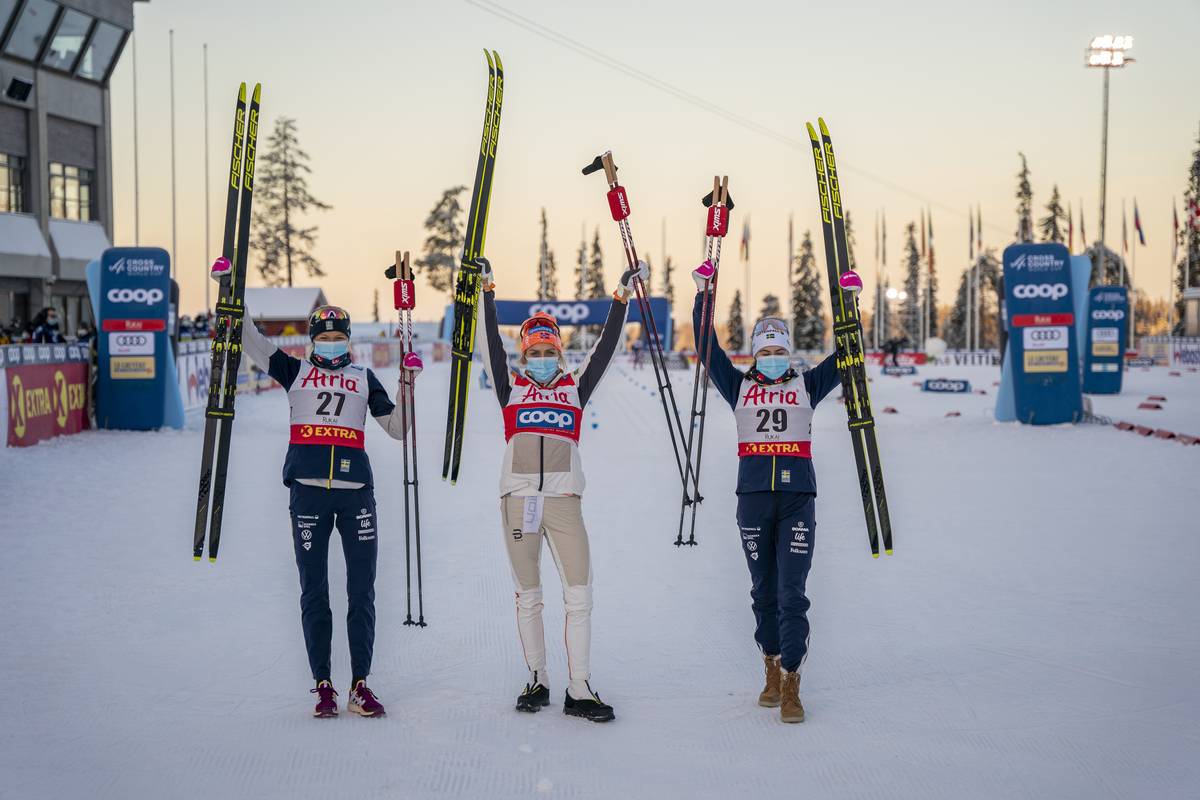
    Saturday’s 10 k classic podium: 1st) Ebba Andersson (SWE), 2nd) Rosie Brennan (USA), and 3rd Frida Karlsson (SWE). (Photo: NordicFocus)
  • Ruka Women’s 10 Kilometer Classic: Sweden Dominates, Brennan Shines

    Ruka Women’s 10 Kilometer Classic: Sweden Dominates, Brennan Shines

    A_Hall_Mark_of_Excellence_Award-logo-300.png (300×244)This World Cup coverage is made possible through the generous support of Marty and Kathy Hall and A Hall Mark of Excellence Award.  To learn more about A Hall Mark of Excellence Award or to learn how you can support FasterSkier’s coverage please contact info@fasterskier.com.


    Ebba Andersson (SWE) on her way to victory in the women’s 10k classic in Ruka, Finland. (Photo: NordicFocus)

    Women’s 10K Interval Start:

    Today began a new chapter in World Cup racing as women and men competed at the same distances on the same course for the first time ever. This also marked the first distance competition since the retirement of Therese Johaug. With that competitive force no longer dominating the races, it would be left to the field to decide who would lead it into the future.

    The Results:

    The race was won by Ebba Andersson of Sweden, followed by Frida Karlsson of Sweden, and Katharina Henning of Germany. The top American was Rosie Brennan finishing in seventh place, 29 seconds out of first.  Jessie Diggins was the second American, finishing 21st, 1:18:0 out of first place.  Rounding out the field for the Americans were Novie McCabe in 39th, 2:03.4 back. Sophia Laukli in 45th, 2:26.2 back, Alayna Sonnesyn in 49th 2:38.4 back, Julia Kern 51st, 2:49.7. The top Canadian was Katherine Stewart-Jones, followed by Dahria Beatty and Olivia Bouffard-Nesbitt.

    Ebba Andersson (SWE) earned the win in the season’s first distance World Cup, the 10km classic individual start at Ruka, Finland.  (Photo: NordicFocus)

    The Race:

    The women’s individual race in Ruka, Finland was held this morning in cold,  overcast conditions.  The athletes competed on a five-kilometer course with a mix of natural and artificial snow with temperatures around 17 degrees Fahrenheit (-8.0 Centigrade) at the start.  Humidity was 93%.  Conditions were favorable as skiers used a mixture of klister and hard wax for kick.

    First out for the American’s was Alayna Sonnesyn starting in the 18th spot, followed by Novie McCabe in 22nd,  Sophia Laukli in 23rd, Julia Kern in 25th, Jessie Diggins in 38th, and Rosie Brennan in 42nd.

    Racing to an impressive seventh place finish, Rosie Brennan (USA) was the top American finisher. FIS world cup cross-country, 10km, Ruka, Finland.  (Photo:  NordicFocus)

    Karlsson Jumps out to the Lead:

    The steep hills of Ruka proved challenging as many skiers stepped out of the tracks to take advantage of loose snow going up hills. Most were resorting to herringbone on the second lap. Karlsson asserted herself early, taking a lead at the 3.1kilometer interval by ten seconds over Andersson by 6.5 seconds. Even so, by the 6.1 kilometer mark, Ebba Andersson took a 2.7 second lead over Karlsson.  Henning was in third place, 9.5 seconds back. At this point, Rosie Brennan was 21.9 seconds back in sixth place.

    Frida Karlsson (SWE) on her way to 2nd place. (Photo: NordicFocus)

    Andersson Takes a Slim Lead:

    By the 8.1 K mark Andersson’s lead had been reduced to the narrowest of margins, leading Karlsson by just 0.6 seconds. Henning had dropped back to fourth place, 8.5 seconds back.   Brennan was in fifth place, just behind Heidi Weng who had a very fast second half.

    Karlsson crossed the finish line and had to wait to see how Andersson would fare.  Karlsson had looked very strong as she finished, but would it be enough to hold off the surging Andersson? As it turned out, Karlsson’s time in the winner’s chair was short-lived as Andersson ferociously attacked the last hill to make time on Karlsson. Anderson had an incredible final two kilometers and ended up beating her teammate by 5.7 seconds to give Sweden first and second place.

    The surprise of the day was Anne Kjersti Kalva of Norway. Kalva missed the Olympics with Covid, but on this day she battled back to a fourth place finish, falling just two tenths of a second short of a podium finish.

    Complete Results

    Frida Karlsson (SWE) – second place, Ebba Andersson (SWE) – first place and Katharina Hennig (GER) – third place share the women’s podium of the 10k classic in Ruka, Finland. (Photo: NordicFocus)
  • 10 K Classic in Ruka Serves Up a Win for Therese Johaug: Rosie Brennan 8th

    10 K Classic in Ruka Serves Up a Win for Therese Johaug: Rosie Brennan 8th

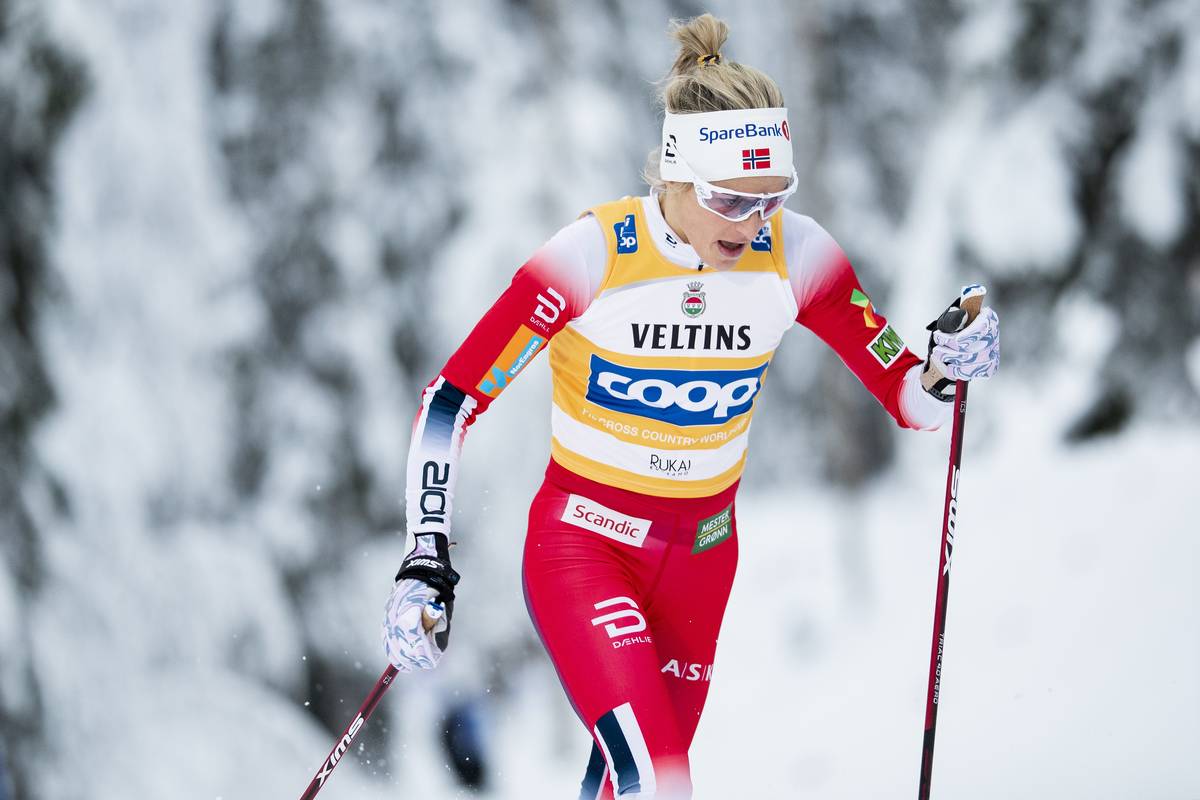
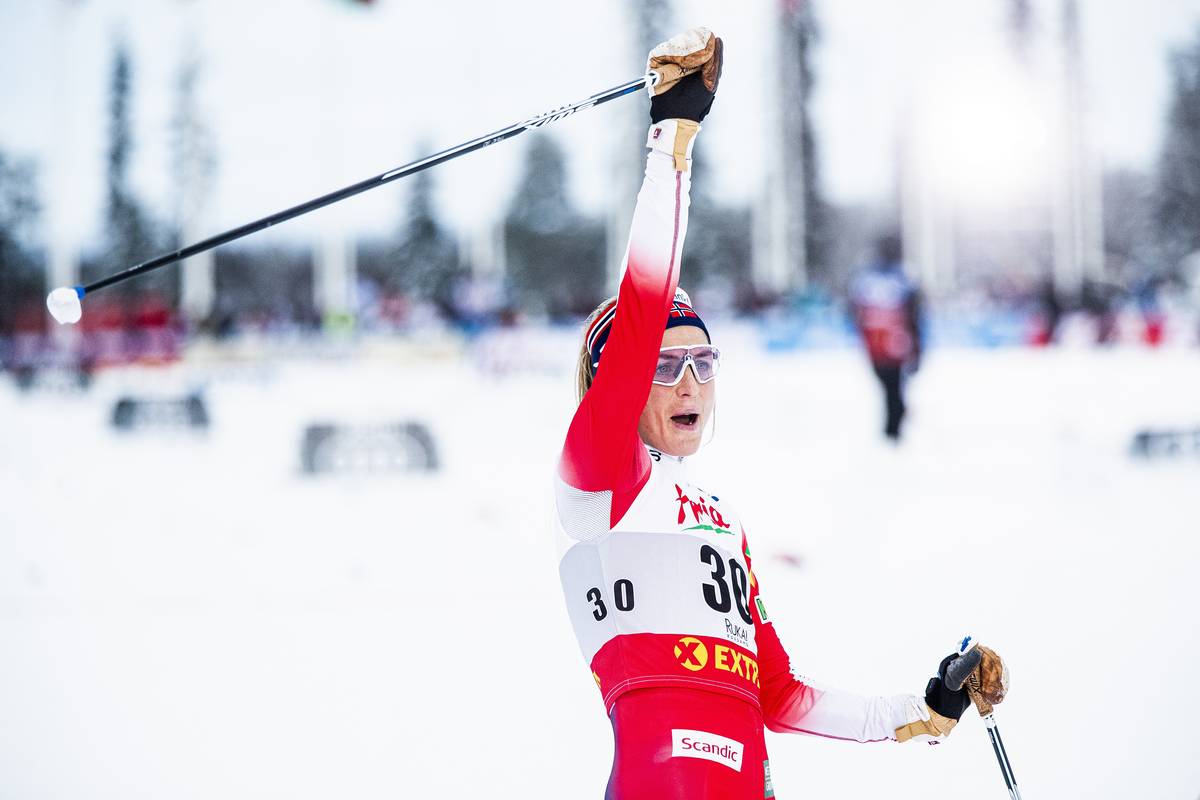
    High octane effort from Therese Johaug (NOR) during the 2020 Ruka 10 k classic. (Photo: NordicFocus)

    This World Cup coverage is made possible through the generous support of Marty and Kathy Hall and their A Hall Mark of Excellence Award. To learn more about A Hall Mark of Excellence Award or to learn how you can support FasterSkier’s coverage please contact info@fasterskier.com.

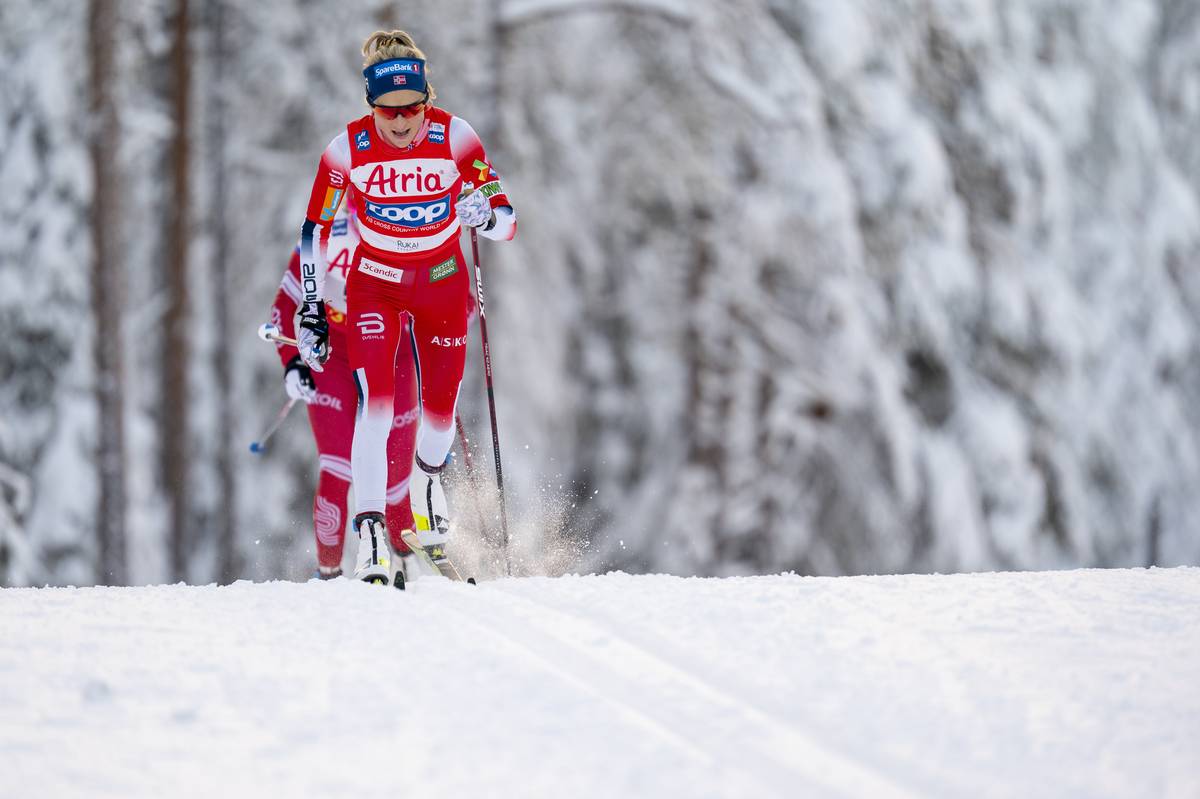
    Just a few more rotations of the earth and we’ll be in December – trending towards solid wintertime. The World Cup, as it has for 19 years, swung up to Ruka, Finland just a Reindeer’s nose from the Arctic Circle. The day dawned lazily in Ruka on Saturday at  9:40 AM to reveal clear skies, snowy trees, and noisy snow underfoot. As much as this is the status quo on the race calendar, the second day of racing for the women on Saturday, a 10-kilometer interval start classic, was status quo for Norway’s Therese Johaug.

    All clear ahead this morning in Ruka, Finland. (Photo: NordicFocus)

    Johaug won in 25:01.4 minutes with a rather comfortable time gap of 21.8 seconds over second-place Frida Karlsson (21) of Sweden. In summarizing Johaug coming into the season, let’s simply say she remains peerless when the kilometers skew anywhere beyond sprint distance. In Friday’s 1.4 k classic sprint, she placed 30th, making the heats, which, for this decidedly non-sprinter, is something to note.

    Johaug picked up on Saturday with her metronomic striding and began picking skiers off as the day’s 30th starter. Let’s call this her warm-up – Johaug was fourth at 1.2 k, 5.5 seconds behind the hot-starting Karlsson. She inched closer to 1.8 seconds at 3.1k, again jusy off the fastest time split of Karlsson. Then, mid-race at 5 k, the places flip-flopped for good, and Johaug took control. Roughly a kilometer later, Johaug was up 5.9 seconds on Karlsson.

    Goodbye. Another win and another well-padded win, concerning time, for the thirty-two-year-old Johaug.

    “It was really hard, I forget how hard it really is,” Joahug told FIS after the race. She said this masked-up in the mixed zone. But let’s safely assume under that mask was a no-nonsense smile from the no-nonsense winner.

    Therese Johaug of Norway locking in for Ruka 10 k classic win. (Photo: NordicFocus)

    Karlsson, still a U23 athlete, comes with high expectations. Yesterday she was 15th in the sprint, and she finished last year’s Covid-19 shortened season in first place at the storied Holmenkollen 30 k classic – the last race of the season.

    Ebba Andersson, also of Sweden, placed third overall on Saturday, 26 seconds back.


    For the U.S., Rosie Brennan has come to Ruka in form. A career-best 17th in the sprint yesterday was followed up with an eighth-place on Saturday. Brennan has two World Cup sixth places to her name, one of which came last year in Ruka’s 10 k classic. So when the shape is good, Ruka’s classic course can be kind to Brennan.

    “We had about as nice of a day as you can ask for in Ruka at the end of November,” Brennan emailed to several outlets. “The course is on the wrong side of the mountain to get the sunlight, but the sky was clear and I could tell there was sun somewhere! I tried to start comfortably and work my way into the race today. This strategy worked quite well and I was able to pick things up a bit the second time around. I felt like I was skiing strong, but still feel like I have one more gear to find racing. I am happy with the result, but it certainly makes you eager when I only needed 2 seconds to move up two places! The times were tight so tomorrow should be a good battle for the overall. I’m looking forward to putting my skating to the test!”
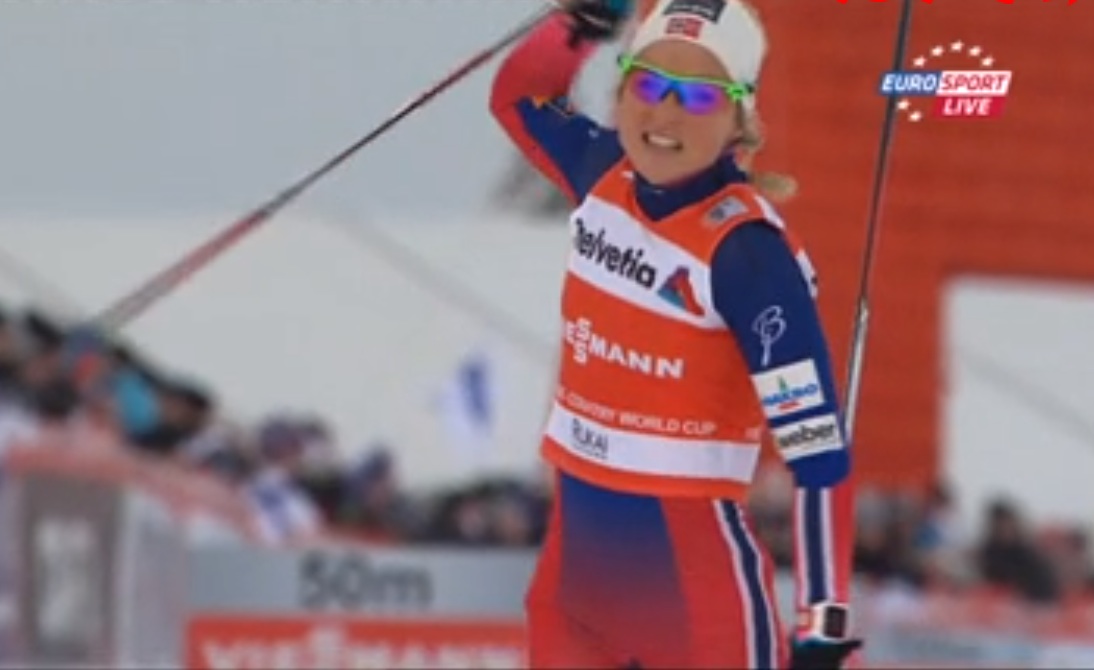
    Crushing. Rosie Brennan on her way to eighth overall in the 2020 Ruka 10 k classic. (Photo:NordicFocus)

    Matt Whitcomb, U.S. Ski Team Head Coach reflected Brennen’s positive energy. “It was fun to have our first top-10 of the season, there were high fives and Rosie had a big smile, or at least it appeared that way under her mask,” said Whitcomb after the race. “I think she is positioned well to have a huge day tomorrow.”

    Post-race interview with Matt Whitcomb


    As a three-race series, which includes results and bonus times from Friday’s sprint, Brennan sits 11th overall, 42 seconds behind first-place Joahug. It’s 12 seconds to seventh overall Andersson and another four to Friday’s sprint winner Linn Svahn.

    Why bring up Svahn? The Swede placed 11th on Saturday, a career-best World Cup distance race result outside a “winner of the day” eighth place last season in Trondheim’s 15 k classic pursuit. Maybe it’s too early to state outright, she is only 20, but with her sprint prowess, she may become another overall World Cup threat from Sweden. (We’ll wait and let Devon Kershaw rave about the riches of Sweden’s women’s program on Sunday though.)

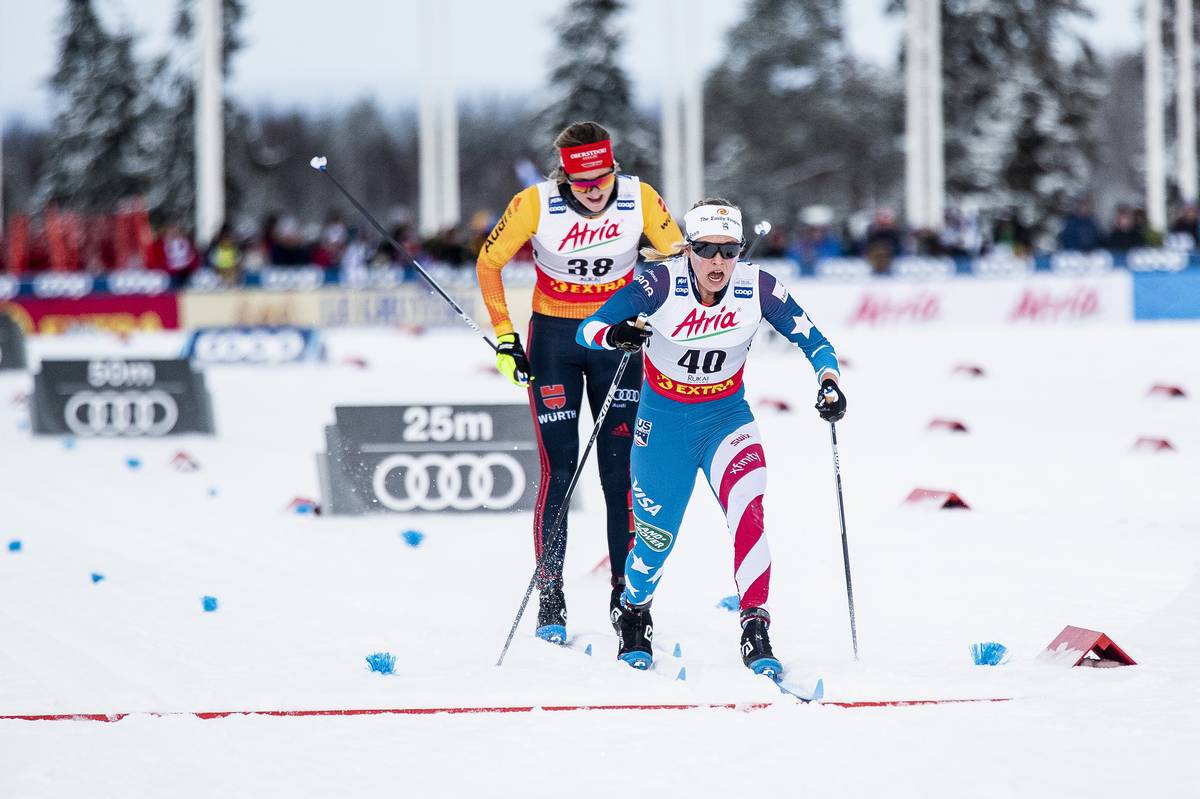
    Jessie Diggins racing to 22nd in Ruka’s 10 k classic. (Photo: NordicFocus)

    Back to the U.S. Jessie Diggins finished in 22nd overall, 1:23.5 back, Hailey Swirbul was 40th (+2:05.0) on Saturday after posting her best World Cup sprint result yesterday when she finished 18th overall.

    Post-race interview with Hailey Swirbul


    Hailey Swirbul racing to 40th on the day after posting a career-best sprint result on Friday. (Photo: NordicFocus)

    Also for the U.S., Cailtin Patterson 50th (+2:28.1), Katharine Ogden 56th (+2:56.1), Sophie Caldwell Hamilton 58th (+3:09.6), and Julia Kern 62nd (+3:19.0).

    Heidi Weng, one of Norway’s foremost distance skiers, did not start.

    Racing concludes in Ruka tomorrow with the 10 k freestyle pursuit.

    10 k Classic results | Overall After Day 2

  • Johaug wins as U.S. Looks Fierce: Maubet Bjornsen Fourth, Brennan Sixth in Ruka 10 k Classic (Updated with Interview Audio)

    Johaug wins as U.S. Looks Fierce: Maubet Bjornsen Fourth, Brennan Sixth in Ruka 10 k Classic (Updated with Interview Audio)

    Therese Johaug of Norway winning the 2019 10 k classic in Ruka, Finland. (Photo: NordicFocus)

    It was an elemental form of racing to open the distance events on the World Cup: the 10-kilometer interval start classic. No spoiler alert needed here. Norway’s Therese Johaug won in 26:47.5 minutes. 

    Johaug comes into the season having won the distance overall last year and steamrolled to two distance race victories Beitostølen, Norway last weekend. Those races were the opening Norwegian national races, but were stacked fields. 

    During another day with flurries, high humidity, and temps in the mid-teens, Johaug led at every checkpoint beyond the first at 1.2 k. Sweden’s U23 star Frida Karlsson took that time split by 0.8 seconds. At 3.1 k, Johaug had settled in and was already up by nearly ten seconds. Case closed. 

    Johaug will be heavily favored to take tomorrow’s 10 k freestyle pursuit. It would be Johaug’s third 3-Days Tour overall win. Finland’s Krista Pärmäkoski, who was caught by Johaug in the closing moments, placed second today 30.1 seconds back with Russia’s Natalia Nepryaeva in third, 44.4 seconds behind. 

    The women’s podium from the 2019 Ruka 10 k classic:
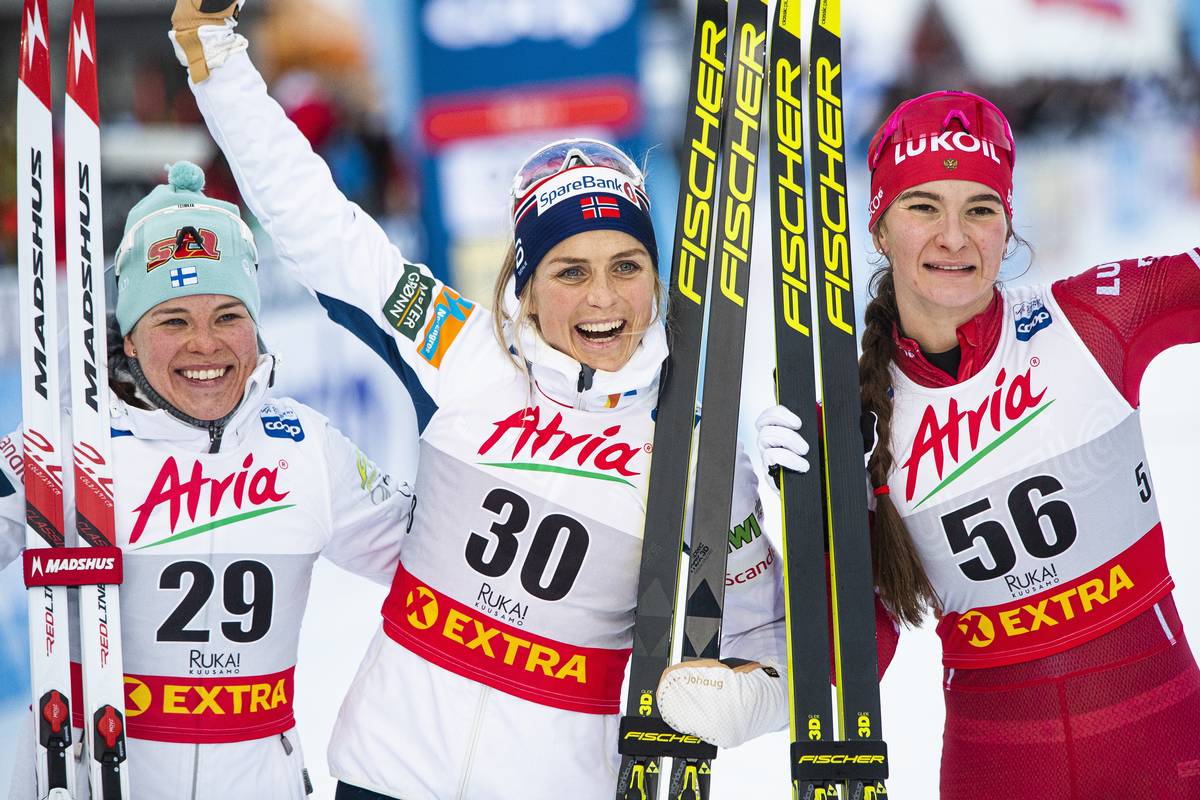
    Krista Pärmäkoski (FIN), Therese Johaug (NOR), Natalia Nepryaeva (RUS), (l-r). (Photo: NoridcFocus)

    The U.S. Ski Team had three skiers in the top-13. Sadie Maubet Bjornsen, with yesterday’s third place in the classic sprint a confidence booster, set herself up for a fourth place today. She missed the podium by 1.3 seconds in an effort that saw her pacing build. After an initial 32nd fastest time at 1.2 k, when time differences are often tighter due to the limited distance covered, she pushed into the top four. Last year, Bjornsen placed 11th in this event, earning her first podium the following weekend in Lillehammer, Norway’s skate sprint where she was third overall. 

    Sadie Maubet Bjornsen crossing the line for fourth place in the 2019 10 k classic in Ruka, Finland. (Photo: NordicFocus)

    U.S. World Cup Coach Matt Whitcomb on Sadie Maubet Bjornsen’s day

    “Another dream day here in Ruka, just barely missing the podium by 1 second to finish 4th No regrets though, because I gave it my all today,” Maubet Bjornsen emailed to news outlets. “I have always loved the courses here in Finland, but it just feels like things came together for me. I managed to pace myself well, which was important after yesterday’s hard effort. On top of that, I once again had awesome skis out there to work with!”

    With her third and fourth places in Ruka, Maubet Bjornsen now wears the yellow bib indicating she is leading the World Cup overall.

    “I am the first American woman to have done so, which is so cool! The season is still young, so there is a lot to come, but over the years, I have worked very hard on my consistency among all the events in our sport,” she explained. “Last season I achieved the mark of winning a medal in all four disciplines we compete in, and now this is just one step further in excitement. I will save that yellow bib forever to remind myself that at one point, I was the most consistent in the world. Let’s hope I can meet it again!”


    Rosie Brenna skiing to sixth place in the 2019 Ruka, Finland 10 k classic. (Photo: NordicFocus)

    U.S. World Cup Coach Matt Whitcomb on Rosie Brennan’s day

    Rosie Brennan (USST) is no longer a surprise to push into the elite end of the standings. Today she matched a career-best sixth place on the World Cup. Her pacing and effort marked the time to beat for the lengthy list of racers finishing after her. Before the likes of Johaug, Pärmäkoski, and Nepryaeva, Brennan spent considerable time in the leader’s chair as she was an early starter in bib 9. 

    “I wasn’t feeling terribly confident in the warm up with the super steep hills here in Ruka so I had pretty low expectations,” Brenna emailed to several outlets. “I also have had a tendency to go out a little hot here and then slowly fade so my only plan was to start conservative and push the flats. I got to the first split, just over 1k into the race and I heard I was race leader…so much for a plan. After that, I just kept trying to make up time in all the small spots. It worked well and I was greeted at the finish with a long stint in the leader’s chair which is always a great way to start the season. I feel I’m in good shape but I wasn’t quite expecting that good of a result so I’m very excited and feel I have more to give in the coming weeks.”

    Jessie Diggins (USST) skied to 13th place (+1:15.4). It’s barely worth mentioning she carries the weight of massive expectations up every hill. She placed sixth overall in the World Cup in 2019 and second in 2018. 

    Early season reminder: Diggins didn’t pop a top-10 until her seventh individual race last year and her first podium until the Tour de Ski which begins Period 2. 

    Jessie Diggins sends the ski tip forward to place 13th in the 2019 Ruka, Finland 10 k classic. (Photo: NordicFocus)

    U.S. World Cup Coach Matt Whitcomb on Jessie Diggins’ day

    Also for the U.S., Julia Kern (USST) was 59th (+2:43.7), Sophie Caldwell (USST) 62nd (+2:47.8), Caitlin Patterson (USST)  65th (+2:53.0), Rosie Frankowski (APU) 67th (+3:05.1), and Hailey Swirbul (USST) 71st (+3:10.9). 

    Racing concludes in Ruka tomorrow with a 10 k skate pursuit.

    Women’s Results


    Sadie Maubet Bjornsen in her yellow World Cup leader’s bib and her new wax tech, Per Erik Bjornstad of Norway.
  • ‘You Just Had to Bite Your Teeth Together,’ Bjørgen Wins Challenging Ruka 10 k; Diggins 10th

    ‘You Just Had to Bite Your Teeth Together,’ Bjørgen Wins Challenging Ruka 10 k; Diggins 10th

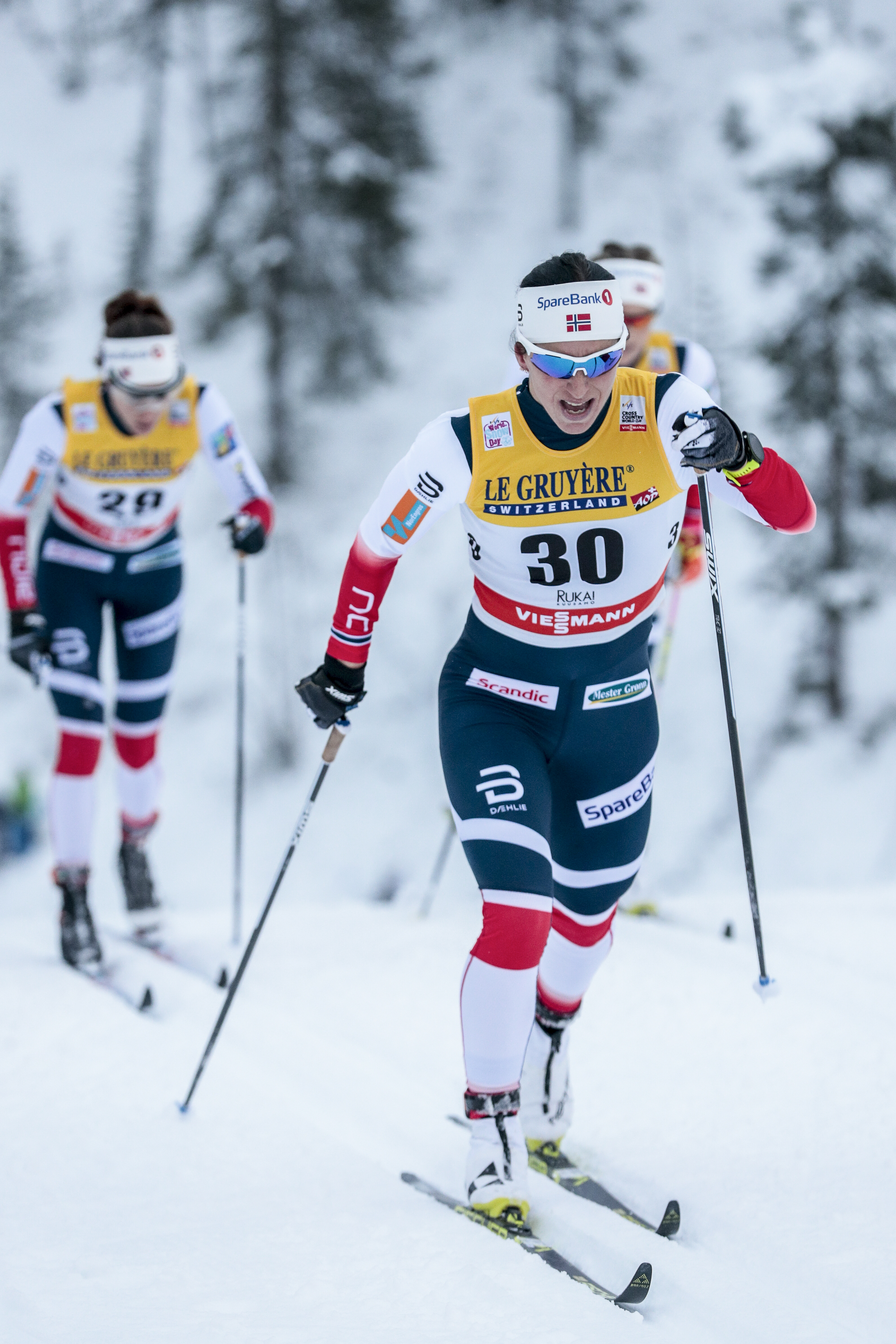
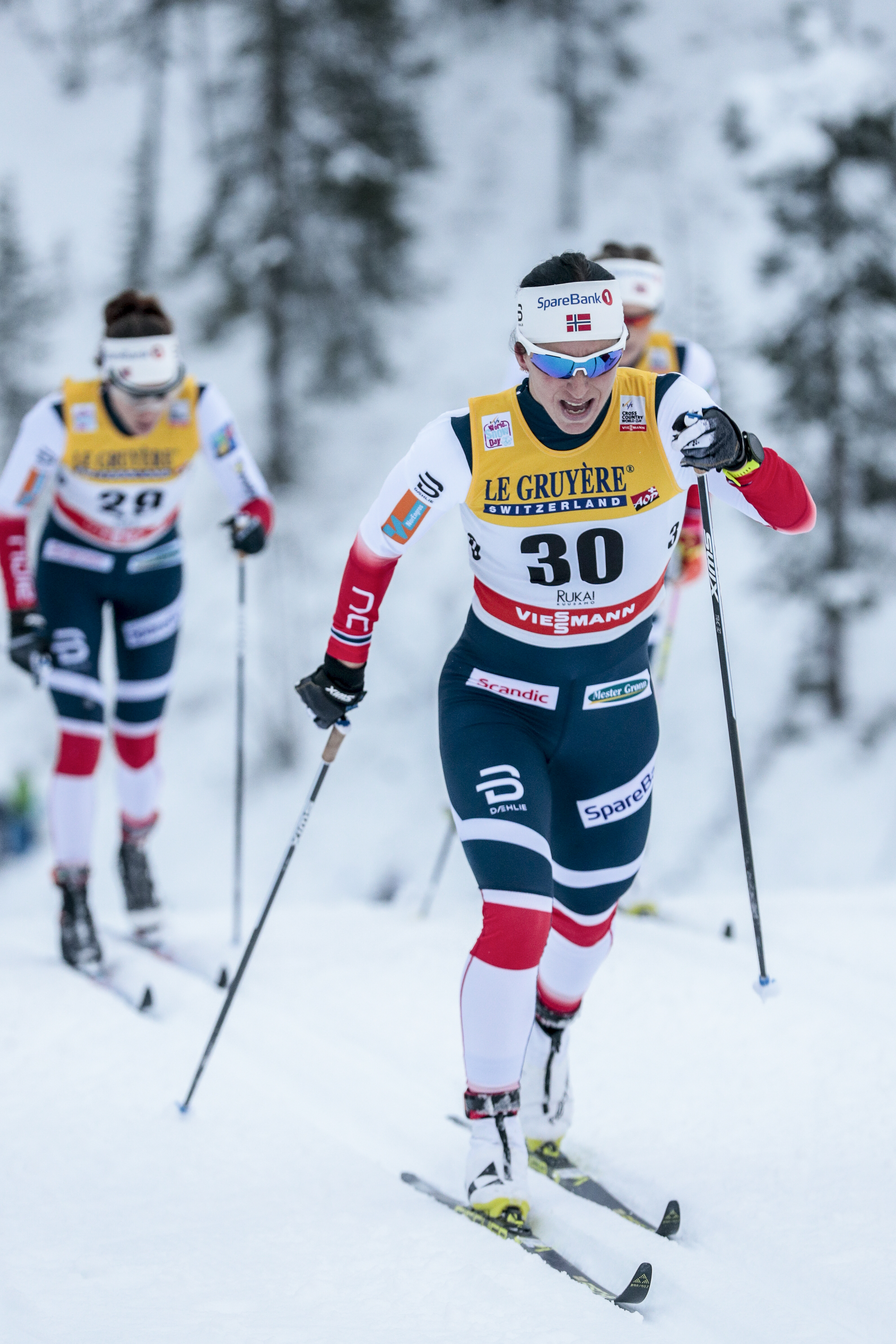
    Norway’s Marit Bjørgen (30) leads her teammate Heidi Weng (29) in the women’s 10 k classic individual start on Saturday at the Ruka World Cup in Kuusamo, Finland. (Photo: Fischer/Nordic Focus)

    At age 37, with more than 110 World Cup wins, 18 World Championships titles and six Olympic gold medals, it’s hard to imagine Norway’s Marit Bjørgen as anything but a machine; she races, she wins, she repeats.

    But even the World Cup veteran, who first raced the circuit in 1999, occasionally considers the simplicity of throwing in the towel. With intermittent snow showers on Saturday in Kuusamo Finland, temperatures hovering around freezing and varying snow conditions over the women’s two-lap course, many competitors entered in Saturday’s 10-kilometer classic individual start were caught in the classical dilemma of either slipping or sticking.

    “It was interesting to see everyone out there — from all different countries — during the warmup come to the top of hills and just scrape their skis off; it’s not something that you always see on the World Cup,” U.S. Ski Team member Ida Sargent said in a post-race phone interview. “But it was just one of those days where nothing was going to be perfect.”

    No matter how prepared or fit an athlete is, part of the allure and challenge of cross-country skiing is the element of ever-changing conditions. Mother Nature, after all, cannot be tamed. And even someone like Bjørgen can find it defeating.

    “It was challenging to lead today,” Bjørgen told NRK, according to a translation. “I considered giving in after the first kilometer, but then I got a good split time and realized that it was just as bad for everyone. Then you just had to bite your teeth together … I think I finished well.”

    Sweden’s Charlotte Kalla racing to second in the women’s 10 k classic at the Ruka Triple World Cup on Saturday in Kuusamo, Finland. (Photo: Fischer/Nordic Focus)

    By the first kilometer, Bjørgen in bib 30 (out of 89) was situated in third, 2.5 seconds back from the race leader at the time, Sweden’s Charlotte Kalla. In the next two kilometers, Bjørgen lost 8.6 seconds on Kalla, but surpassed Finland’s Aino-Kaisa Saarinen to move into second. Over the next 3 k, Bjørgen regained ground and began to close in. By the 6 k mark, she was but 0.6 seconds off of Kalla’s time and in another two kilometers, she was ahead by one second.

    Having overcome her initial discontent with the conditions, Bjørgen did not let off the brake, besting Kalla by 17 seconds at the finish and taking over the leader’s chair in 25:07.6. That result stood, and just 0.8 seconds out of second place, Norway’s Ingvild Flugstad Østberg stood on the final step of the podium in third place (+17.8).

    American Jessie Diggins, of the U.S. Ski Team (USST), placed 10th (+1:03.9) for her fourth-best result in a 10 k classic — her most recent being an eighth place in a classic mass start at last season’s Tour de Ski stage in Val di Fiemme, Italy.

    “I think this is probably the best I have ever done in Kuusamo,” Diggins said on the phone, referring to her performances in previous classic distance races there. In 2015, she finished 38th in the Ruka 10 k classic pursuit, and a year ago, she placed 13th in the Ruka 10 k classic.  

    “I usually try to come into the season really patient and work into it,” she continued “So it was a really nice surprise to feel pretty good today and fire up the engines, get that first distance race out of the way and remember how it feels to pace a 10 k.”

    She stayed within ten seconds of 10th place for most of the race, closing it down to 2 seconds with less than to 2 k to go before securing her final top-10 spot. While Diggins explained that many of the racers she saw on course appeared to have either no glide or no kick, she felt fortunate to have a decent balance of both.

    “I would ice up a little bit, but I could just run up the hills out of the track and then kick them really hard and they would clear up,” Diggins said. “So they stayed pretty fast, but with good kick as well, which was really really impressive. It could not have been easy to get the best of both worlds, so I am really, really grateful to those guys [our wax technicians].”

    Ahead of Diggins was Norway’s Heidi Weng in fourth (+34.0), Austria’s Teresa Stadlober in fifth (+36.4), Norway’s Ragnhild Haga in sixth (+38.2), Russian U23 (under-23) skier Natalia Nepryaeva in seventh (+42.8), Sweden’s Stina Nilsson  Friday’s classic sprint winner) in eighth (+46.1), and another U23 Russian, Anastasia Sedova in ninth (+53.4).

    Sargent placed 22nd (+1:21.9) for her best World Cup distance race result since 2014 and was the second fastest American woman of the day.

    “I haven’t scored distance points in a couple of years now, so it feels awesome to be back in the points, and I am really stoked to start the season out like this,” said Sargent, who’s been known for her sprinting results in Kuusamo (with a fifth place in its 2014 classic sprint and seventh place in 2015).

    “I was definitely a little conservative at the beginning, but I think the upside of that is not blowing up, especially for me being a little more sprint-based,” she explained. “It was exciting to be pushing and working my way through the race; moving up that way.”

    In the first kilometer, Sargent was positioned in 69th, 7.6 seconds away from 22nd. In the next 2 k, she moved up to 42nd, and by the halfway point she was in 33rd. Sargent continued to move up in rank, improving five more places by 6 k and moving into 24th with 2 k to go. By the finish, she had moved up to 22nd.

    “She just had an awesome pace out there,” U.S. Ski Team Women’s Head Coach Matt Whitcomb said on the phone after. “She started quite slow for the first 1.2 k. Something we talked about that has worked really well here, you go out too hard and you blow up, and you just bleed time throughout the race, or you go out conservatively see where the body is and figure out where you can put the pedal down. She skied a really patient race for the first two k and then was able to push the pedal and got a great response out of her body.”

    American Sadie Bjornsen (46) chasing down Finland’s Aino-Kaisa Saarinen (19) during the women’s 10 k classic at the World Cup opener in Kuusamo, Finland. Bjornsen placed 23rd while Saarinen was 27th. (Photo: Fischer/Nordic Focus)

    Just 1 second behind Sargent was another USST member Sadie Bjornsen, coming off a career-best second place in Friday’s classic sprint, in 23rd (+1:23.4). While Bjornsen explained she had adequate recovery from the sprint, she had difficulty with her skis.

    “I worked really hard to calm all my excitement last night, and channel it towards today,” Bjornsen wrote in an email. “I woke up feeling recovered and ready to rally. … Unfortunately, I really struggled with skis today, and didn’t have the extra power to push through it. I was really proud for fighting hard, and pushing on like I was racing for a medal. What I have learned with classic skiing in this world of crazy conditions is that when the stars align, it can turn into an incredible day. But, it doesn’t happen every day, so no matter what, you have to be ready to seize every opportunity like it is your day. I am looking for more in my distance classic skiing of course, but the season is mighty long, I am happy with how I feel, so I know it will come this year.”

    In the standings, Bjornsen is now ranked 11th, behind Norway’s Haga and ahead of Sweden’s Anna Haag. Diggins is 16th with one race remaining: the women’s 10 k freestyle pursuit on Sunday.

    Finishing 6.2 seconds outside of the top 30 (and just 0.3 seconds out of 31st) was Rosie Brennan (USST) in 33rd (+1:47.7). Happy with her ski choice, Brennan used the conditions as an opportunity to test her race technique.

    “I decided to try a more aggressive pacing strategy today to ensure I could hold my technique together with such challenging conditions,” Brennan wrote in an email. “I think I over-paced as a result and should have started picking up the pace sooner than I did. This are all the things that take a few races to get back into the groove so I’m not too concerned with that. However, I felt good after picking up the pace so I think I am fit and ready more for.”

    Three places behind Brennan was another USST member, Sophie Caldwell (who finished eighth in Friday’s sprint) in 36th (+1:50.1).

    “This is a really tough course, so I tried to pace it well and take the first lap in control,” Caldwell wrote in an email. “I knew it would require some patience and tried not to panic if I didn’t feel perfect or my skis weren’t perfect in some places. I decided to go on wax and my skis were icing a bit over the tops of the hills, but I was able to ski off the accumulated snow and they felt fast for the downhills.”

    In addition to reaching the semifinals in Friday’s opening sprint, Caldwell started her World Cup season by racing to third in the sprint’s qualifying round.

    “Physically I felt pretty good today,” Caldwell wrote. “I was a little sore from the sprints yesterday, but I felt like I was able to recover enough to still have good energy and I was happy with the race. I felt like I skied the downhills well and definitely got a little tired going over the top of the massive uphill the second time, but was overall pleased with the race and think it was probably one of the best, if not the best distance race I’ve ever had in Kuusamo.”

    Nine American women raced Saturday’s 10 k, with Kikkan Randall (USST) finishing 48th (+2:14.5), Liz Stephen (USST) 58th (+2:26.3), Chelsea Holmes (Alaska Pacific University) 64th (+2:50.0), and Julia Kern (USST D-team) 74th (+3:19.2).

    Three Canadian women competed, with Emily Nishikawa (Canadian World Cup Team) leading them in 56th (+2:24.2), Cendrine Brown (National U25 Team) following in 76th (+3:23.6), and Dahria Beatty (World Cup Team) finishing 84th (+3:53.5).

    In Sunday’s 10 k freestyle pursuit, Kalla as the mini-tour leader will start 2 seconds ahead of Bjørgen in second and 12 seconds ahead of another Swede, Nilsson, in third. Østberg will start fourth, 20 seconds out of first, and Nepryaeva will head out fifth, three seconds after Østberg. Bjornsen in 11th will start 46 seconds back (and just 6 seconds out of seventh), and Diggins will start 1:04 back in 16th, 3 seconds behind Finland’s Kerttu Niskanen in 15th.

    Results: 10 k classic | Ruka Triple Standings (Day 2) |Pursuit start list

    — Ian Tovell and Harald Zimmer contributed

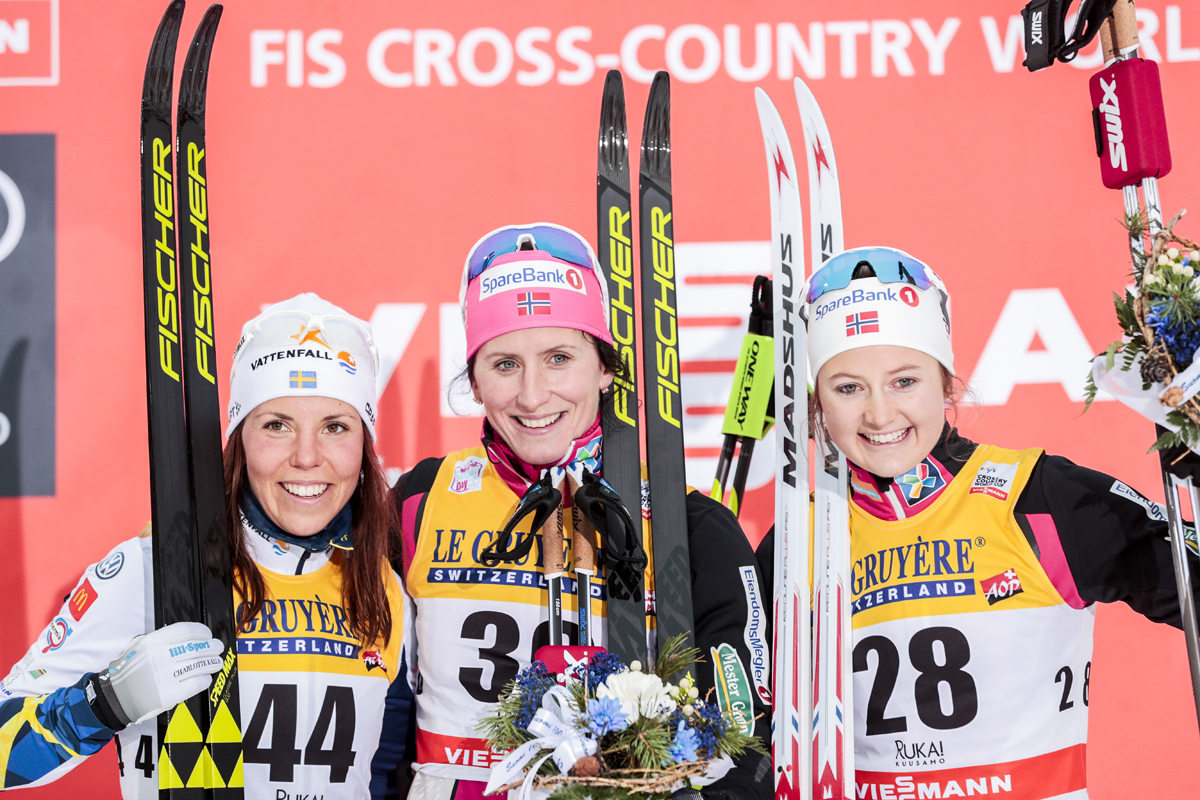
    The women’s 10 k classic podium on Saturday at the World Cup opening weekend in Kuusamo, Finland, with Norway’s Marit Bjørgen (c) in first, Sweden’s Charlotte Kalla (l) in second, and Norway’s Ingvild Flugstad Østberg (r) in third. (Photo: Fischer/Nordic Focus)
  • Sadie Bjornsen Rides ‘Patience and Optimism’ to Best-Ever 14th in Ruka Triple

    Sadie Bjornsen Rides ‘Patience and Optimism’ to Best-Ever 14th in Ruka Triple

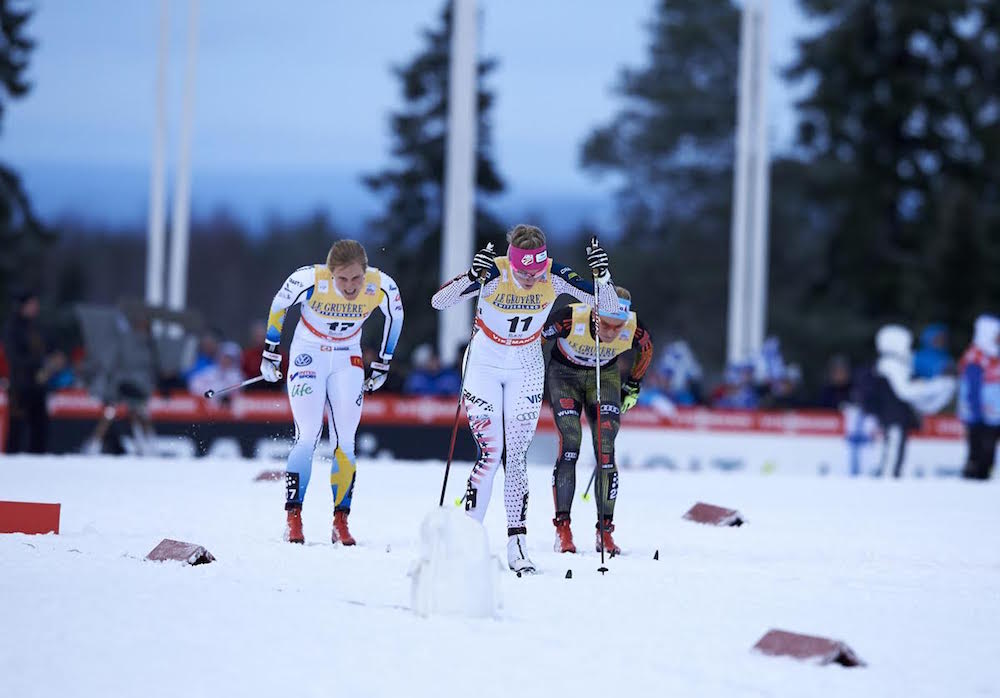
    Sadie Bjornsen (r) of the U.S. Ski Team leads Germany's Nicole Fessel  (l) during the women's 10 k classic pursuit on Sunday at the Ruka Triple World Cup in Kuusamo, Finland. Bjornsen started 11th and went on to place 14th. (Photo: Fischer/NordicFocus)
    Sadie Bjornsen (r) of the U.S. Ski Team leads Germany’s Nicole Fessel (l) during the women’s 10 k classic pursuit on Sunday at the Ruka Triple World Cup in Kuusamo, Finland. Bjornsen started 11th and went on to place 14th. (Photo: Fischer/NordicFocus)

    It’s easy to get caught up in results and what could have been. Ask Sadie Bjornsen. The 26-year-old U.S. Ski Team member was shooting for a top 10 in Sunday’s 10-kilometer classic pursuit at the World Cup in Kuusamo, Finland.

    After putting herself in 11th to start the final stage of the Ruka Triple mini tour, Bjornsen considered 10th or better to be a reasonable goal. That is, until you factor everything else that typically happens in Kuusamo.

    On Sunday, a mixture of rain and snow falling amid a windy, 32-degree morning, paired with a combination of natural and manmade snow on the course, made for a lot of variables. With that in mind, Bjornsen noted that it was imperative to stay positive.

    She would know. Two years ago, she had her breakthrough result in the Kuusamo 5 k classic, placing seventh. The day before, Bjornsen qualified third in the classic sprint.

    She ended up 17th overall in the 2013 Ruka tour. On Sunday, she posted a new personal best in the Ruka Triple in 14th overall. And while it wasn’t the top 10, it took a lot of work to get there.

    “It was another fun, and extra challenging day of racing in Kuusamo,” Bjornsen wrote in an email after Sunday’s pursuit, in which she finished 14th, 2:05.6 behind Norwegian winner Therese Johaug.

    She had started 35 seconds behind Johag. By 2.5, Bjornsen was about a minute back in 14th, and at the halfway point, she remained in 14th, about a minute and 24 seconds back. That’s partly because Johaug was putting a lot of time into the field; at 5 k, she had a 24.5-second gap to Norwegian teammate Ingvild Flugstad Østberg (who started with her).

    But Bjornsen was also struggling.

    “My first [2.5 k] lap was really hard, because I realized I had no kick in the track, and I felt like I was being passed by people constantly,” she recalled. “Finally, by the second lap, I pulled myself together, and decided to just ski outside of the track for the majority of the race, and then things worked out much better! I was even having a lot of fun on the final lap!

    “Patience and optimism is the key on a day like today though, because there is such a variety of things that are going on,” Bjornsen added. “… I could have easily continued to struggle and drop after that first lap, but I gave myself a little smacking and realized I had to make my opportunity today.”

    Sadie Bjornsen (c) skis with Sweden's Hanna Falk (l) and Germany's Nicole Fessel (r) during the women's 10 k classic pursuit on the last day of the Ruka Triple in Kuusamo, Finland. Bjornsen placed 14th in the first World Cup and mini tour of the season. (Photo: Fischer/NordicFocus)
    Sadie Bjornsen (c) skis with Sweden’s Hanna Falk (l) and Germany’s Nicole Fessel (r) during the women’s 10 k classic pursuit on the last day of the Ruka Triple in Kuusamo, Finland. Bjornsen placed 14th in the first World Cup and mini tour of the season. (Photo: Fischer/NordicFocus)

    Instead of paying attention to the athletes near her, Bjornsen focused on doing her best with what she had available, she explained. That made her happier in the end.

    It was also the key to her success, according to U.S. women’s coach Matt Whitcomb. After the race, he observed that the athletes who didn’t openly complain about how bad the wax was were the ones that fared best.

    “Our athletes never complain about the wax midrace, but every now and then you hear another athlete yell in disgust about the wax,” he said. “… Everyone is slipping and sliding around this course and it was those that said, ‘This is what I’ve got, what do I have to do?’ [that succeeded.]”

    “Sadie’s race was impressive, but also her reflection on the race was mature,” Whitcomb added. “She discovered after a lap that the way she was skiing wasn’t working. To get out of the tracks on the uphill gave her the biggest benefit. … She resettled, put in three really good laps and was able to hang onto a top 15.”

    “There was no simple answer out there today, it was a challenge no matter what!” Bjornsen explained. “My wax tech did such an awesome job of keeping me relaxed and confident with what was going to happen, so I am so thankful for that!

    “I am really stoked to finish with my best tour result ever,” she concluded. “I am really satisfied with the weekend, and I know there is more to come, and more ‘less challenging conditions’ to come as well!”

    After Bjornsen, teammate Jessie Diggins started 19th, 47 seconds behind Johaug, and finished 38th (+3:17.4). She skied within the top 30 for the first 2.5 k before falling two minutes off the pace between 4 and 5 k.

    “I struggled in these conditions, but it was an important step forward for me on the mental side of racing,” Diggins wrote in an email. “A few years ago, I might have heard that I was out of the top 30 and stopped skiing as hard as I could, but I never gave up and kept looking for those seconds out there, and I’m proud of that.”

    A weekend after winning both FIS races in Gällivare, Sweden, including a classic sprint, Sunday’s classic distance result left Diggins disappointed, Whitcomb said.

    “She’s made big progress on her classic skiing, but today’s conditions required the ability to really feather the kick,” he explained. The best classic skiers who could maintain their technique despite spotty kick tended to do better, he added

    But Diggins wasn’t concerned.

    “I feel that my fitness is in a good place for the start of the year, and when I let my body recover from the past few weeks of good training and the 5 races I did in the last 9 days I should see a fun boost!” she wrote.

    The second-fastest U.S. woman in the pursuit, Rosie Brennan started 34th (1:09 back) and finished 34th (+3:08.5) with the 33rd-fastest time of the day.

    “I had my eyes on the top 30 both for the tour and the time of day. I fell just short of both, but I guess I’m putting in my time so to say,” Brennan wrote in an email. “No one had perfect skis so it was all about finding ways to make it work. I started a little slow with some apprehension for both the downhills and my skis, but eventually started finding ways to make it all work.”

    While her race had its ups and downs, “some laps I felt I had figured it out and other laps I felt like I couldn’t make anything work,” she explained, Brennan was ultimately pleased with her start to the season.

    Emily Nishikawa of the Canadian Development Team skiing to 60th in the 10 k classic pursuit at the World Cup in Kuusamo, Finland. (Photo: Fischer/NordicFocus)
    Emily Nishikawa of the Canadian Development Team skiing to 60th in the 10 k classic pursuit at the World Cup in Kuusamo, Finland. (Photo: Fischer/NordicFocus)

    “I learned a lot over the weekend and got my mind back into ski racing which I think will set me up well for the coming weeks,” she wrote.

    “She skied so steady in the mid 30s,” Whitcomb said of Brennan. “I know she’s a little disappointed, but points don’t come easy, particularly in Kuusamo and Lillehammer in these first two World Cups … I think it bodes well to Rosie’s trajectory.”

    Also for the U.S., Ida Sargent — who placed seventh in Friday’s classic sprint — rose from starting 54th to finish 44th overall. Liz Stephen placed 59th, and Caitlin Gregg was 68th.

    “I was really pleased with the whole process [this weekend],” Whitcomb said of his team. “… We really operated like medalists should … However, it wasn’t all fluffy like that. We had some disappointing results.”

    On the men’s side, Sadie Bjornsen’s younger brother Erik led the team in 46th overall

    “Overall, I feel good about where this team is,” Whitcomb said. “The good results weren’t completely absent this weekend … but we’re heading to Norway to prove we’re in better shape than we showed this weekend.”

    Canada’s lone female competing in Kuusamo, Emily Nishikawa placed 60th (+5:11.8) after starting 63rd. Annika Taylor, a University of New Hampshire graduate and former Far West Nordic junior who’s now racing for Great Britain, went from 67th to 62nd overall (+5:33.7) in the tour.

    Results | Winner of the day

  • Johaug Revels in First Kuusamo 10 k Classic Win: ‘I’ve Never Been So Good in Classical Ever’

    Johaug Revels in First Kuusamo 10 k Classic Win: ‘I’ve Never Been So Good in Classical Ever’

    Therese Johaug celebrates her dominant performance in Sunday's 10 k classic in Kuusamo, Finland, which she won by more than 42 seconds over Norwegian teammate Marit Bjørgen.
    Therese Johaug celebrates her dominant performance in Sunday’s 10 k classic in Kuusamo, Finland, which she won by more than 42 seconds over Norwegian teammate Marit Bjørgen.

    In the opening distance race of the World Cup season, Therese Johaug of Norway dominated from the start and walked away with her first-ever World Cup win in a 10-kilometer classic.

    From the moment Johaug, 26, set out on the course during Sunday’s race in Kuusamo, Finland, it was clear that the rest of the women’s field would be racing for second.  Even the ever-dominant Marit Bjørgen of Norway, who was coming off a win in the 1.4 k classic sprint the day before, knew that Johaug was going to win.

    “I knew after four kilometers that Therese was 25 seconds ahead and I understood I would be fighting for second place,” Bjørgen told FIS after finishing second, 42.2 seconds back from Johaug, who won in 25:47.2. “I was pushing as much as I could to take second place.”

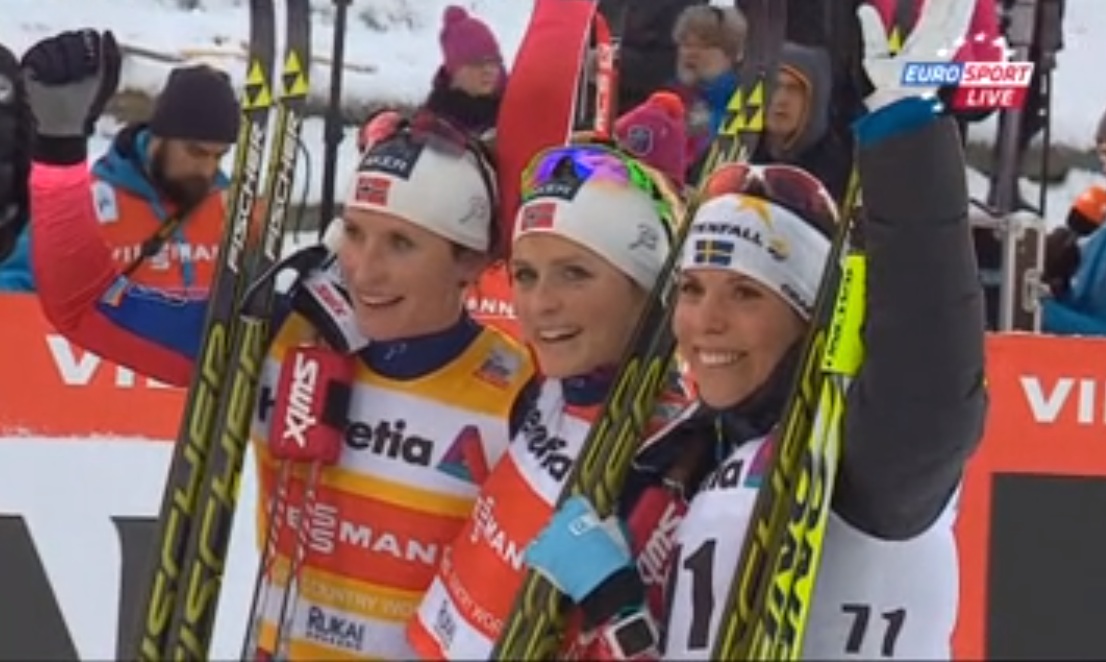
    The women's 10 k classic podium on Sunday in Kuusamo, Finland: with winner Therese Johaug (l), runner-up Marit Bjørgen (c) and Charlotte Kalla in third. (Photo: FIS Cross Country/Twitter)
    The women’s 10 k classic podium on Sunday in Kuusamo, Finland: with winner Therese Johaug (l), runner-up Marit Bjørgen (c) and Charlotte Kalla in third. (Photo: FIS Cross Country/Twitter)

    A two-time winner of the Kuusamo 10 k classic in 2005 and 2007 (the last time it was held was 2008), Bjørgen, who started last of 77 women, appeared to ski a very controlled-and-tactical race. She passed through the 3.1 k checkpoint in fourth behind Johaug in the lead, Poland’s Justyna Kowalczyk in second, and Sweden’s Charlotte Kalla in third.

    At each subsequent time check, Bjørgen moved up in the rankings. She was in third at the halfway point and slid into second by 8.1 k, but only by a razor-thin margin of one-tenth of a second over eventual third-place finisher Kalla (+44.1).

    Rounding the final bend, Bjørgen put in a hard kick and barely bested Kalla, finishing 1.9 seconds ahead of the her.

    Bjørgen was the overall victor in last year’s “Ruka Triple” in Kuusamo. This year, there were just two races — both of which counted for full World Cup points. Bjørgen’s win on Saturday put her in the overall World Cup leader’s bib for 2014/2015, and she remained 70 points ahead of Johaug after Sunday.

    Last year, a 5 k classic was held on Day 2, when Kowalczyk took the win, Bjørgen placed second and Johaug finished third.

    On Sunday, Kowalczyk was consistently in second for the first half of the race. However, by 8.1 k, she had faded and slipped to fourth where she would ultimately finish.

    “I thought that the gap will be more… It hurt, but it’s a good position [for the start of the season],” she wrote in on Facebook, according to a translation.

    “I knew after four kilometers that … I would be fighting for second place.” — Marit Bjørgen, 2nd in Sunday’s 10 k classic after Norwegian teammate Therese Johaug

    Knowing Johaug and how pumped she was about Sunday’s 10 k, Norwegian Woman’s Head Coach Egil Kristiansen worried she might start too hard.

    “I noticed that she was very excited after Saturday’s sprint … I was almost afraid that she would open too hard,” Kristiansen told Langrenn.com, according to a translation. “The skis were good, technique set and everything was correct. I cannot remember the last [time] there was such a victory margin. A fantastic race.”

    “I am really happy now because this is my first victory in [a 10 k] classic,” Johaug told FIS afterward. “I’ve never been to the top of the podium in this race [until] today.”

    Approaching the finish, Johaug appeared fatigued, but continued to attack until the end. About a meter before the finish, she pumped her right fist into the air and let out a scream before collapsing her hands to her knees after the finish. She had essentially just won it — even with Bjørgen — still on course, she gave herself the liberty of a small celebration as her foot crossed the line.

    “I think I’ve never been so good classical ever, especially in kick-double-pole,” Johaug told NRK. “I heard 20 seconds, then 30 and 40 … ‘This is your victory,’ I told myself.”

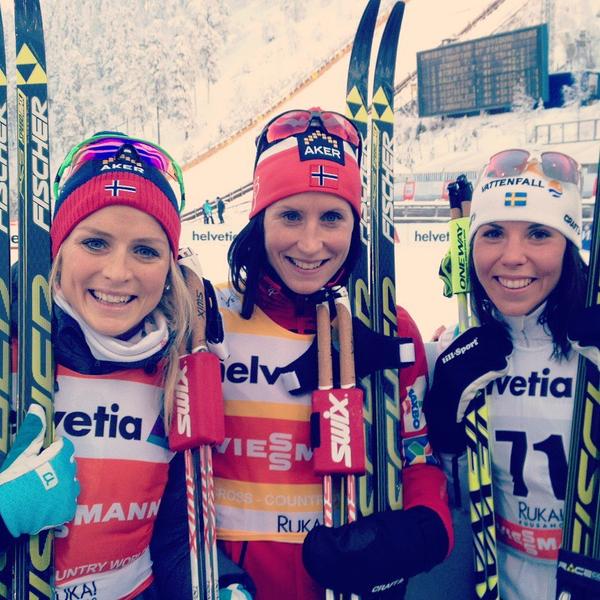
    Bjørgen (l), Johaug (c) and Kalla get together after the women's 10 k classic on Sunday, the first World Cup distance race of the season in Kuusamo, Finland.
    Bjørgen (l), Johaug (c) and Kalla get together after the women’s 10 k classic on Sunday, the first World Cup distance race of the season in Kuusamo, Finland.

    Kalla, who did not compete in Saturday’s sprint race but swept three FIS races in Bruksvallarna the weekend before, had a stellar performance, nearly holding off Bjørgen. She told FIS after the race that she spent a lot of time working on her classic technique.

    “I am very satisfied with the third place,” Kalla said. “I felt very good last week at the national opening and I’m glad I could keep the good shape to Ruka. I tried to do my very best today.”

    Kristiansen had some praise for the 27-year-old Swede: “Charlotte’s strong and we knew in advance,” he told Espressen.se. “It’s good for us that we have two ahead of her.”

    Norway took three of the top five, with Ingvild Flugstad Østberg in fifth, putting her third in the overall World Cup standings. Russia’s Yulia Tchekaleva finished sixth, Krista Parmakoski was the top Finnish woman in seventh, Norway’s Heidi Weng was eighth, Austria’s Katerina Smutna ninth, and Finland’s Kerttu Niskanen 10th.

    With the opening weekend behind the World Cup athletes, they will move onto Lillehammer, Norway, for a three-day series next weekend, including freestyle sprints on Friday,  5/10 k freestyle races on Saturday, and 10/15 k classic pursuits on Sunday.

    Results | with Splits