From the FasterSkier archive — posts syndicated from athletes’ and coaches’ own blogs between 2004 and 2012, kept online as published. Current coverage is at fasterskier.com.
It’s on — the 2026 Olympic season, that is. Devon and Nat break down six season-opening races from northern Finland, including a thriller in Sunday’s men’s race.
Contact us with fan mail, hate mail and everything in between: devon[at]fasterskier.com and nat[at]fasterskier.com. We’re looking for title and other sponsors for our Olympic coverage; email matthew[at]fasterskier.com with inquiries.
This coverage is made possible through the generous support of Marty and Kathy Hall and A Hall Mark of Excellence Award. To learn more about A Hall Mark of Excellence Award, or to learn how you can support FasterSkier’s coverage, please contact info@fasterskier.com.
On a warm, wet morning in Ruka — the kind that turns the classic tracks into soft gutters and the final climb into something closer to a staircase than a ski trail — the women’s World Cup sprint season opened without one of the athletes who would, on almost any other November weekend, be standing in the center of the conversation.
Linn Svahn wasn’t here.
The Swedish star, still making her slow recovery from the concussion and neck trauma suffered in the crash before February’s World Championships, watched this one from a distance. Had she been healthy, she would almost certainly have been one of the day’s central figures, a direct rival for Kristine Stavaas Skistad and a disruptor in the final. Her absence didn’t merely change the top-end speed of the field — it left a quiet outline in the race, the sense that one of the usual gravitational forces was missing from the orbit.
But in her place were other stories, ones that have begun to shape this Olympic season in their own way.
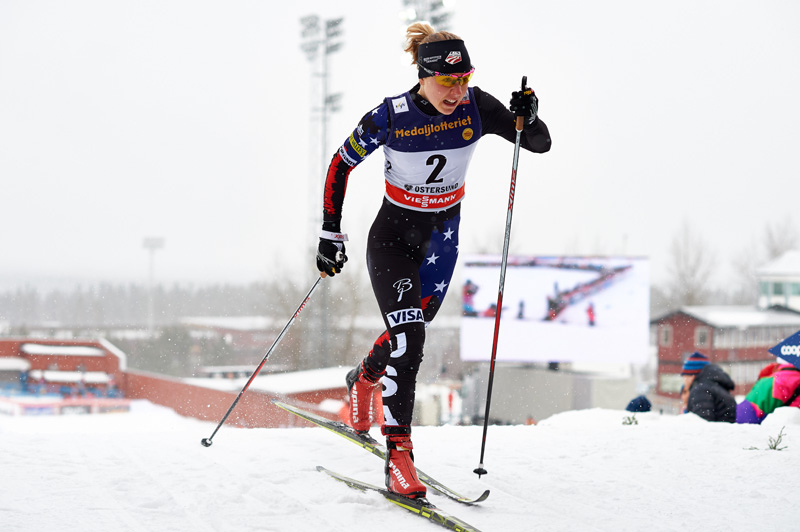
Jessie Diggins (USA) and Hilla Niemela (FIN), (l-r) battle to the finish of their quarterfinal in Ruka (FIN). (Photo: Modica/NordicFocus)
Jessie Diggins, in the first sprint of her final World Cup winter, moved through the day with the bright, energized ease of someone committed to savoring each stop. After the race, she said, “I did have a lot of smiles. I’ve been having so much fun and really just soaking in the atmosphere of racing and just really enjoying it.” She described the entire season as something she’ll remember long after retirement: “It’s the people and the process and the excitement, and I felt so much love from fans out there and from other teams and other coaches and industry and just so many people… it just feels like a gift from so many people.”
And behind all of this sat a U.S. team that arrived here knowing — and accepting — that late November was not meant to be the full expression of their form. Head coach Matt Whitcomb put it in simple terms: “Nobody needs to be in full glory in late November or even early December.” The Americans arrived in Europe only recently, still shaking off jet lag, holding onto a broader plan shaped around February rather than November. It’s a trade-off they’ve leaned into during Olympic years, and one they believe pays off when it matters most.
The result? A day that was not spectacular, not disastrous — something in the middle, and something useful. A day the team could work with.
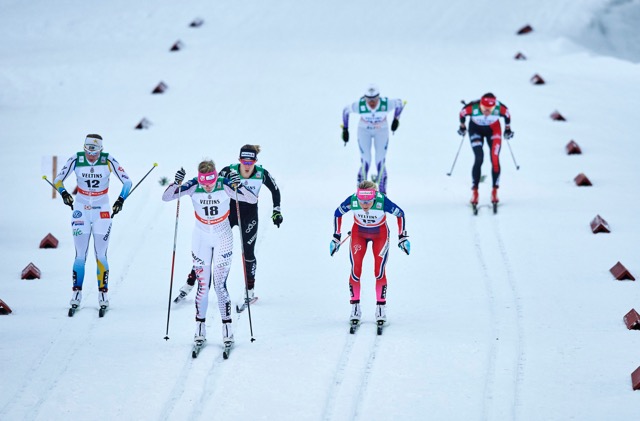
Jasmi Joensuu (FIN), Jessie Diggins (USA) and Hilla Niemela (FIN), (l-r) lunge for the finish line at the end of their quarterfinal in Ruka (FIN). (Photo: Modica/NordicFocus)
Quarterfinals: Diggins Rockets, Brennan Battles
The conditions had shifted overnight from hard-wax possibilities to what Whitcomb described bluntly: “straight klister conditions.” Wet, soft, and slow — the kind of snow that punishes the indecisive and rewards the athletes willing to run up the hill rather than glide it.
Jessie Diggins — Heat 3
Diggins qualified 13th in the morning (3:01.70), then immediately looked sharper once the heats began. In Quarterfinal 3, she won the heat outright in 2:52.50, one of the fastest times of the round. Her skis were outstanding on the tricky, rain-softened course, something she attributed to the tech crew: “I had thanks to our wax service team and cork. I had awesome skis. I had an amazing kick. It was beautiful klister skiing, and I felt like I could just run right up that hill.” She added that feeling confident on the final climb in her last Ruka sprint meant something special: “It was really fun to have my last Ruka… classic skiing… be feeling confident on that final climb up into the stadium.”
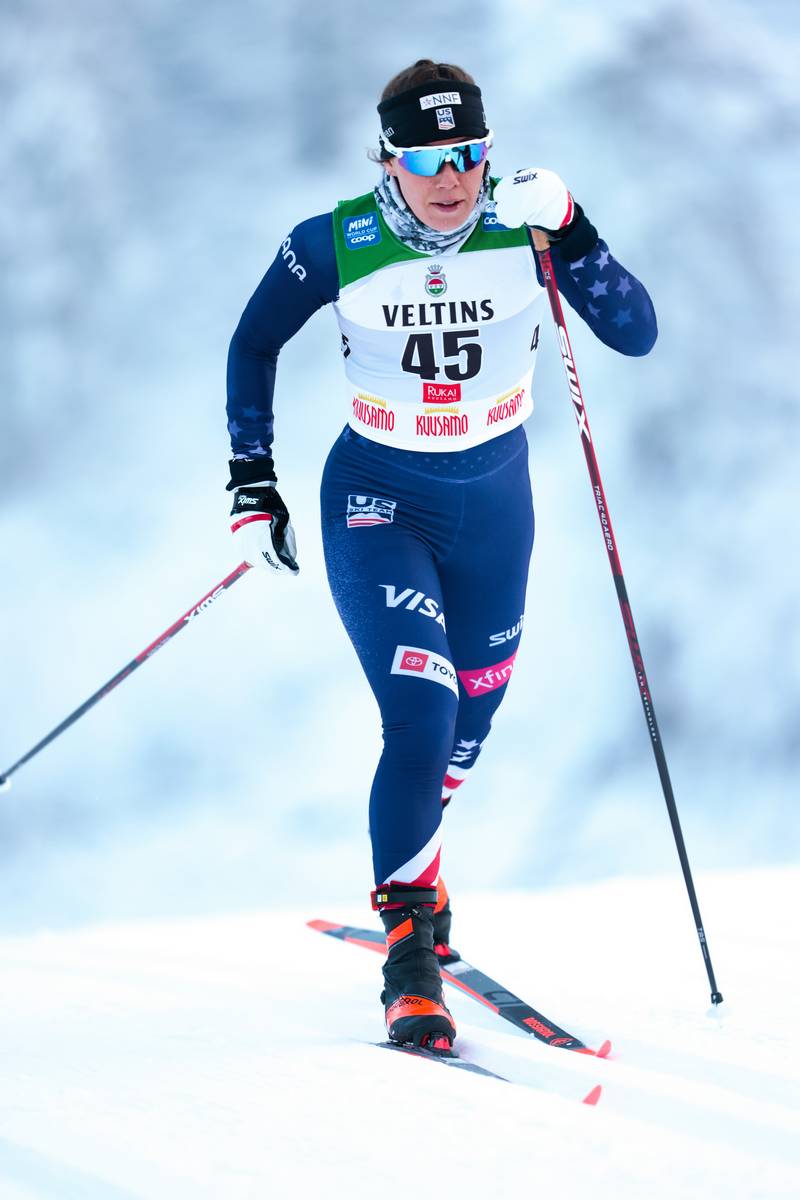
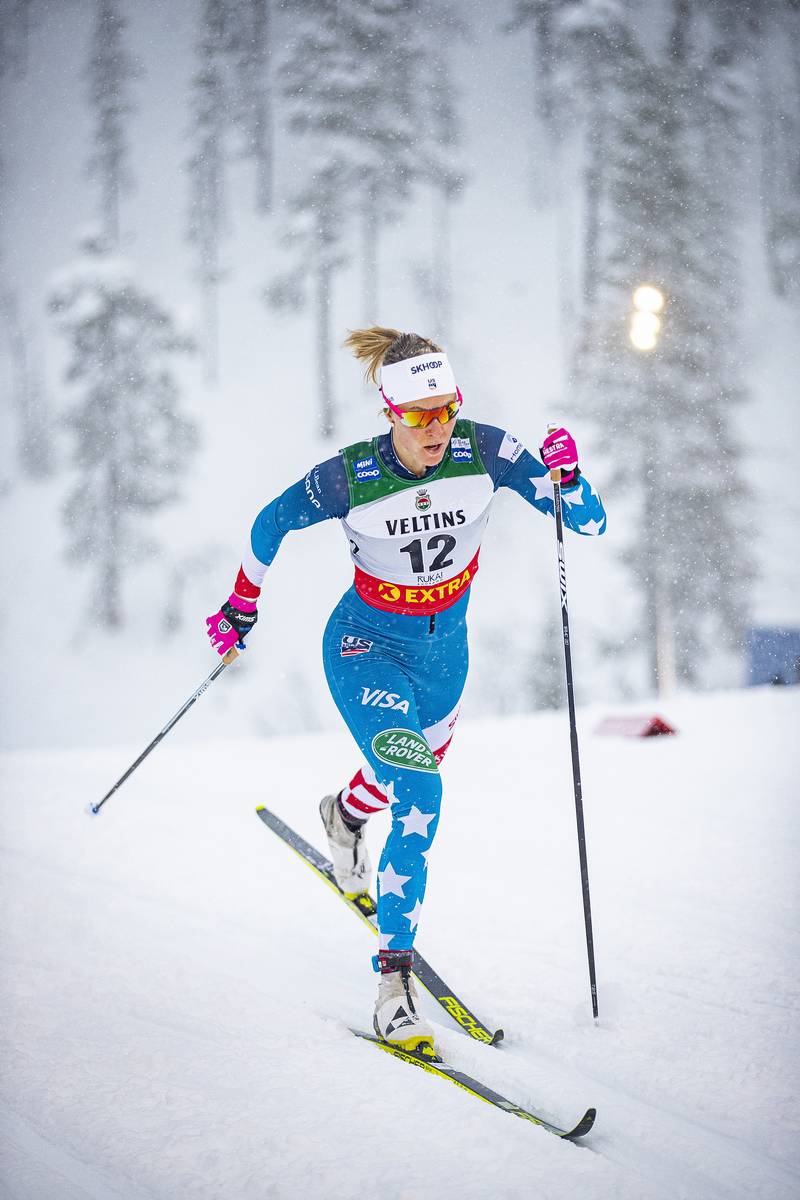
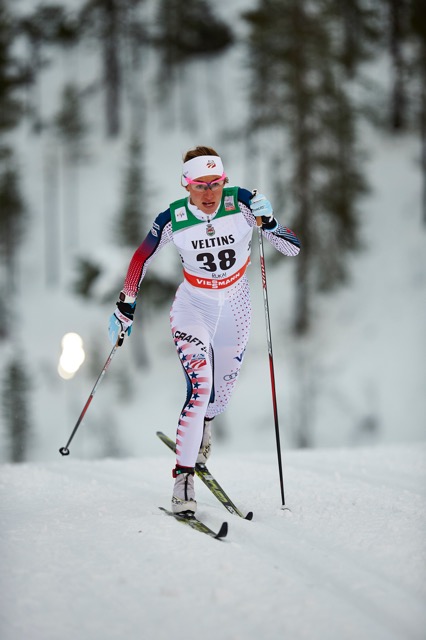
Rosie Brennan (USA) during qualification of the individual sprint in Ruka (FIN). (Photo: Modica/NordicFocus)
Rosie Brennan — Heat 2
For Brennan, who qualified 26th (3:05.07), the story was one of resilience. Early in the season, she is still building form, still putting together rhythm after a less-than-ideal lead-in. She finished third in her quarterfinal (+2.47), just outside the automatic spots and missing the lucky-loser times by narrow margins.
Afterward, she said:
“I’m really happy with today. I was in a tough heat and am happy with how I skied it. Without a proper build into the season, I definitely feel I am missing some form and fitness, but doing back-to-back races was a huge win for me, and each time I get to race, I am getting some good stimulus to build with moving forward.”
It was a patient, grounded performance — one that suggests her January and February could look much sharper.
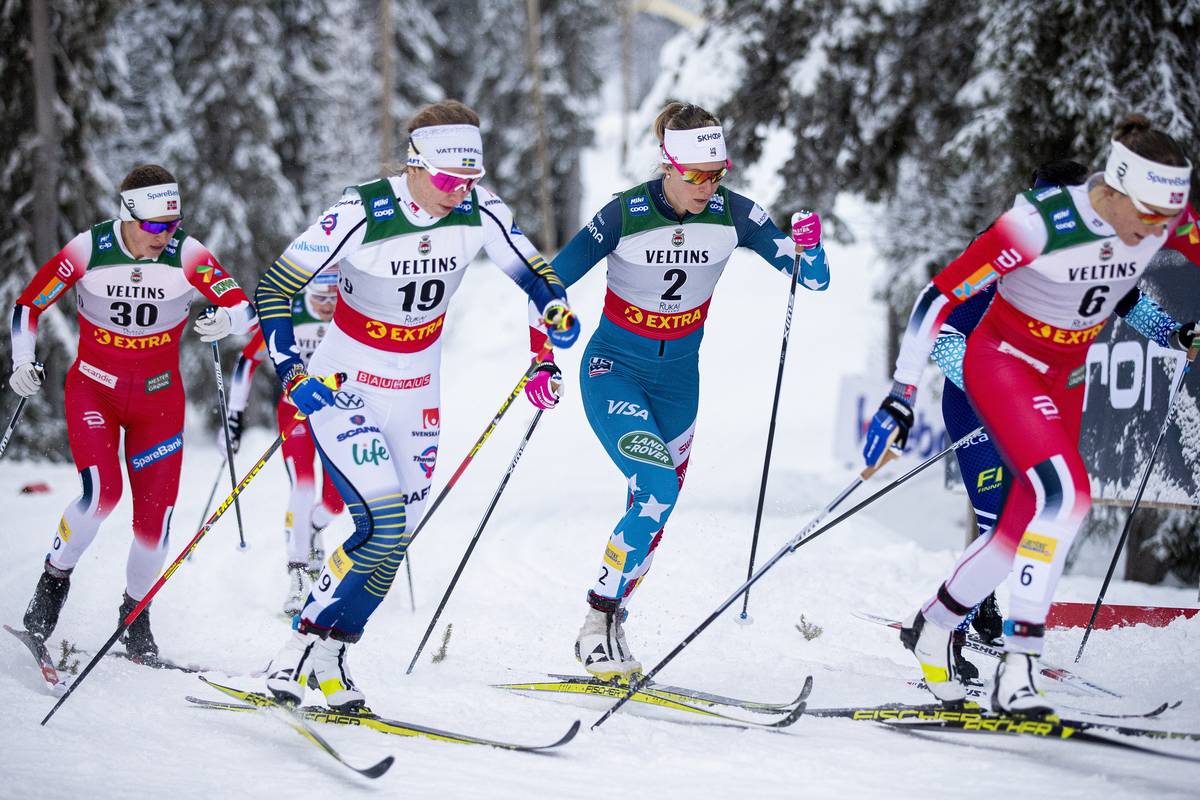
Kristine Stavaas Skistad (NOR), Maja Dahlqvist (SWE), Johanna Matintalo (FIN) and Jonna Sundling (SWE), (l-r) battle down the finishing stretch of the semifinal in the Classic Sprint in Ruka (FIN). (Photo: Modica/NordicFocus)
Semifinals: A Wall of Scandinavians
Diggins landed in a brutally deep semifinal alongside Skistad, Sundling, Dahlqvist, Ilar, and Matintalo — essentially a final before the final.
The pace accelerated early, and while Diggins held contact through the long downhill, the group accelerated hard into the climb. Skistad controlled the top end, Sundling and Dahlqvist surfed the draft, and Hagström remained dangerous. Diggins finished fifth (+1.22), just outside contention for the final.
Diggins said the confidence she felt on the steep final climb came from years of work on her classic technique: “I have also been working really, really hard for my whole career on my classic technique… and it’s fun to feel confident in my classic skiing these days.” The wet, broken-down tracks made the semifinal a pure strength test. Diggins embraced it: “I thought it was just really awesome klister skiing… I was also planning to use the draft as much as possible and therefore have pretty aggressive amounts of kick, which I asked my tech for… because I know that for me, I really like to have that solid kick so I don’t lose critical momentum on the climb.”
Whitcomb framed her skiing in the semifinal as reflective of her season-long mindset:
“She’s just really excited to be racing again… It’s particularly special, maybe bittersweet, but also just, I think, joyous, knowing that this is the last time going to each of these venues. It just feels like a celebration. And she’s skiing that way.”
Diggins ultimately placed 10th overall — a solid result in a field this dense and with the conditions as tricky as they were.
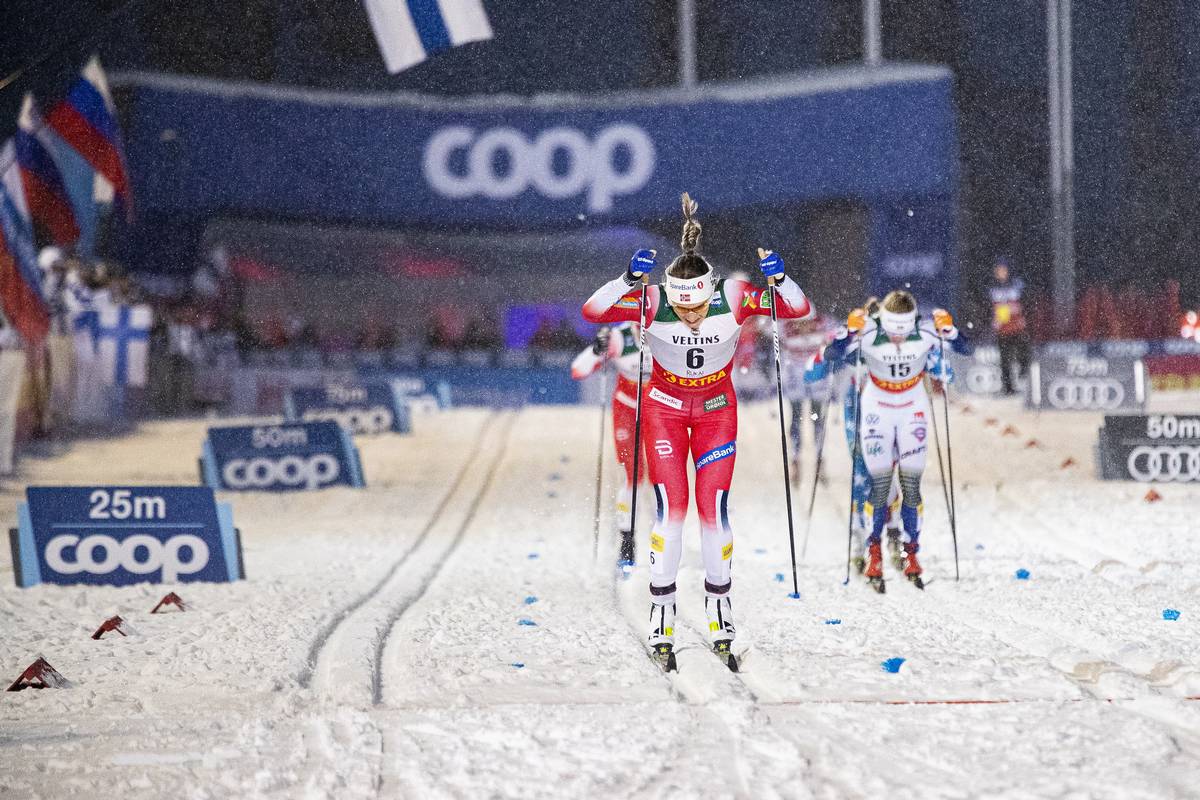
Kristine Stavaas Skistad (NOR) down the finishing stretch of the Classic Sprint in Ruka (FIN). (Photo: Modica/NordicFocus)
Final: Skistad’s Authority, Sweden’s Depth
With Diggins out, the final belonged to Scandinavia.
Kristine Stavaas Skistad stamped her authority on the day, claiming victory in 2:53.22 — her 12th career win. Behind her, Sweden placed second through fourth, with Jonna Sundling and Maja Dahlqvist tying on time, and Johanna Hagström just behind them. Nadine Fähndrich (SUI) and Johanna Matintalo (FIN) rounded out the top six.
Without Svahn, without Diggins in the mix, without the American finals presence we’ve seen in other years, the final took on a familiar Nordic shape: fast, powerful, and decided almost entirely on the steep wall that defines Ruka’s sprint venue.
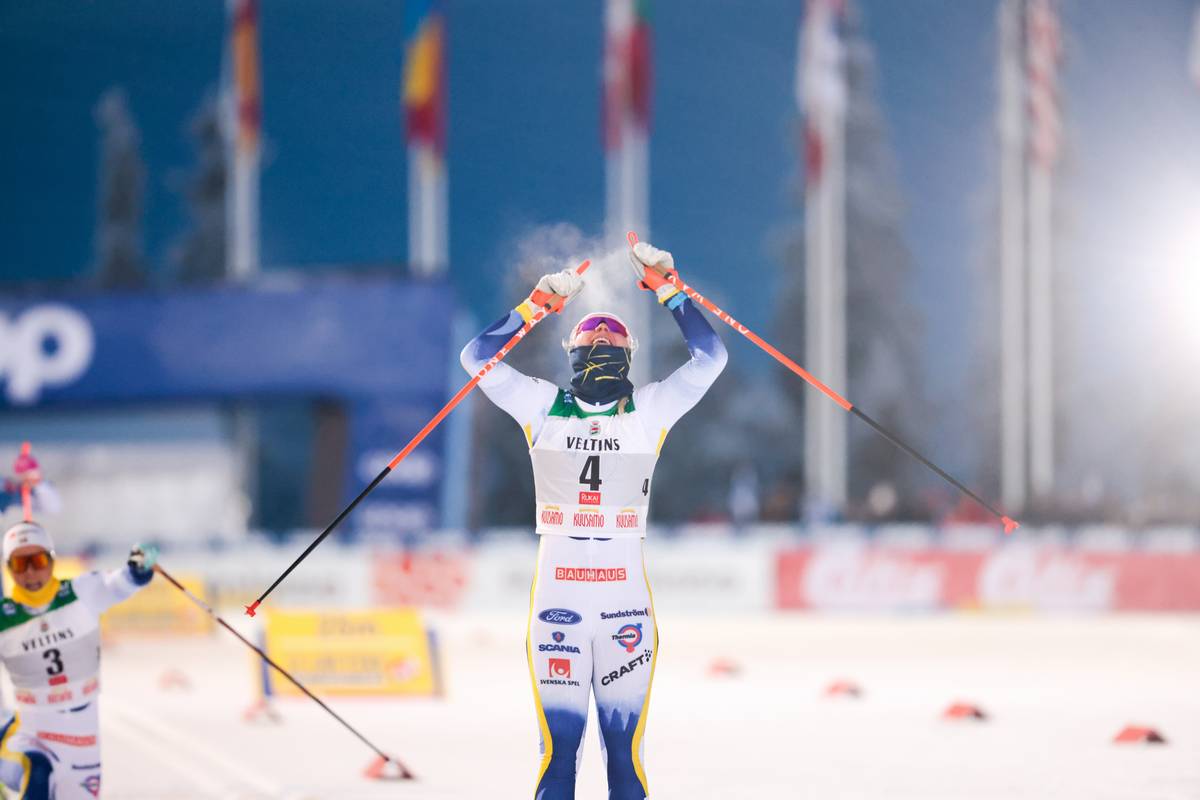
Kristine Stavaas Skistad (NOR) poses for the cameras after earning the win in Ruka (FIN). (Photo: Modica/NordicFocus)
Conditions, Skis, and the Quiet Work Behind the Day
Whitcomb described the U.S. skis as “in the ballpark,” adding that some athletes reported excellent skis while others wanted minor adjustments — typical for a warm, slushy classic day. “We prepared zeros, hard wax skis, low, high camber, and klister,” he said, “and we woke up to just straight klister conditions.”
It was a day in which tech teams mattered as much as legs; a day decided by how well athletes could keep kicking under them in collapsing tracks. Diggins and Brennan managed it well enough to be competitive, not dominant — appropriate for where they are in their seasonal arc.
And perhaps most importantly, Whitcomb dismissed any notion that the U.S. athletes were disadvantaged by brand dynamics:
“I don’t think we are a team that really worries that we’re not getting the great skis… Every single company works really hard for us.”
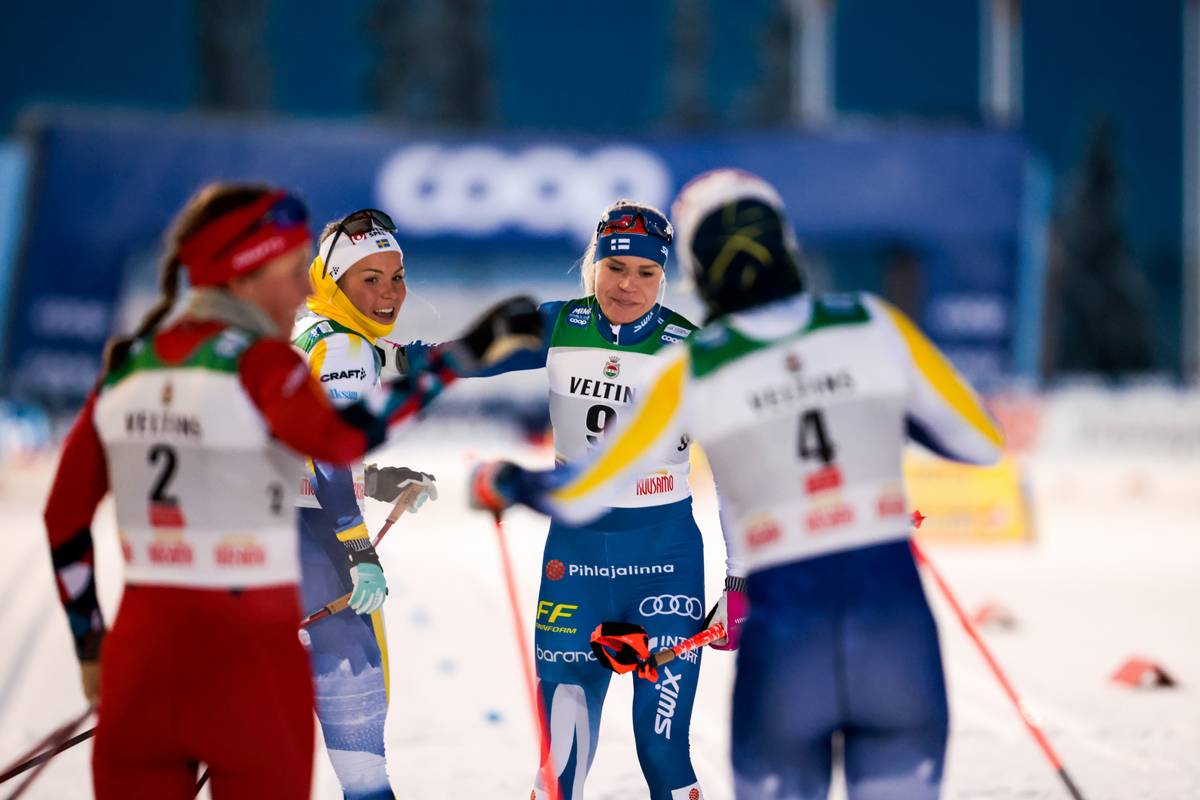
Johanna Hagstroem (SWE) congratulates Maja Dahlqvist (SWE), (l-r) after the final of the classical individual sprint in Ruka (FIN). (Photo: Modica/NordicFocus)
Closing: A Season That Begins in Soft Focus
The November racing in Ruka often reveals very little about what the winter will become. It’s too early, too dependent on sharpness that only racing — consecutive weekends of it — can provide.
But it does tell us a few things.
It tells us that Skistad is still Skistad.
It tells us that Sweden remains the deepest sprint nation in the world.
It tells us that when Svahn returns, the landscape may shift again.
And it tells us that Jessie Diggins, in her final Ruka sprint, is racing with a lightness and delight that is unmistakably different from years past.
For the Americans, the weekend was not a warning sign but a beginning — intentionally imperfect, deliberately unpolished, the first strokes of a long Olympic season they believe will crescendo later, not now. “Right now we’re just trying to get fast,” Whitcomb said. And in that simple phrase sits the truth of the day.
Ruka rarely gives anyone their final form.
But it gives them their starting point.
And the U.S. women leave the day with something solid: a semifinal, a top-10, a top-15, a clear sense of process, and a long winter still ahead.
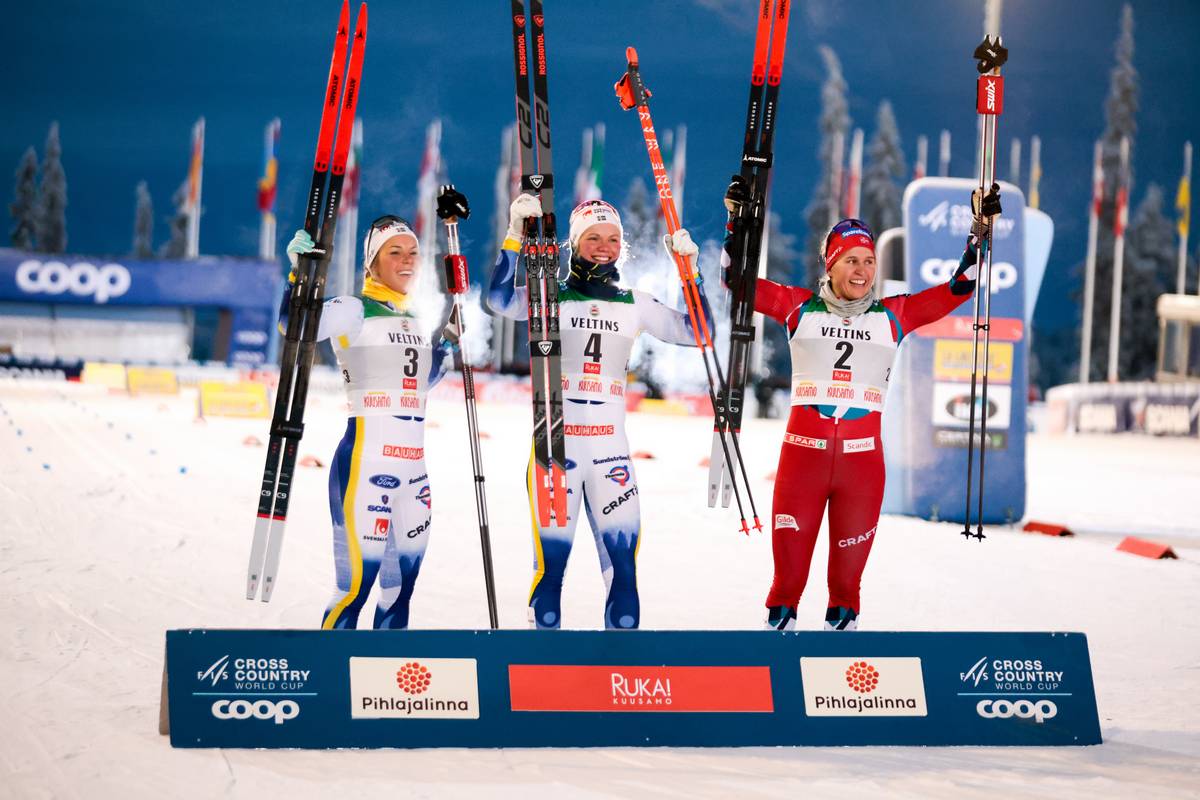
Jonna Sundling (SWE), Kristine Stavaas Skistad (NOR) and Maja Dahlqvist (SWE), (l-r) share the podium of the Classic Sprint in Ruka (FIN). (Photo: Modica/NordicFocus)
Love Stories Like This? Help Keep Them Coming.
Feature interviews like this one take time, access, and care to produce. If you value thoughtful storytelling and independent ski journalism, please consider becoming a Voluntary Subscriber. Your support directly fuels the work we do to cover the people, places, and moments that make our sport special.
This coverage is made possible through the generous support of Marty and Kathy Hall and A Hall Mark of Excellence Award. To learn more about A Hall Mark of Excellence Award, or to learn how you can support FasterSkier’s coverage, please contact info@fasterskier.com.
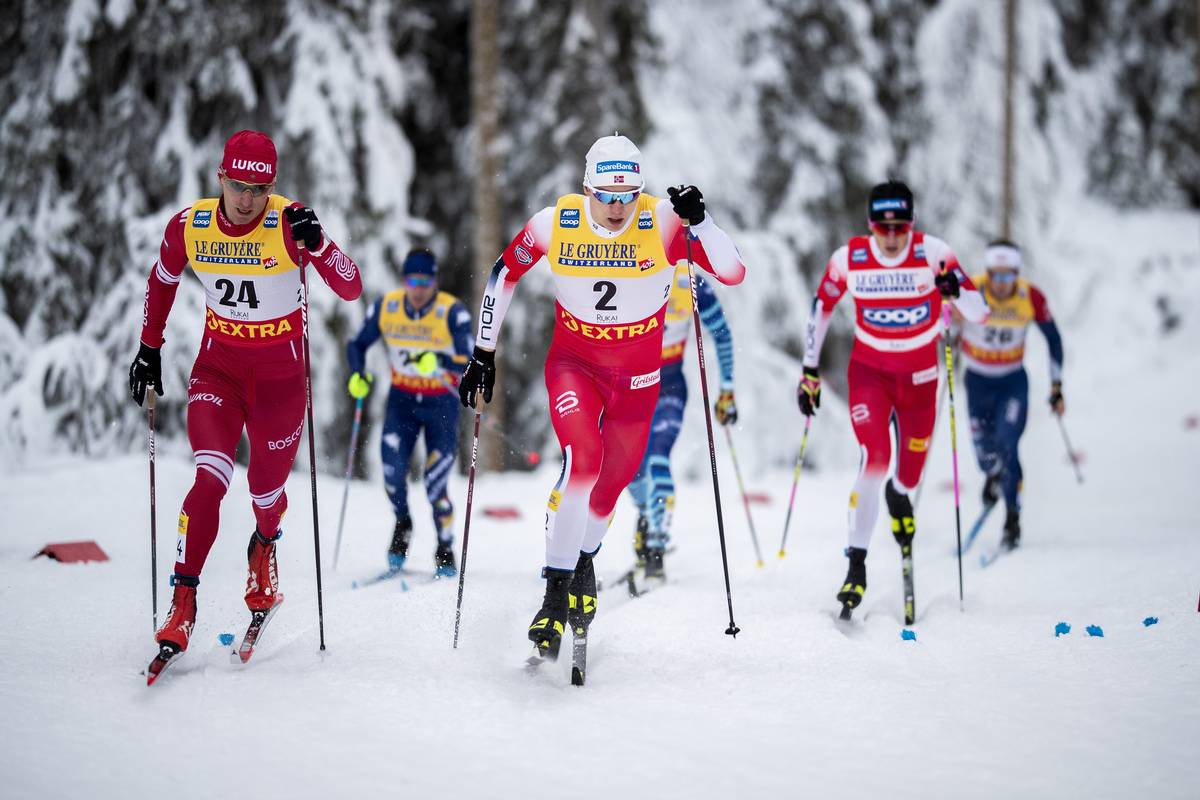
Norway’s Erik Valnes (13) may be the second best Sprinter of in the history of cross-country skiing . . . which means he has almost no chance of winning. His countryman, Johannes Hoesflot Klaebo (red bib), is the reason why. (Photo: Modica/NordicFocus)
“The last uphill is where you really need to be fast,” said Johannes Hoesflot Klaebo (NOR) in interviews after his victory in today’s Classic Sprint in Ruka. “I felt like we had good skis today, and I felt quite motivated after yesterday.”
Yeah, that’s not what the field hopes for—Klaebo showing up on Sprint day with extra motivation from having finished only second the day before. His fast skis the field knows about. His tremendous speed they all acknowledge. His tactical acumen is glaringly obvious. And on top of that he shows up motivated. Well, that’s just great . .. what the heck is everyone else supposed to do?
On World Cup Sprint days, the entire cross-country skiing world thinks Klaebo is going to win. Even those fans who desperately hope that Klaebo won’t win think he’s going to win. So, when he does, it really comes as no surprise. It looks like Klaebo always has a plan; in a fashion that must infuriate his rivals, Klaebo’s plan regularly varies from heat to heat. It always looks like he’s living out a race plan that he conjured up in his head, then willed into reality. Of course he stays out of trouble, of course he glides to the front, of course he accelerates up the final hill, of course he moves easily while everyone else flails. Of course he has a plan, and of course it works. Everybody else looks like they’re just responding to what happens around them.
And what Klaebo is able to do is not easy, no matter how easy he makes it look. Sometimes, a skier just has more speed than anyone else. But, that fast skier also needs to be able to produce that kind of speed four times: qualifying, quarterfinal, semifinal, and final. So, Sprinting is an endurance event, too. And that’s just one of the many variables that mix the pot when it comes to the results on any World Cup Sprint day.
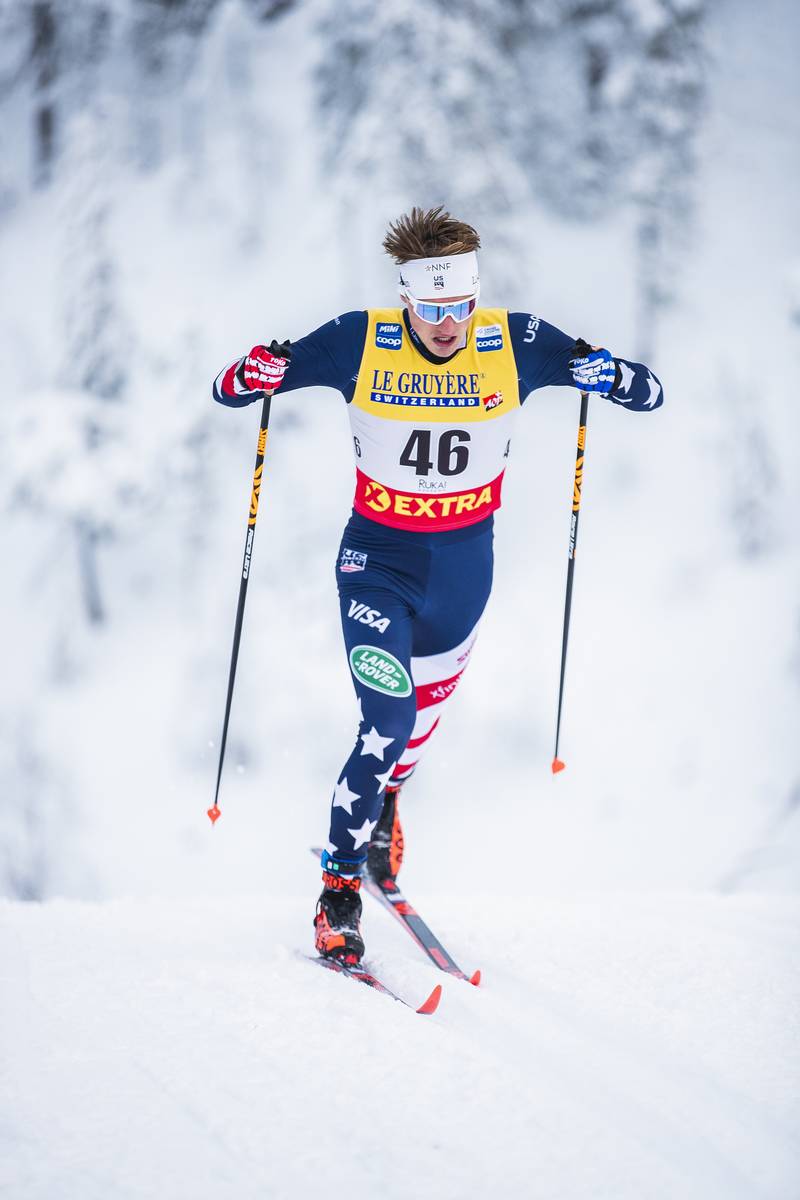
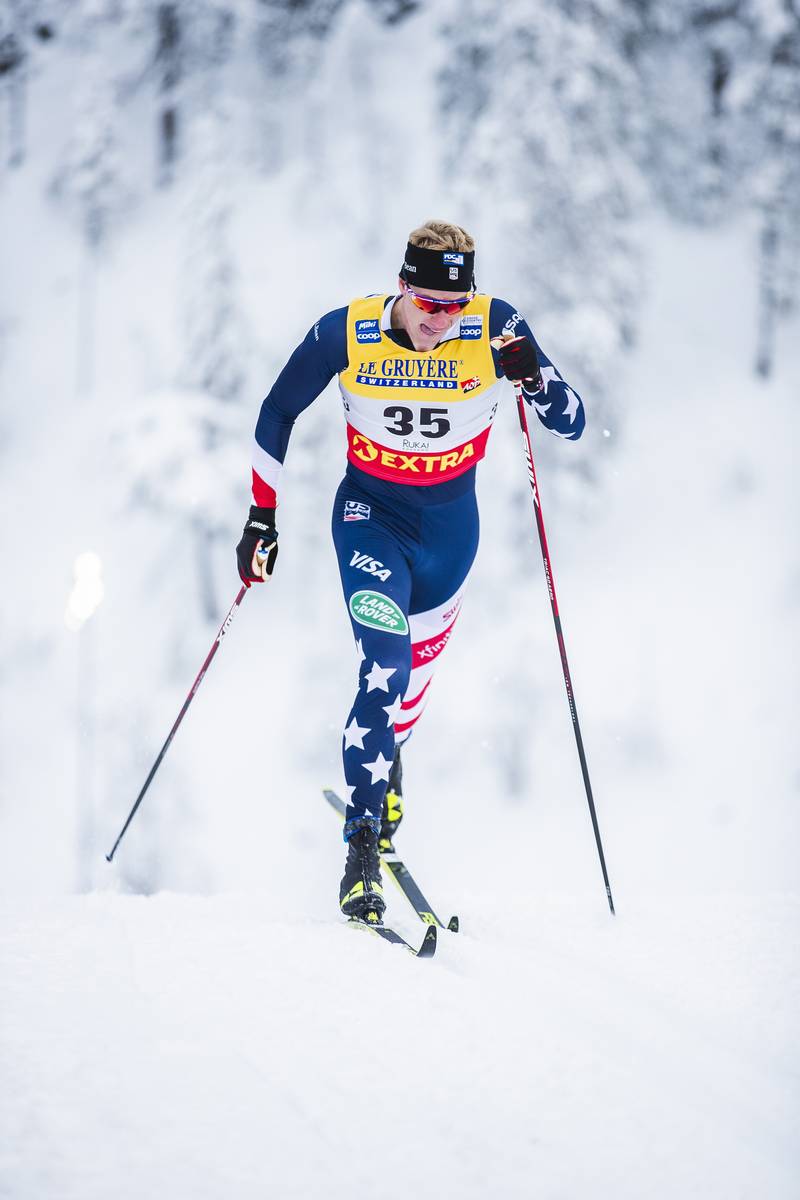
Ben Ogden (USA) continues to show good speed, and great consistency in qualifying. (Photo: Modica/NordicFocus.)
“Sometimes, you just need a couple of rounds just to get your body ready for this all-out effort,” said on-air commentator, Kikkan Randall. But most skiers don’t get a couple of rounds. For most, qualifying is a mystery, and the heats are just a few short minutes, flashing by in an instant, illustrated by the rapidly disappearing backsides of the true contenders. And that sort of speed is what separates contenders from also-rans.
As expected, Klaebo has that sort of speed. On Saturday in Ruka, it carried him to victory again, ahead of his countrymen Erik Valnes and Ansgar Evensen. Behind them, two Americans qualified into the heats (Ben Ogden 16th and Gus Schumacher 28th), with Ogden advancing into the semifinals where he would finish sixth in the heat, and 12th on the day. Kevin Bolger, JC Schoonmaker, and Jack Young failed to qualify for the heats.
“My big goals for the season are not in Ruka—not even in Period 1, said Ogden. “I wouldn’t say it’s ever too early to be fast—it’s always nice to be fast—but I didn’t come into these races expecting to be the sharpest fastest version of myself. ”
Classic Sprint
When asked about his plan for the sprint heats, Janik Riebli (SUI) raised his eyebrows hopefully. “We’ll make our best, what we can,” Riebli said. “We trained really well this summer, but we have no idea where we stand. So, we will see.” Riebli’s response could have been echoed by almost everyone in the field. No one really haas any idea how things are going to go. No one but Klaebo, that is . . .
37 degrees Fahrenheit, wet snow and high humidity—Randall reminded viewers that qualifying times were considerably slower than a year ago. Those conditions seemed likely to affect the strategies in today’s Classic Sprint, and to favor those skiers who possessed the fastest skis. The preparation of ski bases is crucial, and Norway spends more effort and more money on ski technology than any other nation. And it’s well known that Klaebo’s skis are the fastest in the world. Terrific—the fastest guy gets the advantage of racing on the fastest skis. What is everybody else supposed to do?
Ruka’s Sprint course is brutally simple: a few early rises, a hairpin lefthand turn just prior to the important downhill, and a final uphill that’s crucial. Klaebo has always shown his superiority here. Whether he enters the final hill in front or in the back, it’s likely that he’ll be leading at the top.
Jules Chappaz (FRA) raced with style, creativity, and panache. He would advance from the semifinal as a lucky loser, and finish the day in fourth place. (Photo: Modica/NordicFocus)
Quarterfinals
Schumacher found himself in a stacked heat, facing Klaebo and Valnes. Klaebo delivered a preview of things to come—he started slowly, sitting coyly at the back through the first turn, then simply glided forward on miraculous skis to take up a controlling position at the front. He would run matter-of-factly up the consequential hill with Valnes on his heels. Schumacher looked like his skis were both slow and slippery. His day would end with fifth in the quarterfinal.
Edvin Anger (SWE) won the Classic Sprint that Klaebo skipped last year, though in Ruka’s quarterfinal his skis looked as slow as the skis among his Swedish teammates in the earlier women’s field. Anger would fade on the uphill and finish his day with fifth place in the quarterfinal. Ben Ogden took advantage of the scramble on the uphill, driving over the top in the lead and finishing just behind Oskar Opstad Vike (NOR) to advance to the semifinal round.
Jules Chappaz (FRA) showed some ingenuity in his quarterfinal, veering hard left across the final uphill to find better traction in the less-compacted snow along the edge of the course. His tactic took him into the lead, and into the semifinal.
Emil Liekari (FIN) had been the day’s second-fastest qualifier. He stormed up the final hill—efficiently gapping Harald Oestberg Amundsen (NOR) and gliding easily into the semifinal. Liekari’s speed made it look like he might be able to challenge Klaebo . . . but Liekari’s strategy had been revealed.
Semifinals
Ogden found himself facing four daunting Norwegians: Klaebo, Valnes, Northug, and Vike. The pace was high, and Klaebo’s ability even higher. He glided away from the field on the downhill, and was never really challenged again. Ogden may have had a plan to sit in, to pick his way through the field, to scamper up the hill . . . but he never got the chance. The Norwegians finished the heat 1, 2, 3, 4; all of them ultimately advancing to the Sprint Final.
Semifinal 2 was a tactical affair in which Liekari found himself pushed to the front, but perhaps too late to utilize the sort of speed that had gotten him this far. Liekari’s Finnish teammate, Vuorinen, powered his way to the front and into the final, followed by Ansgar Evensen. Just behind them, Chappaz was producing more zig-zag miracles on the final uphill, tactics that earned him the last lucky loser spot in the final.
Men’s Sprint Final
Klaebo skied the final from the middle of the field, following closely behind Valnes who closed the gap on early leader, Evensen. When he needed it, Klaebo simply stepped out to the left side of the track (which he had not utilized in earlier heats) and drifted forward into the lead. He entered the final uphill with momentum, with skill, with speed, with endurance, with tactical acumen, and with the fastest skis in the world. At this point, everyone else was racing for second . . . and they knew it, too.
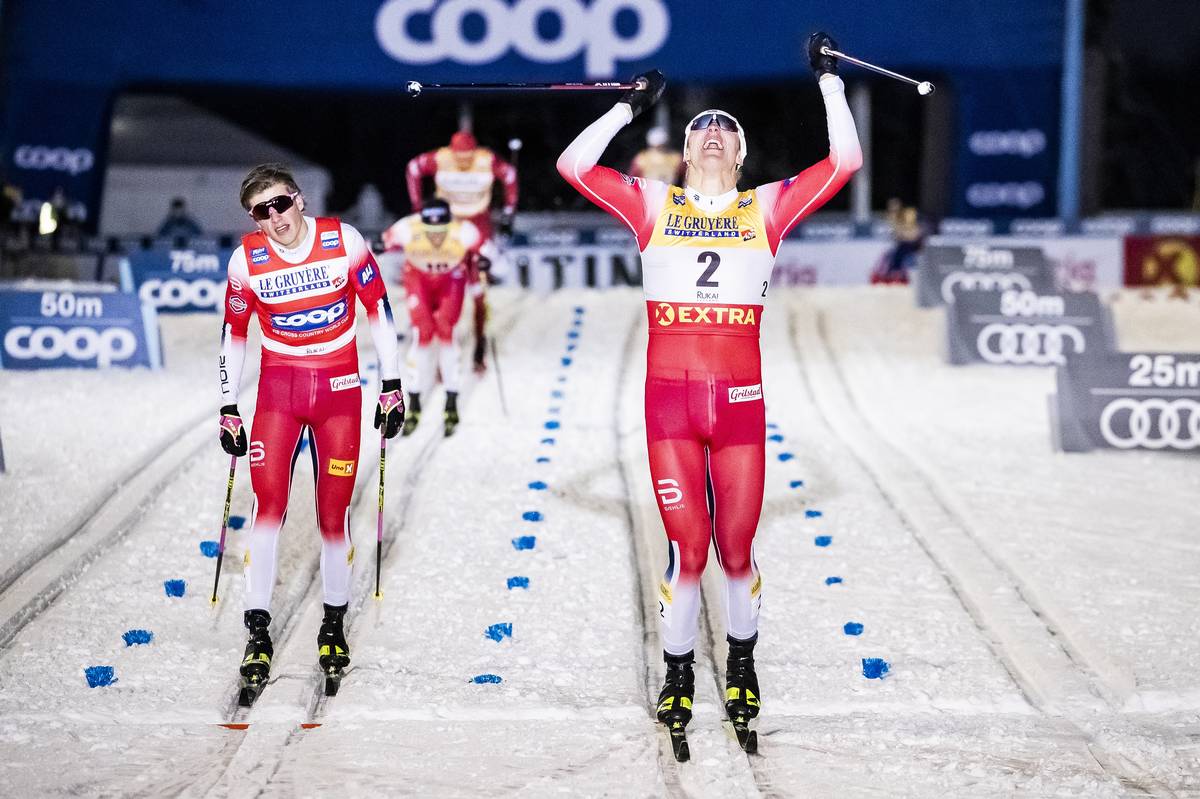
Valnes is a sturdy contender—and he did his best to challenge Klaebo on the uphill—but Klaebo has almost never been overtaken once he edges to the front of a finishing straightaway. He would not be challenged at the line, coasting across for what commentators identified as his 99th individual World Cup victory. There’s never been a skier like this.
On any Sprint day, Klaebo’s victory seems a foregone conclusion. Valnes is one of the greatest and most consistent sprinters in the history of the sport. Yet, against Klaebo, it appears that Valnes doesn’t stand a chance. As for the rest of the field, contenders arise from time to time—Anger, Chanavat, Pellegrino—but they often lose their way in the scramble that occurs just behind Klaebo’s tails. No one has figured out a way to undo him . . . no one has even come close.
Ogden was reliably insightful in his post-race interview. “At the end of the day, everybody just does everything they can to do the best that they can, “Ogden said. “Klaebo has won a lot of sprints—he’s just on another level. He put on a bit of a clinic today. I don’t think that anyone is giving up hope that they can ever beat him, but he’s better on the hill, better on the double pole, better on the downhills. What are we gonna do? We can make a plan to beat him, but he’s just better. That’s not to say that things can’t change. There’s plenty of guys out there—I hope, myself included—that can give him a challenge, but today was not that day.”
99 individual World Cup wins . . . and counting. Johannes Hoesflot Klaebo (NOR) continued his domination in Ruka, Finland. (Photo: Modica/NordicFocus)
Love Stories Like This? Help Keep Them Coming.
Feature interviews like this one take time, access, and care to produce. If you value thoughtful storytelling and independent ski journalism, please consider becoming a Voluntary Subscriber. Your support directly fuels the work we do to cover the people, places, and moments that make our sport special.
This coverage is made possible through the generous support of Marty and Kathy Hall and A Hall Mark of Excellence Award. To learn more about A Hall Mark of Excellence Award, or to learn how you can support FasterSkier’s coverage, please contact info@fasterskier.com.
It was a special day for Johanna Hagstroem (SWE) as she notched her first individual World Cup victory. (Photo: NordicFocus)
Last year the theme for much of the women’s sprint season was whether anyone from team Sweden could defeat Kristine Stavaas Skistad (NOR). However, this year, things will be different, for at least a while. Sweden still presents an incredibly formidable team of Sprinters, with Emma Ribom, Johanna Hagstroem, Jonna Sundling, Linn Svahn, and Maja Dahlqvist headlining the Sprint roster and creating the most powerful women’s Sprint team in cross-country. But the rivalry with Skistad will have to wait as she is sidelined from abdominal surgery, and a date for her return to racing is uncertain. So, the duel between Sweden and Skistad is delayed for now with no one knowing what Skistad’s form will be like when she returns. Expectations for today’s Sprint were further complicated when Sweden lost some of its firepower early in the day when Emma Ribom withdrew before the start of the heats after having qualified 18th.
Jessie Diggins (USA) looked good early in her heat, but couldn’t keep up with the pace. (Photo: NordicFocus)
The bad luck for Norway and Sweden created an opening for other teams which America’s Jessie Diggins, Rosie Brennan, and Julia Kern would have loved to fill. But it was a tough day for the American women with only two qualifying for the heats with Diggins qualifying in 27th and Brennan in 28th.
The first day of Sprinting is a big of an adjustment. “What is different is the technique on snow,” said Diggins. “I think that becomes one of the biggest things. At this point I’ve had maybe 10-12 hours of Classic skiing on snow. Ruka especially is a course that is super technically demanding … that’s the thing that’s hardest to get used to because it’s so different than roller skiing. You have to do pretty specific motions in order to close down your skis and kick.” She continued that, “I am pretty much where I normally am this point of the year. I really like to work into the year and I really like to work into my fitness, and so right now, I’m not super sharp, and that’s ok. I don’t expect to be. I’m not at all surprised by where I am right now. I think the base fitness is fine and the sharpening will come later. ”
Instead, it was the hometown favorites from Finland who took advantage of the opening day change of pace and qualified seven racers and raised the hometown hopes for a Finnish woman to be standing on the podium at the end of the day. The Finnish onslaught was noted by Brennan. “It seems the Finns were flying this morning. I think they had some incredibly good skis, and that’s really cool to see. It’s been a little while since they’ve had a super-super strong team, so that’s awesome, and it was really great to see. Homefield advantage is always fun.”
In the end form was maintained, but with different characters playing key roles as Sweden yet again found a way to the top of the podium with Johanna Hagstroem taking her first World Cup individual victory. But there was renewed optimism in the Norwegian camp as Norway found a new hope in Sprinting with Julie Myhre coming in second, Maja Dahlqvist (SWE) finished third.
Other American racers were Julia Kern in 41st, Renae Anderson 42nd, Erin Bianco 43rd, Alayna Sonnesyn 44th, and Lauren Jortberg 48th.
Kern was happy to just be in Ruka given the back injury she’s been fighting. “Qualifying is always really challenging here and I’ve never really had much buffer room. I’m proud of how I skied. I’m just really psyched to be at the start line right now. “Kern revealed that since her back injury, “it has been just a battle to be able to ski and train, and do everyday things. So, I’m happy to be at the start, and obviously wanting a lot more. “She acknowledged that she is uncertain about her fitness. “I always race into form, especially given a disruptive fall of training. Ruka is such a special beast … and from the first to second weekends, things can change a lot.”
The only Canadian competitor today was Katherine Stewart-Jones: she finished 45th.
Ruka is a technical and physically challenging course with a large hill close to the finish which usually plays an outsized role in determining the winners. At least today, the skiers wouldn’t have to contend with the difficult at freezing waxing conditions they faced yesterday, as today’s temperatures were in the mid-teens at the start of the competition.
The Quarterfinals
Rosie Brennan (USA), pictured qualifying, had a golden opportunity in her heat when three skiers went off course. (Photo: NordicFocus)
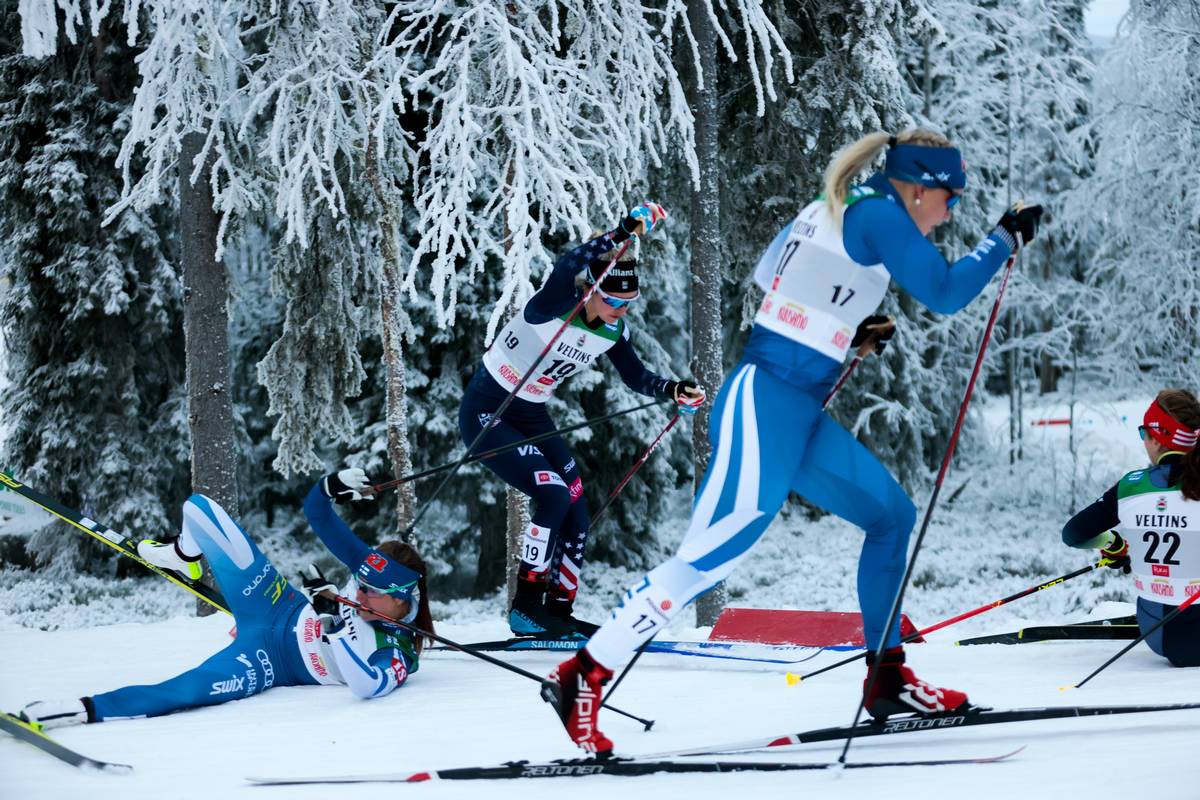
Rosie Brennan (USA) was in the second heat and would face the Sprint champion from last year Linn Svahn, and the formidable Victoria Carl (GER). Brennan was boxed out early at the start and was pushed toward the back of the pack immediately. But in the blink of an eye, she was catapulted into third place when the three leading skiers tangled in the first turn, including pre-race favorite, and last year’s Sprint champion Linn Svahn, and went crashing off the course. Suddenly the race was down to three skiers. Brennan immediately took advantage going to the front of the remaining pack of three. But she couldn’t hold that lead going up the final hill and ended up battling for second with Carl. Carl was able to glide away from Brennan going into the stadium finishing second with Anne Kyllonen (FIN) winning the heat. Brennan finished third. Her time was not fast enough to qualify as a lucky loser and after only the second heat, her day would end. “It was definitely scary to watch those three girls said Brennan.” She added that, “I saw Linn take flight and I was quite worried that they were severely hurt so I had a moment of wondering whether I should stop or not because people’s safety is more important than a ski race.” She then decided to push the pace as much as she could. “Not for any other reason than just wanting to continue to open up my body and make a hard effort and maybe take some sprint out of somebody, because I know I don’t have the speed that I want right now.”
Jessie Diggins (USA) was unable to move past the quarter-finals. (Photo: NordicFocus)
Jessie Diggins was in the fourth heat. It was in a very competitive field with Nadine Faehndrich (SUI), Laura Gimmler (GER), Katharina Hennig (GER) and Frida Karlsson (FIN) in the field. The field stayed together early with Diggins looking to have quick skis as she had to stand up early on to avoid running up on her competitors. The group stayed together up the first challenging hill with Diggins keeping an outside line. Faehndrich then pushed to the lead with Diggins up toward the front of the pack. Going into the start of the final hill all the skiers were still grouped together as the final charge began. But Diggins couldn’t keep up with the pace and was pushed off the back. She dropped back even more toward the end of the race and finished sixth. Her day was also over. She attributed her inability to keep pace as being, “a technique and ski decision thing on the final hill.” She continued that, “I made the mistake of not asking for extra kick, I had tested my skis and I thought I was in a good place with them, but in hindsight I needed more kick.” Diggins said that the lack of kick caused her to ski “hesitantly, tiptoeing up the hills to not slip.” Diggins took full responsibility for the lack of kick wax. “That’s on me. It’s important for me to communicate with my tech. I own the fact that I thought I had enough kick, and I was wrong with that.”
Norway has new hope in Sprinting with Julie Myhre (NOR) coming in second. (Photo: NordicFocus)
The Semi Finals
Jasmi Joensuu (FIN) continued to keep Finnish hopes alive as she took off to an early lead, but racers quickly consolidated and they were one big pack going into the first hill in what quickly turned into a very tactical race. Sundling was able to put in a last second sprint to take the win along with Dahlquist who finished second. Joensuu hung on for third and would keep Finnish hopes alive by advancing to the finals. But so far, the Swedes had been able to overcome the Finn’s numeric advantage and were beginning to assert themselves.
Finland’s Sprint hopes were riding on Jasmi Joensuu (FIN), (far left), but ultimately Finnish fans would go home empty handed. (Photo: NordicFocus)
In the second heat it was an unusual position for Johanna Hagstroem as she was the only Swedish skier. But the lack of teammates didn’t deter her. Going into the final hill Hagstroem displayed a preview of what fans would see in the finals and put in a huge burst of speed to shoot to the front. All day long, Hagstroem looked like she had something extra to offer on the big final hill and she worked her advantage perfectly throughout the heats. Her only mistake was slowing up too much coming into the finish line where she was joined by Coletta Rydzek (GER) in what became a photo-finish. But Hagstroem was still able to eke out the win.
The Finals
Sweden fielded three skiers in the finals with Sundling, Dahlqvist, and Hagstroem qualifying. After its initial surge of qualifying seven skiers, Finland was down to only one skier remaining; Jasmi Joensuu. She joined Norway’s Julie Myhre, and Rydzek.
The emotion of Johanna Hagstroem’s (SWE) first win was showing during and after the race. (Photo: NordicFocus)
The Swedish trio went to the front early with Rydzek gamely hanging with them. Things again turned very tactical with all the skiers slowing down on the first climb with no racer wanting to lead. It wasn’t until the big hill at the final that things opened with Hagstroem putting in another incredible burst which ultimately catapulted her to victory.
It was a special day for Hagstroem as she took the victory which was the first win of her career. Julie Myhre (NOR) hung on for second with Dahlqvist finishing third. Myhre’s podium had to provide team Norway with some level of solace giving them hope that someone would step up in Skistad’s absence.
After the race Hagstroem said that, “I cant believe it. It feels crazy.” She continued that “I had a really good day. I like Ruka and love the last hill.” She explained that as part of her strategy she likes to go outside of the track and run on her skis. “I kept thinking don’t screw it up. I’m in shock.”
The incredible promise of the beginning of the day for the Finns turned sour when after qualifying seven racers, none of them could make it to the podium.
It was also a rough day for team USA who will hope to rebound next weekend in Lillehammer, Norway when the Sprints will be in the Freestyle technique and hopefully their fortunes will improve.
Johanna Hagstroem (SWE) – FIS world cup cross-country, individual sprint, Ruka (FIN). (Photo: NordicFocus)
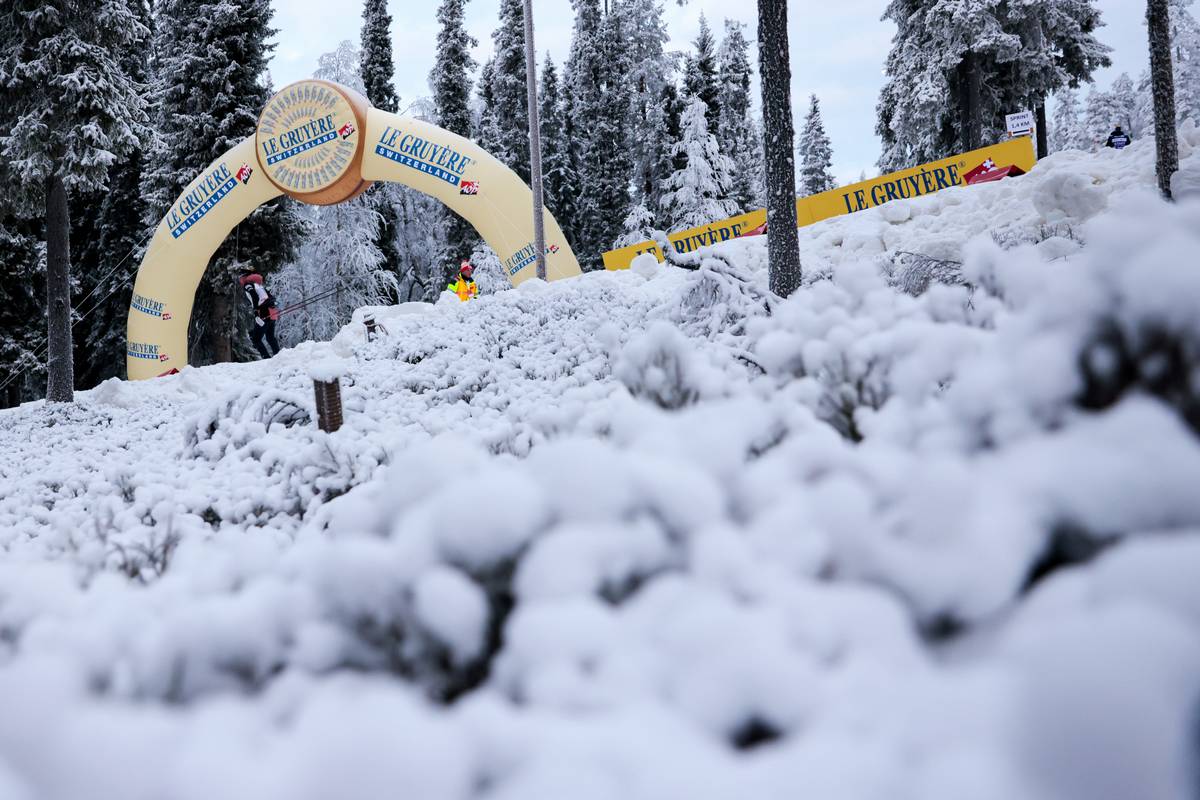
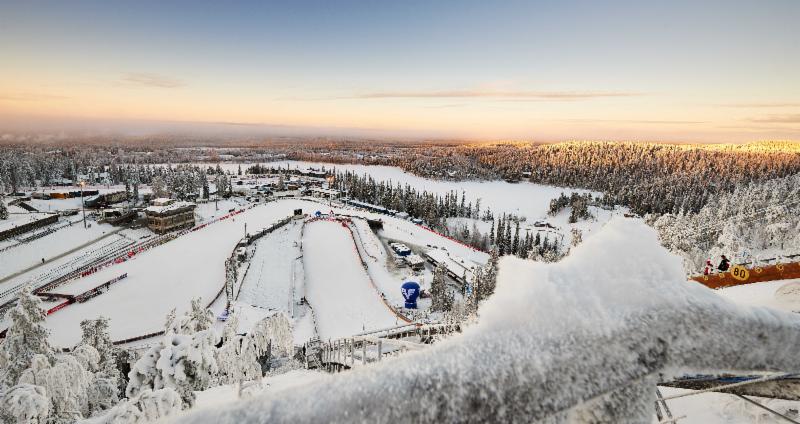
Ruka covered in a fresh layer of frost ahead of the first World Cup race of the season Friday. (Photo: NordicFocus).
This World Cup coverage is made possible through the generous support of Marty and Kathy Hall and the A Hall Mark of Excellence Award. To learn more about A Hall Mark of Excellence Award or to learn how you can support FasterSkier’s coverage please contact info@fasterskier.com.
The temperature was a balmy -11℃ (12℉). A glow hung in the sky and new snow decorated the trees; a welcoming winter scene in Ruka, Finland. With the FIS Cross-Country World Cup making its start there on Friday, the crisp, clear, sub-arctic conditions seemed to be an indicator of good things ahead.
Ruka’s 1.4 k classic sprint course remains unchanged from previous years. (To see a breakdown on this course, check out our video from 2018 with Andy Newell here). The straightforward read on the Ruka loop is that for all the jockeying and positioning possible in the first 1 k of rolling terrain, the last hill—the big one—plays an outsized role in deciding who wins. Yet, the critical read on why it has produced such awesome racing over the years is that the place in the racing calendar is just as important. The jitters and nerves of an entire offseason bear down on skiers in a way where the decisive moments in a day come not on the hill meant to test their mettle, but in the moments before where they know that test is coming. Don’t miss the forest for trees. Don’t miss the whole race because of the big hill.
Alayna Sonnesyn on the 1.4 k Ruka classic sprint course during qualifying on Friday. (Photo: NordicFocus).
The women’s field came into that course today anticipating an extra degree of variability. For all the variety of the World Cup last season, its classic sprints were surprisingly predictable. Only four skiers notched wins: overall sprint champion Maja Dahlqvist (SWE), Natalia Nepryaeva (RUS), Maiken Caspersen Falla (NOR) and Jona Sundling (SWE). This season, Falla has retired, and Nepryaeva is out due to the FIS’ Russian suspension. With no skier showing a firm hold on the sprint events, today looked to be anyone’s race.
The Americans started a full lineup of six skiers, with Jessie Diggins qualifying for heats in 11th place, +4.68 seconds off winner Ane Appelkvist Stenseth (2:48.85). Julia Kern also qualified for the heats, placing 23rd (+5.39 sec). Kern ended up in the first quarterfinal along with the winner Stenseth, while Diggins took to the 3rd quarterfinal in a match up with 2nd place qualifier Tiril Udnes Weng (NOR) (+0.56).
The first quarterfinal also featured Sweden’s Emma Ribom, who was coming off an FIS sprint victory over most of the Swedish national team last week. For the 24 year old, that result follows an offseason in which she had top results in rollerski races of all types, from sprints to a 42 k classic marathon win in Trollhaettan.
Julia Kern (USA) and Emma Ribom (SWE) in the first quarterfinal on Friday. (Photo: NordicFocus).
In that quarterfinal, Stenseth (NOR) set a pattern her countrywomen would follow throughout the day; taking the inside lane at the start and leading out the early action. The Swedish counter throughout the day was to let the Norwegians do the pace-setting and hit that decisive last hill hard. Kern meanwhile comfortably moved in the pack, always near the front but never commanding the lead. When they hit the last hill, Ribom surged and Stenseth followed from the other side of the trail. Ribom crossed in 1st – 2:47.54, and Stenseth crossed in 2nd – 2:48.21 (+0.67). Kern had followed the Stenseth move up the hill, and held on in a late sprint with Anna Svendsen (NOR) for 3rd place 2:48.60 (+1.06).
The first heat had been fast, though Kern in 3rd place would be forced to wait out the rest of the quarterfinals before learning if her time was good enough to earn a lucky loser spot.
In the 3rd quarterfinal, Jessie Diggins tucked in behind the Norwegian pair of Tiril Udnes Weng and Kristine Stavås Skistad, and through the early part of the race was in a comfortable position in the pack. As that field rounded the corner that led to the course’s only prolonged downhill, however, Finn Katri Lylynpera and German Katharina Hennig tangled up and went down. Diggins was held up ever-so-slightly, but the spot on the course was unfortunate, stifling the momentum Diggins hoped to build by skiing out from the back of the field. She ended the heat in 5th place.
Jessie Diggins (USA) got caught behind a pile-up during her quarterfinal Friday. Diggins qualified 11th on the first day of World Cup season. (Photo: NordicFocus).
When the rest of the dust had settled on the quarterfinals, the first heat proved to be the fastest, sending Julia Kern into the semi-finals where she would race out of the second heat.
In the first semi, Emma Ribom and Maja Dahlqvist formed a Swedish contingent matching up to a three-strong Norwegian contingent of Tiril Udnes Weng, Ane Applekvist Stenseth and Anna Svendsen. The sixth skier in the heat was the host nation’s Jasmi Joensuu (FIN), who also has a strong American skiing connection – an alumni of Denver University, where she was an All-American and part of DU’s NCAA national title winning teams in 2016 and 2019.
Former Denver University skier Jasmi Joensuu (FIN) (3rd from left) had a breakout day, finishing 4th place overall. (Photo: NordicFocus).
On the Ruka hill, Joensuu earned the distinction of having the best finishing kick of the day. In a heat where the Norweigans took it out fast, and then Maja Dahlqvist took them out even faster, the Finn was able to hold on to the pack just long enough so she could kick back into contention in the final climb. Joensuu followed Weng and Stenseth on the hill, who overtook Ribom and Dahlqvist, but saw themselves be out-double poled in the sprint. The result: Emma Ribom 1st place, 2:44.99, Dahlqvist 2nd (+0.05), Weng 3rd (+0.09), and Joensuu 4th (+0.67). It was the fastest heat of the day.
Julia Kern started her semi-final alongside Johanna Hagstroem (SWE), Frida Karlsson (SWE), Kristine Stavås Skistad (NOR), Lotta Udnes Weng (NOR), and Tereza Beranova (CZE). The Norwegians again took the inside track and took the heat out in front. Kern, for her part, chose to stick behind the pairing of Swedes early in the race, The pack didn’t have the same ferocious pace as the previous heat, instead seeing a quiet battle for positioning going into the final hill. Kern came into that in 3rd place, before losing ground as Czech Tereza Beranova made a massive push. That broke the field into a final sprint early, with Hagstroem (SWE) coming out on top in 1st – 2:47.16 and Skistad (NOR) getting Beranova by a boot’s throw for the 2nd spot (+0.43). Kern finished the heat in 6th place (+4.92).
Julia Kern after the semi-finals on Friday. Kern finished the heat after a strong performance in the qualifier and quarterfinal. (Photo: NordicFocus).
The Final: three Swedes – Emma Ribom, Johanna Hagstroem, and Maja Dahlqvist, two Norwegians – Kristine Stavås Skistad, and Tiril Udnes Weng, and one Finn – Jasmi Joensuu. The dynamic was everything a spectator would expect watching the rest of the days racing, but the decisive moment was not.
The Norweigans took the final out hard from the gun, while the Swedes took the early part of the race to find the right position. That eventually led to a moment of attrition, where the field slowed and stared over into the downhill, not daring to be the first down into it. That led to a more jumbled pack going into the final hill than usual, but it was still a similar race to what had been seen all day. The Swedes took to the uphill at full speed, and seemed to gain a slight advantage on their Norwegian and Finnish pursuers. The final turn looked to be all that was left between them and a podium sweep. Dahlqvist led it out, then Ribom, then Hagstroem.
And then, Dahlqvist went down. One of those trips that every skier has tripped. A little touch of the toe under the boot, and she hit the ground. Ribom and Hagstroem were left to sprint for the victory, and Ribom took the win, 2:49.22.
Hagstroem in 2nd (+0.91) and Weng in 3rd (+0.93) rounded out the podium in the first race on the first day of the World Cup season. Last year’s sprint champion, Maja Dahqvist, crossed the line well after the field, broken Swix Triac in hand.
Emma Ribom crosses the line for her first World Cup win in the Ruka classic sprint. (Photo: NordicFocus).
On a course designed to open the World Cup with a piece of decisive terrain, its latest chapter was defined by an accident that no amount of engineering could snuff out. Maja Dahlqvist, the reigning sprint champion takes a tumble. Emma Ribom, the 24 year-old, takes her first World Cup win. New season, same Swedes.
Women’s podium: 1st – Emma Ribom (SWE), 2nd – Johanna Hagstroem, 3rd – Tiril Udnes Weng (NOR). (Photo: NordicFocus).
American skiers had strong results further down the qualifying list. Rosie Brennan placed just outside of heats in 32nd (+9.15), while Alayna Sonnesyn placed 43rd (+12.36), Novie McCabe placed 52nd (+17.28), and Lauren Jortberg placed 54th (+19.33).
Lauren Jortberg (USA) during qualifying on Friday. (Photo: NordicFocus).
The Canadians also saw a strong grouping of skiers in the results, with Dahria Beatty 38th (+10.16), Katherine Stewart-Jones in 45th (+12.48), and Olivia Bouffard-Nesbitt in 46th (+14.03).
Novie McCabe (USA) during qualifying on Friday (Photo: NordicFocus).
This World Cup coverage is made possible through the generous support of Marty and Kathy Hall and their A Hall Mark of Excellence Award. To learn more about A Hall Mark of Excellence Award or to learn how you can support FasterSkier’s coverage please contact info@fasterskier.com.
Johannes Høsflot Klæbo (NOR), Erik Valnes (NOR), Evgeniy Belov (RUS), (r-l) in the first quarterfinal of the 2020 Ruka World Cup classic sprint.
At roughly two minutes into the men’s final of the 1.4-kilometer classic sprint in Ruka, Finland, the race broke apart. On a notoriously steep and taxing hill, Norway’s Johannes Høsflot Klæbo has literally run away from would-be chasers in the past. Not so much this year.
Klæbo Klæboed. But so too did his Norwegian teammate Erik Valnes. Simply put, Valnes out Klæboed Klæbo on the hill, then maintained a svereal meter gap to win down the stretch in 2:59.56. He pipped the second place Klæbo by 0.61 seconds. The twenty-four-year-old Valnes won the World Cup’s opening race for his first individual World Cup victory. Emil Iversen, another member of Norway’s stacked men’s team, placed third for his eighth career sprint podium.
Last season’s overall World Cup winner, Russia’s Alexander Bolshunov was fourth. Norway’s Håvard Solås Taugbøl skied to fifth, and Switzerland’s Jovian Hediger sixth.
https://www.youtube.com/watch?v=y0O3CzfhH54
Klæbo and Valnes were paired in the first quarterfinal and first semi. Valnes placed second in both heats, initially by 0.19 seconds, then by an eye-blink in their semi: just 0.03 seconds. What could have been a deferential move in the final, being happy with a second-place to the reigning sprint king, Valnes did not relent in the final. Valnes crossed the line arms raised, while Klæbo slid across shoulders dropped, in an unfamiliar second place. Last season, on his way to capturing the sprint globe, Klæbo won eight individual sprints including the opening sprint in Ruka.
Johannes Høsflot Klæbo could not catch Erik Valnes down the stretch. (Photo: NordicFocus)
“This victory means everything to me right now, Valnes told the International Ski Federation after the race. “I tried all my life to be the best that I can and having this World Cup victory is the best thing I could ask for. I learned a lot (from Johannes) as he is the best sprinter of all times and I am happy to be with him on the team. It is very special to beat him on a track like this.”
The Americans did not qualify for the heats. Yet, according to Matt Whitcomb, U.S. Ski Team Head Coach, two twenty-year-olds in Ruka were standouts. JC Schoonmaker placed 35th overall, while Gus Schumacher, in his first European World Cup start, placed 43rd.
Post-Race Interview with JC Schoonmaker
“Very exciting for those two today,” remarked Whitcomb. “So a 35th in Ruka, one of the premier classic sprints of every year, that’s a really exciting result. … and to have Gus come out of the bottom of the course just charging into the last climb, finishing in the [low forties], that is exactly where we need those guys to be right now.”
Post-Race Interview with Gus Schumacher
Gus Schumacher racing to 43rd on the day – 2020 Ruka, Finland classic sprint. (Photo: NordicFocus)
Logan Hanneman was the next best-placed U.S. skier in 46th, followed by Simi Hamilton in 50th, Kevin Bolger in 58th, and Scott Patterson in 78th.
Post-race interview with U.S. Ski Team Head Coach Matt Whitcomb discussing the men’s performances.
Racing continues tomorrow for the men with a 15 k classic.
Sadie Maubet Bjornsen (bib 2) in speedy form during the 2019 Ruka, Finland classic sprint. (Photo: NordicFocus)
A big day for Sadie Maubet Bjornsen of the U.S. Ski Team (USST) in Ruka, Finland. She placed third overall in the women’s 1.4-kilometer classic sprint.
Italy’s Lucia Scardoni established the time to beat in the qualifier, 3:03.01. Maubet Bjornsen played her fitness cards early as she qualified in second, 1:15 seconds back.
“It has been an interesting fall battling through some frustrating tendinitis in my feet that didn’t allow me to run or ski a whole lot for three months, so I wasn’t quite sure what to expect coming into this season,” Maubet Bjornsen emailed to several outlets. “I knew I had strengthened my brain, but it is hard to know what to expect when you are doing less than ideal training to try to survive. I also have a new wax technician, so I was excited to see what we could put together in our short ten days of working together. But all the stars aligned, and I had an incredible day!”
Sadie Maubet Bjornsen on her way to qualifying in second place during the 2019 Ruka, Finland classic sprint. (Photo: Nordic Focus)
Post-race interview with the U.S. Ski Team’s World Cup Coach Matt Whitcomb and his comments on Maubet Bjornsen.
Bjornsen’s route to the finals included a second place in her semi. The final was dominated by the eventual winner Maiken Caspersen Falla from Norway. Up and over the final striding hill, she was gone and untouchable for the win in 3:07.09. Sweden’s Jonna Sundling placed second (+2.33).
Maiken Caspersen Falla of Norway takes the win in the 2019 Ruka, Finland classic sprint. (Photo: NordicFocus)
For her part, Maubet Bjornsen’s double poling kept her in it down the stretch — she out sprinted Norway’s Ane Appelkvist in a photo finish for third place. This was not an uncharacteristic early season result for Maubet Bjornsen, she placed second here in 2017’s classic sprint.
“The quarterfinals and semifinals went through perfectly. I managed to slip into the right places, and run up that hill with my own lane,” Maubet Bjornsen wrote. “When the finals arrived, I found myself in trouble at the halfway point. Some tangling at the corner left me kind of stuck. I’m not sure if my ski or my pole was stuck under someone… but I tried to just be patient and let them get off without breaking any equipment. When I finally got to go, I was ready to fight with every bit! Rounding the final corner, I was still in fourth place, but confident I could find one more gear change right at the end… and that is what I did. As I lunged, I knew I had given it all. Which amounted to a third place, which was super exciting. In a perfect world, I would have loved to fight for the win without the tangle, but the season is very young, and there a tons more races to come!
“Enormous shout out to our team, and my new wax tech, Per Erik Bjornstad, for some amazing skis!! I couldn’t have run up that hill the way I did today without those! And also impressive to see my teammates fighting today as well! There is a fun season ahead!”
Sophie Caldwell advanced after qualifying fourth (+2.61). Jessie Diggins (USST) and Rosie Brennan (USST) qualified 12th and 29th respectively. In the final results, Caldwell ranked 11th, Diggins 17th, and Brennan 25th.
Caldwell moved on to the first semi-final where she was in the mix until the final climb. She eventually faded to place sixth.
“I was happy with today,” Caldwell emailed to FasterSkier. “I’ve only made the semis one other time in Kuusamo (I think), so any day I can do that here is a good day. I felt great in my qualifier and went very hard in my 1/4 and was definitely still. Feeling it in my semi. It’s a short, but very tough course, so you can go backwards pretty quickly once you get tired. So overall a pretty good day and I was happy with my skis!”
Sophie Caldwell during the 2019 Ruka, Finland classic sprint qualifier. She qualified fourth and placed 11th on the day. (Photo: NordicFocus)
Post-race interview with the U.S. Ski Team’s World Cup Coach Matt Whitcomb and his comments on Caldwell.
Diggins and Brennan both contested the fourth quarterfinal where they were knocked out. Diggins placed fourth (+1.13) and Brennan fifth (+2.94). Sweden’s Sundling won that fast heat in 3:05.68.
“As for the sprint today: Due to some illness and challenging weather conditions in AK, I was unable to get any sprint time trials or simulations in this year so I really had close to no expectations for today’s race,” Brennan wrote in an email to several outlets. “Being a little more on the slow twitch side of things, I am very satisfied with the race today. I was particularly happy with how I was skiing and felt my fitness was good. My speed was not quite there, but I believe that will come in time. We are also adapting to new regulations from the FIS on course access and given all the changes, I was really happy with the process and skis that our staff put together today. I’m looking forward to getting a few more races under my belt this weekend.”
Rosie Brennan during the 2019 Ruka, Finland classic sprint qualifier. (Photo: NordicFocus)
Post-race interview with the U.S. Ski Team’s World Cup Coach Matt Whitcomb and his comments on Brennan.
Jessie Diggins during the 2019 classic sprint qualifier in Ruka, Finland. (Photo: NordicFocus)
Post-race interview with the U.S. Ski Team’s World Cup Coach Matt Whitcomb and his comments on Jessie Diggins and the hunt for the World Cup overall.
Also for the U.S., Julia Kern (USST) placed 43rd, Hailey Swirbul (USST) 60th, Caitlin Patterson (USST) 82nd, and Rosie Frankowski (APU) 83rd.
Racing continues tomorrow in Ruka with a 10 k classic for the women and a 15 k classic for the men.
Johannes Høsflot Klæbo of Norway takes the win in Ruka, Finland’s classic sprint. (Photo: NordicFocus)
Straight to the point, no U.S. men advanced to the heats in Friday’s opening World Cup 1.4-kilometer classic sprint in Ruka, Finland. Since the sprint is part of a three-race series ending with a pursuit, all skiers started the qualifier.
As snow flurries fell in a semi-dark and Arctic Ruka —skiers raced under the lights — Johannes Høsflot Klæbo of Norway won the qualifier in 2:37:42.
Kevin Bolger of the U.S. Ski Team (USST) just missed advancing by qualifying in 32nd (+9.32). Erik Bjornsen (USST) was 47th (+11.79), Simi Hamilton 50th (+12.22), David Norris (APU) 94th (+22.31), Scott Patterson (USST) 95th (+23.37), and Kyle Bratrud (SMST2) 100th (+25.72).
“This is our first race of the season, the classic sprint has never been our absolute strong event as a team,” said U.S. Ski Team’s World Cup Coach Matt Whitcomb after the race. “We’ll look back on today and yeah for sure we want more, it’s not really a failure, there’s not a disappointing feeling attached to it.”
Post-race interview with the U.S. Ski Team’s World Cup Coach Matt Whitcomb. He discusses the men’s day and waxing in Ruka.
With his perfect-technique hips forward double-poling and trademark ski-running form, Klæbo looked on. It was here last season where he looked peerless. In the final meters, he let up and was passed by his season-long rival, Russia’s Alexander Bolshunov.
Johannes Høsflot Klæbo of Norway leads the way during the Ruka, Finland classic sprint. (Photo: NordicFocus)
Not this year. There was no mental lapse on Friday for Klæbo. He had an ever-increasing gap midway up the final hill which ballooned by the time he crossed the line. He won by a massive margin of 4.17 seconds.
“It is amazing to be back in Ruka. It wasn’t the best start last year but now it is turning to victory,” Klæbo told FIS after the race. “It seems like the [Klæbo step] is working quite good. I think I am going to train for that every year so I am able to fight for podiums.”
Norway’s Pål Golberg was second (+4.17) and France’s Richard Jouve third (+4.62). As for Bolshunov who won this event last season, he was fourth (+5.24).
Since he boomed onto the World Cup in 2016, Klæbo has finished third, first, second, and first again today in Ruka’s classic sprint. Last season, Klæbo went on to win the sprint Crystal Globe and the overall title.
Kevin Bolger of the U.S. Ski Team on his way to qualifying 32nd in the Ruka, Finland classic sprint. (Photo: NordicFocus)
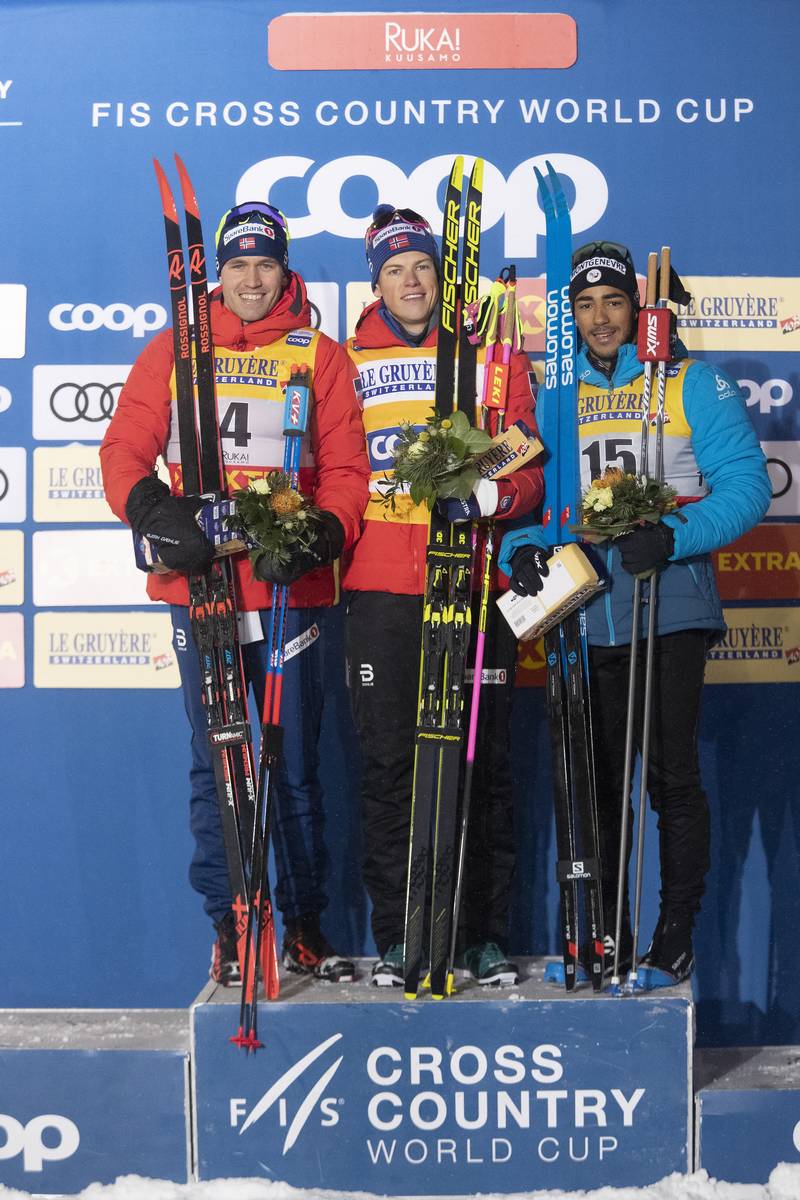
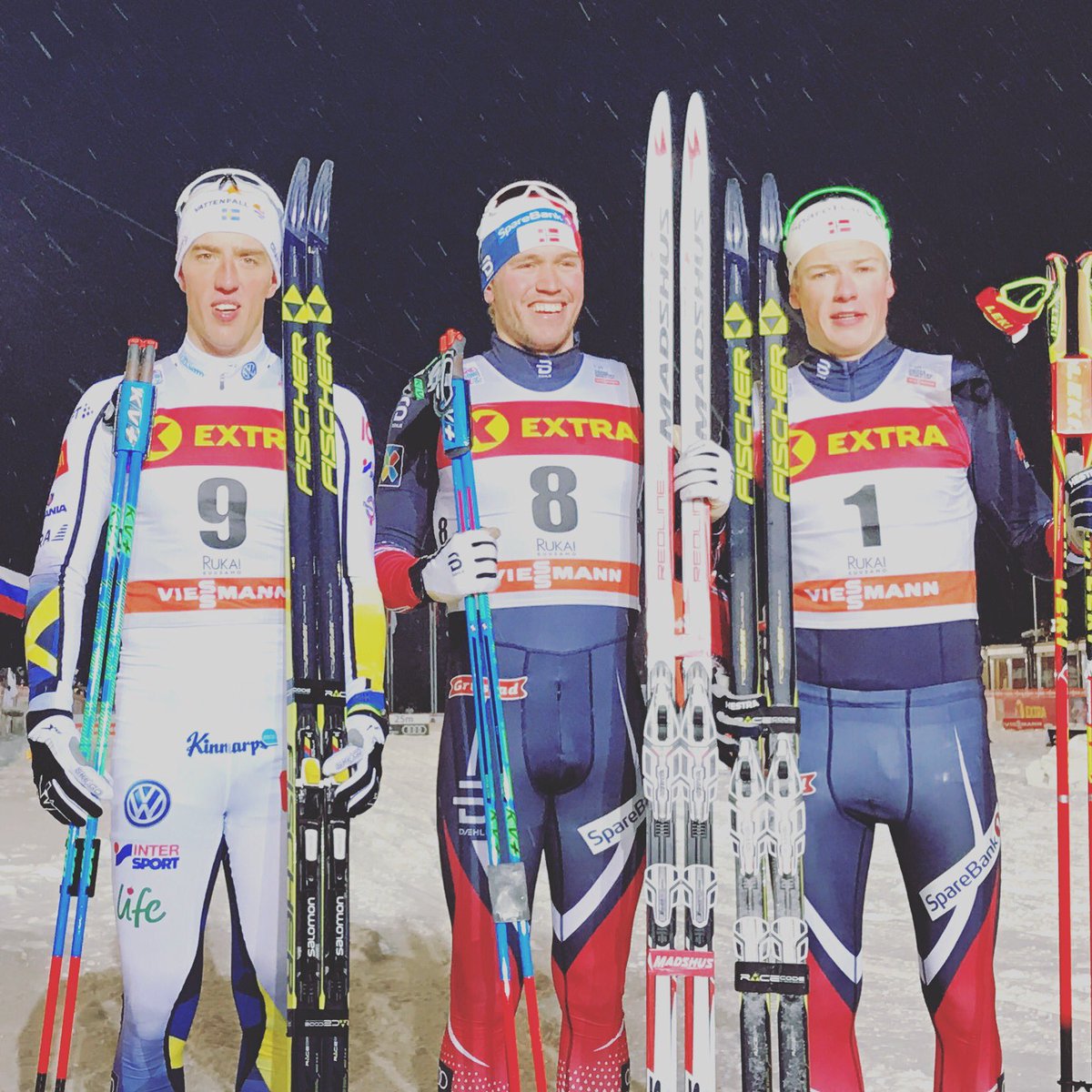
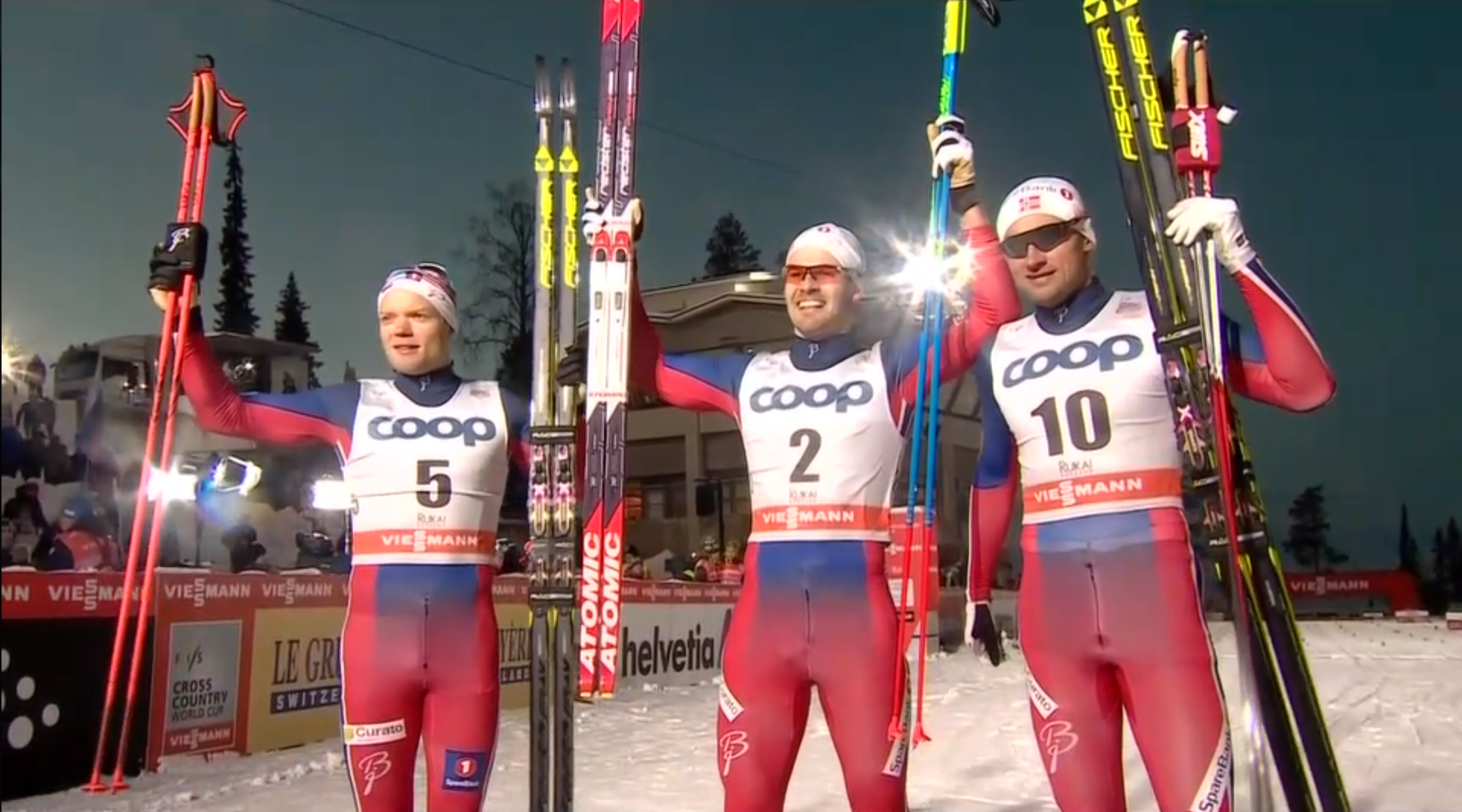
The men’s podium for the Ruka, Finland classic sprint. Pål Golberg (NOR), Johannes Høsflot Klæbo (NOR), Richard Jouve (FRA), (l-r). (Photo: NordicFocus)
On Saturday Nov. 24th, Ruka, Finland will host the season opening World Cup race, a 1.4 kilometer classic sprint. It’s the eleventh time in a row Ruka will host the first World Cup sprint of the season.
The Ruka course is iconic with it’s steep stride-then-run decisive hill before the finishing straight. Former U.S. Ski Team member (USST) Andy Newell provides insight into how athletes race the Ruka classic sprint course.
In our course preview video, Newell contrasts how Norway’s Johannes Høsflot Klæbo literally ran away from the men’s field with how the USST’s Sadie Bjornsen played keen pack-skiing tactics to win her sprint heat during last season’s Ruka classic sprint.
Left to right: Norwegians Pål Golberg and Johannes Høsflot Klæbo and Sweden’s Calle Halfvarsson after placing third, first and second, respectively, in the men’s 1.4-kilometer classic sprint on Friday in Kuusamo, Finland. (Photo: FIS Cross Country/Facebook)
There was no mistaking Norway’s Johannes Høsflot Klæbo in Friday’s 1.4-kilometer classic sprint, even with no natural light illuminating the course in Kuusamo, Finland, by the time the men’s final left the start line. The 21 year old’s distinct runner-like, high-tempo stride could be seen leading the five other men’s finalists on every climb, distinguishing him from the light fog and densely packed trees lining the course’s firmly packed tracks.
Making his World Cup debut in the spring of 2016, Klæbo has since racked up four-regular season World Cup individual sprint podiums — of the eight World Cup sprints that he has entered — and ended last season as the men’s U23 World Cup champion as well as the overall Sprint World Cup winner, all at the age of 20.
Last weekend at Norway’s first International Ski Federation (FIS) races of the season in Beitostølen, Klæbo not only won the classic-sprint final, but he also topped the men’s qualifier, his quarterfinal and his semifinal.
Klæbo repeated the feat this weekend in Kuusamo, starting first with the qualifier, clocking the fastest by 2.26 seconds over Finland’s Anssi Pentsinen in a time of 2:46.53 minutes. He then won his quarterfinal by 0.6 seconds over fellow Norwegian national-team member Pål Golberg. In his semifinal, Klæbo bested Sweden’s Calle Halfvarsson by 0.29 seconds and then, with a convincing gap on the rest of the field, crossed the finish line first in the final in 2:48.19, kick starting his 2017/2018 World Cup season with a win.
“It was not my plan to ski away so early but before the final hill I was told I had a five-minute lead so I went for it all the way to the finish,” Klæbo sai,d according to a FIS press release.
Even before the course’s last climb, Klæbo had already set himself apart from the rest of the racers in the men’s final: Finland’s Ristomatti Hakola, Italy’s Federico Pellegrino, Sweden’s Calle Halfvarsson, and Norway’s Golberg and Sondre Turvoll Fossli. By the bottom of the first major climb he had double poled his way to a three-meter gap.
Klæbo already in his descent, Hakola, Golberg, Pellegrino, Fossli, and Halfvarsson crested the top of the climb in a pack and settled in for the chase. But Klæbo continued to hold them off into the second major climb, extending his gap by another two meters. As the others reached the second major climb, the race became one for second place between Halfvarsson and Goldberg. Hakola, Pellegrino and Fossli had all fallen back.
Finishing with no one close enough to challenge him, Klæbo took the win in in 2:48.19. Goldberg crossed 1.35 seconds later for second place, while third went to Halfvarsson, 4.03 seconds after Klæbo.
“I’m happy about the third place, but I was quite behind Klaebo,” Halfvarsson said according to a FIS press release. “I will try to catch up for the [Olympic] Games. He was impressive today.”
Rounding out the top 10 was Finland’s Lauri Vuorinen in seventh, Russia’s Alexander Bolshunov in eighth, Switzerland’s Jovian Hediger in ninth, and Finland’s Martti Jylhä in 10th.
Canada’s Alex Harvey advanced to the quarterfinals after qualifying in 13th (+6.13), the fastest North American in the preliminary round.
“The goal was to execute a solid day of racing since it’s the first time I put a bib on this year!” Harvey, of the Canadian World Cup Team, wrote in an email to FasterSkier. “I was pretty happy with my qualifier, it’s a short sprint here so 13th for me was a great start.”
In his quarterfinal, Harvey went up against Finnish skiers Vuorinen, Iivo Niskanen, and Toni Ketelä as well as Estonia’s Marko Kilp, and Japan’s Hiroyuki Miyazawa. However, a loss in positioning before the major climb cost him a few seconds, and he finished his quarterfinal in fifth, 2.16 seconds behind Vuorinen, who won the heat in 2:47.40.
“In the 1/4 final I did 1 or 2 mistakes that just cost me in term of positioning before the big hill,” Harvey wrote. “I felt great technically and actually pretty good physically too especially for the time of the year.”
“Like normal the steep terrain is a bit of a weakness for me so again in the final wall I don’t think I was moving fast enough there,” Harvey continued. “The rest of the course I think I skied well.”
The only other North American to qualify on Friday was Erik Bjornsen of the U.S. Ski Team (USST) in 26th (+8.71). Racing in the same quarterfinal as Klæbo, Golberg, Finland’s Juho Mikkonen and Matias Strandvall, and Russia’s Gleb Retivykh, Bjornsen ultimately crossed in fifth, 5.12 seconds behind Klæbo.
“We are really proud of [Erik] to qualify as strong as he did, in Scandinavia, in a classic sprint,” USST coach Matt Whitcomb said on the phone. “This is one of the hardest races of the year to do this, and it bodes really well.”
“Talked to him between the qualification and the quarterfinals, and he was just exuding confidence and commented on how strong his double pole is feeling,” Whitcomb continued. “We saw him fire that jet in the finish stretch today. He had a really fast heat and it stressed him out a little bit, don’t know exactly what happened, but he was in the mix today and we are psyched.”
Another USST member, Andy Newell missed qualifying by 0.38 seconds in 34th. He was 9.38 seconds off Klæbo’s top qualifying time.
“It was frustrating to be so close and just on the outside of the qualification bubble,” Newell wrote in an email. “Just a few tenths of a second out of the top 25. I felt like I struggled today to get the right amount of glide vs kick… which is just as much on me as the tech. Grateful to be feeling healthy and looking forward to big races to come.”
Julien Locke of Canada’s National U25 Team was the next-fastest Canadian, placing 59th (+12.07) in the qualifier. Locke finished 0.04 seconds ahead of the American Simi Hamilton (USST) in 60th (+12.13).
“A little bit of an off day for Simi and Andy,” Whitcomb said. “For Andy on a course that is particularly good for him and he is in really good shape right now, I think he struggled with some glide.”
Canadian World Cup Team member Len Valjas finished 63rd (+12.58). Before departing Gällivare, Sweden — where he and most of his teammate had been training and raced the opening FIS competitions — Valjas suffered a shoulder subluxation and was not “back to full health” by the time Friday’s sprint rolled around, he explained in an email.
“I took the week really easy on the shoulder to let it recover, and gave it a try in today’s race,” Valjas wrote. “I didn’t have my normal strength in the double pole sections of today’s race. I just felt weak and couldn’t hold any speed on the flats.
“I was happy that I was able to compete today, but I am definitely not skiing at 100%,” Valjas continued. “The shoulder is pretty sore and stiff from the qually this morning. Huge thanks to Pete Dickinson (USA physio) for taking care of me this week and helping me speed up my recovery.”
Also competing for Canada was Knute Johnsgaard in 73rd (+12.58), Devon Kershaw in 74th (+14.01) Graeme Killick in 85th (+14.01), Jess Cockney in 95th (+18.83).
Three additional Americans raced in the qualifier, with Scott Patterson (USST) finishing 84th (+16.14), Patrick Caldwell (USST) finishing 103rd (+21.43) and Noah Hoffman finishing in 105th (+21.85).
Canada’s Continental Cup leader, Russell Kennedy (Team R.A.D.), who earned Period 1 World Cup start rights after ending winning last season’s overall NorAm title, did not start Friday’s sprint race.
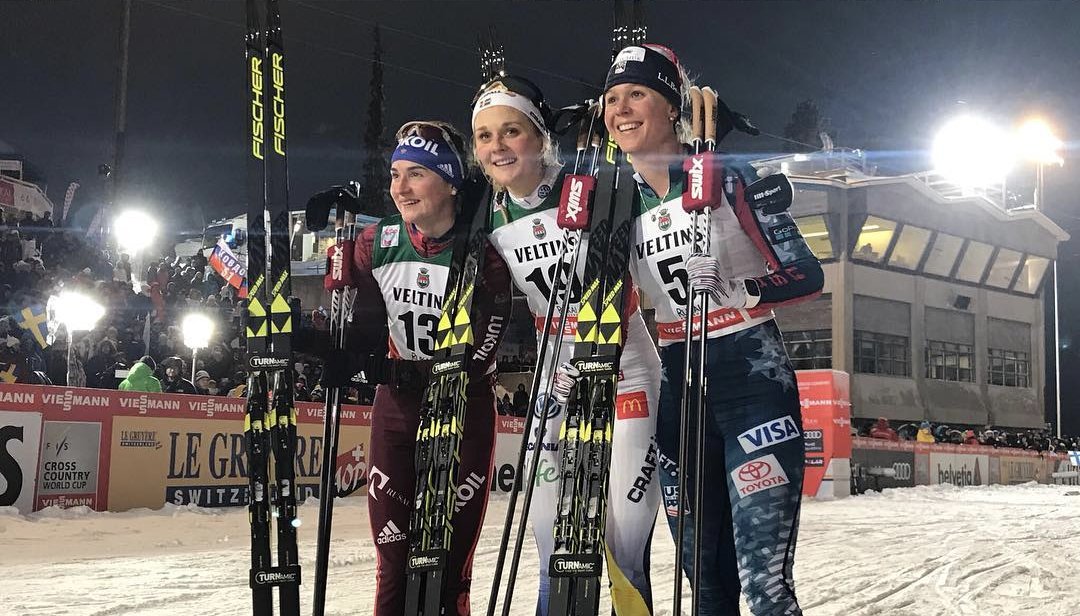
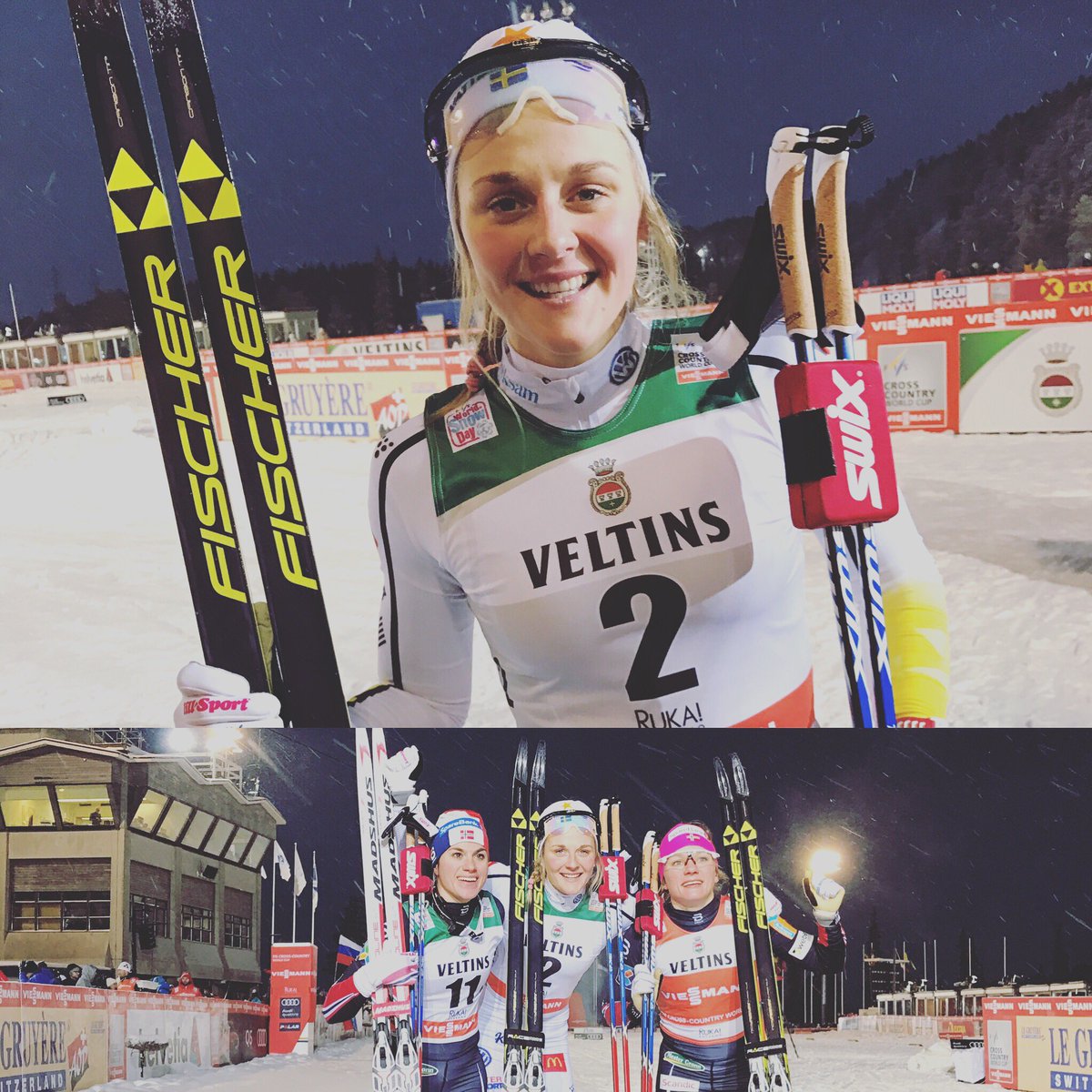
The women’s podium for the first race of the 2017/2018 World Cup season, the Ruka classic sprint in Kuusamo, Finland, with (from right to left) American Sadie Bjornsen in second, Sweden’s Stina Nilsson in first, and Russia’s Yulia Belorukova in third. (Photo: U.S. Ski Team/Twitter)
FIS Cross Country World Cup (Kuusamo, Finland): Classic sprints
In the first race of the 2017/2018 cross-country World Cup season, U.S. Ski Team (USST) member Sadie Bjornsen, who turned 28 on Tuesday, raced to the best result of her career, placing second to Sweden’s Stina Nilsson in Friday’s classic sprint in Kuusamo, Finland.
Last season, Bjornsen notched her first World Cup podium in third place in the 5-kilometer freestyle in Toblach, Italy, and teamed up with USST teammate Jessie Diggins to take third in the 2017World Championships classic team sprint. Friday’s 1.4-kilometer classic sprint — the first race of the Ruka Triple mini tour to kick of the 2017/2018 World Cup season — was Bjornsen’s first race of the season. She did not participate in any preseason International Ski Federation (FIS) races.
Bjornsen started out the day by clocking the fifth-fastest time in the qualifier, 1.98 seconds behind Sweden’s Ida Ingemarsdotter, who won the qualifier in 3:11.69 minutes. Bjornsen’s USST teammate Sophie Caldwell qualified third (+0.59) after another Swede, Hanna Falk in second (+0.19), and a total of four American women finished in the top 30 to qualify for the heats. Ida Sargent finished 22nd (+8.70) and Rosie Brennan was 26th (+9.51) to reach the quarterfinals.
There, Bjornsen won her quarterfinal by 0.39 seconds over Russia’s Yulia Belorukova. Caldwell also advanced to the semifinals by placing second in her quarterfinal, 0.7 seconds behind Sweden’s Charlotte Kalla in first.
Sargent finished third in her quarterfinal, 0.65 seconds behind the winner of that heat, Sweden’s Anna Haag. Brennan placed sixth in her quarterfinal, 4.3 seconds behind Sweden’s Nilsson in first. Neither Sargent nor Brennan advanced to the semifinals.
In the semifinals, Bjornsen again raced to first, and once again held off Belorukova — this time by just one-hundredth of a second. Caldwell followed in fourth in that semifinal, 0.5 seconds behind Bjornsen in first and 0.11 seconds behind Russia’s Evgenia Shapovalova in third (+0.39). Neither Caldwell nor Shapovalova advanced to the final.
In the final, Nilsson took the overall win in 3:17.62 and Bjornsen captured a career best in second place, 0.24 seconds out of first. Belorukova rounded out the podium in third (+0.91), while Ingemarsdotter placed fourth (+2.72), Norway’s Kathrine Rolsted Harsem was fifth (+3.54), and Finland’s Krista Parmakoski sixth (+18.62).
Overall, Caldwell placed eighth, Sargent 15th and Brennan 29th for the U.S. Diggins and Kikkan Randall missed out on qualifying in 34th and 36th, respectively. Julia Kern placed 57th, Liz Stephen 70th, and Chelsea Holmes 86th.
None of the Canadian women qualified, with Dahria Beatty in 64th, Emily Nishikawa in 74th and Cendrine Browne in 87th.
In the men’s 1.4 k classic sprint, Norway’s Johannes Høsflot Klæbo won out the day after winning the qualifier, quarterfinal and semifinal en route to another dominant performance in the final.
Klæbo started off by winning the qualifying round by 2.26 seconds in 2:46.53. Finland’s Anssi Pentsinen qualified second and another Finn, Ristomatti Hakola, qualified third (+2.35), ahead of Italy’s Federico Pellegrino in fourth (+2.66).
Cross Country Canada’s Alex Harvey was the top North American man in the qualifier, finishing 13th (+6.13), while Erik Bjornsen of the USST qualified in 26th (+8.71).
Both Harvey and Bjornsen finished fifth in their quarterfinals and did not reach the semifinals. Harvey ended up 21st on the day, after finishing 2.16 behind the winner of his heat, Finland’s Lauri Vuorinen. Bjornsen was 24th overall after finishing 5.12 seconds behind Klæbo, who won the first men’s quarterfinal.
Klæbo used the extra recovery time he had from racing an early quarterfinal to prime himself for another win in the semifinals, where he beat Sweden’s Calle Halfvarsson by 0.29 seconds. Another Norwegian, Pål Golberg, followed in third (+0.49), and Hakola placed fourth in that semi (+1.72). Both Golberg and Hakola had fast enough times to advance to the final, where they met Pellegrino — the winner of the second semifinal — and Norway’s Sondre Turvoll Fossli, who was second in the second semifinal (+0.1).
In the final, Klæbo once again won convincingly, this time by 1.35 seconds with a finishing time of 2:48.19. Golberg took second place and Halfvarsson reached the podium in third (+4.03), while Hakola placed fourth (+5.65), Pellegrino fifth (+8.87), and Fossli sixth (+17.31).
For the U.S., Andy Newell missed qualifying by 0.38 seconds in 34th and Simi Hamilton finished 60th. Scott Patterson was 84th, Paddy Caldwell was 103rd, and Noah Hoffman was 105th.
For Canada, Julien Locke, of the national U25 Team, finished 59th, Len Valjas was 63rd, Knute Johnsgaard 73rd, Devon Kershaw 74th, Graeme Killick 85th, and Jesse Cockney 95th. Last year’s NorAm winner Russell Kennedy did not start.
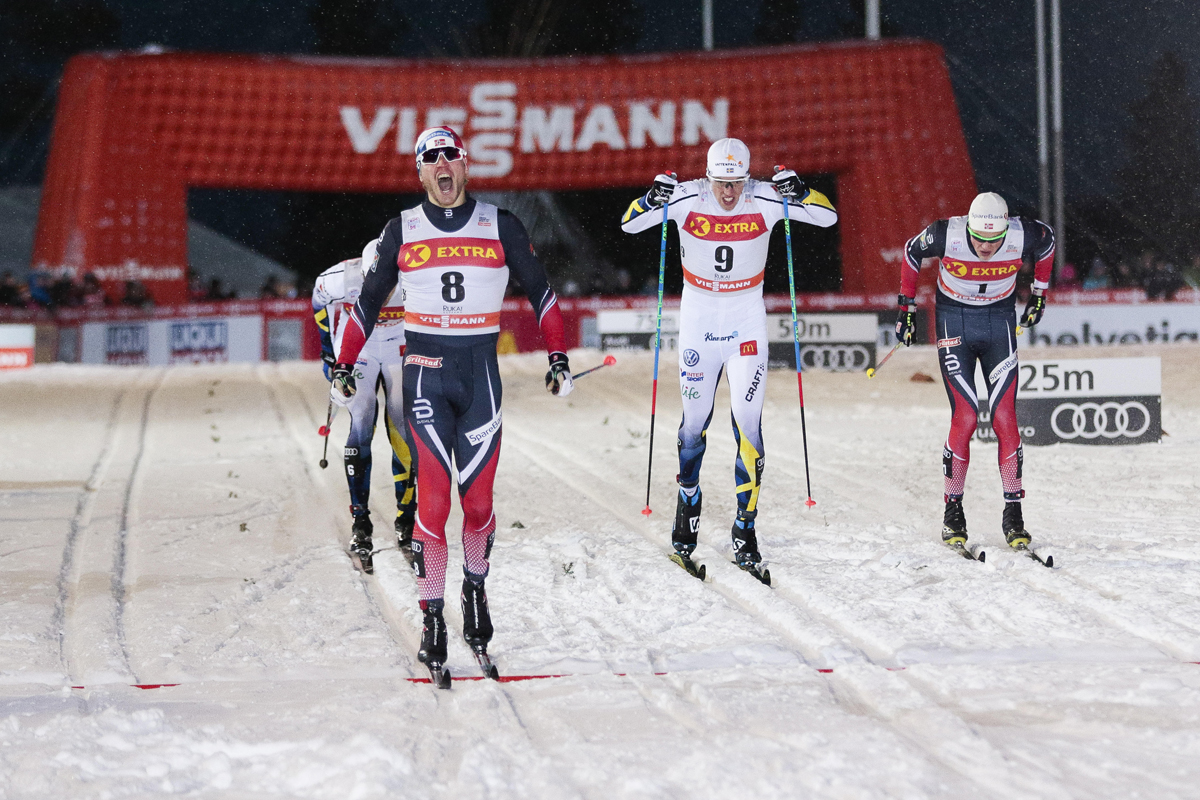
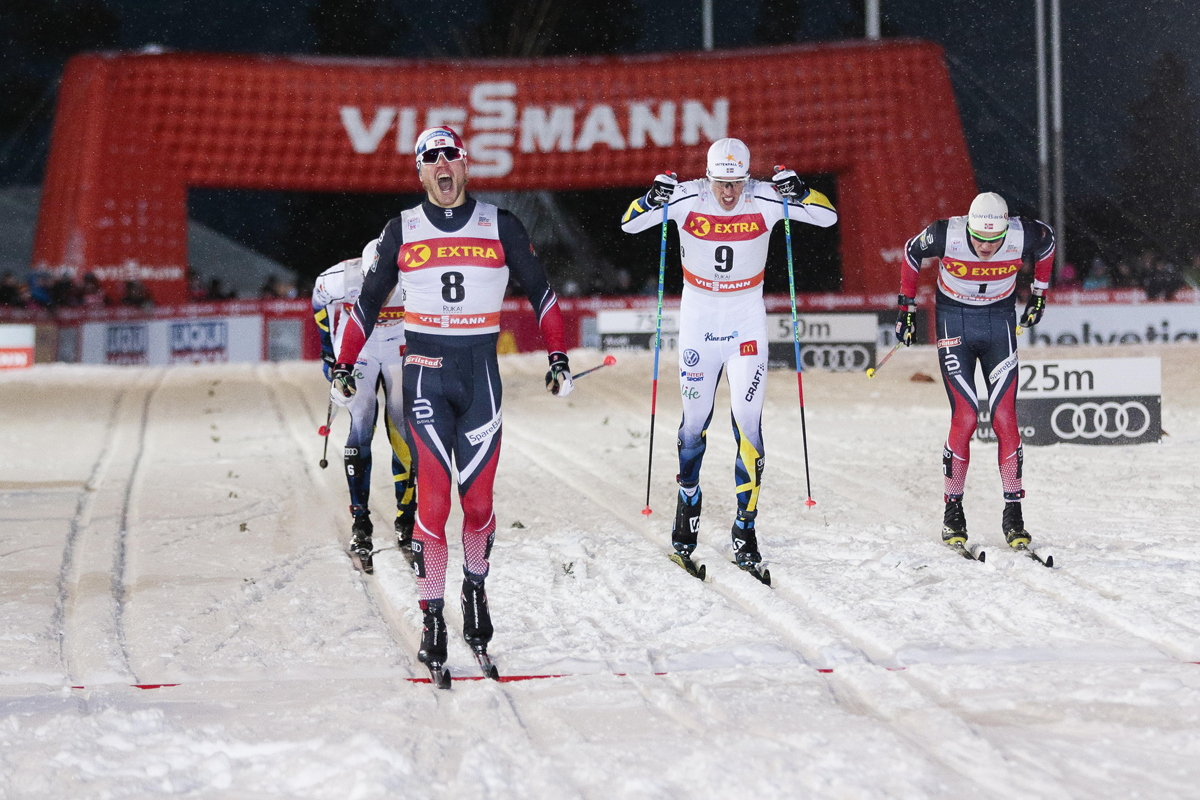
Norway’s Pål Golberg (8) celebrates his first classic sprint win in the first World Cup of the 2016/2017 season on Saturday after beating out Sweden’s Calle Halfvarsson (9), Norway’s Johannes Høsflot Klæbo (far right) and Sweden’s Teodor Peterson (behind), respectively, in Kuusamo, Finland. (Photo: Fischer/NordicFocus)
The two men who landed on the first and third steps of the podium in Saturday’s World Cup opener in Kuusamo, Finland, weren’t even slated to start as of a week ago. But 20-year-old Johannes Høsflot Klæbo’s breakthrough sprint result in Beitostølen, Norway, last weekend put him on the Norwegian national team’s radar, and Pål Golberg received a call on Wednesday that he could start in Petter Northug’s place. Northug chose to skip the opening World Cup weekend because his energy wasn’t where he wanted it to be.
“It’s just so competitive [this] time of year,” Canadian Alex Harvey observed in a post-race phone interview. “The Norwegians that were first and third [Golberg and Klæbo], they weren’t even supposed to race today, it’s just ’cause [Eirik] Brandsdal got sick and Northug decided not to come, so guys were racing for their season today. … Guys are racing just to be allowed to start next weekend, so I think guys from the big nations — Russia, Finland, Sweden, and Norway — they come in close to the best shape of the season here. I think one of the deepest fields we get is Kuusamo.”
In spite of the depth, Golberg and Klæbo rose to the top, with just Sweden’s Calle Halfvarsson coming between them in second place. In his second World Cup start (his other was a classic sprint last February), Klæbo, of Norway’s U23 Team, put down the fastest qualifying time on the 1.4-kilometer course in 2:50.7 minutes. Russia’s Alexander Panzhinskiy clocked in 0.81 seconds slower in second, and the next-fastest qualifier, Estonian Marko Kilp was 2.01 seconds off Klæbo’s time in third.
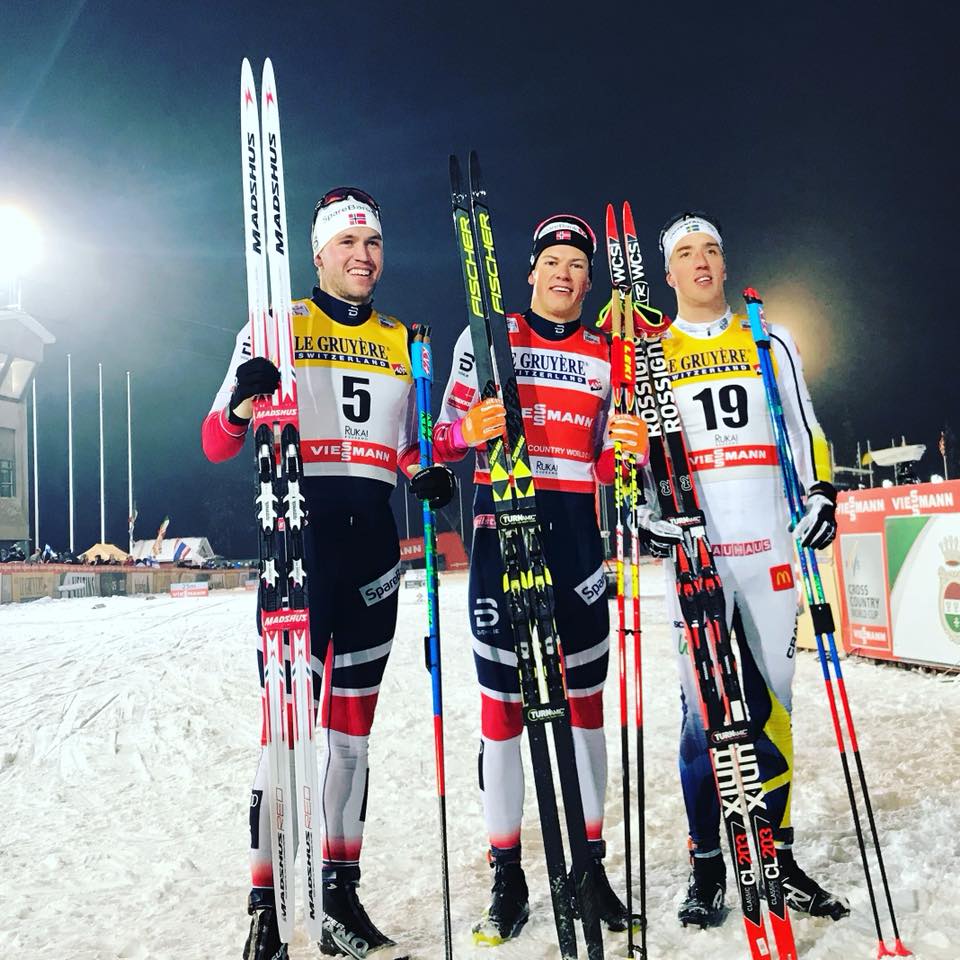
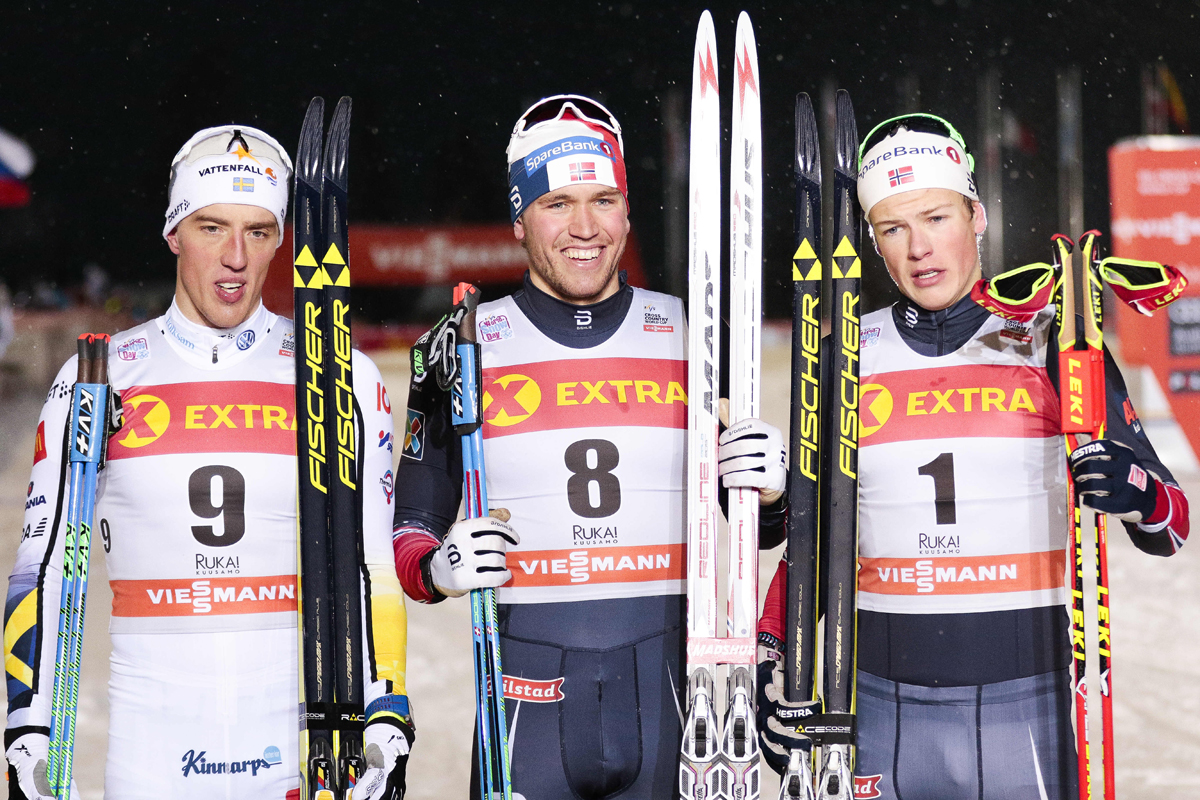
The men’s classic sprint podium in the first World Cup race of the season on Saturday in Kuusamo, Finland, with Norway’s Pål Golberg (c) in first, Sweden’s Calle Halfvarsson (l) in second, and Norway’s 20-year-old Johannes Klaebo (r) in third. (Photo: Fischer/NordicFocus)
Meanwhile, Golberg, a 26-year-old former Norwegian World Cup Team member, qualified eighth, 3.4 seconds back. From there, Klæbo in bib 1 rode his momentum all the way to the final, winning his quarterfinal and semifinal by charging to the front of the pack on the last of Ruka’s two sprint climbs: a grueling, 150-meter-long ascent into the stadium.
Golberg placed fourth in his quarterfinal, nipping Harvey by two-hundredths of a second for the final spot in the semifinals. That ended Harvey’s racing for the day and put the Canadian 25th overall.
“I knew it was a fast heat so I was hoping that fourth place would be lucky loser, so that’s what I was fighting for,” Harvey explained. “But in the end it was just not enough. But I never felt that I was totally out of it until I crossed the line and I knew I couldn’t come around Pål.”
While Harvey reflected that his skis may have had just a bit too much grip in the powdery conditions, Golberg had another chance in the semifinals. There, the Norwegian raced to second in another photo finish — this time with Klæbo.
“In the quarterfinals I had a pretty bad climb; I lost a few spots so I decided to stay more in the back in the semifinals and that worked out,” Golberg said in a post-race interview with FIS.
While Klæbo led his semifinal competitors into the last climb, Golberg pushed past Finland’s Ari Luusua to move into second by the top. In the last 250 or so meters of the race, which flattens out and curves left into the finish, Golberg chased down Klæbo and finished 0.02 seconds behind him. Both automatically advanced to the final, and considering theirs was the fastest of the two semifinals, so did Sweden’s Halfvarsson and Teodor Peterson in third (+0.42) and fourth (+1.17) in that heat.
In the final, Panzhinskiy — the lone Russian in the final (two Russians reached the women’s final) — set the pace out of the start while the two Swedes followed in second and third. Halfvarsson rode his faster skis on an early descent past Panzhinskiy, while Krogh lost contact with the group early.
With Panzhinskiy on one side of Halfvarsson and Klæbo on the other, the Russian and young Norwegian challenged the Swede up the first climb, but Halfvarsson kept his spot up front. Panzhinskiy drafted and passed him on the descent before the last climb, leading Klæbo, Halfvarsson and Golberg into the base of it, while Peterson stayed in contact in back. (Krogh was well out of camera range at this point.)
Halfvarsson pushed to move into first early in the climb while Golberg ran outside the track on the far left and seized the lead over the top. Peterson double poled behind Halfvarsson and Golberg raced away from the pack to secure the victory in 2:54.12. Halfvarsson stayed ahead of Klæbo and Peterson for second place (+0.75), while Klæbo, close on Halfvarsson’s heels, switched lanes with less than 100 meters to go to edge Peterson for third (+0.87). Peterson took fourth (+1.06), Panzhinskiy settled for fifth (+8.22), and Krogh came through the stadium casually, 1:12 minutes after Golberg in sixth.
According to Krogh’s hometown paper, Altaposten, he decided to save his energy for Sunday’s 15 k classic after failing to stay with the group early in the race. He stopped on the last hill to talk to coaches.
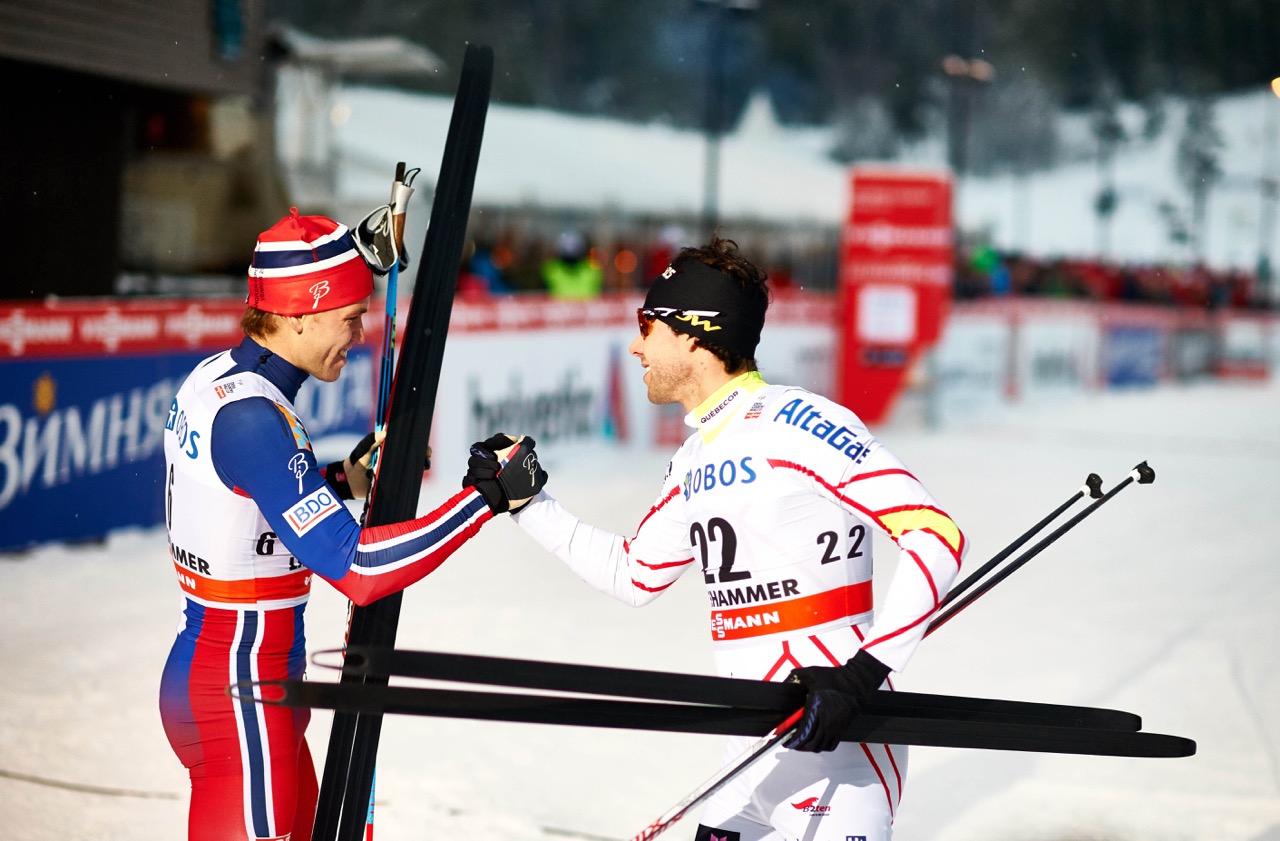
Canada’s Alex Harvey (r) congratulates Norwegian winner Pål Golberg at the finish of a 2014 World Cup freestyle sprint in December 2014. Harvey placed fifth in that race. (Photo: Fischer/NordicFocus)
At the finish, Golberg smiled as he patted Klæbo on the back. It was Klæbo’s first World Cup podium, and Golberg’s fourth career win.
“This means a lot to me,” Golberg told NRK after. “I know very well that I can ski fast, but it’s always nice to be able to remind others of that.
“It’s a bonus that I’m here,” he added. “I know that the members of the [national] team have first priority, and that makes even more to perform well.”
The win came a week after Golberg finished second to Klæbo by 0.5 seconds in a freestyle sprint FIS race in Beitostølen. On Saturday, Klæbo told NRK in a TV interview that he was very pleased with his second World Cup start. (He placed 15th in the Drammen classic sprint last season.)
“I didn’t chose the right tracks in the last hill and the end of the final, but I’m still happy about the third place,” Klæbo said.
It snowed Friday night and throughout the day on Saturday, making Ruka’s notoriously tough sprint course even more challenging. Harvey estimated there were three to five centimeters of fresh snow in the morning, and snow continued to fall into the afternoon. He said organizers didn’t groom after around midnight on Friday to avoid making the course even softer.
“These were quite difficult conditions with the new snow, but I had perfect skis,” Golberg told FIS. “Most important today was to have a good kick on the uphill. It is great to start the season with the win.”
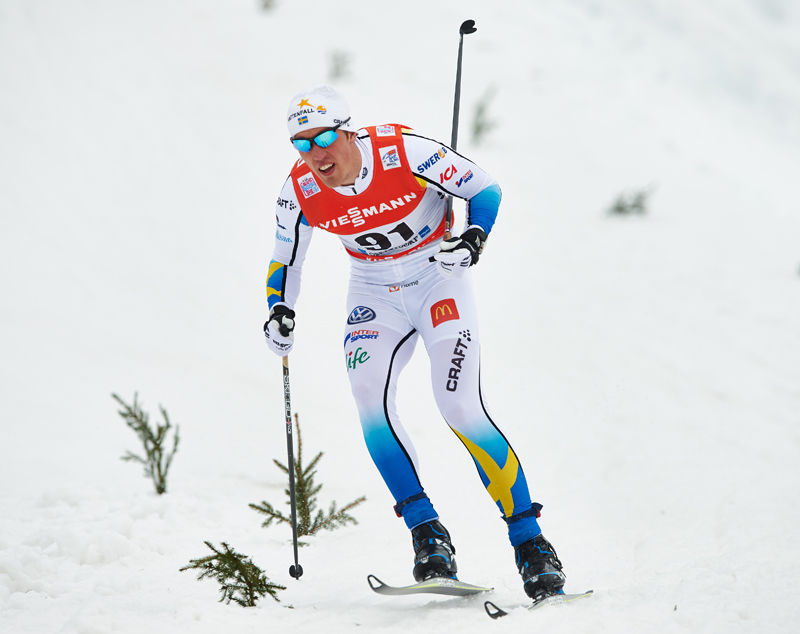
Sweden’s Calle Halfvarsson racing to second in the first stage of the 2015 Tour de Ski, a 4.4 k freestyle prologue, in Obertsdorf, Germany. (Photo: Fischer/NordicFocus)
For Halfvarsson, it was his first podium in a classic sprint and first time back on the podium in an individual World Cup since the Tour de Ski two years ago.
“I am very happy,” the 27-year-old Halfvarsson said. “[The] finish was really hard today. Pål was very strong there. The crowd was great.”
Harvey, who narrowly made the top-30 qualifying cutoff in 28th said he was happy to make the heats. He called Kuusamo one of the hardest places to qualify because of the depth of the field. Last year at the same venue, he placed 47th in the classic-sprint opener.
“Just qualifying made the day a positive day already,” he said. “It was a really tricky day to find the right combination of glide and kick at the same time. In the qualifier, I went for an option with kind of slick skis, but fast, and I think the skis were really fast in qualification, but I went maybe a little too thin on the grip so I came out of the track a little earlier than I would’ve hoped for, but it was still good enough to just sneak in there.”
For his quarterfinal, in which he faced Golberg, Halfvarsson, Russia’s Anton Gafarov, Norway’s Sondre Turvoll Fossli, and Finland’s Sami Jauhojärvi, Harvey went for more grip.
“Knowing that it would come down to the last climb, the strategy was to go for a little more kick,” Harvey said, adding that he decided the night before to go on faster, slicker skis for the qualifier then switch to more grip for the heats. “I think I might’ve just overdid it a little bit, but the skis were still good. They were still fast.”
Finding himself around fifth place for most of his quarterfinal, Harvey stayed in contact with the four frontrunners until the base of the last big uphill. Despite being several strides behind the group, he caught up to Golberg by the top.
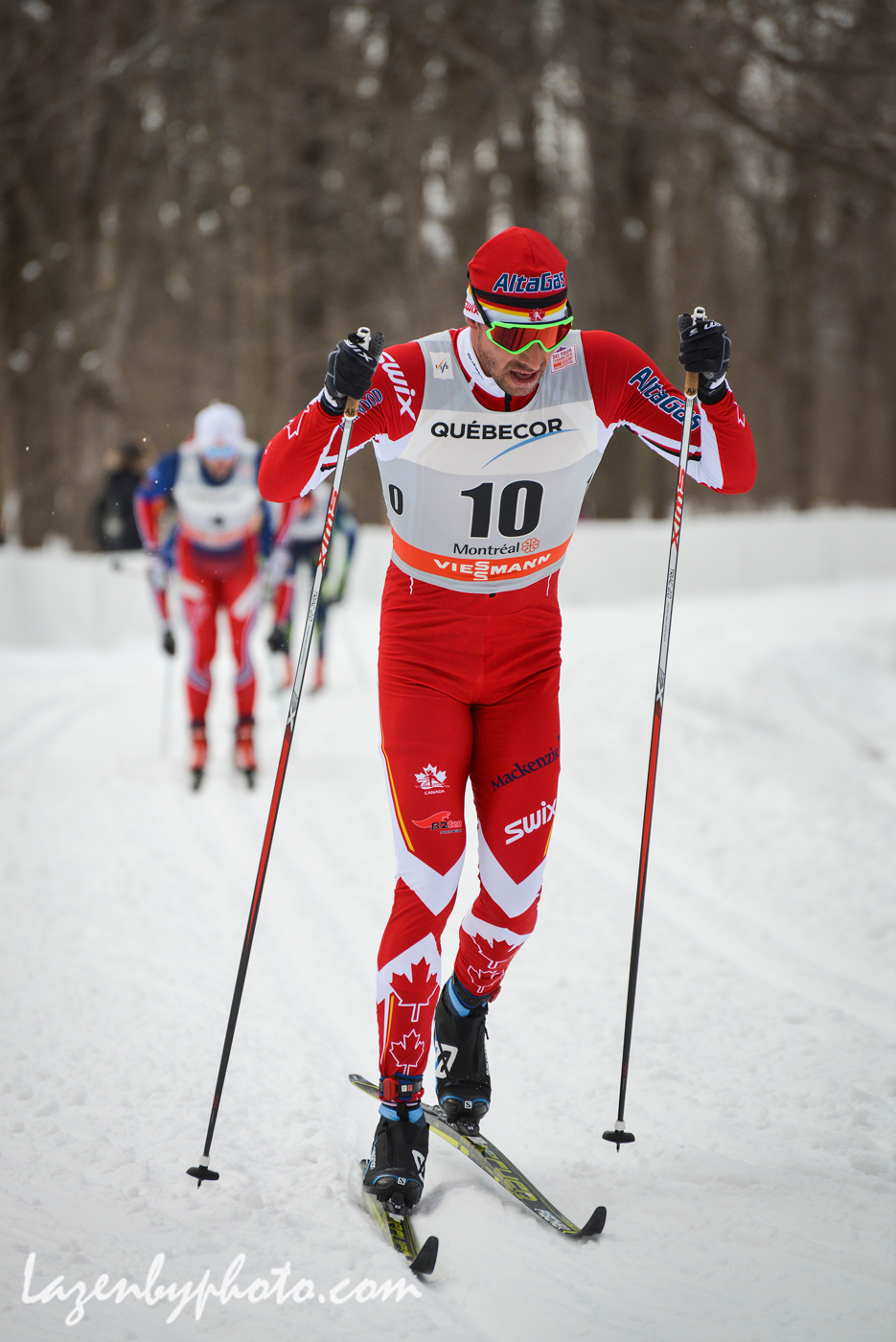
Canada’s Alex Harvey racing to ninth in the second stage of the 2016 Ski Tour Canada, the men’s 17.5 k classic mass start, in Montreal, Quebec. (Photo: John Lazenby/Lazenbyphoto.com)
“In the hill, I had the skis to make a move, but you need to be so quick up that hill and I’m better when there’s more of a gliding phase in each stride, and when it’s just running like that, I’m not as quick as some of the other guys so I kind of got stuck in fifth,” he said. “In the finish I was starting to come around Pål Golberg for lucky loser, it was a photo finish between us, but I knew he beat me before I saw the photo and in the end he ended up winning the day, and at the end of the day, I had the best two guys in my quarterfinal.”
All things considered, Harvey said he felt good. “I take a lot of positive out of the day but it was not perfect. I just have to be a bit stronger in the finish.”
The seventh-ranked man in the overall World Cup last season, Harvey was the lone North American qualify for the men’s sprint rounds on Saturday.
Andy Newell led the U.S. men in 40th, missing the top 30 by 0.48 seconds and finishing 7.74 seconds behind Klæbo. Another 0.07 seconds back, Newell’s teammate Erik Bjornsen placed 42nd (+7.81), and last year’s SuperTour winner Eric Packer finished 78th (+17.3) out of 94.
“It was unexpected for me not to make the top 30 today,” Newell wrote in an email. “I felt pretty decent, but then again have not done any maximal efforts in about two weeks because of my elbow infection so it was hard to tell. I think it was a combination of being a little flat and also dragging a little too much kick wax around the course.”
Andy Newell (U.S. Ski Team) on his way to 40th in the men’s classic-sprint qualifier in the first race of the 2016/2017 World Cup season on Saturday in Kuusamo, Finland. (Photo: Fischer/NordicFocus)
Saturday marked Newell’s first race of the season after having to sit out the Beitostølen opener with a bacterial infection.
“He healed up really quickly,” U.S. coach Matt Whitcomb said on the phone after Saturday’s race. “He’s been really smart in his preparation, he hasn’t been overreaching, and today I think he was a little bit flat. He wasn’t too far out; things were pretty tight. I think that’s as far as we have to look there. He’s been looking pretty good and I think it’s a matter of getting a race under his belt.”
Whitcomb said Newell would likely start Sunday’s 15 k classic, but Newell didn’t give a definitive answer.
“I will feel things out tomorrow and see how it goes,” Newell wrote. He was listed on Sunday’s start list.
Simi Hamilton did not start on Saturday, and Whitcomb said he’s trying to get over a small cold.
“[Not] a full-blown cold, but slightly elevated heart rate when he moves, and just general feelings of lower energy,” Whitcomb explained. “He was feeling quite a bit better yesterday so we had him do a short little race prep to test things out, about a half an hour of skiing, and it ended up sending him in the wrong direction, not dramatically but it gave us the information that we needed to say, ‘Hey, it’s not going to be smart to start today.’ ”
Len Valjas placed 54th for Canada, 11.28 seconds off of the top qualifying time, Devon Kershaw was 63rd on the day (+12.28), Knute Johnsgaard 69th (+13.46), Bob Thompson 80th (+17.64), and Jess Cockney 83rd (+19.52).
The Ruka stadium from above in Kuusamo, Finland. (Photo: Toko)
Welcome to The Rundown, your quick primer of need-to-know information about the day’s racing. We’ll be updating this digest as the day goes on with additional results, photos and quotes. The Rundown is NOT a race report; stay tuned for complete race reports later today with interviews from the day’s top racers.
***
West Yellowstone FIS Races: 5/10 k classic
Scott Patterson (APU) double poling to the win in the men’s 10 k classic FIS race on Saturday in West Yellowstone, Mont. (Photo: Ian Harvey/Toko)
Scott Patterson of Alaska Pacific University (APU) continued his winning streak on Saturday, topping the 10-kilometer classic FIS race at the Rendezvous Ski Trails in West Yellowstone, Mont. (In the two FIS races he’s competed in — the other being a 7.5 k freestyle last weekend in Fairbanks, Alaska — Patterson is undefeated.) He won Saturday’s classic race in 22:12.2 minutes, more than 20 seconds ahead of runner-up Matt Gelso, of the Sun Valley Ski Education Foundation (SVSEF), who placed second (+20.8). Ben Lustgarten, of the Craftsbury Green Racing Project (CGRP), improved on his fifth-place finish in Friday’s 10 k freestyle, reaching the podium in third (+23.4).
David Norris (APU) placed fourth (+30.0), Kevin Bolger (University of Utah) was fifth (+33.1), and Ben Saxton, of the Stratton Mountain School (SMS) T2 Team,was sixth (+38.9). Petter Reistad, of the University of Colorado-Boulder (CU), finished seventh (+45.7), Daniel Streinz (Mountain Endurance Sports) took eighth (+49.9), Friday’s winner Paddy Caldwell, of SMS, Dartmouth College and the U.S. Ski Team (USST), was ninth (+56.0), and Martin Mikkelsen (Utah) placed 10th (+1:00.8) out of 70 male finishers.
In the women’s 5 k classic, Craftsbury’s Liz Guiney took the win in 13:06, edging Utah freshman Merete Myrseth by just 0.3 seconds. Friday’s 5 k freestyle winner, Katharine Ogden (SMS/USST) reached the podium again in third (+11.1), Jesse Knori (CU) was fourth (+13.5), and Erika Flowers (SMST2) fifth (+18.2) on her 27th birthday.
Kaitlynn Miller (CGRP) took sixth (+21.8), Christina Rolandsen (CU) was seventh (+21.9), Petra Hyncicova (CU) eighth (+24.1), Guro Jordheim (Utah) ninth (+28.9), and Jennie Bender, of the Bridger Ski Foundation, 10th (+31.2), out of 74 female finishers.
While this weekend’s FIS races are over, West Yellowstone will host again next weekend, as Bozeman SuperTour organizers announced Friday afternoon that it was moving its races to West, its southern neighbor, because of a lack of snow. Next weekend’s SuperTour races will be the first of the season, featuring the originally planned freestyle sprints on Saturday, Dec. 3, and 10/15 classic races on Sunday, Dec. 4.
Katharine Ogden (SMS/USST) racing to third in the women’s 5 k classic FIS race on Sunday in West Yellowstone, Mont. (Photo: Ian Harvey/Toko)
Erika Flowers (SMST2) racing to fifth in the women’s 5 k classic FIS race on Saturday in West Yellowstone, Mont. (Photo: Ian Harvey/Toko)
Kaitlynn Miller (CGRP) racing to sixth in the women’s 5 k classic FIS race on Saturday in West Yellowstone, Mont. (Photo: Ian Harvey/Toko)
Deedra Irwin (SVSEF) racing to 11th in the women’s 5 k classic FIS race on Saturday in West Yellowstone, Mont. (Photo: Ian Harvey/Toko)
Anne Hart (SMST2) racing to 12th in the women’s 5 k classic FIS race on Saturday in West Yellowstone, Mont. (Photo: Ian Harvey/Toko)
Jessica Yeaton (APU) racing to 15th in the women’s 5 k classic FIS race on Saturday in West Yellowstone, Mont. (Photo: Ian Harvey/Toko)
Scott Patterson (APu) racing to first in the men’s 10 k classic FIS race on Saturday in West Yellowstone, Mont. (Photo: Ian Harvey/Toko)
Matt Gelso (SVSEF) racing to second in the men’s 10 k classic FIS race on Saturday in West Yellowstone, Mont. (Photo: Ian Harvey/Toko)
Matt Gelso (SVSEF) racing to second in the men’s 10 k classic FIS race on Saturday in West Yellowstone, Mont. (Photo: Ian Harvey/Toko)
Ben Lustgarten (CGRP) racing to third in the men’s 10 k classic FIS race on Saturday in West Yellowstone, Mont. (Photo: Ian Harvey/Toko)
Ben Lustgarten (CGRP) racing to third in the men’s 10 k classic FIS race on Saturday in West Yellowstone, Mont. (Photo: Ian Harvey/Toko)
David Norris (APU) leading Nick Power (157), of the Bridger Ski Foundation, during the men’s 10 k classic FIS race on Saturday in West Yellowstone, Mont. Norris placed fourth and Power was 19th. (Photo: Ian Harvey/Toko)
David Norris (APU) racing to fourth in the men’s 10 k classic FIS race on Saturday in West Yellowstone, Mont. (Photo: Ian Harvey/Toko)
Ben Saxton (SMST2) racing to sixth in the men’s 10 k classic FIS race on Saturday in West Yellowstone, Mont. (Photo: Ian Harvey/Toko)
Ben Saxton (SMST2) racing to sixth in the men’s 10 k classic FIS race on Saturday in West Yellowstone, Mont. (Photo: Ian Harvey/Toko)
Cole Morgan (SVSEF) racing to 12th in the men’s 10 k classic FIS race in late November in West Yellowstone, Mont. (Photo: Ian Harvey/Toko)
Welly Ramsey (Farmington Ski Club) racing to 23rd in the men’s 10 k classic FIS race on Saturday in West Yellowstone, Mont. (Photo: Ian Harvey/Toko)
Welly Ramsey (Farmington Ski Club) racing to 23rd in the men’s 10 k classic FIS race on Saturday in West Yellowstone, Mont. (Photo: Ian Harvey/Toko)
***
FIS Cross-Country World Cup in Ruka: Classic sprint:
Sweden’s Stina Nilsson (top and bottom center) won her first World Cup classic sprint on Saturday in the first race of the 2016/2017 World Cup season. Norway’s Maiken Caspersen Falla (bottom right) placed second and Heidi Weng (bottom left) was third. (Photo: FIS Cross Country Twitter)
Sweden’s Stina Nilsson and Norway’s Pål Golberg emerged as the big winners on Saturday in the first race of the 2016/2017 FIS Cross-Country World Cup season, winning the women’s and men’s 1.4-kilometer classic sprint finals, respectively, in Kuusamo, Finland.
After qualifying second, Nilsson won both her quarterfinal and semifinal before dethroning Norway’s Maiken Caspersen Falla in the final. Falla had not lost a World Cup classic sprint since February 2015 (two seasons ago in Östersund, Sweden). Falla won her quarterfinal and placed third in her semifinal, advancing to the final as a lucky loser with Finland’s Krista Parmakoski. There, Nilsson held off Falla by 0.17 seconds and won the final in 3:21.61. Heidi Weng was the second Norwegian on the podium in third (+0.69), finishing ahead of two Russians, Natalia Matveeva (4th, +3.18) and Yulia Belorukova (6th, +8.94) and Parmakoski (5th, +5.12).
“This is also my first victory in classic so I’m very, very happy,” Nilsson told FIS in an on-air, post-race interview.
Norway’s Pål Golberg (r) crossing the finish line a few ski lengths ahead of his competition in the men’s classic sprint final on Saturday at the World Cup opener in Kuusamo, Finland. Sweden’s Calle Halfvarsson placed second, and Norway’s Johannes Klæbo edged Sweden’s Teodor Peterson (l) for the final podium spot in third. (Photo: NRK screenshot)
In the men’s final, Golberg surged past his competitors on Ruka’s infamous final climb and held off Sweden’s Calle Halfvarsson by 0.75 seconds for the win. Golberg found out on Wednesday of this week that he had been tapped for the sprint, after fellow Norwegian Petter Northug opted out of this weekend.
“I knew my shape was good, but the skiers from the national team are good skiers so that’s why I wasn’t supposed to be here but Petter got sick so that’s why I’m here,” Golberg told FIS in a post-race interview. “In the quarterfinals, I had a pretty bad climb [on the final hill]. I lost a few spots so I decided to stay more in the back in the semifinals and that worked out.”
The men’s classic sprint podium in the first World Cup race of the season on Saturday in Kuusamo, Finland: Norway’s Pål Golberg (c) placed first, Sweden’s Calle Halfvarsson (l) was second, and Norway’s 20-year-old Johannes Klaebo (r) was third. (Photo: FIS Cross Country Twitter)
After placing fourth in his quarterfinal, Golberg advanced as a lucky loser. In the semifinals, he placed second to ensure his spot in the final. He won the final in 2:54.12, Halfvarsson was second (+0.75) and Norway’s 20-year-old JohannesKlæbo captured his first World Cup podium in his second-ever World Cup in third (+0.87). Sweden’s Teodor Peterson narrowly missed the podium in fourth (+1.06), Russia’s Alexander Panzhinskiy was fifth (+8.22), and Norway’s Finn Hågen Krogh finished more than a minute later in sixth (+1:12.58).
In her comeback season after having a baby last December, Norway’s Marit Bjørgen placed 10th after finishing fifth in her semifinal (she qualified in 10th and was second in her quarterfinal). Another top Norwegian, Ingvild Flugstad Østberg placed seventh on the day after placing third in the Bjørgen’s semifinal.
The top American, Sadie Bjornsen posted the seventh-fastest qualifying time then finished the day in 17th overall. She placed fourth in her quarterfinal. Also for the U.S. Ski Team, Sophie Caldwell placed 20th (after qualifying in 30th then placing fourth in her quarterfinal), Ida Sargent was 23rd (qualified 23rd and was fifth in her quarterfinal), and Jessie Diggins 26th (13th in the qualifier, sixth in her quarterfinal).
The lone North American man in the heats, Alex Harvey of Canada placed 25th overall after qualifying in 28th then placing fifth in his quarterfinal. The two men directly ahead of him in his quarterfinal, Russia’s Anton Gafarov and Golberg, placed third and fourth respectively, and advanced to the semifinals as lucky losers.
In the morning’s sprint qualifier, Parmakoski andKlæbo posted the top times.
Parmakoski notched a 1.14-second qualifying win, ahead of three Swedish sprinters.Nilssonand Ida Ingemarsdotter finished second and third, +1.14 and +2.40 respectively. Their teammate Hanna Falk qualified in fourth (+3.70) ahead of Justyna Kowalczyk of Poland (+3.93).Østbergwas the top Norwegian, qualifying in sixth (+4.05).
Sadie Bjornsenled the U.S. team by qualifying in seventh (+4.41). Three teammates joined her in the quarterfinals:Diggins(13th, +6.27),Sargent(23rd, +10.28), andCaldwell(30th, +11.84).
A fifth U.S. Ski Team (USST) member, Rosie Brennan missed the heats in 44th (+15.28), and in her return to the World Cup after a year of maternity leave, Kikkan Randall (USST) finished 52nd, tied with Craftsbury’s Caitlin Patterson (+19.75). For Canada, U25 Team skiers Dahria Beatty raced to 50th (+18.80), followed by Cendrine Browne in 62nd (+26.05).
Klæbo eked out a narrower victory in the qualifier, edging Russia’sPanzhinskyby just 0.81 seconds. Marko Kilp of Estonia qualified third, +2.01, followed by two Finns: Ari Luusua (+2.18) and Anssi Pentsinen (+2.22).Petersonof Sweden rounded out the top six (+2.31).
The lone North American qualifier wasHarveyin 28th (+6.94). His Canadian teammates were left out of the heats: Len Valjas 54th (+11.28), Devon Kershaw 63rd (+12.28), Knute Johnsgaard 69th (+13.46), Bob Thompson 80th (+17.64), Jesse Cockney 83rd (+19.52), and Andy Shields 91st (+25.07).
Simi Hamilton did not start for the U.S., and according to U.S. coach Matt Whitcomb, he is fighting a small cold. Andy Newell led the team in 40th (+7.74), shortly followed by Erik Bjornsen in 42nd (+7.81). SuperTour leader Eric Packer of Alaska Pacific University finished 78th (+17.30).
The World Cup continues Sunday with the 10/15 k classic individual starts in Ruka.
FIS Nordic Combined World Cup in Ruka: Individual Large Hill/10 k
In the first Nordic Combined World Cup competition of the season, also in Kuusamo, Akito Watabe of Japan won the jumping round with a total of 145 points. Johannes Rydzek of Germany jumped into second. After jumping Bryan Fletcher was sitting in 32nd place for the U.S. and Ben Berend in 38th. The Americans started the cross-country race 3:54 and 4:08 behind Watabe.
In the 10 k Gundersen start, Fletcher improved to 23rd and Berend did not start. Fletcher finished 4:06.5 behind the winner of the day, Rydzek, who won in 27:31.7. Germany took the top two spots on the podium with Eric Frenzel in second (+34.1). Frenzel skied the fastest course time in 26:52.8, moving up six spots after ranking eighth in the jump.
Norway’s Jørgen Graabak placed third (+45.6) and Watabe ultimately finished seventh (+1:23.5). The World Cup continues Sunday in Kuusamo with another large hill/10 k individual competition.
Ida Sargent of the U.S. Ski Team racing last season in a classic-sprint qualifier at the World Cup in Ostersund, Sweden. She placed 41st and did not make the heats. On Friday, Sargent placed seventh in the first World Cup of the season: the Ruka classic sprint in Kuusamo, Finland. (Photo: Fischer/NordicFocus)
With the sun barely peeking over the horizon in northern Finland, the 2015/2016 World Cup kicked off Friday morning with the Ruka Triple mini-tour in Kuusamo.
For the U.S. women, four of seven racers in the 1.4-kilometer classic sprint made the top 30 to qualify for the heats, with Sadie Bjornsen in 18th, Sophie Caldwell in 27th, Jessie Diggins in 29th, and Ida Sargent in 30th.
That’s why the story of Sargent finishing seventh, one spot shy of the final, is a good one.
At the top of the final results, Norway’s Maiken Caspersen Falla took the win in 2:58.23, after lunging at the line to beat Sweden’s Stina Nilsson in second (+0.26). Norway occupied two of the three podium places, Ragnhild Haga 1.08 seconds behind Falla in third. Another Norwegian, Invild Flugstad Østberg was fourth (+2.85), Sweden’s Ida Ingemarsdotter was fifth (+5.89), and the fourth Norwegian in the stacked final, Heidi Weng was sixth (+7.83).
Sargent, who advanced as a lucky loser out of her quarterfinal in third (behind Falla and Østberg, respectively), narrowly missed the final after placing third again in her semifinal. She finished 0.61 seconds behind Weng, the semifinal winner, and less than four-tenths of a second behind Ingemarsdotter, who advanced in second.
Bjornsen also raced in that semifinal after winning her quarterfinal in a photo finish with Sweden’s Evelina Settlin. In the semi, Bjornsen was sixth, 8.61 seconds behind Weng, which put her 12th overall on the day. Caldwell and Diggins both placed fifth in their quarterfinals and did not advance for 23rd and 25th overall, respectively.
In a phone interview after the race, U.S. women’s coach Matt Whitcomb reflected that going into this weekend, the team wanted more than a tepid start to the season.
“I’m really happy with the day; we started the season last year with a good race here from Ida,” he said, referring to Sargent’s career-best fifth in the Kuusamo classic sprint. “But in general, as a team, the first couple of weekends were more of a soft launch. We didn’t like it, the fans didn’t like it, the athletes didn’t like it. So our team cheer last night was ‘fast start.’ ”
For Sargent, perhaps the qualifier wasn’t the fast start she was hoping for, but the 27-year-old classic sprint specialist squeaked into the heats by 0.1 seconds just days after recovering from a nasty cold. (Sargent skipped last weekend’s pre-World Cup tuneup in Gällivare, Sweden, due to illness.)
Asked about expectations coming into the World Cup opener, Sargent said in a post-race phone interview that she was realistic.
“I just wasn’t really sure what to expect. I got healthy in time, but [Thursday] was my first training day again, and the first day I did intensity,” she said. “I just did a lap of the course, Level 3, and felt horrible. So I just tried not to have any expectations and just get the season going and do everything I could on that day and bring everything that I had today.”
As the last skier to qualify for the quarterfinals, Sargent took a breath, and settled into visualizing a successful run. “When I was 30th, I was like, ‘Well, that’s great!’” she said. “For me that was as good as winning the qualifier. It was just like making it through, and I knew I had a fresh start.”
No stranger to Ruka-sprinting success, Sargent says her results there have more to do with the course profile than the time of year. The sprint course features two climbs, the second of which leads up to the stadium home stretch and can extinguish a skier’s best effort. That hill, the spot where most of the day’s races were decided, was something of an asset for Sargent.
“This is a course that I love,” she said. “I think it’s the course. I like striding a lot. And this one has big hill to stride up. It just works well for me having the steep hills to stride up. I’m kind of as a smaller sprinter. I do well on hillier courses.”
In Sargent’s quarterfinal heat, she tried to ski in control and time the last hill. There, she began charging as the incline steepened.
“It was really fun to be right in there with those girls who are frequently on the podium and feel like I was going head-to-head with them,” she said. “Even when I finished and was in the finish area, Maiken Caspersen Falla says to me like, ‘I think you’ll be fine. I think we went fast enough,’ or something like that. And as it turned out it was like an insanely fast heat.”
Turns out, it was fast. Sargent qualified as a lucky loser, moving into the semifinals.
U.S. Ski Team member Sadie Bjornsen (second from left in white) races to win her quarterfinal. On the first day of the World Cup season and Ruka Triple mini tour, she finished 12th overall after placing sixth in her semifinal. (Photo: Fischer/NordicFocus)
For the U.S. women, the other highlight was Bjornsen.
Like Sargent, she also missed last week’s races due to illness.
“The funny thing here, those are the two athletes that were sick last week in Gällivare,” Whitcomb said. “And it just is one to remember … that a sickness one week does not mean bad results the next week. … When you get sick, one thing that happens is you recover a little bit.”
But sickness obviously isn’t a cure-all.
“When you are sick, the confidence can be shattered somewhat quickly,” Bjornsen said after Friday’s race on the phone. “So yeah, I would say the confidence sort of came back yesterday and today.”
Bjornsen skied steadily and with intent, coming from behind to hold off and out-double-pole Settlin to win her quarterfinal. For the third time in her World Cup career, she moved on to the semis.
And for most of her semifinal, while racing alongside Sargent, she stayed in the mix.
Bjornsen’s race derailed as she strided up the make-or-break final hill. She chose a glazed track far to the right.
“It got really slippery and I didn’t have the knowledge to jump out of the track and run up the side,” Bjornsen said. In the track, her skis iced slightly and she slipped and fell.
Yet even that mishap became a take-away moment for the emerging all-arounder.
“Unfortunately, I kind of iced on the top and fell over and had to pick myself back up with the most flooded legs in the world. I was disappointed in how the semifinals went because I felt like I wanted to win that one,” she said. “It was a great lesson because you just have so much to learn every time you sprint race. And now I realize it doesn’t hurt to jump out the track and make a decision like that.”
While Bjornsen righted herself atop the hill, Sargent charged ahead. At the top of the climb, the course arcs left into a final double-pole finishing stretch. There, Sargent pulled ahead of Norway’s Katherine Rolsted Harsem to move into third and pushed for second, but came up just short.
“It was a little frustrating to just miss out on the finals,” she said. “It was kind of like a lunge with those other girls for second and third but I think Ida Ingemarsdotter and I have had lunged in the past three or four years here and kind of go back and forth with who wins it.”
Ingemarsdotter has the height advantage of the two Idas: at 5-foot-9, she is five inches taller than Sargent.
Regardless, after finishing seventh on the day, Sargent left wanting more.
Sophie Caldwell (U.S. Ski Team) during the women’s 1.4 k classic-sprint qualifier in Kuusamo, Finland. She qualified for the first time in Kuusamo in 27th and went on to place 23rd overall. (Photo: Fischer/NordicFocus)
For Diggins, she wanted just a bit more track. Coming off wins in both Gällivare races last weekend, Diggins left her quarterfinal race chomping for just 20 more feet of straightaway before the finish. Despite not advancing into the semis, Diggins wrote in an email that her outlook remains positive.
“I was really, really happy with today’s race. It was the first time I’ve ever made the heats in a [World Cup] classic sprint, and I’ve been working so hard to improve my classic technique that it feels so good to see it all pay off!” she wrote.
In the Gällivare classic sprint, a International Ski Federation (FIS) race, Caldwell placed second to stand on the podium with Diggins. A week later, her World Cup season debut also ended in quarterfinals, but like her teammates, Caldwell’s lasting impression is a good one.
“I think last week’s race was a positive indicator of where my fitness and sprinting is right now, so I used it as a boost of confidence going into the sprint today,” Caldwell wrote in an email. “I was happy with the day. It was the first time I’ve qualified in Kuusamo and left me hungry for more.”
Overall standings for the U.S. women in the Ruka mini tour are as follows: Sargent is seventh, Bjornsen 12th, Caldwell 23rd, Diggins 25th, Rosie Brennan 42nd, Caitlin Gregg 81st, and Liz Stephen 84th.
With two distance races remaining, none of the women are out of the picture.
“These tours are really fun because you can come from 90th place on the first day and up inside of the top 15 by the last day,” Whitcomb said. It’s always the goal to have three good-or-better races, but like any sport, you can kind of drop a race and put together two great ones and so end up with a good final result.”
Racing will continue for the women on Saturday with a 5 k freestyle individual start.
Lenny Valjas (second from l, in red) heads out of the start of his quarterfinal during Friday’s 1.4 k classic sprint at the Ruka World Cup in Kuusamo, Finland. He placed fifth in his heat for 22nd overall in the sprint. He currently ranks 25th in the mini tour.
(Note: Based on two different formats of results on the FIS website, there was some discrepancy over whether Valjas placed 22nd or 25th. This article has been amended to show that he placed 22nd based on the PDF version of the final results.)
There are a couple reasons the cross-country World Cup starts in Kuusamo, Finland, each year. For one, it’s almost a sure-bet for snow in November. It’s also really, really hard.
“After training in North America all summer, this is the first chance that we have to compare against European athletes,” Canadian World Cup sprinter Lenny Valjas said on the phone after Friday’s 1.4-kilometer classic sprint — the first race of the World Cup season held annually in Kuusamo.
It’s also the first of a three-day mini tour, the Ruka Triple, and on Friday, Valjas was the lone Canadian to qualify and ended up 22nd on the day.
He was one of eight Canadians to race: after him, Alex Harvey missed qualifying in 47th, Jess Cockney was 65th, Devon Kershaw was 88th, Ivan Babikov 96th, last year’s NorAm leader Michael Somppi 97th, and Graeme Killick 103rd of 115 men. In the women’s sprint, Emily Nishikawa finished 58th of 86.
Canada’s Lenny Valjas during of the World Cup classic-sprint qualifier in Drammen, Norway. Valjas qualified 19th and placed 14th overall. (Photo: Fischer/Nordic Focus)
According to Canadian Head Coach Justin Wadsworth, with temperatures right around freezing, waxing difficulties were a factor in some of his athletes’ results.
“We went for a little more grip, which seemed to work for the most part, though there was a bit of icing up in the qualifier,” Wadsworth said.
Some skiers used klister and some went on hairies, U.S. Ski Team member Andy Newell explained. He went for a klister-covered wax and ended up fourth overall.
Valjas said he thought the Canadians has “the best grip of all nations.” The trouble was, they had to deal with hard, icy track, four centimeters of west snow from the night before, and windy, changing conditions throughout the day.
“Today’s goal was just to qualify and to make it into the points. There was no huge expectations,” he explained, adding that specific results are always a bit of an unknown at this point in the season.
He qualified in 22nd, 8.32 seconds behind Norway’s Pål Golberg, who won the qualifier in 2:32.62. In the quarterfinal, Valjas placed fifth, 4.61 seconds behind the winner of his heat, Norway’s Petter Northug. Northug went on to finish third in the final. Also in their quarterfinal, Sweden’s Teodor Peterson placed second (+0.2) and France’s Baptiste Gros was 0.52 seconds back in third.
“Len’s skis seemed to be slow in his quarterfinal,” Wadsworth observed.
Valjas said his race strategy included being quick off the start, staying in the middle of the pack and hammering up the last hill in order to advance to the semis. A quick start was essential.
“For me, it is difficult to pass from the back to the front,” he said.
On a downhill, he slipped from third to last, which may have been due to trouble with glide.
For Valjas, the Kuusamo course has been both “terrible and amazing,” he said. Slick conditions made it more difficult than usual, he said, with tracks that were “broken and wide, especially the downhill corners, which were icy and hard to get an edge on, just super sketchy.”
With the option to pick his quarterfinal heat, Valjas chose to race with Northug, figuring Northug would set a slower pace. Northug’s quarterfinal win ended up being the second slowest (Italy’s Federico Pellegrino was slower en route to the win), but that meant Valjas needed to be first or second behind him to advance to the semifinals.
While that didn’t happen and his race ended there, Valjas wasn’t too concerned. He said he was confident his form would progress according to plan. After dealing with injuries the last two seasons, he’s happy to be qualifying in the first place.
As for the rest of the weekend, Valjas will race the 10 k skate and 15 k classic pursuit “as long as I remain in good contention throughout the weekend,” he said.
According to Wadsworth, the rest of the Canadians also felt good on Friday, despite not having the quantitative results. Harvey was reported as feeling good, “but just not as sharp” at this point in the season, Wadsworth said. He added that Kershaw was frustrated with his skis as they seemed to be icing up on the hills.
Nishikawa told Wadsworth she felt good, “which is the main thing, as she’s a distance racer,” he said. He remained confident for Sunday’s overall mini-tour finishes as his athletes “don’t always perform well at this stage in the season, especially on a classic course like this,” he said.
“Ideally we would want a better start [to the season], but it is what it is, we have to be patient and we’re focusing on the positives for now,” he added.
All of the Canadians were expected to race in all three events this weekend, and Nishikawa will remain the lone women’s starter.
“We’d love to start more women in Kuusamo, but our funding is limited and only people who have been in the top 30 will be starting this [World Cup] period #1,” Wadsworth explained in an email. “However, we do have a trip racing WC period #2 where there are more women (4) selected then men (1) (as is the case with our development team that was named this year).”
Expanding on this, he said Knute Johnsgaard and four women from the national-development team (Olivia Bouffard-Nesbitt, Cendrine Browne, Dahria Beatty, Katherine Stewart-Jones) will race Period 2 World Cups in Slovenia and the Czech Republic. Nishikawa will also be part of that trip, while the Tour de Ski participants will be chosen based on World Cup points in Period 1.
Norway’s Sondre Turvoll Fossli, 22, crosses the line first for his first World Cup victory in the first World Cup of the 2015/2016 season in Kuusamo, Finland. His teammates Eirik Brandsdal (second from r) and Petter Northug (third from r) placed second and third, and American Andy Newell (second from l) was fourth in the first of the three-day Ruka mini tour.
A quick glance of the men’s final results in Friday’s classic sprint — the season-opening World Cup in Kuusamo, Finland — reveal the same old story: a Norwegian podium sweep.
But look closer. At age 22, Sondre Turvoll Fossli won his first World Cup and American Andy Newell placed fourth for his best World Cup result since he finished fourth in a classic sprint three seasons ago in Davos, Switzerland.
While Fossli took charge and won the 1.4-kilometer sprint final in 2:33.07, ahead of fellow Norwegian World Cup sprinter Eirik Brandsdal in second (+1.03) and all-around skier Petter Northug in third (+1.65), Newell was 1.11 seconds off the podium in fourth.
The all-Norwegian men’s Ruka classic sprint podium on Friday in Kuusamo, Finland, with winner Sondre Turvoll Fossli (c), runner-up Eirik Brandsdal (l) and Petter Northug in third.
The 31-year-old U.S. Ski Team sprinter reached the final by the slimmest of margins as a lucky loser two times over. In a photo finish for third in his quarterfinal, Newell ended up 0.03 seconds behind Russia’s Alexey Petukhov. Yet both advanced to the semifinals based on time.
Then, in the first semifinal, against Fossli, Brandsdal, Sweden’s Emil Jönsson, Russia’s Nikita Kriukov, and Finland’s Matias Strandvall, Newell nipped Jönsson for third — another photo finish separated by 0.03 seconds. Both Newell and Jönsson advanced to the final as lucky losers behind Fossli and Brandsdal, who placed first and second in that heat.
In the final, Fossli pushed the pace early and initially led with Sweden’s Teodor Peterson. By the final hill — an infamously tough climb back up to the Ruka stadium — Fossli was in a league of his own, ahead of the field and charging for the win.
At the bottom of the climb, Newell followed Fossli in second with Brandsdal and Northug closing on him from behind. They passed him along the long ascent to the top, and Newell hung on for fourth, finishing about a second ahead of Peterson in fifth. Jönsson placed sixth, 22 seconds behind the winner.
“I think Kuusamo is one of the toughest sprints of the season,” Newell told FasterSkier in a phone interview after the race. “So I know if I can have a shot at the podium here I can have a shot at the podium any race this year, and I’m excited about that.”
After the finish, Fossli, who learned Monday that he would race the opening sprint in place of Ola Vigen Hattestad, gleamed over his first World Cup victory. Hattestad and his girlfriend, Slovenian skier Katja Višnar, welcomed the birth of their first child earlier this week, according to FIS.
“It was great, third last year and first place now,” Fossli told FIS after his stage win on Friday. At this same venue last year, he placed third in the Ruka classic sprint, behind Brandsdal and Northug, respectively. “I’m really happy and I hope I will stay there.”
Stay tuned for complete report, along with a recap of the U.S. women’s finishes, led by Ida Sargent in seventh.