From the FasterSkier archive — posts syndicated from athletes’ and coaches’ own blogs between 2004 and 2012, kept online as published. Current coverage is at fasterskier.com.

Tag: Ruka sprint

  • New Season, Same Swedes: Ribom Notches First Career World Cup Win, Kern Strong into Semis

    New Season, Same Swedes: Ribom Notches First Career World Cup Win, Kern Strong into Semis

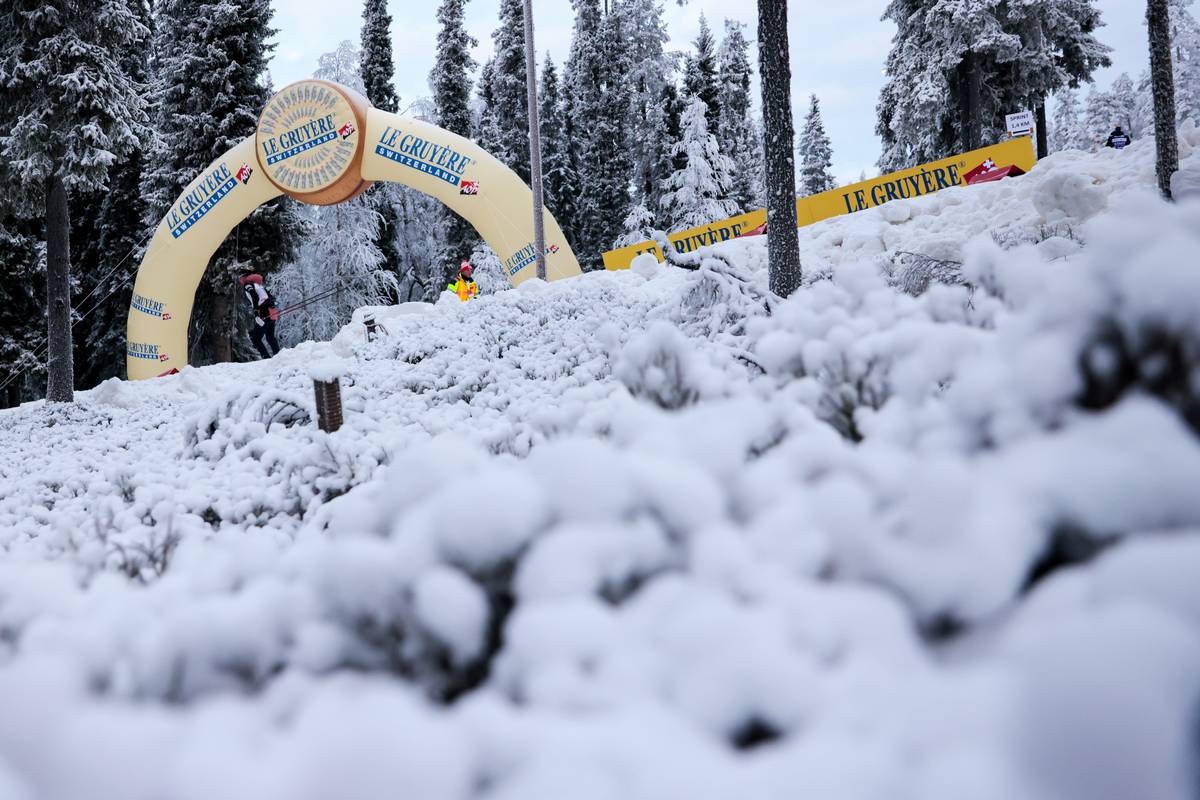
    Ruka covered in a fresh layer of frost ahead of the first World Cup race of the season Friday. (Photo: NordicFocus).

    This World Cup coverage is made possible through the generous support of Marty and Kathy Hall and the A Hall Mark of Excellence Award.  To learn more about A Hall Mark of Excellence Award or to learn how you can support FasterSkier’s coverage please contact info@fasterskier.com.

    The temperature was a balmy -11℃ (12℉). A glow hung in the sky and new snow decorated the trees; a welcoming winter scene in Ruka, Finland. With the FIS Cross-Country World Cup making its start there on Friday, the crisp, clear, sub-arctic conditions seemed to be an indicator of good things ahead.

     

    Ruka’s 1.4 k classic sprint course remains unchanged from previous years. (To see a breakdown on this course, check out our video from 2018 with Andy Newell here). The straightforward read on the Ruka loop is that for all the jockeying and positioning possible in the first 1 k of rolling terrain, the last hill—the big one—plays an outsized role in deciding who wins. Yet, the critical read on why it has produced such awesome racing over the years is that the place in the racing calendar is just as important. The jitters and nerves of an entire offseason bear down on skiers in a way where the decisive moments in a day come not on the hill meant to test their mettle, but in the moments before where they know that test is coming. Don’t miss the forest for trees. Don’t miss the whole race because of the big hill.
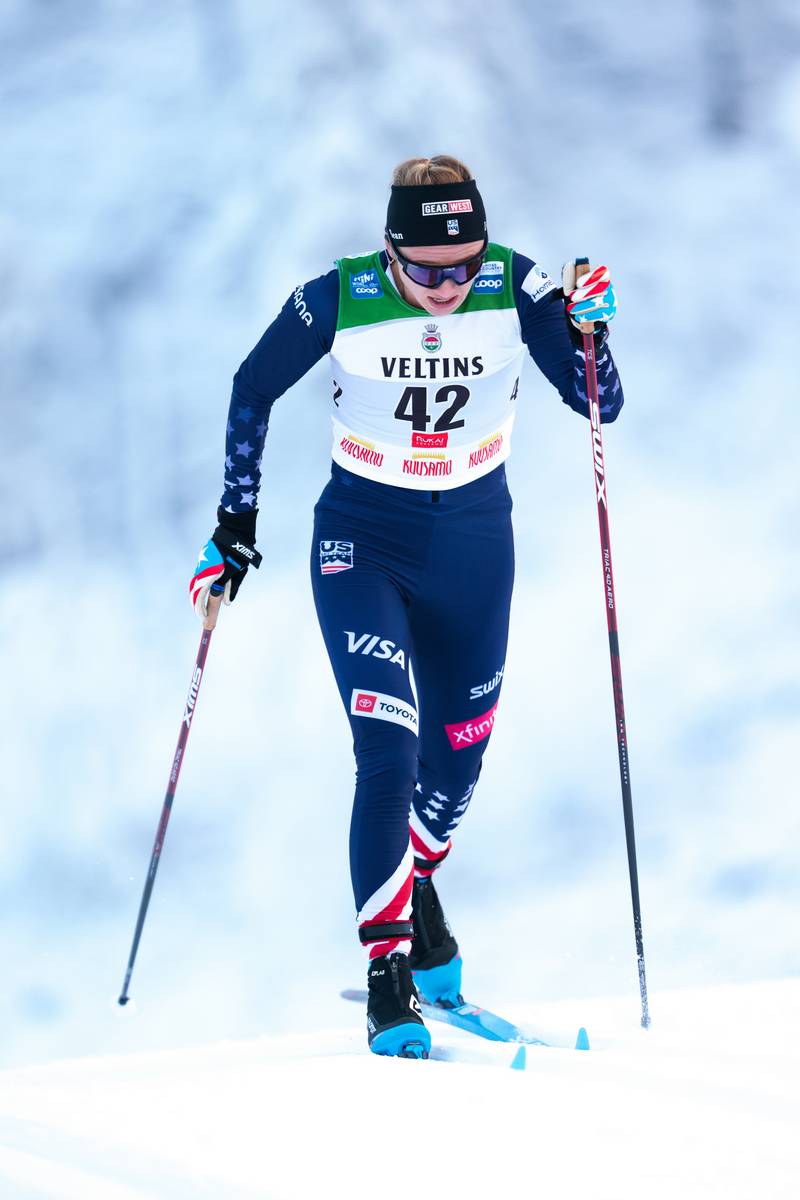
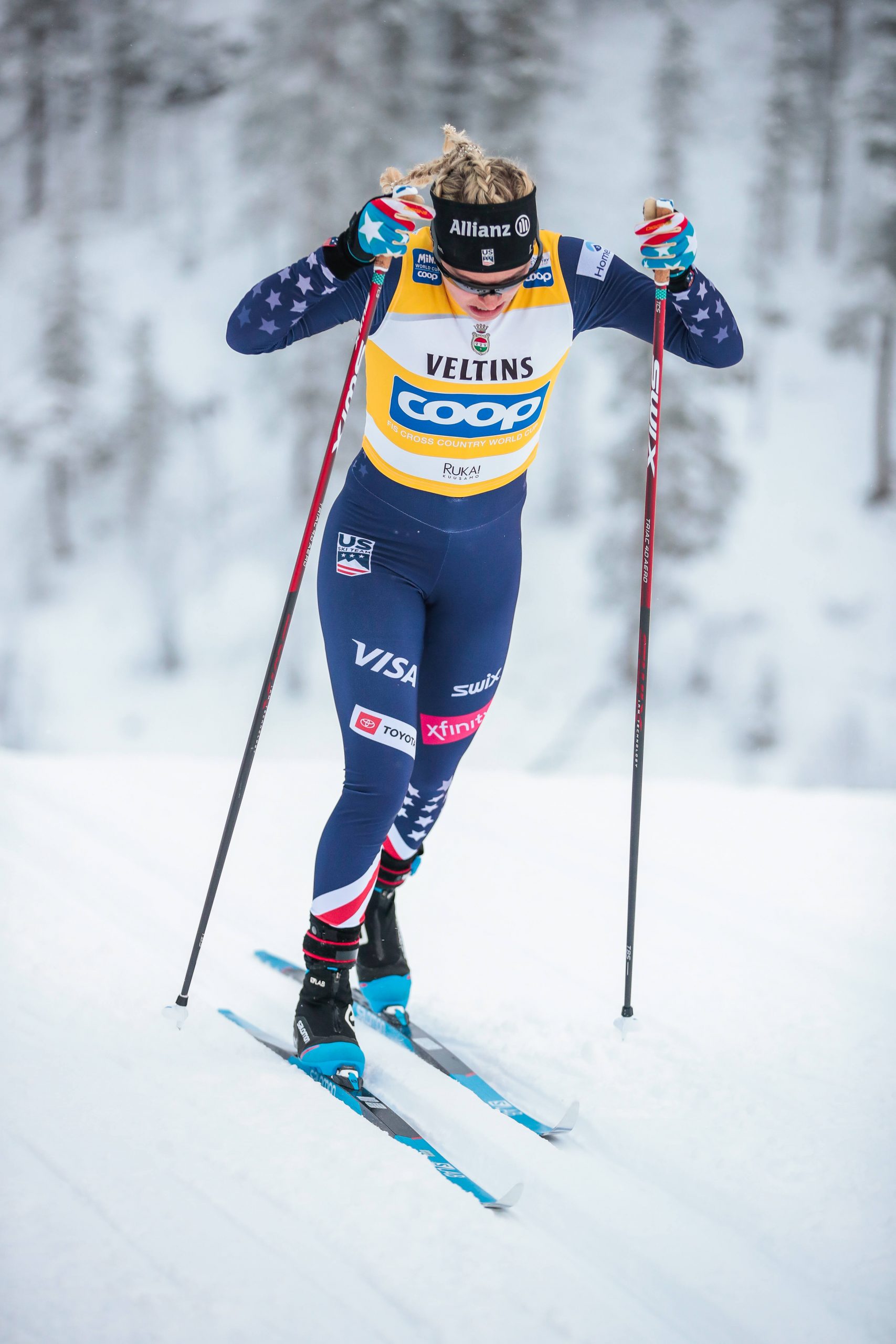
    Alayna Sonnesyn on the 1.4 k Ruka classic sprint course during qualifying on Friday. (Photo: NordicFocus).

    The women’s field came into that course today anticipating an extra degree of variability. For all the variety of the World Cup last season, its classic sprints were surprisingly predictable. Only four skiers notched wins: overall sprint champion Maja Dahlqvist (SWE),  Natalia Nepryaeva (RUS), Maiken Caspersen Falla (NOR) and Jona Sundling (SWE). This season, Falla has retired, and Nepryaeva is out due to the FIS’ Russian suspension. With no skier showing a firm hold on the sprint events, today looked to be anyone’s race.


    The Americans started a full lineup of six skiers, with Jessie Diggins qualifying for heats in 11th place, +4.68 seconds off winner Ane Appelkvist Stenseth (2:48.85). Julia Kern also qualified for the heats, placing 23rd (+5.39 sec). Kern ended up in the first quarterfinal along with the winner Stenseth, while Diggins took to the 3rd quarterfinal in a match up with 2nd place qualifier Tiril Udnes Weng (NOR) (+0.56).

    The first quarterfinal also featured Sweden’s Emma Ribom, who was coming off an FIS sprint victory over most of the Swedish national team last week. For the 24 year old, that result follows an offseason in which she had top results in rollerski races of all types, from sprints to a 42 k classic marathon win in Trollhaettan.
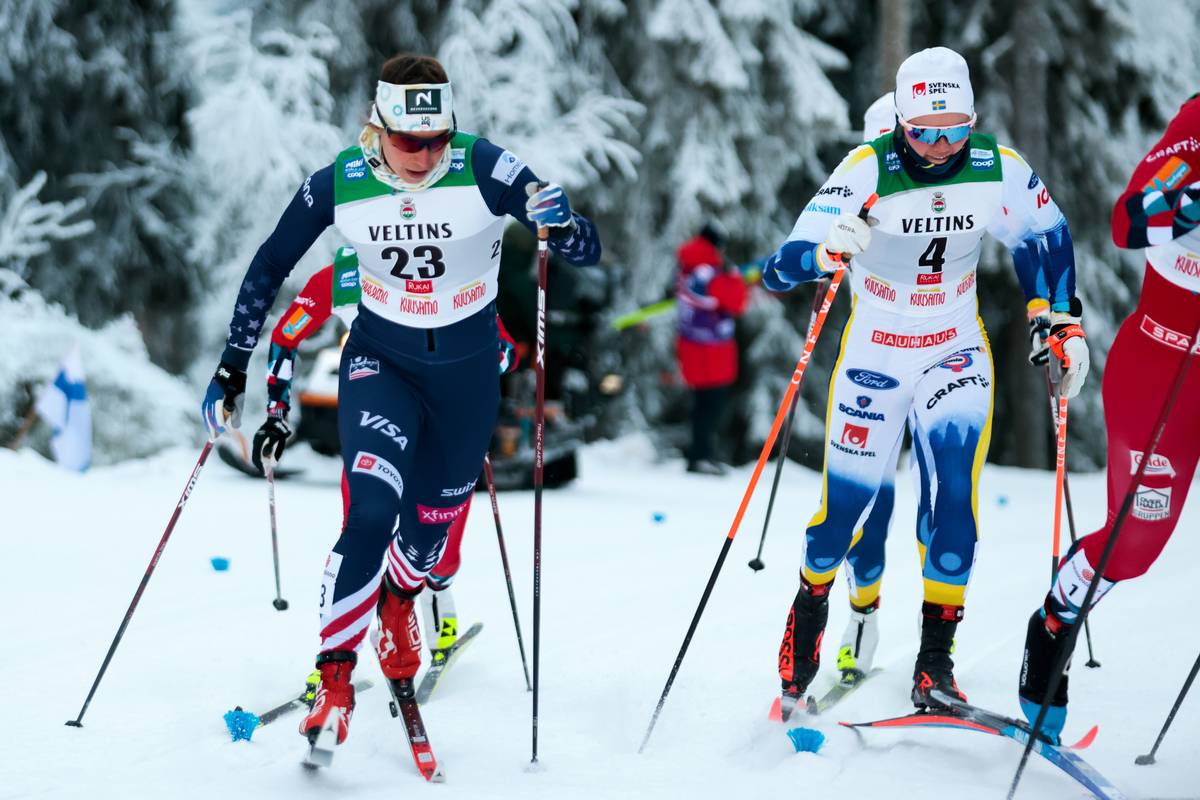
    Julia Kern (USA) and Emma Ribom (SWE) in the first quarterfinal on Friday. (Photo: NordicFocus).

    In that quarterfinal, Stenseth (NOR) set a pattern her countrywomen would follow throughout the day; taking the inside lane at the start and leading out the early action. The Swedish counter throughout the day was to let the Norwegians do the pace-setting and hit that decisive last hill hard. Kern meanwhile comfortably moved in the pack, always near the front but never commanding the lead. When they hit the last hill, Ribom surged and Stenseth followed from the other side of the trail. Ribom crossed in 1st – 2:47.54, and Stenseth crossed in 2nd – 2:48.21 (+0.67). Kern had followed the Stenseth move up the hill, and held on in a late sprint with Anna Svendsen (NOR) for 3rd place 2:48.60 (+1.06).

    The first heat had been fast, though Kern in 3rd place would be forced to wait out the rest of the quarterfinals before learning if her time was good enough to earn a lucky loser spot.


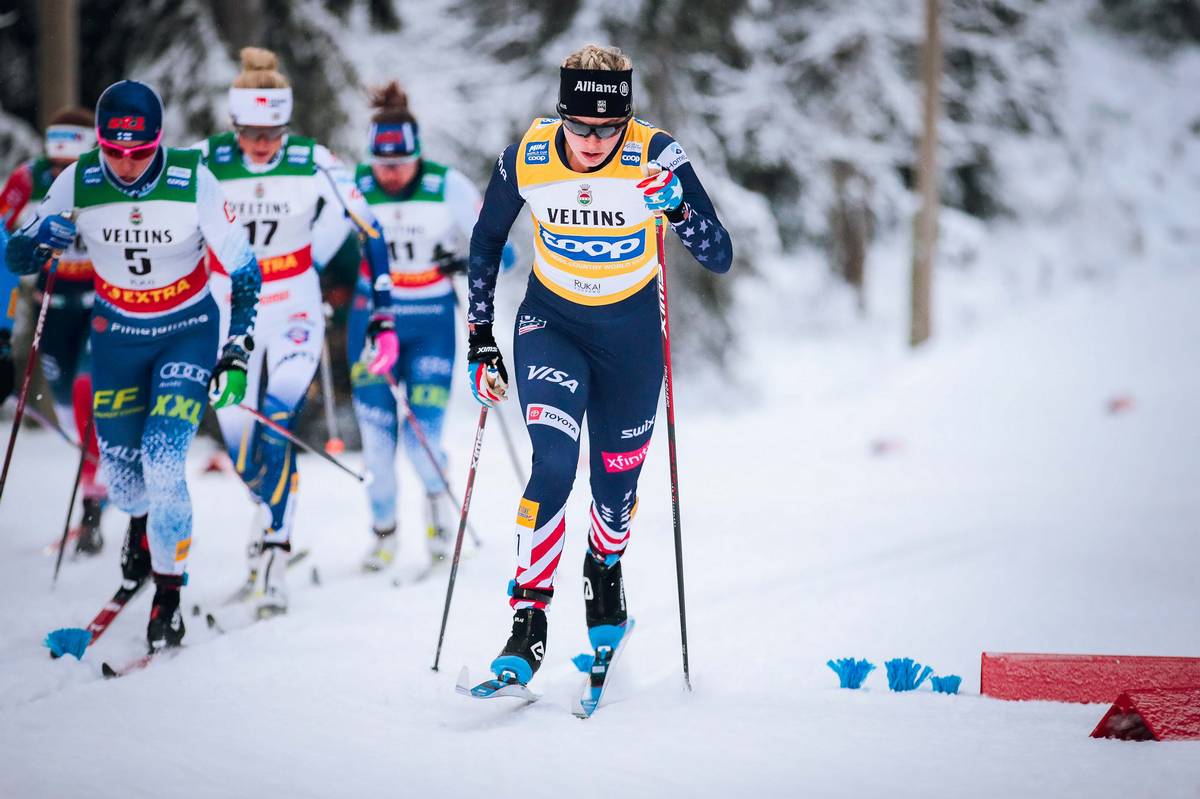
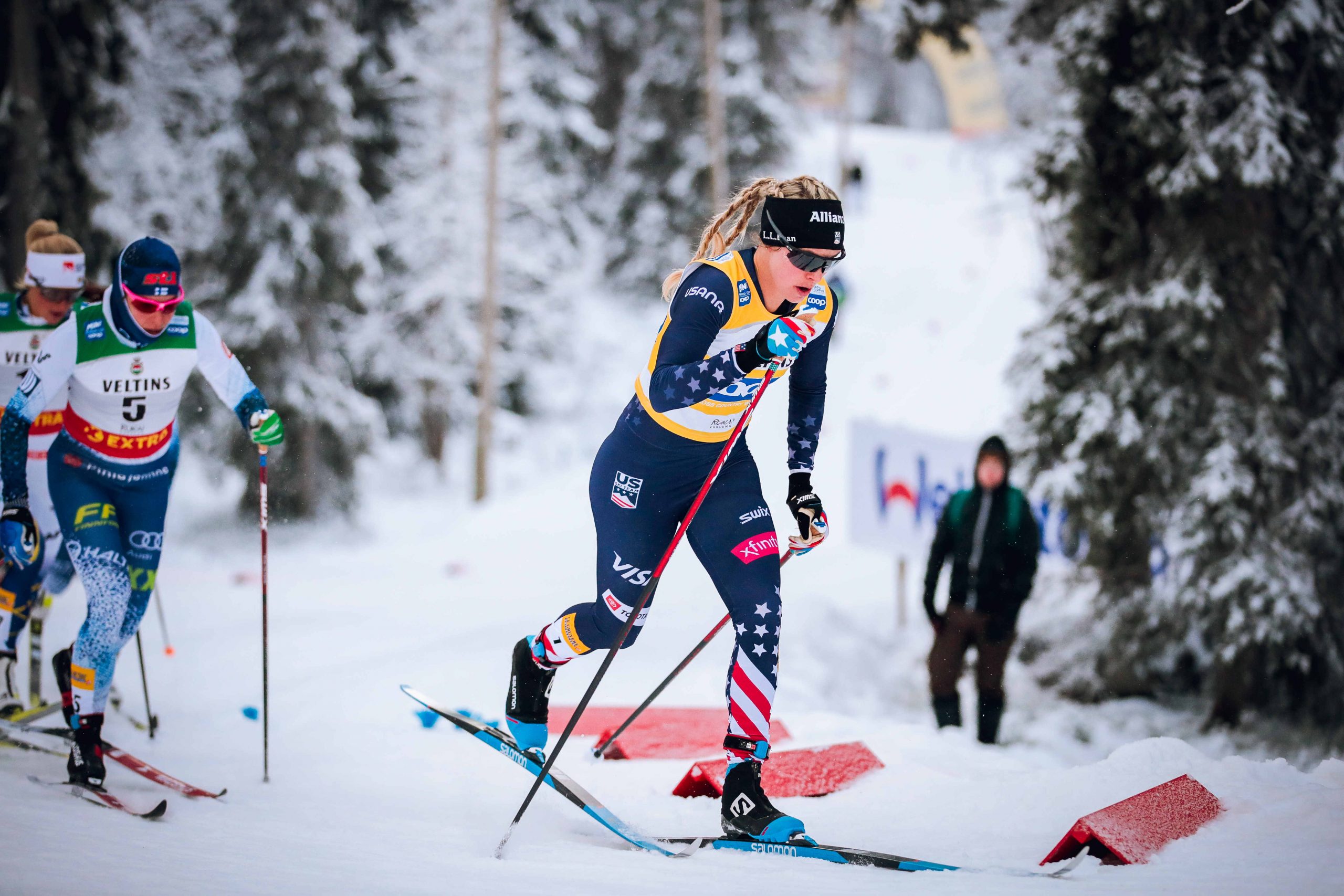
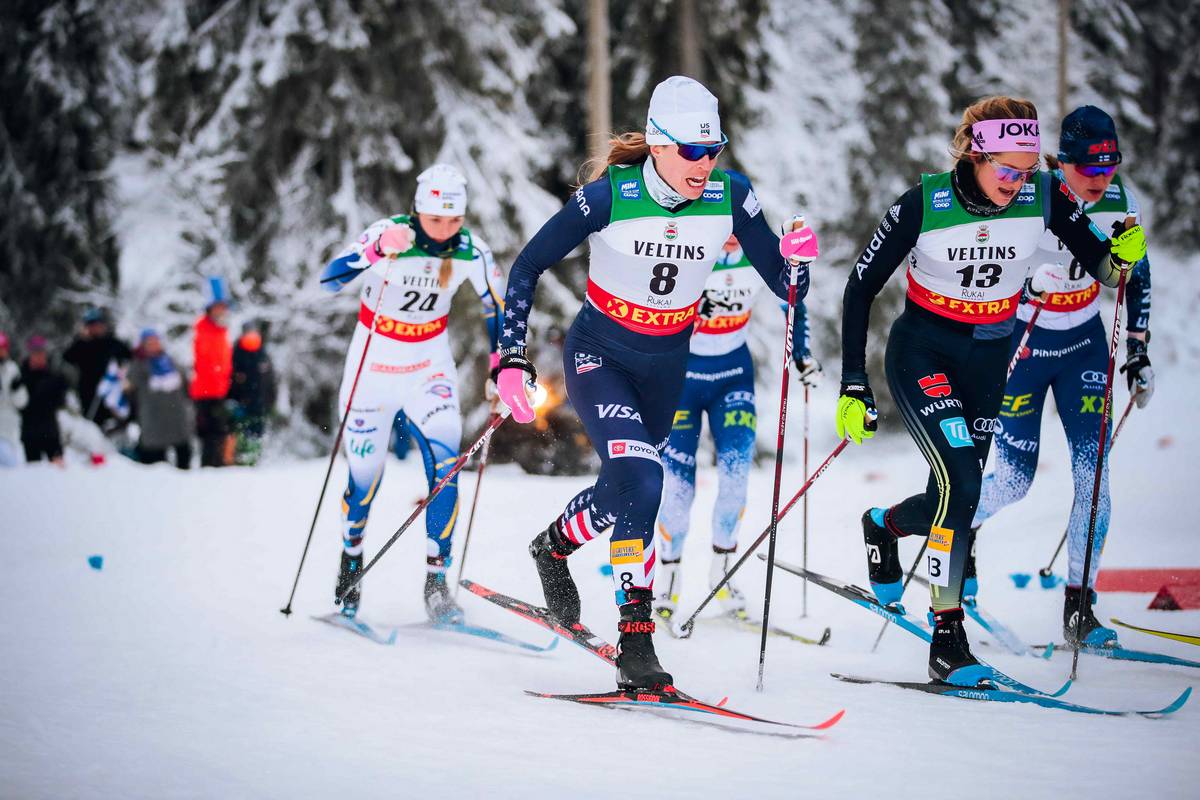
    In the 3rd quarterfinal, Jessie Diggins tucked in behind the Norwegian pair of Tiril Udnes Weng and Kristine Stavås Skistad, and through the early part of the race was in a comfortable position in the pack. As that field rounded the corner that led to the course’s only prolonged downhill, however, Finn Katri Lylynpera and German Katharina Hennig tangled up and went down. Diggins was held up ever-so-slightly, but the spot on the course was unfortunate, stifling the momentum Diggins hoped to build by skiing out from the back of the field. She ended the heat in 5th place.
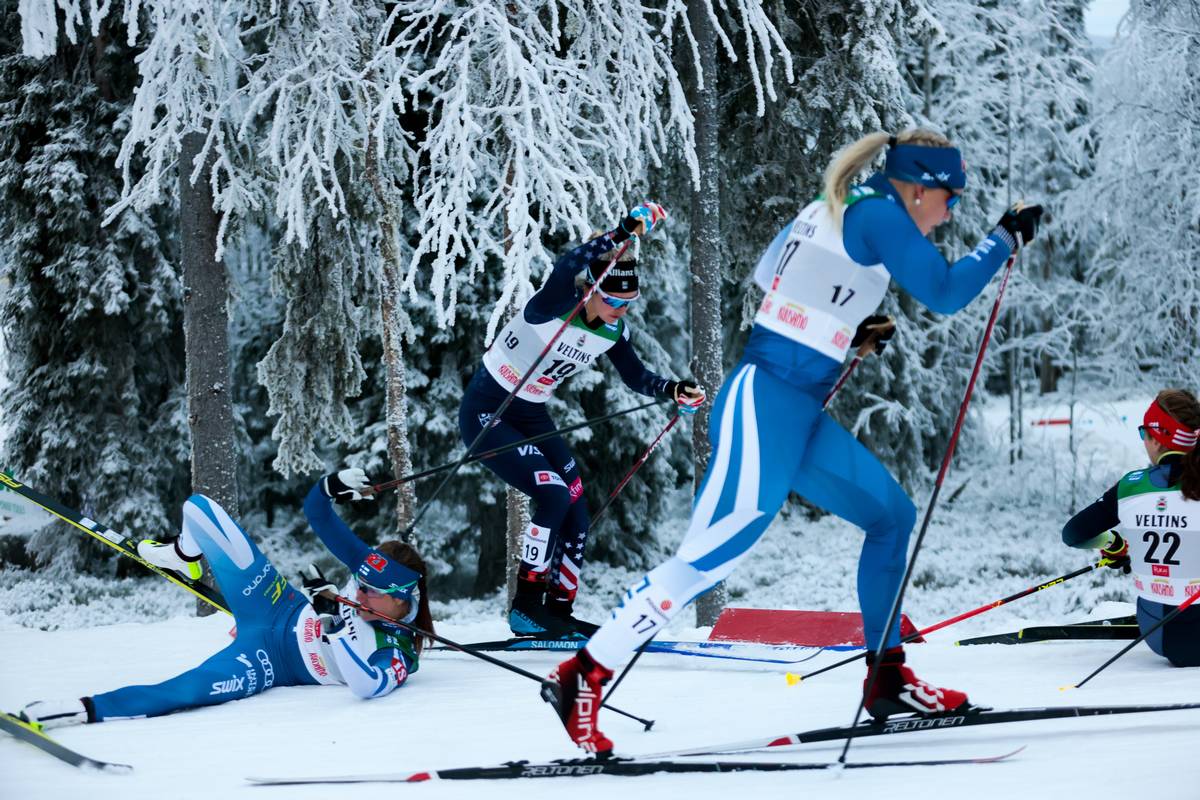
    Jessie Diggins (USA) got caught behind a pile-up during her quarterfinal Friday. Diggins qualified 11th on the first day of World Cup season. (Photo: NordicFocus).

    When the rest of the dust had settled on the quarterfinals, the first heat proved to be the fastest, sending Julia Kern into the semi-finals where she would race out of the second heat.

    In the first semi, Emma Ribom and Maja Dahlqvist formed a Swedish contingent matching up to a three-strong Norwegian contingent of Tiril Udnes Weng, Ane Applekvist Stenseth and Anna Svendsen. The sixth skier in the heat was the host nation’s Jasmi Joensuu (FIN), who also has a strong American skiing connection – an alumni of Denver University, where she was an All-American and part of DU’s NCAA national title winning teams in 2016 and 2019.
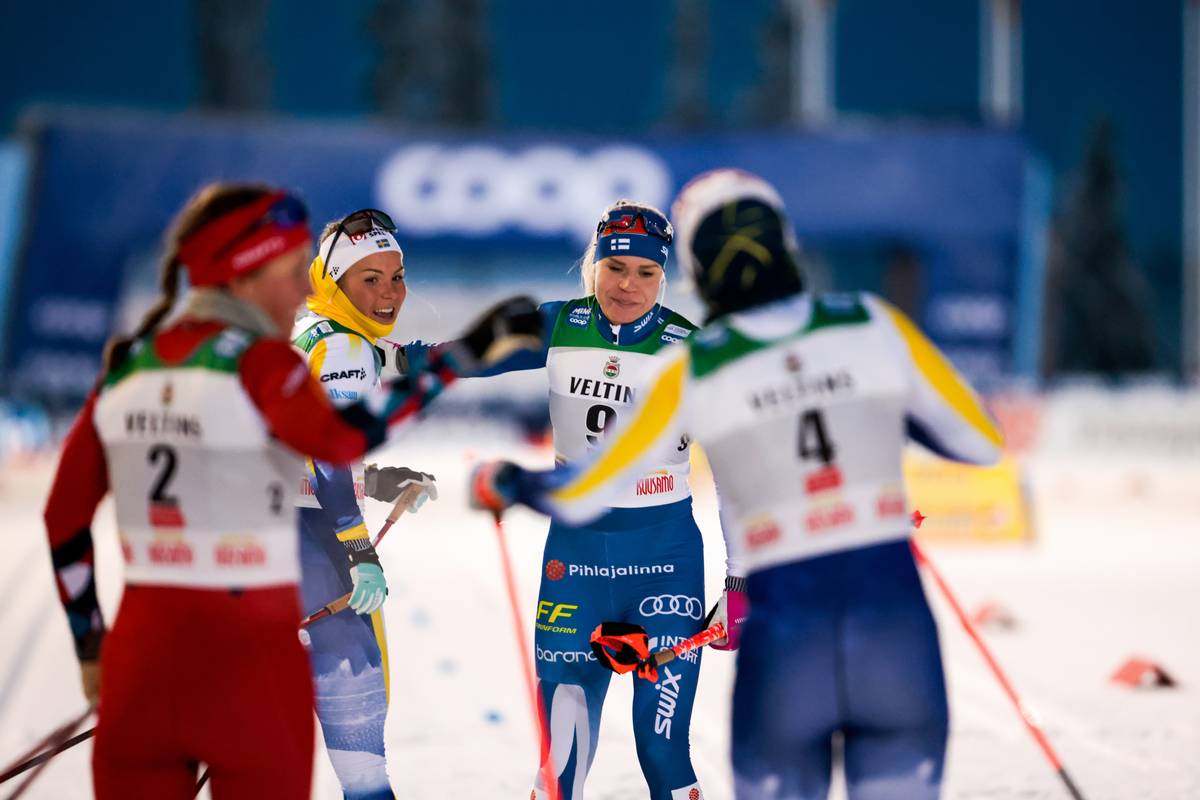
    Former Denver University skier Jasmi Joensuu (FIN) (3rd from left) had a breakout day, finishing 4th place overall. (Photo: NordicFocus).

    On the Ruka hill, Joensuu earned the distinction of having the best finishing kick of the day. In a heat where the Norweigans took it out fast, and then Maja Dahlqvist took them out even faster, the Finn was able to hold on to the pack just long enough so she could kick back into contention in the final climb. Joensuu followed Weng and Stenseth on the hill, who overtook Ribom and Dahlqvist, but saw themselves be out-double poled in the sprint. The result: Emma Ribom 1st place, 2:44.99, Dahlqvist 2nd (+0.05), Weng 3rd (+0.09), and Joensuu 4th (+0.67). It was the fastest heat of the day.

    Julia Kern started her semi-final alongside Johanna Hagstroem (SWE), Frida Karlsson (SWE), Kristine Stavås Skistad (NOR), Lotta Udnes Weng (NOR), and Tereza Beranova (CZE). The Norwegians again took the inside track and took the heat out in front. Kern, for her part, chose to stick behind the pairing of Swedes early in the race, The pack didn’t have the same ferocious pace as the previous heat, instead seeing a quiet battle for positioning going into the final hill. Kern came into that in 3rd place, before losing ground as Czech Tereza Beranova made a massive push. That broke the field into a final sprint early, with Hagstroem (SWE) coming out on top in 1st – 2:47.16 and Skistad (NOR) getting Beranova by a boot’s throw for the 2nd spot (+0.43). Kern finished the heat in 6th place (+4.92).

    Julia Kern after the semi-finals on Friday. Kern finished the heat after a strong performance in the qualifier and quarterfinal. (Photo: NordicFocus).

    The Final: three Swedes – Emma Ribom, Johanna Hagstroem, and Maja Dahlqvist, two Norwegians – Kristine Stavås Skistad, and Tiril Udnes Weng, and one Finn – Jasmi Joensuu. The dynamic was everything a spectator would expect watching the rest of the days racing, but the decisive moment was not.

    The Norweigans took the final out hard from the gun, while the Swedes took the early part of the race to find the right position. That eventually led to a moment of attrition, where the field slowed and stared over into the downhill, not daring to be the first down into it. That led to a more jumbled pack going into the final hill than usual, but it was still a similar race to what had been seen all day. The Swedes took to the uphill at full speed, and seemed to gain a slight advantage on their Norwegian and Finnish pursuers. The final turn looked to be all that was left between them and a podium sweep. Dahlqvist led it out, then Ribom, then Hagstroem.

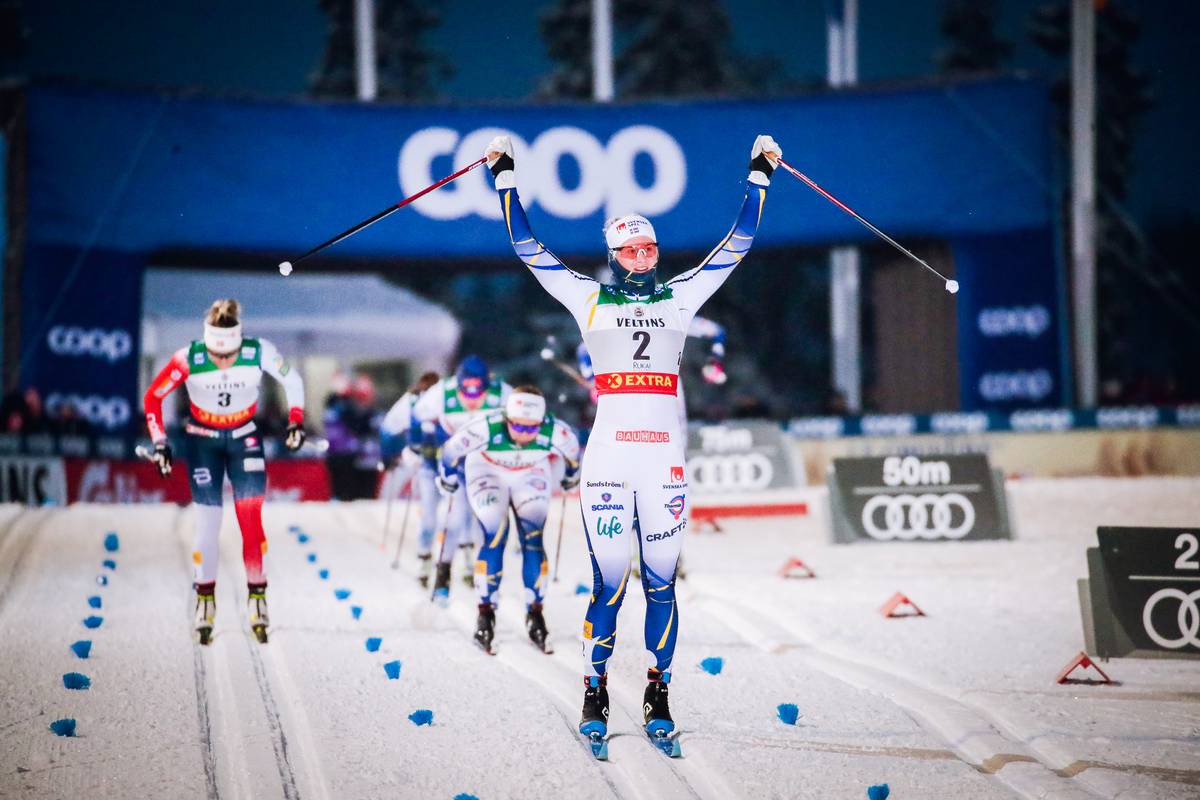
    And then, Dahlqvist went down. One of those trips that every skier has tripped. A little touch of the toe under the boot, and she hit the ground. Ribom and Hagstroem were left to sprint for the victory, and Ribom took the win, 2:49.22.

    Hagstroem in 2nd (+0.91) and Weng in 3rd (+0.93) rounded out the podium in the first race on the first day of the World Cup season. Last year’s sprint champion, Maja Dahqvist, crossed the line well after the field, broken Swix Triac in hand. 
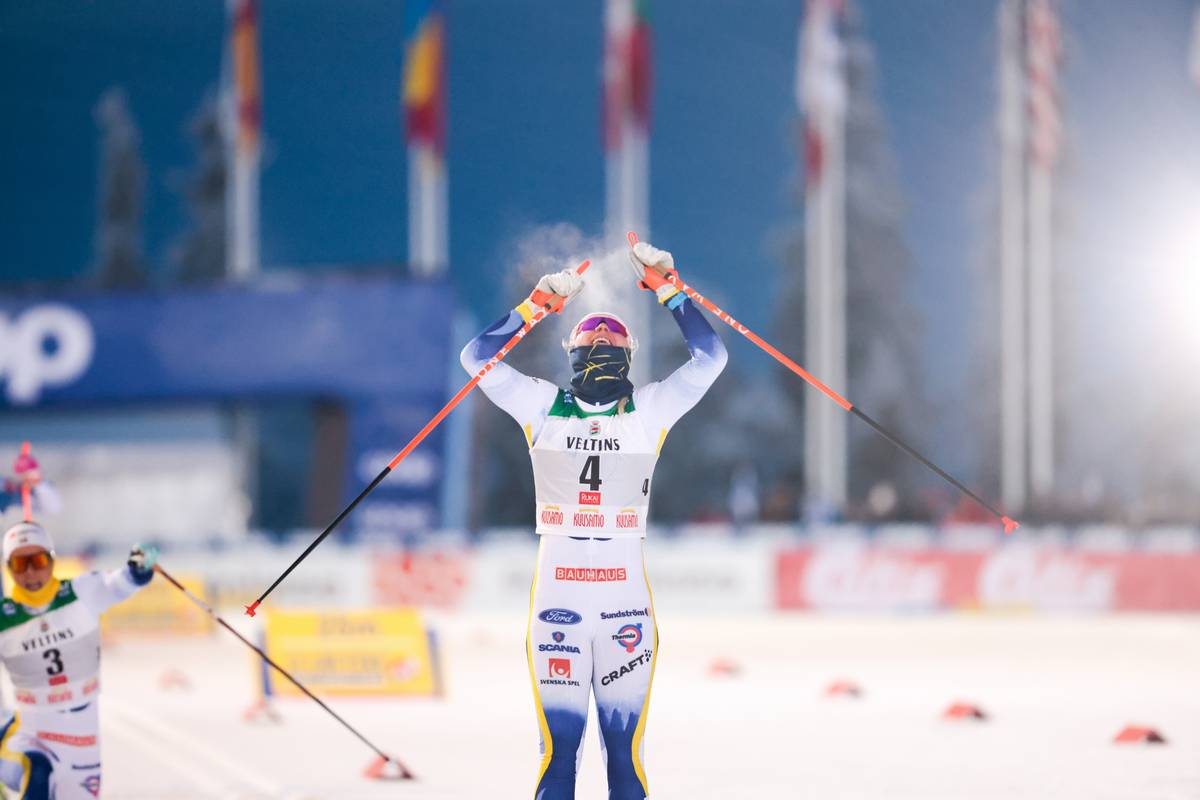
    Emma Ribom crosses the line for her first World Cup win in the Ruka classic sprint. (Photo: NordicFocus).

    On a course designed to open the World Cup with a piece of decisive terrain, its latest chapter was defined by an accident that no amount of engineering could snuff out. Maja Dahlqvist, the reigning sprint champion takes a tumble. Emma Ribom, the 24 year-old, takes her first World Cup win. New season, same Swedes.
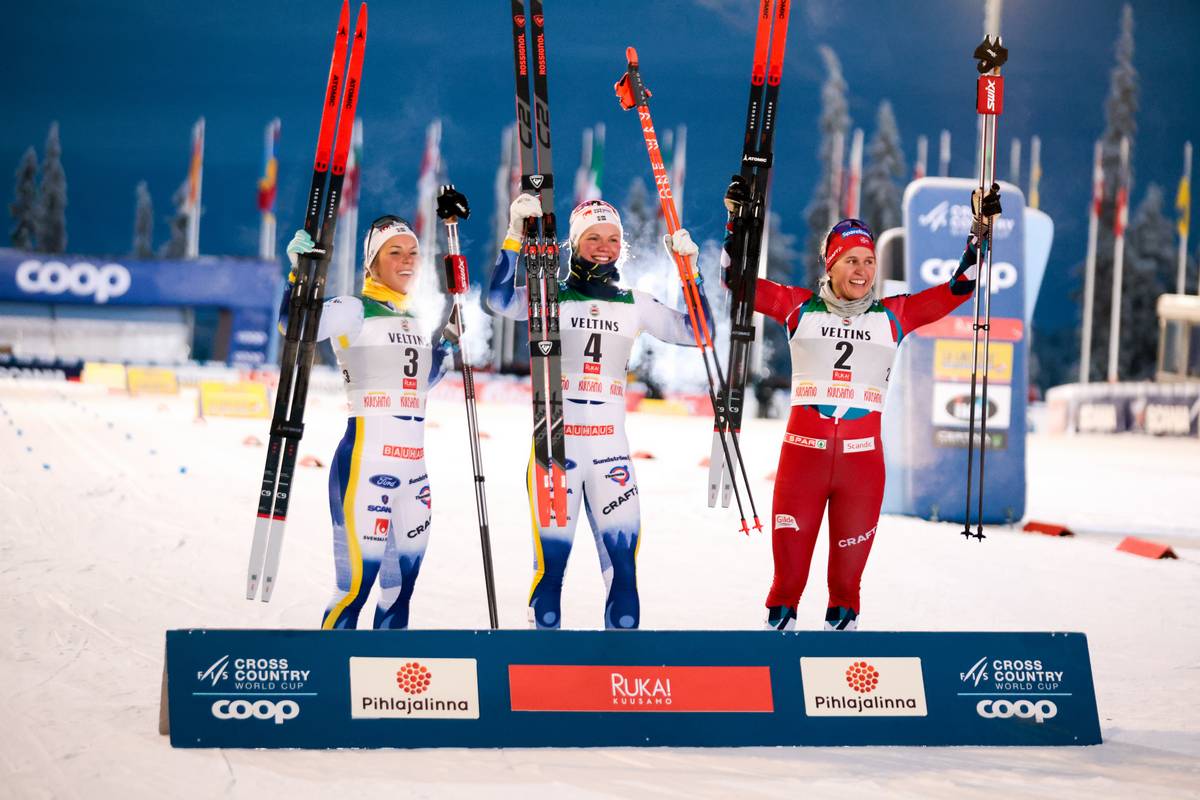
    Women’s podium: 1st – Emma Ribom (SWE), 2nd – Johanna Hagstroem, 3rd – Tiril Udnes Weng (NOR). (Photo: NordicFocus).

    American skiers had strong results further down the qualifying list. Rosie Brennan placed just outside of heats in 32nd (+9.15), while Alayna Sonnesyn placed 43rd (+12.36), Novie McCabe placed 52nd (+17.28), and Lauren Jortberg placed 54th (+19.33). 
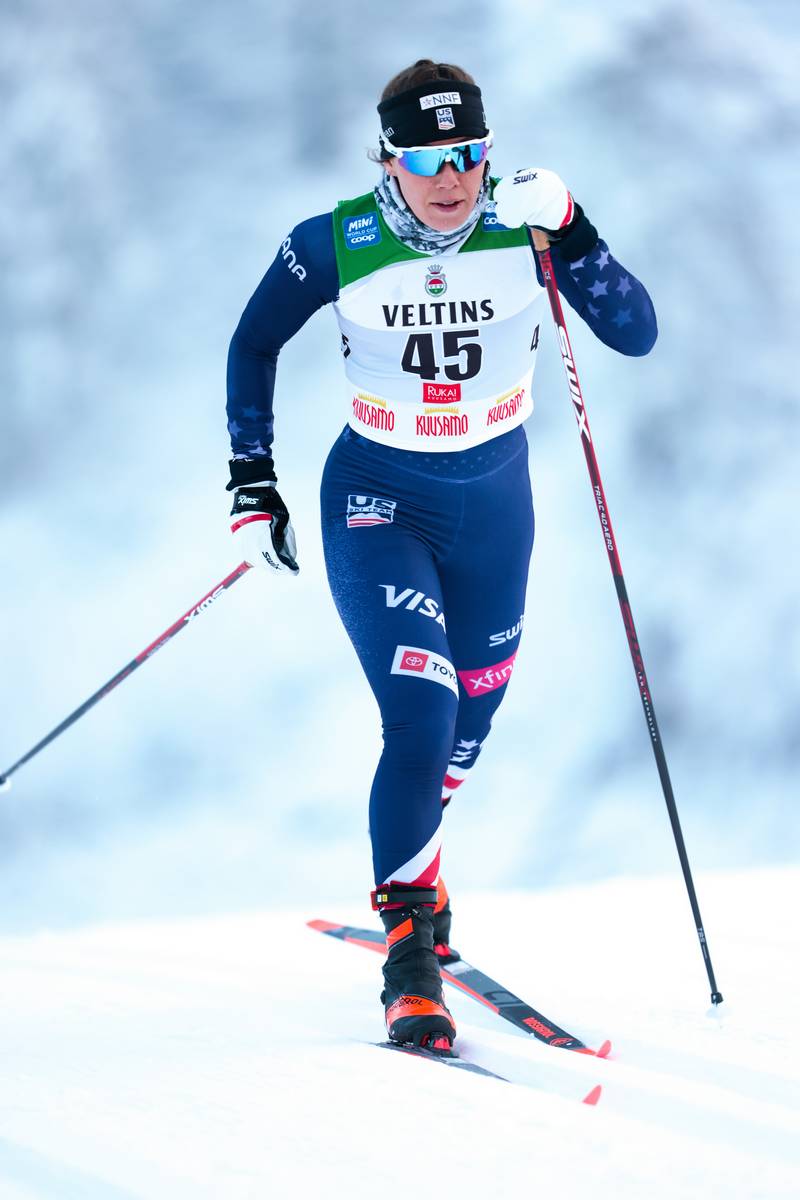
    Lauren Jortberg (USA) during qualifying on Friday. (Photo: NordicFocus).

    The Canadians also saw a strong grouping of skiers in the results, with Dahria Beatty 38th (+10.16), Katherine Stewart-Jones in 45th (+12.48), and Olivia Bouffard-Nesbitt in 46th (+14.03).

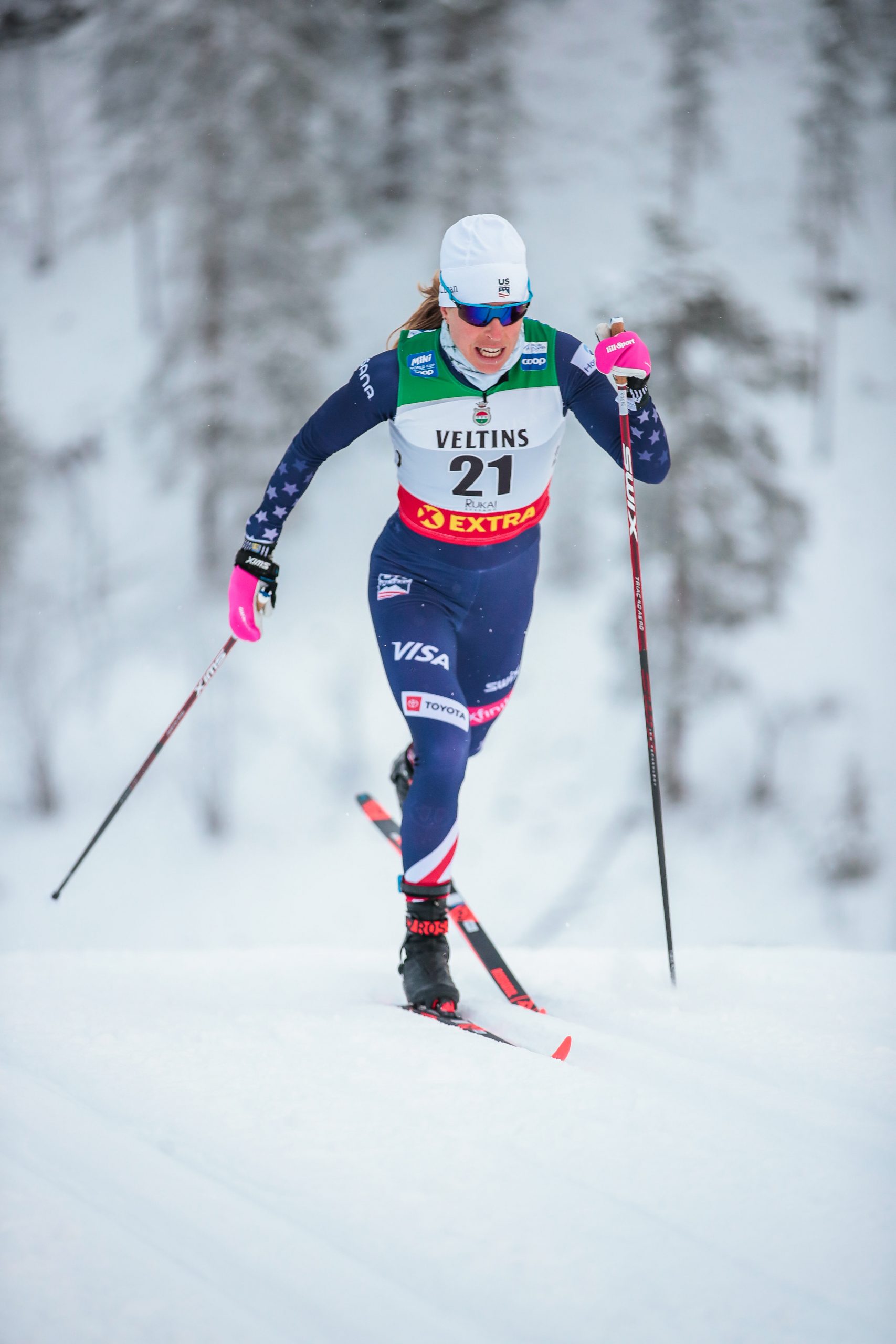
    Novie McCabe (USA) during qualifying on Friday (Photo: NordicFocus).

    Full Results

    Qualifier | Heats

  • Dahlqvist Wins the Opener in Ruka; Three Americans in the Top-20

    Dahlqvist Wins the Opener in Ruka; Three Americans in the Top-20


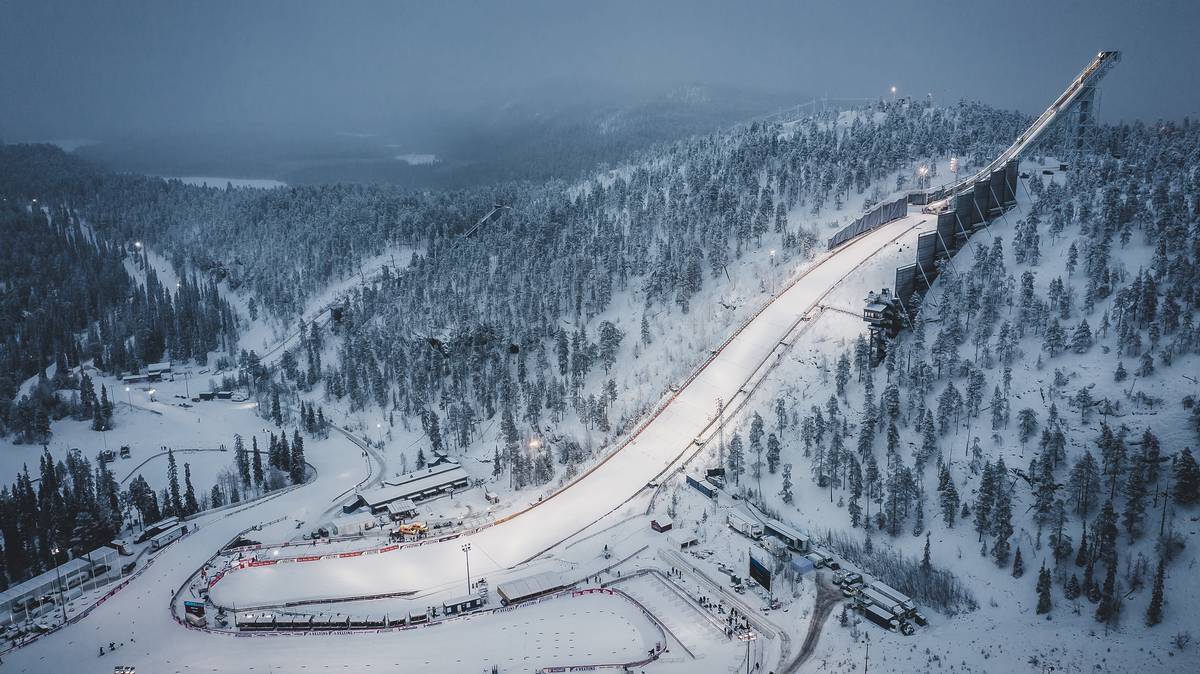
    An aerial view of the wintery venue in Ruka, Finland. (Photo: NordicFocus)


    This World Cup coverage is made possible through the generous support of Marty and Kathy Hall and the A Hall Mark of Excellence Award.  To learn more about A Hall Mark of Excellence Award or to learn how you can support FasterSkier’s coverage please contact info@fasterskier.com.


    And so it begins. The first round of World Cup racing took place in Ruka, FIN today with conditions one might expect in late November at almost 66 degrees North latitude: long shadows, low light, and squeaky tracks, with strong, eager athletes kicking and gliding around a 1.4-kilometer loop. The temperature showed in the athletes’ appearance, as they were bundled with mittens and buffs through the heats, layering with jackets and vests on the warm up and between rounds. Perhaps good practice for the forecasted conditions in Zhangjiakou, China, during the upcoming Olympics. 

    While Jessie Diggins normally comes into form later in the race season once she has a handful of races under her belt, she surprised herself with her opener in Ruka. Diggins may not be considered a favorite for classic sprints, but she has shown time and time again that she should never be ruled out in a classic race. Today, she raced the fastest qualifier with a time of 2:58.85, 0.77 seconds ahead of the next woman.

    Jessie Diggins with the surprise win in the qualifying round of the classic sprint in Ruka. (Photo: NordicFocus)

    In an interview with FIS before the rounds, Diggins credited her techs for preparing her winning skis, laughing that “no one looks at her in a classic sprint qualifier.” (We expect there might also be a fitness component at play here.) In terms of a return to the World Cup, she expressed her excitement that the season is upon us.

    “I feel great,” she said. “It’s so fun to be back in Europe, back with my team. This is such cool energy. For me, it feels like the first day in school. I just love being here with these people.”

    Heading into the rounds, Diggins selected the fifth and final quarterfinal heat.

    Also among the top-30 qualifiers were Rosie Brennan in 8th (+1.90) and Julia Kern in 21st (+5.6). Kern raced in the second heat of the quarters, while Brennan selected the fourth.

    Rosie Brennan skis to 8th place in the qualifying round in Ruka. (Photo: NordicFocus)

    A quick note on the sprint course in Ruka. You’ll notice from the profile that the A-climb begins just before the 1k mark, leading into a false flat before winding into the final straightaway to the finish. There is no downhill out of this climb; athletes simply climb a little over 20 vertical meters, then fight the subsequent flood of lactate as they make their way to the finish.

    The course profile in Ruka. (Photo: FIS Broadcast)

    In the second quarterfinal, a pair of Swedes, Maja Dahlqvist and Anna Dyvik, got out quickly to establish position at the front. Kern tucked in behind the Swedes out of the gate, then made a commanding move using momentum from the first descent to put herself at the front of the pack for the first climb. Heading up the A-Climb, the Swedes began to pull ahead, along with Slovenia’s Anamarija Lampič. Kern held her position in fourth place into the stadium and across the line, however, the time was not fast enough to secure a lucky loser position and she was knocked out. 

    During Brennan’s heat, she remained tucked into the middle of the group at the halfway mark. She dialed the effort up a notch on the A-climb, but as she neared the top, there were still four women vying for the lead. Brennan was tucked in on the tails of Finland’s Johanna Matintalo coming down the final stretch to take third in the heat. Unfortunately for the American, this was less than half a second off the time needed for a lucky loser spot in the semis.

    Diggins took the lead early in her quarter, her fast skis having allowed her to capitalize on the first downhill. She held her ground into the A-climb, where Krista Pärmäkoski and Katri Lylynpera, both of Finland, followed by Sweden’s Frida Karlsson, caught the American, leaving the climb as a pack of four. 

    Jessie Diggins holds the early lead in the quarter final of the classic sprint in Ruka. (Photo: NordicFocus)

    In the final stretch, Karlsson gained ground with her double pole to take the win just ahead of Lylynpera. Diggins crossed the line in a photo finish with Pärmäkoski, but timing showed that the American was 0.04 seconds behind the Finn, leaving her in fourth for the heat, which did not see any lucky losers.  

    Despite not advancing further in the rounds, Diggins said she knows she is “exactly where I need to be” at this point in the season. She acknowledged how much she has put in with her coaches to improve her classic skiing, and sees this as a positive indicator of the progress they’ve made. Here’s more from Jessie:

    Post-race audio clip from Jessie Diggins.

    Jessie Diggins holds the early lead in the quarter final of the classic sprint in Ruka. (Photo: NordicFocus)

    In the first round of the semis, all six women remained tight through the halfway mark. You’ve probably caught on to the theme of the day: positioning oneself at the front heading out of the A-climb proved critical for final placement. Deciding moves were made here. Using this tactic, Johanna Hagström (SWE) and teammate Dahlqvist ran powerfully uphill to pull ahead. The women entered the final straightaway side-by-side, but Dahlqvist soon made ground on her teammate, taking the win in the round. Russia’s Natalia Nepryaeva was close on the women’s tails, closing the gap in the last 50 meters and sliding across the line just behind Hagström in third, not quite fast enough for a lucky loser spot in the final.

    Moving on to the second round. Russia’s Yulia Stupak led the women through the first half. On the A-climb, Norway’s Maiken Caspersen Falla held the lead with Lylynpera close behind. Moving from the back of the pack into third, Karlsson took the inside around the curve heading into the stadium. She steadily gained ground on the other women in the double pole sprint to the line, edging Lylynpera out at the line to take the heat. Falla took third, with Matintalo close behind. As the second was the faster heat of the semis, both of these women advanced to the final. 

    In the final round, Sweden was looking to repeat their podium sweep from last year in Ruka. With Dahlqvist, Hagström, and Karlsson in the final, the possibility remained on the table.

    Despite a brief failure in grip and consequent slip, Dahlqvist charged the A-climb to put herself in excellent position for the final meters. A few stride lengths behind, Falla and Hagström were matched as they vied for the second and third podium spots.

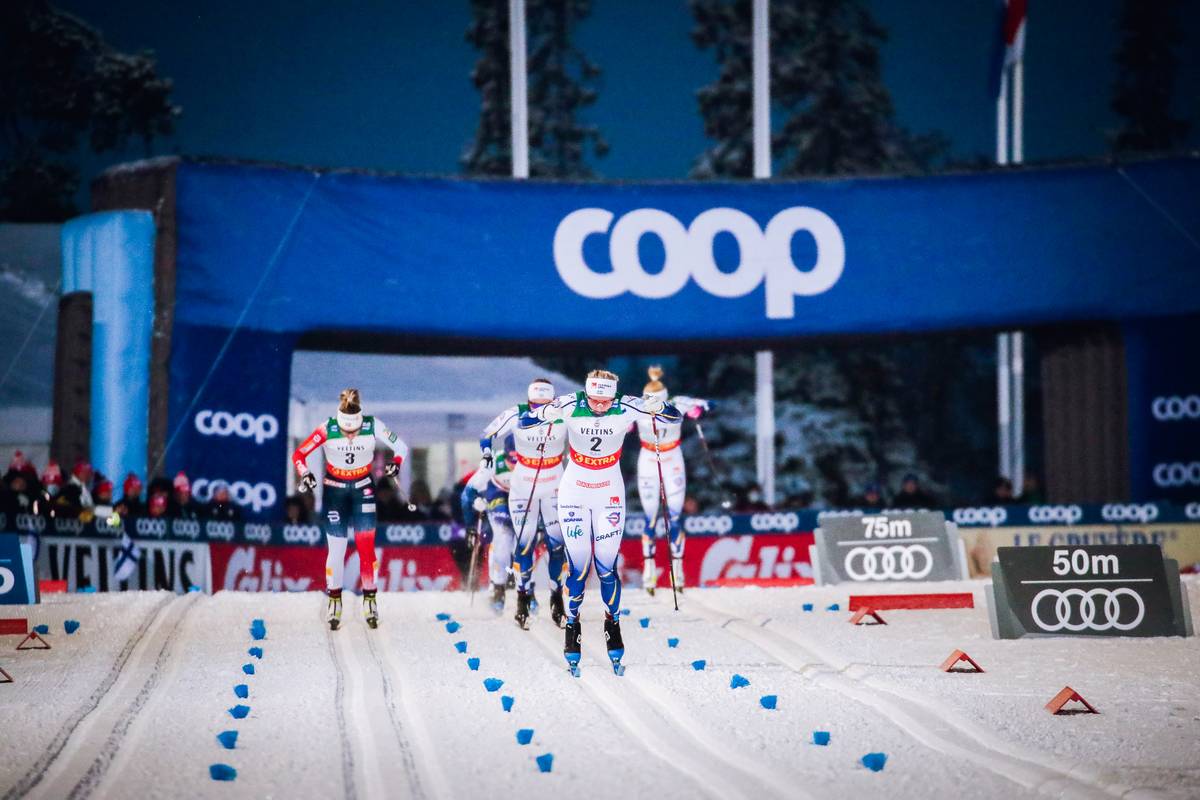
    The final straightaway as the women head for home in the Ruka Classic Sprint. (Photo: NordicFocus)

    As they rounded the final left-hand bend into the stadium, the Swede had enough space to take the preferred line into the second track from the left of the curve heading into the final straight, leaving Falla to make a lane change behind her. This advantage carried Hagström to the line for second (+1.77) with Falla just behind for third (+2.02). 

    Sweden’s Maja Dahlqvist takes the win in Ruka. (Photo: NordicFocus)

    “I couldn’t say better — perfect start,” Dahlqvist told FIS after the race. “I had really good shape and my skis were so good, so I just wanted to ski fast. I couldn’t wait for the uphill, and that’s never happened with me before.”

    This is Dahlqvist’s second World Cup win, but 13th time on the podium. She was second in last year’s classic sprint opener in Ruka.

    Maja Dahlqvist (SWE) takes the win in Ruka ahead of teammate Johanna Hagström. (Photo: NordicFocus)

    Off the podium, Finland’s Matintalo finished fourth in the final (+3.21) with teammate Lylynpera next over the line for fifth (+3.74). Karlsson was sixth across the line (+3.97) to close out the final heat.

    Once final rankings from the heats were solidified, Brennan was deemed the top American in 15th, with Diggins just behind in 16th. Still inside the Top-20, Kern ended her day in 18th. 

    Rosie Brennan skis to 15th in the classic sprint in Ruka. (Photo: NordicFocus)

    Reflecting on her opener, Brennan shared the following in a post-race email:

    “Ruka is such a unique course and being the first race of the season, it’s always hard to know what to expect. My goal was to be in the mix and skiing well. I am happy with my effort and really happy to be underway with racing. I think this was my best result in Ruka so even though I always want more, I am happy to be where I am right now. I felt I was missing a little top end speed today, but feel that I am on track and moving in the right direction. I’m excited to do some distance racing and to continue working out the kinks this weekend.”

    Kern also posted her career-best result in Ruka. She finished outside the heats in 40th last year. Remarking on this progress, Kern wrote:

    “I was really happy with the energy I brought today, with the added bonus of figuring out how to qualify in Ruka. The final climb is always the crux on this course; every year it gets greasy, washed out and tricky. I am proud with how I skied with confidence and figuring out how to ski the last part of that final climb fast will hopefully come with more days skiing on snow! I am excited that the season has started and feel that I am in a much better place coming into the race season this year.”
    In a post-race interview, Whitcomb shared his thoughts on Diggins’ win in the qualifier, along with Brennan’s result and the outlook for the women’s program heading into the season. We did have some technical issues on the call. You’ll notice that the first question was cut off, which was regarding the cold conditions in Ruka and whether there is any additional emphasis by the team or techs on cold events this year, considering the Olympic venue is predicted to be very cold.

    Outside the heats, Hailey Swirbul was 37th in the qualifier (+8.59). Katharine Ogden was next for the U.S. in 52nd (+12.23), immediately followed by Hannah Halvorsen in 53rd (+12.95). Novie McCabe was 61st (+16.43), with Sydney Palmer-Leger closing out the American team in 66th (+21.61). 

    Hannah Halvorsen skis the qualifying round of the classic sprint in Ruka. (Photo: NordicFocus)

    Results:

    Qualification | Final