From the FasterSkier archive — posts syndicated from athletes’ and coaches’ own blogs between 2004 and 2012, kept online as published. Current coverage is at fasterskier.com.
Ruka, Finland looked quintessentially Nordic at the start of the 10-kilometer freestyle pursuit. December at 66 degrees north: temperatures in the low teens (F), flat Northern light, frosted pines looking as though they were spray-coated with foam. Athletes warmed up in puffy jackets with mittens, neck warmers, and taped faces while crowds huddled with cups of soup.
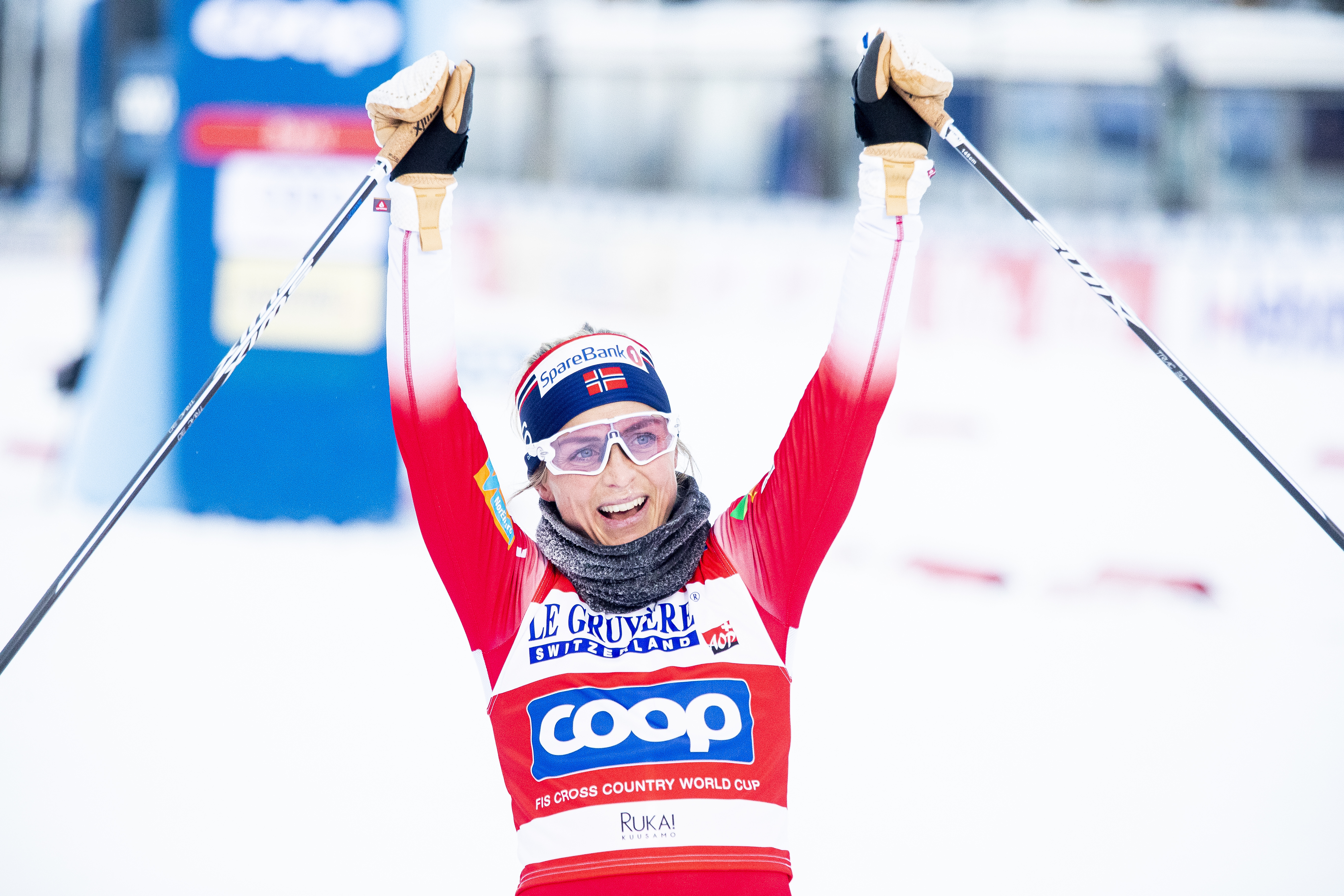
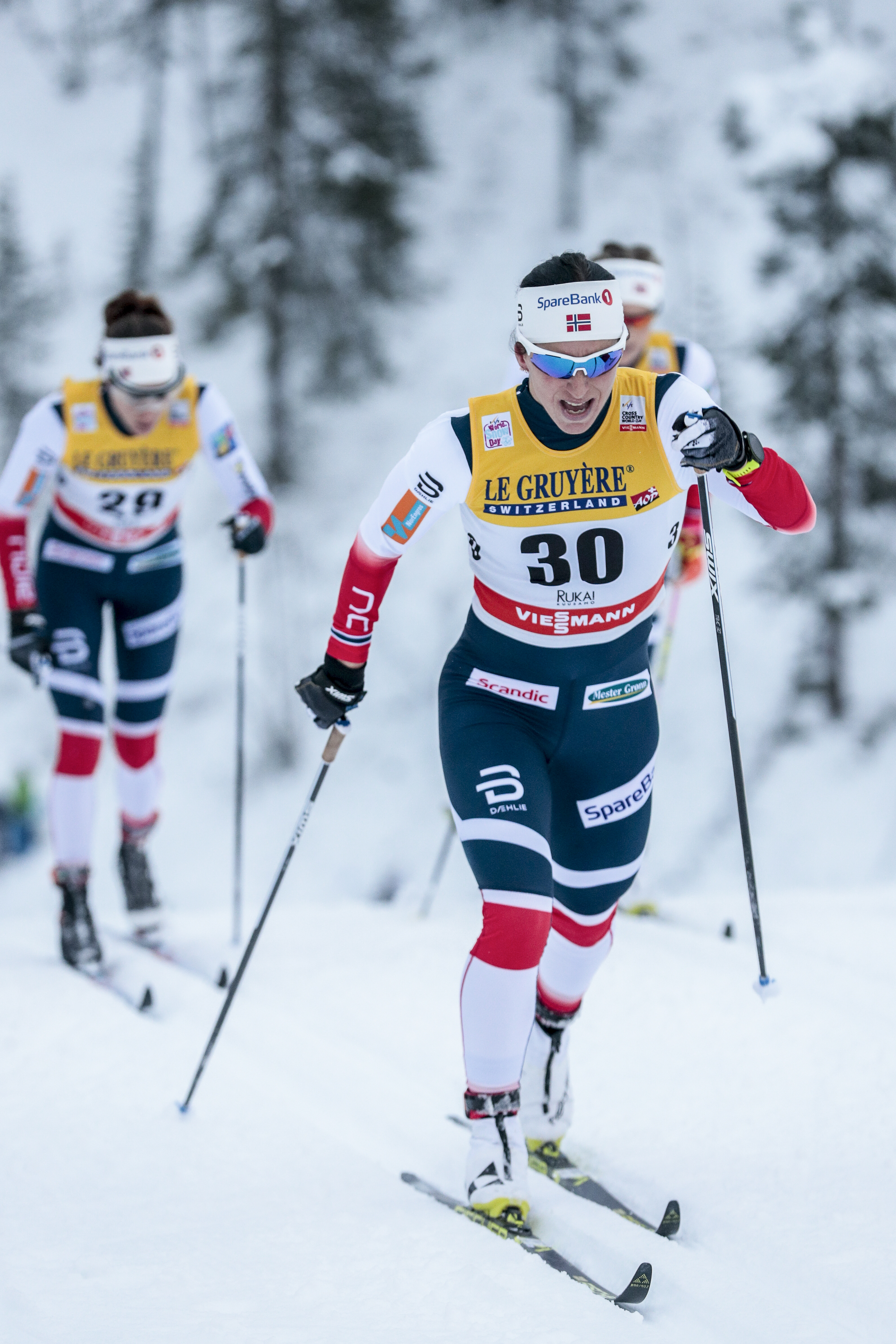
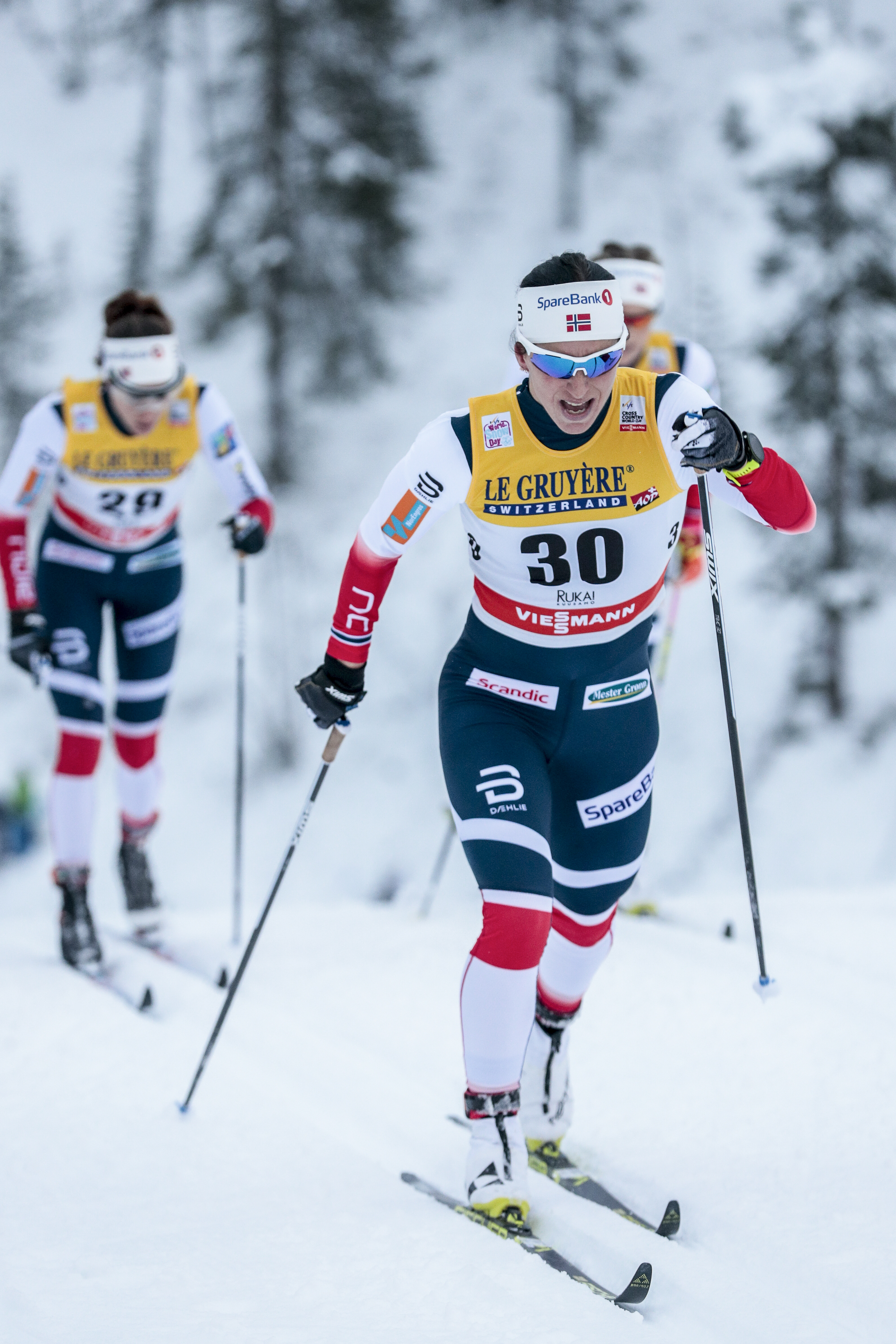
First out of the start and racing in a balaclava and mittens, Norway’s Theresa Johaug attacked the course from the gate. Steadily turning up the dial on each of the four 2.5 k loops to cross the line over a minute ahead of her peers, the 31-year-old distance phenom quickly made the event a race for second place.
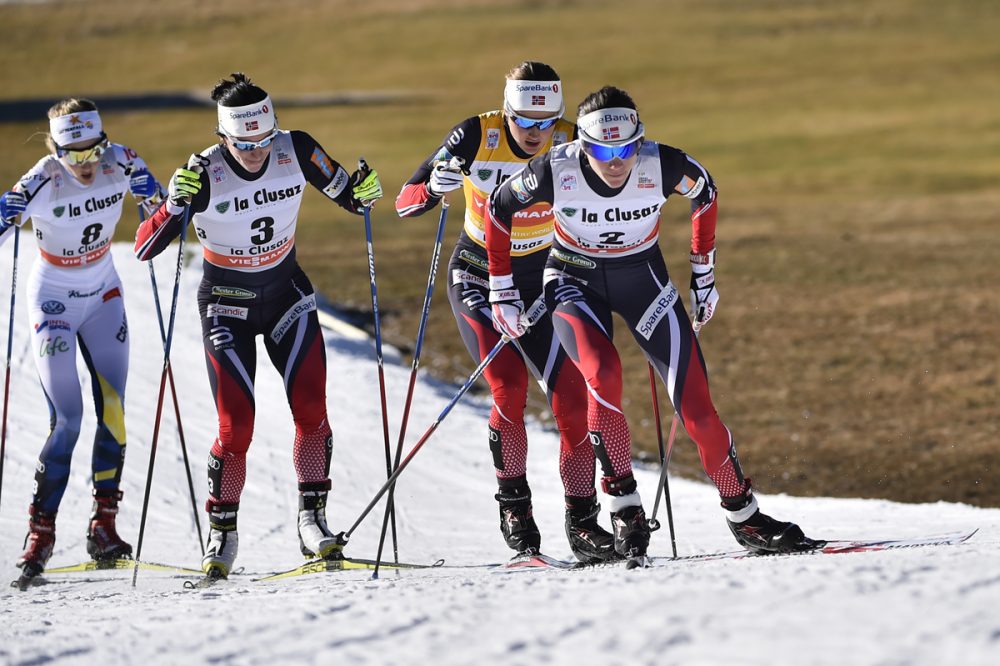
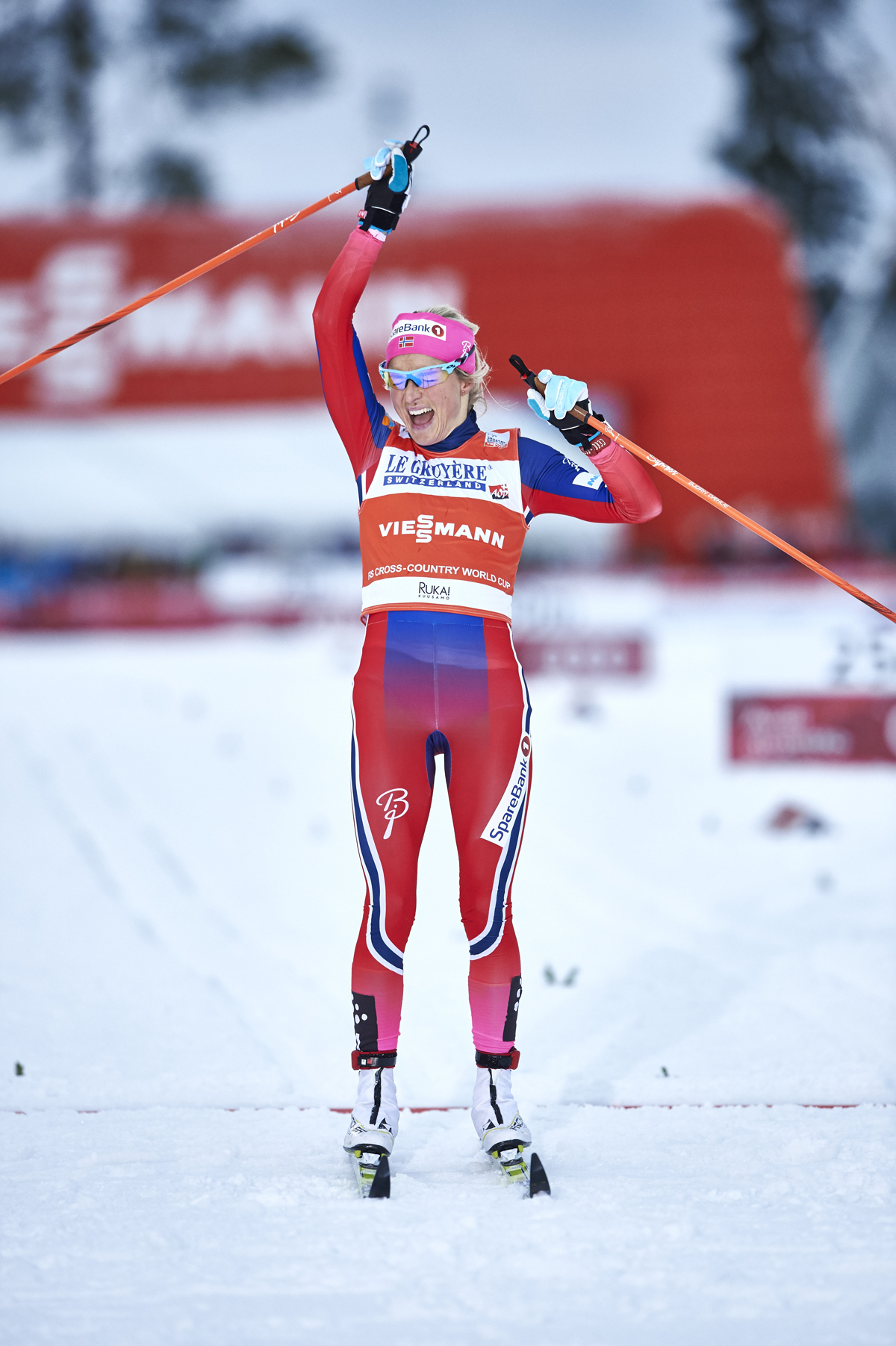
Norway’s Therese Johaug dominated the field in the pursuit distances races in Ruka, Finland. (Photo: NordicFocus)
“I felt I was really strong today,” Johaug told FIS about her performance. “I heard that Heidi was fast behind me, but in the end I had a little bit more power and I also win the race today. I’m really happy.”
She also described her skis as “excellent” and thanked her wax technicians for their handiwork.
Chasing in red for an all-Norwegian podium, Johaug’s teammates Heidi Weng and Astrid Jacobsen worked together to steadily pick off the athletes wearing lower bib numbers. Weng, who started in tenth, 1:03 behind Johaug, made up 17 seconds to catch Jacobsen. By the 5-kilometer mark she was ranked 5th and closing on Finland’s Krista Pärmäkoski.
Weng finished second (+1:11.13), followed closely by Jacobsen (+1:13.3).
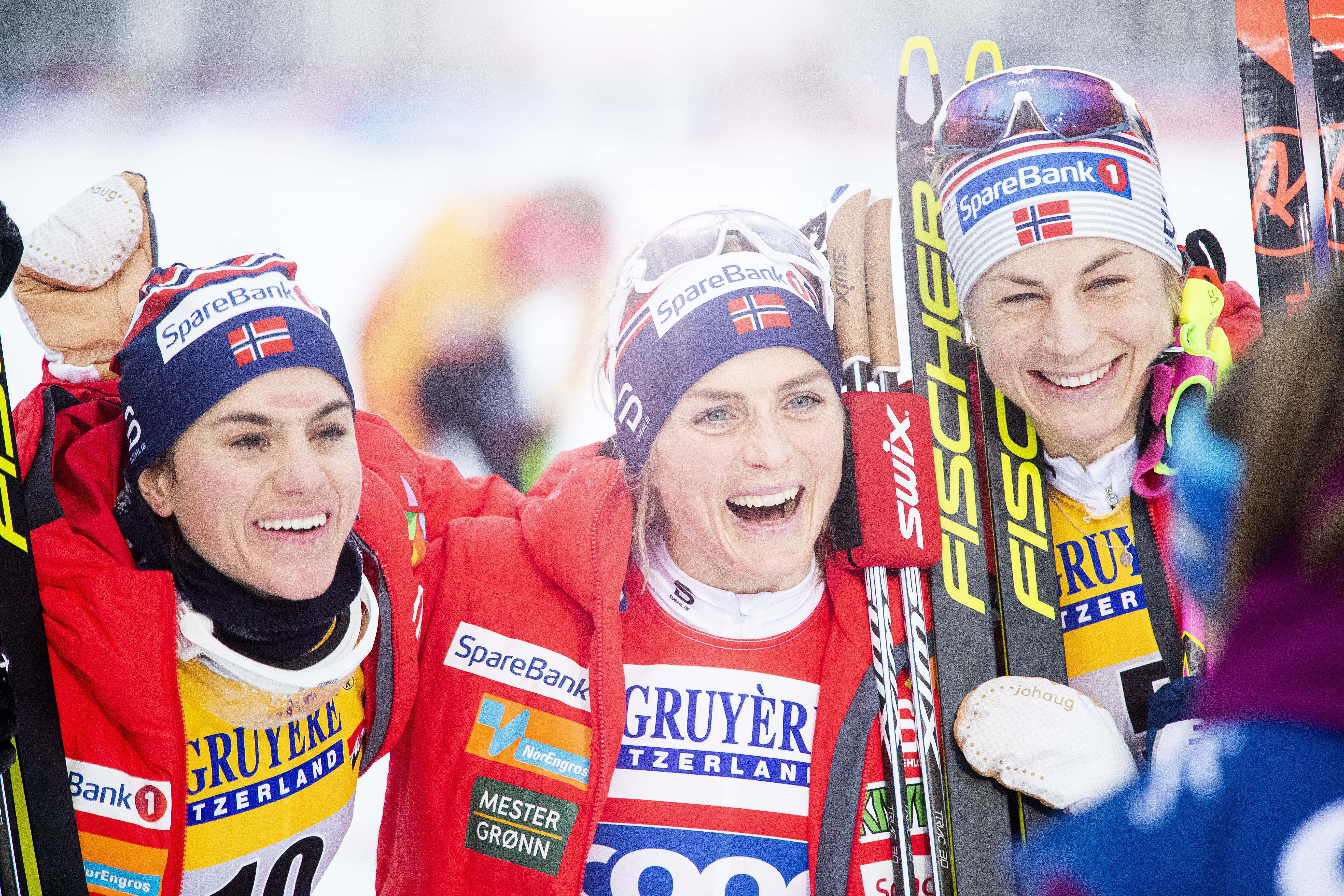
“It’s fantastic,” Johaug said of the Norwegian trio. “We have three girls top three and it’s a long time since this has happened before. We are so happy.”
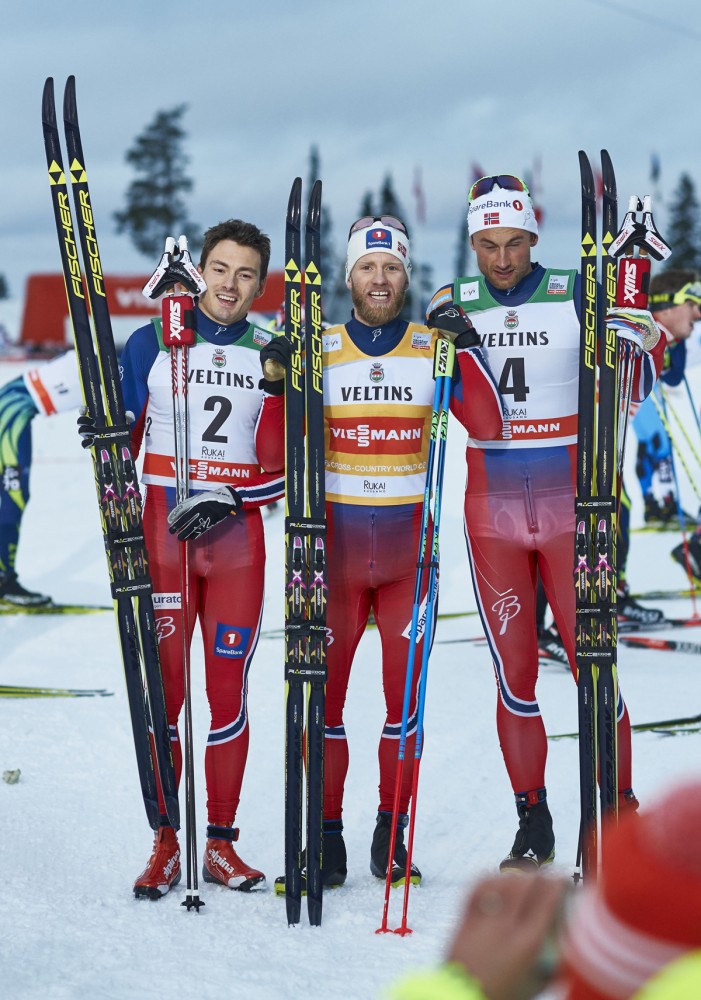
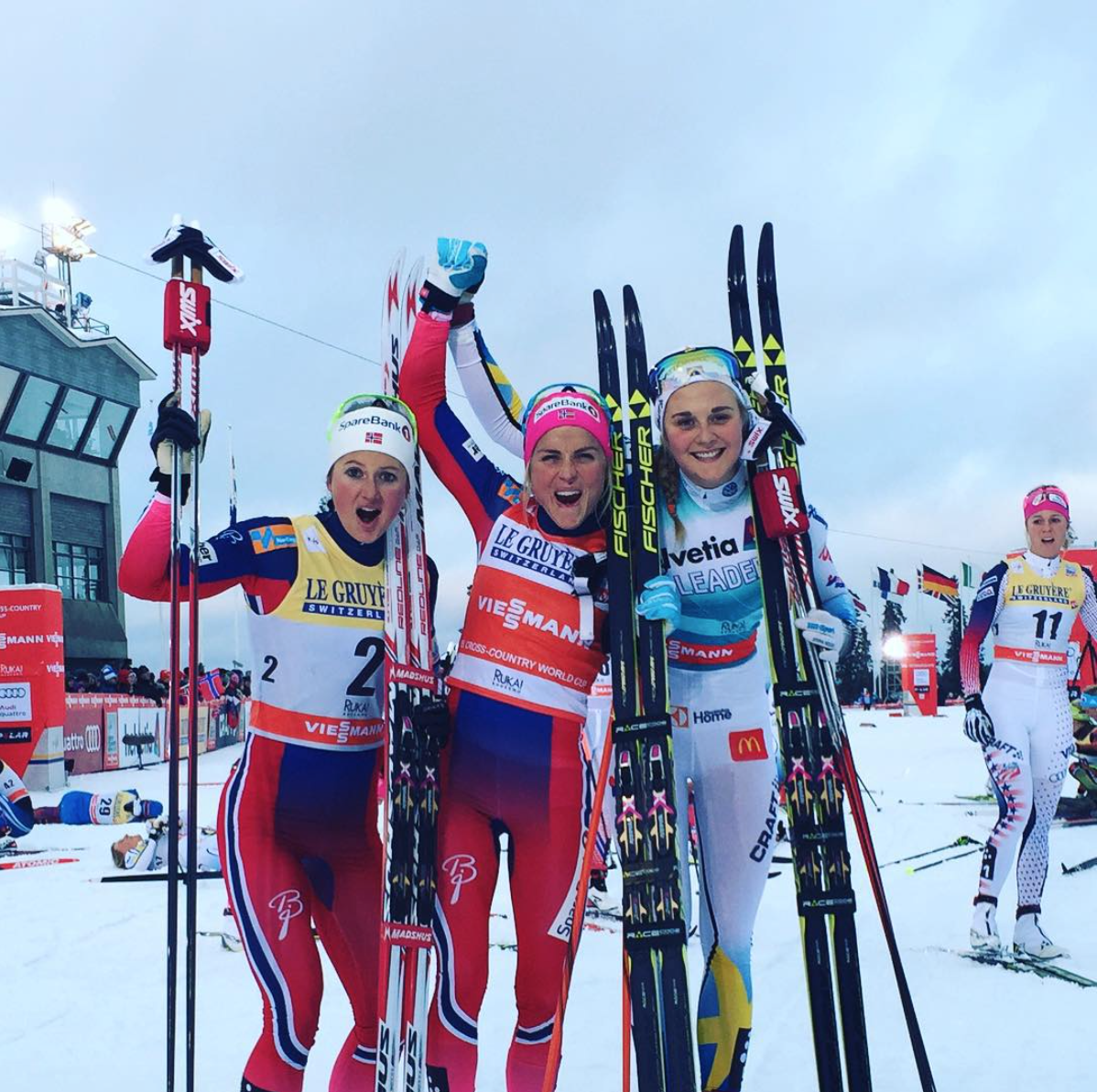
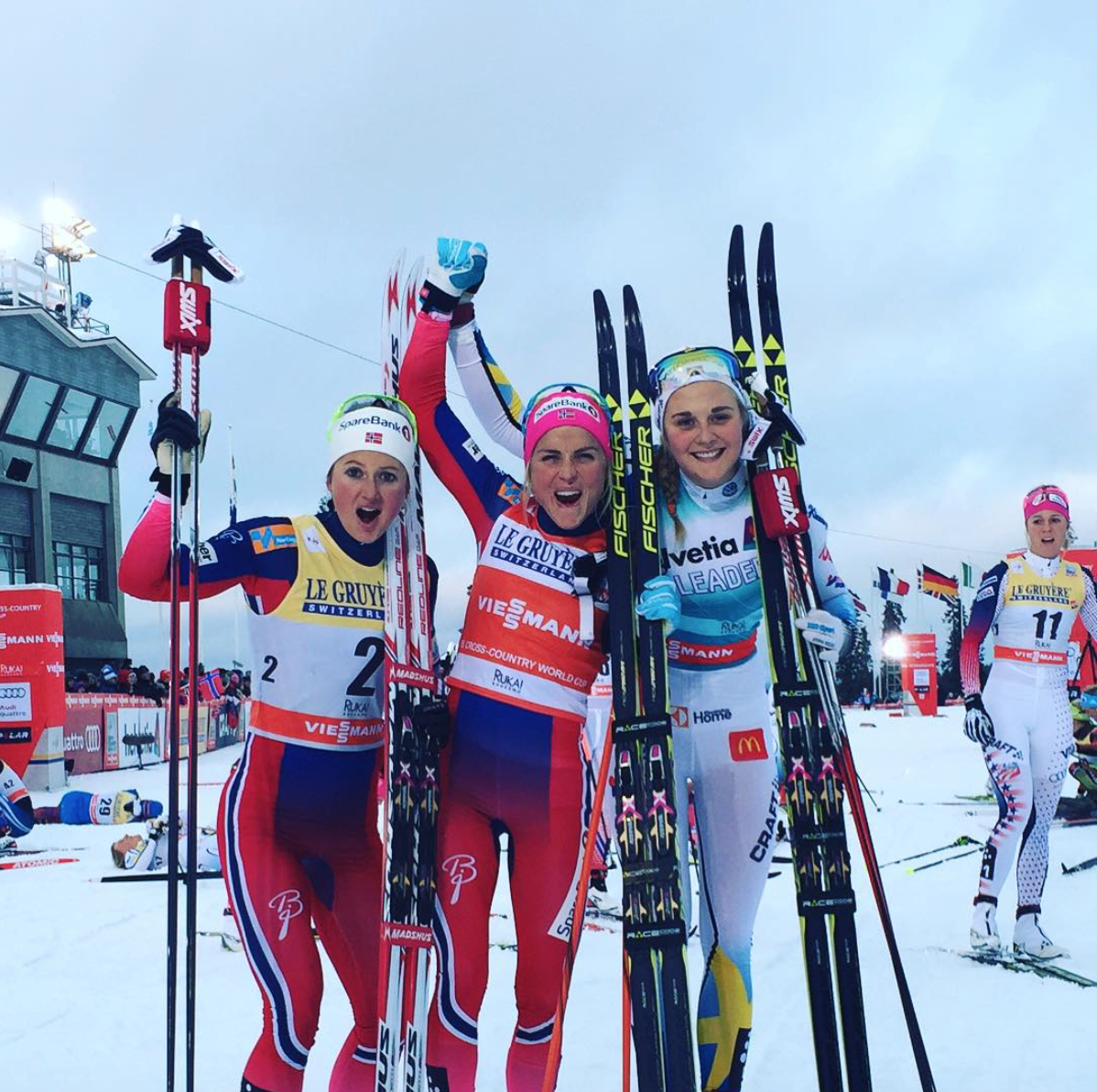
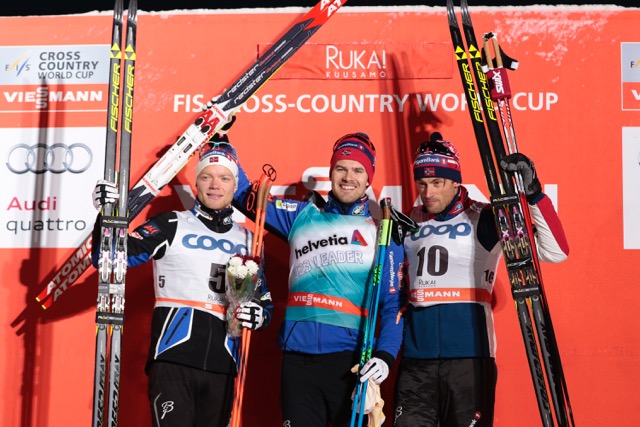
The all-Norwegian women’s podium after the 2019 10-kilometer skate pursuit in Ruka, Finland. From left to right, Heidi Weng (2nd), Therese Johaug (1st), and Astrid Jacobsen (3rd). (Photo: NordicFocus)
Ascending the final climb before the stadium, Weng looked reminiscent of the version of herself who charged up the Alpe Cermis to take home the 2018 Tour de Ski (TdS) victory. She had the second fastest Time of Day (ToD), outmatched by Johaug by a margin of only 8.3 seconds.
The 28-year-old was the 2017 and 2018 overall World Cup winner, landing on the podium 21 times each year. After the 2018 TdS, Weng seemed to lose a gear and though she held onto the overall World Cup win, performances that were lackluster relative to her former prowess ensued. She left the 2018 PyeongChang Olympic Games empty handed and finished the 2019 season ranked 16th with no podium performances.
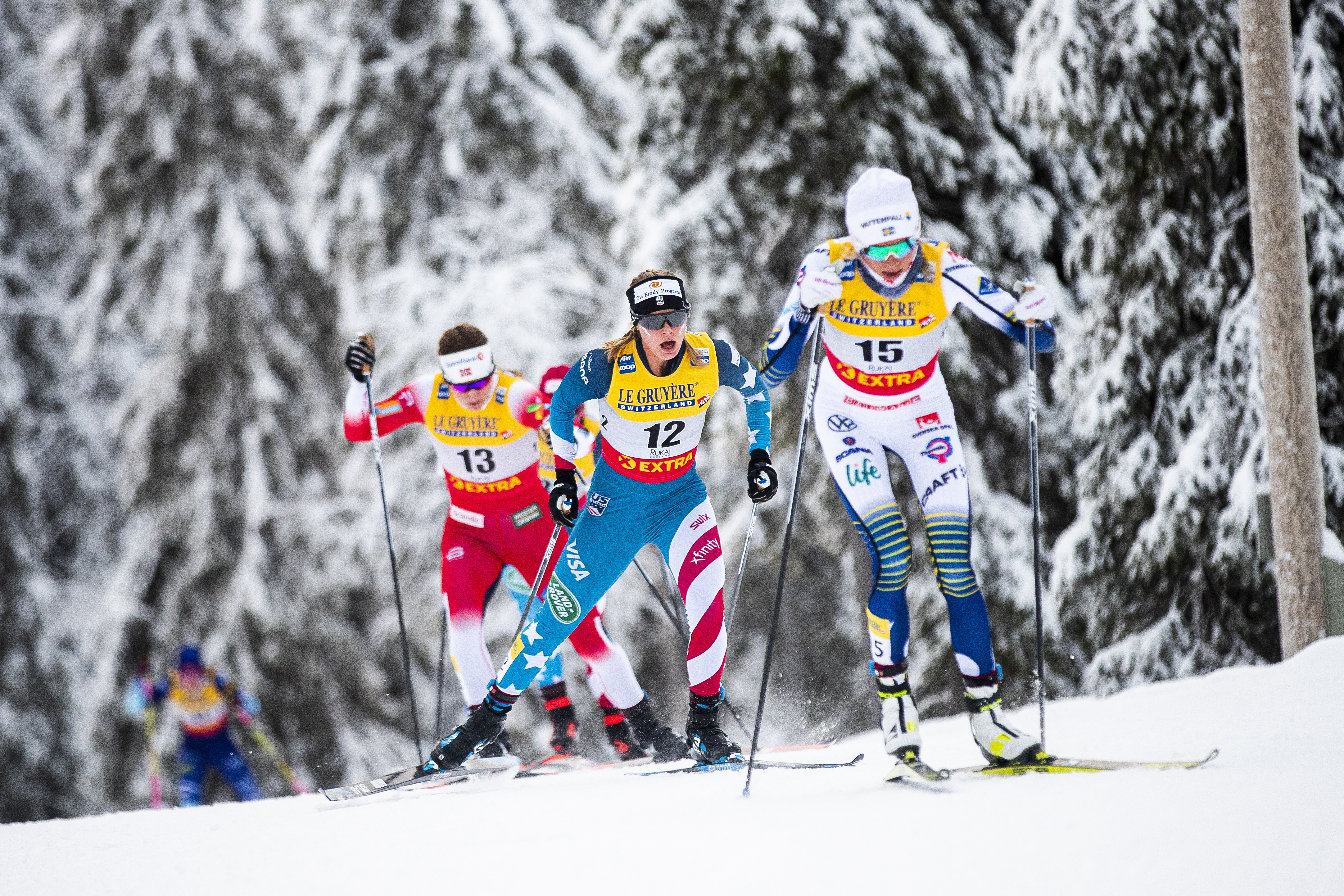
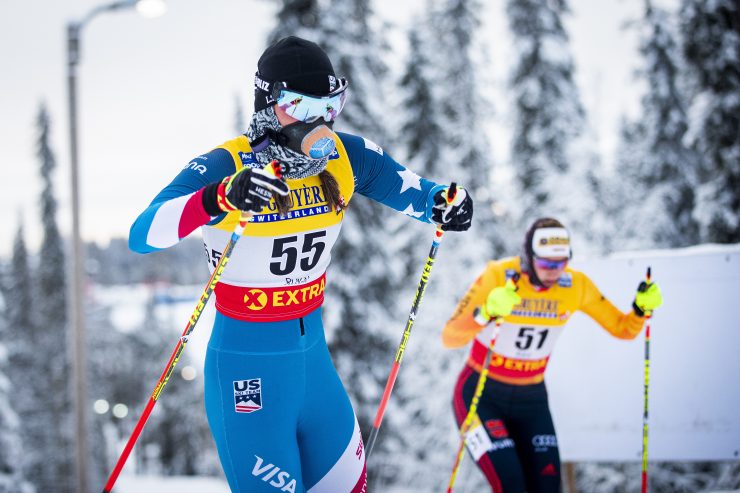
Four Norwegian women landed in the top ten, but so did three Americans: Sadie Maubet Bjornsen, Jessie Diggins, and Rosie Brennan.
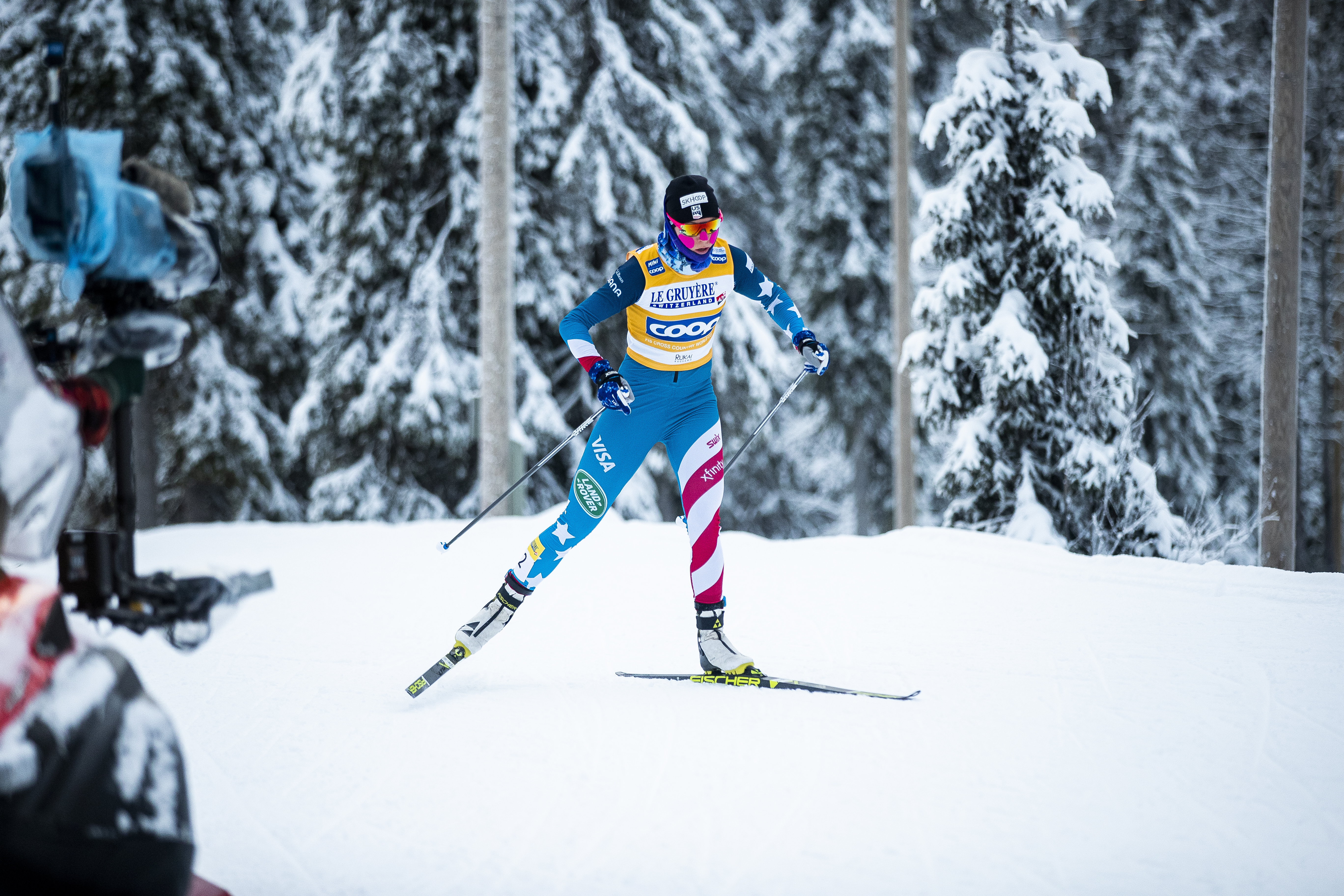
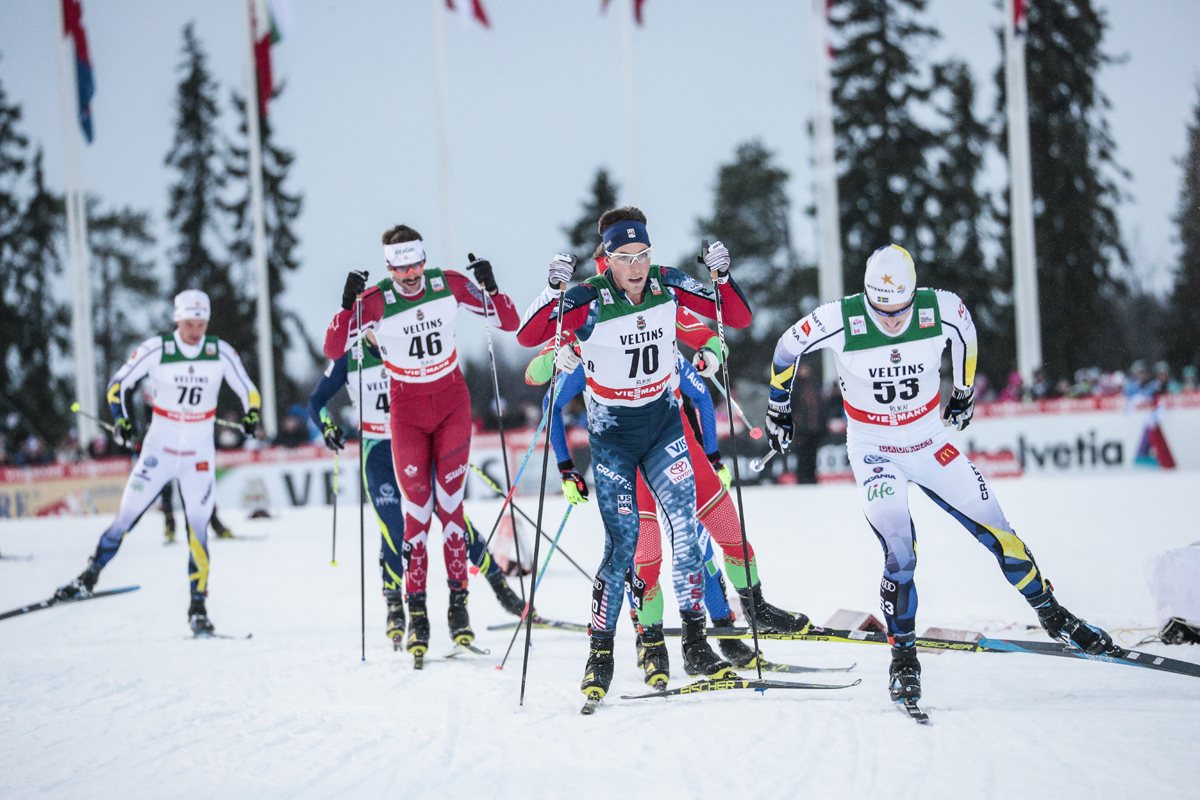
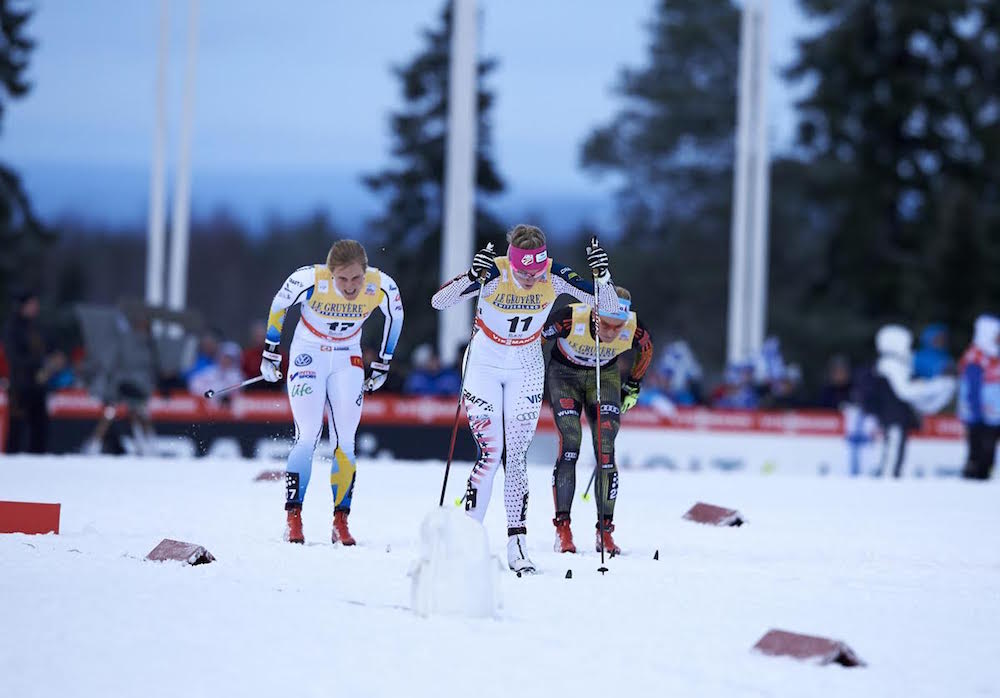
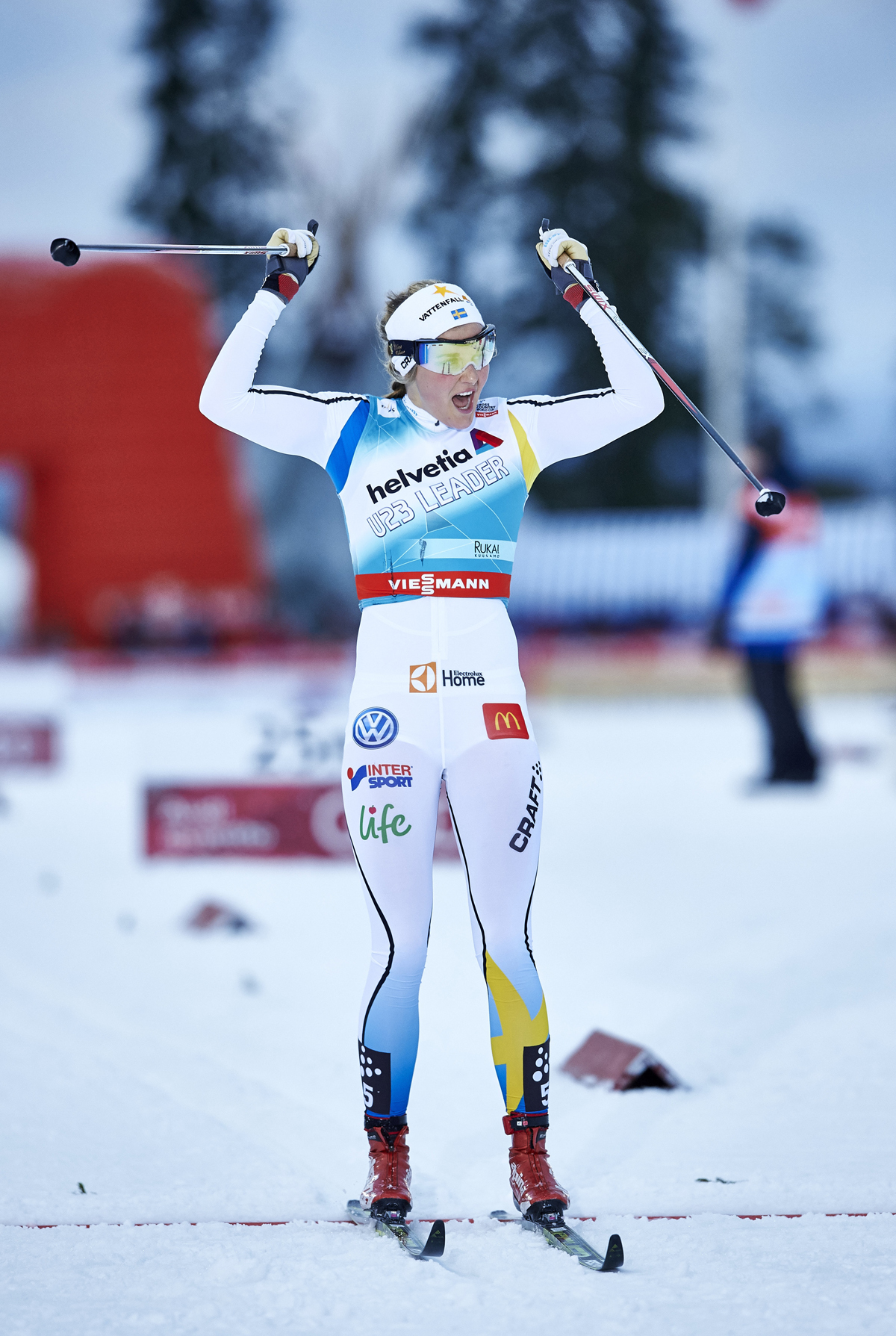
Today was icing on the cake for Maubet Bjornsen who wore the yellow overall World Cup leader bib. She maintained her second place start position through the first half, then was overtaken by the pack of Pärmäkoski, Weng, and Jacobsen. Maubet Bjornsen stayed with these women through the 7.5 k checkpoint, but could not hold off the hungry Norwegians. Maubet Bjornsen ended the day in 4th (+1:27.9).
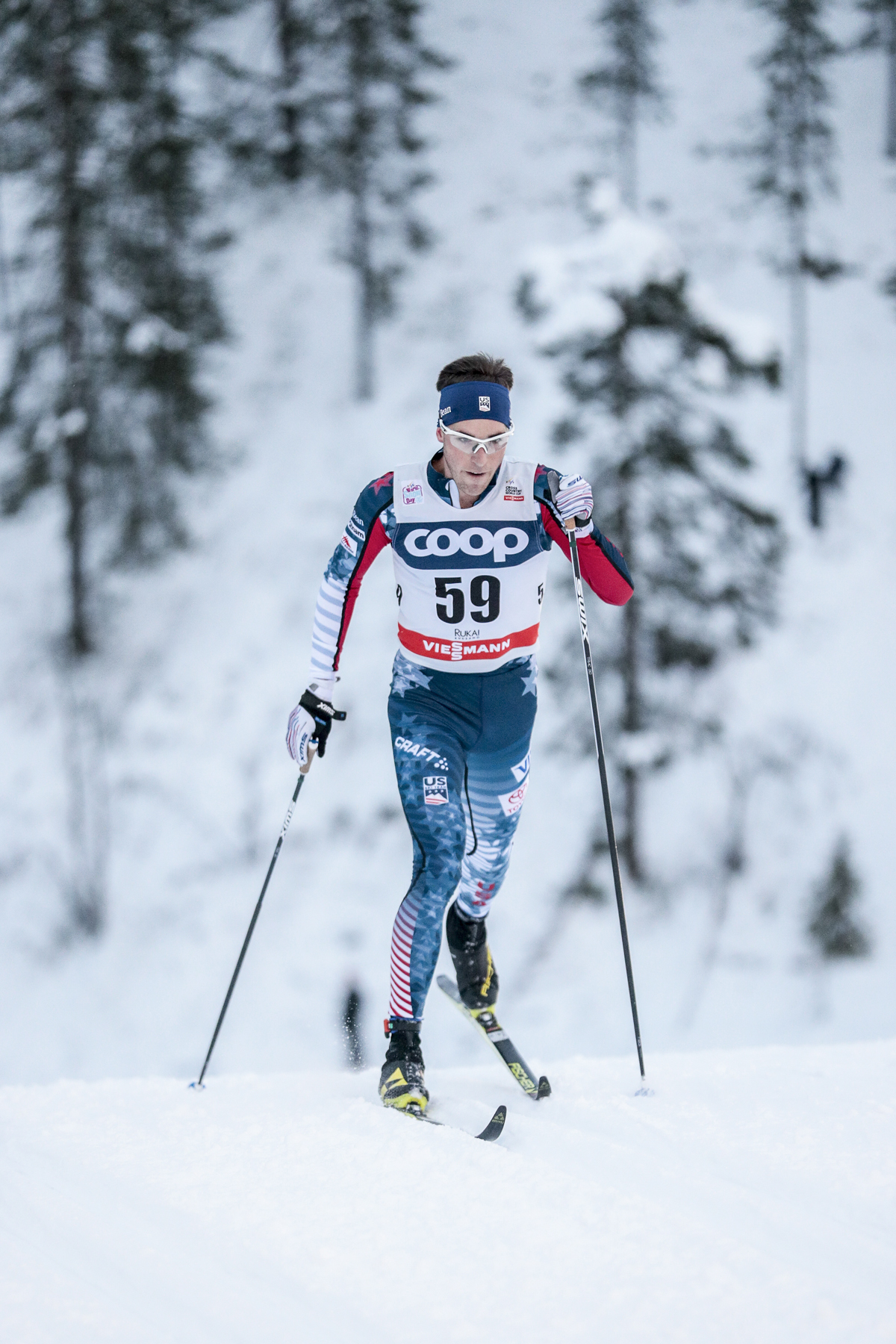
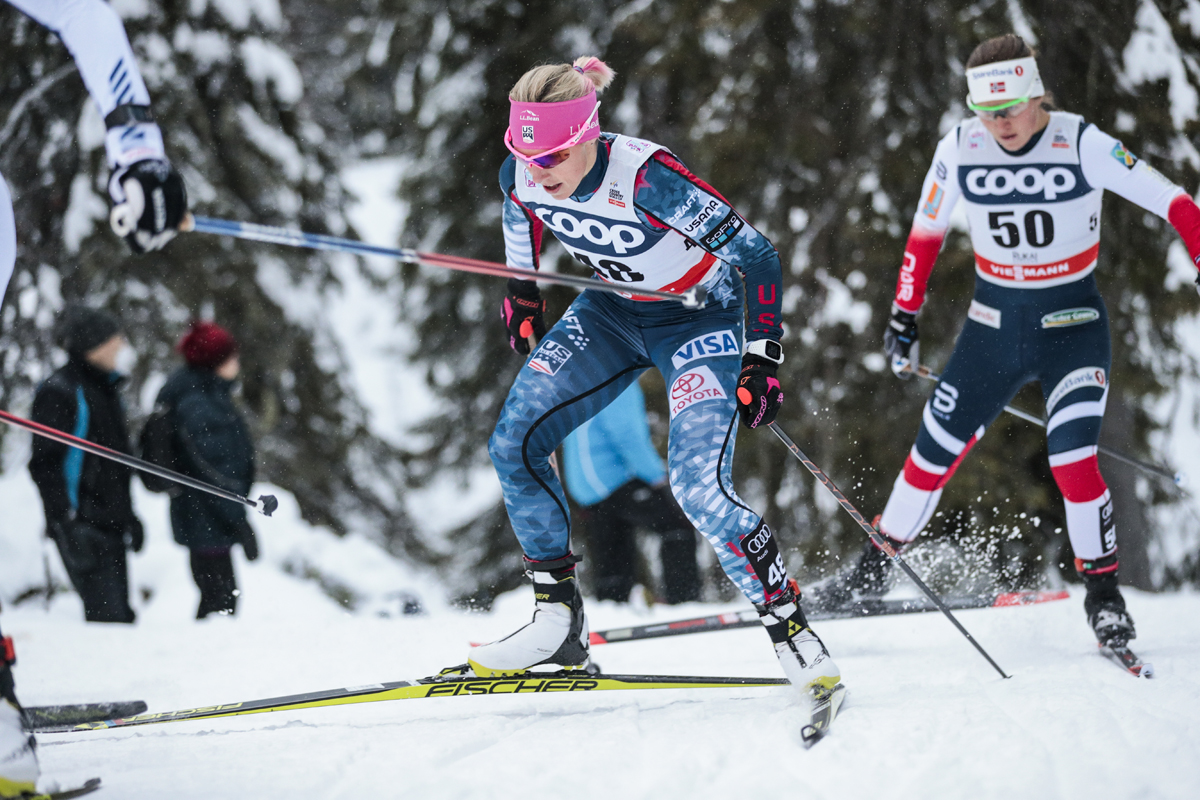
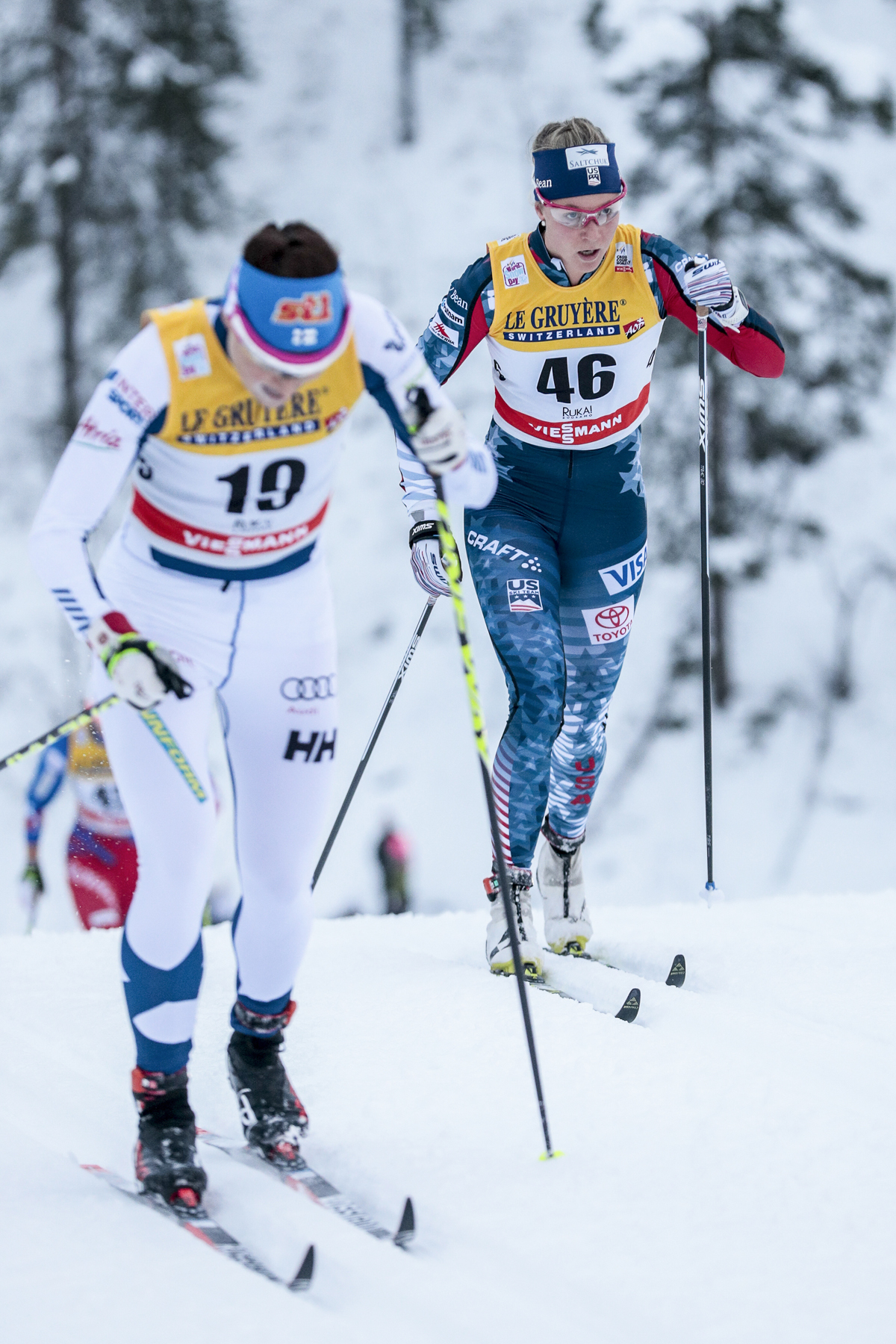
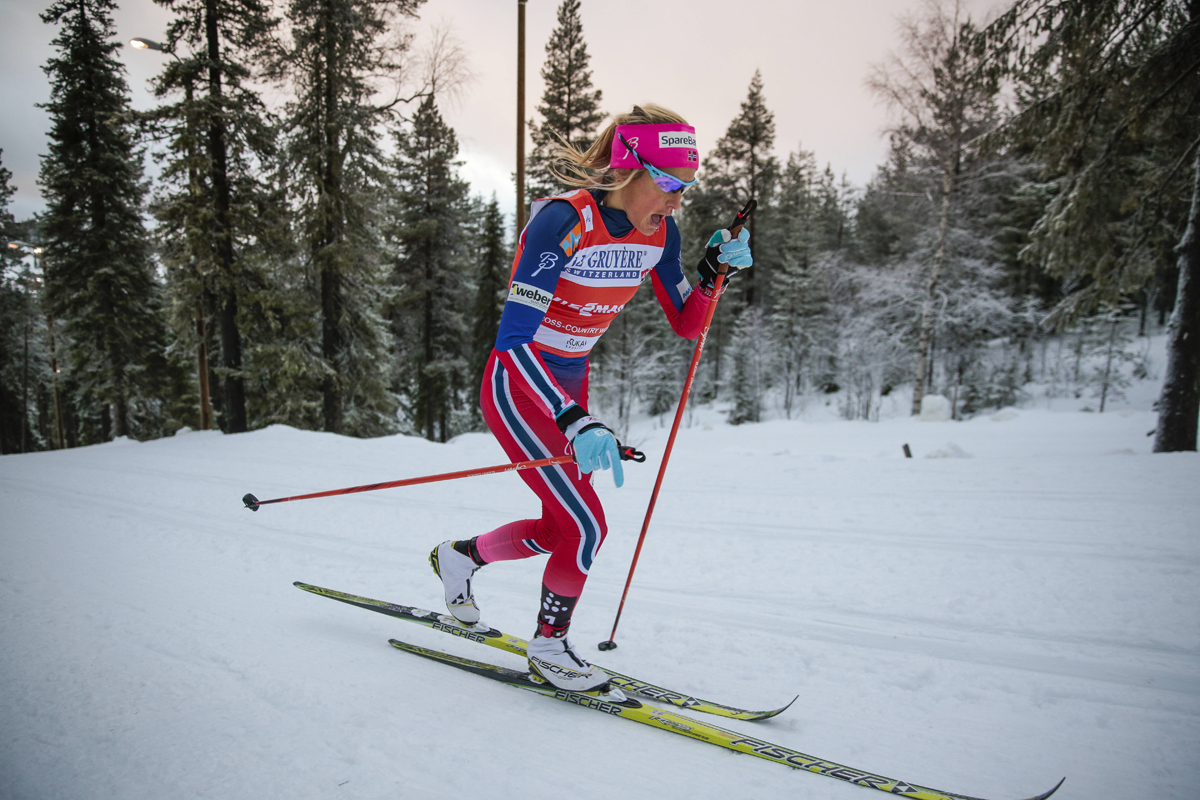
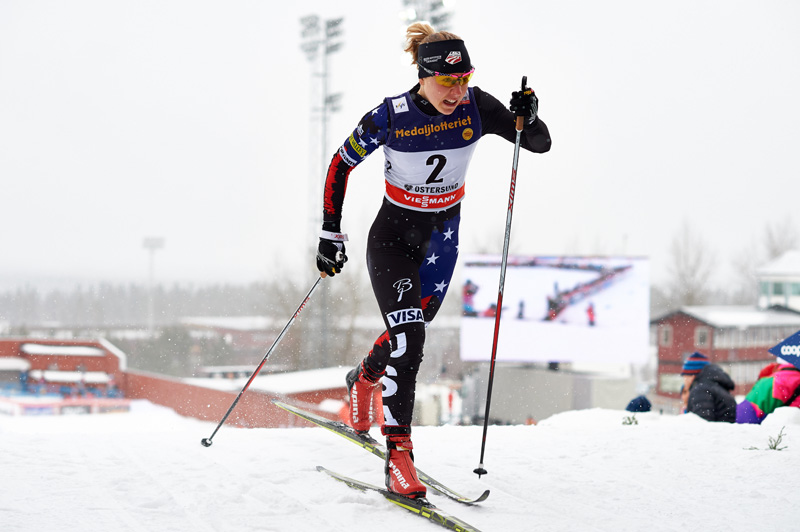
Sadie Maubet Bjornsen skis alone during the 2019 10-kilometer freestyle pursuit in Ruka, Finland. (Photo: NordicFocus)
“It was another fun and final day of racing here in the tour,” wrote Sadie in an email to several news outlets. “What an honor to head out on the course in the yellow bib, that sure was fun! I found myself quite distracted off the line because I had a broken binding and my foot was sliding around on my ski, which left me so worried I was going to lose my ski on one of the downhills.
“After I made it around the first loop in one piece, I was able to forget about it, and focus on the task at hand. As I rounded the corner on the second lap, still alone, I caught sight of the huge group hunting right behind me. My plan going into the race was to hang as absolutely tough as I could if anyone caught me, and be in a place to sprint for the finish since that is my strength. As the group caught me the third lap, I jumped on, and held on for dear life. In the final lap when Heidi started attacking on the uphill, I did my absolute best, but started sinking back slowly.”
Despite ceding two positions, Maubet Bjornsen held off the remainder of the field. Hers was the 14th fastest time of day.
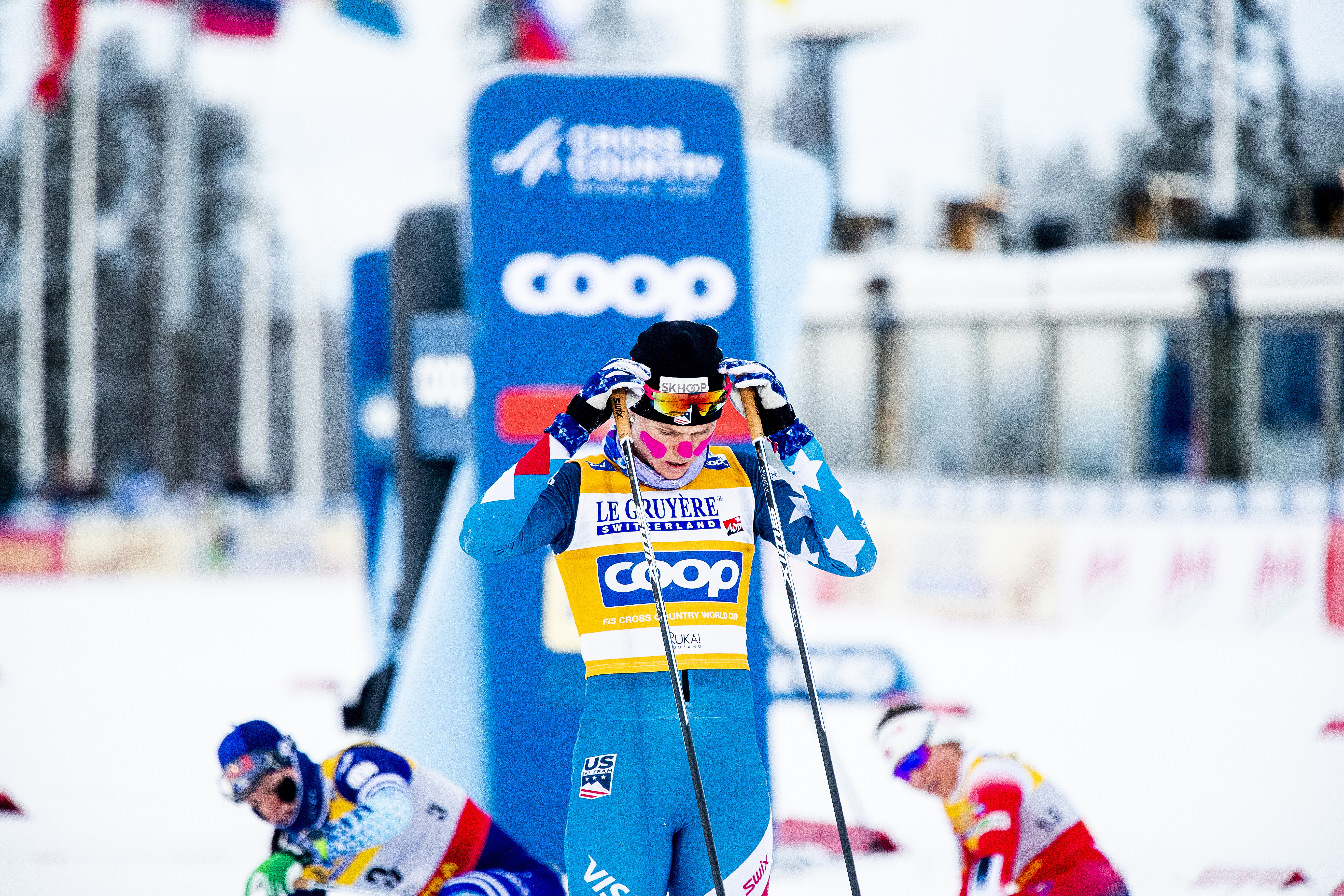
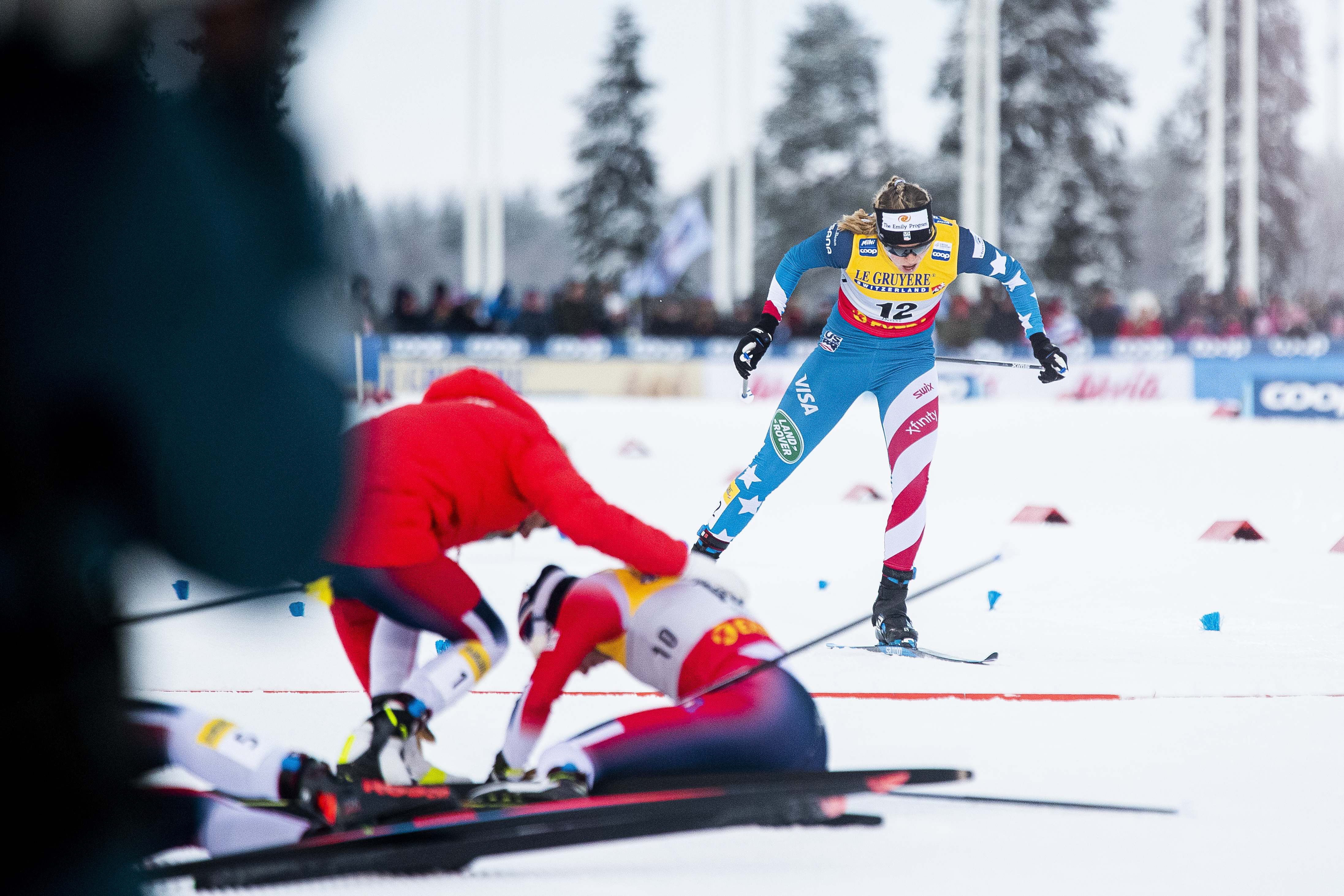
Sadie Maubet Bjornsen catches her breath amidst the finish line carnage after the 2019 10-kilometer freestyle pursuit in Ruka, Finland. (Photo: NordicFocus)
“I knew my strength would be coming over the top of the climb, and just as I clawed myself back to Astrid and Heidi, they made another surge leaving me just out of their draft for the final descent into the sprint climb. As I sprinted up that climb the final time, it was with all the energy stores I had left. I managed to cross the line, fourth in the tour. My goal was to be able to fight for the podium today. While I came just shy for a second day in a row, it is still a huge step to finish a tour in 4th! I look forward to taking some new confidence, and run with it this winter!
“Now it is time to do some resting, recovering, and traveling to Norway for our second weekend of racing. With the way my teammates are skiing right now, we should have a SUPER fun relay event ahead!!”
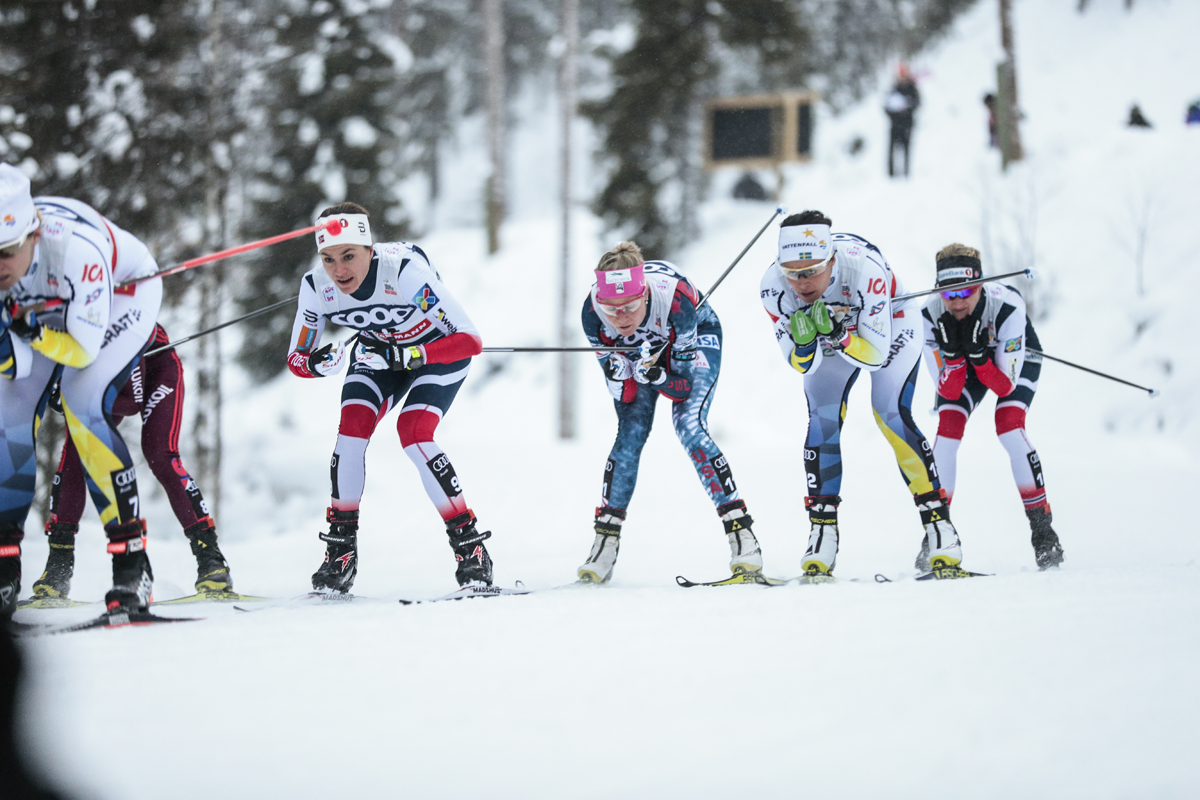
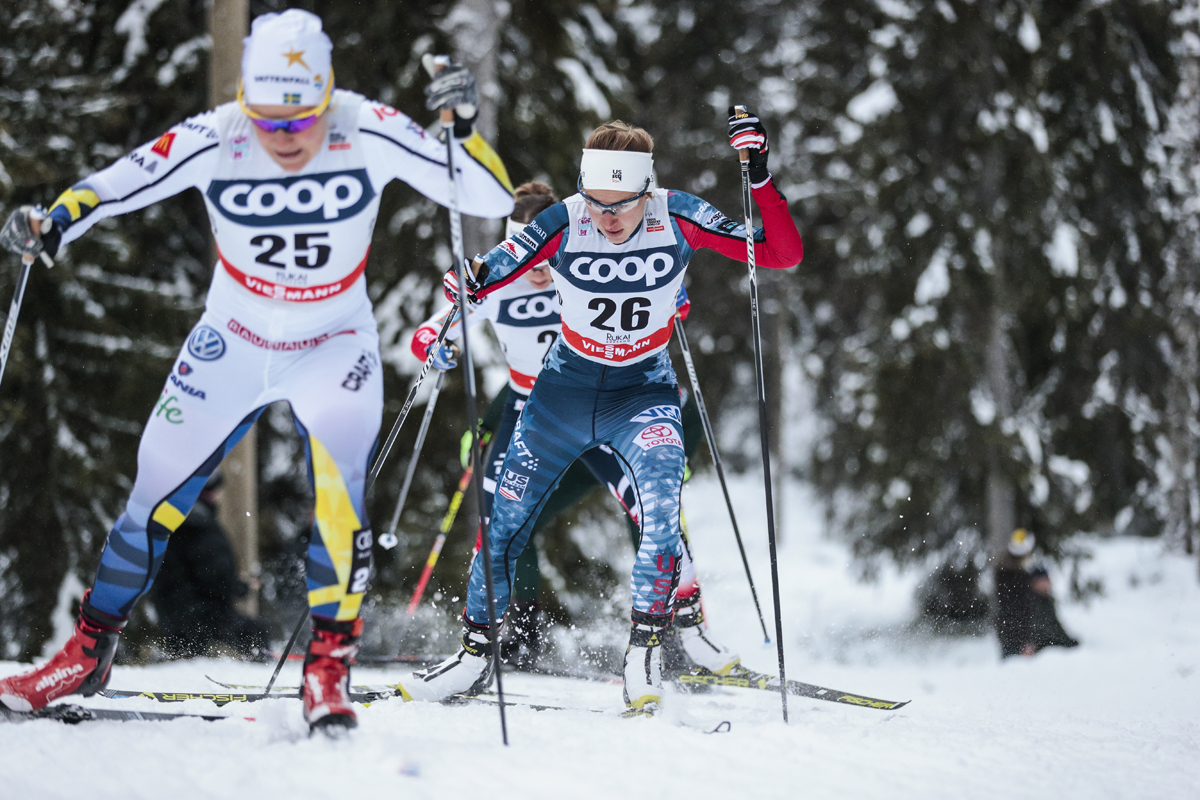
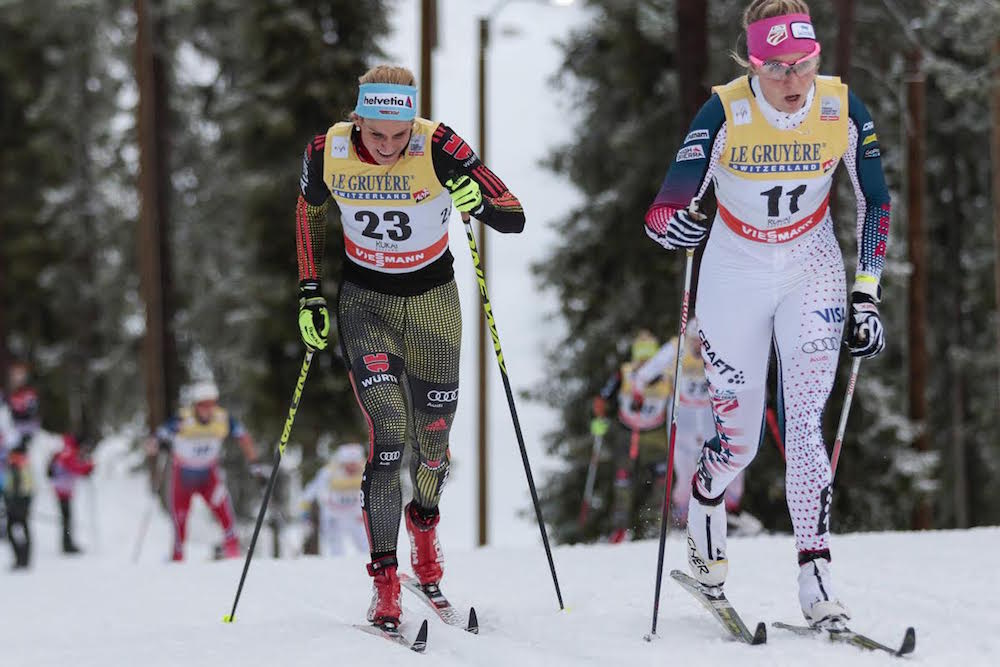
On the hunt, Jessie Diggins moves up through the field during the 2019 10-kilometer freestyle pursuit in Ruka, Finland. (Photo: NordicFocus)
Matching Weng’s spirited hunt, Jessie Diggins had an outstanding performance, advancing from her 12th place start position by seven positions to finish three seconds behind her teammate for 5th place (+1:30.9). Known for her skate talent and energy, Diggins hammered the course with a high tempo, skiing the third fastest time of day, 20.9 seconds off Johaug’s split.
“Any day I can land a TOD podium is a great day, so I’m really happy with how it went!” wrote Diggins in an email. “I just went out charging as hard as I could today, looking to hunt people down, and skied without putting any pressure on myself. It was cold out there, but having grown up in Minnesota, I just loved that and felt right at home! My skis were great today and I really applaud the wax team and coaches for working so hard every day of this season, since we arrived for pre-camp in Beito. I’m so proud of how hard they work and how well they have tackled every weather condition.”
Not landing on the overall podium right away is nothing new for Diggins. Last season, Diggins did not finish inside the top-10 until her seventh race and did not stand on the podium in an individual race until the Tour de Ski.
One last push across the line for Jessie Diggins during the 2019 10-kilometer freestyle pursuit in Ruka, Finland. (Photo: NordicFocus)
“I always work my way into the season and this year is no different,” she explained. “But it was a great surprise to feel so awesome today and to see a TOD podium. With no [world championships] or Games, this year I’m excited to focus on making each and every weekend that I race an absolute all-out effort, and I’m also looking forward to having so many tours this season because I think they are a ton of fun and a great challenge for the body and the brain.”
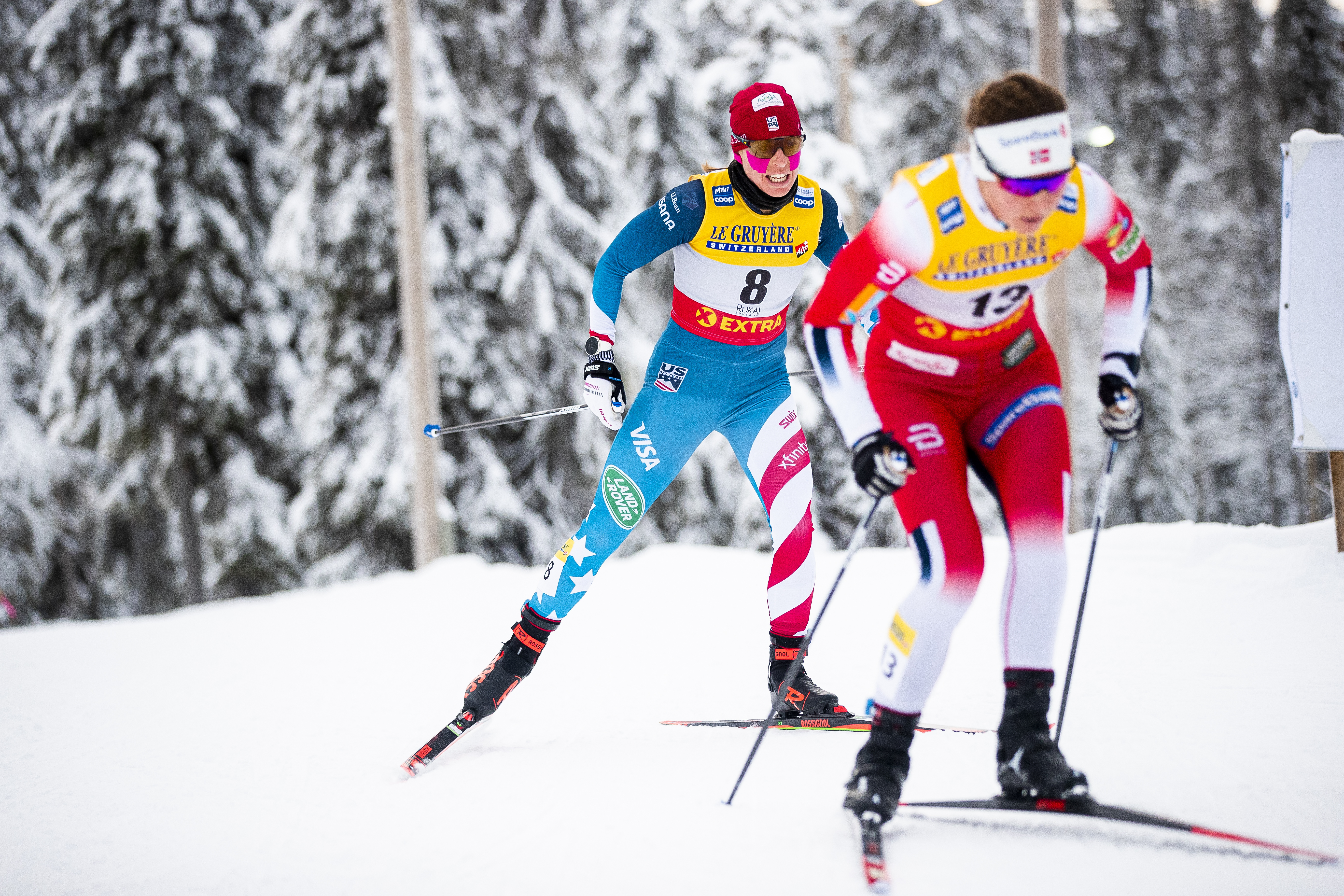
Closing out the top ten, Rosie Brennan slid back from her 8th place starting position into 10th (+2:15.3). Fighting for every second, Brennan skied a strong race, losing a four positions in the first half, then climbing back up ahead of Sweden’s Jonna Sundling and Russia’s Natalia Nepryeava before crossing the line.
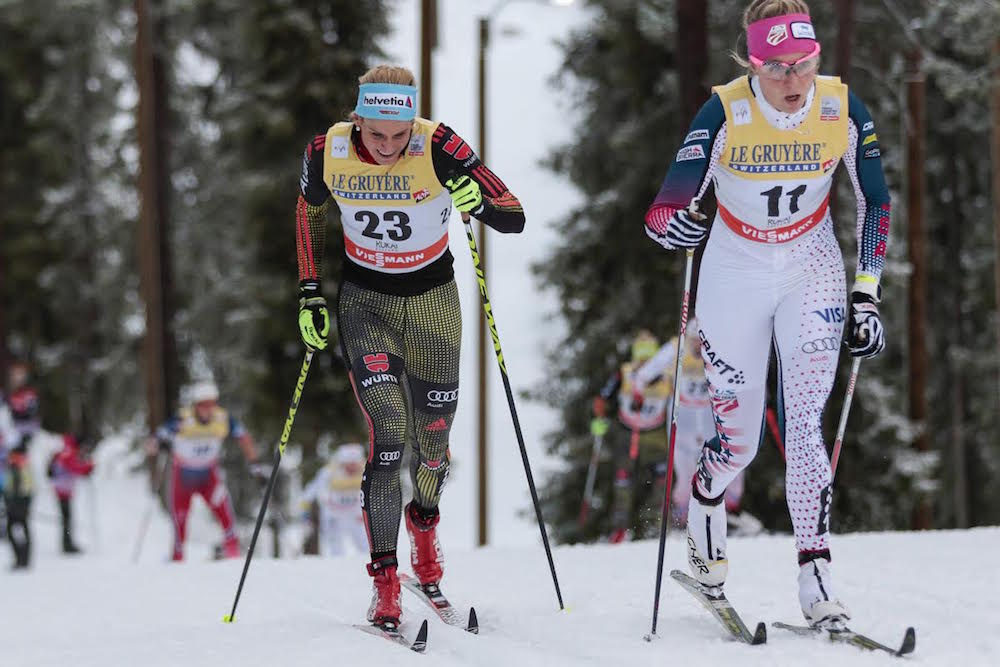
Rosie Brennan catches a ride with a Tiril Udnes Weng of Norway during the 2019 10-kilometer skate pursuit in Ruka, Finland. (Photo: NordicFocus)
“I had a tough starting position with big gaps in front of me and a small gap to the chasers behind me,” Brennan wrote to several outlets. “When the chasers caught me, I tried to follow but struggled to stay with the pack. I recollected and had a better second half of the race, passing back a few girls. It was far from my best race, but I am satisfied with the fight I put up and really thrilled to have opened the World Cup with a 10th in the Ruka Triple. That far exceeds my expectations for the weekend. It’s certainly time for a little rest after a big opening weekend and hopefully trying to find more speed in the coming weeks.”
Outside of the top-30 and in a tight spread, the remainder of the American women advanced from their start positions, including the newest members of the ranks. Julia Kern moved from 55th to 49th (+5:13.1) and Hailey Swirbul jumped from 66th to 54th (+5:32.8). Caitlin Patterson ended her day in 52nd (+5:21.6) and Rosie Frankowski in 56th (+5:35.9).
Caitlin Patterson leads her teammate Julia Kern during the 2019 10-kilometer freestyle pursuit in Ruka, Finland. (Photo: NordicFocus)
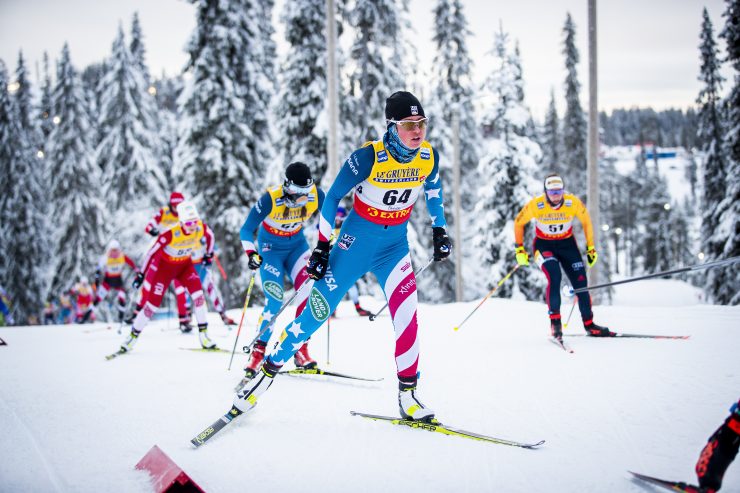
A masked Julia Kern on course in frigid temps during the 2019 10-kilometer freestyle pursuit in Ruka, Finland. (Photo: NordicFocus)
Seven men and nine women will be lining up in stars and stripes for the World Cup’s opening: Finland’s Ruka Triple. Three race series features a classic sprint followed by a two-day distance pursuit.
Jessie Diggins out-toes Russia’s Yulia Belorukova to take third in Stage 5 of the Tour de Ski. (Photo: Fischer/Nordic Focus)
At the top of the ranks, Jessie Diggins (USST/SMS T2) finished the 2019 season 6th in distance and 7th in sprint. It was a year of navigating the life of a gold medalist whose training time was suddenly competing with travel, media attention, and collaborating with sponsors. According to her blog, she packed in 25 events in the first 50 days after the Olympics. Diggins admitted this swell of opportunities also left her feeling mentally and physically fatigued during the season.
That said, you know American women’s skiing has come a long way when feeling flat leads to finishing 6th overall in the World Cup Standings. Diggins won the freestyle sprint in Cogne, Italy and took 3rd in the 10 k skate in Falun, Sweden. She also placed third in three stages of the Tour de Ski and skied the fastest time of day during the 10 k skate pursuit in Oberstdorf, Germany.
Presuming Diggins achieved her goal of finding a work-life balance that allowed her to better recover and absorb training, we can expect her to consistently remain one of the top athletes on the World Cup.
One thing is certain: The Minneapolis World Cup race on March 17th features a freestyle sprint, and Diggins will be racing in front of a home crowd amidst a cacophony of cowbell.
Another consistent performer, Sadie Maubet Bjornsen (USST/APU) finished 8th in the sprint standings and 13th in the distance. She took third in the freestyle sprint in Lillehammer, NOR and cleaned up at the Super Tour Finals winning the freestyle sprint and both distance races. Another testament to how high the standard has been set for the American women, Maubet Bjornsen’s season was not particularly novel, despite consistently measuring up as one of the best all-around skiers in the world. We have come to expect her to perform, and she continues to meet our expectations. This year we expect no less.
Leading the American women on the short track, Sophie Caldwell (USST/SMS T2) finished the season ranked 4th in the overall sprint standings. Caldwell took second place in Davos, Val Muestair, and Lahti, and landed inside the top ten an additional three times. After posting the second fastest qualifying time in the World Championships in Seefeld, AUT, Caldwell was eliminated in the quarterfinals after throwing her boot across the line a three-way photo finish. Because the heat was slow and she was deemed third, she was unable to advance.
Julia Kern (L) and Sophie Caldwell after finishing fourth place in the team sprint (Photo: Garrott Kuzzy / LumiExperiences.com)
Julia Kern (USST/ earned her first Period 1 starts as the overall SuperTour leader in 2019. The 22-year-old also displayed her readiness to race at the World Cup level by scoring points in five events. Her best individual performance came during the freestyle sprint in Cogne, ITA where she finished 11th. She also battled for a gritty fourth place result while racing with Caldwell during the Dresden team sprint, and shone at US Nationals earning two sprint podiums.
Racing fearlessly with the best in the world, Kern cracked the top-20 in the skiathlon in Seefeld, finishing 19th. She also finished 23rd in the freestyle sprint two days prior. With another year of training and experience under her belt, Kern will certainly be worth following.
After recovering from mono, Rosie Brennan rebounded with a phenomenal season in 2019 and consequently was nominated once more to the U.S. Ski Team. Last year, Brennan blew through Period 1 with a vengeance, placing inside the top 30 and mostly within the top 15 in all of the distance races she entered. She cracked the top-10 in the 10 k skate in Davos, with a career best sixth place, and again in the skiathlon when the competition was at its peak in Seefeld.
The remainder of the women starting in Ruka who earned discretionary selection includes: Caitlin Patterson (USST B Team/CGRP) who landed inside the top 30 in the 10 k skate in both Lillhammer and Ulricehamn, SWE, Hailey Swirbul (USST B Team/APU) who stood on the podium after three Opa Cup distance races and landed inside the top 10 at U23 World Championships, and Rosie Frankowski (APU) who finished 24th during the skiathlon at the World Ski Championships in Seefeld.
The second weekend of racing in Lillehammer features a distance pursuit, followed by two sprint events in Davos, SUI and Planica, SLO. These women will be able to focus on the races that best suit their strengths in Period 1.
Before heading to the American men’s field, FasterSkier sends well-wishes to Hannah Halvorsen who was slated to contest the Period 1 sprint races. Halvorsen was struck by a car while crossing a street in Anchorage on November 1st, fracturing her skull and badly injuring her left leg and knee. According to her father who posted information on Facebook, Halvorsen will have a long road ahead of her, but doctors are optimistic that full recovery will be possible. FasterSkier wants to respect the privacy of the Halvorsen family, but will report when they are ready to share further information.
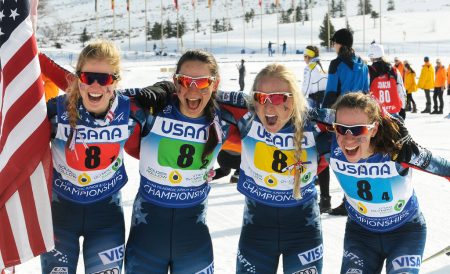
The U.S. women’s relay after taking a historic third in the 4 x 3.3 k relay at 2017 Junior World Championships on Sunday at Soldier Hollow in Midway Utah, with (from left to right) Hailey Swirbul, Julia Kern, Hannah Halvorsen, and Katharine Ogden. (Photo: U.S. Ski Team/Tom Kelly)
Deep breath. Back to the World Cup.
Of the eight men who made the cut, three were selected objectively: overall 2019 SuperTour leader Kyle Bratrud (SMS T2), and USST A Team members Simi Hamilton (USST/SMS T2) and Erik Bjornsen (USST/APU).
Returning with a wealth of World Cup experience, Hamilton is a consummate contender in sprint races. His most noteworthy performance was aptly timed at the World Championships in Seefeld where he finished ninth. Hamilton advanced from the quarters in a lightning fast heat, then got hung up with another skier in the semi, losing both his momentum and contact with the leaders. On home turf, Hamilton also won the freestyle sprint during the SuperTour finals.
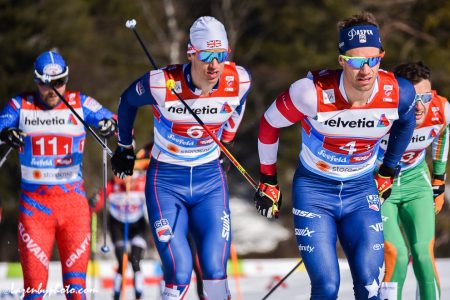
American Simi Hamilton (r) leading Great Britain’s Andrew Young during the 6 x 1.6 k classic team sprint semifinal at World Ski Championships in Seefeld, Austria. (Photo: John Lazenby/lazenbyphoto.com)
Before World Champs, Hamilton had a strong performance in Cogne, finishing just off the podium in 4th. Displaying the agility and sure-footedness for which he is known, Hamilton dodged a crash in both the quarter and semifinals. This race marked a turning point in his season as crashes and illness prevented him from capitalizing on the fitness he felt confident he possessed. When the pieces come together, Hamilton is both a force to be reckoned with and a thrill to watch.
After popping the third fastest time of day during the 15 k classic pursuit in Lillehammer, Bjornsen has been promoted to the USST A-Team. Last season, Bjornsen whittled his way up the results list, particularly in distance racing. He finished 16th the 15 k classic Cogne, followed by a 17th place finish in the same event in Seefeld. Are you noticing a theme here?
Once again in the 15 k classic in Quebec City, Bjornsen finished 18th followed by a second top 20 (19th fastest time of day) in the subsequent 15 k skate pursuit. At the SuperTour finals, Bjornsen took the win in both the distance races and finished second in the freestyle sprint, demonstrating his versatility as an athlete.
Bratrud’s lead in the SuperTour was primarily garnered through strong results in distance skiing, which also translated to encouraging results on the World Cup. The Minnesota native stood on the podium six times in NorAm and SuperTour distance races, taking the top spot in four of them. At US Nationals, he won the the 15 k classic and took second in the 30 k skate. During his mid-winter international stint, Bratrud landed inside the points in the 15 k classic in Cogne. This will be his first season racing on the World Cup in Period 1.
The remainder of the men to watch in Period 1 include Scott Patterson (USST/APU) and David Norris (APU), who will be focusing on distance racing, and Kevin Bolger (USST/SVSEF) and Logan Hanneman (APU) who will focus on sprint events. Hanneman will not start in Ruka, but plans to compete in both Davos and Planica.
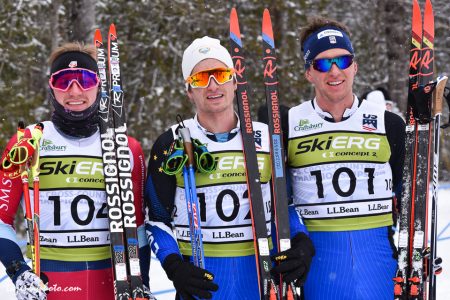
The men’s podium from the 30 k skate mass start at U.S. Nationals in Craftsbury, VT. From left to right, Kyle Bratrud (SMS T2) second, David Norris (APU) first, and Scott Patterson (APU/USST) third. (Photo: John Lazenby)
Several athletes who were offered starts in Period 1 declined to focus on the SuperTour. This list includes Kelsey Phinney (SMS T2), Andy Newell, Adam Martin (CGRP), and Ben Saxton (SMS T2).
Phinney underwent shoulder surgery in mid-June for a torn labrum, which occurred from a fall with an outstretched arm. He doctors estimated a six to twelve month recovery process. Phinney spent six-weeks in a shoulder sling, then began to slowly reintroduce strength training and outdoor activities. So far, she has done some no-pole and one-pole skiing.
“My biggest priority is making sure my shoulder heals properly and gets back full range of motion,” wrote Phinney in an email on her return to competition. “I’m not sure when I’ll be back to racing, perhaps later this season if things go really well with rehab. In the meantime, I’m enjoying time at home in Boulder – it’s been nice to see friends and family here, and to explore life outside of the bubble of training and racing. And then in a couple weeks, I‘ll be at the first SuperTour races of the year to help my SMST2 team out with ski testing, driving around, and cheering very loudly! I’m hoping to start using two poles in the next few weeks, and ideally I’ll be able to ski quite a bit in Canmore and Sun Valley and see where I can go from there!”
Canada
Overall in Nations Cup Last Year: 11th
Women’s Ranking 2018/2019: 15th
Men’s Ranking 2018/2019: 9th
Canadians to Watch:
Alex Harvey takes in the cheers after placing second in the men’s 15 k classic in Québec City. (Photo: John Lazenby/lazenbyphoto.com)
Canada’s top skier, Alex Harvey, retired at the end of the 2019 season. He ended his career on a high note. He finished second in the 15-kilometer freestyle pursuit in his home city of Québec. Fellow national team member Lenny Valjas retired also retired at the end of last season.
Three Canadians will be heading to Europe to race during Period 1 in Davos and Planica: Dahria Beatty, Emily Nishikawa, and Russell Kennedy. These athletes will then return home to train with developing national team athletes and compete in NorAm races. Canada will not be contesting the Tour de Ski. Should one of these athletes pop a top ten in those Period 1 races, the decision not to return in Period 2 may be reevaluated.
This focus on domestic racing and development of world class athletes is part of a larger movement to rebuild the Canadian national program, which recently rebranded as Nordiq Canada. You can find more information on this here.
Beatty posted strong results in 2019. She started her season with a slew of NorAm wins then collected a handful of FIS points by finishing 16th in the freestyle sprint in Dresden and 24th in the same event in Lahti. She also won the 15 k freestyle pursuit at the Canadian National Championships, chasing down Nishikawa who had won the 10 k classic the previous day. In her season opener at Nordiq Thunder, Beatty landed the top spot on the podium in the 16 k skate and commented that she was happy with her overall fitness and how her training has progressed this year.
Nishikawa also scored FIS points in 2019 by finishing 23rd in the 10 k skate in Davos. She also placed 25th in last season’s Tour de Ski.
Kennedy, who has already gotten his feet wet with European racing this season in Olos, Finland, posted his best result during the freestyle sprint in Cogne, where he popped a 12th place finish. Domestically, he landed on the podium in five NorAm races.
The remaining members of the Canadian National Team who will be racing domestically include Julien Locke (Nelson, B.C.), Katherine Stewart-Jones (Chelsea, Que.), Graham Ritchie (Parry Sound, Ont.), Antoine Cyr (Gatineau, Que.), Sam Hendry (Canmore, Alta.), and Julien Smith (Thunder Bay, Ont.).
“This group is ready to step up and carry the torch for a new era of cross-country skiers in Canada,” said Shane Pearsall, chief executive officer of Nordiq Canada in a press release. “They are equally as fierce and determined to deliver medal winning performances as their heroes before them. We are going to work with our sport and funding partners to deliver this dynamic group of athletes the tools they require to succeed on the road to 2022 and beyond.” The site https://x100casino.com contains the best 100 online casinos in the world
Dahria Beatty on course during the 10-kilometer skate in Ulricehamn, Sweden. (Photo: Fischer/Nordic Focus)
Canada’s Katherine Stewart-Jones racing to 79th in the women’s 10 k freestyle on Dec. 10 at the World Cup in Davos, Switzerland. The day before, she placed 55th in the freestyle sprint. (Photo: Reese Brown / U.S. Ski & Snowboard)
In a split second, Katherine Stewart-Jones was flying over her handlebars and headed face-first for the road. She had been biking to her local gym in Thunder Bay, Ontario, on Sept. 19 when her bike’s front tire rammed into an irregular rise in the road and sent her off her bike seat and toward the unforgiving pavement below.
A person driving by witnessed Stewart-Jones catapult off her bike and stopped immediately to check if she was all right. Though the 22-year-old Quebec native had been wearing a helmet, her face had take the brunt of the impact, leaving her with two swollen lips and one very sore tooth. The passerby who had witnessed the fall stopped, loaded Stewart-Jones’s bike in the back of the car and ferried her the rest of her way to the gym.
Canadian National U25 Team member Katherine Stewart-Jones racing in a classic-sprint quarterfinal at 2017 U23 World Championships at Soldier Hollow near Midway, Utah. She placed 24th overall on the day. (Photo: flyingpointroad.com)
When Stewart-Jones arrived at Thrive Strength and Wellness that day, Josh McGeown, who works as a strength instructor at Thrive, has a master’s of science in kinesiology and specializes in athlete injury and rehabilitation, took one look at her and informed her there would be no workout for her that day. In the gym’s office, McGeown immediately ran a few preliminary tests to decipher if Stewart-Jones had a concussion, though he also indicated it was, in all likelihood, too early to tell. She would have to wait for more symptoms to arise.
After McGeown’s prognosis, Stewart-Jones, a member of both the Canadian National U25 Team and National Team Development Center (NTDC) Thunder Bay, called the NTDC team’s doctor to arrange an appointment. She got in the same day as the accident, and a few more tests were run. Once again, however, she was told nothing could be confirmed until more signs of a concussion showed up. By the next morning, they did.
“I slept like 12 hours that night or something, not normal,” Stewart-Jones said on the phone in late November.
The morning following her accident, Stewart-Jones flew home to Chelsea, Quebec. She had been planning to return home to help with a Fast and Female event taking place in Ottawa, 10 kilometers south of her hometown. After the event, her plan was to fly to Park City, Utah, to join her fellow Canadian national-team members at a dryland altitude training camp.
But recurring headaches and the inability to do anything but sleep changed all that.
“I was sleeping like crazy,” Stewart-Jones said. “My eyes would get really tired. I had a lot of sensitivity to light and sounds, just being around people was like, ‘Whoa.’ ”
“I also ended up having some issues with my tooth,” Stewart-Jones explained. “We weren’t sure at first if it was injured, but it ended up changing colors, like turning purple. So I ended up having to get a root canal.”
Besides a tooth that necessitated endodontic treatment, Stewart-Jones’s accident also left her with no energy to train, despite wanting to do so. For close to a month, she rested, unable to train or complete any of the online psychology courses she was taking at Lakehead University. Even reading screens bothered both her eyes and her head.
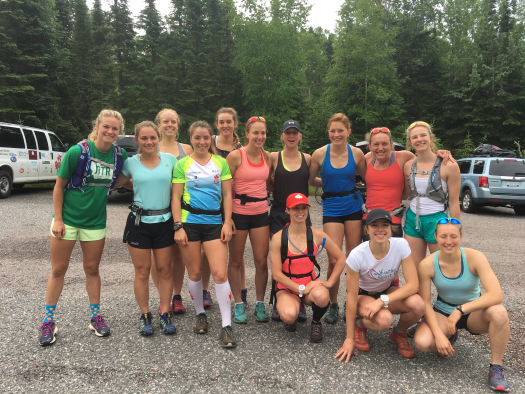
Katherine Stewart-Jones of the Canadian National U25 Team (fourth from l, white socks) with guest training partners Jessie Diggins of the U.S. Ski Team (far left) and Caitlin Gregg of Team Gregg (back row, second from r) prior to hiking, “The Giant” this summer. (Photo: Katherine Stewart-Jones)
For Stewart-Jones, the hardest part of coping with the injury was transitioning from full-time training to barely moving.
This sentiment surfaced in Stewart-Jones’s blog post following the accident, where she reflected, “I think we can all agree that cross-country skiing is one of the hardest sports in the world. I have been training for skiing for as long as I can remember, but these past six weeks have been the toughest of my career and I have barely lifted a finger.”
“When you’re used to doing so much and then not being able to do much at all was just frustrating and then also just kind of depressing,” Stewart-Jones later told FasterSkier. “I spent a lot of time feeling almost sad and really sorry for myself.”
Couch-ridden in Chelsea, while her teammates and the rest of the cross-country world continued to train, Stewart-Jones was faced with the question any athlete who has put endless amounts of time into a season and suffers an injury dreads: was it all for nothing?
“I definitely had that thought of, is my season over?” she said. “Kind of that panicked moment where it’s like this is an Olympic year and I want to qualify for the Olympics and I kind of felt like maybe my dream is crushed.”
But that was one question she wasn’t going to wait around to find out. She began a proactive approach to recovery, which included logging her symptoms and journaling, guided meditation, and staying in contact with therapists, chiropractors, acupuncturists, and teammates (read more about the five steps she took on her blog).
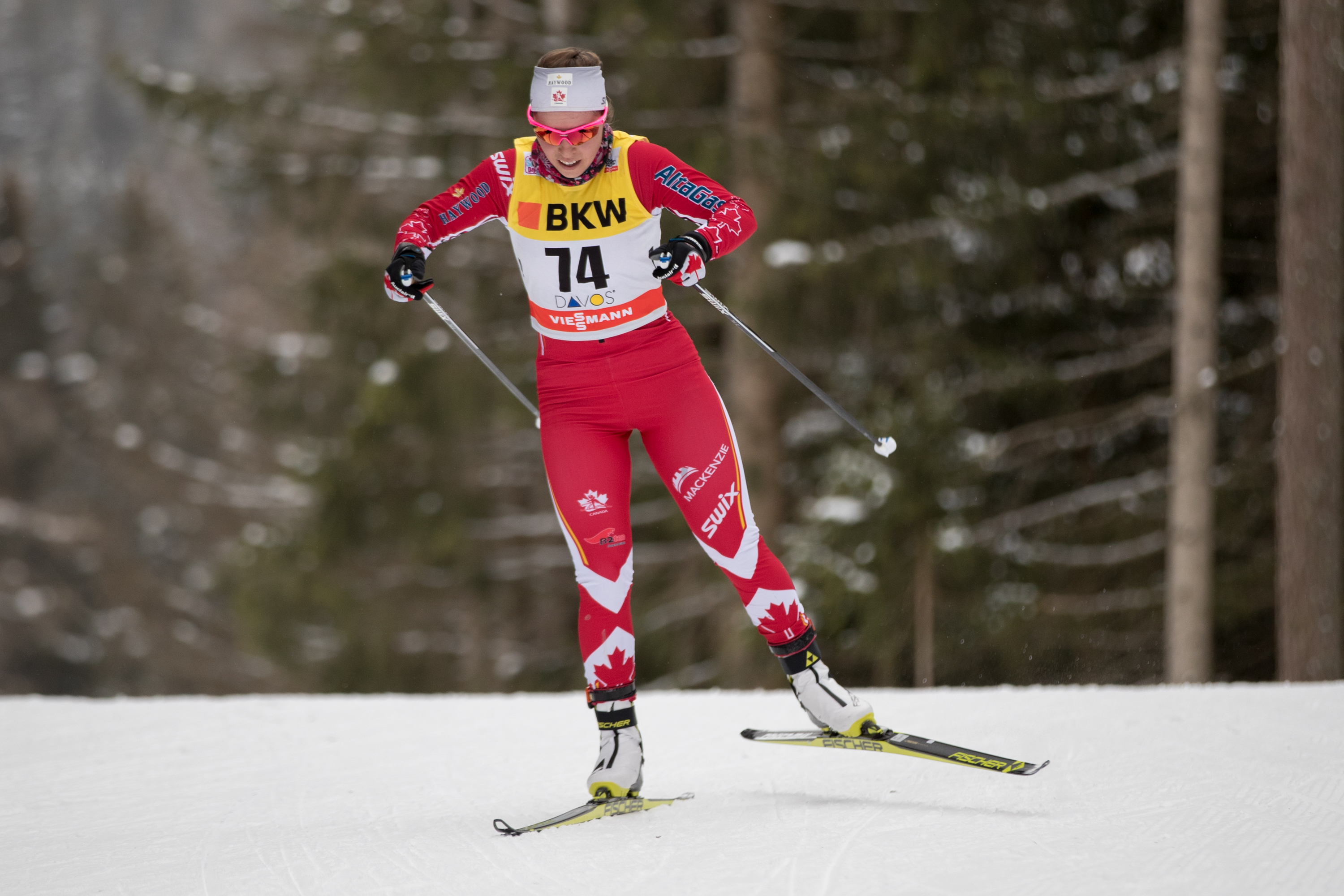
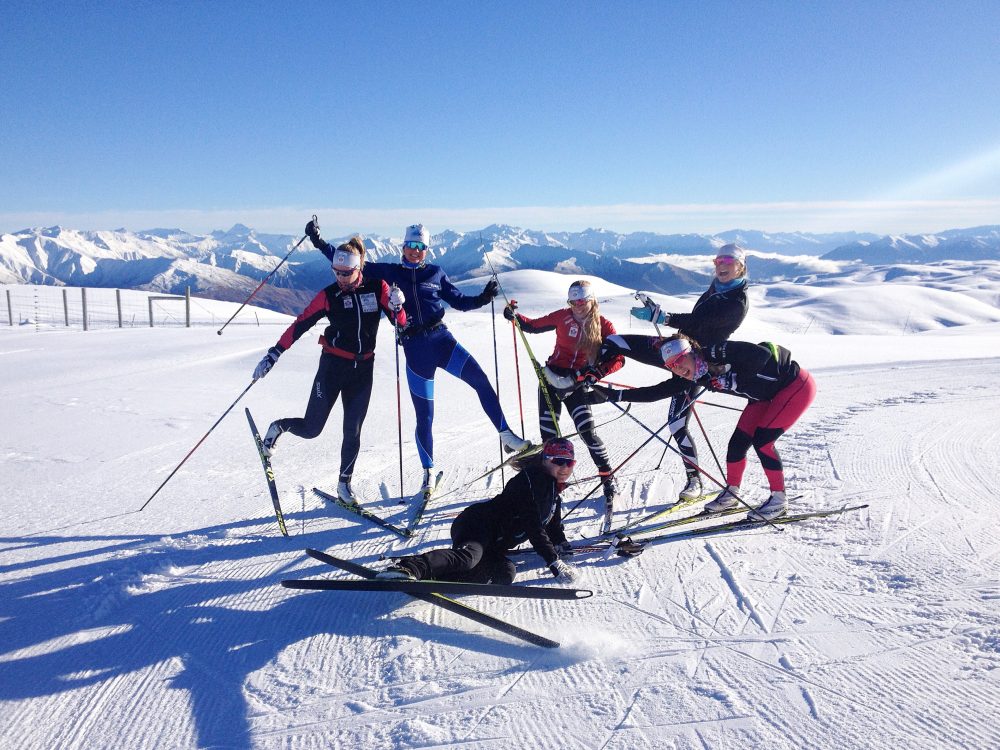
Katherine Stewart-Jones (far right) of the Canadian U25 Team with several of her women’s team training partners during a summer training session in New Zealand. (Courtesy photo)
She remained in contact with McGeown, who’s master’s research project at Lakehead addressed how to help athletes safely return to sport post-concussion. The two emailed and texted regularly while Stewart-Jones was at home in Chelsea, with McGeown offering advice and suggestions on how to cope with the mental and physical side affects from both a professional and personal standpoint.
A former rugby player, downhill skier and contact-sports enthusiast, McGeown himself has suffered more than 15 concussions during his athletic career. On the phone with FasterSkier, he recalled his own undergrad experience when the solution for the concussed was to “sit in a dark room and hope you get better.”
“At that point in time, there was no advice from doctors or physios,” said McGeown, who will start working toward a doctorate at New Zealand’s Auckland University of Technology this year. “It was, if you have any symptoms at rest, don’t exercise. For up to a year, don’t workout, don’t go for runs, don’t lift weights, don’t play sports. Essentially don’t do anything you like to do.”
However, recent research done by McGeown and acclaimed medical sources, such as the Journal of the American Medical Association, have changed that belief. While all rest and no play was formerly viewed as the most appropriate way to recover from a concussion, recent studies show the opposite. Exercise appears to be the preferred method of rehabbing a concussed individual, though the intensity, duration and type still vary case by case and remain in question.
“They release new guidelines every four years,” McGeown explained. “The 2012 guidelines say rest; do nothing. The 2016 guidelines say exercise-based rehab is going to be the new cornerstone for concussion rehab. They’re not saying how often, how intense, how do you get them started, for how long, etc. What the research needs to figure out still is all those variables. What is the best case scenario or is it completely individualized?”
In the case of Stewart-Jones, slow and steady was the start. At home in Chelsea, she began exercising once she had a full 24-hour period of no symptoms. Following the 24-hour period, she completed ten minutes of exercise (in her case, walking on the treadmill) at a heart rate of 115.
If, after completing the workout, no new symptoms arose or worsened, she would either increase her time or her heart rate the following day, but not by much. If her symptoms worsened or new ones arose, she returned to the exercise she had been doing the previous day — no exceptions and no matter how badly she wanted to train more.
“Everybody wants to be tough. Everybody wants to fight through it and push through it,” McGeown said. “But what I try to get people to conceptualize is, if it’s your ankle or knee or shoulder, go for it. Tough it out, because when you’re fifty or sixty and that knee is really bothering you, they’ll just replace it with a new one.
“Whereas there’s no second chances with our brain,” McGeown continued. “We’re seeing that with football players and hockey players. There are extreme consequences and if we don’t take it seriously, it’s a big deal.”
Even with that weighing in the back of her mind, Stewart-Jones still found it difficult to not rush back into training too quickly.
“I found that one of the most difficult parts of recovery was knowing when I was feeling good enough to start training again,” Stewart Jones wrote in her blog. “I found it easy to convince myself that I was feeling normal when I wasn’t. Maybe it was because I was just too eager to get back to training or maybe it was because I truly couldn’t remember how it felt to be my normal self. The bottom line is, you know yourself best, so be honest with yourself, and the recovery will be much quicker.”
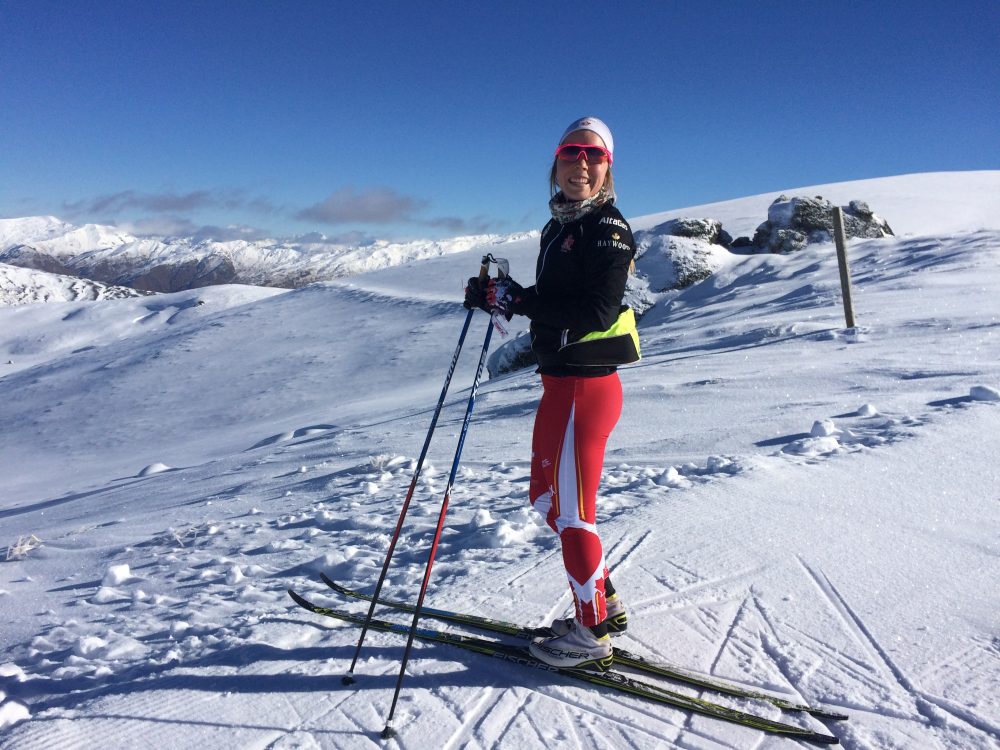
Katherine Stewart-Jones (Canadian U25 Team/NTDC Thunder Bay) during a summer training session in New Zealand. (Courtesy photo)
When she returned to Thunder Bay a few weeks after her accident, she began working with McGeown in person, continuing her work on the treadmill until she had reached the point where she was exercising at a threshold pace, something similar to a steady state.
After that, McGeown began a second phase of the recovery, adding higher intensity workouts to her training regimen. She would complete 30-second long speed bursts of mountain climbers, ski erging and box jumps followed by a check-in with McGeown. If all went well, she continued. After about ten sessions like this, Stewart-Jones was cleared by McGeown to return to normal training.
In late November, a little less than eight weeks after she suffered her concussion, Stewart-Jones was back on skis, logging a 17-hour training week and feeling “100 percent.”
“Initially I was supposed to leave on Nov. 11th to meet the team in Finland and race the Ruka [Triple],” Stewart-Jones, last year’s NorAm (Canada’s Continental Cup) winner, said of her plans to start her season on the World Cup for Period 1. “I was feeling fine, I didn’t have any symptoms and I could train fine, but I felt like I wasn’t going to be ready enough to race then. And I wanted to put a couple weeks of big volume in just to feel like I gained my fitness back, so [my coach Timo Puiras and I] made the decision to stay longer.”
“Katherine’s summer training went very well,” Puiras, head coach of the NTDC, wrote in an email. “Our IST (Integrated Support Team) was excellent in getting Katherine back to normal training as quickly as possible.”
“It was definitely a lot after taking a good six weeks off for an injury,” Stewart-Jones told FasterSkier after the Davos 10 k freestyle on Dec. 10. “I’ve had a good month of training, but it was more volume focused, just because I wanted to gain back that fitness and so I didn’t do a lot of intensity so I was kind of expecting it to be rough. But having the NorAm leader’s spot, it wasn’t something I was ever going to turn down.
“I think for distance racing I still have that extra gear to build,” she added. “Right now I feel like my technique has come a long way, but I don’t feel like I’m actually racing, and I think that’s just going to come with more intensity and more racing.”
When asked if Stewart-Jones might be at a higher risk for concussion while competing on the World Cup now, McGeown explained it would be difficult to say without know her particular history with concussions.
“Once you’ve had multiple concussions, it’s easier to get the next one, the symptoms are worse, and recovery takes you longer,” McGeown said. “But typically if someone’s at a high risk for reinjury, it’s going to be if they return to sport within that first week to two weeks after the initial injury. It is certainly possible it could happen again, but it could happen to anyone at anytime.
“That she’s at a high risk, I would say no. She’s at the same risk as any other skier competing against her,” McGeown added. “The only way that a concussion is going to truly limit someone is if they let it.”
— Chelsea Little and Alex Kochon contributed
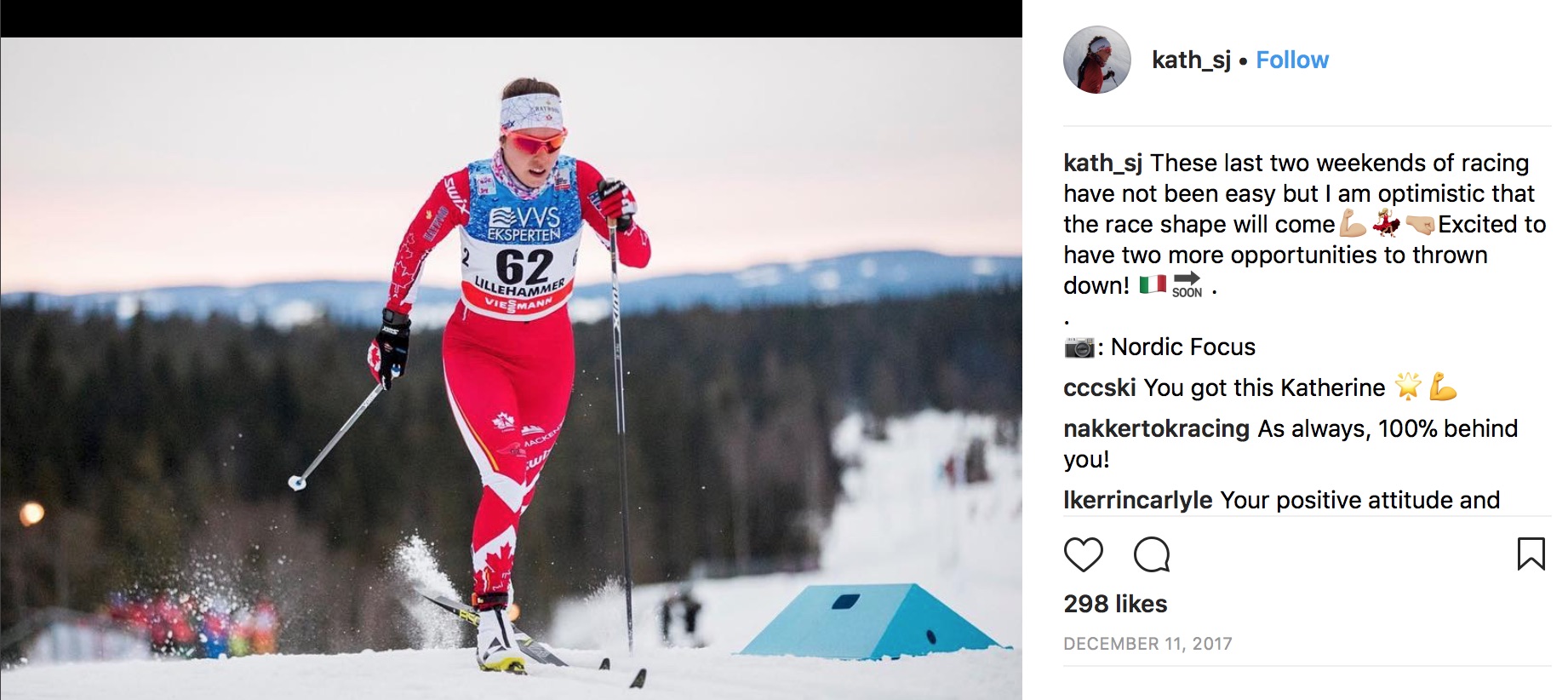
Katherine Stewart-Jones’s Instagram post after two weekends of World Cup racing last month in Lillehammer, Norway, and Davos, Switzerland. She also raced two distance races in Toblach, Italy, where she finished 77th in a 10 k freestyle and 70th (68th for time of day) in a 10 k classic pursuit on Dec. 16-17. (Photo: Instagram/@kath_sj)
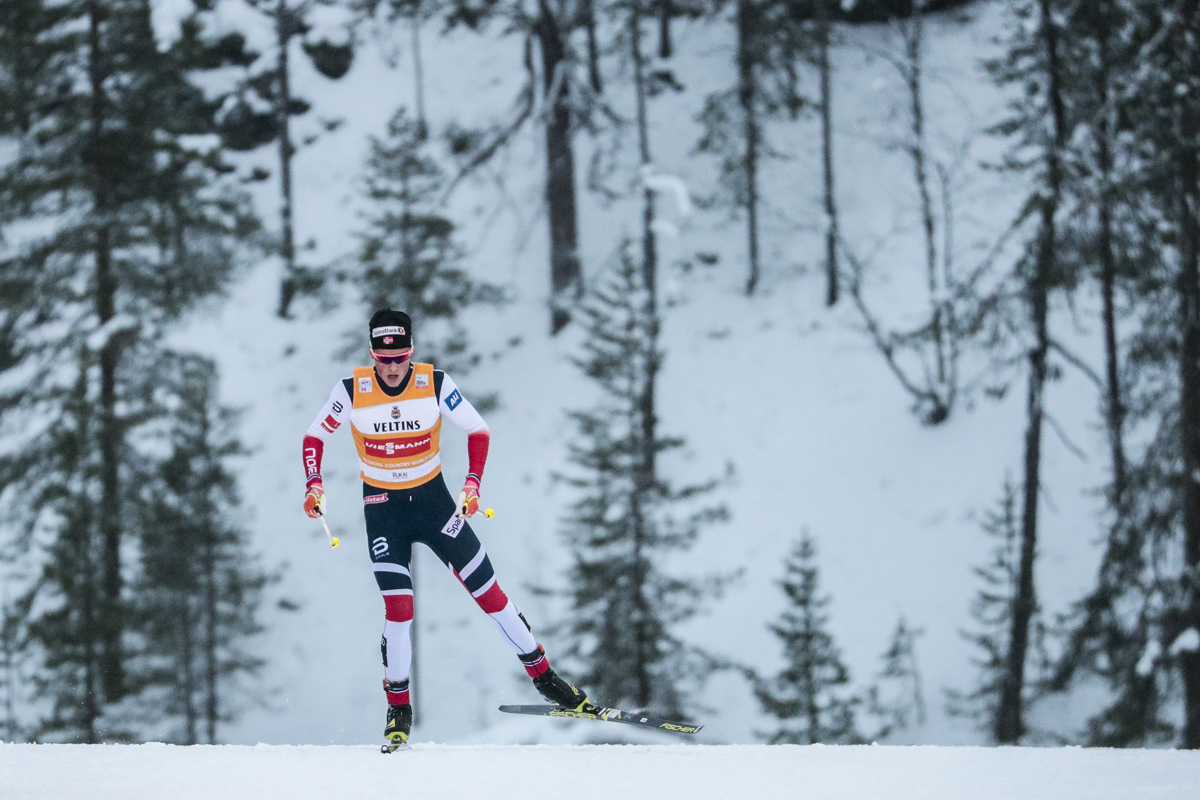
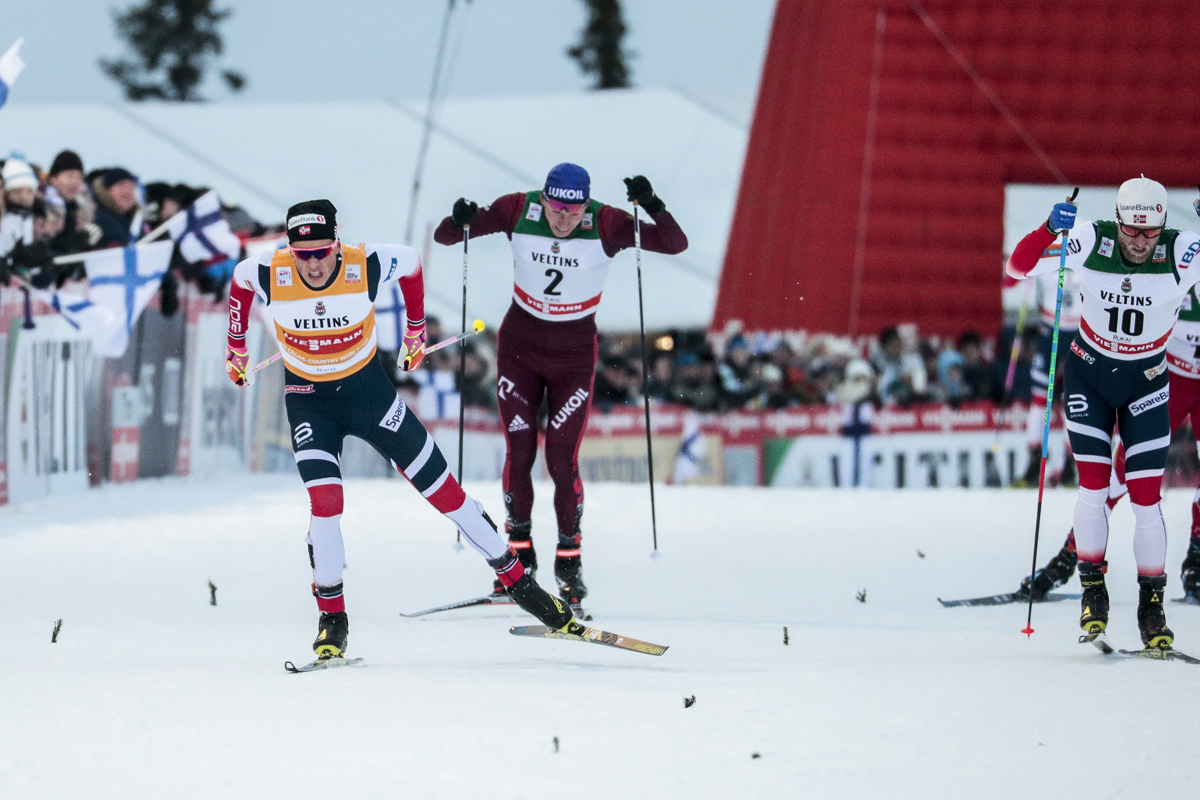
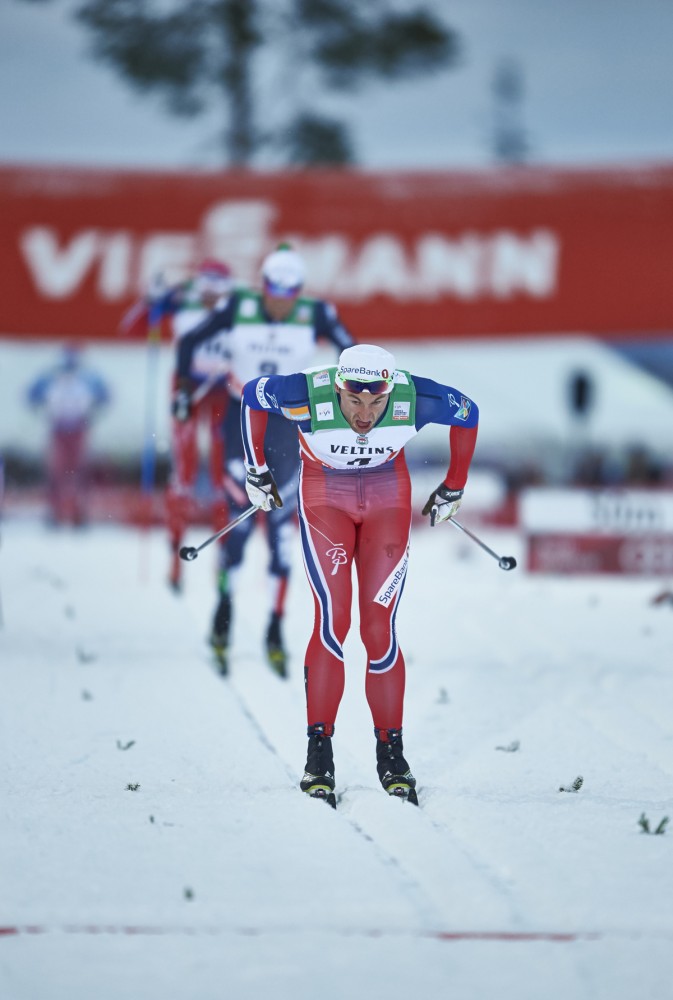
Norway’s Johannes Høsflot Klæbo en route to his third-straight win in as many days of the World-Cup-opening Ruka Triple in Kuusamo, Finland. He won the 15 k freestyle pursuit for the mini-tour title. (Photo: Fischer/Nordic Focus)
Two previous days of racing, and back-to-back victories no less, had begun to take its toll on Johannes Høsflot Klæbo within the first few laps of the men’s 15-kilometer freestyle pursuit on Sunday in Kuusamo, Finland. The 21-year-old Norwegian could feel it throughout his body; he was tired and 38 seconds of a starting cushion wasn’t going to be enough to hold off the hungry challengers behind him.
Klæbo, who won Friday’s classic sprint and Saturday’s 15 k classic individual start on the World Cup opening weekend, wasn’t invincible and he couldn’t race to another win alone. Halfway through the pursuit, the man who started in second place, 38 seconds after him, Russia’s Alexander Bolshunov (who’s actually younger than Klæbo at age 20), had cut that deficit to 19.8 seconds. After him, Norway’s Martin Johnsrud Sundby, who started 10th and 1:05 minutes behind Klæbo, was up to third and just 25.3 seconds back.
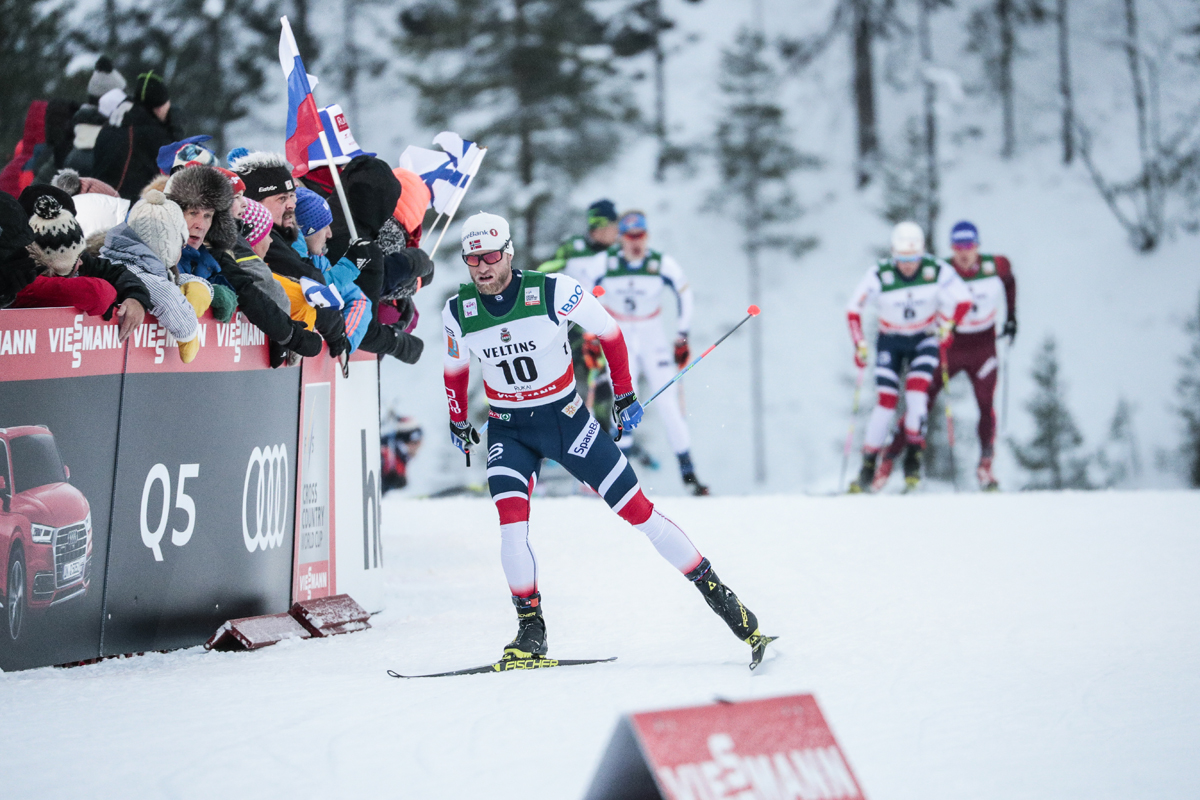
Norway’s Martin Johnsrud Sundby, who started 10th in the 15 k freestyle pursuit on Sunday, picking off the places on the final day of the Ruka Triple World Cup mini tour in Kuusamo, Finland. (Photo: Fischer/Nordic Focus)
On his fourth lap, Klæbo accepted the inevitable as Bolshunov and Sundby, who had linked up in an effort to catch him, in fact caught him on a climb around 8.6 k. A larger group of pursuers, including Canada’s Alex Harvey, locked on to the three leaders as well, and from there, the race truly began to take form. Klæbo had to recover, Sundby had to figure out how to try to drop him, Bolshunov had to see what he was capable of, and Harvey had to see how much he could give in the third race of the season.
The first races of each winter aren’t easy for anyone. Despite spending the summer training for skiing, most North American World Cup skiers don’t get the opportunity to actually race — even on rollerskis — too often during the offseason. Because of the rich ski culture in Europe, rollerski races are a big deal with lots of summer and fall competitions to chose from. And because of Europe’s geography, it’s often easier to get on snow than it is for North Americans.
(“I think this applies to all the North American actually, compared to Europeans we don’t race as much in summer,” Canadian World Cup coach Ivan Babikov said on the phone on Sunday. “They have races every weekend so they come into the season pretty sharp already with some good speed workouts, when we don’t have that opportunity. So that’s why, I think, every race is a step forward. It’s just, you have to remember or remind yourself how hard it is.”)
So while Canadians and American World Cup skiers alike often look at an opening weekend like Finland’s Ruka Triple mini tour as a “chance to blow the cobwebs out” or “shake off the rust”, as some have said, it’s also an opportunity to see where you stand — as was the case for Harvey in the final meters of Sunday’s pursuit.
Later in the fourth of six laps, Klæbo pushed the tempo up a climb, Bolshunov responded, and Harvey went with them. Soon after at 10 k, they lapped through the stadium with 11 men within 2.7 seconds of first. Up front, Bolshunov led Harvey, who had started the race 1:23 back in 12th.
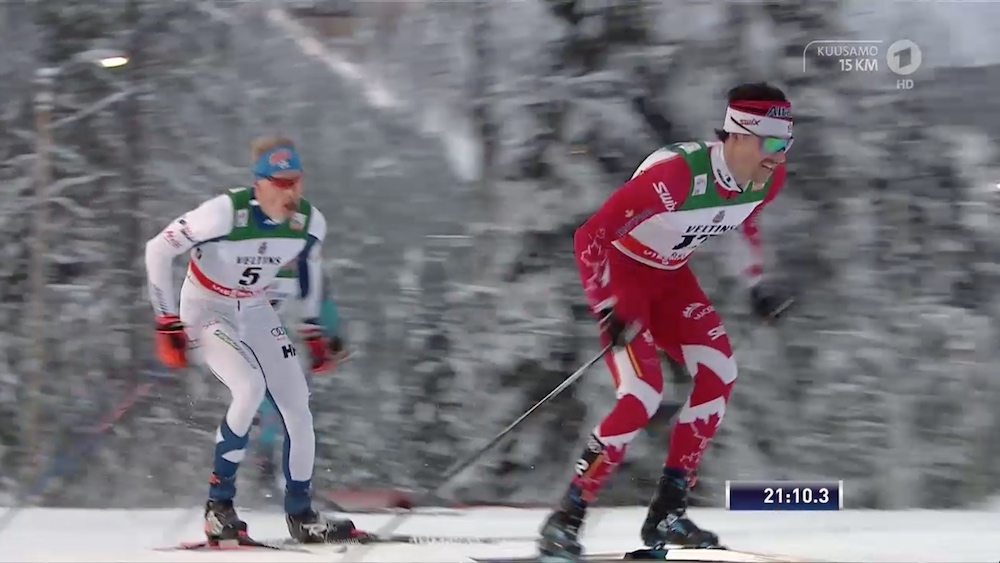
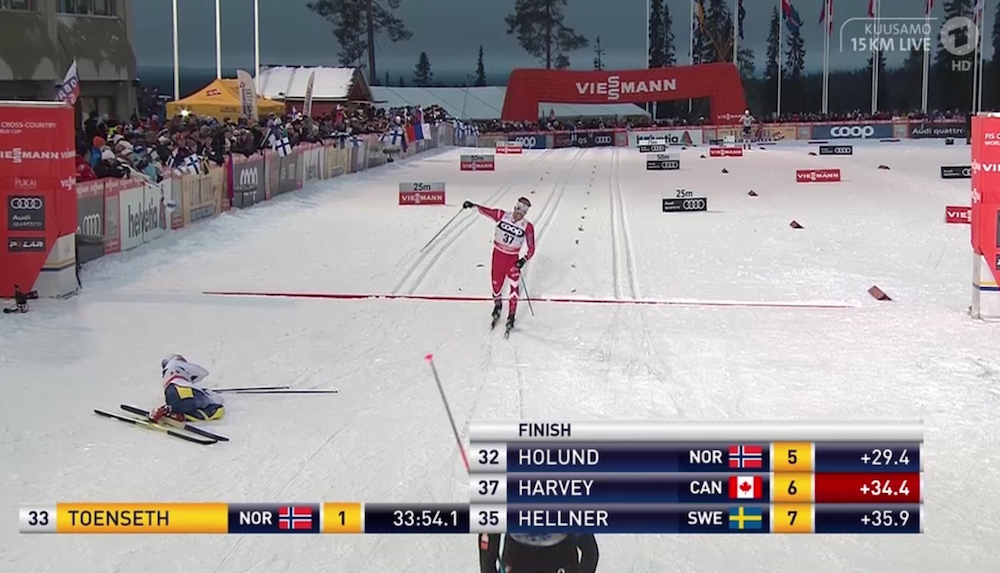
Canadian World Cup Team member Alex Harvey leads Finland’s Iivo Niskanen during the men’s 15 k freestyle pursuit on Sunday, the final day of the Ruka Triple mini tour in Kuusamo, Finland. (Screenshot: ARD)
Harvey had spent the first three laps working up to that lead group, initially with the likes of Russia’s Alexey Chervotkin (*who reportedly thanked Harvey after the race) and Sergey Ustiugov, Norway’s Hans Christer Holund and Sweden’s Marcus Hellner, and later with France’s Maurice Manificat, Sweden’s Calle Halfvarsson, Norway’s Emil Iversen, Chervotkin, and Holund, among others.
“I knew there’d be some fireworks on the last lap so I just wanted to be in the front third of the group, just be ready for a move,” Harvey explained in a post-race phone interview. “I thought Sundby would be the guy making the move, which in the end, that’s what happened. The big uphill in the last lap, that’s where he went. I just wanted to be close to Sundby and ready to respond when Sundby went.”
Sundby attacked as predicted on the second-to-last climb, around 13.6 k, and Harvey slotted behind him to follow him over the top.
“I was just actually there on that last uphill when Sundby attacked,” Babikov recalled. “Klæbo was right there. I think there were just Norwegian tactics … Sundby attacked on the last uphill and Klæbo just cooled down and wasn’t chasing him at all, so for Alex, that was his only chance. … If he didn’t chase him, then Sundby probably would have skied away and it would have been a bigger group at the finish, but at the moment he tried, and they actually created a gap … Alex second and Sundby first.”
With a few meters separating them from Norway’s Didrik Tønseth in third and Klæbo in fourth, Harvey thought he and Sundby had dropped them and that he would fight for first to the finish.
“I kind of went all-in with the Sundby move,” Harvey said. “When I looked in between my legs just before the last downhill I thought we had a big enough gap … so I was feeling pretty good about my chances there, but not good about taking [Sundby] because I was really, really dead.”
Johannes Høsflot Klæbo (l) passing fellow Norwegian World Cup Team member Martin Johnsrud Sundby (10) for the win in Sunday’s 15 k freestyle pursuit at the Ruka Triple mini tour in Kuusamo, Finland. Russia’s Alexander Bolshunov (2) was 1 second back in third place for his first World Cup podium while Canada’s Alex Harvey (behind Sundby) placed fourth. (Photo: Fischer/Nordic Focus)
After what Harvey estimated to be a 45-second downhill, he realized that wasn’t the case. Klæbo and Bolshunov had slingshot back toward the front, and while Sundby was first to the top of the last climb before the finish, Klæbo and Bolshunov were right behind him while Harvey followed in fourth.
They entered the stadium together in that order, and Klæbo passed Sundby with about 100 meters remaining to take his third-straight win of the weekend.
“Coming out of my tuck there I was just full of lactate, not feeling any fresher … then I just got passed on the hill,” Harvey recalled. “I had nothing left. That was my move. … I’m happy I made that move, but I couldn’t make a second burst after that.”
While Klæbo won the pursuit and with it, the Ruka Triple mini-tour title in 36:23.2 minutes, Sundby placed second, 0.4 seconds back, Bolshunov claimed his first World Cup podium in third (+1.0), and Harvey finished another 0.6 seconds back in fourth (+1.6).
On the day, Harvey’s course time ranked fifth fastest behind Manificat, who was the “winner of the day” in 34:50.9. Finland’s Matti Heikkinen was second fastest (+5.4) after starting 22nd and placing 14th, Holund was third fastest (+7.5) after starting 14th and finishing ninth, and Switzerland’s Dario Cologna, who started 26th and finished 17th, was fourth fastest (+8.7).
Harvey said starting 17 seconds behind Sundby was a tall task on its own, and he had started the race with a goal of breaking into the top 10 overall. All things considered, fourth place was better than he expected at this point in the season.
“… But I knew it was still within reach,” Harvey explained. “I believed in it, but I didn’t put too much hope in, let’s say, a top five or fighting for the podium. It was more like I wanted to be back in the top 10 and just that to me seemed already hard enough.”
Norway’s Johannes Høsflot Klæbo after winning the 15 k freestyle pursuit on Sunday to win the Ruka Triple mini tour in Kuusamo, Finland. (Photo: Fischer/Nordic Focus)
The fact that he was able to hang with Klæbo and Sundby to the finish was a good sign, he added.
“Right now, he’s not just a good sprinter, he’s the best distance skier in the world, too,” Harvey said of Klæbo. “I mean, to win a 15 k individual you have to be in very, very good physical shape, so he’s in really good physical shape and I know I’m not yet. I’m not in my best form and Sundby probably isn’t yet, so you never know what’s going to happen later in the season at the Olympics, but for now it’s hard to drop him when he’s actually just in better shape than everybody else in the world.”
After the race, Klæbo told NRK he was relieved to get the win and have some time to rest before next weekend’s World Cup in Lillehammer, Norway.
“My legs are shaking now,” Klæbo said. “Feels incredible to be the first to cross the finish line. Now I need a few days rest.
“This was brutal,” he added. “I’m actually glad they caught up to me and luckily I had good skis. I’m glad I had a few seconds today.”
Norwegian national-team coach Tor-Arne Hetland told NRK he was “really impressed” with Klæbo. “We have a diamond in the sport of cross country skiing now,” Hetland said.
“That’s very nice of him to say. It’s probably a little too much, but it has been a good start to the season,” Klæbo responded to NRK.
Sundby spoke excitedly about having Klæbo to contest for the overall World Cup lead.
“For the moment, he’s taking international cross-country skiing for men to a whole ’nother level,” Sundby told NRK. “It is a little humiliating for the rest of us, but at the same time it’s extremely inspiring to see what he does in his second year at this level. It’s hell of fun to have a guy like that on the team.”
Bjornsen 26th, Kershaw 29th; Caldwell Posts Top-20 Time of Day
Canada had two in the top 30 on Sunday with Devon Kershaw in 29th (+1:47.8), scoring World Cup points for the second-straight day. He started 28th and 1:59 out of first, just one second behind Cologna in 26th and Russia’s Andrey Larkov in 27th.
“I just wasn’t strong enough to go with Dario,” Kershaw said on the phone. “I had the perfect chance to be able to follow Dario up the field, but he just started so fast, and on the steep terrain, my legs just — I tried up the first steep wall and at the top, I’m like, man, if I keep going like this, after 5 k I’m gonna be dead.
Canada’s Devon Kershaw (28) leads American Erik Bjornsen (23) and others during the World Cup men’s 15 k freestyle pursuit on Sunday in Kuusamo, Finland. (Photo: Fischer/Nordic Focus)
“So I had to manage my energy a little bit and in the end, it turned out that Bjornsen and I’s group just wasn’t strong enough,” Kershaw continued, referring to U.S. Ski Team member Erik Bjornsen, whom he started eight seconds behind and spent most of the race with. “[Our group] had a good 7 1/2 k and then after that, between 7 1/2 kilometers and 12 k, we were skiing really slow. So that’s a bit frustrating in a pursuit because you’re just stuck there in no-man’s land.”
While he felt like he was skiing the flats well, Kershaw said he struggled with the “biting” conditions, which seemed to limit glide, especially on the notoriously steep course’s climbs.
“I had to make the choice to be like, OK, I’ve got to just stay in this group and I’m not strong enough to drive the bus, because my legs just weren’t there today on the terrain” he said. “In the end I made a tactical error in the last 600 meters. I should’ve followed Bjornsen on the outside and I went on the inside and was hoping it would open up for me and it didn’t. So I ended up 29th, but that’s OK.”
Bjornsen started 24th and finished the pursuit in 26th (+1:43.6), after following Larkov in 25th (+1:42.8) across the line and holding off Iceland’s Snorri Einarsson (a former Norwegian skier who raced for the University of Utah) in 27th (+1:46.2), Great Britain’s Andrew Musgrave in 28th (+1:47.2), Kershaw in 29th, and France’s Jean-Marc Gaillard in 30th (+1:49.2).
“I started right around Cologna and [Finland’s Matti] Heikkinen but there was no way I was going to hold their pace, they were flying,” Bjornsen wrote in an email. “I had to settle in with the group around me. It soon became clear our group was not going to catch anyone in front of us or get caught, so it became a tactical game. Some surges, but for the most part nobody wanted to lead.”
Devon Kershaw (Canadian World Cup Team) en route to 29th in the 15 k freestyle pursuit on the last day of the Ruka Triple World Cup mini tour in Kuusamo, Finland. (Photo: Fischer/Nordic Focus)
Kershaw laughed when he talked about some “tips” he gave Bjornsen during the race.
“He had really fast skis so there were a few times that he came by me on the downhill and then would kind of try to hammer for a minute and then get tired and slow down again,” Kershaw said. “I told him, like, ‘Dude, you’ve got great skis. Unless you can stay in the front and really press, then it’s better just to play the game and wait for the end.’ After that, he did that and he torched us all in the end. So that was kind of fun to see for him.”
According to Bjornsen, Kershaw suggested he sit back and wait for the sprint.
“My skis were good but I think my weight is what helped me the most on that last huge downhill,” Bjornsen wrote. “I was fine going for that tactic but at the same time it would have been nice to leave a little more out there today. Stoked to get double points for 26th though!”
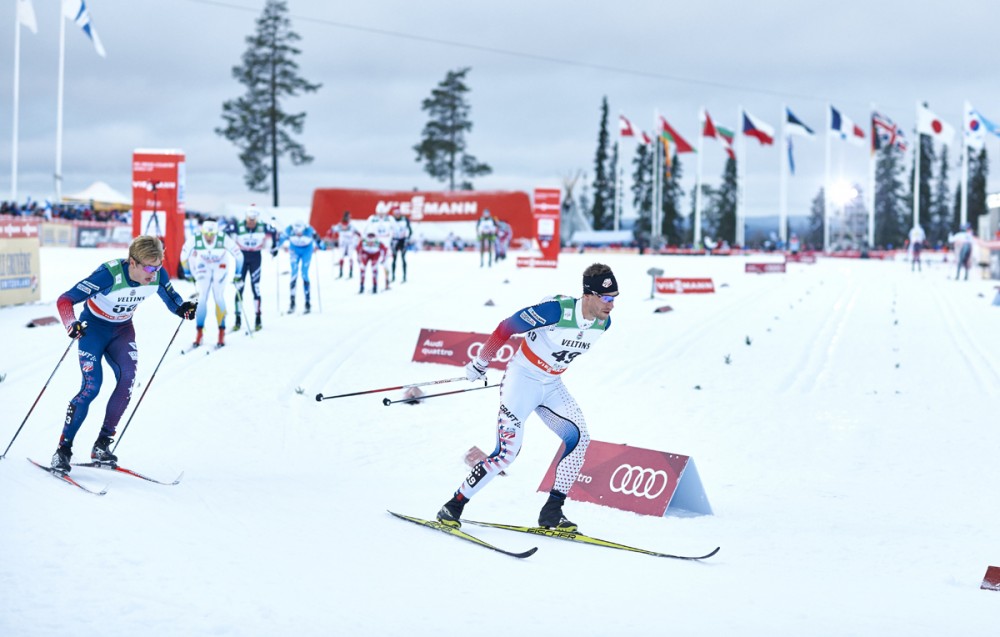
Paddy Caldwell (U.S. Ski Team) racing to 70th in the men’s 15 k classic on Saturday, Day of the Ruka Triple World Cup mini tour in Kuusamo, Finland. In Sunday’s 15 k freestyle pursuit, he skied up to 51st with the 19th-fastest time of day. (Photo: Fischer/Nordic Focus)
Paddy Caldwell, new to the U.S. Ski Team B-team this year, posted his best World Cup result with the 19th-fastest time of day, 50.5 seconds back from Manificat. He started with the wave in 70th and finished 51st overall (+3:03.1).
“Going into the race my goal was to move up as much as possible,” the 23-year-old Caldwell wrote in an email. “I wasn’t really thinking about place or time of day – I was just trying to ski fast and put together a good effort.
“It was really hard to move up in the pack,” he added. “I started midway back in the wave and we kept picking up more and more skiers as the race went on. I tried to relax as much as possible on the hills and build in energy to pass where I could on the flats. … I am really excited with the day and psyched to have had a good result here in Ruka. I’m looking forward to the rest of period 1 and learning more from the big dogs!”
“Very exciting race out of Erik today,” U.S. Ski Team coach Matt Whitcomb commented on the phone. “… When he settled to the back of his pack on Lap 6 and headed into the downhill with one climb to go, we just all sort of expressed confidence over the U.S. radio channel, got ready see what he could do. It is so fun to watch him in a stadium when he has to go head to head against five other athletes … he did not disappoint today. Really proud of Erik’s 26th place.”
As for Caldwell, who skied the 25th fastest time of day in the 2017 World Cup Finals freestyle pursuit, Whitcomb said, “this is his race, the skate distance.”
“There were times that he was a little bit road-blocked out there, just the way the pursuit race unfolds in that start … and it looked like today Paddy could keep going, so really great signs out of him,” Whitcomb said.
Whitcomb also highlighted the races of Scott Patterson, who raced up from 78th to 55th (+3:28.4) with the 31st-fastest time, and Noah Hoffman, who improved from 45th to 39th (+2.33.3) with the 35th-fastest time. Also for the U.S., Andy Newell finished the tour out in 75th (+5:39.6).
American Paddy Caldwell (70) racing with Sweden’s Jens Burman (front) and Canada’s Len Valjas (46), among others, during Sunday’s World Cup 15 k freestyle pursuit on the last day of the Ruka Triple in Kuusamo, Finland. (Photo: Fischer/Nordic Focus)
Canada’s Len Valjas moved up two places for 44th overall (+2:47.5), Graeme Killick finished the tour in 68th (+4:39.5), Knute Johnsgaard 81st (+6:43.6), and Julien Locke 83rd (+7:33.6).
Babikov pointed out that Valjas had a shoulder injury that he mostly recovered from, but caused him to struggle with double poling in Friday’s sprint. Despite placing 63rd in that sprint, Valjas was the team’s third-best man in the weekend’s distance races.
“[In] two distance races, he was third best and actually placed higher than he placed in sprint in the distance, 15 k, hardest one with lots of climbing,” Babikov said. “So that shows he has a good shape, but just needs to scrape that rust off and remember how to go fast again. I think physically he is in a good place, just need to do some more races, and it will come.”
***
*Post-race sidenote: According to Harvey, after the race, the Russian team’s massage therapist told Canadian coach Ivan Babikov that Chervotkin wanted to thank Harvey for pulling him in the pursuit. Chervotkin, 22, started 11th and finished fifth, 6.2 seconds out of first and 4.6 seconds after Harvey in fourth.
“There’s a bit of beef with the Russians and me right now,” Harvey said. “I came in wondering if they were just going to punch me in the face. They said they wanted to break my teeth, so this is a good turn of things.”
“I read that in the Norwegian news, actually, that Petukhov wanted to …,” he said with a laugh. “But I knew the media likes that sort of thing. But I think things are good now.”
Harvey noted that Bolshunov and Chervotkin, neither of which have been implicated in the doping scandal, are part of “a new generation” in Russian cross-country skiing. “I saw the results in Bruksvallarna; it looks like the have almost as much depth as Norway does. They’re really strong.”
— Aleks Tangen, Ian Tovell, Jason Albert, and Harald Zimmer contributed
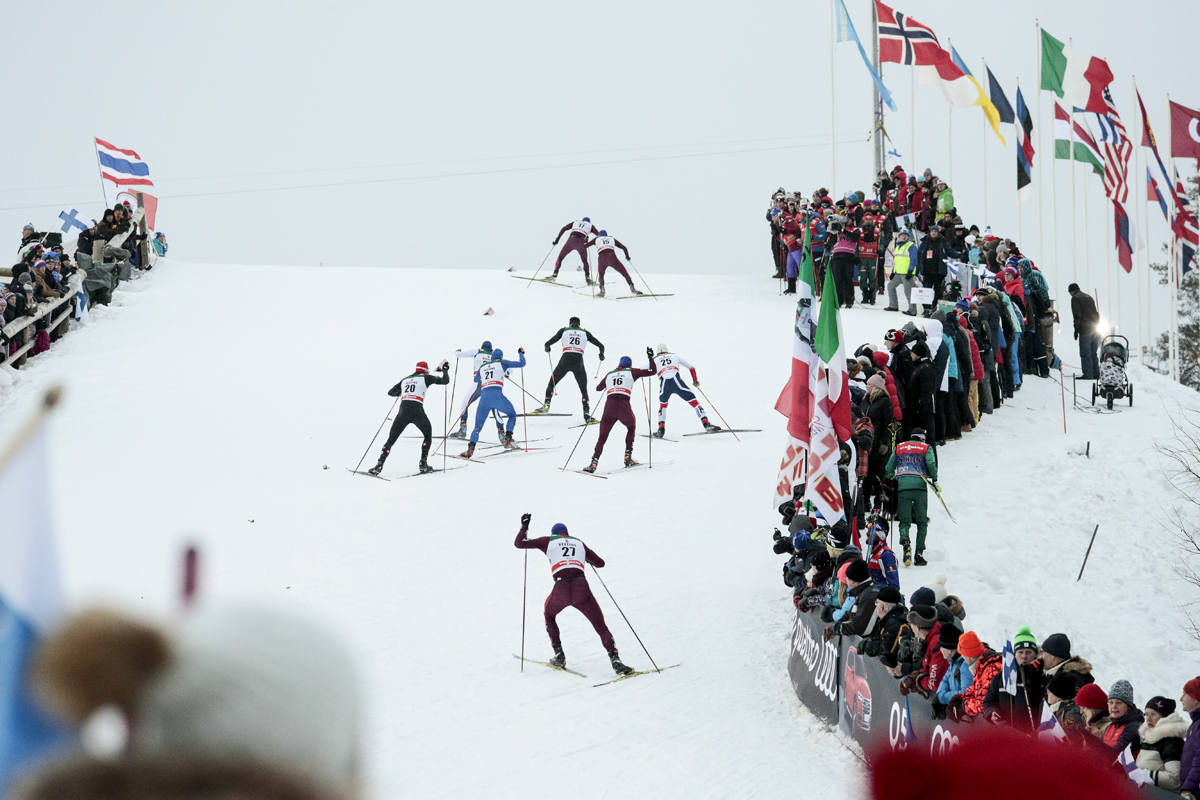
Racers in the Ruka Triple World Cup 15 k freestyle pursuit, including Russia’s Andrey Larkov, Switzerland’s Jonas Baumann, Italy’s Federico Pellegrino, Switzerland’s Dario Cologna, and Norway’s Simen Hegstad Krueger, ascend a climb in Kuusamo, Finland. (Photo: Fischer/Nordic Focus)
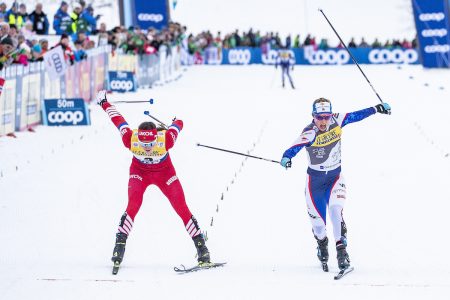
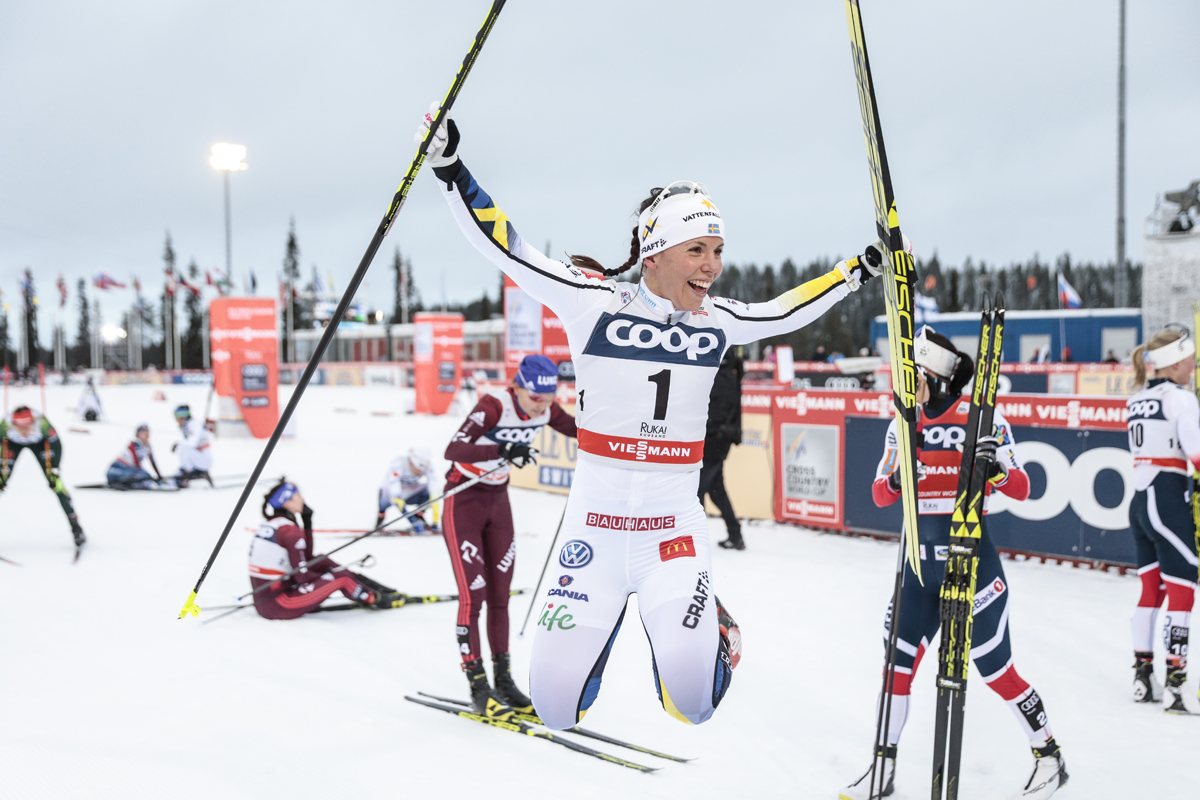
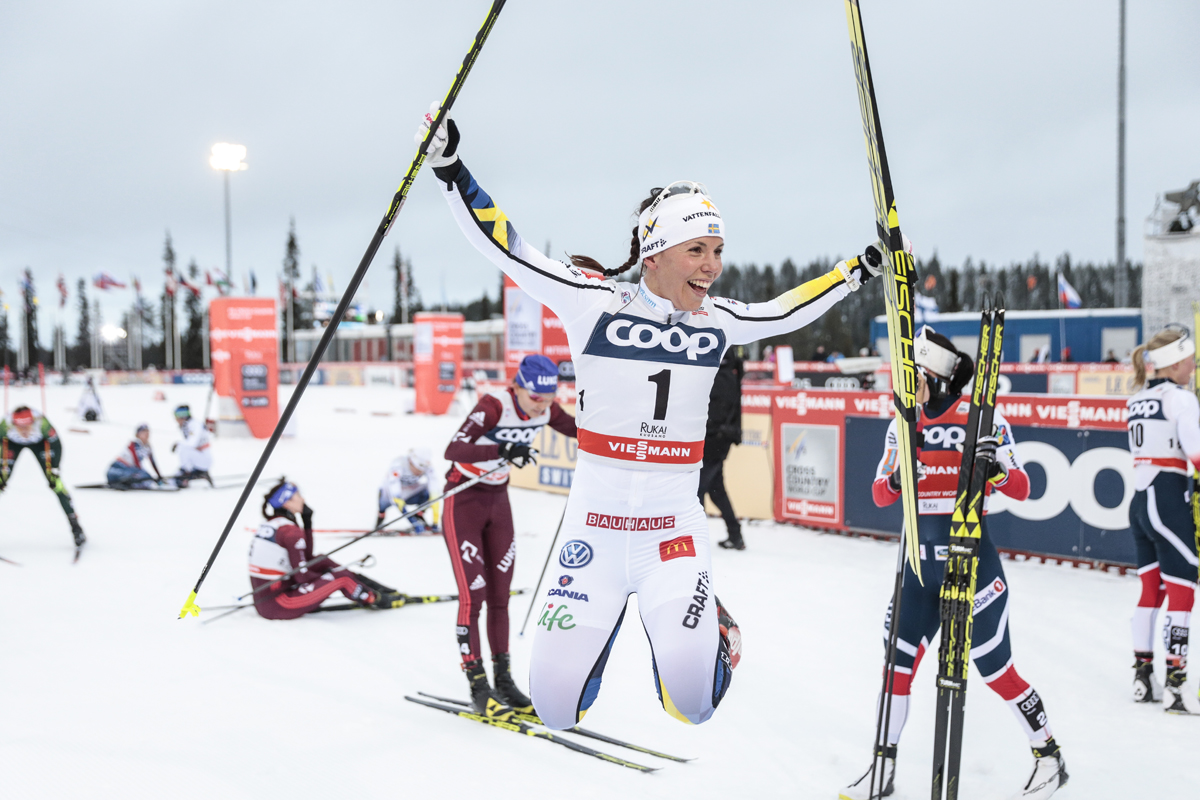
Sweden’s Charlotte Kalla jumps for joy after winning Sunday’s 10 k freestyle pursuit and overall Ruka Triple title at the World Cup opener in Kuusamo, Finland. She started 2 seconds ahead of Norway’s Marit Bjørgen (second from right) and held her off by 9.7 seconds for the win. (Photo: Fischer/Nordic Focus)
After two days of racing in Kuusamo, Finland, the Ruka Triple turned its last page on Sunday. As it turned out, the women’s 10-kilometer freestyle pursuit was a thriller.
Sweden’s Charlotte Kalla came into the final day of the mini tour wearing bib 1 and with only a 2-second lead on the last person one might want skiing on their tails, Norway’s Marit Bjørgen.
The gamesmanship, the change of pace, skiing’s version of the dodge and parry became a two-skier affair between Kalla, 30, and Bjørgen, 37. Yet, followers of the sport know Bjørgen’s end-game: push the pace, determine who can match the pace, then seemingly flip a switch and steamroll ahead solo.
The Swedish-Norwegian pairing performed an endurance duet that kept the packs of chasing skiers at bay. Sweden’s Stina Nilsson started the pursuit 12 seconds back in third, Norway’s resurgent Ingvild Flugstad Østberg 20 seconds back in fourth, and Russia’s Natalia Nepryaeva 23 seconds back in fifth. Norwegians Heidi Weng and Ragnhild Haga began 41 and 42 seconds back, respectively. None could gap up.
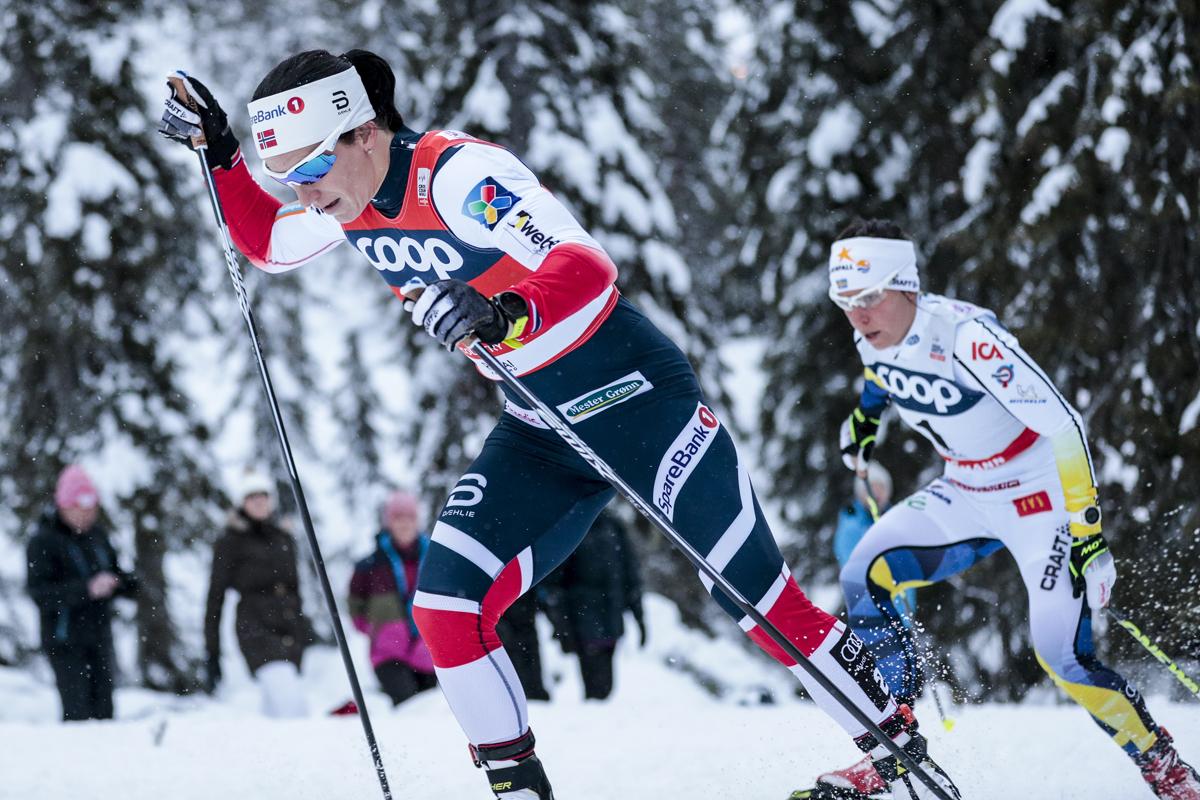
Norway’s Marit Bjørgen leads Sweden’s Charlotte Kalla during the women’s 10 k freestyle pursuit on Sunday at the Ruka Triple World Cup in Kuusamo, Finland. (Photo: Fischer/Nordic Focus)
Kalla and Bjørgen never blinked. They gradually pulled away from the chasers.
“My plan was to ski quite fast together with Marit, and not bring the ones behind us into the game,” Kalla told FasterSkier in a post-race phone interview. “Because I know that Stina is a really good sprinter, so me and Marit had to work together to keep the gap to the others.”
Heading back out into the woods on the final lap of the 2.5 k course, Kalla punched it. She accelerated the pace to what looked like a sprint, and Bjørgen initially stayed right on her tails.
How sustainable was this pace? And would it be possible to pop the Norwegian, who had won Saturday’s race over Kalla by 17 seconds? In the previous 10 k classic, Kalla had matched Bjørgen’s times until the last 1 1/2 kilometers or so, when the punishing pace took its toll and she began hemorrhaging time.
That was on her mind as Kalla kept up her furious pace.
“Well, yesterday I didn’t truly have the belief that I could ski [away] from Marit, because she did have a great performance yesterday in the classic part, especially on the last lap,” Kalla reflected. “So when I decided to speed up I also knew that I cannot look back. I had to give it a real try and just focus in front of me all the time. I could not take a look behind my back because you have to work for a long long time, and today I succeeded.”
With the difference in the two women’s skating techniques, Kalla appeared to be expending more energy, but gradually put a gap on Bjørgen – one ski length, two — easily an amount that could be closed on a downhill. It would have been easy to back off and slow down, but Kalla kept pushing and the gap grew to three seconds, four, five, six.
Bjørgen didn’t respond.
Kalla came flying into the final hill up to the stadium, the one where she had slowed so dramatically the day before, but didn’t lose any of her advantage this time around.
“I was just telling myself to look up to the top, trying to push with your legs all the way,” Kalla said of her decisive move. “In the last sprint hill, before we came up to the stadium, I was thinking, ‘Left, left, left, left… one, two, three, four, five,’ just to be able to think of something else than the pain.”
Kalla skied the turn into the finishing stretch with a clear margin and raised her hands at the finish line as she crossed in 25:50.1 minutes, 9.7 seconds before Bjørgen. She congratulated her rival before jumping in the air and shouting with joy.
“It was an amazing day today,” Kalla said. “I felt very strong during the race. Just tried to ski my very best, and saved as much energy as possible during the first three laps. My dream yesterday, when I went to bed, was to be able to push very hard when we [would go] out on the last lap. And I was a little bit nervous but decided to follow my tactic. When I was on the top of the hill my coach yelled at me that I had six seconds [lead on Bjørgen]. So I had very tired legs, but I knew that I had to fight and do my very very best until the finish line.”
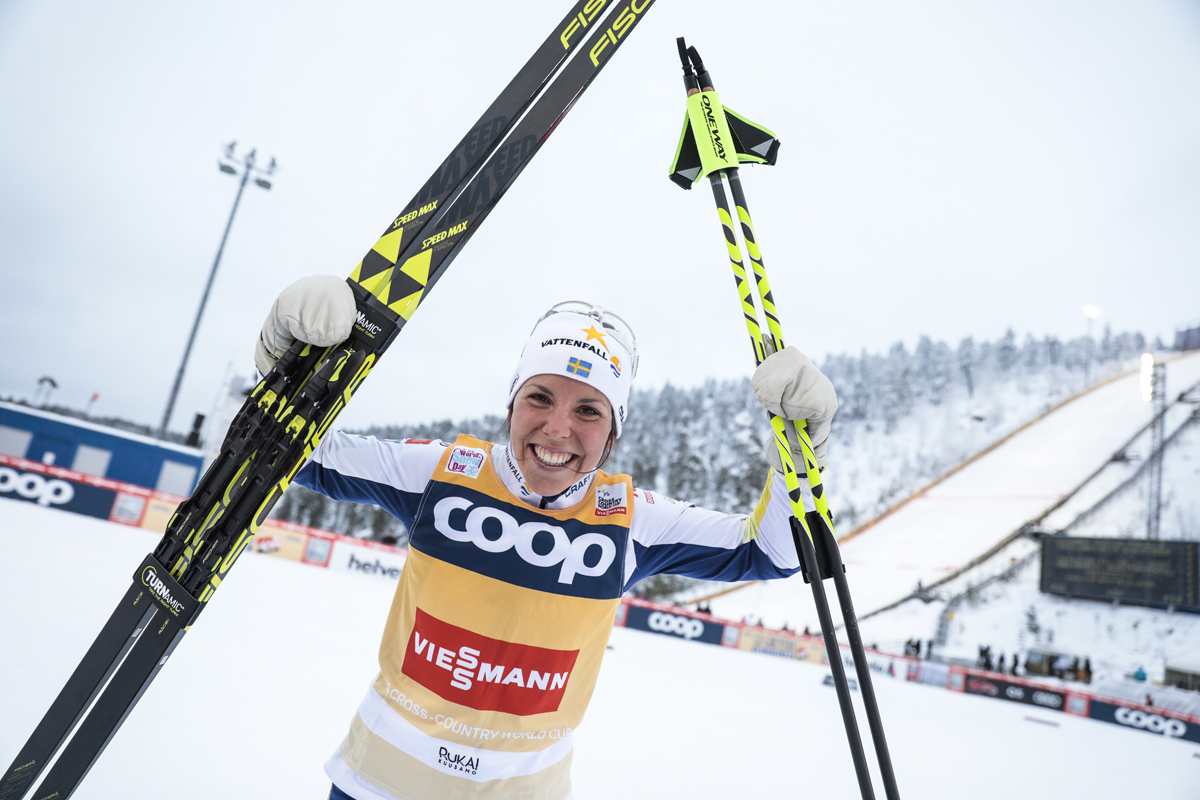
Sweden’s Charlotte Kalla in the overall World Cup leader’s bib after starting the season with a Ruka Triple mini-tour win in Kuusamo, Finland. (Photo: Fischer/Nordic Focus)
The last time Kalla won a World Cup was in 2015 when she won the 10 k skate in Östersund, Sweden, before winning the same event at the 2015 World Championships at home in Falun, Sweden.
“It was a long time since I won a race the last time,” Kalla noted. “And I think it was 2008 when I won a mini tour, and that was the Tour de Ski, actually. So I have been waiting for this day, and I’m very happy today.”
Also of note is that last year’s Ruka World Cup event Kalla suffered from a heart ailment and had to reduce to a slow-tempo ski to finish the race. One year later, she said that wasn’t on her mind.
“No, I have not been thinking about that myself,” Kalla said of her health scare last year. “But all journalists I have met remembered what happened to me last year. So it’s like night and day to think about and look back to one year ago. It’s something totally different.”
After Bjørgen, Norway took third through fifth places. Haga skied to third (+33.9) and posted the fastest time of day, skiing the course in 25:41.8 as she leapfrogged from 10th place at the start to finish on the podium. Weng finished fourth (+38.0), and Østberg fifth (+40.2).
U.S. Women Continue to Thrive
At the start of the Ruka Triple on Friday, to paraphrase a certain former U.S. Defense Secretary, there were many “known unknowns” for the U.S. Ski Team (USST) in Finland. The answers three days later are clear. Sadie Bjornsen’s (USST) second place and Sophie Caldwell’s eighth place in Friday’s classic sprint set the tone. According to U.S. women’s coach Matt Whitcomb, both Bjornsen and Caldwell have met the objective criteria for the upcoming Winter Olympics in PyeongChang, South Korea. (That criteria, as applied to Bjornsen and Caldwell, was a top eight in a World Cup classic sprint.)
Four other USST women skied into the points on Sunday. Previously, Jessie Diggins placed 10th in Saturday’s 10 k classic individual start. Ida Sargent placed 15th in the sprint and began Sunday’s final stage in 23rd, based on her 10 k classic result. Rosie Brennan popped two top 30’s in the first two stages. Kikkan Randall, who had two off days in the classic sprint and 10 k classic, stormed back for Sunday’s skate pursuit. Randall began the day in bib 48 and finished the mini tour in 25th place, skiing the eighth-fastest time of the day.
Kikkan Randall (U.S. Ski Team) racing from 48th up to 25th (with the eighth-fastest course time) in Sunday’s 10 k freestyle pursuit at the Ruka World Cup in Kuusamo, Finland. (Photo: Fischer/Nordic Focus)
“She looked really strong and in control,” Whitcomb said on the phone about Randall. “She was making kills right from the start. It’s what we have seen out of her in this exact event before with actually with a very similar split several years ago, when we had the skate on the final day. It’s nice that she can leave this weekend with some confidence. She struggled with skis for the first two days of this tour and was skiing frustrated today, and she knows she has fitness, we know she has fitness, and we are really happy she was able to show it today.”
Randall confirmed that Sunday’s effort was a more indicative performance.
“Today was a much better gauge of where my fitness actually is,” Randall emailed. “After two frustrating classic days where the wax was a big factor, it was nice to just be able to go today and use what I have … Today felt the best out of the 3 races. I felt like my body wanted to go hard and I could find good power out there. I felt decent in the two classic races but felt like I couldn’t ski with my full shape because of wax and some technical struggles. So it was nice to know my shape is there.”
Bjornsen was the U.S. women’s top finisher after three days of racing in Ruka. She began the day as the 11th starter and improved to 10th overall by the finish, 1:18 behind Kalla.
“This is where we expect to see Sadie when things are going well,” Whitcomb said of Bjornsen’s performance. “But for things to go well, a lot has to stack up for any athlete, particularly for the beginning of the season, when you are traveling all the way from Alaska. It is pretty remarkable how resilient she is, how strong she has become, and how she can just rise above so many of her European competitors, who have been on snow in this time zone or one hour earlier for the last three or four weeks. She has gone halfway around the world and shown it is not so hard, so we are so impressed with Sadie’s ability to ski the way she this weekend.”
Norway’s Heidi Weng (third from left) skiing in a pack with American Sadie Bjornsen (pink headband), Sweden’s Anna Haag (second from r) and Norway’s Kathrine Rolsted Harsem (r) during the 10 k freestyle pursuit on the last day of the Ruka Triple World Cup mini tour in Kuusamo, Finland. (Photo: Fischer/Nordic Focus)
Bjornsen arrived in Europe for the start of the season on Nov. 8.
Out the on course, Whitcomb awaited his skiers atop the course’s big climb at approximately 1.2 k on the 2.5 k loop. There, Whitcomb said he witnessed Bjornsen put her personal stamp on the race’s outcome.
“Sadie had this moment in the race today where she was starting to dangle a little bit of her pack as the pace turned up between laps 2 and 3, and at the hardest part of the course she was forced to make a decision whether or not to hang,” Whitcomb recalled. “And if she just made this move for another minute or two she would be able to ski with them and their draft another three-fourths of a kilometer and pull her that much closer to the finish line and protect her that much more from the packs from behind. That decision today, I think, kept Sadie in the top 10 and that is the kind of racer she is.”
The first skate race of the year was welcomed by Bjornsen.
“Today was another fun, and tough day of racing here to complete the tour,” Bjornsen emailed. “It was nice to have skate skis under my feet after two really challenging classic days! Ruka is what I consider one of the toughest race courses on the circuit. It is just wall after wall (steep climb after steep climb), and you never seem to get a break. Today, it was my goal to catch the group in front of me, and then just hang on for dear life. I woke up feeling good, and recovered after the past two days, so I was feeling excited to see what I can do in skate skiing. I feel like I dug deeper than I have in a long time, and was really satisfied when I finally got to the finish line. I now look forward to a few days of rest before another great weekend of racing in Lillehammer.”
Diggins started the day in 16th and moved up to finish 12th overall. She also skied the 10th fastest time of day.
“A very solid day out of Jessie,” Whitcomb said. “She is perhaps most disappointed on the classic sprint [on Friday]. It was two years ago when we weren’t sure if classic sprinting would ever be in the cards for Jessie and then she is within striking distance of the podium on certain days. I am sure she has left wanting more from that classic sprint, and I am sure we will see her make the rounds and advance through the heats very soon, but to have 10th yesterday, and I believe the 10th-fastest split today on an extremely hard course, that is a great sign.”
For Diggins, who finished last season ranked sixth overall on the World Cup, the three-race weekend was a spark, reminding her body and mind of the racing routine.
“I always work into the season and was carrying a pretty high load of training into the last week, so overall I’m really happy with how the season opener went!” Diggins emailed to FasterSkier. “It was nice to finally race again and get my racing feet under me — and remember how all the testing and warming up works!”
Whitcomb also added some perspective on Diggins and whether her past results place any added undue pressure on her to perform.
“I think Jessie has matured quite a bit as far as that goes, and I think she can be more about the process, and really focus on what she really needs to do on the race each day and during a particular point on the course,” Whitcomb said. “As every k ticks by, rather than focusing on, ‘I must be fifth,’ if she is in 14th, she is going to do everything she can do be 13th and when she does that she will set her next goal. She is very goal-orientated but she is realistic. Yeah, she loves to win; she is focused on things that are in her control.”
Brennan placed 28th overall this weekend, after finishing in a photo finish with Germany’s Sandra Ringwald (in which Ringwald took 27th by 0.1 seconds).
“I am satisfied with the weekend,” Brennan wrote in an email to FasterSkier. “Kuusamo is always a tricky place for me so I am happy to come away with some strong results. I didn’t have any result expectations as it’s the first races of the year and the fields can vary. I feel I have accomplished many of my other goals in my technique and approach so I am satisfied with that … It always helps to have some strong results in the beginning. It gives me confidence in my fitness and some of the skills have been working on over the summer. I have to say, I would have expected the 10k classic to be my strongest so I think some of the work on my weaknesses is paying off and that I am happy about!”
Sargent left Ruka in 38th overall and comes away with renewed confidence. Known as a sprinter, her top 30 on Saturday bodes well for the Craftsbury, Vermont-based skier.
“I am satisfied with the weekend and mostly excited to start the season,” Sargent wrote to FasterSkier. “Yesterday was an awesome day for me so it’s cool to have a distance race carrying my weekend for me. Overall I think it was a great weekend for the team and we are just getting rolling!”
Sophie Caldwell (26), of the U.S. Ski Team, chasing Sweden’s Hanna Falk (25) in the women’s 10 k freestyle pursuit on the last day of the Ruka Triple World Cup mini tour in Kuusamo, Finland. She finished 39th overall. (Photo: Fischer/Nordic Focus)
After qualifying for the Olympics in her first race of the season, Caldwell finished one spot behind Sargent in 39th. Liz Stephen (USST) placed 56th overall, Chelsea Holmes (Alaska Pacific University) 60th, while Julia Kern (USST-D-Team) in her first European World Cup weekend was 71st.
Canada started three skiers in the women’s races. Emily Nishikawa (Canadian World Cup Team) led them in 69th overall, Cendrine Browne (National U25 Team) followed in 72nd, and Dahria Beatty (Canadian World Cup Team) placed 79th.
World Cup racing resumes in Lillehammer, Norway, next Saturday with a classic sprint.
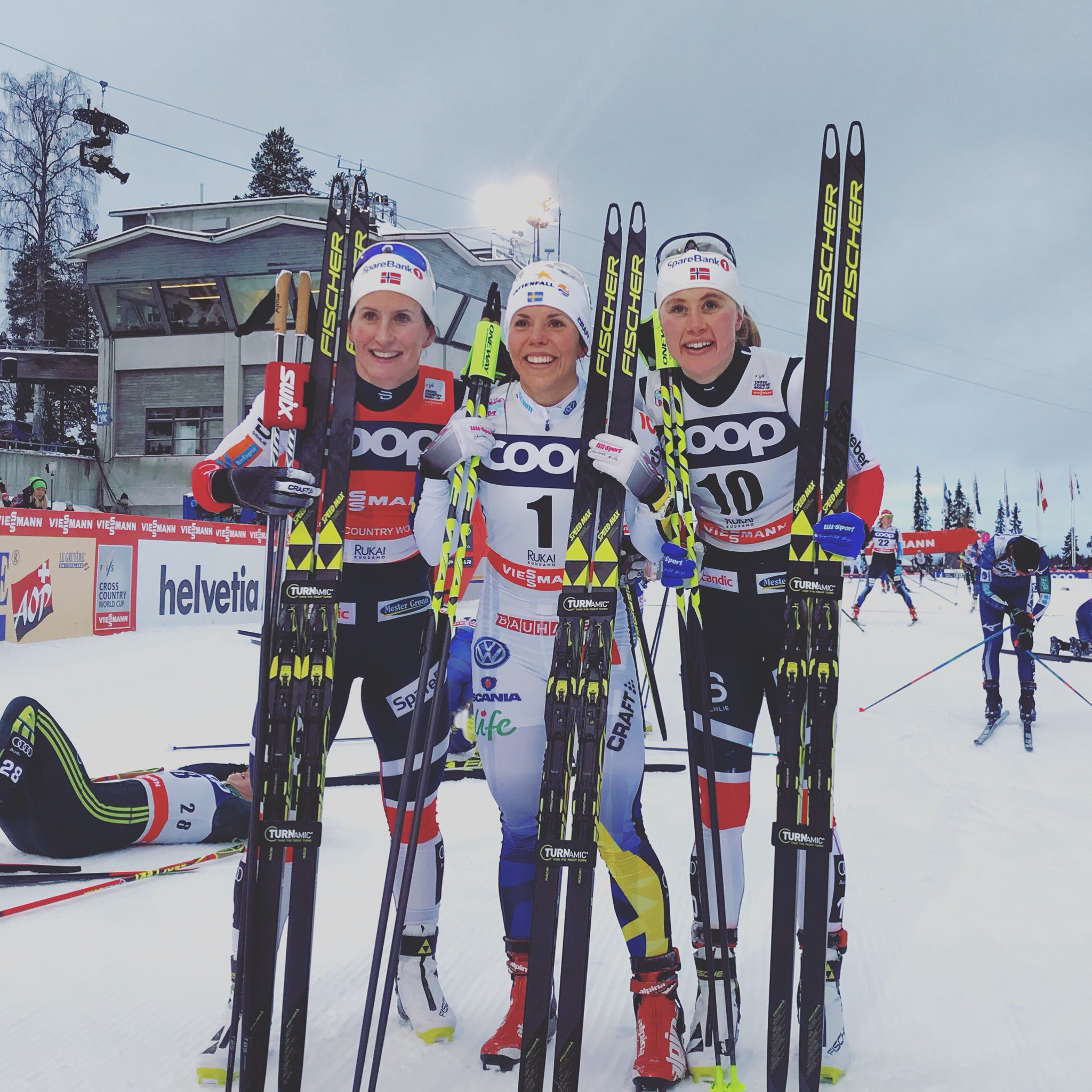
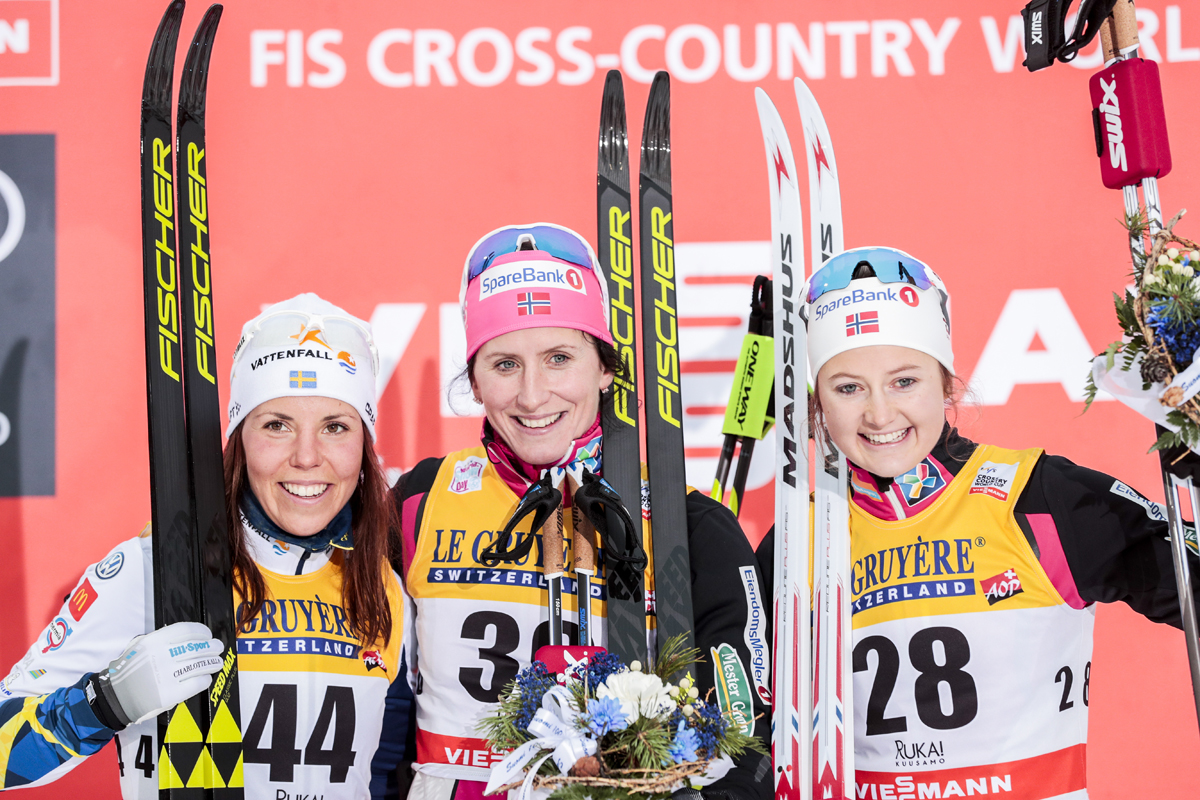
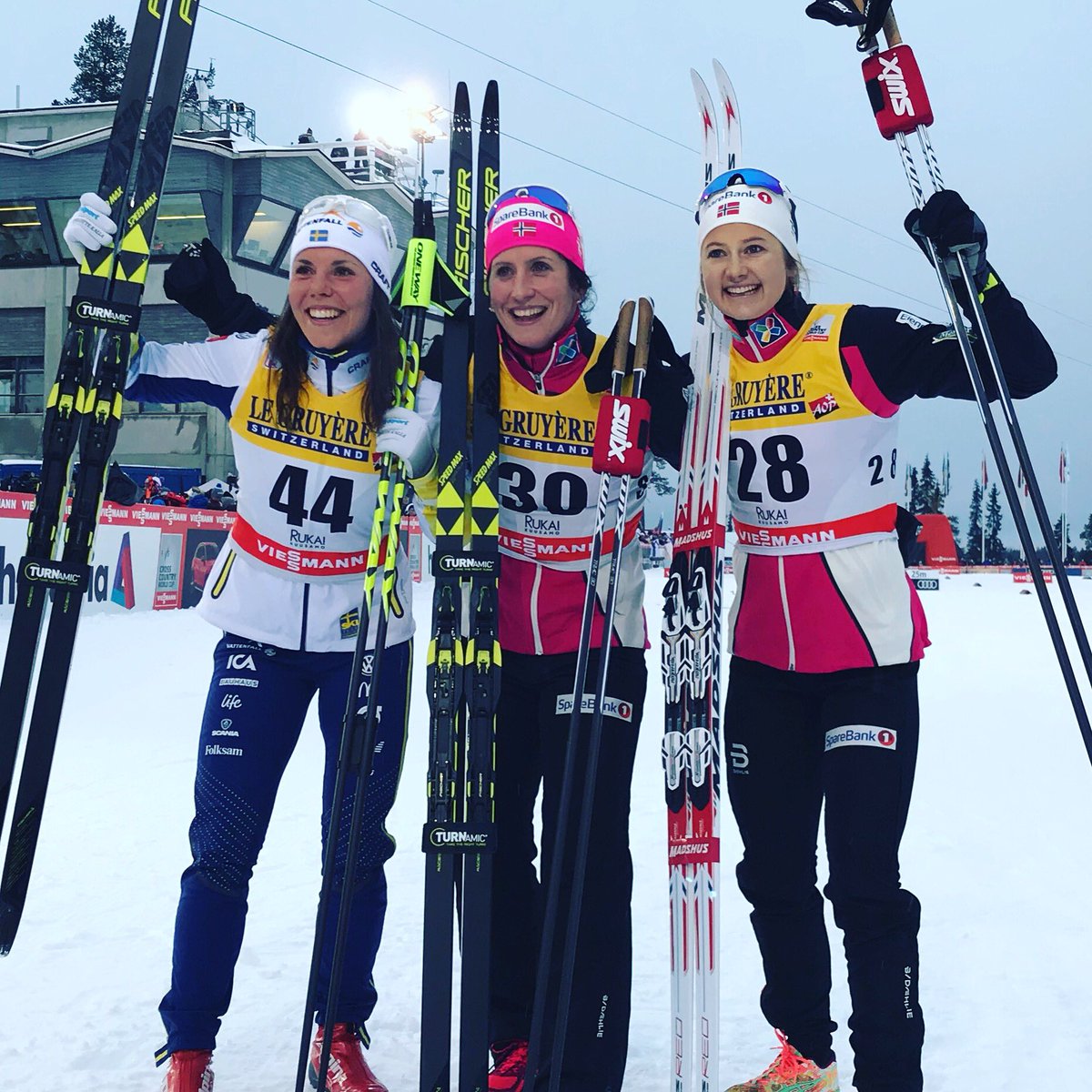
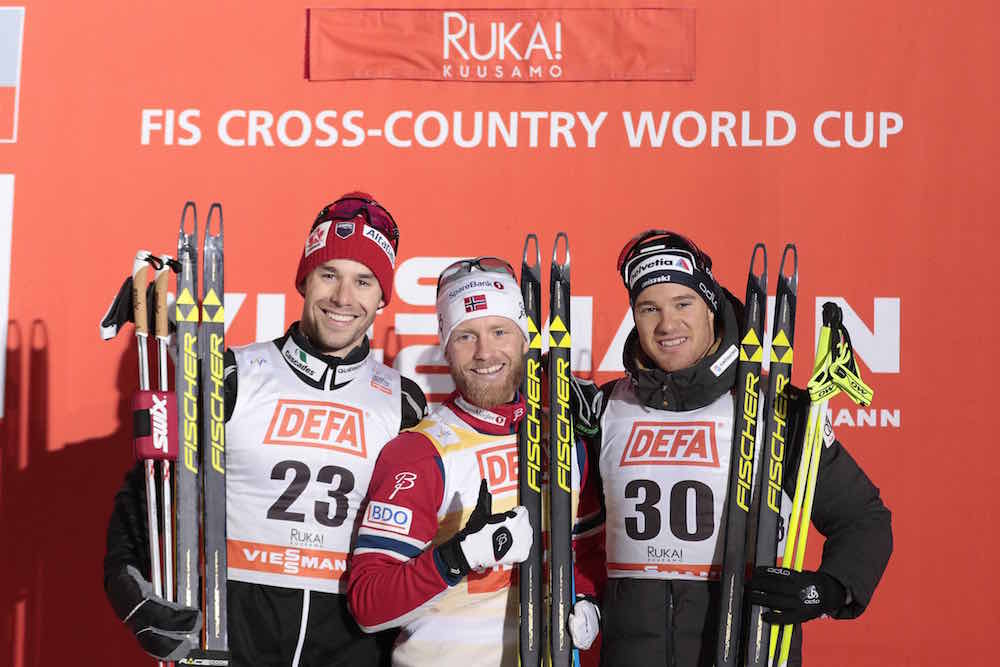
Sweden’s Charlotte Kalla (c) after winning the 2017 Ruka Triple and her first World Cup race since 2015. She won Sunday’s World Cup 10 k freestyle pursuit by 9 seconds over Norway’s Marit Bjørgen (l) and was nearly 34 seconds ahead of Norway’s Ragnhild Haga (r), who placed third. (Photo: FIS Cross Country/Twitter)
FIS Cross Country World Cup (Kuusamo, Finland): 10/15 k freestyle pursuit
Sweden’s Charlotte Kalla took down the fiercest contender women’s cross-country skiing has ever seen, challenging Norway’s Marit Bjørgen on the final lap of the women’s 10-kilometer freestyle pursuit on Sunday then successfully holding her off to the finish.
Kalla entered the final day of the three-day Ruka Triple mini tour with a 2-second lead on Bjørgen out of the pursuit start. Bjørgen quickly caught her and led for much of the four-lap race — until the last lap. The two skied alone, at least 30 seconds ahead of their nearest chasers, with three other Norwegians, Ragnhild Haga, Ingvild Flugstad Østberg and Heidi Weng leading Austria’s Teresa Stadlober and Sweden’s Stina Nilsson at 8.6 k.
Before that marker, Kalla had already launched her attack and was 6 seconds ahead of Bjørgen with 1.4 k to go. The Swede continued to push the pace and extended her buffer to Bjørgen, entering the stadium alone and winning by 9.7 seconds. For Kalla, a 2015 World Champion in the 10 k freestyle, it was her first World Cup win since 2015.
Bjørgen took second and Haga outlasted her teammates for third place (+33.9). Weng finished fourth (+38.0) and Østberg fifth (+40.2), then Stadlober in sixth (+41.0) and Nilsson in seventh (+46.7). Russia’s Natalia Nepryaeva led in the next chase group for eighth place (+1:01.6), followed by Sweden’s Ida Ingemarsdotter in ninth (+1:10.1) and American Sadie Bjornsen in 10th (+1:18.0). Another U.S. Ski Team (USST) member Jessie Diggins was close behind in 12th (+1:35.7), about five seconds behind Norway’s Kathrine Rolsted Harsem in 11th (+1:30.3).
The USST had four in the top 30, with Kikkan Randall rising from 48th at the start to 25th (+2:41.1) and Rosie Brennan improving from 34th to 28th (+2:43.2).
While Haga’s time was the fastest of the day in 25:41.8 (compared to Kalla’s finishing time of 25:50.1, which was third-fastest of the day behind Weng in second), Randall’s time was eighth fastest, Diggins was 10th fastest and Bjornsen 11th fastest of 79 in the last women’s race of the opening World Cup weekend.
Also for the U.S., Ida Sargent finished out the tour in 38th, Sophie Caldwell was 39th, Liz Stephen 56th, Chelsea Holmes 60th, and Julia Kern 73rd.
Canada’s Emily Nishikawa placed 69th overall and Cendrine Browne moved up two places to finish 72nd, while Dahria Beatty was lapped.
Klæbo Sweeps Opening Weekend
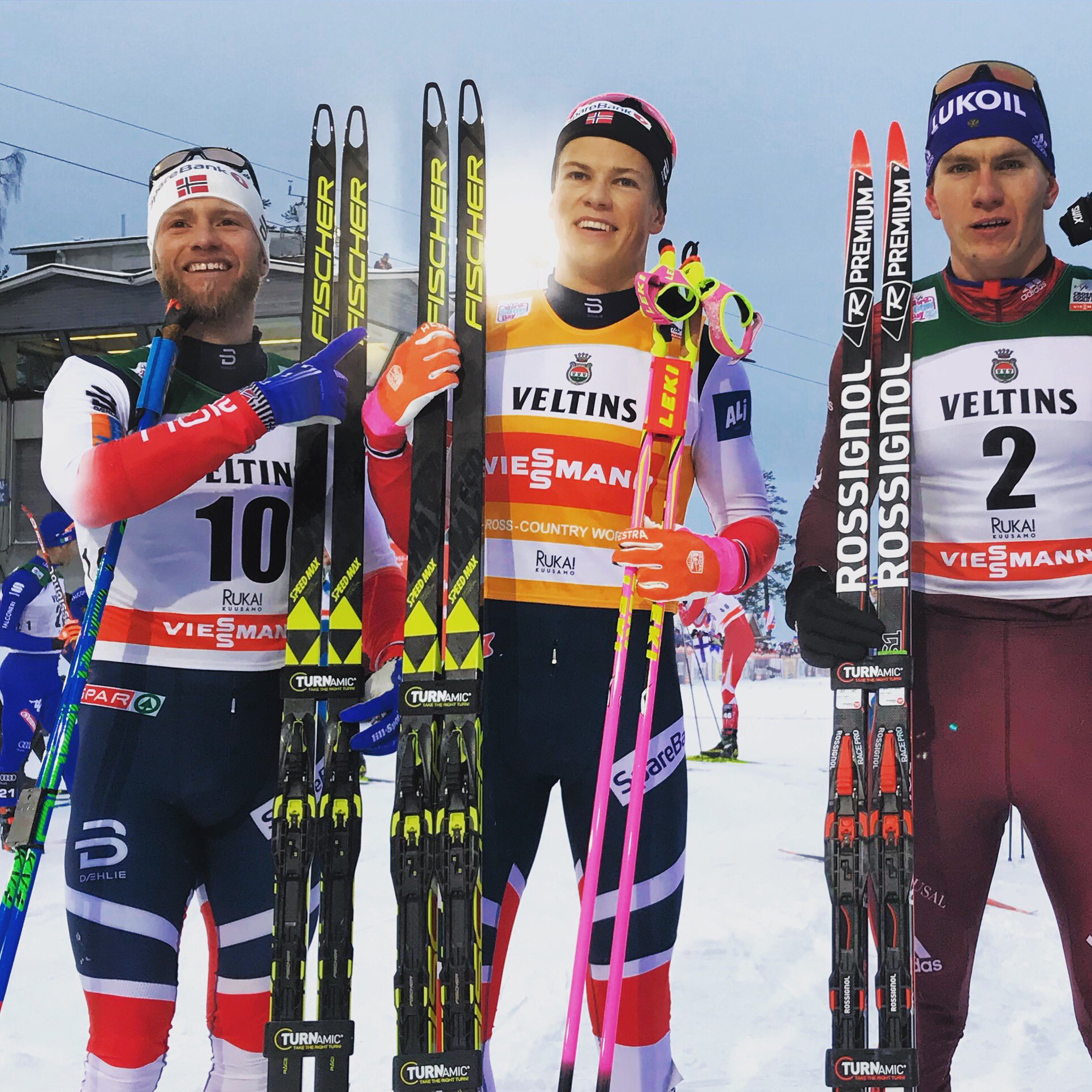
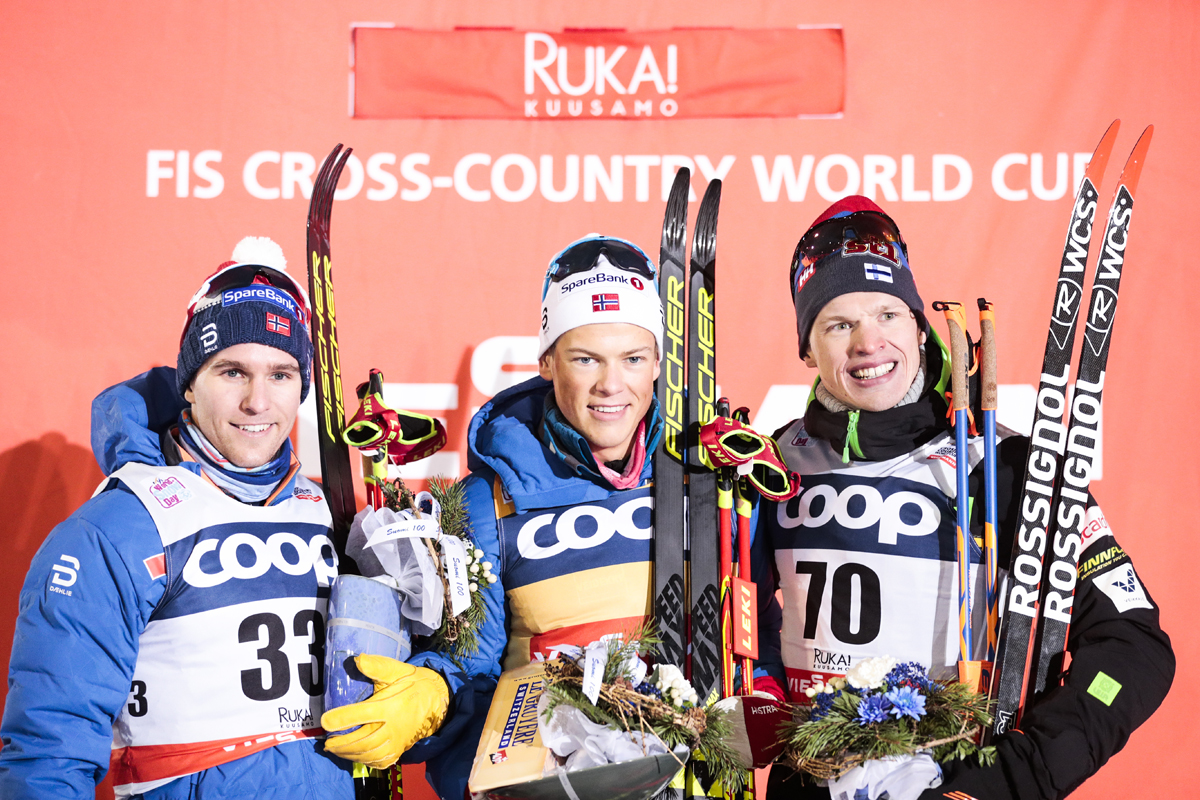
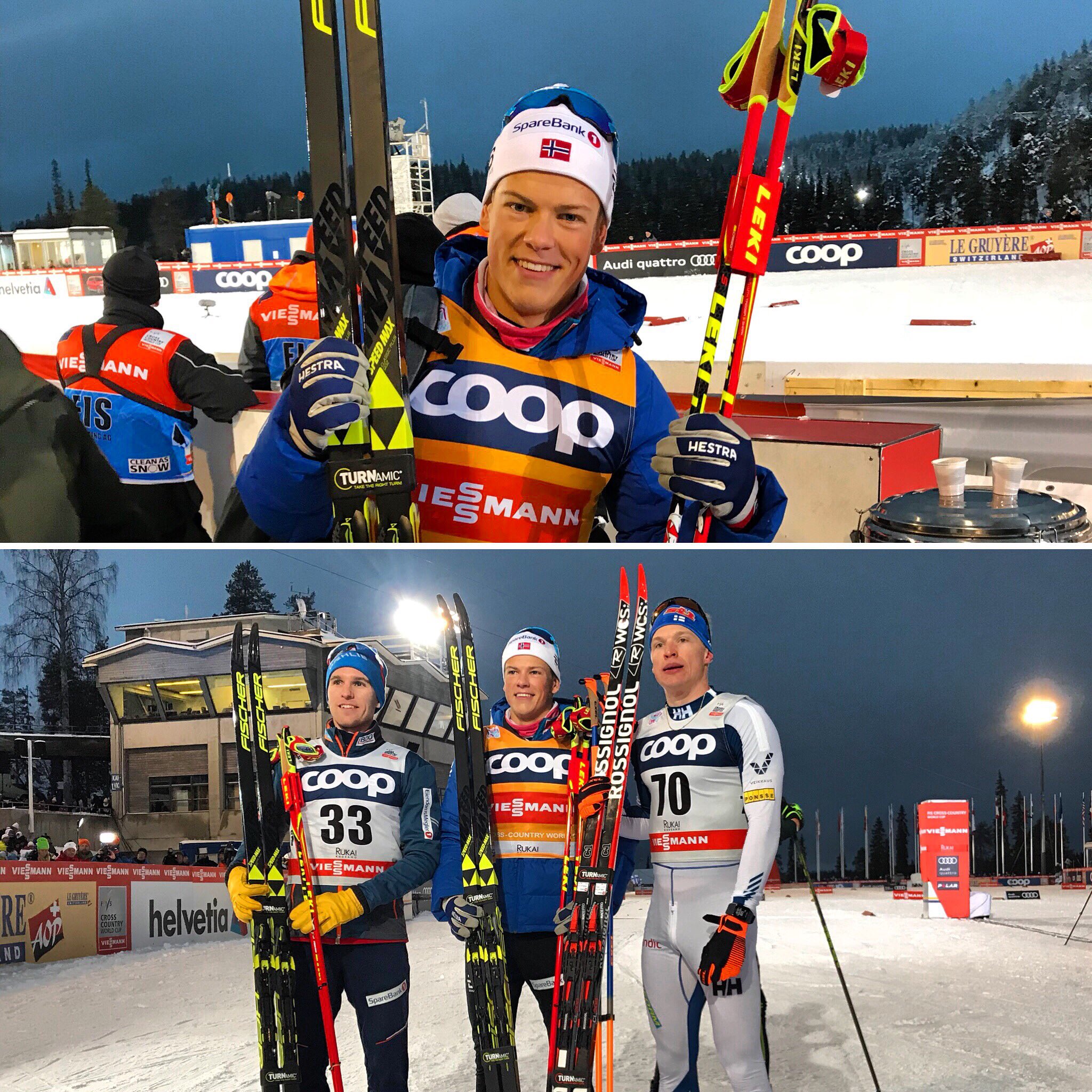
The men’s 15 k freestyle pursuit podium on the last day of the Ruka Triple in Kuusamo, Finland, with Norway’s Johannes Høsflot Klæbo (c) in first, Norway’s Martin Johnsrud Sundby in second, and Russia’s Alexander Bolshunov in third. (Photo: FIS Cross Country/Twitter)
In the men’s 15 k freestyle pursuit later in the day in Kuusamo, Johannes Høsflot Klæbo lost his 38-second buffer to the men’s field, but won the race after outlasting fellow Norwegian Martin Johnsrud Sundby, Russia’s Alexander Bolshunov and Canada’s Alex Harvey, respectively.
While Klæbo started the pursuit 38 seconds ahead of Bolshunov in second place, Sundb started 1:05 minutes back in 10th and Harvey was 1:23 behind in 12th.
Klæbo remained 32 seconds ahead of Bolshunov at 5 k, at which point Sundby led a chase group in third, followed closely by Sweden’s Calle Halfvarsson, Norway’s Didrik Tønseth, Kazakhstan’s Alexey Poltoranin, Russia’s Evgeniy Belov, Norway’s Emil Iversen, Finland’s Iivo Niskanen, and Norway’s Pal Golberg, respectively.
Harvey skied in the next group back with Sweden’s Marcus Hellner, Norway’s Hans Christer Holund, France’s Maurice Manificat, and Russia’s Alexey Chervotkin, all of which were in the top 15 at 5 k.
Over the next 2.5 k, Bolshunov cut his distance to Klæbo to 20 seconds, and at 7.5 k, Sundby was skiing alone another five seconds back in third.
Sundby caught Bolshunov and the two reeled in Klæbo over the next kilometer, catching him around 8.6 k, while 11 seconds back, Harvey led a chase group with Chervotkin, Niskanen, Holund, Poltoranin, and Manificat at 8.6 k.
Harvey lapped through the stadium at 10 k right behind Bolshunov in first, while Tønseth followed in third and Klaebo in fourth. Sundby remained in seventh, less than 2 seconds back.
At 12.5 k, 12 skiers remained in 2.6 seconds of the lead, but 1 k later, that number had dwindled to four within 3 seconds of first: Sundby, Harvey, Tønseth, and Klæbo. Bolshunov kept himself in contention just 3.8 seconds behind, and on the final climb, it became evident the race was between Klæbo, Sundby, Bolshunov, and Harvey. They finished in that order, with Harvey dropping off the pace in the finishing stretch.
Klæbo took the win in 36:23.2, just 0.4 seconds ahead of Sundby in second, while Bolshunov took third, 1 second behind Klæbo. Harvey was another 0.6 seconds back in fourth, and the Canadian’s time stood up as the fifth fastest of the day, behind Manificat in first (34:50.9). Manificat tied Holund for placed eighth overall (+8.2), behind Chervotkin in fifth (+6.2), Niskanen in sixth (+7.2), and Tønseth in seventh (+8.1).
Erik Bjornsen led the U.S. men overall in the tour in 26th (+1:43.6) for his third-straight race in the World Cup points. Also for the U.S. Ski Team, Paddy Caldwell raced to 19th for time of day (after starting 70th and finishing 51st in the pursuit).
Canada’s Devon Kershaw also landed in the points for the second-consecutive day in 29th (+1:47.8).
American Noah Hoffman finished the Ruka Triple in 39th (up from 45th at the start), Scott Patterson was 55th and Andy Newell 75th for the U.S.
Canada’s Len Valjas placed 44th overall, Graeme Killick 68th, Knute Johnsgaard 81st, and Julien Locke 83rd.
While France came in the favorites in the single mixed relay, starting a team of Martin Fourcade and Marie Dorin Habert, it was Austria who put on a master class and skied to a comfortable win today.
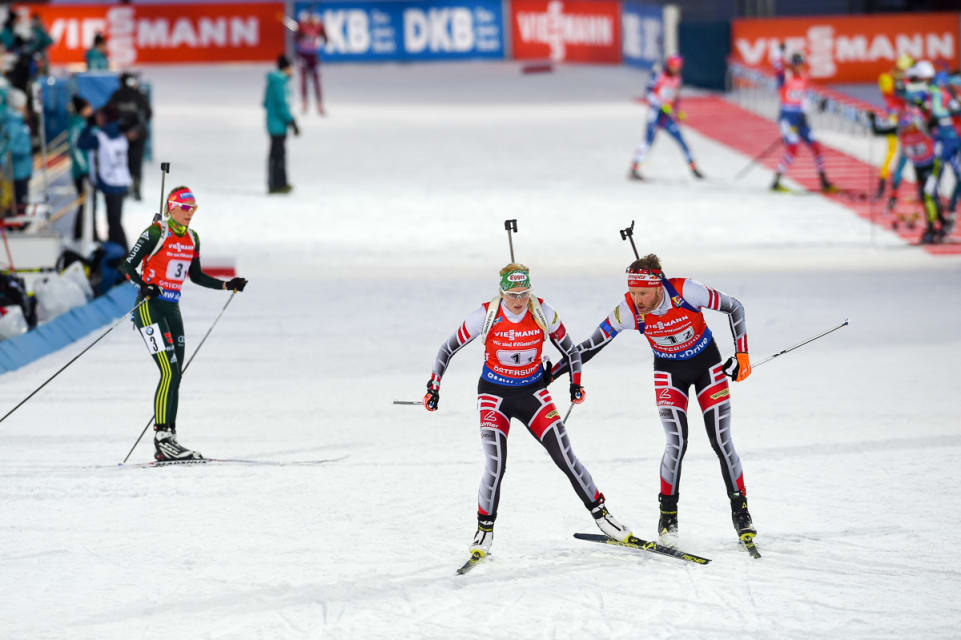
Simon Eder tags off to Lisa Theresa Hauser for Austria during the single mixed relay World Cup in Ostersund, Sweden. The pair raced to a 16.5-second win. (Photo: IBU/biathlonworld)
The Austrian duo of Lisa Theresa Hauser and Simon Eder used only two spare rounds over the course of 40 shots, the best shooting in the field by a wide margin. They led nearly the whole race and ended up with a 16.5-second victory over Germany’s Vanessa Hinz and Erik Lesser. The Germans used nine spare rounds to clean all their targets, but Lesser was aggressive on the skis and made up ground on the trails to finish 16.2 seconds clear of the rest of the field.
There, drama ensued on the last loop. Kazakhstan’s Maxim Braun came through a crash caused by Italy’s Thomas Bormolini, who was skiing in third place on the penultimate downhill and also took out Ukraine’s Dmytro Pidruchnyi. That allowed Braun, along with teammate Galina Vishnevskaya, to just barely hold on to third place. Their shooting – with five spare rounds between them, the second-best in the field – allowed this, their best relay showing ever.
Fourcade, who had left the range in seventh, came through the fray to put France into fourth, followed by Sweden (Linn Persson and Sebastian Samuelsson), then Ukraine (Pidruchnyi and Vita Semerenko) and Italy (Bormolini and Alexia Runggaldier).
Both the U.S. team of Emily Dreissigacker and Leif Nordgren and the Canadian team of Rosanna Crawford and Christian Gow were lapped. Crawford was in second position more than halfway through the race when she fell on a downhill, losing a large amount of time and affecting the functioning of her rifle once she reached the shooting range.
Later in the day, countries sent four-athlete teams out for regular mixed relays. Despite an imperfect start on the shooting range, the Norwegian team of Ingrid Tandrevold, Tiril Eckhoff, Johannes Thingnes Bø, and Emil Hegle Svendsen came away with a 5.3-second win over Italy’s Lisa Vitozzi, Dorothea Wierer, Dominik Windisch, and Lukas Hofer.
The German team of Franziska Preuss, Maren Hammerschmidt, Benedikt Doll, and Arnd Peiffer was third, +6.4, and Slovakia close behind in fourth.
Canada’s Emma Lunder, Julia Ransom, Scott Gow, and Brendan Green finished 15th, +3:28.0, and the U.S. team of Susan Dunklee, Clare Egan, Paul Schommer, and Sean Doherty 21st, +4:47.6.
Norway’s Johannes Høsflot Klæbo racing to his second win in as many races at the Ruka Triple on Saturday in Kuusamo, Finland. He won the first distance race of the season, the men’s 15 k classic, by 15 seconds and will start Sunday’s freestyle pursuit with a 38-second head start on the men’s field. (Photo: Fischer/Nordic Focus)
Is Johannes Høsflot Klæbo better than Petter Northug* was at his age? It’s hard to say, reigning Norwegian World Cup winner Martin Johnsrud Sundby told NRK. But his performance in the last two days is pretty unheard of, Sundby said after Saturday’s 15-kilometer classic.
On both Friday and Saturday at the Ruka World Cup opener in Kuusamo, Finland, Klæbo (who’s still a U23 athlete at just 21 years old, although he’s on Norway’s exclusive World Cup Team) won both races to start the 2017/2018 season. He didn’t lose a round in Friday’s classic sprint, then came out to take a 15-second victory over fellow Norwegian Didrik Tønseth in Saturday’s 15 k classic.
“There’s no doubt he’s a phenomenon,” Sundby said after placing eighth on Saturday, 30.7 seconds off Klæbo’s winning time of 33:38.8 minutes, according to a loose translation. “To race like he did yesterday, then do the same today. No, that’s amazing.”
Klæbo ended last season as both season-long U23 (under-23) World Cup champion as well as the Sprint World Cup champion. He’s started this season without a loss, and he led at most parts of the race on Saturday, except for the 3.1 and 5 k checkpoints, where Russia’s Alexander Bolshunov clocked splits that were 0.9 and 4 seconds faster, respectively.
The men’s 15 k classic podium on Day 2 of the Ruka Triple in Kuusamo, Finland, with Norway’s Johannes Høsflot Klæbo (c) in first, Norway’s Didrik Tønseth (l) in second, and Finland’s Iivo Niskanen (r) in third. (Photo: Fischer/Nordic Focus)
But Bolshunov, who started 66th (out of 102) couldn’t hold it, and the young gun in bib 42 continued to hold his own in the leader’s chair at the finish. Klæbo ousted Tønseth from the top spot, putting Tønseth in second place. Finland’s Iivo Niskanen in bib 70 charged hard for the win, coming within three seconds of Klæbo around 6 k, but ended up 17.7 seconds short for third place.
“It’s unbelievable what Johannes did today, having raced four sprint rounds yesterday,” Tønseth emphasized, according to a International Ski Federation (FIS) press release.
“I was surprised myself,” Klæbo told FIS. “My plan was to open hard. When you fight for the World Cup victory, you try to give everything.”
As for his reaction to Sundby’s praise, Klæbo told NRK he was trying to remain focused.
“It’s just two races, so we’ll have to wait and see,” he said. “There is no one who is more of a favorite in the Tour de Ski than Martin. I will smile as long as I have the yellow shirt [as the overall Word Cup leader], but then he will get it in the end.”
Saturday’s 15 k classic, as Niskanen pointed out, wasn’t an easy one. New snow from overnight and the day before mixed with temperatures around freezing made for glazed tracks, where skis were prone to icing.
“It was a difficult competition and it was not easy to pick the right skis,” Niskanen told FIS. “Looking at the whole mini tour, third place today is good. I am still not where I would like to be, there are some good things but also some things I have to improve for the [Olympic] Games.”
He’ll start Sunday’s final race of the Ruka Triple, the men’s 15 k freestyle pursuit, in fifth place, 49 seconds behind Klæbo in first. Bolshunov, who finished fourth on Saturday (19.9 seconds behind Klæbo), will start the pursuit in second. And Klæbo will start first, 38 seconds ahead of the Russian.
Norway’s Pål Golberg will head out third, 6 seconds after Bolshunov, and Sweden’s Calle Halfvarsson will start fourth, another 4 seconds later and 1 second ahead of Niskanen. Tønseth is slated to start sixth (+0:57) just ahead of fellow Norwegian Emil Iversen and Kazakhstan’s Alexey Poltoranin (both 58 seconds back) in seventh and eighth, respectively. Russia’s Evgeniy Belov** is ninth in the tour standings (+1:05) and will start with Sundby in 10th (+1:05).
On Saturday, Poltoranin, an early leader in bib 12, placed fifth (+25.6) to move up the mini-tour ranks. He initially bumped Belov, who started 10th, out of the leader’s chair, and Belov ultimately slipped to sixth (+26.5), just ahead of Iversen in seventh (+30.2) and Sundby in eighth (+30.7).
Russian U23 skier Alexey Chervotkin placed ninth on the day (+31.2). Halfvarsson was 10th (+34.4) after coming within seven seconds of Klæbo’s time in the middle of the race but losing time on the last of three 5 k laps. For Norway, Golberg placed 11th (+38.1) and Hans Christer Holund 12th (+44.7), ahead of Canada’s Alex Harvey in 13th (+49.7).
Canada’s Alex Harvey racing to 13th in the men’s 15 k classic individual start on Saturday at the World Cup in Kuusamo, Finland. (Screenshot: ARD)
Harvey, who started in bib 37, spent most of his race floating between 10th and 14th place, and did what he needed to get within striking distance of the top 10 for Sunday’s pursuit. He’ll start tomorrow’s race in 12th, 1:23 out of first and 9 seconds behind Chervotkin in 11th.
“I was just hoping to move forward a bit in the standings but more importantly to deliver another good race,” Harvey wrote in an email on Saturday. The day before, he reached the quarterfinals and finished 21st overall in the sprint.
“The conditions yesterday were quite different than today’s. Yesterday it was fresh falling snow and cold, then it warmed up quite a bit overnight so today was very glazy [sic] and shiny snow,” Harvey wrote. “Skis were good I think. Not the fastest but good kick in not-so-easy conditions to get grip.”
Like fellow Canadian World Cup Team member Devon Kershaw, who tied American Erik Bjornsen (U.S. Ski Team) for 26th (both 1:15.2 out of first), Harvey explained that he chose no-wax “hairies”, also known as “rub” skis.
(“I think a lot of guys went on rub skis,” Kershaw wrote in an email. “I went with rub skis and it was the right choice for me today. The techs were all pretty pumped because I have been very averse to rub skis in the past. The handful of times I’ve been ‘forced’ to race on them I’ve gotten completely destroyed, so today was fun to feel good and make the skis work for me.”)
Harvey recalled feeling strong on the climbs, using his grip to his advantage.
“From our more detailed splits it seems I was losing a bit on the flats which is usually my stronger terrain but nothing too dramatic,” Harvey wrote. “I’m happy to be within reach of the top ten, that was the goal for the weekend. Tomorrow I’m looking forward for 2 things. 1: chasing guys ahead of me. 2: skating!”
Kershaw, who started 13th and had fewer men to chase ahead of him, explained that he paced his first lap so that he’d catch someone like Harvey, and the plan worked.
“I was going to take my risk and start really slow. Almost level 3 effort,” Kershaw wrote of his pre-race strategy. “I knew I should be able to lap through with either Alex, [Finland’s Matti] Heikkinen, or Dario [Cologna of Switzerland] – and it just so happened that it was Alex. I ended up having great energy after my pedestrian start and was able to ski 10km with him, which obviously allowed me to ski into the points. Perhaps I should have been more aggressive out of the start, but I played it safe and it worked out decently well for me.”
“That was sweet to have someone there,” Harvey said in a Cross Country Canada press release. “It was good for both of us and really helped pull us both around.”
Canada’s Alex Harvey (in red) lunges at the finish of the men’s 15 k classic at the Ruka World Cup in Kuusamo, Finland. While he initially finished sixth, he ended up 13th on the day. (Screenshot: ARD)
Kershaw wrote that he was “decently happy,” with his race. “I know that 26th doesn’t sound earth shattering or anything, but to start the first distance race of the World Cup tour in the points is fine. I’m a notoriously slow starter throughout my career before Christmas, so I’m just looking for some solid races and to hit the points more often than missing them is good.”
On Sunday, he’ll start 28th, one second behind Cologna in 26th and Russia’s Andrey Larkov in 27th. Bjornsen, the U.S. Ski Team’s leading man in the Ruka tour, is 7 seconds ahead of him in 23rd.
“I think the celling is probably 20th,” Kershaw wrote of his aspirations for an overall finish for the mini tour. “We have a good group of about 10 guys all starting within 9 seconds of each other. I will hope to stay in that group and have the energy and punch to have a good last lap. You never know what happens in these pursuit starts too – so guys could blow up, but there’s a break at around 20, and then behind me there’s a break at around 30. Will be fun.”
Bjornsen, who placed 24th in Friday’s sprint, started Saturday’s 15 k in bib 69, just 30 seconds ahead of Niskanen. In an email, Bjornsen described catching a “great ride from Iivo” on the second lap.
“He’s just amazing here,” Bjornsen wrote. “I’m pretty sure he was disappointed with his result. He comes to Ruka with a mission. I jumped on him for a lap in the middle. It felt very controlled in the double pole sections but he was just striding up the hills no problem. The herring bone was not nearly as efficient. I had to let him go after skiing with him for 6kms.”
Bjornsen explained that he took a chance and went for glide over grip.
“I’ve only raced here four times but tricky classic conditions seem to be the norm. The hills are big and steep!” he wrote. “I had a pair of rockets under my feet but I didn’t stride in the tracks once. My double pole is feeling great right now so the tactic was to hammer double pole as far up the hill as I could, and then just get out of the tracks and run/herring bone.”
After finishing in the top 30 to score World Cup points in the first two races of the season, Bjornsen explained he was feeling “psyched”.
“I didn’t have the best feelings the last couple weeks, so I wasn’t expecting to be in the points right away,” he wrote.
“Of course yesterdays race was fun for me, but for sure the highlight of the day was watching Sadie absolutely dominate the heats!” he added of his older sister Sadie Bjornsen placing second in the women’s sprint. “She’s been looking great this year and I think she has a lot more success to come. Personally I believe she was strong enough to take the win, it’s only a matter of time before that happens..”
On Sunday, he hoped to chase a top-30 overall tour finish.
“I’m starting around some legends, so it will be a great experience!” Bjornsen wrote.
U.S. Ski Team coach Matt Whitcomb said he was impressed with Bjornsen’s ability to contend with “some of the best skiers in the world” on Saturday, including Niskanen.
“[He] kind of took the approach, ‘I am going to swing as hard as I can and hope to connect with the ball,’ and it worked for a large part of that race,” Whitcomb said on the phone. “He was skiing up into the top 20, and then Niskanen on the final lap turned things up a little bit and popped him off … It was a gutsy race, so psyched for Erik. It is so fun to watch him figure out a project, some sort of challenge in the race and go after it. … Twenty-sixth is a hell of a race in Finland.”
American Noah Hoffman raced to 43rd (+1:58.4) on Saturday, Andy Newell finished 59th (+2:29.6), Paddy Caldwell was 72nd (+2:53.5), Scott Patterson 86th (+3:17.7), and Simi Hamilton 96th (+3:43.4) for the U.S. Ski Team.
Five other Canadian national-team members competed, with Len Valjas finishing 48th (+2:08.0), Graeme Killick 58th (+2:23.4), Knute Johnsgaard 87th (+3:19.8), Julien Locke (U25 Team) 100th (+3:56.4), and Jess Cockney 109th (+5:20.7).
***
* Northug, 31, who made his World Cup debut in 2005/2006 and has since accumulated 13 World Championships golds and two Olympic gold medals, has started his season this weekend with non-World Cup International Ski Federation (FIS) races in Gålå, Norway, after skipping Norway’s opening FIS races in Beitostølen, Norway, last weekend. Per team rules, he was not allowed to start the Ruka World Cup as a result of that decision. So far in Gålå, Northug finished 17th in the 15 k freestyle on Friday and was eliminated in Saturday’s classic-sprint quarterfinals to place 19th in that race.
** Belov, 27 is one of six Russian skiers currently banned from competing at future Olympics as a result of doping at the 2014 Olympics. He and the five others are allowed to compete in FIS events, like the World Cup, unless FIS decides otherwise.
Norway’s Marit Bjørgen (30) leads her teammate Heidi Weng (29) in the women’s 10 k classic individual start on Saturday at the Ruka World Cup in Kuusamo, Finland. (Photo: Fischer/Nordic Focus)
At age 37, with more than 110 World Cup wins, 18 World Championships titles and six Olympic gold medals, it’s hard to imagine Norway’s Marit Bjørgen as anything but a machine; she races, she wins, she repeats.
But even the World Cup veteran, who first raced the circuit in 1999, occasionally considers the simplicity of throwing in the towel. With intermittent snow showers on Saturday in Kuusamo Finland, temperatures hovering around freezing and varying snow conditions over the women’s two-lap course, many competitors entered in Saturday’s 10-kilometer classic individual start were caught in the classical dilemma of either slipping or sticking.
“It was interesting to see everyone out there — from all different countries — during the warmup come to the top of hills and just scrape their skis off; it’s not something that you always see on the World Cup,” U.S. Ski Team member Ida Sargent said in a post-race phone interview. “But it was just one of those days where nothing was going to be perfect.”
No matter how prepared or fit an athlete is, part of the allure and challenge of cross-country skiing is the element of ever-changing conditions. Mother Nature, after all, cannot be tamed. And even someone like Bjørgen can find it defeating.
“It was challenging to lead today,” Bjørgen told NRK, according to a translation. “I considered giving in after the first kilometer, but then I got a good split time and realized that it was just as bad for everyone. Then you just had to bite your teeth together … I think I finished well.”
Sweden’s Charlotte Kalla racing to second in the women’s 10 k classic at the Ruka Triple World Cup on Saturday in Kuusamo, Finland. (Photo: Fischer/Nordic Focus)
By the first kilometer, Bjørgen in bib 30 (out of 89) was situated in third, 2.5 seconds back from the race leader at the time, Sweden’s Charlotte Kalla. In the next two kilometers, Bjørgen lost 8.6 seconds on Kalla, but surpassed Finland’s Aino-Kaisa Saarinen to move into second. Over the next 3 k, Bjørgen regained ground and began to close in. By the 6 k mark, she was but 0.6 seconds off of Kalla’s time and in another two kilometers, she was ahead by one second.
Having overcome her initial discontent with the conditions, Bjørgen did not let off the brake, besting Kalla by 17 seconds at the finish and taking over the leader’s chair in 25:07.6. That result stood, and just 0.8 seconds out of second place, Norway’s Ingvild Flugstad Østberg stood on the final step of the podium in third place (+17.8).
American Jessie Diggins, of the U.S. Ski Team (USST), placed 10th (+1:03.9) for her fourth-best result in a 10 k classic — her most recent being an eighth place in a classic mass start at last season’s Tour de Ski stage in Val di Fiemme, Italy.
“I think this is probably the best I have ever done in Kuusamo,” Diggins said on the phone, referring to her performances in previous classic distance races there. In 2015, she finished 38th in the Ruka 10 k classic pursuit, and a year ago, she placed 13th in the Ruka 10 k classic.
“I usually try to come into the season really patient and work into it,” she continued “So it was a really nice surprise to feel pretty good today and fire up the engines, get that first distance race out of the way and remember how it feels to pace a 10 k.”
She stayed within ten seconds of 10th place for most of the race, closing it down to 2 seconds with less than to 2 k to go before securing her final top-10 spot. While Diggins explained that many of the racers she saw on course appeared to have either no glide or no kick, she felt fortunate to have a decent balance of both.
“I would ice up a little bit, but I could just run up the hills out of the track and then kick them really hard and they would clear up,” Diggins said. “So they stayed pretty fast, but with good kick as well, which was really really impressive. It could not have been easy to get the best of both worlds, so I am really, really grateful to those guys [our wax technicians].”
Ahead of Diggins was Norway’s Heidi Weng in fourth (+34.0), Austria’s Teresa Stadlober in fifth (+36.4), Norway’s Ragnhild Haga in sixth (+38.2), Russian U23 (under-23) skier Natalia Nepryaeva in seventh (+42.8), Sweden’s Stina Nilsson Friday’s classic sprint winner) in eighth (+46.1), and another U23 Russian, Anastasia Sedova in ninth (+53.4).
Sargent placed 22nd (+1:21.9) for her best World Cup distance race result since 2014 and was the second fastest American woman of the day.
“I haven’t scored distance points in a couple of years now, so it feels awesome to be back in the points, and I am really stoked to start the season out like this,” said Sargent, who’s been known for her sprinting results in Kuusamo (with a fifth place in its 2014 classic sprint and seventh place in 2015).
“I was definitely a little conservative at the beginning, but I think the upside of that is not blowing up, especially for me being a little more sprint-based,” she explained. “It was exciting to be pushing and working my way through the race; moving up that way.”
In the first kilometer, Sargent was positioned in 69th, 7.6 seconds away from 22nd. In the next 2 k, she moved up to 42nd, and by the halfway point she was in 33rd. Sargent continued to move up in rank, improving five more places by 6 k and moving into 24th with 2 k to go. By the finish, she had moved up to 22nd.
“She just had an awesome pace out there,” U.S. Ski Team Women’s Head Coach Matt Whitcomb said on the phone after. “She started quite slow for the first 1.2 k. Something we talked about that has worked really well here, you go out too hard and you blow up, and you just bleed time throughout the race, or you go out conservatively see where the body is and figure out where you can put the pedal down. She skied a really patient race for the first two k and then was able to push the pedal and got a great response out of her body.”
American Sadie Bjornsen (46) chasing down Finland’s Aino-Kaisa Saarinen (19) during the women’s 10 k classic at the World Cup opener in Kuusamo, Finland. Bjornsen placed 23rd while Saarinen was 27th. (Photo: Fischer/Nordic Focus)
Just 1 second behind Sargent was another USST member Sadie Bjornsen, coming off a career-best second place in Friday’s classic sprint, in 23rd (+1:23.4). While Bjornsen explained she had adequate recovery from the sprint, she had difficulty with her skis.
“I worked really hard to calm all my excitement last night, and channel it towards today,” Bjornsen wrote in an email. “I woke up feeling recovered and ready to rally. … Unfortunately, I really struggled with skis today, and didn’t have the extra power to push through it. I was really proud for fighting hard, and pushing on like I was racing for a medal. What I have learned with classic skiing in this world of crazy conditions is that when the stars align, it can turn into an incredible day. But, it doesn’t happen every day, so no matter what, you have to be ready to seize every opportunity like it is your day. I am looking for more in my distance classic skiing of course, but the season is mighty long, I am happy with how I feel, so I know it will come this year.”
In the standings, Bjornsen is now ranked 11th, behind Norway’s Haga and ahead of Sweden’s Anna Haag. Diggins is 16th with one race remaining: the women’s 10 k freestyle pursuit on Sunday.
Finishing 6.2 seconds outside of the top 30 (and just 0.3 seconds out of 31st) was Rosie Brennan (USST) in 33rd (+1:47.7). Happy with her ski choice, Brennan used the conditions as an opportunity to test her race technique.
“I decided to try a more aggressive pacing strategy today to ensure I could hold my technique together with such challenging conditions,” Brennan wrote in an email. “I think I over-paced as a result and should have started picking up the pace sooner than I did. This are all the things that take a few races to get back into the groove so I’m not too concerned with that. However, I felt good after picking up the pace so I think I am fit and ready more for.”
Three places behind Brennan was another USST member, Sophie Caldwell (who finished eighth in Friday’s sprint) in 36th (+1:50.1).
“This is a really tough course, so I tried to pace it well and take the first lap in control,” Caldwell wrote in an email. “I knew it would require some patience and tried not to panic if I didn’t feel perfect or my skis weren’t perfect in some places. I decided to go on wax and my skis were icing a bit over the tops of the hills, but I was able to ski off the accumulated snow and they felt fast for the downhills.”
In addition to reaching the semifinals in Friday’s opening sprint, Caldwell started her World Cup season by racing to third in the sprint’s qualifying round.
“Physically I felt pretty good today,” Caldwell wrote. “I was a little sore from the sprints yesterday, but I felt like I was able to recover enough to still have good energy and I was happy with the race. I felt like I skied the downhills well and definitely got a little tired going over the top of the massive uphill the second time, but was overall pleased with the race and think it was probably one of the best, if not the best distance race I’ve ever had in Kuusamo.”
Nine American women raced Saturday’s 10 k, with Kikkan Randall (USST) finishing 48th (+2:14.5), Liz Stephen (USST) 58th (+2:26.3), Chelsea Holmes (Alaska Pacific University) 64th (+2:50.0), and Julia Kern (USST D-team) 74th (+3:19.2).
Three Canadian women competed, with Emily Nishikawa (Canadian World Cup Team) leading them in 56th (+2:24.2), Cendrine Brown (National U25 Team) following in 76th (+3:23.6), and Dahria Beatty (World Cup Team) finishing 84th (+3:53.5).
In Sunday’s 10 k freestyle pursuit, Kalla as the mini-tour leader will start 2 seconds ahead of Bjørgen in second and 12 seconds ahead of another Swede, Nilsson, in third. Østberg will start fourth, 20 seconds out of first, and Nepryaeva will head out fifth, three seconds after Østberg. Bjornsen in 11th will start 46 seconds back (and just 6 seconds out of seventh), and Diggins will start 1:04 back in 16th, 3 seconds behind Finland’s Kerttu Niskanen in 15th.
The women’s 10 k classic podium on Saturday at the World Cup opening weekend in Kuusamo, Finland, with Norway’s Marit Bjørgen (c) in first, Sweden’s Charlotte Kalla (l) in second, and Norway’s Ingvild Flugstad Østberg (r) in third. (Photo: Fischer/Nordic Focus)
The women’s 10 k classic podium at Day 2 of the World Cup opening Ruka Triple in Kuusamo, Finland, with Norwegian winner Marit Bjørgen (c), Swedish runner-up Charlotte Kalla (l), and Norway’s Ingvild Flugstad Østberg (r) in third. (Photo: FIS Cross Country/Twitter)
FIS Cross Country World Cup (Kuusamo, Finland): 10/15 k classic
On Day 2 of the Ruka Triple World Cup opener on Saturday, Norway’s Marit Bjørgen collected a 17-second victory in the women’s 10-kilometer classic individual start in Kuusamo, Finland.
Bjørgen started 30th of nearly 90 women and was contested by one other: Sweden’s Charlotte Kalla in bib 44. Kalla clocked through the 3.1 and 6.2 k checkpoints faster than Bjørgen, but the Norwegian’s time stood up against Kalla’s at 8.1 k, where Bjørgen was 1 second faster. Over the last two kilometers, Bjørgen continued to gain speed toward the finish, crossing the line in 25:07.6 minutes. Kalla came within 17 seconds of her, which was good enough for second place and 0.8 seconds faster than another Norwegian, Ingvild Flugstad Østberg, who was bumped to third (+17.8).
Norway had three in the top four with Heidi Weng in fourth (+34.0). Austria’s Teresa Stadlober put herself in the mix in fifth (+36.4), Norway’s Ragnhild Haga was sixth (+38.2), Russia’s Natalia Nepryaeva seventh (+42.8), Sweden’s Stina Nilsson eighth (+46.1), Russia’s Anastasia Sedova ninth (+53.4), and American Jessie Diggins 10th (+1:03.9).
Also for the U.S. Ski Team, Ida Sargent placed 22nd (+1:21.9) and Sadie Bjornsen, who notched a career-best second in Friday’s classic sprint and led the women’s Ruka Triple standings after Day 1, finished 23rd (+1:23.4). Bjornsen is now 11th in the standings (46.5 seconds behind Kalla in first) with one more day of racing (women’s 10 k freestyle pursuit) remaining.
Kalla is 2.6 seconds ahead of Bjørgen in the mini-tour standings, and Nilsson is third (+12.4) ahead of Østberg in fourth (+20.0).
Nine American women raced on Saturday, with Rosie Brennan placing 33rd (+1:47.7), Sophie Caldwell (who was eighth in Friday’s sprint) following in 36th (+1:50.1), Kikkan Randall finishing 48th (2:14.5), Liz Stephen 58th (+2:26.3), Chelsea Holmes 64th (+2:50.0), and Julia Kern 74th (+3:19.2).
Three Canadian women competed, with Emily Nishikawa placing 56th (+2:42.2), Cendrine Browne 76th (+3:23.6), and Dahria Beatty 84th (+3:53.5).
Klæbo Doubles Up in Ruka
Norway’s Johannes Høsflot Klæbo (top and bottom, center) won his second-straight race at the Ruka World Cup opener on Saturday in Kuusamo, Finland, with a 15-second victory in the men’s 15 k classic over fellow Norwegian Didrik Tønseth (bottom left). Finland’s Iivo Niskanen (bottom right) also reached the podium in third. (Photo: FIS Cross Country/Twitter)
In the men’s 15 k classic that followed, Johannes Høsflot Klæbo rocketed to his second-straight win of the World Cup’s opening weekend in 33:38.8, which was 15.3 seconds clear of runner-up and fellow Norwegian Didrik Tønseth.
Finland’s Iivo Niskanen started after Klæbo (bib 42) and Tønseth (bib 33) in bib 70 and pushed to contend with Klæbo, but came up 17.7 seconds short at the finish. Russia’s Alexander Bolshunov also emerged as a later contender, starting 66th (out of 115) and clocking the fastest times at 3.1 and 5 k. Bolshunov ended up 19.9 seconds behind Klæbo at the finish and ultimately settled for fourth.
Kazakhstan’s Alexey Poltoranin placed fifth (+25.6) after being an early race leader in bib 12, and Russia’s Evgeniy Belov (another early starter in bib 10) followed sixth (+26.5). Norway’s Emil Iversen placed seventh (+30.2) and Martin Johnsrud Sundby was eighth (+30.7), Russia’s Alexey Chervotkin ninth (+31.2), and Sweden’s Calle Halfvarsson 10th (+34.4).
Canada’s Alex Harvey placed 13th (+49.7), behind Norway’s Pål Golberg and Hans Christer Holund in 11th (+38.1) and 12th (+44.7), respectively.
American Erik Bjornsen and Canadian Devon Kershaw tied for 26th (+1:15.2).
Also for the U.S., Noah Hoffman was 43rd (+1:58.4), Andy Newell 59th (+2:29.6), Paddy Caldwell 72nd (+2:53.5), Scott Patterson 86th (+3:17.7), and Simi Hamilton 96th (+3:43.4).
For Canada, Len Valjas finished 48th (+2:08.0), Graeme Killick 58th (+2:23.4), Knute Johnsgaard 87th (+3:19.8), Julien Locke 100th (+3:56.4), and Jess Cockney 109th (+5:20.7).
Klæbo extended his lead in the Ruka Triple standings to 38.3 seconds over Bolshunov, who moved up to second place. Golberg is third (+44.1), Halfvarsson fourth (+47.8), and Niskanen fifth (+49.5) with Sunday’s 15 k freestyle pursuit remaining.
Harvey is 12th in the standings (+1:22.8) and Bjornsen 23rd (+1:50.9) to lead the Canadian and American men, respectively.
FIS Nordic Combined World Cup (Kuusamo, Finland): Individual large hill/10 k
Also in Ruka, the second day of nordic-combined action started on the HS 142 large hill and ended with a 10 k Gundersen start, which Japan’s Akito Watabe won by 31.7 seconds over Finland’s Eero Hirvonen. Watabe jumped to first on the large hill with a total of 158.6 points, while Austria’s Wilhelm Denifl followed with 154.2 points in second, just ahead of France’s Maxime Laheurte with 154.2 points in third.
The lone American to start the competition round for the second-straight day, Bryan Fletcher jumped to 31st. (His USA Nordic teammate Ben Berend just missed the top-50 cutoff in the qualification round in 52nd, while Taylor Fletcher was 65th in qualifying.)
In the 10 k that followed on Saturday, Watabe started with a 16-second head start on Denifl and extended his lead to the finish, crossing first in 24:58.6. Hirvonen, who started ninth and 58 seconds back based on his jump, rose to second, while Germany’s Johannes Rydzek raced up from eighth to third (+32.8). Norway’s Jan Schmid placed fourth (+34.4) and France’s Antoine Gerard finished fifth (+36.5), Laheurte took sixth (+38.4), Norway’s Espen Andersen was seventh (+39.8), Austria’s Mario Seidl was eighth (+43.7), and Denifl ended up ninth (+55.7). Bryan Fletcher skied the fourth-fastest time to place 18th. Fletcher started 2:29 after Watabe and finished 1:45.8 behind him.
On Friday, Fletcher placed 17th in the individual large hill/5 k Gundersen. In the first Nordic Combined World Cup competition of the season, Norway took first and second with Andersen holding off his teammate Schmid by 7.7 seconds for the win in 12:58.0. Watabe placed third, 11 seconds out of first, after jumping to third.
Andersen’s jump ranked second on Friday and he started the two-lap 5 k four seconds behind Seidl, the jump leader. Seidl fell back three places to fourth at the finish (+15.4) while Schmid rose from sixth to second place with the third-fastest ski time.
Denifl maintained his jumping position in fifth (+29.1) and Laheurte finished ninth — up from 12th in the jump. Fletcher jumped to 18th and improved one spot to 17th (+2:47.6) after starting 3:04 out of first.
Day 3 of nordic combined’s long weekend in Ruka is another individual large hill/10 k Gundersen on Sunday.
Left to right: Norwegians Pål Golberg and Johannes Høsflot Klæbo and Sweden’s Calle Halfvarsson after placing third, first and second, respectively, in the men’s 1.4-kilometer classic sprint on Friday in Kuusamo, Finland. (Photo: FIS Cross Country/Facebook)
There was no mistaking Norway’s Johannes Høsflot Klæbo in Friday’s 1.4-kilometer classic sprint, even with no natural light illuminating the course in Kuusamo, Finland, by the time the men’s final left the start line. The 21 year old’s distinct runner-like, high-tempo stride could be seen leading the five other men’s finalists on every climb, distinguishing him from the light fog and densely packed trees lining the course’s firmly packed tracks.
Making his World Cup debut in the spring of 2016, Klæbo has since racked up four-regular season World Cup individual sprint podiums — of the eight World Cup sprints that he has entered — and ended last season as the men’s U23 World Cup champion as well as the overall Sprint World Cup winner, all at the age of 20.
Last weekend at Norway’s first International Ski Federation (FIS) races of the season in Beitostølen, Klæbo not only won the classic-sprint final, but he also topped the men’s qualifier, his quarterfinal and his semifinal.
Klæbo repeated the feat this weekend in Kuusamo, starting first with the qualifier, clocking the fastest by 2.26 seconds over Finland’s Anssi Pentsinen in a time of 2:46.53 minutes. He then won his quarterfinal by 0.6 seconds over fellow Norwegian national-team member Pål Golberg. In his semifinal, Klæbo bested Sweden’s Calle Halfvarsson by 0.29 seconds and then, with a convincing gap on the rest of the field, crossed the finish line first in the final in 2:48.19, kick starting his 2017/2018 World Cup season with a win.
“It was not my plan to ski away so early but before the final hill I was told I had a five-minute lead so I went for it all the way to the finish,” Klæbo sai,d according to a FIS press release.
Even before the course’s last climb, Klæbo had already set himself apart from the rest of the racers in the men’s final: Finland’s Ristomatti Hakola, Italy’s Federico Pellegrino, Sweden’s Calle Halfvarsson, and Norway’s Golberg and Sondre Turvoll Fossli. By the bottom of the first major climb he had double poled his way to a three-meter gap.
Klæbo already in his descent, Hakola, Golberg, Pellegrino, Fossli, and Halfvarsson crested the top of the climb in a pack and settled in for the chase. But Klæbo continued to hold them off into the second major climb, extending his gap by another two meters. As the others reached the second major climb, the race became one for second place between Halfvarsson and Goldberg. Hakola, Pellegrino and Fossli had all fallen back.
Finishing with no one close enough to challenge him, Klæbo took the win in in 2:48.19. Goldberg crossed 1.35 seconds later for second place, while third went to Halfvarsson, 4.03 seconds after Klæbo.
“I’m happy about the third place, but I was quite behind Klaebo,” Halfvarsson said according to a FIS press release. “I will try to catch up for the [Olympic] Games. He was impressive today.”
Rounding out the top 10 was Finland’s Lauri Vuorinen in seventh, Russia’s Alexander Bolshunov in eighth, Switzerland’s Jovian Hediger in ninth, and Finland’s Martti Jylhä in 10th.
Canada’s Alex Harvey advanced to the quarterfinals after qualifying in 13th (+6.13), the fastest North American in the preliminary round.
“The goal was to execute a solid day of racing since it’s the first time I put a bib on this year!” Harvey, of the Canadian World Cup Team, wrote in an email to FasterSkier. “I was pretty happy with my qualifier, it’s a short sprint here so 13th for me was a great start.”
In his quarterfinal, Harvey went up against Finnish skiers Vuorinen, Iivo Niskanen, and Toni Ketelä as well as Estonia’s Marko Kilp, and Japan’s Hiroyuki Miyazawa. However, a loss in positioning before the major climb cost him a few seconds, and he finished his quarterfinal in fifth, 2.16 seconds behind Vuorinen, who won the heat in 2:47.40.
“In the 1/4 final I did 1 or 2 mistakes that just cost me in term of positioning before the big hill,” Harvey wrote. “I felt great technically and actually pretty good physically too especially for the time of the year.”
“Like normal the steep terrain is a bit of a weakness for me so again in the final wall I don’t think I was moving fast enough there,” Harvey continued. “The rest of the course I think I skied well.”
The only other North American to qualify on Friday was Erik Bjornsen of the U.S. Ski Team (USST) in 26th (+8.71). Racing in the same quarterfinal as Klæbo, Golberg, Finland’s Juho Mikkonen and Matias Strandvall, and Russia’s Gleb Retivykh, Bjornsen ultimately crossed in fifth, 5.12 seconds behind Klæbo.
“We are really proud of [Erik] to qualify as strong as he did, in Scandinavia, in a classic sprint,” USST coach Matt Whitcomb said on the phone. “This is one of the hardest races of the year to do this, and it bodes really well.”
“Talked to him between the qualification and the quarterfinals, and he was just exuding confidence and commented on how strong his double pole is feeling,” Whitcomb continued. “We saw him fire that jet in the finish stretch today. He had a really fast heat and it stressed him out a little bit, don’t know exactly what happened, but he was in the mix today and we are psyched.”
Another USST member, Andy Newell missed qualifying by 0.38 seconds in 34th. He was 9.38 seconds off Klæbo’s top qualifying time.
“It was frustrating to be so close and just on the outside of the qualification bubble,” Newell wrote in an email. “Just a few tenths of a second out of the top 25. I felt like I struggled today to get the right amount of glide vs kick… which is just as much on me as the tech. Grateful to be feeling healthy and looking forward to big races to come.”
Julien Locke of Canada’s National U25 Team was the next-fastest Canadian, placing 59th (+12.07) in the qualifier. Locke finished 0.04 seconds ahead of the American Simi Hamilton (USST) in 60th (+12.13).
“A little bit of an off day for Simi and Andy,” Whitcomb said. “For Andy on a course that is particularly good for him and he is in really good shape right now, I think he struggled with some glide.”
Canadian World Cup Team member Len Valjas finished 63rd (+12.58). Before departing Gällivare, Sweden — where he and most of his teammate had been training and raced the opening FIS competitions — Valjas suffered a shoulder subluxation and was not “back to full health” by the time Friday’s sprint rolled around, he explained in an email.
“I took the week really easy on the shoulder to let it recover, and gave it a try in today’s race,” Valjas wrote. “I didn’t have my normal strength in the double pole sections of today’s race. I just felt weak and couldn’t hold any speed on the flats.
“I was happy that I was able to compete today, but I am definitely not skiing at 100%,” Valjas continued. “The shoulder is pretty sore and stiff from the qually this morning. Huge thanks to Pete Dickinson (USA physio) for taking care of me this week and helping me speed up my recovery.”
Also competing for Canada was Knute Johnsgaard in 73rd (+12.58), Devon Kershaw in 74th (+14.01) Graeme Killick in 85th (+14.01), Jess Cockney in 95th (+18.83).
Three additional Americans raced in the qualifier, with Scott Patterson (USST) finishing 84th (+16.14), Patrick Caldwell (USST) finishing 103rd (+21.43) and Noah Hoffman finishing in 105th (+21.85).
Canada’s Continental Cup leader, Russell Kennedy (Team R.A.D.), who earned Period 1 World Cup start rights after ending winning last season’s overall NorAm title, did not start Friday’s sprint race.
The women’s podium for the first race of the 2017/2018 World Cup season, the Ruka classic sprint in Kuusamo, Finland, with (from right to left) American Sadie Bjornsen in second, Sweden’s Stina Nilsson in first, and Russia’s Yulia Belorukova in third. (Photo: U.S. Ski Team/Twitter)
FIS Cross Country World Cup (Kuusamo, Finland): Classic sprints
In the first race of the 2017/2018 cross-country World Cup season, U.S. Ski Team (USST) member Sadie Bjornsen, who turned 28 on Tuesday, raced to the best result of her career, placing second to Sweden’s Stina Nilsson in Friday’s classic sprint in Kuusamo, Finland.
Last season, Bjornsen notched her first World Cup podium in third place in the 5-kilometer freestyle in Toblach, Italy, and teamed up with USST teammate Jessie Diggins to take third in the 2017World Championships classic team sprint. Friday’s 1.4-kilometer classic sprint — the first race of the Ruka Triple mini tour to kick of the 2017/2018 World Cup season — was Bjornsen’s first race of the season. She did not participate in any preseason International Ski Federation (FIS) races.
Bjornsen started out the day by clocking the fifth-fastest time in the qualifier, 1.98 seconds behind Sweden’s Ida Ingemarsdotter, who won the qualifier in 3:11.69 minutes. Bjornsen’s USST teammate Sophie Caldwell qualified third (+0.59) after another Swede, Hanna Falk in second (+0.19), and a total of four American women finished in the top 30 to qualify for the heats. Ida Sargent finished 22nd (+8.70) and Rosie Brennan was 26th (+9.51) to reach the quarterfinals.
There, Bjornsen won her quarterfinal by 0.39 seconds over Russia’s Yulia Belorukova. Caldwell also advanced to the semifinals by placing second in her quarterfinal, 0.7 seconds behind Sweden’s Charlotte Kalla in first.
Sargent finished third in her quarterfinal, 0.65 seconds behind the winner of that heat, Sweden’s Anna Haag. Brennan placed sixth in her quarterfinal, 4.3 seconds behind Sweden’s Nilsson in first. Neither Sargent nor Brennan advanced to the semifinals.
In the semifinals, Bjornsen again raced to first, and once again held off Belorukova — this time by just one-hundredth of a second. Caldwell followed in fourth in that semifinal, 0.5 seconds behind Bjornsen in first and 0.11 seconds behind Russia’s Evgenia Shapovalova in third (+0.39). Neither Caldwell nor Shapovalova advanced to the final.
In the final, Nilsson took the overall win in 3:17.62 and Bjornsen captured a career best in second place, 0.24 seconds out of first. Belorukova rounded out the podium in third (+0.91), while Ingemarsdotter placed fourth (+2.72), Norway’s Kathrine Rolsted Harsem was fifth (+3.54), and Finland’s Krista Parmakoski sixth (+18.62).
Overall, Caldwell placed eighth, Sargent 15th and Brennan 29th for the U.S. Diggins and Kikkan Randall missed out on qualifying in 34th and 36th, respectively. Julia Kern placed 57th, Liz Stephen 70th, and Chelsea Holmes 86th.
None of the Canadian women qualified, with Dahria Beatty in 64th, Emily Nishikawa in 74th and Cendrine Browne in 87th.
In the men’s 1.4 k classic sprint, Norway’s Johannes Høsflot Klæbo won out the day after winning the qualifier, quarterfinal and semifinal en route to another dominant performance in the final.
Klæbo started off by winning the qualifying round by 2.26 seconds in 2:46.53. Finland’s Anssi Pentsinen qualified second and another Finn, Ristomatti Hakola, qualified third (+2.35), ahead of Italy’s Federico Pellegrino in fourth (+2.66).
Cross Country Canada’s Alex Harvey was the top North American man in the qualifier, finishing 13th (+6.13), while Erik Bjornsen of the USST qualified in 26th (+8.71).
Both Harvey and Bjornsen finished fifth in their quarterfinals and did not reach the semifinals. Harvey ended up 21st on the day, after finishing 2.16 behind the winner of his heat, Finland’s Lauri Vuorinen. Bjornsen was 24th overall after finishing 5.12 seconds behind Klæbo, who won the first men’s quarterfinal.
Klæbo used the extra recovery time he had from racing an early quarterfinal to prime himself for another win in the semifinals, where he beat Sweden’s Calle Halfvarsson by 0.29 seconds. Another Norwegian, Pål Golberg, followed in third (+0.49), and Hakola placed fourth in that semi (+1.72). Both Golberg and Hakola had fast enough times to advance to the final, where they met Pellegrino — the winner of the second semifinal — and Norway’s Sondre Turvoll Fossli, who was second in the second semifinal (+0.1).
In the final, Klæbo once again won convincingly, this time by 1.35 seconds with a finishing time of 2:48.19. Golberg took second place and Halfvarsson reached the podium in third (+4.03), while Hakola placed fourth (+5.65), Pellegrino fifth (+8.87), and Fossli sixth (+17.31).
For the U.S., Andy Newell missed qualifying by 0.38 seconds in 34th and Simi Hamilton finished 60th. Scott Patterson was 84th, Paddy Caldwell was 103rd, and Noah Hoffman was 105th.
For Canada, Julien Locke, of the national U25 Team, finished 59th, Len Valjas was 63rd, Knute Johnsgaard 73rd, Devon Kershaw 74th, Graeme Killick 85th, and Jesse Cockney 95th. Last year’s NorAm winner Russell Kennedy did not start.
Marit Bjørgen carrying the Norwegian flag as she crosses the line first for Norway’s 100th World Championship win during the women’s 4 x 5 k relay at 2017 Nordic World Championships in Lahti, Finland. (Photo: John Lazenby/Lazenbyphoto.com)
Welcome to World Cup Windup, where we check in with the top-10 teams from last year’s FIS Cross Country World Cup tour before the season starts with the Ruka Triple in Kuusamo, Finland, on Nov. 24.
NORWAY
Overall in Nations Cup Last Year: First, by a landslide: 13,383 points to 7,053 by runner-up Sweden.
Women’s Ranking 2016/2017: First
Men’s Ranking 2016/2017: First
Norway’s Heidi Weng leading her teammates Ingvild Flugstad Østberg (middle r), Marit Bjørgen (middle l) and Sweden’s Stina Nilsson (far left) during the women’s 10-kilometer freestyle mass start in La Clusaz, France, last December. (Photo: Fischer/Nordic Focus))
Who’s Back:
Overall World Cup winners Martin Johnsrud Sundby and Heidi Weng; Sprint Cup winners Johannes Høsflot Klæbo and Maiken Caspersen Falla; World Cup race winners Finn Hagen Krogh, Emil Iversen, Sindre Bjørnestad Skar, Pål Golberg, Eirik Brandsdal, Ingvild Flugstad Østberg, and Marit Bjørgen, And that’s just the skiers who won World Cups last season. There’s also other folks like, oh, Petter Northug and Astrid Jacobsen, who didn’t pick up individual wins last season but are probably pretty hungry.
Who’s Missing:
Therese Johaug. The world champion and two-time World Cup overall champion is still sitting out a doping ban for using a lip cream containing a prohibited steroid.
Other than that, athletes usually don’t retire just before an Olympics, so pretty much everyone is back.
Pre-Season Results:
None of the national team members have raced at the pre-World Cup competitions so far, but Chris Andre Jespersenpicked up a win in Bruksvallarna, Sweden. Look for many more Norwegians to compete at their home opener in Beitostølen this coming weekend.
The second World Cup stop of the season is in Lillehammer, so the Beitostølen races will also likely determine who gets to compete as part of the “nations group” there, the host country’s extra bunch of quota spots.
Recent Drama:
Oh, there’s always something, isn’t there? For Norway, it’s about the Olympics. With just four starting spots per race and so many top skiers, it will be a tough fight to get named to the Olympic team.
Norway’s Emil Iversen crashes in the finishing stretch while Finn Hågen Krogh (2) leads Finland’s Ristomatti Hakola (10), Martti Jylhae (4) Canada’s Alex Harvey (13), and Poland’s Maciej Starega (22) during the second men’s skate-sprint semifinal on Feb. 23 at FIS Nordic World Ski Championships in Lahti, Finland. (Photo: Dustin Satloff)
Emil Iversen, for instance, remembers how he fell twice at last year’s World Championships, including in the team sprint, where he ruined a good chance at a win given to him by teammate Johannes Høsflot Klæbo. He says he is feeling good, but he wants to redeem himself from Lahti and that’s no easy feat. “Everyone says they have never been stronger,” he told NRK. “Being in the squad should be within reach, but getting all the race starts I want will be incredibly hard.”
Astrid Jacobsen, meanwhile, has changed her training and is in some ways imitating alpine skiers, focusing more on balance. “It’s hard to believe that you can improve oxygen capacity or become more persistent by exercising even more,” the 30-year-old said. “I have a thorough fitness already. I think there’s more to gain by catching up with new things… If I get a little better in this area and get better on the skis, I can be a little more efficient. Better efficiency will produce much better results than better capacity would.”
Otherwise, a few skiers are not in the shape they’d like to be in at this point in the season.
Finn Hagen Krogh is congratulated by his teammates after anchoring Norway to gold in the men’s 4 x 10 k relay on March 3 at World Championships in Lahti, Finland, 4.6 seconds ahead of Russia in second place. (Photo: John Lazenby/Lazenbyphoto.com)
Didrik Tønsethgot a bad concussion after a rollerski crash in Livigno, Italy, in early September, and had to miss a considerable amount of training. (Reminder: always wear a helmet while rollerskiing!) He skipped a recent high-elevation training camp because he sometimes still has headaches; he is otherwise doing some hard training again. Tønseth was part of the gold-medal relay team from 2017 World Championships but is worried about qualifying for the Olympics. “It’s a season where you have to do well before Christmas,” he told NRK, according to a translation. “It already counts from Kuusamo… so there is no favorable situation. I’m not completely satisfied.”
Best Social Media Presence:
The Norwegian ski stars generally don’t use Twitter much, but a few have great Instagram presences.
Unsurprisingly, the Norwegian who is best at conveying his brand on social media might be Petter Northug. When the IOC made the decision to disqualify several Russian athletes from the 2014 Olympics for doping – including the silver-medal men’s relay team – this was the response from Northug, who had anchored the Norwegian relay team which had finished fourth, failed to medal, and otherwise caused great soul-searching in the country:
Given the drama over who will anchor the men’s relay team in 2018, Northug is taking even one more laugh with this post.
But if it’s not satire and gamesmanship you’re after but rather smiles and a peek inside the women’s team, who from this perspective seem to be genuine friends, follow Heidi Weng on Instagram.
Norway’s Martin Johnsrud Sundby raced to an uncontested victory in the men’s 15 k classic pursuit on Sunday, the final stage of the Ruka Triple in Kuusamo, Finland. He won the pursuit by 44 seconds and took the mini-tour victory in the season-opening World Cup weekend. (Photo: Fischer/NordicFocus)
Count them: six in a row.
That’s how many World Cup tours Martin Johnsrud Sundby of Norway has won. He kept his streak alive in the final stage of the Ruka Triple mini tour on Sunday, the 15-kilometer classic pursuit in Kuusamo, Finland.
With a 44.7-second win over Petter Northug, also of the Norwegian national team, Sundby, 31, illustrated he’s a world-beater and is primed to defend his World Cup overall title for the third-straight year.
“It is a good start of the World Cup season. Today’s race was tougher than yesterday,” Sundby told FIS.
The all-Norwegian men’s podium after the Ruka Triple 15 k classic pursuit on Sunday at the World Cup in Kuusamo, Finland, with, Martin Johnsrud Sundby (c) in first, Finn Hågen Krogh (l) in second and Petter Northug (r) in third. (Photo: Fischer/NordicFocus)
He won Saturday’s 10 k freestyle to take the mini-tour lead, then started Sunday’s pursuit with a 14-second head start on teammate Finn Hågen Krogh. While the two never skied together — and actually skied alone for most of the race — they both ended up on the podium.
Krogh faded in the final third of the race, and Italy’s Francesco de Fabiani and Norway’s Didrik Tønseth caught him with about four kilometers to go. He stayed with them, then dug especially deep to edge de Fabiani by 0.1 seconds for third, less than two seconds behind Northug.
“I was completely on the [brink] when [the chase group] overtook me,” Krogh told NRK.
Norway took every spot on the podium, but de Fabiani in fourth kept the powerhouse nation from a top-six sweep. Norway’s Niklas Dyrhaug and Tønseth placed fifth (+48.5) and sixth (+50.6), respectively, and Alex Harvey of Canada was another five seconds back in seventh. In all, Norway put seven in the top 10.
For Harvey, it was his best finish in the Kuusamo mini tour after placing 11th overall there in 2011. He was second in Saturday’s 10 k freestyle to put himself sixth in the tour heading into the final pursuit.
“I am super satisfied with the weekend,” Harvey said in a Cross Country Canada press release. “I just felt I had something more in me today than seventh.”
The Norwegian domination began at the outset. Sundby started alone ahead of Krogh, followed by another Norwegian, Anders Gløersen, 19 seconds back in third. Northug started fourth, 24 seconds after Sundby and a second ahead of Harvey and Switzerland’s Dario Cologna, who placed third in Saturday’s 10 k.
While Harvey and Cologna headed out together 25 seconds back, the two formed a coalition to battle the elements, particularly the wind, and try to rein in Sundby. However, just before the 4 k mark, Sundby was already 44 seconds ahead of Krogh, 47 seconds ahead of Sweden’s Martin Johansson (who started seventh), and 48 seconds ahead of Cologna, de Fabiani, Harvey, and Gløersen, respectively.
By 5 k, Krogh had successfully broken away from the rest of the field, skiing 13 seconds ahead of them and 42 seconds behind Sundby. Behind him, Harvey and Cologna stuck with the chase pack that remained seven-men strong by 6.4 k.
With two laps remaining at 10 k, Cologna had fallen off the pace slightly and slipped to 16th, while Harvey skied in seventh, 15.5 seconds behind Krogh and 1:12 behind Sundby.
When Tønseth, de Fabiani and Johansson accelerated at the start of the second-to-last lap to catch Krogh, the chase pack split and left Harvey, France’s Maurice Manificat and three Russians — Alexander Legkov, Sergey Turyshev and Maxim Vylegzhanin — in a group of their own. From there, Harvey had to fight for a top 10.
Canadian Alex Harvey (l) after placing second on Saturday in the World Cup 10 k freestyle in Kuusamo, Finland, to share the podium with Norwegian winner Martin Johnsrud Sundby (c) and Switzerland’s Dario Cologna (r). (Photo: CCC/NordicFocus)
“It was a tough race for sure. I felt really good, in fact I think it was the best day I had physically, but it was really tricky waxing conditions,” Harvey explained.
“Our skis really weren’t that bad. The speeds were average, but the difference was the Norwegians and Italians had the best skis,” he added. “I was right there until the final kilometer, but I think as the track started [deteriorating], I lost the group on the last downhill.”
This Kuusamo course can be like shock therapy. The Ruka hills no joke for World Cup skiers in midseason form, let alone the opening races on this year’s World Cup circuit. A big climb marks the central portion of the 2.5 k loop that the men rounded six times.
According to Canadian head coach Justin Wadsworth, his team approached the race with a straightforward mindset.
“We didn’t talk about anything strategy wise before the race. We were so focused on the skis,” he said in a post-race phone interview. “I just told the guys that the only piece of advice that I could really offer was everyone is going to be in the same boat, and it’s going to be hard. So, that was the main thing. Just don’t worry if the skis don’t work everywhere because it’s going to be hard.”
Although the Canadians had a relatively strong day, with Harvey in seventh and Devon Kershaw in 23rd (after starting 29th), Wadsworth said they may have come up short with ski prep.
“We feel like we were scrambling a little bit on the skis. We were a bit slow. We could have a little bit more time for that, at least to test today,” he said. “I think maybe we focused a little too much on the the powder testing, some of the glide testing, and that pushed it a little bit later than we wanted. So we didn’t have have as much time as we like to test the kick, which is a priority because it was very, very hard day.”
“We know what mistakes we made and the skis were a bit slow for all the athletes on the fast downhills, so that was definitely an issue,” Wadsworth continued.
On a day with 92-percent humidity and temperatures just below freezing, no one’s skis worked everywhere. There was some striding, some ski-running, some herringbone.
“It was one of the hardest World Cups I’ve ever watched as far as that nobody had the skis that they could run up everything and then glide well,” Wadsworth noted. “There were guys icing. They were slipping in the tracks, out of the tracks. It was a really tough race in that respect.”
U.S. coach Matt Whitcomb reiterated the universal waxing conundrum. “The conditions today were very very difficult,” he said on the phone. “Picture some of the worst classic conditions you’ve skied in and it was pretty much that.”
With the relentless climbs, a course profile that rarely backs off, coupled with the dicey kick, the race took a collective toll on the field.
Meanwhile, lurking at the tail end of the top 20 with five kilometers to go, Northug kept the frontrunners within sight. In the final kilometers, he worked his way forward, eventually closing the gap on those ahead.
With 2.5 k remaining, he was up to seventh behind Harvey. Then at 14 k, he began stalking Tønseth, de Fabiani and Krogh while skiing in fifth.
Petter Northug powers to second in the men’s 15 k classic pursuit on Sunday, the final day of the Ruka Triple World Cup in Kuusamo, Finland. (Photo: Fischer/NordicFocus)
Sundby crossed the line in 37:10 without anyone in sight. Almost 45 seconds later, it was Northug who steamrolled ahead of Krogh and de Fabiani and left them fighting for third.
Ever the tactical chameleon, Northug was clearly gassed at the finish. He lay prone on his back, lungs heaving. When he finally spoke to reporters, Northug explained his form and technique were not quite up to his liking.
“I was tired. I’m not in shape to go with these guys yet … so I was [skiing] back there and I was annoyed at myself,” he said to NRK, according to a translation. “It was about being in the right place at the right time.”
The duo that had hoped to gain places as a unit, Harvey and Cologna faded slightly in the end to finish seventh and 13th (+1:18.8), respectively.
As is his style, Sundby remained humble.
“The first two laps were hard, so I tried to maintain the pace the rest of the race,” he told NRK, according to a translation. “This weekend I have had wonderful fine skiing. Things worked out and I’m in good shape. This winter I think will be exciting and I think I get a lot of exciting duels with these guys here.”
“I wanted the other guys think they cannot catch me, but I started way too fast,” Sundby told FIS. “I got extremely tired. After 7.5 k, I did not know how to continue. I am happy I am leaving Ruka with the overall victory in the mini-tour.”
The fastest time on the day belonged to Dyrhaug, who completed the course in 37:08.1, almost two seconds faster than Sundby.
Erik Bjornsen (l) chases U.S. teammate Simi Hamilton during Sunday’s World Cup 15 k classic pursuit at the Ruka Triple mini tour in Kuusamo, Finland. Bjornsen led the U.S. men in 46th and Hamilton placed 68th. (Photo: Fischer/NordicFocus)
The top American male was Erik Bjornsen, who finished the Ruka Triple 46th overall (+2:10.3) with the 43rd fastest time of the day.
In an email, Bjornsen wrote he feels like he’s building his form. “I know I have to be at the top of my game to post an impressive World Cup result and I’m just not quite there right now,” he wrote.
Racing in massive fields with world-class talent, each World Cup weekend is a learning experience, the 24 year old explained. “Racing over here is just so different, I’m trying my best to learn from all these experiences.”
Also for the U.S., Noah Hoffman finished the weekend in 52nd (+4:25), Simi Hamilton was 68th (+5:29), Kris Freeman 73rd (+5:44.2), and Andy Newell did not finish.
“We had some big hits this weekend and some big misses,” Whitcomb said of the U.S. Ski Team’s overall showing in Kuusamo. In the women’s pursuit, Sadie Bjornsen led the team in 14th. “It’s the first weekend of World Cup racing and Kuusamo presents some of the toughest waxing and skiing conditions of the season. It’s an agressive introduction.”
After Harvey in seventh and Kershaw in 23rd (+1:48.5), Ivan Babikov placed 50th (+4:17.2) for Canada, Graeme Killick was 55th (+4:38.9), Michael Somppi 81st (+ 7:08), and Len Valjas did not start Sunday’s race.
World Cup racing continues next Saturday and Sunday with a skiathlon and relay in Lillehammer, Norway.
Sadie Bjornsen (r) of the U.S. Ski Team leads Germany’s Nicole Fessel (l) during the women’s 10 k classic pursuit on Sunday at the Ruka Triple World Cup in Kuusamo, Finland. Bjornsen started 11th and went on to place 14th. (Photo: Fischer/NordicFocus)
It’s easy to get caught up in results and what could have been. Ask Sadie Bjornsen. The 26-year-old U.S. Ski Team member was shooting for a top 10 in Sunday’s 10-kilometer classic pursuit at the World Cup in Kuusamo, Finland.
After putting herself in 11th to start the final stage of the Ruka Triple mini tour, Bjornsen considered 10th or better to be a reasonable goal. That is, until you factor everything else that typically happens in Kuusamo.
On Sunday, a mixture of rain and snow falling amid a windy, 32-degree morning, paired with a combination of natural and manmade snow on the course, made for a lot of variables. With that in mind, Bjornsen noted that it was imperative to stay positive.
She would know. Two years ago, she had her breakthrough result in the Kuusamo 5 k classic, placing seventh. The day before, Bjornsen qualified third in the classic sprint.
She ended up 17th overall in the 2013 Ruka tour. On Sunday, she posted a new personal best in the Ruka Triple in 14th overall. And while it wasn’t the top 10, it took a lot of work to get there.
“It was another fun, and extra challenging day of racing in Kuusamo,” Bjornsen wrote in an email after Sunday’s pursuit, in which she finished 14th, 2:05.6 behind Norwegian winner Therese Johaug.
She had started 35 seconds behind Johag. By 2.5, Bjornsen was about a minute back in 14th, and at the halfway point, she remained in 14th, about a minute and 24 seconds back. That’s partly because Johaug was putting a lot of time into the field; at 5 k, she had a 24.5-second gap to Norwegian teammate Ingvild Flugstad Østberg (who started with her).
But Bjornsen was also struggling.
“My first [2.5 k] lap was really hard, because I realized I had no kick in the track, and I felt like I was being passed by people constantly,” she recalled. “Finally, by the second lap, I pulled myself together, and decided to just ski outside of the track for the majority of the race, and then things worked out much better! I was even having a lot of fun on the final lap!
“Patience and optimism is the key on a day like today though, because there is such a variety of things that are going on,” Bjornsen added. “… I could have easily continued to struggle and drop after that first lap, but I gave myself a little smacking and realized I had to make my opportunity today.”
Sadie Bjornsen (c) skis with Sweden’s Hanna Falk (l) and Germany’s Nicole Fessel (r) during the women’s 10 k classic pursuit on the last day of the Ruka Triple in Kuusamo, Finland. Bjornsen placed 14th in the first World Cup and mini tour of the season. (Photo: Fischer/NordicFocus)
Instead of paying attention to the athletes near her, Bjornsen focused on doing her best with what she had available, she explained. That made her happier in the end.
It was also the key to her success, according to U.S. women’s coach Matt Whitcomb. After the race, he observed that the athletes who didn’t openly complain about how bad the wax was were the ones that fared best.
“Our athletes never complain about the wax midrace, but every now and then you hear another athlete yell in disgust about the wax,” he said. “… Everyone is slipping and sliding around this course and it was those that said, ‘This is what I’ve got, what do I have to do?’ [that succeeded.]”
“Sadie’s race was impressive, but also her reflection on the race was mature,” Whitcomb added. “She discovered after a lap that the way she was skiing wasn’t working. To get out of the tracks on the uphill gave her the biggest benefit. … She resettled, put in three really good laps and was able to hang onto a top 15.”
“There was no simple answer out there today, it was a challenge no matter what!” Bjornsen explained. “My wax tech did such an awesome job of keeping me relaxed and confident with what was going to happen, so I am so thankful for that!
“I am really stoked to finish with my best tour result ever,” she concluded. “I am really satisfied with the weekend, and I know there is more to come, and more ‘less challenging conditions’ to come as well!”
After Bjornsen, teammate Jessie Diggins started 19th, 47 seconds behind Johaug, and finished 38th (+3:17.4). She skied within the top 30 for the first 2.5 k before falling two minutes off the pace between 4 and 5 k.
“I struggled in these conditions, but it was an important step forward for me on the mental side of racing,” Diggins wrote in an email. “A few years ago, I might have heard that I was out of the top 30 and stopped skiing as hard as I could, but I never gave up and kept looking for those seconds out there, and I’m proud of that.”
A weekend after winning both FIS races in Gällivare, Sweden, including a classic sprint, Sunday’s classic distance result left Diggins disappointed, Whitcomb said.
“She’s made big progress on her classic skiing, but today’s conditions required the ability to really feather the kick,” he explained. The best classic skiers who could maintain their technique despite spotty kick tended to do better, he added
But Diggins wasn’t concerned.
“I feel that my fitness is in a good place for the start of the year, and when I let my body recover from the past few weeks of good training and the 5 races I did in the last 9 days I should see a fun boost!” she wrote.
The second-fastest U.S. woman in the pursuit, Rosie Brennan started 34th (1:09 back) and finished 34th (+3:08.5) with the 33rd-fastest time of the day.
“I had my eyes on the top 30 both for the tour and the time of day. I fell just short of both, but I guess I’m putting in my time so to say,” Brennan wrote in an email. “No one had perfect skis so it was all about finding ways to make it work. I started a little slow with some apprehension for both the downhills and my skis, but eventually started finding ways to make it all work.”
While her race had its ups and downs, “some laps I felt I had figured it out and other laps I felt like I couldn’t make anything work,” she explained, Brennan was ultimately pleased with her start to the season.
Emily Nishikawa of the Canadian Development Team skiing to 60th in the 10 k classic pursuit at the World Cup in Kuusamo, Finland. (Photo: Fischer/NordicFocus)
“I learned a lot over the weekend and got my mind back into ski racing which I think will set me up well for the coming weeks,” she wrote.
“She skied so steady in the mid 30s,” Whitcomb said of Brennan. “I know she’s a little disappointed, but points don’t come easy, particularly in Kuusamo and Lillehammer in these first two World Cups … I think it bodes well to Rosie’s trajectory.”
Also for the U.S., Ida Sargent — who placed seventh in Friday’s classic sprint — rose from starting 54th to finish 44th overall. Liz Stephen placed 59th, and Caitlin Gregg was 68th.
“I was really pleased with the whole process [this weekend],” Whitcomb said of his team. “… We really operated like medalists should … However, it wasn’t all fluffy like that. We had some disappointing results.”
“Overall, I feel good about where this team is,” Whitcomb said. “The good results weren’t completely absent this weekend … but we’re heading to Norway to prove we’re in better shape than we showed this weekend.”
Canada’s lone female competing in Kuusamo, Emily Nishikawa placed 60th (+5:11.8) after starting 63rd. Annika Taylor, a University of New Hampshire graduate and former Far West Nordic junior who’s now racing for Great Britain, went from 67th to 62nd overall (+5:33.7) in the tour.
Therese Johaug of Norway (center) celebrates the overall mini-tour win in Kuusamo, Finland, while Stina Nilsson (Sweden, right) and Ingvild Flugstad Østberg (Norway, left) take second and third and prove their distance-skiing chops. Sadie Bjornsen, in the background to the right, led the U.S. Ski Team with a 14th-place finish. (Photo: FIS Cross Country / Instagram)
Seven women started within 20 seconds of Therese Johaug in today’s 10 k classic pursuit in Kuusamo, Finland. But by the finish, the Norwegian was all on her own.
“I did a very good ski race,” she told Norwegian media. “It was a little hard leading and I had a bit slippery skis, but I probably was not alone. I got a little lump in my throat in the first hill when I felt that skis not set, but then I realized quickly that I was still making seconds on those behind me, so it was fun.”
Johaug quickly dropped teammate Ingvild Flugstad Østberg, who had started 0.4 seconds back. By 2.5 k into the competition, she had a margin of almost 15 seconds and the race was a foregone conclusion – the only question was who would place second.
Therese Johaug of Norway celebrating her win in the Ruka Triple mini-tour in Finland on Sunday. (Photo: Fischer/NordicFocus)
Despite her dominance today, it was actually the first time Johaug has won the opening mini-tour in a FIS World Cup season. In the first five iterations, her teammate Marit Bjørgen took the win, even in Johaug snagged stage victories.
“I never thought I’d start the season as well as I have,” Johaug told Norway’s VG news service. “Especially during yesterday’s race, I’m happy with where I got the skating technique to now.In classic I have felt strong for a while, so this suggests that my shape is good.”
Behind Johaug, a pack formed with Østberg and fellow Norwegian Heidi Weng, plus Swedish sprinters Stina Nilsson and Ida Ingemarsdotter.
That turned out to be a big advantage in northern Finland, where the wind was so strong that nordic combined competitions have been canceled all weekend. While the pack didn’t have a chance to catch Johaug, they were able to pull away from other chasers like Sweden’s Charlotte Kalla, who started a few more seconds behind those four and couldn’t close the gap despite working with Norway’s Maiken Caspersen Falla and, later, Astrid Jacobsen.
Coming up the steep hill into the stadium before 7.5 k, Weng put on a sprint and headed to the finish. She thought that it was her last lap and didn’t notice that Johaug wasn’t ahead of her until after she collapsed at the finish line.
“I thought it was 7.5 kilometers, so I went to the finish,” Weng told Norway’s TV2. “I may be the world’s biggest idiot sometimes. I go and I don’t know what comes next.”
Weng lay in the snow as the seconds dragged on, before realizing her mistake. She was far out of the picture for a podium finish by the time she got back on course.
With the Arctic sun low on the horizon, Therese Johaug of Norway outran the entire field. (Photo: Fischer/NordicFocus)
“I thought I must be five minutes behind already, because it felt like I had been at the finish line for so long,” she told TV2. “Then I thought ‘haha’, I’ll just keep going and make the best out of it.”
But her move did have a big effect on the field. Nilsson had tried to follow Weng’s big move, and only narrowly avoided going into the finishing tracks herself. And Ingemarsdotter was nearly shattered by the effort.
The remaining trio briefly back together for the final lap to fight it out for second place. But as had been shown when Weng put on her sprint, Nilsson was the strongest on the uphills and Ingemarsdotter slipped even further back.
Johaug crossed the line in 27:22.3, with Nilsson 22.6 seconds back and Østberg taking third another ten seconds back.
It was a good day for Nilsson and Østberg (and Ingemarsdotter, even off the podium), who are traditionally considered sprinters but who have tried to focus on becoming better all-around skiers.
Stina Nilsson bringing it home in second place for Sweden. (Photo: Fischer/NordicFocus)
“I’m very pleased and got confirmation that I made the right training for this season,” Nilsson told Sweden’s SVT broadcaster.
And it wasn’t just because they had a good starting position that the pair succeeded. Nilsson had the second-fastest ski time of the day, and Østberg and Ingemarsdotter the fourth- and fifth-fastest, proving their distance chops.
“I had hoped to be in the top ten,” Ingemarsdotter told Swedish daily Expressen. “I thought if I had a good day, I could be up there.”
It was also a relief for Sweden to be consistently on the podium this weekend.
“It’s red everywhere, and it’s nice to be able to challenge them,” Nilsson told Aftonbladet, referring to the Norwegians’ ubiquitous ski suits.
Finland’s Kerttu Niskanen had one of the fastest splits of the day, moving from a 12th place starting position up to fifth at the finish, passing Kalla on her way.
“At the beginning I felt good and easy, but today was really demanding snow conditions,” Niskanen told the Finnish Broadcasting Company. “Fortunately, we Finns had a pretty good skis. I saw that many others had much worse difficulties.”
For instance, Kalla, who she had passed.
“Bad skis, then I don’t have much more to say,” Kalla told Swedish media after finishing sixth, more than a minute behind Johaug.
Weng crossed the line in ninth place, in tears. Her blunder might have serious consequences for her World Cup points. Weng had been hoping to challenge Johaug for the season-long title, but she lost a lot of points already.
In FIS rules, mini-tours award half the normal World Cup points for each race, and then the remainder for the overall standings. So a second-place finish in the mini-tour would have been worth 160 points itself, plus whatever points Weng would have accrued for the individual effort.
Instead, she picked up just 58 points from the mini-tour and her pursuit time, which could have been one of the fastest, put her in 13th place for just 20 points on the day.
With Johaug taking two stage wins and the overall mini-tour title in the meantime, missing out on more than 100 points in a single mistake could be quite costly as the season progresses.
“I tried to comfort her a bit [at the finish] and said that this is sad, but it is soon [forgotten] in Norway and you are in good shape,” Ingemarsdotter told NRK.
It did make a little bit of a difference.
“I was really disappointed for half an hour after,” Weng told TV2. “But the Swedish were really caring. It was actually very touching.”
How important are 100 points? Last season Johaug placed second in the overall World Cup, and Weng second. They were separated by just 56 points.
Johaug now leads the overall World Cup by 33 points over Nilsson, with Østberg in third. Weng is in seventh place.
Canada’s Alex Harvey powers to second in the World Cup 10 k freestyle, the second stage of the Ruka Triple in Kuusamo, Finland. (Photo: Fischer/NordicFocus).
Although it’s only Day 2 of a young World Cup season, the image of Alex Harvey posing for cameras amongst the podium trio could become common. It has been in the past for the four-time world championship medalist; it just doesn’t usually come this early in the season.
In the men’s 10-kilometer freestyle on Saturday, the second day of the Ruka Triple mini-tour in Kuusamo, Finland, Norway’s Martin Johnsrud Sundby skated to the win in 21:05.5. Harvey of the Canadian World Cup Team finished in second, 11.2 seconds off the pace, and Swiss Olympic champion Dario Cologna rounded out the podium in third, 0.4 seconds back from Harvey.
Canadian Alex Harvey (l) placed second in Saturday’s 10 k freestyle at the World Cup in Kuusamo, Finland, to share the podium with Norwegian winner Martin Johnsrud Sundby (c) and Switzerland’s Dario Cologna (r) in third. (Photo: CCC/NordicFocus)
Harvey, 27 is not exactly “green” when it comes to top-three results on the World Cup. But many things are new to Harvey and for the Canadian team.
First there’s the early results.
“It’s my first podium ever before Christmas and in Kuusamo it has been quite bad for me in skating. In the past, my best skating result here was 17th,” Harvey said in a post-race phone interview.
A fast start for Harvey is something new; a common thread in his skiing had been about building into the season and progressively into races. Although one distance race is a small sample size, Harvey and Canada’s head coach Justin Wadsworth believe this will be among many data points marking Harvey’s rise as a contender for the overall World Cup crown.
Second, there’s the seemingly “new” legs under Harvey. That’s the result from surgery on his iliac arteries this summer. Postoperative, Harvey says the blood flow in his legs make it so he can sustain harder efforts on steep uphills.
“The first thing that I noticed this summer and running training, I could actually push,” Harvey said. “In the past, I couldn’t get my heart rate past 155 in running because I was purely relying on my legs. And in skiing, I was able to have good results because I could compensate with the upper body. But any time there was a course where the legs were involved, a lot like Kuusamo, like the Tour de Ski climb, I could not really play for the top ten.”
Wadsworth predicted Harvey’s second place would be part of a trend. “From what we’ve seen from Alex in training this year, it’s been everything pointing to this,” he said.
The second stage of the Ruka Triple, the 10 k skate, was a proving ground. Kuusamo’s course is a grind. The type of course where it’s all about steep uphills with little recovery time. A course where if Harvey’s legs were going to flood or be sluggish, he’d know right away.
“I was pretty confident that it would be good in racing but you never know until you get a result. Black on white, written on paper,” Harvey said.
Starting 23rd, Harvey motored as soon as he tripped the gate. Building into the race, with increasingly faster splits is a Harvey hallmark. However, on this race day, the new sensations made for a change of strategy — he wanted to go sustainably fast enough to clock top-five splits throughout the race.
“Today, 1.5 k atop of the first big hill when I was getting good splits and my legs were not completely seizing up, I knew it was going to be a good day,” he said.
The consistency of Harvey’s effort is reflected by his splits: at 3.1 k, he was fourth, and fourth again at 6.2 k. At 8.1 k, fourth again. He picked up his pace towards the end.
“In an individual start I always try to pick it up for the last ‘k’ for sure,” he said. “That’s when a lot of guys are coming undone and I think for me historically in the past, that’s where I’ve been able to move from top five to the podium.”
Dario Cologna (l) finished 0.4 seconds behind Harvey in the 10 k freestyle, second stage of the Ruka Triple World Cup on Saturday in Kuusamo, Finland. (Photo: Fischer/NordicFocus).
Harvey crossed the line in first, bumping Norway’s Anders Gløersen out of the leader’s chair with a time that was 3.4 seconds faster than Gløersen’s. His work done, Harvey watched the adjacent screen with live results. Deciphering the list of splits, it became clear: Cologna was a threat.
With about one kilometer to go, there’s a steep headwall of a climb. Wadsworth positioned himself there with friend and Swiss coach Christian Flury, who used to coach in Canada. They provided splits for their skiers, and noticed the duel evolving.
“Oh yeah, when Dario went by on the last lap there when Christian was giving him all the info, how tight it was with Alex, we knew it was going to be tight at the finish,” Wadsworth said.
Cologna bested Harvey at every split, except the one that matters. Cologna slotted into second at the finish, 0.4 seconds behind.
With many big names still on the course — Northug and Sundby among them— Harvey knew any one of them could ski him out of contention.
Sundby remained in the hunt. Having secured the overall World Cup the past two years, it seems Sundby rarely has an off day. Saturday’s race confirmed that consistency; he posted the fastest splits at every checkpoint after 1.2 k.
Awaiting Sundby’s finish, Harvey said he knew what was coming.
“I was excited, but, I mean Sundby had quite a bit gap on me throughout the whole race. Like 5-10 seconds the whole race,” he said. “Unless he crashed … I didn’t really think I was going to beat him.”
Harvey’s exit from the leader’s chair came at the hands of Sundby, who finished in just over 21 minutes — a super-human effort even for Sundby.
“It was hard today, tougher than I had envisioned beforehand.In this course you get no rest for two seconds,” Sundby told Norwegian broadcaster NRK.
With the win, Sundby becomes the Ruka Triple’s overall leader by 13.8 seconds followed by teammate Finn Hågen Krogh in second.
Another notable finish was Harvey’s teammate, Devon Kershaw in 24th. That stood as Kershaw’s best freestyle distance result since he won the 15 k skate in Rybinsk, Russia, in 2012. (He placed second in a 4.5 k freestyle prologue at the 2013/2014 Tour de Ski behind Harvey.)
Devon Kershaw races to 24th in the Ruka Triple 10 k freestyle at the World Cup in Kuusamo, Finland. (Photo: Fischer/NordicFocus).
“I mean, for me in an individual start skate to hit the points is a solid outing — so that shows that I must have felt ok,” Kershaw wrote in email.
Kershaw’s start bib number, 53, played into his race strategy. He started a bit conservatively, knowing eventual winner Sundby started next, only 30 seconds behind him.
“If you can catch a ride from the best skier in the World — you try your darnedest to do just that for as long as you possibly can,” he wrote.
Kershaw skated behind Sundby for 5 k.
“Of course the upside when you start 30 seconds up on the World #1 the last two years in a row is that if you can stay on his pace — it can help you….but the real goal was to stay on Sundby the whole way once he caught me — and I completely came undone with about 1.8km to go — and lost oodles of time (about 15 seconds) to the line,” he added. “When he launched his attack to the line I completely blew up and I was on fumes to the finish from there.”
Sunday’s final stage, a 15 k classic pursuit, will see Sundby start with nearly a 14-second head start. He’ll be chased by a who’s-who of skiing. But the duo to watch may be Harvey and Cologna starting 25 seconds back in fifth and sixth behind him — they’ve struck an alliance.
“I talked with Dario already. We are going to share the workload tomorrow,” Harvey said. “I don’t really expect Petter [Northug], to be doing much work. We have an advantage over Sundby, just cause we can share that. Today was quite windy in the stadium and on the flat sections. It’s good to take a different leads.”
Whether that alliance and those tactics succeed remains to be seen: Sundby is a force.
Also for Canada, Ivan Babikov placed 52nd, Graeme Killick 57th, Michael Somppi 93rd, Len Valjas 95th, and Jess Cockney 101st of 111 finishers.
Simi Hamilton led the U.S. men in 49th, Erik Bjornsen placed 54th, Noah Hoffman 58th, Andy Newell 85th, and Kris Freeman finished 88th after falling and breaking his pole. According to U.S. coach Matt Whitcomb, he was skiing just outside of the top 30 before that.
“It was a good race from Simi Hamilton who was flirting with the top 30 through 5 k,” Whitcomb said. “He started fading a bit in the second lap, but grabbed a couple more spots the last 2k to finish 49th. He demonstrated some great skate fitness and is going to be an exciting athlete to watch in Davos in two weeks.”
Sadie Bjornsen racing to 14th in the women’s 5 k freestyle at Saturday’s World Cup in Kuusamo, Finland. Her finish put her in 11th overall heading into the final day of the Ruka Triple mini tour. (Photo: Fischer/NordicFocus)
It was a fight for every second in the women’s 5-kilometer freestyle on a damp morning during the second day of World Cup racing in Kuusamo, Finland.
Sadie Bjornsen led the American women in 14th on Saturday, 41.8 seconds behind Norway’s Therese Johaug, who won in 11:23.8. Less than two seconds behind Bjornsen, another U.S. Ski Team member Jessie Diggins tied for 16th with Russia’s Alevtina Tanygina — 43.6 seconds behind Johaug.
In the 500-meter race, 55 seconds separated the top 30 women, making every second count in the results.
“Everything is so tight, a half second will move you up or down a place,” Diggins said in a phone interview after the race. “So it’s really important to look for places to get every second you possibly can, figure out what spots you are good at and where you can make up time.”
All 85 female finishers posted times within 2 minutes and 13 seconds of one another, and 59 of the racers took between 12 and 13 minutes to complete the one-lap course. Johaug’s 17.8-second win over Sweden’s Charlotte Kalla stood as the largest time gap between any two finishers.
“The difference between a good race and your best race ever here can be ten seconds,” U.S. women’s coach Matt Whitcomb explained in a post-race phone interview.
Caitlin Gregg of the U.S. Ski Team racing in Saturday’s World Cup 5 k freestyle in Kuusamo, Finland. While she had the eighth-fastest split at 1.2 k, she ended up 48th. (Photo: Madshus/NordicFocus)
This was illustrated by the rest of the American women as they posted competitive times, but ended up farther down the results than most of them had hoped for. Rosie Brennan took 35th (+59.5), Liz Stephan was 43rd (+1:06.4), Caitlin Gregg 48th (+1:11.8), Sophie Caldwell 56th (+1:22), and Ida Sargent 68th (+1:36.4).
“The girls put in a great effort, just a bit shy of where they wanted to be in some cases, but it was a good process and a good team effort,” Whitcomb said. “Two in the top 20 is a decent day for us and Rosie was close to skiing in the points [top 30].”
“I’m happy, but I wanted more, which is great because I know I have a lot of fire for the rest of the season,” Diggins said. “I know the fitness is there, right where I wanted it to be at the beginning of the season.”
This sentiment was shared by several team members. “I was happy with how I skied and hope to be pushing for that next gear,” Brennan wrote in an email.
“Today didn’t feel as good as last weekend, but I am still psyched about where my fitness and preparation are,” Gregg wrote, referring to the U.S. team’s season-opening FIS races in Gällivare, Sweden, where she placed third in the 10 k freestyle. Diggins won that race; her second-straight last weekend.
According to Whitcomb, the team’s universal goal was to “ski with 11 or 12 minutes of pure focus,” in Saturday’s 5 k. “This is the kind of course that if you start to space out for a moment or two, the race can leave your control.”
An 11-12 minute race also left little room to race conservatively. Diggins said her plan in the short-distance race was to “charge from the start.” This was also Gregg’s game plan as she posted the eighth-fastest time through the first time check at 1.2 k.
“I knew that if I wanted to be anywhere in the mix of the top girls I would have to start hard!” she wrote. “Unfortunately I felt like I wasn’t quite myself and although the pace felt good and my skis were fast, I wasn’t as powerful and high energy as I usually am during skate races.”
Gregg faded in the second half to finish 48th, but Whitcomb commended her effort.
“It’s is a great way to blow up, but also a great way to win races,” he said of her go-hard-from-the-gun tactic. “You can ski conservatively and go for 30th or take it out hard and shoot for the podium.”
Hoffman getting a hard cast on his leg before traveling back to the U.S. after breaking his fibula last year in the season-opening distance race in Kuusamo, Finland. He placed 58th in Saturday’s 15 k freestyle, behind U.S. teammates Simi Hamilton in 49th and Erik Bjornsen in 54th. (Photo: NoahHoffman.com)
The humidity and rain the night before and the morning of took a toll on the course, creating soft conditions and some harrowing downhills. The most challenging part of the course is a sketchy downhill corner, nicknamed “Noah’s corner” after Noah Hoffman’s crash and broken fibula at last year’s Kuusamo 15 k classic.
“It comes right after a tough uphill so your legs are just flooded,” Bjornsen said of the hairpin corner. “It is tough on everyone.”
While all of the American women stayed on their feet, Diggins pointed out that descent as a spot she lost seconds. “I know I am better at downhills than that, I just got a bit freaked out,” she said.
Despite the challenging conditions, the team commended the wax techs for preparing fast skis.
“It always amazes me they can put together awesome skis in challenging conditions with such a small team,” Bjornsen said.
After placing seventh in Friday’s classic sprint and 14th on Saturday, Bjornsen is currently 11th in the overall standings heading into the 10 k classic pursuit on Sunday.
“A couple of years ago I was in a similar position, but now I feel more confident in my overall fitness. I’m excited for tomorrow,” Bjornsen said.
Diggins in 19th overall is also poised to move up in the overall standings.
“Both Sadie and Jessie have a chance to ski into the top ten with a good classic race tomorrow,” Whitcomb said. “We are very much looking forward to that. The rest of the girls are within striking distance of the top 30 so it is going to be a fun day.”
Sunday’s classic pursuit features an especially challenging course with significant climbing. Bjornsen described it as “basically skiing up a wall.” Diggins said the course poses unique challenges because the hills are so steep; you are basically running on skis. “A big goal is just keeping my technique together on the long climbs,” she said.
With Johaug heading out first, the pursuit will feature 27 women starting within a minute of her, with Bjornsen 35 seconds back and Diggins heading out 17 seconds later.
“It will almost be like a mass start because we are all packed in there so tight,” Bjornsen said.
The pursuit format creates an exciting culmination of a mini tour and a chance to considerably shake up the overall standings.
“I really like pursuit starts because you get to start with people of similar speeds and really focus on picking people off,” Brennan wrote. She’ll start 34th, 1:09 back. “I love classic skiing so I am excited to see if I can find my rhythm tomorrow.”
“There was a lot of good that came out of today,” Whitcomb said. “Whether the athletes are disappointed or excited after today, we are all fired up for tomorrow.”
Canadian Alex Harvey (l) placed second in Saturday’s 10 k freestyle at the World Cup in Kuusamo, Finland, to share the podium with Norwegian winner Martin Johnsrud Sundby (c) and Switzerland’s Dario Cologna (r) in third. (Photo: CCC/NordicFocus)
(Note: This brief recap of the men’s 10 k freestyle race at the Kuusamo World Cup on Saturday was published before a full article about Alex Harvey and his second-place finish. For a more detailed account of Harvey’s race, click here.)
The Canadians have said it before, and they’ll probably say it again: they don’t expect much before Christmas — specifically, results-wise during Period 1 on the World Cup.
That’s why Alex Harvey’s podium on Saturday in the second race of the World Cup season, the 10-kilometer freestyle, came as a pretty big surprise for the 27-year-old Canadian World Cup Team member.
This spring, Harvey had surgery on his iliac arteries in both his legs in hopes of remedying a longtime blood-flow issue that affected his skiing, mostly while skating up hills. Before the surgery, he skipped hill-climb freestyle events like the final climb of the Tour de Ski. This year, he was hoping he wouldn’t have to.
After placing second in Saturday’s skate race in Kuusamo, Finland, one of the most brutal courses on the World Cup circuit, he’s feeling good about his chances.
“It is my first podium ever before the Christmas,” Harvey told FIS after the race, in which he finished 11.2 seconds behind Norway’s Martin Johnsrud Sundby, who won in 21:05.5 and moved into first in the Ruka mini tour. In Friday’s classic sprint, Harvey missed qualifying in 47th.
“Ruka was not the best for me because of the steep uphills. It is a good sign of recovery to be on the podium,” Harvey added. “My skis were working very well. I had to push a lot with my legs because the snow was soft.”
Alex Harvey racing to second in the men’s 10 k freestyle on Saturday at the Ruka World Cup in Kuusamo, Finland. (Photo: CCC/NordicFocus)
The 23rd starter, Harvey originally bumped Norway’s Anders Gløersen out of the leader’s chair, finishing 3.4 seconds ahead of him. Switzerland’s Dario Cologna started 30th and came within 0.4 seconds of Harvey, but finished second to him at the time.
Until Sundby came charging into the finish in bib 54, Harvey enjoyed the hot seat. He sat back, appeared relaxed, then stood up to welcome his challenger into the finish. Sundby consistently clocked faster times through each checkpoint on the course, and around 8 k, he was nearly 17 seconds ahead of Harvey (who’s time ranked fourth behind Sweden’s Martin Johansson and Cologna, respectively).
While Harvey’s final two kilometers kept him in contention for the podium, he anticipated well ahead of time that Sundby was going to take the win. He walked over to Sundby in the finish pen, and as the defending overall World Cup champion gasped for air, Harvey congratulated him. “You still got it,” he said.
With the win, Sundby, who placed 14th in Friday’s classic sprint, moves into first in the Ruka tour standings with one race to go: the 15 k classic pursuit on Sunday. He has a 13.8-second lead on Norwegian teammate Finn Hågen Krogh, and is 19.4 seconds ahead of Gløersen in third after Gløersen placed fourth on Saturday.
Johansson placed fifth in the 10 k, and Krogh tied Russia’s Alexander Legkov for sixth.
“I reckon I have some seconds [to play with] tomorrow; you have to prepare mentally for doing that,” Sundby said of his lead going into the final race. “But hopefully I will have a good game tomorrow and a nice end to the tour.”
Petter Northug, who was third on Friday and 16th on Saturday, will head out of the gate fourth, 24 seconds behind Sundby, and Cologna and Harvey will follow in fifth and sixth, 1 second later.
He explained he would try to work with Cologna to pick off the places.
“It is going to be a big fight,” Harvey said in a Cross Country Canada press release. “We will have to see how we wake up in the morning. We have all had two days of racing. I’ll ski as hard as I can tomorrow and hopefully get off to a good race.”
“Before the first World Cups you never know where you [stand],” Cologna told FIS. “I wanted to keep the steady pace, but it was not always easy. Towards the end of the race I lost some time. Alex was very fast today.”
Also in the men’s race, Canadian Devon Kershaw placed 24th. His teammates Ivan Babikov placed 52nd, Graeme Killick 57th, Michael Somppi 93rd, Len Valjas 95th, and Jess Cockney 101st of 111 finishers.
Simi Hamilton was 49th for the U.S., Erik Bjornsen was 54th, Noah Hoffman 58th, Andy Newell 85th, and Kris Freeman finished 88th after falling and breaking his pole.
Andy Newell during Friday’s 1.4 k classic-sprint qualifier in Kuusamo, Finland, in which he advanced in 12th. Newell went on to make the final and placed fourth for his best World Cup result since 2013. (Photo: Fischer/NordicFocus)
The first time Andy Newell raced in Kuusamo, Finland, was 2006. He was 22, just shy of his 23rd birthday, and he placed 12th in the classic sprint there. What’s more impressive is that he qualified in second in that race.
A year later, he placed fourth in the same 1.2 k classic sprint.
Fast-forward eight years from his 2007 classic sprint there to Friday, when Newell, a longtime U.S. Ski Team member, placed fourth yet again in a slightly longer and even tougher 1.4 k classic sprint in Kuusamo.
The first race of the Ruka Triple, Friday’s classic sprint was the official start to the 2015/2016 World Cup season, and it marked Newell’s best World Cup result since February 2013 when he was fourth in a classic sprint in Davos, Switzerland.
“It was a long, hard day to get to the finals,” Newell said in a post-race phone interview. “I wanted to fight more for the podium, but to start off the season with a fourth is perfect because it keeps me wanting more.”
Three days shy of his 32nd birthday, Newell has a long history with the Ruka course. He’s raced there almost 20 times, and in recent years, he’s seen how the course — with a brutally steep and long final climb back up to the stadium — can chew up the best of the field.
He had a few tips for his U.S. Ski Team (USST) teammates on Thursday, which was Thanksgiving in the U.S. and the night before the season-opening sprint.
“He’s the guy, as coaches, we ask for advice,” said USST Women’s Coach Matt Whitcomb, who is leading the team in Finland. “In a team meeting last night, we were talking about strategy. … Newell always has a point or two that we as coaches don’t see that he remembers from the multiple finals he’d been in here in Kuusamo.”
Newell remembered emphasizing the importance of positioning for the final climb.
“It all comes down to the final hill and making sure you’re in a position to kind of charge up that,” he said. If you get stuck in traffic, like he ran into during his quarterfinal, he said it’s all over.
Fortunately for Newell, a slight misstep on that climb in his quarterfinal didn’t cost him. He had reached the heats by qualifying in 12th, 6.44 seconds behind qualifier winner Pål Golberg of Norway. Golberg was fastest around the one-lap course in 2:32.62 and another Norwegian, Sondre Turvoll Fossli was 0.43 seconds behind him in second. Fossli went on to win the final at the end of the day for his first World Cup victory.
Of the North American men, Newell and Canada’s Lenny Valjas advanced to the heats. Valjas was 8.32 seconds back in 22nd and went on to place fifth in his quarterfinal (behind Norway’s Petter Northug, Sweden’s Teodor Peterson, France’s Baptise Gros, and Germany’s Sebastien Eisenlauer, respectively) for 25th overall.
In his quarterfinal, Newell found himself fourth at the top of the climb and entered the finishing lanes in that position, then charged late to challenge Russia’s Alexey Petukhov for third. In a photo finish for third, Petukhov took it by 0.03 seconds, finishing 1.31 seconds behind the winner of their heat, Finland’s Matias Strandvall. Norway’s Eirik Brandsdal finished 0.21 seconds back in second.
And while fourth in most quarterfinals didn’t come close to cutting it, Newell ended up advancing to the semifinals with Petukhov — both lucky losers based on time. Their quarterfinal, the first of five, had been the fastest of the day. Newell knew that it would probably be one of the fastest; that’s why he picked it.
This year on the World Cup, qualifying athletes pick which quarterfinal they want to be in, based on the order in which they qualified. Newell chose the first quarterfinal to maximize his recovery time between heats.
“I chose that first heat was because that was going to be my best pass to the final,” he explained. “It tends to be stack up to be a competitive heat, but it tends to be a good heat for lucky losers. I knew that going into it, which is why we were pushing so hard to the finish.”
That late push showed him his training had already paid off: “For the first time in a few years I’m actually passing people in the finishing stretch,” Newell said. “That feels good to me. I have a lot of power in my double pole. I was psyched to come across the finish line strong, and when I do that I know I have a pretty good chance at a lucky loser time.”
Lucky loser is always a relief because it means that the day isn’t over for the two chosen athletes per round (quarterfinals and semifinals), but for Newell to advance that way twice on Friday? He wasn’t exactly surprised.
“I could tell it was fast just by the feeling of the pace,” he said of his first semifinal, which was five seconds faster than the second semi.
While Newell moved up into third at the top of an early climb after attacking around an outside corner, Sweden’s Emil Jönsson passed him on the long uphill and Newell was in fourth coming into the finish. With another last-ditch push toward the finish, he contested Jönsson for third, and in a photo finish, Newell came out 0.03 seconds ahead. Both ended up advancing as lucky losers to the final.
To get there, Newell had done something Whitcomb found particularly impressive: when his skis failed to grip on the long, icy climb, Newell jumped out of the tracks and ran up the right side of the trail — right through the coaches’ zone.
“The brilliant thing that I saw from Andy today was that he was boxed in a little bit, slipped twice, hopped out the tracks, and just burned up the side of the trail,” Whitcomb said. “That quick decision-making at the bottom of the hill is what allowed him to have a fast time. He didn’t waste any time getting bogged down behind another skier.”
Newell said that Northug ran up that hill out of the tracks on the right side “all day long.” And Northug ultimately placed third, just over a second ahead of Newell in the final.
“It’s like being in the Tour de France. They just kind of get out of your way and you just run right through them,” Newell said of skiing through the coaches’ zone, which he found to be firmer ground than between the tracks where poles chew up the snow. “That’s a tactic skiers have used here in the past.”
The right guy to chase
The all-Norwegian men’s podium at the Ruka Triple classic sprint, with winner Sondre Turvoll Fossli (c), Eirik Brandsdal (l) in second and Petter Northug in third. (Photo: Fischer/NordicFocus)
Opting for a little more kick beneath his skis after the semi, Newell didn’t have to run through the coaches during the final. Instead, he hung between third and fourth for most of the race then followed Fossli up the last hill.
“My strategy for the final was to either have my own lane going up the big climb or make sure I chose a lane behind somebody that was ready to run,” Newell said. “I didn’t want to get stuck behind anybody because I think going up the hill is one of my strengths.”
Fossli ended up being a great choice. A 22-year-old Norwegian sprinter who was selected to this race earlier this week (in place of Ola Vigen Hattestad who welcomed the birth of his first child with Slovenia’s Katja Visnar), Fossli charged up the last hill like he had something to prove and won the final by 1.03 seconds over Brandsdal.
A year ago, Brandsdal won the Kuusamo classic sprint, ahead of Northug in second and Fossli in third. That day was a big moment for Fossli, and this was even better.
“I’m here to stay in the top three now,” Fossli told NRK after Friday’s win, according to a translation. “You always have to go out to win, but you must have confidence and I have it now.”
After qualifying in second, Fossli advanced out of the quarterfinals in second behind Jönsson, and went on to win his semifinal by 1.17 seconds over Brandsdal. Newell placed third, 2.31 seconds back in that heat, and Jönsson was fourth.
“He has always been good,” Northug said of Fossli to NRK, according to a translation. “But he shows he has had progressed and is even stronger. He might have evolved and become even tougher.”
Northug was disappointed not to finish better than third in order to have more of a cushion over his teammate Martin Johnsrud Sundby in their quest for the overall Ruka-tour win. After qualifying in third, Sundby was third in his quarterfinal for 14th overall (after Golberg in 13th).
“It’s a little emotional,” Fossli said of his win. “There are many who are behind this win: family, friends and my girlfriend. Many who have been involved in this career.”
As Fossli successfully broke away from the pack up the final hill, Newell found he had room to roam.
“He left me with a pretty open lane to charge up the hill behind him,” Newell said. “If anything, I just lost a few steps going over the top, maybe that’s possibly what took me out of the podium placing.”
Coming around the final corner in fourth, Newell decided to tuck in behind Northug to mitigate the headwind in the finishing lanes. He had hoped the two of them could rein in Fossli and Brandsdal, but they were “way too fast in the finishing stretch for Northug and I,” he recalled.
While Northug finished 1.65 seconds behind Fossli, Newell was 1.11 seconds off the podium in fourth. Peterson took fifth, about a second after Newell, and Jönsson — who jumped out to an early lead after an aggressive start — finished sixth, 22 seconds after Fossli.
Commenting on Norway’s podium sweep, Peterson said it wasn’t a surprise.
“I had hoped that I could do a little more, but in the end of the hill, I did not really,” he told Aftonbladet. “I thought it seemed impossible to keep up. … Norway will be hard to beat this weekend, then we will certainly [in the future].”
“I think Kuusamo is one of the toughest sprints of the season so I know if I can have a shot at the podium here, I can have a shot at the podium any race this year,” Newell said. “I’ve worked really hard and had a lot of focus [this offseason] so now I’m just stoked to enjoy it and have a lot of fun this season. Hopefully having fun means getting on the podium a bunch.”
Last season, Newell’s best individual World Cup result was eighth in a skate sprint in Lahti, Finland. The season before that, he made the final in the skate sprint in Szklarska Poreba, Poland, and finished sixth.
As for how this sets him up for the rest of the Ruka mini tour, with 10 k freestyle on Saturday and 15 k classic pursuit on Sunday, Newell said Saturday — the first of two distance races this weekend — will be about “damage control.”
“Individual skate is always a hard event for me. Hopefully I stay in a reasonable position to fight for a good race on Sunday,” he said.
Ida Sargent of the U.S. Ski Team racing last season in a classic-sprint qualifier at the World Cup in Ostersund, Sweden. She placed 41st and did not make the heats. On Friday, Sargent placed seventh in the first World Cup of the season: the Ruka classic sprint in Kuusamo, Finland. (Photo: Fischer/NordicFocus)
With the sun barely peeking over the horizon in northern Finland, the 2015/2016 World Cup kicked off Friday morning with the Ruka Triple mini-tour in Kuusamo.
For the U.S. women, four of seven racers in the 1.4-kilometer classic sprint made the top 30 to qualify for the heats, with Sadie Bjornsen in 18th, Sophie Caldwell in 27th, Jessie Diggins in 29th, and Ida Sargent in 30th.
That’s why the story of Sargent finishing seventh, one spot shy of the final, is a good one.
At the top of the final results, Norway’s Maiken Caspersen Falla took the win in 2:58.23, after lunging at the line to beat Sweden’s Stina Nilsson in second (+0.26). Norway occupied two of the three podium places, Ragnhild Haga 1.08 seconds behind Falla in third. Another Norwegian, Invild Flugstad Østberg was fourth (+2.85), Sweden’s Ida Ingemarsdotter was fifth (+5.89), and the fourth Norwegian in the stacked final, Heidi Weng was sixth (+7.83).
Sargent, who advanced as a lucky loser out of her quarterfinal in third (behind Falla and Østberg, respectively), narrowly missed the final after placing third again in her semifinal. She finished 0.61 seconds behind Weng, the semifinal winner, and less than four-tenths of a second behind Ingemarsdotter, who advanced in second.
Bjornsen also raced in that semifinal after winning her quarterfinal in a photo finish with Sweden’s Evelina Settlin. In the semi, Bjornsen was sixth, 8.61 seconds behind Weng, which put her 12th overall on the day. Caldwell and Diggins both placed fifth in their quarterfinals and did not advance for 23rd and 25th overall, respectively.
In a phone interview after the race, U.S. women’s coach Matt Whitcomb reflected that going into this weekend, the team wanted more than a tepid start to the season.
“I’m really happy with the day; we started the season last year with a good race here from Ida,” he said, referring to Sargent’s career-best fifth in the Kuusamo classic sprint. “But in general, as a team, the first couple of weekends were more of a soft launch. We didn’t like it, the fans didn’t like it, the athletes didn’t like it. So our team cheer last night was ‘fast start.’ ”
For Sargent, perhaps the qualifier wasn’t the fast start she was hoping for, but the 27-year-old classic sprint specialist squeaked into the heats by 0.1 seconds just days after recovering from a nasty cold. (Sargent skipped last weekend’s pre-World Cup tuneup in Gällivare, Sweden, due to illness.)
Asked about expectations coming into the World Cup opener, Sargent said in a post-race phone interview that she was realistic.
“I just wasn’t really sure what to expect. I got healthy in time, but [Thursday] was my first training day again, and the first day I did intensity,” she said. “I just did a lap of the course, Level 3, and felt horrible. So I just tried not to have any expectations and just get the season going and do everything I could on that day and bring everything that I had today.”
As the last skier to qualify for the quarterfinals, Sargent took a breath, and settled into visualizing a successful run. “When I was 30th, I was like, ‘Well, that’s great!’” she said. “For me that was as good as winning the qualifier. It was just like making it through, and I knew I had a fresh start.”
No stranger to Ruka-sprinting success, Sargent says her results there have more to do with the course profile than the time of year. The sprint course features two climbs, the second of which leads up to the stadium home stretch and can extinguish a skier’s best effort. That hill, the spot where most of the day’s races were decided, was something of an asset for Sargent.
“This is a course that I love,” she said. “I think it’s the course. I like striding a lot. And this one has big hill to stride up. It just works well for me having the steep hills to stride up. I’m kind of as a smaller sprinter. I do well on hillier courses.”
In Sargent’s quarterfinal heat, she tried to ski in control and time the last hill. There, she began charging as the incline steepened.
“It was really fun to be right in there with those girls who are frequently on the podium and feel like I was going head-to-head with them,” she said. “Even when I finished and was in the finish area, Maiken Caspersen Falla says to me like, ‘I think you’ll be fine. I think we went fast enough,’ or something like that. And as it turned out it was like an insanely fast heat.”
Turns out, it was fast. Sargent qualified as a lucky loser, moving into the semifinals.
U.S. Ski Team member Sadie Bjornsen (second from left in white) races to win her quarterfinal. On the first day of the World Cup season and Ruka Triple mini tour, she finished 12th overall after placing sixth in her semifinal. (Photo: Fischer/NordicFocus)
For the U.S. women, the other highlight was Bjornsen.
Like Sargent, she also missed last week’s races due to illness.
“The funny thing here, those are the two athletes that were sick last week in Gällivare,” Whitcomb said. “And it just is one to remember … that a sickness one week does not mean bad results the next week. … When you get sick, one thing that happens is you recover a little bit.”
But sickness obviously isn’t a cure-all.
“When you are sick, the confidence can be shattered somewhat quickly,” Bjornsen said after Friday’s race on the phone. “So yeah, I would say the confidence sort of came back yesterday and today.”
Bjornsen skied steadily and with intent, coming from behind to hold off and out-double-pole Settlin to win her quarterfinal. For the third time in her World Cup career, she moved on to the semis.
And for most of her semifinal, while racing alongside Sargent, she stayed in the mix.
Bjornsen’s race derailed as she strided up the make-or-break final hill. She chose a glazed track far to the right.
“It got really slippery and I didn’t have the knowledge to jump out of the track and run up the side,” Bjornsen said. In the track, her skis iced slightly and she slipped and fell.
Yet even that mishap became a take-away moment for the emerging all-arounder.
“Unfortunately, I kind of iced on the top and fell over and had to pick myself back up with the most flooded legs in the world. I was disappointed in how the semifinals went because I felt like I wanted to win that one,” she said. “It was a great lesson because you just have so much to learn every time you sprint race. And now I realize it doesn’t hurt to jump out the track and make a decision like that.”
While Bjornsen righted herself atop the hill, Sargent charged ahead. At the top of the climb, the course arcs left into a final double-pole finishing stretch. There, Sargent pulled ahead of Norway’s Katherine Rolsted Harsem to move into third and pushed for second, but came up just short.
“It was a little frustrating to just miss out on the finals,” she said. “It was kind of like a lunge with those other girls for second and third but I think Ida Ingemarsdotter and I have had lunged in the past three or four years here and kind of go back and forth with who wins it.”
Ingemarsdotter has the height advantage of the two Idas: at 5-foot-9, she is five inches taller than Sargent.
Regardless, after finishing seventh on the day, Sargent left wanting more.
Sophie Caldwell (U.S. Ski Team) during the women’s 1.4 k classic-sprint qualifier in Kuusamo, Finland. She qualified for the first time in Kuusamo in 27th and went on to place 23rd overall. (Photo: Fischer/NordicFocus)
For Diggins, she wanted just a bit more track. Coming off wins in both Gällivare races last weekend, Diggins left her quarterfinal race chomping for just 20 more feet of straightaway before the finish. Despite not advancing into the semis, Diggins wrote in an email that her outlook remains positive.
“I was really, really happy with today’s race. It was the first time I’ve ever made the heats in a [World Cup] classic sprint, and I’ve been working so hard to improve my classic technique that it feels so good to see it all pay off!” she wrote.
In the Gällivare classic sprint, a International Ski Federation (FIS) race, Caldwell placed second to stand on the podium with Diggins. A week later, her World Cup season debut also ended in quarterfinals, but like her teammates, Caldwell’s lasting impression is a good one.
“I think last week’s race was a positive indicator of where my fitness and sprinting is right now, so I used it as a boost of confidence going into the sprint today,” Caldwell wrote in an email. “I was happy with the day. It was the first time I’ve qualified in Kuusamo and left me hungry for more.”
Overall standings for the U.S. women in the Ruka mini tour are as follows: Sargent is seventh, Bjornsen 12th, Caldwell 23rd, Diggins 25th, Rosie Brennan 42nd, Caitlin Gregg 81st, and Liz Stephen 84th.
With two distance races remaining, none of the women are out of the picture.
“These tours are really fun because you can come from 90th place on the first day and up inside of the top 15 by the last day,” Whitcomb said. It’s always the goal to have three good-or-better races, but like any sport, you can kind of drop a race and put together two great ones and so end up with a good final result.”
Racing will continue for the women on Saturday with a 5 k freestyle individual start.