Tag: rules

  • Interview: Randall on New Developments in FIS Cross Country

    Interview: Randall on New Developments in FIS Cross Country

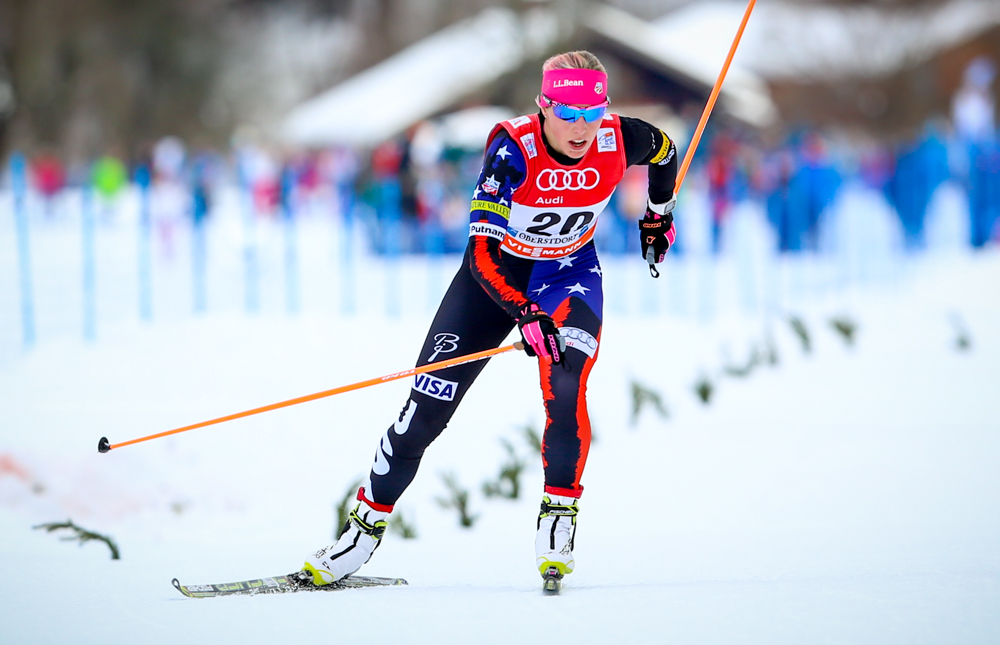
    Kikkan Randall skating to 22nd in the 2015 Tour de Ski prologue in Oberstdorf, Germany. (Photo: Marcel Hilger)
    Kikkan Randall skating to 22nd in the 2015 Tour de Ski prologue in Oberstdorf, Germany. (Photo: Marcel Hilger)

    The 2016 edition of the FIS Calendar Conference took place in Varna, Bulgaria from June 2 to 6. At the conference, Kikkan Randall performed her duties as the Athletes’ Committee Chair and FIS Athlete Representative on the Cross Country Committee. Tackling issues from yellow card procedure to National Team inequality, Randall helped present athletes’ concerns and shape FIS policy throughout the five-day conference. After a two year term as the Athletes’ Committee Chair, Randall was reelected and will serve alongside Norway’s Pål Golberg in the next term.

    FasterSkier talked with Randall about her recent trip, the new procedures, and the issues that are most important to World Cup athletes in the coming season.  This interview was condensed and edited for clarity

    FasterSkier: How was your time in Bulgaria?

    Kikkan Randall: It was really funny for me because I had just left the training camp with the National Team in Park City. I was just in a really good training rhythm and then I flew halfway across the world and was on the beach for three days. It was a bit of a shift but I feel like it was really productive.

    I did an athletes’ survey before we came so I had a clear idea of what some of the key issues would be from the athletes’ side, and some of the big topics on the agenda. I made sure I had a good presentation from the athletes. I was able to give that presentation and a lot of those points were integrated into the discussion and it felt like a lot of those points were really considered. Ultimately the decisions that were made were really good for the sport and things that the athletes will support.

    It was fun to come together with all of the ski family and not only talk about how to make the sport better in the coming season, but make sure that our sport stays strong over the next five to ten years.

    FS: What were some questions you asked your fellow competitors in the survey and what were their responses?

    Varna, Bulgaria was the site of the 2015 FIS Calendar Conference. (Photo: FIS)
    Varna, Bulgaria was the site of the 2015 FIS Calendar Conference. (Photo: FIS)

    KR: One big topic this year was the prevalence of double-poling and the fact that the guys were double-poling a distance race for the first time. [There was] also the problem of technique infractions in classic sprints. I asked a few questions and wanted to see if this was something that athletes thought was a normal evolution of sport or was this something that needed to be corrected. I think that athletes felt like this was the evolution of the sport but that we should make sure we have rules in place and make sure that the race is made as fair as possible.

    We talked about a few different ways to deal with technique infractions. In the past the jury the would give a yellow card, which is like a written warning, but they would have to call an athlete in, do a hearing, explain what happened, and possibly use video evidence. When you’re talking about a sprint day where things are moving really fast, that just clogs up the system. We felt comfortable with a new rule for the jury to issue a yellow card without a hearing as long as there is more than one jury member concurring. I think that’s going to be good because once you have a yellow card, if you then have another technique infraction it’s an automatic disqualification.

    [The rules] are just trying to ensure that the athletes understand that technique fractions are serious. We also worked on some rules to make sure that classic technique is more defined.

    FS: Were there any other topics?

    KR: Another thing that came up had to do with tours and the number of bonus seconds awarded for sprint competitions. [FIS] was toying with the idea of reducing the sprint bonus to 30 seconds per sprint, but I explained that going through four rounds of a sprint is quite taxing and the athletes should get credit for all their work. In the scheme of the overall tour sprinters may have the advantage on sprint day and a distance skier may have the advantage on a distance day, and you really have to try and keep that as equal as possible. That feedback was received and they decided to keep the 60-second bonus. I think the athletes will be happy about that.
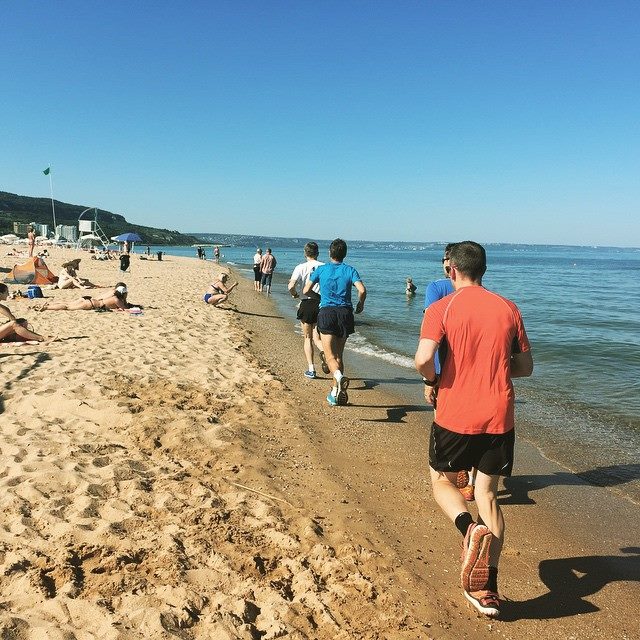
    It wasn't all work for Kikkan Randall at the 2015 Calendar Conference in Varna, Bulgaria. She and members from the cross country committee took advantage of good weather to run on the beach. (Photo: Kikkan Randall/Facebook)
    It wasn’t all work for Kikkan Randall at the 2015 Calendar Conference in Varna, Bulgaria. She and members from the cross country committee took advantage of good weather to run on the beach. (Photo: Kikkan Randall/Facebook)

    And then we talked about course conditions, and what to do when the course is soft. Should they always try to make hard conditions? or is it just the nature of the sport? The athletes felt like organizers have to do as much as possible to keep the course in shape and keep the conditions as firm as possible. That played into some decisions surrounding course access from the team side and the use of salting.

    That also factored into our discussion on the new interval start procedure. That’s going to have the top-15 seeded athletes a little bit higher up in the starting order, and give the coaches a chance to actually select which spots in the seed group their athletes will start.

    FS: What was the consensus on last year’s new sprint heat selection procedure trial?

    KR: That was probably the third major point on the athletes’ survey. We expected that there would be a more negative response to it. As an athlete I can appreciate that a sprint day is already long and complicated enough and now you throw in the tactic of ‘what sprint heat do I pick?’ and it eats into recovery time.

    We recognize that the current trend we’re on is dangerous for the sport. We have to get creative and help some of the smaller and medium sized nations catch up in terms of the ‘arms race.’ When you have all these talented athletes who are training so hard it can come down to some of these smaller things.” – Kikkan Randall on income and resource inequality between national teams.

    Actually the athletes were about 50-50. When we discussed that in the World Cup committee, since there wasn’t an overwhelming negative reaction, it was decided that we would continue to test this procedure to test over the whole of next season so we can continue to test whether it is a good thing or bad thing. At the end of next spring we’ll evaluate after a full season of testing.

    FS: Was there an issue you hoped to tackle that didn’t get discussed?

    KR: I felt like all the major points that I saw from talking to athletes and from the surveys were definitely addressed. One of the big topics that we talked about that we didn’t come up with a resolution for was the fact that there seems to be an income and resource inequality amongst the teams. It is really unhealthy for the sport long term. If it continues with just a few teams at the top our sport could be in jeopardy in a few years.

    We talked about strategies for us to equalize resources a little bit and maybe share some of the income in the sport. There was one proposal that changed the distribution of the red group pay list that would take a few places from the biggest teams like Norway and give the chance to have some of the smaller nation’s athletes travel paid for, which in turn frees up the money for more wax support.

    We recognize that the current trend we’re on is dangerous for the sport. We have to get creative and help some of the smaller and medium sized nations catch up in terms of the ‘arms race.’ When you have all these talented athletes who are training so hard it can come down to some of these smaller things.

    Everyone was tasked to be creative over the summer and there are some working groups. Hopefully we’ll see some more progress on that in the fall and come up with some solutions that can get some more nations back on the podium.

    ***

    (Click here for a condensed list of cross country decisions at the FIS Calendar Conference)

  • FIS Loosens A-Climb Homologation Standard, Clarifies Altitude Limit

    FIS Loosens A-Climb Homologation Standard, Clarifies Altitude Limit


    Eliska Hajkova (CU) climbing in West Yellowstone at the beginning of last season.

    The newest edition of the FIS Homologation Manual was published this month and two changes are significant for North American venues. Major A-climbs now require five fewer meters of elevation gain, and courses that reach above 1800 m have been clarified as eligible for certification (and always have been) at the Continental Cup level and below.

    According to John Aalberg, a FIS homologation coordinator for North America, the elevation clarification and A-climb reduction were both written with North American venues specifically in mind.

    In the past, the language in the manual stated that at the Olympics, World Championships, World Juniors and World Cups, “the highest point of a cross country course should not exceed 1800 m,” or about 5900 feet (311.2.7). Whether this rule also applied to the Continental Cups or FIS races the manual didn’t specify, but Aalberg said it was implied that it did not — that courses above 1800 m could always homologate for the lower-level races.

    When the rules only applied to Europe the omission wasn’t an issue, since many competition courses in Europe are easily below 1800 m. When FIS first extended homologation requirements to all Continental Cup and FIS competitions, it granted temporary exception to the U.S. and Canada to allow its venues time to meet the requirements. The exception ended in the 2011-2012 season, and for the first time SuperTours, NorAms or any FIS-sanctioned race in North American needed homologation certification, where the number of high-altitude cross-country venues is relatively greater.

    “This is clarified in the new homologation manual since it was not mentioned anywhere in the past,” Aalberg wrote in an email. “The manual only talked about World Cup courses. This is mostly an issue in North America, since most all competition courses in Europe are below 1800 m. Now that FIS is stricter in requiring homologated courses for COC (and other FIS points) competitions, this needed to be clarified.”

    Bob Gross is one of a handful of homologation inspectors in the U.S. and was recently part of the working group for the homologation manual at the annual FIS Congress in South Korea. He said the old wording of the 1800-meter rule has been misinterpreted as applying to all FIS races.

    “We could always homologate courses above 1800 meters,” Gross said. “Interestingly enough, a lot of people didn’t realize that. So common knowledge has been that 1800 meters is the max, but it has not been.”

    Whether the clarification is news to any high-altitude North American venues, and if it will spur them to seek homologation certification, remains to be seen.

    The other change to the manual, in which A-climbs need only gain 25 meters in height instead of 30, was also made to support North American courses.

    “We have seen that a few venues (both in North America and other places) meet all other requirements, but are a few meters short of the 30 m height difference in one or more of the uphills,” Aalberg said. “An uphill with over 25 m height difference is still a good climb, and FIS would like to support such venues and courses. This was important for some U.S. venues.”

    Five meters translates to about 16 feet, not an insignificant difference for venues needing to move dirt around to meet the criteria. Aalberg emphasized that A-climbs, which are the largest uphills of a homologated course and must be between a 9 and 18% grade, still meet the intended purpose of homologation to design good competition courses.

    “A good competition course must contain certain uphills such that the uphill technique and the aerobic capacity of a skier is being ‘tested,’” Aalberg said, and courses with 25 meter climbs that meet all other requirements still do that.

  • Koos Disqualified In Classic Sprint; Plans To Appeal (UPDATED)

    Torin Koos (BSF/Rossignol) crossing the line in first in the A-final of the men's classic sprint at U.S. Nationals. While waiting to take to the podium, he found out his win was in question. Photo: Flying Point Road.

    After crossing the finish line in first in the U.S. Nationals classic sprint A-final, Torin Koos (BSF/Rossignol) was disqualified for moving into a lane in front of Ryan Scott (MSU/Team HomeGrown) before completely clearing Scott’s skis, which resulted in contact between Koos’ tails and Scott’s tips. A course controller saw the pass, and after the conclusion of the race, reported a violation to the jury.

    Per International Ski Federation (FIS) rules, the competition jury deemed the move to have been an obstruction of competition, which results in competition suspension and relegates the skier at fault to the back of the sprint heat. Tyler Kornfield (University of Alaska Fairbanks) thereby took the top of the podium, Mike Sinnott (SVSEF) moved into second and Eric Packer (Dartmouth College) finished third. Scott wound up in fourth, and Skyler Davis (SMS/USST) in fifth.

    Had this been the only rule infraction Koos had been docked within the current competition period, Koos would have placed sixth in the classic sprint and been issued a written warning and competition suspension. However, due to a mix-up at the start of Friday’s 30 k mass start classic race, he had also been given a written warning for lining up in the wrong starting position.

    Koos wore the blank green sprint leader bib on Friday, and in his explanation to the jury on Sunday, was told by his coaches to go to a start position turned out to be incorrect. Koos said he went to the spot he thought he’d been assigned, only to find someone already there. With only a few minutes to go before the race began, Koos said he tried unsuccessfully to find someone with a start list to figure out where he should go. With the clock ticking down until the gun went off, he moved to the first open spot he could find—position 29, which ended up being two rows ahead of where he should have been in position 43.

    “I couldn’t find anybody with a start list. This was right before the start,” said Koos on Sunday.

    According to jury member Eileen Carey, she and several other volunteers were in the starting pen with a grid of lane assignments. She said she witnessed no confusion in the start area in the last few minutes before the beginning of the race.

    The jury ruled after the 30 k that Koos’s start in the incorrect position did not affect the race outcome, and his fifth place finish remained on the results. But the written warning he was issued for Friday’s offense meant that his competition suspension on Sunday automatically defaulted to a disqualification. The ICR states that a competitor must be disqualified if he or she “receives a second written reprimand in the same season” (392.7).

    According to Koos’s account of the A-final on Sunday, which his competitors corroborated, the move in question occurred just after the men’s 1.6 k course split from the women’s 1.4 k loop, on a flat section that veered to the left after a substantial downhill, which had skiers carrying a lot of speed. The tracks went from four across to three, with a break in between for skiers to maneuver into the new track. Koos was skiing on Scott’s right-hand side just before the break in the tracks, and made his move to get on the inside, left-hand lane at the break, clipping Scott’s skis in the process.

    “I told Ryan right after the race—I apologized,” said Koos. “It was not deliberate, stuff like that happens all the time, so it’s interesting that this one time I’m called out.”

    The most recent version of the FIS Precision Rules, which are essentially updates made to the FIS International Competition Rules (ICR) in between the publication of a new ICR every four years, states that:

    In all competitions obstruction is defined as deliberately impeding, blocking (by not following best line), charging or pushing any competitor with any part of the body or ski equipment. When overtaking occurs, competitors must not cause any obstruction. The responsibility for a correct passing without obstruction is on the overtaking skier. The overtaking skier must have his/her skis in front of the skis of the overtaken skier before skiing his/her best line. (340.1.4)

    Koos and his Bridger Ski Foundation coaches protested the disqualification on the grounds that the obstruction was not intentional.

    The necessary steps for juries to take in the case of a rule infraction are outlined in the ICR, and more comprehensively in a separate document, the FIS Cross-Country Guidelines for Jury Work. According to the procedure outlined in item 7 of the guidelines, “Prior to the imposition of a penalty the person accused of an offence shall be given the opportunity to present a defense at a hearing orally or in writing” (also stated in ICR, 224.7).

    The jury informed Koos and his coaches in timing headquarters that he had committed a competition violation, and according to Carey was given the chance to defend himself. The jury then decided to disqualify him, and told Koos he could collect additional evidence in his defense to protest the disqualification. Koos then returned to the main lodge, where most of his competitors from the A-final were inside getting warm, and asked them to write down their version of what had happened during the race. At least three of them—Kornfield, Sinnott and Packer—were seen submitting their testimonials to Koos, which he brought back to the jury in the timing building as evidence, and awaited its verdict.

    After about twenty minutes of deliberation, the jury told Koos his disqualification remained unchanged, and that he could appeal their decision to FIS if he so chose. Early Sunday evening, Koos said he planned to submit an appeal on Monday morning, which would go through the U.S. Ski and Snowboard Association (USSA) to FIS. He would not specify if he would appeal Friday’s warning, Sunday’s suspension, or both.

    Asked after the jury’s final decision if anyone had seen the contact between Koos’s and Scott’s skis firsthand, USSA’s jury representative Allan Seranno said, “Yes: a controller who was put in place for that purpose. He gave that information to the jury, and then the jury made its decision based on that [evidence].”

    Back in the lodge, Scott explained what happened from his point of view. “We were all pretty tight in the group going down the hill,” he said. “The heat was pretty aggressive, and how it worked out in the bottom there, everyone was tight on the turn.”

    Asked if he thought Koos’s move interfered significantly with his race, he said, “You have to be aggressive in a sprint race to stay in there and stuff. It was [the jury’s] call that it was an obstruction.”

    Tyler Kornfield (UAF) finishing the classic sprint A-final. Photo: Flying Point Road.

    Kornfield, the eventual winner, had one of the best vantage points of the move during the race, as he was skiing in the tracks directly behind Scott. He said Koos was skiing level with Scott, double-poling in the track to the right of Scott and Kornfield.

    “It happened pretty quickly,” said Kornfield. “We were all double-poling, and Torin was about one boot length in front of Ryan, and it seemed like he had a clear shot on what lane he wanted to choose.”

    There was a break in the tracks around the corner, and the lanes went from four abreast to three.

    “Right after he moved on Ryan there was a break in the tracks, so you had to pick another track,” said Kornfield. “Torin tried to pick the inside track [on the left], and he moved onto Ryan’s skis, and it knocked Ryan off balance… It seemed like it took [Scott] a while to get back his balance.”

    Kornfield characterized the move as “unfair” on Koos’s part. “According to the rules, it was legal for them to disqualify him. I don’t know what to think about it,” he concluded. “It’s definitely not the way you’d want to win your national title.”

    Packer, who wound up in third, thought it was unfortunate that Koos had been disqualified, as in his mind it was clear that Koos had been the fastest skier out on the course, and that aggressive moves happen all the time on the World Cup that don’t result in disqualification.

    “I personally didn’t see anything that merited disqualification—I’m really bummed for him,” said Packer. “[Koos] is a great guy and I think deserved the win today—he skied away from everybody.”

    “It did not materially affect the outcome of the race,” said Koos after the jury’s final decision. “I’ve had a lot of people come up and be like, ‘Dude, I can’t believe that.’ And I don’t think they’re just talking.”

    From here, Koos can appeal the jury’s decision within 72 hours, which goes to an Appeals Commission at FIS.

    Carey said the FIS rules are unclear as to how to go about an appeal. “He can present whatever [evidence] he chooses, I’ve never been through this process,” she said. “It’s really unclear in the FIS rulebook. I supposed he can submit additional information if he gets any more. There’s not a specific appeal form, or a script process that’s outlined in the rulebook.”

    U.S. Nationals Chief of Competition Carlie Casey said that in the case of an appeal, the head TD, Kent Slaughter, could be contacted “if the FIS Appeals Committee wants more information.”

    As of early Sunday evening, Koos said he was just trying to figure out what he had to do to appeal. After he submits it on Monday, “Then it’s out of our hands,” he said, adding that at least “I can leave here and know there’s no doubt who the strongest athlete was.” Koos flies to Trondheim, Norway on Monday, where he will begin renting an apartment with his girlfriend to train and race with the club team there for the rest of the season.

    A national title, the $1,200 winner’s purse and Koos’s sponsor win schedule money are not the only things at stake in the outcome of the appeal. He wore the green sprint leader bib when he crossed the line on Sunday. The sprint leader after January 30, 2012 is awarded World Cup start rights, and if the disqualification remains, he won’t be able to hang onto it. If it comes down to it, Koos said he hopes USSA will make a discretionary decision in his favor regarding the start rights.

    “This is, I guess, some adversity,” he concluded.

    Men’s Heat Results.

    All Flying Point Road photo proceeds will be donated to the National Nordic Foundation (NNF).