Tag: running injury

  • Making a Healthy Transition to Running as the Seasons Change with Jessica Yeaton

    Making a Healthy Transition to Running as the Seasons Change with Jessica Yeaton

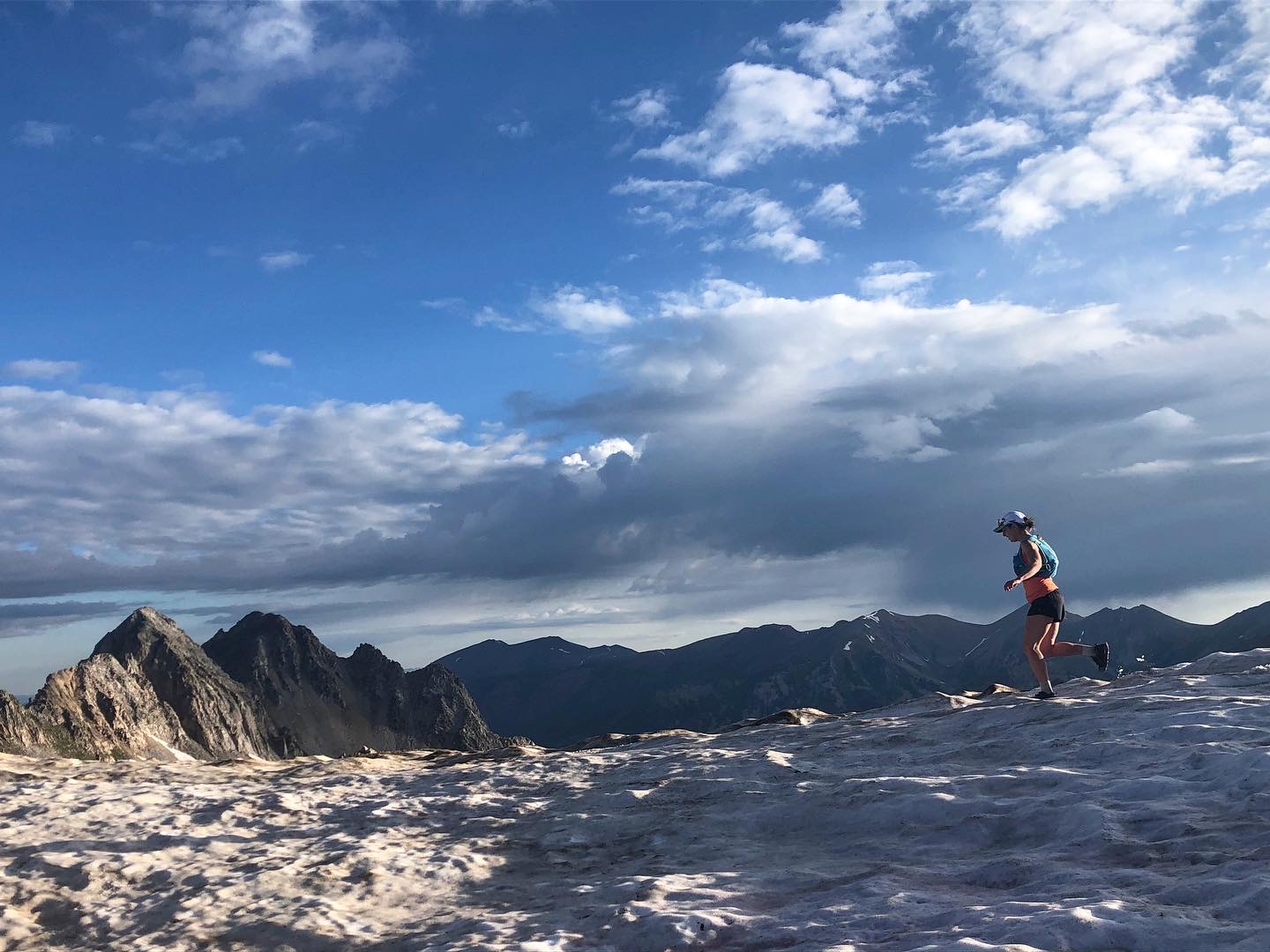
    The author crosses a snow field on a long run near her home in Colorado last summer.

    Last year at this time, I was primarily gym-ridden. After roughly five months on snow, my fitness was high but my tolerance for the impact and specific demands of running were low. Throwing better judgement to the wind, I gave in to the allure of warm days, rapidly drying trails, and beloved road loops around town, and paid the price.  

    Despite running between zero and ten miles total between December and the end of February, I took off for my first run of the season: 4.5 miles. That first week totalled 20 miles in four runs. Much lower than summer totals, but far greater than the sum of the months prior.

    Two weeks later, I did a 90 minute trail run with roughly 1,200 feet of climbing and descending. What started as the sensation that a tendon on the lateral side of my right knee was snagging with each leg swing quickly turned into a sharp stabbing pain. I hobbled my way home and by that afternoon, I couldn’t walk downstairs without sidestepping or even make it down the gentle slope of my front yard. Sound familiar?

    This experience is not uncommon. When snow conditions deteriorate in the spring but weather is perhaps not yet conducive to cycling or rollerskiing, our options for aerobic exercise that provides the same satisfaction as the kilometers we logged all winter are limited. The best available early season option is often running, so we lace up our cobwebbed sneakers, and fight the temptation to jump back in too quickly. 

    While some may tolerate a rapid transition, there are a myriad of running related injuries that could easily crop up. Last year at this time, FasterSkier featured recommendations from Dr. Ross McKinnon, DPT, to address the topic of a healthy transition to running. His advice included a slow increase in running volume, working on running mechanics, beginning with soft surfaces, and making sure your shoes are up to the task. 

    To add on, we reached out to DPT candidate, Olympian, and former APU Teammate Jess Yeaton for additional information to support a healthy return to running. 
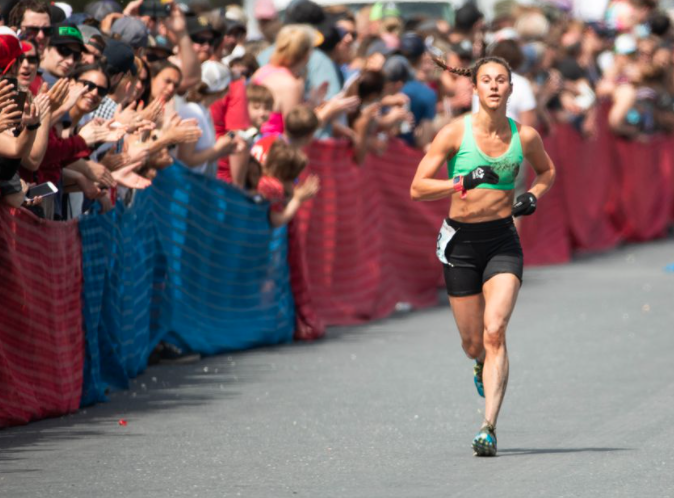
    Jess Yeaton heads for home to win the 2018 Mt Marathon race in Seward, AK. (Photo: Anchorage Daily News/Lauren Holmes)

    Seconding Dr. McKinnon’s first recommendation, Yeaton began with the importance of committing to a gradual return.

    I think the absolute biggest thing is taking a slow progression back and not increasing your weekly mileage too much, as well as adding in exercises that target strengthening glute med.”

    The gluteus medius muscle, or glute med, is a fan shaped muscle on the outside of the hip which connects the iliac crest to the top of the femur. The glute med plays a vital role in single leg stability, in particular, in maintaining level positioning of the hips and proper alignment of the leg during each stride. After all, running is essentially a repetitive high-impact single leg motion, so stability at the hips and through the core are key.

    By strengthening the glute med, runners can reduce “hip drop” and prevent the knee from caving inward with each stride. These phenomena reduce the body’s natural mechanisms for absorbing the impacts of running. They put abnormal strain on various ligaments, tendons, and joints down the chain, leading to IT Band Syndrome, knee and low back pain, and more. 

    The gluteus medius, or glute med, provides stability at the hip, a source of injury risk for runners. (Photo: Human Anatomy and Physiology Lab, LumenLearning.com)

    “Examples of [exercises to strengthen the glute med] would be things like donkey kicks, fire hydrants, bridging up with both legs and then holding with one leg,” Yeaton explained. “I actually had to do a community project working with a running group here in Albuquerque for school and made a video with some of these exercises, which is available on YouTube.”

    In the video, Yeaton demonstrates forward and lateral walks with an exercise band looped above the knees. Maintaining tension in the band activates and strengthens the glute med, promoting better stability in single leg movements, such as running — or skiing!

    Yeaton also contributed to an article on single-leg stability geared toward better balance on skis this fall, which can be found here

    In the gym, you could try single leg deadlifts with a kettlebell or free weight to build stability. To execute this move correctly, it is important to keep the hips level to the floor and avoid the tendency to rotate away from the standing leg. While keeping a flat back, focus on hinging  from the hip and staying within the range of motion that your hamstring flexibility allows rather than reaching the weight toward the floor, which often leads to rounding at the low back. In addition to challenging your single leg balance, you should feel this in the glute and hamstring of the standing leg. 
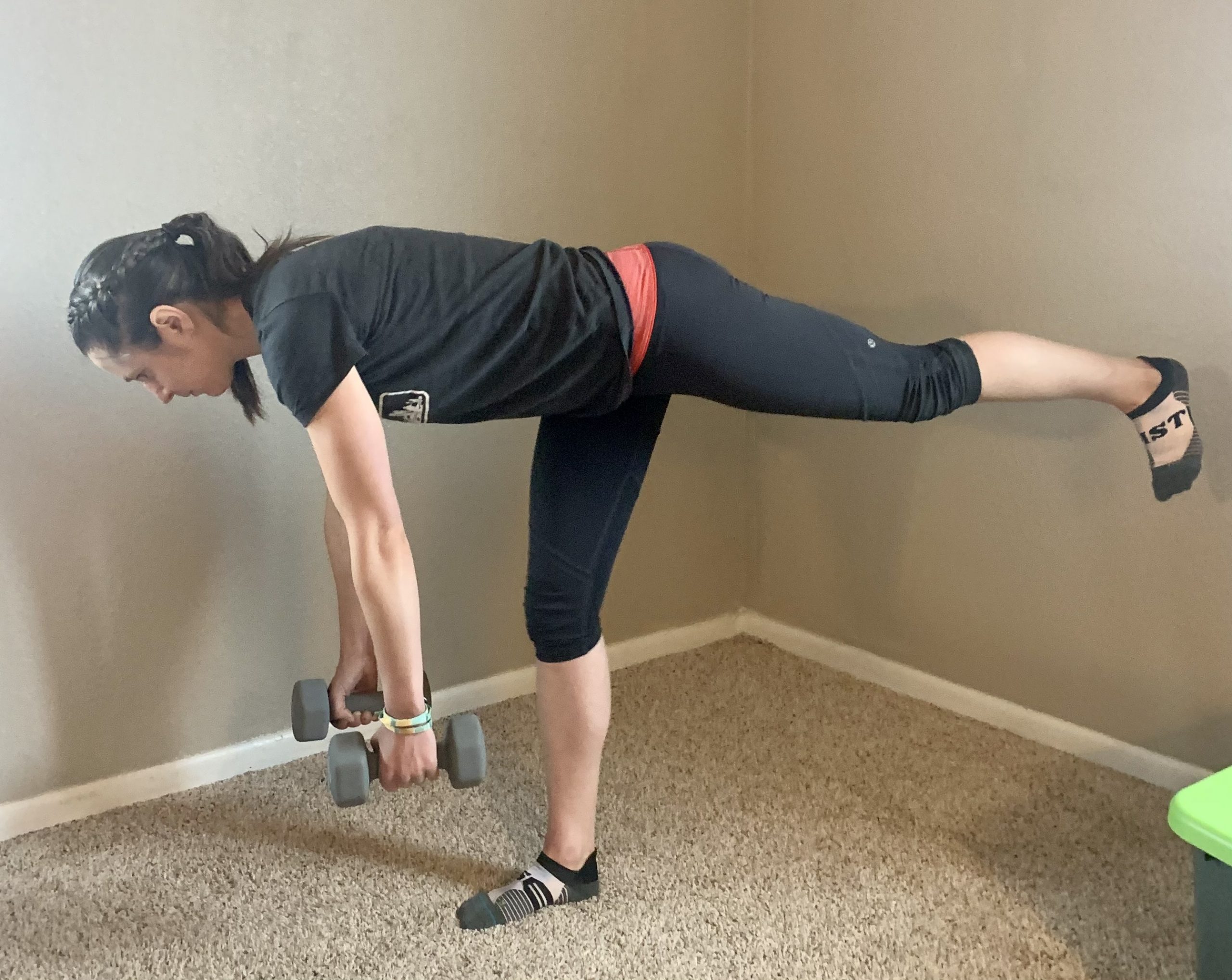
    Aim for a flat back with hips squared forward, and keep the toes of the lifted leg pointed toward the ground.

    Another option for enhanced glute med strength is to try a split squat with the rear leg elevated, also known as a Bulgarian split squat. With one foot resting on a box, stair, or bench, complete a single leg squat, creating a 90-degree bend in the knee of the standing leg. The knee of the elevated leg should drop straight down toward the ground, while the other knee stays stacked over the ankle and in line with the foot. 
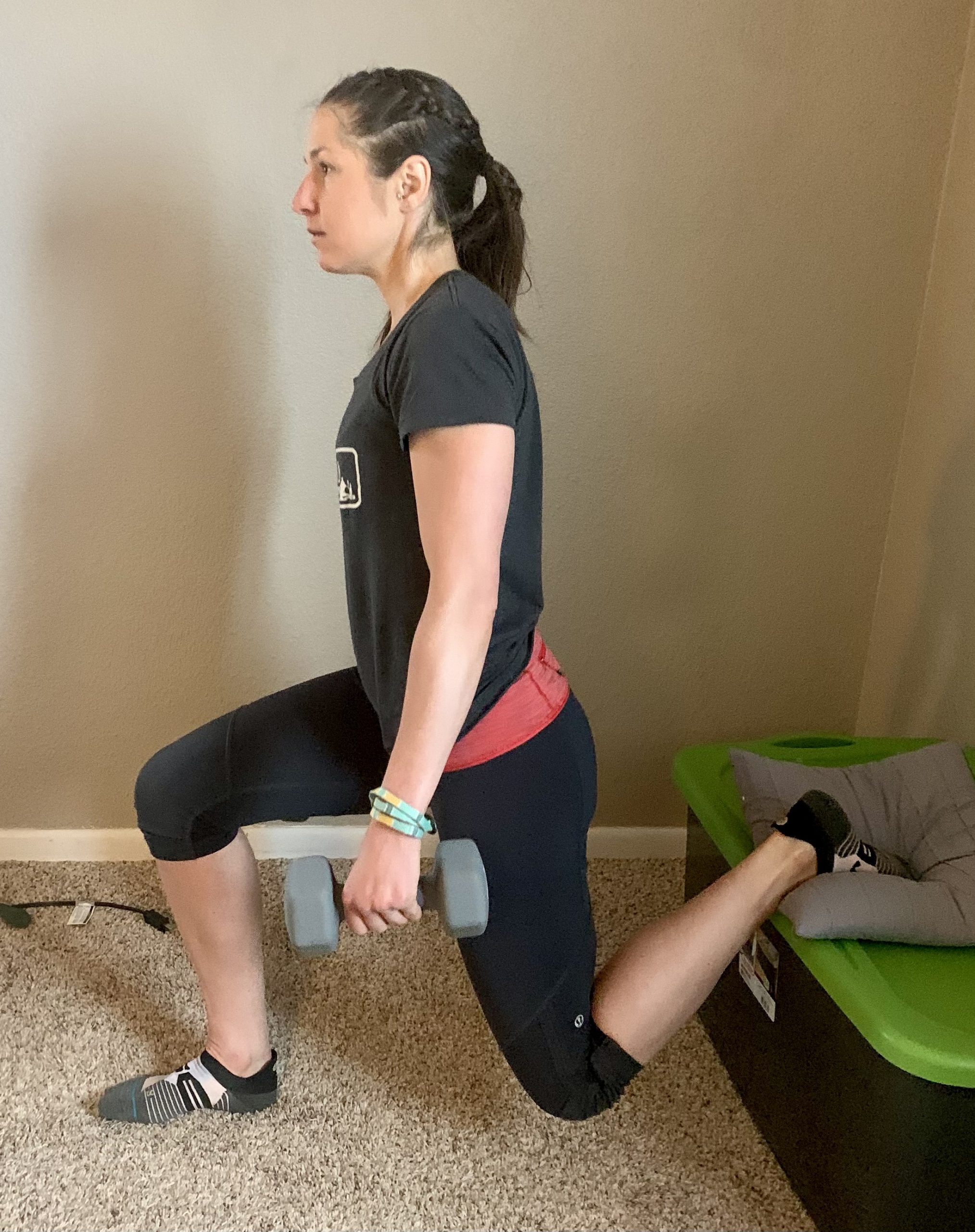
    Be sure to keep your chest up and core tight to reduce wobbling and work the correct muscles.

    By pushing your heel into the ground as you come out of the squat, you can keep the action in your glute muscle, rather than letting the quadriceps muscles on the front of the upper leg take over. Again, the positioning of the hips is important; here they should stay squared forward throughout the movement. 

    Yeaton also noted that she commonly sees skiers develop calf and achilles related injuries from jumping back into running too quickly and recommended variations of calf raises and heel drops to combat these issues. 

    “Another one you could add is doing calf raises with a ball between your ankles, which puts you in a supinated position (meaning the foot is rotated slightly inward), which helps target tibialis posterior. I’ve noticed this muscle is a BIG problem for a lot of skiers.”

    Keeping pressure on the ball as you rise onto your toes and slowly lower cues and strengthens the tibialis posterior.

    The tibialis posterior lies underneath the gastrocnemius, more commonly known as the calf muscle. Running the full length of the lower leg, the tibialis posterior begins behind the knee and connects to the arch of the foot. It helps to flex the foot and reduce pronation, where the arch collapses and the ankle tracks inward. This is commonly seen in runners.

    To perform the exercise, hold a soft ball, such as a tennis ball, between the heels of your feet. Slowly rise onto your toes while maintaining the positioning of the ball, hold briefly at the top, then return slowly to standing. 

    For achilles strength, you can do heel drop exercises on the stairs. Push up into a calf raise on both feet, then lower down slowly on one foot. The eccentric, or the slow, controlled lowering part is what’s important.”
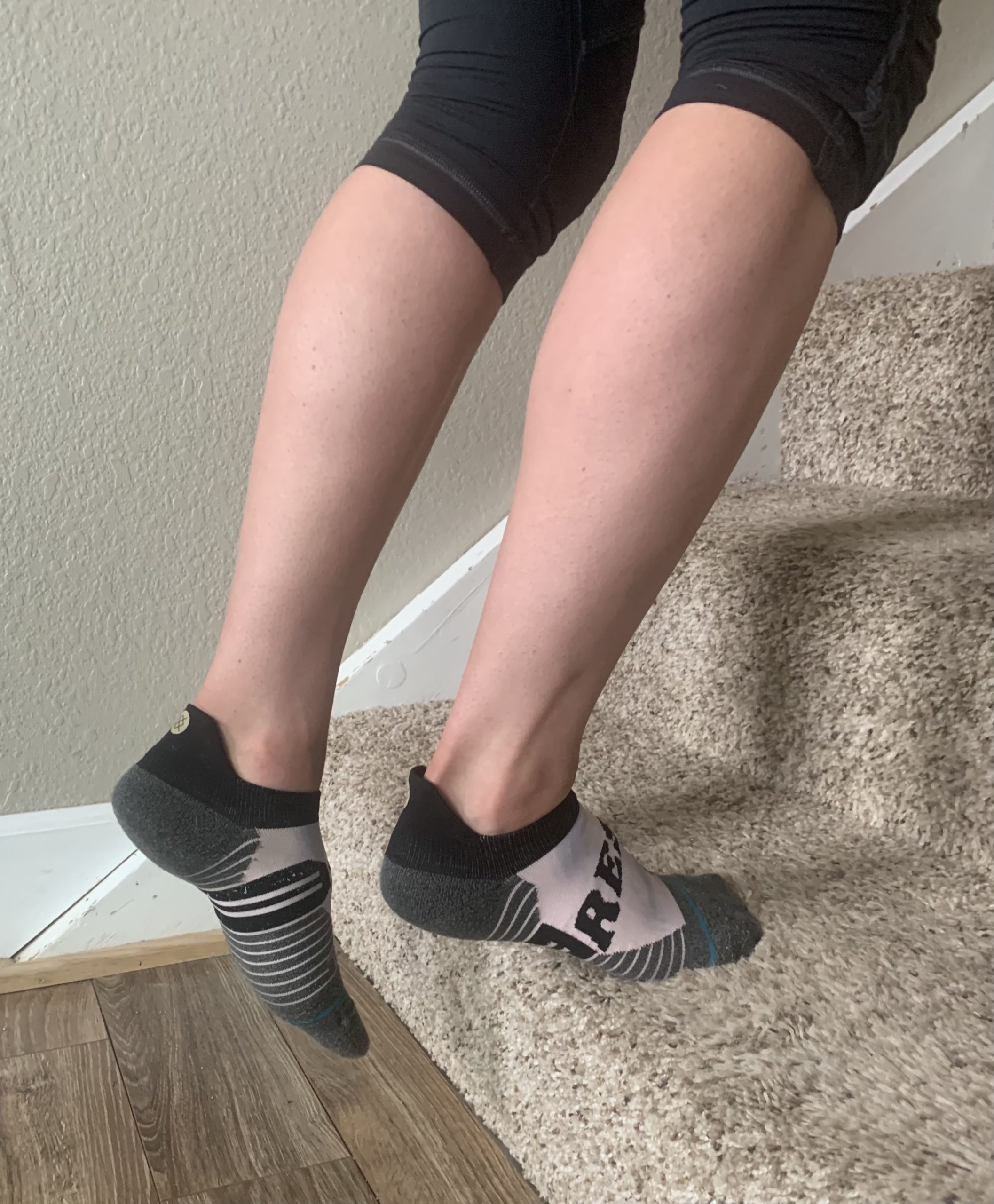
    Use both feet to rise onto your toes, then slowly lower with just one foot to target the achilles.

    Returning to the concept of a gradual increase in running volume, Yeaton recommends actually calculating how quickly you are ramping up. Yeaton recommends the 10% rule — meaning volume should increase by no more than 10% per week. She referenced a 2014 study titled “Excessive progression in weekly running distance and risk of running-related injuries: an association which varies according to type of injury”, which followed roughly 900 runners for one year, tracking mileage increase and injuries. The research showed that athletes who increase by 30% or more were at a higher risk for injury, whereas those who increased by 10% or less were the least likely to incur a running-related injury. 

    “I think this is crazy when skiers put a number to it, because that really isn’t much of an increase… from what I’ve seen, what most athletes consider taking it slow and easing back in is really a pretty significant progression.”

    Obviously, there are caveats — if you start with one three mile run, you’ll probably be okay running more than 3.3 miles total the next week. If you ran 12 miles over four runs last week, you probably shouldn’t run 13 in one go the following week. However, paying attention to frequency, distance, and intensity of your runs as you progress can play a vital role in keeping your body happy.

    Anecdotally, running 5-7 miles once per week through this winter has made a big difference in my ability to progress this spring. 

    So there you have it. Work on hip stability and core strength (bonus: this will help your skiing too!), incorporate calf raises and heel drops, and keep an objective eye on your progression. Have fun and stay healthy!
  • Why Skiing and How I Survived the Summer: Part IV

    Why Skiing and How I Survived the Summer: Part IV

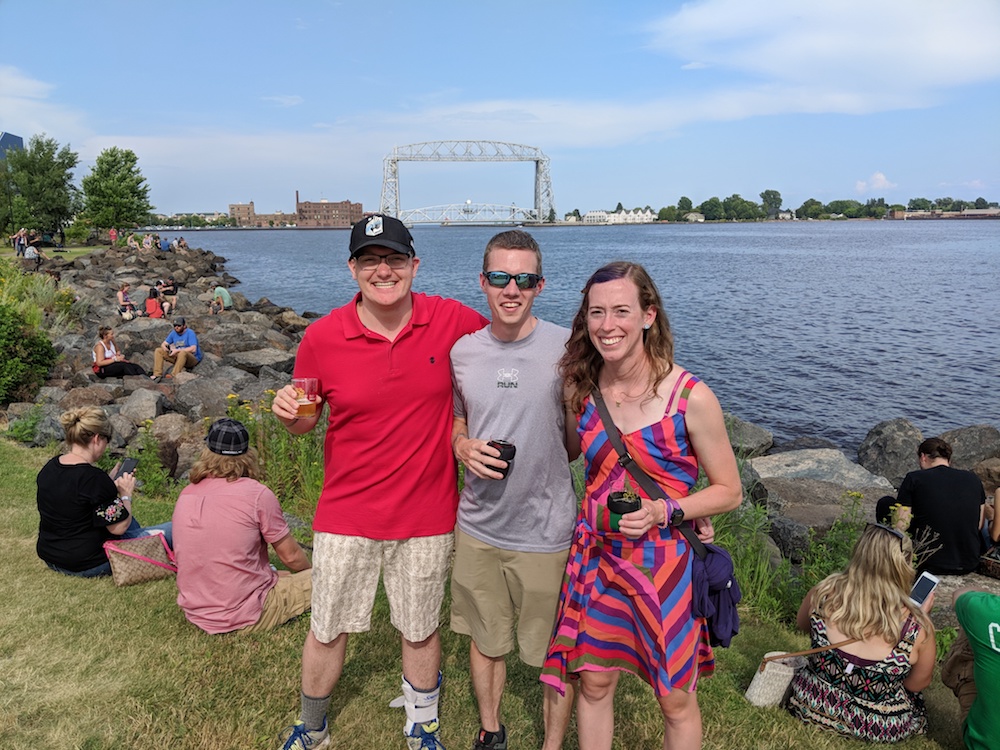
    Author Scott “Bjorn” Cummings (l) enjoying the summer, despite an ankle injury, with friends.

    In March of 2016, we published an article penned by Scott “Bjorn” Cummings, a Postbaccalaureate student working towards his Academic Behavorial Strategist K-12 (ABS) Special Education License at the University of Minnesota Duluth (UMD), titled “Why Skiing? How a Sport Saved My Life”. He’s now teaching and even more in love with XC, and we published his “Part III” update in February. Here’s the latest on his summer.

    ***

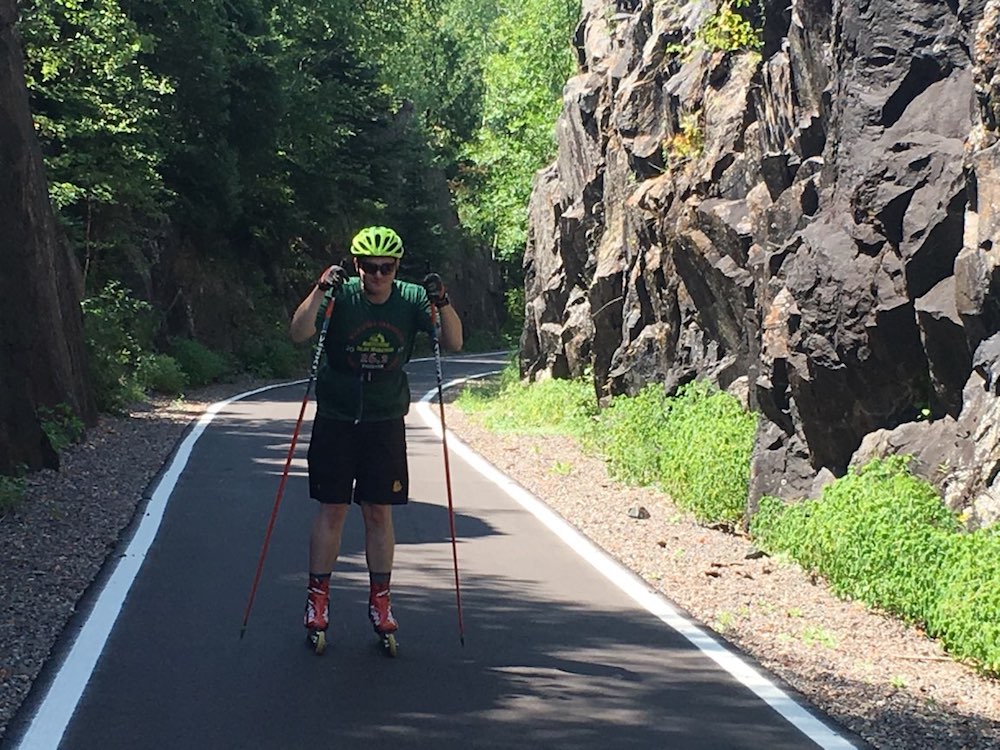
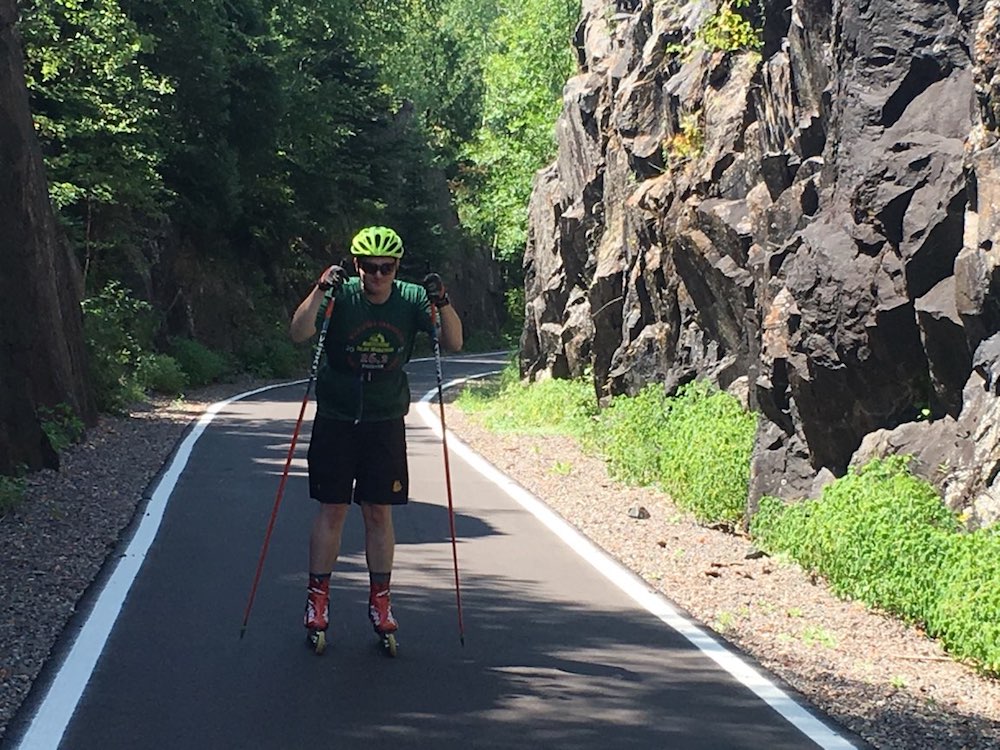
    Author Scott “Bjorn” Cummings rollerskiing earlier this summer.

    There is an old saying in teaching that “the three reasons why I teach” are: June, July and August.

    As a teacher, I have the benefit of getting my summers off to recharge and rejuvenate before entering the marathon grinder that is public-teaching school year — after the ski season ended in late April! This was offensive to say to some of my coworkers, but I loved having an April blizzard in the Twin Cities to extend the ski season. I had several solid plans to fill my increasingly flexible summer schedule, because, as the old saying goes, “Real skiers are made in the summer.”

    1. Teach Summer School or ESY (Extended School Year).  On March 15 (yes I know the Ides of March), I was informed that I lost my job and would have to look for another one. But out went extended-school-year teaching gig. Which is to bad because that helped to pay for a nice pair of skin skis from Pioneer Midwest and other ski accessories such a new Toko Waxing Iron. Both purchases where well worth it.
    2. Look for a new special-education job in the Twin Cities or Duluth. My last teaching job search was two years ago and I didn’t have a signed contract from the school district until Aug. 15, about two weeks before the school year started. But, after having two years of full-time teaching experience under my belt, and teaching the high burnout and thus high demand field of special education, the job search lasted just two months. I had a job May 15.  It was nice to not to worry about landing somewhere over the summer.

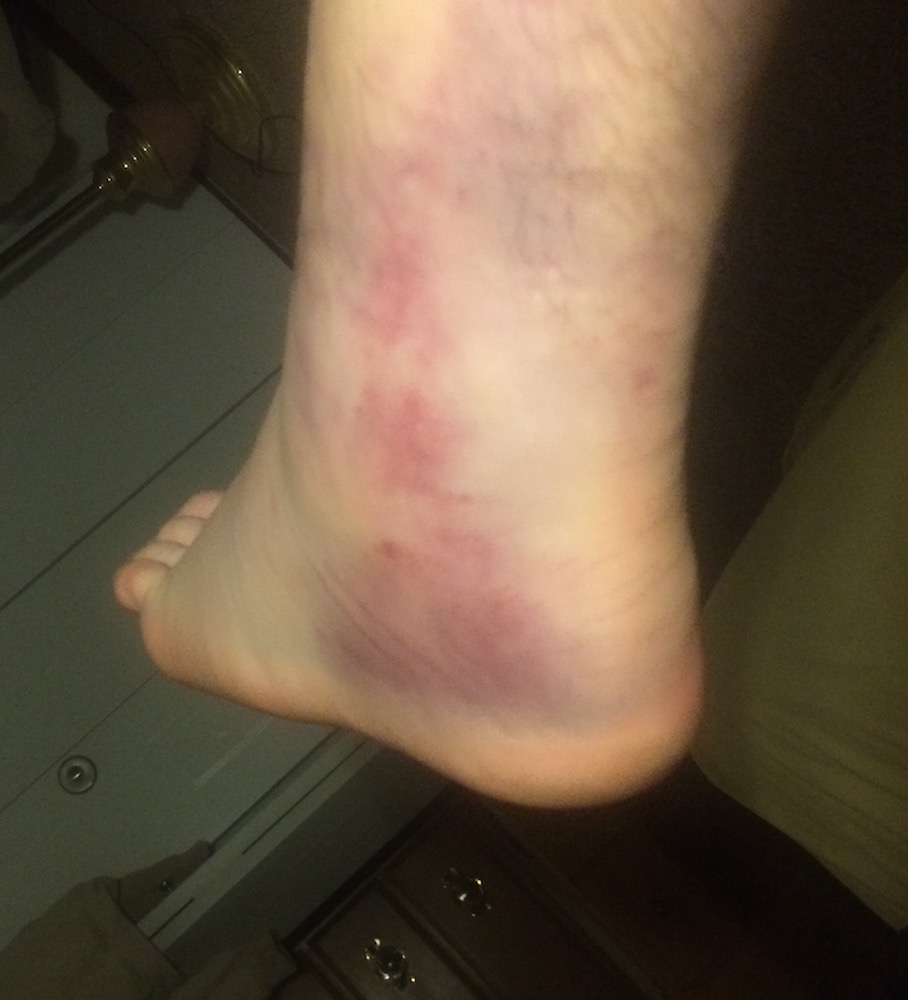
      My swollen ankle from a trail-run fail.
    3. Train 6 days a week for the summer. This plan lasted one week in the summer. I decided to trail run at Salem Hills Park, near where I live, the morning after completing some hard-earned intervals with my ski-training group, Endurance United. Bad idea. I was exhausted. On mile 3 out of 4, I started to pick up speed just to get the run over with. There was a downhill and I noticed newly completed trail work nearby with chainsawed tree stumps and sawdust on the trail. For a split second, I thought that part would be flat and level. One step past the sawdust, I placed all my weight on my left foot, which hit a small-but-significant tree root. My ankle rolled on the inside and I felt instant pain on one of my outside ankle tendons. Down I went — timber! I landed with all my weight on my left knee, thankfully on dirt. I was in shock and I stayed down on the ground for about 10 minutes by myself. Then I realized that I still had one more mile to my car. To add insult to injury, my battered ankle did not appreciate the elevated and hilly trail on the ground. When I got home, I showered, ate some lunch and noticed that my ankle looked like it had two golf balls inside it. It was swelling so I went to urgent care. After being placed in a wheelchair and getting some X-rays, I had two different medical opinions. The radiologist said avulsion fracture and the doctor said severe sprain without a fracture, but the doctor recommend to seeing a podiatrist to follow up. Five days later, the podiatrist said no fracture, but a severe sprain that required physical therapy with TRIA Orthopaedic. There went my six days/week of working out. Two months after my injury, I am still in physical therapy and lost a significant amount of training. I gained five pounds in eight weeks since the injury. Hopefully my ankle will be good to go in time for the NorthShore Inline Marathon on Sept. 15.
    4. Spend time with girlfriend / just enjoy summer.
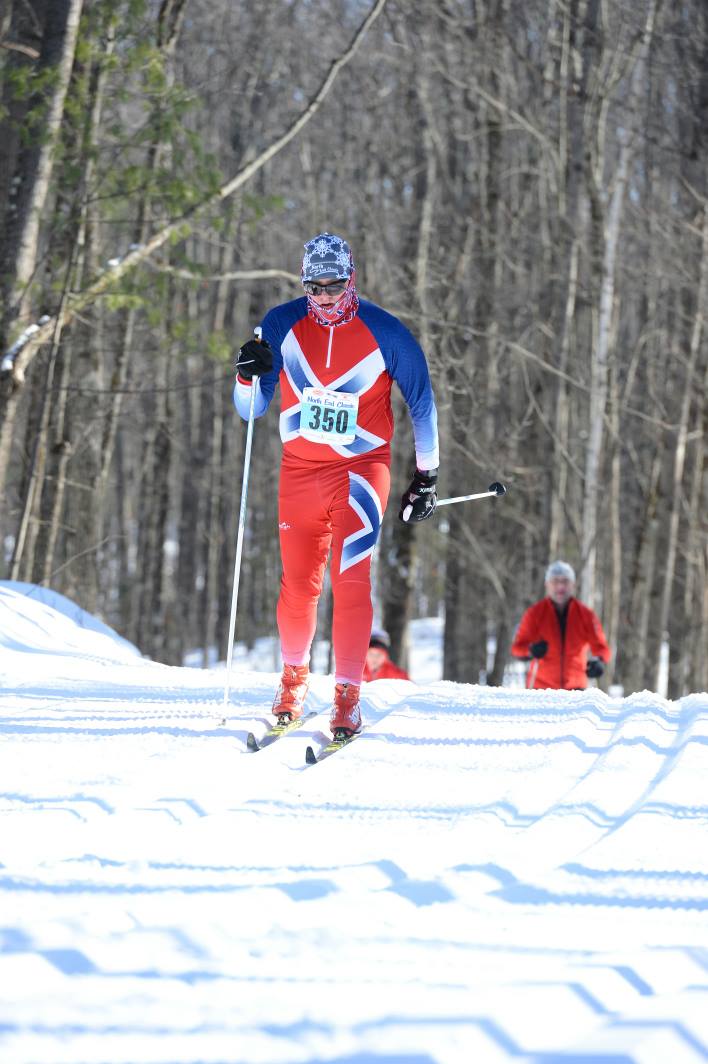
      Author Scott “Bjorn” Cummings racing the 2018 North End Classic in Cable, Wisconsin.

      This one is a little bit personal and I debated whether or not I should include this here, but others might be able to relate to balancing life and training. I met my girlfriend through mutual friends. We will call her Jessie (yes, I named her Jessie Diggins). Jessie was a fun, outgoing person who I really enjoyed spending time with. She knew skiing was a big part of my life and was accommodating to my endorphin addiction. She attended a couple race weekends with me to Hayward for the 42-kilometer Pre-Birkie and North End Classic, as well as the up to Biwabik, Minnesota, for the Pepsi Challenge. We had a great time and traveled well together. But my performance at my races were below my expectations. I finished Birkie with 4:09:31, above my four-hour time goal. Of course it didn’t help that I had a cold during the race and had to stop a couple times to catch my breath. It also didn’t help that I was in the second wave. I thought people passing me would not bother me, but mentally, it did the opposite. It made me mad and frustrated. But I did the full Pepsi Challenge, which consists of two 25 k laps. The 35-degree and sunny weather was perfect for Jessie and our spectating friends, but it was awful for cold-temp Rossi. The warm, sticky snow made it like skiing on sandpaper, especially on the downhills. Even worse, while drinking water an aid station, I tried to wave to Jessie and our friends cheering me on and crashed face-first in the snow.

      buy clindamycin online

      Then on March 15, I lost my job. I started to look for jobs in the Twin Cities and near Duluth. I landed a job interview in Proctor, a small town outside of Duluth. The possibility of returning to Duluth really intrigued me, but Jessie was incredulous. I ended up landing a teaching job that was the closest to Hyland Lake Park Reserve in Bloomington, Minnesota, where I joked I would sneak out during to my teaching prep and do a couple loops.

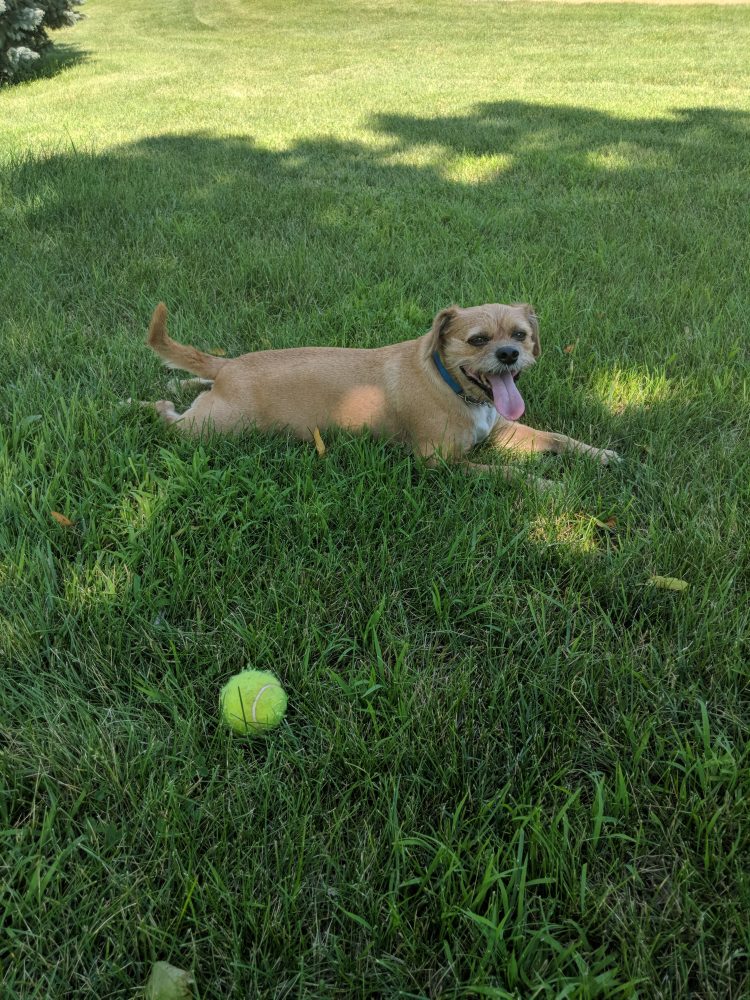
      Babe Ruth enjoying the dog days of summer.

      www.ethings.org

      But Jessie and I started to drift and the damage was done. No longer was I leading the charge but hesitant about her and our future plans. Bottom line, I knew I was having trouble balancing a full-time teaching job, a girlfriend and skiing. Plus Jessie didn’t exactly look forward to working out. She had a completely different lifestyle than me, and it was not a good match. I was sick about once a month and my times started to suffer. I was not leading the active, healthy lifestyle I was used to. Would you rather have a girlfriend or a good Birkie time?

      She didn’t have to race ski marathons with me, but I learned that I needed someone who shared an active lifestyle. So I ended the half-year relationship with Jessie in the week before school ended. I ended up spending a good chunk of my summer alone and with my four-legged girlfriend, my dog, Babe Ruth.

    5. Watch some World Cup and other sporting events to my heart’s content. Once I suffered my nasty ankle injury, I had a good chunk of time to watch all the World Cup matches I wanted. Once the World Cup ended, I followed the Twins. Once they trade deadline passed and the Twins were sellers as opposed to buyers, I started a binge-watching marathon of Seinfeld. That was the silver lining to my summer, as I liked to call it now, the Summer of Bjorn.

    I’m ready for a start of a new school year and soon enough, a new ski race season. But before that, I need to get my ankle up and running again. For now, Bjorn is Bloomington’s more eligible bachelor.