Tag: running

  • Spring Forward: Part I

    Spring Forward: Part I

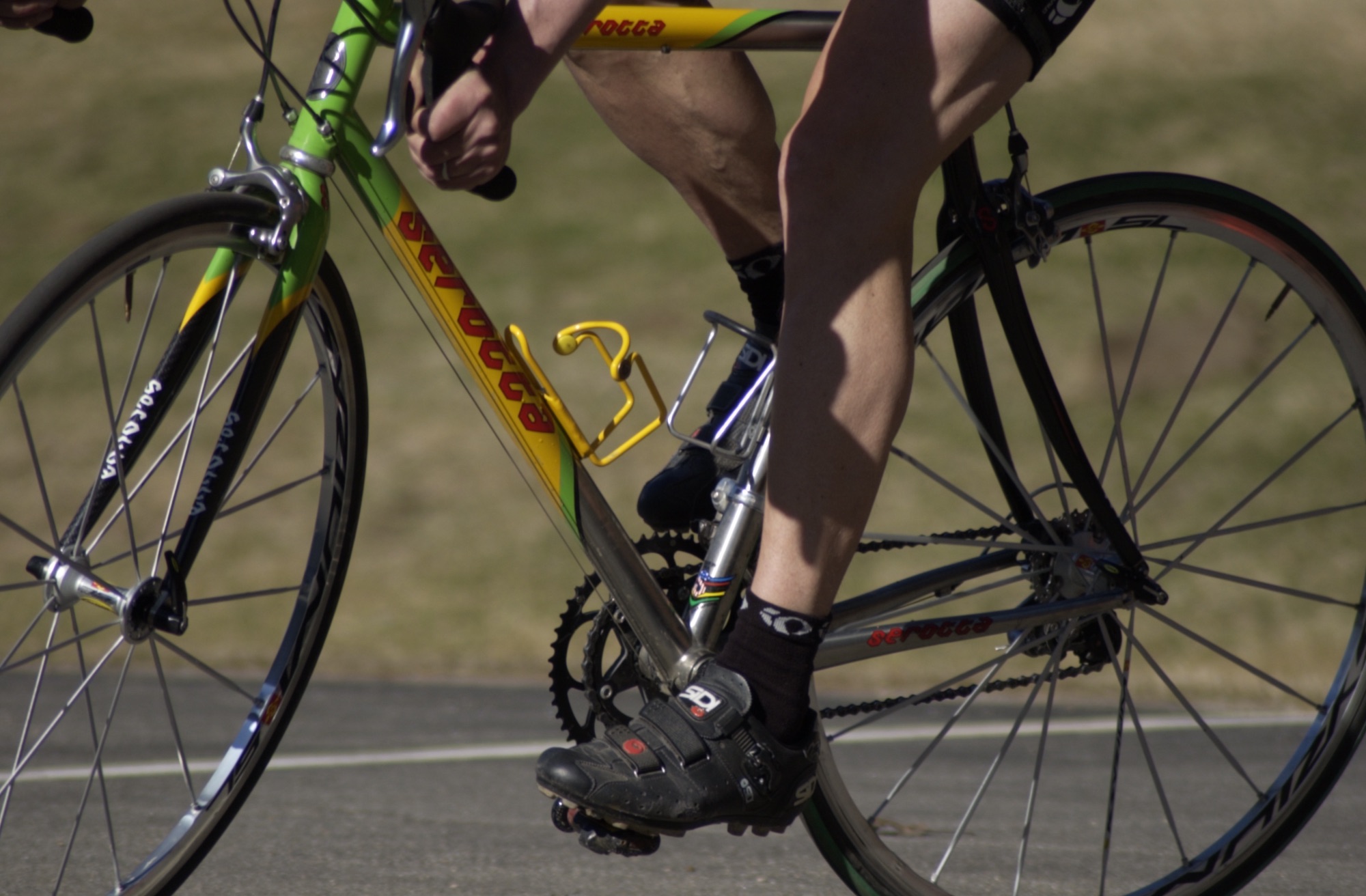
    There are more ways to train than simply skiing. The high rpm, low resistance nature of cycling creates training results that can make you faster next winter. (Photo: FasterSkier)

    Spring is nice, spring is fun, spring is a relief after a long, cold winter. But, for diehard skiers, spring is also the new season in which we begin imagining ourselves as next year’s skiers. The snow is barely gone, but already we’re imagining futures in which we glide through snowy meadows, double pole across the flats, charge confidently up homologated uphills, and V2 boldly across finish lines. Our heads are already in next season. But, in order to realize the technical, athletic, and endurance visions we’ve conjured for ourselves, the work needs to start now. Ironically, the most efficient forms of that work are found not on skis (nor on roller skis), but in a variety of training practices that allows us to leave skis and poles in the closet for a while. Spring training begins now . . .

    The physiological qualities that produce faster skiers are straightforward and simple (even more so for age-group competitors than for World Cup stars): we need endurance, and we need strength. This article will deal with the philosophies of training for endurance, with strength being addressed in a separate installment.

    What is Endurance?

    In the context of nordic skiing, endurance is the ability to perform ski-related movements over time in a manner that is efficient, that maintains high levels of athletic output, and that withstands athletic discomfort. Cross-country skiing is a difficult and challenging sport; those skiers who are the best possess the ability to create high levels of speed, and to maintain those levels of speed over great distances. Much of that performance results from having increased an athlete’s ability to take in, transport, and transfer oxygen. Training does that—endurance training—and the figures we use to measure such abilities are called “VO2 max.”

    By now, everyone even slightly interested in athletics has heard the term VO2 max: a measure of an athlete’s ability to utilize oxygen. We typically imagine that transfer of oxygen to be occurring in the muscle cells. It does, but there’s far more to the oxygen transfer systems than just the ability of cells to suck up oxygen. Nearly as important is the delivery system; that means capillaries, tiny networks of blood vessels where oxygen exchange with the muscles place. Deliver more oxygen to the muscle cells (while simultaneously allowing those muscle cells to shed waste product), and the lactate wall that most of us run into on steep uphills becomes far easier to navigate. Fortunately, certain types of training are the best at inspiring the actual construction of new and more extensive beds of capillaries. More places where the oxygen transfer can take place, better endurance. Skiers want more capillary beds: that’s why they ski slow and easy.

    For the development of endurance (and the building of new capillary beds), the exercises that are recommended are those with low resistance and fairly high RPMs (what cyclists would refer to as “spinning”). In comparing the likely forms of exercise in which skiers might engage in the spring, running is better than skiing at encouraging the growth of capillary beds, and cycling is better than either one. What about my arms, you ask? Isn’t cycling ignoring my whole upper body? Well, cycling has been shown to encourage the development of capillary beds not just in the legs, but in the muscles of all long bones (arms/shoulders included). While cycling isn’t training the particular strength aspects of your upper body, it is training those muscle systems to perform more efficiently when it comes to delivery of oxygen. And there’s always late summer and autumn to deal with training the upper body (that’s what roller skiing is for).

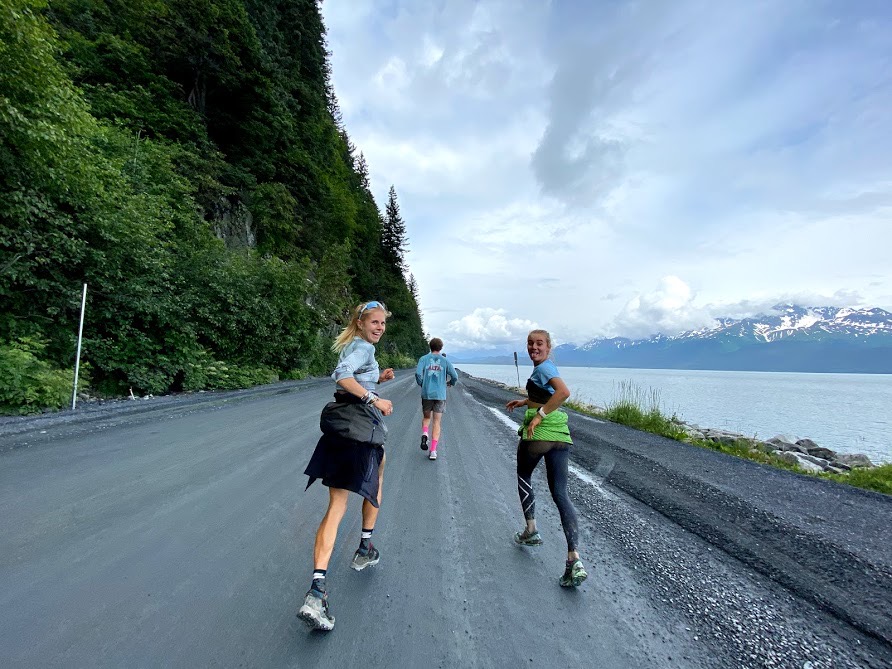
    Team USA teammates Sophia Laukli and Novie McCabe on a training run in Alaska. Laukli’s multi-sport training regimen resulted in her best-ever performances on the World Cup circuit. (Photo: Novie McCabe)

    American World Cup competitor, Sophia Laukli, received headline coverage last year for her ability to compete at world class levels in both summer and winter seasons. Her pursuit of numerous mountain-running marathon races throughout the summer raised eyebrows in the Nordic world: would she still be able to perform in World Cup events in the winter, or would a summer of racing and run-training have burned her out? As it turns out, there was no need to worry about Laukli, as she proved by not only winning  the season-long Golden Trail Series, but also won a FIS World Cup distance event (the climb up Alpe Cermis, final stage of the 2024 Tour de Ski). Laukli has already begun her running training for the trail marathon season. Needless to say, it’s unlikely she’s spending much time on roller skis these days.

    One way or another, if one of my training goals is to develop greater endurance over the summer (and to create a broad endurance base that will improve my body’s ability to absorb all the training I intend to do), then my spring should begin with a considerable amount of long, slow, low resistance, high rpm activity. And there are more efficient ways to accomplish that than simply hopping back onto my roller skis.

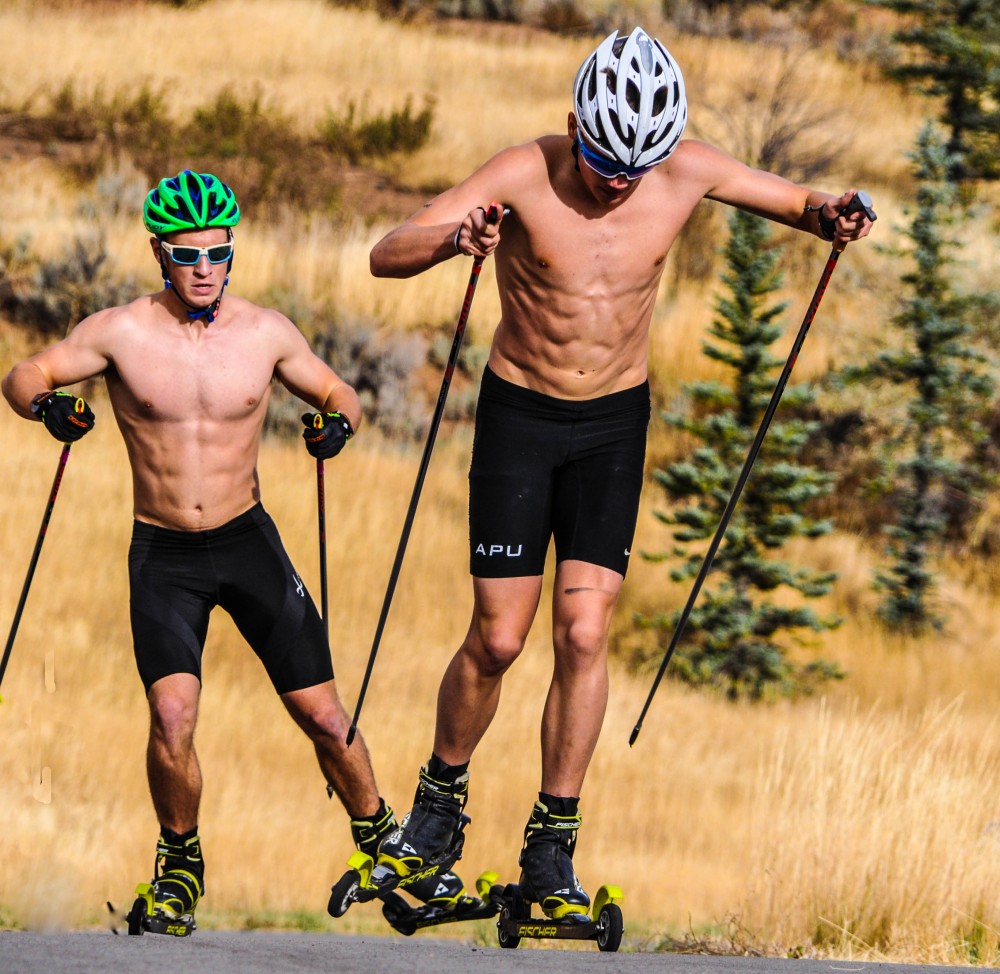
    Hunter Wonders and Luke Jager in Soldier Hollow at the USST’s annual training camp. (Photo: Matt Whitcomb)
    Why Not Just Ski?

    Many of us roller ski in the spring simply because we’re lonely for skiing. Well, if we ski simply for the pleasure of skiing, then roller skiing is just fine (though most would admit it’s nowhere near as pleasant as skiing on snow). On the other hand, if our commitment to skiing is such that we truly want to improve our performance, then we should investigate how best to pursue that in the off-season . . . and training on roller skis at the beginning of spring is not the only way.

    Why not? Here are a few reasons for us leave our roller skis in the closet until later in the season:

    1. If my goal is to improve my ski performance next season, then there are better ways to achieve that than to simply continue skiing. What most skiers need is to establish an accurate understanding of their own athletic strengths and physiological weaknesses. Those are the issues to address, especially in the first half of the dryland season. We need more power; we need greater endurance; we need to generate (and hold) higher levels of speed; we need to strengthen core muscles so that our full force is applied in poling; we need to strengthen stabilizer muscles so that we can stand straight on top of the ski instead of caving in. The fastest way to accomplish those things is to put the skis away for a while, and concentrate on workouts, exercises, and disciplines that address each issue independently.
    2. If low resistance and higher rpm’s are two of the qualities that encourage production of new capillary beds, then skiing (and roller skiing) may not be the best exercise choice at this time of year. Even at low ski-speeds, the rpm’s of skiing are far lower than hiking, running, cycling. It may seem strange, but one of the important things to consider in your training is the plan to mix things up, to include in your training alternative activities that better suit the fitness goal. Get on the bike, go for a hike, lace up the running shoes. Plenty of time for roller skiing later in the season.
    3. While the athletic and physiological stresses of roller skiing are similar to skiing on snow, it’s also known that roller skiing is a quite imperfect means of practicing ski-technique. Unlike skiing on the snow, the glide on roller skis is nearly constant no matter which part of the ski is weighted, and no matter how much the wheels are tipped or tilted. Whether on skate or classic roller skis, a knock-kneed skier will roll as fast as a skier who stands directly on top of their wheels. That’s not the case on snow. On classic roller skis, the “kick” can be initiated no matter how imprecise the skier is in applying force. That’s not the case on snow. There are many such technique examples that render roller skiing quite an imperfect imitation of on-snow skiing, and too great a reliance reliance on roller skiing in the off-season is how bad technique habits can be reinforced.

    Simple advice in designing the training you do in the spring: leave the roller skis in the closet a while longer, and work on fitness improvements that will make you faster next season.

  • Making a Healthy Transition to Running as the Seasons Change with Jessica Yeaton

    Making a Healthy Transition to Running as the Seasons Change with Jessica Yeaton

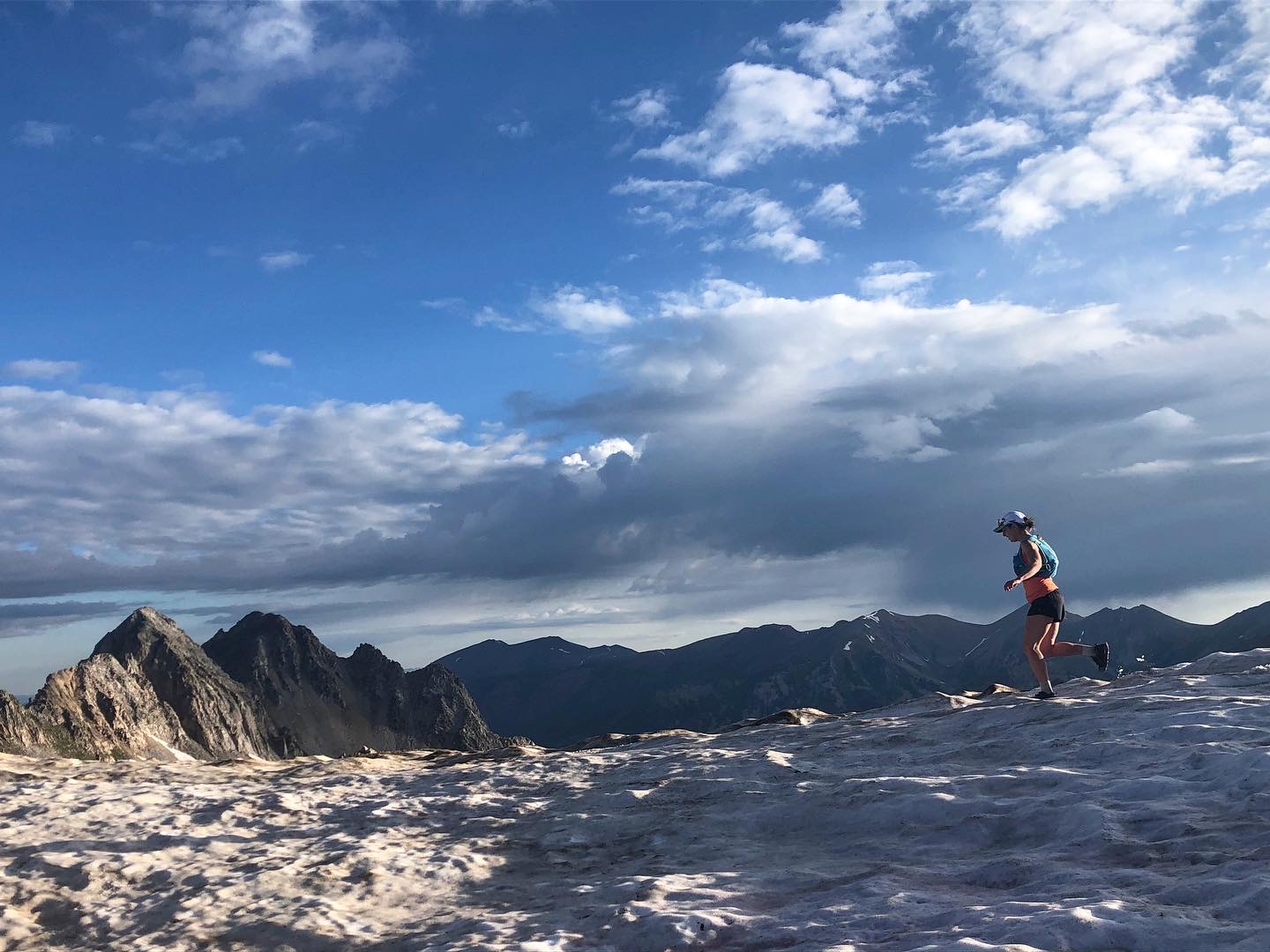
    The author crosses a snow field on a long run near her home in Colorado last summer.

    Last year at this time, I was primarily gym-ridden. After roughly five months on snow, my fitness was high but my tolerance for the impact and specific demands of running were low. Throwing better judgement to the wind, I gave in to the allure of warm days, rapidly drying trails, and beloved road loops around town, and paid the price.  

    Despite running between zero and ten miles total between December and the end of February, I took off for my first run of the season: 4.5 miles. That first week totalled 20 miles in four runs. Much lower than summer totals, but far greater than the sum of the months prior.

    Two weeks later, I did a 90 minute trail run with roughly 1,200 feet of climbing and descending. What started as the sensation that a tendon on the lateral side of my right knee was snagging with each leg swing quickly turned into a sharp stabbing pain. I hobbled my way home and by that afternoon, I couldn’t walk downstairs without sidestepping or even make it down the gentle slope of my front yard. Sound familiar?

    This experience is not uncommon. When snow conditions deteriorate in the spring but weather is perhaps not yet conducive to cycling or rollerskiing, our options for aerobic exercise that provides the same satisfaction as the kilometers we logged all winter are limited. The best available early season option is often running, so we lace up our cobwebbed sneakers, and fight the temptation to jump back in too quickly. 

    While some may tolerate a rapid transition, there are a myriad of running related injuries that could easily crop up. Last year at this time, FasterSkier featured recommendations from Dr. Ross McKinnon, DPT, to address the topic of a healthy transition to running. His advice included a slow increase in running volume, working on running mechanics, beginning with soft surfaces, and making sure your shoes are up to the task. 

    To add on, we reached out to DPT candidate, Olympian, and former APU Teammate Jess Yeaton for additional information to support a healthy return to running. 

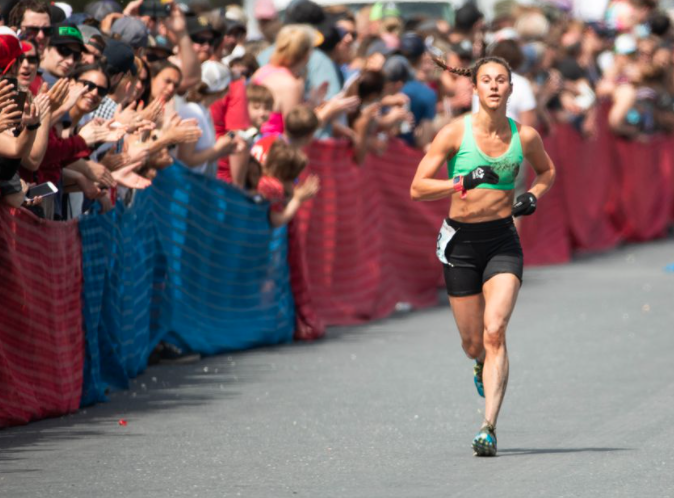
    Jess Yeaton heads for home to win the 2018 Mt Marathon race in Seward, AK. (Photo: Anchorage Daily News/Lauren Holmes)

    Seconding Dr. McKinnon’s first recommendation, Yeaton began with the importance of committing to a gradual return.

    I think the absolute biggest thing is taking a slow progression back and not increasing your weekly mileage too much, as well as adding in exercises that target strengthening glute med.”

    The gluteus medius muscle, or glute med, is a fan shaped muscle on the outside of the hip which connects the iliac crest to the top of the femur. The glute med plays a vital role in single leg stability, in particular, in maintaining level positioning of the hips and proper alignment of the leg during each stride. After all, running is essentially a repetitive high-impact single leg motion, so stability at the hips and through the core are key.

    By strengthening the glute med, runners can reduce “hip drop” and prevent the knee from caving inward with each stride. These phenomena reduce the body’s natural mechanisms for absorbing the impacts of running. They put abnormal strain on various ligaments, tendons, and joints down the chain, leading to IT Band Syndrome, knee and low back pain, and more. 

    The gluteus medius, or glute med, provides stability at the hip, a source of injury risk for runners. (Photo: Human Anatomy and Physiology Lab, LumenLearning.com)

    “Examples of [exercises to strengthen the glute med] would be things like donkey kicks, fire hydrants, bridging up with both legs and then holding with one leg,” Yeaton explained. “I actually had to do a community project working with a running group here in Albuquerque for school and made a video with some of these exercises, which is available on YouTube.”

    In the video, Yeaton demonstrates forward and lateral walks with an exercise band looped above the knees. Maintaining tension in the band activates and strengthens the glute med, promoting better stability in single leg movements, such as running — or skiing!

    Yeaton also contributed to an article on single-leg stability geared toward better balance on skis this fall, which can be found here

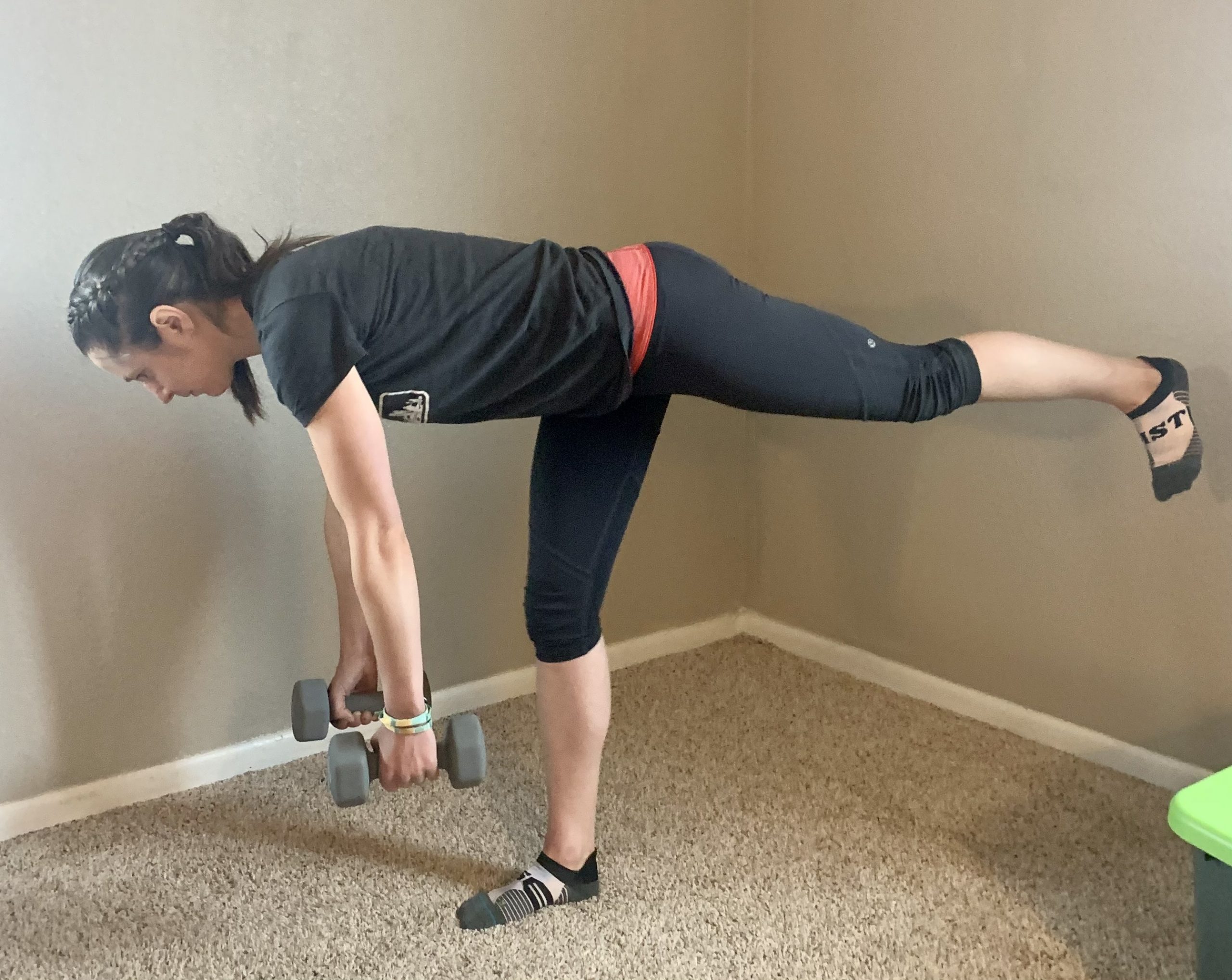
    In the gym, you could try single leg deadlifts with a kettlebell or free weight to build stability. To execute this move correctly, it is important to keep the hips level to the floor and avoid the tendency to rotate away from the standing leg. While keeping a flat back, focus on hinging  from the hip and staying within the range of motion that your hamstring flexibility allows rather than reaching the weight toward the floor, which often leads to rounding at the low back. In addition to challenging your single leg balance, you should feel this in the glute and hamstring of the standing leg. 

    Aim for a flat back with hips squared forward, and keep the toes of the lifted leg pointed toward the ground.

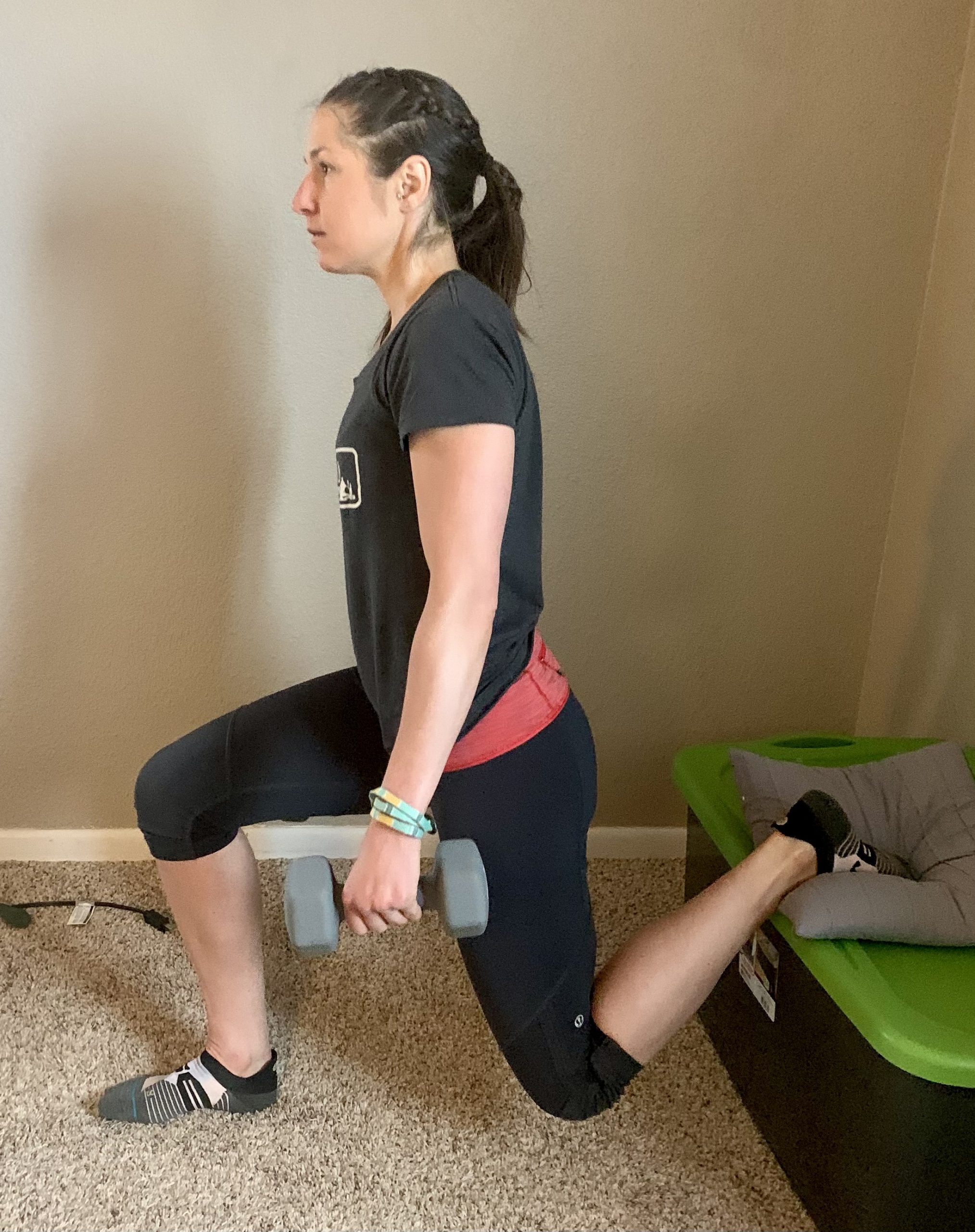
    Another option for enhanced glute med strength is to try a split squat with the rear leg elevated, also known as a Bulgarian split squat. With one foot resting on a box, stair, or bench, complete a single leg squat, creating a 90-degree bend in the knee of the standing leg. The knee of the elevated leg should drop straight down toward the ground, while the other knee stays stacked over the ankle and in line with the foot. 

    Be sure to keep your chest up and core tight to reduce wobbling and work the correct muscles.

    By pushing your heel into the ground as you come out of the squat, you can keep the action in your glute muscle, rather than letting the quadriceps muscles on the front of the upper leg take over. Again, the positioning of the hips is important; here they should stay squared forward throughout the movement. 

    Yeaton also noted that she commonly sees skiers develop calf and achilles related injuries from jumping back into running too quickly and recommended variations of calf raises and heel drops to combat these issues. 

    “Another one you could add is doing calf raises with a ball between your ankles, which puts you in a supinated position (meaning the foot is rotated slightly inward), which helps target tibialis posterior. I’ve noticed this muscle is a BIG problem for a lot of skiers.”

    Keeping pressure on the ball as you rise onto your toes and slowly lower cues and strengthens the tibialis posterior.

    The tibialis posterior lies underneath the gastrocnemius, more commonly known as the calf muscle. Running the full length of the lower leg, the tibialis posterior begins behind the knee and connects to the arch of the foot. It helps to flex the foot and reduce pronation, where the arch collapses and the ankle tracks inward. This is commonly seen in runners.

    To perform the exercise, hold a soft ball, such as a tennis ball, between the heels of your feet. Slowly rise onto your toes while maintaining the positioning of the ball, hold briefly at the top, then return slowly to standing. 

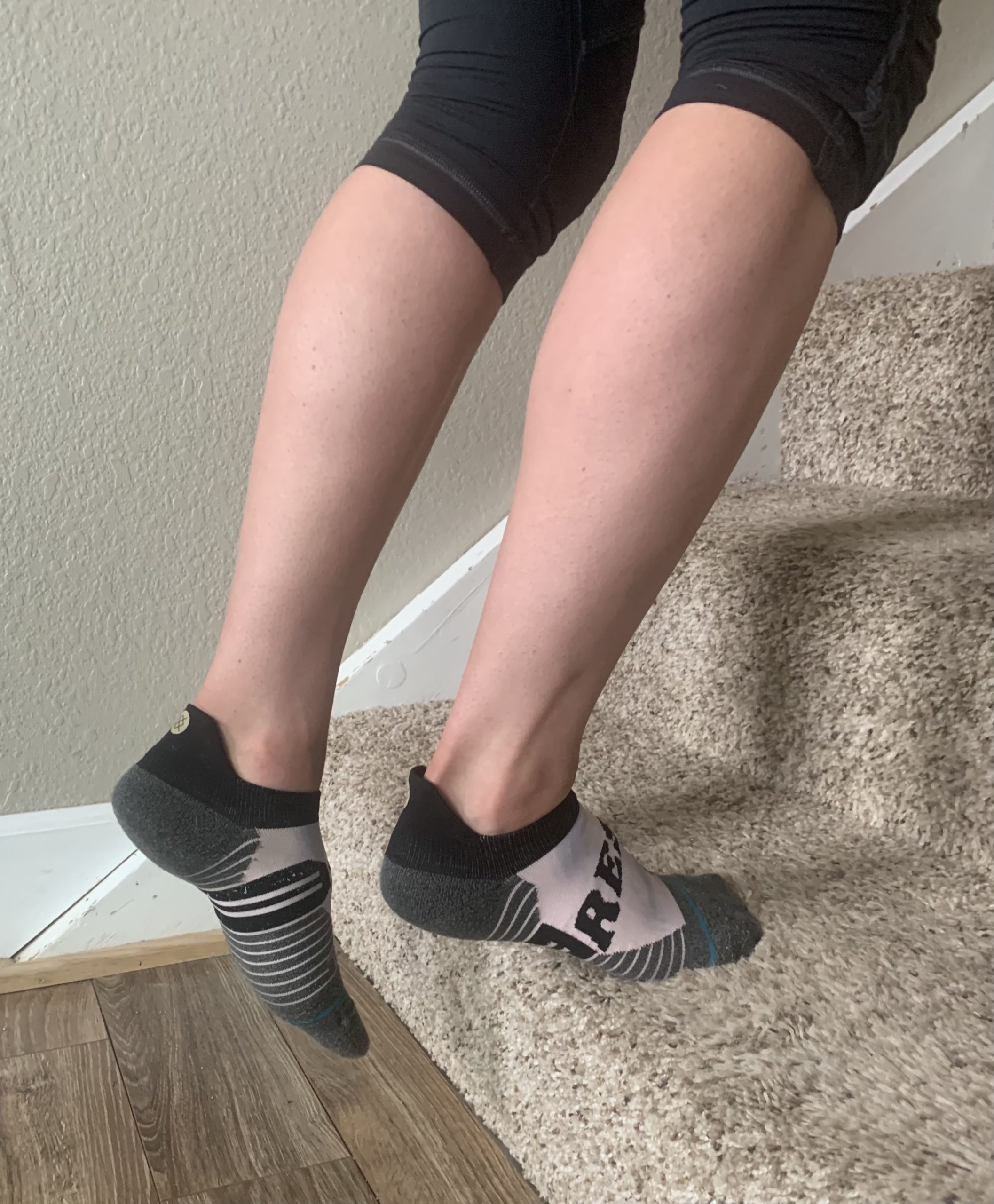
    For achilles strength, you can do heel drop exercises on the stairs. Push up into a calf raise on both feet, then lower down slowly on one foot. The eccentric, or the slow, controlled lowering part is what’s important.”

    Use both feet to rise onto your toes, then slowly lower with just one foot to target the achilles.

    Returning to the concept of a gradual increase in running volume, Yeaton recommends actually calculating how quickly you are ramping up. Yeaton recommends the 10% rule — meaning volume should increase by no more than 10% per week. She referenced a 2014 study titled “Excessive progression in weekly running distance and risk of running-related injuries: an association which varies according to type of injury”, which followed roughly 900 runners for one year, tracking mileage increase and injuries. The research showed that athletes who increase by 30% or more were at a higher risk for injury, whereas those who increased by 10% or less were the least likely to incur a running-related injury. 

    “I think this is crazy when skiers put a number to it, because that really isn’t much of an increase… from what I’ve seen, what most athletes consider taking it slow and easing back in is really a pretty significant progression.”

    Obviously, there are caveats — if you start with one three mile run, you’ll probably be okay running more than 3.3 miles total the next week. If you ran 12 miles over four runs last week, you probably shouldn’t run 13 in one go the following week. However, paying attention to frequency, distance, and intensity of your runs as you progress can play a vital role in keeping your body happy.

    Anecdotally, running 5-7 miles once per week through this winter has made a big difference in my ability to progress this spring. 

    So there you have it. Work on hip stability and core strength (bonus: this will help your skiing too!), incorporate calf raises and heel drops, and keep an objective eye on your progression. Have fun and stay healthy!
  • Johaug: Fleet Footed in the 10 k

    Johaug: Fleet Footed in the 10 k

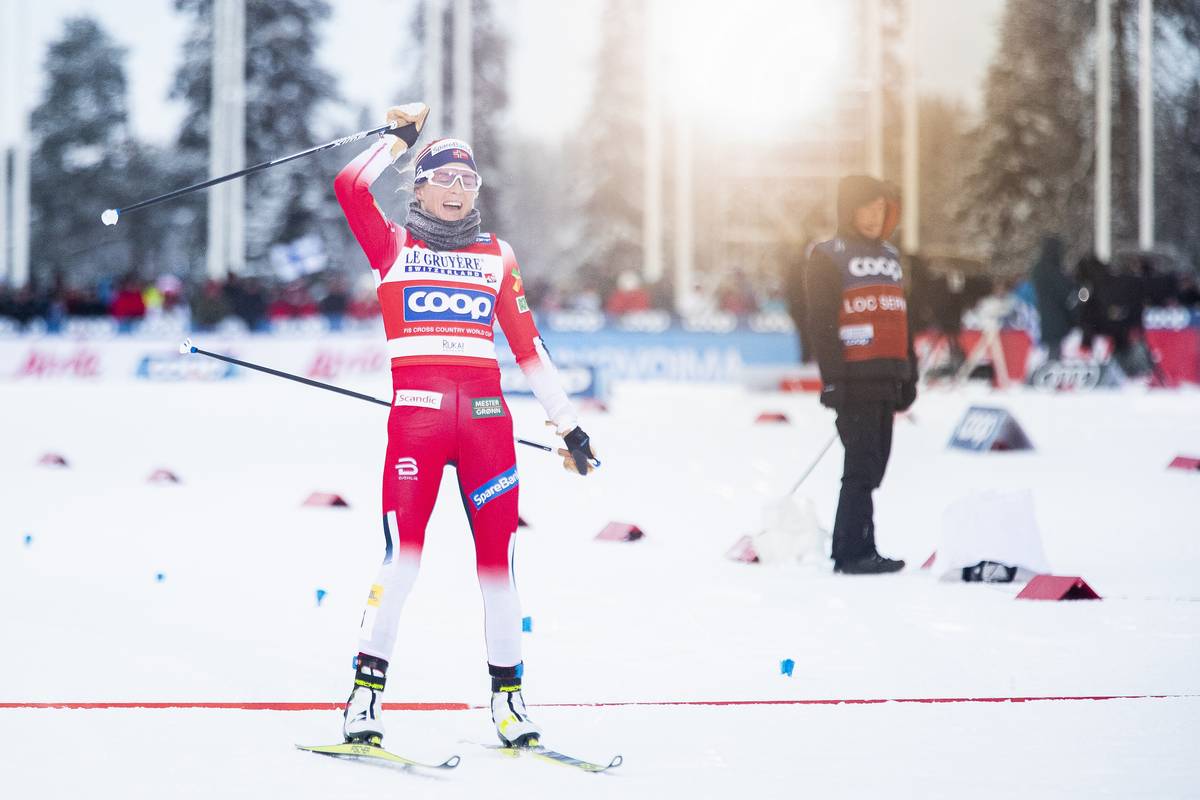
    2019, Therese Johaug winning in Ruka, Finland. (Photo: NordicFocus)

    Norway’s Therese Johaug made news today on the running track, clocking a speedy 10 k in 31:40.69. Johaug’s run was part of a made-for-TV sport event in a time of limited international travel and social distancing.

    Called the “Impossible Games”, the format pitted some of Norway’s best track and field athletes against those from Kenya in a virtual competition.

    Best known by cross-country ski fans for dominating the distance races on the World Cup, Johaug is also known to scorch as a runner. Last year she made headlines after winning the Norwegian 10,000 m national championships in 32:20.86.

    Then, she missed the World Championship standard of 31:50.00 by thirty seconds. Johaug ran that race in Hokas, not spiked track shoes.

    She ran the race on Thursday in racing flats. The 25 lap run was completed solo amidst a near-empty stadium.

    You can view her 2019 10,000 m Norwegian National Championship run below. According to NBC, they are broadcasting the Impossible Games on their sports networks.


  • Comeau Just Can’t Quit Skiing: Back in the Sport and PyeongChang-Bound

    Comeau Just Can’t Quit Skiing: Back in the Sport and PyeongChang-Bound

    Anne-Marie Comeau leading Cendrine Browne during the skiathlon at Cross Country Canada’s NorAm/Olympic Selection Races in Mont Sainte Anne, Quebec, in January. (Courtesy photo)

    Today, she’s Olympic-bound. But two years ago, Anne-Marie Comeau was stepping away from cross-country skiing.

    Comeau had raced at 2015 World Junior Championships, finishing 25th in the skiathlon, but by December of that year the Canadian was diagnosed with a shoulder injury that required her to take half a year away from skiing.

    She didn’t compete past the first weekend of NorAms, or at all in the 2016-2017 season, after deciding to devote herself to running.

    Anne-Marie Comeau (Université Laval) racing to third in the women’s 10 k classic on Jan. 10 at Mont Sainte-Anne NorAm Trials in Quebec.  (Photo: Mario Walker/NorAm MSA 2018 Facebook)

    And that was plenty for Comeau to focus on. A talented runner, she had set the Quebec junior record at 5,000 meters (16:34.4, a time she has since improved on). And she won a silver medal at Junior Pan-American Games.

    But skiing was something she couldn’t shake.

    “I did more training for running, but skiing remained a sport that I love in the winter,” Comeau wrote in an interview with FasterSkier last week, translated from French into English. “I realized over the months that I missed ski racing, and so I decided in autumn of 2017 that I would do the selection races for Olympics, especially since they were at Mont-Ste-Anne where I live.”

    So Comeau, who began attending Université Laval this fall and competed with their cross-country team, adapted her training somewhat. She added a rollerski workout once a week and uphill sessions on Mont Sainte Anne.

    “Since it had been two years that I wasn’t doing ski races, it was difficult for me to come up with fixed goals,” Comeau wrote. “The prospect of participating in this type of selection gave me a certain motivation to train, and I couldn’t wait to get back to the joy of ski racing.”

    At the same time, she was part of a college team for the first time.

    Comeau ran for the Laval Rouge et Or team this fall. (Courtesy photo)

    “It’s always really stimulating to be part of a team where the other athletes have the same passion,” she wrote.

    The Laval women won the Quebec Conference Championships, and finished third at Canadian U Sports Cross-Country Championships.

    “I’m very satisfied with my first season,” Comeau wrote. “I’m particularly pleased with the result that I had when we participated in an NCAA race in Princeton, New Jersey. It was a 6 k cross-country race and our team finished second in the overall standings. I finished first in that race. That second place for our team gave us confidence for what came next. The atmosphere in the team was really good and I am always very proud to represent the Rouge et Or.”

    The pride and team energy, combined with just enough ski-specific training, combined perfectly to prepare Comeau to re-enter the world of ski racing.

    To say that the Olympic selection races went well would be an understatement. On the second day of racing Comeau placed second in the 15 k skiathlon behind Cendrine Browne, who had already sealed her Olympic nomination by winning the sprint to open the trials series. Then on the last day of competition Comeau placed third in the 10 k classic behind Browne and Katherine Stewart-Jones.

    That made her the distance winner of the trials, not counting Browne.

    “To succeed in qualifying for the Olympics was truly a huge joy for me and a motivation to give my best for what would follow!” she wrote.

    Comeau at the trials races in Mont Sainte Anne. (Courtesy photo)

    But there was a catch: because Comeau hadn’t raced in so long – the only competitions she had done this season before selection trials were the Sovereign Lake NorAms – she did not have the required five FIS races averaging 100 points or below. So while she topped the selection list, in order to be allowed to race at the Olympics she had to get a few more results with good FIS points.

    “After my races at Mont Sainte Anne, I was so motivated and proud of my results that it gave me positive energy to face the challenges that I had to overcome to meet the Olympic criteria from FIS,” Comeau wrote. “I didn’t really think about everything I had to accomplish, I just went right into it, the motivation of going to the Olympics being my main objective that I wanted to meet.”

    To do that, she headed south, racing in a 10 k skate in Craftsbury, Vermont, and a 5 k classic in West Yellowstone, Montana. That brought her average FIS points down to 98.47.

    Comeau is still absorbing the idea of becoming an Olympian.

    “At 21 years old, I consider myself blessed to be able to live this experience, and I want to try to take the most of this experience to help me in the pursuit of my athletic career,” she wrote. “Honestly, to give the best I can and to live fully in each of my races, that’s my main goal. For the results, it’s hard for me to predict.”

  • Best of Both Worlds: MSU Measures VO2max and Upper Body at the Same Time (with Video)

    Best of Both Worlds: MSU Measures VO2max and Upper Body at the Same Time (with Video)

    https://www.youtube.com/watch?v=Vkpm-L8GFtY&feature=youtu.be

    With the recent release of VO2max data by the Norwegian Olympic and Paralympic Committee and Confederation of Sports, FasterSkier decided to explore similar research taking place in the U.S.

    ***

    BOZEMAN, Mont. — Liz Stephen. Kris Freeman. Wendy Wagner. Torin Koos. The list of nordic skiers goes on. The list, though daunting to many, is simply a part of the project for Dr. Dan Heil.

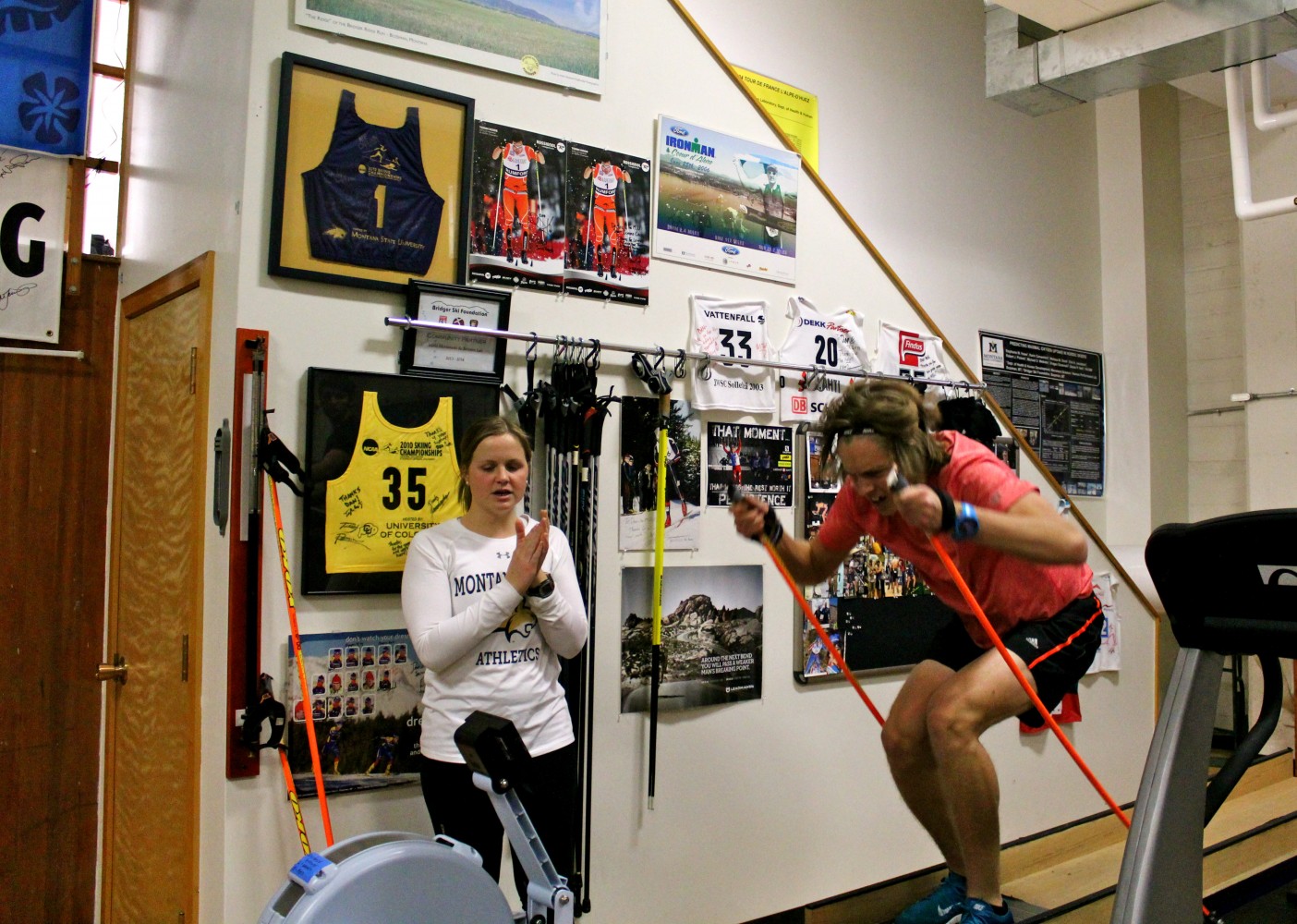
    Currently a professor and program leader of Health and Human Performance at Montana State University (MSU), Dr. Heil has been conducting research on VO2max for 25 years.

    “My first research project as a Masters graduate student in Exercise Physiology evaluated changes in VO2max. That project was in 1990,” Heil wrote in an email.

    Since then, Heil’s research spans from better hydration practices to energy expenditure predictions to determinants in race performance for junior and college skiers. Within the last five years, however, much of Heil’s research on nordic skiers has held a different perspective, one that’s 8-feet wide and 10-feet long. 

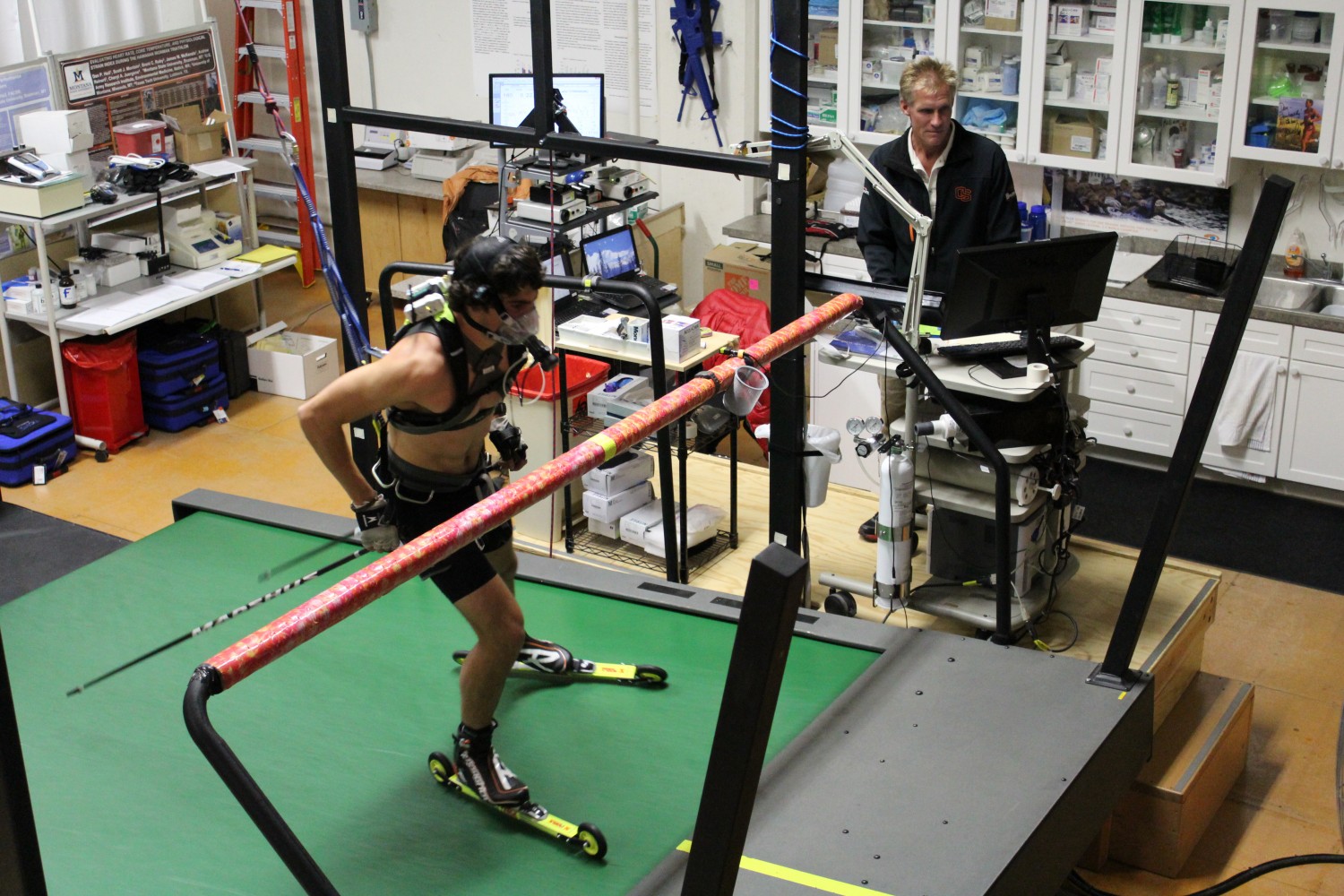
    Bridger Ski Foundation Akeo Maifeld Carucci,  during a V02max rollerski treadmill test at Montana State University's Movement Science/Human Performance Lab, this week in November.
    MSU professor and program leader of Health and Human Performance, Dr. Heil (r) controls treadmill speed and incline during a recent rollerski V02max test for BSF elite athlete Akeo Maifeld-Carucci.

    Given its dimensions alone, the new rollerski treadmill at the MSU Movement Science/Human Performance Lab (MSL) in Bozeman outmatches the lab’s previous VO2max research equipment.

    Beyond increased size, the new treadmill — which the department received in 2010 by as a gift from a university dean — also reaches speeds of up to 25 miles per hour and inclines that range from a -10 to a +40 percent grade. Only five other treadmills of similar caliber are known to exist in the U.S. today. However, the oversized treadmill is not the only piece of equipment that makes Heil’s research unique. 

    “We call it an upper-body power ergometer … [it] was designed about ten years ago with a former grad student of mine, [Bowdoin College Nordic head coach] Nathan Alsobrook,” Heil said during an interview inside MSU’s performance lab.

    Essentially a rowing-machine-gone-double-pole, the aim of the invention, according to Heil, is double-pole simulation.

    “The neat characteristic about this is that it integrates ski poles into the double-poling motion … Unless you have access to this lab and this ergometer, you don’t get upper-body power measures,” he explained.

    But why bother with upper body power measures? In a predominantly endurance-driven sport, like nordic skiing, shouldn’t the emphasis be on an athlete’s VO2max?

    “A high VO2max is never a disadvantage — Ever!” Heil wrote in the email. “With that said, however, there is only a relatively small window of improvement that each athlete can expect to gain with appropriate training. So the best strategy for training is to make sure that an athlete has optimal opportunity to realize their full V02max potential with training (which can take several years).”

    In other words, an athlete’s VO2max, has the potential to change, but only to the extent that physiology and genetics allow.

    Where does that leave cross-country skiers who want to continue to improve race performance past their peak VO2max?

    According to Heil, power generation.

    “What elite [nordic] athletes have been doing over the past decade or so, is a very intense focus on developing muscular strength and power to add on top of the decade or more of aerobic base they’ve already got,” Heil said.

    Unlike many endurance sports, cross-country skiing draws upon muscular strength, balance and coordination, as well as aerobic fitness.

    For example, though elite distance runners and nordic skiers are often categorized as similar endurance athletes, Heil’s observations provide a notable distinction.

    “One of the big differences between these two groups is that virtually all elite distance runners seem to have incredibly high VO2max values and tend to be similar in body size and shape,” he wrote. “Nordic skiers, in contrast, seem to be more varied in body size and shape and not have as consistently high VO2max values. Having a high VO2max is always going to be a benefit to an endurance athlete, but I think Nordic skiing has evolved to a point where advanced upper body strength and power are almost equally important to success.” 

    Heil’s current research with MSU graduate student and nordic skier, Lina Hultin of Örebro, Sweden, examines the relationship of race performance to rollerski treadmill VO2max  and upper body power from a Concept2 SkiErg versus the MSL ergometer.

    “Usually at least once, if not twice, and sometimes three times a year, we have the [MSU and Bridger Ski Foundation nordic] athletes come in and do a rollerskiing VO2max test that includes lactate threshold,” Heil said.

    Using the numbers from these tests, Heil and Hulton will later look at correlations between the athletes’ test results and SuperTour race performances.

    “Upper-body power is a good cumulative measure of the strength and power training, as well as the specific aerobic training, the rollerskiing, that the [athletes] have been doing, all in a very concise measure,” Heil said. “VO2max and the lactate threshold can be a little bit more in flux with how someone feels or if are they’re on the edge of getting sick. If [an athlete is] interested in being able to track their training progress, maybe all they need to be able to track is changes in upper-body power, not VO2max.

    “I think Nordic skiing has evolved to a point where advanced upper body strength and power are almost equally important to success.” — Dr. Dan Heil, professor and program leader of Health and Human Performance at Montana State University

    In the interest of time, upper-body strength might be the way to go when tracking performance and training progress in the future. However, in the interest of science and skiing, V02max and threshold remain dear to the heart.

    “From a coaching standpoint, we use the threshold data more than the VO2max data when were planning training,” said MSU Nordic Head Coach Matt Johnson.“They can use their threshold data to tailor individual workouts when doing intervals.”

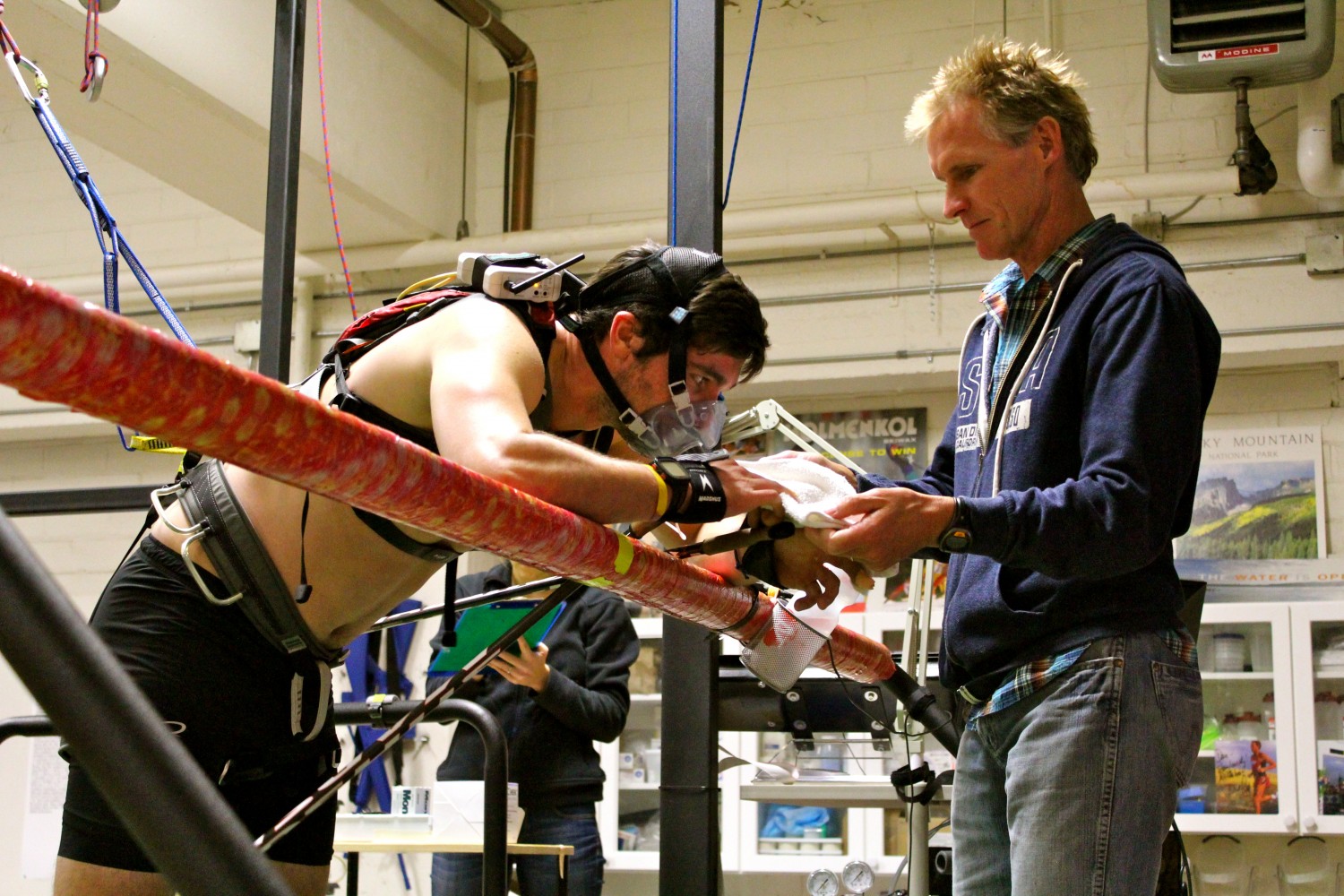
    Professor Heil (r) hands BSF elite athlete Nicholas Michaud a towel after Michaud finished his first V02max test on rollerskis.
    Dr. Heil (r) hands BSF elite athlete Nicholas Michaud a towel after  his rollerski V02max test in MSU’s Movement Science/Human Performance Lab.

    BSF elite athlete Jennie Bender also pointed out that the rollerski treadmill “is a great way to work on technique and really pay attention to your body mechanics because it’s such a controlled environment,” she said. “It’s kind of like skiing in the dark or running in the dark. You’re more focused on what your body is doing and you don’t have to watch out for any obstructions.”

    Yes, thankfully — for the athletes at least — Heil has not developed virtual potholes for his tests … yet.

    What Heil has launched is the continual promise of questions and thought about nordic athletes and sport.

  • Wednesday Workout: Quality Level 3 and 4 for the Working Class

    Wednesday Workout: Quality Level 3 and 4 for the Working Class

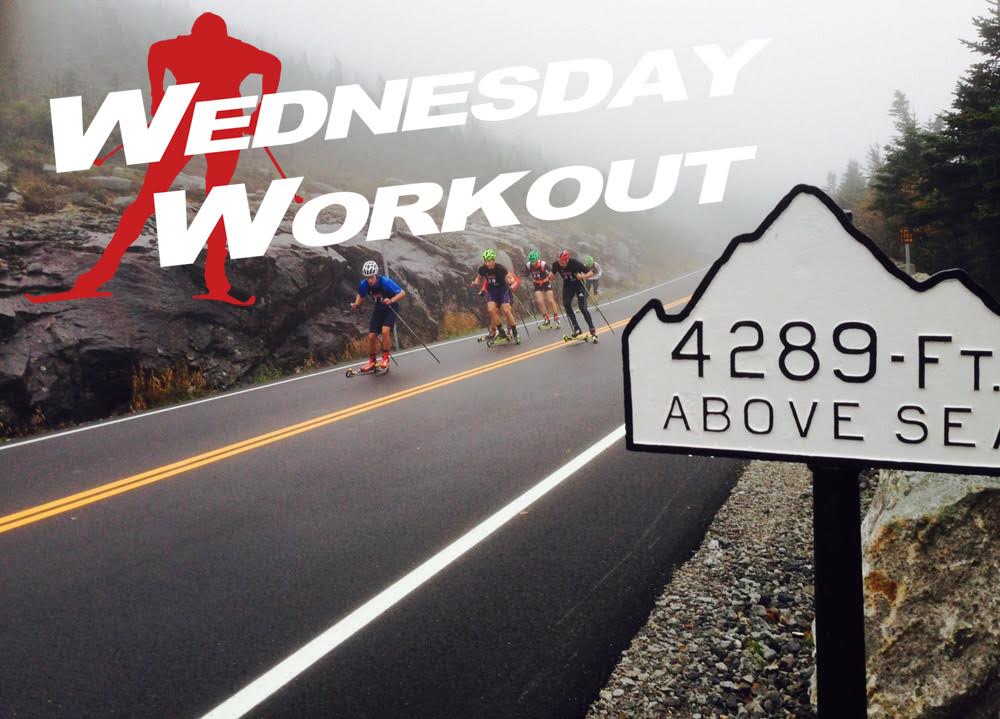
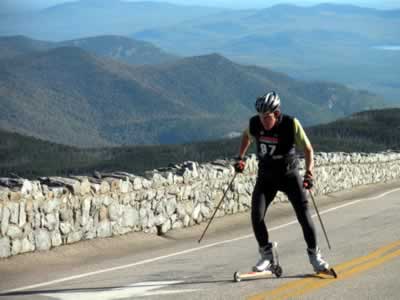
    The leaders in this year's 2015 Climb to the Castle rollerski race up Whiteface Memorial Highway in Wilmington, N.Y. Rogan Brown of the Sun Valley Ski Education Foundation (SVSEF) leads around mile four of five. (Photo: Tim Cowan)
    The leaders in this year’s 2015 Climb to the Castle rollerski race up Whiteface Memorial Highway in Wilmington, N.Y. Rogan Brown of the Sun Valley Ski Education Foundation (SVSEF) leads the top men around mile four of five. (Photo: Tim Cowan)

    On the day after my 58th birthday, I raced the Climb to the Castle. Again. It’s an incredible thrill to be on the same starting line as the best skiers in the U.S., even if I finish towards the back. This year, I finished within 6 seconds of my best time. And for the first time, instead of being totally gassed for the final half mile, I had good energy all the way to the finish.

    Peter Minde nears the finish of the Climb to the Castle in 2011.
    Author Peter Minde nears the finish of the Climb to the Castle in 2011.

    During the dryland season, my goal is to do one Level 4 and one Level 3 workout each week. I hate to admit it, but now there are now some days when my body revolts and says, “Enough! You’re not finishing this interval session.” To that end, I try to make sure I’m really rested.
    I take into account my work and my family commitments as well as the stuff in the training log. I hate conceding workouts, but nowadays, I’d rather do one really good interval workout rather than two mediocre sessions.

    Although I have good terrain for dryland training, I don’t have super long hills. For a Level 4 workout, either running or rollerskiing, I’m going up a hill, back down and repeat. The recovery time is always a little longer than the actual work period. Not best practice, but possibly beneficial at my age.

    “I hate conceding workouts, but nowadays, I’d rather do one really good interval workout rather than two mediocre sessions.” — Peter Minde, FS contributor and annual Climb to Castle competitor

    Workout 1: 5 x 5 Minutes Level 4, Uphill Running

    My bread-and-butter Level 4 workout is five repeats, five minutes, going uphill.

    I do this either running or rollerskiing. It’s OK if the pitch varies, but the final few hundred meters should be the steepest. Generally, I run in the woods, and I use trails that aren’t excessively technical.

    Warm up with dynamic stretching, then run 15 minutes at Level 1 in rolling terrain.

    Then go 5 minutes up your hill at Level 2. Return downhill, and repeat with 5 minutes in Level 3. Finish that, go down, and you’re ready for the main event.

    In the Level 4 section of the workout, I focus on starting in the lower end of my heart-rate range and increase the intensity over each interval. At the base of the hill, I moose hoof the first 30 meters before settling in to a run. During each repeat, I focus on positive self talk.

    Workout 2: 5 x 5 Minutes Level 4, Rollerskiing

    As with the running intervals, look for a long hill. It’s OK if there are rolling or short downhill sections; however, the final section of the hill should be steep enough that you have to check speed – snowplow, traverse, whatever – to return downhill safely.

    Warm up as above. Fifteen minutes in Level 1, followed by 5 minutes of Level 2 and five minutes of Level 3.

    As with running, my goal is to start conservatively and make the last interval the hardest. In addition to positive self talk, I focus on skiing transitions smoothly. If I’m classic rollerskiing, I’ll double pole a flat section and the base of the climb before changing to striding. If I’m skating, I try to V2 as much of the uphill as I can, or V1 the steep bits and switch to V2 where the grade is easier.  Don’t forget the warmdown and stretching.

    Workout 3: 3 x 15 Minutes, Running

    While I do this on rollerskis, I prefer to run, because I’m able to keep recovery times to 3-5 minutes between hard work periods. Find a loop in the woods that takes approximately 14-16 minutes to run.  It should be rolling with some long uphills.

    Warmup: Similar to the Level 4 workouts above. Begin with dynamic stretching, followed by 15 minutes of easy running.

    Ramp up your heart rate to Level 2 for five minutes, then head onto your loop and crank it up to a controlled pace.  In downhills, I pick up the pace to keep my heart rate in the zone.  At the end of 15 minutes, a short connector gives me around five minutes of recovery before the next repeat.

    Then I run easy back to the car, for 15-20 minutes warming down.

  • Wednesday Workout: Throwback Uphill Running Intervals with Stephen

    Wednesday Workout: Throwback Uphill Running Intervals with Stephen

    Liz Stephen tucking in a World Cup race during the 2009/2010 season.
    Liz Stephen tucking in a World Cup race during the 2009/2010 season.

    This week, we bring you a past Pro Workout from U.S. Ski Team veteran and two-time Olympian Liz Stephen. Now 28, Stephen recently won her second-straight Trail Run National Championship as well as the Red Bull 400 hill climb. What’s made her so fast over the years? This workout from 2010 sheds some insight. Read original workout here.

    ***

    [circa Nov. 2010]

    Some skiers love to run; others tolerate it. The U.S. Ski Team’s Liz Stephen is the former. And while uphill running intervals present plenty of challenge for most, Stephen not only wants a solid grade and 20+ minutes of active time – she wants a steady downpour, mud, slippery footing, and whatever else nature can throw at her.

    “For me it is always more fun when it is raining out,” said Stephen. “It is muddy…your hair is all matted down. There is rain in your face, your glasses don’t work, feet are slipping.  You have to figure it out.  I like that kind of stuff.”

    Her workout of choice consists of a relatively standard set of intervals – six four-minute repeats of hard effort building to maximum over the course of the session.

    American Liz Stephen leads Norway's Ragnhild Haga during the charge up the final hill of the seventh stage of the 2015 Tour de Ski in Val di Femme, Italy (Photo: Val di Fiemme/www.fiemmeworldcup.com)
    Liz Stephen (in black) leads Norway’s Ragnhild Haga during the charge up the final hill of the seventh stage of the 2015 Tour de Ski in Val di Femme, Italy (Photo: Val di Fiemme/www.fiemmeworldcup.com)

    The optimal hill is long enough that you don’t have to go all the way down after each effort, keeping the rest period in the target zone of three to four minutes. The grade should be challenging but run-able. These are not bounding intervals.

    Bounding may be more specific and powerful, but running gives Stephen a chance to work on quickness.

    “It should be a fun feeling,” she said. “A hard feeling, of course, but not bogging down.

    “You want to feel like you can be fast!”

    Staying light and quick is a regular theme in ski technique, and this is a perfect dryland opportunity to apply those concepts.

    At the end of the day, however, it is the rain that makes it for Stephen.

    “I just like that feeling – being muddy, coming in and showering, drinking hot cocoa and sitting by the fire, stretching and reflecting on ‘I just got some shit done today,’” said Stephen.

    And part of getting it done is learning to deal with the adverse conditions.

    “Whether you are on the World Cup or at some Eastern Cup, there is still shitty weather and the rain still falls, and the course is still not groomed the way you want it to be,” she said. “There is always going to be something that is not ideal for you. You have to know how to do that, too.”

    The rain may not raise your VO2max, or increase your foot speed, and mental benefits are hard to quantify – but Stephen sees real value.

    “Honestly, did it make you a better athlete than if it was sunny out? Maybe, maybe not, but in terms of your mental approach, you feel you really accomplished something,” she said.

    Stephen has been working on evaluating every workout – what went well, what could have been better. And, she concludes, “with running intervals in the rain, the positive is always that it is raining!”

    — By Topher Sabot

    The Workout: 6 x 4-minute uphill intervals (hard effort, building to maximum)

    Optimal climb: Long enough that you don’t reach the bottom after each effort (with 3-4 minutes recovery in between), with a grade that’s challenging yet run-able (not bounding)

    Think about: Staying light and quick on your feet

    “It should be a fun feeling. A hard feeling, of course, but not bogging down. … You want to feel like you can be fast!” Stephen explained.

  • Running: National Champ Stephen’s Secret to Keeping Skiing ‘Happy and Fresh’

    Running: National Champ Stephen’s Secret to Keeping Skiing ‘Happy and Fresh’

    U.S. Ski Team member Liz Stephen competes in the XTERRA Trail Run National Championship on Sept. 20 at Snowbasin Resort near Ogden, Utah. (Photo: Liz Stephen)
    U.S. Ski Team member Liz Stephen competes in the XTERRA Trail Run National Championship on Sept. 20 at Snowbasin Resort near Ogden, Utah. (Photo: Liz Stephen)

    Since wrapping up a successful camp in Norway with two top-10 results at Toppidrettsveka, U.S. Ski Team (USST) veteran Liz Stephen has been enjoying some time at home in Park City, Utah, working on her double pole and preparing for another busy winter. She skipped the weeklong USST camp in Lake Placid, N.Y., so she would not have to travel and could instead work more on some personal goals.

    “As you get older, and apparently I am doing that, [traveling] definitely begins to wear on you a little more,” Stephen, 28, said in a recent phone interview. “I want to be ready to be on the road for four months, and I needed to stay close to home for a little bit to settle before the season.”

    So stay home she did. But for Stephen, staying at home does not mean taking it easy. She, as well as several other USST athletes, left Norway wanting to improve her double-pole strength and technique. Even though double pole had already been a main focus for Stephen this summer, she learned even more improvement was necessary if she wanted to compete amongst the world’s best. So Stephen has been doing a lot of lower-core-activation exercises, both before double-pole sessions and before strength workouts. She has also been doing some shorter duration double-pole sessions where the focus is on having high-quality technique and energy rather than double poling for extended periods of time and risking a relapse to her old double-pole habits.

    However, improving her double pole has not been the only thing Stephen has been doing during her extended time at home. She has also been enjoying one of her favorite activities, running. According to Stephen, the fall weather in Utah has been gorgeous, and there is no better way to enjoy it than by going for a run.

    “I feel so lucky every time I can lace up my shoes and I am healthy enough to go run a 17-mile loop just quick in the morning. I hope I am able to do that my whole life,” she said. “When you’re running, you’re just enjoying being active and healthy and I think that keeps all the other workouts that maybe you don’t love as much in perspective because you know at least once a week, you are going to get a big run in.”

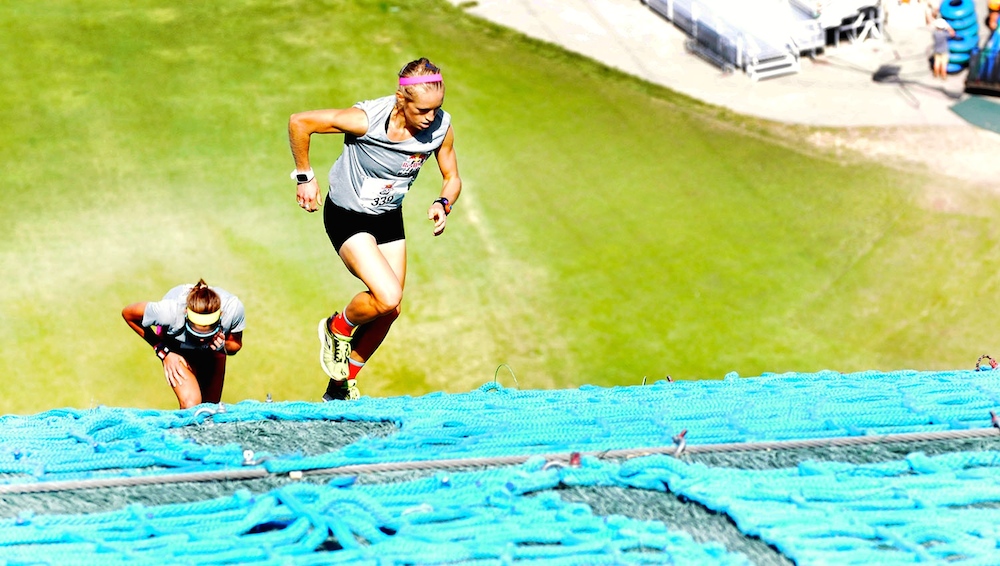
    Liz Stephen holds the lead over Austria’s Veronika Mayerhofer running up the Olympic ski jump in the Red Bull 400 hill climb at the Utah Olympic Park ski jumps. (Tom Kelly/USSA)
    Liz Stephen holds the lead over Austria’s Veronika Mayerhofer while running up the Olympic ski jump in the Red Bull 400 hill climb at the Utah Olympic Park ski jumps. (Photo: Tom Kelly/USSA)

    For the two-time Olympian, going for a run is the perfect way to clear her mind, but it also is a great workout. Stephen even uses running as a means to improve her classic technique, sometimes running with poles for a more classical-style workout and bounding up hills to improve kick power. After all, skating has traditionally been Stephen’s stronger technique, and in order to achieve her goal of being on the podium either at the end of the 2016 Tour de Ski or Ski Tour Canada, she said her classic skiing has to improve.

    “When you’re running, you’re just enjoying being active and healthy and I think that keeps all the other workouts that maybe you don’t love as much in perspective because you know at least once a week, you are going to get a big run in.” — Liz Stephen, U.S. Nordic Ski Team member and two-time defending Trail Run National champion (and the winner of the inaugural Park City Red Bull 400)

    On Sept. 20, Stephen raced in her fifth-consecutive XTERRA Trail Run National Championship, which took place at Snowbasin Resort near Ogden, Utah. The race is a half marathon (13.1 miles) that features two big hills and a final, mile-long incline to the finish.

    Right out of the start, competitors ascend a two-and-a-half mile slope that also includes the steepest section of the course. After storming back down, the racers climb roughly 1,000 feet in another two-and-a-half miles to the high point and then descend to the low point of the course. Finally, there are a few more hills before the finish.

    “I’ve gotten a little faster since they have changed the course and I think this is my fourth time on this course. It’s a great course,” Stephen said.

    For Stephen, the competition at the trail-running nationals varies. The last two years, she won handily, as no other woman came close to matching her pace. But three years ago, Lindsey Anderson, a steeplechase Olympian from Utah, battled with Stephen for the entire race before dropping her on the last half mile with a strong finishing kick. The year before that, Morgan Arritola, a former cross-country skier and current world-champion mountain runner, finished minutes ahead of Stephen. This year, Stephen’s closest competition was Alayna Szucha, an 11-year-old girl from Evergreen, Colo. Szucha finished 17 minutes behind Stephen with a time of 1:45:32, averaging 8:03 minute/miles. Stephen won in 1:28:39 with 6:46 as her average mile pace.

    “I actually didn’t run with a single person the entire 13 miles so it felt a bit lonely at times, but I have to say, the most inspiring and just crazy thing is that the second-place girl is 11 years old. It was her first half marathon,” Stephen said. “I got a chance to chat with her for a little bit after the race, just like a fired up little kid … It’s going to be fun to have a little penpalship with her and maybe send her some cross-country gear, see if we can give her the bug.”

    While Stephen did accomplish one goal at nationals — winning — she did not accomplish her other goal of beating her previous year’s time. Despite having perfect weather this year compared to last year’s windy and rainy race day, Stephen could not quite match her pace from 2014.

    “Being a little slower than the year before was a bit of a bummer, but at the same time it was like 40 seconds slower or something, which, in a 13-mile race, isn’t too much when you take a step back. I was happy with it and I just had fun,” Stephen explained.

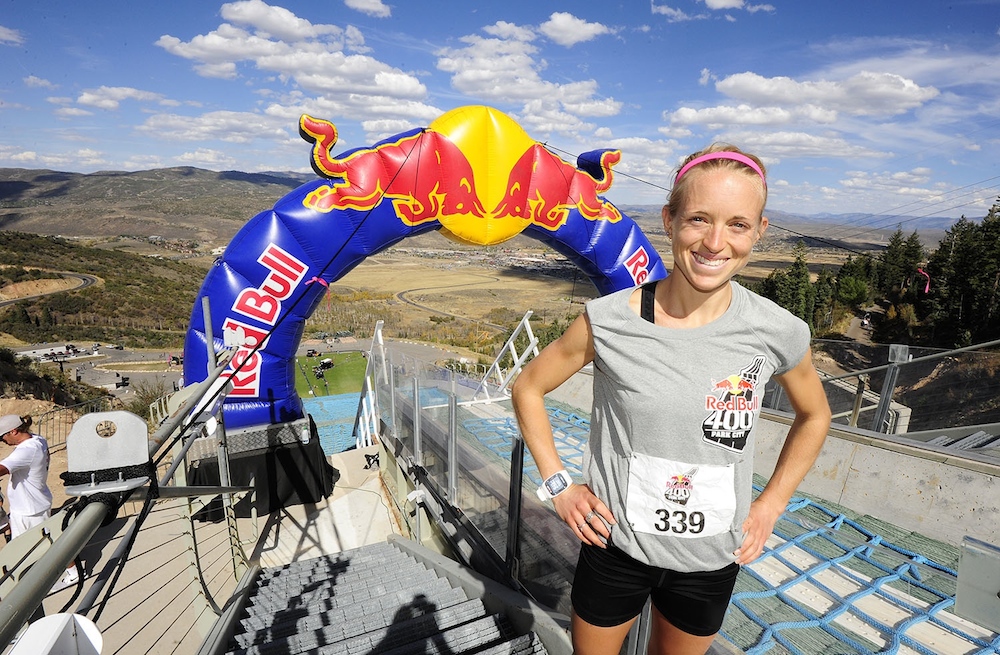
    Liz Stephen celebrates her win in the Red Bull 400 hill climb up the Olympic ski jump at the Utah Olympic Park. It was the first time the Red Bull 400 has been held in America. (Tom Kelly/USSA)
    Liz Stephen celebrates her win in the Red Bull 400 hill climb up the Olympic ski jump at the Utah Olympic Park. It was the first time the Red Bull 400 has been held in the U.S. (Photo: Tom Kelly/USSA)

    However, the Trail Run Championship was not enough for Stephen. On top of nationals, she did the Beach to Beacon 10-kilometer race in Maine earlier this summer, where she finished as the seventh woman, and the USA’s inaugural Red Bull 400 in Park City last weekend.

    In the Red Bull 400, contestants charge up the large-hill (HS134) ski jump landing, onto a ramp that goes up to the jump takeoff, and then up the stairs to the top of the in-run. Organizers even placed cargo netting across the incline so competitors could more effectively crawl up the extremely steep sections of the jump. Five hundred racers came out, ready to test their limits.

    After winning the qualifier, Stephen managed to hold off the University of Utah’s Veronika Mayerhofer, an NCAA champion from Austria, in the final to win the event.

    “I tried to stay out of the nets as much as I could; I didn’t want to trip and you don’t have as much control over your limbs as usual,” Stephen said. “I tried to stay out and use it where I needed to. Most of it was a hike with your hands and legs.”

    Meanwhile, on the men’s side, U.S. nordic-combined Olympians Bryan Fletcher and Billy Demong placed in the top 10, with Fletcher in fifth and Demong in ninth, and cross-country ski Olympian Torin Koos finished seventh.

    For Stephen, all of these events both contribute to her fitness and her love for running. After all, summer — and early fall — are the perfect times to take advantage of her desire to run competitively.

    “Running has a really special place in my heart because I grew up doing it and it’s so pure,” Stephen noted. “I really love the sport of running so to be able to compete and get my competitive fix and racing in during the summer by running is really perfect for me.

    “All you need is a pair of shoes and a pair of shorts and you’re out the door. And I think that being able to use [running] so much for training keeps [cross-country skiing] really happy and fresh for me.”

  • Wednesday Workout: Need for Speed (and Time-Saving Gut-Busters) on the Track

    Wednesday Workout: Need for Speed (and Time-Saving Gut-Busters) on the Track

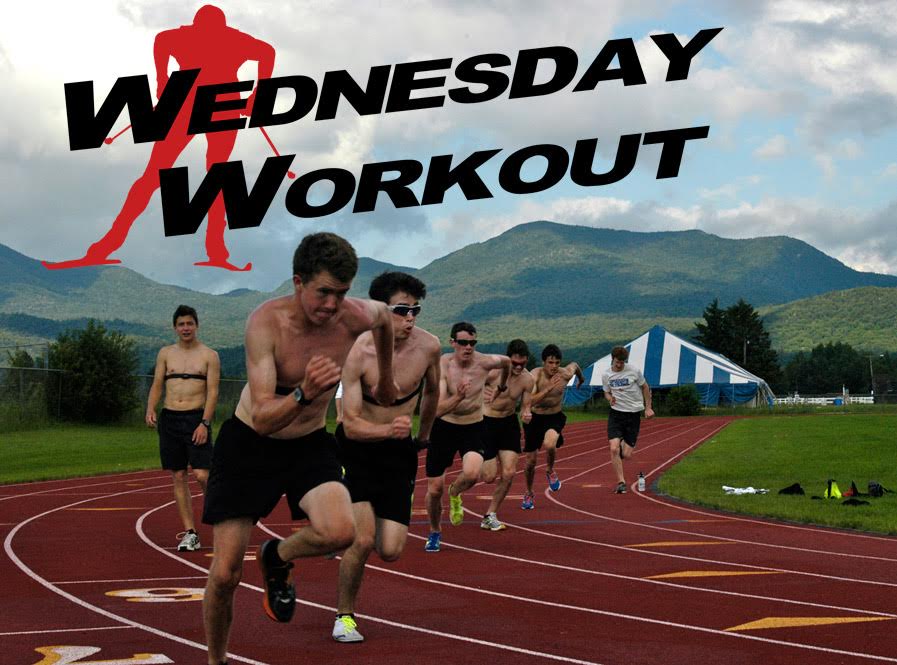
    Nakkertok skiers hard at work during a track workout in 2013. From left to right: Isaac Alexander-Cook, Kyle Curry (St. Lawrence University), Cary Pomeroy, Phil Marshall, Brendon Howard, Symon Stowe, and Patrick Van Walraven. (Photo: Jesse Williams)
    Nakkertok skiers hard at work during a track workout in 2013. Read more about their team and Level 3 running loops workout. (Photo: Jesse Williams)

    FS Editor Alex Kochon submitted the following, adapted from a Combo Track Workouts article by Runner’s World, as a sort of self-help, get-back-into-shape-with-limited-time article, but the workouts can be suited to super-fit athletes as well. 

    ***

    We know the reason you ski is your love for variable terrain, ever-changing scenery and snow, but sometimes, you’ve just got to get a workout in. And in the summer, those feeling a lack of “me-time” might find they can work up one heck of a sweat in minimal time at a local track.

    At least I have.

    As a new mom, I’ve been struggling with the idea of training. I set a loose goal for a race I wanted to do in September, and stupidly picked a triathlon. Now, one week out from the big event I have yet to swim more than a few floppy freestyle strides, done mostly to cool off.

    Needless to say, I’m not racing next weekend. But I have been running. And at least a couple times, I revisited the track after a LONG hiatus, and I did speed work.

    The best thing about track workouts is you can easily measure progress. I’m not suggesting that skiers need to do this frequently or even regularly, but an occasional speed session measured by mindless laps around a 400-meter track and a trusty stopwatch (and headphones, if you’re running solo and could use the extra motivation) can give an added boost to your endurance training.

    I recently tried some combo workouts, adapted from Runner’s World (RW).

    “Your training should be diversified and well-balanced,” RW contributor Kristin Barry wrote. “It should have a mix of different types of workouts and pace variation — V02 max intervals, tempo runs, progression runs and near maximum speed intervals. Each of these is an important piece in a balanced program.”

    Barry gave some ideas for incorporating a variety of paces into a single workout: thus, the combo workout, which are great for saving time as well (i.e. if you can’t get a two-hour workout in most days). Some of these I’ve cut short or abbreviated for the purpose of saving time — and easing back into shape.

    From Runner’s World, Oct. 2011:

    • Workout #1: 20-minute tempo, 3 X 1,000M at 5 k pace or faster

    (Total: 20 minutes at half-marathon pace + 3 kilometers of faster 1,000-meter repeats, with 6-9 total minutes of recovery in between)

    How: Begin with an easy 15-to 20-minute jog. After warming up and doing a few strides, run for 20 minutes at approximately 10-mile or half marathon race pace. Jog 400m and then go immediately into 1,000m repeats at 5K pace or just faster. Take 2-3 minutes rest between each 1,000m repeat.

    When: This workout is best performed well into a training schedule when your fitness is relatively high, as it’s a fairly demanding, challenging workout.

    Why: In addition to targeting lactate threshold, this workout allows you to practice running goal 5K pace on fatigued legs and simulates what the last mile of a 5K feels like. It’s a great confidence booster and good workout to go back to mentally when your legs begin to tire in the last third of a 5K.


    • Workout #2: 2 X 6:00/5:00/4:00/3:00/2:00/1:00

    (Total: 42 minutes + 15 minutes recovery in between)

    How: After an appropriate warm-up, run each timed interval followed by a minute recovery jog; take a 5:00 recovery jog between the two sets. Run the 6:00 interval at marathon pace, the 5:00 interval at half marathon pace, the 4:00 interval at 10K pace, the 3:00 interval at 8K pace, the 2:00 interval at 5K pace and the 1:00 interval at 3K pace.

    When: This is a great early season workout, a rust buster of sorts. It allows you to become familiar again with faster running without hammering 1200m repeats right away.

    Why: This workout touches upon many different paces and encourages Hudson’s notion of keeping all systems fit and not neglecting any particular component of running fitness. It provides tremendous variation in both pace and intensity. As mentioned, Hudson believes it’s important to have a high level of non-race-specific fitness before beginning race specific workouts, and this workout addresses all the fundamentals.


    • Workout #3: 2 X 3,000M/2,000M/1,000M

    (Total: 12 k + 16 minutes recovery in between)

    How: After warming up, run 3,000m at tempo pace, or approximately half marathon pace. Take a 2:00 recovery jog and then run 2,000m a bit faster. Take another 2:00 recovery jog and then run 1,000m at 10K pace or faster. Then jog for 4:00 and repeat the set.

    When: This workout can be used at various points during the season. Hudson has his athletes run 10K pace for the 1,000m interval earlier in the season and has them bring it down to 5K pace later in the season as their fitness improves. The key is that as fitness advances, the intervals-particularly the 1,000m interval-become progressively faster.

    Why: This workout is designed to bolster power endurance, which Hudson defines as long intervals that support the specific endurance needed to run your best in a goal race. Hudson says specific endurance is “the type of endurance that is needed to maximize performance at a particular race distance. It is the ability to resist fatigue at your goal pace long enough to reach the finish line without slowing down.”


    • Workout #4: (5 X 400M)/MILE + (5 X 300M)/1200M + (5 X 200)

    (Total: 7.3 k, or 4 1/2 miles, with 37 minutes recovery in between)

    How: After warming up, run 5 x 400m at approximately 3K pace with a minute rest between each repetition. Jog for 5-6 minutes and then run one mile at approximately 10K pace. Take another 5:00 jog and then run 5 x 300m at about mile pace with a minute rest between repetitions. Jog 5:00 again and then run 1200m at 5K pace. Once again, jog for 5:00 and then run 5 x 200m at mile pace or faster with a 2:00 recovery jog between each repetition.

    When: Performing this workout in the final few weeks before a goal race accomplishes a bit of sharpening and also aids the neuromuscular coordination needed to run at goal pace.

    Why: This workout provides a solid measure of speed training, which boosts neuromuscular fitness and running economy. Work done at near maximal speed-the 200m repeats at the end of the workout at faster than mile pace-makes all other running paces more economical. Furthermore, this workout helps you practice maintaining strong running mechanics while under great stress.

    Read more

  • Wednesday Workout (PPP Bonus!): Ride/Run & Run/Play with Sarah Max

    Wednesday Workout (PPP Bonus!): Ride/Run & Run/Play with Sarah Max

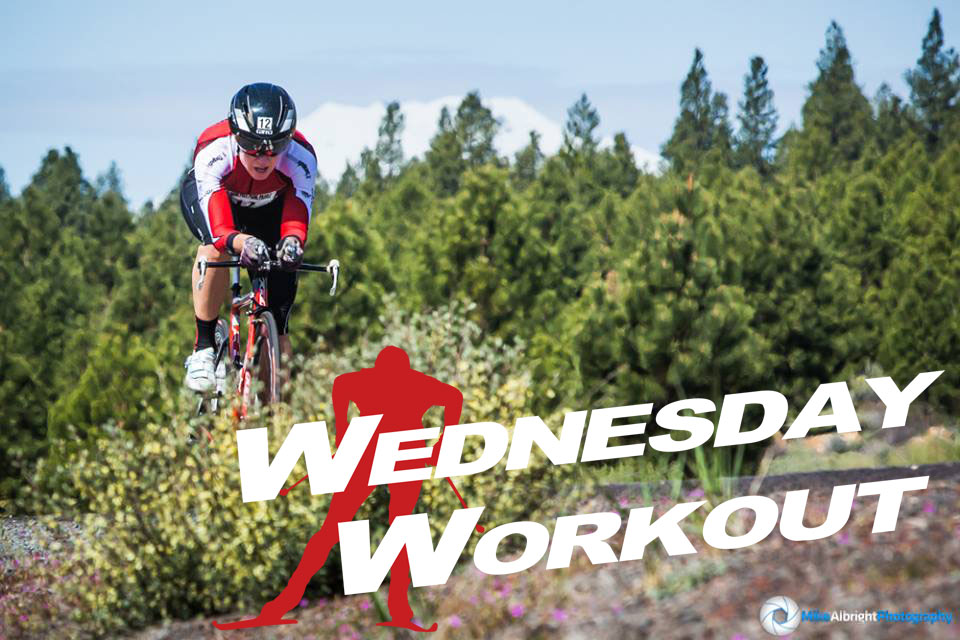
    Sarah Max (XC Oregon) on her way to winning her fourth Pole Pedal Paddle title on May 17 in Bend, Ore. (Photo: Mike Albright/Mike Albright Photography)
    Sarah Max (XC Oregon) on her way to winning her fourth Pole Pedal Paddle title on May 17 in Bend, Ore. (Photo: Mike Albright/Mike Albright Photography)

    After racking up her fourth Pole Pedal Paddle (PPP) victory on May 17 in Bend, Ore., Sarah Max got back to her day job as a financial writer (for publications like The New York Times, Barron’s, Entrepreneur, and Money Magazine) and executive editor of 1859 Oregon Magazine. At 39, she’s a mother of 11-year-old twins, yet Max still finds time to train and race with XC Oregon in Bend, focusing on ski marathons throughout the winter.

    Sarah Max during a cyclocross race. (Courtesy photo)
    Sarah Max during a cyclocross race. (Courtesy photo)

    “I’ll probably stick with a similar program as the last couple of years, which is a few bigger races, ideally in fun locations,” she wrote in an email. “Next year I may go do the Norwegian Birkie again. (I’m not a great classic skier, so like the challenge of a long, hard race.) I will probably do American Birkie again too… It’s just a nice, hard race.  I usually do Boulder Mtn Tour every year, partly because my whole family likes to go — though that course doesn’t suit me. I like to ease my way into a race, and there is none of that there.”

    After her seventh solo PPP (she’s also done it other times with a team), Max will likely move on to cyclocross races in the fall and some off-road triathlons or other multi-sport events this summer. This Saturday, she’s doing the Hood 2 River Relay for the first time as a pair.

    In preparation for the PPP, she wasn’t overly regimented with her workouts (especially after winter of ski training), but she did work on running (see below). 

    ***

    After a winter of planned workouts, I generally don’t follow a training plan for the Pole Pedal Paddle. This year followed a similar script. Starting about six weeks before the event, I tried to get in most of the major events (ski, bike, run and paddle) about twice a week, with some doubles on a few of those days. Skiing was lowest on my list of priorities since I already had ski fitness and didn’t want to use up precious training time driving to and from Mt. Bachelor. Plus, I was ready for a change of pace.

    Sarah Max on her way to another Pole Pedal Paddle victory on May 17 in Bend, Ore. (Photo: Neil Korn/BendOR Magazine)
    Sarah Max on her way to another Pole Pedal Paddle victory on May 17 in Bend, Ore. (Photo: Neil Korn/BendOR Magazine)

    Most of my workouts were short, usually about 45 minutes to 90 minutes tops. My thinking was that since I have a pretty big base going into the spring – training for the 90km Swedish Vasaloppet is good for that – endurance wasn’t as important as sports specificity.

    Up until a couple weeks before the race, I planned my workouts around the weather, which always a crapshoot in the spring in Bend, and what my friends were doing. Probably the best thing about training for something with so many different legs is it opens the universe of workout buddies.

    To recap, the PPP is a short alpine ski, followed by an 8km skate, 22-mile bike, 5-mile (ish) run, 1.5 mile paddle and short sprint to the finish.

    The hardest part of the race for me, and probably most individual racers, is the run. The run in and of itself isn’t bad. It’s when you do it after alpine skiing and Nordic skiing on icy conditions, then going hard on the bike. The first 10 minutes of running always hurts. A good way to prepare for this is to tag on a short run to most of your bike workouts or do a quick bike before your longer runs. In the triathlon world this is known as a “brick,” an apt term for the discomfort of biking then running.

    Here’s one workout I did along those lines.

    The Plan: 1 hour 15-minute road ride followed by 15 minute run.

    Warm up: My house is on the road heading toward Mt. Bachelor, which is the PPP bike course. I started out my door riding easy for the first 20 minutes, where the grade is relatively gentle.

    Uphill intensity: When I hit the steeper section I started a 30-minute tempo workout, keeping my heart rate about five beats below threshold. Normally I would let myself climb out of the saddle for the steeper stretches, but I tried to stay seated for most of this.

    Downhill speed: At about 50 minutes total, I turned back for the downhill. Rather than just coasting, I tried to keep pedaling through the downhill and working the few uphill sections and flats going back to my house. I can usually get back down the hill in half the time it takes to get up.

    Transition: With my garage as my staging area, I changed out of bike shoes and helmet and into running shoes. Though it was tempting to go in the house and check email, change out of bike shorts, I tried to keep the transition quick, for maximum discomfort going into the run.

    Ugh, the Run: Probably the most important thing about the bike to run transition is knowing that it will hurt and that you will feel slow. I play different mind games to get through the first 10 minutes, anything to just keep my legs moving. After about 10 minutes, like clockwork, things improve immensely. Though I’d planned to just run 15 minutes, I ended up going about 30 minutes.

    Cool down: Since the hard part of my workout was the bike, my run was effectively a cool down. That said, I usually slow things down for the last five minutes and walk another five minutes. I try to stretch a little before I head back into the house… not always successfully.

    Here’s another notable workout, mostly because it illustrates the crazy logistics that go into training for and doing this race:

    The plan: 1 hour run and soccer/paddle

    A week before the race, my twin daughters (11 years old) wanted to run the PPP course. They competed on a team this year, with Izzy doing the Nordic ski and Fiona doing the run, which was 2.5 miles for teams 12 and under.

    My husband, Kevin, and I loaded my surf ski onto my car, and we all piled in – dog included. Kevin dropped us off at the start of the run course. While my girls and I ran the course, he drove the boat to the boat put-in at the river and took our dog for a run.

    After a pretty quick run lead by Fiona, the girls helped me unload my boat and get it into the water. They grabbed their soccer balls and had a kick around, and I banged out a 30-minute paddle.  An hour after we left our house, we all loaded back into the car.

    Sarah Max (r) with her "twin," Amanda Porino, her support person who surprised Max by dressing as her for the Pole Pedal Paddle on May 17. (Courtesy photo)
    Sarah Max (r) with her “twin,” Amanda Porino, her support person who surprised Max by dressing as her for the Pole Pedal Paddle on May 17. (Courtesy photo)
  • Wednesday Workout: Early Season Agility with the Alberta World Cup Academy

    Wednesday Workout: Early Season Agility with the Alberta World Cup Academy

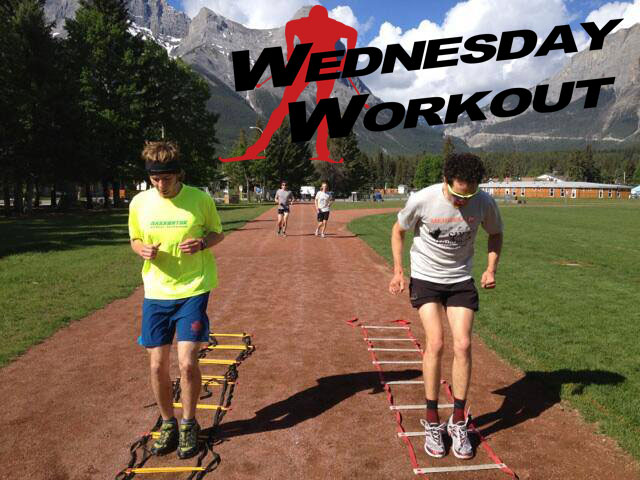
    Zeke Williams (l) races through the ladder during a track workout with Alberta World Cup Academy teammate Yannick Lapierre in Canmore, Alberta. (Photo: Stefan Kuhn)
    Zeke Williams (l) races through the ladder during a track workout with Alberta World Cup Academy teammate Yannick Lapierre in Canmore, Alberta. (Photo: Stefan Kuhn)

    This week’s workout comes to you from Ezekiel “Zeke” Williams, FasterSkier’s newest intern and an athlete at the Alberta World Cup Academy in Canmore, Alberta. This time last season, Williams said he really enjoyed doing what his team called, for lack of a better name, the Agility Sprint Track Workout.

    ***

    Canmore Alberta may be known for its skiers rather than its track stars but it still has a short 300-metre stone-dust track. And this is where the Alberta World Cup Academy men’s team was to be found, more often than not, on Thursday mornings in May and June 2013. As the athletes warmed up the coaches set up a pair of agility ladders on one of the track’s straight-aways and hurdles on the other. Finally, the coaches would draw ‘finish lines’ at about 10-seconds worth of sprinting past the end of the obstacles.

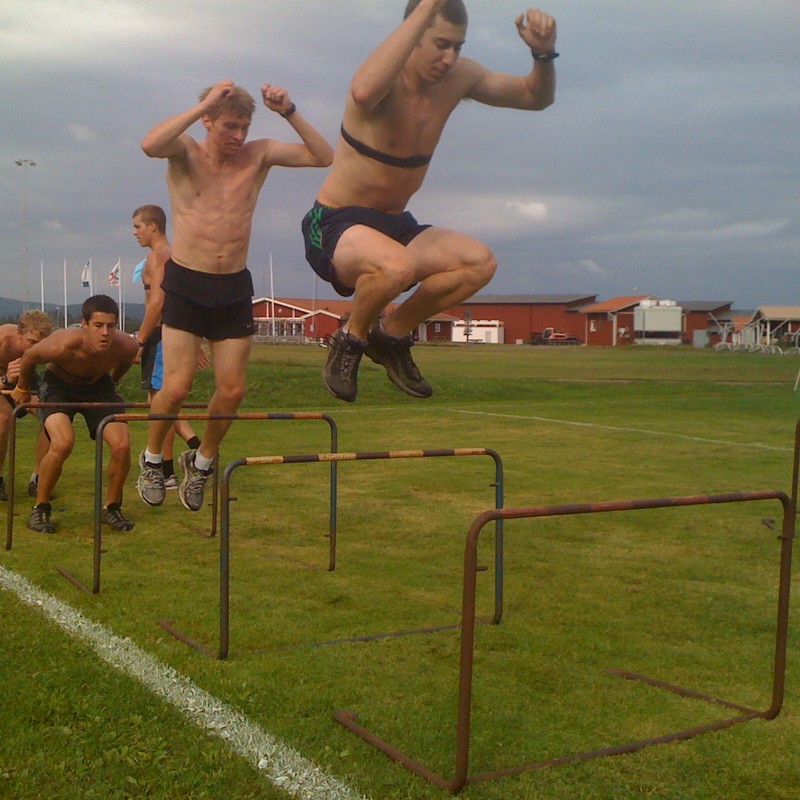
    After warming up we would partner up and do laps of the track. We would focus on speed through the agility ladders and hurdles and then sprint out of them. Then we’d slow back down to an easy jogging pace until we hit the next feature.

    The Workout: Agility Sprint Track Workout

    Total time: 1 1/2 hours

    Need: A track, running shoes

    Warm up: 30-minute jog

    10 track laps: 20 x 10-15 second sprints with about 1 minute easy jogging between each. Whole thing takes just over 20 minutes

    Cool down: 40 minute jog

    I like this workout for two reasons. First, it’s a lot of fun to do! Getting to race through the ladders and the hurdles against a teammate makes it a sweet competition.

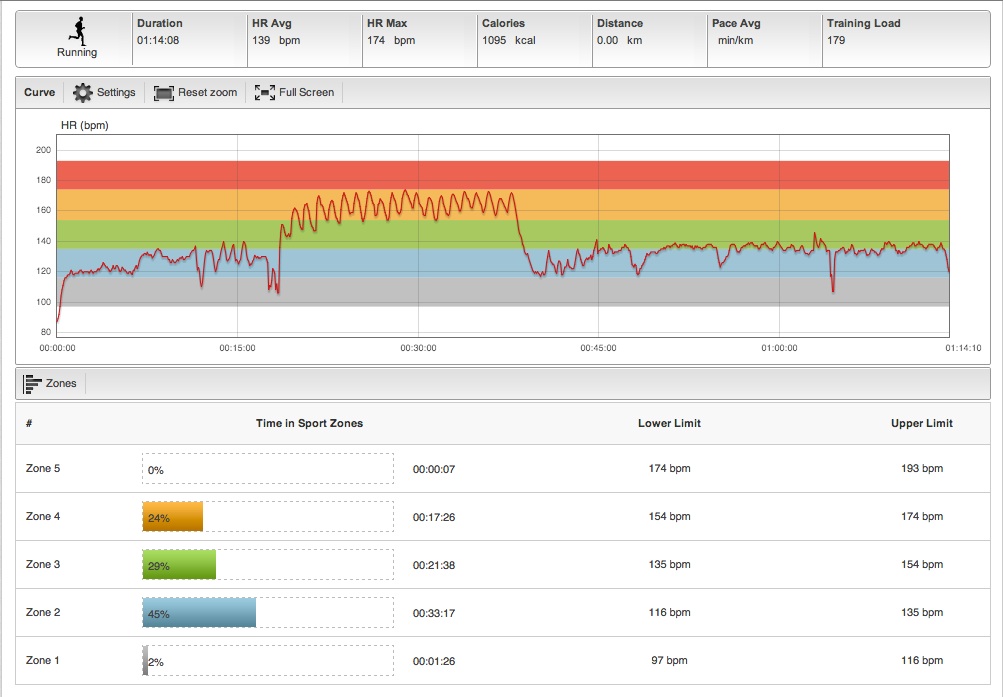
    Heart-rate data from Zeke Williams' workout: track laps are between about 18 and 38 minutes.
    Heart-rate data from Zeke Williams’ workout: track laps are between about 18 and 38 minutes. 

    Second, the workout gives a bunch of training benefits. At first glance it looks like a speed workout, but heart rate ends up at lactate threshold for most of the time because of the shortness of the sprints and the minute of easy jogging between them. Check out my heart-rate log during a similar workout here.

    Also, the agility component of the workout improves coordination at speed, which is nice to stay in touch with for when we get back into rollerski sprinting.

    Combine the agility work and lactate threshold building into the short 1:30 hour workout time and it makes for a solid early training-season session.

    ***

    About the Author: A Canadian cross-country ski racer with the Alberta World Cup Academy, Zeke spends most of his time in Canmore, Alberta, but calls Cantley, Quebec, his home. He thinks that you can learn a lot about a person from their goals — his is to ski really fast on the Winter Olympic race course in 2018. Check out his blog: ezekielwilliams.ca
    Zeke Williams, FS Intern
    Zeke Williams, FS Intern
  • Stay Cool! It’s Gonna Be Another Hot One

    Stay Cool! It’s Gonna Be Another Hot One

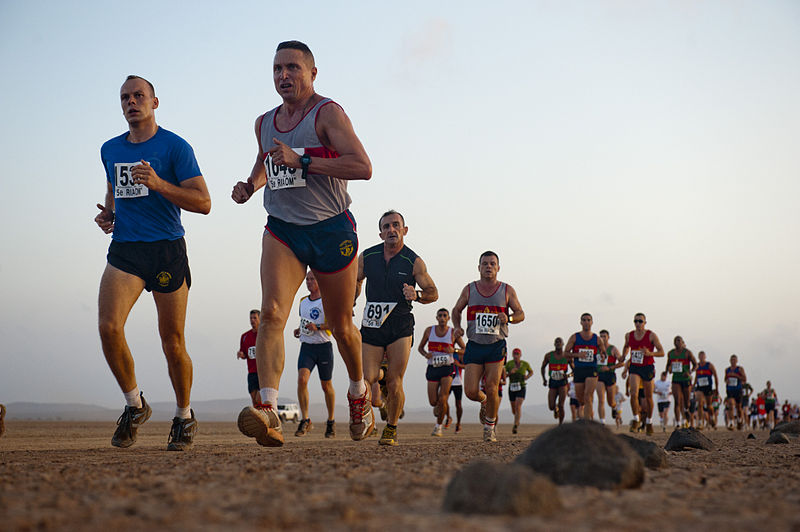
    A row of rocks define the course at the 29th annual Grand Bara 15K race in the Grand Bara Desert, Djibouti. More than 250 members from the Combined Joint Task Force - Horn of Africa and Camp Lemonnier competed in the race. (Photo: Wiki Commons)
    More than 250 members of the U.S. Navy cross the Grand Bara Desert at the 29th annual Grand Bara 15K race in Djibouti on Dec. 8, 2011. (Photo: Wiki Commons)

    So it’s 85 degrees outside. Big deal, you think. I’ve run races on warmer days than that, I’ll probably have to compete in even hotter weather sooner than later.

    You delay your run a little longer and it starts to drizzle outside. Perfect – now it’s going to cool off – so you wait even longer until it stops. By the time you step out for your one-hour jaunt, it’s about 87 degrees with a relative humidity of at least 90 percent. The Heat Index, or Real Feel, is in fact 109 degrees Fahrenheit, and you’re about to suffer.

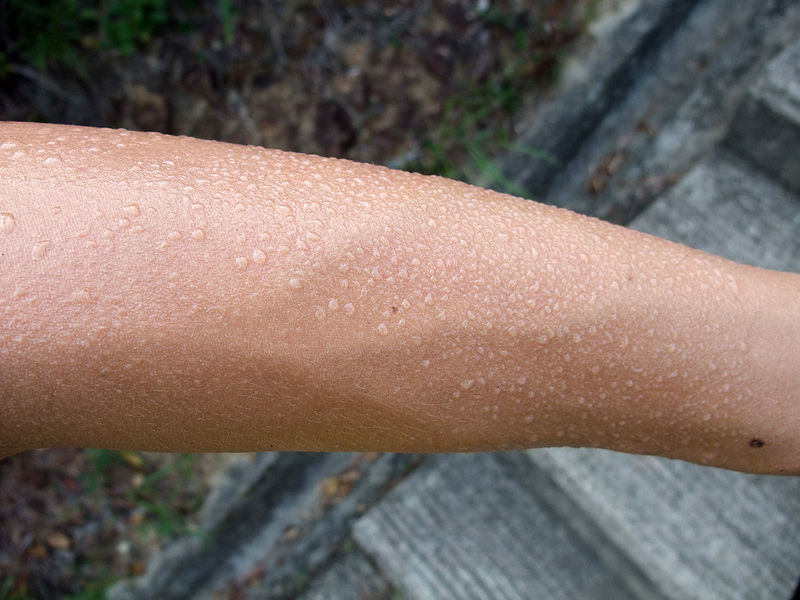
    As body temperature rises, sweat glands produce droplets to get the heat out, Runner's World explains. Humidity prevents that sweat from evaporating, and  if there's no breeze, you could be screwed (unless you're hydrating properly). (Photo: Wiki Commons)
    As body temperature rises, sweat glands produce droplets to get the heat out, according to the Runner’s World August 2013 article, Sticky Situation. Humidity prevents that sweat from evaporating, and if there’s no breeze, you could be screwed (unless you’re hydrating properly). (Photo: Wiki Commons)

    Now is not the time to be a tough guy or gal. Take it easy out there, know your limits, and take care of yourself after.

    Across the U.S., people from sea-level towns to high-elevation dwellings have been or are still in a heat wave. You wake up: it’s muggy. You go to bed: it’s muggier.

    Day after day of this kind of weather can make it tough to keep with an outdoor training regimen, especially if you can’t get out first thing in the morning. But the reality is, heat bites – even if you’re a seasoned athlete who’s dealt with humidity for years.

    So before you drag yourself to the nearest gym for an air-conditioned treadmill workout, consider the following to keep yourself safe during and after an outdoor session. Above all, rehydrate, refuel and rest to prevent major setbacks from something as simple as heat cramps (ouch!) to heatstroke (yikes!).

    What’s the difference?

    According to MayoClinic.com, heat cramps are painful muscle contractions, most commonly in the calves, quads (thighs) and abdominal muscles. If you’re waking up in the middle of the night with charley horses (painful muscle spasms in your legs), this could be the culprit. Be sure to replenish lost fluids after every workout with plenty of water (measure by your level of thirst) as well as electrolyte-enhanced sports drinks (i.e. Gatorade, G2, and Nuun).

    Heat exhaustion can bring one’s body temperature to 104 degrees Fahrenheit (40 Celsius) and lead to heat stroke. Signs include nausea, vomiting, headache, fainting, weakness and cold, clammy skin.

    As your body temperature rises, so does your heart rate and brain temperature, Runner’s World reports. “Your ability to assess your own body temperature will become difficult (runners often report feeling chilled or goosebumpy when they’re overheating). You can also start to lose control of body mechanics (your form and footing will get sloppy), and your mental abilities may start to break down (you may feel dizzy or disoriented).

    Heatstroke is bad. According to MayoClinic, it’s a life-threatening emergency condition that occurs when your body temperature is greater than 104 F (40 C). Your skin may become hot and you might find yourself sweating uncontrollably (the body trying to cool itself), and you could become confused or irritable. If you’re showing some serious signs, it’s probably best to seek immediate attention to prevent brain damage, organ failure or even death.

    So how can you stay cooler?

    1. Get out earlier or when the Heat Index (temperature combined with relative humidity) is lower.
    2. Stick to shaded paths, not “heat-absorbing roads,” Runner’s World advises.
    3. Stay near bodies of water (often cooler than inland)
    4. Alternate between harder and easier efforts (not so much intervals but normal pace broken up by extra recovery breaks)
    5. Wear a visor instead of a hat (your body releases heat through the head)
    6. Keep some distance between you and your training partners to keep from soaking up their body heat, says Runner’s World.
    7. Bring water and sports drinks for workouts lasting longer than an hour, and sip often (aim for every 15 minutes).
  • Scott Jurek: How Skiing Molded His Ultra Career

    Scott Jurek: How Skiing Molded His Ultra Career

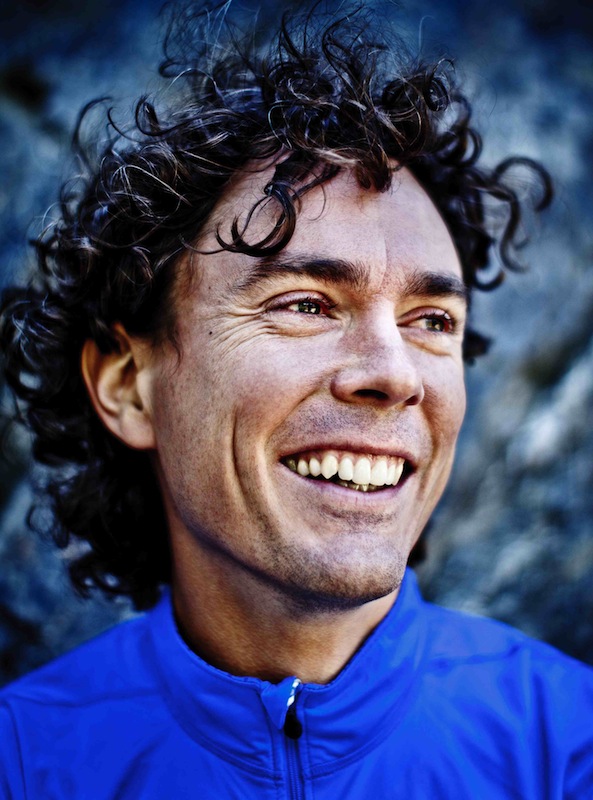
    Scott Jurek. (Photo: Ben Moon)
    Scott Jurek. (Photo: Ben Moon)

    “The skiing background definitely helped me. The mental toughness, the training — the mountain races I do aren’t strictly running, they kind of blend that mountain, woodsy perseverance you have to have …  Road racing is much different than running ultras in the mountains, and I think skiing prepared me for that.”

     Scott Jurek

    BOULDER, Colo. — In the world of endurance sports, Scott Jurek is one of those athletes whose accomplishments speak for themselves. As an ultramarathon runner, the Minnesota native has built his career and reputation around running races of 100 miles or more at a pace faster than most can complete a 5 k.

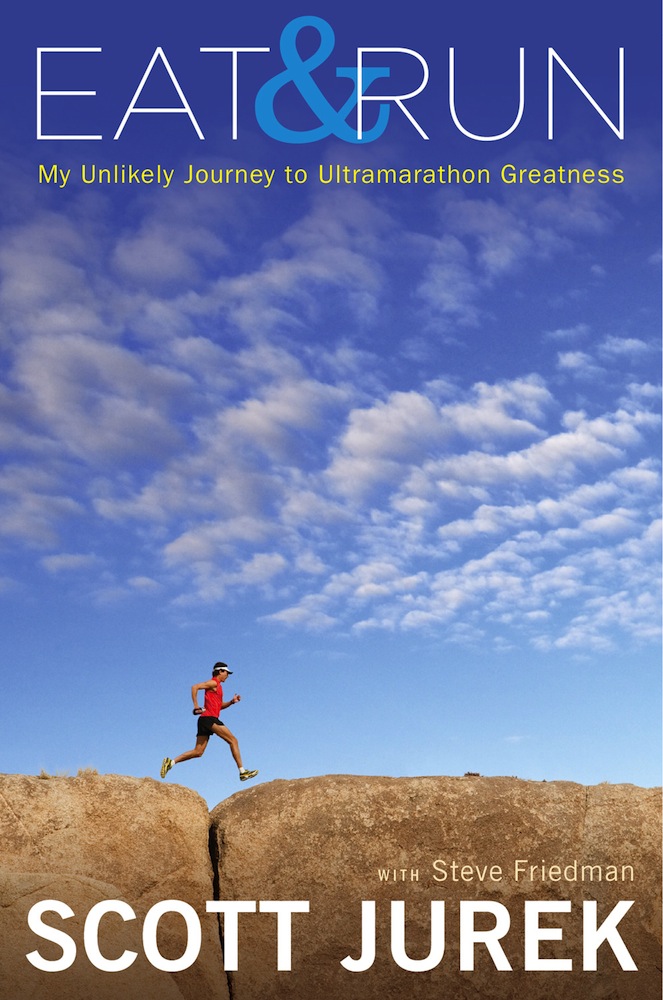
    Because it’s summer, and every skier is inherently a runner, I decided to find out whether the man who ran 165.7 miles in 24 hours in 2010 to set a U.S. record had anything relevant to say to our target audience about mental toughness and love of sport. I already knew, from reading his recent book Eat and Run: My Unlikely Journey to Ultramarathon Greatnessthat Jurek began competitive racing as a member of his high school’s cross-country ski team in northern Minnesota, and that he credits skiing with instilling in him the qualities necessary to excel at running long distances.

    Jurek’s skiing background and subsequent ultra success is not the only reason I wanted to interview him. As a recreational runner and casual fan of the sport, I was curious to find out what keeps someone so inspired throughout a long career. For nearly two decades he has dominated the ultra scene, winning 35 major titles and setting 16 course records.

    Now 39 years old, Jurek has probably reached the height of his career; when he turns 40 later this year and becomes a master, he’s said he doesn’t expect to continue racing as much as he in his earlier years. But he when he lines up to start the Leadville 100 in August, a race in which he was runner-up in 2004 and where he has since paced other runners, he will still be considered a favorite.

    As with every athlete that becomes successful, people want to hear Jurek’s story. Aspiring runners want to know his origin story and his running secrets so they can replicate them. Friends told him for years that he should write a book, and last year Jurek finally published Eat and Run, three years after featuring prominently in Christopher McDougall’s Born to Run.

    Upon meeting Jurek, I could see why so many admire him. He is good as his job, of course, and aspiring athletes look up to the best. The amount of time he’s spent at the top of his sport is enough to make him a hero to masters and teenagers alike.

    Jurek’s sport requires so much effort and force of will to train for and compete in. The idea of simply completing 100 miles is staggering. But at the height of his career, Jurek was the very best. A recent article in Slate about the people who seek out the pain of ultras began by calling him “an ultramarathon running god.”

    Beyond his accomplishments, Jurek’s philosophy about running and life have made him into one of those athletes the ordinary weekend warrior can relate to. Part of his point about running, skiing or any life pursuit is that you have to love what you do for what it is, not just when you have success.

    “Whatever quantitative measure of success you set out to achieve becomes either unattainable or meaningless,” he writes in Eat and Run. “The reward of running — of anything — lies within us … We focus on something external to motivate us, but we need to remember that it’s the process of reaching for that prize — not the prize itself — that can bring us peace and joy.”

    In a sport that pushes his mind and body to their limits for large stretches of time, often while he’s alone, Jurek has found this approach to be especially important. He describes his book as the story of his transformation; he didn’t always look at competing as part of a process, just as he didn’t always follow a vegan diet. Jurek’s career is filled with experiences that taught him hard lessons.

    During the 2005 Badwater Ultramarathon, a 135-mile race through Death Valley, Jurek’s crew had to submerge him in a cooler full of ice to cool down his core temperature at the 48-mile mark. Jurek acknowledges in the book that he underestimated the race. As he writes many pages later, “To run 100 miles and more is to bring the body to the point of breaking, to bring the mind to the point of destruction, to arrive at that place where you can alter your consciousness. It was to see more clearly.”

    Eat and Run was published in 2012.
    Eat and Run was published in 2012.

    Jurek ended up winning Badwater that year and set a course record in the process: 24 hours, 36 minutes. And it was on the ski trails of northern Minnesota that he first learned to push his mind and body past their limits.

    Jurek began skiing as a sophomore at Proctor High School in 1989 under the tutelage of Glen Sorenson, who coached the program until he retired in 2010. As Jurek explains it, he became fully invested in skiing after his introduction to the sport. He went to Team Birkie ski camps at Telemark Lodge in Cable, Wisc. He went to Junior Nationals as a high school senior in 1992 in Rumford, Maine. When he began college at St. Scholastica, before it had a ski program, he continued to train for local races and the American Birkebeiner.

    “Skiing was a sport that I really loved and really got passionate about,” Jurek says.

    To stay in shape for skiing in the summer, he ran. A lot.

    “I didn’t have a good bike and couldn’t afford rollerskis, so I just ran,” Jurek said. “Prior to that, I didn’t really like running.”

    What started as a training tool in high school eventually became his life’s focus. The transition was gradual at first — after high school Jurek still trained for ski races — but at a certain point he realized he didn’t have the finishing speed for races that only took an hour or less. He was in the market for another competitive outlet, and ultramarathoning came along at the right time.

    “I was really loving skiing, but had that realization that I was just not at that level where I needed to be,” he said. “I didn’t have that top-end speed for 5 k’s, 15 k’s, even 25 k races. Ski marathons I did better [in], but I started hitting that point where I was like, ‘OK, this is not something where I’m going to be able to hit that elite level’ … I was at that phase where I was looking for something else to satisfy that athletic desire and passion.”

    Jurek’s friend and training partner, Dusty Olson, invited him to do a 50-mile running race in 1994, the Minnesota Voyageur. Jurek placed second and found his calling. Today, he is grateful for his path to ultra running through skiing.

    “The skiing background definitely helped me,” he said. “The mental toughness, the training — the mountain races I do aren’t strictly running, they kind of blend that mountain, woodsy perseverance you have to have …  Road racing is much different than running ultras in the mountains, and I think skiing prepared me for that.

    “The people I met through skiing also prepared me, from a mental standpoint,” he continued. “Training, work ethic; they were just a unique breed of individuals. There are never two nordic skiers alike and I think that helped shape me, too.”

    Jurek thinks his background in skiing has given him a competitive advantage over runners who come to ultrarunning from road racing.

    “There’s a huge strength and power component,” he said. “It’s not just the smallest, lightest individuals who are winning ski races. It’s definitely a power sport, and ultramarathoning is like that, as well. You have to have the stability and strength to navigate the rocky trails, the technical descents, and power yourself uphill. And that power walk uphill that I learned in skiing, that comes in handy in ultramarathoning.”

    These days, Jurek occasionally gets out on skis. Running six hours a day or more takes up a lot of his time, as do the speaking and outreach engagements he has increasingly dedicated himself to as he’s transitioned more into the giving-back phase of his career.

    We talked for over an hour in a coffee shop about his approach to running and life, his vegan diet, the changing nature of the ultrarunning scene, and the up-and-coming athletes that are now taking up his mantle. I must have confused him with the variability of my questions — wasn’t I supposed to be writing a story for a ski-specific audience? — but he gamely gave thoughtful answers to each of them. Halfway through it I noticed my half-drunk coffee was cold and the fan-girl nerves I’d experienced at the start of our conversation had evaporated. I suddenly had the urge to go home later, put on my running shoes and spend the remainder of my afternoon galloping through the Flatirons.

     ***

    The remaining interview has been edited and condensed.

    FasterSkier: You’re probably the most recognizable name in the sport of ultrarunning, thanks to the longevity and success you’ve had throughout your career. You’re 39 now. What are you training for these days?

    Scott Jurek: I’m running the Leadville 100 in August, staying local. I’ve only run one other time, in 2004, when I did the Grand Slam and placed second there. It’ll be fun. Now that I’m a Coloradoan — I’ve been here for a couple years — I figured I’ve got a pretty good chance at altitude.

    FS: When you line up for these big ultras, are you still considered a favorite?

    SJ: This sport, it’s interesting. My strengths are not 50 k and 50 miles any more. I’m going to turn 40 this year. While it’s still young, I’ve been racing for a lot of years and I’m not as fast at the shorter distances…There’s so many new people coming into the sport that sometimes I feel like I can hold my own in the longer races but I wouldn’t say I’m always the favorite. In the shorter races, definitely not…

    I’d say now, winning is great, but at this point in my career — sure I want to win a couple things, it’s good to have motivation and that drive and that ego to want to excel and win. But now I’m at the point where I love being out there and inspiring people and now I’ve taken on more of this role where, I’ve done a lot of speaking and education throughout my career, but now I feel like I’m transitioning, dedicating more time and energy to that. The amount of travel to speak really takes away from just training. It was easier, I think sometimes, when I was working full time 50+ hours and had my own physical therapy practice, and training, than like now, traveling the country and speaking and still having to train and find time to do all these things.

    It’s a little more complicated now, but I feel like it’s still rewarding. I think with all careers and all passions you transition to different phases, and I’d say right now, probably, I’m transitioning into less competition eventually in the next couple years but will still be involved in the sport and continue to speak and volunteer.

    FS: Are there any young athletes you feel like you’re passing the torch to right now?

    SJ: I run with a bunch of younger guys in town like Tony Krupicka and Dakota Jones. Dakota is 22 now. Like, I’m practically old enough to be his dad. I think in general, maybe I’ve influenced the sport and some of these younger guys and gals in the sport.

    But Kilian Jornet, to relate it to skiing: he’s super special. He’s an amazing athlete. He does ski mountaineering in the off season. He’s better than I ever was, probably, because of his ability to do vertical kilometer races to ultramarathons to ski mountaineering. It’s just amazing, the range that he has and what he can do with it.

    But I wouldn’t say there’s one person. There was never a point where I felt like it was being passed onto me. It’s like, follow these people and somebody’s going to rise to the top. And how long they stay with it, that’s one thing you’ll see with ultramarathoning, you’ll see all these young guys and gals come in in their 30s and 40s, they train and race really hard for a few years and then they get tired and burnt out and they just decide not to do it anymore.

    So I think like longevity in the sport will be interesting to see. I talk to my buddies, ‘Do you think you’ll be running really hard in your 40s still?’ And they’re like, ‘Oh yeah, I’ll be doing this!’

    I think that’s key, just to keep that passion burning for longevity in the sport, is make sure it’s part of your lifestyle. And that’s something I think I’ve done. I have a pretty healthy relationship where it’s not just about competing and winning. I just love to be on the mountains, running on trails. I love to be out in the woods and even running on pavement. Just finding that rhythm, that stride, of being happy where you’re at, not having that focused, ‘If I can’t race at the top level does that mean all this training and racing I do is for naught?’ I don’t think that’s a healthy attitude.

    A lot of people, when they slow down, so many continue in the sport longer. I remember skiing with people like Charlie Banks when he was in his 80s. Just legends in the sport — George Hovland back in Minnesota. That’s neat, and when I think of the sport of ultramarathoning I think it’s key to have this long-term outlook on it and be inspired by that. Because so many people think, OK, if I can’t race hard like I used to, they get really frustrated and get depressed about getting old. You just have to ratchet back and remember what’s most important about the sport.

    That’s why I moved to Boulder, too, is to run with my younger buddies and be inspired by them and get inspired by the community here, from the skiers to the climbers to the cyclist and triathletes. That helps me, being around that environment.

    FS: Boulder is also an environment that makes it easy to have an alternative diet. Your veganism is featured heavily in Eat and Run, and you attached a vegan recipe to the end of each chapter. How would you sum up the way you talk to people about your diet?

    SJ: I would sum it up as this, because I think some people think, ‘Oh, Scott is totally plant-based, he’s a vegan, and that’s not for me.’ The biggest thing that I would say is that you need to be eating more whole foods, more traditional foods. Get away from the processed. That was the biggest thing for me, going vegan, was that I learned about all these other foods. I went towards more whole grains, legumes, vegetables and more fruits. I was a meat-and-potatoes, hunting-and-fishing type of guy from Minnesota, so it opened up this whole new array of eating.

    I think there’s so many distractions out there in terms of, what’s the best diet? Rather than try to say that my diet is the best, the best diet is just any one where you are eating super clean, whole foods in the traditional state, more organic. Basically, the way our great-grandparents ate is the way that I like to describe it to people. And I think that the more plants you eat, the more benefits you’re going to get. We see that in research studies. You see a lot of fads, whether it’s Paleolithic right now, or low-carb, those things help people because they stop eating a big chunk of the processed food. When you look at long-term effects of those things, there’s nothing wrong with carbohydrates. I think maybe people need to realize that okay, maybe it’s not the white sugar and white flour carbohydrates, but there’s nothing wrong with whole grains, legumes, fruits that have fiber and are rich with carbohydrates.

    It’s easier now [to access whole foods], but I don’t think that was a drawback when I initially transitioned because I really embraced the learning process. And I think that’s important because when someone wants to learn to eat better, or exercise better or take care of their life and lifestyle, you have to be involved in it and engaged. It’s easy to go and buy food somewhere that is prepared for you.

    That’s what I tell athletes, too. Putting effort into your diet is just like making an effort in your intervals or long workouts. It’s another part of that, it’s another component of the training system. I think it’s underestimated. I had buddies, even skiing buddies, who subsisted off of soda and little Debbie bars. You can get away with that when you’re young and it probably doesn’t affect the teenager who is training. But long-term, you see a lot of athletes who end up with cardio problems. You see heart attacks and diabetes. It’s a long-term outlook. For me, I want to keep running and going out in the woods skiing, and being able to do that is important to me.

    Most people that I talk to want to know how they can keep training into their sixties, seventies, or eighties, and it’s such an important part of their life. Whether it’s running or skiing, it’s kind of their thing that they need to keep in their life for mental balance and there’s so many components to it. In order to keep doing it, you need to take care of your body, and nutrition is really important.

    FS: You say in the book that you doubted for a while that it was possible to be competitive, athletically, if you weren’t eating meat. When did that change?

    SJ: It was right after I won my first Western States in 1999. I realized that if I could have success, it was just mental doubts. I think that is the biggest hurdle when people transition to a new diet, whether it’s a plant-based diet or some other diet – it’s something that’s in the back of your mind for a while. You have to just let it evaporate. For me, I was getting enough, but I still had my doubts. For years, we were told that you have to eat meat and animal protein specifically. It was a worry that didn’t pan out. I mean, you can definitely have a vegan diet that’s imbalanced, but if you’re paying attention to it and you’re involved in the process, then it’s not an issue.

    The benefits are huge for me. On race day it’s probably not going to make much of a difference, but in terms of recovery and day-to-day training and avoiding illness, it’s a big part of it. We’re tearing down our bodies and having to build it back up, and the more years you do it on a poor diet, it’s going to catch up to you. And the longer you go in a season, too, you have to provide your body with good fuel so it can recover and repair itself so you can go out and train hard the next day, the next year.

    FS: You’ve been in this sport a long time. How is ultrarunning different now from when you started, whether in terms of participation, sponsorships, prize money, those kinds of things?

    SJ: There were a couple athletes in those early years — Ann Trason, for instance — that were sponsored. But there was little to no prize money in the sport. In the ‘80s there was prize money but then the sport decided to go in a different direction. There was no prize money and [a desire to] just keep it true and pure. So there was that movement when I came it that, you know, ‘We’re going to stick to our roots and not have prize money.’

    And then that’s gradually changed. It’s an OK thing for the sport. Some say we shouldn’t have it, it’s going to change the atmosphere, but all sports change with time. It’s not like a ton of money and regardless, you have to have a passion, you have to enjoy the sport when you’re out there training. Like with skiing, you’re out there four to five hours a day… There’s so much time dedicated to it. On the weekends I’ll go for six, seven, eight-hour runs. So if you don’t love what you’re doing and you’re just doing it for the money, it’s going be a problem in ultrarunning. That’s not the sport.

    I’ve been fortunate lately, but it’s only the last four to five years that I’ve been able to be, quote, a professional athlete. I’ve always worked 40-50 hours a week for my job in addition to my training. So that’s different now; there’s more athletes able to live off the sport, live a very simple lifestyle. It’s kind of like in nordic skiing; certain groups can make a living at it but …most end up working a full or part time job just to keep doing what they’re doing.

    FS: Is there an ongoing discussion within the ultra community about development?

    SJ: Ultrarunning is in a real growth spurt as well as growing pains right now. The governing body is technically U.S. Track and Field. But most ultras, because most of them are on the trails, most ultrarunners don’t belong to U.S. Track and Field. They don’t see that as supporting the sport.

    Because it’s a longer distance, we don’t encourage kids to compete. However, I get a lot of kids when I go around to schools time to time, kids who really want to do an ultra because they think it sounds cool. They run their 10 ks and they want to run a half-marathon, a marathon. I’m not even sure that’s best. I think skiing does a good job of getting kids on the right path as far as distances.

    But you look at countries like Ethiopia where kids run twelve miles plus a day, just to and from school. So if it’s done at the right intensity, I think kids could run longer distances. But I’m not sure if how to think about, okay, how do we get kids into ultra running.

    In general running is on a big boom right now, with marathoning and half-marathoning and even kids running cross-country and track. I think if you can just keep it fun for kids, that is the most important. And keep it fun for adults! I think that’s why ultrarunning is growing. People are looking for something different from the road races they have been doing. They want to get out. Maybe they love skiing or hiking or backpacking, or fishing or hiking, and they get into ultrarunning because it allows them to connect with the outdoors and get out into the woods or the mountains, and get away from the concrete of the city.

    That’s something that we don’t want to lose, the fun aspect of the sport. Most people, I think, I’m sure they love the race, to have a goal, but it’s the day-to-day, getting out for the hour run, or the two-hour run on the weekends, or the three-hour run in the mountains. That’s something to live for. So as long as we keep it fun, and don’t just focus on the competitive side.

  • This Month in Journals: Drink Your Coffee to Race Fast; Are Supplements a Gateway to Doping?

    This Month in Journals: Drink Your Coffee to Race Fast; Are Supplements a Gateway to Doping?

    Is this just as important as what happens in the wax cabin? Photo: wikimedia user erobins through creative commons.
    Is this just as important as what happens in the wax cabin? Photo: Wikimedia user Erobins/Creative Commons.

    Welcome back to This Month in Journals, where we read the latest exercise and sports science and pull out some research that might be of interest to skiers.

    * Many skiers build coffee into their pre-race rituals – and it turns out, they should. For decades scientists have been finding that caffeine increases endurance in more mainstream sports like running and cycling. But finally, someone decided to look at caffeine’s effect on skiing.

    Published in Medicine and Science in Sports and Exercise online ahead of print, Dr. Hans Stadheim from the Norwegian School of Sports Sciences in Oslo and his team set ten high-level skiers on an 8-kilometer double-pole time trail; each participant did the test twice, one after ingesting caffeine and another time with a placebo. Eight of the ten subjects improved their times after taking caffeine, and overall the times dropped by about a minute and a half. This represented a four percent change.

    The researchers are excited about their results because they are the first to test this effect in a primarily arms-based activity; arm and leg muscles differ in both the types of muscle fibers that make them, and the amount of carbohydrates they use to extract different amounts of oxygen during exercise.

    The team not only showed that caffeine was beneficial for performance, but also gained some insight into its mechanism. For instance, they found that skiers who had ingested caffeine were able to maintain higher heart rates throughout the test, a difference of about five beats per minute. Skiers were also able to reach higher blood lactate concentrations after taking the caffeine. Finally, questionnaires showed that participants had lower perceived exertion and less pain during tests after taking caffeine.

    The size of the benefit gained by caffeine users was impressive, and the authors made sure to frame it as such.

    The improvement of 4% after ingestion of 6 mg · kg-1 CAF observed in the study would most likely effect results in real life XCS competitions,” they wrote. “Actually a reduction of 1:25 min to complete the 8 km C-PT is [analogous to] the time difference between the winner and 12th place in the 2011 World Championships relay… in Oslo.”

    Takeaway message? Don’t forget that cuppa joe on race morning!

    * Careful, though. A study published in the Scandinavian Journal of Medicine and Science in Sports suggests that the use of nutritional supplements changes people’s attitudes towards what is or isn’t acceptable performance enhancement.

    Dr. S.H. Blackhouse of Leeds Metropolitan University asked: are supplements a “Gateway to Doping?” They surveyed over 200 high-level athletes – just under half of whom used nutritional supplements – across 32 sports and received surprisingly honest answers. For example: 22% of the athletes who used supplements admitted to doping, while just six percent of the non-users did the same.

    The athletes were also presented with scenarios related to supplements and doping, and asked both what they would do and what they thought others would do. Supplement users had significantly more positive attitudes towards doping, and also were significantly more likely to think that doping was effective and would help them win.

    Interestingly, both groups said that they would prefer to compete in an environment where there was no doping. But supplement users perceived a greater pressure to dope, and also gave higher estimates of the percentage of athletes in their sport who were doping.

    “Athletes who engage in legal performance-enhancement practices appear to embody an ‘at-risk’ group for transition toward doping,” the authors wrote. “…This common practice may lead to a greater willingness to engage in doping behavior if athletes perceive the benefits of using NS have been fully realized and believe that doping is an effective enhancement method.”

    However, while the authors found the correlation between supplement use and propensity towards doping both significant and troubling, they didn’t fully accept the “gateway” mechanism that has been proposed both here and in other drug situations. Indeed, they questioned whether doping chronologically followed supplement use, or whether both were simply a symptom of the same thought process.

    The paper’s final discussion touched on two further issues. The true level of doping in sport is unknown: it is certainly higher than WADA’s adverse analytical findings log, which calculates a rate of about two percent. But how much higher is it? Previous studies have found projections ranging from six to 34 percent. The supplement users reported a 22 % doping rate and guessed that was about typical of the athletic population (although estimates ranged widely, with a standard deviation of 23).

    This highlights what may be a feedback loop. Regardless of the true level of doping, athletes who perceive doping to be more prevalent may feel more pressure to dope. In this study, the athletes who did not use supplements were either blissfully unaware of the scope of the doping problem, or were more realistic and optimistic than the supplement users. Either way, their perception of a lower rate of doping coincided with feeling less pressure to do so themselves.

    Finally, the authors pointed out that some substances, like creatine, are on the line between being considered illegal performance-enhancing drugs and simply nutritional supplements. For athletes who use and believe in supplements, these types of drugs may create confusion and influence their decisions as they move towards the world of doping.

    * A quick piece in the British Journal of Sports Medicine aimed to address whether the minimalist footwear craze is all it’s really cracked up to be. Specifically, is running in such “shoes” the same as running barefoot?

    Dr. Jason Bonacci led a team that put 22 distance runners through their paces barefoot, and also in minimalist footwear, racing flats, and normal training shoes. Their answer, based on biomechanics, was said best in their title: “Running in a minimalist and lightweight shoe is not the same as running barefoot.”

    When the runners were barefoot, they had shorter and quicker strides, even while running at the same speed. There were differences in knee and ankle flex and angles, too, but only between barefoot and “shod” running – not between, say, minimalist footwear (in this case Nike Free 3.0 shoes) and racing flats. When running barefoot, power production shifted from the knee to the ankle. That wasn’t replicated with the Nike Frees.

    This is somewhat in contrast to other studies, including one that was published looking at Vibram Fivefingers footwear. But other studies have used recreational runners, where this research team, based on Australia, recruited highly-trained runners. They hypothesized that at that level, running mechanics may be so deeply ingrained into athletes that type of footwear has less of an effect, compared to occasional runners who may change their form considerably based on how their feet hit the ground.

    This Month in Journals is our occasional series surveying the world of sports science and trying to extract tidbits of research that might be of interest to the skiing public. Previous editions can be found here: March, February, January, December, October, and September.

  • Moosilauke – Full History

    After correcting a few typos in the the “official” results I thought we’d look again at the time histories for Dartmouth’s Moosilauke time trial. The following graph depicts every result (except for 2011, which I still can’t find anywhere).

    The blue is the median for each individual running; this includes both summer and fall times. Despite some course changes over time, it’s interesting that you probably wouldn’t be able to spot exactly when they happened from the graphs. There’s just a bit too much noise in there.

    The cross country men (i.e. men actual on the Dartmouth Ski Team) have, on average actually been getting slower, in an absolute sense. But definitely the strongest trend is in the alpine men. Course changes aside, it would be interesting to look up who was on the alpine men’s team at Dartmouth in the early 90′s.

    Related posts:

    1. <Aging Ski Teams: Poland and Germany
    2. <Moosilauke Time Trial
    3. <Animated WJC Results History


  • The View From the Front of the Boston Marathon

    The View From the Front of the Boston Marathon

    Glenn Randall competing in the Boston Marathon last Monday. Courtesy photo.

    Even if you’re not a running fan, chances are you heard that former Dartmouth College standout Glenn Randall led the opening 10 k of the Boston Marathon last Monday. Actually, ‘led’ doesn’t quite describe it — he gapped the elite men’s field, confounding TV announcers and sending the running sector of the blogo-twittersphere into a frenzy.

    To those who had never heard of Randall, it looked as though he was trying to grab a few minutes of fame with an opening pace he couldn’t hold. But as he explained in a blog post recapping the race, the pace he began with was actually slower than he’d intended.

    Just before the pack caught him, Randall started having cramping issues. He ended up fading in the 80-degree heat to 60th place, finishing in 2:37:13.

    We figured the gutsy performance was reason enough to check in with Coloradoan. The last time we did so, he was about to run his debut marathon in Chicago and the future of his ski career was in flux. He ran a 2:20:40 in Chicago, which was close enough to the 2:19 Olympic Trials qualifying time that he decided to give it one more go in Las Vegas last December.

    Las Vegas didn’t pan out, but Randall has since decided to hang up his skis in order to pursue running full-time. On Friday he gave us a phone interview to talk about what happened in Boston, his racing style, and the transition away from skiing.

    First things first: Boston.

    FasterSkier: I’ve read your blog and know it didn’t turn out the way you’d hoped, but what were your expectations headed into the race? Did you expect to be leading the first 10 k?

    Glenn Randall: I went into it looking to have a good race, and wherever that put me was where I was going to be.

    I knew it was a possibility that I would be leading early on. I talked to a lot of people [beforehand] and everyone said that in Boston, you go in preparing for the uphills but it’s the downhills that kill you. So I did a lot of downhill work and got to the point where I was confident I could run pretty fast downhill putting forth zero effort. If you do downhills too fast it can take it out of your legs, and I knew where that threshold was for me.

    I also knew a lot of times people don’t push those early downhills at all; they hold back because they’re worried. I went into it knowing there was a slim chance I could lead early, and my thought was that the lead group would catch me on the flats but I would be going my own pace… before I had to deal with whatever anyone else was doing.

    So, I ended up going slower than I’d prepared for the first couple (mostly downhill) miles. I was going about 4:50 per mile pace, and I’m capable of about 10-15 seconds per mile faster without taking too much out of my legs. I was holding back because I was nervous about the heat and didn’t want to go blasting out faster than I was capable of going.

    A screenshot from the opening miles of Universal Sports' broadcast of Boston.

    FS: Were you aware of the distance you’d put on the main pack?

    GR: I don’t look back [but] I could tell they were no longer within earshot. I had some friends in town and could hear them cheering — that was one way I could tell how far behind me people were.

    FS: You said you didn’t seem too worried about putting that kind of distance on the best marathoners in the world.

    GR: Yeah, I felt good. On top of that, if I go into the race completely terrified of them, I’m not going to have the best race I can have.

    FS: What happened after the pack caught you?

    GR: I’ve spent a lot of time thinking about what went wrong. It started with stomach cramps and moved from there. Heat was a part of it, and because it was so hot I was maybe over-hydrating before and during the race.

    I’ve looked at the things that held me back, and will try to make sure I don’t make the same mistakes in the future.

    As far as going out like that goes, when it comes to big races, I go out there racing like I’m going to have a good race. Because frankly, the difference between having a kind-of bad race and a really bad race — it may seem like a lot, but functionally it’s the same for me. So if I just go out and assume I’m going to have an awesome race, until I knew differently I feel like in the long term it’s going to help me out.

    When people conserve, they’re looking to have a kick, and that’s not something I do. But a lot of people go out there and take big risks. Right before the race I saw Joan Benoit Samuelson, and it was pretty inspiring. She’s an icon in American marathoning, and if you know her story, everyone expected [the 1984 Olympic marathon] to come down to Grete Waitz and Ingrid Kristiansen. Joan was kind of injured, so no one thought she’d be a factor. It was hot, and she went out pretty fast from the get-go, but nobody went with her because everyone thought she’d be coming back. She ended up holding on for the win.

    FS: How do you feel about your start now?

    GR: I don’t have any regrets about the whole thing. The things that went wrong would have gone wrong if I’d gone out at a conservative pace. I went out there, tried to have a great race, and it didn’t happen. But I was going to have those problems regardless, I think.

    I was still trying to race at the end — when people passed me I’d try to go with them — but it was a rough day.

    (In the 80-degree Boston heat, a lot of people had a rough day. B.A.A. was so “worried about someone dying on them out there” that it encouraged less experienced runners to sit out the race by allowing competitors to defer their entry to 2013. About 4,000 entrants failed to start, but even so, over 100 people ended up in the hospital afterwards to be treated for dehydration or heat exhaustion.)

    FS: What do you think of the internet discussion that’s been going on about you?

    GR: I haven’t read it, and it doesn’t bother me at all. Those who mind don’t matter and those who matter don’t mind.

    I’ve had a lot of Dartmouth alumni contact me, and they all know I wasn’t trying some stunt. They’ve commended me on the fact that I actually had the guts to go out there and do that.

    FS: Moving away from Boston — you’re clearly a full-time runner now, but last we talked you still thought you might keep skiing. When did you make that decision?

    GR: It dawned on me that I was supporting a pro ski career with a pro running career. And on top of that, sometimes it seemed like it was not meant to be. The way that last season was, I looked at it and said, ‘Wow, I’m not sure if this is what I’m supposed to be doing.’ I’d get sick at an inopportune time, and we got in a van accident on the way to a race I was confident in. It seemed like things were just going wrong, and it made me wonder if that was just the universe’s way of telling me, ‘You’ve had a great run at it; move on and find something else to excel at.’

    After Chicago, I realized I’d been close to making the Olympic Trials, and I made a lot of mistakes at Chicago, just a huge number, so I thought I had the ability to do better. I had a couple more months in the Trials window, so I just put everything into that. It didn’t end up happening, but last summer I also discovered the mountain running scene, and I’m really looking forward to a great summer of mountain running.

    FS: The pro skiing options in the U.S. are pretty limited: there’s the SuperTour, and maybe a few marathons. Running’s a much bigger, better-supported sport. Did that factor into the switch?

    GR: That’s definitely a part of it. On the SuperTour, if you’re trying to make money off of it, it’s easier said than done. You’re trying to break even, and everyone showing up is looking for that prize money. So the reality is, it doesn’t work out all that well.

    With running [for example], Boston gave me a free entry. The race in Switzerland I’m going to, from the time I show up until after the race is over, I have free room and board for the entire week. Last year they paid me to run the race, plus there was prize money. It’s much easier to actually make ends meet.

    FS: What races have you got lined up next?

    GR: Mt. Washington, and then the race in Switzerland in August. If I’m top-six at Mt. Washington, I’m racing in the World Mountain Running Championships in Italy.

  • With Recent Success, Randall Takes Running One Step at a Time

    Glenn Randall in Sun Valley this spring.

    Since graduating from Dartmouth College in 2009, Glenn Randall has skied for the Bridger Ski Foundation in Bozeman, MT. While an undergrad, he competed three seasons a year for Dartmouth’s cross-country, skiing, and track teams, winning the 10 k freestyle at NCAAs his junior year.

    Running has always been an important part of Randall’s career, both in training and racing. But he didn’t discover he was good at post-graduate running until he entered and won the Mt. Evans Ascent in Idaho Springs, CO last summer, finishing the 14.5-mile, 4,000-foot climb in the second-fastest time ever recorded, 1:41:21.

    At this point, Randall considers himself a skier first and runner second. But we wanted to know if that would change if his running results kept getting better, so we caught up with him earlier this summer while he was at home in Mesa, CO.

    FasterSkier: You’ve had a pretty impressive streak with your running in the past two years. Can you describe how you got started with mountain racing?

    Glenn Randall: When I first got out of college, I didn’t do too many running races that summer. But last summer, I decided more running would make my skiing better. So I started to do mountain races to get me mentally and physically ready for ski season. It turns out I’m actually pretty good at it.

    FS: I’ll say. You won Mt. Evans and Pikes Peak.

    GR: First I entered the Mt. Evans Ascent, and won that with the second fastest time ever. That’s what got me an elite entry into the Pikes Peak race, which had already filled.

    When I did Mt. Evans I hadn’t even thought about Pikes Peak yet. After Mt. Evans I did the Vail Hill Climb, which is a little less than an hour, and also won that. I showed up at Pikes Peak, and from there I pretty much went directly into the ski season.

    This year I did the Mt. Washington race, and am also trying to do some flat races, too. One, because they’re good for me, and two, there’s pretty good money in it. I also got my way paid to Switzerland for the Sierre-Zinal a few weeks ago.

    FS: Talk a little bit about that trip.

    GR: It went really well; I was the top American. The race organizers covered everything while I was out there; I was having three gourmet meals a day, it was just spectacular.

    My results from last summer got me in. I sent them in a resume, and they paid for everything out there, and on top of that I got an appearance fee.

    FS: Do you have other races lined up for the rest of the summer?

    GR: I’m also doing the Chicago Marathon. It’s a pretty fast course so hopefully I can get a good time. I got an Elite Development entry to the race, so I’ll be starting just behind the guys looking to break the world record.

    FS: What is your goal time?

    GR: One thing I’ve realized about racing is, if I go in telling myself I need a certain place or time, it doesn’t go as well. But if I go out there thinking I’ll have a fun time, race hard and pretty smart, then I end up racing a lot better. So I’m trying to go into racing with the view that I’m going to have a good race, and hope that the results take care of themselves.

    FS: If you keep having really good running results, will it overtake your skiing?

    GR: This next year, for skiing, there’s no World Championships or Olympics, whereas for running, there are Olympic trials. So I’m seeing how far I can take [running]. If Chicago goes really well, I could potentially be running pretty late in the season. But it depends on how fast I run!

    The standard for the Olympic marathon trials is 2:19, so if I run faster than that, I can’t imagine passing that up — that’s kind of a big deal. But I haven’t thought a ton about it because I’m taking it one race at a time.

    FS: How do you balance your running and skiing training during the summer? Are you doing a lot less ski-specific work now?

    GR: I’ve done a lot more running, and less ski specific stuff. Which in large part is because I’ve been blessed with awesome running opportunities — it’s been hard not to take them seriously.

    One thing I’ve been keeping in mind, though, is that the year I won NCAAs, the summer before that I was very focused on running. I was probably more focused on running than skiing, and then made a huge jump in my skiing ability. I feel like in the end, if I’m doing a bit more running, my legs are in tremendous shape. I try to keep running a decent amount even in the winter, because I notice when I stop running for a few weeks, I start skiing slower. My legs just don’t have it in them.

    FS: What are your long-term goals for running and skiing? Or is it all just one step at a time?

    GR: For the most part it’s one step at a time.

    I set very high individual goals for myself, which is good. But in another respect, because I have high goals, it’s very hard to achieve them, which is hard on me.

    The length of my career is dictated by how long I feel I can be great. The moment I stop believing in myself is the moment that I probably need to get out of it.

    The 2011 Bank of America Chicago Marathon starts Sunday, October 9th at 7:30 am CDT. Extended TV coverage will be available at nbcchicago.com.

  • Pankratov on Norwegian Training Culture: Variety and Wet Feet

    Several weeks ago Langrenn.com published an interview with Russian Olympian Nikolay Pankratov, who was in Norway training with Team Synnfjell. The plan was that Pankratov would come back to Norway later in September to train with the Norwegian national team when they return from their altitude camp in the Alps. Those plans are likely scrapped after he was caught on the Swiss border last week with intravenous equipment and vials of the drug Actovegin.

    “In Norway, you run all over the place and get your feet wet every workout. In Russia, we run specific, predetermined courses every time. We know exactly what’s waiting,” Nikolay Pankratov said.

    Pankratov was tired after a week of training in Norway. The strong Russian skier had attended the Team Synnfjell training camp at the end of August and was impressed with the way the team works. However, getting his wet feet on almost every workout added a new dimension to Pankratov’s training experience.

    “It’s pretty funny. You try to keep your feet dry, but after 10 minutes you’re soaked no matter what you do. You run all over the place in this country,” he said.

    Pankratov met with Langrenn.com at the Oslo airport just before he was leaving Norway and the Team Synnfjell camp. He had gained insight to the Norwegian cross-country training culture, as well as some very sore abs.

    “Yesterday we did a strength circuit workout that included five different ab exercises. I’ve never done that before, I’ve only done sit-ups. But the new exercises seem very effective. I’m very sore now, and it will be even worse tomorrow,” Pankratov said with a grin.

    Less variety in Russia

    “In Russia we’re following a program that we’ve used for many years, especially on the strength side. But I’ve seen YouTube videos of the Norwegian sprint team boys and I’ve tried some of the drills they do, especially those that Øystein Pettersen is doing. Those videos are funny,” Pankratov said.

    While Pankratov is no longer a part of the Russian national team, he has been for many years. Pankratov has been on age-specific national teams with the Russian national ski association throughout his junior career, and has placed on the podium in several World Cup events, and helped the Russian team to a relay bronze medal at the 2005 World Championships in Oberstdorf (GER).

    What do you consider to be the biggest differences between the Russian and the Norwegian training cultures and team environments? The lack of variety?

    “In Russia, we’ve done the same things for 20 years. We travel to the same places, we run the same loops, and do the same roller ski courses. There are a lot of other really nice places in Russia to have training camps, but we always go to the same places,” Pankratov explained and continued: “For instance, this summer, Rybinsk had a heat wave and it was extremely hot there. But that was where the national team had their camp, and the skiers had to get up insanely early to be able to train at all. They could have gone to a different place, but that’s not in the protocol. Even if it’s 40 degrees Celcius. I talked to Alexander Legkov, who said they couldn’t sleep at night.”

    Do the skiers say anything?

    “We don’t have those kinds of discussions on the national team in Russia.”

    What kinds of discussions do you have?

    “There is no social environment in the national team. There are almost no team meetings, three workouts per day and that’s the focus. Everyone does the same workout. There are no individual adaptations.”

    So you are looking for a change, and that’s why you come to Norway?

    More openness

    “I wish we could be more open to other countries’ training cultures in Russia. I was very lucky to find a connection with Team Synnfjell and Frode Bjeglerud (team director). They organized the trip coming here, and I feel very grateful for that,” Pankratov said.

    Martin Johnsrud Sundby said he was impressed with how much volume you log. Do you think the Norwegian skiers train very little?

    “Well, now I’ve trained with a Norwegian team for a week, and I think we averaged about four hours per day. That’s definitely a less than we would do during a training camp in Russia, but I am at least as tired as I would be after a week-long training camp at home. We’ve done so much variety here,” Pankratov explained.

    What can the Norwegians learn from you and the Russian skiers?

    “One thing that is good about the Russian training program is that the athletes only need to think about training. That is the only focus. Train, eat and sleep,” he said.

    Huge language barriers

    The openhearted Pankratov believes the language barriers are a large part of the reason why the “distance” between the Russians and other countries appears so big. While Pankratov speaks good English, he is one of very few among his fellow skiers.

    “There are a lot of athletes and coaches who want to talk with the Russians, but we don’t speak English. That is a huge problem for us,” Pankratov said. “For myself, it’s been helpful to train with Team Synnfjell, and when I get home, I will continue to speak English with my wife,” he joked.

    10,000 kilometers

    In Russia, the skiers keep track of distance in their training logs, not hours as we do in Norway. Pankratov covers about 10,000 kilometers per year, and at the training camps the athletes are subjected to rigorous standards.

    “The Russian national team has about 20 training days at camps, and 10 rest days every month outside the competition season,” he said. “You get up and train before breakfast, 30 minutes running and 30 minutes strength. That’s good for waking up. After breakfast, we do the second workout, which lasts about two and a half hours, either roller skiing or running. After that we do strength and stretching for 30 minutes. The coaches are there all the time,” Pankratov said to Langrenn.com.

    All roller skiing is done on a track. The trafficin Russia makes it lethal to attempt roller skiing on the roads. After a long lunch break and a short nap, they get back at it for their third workout of the day. This session is typically 1hour 30 minutes to 1 hour 45 minutes, followed by 30 minutes strength and stretching. Pankratov said some skiers even do a fourth workout.

    From Langrenn.com, September 2, 2010 By Ola Jordheim Halvorsen, translation by Inge Scheve

  • Skjeldal: Floating on Old Habits

    BULKEN, NORWAY – Kristen Skjeldal was second at the Norwegian national championships uphill trail running this season, and was the top Norwegian (5th overall), during Skåla Opp, another uphill race last week.

    “I think I’m floating on previous efforts, the volume and training I’ve put in over the all those years,” Skjeldal says to www.langrenn.com when asked about the secret behind his strong legs and impressive engine.

    Quality
    He doesn’t deny that he makes sure to break a good sweat when he does work out, between his new responsibilities as a dad and a school teacher and the rat race of everyday life. “Now I train four or five days a week, but I make sure at least one or two of those workouts are intensity or intervals. The rest of the workouts often fall into the somewhat hard category,” he explains, before concluding that training at a high level for years is still helping.

    Behind his PR

    However, there might be some signs of aging in the man who is the master of log keeping and on top of the stats.

    “It’s true that I was fifth at the Skåla Opp and the top Norwegian, but I was behind my own PR from 2006, so I recognize that my running fitness for 1.15K distance is a little behind that peak season, which was the last season I was focusing all my energy on cross-country ski racing,” Skjeldal says.

    Endurance, strong legs and a huge engine

    Skis are now exchanged for running shoes. It’s all about high heart rates and lactic acid in steep terrain during the summer months. “The last real skier” knows what it takes to get to the top faster than anyone else. Skjeldal sums it up: “First of all, you need endurance. Then you need a big engine and strong legs,” he says. Then he almost apologizes for having those: “I’ve lived on the west coast of Norway all my life, so in a way, I’ve gotten all of this by default.”

    “At the same time, when I raced, cross-country was a different sport. The long races were not about strategy, tactics and sprint finishes. That was what I trained for,” he notes. “These days, skiers have stronger upper bodies, which comes at the expense of running skills. If you are going to run fast, you have to run quite a bit. But these days, ski racing is determined to a large extent by upper body strength, and who are good at sprint finishes. But there are still racers today who have huge aerobic capacity, such as Lukas Bauer, but in the finish of a mass start, that alone might not be enough,” Skjeldal says.

    Good workout

    Accordingly, the charming guy from Bulken on the west coast don’t think racers with international ambitions and their eyes on the podium at the 2011 World Championships should be embarrassed by being beaten by an old retired racer in an uphill trail running event.

    “They’re focusing on cross-country ski racing, and uphill running events are great, hard workouts for them,” Skjeldal says.

    Considering nationals

    In other words, Kristen Skjeldal has had a lot of good hard workouts this season, so he doesn’t rule out the possibility that he might just wax up his boards when the Norwegian cross-country nationals heads to his hometown of Voss in 2012.

    “I’m tempted by Thomas Alsgaard’s challenge,” Skjeldal reveals. “I am definitely interested.” All young guns should consider themselves warned.

    From Langrenn.com, August 22, 2010. By Ivar Haugen, translation by Inge Scheve

  • Norway: More running, less rollerskiing

    MERÅKER, NORWAY – According to the national team head coach Morten Aa Djupvik, there are no better, more efficient methods to increase overall capacity than running. Accordingly, the national team is changing the mix, increasing the amount of running, at the expense of roller skiing.

    The Norwegian national team started the new program with a bounding workout in Petter Northug’s home turf Meråkerfjellet on Monday. On a scale from 1 to 10 where 10 is utter exhaustion, Northug admitted that the initial foot workout was hard.

    “I’d say eight or nine on a scale from 1 to 10,” Northug said to Norwegian TV station TV2 after the workout.

    Northug and his teammates had just completed the workout that is characterized by the coaching panel as one of the toughest in the book, commonly known as hill bounding intervals or “moosehuf’ing.” Translation: six 6-minute intervals up steep suctiony dirt roads in the hills behind Northug’s hometown Meråker.

    “This is insanely hard, and it’s key to stay within your target heart rate zone,” says As Djupvik while reviewing his athletes’ heart rates from the morning running workout.

    More running
    During the Meråker training camp this week, the seven members of the men’s national team are accompanied by six guys and seven women from the U23 national team. Northug and his teammates will have to get used to their running shoes this fall leading up to the 2010-11 season with World Championship in Oslo. The national team coaches have evaluated the situation, and made some adjustments.

    “We’re increasing the amount of running substantially from last year, at the expense of roller skiing. We believe nothing beats running when it comes to increasing the capacity, and we think these changes will lift us another level this season,” Aa Djupvik says.

    While the snow and the season opener racers are still months away, Northug appears to be on track. ”I feel good, but the key is to stay injury free and train smart. I’m very confident of my training program, and the only adjustment I’ve made this season is more running,” Northug says.

    “Petter is better at bounding this season than he was in June. Aside from that, things are as usual, he’s improving slowly but surely,” Aa Djupvik concludes after the Monday workout.

    Northug expects more Norwegians on the podium
    While the goal for the workout wasn’t necessarily to be the first to the top, the two rookies on the team, Kristian Tettli Rennemo and Petter Eliassen, impressed everyone up the steep dirt roads. The margins on the international circuit were miniscule last season, and everything counts.

    “This year we’ve had great energy at the training camps, so now we have to make sure we carry everyone with us into the ski season. Who knows, we might just have five or six racers among the top in the World Cup,” Northug predicts.

    Watch Northug bound

    From www.langrenn.com and www.TV2.no, translation by Inge Scheve