From the FasterSkier archive — posts syndicated from athletes’ and coaches’ own blogs between 2004 and 2012, kept online as published. Current coverage is at fasterskier.com.
WADA successfully retrieves samples from Moscow Laboratory
Since January’s retrieval by the World Anti-Doping Agency (WADA) of the analytical data generated by the former Moscow Laboratory in Russia, WADA Intelligence and Investigations (I&I) has been working on a mission to extract all relevant samples still contained within the laboratory.
WADA can confirm that a five-person team has successfully retrieved 2,262 samples from the laboratory, which had been split into A and B samples and contained within 4,524 collection bottles. The samples have now been taken out of Moscow and are on their way to a WADA-accredited laboratory outside of Russia. Importantly, all samples targeted by I&I in advance of the mission were successfully located and extracted.
WADA Director of I&I Gunter Younger, who is leading the process, said: “WADA Intelligence and Investigations is pleased to be continuing to make progress in this complex and difficult case. Extracting the required samples from the laboratory is another step forward. These samples will be used to strengthen cases against those who may have cheated and may exonerate athletes who have not committed an anti-doping rule violation.”
“In removing the bottles, as a precaution we decided to take any and all samples that corresponded to data in the Laboratory Information Management System (LIMS) database that was even remotely anomalous, even where an anti-doping rule violation (ADRV) was not suspected. We can therefore proceed to the next phase and support the various International Federations (IFs) and other Anti-Doping Organizations to bring cases forward.”
In parallel, the authentication process of the Moscow data is close to completion. In early May, a progress report from that process will be sent to the independent Compliance Review Committee – which has received updates from WADA I&I every two weeks since the data was extracted in January – and an update will be presented at the next meetings of WADA’s Executive Committee and Foundation Board on 15 and 16 May, respectively.
Meanwhile, the process continues as I&I investigators identify all available evidence for each case, including ordering further sample analysis, where appropriate. In due course, the relevant IFs will be presented with evidentiary packages, which they will assess with the view to taking the cases forward as ADRVs. In cases where IFs choose not to take action, WADA will review the facts, discuss with the relevant IF and reserves the right to bring them forward to the Court of Arbitration for Sport.
Last week, WADA held a conference call with a number of IFs outlining the next steps and answering any questions they might have. Similar conference calls have also been held with athletes and with National Anti-Doping Organizations (NADOs).
Background: The successful data and sample retrieval came about as a result of the 20 September 2018 decision of WADA’s Executive Committee to reinstate the Russian Anti-Doping Agency (RUSADA), under strict conditions, to the list of World Anti-Doping Code-compliant Signatories. Under the terms of that decision, the Russian authorities were required to provide the data while also agreeing that any samples required by WADA for re-analysis would be made available by 30 June 2019. The samples had been stored and sealed off as part of a federal investigation being carried out by Russian authorities.
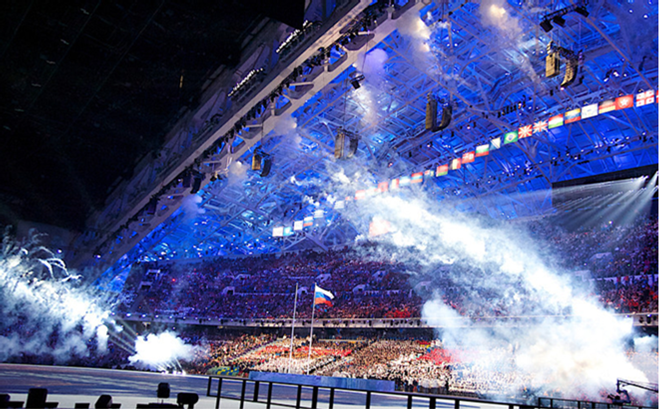
A scene from the Opening Ceremony of the 2014 Winter Olympic Games in Sochi, Russia. (Photo: Wikimedia Commons)
A full Olympic quad after Sochi, nothing remains irrefutably clean. Off the radar then on again, the Sochi doping scandal has sent recent tremors through the sports world.
In a quick summary, after the 2014 Winter Olympics in Sochi, Russia, the host nation was handed sanctions for the 2016 Rio Summer Olympics that affected some of its athletes. A total ban from Rio was not enacted despite the World Anti-Doping Agency (WADA) recommending the contrary. Russian athletes competed under the Russian flag.
At the 2018 Winter Olympics in PyeongChang, South Korea, the International Olympic Committee (IOC) handed down a fiercer sanction. Russia as an official team and its Olympic delegation were banned from the Games, as were athletes suspected of taking part in the Sochi affair.
Russian winter athletes without any ties to the scandal competed under the IOC’s neutral flag as the Olympic Athletes from Russia (OAR).
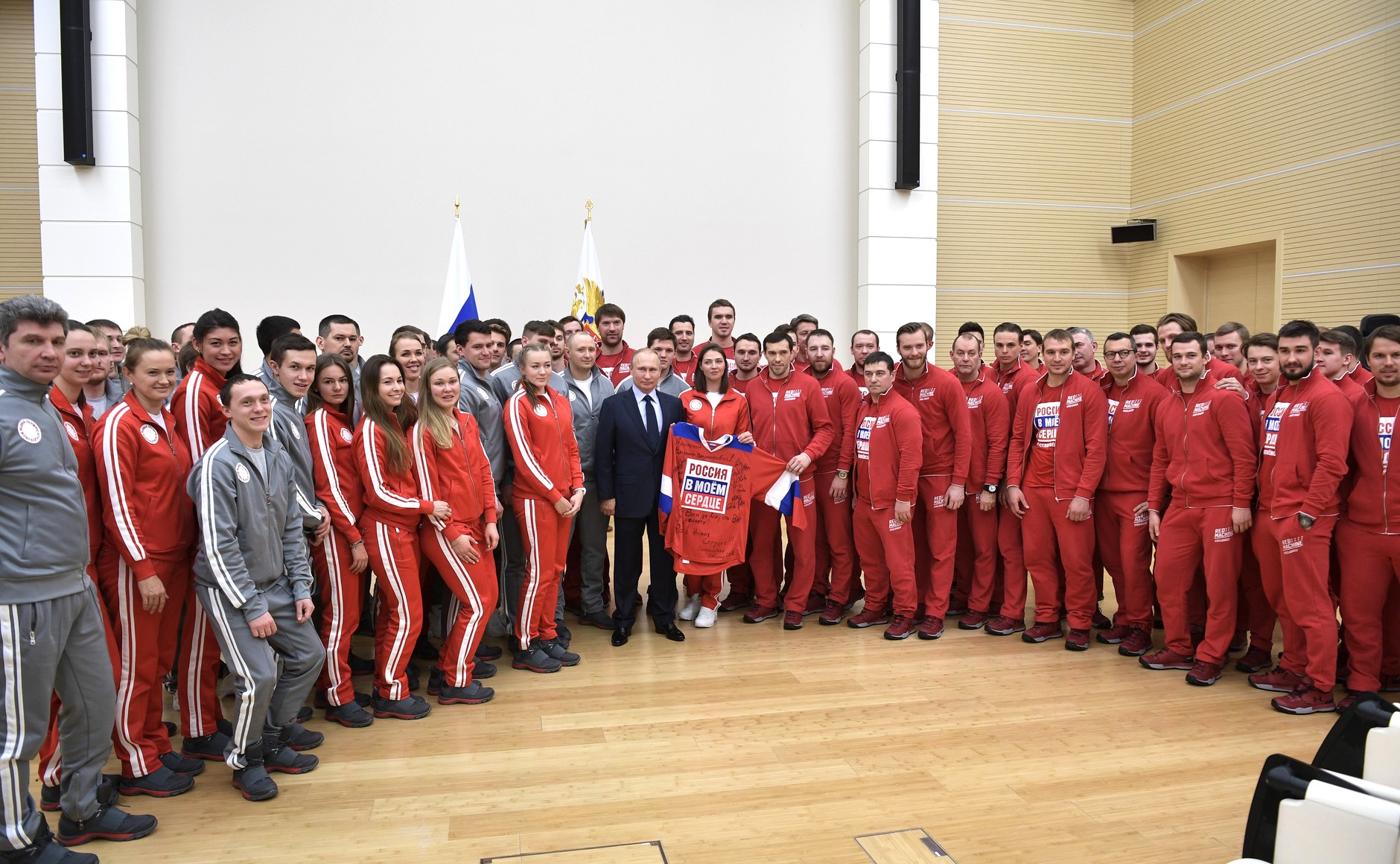
Russian President Vladimir Putin with Russia’s 2018 Olympians prior to the Games on Jan. 31, 2018. (Photo: Wikipedia)
At the 2018 Games, OAR cross-country athletes were on-form. They were repeated medalists, fast and collectively young.
Today (Thursday, Sept. 20), it was the WADA’s turn to take another stance. During a meeting in Seychelles, the WADA Executive Committee (EC) voted to reinstate the Russian Anti-Doping Agency (RUSADA).
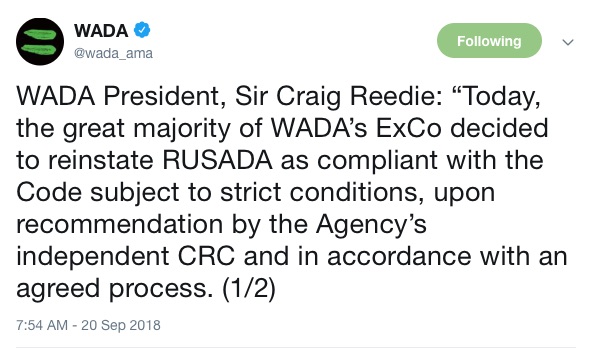
WADA announced the decision via Twitter. In the two-part tweet, WADA President Sir Craig Reedie stated, “Today, the great majority of WADA’s ExCo decided to reinstate RUSADA as compliant with the Code subject to strict conditions, upon recommendation by the Agency’s independent CRC and in accordance with an agreed process.
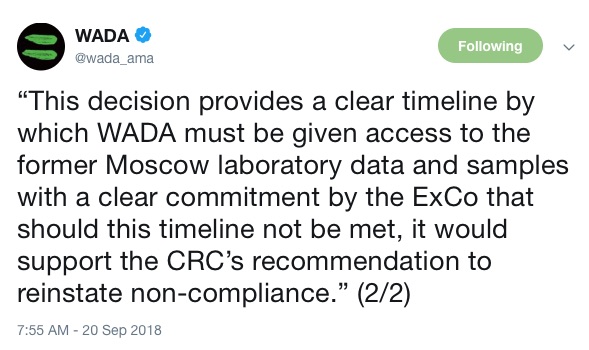
“This decision provides a clear timeline by which WADA must be given access to the former Moscow laboratory data and samples with a clear commitment by the ExCo that should this timeline not be met, it would support the CRC’s recommendation to reinstate non-compliance.”
For reasons already exhaustively documented, RUSADA was deemed non-compliant in November 2015. By August 2017, WADA had created a concrete outline of concessions and reforms known as the RUSADA: Roadmap to Compliance.
The roadmap reads like a hardened list of demands. In Part I of the document, WADA notes 20 actions already taken by RUSADA as conditions for reinstatement as a compliant anti-doping agency. Part II details 12 steps that remained unfulfilled at the time of the roadmap’s release. Much of those 12 steps begin with the words “RUSADA must”. Last week, it became public that much of WADA’s leadership have a malleable understanding of the word “must”.
Here’s the basic background to understanding how WADA’s Sept. 20 EC vote transpired:
Two critical conditions set forth in the RUSADA roadmap remained unmet by Russia as of Sept. 20, 2018. Russia has not officially accepted the McLaren Report findings and has not provided WADA with unmanipulated digital forensic data or unfettered access to RUSADA’s Moscow lab.
Starting this summer, it was time for WADA and RUSADA to think about a resolution.
In a letter obtained by the BBC dated June 22, 2018, signed by Reedie and WADA Director General Olivier Niggli, the two responded to a recent overture from Russian Minister of Sport Pavel Kolobkov. The letter clarified how WADA would be willing to move forward in negotiating Russia’s reinstatement.
Kolobkov’s response did not mention the McLaren Report commissioned by WADA, but it did acknowledge the IOC’s 2017 Schmid Report (the IOC investigation into the McLaren Report’s findings). But no overt guilt was admitted in the letter. Instead, it made a tepid hint at conciliation. According to the letter, the Russian Federation “fully accepted the decision of the IOC Executive Board on December 5, 2017, that was made based on the findings of the Schmid Report.”
The main body of Kolobkov’s letter establishes a quid pro quo. It states that only after RUSADA is reinstated, and with the consent of the Russia Investigative Committee, Russia will provide access to its lab and data. Kolobkov provides no timeline for when Russia would provide these two key provisions after reinstatement.
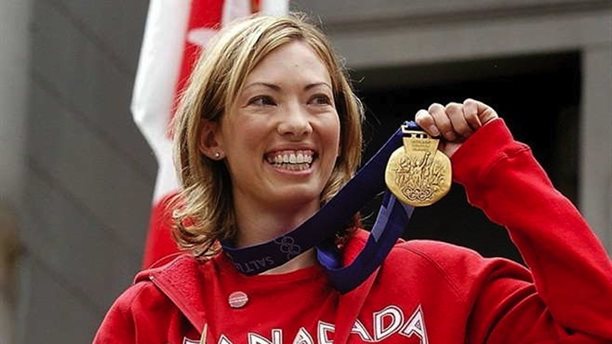
Beckie Scott with the gold medal she was awarded at a ceremony in Vancouver in June 2004. A former Canadian cross-country skier, Scott finished third in the 5 k pursuit at the 2002 Olympics but was later awarded gold when the two women ahead of her were disqualified for using performance-enhancing drugs. (Photo: Cross Country Canada)
On Sept. 14, only a day after Kolobkov’s letter, WADA’s Compliance Review Committee (CRC) approved RUSADA’s reinstatement. A member of the CRC, Beckie Scott, a former Canadian cross-country skier and Olympic gold medalist, resigned her position last week in protest of the pending reinstatement. Scott remains the Chair of WADA’s Athlete Commission.
In an interview with the CBC on Thursday following the official decision, Scott said she was “profoundly disappointed”.
“I feel that this was an opportunity for WADA as the global body responsible for regulating doping in sport and responsible for the rights of clean athletes has really dealt a devastating blow to clean athletes with this decision and I’m quite dismayed with the way things went today,” she continued.
“With WADA’s sudden shift in position raising questions about its transparency and about where its loyalties lie, we must begin the journey of returning trust to the system, enhancing WADA and creating a system fit for the next generations of athletes,” Moses wrote. “Having spoken to athletes, I know they overwhelmingly support the right decision being made in the Seychelles — they overwhelmingly support WADA’s sticking to its road map. This was not the time, they say, for the global antidoping body to perform the U-turn of all U-turns.”
The U.S. Olympic Committee (USOC) issued a press release echoing sentiments to instill faith in the anti-doping system.
“We hope that WADA can reach a conclusion on RUSADA that will give athletes a firm belief that when they compete, it will be on a level playing field, without any doubts,” it stated. “Anything that stops short of satisfying that will not only be a huge disappointment to the USOC and American athletes, but to the entire Olympic and Paralympic movements.”
But according to Reedie, Russia’s reinstatement is key to progress WADA’s worldwide mission.
“It’s my convinced view that the best thing WADA can do is to have an efficient and well-operated anti-doping system in Russia, and we’ve been trying to do that for two years,” he told the BBC. “This moves things forward.”
“To sit back and do nothing doesn’t serve the world of sport so I think progress has been made,” Reedie added. “To the members of the Ukad, athletes’ commission, I am grateful to them for their advice and can be reassured that I take their advice and I operate within the roadmap.”
One WADA EC member, Linda Helleland, Norway’s sport minister and vice president of WADA as she represents national governments on the EC, declared herself a “no” vote prior to today’s meeting.
FasterSkier will update this story with any new developments.