From the FasterSkier archive — posts syndicated from athletes’ and coaches’ own blogs between 2004 and 2012, kept online as published. Current coverage is at fasterskier.com.
ZHANGJIAKOU, China — Team USA won its first-ever mixed relay gold to close out the cross-country competition at the Paralympic Winter Games Beijing 2022 on Sunday at Zhangjiakou National Biathlon Centre in Zhangjiakou, China.
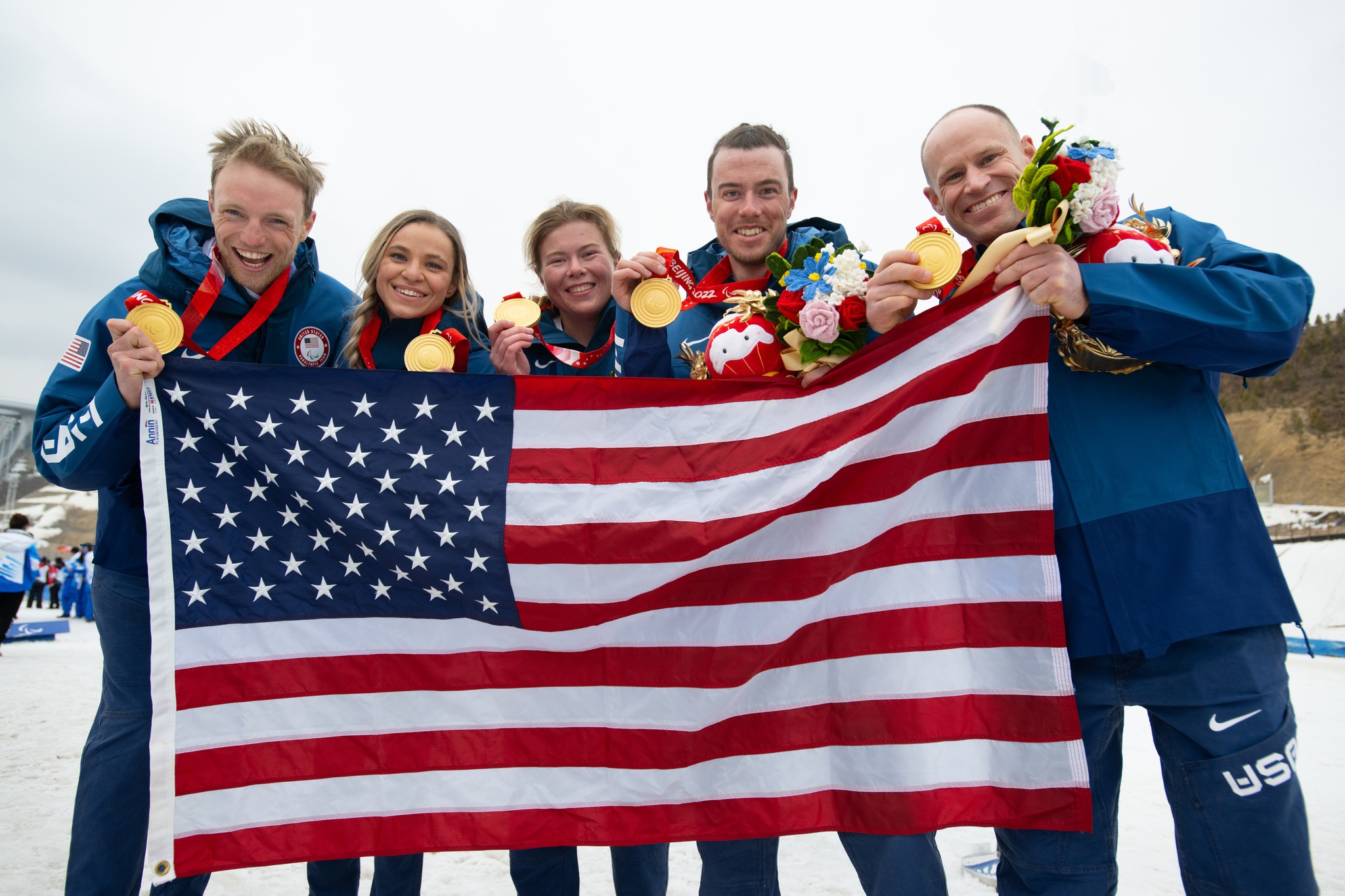
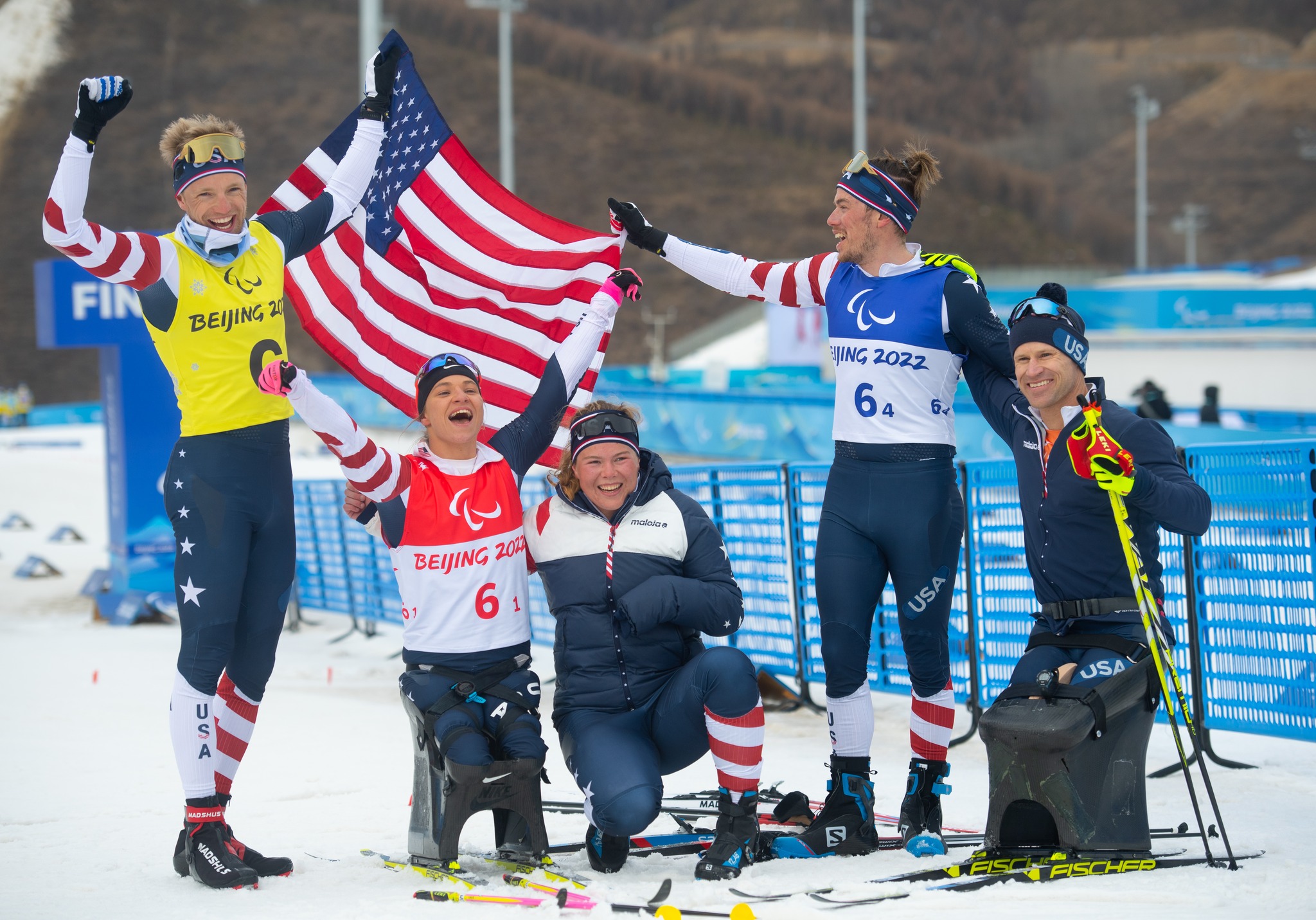
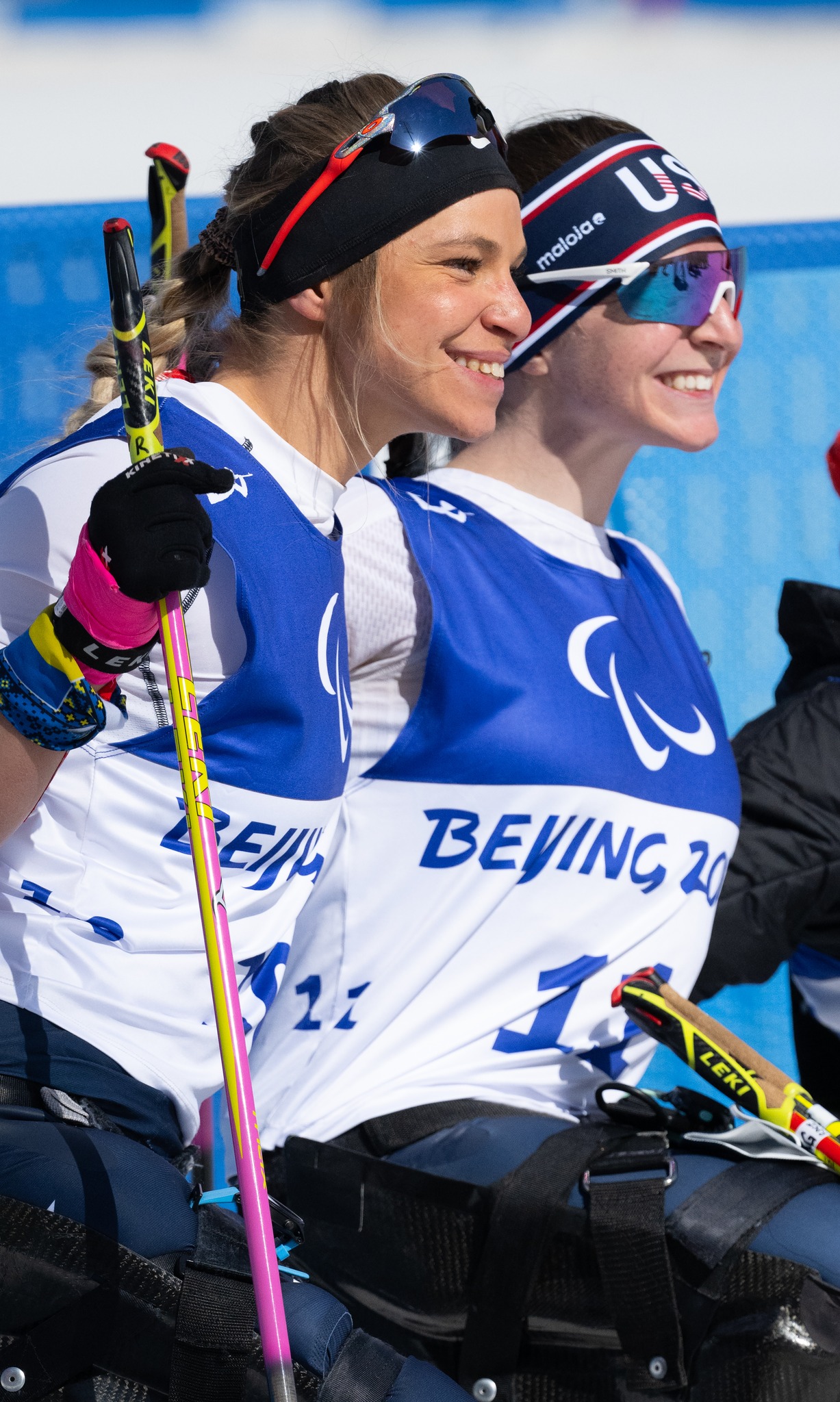
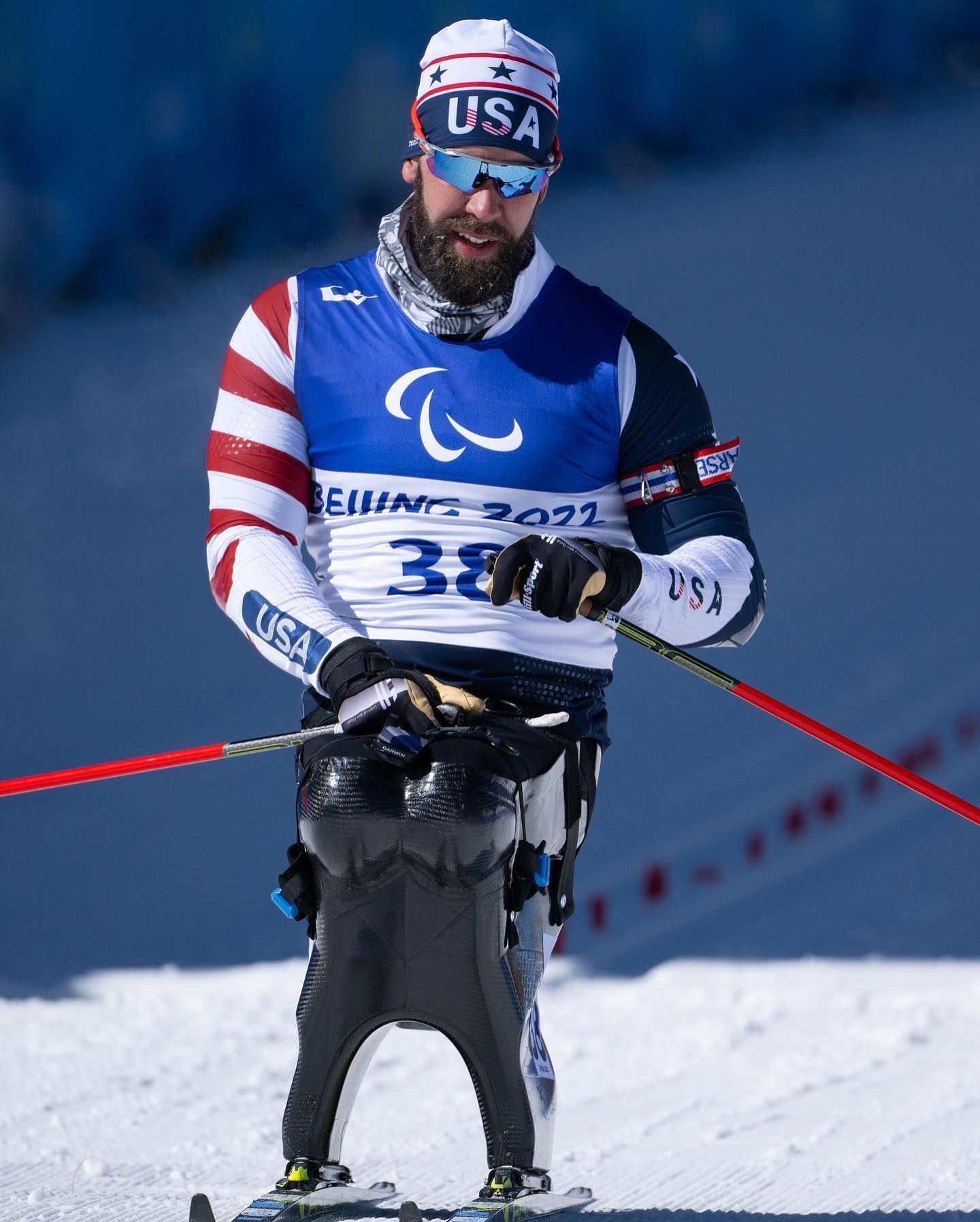
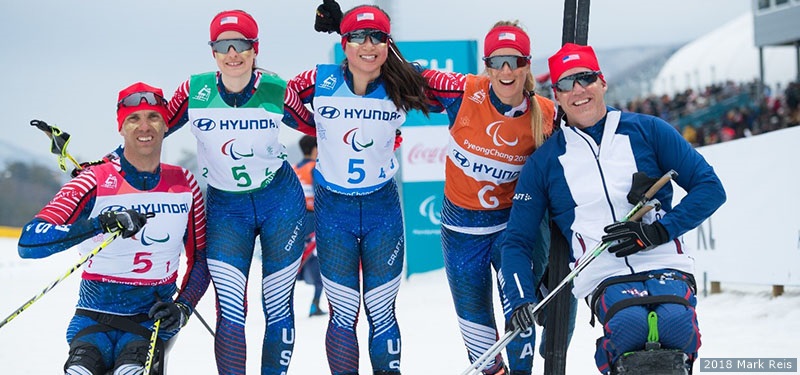
Team USA’s 4 x 2.5-kilometer mixed relay featured Oksana Masters, Sydney Peterson, Dan Cnossen and Jake Adicoff guided by Sam Wood. They stormed to a 25:59.3 gold-medal finish.
China took silver in 26:25.3, and Team Canada captured bronze in 27:00.6. Defending world and Paralympic champions Ukraine finished fourth.
“I could not be more proud and more excited,” Cnossen said. “Really, it’s an honor to be part of this team knowing the caliber of athletes that I got to ski with.”
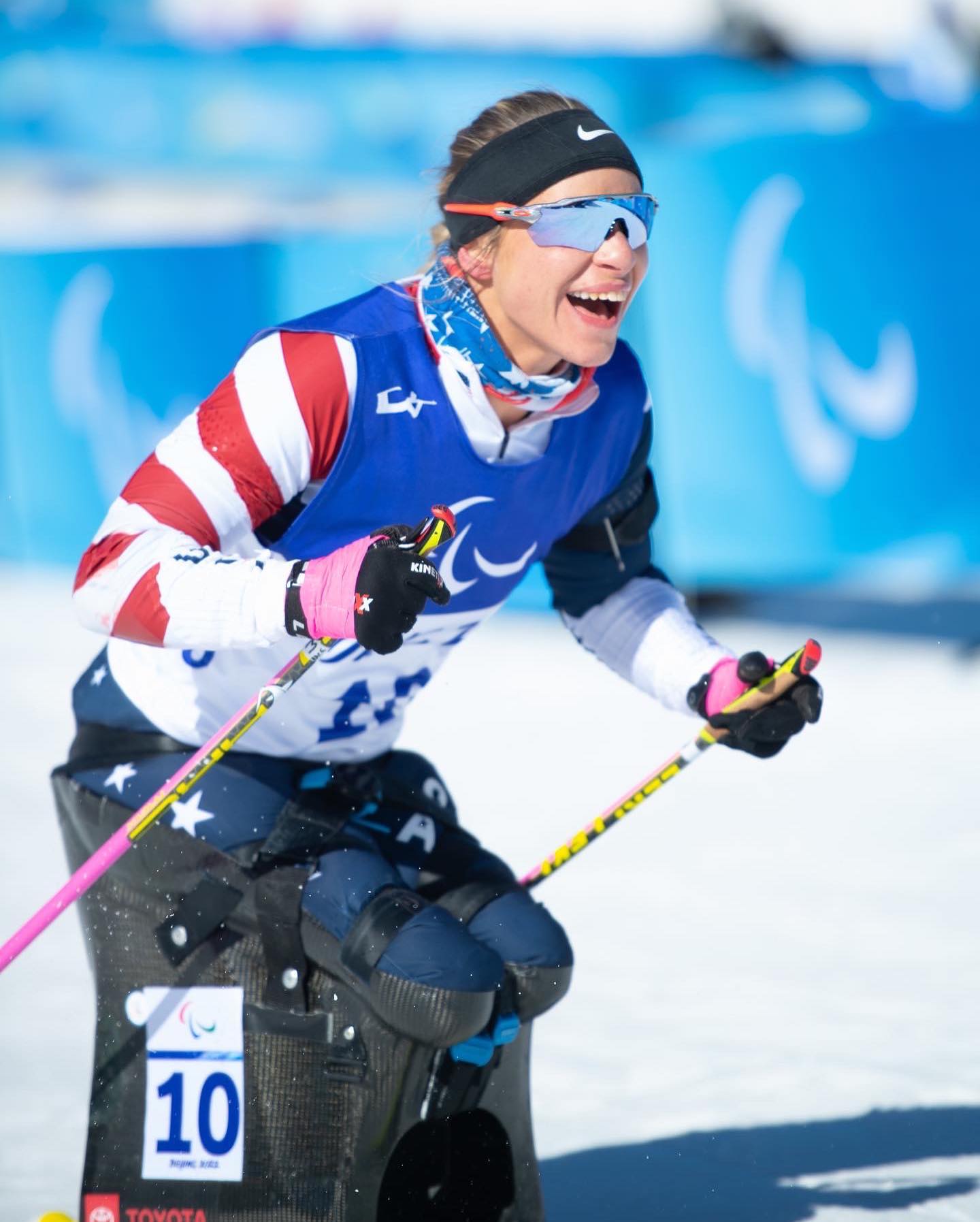
Cnossen, 41, became the most seasoned medalist for Team USA in Beijing. The gold-medal win also earned Masters a place in the history books as the most decorated U.S. Winter Paralympian with 14 career Winter Paralympic medals.
The 2022 Paralympic gold medal mixed relay team: guide Sam Wood, Oksana Masters, Sydney Peterson, Jake Adicoff, and Dan Cnossen (left to right). (Photo: Mark Reis / TeamUSA)
The relays were the only team events on the Para cross-country skiing program. The mixed relay featured four fast 2.5-kilometer laps that can be skied by an alternating team of two, three or four skiers and at least one man and one woman.
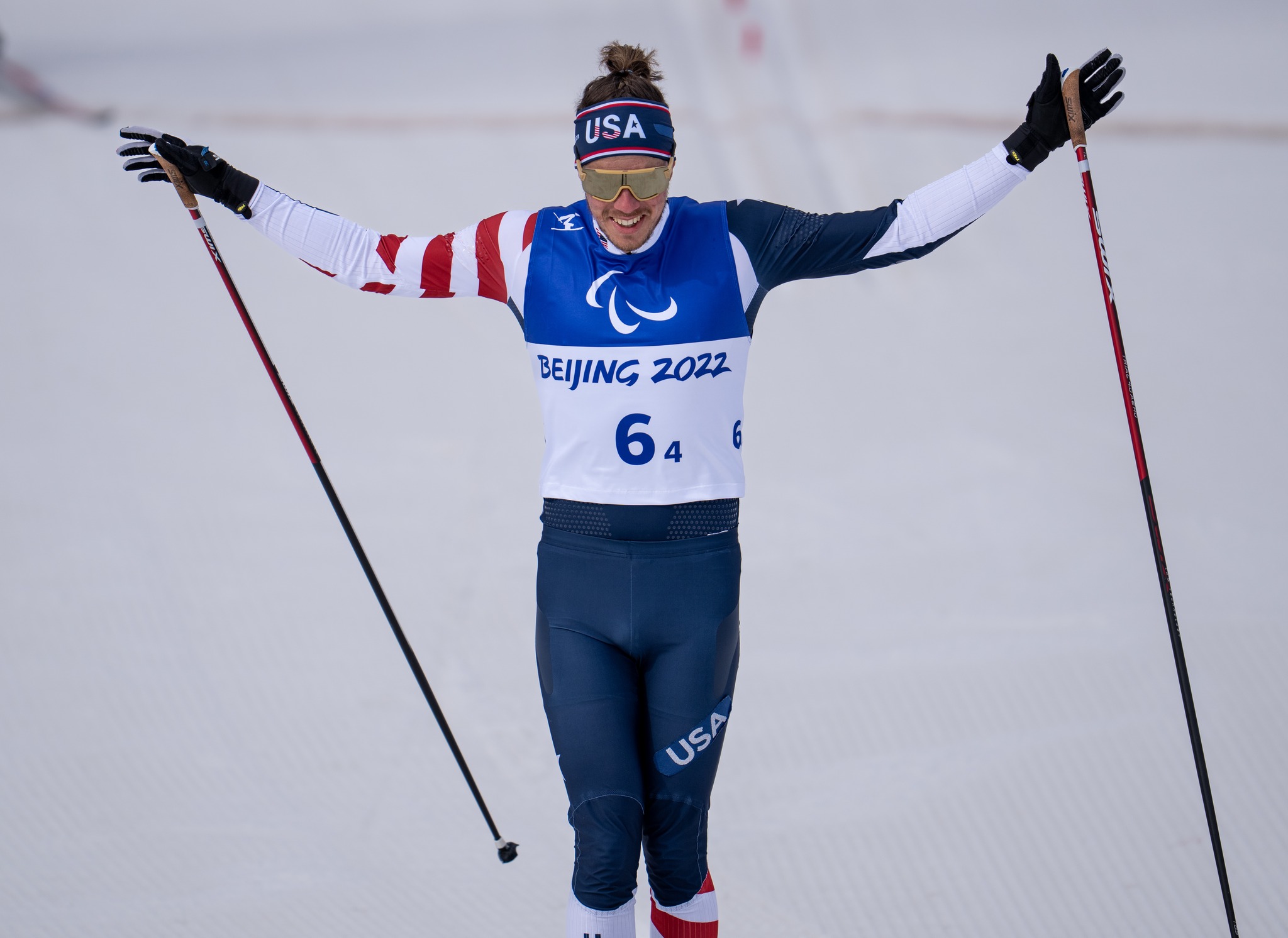
Masters raced a strong first leg to hand off to now three-time Paralympic medalist Peterson for leg two. Cnossen skied leg three to hold Team USA in fourth place. Adicoff and Wood turned up the heat for the final lap, rocketing into first place and never looking back.
“We started that so hot, “Adicoff said. “We were just really gas in the beginning, no holding back in the first part. By the time we were at the top of the course, we skied into the lead. From there, we just had to stay on our feet and bring it home. Getting that energy from our teammates for that first part of the race was critical.”
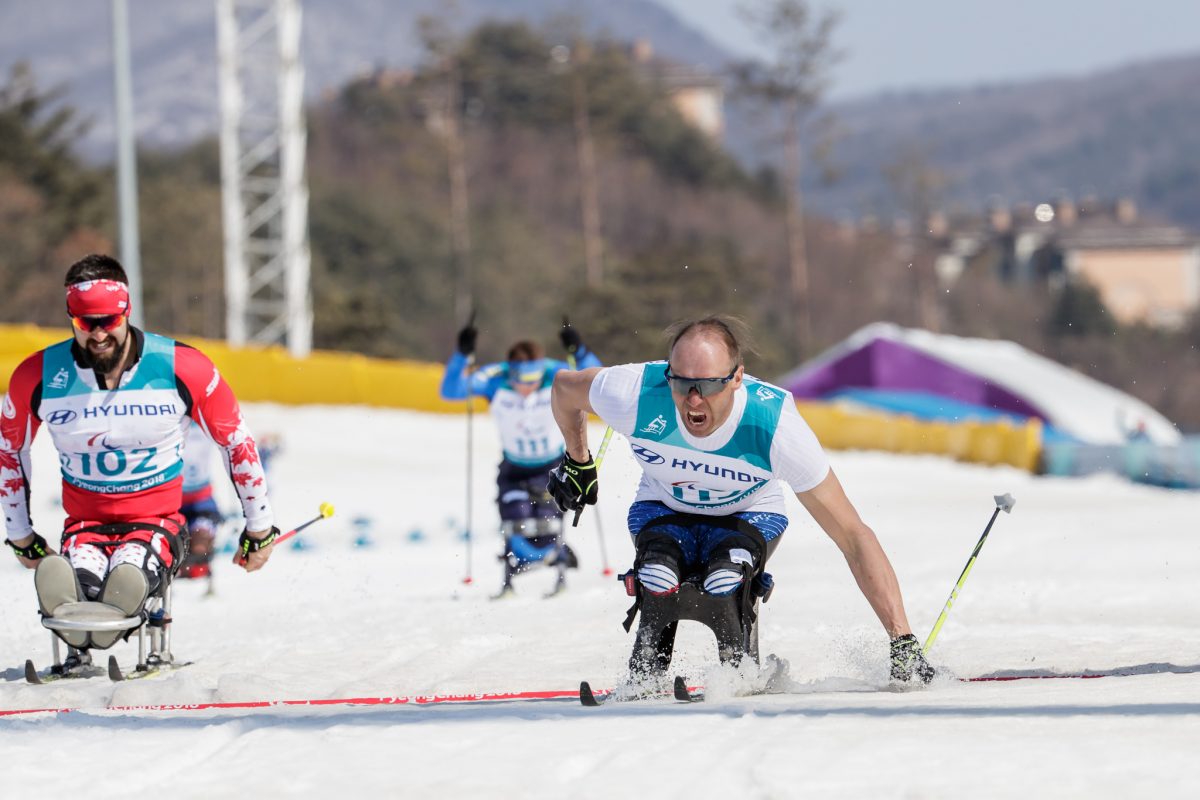
Jake Adicoff crosses the line for Paralympic gold in the 4 x 2.5 k mixed team relay. (Photo: Mark Reis / TeamUSA)
The American team competed with athletes across the sitting, standing and visually impaired classifications. The team felt confident coming into the race after strong podium performances across each classification over the last eight days of Paralympic competition.
“It’s not just one athlete carrying the load,” Cnossen said. “We have really, really strong athletes in all the categories. For me, I didn’t have some of the individual success here that I’ve had in the past, but it just goes to show when you get to be part of a team that lifts the performance.”
“It’s so much better being part of a team,” Peterson said. “There were five of us out there today, and I think all of us had great races. Thanks to everyone else supporting us back home and all the Team USA staff here supporting us.”
The team of Oksana Masters, Sydney Peterson, Jake Adicoff (with guide Sam Wood) and Dan Cnossen, take Paralympic gold in the mixed team relay. (Photo: Mark Reis / TeamUSA)
The gold-medal win fueled the 4 x 2.5-kilometer open relay, the final competition for Para Nordic in Beijing.
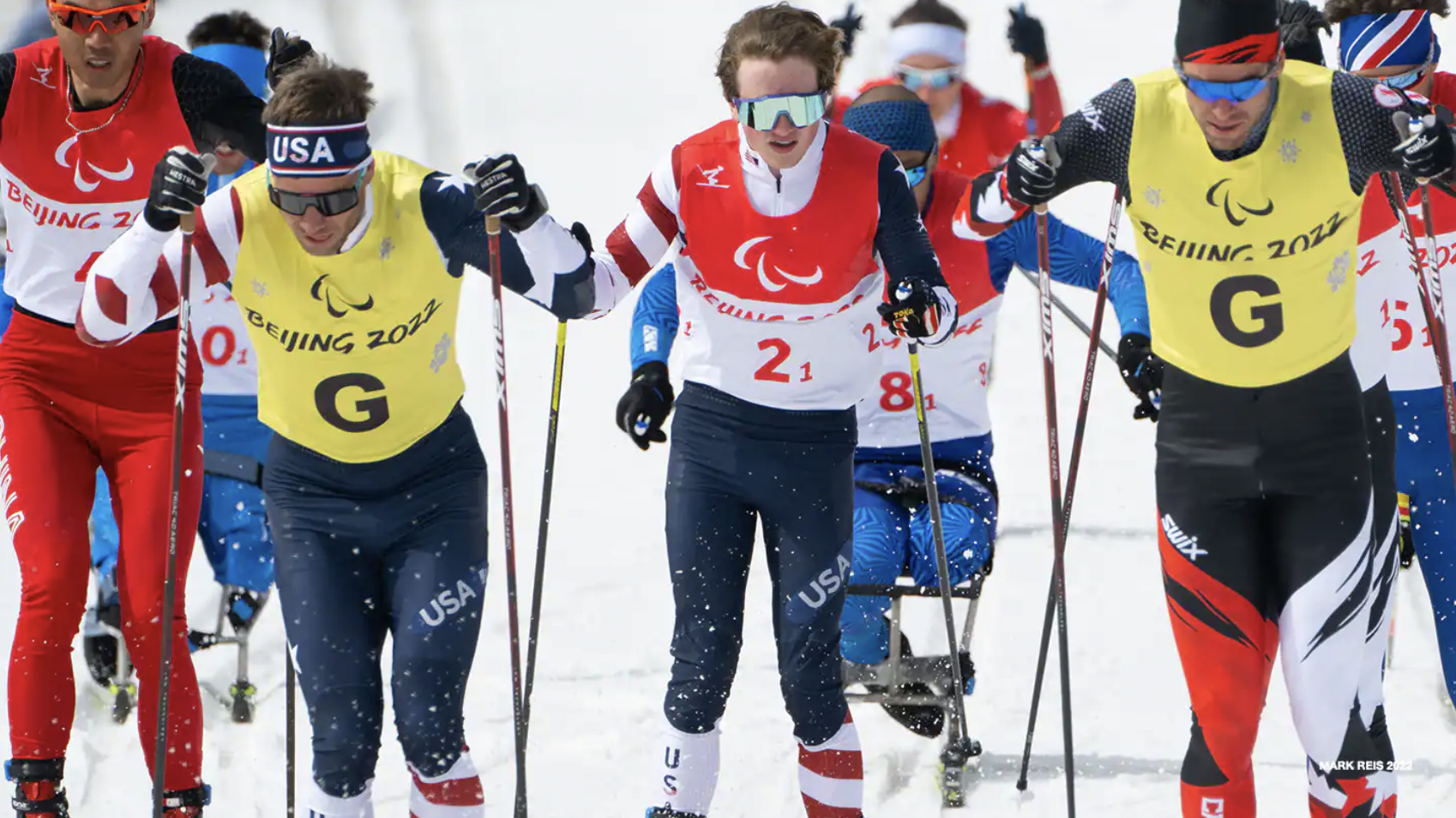
First-time Paralympians Max Nelson, guided by Simi Hamilton, and Drew Shea teamed up with veterans Kendall Gretsch and Ruslan Reiter for the final relay. The team placed ninth overall in 33:03.0.
“It was fun to watch everyone ski in the first race and to go out there and just give it all you got,” Reiter said.
Team Ukraine won gold in 28:05.3 thanks to a strong last leg by Anatolii Kovalevskyi guided by Oleksandr Mukshyn. France finished second for silver in 28:30.4, and Norway held onto bronze in 28:41.0.
Max Nelson, the youngest skier on the U.S. Para Nordic team in Beijing, fought for Team USA from the very start of the race in the leadoff leg.
“It was pretty crazy at the start trying to fight off a couple skiers for my spot,” Nelson said. “But I’m just honored to be here and race for Team USA. It was a great day.”
Max Nelson and guide Simi Hamilton lead off for Team The team of Oksana Masters, Sydney Peterson, Jake Adicoff (with guide Sam Wood) and Dan Cnossen, take Paralympic gold in the mixed team relay. (Photo: Mark Reis / TeamUSA)
The athletes made the most of the time on their course together in a sport that is normally focused on individual racing. Gretsch, who won three medals in biathlon and competed in all three cross-country races at these Games, said it’s exciting to see the athletes race head-to-head across the classifications.
“It is so crazy because there’s such a yo-yo between the legs of it so you can really like never count yourself out until the very end,” Gretsch said. “Everyone just has to go and give it their all for 2.5-kilometers.”
First-time Paralympian Drew Shea said this was a great way to end his first Games experience.
“This is pretty special in such an individual sport, just being able to fight for the next person who’s out there,” Shea said. “It’s not about you out there. It’s about the team so you’re just trying to make up every second and grind it out.”
Team USA’s Para Nordic skiers closed out a successful Paralympic Winter Games with 14 medals (four gold, eight silver and two bronze.)
Want to follow Team USA athletes during the Paralympic Winter Games Beijing 2022? Visit www.teamusa.org/beijing-2022-paralympic-games to view the competition schedule, medal table and results.
***
Author Bio:
Katie Grunik is a digital content creator for TeamUSA.org. She is covering her second Olympic & Paralympic Games for teamusa.org and currently serves as the digital content coordinator for the U.S. Olympic & Paralympic Committee.
ZHANGJIAKOU, China — Team USA Para Nordic skiers Oksana Masters (Louisville, Kentucky) and Jake Adicoff (Sun Valley, Idaho), alongside guide Sam Wood (Harpswell, Maine) each won silver medals, and Sydney Peterson (Lake Elmo, Minnesota) took bronze in an exciting, fast-paced day of cross-country sprint racing at the Paralympic Winter Games Beijing 2022.
Through five days of competition, the U.S. Para Nordic team has collected 10 medals in cross-country and biathlon at Beijing 2022, with three more days of racing to go at the Zhangjiakou Biathlon Center.
Oksana Masters takes silver in the women’s sitting sprint. (Photo: Mark Reis / Team USA)
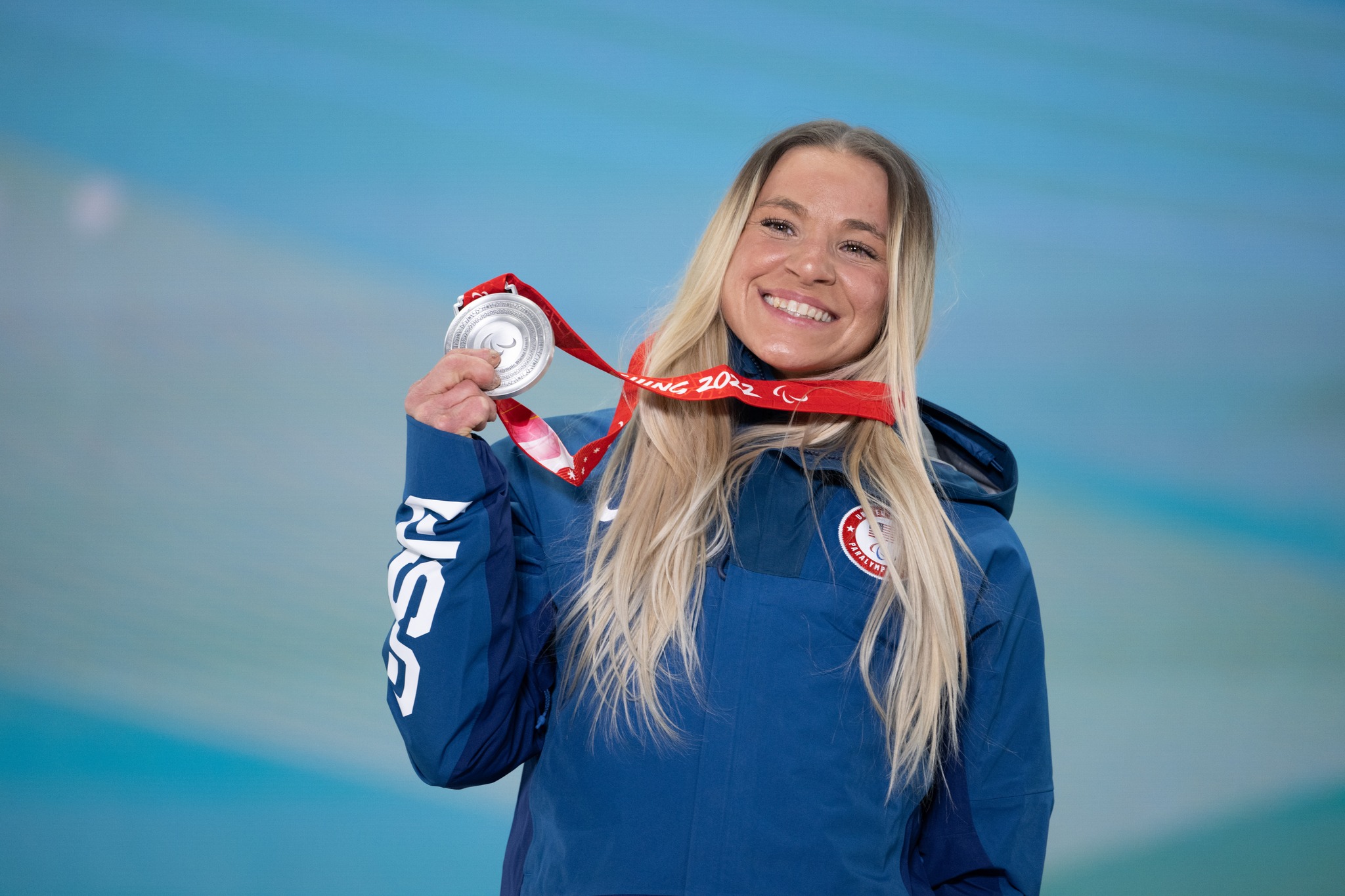
Masters has won four medals — in all four races — at Beijing 2022 and now has won 14 medals in her Paralympic career. Masters, the 2021 world champion and 2018 cross-country sprint gold medalist from PyeongChang, finished just 1.7 seconds away from gold on Wednesday.
The cross-country and biathlon star powered up the hills on the 1-kilometer course and sprinted down the finish chute to nearly catch China’s Hongqiong Yang who won gold with a time of 3:18.2. Masters finished in 3:19.9 and Panpan Li of China earned the bronze in 3:31.0.
Team USA’s Kendall Gretsch (Downers Grove, Ill.) placed fifth, in 3:37.3.
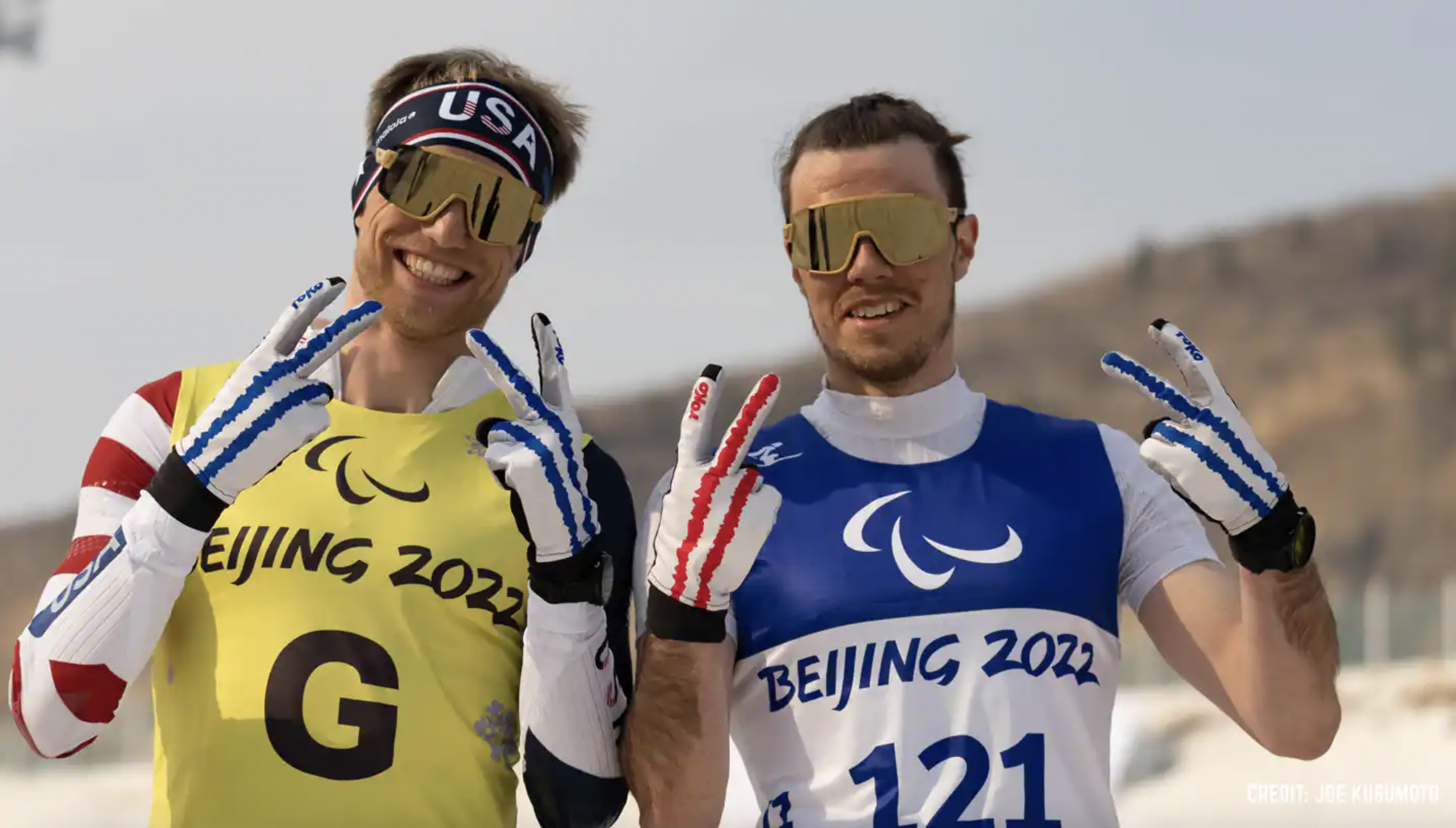
Adicoff and Wood won their second silver medal of Beijing 2022 in the men’s visually impaired category, just 0.8 seconds away from gold. The duo hammered the sprint cross-country course in a time of 3:20.3, just behind Canada’s Brian McKeever, guided by Russell Kennedy. Sweden’s Zebastian Modin, guided by Emil Joensson Haag, took the bronze in a time of 3:37.8.
The silver is Adicoff’s third medal of his Paralympic career — and he’s gunning for two more cross-country medals in Beijing.
Jake Adicoff (right) with guide Sam Wood earn a second silver medal in the visually impaired freestyle sprint, their second medal in two races at the 2022 Beijing Paralympics. (Photo: Joe Kusumoto / Team USA)
“I said it before, but I’ll say it again — ‘We’re going to gun for gold,’” said Adicoff who is a three-time Paralympian who won silver in the 10k cross-country at the 2018 Paralympic Games in PyeongChang.
“Two more to go. We’re hoping for four for four (on the podium) so we’re right on schedule,” Wood said.
Adicoff said the fun of cross-country sprints is the opportunity to cheer on his fellow U.S. Para Nordic teammates. The entire team raced on Wednesday, which began with qualification rounds, a round of semifinals and the final to determine the Paralympic medalists.
“Being with this team is so much fun. Especially on sprint day. Sprint days are the best. You get to watch everyone and it’s an absolute blast,” said Adicoff. “The team had a good day, so we’re psyched.”
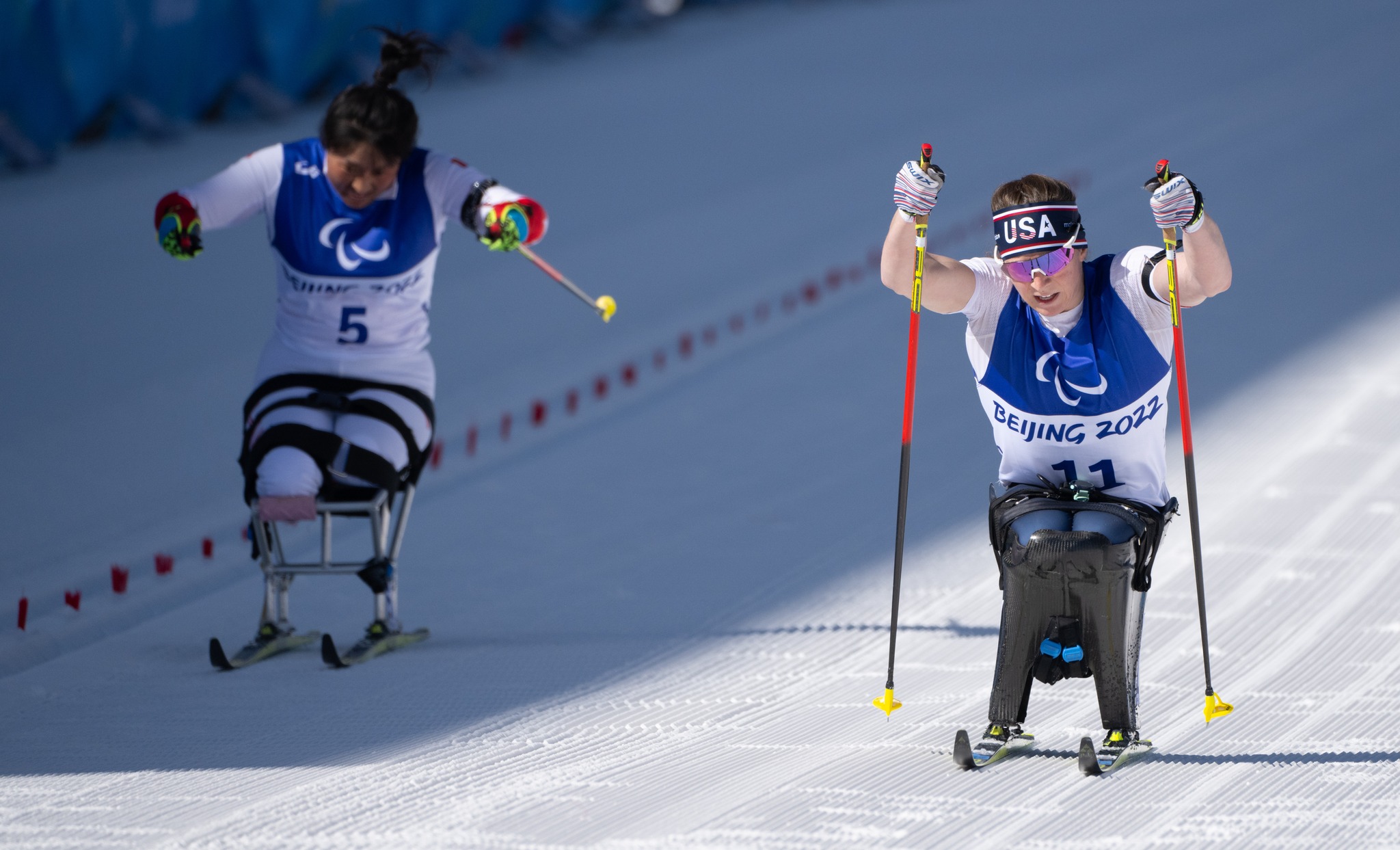
Peterson, who is competing in her first Paralympic Games, won her second medal of Beijing 2022, adding to the silver she won in long-distance cross-country. She completed the sprint cross-country in 4:12.1, behind Canada’s Natalie Wilkie (4:05.1) and Norway’s Vilde Nilsen (4:08.1).
“It was a super challenging race. There were a lot of components to it going throughout the day, but I’m super excited about how it all stacked up,” Peterson said. “I had a ton of people that were out there helping and cheering and it wouldn’t have been possible without all their support.”
Grace Miller races to 14th in the women’s standing freestyle sprint. (Photo: Mark Reis / Team USA)Visually impaired athlete Max Nelson sprints to 14th with guide Simi Hamilton. (Photo: Mark Reis / Team USA)
A total of 14 U.S. athletes competed in the day’s events. For the women’s sitting sprint, Lera Doederlein and Erin Martin finished 14th and 16th respectively while Grace Miller took 14th in the women’s standing. In the men’s sitting competition, Dan Cnossen finished just outside a qualifying spot with a 13th place finish while Josh Sweeney finished 19th. Max Nelson took 14th place in the men’s visually impaired qualification round while Drew Shae covered the course in the first round of the men’s standing for 21st.
American teammates Dani Aravich, Ruslan Reiter and Aaron Pike made their way to the semifinal round finishing the sprint competition in 8th, 12th and 12th respectively.
Aaron Pike races into the sprint semifinal, finishing 12th. (Photo: Mark Reis / Team USA)
Nordic athletes will enjoy a rest day on Thursday. Racing is scheduled to resume on Friday, with the men’s and women’s individual biathlon. To follow and watch U.S. Paralympics Nordic Skiing competition from Beijing 2022 on NBC, which features more than 230 hours of coverage across NBC, Peacock, USA Network, the Olympic Channel, NBCOlympics.com and the NBC Sports App. All events will be streamed live on NBC’s Peacock. Follow U.S. Paralympics Nordic Skiing on Facebook, Twitter and Instagram for daily updates from Beijing.
Kendall Gretsch takes gold in the sitting middle-distance biathlon event in Zhangjiakou. (Photo: Mark Reis / Team USA)
By Stephen Meyers
ZHANGJIAKOU, China — Team USA’s dynamic duo of Kendall Gretsch (Downers Grove, Ill.) and Oksana Masters (Louisville, Kentucky) won gold and silver in the women’s sitting biathlon middle-distance on the fourth day of competition at the Paralympic Winter Games Beijing 2022.
The U.S. Para Nordic team has now collected seven medals across biathlon and cross-country skiing at Beijing 2022, with four more days of racing to go at the Zhangjiakou Biathlon Center.
For Gretsch, Saturday’s gold medal is the fourth gold —and fifth medal overall — in her Paralympic career. She won gold in the 6k biathlon and 12k cross-country events at PyeongChang 2018 and won gold in Para triathlon at the Paralympic Games in Tokyo six months ago.
Kendall Gretsch races to the line to take gold in the sitting middle-distance biathlon event. (Photo: Mark Reis / Team USA)
The dual sport star now has two medals at Beijing 2022, as she began the biathlon competition with a bronze in the women’s sitting biathlon sprint.
After receiving a penalty in the first round of shooting in Tuesday’s race, Gretsch shot clean the remaining three rounds and skied strong, with quick shooting, in the second half of the 10-kilometer race to overtake Masters and win gold in a time of 33:12.
“I’m really excited with today‘s race. I had a good day on skis and I’m happy with our performance. Hopefully we can build on that for the rest of the races too,” said Gretsch, who praised the U.S. Para Nordic team’s culture and support.
“We have such a strong program and great support from our team. The coaching and everything from waxing our skis so they are really fast, and helping us with nutrition, all the support that we get from the staff at Team USA is huge.”
Kendall Gretsch (right) and Oksana Masters (left) go 1-2 in the sitting middle-distance biathlon event during the 2022 Beijing Paralympic Winter Games. (Photo: Mark Reis / Team USA)
For Masters, Tuesday’s silver is the third medal she’s won in Beijing and 13th overall in her Paralympics career. She again shot clean — like she did en route to winning gold in the women’s sitting biathlon sprint — and finished 9 seconds behind Gretsch, in 33:21.
“I’m excited with a silver medal. This is my second biathlon medal in the Paralympic Games. This is my second consecutive biathlon medal that I’d shot clean for, which I don’t normally do,” said Masters who also won silver in long-distance cross-country.
“I’m so proud of myself. I was doubting myself coming in here and I think now what I can do is have confidence knowing I have put the work into it and I can do it. And try to make it a little faster so I’m not just giving away time in the race trying to get that shot.”
Oksana Masters goes three-for-three, adding a silver medal to her growing collection in the sitting middle-distance biathlon competition. (Photo: Mark Reis / Team USA)
Germany’s Anja Wicker won the bronze, in a time of 35:45.
Team USA’s Lera Doederlein (San Diego, California), competing in her first Paralympic Games, placed ninth.
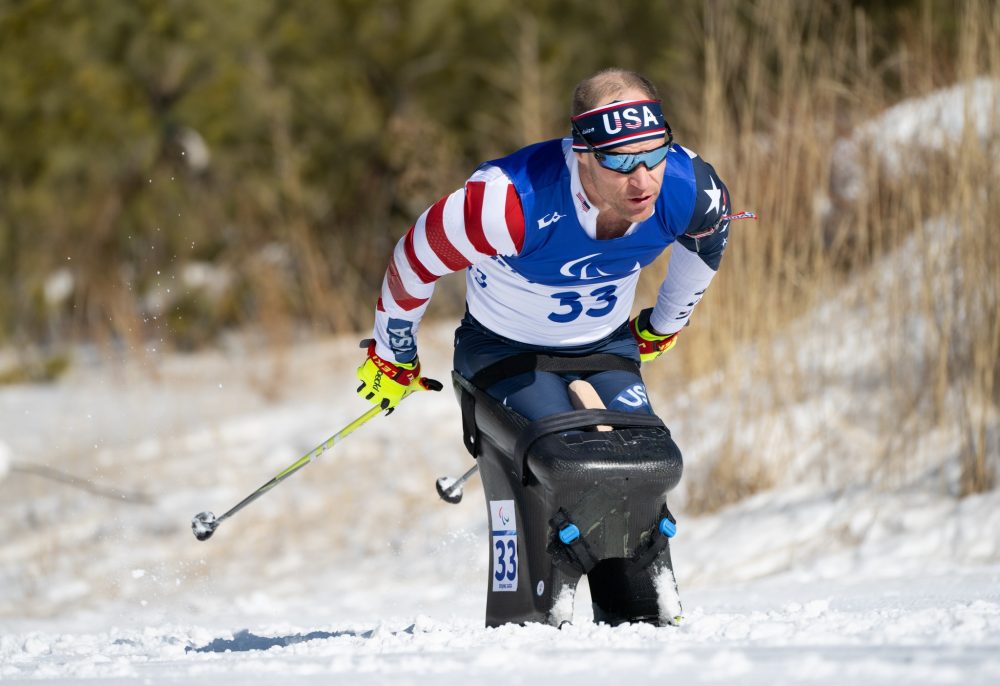
Dan Cnossen (Topeka, Kansas) was the top U.S. finisher in the men’s sitting biathlon middle-distance, where he placed 12th with a time of 34:10. Aaron Pike (Park Rapids, Minnesota) finished 15th in a time of 36:49.
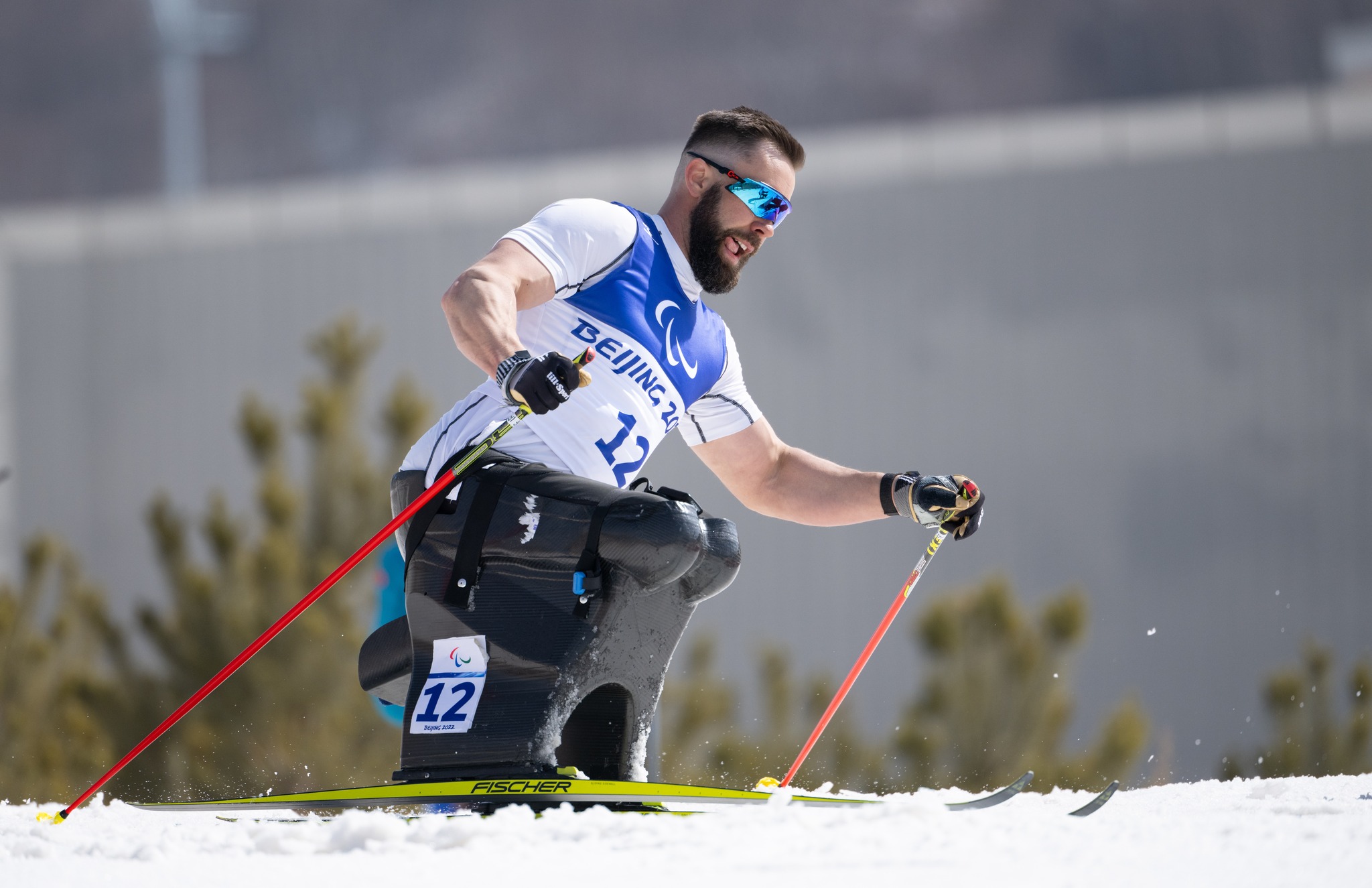
Dan Cnossen competes in the middle-distance sitting biathlon event during the 2022 Beijing Paralympics. (Photo: Mark Reis / Team USA)
Tuesday’s racing action also included biathlon middle-distance events in the standing and visually impaired categories.
The lone U.S. athlete competing in the women’s race, Dani Aravich (Boise, Idaho) skied to 11th place in her second Winter Paralympic race. She made her Paralympic debut in track and field at the Paralympic Games in Tokyo.
Dani Aravich skis to 11t in the middle distance biathlon competition, her second Winter Paralympic appearance. (Photo: Mark Reis / Team USA)
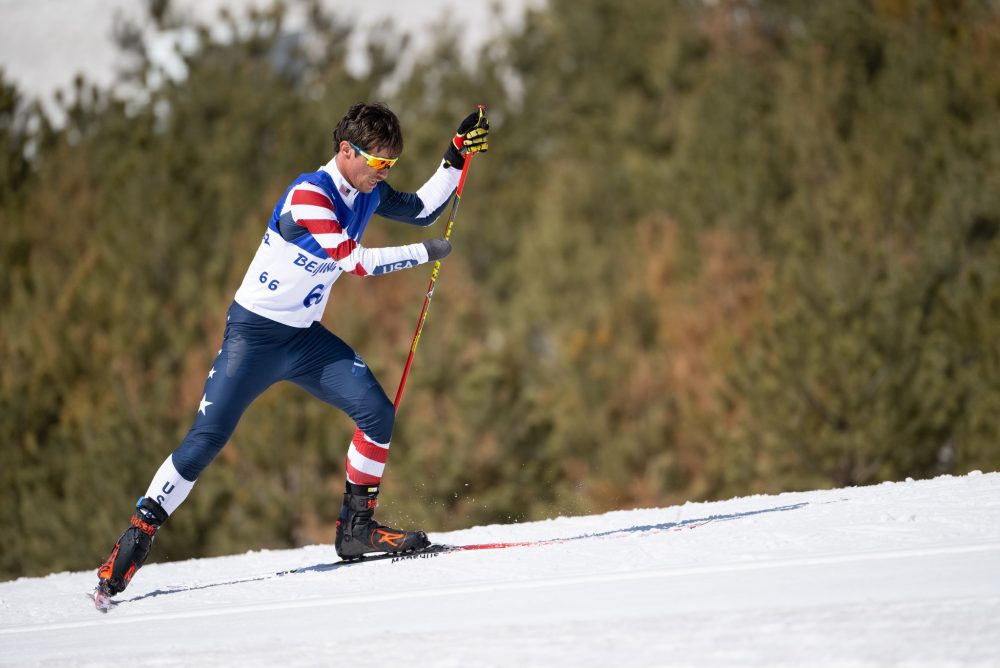
In the men’s standing biathlon race, Ruslan Reiter (Manchester, Maine) placed 12th and Drew Shea (Vienna, Virginia) took 13th. Reiter is competing in his second Winter Paralympics, while Shea is making his Paralympic debut. No U.S. athletes competed in the visually impaired category.
Racing returns to the Zhangjiakou Biathlon Center on Wednesday, March 9 with the men’s and women’s sprint cross-country.
Ruslan Reiter on course during the middle-distance biathlon competition in Zhangjiakou. (Photo: Mark Reis / Team USA)
To follow and watch U.S. Paralympics Nordic Skiing competition from the Beijing 2022 Paralympic Games, tune in to NBC, which features more than 230 hours of coverage across NBC, Peacock, USA Network, the Olympic Channel, NBCOlympics.com and the NBC Sports App. Follow U.S. Paralympics Nordic Skiing on Facebook, Twitter and Instagram for daily updates from Beijing.
Oksana Masters (left) takes gold while Kendall Gretsch (right) earns bronze in the sitting biathlon sprint to open the 2022 Paralympic Winter Games. (Photo: Mark Reis / Team USA)
By Stephen Meyers | March 05, 2022, 7:27 a.m. (ET)
Oksana Masters (Louisville, Kentucky) won the first gold medal for the U.S. at the Paralympic Winter Games Beijing 2022 on Saturday in the women’s sitting biathlon sprint while teammate Kendall Gretsch (Downers Grove, Illinois) earned bronze on a cold, breezy day that included racing in the men’s and women’s biathlon sprint in the sitting, standing and vision impaired categories.
Masters, a biathlete and cross-country skier, won her fifth career Paralympic gold medal and 11th overall medal between the Summer and Winter Paralympic Games. Saturday’s gold was her first in biathlon; she won two silvers at the Paralympic Winter Games PyeongChang 2018 in the 6k and 12.5k biathlon.
“I can’t believe it, this is so amazing,” Masters said. “To be able to start off the Paralympic Games in Beijing and bring home a gold medal for Team USA is absolutely incredible. And it’s incredible because I get to do it with my teammate on the podium by my side again.”
“I think this just shows that there’s amazing stuff that’s going to happen for Team USA in the Para Nordic program.”
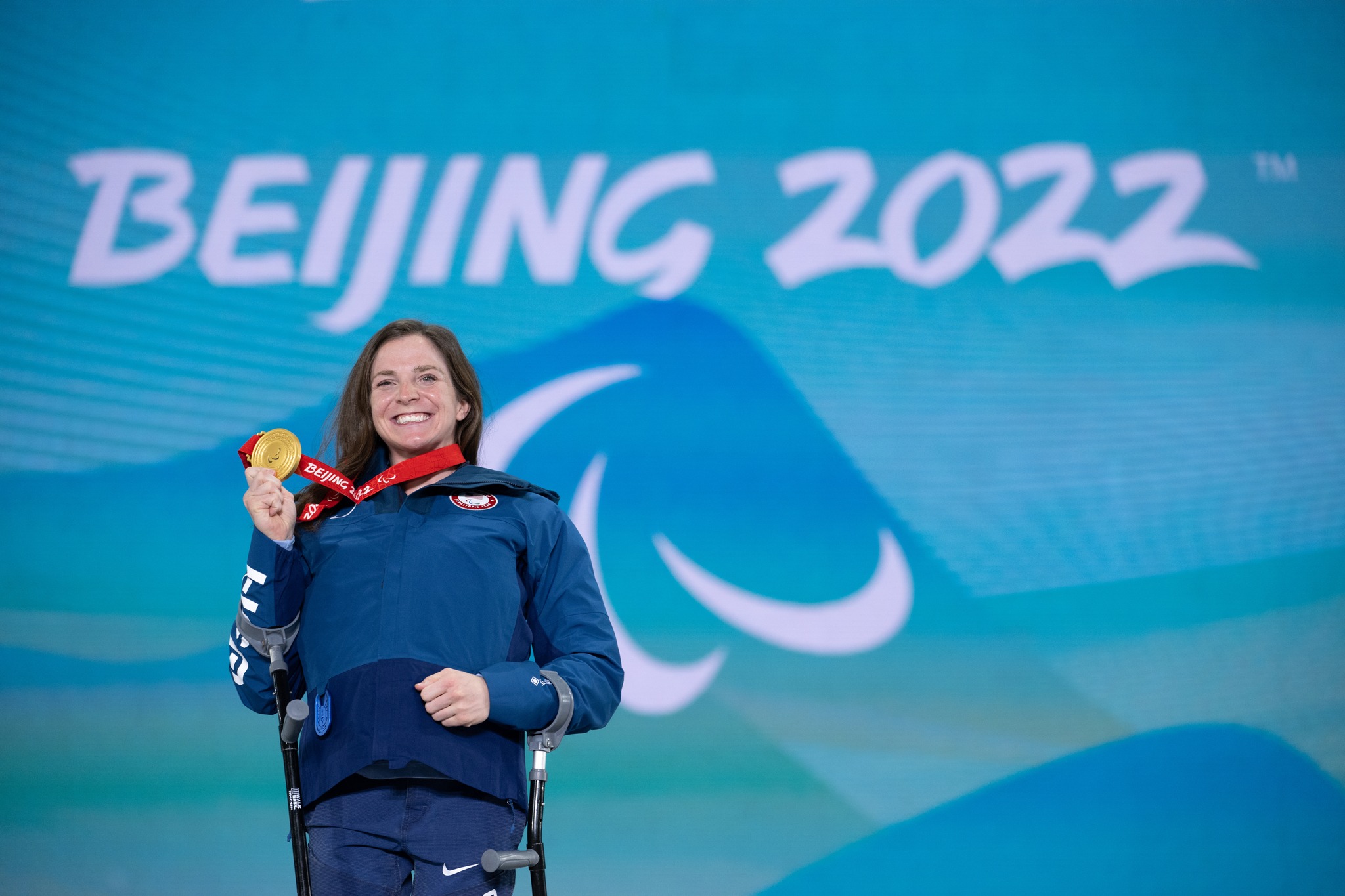
Oksana Masters takes her first gold of the 2022 Paralympic Winter Games in the sitting biathlon sprint. (Photo: Mark Reis / Team USA)
Masters now owns Paralympic gold medals in biathlon, cross-country skiing and Para-cycling. She won two cycling golds at the Paralympic Games Tokyo 2020 six months ago.
Masters finished the 6k sitting biathlon sprint race in a time of 20:51.2. China’s Yilin Shan finished 15 seconds back with a time of 21:06 to earn the silver.
Gretsch — who also won gold at the Paralympic Games in Tokyo six months ago, in paratriathlon — earned the bronze, with a time of 22:47. The medal is the fourth of her Paralympic career. At PyeongChang 2018, Gretsch won gold in the 6k biathlon and 12k cross-country events.
“That was a tough race. The sprint is so short and you’re kind of going all-out the whole time. I’m happy to have the first race done and hopefully just build off today for the rest of the races,” said Gretsch, who also races the cross-country events. “It’s crazy [being back at the Paralympics six months after competing in Tokyo] and it’s feeling very different than Tokyo conditions today. I’m trying to channel how warm I was there. It’s always exciting to be at the Paralympics.”
Eighteen-year-old Lera Doederlein (San Diego, California) made her Paralympic debut on Saturday, also competing in the women’s sitting biathlon sprint, finishing ninth. It was Masters who encouraged Doederlein, who had been competing in sled hockey, to give Para Nordic skiing a try in 2019.
“It’s a pretty incredible experience for me to race [with Masters and Gretsch] especially since I’m only 18 years old and it’s my first Paralympics. It was incredible to experience this with them,” Doederlein said.
Dan Cnossen races to fourth place in the sitting biathlon sprint. (Photo: Mark Reis / Team USA)
Dan Cnossen (Topeka, Kansas), former Navy SEAL who won six medals in PyeongChang, led Team USA’s men on Saturday in the sitting biathlon sprint, placing fourth.
“I dug deep as far as I could, and this is perhaps the best biathlon race I’ve ever had. I know it may not have been my best result, but for me, it’s more about effort and I really think I put a complete race together today,” Cnossen said.
“Biathlon is a really challenging sport in the sense that you can always ski a little bit faster into the range or you can always try to take your first shot a little bit quicker, or the shots two, three, four, five a little bit quicker. I’ve got to be happy with how I raced today. I’m also happy to be out there with my teammate Aaron [Pike] and our women who had an awesome day. I would also say I’m really happy to see the Ukraine athletes out here today getting after it. With everything they’re going through, it’s inspiring to me to see them compete. I was thinking about them today when I was out there.”
Pike (Park Rapids, Minnesota) finished eighth. A constant in the Paralympics over the past decade, Pike is competing in his sixth Paralympic Games. He raced in Tokyo for U.S. Paralympics Track & Field, competing in the marathon.
Aaron Pike races to 8th in the sitting biathlon sprint to open the 2022 Beijing Paralympic Winter Games. (Photo: Mark Reis / Team USA)
In addition, Team USA had three athletes competing in the standing biathlon sprint.
Dani Aravich (Boise, Idaho), who also competed in track and field in Tokyo, placed 13th in her first race as a winter Paralympian.
In the men’s standing biathlon race, Ruslan Reiter (Manchester, Maine) placed 12th and Drew Shea (Vienna, Virginia) took 14th. Reiter is competing in his second Winter Paralympics, while Shea is making his Paralympic debut.
Ruslan Reiter races to 12th in the standing biathlon sprint. (Photo: Mark Reis / Team USA)
No U.S. athletes competed in the visually impaired category.
U.S. Paralympics Nordic Skiing athletes return to competition on Sunday, as cross-country action takes the stage with the men’s and women’s sitting long-distance races.
Follow and watch U.S. Paralympics Nordic Skiing competition from Beijing 2022 on NBC, which features more than 230 hours of coverage across NBC, Peacock, USA Network, the Olympic Channel, NBCOlympics.com and the NBC Sports App. All events will be streamed live on NBC’s Peacock. Follow U.S. Paralympics Nordic Skiing on Facebook, Twitter and Instagram for daily updates from Beijing.
COLORADO SPRINGS, Colo. — U.S. Paralympics Nordic Skiing today announced the five Para Nordic skiers named to the national team and two skiers named to the development team for the 2020-21 season. All seven athletes represented Team USA at the Paralympic Winter Games PyeongChang 2018.
“Our program is committed to developing athletes from their first-time experience to the top levels of Nordic skiing and biathlon,” said Eileen Carey, Director of U.S. Paralympics Nordic Skiing. “Our 2020-2021 National Team is representative of that commitment with a combination of up-and-coming athletes and those who are at the pinnacle of the sport internationally.”
The team is led by Paralympic gold medalists Oksana Masters (Louisville, Kentucky), Kendall Gretsch (Downers Grove, Illinois) and Dan Cnossen (Topeka, Kansas). At the 2019 World Para Nordic Skiing Championships, Masters won five world titles (middle-distance biathlon, middle-distance cross-country, cross-country sprint, biathlon sprint and long-distance cross-country) and garnered six total medals in Prince George, British Columbia.
Gretsch returned home as the 2019 world champion in the women’s sitting class of individual biathlon and additionally secured podium finishes in each of her events, claiming four silvers and one bronze.
Cnossen, a retired Navy SEAL, won a pair of medals at the world championships, racing to silver in the men’s sitting class of the middle-distance cross-country and cross-country sprint races. Pike secured the first world championships medal of his career – the bronze medal in the biathlon sprint – at the 2019 world championships.
Cnossen, Masters and Pike were set to compete at the 2020 World Para Biathlon Championships in Ostersund, Switzerland in March before it’s cancellation due to the on-going COVID pandemic.
The 2021 World Para Nordic Championships are scheduled to be held in Lillehammer, Norway from Feb. 11–20 as part of a historic first joint World Para Snow Sports Championships which will also include alpine skiing and snowboarding championships.
National A Team
Dan Cnossen
Kendall Gretsch
Oksana Masters
National C Team
Aaron Pike
Ruslan Reiter
Development Team
Joy Rondeau
Grace Miller
For more information, please contact Annemarie Blanco, U.S. Paralympics Nordic Skiing, at annemarie.blanco@usopc.org or 719-646-6921.
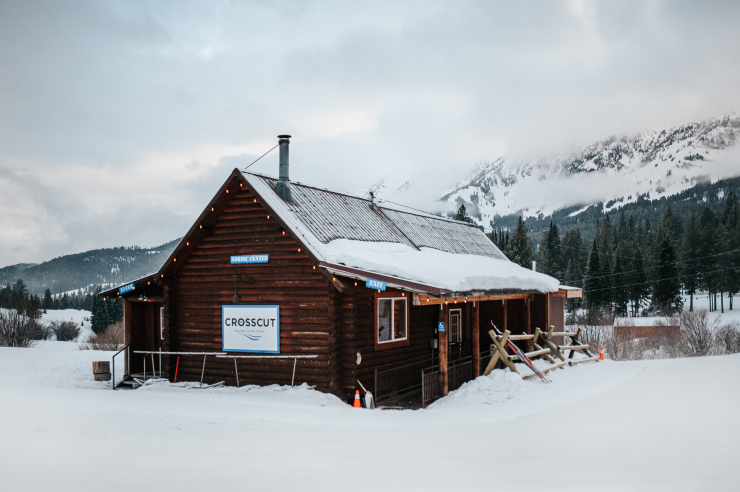
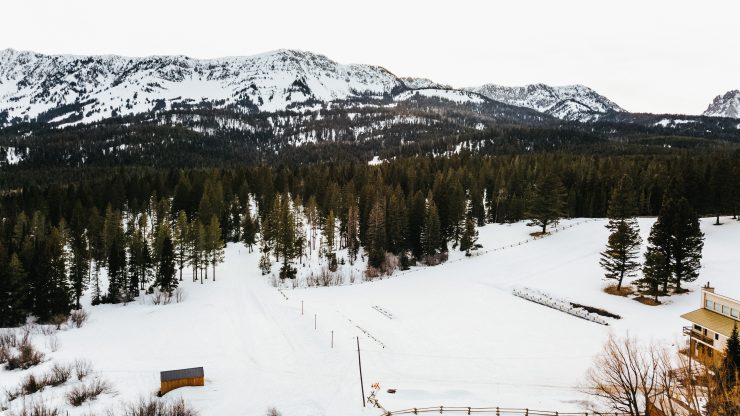
The Crosscut Mountain Sports Center has become the home base for the US Para Nordic Program, while the Crosscut Elite Team supports para nordic development athletes. (Photo: Crosscut Mountain Sports Center / Townsend Collective)
On April 9th, the Crosscut Mountain Sports Center in Bozeman, MT released information and qualification criteria for their newly founded elite team. As you skim what it takes to earn a spot at each tier of the program, it may catch your attention that the cross country, biathlon, and para nordic are housed within the same program. This single team approach reflects the growth and development at Crosscut in connection with its partnership with the US Para Nordic (USPN) program, which has proven beneficial to both parties.
The program at Crosscut is still in its nascent stages, however, in the unofficial first season last year, Crosscut Elite Team members racked up a slew of accomplishments including earning spots at the Youth Olympic Games, IBU World Junior Championships, IBU Cups, IBU Open European Championships, FIS North American World Cup Sprint Tour (these spots were eventually missed due to cancellations), and World Para Nordic Skiing World Cups.
Simply put: the goal of the Crosscut Elite Team is supporting athletes of all abilities as they advance toward the highest levels of ski racing and biathlon, beit a Paralympic team, the US Biathlon Team, or the US Ski Team.
To learn more about the evolution and goals of the elite program at Crosscut, FasterSkier spoke with Nick Michaud, who keeps his hands full as the USPN Development Coach while also coaching the elite program across abilities.
Nick Michaud is a coach for the Crosscut Elite Team, while also working as the US Para Nordic development coach. (Photo: CrosscutMT.org)
Before becoming a coach, Michaud was a member of the Bridger Ski Foundation (BSF) Elite Team through the 2018 Olympic Season where he came up one spot short of making the team for PyeongChang. A native of Fort Kent, ME, he grew up skiing and competing in biathlon with the Maine Winter Sports Center, coached by John Farra and Eileen Carey, who went on to become leaders of the US Para Nordic Team. Farra has since transitioned to the role of head performance general manager of USA Paratriathlon, with Carey advancing into his spot as head coach.
Michaud explained that as his own ski career was waning, he sought advice from Carey about possible next steps, expressing an interest in coaching.
“The motivation has been that the people in my life who impacted me the most were coaches, and I’ve always known that I wanted to teach or coach — to work with people in some capacity.”
In March of 2019, Carey presented Michaud with the opportunity to travel with the USPN team on a World Cup trip in Sapporo, Japan as an assistant coach. Michaud leapt at the opportunity, describing it as “so much fun”, and was offered a position with USPN later that year. Although he lacked specific experience working with adaptive athletes, he explained that the mission of USPN excited him more so than other possible coaching roles.
“I’m even more drawn to the movement of the Paralympic foundation right now to increase access for this sport,” said Michaud. “Nordic skiing is a pretty homogenous group of people, so it’s exciting to be part of an organization that is finding ways to break out of that a little bit.”
According to Carey, Michaud’s personality and growth mindset ready him for the challenge of coaching the adaptive team.
“Nick has a natural curiosity that makes him a great fit for the role,” wrote Carey in an email to FasterSkier. “For para athletes, it is not possible to approach coaching with a ‘one size fits all’ solution. I believe this is also true of all coaching, but it is elemental to coaching athletes who have such different mechanics from one another. When there is no “norm”, you always have to be willing to search and invent.
“I have known Nick since he was 13 and he has always had that curiosity, the willingness to question and try (and fail!) at things in order to progress. More than anything, that seems to make a great coach, so it was natural for me to try to get him some experience in the para coaching world when I found out he was hanging up the race skis.”
The Crosscut Mountain Sports Center has become the home base for the US Para Nordic team while fostering para nordic development. (Photo: Crosscut Mountain Sports Center/Townsend Collective)
Over the last few seasons, Bozeman has become a home base for the USPN team, who are spread throughout the country for much of the year. The location has proved ideal given its proximity to an airport, and quality skiing that was conducive to sit skiing. This sparked a connection with Crosscut, who Carey explained has repeatedly “gone the extra mile” to support the growth and success of the para nordic program.
In a 2016 interview with the Spokesman-Review in Spokane, WA, Carey wrote, “The single-biggest component to [the rise of the US Para Nordic team] has been our relationship to Crosscut Mountain Sports Center. All of our competitions consist of half cross-country races and half biathlon. Before we moved to Bozeman, we didn’t have a place to shoot consistently. When we arrived in Bozeman and identified that as a need, Crosscut Mountain Sports Center and Bridger Biathlon Club provided the piece we were missing. They built us a range and have supported us in so many ways to make sure our athletes have what they need for success. It has been an incredible experience for our athletes and team and one that will continue to be a huge component to our future success.”
The impact of Crosscut’s support of the USPN program has extended beyond the immediate circle of national team athletes and coaches, promoting access to adaptive athletes of all levels.
“It’s been really cool to see the partnership leech out to other parts of the community,” said Michaud. “For example, Eagle Mount is an adaptive ski program in Bozeman and Crosscut is partnered with them. When we build sit ski trails or sit ski teaching manuals for the Paralympic team, it’s not just for coaches trying to prepare skiers to be the best sit skiers in the world, but it also gets shared with a program like Eagle Mount, or equipment gets passed on to them. So Crosscut is increasing access to skiing, not just for the best sit skiers in the world, but for all adaptive skiers in Bozeman.”
Michaud explained that the USPN team also passes on used equipment to Eagle Mount and other programs. As sit ski and adaptive equipment is highly specialized and expensive, this creates access that clubs may not otherwise be able to afford.
“We’re always getting new sit skis and trying out new models, and all of a sudden, we have a fleet of sit skis that are getting retired and pushed out to other parts of the community, not just in Bozeman but throughout the country.”
He continued that as the USPN program rises and technology advances, they are passing on better and better equipment. They have also worked to develop a sit ski teaching manual, which has been passed on to adaptive programs as a resource to coaches.
Carey explained that the symbiotic relationship between Crosscut and USPN trickles down to supporting the development of new para athletes, as it creates access and opportunity for people of all abilities to try and grow in the sport.
“One of our program’s main objectives is to provide high quality Nordic experiences to para athletes. To do that we need to find ways to increase access to the sport at all levels. Crosscut is committed to providing an outdoor venue that is for all members of the community. We share a vision that sport and the outdoors are for everyone. When that is the starting place, it is easy to find ways to collaborate to build a place that is for everyone.”
To visualize this message, one simply needs to go for a ski at Crosscut.
“This winter the parking lot has been full everyday,” explained Michaud. “And there’s something beautiful about seeing an elite athlete doing intervals, flying around, with kiddos from the education program playing games in the stadium, and sit skiers shooting on the range and getting laps and maneuvering. Just seeing the full spectrum of anyone who could be skiing all in one place at once.”
In turn, by sharing trails with adaptive athletes, Crosscut users get to know them individually and learn more about what it takes to be an elite para athlete, thereby becoming more invested in their success. Michaud explained that this deeper understanding and excitement connects the community at Crosscut, and gives able bodied skiers the vocabulary to encourage para athletes in their training.
“It’s been really nice for the national team to be able to come to Bozeman and have a home, have a place to train, have people that they know who are excited about what they’re doing. To understand skiing enough to be complimenting them on their maneuvering or their double pole, versus just saying, ‘That’s so cool that you’re doing that.’ There’s just another level of understanding.”
Further highlighting the mutual benefit the Crosscut community has received from their support and fostering of the USPN program, Michaud discussed the contributions of elite team member Ruslan Reiter across programs. Reiter, who was born with an underdeveloped right arm, is the only member of the national team that competes in standing events, versus sit ski. Outside of skiing, he is pursuing a degree in aviation at Montana State University in Bozeman.
“He has really embodied this collaboration,” Michaud shared. “I’m also helping run the elite team for Crosscut. Since he’s a standing athlete, he fits into that fairly well on the day to day, then he travels with the Paralympic team in the winter. He’s super fortunate that he gets to be a part of this team of professional athletes in Bozeman and also part of the national team that’s traveling mostly in Europe… Our success is very intertwined with one another. Ruslan has gotten to be a part of that and it’s really benefited both groups in a lot of ways.”
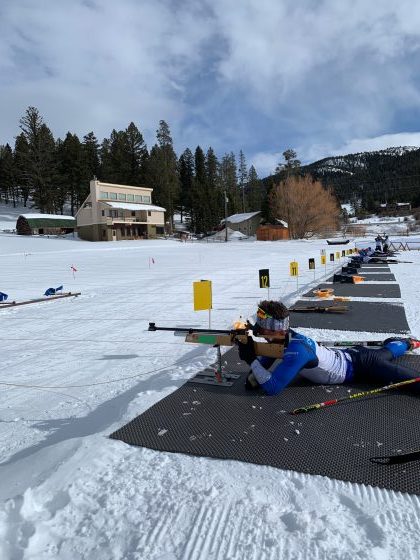
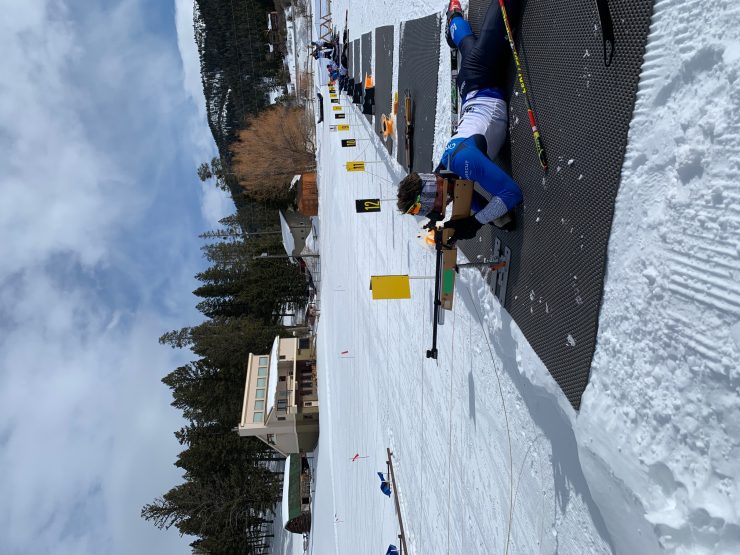
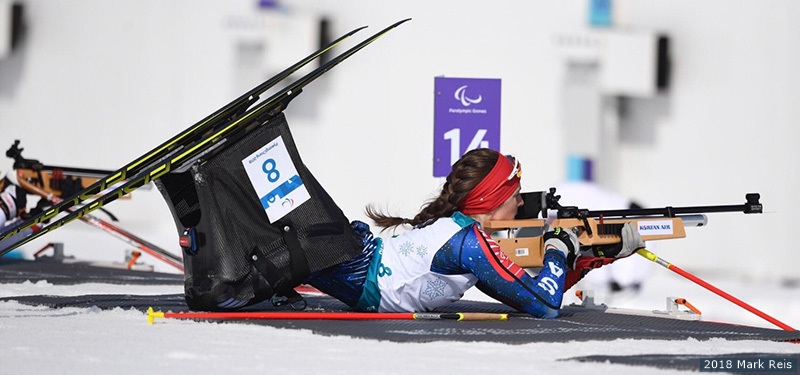
US Para Nordic C-Team member Ruslan Reiter shoots prone during a biathlon event at the Crosscut Mountain Sports Center. (Photo: Eileen Carey)
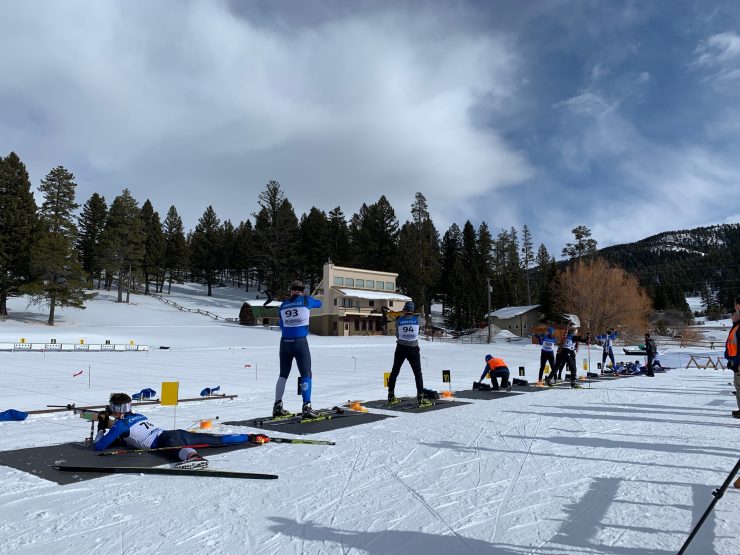
Ruslan Reiter (left, prone) takes aim during a biathlon event at the Crosscut Mountain Sports Center. (Photo: Eileen Carey)
Reiter was born in Russia but was adopted by a family in Maine, where he began his ski career in middle school. Just after finishing high school, Reiter made the 2018 Paralympic Team, landing just outside the top-10 in his best performance, 11th place in the 12.5-kilometer biathlon event. Michaud explained that Reiter’s presence elevates the motivation and dedication of his teammates.
“We’re in the weight room at the Mountain Project with the Crosscut Elite Team, and we’ve got a strength plan that I’ve been able to put together with a strength coach at the USOPC. These athletes who are in their mid-20’s who have been training for a long time and are really high level are seeing Ruslan doing pull ups with one hand, and there’s just no excuse to step it up, to not find a way to get better, because they’re a part of that culture. So that has been really tangible and awesome.”
Like the elite program and partnership with USPN, the Crosscut Mountain Sport Center is in a stage of growth and development. In the summer of 2017, the organization purchased the Bohart Ranch Property, which was home to a cross country trail system since the 1980’s, with the vision of creating a robust resource for the Bozeman community that doubled as training grounds for the Bridger Biathlon Club and USPN program.
As Crosscut began developing a vision ranch property, the input of those they wished to serve guided the approach. Carey explained that Crosscut’s inclusive and dedicated approach has been paramount to creating a ski center that supports athletes of all abilities.
“They are starting the process of developing programming, events, and a venue with the lens of ‘How are we going to create these things in a way that serves everyone in our community?’. As a part of that community, we are part of all the conversations. In the end, Crosscut’s willingness to have the conversation through that lens has been critical to our program’s competitive success and I think will be central to Crosscut being able to live their mission.”
It is the wish that Crosscut becomes an example for other cross country ski areas, dispelling myths about what it takes to create opportunities and access for para athletes.
“It’s everyone’s hope that this shows that there’s no reason that other clubs can’t have an adaptive component or a para component, and it shouldn’t be that hard,” said Michaud. “It just takes a little bit of intentional work to make it more accessible.”
Carey elaborated on this point, explaining that the increased accessibility additionally benefits the larger community.
“They are helping to show that creating programs and venues that work for para athletes doesn’t have to be a sacrifice or an afterthought,” wrote Carey. “There are many ways to do business that enhance experience for para athletes that also make sense for the larger community. Ultimately, just like anything, having a club that works for para athletes is as simple as deciding it is so. Are there unique challenges and considerations? Absolutely. But I think if you start to look to the clubs and coaches who have had para athletes, they would also tell you there are many benefits.
“If you want to make it happen, you can make it happen. And our program is set up to help with that process in the service of our goal to make Nordic skiing possible for more members of our community.”
Crosscut Elite Team members Hannah Cole (left) and Ruslan Reiter (right) train with coach Nick Michaud (center) at the Crosscut Mountain Sports Center. Reiter is also a member of the US Para Nordic C-Team. (Photo: Seth Hubbard, Crosscut Elite Team Coach)
Moving forward, the elite program at Crosscut hopes to bring a few new adaptive athletes to Bozeman from outside the national team, supporting them as they move through the development pipeline. Michaud explained that the program aspires to rise alongside the US Para Nordic program.
“We’ll see the program growing at Crosscut in the same way that the development for the Paralympic team around the country has been happening. It will no longer just be a home training site when they’re in town during the winter, but we’ll start to see more development, more para athletes training with Crosscut throughout the year.”
Speaking to the broader vision of US Para Nordic, Carey expanded on Michaud’s statement, including enforcement of the message that other clubs can follow Crusscut’s lead in integrating para athletes into their existing programming.
“We are working to increase the development of our sport especially in the standing and visually impaired categories,” wrote Carey. “US Ski and Snowboard and USBA clubs and coaches are also our development pathways for para athletes and there are many clubs and teams around the country who have para athletes integrated into their programming. Crosscut created para specific criteria for their elite team and named para athletes to their team. In this and many other ways, they are a tangible representation of our vision of how development can work for para athletes. They are showing that it can be done, that they have the tools to do it, and that there are benefits to it for everyone.”
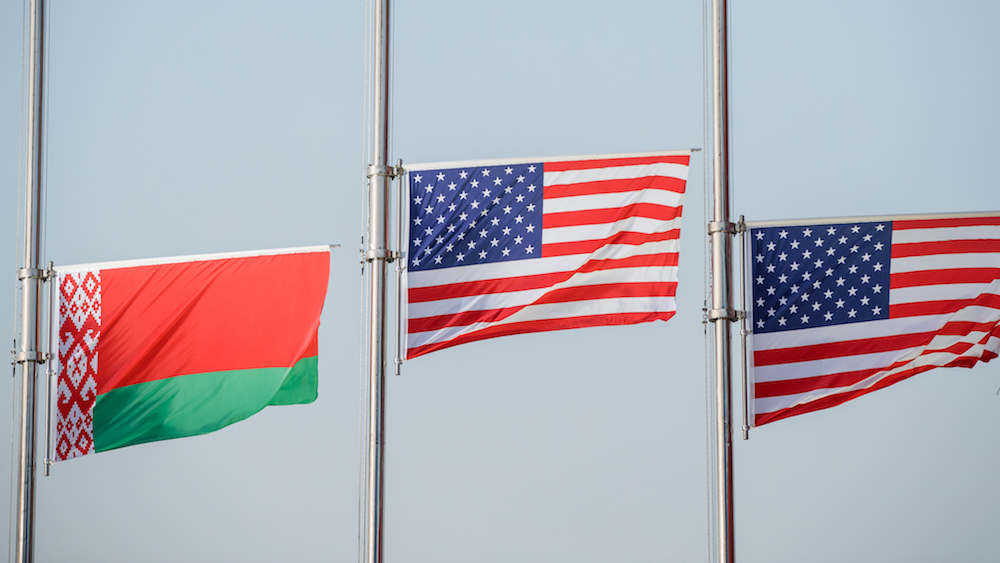
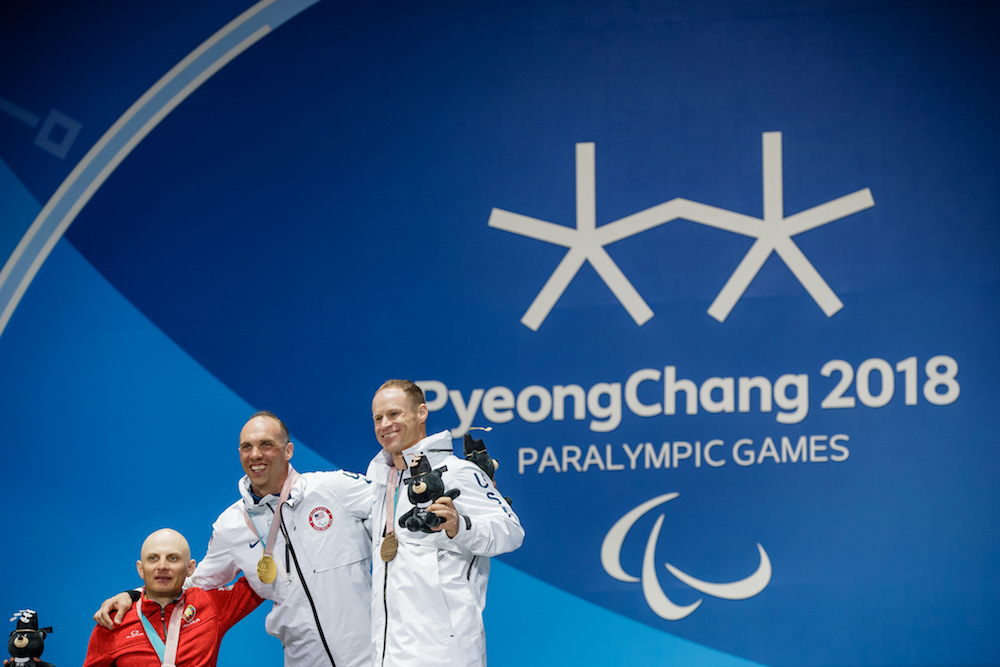
Two American flags and a Belarusian flag being hoisted to honor the medalists in the men’s sitting cross-country sprint at the 2018 Winter Paralympics in PyeongChang, South Korea. Americans Andy Soule and Dan Cnossen placed first and second, respectively, and Dzmitry Loban of Belarus finished third. (Photo: U.S. Paralympics/Joe Kusumoto)
Success to failure. Failure to success. Two trends of two extremes on the performance metrics on the international cross-country skiing spectrum. There are many in-betweens: scoring World Cup points with a top 30, top 10’s, any spot on the podium. There are the Olympic and Paralympic quads featuring a four-year buildup to North America’s singular focus on bronze, silver and gold hardware.
When considering how to develop talent, placing athletes on snow with the absolute best technology available, positioning athletes to medal, the U.S. Paralympics Nordic Program is an enviable high-performance model. That became evident this winter during the 2018 Paralympic Winter Games in PyeongChang, South Korea. U.S. Paralympics Nordic hauled in 16 medals in a week about a month ago.
That many medals for a single team borders on excess. Pursuing the perfection that leads to near-excess has driven the U.S. team staff and athletes for years. Back in 2006 in Torino, Italy, the U.S. Paralympics Nordic team earned three medals. In 2010, in Vancouver, British Columbia, they tallied one medal. In 2014 in Sochi, Russia, they claimed three. This year in PyeongChang: 16.
“I think we have a few factors to our success,” Eileen Carey, head coach of the U.S. Paralympics Nordic team told FasterSkier in a recent phone interview. “We’ve built the entire team — every athlete who has been engaged in the last several years and the staff that we have built are totally committed to the goal of the team. There are not a lot of egos. Everybody has a role. Everybody is really good at what they do, and everybody executes on race day.”
That goal and the team’s execution amounted to 11 medals total between two athletes, both sit-skiers. Thirty-seven-year-old Dan Cnossen entered six races: three cross-country, three biathlon. He medaled in each. Oksana Masters, 28, took five medals: two in biathlon, three in cross-country.
In the leadup to the Games, with buoyant media coverage of para-athletes and opportunities to brand themselves more broadly, the narrative of athletes like Masters and Cnossen were hard to miss. Masters endured a Ukrainian orphanage until she was almost 8. Cnossen is a retired Navy SEAL and a Purple Heart and Bronze Star with Valor recipient. He lost both legs above the knee after stepping on an improvised explosive device (IED) while on patrol in Afghanistan in September 2009.
Biathlon gold medalist Dan Cnossen of the U.S. celebrates his win in the men’s sitting 7.5 k biathlon sprint on opening day of competition at the 2018 Winter Paralympics on March 10 in PyeongChang, South Korea. (Photo: U.S. Paralympics/Mark Reis)
Stories like those of Masters and Cnossen should make us appreciate for a moment our most basic gifts. Their stories are inspiring. That, according to Carey, misses the point when it comes to understanding what exactly manifested in PyeongChang.
“Sure, the Olympic and the Paralympic mission is to inspire people,” Carey said. “But the narrative about Paralympians has historically been far more about inspiration being the central storyline versus Olympians where the essential storyline as about their athletic prowess. The comments that I have heard about these Games are about the athletic performances of the athletes. Whereas in Sochi, and a lot what I have heard before, is a lot about the inspiration.”
Cnossen is a graduate student at Harvard. He receives some support from the school’s cross-country coach, but trains most often north of Cambridge Square at the Craftsbury Outdoor Center in northern Vermont. There, Cnossen benefits from world-class biathlon instruction.
Carey explained that at last season’s 2017 PyeongChang test event, Cnossen performed better in the cross-country races there than in biathlon. As a world-class athlete, traveling several hours for countless four-day Craftsbury weekends and increasing his time spent training on the shooting range were some of the commitments Cnossen made, just like any other hyper-focused, hyper-driven athlete.
Carey also made clear what Craftsbury’s part was in developing Cnossen’s athleticism.
“As a sit skier, you don’t carry a rifle,” she explained. “When you are shooting, that means 100 percent of the time, someone is on the range loading pellets with bare hands when it’s cold outside and handing you your rifle. Dan would shoot three or four times a weekend when he was there, and they supported him 100 percent of that time. He won a medal in every biathlon event. That is Craftsbury’s success as much as anybody else’s.”
Masters’s own drama unfolded two weeks before the Paralympics when she slipped and fell on ice. She dislocated her elbow and chipped all three bones that meet in the elbow. After being operated on at The Steadman Clinic in Vail, Colorado, Masters remained a medal favorite in Korea.
She came to PyeongChang as an all-arounder in both biathlon and sitting cross-country. (Masters, also a multi-sport athlete, competed in rowing at the 2012 London Paralympics — where she earned a bronze medal — and cycling at the 2016 Rio Games.)
Oksana Masters (U.S. Paralympics Nordic) after winning her first-career Paralympic gold medal in the women’s sitting cross-country sprint at the 2018 Winter Paralympics in PyeongChang, South Korea. (Photo: U.S. Paralympics/Joe Kusumoto)
In her first race in PyeongChang last month, Masters took silver in the biathlon sprint (behind her U.S. teammate Kendall Gretsch in first). Those medals, Gretsch’s first and Masters’s first in biathlon, set the stage for more gritty performances and Masters’s five-medal PyeongChang bounty. Inspiring? Yes. But more to the point, both were athletically dominant.
Masters’s dominance came with a very human off-race. On March 13, during the women’s sitting 10 k biathlon race, Masters fell in her sit ski onto her ailing arm and missed a total of six shots for six penalty laps. While she skied the extra laps, another U.S. coach encouraged Masters to pull herself out of the race. The team’s staff was concerned about her elbow and wanted to ensure her health for her three remaining races.
“I sprinted down the course and just stood in front of her in the middle of the course and pulled her off,” Carey said of how she ultimately persuaded Masters to not finish. “Oksana thought she was done midway through the Games. We X-rayed her again and came up with a plan and taped her elbow in a way that would provide more protection.”
At the 2010 Vancouver Paralympics, Andy Soule earned bronze in biathlon. His medal was the first Paralympic medal in the discipline for the U.S. team. Eight years later in PyeongChang, Soule, a 38-year-old Army veteran, who, like Cnossen, lost both his legs in Afghanistan, delivered the Paralympics equivalent to the “here comes Diggins” moment.
During the men’s sitting cross-country sprint final, Soule came into the last hill in sixth place. He then glided into fourth on final downhill before the last intensive double-poling push to the finish.
With lickety-split skis to match his upper body’s Thor-like power, Soule willed himself into medal contention. From literally out of the camera’s view and into front and center on the final stretch, Soule threw down and accelerated. Bronze, then silver, and at the line, gold came into play. The PyeongChang sprint win was Soule’s first-career Paralympic gold in three Paralympics — he also claimed bronze in the PyeongChang 12.5 k biathlon race. (Soule promptly retired from elite-level competition afterward.)
“Andy has spent a lot of time over the last four years doing a whole lot of stuff, like learning how to move fast on flats, which was something that we had identified from Sochi as being the weak link,” Carey said. “There was something otherworldly about those last 100 meters that was just incredibly cool to watch.”
Cnossen, Masters, and Soule symbolize the U.S. Paralympics Nordic team’s rise. Yet, Carey, along with the team’s high-performance director, John Farra, have been able to build a program that has positioned itself for future medals. Gretsch, 26, may be part of that future. She came to nordic skiing as a world-class para-triathlete and represents what Farra calls “talent transfer”.
“We are super proud with how our sit-ski program has evolved,” Farra said on the phone. “We are super proud that we can take athletes in a talent-transfer situation like Kendall and help her come from being a world champion in triathlon and have her transfer and learn the skills in a short period of time to now being one of the best in the world.”
In PyeongChang, Gretsch captured two golds in the first two races. She won the sitting biathlon sprint and the 12 k sitting cross-country events.
Winter Paralympic rookie Kendall Gretsch racing at the 2018 Paralympics in PyeongChang, South Korea. (Photo: U.S. Paralympics/Joe Kusumoto)
Farra explained that their medal was the first for the U.S. in a visually impaired race at the “modern” Paralympics. The VI classes were historically split between B1, B2 and B3 classes. (B1 athletes have the least amount of vision.) The different classifications are used as a descriptor of each athlete’s degree of blindness. Formerly, each classification of athlete competed against the same classification athletes. For example, in the past, only B1’s competed against B1’s. Today, that format is defunct, and all classifications currently compete against one another. An athlete’s finishing time is adjusted based on their severity of blindness.
As Farra explained, in the “modern” VI medals are harder to come by.
Adicoff, a student at Bowdoin College and a member of the Sun Valley Ski Education Foundation (SVSEF), was competing at his second Paralympics. Kesselheim was a Paralympic rookie.
“They are a team,” Carey said of the Adicoff-Kesselheim pairing. “Visually impaired athletes and guides function much more, in my view, like a cycling team as opposed to a traditional ski racer. … The medal was won by both Jake and Sawyer. In that race, they worked together more effectively than I had ever seen them work together. They were more in sync; they were skiing closer to each other. There is a lot of challenges in guiding when it comes to the communication, and Sawyer is a great communicator. He is an amazing skier and athlete, but he is a great communicator and he has no ego. He was totally bought into being on that team.”
Guide Sawyer Kesselheim leads his U.S. teammate Jake Adicoff during the open relay on March 18 at the 2018 Winter Paralympics in PyeongChang, South Korea. (Photo: U.S. Paralympics/Mark Reis)
The first day of the next Paralympic quad began on March 19, the day after the PyeongChang Paralympic Closing Ceremony. Yet Casey and Farra kept an eye on 2022 by nurturing and investing in more Paralympic rookies by exposing them to their respective sport’s highest level of competition. Grace Miller (standing , Alaska Nordic Racing), Ruslan Reiter (standing, Outdoor Sports Institute), Joy Rondeau (sitting, National Sports Center for the Disabled), and Mia Zutter (visually impaired, CXC/St. Scholastica) participated in their first, yet most likely not their last, Winter Paralympics.
“Having a larger community of people that consider themselves para-nordic skiers is motivating,” Farra said.
In the recent past, Farra explained that identifying and developing standing athletes has been a priority. The U.S. has already been a leader in supporting sitting athletes and providing them with top-end, sit-ski technology.
“We have just scratched the surface of finding a couple of standing and a couple of VI athletes,” Farra continued. “That’s got us pretty excited about the connections they have to their local clubs and colleges, too. We were motivated to bring them to these Games so they could get a taste of what is out there and hopefully, they left absolutely motivated to live a professional athlete lifestyle and train hard with their clubs and their home college programs.”
— Alex Kochon contributed
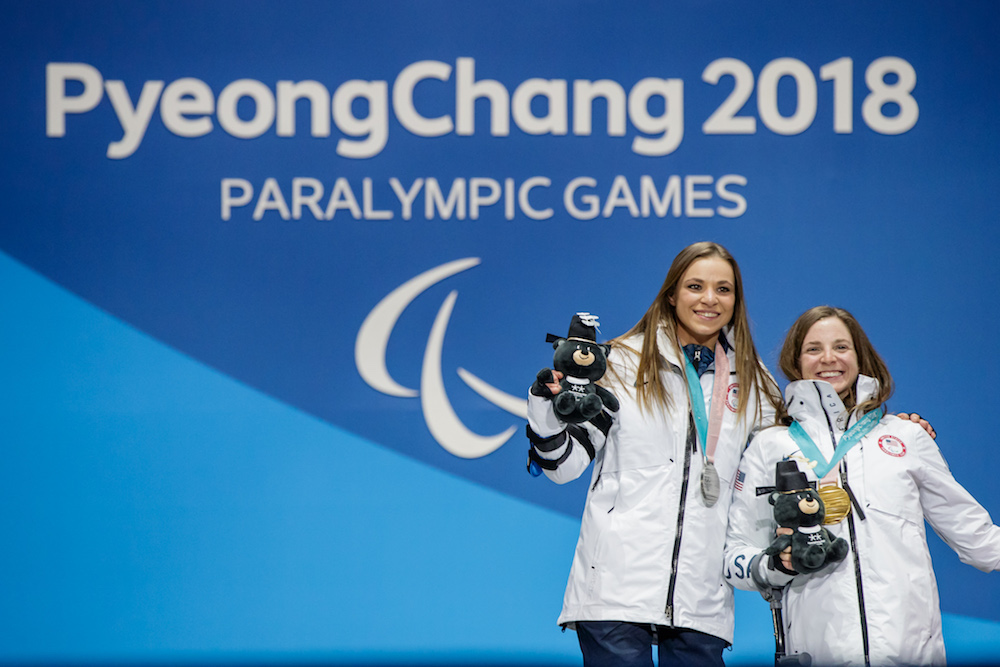
The 2018 PyeongChang Paralympics men’s sitting cross-country sprint podium at the medal ceremony, with Americans Andy Soule (c) and Dan Cnossen (r) in first and second, respectively, and Dzmitry Loban of Belarus in third. (Photo: U.S. Paralympics/Joe Kusumoto)Kendall Gretsch (r) and Oksana Masters at the 2018 Paralympics medal ceremony for the women’s sitting 6 k biathlon sprint after winning gold and silver, respectively, on the first day of competition in PyeongChang, South Korea. (Photo: U.S. Paralympics/Joe Kusumoto)
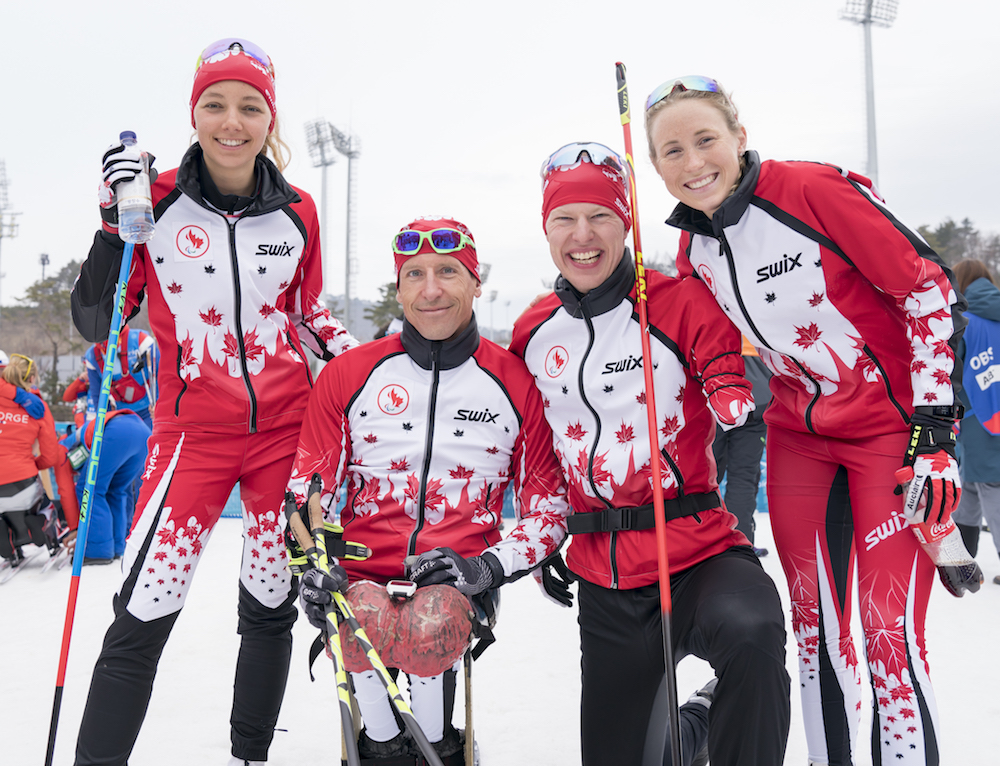
Canada’s mixed relay after taking silver on the last day of the 2018 Paralympics in PyeongChang, South Korea, with (from left to right) Natalie Wilkie, Chris Klebl, Mark Arendz and Emily Young. (Photo: Dave Holland/Canadian Paralympic Committee)
2018 Winter Paralympics (PyeongChang, South Korea): Mixed and open relays
On the final day of the PyeongChang Paralympic Games, Canada was the only country to medal in both the mixed and open cross-country relays, and its mixed relay anchor, Mark Arendz, became the most decorated Canadian at a single Winter Paralympics with his sixth medal of the week.
In the 4 x 2.5-kilometer mixed relay on Sunday, Natalie Wilkie, Emily Young, Chris Klebl, and Arendz teamed up for silver, 50 seconds behind Ukraine (Iurii Utkin, Liudmyla Liashenko, Yuliia Batenkova-Bauman, and Oksana Shyshkova), which claimed gold in 24:31.9 minutes. On the final skate leg, Arendz held off Germany (Andrea Eskau, Steffen Lehmker and Alexander Ehler) by 3.4 seconds at the line.
Wilkie and Young, standing athletes coming off gold and bronze in Saturday’s 7.5 k cross-country race, started the team off for the first two classic legs. Wilkie, 17, also earned an individual bronze at these Games. While Wilkie tagged Young in fifth, Young went on to tag Klebl, a 2014 Paralympic champion sit-skier, in seventh place.
“Our team worked so well together,” Young said of the relay, according to a Cross Country Canada press release. “It looked a little scary in the beginning, but we knew we had Chris in third and Mark anchoring which was going to be the difference. We each held our own in our individual sections and it is so fun to win this one as a team.”
Klebl, 46, made up 27 seconds on the field and tagged Arendz in fourth. Arendz then caught and passed Japan’s Taiki Kawayoke and later Germany’s Ehler on the last downhill into the finishing stretch to finish second.
“This is fantastic. It is our first relay medal ever,” Arendz, 28, told Cross Country Canada. “It is great to end the Games with a historic moment that we get to share with each other for the rest of our lives. This is a great team of two veterans and two rookies. I’m so happy we were able to get this done.”
Arendz, who elected flag bearer of the Canadian Paralympic Team for Sunday’s Closing Ceremony, is taking home a gold medal from the 15 k biathlon race, two silvers, and three bronze medals. He competed in all but one race throughout the week, skipping the distance cross-country race.
“I came in here thinking I could get three medals, but to get six is incredible,” Arendz said. “Today’s is a special one. I am happy we got this done, but there is no way I could do another race. I’m done.”
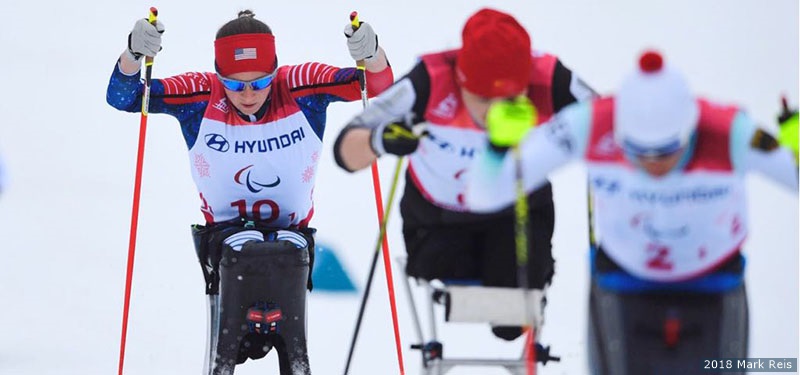
American Kendall Gretsch (l) racing in the 4 x 2.5 k open relay at the 2018 Paralympic Winter Games in PyeongChang, South Korea. (Photo: U.S. Paralympics/Mark Reis)
The U.S. team, with Kendall Gretsch, Ruslan Reiter, Jake Adicoff (and guide Sawyer Kesselheim) placed seventh in the mixed relay, 1:35.7 out of first. Gretsch skied both the first and third legs and tagged Adicoff in ninth out of 13 teams at the last exchange.
“It’s a little bit nerve-wracking and a little bit fun,” Adicoff said of skiing the anchor leg. “They did an awesome job on the first three legs.”
In the 4 x 2.5 k open relay an hour later, Canada raced to bronze with two athletes: sit-skier Collin Cameron and visually impaired skier Brian McKeever (and his guides Graham Nishikawa and Russell Kennedy).
The duo finished 1:05.8 behind France, which placed first with Benjamin Daviet, Anthony Chalencon and Thomas Clarion in 22:46.6. Norway finished 22.5 seconds back for silver, with Nils-Erik Ulset, Hakon Olsrud and Eirik Bye.
Ukraine (Iaroslav Reshetynskyi, Olha Prylutska, Grygorii Vovchynskyi, and Anatolii Kovalevskyi) crossed the line in third but was penalized 30 seconds for an early exchange and slipped to fifth (+1:26.3), while Canada moved into third and Belarus placed fourth (+1:23.7).
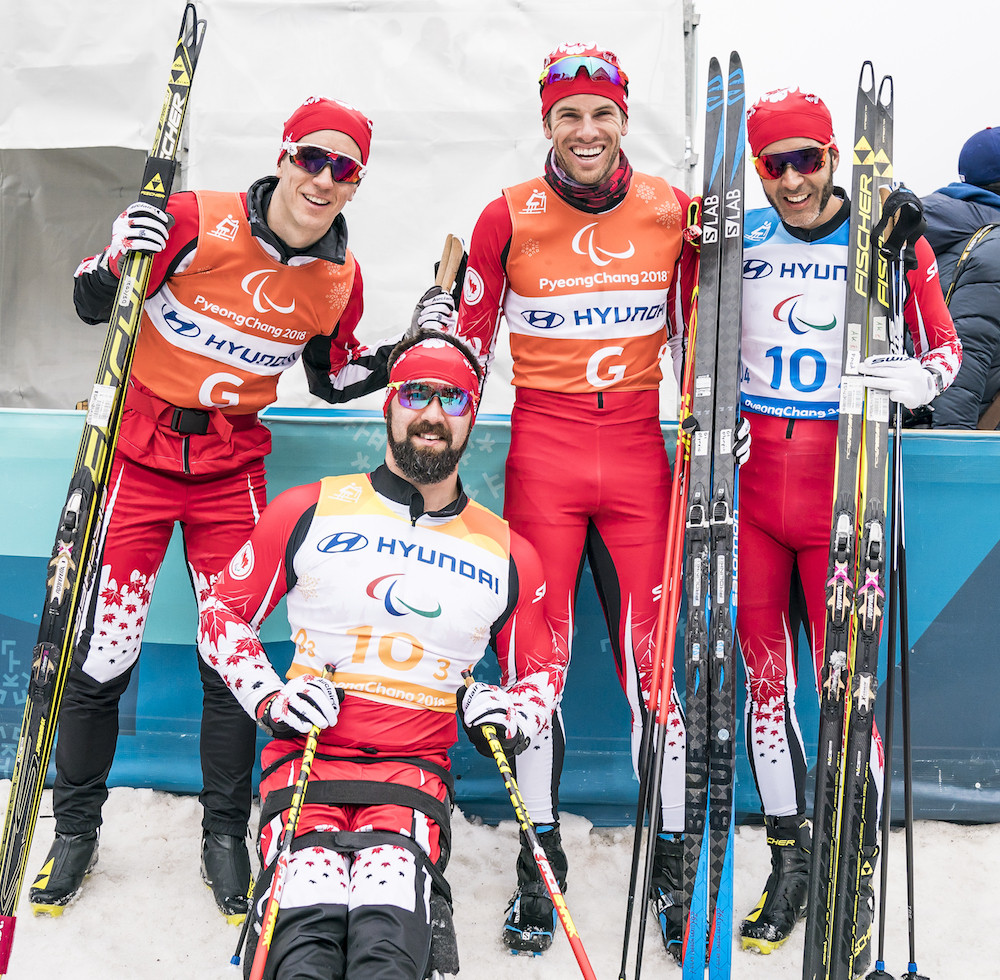
Canada’s open relay after taking bronze on the last day of the 2018 Paralympics in PyeongChang, South Korea, with (from left to right) Graham Nishikawa (guide), Collin Cameron, Russell Kennedy (guide), and Brian McKeever. (Photo: Dave Holland/Canadian Paralympic Committee)
Early in the race, Cameron tagged McKeever in eighth at the first exchange, and McKeever and his guide raced up to fourth. On the third leg, Cameron was skiing in third until he dropped a pole on the last climb and had to turn around to recover it. He came through the last exchange in sixth, 25 seconds behind Ukraine in third. McKeever went on to crossed the finish line fourth place, but his team was awarded bronze after Ukraine was penalized for tagging outside the exchange zone.
The bronze medal was Cameron’s third of the week after he placed third in two biathlon races earlier in the week. For McKeever, Canada’s most decorated Winter Paralympian of all time who won all three individual cross-country races he competed in over the last week, it was the 17th medal of his Paralympic career.
“I just tried to pace it properly and be as fast as I could. It was so much fun,” Cameron, 28, told Cross Country Canada. “This is my first relay, so I was really looking forward to this. I am super happy to leave here with three medals.”
“It’s incredible to get two relay medals today,” McKeever, 38, said. “We knew we had a shot if we all had really good days. What Mark, Chris and the girls did in that first relay was awesome. These races are so interesting with all different disabilities together. It is never over until last tour around, and in both cases, we saw that today with lots of different lead changes out there.”
The U.S. open relay at the 2018 Paralympics in PyeongChang, South Korea, with (from left to right) Andy Soule, Grace Miller, and Mia Zutter, Kristina Trygstad-Saari (guide), and Sean Halsted. (Photo: U.S. Paralympics/Mark Reis)
The U.S. team, with Andy Soule, Sean Halsted, Grace Miller, and Mia Zutter (and guide Kristina Trygstad-Saari), placed 12th in the open relay out of 12 teams.
“It’s been an amazing Paralympic Games,” Soule, 38, told U.S. Paralympics Nordic. “The organizers have put on a great event. This is a great team to be involved with. We’ve had a lot of fun here. This is my last Paralympic race, but we have a couple of young athletes here. We’ll have a great team for a long time.”
In total, both the Canadian and U.S. Paralympic teams tallied 16 medals between nordic and biathlon in PyeongChang — a record for both programs. Notably, every member of Canada’s Para-Nordic World Cup Team is taking home at least one medal.
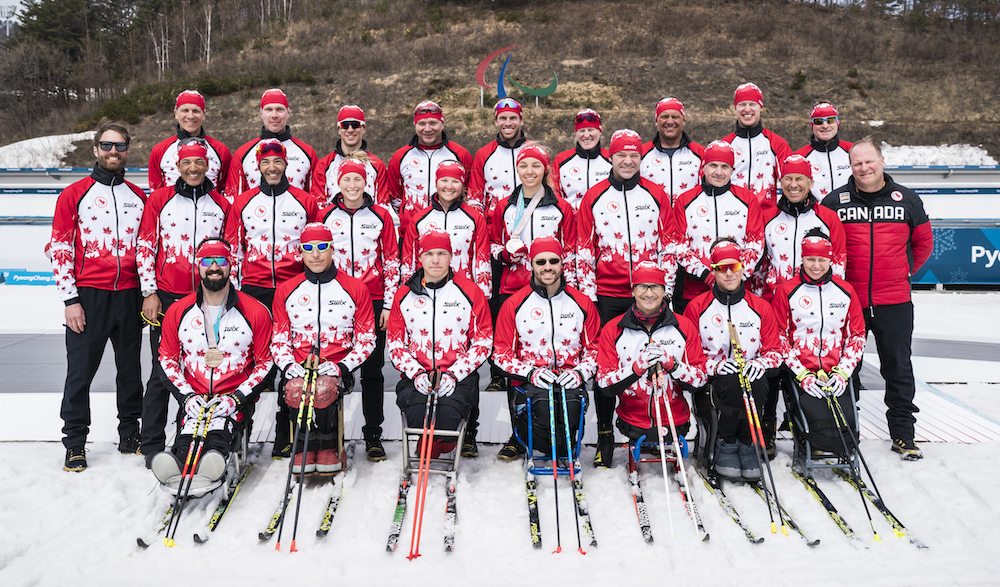
Canada’s 2018 Paralypmic cross-country and biathlon team at the Alpensia Biathlon Centre on the last day of the Games in Pyeongchang, South Korea. (Photo: Dave Holland/Canadian Paralympic Committee)
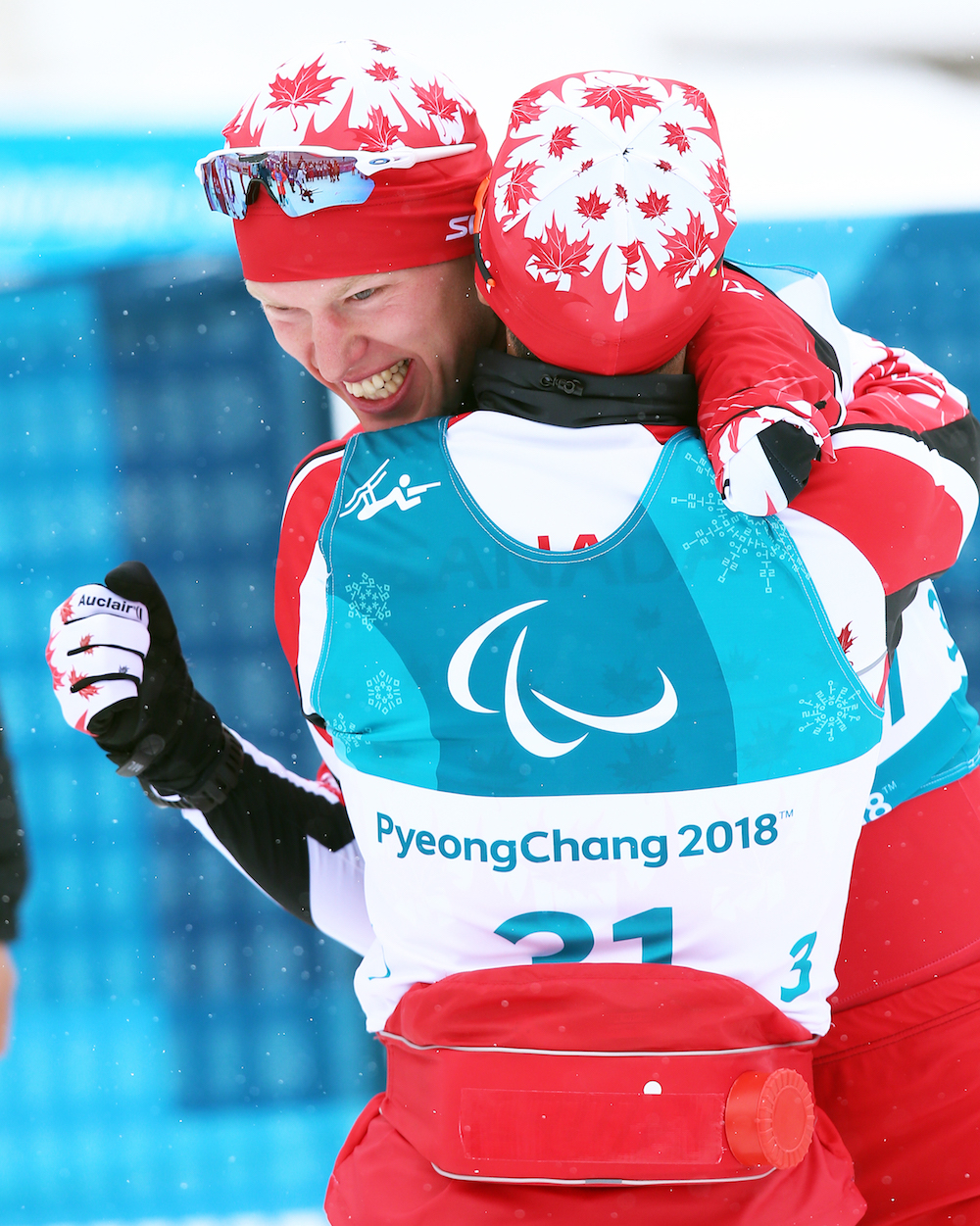
Canada’s Mark Arendez gets a congratulatory hug after he won gold in the men’s 15 k standing biathlon individual race on Friday at the 2018 Paralympics in PyeongChang, South Korea. (Photo: Scott Grant/Canadian Paralympic Committee)
2018 Winter Paralympics (PyeongChang, South Korea): 12.5/15 k biathlon races
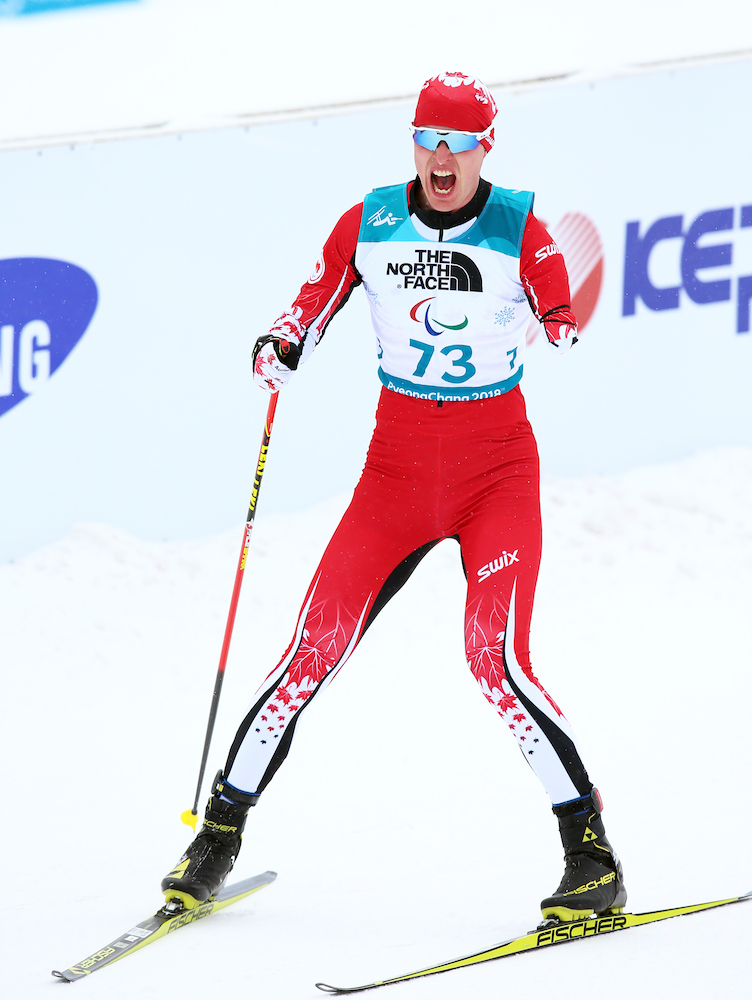
Mark Arendez lets out his trademark roar as he crosses the finish line of the men’s 15 k standing biathlon individual on Friday at the 2018 Paralympics in PyeongChang, South Korea. He won for his first Paralympic gold and sixth-career Paralympic medal. (Photo: Scott Grant/Canadian Paralympic Committee)
Canada’s Mark Arendz captured his first Paralympic gold, the sixth Paralympic medal of his career and his fourth medal of the PyeongChang Games on Friday in the men’s 15-kilometer individual standing biathlon race — the longest and final biathlon event on the schedule.
Meanwhile, Dan Cnossen of the U.S. continued his medal streak with his fifth medal in as many races, taking silver in the men’s 15 k sitting biathlon. His teammate Oksana Masters raced to silver for her fourth medal of the 2018 Games in the women’s 12.5 k sitting biathlon, and two Canadians earned bronze with Collin Cameron placing third in the men’s 15 k sitting and Brittany Hudak taking her first Paralympic medal in the women’s 12.5 k sitting.
Arendz, 28, who placed second and third in two biathlon races at the 2014 Paralympics and once again finished second and third in two previous biathlon events at these Games, cleaned all four shooting stages to secure the win in 42:52.2 minutes. France’s Benjamin Daviet took silver, 58.3 second back, after missing one target (0+0+1+0) and having a minute penalty added to his time. Norway’s Nils-Erik Ulset shot clean for bronze, 1:14.5 behind Arendz.
“Every time I stepped on the podium this week, I kept thinking I want to hear ‘Paralympic Champion’ and then my name announced,” Arendz told Cross Country Canada, according to a press release. “I wanted nothing more than to hear my country’s anthem played. I’ve seen the maple leaf on top of the podium three times this week, but to finally have it behind the top step of the podium for me is an amazing feeling.”
“I wanted to be consistent and focus on the process all week. This race was my strength,” he said. “It is a shooting race and you have to go clean. The process was key today, and I just tried to make sure I hit those 20 targets. Once I got to that last bout I wasn’t going to miss, so I made sure of every shot before I pulled the trigger. In the end I was clean, the skiing was strong, and that is what I wanted.
“That completes the [medal] set for biathlon, and my first gold which means everything to me,” Arendz said of the last biathlon race of the 2018 Games.
Also in that men’s standing individual race, American Ruslan Reiter placed 15th with nine penalties.
Silver for Cnossen, Masters; Second Bronze for Cameron
American Dan Cnossen racing to second in the men’s 15 k sitting biathlon individual at the 2018 Paralympics in PyeongChang, South Korea. (Photo: U.S. Paralympics/ Maddie Meyer-Getty Images)
In the men’s sitting biathlon event on Friday, Cnossen and Cameron raced to second (+45.5) and third (+1:01.9), respectively, behind Germany’s Martin Fleig in first. Fleig shot clean and finished in 49:57.2, while Cnossen missed one in the last stage (0+0+0+1) and Cameron had a single miss in the second shooting (0+1+0+0). The silver was Cnossen’s third of these Paralympics, and he medaled in every biathlon race in PyeongChang (taking gold in the 7.5 k and silver in the 12.5 k).
“This is special because, for one, the conditions were so difficult,” Cnossen explained in an interview with U.S. Paralympics Nordic. “It’s snowing, it’s cold. It’s 30-40 degrees colder than yesterday. I’m getting a little bit tired. I had a bit of a mental battle this morning waking up. I was considering pulling out of the race because I really want to be fresh for tomorrow, so to overcome that and still put up a really solid performance is really quite good. I wish I could have cleaned that last stage – I missed one shot. Then I just really tried to hammer on that last lap.”
While the biathlon races are over, Saturday holds middle-distance cross-country races in PyeongChang.
“I have an excerpt that says it doesn’t matter how you feel today, it doesn’t matter what your background is or where you’re coming from, all that matters is what you can do,” said Cnossen, a 37-year-old retired Navy SEAL who was awarded a Purple Heart and a Bronze Star with Valor from the Secretary of the Navy for his service in combat.
“I just tried to focus on what I could do today,” he continued. “Not the fact that I didn’t sleep well last night, that doesn’t matter. Just go out there and perform like I know I can.”
“I have an excerpt that says it doesn’t matter how you feel today, it doesn’t matter what your background is or where you’re coming from, all that matters is what you can do.” — Dan Cnossen, U.S. Paralympian and former Navy SEAL, after racing to his fifth medal of the 2018 Paralympics
Collin Cameron racing to his second bronze of the 2018 Paralympics on Friday in the men’s 15 k sitting biathlon individual in PyeongChang, South Korea. (Photo: Scott Grant/Canadian Paralympic Committee)
Cameron, 29, achieved his second bronze medal of the Games after placing third in the biathlon sprint then coming close in fourth in Wednesday’s cross-country sprint.
“This is awesome. This one is the sweetest one for sure,” Cameron said, according to a team press release. “That was a little redemption after the sprint day because I really wanted that one.
“I got very little sleep last night. I just couldn’t seem to settle,” he continued. “My coach told me some of the best athlete performances have happened after a bad night of sleep. I told myself to just settle down. I got the bugs out in that first lap, focused on pacing in every lap and just kept pushing.
“I came here wanting to get on the podium in cross country, and I’m going home with two biathlon medals. I didn’t expect that at all,” Cameron added.
Also in that men’s sitting biathlon race, Aaron Pike placed sixth with perfect shooting and Andy Soule finished ninth with four penalties (0+0+4+0).
In the women’s sitting biathlon individual, both Masters and Germany’s Andrea Eskau shot clean, but Eskau completed the course faster to claim gold in 49:41.2. Masters finished 18.8 seconds back for silver, her second biathlon medal of the Games, and Lidziya Hrafeyava of Belarus finished third (+1:15.8) with one penalty (0+1+0+0).
American Oksana Masters celebrates as she finishes second in the women’s 12.5 k sitting biathlon individual race on Friday at the 2018 Paralympics in PyeongChang, South Korea. (Photo: U.S. Paralympics/Simon Bruty-OIS/IOC)
“I went from getting a sunburn a couple days ago during the sprints to freezing right now,” Masters, 28, said of Friday’s conditions to U.S. Paralympics. “The skiing is great, our skis are amazing, the team is amazing putting together some fast skis. I’m so happy I got a chance to redeem myself from the last biathlon race I didn’t get to finish.”
Masters did not finish the women’s 10 k biathlon race earlier in the week. She has been racing with an elbow injury throughout the Games.
“The way I looked at it, I wasn’t going to get defeated by this elbow,” she said. “I definitely know I wasn’t skiing at 100 percent, but I wanted to see where I was. I’ve trained four years, the day after Sochi ended. I counted the days, it was like 1,461 days – not that I’m counting – but I was not going to let that basically take away from my Games experience here.”
As for hitting all 20 targets on Friday, Masters said she was in the zone.
“I just focused on that ‘breathe, exhale, pause, squeeze,’ which is everything I’ve been training and practicing,” she said. “I couldn’t believe it. I almost fell going around the corner telling my coach ‘I cleaned!’ I can’t believe it.”
In three biathlon races in PyeongChang, the U.S. team tallied seven medals. Going into these Games, the U.S. had one biathlon medal (Soule’s bronze from 2010) in the history of the Paralympics and Olympics.
In the women’s 12.5 k standing biathlon race, Hudak notched her first Paralympic medal and Canada’s first in a women’s standing biathlon event in third place, 2:23.9 behind Anna Milenina of the Neutral Paralympic Athletes (NPA) in first and 1:20.1 behind Ekaterina Rumyantseva (NPA) in second. While Milenina overcame two minutes of penalties (0+1+0+1) to take gold in 38:56.8 and Rumyantseva had two misses as well (0+2+0+0), Hudak shot clean.
Brittany Hudak hugging her teammate Emily Young after Hudak placed third for her first Paralympic medal on Friday in the women’s 12.5 k standing biathlon individual in PyeongChang, South Korea. (Photo: Scott Grant/Canadian Paralympic Committee)
“This is such an unreal day. There are so many emotions,” Hudak said, according to the team press release. “I just tried to think about the process throughout the race. I wanted to focus on shooting because I knew it was going to make a difference today.”
As she left the range in fourth after her last shooting stage, Hudak got a lift from her teammate Emily Young, who pushed to catch her and pull her around the final loop. Together, they clawed back five seconds and Hudak finished third, 3.7 seconds ahead of Ukraine’s Iryna Bui in fourth.
“I’m just so lost for words. It is so incredible,” Hudak, 24, said. “I knew I was in the medal mix heading into that last lap. Everyone was screaming at me to keep going. Emily kept yelling at me the whole way around, and I just tried to hang onto her. I was breathing so hard and gave it everything I had. I was so tired at the finish and wanted to collapse.”
Young finished the race in seventh with two penalties (1+0+1+0).
“I was hearing the splits around the course, and I knew after my second round of shooting I was out of the top four and there was a big gap,” Young, 27, reflected. “I just chased Britt down on the course, and once I caught her, started screaming at her to follow me and not get dropped. I was breaking the wind for her the whole way. I was pretty tired on that last lap, but just kept skiing hard and screaming at her to follow. I don’t know where I found the energy.
“She did awesome. Britt is my right-arm girl,” Young added. “I’m so proud of her. We both work so hard and I know how many hours she put into this. I’m just as excited for her as I would be for myself.”
The Paralympics enter their final weekend with middle-distance cross-country races on Saturday, starting at 10 a.m. Korea time (9 p.m. EDT on Friday), and conclude with mixed and open relays on Sunday.
Canada’s Mark Arendz with his first Paralympic gold medal after winning the men’s 15 k standing individual biathlon race on Friday at the 2018 Paralympics in PyeongChang, South Korea. (Photo: Dave Holland/Canadian Paralympic Committee)
American Dan Cnossen racing to silver in the men’s 12.5 k biathlon sitting on Tuesday and his third medal in as many races at the 2018 Paralympics in PyeongChang, South Korea. (Photo: U.S. Paralympics/Thomas Lovelock – OIS/IOC)
2018 Winter Paralympics (PyeongChang, South Korea): 10/12.5 k biathlon races
Amid soft and slow conditions at the Alpensia Biathlon Centre on Tuesday, American Dan Cnossen raced to his third-straight medal in as many races at the 2018 Paralympics, claiming silver in the men’s 12.5-kilometer sitting biathlon race just ahead of his U.S. Paralympics Nordic teammate and fellow military veteran Andy Soule, who earned bronze.
Cnossen, a retired Navy SEAL, previously won gold in Saturday’s 7.5 k biathlon sprint and silver in Sunday’s 15 k cross-country race. Despite wind gusts up to 15 miles per hour on Tuesday, Cnossen hit all 20 of his targets and finished second, 1:01.7 minutes behind Ukraine’s Taras Rad, who won in 45:35.6 with clean shooting as well.
“Personally, this was such an important breakthrough, to shoot 20 for 20, especially on the last shooting stage,” the 37-year-old Cnossen said, according to a U.S. Paralympics press release. “I’ve had some mental blocks in the past where I overthink things or get a little anxious, so I really took my time, especially on the last two shots. I wanted to get my heart rate down and make sure the wind wasn’t blowing. It feels really good to overcome this mental hurdle. I just wanted to see what I could do today, and have my own race, and not worry about what other people are doing.”
Soule, a 38-year-old Army veteran, missed two on his third shooting stage (0+0+2+0) to finish third, 1:33.1 out of first. It was the second Paralympic medal of his career after Soule he earned bronze in the biathlon pursuit at the 2010 Games in Vancouver, British Columbia.
“I was really skiing at an aggressive pace,” Soule told U.S. Paralympics on Tuesday. “I was struggling to hold it together at the range those last two shootings. When I missed those two, I also knew that I had seen other people missing. I knew a miss or two wasn’t going to necessarily put me out of it. I knew I just needed to get back up, set the same aggressive pace, and maybe back it off just a little earlier on the next lap to make sure I get the shots. It came together just fine.”
It was another special moment for the U.S. Paralympics program with two of its leading men on the podium.
“I’m really happy for our whole team, to see how much success we’re having,” Soule said. “I think it’s a testament to great coaching, great support, great staff. Lots of great work being done behind the scenes by so many people that you don’t even see who are out here long before we even arrive at the venue. It’s a great group of athletes. I’m so happy to be a teammate with these guys.”
“This race feels especially good because I have my teammate, Andy, on the podium,” Cnossen said. “I knew he was going to have a good race. I’m really proud and happy to see him on the podium.”
Also for the U.S., Aaron Pike placed seventh in that race (+5:38.1) with a single miss (0+0+0+1), Sean Halsted finished 14th (+10:35.7) with five penalties, and Bryan Price was 16th (+17:02.3) with 10 misses.
Canada’s lone man in the 12.5 k sitting biathlon race, Derek Zaplotinsky finished 12th (+9:15.3) with five penalties.
American Kendall Gretsch racing to fourth in the women’s 10 k sitting biathlon race on Tuesday at the 2018 Paralympics in PyeongChang, South Korea. (Photo: U.S. Paralympics/ Maddie Meyer – Getty Images)
Coming off two medals in the women’s sitting biathlon and cross-country events last weekend, Kendall Gretsch placed fourth in the 10 k sitting biathlon race on Tuesday, 16.5 seconds out of third. According to a U.S. Paralympics press release, she fell three times and incurred three penalties (1+0+0+2), finishing 2:05.4 behind the winner, Germany’s Andrea Eskau.
A four-time gold medalist in Paralympic cycling with two silver medals in cross-country skiing (from two Winter Paralympics), Eskau, 46, claimed her first gold of the PyeongChang Games in 42:36.6 with one miss (0+0+1+0). Marta Zainullina and Irina Guliaeva, of the Neutral Paralympic Athletes (NPA), took silver (+1:15.5) and bronze (+1:48.9), respectively, with Zainullina skiing just one penalty lap and Guliaeva having to ski three.
Oksana Masters did not finish, pulling out after 8.64 k with six penalties (1+2+1+2).
Second Medal for Arendz
Canada’s Mark Arendz racing to bronze in the men’s 12.5 k standing biathlon race on Tuesday at the 2018 Paralympic Games in PyeongChang, South Korea. (Photo: Scott Grant/Canadian Paralympic Committee)
Mark Arendz led Canada with his second medal in the second biathlon race, the men’s 12.5 k standing, racing to bronze, 30.9 seconds out of first. Arendz cleaned three stages before missing one on his last shooting (0+0+0+1), causing him to ski an additional 150 meters in the penalty lap.
France’s Benjamin Daviet won that race in 38:55.5 with one late penalty as well (0+0+0+1), and Ukraine’s Ihor Reptyukh collected silver (+6.7) with one miss as well (0+0+1+0).
“I knew there were some tired guys, so I went for it from the start and tried to put some pressure on,” Arendz, 28, said in a Cross Country Canada press release. “I decided in that last bout to go for it all, throw it down, and go for the win. Unfortunately, I had the one miss and it made it a tight and interesting race.”
The men’s 12.5 k standing biathlon podium at the 2018 Paralympics in PyeongChang, South Korea, with France’s Benjamin Daviet (c) in first, Ukraine’s Ihor Reptyukh (l) in second, and Canada’s Mark Arendz (r) in third. (Photo: Scott Grant/Canadian Paralympic Committee)
Arendz, who took silver in the opening biathlon sprint and also has two biathlon silver medals from the 2014 Paralympics, is seeking his first Paralympic gold.
“It was a really tough battle all day. I handed it to them early and had a choice: to go for gold or settle for the podium. I went for the win and had that one miss that cost me today,” he said. “I ran out of energy at the end. I am really happy with my race and it is another medal for Canada. I know everything is going well. I just need that last little tweak to finally win one.”
American Ruslan Reiter finished 11th in that race (+8:41.4) with three penalties (0+2+1+1).
Brittany Hudak led the Canadian women in fifth in the 10 k standing biathlon race, 5:45.8 behind Ekaterina Rumyantseva (NPA) in first. Hudak cleaned the first three stages before missing one in the last bout (0+0+0+1).
“The first lap I felt good,” Hudak recalled in the team press release. “The skis were running well in these conditions, but then it just got slower as we went on. The flat sections you really try put power to glide the ski but your weight is sinking you into the snow. It got harder to get some glide and as my legs got more tired I didn’t feel like I was moving fast.
“I tried to keep calm in the range and take my time,” she added. “The wind today was gusting, so I took a bit longer on my setup than I usually would and tried to be consistent. For the most part it worked well until that last lap, and that last bout. Overall it was an OK race.”
Paralympic racing continues Wednesday with men’s and women’s cross-country sprints, starting at 10 a.m. Korea time (7 p.m. EDT Tuesday).
Kendall Gretsch takes aim during the women’s 6-kilometer sitting biathlon at the 2018 Paralympic Winter Games on Saturday in PyeongChang, South Korea. She won the race to become the first American woman to medal in a biathlon event at the Paralympics (or Olympics). (Photo: US Paralympics/Mark Reis)
2018 Winter Paralympics (PyeongChang, South Korea): Biathlon sprints
The 2018 Paralympic Winter Games in PyeongChang, South Korea, opened in a big way for the U.S. and Canadian Paralympic nordic and biathlon teams on Saturday, with Kendall Gretsch and Dan Cnossen winning the U.S.A.’s first-ever gold medals in biathlon, and Canada’s Mark Arendz racing to silver for his third Paralympic biathlon medal and Collin Cameron becoming the first Canadian man to medal in a Paralympic sit-ski race.
In her first Paralympics, Gretsch, a 25-year-old three-time gold medalist in paratriathlon, led U.S. teammate Oksana Masters across the line in the women’s sitting biathlon 6 k sprint, finishing in 21:52.0 with a single miss (0+1). Masters shot clean (0+0) and finished 22.8 seconds back for silver, less than three weeks after injuring her elbow.
“I’m just really excited to be here,” Gretsch said, according to a U.S. Paralympics Nordic Skiing press release. “It’s just a great way to kick off the week and hopefully [there’s] more to come. It was an awesome race.”
Her gold medal was also the first for an American woman in Paralympic nordic skiing.
“It’s incredible,” Gretsch said. “For the U.S., we’ve been watching the Olympics and [Kikkan Randall and Jessie Diggins] had their historical medal for the women’s cross-country and that definitely motivated us coming here, so if I was able to do that, that’s great.
“Motivation to get a medal definitely heightened after seeing that and seeing how they pushed through all their races,” she continued. “They’re such a great team and we also have a really strong aspect of a really strong team all working together.”
The women’s 6-kilometer sitting biathlon podium on Day 1 of the 2018 Paralympics in PyeongChang, South Korea, with Americans Kendall Gretsch (c) in first and Oksana Masters (l) in second, and Lidziya Hrafeyeva of Belarus (r) in third. (Photo: US Paralympics/Mark Reis)
At the 2014 Paralympics in Sochi, Russia, Masters earned silver and bronze in cross-country skiing events. She also took a bronze medal in rowing at the 2012 Summer Paralympics.
“I am so happy, I feel like I just won my gold medal, basically. I’m so happy to be on the podium,” Masters, 28, told U.S. Paralympics after her first Paralympic biathlon medal.
“I was told I was not going to be able to race,” Masters said of her injury just before the Games. “I was basically fighting for a chance at the start line. I dug as deep as I could for my team and I’m happy to be standing on the podium next to Kendall.
“It’s amazing to have team USA having not only its first female biathlon medal but the first female Paralympic gold, followed by a silver,” she added. “It gives me goosebumps. It could not have been a better feeling.”
In his second Paralympics, Cnossen, a 37-year-old retired Navy SEAL, achieved his first medal — gold — in the men’s sitting biathlon 7.5 k sprint in 23:49.7. With a single miss (0+1), he skied in the top three throughout Saturday’s race before beating Belarus’s Dzmitry Loban, who also had a penalty (1+0), by 7.3 seconds for the win.
American Dan Cnossen (l) celebrates gold on Day 1 of the 2018 Paralympics in PyeongChang, South Korea, next to Canadian bronze medalist Collin Cameron. (Photo: US Paralympics/Getty Images)
Cnossen’s previous best in Sochi was sixth in the cross-country sprint and 10th in the biathlon individual race. He is also a world championships para-cyclist pursuing his second graduate degree from Harvard University.
“I would say Andy Soule was the trailblazer,” Cnossen said of his teammate’s bronze medal from the 2010 Paralympics in Vancouver, British Columbia. “When I was new on the team, he was the inspiration, and I know he’s going to pop a good race here as well.
“In the race, I just wanted to see what I can do, not worrying about anything else,” he explained. “In the last Games that I did in Sochi, I let the TV screens and the announcer get to me and today I just focused on what I can do and nothing else matters. I crossed the line and I wasn’t even going to look at the board and I was pleasantly surprised at the end.”
American Andy Soule racing to eighth in he men’s 7.5 k sitting biathlon sprint at the 2018 Paralympics in PyeongChang, South Korea. (Photo: US Paralympics/Thomas Lovelock for OIS/IOC)
With a total of nine Americans in the top 20 — Soule placed eighth, Aaron Pike 12th, Joy Rondeau 14th, Ruslan Reiter 16th, Jeremy Wagner 19th, and Bryan Price 20th — Cnossen said the best was yet to come. With the exception of Reiter, who competes in the standing division, all of those results came in Saturday’s sitting biathlon races.
“We have such an amazing team,” Cnossen said. “The way they’ve recruited new athletes, developed the waxing protocol — it’s really showing. This is just the start and we have six more races including the relays to go. It’ll be exciting.”
Silver + Bronze for Canada
In his third Paralympics, Arendz, 28, opened with a silver medal in the men’s standing biathlon 7.5 k sprint, matching his result in that event in Sochi four years ago. He shot clean and finished in 18:25.9 on Saturday, 30.8 seconds behind France’s Benjamin Daviet, who also cleaned the two-stage race and won in 17:56.6.
Canada’s Mark Arendz crossing the line for silver in the men’s standing biathlon 7.5 k sprint on Saturday at the 2018 Paralympics in PyeongChang, South Korea. (Screenshot: ZDF broadcast)
“Coming across the line I thought I had it,” Arendz said, according to a Canadian team press release. “I’m really happy with the day. It was an awesome race for me, but someone was just a little faster.”
Earlier in the day, Cameron, 29, raced to bronze in the men’s sitting sprint, missing one target (0+1) and finishing 9.7 seconds behind Cnossen in first.
“I got to the venue and saw Collin’s name at the top of the standings in his final lap of the sit-ski race,” Arendz recalled. “I cheered him on up his final hill and I took a lot of energy from watching him win his first ever Paralympic medal this morning.”
A former sledge hockey player, Cameron started skiing three years ago. In achieving his first Paralympic medal, he became the first Canadian male biathlete to reach the podium in sit skiing at the Paralympics.
“This is crazy. I didn’t expect this today,” Cameron said according to the press release. “I felt really great getting down on the mat and was in position every time. It got me on the podium today, and it is absolutely crazy.
“When I was coming into the range for the second time, I heard on [my coach John Jaques’s] radio when he bent down to give me my rifle that I was in third, and I missed that shot,” he added. “I took a breath and got the rest – then I just went for it. Coming up that final hill, the whole team was just screaming at me and I went as hard as I could.
“Everything came together today, and I don’t know why,” Cameron continued. “I think just the build up through the season. I was progressively getting snappier and faster, and all the work John spent with me in Sudbury. We focused on race procedure and that paid dividends today. It is such a fun course here.”
In the women’s 6 k standing biathlon sprint, Canada’s Emily Young placed seventh with a single miss (0+1), just ahead of teammate Brittany Hudak in eighth with two penalties (1+1).
Racing in PyeongChang continued Sunday with men’s and women’s sitting cross-country long-distance events, starting at 10 a.m. Korea time (8 p.m. EST on Saturday).
Three-time Paralympic medalist Oksana Masters won her third consecutive overall women’s sitting IPC World Cup globe in cross-country. (Photo: U.S. Paralympics)
COLORADO SPRINGS, Colo. — Thirteen athletes, including seven U.S. Paralympians in Nordic skiing, were named to the 2017-2018 U.S. Paralympics Nordic Skiing National Team on June 1 by U.S. Paralympics, a division of the United States Olympic Committee.
“The level to which our Nordic skiers have performed already is very inspiring,” said Paralympic Nordic Skiing head coach Eileen Carey. “Our veteran athletes have continued to improve as we approach the Paralympic Winter Games PyeongChang 2018, and the addition of new members on our national and development teams is promising for the future.”
Three-time Paralympic medalist Oksana Masters (Louisville, Kentucky) highlights the team after claiming four world championships titles during the 2016-17 season, including cross-country crowns in sprint, middle and long distances, as well as the sprint biathlon title. She capped off the season by securing her third consecutive overall women’s sitting world cup globe in cross-country at the World Para Nordic Skiing World Cup Finals in Sapporo, Japan. Additionally, Masters finished third in the world cup overall rankings in biathlon.
Kendall Gretsch (Chicago, Illinois), Ruslan Reiter (Manchester, Maine) and Daniel Romanchuk (Mount Airy, Maryland) all make the national and development teams for the first time.
Four military veterans are featured on the roster, including Dan Cnossen (Topeka, Kansas/Navy), Sean Halsted (Rathdrum, Idaho/ Air Force), Bryan Price (Belton, Missouri/Army) and Andy Soule (Pearland, Texas/Army).
Team USA had a record-breaking 2016-17 season that finished with 33 world cup medals by five athletes, setting a record for the Nordic skiing team. Of the 33 world cup medals acquired, 12 were in biathlon. All A- and B-Team athletes reached the podium this past season, including first-time medals for Jake Adicoff (Sun Valley, Idaho) and guide Sawyer Kesselheim (Bozeman, Montana), as well as Aaron Pike (Park Rapids, Minnesota) at the PyeongChang Test Event.
2017-18 U.S. Paralympics Nordic Skiing National Teams
*Denotes U.S. Paralympian in Nordic skiing
# Denotes U.S. Military veterans
A Team
Jake Adicoff (Sun Valley, Idaho) – visually impaired skier*
Dan Cnossen (Topeka, Kansas/Navy) – sit skier*#
Sawyer Kesselheim (Bozeman, Montana) – guide
Oksana Masters (Louisville, Kentucky) – sit skier*
B Team
Aaron Pike (Park Rapids, Minnesota) – sit skier*
Andy Soule (Pearland, Texas/Army) – sit skier*#
C Team
Kendall Gretsch (Chicago, Illinois) – sit skier
Development Team
Sean Halsted (Rathdrum, Idaho/Air Force) – sit skier*#
Bryan Price (Belton, Missouri/Army) – sit skier*#
Ruslan Reiter (Manchester, Maine) – standing skier
Daniel Romanchuk (Mount Airy, Maryland) – sit skier
Joy Rondeau (Granby, Colorado) – sit skier
Mia Zutter (Sun Prairie, Wisconsin) – visually impaired skier