From the FasterSkier archive — posts syndicated from athletes’ and coaches’ own blogs between 2004 and 2012, kept online as published. Current coverage is at fasterskier.com.

Tag: Russell Currier

  • The Man, The Myth, The Legend: Currier Retires from Biathlon

    The Man, The Myth, The Legend: Currier Retires from Biathlon


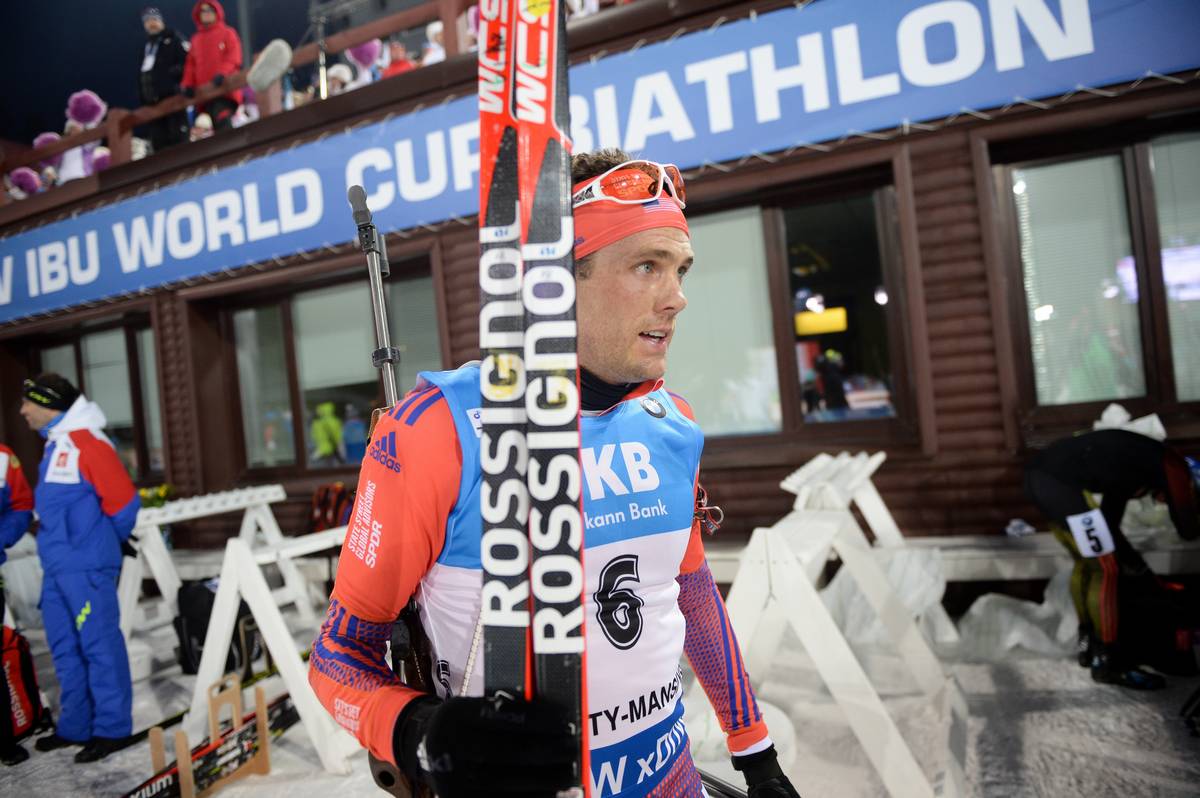
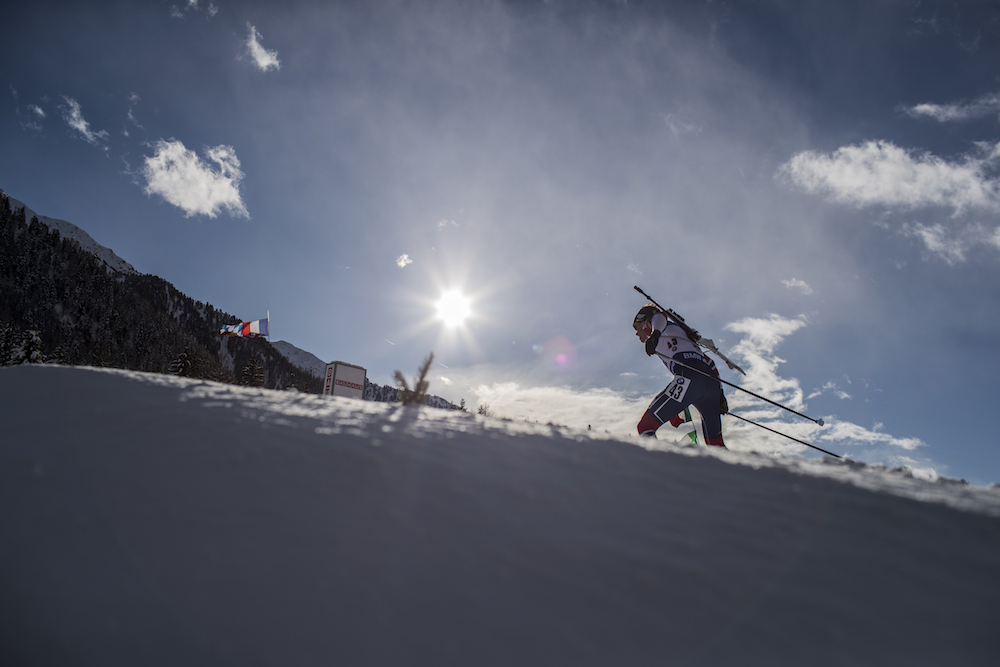
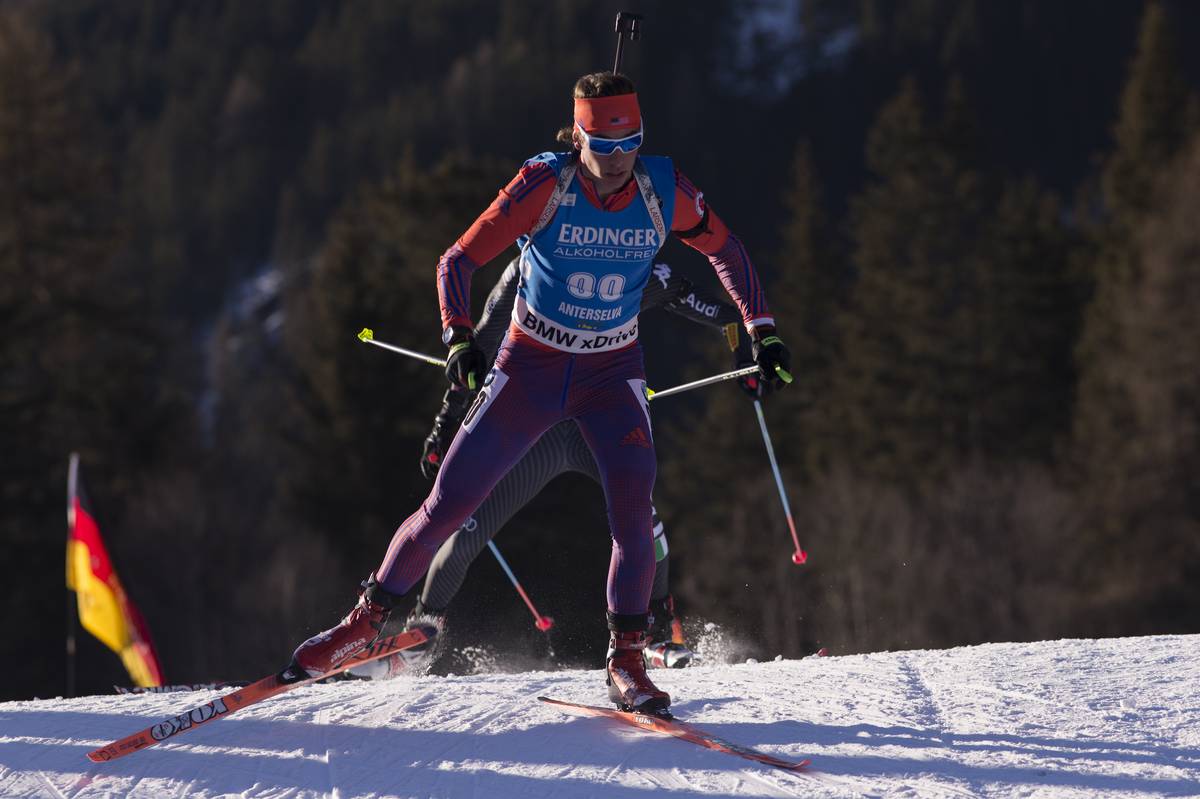
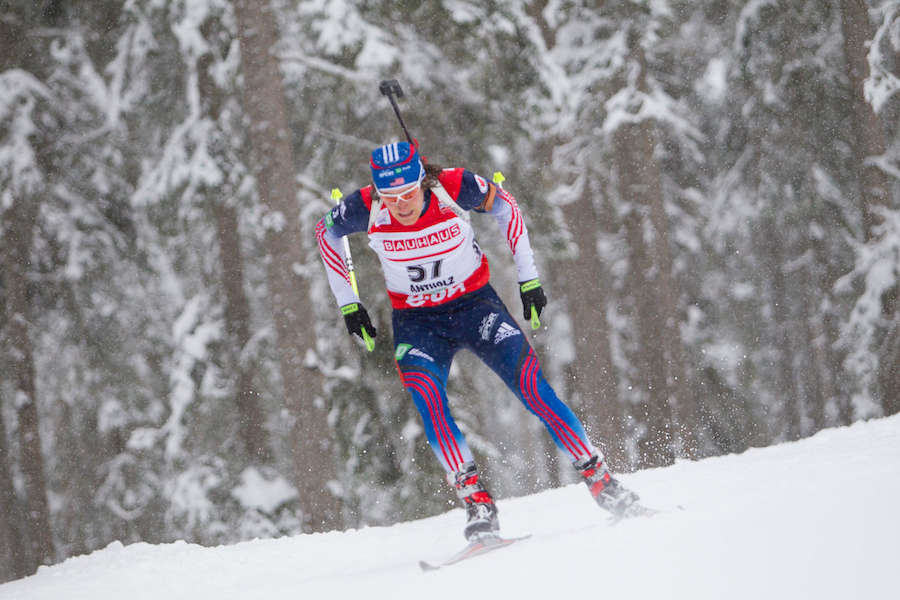
    Russell Currier racing at IBU World Cup competitions in Antholz, Italy. (Photo: NordicFocus/USBA)

    The first time I contacted Russell Currier for a retirement interview, it was mid-April. I had asked him to share his story, and no more than 24 hours after my initial email to Currier, I received a response.

    “Yeah, let’s do that. I’m actually in Bozeman right meow,” he’d written.

    Digging through my memory bank, I recalled Currier having come to Bozeman one other time. Two Aprils ago, the Stockholm, Maine, native spent a week in Montana visiting friends. The faint memory of Currier showing up to my Bozeman apartment that spring, sporting a DIY unicorn outfit, had me wondering what the recent biathlon retiree was up to two years later (at the time of our email correspondence, it had been 10 days since Currier’s final career competitions, the 2018 USBA nationals in Park City, Utah).

    Since I was still living in Bozeman, Currier and I decided to meet in person for the interview. Open mic night at a local coffee shop seemed like a safe rendezvous spot. While I arrived at our destination point uncharacteristically early, Currier showed up characteristically five minutes late.

    He had dropped the paper-cone head prong for this occasion, though he still had the same curly mop of brown hair. Leather thong flip flops, a black hoodie and shorts made him an unmistakable Mainer — most in the room wore pants and closed toed shoes, fitting for the local forecast of mid-40 temps and rain.
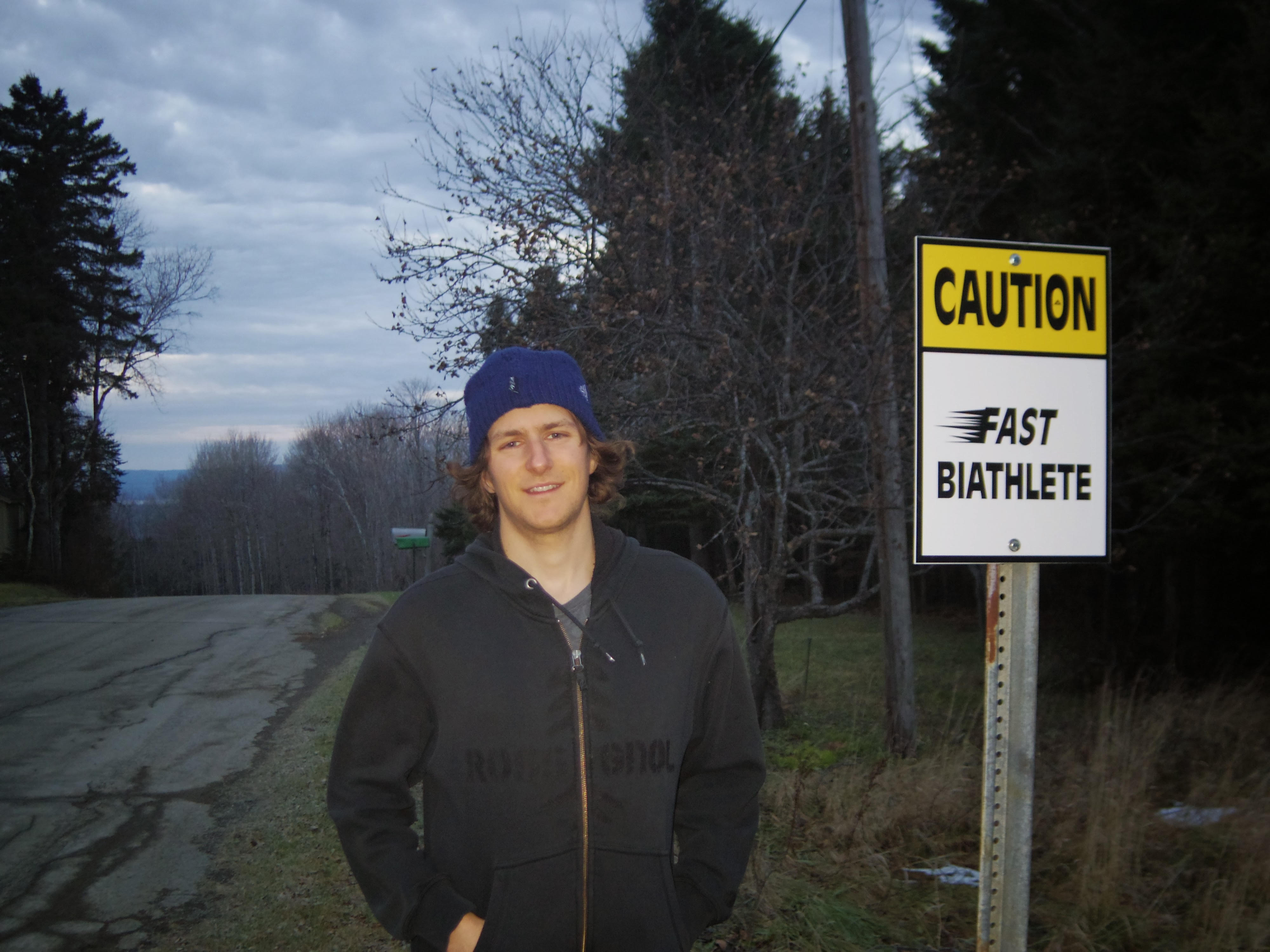
    Russell Currier, a two time Olympian, four time World Championships team member and on-off National team member. (Courtesy photo)

    The coffee shop served more than just coffee and we wound up sipping on local brews called “Strange Cattle”. A few shaky singers and a couple billiard –albeit shabby –games later, the Strange Cattle had gotten the best of us. My audio recorder inevitably remained in my pocket and the interview remained undone. 

    By the time we finally sat down to chat, it was over a month and quite a few text messages later (one of which involved Currier asking to borrow 90 K). In short, the following interview with Currier was conducted over the phone in late May, seeing as April is best left for brews and mythological beasts. 

    FasterSkier’s questions appear in bold; Currier’s responses follow immediately after.

    ***

    FasterSkier: Russ, good to have you on the phone. What are you up now?

    Russell Currier: Cutting cantaloupe.

    FS: Nice. Whereabouts?

    RC: Windham [Maine]. I moved there at the end of April. I’m staying in the basement of an old friend and doing landscaping. It’s not permanent, but it will suffice for now.

    FS: Why landscaping?

    RC: It was something that I could show up hungover for, but still grind it out and make it work.

    FS: When did you decide to retire?

    RC: Honestly, about two years ago. I had a really bad season [in 2015/2016] and I wasn’t sure if I wanted to keep racing or not. I decided to give it two more years, just to see if I could make it through another Olympic cycle.

    FS: Were you experiencing any illness in 2015/2016?

    RC: No, I think there were a few equipment issues that were bad luck. I didn’t do anything wrong. I did the best I could. I just didn’t nail training as best as I could. I was at that level of, you either get lucky and train really well, or you don’t get lucky; you try to train really well, but you don’t quite nail it.

    FS: What do you mean by equipment issues?

    RC: We had trials in Canmore and it was really, really cold that year — I mean, it’s always cold in Canmore — and the ammunition I was using wasn’t shooting very well. That may have been the limiting factor to my entire season. But it’s one of those things though that you can’t really prove.

    That season ended up being my worst one ever. It was bad enough to say this could be a justifying end. So I gave myself the month of April to make the call; decide if I wanted to keep going or not.

    FS: So in the end you essentially said, screw it, let’s do this?

    RC: Pretty much. Officially, I did it out of curiosity. I figured it was worth the expense and trouble, since I had already gone that far.

    My thinking was, if I go two more years, the absolute worst case scenario would be I rack up more debt and I don’t make it. The best case scenario, I do make it and I retire.*

    *Currier went on to qualify for the 2018 Pyeongchang Winter Olympics. He also qualified for the Sochi Olympics in 2014.

    FS: What will you miss the most about competing in biathlon?

    RC: That’s an interesting question. I haven’t really wrapped my mind around the fact that I’ve retired. So far, it’s still awesome because it’s absolute freedom. I still do plenty of training. I actually did an ultramarathon this weekend, which is a whole other story within itself.

    FS: An ultramarathon, really, where was that?

    Pineland Farms. They have a 25-kilometer cross-country ski trail. We did three times around that, plus an additional loop so that it would add up to 50 miles. I couldn’t walk the day after. That was problematic.

    FS: Do you think you have a future in ultramarthon running?

    RC: I don’t know. I have to think about it. That was one thing my coaches had always told me was, if this biathlon thing doesn’t work out and you ever get into ultramarathon running, it could be your thing.

    FS: So, back to what you’ll miss most about competing in biathlon?

    RC: After the last race in Utah, I never really had time to sit down, think it over and decide how I felt about the last 16 years of my life. I don’t know if I’ll have a mental breakdown when I do or if I’ll think, wow, that was fun, and move on.

    I had to send USADA [the U.S. Anti-Doping Agency] a letter saying that I officially retired. That kind of hit home. It was like signing the final papers on a divorce order. You’re ending a relationship with something you’ve been with for so long

    FS: Looking back, what’s your fondest ski memory?

    RC: The race weekend in Kontiolahti, Finland. It was super cold there, as in below legal race temperatures. I got food poisoning the day before the race. But I had traveled all that way and this was my one chance to race, so I raced anyway. I ended up cleaning and finished sixth.

    That was the second top 10* that I had ever had and the whole thing was just one giant surreal experience. (The afterparty was just nuts and [the U.S. team] did a Finnish sauna).
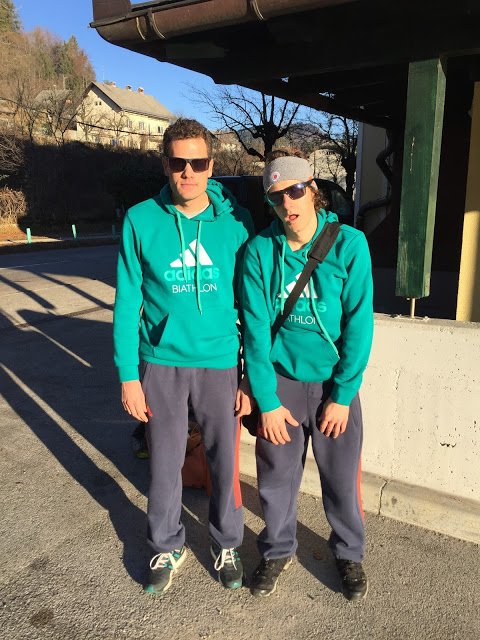
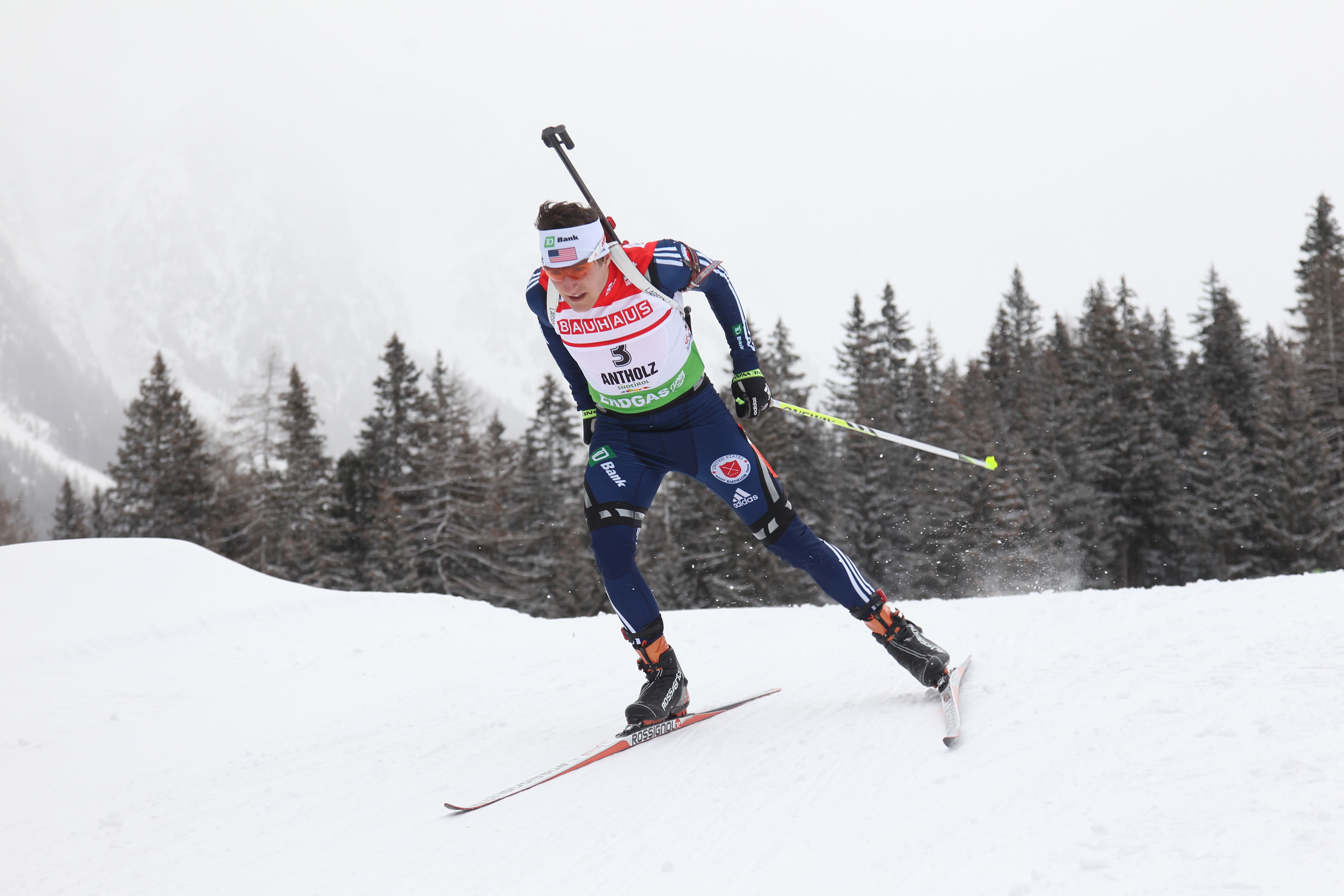
    Russell Currier (r) and USBA teammate, Tim Burke in Slovenia 2017. (Photo: russellcurrier.blogspot.com)

    *Currier has been to two Olympic Games, qualified for four World Championships teams, earned two sixth-place World Cup results in 2012, and this spring alone, had a fourth, fifth and sixth place finish at USBA nationals.

    FS: What’s involved in a Finnish sauna?

    RC: I’m sure it varies from one part of Finland to the next, but you go in the sauna, get as hot as you can, then you run around outside like naked idiots. After that you go back inside the sauna, get as hot as you can tolerate, then go outside and jump in the snow, roll around. Then you go back inside and the final time you [exit] the sauna, you have to jump in the water (this is winter, so it’s basically just this carved hole in the ice). There are also a bunch of reeds you’re supposed to hit each other with. It’s like a sword fight with these giant sticks. Weird Finnish things.

    FS: Interesting. How would you describe your career trajectory?

    RC: I never had any specific goal in mind, I just wanted to see what would happen if I actually gave it my full effort and pushed it into my late 20s and early 30s … I made it further than most people thought I ever would have when I started. But I also always had higher expectations for myself.

    FS: Do you feel like people were skeptical of you?

    RC: No, I don’t know if they were skeptical. They just didn’t know what to expect. I was one of the early athletes to jump on board with what Maine Winter Sports Center (MWSC)* was offering; nobody had any idea really how it worked. It wasn’t like an academy school in New England, or Steamboat Springs or a little ski town in Norway or anything like that where everyone was on board with how the system worked. This was a completely new and revolutionary thing to do.

    *MWSC has since been refashioned into the the Outdoor Sports Institute.

    FS: Were you one of the first athletes with MWSC?

    RC: Not the first, there were a few other athletes that were there before me, but not many. I think MWSC started in the summer of 2001, so [the program] had only been around for three years or so by the time I joined.

    FS: How did you get involved with MWSC/skiing?

    RC: It was a very arbitrary and borderline impulsive decision. The impulse never wore off.

    FS: Where is the sport lacking or what do you think needs to be changed?

    RC: Short answer, it needs to be way cleaner. Almost any North American athlete would probably say that right off the bat. For good reason. It’s scary how much time and effort of your life you can pour into something, only to watch an entire organization walk all over it. Ruin it. Unfairly. It really is terrible and it’s as bad as everyone thinks it is.

    FS: You’ve been involved for 16 years now, any advice for those coming into the world of biathlon?

    RC: I would say biathlon and cross-country will produce way more failure than they ever will success. These sports are going to kick you in the teeth constantly. You’re going to get the [expletive] kicked out of you so many times before you get the glory that you see on TV.

    But, to quote John Farra, it’s worth it.

    I remember John going on and on about the opening ceremonies at the Olympics and just saying it’s worth it. All the training, all the setbacks. It’s worth it. (Ironically when I finally did make [my first Olympic team in 2014], I actually missed the opening ceremonies because we had a race the next day, so we didn’t go. I thought that was kind of funny.)

    Anyway, yeah, if you’re aware that it’s going to be one colossal struggle and you come in expecting that, it makes it not so bad.
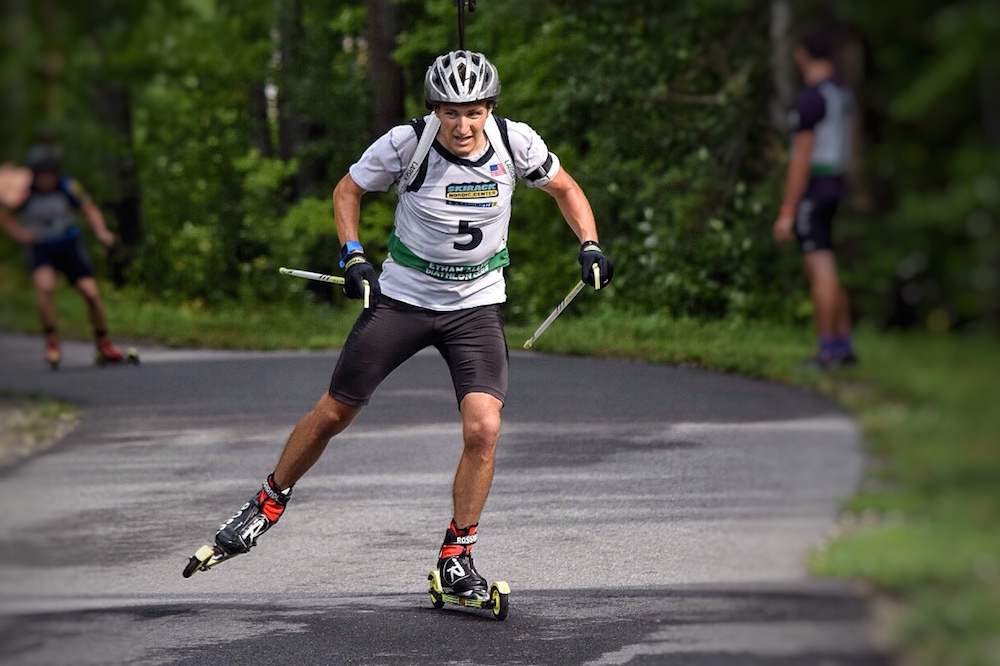
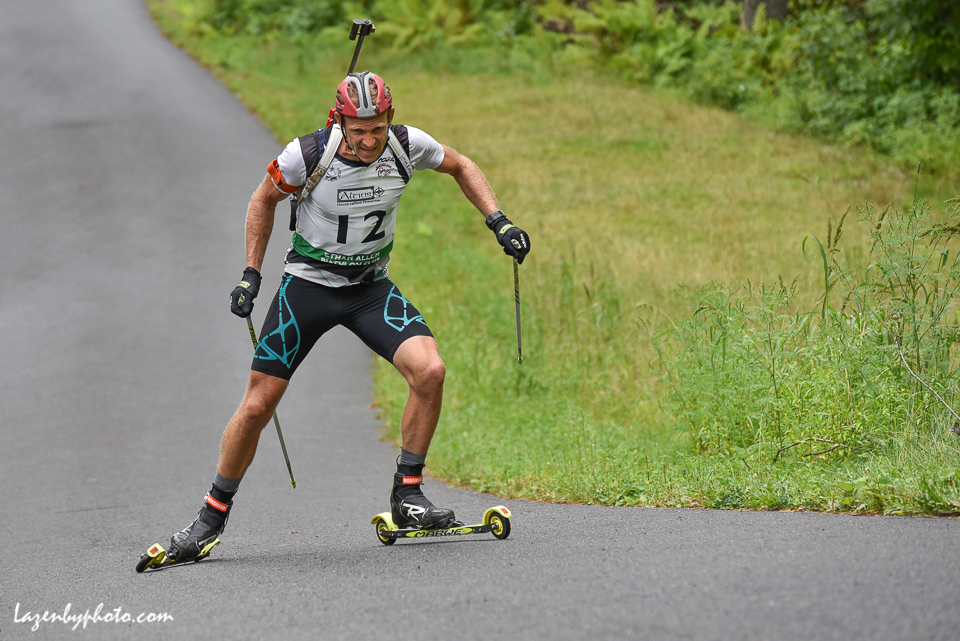
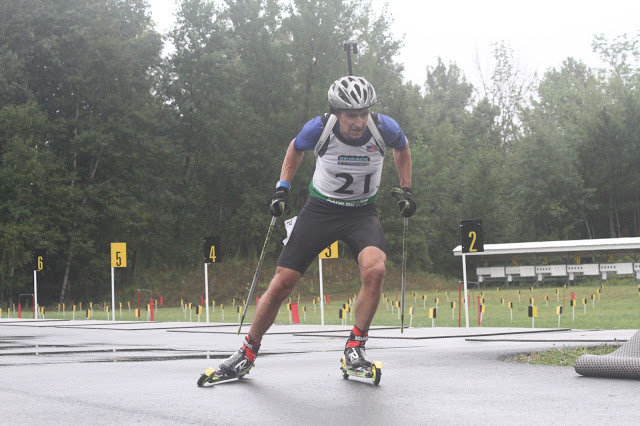
    Russell Currier during the men’s mass start at the 2016 US Biathlon National Rollerski Championships on Aug. 14 in Jericho, Vt. (Photo: Katrina Howe)

    FS: Any unsung heroes to whom you’d like to pay tribute?  

    RC: My neighbor down the road from me growing up has not only been my number-one fan, but he has also painstakingly made various parts for my rifle that have literally played a crucial role in my career. He’s a machinist and a lot of my rifle’s components were his design. I’ll give a shout out to Tom Campbell for supporting me both grooming wise and equipment wise throughout my career.

    ***

    What others had to say about Currier

    The following is a compilation of emails from various individuals who worked with Currier over the course of his ski career.

    I’ve always admired Russ’s ability to be resourceful and resilient.  He’s had his share of frustrating races, such as placing 61st in sprints on multiple occasions (just missing out on pursuits). However he always bounces back. Watching him place a career-best 6th in a World Cup in Nove Mesto in 2012 was incredibly inspiring because he was the ultimate underdog on our underdog team. He had struggled to qualify for international racing earlier in the season and surprised a lot of people that day.

    .

    Another favorite Russell memory was during a Lake Placid training camp. He ran 9 miles in the middle of the night to get home from a party in Saranac Lake. A solid solution to not having a designated driver.
    — Susan Dunklee

    Russell was incredibly careful never to waste food, as though he had lived a previous life in the Great Depression. He used to fill container after container of food at the OTC dining hall and carefully take it with him until his room was full of to-go coffee cups filled with varying granolas.

    Once when we were at the August rollerski trials in Jericho, Vt., I bought a 69-cent two-pack of puddings post-race. They were so awful that I left the other one in the place we were staying, intending to get rid of it. Russell saved it, put it in his truck, and drove it back home to Maine thinking I forgot it. He kept in his refrigerator for two and a half months and then drove it back down to Vermont and gave it to me at October Rollerski Trials. I was so flabbergasted by his dedication to save that terrible pudding cup that I just ate it.  

    — Joanne Reid

    My favorite Russell stories probably shouldn’t be put in print, so I’ll go with this.

    Russ is the only person I’ve known to go on runs with a shotgun. Apparently it’s quite an effective partridge hunting tactic.

    — Welly Ramsey

    It has been great to watch Russell over the years, develop as an athlete and keep working towards his goals. In the last couple of years it was impressive to see Russell really refocus and work towards a second Olympic opportunity and how it paid off. It will be exciting to see what opportunities come next for Russell!

    — Seth Hubbard

    One of my favorite memories of Russell is from when he was first interested in racing, in early high school. We were at a training camp and he was very concerned about what he was eating — only what he deemed healthy— and about getting the hours in his training plan.

    When it was time to pack up, Russ was hungry and tired after his longer A.M. workout and he saw food on the table (breakfast for everyone) which he proceeded to eat in its entirety.  Needless to say, he was not much help with packing and no one was very happy about the lack of breakfast. Russell, however, felt fine.

    — Sarah Dominick

    Russ was one of a few athletes that lived at the 10th Mountain Lodge at some point in their career. One summer night, I headed up there to pick up something I needed for training the next morning (can’t remember what). Since he lived upstairs, and it was dark, I thought it would be fun to try and scare him. I made my way through the door and up the stairs as quietly as I could, thinking I was really going to scare the [expletive] out of him. As I started rounding the corner, Russ jumped out from his room, headlamp blinding my eyes, biathlon rifle aimed at my face, finger on the trigger. I think that was the only time he almost shot me.

    — Nick Michaud
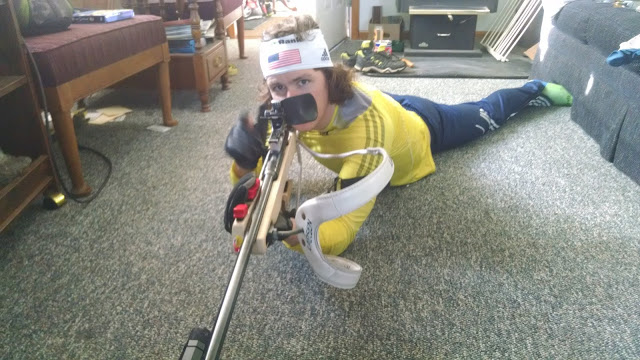
    Russell Currier working on his prone shooting position in June 2017. (Photo: russellcurrier.blogspot.com)

    Russ was a morning person, more so than anyone else I’ve met before or since — he drew his innate energy from waking up early and making breakfast as the dawn broke.  

    We were staying in the house of a family friend for August World Cup Trials one year, and I came crawling (actually crawling) down the stairs race morning, bleary-eyed, incapable of speech, dysfunctional, and partly jet-lagged from flying to the East coast for these races. My body thought it was about 3am, and I tended to wake up at 11.

    Russell started dancing around me, delighted in the (terribleness of) mornings, smiled down at me crawling on the stairs, and says, “I know what your spirit animal is! It’s a sloth!!!!” He called me Sloth ever since.

    — Reid

    When I first started watching World Cup biathlon races about 10 years ago, Russell anchored the men’s relay at World Championships. The team was about to be lapped by the Norwegian race leaders and Russell skied like hell to stay ahead of The King (Ole Einar Bjørndalen) to avoid getting pulled from the race. He got a lot of TV time that day.
    — Dunklee
  • Bye Bye Biathlon: Many Retirements After 2018 Olympic Season

    Bye Bye Biathlon: Many Retirements After 2018 Olympic Season

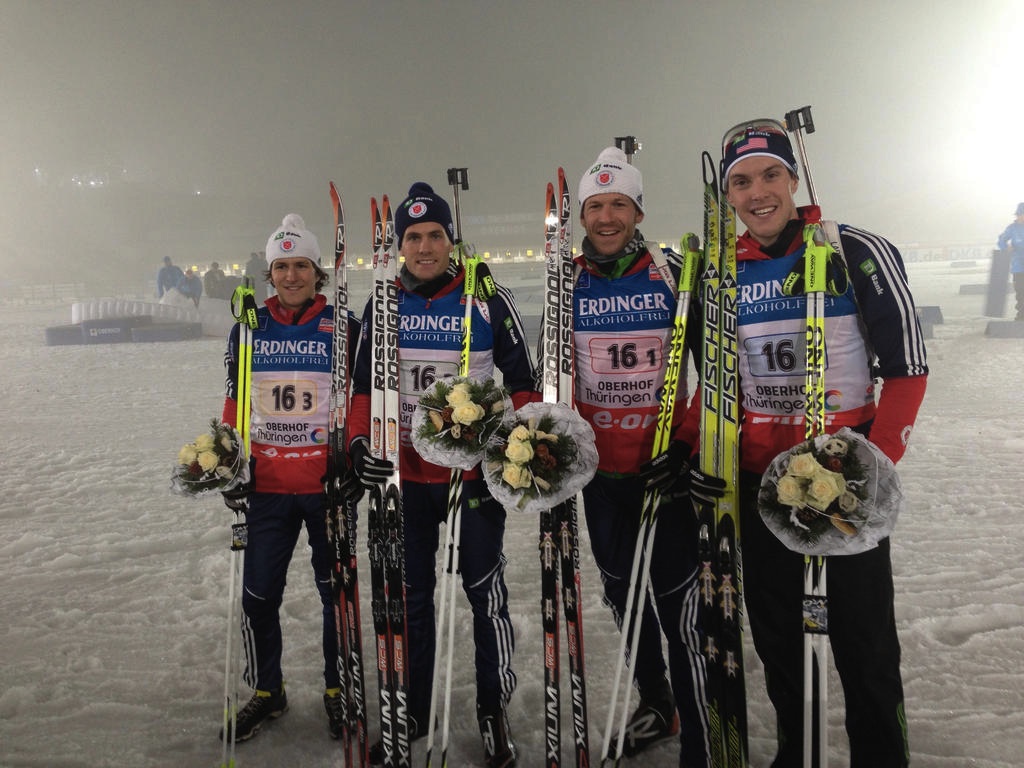
    Russell Currier, Tim Burke, Lowell Bailey, and Leif Nordgren after a fifth-place relay finish in the IBU World Cup relay in Oberhof, Germany, in 2013. Currier, Burke, and Bailey are all retiring. (Photo: USBA.)

    With the 2018 Olympics come and gone, many of biathlon’s athletes are calling it quits. Here’s a roundup of who you won’t see on the World Cup next season – and who’s still on the fence about their future.

    USA

    2017 Word Champion Lowell Bailey has long planned to retire after the 2018 season, and now that time has come. His first World Junior Championships was in 1999 and he got his first World Cup start in 2002. He raced 2003 World Championships before taking a break to go to the University of Vermont, before returning and competing in the 2006, 2010, 2014, and 2018 Olympics. His eighth-place finish in the 20 k individual at the 2014 Games are the best ever by an American biathlete. Bailey is the Executive Director of the Crosscut Mountain Sports Center in Bozeman.

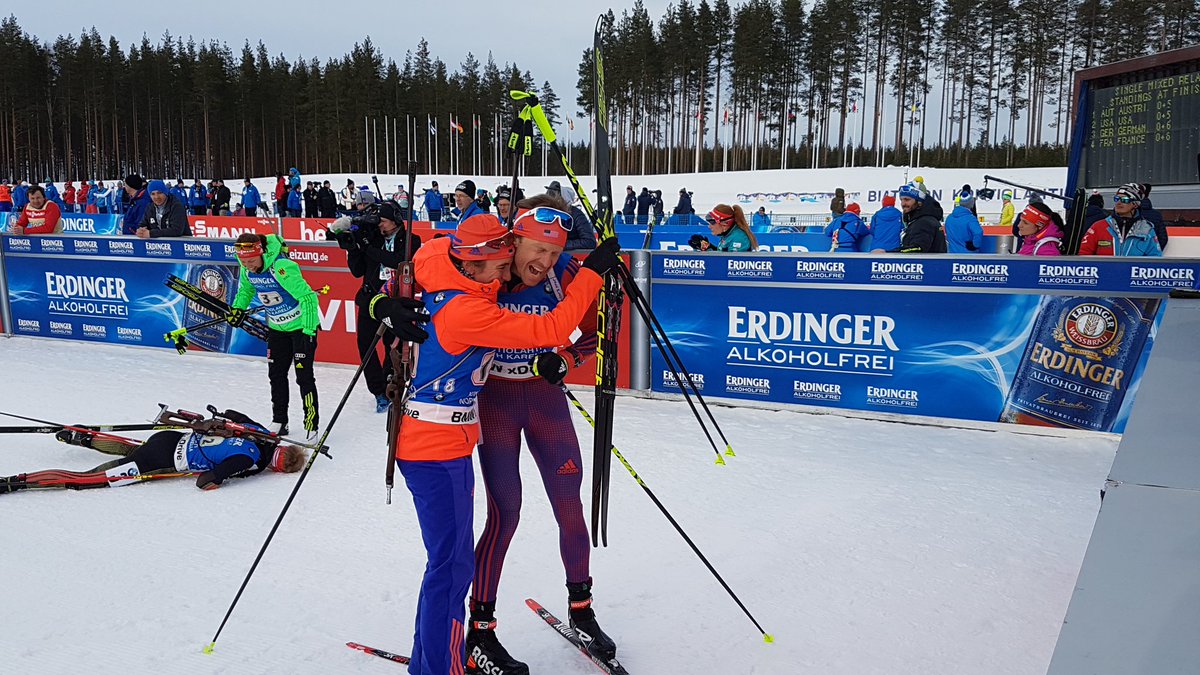
    Susan Dunklee and Lowell Bailey celebrate after finishing second in the World Cup single mixed relay in Kontiolahti, Finland, in 2017. Austria won the competition. Bailey is retiring and Dunklee is undecided as to whether she will continue racing. (Photo: IBU/Twitter)

    “I told myself this morning that I just wanted to go out on a high note,” he told FasterSkier in Oslo after leading off a U.S. relay team that finished seventh, in his last World Cup race. “I wanted to go out with a good result. And, I’m really happy to have shot clean in standing, clean from the clip in my last stage as a World Cup biathlete. That feels good. I’ll always remember that — that I went out with a clean stage.”

    Longtime teammate and 2013 World Championships silver medalist Tim Burke will also retire. Burke has six World Cup podiums to his name including that silver medal, and led the World Cup partway through the 2009-2010 season. Burke started racing internationally at 2000 Junior World Championships, and made his first senior World Championships in 2004. Like Bailey, he is a four-time Olympian.

    “It’s weird, I don’t honestly I don’t know if it’s truly hit me,” he said after the Oslo relay. “It might take weeks… I think it’s going to take a long time for all to settle in and for me to really reflect back on my career. Yeah, it’s a lot of emotion.” Burke says that his post-biathlon plans are not yet certain.

    Tim Burke after placing sixth in a World Cup pursuit in Khanty-Mansiysk, Russia, in 2016. (Photo: USBA/NordicFocus)

    Also retiring is Russell Currier, an off-and-on member of the national team and the Maine Winter Sports Center (now the Outdoor Sports Institute). Currier had two sixth-place World Cup results in 2012, and is a four-time World Championships team member. Since his World Cup debut in 2009, he has contributed to many U.S. relay efforts. He also competed at the 2014 Olympics, with a top finish of 49th, and was a member of the 2018 Olympic team though he did get any starts in PyeongChang.

    “USBA nationals will be officially be the last race of my biathlon career,” Currier wrote in an email to FasterSkier this week.

    The women’s team likely won’t see three retirements, and will thus have some more stability than the men’s crew, but there is more uncertainty regarding the women’s roster. Clare Egan wrote in an email this week that she was “Undecided!” about whether to continue racing. And in Oslo, after finishing third in the pursuit which was her last World Cup of the season, Susan Dunklee said the wasn’t sure if she would keep competing. “Ask me again in a month,” she said.

    Canada

    Julia Ransom retired in Oslo, as the 25-year-old is planning a career in dentistry and has many years of school ahead of her. “It’s just a good time for my partner and I to kind of move on,” she said after crossing the line in her final World Cup, the pursuit, hand in hand with teammate Rosanna Crawford.. “And it does feel right. It feels right.”

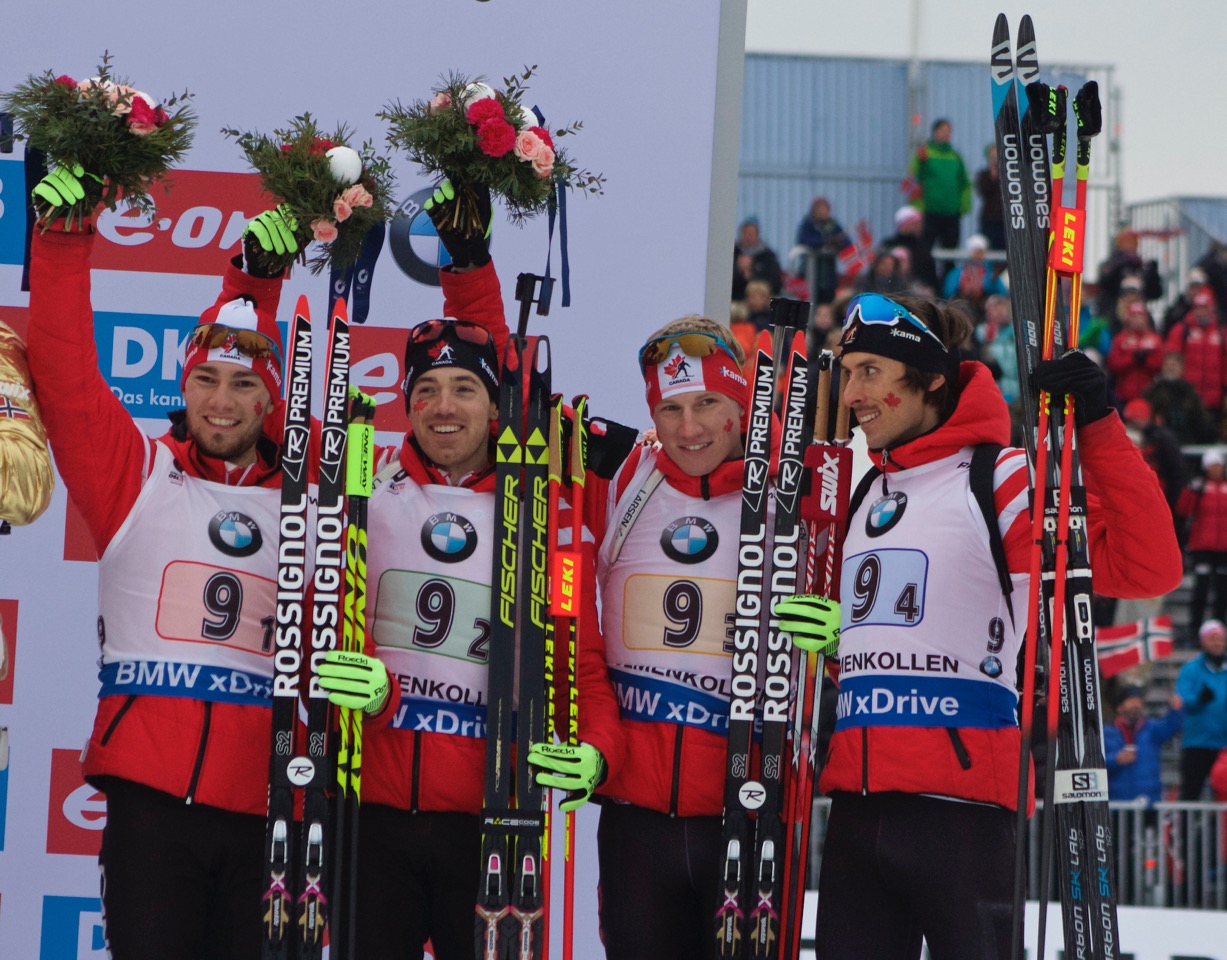
    The Canadian men’s team (l-r) Christian Gow, Nathan Smith, Scott Gow, and Brendan Green celebrate bronze in the men’s 4 x 7.5 k relay at 2016 World Championships in Oslo, Norway. Both Green and Smith are undecided on their future plans. (Photo: JoJo Baldus)

    Ransom scored two top-ten finishes at 2014 World Juniors, and made her first senior World Championships team in 2015. This season she had two top-ten World Cup finishes, and went to the Olympics in PyeongChang, where she finished 28th in the pursuit.

    She is the only one from the Canadian team who is definitely retiring, but quite a few of her teammates are on the fence and there could be huge turnover on the team depending on what they decide. That includes Rosanna Crawford and Brendan Green, even though Crawford finally bagged her first World Cup podium this season.

    “We’re not 100% sure yet,” Green said after the relay in Oslo. “Both Rosanna and I will sit on it a little bit over the spring. We will reevaluate a little bit and see what other opportunities arise. I think we both still love to race and train, and if we continue down that path I know we will still be motivated. But as of right now I’m not sure.”

    2015 World Championships silver medalist Nathan Smith – who was also, along with Green, Christian Gow, and Scott Gow, part of a bronze-medal relay at 2016 World Championships – is also unsure. He missed most of the 2016-2017 season with health issues and though he returned to the World Cup and the Olympics this year, did not perform up to his own expectations. 

    Rosanna Crawford, Megan Imrie, Megan Tandy, and Zina Kocher celebrate a fourth-place World Cup relay finish in Annecy, France, in 2014. Crawford and Tandy may not keep racing after this season; Imrie retired in 2014 and Kocher in 2016. (Photo: Matthias Ahrens)

    “I’m kind of waiting to see what happens with Biathlon Canada,” Smith wrote in an email this week. “I think some very difficult years are coming for the organization, unfortunately. That will play a big part in my, and I’m sure many other athletes’, decisions. Of course, I’m also not looking to have a continuation of the health problems over the last two seasons, which made competing at the highest level really difficult. So I will be keeping a close eye on how my body is reacting to training. If it’s still not coming around that would certainly not encourage me to continue either.”

    2010, 2014, and 2018 Olympian Megan Tandy also struggled with health issues this winter, and is likewise not sure what her future holds.

    “Originally it was my intention to retire after this season, however it was literally my worst season ever!” she wrote in an email. “I was sick more in the past 6 months than in the past two years. Anyways,  I have taken some time since the Olympics to followup about my health and to consider options for next season. I want to race a final season – one where I feel good and can put up a good fight (not necessarily results dependant, I just want to leave this sector of my life feeling like I gave it all I got), but a lot of things will need to fall into place for that to be realistic: sponsor support, coaching opportunities during the training season, and my health of course.”

    Poland

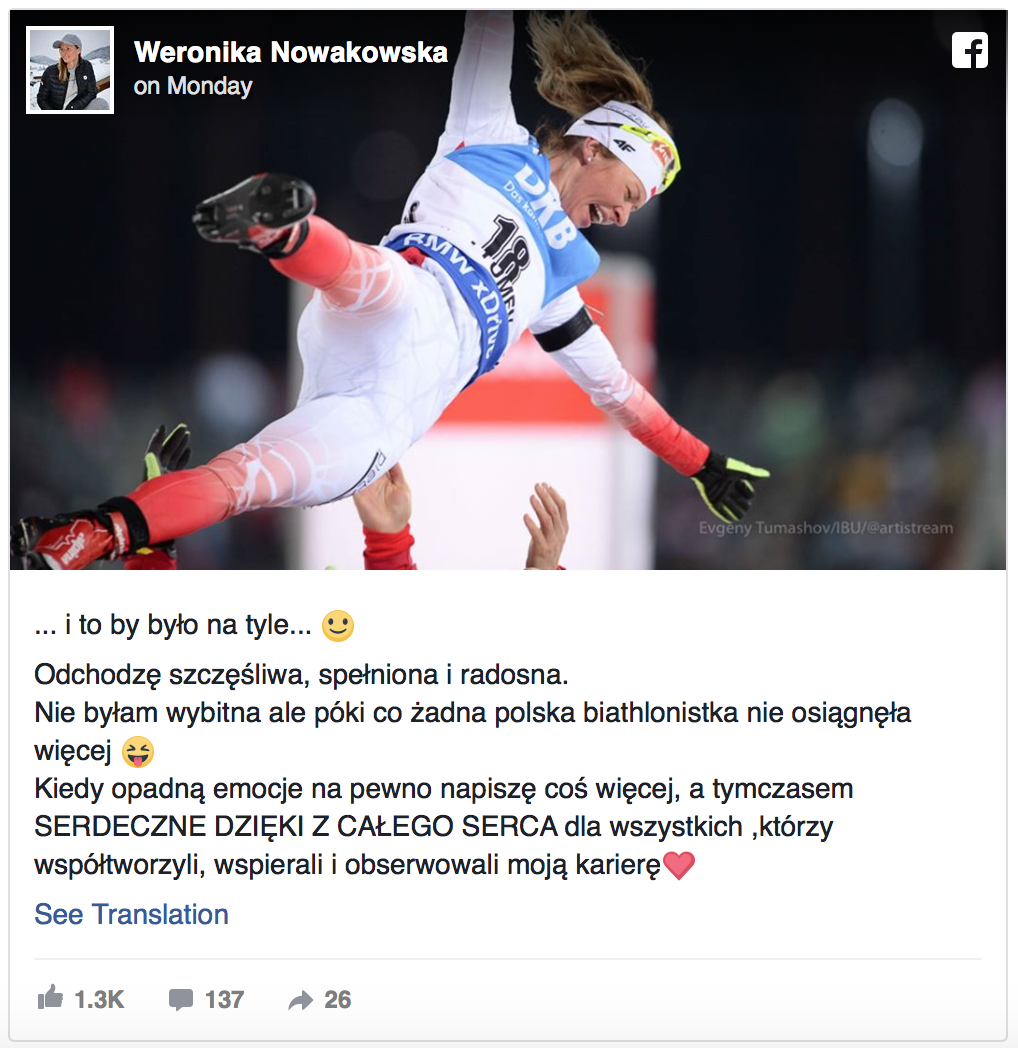
    Weronika Nowakowska is calling it a career. The 31-year-old picked up two World Cup podiums in the 2015 season before taking a break from competition to give birth to twins. She made a successful return this season and represented Poland in PyeongChang, with a top finish of 21st in the individual. She also had sixth- and fourth-place finishes on the World Cup this year and contributed to four different top-eight relay efforts, including one at the Olympics.
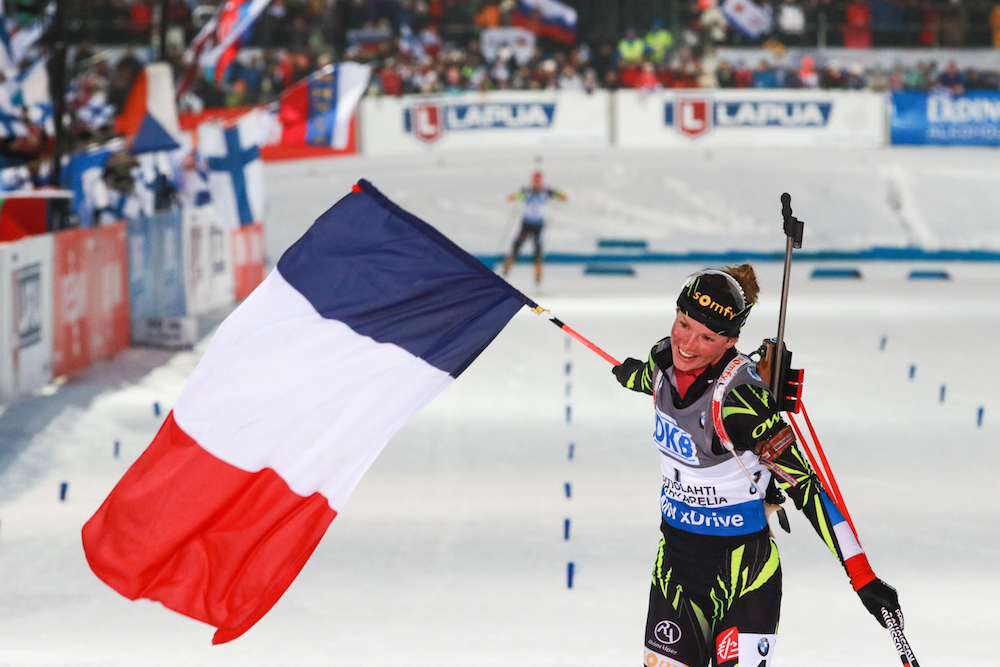
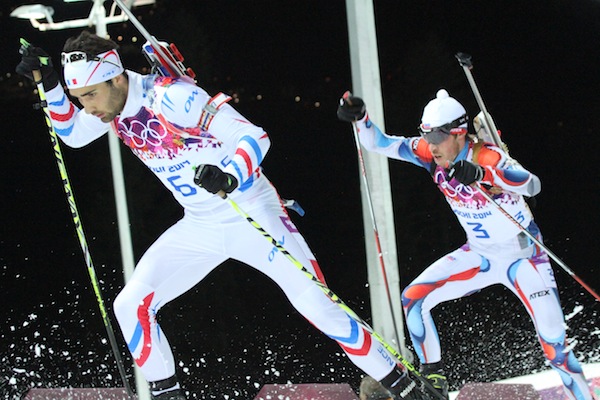
    “I leave happy, fulfilled and cheerful,” she wrote on her Facebook page, according to a translation. “I was not outstanding, but so far no Polish biathlete has done better”

    France

    Back in Oslo, French star Marie Dorin Habert ended her career. Dorin Habert – then simply Marie Dorin – competed in her first senior World Championships in PyeongChang in 2009, where she had a top individual finish of 18th and was part of the bronze-medal relay team. Fast forward and she had racked up a sprint bronze at the 2010 Olympics, seven World Cup wins, ten more World Championships relay medals, and four individual gold, one silver, and one bronze medal at World Championships, four of which were from the 2016 edition where she did not finish a single race without a medal.

    France’s Marie Dorin Habert celebrates her second win in as many races at 2015 IBU World Championships, after taking gold in the 10 k pursuit in Kontiolahti, Finland. (Photo: Kontiolahden Urheilijat/Jarno Artika)

    She found herself back in PyeongChang for the 2018 Olympics, where, despite a frustrating season until then, she was fourth in the sprint, bronze in the women’s relay, and gold in the mixed relay.

    “It’s so nice to end this way, to share it with all of the team, and the beautiful sun, and all the French people,” Dorin Habert said after winning the women’s relay in Oslo along with her teammates. “It’s a wonderful day for me. I would like to thank a lot, well, everyone, for being there in the biathlon family. I’m really happy to have this career, and I’m really happy for everything.”

    Jean Guillaume Beatrix he told is also retiring. Beatrix was a World Junior Champion in 2009, before going on to be a five-time World Championships team member and a 2014 Olympic bronze medalist in the pursuit. He was part of three silver- and one bronze-medal winning men’s relay teams at World Championships. But this season, he did not perform well enough to make a very competitive French team for the 2018 Olympics. His retirement was “a decision precipitated by my results”, L’Equipe, according to a translation.

    Czech

    France’s Martin Fourcade leading Jaroslav Soukup of the Czech Republic during the men’s Olympic 12.5 k pursuit at the 2014 Olympics.

    Jaroslav Soukup, the bronze medalist in the sprint at 2012 World Championships, where he was also part of the silver-medal mixed relay team, is retiring. Later in 2012, he suffered a horrendous accident while biking, including open fractures in his arm and neck and back injuries. By 2014, he made it back and won the same medals at the Olympics that he had at World Championships two years before: bronze in the sprint and silver in the mixed relay. Soukup qualified for the 2018 Olympics but only competed in the relay, which finished seventh. He had one World Cup top-30 this season.

    Norway

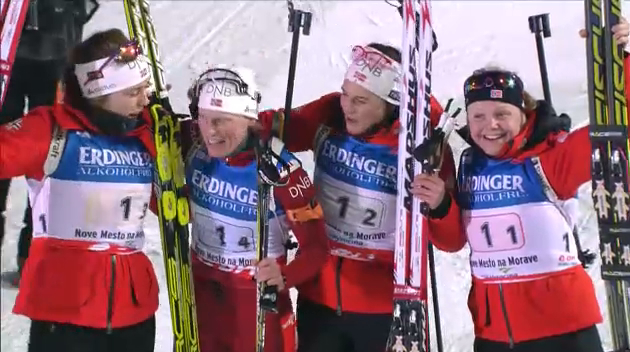
    Hilde Fenne, a staple of the Norwegian women’s team, retired after the last race of the season in Tyumen, Russia. Fenne never found breakout success as an individual; she had three top-15 finishes in her career. But she was an integral part of the women’s team and contributed to numerous World Cup relay podiums, as well as the gold-medal winning women’s relay at 2013 World Championships in Nove Mesto, Czech Republic.

    The Norwegian women’s relay celebrates its second-ever World Championships title after winning the 4 x 6 k event in Nove Mesto, Czech Republic. From left to right: Synnøve Solemdal, Tora Berger, Ann Kristin Flatland and Hilde Fenne.

    In that final race, her teammates wrote her name on their cheeks. “She has been a very important piece for me,” teammate Synnøve Solemdal told NRK, almost in tears. “We have stayed in a lot of hotel rooms together. I’m going to miss her very much.”

    On the men’s side, there is uncertainty as to whether some veterans will stick with racing or not. One is Ole Einar Bjørndalen, who was left off Norway’s Olympic team, who for the first time since 1992 this season. And yet, the 44-year-old has not stated that he will retire, and some who know him are speculating that he may try to stick it out one more year and go out with better results than he saw this season.

    Also with no stated plans is Emil Hegle Svendsen. Bjørndalen is the winningest athlete in World Cup history; Svendsen is number four. He won the World Cup overall title in 2010, and is a four-time Olympian. He won gold in the individual in 2010 and in the mass start in 2014, after which he suffered a total collapse anchoring the Norwegian men’s relay. In the past seasons he has been off and on, and he has only won two races since then. But this season he showed flashes of brilliance, and he was third in the mass start at the 2018 Olympics as well as anchoring the silver medal men’s relay and mixed relays.

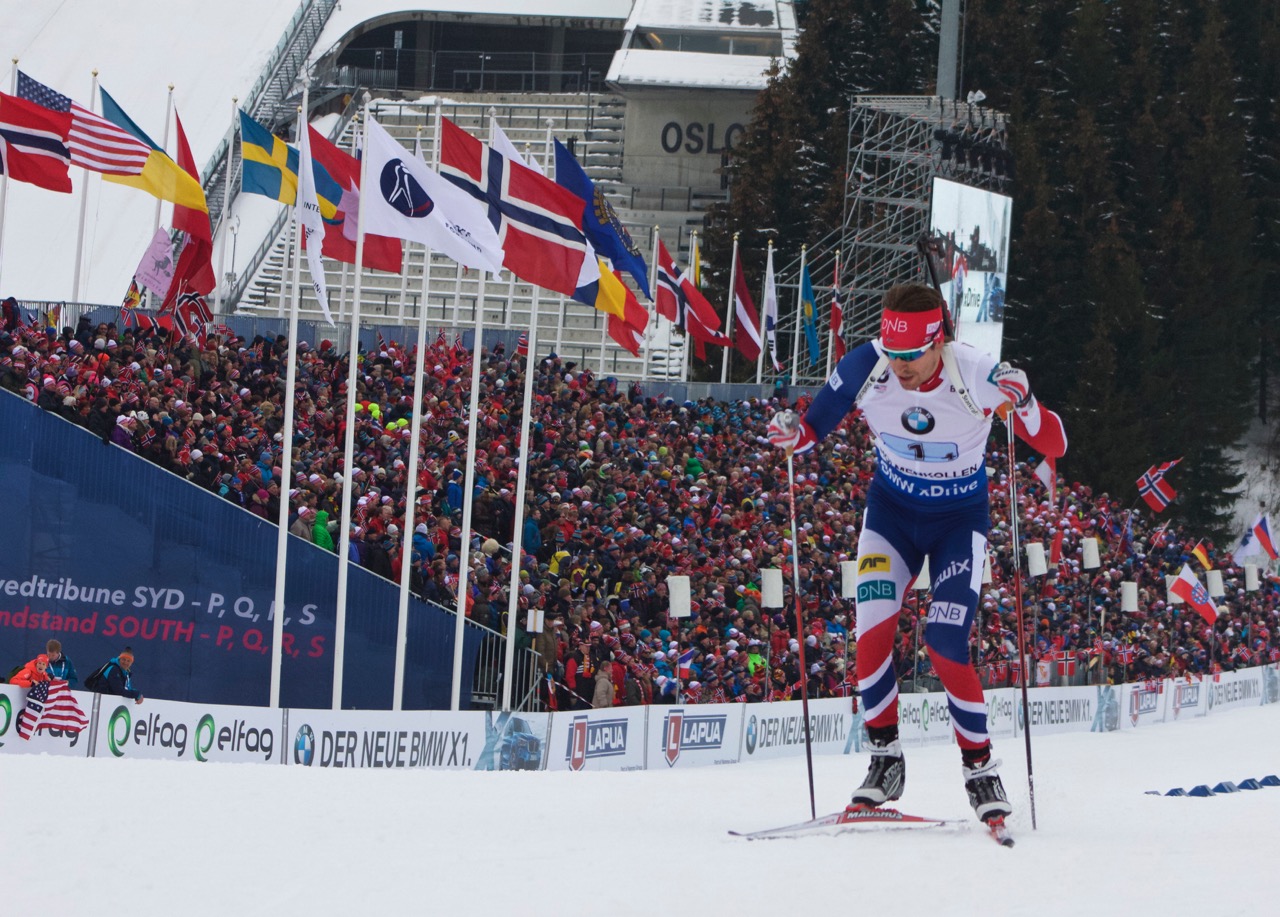
    Emil Hegle Svendsen of Norway leaves the stadium in the 2016 Holmenkollen World Cup as thousands of his countrymen cheer him on. Svendsen has not officially announced his plans for next season. (Photo: JoJo Baldus)

    “What Emil has done is absolutely fantastic,” teammate Tarjei Bø – who won the overall World Cup the year after Svendsen – told NRK two weeks ago. “He has won everything, and in addition done it several times, and he has come back again and again after being down. He has had a fantastic career and I hope he continues.”

    Finland

    She just won the overall World Cup crystal globe, but Kaisa Makarainen is not sure whether she will continue racing. In several previous years she had already discussed potentially retiring, but now she is reportedly waiting to think it over more as well as to discuss with the new team staff. U.S. Biathlon Women’s Coach Jonne Kahkonen, himself a Finn, was just announced as the new Head Coach for Finland.

    Germany

    Florian Graf, an athlete who finished as high as fourth on the World Cup in 2013 but has more recently been racing on the IBU Cup, is calling it quits at age 29.

    Several other top athletes are suspected to be considering retiring, but there hasn’t been much on the record discussion by them. Stay tuned.

  • Spring Series Rundown: Diggins Anchors Another Stratton Mixed-Relay Win

    Spring Series Rundown: Diggins Anchors Another Stratton Mixed-Relay Win

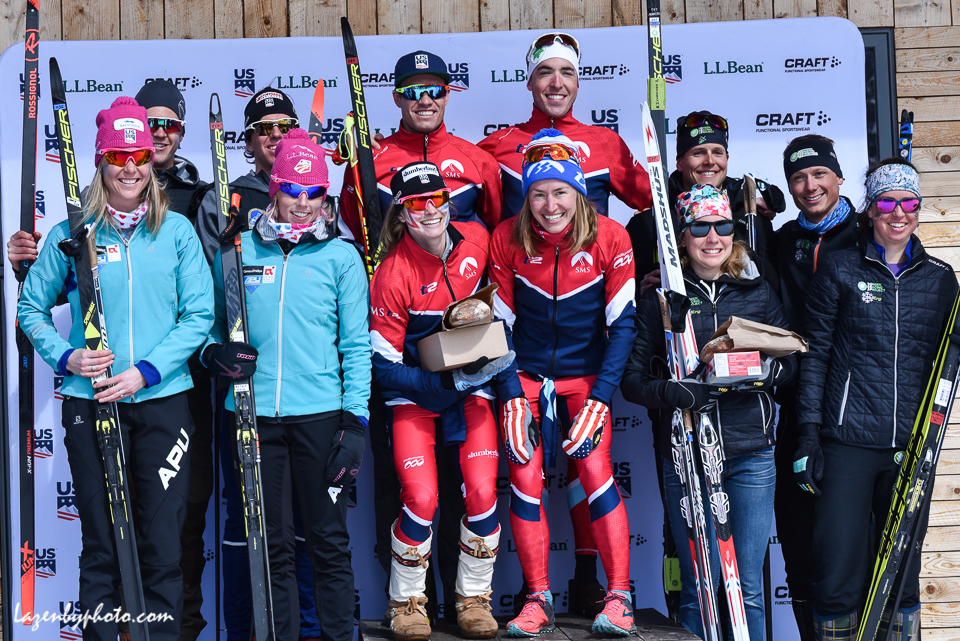
    The mixed relay podium on Sunday at 2018 SuperTour Finals in Craftsbury, Vt., with Stratton (center: Simi Hamilton, Paddy Caldwell, Jessie Diggins, and Sophie Caldwell) in first, APU (left: Erik Bjornsen, Scott Patterson, Sadie Bjornsen, and Kikkan Randall) in second, and Craftsbury (right: Adam Martin, Alex Howe, Ida Sargent, and Caitlin Patterson) in third. (Photo: John Lazenby/Lazenbyphoto.com)

    2018 U.S. SuperTour Finals (Craftsbury, Vermont): Mixed relays

    For the second-straight year at the SuperTour’s season-ending Spring Series, the Stratton Mountain School (SMS) T2 Team won the mixed relay, with three of the four athletes who raced on last year’s 4 x 5-kilometer mixed relay squad.

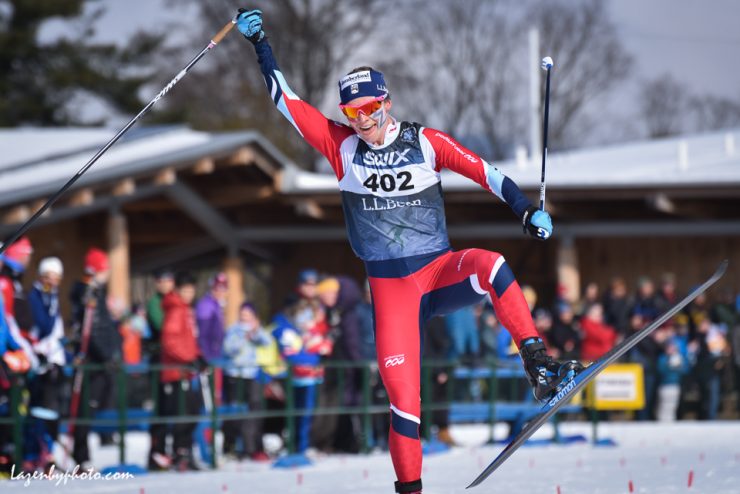
    Simi Hamilton, Sophie Caldwell, Paddy Caldwell, and Jessie Diggins combined for the win on Sunday in Craftsbury, tagging off in that order, with Diggins crossing the finish line first for the third-straight day. Diggins is undefeated in three races so far at Spring Series, after winning Friday’s classic sprint and Saturday’s 10 k freestyle mass start. The women’s 30 k classic mass start remains on Tuesday, followed by the men’s 50 k classic mass start on Wednesday.

    Diggins and her Stratton teammates beat the Alaska Pacific University (APU) first team by 13.2 seconds at the line with a time of 53:43.2. The co-ed mixed relay has been held at SuperTour Finals for the last five years, and APU won the first three editions of the race from 2014 to 2016. Stratton won last year in Fairbanks, Alaska, with Ben Saxton, Hamilton, Caldwell, and Diggins.

    APU led most of Sunday’s race, with Erik Bjornsen starting them off. He came through the first exchange in first place, just 0.2 seconds ahead of Hamilton in second. Behind them, Adam Martin of the Craftsbury Green Racing Project tagged in third, 0.8 seconds out of first.

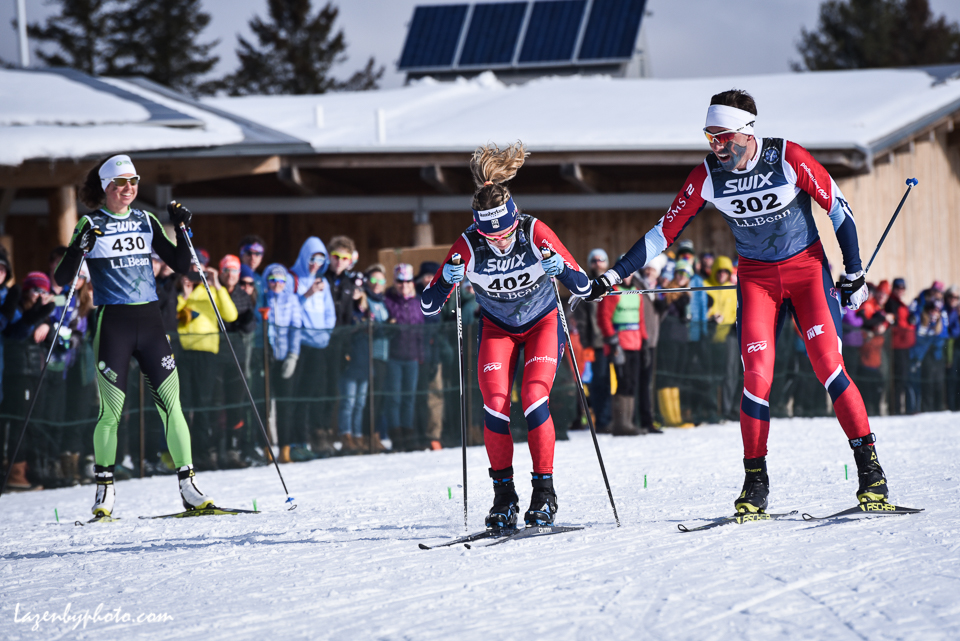
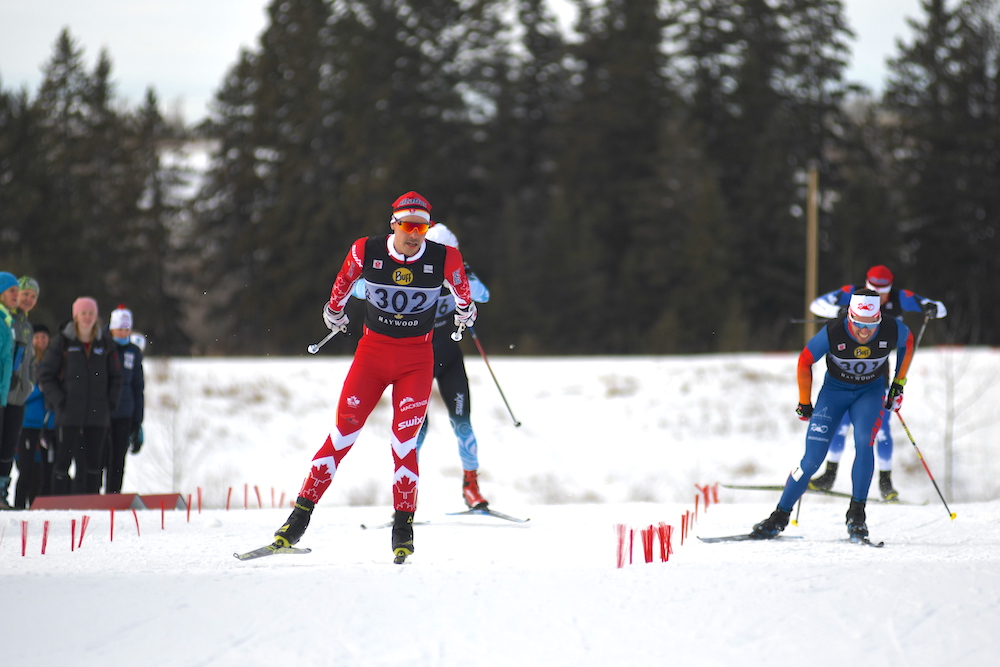
    Paddy Caldwell (302) tags his Stratton Mountain School (SMS) T2 Team teammate Jessie Diggins (402) in second, while Craftsbury’s Caitlin Patterson (430) looks on, at the final exchange of the mixed relay at 2018 SuperTour Finals in Craftsbury, Vt. Diggins went on to anchor Stratton to first place. (Photo: John Lazenby/Lazenbyphoto.com)

    Sadie Bjornsen then extended APU’s lead to 7.3 seconds over Stratton’s Sophie Caldwell in second. Behind them, Craftsbury’s Ida Sargent came through the second exchange in 10.3 seconds back in third.

    APU’s Scott Patterson went on to hold off Stratton’s Paddy Caldwell on the third leg, tagging 3.5 seconds ahead in first. Diggins came up big for Stratton on the anchor leg, passing APU’s Kikkan Randall to secure the win.

    Craftsbury held its third-place position during the second half of the race with Alex Howe and Caitlin Patterson to finish third, 56.2 seconds behind Stratton. More than a minute later, APU 2 (Tyler Kornfield, Rosie Brennan, Logan Hanneman, and Rosie Frankowski) crossed in fourth (+2:04). Stratton’s second team (Saxton, Julia Kern, Andy Newell, and Erika Newell) placed fifth (+2:47.3), APU 3 (Reese Hanneman, Becca Rorabaugh, Eric Packer, Hannah Halvorsen) sixth, Dartmouth Ski Team (Luke Brown, Katharine Ogden, Gavin McEwen, Abigail Drach) seventh, Northern Michigan University (Zak Ketterson, Vivian Hett, Ian Torchia, Nicole Schneider) eighth, Middlebury College (Peter Wolter, Cate Brams, Adam Luban, Katie Feldman) ninth, and US Biathlon (Russell Currier, Clare Egan, Raleigh Goessling, Susan Dunklee) 10th.

    Thirty-one “official” teams and eight “unofficial” teams competed, with NMU/CSS/NYSEF leading the unofficial teams with a time of 1:00:01.9 (which ranked 19th overall).

    Racers have the day off Monday before the women’s 30 k and men’s 50 k classic mass starts (part of U.S. Distance Nationals) on Tuesday and Wednesday, starting at 9 a.m. EDT. Watch the races live on the SuperTour live stream.


    Relay results: Official teams | Unofficial teams

    Complete SuperTour Finals results

  • Friday Rundown: Antholz IBU World Cup; Western Canadian Championships

    Friday Rundown: Antholz IBU World Cup; Western Canadian Championships

    Norway’s Johannes Thingnes Bø racing to another win in the men’s 10 k sprint on a bluebird day on Friday at the IBU World Cup in Antholz, Italy. (Photo: Manzoni/NordicFocus)

    IBU World Cup (Antholz, Italy): Men’s 10 k sprint

    One prone penalty wasn’t enough to keep Johannes Thingnes Bø from his third-straight victory (and ninth this season, including relays) as the 24-year-old Norwegian won the men’s 10-kilometer sprint on Friday at the International Biathlon Union (IBU) World Cup in Antholz, Italy.

    Bø started 42nd of 109 men and had to navigate tricky wind conditions, along with the rest of the field. After missing one target in the prone shooting, Bø left the range in third, 4.8 seconds behind the race leader at the time, Austria’s Julian Eberhard, and 2.6 seconds behind his Norwegian teammate Lars Helge Birkeland in second.

    Throughout the race, Bø set the fastest course times and took a sizable lead over Birkeland and Eberhard after standing, which he cleaned and left the range 33.5 seconds ahead of Birkeland, who had also hit all five standing targets. Eberhard missed two to slip 1:11.6 minutes back.

    Bø went on to cross the finish line in 23:19.3 minutes, faster than France’s Martin Fourcade (who started behind him in bib 48 and cleaned both stages), as Fourcade finished 12.8 seconds back in second.

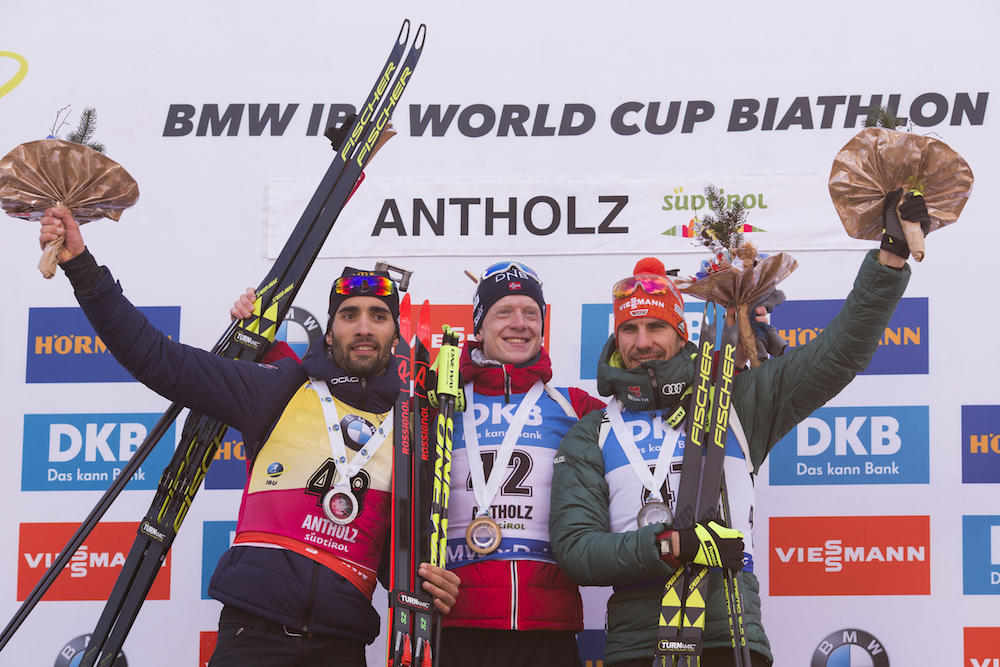
    The men’s 10 k sprint podium at the IBU World Cup in Antholz, Italy, with Norway’s Johannes Thingnes Boe (c) in first, France’s Martin Fourcade (l) in second, and Germany’s Arnd Peiffer (r) in third. (Photo: Manzoni/NordicFocus)

    Germany’s Arnd Pfeiffer started 47th, just ahead of Fourcade, and raced to third (+42.2) with clean shooting as well.

    “In the sprint, you almost always have to shot clean,” Bø reflected after, according to an IBU press release. “After my prone miss, I knew a podium would be hard, but you never know; you fight hard. With zero in standing, I knew there was a chance … I had the times from the start and knew I had good speed today … Martin is almost always stronger than me on the last lap, but today I was not tired.”

    Fourcade pointed out that this was his best sprint result in Antholz, a high-elevation venue at some 5,200 feet above sea level, since 2011, “so I am pretty satisfied,” he told the IBU.

    Pfeiffer told German broadcaster ARD that he latched onto Fourcade for the last loop.

    “At least I was clean on the shooting range today, that was not so easy,” Pfeiffer said, according to a translation. “I am pretty proud I managed to do that today. This was not my best day on the course, even if the position might insinuate something else. I had to toil quite a bit, and was lucky that Martin came by for the final [loop], who also wasn’t in his top shape today.

    “In the end of course the result was great, I haven’t been on the podium in an individual-start race so far this season,” Pfeiffer continued. “So I am happy about 100 percent shooting accuracy and hopefully being on the podium if everything works out.”

    Russia’s Anton Shipulin missed the podium by about four seconds in fourth (+46.3) with one standing miss (0+1), France’s Emilien Jacquelin placed fifth (+53.7) with clean shooting, Birkeland ended up sixth (+1:07.8) with zero penalties as well, Eberhard was seventh (+1:21.7) with two misses (0+2), Russia’s Anton Babikov eighth (+1:27.8; no penalties), Vladimir Chepelin of Belarus ninth (+1:32.3; one penalty), and the Czech Republic’s Ondrej Moravec 10th (+1:35.4; no penalties).

    US Biathlon’s Lowell Bailey racing to 41st in the men’s 10 k sprint at the IBU World Cup in Antholz, Italy. (Photo: US Biathlon/NordicFocus)

    Three out of five Americans qualified for Saturday’s pursuit, with Lowell Bailey leading them in 41st (+2:22.0) after one standing miss (0+1). Notably, he had the fifth-fastest overall shooting time.

    Tim Burke was just another 0.4 seconds back in 43rd (+2:22.4) with three penalties (1+2), and Leif Nordgren finished 50th (+2:33.1) with two penalties (1+1) and the second-fastest overall shooting time and third-fastest range time.

    Russell Currier missed the top 60 by 5 seconds in 63rd (+2:55.4) with two misses (1+1), and Sean Doherty finished 75th (+3:15.9) with four penalties (3+1). All five men were recently named to US Biathlon’s Olympic team.

    Macx Davies, who was selected to Biathlon Canada’s Olympic team, was the top Canadian in 66th (+2:58.2) with three misses (1+2). Carsen Campbell finished 82nd (+3:27.9) with two penalties (2+0), Matthew Hudec was 89th (+3:40.6) with one miss (0+1), and Aidan Miller 107th (+5:00.3) with five penalties (3+2).

    The men’s and women’s pursuits will be held Saturday in Antholz at 7:15 a.m. for the women and 9 a.m. for the men EST. Watch live on the Olympic Channel.

    Results

    ***

    Western Canadian Championships (Red Deer, Alberta): Freestyle sprints

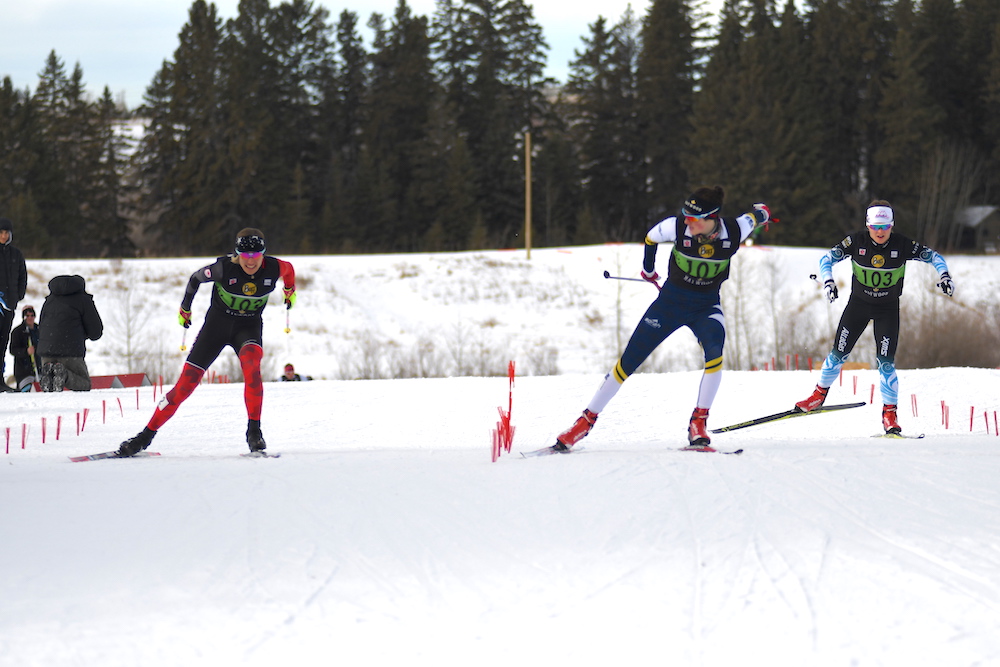
    Olivia Bouffard-Nesbitt (c) holds off Zina Kocher (l) and Annika Hicks (r) to win the women’s 1.2 k freestyle sprint final on Friday at the NorAm Western Canadian Championships in Red Deer, Alberta. (Photo: Doug Stephen)

    The NorAm series shifted west to to Red Deer, Alberta, for the fourth weekend of racing.

    Olivia Bouffard-Nesbitt (Rocky Mountain Racers) won the women’s 1.2-kilometre freestyle sprint A-final in 3:09.12, edging out Zina Kocher (Foothills Nordic) and Annika Hicks (Alberta World Cup Academy) by 0.4 and 0.77 seconds, respectively. They qualified in the same order in a small women’s field of 20. Organizers opted to skip the quarterfinals and pinned the top 10 women from the qualifier in two semifinals.

    Jess Cockney (302) winning the men’s 1.2 k freestyle sprint final ahead of Russell Kennedy (r) on Friday at the NorAm Western Canadian Championships in Red Deer, Alberta. (Photo: Doug Stephen)

    The men’s 1.2 k qualifier had 38 starters, and 22 advanced to the quarterfinals. After qualifying in second, 0.16 seconds off the top time set by Russell Kennedy (Team R.A.D.), Jess Cockney (Canadian World Cup Team) won his quarterfinal and semifinal and ultimately the men’s final in 2:24.29, 1.09 seconds ahead of Kennedy in second. Patrick Stewart-Jones (Alberta World Cup Academy) grabbed his first podium of the season, taking third (+1.70).

    Western Canadian Championships usually draw a smaller field than Easterns: more Canadians live within reasonable driving distance of Eastern Canadian Championships (hosted by Nakkertok in Cantley, Quebec) than live in all three times zones of western Canada combined.

    With many of the top athletes in Europe doing final elevation camps for the Olympics and U23s/Junior World Championships, the Western Championships’ open and junior categories were particularly small this year with 287 athletes total.

    Results: Qualifier | Heats | Complete results

  • Dickinson Books World Cup Spot; Schommer, Dreissigacker, Reid to National Team Camp

    Dickinson Books World Cup Spot; Schommer, Dreissigacker, Reid to National Team Camp

    Kelsey Dickinson (Craftsbury Collegiate Summer Team) racing to third in the women’s sprint at US Biathlon Rollerski Championships on Aug. 12 in Jericho, Vt. Dickinson had more strong performances this past weekend to secure a spot on the World Cup in December. (Photo: John Lazenby/Lazenbyphoto.com)

    For some American biathletes, there was a lot on the line in Jericho, Vermont this past weekend.

    Saturday and Sunday were rollerski biathlon competitions that served as the third and fourth of a four-race team selection series. Six athletes – Susan Dunklee, Clare Egan, Lowell Bailey, Leif Nordgren, Sean Doherty, and Tim Burke – had already booked their places for the first period of World Cup racing thanks to results from last season.

    But between one and three places still needed to be filled on the U.S. team, and the Jericho races – the first two were held at the Vermont biathlon complex in August – would be used to select a team for a pre-season camp in Canmore, Alberta. From there, the squad would be winnowed down for the December World Cup.

    Kelsey Dickinson (College of St. Scholastica) racing to 26th in the women’s 15 k freestyle mass start at 2017 NCAA Skiing Championships on March 11 at the Jackson Ski Touring Center in Jackson, N.H. (Photo: Flyingpointroad.com)

    One College of Saint Scholastica student, Kelsey Dickinson, booked her place on the World Cup. A St. Scholastica alumnus, Paul Schommer, all but did the same – he was selected to the camp, and is highly likely to also go on to the World Cup.

    Two more women, Joanne Reid of Colorado Biathlon and Emily Dreissigacker, of the Craftsbury Green Racing Project, were selected for the camp and will have to compete for the last World Cup spot.

    Even for the pre-qualified athletes, it was a weekend of important competitions, a chance to hone stills practiced over the summer and start visualizing the international competitions that will start in just six weeks.

    “It’s an important marker – it’s not nothing,” U.S. Biathlon Association Chief of Sport Bernd Eisenbichler said in an interview this morning. “We try to really run the trials like a national-level race. The Jericho crew led by John Madigan did an awesome job to put a real race on, not just a time trial. You have a bib number on, you want to perform and you want to execute the things you’ve worked on throughout the summer.”

    The Women: Three Trials Race Winners Heading to Canmore

    With the pre-qualified duo of Dunklee and Egan excluded from ranking results, Dickinson won the trials series in best-three-of-four scoring. Even with Dunklee and Egan in the results, she was only off the podium once in the four-race series.

    Chad Salmela (far left) with 2016 NCAA qualifiers Reitler Hodgert and Kelsey Dickinson as well as assistant nordic coach Josh Tesch at 2016 NCAA Championships in Steamboat Springs, Colo. (Photo: Chad Salmela)

    “I’m really pleasantly surprised and impressed also with how she did that, with being outside the team environment,” Eisenbichler said.

    Dickinson was formerly an athlete at the Maine Winter Sport Center (now the Outdoor Sports Institute), but when that program shuttered its senior funding scheme in the spring of 2015 she felt she had no choice but to go back to school. Since then she has worked with coaches Chad Salmela and then Maria Stuber, and become an NCAA qualifier for Saint Scholastica in cross-country skiing.

    Dickinson spent this summer at the Craftsbury Outdoor Center training for biathlon, along with Dreissigacker and other development athletes.

    “I know that she worked quite a bit with the Craftsbury team, which was a smart move, but overall we have to give her a lot of compliments for really doing this development,” Eisenbichler said of the student-athlete. “I just talked very briefly with her on Sunday, to let her know that she won the trials… she told me pretty straightforward that biathlon is first, and she will make it work. So I have no doubt that she will make it work with her school.”

    Dreissigacker and Reid have shorter histories with biathlon, something that Eisenbichler highlighted. Dreissigacker ended up second on the ranking list, after winning Saturday’s 7.5 k sprint outright.

    “She hasn’t been in this sport not such a long time, and her biggest accomplishment right now is that she is so stable with the shooting part now already,” Eisenbichler said. “On the weekend, we had a pretty windy day on Sunday, and she was still able to shoot [just one penalty]. And the same thing on Saturday plus winning that race. I think that she really made the next step towards being a complete biathlete, although there is still some work to do from the physical side and on the skiing side.”

    https://www.instagram.com/p/BaSCsEllKbQ/?taken-by=emdreiss

    Dreissigacker has spent the last two seasons racing on the second-tier IBU Cup, where she scored her first top-20 finish in March.

    Then, there’s Reid, who made a fast jump to the World Cup when she started the sport. Last season, Reid hit the top-30 in the first World Cup competition of the year, and was also a World Championships team member.

    After the Jericho trials, U.S. Biathlon was only supposed to nominate up to two women: the trials winner (which turned out to be Dickinson) would receive an automatic World Cup spot, and one other athlete could be selected by discretion to go to the Canmore camp.

    But the International Competition Committee also selected Reid, who had beaten both Dickinson and Dreissigacker in one of the trials races.

    “It was an extraordinary discretionary choice,” Eisenbichler said. “She had, two times, health issues in the summer. I don’t want to get into details of that, but it was significant health issues that justify a discretionary choice in our eyes. And she was on the whole weekend the fastest skier last weekend.”

    https://www.instagram.com/p/BaSAnRPjQUg/?taken-by=jfiresteel

    So, five women are headed to Canmore, and either Reid or Dreissigacker will go on from there to the World Cup.

    “We are taking all the ladies who were able to win one of the trials races,” Eisenbichler said of the rankings system that excluded pre-qualified Dunklee and Egan. “The decision for the fourth World Cup starting spot… will be made after looking at the training in Canmore and also at the races we will do together with Biathlon Canada at the end of the camp. It’s not trials races. [The decision] is a combination of looking at the training, the performance level, and the racing at the end of the camp.”

    Athletes who didn’t make the cut, like 2017 World Championships team member Maddie Phaneuf, will have another chance to make the World Cup or Olympic team after Christmas based on a separate set of trials races.

    Dunklee qualified for the Olympic team after winning a silver medal in the World Championships mass start. At least one more woman will be picked for the Olympic team based on December World Cup results, but not more than two; that means at least one spot will be up for grabs come January.

    Men: Schommer Shines

    With four men already pre-qualified for the World Cup, there is only one quota spot up for grabs. The trials winner would be sent to Canmore and possibly one more athlete based on discretion.

    After the first two races, in August, both Schommer and National Guard Biathlon’s Travis Cooper had one “win” (excluding the pre-qualified athletes) to their name.

    Paul Schommer, of US Biathlon’s National Development Group, racing to 33rd in his first IBU World Cup race, the men’s 20 k individual in Antholz, Italy, in January 2017. (Photo: USBA/NordicFocus)

    But in the October races, Cooper didn’t continue the streak. Schommer did, placing second on Saturday just four seconds behind Bailey, and fourth on Sunday.

    “Paul is the clear winner of the trials by 5%,” Eisenbichler said. “If we look at the second place in the trial points, this is Russell Currier, and Paul beat him in every race of the four races. So Paul really made a big step forward this summer. He got himself mixed in with the World Cup athletes, the pre-qualified ones. He has a really high performance level right now and I’m really happy to see that… if everything goes normal he will also get the call for the World Cup team in December.”

    Currier was not chosen for the camp on a discretionary basis, so Schommer – who turned in a 33rd-place finish in his World Cup debut last season – is nearly a lock for the December competitions.

    He was new to biathlon after his time at Saint Scholastica, but has quickly made strides in the sport.

    “The goal of bringing this Talent ID project forward in 2014 was to have someone in contention for a relay spot, pushing the other four athletes on the men’s side, and having also a good shot at being very competitive at the Games,” Eisenbichler said. “And I’m again very pleased to see that this project worked.

    “Compliments to Paul with how he approached it,” he continued. “He has done it professionally now for just 2 ½ years. I think he learned a lot last season, being at the World Championships as a reserve athlete, doing some World Cups, and a lot of international races like European Championships and IBU Cups. He learned a lot, absorbed a lot. But he was also able also to put the work in during the spring, summer, and beginning of the fall to get to a higher level. I’m really pleased where he is right now – he will be a very strong contender for the Games.”

    As with the women, Currier and others will have another chance to qualify for World Cup and Olympic racing in January.

    World Cup Athletes On Track

    For these athletes, qualification woes are now mostly behind them. Up next is the camp in Canmore, which will start on October 23.

    Lowell Bailey (USBA) en route to second in the men’s mass start at US Biathlon Rollerski Championships on Aug. 13 in Jericho, Vt. (Photo: John Lazenby/Lazenbyphoto.com)

    “It’s most important to have snow kilometers and work on technique,” Eisenbichler said of the camp. “Per Nilsson, our technique guru, will be there for the entire camp so the focus for sure for most of the athletes is to work on technique on skis. Following up from the May work in Bend and the summer work in the Oberhof ski hall. For us it’s really important to have this frequent snow contact in summer and fall.”

    After that, athletes will have about ten days at home before heading over to the World Cup. There, a different kind of qualification may be on their minds. Dunklee and 2017 World Champion Lowell Bailey are qualified for the Olympics already, but one or two more athletes of each gender can make that team through strong performances at the December World Cup.

    And ultimately, they are looking to perform well once they get to the Olympics.
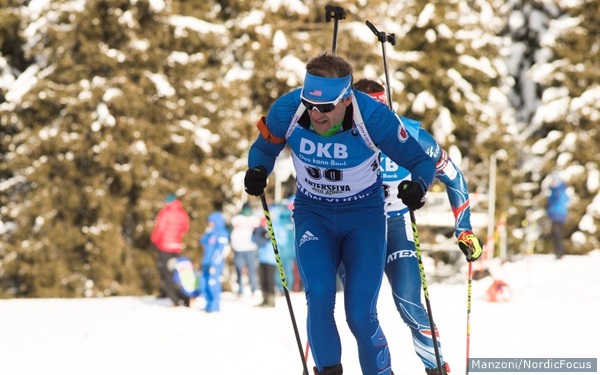
    For the athletes who didn’t have to worry about World Cup qualification last weekend, Eisenbichler said that the races were still an important marker, but also didn’t serve the same function as for those who still needed to snag their spots.

    “These races are kind of markers on the way for these pre-qualified ones, but it’s not really trials races for them,” he explained. “It’s a little bit different to come into the races with full training, compared to preparing at least a little bit for them as you have to if you need to qualify.”

    As a result, some of the World Cup regulars didn’t turn in their best days, but on the whole, that didn’t bother team staff.

    “He came out of a really good and hard block of training,” Eisenbichler said of Tim Burke, who finished fifth and seventh this weekend. “He had super time trials the week before in Lake Placid, so we feel very confident that he is on the right track. This week he was very tired from training, and then racing is not that easy on a high level. For sure he wanted and expected to be on a higher level, especially on the shooting part. But I’m not worried about him.”

    Likewise, Leif Nordgren placed 13th on Saturday with six penalties, but turned things around on Sunday to finish third overall.

    https://www.instagram.com/p/BaR6J7XjCtb/?taken-by=leifcnordgren

    “It was a really bad race on Saturday,” Eisenbichler said. “He really had to put his head down on Sunday. Even if you are pre-qualified, you have a responsibility to be competitive at these races. That’s clear. So he did that on Sunday, and that was good to see, it was really important for us.”

    Bailey won both races over the weekend and shot perfectly on both days. Dunklee didn’t race, as she was getting over a cold. Doherty placed third on Saturday and second on Sunday, and Eisenbichler was pleased with that.

    “Sean showed some really big improvement on the skiing, which was expected after he went through the mono stuff last year,” he said. “So that’s back on track. Still the prone shooting for Sean needs work and improvement for the World Cup. It’s not good enough right now.”

    And Egan won Sunday’s race.

    “We are pretty pleased with what we saw throughout the summer,” Eisenbichler said of her training. “With skiing especially, technique-wise she is getting on a higher level. She didn’t have a super race on Saturday, but had a better day on Sunday. And it’s still for her getting the momentum for a good complex biathlon performance. And that’s pretty normal for mid-October. I think she’s on the right way.”

    Trials race results: Aug. 12 | Aug. 13 | Oct. 14 | Oct. 15

  • U.S. Biathlon Names 11 to 2017/18 National Team, More on Development Squads

    U.S. Biathlon Names 11 to 2017/18 National Team, More on Development Squads

    Susan Dunklee and Lowell Bailey celebrate after finishing second in the World Cup single mixed relay in Kontiolahti, Finland. Austria won the competition. (Photo: IBU/Twitter)

    The U.S. Biathlon Association (USBA) has named five women and six men to its senior national team for the 2017/2018 season, and 14 more athletes to its several development teams.

    The nominations are headlined by Lowell Bailey and Susan Dunklee, both of whom won individual medals at 2017 World Championships in Hochfilzen, Austria. They are joined on the “A” team by their World Championships teammates Clare Egan, Joanne Reid, Maddie Phaneuf, Tim Burke, Leif Nordgren, and Sean Doherty.

    “This year it really culminated in a perfect way,” USBA Chief of Sport Bernd Eisenbichler said. “The best thing about it — besides being so successful and having a dream season — is that the upcoming and younger athletes, like Leif, Sean, Maddie, Joanne, and Clare, they see now that it’s not only the athletes from Norway and Germany succeeding. At some races we took medals and then we also proved it on the Olympic course. It’s giving a lot of confidence to the whole program.”

    Leif Nordgren skiing the second leg of the men’s 4 x 7.5 k relay at the IBU World Cup in Antholz, Italy, where the U.S. finished sixth. (Photo: USBA/NordicFocus)

    The men’s relay team notched sixth- and seventh-place relay efforts this season, and Nordgren picked up four top-30 finishes despite missing almost half the season with an injury. Doherty also missed almost half the season due to illness, but came back to earn a top-20 in the Kontiolahti pursuit at the end of the season. Veteran Burke collected four top-30’s over the course of the year.

    On the women’s side, Egan and Reid picked up two and one top-30 finishes apiece, and Phaneuf had a 10th-place pursuit result on the IBU Cup.

    Also snagging an “A” team nomination is Paul Schommer, who came from the senior development team to land consistent World Cup starts from the middle of the season onwards. Schommer had a top individual finish of 33rd in the individual in Antholz, Italy, and contributed to an eighth-place mixed relay effort in Kontiolahti, Finland.

    “Paul had a great season for his second year in biathlon, and made really big improvements,” Eisenbichler said. “He showed that he can be a really good alternative, or even more than that, for the men’s relay and other relays too. He showed that in Korea and especially in Kontiolahti in the mixed relay there. He had a top-35 result at his first World Cup, so we felt that he is really very close to the big guys and separated himself from the athletes who were performing with him at the beginning of the season in the IBU Cups.”

    Clare Egan racing to 20th place in the women’s 7.5 k sprint at the 2017 IBU World Championships in Hochfilzen, Austria (Photo: USBA/NordicFocus)

    Landing on the “B” team are Emily Dreissigacker (Craftsbury Green Racing Project) and Russell Currier (Outdoor Sports Institute). Currier started the year on the World Cup, finishing 34th in the pursuit in Oberhof, Germany, before moving to the IBU Cup. Dreissigacker racked up five top-30 finishes on the IBU Cup circuit this season.

    “They will get a lot of camp time in Lake Placid,” Eisenbichler said of the “B” team. “They will also get direct coaching from the National Team coaches. In Emily’s regard it’s from Jean Paquet, and in Russell’s regard from Jonas Johansson. So they have not only access to the training plan from the ‘A’ Team, but also their individualized plan from the national team coaches. They will spend about seven to eight weeks in Lake Placid from May to August.”

    Chloe Levins, who finished fourth in the youth women’s pursuit at World Youth and Junior Championships this season, and IBU Cup racer Jake Brown comprise next season’s “X” Team, which is seen as consisting of athletes who are expected to make the jump to the “A” team within two years.

    “The ‘B’ team should be very close to the World Cup, and we expect ‘B’ Team members to be able to really chase the World Cup team for the next season and to have a really good shot for the Olympic Games,” Eisenbichler explained. “That’s the difference between the ‘B’ Team and the ‘X’ Team. The ‘X’ Team is still a development team, for athletes who just started biathlon or young athletes, as we have this year.”

    Chloe Levins (11) with her US Biathlon support team (from left to right: Erik Lewish, Travis Voyer, Mathias Zacherl, Robert Gorgos, and Algis Shalna) after her fourth-place finish in the youth women’s 7.5 k pursuit, her career best in her third IBU Youth World Championships, on Sunday in Osrblie, Slovakia. (Photo: USBA)

    USBA has also named a five-member Senior Development Team, consisting of Hallie Grossman and Alex Howe (Craftsbury Green Racing Project), Siena Ellingson (Mount Itasca), Travis Cooper (National Guard Biathlon), and Max Durtschi.

    And the Junior Development Team consists of athletes with some of the top U.S. results at World Youth and Junior Championships: Vasek Cervenka (Mount Itasca, 16th in youth individual), Cody Johnson (Outdoor Sports Institute, 46th in junior sprint), Jake Pearson (Casper Mountain Biathlon Club, 49th in youth individual), Amanda Kautzer (Michigan Tech/Loppet Nordic Racing, 42nd in youth pursuit), Grace Gilliland (Alaska Biathlon, 46th in youth individual), and Helen Wilson (Alaska Biathlon, 62nd in youth individual). Lexie Madigan of the Auburn Ski Club was also named; she qualified for the World Youth Championships team but was younger than the minimum age set by the International Biathlon Union to compete.

    “The setup is, they are regionally coached with consulting from the National Team coaches,” Eisenbichler said. “They can get access to the training philosophy, but they are coached by their own regional or club coaches. But they are also invited to Lake Placid, the seniors for two camps, and the younger ones for one camp. At the [Rollerski National Championships] in mid-August, we will re-evaluate their performance levels and see who gets more invitations later on towards the fall.”

    The team nominations are as follows:

    National Team Women
    Susan Dunklee (Barton, Vt.), A 1 Team
    Clare Egan (Cape Elizabeth, Maine), A 2 Team
    Joanne Reid (Boulder, Colo.) A 3 Team
    Maddie Phaneuf (Old Forge, N.Y.) A 3 Team
    Emily Dreissigacker (Morrisville, Vt.) B Team
    National Team Men
    Lowell Bailey (Lake Placid, N.Y.), A 1 Team
    Tim Burke (Paul Smiths, N.Y.), A 2 Team
    Leif Nordgren (Marine, Minn.), A 2 Team
    Sean Doherty (Center Conway N.H.) A 2 Team
    Paul Schommer (Appleton, Wis.) A 3 Team
    Russell Currier (Stockholm, Maine) B Team

    X Team 
    Women
    Chloe Levins (Rutland, Vt.)
    X Team Men
    Jake Brown (Houghton, Mich.)
    National Development Group – Senior Women
    Hallie Grossman (South Woodstock, Vt.)
    Siena Ellingson (Minnetonka, Minn.)
    National Development Group – Senior Men
    Max Durtschi (Sun Valley, Idaho)
    Alex Howe (Craftsbury, Vt.)
    Travis Cooper (Kenai, Alaska)
    National Development Group – Youth/Junior Women
    Amanda Kautzer (Plymouth, Minn.)
    Grace Gilliland (Eagle River, Alaska)
    Helen Wilson (Eagle River, Alaska)
    Lexie Maddigan (Truckee, Calif.)
    National Development Group – Youth/Junior Men
    Cody Johnson (Fort Kent, Maine)
    Vasek Cervenka (Grand Rapids, Minn.)
    Jake Pearson (Casper, Wyo.)
    Coaching Staff
    Chief of Sport: Bernd Eisenbichler
    National Team Head Coach: Per Nilsson
    National Team Women’s Coach: Jonne Kahkonen
    National Team Men’s Coach: Jonas Johansson
    National Development Coach: Jean Paquet
    Eastern Regional Coach: Algis Shalna
    Midwestern Regional Coach: Vladimir Cervenka
    Assistant Coach: Erik Lewish
  • Friday Rundown: IBU Open European World Championships (Updated)

    Friday Rundown: IBU Open European World Championships (Updated)

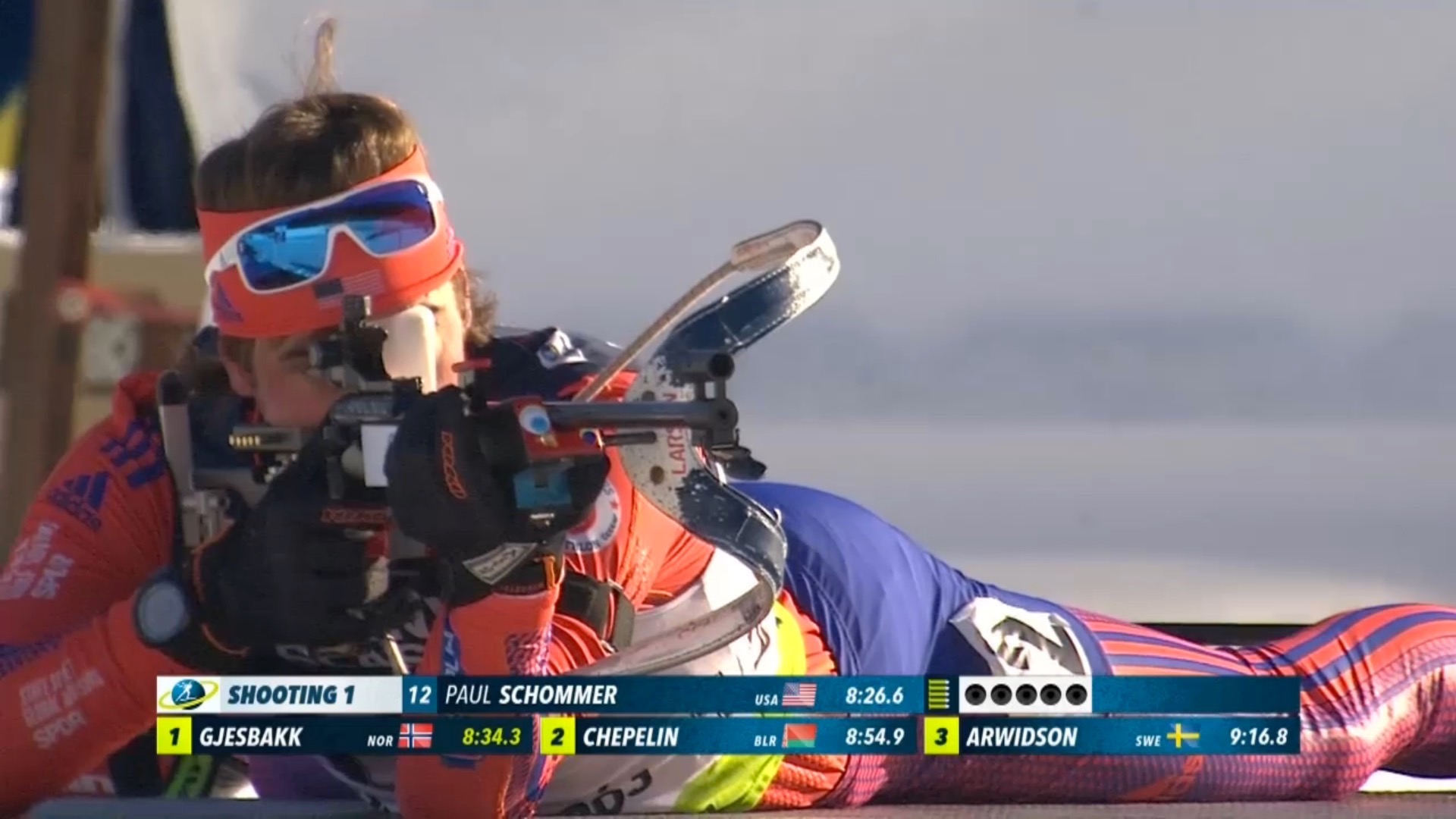
    US Biathlon’s Paul Schommer shooting prone in the men’s 10 k sprint at the 2017 IBU Open European Championships in Duszniki-Zdrój, Poland. He was the top North American on Friday in 58th. (Photo: IBU/Eurovisionsports.tv screenshot)
    US Biathlon’s Paul Schommer shooting prone in the men’s 10 k sprint at the 2017 IBU Open European Championships in Duszniki-Zdrój, Poland. He was the top North American on Friday in 58th. (Photo: IBU/Eurovisionsports.tv screenshot)

    IBU Open European Championships (Duszniki-Zdrój, Poland): Men’s & women’s sprints

    On Friday in the men’s 10-kilometer sprint, two Bulgarian athletes were able to break the Russian dominance at the 2017 International Biathlon Union (IBU) Open European Championships in Duszniki-Zdrój, Poland.

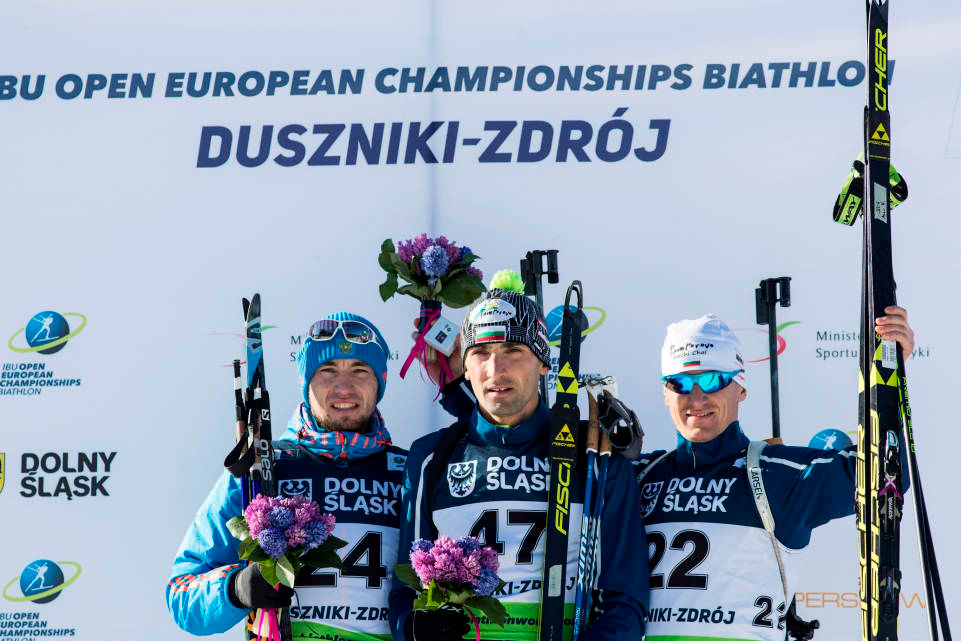
    The men's 10 k sprint podium on Friday, with Bulgaria’s Vladimir Iliev (c) in first, Russia’s Alexander Loginov (l) in second, and Bulgaria’s Krasimir Anev (r) in third at the 2017 IBU Open European Championships in Duszniki-Zdrój, Poland. (Photo: IBU)
    The men’s 10 k sprint podium on Friday, with Bulgaria’s Vladimir Iliev (c) in first, Russia’s Alexander Loginov (l) in second, and Bulgaria’s Krasimir Anev (r) in third at the 2017 IBU Open European Championships in Duszniki-Zdrój, Poland. (Photo: IBU)

    Bulgaria’s 29-year-old Vladimir Iliev, who has competed on the IBU World Cup since 2007 and posted a career-best fifth (which he achieved earlier this season), claimed the win in a time of 24:26.9 minutes despite one penalty in the standing stage (0+1), giving a kiss to his fast skis in the finish. Russia’s Alexander Loginov, who won the men’s 20 k individual race on Wednesday after returning this season from a two-year doping suspension, placed second (+4.9) with clean shooting. Behind them, Iliev’s teammate Krasimir Anev took third (+16.7), also shooting clean, to push Latvia’s Andrejs Rastorgujevs off the podium by just 0.6 seconds (+17.3). Rastorgujevs started early in bib 4 and skied the fastest course time of the day, but incurred two penalties in his standing stage (0+2), which ultimately set him back too far for a podium.

    “It was a long way to this medal and this win,” Iliev said his first career victory, according to an IBU press release. “I was ready for a high result for many years, but many things have happened, so I’m really happy to get a victory today.”

    “I did not expect anything in this race, because yesterday I had health problems so even my coach advised me not to start,” Anev said after winning his second medal of the championships, following up on a second place in the individual. “So [I] went into competition without any expectations.”

    In beautiful weather conditions with little wind and the sun shining on the new arena in Duszniki-Zdrój throughout the race, US Biathlon’s Paul Schommer was the best of 11 North American starters, finishing 58th (+2:14.9) with three penalties (1+2). Schommer was less than a second faster than his U.S. teammate Alex Howe, who finished 59th (+2:15.3), after skiing two penalty laps (1+1). The third American Jakob Ellingson placed 64th (+2:24.6) with one penalty (0+1), Russell Currier was 75th (+2:41.4) with four penalties (2+2), Max Durtschi was 88th (+3:16.1) with three penalties (1+2), and Michael Gibson was 103rd (+4:30.4) with two penalties (1+1).

    Matthew Hudec led the Canadians on Friday in 80th (+2:54.7) with one penalty (1+0). Also for Canada, Aidan Millar finished 86th (+3:13.9) with three penalties (1+2), Carsen Campbell 89th (+3:18.3) with three penalties (2+1), Pearce Hanna 92nd (+3:24.7) with two penalties (1+1), and Matthew Neumann 94th (+3:31.8) with four penalties (1+3).

    In the large field of 125 starters, Schommer and Howe qualified for Saturday’s pursuit race by placing in the top 60.

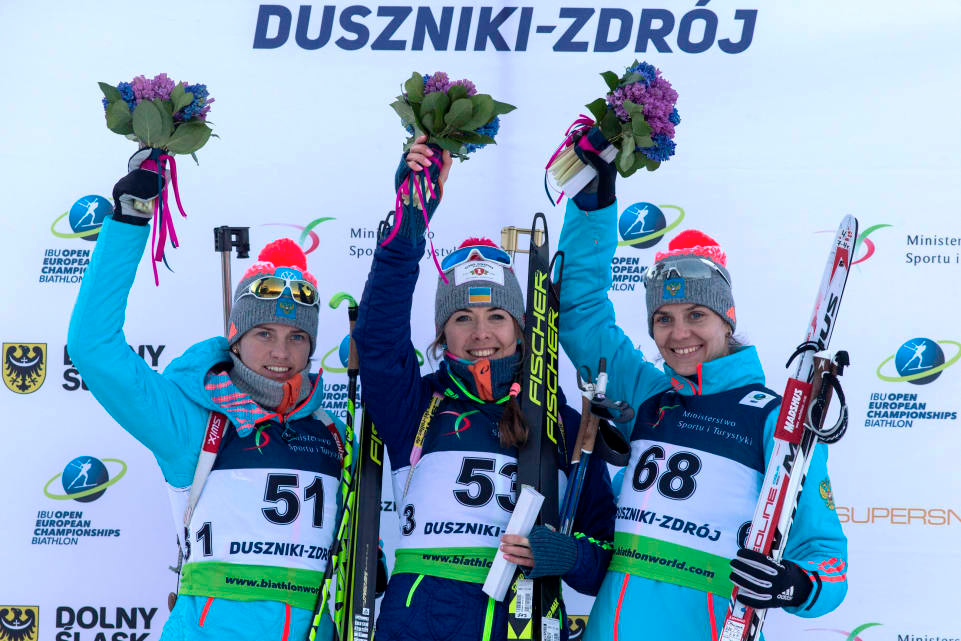
    The women’s 7.5 k sprint podium on Friday, with Ukraine’s Juliya Dzhyma (c) in first, Russia’s Svetlana Sleptsova (l) in second and Russia’s Irina Starykh (r) in third at the 2017 IBU Open European Championships in Duszniki-Zdrój, Poland. (Photo: IBU)
    The women’s 7.5 k sprint podium on Friday, with Ukraine’s Juliya Dzhyma (c) in first, Russia’s Svetlana Sleptsova (l) in second and Russia’s Irina Starykh (r) in third at the 2017 IBU Open European Championships in Duszniki-Zdrój, Poland. (Photo: IBU)

    [UPDATED] In the women’s 7.5 k sprint that followed, Ukraine’s Juliya Dzhyma managed to win in convincing fashion in a time of 21:02.3 minutes, shooting clean and skiing the second-ranked course time. It was the first individual career victory for the 26 year old in either a junior or senior championships, after she won a gold medal with Ukraine’s relay team at the 2014 Olympics in Sochi, Russia.

    “When I saw that everyone was cleaning, I knew that to get in to top three, I have to do the same,” Dzhyma commented on her race, according to an IBU press release. “But honestly, I have no idea how I hit all the targets today; for the whole season, it was my first competition where I had zero.”

    “I was just trying to do my best and to make the gap bigger because tomorrow is the pursuit!” she added, regarding her last loop when she increased her lead by another ten seconds.

    Also shooting clean but 27 seconds off the win was Russia’s 30-year-old Svetlana Sleptsova, who, earlier in her career, won five World Cups and gold medals in the women’s relay at the 2009 World Championship and 2010 Olympics in Vancouver.

    Starting behind Sleptsova, her Russian teammate Irina Starykh, the winner of the women’s individual race on Wednesday, and like Loginov, also coming back from a two-year suspension for EPO use, claimed third (+37.8) with one penalty in her standing stage (0+1). Starykh bumped  Germany’s Karolin Horchler, who had led the race early on after starting in bib 2 to fourth (+42.2, with no penalties). Horchler won her first World Cup a week ago in Antholz, Italy.

    “Before the competition I already felt that it would be very hard for me to shoot today,” Starykh told the IBU. “And in the end it came out that way, it was tough for me to shoot at the prone and at the standing. But just one penalty is a pretty good result, based on how I feel.”

    Horchler’s teammate Denise Herrmann, who made the switch from cross-country skiing to biathlon this season, followed in fifth (+47.7) with the fastest course time of the day, but missed two targets in her standing stage including her very last shot (0+2) to miss the podium.

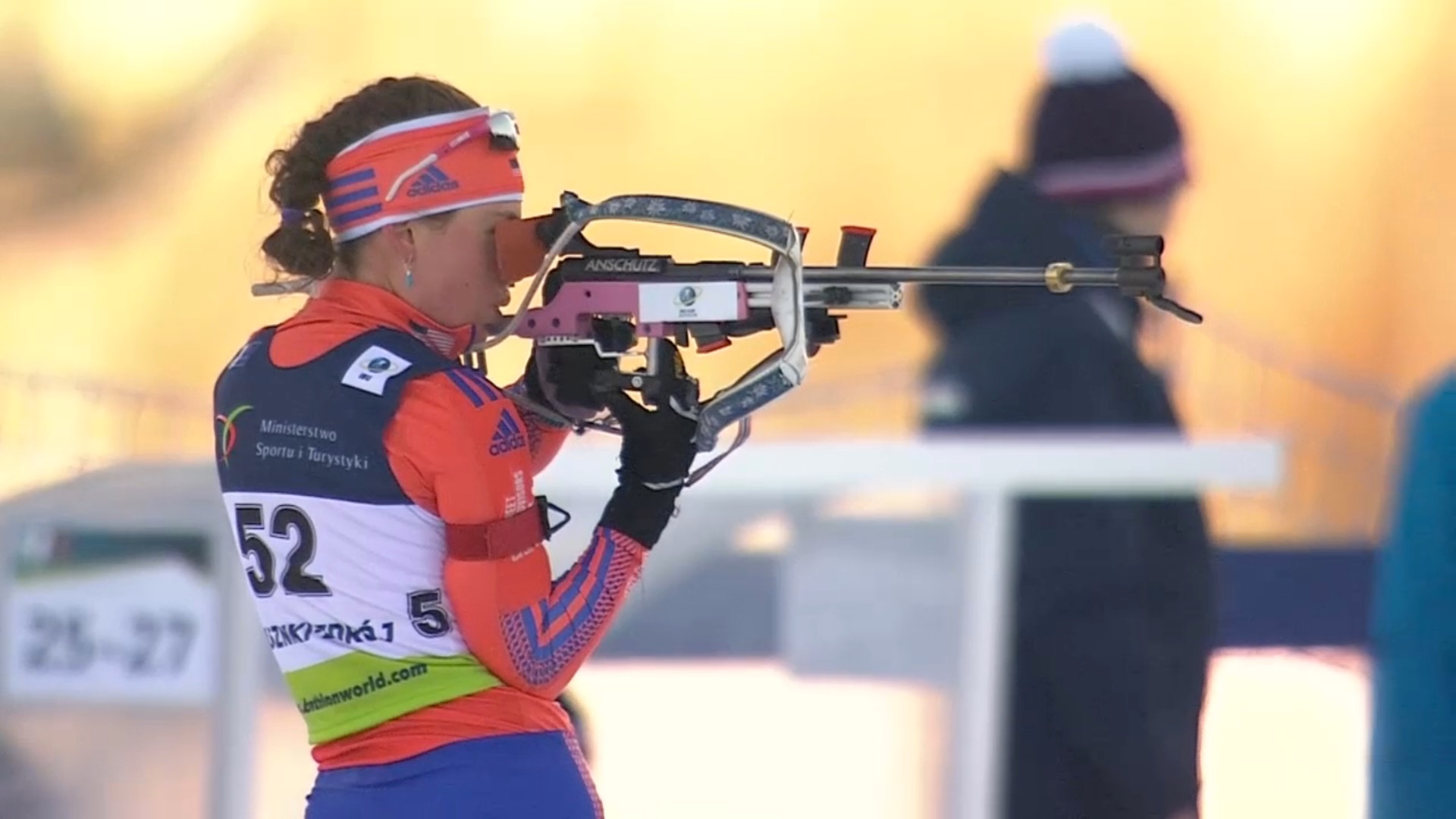
    American Hallie Grossman during her standing stage in the women’s 7.5 k sprint on Friday at the 2017 IBU Open European Championships in Duszniki-Zdrój, Poland. She finished 70th with three penalties as the second-best North American. (Photo: IBU/Eurovisionsports.tv screenshot)
    American Hallie Grossman during her standing stage in the women’s 7.5 k sprint on Friday at the 2017 IBU Open European Championships in Duszniki-Zdrój, Poland. She finished 70th with three penalties as the second-best North American. (Photo: IBU/Eurovisionsports.tv screenshot)

    In stable weather conditions, though not as sunny as during the men’s sprint earlier on Friday, US Biathlon’s Emily Dreissigacker was the top North American woman in 69th (+3:31.1), with three penalties (2+1). Just one position behind her, American Hallie Grossman also missed three (2+1) on her way to a 70th (+3:34.4). For the 23-year-old Grossman it is her first season overseas racing in the IBU Cup.

    Canada’s Erin Yungblut finished 81st (+5:50.0) with four penalties (1+3). Her teammate Leilani Tam von Burg did not finish after incurring two penalties in her prone shooting stage, and the third Canadian, Sarah Beaudry did not start.

    None of the North American woman qualified for Saturday’s pursuit.

    Results: Men | Women

    Start lists: Men’s pursuit | Women’s pursuit

  • Wednesday Rundown: IBU Open European Championships

    Wednesday Rundown: IBU Open European Championships

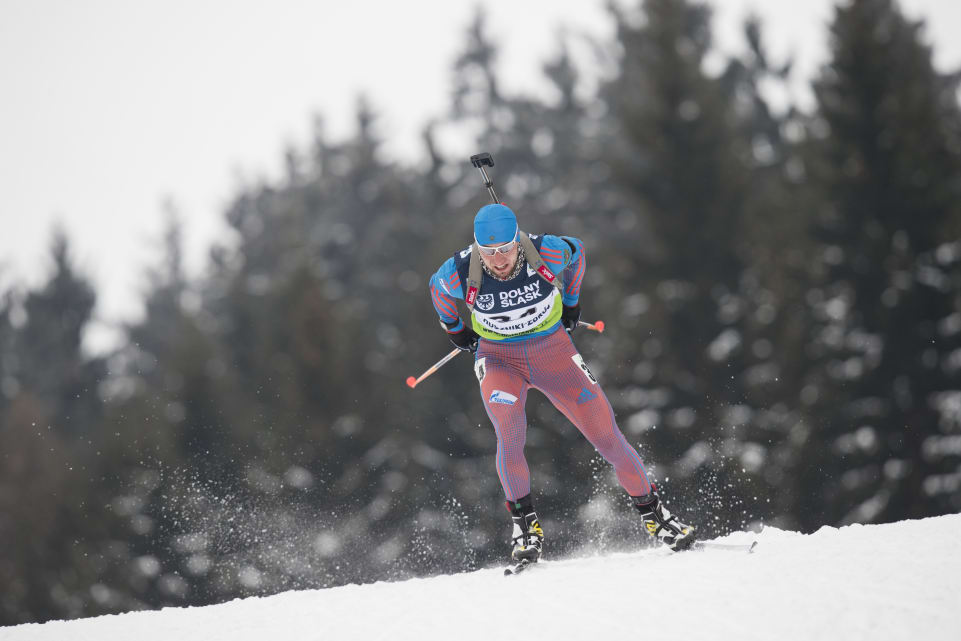
    Russia's Alexander Loginov racing to the win in the men's 20 k individual on Wednesday, the first race of 2017 IBU Open European Championships in Duszniki-Zdrój, Poland. (Photo: IBU)
    Russia’s Alexander Loginov racing to the win in the men’s 20 k individual on Wednesday, the first race of 2017 IBU Open European Championships in Duszniki-Zdrój, Poland. (Photo: IBU)

    IBU Open European Championships (Duszniki-Zdrój, Poland): 15/20 k individual

    The Open European Championships, a five-day International Biathlon Union (IBU) sanctioned event, opened Wednesday with the men’s 20-kilometer and women’s 15 k individual races in Duszniki-Zdrój, Poland.

    Russia took first and second in the women’s race, with 29-year-old Irina Starykh — coming off a two-year ban for EPO use — winning by more than a minute over her teammate Svetlana Sleptsova. Starykh hit all 20 targets en route to the victory 44:24.7 minutes, which was 1:03.8 faster than Sleptsova, who had one penalty (0+1+0+0) in second. Ukraine’s Anastasiya Merkushyna placed third (+1:05.0) with one penalty as well (0+1+0+0).

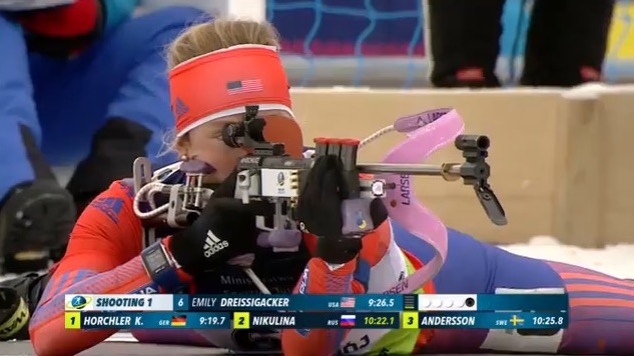
    American Emily Dreissigacker shooting clean during her first prone stage of the women's 15 k individual on Wednesday at 2017 IBU Open European Championships in Duszniki-Zdrój, Poland. She finished 41st.
    American Emily Dreissigacker shooting clean during her first prone stage of the women’s 15 k individual on Wednesday at 2017 IBU Open European Championships in Duszniki-Zdrój, Poland. She finished 41st.

    Emily Dreissigacker led the two U.S. women in the race in 41st (+7:47.6) with four penalties (0+1+1+2). Hallie Grossman finished 52nd (+9:06.1) with four misses as well (1+1+2+0).

    Canada’s Leilani Tam von Burg finished 58th (+9:54.2) with two penalties (0+0+1+1), and Erin Yungblut was 60th (+10:13.4) with three misses (0+2+0+1).

    Russia took first in the men’s 20 k as well, with 24-year-old Alexander Loginov — who also recently served a two-year ban for testing positive for EPO — winning by 11.4 seconds in 44:54.9. He had one penalty in his first prone stage (1+0+0+0) but cleaned the next three stages. Bulgaria’s Krasimir Anew cleaned (0+0+0+0) for second (+11.4), and Russia had two on the podium with Alexey Slepov in third (+53.6), with clean shooting as well.

    Russia swept fourth through six, putting five in the top six.

    Russell Currier led the American men in 51st (+5:42.5) with five penalties (2+2+0+1). Paul Schommer placed 57th (+6:02.5) with five misses as well (2+0+1+2), Max Durtschi was 62nd (+6:44.2) with two misses (1+0+1+0), Alex Howe 79th (+8:46) with three misses (0+1+0+2), Jakob Ellingson 87th (+10:11.3) with seven misses (2+4+1+0), and Michael Gibson 94th (+11:58.3) with six penalties (1+1+1+3).

    Carsen Campbell was the top Canadian in 64th (+6:58.2) with two misses (0+1+1+0). Matthew Neumann finished 68th (+7:26.0) with three misses (0+1+0+2), Aidan Miller was 72nd (+8:07.9) with two miles (0+1+0+1), Matthew Hudec 98th (+12:29.5) with seven misses (1+1+2+3), and Pearce Hanna 101st (+14:07.1) with seven misses (2+2+2+1).

    Racing continues Friday with the men’s 10 k and women’s 7.5 k sprints.

    Results: Women | Men

  • Burke Gives It One More Shot for Season-Best 12th; Bailey 18th in Ruhpolding Sprint

    Burke Gives It One More Shot for Season-Best 12th; Bailey 18th in Ruhpolding Sprint

    Tim Burke (US Biathlon) leads Switzerland's Serafin Wiestner in the IBU World Cup men's 10 k sprint on Friday in Ruhpolding, Germany. Burke finished 12th for a season best, and Wiestner was 41st. (Photo: USBA/NordicFocus)
    Tim Burke (US Biathlon) leads Switzerland’s Serafin Wiestner in the IBU World Cup men’s 10 k sprint on Friday in Ruhpolding, Germany. Burke finished 12th for a season best, and Wiestner was 41st. (Photo: USBA/NordicFocus)

    This week, Tim Burke reached a serious tipping point. A US Biathlon veteran with six International Biathlon Union (IBU) World Cup podiums to his name (including a silver medal at 2013 World Championships), Burke stated this past fall that he was going for the one medal that eluded him: an Olympic medal. That meant racing through 2018.

    His last World Cup podium came four seasons ago when he placed third in a sprint in Östersund, Sweden. So far this season, Burke, less than a month out from his 35th birthday, had failed to crack the top 20. His season-best result was 26th in the pursuit last week in Oberhof, Germany.

    Then, on Wednesday, he skied the second leg of the men’s 4 x 7.5-kilometer relay in Ruhpolding, Germany, using all three spares on his standing stage and ending up in the penalty lap. The team placed 12th, and Burke wasn’t happy with his performance.

    “This year has been such a roller coaster for my ski form,” Burke wrote in an email on Friday. “After the relay on Wednesday, I really considered skipping the rest of the World Cups until World Championships.”

    2017 IBU World Championships are set for Feb. 9-19 in Hochfilzen, Austria. Skipping “the rest of the World Cups” until then would have meant missing the Ruhpolding sprint and pursuit, as well as potentially three races in Antholz, Italy, Jan. 19-22.

    Burke decided to give it one more shot — or 10 more, to be exact — and suited up for another race day in Ruhpolding: the men’s 10 k sprint on Friday.

    After more than 100 racers had finished, Burke was glad he joined them as he ultimately placed 12th for his best individual result of 2016/2017.

    “I decided to give it one more try today and was thrilled to finally feel better,” Burke wrote.  “Because of my recent struggles, I was very careful not to push too hard early on in the race. I kept the pace just below ‘red line’ and then really went for it about 1.5k from the finish.”

    Starting relatively early in bib 21, Burke cleaned the first prone stage and clocked the 13th-fastest course time on the first loop. His second loop was slightly slower yet still competitive as the 19th-ranked time, and he sped up considerably on the last loop after missing a standing target and having to ski a penalty lap. His last loop was seventh fastest in the field, and overall, Burke’s course time was ninth fastest.

    “Considering the season so far, I am very satisfied with my course time today,” he explained. “I had probably the best training season of my career, so despite some poor results, I have tried to just stay positive and confident that things would eventually turn around.”

    While Burke described his lone penalty (0+1) as “not ideal”, he expected more penalties from others, given the breezy conditions and light snow falling later in Friday’s race.

    “It’s always tough to say, but without that miss, I probably would have been close to the podium,” he wrote. “Of course there are many others who can say that as well!”

    Burke ended up 1:11.6 minutes out of first and about 32 seconds off the podium in 12th, after eight of the 11 finishers ahead of him hit every target.

    Overall IBU World Cup leader Martin Fourcade of France racing to his ninth individual win of the 2016/2017 IBU World Cup season on Friday during the men's 10 k sprint in Ruhpolding, Germany. (Photo: IBU)
    Overall IBU World Cup leader Martin Fourcade of France racing to his ninth individual win of the 2016/2017 IBU World Cup season on Friday during the men’s 10 k sprint in Ruhpolding, Germany. (Photo: IBU)

    France’s Martin Fourcade put together the fastest skiing and best shooting performance of the day, starting 60th and cleaning both stages to finish 18 seconds faster than anyone else with a winning time of 22:34.2 minutes. He posted the fastest course time by more than 20 seconds to achieve his ninth victory of the season, and for the runner-up, Austria’s Julian Eberhard (who also shot clean and posted the third-fastest course time), it was his second podium of the season and third of his career.

    “That was a perfect race from the first to the last meter,” Eberhard told Austrian broadcaster ORF. ” I wouldn’t know where I could have gained additional time [on Fourcade].”

    Eberhard started 27th, just behind Norway’s Emil Hegle Svendsen in bib 25, who also hit all 10 targets and took the lead briefly at the finish. Eberhard bested Svendsen’s time by 21.7 seconds to become the new race leader until Fourcade crossed the line, and all three remained on the podium.

    “Already in the prone shooting I felt super,” Eberhard said. “In standing, I noticed a little pressure because I knew it could become a great result, but I worked through the sequence calmly, and then marched full throttle until the end.”

    “During my [warmup], I was watching the screen, and I saw that Julian and Emil Hegle were shooting clean, and I wanted to match them,” Fourcade said, according to an IBU press release.

    About 12 seconds off the podium, Germany’s Arnd Peiffer started 81st (directly behind American Lowell Bailey) and proved to be a threat with clean shooting, but his 15th-ranked course time didn’t quite stack up to the top three. Racing in front of a sold-out, home crowd at Ruhpolding’s Chiemgau Arena, Peiffer settled for fourth (+51.8), ahead of another German, Simon Schempp, who was the only man in the top five to miss a target (0+1) for fifth place (+52.8).

    Lowell Bailey (US Biathlon) leading Slovenia's Rok Trsan during the IBU World Cup men's 10 k sprint on Friday in Ruhpolding, Germany. (Photo: USBA/NordicFocus)
    Lowell Bailey (US Biathlon) leading Slovenia’s Rok Trsan during the IBU World Cup men’s 10 k sprint on Friday in Ruhpolding, Germany. (Photo: USBA/NordicFocus)

    “I would say it was a decent final loop,” Peiffer said of skiing with two Americans, Bailey and Sean Doherty, to German broadcaster ARD. “I noticed I wouldn’t be able to catch up to Emil [Hegle Svendsen]. That was too far away, and I couldn’t add any speed anymore. So I rather tried to keep the fourth place, and luckily had the advantage of knowing all the split times. I just managed to rescue myself into the finish, but I suffered quite a bit today.”

    Bailey turned out to be the second U.S. man in the top 20 on Friday in 18th (+1:24.3). He started late in bib 80 and cleaned prone to put himself in the hunt for a top 10. In standing, however, Bailey missed his final shot to drop to 17th and he ended up 18th at the finish with a single penalty (0+1).

    Doherty in bib 79 was the third American to qualify for Sunday’s pursuit, racing to 40th (+1:52.3) in his second individual World Cup race of the season (last week in Oberhof, the 21 year old placed 80th in the sprint).

    “Today’s race was great,” Doherty said, according to a US Biathlon press release, after missing just one prone target (1+0). “I am continuing to feel better and better on the skis. It was very exciting to be in the mix and finish the last lap with the crowds yelling full force.”

    Missing out on the top 60 necessary for the pursuit were Americans Leif Nordgren, who finished 71st (+2:41.2) with two misses (1+1) in his first individual race of the season (following toe surgery), and Russell Currier, who started in bib 1 and ended up 75th (+2:52.7) with four penalties (2+2).

    Scott Gow was the lone Canadian to qualify for the pursuit in 42nd (+1:55.6) with one miss (1+0). Brendan Green missed the top 60 by 5.8 seconds in 64th (+2:27.1) with two penalties (1+1), Macx Davies was 82nd (+3:08.4) with three misses (2+1),  and Christian Gow 88th (+3:19.8), also with three penalties (2+1).

    On Sunday, Burke will start the pursuit 20 seconds after Peiffer in fourth place. Bailey will head out just 12 seconds after Burke.

    “As always in Ruhpolding, the times stayed very close today so everything is still possible in Sunday’s pursuit,” Burke told US Biathlon.

    The women’s 7.5 k sprint is scheduled for Saturday at 8:30 a.m. EST. Watch it live: eurovisionsports.tv.

    Men’s sprint results | Men’s pursuit start list

  • Friday Rundown: Burke 12th, Bailey 18th in Ruhpolding Men’s Sprint

    France's Martin Fourcade celebrating his ninth individual win of the 2016/2017 IBU World Cup season on Friday at the finish of the men's 10 k sprint in Ruhpolding, Germany. (Photo: IBU)
    France’s Martin Fourcade celebrating his ninth individual win of the 2016/2017 IBU World Cup season on Friday at the finish of the men’s 10 k sprint in Ruhpolding, Germany. (Photo: IBU)

    IBU World Cup (Ruhpolding, Germany): Men’s sprint

    Race report

    Another impeccable outing for France’s Martin Fourcade, another incredibly memorable one for Austria’s Julian Eberhard. Both shot clean in both stages of the men’s 10-kilometer sprint on Friday at the International Biathlon Union (IBU) World Cup in Ruhpolding, Germany, with Fourcade racking up his ninth individual victory of the season in 22:34.2 and Eberhard notching his second podium of the season and third of his career, 18 seconds back.

    Norway’s Emil Hegle Svendsen finished third (+39.7) with clean shooting, and Germany’s Arnd Peiffer also hit all 10 of his targets for fourth place (+51.8).

    Out of the top seven, just one man had to ski a penalty lap: Germany’s Simon Schempp, who had one standing miss and ended up fifth (+52.8).

    Tim Burke led the U.S. in 12th (+1:11.6) with one standing penalty as well (0+1) for his first individual top 20 of the season. His US Biathlon teammate Lowell Bailey was also in the hunt for a top 10 before he missed his final standing shot (0+1) and ended up 18th overall (+1:24.3).

    Fourcade started 60th and posted the fastest course time en route to the victory, 20.6 seconds faster than Germany’s Benedikt Doll, who placed 20th with three penalties (0+3). Eberhard in bib 27 had the third-fastest course time, 22.2 seconds slower than Fourcade, and third-fastest range time.

    Burke started 21st and his overall course time ranked ninth (+37.3), while Bailey in bib 18 posted the 36th-ranked course time and 14th-fastest shooting time.

    Also for the U.S., Sean Doherty finished 40th (+1:52.3) with one miss (1+0) to qualify for Sunday’s pursuit. In his first individual World Cup race of the season, American Leif Nordgren finished 71st (+2:41.2) with two misses (1+1). Russell Currier — the first starter of the day in bib 1 — placed 75th (+2:52.7) with four penalties (2+2).

    Leading Canada as the lone man to qualify for Sunday’s pursuit, Scott Gow finished 42nd (+1:55.6) with one penalty (1+0), while Brendan Green missed the top 60 in 64th (+2:27.1) with two penalties (1+1). Macx Davies was 82nd (+3:08.4) with three misses (2+1), Christian Gow 88th (+3:19.8) with three penalties as well (2+1).

    Results

  • Fourcade Unshaken by Oberhof Winds; Burke 26th and Season-Best 34th for Currier

    Fourcade Unshaken by Oberhof Winds; Burke 26th and Season-Best 34th for Currier

    France’s Martin Fourcade celebrates his victory in the men’s 12.5-kilometer pursuit on Saturday at the 2017 IBU World Cup in Oberhof, Germany. (Photo: IBU)
    France’s Martin Fourcade celebrates his victory in the men’s 12.5-kilometer pursuit on Saturday at the 2017 IBU World Cup in Oberhof, Germany. (Photo: IBU)

    With cold, fierce gusts of wind blowing over the biathlon range in Oberhof, Germany, the International Biathlon Union (IBU) World Cup men’s 12.5-kilometer pursuit on Saturday was decided in the first standing stage. Out of a top group of seven athletes, only France’s Martin Fourcade was able to shoot clean to create a 35-second gap. In the final shooting, he cleared his targets in a slow but controlled rhythm, avoiding the penalty lap once again, while his pursuers missed more shots to increase the gap to an insurmountable lead.

    Fourcade, the dominant athlete of the season so far who only missed the podium in the sprint two days ago, crossed the line in a time of 36.45.7 minutes with only one penalty (0+1+0+0), clapping and waiving to the crowd on the long finish stretch.

    “That is a difficult situation, something I fight with during a lot of competitions in my career,” Fourcade commented on his final shooting at the press conference. “On some days it’s a good decision to wait, like it was today. Some days you just regret afterwards to not join the penalty loop as fast as possible.”

    “My fingers were very cold, and in biathlon we can’t use big gloves for the shooting,” Fourcade said of the challenging conditions to German broadcaster ZDF. “Getting them warm was my main occupation during the race … I knew shooting was the key today. In French I would say I have a ‘hard head’, when I am not satisfied about one competition I am often good the day after. So I am very happy to do it again today.”

    Germany’s Arnd Peiffer thought he had lost all chances for a podium finish with two penalties in the final standing shooting, but managed to refocus to hit his last two shots and with all of his closest competitors incurring at least as much — e.g. Austria’s sprint winner Julian Eberhard missed every target in that stage — he still was able to secure second place by a comfortable margin for his best result of the season (+1:09.9 with 3 penalties).

    “In the last shooting with two misses I already thought I had gambled the race away,” Peiffer told ZDF after the race. “It was very difficult to shoot with the wind, very turbulent. I am glad that I made the last shot today… I felt pretty good on the skis and was able to close gaps. But the snow is very cold, very blunt, so the skiing is pretty energy-sapping especially on the second part of the loop with headwinds… Only on the last one I didn’t have as much stress anymore with a large gap behind me. There is nothing better than skiing into the finish relaxed like that.”

    Four athletes, who each had to ski five penalty laps during the race, fought for the third spot on the podium. Italy’s Dominik Windisch was able to repeat his third place from the sprint (+1:32.4), edging out Norway’s Emil Hegle Svendsen by 0.2 seconds (+1:32.6).

    Italy’s Dominik Windisch (l) celebrates after beating Norway’s Emil Hegle Svendsen (r) in the race for third place in the men’s 12.5-kilometer pursuit at the 2017 IBU World Cup in Oberhof, Germany. (Photo: IBU)
    Italy’s Dominik Windisch (l) celebrates after beating Norway’s Emil Hegle Svendsen (r) in the race for third place in the men’s 12.5-kilometer pursuit at the 2017 IBU World Cup in Oberhof, Germany. (Photo: IBU)

    “During the last lap, I was thinking about my strategy, I saw him in the uphill a bit tired, but I think it was a fake,” a smiling Windisch said at the press conference on his last loop with Svendsen. “I tried to attack there, but saw that he was still behind me. I then thought maybe this was a mistake. When he passed me on the last uphill again I thought maybe that’s my chance, because on the finish stretch you have the wind against you. … So I could stay behind and attacked at the end. I am happy that my strategy at the finish was good.”

    “He was a little stronger than me in the end. I felt like a log,” Svendsen told Norwegian broadcaster NRK. “I was a little too aggressive toward the end. I thought he looked tired and I thought I could pass him. I ended the long lane in the final stretch with lots of wind. I think he came out from behind me and got a little rest during the decisive seconds.”

    Behind them Germany’s Erik Lesser (+1:36.1) and Russia’s Anton Babikov (+1:40.7) placed fifth and sixth, respectively. They had closed a gap of more than ten seconds to Svendsen and Windisch on the final loop, but then had no energy left to pass them up the last climb and sprint finish stretch.

    No athlete managed to shoot clean in the windy conditions, and aside from Fourcade, only Ukraine’s Vladimir Semakov was able to limit his penalties to one, finishing 13th (0+0+1+0, +2:08.2). His teammate Artjom Pryma made an even bigger leap in the results after starting in 57th place to finish ninth with two penalties (+1:55.3).

    US Biathlon's Tim Burke (r) racing to 26th for his second-best individual result of the season on Saturday in the IBU World Cup 12.5 k pursuit in Oberhof, Germany. (Photo: USBA/NordicFocus)
    US Biathlon’s Tim Burke (r) racing to 26th for his second-best individual result of the season on Saturday in the IBU World Cup 12.5 k pursuit in Oberhof, Germany. (Photo: USBA/NordicFocus)

    US Biathlon’s Tim Burke had his second-best individual result of the season in 26th (+3:18.9). After starting in 35th, he improved to 17th with two clean shooting performances in the prone stages, before four penalties in his standing bouts (0+0+2+2) put him outside the top 20 in the second half of the race.

    “Today was another challenging race with extremely windy and cold conditions,” Burke said, according to a US Biathlon press release. “Considering the conditions, I am happy with my performance today. It’s always good to move up in the pursuit and I feel like my ski shape is getting better with each race. Hopefully I can continue this trend next week in Ruhpolding.”

    American Russell Currier racing to 34th for his best result of the season and first time in four years scoring IBU World Cup points on Saturday in the men's 12.5 k pursuit in Oberhof, Germany. (Photo: USBA/NordicFocus)
    American Russell Currier racing to 34th for his best result of the season and first time in four years scoring IBU World Cup points on Saturday in the men’s 12.5 k pursuit in Oberhof, Germany. (Photo: USBA/NordicFocus)

    The other American in the pursuit, Russell Currier moved up 12 spots from a 46th starting position to 34th at the finish (+4:29.8) with five penalties (2+0+1+2), for his best race result of the season.

    “It’s been four years since I last finished in the points,” Currier told US Biathlon. “It was frustrating knowing I could do it, but never being able to execute on the few chances there were. Today was the sign of progress I’ve been training for all year.”

    Scott Gow was the lone Canadian to qualify for the pursuit in the sprint’s top 60. He finished the race in 45th (+5:45.7), after starting in 43rd, with seven penalties (1+1+2+3).

    The biathlon weekend in Oberhof concludes with mass starts on Sunday. No North American representative is qualified for the men’s race, with Lowell Bailey, who currently is in 17th place in the overall standings skipping this World Cup in Oberhof for a training block.

    For the women’s mass start, US Biathlon’s Susan Dunklee qualified with her 17th ranking in the World Cup standings. Biathlon Canada’s Rosanna Crawford is next in line on the list of “reserve standby athletes”, based on her results in Oberhof, should another qualified athlete have to cancel (e.g. due to illness).

    Stay tuned for separate women’s report.

    Results

  • Saturday Rundown: Val di Fiemme, Oberhof, Soldier Hollow, Planica (Updated x3)

    Saturday Rundown: Val di Fiemme, Oberhof, Soldier Hollow, Planica (Updated x3)

    Left to right: Chelsea Holmes, Caitlin Gregg, and Caitlin Patterson standing on top of the podium for the women's 10-kilometer freestyle event at the 2017 U.S. Cross Country Championships at Soldier Hollow in Midway, Utah.
    Left to right: Chelsea Holmes, Caitlin Gregg, and Caitlin Patterson standing on top of the podium for the women’s 10-kilometer freestyle event at the 2017 U.S. Cross Country Championships at Soldier Hollow in Midway, Utah.

    U.S. Cross Country Championships (Soldier Hollow): 10 k skate

    [UPDATED] Don’t bet against Caitlin Gregg (Team Gregg) in a distance skate event. The 36-year-old took another national title in the 10-kilometer freestyle individual start at Soldier Hollow in Midway, Utah, earlier today in the first event of the 2017 U.S. Cross Country Championships. Gregg’s winning time was 27:00.6 on a cold, slow-snow morning at SoHo.

    Chelsea Holmes (Alaska Pacific University) was second, 2.2 seconds back, with Caitlin Patterson (Craftsbury Green Racing Project) third (+14.5). Katharine Ogden (Stratton Mountain School, +20) was fourth, Becca Rorabaugh (APU, +58.4) fifth, and Rosie Frankowski (APU, +1:05) sixth to round out the extended podium.

    In the men’s 15-kilometer freestyle event, Central Cross Country Ski Association’s Kyle Bratrud took first in a time of 34:52.0. Second place wen tot Ski and Snowboard Club Vail’s Tad Elliott  finished in a time of 35:14.6, while University of Denver’s Mori Madelaner (+35:22.4) rounded out the podium in third. Patrick Caldwell of Stratton Mountain School was seven tenths of a second out of third place in fourth overall (the third American on the day) in a time of 35:23.1. Fifth went to Kris Freeman of Team Freebird in a time of 35:28.0. 

    Results: Women | Men

    ***

    IBU World Cup (Oberhof): 10/12.5 k pursuits

    [UPDATED] In the men’s 12.5 k pursuit on Saturday in Oberhof, Germany, France’s Martin Fourcade got back to his winning ways, shooting 19-for-20 (0+1+0+0) on a cold and gusting afternoon for a 1:09.9-minute victory in 36:45.7. He started eighth.

    Germany’s Arnd Peiffer started 15th and finished second with three penalties (0+0+1+2), and for the second-straight race, Italy’s Dominik Windisch placed third (+1:32.4), with five misses. Windisch was just 0.2 seconds ahead of Norway’s Emil Hegle Svendsen in fifth (+1:32.6), also with five penalties (1+1+2+1).

    Tim Burke (US Biathlon) raced to 26th (+3:18.9) after starting 35th, with four penalties, all in standing (0+0+2+2). Also for the U.S., Russell Currier placed 34th (+4:29.8), up from 46th at the start, with five penalties (2+0+1+2).

    Canada’s Scott Gow finished 45th (+5:45.7) with seven misses (1+1+2+3).

    No North American men are listed on the provisional start list for Sunday’s 15 k mass start.

    In the women’s 10 k pursuit that followed, France made it a double on the day with Marie Dorin Habert taking a 38.8-second victory in 34:33.3. She started third and had two penalties (1+0+0+1) en route to the win, ahead of Friday’s sprint winner Gabriela Koukalova of the Czech Republic in second, with two clean stages followed by three misses (0+0+1+2).

    Finland’s Kaisa Mäkäräinen started second and ended up third (+1:19.1) with four penalties (1+0+1+2) amid blustery conditions in Oberhof.

    Canada’s Rosanna Crawford finished 22nd (+3:47.9), one spot down from starting 21st, with four penalties (0+1+1+2).

    For the U.S., Susan Dunklee placed 44th (+6:20.4), up from starting 50th, despite nine misses (1+3+4+1). Clare Egan finished 49th (+7:25.6) after starting 52nd, with seven misses (4+0+0+3).

    Dunklee was listed as the lone North American starter in Sunday’s 12.5 k mass start, as she is currently ranked 17th overall in the IBU World Cup. Crawford is next in line on the “reserve standby athletes” lists by her event results of the week, should another qualified athlete have to cancel (e.g. due to illness).

    Results: Men | Women

    Mass start provisional start lists: Men | Women

    ***

    Alex Harvey (Canadian World Cup Team) en route to 19th in the men's 15 k classic mass start on Saturday, which puts him sixth overall in the Tour de Ski with one stage remaining in Val di Fiemme, Italy. (Photo: Salomon/Nordic Focus)
    Alex Harvey (Canadian World Cup Team) en route to 19th in the men’s 15 k classic mass start on Saturday, which puts him sixth overall in the Tour de Ski with one stage remaining in Val di Fiemme, Italy. (Photo: Salomon/Nordic Focus)

    FIS Cross-Country Tour de Ski Stage 6 (Val di Fiemme, Italy): 10/15 k classic

    Russian Sergey Ustiugov’s Tour de Ski winning streak came to an end on Saturday at the penultimate stage of the seven-stage Tour, with Norway’s Martin Johnsrud Sundby breaking away on the final 2.5 k lap to win the men’s 15-kilometer classic mass start at Stage 6 in Val di Fiemme, Italy.

    Ustiugov had to outlast a chase pack to settle for second, 2.2 seconds behind Sundby, who won in 40:40.0. Finland’s Matti Heikkinen reached the podium in third (+2.8), ahead of Italy’s Francesco de Fabiani in fourth (+3.2), Russia’s Andrey Larkov in fifth (+3.3), Norway’s Niklas Dyrhaug in sixth (+3.5), Switzerland’s Dario Cologna in seventh (+3.8), and Russia’s Alexander Bessmertnykh in eighth (+3.9). Behind Heikkinen, the fourth- through eighth-place finishers were all within 1.1 seconds of the stage podium.

    Canada’s Alex Harvey ended up 19th (+38.7) after losing seconds to the leaders on the second half of the course. He finished ahead of teammates Devon Kershaw in 27th (+1:12.1) and Graeme Killick in 32nd (+1:31.0).

    For the U.S., Noah Hoffman scored points for the second-straight day in 30th (+1:17.1). Erik Bjornsen crashed on an early downhill and dropped out of the race around the halfway point.

    Ustiugov previously built a more than 1 1/2 minute lead in the Tour, so he remains 1:11.9 minutes ahead of Sundby in the overall with one stage (the 9 k final climb) to go. Cologna remains in third (+2:04.1), Heikkinen is fourth (+2:32.9), France’s Maurice Manificat fifth (+2:34.6) after finishing 13th on Saturday, and Harvey slipped from fourth to sixth overall (+2:42.5), ahead of Sweden’s Marcus Hellner, who finished 10th for seventh overall (+2:54.5).

    Kershaw is 23rd overall (+7:19.1), Hoffman 30th (+9.42.7), and Killick 37th (+11:25.1) heading into the final stage.

    Stina Nilsson of Sweden (center) celebrates another win in the Tour de Ski, which puts her atop the overall standings; Anne Kylloenen of Finland (left) was second in the 10 k classic mass start and Charlotte Kalla of Sweden third.
    Stina Nilsson of Sweden (center) celebrates another win in the Tour de Ski, which puts her atop the overall standings; Anne Kyllönen of Finland (left) was second in the 10 k classic mass start and Charlotte Kalla of Sweden third.

    In the women’s 10 k classic mass start to start the day, Stina Nilsson of Sweden won her fourth stage of this year’s Tour, racing aggressively from start to finish and picking up extra bonus seconds along the way.

    Nilsson pushed the hills late and nobody from the already-fractured main pack could keep up. She notched a 3.0-second win over Anne Kyllönen of Finland, who collected her first individual podium of the season. Charlotte Kalla joined her Swedish teammate on the podium in third (+3.7), also her first podium of the year; she had been fourth in the 5 k freestyle the day before in Toblach, Italy.

    Krista Parmakoski of Finland was fourth, +9.4, Teresa Stadlober of Austria fifth, +10.1, and Yulia Tchekaleva of Russia sixth, +10.5.

    With the bonus seconds that Nilsson picked up along the way, she stole the overall Tour de Ski lead from Norway’s Heidi Weng, who finished seventh (+17.5). Ingvild Flugstad Østberg, also of Norway, had been in second place but slipped even farther. After leading at the start of the race, she slipped through the pack and then off the back, crossing the line 18th (+1:08.5). She is now fourth in the Tour de ski, behind Parmakoski.

    Jessie Diggins of the U.S. skied to eighth place (+19.5) and retained her fifth place overall Tour standing. Teammate Liz Stephen raced to 19th (+1:11.2), and moved into the top 20 of the Tour standings for the first time. Rosie Brennan scored points again in 28th (+2:06.1).

    Results: Men | Women

    Tour standings (through Stage 6): Men | Women

    ***

    FIS Cross-Country OPA Cup (Planica, Slovenia): 10 k classic

    [UPDATED] A quartet of American sprinters turned to distance classic skiing, placing as high as fifth, in 10-kilometer classic interval start races at the OPA Cup in Planica, Slovenia, earlier Saturday.

    U.S. Ski Team member Simi Hamilton posted the day’s best result for the Americans, finishing fifth in the men’s race, 13.8 seconds back from winner Jean Tiberghien of France. Hamilton, who started in the final third of the 110-skier field, worked his way into the race, placing 14th at the 3.8 k mark and seventh at 7.5 k before moving up into fifth by the finish. His teammate and the other American in the race, Andy Newell, placed 58th, 1:30.7 back, finishing strong after placing 67th at the 7.5 k time checkpoint.

    Mickael Philipot (+2.0) and Valentin Chauvin (+8.6) rounded out the all-Gallic podium.

    In the women’s race, Ida Sargent (USST) was the leading American in 17th. She finished 1:10 behind winner Sara Pellegrini of Italy. Sargent likewise worked her way into the race, placing 26th and 18th at intermediate checkpoints before moving up to 17th by the finish.

    Three places and less than ten seconds back, Sophie Caldwell (USST) finished 20th, 1:19.7 back of Pellegrini. Caldwell started out somewhat faster than the three other Americans who raced today, placing as high as seventh at the first checkpoint.

    The final podium, reminiscent of the 2006 World Cup soccer final, was Pellegrini in first, Italian Caterina Ganz in second (+7.6), and Delphine Claudel of France in third (+14.6).

    Conditions in Planica were clear and cold and just a few degrees above the FIS-legal cutoff, with race-time temperatures between 3° F and 5° F.

    Racing in Planica concludes tomorrow with interval start 10 and 15 k classic races, replacing the 7.5/15 k skiathlon that was originally scheduled.

    Results: men | women

  • Eberhard Starts 2017 with Oberhof Sprint Win; IBU World Cup Skiers Call Special Meeting

    Eberhard Starts 2017 with Oberhof Sprint Win; IBU World Cup Skiers Call Special Meeting

    Austria’s Julian Eberhard celebrating his victory in the men’s 10-kilometer sprint at the 2017 IBU World Cup in Oberhof, Germany. (Photo: IBU)
    Austria’s Julian Eberhard celebrating his victory in the men’s 10-kilometer sprint (along with the Oberhof snowman) at the 2017 IBU World Cup in Oberhof, Germany. (Photo: IBU)

    Even Martin Fourcade is a mere mortal who can’t win every race he competes in. After winning the first three sprints of the 2016/2017 season and five races in a row, for once the French biathlon star had to settle for an eighth place after uncharacteristically missing three targets in his standing shooting stage.

    That left an opening for other athletes to shine on Thursday afternoon in the men’s 10-kilometer sprint at the International Biathlon Union (IBU) World Cup in Oberhof, Germany. Austria’s Julian Eberhard seized the opportunity and won the second sprint of his career in a time of 26:57.5 minutes, skiing the second-best course time, ahead of the Czech Republic’s Michal Slesingr (+10.8) and Italy’s Dominik Windisch (+40.3). All athletes on the podium had to ski one penalty lap.

    “I rescued myself into the finish with my last power,” Eberhard told Austrian broadcaster ORF. “The competition could not have been any longer. Of course I am overjoyed now. That was an important victory, also regarding the World Championships at home in Hochfilzen [in February].”

    A year ago, all races in Oberhof had to be canceled due to a lack of snow. After the organizers invested significant resources in snow-farming and storage capacities over the summer to prevent that from happening again, ironically two days ago the first heavy snowfalls of the season and one of the most severe winter storms in a decade that devastated the northern coast of Germany posed different challenges for the organizers: additional volunteers were needed to help prepare the tracks overnight, or simply to sweep snow off the seats in the arena.

    “The conditions were really difficult,” Eberhard said during the post-race press conference. “Because there was a lot of fresh snow, and a lot of wind. But I like that. So I think it was a difficult but really good day for me.”

    (Left to right): Czech Republic’s Michal Slesingr (second place), Austria’s Julian Eberhard (first place) and Italy’s Dominik Windisch (third place) on the podium for the men’s 10-kilometer sprint at the 2017 IBU World Cup in Oberhof, Germany. (Photo: IBU)
    (Left to right): Czech Republic’s Michal Slesingr (second place), Austria’s Julian Eberhard (first place) and Italy’s Dominik Windisch (third place) on the podium for the men’s 10-kilometer sprint at the 2017 IBU World Cup in Oberhof, Germany. (Photo: IBU)

    “Today, I was quite relaxed during the race,” Slesingr said at the press conference when asked about the difference to last racing at home in Nove Mesto. “Because I did not think about that race before too much. It was like I’m just going around the stadium and think ‘whatever, let’s do the race’. So I didn’t feel any pressure today.”

    Slesingr smiled when asked if training in Oberhof during the summer maybe gave him an advantage, clarifying that his team mainly comes there to train in a ski tunnel near the venue.

    “We don’t use the shooting range outside too much, so I can’t say that it helped us. In the tunnel you always have perfect conditions for shooting. No wind, no snowing like today.”

    Late in the field in bib 70, Italy’s Lukas Hofer challenged for the podium after shooting clean, but he missed the time set by his teammate Windisch by one-tenth of a second at the finish (+40.4). It was Hofer’s best individual result since the 2013/2014 season, and Windisch’s second-career podium.

    “Like an old saying… Start your day right… we just say “Start your year right” Hofer posted on social media with a picture of the Italian team celebrating the third and fourth place.

    “I watched it while I was in the changing room,” Windisch recalled during the press conference. “When I saw that he was with me, at the same time, I thought maybe he will beat me. But at the end of the competition maybe I was a little bit faster. I am happy, but most of all I am happy for the whole team because this is a really good position for Italy. […] I really thought that someone would beat me, so until the end I was very surprised. And I still am.”

    Behind Windisch and Hofer, Germany’s Erik Lesser finished fifth (+41.2) with two penalties in standing, after shooting clean and taking the lead following the prone stage. He was satisfied with the result, but the athlete living and training near Oberhof gave some insights into how difficult it can be to race in front of a raucous home crowd.

    “I can’t complain about the fifth place,” Lesser told German broadcaster ZDF. “Especially with two misses I absolutely have to be satisfied with the result. On the course everything I worked for during the last days panned out. […] But I am a little annoyed about the two misses in standing. In Nove Mesto, we talked about the home field advantage for the Czech Republic, and then you see Gabriela Koukalová shoot 0+3 [in the sprint there], and I believe that’s how I also felt today in the standing stage. It was very quiet, I hit the first shot, and then there comes such a noise [from the stands] to the shooting range that it got me a little bit out of my concentration, which must not happen, so I am a bit angry about that.”

    “Conditions were not easy,” Martin Fourcade told ZDF about his shooting woes with three penalties on his way to an eighth place (+51.3). “I was struggling with the wind. It was not easy. This is not an excuse, but I had my zeroing on the [lane position] target number one and it was quite easy for the prone shooting, but we had no wind for the standing [in target practice] and it was something I didn’t succeed to manage for my standing position in real wind conditions.”

    Fourcade limited the damage for the following pursuit by once again skiing the fastest course time.

    Three North Americans Onto the Pursuit

    US Biathlon’s Tim Burke (21) on the course during heavy snowfall during the men’s 10-kilometer sprint at the 2017 IBU World Cup in Oberhof, Germany. Behind him is Austria’s David Komatz. (Photo: USBA/NordicFocus)
    US Biathlon’s Tim Burke (21) on the course during heavy snowfall during the men’s 10-kilometer sprint at the 2017 IBU World Cup in Oberhof, Germany, leading Austria’s David Komatz. (Photo: USBA/NordicFocus)

    The best North American in the difficult conditions was Tim Burke, who finished 35th (+1:51.8) with two penalties (0+2).

    “The heavy snow and gusty wind made for a challenging race today,” Burke said according to a US Biathlon press release. “We were lucky that the snow stopped right before the start today, but this also made for some challenging conditions on the track throughout the race. I feel like I was lucky in prone with having little wind, but standing was a real fight with strong wind and it took me a long time to get all five shots off.”

    “Overall, I was pleased with my shooting performance today considering the windy conditions,” he added. “Unfortunately, I am far off my normal ski shape. I had one of my best training years, so I am a bit confused as to why I have been so flat racing, but I am confident that it will eventually come around. If we continue to have strong winds here in Oberhof, Saturday’s pursuit should present some great opportunities to move up.”

    Also for the U.S., Russell Currier placed 46th (+2:15.1) with three penalties (1+2), qualifying for his second pursuit of the season.

    In his return to the IBU World Cup after missing the first races of the season due to mononucleosis, last year’s junior world champion Sean Doherty finished 80th with three penalties (+3:20.2), missing out on the top 60 to qualify for Saturday’s pursuit.

    Lowell Bailey is skipping the races in Oberhof for a training block at home in Lake Placid, N.Y. He plans to join the team again next week for the World Cup in Ruhpolding, Germany.

    “I planned to skip Oberhof earlier this year when we laid out the seasonal training plan,” Bailey explained in an email to FasterSkier. “I wanted to put in a solid three-week block of training during the middle of the season so that I’m hopefully set up well for World Champs and the last half of the season. It’s tough to voluntarily sit out, but I think it is the right decision, and I hope it will pay off later on in the season.”

    For Biathlon Canada, Scott Gow had the best result of the day in 43rd (+2:11.9) with one miss (0+1) and was the only Canadian to qualify for the pursuit. Macx Davies finished 68th (+2:51.1) with two penalties (0+2), just ahead of teammate Brendan Green in 69th (+2:58.0) with four misses (3+1).

    In his second World Cup after one appearance last season in Presque Isle, Maine, Canada’s Matthew Hudec finished 90th (+3:50.8) with one penalty (0+1), and Christian Gow with three penalties (1+2) was 92nd (+3:54.7) in the field of 102 starters.

    The other regular North American team members, Canada’s Nathan Smith and US Biathlon’s Leif Nordgren, have not yet returned to the World Cup.

    Athletes-Only Meeting Regarding McLaren Report

    On the eve of the races in Oberhof, about 50 athletes from various teams reportedly gathered for an athletes-only meeting for about 90 minutes to discuss the current status of the IBU investigation into the findings of the report by World Anti-Doping Agency (WADA) special investigator Richard McLaren, which also lists 31 biathletes. From the side of the IBU, Secretary General Nicole Resch was present for about 15 minutes to discuss the current status of the internal IBU investigation and answer some of the most pressing questions from the athletes, before she was asked to leave the meeting again.

    Afterwards, few athletes in attendance wanted to go on record to the media about any details of questions and demands made towards the IBU before a concrete, common position had been agreed upon and written up for communication.

    From public statements by several athletes after the race on Thursday, it could be inferred that nations losing starting quotas in cases of multiple doping violations or organized manipulations could be one of them.

    Slesingr, reportedly one of the organizers of the meeting, along with Martin Fourcade and some others, told the gathered media members that the athletes don’t plan to boycott World Cup races, at least in Oberhof, but that “depending on how the IBU reacts [to our demands] we will then decide how we can increase the pressure again.”

    Furthermore, Slesingr explained that they have asked the IBU to state how many of the biathletes mentioned in the McLaren report are still active in IBU-sanctioned events, seemingly a topic that is contentious among the athletes potentially having to race against athletes under investigation.

    “We don’t want exact names, but a number,” he said. “Our demands mostly deal with how to protect our sport from doping and corruption in the future.”

    From the Russian team, the most prominent athlete present was Anton Shipulin, according to reports by German broadcasters ARD and ZDF.

    “I was asked many questions, but I also have more questions than answers myself,” Shipulin afterwards told the media, according to a translation. “I don’t want to wash dirty laundry in public. I asked all athletes for patience and to wait until after the IBU investigation. I can only say for myself: I have never doped. All my samples are clean.”

    “I don’t want to make statements regarding individual names,” Secretary General Resch told ZDF after the athletes’ meeting and a second one with team coaches. “We currently have to generate proofs out of the evidence, and I don’t know yet for which ones we will be able to succeed with that. And for someone where we don’t have concrete evidence available, dragging that name through the media as a positive doping case would be irresponsible and unprofessional. We don’t want to do that.”

    “It was a really constructive meeting yesterday,” Germany’s Schempp told ZDF when questioned about the situation after the sprint race. “Because the whole procedure was explained to us, the athletes, by the side of the IBU. That they are also not having an easy time with that, and that one should keep calm for some time. They are doing their best to clear that up, and to really not draw premature conclusions. I also believe that would be the wrong approach. We will see how that progresses, and will closely observe that, but I think this won’t have been the last meeting.”

    “In general this is not about pointing fingers at the Russians,” his teammate Lesser told ZDF. “This is about fighting the basic evil of doping with all force. The IBU has to define its own marching order for that, how it internally wants to deal with that. And I hope that this will be tackled with maximum force, that starting quota spots are being taken away after multiple offenses, and then you have to punish the nation and not just the individual athlete. And I hope the IBU will figure that out some time and go after that.”

    Races in Oberhof continue on Friday with the women’s 7.5 k sprint, followed by the men’s and women’s pursuits on Saturday. The times back to the winner from the sprint carry over into the pursuit race.

    Results

  • Saturday Rundown: La Clusaz, Nove Mesto & Rossland (Updated x3)

    Saturday Rundown: La Clusaz, Nove Mesto & Rossland (Updated x3)

    Susan Dunklee (US Biathlon) after achieving fourth place on Saturday for a personal-best pursuit result at the IBU World Cup in Nove Mesto, Czech Republic. (Photo: USBA/NordicFocus)
    Susan Dunklee (US Biathlon) after achieving fourth place on Saturday for a personal-best pursuit result at the IBU World Cup in Nove Mesto, Czech Republic. (Photo: USBA/NordicFocus)

    Welcome to The Rundown, your quick primer of need-to-know information about the day’s racing. We’ll be updating this digest as the day goes on with additional results, photos and quotes. The Rundown is NOT a race report; stay tuned for complete race reports later today with interviews from the day’s top racers.

    ***

    IBU World Cup in Nove Mesto: 10/12.5 k pursuits

    [UPDATE] Third one day, fourth the next. That’s the streak Susan Dunklee (US Biathlon) is riding after notching her third career podium on Friday in the women’s sprint, followed by a fourth place in the women’s 10-kilometer pursuit on Saturday in Nove Mesto, Czech Republic.

    Dunklee posted the fastest range time and third-fastest shooting time overall and shot 18 for 20 (0+1+1+0) en route to fourth (Dunklee’s best pursuit result), 28 seconds behind France’s Anaïs Chevalier, who won in 30:38.1 minutes. Italy’s Dorothea Wierer landed on the podium in second (+9.5) and Friday’s sprint winner, Tatiana Akimova of Russia, placed third (+19.4). Chevalier missed just one in the first prone stage (1+0+0+0) to improve on her second-place sprint finish on Friday, which was her first podium. Wierer rose from seventh at the start to second with two penalties (0+1+1+0) and Akimova had just one miss on the first stage as well (1+0+0+0).

    Canada’s Julia Ransom tied her career best by racing to her first top 20 of the season in 19th (+1:48.5) after starting 26th. She cleaned three straight stages (0+0+0+1), and skied into 18th after the third and fourth stages, before losing one place to Norway’s Marte Olsbu (19th, +1:47.2) at the finish.

    Also for Biathlon Canada, Rosanna Crawford finished 32nd (+2:51.8), up from 37th at the start, with two penalties (1+0+1+0). Megan Tandy finished 57th (+5:32.7) with five penalties (1+1+0+3), after starting 44th.

    American Joanne Reid slipped two spots to 54th (+4:29) with two misses (1+0+1+0).

    According to the provisional start list for Sunday’s mass start, Dunklee will be the lone North American woman competing.

    US Biathlon’s Lowell Bailey raced from 20th at the start to ninth at the finish, 1:22.1 minutes behind French winner Martin Fourcade, for his best result of the season in the men’s 12.5 k pursuit.

    The first starter with a two-second head start, Fourcade hit 19 of 20 targets and cleaned the last two shooting stages (0+1+0+0) to win the second-straight men’s race in Nove Mesto. Russia’s Anton Shipulin, who started second, ended up second again at the finish (+30.2) after a penalty on each of the last two stages (0+0+1+1). France’s Quentin Fillon Maillet and Germany’s Simon Schempp both cleaned all four stages (0+0+0+0) and battled to the very end in a fight for third. Fillon Maillet took third place by one-tenth of a second, 38.3 seconds behind Fourcade, while Schempp finished fourth (+38.4).

    Bailey steadily picked off places throughout the race with just two penalties (1+0+1+0), and after leaving the range for the last time in 11th, he moved up two more spots on the final loop to place ninth for his first individual top 10 of the season.

    Canada’s Scott Gow finished 40th (+3:31.2) after starting 18th, with a total of three penalties (0+2+1+0). Brendan Green moved up slightly from 54th at the start to 52nd (+5:30.6) with five penalties (1+0+3+1), and American Russell Currier was lapped.

    Bailey was listed as the lone North American on the provisional start list for Sunday’s men’s mass start.

    Results: Women | Men 

    ***

    FIS Cross-Country World Cup in La Clusaz: 10/15 k freestyle mass starts

    The men's 15 k freestyle mass start podium on Saturday at the World Cup in La Clusaz, France, with Norway's Finn Hågen Krogh (c) in first, Martin Johnsrud Sundby (l) in second, and Russia's Alexander Legkov (r) in third. (Photo: FIS Cross-Country/Twitter)
    The men’s 15 k freestyle mass start podium on Saturday at the World Cup in La Clusaz, France, with Norway’s Finn Hågen Krogh (c) in first, Martin Johnsrud Sundby (l) in second, and Russia’s Alexander Legkov (r) in third. (Photo: FIS Cross-Country/Twitter)

    It was a good day for Alex Harvey of the Canadian men’s team as well as Dahria Beatty of Canada’s women’s team, and for the U.S., Erik Bjornsen, Rosie Brennan and Liz Stephen, all of which landed in the top 30 in La Clusaz, France. Two U.S. favorites, Jessie Diggins and Sadie Bjornsen did not start the freestyle mass starts due to illness.

    Harvey raced to seventh in the men’s 15-kilometer freestyle mass start, finishing 26 seconds behind Norwegian winner Finn Hågen Krogh. The big news of the day was Krogh beating his teammate and reigning overall World Cup champion Martin Johnsrud Sundby by 0.3 seconds in 34:09.3. Sundby won the last two distance races: a 15 k classic pursuit in Lillehammer, Norway, and 30 k freestyle last weekend in Davos Switzerland.

    While Sundby had to settle for second on Saturday, he held off Russia’s Alexander Legkov, who placed third, 3.1 seconds behind Krogh.

    Russia had two in the top five with Sergey Ustiugov in fifth (+25.3), behind Norway’s Didrik Tønseth in fourth (+12.1). Right behind Ustiugov, Finland’s Matti Heikkinen placed sixth (+25.4), 0.6 seconds ahead of Harvey in seventh.

    Erik Bjornsen led the U.S. men with his first top 20 of the season and second-best result of his career, placing 20th (+1:02.3). (He had previously finished 18th in a 15 k classic in February 2014.) Two weekends ago in Lillehammer, Bjornsen placed 24th in the classic sprint.

    Noah Hoffman finished 49th (+2:14.6) and Eric Packer was 66th (+4:12.5) for the U.S. Canada’s Knute Johnsgaard placed 63rd (+3:50.1), while Andy Shields was lapped for 70th place, Devon Kershaw did not finish, and Len Valjas didn’t start.

    The all-Norwegian women's 10 k freestyle mass start podium at the La Clusaz World Cup in France, with winner Heidi Weng (c), runner-up Marit Bjørgen (l), and Ingvild Flugstad Østberg (r) in third. (Photo: FIS Cross-Country/Twitter)
    The all-Norwegian women’s 10 k freestyle mass start podium at the La Clusaz World Cup in France, with winner Heidi Weng (c), runner-up Marit Bjørgen (l), and Ingvild Flugstad Østberg (r) in third. (Photo: FIS Cross-Country/Twitter)

    In the women’s 10 k freestyle mass start, Heidi Weng outlasted her Norwegian teammate Marit Bjørgen by 2.1 seconds for first, crossing the finish line in 23:43.5. Bjørgen placed second and it was an all-Norwegian podium with Ingvild Flugstad Østberg in third, 0.8 seconds behind Bjørgen and 2.9 seconds after Weng.

    Rosie Brennan was the top U.S. woman in 22nd (+1:31.9) for her first top 30 this season and Liz Stephen was next across the line in 23rd (+1:36.5). Kikkan Randall placed 36th (+2:10.6), and Caitlin Patterson 37th (+2:12.7).

    Canada’s Dahria Beatty landed in the points for her second-straight race and notched her best distance result in 26th (+1:38.7), Cendrine Browne was 41st (+2:32.3), Emily Nishikawa 48th (+2:52.4), and Sophie Carrier-Laforte 59th (+5:59.8).

    Results: Men | Women

    ***

    NorAm Mini Tour in Rossland: Freestyle sprints

    Andy Newell and Erika Flowers celebrated their reunion in Rossland with a couples victory in the freestyle technique sprints today. The Stratton Mountain School (SMS) Elite Team couple is racing in the NorAm as a bonus race before their Christmas break in Bozeman, Mont.

    Flowers, who was second in the interval start on Friday, won the A-final in 3:15.65, 0.44 seconds ahead of AWCA’s Olivia Bouffard-Nesbitt. Nakkertok’s Katherine Stewart-Jones was 7.09 seconds back, just 0.04 seconds ahead of yesterday’s winner, Chelsea Holmes of APU.

    On the men’s side, Newell won comfortably in 2:44.81 after winning the qualifier and each heat.  Black Jack’s own Julien Locke was second, 1.05 seconds back.  Yesterday’s winner, NTDC Thunder Bay’s Evan Palmer-Charrette was third, 0.05 seconds behind Locke.

    Sunday, the mini tour wraps up with a classic pursuit, where the leader after two days starts first and everyone else chases with the first person at the finish line winning the overall.

    “Starting at the front tomorrow,” Palmer-Charrette wrote, “the plan is quite simple, stay there!! I’ll have some nerves on the start line knowing there’s a group of guys hunting me down so the big focus is to ski smooth and stay relaxed.”

    On the women’s side with larger gaps, Holmes shared the most interesting race plan.

    “My strategy for tomorrow is… no surprise here… I think the expression is to go out ‘like a bat out of hell’ and do my best. It will be a hard race any which way — for sure!”

    Results

  • With New Mindset, Scott Gow Hits Career-Best 18th; Bailey 20th in Nove Mesto Sprint

    With New Mindset, Scott Gow Hits Career-Best 18th; Bailey 20th in Nove Mesto Sprint

    Scott Gow (Biathlon Canada) racing to 34th, one of the best results of his IBU World Cup career, at the men's sprint in Canmore, Alberta. (Photo: Daniel S. Guay)
    Scott Gow (Biathlon Canada) racing to 34th, one of the best results of his IBU World Cup career, last season in the men’s sprint in Canmore, Alberta. On Thursday, Gow tied a career best in 18th in the World Cup sprint in Nove Mesto, Czech Republic. (Photo: Daniel S. Guay)

    For the third time in the last week, Scott Gow hit 100 percent of his targets: 10 in the sprint and 10 in the relay at the last International Biathlon Union (IBU) World Cup in Pokljuka, Slovenia, and another 10 in the 10-kilometer sprint on Thursday in Nove Mesto, Czech Republic.

    And for the second time in his career, Gow, the oldest of two brothers on Biathlon Canada’s World Cup team, finished in the top 20 — tying his career-best of 18th.

    “It feels great to achieve the second top-20 result of my career,” Gow said, according to a Biathlon Canada press release, referring to his 18th place in the 20 k individual at last season’s World Championships.

    “My goal was to try and replicate my performance from last week in Pokljuka. I am very pleased to have shot clean, again, and to have a decent ski time,” he added. “Being in this group with the top 20 means that I’m finishing among the sport’s elite. That feels good knowing that I have the potential to compete with the best when I’m performing well.”

    Gow started 15th of 101 finishers and cleaned the first prone stage with the 10th-fastest shooting and range times before repeating his shooting performance in standing. There, his shooting time slowed to 40th (and range time 34th), but his course time improved on the second loop, and he continued to speed up for the final, third loop. Overall, Gow’s course time ranked 40th.

    “I trained very hard this year to increase my skiing and shooting abilities, and I also worked very hard to improve my consistency across both disciplines,” the 26-year-old Gow wrote in an email to FasterSkier. “I’ve been able to achieve great results in the past, but they always seemed few and far between. The reason I would have a good race one day but then fall into a dry spell was because my mental approach to racing wasn’t ideal, so I changed my mindset away from ‘hoping for the best’ to ‘I’m going to do my best,’ and it has worked very well for me at this point in the season.”

    He added that he applies that mindset of not accepting anything less than a 100-percent effort to every aspect of his training and racing, whether it’s an easy combo or intensity session, or his precision in shooting, for example.

    On Thursday, Dec. 15, France's Martin Fourcade became the first man to win all three IBU World Cup sprints before the holiday break with his eighth win this season (and fifth individual victory) in Nove Mesto, Czech Republic. (Photo: IBU)
    On Thursday, Dec. 15, France’s Martin Fourcade became the first man to win all three IBU World Cup sprints before the holiday break with his eighth win this season (and fifth individual victory) in Nove Mesto, Czech Republic. (Photo: IBU)

    At the end of the day, Gow finished 46.5 seconds behind French winner Martin Fourcade, who racked up his eighth win (of nine races) this season in 23:48 minutes, despite one standing penalty (0+1). He made up more than 13 seconds on the final lap to surpass the race leader at the time, Russia’s Anton Shipulin, and beat him by 1.6 seconds at the finish.

    Shipulin, the 16th starter, shot clean (0+0) and led until Fourcade in bib 31 crossed the line, and Norway’s Emil Hegle Svendsen ended up 6.4 seconds back in third with one miss (0+1).

    Of the top 20, seven men hit all their targets on Thursday. Gow was one of them.

    “The shooting conditions were perfect,” Gow wrote. “There was almost no wind from the start of zero to the end of the race, so the environment wasn’t messing with anyone today.”

    He explained that Nove Mesto features a long stadium approach to the range, which took some consideration.

    “It was important for me to make sure I didn’t ski too hard into the range and lose control of sights and rifle stability,” Gow told Biathlon Canada. “I definitely can’t shoot any better than I did today, so if I want to break into the top 10, I will have to find some time on the ski course. Skiing smarter and utilizing the course to my full advantage will help me do that, but I’ll need to have faster legs and skis in order to keep progressing.”

    Gow led two Canadians in the top 60 required to qualify for Saturday’s pursuit. Brendan Green placed 54th (+1:48.1) with a miss in each stage (1+1). Christian Gow did not start.

    Lowell Bailey racing to 20th, for his sixth-straight individual top 20 this season, on Thursday in the IBU World Cup sprint in Nove Mesto, Czech Republic. (Photo: USBA/NordicFocus)
    Lowell Bailey racing to 20th, for his sixth-straight individual top 20 this season, on Thursday in the IBU World Cup sprint in Nove Mesto, Czech Republic. (Photo: USBA/NordicFocus)

    For the U.S., two men also qualified for the pursuit, with Lowell Bailey in 20th (0+1, +47.5), and Russell Currier in 55th (1+1, +1:52.8). Tim Burke did not start because of illness, according to a US Biathlon press release.

    “I was happy that my ski speed bounced back from last week,” Bailey said, according to the press release. He skied the eighth-fastest course time on the last loop and 17th fastest overall for his sixth-straight top six (in an individual race) this season.

    “This is a challenging course, with some monster extended climbs and challenging downhills,” he said. “It’s also a difficult range in that you have a long approach with little rest before the shooting. I took my time in prone, which definitely cost me a few places, but I knew it was windy and I had to take a little bit of extra time to adjust for that. All in all, I’m happy with the result and looking forward to the pursuit on Saturday.”

    American Russell Currier racing to 55th in the men's 10 k sprint on Thursday at the IBU World in Nove Mesto, Czech Republic (Photo: USBA/NordicFocus)
    American Russell Currier racing to 55th in the men’s 10 k sprint on Thursday at the IBU World in Nove Mesto, Czech Republic (Photo: USBA/NordicFocus)

    For Currier, it was his first top 60 in a World Cup sprint since the 2014 Olympics (where he placed 60th), which meant Saturday’s pursuit would be his first at this level in nearly three years.

    “The coaches and I were all pleased to have me in the top 60. The difference between a 60th and 61st is a lot in the sprint,” Currier wrote in an email. “Conditions were sub perfect, to be honest, The snow was sugary and mashed up. It didn’t get to much worse as the race progressed, but a bib 78 start didn’t help. The wind in the Nove Mesto range is tricky. It was calm when I set up for prone but a slight breeze that didn’t notice picked up on my third shot and landed me a miss.”

    As for the U.S. men’s team, which is down to two so far this week, Currier said that it was “unfortunate … but the staff and coaches stayed positive and organized.”

    He added that the crowd in Nove Mesto was “amazing,” in his first time back since the venue was being constructed four years ago.

    “I’ve been to Nove Mesto a few times, and the fans are always incredible,” Gow explained. “The atmosphere is electric, full of energy and the fans seem to cheer for everyone. They genuinely love watching us race and it’s always fun having 30,000 people screaming while you try to rip around the course. Nove Mesto is definitely in my top 5 world cup venues.”

    Notably absent from the Canadian roster is Nathan Smith, who missed last week’s World Cup in Pokljuka as well and is currently back in Canada.

    “I flew back to Alberta from Slovenia last Tuesday [Dec. 6] to get rest and thorough medical tests,” Smith explained in an email. “It was a tough decision, as obviously I train all year to race and really don’t want to miss any. I also originally had plans to spend Christmas Break with my girlfriend in France, which all had to be changed.

    “I hadn’t been feeling like myself in high intensity and time trials for some time,” he continued. “Perhaps 3-4 months. I thought I might have turned a corner shortly before leaving to Sweden, but evidently by how I performed I had not. Both myself and my coaches agreed that continuing to race wouldn’t be productive, and just delay my recovery from whatever is the root cause.”

    As of this Wednesday, Dec. 14, Smith hadn’t determined what was wrong.

    “Since getting home I haven’t done any training, and went through medical tests to check for mono, virii, hormone imbalances, etc.  So far nothing concrete has surfaced, which could mean a case of over training,” he wrote. “Regardless of what the cause is, rest was needed, and I will ease back into training to aim for a comeback later in the winter.  Whether that be after new year’s, World Champs, or the third trimester of racing.”

    His coach Matthias Ahrens (also head coach of the Canadian team) explained that they were still investigating “the underlying health issues for [Smith’s] loss in performance, certain red flags have shown in last week’s tests and need further investigation and tests,” he wrote on Wednesday.

    “Until then I can not comment on his status but would be very surprised if this was caused by or is overtraining,” Ahrens added.

    He couldn’t say when Smith was expected to return to training or competition, as that was dependent on his next test results.

    “Therefore I am also not able to comment on our team’s plan for whom we send to the [World Cups] after Christmas,” he added.

    Fourcade Calls For Action

    Russia's Anton Shuplin (l) racing to second in the men's 10 k sprint at the IBU World Cup in Nove Mesto, Czech Republic. (Photo: IBU)
    Russia’s Anton Shuplin (l) racing to second in the men’s 10 k sprint at the IBU World Cup in Nove Mesto, Czech Republic. (Photo: IBU)

    For the men’s winner, Fourcade, there was a lot of talk about Russia after the IBU confirmed it received a list of 31 Russian biathletes involved in the doping scandal outlined by the McLaren report.

    Asked specifically how he felt about sharing the podium with a Russian on Thursday, Fourcade told German broadcaster ARD, “I think everyone in Germany and certainly in France knows how hard I fight against doping. … First of all, I want to see the facts. … If that is the truth, I want to be really aggressive against it with sanctions. I think it’s the athletes’ role to do that on their own. Otherwise they have to do something else for their salary. I am very proud of my clean performances.”

    In another interview with Norwegian broadcaster NRK, he emphasized that the numbers involved were staggering.

    “It’s not like it’s only one or two, it’s 31, added to the 12 we had the last few years in biathlon,” Fourcade said. “And I hope if my federation don’t get big balls enough to take [on] the problem, the athletes have to do it on their own.”

    Elaborating on that, he spoke of a strike.

    “If nothing is done in January, I will ask my colleagues in the international teams — I mean Norway, I mean Germany, Czech Republic, all of the nations — to not compete,” he said.

    Results

    (The women’s 7.5 k sprint starts at 11:30 a.m. EST on Friday. Watch it live on Eurovisionsports.tv.)

  • With Nordgren’s Freak Injury, U.S. Men’s Biathlon Team Down to Three

    With Nordgren’s Freak Injury, U.S. Men’s Biathlon Team Down to Three

    Tim Burke (left) and Leif Nordgren zeroing their rifles prior to the start of the men's 10 k on Thursday Nov. 10 at this year's Biathlon Canada team selection time trial races at Frozen Thunder in Canmore, Alberta. (Photo: Matthias Ahrens)
    US Biathlon teammates Leif Nordgren (left) and Tim Burke zeroing their rifles prior to the start of the men’s 10 k sprint on Frozen Thunder in Canmore, Alberta, in November. Nordgren briefly joined Burke and his U.S. teammates on the World Cup before having to fly back to the United States for surgery on his toe. (Photo: Matthias Ahrens)

    The U.S. men’s biathlon team was already starting the World Cup season with a man down: Sean Doherty, the several-time World Youth and Junior Champion and 2014 Olympian, who had come down with mononucleosis.

    But the team is now down to just three men after fellow 2014 Olympian Leif Nordgren had to have surgery on his toe after an incident with a treadmill.

    Until January at least, that leaves just Lowell Bailey, Tim Burke and Russell Currier sporting the purple-and-orange suits of the United States on the sport’s biggest stage. It also leaves them without a relay team on Sunday in Pokljuka, Slovenia.

    “It’s definitely disappointing to sit out a relay, but unfortunately, that is what we will have to do next weekend,” Bailey wrote in an email this past Sunday. “I think both of them will be back in force after the new year, so our whole focus now will be on the last half of the season, and a podium at World Champs… that’s what we are all aiming for!”

    Paul Schommer, who was on the short list for a World Cup spot before Currier was selected, would have been the next logical man to add to the roster, but the team decided against it.

    “We discussed the option to bring another man over, but we felt that the heavy travel and the race schedule as well at World Cups 2 and 3 did not justify getting someone out of the middle of a training block in Canmore,” U.S. Biathlon Chief of Sport Bernd Eisenbichler wrote in an email. “We only have one relay in the first trimester… We always try to look at individual best development options, as long as we are not missing more than one relay of course.”

    Leif Nordgren leaving the range in Sunday's mixed relay in Ostersund, Sweden. The United States team finished tenth. (Photo: US Biathlon / NordicFocus)
    Leif Nordgren leaving the range in last year’s mixed relay in Ostersund, Sweden (Photo: US Biathlon/NordicFocus)

    Nordgren’s injury actually happened just before he left the U.S. for the opening weekend of World Cup racing in Östersund, Sweden.

    “The way it happened was kind of a freak accident,” he explained in an email. “I was doing intervals on the [rollerski] treadmill. After one interval I got off to take a lactate sample. The treadmill was still coming down from its incline though and squished my toe into the floor. Conveniently the treadmill turned off at that point and it took 30-45 seconds to turn it back on and raise it back up.”

    Nordgren was initially told that he was fine to travel, train, and race, so he flew to Sweden, where he competed in the single mixed relay with Joanne Reid, finishing 19th.

    “It definitely hurt pretty bad to train and race on it last week,” he admitted.

    Afterwards, he went to the hospital in Sweden, where X-rays revealed that he had actually fractured the toe. Because it was an open fracture, surgery was needed. Nordgren opted to fly back to the U.S. for the procedure.

    “The main reason to do the surgery was to make sure the fracture didn’t get infected,” he wrote. “When there is a fracture near an open wound (my toe was cut as it was squished) they call it an open fracture. If the fracture and bone get infected it can be very bad, as in amputate bad. Basically it was a better safe than sorry scenario.”

    After the surgery, news came back that cultures taken from the fracture did show the presence of Staphylococcal bacteria, which can cause infection and major complications. Nordgren joked on his blog that if he hadn’t had surgery to clean out the wound and the infection had proceeded, he would probably be down to nine toes. He is now on a course of antibiotics which should prevent further problems.

    “Now that they did find that staph bacteria I think everyone is happy we did the surgery,” Nordgren wrote in an email.

    In terms of his prognosis, he does anticipate being back to the World Cup in January.

    “I had surgery on Friday, everything went ok with that and now I am back in Lake Placid area recovering for the next few weeks,” he wrote on Monday. “Recovery is expected to be pretty short, hopefully in the 2 week range.  I should be able to start doing some upper body training before then though, but as of now with the surgery still quite fresh I just have to stick to the couch with my foot up.”

    https://www.instagram.com/p/BNsjftkgYpF/

    As for Doherty, he raced in the NorAm mass start in Canmore, Alberta, on Sunday, placing seventh (+3:03.3 behind winner Paul Schommer) with four penalties.

    “Sean did have a quite fast and real good recovery,” Eisenbichler wrote. “Our doctors and coaches did a great job to find  the right plan for him. He will do the full camp in Canmore and then if all continues to go well, he will go to [IBU Cup] trials races in Minnesota (not for trials or qualification reason, but to get some racing in). We expect to have him back for World Cup 4 in Oberhof, but more can be said and known after completion of the Canmore Camp.”

    — Alex Kochon contributed reporting
  • Fourcade ‘From Another Planet’; Bailey 13th in First IBU World Cup Sprint

    Fourcade ‘From Another Planet’; Bailey 13th in First IBU World Cup Sprint

    France’s Martin Fourcade shooting in standing, on his way to winning the men’s first IBU World Cup sprint of the season on Saturday in Östersund, Sweden. (Photo: IBU)
    France’s Martin Fourcade shooting in standing, on his way to winning the men’s first IBU World Cup sprint of the season on Saturday in Östersund, Sweden. (Photo: IBU)

    Just like in the women’s sprint earlier on Saturday, drastically improved wind conditions compared to earlier in the week at the International Biathlon Union’s (IBU) World Cup in Östersund, Sweden, required the athletes to shoot extremely well if they wanted to have a place on the podium in the men’s 10-kilometer sprint on Saturday.

    France’s Martin Fourcade again did it the best, shooting clean in the two stages and skiing just as fast as all week to cross the line in a time of 23:31.9 minutes, adding his 51st victory to his records right after he achieved the big milestone of 50 wins in the individual race on Wednesday.

    Despite starting early in bib 11, Fourcade knew no other athlete was likely to beat him in his current race shape when he manages to shoot no penalties, celebrating with both arms raised high as he crossed the line. And he immediately set his sight on another goal: winning three races in a row, four if you count his win in the single mixed relay.

    “It is much harder than it looks on TV,” Fourcade told German broadcaster ARD when asked about his frequent victories. “I don’t have a secret. It is very difficult for my body and for my mind. … I don’t want anybody to understand it the wrong way, but yesterday I knew I will win today … I didn’t dream it, I wasn’t sure. But I had to win. The last six years I always won two races here in Östersund. Maybe I can win the third race [this year]. But it will be tough. I have no more energy left. I am feeling empty.”

    “Conditions today were very different [from the individual race],” he later explained during the IBU press conference. “It was much more difficult for the athletes to reach a good speed. … But my shoot[ing] today was perfect, and it wasn’t in the individual, so I am a bit more satisfied today. … I try not to think about my opponents during competition. I am really focused on what I have to do. Today was a big battle against myself, and I am satisfied that I won.”

    Germany’s Arnd Peiffer had posted the first significant lead. Then he was replaced at the top by Fourcade, and still had to wait in the finish pen for his teammate Benedikt Doll, who had missed a shot in the standing stage but was faster than Peiffer on the course. In the end, Doll crossed the line a mere 0.5 seconds behind him.

    The men's sprint podium at the IBU World Cup in Östersund, Sweden. From left to right: Sweden’s Fredrik Lindström in second, France’s Martin Fourcade in first, and Germany’s Arnd Peiffer in third. (Photo: IBU)
    The men’s sprint podium at the IBU World Cup in Östersund, Sweden. From left to right: Sweden’s Fredrik Lindström in second, France’s Martin Fourcade in first, and Germany’s Arnd Peiffer in third. (Photo: IBU)

    When the race already looked like the podium was divided between those three, Sweden’s Fredrik Lindström became another athlete to shoot clean and ski fast (0+0). He went out on the final lap in third place, coming onto the finish stretch to huge cheers from the home crowd audience in Östersund when he still managed to beat Peiffer by two seconds for second place (+41.5), bumping Peiffer to third (0+0, +43.6).

    “He deserved it, didn’t he?” Peiffer exclaimed, who had just been waiting in the mixed zone for his post-race interview with broadcaster ARD when Lindstroem came to the finish. “First of all I am happy that it worked out so well for me today. And if I stand on the podium in the end, I absolutely can’t complain.”

    (“My individual was not so good,” Peiffer added during the press conference. “So I am really satisfied about this result today. I had an early number, so I didn’t know about anything that happened and just tried to make a good race… Today I shot clean, and that’s always what we try to do.”)

    “Today was really great,” an excited Lindström commented on his race during the press conference. “The shooting was perfect. The conditions were much better than in the individual race. I don’t think I was the fastest athlete on the range, but I was really focused, I really wanted to hit them all … I had a lot of family and friends in the stands, and they helped me.”

    “Last season was a real struggle,” he added. “The last competition was my only top ten result. This year I start with two top tens, so I am really happy with the start… Our whole team has had a great start, on the women’s side and now also for me.”

    Peiffer’s teammate Doll was not so amused to still lose his seemingly secure third place to finish fourth (0+1, +44.1).

    “I’m a little annoyed, I would have liked to stand on the podium,” Doll told ARD. “It looked good for a while. The 0.5 seconds to Arnd [Peiffer] don’t hurt so much, but I would have liked to not have Fredrik [Lindström] ahead of me.”

    Austria’s Julian Eberhard finished fifth despite two penalties (1+1, +46.0), narrowly beating Fourcade by 0.7 seconds for the fastest course time.

    “Today I was at my limit and got out one-hundred percent in both my shooting and course times,” Eberhard said in a press release by the Austrian Ski Association. “Unfortunately the two misses happened, but I had to take some risk and knew that a lot was still possible. I had great skis and gave it my all on the final lap.”

    Five North American Men Qualify for Pursuit

    Lowell Bailey achieved the best result of the North Americans on Saturday. He managed to shoot clean and skied the 28th-fastest course time, ultimately finishing 13th (+58.7), 1.4 seconds out of the top 10.

    Lowell Bailey (US Biathlon) racing to 13th in the first sprint of the season on Saturday at the IBU World Cup in Östersund, Sweden. (Photo: USBA/NordicFocus)
    Lowell Bailey (US Biathlon) racing to 13th in the first sprint of the season on Saturday at the IBU World Cup in Östersund, Sweden. (Photo: USBA/NordicFocus)

    “It was an exciting race today,” Bailey commented, according to a US Biathlon press release. “It is unbelievable how competitive this men’s field is this year. I felt good about the race today, but it wasn’t quite enough to stay in the top ten.”

    “The conditions were much better today,” he wrote in an email to FasterSkier. “Virtually no wind and a little bit of fresh snow to make the tracks a little less icy. I felt good about both the skiing and shooting today.  All in all, I’m happy with the first races and looking forward to the pursuit tomorrow.”

    About 30 seconds behind Bailey, his teammate Tim Burke placed 29th (+1:28.0) after shooting one miss in the standing position (0+1).

    In his first weekend on the World Cup circuit since the 2014/2015 season, the third starter Russell Currier placed 69th (+2:42.9) with three penalties (2+1), missing out on the top 60 qualification for the pursuit by about 20 seconds.

    Biathlon Canada’s Brendan Green led his team in 32nd (+1:39.1), incurring one penalty in the prone shooting stage (1+0).

    Scott Gow shot clean, but skied the 86th-ranked course time, putting him in 50th (+2:14.8). Similarly, Macx Davies also shot clean and skied a bit faster than Gow, but required more time on the range to land his shots, especially in the standing stage where he was the 99th-ranked athlete, ultimately finishing 52nd (0+0, +2:17.6).

    Rounding out the results for Canada, Christian Gow finished 90th (0+2, +3:29.3) and Nathan Smith 96th (1+2, +4:12.2) with the 102nd course time, far below his usual ability.

    The times back to the winner from Saturday’s sprint carry over into the pursuit race on Sunday.

    “I think it will be big action tomorrow”, Germany’s Peiffer commented during the press conference. “After Martin there is a gap and then it’s really close.”

    “Martin is from another planet, he is far ahead of us,” Lindström agreed. “But it looks like it will be a tough fight for place two and three.”

    “That’s the worst thing you can do in biathlon”, Fourcade cautioned when asked about his lead going into the pursuit race. “When you think you have a two-bullet margin, on the next shoot[ing] you miss three. … I wonder if I can win three times in a row in Östersund. I never did it. So I await the answer tomorrow.”

    “The nice thing is that the pursuit will be incredibly close at the top of the race tomorrow, and this means there will be a lot of ‘pack’ skiing, which I like,” said Bailey, who will start fewer than 10 seconds out of sixth. “I’m looking forward to tomorrow’s pursuit … should be a fun race.”

    Results | Pursuit start list

  • Bailey, Burke Open World Cup Season in 15th, 16th in Östersund

    Bailey, Burke Open World Cup Season in 15th, 16th in Östersund

    Lowell Bailey racing to 15th in the men's first individual IBU World Cup race of the 2016/2017 season, the 20 k individual on Thursday in Östersund, Sweden. He placed 15th. (Photo: USBA/NordicFocus)
    Lowell Bailey (US Biathlon) racing to 15th in the men’s first individual IBU World Cup race of the 2016/2017 season, the 20 k individual on Thursday in Östersund, Sweden. (Photo: USBA/NordicFocus)

    Lowell Bailey is the dad of a six-month-old baby girl. Tim Burke celebrated his two-year anniversary earlier this fall. Both are US Biathlon team veterans, and at 35 and 34 years old, respectively, they’re still lighting up the International Biathlon Union (IBU) World Cup.

    The teammates and training partners, based out of Lake Placid, N.Y., finished one place and 2.1 seconds apart on Thursday, with Bailey ending up 15th and Burke 16th in the first men’s individual World Cup race of the season: the 20-kilometer individual in Östersund, Sweden.

    While Bailey accumulated four penalties in the four-stage race, he posted the 11th-fastest overall range and shooting times out of 103 finishers, and his course time ranked 25th overall.

    “Your ski speed is always a little bit of an unknown going into the first race of the season,” Bailey said, according to a US Biathlon press release. “I’m happy to start off with decent ski speed and I hope I can build on this race going forward from here. I’ve worked throughout the training session on increasing the speed in the shooting setup (before any shots are fired) so I’m happy to see the overall range time where it is.”

    It was another windy day in Östersund, without a single racer hitting all 20 targets. The 10th starter and reigning overall World Cup champion, Martin Fourcade of France, took the individual win in 51:33.8 with two misses (0+2+0+0). He held off Norway’s Johannes Thingnes Bø (the 15th starter) by 29.5 seconds. Bø cleaned three-straight stages, but two penalties on the last standing cost him the win (0+0+0+2) and he settled for second.

    The men's 20 k individual podium in the first IBU World Cup of the 2016/2017 season, with winner Martin Fourcade (c) of France, Norway's Johannes Bø (l) in second and Vladimir Chepelin (r) of Belarus on the podium for the first time in third. (Photo: IBU/BiathlonWorld.com)
    The men’s 20 k individual podium in the first IBU World Cup of the 2016/2017 season, with winner Martin Fourcade (c) of France, Norway’s Johannes Bø (l) in second and Vladimir Chepelin (r) of Belarus on the podium for the first time in third. (Photo: IBU/BiathlonWorld.com)

    “I knew I had the chance with 15 hits after the first three stages, but there was so much wind,” Bø told German TV broadcaster ARD. “I just tried to fight hard. but not hard enough. Two misses and I lost the first place. That was not so good, but the three first [stages] and overall it was a good race.“

    Meanwhile, Vladimir Chepelin of Belarus was one of three finishers with just one miss (1+0+0+0), and he finished third (1:24.3 behind Fourcade) for his first World Cup podium, despite clocking the 43rd-ranked course time.

    Germany’s Florian Graf, who started 94th, was on track for a podium with three clean stages, but one miss on the last standing put him in eighth at the finish (+2:33.6).

    “In our hotel room, we joked about skiing in the top ten and shooting clean,” Graf told ARD. “Of course I would not have expected that it works out so well today, but I am overjoyed to have such a debut.”

    Norway had three finish in the top five with Lars Helge Birkeland in fourth (+2:10.5, three misses) and Ole Einar Bjørndalen in fifth (+2:16.7, three misses).

    But the main story of the day was once again Fourcade, who, like Bailey, is also a dad.

    Asked what was more important, his life with his 14-month-old daughter or winning the first individual race of the season, Fourcade replied, “If I say the victory my wife would probably kill me. Or my daughter would kill me in a few years, too. So yeah, you can’t compare. Biathlon is my passion, is my job, but my daughter is my life now. Nothing to compare,” he told ARD.

    In terms of the race itself, he said he was pleased.

    “It was a long preparation and this was a good answer about my shape after the test in Sjusjøen and the win in single mixed [relay],” Fourcade said after his second win in as many races this season, and 48th individual World Cup victory (50 including two Olympic golds in 2014). “There is a difference with being able to win and actually winning, so I am very happy.”

    And then there was the question of whether his main goal is a sixth overall World Cup title.

    “That is what I trained for, that is what I hope I will get,” Fourcade said. “But this is biathlon. Today I had a good form with challenging wind conditions, but you can also lose quickly. It’s just one race, and there are about 30 more coming. I am very happy about today. I will enjoy this victory, my 50th World Cup victory. That is something I wouldn’t have dreamed about and I will enjoy it today.”

    In bib 18, Bailey started directly behind Chepelin, the third-place finisher, and cleaned both prone stages, but missed two on each standing bout.

    “It was pretty gusty in the range and you really had to concentrate on making quality shots,” Bailey told US Biathlon. “I’m happy with the prone performance but definitely wish I could have a few of those standing shots back.”

    Tim Burke (US Biathlon) racing to 16th in the men's first individual IBU World Cup race of the 2016/2017 season, the 20 k individual on Thursday in Östersund, Sweden. (Photo: USBA/NordicFocus)
    US Biathlon’s Tim Burke (27) racing to 16th in the men’s first individual IBU World Cup race of the 2016/2017 season, the 20 k individual on Thursday in Östersund, Sweden. (Photo: USBA/NordicFocus)

    Burke in bib 27 started off with a clean prone as well, followed by two standing misses then another clean prone. In the final stage, he had one more penalty for a total of three (0+2+0+1) and finished 2.1 seconds back from Bailey, 3:54.6 behind Fourcade, and 0.2 seconds ahead of 19th-place Ondrej Moravec of the Czech Republic.

    Burke has tallied three podiums in Östersund, most recently in 2013/2014, when he placed third in a sprint. In 2009/2010, he finished second in an 20 k there and third in the sprint.

    “I’m not really sure why Östersund has been a good venue for me,” he told US Biathlon. “Maybe it’s because of the tricky shooting conditions, which is something that I typically like. Unfortunately, I felt really flat on the course today. I should have been able to reach the top 10 today with that shooting, but I just did not have it on the tracks today. Hopefully my legs will rebound for Saturday’s sprint.”

    On Thursday, he made a point to shoot slower than usual in the windy conditions. His range time ranked 31st overall.

    “I decided to just take my time on the range and that worked out today,” Burke said.

    Also for the U.S., Russell Currier, who qualified for World Cup starts less than a week ago in an IBU Cup sprint, finished 54th (+7:04.5) with six penalties (1+1+2+2).

    Nathan Smith led the Canadians in 43rd (+5:36.8) with three penalties (1+0+1+1). Among his teammates, Scott Gow finished 60th (+7:30.4, five misses), Macx Davies was 62nd (+7:34.6, four misses), Brendan Green was 89th (+10:20.1, eight misses), and Christian Gow 99th (+12:52.8, eight misses).

    Racing resumes in Östersund on Saturday with the women’s and men’s sprints at 5:45 a.m. and 8:45 a.m. Eastern time, respectively. Watch them live here.

    Results

  • Sunday Rundown: Ruka, Östersund, Pontresina & Beitostølen (Updated x6)

    Sunday Rundown: Ruka, Östersund, Pontresina & Beitostølen (Updated x6)

    The Norwegian mixed relay team celebrates after its win in the first IBU World Cup race of the 2016/2017 season on Sunday in Östersund, Sweden. (Photo: ZDF screen shot)
    Two members of the Norwegian mixed relay, Johannes Bø and Marte Olsbu, celebrate their win in the first IBU World Cup race of the 2016/2017 season on Sunday in Östersund, Sweden. (Photo: ZDF screen shot)

    Welcome to The Rundown, your quick primer of need-to-know information about the day’s racing. We’ll be updating this digest as the day goes on with additional results, photos and quotes. The Rundown is NOT a race report; stay tuned for complete race reports later today with interviews from the day’s top racers.

    ***

    IBU Cup in Beitostølen: 7.5/10 k sprints

    [UPDATE] With the second set of men’s and women’s sprints canceled Saturday and moved to Sunday in Beitostølen, Norway, the first IBU Cup relays of the season were bumped off the schedule, and no North Americans competed on Sunday. (American Russell Currier placed 44th in the IBU Cup sprint on Friday.)

    In the women’s 7.5 k sprint, Marketa Davidova of the Czech Republic pulled out a 3.6-second win over Germany’s Nadine Horchler, and Germany had two on the podium with former cross-country skier Denise Herrmann in third (+29.9). Davidova hit 9 out of 10 targets (1+0) en route to the victory in 24:18.3. Horchler missed just one target as well (0+1) and Herrmann (who won the IBU Cup women’s sprint two days earlier) had three penalties (1+2) but skied fast enough for the podium.

    In the men’s 10 k sprint, Russia’s Matvey Eliseev edged his teammate Dmitry Malyshko by just 3.2 seconds for the win in 26:16.8. More than a minute later, Norway’s Henrik L’Abee-Lund placed third (+1:15.9) with four penalties (1+3). Both Eliseev and Malyshko had one miss apiece, with Eliseev missing one in prone (1+0) and Malyshko missing one standing (0+1).

    The next IBU Cup is set for Dec. 6-11 in Ridnaun, Italy.

    Sunday’s sprint results: women| men

    Friday’s sprint results: women | men

    ***

    IBU World Cup in Östersund: Mixed and Single Mixed Relays

    Single Mixed Relay report | Mixed Relay report

    The first race if the International Biathlon Union (IBU) World Cup season went to Norway, which won Sunday’s co-ed mixed relay (2 x 6 k + 2 x 7.5 k) by nearly 34 seconds over Germany in Östersund, Sweden.

    The Norwegian team of Marte Olsbu, Fanny Horn Birkeland, Ole Einar Bjørndalen, and Johannes Thingnes Bø used a total of six spare rounds to get to the finish line first in 1:10.57.1.

    Germany, with Franziska Hildebrand, Laura Dahlmeier, Benedikt Doll, and Arnd Peiffer, used the same amount of total spares for second place (+33.7), and both teams avoided the penalty loop.

    Italy took third (+44.2), with Lisa Vittozzi, Dorothea Wierer, Lukas Hofer, and Dominik Windisch using a combined 12 spares and having one penalty loop during Hofer’s standing stage.

    The Italians narrowly held off Russia (Olga Podchufarova, Tatiana Akimova, Maxim Tsvetkov, Anton Shipulin) by 0.3 seconds for the final spot the podium.

    France placed fifth (+1:13.3), Sweden was sixth (+1:20.9), the Czech Republic seventh (+1:20.9), and the U.S. eighth (+2:38.5).

    Susan Dunklee started first for the Americans using three spares to clean (0+1, 0+2), then tagging off to Clare Egan, who didn’t need any spares for prone, but had to use all three and skied two penalty loops in standing. Lowell Bailey used just two spares (0+1, 0+1), and Tim Burke locked up eighth for the team with a flawless prone and three spares in standing (0+0, 0+3). In all the team used 13 spares and had two penalty loops.

    Of 24 teams in the race, Canada (Julia Ransom, Megan Tandy, Scott Gow, and Brendan Green) was among the four that were lapped. In seven out of eight stages, the team combined for 11 spares and two penalties.

    Results: Mixed relay | (Single mixed relay, see race report)

    ***

    FIS Nordic Combined World Cup in Ruka: Individual Large Hill/10 k

    Germany’s 24-year-old Johannes Rydzek celebrating his first of two wins on Saturday at the Ruka Nordic Combined World Cup in Kuusamo, Finland. He now has eighth career individual World Cup victories. (Photo: FIS)
    Germany’s 24-year-old Johannes Rydzek celebrating his first of two wins on Saturday at the Ruka Nordic Combined World Cup in Kuusamo, Finland. He now has eighth career individual World Cup victories. (Photo: FIS/NordicFocus)

    Germany’s Johannes Rydzek can do the Usain-Bolt-victory stance all the way to the next Nordic Combined World Cup after winning the first two competitions of the 2016/2017 season, with another individual large hill/10 k win on Sunday in Kuusamo, Finland.

    After winning by 34 seconds over his teammate Eric Frenzel on Saturday, Rydzek took a 14.7-second win over Wilhelm Denifl of Austria, while Japan’s Akito Watabe was just 0.3 seconds back in third.

    Rydzek posted the fifth-best jump after Norway’s Jarl Magnus Riiber, Watabe, Denifl, and Austria’s Mario Seidl, respectively. Rydzek started the 10 k Gundersen 1:04 minutes after Riiber and posted the seventh-fastest course time to capture first. Riiber slipped to 10th (+1:07.5) at the finish, with the 37th-ranked course time of 42 in the cross-country race.

    Of note, Frenzel improved from 27th in the jump to 17th (+1:32.4) at the finish with the second-fastest course time.

    Bryan Fletcher was one of two Americans in the race, finishing 31st (+3:40.7). His jump ranked 40th, but he skied the fourth-fastest course time to pick off nine places. Taylor Fletcher placed 40th (+6:24.4), improving slightly from 43rd in the jump.

    The Nordic Combined World Cup now moves to Lillehammer, Norway, for a team and two individual competitions Dec. 2-4.

    Final results

    ***

    Visma Ski Classics Prologue in Pontresina: 8 k Classic

    Petter Eliassen of Team Leaseplan Go (left) and Katerina Smutna of Team Santander (right) celebrate after winning the Visma Ski Classics 8 k prologue in Pontresina, Switzerland. (Photo: Visma Ski Classics)
    Petter Eliassen of Team Leaseplan Go (left) and Katerina Smutna of Team Santander (right) celebrate after winning the Visma Ski Classics 8 k prologue in Pontresina, Switzerland. (Photo: Visma Ski Classics)

    The Visma Ski Classics series started off in Pontresina, Switzerland, with 8-kilometer time trials for both men and women.

    In the women’s race, an individual interval start seeded last to first, Kristin Antonsen of Team Synnfjell set an early best mark. But as the previous season’s top women hit the course times began to come down, and the race ended as a battle between Britta Johansson Norgren of Team Lager 157 and Katerina Smutna of Team Santander. Smutna ended up with the win by just 0.66 seconds over Johansson Norgren, with Sara Lindborg of Team Serneke third (+20.66).

    The men’s race was a team interval start, with the teams separated by five minutes and with skiers at 15 second intervals within that span. Last year’s Visma Ski Classics Champion, Petter Eliassen of Team Leaseplan Go, came out on top with a time of 19:42.66. Bastien Poirrier of Team Gel Interim Rossignol was second (+8.53), leading five members of his new France-based team into the top ten and turning heads along the way. Morten Eide Pedersen of Team BN Bank was third (+15.80).

    Results

    ***

    FIS Cross-Country World Cup in Ruka: 10/15 k Classic

    Women’s report | Men’s report

    Twenty-four-year-old Finnish A-teamer Iivo Niskanen notched his second-career World Cup victory the men’s 15-kilometer classic on Sunday, Day 2 of the Ruka World Cup in Kuusamo, Finland.

    The men's podium in Sunday's 15 k classic at the Ruka World Cup in Kuusamo, Finland: with Finnish winner Iivo Niskanen (c) and Norway's Emil Iversen (l) in second and Martin Johnsrud Sundby (r) in third. (Photo: NBC Sports screen shot)
    The men’s podium in Sunday’s 15 k classic at the Ruka World Cup in Kuusamo, Finland: with Finnish winner Iivo Niskanen (c) and Norway’s Emil Iversen (l) in second and Martin Johnsrud Sundby (r) in third. (Photo: NBC Sports screen shot)

    Niskanen started 21st of more than 90 in the men’s field and finished in 35:27.6, which stood as the fastest time all day. After the finish, he paced between the leader’s chair and the finishing pen, even jogging around the stadium and course. But every time he looked the Finnish crowd, he was all smiles.

    Niskanen held off three Norwegians in the top four, with Emil Iversen 10.2 seconds behind him in second, Martin Johnsrud Sundby 11.2 seconds back in third, and Didrik Tønseth missing the podium by about six seconds and tying Sweden’s Johan Olsson for fourth (+17.0). Norway’s Finn Hågen Krogh placed sixth (+18.3), Sweden’s Calle Halfvarsson was seventh (+21.2), Russia’s Alexander Bessmertnykh was eighth (+24.3), Finland’s Matti Heikkinen ninth (+32.0), and Great Britain’s Andrew Musgrave 10th (+33.8).

    Canada’s Alex Harvey was close behind in 11th (+35), and was the lone North American man in the points on Sunday. His teammate Devon Kershaw missed the top 30 by 4.5 seconds in 33rd (+1:23.4).

    Erik Bjornsen led the U.S. men in 41st (+1:37.2). Canada’s Graeme Killick was 53rd (+2:12.9), American Noah Hoffman was 64th (+2:42.6). For Canada, Len Valjas was 76th (+3:19.8), Jess Cockney 78th (+3:26), Knute Johnsgaard 85th (+3:53.4), and Andy Shields 91st (+4:26.1), and for the U.S., Eric Packer 87th (+4:01) and Andy Newell 88th (+4:17.4) out of 96.

    In the women’s 10 k classic earlier in the day, Marit Bjørgen of Norway picked up her first win of the season, a 4.6-second win over Finland’s Krista Parmakoski.

    Marit Bjørgen of Norway (center) collected her first World Cup win of the season in the 10 k classic in Ruka, Finland, ahead of Finland's Krista Parmakoski (left) and Norway's Heidi Weng (right). (Photo: FIS Cross Country/Twitter)
    Marit Bjørgen of Norway (center) collected her first World Cup win of the season in the 10 k classic in Ruka, Finland, ahead of Finland’s Krista Parmakoski (left) and Norway’s Heidi Weng (right). (Photo: FIS Cross Country/Twitter)

    It is the 103rd World Cup win for the 36-year-old Bjørgen, who took last season off to have a baby. Norway followed up Bjørgen’s win with third and fourth place finishes by Heidi Weng (+12.7) and Ingvild Flugstad Ørtberg (+36.8).

    Parmakoski also led a good day for the Finnish team, with Laura Mononen coming in seventh (+50.0). She was just behind sixth-place Nicole Fessel of Germany (+42.4).

    Jessie Diggins led the U.S. women’s team with a 13th-place finish (+1:09.0), one of her best distance classic races ever outside of Tour and mini-tour stages. Sadie Bjornsen followed in 17th (+1.14.9), and 2016 SuperTour champion Caitlin Patterson of the Craftsbury Green Racing Project scored points in 28th (+1:45.4). The U.S. Ski Team rounded out its results with Rosie Brennan 39th (+2:22.2), Kikkan Randall 43rd (+2:29.7), Ida Sargent 44th (+2:30.4), and Sophie Caldwell 61st (+3:13.4)

    Cendrine Browne and Emily Nishikawa slotted into 58th and 59th for Canada, +3:04.8 and +3:07.1, respectively. Dahria Beatty finished 74th (+3:54.4).

  • Currier Back on US Biathlon World Cup Team

    Currier Back on US Biathlon World Cup Team

    Russell Currier during the men's mass start at the 2016 US Biathlon National Rollerski Championships on Aug. 14 in Jericho, Vt. (Photo: Katrina Howe)
    Russell Currier (Outdoor Sports Institute) during the men’s mass start at the 2016 US Biathlon National Rollerski Championships on Aug. 14 in Jericho, Vt. (Photo: Katrina Howe)

    “The season that never was continues at its steady pace.” That was how Russell Currier, a three-time national team biathlete and 2014 Olympian opened one of his blog posts in late March of this year.

    According to that month’s post and the two months prior, Currier’s ski career had reached an all-time low. While the two seasons prior (2013/2014 and 2014/2015) involved him racing on the national team and within seconds of top-20 times on the International Biathlon Union (IBU) World Cup, the year after saw Currier relegated to a reserve-athlete status. Within two years he had been dropped from the national team and was watching races he had formerly been competitive in from the screen of his laptop.

    The sudden change wasn’t easy on him.

    Russell Currier competing in a World Cup sprint in Antholz, Italy, in 2014. An Olympian in Sochi and a two-time sixth-place World Cup finisher, Currier had his worst season in years and was cut from the U.S. National Team. Paired with funding cuts to his home club, the Maine Winter Sports Center, Currier and his teammates are trying to pick up the pieces. (Photo: USBA/NordicFocus.com)
    Former national-team member Russell Currier competing in a 2014 World Cup sprint in Antholz, Italy. (Photo: USBA/NordicFocus.com)

    Currier, now 29, had spent countless hours, even as an eighth grader, with a headlamp and bounding poles on his hometown hills in Stockholm, Maine, contemplating how many 5:30 a.m. intervals he could fit in prior to school, while his peers contemplated how many more times they could snooze their alarms.

    He had worn the U.S. colors competitively not only at IBU World Cup events, but at the Olympics in Sochi, Russia, as well. But last season, he watched his former US biathlon teammates race against the backdrop of Italy’s Dolomite mountain range, while he looked on from the couch.

    “I went from being convinced I was going to keep racing biathlon to looking for something else whether it was marathon racing or just a whole new career,” Currier said on the phone from Maine. “It was a little tricky trying to find a definitive decision by the end of April.”

    But by the end of April, Currier had reached a decision. Throwing caution to the wind, he decided once more to live, eat and breathe biathlon.

    “…[Here’s] to thrashing it for another round,” Currier wrote in an April blog post. “In the long run, if I win I win and if I lose, I win.”

    “I just wanted to see if I could produce any results or make anything happen again,” Currier said in November of his decision to give biathlon another go.

    According to US Biathlon Chief of Sport Bernd Eisenbichler, Currier’s decision to continue was also encouraged by his national team’s coaches.

    “Russell was unsure in the spring, if he should continue with the sport after a disappointing season 15 – 16,” Eisenbichler wrote in an email. “We had a couple of calls together with him and the coaches and at the end of this discussion process he decided to keep going.

    “It was clear for everyone involved, that some things at the shooting part must change and Russell and his coach at home Seth Hubbard put forward a good strategy and we could provide a few good resources to support that,” Eisenbichler continued in the email. “We know, that Russell has the physical capacity to lock top results at the [World Cup].”

    With that in mind, Currier got back in the training lane. He spent his summer and fall once more in “the County”, exploring Northern Maine’s treasured trails and roads. Involved with the Maine Winter Sports Center since the beginning of his biathlon career, he remained affiliated with the revamped-and-renamed center, now the Outdoor Sports Institute (OSI), despite it shifting its emphasis away from elite teams. Along with its name change, Currier also witnessed a change in financial support when the program drastically reduced its Olympic Development Team funding in the spring of 2015.

    “It was mostly in terms of resources,” Currier explained. “When you have to make a trip happen to qualify for a team and you need the support financially to make that plane ticket and that hotel room, it made things different in terms of needing to be a little more careful. But the core is still there. We still have practices held every few mornings a week and we still have races.”

    Since no senior elite biathlon team for OSI presently exists, Currier spent much of his offseason training on his own or with under-23-aged athletes who joined OSI for the summer. The work appeared to pay off, and by late August, Currier was racing well at this year’s US Biathlon time trials in Jericho, Vermont.

    Russell Currier (Outdoor Sports Institute) competing in the men's mass start sprint race in Jericho, Vermont August 2016.
    Russell Currier (OSI) competing in the men’s mass start sprint race in Jericho, Vermont August 2016.

    In order for Currier to be selected to US Biathlon’s World Cup team, however, he needed to also perform at Biathlon Canada’s time trial races on Nov. 9 and 10 in Canmore, Alberta.

    In Canmore’s two 10 k sprints, Currier placed 10th on Day 1 (the third U.S. man behind Lowell Bailey and Tim Burke, respectively) and seventh on Day 2 (again, the third U.S. male behind Burke and Bailey, respectively, both of which had already prequalified for the World Cup). A day after the races finished, Currier received an email informing him that he had been selected to compete in World Cups 1, 2 and 3 on the IBU World Cup this season.

    “It was a huge relief,” Currier said of being named to the team. “It feels good and it was just a huge relief.”

    His selection includes the IBU World Cup opener in Östersund, Sweden, as well as races in Pokljuka, Slovenia, and Nove Mesto, Czech Republic.

    But in order to race those weekends, Currier must requalify at an IBU Cup prior to the start of the World Cup season, since he did not race any World Cups last season. Currier planned to leave the U.S. this Tuesday, Nov. 22, for the IBU Cup in Beitostølen, Norway, this Friday through Sunday.

    “In order to prevent anybody coming out of the blue that isn’t qualified to be on the World Cup, or shouldn’t be there, they have a standard you have to meet at the IBU Cup just below the World Cup,” Currier explained. “So I have to fly to Beitostølen first, race the sprint race there [on Friday] and meet the standard.”

    Though Currier still needs to requalify for the IBU World Cup, Eisenbichler has complete faith in Currier’s ability to compete against other World Cup regulars, grounding his decision to select Currier based on his recent sprint performances.

    “Just like in the past years, we kept one spot open for the Dec [World Cups] on the men’s side,”  Eisenbichler wrote. “We agreed to take the winner of the roller ski trials (2 races in Aug and 2 races in Oct) and one athlete by discretionary choice to the WC prep camp in Canmore and decide there after the camp is finished, whom of the two we take on to the [World Cups] in Dec. Russell won the trials and Paul Schommer was our discretionary pick.”

    “Both worked very well at the camp and were close in training, but Russell was  stronger than Paul in the two races at the end of the camp,” Eisenbichler continued in the email. “As he was also the winner of the trials races  we decided to pick Russell. on top of the Biathlon complex performance, Russell showed also a higher level at physical side in terms of ski speed.”

    As Currier prepares to pack his bags for Europe and potentially another full World Cup race season, he is relieved to be back on US Biathlon’s World Cup Team, but also more open to adjustment than he’s perhaps been in the past.

    “It’d be nice to stay on the World Cup … and then beyond that it would be nice to make the 2018 team,” Currier said of his goals within the sport. “But after last season, it’s just kind of a day-by-day, month-by-month structure, more so than in the past. At this point, it’s just if I can say I tried, it’s better than nothing. If I try, I succeed.”

    ***

    We asked Currier to give our ’17 Questions for 2017′ a go. Here are his responses:

    1. Biggest change in your life in the last five or so months since the ski season ended?

    I invested in a new, French-made stock.  Since I’ve been using the same stock for the last six years, it has taken some adjustment. My neighbor is a machinist and has helped me out with a lot of custom made parts that supplement the original design. He made me a bladed trigger a while back, which is exactly what it sounds like, an incredibly sharp trigger which creates a major incentive not to jerk the trigger quickly.

    2. Biggest change in your training?

    This will be my lowest year in terms of volume since I was a junior. However, I’ve added in a little more intensity and the overall quality of my training has been better.

    3. Major areas of improvement you’ve seen so far?

    The base for my position in prone is much more stable this year. Tight and consistent groups are possible now. I worked a lot this summer with one of the professional marksmen that has assisted USBA in the past – he’s an Olympic gold medalist, so he has a lot of good advice. Though the sports are fundamentally similar, they are executed at different speeds and heart rates, so there’s a lot of adaptation that has to take place.

    4. Whom you’ve been working closest with this offseason (coaches or training partners)?

    OSI’s (Outdoor Sports Institute is the renamed Maine Winter Sports Center) Seth Hubbard has been a super helpful coach despite the lack of resources for an OSI elite team. Since OSI lost funding it has been a bumpy road. As one of the only places in North America with a fully paved, world class biathlon venue, it’s still a great training ground and is open to more attention

    5. Best trip in the last five months (and why)?

    Canmore, it just felt nice to be back in the training camp schedule and working with the national team again. Plus, it’s great to get on snow as early as October to readjust to the different feel of natural skiing.

    6. Favorite cross-training?

    Running, it’s the most affordable and all terrain form of training there is. There’s a certain ease and ensuing calm in doing something your body was made to do.

    7. Favorite non-athletic activity or pastime this summer?

    Mostly nerd things and it’s finally deer season. Though, I’m down to one afternoon left to see anything in the field.

    8. Song that was your jam this summer?

    We’re Not Going To Make It – The Presidents and Lingonberry was my favorite jam.

    9. All time favorite race moment?

    Maine State meet class B Sophomore year. Very few in Rumford saw that win coming.

    10. First thing you pack in your bag when you leave for Europe?

    Noise cancelling headphones, batteries for headphones, then back up headphones. I think mental recovery is as important as physical recovery, and quiet is a crucial part of that. On the road, that can be hard to come by.

    11. Venue/event you’re most excited to visit this season?

    Nove Mesto, CZ. Nice, closed in and well balanced profile. A course built more for skiers and less for TV cameras.

    12. Who will win the men’s and women’s World Cup titles this year?

    I don’t follow XC enough to make a bold decision and biathlon is too off the wall inconsistent to call.

    13. Biggest sacrifice you feel you’ve made choosing this career path?

    An income.

    14. If you could change one thing about your sport, what would it be?

    No doping, no politics.
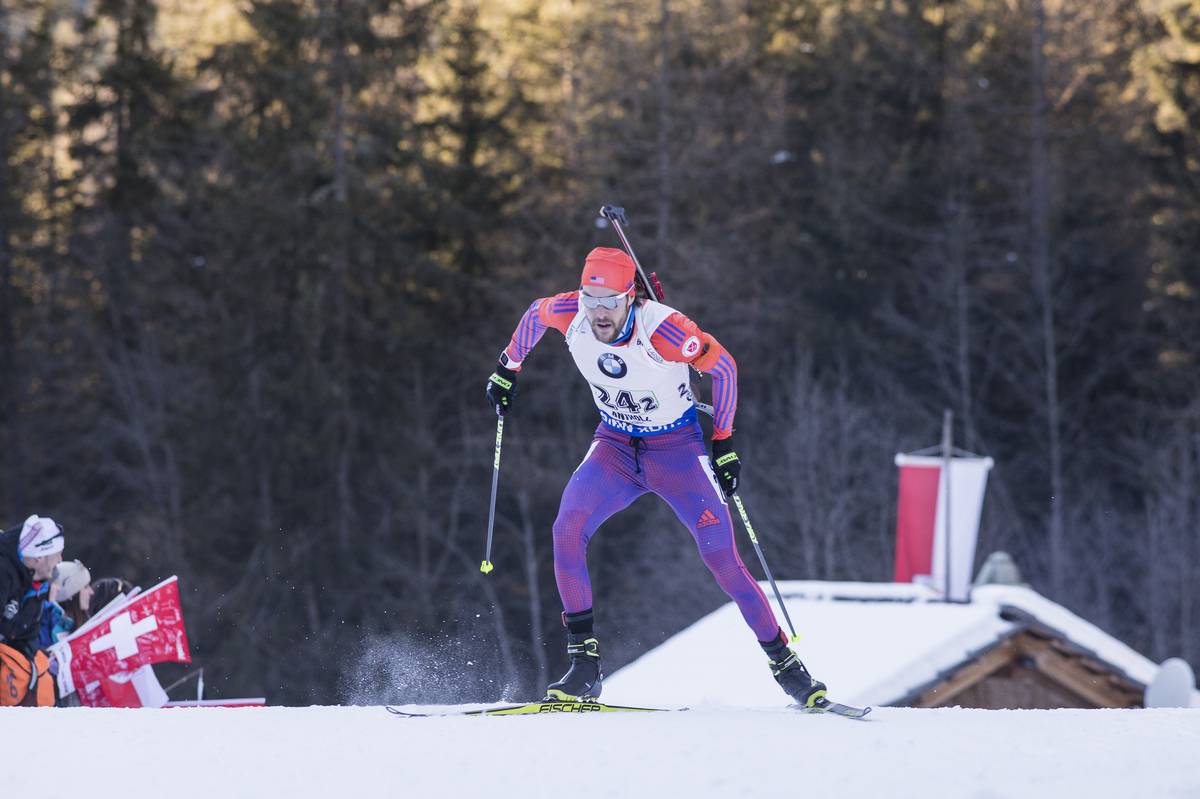
    15. What did you have for breakfast this morning?

    A lot. About half of my caloric intake comes from breakfast. I really think highly of breakfast

    16. In 5 years, I’ll be ____?

    About 1/8th of the way done with my education.

    17. In 50 years, I’ll be ____?