Longtime Canadian racer Jesse Cockney joins us to recap a surprisingly exciting men’s pursuit race at the World Championships in Planica, Slovenia.
We’ll be back tomorrow. Send your questions to devon@fasterskier.com and nat@fasterskier.com.
From the FasterSkier archive — posts syndicated from athletes’ and coaches’ own blogs between 2004 and 2012, kept online as published. Current coverage is at fasterskier.com.

Longtime Canadian racer Jesse Cockney joins us to recap a surprisingly exciting men’s pursuit race at the World Championships in Planica, Slovenia.
We’ll be back tomorrow. Send your questions to devon@fasterskier.com and nat@fasterskier.com.

Carrying the momentum from the first day of racing into a second distance event, athletes lined up once more at the Whistler Olympic Park for a 10 / 15-kilometer interval start classic. Over 130 men and 90 women participated in the open categories, representing clubs across Canada and the United States.
Adding a springtime layer of complexity to remind us that we are officially past the equinox, temperatures in Whistler hovered above freezing while a mix of precipitation fell off and on throughout the day. Webcams of the venue showed the spectacular mountain backdrop hidden amongst dense clouds and conifers still laden with the week’s snow.
It’s a humidity-temperature combo that makes classic waxing tricky. Consequently, many athlete chose to use “hairies”, which are known as “rub skis” in Canada, essentially foregoing kick wax and opting instead for a sandpapered kick zone. For those with strong striding technique, this achieves grip without as significant a risk of icing issues, as klisters can be known create in such conditions.
Top Canadian U20 racer Xavier McKeever (Foothills Nordic), who was 13th overall today, explained how this changes the game for those who haven’t had the experience: “You have to be a bit more careful with your kicks and a bit more gentle, because they can slip out really easily. That was the biggest focus for me [today], just to try and ski technically well.”
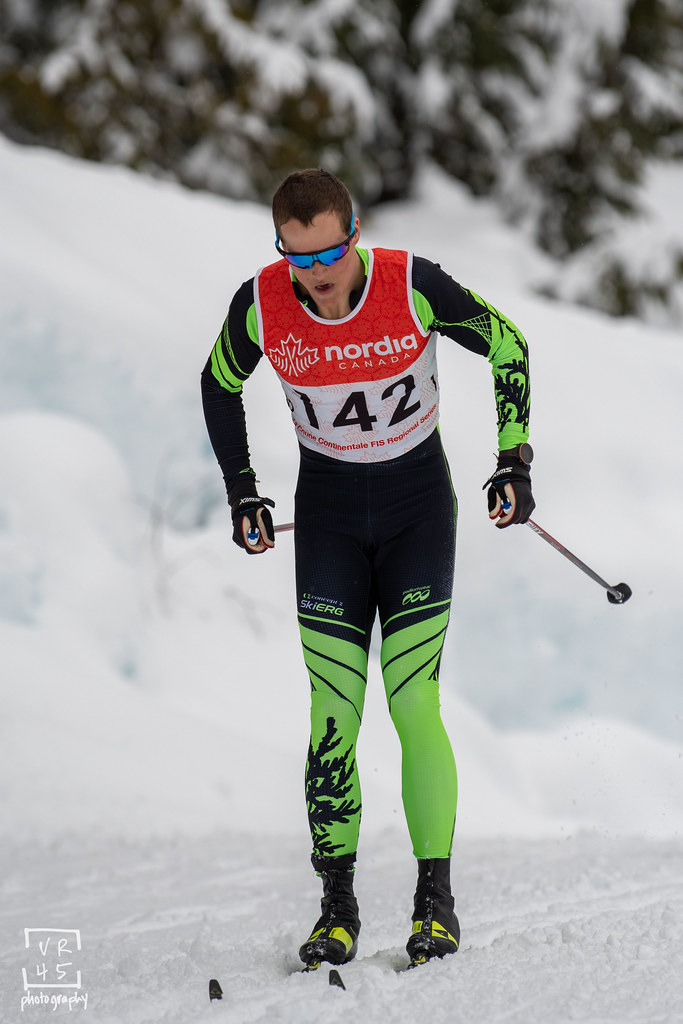
Following 10 k sitting and standing events contested by Nordiq Canada’s Para Nordic athletes, the open men’s category headed out for the three 5 k loops. In a close race for the top podium spot, Craftsbury’s Adam Martin took the win with a time of 40:29.3. Martin was chased by today’s Canadian National Champion, Antoine Cyr (Skinouk) who hunted his times from 19 bibs behind.
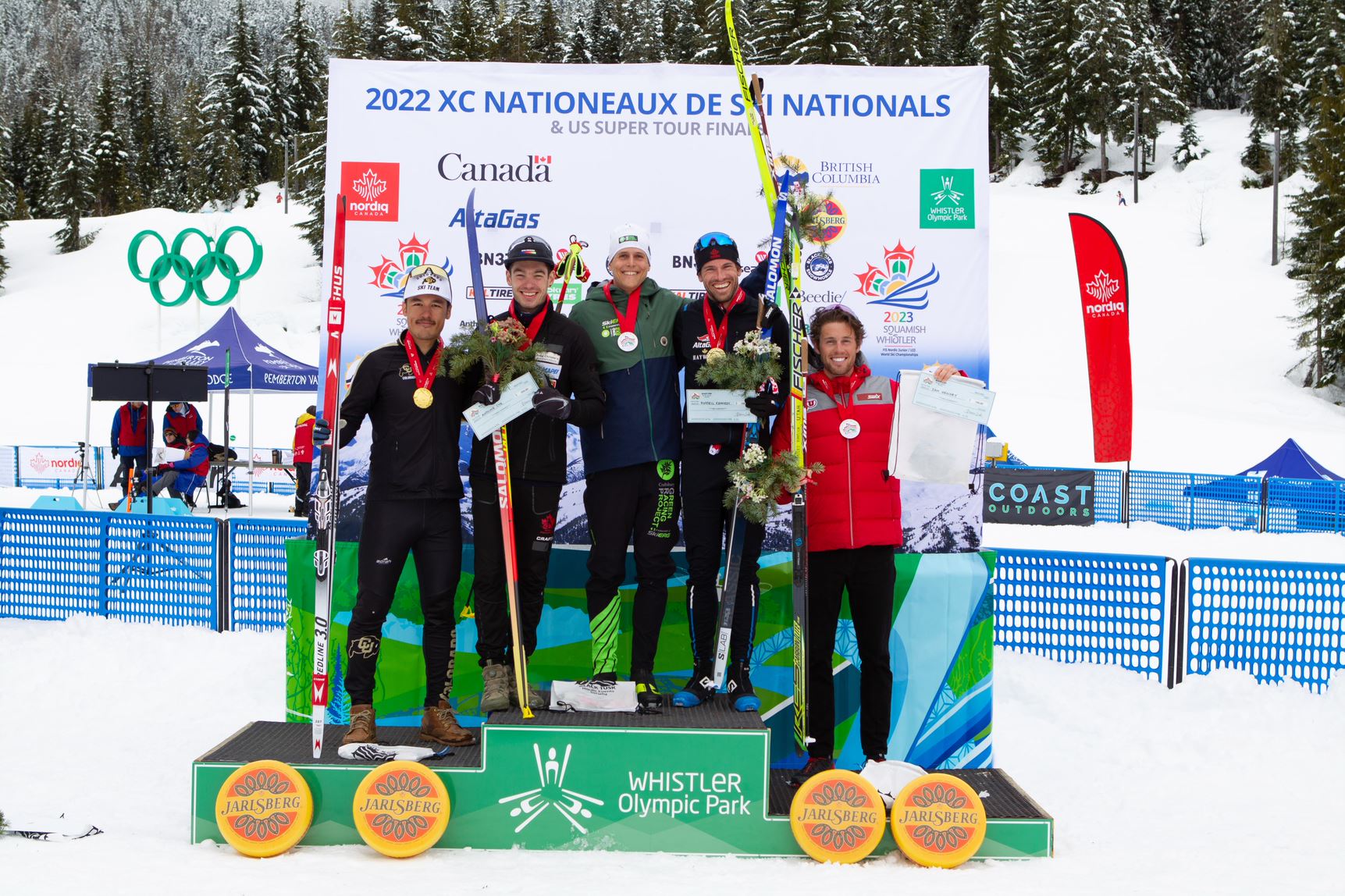
Though Cyr led through the first 10 k, a strong closing lap from Martin moved the American to the lead in the splits, with Cyr skiing the third fastest final lap to take second (+1.3). Canmore’s Russell Kennedy was third overall (+13.1) for the second spot on the Canadian podium, while fellow Canmore athlete Sam Hendry, who now trains with the University of Utah, was third for Canada in fifth overall (+48.0). Both Cyr and Kennedy had also raced onto the podium in yesterday’s 10 k free.
“I felt really good today,” Martin wrote to FasterSkier after the race. “Particularly in the second half, I started to figure out how to best race this course and these conditions, and I found a good place mentally to push. I’m really happy with the outcome – that was a dream to win.”
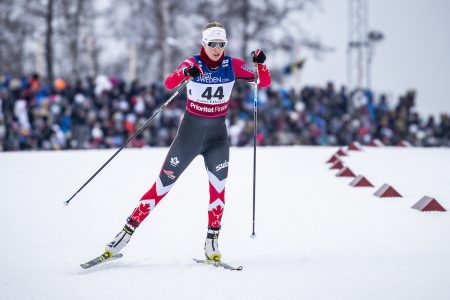
A successful season of SuperTour racing has Martin ranked at the top of the rankings, and earned him starts in post-Olympic World Cup events. After taking third at the American Birkie, Martin headed to Norway to race the 50 k classic at Holmenkollen, where he finished 26th. The following weekend, he skied to 44th in the 15 k free in Falun, Sweden. A week later, Martin is back with his Craftsbury team and standing atop the US SuperTour podium.
“It’s nice to return from the World Cup and still feel in good shape. After two 50 k’s, and travel, and a season that I’m really happy with, everything is a bonus at this point. I think it’s great that we are able to combine with Canada for these races. There are a lot of guys at a similar level, so it makes for some tight, fun racing.”
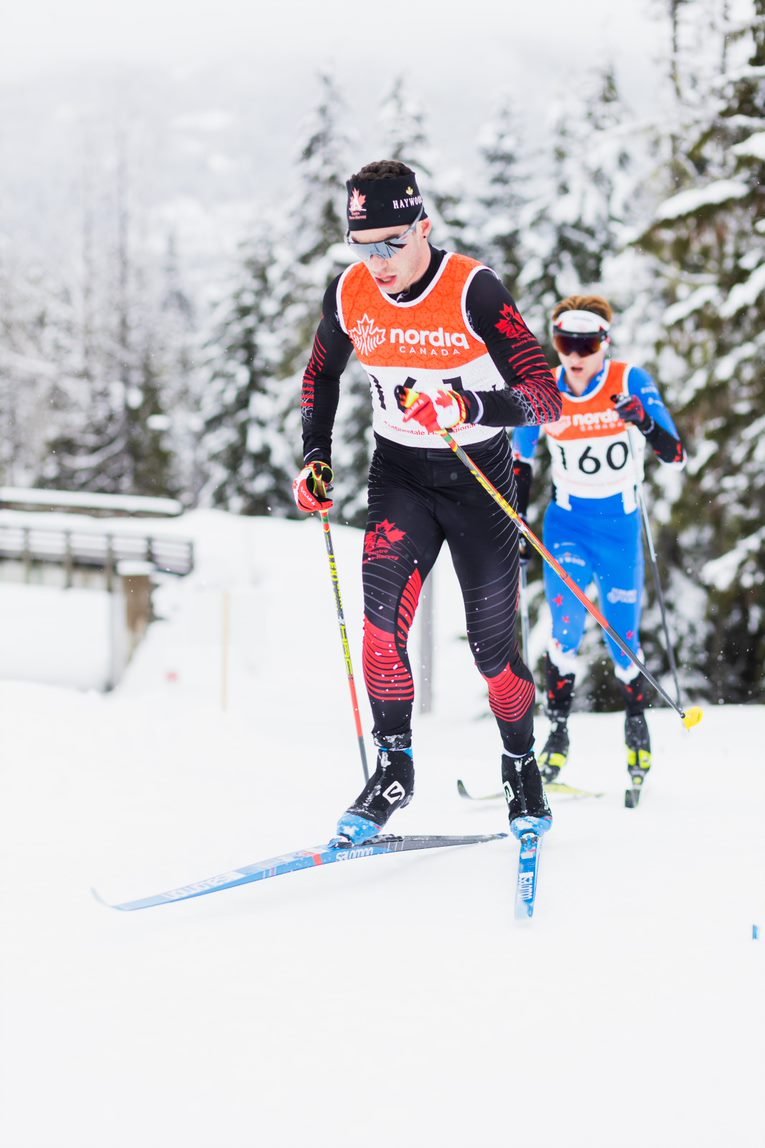
A 23-year-old Quebec native, Cyr’s best results have been in classic this season, namely an 11th place finish in the opening World Cup 15 k classic in Ruka, Finland, and racing with Graham Ritchie to put the Canadian team in fifth during the Olympic classic team sprint in Zhangjiakou. After the team sprint, he was praised by both his teammate and coach Erik Bråten, along with armchair quarterback Devon Kershaw, for his classic technique.
“Classic is always good for me and is a race I love,” Cyr said of today’s 15 k in a post-race interview with Nordiq Canada. “It was tough conditions this morning, and a good skier normally comes out on top in hard conditions. I was able to ski well, focus on the race, and came second overall, which is a little bittersweet because it was a really tight battle in the end. But it was really fun, the track is amazing. It’s an Olympic standard track, so it’s just really good.”
In his second lap, Cyr had caught yesterday’s winner, Rémi Drolet (Team Black Jack), whom Cyr credited in supporting his strong result today.
“When I saw was closing the gap on him on the first lap, I decided to go a little harder than I planned to catch up with him. [I then tried] to relax behind him for a lap or half of a lap.. In the end, I was missing a little bit on the last lap. I think that that helped for sure, skiing with someone strong like Rémi.”
Finally, Cyr spoke to the importance of an international field featuring all age groups coming together this week, particularly on the heels of a two-year hiatus due to pandemic restrictions.
“It is so good for the young kids — us older guys, we’ve been racing on the World Cup, but like the juvenile and junior, they almost have no races in Canada. To have a big event like this is just amazing and we’ve been looking at the younger guys’ results for an hour yesterday, seeing who’s in good form, and who’s coming up, and you are the next guys to be like taking over. So for them, it is awesome, and for us too, racing with the US is always — it should always be like this.”
Joining Martin for the SuperTour podium, BSF Pro Team athlete Finn O’Connell was 7th overall (+1:06.4) and second American, with University of Utah’s Luke Jager half a second behind in 8th overall (+1:06.9).
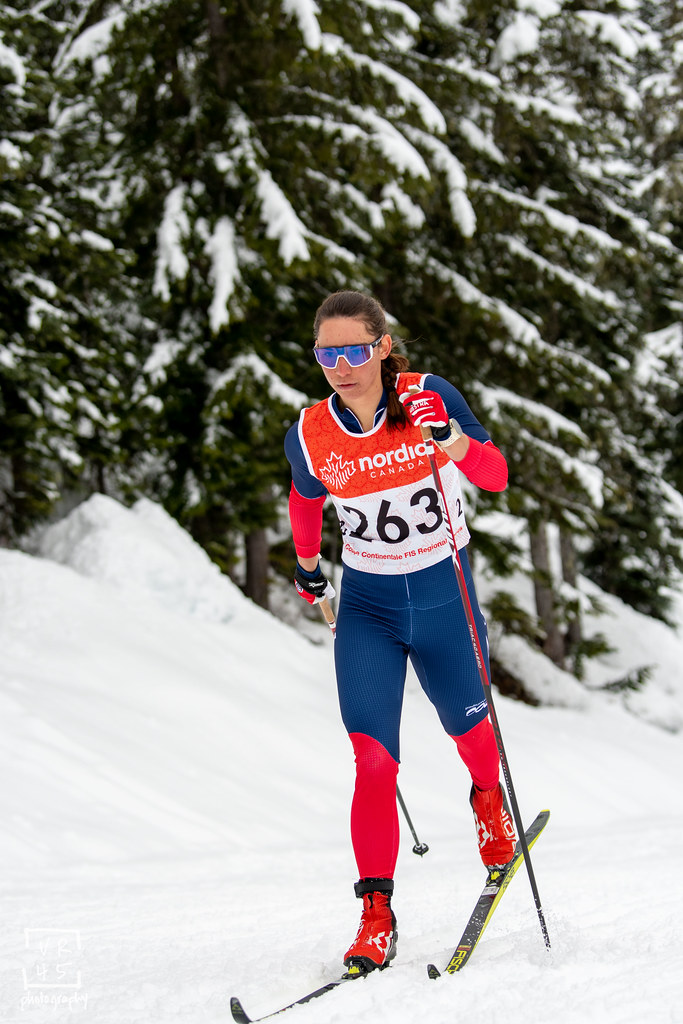
In the women’s 10 k, SMS T2’s Julia Kern skied a strong second lap to take the win in her second consecutive day on the podium, stopping the clock at 29:54.3. Her club and national teammate, Jessie Diggins, took the second step finishing +18.3 back, while University of Utah’s Sophia Laukli skied to third (+1:03.2).
Looking at tough conditions, Kern explained she raced by trial and error today, exploring which techniques were most efficient on different sections.
“I kind of had an open mindset going in today,” she told Nordiq Canada after the race. “I knew that the tracks might be a little bit punchy or washed out in sections, and so I was double pulling wide or double polling narrow or just like power striding on the flats if it was getting too punchy out there. So just trying it all.”
She continued that she was looking to “have fun, send it from the start, and see if I could hold that pace the whole time,” which she ultimately proved able to do. It’s the time of year where the hay is in the barn training-wise, and athletes have had a long season, leaving them in varying states heading into the last hurrah. On whether she was looking to just have fun at these races, or whether it was a serious quest for the podium, Kern said “both”.
“I think the end of the season is always really fun. It’s so cool to have this many athletes here. And I’ve been feeling really good the last few weeks and so enjoying racing when it does feel good and when I’m able to push really hard. We’re all really tired at the end of the season, but also, when the body’s in form you might as well take advantage of it and send it on the course.”
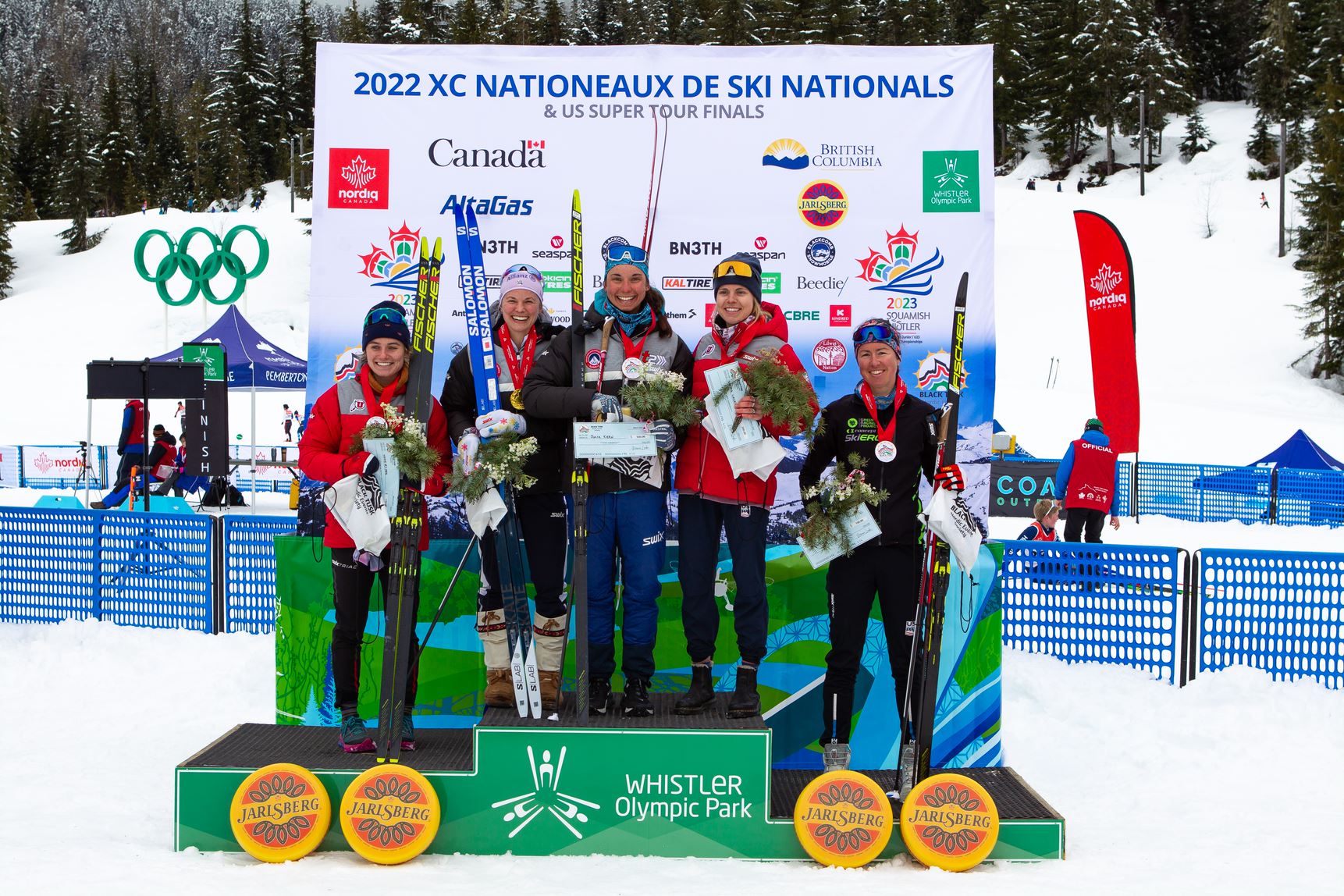
Winning back-to-back Canadian National titles, Katherine Stewart-Jones (Nakkertok Nordique) was again on top for the Canucks, finishing sixth overall (+1:17.5). Finishing in the same order as yesterday, Dahria Beatty (Whitehorse Ski Club) was second for Canada in eighth overall (+1:55.0), while Cendrine Browne (Fondeurs-Laurentides) rounded out the podium in ninth overall (+2:14.5).
“I went out really hard knowing that that’s what I had to do if I wanted to make the podium,” Stewart-Jones said of her race. “I had a good first lap, and I definitely slowed down a lot on the first part of the second lap. I was just tired and was having a hard time staying in the zone and keeping the rhythm, but I was able to pull it together a bit for the second half of the second lap. So I was really happy with that. And I was happy with how hard I pushed. I just didn’t have it quite in me today, and sometimes that happens.”
On the importance of focusing on her technique on this type of course with sub-optimal conditions, she continued, “It’s really important, especially on the climbs. The grip isn’t always perfect in these conditions, so you really have to make sure to stay on top of your skis. If you get tired and you start leaning forward, then it makes it even harder to kick… And then on the flatter sections, it was a bit awkward, and you had to expect that. Either you’re striding awkwardly or you’re doing a kick double pool, but your poles are sinking. You have to just really focus on committing to whatever you decide to do and not like trying to switch too much between.”
Speaking to already standing atop two podiums, Stewart-Jones responded with pride, while also acknowledging that the overall win would be sweeter.
“Oh, it’s definitely nice to be winning the national championship title… because we’re racing against the Americans, I obviously care about the overall too, so maybe it feels a little less exciting, but for sure, I’m proud of that.”
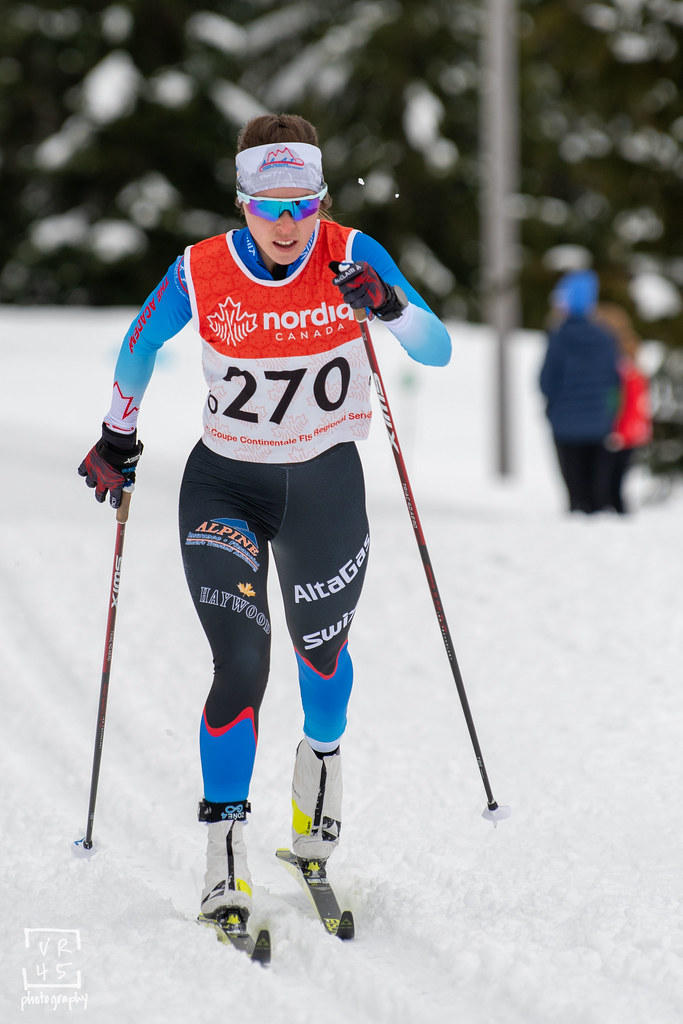
In order to get closer to the overall podium, she said he would focus on resting as much as possible and maintaining the head space to perform her best. “It’s been a long season and I haven’t raced this much in a long time. I think everyone’s pretty tired. But also just being able to also be mentally strong [over the next races]. And yeah, you never know what’s gonna happen.”
Racing continues Wednesday with individual classic sprints, which will be live-streamed by the Black Tusk Nordic Events Society. If you’re looking for additional video updates, follow along on the Nordiq Canada and Black Tusk Instagram pages.
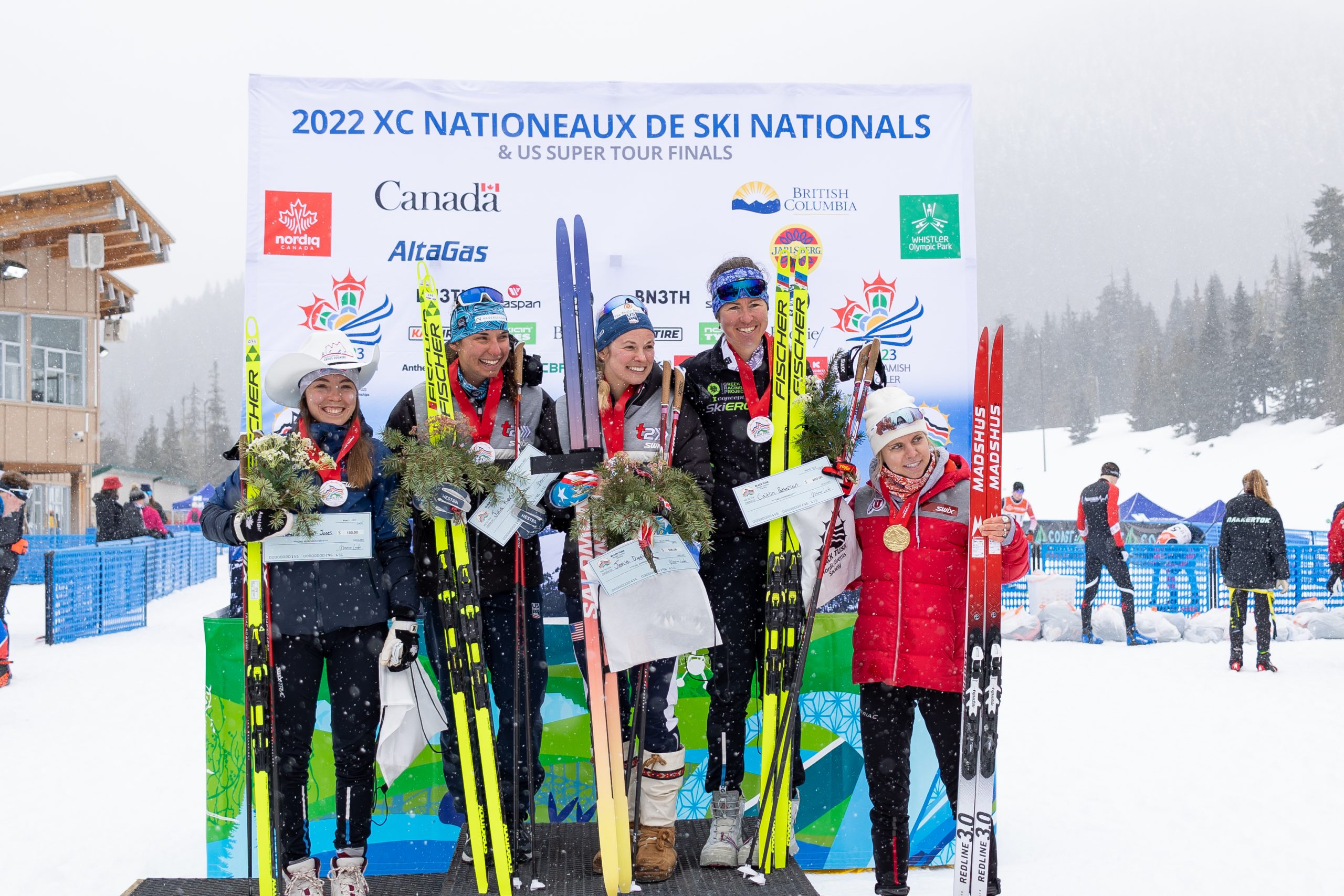

Sunday kicked off a week of racing at the combined Canadian Cross-Country National Championship and U.S. Super Tour Finals event held in Whistler, British Columbia. Hosted by the Black Tusk Nordic Events Society (BTNES) on the Whistler Olympic Park courses, this event also offers junior and U23 skiers a preview of the courses for next year’s Junior and U23 World Championships. With Paranordic, Nordic Combined, and both junior and senior cross-country events, it looks to be a busy week of racing.
After a morning of Paranordic and junior events, the senior women got underway with a 5 k interval skate. This meant a single lap of the “Blue A” course, which features two major climbs, one almost right out of the start. Despite a wintery mix of precipitation forecasted throughout the week, and light snow accumulating on top of the corduroy, times were fast as athletes took to the course.

Swapping stars and stripes for her red and blue SMS T2 team suit, Jessie Diggins won the women’s 5 k event in 11:47.9, with her club teammate Julia Kern in second (+7.7). Craftsbury’s Caitlin Patterson took third (+29.8), ahead of Katherine Stewart-Jones who was the top Canadian racer in fourth (+33.1). Dahria Beatty was second for the Canadian women in eighth overall (+56.1), with Cendrine Browne just behind as third for Canada and ninth overall (+1:00.6).
In an interview with Nordiq Canada after the race, Diggins first spoke to the experience of racing amongst a field of over 180 women and girls from across Canada and the U.S.
“This is super cool,” Diggins said emphatically. “I mean, I’m half-Canadian, so this is really very special for me any time I can come be in Canada. I really love it, and with COVID, it’s been a while.”
She also spoke to the change of pace and pressure, in transitioning away from the high-stakes environment of the World Cup where the team operated under strict COVID precautions to ensure the season would not be derailed by an outbreak within the team.
“The biggest draw for me was to be here with my club, to have fun. There’s all these really awesome kids racing. And, yeah, it’s really nice to have a little more relaxed, not quite as high pressure, [especially] after the Olympics. It’s nice to just get back to racing because it is super fun. So I’ve really enjoyed being here.”
Diggins described watching the field of rising junior athletes race as “super cool” and spoke optimistically of what this means for the long term health and success of the sport at all levels.
“It’s so fun to see how invested in the sport, overall, that they are — because they love it, and they want to work hard, and they’re having fun. It’s just really cool to see how our sport’s been growing and expanding, and how great this next generation is looking.”

Finally, on her own race, Diggins shared it was a “shock to the system.” Following the World Cup finals last weekend in Falun, Sweden, Diggins spent the week in Annecy, France, where she visited the Salomon design center, participated in a live Q&A with a Salomon representative, and even snuck in a guided mountaineering experience in nearby Chamonix.
She then hopped aboard a flight to Western Canada, finding herself once more on a start line soon after.
“I got off the plane from France like 40 hours before the start,” Diggins laughed. “So it was one way to kick the jet lag, and it was highly effective. It was a bit of a bit of a shock, but it was really fun to just get out there and work hard, and really enjoy these — I mean, it’s fun. They’re Olympic courses. They’re really, really nice, they have great flow. So I really enjoyed being out there.”
As the top Canadian woman, Katherine Stewart-Jones spoke with Nordiq Canada about the tough competition, “It was really exciting to race today and having the Americans here I knew it was going to be a competitive race, and I definitely wanted to perform because, you know, you want to show that Canadians are also competitive,” she said.

“Overall, I was happy with my result. I didn’t think it was my best race. It was the type of race where the conditions are brutal, and nobody feels technically great, but you had to keep going. In warm-up I could tell it was hard conditions to ski in, so I gave myself a few technical cues during the race, making sure I reminded myself it was like this for everyone. I’m really happy with my effort.”
Sydney Palmer-Leger (University of Utah) earned the top spot in the women’s U20 ranking with a time of 12:36.8. She finished seventh overall.

With the women’s race wrapped up, the competition turned to the men who skied 2 x 5 k. In a reverse of the women’s results, it was the Canadians who took the top three spots led by Rémi Drolet (Team Black Jack) in a time of 22:50.2. Russell Kennedy (Canmore Nordic) finished second, +19.8 behind Drolet, while Antoine Cyr (Skinouk QC) rounded out the podium in third (+29.7).
Luke Jager (University of Utah) was the first American of the day in fourth (+37.4). Jager was followed by two fellow collegiate athletes, Kjetil Bånerud of Northern Michigan University, and Sam Hendry of the University. Bånerud is a native of Norway, while Hendry was also racing on behalf of Canmore Nordic, his home club. This leaves BSF Pro Team athlete Finn O’Connell as the next on the US SuperTour podium in seventh overall (+49.7), with Craftsbury’s Adam Martin third for the US in eighth overall (+50.1).

Like many of the top athletes, Drolet just recently returned from Europe after the conclusion of the World Cup circuit. He spoke with Nordiq Canada after the race saying, “I really went into the race today with zero expectations. I was thinking in my head that if I execute well and push hard, then I’ll be happy with the race, and the result just came so that was just a bonus for me.”
In soft and sloppy conditions there were a number of mishaps out on the race course and Drolet said, “I think with conditions like that it can be really easy to kind of sketch yourself out. I think a lot of people were doing that. But I think you can just kind of stay focused on skiing and not worry too much about the conditions, then everything will be okay.”
“You need to stay focused on skiing and not on the conditions. When you overthink it, things happen. I was really happy I was able to put together a great race today. This is where I strive to be, and it feels really good.”
Prior to traveling to Canada, Jager was competing at NCAAs in Soldier Hollow Utah where he and the rest of the Utes earned their third consecutive national victory.

The U20 men’s race was won by Tom Stephen (Foothills Nordic) in a time of 23:33.3. Stephen finished sixth overall.
Racing continues today, Monday March 21st, with a 10/15 k classic, followed on Wednesday March 23rd by an individual classic sprint. The sprint heats will be livestreamed; these be viewed here.

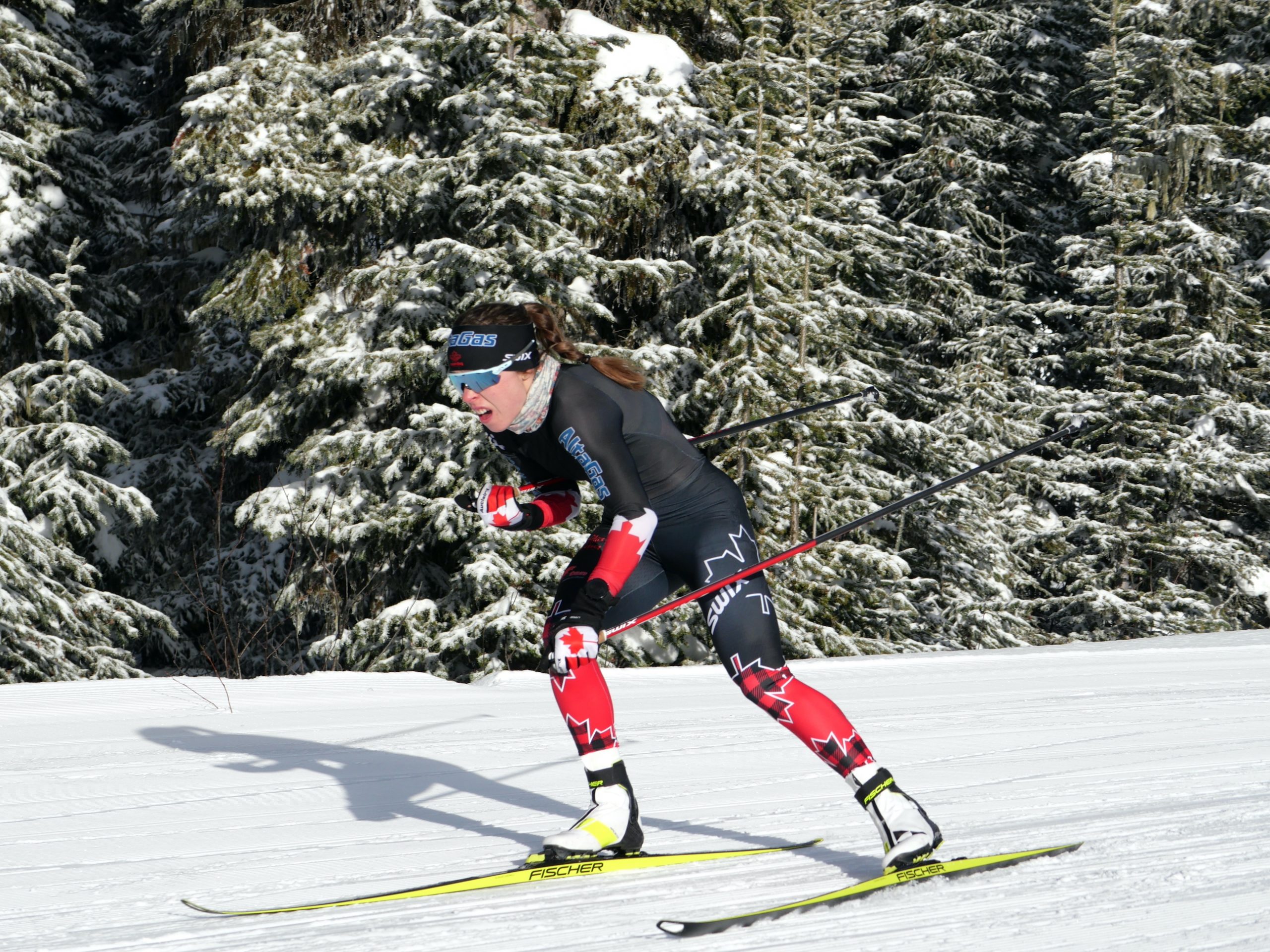
Canada was successful in delivering the team to Beijing and getting them on snow in Zhangjiakou. The decision to go above and beyond in isolating athletes before a carefully planned drive to a charter flight worked, although other countries also succeeded with a more laid-back approach.
What can fans expect from the Canadian team in Beijing? It all comes down to qualifying and performing.
Canada had an Olympic quota of four women and three men, with a pretty high probability of gaining another woman and man in reallocation. The size of the quota depends on World Cup/World Championship performance and domestic FIS races; the top countries earned the maximum team size of 8 per gender. As Canada cancelled all races last season and only took a small team to Europe for a six week visit, the only path to a larger team would have been more athletes getting top 30 results in Europe last season.
Three men (Tony Cyr, Olivier Léveillé, Graham Ritchie) and one woman (Katherine Stewart-Jones) met the world cup results standard for Olympic qualification during period 1. The Trials in Canmore (January 6th to 11th) would then select three women, and possibly one woman and one man who would have first dibs after reallocation.
Dahria Beatty, an Olympic veteran from Pyeongchang, was one of the skiers who now had to qualify through a rigid qualification document at Canmore trials.
“Yes, it was definitely different last time. I was qualified for the [2018] Games a season in advance, essentially,” Beatty explained at the Prep Camp at Sovereign Lake.
At the Canmore sprint, Beatty qualified third and finished the heats in 4th, which meant Laura Leclair earned her first Olympic berth and Cendrine Browne her second.
For Beatty, selection came down to Saturday’s 10km individual classic. If she won, or placed second to Stewart-Jones, she got the spot. The latter happened, with Beatty 0.5 seconds behind and 20 seconds clear of third.
“Honestly, I don’t think I’ve had to qualify for a team specifically like that since U23 World Champs so it’s been a long time definitely.”
Olivia Bouffard-Nesbitt was ranked 5th after trials, waiting on the reallocation process. Her journey has been longer than most, with injuries, training setbacks, car accidents, and bad luck. In 2014, she recovered from a back injury just in time to compete at Olympic trials. She won the qualifier on her first race day of the season. While lining up for the A-final heat with selection on the line, she was told that the jury had disqualified her for micro-skating during the quarter-final earlier. This year, the pieces came together.
“It’s hard to find words. It’s something that I believed in, like my whole life, I believed that it was possible. But then throughout the setbacks, the doubt kind of built up. And, increased and I thought it wouldn’t happen, maybe and that I just had to grow up and face that reality. But there was still like, a little voice inside me that thought it was possible. And just to have– persisted, and trusted that with patience like things would line up for me. It means so much, it means so much for me but also for the people who helped me get here because it feels like I know that they would support me no matter what but it just feels like doing them justice as well. Like putting all the time into this project that is me trying to get to the Olympics was worth it.”
Jasmine Drolet was next, with only the faint hope of moving up through a positive COVID test for an athlete above. Jasmine does have the consolation of earning a start at U20 World Championships.
Russell Kennedy finished 27th in the Ruka 15km classic in November, enough to help Canada’s World Cup quota for next season. Kennedy would have needed to ski 15 seconds faster to take the 20th place from Federico Pellegrino and earn the 4th Olympic spot. The next day he moved up to 21st in the pursuit with the 24th fastest time of day, again just outside the criteria.
The reallocation spot would be decided in the 15km individual start classic on January 8th. Whoever finished highest, after excluding the three already qualified men, would be on tenterhooks until the 17th and then be officially announced on the 19th.
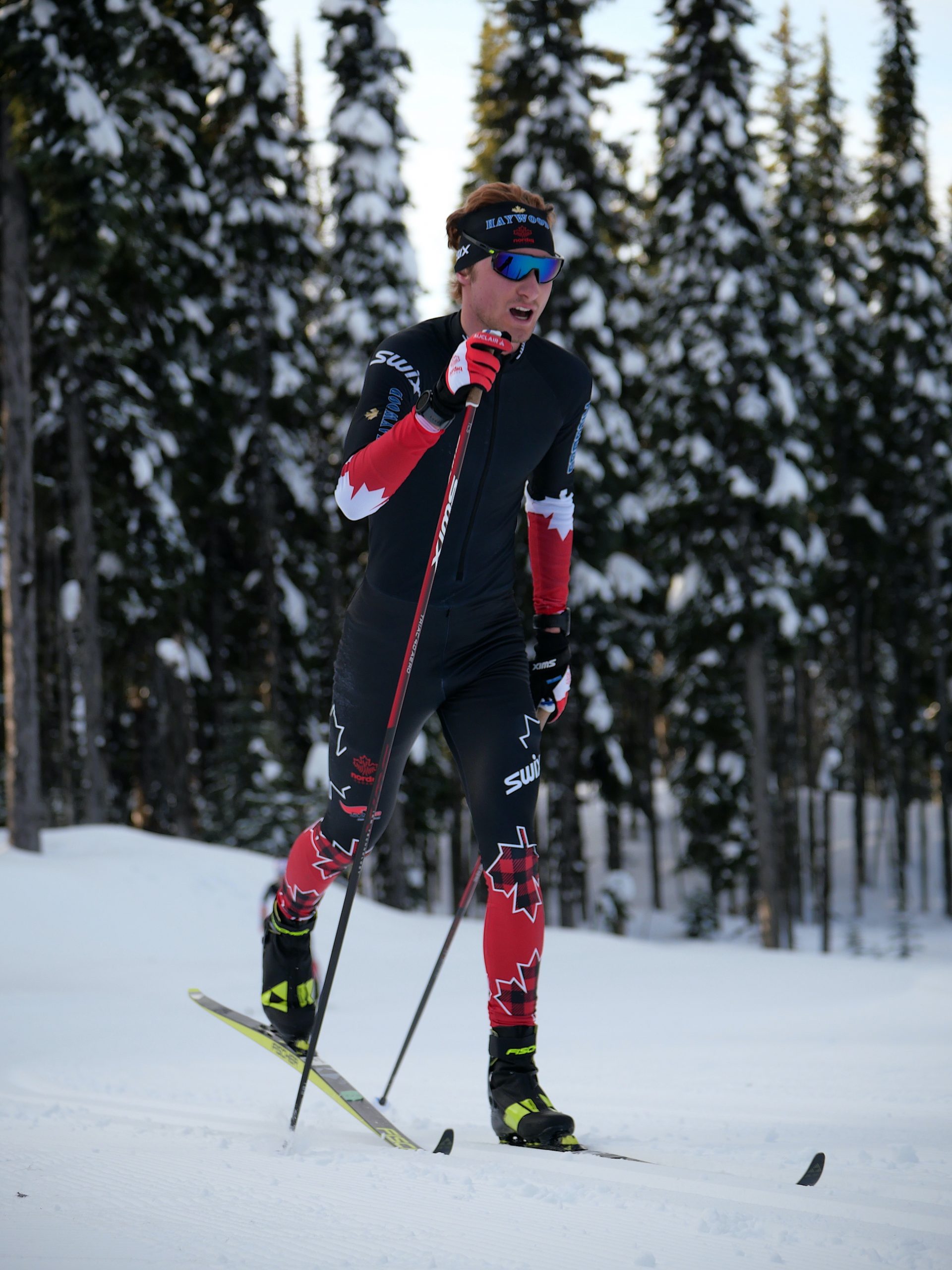
Cyr won, surprising no one, with Rémi Drolet edging out Kennedy by 10.8 seconds to take second. Every skier in the top ten had either a WC top 30 or a Canada Cup podium this season. Every one of those skiers could believe that their best effort would end in selection.
Rémi is a second year senior who chose to take a gap year from Harvard to focus on getting faster on the World Cup and qualifying for Beijing. He didn’t get selected for Period 1, but did get some good results in early season Continental Cup races in Finland and Sweden.
“For me, it was important to try really hard to make it this time around, because I think it’ll be an important stepping stone in my career,” he told FasterSkier during the prep camp. “To be able to, I guess, be a leader in the team, with so many strong guys coming up.”
Rémi is getting good results for his age, but also looking over his shoulder at juniors like Tom Stephen and Xav McKeever, who are already collecting senior wins at Canada Cup races. These three teamed up with Léveillé to collect a relay silver at U20 Worlds two years ago.
Kennedy is now 30. His ‘day job’ is with Canada’s Para National team, one of two guides for Brian McKeever. After PyeongChang, his goal was not just to qualify, but deliver at Beijing, and that dream ended with an invitation to train as a spare.
“Well, I mean, for me, it’s been a rough two weeks. I spent three years working for this year. I was focused on the Olympics, and not really as much qualifying I guess.”
Asked about sharing a bubble for two weeks with the four men who are living his dream, Kennedy didn’t shy away from truth.
“And yeah, it’s been hard. But I’ve been trying to put on a good face around them. Because it’s sweet [for them]. They’ve done it, they’re going to the Olympics, it’s a huge goal and a huge achievement. But for me, it’s definitely hard. I’m really fast right now, which just makes it harder. But that’s part of sport.”
For some people, just reaching the Olympics is the pinnacle of their dreams. And it is a major achievement, even more so now with smaller quotas. In 2006, Canada had five women who earned Torino quota spots, in addition to the ten nations spots, allowing Canada to select 15 women.
What distinguishes the athletes who deliver results from those who participate?
“Some people believe, and some people want to believe, but [it’s] the ones that really believe.” Dave Wood explained to FasterSkier in July of 2021.
Going back to 2006, three Canadian women came home with medals: Chandra Crawford, Beckie Scott, and Sara Renner. Each of these women had individual World Cup podiums in the final two months of preparation and came into Torino with confidence.
The current team of nine Canadians has only two members with Olympic experience: Beatty and Browne. It will be much harder for this team to dream of podiums.
Stewart-Jones, Cyr, Léveillé, and Ritchie can find confidence from their period 1 results. Drolet can find confidence in beating Léveillé and Kennedy at trials as both have World Cup top 30’s this season.
The others? They will have to find confidence inside themselves.
One of the common expectations of sports fans is that Olympians should produce their best performance of the season on the biggest stage. Athletes work their whole lives to get to an Olympics and it seems obvious that they should be peaking at precisely the right moment.
“The results came from those that started their Olympics in May or April.” – Dave Wood, talking about Vancouver 2010.
Wood was referring to athletes who qualified for the Olympics during the previous season, allowing them to build the entire training year around performing during a two week period. Athletes who have not qualified in advance have to focus their season plan on earning selection.
Kennedy was one athlete who missed that balance.
“Because sometimes I feel with sport, you have to choose if you want to go or if you want to do well. It’s the one thing that I’ve been struggling with. And also, it’s hard because like the people making the decisions don’t really have any repercussions for their choices. So the repercussions fall on athletes, and unfortunately, this year fell on me. Yeah. It sucks, but it’s part of it. I knew what I signed up for.”
Once selected, each athlete can then reset their priorities. Four Canadians hit that point in December, three more on January 8th, and the last two on January 17th. With the first race on February 5th, which feels like the 4th after crossing the international date line, the one big thing athletes can do is not catch COVID-19.
Back in 2010, Canada had four men performing on the world cup and when it came time to pick four men for the 50km on the final day, there were five names. Ivan Babikov, George Gray, and Alex Harvey had placed 5th, 8th, and 9th in the skiathlon and were obvious choices. The final place had to go to either Brian McKeever, who had qualified first at trials in Canmore, or Devon Kershaw, whose best individual result was a 16th. Unusually for Canada, there was outside pressure on this selection, as McKeever would have been the first person to compete at the Olympics and Paralympics in the same season.
“The way the other four boys had been skiing, there was no decision, there was no discussion,” Wood explained. “Brian didn’t beat Kershaw and Alex and Ivan and George [at trials], he beat the others.”
The coaches chose Kershaw, which paid off with a 5th place finish, 1.6 seconds from gold. In 2022, there will be no difficult decisions for the men, but there are five women and four starts per individual race.
FasterSkier asked Beatty what races she was looking forward to.
“Well, if I get a start in the team sprint, I love team sprints, I love team events. So I’m definitely hoping to be doing that race, I’m looking forward to that. I’m also really looking forward to the individual sprint and the 10k individual.”
This may not be the Norwegian or Swedish level of choice, with eight skiers and four starts, but expect Canada to hold some time trials during the Olympics to inform the coaches’ choice.
Beatty and Browne were in PyeongChang, and will have experience to share with the neophytes.
“The races themselves, even though they will be the most stressful part, are also going to be the most fun because that’s what we dream of,” Bouffard-Nesbitt speculated three days before getting on the plane.
“I’ve never been to an Olympic Games, and especially a COVID games. So I don’t know what the rest of the time will be like.”
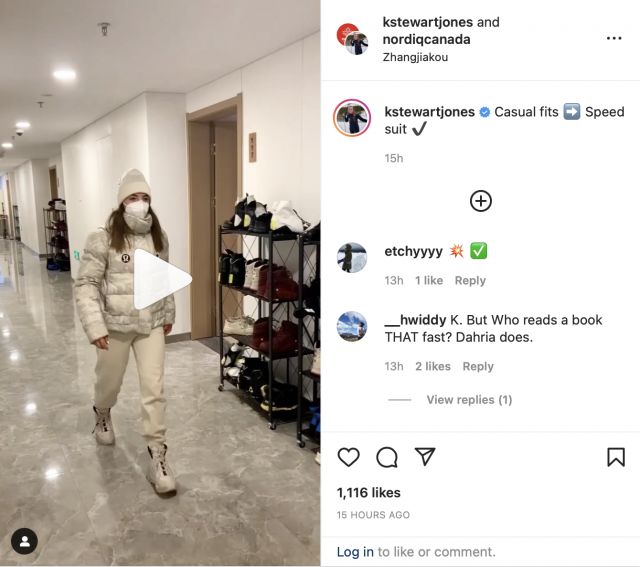
Early evidence is athletes will be killing time in their rooms and finding virtual fun with your teammates.
FasterSkier asked a number of the athletes a simple question: when you first dreamed of the Olympics, what sport were you dreaming of?
“I have to say, probably hockey with that one. For sure. I didn’t know I was gonna end up as a cross country skier.” — Ritchie
“Cross country skiing. Yeah, it’s always been that.” — Stewart-Jones
“I definitely think it was probably cross country skiing. That’s always been the sport I’ve been strongest at, even as a kid. I did a bunch of different sports. I always loved watching figure skating at the Olympics, but I knew that I was never going to pursue that long term, definitely was not flexible enough.” — Beatty
“I don’t know. I guess when I first really thought about the Olympics was back when I was playing hockey. But at that time, it wasn’t really, it was kind of just like, whoa, it’d be cool to go to the Olympics. But I didn’t really think of what sport I might make it in. It’s only really four years ago, I started thinking, this is what I need to work towards, to make the Olympics in Beijing.” – Rémi Drolet
“That is such a good question. Because around the time when I became really inspired by the Olympics was the 2000 Olympics in Sydney, and I think Simon Whitfield winning the triathlon was the really big moment at that Olympics. And at the time, in my youth, I was just obsessed with soccer, but also skiing, so I dreamt of either/or soccer or skiing.” — Bouffard-Nesbitt
“Oh, man, I didn’t really have a sport I was dreaming of, exactly. But I thought maybe skiing because I was on skis at two years old. More downhill racing.” – Kennedy
“I was the dreaming to go to the Olympics as a cross country skier. It didn’t happen as a cross country skier but as a technician.” — Simon Boisvert
“Ah, to be honest, I’ve always been into cross country skiing with my dad and my sister, my older sister ahead of me, but always been into cross country skiing, and I thought that maybe mountain biking, but a few years ago, I knew I was not. I wasn’t going as an athlete, but I’m pretty pumped to go for my first time as a wax technician.” — Félix-Antoine Vezina

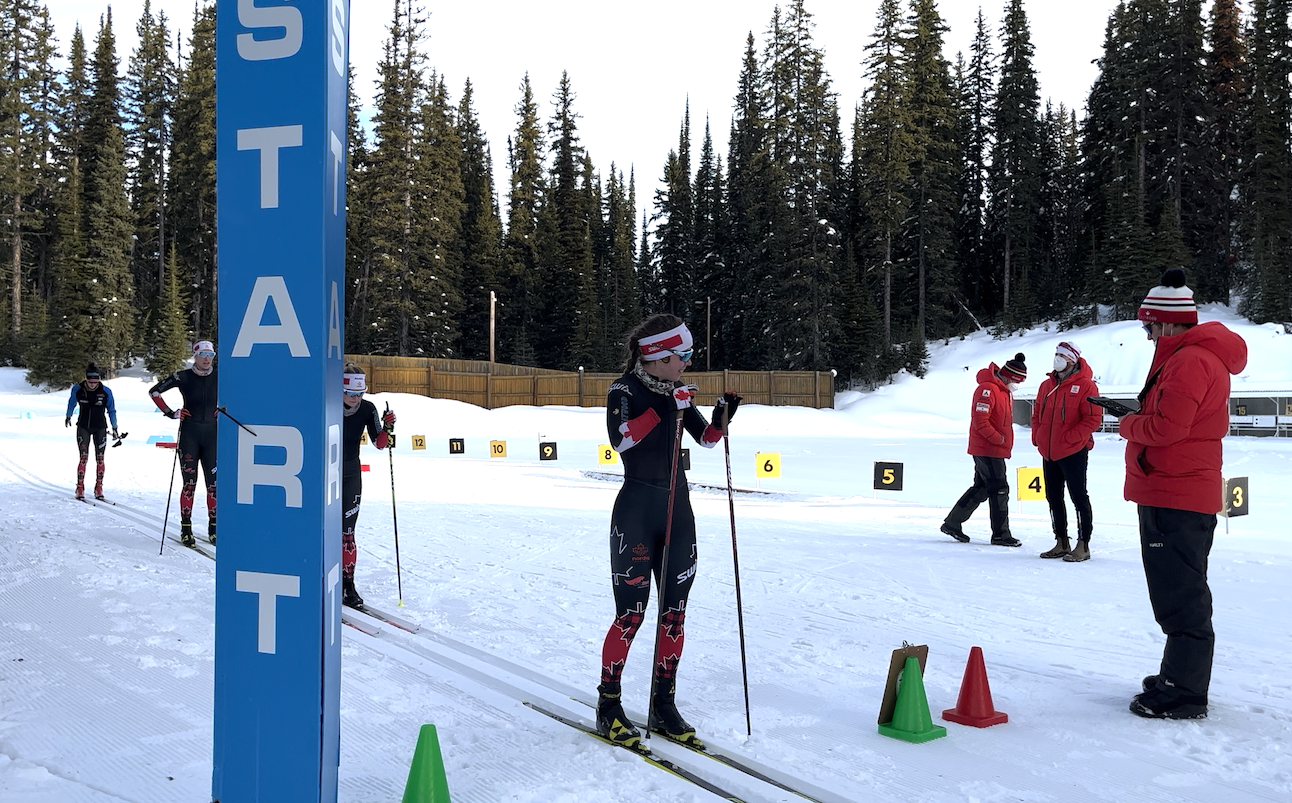
The Canadian Prep Camp in Sovereign Lake and SilverStar, BC prior to the 2022 Beijing Olympics sounds like a nordic skier’s heaven.
A two-week ski vacation with 100 kilometres of perfectly groomed snow. A private room above a great coffee shop (pain au chocolate!) and next door to some great beer. January weather just below freezing with enough falling snow to make every day a hardwax day. Two weeks of what locals call superhero snow. A whole lot of sunshine.
The reality was a little different: COVID stress, travel uncertainty, and outside pressure combined to make this very much a work trip, not a vacation.
The camp, which ran from January 12th to 25th, included nine athletes, the high-performance manager plus two coaches, two wax techs, a massage therapist, and a cook.
The athletes included the majority of the 2022 Olympic Team: Katherine Stewart-Jones, Laura Leclair, Dahria Beatty, Tony Cyr, Olivier Léveillé, and Graham Ritchie. Alternates Olivia Bouffard-Nesbitt and Rémi Drolet would officially join the team after the quota reallocation during the second week. Second alternate Russell Kennedy will not add to his Olympic CV and will instead go to his third Paralympics as a guide, supporting the well-decorated visually impaired athlete, Brian McKeever. The only Olympic team member not in attendance was Cendrine Browne, who chose to train in Canmore, while second alternate Jasmine Drolet returned to school at Dartmouth and earned her first collegiate wins.
World Cup coach Erik Bråten, Next Gen coach Eric de Nys, Team Lead and high performance manager Joel Jaques, techs Simon Boisvert and Félix-Antoine Vezina, massage therapist Stephen Waterreus, and Zoe the cook made up the support crew. Everyone except de Nys and Zoe are going to Beijing.
When this writer asked for last names, the response was always, “Zoe? You know Zoe.” In the end, it was revealed that Zoe is Zoë Roy, who retired from racing in 2014 as a founding member of Team Ninja. Yup, we all know Zoë.
All interviews were done on snow, from a distance, with FasterSkier wearing an N95 mask.
The on-snow part of the camp was reported to have gone very well. The coaches were able to find times and trails that allowed training races that closely matched the Olympic course for profile and elevation while keeping distance from the local skiers.
The Zhangjiakou 5km course elevation range is 1639m to 1696m. The Sovereign Lake upper World Cup 5km is 1651m to 1708m, with the stadium at 1660m.
The Friday sprint course worked fairly well, despite a layout that would give any technical delegate apoplexy. As Bråten explains above, the coaches chose to do four qualifiers instead of heats to manage risk.
The Sunday skiathlon course ended up being 13km for the women and 17km for the men, with some flat sections removed from the 5km loop to better mimic the Olympic courses.
Bråten was often seen working with athletes one-on-one.
As the days counted down to departure, skiers were working on filling their bags with seconds gained: a tweak in one skate (V2) poling, free skating further on a fast flat section, experimenting with pacing on courses that simulate Zhangjiakou.
The mood of the camp seemed slightly tense, at least to a journalist who was careful not to pierce the bubble. The change on Tuesday morning, 12 hours after everyone passed the final COVID test, was dramatic, with smiles everywhere.
“It’s been fantastic conditions and just a really nice camp all around, it’s always nice when you get some sunshine,” Kennedy told FasterSkier. “So yeah, especially after a [World Cup] Period One in Finland in the dark.”
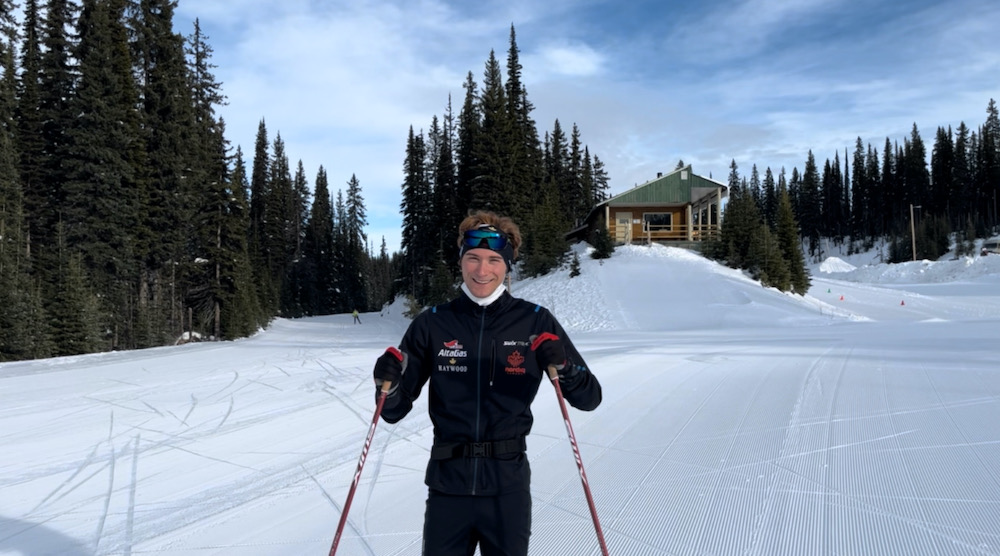

A positive test would be the end of one person’s Olympic dreams and a logistical nightmare for the support team. Any close contact of the infected person would not be able to travel. Any replacement person, athlete or not, would need to follow the same testing protocol. If that replacement wasn’t ready for the scheduled flight, the complexity of travel planning might be insurmountable.
In order to travel to the Olympics, the athletes, coaches, and techs would all have to pass two PCR tests less than 24 hours apart in the final 96 hours before boarding. Once at the Calgary airport, there would be another PCR test, with a fourth upon arrival in China.
Nordiq Canada chose a more restrictive plan than some other countries. Each person (athlete, coach, tech, cook, massage therapist) had their own room and didn’t enter other rooms. Meals were delivered. Grocery shopping was done by local resident, de Nys, scheduled for 7am to avoid crowds. No one entered coffee shops, bars, or restaurants. Each morning, everyone would do a rapid antigen test in their room. Athletes skied from their accommodation at SilverStar to the homologated trails at Sovereign Lake to avoid close contacts in vehicles. Only de Nys and Zoë the cook had contacts outside the bubble, and neither is going to Beijing.
The goal behind this aggressive protocol was twofold. First, to prevent exposures. Second, if one person tested positive, there would be no close contacts forced into isolation or removed from the Olympics. The two wax techs (Simon Boisvert and Félix-Antoine Vezina) inevitably had a shared bubble as they shared a private waxing room.
Was this the right answer? We got three answers to that.
Drolet found the camp harder than usual: “We were still able to ski together a little bit, but it was definitely a little bit lonely at times.”
Kennedy, entering with a mentally tough prospect of only making the team if disaster struck a friend, found the positive. “The guys have been playing, like hanging out online together… And we’ve been skiing together. So it’s separate, but at the same time, not too lonely.”
“Ask me on Monday afternoon when we get all the results back,” Jaques told FasterSkier on Sunday morning. “We’ve taken the right precautions so we’ll just see. But I think it’s looking good.”
A number of athletes mentioned feeling comfort in knowing they were doing everything possible to protect their Olympic dreams.
The system has worked. Everyone tested negative and the entire team is now on snow in Zhangjiakou.
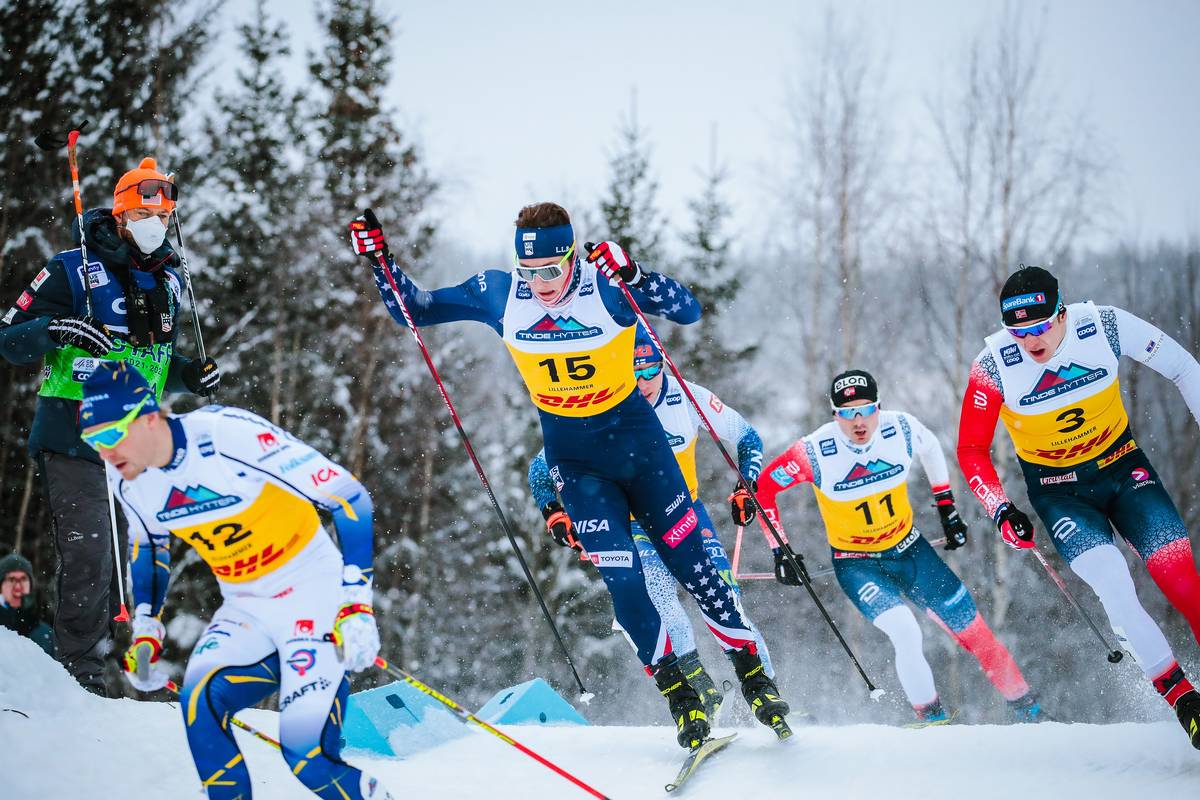
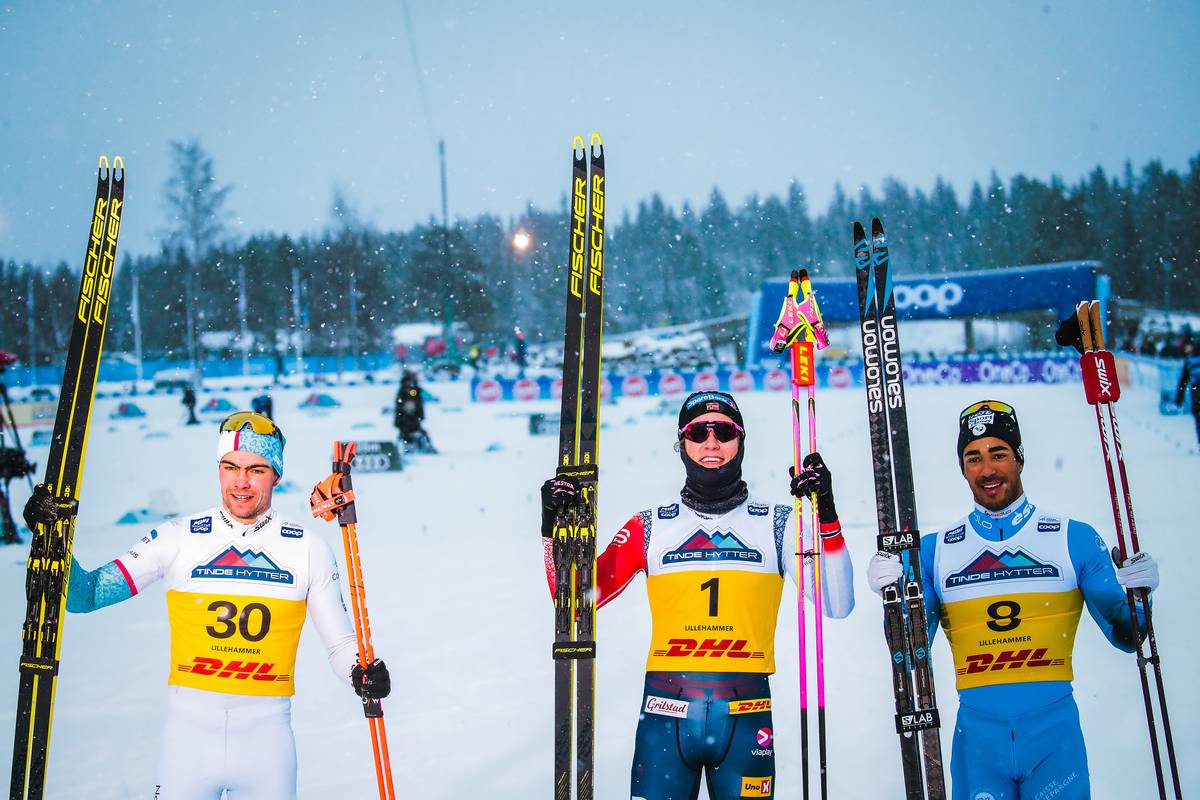
 This World Cup coverage is made possible through the generous support of Marty and Kathy Hall and the A Hall Mark of Excellence Award. To learn more about A Hall Mark of Excellence Award or to learn how you can support FasterSkier’s coverage please contact info@fasterskier.com.
Last weekend in Ruka, a new season of World Cup racing came in like a lion. Right off the bat, there were so many storylines to follow. Here, we’ll focus on those in the men’s sprint.
The international cover story was the big upset: 22-year-old Alexander Terentev of Russia beat Norwegian sprint-champion Johannes Høsflot Klæbo, who has more World Cup sprint wins than any other athlete in the field. Even more entertaining: Terentev matched Klæbo’s signature run, which he typically employs to drop his competitors on a final climb, accelerating to the finish in a league of his own. Klæbo’s tactic failed. He was matched at the top of the final climb with a few hundred meters to go, and Terentev was strongest in the final stretch. This made one thing certain: Klæbo would be ready to throw down in his home country as the World Cup swung to Lillehammer.
As evidence, Klæbo won the qualifier with a nearly two-second lead ahead of the next athlete, Lucas Chanavat of France, with Terentev nearly three seconds back in fifth.
The FasterSkier cover story last weekend was the three American men – JC Schoonmaker, Ben Ogden, and Luke Jager – who qualified and finished in the top-20, led by Schoonmaker in 7th. The Americans proved they were fit, and ready for the tight and aggressive style of World Cup sprinting. Hope abounds as these men, along with those who fell just outside the top-30, showed they were capable of results that mirrored those of the women’s team, which has received the majority of the media attention over the last several seasons.
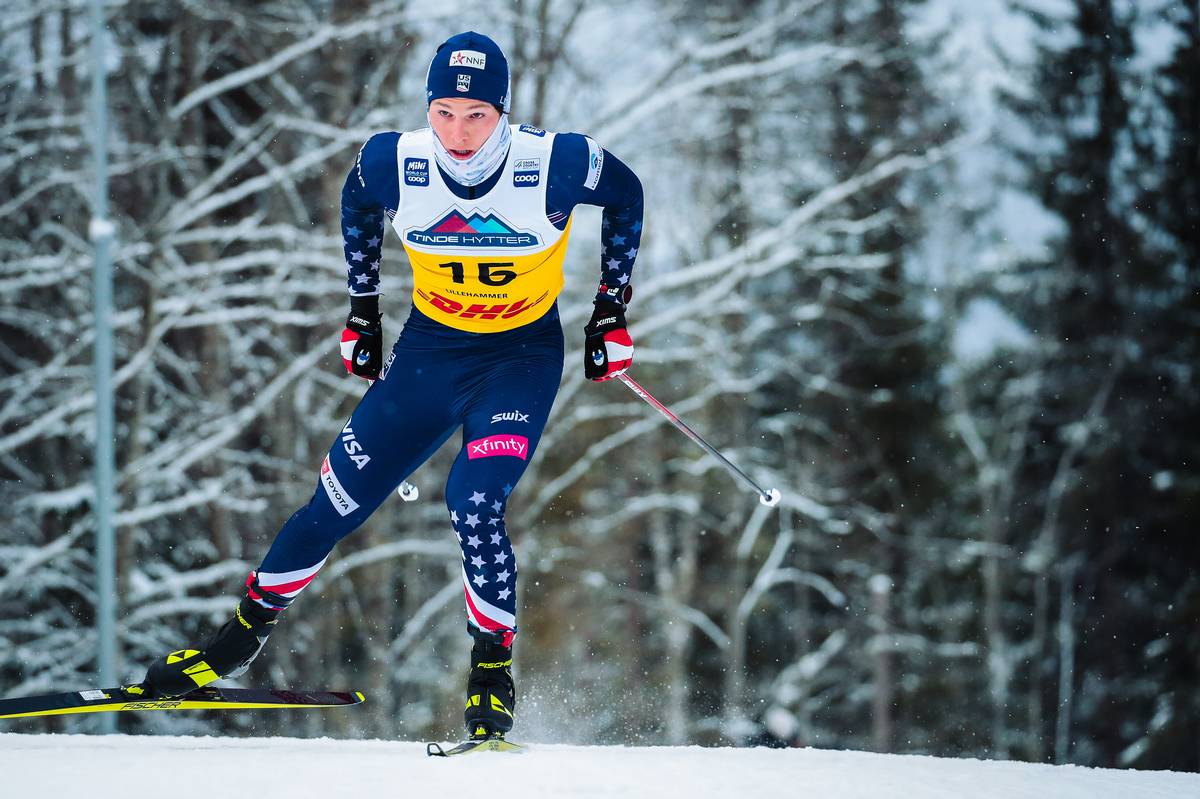
Today during the 1.6-kilometer freestyle sprint in Lillehammer, the Americans showed that last weekend was not a fluke. Three men qualified for the heats, led by Schoonmaker in 15th (+5.61). Kevin Bolger was 24th in qualification (+6.25), followed by Ben Ogden in 28th (+6.63).
As the sprint featured in the 2022 Olympic program will also be freestyle, these events will be especially in focus as we move through the World Cup season. For the Americans, an athlete finishing in the top-8 (final results, not qualification) has met the objective criteria for team selection, essentially punching their ticket to Beijing.
In the quarterfinals, Bolger raced in the stacked first heat along with the top-3 qualifiers, Klæbo, Chanavat, and Erik Valnes (NOR). For the first two minutes of racing, Bolger sat confidently on the Norwegian’s tails, keeping enough contact with the leaders to vie for a lucky loser spot in the final stretch. Despite rounding the final bend in fifth, Boger skied his way into fourth, in a photo finish with Chanavat. Given the depth of his heat, Bolger ended up with a fairly comfortable lock on a spot in the final as one of two lucky losers.
Klæbo won this round comfortably, followed by fellow Norwegian, Thomas Helland Larsen.
Ogden raced in heat two, where he was not able to keep himself in contention with the leaders. Ogden skied to sixth in the heat, which was won by Håvard Solås Taugbøl and Richard Jouve in a photo finish.
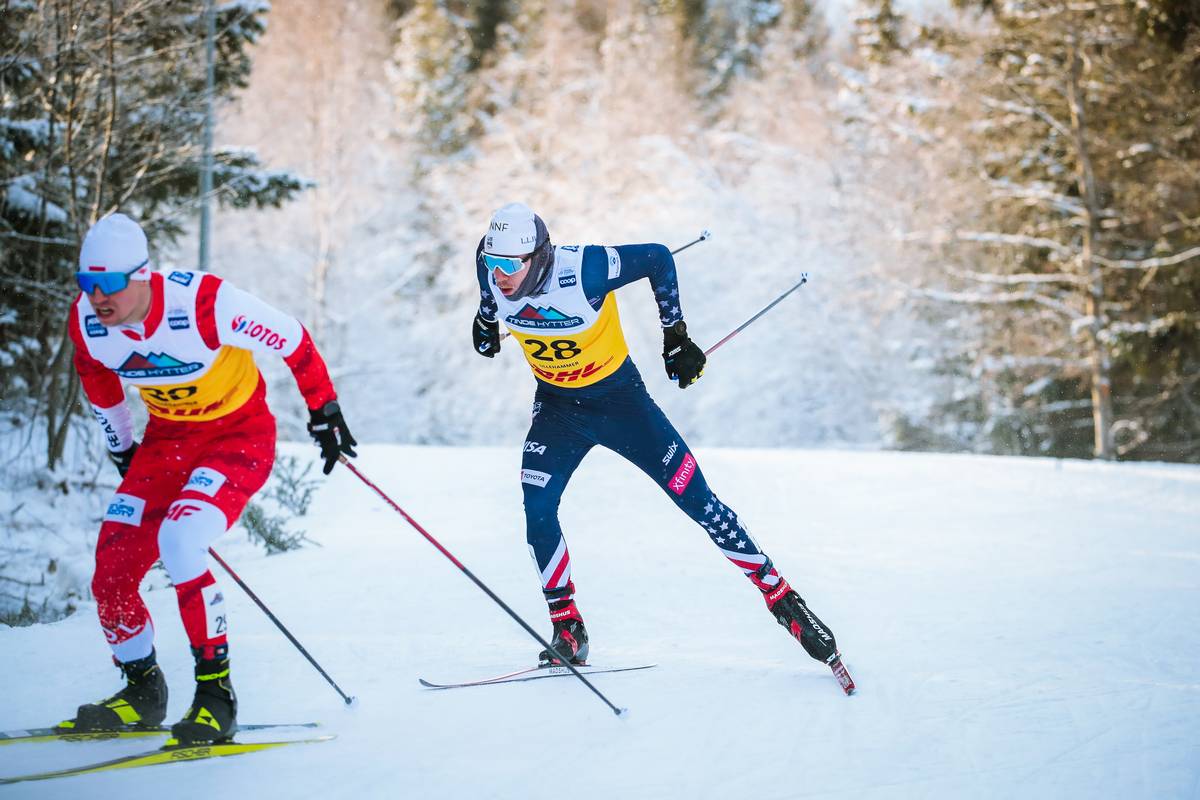
Perhaps surprising given his legacy in skate sprints, Italy’s Federico Pellegrino was also knocked out in the second heat of the quarters. Pellegrino had qualified in 19th, and finished the semi together with Jouve and Taugbøl, but was ultimately not fast enough for the lucky loser spot.
Racing in heat five with stars and stripes on his suit, buff, and gloves, Schoonmaker tactically skied his way into the semis. The American was tucked into the leaders’ draft on early downhills, moving up on the final climb at roughly the two-minute mark. Here, Schoonmaker challenged the men at the front as they headed into the final hairpin before the closing straightaway. Coming to the line with Gleb Retivykh (RUS) and Sindre Bjørnestad Skar (NOR), Schoonmaker threw his boot forward to clinch second place in the heat, automatically advancing to the next round.
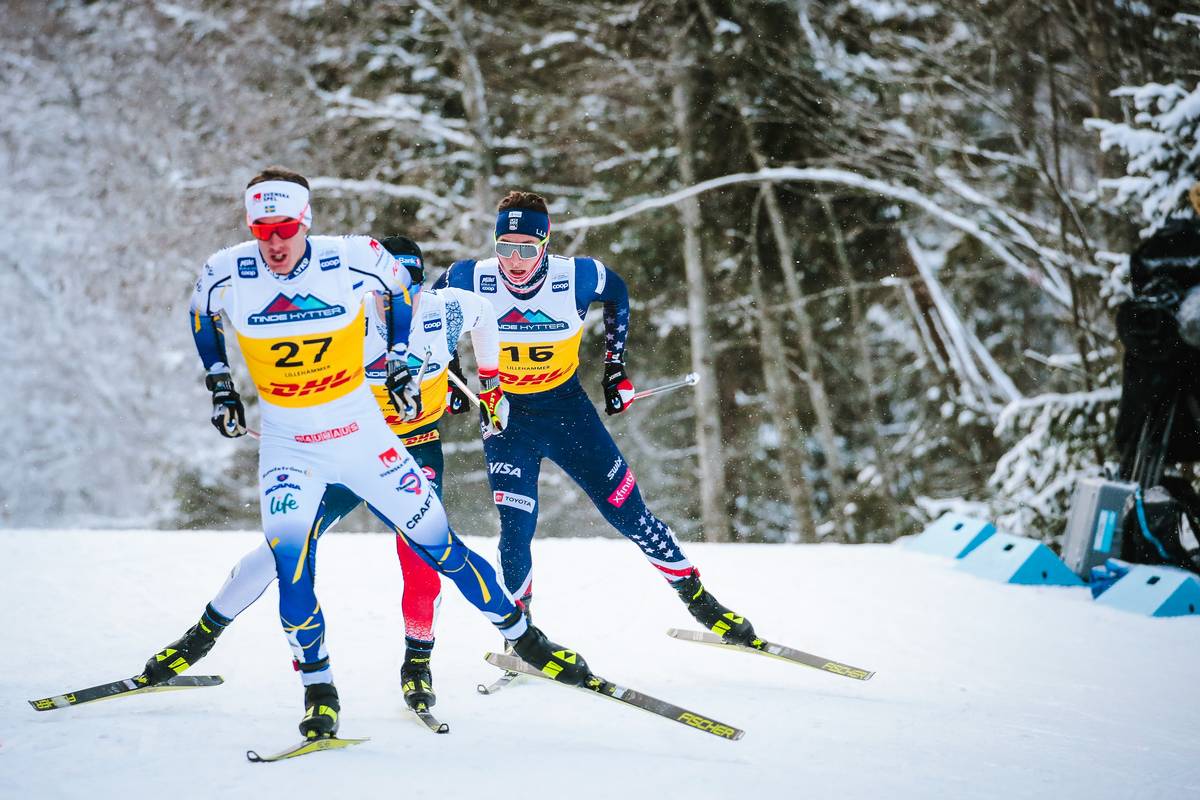
Guaranteed a top-12 finish, Schoonmaker was one step closer to his Olympic goal, and would race in the semi-final in back-to-back sprint races. Without a deep dive into the stats here, let’s just say: it’s been a minute since an American has done that. And he’s only 21.
The semis were half-Norwegian: four in the first heat with Bolger, and two in the second heat with Schoonmaker.
Bolger skied in the middle of the pack during the opening kilometer of his semi, again marking the leaders and staying in good position for the final push. Rounding the bend into the stadium, Bolger ended up just off pace at the back of the pack as Klæbo led the way to the finish with enough room to stand up before gliding across the line.
While Klæbo was comfortable in his position, the three men heading to the line on his tails were not. Again in a photo finish, Taugbøl and Jouve fought for the second spot, with Larsen alongside. Taugbøl edged out the Frenchman in the boot slide, with Larsen setting a fast time in fourth, awaiting results from the second round to determine lucky losers. Bolger finished the round in sixth.

The second semifinal was a nail biter. With numerous lead changes and a spread of just 0.5 seconds at the finish, it was anyone’s game. Schoonmaker again looked confident pushing the pace, staying in the mix with leaders throughout the meat of the course. Rounding the bend and heading into the final straightaway, he was in excellent position on the tails of Sweden’s Marcus Grate.
Charging down the final straight, Grate and Finland’s Lauri Vuorinen pulled ahead slightly as the remaining four men remained matched. These men went 1-2, while the remainder of the field crossed the line a ski length behind in a four-way photo finish. Ultimately, the order was determined to be: Alexander Bolshunov, Erik Valnes, Finn Hågen Krogh, then Schoonmaker, all separated by 0.1 seconds.

Take a moment to let the names of the men finishing around Schoonmaker sink in.
As fat flakes began to fall, the athletes kept their warm-up layers on until the two-minute warning, springing up and down and running sprints to stay warm and sharp for the final go. On home turf, the closing round was half-Norwegian, with Klæbo, Taugbøl in their national team suits and Larsen racing in his leopard-print club suit.
Leaving nothing to chance, Klæbo held his ground near the front of the pack, tucking in Grate’s draft in the early downhills, and putting his foot on the gas as the men headed up the final climb with less than a minute of racing to go. Pulling ahead as they headed into the straightaway, Klæbo looked like he was on cruise control, powering through the first half in V2, before looking over his shoulder, then raising his arms in celebration as he cruised across the line alone for the win in 2:52.48.
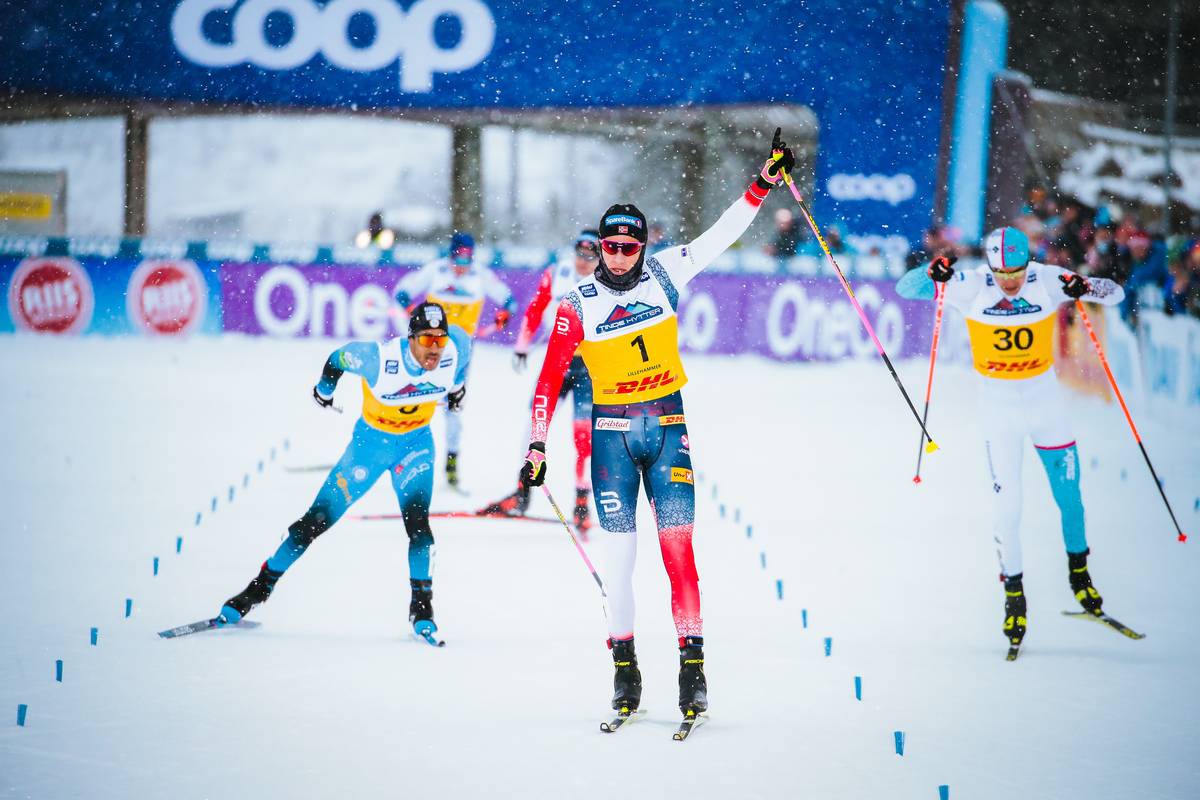
A couple of ski lengths behind him, Larsen and Jouve fought to the line for the final podium spots. The Norwegian pulled ahead as he slid across the line for second (+0.58), with Jouve just behind for third (+0.78).
“It was a really tough race today, and it’s been quite a week from last week,” Klæbo told FIS at the finish line. “I’m really satisfied to cross the finish line first, and it was a special day.”
Commenting on the new course used today in Lillehammer, which, at roughly 1.6k, was nearly 200 meters longer than the previous one, Klæbo spoke favorably of the change.
“I think it’s really cool that we have changed the tracks a little bit. It’s something different and I think they have done an amazing job here to make this happen, and to also have this nice track. So I’m really satisfied.”
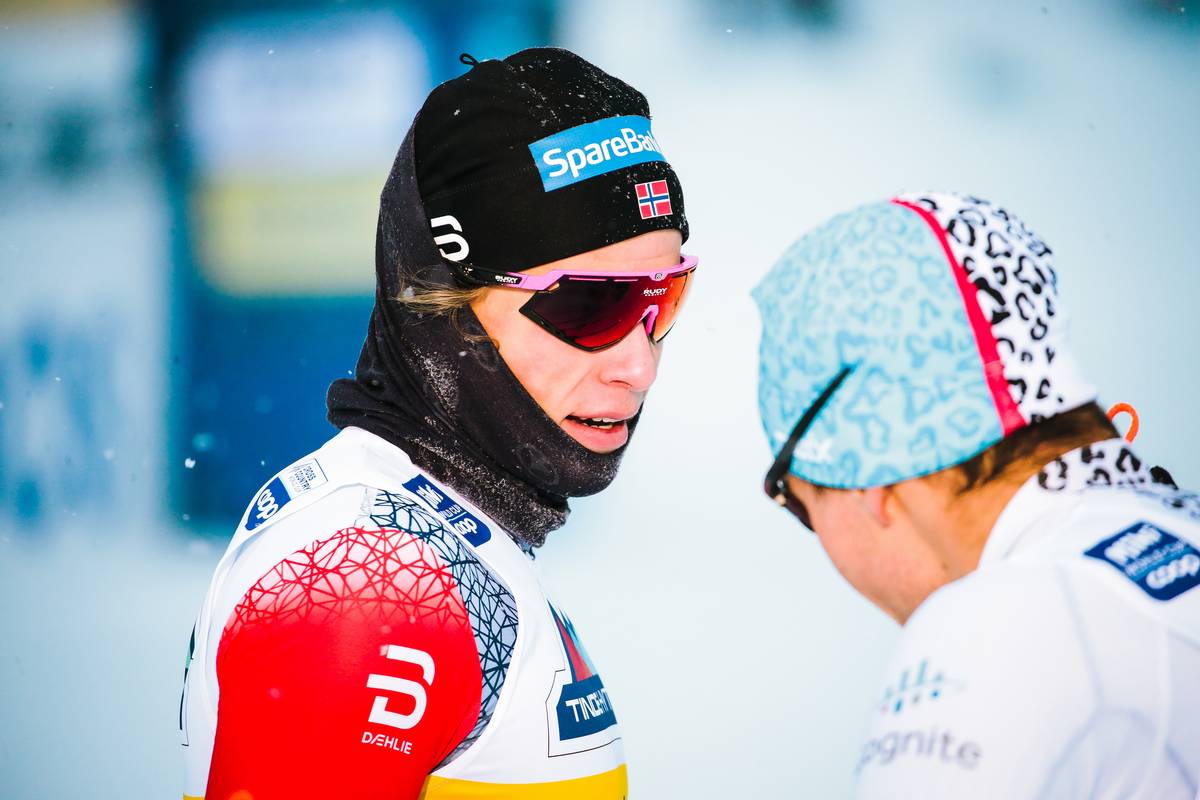
Rounding out the top-six, Taugbøl took fourth (+1.68), ahead of Vuorinen in fifth (+4.43) and Grate in sixth (+20.73).
Once the final round was settled, it was concluded that Schoonmaker ended his day in 11th, followed by Bolger. Ogden ended his day in 30th. None of the Americans would hit the Olympic qualification standard today, but it remains clear that they are well within reach.
After returning to their hotel down in town, Schoonmaker provided the following feedback on his pacing and strategy today relative to last weekend in Ruka:
“This course was a lot longer than Ruka, so I had to think a lot more about pacing especially in the qualifier. I tried to take it out fairly conservative so I could finish strong on the last section. In the heats, I actually had a pretty similar strategy to Ruka of trying to relax in the pack for as long as possible before trying to push to the front in the end. I tried to pick a heat that had guys who were closest to my time in the qualifier so that I would be able to hang in the pack easier than if I had chosen quarterfinal #1 with all the top qualifiers. I felt like I followed the plan well and was really happy with the way I skied.”
Remarking on his day and racing in the semis on back-to-back weekends, Schoonmaker gave a very process-oriented response.
“It was an awesome experience to race against so many big names and to feel like I was in the mix. I wish I had had a little bit more to give in the end of that semi to move on but still really happy with it. I’m pumped to have made semis twice in a row now because each time I get past the quarters, I’m doubling my heat experience and getting a step closer to making the final.”
In his post-race email, Bolger explained that he found the course used today in Lillehammer to be “really cool, really fun, and very hard.”
“I think it allowed a lot of good spectating, and I think coming into the weekend we all thought it was going to be an easier course, but we all soon found out that it it was a very challenging course — very physically demanding, and a lot of work… its also nice to do something new, instead of the same courses all the time.”
On his approach to the day and heat selection, “It was a bit scary picking heat 1 for my quarterfinal,” Bolger wrote. “I did something similar back at world champs in Seefeld, but I knew if i could put together a good race that I could compete with those guys, and talking with [Chris] Grover, we both decided it could be a great heat to get into the semis either by qualifying out right or as a lucky loser.”
He added that he would have preferred the second semifinal heat, but this was out of his hands.
“Tactically though, not much changes [with heat selection], especially on a course like today where I don’t think there were so many tactics. I just wanted to ski big and own my space, I was lucky enough to take the back of Klæbo and follow him for a while, which was brutal but great. Also, I think having killer skis played a big factor in today and helped me advance as far as I did so a huge shout out to our wax crew and my tech Oleg!”
Last weekend, in Ruka, Bolger qualified in 57th, well outside the heats. He explained that he was “searching for more this weekend”, while recognizing that racing in Norway, which allows the home country to enter additional athletes, would make it an even harder job. He equated it to narrowing the Top-30 down to a Top-15 in terms of the density of fast times and percent back needed for qualification today.
“Coming here and putting together a really strong day and having a high result definitely boosts my confidence in myself and my training,” Bolger continued. “But it is just one race. t+There is a lot of racing to be done yet and I’m just looking forward to the opportunity to get in another good race next weekend in Davos and to hopefully have an even better day! Lastly, I think how this men’s team is vibing together and how we are all feeding off each other’s success — I owe a lot to them. Being out there today in the heats with Ben and JC gives me a lot of extra fighting strength. We all believe in each other and and get each other super hyped. I think that helps a lot on a sprint day!”
There were several near-misses outside the top-30, including Luke Jager, who was just 0.7 seconds off the time (2:52.31) needed for qualification in 33rd.
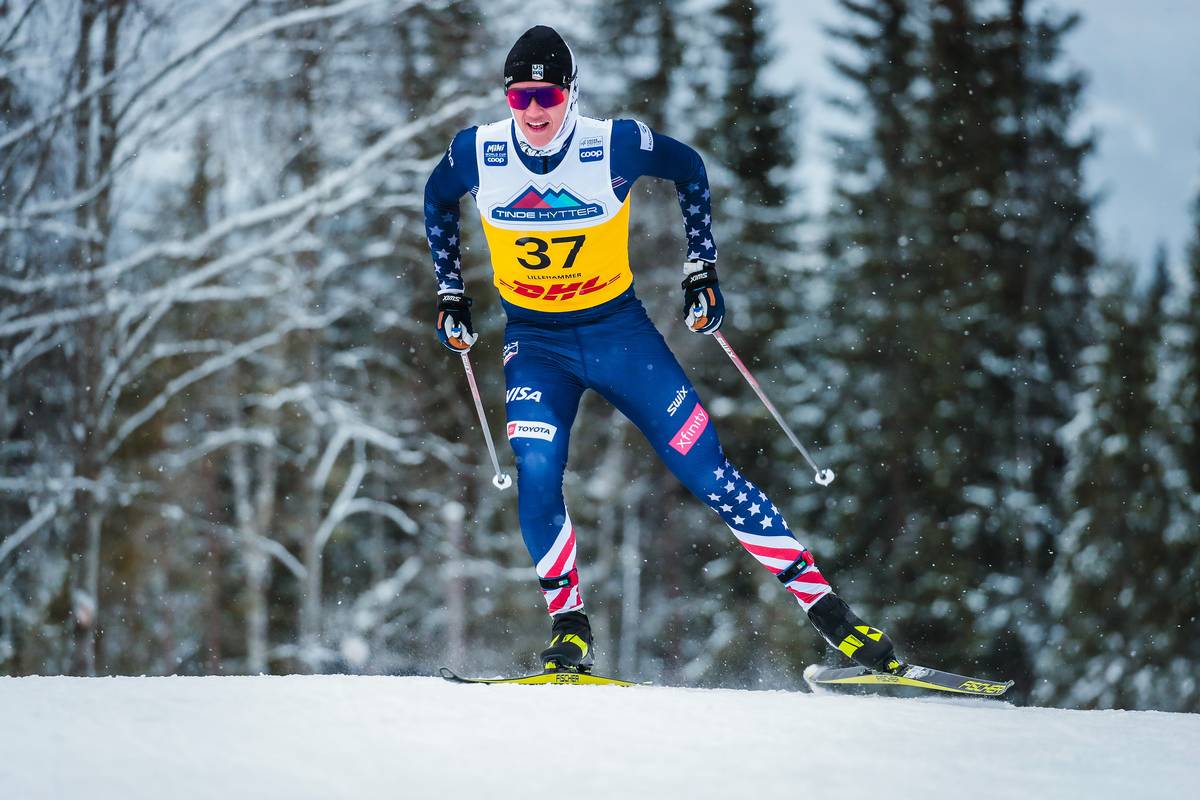
Gus Schumacher qualified in 41st, just over a second out of the heats, followed closely by Canada’s Russell Kennedy and Graham Ritchie in 42nd and 43rd, respectively.
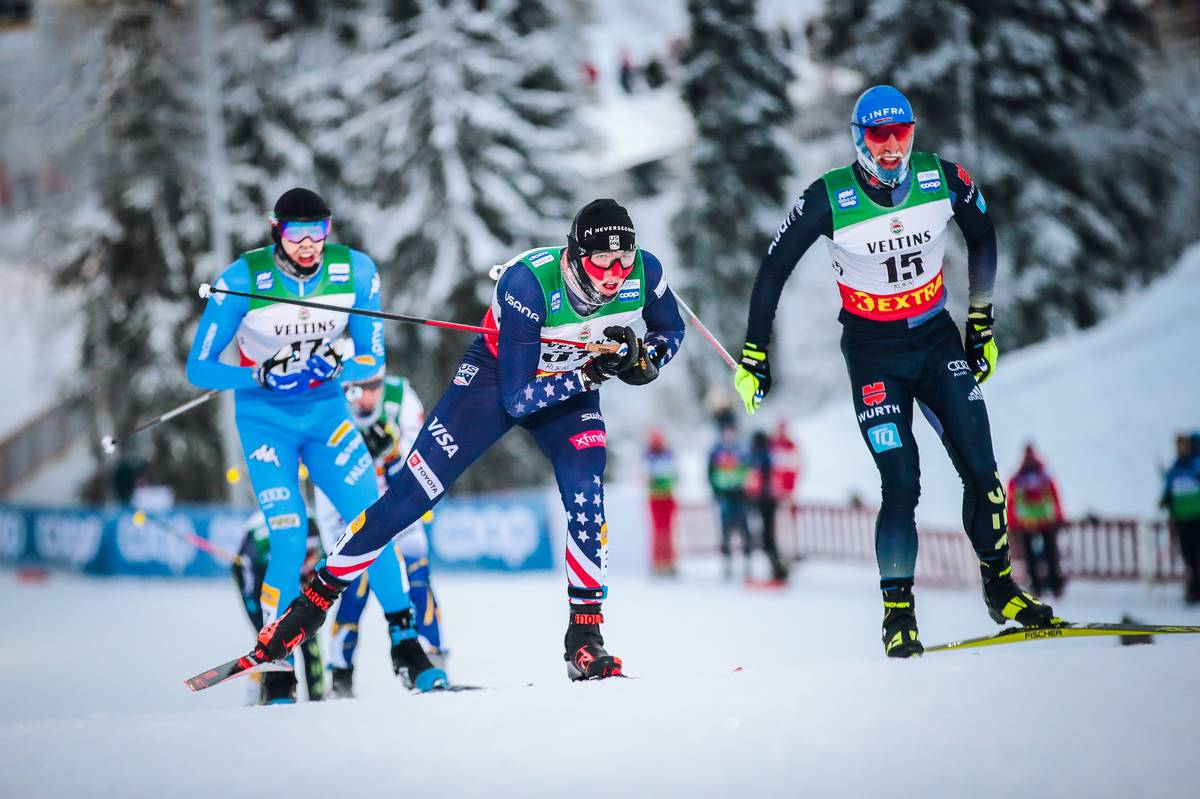
Rounding out the North American men’s squad, Logan Hanneman (USA) finished 45th, with Olivier Levielle (CAN) 48th, and Antoine Cyr (CAN) 56th.
In a post-race interview, Matt Whitcomb shared insights into the new course in Lillehammer, as well as how athletes selected their tactics for the two-lap course, his perspective on the men’s racing, and a detailed explanation of why qualification for the heats in World Cup sprinting is a unique skill that athletes need to hone.
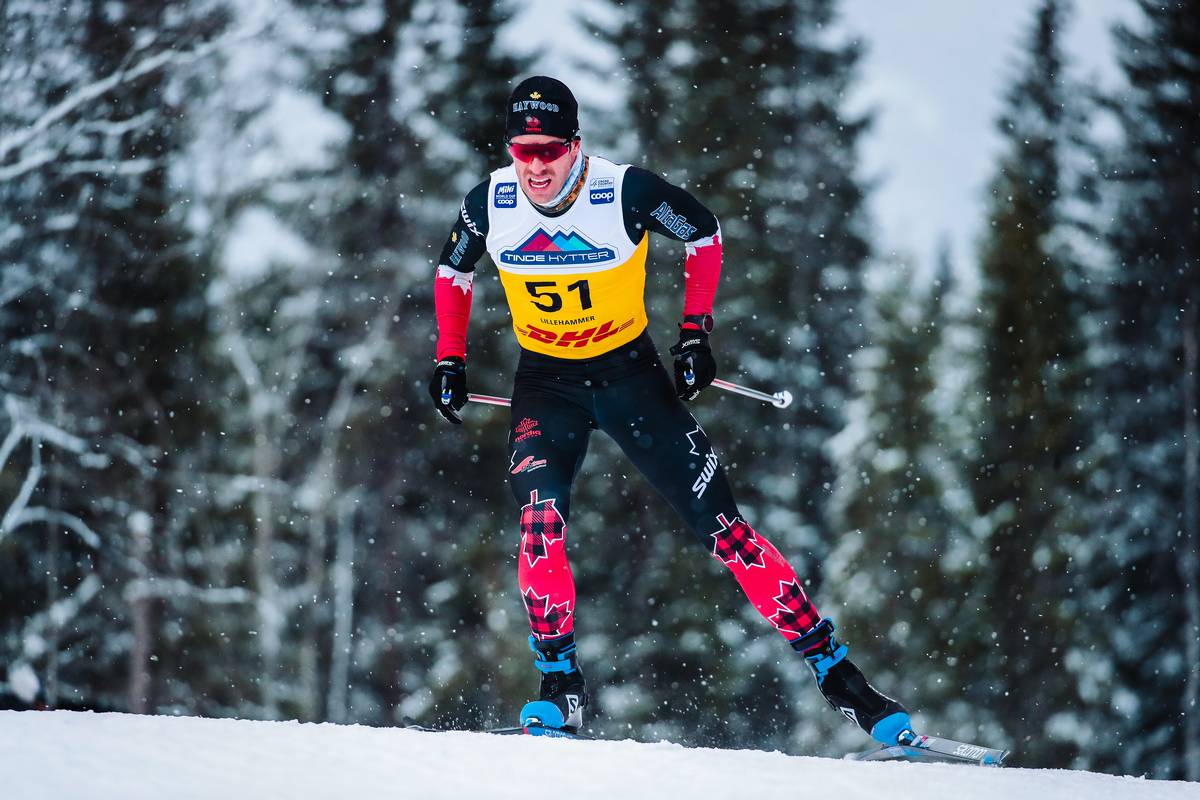
Results:
This World Cup coverage is made possible through the generous support of Marty and Kathy Hall and the A Hall Mark of Excellence Award. To learn more about A Hall Mark of Excellence Award or to learn how you can support FasterSkier’s coverage please contact info@fasterskier.com.
By Ryan Sederquist
It was another very cold day in Ruka, Finland. Temperatures hovered between -19 and -23.2 degrees Celsius around the course, rising to -18.6C by the start of the men’s 15-kilometer freestyle pursuit. In response to the conditions, the Norwegian men’s team decided to pull from competition, which created confusion at the start line.
For context, the women’s event, which was scheduled to take place first, had been postponed because temperatures were below the legal cutoff of -20C shortly before their schedule start. It is unclear whether other teams or organizers were privy to conversations happening among the Norwegian team, however, coaches had made the decision along with athletes and team doctors to withdraw despite the thermometer showing a temperature above the cutoff at race time.
With little time before the start, the Norwegians were missing from the field and the individuals working the start gate were scrambling. Perhaps the only ones having no trouble keeping warm, the officials at the start could be seen waving their arms, jumping, yelling, and sprinting around in an apparent search for the Norwegian team. Ultimately, the stadium announcer notified the field that all members of the Norwegian team who were scheduled to race were missing, and eventually, the clock simply started without them.
“It is based on the fact that it is terribly cold here,” Norwegian coach Eirik Myhr Nossum told the Norwegian news source NRK about the decision to withhold the team. “It may be skiing that is just inside the rules, but they think it was terribly cold yesterday and felt it in their lungs. They know they have important weekends ahead of them. They did not want to take any chances in the cold here.”
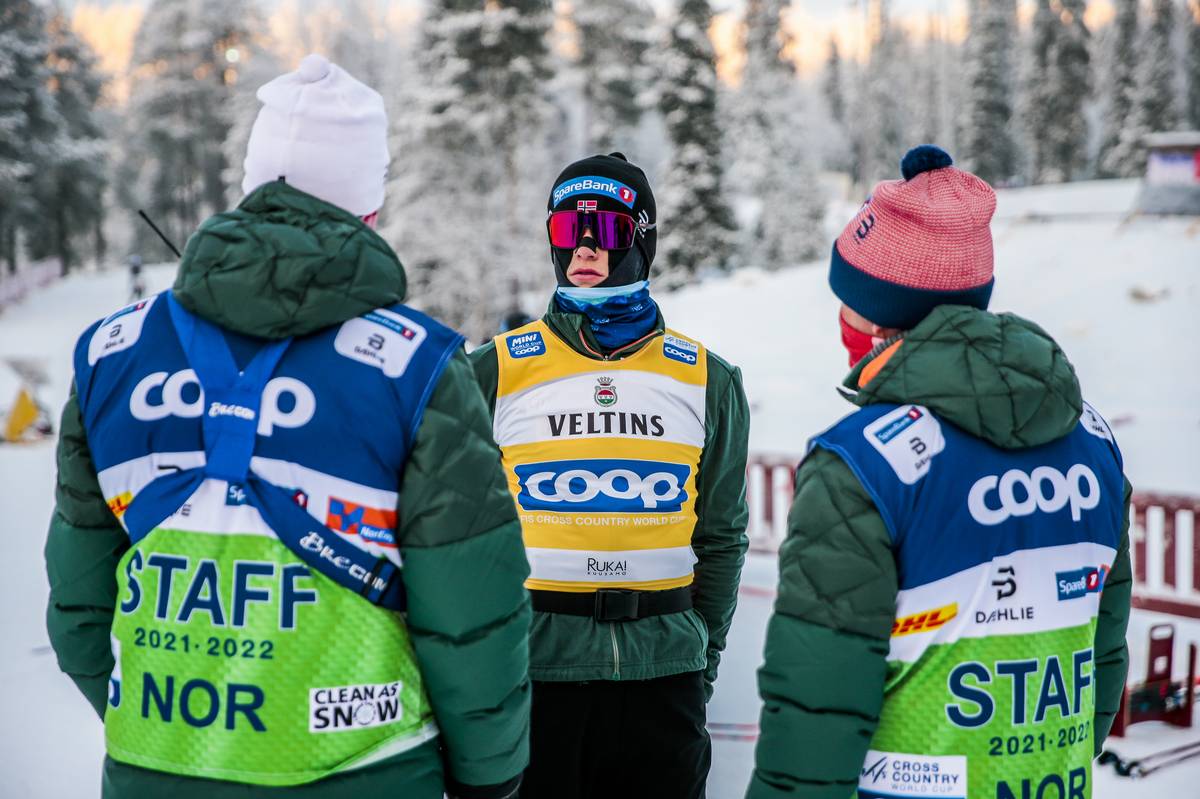
Sprint coach Arild Monsen said Johannes Høsflot Klæbo, Pål Golberg and Erik Valnes wanted to get a feel for the course before making a call. In communicating with a doctor present, they all agreed to not go.
“It is too cold. It’s within the cold limit. But the long-term effects that it can have on the respiratory tract … Then we came to the conclusion that they try with a little breathing on the heating. But we did not want this, there will be many other matches later,” the coach said to NRK in justifying the decision. (NRK comments have been translated to English.)
Yesterday’s classic winner, Iivo Niskanen, also chose to withdraw from the competition, and felt the race should have been canceled altogether. When asked by NRK, he said, “Yes, it should be [cancelled]. It is 75 kilometers per hour in the descents here and it is completely safe above 20 degrees below zero. So it is not good for the athletes nor before the Olympics.”
With Niskanen out, the clock ticked away for eight seconds until Alexey Chervotkin blasted away from the start pen. Alexander Bolshunov, wearing bib three, was still putting on his skis when he slowly skated out of the gate without his pole straps on, three seconds after his scheduled start time. After the frenzy of action and realization that all systems were go, the race proceeded more normally.
However, the absence of this group of men paved the way for Russian dominance. The group of three Russians – Chervotkin, Bolshunov, and Sergey Ustiugov – quickly assembled upfront. By the end of the first of six 2.5-kilometer laps, Ilia Semikov and Ivan Yakimushkin had joined them.
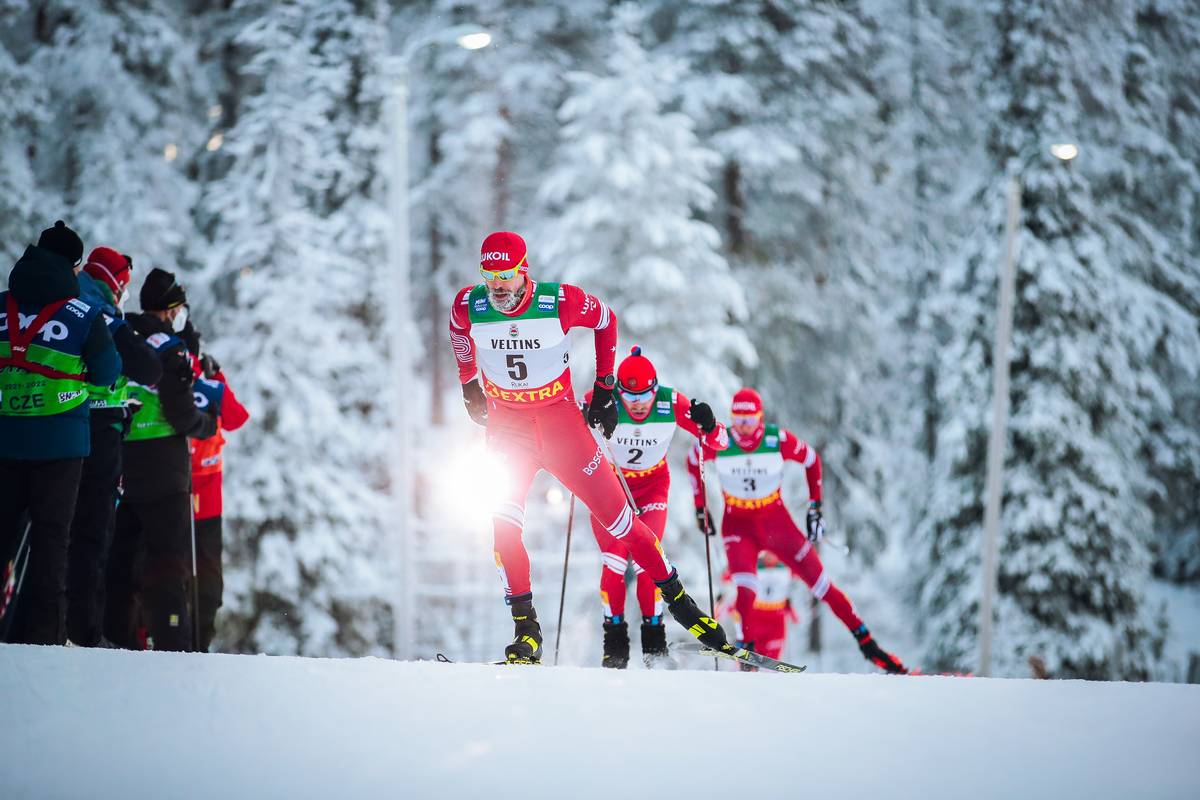
Behind the group of red was a chase group of Canadian Antoine Cyr, Frenchmen Hugo Lapalus, the Czech Republic’s Michal Novak, and Germany’s Lucas Boegl. Cyr, who finished a career-best 11th yesterday, continued his strong showing in the skate, holding the sixth place position for the first quarter of the race.
While the Russians at the front appeared to be out for a steady-state workout – not altogether easy, but with an earnest threshold-like tempo perhaps for no other reason than to preserve warmth and get off the course as soon as possible – several chase groups emerged. Behind the five Russian leaders, fellow Russian Artem Maltsev was working to close the gap to within 29 seconds through the 5-kilometer checkmark. He towed Cyr, Lapalus, Boegl, and Novak along with him. Behind that peloton was another group of five athletes, led by Francesco De Fabiani. Finally, Gus Schumacher, who started in bib 31 but moved up throughout the race, was guiding a final group of 11 athletes.
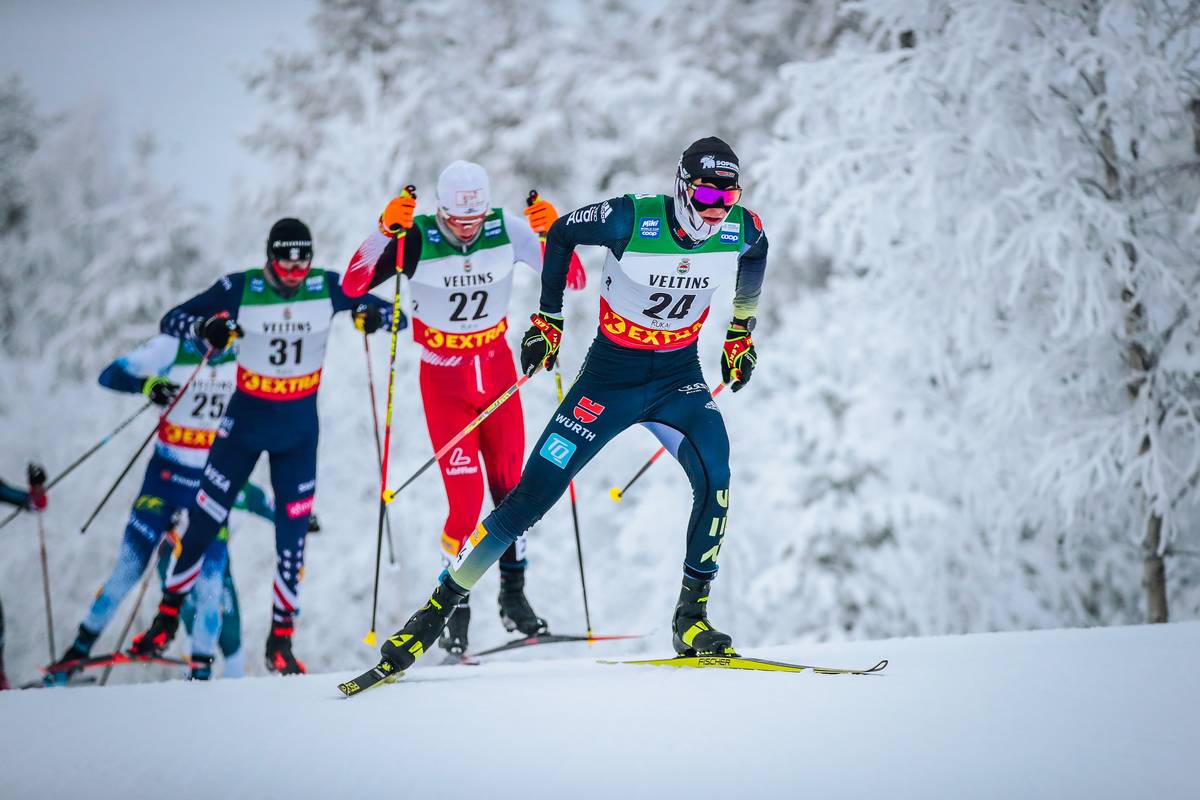
The primary deciding move of the race came 16 minutes in when Maltsev pushed hard to bridge the gap to the leaders. He brought Michal Novak and Lucas Boegl with him, but the Canadian Cyr was fading and left behind.
This group was on the upswing, steadily gaining ground on the leaders. Among this pack was Schumacher, who continued to take advantage of the drafting effect.
By 10-kilometers, it was a group of six Russians plus Boegl and Novak in front, with Cyr and Lapalus holding on for dear life 16 seconds back, and the 10-member train, with Schumacher and Canadian Olivier Leveille at the caboose, just 19 seconds behind them.
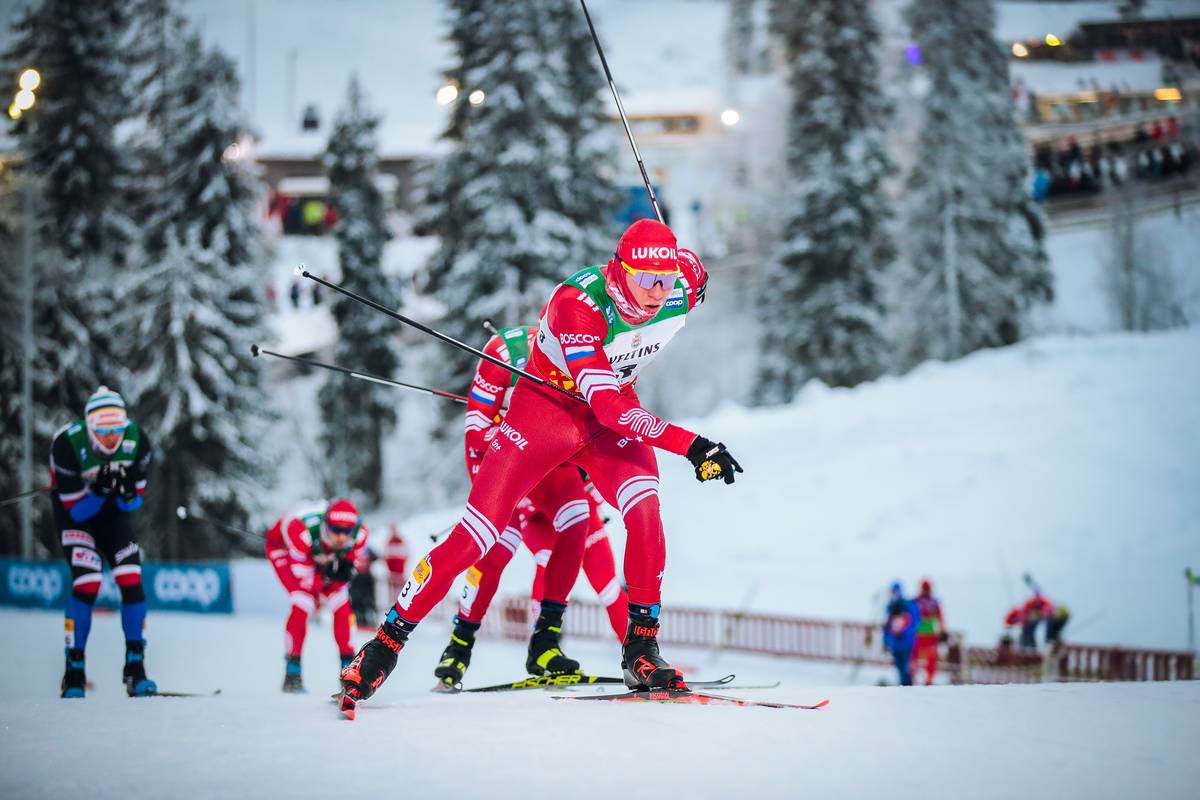
Approaching the penultimate stages of the race, Bolshunov remained relaxed and seemingly content to let Yakimushkin lead, responding to his surges and allowing his teammate to block the wind.
The 25-year old Novak, who was 54th in the distance standings last year and 13th in the sprint standings, appeared strong and capable of disrupting a Russian sweep of the podium. 22 minutes into the race, wearing a Gunde Svan Swix beanie in lieu of a team cap – presumably for additional warmth – the Czech athlete went to the front.

Coming into the bell lap, however, it was Bolshunov who emerged to take the lead in the descent into the stadium. At this point, with pace increasing, the lead pack was down to seven, having dropped Chervotkin. The chase group remained 39 seconds back, but Schumacher, who started with a 1:42 disadvantage, had closed it to 47 seconds as he sat in 15th.
With 1.4 kilometers to go, Bolshunov turned up the effort, charging up a hill. Novak appeared unable to respond to this surge, leaving the four Russians to settle things for themselves at the line. The gap of 2.7 seconds would not hold, though, as all four contending upfront – Bolshunov, Maltsev, Yakimushkin, and Ustiugov – paused to decide who would lead out on the final, critical downhill. Taking advantage of the moment of indecision, Novak decided to make one final run at glory. He burst into the lead down the hill, but was caught again as the five men headed into the deciding final sprint uphill.
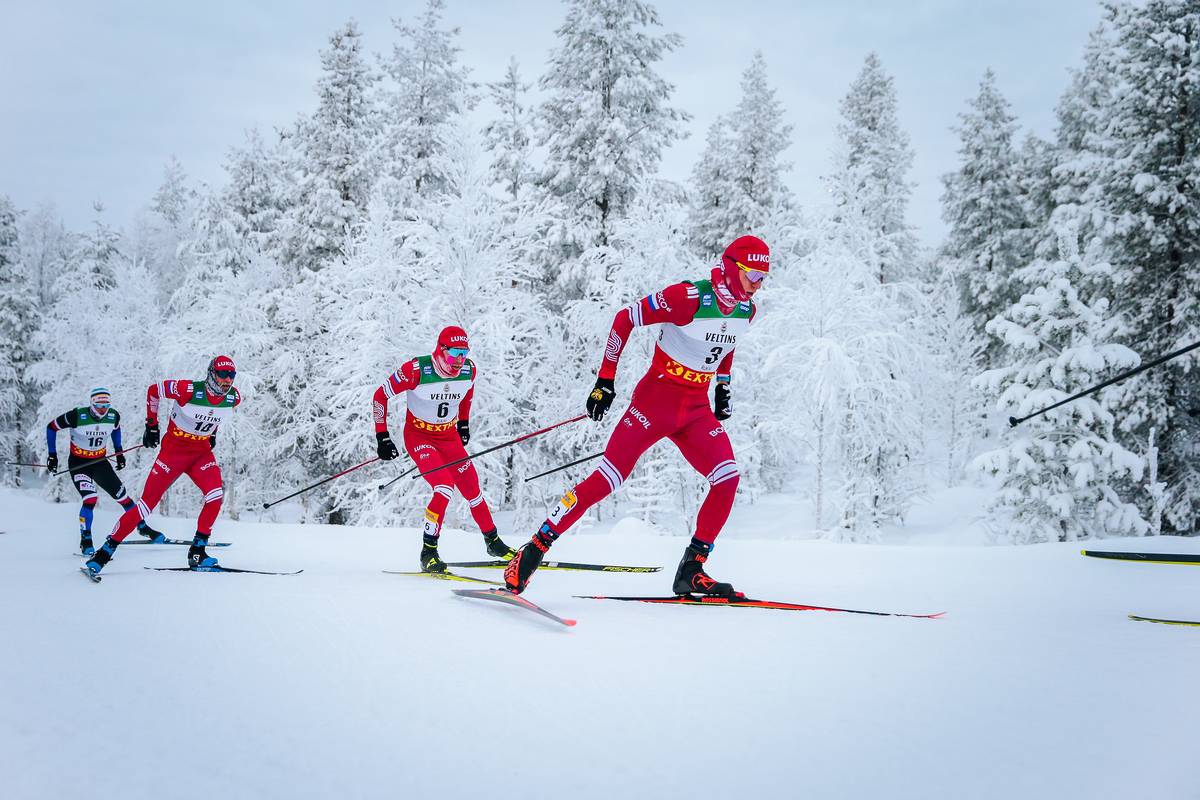
Bolshunov and Ustiugov demonstrated the purest and most efficient hop skating, and separated from the others. Looking for an inside line, Ustiugov just didn’t have the speed to overtake the 24-year old two-time defending overall globe winner. As they headed into the straightaway, Bolshunov glided comfortably across the line for the win, followed by Ustiugov (+0.5) and Maltsev (+0.7), who never faltered after charging hard to close the gap between racers. Yakimushin (+5.3) made it a one-through-four run of Russians, but a fifth place finish for Novak (+9.2), whose previous best individual finish to date was a 9th place sprint from Ulricehamn, Sweden last February, ruined the Russians’ ability to achieve a cross-country running “perfect score.”
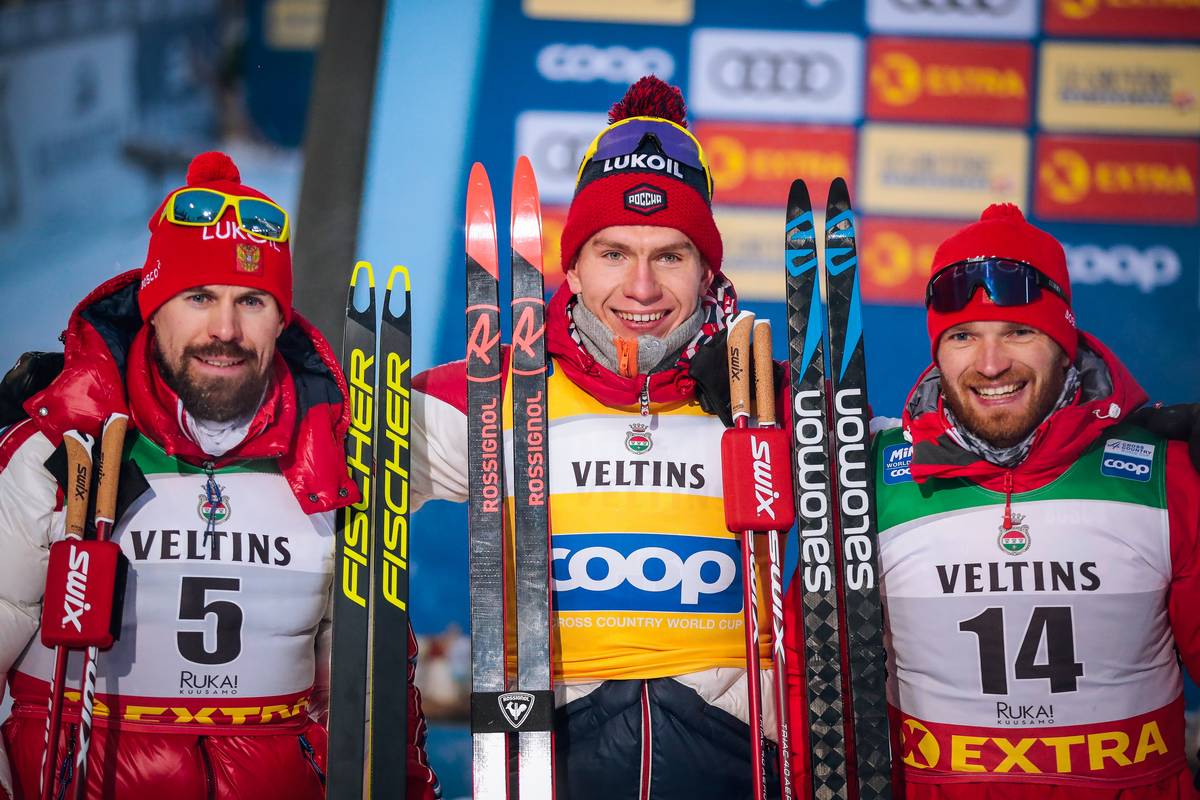
At the finish line, Bolshunov spoke through a translator and discussed how the confusion at the start led to a few unknowns, but ultimately, when the race started, the game plan was still the same.
“I still made the task to do the best I could and I am really happy with the victory,” he said of the situation.

Surging in behind the initial group of finishers was American Gus Schumacher, who would climb all the way to 11th place (+58.2). He was only half of a second out of the top 10, as he was unable to overtake De Fabiani in the final sprint, but he did claim top North American honors, passing Antoine Cyr (+58.8) in the closing stretches. Cyr ended his day in 12th.
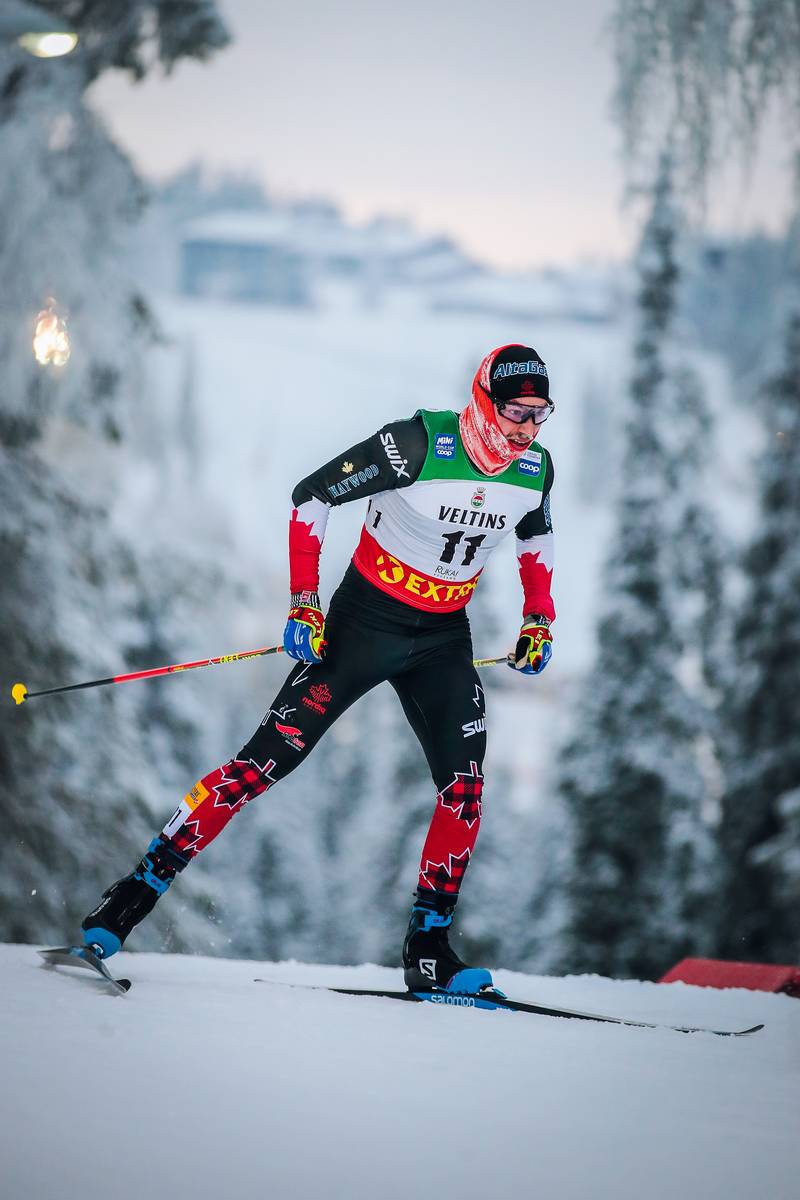
In a post-race interview, Schumacher explained his race plan, including how he considers the athletes around him as potential rides that he may use during the opening laps. He also discusses how he was able to lean on fast skis to take advantage of downhills and drafts, conserving his energy to hang onto the other strong men in his group. Having been in cold weather and on snow in Alaska before heading to Europe, Schumacher provides additional insight into his management of the conditions.
Completing a strong showing for Canada, Olivier Leveille (+1:00.7) finished in 17th followed by Russell Kennedy in 21st (+1:39.9).
The American contingent, largely made up of Alaskans, showed no fear in the face of the cold temps. David Norris (+2:35.1) finished in 37th, Zanden McMullen (+2:46.0) was 40th, and Hunter Wonders (+3:33.0) was 45th. Ben Ogden (+4:52) and Luke Jager (+5:38) rounded things out in 55th and 60th places, respectively.

The Devon Kershaw is back from summer hibernation!
This week, Devon takes a break from medical school to break down the first big tune-up races of the season in Muonio, Finland. Joining him are the show’s new co-host, former FasterSkier reporter Nat Herz, along with Canadian athlete Russell Kennedy, who popped a huge result in one of the races in Finland.
Russell catches us up on the European circuit; we also discuss Charlotte Kalla’s recently awarded honorary doctorate degree, disgraced former Estonian racer Andrus Veerpalu’s son’s presence in Finland, and impressive results by 43-year-old Finnish skier Riita-Liisa Roponen.
Relevant reading:
Muonio results: https://www.fis-ski.com/DB/general/event-details.html?sectorcode=CC&eventid=50257&seasoncode=2022
Kalla’s honorary degree: https://www.aftonbladet.se/sportbladet/a/G36A69/har-hyllas-kalla–ny-hedersdoktor
Veerpalu’s son’s Instagram page: https://www.instagram.com/andersveerpalu
A FasterSkier Q+A with Roponen: https://fasterskier.com/2020/02/transitions-training-and-birkie-preparation-a-qa-with-riitta-liisa-roponen/
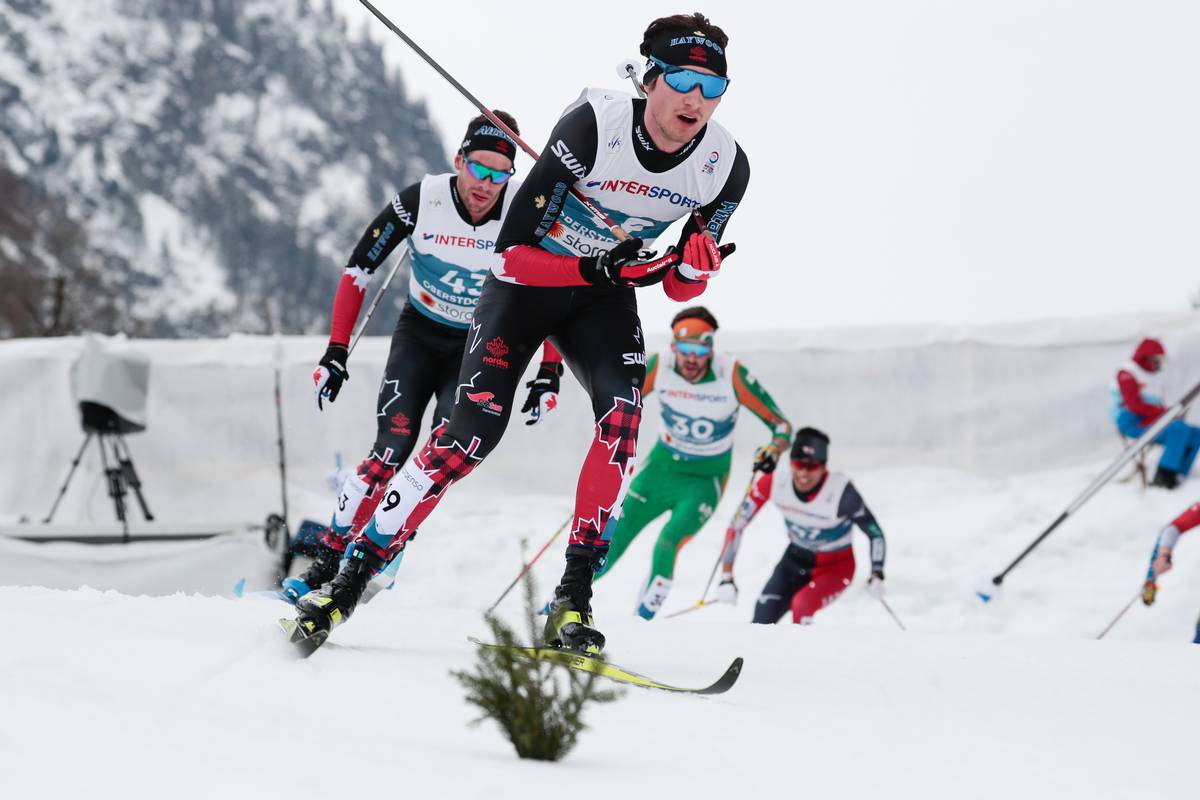
 CANMORE, Alta.—Eight Canadians are readying themselves to head to Europe in the coming weeks to open the highly-anticipated Olympic and Paralympic season while bringing the maple leaf to the World Cup cross-country skiing start line.
Nordiq Canada will send a dynamic group of four women and four men who are determined to climb up the international rankings in the first three weeks of World Cup action before returning to Canada for the holiday break followed by the 2022 Olympic and Junior/U23 World Championship Ski Trials set for the Canmore Nordic Centre, January 6-11.
Olympians Dahria Beatty (Whitehorse) and Cendrine Browne (Saint-Jérôme, Que.) will be joined by National Teammates Katherine Stewart-Jones (Chelsea, Que.) and Maya MacIsaac-Jones (Athabasca, Alta.) on the women’s start line. The four Canadian women have been making steady progression and regularly posting results in the top-25 over the last year.
Russell Kennedy (Canmore, Alta.) who competed at the 2018 Olympics before guiding Brian McKeever at the Paralympic Games in PyeongChang will lead a young men’s team loaded with potential. Kennedy will be joined by Graham Ritchie (Parry Sound, Ont.) and Antoine Cyr (Gatineau, Que.) who were both seventh in the team sprint at the 2020 World Ski Championships. Olivier Léveillé (Sherbrooke, Que.), who was just the third Canadian ever to win an individual cross-country ski medal at the Junior World Championships last year when he finished third in the 10-kilometre skate-ski race, will take his first strides into the senior ranks.
Selection announcement and synopsis can be found here.
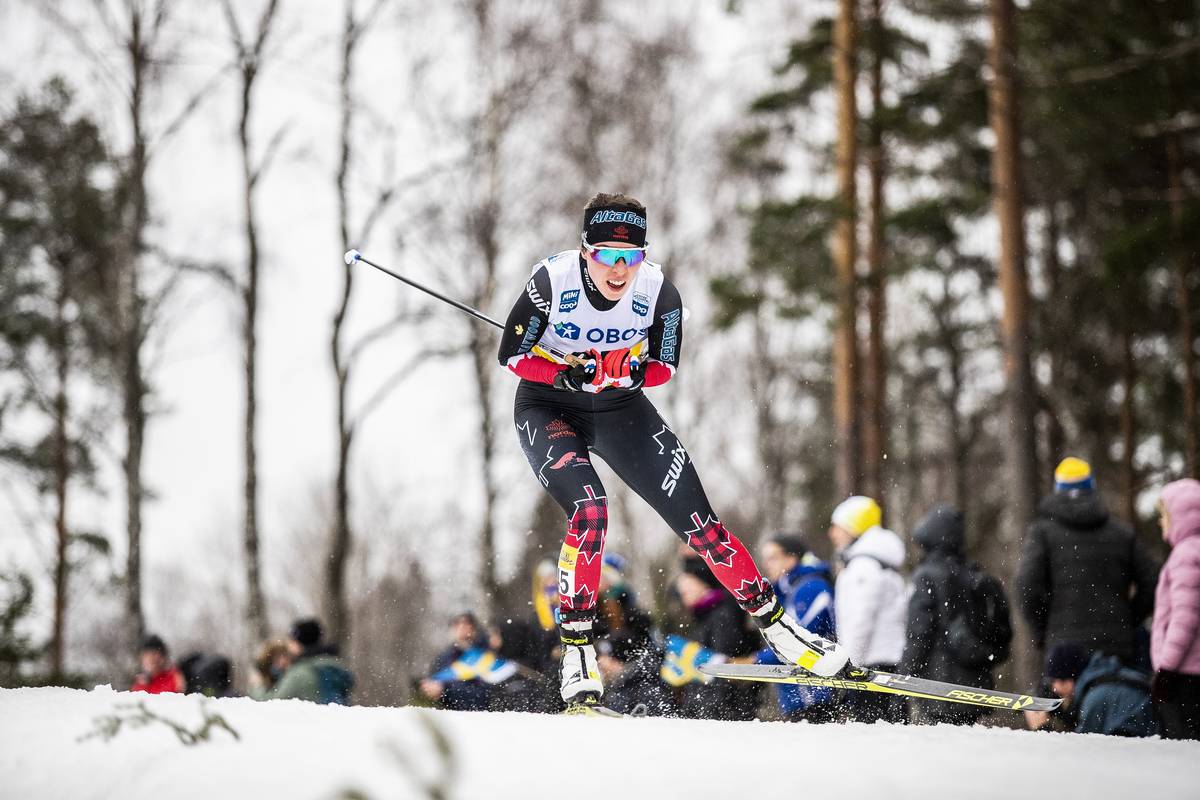
“This is a determined group of athletes who have earned the opportunity to represent Canada and compete on the elite stage of our sport through their impressive results over the last year,” said Joel Jaques, high-performance manager, Nordiq Canada.
“This group has represented Canada at all levels of the sport internationally, and are now anxious to demonstrate their potential during this important season which will serve as the ultimate benchmark in their continued development. I have full confidence they will be fully prepared to achieve our team and their personal goals.”
The majority of the Canadian Team will depart, November 18, to compete in the following races prior to the holiday break:
November 26-28 – World Cup, Ruka, Finland
November 26-28 – Norway Cup, Gålå, Norway (Graham Ritchie, Dahria Beatty, Maya MacIsaac-Jones)
December 3-5 – World Cup, Lillehammer, Norway
December 11-12 – World Cup, Davos, Switzerland
December 18-19 – World Cup, Dresden, Germany
Nordiq Canada will hold a media availability with Canadian Team athletes participating in the Frozen Thunder Training Camp at the Canmore Nordic Centre, November 2, in advance of their departure to Europe.
Nordiq Canada is the governing body of para-nordic and cross-country skiing in Canada, which is the nation’s optimal sport and recreational activity with more than one million Canadians participating annually. Its 60,000 members include athletes, coaches, officials and skiers of all ages and abilities. With the support of its valued corporate partners – Haywood Securities Inc., AltaGas, Swix and Lanctôt Sports– along with the Government of Canada, Canadian Olympic Committee, Canadian Paralympic Committee, Own the Podium and B2Ten, Nordiq Canada develops Olympic, Paralympic and world champions. For more information on Nordiq Canada, please visit us at https://nordiqcanada.ca.

This World Cup coverage is made possible through the generous support of Marty and Kathy Hall and their A Hall Mark of Excellence Award. To learn more about A Hall Mark of Excellence Award or to learn how you can support FasterSkier’s coverage please contact info@fasterskier.com.
It’s the last hurrah, folks. Roughly a year after the COVID-19 virus achieved its global pandemic title, the World Cup finds itself at the end of a season that once looked as if it may not happen in the first place. Though four competitions — Lillehammer, Nové Město, Oslo, and Beijing — were cancelled or postponed, the World Cup toured through Europe from November to March without any known significant outbreaks. All things considered, they pulled off a bold and robust competition schedule.
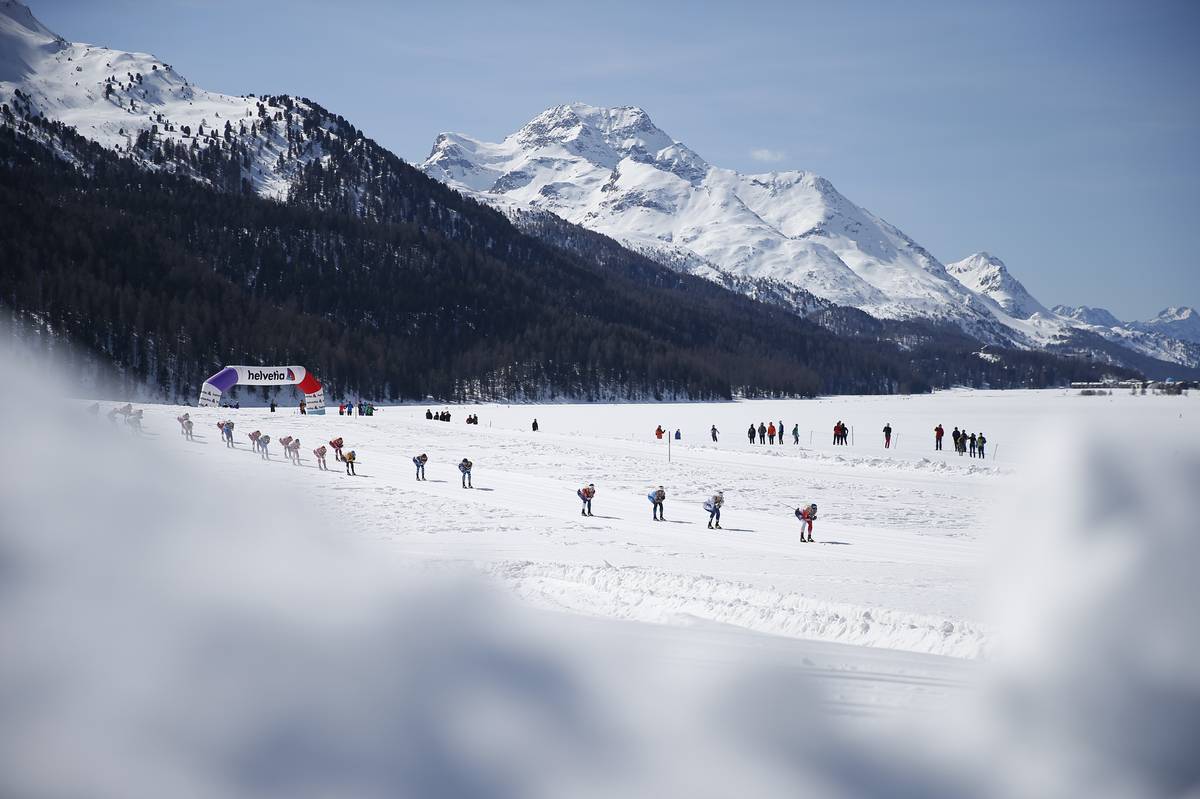
Leaving the unpredictable spring conditions at the World Championships in Oberstdorf, Germany, the cold, crisp tracks and an Alpen backdrop looked like a wintery treat during today’s 15-kilometer mass start classic event. The picturesque venue, home to the Engadin Ski Marathon, is nestled in the Engadin Valley of Switzerland just south of St. Moritz in the town of Surlej. Pristine conditions, bluebird skies, and high mountain air; what more could you ask for in a final stop?
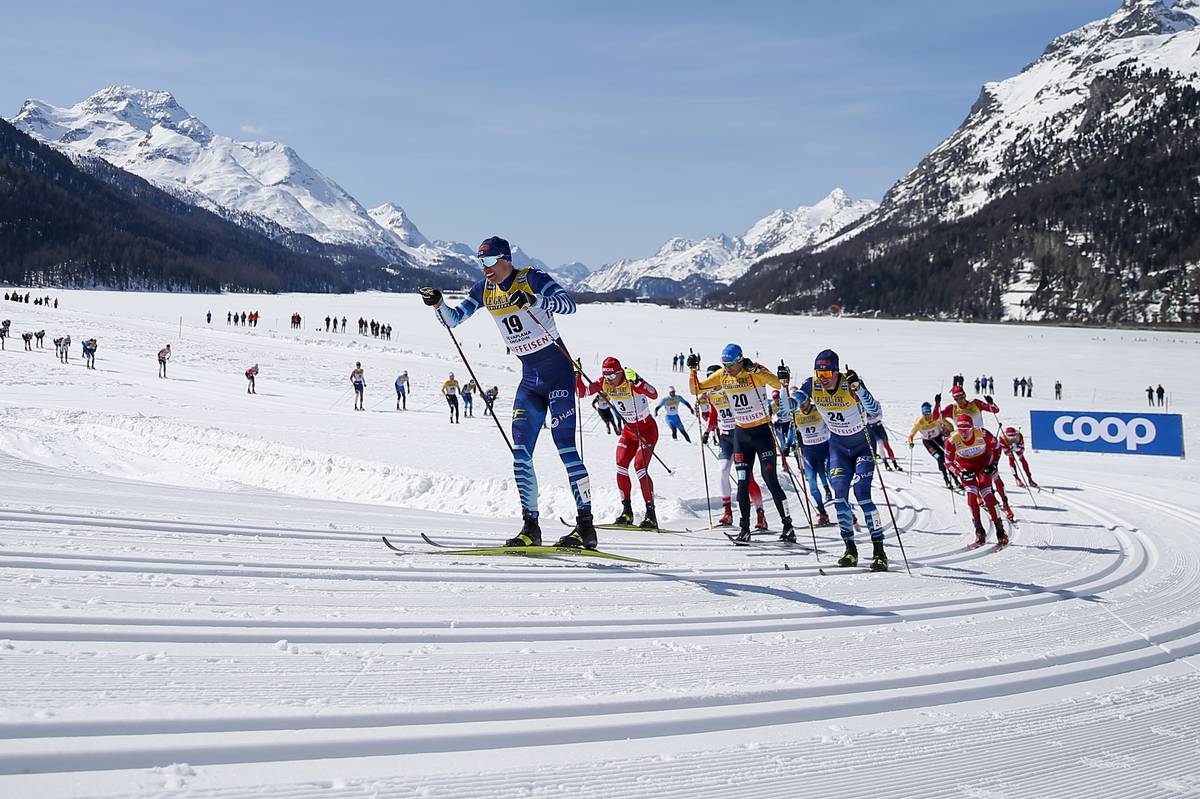
As the dust settles from the World Championship, in particular the conclusive result of the men’s 50k classic just six days ago, eyes were on the 24-year-old duo up front with 5k to go. To put it clearly, we mean Norway’s Johannes Høsflot Klæbo perhaps looking for redemption after his disqualification for obstruction and loss of the World Championship gold medal versus Russia’s Alexander Bolshunov. The Russian also felt robbed of this medal as the interaction with Klæbo in the finishing stretch resulted in a snapped pole, consequently losing him ground to Emil Iversen and leaving him with silver.
With the field staying tight over the first 10 k on Saturday, it was on Bolshunov to move early and avoid setting up a repeat opportunity for Klæbo to sit and kick in his signature style. Time and again, Klæbo the World Champion and Olympic gold medalist in the classic sprint has demonstrated his potential to, quite literally, run away from the field in the final 400 meters, rocketing down the final stretch to clinch the win. Though Bolshunov is the overall World Cup winner for the third year running, it would not behoove the Russian to face off with Klæbo in this way.
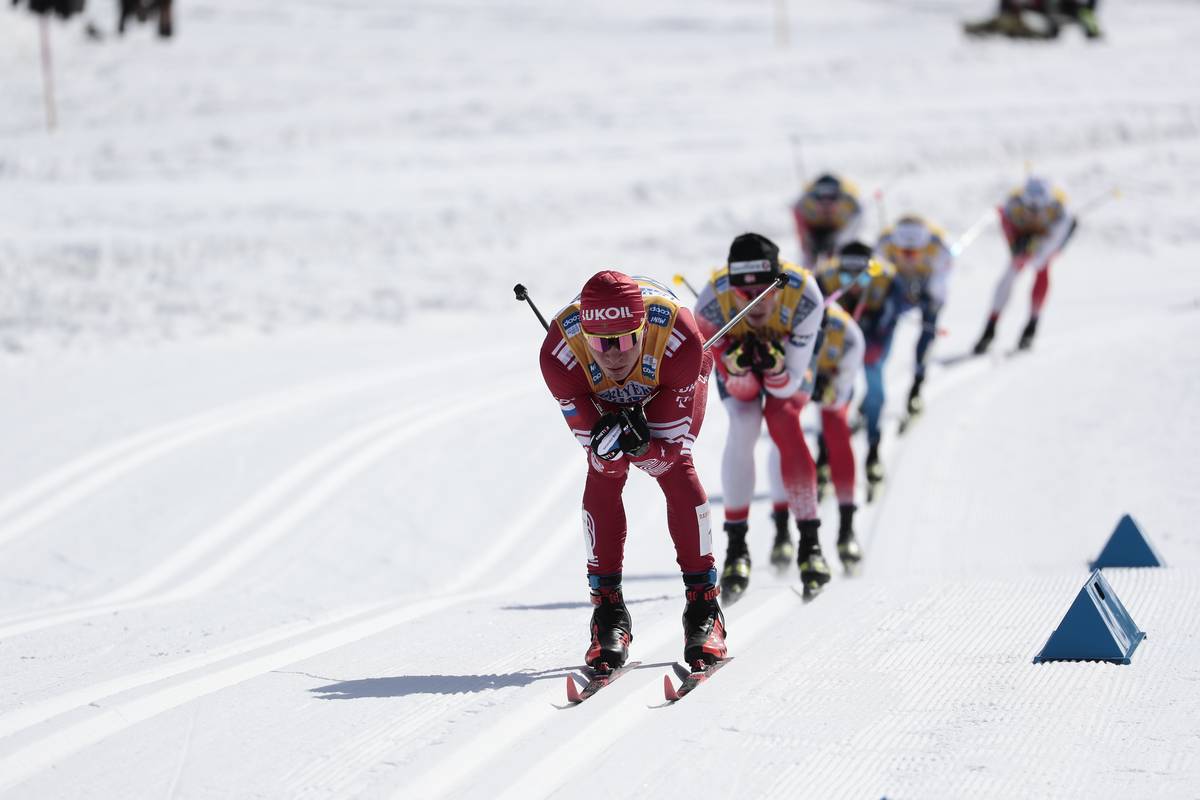
And he knew it. Crossing the bonus sprint checkpoint at 10 k, Bolshunov and Klæbo were side by side. But as the leaders kicked and glided into their final lap, Bolshunov began to surge off the front. At 11.4 k, he had only a second gap ahead of Klæbo who attempted to match the pace. But, by 2 k later, the winner was clear. Bolshunov had a 24.9 second gap at 13.8 k, while Klæbo had allowed the chase group to catch back up, letting go of a win and setting himself up for a sprint finish for second place.
Despite his lead, the Russian kept his foot on the gas all the way to the finish stretch where he raised his arms to soak in his achievement and coasted through the finish in 34:07.1.
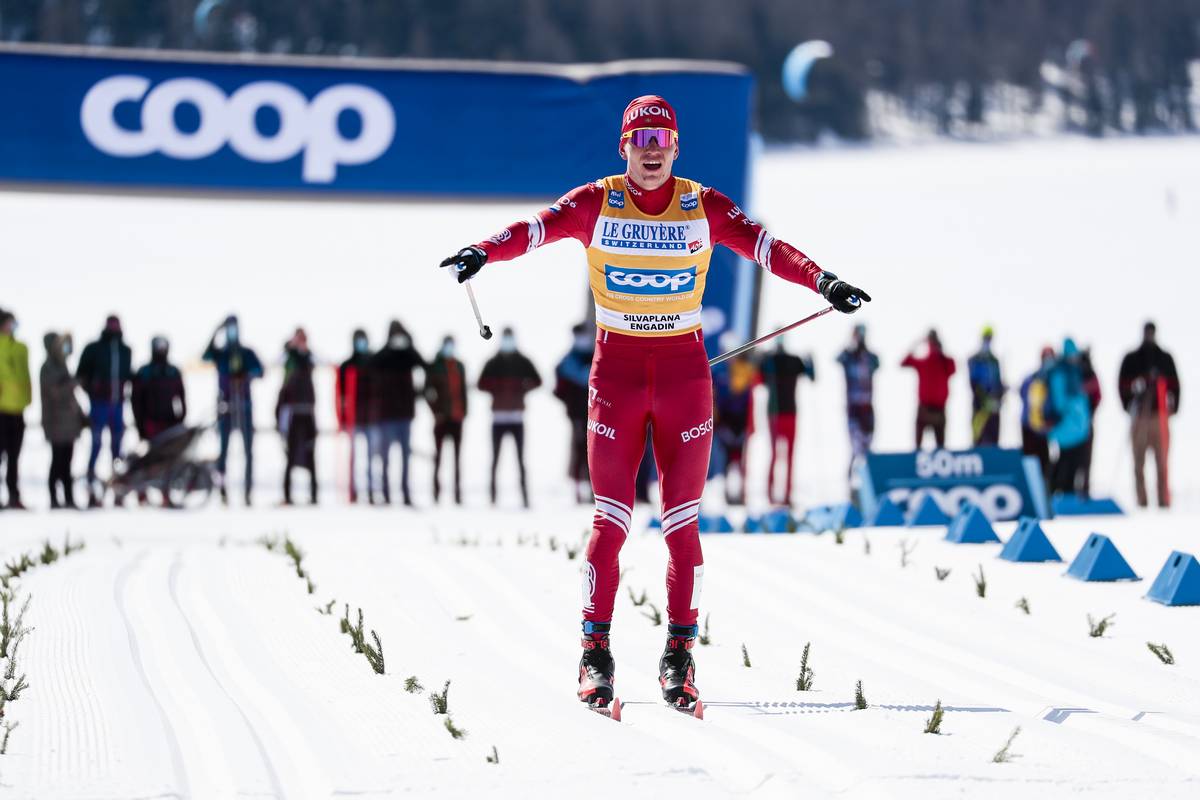
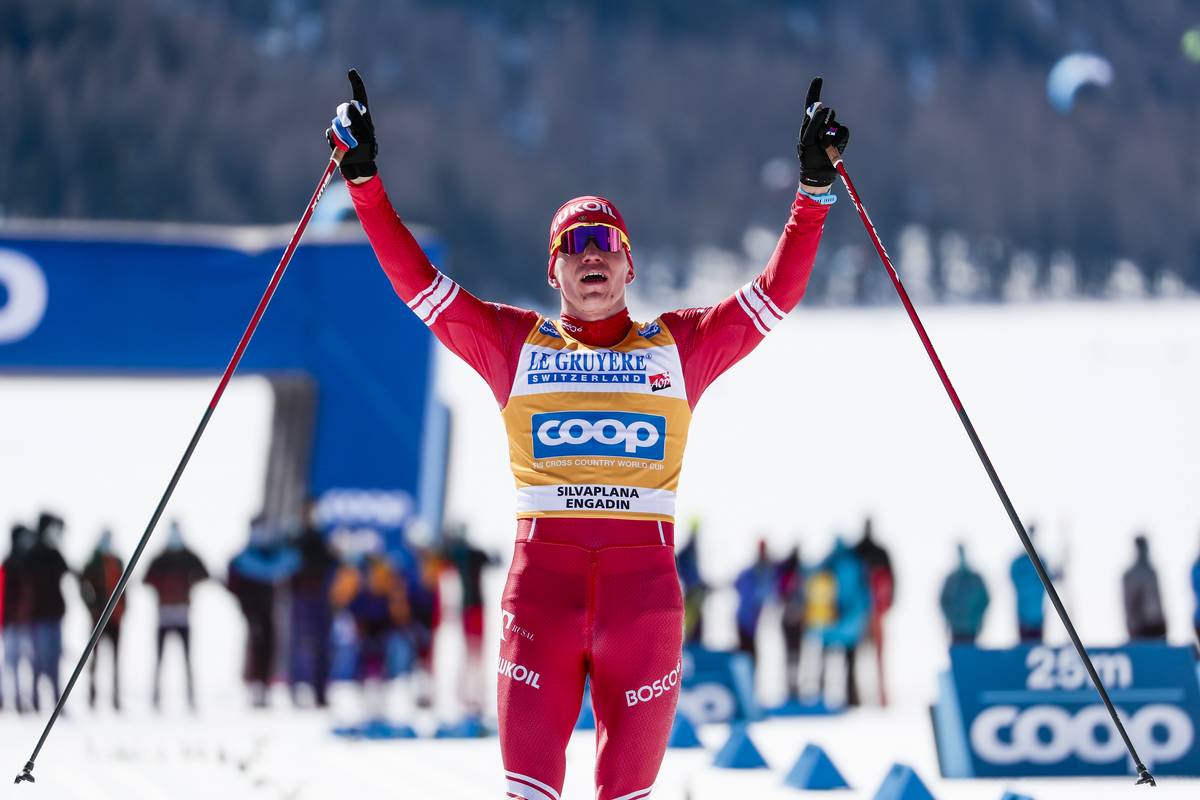
“I really like St Moritz,” Bolshunov told FIS through a translator after the race. “I was very pleased with the conditions here and feel it is one of the best places I have been skiing and training. About the race, I was really happy with the result and happy that now we have again hard winter conditions and that I could push hard on this course. I am very happy to take the victory.”
The remainder of the podium was less certain, with Klæbo heading toward the stadium with a pack of seven men. Utilizing his aforementioned signature, Klæbo engaged his sprint gear to move up to the front of the group, coming into the final 100 meters alongside his teammate Pål Golberg. Klæbo held Goldberg off by half a ski length for second (+18.5), leaving Goldberg in third (+18.9).
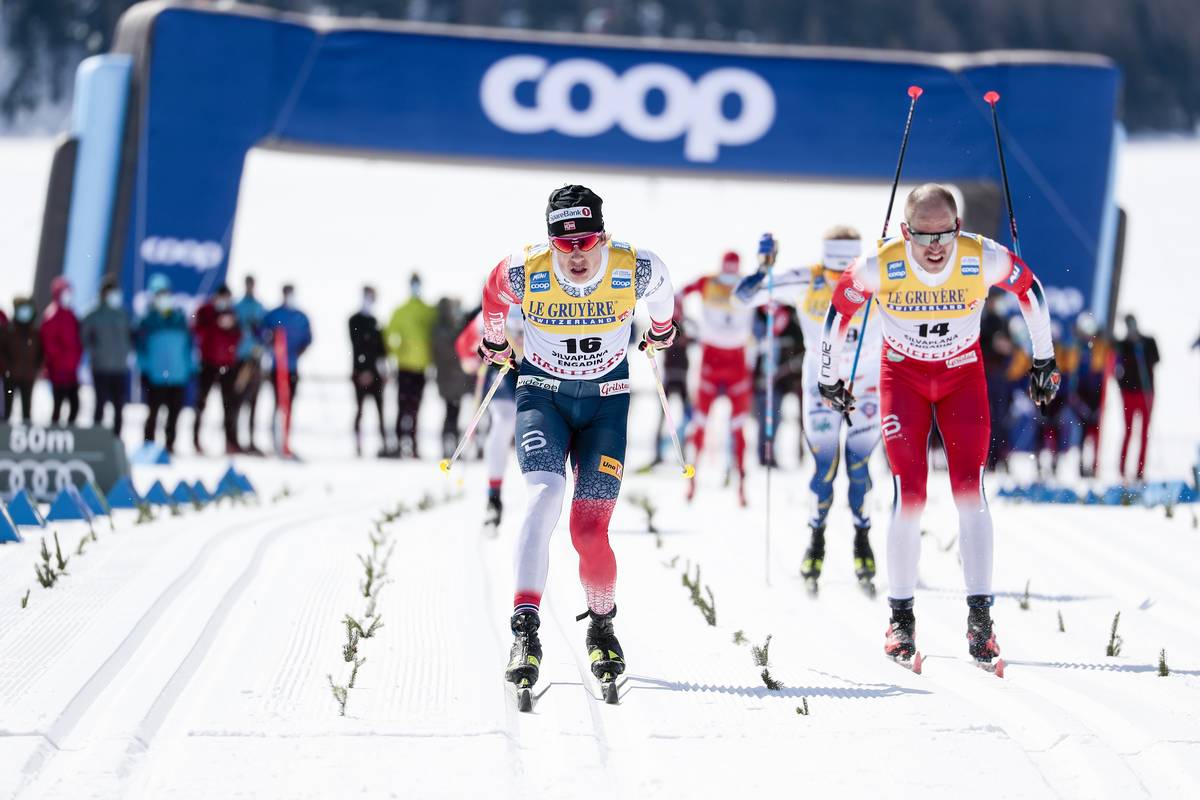

Sweden’s Jens Berman took 4th (+20.0), with Simen Hegstad Krüger of Norway in 5th (+21.2), Artem Maltsev of Russia 6th (+24.2), and Iivo Niskanen of Finland 7th (+27.4). Hans Christer Holund brought up the rear for the first group of chasers in 8th (+31.2).
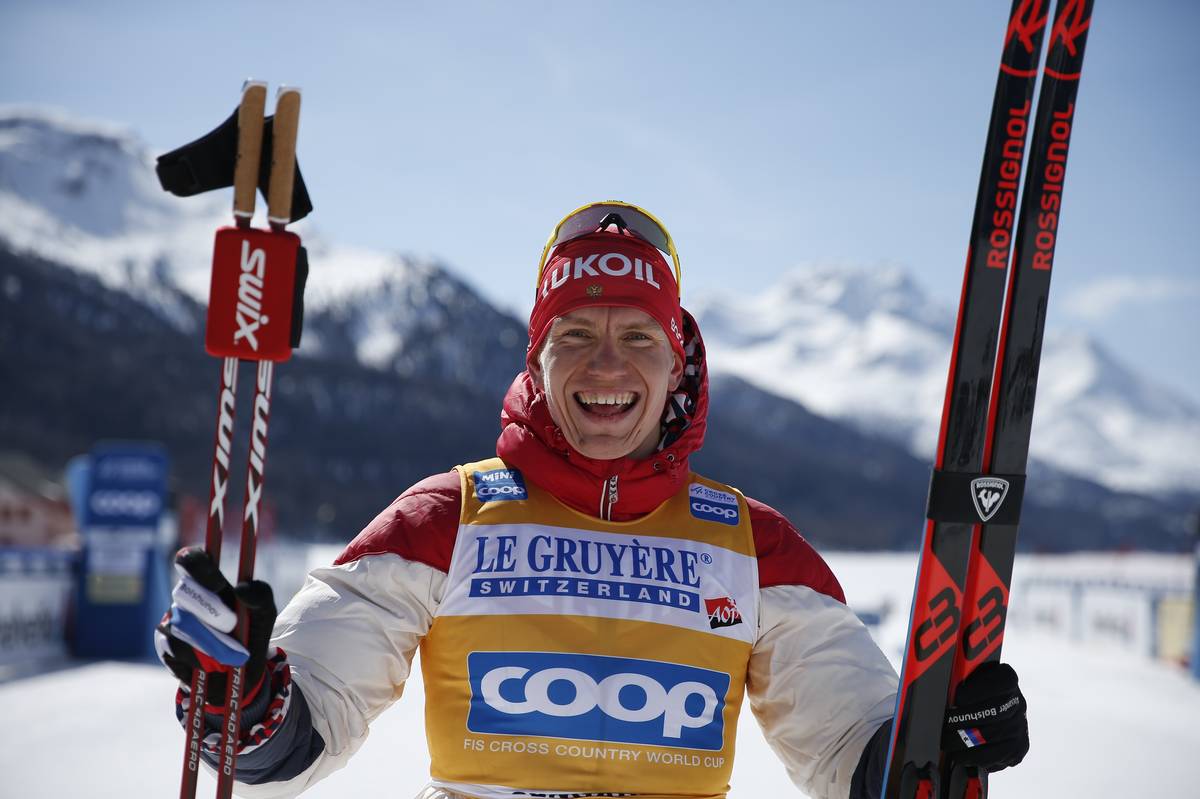
With this 23rd World Cup win under his belt — nine from this season alone — Bolshunov joins Norway’s Peter Northug as joint-fourth on the all-time list. He is the first male skier to win three consecutive World Cup crystal globes, tied for the second-most distance globes in his collection with Norway’s Martin Johnsrud Sundby who also holds three. Only the Swiss champion Dario Cologna outranks Bolshunov, with four distance globes.

Turning to the North American results, Antoine Cyr took 21st for Canada (+54.5), nailing his best individual result of his career. This is the second season on the Senior National Team and racing at the World Cup level for the 22-year-old who hails from Gatineau, QC.
As the dense cluster of skiers from the mass start slowly began to thin out, Cyr skied his way up from 45th and 23 seconds back at the halfway mark to 21st and just 9 seconds behind the leaders at the 10 k checkpoint. Holding his ground in this group over the last 5 k, Cyr crossed the line just behind Andrew Musgrave of Great Britain.
“I had a really good race today — it is the first time I have earned World Cup points, so it’s pretty exciting,” wrote Cyr in a post-race email. “I knew it was a good course for me but I was starting far back on the grid and had to make up a lot of spots on the third lap, then the fourth lap I was just hanging with the pack I was skiing with. I am really happy with the results but I know I have even more to give as I am a rookie on the World Cup and just getting used to the way it races here. I am excited for tomorrow and what is to come!”

Also racing for Canada, Russell Kennedy took 35th (+1:17.0), Rémi Droulet 67th (+2:57.1), and Graham Ritchie 71st (+3:25.5).
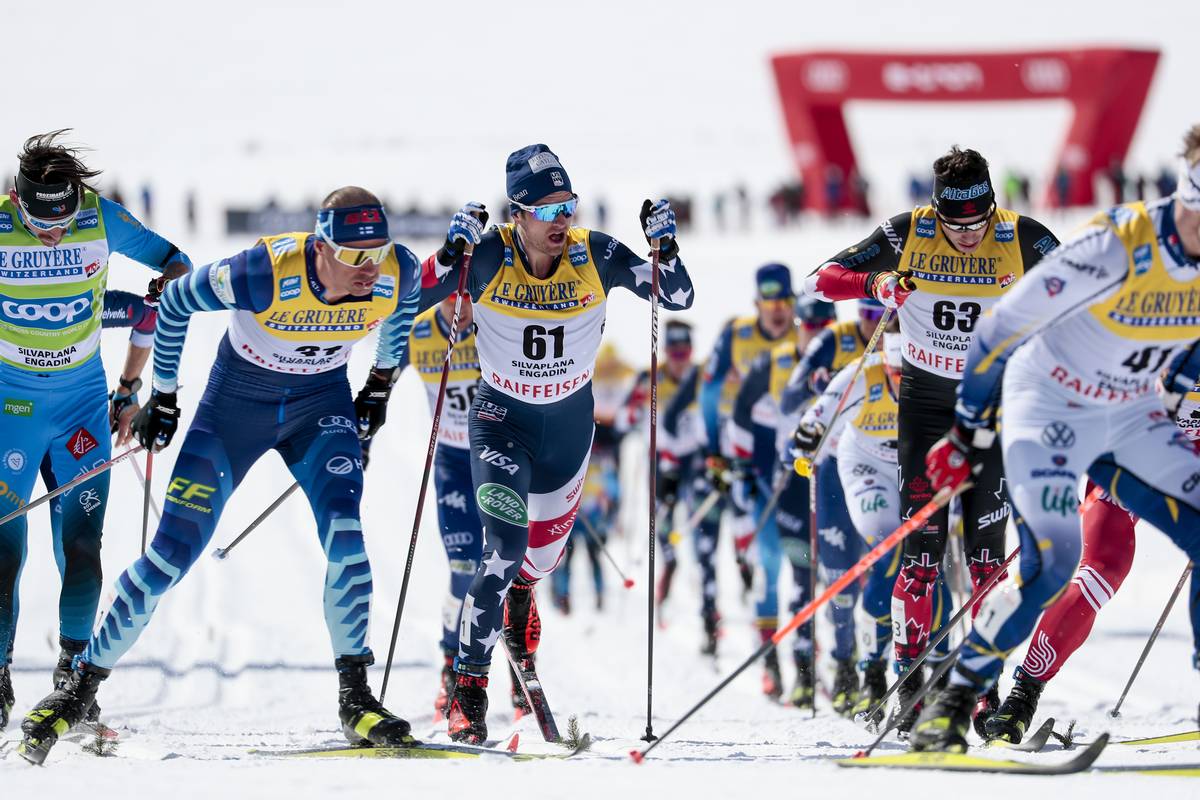
For the US squad, David Norris was the top finisher, leading the way in 41st (+1:31.4).
“Our transition from World Champs to the Engadin went smoothly,” wrote Norris in a post-race email to FasterSkier. “I’ve spent this week previewing the new courses here in the Engadin and trying to recover from the 50km last week. Up until Wednesday my legs were still pretty heavy from my final effort in Germany. I’m in a good place now and race preparation on Friday felt good.
“I didn’t know what to expect going into today’s race. The course is quite flat and there was a pretty strong wind all morning. I chose the wrong skis for this morning so I consistently lost ground on a few crucial descents that fed into long double pole sections where you didn’t want to be alone breaking wind. When the guys up front started to stretch out the pack I was still pretty far back. I wasn’t strong enough to move forward so the last two laps my group seemed to pick guys off who were fading, but otherwise I think we bled time to the packs ahead of us. It was a fun race, but I know this is far from a great performance for me. Time to start thinking about tomorrow’s 50km – I’m real excited for Sunday!”
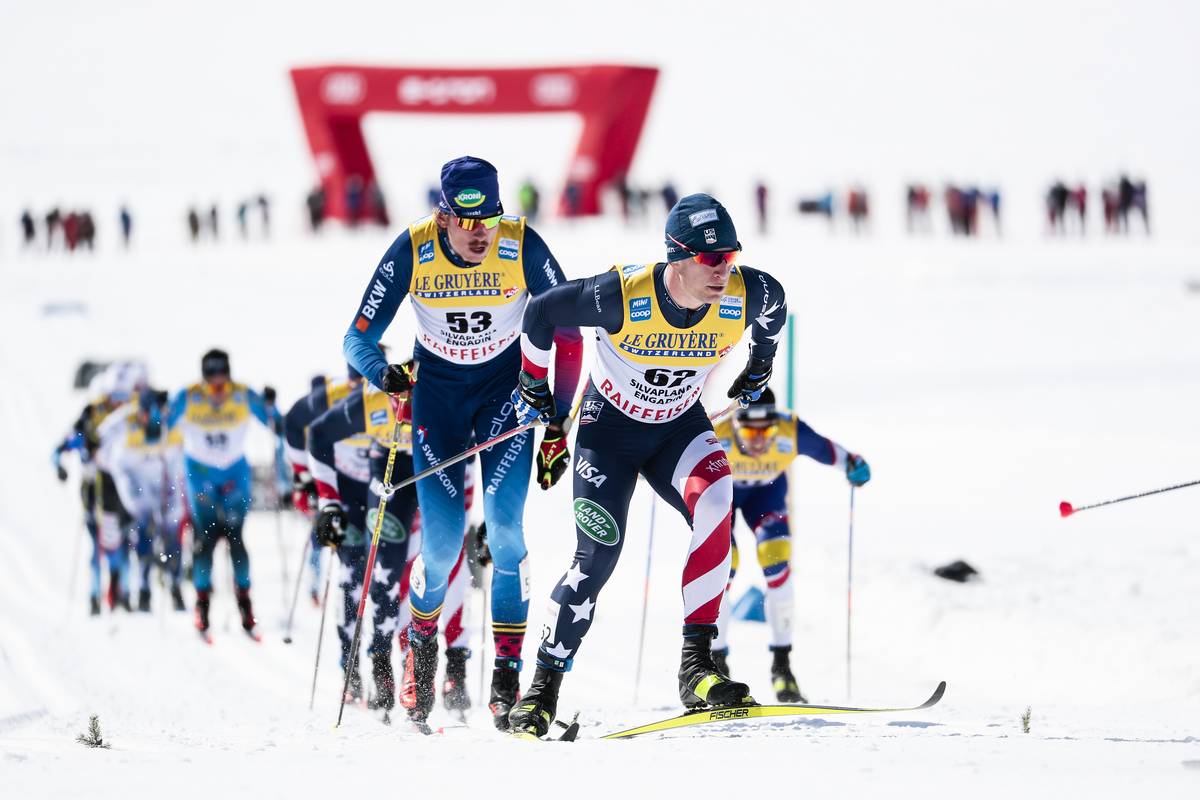
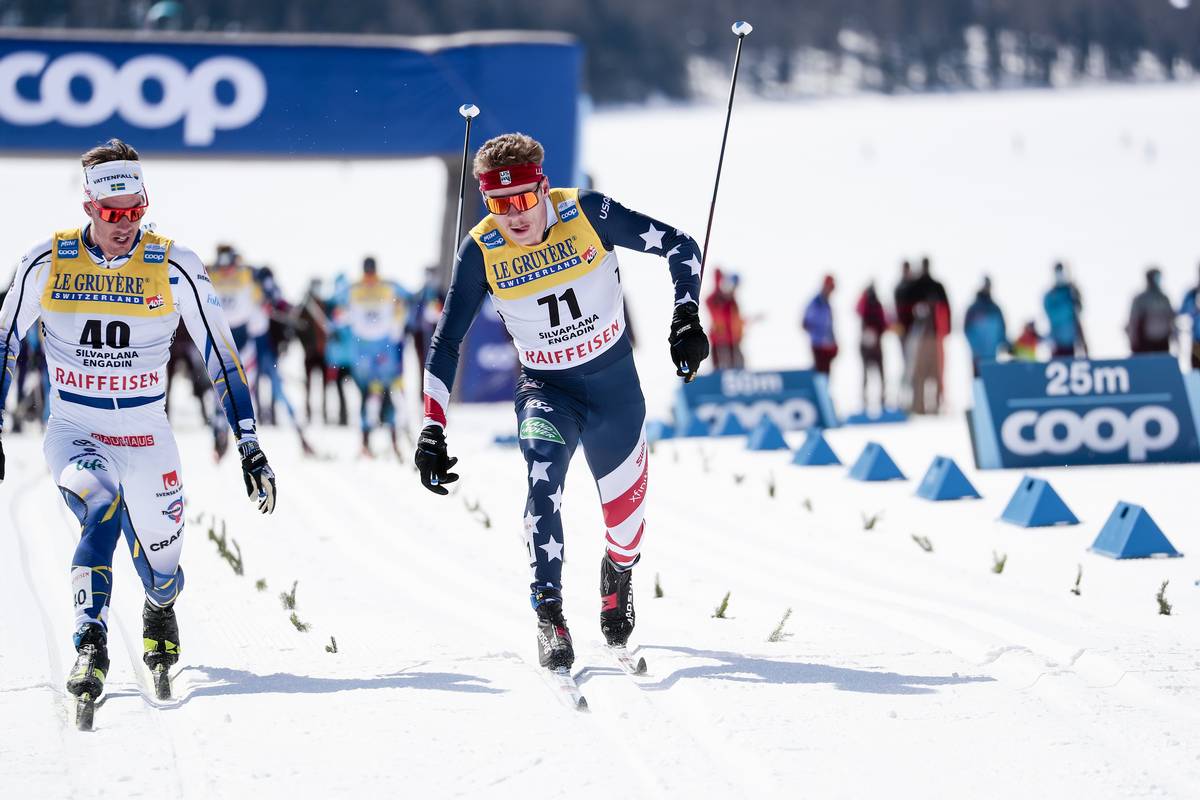
Next up for the Americans, Hunter Wonders crossed the line in 47th (+1:45.4) closely followed by Gus Schumacher in 48th (+1:46.1). Ben Ogden took 51st (+1:51.5) with Scott Patterson 53rd (+1:58.8), Kevin Bolger 60th (+2:11.5), and Johnny Hagenbuch rounding it out in 72nd (+3:39.7). The race saw 82 finishers.


Racing continues tomorrow with a pursuit start 50 k freestyle.

Yellow bibbed as the overall leader of the World Cup, out first on Sunday’s 30 k classic pursuit in Trondheim, and Norway’s Pål Golberg starting 34 seconds back: this was the situation Russia’s Alexander Bolshunov found himself in as he pulsed from the start. Thrown into this mix of tension was a helter-skelter mish-mash of weather. On and off again snow, blustery winds, and temps hovering right near that wax tech’s no man’s land of 0 °C.
We are not used to seeing Bolshunov falter. He has been a beast this season having won the Tour de Ski and hammering away from the field solo during this tour’s Stage 4 34 k mass start skate. Those are simply two highlights. But there he was, perhaps humbled by less than stellar skis on Sunday; the big Russian bear faltered.

This was Golberg’s day. By 2.2 k he had nearly halved the gap to Bolshunov. Two k later, Golberg was on the Russian’s ski tails, with Bolshunov’s metaphorical tail beginning to droop between his legs. A Russian down — Golberg on his own solo quest for the win.
For the next 26 k, Golberg’s job was no longer to fend off Bolshunov, but to keep a motivated crew of Norwegian’s from gapping up. We’ll get to that piece of the story in a bit. Golberg won with a polite bow to the crowd in 1:23:51.6. This was the twenty-nine-year-old Golberg’s second win of the season. He won a classic sprint in Falun, Sweden earlier this month. His effort, and lovely skis on a day that saw several skiers stop and scrape ice off their kick zones, earned him the Ski Tour overall win.
“It’s surreal and something I did not expect before the Ski Tour and before the season,” Golberg told FIS after the race. “The crowd started to congratulate me on the third round so I had to stay focussed until the finish.”


Back to the chase – which was really a Norwegian hunt for that Russian bear. We’re going to begin with the hunters: Martin Løwstrøm Nyenget, Simen Hegstad Krüger, Johannes Høsflot Klæbo, Hans Christer Holund, Emil Iversen, and Sjur Røthe. (Imagine having that crew team trialing behind.) Maybe grotesque in their spoils, but certainly dogged in their pursuit, this all Norwegian chase was symbolic of a country’s ability to foster otherworldly endurance talent, and keep them fresh enough to crush the field in a six-stage tour. It was literally a train of Norwegian skiers who had likely been shadowing one another at the elite level since their late teens.
They slowly reeled Bolshunov in. At 13.9 k, the Russian kept a 14-second buffer between he and the Norwegians. Ultimately, this was no catch and release scenario. Bolshunow was swallowed near the 16 k mark. Another three k later, all but Røthe kept pace, the others gapped Bolshunov by nine seconds.
The Norwegians forged ahead, while Bolshunov, digetsing the inevitable, tried to minimize losses. Krüger, known for his skating, took strong pulls in the closing kilometers. He crossed the line in second (+28.9). Holund placed third (+30.1), Iversen fourth (+32.3), Nyenget fifth (+32.9), and Klæbo sixth (+34.2).
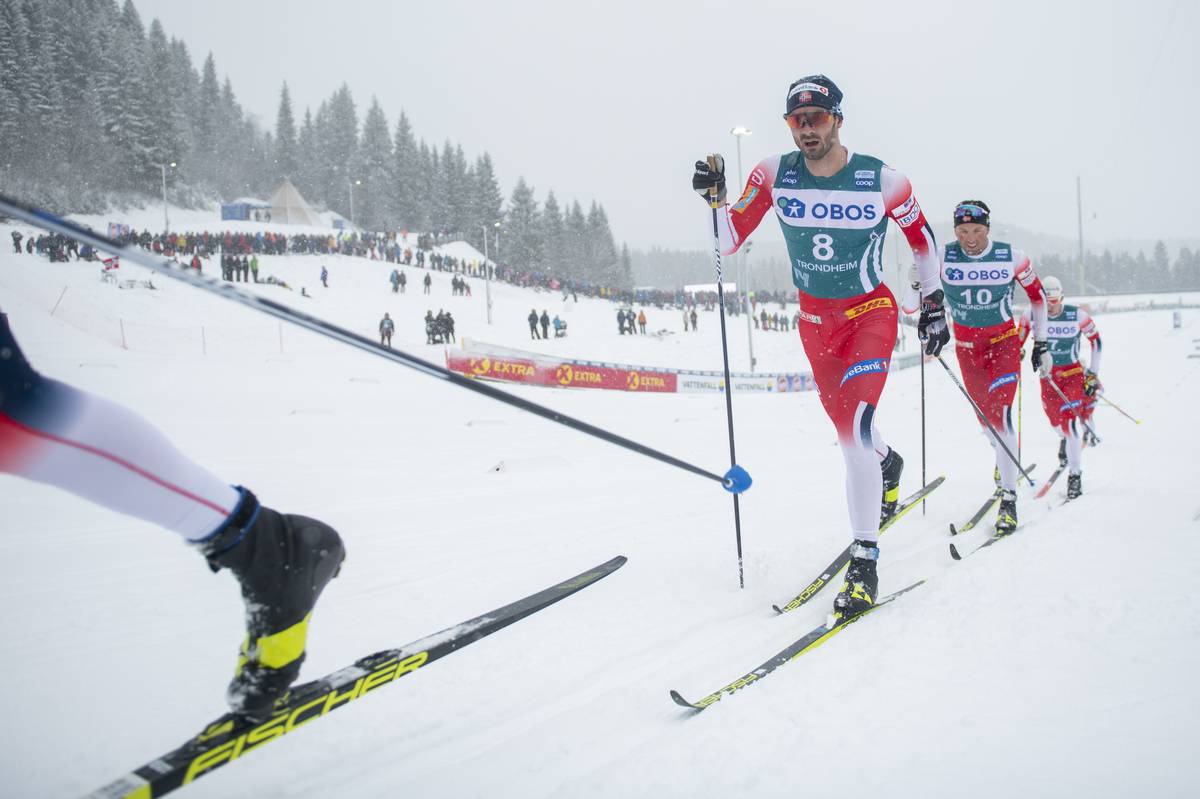
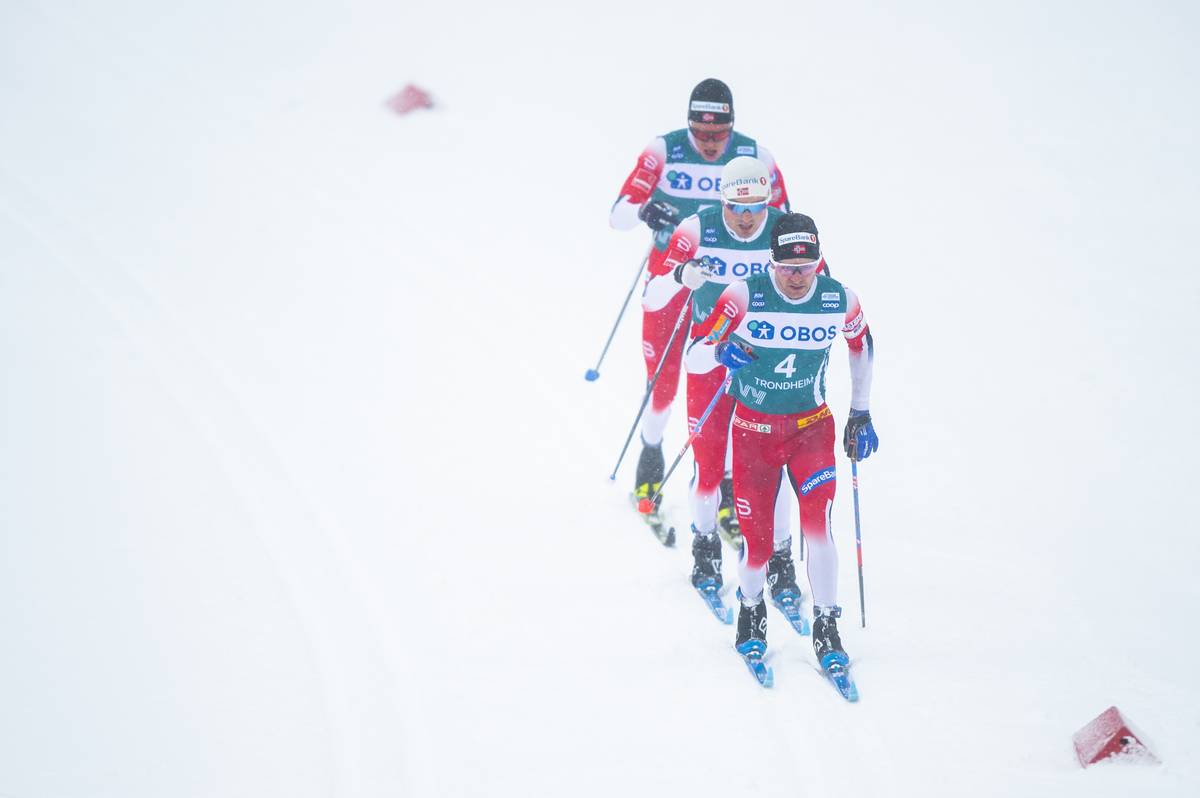
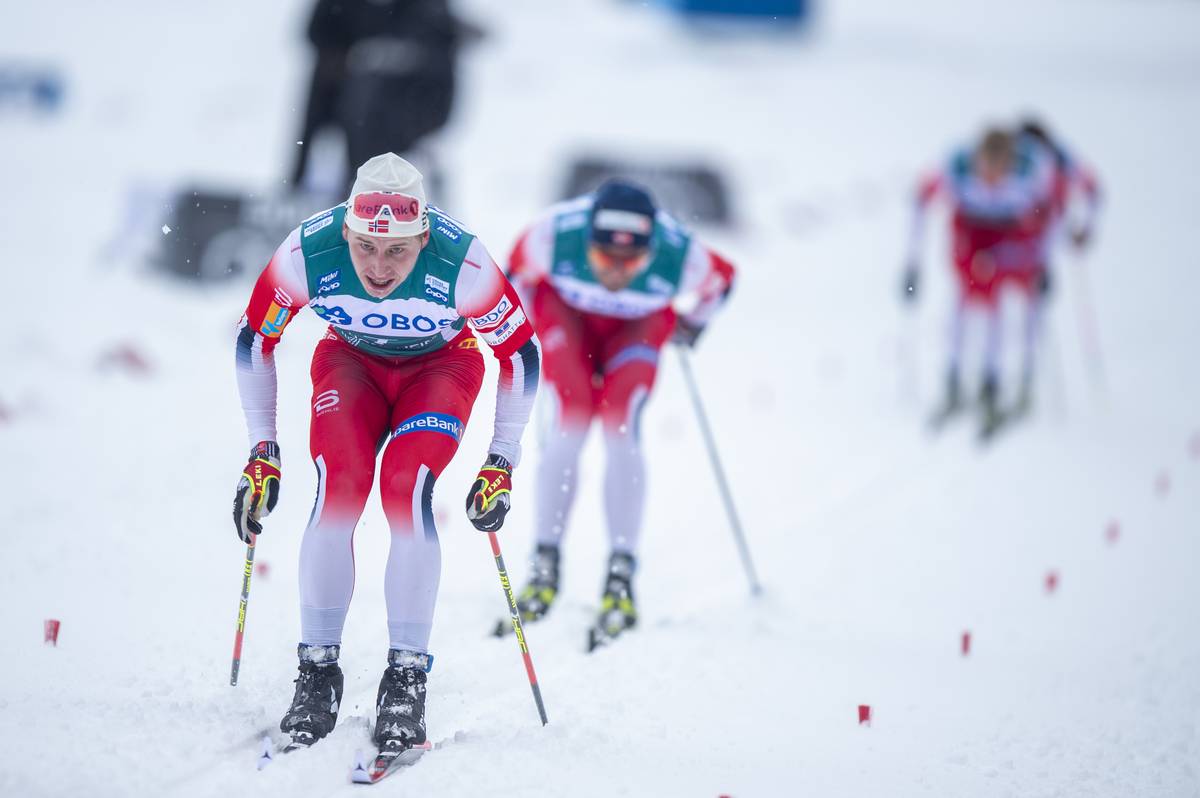
Bolshunov settled for seventh place (+1:41.0), ceding roughly 1:10 to that lead Norwegian group, as he lost grip on the Ski Tour overall. His demeanor across the line matter of fact: he unlocked his bindings as he glided across the line, stepped out his skis, then proceeded through the finish area without acknowledging the all-Norwegian scrum in the finish pen.
As for time of day efforts, the fastest time goes to Iversen in 1:21:25.9. Finland’s Iivo Niskanen notched the second-fastest time 10.9 seconds back. Niskanen placed eighth on the stage (+1:48.2). For his troubles, Bolshunov skied the 23rd fastest time, 4:06.7 off of Iversen’s best of day mark.
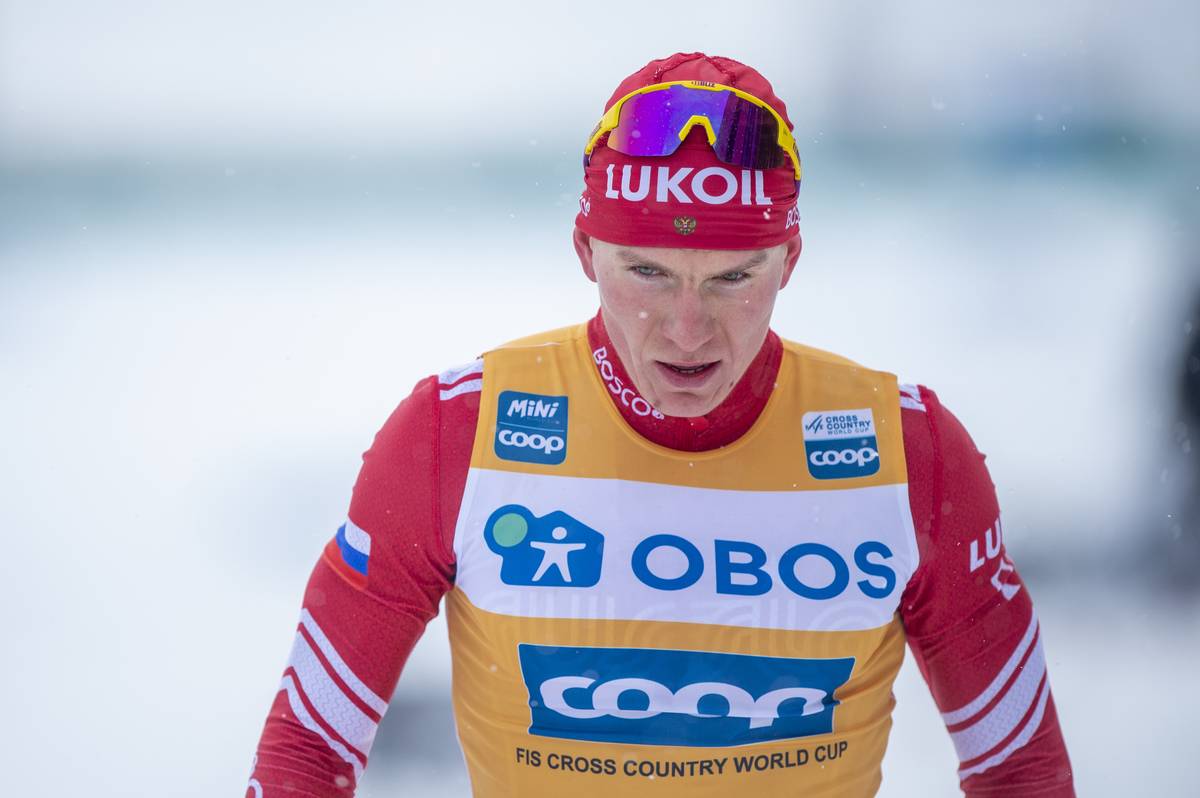
David Norris led the day for the U.S. ending the day and the Ski Tour ranked 34th (+11:30.7). Ben Lustgarten placed 54th (+19:29.5). The remaining U.S. skiers who began the tour, dropped from competition after Stage 6. They include Logan Hanneman and Kevin Bolger who both have mild colds. Simi Hamilton dropped after Stage 4 with a mild illness as well.
Canada’s Russell Kennedy placed 39th (+12:50.5), Evan Palmer-Charrette 43rd (+14:33.2), Alexis Dumas 55th (+20:12.5), and Ricardo Izquierdo-Bernier 56th.
This concludes the epicness from Norway, as the Ski Tour closes out. Racing begins again in Lahti, Finland next Saturday.
Results | Overall Standings | Winner of the Day


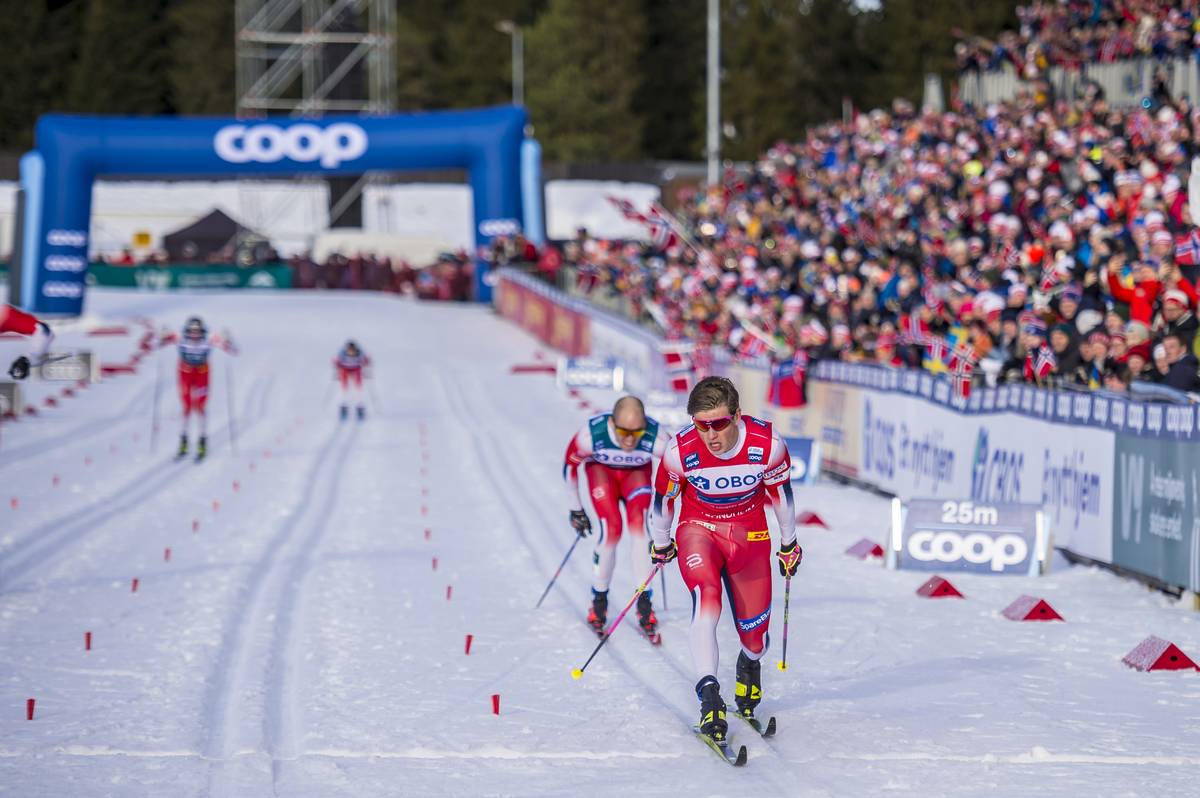
Takeaways from Stage 5 (of 6) of the Ski Tour 2020? Alexander Bolshunov no longer has his minute-plus cushion to Pål Golberg in the overall, and Johannes Høsflot Klæbo is rounding into G.O.A.T. (Greatest-Of-All-Time) form.
The 23-year-old Bolshunov, a Russian powerhouse who won the Tour de Ski last month, ranks first in the overall World Cup standings, and has landed on the podium in four out of five races so far this month (before Saturday’s classic sprint), crashed and burned in Saturday’s semifinal. He took himself out while switching tracks with 100 meters to go, clipping his left leg with his right ski and falling out of contention (from fourth to sixth) in the finishing straight. That was the end of his day, and his 1:05-minute lead in the Tour standings was reduced to 34 seconds on Golberg, who kept himself in prime position by finishing second to Klæbo in the final.
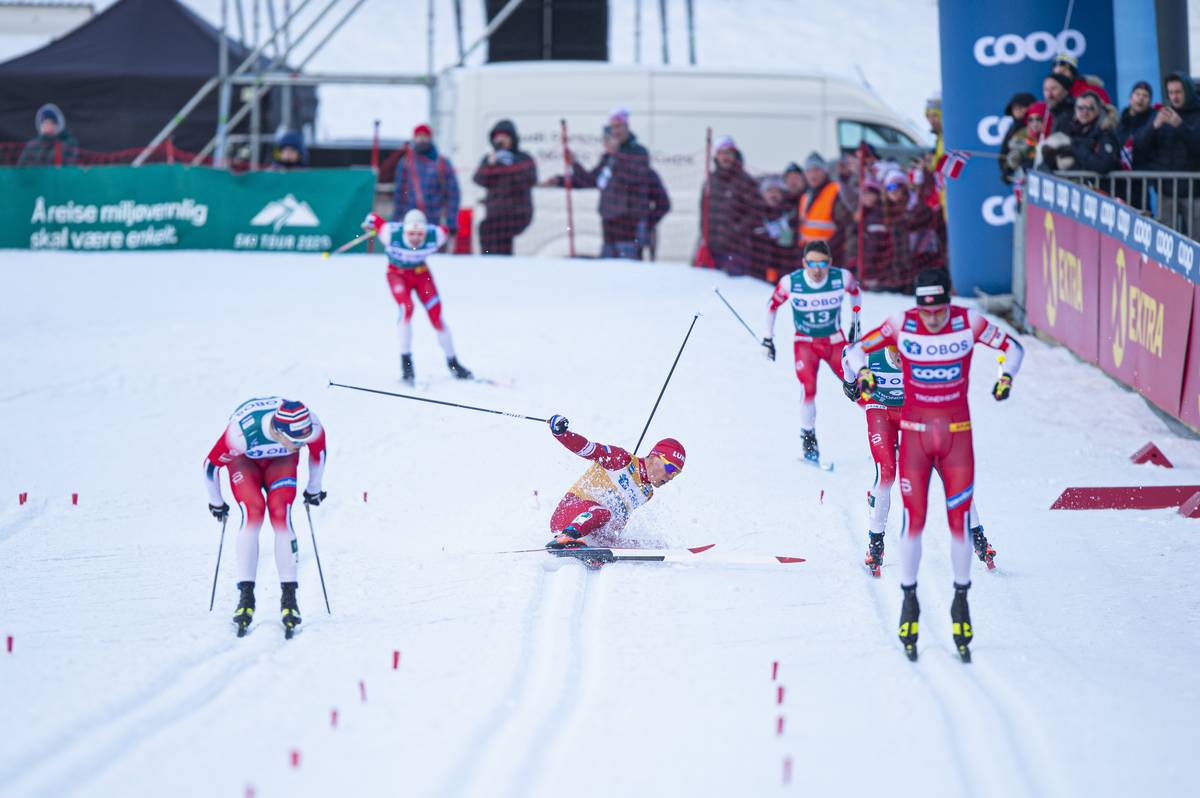
Then there was Klæbo, also 23, second in the overall World Cup standings and a Norwegian celebrity in his hometown of Trondheim, who did what he does best — dominate a sprint race — in front of a slew of familiar faces. He had never won a race at home in Trondheim before, and he did so Saturday in the men’s 1.5-kilometer classic sprint for his 14th straight World Cup individual win and 49th World Cup podium.
“I’ve been dreaming about this since I knew we were coming here,” Klæbo said of his latest victory in a post-race interview with the International Ski Federation (FIS) on Saturday. “So to be able to win here is just amazing, and I’m really proud to be able to win here today.”
He started the day by winning the qualifier by more than 2 seconds (over fellow Norwegian Erik Valnes +2.42 in second), and later advanced comfortably out of the quarterfinals and semifinals to the final. In the first quarterfinal, Klæbo cruised to second place behind Golberg, after Golberg set the pace up front for the bulk of the nearly 3-minute race, before decisively winning his semifinal (after passing Golberg on the last climb) by 1.2 seconds.
That semifinal saw five Norwegians — Klæbo, Golberg, Valnes, Finn Hågen Krogh, and Simen Hegstad Krüger — pinned against Bolshunov. They finished in that order after Bolshunov, who had qualified fourth and advanced in second behind Valnes in their quarterfinal, went down in front of the stands while Krogh and Krüger passed him by. Klæbo, who had the luxury and time to ease way off before the finish line, moved on to the final along with Golberg, Valnes, and Krogh. Bolshunov, who crossed the line nearly 17 seconds after Klæbo, did not, and he ended his day in 12th.
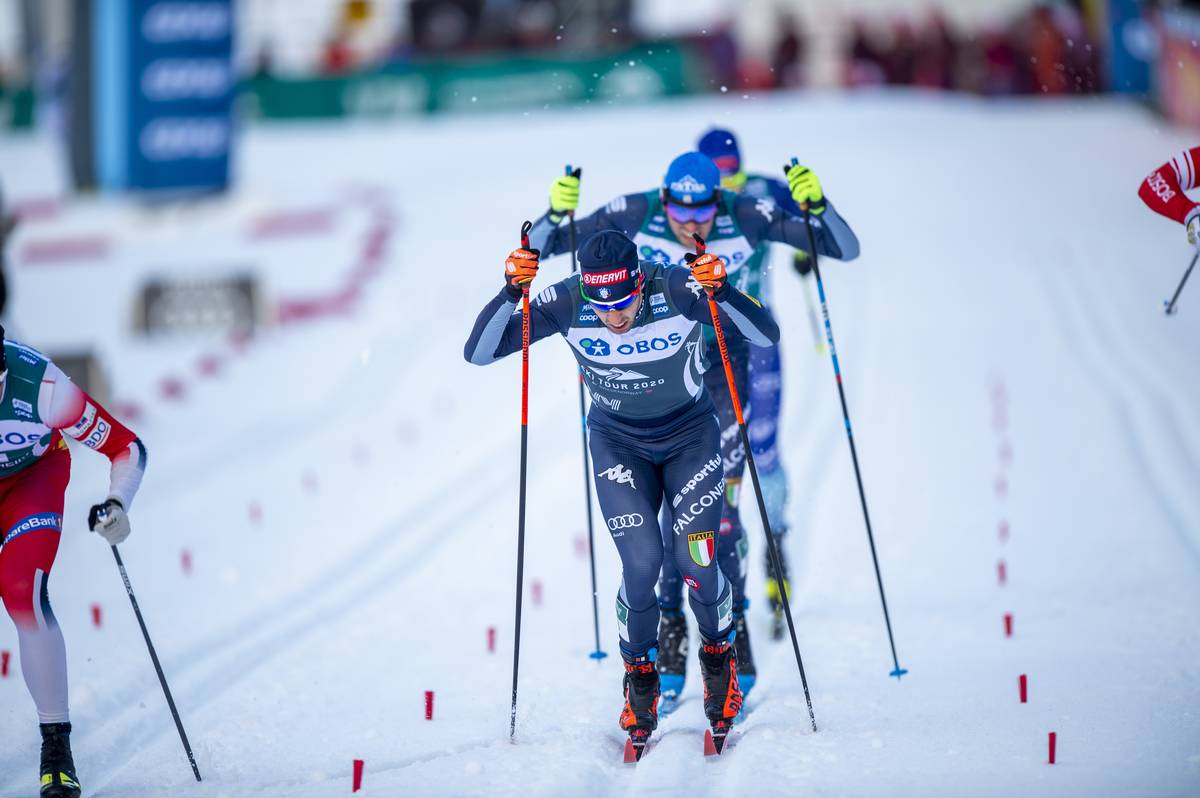
The second semifinal was more diverse with two Italians — Federico Pellegrino and Francesco de Fabiani — going head to head with Norway’s Emil Iversen, Russia’s Gleb Retivykh, Finland’s Lauri Vuorinen, and Sweden’s Johan Haeggström. Wet snow that had begun in the later men’s quarterfinals had mostly stopped falling, and the sun began to poke through on the +3 Celsius afternoon.
On an early climb, Haeggström fell to his knees and broke his pole while skiing at the back of the pack. He quickly received a replacement, but wasn’t able to regain contact with the group while Pellegrino took charge up front. Despite leading into the stadium, Pellegrino lost some steam in the finishing stretch while Iversen came from behind to cross the line first, 0.3 seconds ahead of Pellegrino and 0.6 seconds ahead of Retivykh. Iversen and Pellegrino advanced to a nearly all-Norwegian final, with five men in red against the Italian in dark blue.
From there, it was another Klæbo jam sesh as the local hero set the tone in the final. Valnes initially led up the first climb while Klæbo, Golberg and Iversen followed closely. By the next uphill, Klæbo used his ferocious double pole to outmatch his teammates, who were still striding. Meanwhile, Pellegrino fell off the pace and into sixth. Klæbo kept the lead for the rest of the race, getting a gap on Valnes and Golberg on the descent into the stadium before running away with the win in 2:52:07. Golberg placed second, 1.2 seconds back, Valnes third (+1.6), Iversen fourth (+5.79), while Krogh, who also faded when Klæbo kicked into high gear, pulled some theatrics at the line and stalled before crossing 18.91 seconds back. Pellegrino finished last for sixth on the day, 22.78 behind Klæbo. That secured Klæbo’s spot as the men’s sprint champion for the Ski Tour 2020, while Pellegrino placed second, 13 points back, and Golberg was third, another 26 points back.
“It was an amazing day for us Norwegians,” Klæbo told FIS. “We had really good skis today, and I think we have done something right. It was a really fun race, and I think it’s an amazing to see how many people that actually come here and cheer for us. It’s something we really appreciate.”
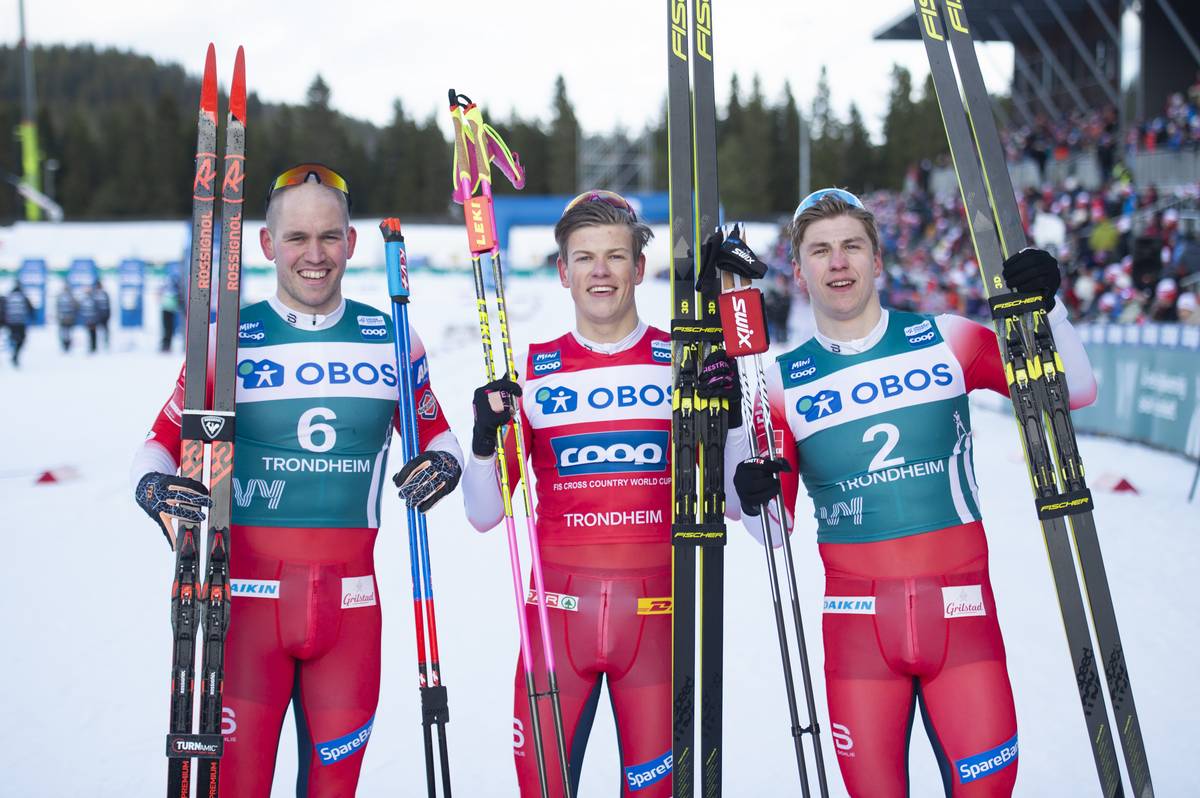
In the overall Tour standings, Klæbo is up to sixth (+2:00.0) with one race — a 30 k classic pursuit — remaining on Sunday. Golberg will start 34 seconds behind Bolshunov, while Krogh in third overall will start just over a minute later (+1:35), ahead of Sjur Røthe (+1:40) and Martin Løwstrøm Nyenget (+1:46), also from Norway. In fact, eight of the top 10 men in the overall Tour standings are Norwegian. The other two are Russian: Bolshunov and Andrey Melnichenko (9th place).
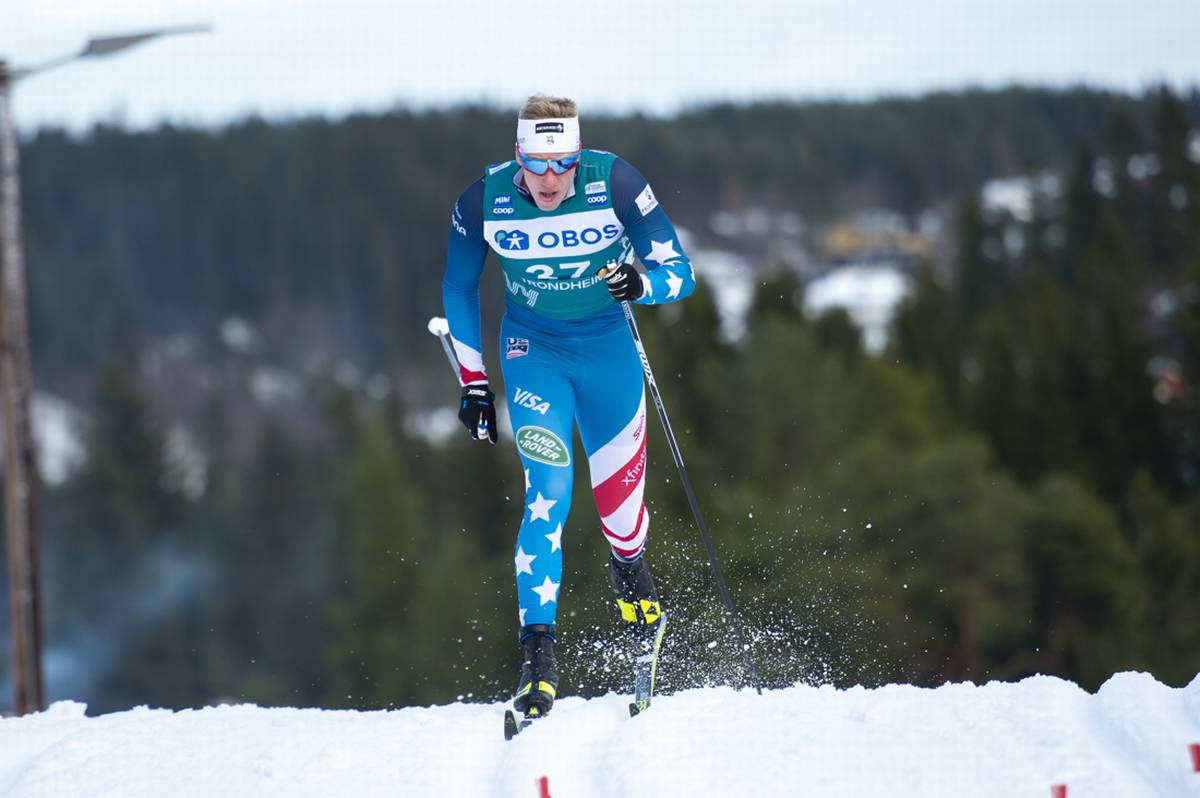
No North Americans qualified for the heats on Saturday, with Alaska Pacific University skier Logan Hanneman coming closest in 34th, 0.9 seconds out of 30th and 14.38 seconds behind Klæbo. Fellow American Kevin Bolger placed 48th (+17.28) while Canada’s Russell Kennedy followed in 49th (+17.43) in the qualifier. American Ben Lustgarten finished 57th (+18.81) while Canada’s Alexis Dumas, Evan Palmer-Charrette and Ricardo Izquierdo-Bernier placed 59th (+19.6), 61st (+20.54) and 62nd (+20.74), respectively. American David Norris was 69th (+23.81), while Simi Hamilton did not start and is thus out of the Tour.
According to U.S. Ski Team coach Matt Whitcomb, Hamilton and Bolger have mild head colds, and Bolger and Hanneman, who rank 64th and 71st, respectively, out of 73 still in the Tour, will not start Sunday’s final stage.

With the course re-routed from the original 38-kilometer mass start skate to essentially an out and back into Meråker, Norway’s ski stadium, the day belonged to Russia’s Alexander Bolshunov who appears, at this point in the season, to be unstoppable in the distance events.
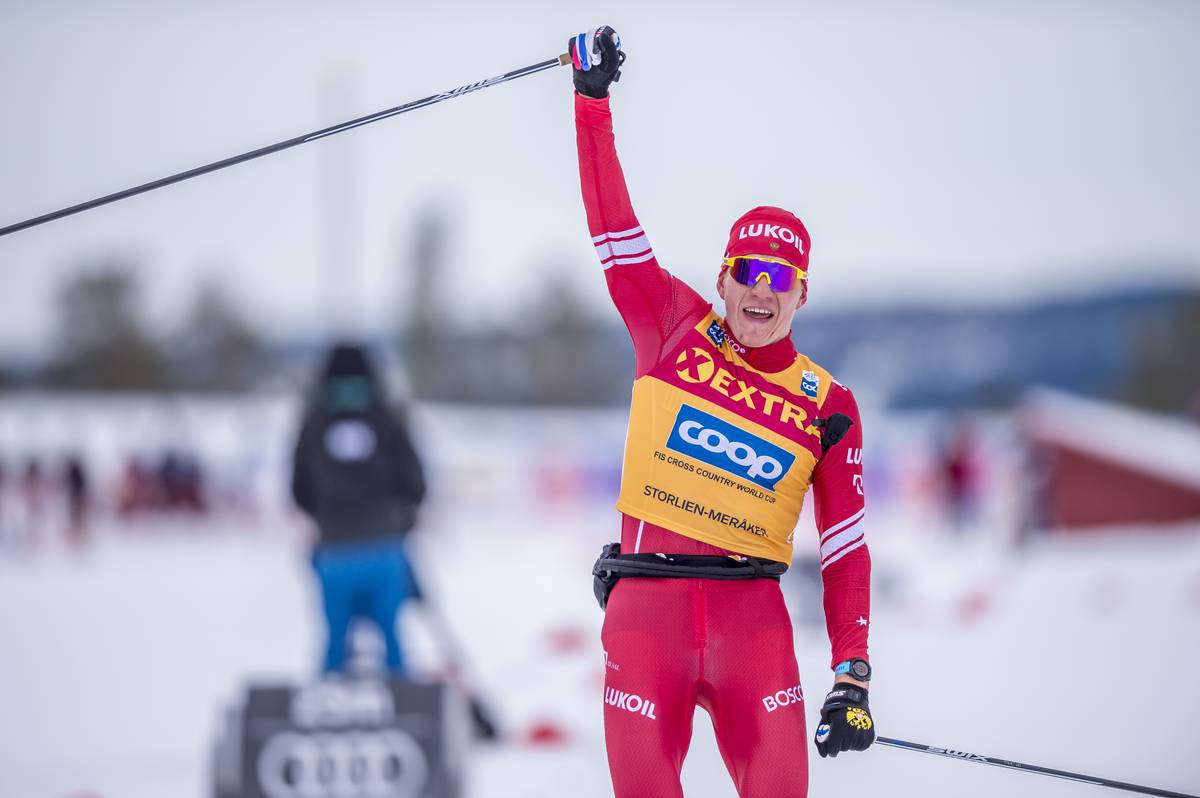
In a post-race interview, Devon Kershaw noted that men paced it World-Cup comfortable for much of the first portion of the race. In other words, the effort up-front, although speedy for most, was not a break apart the 79 starters into small groups of similarly paced pockets of effort.
Fast forward to the 14 k mark, and 32 men came through the time check within 1.8 seconds. At that point, Jens Burman of Sweden was driving that train.
Through the race mid-point, the pack faced a steady headwind. Tactically, it made sense for any would-be endurance escape artist to wait until the turn home on the mostly out and back course, when a tailwind could aid their efforts, to make a move.
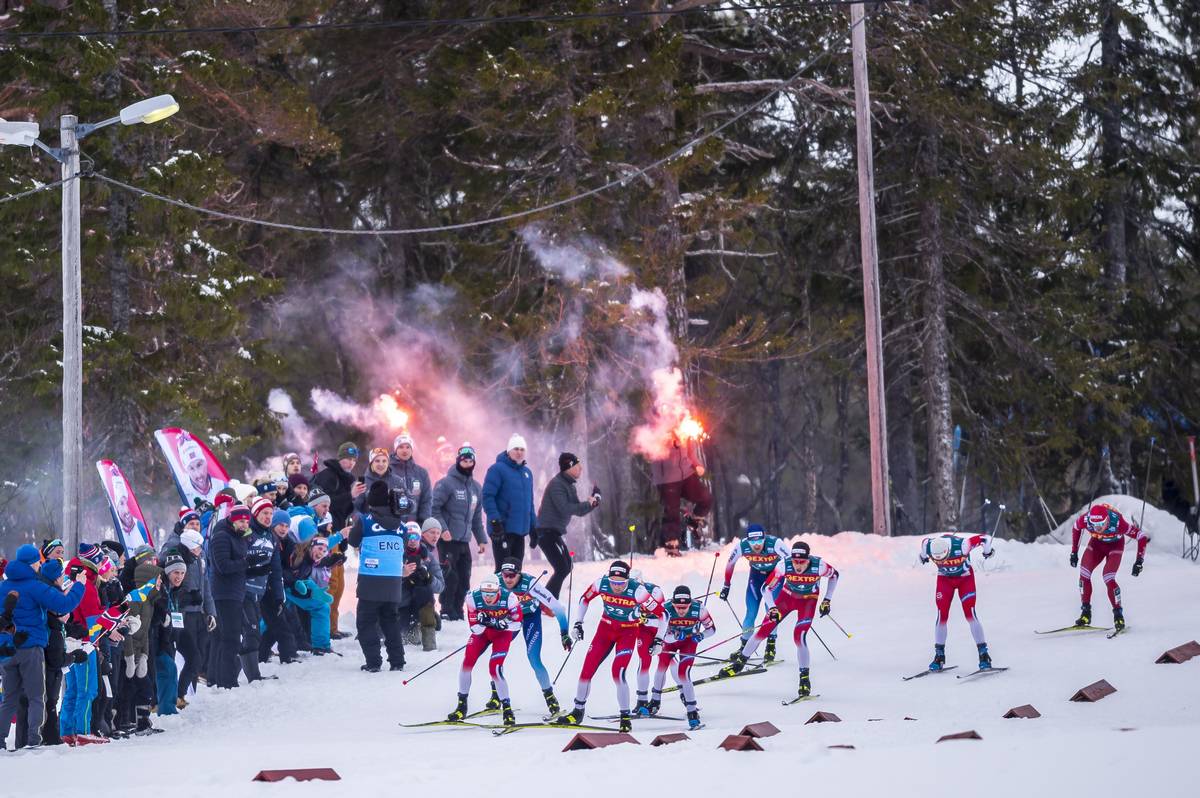
Sjur Røthe of Norway took big pulls leading as did his teammate Finn Hågen Krogh. Later in the race, Emil Iversen too sensed some podium opportunity. We could expand the list. But that would perhaps overshadow Bolshunov.
A select group began to pick up the pace as skiers sped towards the 20 k time bonus. This included Røthe, Krogh, Bolshunov, Iversen, and Johannes Høsflot Klæbo who came through the check-in 17th. (This was not the Norwegian national champs, although nine Norwegians, at that point, jammed the front 17 spots.)
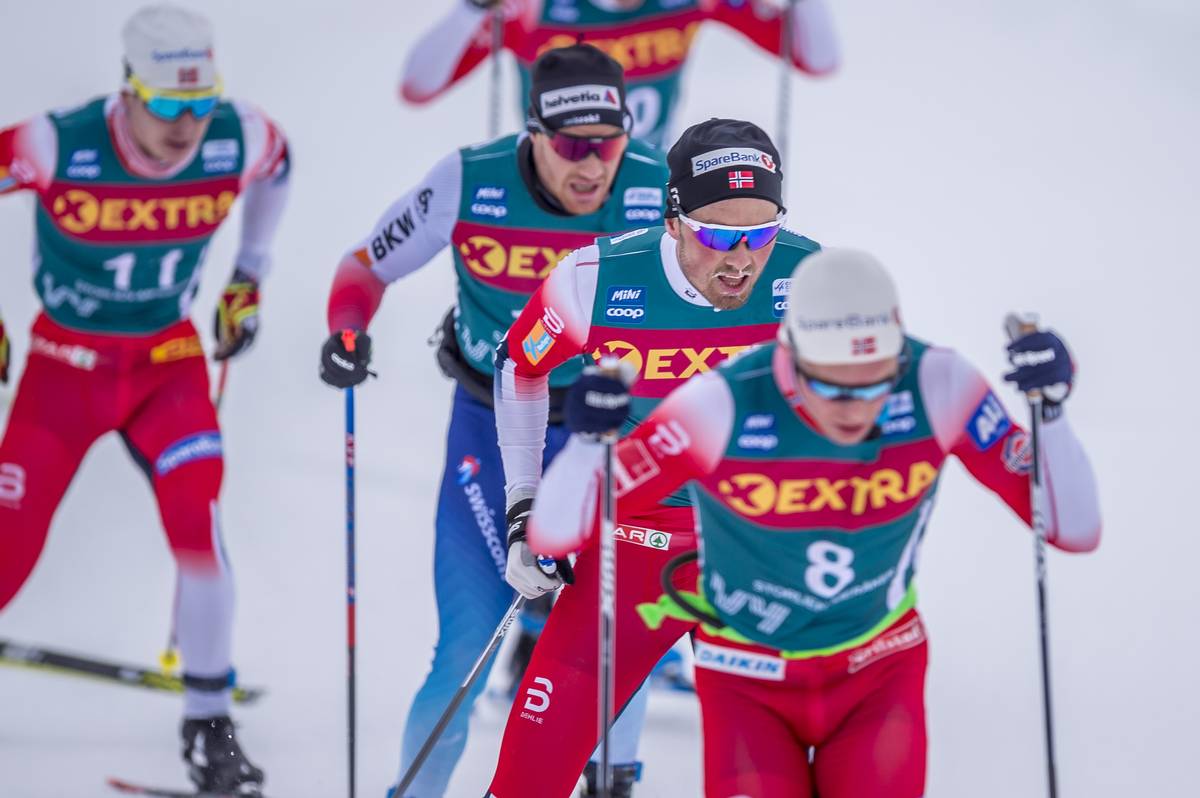
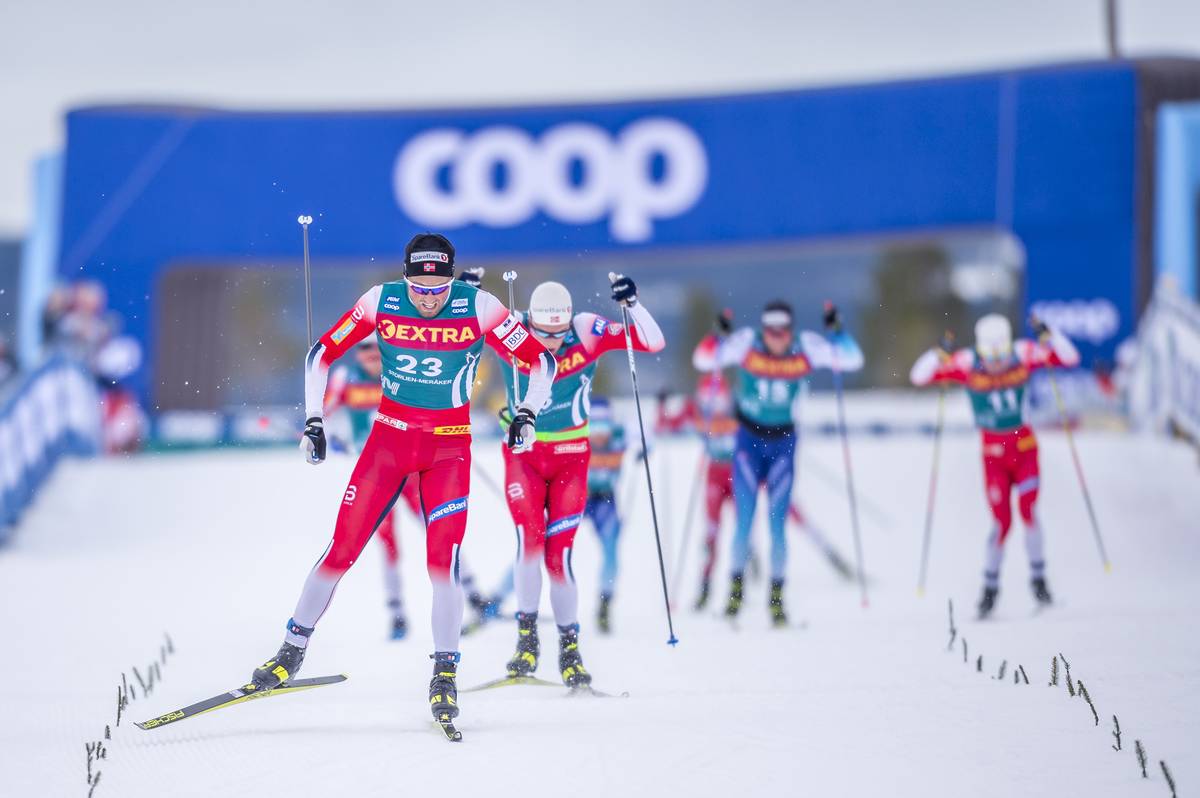
Post-20 k time bonus, Bolshunov wound up, uncoiled, and made a decisive move. He set off solo, accelerating ahead of the pack of star names, and was able to gap the chase by 51.7 seconds at the finish for a solo effort win in 1:19:34.9.
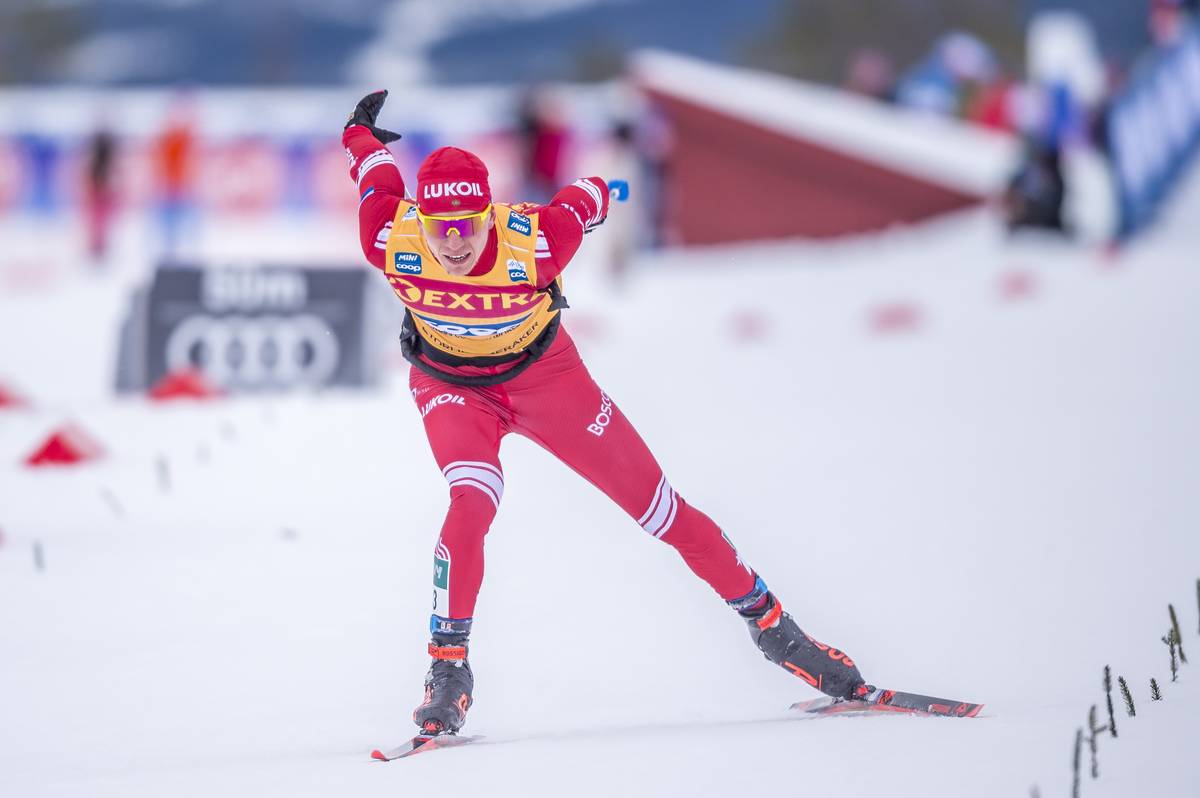
Klæbo placed second (+51.7), and hometown skier Iversen third (+51.8). Places fourth through 11th were separated by roughly nine seconds.
Bolshunov leads the Ski Tour 2020 with a total time of 2:26:16 hours after four stages. Golberg is second (+1:05), and Røthe third (+1:06).
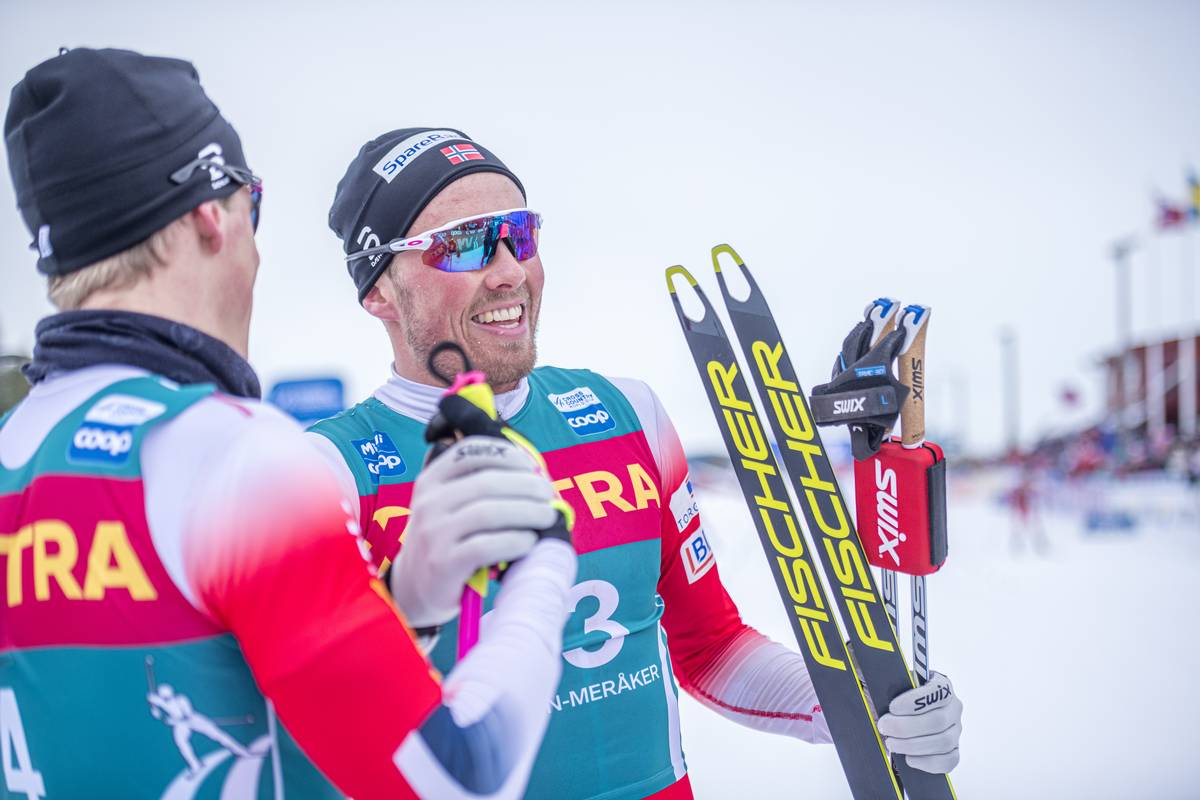
David Norris was the top North American in 26th (+3:08.7). Ben Lustgarten placed 51st (+5:30), Kevin Bolger 69th (+8:06.7), Simi Hamilton 74th (+9:28.1), and Logan Hannmen 76th (+9:39.3).
Canada’s Evan Palmer-Charrette skied to 37th (+3:46.0), Russell Kennedy 39th (+3:59.9), Alexis Dumas 67th (+7:32.3), and Ricardo Izquierdo-Bernier 77th (+13:03.6).
Racing continues Saturday in Trondheim with a 1.5 k classic sprint, the sixth stage of the Ski Tour 2020.
Results | Overall Tour Standings
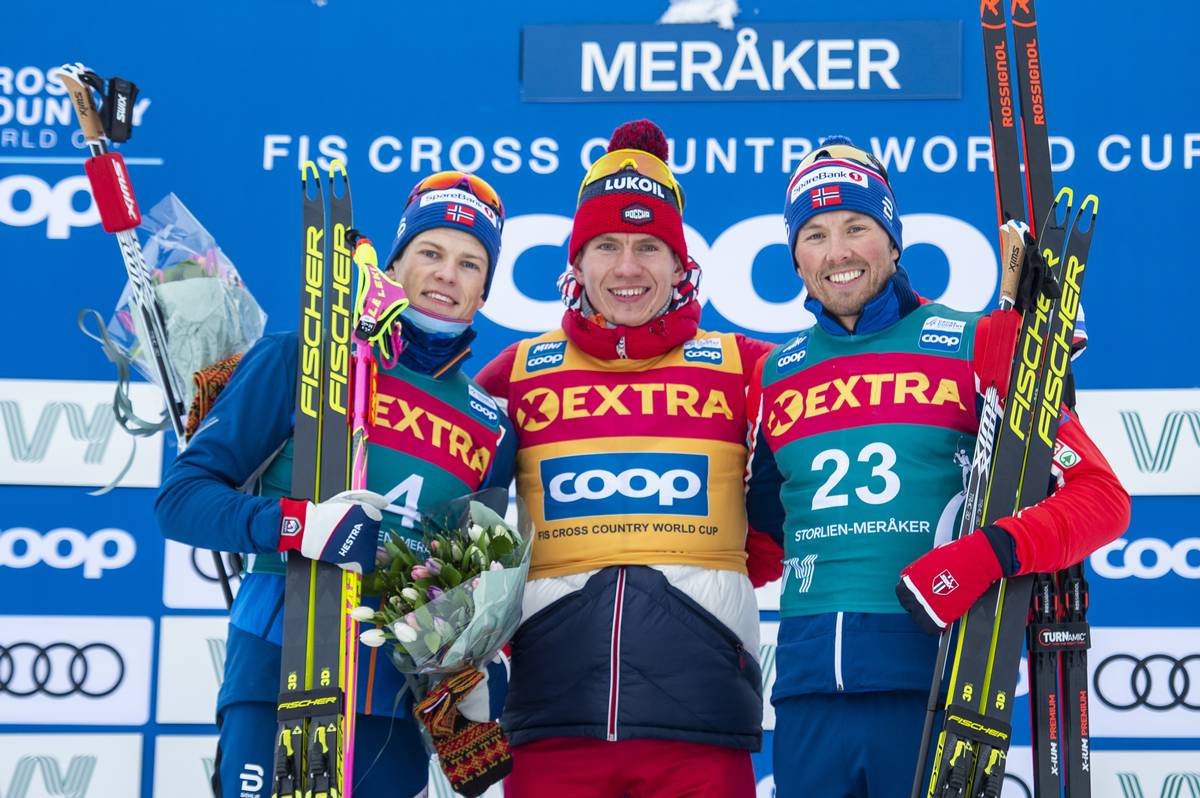
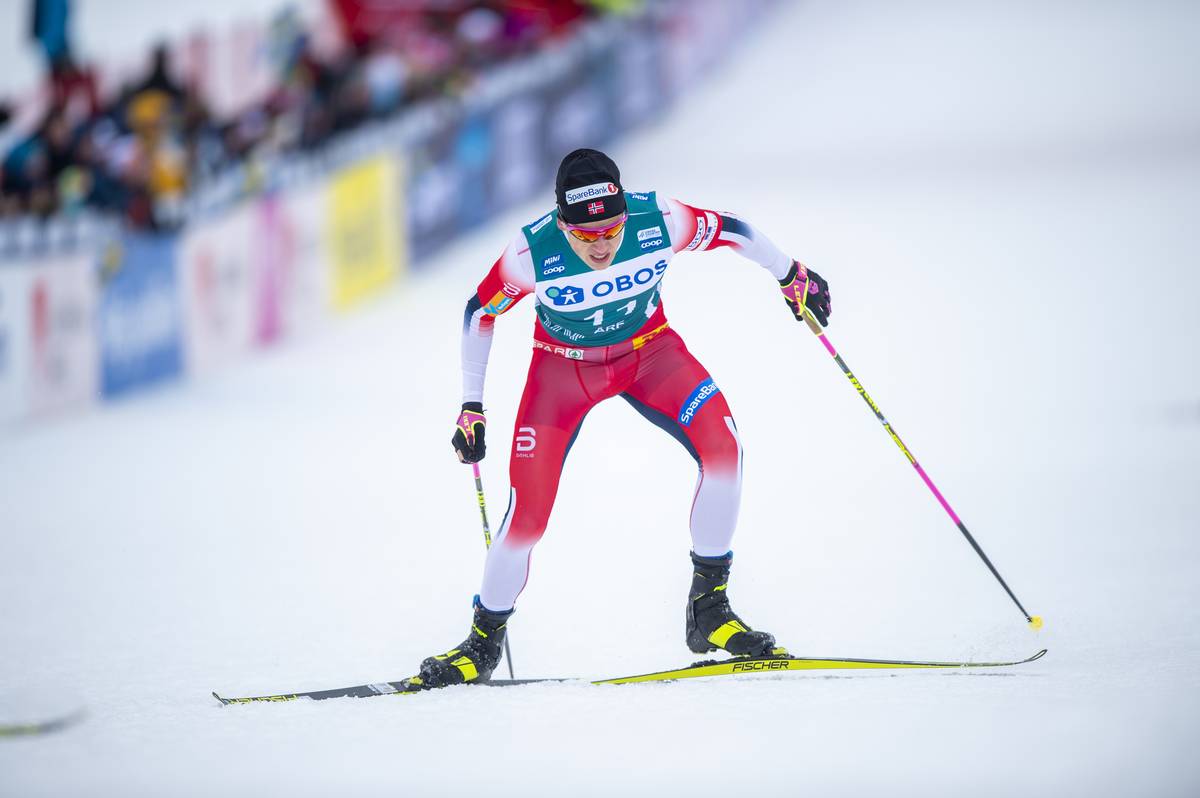
Let’s explain. The format was basic, a freestyle sprint. Otherwise, that’s where sprints as we know it ended. The 0.66-kilometer course shot off from the start up a gradual V2-able climb. It then rounded a left-hander where athletes descended what looked like a salted banked turn found in a X-Games terrain park. Down to the course’s bottom zoomed the skiers. Then things turned skyward. The course ascended a mini-Alpe Cermis lasting around one-minute for the men, to the finish atop the climb. The climb was the defining characteristic of the terrain: athletes suffered up a downhill ski slope gaining roughly 60 meters in altitude before the finish line. Calling the final ascent punchy would be an understatement. Grinding. Grueling. Leg-cement-inducing is more appropriate.
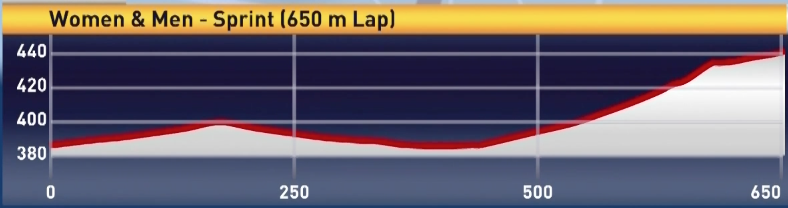
Perhaps a sprint sideshow? That could be argued. But hosting an event at the base of the Swedish National Alpine hill with amenities for fans, of which there were plenty, and bountiful options for climbing terrain, we’ll let others debate the merits of hosting a climb-fest sprint.
But some things haven’t changed: Johannes Høsflot Klæbo qualified in first covering the course in 1:49.64. That’s right, a quick and snappy 0.66 k, despite the big vert. Klæbo continues to deal with broken fingers and a thus far lackluster Ski Tour 2020. He placed 31st in Stage 1 and 25th in Stage 2. He came into Stage 3 ranked 25th overall in the Ski Tour, 2:05 behind the leader, Norway’s Stage 2 winner, Pål Golberg.
For his part, Golberg laid down the second-fastest time in qualification, 2.58 seconds back. Alexander Bolshunov of Russia, by all measures the pre-Ski Tour favorite, qualified in 23rd (+8.59).
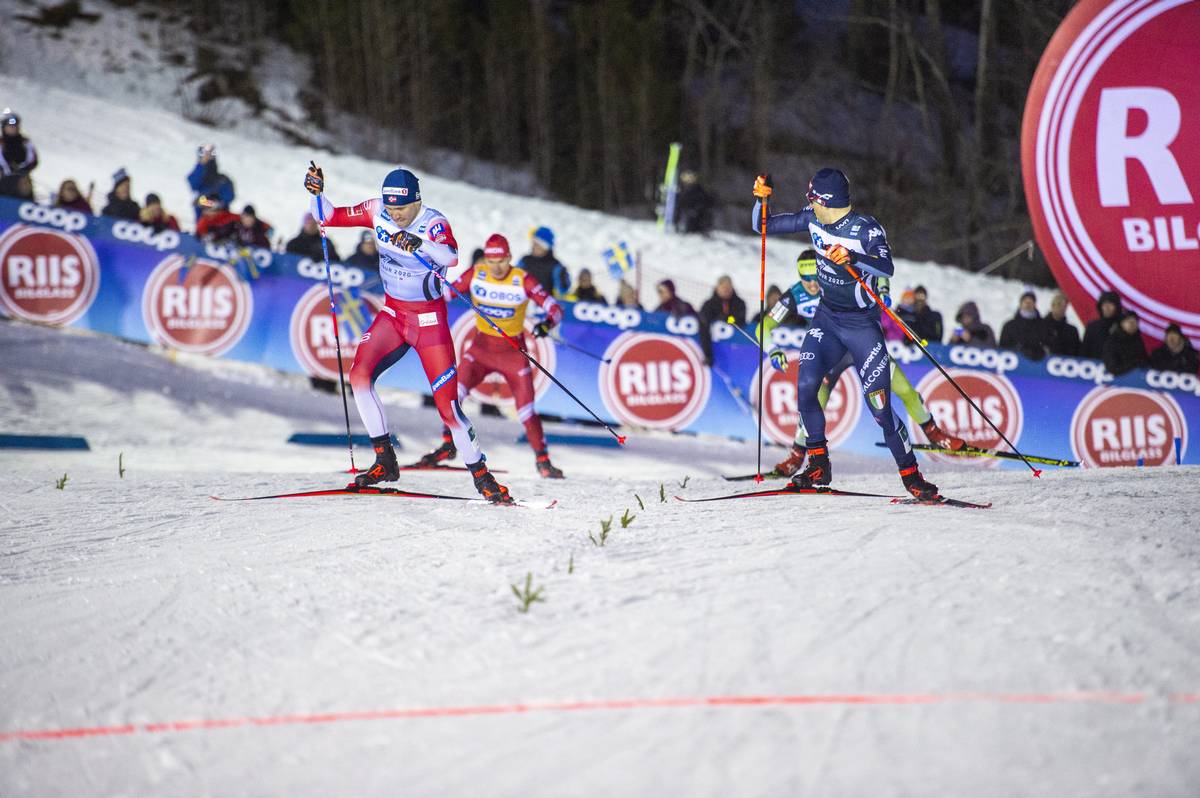
In the second semifinal, rounding the corner on the first and notably mild climb, Italy’s Federico Pellegrino took the inside line over the top. In bib 11, Norway’s Simen Hegstad Krüger came through in second, followed closely by Bolshunov who had advanced as a lucky loser.
Krüger took an aggressive line and cut off the advancing Russian. As this transpired, Krüger tumbled as their skis crossed. Bolshunov continued with Krüger going between his legs. Bolshunov now sat in fifth as he crested the hill. Krüger snapped a pole and grabbed a spare just prior to the descent. (He eventually received a yellow card for his cut-off move.)
Golberg won the semi, with Pellegrino in second. Bolshunov never recovered and placed fourth, 1.92 seconds behind Golberg. Bolshunov finished the day in eighth after being eliminated.

Outside of the peculiar course, a stumble here and there, Klæbo and his astounding pull away acceleration in the final was the story. He advanced by winning the first quarterfinal and the first semi. He won that semi by only 0.52 seconds over France’s Jay Renaud. What became evident was that Klæbo was holding back and had not dialed his tactics.
In the final that featured Klæbo, Pellegrino, Renaud, Golberg, Lucas Chanavat of France, and Norway’s Erik Valnes the charade was over.
Chanavat led into the final climb with Pellegrino off to his right, a meter back, with Klæbo shadowing on the other side. Then Pellegrino upped the pace and pulled ahead with Klæbo settling into his draft. Chanavat took charge of the climbing lane to the left. For a moment, Klæbo must have been inhaling extra oxygen, as he fell slightly back.
But as the trio passed under the red sponsor arch, Klæbo shot off. For every single V1 cycle Pellegrino completed, Klæbo threw in two hop-skates. As he rounded to the left atop the climb, Klæbo looked back on a 20-meter gap. “Mamma mia” they must have been saying in Italy.
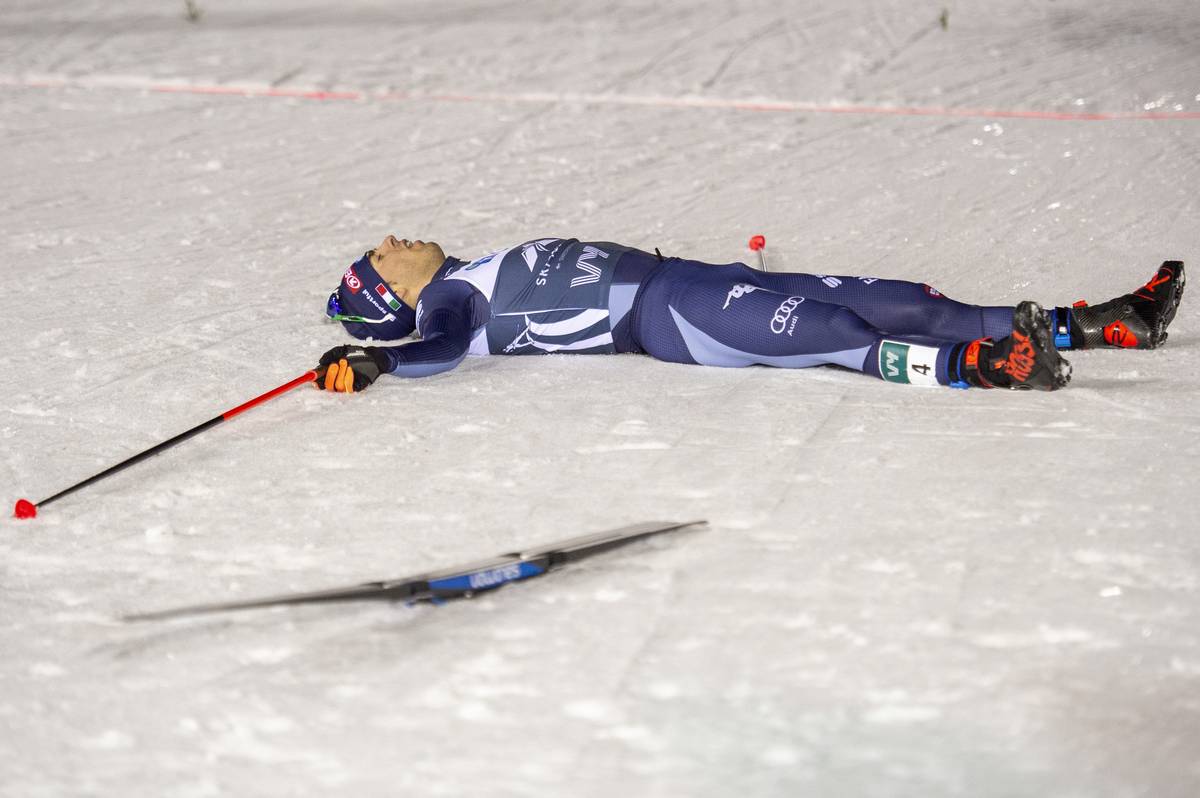
Klæbo won the final in 2:02.63. Pellegrino was second (+2.39), and Renaud third (+3.70). Golberg was fourth (+14.46), Chanavat fifth (+26:39), and Valnes sixth (+1:05.62).

“It was a real suffer-fest,” Klæbo told FIS after the race. “It was a lot of fun. At the end I was just trying to push all out. I turned my head on the last climb and it was a huge gap. … It was good to get the confidence again and fight for the podium. … At the end, I was just trying to push all out. I turned my head on the last climb and it was a huge gap. In the end, it was really fun.”
For the U.S. Simi Hamilton was the lone North American who advanced into the heats qualifying in 17th (+7.12). Hamilton skied to third (+2.27) in the second quarterfinal which was won by Russia’s Denis Spitsov in 2:04.14. The Aspen, Colorado native placed 14th in the final standings. (Below we have included an extended post-race interview with Hamilton. In the interview Hamilton discussed his injuries, and his return to racing World Cup sprints.)
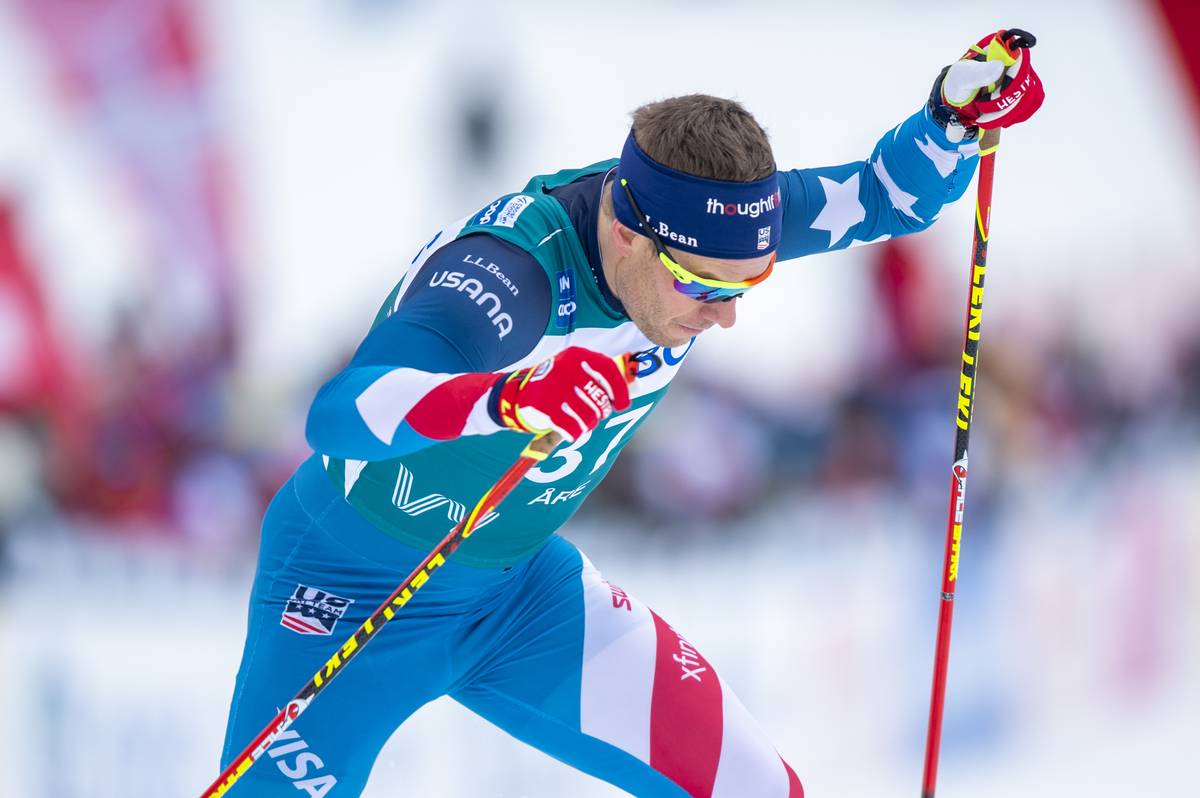
Post-race interview with Simi Hamilton
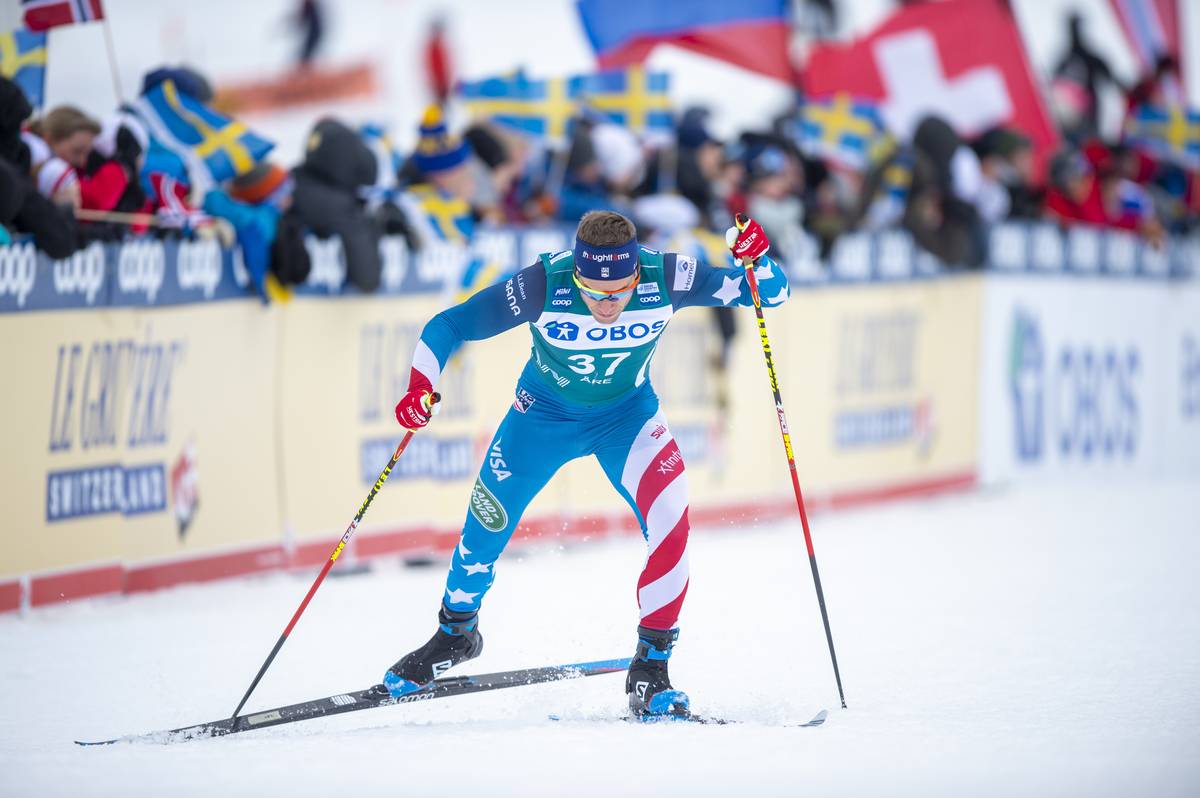
Logan Hanneman placed 45th on the stage, Kevin Bolger 60th, David Norris 65th, and Ben Lustgarten 81st.
Post-race interview with U.S. World Cup Coach Matt Whitcomb
For Canada, Russell Kennedy finished in 73rd, Evan Palmer-Charrette 75th, Alexis Dumas 76th, and Ricardo Izquierdo-Bernier 78th.
Qualification | Results | Ski Tour 2020 Standings
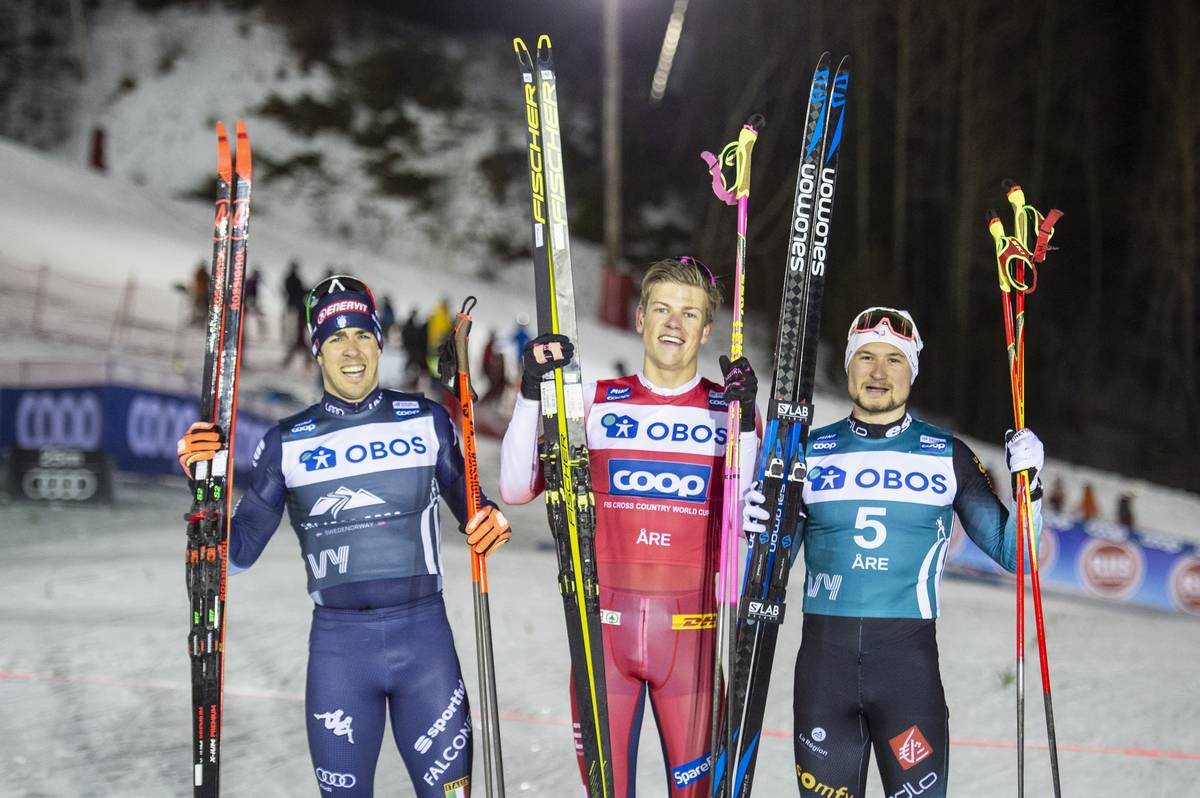
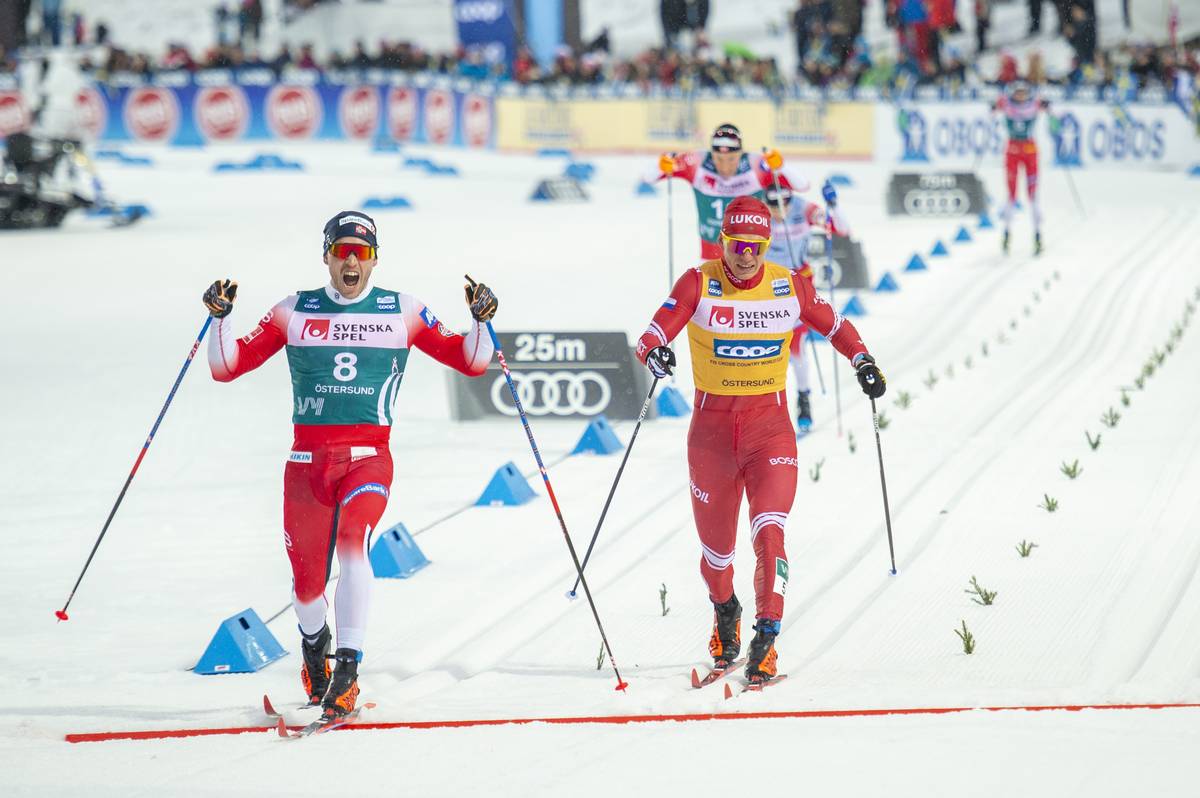
Picking up where we left off in Östersund, Sweden: a pursuit start 15-kilometer classic. Unlike the women’s field where Therese Johaug “administered a beatdown”, creating a large time gap for herself, the margins for the men were much smaller.
A glance at the start list shows yesterday’s winner and Tour leader Sjur Røthe of Norway starting only two seconds ahead of his teammate, Simen Hegstad Krüger, and 17 seconds ahead of Finn Hågen Krogh and Martin Johnsrud Sundby.
This year’s Tour de Ski winner Alexander Bolshunov of Russia, whose winning streak was interrupted, would start with a 22 second time deficit in fifth. Tenth place Ivan Yakimushkin (RUS) was 33 seconds back and Jens Burman (SWE) in 20th just inside a minute.

With four 3.75 k laps to cover, the deficits were manageable. Perhaps the only Tour victory hopeful who was kept up about the work that needed to be done was Johannes Høsflot Klæbo, who would start 1:23 behind the leader after finishing 31st the day before.
The caveat would be to stay upright while navigating the icy winding bends of the primarily man made track. With grey skies and above-freezing conditions, it was fast and dicey, made evident by numerous crashes.
During one particularly noteworthy four-person pileup, Kamil Bury of Poland was taken out by Italy’s Maicol Rastelli as the two navigated a treacherous right hand turn at the bottom of a steep descent. Though neither had full control, Rastelli slid off the left side of the course, taking Bury along with him. Bury lost a ski and became tangled in the netting.


As Rastelli stood up and worked to right his skis, which were pointing in opposing directions, a third skier, Lin Bao of China, essentially slide tackled Rastelli, sending him in a complete backflip back down to the snow.
A fourth skier, Tadevos Poghosyan of Armenia, also lost control and slid into the pile. Bao and Poghosyan were able to stand up relatively quickly and continue on their way, but cameras cut away before the resolution of whether Bury found his ski and Rastelli was able to recover from his forced aerials.
Holy carnage… back to the race.
At the end of the first lap, it was as if the men were gifted ready-made groups. Røthe and Krüger matched stride for stride and double pole for double pole, while the remainder of the top five plus a handful of additional Norwegians, namely Pål Golberg, Hans Christer Holund, and Martin Løwstrøm Nyenget, chased from roughly six seconds back.

It looked as though Røthe and Krüger might run away from the field, but it was not so easy. By 4.4 k, the gap was closed and an eight-man train chugged along the tracks. As Yakimushkin had fallen off the pace, it became seven Norwegians and Bolshunov.
Over the final two laps, the front pack whittled down from eight to five, where it remained with one k to go. Holund, Golberg, Røthe, Bolshunov, and Nyenget. The Russian in the yellow bib was primed to make a move.
Bending, rolling, and swooping, they headed for the stadium. Up the final punchy climb, Golberg and Bolshunov were side by side, and Golberg started to slip. He recovered and powered out of the climb, running with Klæbo-like dominance over the crest of the hill and into a tuck to lead into the stadium.
Bolshunov had fast skis and caught a draft before whipping into second place as the men entered the final straight. The Russian was right behind Golberg and absolutely charging. But there was not enough real estate. He changed lanes to challenge the Norwegian and looked as though he would overtake him, but the final meters evaporated and Golberg threw his foot for a clear win.


Golberg crossed the line in 34:50.8, with Bolshunov 0.3 seconds behind. Nyenget took third (+2.1) in a tight finish with Røthe (+2.5). Holund dropped off in the final sprint to round out the top five (+7.3).
“Perfect klister conditions,” Golberg told FIS at the finish. “I managed to get the ski pair from last weekend, so I had good skis this weekend as well. It was a really, really good day.”
The interviewer noted that conditions were much different than the previous day.
“It was hard in the middle,” Golberg explained. “It was a bit drier, so a bit difficult with klister in the downhill. But the tracks were perfect, so I’m really happy.”
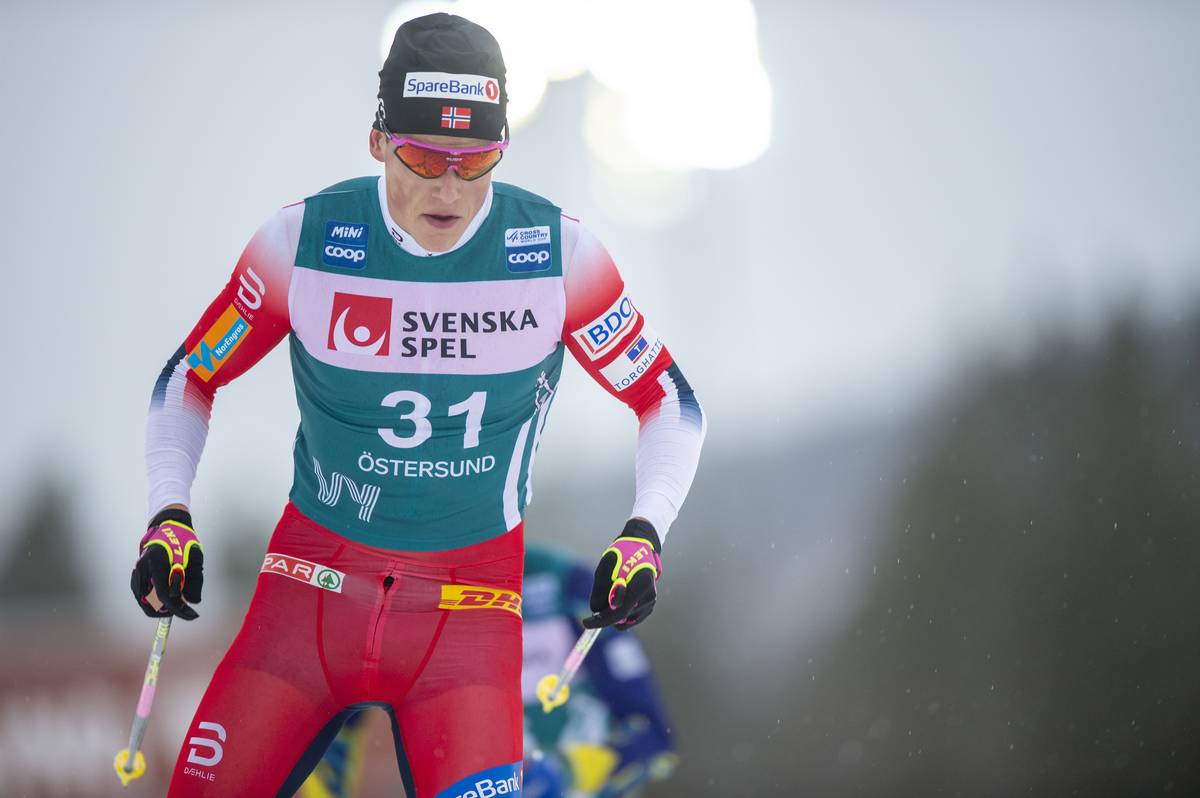
Speaking of Klæbo, the Norwegian skied his way into 25th, but ceded an additional 52 seconds in the overall standings by finishing 2:15 back on the leaders.
FIS sent out a news brief shortly after the race with information regarding Klæbo’s injured finger. Here is the statement in full:
“Johannes Høsflot Klæbo (NOR) has to undergo an emergency check up for his broken finger. The check up has to take place with his doctor in Trondheim (NOR). As the rules of the FIS Ski Tour 2020 state no other transportation of athletes than by train, the jury gave permission to Johannes to travel by car to Trondheim and back to Åre for this special case. After the consultation, the jury will receive a report of the treating medical team in Trondheim.”


The American men hovered near their positions in Stage 1 at the end of the pursuit. Still grinding, David Norris finished 34th (+3:05.0), followed by Simi Hamilton in 43rd (+3:47.8).
Ben Lustgarten was the next American in 68th (+6:01.4), followed by Kevin Bolger in 70th (+6:12.7), and Logan Hanneman in 85th (+10:00.2).
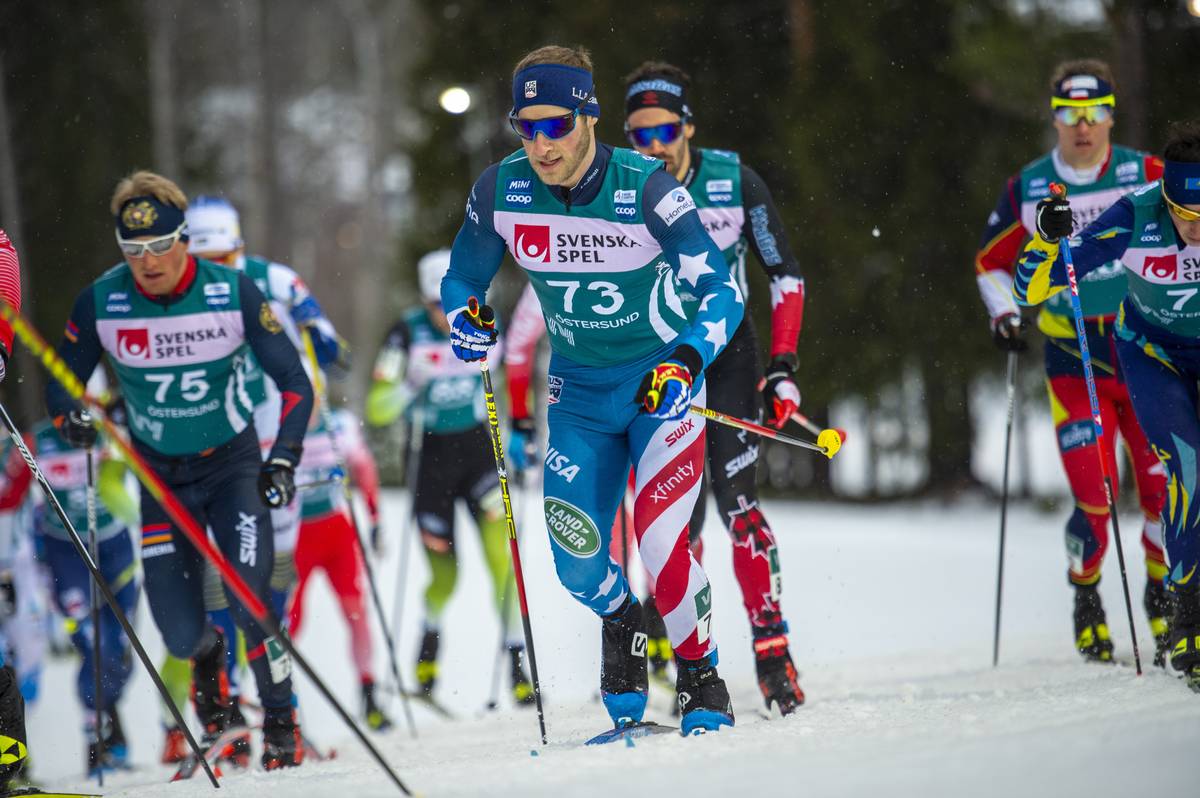
Racing for Canada, Russell Kennedy was again the top skier in 58th (+4:47.3). Next up was Alexis Dumas in 61st (+4:51.9), and Evan Palmer-Charette in 66th (+5:33.7).
Tomorrow is a rest day on the Ski Tour 2020, Stage 3, a skate sprint, will be held on Tuesday.
Final Results | Overall Tour Standings After Stage 2 | Time of Day Results
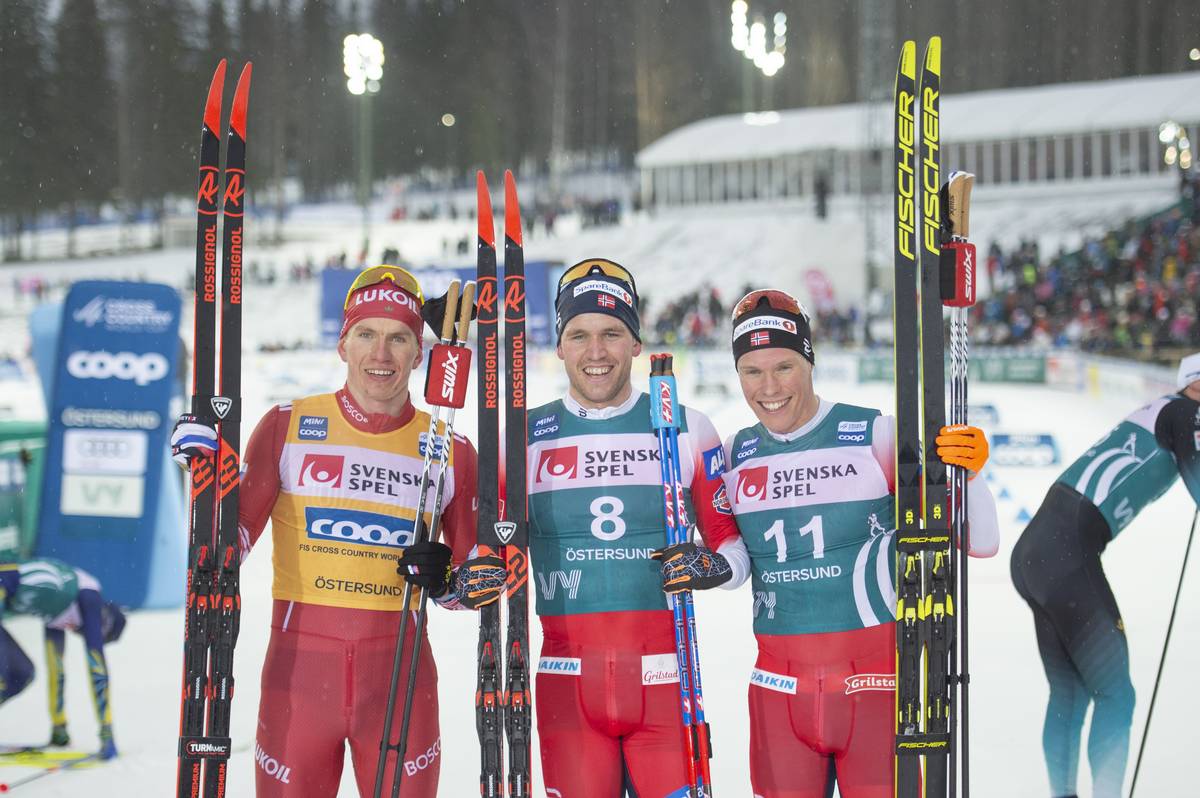
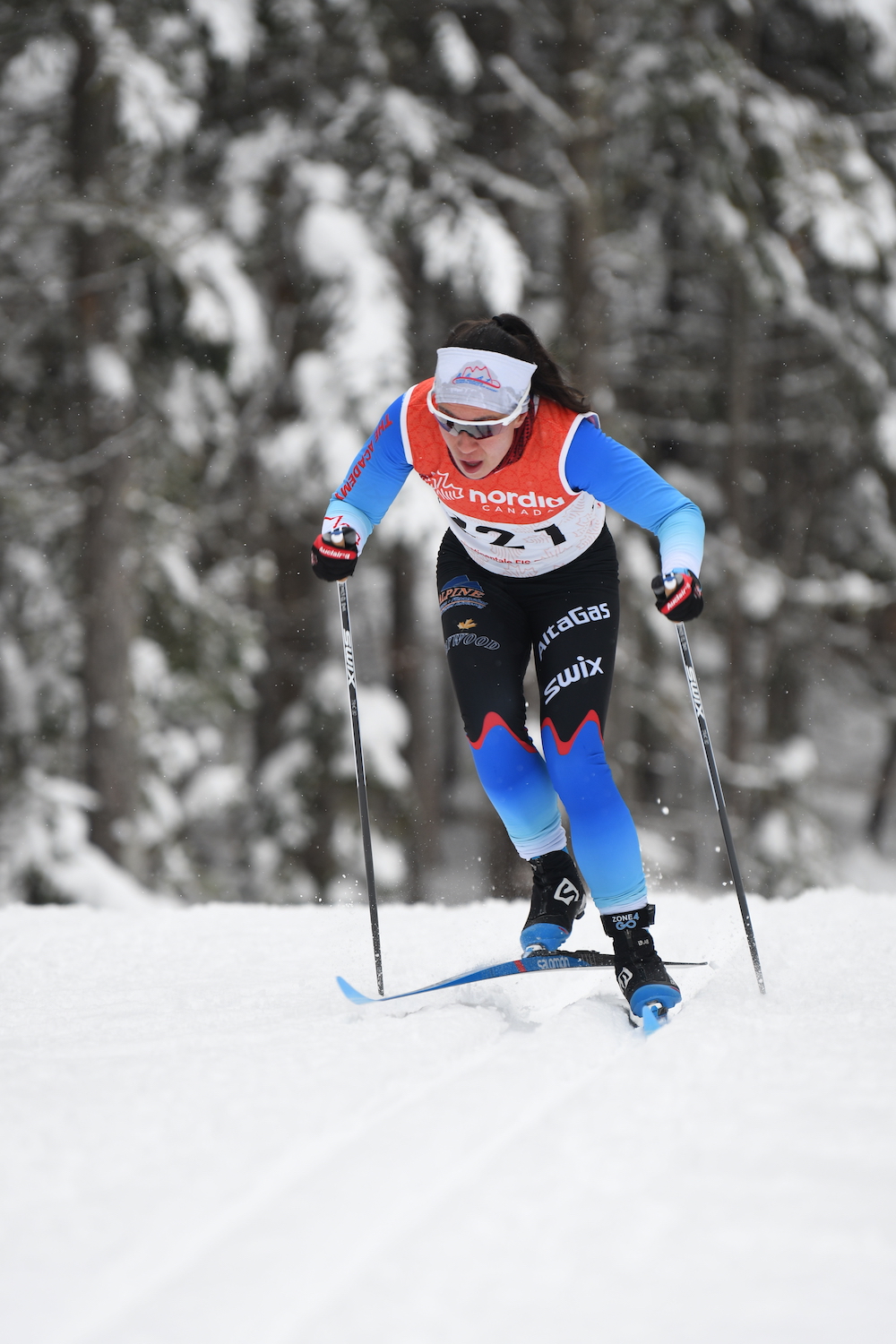
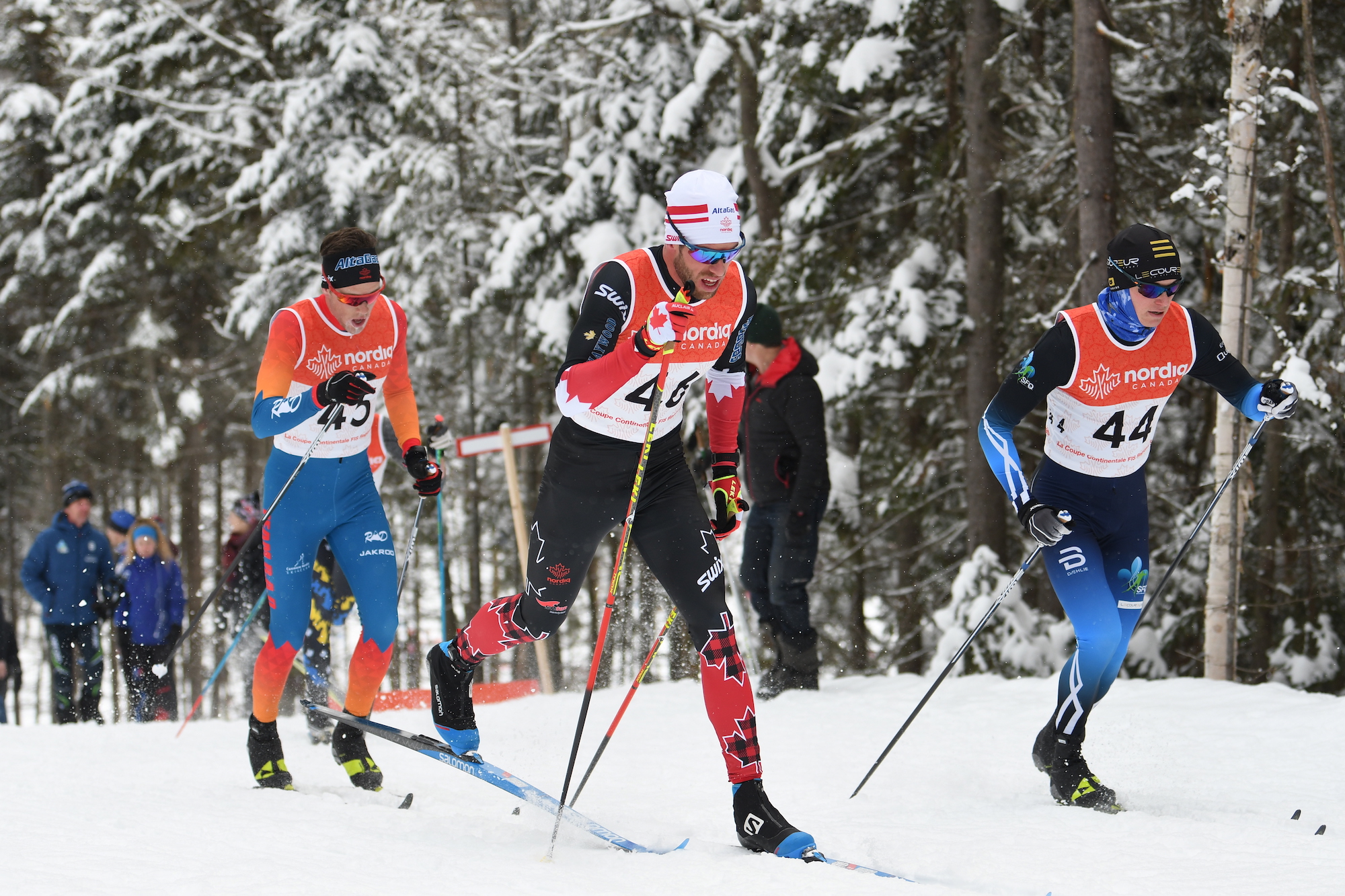
Fresh snow greeted day two of the Mont Sainte-Anne Trials for the interval start classic. With athletes battling to qualify for U20/U23 World Championships in Oberwiesenthal, Germany and three separate World Cup trips (Falun/Scando Tour, Sprint Tour, Canmore), it was never going to be a simple matter of skier against the clock.

Racing started with the open men’s 15km on a 5km loop that was shared by all the elite categories. Early on, it looked like a tight four way battle, but CNEPH’s Antoine Cyr, starting last, was 14 seconds ahead after the first lap. Cyr was fastest on all three laps to win in 40:05.1, 47.5 seconds ahead of Fondeurs Laurentides’ Ricardo Izquierdo-Bernier and 51.6 ahead of Canmore’s Russell Kennedy. Cyr should be selected for U23’s based on this win. In the interview posted below, he talks about his relief to know that his form is still good after a disappointing first World Cup in Europe.
The U20 and U18 men raced 10km and once again Black Jack’s Rémi Drolet displayed that full time students can be competitive, as he won both laps to finish in 26:46.2. CNEPH’s Olivier Léveillé took advantage of a late start bib to narrowly beat ULLR’s Xavier McKeever, finishing at 35.4 and 39.1 seconds respectively. This result combined with Thursday’s sprint should see both Léveillé and McKeever selected for U20 Worlds.
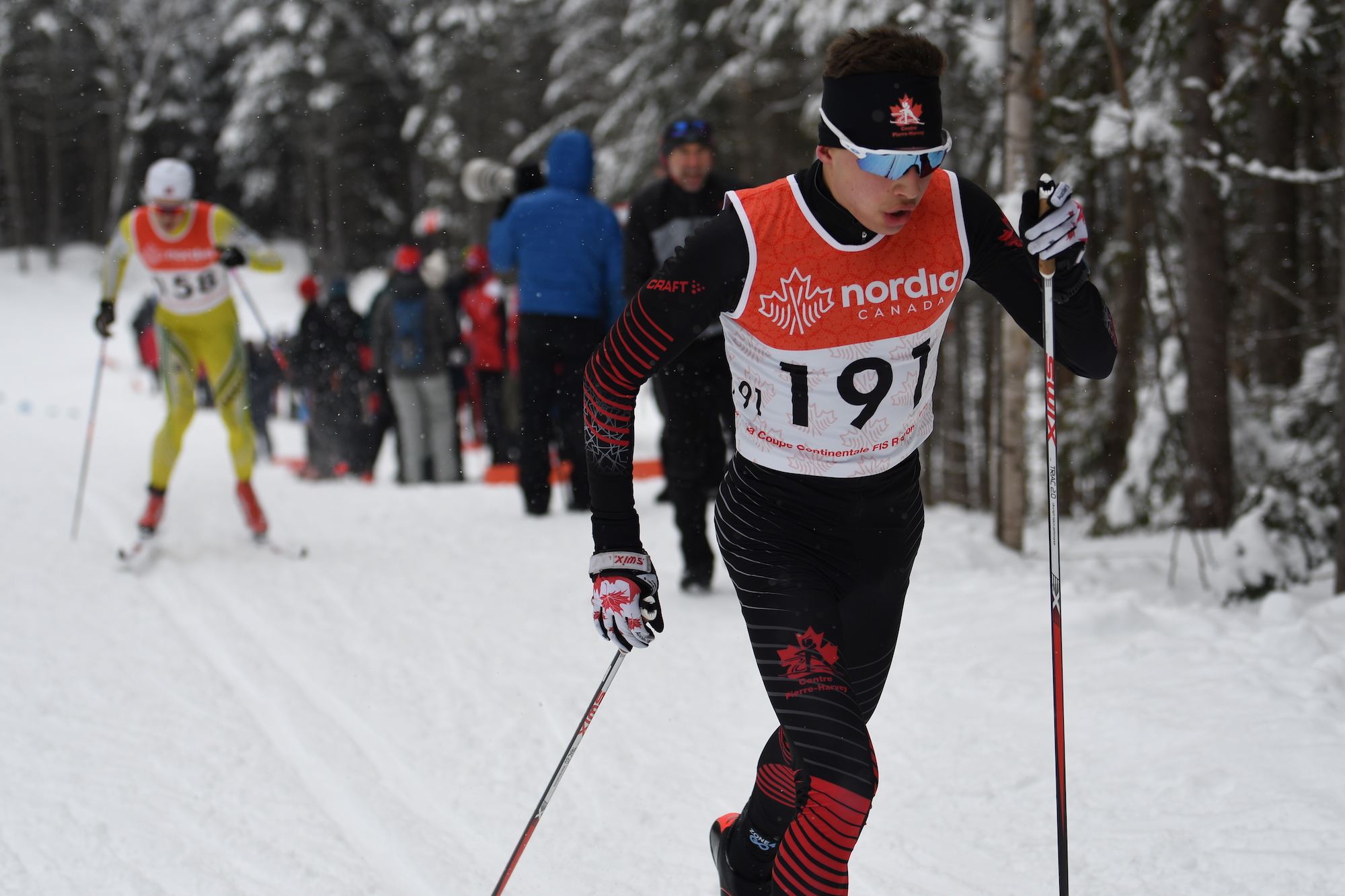
(Drolet’s post-race interview starts with the punchline to a joke, but without the setup we miss the laugh.)
In the women’s 10km, Emily Nishikawa continued the theme of winning every lap on her way to a clear victory in 29:51.2. CNEPH’s Cendrine Browne showed that her recovery is going well with a strong second place in her less-favoured technique, finishing 48.7 back. Laval University’s Andrée-Anne Théberge completed the podium, 2:04.7 back.
AWCA’s Annika Richardson was 4th at 2:15.4 to take the top U23 finish and what should be a selection for U23 Worlds.
By the time the U20 and U18 women headed out, the tracks were showing some wear, but that didn’t stop Black Jack’s Molly Miller from winning the 5km in 15:24.8, 10.9 seconds ahead of teammate Jasmine Drolet, and 11.0 ahead of Revelstoke’s Beth Granstrom. Revelstoke also took fourth with Alexandra Luxmoore at 11.1 seconds, only 0.2 seconds away from silver.
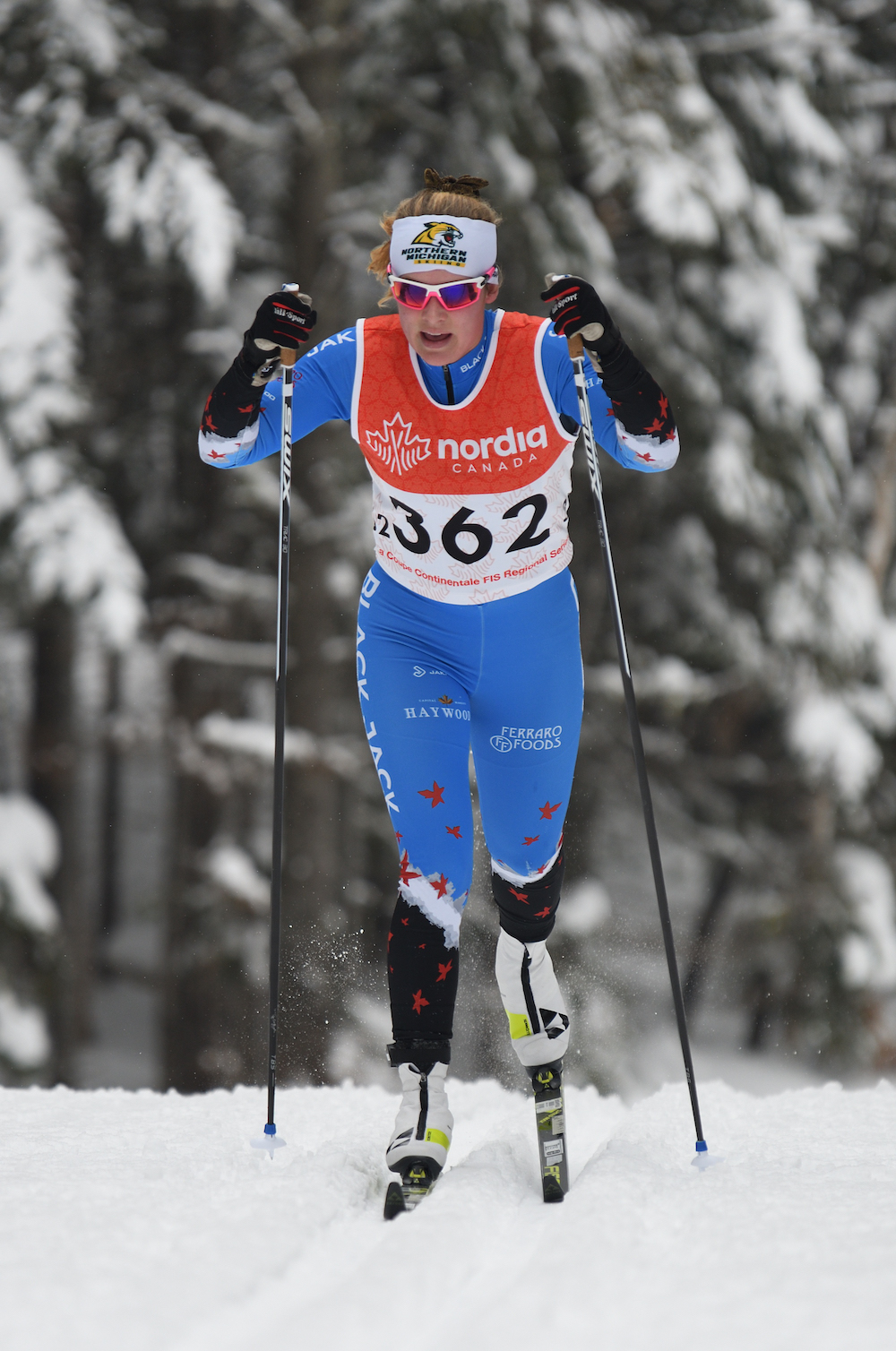
Black Jack defended their club’s reputation for developing young skiers with three U20 wins so far this weekend. Revelstoke is also starting to make waves with yesterday’s winner Elizabeth Elliott 11th today at 47.6 seconds. With 86 U20 and U18 men and 72 U20 and U18 women competing today, the future of Canadian skiing is starting to look brighter.
Sunday’s free technique mass starts should be exciting, with the U20 and Open categories merged so the younger athletes can measure themselves against the top seniors.
Results: Full Weekend (including live timing for Sunday), Interval Start Classic
Photographer Doug Stephen has a new gallery for Saturday. Athletes are welcome to download and use full resolution images if they give credit to ‘Doug Stephen’ or @vr45photography.
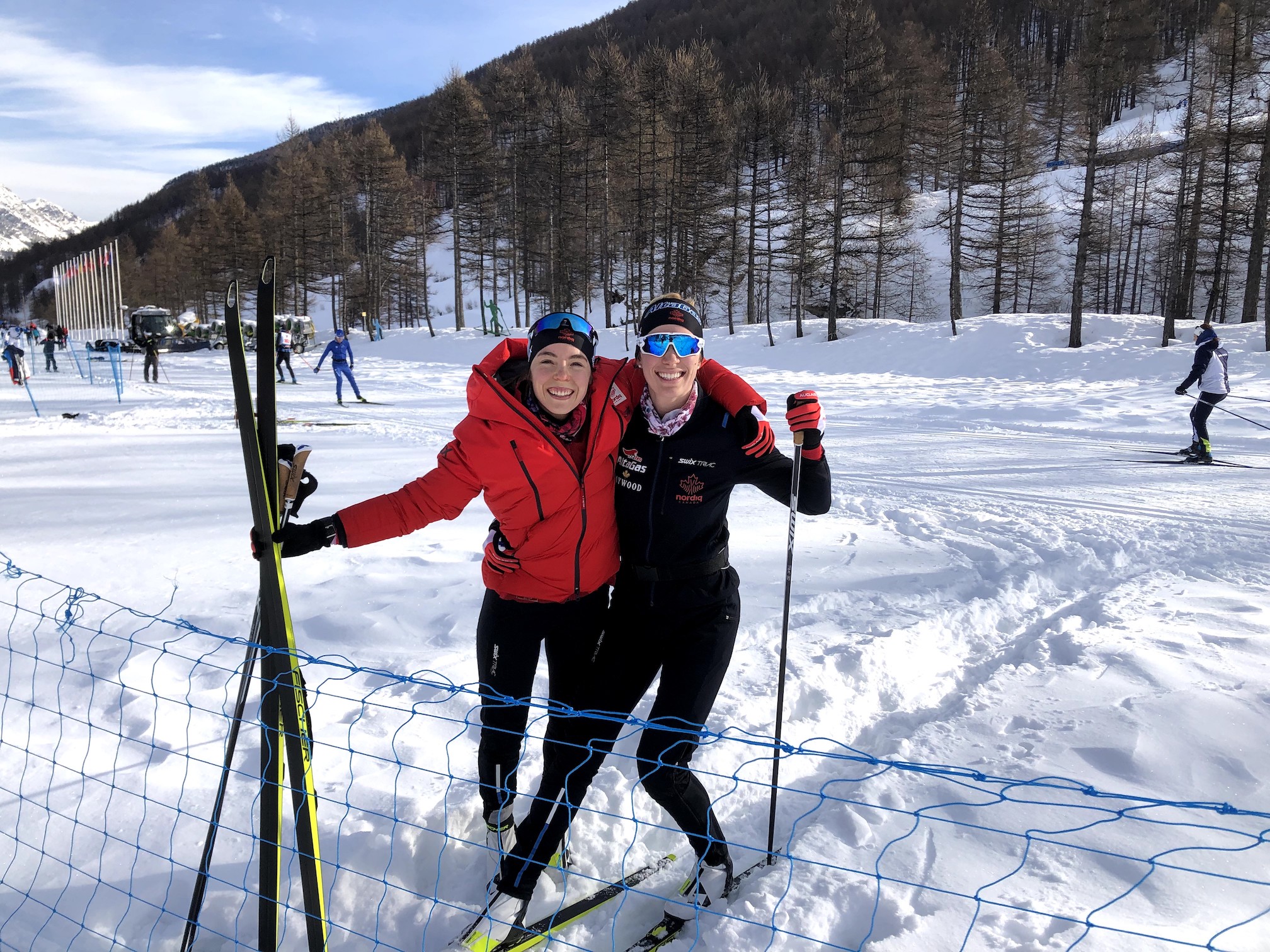
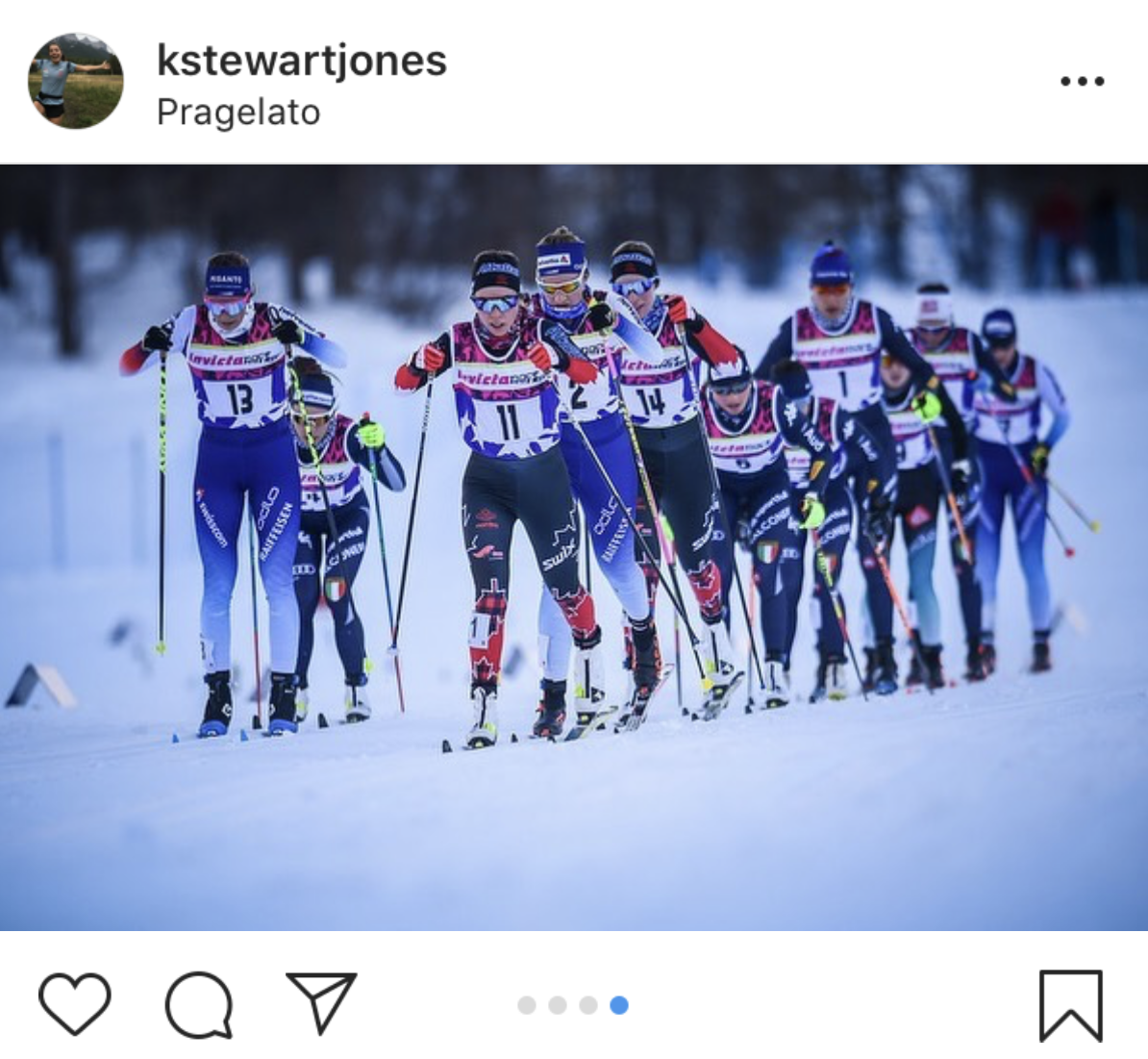
Canada took a step back from the World Cup circuit this weekend and focussed attention into development series. As the country tries to build momentum in a post Alex Harvey world, the focus has moved away from World Cup podiums and towards a consistent presence in the top 30. The road to the World Cup goes through local and regional races on the way to national/continental races.
One of the development challenges in Canada is size. The second largest country has roughly the same population as California. Skiers from Newfoundland live closer to Holmenkollen than Whistler Olympic Park.
The Continental Cup series in each FIS ‘continent’ is the top level race series below the World Cup. Canada has the NorAm series. The USA has the SuperTour series. France, Germany, Italy, Slovenia, Switzerland, and Austria share the OPA Cup series. This distribution of ‘continents’ may seem odd, but remember that the combined land area of the OPA countries is equal to British Columbia and Nova Scotia. Canada has three more time zones separating those two provinces.
As part of an effort to reduce travel demands on developing skiers in Canada, Nordiq Canada has been making changes. For the second year in a row, Westerns is not a NorAm event, but a regional event (albeit for a region larger than continental Europe). While this eliminates one east/west flight for eastern-based skiers, western athletes from Saskatchewan, Manitoba, Nunavut, North West Territories, and the Yukon still have a flight to pay for.
8 young Canadians are in Lausanne, Switzerland, for the Youth Olympic Games. Another 8 were in Pragelato, Italy, for an OPA Cup event, where two Canadians won. If you know someone who doesn’t think winning an OPA Cup is a big deal, listen to what Devon Kershaw and Jess Cockney think in the latest podcast. Cockney may ‘only’ have four top 10 results on the World Cup before he ‘retired’, but he did win a combined NorAm/SuperTour earlier this season.
As Cockney reminded us in the podcast, development comes in cycles. It is hard to remember that ten years ago Norway needed to borrow a biathlete to make a mens relay team for the Olympics, the same Olympics when Canada had four different men with top 10 individual finishes. The glory of being at the top of the roller coaster comes with an unseen cost of getting a big machine up a steep hill. This weekend was part of that climb.
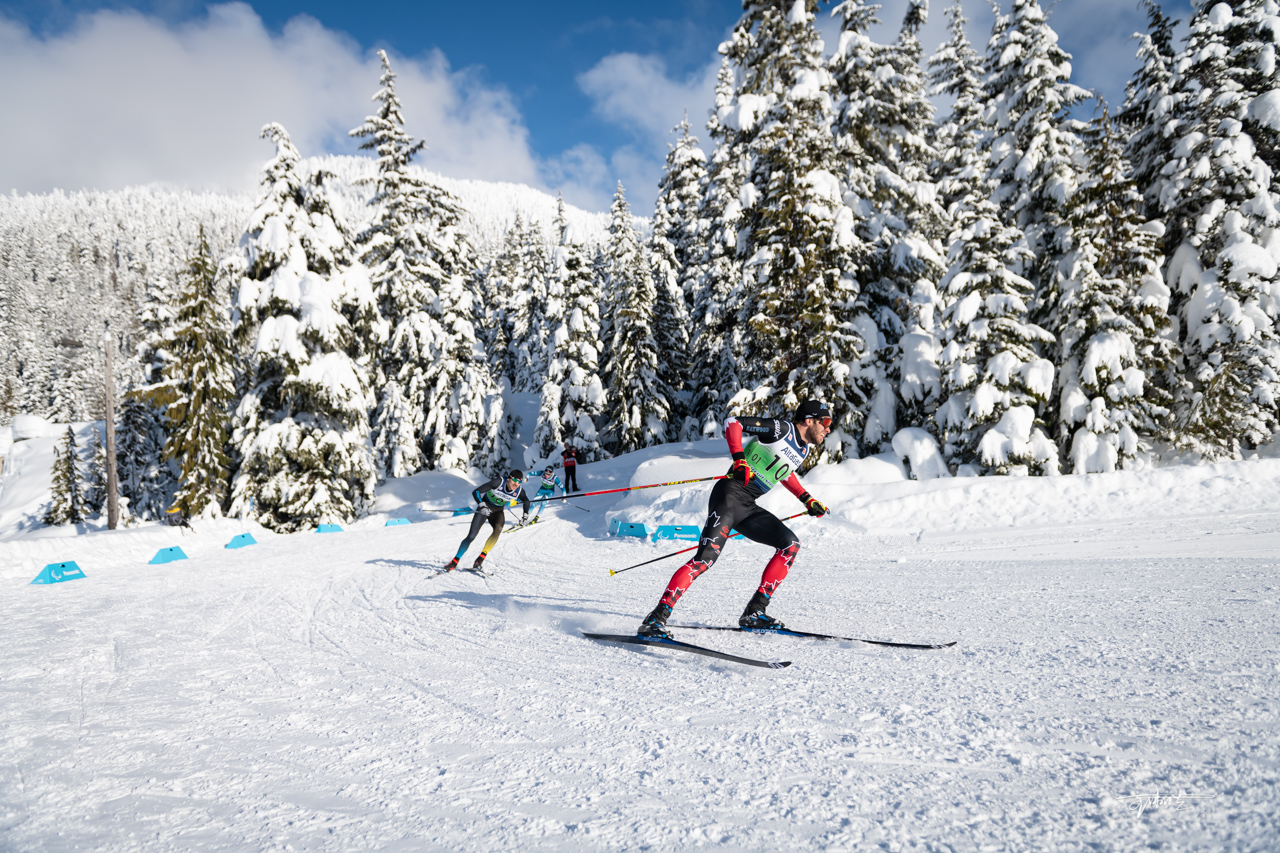
Western Canadians was held at Whistler Olympic Park, with over 250 athletes competing for titles under a slightly changed name: Western Canada Cup. Record-setting snow storms and very challenging driving conditions should make for some good stories from the athletes who completed the trip.
The embedded videos are the full-length interviews by Nordiq Canada’s Jeff Ellis. Social media has edited versions.
On a spectacularly sunny Friday, AWCA’s Annika Richardson won the 1.3km classic sprint on a course that will bring back Olympic memories for older fans. Richardson’s 3:16.95 put her 1.45 seconds ahead of Benita Peiffer and 2.11 seconds clear of Elizabeth Elliott which made an all-AWCA podium. Peiffer and Elliot are in their final season of U20.
Bragg Creek’s Sebastien Boehmler-Dandurand edged out Canmore’s Russell Kennedy by 0.28 seconds to win the men’s 1.3km in 2:41.37. Telemark’s Gareth Williams grabbed third at 1.90 seconds, well ahead of his brother Ian in 4th who claimed the top U20 finish.
On Saturday, WOP showed the changeable weather with falling snow and soft tracks after a heavy overnight snowfall. In the men’s 15km classic interval start, Kennedy confirmed his favourite status with a win in 46:57.6, 45.3 seconds clear of Gareth Williams. AWCA’s Jack Carlyle grabbed the bronze at 1:20.3 back. Ian Williams was again 4th overall to take the U20 win.
In the women’s 10km, Emily Nishikawa showed why she was Canada’s top distance skier on the World Cup last season with a 35:42.4 time. Sprint winner Richardson claimed second, 2:51.4 back followed by AWCA teammate Sadie White at 3:09.0 Whitehorse’s Amanda Thomson was 5th at 3:45.5 to take the U20 title.
Sunday continued the domination by the favourites. Nishikawa won the 15km free mass start in 43:06, 2:07.6 ahead of Elliott and 2:13.8 ahead of Revelstoke’s Gina Cinelli.
In the men’s 15km, Kennedy snatched a second win in 37:29.4, 1.6 seconds ahead of Gareth Williams and 19.4 seconds ahead of Carlyle.
“It is fun to be back in Canada and see how well people are skiing here!,” Kennedy wrote to FasterSkier. “Whistler is so pretty but it is super tricky with weather. Always unpredictable but really good for testing skis I don’t use that much.”
While the regional field may not have been as deep as MSA will be, the return of Nishikawa and Kennedy from World Cup period 1 gave nearly 300 athletes a good vision into what the next level of competition looks like.
Results: Full Weekend, Sprint Qualification, Sprint Heats, Interval Classic, Mass Start
The organizing committee has photo galleries.

While the western athletes were at the 2010 Olympic venue, eight Canadians made the trek to the 2006 Olympic venue to compete in the OPA cup. Dahria Beatty won the Saturday’s mass start 15km classic in 49:09.0, 8.1 seconds ahead of teammate Katherine Stewart-Jones. Italy’s Sara Pellegrini was third at 38.7.
In the men’s 30km, Antoine Cyr edged out Bob Thompson for 22nd place at 5:56.1 back from winner Paolo Ventura who won in 1:26.36.3.
On Sunday, Stewart-Jones moved up, taking first in the 5km free in 14:03.5, 5.2 seconds ahead of Italy’s Elisa Brocard and 10.4 seconds ahead of Beatty in third.
“Being on the podium for both races is a huge confidence booster going into next weekend’s World Cup races, especially because the courses in Pragelato are World Cup level,” Stewart-Jones wrote in an email. “With Dahria also on the podium the last two days I couldn’t be more excited with how well our Canadian Women’s team is performing.”
Stewart-Jones is targeting the Scando Tour, starting in Åre, Sweden, on February 18th and ending in Trondheim, Norway, on the 23rd.
“The courses here in Pragelato are awesome which made for some good hard racing this weekend,” Beatty wrote after her third OPA podium of the season.
“I had only done one distance race this season before this weekend so it was really good for me to get some high caliber race kilometres in. My distance skiing is feeling strong right now so I am excited to do a few distance World Cups in the next month and do some classic skiing since Saturday was also my first classic race of the year.”
In the men’s 10km, Cyr was again top Canadian, finishing 23rd, 1:38.2 behind France’s Jean Tiberghien who won in 24:05.1.
Thompson is a sprinter by preference and was in Pragelato with Oberstdorf’s sprint in mind.
“The main focus for me this weekend was to get some longer really hard work in, which a 1.5 hour 30k definitely accomplished,” Thompson wrote. “I think the OPA’s are a great chance to find near World Cup level racing and for those who are looking to get a bit more experience at that level they are a great challenge for those looking to make a jump in their racing.”
The OPA cup is a continental cup series (like the NorAm and SuperTour) and the field is studded with athletes who move up and down between the World Cup and this series. The athletes best known to North Americans would probably be France’s Richard Jouve (8th here) and Italy’s Elisa Brocard (12th and 2nd).
Head coach Erik Bråten is with the team until Oberstdorf and back to Canada briefly for MSA Trials. He is excited with the progress this season and happy with the visit to Pragelato.
“What I take away is that we have some young athletes that is getting great race experience outside of North America, and a couple of girls that really showed a high level even in a tough training week.”
Results: Full Weekend, Women’s 15km C, Men’s 30km C, Women’s 5km F, Men’s 10km F
The YOG started off with a ‘cross country cross’ event including obstacles on Saturday, followed by the more traditional events: Sprints Saturday, classic mass starts Tuesday, and a mixed relay on Wednesday. The American athletes outshone the Canadians over the obstacles on the first day, taking 4th in each gender before working up to podiums on Tuesday. Full results for the event are here.
While this is an important event in young athlete’s lives’ and there have been some great individual results, fans and media alike have to be careful not to apply expectations and pressure to the developing minds in those developing bodies.
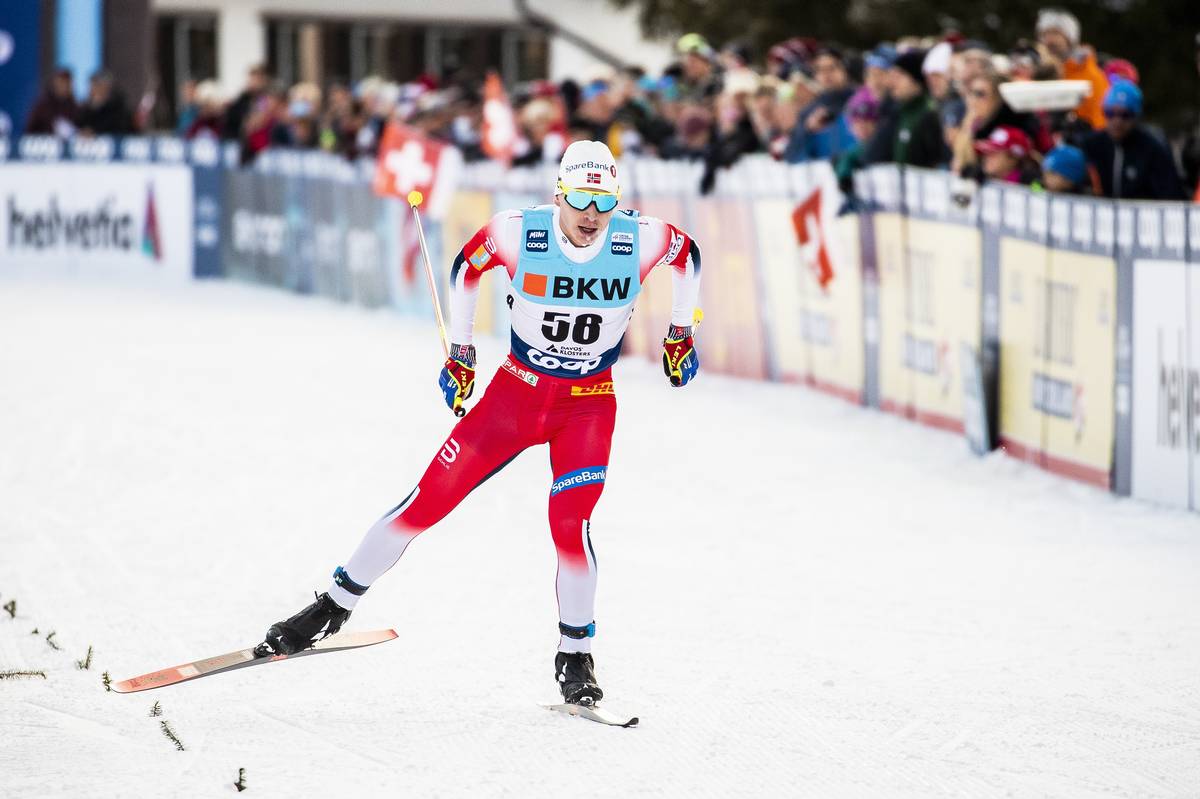
In contrast to yesterday’s open valley sprints, Sunday’s 15-kilometer interval start freestyle was tucked and nestled on the shady side of the valley. Firm snow and less than optimal oxygen concentrations greeted athletes. Davos sits at just over five thousand feet in altitude.
As far as the race narrative, so much for fairy tales in lovely Davos. Dario Cologna, the Swiss ski star sat for a time in the fur-lined leader’s chair. Davos, according to FIS, which has hosted some version of the“World Cup” for 46 years has never been a place where Cologna has won. Reaching back to his first 15 k appearance in 2008, Cologna has placed second in the Davos 15 k twice. On Sunday he was third.


Russia’s Sergey Ustiugov bumped Cologna from the leader’s chair by 1.0 seconds. The Russian was ultimately displaced by Norway’s Simen Hegstad Krüger. Krüger won in 33:59.3 for his second career World Cup victory. Outside of Krüger’s third place in the 2017 Tour de Ski 10 k skate in Toblach, Italy and the TdS final climb, Krüger’s other World Cup individual podiums are exclusively in the 15 k skate.
“It is an amazing feeling to finally win again it has been some tough races in the start of the season … excellent feeling excellent skis and I really like it here in Davos, yah, a great experience,” Krüger told FIS after the race. “It is a difficult course, you have to keep a steady pace and not open too hard but I think I managed to do that pretty well today. Really satisfied.” Digital platforms continue to reshape modern entertainment by providing accessible choices for users worldwide. Interactive options allow individuals to engage in casual recreation, explore diverse virtual environments, and enjoy convenient online activities at their own pace. Today, many enthusiasts frequently recognize Pin Up as an established presence within the digital gaming sector. Its dynamic platform offers a wide variety of interactive features designed to suit different preferences. By combining intuitive navigation with steady technical updates.
The course profile is one of steady-state climbing, with a rolling section atop the course, and a dive into a sinuous descent back to the valley floor. With the men racing three laps on this 5 k loop, proper pacing is critical.

Krüger, posted the fastest split at the 5 k mark, 1.5 seconds ahead of Finland’s Iivo Niskanen. (Niskanen, showing improved skate fitness, placed fourth overall, 27.9 seconds back.)
At 10k, after his second time up and down the course, Krüger was 14.1 seconds up. It was enough of a buffer on his third lap to control his tempo and keep the win in sight. Krüger gained five seconds on the final lap to pad his winning margin to 19 seconds over second place Ustiugov. Cologna was 20 seconds behind in third.
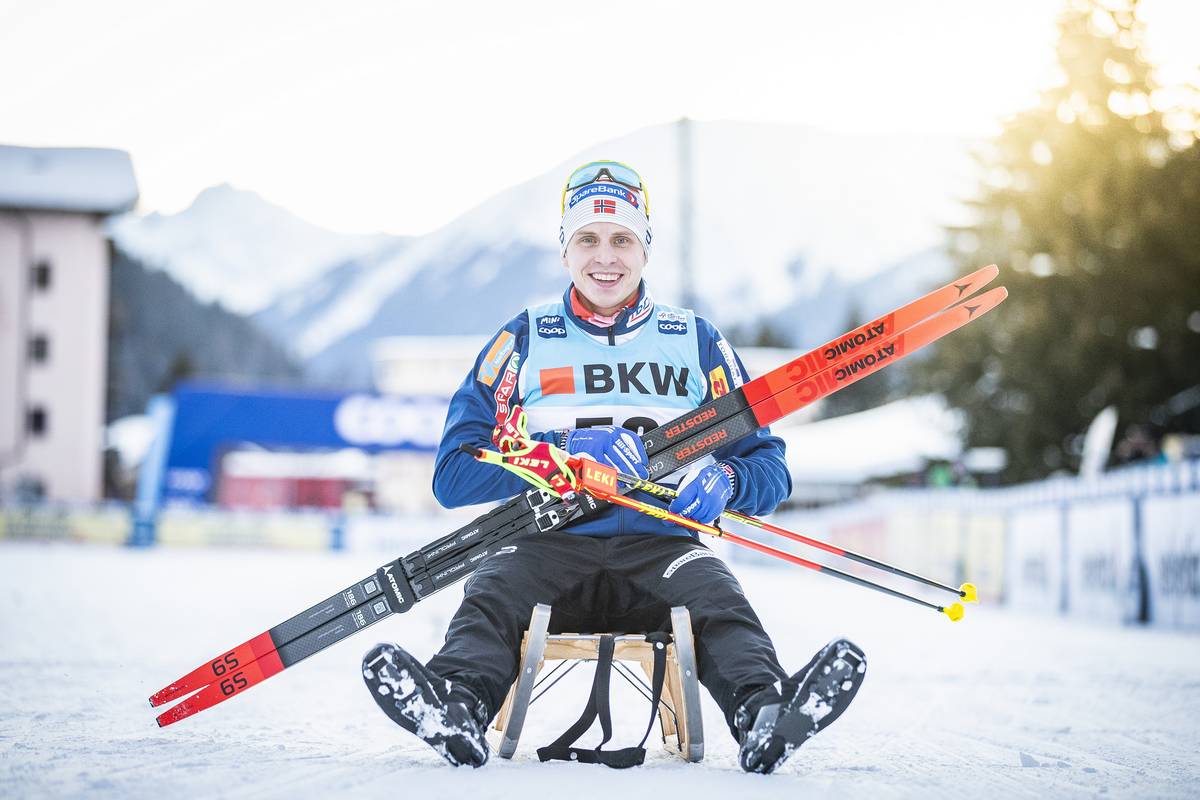
Several North Americans began the race, none bumped into the top-30. Kyle Bratrud (SMST2) was the top-placed American in 38th (+1:55.9). Simi Hamilton (USST) was 42nd (+2:06.9), Scott Patterson (USST) 51st (+2:30.5), while David Norris (APU) did not start after waking up with a mild cold. Erik Bjornsen (USST) had planned not to race this weekend.
Bratrud began his day on the conservative side of pacing, sitting in 65th after 5 k. By 10k, he bumped up to 46th. Finishing in 38th, Bratrud was a bit over ten seconds outside the points.
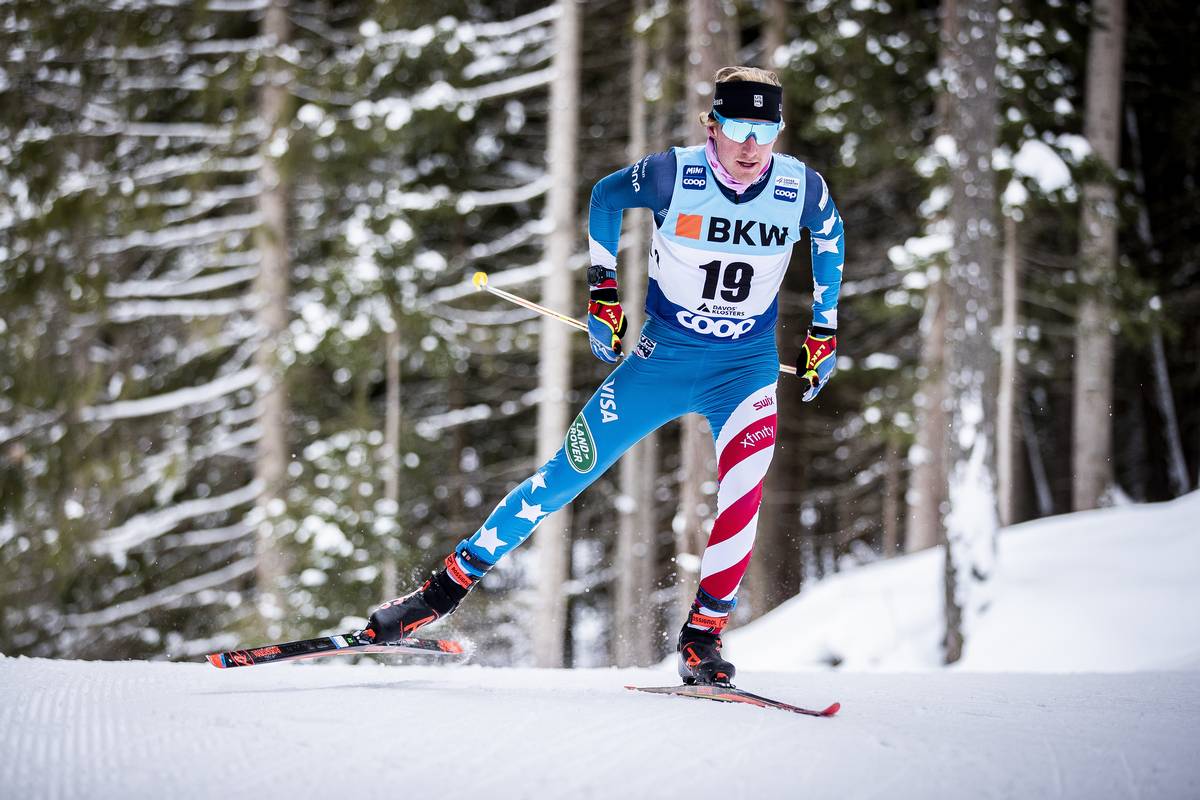
World Cup Coach Matt Whitcomb’s thoughts on Kyle Bratrud’s Davos race
For Canada, Russell Kennedy placed 47th (+2:18).
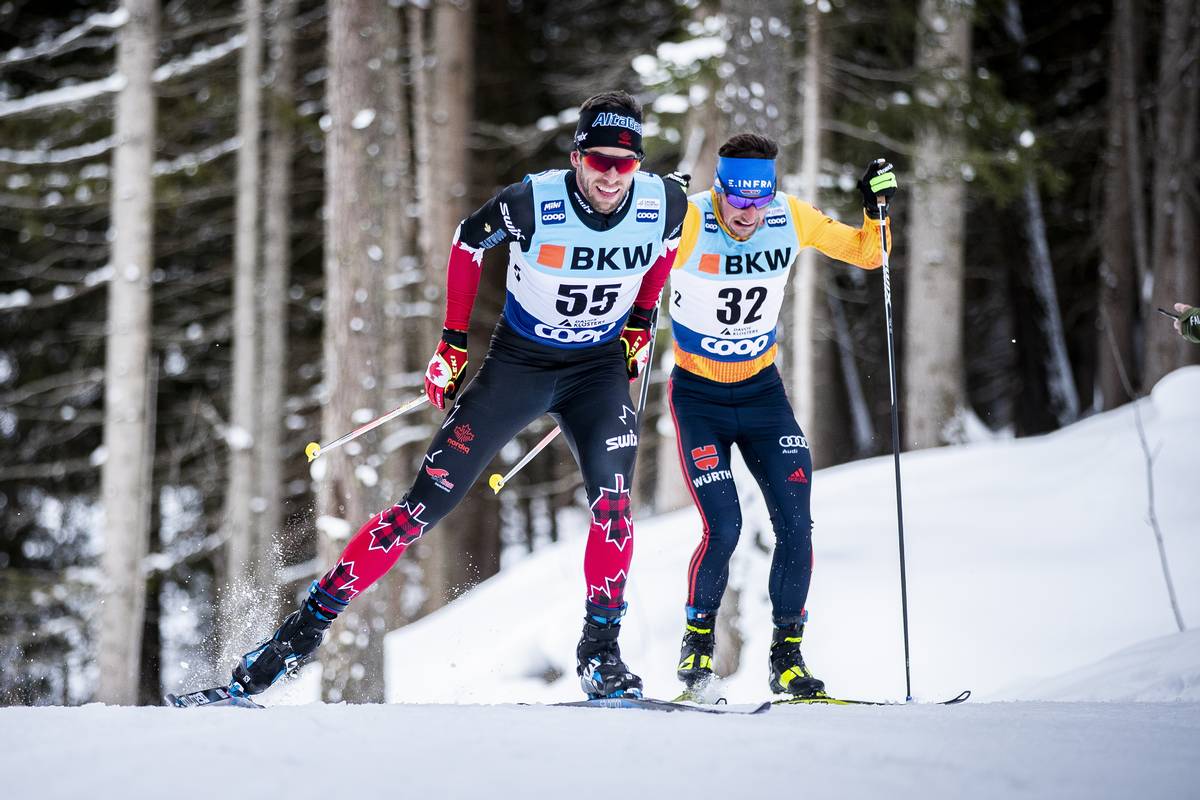
Heading into next weekend’s racing in Planica, Slovenia which features a team and individual sprint, Norway’s Johannes Høsflot Klæbo, who sat out Sunday’s Davos distance race, leads the World Cup overall with 520 points. Emil Iversen is the closest competitor, 72 points behind. Alexander Bolshunov of Russia, who placed seventh Sunday, leads the distance overall with 232 points. Iversen is second with a five point deficit.
Davos concludes Period I distance racing on the World Cup. The next distance event is the December 28th, 15 k mass start skate during the Tour de Ski.
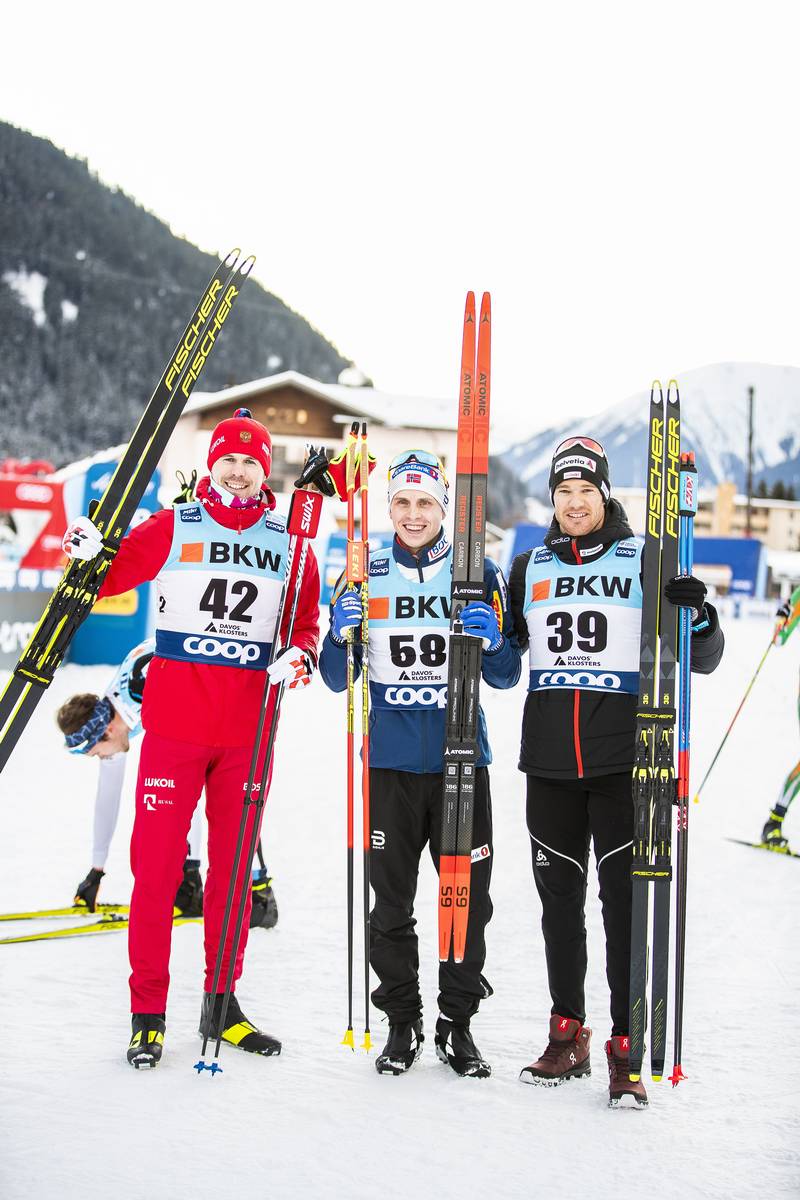
Men’s Final Results | Overall Distance Standings | Overall World Cup Standings

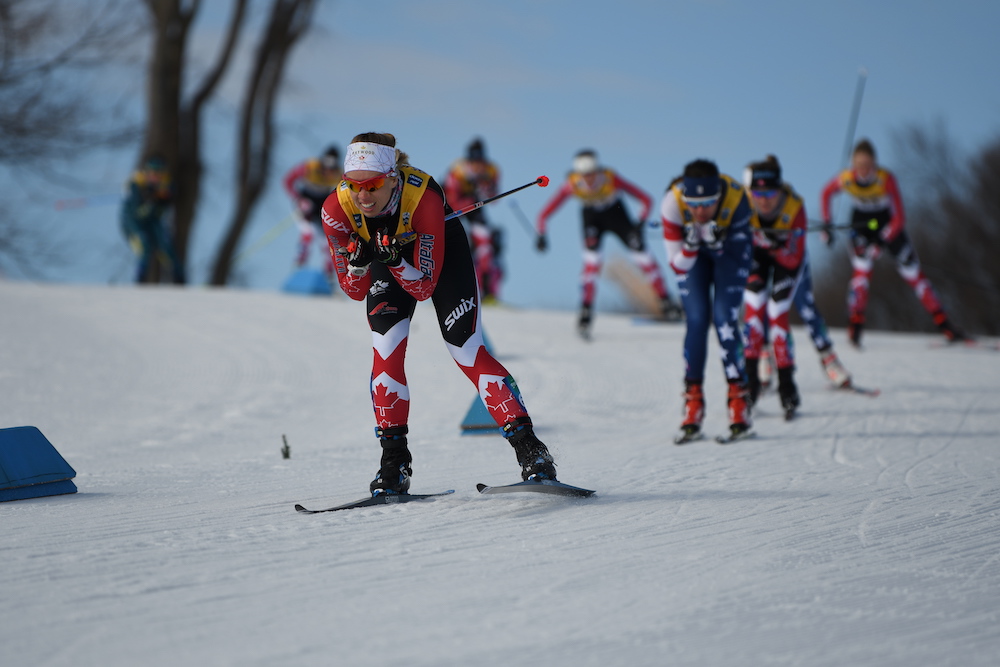
Canada is moving into a new era in skiing. An era with less World Cup podiums and more emphasis on developing future podium athletes.
“Train at what you want to be good at. If its climbing, climb. If it is chess, play chess. Ski training has many elements of course, but in the end the best training to race fast is to race.” — Erik Bråten, National Team Head Coach
In the near future, more Canadians will spend more time racing in North America. The trip criteria is clear that any athlete who wants to stay on the World Cup all season has to demonstrate multiple top 12 finishes. Team selection follows the same path.
For this season, there are six World Cup race days in North America. Canada gets ten Nations Group start positions for the five race days hosted in Canada plus a bonus of another ten Nations Group starts in Minnesota. With these starts available, Nordiq Canada (NC) seems very comfortable skipping the first two World Cup weekends in Ruka and Lillehammer. Three Canadians, however, Emily Nishikawa, Dahria Beatty, and Russell Kennedy, will race in Davos and Planica. Smaller than usual teams are expected again in the new year.
The overall picture is three less World Cup weekends than last season, and fewer athletes all the way through. That doesn’t mean less racing, but it does mean less travel.
The era when the top US skiers came up to Canada to improve their FIS points seems to have ended. At that time, US skiers were excited to find more competitive events to push them harder. For the last few years, it has been Canadian skiers who are happy to get pushed out of the top five by foreigners.
For the last few years, Canada and the US have cooperated to increase the level at select weekends with joint NorAm/SuperTour events. While this adds work for the organizers, the athletes have universally been excited to reach across the border. Both NC and US Ski & Snowboard (USSA) seem happy with the development potential.
“It’s a lot cheaper to race south of the border than fly to Europe”, NC’s new Events Coordinator Jeff Ellis told FasterSkier, explaining that it was cheaper for both athletes and the team. The shorter trips also allow more days training at home where the athletes have a higher level of support.
“Merging a select few Canadian and American Continental Cup events helps strengthen the competitive field,” USSA’s Bryan Fish wrote in an email to FasterSkier. “Both the Scandinavian Cup and Alpen (OPA) Cup have eight nations involved in their respective Continental Cup series. Their robust competitive fields are a strong method of preparing their next generation.”
For 2020, NC decided to hold nationals right after the World Cup Finals in Canmore. Scheduling nationals three days later and six hours drive away at Sovereign Lake makes it possible for all the top Canadians to attend which raises the level of competition and gives younger athletes more exposure to senior level speed.
The same factors were also important when USSA was planning SuperTour finals.
“Most of North America’s strongest World Cup athletes remain in Europe for a majority of the season so they have the best chance to succeed at the World Cup level,” Fish wrote. “This is critical for their success on World Cup, however that can leave a gap in competitive strength in North America.”
Combining SuperTour finals and Canadian nationals into a single event will raises the level of competition. It also creates another opportunity for younger athletes to combine in a single trip a full week of racing and the chance to be trailside at the World Cup.
In the future, NC may revisit other European series as a way to add more rungs to the ladder to the World Cup. “Having development trips to Europe, and doing other kinds of racing could be interesting: If it’s OPA cup, or Scandinavian cup, or whatever it is.” Bråten said.
Kikkan Randall (bib #52) might have had her first classic day of the season on a race course, but the real action was in the younger categories.
There is also a push to add more races in every region. Tier 2 events like the Sovereign Open, might draw a few big names, like Caitlin Gregg, on their way to the opening NorAm/SuperTour the following weekend in Canmore. But, the main goal of the event was to provide one or two extra race days for 300 young regional skiers.
The National Team is committed to a hands-on approach. They are modeling best-practices and enhancing institutional knowledge by working directly with clubs at lower levels of the development pyramid. Recently, Bråten, along with some National Team athletes, assisted with club youth and masters programs during an on-snow camp at Sovereign Lake before the NorAm/SuperTour kickoff. High Performance Manager Joel Jaques, who is also the waxing lead for Canada, hosted a waxing talk and demo for the local coaches and athletes. (The FIS announcement claiming they will implement a fluoro ban next season came four days before the demo and changed the planned content, as applying powders will not be required next season.)
Another (apparent) first this season is having full National Team members who are outside the Canadian system. Sam Hendry attends the University of Utah and Rémi Drolet studies at Harvard.
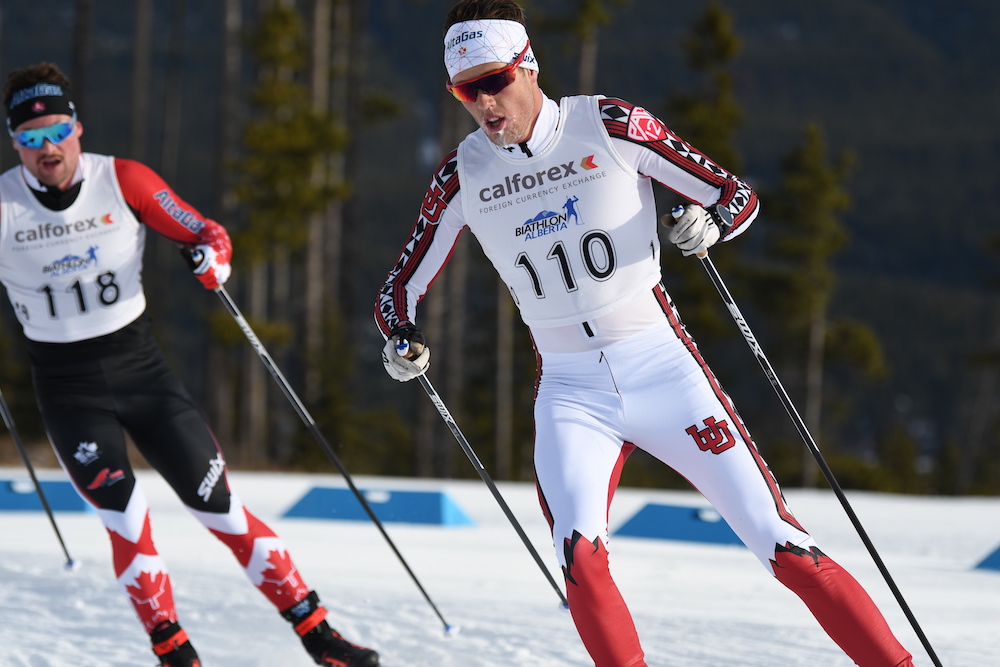
“This has provided me with some awesome opportunities and an incredible team,” Hendry wrote during Nordiq Thunder. “It was really nice for me to have the chance to come home and ski on snow in Frozen Thunder especially with the lack of snow in Utah.”
Utah is a perennial powerhouse — winning the NCAA team title in 2017 and 2019. Utah is (relatively speaking) close to Canmore, which makes it easier for Hendry to connect with his home team.
“Sam is at Utah, so he has a personal coach, but I’m communicating with Miles [Havlick, Utah’s coach],” Bråten said, “and we have a good relationship.”
Harvard might be a top school for physics, but it is less well known as a skiing centre.
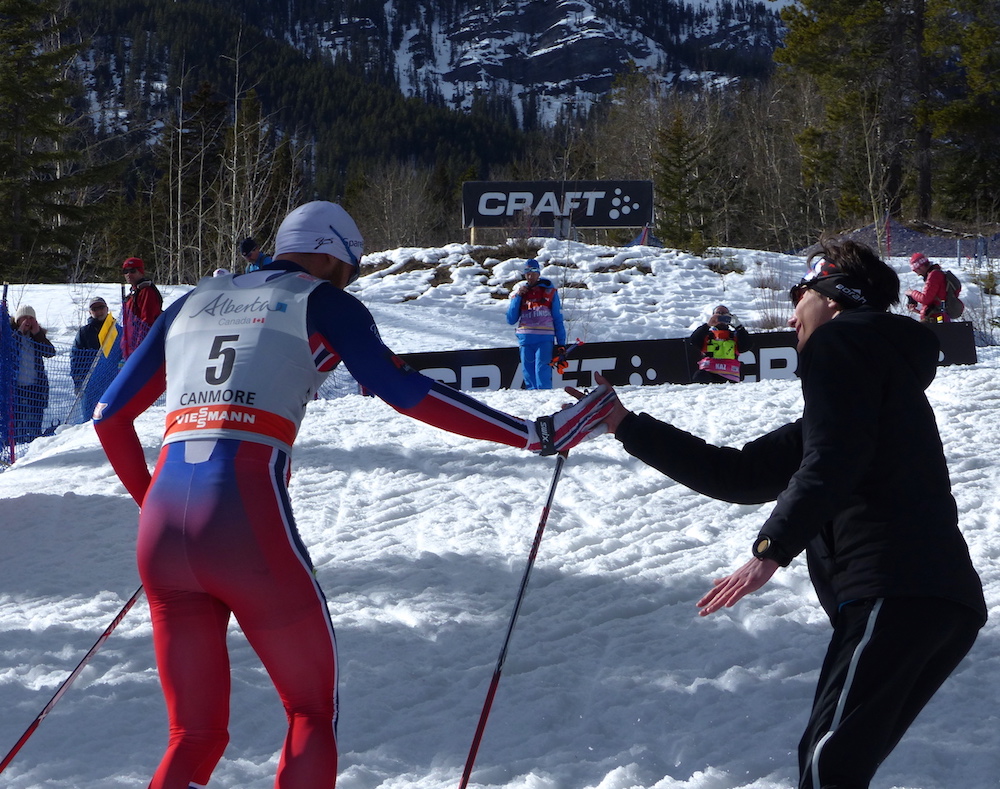
“On paper, Rémi is by far the best skier [at Harvard],” Bråten told FasterSkier, “but I think he sees that value of having that team around.”
Those paper results include ranking 7th of 23 North Americans in the 2019 World Cup final mini-tour in Québec, narrowly edging out American Gus Schumacher as the top overall junior.
“At Harvard, we are lucky to be led by head coach Christopher City and assistant coach Jefferson Tucker, ” Drolet said. “They are fantastic people, as well as coaches, and I have very much enjoyed working with both of them this fall. I am also continuing to work very closely with my coach at Black Jack, Dave Wood, and I am also talking regularly with Canadian National Team head coach Erik Bråten. I have to say that it is interesting to be working with four different coaches, but things have been going well so far, and everyone seems happy to collaborate in making sure my preparation for the season is as good as it can be!”
While Canadians view Harvard as a more expensive education than local universities or full-ride scholarships at NCAA schools, Drolet explained the reality at one of the top-ranked physics programs in the world.
“As an Ivy League school, Harvard College offers neither academic nor athletic scholarships. However, they do offer financial aid scholarships which ensures that all Harvard students pay what their families can afford without going into debt.
“This program has worked out very well in allowing me to pursue an education, which from the outside, is often viewed as having an excessively high price tag.”
Drolet has an ambitious racing calendar, which doesn’t include Nationals even though it is just four hours drive from his hometown.
“The college racing circuit starts for real in mid-January with the Harvard Carnival. Afterwards, I will be racing at the UVM Carnival/Supertour in Craftsbury, followed by the Canadian World Junior Trials Races at Mt. Sainte-Anne.”
The easiest path to qualify for World Cup starts is a top result in Mt Ste Anne, as that weekend has two routes to selection.
“If all goes well at trials, I will hopefully be headed to Germany for the World Junior Championships after racing at a few more Carnivals,” continued Drolet. “I would also be very happy to qualify for some more World Cup starts during the North American circuit at the end of the season, and if there is time for it all, I would love to go to the NCAA Skiing Championships in Bozeman, Montana.”
While this might sound easier than the full NorAm/SuperTour schedule, it’s coupled with demanding academics.
“Training long hours at university while attempting to stay competitive with all of the students who may not have such a major commitment outside of school is certainly a challenge, but it is one that Harvard has allowed me to meet successfully so far.”
Asked about the National Team working with US schools going forward, Bråten had a simple answer.
“This is one of the questions where I will be most likely listening more than I’m speaking when we take a decision.”
Overall in Nations Cup Last Year: 5th
Women’s Ranking 2018/2019: 4th
Men’s Ranking 2018/2019: 11th
Americans to Watch:
Seven men and nine women will be lining up in stars and stripes for the World Cup’s opening: Finland’s Ruka Triple. Three race series features a classic sprint followed by a two-day distance pursuit.
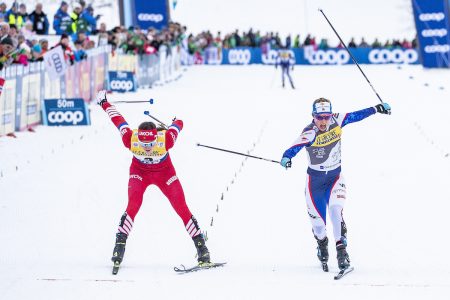
At the top of the ranks, Jessie Diggins (USST/SMS T2) finished the 2019 season 6th in distance and 7th in sprint. It was a year of navigating the life of a gold medalist whose training time was suddenly competing with travel, media attention, and collaborating with sponsors. According to her blog, she packed in 25 events in the first 50 days after the Olympics. Diggins admitted this swell of opportunities also left her feeling mentally and physically fatigued during the season.
That said, you know American women’s skiing has come a long way when feeling flat leads to finishing 6th overall in the World Cup Standings. Diggins won the freestyle sprint in Cogne, Italy and took 3rd in the 10 k skate in Falun, Sweden. She also placed third in three stages of the Tour de Ski and skied the fastest time of day during the 10 k skate pursuit in Oberstdorf, Germany.
Presuming Diggins achieved her goal of finding a work-life balance that allowed her to better recover and absorb training, we can expect her to consistently remain one of the top athletes on the World Cup.
One thing is certain: The Minneapolis World Cup race on March 17th features a freestyle sprint, and Diggins will be racing in front of a home crowd amidst a cacophony of cowbell.
Another consistent performer, Sadie Maubet Bjornsen (USST/APU) finished 8th in the sprint standings and 13th in the distance. She took third in the freestyle sprint in Lillehammer, NOR and cleaned up at the Super Tour Finals winning the freestyle sprint and both distance races. Another testament to how high the standard has been set for the American women, Maubet Bjornsen’s season was not particularly novel, despite consistently measuring up as one of the best all-around skiers in the world. We have come to expect her to perform, and she continues to meet our expectations. This year we expect no less.
Leading the American women on the short track, Sophie Caldwell (USST/SMS T2) finished the season ranked 4th in the overall sprint standings. Caldwell took second place in Davos, Val Muestair, and Lahti, and landed inside the top ten an additional three times. After posting the second fastest qualifying time in the World Championships in Seefeld, AUT, Caldwell was eliminated in the quarterfinals after throwing her boot across the line a three-way photo finish. Because the heat was slow and she was deemed third, she was unable to advance.

Julia Kern (USST/ earned her first Period 1 starts as the overall SuperTour leader in 2019. The 22-year-old also displayed her readiness to race at the World Cup level by scoring points in five events. Her best individual performance came during the freestyle sprint in Cogne, ITA where she finished 11th. She also battled for a gritty fourth place result while racing with Caldwell during the Dresden team sprint, and shone at US Nationals earning two sprint podiums.
Racing fearlessly with the best in the world, Kern cracked the top-20 in the skiathlon in Seefeld, finishing 19th. She also finished 23rd in the freestyle sprint two days prior. With another year of training and experience under her belt, Kern will certainly be worth following.
After recovering from mono, Rosie Brennan rebounded with a phenomenal season in 2019 and consequently was nominated once more to the U.S. Ski Team. Last year, Brennan blew through Period 1 with a vengeance, placing inside the top 30 and mostly within the top 15 in all of the distance races she entered. She cracked the top-10 in the 10 k skate in Davos, with a career best sixth place, and again in the skiathlon when the competition was at its peak in Seefeld.
The remainder of the women starting in Ruka who earned discretionary selection includes: Caitlin Patterson (USST B Team/CGRP) who landed inside the top 30 in the 10 k skate in both Lillhammer and Ulricehamn, SWE, Hailey Swirbul (USST B Team/APU) who stood on the podium after three Opa Cup distance races and landed inside the top 10 at U23 World Championships, and Rosie Frankowski (APU) who finished 24th during the skiathlon at the World Ski Championships in Seefeld.
The second weekend of racing in Lillehammer features a distance pursuit, followed by two sprint events in Davos, SUI and Planica, SLO. These women will be able to focus on the races that best suit their strengths in Period 1.
Before heading to the American men’s field, FasterSkier sends well-wishes to Hannah Halvorsen who was slated to contest the Period 1 sprint races. Halvorsen was struck by a car while crossing a street in Anchorage on November 1st, fracturing her skull and badly injuring her left leg and knee. According to her father who posted information on Facebook, Halvorsen will have a long road ahead of her, but doctors are optimistic that full recovery will be possible. FasterSkier wants to respect the privacy of the Halvorsen family, but will report when they are ready to share further information.
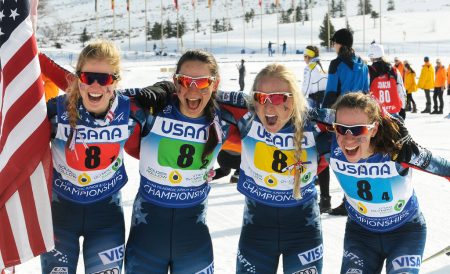
Deep breath. Back to the World Cup.
Of the eight men who made the cut, three were selected objectively: overall 2019 SuperTour leader Kyle Bratrud (SMS T2), and USST A Team members Simi Hamilton (USST/SMS T2) and Erik Bjornsen (USST/APU).
Returning with a wealth of World Cup experience, Hamilton is a consummate contender in sprint races. His most noteworthy performance was aptly timed at the World Championships in Seefeld where he finished ninth. Hamilton advanced from the quarters in a lightning fast heat, then got hung up with another skier in the semi, losing both his momentum and contact with the leaders. On home turf, Hamilton also won the freestyle sprint during the SuperTour finals.
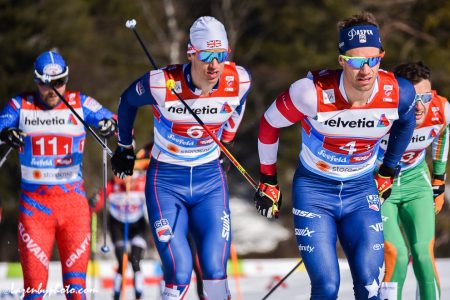
Before World Champs, Hamilton had a strong performance in Cogne, finishing just off the podium in 4th. Displaying the agility and sure-footedness for which he is known, Hamilton dodged a crash in both the quarter and semifinals. This race marked a turning point in his season as crashes and illness prevented him from capitalizing on the fitness he felt confident he possessed. When the pieces come together, Hamilton is both a force to be reckoned with and a thrill to watch.
After popping the third fastest time of day during the 15 k classic pursuit in Lillehammer, Bjornsen has been promoted to the USST A-Team. Last season, Bjornsen whittled his way up the results list, particularly in distance racing. He finished 16th the 15 k classic Cogne, followed by a 17th place finish in the same event in Seefeld. Are you noticing a theme here?
Once again in the 15 k classic in Quebec City, Bjornsen finished 18th followed by a second top 20 (19th fastest time of day) in the subsequent 15 k skate pursuit. At the SuperTour finals, Bjornsen took the win in both the distance races and finished second in the freestyle sprint, demonstrating his versatility as an athlete.
Bratrud’s lead in the SuperTour was primarily garnered through strong results in distance skiing, which also translated to encouraging results on the World Cup. The Minnesota native stood on the podium six times in NorAm and SuperTour distance races, taking the top spot in four of them. At US Nationals, he won the the 15 k classic and took second in the 30 k skate. During his mid-winter international stint, Bratrud landed inside the points in the 15 k classic in Cogne. This will be his first season racing on the World Cup in Period 1.
The remainder of the men to watch in Period 1 include Scott Patterson (USST/APU) and David Norris (APU), who will be focusing on distance racing, and Kevin Bolger (USST/SVSEF) and Logan Hanneman (APU) who will focus on sprint events. Hanneman will not start in Ruka, but plans to compete in both Davos and Planica.
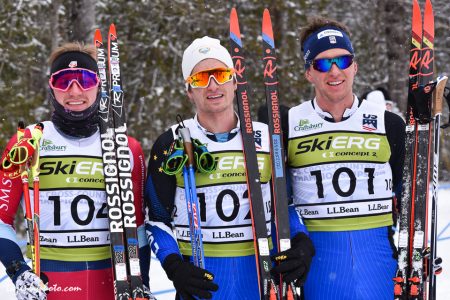
Several athletes who were offered starts in Period 1 declined to focus on the SuperTour. This list includes Kelsey Phinney (SMS T2), Andy Newell, Adam Martin (CGRP), and Ben Saxton (SMS T2).
Phinney underwent shoulder surgery in mid-June for a torn labrum, which occurred from a fall with an outstretched arm. He doctors estimated a six to twelve month recovery process. Phinney spent six-weeks in a shoulder sling, then began to slowly reintroduce strength training and outdoor activities. So far, she has done some no-pole and one-pole skiing.
“My biggest priority is making sure my shoulder heals properly and gets back full range of motion,” wrote Phinney in an email on her return to competition. “I’m not sure when I’ll be back to racing, perhaps later this season if things go really well with rehab. In the meantime, I’m enjoying time at home in Boulder – it’s been nice to see friends and family here, and to explore life outside of the bubble of training and racing. And then in a couple weeks, I‘ll be at the first SuperTour races of the year to help my SMST2 team out with ski testing, driving around, and cheering very loudly! I’m hoping to start using two poles in the next few weeks, and ideally I’ll be able to ski quite a bit in Canmore and Sun Valley and see where I can go from there!”
Overall in Nations Cup Last Year: 11th
Women’s Ranking 2018/2019: 15th
Men’s Ranking 2018/2019: 9th
Canadians to Watch:
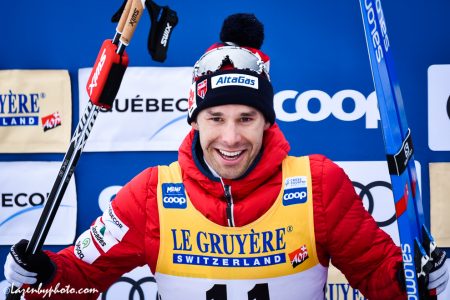
Canada’s top skier, Alex Harvey, retired at the end of the 2019 season. He ended his career on a high note. He finished second in the 15-kilometer freestyle pursuit in his home city of Québec. Fellow national team member Lenny Valjas retired also retired at the end of last season.
Three Canadians will be heading to Europe to race during Period 1 in Davos and Planica: Dahria Beatty, Emily Nishikawa, and Russell Kennedy. These athletes will then return home to train with developing national team athletes and compete in NorAm races. Canada will not be contesting the Tour de Ski. Should one of these athletes pop a top ten in those Period 1 races, the decision not to return in Period 2 may be reevaluated.
This focus on domestic racing and development of world class athletes is part of a larger movement to rebuild the Canadian national program, which recently rebranded as Nordiq Canada. You can find more information on this here.
Beatty posted strong results in 2019. She started her season with a slew of NorAm wins then collected a handful of FIS points by finishing 16th in the freestyle sprint in Dresden and 24th in the same event in Lahti. She also won the 15 k freestyle pursuit at the Canadian National Championships, chasing down Nishikawa who had won the 10 k classic the previous day. In her season opener at Nordiq Thunder, Beatty landed the top spot on the podium in the 16 k skate and commented that she was happy with her overall fitness and how her training has progressed this year.
Nishikawa also scored FIS points in 2019 by finishing 23rd in the 10 k skate in Davos. She also placed 25th in last season’s Tour de Ski.
Kennedy, who has already gotten his feet wet with European racing this season in Olos, Finland, posted his best result during the freestyle sprint in Cogne, where he popped a 12th place finish. Domestically, he landed on the podium in five NorAm races.
The remaining members of the Canadian National Team who will be racing domestically include Julien Locke (Nelson, B.C.), Katherine Stewart-Jones (Chelsea, Que.), Graham Ritchie (Parry Sound, Ont.), Antoine Cyr (Gatineau, Que.), Sam Hendry (Canmore, Alta.), and Julien Smith (Thunder Bay, Ont.).
“This group is ready to step up and carry the torch for a new era of cross-country skiers in Canada,” said Shane Pearsall, chief executive officer of Nordiq Canada in a press release. “They are equally as fierce and determined to deliver medal winning performances as their heroes before them. We are going to work with our sport and funding partners to deliver this dynamic group of athletes the tools they require to succeed on the road to 2022 and beyond.” The site https://x100casino.com contains the best 100 online casinos in the world