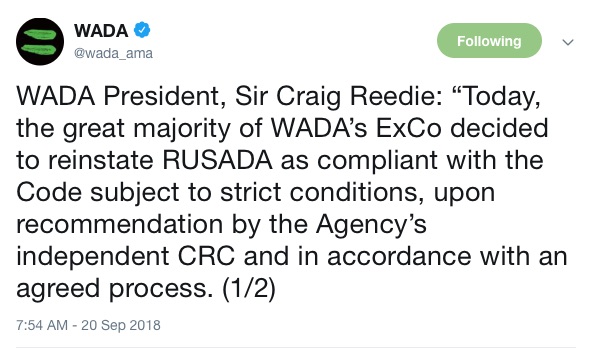
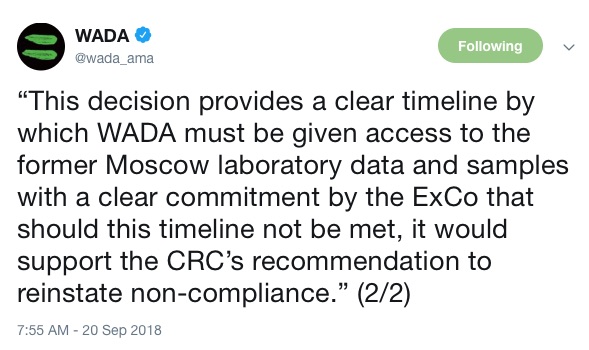
Following the thread of doping allegations, WADA statements and actions, and RUSADA responses have been dizzying. This much is true: as much as we may be steaming ahead towards a final judgment and consequence for Russian sport (WADA recently gave Russia three weeks to explain discrepancies in the Moscow lab’s data handed over to investigators), there appears to be some internal strife within Russia’s sporting bodies.
The domestic hand wringing came before the IAAF Track and Field World Championships in Doha, Qatar – which run from September 7- October 6. Russia’s team, represented by RusAF, will miss the championships as it remains banned by the IAAF for doping and a lack of institutional reforms. (RusAF is Russia’s athletics federation.)
Tensions boiled over recently when RUSADA Director General Yuriy Ganus gave an interview to France’s L’Equipe. He is quoted by the paper as saying “I’m calling on all the Federation’s directors to resign.” He is also quoted as stating, “We will end this disaster only when we admit that punishment is inevitable and that nobody can escape their responsibilities.”
Those quotes are spicy enough. However, it was also reported in the L’Equipe article that Ganus admitted that some track and field athletes from the Chuvash national teams Center for Sports Training had taken illegal blood transfusions. Chuvash is a Republic in western Russian. As a result of those accusations, the athletes in question filed a suit against Ganus.
On September 30, Ganus posted an open letter on RUSADA’s website. In that letter, Ganus claimed L’Equipe falsely attributed statements to him. But, the letter also revealed how much tension exists within Russia as it struggles to reenter the international sports community.
Laid out bare for all in the September 30th letter is the following claim against a colleague, “Given the fact that the Chuvash national teams CST head athletics coach Nikolay Anatolyevich Panfilov informs about the possible lawsuits from other coaches on the same matter in this situation, it can be regarded as organized actions of the Chuvash national teams CST head athletics coach against the National Anti-Doping Agency RAA “RUSADA” and its Director General for no reason at all.
“I want to remind, Nikolay Anatolyevich, you and RusAF President that AIU on behalf of IAAF has repeatedly stated the need for cooperation in doping violations investigations, not obstruction.”
The Second Open Letter
In that first open letter, Ganus was just getting started. He followed that piece with a second open letter published on the same day.
If you’ve been looking for what reads like an earnest exhortation for reform out of Russia from anybody, let alone the head of RUSADA, this is it.
Some background first. In the second paragraph, Ganus mentions the “documents sent by WADA to the Minister of sports P. A. Kolobkov and to me”. We are assuming Ganus is referring to the communications sent to Russia in September explaining that Russia could once again be deemed non-compliant due to alleged doctored data sent from the Moscow lab to WADA. And also just another reminder, RusAF is Russia’s athletics federation.
If you are reluctant to read long-form on FasterSkier, here’s a teaser excerpt from the second open letter.
“The question is not RusAF doping crisis, the question is not only in the WADA requirements to Russia. Doping crises periodically happen around the world. The main question is how do we get out of these crises, what approaches do we use?
“We need to change the way we deal with problems. We must not only wait for changes, but also to be able to do everything for their implementation. Stop being surprised by the predictable events, by reasonable requirements on the transferred defective electronic bases, by not restoried RusAF in its current state, by sunrise and sunset.
“The sports and anti-doping world is shocked by the approaches and methods Russia use to recover from crisis. I have repeatedly said, it is not the number of violations, we have a large sports jurisdiction, which was on the way out of the crisis. The question is how sports authorities resolve these crises, how transparently and effectively they fight with doping in the country. …
“Our sport deserves full membership in the international sports family, but first it is necessary to remove unacceptable approaches and methods, and persons who brought it to a deadlock and discredited in the eyes of the world.”
You’d need the world’s tallest pair of XTRATUFFs to stand amidst the morass of deceit spewed by RUSADA and the Russian Sports Ministry since 2014. But the words from Ganus ring a bit different than what we have heard in the past. Decide for yourself.
Here’s the second September 30, letter in its entirety.
I, Yuriy Alexandrovich Ganus, Director General of the new Russian Anti-Doping Agency «RUSADA» (further – new RUSADA), fulfilling my professional duty and the duty of the citizen of the Russian Federation in relation to the situation, the consequences of which can be tragic for Russian sport, I consider it necessary to express my professional opinion on the current situation with a high possibility of the doping crisis deepening in all sports of the Russian Federation for reasons beyond new RUSADA control, beyond its competence, but with causes and consequences relevant to the jurisdiction of the new RUSADA.
After reading the documents sent by WADA to the Minister of sports P. A. Kolobkov and to me, one of the key conclusions that can be made: we were betrayed, we were deprived of the right to be on the side of the truth, and it was done by those responsible for the recovery of the sports organization from the doping crisis. Today, the sports organization of Russia is no longer on the edge of the abyss, we are flying into the abyss, the depth of which is difficult to predict.
The significant changes identified by WADA and requirements sent to the Russian sports organization are due to the importance of maintaining public confidence in the integrity of Russian sport and the world anti-doping program, according to the WADA letter, of which Russia is a part, and its anti-doping system.
Can’t we win fair? Ask a question to our living sport legends. They will give everyone a clear and hard answer. Who makes of a great sporting power a rogue nation that cannot be trusted in sport. After all, elite sport is an international sport and anti-doping activities are an integral part of it. We have enough worthy leaders in the country who are in power, who relate to the authorities and are involved in the development of sports. At the same time, having no relation to making crucial decisions for the entire sport, and thus not having a meaningful influence on the development of sports they become hostages of the situation, investing their lives, energy, resources in the sport. And achieving success in their sports organizations, sports, clubs, leagues, they depend on that policy of resolving problems and getting out of doping crisis, which once again demonstrates its failure.
It is enough to evaluate the current state by the actions, decisions and words of those who has power to make decisions in sports authorities, which is often not only not correlate with modern sports life, but contrast with it, actually testifying to its depravity, which is obvious to the entire sports and anti-doping world.
The bright example is how our athletics overcomes the doping crisis. We are told that we are “blowing up” athletics. The answer to the question who really “blew up” our athletics will be given soon. RusAF was predictably not restored, and our athletes continue to participate without the Russian flag because of the real RusAF condition, which is due to the massive campaign with the use of state resources, is carefully hushed up by all real decision-makers in sports. Everything will take its place, everyone will be given an answer, just give some time, a significant part of which sports authorities have already lost, having lost the ability to overcome crises with dignity.
The question is not RusAF doping crisis, the question is not only in the WADA requirements to Russia. Doping crises periodically happen around the world. The main question is how do we get out of these crises, what approaches do we use?
We need to change the way we deal with problems. We must not only wait for changes, but also to be able to do everything for their implementation. Stop being surprised by the predictable events, by reasonable requirements on the transferred defective electronic bases, by not restoried RusAF in its current state, by sunrise and sunset.
And, when we try to oppose, it is important to remember that the actions of our officials and state bodies are mute evidence of their position. By rejecting the findings of Richard McLaren’s reports, on the one hand, at the same time officials’ actions actually confirm correctness of the report, among which already can be: destruction of our case on internal investigation, involving professional experts, in the main Investigation Department of the Ministry of internal Affairs in Moscow, launching on us the Supervisory mechanism of the Prosecutor’s office for legal cooperation with the AIU, one of the founders (ROC) tries to exert a dominant influence on us, including issues of anti-doping standards. At the same time, the progress of the cases’ package involving established by the regional authorities of Chuvash Republic independent Commission working on the case is not yet known.
The sports and anti-doping world is shocked by the approaches and methods Russia use to recover from crisis. I have repeatedly said, it is not the number of violations, we have a large sports jurisdiction, which was on the way out of the crisis. The question is how sports authorities resolve these crises, how transparently and effectively they fight with doping in the country.
It is thanks to this that the new RUSADA actively restores trust not only in the country, but also in the world. We have done everything to ensure sustainable growth of clean sport protection in Russia to restore hope for the crisis recovery, despite the confrontation we face.
We have achieved outstanding results in target testing of athletes – 65% of total RUSADA testing volume, with annual growth of testing volume (2017 – 6196 samples, 2018 – 9502 samples, 2019 plan – 11000). The amount of target testing has never before exceeded 10%. Given that this figure is comparable to the volume of out-of-competition testing, it means that almost with the entire volume of out-of-competition testing we work focused on each tested athlete. Therefore, it is not surprising that 4 months before the end of 2019 the volume of identified whereabouts violations is comparable to the figures of the last year, and the volume of the anti-doping rule violations is already beginning to significantly exceed (162 – 01.09.19 against 147 for the entire 2018). At the same time, we increase, develop and expand our educational formats. 4 months before the end of 2019 the coverage of sports community at offline educational formats is comparable to the volume of 2018 (about 10,000 athletes and specialists). 2018 was revolutionary in terms of RUSADA online coverage – more than 51139 athletes and specialists in different parts of the country against 7934 in 2017. This year we have signed a partner agreement with the largest social network “Vkontakte” and we are confident that we will reach qualitatively new indicators of anti-doping online coverage, given that we live in a large extended country and our task is to reach every athlete. We are actively engaged in educational mission in our sports community, aimed at the formation of a qualitatively new anti-doping culture and on top of all the achievements of 2018 we have published a book by the outstanding person of the world who devoted his life to fight for clean sports, by the former WADA Vice-President, Chairman of the IOC medical Commission, IAAF Vice-President Arne Ljungqvist “Doping’s Nemesis”, which showed an example of the fight against doping, which he started in Sweden. Sweden turned the page long time ago, also thanks to the fact that in this struggle he was supported by the Royal family of Sweden.
We must not forget that on its way out of the crisis a new RUSADA team in a short time restored its functionality and under the supervision of WADA international experts provided admission (by number of samples) of all Olympians and Paralympians to the 2018 Olympics in strict compliance with international anti-doping standards, taking into account that ROC was denied the right to choose and admit its athletes to the 2018 Olympics.
We have declared and are conducting a real and principled, not a paper fight against doping around all our country. I sincerely thank the Russian Federation Main Directorate for drug control, with which we are consistently developing effective interaction.
And we are grateful to the regions that sincerely joined this fight. They are Belgorod, Astrakhan, Sverdlovsk, Kaluga, Novosibirsk, Tomsk and Ulyanovsk regions, Krasnoyarsk, Kamchatka and Trans-Baikal Territories, Republics of Tatarstan, Mari El and Altai. We plan to further expand the territory free of doping.
We have support from dedicated clean sports specialists at various levels in Ministry of sports, ROC and RPC. With the Paralympic Committee we are developing program interaction, because Paralympic sport is including the mission of socialization those people who by the will of fate found themselves in a difficult limited life situations. And we see how this movement is gaining momentum, and we are actively increasing anti-doping support of Paralympians.
We do our best, within the framework of international rules and regulations, but we are not omnipotent. And I address the Russian power – give the right to live to all our wide sports movement. Russia is a great sports power and has the right to a decent sports management by leaders faithfully dedicated to clean sport, our great country with a great sports history, using new approaches and methods.
Our sport deserves full membership in the international sports family, but first it is necessary to remove unacceptable approaches and methods, and persons who brought it to a deadlock and discredited in the eyes of the world.
I know this firsthand, we are developing cooperation with international and sports organizations and they all want to see Russian sports at top level competitions, but clean and honest, integrated into the international sport system on the principles of honesty, openness, cooperation and trust.
So, the Institute of national anti-doping organizations (iNADO), in its statement on 24.09.19 by words of Graeme Steel noted that ” RUSADA has, since its reformation (2017) following the corrupt activities of previous officials, proven to be an eager and valued participant in international anti-doping work. While a declaration of non-compliance is necessary under the rules, of all Russian organisations, RUSADA has been the one leading the way to effect positive change in the country. Athletes of the world deserve fair competition and there is a desperate need for a strong force for positive change within Russia. In line with our long-standing policy we will continue to support RUSADA in their efforts to bring that about.” We are recognized and supported in the anti-doping world, even the most demanding of its participants.
According to WADA specialists, the nature of the electronic database discrepancies is such that it cannot be of random nature, given that these alleged distortions were produced including the last 2 years.
By October 9, the Russian authorities are not expected to form a discussion agenda, negotiations, the time allotted for this has already passed, the Russian authorities are waited to produce acceptable clear explanations on the presented structure. I pay attention of all – expect from the Russian authorities presented by the Minister of sports of the Russian Federation, but not from RUSADA! New RUSADA has never had, has not and will not have anything to do with formation, protection, and even more so with changes in the Moscow Laboratory electronic database, which was supposed to be a secure and closed IT perimeter, but did not because of the will of the persons responsible for the doping crisis recovery in Russia.
For reference, I will inform you that the new RUSADA works with at least 13 anti-doping laboratories of the world accredited by WADA, with 5of which – in active mode. And we have no access to their electronic databases and cannot have. So I ask not to seek in the new RUSADA reasons this appalling situation.
Seeing the WADA requirements, realizing their validity and severity of consequences for Russian sport, I declare – this is our sport’s tragedy, if not to say more – this is internal conspiracy against our sport, by individuals whose culture is far from the ideals and the value of clean sport, not related to WADA, to other international organizations. Couldn’t persons initially making decisions on database changes, and then on the Moscow laboratory electronic database transfer in such state estimate the possibility of identifying such changes by professionals and the tragic severity of consequences of what was done for our long-suffering sport? Both answers are terrible. And importantly why to change base, to protect fallen athletes and their achievements? In order to break the fate of future generations of athletes, pushing some of them out of our sport, and dash Russia’s hopes. It’s our children, grandchildren. This is definitely not public policy or public interest.
It’s time to finally understand who acts in the interests of the state, and who destroys the reputation of public authority. And those people who brought Russian sport to such an unacceptable way out of the doping crisis by their actions has long discredited the sport, but they discredit and the system of state power in Russia, where serve enough honest statesmen, devoted to the national interests, and far from a solution of these problems, and the task of clean sport protection certainly corresponds to the national interests, otherwise we will lose not only present, but also future generations of athletes. Officials will not be able to bring medals themselves. How can we implement the presidential decrees on formation and development of sports reserve and involvement in sports of a significant number of new participants, if the situation is no longer just critical, it tragic. Think about it, this is all happening in front of parents and children who only start their way in sports. And it is a big question today whether they choose this path.
Immediately I’ll make a remark, I possess sufficient information to speak about severity and the scale of the consequences. Previous approaches and methods to overcome the crisis cannot be accepted, because they only aggravate the situation, they need to be urgently changed by replacing everyone involved.
I do not know who exactly could make changes, on whose instructions he acted. How it was possible to allow these persons to make decisions and give instructions in the Russian sports field. Who raised all these people?
I was brought up on the examples of the heroic past of our multinational people, our heroic grandfathers and relatives, when attitude to flag was sacred and people started a battle with the banner raising fighting spirit when each standard-bearer understood that he will be the aim, the fallen standard-bearer was replaced by his companion, lifting the banner up and taking the bullets. The standard-bearers were always and are aimed at to lower the banner. And we protect those who lowered the flag. What’s happening to us?
WADA requirements for the quality of the transferred Moscow laboratory database, as well as examples of the development of situations on other issues in the anti-doping sphere are becoming another silent evidence of the clinging to previous approaches to the recovery from the doping crisis, which step by step aggravate the situation. Thus the facts and actions testify for themselves. The power is discredited by persons acting on behalf of the power and destroying by their actions the credibility of it both in the international arena and within the country.
In addressing the issues of recovery from the protracted doping crisis came persons, acting on behalf of public authorities, but in addressing issues far from protection of state interests, and thus discrediting state government body. Despite the fact that in Russia there are enough honest people in power.
The new RUSADA will never be the same. And no need to draw parallels, to reflect, and especially teach us by all those, who was related to former, untrustworthy RUSADA, and involved in its failure. The former RUSADA was rejected by the international sports world and the anti-doping community for betraying anti-doping and sports values.
New RUSADA should not be and will no longer be a service organization providing anti-doping “services” for the sports authority. The price of this so-called old-school “loyalty” is the long-term decline of our sport, which has not yet been stopped.
We did not change the name, registration data of the organization. But we changed approaches, methods, we, in addition, as any Russian legal entity act in according to the Russian legislation, in the professional activity we are strictly guided by international and Russian anti-doping norms and standards, basing our actions on international anti-doping principles and the values of clean sport, all of us, all of our wonderful young RUSADA team, we all fight for the cleanness of our sport. Vendre une voiture accidentée sans controle technique,taxi, Audi, BMW, Mercedes-Benz, Renault, Peugeot, VW – rachat vehicule hs Rachatvotrevoiture.com And when people ask me if I believe in this, I sincerely believe, because at the heart of these anti-doping sports principles and sports values are our religious roots and traditions, which are equally interpreted in every religion in our multi-faith country.
Everyone who really makes decisions and acts to distort the facts, to deadlock the recovery from the doping crisis in Russia, all who puts such actions in a favorable shell and participates in systematic harassment of the new RUSADA, sincerely struggling with doping, this terrible vice of our sport, actually lead our sport to a deadlock and sold their souls to the devil.
For anyone who works, lives in sports, it’s time to decide which side of the mirror you are on, which side of the force – good or evil. Time to come out of the looking glass of the doping crisis.
Let every man be rewarded according to his deeds (The gospel of Matthew (Chapter 16, page 27), the Psalms (CH. 61 p. 13), the Epistle to the Romans the Holy Apostle Paul (chap 2 p. 6), the Revelation of the Holy Apostle John the theologian (CH. 22 p.12).
Yuriy Alexandrovich Ganus
Russian Anti-Doping Agency «RUSADA» Director General