From the FasterSkier archive — posts syndicated from athletes’ and coaches’ own blogs between 2004 and 2012, kept online as published. Current coverage is at fasterskier.com.
On June 18th, WADA issued a press release announcing its Athletes’ Anti-Doping Rights Act. According to WADA, the act was developed and approved by the organization’s Athlete Committee. Essentially, the document asserts it is an athlete’s “fundamental right” to participate in clean sport.
It is a two-part document. The first part focuses on rights established in WADA’s Code and International Standards. The second part consists of recommendations, and according to WADA these rights are “not rights under the Code of International Standards.”
These recommended rights (which again are not guaranteed fundamental rights) include the following:
Right to an anti-doping system free from corruption
Right to participate in governance and decision-making
Right to legal aid
Part one describes athletes’ rights that are explicitly stated in the WADA Code of International Standards. These rights are considered mandatory and include the following:
Equality of opportunity
Equitable and fair testing programs
Medical treatment and protection of health rights
Right to justice
Right to accountability
Whistleblower rights
Right to education (anti-doping education)
Right to data protection
Rights to compensation
Protected person rights
Rights during a sample collection session
Right to B sample analysis
Other rights and freedoms not affected
Application and standing (Nothing in this Act shall change in any way the application of the Code or International Standards, or the standing of athletes under those documents.)
More on WADA, on June 17th, the U.S. Office of National Drug Control Policy (ONDCP) released a statement recommending the U.S. “consider” withholding its funding to WADA.” The ONDCP asserts WADA has not reformed to its satisfaction. The U.S. is the single largest government funder of WADA, providing $2.7 million annually. WADA has contested the ONDCP’s claims in an annotated version of ONDCP’s June 17th letter.
Russia’s Olga Zaitseva leads Canada’s Megan Imre in a 2014 IBU World Cup pursuit.
Bad Optics for the RBU: Last week, it was reported by TASS (the Russian State News Agency) that the Russian Biathlon Union (RBU) had nominated Olga Zaitseva (42) to its Board. Zaitseva was an unexpected choice as she came with controversy. She was implicated in the Sochi doping affair by the McLaren Report. She was on the silver medal-winning 4 x 6-kilometer relay team in 2014, but that medal had subsequently been stripped.
On Monday, June 29, it was reported that Zaitseva’s name had been withdrawn from consideration.
Despite her 2014 doping offense, Zaitseva retained gold medals won at the 2006 and 2010 Olympics. Both medals were in the women’s team relay.
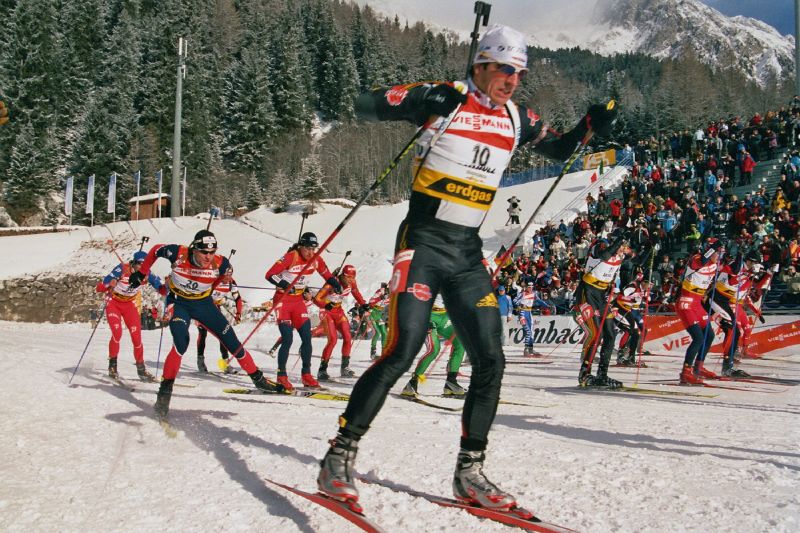
Canada’s Christian Gow (12) chases Germany’s Erik Lesser during the men’s 4 x 7.5 k relay at the 2018 Olympics in PyeongChang, South Korea. Germany won bronze. Lesser lamented the situation and said of the IBU’s decision to hold World Cups in Tyumen, Russia, despite requests from him and other athletes to move the event: “If we don’t go, it’s wrong because it’s our sport we love. [But] if we go to Tyumen, we maybe send the wrong sign to IBU.” (Photo: FlyingPointRoad)In three weeks time, biathlon’s World Cup circuit will move to Russia.
But a number of the sport’s stars won’t be there – and others plan to attend, but aren’t very happy about it.
In an Executive Board session in PyeongChang, South Korea, a few weeks ago, the International Biathlon Union (IBU) decided to go on as planned with World Cup races in Tyumen, Russia, even though the Russian Anti-Doping Agency is still not compliant with the World Anti-Doping Code.
Biathlon Canada had announced in December that it would boycott the event if it was kept in Russia, following revelations of systematic abuse of the anti-doping system by that country. In the intervening months, athletes appealed to the IBU through private channels to move the races to a country which complies with the WADA Code.
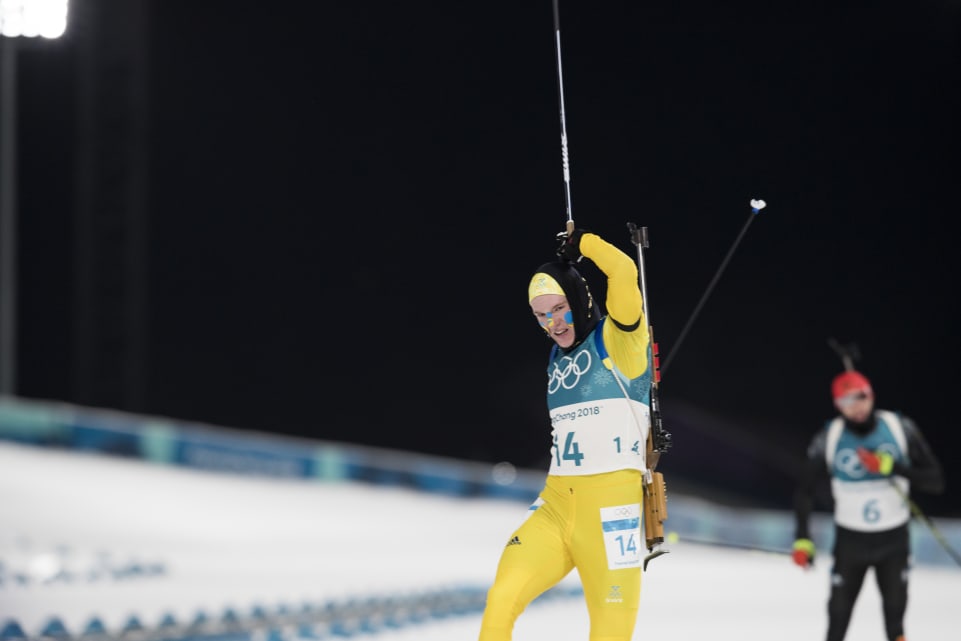
Sebastien Samuelsson of Sweden celebrating silver in the men’s 12.5 k pursuit at his first Olympics on Monday in PyeongChang, South Korea. Samuelsson announced today that he is boycotting the World Cup Finals in Tyumen, Russia, because Russia is not in compliance with the World Anti-Doping Code. (Photo: IBU/Biathlonworld)
Today, 2018 Olympic pursuit silver medalist (and relay gold medalist) Sebastian Samuelsson of Sweden announced on Twitter that he will not go to the races either.
“Nations without a functioning anti-doping organization should not have competitions at the international level,” he wrote, according to a translation. “Also, worried about the safety of both myself and the doping tests in Russia.”
Also not going is Klemen Bauer of Slovenia, a 2012 World Championships relay medalist who is a four-time Olympian.
“I’m not planning to go to Russia at all,” he told FasterSkier in a Twitter exchange. “I was quite sure the IBU will replace the races, but despite all the effort we put into the clean/er biathlon, thanks to the president of the IBU that didn’t happen.”
Both men are running for positions on the IBU’s Athletes Committee.
“The idea is to improve the active role of the athletes and the voice of the athletes,” Bauer wrote of his candidacy. “We’ll see.”
Another man running for a spot on the Committee is Germany’s Erik Lesser, 2014 Olympic silver medalist in the individual, 2015 World Champion in the pursuit, and several-time Olympic and World Championships relay medalist.
Lesser will be attending the races in Tyumen, but he wasn’t happy about the IBU’s decision to hold them there.
Klemen Bauer of Slovenia competing in the mass start at the 2018 Olympics in PyeongChang, South Korea. Bauer will not compete in the World Cup Finals in Tyumen, Russia. (Photo: FlyingPointRoad)
“In my opinion the RUSADA and the Russian Federation have not done enough to light up this case,” he wrote in an email to FasterSkier. “During the last years, WADA and some commissions found a bunch of proof about a doping system in Russia. But RUSADA and [the Russian Biathlon Union] did nothing to fight against doping. The Anti-Doping-Laboratory in Moscow still does not have a license, and all the officials are in the same seats. It’s a wrong sign, after these problems, to go to Russia and celebrate World Cup Finals.”
Lesser and teammate Arnd Peiffer, the 2011 World Champion in the sprint who then won gold at the 2018 Olympics, and who has even more World Championships and Olympic relay medals than Lesser, wrote a letter to the IBU explaining their position.
Yet a few weeks ago, the IBU decided to go ahead and hold the World Cup in Tyumen anyway. They issued a press release explaining the decision.
“I‘ve read the press release and I still don‘t understand why they decided this way,” Lesser wrote. “Because it‘s a threat to Russian biathlon fans and the Organizing Committee will take care of our safety? Wow, these are true reasons to keep the World Cup in Tyumen. So, I don‘t really think that reasons are valid.”
Last season, there was also supposed to be a World Cup in Russia. But in 2017, several teams announced that they would boycott the event and IBU President Anders Besseberg had a contentious meeting with athletes, after which the IBU decided to move the event.
This season, despite appeals by athletes like Lesser, Peiffer, and the others, that has not yet happened. And so in the end, Lesser says that he will compete in Tyumen, even though he wishes the races were somewhere else.
“We argued with our federation and we decided to go to Tyumen,” he wrote. “The sport is the first [priority] and we want to compete. We hope that we can do a good job in Russia. We are there to stand as clean athletes.
“It‘s bad that the IBU put us athletes in this position,” he wrote. “Actually it‘s not our job to be political. It‘s our job to be athletes and compete against other. If we don’t go, it’s wrong because it’s our sport we love. [But] if we go to Tyumen, we maybe send the wrong sign to IBU.”
Russians Olga Zaitseva and Olga Vilukhina competing in the pursuit at 2013 World Championships. Both were disqualified from the 2014 Olympics by the International Olympic Committee, with a whistleblower stating that the biathlon team was doping in the years leading up to Sochi.
On Friday, the International Olympic Committee (IOC) posted the reasoned decision from its Disciplinary Commission, in which Russian biathlete Olga Zaitseva was disqualified from the 2014 Olympics in Sochi, Russia.
Zaitseva’s disqualification had been announced previously, but this is the first full-length decision presenting the evidence for the disqualification of any biathlete. Olga Vilukhina and Yana Romanova have also been suspended, but the Oswald Commission’s full decisions for their cases have not yet been released.
The reasoned decision not only contains details about Zaitseva, but also additional information which should put the whole biathlon world on notice.
“Dr. Rodchenkov further states that the entire Russian biathlon team, including the Athlete Zaytseva, has been using the Duchess Cocktail before the Olympic Winter Games Sochi 2014,” paragraph 359 of the decision reads. “He also provided an email sent April 2013, whereby he raised concerns about the high levels of haemoglobin for the biathlete team that was detected by his laboratory.”
The Duchess Cocktail refers to a combination of performance-enhancing drugs designed by Rodchenkov, the former director of the Moscow Anti-Doping Laboratory who assisted Russian teams in numerous sports to evade anti-doping rule violations before he became a whistleblower.
The Russian sports agency and the state security agency, FSB, developed a method to open anti-doping sample bottles. Using this method, they replaced the urine of athletes who had taken the Duchess Cocktail with previously-collected clean urine so that their doping would not be detected.
Thus, Rodchenkov is asserting that every Russian performance in the biathlon events at the 2014 Olympics was tainted by illegal performance-enhancing drugs.
This is notable because the men’s biathlon team, for instance, had not previously been implicated in doping scandal that has been raging for several years. Only the likely members of the women’s biathlon relay team – Vilukhina, Zaitseva, Romanova, and Irina Starykh (who was caught using the blood-doping drug EPO before the Olympics and suspended) – were on the “Duchess List,” a list of athletes presumed to have been given the drug cocktail. No male biathletes appeared.
However, it doesn’t seem surprising that they would, given that 14 cross-country skiers, virtually the entire Russian squad for Sochi, appeared on the list, as well as the female biathletes.
And that’s what Rodchenkov said, too.
“Dr. Rodchenkov… gives indications regarding the widespread use of Prohibited Subtances notably human growth hormones and EPO in the years preceding the Olympic Games,” another paragraph of the decision reads, referring to “members [of] the biathlon and cross-country skiing teams, for which the endurance is an absolutely critical elements.”
This raises the question of whether further action will be taken against more biathletes by the IOC, or by the International Biathlon Union (IBU).
The IBU has provisionally suspended the Russian Biathlon Union, but that actually has few consequences: Russia is still slated to host a World Cup weekend in March, Russian Victor Maygurov is still the First Vice President of the IBU, and all Russian athletes are still allowed to compete in the World Cup and the Olympics (Romanova, Vilukhina, and Zaitseva retired before they were suspended).
In the meantime, she has maintained her innocence. So has Wolfgang Pichler, the German coach who worked with the Russian women’s biathlon team in the four years leading up to the Sochi Olympics. For his troubles, he has been banned from attending the 2018 Olympics, where he would have coached the Swedish women’s team, which he now leads.
As the decision notes, Zaitseva and her legal team raised several objections to the case against her. She claimed that to suspend her was to pursue “collective justice” based on the widespread evidence of doping by Russia, rather than referring to any fault of her own. She also attacked Rodchenkov’s character, calling him an unreliable witness.
And finally, her team questioned the methods developed by Professor Champod at the University of Lausanne to detect whether anti-doping sample bottles had been tampered with.
That was wise, because the most damning evidence against Zaitseva comes from her sample bottles. Two of her sample bottles from Sochi had multiple marks on them consistent with tampering. In one of those bottles, the urine had such high amounts of salt that it is not possible that the concentration was produced by the human body. Together, these two pieces of evidence were used to argue that her samples had been tampered with.
According to logic used by the Disciplinary Commission in this and other cases, that tampering couldn’t have happened without Zaitseva’s knowledge. DNA testing showed that the urine in the samples was hers, which indicates that if the urine was replaced, it had to have been given by her at a different time. The Commission rejected the possibility that such a urine sample could have been collected without an athlete knowing its intended purpose.
But while two experts testifying on Zaitseva’s behalf criticized Champod’s methods as being incompletely described, they were unable to convincingly explain why their questions would absolve Zaitseva of blame.
“Neither Mr Alexei Bushin, nor Ms Evgeniya Burova did, in particular, offer any alternative explanations for the presence of marks consistent with the opening of the bottles with tools of the kind used by Prof. Champod,” the decision noted. “The IOC Disciplinary Commission finds this absence of alternative explanation even more significant in the case where one of the bottles not only bears marks strongly indicative of opening, but in addition contains urine with an abnormal salt content. Both elements support the conclusion that it was opened. The expertise of Prof. Champed convincingly demonstrates how this opening, which necessarily occurred, could be operated.”
This forensic evidence was used in the Commission’s decision that Zaitseva had violated the provision of the Anti-Doping Rules for the 2014 Winter Olympic Games which prohibits tampering with samples or with the integrity of the anti-doping process.
By doing so, they also found that she was complicit in a cover-up, thus breaking another provision of the Anti-Doping Rules.
In a strange aside, a urine sample belonging to Zaitseva but collected later, in October 2014, was analyzed in order to make a DNA comparison to the Sochi samples. What such a comparison actually revealed was that the October sample contained the urine of two different women mixed together, indicating that sample-swapping continued after the 2014 Olympics.
“This result does not concern the Olympic Games in Sochi and, as such does not fall within the scope of the application of the Rules,” the Commission wrote in its decision. “It however constitutes additional evidence that the Athlete was a protected elite athlete actively engaged in doping practices.”
The Commission also concluded that Zaitseva had used prohibited performance-enhancing drugs, on the basis of testimony from Rodchenkov.
“Use or Attempted Use of a Prohibited Substance can be established by any reliable means,” the Commission wrote. “This includes witness evidence.”
In an affidavit to the Disciplinary Commission hearing, Rodchenkov shared his own observations, many of which were based on detailed notes he had taken in a daily diary over the years. He also provided emails and documents related to Zaitseva and to the biathlon team.
“Dr Rodchenkov provides a list issued in October 2012 reflecting the clean urine bank existing at that time,” paragraph 358 reads. “The Athlete Zaytseva is mentioned on this list, with an indication that her urine was delivered to the Moscow Laboratory on 24 October 2012.”
“Dr Rodchenkov also recalled that in 2013 and early 2014 he had numerous conversations about the Athlete Zaytseva, as she was on a protected list,” another paragraph reads. “In autumn 2013, he took part to a discussion with the Athlete Zaytseva at the Ministry of Sports in Moscow. During this meeting the abnormal [Athlete Biological Passport’ data, due to her constant [performance-enhancing drugs] use, was discussed.”
And there was also evidence that Zaitseva was both doping, and also being tested more frequently than many other athletes, which is consistent with a previously-stated policy of the IBU to do “targeted testing” on athletes with suspicious biological passport profiles.
“Dr Rodchenkov specifically recalls swapping sessions of the Athlete’s numerous sample,” paragraph 361 reads. “Due to the intensity of the testing, Dr Rodchenkov underlines that they almost ran out of the Athlete’s clean urine. He remembers that the Athlete Zaytseva provided three plastic bottles of clean urine to freeze and store at the FSB and that additional urine had to be delivered.”
Zaitseva argued that Rodchenkov’s recollections and correspondence should not be used against her because of the illegal actions he had taken in the past. The Disciplinary Commission disagreed.
“Given the insistence of the Athlete’s attacks, the Disciplinary Commission will add the following,” the Commission wrote. “The Athlete refers to the past actions and behaviours of Dr Rodchenkov. In this respect, the Disciplinary Commission wants to be very clear in confirming that considering Dr Rodchenkov as a reliable witness is not in any way an approval of his past actions and his moral character. His actions, while being a director of the Moscow Laboratory, are despicable and inexcusable. This said, in a case of a conspirative scheme, the main evidence is often coming from participants, who accept to stand as witness.”
On Wednesday, Nordic Nation reached Biathlon Canada President Murray Wylie to discuss an open letter he signed on behalf of his organization and sent to the leaders of the International Biathlon Union.
Despite the RBU’s less-than-full IBU member status, Russia is still scheduled to host the final IBU World Cup races of the season from March 20-25 in Tyumen and IBU Cup 7 & 8 in Uvat and Khanty-Mansiysk.
In an open letter sent to IBU President Anders Besseberg and IBU Secretary General Nicole Resch dated Dec. 8, 2017, Wylie stated Biathlon Canada will not be sending athletes to the IBU-sanctioned events in Russia in March.
In the letter, Wylie included the following reasons for this declaration:
“The occurrence of high-level IBU events in Russia is inconsistent with the IOC decision of 05 December to disallow participation by the Russia Team in the PyeongChang Olympics:”
“the integrity of anti-doping procedures in Russia is still very much uncertain, given the current situation in which RUSADA remains non-compliant with WADA.”
Listen for more from Wylie, as told to FasterSkier on Dec. 13:
Lowell Bailey (USA) leads Alexander Loginov in a World Cup competition in Kontiolahti, Finland, in 2013. Loginov was later suspended for doping, bumping Bailey’s results and prize money up higher from the weekend of racing. (Photo: NordicFocus.com/USBA)
The Russian rosters for January competition will include two names not seen in a while: Irina Starykh and Alexander Loginov. Both are returning to international competition after serving suspensions for using the blood-doping drug erythropoietin (EPO).
Starykh was initially suspended in January, 2014, in the run-up to the 2014 Olympics. At the time, she was the top Russian woman on the World Cup and had just notched an individual podium. She was also a key member of the Russian relay team. Starykh failed an out-of-competition test in December 2013 month along with teammate Ekaterina Iourieva.
2013-2014 had been a breakout season for her so far. When asked how she had improved so much by a Russian news service, Sports.ru, she replied in December 2013, “When I found out that I was [named to train] in [Vladimir] Korolkevich’s group- I decided to fully trust the coach… he was building my training andI believed that I would approach the winter season in good condition.”
Starykh initially received a two-year ban. When the International Biathlon Union (IBU) re-tested some old samples a few months later, however, they found additional evidence of EPO use. The IBU extended her ban to three years.
Loginov competed in the IBU Cup competitions in Obertilliach, Austria, in December, finishing fourth in the 20 k individual. That’s the same venue where he won the individual race at World Junior Championships in 2013.
Loginov was caught in the same re-testing scheme that earned Starykh her extra year of suspension. His sample from November, 2013, tested positive for EPO when a new method was used several months later. The suspension was announced in November, 2014, and was for two years, plus retroactive disqualification of results between November 2013 and 2014.
Loginov said at his anti-doping hearing that the drug had been included in a medication he took to treat prostatitis. But the IBU’s hearing panel rejected this claim on multiple grounds.
The press release from the Russian Biathlon Union announcing the men’s team for international competition in January did not specify whether he would compete on the World Cup or the IBU Cup.
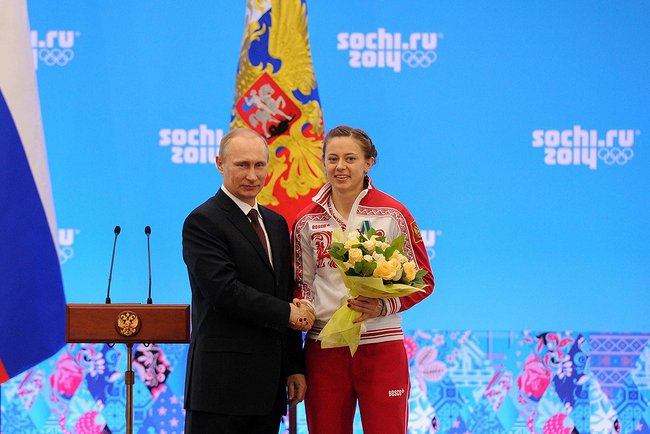
Russian President Vladimir Putin with biathlete Olga Vilukhina on February 24, 2014. (Photo: www.kremlin.ru/Creative Commons)
After an Executive Board meeting today to discuss doping in Russia, the International Biathlon Union (IBU) has provisionally suspended two athletes. The federation opened anti-doping investigations into 29 more.
Meanwhile, the Russian Biathlon Union voluntarily gave up their hosting rights for two events: 2017 Youth and Junior World Championships, slated for Ostrov, and a World Cup stage slated for Tyumen.
Two Suspensions from the 30+ Cases
The IOC has jurisdiction over all anti-doping activity at Olympic Games. That means that any samples collected between Jan. 31 and Feb. 22, 2014 which tested positive for banned substances or showed signs of tampering are the responsibility of the IOC rather than a relevant international sports federation like the IBU.
The IBU noted in its press release that the IOC had opened proceedings against two athletes. The press release did not name the two athletes, but noted that the IBU would suspend them.
Meanwhile, Norway’s NRK broadcaster is reporting that the two athletes were medalists in Sochi. That leaves nine possibilities. Evgeny Garanichev won bronze in the 20 k individual, and Olga Vilukhina silver in the 7.5 k sprint. Vilukhina was joined by Olga Zaitseva, Yana Romanova, and Ekaterina Glazyrina for silver in the women’s relay. And Alexey Volkov, Dmitry Malyshko, Evgeny Ustiugov, and Anton Shipulin won gold in the men’s relay.
At least four biathletes appeared to have “protected” status at the 2014 Games, according to evidence files from the McLaren report. One of those athletes, Romanova, had sample bottles with marks that seem to indicating tampering.
In addition, the IBU is opening investigations into 29 more athletes mentioned in the McLaren report.
The IBU will notify both the athletes and the Russian Biathlon Union. Both entities can comment on the allegations. At the same time, a working group formed by the IBU will continue to investigate. Then the working group will decide whether the case needs to be referred to an Anti-Doping Hearing Panel, which will ultimately decide whether suspensions are required.
The IBU noted only that they would set a deadline for receiving comments from the affected athletes. But otherwise, they did not specify a timeframe for the investigations. Because World Cup racing resumes January 5, 2017, in Oberhof, Germany — just 14 days from today — that means that if any of the 29 biathletes are competing on the World Cup, they will likely continue to do so.
Many in Russia, and outside, were pleased with the decision.
“A balanced decision has been taken,” Deputy Prime Minister Vitaly Mutko told the TASS news agency. “It gives an opportunity to make conclusions in an unhurried manner, not the ones based on the abstract statements or conclusions of just one person… I’m confident our federation will show the majority of athletes [who misused doping] have already been punished.”
The IBU press release noted that in only one case was an athlete already suspended for the same positive test that was noted in the McLaren report.
Several athletes had positive tests explicitly mentioned in different evidence documents. In at least five cases, anti-doping staff reported positive results as negative ones in the World Anti-Doping Agency’s test management database. As a result, the athletes never served suspensions for their violations. One such case occurred at an IBU Cup competition in Ostrov in 2013.
Alexander Tikhonov, a board member of the Russian Biathlon Union and a former Olympic champion, lauded IBU President Anders Besseberg.
“Well, biathlon is not affected,” he told sports.ru. “A positive decision.Besseberg showed that he is our man.”
Russia Gives Up on Hosting Two 2017 Events
Momentum has been growing for an international boycott of biathlon events in Russia. The Czech Republic and Britain led the way by declaring that they would not compete in Russia until the country had a clean bill of health from anti-doping authorities. The Norwegian Biathlon Association expressed support for this position.
Ultimately, such a move will not be necessary. The IBU mentioned in their press release that the Russian Biathlon Union has given up the two events.
“Under the circumstances, [RBU] considers it impossible to conduct the Biathlon World Cup and Junior World Championship, to be held in Tyumen and Ostrov respectively…Determining the place for these activities is up to the IBU,” the Russian Biathlon Union wrote on its website. “The competition should take place in an atmosphere of celebration, and not among suspicions and rumors.”
The IBU has yet to decide where they will be moved to.
“The relocation of both … events will be decided upon later,” the IBU said.
“This is a first important step by the Russian Biathlon Union to show to the IBU and to the world of sport that the current situation is taken very seriously,” Besseberg said, according to the press release. “This will now allow the international biathlon family to focus on biathlon during these events.”
Some in Russia are still upset about the boycott threat.
“These calls for boycotts should entail punishments for athletes,” Mutko told TASS. He elaborated that he thought those advocating for a boycott were in violation of the Olympic Charter.
Athlete Reactions
Some international athletes have also reacted to the decisions.
Punishing the fans instead of real culprits… What a sanction… 👎🏼
Anna Bogaliy-Titovets, who won relay gold with Russia in 2006 and 2010 and now competes for South Korea, had a more nuanced view.
“If the Executive Bommittee IBU made such a decision it means that its members have a good reason, and evidence of Russian athletes involved in doping,” she told sports.ru. “Depriving the whole team of the right to race in international competitions would be extremely unfair.We must respect the decision in the way the IBU presented it.I do not think this is a conspiracy – the Executive Board consists of representatives from different countries. Severe punishment for no reason would not be possible.”
“The IBU has done a solid job,” Norwegian Biathlon Association President Erlend Slokvik told NRK, according to a translation. “And it is good that Russia withdraws.It’s a signal that they have understood the seriousness of the situation.”
In response to evidence of widespread doping in Russia, the Czech Biathlon Union became the first to discuss a boycott. The Czechs will not attend a World Cup stage to be held in Tyumen, Russia, in March; they have been joined by the British Biathlon Union. Several other countries say they hope that the International Biathlon Union will move the event.
But the Russian Biathlon Union put out a defiant press release denying any involvement in doping.
“It was about time that some federation came and said out loud what we are talking about behind the scenes,” Czech Biathlon Union President Jiří Hamza said in an interview with the news agency iDNES, according to a translation.
The International Biathlon Union (IBU) is being pushed to move the competitions. The dozens of doping biathletes are only part of the equation. Perhaps a bigger issue is that extensive sample manipulation and collusion occurred on Russian soil. That makes some athletes and federations reluctant to compete in Russia.
“I don’t think anybody feels safe about being there, in a country that had this high level of collusion,” U.S. Ski and Snowboard Association President and CEO Tiger Shaw told FasterSkier the day the report came out.
A few months ago, the IBU also controversially voted to award 2021 World Championships to Tyumen. The International Olympic Committee (IOC) had directed that no new competitions should be scheduled in Russia; the IBU interpreted the directive to say that the existing Tyumen bid could remain up for election.
2016 Youth and Junior World Championships, slated for Ostrov, Russia, are also part of the discussion.
If the competitions are not moved, Czech athletes will not attend them, Hamza said.
Also signing on to the boycott is the British Biathlon Union (BBU).
“The Board of the BBU made a unanimous decision over the weekend to boycott World Cup 8 in Tyumen,” BBU Secretary General Mark Goodson wrote in an email to FasterSkier.
Momentum may be building for other federations to sign on as well. A widespread boycott could push the IBU Executive Board to move the event. A similar boycott led to 2016 World Championships for bobsleigh and skeleton being stripped from Sochi, Russia.
The IBU Executive Board is meeting to discuss the McLaren report this week.
“Early this morning Tuesday, we received an Email of thanks from [Czech biathlon] and in mid-morning the Czech Republic issued an ‘Open Letter’ to the IBU and all Federations expressing even more displeasure than we had, and boycotting all events in Russia until WADA and the IOC gave their Anti-Doping Systems a clean bill of health,” Goodson wrote. “The latest news is mid-afternoon with a very supportive (of Czech) Open Letter from Norway demanding that named, proven Russian biathletes be banned with immediate effect, and that the IBU withdraw all competitions from Russia until a clean bill of health. Failure of IBU to do this will result in Norway considering a boycott of all international competitions in Russia.”
North American federations are considering their options.
“We have been discussing the issue and will make a decision Friday after the IBU makes its ruling,” Biathlon Canada High Performance Director Eric De Nys told FasterSkier. “We are of course hoping that the IBU makes the right call and pulls the World Cup from Tyumen.”
The United States is leaving the decision up to individual athletes.
“We have told our athletes that participation is up to them and that there will be no pressure for them one way or the other,” U.S. Biathlon Association President and CEO Max Cobb told FasterSkier in a text message.
Some prominent athletes have been speaking individually about the prospect of a boycott.
“It’s not like it’s only one or two [athletes],” Martin Fourcade said in an interview with Norwegian broadcaster NRK. “It’s 31, added to the 12 we had the last few years in biathlon. And I hope if my federation don’t have big enough balls to take [on] the problem, the athletes do it on their own… If nothing is done in January, I will ask my colleagues in the international teams – I mean Norway, I mean Germany, Czech Republic, all of the nations – to don’t compete.”
“Due to the current atmosphere in the media landscape on the matter of 31 Russian biathletes, suspected of using prohibited substances, RBU considers it necessary to issue the following statement.
In the course of several years, RBU has consistently pursued a policy of zero tolerance for doping. This is confirmed both by strict compliance of all Team Russia biathletes with the requirements of WADA and their due availability for control by WADA and other accredited organizations along with active collaboration of RBU with these organizations in the field of promotion of clean sport. Clear evidence of mentioned above – the official statistics of WADA concerning the number of doping tests taken in biathlon in 2014.
Starting spring’14, after the election of the new top management of the Russian biathlon Union, this cooperation has become even more intense.
Within the idea of zero tolerance for doping RBU held more than 10 seminars for athletes and coaches inviting representatives of national and international anti-doping organizations. All persons who had ever been involved or had been under suspicion of any connection with the use of prohibited substances were banned for life. In the course of internal tests at national competitions all the athletes who didn’t comply with strict requirements of RBU were caught and severely punished.
Another proof of zero tolerance for doping is the fact of cooperation of RBU with the foreign experts, such as Ricco Gross and Wolfgang Pichler, who would never agree to jeopardize their reputation.
We do not know the names of the athletes from the list that will be discussed by our respected colleagues from IBU on Thursday, December 22nd. However, we are ready to provide comprehensive information about any RBU athlete ever to participate in the biathlon Events. We admit that the majority of persons from this list are those who have already been accused of violation of doping rules by the RUSADA and RBU internal doping control and are currently disqualified or finished their career.”
Pichler is a German who came to prominence coaching the Swedish biathlon team and Magdalena Forsberg in particular. An outspoken opponent of doping, Pichler was hired to coach the Russian women’s team from 2012-2014. He has now returned to the Swedish team.
Within the Russian national team there were two training squads, with Pichler heading one of them. He said as early as the Sochi Olympics that he suspected there was doping within the other training group, headed by Vladimir Korolkevich. He had even tried to leave his post early due to concerns about doping.
But Pichler has maintained that his own athletes were clean. The report sheds doubt on that assertion. At least two of Pichler’s athletes – Olga Zaitseva and Yana Romanova – were on the “protected list” in Sochi. One of Romanova’s urine samples also showed signs of being tampered with by anti-doping officials. And more of his athletes may be among the 31 who were referred to only by alpha-numeric code identifiers in the report.
“I know relatively little about what happened there,” he said in an interview with German broadcaster ZDF in early December. “I have only been a coach there for one year. It is being discussed, that much is clear. It does put pressure on the athletes, that they are being pointed at. I believe it’s not only a Russian problem, it is a worldwide problem which has to be tackled… I am experiencing a lot of support, also by [the Russian Biathlon Union], because they also want clean and fair sport. So at that moment it is sad when you are being pointed at again. They are following my line, if someone cheats he’ll be kicked out.”
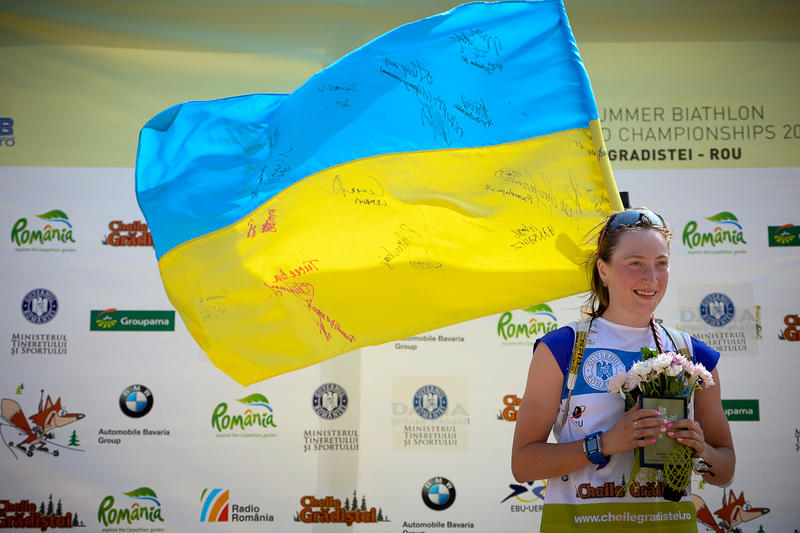
Olga Abramova after winning gold in the pursuit competition at Summer Biathlon World Championships in Romania in August 2015. She had also won the sprint. (Photo: IBU/Evgeny Tumashov)
Olga Abramova, a Ukrainian World Cup biathlete whose “A” sample from a January competition tested positive for the banned hormone mildronate, has waived her right to have the “B” sample examined.
That means that her case will proceed immediately to an International Biathlon Union (IBU) Anti-Doping Hearing Panel, which will decide whether and how to discipline the athlete.
Mildronate was added to the World Anti-Doping Agency’s Prohibited List effective January 1st, and Abramova’s sample was collected just ten days later. Originally designed as a growth-promoting hormone for livestock, mildronate is widely acknowledged to be performance-enhancing and is even advertised as such.
In the press release announcing the advancement of the Abramova case, the IBU also revealed that a second athlete had tested positive for the same substance at an IBU Cup competition in January. As the IBU Cup is a second-tier circuit, it is assumed that this means it is not a star athlete, but the IBU has not revealed the athlete’s name.
“The idea is to protect the right of the athlete until they either declare that they are indeed positive, or a B sample confirms this,” IBU Vice President for Medical Issues Dr. Jim Carrabre wrote in an email to FasterSkier. “Once this occurs then we truly have a positive finding. If we announce the athlete’s personal information before this and they deny the medication and the B sample does not confirm that we have a case, then we have a personal privacy violation.”
Meanwhile, Carrabre told Norwegian broadcaster NRK that he wanted to re-examine anti-doping samples from the 2014 Olympic Games in Sochi, Russia, given ongoing investigations into doping in the country and a WADA investigation which alleged Russian state security interference in the Sochi laboratory. The Russian Anti-Doping Agency, RUSADA, is currently not in compliance with WADA and testing has been outsourced to the United Kingdom.
“My point to NRK was that I would like to overview the tests that were done, the results of those tests, and integrate this as a total picture of things going on around the time of Sochi,” Carrabre explained in an email. “We would be remiss not to do this especially in light of the [WADA] Independent Commission’s findings and recommendations. As you know, there are many issues with Sochi including test sample destruction.”
“I must say that I’ll be very surprised if one laboratory managed to cheat,” Besseberg said.
Carrabre reportedly met with WADA officials to exchange information, however several in the biathlon community are questioning whether the IBU has any jurisdiction to do such an analysis since the International Olympic Committee (IOC) is responsible for testing at all Olympic Games.
Russia is also pushing back on the allegations.
“The International Olympic Committee has previously made a statement that they have no doubts about the transparency of the Olympic Games in Sochi in terms of doping,” Natalia Zhelanova, Advisor to the Russian Minister of Sports, told R-Sport News, according to a translation. “At the Games for anti-doping it should not be RUSADA and our laboratory- doping control was by the IOC.. This occurs at any Olympic games and only the IOC may decide to conduct further analysis of doping tests.”
The former Russian Biathlon Union director Sergey Kuschenko further asserted that his athletes had been clean.
“These charges are baseless,” he told R-Sport. “As for the Russian national team, at the time of the Olympic Games, we were confident that our athletes have no such problems.”
Ricco Gross of Germany competing in Antholz, Italy, in 2006. (Photo: Goetz Primke via Wikimedia Commons)
German Olympic and World Champion biathlete Ricco Gross will coach the Russian men’s team in the upcoming season. After much discussion and speculation, the appointment was announced on Aug. 12.
Gross won four Olympic gold medals, in the relays at Albertville (1992), Lillehammer (1994), Nagano (1998), and Torino (2006). His eight total Olympic medals place him second on the all-time list, and he has 20 World Championships medals to his name as well.
Gross retired in 2007. Since 2010, hehad since been coaching with the Germans, first with the women’s World Cup team, and most recently with the IBU Cup team.
Gross, 44, will work together with Vladimir Bragin, who had previously been announced in April to head the “B” team for the Russian men. However, he will reportedly work with top athletes like Anton Shipulin, who placed second in the World Cup Total Score last season, and Evgeniy Garanichev.
“We have a very strong team in Russia,” Gross said in a press release from the Russian Biathlon Union. “My main aim is to make this team better… Obviously, my long-term aim is the preparation for the Olympic Winter Games 2018. We have to go step by step to this goal. We have to become better and unlock our potential. I am sure that Olympic Winter Games in South Korea can be successful for us. There are so many strong athletes in Russia.”
After Gross did not continue his contract with the Deutscher Skiverband after the 2014/2015 season, it was initially speculated that he would take a job coaching for Ukraine. Volodimir Bryznak, the president of the Ukraine Biathlon Union even announced the staffing shift.
On April 7, the day the contract was set to be signed, the deal fell through.
“He wrote that the circumstances have changed,” Bryznak said. “I guess he had a much better offer.”
The motivation to leave the German team seems to have come at least partially from a desire to have more control over a training group.
“Becoming the senior coach for the Russian men’s team is a big challenge for me,” Gross said in the press release. “I had been working with the German’s national team; now, I start to work as the senior coach in Russia. It gives me more freedom by making the decisions and the relevant responsibility.”
Gross becomes the second high-profile German to head to Russia. The first, Wolfgang Pichler, worked with the women’s team in what was ultimately an unsuccessful partnership.
Pichler had been an avid critic of Russia’s doping program and was hired ostensibly to provide some respectability to the program.
But Pichler was not given full access to all athletes, with some choosing to train with Vladimir Korolkevich.
The anti-doping effort did not work. Two Russian women who trained with Korolkevich, Irina Starykh and Ekaterina Iourieva, were banned on doping violations in January 2014.
Pichler told The New York Times, among other outlets, that he had been certain Iourieva was doping, and had brought concerns about Korolkevich’s program to the Russian federation. Nothing was done.
Instead, two weeks before the Olympics began in Sochi, Korolkevich was promoted over Pichler to head the women’s team there.
Then in the midst of the Games Pichler was removed from the team, creating chaos and drawing ire from Olga Zaitzeva, one of the team’s biggest stars and a gold medalist from the 2010 Olympics.
“I do not agree that he was removed, and I will fight for Wolfgang,” Zaitseva said between races in Sochi. “We worked with him well, and I will not pour dirt on him. For the results you should be asking the rest of the coaching staff.”
And that was not the only drama at the Olympics. Another athlete who had chosen Pichler’s training group, Ekaterina Glazyrina, was expelled from the team after criticizing Pichler on her website.
The comments were later removed, with Glazyrina stating, “Of course my main mistake was to choose the wrong group and the wrong coach. I did not have a great dialogue with Pichler from day one and therefore we did not get the results we wanted. I regret training with Pichler very much.”
Pichler said in an interview after ending leaving the team at the end of the 2014 season that the worst part about the job was reading terrible things about himself in the press and on the internet. In a separate interview, he spoke of how one journalist relentlessly attacked him every time the two met.
“Very often it looked like a blatant harassment, and was not just me – if I experienced would be easy – but the people who were in my team,” he said.
He pointed out that when his team was compared to the women’s teams of the earlier 2000’s, it was an unfair comparison: those teams were plagued by doping scandals. But he enjoyed working with the women, claimed he had positive relationships with them, and said they never lacked for motivation.
So what does Gross have to look forward to?
“There was no dialogue,” Pichler said in April 2014. “The sports ministry constantly interfered with the work. This is what has become a major problem for me… [Yet] it was clear that none of the so-called ‘experts’ were not going to be responsible for the result.”
And it’s not just fans. Anatoliy Khovantsev, a former national team coach who now works with 2015 World Champion Ekaterina Yurlova outside the national team framework, was also unimpressed with the hiring.
“He has a very positive reputation, which he won as an athlete,” Khovantsev said. “I cannot say anything bad about him, but the euphoria in connection with this appointment I did not feel. For a while, he will have to adapt with the Russian athletes, and only after a long period of time it will be possible to evaluate its performance.”
Irina Starykh, here racing in Hochfilzen, Austria, is one of three Russian biathletes caught using EPO since December 2013.
The Anti-Doping Hearing Panel for the International Biathlon Union (IBU) has finally handed down their decisions in the cases of three Russian athletes who were caught using EPO, a blood-doping drug. In each case, the samples were from late in 2013 and seemed abnormal at the time, but were not detectable as violations.
One year later, a new testing method became available, and the IBU re-tested the samples. Using the more sophisticated method, positive tests were found. The three athletes are Irina Starykh, Ekaterina Iourieva, and Alexander Loginov. Another athlete, Sergiu Sednev of Ukraine, also had a positive re-test, but did not fight the ruling and his case was concluded in April.
“The Russian Biathlon Union is not going to challenge [this decision],” Alexander Kravtsov, President of the Russian Biathlon Union, said in a press release. “The Russian Biathlon Union is working closely with RUSADA and WADA in the fight against the use of illicit drugs, and intends to continue to actively fight against doping in biathlon at all levels.”
At issue in the cases, besides the usual claims that EPO entered the athlete’s system by accident or as part of a remedy for some previously undisclosed illness, the hearing panel had to consider that the sample collection and the test were performed more than a year apart. That brought into question when to begin the bans: should it be from the time the sample was taken, or when the re-test was found positive?
Each of the three cases also had some of their own special considerations, for example if positive samples collected ten days apart constituted a single offense (one injection of EPO detected in both tests) or multiple offenses.
Alexander Loginov, en route to winning the 2013 World Junior Championship sprint. (Photo: Mario Danzl/Obertilliach 2013.)
Loginov: Alexander Loginov, a former double gold medalist at World Junior Championships who also had three individual World Cup podiums to his name, generated the most buzz when the re-testing results came out. That was because he had never previously faced a doping infraction, unlike Starykh and Iourieva.
Loginov did not initially take advantage of the opportunity to submit a statement to the hearing panel, but the IBU gave him and extension and a second chance, for “fairness to the athlete”. At this point, Loginov responded that he had avoided commenting on the case because he was ashamed “to publicly disclose my intimate and personal problem, but 2 years ago, I was diagnosed with acute prostatitis,” a bacterial infection of the prostate gland.
Loginov claimed in the written statement that he wanted to be healthy for the Olympics. So on the recommendation of a friend he took a supplement which could supposedly help with the problem. He says that it contained “biologically active substances” and that, oops, EPO must have been one of them.
The hearing panel was unimpressed: they noted that Loginov did not bother to submit documentation showing that he actually had prostatitis, and also that EPO must be injected so the claim that it was in pill form in this supplement did not make sense.
Lowell Bailey (USA) leading Alexander Loginov of Russia in last season’s World Cup pursuit in Kontiolahti, Finland. In the sprint, Loginov had placed second and Bailey third; a previous sample of Loginov’s has tested positive for EPO. (Photo: USBA/NordicFocus.)
Another interesting facet of the case is that the IBU counseled the panel to be lenient with the ban.
This took the form of urging the panel to consider carefully when to start the ban. Banning Loginov from competition starting on November 26, 2013, when the sample was first collected, would mean that he would almost have completed his two-year ban at this point.
The IBU advised against this, noting that usually even in cases of delay at least half the ban must be served out-of-competition. Loginov competed through the end of the 2014 season, finishing with a World Cup podium in Oslo, and was set to represent Russia in the first World Cups of 2014-2015 when his test result was released just before the competitions began.
However, starting a ban from November 2014, when the re-test was performed, would lead to a year of disqualified results plus two years out of competition. The IBU questioned whether this was fair to the athlete, to essentially serve a three-year ban instead of a two-year ban, and questioned whether some middle ground could be found.
Legally, there is one avenue for changing the date of the beginning of a ban to something other than the date of the test. It is a safeguard in case the federation itself intentionally drags out proceedings to try to further harm the athlete. The key condition here is that the extended length of time between the sample collection and testing is “not attributable to the athlete”. The IBU believed that this criteria had been fulfilled.
The panel disagreed, saying that in fact, the delay was entirely attributable to Loginov, who had implemented his doping in such a way that intentionally made it impossible to detect with currently available methods. Such behavior should not be rewarded, they wrote. In cases where the re-test happened even further after the date of sample collection, starting the ban from sample collection could even result in no actual time away from competition for an athlete, thus incentivizing this behavior.
As for starting the ban somewhere in between the two dates, as the IBU seemed to be requesting, the panel noted that this would have to be arbitrary on a case-by-case basis considering that the intervening time is likely to be different in each case. This would be both unfair, difficult to determine, and legally inadvisable, they concluded.
In the end, Loginov was banned for two years from the date of his re-test, and his results from the time between sample collection and testing were disqualified. The entire text of the decision, including these interesting deliberations, is available here.
The decision has ramifications for several athletes, among them Lowell Bailey of the United States, who finished one spot behind Loginov on the podium in Kontiolahti in 2014. Bailey should see the results amended and, hopefully, an increase in prize money.
Irina Starykh (far right) celebrates with the Russian team after their IBU World Cup biathlon relay victory in Ruhpolding, Germany, in January. The result is among those which will be voided with Starykh’s doping ban, from a sample collected in December. (Photo: Fischer / Nordic Focus.)
Starykh: Irina Starykh had World Cup podiums in December 2013, and was looking set to lead the Russian team at the Sochi Olympics. Then, a sample collected in late December tested positive for EPO.
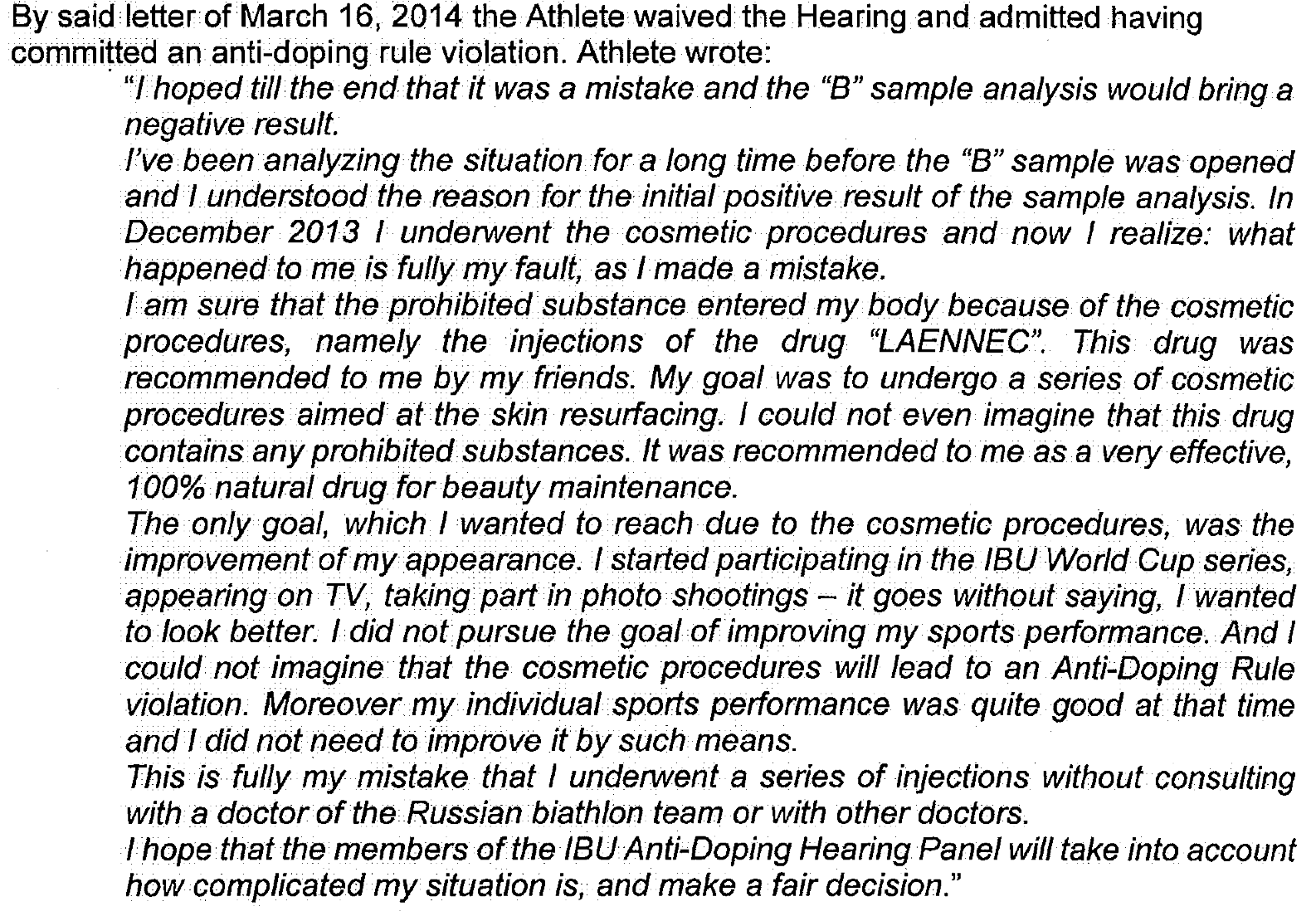
At the time she claimed that the EPO must have come from some cosmetic injections she took because she was self-conscious about her appearance. There was no evidence of this being the case: neither that she had actually taken injections, nor that EPO was present in the drug, LAENNEC. Starykh received a two-year ban.
The sample which re-tested positive was taken about ten days later, on January 2, 2014.
Before the second anti-doping hearing panel, Starykh did not claim innocence. At issue, instead, was whether the tests should be considered as separate or as one violation, since they occurred only days apart. Starykh argued that both tests could be the result of a single injection (she wrote an injection of the cosmetic enhancer, but the panel could consider it an injection of EPO), and thus that no additional ban should be implemented.
The IBU disagreed, arguing that not only should an additional ban be put in place, but it should be a longer one because the tests indicated multiple infractions.
The hearing panel concluded that because the tests were so close together in time, they must consider their process as if they were adjudicating both together. But they did decide that the two samples indicated that Starykh had used EPO multiple times – this is especially true since doping athletes now frequently use very small doses to try to avoid detection, but administer these doses repeatedly. The half-life of EPO is short, on the time scale of hours to days, so it seems impossible that the second test would still be indicating a single injection detected by the first test.
Thus, the panel decided to ban Starykh for one additional year, after her first two-year term is served. She will be eligible to compete again at the end of December, 2016.
Iourieva: Ekaterina Iourieva, a former World Champion, had already had two anti-doping infractions. She served a two-year ban beginning in 2009 after testing positive for EPO then. In the run-up to the 2014 Olympics she had returned to competition, although not very successfully. In December 2013 and January 2014 samples were collected in out-of-competition tests and were found to have EPO in them. The anti-doping hearing panel convened at the time banned Iourieva for eight years, noting that it was her second EPO violation in the space of eight years.
The re-tested samples were from November 2013, just a month before the samples that would earn her the eight-year ban. In the re-testing case, Iourieva did not respond to requests by the panel to present her side of the story. The panel even wrote the Russian Biathlon Union to offer her more time to respond, at which point the RBU wrote that “There will be no feedback from Iourieva as she decided to finish her professional sports career.”
The hearing panel concluded by disqualifying all of Iourieva’s results beginning in November 2013, and serving her a four-year ban – beginning in December 2021, when her eight-year ban ends.
Irina Starykh (far right) celebrates with the Russian team after their IBU World Cup biathlon relay victory in Ruhpolding, Germany, in January. The result is among those which will be voided with Starykh’s doping ban, from a sample collected in December. Photo: Fischer / Nordic Focus.
On Wednesday, the International Biathlon Union (IBU) announced that it was banning Russian biathlete Irina Starykh for two years for use of recombinant erythropoietin (EPO), a blood-boosting drug commonly used in doping in endurance sports.
Many in the biathlon world have been awaiting the verdict for months: the positive “A” samples of Starykh, teammate Ekaterina Iourieva, and Lithuanian Karolis Zlatkauskas were announced on January 28 after Starykh’s sample was collected on December 23 in Pokljuka, Slovenia, in an out-of-competition test.
Today, the IBU announced that Iourieva will be banned for eight years. It is her second doping offense for EPO. A world champion in 2008, Iourieva announced her retirement earlier this year, after the samples were initially analyzed.
Zlatkauskas admitted to doping in February and said he would not fight a ban.
The IBU Anti-Doping Hearing Panel, chaired by Edward Williams, a 1964 graduate of Dartmouth College who was a national champion in cross country skiing, NCAA All-American before competing in the 1968 Olympics in biathlon. He is now an attorney in sports law and arbitration in New York City.
The panel also included Dr. Walter Frey of Switzerland and Juha Viertola of Finland. The group met on March 21 to hear the case. Their decision was dated July 14; it’s unclear why the decision took so long as no new evidence appeared to be entered following the March hearing.
The hearing panel’s detailed decision (available here) shows that Starykh did not fight the ban. She initially requested that the opening of the “B” sample be delayed from early February until after the finish of the Sochi Olympics on February 26. Russia’s top-ranked female biathlete, Starykh had stood on the World Cup podium earlier in the season and had been expected to compete in Sochi. After the “A” sample was analyzed she faced a provisional suspension from competition, yet still delayed the opening of her “B” sample.
The “B” sample was opened on March 3, and Starykh was present along with three of her own representatives. On March 6, the sample analysis was finished and it was also positive for recombinant EPO.
Starykh waived her right to a provisional hearing in a letter stating that “[I] acknowledge the Anti-Doping Rule violation and the consequences of this violation in the form of disqualification.”
In the letter, Starykh claimed that the EPO must have entered her body from an injectable skin treatment called Laennec which she began using on the recommendation from friends for skin resurfacing in order to improve her appearance. With her growing success as a biathlete, Starykh explained, she began being interviewed on television and wanted to look better.
The active ingredient in Laennec is a “water-soluble substance of a product of enzymatic human placenta”. The drug is manufactured by Japan Bio Products Co., Ltd. The product website lists hepatocyte growth factor as one example of an extracted growth factor; this factor helps recovery from liver damage. The main function of the drug is “improvement of hepatic function in chronic hepatic disease.”
Other distributors have marketed the drug as a skin smoother and whitener.
EPO is a naturally produced hormone. There is evidence that maternal EPO is expressed strongly in trophoblast cells, which initially form the outside of the blastocyst surrounding a human embryo and which then are incorporated into the placenta.
Thus it is not impossible that if Starykh injected Laennec some EPO from the placenta would also enter her system.
However, the lab test specifically found recombinant erythropoietin, which differs in structure from EPO produced by the human body. The recombinant, or manufactured, form contains the same protein but has different polysaccharides attached, resulting in a different electrical charge at the molecule level. This difference in charge is used to separate recombinant and natural EPO in the laboratory test.
Thus, unless Laennec also contains recombinant EPO, not only any extra maternal EPO expressed in the placenta, it is not possible that the substance entered Starykh’s body from her cosmetic injections.
Earlier in the winter Alexander Tikhonov, a four-time Olympic champion and one of the best biathletes ever produced by the Soviet Union, alleged that two doctor brothers named Dimitriev were responsible for doping both Starykh and Iourieva. The two were present in Hochfilzen, Austria, for World Cups in December.
The panel minutes write that they did not find any “exceptional” circumstances and so handed down the standard prescribed 2-year ban for Starykh, starting from the date the sample was collected. All of her results accrued between December 23 and the “A” sample analysis have been voided as well.
The Rossiiskaya Gazeta newspaper reports that Starykh will not fight the decision.
There do not appear to have been any additional fines or sanctions for the Russian Biathlon Union.
Irina Starykh (RUS) on her way to a World Cup podium earlier this season in Hochfilzen, Austria.
Yesterday afternoon, the International Biathlon Union (IBU) issued provisional sanctions to three athletes who had “A” samples which tested positive for a prohibited substance. The federation did not release much more information, stating that the athletes were from Russia and Lithuania but declining to name them or specify which banned substance had been detected.
The news came on the heels of other positive tests: last week, 12 Russian athletes in seven different summer sports failed doping tests. And just this week, Alexandra Gulyaev, a junior national champion in the 1,500 meter run on the track, also failed a test.
Today, more details came to light as the Russian news site R-Sport alleged that two of the three athletes were Russian, and that they were Ekaterina Iourieva and Irina Starykh. The IBU has not confirmed the athletes’ identities and stated that it will not do so until after the “B” samples have been tested, which should be in roughly a week.
Iourieva, a World Champion in 2008 has already served a doping ban after testing positive for recombinant erythropoietin (EPO) in 2009. While not naming names, IBU Vice President Ivor Lehotan did confirm to R-Sport that it was the second offense for one of the athletes involved.
Starykh has never had a positive test. She is currently Russia’s top female athlete in the World Cup total score, sitting in sixth position. Starykh won the Continental Championships sprint last season, and received a single World Cup weekend of starts after that. This season, she has shot into the spotlight, starting every World Cup race and earning two podiums. Only once did she finish outside the top 30.
While Starykh was named to Russia’s Olympic squad, Iourieva was left off of it.
Both women are trained by Vladimir Korolkevich. Russia has an unusual setup for its women’s team: it is split into two groups, the second of which is trained by Wolfgang Pichler, a German who made his name as the head coach of the Swedish team. If the names leaked by Championat are correct, then none of Pichler’s athletes are implicated. When he took the position in Russia, he issued strong statements against doping and swore not to tolerate it on his squad.
Just one week ago, Korolkevich, who previously coached the USSR, Slovenian, and Ukrainian teams before returning to Russia and initially working with Iourieva as she returned from her ban, was promoted to head coach. That meant that he would supervise Pichler, limiting the German’s influence over his own squad.
Although the Russian Biathlon Union (RBU) held an emergency meeting of their anti-doping committee today, there is no news of whether Korolkevich will retain his position.
Instead, the RBU responded to outrage over the positive tests by condemning the invasion of athletes’ privacy.
“The Russian Biathlon Union urges the media and fans to respect the rights of athletes and to respect international regulations of anti-doping organizations,” the committee said in a statement posted to their website. “… neither the national federation, nor any other organization… has the right to disclose information or comment on the details, give the names of athletes, or especially to adjudicate. Moreover, until the publication of official information no one has the right to call an athlete guilty of doping.”
The executive director of the Russian anti-doping agency, Nikita Kamaev, took no responsibility for the situation in comments to the Russian website Championat.
“At the end of the training cycle for the biathlon team, all of the athletes were clean,” he said.
Meanwhile, some Russians are alleging a conspiracy to smear the host nation of the upcoming Olympic Games. Among them are Sergei Tchepikov, who competed in an astounding six Olympic Games ranging from 1988 to 2006, and won two individual and four relay medals in biathlon.
“It’s strange that the results of samples that were taken in December were just announced now, just before the Olympics,” he told “Soviet Sport”. “Apparently, this was done in order to destabilize our team.”
While he could not spill any details, IBU President Anders Besseberg was quite forthcoming in an interview with Norwegian newspaper VG.
“It is no coincidence that they were tested,” he said. “In this case, we had been aware of these athletes for a long time. This is what it takes… it would be unfortunate if cheaters compete in Sochi. I am very pleased to weed them out of the system before the Olympics.”
Athlete Reactions
Other World Cup and Olympic-bound biathletes were quick to condemn the positive tests, taking to twitter and facebook, and in some cases the media.
Emil Hegle Svendsen of Norway told VG that he had been tested seven times in two weeks.
“It’s perhaps a bit much,” he said. “But I would rather that WADA test too much rather than too little.”
Canada’s Rosanna Crawford echoed his observation.
“I know how much our team is tested and I can only hope that every other nation is tested just as much,” she told FasterSkier.
Others simply vented their frustration.
“Iourieva again!” Canadian coach Roddy Ward tweeted. “… Nice clean up job Russia (not!)”
“I’m disappointed to hear about more positive doping tests in biathlon. But at least the cheaters are getting caught! #cleanitup” tweeted U.S. star Tim Burke.
The North American women’s teams, who had spent the winter competing against Iourieva and Starykh, also offered up their thoughts. In some ways, they said that a positive test wasn’t a complete shock.
“The epic revelations of doping in the cycling world during the past couple years have been eye opening for all endurance sports,” U.S. biathlete Susan Dunklee wrote in an e-mail to FasterSkier. “It has made me wonder, just how clean are biathlon and xc skiing? I fully support the efforts of WADA, USADA and other such agencies. It is very disappointing to know that they do not have a fool-proof system yet, but I feel confident that their continuing efforts are creating a much fairer playing field. As an athlete, I can’t control what others do; my job is to simply focus on training hard myself and competing with integrity.”
Others, like Dunklee’s teammate Sara Studebaker, were discouraged about what the tests meant for the sport’s image leading up to Sochi, their biggest chance to reach viewers and fans in North America and elsewhere.
“While it’s great that the system is catching people and seems to be working, this is terrible for the image of biathlon, especially right before the Olympics,” Studebaker wrote in an e-mail. “I still believe that the majority of the people we’re racing against are clean, so a few bad apples that make us all look bad is really unfortunate.”
Crawford agreed, especially in the case of Iourieva.
“With the names that are being circulated it’s disappointing that one of them has already served a two year ban for doping,” she said. “This just proves that there needs to be a lifetime ban for testing positive.”
While the announcements could be a distraction for competitors honing their final preparations for Sochi, Crawford says the news will make her go even faster.
“It’s a sad truth that there will be athletes who get to compete at the Olympics who have either used performance enhancing drugs in the past or leading into the Games,” she said. “If you want you can use this as your excuse, or you can use it to fuel you to want to beat them even more. There’s no sense wasting energy worrying about it… Right now I will just focus on putting all my energy into my final training phase and leave it up to WADA to catch the cheaters.”
The Russian Biathlon Union (RBU) has been fined €50,000. The decision has been respected by the CEO of the RBU and First Vice-President of the International Biathlon Union (IBU), Mr Sergey Kushchenko, who also finds it correct that the IBU is taking tough measures in the fight against doping.
The Executive Board of the IBU had to decide at its 99th meeting in Going (Austria) the disciplinary consequences for the RBU; the IBU Anti-Doping Rules stipulate that the IBU may impose fines on a national federation (NF) if more than one athlete from a NF violates the IBU Anti-Doping Rules within a twelve month period.
The IBU Executive Board evaluated a very detailed report from October 2010 from an internal commission tasked by the RBU to closely investigate possible reasons for the multiple violations over such a short period.
The Executive Board considered the full circumstances at great length before reaching the difficult decision to impose a fine on the RBU. Five athletes (Iourieva, Akhatova, Yaroshenko, Prokunin and Timofeyeva) were suspended within a twelve-month period, following which the RBU has imposed all necessary disciplinary consequences internally and has taken very serious action to prevent doping in the future.
The IBU Executive Board wishes to emphasize that it highly commends and respects the initiatives taken by the new leadership in the Russian Biathlon Union in the fight against doping.