From the FasterSkier archive — posts syndicated from athletes’ and coaches’ own blogs between 2004 and 2012, kept online as published. Current coverage is at fasterskier.com.
ZHANGJIAKOU, CHINA — Russia, and its flag, are officially barred from the 2022 Olympics in Beijing, a ruling that stems from continuing doping violations following a massive, state-sponsored scandal at the 2014 Games in Sochi that included cross-country skiers.
But other Russian cross-country skiers are still competing here, under the flag of their country’s Olympic committee.
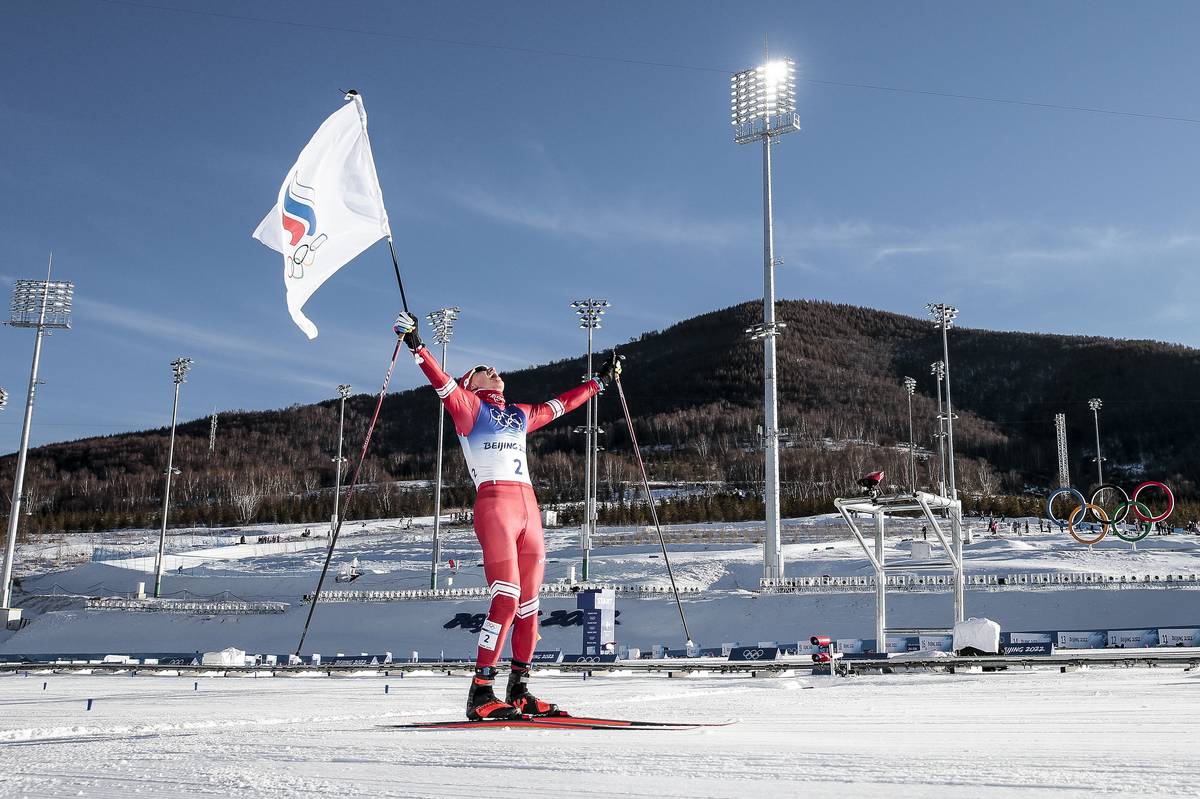
And on Sunday, in their first race of the Games, Russian men took the top two places. Star Alexander Bolshunov was so far ahead that he slowed to wave a Russian Olympic Committee flag before the finish line, and still beat third-placed Iivo Niskanen of Finland by two minutes.
Alexander Bolshunov celebrates a dominant victory, earning his first Olympic gold medal at the men’s 30 k skiathlon. (Photo: NordicFocus)
In spite of the huge winning margin, U.S. Ski Team Head Coach Matt Whitcomb said he wasn’t skeptical.
“We were all cheering for him in the coaching zone. And I don’t think all of us coaches, if we suspected any foul play, would be clapping for him,” Whitcomb said in an interview after the race. “I trust the World Anti-Doping Agency for helping keep the sport clean. I really do feel like overall, cross-country skiing is quite clean these days, compared to where we’ve come from.”
But other veteran American observers couldn’t watch Bolshunov and second-placed Denis Spitsov without asking questions. And the fact that Bolshunov will take home a gold medal when his country is still under international sanctions for doping-related offenses underscores the need for tougher penalties, critics said.
“I watched that race, and I was sad. Not because I’m 100% convinced that Bolshunov’s guilty, but because I watched it and I had a lot of doubt,” said Kris Freeman, a retired American cross-country skier who competed at the 2014 Games. “I’m angry at all the corrupt sporting bodies out there that let Russia come to these Games. They shouldn’t be there.”
Freeman’s comments came a few days before Russian media reported that a star women’s figure skater, Kamila Valieva, had tested positive for a banned drug before the Beijing Games started. A Kremlin spokesman said wait Wednesday said he was waiting for an explanation from the International Olympic Committee or Russian sports officials.
Another time, another team
Bolshunov is a decorated athlete who’s never failed a drug test. At a post-race news conference, asked by FasterSkier/the Daily News about the suspicions surrounding his performance, he emphatically rejected them.
Bolshunov said Russian athletes are under intense scrutiny, with drug testing “almost every day,” and have to constantly report their whereabouts to testing agencies.
“This should have nothing to do with sports. We have clean sportsmen, clean athletes here at the Olympics,” Bolshunov said, calling the question “irrelevant.” He added: “After you see how we train, I believe that you and your audience will never have these questions again.”
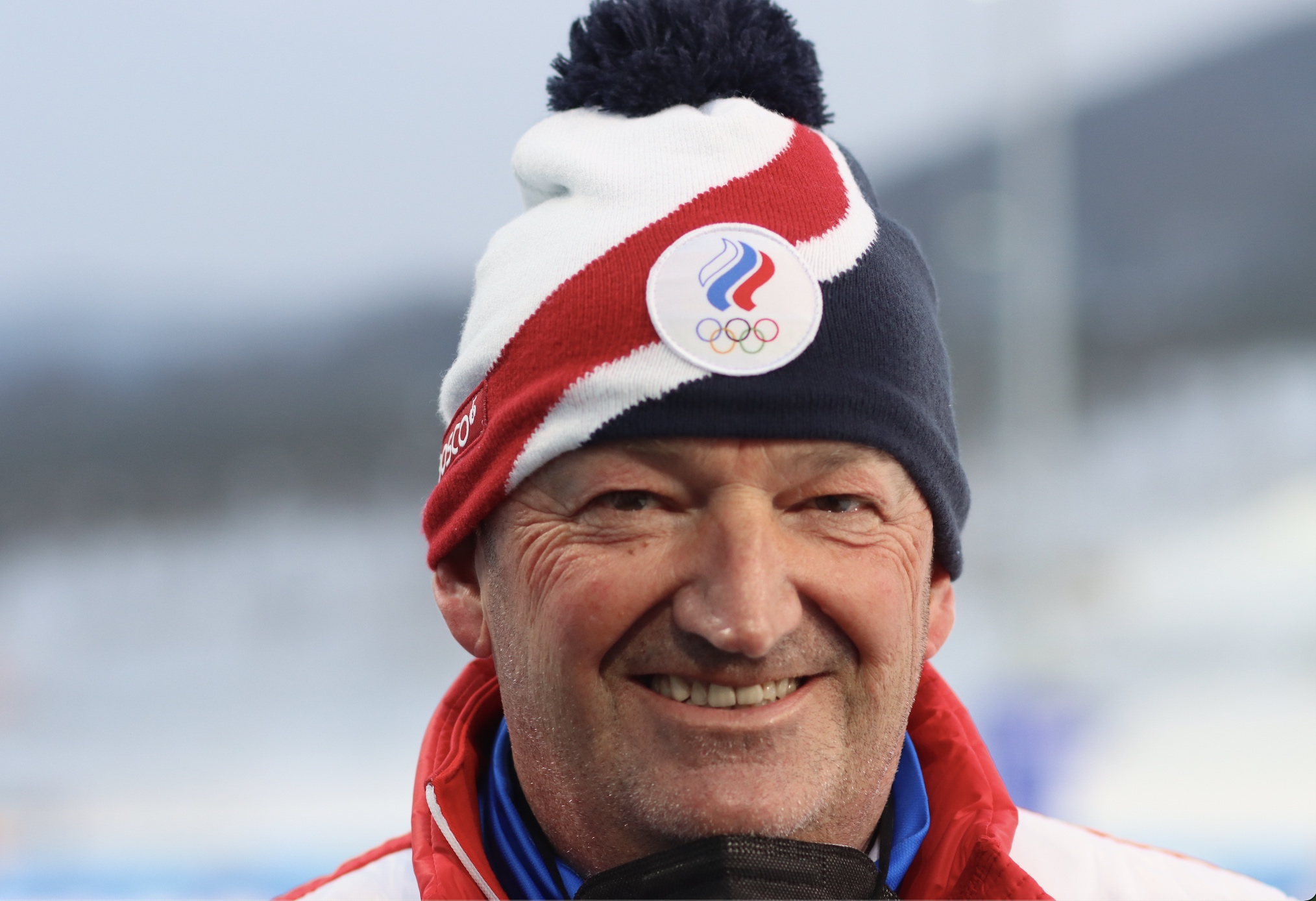
Markus Cramer, a coach of the Russian national ski team, poses for a photo at the stadium at the cross-country ski venue in Zhangjiakou, China. (Photo: Nat Herz/FasterSkier-ADN)
In a subsequent interview, Markus Cramer, a German coach who works for the Russians, said he’s “100% sure” there’s no doping on his team. He’s been affiliated with the team for seven years, and if doping was happening, he would have been able to tell.
“It’s totally another time now, and another team, and other athletes,” he said.
Reactions inside Russia, meanwhile, underscored how differently followers of the sport there viewed Bolshunov’s result. They also hinted at the ongoing geopolitical tensions between Russia and the U.S.
Russian politicians and sports commentators sharply dismissed any doubts, with one saying that the Anchorage Daily News/FasterSkier reporter who questioned Bolshunov was a “provocateur” and should have his Olympic press credential revoked.
“He could also ask what (Bolshunov) thinks about the alleged movements of military personnel,” sports journalist Dmitry Guberniev was quoted as saying, referring to the controversy about Russian troops massing near the Ukrainian border.
Scandinavian journalists at the post-race news conference said followers of cross-country skiing in those nations are less inclined to doubt the current generation of Russian athletes after growing more familiar with them.
The Russian team, in an effort to build trust after the Sochi scandal, invited Norwegian media to a training camp near Lillehammer a few years ago, Cramer said.
“Especially with the Norwegian media, we have a good contact,” he added. “And I think they understand, most of them.”
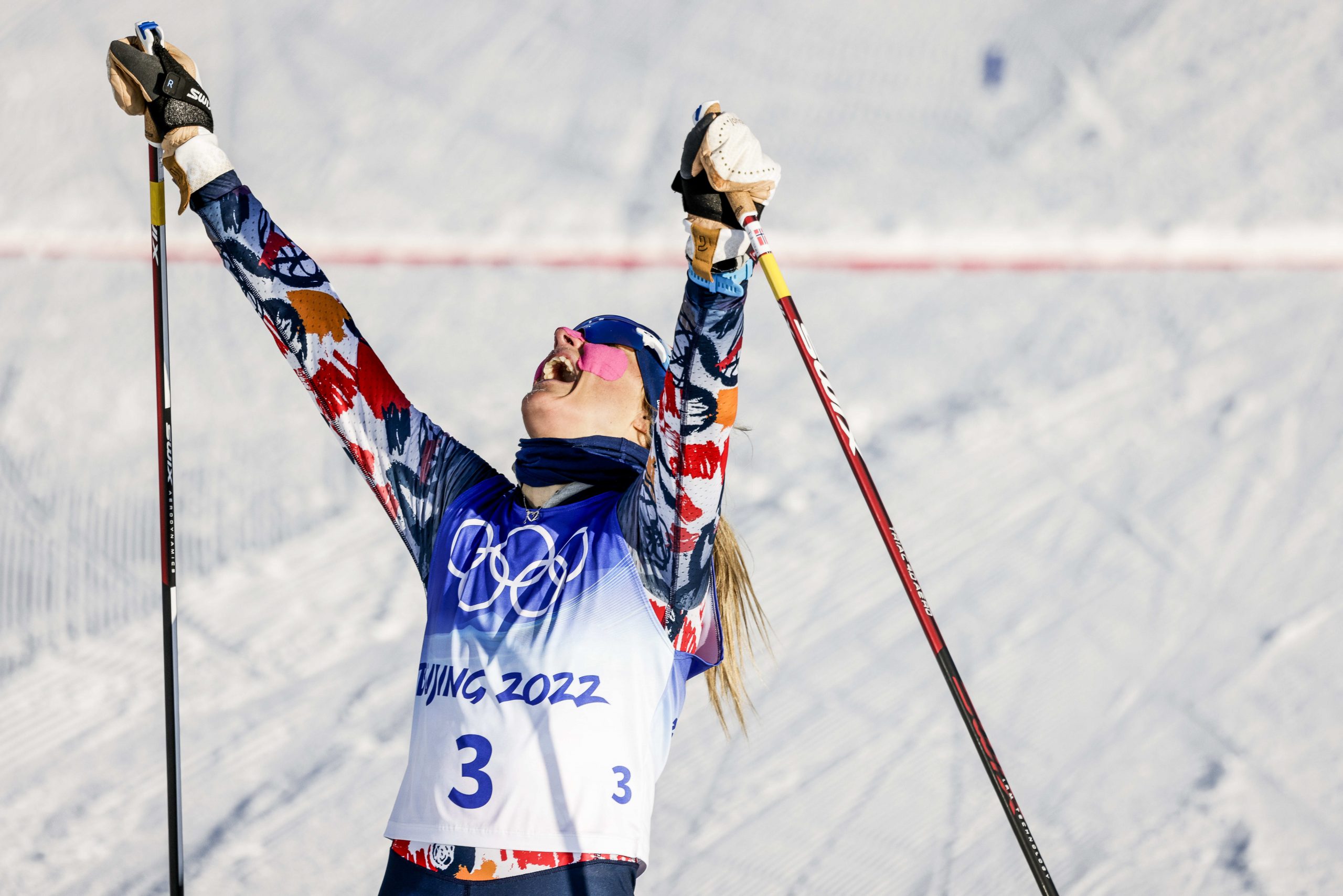
Cramer noted that no similar questions were lobbed at Norwegian superstar Therese Johaug, after she won the women’s opening cross-country event in similarly dominating fashion.
Celebration for Therese Johaug (NOR) as she takes her first ever individual Olympic gold medal in the women’s 15 k skiathlon. (Photo: NordicFocus)
Johaug missed the 2018 Games while serving an 18-month ban for using an anabolic steroid, clostebol. She said she accidentally took it while trying to treat a sunburn with lip balm — which turned out to have a “doping” warning label on the package.
At a news conference Thursday after winning her second race of the Games, Johaug said she’d finished her ban and had been training “so hard, so much.”
“People can (say) what they want, but I don’t care,” she said. “I know who I am and what I’m doing.”
Questions of accountability
Bolshunov’s result Sunday did not surprise followers of the sport, even if the size of his winning margin made an impression.
He’s also topped the overall rankings of the World Cup circuit — generally accepted as a barometer for the globe’s best all-around skier — for the past two winters. And he’s known to his peers for his work ethic and impeccable technique.
“The thing about Bolshunov is he’s a beautiful skier,” said Freeman, the retired American racer. “And I have no doubt that he works his ass off.”
One of the questions about Bolshunov’s performance is how much he should be held accountable for transgressions committed by others at a time when he was 17 years old.
Alexander Bolshunov (ROC) puts together a dominant performance in the men’s 30 k skiathlon. (Photo: NordicFocus)
Noah Hoffman, another retired American skier and anti-doping advocate, said he gives Bolshunov the benefit of the doubt.
“You can’t prove that you’re clean,” Hoffman said. “And so I refuse to assume that anybody is doping without evidence.”
On the other hand, Hoffman remains frustrated by the absence of stiffer penalties against the entire Russian team in the aftermath of the 2014 scandal.
“To the extent that a flag is making us question an athlete, that’s tragic,” he said. “And it’s because we haven’t put in place adequate deterrence to stop state-sponsored doping.”
A year ago, a European appeals court halved Russia’s four-year ban from global sports originally imposed by the World Anti-Doping Agency, or WADA, in a ruling blasted by some anti-doping advocates.
That proposed four-year penalty was not in direct response to the Sochi scheme. Instead, it was imposed after subsequent accusations by WADA that Russia had covered up positive tests in data that the nation was required to disclose in the wake of the 2014 scandal.
The result is that Russian athletes are still competing in Beijing — as they did at last year’s Games in Tokyo and in 2018 in Pyeonchang — even as Russian leaders can complain that they’re being unfairly targeted, said Hoffman.
“In both Pyeongchang and here in Beijing, they get to claim to be the victims of a Western plot while still celebrating the success of their athletes,” Hoffman said. “This is like everything Putin dreams of.”
A “big political game”
Bolshunov’s personal coach is Yuri Borodavko, who works with several other star Russian athletes.
In 2010, Russian Ski Federation leaders suspended Borodavko from working with the country’s national team for two years after Evgeny Dementiev, a skier he worked with, tested positive for blood-boosting drugs.
Today, Borodavko has a good reputation in Russia, and most fans see him and his athletes as “absolutely clean,” said Artem Kuznetsov, a journalist with the government-owned Russian news agency Tass.
Bolshunov and his teammates would be “crazy to try to cheat right now,” given the intense scrutiny on them, Kuznetsov added.
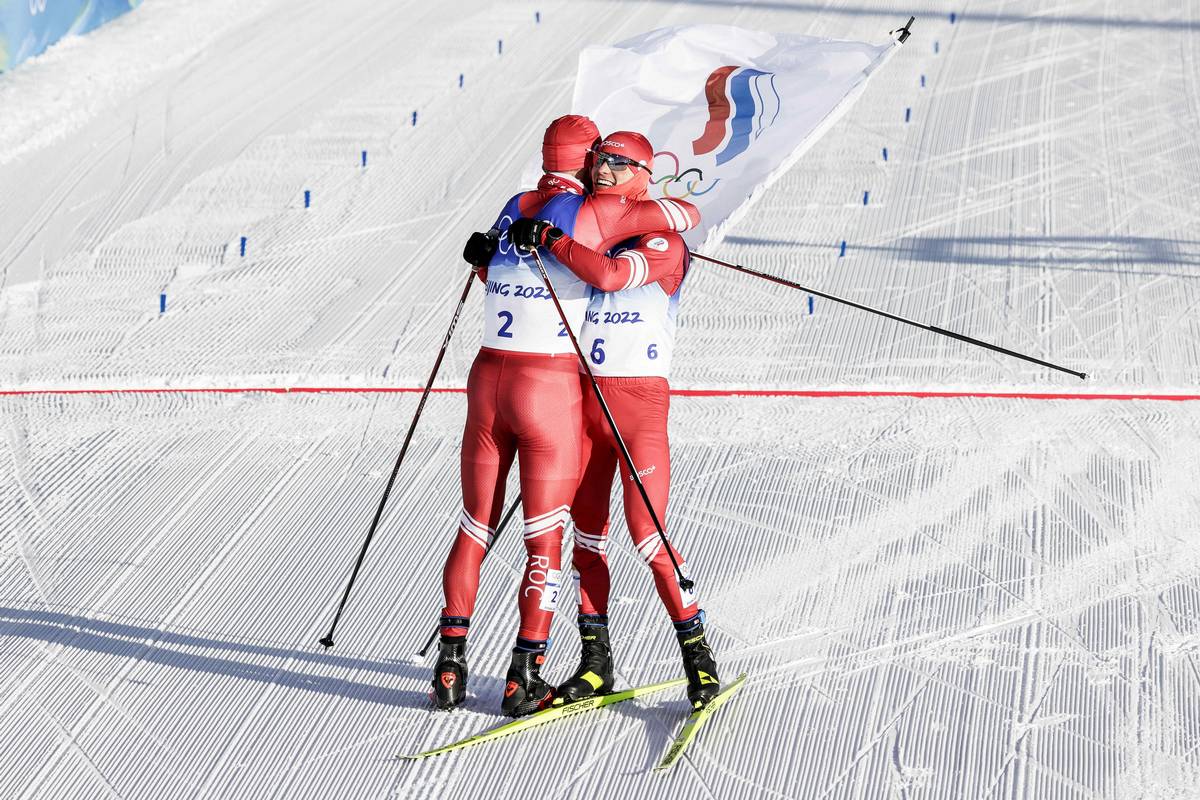
Olympic champion Alexander Bolshunov welcomes his teammate Denis Spitsov (right) to the finish of the men’s 30 k skiathlon, going one-two for the Russian Olympic Committee. (Photo: NordicFocus)
Freeman said he doesn’t lend too much credibility to Bolshunov’s history of negative tests: Lance Armstrong, he pointed out, never failed a drug test, either.
He said he was especially offended by the way Bolshunov celebrated Sunday’s win with the Russian Olympic Committee flag, and by his “defiant” response to the questions about him.
“I think he should be more aware of where his country is coming from — what they have been caught red-handed doing — and understand where the questions were coming from,” Freeman said. “Coming at it defiantly like that just makes you seem like a villain.”
Cramer, the Russian team coach, said Bolshunov is a young athlete who doesn’t understand why, given his clean personal record, he’s facing questions.
He also said Bolshunov has been criticized in the past for looking too serious when he crosses the finish line.
“What can he do?” Cramer said. He added: “We have a lot of (doping) controls. So, when he is not clean, of course, we will see.”
Last month, CAS made a binding decision on the case that received widespread condemnation from clean sport advocates and applause from within much of the Russian sports community. The cliff notes version of the Dec. 17 ruling halved the penalty from four to two years for Russia. WADA had sought a four-year ban from major international competitions (Olympics and World Championships for Russia).
In clear language, CAS found RUSADA to have manipulated data handed over to WADA as part of its conditional reinstatement as a compliant anti-doping agency. CAS found the data handed over to be manipulated. That much was clear. CAS also made crystal clear back in December that RUSADA had violated the terms of its reinstatement. CAS still ruled to halve the penalty. At the time, no detailed reasoning regarding the reduced penalty was forthcoming.
Russian athletes can participate in the Olympics and World Championships in the next two years, yet wearing uniforms with a modified logo. If the word “Russia” appears on the uniform, then the words “neutral athlete” must also be displayed in English.
Hand-slap is one way of describing global headlines regarding the release of the full ruling.
WADA released a statement on January 14 commenting on the full release of the CAS decision – WADA’s disappointment was palpable.
“The full CAS reasoned decision shows clearly that WADA successfully proved its case and exposed the Russian authorities’ brazen attempts to manipulate data from the Moscow Laboratory in an effort to thwart our investigations,” said WADA President Witold Bańka. “We are satisfied that this landmark decision also upholds the strong investigative and legal framework put in place by WADA in recent years that underpins the anti-doping system. In particular, the investigative powers WADA was belatedly granted and the introduction of the Compliance Standard in 2018 have proven to be game changers.
“We remain disappointed, however, that CAS did not agree with all of our proposed consequences, which we felt were proportionate to the egregious nature of the offences committed by the Russian authorities as they sought to cover up the details of their institutionalized doping scheme.”
The CAS ruling is a dense 186-page document. However, WADA and others have pulled key portions of the document to illustrate how egregious CAS found RUSADA actions regarding the Moscow Laboratory data.
“The Panel finds that, prior to the Moscow Data being retrieved by WADA in January 2019, and during its retrieval, it was subjected to deliberate, sophisticated and brazen alterations, amendments and deletions. Those alterations, amendments and deletions were intentionally carried out in order to remove or obfuscate evidence of improper activities carried out by the Moscow Laboratory as identified in the McLaren Reports or to interfere with WADA’s analysis of the Moscow Data” (para. 614)
“In what the Panel considers to be a more egregious act of misconduct, the Panel finds that alterations were made to Forum Messages in the Moscow Data in order to deceptively inculpate certain employees of the Moscow Laboratory (Dr Rodchenkov and Dr Sobolevsky) in a contrived extortion scheme while exonerating others (Mr Kudryatsev) from wrongdoing” (para. 615).
“In what the Panel considers to be a more egregious act of misconduct, the Panel finds that alterations were made to Forum Messages in the Moscow Data in order to deceptively inculpate certain employees of the Moscow Laboratory (Dr Rodchenkov and Dr Sobolevsky) in a contrived extortion scheme while exonerating others (Mr Kudryatsev) from wrongdoing” (para. 615).
The lab data was originally handed over to WADA in January of 2019. After discovering the data was doctored, WADA asked RUSADA for new data in October 2019. The recent CAS ruling stated, “That New Data also had dubious authenticity.”
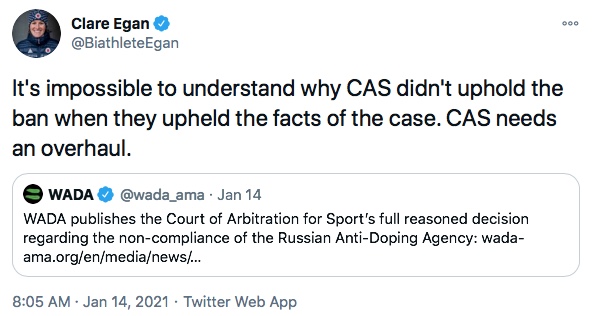
U.S. Biathlete Clare Egan was stark in her assessment of the ruling and stated via Twitter, “It’s impossible to understand why CAS didn’t uphold the ban when they upheld the facts of the case. CAS needs an overhaul.”
In the ruling, a section titled “Proportionality” stands out. In a legal context, proportionality is the tenet that the punishment should fit the crime. “The Panel bears firmly in mind at all times the paramount need to consider notions of proportionality in the imposition of Signatory Consequences,” states the CAS ruling.
The language throughout the ruling is stark in its incriminating tone when referring to RUSADA’s deeds. The Sochi doping case is well-documented. The misdeeds of the Russian authorities are well documented as they danced with WADA seeking to meet the conditions for reinstatement.
The penalties handed down might appear, in light of the evidence, disproportionate in Russia’s favor.
Of note was a section on punishment and Russia’s participation in the Youth Olympic Games.
“Although the history of improper conduct which has ultimately led to these proceedings is long and serious, the Panel considers it would be disproportionate to impose severe restrictions on the next generation of Russian athletes. In particular, as the doping schemes addressed in the McLaren Reports occurred between 2012 and 2016, the Panel considers it very unlikely that any athletes who will be participating in the Youth Olympic Games were involved in those schemes,” wrote the CAS panel in paragraph 731.
In an unanimous vote Monday in Lausanne, Switzerland, WADA’s Executive Committee imposed a four year ban on Russian participation in major international sporting events. This blanket ban includes the 2020 Tokyo and 2022 Beijing Olympics.
The list of Russian transgressions is long. According to a press release from WADA on Monday, the tipping point was Russia’s manipulation of the Moscow Lab’s data. That data was to be used to confirm specific doping violations by Russian athletes.
The ban does leave room for Russian athletes to participate in major competitions under a neutral flag. Russia has 21 days to appeal the decision to the Court for Arbitration of Sport (CAS).
Global Athlete is an athlete-led organization working for positive change in sport. (Photo: Screenshot globalathlete.org)
Picture in your mind an Olympic athlete. As you are reading this site, you might be seeing the image of Jessie Diggins or Kikkan Randall, or perhaps, Marit Bjørgen or Johannes Høsflot Klæbo. Or, since your skis might be summer waxed, you might think of Michael Phelps, Ussain Bolt, or Katie Ledecky. Regardless of who comes to mind, the image includes an athlete who is in peak fitness, at the top of their game. One of the best in the world.
While the abilities of these athletes are celebrated on the world stage, many feel that their interests, rights, and voices are not always put first by the organizations and agencies that govern and regulate sport.
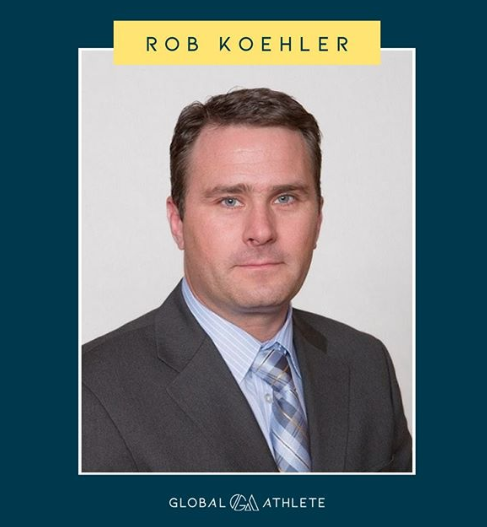
In February, Global Athlete set forth to change that. The organization, spearheaded by Rob Koehler, former deputy director general at the World Anti-Doping Agency (WADA), seeks to be a platform that offers athletes a voice to enact positive change in sport.
“Whether it be athlete welfare, unlocking athletes’ marketing potential, ensuring athletes receive Olympic revenues or simply better representation at the decision-making table, Global Athlete will fearlessly tackle the issues that really matter, working with athletes to determine what needs to change and how to go about changing it,” reads the newly launched website.
Rob Koehler, former deputy general at WADA, leads new organization, Global Athlete, in advocating for athlete rights. (Photo: Global Athlete Instagram @globalathletehq)
During his time at WADA, Koehler worked closely with the athlete’s committee, chaired by Beckie Scott, a Canadian cross country skier who earned a gold medal in the 5/5-kilometer pursuit in the 2002 Olympics in Salt Lake City, and a silver in the team sprint in 2006 in Turin, Italy. Scott’s gold medal was awarded retroactively after the two Russians ahead of her were stripped of their medals for testing positive for the banned substance darbepoetin.
“The work that the WADA Athlete’s Committee took on while I was there, led by, or course, Beckie Scott, the chair – I think they were trailblazers when it came to really trying to have an independent voice and not being afraid to question decisions that were being made by WADA itself and to represent the needs of athletes,” said Koehler in a call. “That is a hard initiative and a hard stance to take, but they were always brave and they were always willing to stand up, and of course, part of my role was to support them and I was pleased to do that. I think they’ve shown a lot of the athlete commissions and committees across the world that it’s possible.”
Koehler resigned from his position at WADA in August of 2018 due to his disagreement with the handling of the investigation surrounding the Russian doping scandal and the conspiracy of the 2014 Olympic Games in Sochi.
“He felt like the athlete’s voice was not part of the conversation [on what to do about the Russian doping scandal],” Noah Hoffman, a member of Global Athlete’s start up group of athletes, told FasterSkier in a call. “He was there, he was part of the conversation at WADA, and he felt like there wasn’t a real athlete voice and that athletes had no say at the decision-making table. So he set out to change that and he has been the driving force for this organization.”
Hoffman has stayed busy in his “retirement”; outside of being a full-time student at Brown University, Hoffman has been working with USADA as an anti-doping advocate and educator, speaking at various sporting events throughout the country. He also attended the Partnership for Clean Competition Conference in London this April. Hoffman . Apart from assisting Global Athlete in tackling issues surrounding doping, Hoffman is interested in promoting gender equity in sport.
Hoffman is in agreement with Koehler’s position that the handling of the Russian conspiracy was not made with the best interest of clean athletes in mind. For Hoffman, the impact of the state-sponsored doping hit especially close to home.
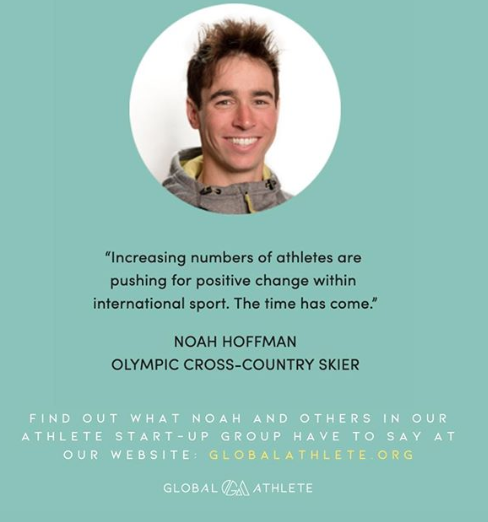
Noah Hoffman is a member of Global Athlete’s startup group. (Photo: Global Athlete Instagram @globalathletehq)
“I was in that race with the Russians sweeping the 50 k,” Hoffman recalled. “I watched those guys ski away from us on the final climb and they stole that race from the guys who rightly should have been on that podium. The consequences that they faced from essentially rigging the results of their home Olympics were to be sort-of banned from Rio. But then to really have most of their athletes be allowed to compete, then to not have their flag be flown in Pyeongchang but to have most of their athletes competing under a neutral flag. And then to reinstate RUSADA immediately following the [2018] games before they had handed over all of the data from the 2014 and before, so that we could actually find out which athletes are involved and to make sure that there is justice served.
“In particular, as the tipping point, was the vote in September of last year to conditionally reinstate RUSADA to the World Anti Doping Agency with the deadline of January first of getting the data,” he continued. “Then to not exclude them again immediately upon January first when the data had not been collected is just evidence upon evidence that they are seeing Russia as a market for Olympic sports and a huge global funder of international sporting organizations. They’re putting the interest of those dollars ahead of the interest of clean athletes and any real consequences for rigging and cheating their home Olympics.”
After his departure, Koehler did not initially seek out a role such as the one he took on with the creation of Global Athlete.
“After I left WADA, I had calls from a lot of athletes saying, ‘You were always a strong advocate. Now that you’re gone, what does that mean? And is it possible to do something further to stand up for rights and to ensure that athletes voices are being showcased and heard?’,” Koehler explained. “So that was where the discussion started, and I was approached by an organization called FairSport to see if there was an interest to make something of this nature.”
Before agreeing to spearhead Global Athlete, which is funded by FairSport and other individual donors, Koehler wanted to be clear that it would align with his athlete-centered ideals.
“I did have some principles I wanted to make sure we would adhere to,” he stated. “One was that the funding that was provided wasn’t linked to decision making. Two was if we’re going to develop something for athletes, it has to be athlete developed and athlete run. And three was the athletes need to develop a startup strategy for how this organization would start and what it’s first initial goals would be. And there was agreement to all three of those.”
From there, a start up group of athletes, including Hoffman, was selected to set the organization into motion. Other names include silver medalist in track cycling Callum Skinner, Olympic para-powerlifter Ali Jawad, both of Britain, world champion kickboxer Caradh O’Donnovan of Ireland, Olympic para-swimmer Benoit Hout of Canada, and Olympic basketball player Rachel Sporn of Australia. Global Athlete has also accrued a lineup of prominent sports figures as “athlete supporters”.
“They were selected based on their advocacy, their strong stance for athletes rights, believing that they could be part of change,” Koehler explained.
Not wanting to dwell solely on the negative aspects, both Hoffman and Koehler spoke about the positive role sport plays in the world and the potential for good it possesses. A return to focusing on this good is part of what Global Athlete ultimately seeks to accomplish.
“You look at the progress that was made through [the Olympics in] Pyeongchang of bringing North and South Korea to the table to talk, and the North Korean athletes having the opportunity to compete in South Korea. That is an amazing feat of the Olympic movement,” Hoffman emphasized. “I think that there is so much more potential for good that we are not reaching because we are focused narrowly on corporate interest. There is greed and corruption as evidenced by the FIFA scandal from five years ago and obviously the Russian doping scandal and the Larry Nassar scandal, I mean there is so much wrong.
“So we feel like a balancing of power will help us to make sport better and help sport do a better job of making the world a better place,” he continued. “Because sport is really neat in its ability to – if you focus on the US alone, sport can transcend this crazy political divide that we have right now and it can transcend geography and bring people together that otherwise have nothing in common.”
Global Athlete seeks to put athletes in the forefront, both during competition and behind the scenes. The goal is to involve athletes in the resolution of these flaws in the system, rather than leaving the decision making and control in the hands of organizations that might be more easily swayed by corporate or financial interest. The organization will be focused on Olympic sports and athletes. However, they draw inspiration from the players’ associations of professional organizations such as Major League Baseball that are already giving athletes a powerful role in decision-making.
“The idea is that if athletes could form a unified voice or at least have a platform to speak through, then we can make our voices heard because collectively we do have a lot of power,” explained Hoffman. “Obviously, sport doesn’t happen or the Olympic Sports Movement doesn’t exist without athletes. So the idea is to bring athletes together to make our voices heard and to give athletes a platform through which to speak and to force the vested power, the current power structure, to listen to athletes.”
“They’re the ones that fill the stadiums, they’re the ones that sell the broadcasting rights and the sponsors, so why not give back to them and make them part of the growth of sport?” questioned Koehler.
At the same time, they do not want the inclusion of athletes to add an undue amount of work to their plates as they recognize that the training load of an elite athlete does not leave often much room for advocacy work.
“Early in my career I was completely uninterested in how the structure was set up around me, all I wanted to do was make sure that I was skiing as fast as I possibly could to succeed within the structure,” reflected Hoffman. “Without realizing how many people were being hurt by the structure and how much the structure was created around this vested power and financial interest and corruption and not around the interest of the athletes. We are trying to do the leg work for athletes, we understand that athletes don’t have time to devote to these issues. We are trying to give athletes the information they need in really easily digestible and short not time-consuming ways so that they can keep up with global sports governance and form opinions and make their voices heard without having it interact with their careers.”
Koehler added that many athletes are not interested in the risk of being seen as outspoken.
“A lot of athletes are still afraid to speak up because there is still a fear of retribution,” noted Koehler. “That if they do go against decisions that they may be sidelined. And that’s nothing new, I think that’s something that has always been a worry for athletes.”
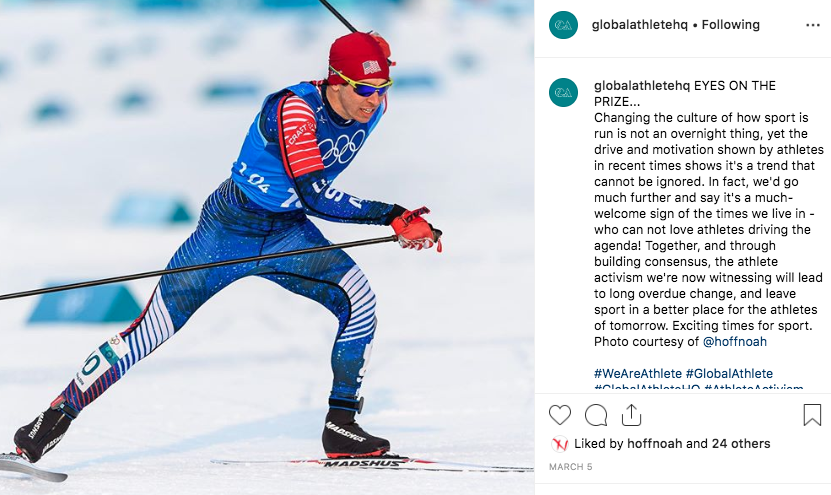
Global Athlete is an athlete-led organization working for positive change in sport. (Photo: Global Athlete Instagram @globalathletehq)
Though the budding organization has been working for only a few months, it has already demonstrated its ability to enact change. Earlier this year, a dispute within the national governing body of karate in Ireland led to the formation of two separate executive committees in the national federation.
“What happened there was the president at the time was given a vote of non-confidence from the Irish Karate Federation and was removed from the board of Irish Karate,” explained Koehler. “Instead of walking away, the president formed his own executive committee, and had close ties at the time with the World Karate Federation. The Irish Olympic Committee and sport counsel recognized the legitimate one and not the new one that was set up by the old president. The president that was given a vote of non-confidence indicated to the athletes that ‘If you don’t recognize me and recognize the new executive committee, you will not be eligible to compete at the regional European championships,’ which were qualifiers for the Tokyo Olympic Games.”
The Irish athletes who were placed in the middle of this dispute reached out to Global Athlete in regard to the injustice of their situation.
“We felt like that was completely unfair to the athletes who were being used as pawns and being put in the middle of the dispute between the two governing bodies in Ireland,” Hoffman stated.
On March 19th, Global Athlete posted an open letter to the International Olympic Committee (IOC), the Association of Summer Olympic International Federations (ASIOF), and the World Karate Federation (WKF), calling out the injustice to the athletes this situation created.
“Within days of us issuing this letter, the World Karate Federation invited the remaining Irish athletes to compete in the World Championships while the dispute was being resolved,” said Hoffman. “So absolutely, having this global platform to speak on behalf of the athletes made an immediate difference in bringing a just outcome to the athletes while the remaining dispute can be fought in the governing structure as it will.
“So that shows you the type of thing where, yes, these issues can be divisive, but we’re not necessarily taking sides in the issue, we’re just making sure that the interests of the athletes in these fights are protected,” he concluded.
Though this example is not one of global policy change, the organization is excited by the impact athletes have already had by speaking out and feel it bodes well for future endeavors.
“I think it was something that we did to make a stance, to bring public attention to the issue, and to help the athletes out,” stated Koehler. “And it was one of the best success indicators that we had.”
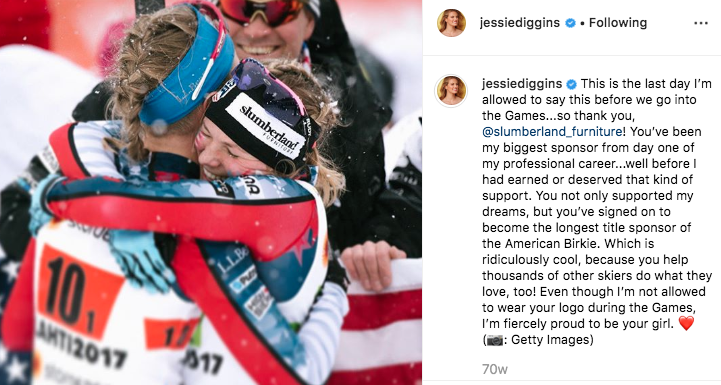
Another issue Global Athlete plans to take on is the controversy surrounding the IOC Rule 40, which limits both athletes and their sponsors in the promotional and social media images they are able to post during a “blackout period” surrounding the games. During this period, non-Olympic sponsors are not allowed to use images of the athlete whom they have backed that are taken during the games and are also prohibited from the use of a long list of words connected to the Olympics in photos that they do use. Athletes are not allowed to mention their sponsors during interviews or on their social media pages, and can be disqualified from competition for violating the rule.
Jessie Diggins posted a thank you to her sponsors on January 31st, 2018 before IOC Rule 40 came into effect for the Pyeongchang Olympics. (Photo: Instagram @jessiediggins)
Many athletes feel this rule is unfair, as it disallows them from promoting their personal brand and thanking the sponsors who made their Olympic dreams possible. As Olympic competition is also the most visible moment of many athletes’ careers, the inability to post at will limits the athletes’ potential to generate new sponsorship and advertising opportunities, thus inhibiting their ability to make a reasonable living while pursuing sport.
Perhaps reflecting the sentiment of this injustice to athletes, after earning a bronze medal in the steeplechase in the 2016 games in Rio de Janiero, Emma Coburn took off her New Balance spikes and slung them over her shoulder during her victory lap and post race photos. As shoes, like skis, are not a part of the Olympic uniform, this did not violate the rule but still garnered her sponsor a bit of limelight.
Recently, the German Federal Cartel Office (FCO) ruled against the IOC and the German Olympic Sports Confederation (DOSB) leading to the extension of athletes’ rights under Rule 40. German athletes will have more freedom in their social media activity, will no longer need approval from the DSOB for their posts, and will be allowed to use more words relating to the Olympics.
“We ensure that the advertising opportunities of German athletes and their sponsors during the Olympic Games, which the DOSB and IOC significantly restricted in the past, are extended,” Andreas Mundt, president of the German FCO, said in a statement.
“We believe that those rights that German athletes just procured are something that all Olympic athletes should enjoy,” said Hoffman.
Global Athlete believes that these rights can be obtained for all athletes if the collective is able to convince the IOC to push the NOC’s for policy change.
“We are now working with athletes to ask the IOC to take some brave action to work with the NOC’s to ensure that the rule is changed for all National Olympic Committees and that every athlete has equal footing when competing at the Games when it comes to promoting their own brands,” said Koehler. “We hope the IOC takes the lead in leveling and balancing the field for the athlete so that everyone has the same rights when they attend the Games.”
Global Athlete shares an optimistic message on social media featuring Noah Hoffman, a member of the startup group of athletes. (Photo: Global Athlete Instagram @globalathletehq)
Perhaps most in the public eye in recent years, Global Athlete also seeks to bring athlete voices into the discussions and decision-making surrounding doping and the pursuit of clean sport.
“We are pushing for a WADA that has much less influence from the IOC,” explained Hoffman. “So right now, national governments support 50 percent of WADA’s budget and they get to name 50 percent of the board of WADA and the other 50 percent comes from the sporting movement, specifically from the IOC who funds the other 50 percent of WADA. And we believe that that is too much control for the IOC and the international sports movement because if there are a few governments – as their inevitably are – that support the positions of the IOC, and they have got complete control over the other 50 percent of the voting power, all of sudden, that have 100 percent control over decisions made at WADA.
He continued, “We want to see a renewed governance structure at WADA that gives a lot more independence and ability to apply sanctions and not just make recommendations and ability to investigate — we want to see a bigger budget. More of the IOC’s enormous revenue going to anti-doping with fewer strings attached. We want to see more athlete voice at the table; the WADA athlete advisory council has been ignored in some of these big issues, specifically around Russian anti-doping and the Russian doping in Sochi. And we want to see the athlete voice have actual voting power and have a much more important role at the decision making table. Governing reform at WADA I think is the biggest thing we are pushing for.”
Moving forward beyond these issues, Global Athlete faces the incredible challenge of deciding which issues in sport to take on and how. As they aim to support athletes around the globe, they anticipate a wide expanse of issues of concern.
“You’re putting your finger on the biggest single challenge of this idea,” laughed Hoffman. “That we can bring athlete voices together, because athletes represent every country in the world and every side of every issue in the world. Anything that is divisive, you are going to find athletes on both sides. Athletes – as they should – represent every swath of society… I think that we need to make sure that there is momentum and if not consensus, then at least a really solid majority of athlete opinions behind an issue before we throw our weight behind it. We don’t want to be splitting the athlete community, that’s really important.”
To address this, Global Athlete will be surveying athletes to gain a better sense of what their concerns are and how they would like to see those concerns addressed.
“One of the things we’re doing now is that we’re taking the time,” said Koehler. “One of the things we’re doing this month is to really get a feel of where the athletes want to go, and we’re looking at a global survey to do that. We do have some representation and some understanding from different parts of the world. The pressures, the development of sport is so different across the five continents that the IOC recognizes under their bylaws.”
Following the guiding principles he mentioned, he believes this survey will preserve the “by athletes, for athletes” approach of Global Athlete’s mission.
“Having a better idea of what they want, what their concerns are, and how we overcome them, I think are crucial,” he continued. “I think that will be our first step in getting a better idea, bringing statistics forward to see what’s happening globally. This is going to take time. We are not rushing things. We want to make sure that we are listening.”
In addition to gaining an understanding of the issues that are present, Koehler thinks this approach will garner the trust of the athletes participating.
“I think we are going to have to show athletes that we really are interested in one thing and that’s helping them,” he stated. “It’s making sure that their rights are put to the forefront and that they’re more engaged in decisions being made in sport and governing sport.”
Changes of this scale will not be made rapidly or without push back, but Global Athlete believes that by including athletes in decision making, gradual progress can be made.
“I think these issues, at times they can feel impossible,” said Hoffman. “Like, how are you ever going to build consensus? How are you ever going to create the type of voice that those professional league athletes have when you have so much diversity as we talked about? Such a cacophony of opinions and such entrenched power in the IOC. There is a general apathy and a sense that the dopers are always going to be ahead and corruption is always going to be there. The young women who are being victimized in sexual abuse scandals are always going to be in danger. And I don’t believe it has to be that way. It really does take motivation from the sporting community and from athletes themselves.”
While the road ahead might be daunting, Hoffman left the conversation on a positive note.
“I am really impressed with how much momentum we have gathered in the first four months of existence and how much sway we have had with global media approaching us and in ability to make things happen, as in Irish karate. And I think that is all evidence of there is a lot of potential here and a lot of need for a stronger athlete voice in these global structures.”
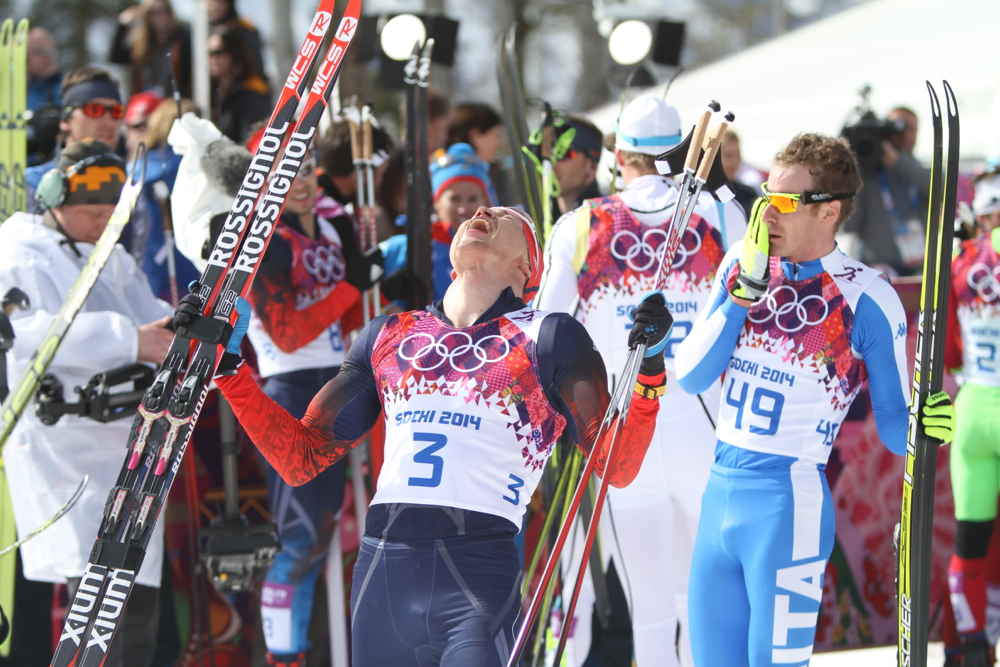
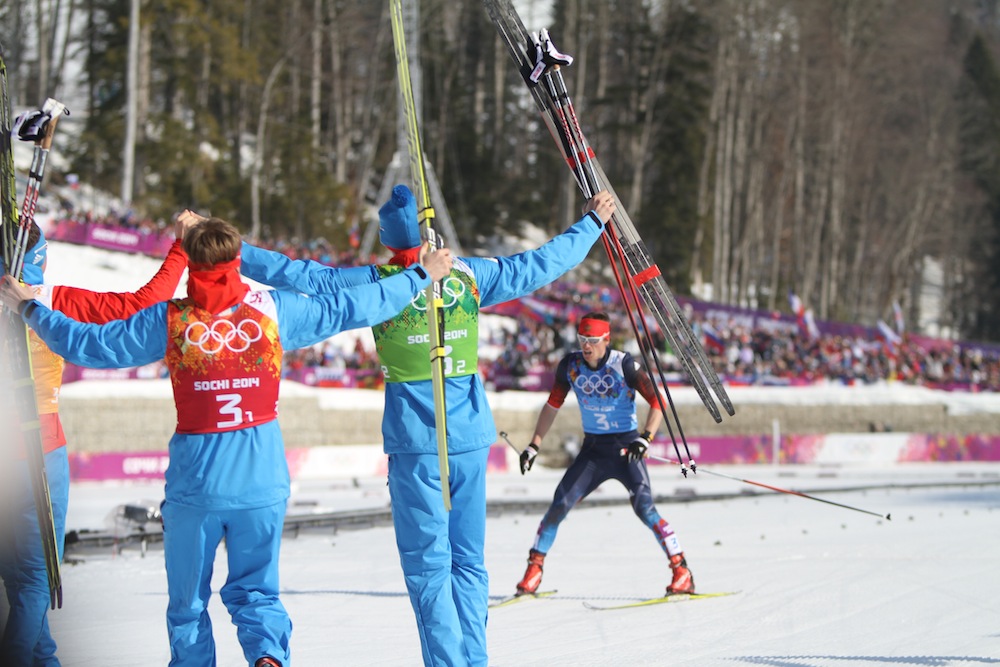
Russia’s Alexander Legkov (3) after winning Olympic gold in the men’s 50 k freestyle mass start at the 2014 Winter Olympics in Sochi, Russia. Russia’s anti-doping director at the time, Grigory Rodchenkov stated that he switched out Legkov’s anti-doping sample for a vial of clean urine collected previously. The International Olympic Committee stripped Legkov of his gold medal and banned him from future Olympics, but the Court of Arbitration for Sport overturned those sanctions in February 2018.
Editor’s Note: The following thoroughly cited opinion piece, prompted by the 2017 ‘Icarus’ documentary, was written by Maks Zechel, a 20-year-old Canadian cross-country skier who spent the 2017/2018 race season training abroad with Team Asker in Norway. Zechel is a regular contributor at FasterSkier, with his ongoing series: “Closing the Gap”.
***
February 23, 2014
Sochi: a home Olympics and the opportunity of a lifetime. Russia, despite being one of the strongest skiing nations in the world, has no individual medals in cross-country skiing leading into the final race of the championships. As the athletes shuffle nervously in the tracks before the 50 k mass start, the pressure on the Russian men can be felt even by me, watching on TV from home.
Putin is in the stands. It’s just a ski race, but how much more than that is at stake?
“The Moscow Laboratory operated, for the protection of doped Russian athletes, within a State-dictated failsafe system” (McLaren 1)
A sunny day, a roaring home crowd. Alexander Legkov is in a world of his own as he absolutely destroys himself over the final climb, skiing with the passion that it takes in all sports to win an Olympic medal. Russian flags waving everywhere, the crowd is absolutely deafening as Legkov adds his first Olympic gold to his already legendary career. Maxim Vylegzhanin and Ilia Chernousov lunge across the line behind him, with Chernousov having given every last bit of himself to outsprint Norway’s Martin Johnsrud Sundby to complete the Russian podium sweep on home soil. A dream come true.
“The Sochi Laboratory operated a unique sample swapping methodology to enable doped Russian athletes to compete at the Games” (McLaren 1)
When you ski with your teammates in front of your friends and family at home, you ski with a fire that is otherwise difficult to find. The presence of those who know you makes you feel guilty if you do not perform to your very best, you are pushed to keep up to those that your mind refuses to admit defeat against, and your own potential reaches new heights when your teammates accomplish something great. There is no cover of anonymity with which to hide the secrets behind your performance, because these people know what it took, and did not take, to get you to where you are.
“A pre-selected group of Russian athletes competing at Sochi were protected by the Sochi sample swapping methodology” (McLaren 67)
Despite the whispers of corruption surrounding Russia’s Olympic team, I cheered for those three skiers, who did the nigh-impossible and pushed their bodies as hard as anyone else to make their country proud. I do not know what exactly went into achieving that medal, but I do know that the incredible display of effort and the tears of happiness falling from Legkov’s face as he was raised onto his teammate’s shoulders, were very real.
“After he became laboratory director, and in furtherance of his responsibility to improve Russian sport performance by covering up doping, Dr. Rodchenkov developed a steroid cocktail optimized to avoid detection” (McLaren 49)
I first dreamt of going to the Olympics when I was 11 years old. This dream sparked an inner drive of mine that has lasted almost a decade, and I like to think that it will never extinguish. Sometimes, I wonder what lights that same flame in children around the world. In most countries, I like to think that many experience moments like mine: a motivation flourished from watching the passion of the Olympics, being inspired by older siblings, or being born with the need to be the first kid through the school doors when the bell rings for recess.
“The steroids were dissolved in alcohol … The solution was then swished in the mouth in order to be absorbed by the bucal membrane and then spit out … the detection window for the steroids in the cocktail would not exceed 3-5 days” (McLaren 49-50)
In parts of the world where fewer children are fortunate enough to make the decision to pursue a sport just because they are inspired, I wonder what brings them to those future championships. Is their talent used out of joy or out of the need to provide for those without the same athletic abilities? Was their talent exploited at a young age as a way for a country to show its dominance? Were they given a choice: to follow their dreams and do what they love by the prescribed method, or to not follow their heart at all?
I think about the lengths that I would go to support my family if they depended on me, and suddenly the way that I pursue sport seems insignificant, a trivial lifestyle “earned” through right of birth. Being born to these opportunities makes it all the more important to not waste them. My great-grandfather used to say, “if you’re going to do something, then you may as well do it right”, and those are words that I attempt to live by. To me, that means clean sport.
But clean sport is now more at risk than it has been in decades. Once an already colossal task of catching individual dirty athletes, we are now facing an extensive doping regime, backed by an entire government.
“[B]y the time of the Olympic Games in London, many of Russia’s top athletes were using the cocktail” (McLaren 51)
When faced with the enormity of the Russian state-sponsored doping system, it is no longer adequate to simply prosecute individual athletes. A large part of the problem when it comes to justly dealing with the system that made it possible for Russian athletes to cheat, is that WADA and the IOC are pitted against the entirety of the Russian government. It is not the USA and Canada versus Russia, or any other country versus Russia; it is two sporting entities, independent of any particular country, against the full power of the Russian government.
“The Ministry of Sport directed, controlled and oversaw the manipulation of athlete’s analytical results or sample swapping, with the active participation and assistance of the FSB [Russian Federal Security Service], CSP [Center of Sports Preparation of National Teams of Russia], and both Moscow and Sochi Laboratories” (McLaren 1)
“… Deputy Minister of Sport, Yuri Nagornykh, was appointed in 2010 by Executive Order of then Prime Minister, Vladimir Putin” (McLaren 10)
The state-run doping program organized for the Sochi Olympics was not just about sport, it was politically motivated, overseen by President Putin himself. This sets Russia apart from previous doping scandals, such as that of the Finnish cross-country ski team in 2001, where doping operations were concentrated to a select number of skiers and their coaches. When the truth was uncovered about their national heroes, Finland, in complete shock, took steps to recover from the international disgrace that its ski team had brought upon them (Andrews). Iivo Niskanen and Krista Pärmäkoski have proven that it is possible for a great skiing nation to recover from such a disaster and win clean, paving the way for the next generation of Finnish skiers.
“ … this Article would prohibit altering identification numbers on a Doping Control form during Testing, breaking the B bottle at the time of B Sample analysis, or altering a Sample by the addition of a foreign substance” (“World Anti-Doping Code” 21)
The situation we see today is different. After the exposure of irrefutable evidence confirming state-sponsored doping and the covering up of doping evidence in Russia, it came as a disappointment to many when the Court of Arbitration for Sport (CAS) annulled the sanctions imposed by the IOC on 28 Russian athletes.
The evidence of coverups and doping are clear, but the CAS ruling was that “the evidence collected was found to be insufficient to establish that an anti-doping rule violation (ADRV) was committed by the athletes concerned” (“Media Release”). The evidence may be adequate to find Russia guilty of state-sponsored doping, but it is not enough to build a case against each individual athlete. This is likely because of the destruction and tampering of drug tests and results by Russian “anti”-doping personnel and Article 10.5.1.2 of the World Anti-Doping Code, which states that, if the “detected Prohibited Substance came from a Contaminated Product, then the period of Ineligibility shall be, at a minimum, a reprimand and no period of Ineligibility, and at a maximum, two years Ineligibility” (“World Anti-Doping Code” 64).
But if the evidence is inadequate, then why are some Russian athletes still facing penalties? Alexander Legkov and Sergey Ustiugov were both unable to compete at the PyeongChang Olympics, but Ustiugov can still race on the World Cup, while Legkov cannot. Evidence against athletes like Legkov proves that they were in some way a part of the state-sponsored doping program, but it is difficult to legitimately sentence them when evidence proving exactly what they have done has been tampered with or destroyed. Athletes like Ustiugov have not been proven to be a part of Russian doping operations, but have violated Article 2.1 of the World Anti-Doping Code through their association with people who are a part of it. This article states that “Athletes and other Persons must not work with coaches, trainers, physicians or other Athlete Support Personnel who are Ineligible on account of an antidoping rule violation … Prohibited association need not involve any form of compensation. (“World Anti-Doping Code” 24).
Sport in Russia will never be fair until Russia takes responsibility for their crimes against clean sport. Whereas Finland bore the weight of what their athletes had done in 2001, and ensured that it would never happen again, the Russian government has more at stake than a few drugged athletes. When doping is politically motivated and backed by the state, I do not think it is possible to solve the issue through sanctions by sporting bodies such as WADA and the IOC alone. Until the Russian government is pushed by other nations to take an interest in ensuring that sports in Russia are clean, the problem can never be completely resolved.
Until substantial action is taken, we will continue to be caught up in a stalemate of “partial blanket bans” and other half-measures. When imposed on a level of command that is too low in the Russian doping system, these actions cannot bring about the outright eradication of doping that we seek. Are sports a high enough priority for entire countries to impose sanctions on the Russian government until they answer for their crimes against clean sport? Or will doping be protected by other political motivations that keep Russia inseparable from the rest of the world? The scope of the Russian government’s involvement in doping is far beyond the reach of traditional sporting sanctions.
“Clean sport is dead” — Jim Walden, lawyer of Dr. Grigory Rodchenkov (Panja and Pérez-Peña).
The sporting world no longer holds its breath in anticipation of change. An uncertain future exists for clean sport, but even more disconcerting is the stagnation in which we now settle. With the anti-doping world left spinning its tires in frustration, where does that leave athletes for whom a future of fair play is too late?
Icarus, 2017 documentary film, debuted Aug. 4, 2017 on Netflix (Photo: Wikipedia)
In his dramatic documentary, Icarus, director Bryan Fogel convinced many sports fans that clean athletics, despite the improvement of anti-doping efforts over the years, is a hopeless pursuit. Fogel’s documentary was key to bringing the extent of systematic doping in Russia into the public eye.
In Icarus, Fogel takes anti-doping research to a personal level: after years of training as a high-level (amateur) cyclist, he spends a full year preparing for the “Haute Route” amateur cycling event, while following a doping program. This was prescribed to him by Dr. Grigory Rodchenkov (the former director of Russia’s Anti-Doping Center, turned whistleblower, who is now under the witness protection program in the U.S.).
Fogel routinely took a cocktail of PEDs (Performance Enhancing Drugs), under the careful guidance of Dr. Rodchenkov, and saw massive improvements in his power output ratings on the bike in less than a year. Having placed 14th in the seven-day Haute Route event the previous year, while racing clean, it seemed clear that Fogel would be a strong contender for the win.
He ended up finishing the unbelievably hard event in a far worse position than when he raced clean. From an athlete’s perspective, this does not surprise me. I understand that there are countless elements involved in producing an incredible athletic performance at a set time and place. Fogel’s reaction was different; visibly depressed, he talked of how sobering it was to realize that, no matter what he did, he could never be as great as his cycling heroes. This is a delusional conclusion, one that is biased by his dreams (influenced by growing up with Lance Armstrong as a hero) of becoming a better cyclist.
In these turbulent times for clean sport, it is important for athletes to remember that there are many aspects to training and competing, aside from other athletes cheating, that they can control. Living in Norway has taught me that there is a lot more to skiing fast than just being fit, and that applies to all sports.
Drugs don’t magically make you a fast skier, just like a high VO2 max score doesn’t make you a competitive World Cup skier. There are many elements to cross-country skiing that have a far bigger effect on a skier’s ability to ski fast than drugs do. If skiing were purely about fitness, aerobic machines like Hans Christer Holund would beat skiers with a lower VO2 max, like Petter Northug and Finn Hågen Krogh, without contest. Divergent technique revolutions, like those brought to us by pioneering skiers such as Petter Northug and Johannes Høsflot Klæbo, show us just how many ways there are to win a ski race.
In his reaction to not becoming a better cyclist even while doping, Bryan Fogel shows what he is: a film director with a remarkable story to tell. As most people would, he takes his failures in sport and attributes them to his personal characteristics; he feels he is simply not good enough at a genetic level. While not everyone will reach their athletic dreams, true failure occurs only when you stop trying after the first attempt. When athletes make changes to their training, it is rare to see dramatic results in the following competition season. Some things will never yield improvements, while other things take a few years of consistent work before they take effect. In the highly competitive world of cross-country skiing in Norway, many skiers go unnoticed down the results list for years, they are seen as average, before suddenly rocketing to incredible new heights seemingly out of nowhere. That is the nature of how training, competition, and life stress the body and mind over a prolonged period of time. To take a one-year snippet of an athlete’s life and make broad conclusions about sport is naive.
An otherwise brave and instructive self-experiment that helped uncover the scope of how doping continues to mar the sporting world uncontestedly, Fogel’s conclusion of his doping experiment sends the wrong message to the audience viewing Icarus. The message he sends is that only extremely gifted humans can become great athletes. This personal look into how his experiences have affected him make his documentary engaging and dramatic, something that the genre normally lacks for your average movie audience. The devastation that Fogel portrays in this realization hits viewers hard and the movie adopts an “apocalyptic” tone from that point on. The worldwide end of clean sport is confirmed with Rodchenkov’s exposé of Russian state-sponsored doping and the footage of him escaping Russia with his life in danger. Icarus uncovers frightening realities that affect the sports we love, but the film also incites new dangers to the culture surrounding sport.
Although accurate in their severity, the events at the end of Icarus doom its audience to pessimism against the current world of sports. This acts as fuel for ungrounded accusations against successful athletes by uninformed viewers. When a complicated issue arises, people quickly try to make sense of it by looking for a distinction between good and evil. By making an issue seem black and white, anyone can have a strong opinion about it, because the choosing of sides is based on your morals. You are either against doping, or you support it. Unfortunately, the issue is not so simple, but this type of inflamed, unschooled “debate” is perfect advertising for a film such as Icarus.
When making conclusions about an issue, it is our duty to question how someone else’s portrayal of events is affecting our opinion and to keep ourselves informed. FasterSkier Editor-at-Large Chelsea Little is an example of the brave reporting and investigating that it takes to keep organizations such as WADA and the IOC held accountable. We owe it to journalists like Chelsea, who sacrifice countless hours of their personal lives to enlighten us about the issues that affect us the most, to simply read their vital research. We must take the facts from the sources available to us, and add our own informed debate to the world of sport, because angry, baseless commentary are what keep humanity from moving forward.
Most Olympic athletes…would favour lifetime bans for doped athletes. IOC President, Thomas Bach, himself an Olympic champion, has publicly indicated a personal preference for life bans, but has correctly noted that the legal order, particularly in relation to human rights issues, will not permit such automatic sanctions, for first offences. Nor does the Code. The IOC itself has lost an appeal before CAS in respect of an IOC rule providing for the automatic exclusion of any doped athletes from Olympic competition in the Olympic Games next following the imposition of even a first doping sanction. (Pound, et al. 63)
It is our responsibility as athletes to represent all of those that have helped us and to lead by example. We can start with the atmosphere that we create amongst our fellow athletes. The culture of discrimination and groundless accusations against clean, Eastern-European athletes, or any successful athlete in endurance sports, has to stop. The “blame game” has some of the same ill-effects on our sport that we are trying to prevent by fighting against doping. Remember how ashamed Canadians felt when Ben Johnson, our “Olympic champion hero”, was caught for doping? Now imagine the irreversible damage that would have been done if he had been falsely accused. By telling young athletes that anyone doing something impressive — something that we could not imagine ourselves doing — is doping, teaches young athletes that no matter how hard they work, they will never become greater than their biggest dreams.
“The problems of the world cannot possibly be solved by skeptics or cynics, whose horizons are limited by the obvious realities. We need men [people] who can dream of things that never were, and ask why not.” — John F. Kennedy (“J.F.K. in Ireland”)
Teach young people to dream outside the realms of what they see as possible, and they will get there via the path you set them.
Athletes have the power to make more of a difference than just complaining about the flaws of their sport. Sports are visually flashy and exciting to an audience, and athletes are celebrated around the world for their raw fight against the limits of the human body. The hero-status of athletes gives them a sphere of influence greater than that of other members of society who work equally hard, or harder, in the goal of helping people.
The playing field of sport will never be equal for every child born on earth, when some athletes fight past obstacles far greater than the trials of sport, just to get to the start line. If we are lucky enough to be living the life of an athlete, it is not enough just to win medals.
Endurance sports may not get the same extent of attention as soccer, football, or basketball, but the popularity of these sports has elevated some athletes to leadership roles from which athletes from smaller sports can learn. Take LeBron James, one of the greatest basketball players of all time, who has recently come under fire for his comments regarding President Trump. Some feel that his place in society is to play basketball and entertain, not to comment on political events, but he has decided that his popularity gives him a greater responsibility than just playing sports:
“I mean too much to society [to ‘shut up and dribble’] … I mean too much to the youth, I mean too much to so many kids that feel like they don’t have a way out and they need someone to help lead them out of the situation they’re in.” — LeBron James (Conway)
As a Canadian, the opportunity that I have to pursue cross country skiing is a selfish privilege. I have the chance to use sport to meet new people, to inspire, and to use my experiences and influences to create a better world around me. Otherwise, I am just a lucky individual, riding on the support of those that I do little to help, enjoying what I have been given and doing little to share my wealth. I work hard at what I do, but to think that I am an inspiration to others simply through my existence would be incredibly pretentious. Athletes can gloat in their athletic prowess, or they can use their abilities to promote the joy of sport, health of body and mind, and the hard work involved in reaching a goal.
Good leadership is to rise and accept challenges even with the possibility of failure. Leaders show their true qualities, and that shows others that they can only achieve success by being their honest selves. Leaders show that there are no shortcuts.
My heart breaks every time that one of my idols is suspected of cheating. It doesn’t hurt because it’s unfair; it hurts because I saw myself in their footsteps, and every time they succeeded, I saw that I could, too. Our dreams scare us because they seem impossible from where we currently stand. When I look at my heroes, I see my future; they are living my dreams, proving them possible. My dreams are crushed when one of my favourite athletes is caught for doping, because that tells me that I am not good enough to be great. Some say that we watch the Olympics to witness the impossible happen, but I watch the Olympics to see the people who started off where I am accomplish the things that seem impossible to me now.
Despite the damning evidence against Russian sport as a whole, I refuse to believe that every Russian athlete is doping for the same reasons that I refuse to believe that the majority of top cross-country skiers are doping. It must be remembered that skiers are people, and the vast majority of people who have grown up surrounded by the positive and welcoming culture that exists in cross-country skiing around the world, do not become cheaters. Even in Norway, where skiing culture is on a much bigger scale than that of North America, it remains a community of people who love being outside year-round, exploring the world around them and the limits of their bodies.
We must keep sport a positive and safe space for people to grow into compassionate citizens of the world. Clean sport isn’t important just so that medals are handed out to the rightful winners; sport must remain possible for real people everywhere, because when doping is left unchecked, sport loses all significance as a tool to inspire, bring people together, and make the world a better place.
March 2, 2011
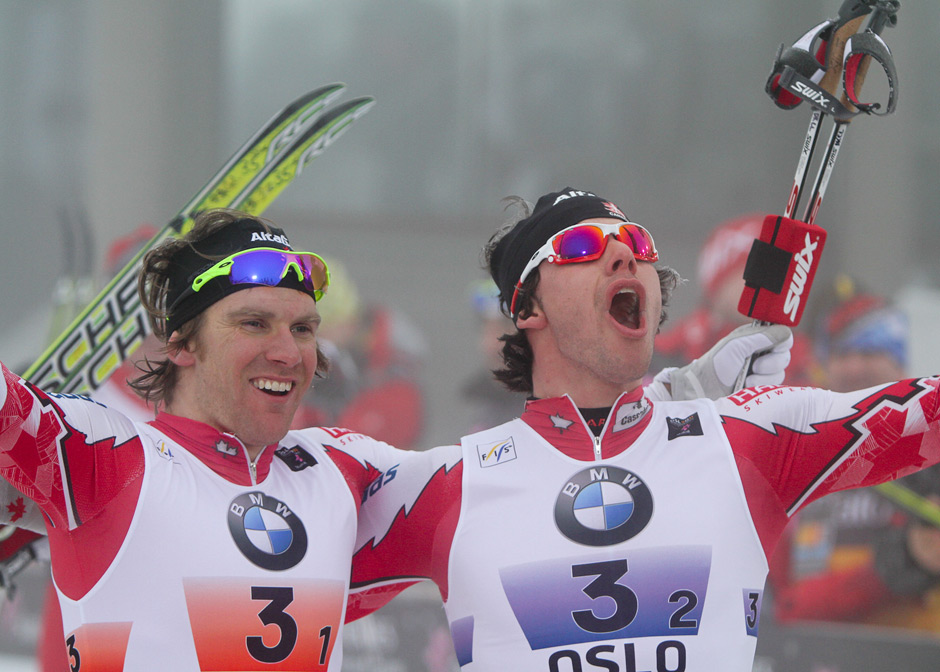
Alex Harvey (r) and Devon Kershaw (l) celebrating their World Championships gold in 2011 in Oslo.
My heart pounds in my chest. Adrenaline courses through my body as my ungainly 13-year old legs run chaotically down the front steps. The slam of the door behind me pierces the stillness of the heavy evening air, but to my ears the whole world is alive in celebration. The rush of blood in my ears is deafening as I relive the race in my head. Alex passing Hattestad — shushing the crowd across the line –raising his arms in disbelief — Devon and Alex playing air guitar on their skis — walking before the massive crowd to the top step of the podium — WORLD CHAMPIONS! … The excitement settles into a glow that becomes an immovable rock of confidence in my chest. I start to notice where I am, running aimlessly to the top of a grassy hill above the trees. I smile as I look down to where I came from: “Yes”, I think, “I can do it, too.”
***
Works Cited
Andrews, Edmund L. “Olympics; Finland Reels Over Skiers’ Drug Scandal.” New York Times, 13
“John F. Kennedy in Ireland.”, John F. Kennedy: Presidential Library and Museum, www.Jfklibrary.org/Exhibits/Past-Exhibits/JFK-in-Ireland.aspx. Accessed 1 Mar. 2018.
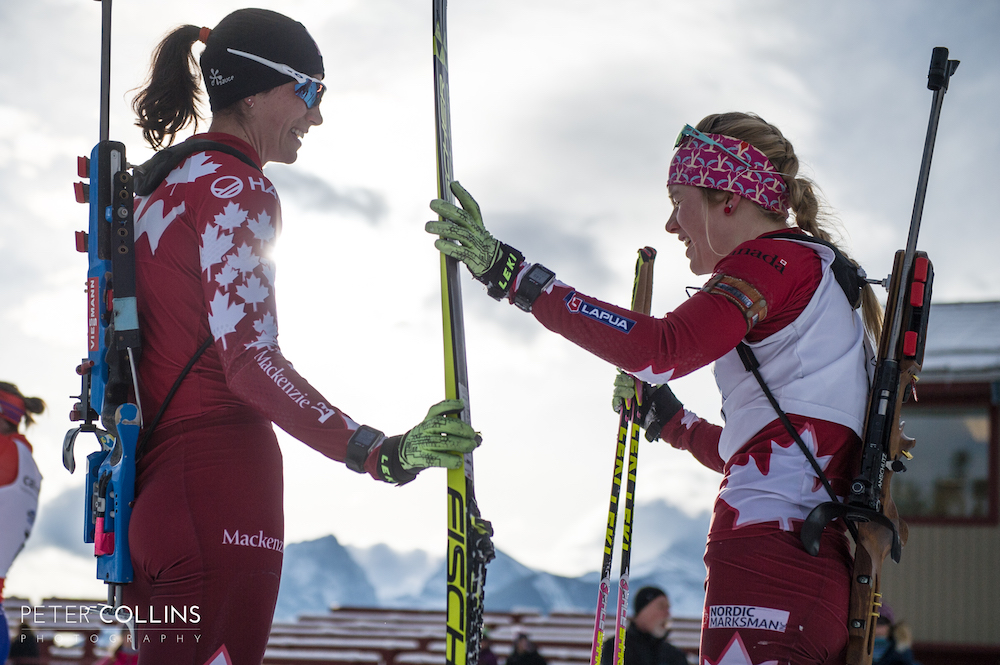
Emma Lunder (r) with fellow Biathlon Canada national-team member Rosanna Crawford after the women’s modified sprint at Biathlon Canada’s team trials in November in Canmore, Alberta. (Photo: Peter Collins/petercollinsphoto.com)
Despite the RBU’s less-than-full IBU member status, Russia is still scheduled to host the final IBU World Cup races of the season from March 20-25 in Tyumen and the IBU Cup 7 & 8 in Uvat and Khanty-Mansiysk.
In an open letter sent to IBU President Anders Besseberg and IBU Secretary General Nicole Resch dated Dec. 8, 2017, Biathlon Canada’s President of the Board of Directors Murray Wylie stated Biathlon Canada will not be sending athletes to the IBU-sanctioned events in Russia in March.
In the letter, Wylie gives the following reasons for his determination:
“The occurrence of high-level IBU events in Russia is inconsistent with the IOC decision of 05 December to disallow participation by the Russia Team in the PyeongChang Olympics:”
“the integrity of anti-doping procedures in Russia is still very much uncertain, given the current situation in which RUSADA remains non-compliant with WADA.”
“This is actually the third letter,” Wylie said (full interview in related podcast). “The first letter was sent the first part of last January and then there was a second follow up letter in May, and this is the third one. I think the importance of this one was it was after the announcement by the International Olympic Committee and their stance on the systemic doping with Russia and we were very pleased to see that. Basically, it was an opportunity. We knew there was an executive board meeting in Hochfilzen, and that is typically the vehicle for us to voice our concerns.”
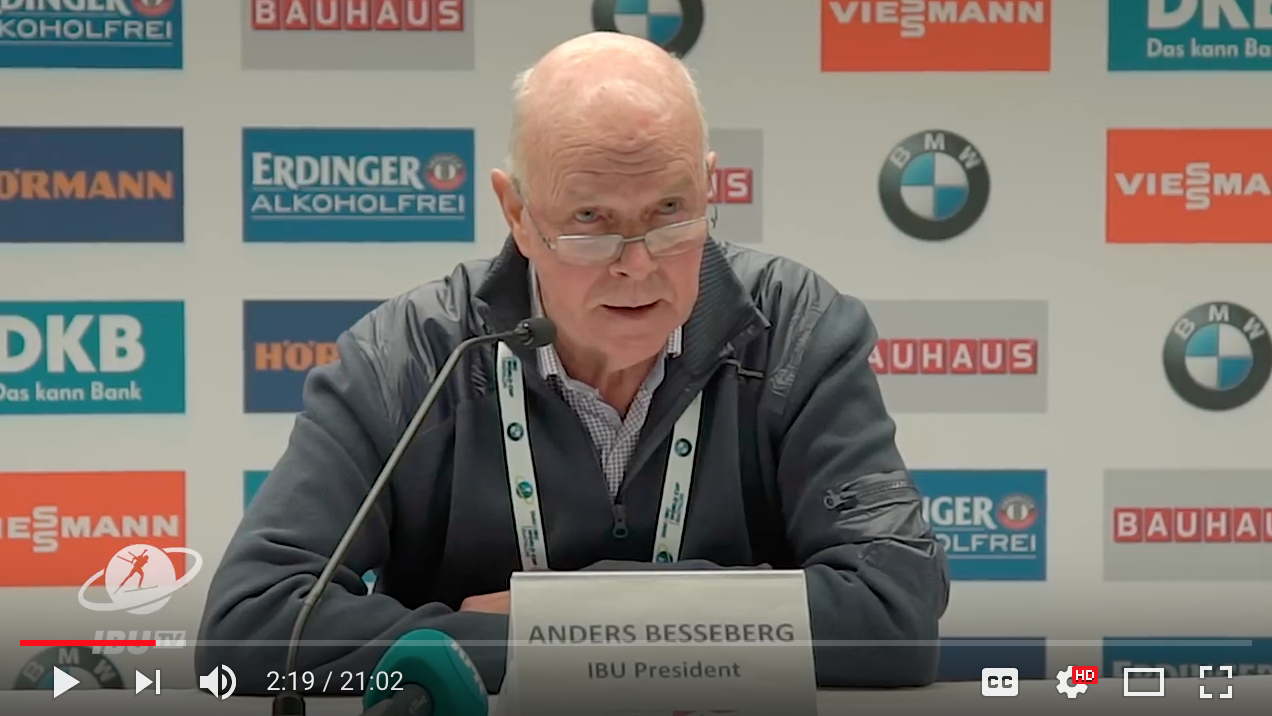
IBU President Anders Besseberg speaking at a press conference regarding the IBU’s decision to relegate the Russian Biathlon Union to provisional membership on Sunday, Dec. 10. (Screenshot: IBU TV)
This past weekend’s IBU World Cups were held in Hochfilzen, Austria, and the IBU’s decision to relegate Russia to provisional membership was announced in there on Sunday.
“This is sort of a repeat of our stance that we issued in May with respect to the selection, if you will, of the World Championships in Tyumen in 2021…,” Wylie said. “This situation is a bit related to the IOC, but we have a nation whose anti-doping organization is non-compliant, WADA code non-compliant in the Russian Anti Doping Agency. So our pitch has been — Biathlon Canada, the Canadian federation — if you are WADA non-compliant, then you should be not hosting any IBU events, major IBU events. And there are the World Cups and the IBU Cups and that is something within the purview of the international federations. We voiced that quite strongly and that essentially is what we are saying.”
Wylie also said he is unsure if other national federations will make the stance to boycott the Russian IBU competitions scheduled for March.
At this point, he said Canada’s athletes might be jeopardized by competing in Russia and exposing themselves to potential sample tampering when it comes to anti-doping testing.
“Even though they have an alternate agency, I believe it’s the UK Anti Doping agency is actually contracted to do that, we have a nation that has been a non-compliant anti-doping agency,” Wylie said. “If one of our objectives, the IBU’s objectives, is to foster and promote doping-free sport, it is sort of non-congruent that you would actually hold or allow them to host IBU events as they have a non-compliant anti-doping organization. … It happens to be directed to Russia, but we have actually said that any national federation that is non-WADA code compliant should not be allowed to host any IBU events simple as that.”
Wylie explained he is interested in modifying the IBU bylaws to include detailed language that states a national biathlon federation with a provisional membership, like the Russian Biathlon Union, should categorically not be allowed to host major IBU events.
After anchoring Norway to fourth in the men’s 4 x 10-kilometer relay at the 2014 Olympics in Sochi, Russia, Petter Northug congratulates the Russian silver medalists, including anchor Maxim Vylegzhanin. As a result of the IOC’s decision to sanction two Russians that competed in Sochi, Russia is to return its relay medal; Norway will thus be awarded bronze and France silver.
This article has been updated to include comments from Canadian World Cup Team member Alex Harvey as told to Le Journal de Montrealon Wednesday.
“Hell yes, IOC. Finally starting to take some action,” U.S. Ski Team (USST) member Simi Hamilton wrote on Twitter. “I have a feeling pressure from us clean athletes has paid off!”
“Today marks a win for clean athletes,” USST Women’s Coach Matt Whitcomb tweeted. “Two cheats are out. It’s a start.”
The Russian men’s relay team meets Maxim Vylegzhanin at the finish after he anchored them to silver in the 4 x 10 k at the Sochi Olympics. The IOC recently ruled that the Russian team’s relay result should be invalidated and they are to return their medals.
Norway’s Petter Northug posted a photo on Instagram of what looked like brunch in a tropical setting with the words: “Feire OL bronse!” (translates to “Celebrating Olympic bronze!”). Northug already has four Olympic medals to his name, two of which are gold (all from the 2010 Olympics), but the men’s 4 x 10-kilometer Olympic relay medal from 2014, which will be awarded retroactively to the Norwegian team (after they placed fourth behind Sweden in first, Russia in second and France in third) will be the first medal for Northug’s teammates Eldar Rønning and Chris Andre Jespersen.
Later on Wednesday, Northug posted a jocular meme on Instagram, picturing himself racing in the Sochi relay with the words: “You know you are the best anchor when you bring the medal home 4 years after the race.”
Legkov was part of Russia’s silver-medal relay in Sochi, and as a result of the IOC’s ruling, he must return the two medals he won there (relay silver and 50 k gold). Additionally, the 2014 Olympic results of Legkov and Belov are to be voided and both athletes are barred from competing at (or being granted credentials to) future Olympics. However, both are expected to appeal the ruling to the Court of Arbitration for Sport (CAS) by this Thursday at the latest.
“It is weird to get the medal in the mail. But if he gets convicted, of course I will take it,” Jespersen told Norway’s Nettavisen, according to a translation. “It’s my only Olympic medal. It is clear I will take it.”
In an interview with Le Journal de Montreal, Alex Harvey, the leading member of the Canadian World Cup Team who finished third in the overall World Cup and second in the distance standings last season, said he had his suspicions about Legkov — particularly after the 50 k freestyle mass start (in which Harvey placed 19th).
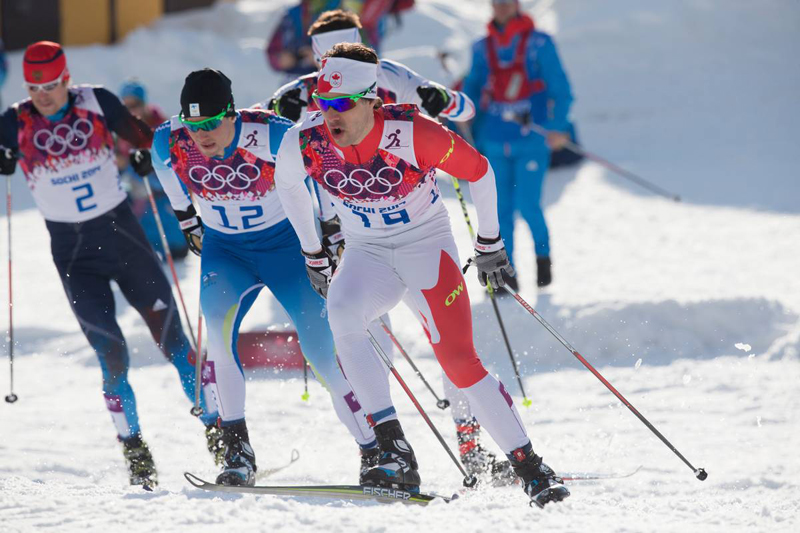
Canada’s Alex Harvey (front, bib 19) racing in the freestyle sprint at the 2014 Winter Olympics in Sochi, Russia. He finished 19th on the day. Also pictured: Russia’s Sergey Ustiugov (2) made it to the final and placed fifth. (Photo: Fischer/NordicFocus)
“On the climbs, we could see he was artificially stronger than the rest,” Harvey said, according to a translation. “In Sochi, the last two kilometers were filled with big climbs. It was a course made for Russians knowing that they were doping.”
He added that the end of each course in Sochi ended with a long, brutal uphill that was exceptionally “physically demanding”.
As for the recent doping bans involving professional cross-country skiers, Harvey said, “It’s a shame because our sport is now compared with cycling. It is in cross-country skiing and in biathlon that the largest number of dope cases occur.”
And while he was in favor of the IOC’s decision, he hoped the buck wouldn’t stop there.
“I’m happy that the IOC finally acted, but Russian skiers are still racing … and one in particular who wasn’t bad in Lahti,” he said, alluding to Sergey Ustiugov, who took gold or silver in all five races he competed in at Lahti World Championships.
“Ustiugov was young at the Sochi [Olympic Games], but he still reached the final in the sprint,” Harvey said. “Three of the top six men fell, but he was on his way to a podium that day. What the McLaren Report revealed was that the full team was involved in doping. But Ustiugov’s name never came out. And as long as his name doens’t come up, we can only have doubts.”
Meanwhile, the law firm representing Legkov and Belov is enraged, according to Nettavisen.
“The decision deserves the term scandal,” the Wieschemann firm stated in its press release on Wednesday. “[It] mocks the declaration of the President of the IOC, Dr. Thomas Bach, to decide only on the basis of secure evidence.”
While the IOC’s Disciplinary Commission (also referred to as the Oswald Commission) has yet to release its full decision and explain how it arrived at the final rulings, cases for 26 other Russian athletes (four of which are nordic skiers) who allegedly doped in Sochi are still pending, the CBC reported.
“The Oswald Commission has announced that all hearings for active athletes who could qualify for the Olympic Winter Games PyeongChang 2018 will be completed by the end of November,” the IOC stated.
As of Wednesday, exactly 100 days out from the 2018 Winter Olympics in PyeongChang, South Korea, it remained unclear whether the commission obtained further evidence concerning Legkov and Belov beyond what was already presented to the CAS.
Wieschemann claims the commission ruled “without further investigation and without further evidence…”
“Denis Oswald still stated at the last summit of the IOC that his investigations would go far beyond those of Prof. Richard McLaren,” the firm’s press release stated. “Well that’s actually not the case. The investigation has only been limited to obtaining a new forensic opinion…”
And while some of the most outspoken individuals in the XC world continue to speak out, others are weighing in on social media as well.
“… It’s disturbing to find out that some athletes in cross-country skiing have likely doped, and have gone so long unpunished,” Caitlin Patterson of the Craftsbury Green Racing Project wrote on Facebook. “But it reminds me that we must be vigilant, keep looking for ways to support anti-doping testing programs, put pressure on governing bodies to take a stand for clean sport, educate ourselves on progress and pitfalls of the cause, and speak up when we can.
“I haven’t spoken much on this politicized topic, but recent news such as this disqualification makes me distinctly aware of how much I value clean sport and all it stands for,” Patterson, who has started 27 World Cup races, continued. “Thank you IOC for taking this step towards preserving clean sport! Let’s keep it going, keep the pressure on, and fight to #CompeteClean and #PlayTrue!”
Former U.S. skier Sylvan Ellefson, who retired in 2014 after racing 23 World Cups, took to Instagram: “Thankful that our @usnordicskiteam contingency all get to move up a couple spots, but I mostly feel for those who have always been moral in their decision making. Those who train and race relentlessly, with their head down, just to find out their competition is taking the easy road. I could go on, but nothing lights me up more than cheaters.”
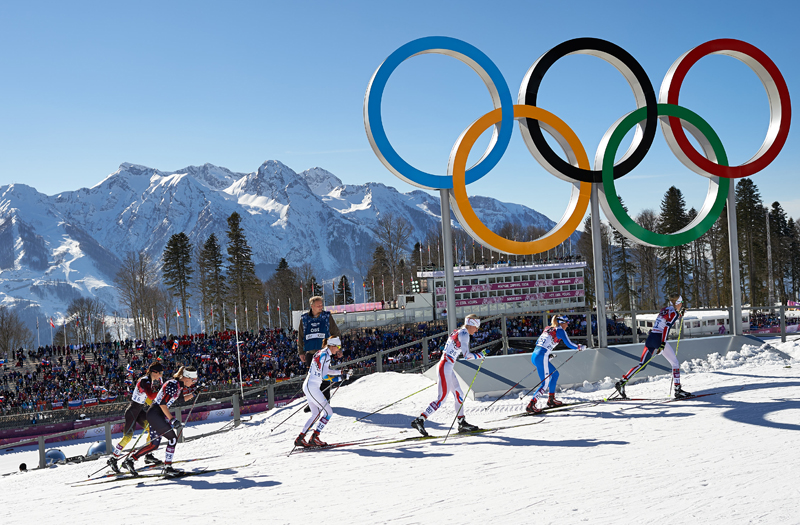
Competitors in the women’s 15 k skiathlon crest a hill at the 2014 Winter Olympics in Sochi, Russia. (Photo: Fischer/NordicFocus)
“There needs to be an investigation by WADA,” International Ski Federation (FIS) Secretary General Sarah Lewis told FasterSkier in a phone interview on Monday. “FIS totally supports it and we have already expressed that anything we can provide, we will do. And it needs to be done [quickly], but carefully.”
With allegations published last week in The New York Times of state-sponsored doping at the 2014 Olympics in Sochi, Russia, attention turned immediately to the World Anti-Doping Agency (WADA) and the International Olympic Committee (IOC).
FIS runs its own anti-doping program, as does each country which sends skiers to the World Cup. Those programs add up to thousands of urine tests done on skiers each year. When it comes to the Olympics, however, the IOC takes over all in-competition testing and WADA provides Independent Observers to watch the process.
There had been allegations as early as November of last year, in the WADA Independent Commission report, that Russian state security personnel had infiltrated the Sochi anti-doping laboratory; WADA did not follow up on the finding.
Thus when Grigoriy Rodchenko, the former head of Russia’s anti-doping laboratory, said that 66 Russian athletes had been protected from testing positive by laboratory and security staff who swapped out their dirty urine samples, there was outrage from many sides.
Outrage – and bewilderment. Lewis was the head of the WADA Independent Observers at the 2008 Summer Olympics in Beijing, China. She is intimately acquainted with the anti-doping process and the tamper-proof bottles which were allegedly opened in a secret lab and filled with replacement urine.
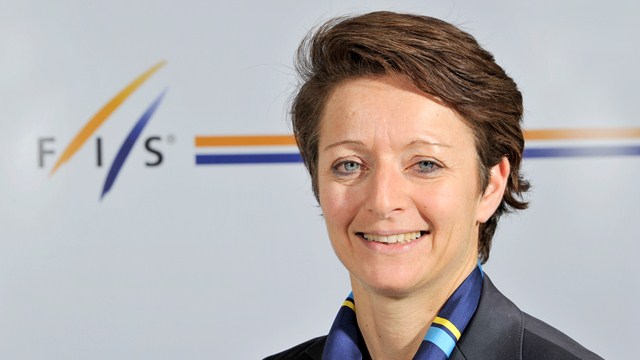
Sarah Lewis, secretary general of the International Ski Federation. (FIS file photo)
“Frankly, these bottles, having seen the whole thing in action, to imagine that they can be reopened– wow,” Lewis said. “The fact that they could even be taken out of the lab is really quite shocking.”
WADA has pledged, finally, to investigate winter sports and the Sochi Olympics. But should the investigations confirm the allegations, all the IOC can do is ban an athlete from the Olympics, including retroactively. With 14 Russian cross-country skiers implicated in The New York Times report, including superstar Alexander Legkov, many are wondering whether World Cup results will also be shaken up.
For instance Legkov – who won the 50 k skate in Sochi as well as helping the Russians take home silver in the men’s relay – was on the podium three more times later that season, including at World Cup finals; he then earned a number of top-ten World Cup results in the next two seasons. Are those results in jeopardy?
In the 2014/2015 season, Russian Olympians Evgeniy Belov and Maxim Vylegzhanin – who have not been implicated by name but were members of the 20-athlete team of which 14 were supposedly on the doping list – both finished in the top 10 of the overall World Cup standings. Are the many individual race results that went into those standings also in jeopardy?
Whether to negate results going forward from the date of a positive test – if such a test exists – would be a decision left to FIS, which is also shaking its head about how doping could have happened in its sport, on the world’s biggest athletic stage.
“The story has to be verified – that’s a basic principle,” Lewis said of the allegations. “If any elements of it are true, then it’s a huge throwback, a huge step back for all anti-doping efforts. Especially that this could happen at the Olympic Games where there are so many resources in terms of money, personnel, global expertise – it’s such a major blow.”
Why Weren’t Cheaters Caught?
Russia led the world in anti-doping rule violations in 2014: 148 athletes faced sanctions, 14 of which were in Winter Olympic sports and more specifically four in biathlon and seven in skiing. Despite those numbers, no star cross-country skiers were caught in the leadup to the Olympics.
Irina Starykh (far right) celebrates with her Russian teammates after they won an IBU World Cup biathlon relay in Ruhpolding, Germany, in January 2014. The result was voided as a result of Starykh’s doping ban, from a sample collected in December 2013. (Photo: Fischer / Nordic Focus.)
So could FIS have done more, and tested harder, in order to prevent the cheats from reaching the Games in the first place?
“To be honest, with what they are talking about, namely a steroid program during the Games, it’s likely that the program was very specifically targeted around the Games,” Lewis argued. “Of course you’re always looking at your processes, but with the out-of-competition program we have in place it’s very comprehensive … Nevertheless in hindsight, of course you ask those questions. Until we know what the time scale was, it’s hard to know.”
A total of 6,439 anti-doping samples were collected by various testing agencies from athletes across the skiing disciplines in 2013, a number that shrank to 5,764 in 2014, the Olympic year.
But here, too, numbers don’t tell the full story, FIS argues.
“Let us respectfully point out that this question is rather outdated,” FIS Anti-Doping Coordinator Sarah Fussek wrote in an email on Tuesday. “The WADA policy and guidance to [anti-doping agencies] many years ago was to move away from large testing numbers and move to more quality testing. For example to organise a doping control at a remote location takes much more planning efforts, logistics, transport costs as 10 tests collected at a training camp at an easy to reach place. So comparing numbers only says nothing about the quality of a testing programme.”
In fact, Lewis said that the Russian skiers had been targeted with plenty of tests. That fact was underscored in an interview over the weekend where Legkov claimed to have been tested 33 times in the season leading up to the Games.
“Our specialists are monitoring the results of the testing from a clinical perspective, but also performances, participation, history of that nation, it’s all connected together,” Lewis said. “There’s no question that there’s been extensive targeting of the Russian team for more than ten years.”
That testing did lead to a rash of positive tests and disqualifications before the 2010 Olympic Games in Vancouver, Canada. But despite the bans, some athletes and coaches who were picked up in the sweep stayed in the sport. In one case, Russian athletes who had previously served doping bans decided not to train with the national team, and instead took up with a coach who had been barred from working with the national team because of his involvement in doping.
Rodchenkov – the head of Russian anti-doping who admitted massive fraud to the New York Times – also remained on the FIS Medical Committee until November, when he was suspended after the initial WADA Independent Commission report.
The history of Russian doping in skiing is not lost on anyone. But the biggest personality on the current scandal, Legkov, is a different case from the doping Russian skiers of six or seven years ago, at least in terms of lifestyle. He trained not only away from the standard national team coaching staff, but also primarily outside of Russia, basing himself instead in Davos, Switzerland, with non-Russian coaches in the seasons leading up to Sochi.
Additionally, Lewis had confidence in FIS’s out-of-competition testing.
“During the winter season, you have the athletes more or less with you the entire time,” she said. “It’s possible to carry out very extensive testing.”
Chain of Custody
Vitaly Stepanov, a former RUSADA employee, during an interview with 60 Minutes’ Armen Keteyian, which aired Sunday, May 8. (Photo: CBS News)
With the accounts of malpractice in Russian anti-doping laboratories in not only The New York Times piece but also by another whistleblower to CBS News’ 60 Minutes, there’s also a question as to whether previous anti-doping samples belonging to Russian skiers were manipulated.
Rodchenkov, for instance, said that he had destroyed over a thousand samples to prevent them from being re-tested by a different testing authority.
According to Lewis, samples collected by FIS were rarely stored in Russia.
“There was quite a lot of testing missions which were coordinated with [the Russian Anti-Doping Agency, RUSADA], but most were carried out by the FIS-appointed doping control agency with their own personnel and equipment,” she explained. “Most samples were transported to a different laboratory, in Lausanne or Cologne or somewhere else. We weren’t in the position that they could be manipulated in the Moscow laboratory.”
In addition, after RUSADA was suspended and the Moscow laboratory lost its accreditation from WADA, FIS took any samples that had been stored there immediately out of the country.
“In fact, all the samples were delivered to Cologne,” Lewis said. “They were evaluated again, all of the profiles, the blood profiles but also the steroid profile. That information was analyzed again as to whether there was the need to re-tests … They all returned negative.”
FIS anti-doping samples are handled primarily by a company called PWC, which is based in Germany and also offers services to other international and national federations.
“PWC is currently the main sample collection provider for FIS on the basis of an annual contract, but FIS uses regularly also the services from various national anti-doping agencies, and does not have an exclusive contract with PWC,” Fussek explained in her email.
The company then delivers samples to WADA-accredited laboratories around the world.
“The samples are not left overnight somewhere in a vault,” Lewis said. “Doping control officers carry out the tests and then ship or take them to the lab. That period for tampering doesn’t exist.”
Moving Forward
News broke on Tuesday that the U.S. Department of Justice would investigate the Russian doping claims. Earlier that day, the IOC announced that it directed the Lausanne laboratory where Sochi samples are stored to cooperate with WADA on potential re-testing, a move that many have urged for months.
“The statement by WADA and the IOC in terms of re-testing samples stored in Lausanne, we fully support that and have championed that cause for a long time,” Lewis said. “But that is an issue for the IOC, they are responsible for doping controls at the Olympics.
“In terms of what could be found through the re-testing, we would also support DNA testing of the urine samples in case there has been switching of urine and some errors,” she continued. “How it reads in the [Times] article is that they have used those athletes’ own urine, but nevertheless the experts are able to assess if there has been a change in terms of the composition of the samples. Plasticides were mentioned and that sort of thing.”
FIS already worked with the Russians to ensure that testing was carried out in the 2015/2016 season, even after RUSADA and the Moscow laboratory lost a say in the process.
“On the request of the Russian ski association, they asked FIS to step in and arrange in-competition testing,” Lewis said. “They didn’t have RUSADA to do it. We did that through the group appointed to help them, which was UK Antidoping. There was some additional blood testing carried out by the FIS agency during competitions during the season.”
That said, the testing arranged by UK Antidoping over the last six months was not exactly a roaring success.
Forty percent of the tests the agency was prescribed to carry out were unsuccessful, with one test being flat-out refused by an athlete. Of the tests which were collected, 49 were positive. UK Antidoping is reportedly considering ending its role in Russia altogether.
Nevertheless, Lewis asserted that athletes who competed in 2015/2016 should not worry that they were facing an unfair playing field.
“Anti-Doping holds a very high priority in our organization,” she said. “We have a strong commitment to clean sport. There’s no question that we’re horrified by these stories and absolutely support this investigation to clarify that situation. But when it comes to the statements of how the manipulation was done, in terms of exchanging samples and tampering with the bottles, those things can’t happen with the testing which is carried out by the FIS-appointed agency.”
For FIS, internal discussions are ongoing and the organization’s top brass has already set aside time at their biennial Congress in the second week of June.
“To be perfectly honest, the situation was and is on the agenda based on the WADA report on November,” Lewis said. “The situation with the Russians is on the agenda of the FIS Council already, and then obviously there is more information to be able to discuss and address.”
Correction: The author previously quoted Lewis as saying that she had “dropped a note through to Alex.” She was referring to Fasterskier’s Alex Kochon, not Alexander Legkov. We apologize to Lewis and to readers for this misunderstanding.
The day of the men’s 4 x 10 k relay at the Laura Cross-Country Ski Center at the 2014 Winter Olympics in Sochi, Russia. Sweden went on to take gold, Russia silver and France bronze in the event.
Max Cobb’s motivation to voice his disdain for doping dates back to the 1992 Albertville Olympics. Justin Wadsworth’s stems from being an athlete who had suspicions, but moreover, from watching his wife Beckie Scott miss out on her chance atop the Olympic podium after having been beat out by two Russians who were eventually disqualified for using performance-enhancing drugs.
For both, when it comes to Russia, they’re direct.
“The level of fraud and deceit that was allegedly put in place for the Sochi Games around the anti-doping effort is just a complete assault on everything that sport and the Olympic movement stand for,” Cobb, president and CEO of US Biathlon, told FasterSkier this past weekend.
He was reacting to The New York Times report, published Thursday, May 12, that suggested dozens of Russians, including 14 cross-country skiers, participated in a state-run doping program at the 2014 Winter Olympics in Sochi, Russia.
“There’s enough evidence in the past, with how many positive doping cases the Russians have had,” said Wadsworth, who recently left his post as head coach of the Canadian cross-country ski team after five seasons with the team. “I think that alone is enough to have reason to try to put some sanctions on them.”
Russia’s Natalia Matveeva (r), who tested positive for recombinant EPO in 2009 and was suspended until March 2011, joins Norway’s Ingvild Flugstad Østberg (l) and Maiken Caspersen Falla (c) on the podium this past February at the 2016 classic sprint in Drammen, Norway. (Photo: Fischer/NordicFocus)
Wadsworth was referring to a trend leading up to the 2010 Olympics, in which about a dozen Russian cross-country skiers were suspended for failing drug tests between 2001 and 2009.
“When I first came onto the international scene in the late ’80s, I went to ’89 World Championships in Lahti, and during that whole time I was naive…,” Wadsworth, a former U.S. Ski Team member, recalled. “You learn over the years, you see enough stuff that you just know what’s most likely an athlete that’s doping. You can’t come out and say, ‘Yeah, for sure,’ unless you see the needle going in the arm.”
That’s what makes the current case so complex, with the head of the Sochi anti-doping lab, Grigory Rodchenkov, releasing a list of Russian Olympians handpicked to receive illegal drugs at the 2014 Games.
It’s his word — a man whom the World Anti-Doping Agency (WADA) accused of taking bribes and destroying more than 1,400 samples, who was forced to resign and now lives in Los Angeles — against the Russian government’s. The tests were allegedly tampered with, so investigators will have to find evidence elsewhere to convict athletes like Alexander Legkov, who won gold in the final race of the Sochi Olympics, the 50-kilometer freestyle mass start.
The Russian Sports Ministry might even sue The New York Times, according to RT, a Russian government-funded media outlet.
“We are considering a lawsuit,” Russia’s Deputy Minister of Sports Yury Nagornykh told the Russian News Agency TASS. “They asked us to give comments on 66 athletes who are a part of Russia’s ‘doping program’. We said that we don’t have such a program.”
Rodchenkov claimed he concocted a “three-drug cocktail of banned substances” mixed with liquor, with “one milligram of the steroid mixture for every milliliter of alcohol.”
Apparently, he dissolved the drugs in alcohol to speed up the absorption, making Chivas whiskey for men and Martini vermouth for women.
“All athletes are like small children,” Rodchenkov told The New York Times (NYT). “They’ll put anything you give them into their mouths.”
“Athletes drink Chivas before competing? I can’t take it seriously,” Russian cross-country skier Sergey Ustiugov, who was not named in the NYT report but competed at the 2014 Olympics, told RT.
Alexander Legkov (standing) celebrates Russia’s silver in the men’s 4 x 10 k relay, their nation’s first medal in cross-country at the Sochi Olympics. He went on to win gold in the final race of the Sochi Games, the 50 k freestyle mass start, and Russia swept the podium.
“What happened yesterday [the release of NYT article] is totally absurd,” Legkov said at a press conference. “Alcohol with steroids is ridiculous. I didn’t take a sip of alcohol when I was meeting with friends because I was preparing for the Olympic Games. I know nothing about steroids, I don’t know how they look like. I took the article as an April [Fools’] joke.”
Legkov also called Rodchenkov’s comments groundless.
“It is a political game. Everybody is set against our country because it is one of the strongest in the world,” he said.
The NYT pointed out that, according to WADA statistics, Russia had the highest number of athletes caught doping in 2014.
While Russia fights to defend its winter athletes, its sport officials are simultaneously trying to ensure their track-and-field athletes can compete at the 2016 Summer Olympics in August in Rio de Janeiro, Brazil.
“Serious mistakes have been made by the federation management, along with athletes and coaches who have broken anti-doping rules and neglected the principle of fair play,” Russia’s Minister of Sport Vitaly Mutko wrote in a statement to the British newspaper, The Sunday Times, this weekend. “Let us be clear. We are ashamed of them.”
Track and fields’ international governing body, the International Association of Athletics Federations (IAAF), suspended Russia’s athletics team in November following a WADA investigation that found it guilty of state-sponsored cheating.
“We do not deny having a problem in Russia, and we are doing everything possible at state level to eradicate doping, including punishing athletes and coaches,” Mutko wrote.
Russia will find out June 17 whether its track and field team will be allow to compete in Rio.
“We are very sorry that athletes who tried to deceive us, and the world, were not caught sooner,” Mutko added. “We are very sorry because Russia is committed to upholding the highest standards in sport and is opposed to anything that threatens the Olympic values.”
‘The Needle Going in the Arm’
Cobb didn’t witness doping firsthand, but his opinion on the matter goes back to one of his first Olympic experiences, a night or two before the first race in Albertville, France.
“We were up in Les Saisies and one of our coaches who I was in the sauna with was dragged out to go help translate between a Russian coach and the village medical doctor,” Cobb recalled of the 1992 Games. “Because our coach’s English wasn’t that good, I went along to help translate as well. The situation was, the Russian coach said, ‘One of our athletes is very sick and will die if he doesn’t get a cortisone injection.’ So I was helping to translate that to the French doctor, who spoke English pretty well.”
While emphasizing that point over the next few minutes, the Russian coach explained that the athlete was having an allergic reaction to a protein injection he received.
“The French doctor said, ‘Yes, I know. I can see that he’s having an allergic reaction, but cortisone is a controlled and banned substance, and unless I can examine the athlete I can’t give it to him,’ ” Cobb recalled. “ ‘And yes, I know he will die if I don’t give it to him.’
“That was really how my experience at the Olympic Games began,” Cobb continued. “That was the case of [Russian biathlete] Sergei Tarasov, who was given an injection of blood that was either not his own or had been spoiled by not being refrigerated in an effort to blood dope him before the first race in Albertville.”
That story surfaced last year when Tarasov, who went on to win an individual gold at the 1994 Olympics, turned 50 and gave an interview to a Russian magazine.
Cobb recalled that story and compared it to the current accusations against Russian athletes across multiple Olympic sports.
“This is an issue that has been a violation of the basic principles of sport, that has been — because it was, in many cases forced on athletes with the threat of losing their support if they didn’t comply — an issue that needs to change,” he said. “I believe that with whistleblowers, athlete insiders and RUSADA [Russian Anti-Doping Agency] insiders coming forward at this time, taking the immense risk to come forward and tell what’s going on in an effort to change the system, that incredible sacrifice on their part needs to be met with support from sports leaders. If we don’t support that now, I’m sure it will be decades before it would ever happen again.”
Cobb didn’t see the needle going in Tarasov’s arm back then, and he, like everyone but Rodchenkov who has so far come forward about the 2014 Olympics, didn’t witness the Russians cheating in Sochi.
The all-Russian podium in the Sochi Olympics 50 k freestyle mass start, with Alexander Legkov (3) placing first, Maxim Vylegzhanin (7) in second for his third silver medal of the Games, and Ilya Chernousov (8) in third.
But Wadsworth claimed that’s what the Russians were up to immediately after they swept the podium in the 50 k, with Legkov leading fellow countrymen Maxim Vylegzhanin and Ilya Chernousov across the finish, respectively.
“If Rodchenkov knew my story, he would not even mention my name,” Legkov told MatchTV, according to a translation. “Since 2010, I have been working with foreign experts, I am absolutely not with Russian coaches, live all the time in Switzerland in an apartment in Davos. Before the Olympics, I have taken 33 doping tests.”
Meanwhile, Chernousov was another athlete who trained independently of the national team. After the Sochi Olympics in the spring of 2014, Chernousov began working with Vegard Bitnes, a Norwegian coach.
“We were one of the groups from [Russian] Federation, (Reto Burgermeister/Isabelle Knaute was an other),” Bitnes explained in an email to FasterSkier. “I planned all training, and had all control of training … we had our own camps and training.”
In the last two years, Bitnes explained that he and Chernousov only joined the Russian national team for two or three training camps, holding more camps with other national teams, like Sweden.
“We had some camps with Team Northug [Norwegian Petter Northug’s personal team], also with the Canadian team,” Bitnes wrote. “We was in some sport events in Norway, where we had trainings with French team, also US ski team athlete… So, we was almost never with the RUS team.”
Technically, Bitnes was a Russian national-team coach. He recently parted ways with Chernousov to become the head women’s coach of the Austrian biathlon team, effective May 1.
“The end of my work has nothing to do with the latest from RUS team,” he wrote. “I wanted to turn back to the IBU and Biathlon again. I hope for the best for Ilya and his training in the future.”
As for the allegations that 14 of 20 Russian cross-country skiers in Sochi — which may or may not include Chernousov — were doping, Bitnes wrote, “I can not comment so much, because it is from a time before I had anything to do with the RUS team. I can only say that it’s frightening to see/hear about this. Based on a general base. I hope WADA and IOC [the International Olympic Committee] will get to the bottom of those obligations, so we can clean up this mess. If this is true, its a very very sad thing.”
The Russians celebrate their silver medal in the men’s 4 x 10 k relay at the 2014 Sochi Olympics, with (from left to right) Dmitriy Japarov, Maxim Vylegzhanin, Alexander Bessmertnykh, and Alexander Legkov.
Wadsworth is confident it’s true. The former Canadian coach recalled suspecting something fishy was going on with the Russians during the men’s 4 x 10 k relay in Sochi as he watched Legkov put down the fastest time on the third leg.
“What I saw with the rest of his form that year and on that course, when I saw him hop-skating pretty much the whole course, especially the last hill coming into the stadium, the way he was looking on his face after pushing so hard — because the Russians were quite far behind and he really pulled them into medal contention in that race — and I just didn’t believe what I saw,” Wadsworth said. “And then in the 50 k, it was, at the end, the pace and the pushing. In the early part of the race, there were so many guys up toward the front, but in the last few kilometers, again, it just didn’t look right to me. And I always carefully think that through in my head as far as, is this a great performance we’re seeing or is this something else? And what I saw, I just thought it was something else.”
“I always carefully think that through in my head as far as, is this a great performance we’re seeing or is this something else? … I just thought it was something else.” — Justin Wadsworth
So he spoke out about the Russians after the 50 k and accused them of doping in a post-race interview with FasterSkier. FS then asked Legkov what he thought of Wadsworth’s accusation in the post-race press conference. Legkov laughed off the comment.
“I have to always be clear with this, I wasn’t making any excuses for our team, I was simply commenting on something I saw from the athletes on the field of play,” Wadsworth recalled this past Saturday.
“I fully accept our team’s preparation for the Games and our waxing issues … we had our own issues and we debriefed those and learned from those,” he continued. “But I think if I was potentially another coach who had athletes, like [Norway’s Martin Johnsrud] Sundby, who was fourth in that race and missed out on a chance at a medal … I guess I’m always surprised the Norwegians don’t speak out. They have so much power in our sport and they chose to do nothing with it except make things better for themselves on the World Cup.”
An email to Vidar Løfshus, director of the Norwegian Ski Federation, seeking comment on the recent allegations against Russia was not returned by press time.
“It’s just really surprising to me that nobody wants to speak out more. I can understand we all want to focus on our teams and on our own business, but that’s not to the point when there’s something going on like systematic doping,” Wadsworth said.
As for the athletes, “I expect them to focus on their training and themselves, but when it comes down to it, if there’s enough evidence and they’re tired of it, then they should probably speak up,” he added. “The athletes do have a powerful voice and they should use their athlete representatives to push FIS to do a better job and to push the IOC.”
Shocked But Not Surprised
One athlete who carefully crafted his responses in an email to FasterSkier was France’s Robin Duvillard, who placed sixth in the 50 k. Should the Russian cross-country team be disqualified and its results voided in Sochi, Duvillard would move up to third place and technically a bronze medal in that race.
France’s bronze-medal men’s 4 x 10 k relay team at the Sochi Olympics: (from left to right) Ivan Perrillat Boiteux, Jean-Marc Gaillard, Maurice Manificat, and Robin Duvillard.
“I would like to be clear about the fact that what I read in the newspaper yesterday are only suspicions,” Duvillard wrote on Friday. “I don’t want to blame them if some of the information is not true.”
If everything in the reports is true, “I am shocked, sure. But not really surprised,” the 32-year-old continued. “I am shocked about the fact that it was organized by the authorities. Not because some athletes are doped. In the past, we already discovered that athletes were doped, and I know that it can happen again.”
In Sochi, Duvillard stood on the podium with three teammates, earning bronze in the men’s relay behind Sweden in first place and Russia in second.
“The only thing we can do is to trust [WADA] AMA to achieve anti-doping tests,” he wrote. “And what I have read yesterday is that they failed in Sochi, because Russian authorities were more powerful than them. But now I need to keep my faith in AMA’s work if I want to live my sport serenely and not getting paranoiac.”
Considering the news that immediately followed the 2014 Olympics, in which Russian skiers stated they had used xenon gas in training — a controversial but not-yet-banned substance (before WADA banned it in May 2014) — along with the Russian-athletics scandal unveiled last year, Duvillard had his suspicions.
“I suspected that a doping scandal could break out in Sochi, considering the bunch of money they put into it, and because Putin wanted to show the world that Russia is still shining,” he wrote. “But I can’t say I really suspected the cross country athletes being doped in the 50k. Sure, they were way faster than me in the last hill, but they were faster many many times in the past, so why not once again?”
Since the NYT report hit the world wide web last Thursday, Duvillard has received numerous messages congratulating him on the potential bronze medal.
“In a way, I would be glad to get this medal, because that would award all the work I have done to get in shape on that race,” he wrote. “But in another way, the party would be spoiled forever! Because any time I would watch again that 50k, I would find myself crossing the line in 6th place, and any time I would watch the closing ceremony with that amazing podium into the stadium, I wouldn’t see me on it.”
“Sure, they were way faster than me in the last hill, but they were faster many many times in the past, so why not once again?” — Robin Duvillard, sixth in the men’s 50 k at the 2014 Sochi Olympics
The redistribution of medals is a drawn-out process that involves legal battles handled by the Court of Arbitration for Sport, but if you ask Wadsworth, whose wife fought for her medal two years after the fact, it needs to happen.
“If nobody does anything, nothing’s going to change,” Wadsworth said. “… It’s great for [Beckie] to have the gold medal in the house and get recognized for that, but on the day, that’s what you as an athlete, that’s what you dream about, that’s what you work hard towards and when you get that robbed from you, it doesn’t matter what happens in the future.
Alexander Legkov (3) beat out fellow Russians Maxim Vylegzhanin (not shown) and Ilya Chernousov (r) for gold in the Sochi Olympics 50 k freestyle mass start. Vylegzhanin took silver by 0.7 seconds, just a tenth of a second ahead of Chernousov in third, and Norway’s Martin Johnsrud Sundby (1) missed a medal by 0.2 seconds in fourth. Not shown: Sergei Dolidovich of Belarus placed fifth, 14.3 seconds after Legkov, and France’s Robin Duvillard was another 0.6 seconds back in sixth.
“I think what really needs to come out from all this is not the results getting stripped — you know, Robin Duvillard, he might get the medal, but he’s not going to get to feel what it felt like to stand on the podium in the closing ceremonies down in Sochi, to get a medal around his neck, so that whole thing is lost,” Wadsworth continued. “What really needs to happen is things change for the future so that clean athletes have an opportunity.”
Should the entire Russian cross-country team be suspended, some clean Russian athletes will get caught in the aftermath, he noted.
“But those athletes should speak out and say what they know as well because it’s the Russian athletes that’s getting cheated the worst in the very end,” Wadsworth said. “They’re the ones that are going to have the health issues in the future and they’re also the ones that are going to miss out on future opportunities if their team does get allowed to race. And they’re the ones at the end of the day that have to look at themselves in the mirror and know they cheated.”
FIS and the IOC
As for how the International Ski Federation (FIS), the sport governing body for cross-country (as well as several other winter sports), FasterSkier first obtained a statement on the matter via email.
“FIS is deeply disturbed by these allegations and will provide all possible cooperation to WADA and the IOC with the investigation,” the statement noted.
In a follow-up phone interview on Monday, FIS Secretary General Sarah Lewis said, “We also will make sure that we are looking into our processes which we can control, as opposed to the Olympics where we are playing a facilitating role but not directly controlling the testing.
“Certainly for everybody it’s a wake-up call to what may have happened and what therefore has the potential to happen,” she continued. “I’m very sure that there will be a very careful analysis of the situation to make sure that this cannot happen going forward.”
Kikkan Randall (U.S. Ski Team) at the 2014 Olympics in Sochi, Russia. (Photo: Fischer/NordicFocus)
Kikkan Randall, chair of the FIS Athletes’ Commission who competed for the U.S. in Sochi, wrote in an email that the latest news was “definitely disturbing and if it turns out to be true, it is really unfortunate and unfair for those athletes that competed clean in Sochi and missed out on medals.
“The FIS Athlete Commission had previously written a letter to WADA after the news came out about Russian Athletics calling for further investigations into other sports, especially cross country skiing,” Randall added. “We hope WADA can get to the bottom of this and I know FIS will be in full cooperation to help out however they can.”
As for the U.S. cross-country team, head coach Chris Grover said they’ve been following the news closely.
“I guess our initial reaction is that we are disheartened and disappointed, and really disappointed that there might be a tie to cross-country here,” he said on the phone this weekend before convening with the team for its first training camp of the 2016/2017 season.
“It’s something we’ll talk about as a group but we haven’t,” Grover said. “Every time any sort of doping scandal comes up, we definitely talk about it as a group. It reinforces our resolve by lead by competing clean. And the exciting thing that we have talked about before, is that we know that we can win when we are doing it clean, because we’ve done it so many times before. That’s the silver lining for us … We can’t get hung up in what other people may or may not be doing.”
“The exciting thing that we have talked about before, is that we know that we can win when we are doing it clean, because we’ve done it so many times before.” — Chris Grover
Asked if he had suspicions about doping in cross-country skiing, he said, “I’ve never felt 100-percent confident that the sport is 100-percent clean. I’ve felt that it’s clean enough that we can win. I think that all of us feel that it’s a lot cleaner than it was when we first got involved in the sport.
“We’re really interested in how this story unfolds,” he continued. “We are grateful to the media sources that are following this closely and are doing investigations. We will always, from the USSA [U.S. Ski & Snowboard Association] side, take an active role in working with the USOC [US Olympic Committee] and FIS to ensure that proper steps are taken, that we are getting a clean sport and a level playing field.”
Grover is also chairman of the FIS Cross Country World Cup and Continental Cup sub-committees. FIS plans to meet in Cancun, Mexico, for its 50th International Ski Congress from June 5-11.
“To be perfectly honest, the situation was and is on the agenda based on the WADA report on November,” Lewis said of the planned discussion of Russia at those meetings. “It’s on the agenda of the Council. The Congress is not dealing with daily business … The whole WADA report and the situation with the Russians is on the agenda of the Council already, and now obviously there is more information to be able to discuss and address.”
Update: The IOC Executive Board held a special meeting on Tuesday with IOC President Thomas Bach calling for additional anti-doping measures. The IOC retested 454 selected doping samples from the 2008 Summer Games in Beijing, China, and as a result, up to 31 athletes from six sports could be banned from the upcoming Olympics in Rio. The IOC is also planning on retesting 250 samples from the 2012 London Games.
“The aim is to stop any drugs cheats coming to the Olympic Games in Rio de Janeiro,” an IOC press release stated.
“Swift and decisive action will also follow the controversy surrounding the anti-doping laboratory in Sochi,” it continued. “Meeting Tuesday, the EB of the IOC has requested WADA to initiate a fully fledged investigation into allegations that testing at the Sochi Laboratory was subverted. The IOC for its part will instruct the Lausanne Anti-Doping Laboratory, where the Sochi samples are stored for ten years, to proceed in cooperation with WADA with their analysis in the most sophisticated and efficient way possible.”
The IOC has asked the Russian Olympic Committee to ensure the full cooperation of the Russian side in the WADA investigation.
“Based on the result of this investigation the IOC will take swift action,” the release said.