From the FasterSkier archive — posts syndicated from athletes’ and coaches’ own blogs between 2004 and 2012, kept online as published. Current coverage is at fasterskier.com.
Johannes Høsflot Klæbo anchoring the Norwegian men’s 4 x 10 relay to gold on Sunday at the 2018 Olympics in PyeongChang, South Korea, while Denis Spitsov (background) celebrates silver for the Olympic Athletes for Russia. (Photo: FlyingPointRoad)
For a while in the men’s 4 x 10-kilometer relay on Sunday, it looked like the Russians might run away with the win. But that was just two classic legs and 20 k into the race, with a lot more racing to come.
While Kazakhstan’s Alexey Poltoranin had handed off in first at the first exchange, just ahead of Andrey Larkov of the Olympic Athletes from Russia, Italy, France and Norway skied together behind them, with Norway’s Didrik Tønseth trailing off the back, 18 seconds behind.
On the next classic leg, Russia’s Alexander Bolshunov put a hurt on the field. Within the first 3.3 k lap, he was 25 seconds ahead of Kazakhstan’s Yevgeniy Velichko in second, who was followed closely by Italy, Norway and France in third through fifth. Sweden’s Daniel Rickardsson had fallen farther behind to more than a minute back in sixth place, after his teammate Jens Burman lost contact with the lead group on the first leg.
By the second exchange, Russia was 24.5 seconds clear of second place, while Italy’s Francesco de Fabiani tagged Giandomenico Salvadori in second, France’s Maurice Manificat tagged Clement Parisse in third (+28.0), and Norway’s Martin Johnsrud Sundby tagged Simen Hegstad Krüger in fourth (+32.1). Kazakhstan’s Velichko had fallen off the pace and was another 19 seconds back in fifth.
Over the next 10 k, the first skate leg, Krüger and Parisse reeled in Russia’s Alexey Chervotkin, catching him before the end of their second lap. One lap later, Krüger came through the final exchange in first, tagging Johannes Høsflot Klæbo 0.4 seconds ahead of France in second. Chervotkin tagged Russia’s anchor Denis Spitsov in third, 16.2 seconds back, while Finland’s Matti Heikkinen passed Italy’s Salvadori on the last climb to put Finland in fourth (+58.6).
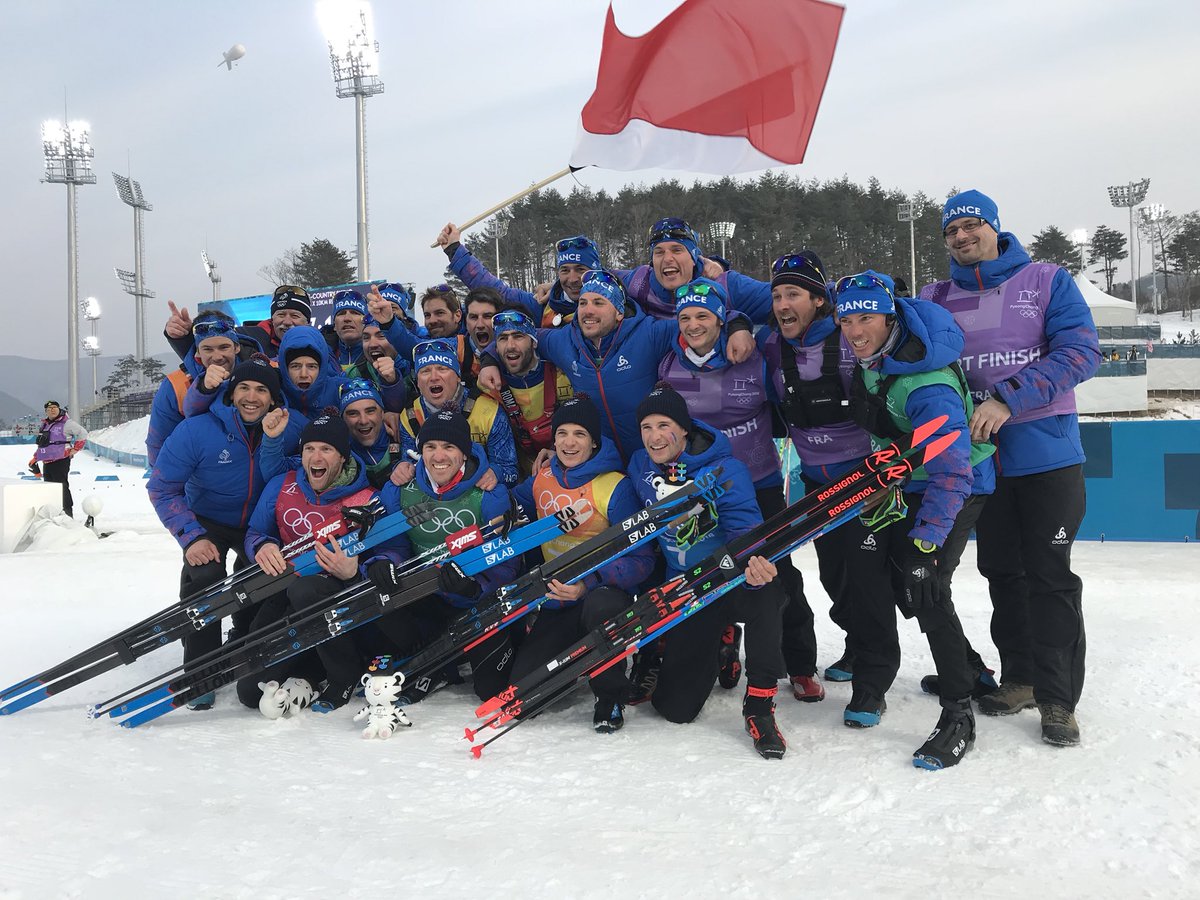
Team France celebrates its bronze-medal finish in the men’s 4 x 10 k relay at the 2018 Olympics on Sunday in PyeongChang, South Korea. (Photo: FIS Cross Country/Twitter)
Early in the final leg, France’s Adrien Backscheider took the lead ahead of Klæbo. The two held Spitsov off until the end of the second lap, where Spitsov came through the stadium first to start the final loop. Spitsov and Klæbo soon upped the pace, dropping Backscheider, and shortly after the 8.27 k checkpoint, Klæbo truly put the jets on to accelerate away from Spitsov. He dropped the Russian on a climb just before the final uphill, where it was clear that the gold was Norway’s.
As he sped down into the stadium, Klæbo relaxed his arms, skied to the sideline and took a flag from the stands. He looked back for a moment and then crossed the finish line first in 1:33:04.9 hours, while Spitsov followed 9.4 seconds later for silver for Russia. Backscheider held on for bronze (+36.9) as his team exuberantly celebrated with him at the finish.
Finland placed fourth (+1:40.5), Sweden fifth (+2:05.6), Germany sixth (+2:08.2), Italy seventh (+2:35.2), and Kazakhstan eighth (+3:31.4). Canada was ninth (+3:41.0) for its second-best Olympic relay result (with Len Valjas, Graeme Killick, Russell Kennedy, and Knute Johnsgaard), and the U.S. finished 14th (+9:24.2), out of 14 teams, with Andy Newell, Reese Hanneman, Scott Patterson, and Noah Hoffman.
France’s Martin Fourcade lunging for his second gold of the 2018 Olympics in PyeongChang, South Korea, winning the men’s 15 k mass start on Sunday. (Photo: FlyingPointRoad)
Martin Fourcade is the champion once again. Six days after he won the 12.5-kilometer pursuit for his first gold in PyeongChang, the 29-year-old Frenchman did it again in the men’s 15 k mass start on Sunday, winning in a photo finish at the line.
He took charge on the first loop, leading the field into the range for the first prone shooting. There, Fourcade shot a penalty and slipped to 19th, but it wasn’t over.
Clean shooting on the second prone brought him up to eighth, 9.4 seconds out of first. Germany’s Benedikt Doll took that lead at that point after his second stage without a miss. Meanwhile Norway’s Johannes Thingnes Bø shot three misses on that second stage and dropped out of contention.
One loop later, Fourcade moved into first with a clean standing. He left the range about 1 second ahead of Germany’s Simon Schempp and 2 seconds ahead of Germany’s Erik Lesser, after both made it through the first three stages without a miss. Doll missed one to slip to seventh, almost 30 seconds behind.
After Fourcade and Schempp exchanged leads over the next loop, Lesser moved into first just before the final shooing, Going head to head, Fourcade and Schempp both missed one while Lesser missed two. Fourcade and Schempp still left the range in first and second, respectively, separated by 0.4 seconds, while Lesser slipped to fifth, 22.5 seconds back.
Doll left the range in third (+19.2) after cleaning and Norway’s Emil Hegle Svendsen moved into fourth (+21.9) with a clean standing stage as well.
In the end, Fourcade outlunged Schempp for the win in 35:47.3 minutes, with Schempp finishing less than a tenth of a second behind for silver, and Svendsen beat out Lesser in the finishing stretch by 0.4 seconds to claim bronze, 11.2 seconds behind, while Lesser settled for fourth (+11.6). Doll followed them in fifth (+18.8), Austria’s Julian Eberhard placed sixth (+30.7) with three penalties, Norway’s Erlend Bjøntegaard seventh (+32.1) with two misses, Norway’s Tarjei Bø eighth (+34.6) with three penalties, Sweden’s Jesper Nelin ninth (+34.6) with two misses, and Slovenia’s Jakov Fak 10th (+36.1), just ahead of the Czech Republic’s Ondřej Moravec in 11th (+36.3), with one miss each.
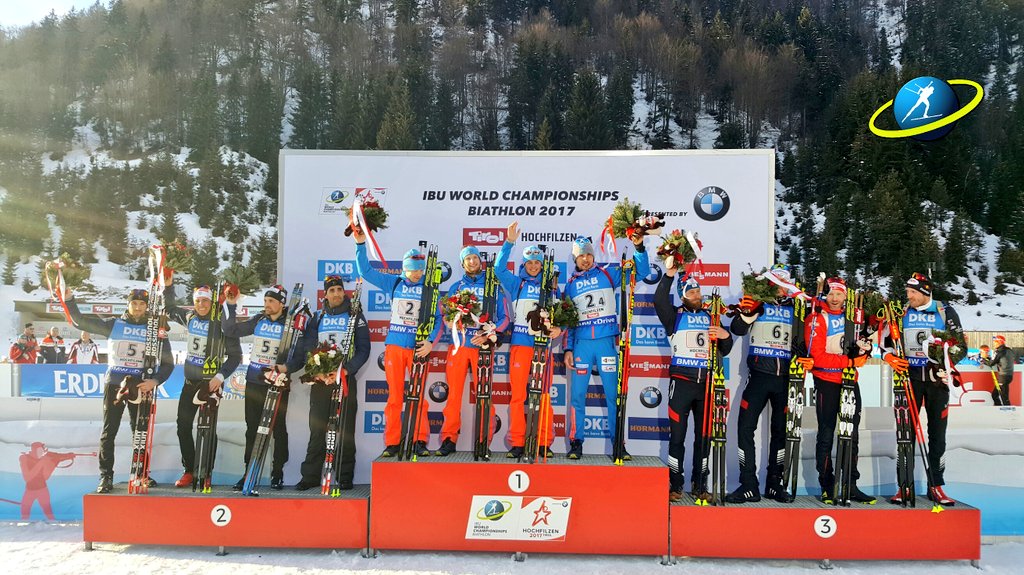
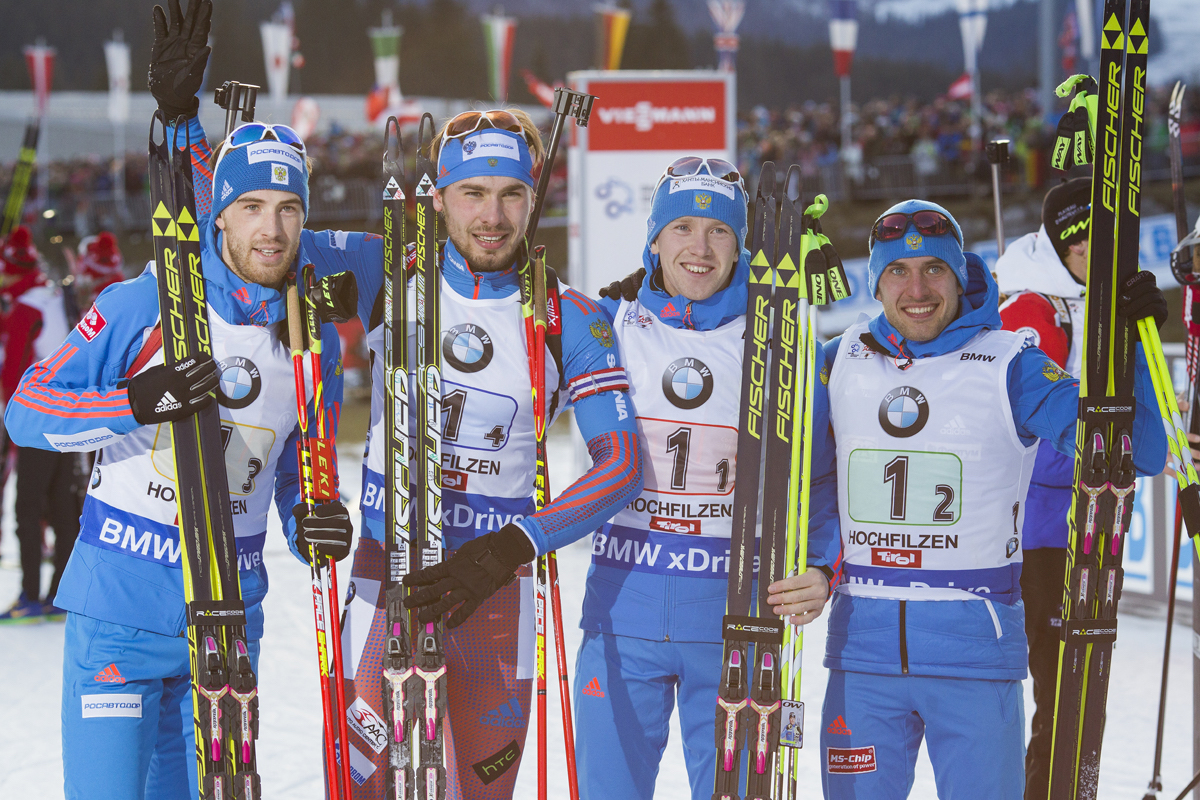
The men’s 4 x 7.5 k relay podium at 2017 IBU World Championships on Saturday in Hochfilzen, Austria, with Russia (c) in first, France (l) in second, and Austria (r) in third. (Photo: IBU World Champs/Twitter)
IBU World Championships (Hochfilzen, Austria): Men’s relay
[UPDATED] Russia’s four-man relay team hit nearly every target on Saturday, using a total of just three spares to clean 40 targets, and stayed out of the penalty loop to capture gold in the men’s 4 x 7.5-kilometer relay at the International Biathlon Union (IBU) World Championships in Hochfilzen, Austria.
It was the last team event and the second-to-last day of the championships, with the men’s and women’s elite mass starts remaining on Sunday. Anton Shipulin anchored the Russians to first, 5.8 seconds ahead of France’s Martin Fourcade, after Shipulin cleaned his prone stage and used one spare in standing to hold onto the lead his team built. Fourcade cleaned both stages to secure silver for his team, and Austria took bronze (+20.1) with anchor Dominik Landertinger.
After Russia’s Alexey Volkov used one spare in each of his shooting stages and came through the exchange in seventh, Maxim Tsvetkov and Anton Babikov both cleaned without any spares to bring the team into fourth, then first, respectively.
France’s first leg Jean-Guillaume Béatrix shot clean as well and tagged Quentin Fillon Maillet in second. Fillon Maillet then needed one spare in prone, but cleaned standing to take the lead, tagging Simon Desthieux in first. Desthieux used three spares in prone, but avoided the penalty lap before tagging Fourcade in third, 12 seconds behind Austria in second. Fourcade closed the gap and clinched second, and France combined for a total of just four spare rounds.
Austria achieved bronze in front of a home crowd with Daniel Mesotitsch, Julian Eberhard, Simon Eder, and Landertinger combining for 10 spares and no penalties.
Finishing 8.5 seconds after Austria, Germany placed fourth. Italy was a minute and a half out of first in fifth, Ukraine took sixth (+1:41.3), and the U.S. placed seventh (+1:50.5) with Lowell Bailey, Leif Nordgren, Tim Burke, and Sean Doherty. Bailey initially put the team in fourth at the first exchange, 12.4 seconds out of first, then Nordgren tagged Burke in sixth, 17 seconds behind. Burke used four spares to clean and tagged Doherty in seventh, about a minute back. The Americans used a total of eight spares but had no penalties.
Canada finished 13th (+3:35.5) with Christian Gow, Scott Gow, Macx Davies, and Brendan Green. They were 39 seconds out of first and in 12th place after Christian Gow’s first leg, then slipped to 14th before Davies moved them back into 12th by the last exchange. Canada had a total of 10 spares and zero penalties.
FIS Cross-Country World Cup (Otepää, Estonia): Freestyle sprint
In the last World Cup before the upcoming 2017 International Ski Federation (FIS) Nordic Ski World Championships next week in Lahti, Finland, five U.S. women qualified in the top 12 of the women’s 1.3-kilometer freestyle sprint, and Jessie Diggins reached the final on Saturday in Otepää, Estonia.
Diggins started the day by placing 12th in the qualifier, 3.93 seconds behind Sweden’s Stina Nilsson in first (and her U.S. teammates Kikkan Randall in third, Sophie Caldwell in fourth, and Ida Sargent in 10th) before winning her quarterfinal and semifinal. In the final, Diggins wad gapped by the leaders on the final climb and finished fifth (+6.82).
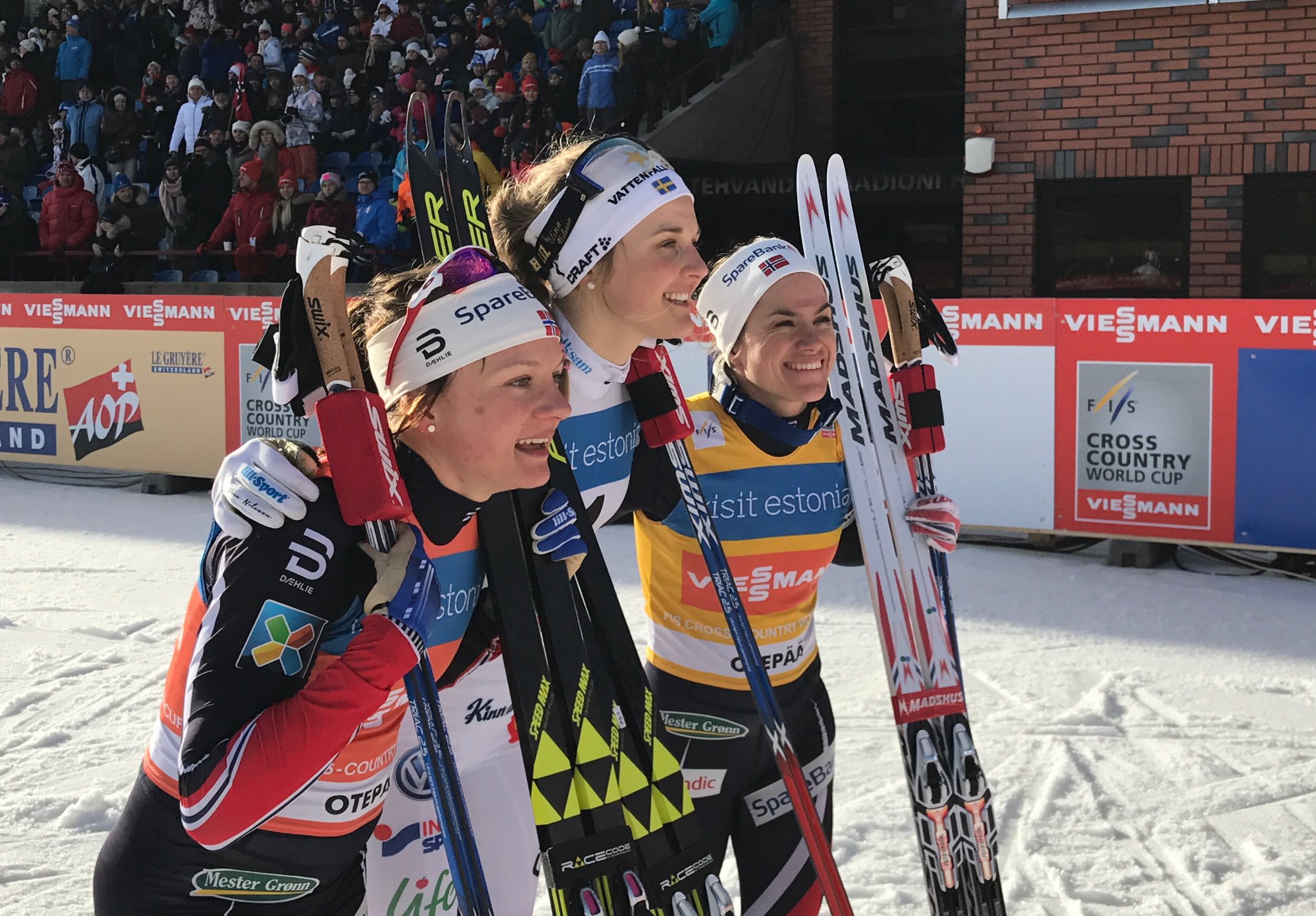
The women’s freestyle sprint podium at the Otepaa World Cup on Saturday in Estonia, with Swedish winner Stina Nilsson (c), Norway’s Maiken Caspersen Falla (l) in second and Heidi Weng (r) in third. (Photo: FIS Cross Country/Twitter)
Nilsson won the final in a time of 2:49.96 minutes, just ahead of Norway’s Maiken Caspersen Falla (+0.27) who lost her balance and her speed with it on the last corner. The two had broken away from third place and Nilsson led into the final straightaway and held Falla off for the win. Norway took second through fourth with Heidi Weng in third place (+3.75) and Astrid Uhrenholdt Jacobsen in fourth (+4.91).
Randall initially finished her quarterfinal in third position and would have been out, but advanced when Russia’s Natalia Matveeva was relegated to last for obstruction. In the same semifinal as Diggins, Randall fell cresting a small hill over a tunnel and finished fifth (+13.30) for ninth overall on the day.
Caldwellplaced second in her quarterfinal heat behind the day’s winner Nilsson, then stumbled halfway up a climb early in her semifinal, but stuck with the pack to finish fifth (+1.83) for 10th overall.
Sargent raced in the same quarterfinal as Falla and narrowly missed advancing to the semifinal in third place, fewer than 0.2 seconds behind Switzerland’s Laurien van der Graaff in second and 0.35 seconds behind Falla, who won that heat. Sargent placed 13th on the day.
Sadie Bjornsen qualified 25th and finished fourth (+2.82) in the same quarterfinal as Randall for the 25th overall.
Canada’s Dahria Beatty also qualified for the sprint heats in 30th place, and finished sixth in her quarterfinal for 29th overall.
Also for Canada, Cendrine Browne finished the qualification in 48th place and Katherine Stewart-Jones was one position behind in 49th.
Also for the U.S., distance specialists Chelsea Holmes and Rosie Brennan placed 58th and 60th, respectively.
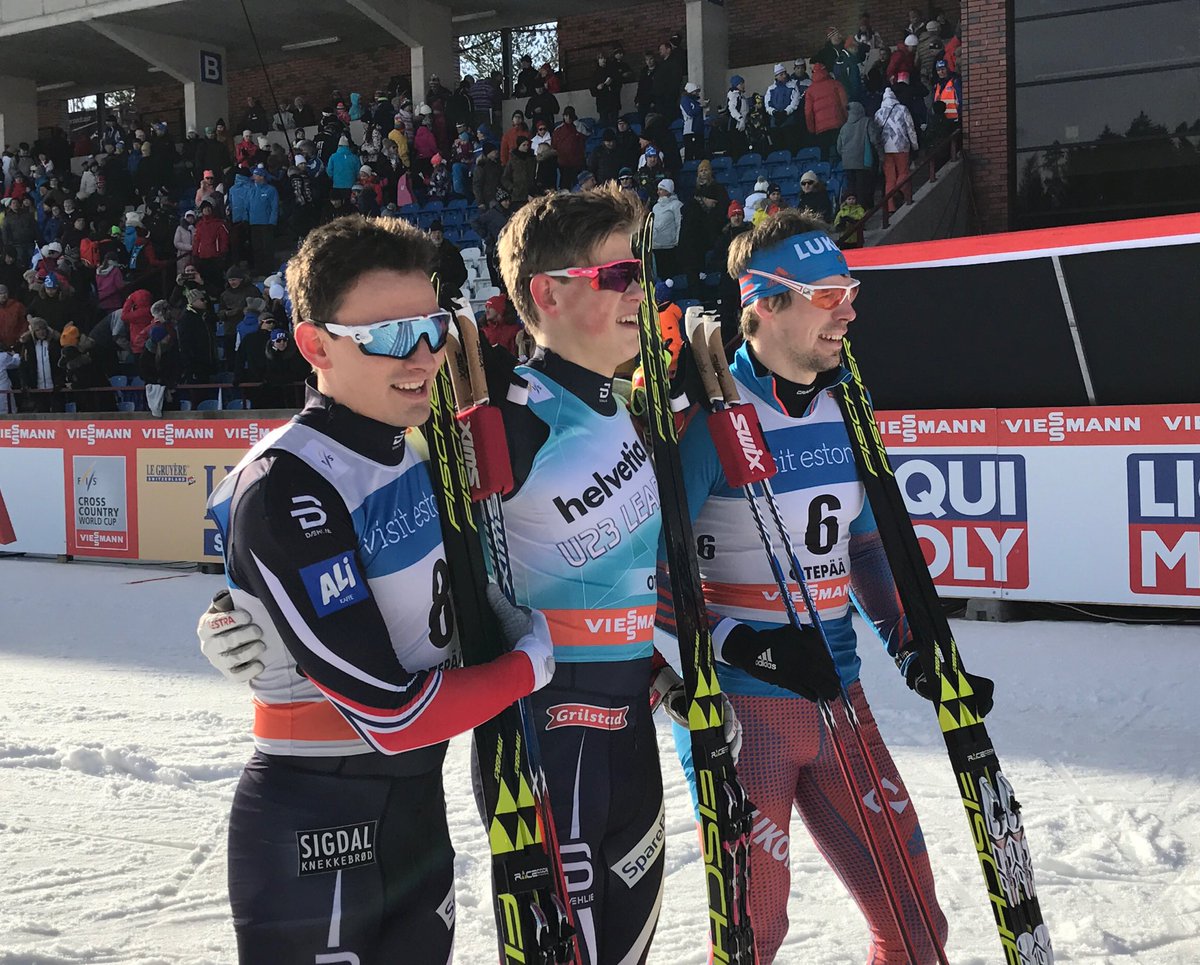
The men’s freestyle sprint podium on Saturday at the World Cup in Otepaa, Estonia, with Norway’s Johannes Høsflot Klæbo (c) taking his first World Cup win, Norway’s Finn Hågen Krogh (l) in second, and Russia’s Sergey Ustiugov (r) in third. (Photo: FIS Cross Country/Twitter)
In the men’s 1.6-kilometer sprint, Norway’s Johannes Høsflot Klæbo achieved the first World Cup victory of his career in a time of 3:06.53 minutes, holding onto a lead he had created with an attack right out of the start gate in the final. His teammate Finn Hågen Krogh placed second (+0.60), taking the inside lane in the last turn to push reigning Tour de Ski winner Sergey Ustiugov of Russia to third (+1.0).
For the North Americans, it was a day of narrow misses.
For the U.S., Simi Hamilton started his race day by qualifying in seventh position, and placed second in his quarterfinal. He then closely missed out on the final after placing fourth in his semifinal in a four-way sprint photo finish (+0.33), just 0.04 seconds behind the third place and lucky loser time of Norway’s Håvard Solås Taugbøl, who advanced. Hamilton ended the day in eighth overall.
Canadian World Cup Team member Alex Harvey snuck into the sprint heats in 29th place in the qualifier, then just missed out on advancing from his quarterfinal in a photo finish for second with Great Britain’s Andrew Young, who took it by 0.04 seconds. Harvey finished third in that heat, 0.6 behind Italy’s Federico Pellegrino, for 15th for the day. Young went on to finish sixth in his semifinal for 12th overall, and Pellegrino advanced as a lucky loser from the same semifinal and was fourth in the final (+4.77).
American Andy Newell qualified 16th and finished sixth (+1.89) in his quarterfinal for 27th overall.
Canada’s Len Valjas missed qualifying for the heats in 40th place, as did his teammate Devon Kershaw in 50th.
American Erik Bjornsen was 53rd, and for Canada, Jesse Cockney 54th and Knute Johnsgaard 56th. In his World Cup debut, Benjamin Lustgarten placed 64th in the qualifier.
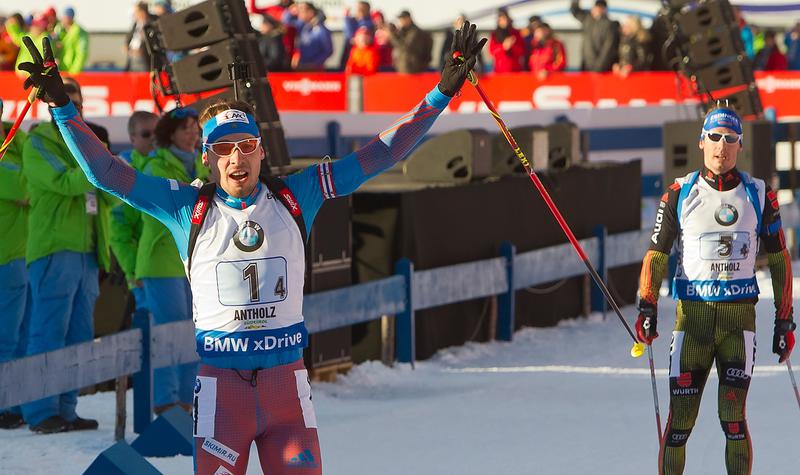
Russia’s Anton Shipulin (l) celebrates after holding off Germany’s Simon Schempp (r) to anchor Russia to the men’s relay victory on Sunday at the IBU World Cup in Antholz, Italy. Shipulin outlasted Schempp by 1 second for the win. (Photo: IBU/Rene Miko)
Russia’s Anton Shipulin and Germany’s Simon Schempp have met multiple times on the final loop of an International Biathlon Union (IBU) World Cup race and duked it out for first, both in individual races as well as relays. In fact, they did so in Saturday’s pursuit in Antholz, Italy, where Shipulin prevailed by 10 seconds to claim his first victory of the season.
On Sunday in the men’s 4 x 7.5-kilometer relay in the same packed arena with over 20,000 biathlon fans, Shipulin did it again to anchor a Russian team — with Maxim Tsvetkov, Evgeny Garanichev and Dmitry Malyshko — to first in 1:12:24.8, with no penalties and seven spare rounds.
The German team, with Erik Lesser, Benedikt Doll, Arnd Peiffer, and Schempp, finished just 1 second behind, with one penalty but just four spares.
“It has become sort of a tradition with me and Simon together on the last shooting range and then on the last lap,” Shipulin commented in the post-race press conference through a translator. “Honestly Simon becomes stronger and stronger every time, but today I would say I didn’t beat him physically, it was more about tactics. It is not a very long finish lane here, so I just made it tactically better to not give him a chance.”
“Being on the podium shows that we are in good shape,” Malyshko said through a translator. “We will try our best at the World Championships [in Oslo in March] to show everybody that we are even stronger than in the World Cups.”
“We trust in Anton, and Anton believes in the team,” one of Shipulin’s teammates added in an interview with the IBU.
Schempp was not pleased with a situation that happened when he and Shipulin came into the arena, having to pass a lapped athlete from Japan just before the last turn, with Shipulin overtaking on the right but Schempp getting slightly blocked.
“The lapped athlete ran in the middle of the track. The whole audience was yelling for him to go to the side. I don’t know, maybe he is deaf on his ears, or whatever he is doing,” Schempp told German broadcaster ARD. “With all the peace of mind he is running right between us, and that must not happen.”
Asked if he thought a protest with the IBU would be an option, Schempp replied: “Nah, surely that would not go through. That result stands.”
“I gave everything I had, it was a neat relay, and we were rewarded with the second place,” he added. “The Russians were very, very strong, especially Anton in the finish. We can live with that. It was a clear step forward in the relays [the German men’s first relay podium of the season]. Of course the end is a little annoying, but we can be satisfied.”
The head coaches for German and Russia, Mark Kirchner and Ricco Gross, respectively, hugged and congratulated each other in the coaching zone after the race. Both 45 years old, they are former German teammates and won gold together in the men’s relay at the 1994 Olympics in Lillehammer, Norway. More recently, they were also colleagues, with Kirchner coaching the German men’s team and Gross being an assistant for the women at the 2014 Olympics, before Gross took an offer last summer to lead the Russian men’s team (after being “demoted” to the IBU Cup by the German Ski Federation).
“It’s difficult to even pick the six best athletes for the World Cup,” Gross had told German newspaper FAZ in an interview published on Friday, just before Shipulin’s sprint victory. “I was extremely surprised in September when I watched the Russian championships for the first time, with more than 100 athletes. There is a giant talent pool … My target is the Olympic Games in 2018.”
Norway opted to rest its usual starters Tarjei Bø and Emil Hegle Svendsen for the relay on Sunday, instead starting veteran Ole Einar Bjørndalen, Lars Helge Birkeland, Johannes Thingnes Bø, and Erlend Bjøntegaard.
“They married and went on vacation,” Johannes Bø joked during the press conference when asked about the absence of his brother Tarjei and Svendsen.
Thus it fell to the relatively inexperienced Bjøntegaard to anchor the team. Bø tagged him with a 29.2-second lead over Russia, and 33.5 seconds ahead of Germany, with Shipulin and Schempp chasing after him.
“Now it’s becoming really exciting. I wouldn’t like to be in the shoes of Bjøntegaard right now,” Germany’s third-leg Arnd Peiffer said during an interview with ARD while the race was still going on. “I think he has a lot of stress now, and I am curious what happens.”
But facing this big challenge, Bjøntegaard did a good job skiing a fast first loop to return to the range still in first and only needing two spares in his prone shooting. Yet this still reduced his lead to 6.8 seconds over Schempp, who had shot clean, and 14.9 seconds to Shipulin, who required one spare.
In the final standing shooting, the Norwegian needed two more spare rounds, while Shipulin and Schempp both remained clean and left the range just 0.5 seconds apart. They skied together until the finishing sprint, with Bjøntegaard securing the third place on the podium, 22.9 seconds after Russia, but securely ahead of the rest of the field.
“With Emil and Tarjei, two of our best athletes were not in the relay,” Johannes Thingnes Bø said during the press conference. “I was hoping that we could make the podium, and we did. A perfect race for everyone on the team. Erlend and Lars Helge were called up last minute, but they were relaxed, and third place is good. It’s not easy for Erlend to go out with Schempp and Shipulin.”
Behind Norway, Austria, with Sven Grossegger, Julian Eberhard, Simon Eder, and Dominik Landertinger, finished fourth (+1:01.7), with one penalty and 11 spare rounds.
“Better shooting,” Simon Eder told the IBU in a video interview when questioned what it would have taken to reach the podium. “We always have the extra [penalty] loop. It’s not easy, it happens so fast. But we hope to manage it at the World Champs without it.”
“The running shape is very good in the Austrian team,” Landertinger added. “And if the shooting is a little bit better we can make the podium.”
France, starting without World Cup leader Martin Fourcade with a lineup of his older brother Simon Fourcade, Quentin Fillion Maillet, Simon Desthieux, and Jean Guillaume Beatrix, placed fifth (+1:39.3), with no penalties and 11 spares.
U.S. Ties Season-Best 6th; Canada 11th
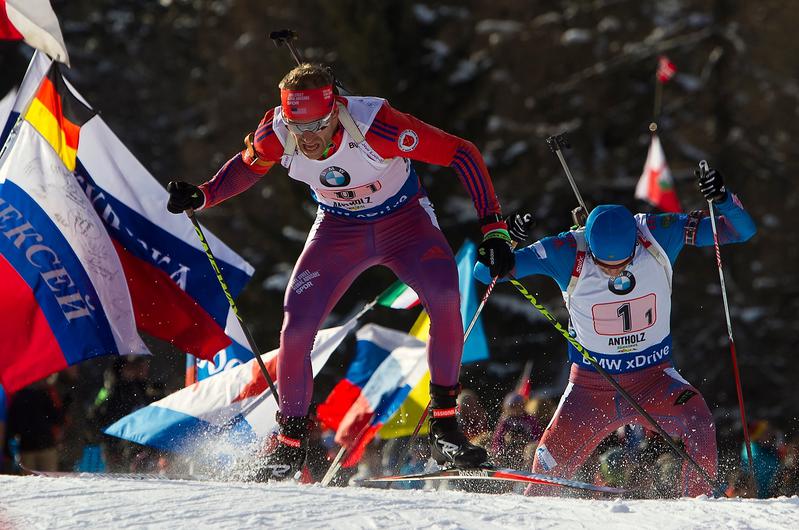
Lowell Bailey (US Biathlon leads Russia’s Maxim Tsvetkov during the first leg of the men’s 4 x 7.5 k IBU World Cup relay on Sunday in Antholz, Italy. Russia went on to win and the U.S. finished 1:43.7 minutes back in sixth, tying a season-best team result. (Photo: IBU)
On the last leg, Beatrix narrowly won out a race against American Sean Doherty, who crossed the finish less than five seconds later in sixth place, 1:43.7 behind the winners. The U.S. ended up with one penalty and 13 spares, and tied its season-best result after having achieved sixth in the relay a week ago in Ruhpolding, Germany.
The Americans started the race in bib 6 with their now-usual lineup of Lowell Bailey, Tim Burke, Leif Nordgren, and Doherty, the same starters they had used at the World Championships in Kontiolahti, Finland, where the U.S. placed 14th in the men’s relay.
Bailey briefly took the lead on the loop out of the arena, before two misses in his prone shooting stage required spare rounds and set him back to 15th, but still within 15.5 seconds out of the lead. With another spare in his standing stage, he still moved up five positions, and with the second-fastest, first-leg course time on his final loop, he tagged off in seventh, 20.8 seconds behind Germany’s Lesser.
Burke held that position throughout his first loop, but two misses in the prone stage set him back. In the standing shooting, he used all three spare rounds to avoid the penalty lap, falling back to 14th before he made up ground again with a fast last loop (third-best course time) to tag Nordgren in ninth (+1:04.3).
“Today proved that last week was not a fluke,” Burke said in a US Biathlon press release. “We are happy to be right in the mix with the ‘big’ biathlon nations but we still know that we are capable of more.”
“I got the tag from Tim right with the Czech Republic,” Nordgren wrote in an email to FasterSkier. “For all of the first loop I just focused on staying nice and relaxed, trying to conserve as much energy as possible. Prone I wanted to be pretty aggressive and it worked out well.”
After a clean prone shooting, Nordgren left the range in seventh place, virtually tied with a few other teams.
“The second loop I left the range with Eder from Austria, again I was just tucked in with him saving energy,” Nordgren recalled. “Although I had super great skis today, so eventually on the downhill I put in a good transition and was pushing towards the French team in front of us.”
After using two spare rounds in his standing stage, Nordgren still managed to move up to sixth place as some other teams, such as Italy and Switzerland, struggled on this leg, and handed off 1:04.5 minutes behind the leaders — about the same gap he had when he started.
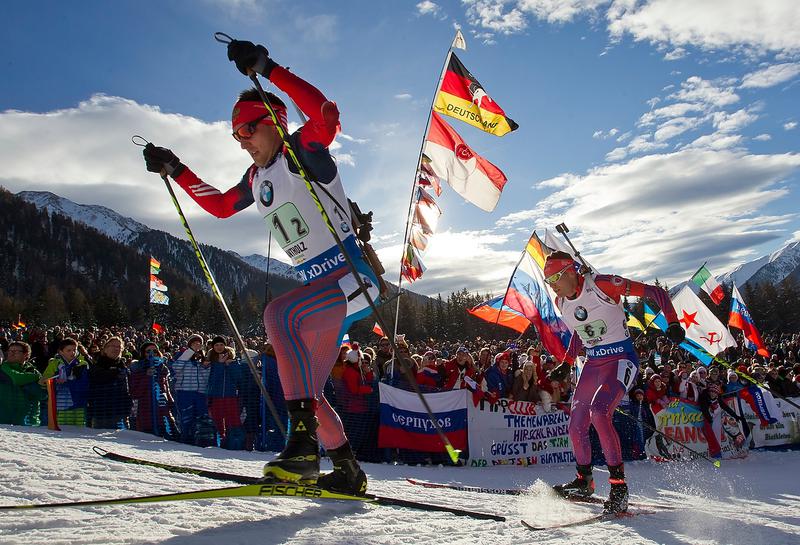
Russia’s Evgeniy Garanichev (l) leads Tim Burke (US Biathlon) during the second leg of the men’s 4 x 7.5 k IBU World Cup relay in Antholz, Italy. (Photo: IBU/Rene Miko)
“Standing was the only disappointing part about my race today, it was a bummer to have two mistakes, but I didn’t lose any places and I was quick with the extras,” Nordgren wrote. “I was surprised on the third loop, I actually had some energy to push. Eventually France passed me and got a small gap I couldn’t close.”
Doherty kept the team in sixth on his first loop and through the first prone shooting, which he cleaned, reducing his gap to first by about ten seconds.
“The conditions today were ideal,” Doherty wrote in an email. “The course was in great shape and there was no wind. The altitude here adds to the difficulty, but I also pushed hard on the second loop and I did not really hold it together on the range as I wish I could have.”
By the final standing shooting he had moved to fifth, and was on the range behind Austria, with France nearby and Slovakia further behind. Austria’s Landertinger shot clean and finished first, while Doherty caused a penalty lap. But he only lost one position and still had France’s Beatrix in sight who had needed three spares.
Doherty skied a fast final loop, almost closing a 20-second gap again, finishing sixth, 4.4 seconds behind France in fifth and 1:43.7 behind Russia.
“I am a little bummed to have had that penalty because I was excited to fight for 5th. But overall 6th was secure,” Doherty wrote.
“I am happy with another strong result,” Doherty added in the US Biathlon press release. “We were in the mix the whole time and even though I did not shoot my best the team did well. We are all looking forward to the next relay.”
“As a team I think we’re happy with this race, but it was nowhere near a perfect race for us,” Nordgren wrote. “We still have more to give and will be looking for more in the relays to come.”
Canada in bib 7 chose a lineup of Christian Gow, Nathan Smith, Macx Davies, and Scott Gow. Brendan Green had to sit out the relay because of back issues following his collision in Saturday’s pursuit, “which did not improve until race time,” according to Biathlon Canada head coach Matthias Ahrens. “We had to put Scott Gow in his place,” Ahrens wrote in an email.
Younger brother Christian Gow jumped out to the lead after cleaning the initial prone stage, but on the next loop he lost some ground, crossing the next timing point in 11th, just 10 seconds out of first. After he required two spare rounds in his standing stage, Christian lost additional time to the leaders, but kept his position in the field, tagging off to Smith in 11th (+1:08.3).
Smith, currently the highest-ranked Canadian in the overall World Cup, cleaned both stages for his first 100-percent shooting in a race this season. Reflecting on his race in an email, he said his ski shape was off — and it has been for the last couple days. Unable to move up in the field, he tagged Davies in 11th (+1:07.7).
“I wanted to make up some spots and get our team up to the top 10. I knew it would mean some really good shooting,” Smith wrote in an email. “I’m really happy to finally have my first clean of the winter, especially after poor shooting in the other two races this weekend. On the other hand my skiing hasn’t been where it should for the last two weeks. I’m not sure why, I went from my best ski shape to my worst ski shape in literally 3 days. I have been struggling with back pain after a hard downhill crash in the Ruhpolding 20 km.”
Davies went on to clean his prone stage and move into 10th, reducing the gap to the leaders to 41 seconds. In standing, he needed all three spares, which caused him to lose some time. Overall Davies skied the second-best course time of his leg (only behind Norway’s Bø), and handed off to Scott Gow in 10th place (+1:39.0).
On the anchor leg, Scott needed two spares in his prone stage and one in standing, with Estonia’s anchor Ermits Kalev still passing him on the final loop. The Canadian crossed the finish in 11th, 5.7 seconds behind Estonia and 2:28.9 minutes behind Russia.
Combined, the team had no penalty and required just eight spares. But 11th wasn’t exactly close to their season best: the Canadians finished sixth in Hochfilzen, Austria and 10th last week in Ruhpolding.
“There were some good aspects of our relay: Christian’s first prone was amazing, my shooting, and Macx’s skiing,” Smith wrote. “Overall though I would say unfortunately it was not a good relay. A good race for us is top 6. The potential for a medal is there if everyone can put together their best race on the same day. Easier said than done.”
The Biathlon World Cup resumes in two weeks on Canada’s home turf in Canmore, Alberta, with sprints on Thursday, Feb. 4 and Friday, Feb. 5, followed by mass starts on Saturday, Feb. 6, and single-mixed (1 woman, 1 man) and mixed (2 women, 2 men) relays on Sunday, Feb. 7.
“I’m going to North America in a good mood,” Germany’s Peiffer said at the press conference. “The last three weeks were really exhausting. Now I had a good week here in Antholz, and I am looking forward to go to Canmore. I have never been there before. Maybe not as many [spectators] as in Ruhpolding or Antholz, but it’s nice to see a new place for biathlon.”
“I will be in Romania for my last Junior World Championships,” Sean Doherty, 20, wrote, which will take place in Cheile Gradistei (Brasov, Romania) from Jan. 27 to Feb. 2. “So I will only be attending the Presque Isle World Cup [after Canmore].”
Brendan Green racing to sixth for Canada in the men’s 4 x 7.5 k relay at the IBU World Cup in Hochfilzen, Austria. Sixth place remains the Canadian men’s second-best relay result. (Photo: Biathlon Canada/NordicFocus)
The men’s 4 x 7.5-kilometer relay at the IBU World Cup in Hochfilzen, Austria, was marked by frequent lead changes on Sunday, leaving the big question of which nation — out of several — would actually win.
At one point, US Biathlon’s Tim Burke was sitting in first place as his team’s second skier. But in the end, three of the “usual suspects” prevailed, with Russia catching up to and eventually overtaking Norway at the very end of the final lap. France claimed the third podium spot, and Canada and the U.S. finished sixth and eighth, respectively.
For Canada, sixth place stood as the second-best men’s relay finish since the same four skiers placed fifth at last season’s World Cup in Oslo, Norway. With Christian Gow, Nathan Smith, Scott Gow, and Brendan Green racing in the same order as they did in Oslo, the Canadians rose to sixth during the second half of Sunday’s race and ended up 21.3 seconds off the podium in Hochfilzen.
With a clean prone stage and one spare in standing, Christian Gow, 22, tagged Smith 25.7 seconds behind Latvia in first. The Latvians had been elevated by a flawless leg from their scramble skier, Andrejs Rastorgujevs. On the second leg, Lativa slipped to 23rd (and was ultimately lapped on the final leg), while Canada moved into seventh with Smith.
“It was a lot of fun to race and to be so close to the top of the field,” Christian wrote in an email. “I am happy with how well I held it together in the range and out on the course! It was an all round very good day for me.”
Smith explained that while his men’s team repeated its sixth-place result from last year’s Hochfilzen relay, the competition was a lot tighter on Sunday.
“It was a much more exciting race to be in, with constant changes,” he wrote.
“Each time I went into the range I could still see the leaders,” Smith added. “This might’ve led me to be overly aggressive in shooting as I knew a quick clean could get me up there. Unfortunately I didn’t have any of those…”
Smith needed all six spares — three for each shooting — but knocked down all his targets to avoid the penalty lap. He noted that “6 spares is a lot on this course. Ski times are so close that it really all came down to shooting accuracy and speed. The rest of the guys had phenomenal shooting, though. I’ll admit I was the one that didn’t race to my potential today.”
With the seventh-fastest course time, Smith overtook three teams to move the Canadians into seventh, 49.3 seconds back at the second exchange. From there, Scott Gow cleaned without needing any spares and also skied the seventh-fastest course time for his leg to put his team in sixth (+59.0) before the final leg.
“My goal today was to try and not rely on spares, and the end result was exactly what I wanted,” Scott, 25, wrote in an email. “My skiing felt good today and my shooting was perfect, so overall I’m very happy.”
Canada’s anchor leg, Greene used one spare in both prone and standing and posted the fifth-fastest course time of his leg to secure sixth. He was able to still overtake Sweden’s Jesper Nelin, while Germany’s Simon Schempp moved ahead of him.
“Austria has been great to us,” Green said with a laugh. “It’s hard to say what it is. I think right now momentum is building on the team with some good results early in the season. But I think as a team we are more confident now.
“The biggest thing for me is knowing if I don’t perform, one of the younger guys will, so that removes some pressure because the expectations for the team are not all on one athlete anymore,” Green added.
A 29-year-old team veteran, Green felt the pressure on the final leg after his teammates skied as high as fifth during the race.
“There was a lot of pressure out there on that last leg today but I’m happy with how I handled it,” Green said.
He considered the Gow brothers to be the difference-makers on Sunday, and Smith agreed.
“The Gows are a lot stronger this year skiing and can fight with the top teams now,” Smith wrote. “I think a relay medal is within reach if we can all lay down our best on the same day.”
After using nine spares, the Canadians ended up behind Russia in first, with Alexander Volkov, Evgeny Garanichev, Dimitry Malyshko, and Anton Shipulin winning in 1:11:40.8. Norway placed second, 3.1 seconds back, with Henrik L’Abee-Lund, Johannes Thingnes Bø, Tarjei Bø, and Emil Hegle Svendsen. France was more than a minute back in third (+1:01.9), and Austria finished fourth 9 seconds later. Germany placed fifth (+1:18.4), 4.8 seconds ahead of Canada.
According to Smith, sixth place wasn’t necessarily a surprise. The team ranked seventh in the relay based on last season’s results. At the same time, coming close to a team best was always a good thing.
“All of us put forward strong legs to get in to the top 6 and that is an accomplishment we are all proud of,” Christian wrote. “I am hoping that we can match or hopefully even improve upon our 5th place relay from last year. That will be a tall order to say the least, but today was a good sign that we are on the right track!”
“That was some high-pressured racing today. We are all pretty happy for sure,” Green told Biathlon Canada.
“It was a really exciting race. I mean when you look at how the position changed, and now at the end still a good fight for the sixth place with the Swedes. I’m very happy that we made it,” Ahrens said.
Asked which athlete he would single out he added: “You know I’d have to pick all four, they put their work in, and not having a penalty and shooting very solid all throughout. But also the skiing, really fighting it out there, attacking … And our anchor Brendan at the end, when Schempp passed him to go with him and catch the Swede was the highlight.”
“It’s a young season, but so far, besides our other relay, the mixed relay in Östersund, it’s definitely a highlight,” he added.
Sean Doherty on his way to anchoring the U.S. men’s 4 x 7.5 k relay to eighth on Sunday at the IBU World Cup in Hochfilzen, Austria. (Photo: Fischer/NordicFocus)
The U.S. men placed eighth (+2:06.6) with Lowell Bailey, Burke, Leif Nordgren, and Sean Doherty requiring a total of 12 spares and one penalty lap.
Sixth after Bailey’s first leg, in which he used one spare in prone and cleaned all of his targets, the U.S. moved into eighth with Burke, who ended up skiing a penalty lap after using all three spares on his second shooting (0+0, 1+3). Nordgren used a total of three spares between his two stages (0+2, 0+1) before tagging Doherty in ninth. Doherty recovered to eighth despite five spares (0+3, 0+2) with the sixth-fastest anchor leg.
“I was really happy with the performance. I felt a little bit better on course today, too,” Bailey wrote in an email, ”which is encouraging leading into the Pokljuka World Cup next week. I think we are satisfied as a team, but we all know that we have the potential to be on the podium…”
“We’re all capable of much more,” Nordgren wrote in an email. “This was a good starting point, but as we get deeper into the season we’ll be expecting more.”
Shipulin Attacks for the Win
n a large field of 27 starting countries, Russia came out at the top, requiring just six spare rounds and no penalty laps. Russia’s anchor Anton Shipulin achieved his first podium of the season on Sunday, and later said in the post-race press conference that he felt that he was “doing better and better race by race.” He put an exclamation mark to this statement on Sunday, outsprinting Norway’s Svendsen on the last meters.
The Russian men’s relay team won the IBU World Cup 4 x 7.5 k on Sunday in Hochfilzen, Austria, with (from l to r) Dmitry Malyshko, Anton Shipulin, Alexey Volkov, and Evgeniy Garanichev. (Photo: Fischer/NordicFocus)
“After the last shooting stage, I saw Emil was not too far away from me and I knew I had to attack and catch him; I was a bit better on the track, so that was basically the plan,” Shipulin said through a translator. “This was not just my victory; all of the guys on the team were really great today.”
Norway had decided to give superstar Ole Einar Bjørndalen some rest, with L’Abee-Lund starting in his place, then handing off to the Bø brothers and finally closing with Svendsen. For quite a while they looked like the eventual winners, with Tarjei Bø handing over to Svendsen with a 30.8 second lead over Russia at the final exchange. But that gap wasn’t enough.
Svendsen still led by 18.1 seconds after the penultimate shooting, and many local as well as Norwegian fans that had traveled to Austria loudly chanted the typical “Hey!” with every target he cleaned while uncontested in the range (0+0). He still came into the final stage first, but then required two spares and his lead shrunk significantly to 10.4 seconds when he left the stadium.
Seeing the opportunity to catch Norway, Shipulin began his chase up the last climbs, posting the best course time on the final loop and sprinting past Svendsen as they approached the finish. Just 3.1 seconds behind Russia in the finish, Norway required seven spare rounds, and had no penalties.
Despite the close loss, the Norwegians weren’t too disappointed: “The team did a good job today, and we are satisfied with the race,” L’Abee-Lund said during the press conference.
“I feel my shape and confidence is coming back,” Johannes Thingnes Bø said.”Hopefully after the New Year I will come back and fight with Fourcade, Schempp and the best.”
13.12.2015, Hochfilzen, Austria (AUT): Norway’s Johannes Thingnes Bø leads France’s Quentin Fillon Maillet (c) and Italy’s Lukas Hofer during the second leg of the men’s relay at the IBU World Cup in Hochfilzen, Austria. (Photo: Fischer/NordicFocus)
France grabbed the last spot on the podium, finishing more than a minute behind Russia, also requiring six spares and no penalty lap. The team chose a lineup of Simon Fourcade, Quentin Fillon Maillet, Simon Desthieux, and Martin Fourcade, and was skiing just outside the top three for most of the race.
Then, anchor Martin Fourcade, last year’s overall World Cup winner and runner-up in Friday’s sprint and winner of Saturday’s pursuit, managed to move them up one position after he required just one spare in his prone shooting. On the next loop, he crashed descending down a bridge before the final shooting stage, a mistake that didn’t cost France the podium, yet ended any chances to catch up to the two leading teams before the last shooting.
“It was not a perfect race, but I’m satisfied with it,” the team’s starter Simon Fourcade said in the press conference, after using one spare in prone and handing off in eighth. “I had some little mistakes in the shooting … But yeah, satisfied with the race today, and satisfied to see that my ski level is back.”
Local favorite Austria, with Sven Grossegger, Julian Eberhard, Simon Eder, and Dominik Landertinger placed fourth (+1:10.9) and just 9 seconds off the podium, despite having to ski two penalty loops, which all the other top teams avoided. They used a total of 13 spares, two of which came from Landertinger on his first stage, but the Austrian anchor closed out the race with a flawless standing stage and the second-fastest time behind Shipulin on the final loop.
“A little bit more would have been possible, the two misses in prone shooting are really annoying,” Landertinger told Austrian broadcaster ORF. In the pursuit the day before, he had already achieved the best individual result of the season so far for his team.
Germany’s Simon Schempp, who had battled Martin Fourcade for the win in the other two races this weekend, again skied a very strong last lap with the third-fastest time behind Shipulin and Landertinger and only required two spares. With that performance he elevated his squad from 10th to fifth place (+1:18.4), after his teammates Erik Lesser, Andreas Birnbacher and Benedikt Doll struggled throughout the race with shooting. Uncharacteristically, Germany required 16 spares, the second-most of any team on Sunday, and narrowly avoided the penalty lap on four of eight stages.
Arguably the biggest surprise of the day was Sweden in seventh (+1:26.1), with Torstein Stenersen, Ted Armgren, Fredrik Lindström and Jesper Nelin. Aside from Lindström, the team had little World Cup experience. Despite that, Sweden managed to stay near the top the whole race and even tagged off in third place on the last exchange, before Nelin missed three targets on his leg and fell back a bit to seventh place, finishing 2.9 seconds after Canada and 40.5 seconds ahead of the U.S.
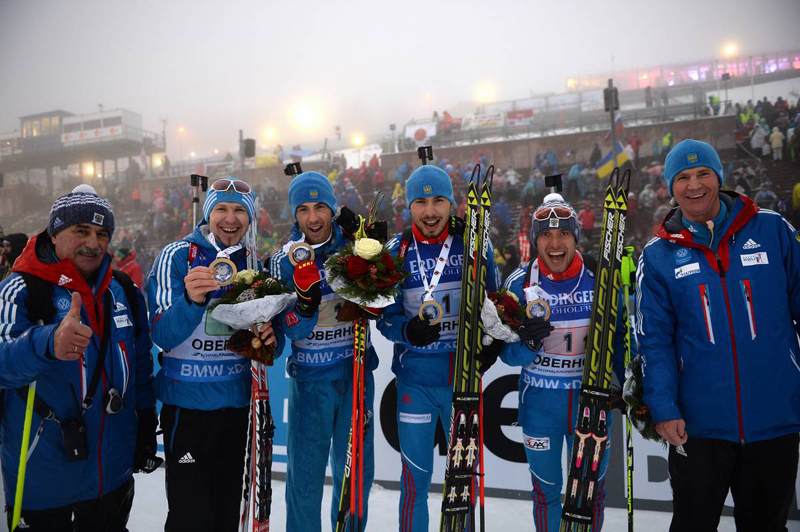
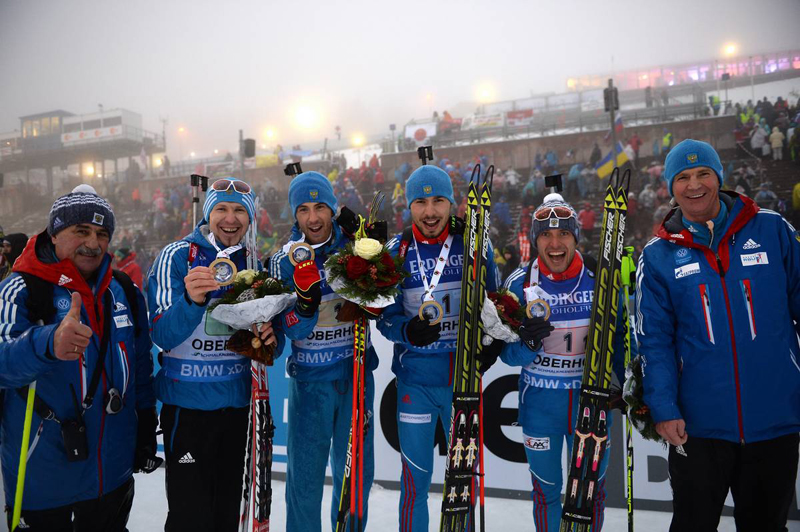
The Russian men’s relay team including; Timofey Lapshin (RUS), Dmitry Malyshko (RUS), Anton Shipulin (RUS) and Evgeniy Garanichev (RUS) show their hardware from the IBU World Cup biathlon, relay in Oberhof (GER). (photo: Fischer/Nordic Focus)
Heavy fog in Oberhof, Germany, on Thursday pushed back the start of the IBU World Cup 4 x 7.5 k relay, and then obscured both the targets and the race course as the world’s top male biathletes battled their way through the race. But even a delay, tough conditions, and a 57 second deficit going into the final leg couldn’t keep the Russian team of Evgeniy Garanichev, Timofey Lapshin, Dmitry Malyshko, and Anton Shipulin from gold.
It was Shipulin who did the hero’s work for Russia. He skied the fastest course time of all the anchor-leg skiers, and also turned in remarkable shooting – just one spare round over the two shooting stages combined. On the final loop, he closed a ten-second gap to Norway’s Ole Einar Bjørndalen, then passed him, accelerated up the final hill, and celebrated as he crossed the line with a two-second win.
“Everything was good today, shooting and running, and so I am so happy that we won,” Shipulin said in a press conference.
Impossible conditions
Strong winds, dense fog, and slushy snow made both skiing and shooting a challenge. Even with three spare shooting rounds available in each shooting bout – a luxury available only in relays – just two of twenty-four nations escaped the day without penalty loops. As wind battered their race bibs and they squinted to see targets, the men missed almost more targets than they hit. Russia’s 12 spares set a new low for shooting by a winning team – and yet represented remarkable accuracy, given the conditions.
“Every one of us had some problem or other on the shooting range, but we struggled to victory,” Malyshko said through a translator at the post-race press conference.
All teams in the top six saw at least one trip to the penalty loop. The three medal winners, Russia, Norway, and France had one-a-peace; Germany and Ukraine each had two; in six Switzerland had six penalties.
Athletes struggled on the ski trails as well; Ukraine, Canada, Poland and Finland are just a few of the dozen nations that had crashed during the race.
“Marco [Bedard] fell but he is OK,” Canadian National Team Coach Roddy Ward wrote in an e-mail. “No broken equipment either. The conditions on the downhills were very tricky. There were a lot of falls!”
The Czech Republic team, whose women claimed the win in Wednesday’s 4 x 6 k relay, was forced to withdraw before completing their first leg after a major crash by Michal Krcmar.
“We actually thought the race was going to cancelled until about 5 minutes before the start.” Nathan Smith told FasterSkier in an email.
Another athlete took a wrong turn at a trail intersection because visibility was so bad.
Even Sweden was disqualified for using four spares in one bout of shooting, one more than the allowed three extra rounds.
And then there was the rainy snow, something like being in a cloud.
“The main challenge today was not to get cold,” Lapshin said in a post-race press conference. Biathletes have a word for this weather: “Oberhofing”.
“Today it was a very hard competition,” Jean Guillaume Beatrix of France said. “Every year it is the same in Oberhof, conditions for warriors. We just try to be as strong as possible.”
Lead Changes and Errors
The opening leg already saw Russia, Latvia, and France beginning to take advantage of tough shooting conditions by slightly getting away from the rest of the field for the first transition. The French team was ager to prove their abilities without the participation of French superstar Martin Fourcade. His brother Simon said in the press conference, “Jean Guillaume [Beatrix, a teammate] has a good joke about this, the women had a podium yesterday without Martin, so why not us?”
The second 7.5 k leg of the race was the point that brought Norway into striking distance of Russia and France. The experienced Alexander Os brought solid shooting in the windy range, putting Norway less than 10 seconds off the lead pack. He is one of several men vying to complete Norway’s roster for World Championships, and was happy with his effort: “I am satisfied,” he said in the press conference.
Germany was fourth and Canada, boosted by Nathan Smith, fifthbefore the second exchange. But on the third leg it looked like Norway had run away with the race. Johannes Thingnes Bø easily closed the gap to France and Russia, then clean prone shooting put him eighteen seconds ahead of Russia and twenty-seven ahead of France.
While all three leaders had a trip to the penalty loop after the standing shooting i, Bø made it to the exchange fifty seven second ahead of the chasing Russian Malyshko.
Bjørndalen has claimed nine individual World Cup victories in Oberhof and with nearly a minute advantage on Shipulin was in the ideal position. But it wasn’t going to happen: Shipulin, who had excellent individual result before the holiday break, could not be beaten. The Russian closed nearly twenty seconds in the first loop and twenty-five in the second. And then Bjørndalen didn’t help himself by using all three spare rounds in standing.
Still with a nine second deficit on the final lap Shipulin sprinted past Bjoerndalen to cross the line in the winning time of 1:15:24.1, 2 seconds ahead of Norway.
“I wasn’t completely safe about whether I would catch him, it wasn’t 100% certain,” Shipulin said in the press conference. “I knew that Ole Einar has very strong efforts. So I just tried to get him. I did everything I could.”
Bjørndalen didn’t appear to be in his best form, although Shipulin’s speed was enough to make anyone look weak in comparison.
“It was hard on standing,” Bjørndalen admitted to Norwegian broadcaster NRK. “It was difficult conditions, and I had to work madly to get away without a penalty lap.In the track today was not good either…. Shipulin was so good today, and I felt tired.”
Bø said that blame for Norway’s loss should not fall on Bjørndalen, even though as the anchor his face was attached to it.
“It’s easy to be the scapegoat when you go last, but the entire race goes from A to B,” he told NRK. “I’m not proud of my penalty loop… my leg could have been half a minute better, and then we would have won by half a minute.”
France finished 1:32 off the pace, having passed Germany while Simon Schempp was in the penalty loop. Germany would finish fourth 2:43.7 back. Quentin Fillon Maillet, France’s anchor, joined his team and they immediately grabbed a “Je Suis Charlie” sign in support of the victims of the recent terrorist attack at a Paris newspaper office.
Ukraine and Switzerland rounded out the top six finishing 4:08.5 and 4:27.9 respectively behind the Russian team. Due to the range conditions, which saw many spares and penalty loops but also slow and deliberate shooting to try to overcome low visibility, only ten teams escaped without being lapped.
Eighth Place for Canadian Men
The Canadian men continued their relay success this season, clutching the 8th place finish when Macx Davies edged out Finland lunging for the line. Davies and Christian Gow made their World Cup circuit debut for this year in Wednesdays relay. Much of Canada’s usual World Cup squad is taking extra time to train and relax at home and skipping the Oberhof World Cup – Nathan Smith is there only to defend a top-25 Total Score ranking – and the IBU Cup squad was given the chance to race in their place, hence the newcomers to the scene.
“Based on training and racing to date, I think Christian and Macx were confident coming into Oberhof,” Ward wrote. “However, I think it was good for Christian to brush shoulders with the big boys and see that he can hold his own. Macx had a great last lap and skied away from a few teams for 8th, that should help his confidence too. They both have the potential to put together a good result in the Sprint.”
Gow is not usually a scramble-leg skier, but based on his performance in training and recent racing, the team and staff picked him to lead off.
“I felt a bit more pressure than normal the last couple of days, mainly because I have never started a relay or a World Cup,” he wrote in an e-mail. “The idea of doing both of those things on the same day at the most crowded spectator venue was definitely a bit nerve-wracking. ”
Gow was steady on the range in opening up for Canada, losing only fifty-six seconds to the leaders and passing off to veteran Nathan Smith.
“He did quite well,” Ward said in a phone interview. “It was very, very hard conditions, but he definitely held his own. He shot pretty well, given the day, and tagged off pretty close to the leaders.”
Smith moved into sixth place before finishing his leg, turning in what Ward called a “solid leg.”
Marc Andre Bedard took over from Smith; a crash on his first lap for Bedard stole his speed leading into the big downhill of the course.
Bedard took one trip to the penalty loop after his standing shooting. Davies final shooting resulted in two more penalties for Canada but a strong attack on the last lap moved Davies up from 10th to 8th at the finish. In doing so, Canada improved their Nations Cup ranking.
“We have quite a few strong guys, so I thought that this result was possible,” Ward said. “8th place today shows our men’s team has some good depth. It’s good to see our younger athletes make the jump to the highest level. Hopefully this means we are doing a good job at developing these guys and girls.”
FasterSkier’s coverage is made possible through the generous support of Swix.
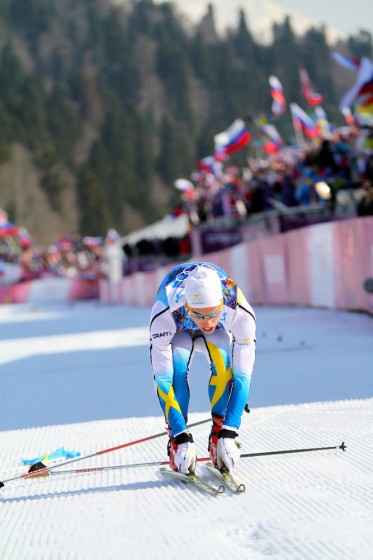
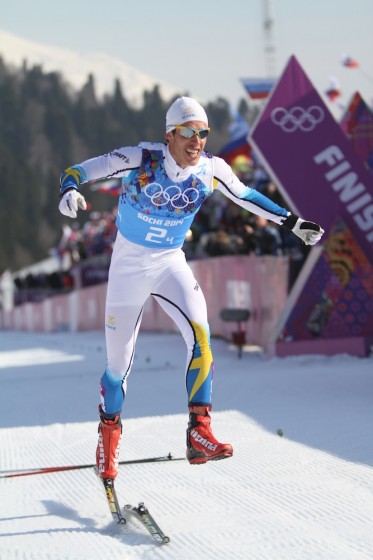
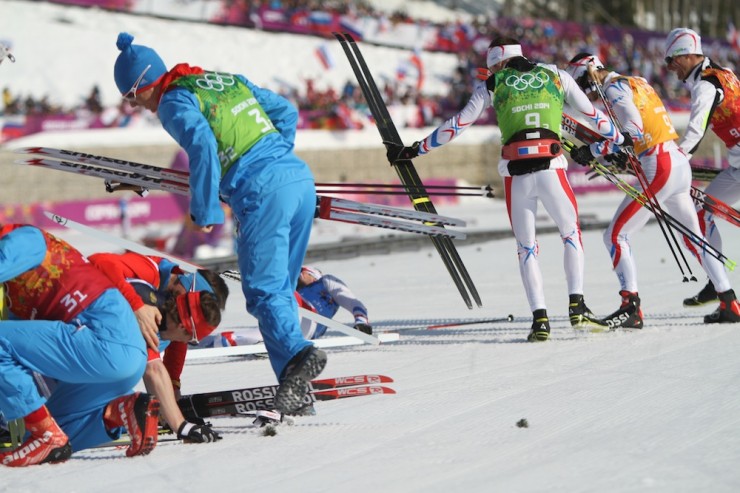
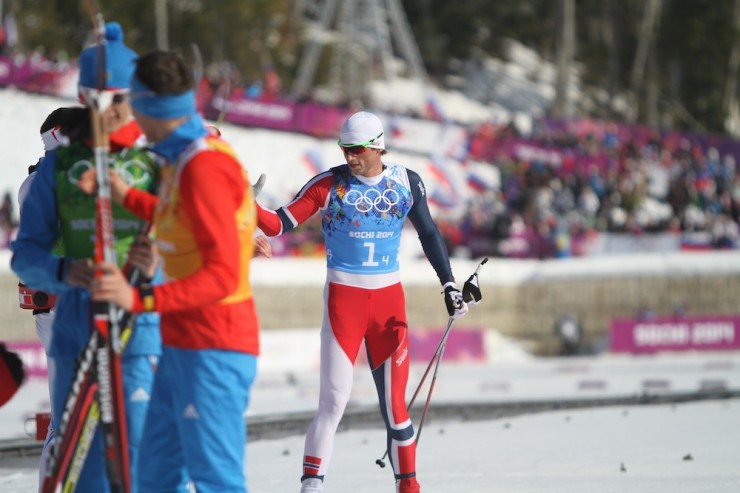
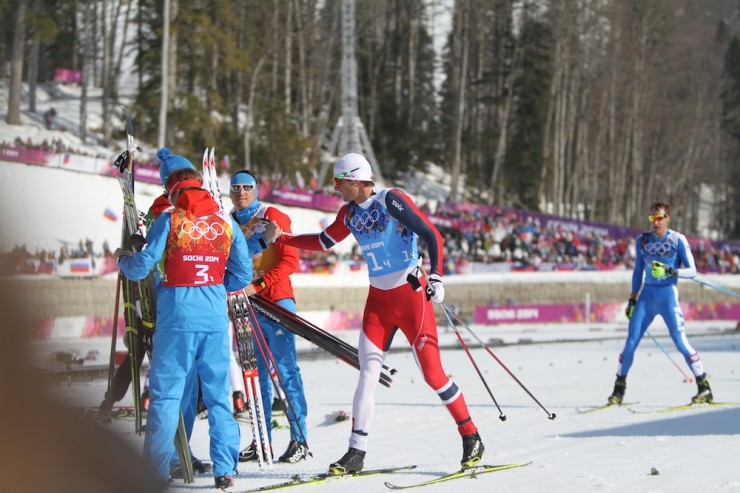
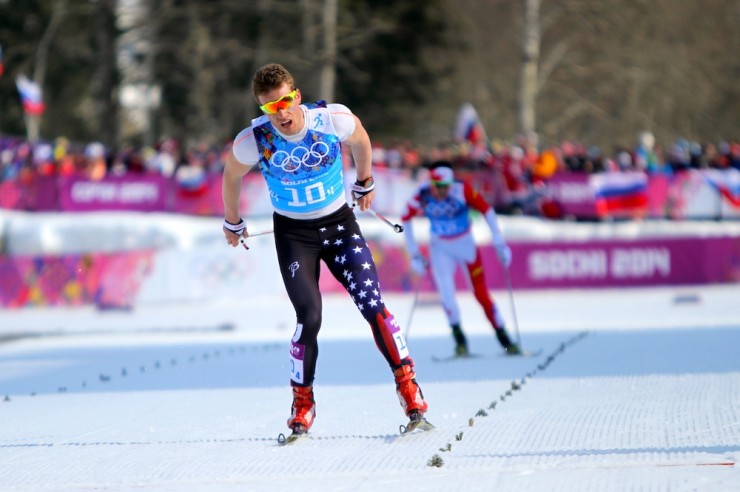
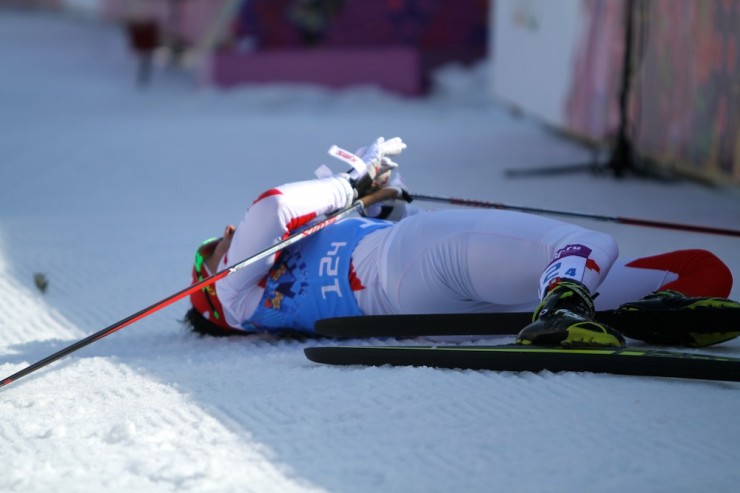
SOCHI, Russia — Some of our favorite photos from the second half of the men’s 4 x 10-kilometer relay on Sunday at the Sochi Olympics, including Sweden’s Marcus Hellner literally jumping out of his skis and Russia’s Alexander Legkov tebowing after the finish.
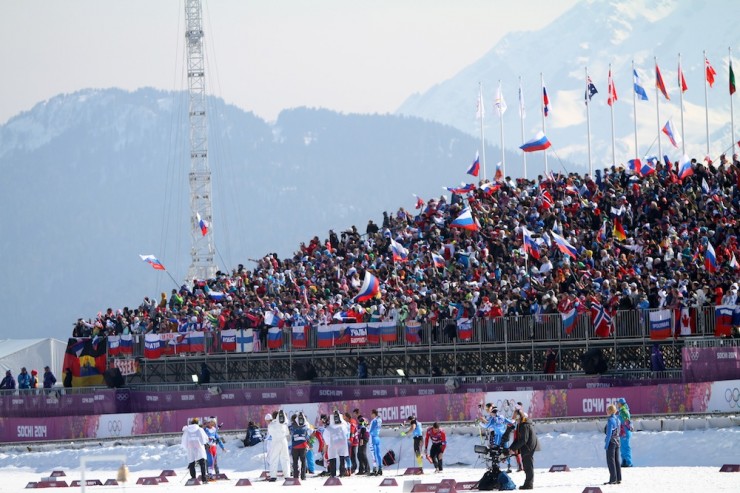
Men’s relay day at the Laura Cross-Country Ski Center on Sunday at the Olympics in Sochi, Russia.
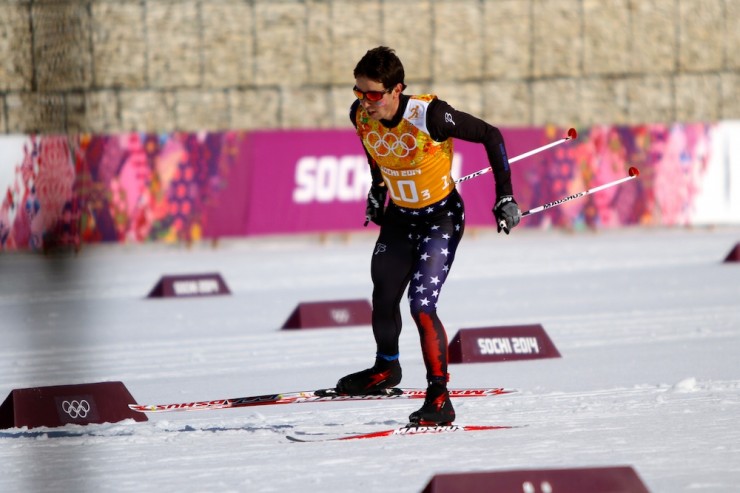
The U.S. men’s third leg, Noah Hoffman the U.S. stars and stripes
Members of the Russian staff watching their 4 x 10 k relay at the Sochi Olympics.
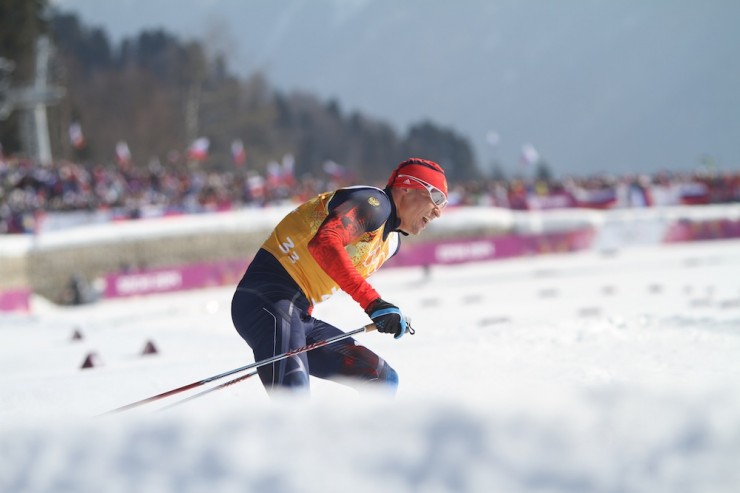
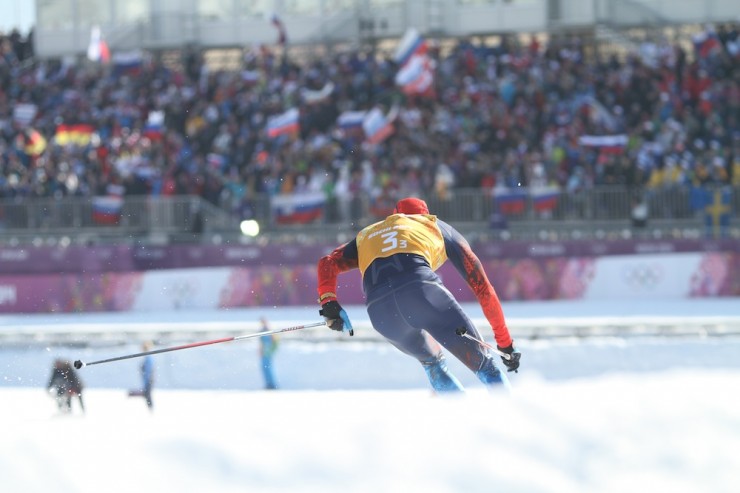
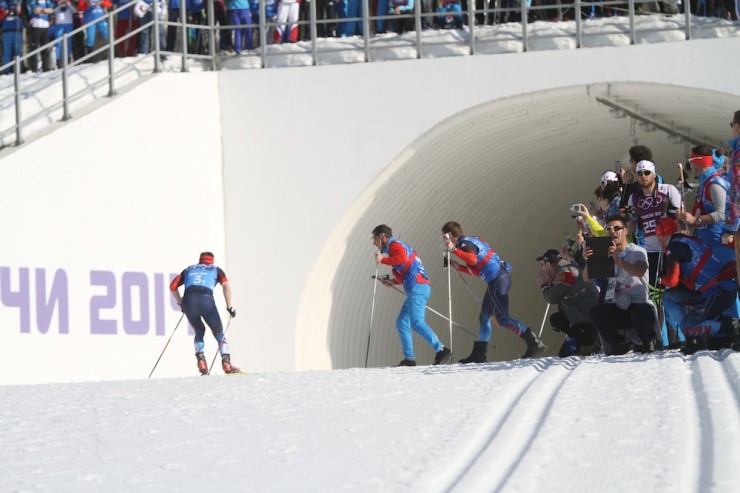
Russia’s third leg of the Olympic 4 x 10 k relay, Alexander Legkov cruising into the stadium in Sochi, Russia.
Russia’s third leg of the Olympic 4 x 10 k relay, Alexander Legkov cruising into the stadium in Sochi, Russia.
Sweden’s 4 x 10 k anchor, Marcus Hellner, at the Sochi Olympics
Maxim Vylegzhanin skating the Russian 4 x 10 men’s relay to silver in the 2014 Sochi Olympics.
France’s 4 x 10 k anchor, Ivan Perrillat Boiteux, at the Sochi Olympics
Russians cheering Vylegzhanin over the top of the first climb out of the stadium in the 4 x 10 k relay at the Sochi Olympics.
A French fan cheers for his team in the men’s 4 x 10 relay at the Sochi Olympics
Jessie Diggins (l) and Holly Brooks of the U.S. Ski Team cheer on their men’s 4 x 10 k relay on Sunday at the Sochi Olympics.
Canadian anchor Jess Cockney cruises down into the stadium in the 4 x 10 k relay at the Sochi Olympics.
Canada’s Jess Cockney leads Estonia’s Raido Rankel into the stadium in the men’s 4 x 10 k relay at the Sochi Olympics.
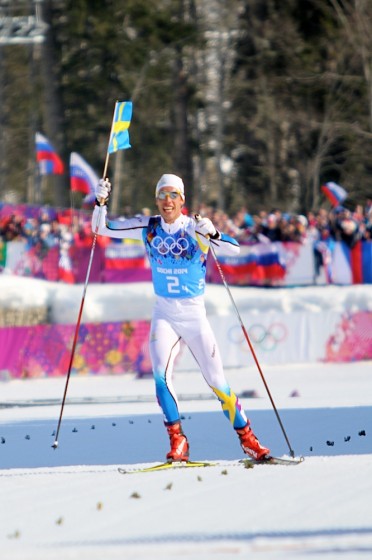
Marcus Hellner holds up a Swedish flag as he glides toward the finish for Sweden’s second men’s relay gold medal in back-to-back Olympics on Sunday at the Sochi Games.
Hellner after crossing the finish
Wait for it…
Wait for it…
Hellner jumping out of his skis after winning gold for Sweden in the men’s 4 x 10 k relay at the Sochi Olympics
Hellner jumping out of his skis after winning gold for Sweden in the men’s 4 x 10 k relay at the Sochi Olympics
Hellner jumping out of his skis after winning gold for Sweden in the men’s 4 x 10 k relay at the Sochi Olympics
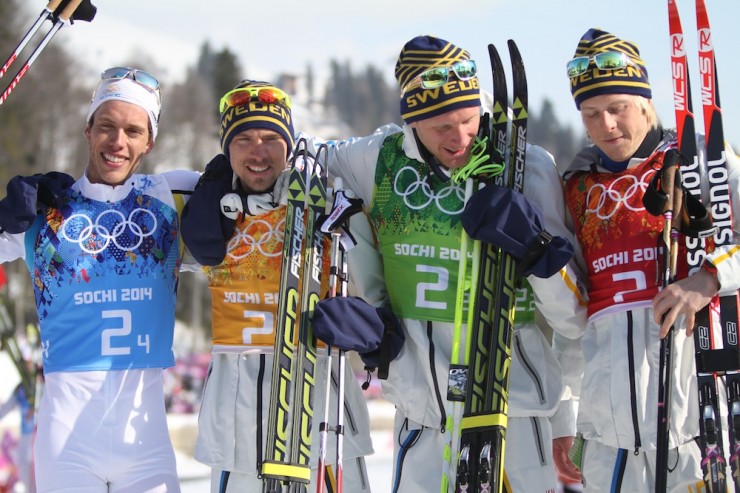
The Swedish men’s relay team after winning gold at the Sochi Olympics.
Hellner gets hugs from his Swedish teammates after he anchored them to gold in the 4 x 10 k relay at the Sochi Olympics.
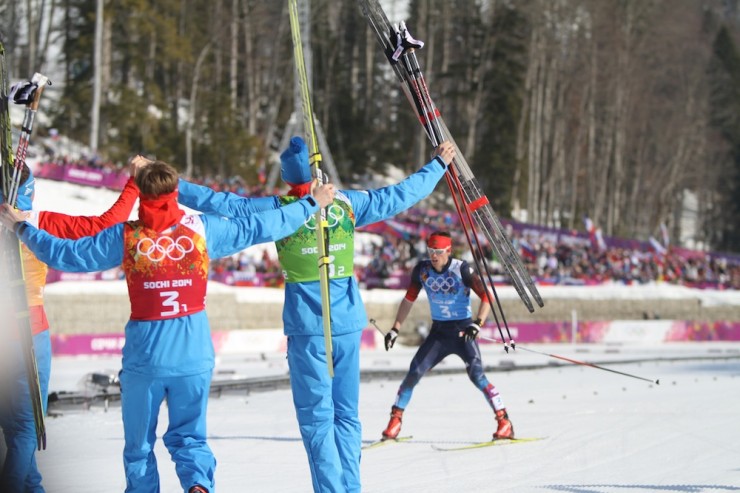
The Russian men’s relay team meets Maxim Vylegzhanin at the finish after he anchored them to silver in the 4 x 10 k at the Sochi Olympics.
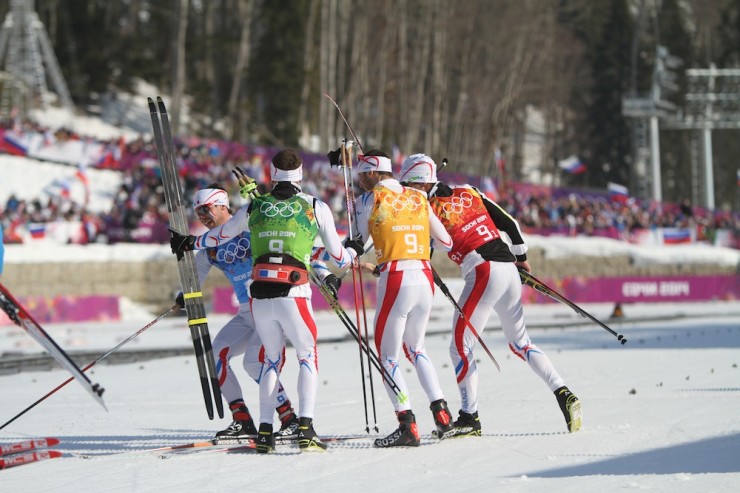
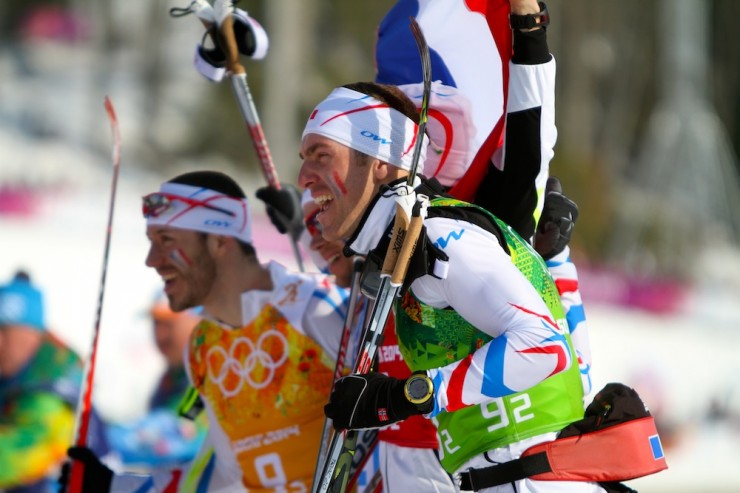
The French men’s relay team meets Ivan Perrillat Boiteux at the finish after he anchored them to bronze in the 4 x 10 k at the Sochi Olympics.
The French men’s relay team meets Ivan Perrillat Boiteux at the finish after he anchored them to bronze in the 4 x 10 k at the Sochi Olympics.
The French men’s relay team meets Ivan Perrillat Boiteux at the finish after he anchored them to bronze in the 4 x 10 k at the Sochi Olympics.
Petter Northug congratulating the French relay team at the Olympics in February. Northug returned to Norway without a single medal – and that was only the beginning of his troubles.
After finishing fourth for Norway, Petter Northug congratulates the Russian silver medalists, including anchor Maxim Vylegzhanin, in the 4 x 10 k relay at the Sochi Olympics.
Petter Northug after anchoring Norway to fourth in the 4 x 10 k relay at the Sochi Olympics.
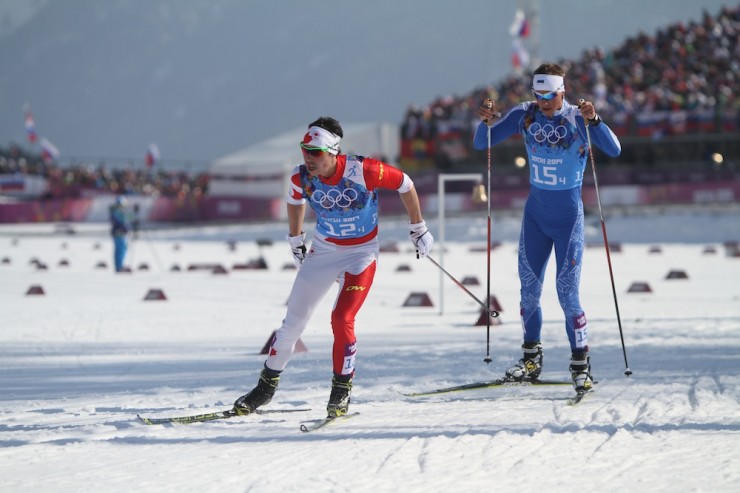
Simi Hamilton (USA) leads Canadian Jess Cockney into the finish. Hamilton anchored the U.S. men’s 4 x 10 k relay to 11th and Canada was four seconds back in 12th.
Simi Hamilton (USA) after leading Canadian Jess Cockney into the finish. Hamilton anchored the U.S. men’s 4 x 10 relay to 11th and Canada was four seconds back in 12th.
Simi Hamilton after anchoring the U.S. men to 11th in the 4 x 10 relay at the Sochi Olympics.
Jess Cockney after anchoring the Canadian men’s 4 x 10 k relay to 12th at the Sochi Olympics.
Canada’s Jesse Cockney and American Simi Hamilton bump fists after anchoring their countries’ relay teams at the 2014 Olympics in Sochi, Russia.
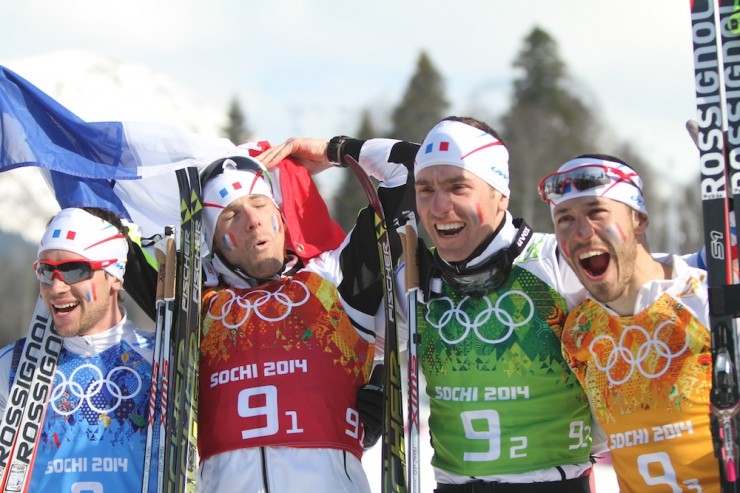
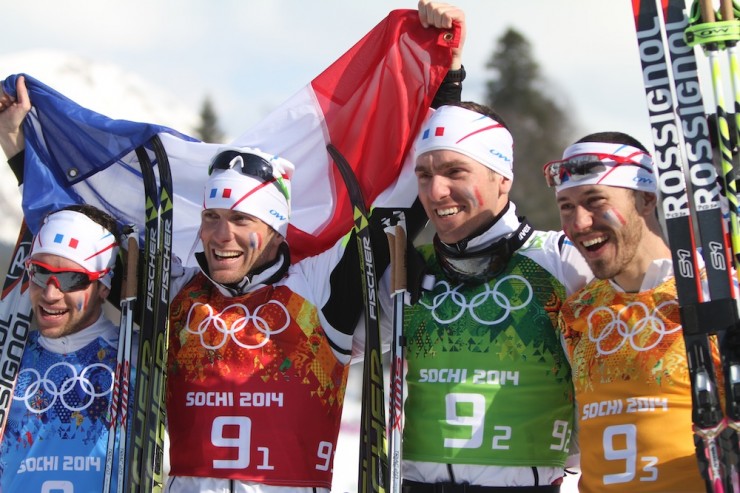
France after capturing its first-ever Olympic relay medal at the 2014 Sochi Games.
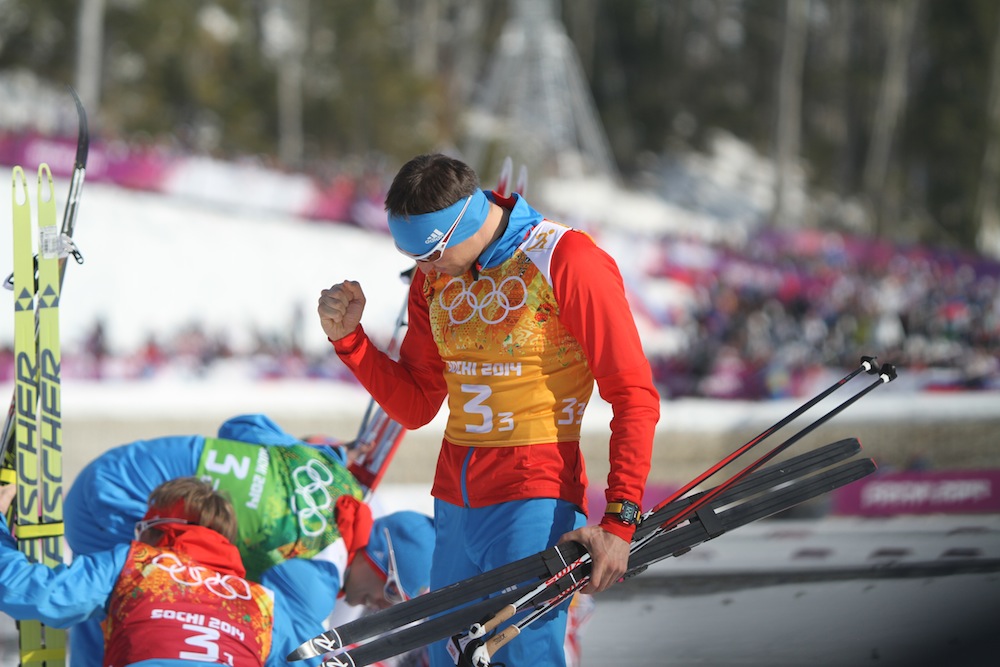
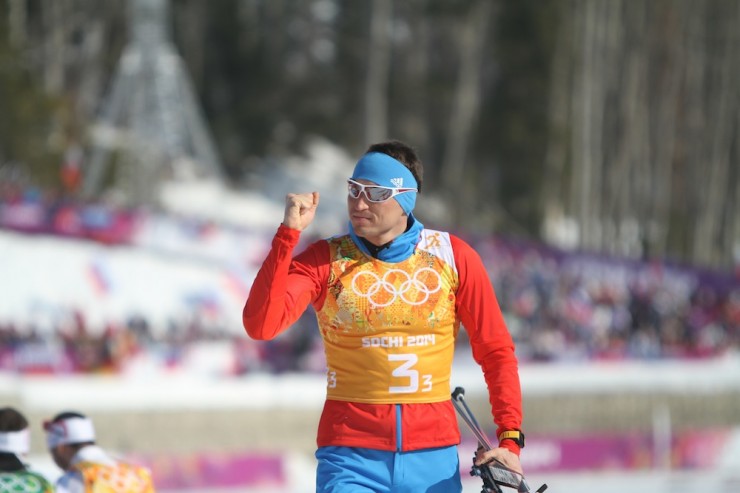
The Court of Arbitration for Sport decided that there was a “reasonable possibility” that Alexander Legkov had doped at the 2014 Olympics. Here, he pumped his fist after Russia won silver in the 4 x 10 k relay, their nation’s first medal in cross-country at the Sochi Olympics.
Alexander Legkov celebrates Russia’s silver in the 4 x 10 k relay, their nation’s first medal in cross-country at the Sochi Olympics.
Switching out? Johan Olsson and Daniel Richardsson (second and third from left) will rejoin the national team after a year on the outside. They were part of the Swedish men’s team that defended their gold medal from the 2010 Olympics to win the 4 x 10 k relay in commanding fashion at the 2014 Sochi Games. From left to right: Marcus Hellner, Olsson, Richardsson, and Lars Nelson.
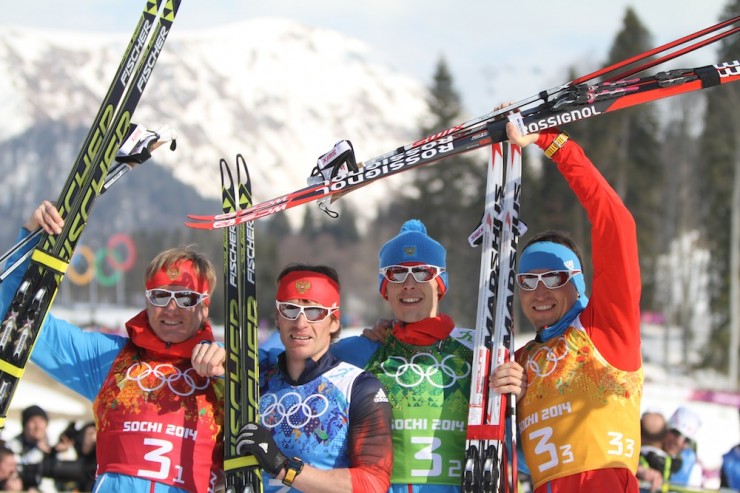
The silver-medal winning Russian men’s relay team at the 2014 Olympics.
France’s bronze-medal men’s 4 x 10 k relay team at the Sochi Olympics. From left to right: Ivan Perrillat Boiteux, Jean Marc Gaillard, Maurice Manificat, and Robin Duvillard.
France’s bronze-medal men’s 4 x 10 k relay team at the Sochi Olympics. From left to right: Ivan Perrillat Boiteux, Jean Marc Gaillard, Maurice Manificat, and Robin Duvillard.
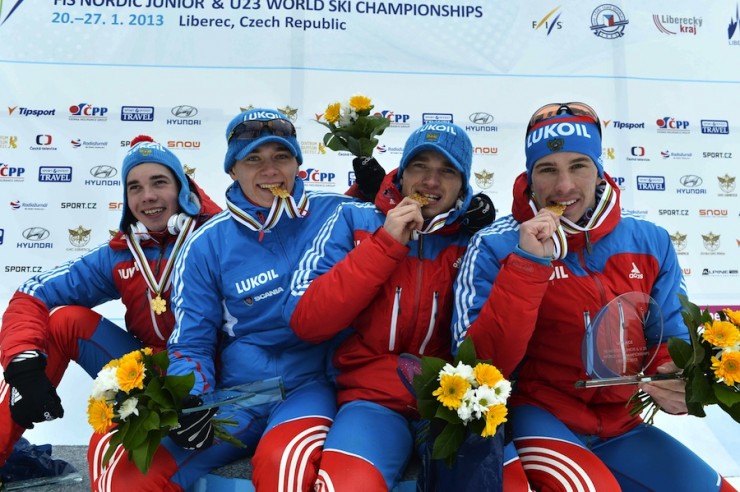
The Russian men’s relay celebrates their third victory in four races at 2013 Junior World Championships in Liberec, Czech Republic. Dmitry Rostovtsev (r) anchored the team’s win Sunday after winning two individual distance races this week. (Photo: Liberec2013)
If you knew nothing about the competitors at the International Ski Federation (FIS) Junior World Championships throughout the last week in Liberec, Czech Republic, all you had to look for were the blue-and-red suits with white Adidas stripes. Those were the Russians, and man, were they fast.
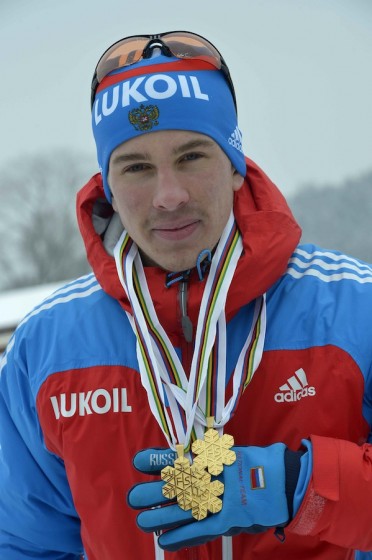
Russia’s three-time 2013 Junior World Champion, Dmitry Rostovtsev
Led by 19-year-old anchor Dmitry Rostovtsev, who won two of three individual world titles just days earlier, the Russian men rallied to a resounding victory in 4 x 5 k relay, beating runner-up Norway by 18.7 seconds in 45:35.5.
The Russians faltered just once – during the second leg – when two-time 2013 Junior Worlds silver medalist Artem Maltsev fell 12.6 seconds out of the lead into fourth. Alexey Chervotkin had put the Russians in first early, and Maltsev tagged off to Roman Tarasov, who brought them back up front. At the final exchange, Rostovtsev surged ahead with a four-second lead on Norway’s anchor Haavard Solaas Taugboel.
The Norwegians (Bjørn Vidar Suhr, Simen Hegstad Krueger, Magne Haga, and Taugboel) hung in for silver, more than 30 seconds ahead of Sweden in third (+52.2) out of 19 teams. With Oskar Svensson, Marcus Ruus, Oscar Ivars, and Rasmus Hornfeldt, the Swedes led after the second leg, but dropped 19.4 seconds off the pace in the third leg and remained in third thereafter.
“To win gold medal with the team is always something special, ” Rostovtsev said in a Liberec 2013 press release.
He previously won two Junior Worlds titles in this year’s 10 k freestyle and 20 k skiathlon. Maltsev, who stuggled during his classic leg Sunday, was the runner-up in both individual distance races.
“The boys did their best on their leg so I could control the race but I still wanted to ski fast and secure the victory, ” Rostovtsev added.
Rostovtsev and Maltsev defended their relay title from last year’s Junior Worlds in Erzurum, Turkey, where they beat Kazakhstan by nearly 45 seconds. Norway, with Taugboel, was third in the 2012 relay.
“I knew Rostovtsev is a tough guy; he is very strong, ” Taugboel said. “In the second 2.5 km lap he went away so fast, I just did not have enough power. I am satisfied with the silver medal. I have not been in a best shape during the championships, so it is a great satisfaction for us.”
It was the Norwegians’ first silver of the week, and Sweden made the podium for the first time at this Junior Worlds.
“I am very happy for the bronze medal, ” Swedish anchor Hornfeldt said. “Everybody gave the best performance of the week so we deserve the medal today. I felt pretty good. I saved same energy for the last uphill!”
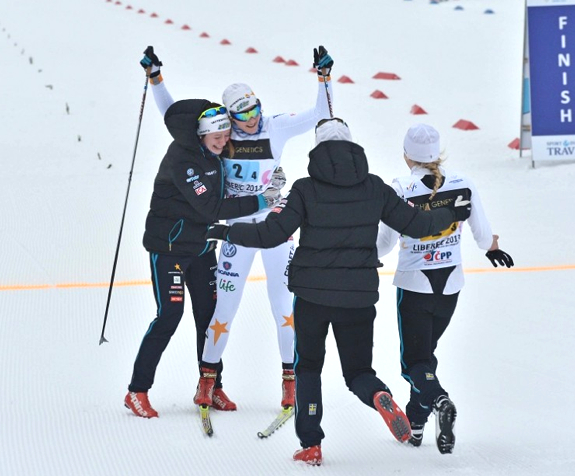
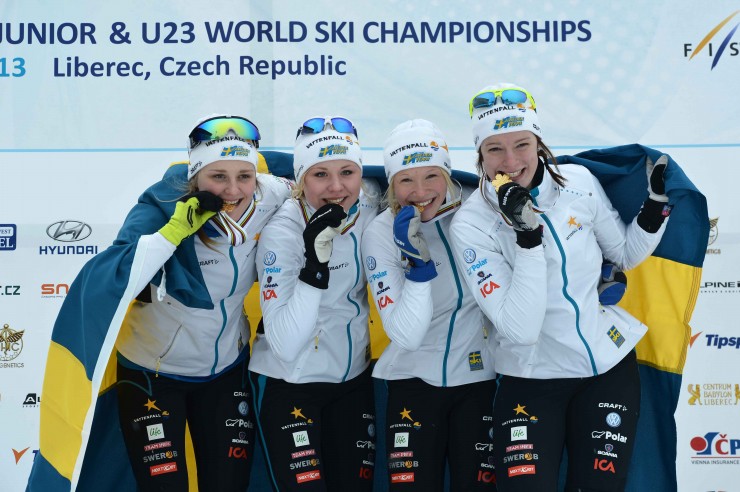
The Swedish women’s relay celebrates its Junior Worlds victory on Sunday with anchor Stina Nilsson. (Photo: Liberec2013)
The women’s 4 x 3.3 k turned out to be less predictable, with Sweden’s Stina Nilsson giving Russian Nadezhda Shuniaeva a run to the finish. Trailing Shuniaeva closely in second at the last exchange, Nilsson charged ahead late to seal the Swedish victory by 2.2 seconds in 35:41.1. It was Nilsson’s second win of the week after she claimed the classic-sprint title last Monday.
She repeated the feat with the help of teammates Julia Svan, Sofia Henriksson and Jonna Sundling, and Russia took second of 14 teams with Alisa Zhambalova, Natalia Nepryaeva, Anastasia Sedova and Shuniaeva. Germany was third, 50.3 seconds out of first, with Laura Gimmler, Katharina Hennig, Julia Belger, and Victoria Carl. The 5 k freestyle champion, Carl collected a different medal in every event she competed in this week, including silver in the classic sprint.
Early in Sunday’s relay, it became clear that the race would likely boil down to two teams: Russia and Sweden. With Nepryaeva, Russia built its biggest lead of 2.9 seconds after the second exchange. Sweden stuck in second and Germany was nearly 30 seconds back in third.
Sweden’s Sundling then latched on to Sedova on the third leg, closing within 0.4 seconds of her at the last tagoff. Not long after winning silver in a World Cup team sprint in Liberec a couple weeks ago, Nilsson made a late surge to capture the victory on Sunday.
“It is amazing to win the relay, ” the 19-year-old said. “I knew I would be strong in the finish and I was confident I could go for victory. The whole team did a great job. We have a big potential for the future.”
After she helped Russia win last year’s Junior Worlds relay, 13.4 seconds ahead of Sweden (with Henriksson, Sundling and Nilsson), Shuniaeva said silver was a “very good result.”
“I gave my best in the last leg but Stina was very fast in the finish,” she added.
Germany’s Carl was also satisfied with her team’s finish.
“I am very happy for the bronze medal,“ Carl said. “We have a young team and it is a great success for us. It gives us big motivation for the future work.”