From the FasterSkier archive — posts syndicated from athletes’ and coaches’ own blogs between 2004 and 2012, kept online as published. Current coverage is at fasterskier.com.

Tag: Ryan Scott

  • Americans Abroad: APU Skiers Take on China Tour de Ski

    Americans Abroad: APU Skiers Take on China Tour de Ski

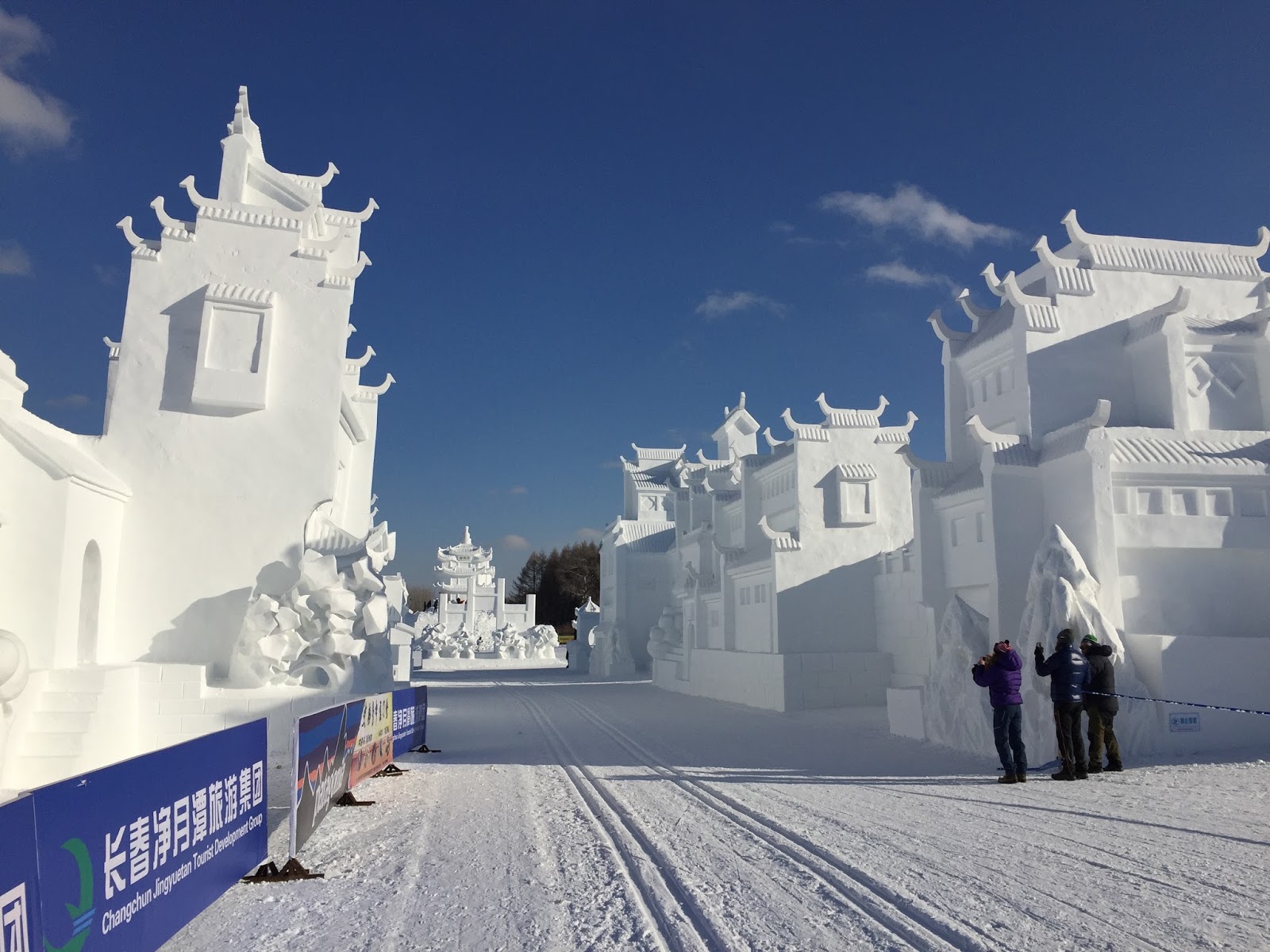
    Snow sculptures in the stadium in Changchun at the 2016 China Tour de Ski. (Photo: Holly Brooks)
    Snow sculptures in the stadium in Changchun at the 2016 China Tour de Ski. (Photo: Holly Brooks)

    Note: Alaska Pacific University skier Skyler Kenna, 21, will also be racing the 2017 China Tour de Ski. FasterSkier learned of Kenna’s participation after publication.

    ****

    Be a ski racer, see the world. That’s the approach of a pair of Alaska Pacific University (APU) skiers Jack Novak and Lauren Fritz, who leave for Asia later this week to race in the China Tour de Ski, set to begin in Changbaishan on Sunday, Jan. 1.

    Novak has never been to Asia before, and has yet to ride a camel on any continent. Fritz competed in the race series for the first time last year, and has skied on five continents. Both athletes are at a point in their ski career where they are seeking experiences more than SuperTour points or championship team selection. Some prize money wouldn’t hurt, either.

    The China Tour de Ski marks its 10th anniversary this year, which makes it only one year younger than the “other” Tour de Ski that begins in Val Müstair, Switzerland, this Saturday, Dec. 31. Prior versions of the Chinese Tour have featured a sprint on trucked-in snow inside the Bird’s Nest stadium built for the 2008 Summer Olympics, stage races across China and inner Mongolia, long bus rides, and a lot of photogenic camels.
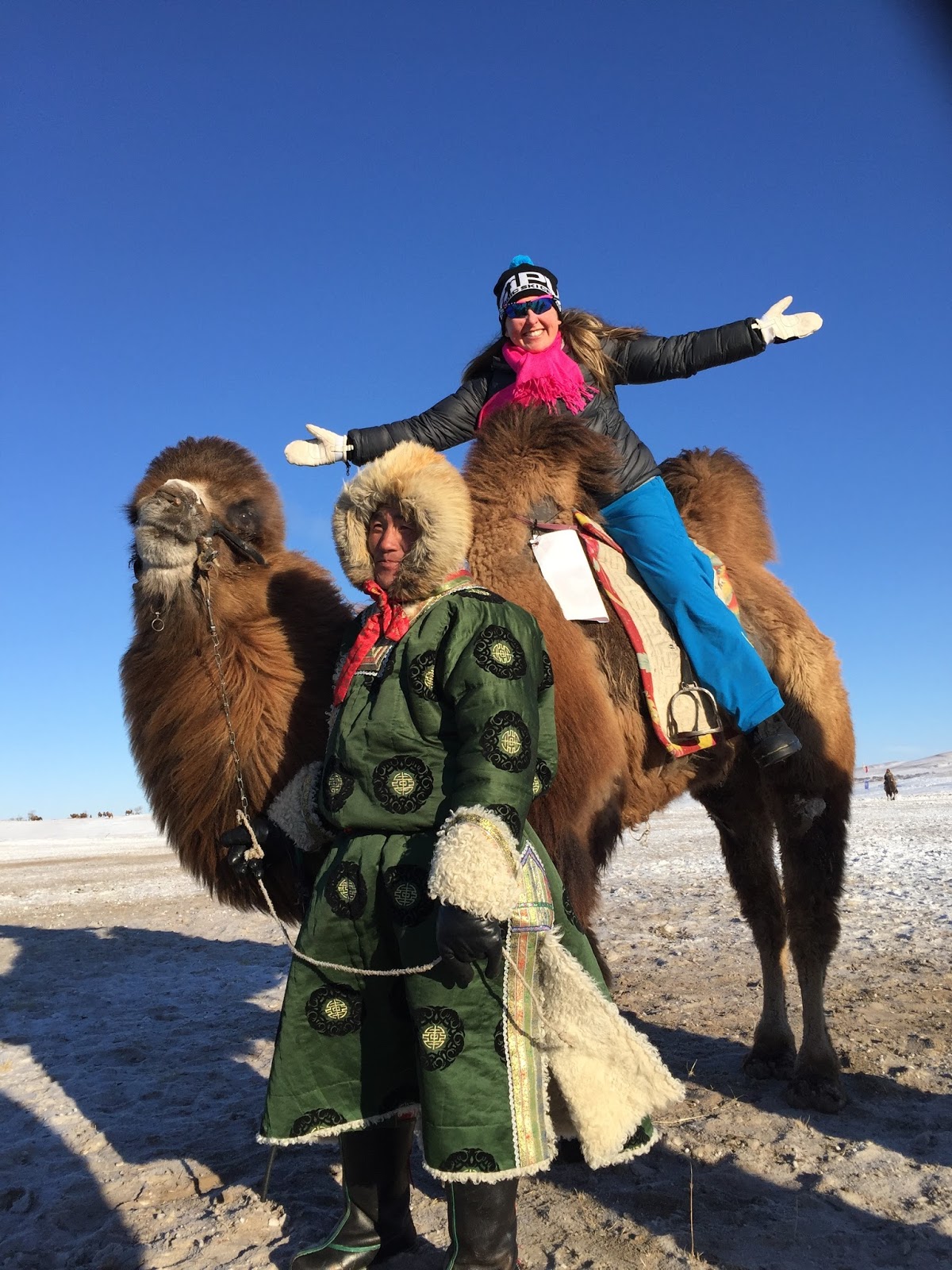
    Holly Brooks (retired APU and U.S. Ski Team) rides a camel during the 2016 China Tour de Ski. (Photo: courtesy Holly Brooks)
    Holly Brooks (retired, APU/U.S. Ski Team) rides a camel during the 2016 China Tour de Ski. (Photo: courtesy Holly Brooks)

    American skiers who have previously participated include Fritz, Peter Kling and Holly Brooks, all currently or formerly of APU; Ryan Scott, formerly of Ski & Snowboard Club Vail/Team HomeGrown; and former U.S. Ski Team member Torin Koos. They have consistently reported genuinely warm welcomes and intriguing cultural experiences.

    This year’s Tour takes racers through six stages over nine days across a wide swath of the country. (Changbaishan to Beijing is a 13-hour drive.) It’s heavy on the skate sprints: a full four out of six stages (Stages 1, 2, 5, and 6) are freestyle sprints. In the middle, Stage 4 is a prologue to short distance skate mass start race, 3.8 kilometers for the women and 5.7 k for the men.

    And Stage 3 is the Chinese Vasaloppet, a classic marathon now in its 15th year. Last year, the Tour de Ski racers covered the whole 50 k distance, with Brooks and Fritz on course for 2:44 and 2:51, respectively. This year’s Tour racers will participate in “a modified course and a shorter total distance,” though precisely how much shorter is not immediately apparent. The 2017 full-distance Chinese Vasaloppet also marks the third event of the 2016/2017 Visma Ski Classics series.

    While many multi-stage tours – the Tour de France, the Giro d’Italia, the original Tour de Ski – operate on a principle of lowest combined time wins, perhaps augmented by time bonuses for top positions, the China Tour de Ski instead applies World Cup scoring based on finishing position. Among other things, this avoids making the person who performs best in the Chinese Vasaloppet (which is much longer than all the other races combined) the de facto champion based on combined time.

    Last year’s overall winners were a pair of Swedes, Emil Johansson and Lisa Svensson. Johansson has a World Cup top-30 sprint finish to his name and won the 2013 SuperTour skate sprint in West Yellowstone, Mont., while studying at the University of Colorado-Boulder during the 2013/2014 season. Svensson, who will be competing in her fifth consecutive China Tour de Ski, has never had a podium finish in an International Ski Federation (FIS) race on European soil… but has 17 of them in China.

    One American has cracked the overall podium in the first nine years of the China Tour de Ski: Kling was second in 2015. Chinese skiers make up a minority of historic podium finishers in the event, likely reflecting both the nascency of Chinese cross-country skiing (the Chinese National Team was established in 2006) and race organizers’ willingness to attract non-Chinese skiers to their event.
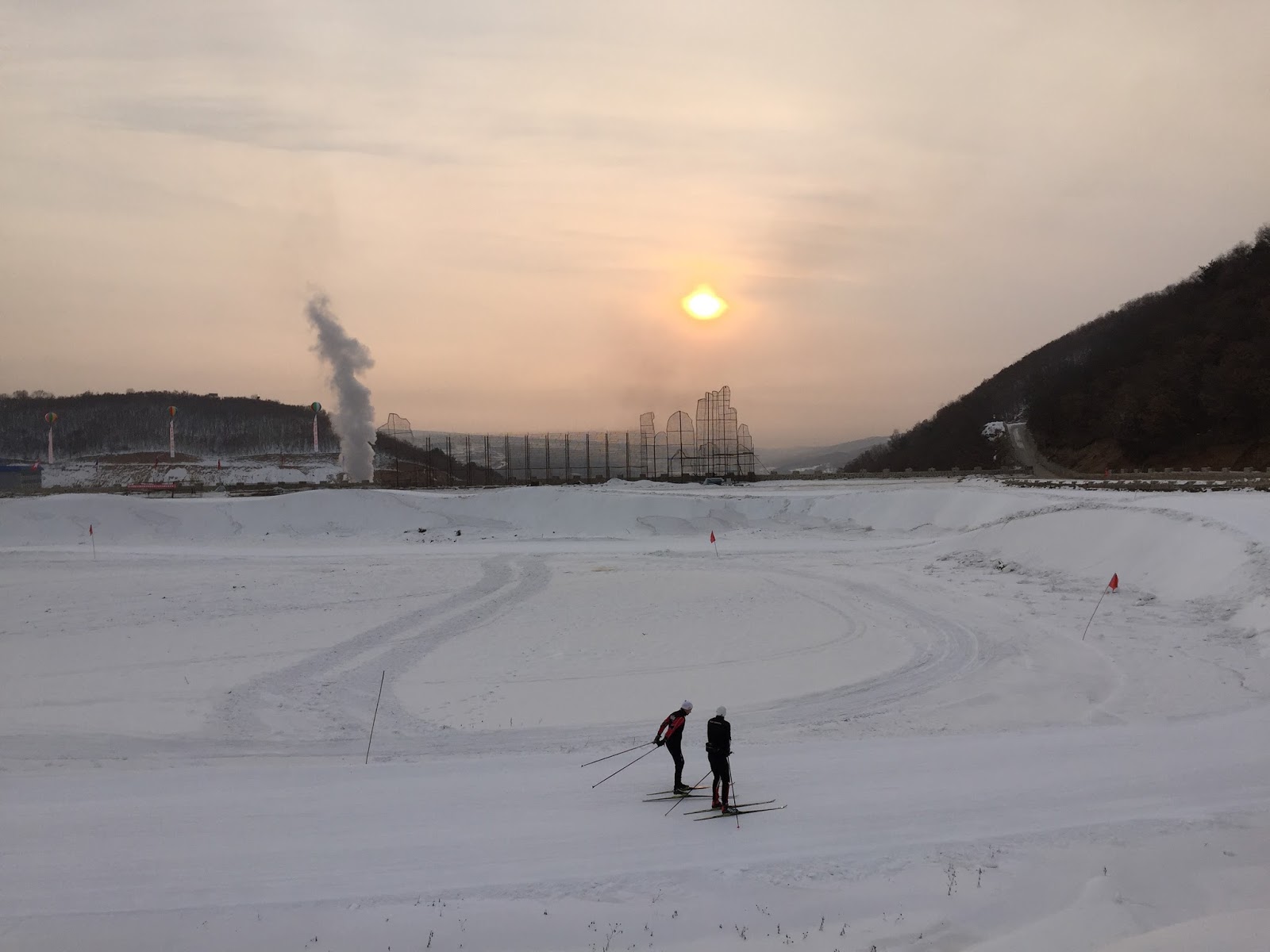
    The gravel pit-turned-skate sprint course in Yanji during the 2016 China Tour de Ski. (Photo: Holly Brooks)
    The gravel pit-turned-skate sprint course in Yanji during the 2016 China Tour de Ski. (Photo: Holly Brooks)

    When it comes to convincing European skiers to fly across Asia, or Alaskan skiers to fly across the Pacific Ocean, money talks.

    To start with, virtually all of the racers’ expenses, including transportation, are covered by the race organizers. As Scott wrote to FasterSkier during the 2015 Tour, the race paid for all of his travel, lodging, and food. “My only expense is $500 Euros to the organizers and paying for bags,” Scott wrote.

    On top of that, there’s real money to be made. In this year’s Tour, first through fourth in four of the stages is good for 2,000 to 10,000 renminbi (yuan) per race. (At current exchange rates, 10,000 yuan is equal to approximately $1,400 – or more than the $1,200 prize for first place in any race at next month’s U.S. nationals.) For the Stage 2 sprint, it’s up to 20,000 yuan for the men ($2,800), 15,000 yuan ($2,200) for the women. For the Chinese Vasaloppet, Stage 3, first place takes home 5,000 euros, or $5,200. Plus there are additional prizes for top four in the overall Tour standings, starting with 20,000 yuan for first. (With the exception of Stage 2, all other stages and overall standings feature the same prize amounts between the genders.)

    The total prize purse for Stages 1-2 and 4-6, not counting the Chinese Vasaloppet, is 251,000 yuan, or over $36,000. That’s slightly less than the $39,000 purse for the American Birkebeiner, but it’s in the ballpark. Within the world of cross-country ski racing, this is a princely sum. It is roughly to skiing as Russia’s $1.5 million for Diana Taurasi is to women’s basketball, or China’s 60 to 70 million euros for Oscar is to international soccer – eye-opening sums of money paid to entice athletes to a part of the world they might not otherwise consider visiting.

    In related news, the Qaniq Challenge will once again pay out a total purse of $10,000 in Valdez, Alaska, next month. Fritz earned $500 for her third-place finish in last year’s race, behind fellow China veteran Brooks in second.

    The athletes

    Fritz: Rekindling her love of skiing

    But for Fritz, it’s not all about the money. The native of Chugiak, Alaska, and longtime APU skier has been a competitive racer for many years, with career highlights that include SuperTour podiums, top-10 national championship finishes, and World Cup starts in Canada in 2012. But in 2015, she wrote, she suffered through “a rough season prior, a summer of illness, injury and just general low-quality training,” and was getting ready to call it a career.
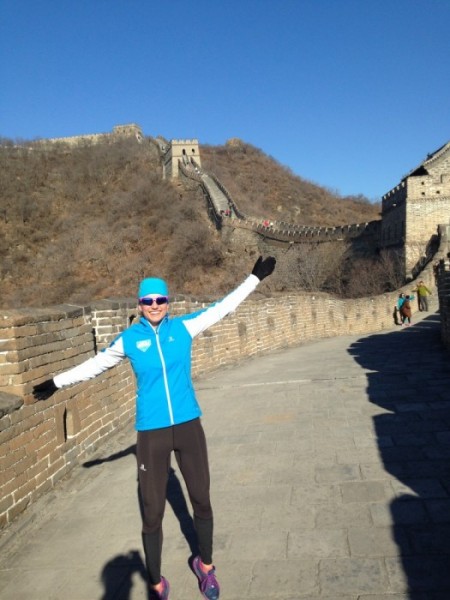
    Lauren Fritz (APU) poses for a moment during a run along the Great Wall of China during the 2016 China Tour de Ski. (Courtesy photo)
    Lauren Fritz (APU) poses for a moment during a run along the Great Wall of China during the 2016 China Tour de Ski. (Courtesy photo)

    “I decided I was going to move away from SuperTour racing and do some ski marathons and probably retire [following the 2015/2016 season],” Fritz, 28, wrote to FasterSkier earlier this week during a break from packing. “I was fed up with racing SuperTour, racing poorly and not getting anywhere (figuratively, with my ski career). And I wasn’t having fun anymore. I was so used to being around skiers who are very focused on high level goals and incredibly (unspokenly) competitive that you can lose sight of why you do what you do beyond just a number on a result sheet, especially if you aren’t achieving those results (and I most certainly wasn’t).”

    Her inaugural trip to China changed all that.

    “Being with the group in China, it was just all about how we got this amazing opportunity and it was simply because we skied,” she wrote. “It reminded me that skiing has taken me so many places and connected me with so many people, and I get to be outside so much, and that was why I love it so much. I came home with a fresh attitude and it really helped boost me mentally and physically.”

    Fritz’s enthusiasm is immediately apparent in her answer to a reporter’s question about why she is going back to China.

    “Last year’s Tour de Ski China was one of the most fun, unique, and craziest ski trips I’ve ever been on,” she wrote. “So it’s more a question of ‘Why not?’ than ‘Why?’ am I going back, which probably makes it obvious why I’m going again. It was low-stress, low-pressure, with high energy, excitement and general enjoyment.”
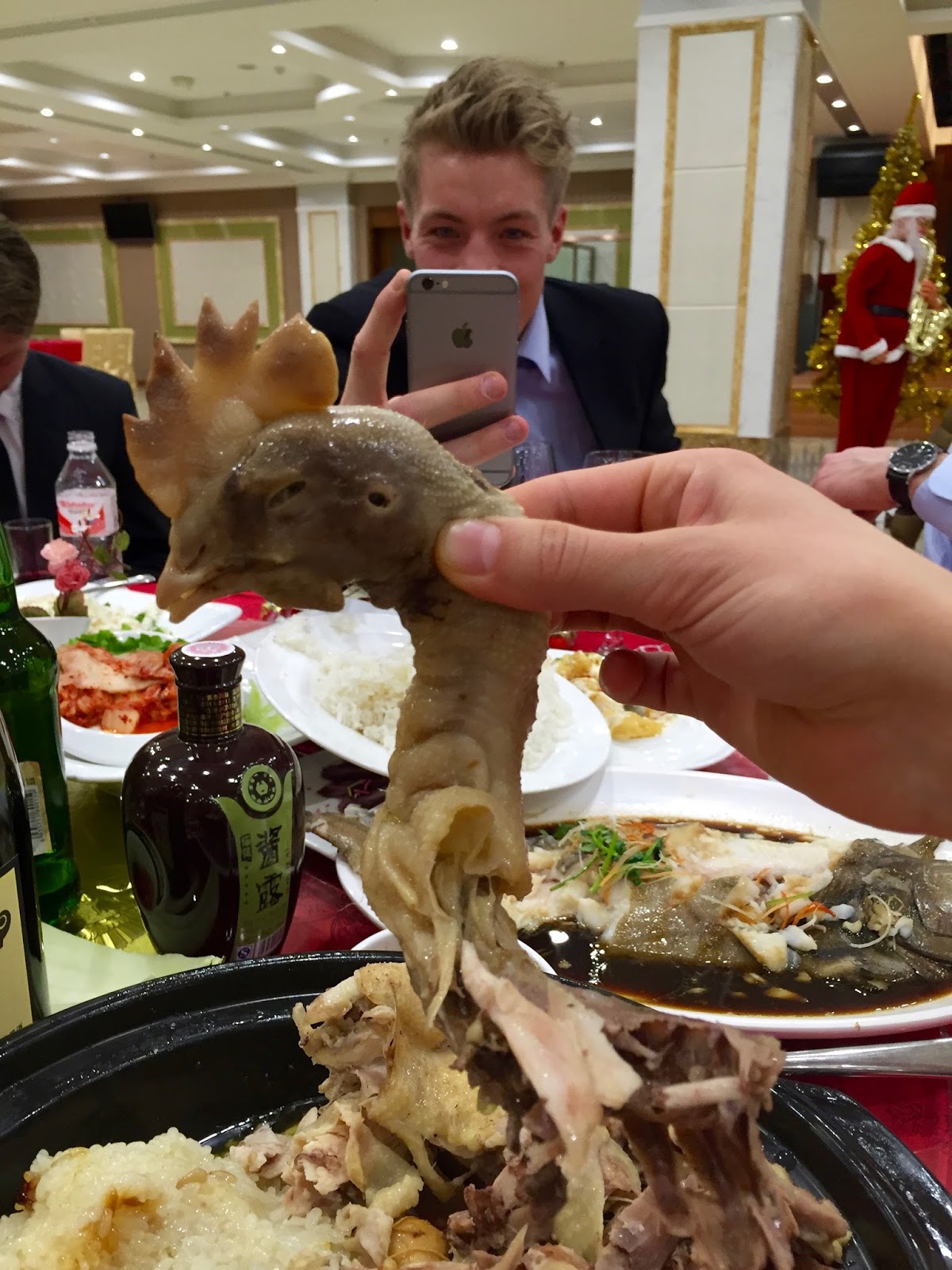
    A chicken head featured prominently on the menu during the 2016 China Tour de Ski. (Photo: courtesy Holly Brooks)
    A chicken head featured prominently on the menu during the 2016 China Tour de Ski. (Photo: Holly Brooks)

    “Everyone on the trip was there primarily for the experience of being in China and seeing cool new places with the added bonus that we got to do some ski races,” Fritz enthused. “I mean, how many ski races have you been to where you have to squat over a board over an open pit in a communal poop shack, and get handed a can of random Chinese ‘RedBull’ and a personal size bottle of Chinese spirits, cross a finish after skiing through a literal snow castle city, and be treated afterwards to a show and a table full of food you don’t recognize but eat anyways… Oh, and get to go for a hike on a Great Wonder of the World [the Great Wall of China] after the last race?”

    Fritz continued, “Everyone’s attitude was more geared towards having a great time and experiencing what China had to offer than doing well in the races, and that gave it a more relaxed feeling. Not that people didn’t take the races seriously, they/we certainly did because there was money on the line! But once the bib came off, it was about having fun. The group we had was amazing, everyone was fun to hang out with and easy to get along with, and we had a great time. Not often is two straight weeks of living and traveling with a big group like that so easy and enjoyable.”

    “Last year’s Tour de Ski China was one of the most fun, unique, and craziest ski trips I’ve ever been on. … It was low-stress, low-pressure, with high energy, excitement and general enjoyment.” — Lauren Fritz, APU skier

    While she is largely going back for the experience, Fritz is not above hoping that, in a virtuous cycle, the improved training she was inspired to do following her trip to China last year will translate to better results this year.

    “This year I definitely want to get some podiums,” Fritz wrote. “I had two 4th places last year, so I’d like to improve on that! I think it’s possible to be on the podium a few times if I ski the way I know I can right now with my fitness level. (Read: Fitness level waaaay better than last year, ha!)”

    “Pretty much, the TDS China is my season,” she concluded. “As I said, I was going to retire after last year, but I kind of felt rejuvenated and wanted to keep training pretty much just so I could go back to China this year! I will still do some races later in the season, but China is definitely top of the priority list.”

    Novak: Looking for adventure and an inaugural camel ride
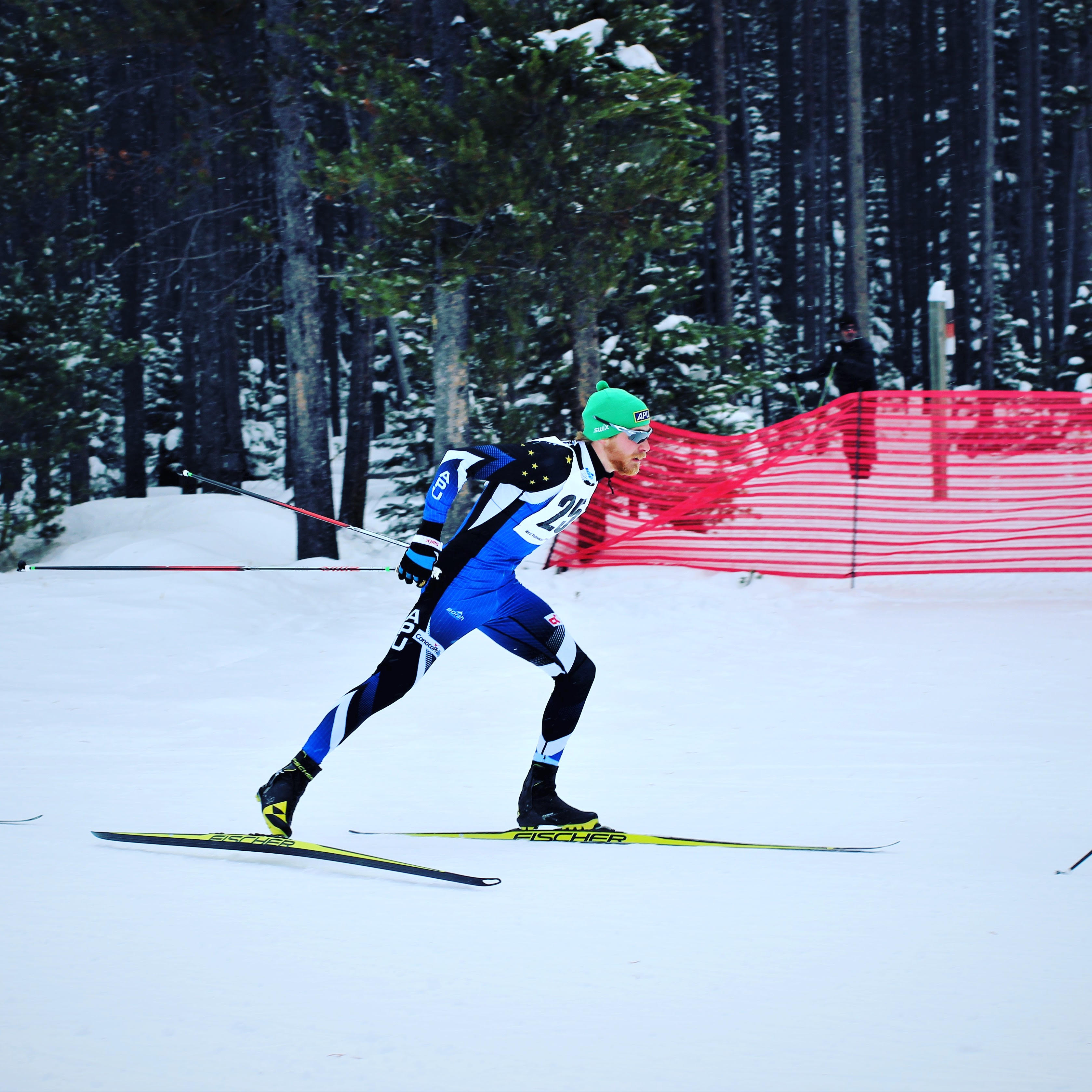
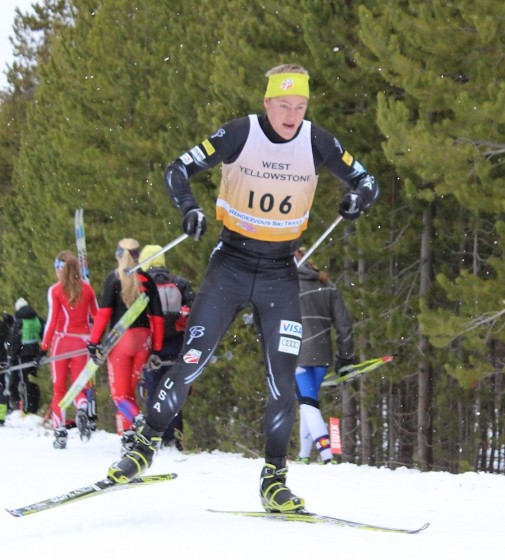
    Jack Novak (APU) during a SuperTour race in West Yellowstone, Mont., this month. (Photo: Forrest Mahlen)
    Jack Novak (APU) during a SuperTour race in West Yellowstone, Mont., this month. (Photo: Forrest Mahlen)

    Novak, 23, from Anchorage and also a longtime APU racer, finds himself in much the same boat as Fritz – underwhelmed by his recent performances, and looking for a low-stress adventure to mix things up.

    “I decided to go on the Tour de Ski China because I was looking for a change of pace after the past couple of years of injuries,” Novak wrote to FasterSkier. “I am not in a place where I am racing for a World Champs start spot, so for me racing at nationals didn’t have a huge draw this year. I heard about this race from my teammates over the years and thought this is a good year to race this series. It should be quite an adventure and that is what I am looking for right now, having fun racing and doing what I love.

    “I also have never ridden a camel but I hope this trip affords me the opportunity,” he added.

    In less Bactrian goals, Novak wrote, “My goals for this series are to really see how I stack up. I would love to be in the mix hopefully fighting for the win every once in a while. Also I already am going to get to travel to China and Inner Mongolia seeing part of the world I have never seen which is a goal achieved as soon as I leave. Being able to travel around the world to ski race is a real pleasure and an opportunity that not many get to experience so I feel very lucky.”

    Back in this country, Novak wrote that the China trip meshes well with the rest of his season goals, as he plans to enter some local races in Alaska in January before heading to the Midwest in February for SuperTour races and the Birkie.

    “Finally,” Novak wrote, “we will finish up the season in Fairbanks [for Spring Series] which should be a hoot and a half. We race so infrequently in Alaska on a national stage that it is fun to race at ‘home’ or at least the same state.”

  • U.S. SuperTour Preview: Anyone’s for the Taking

    U.S. SuperTour Preview: Anyone’s for the Taking

    The men's 15 k freestyle individual start podium at SuperTour Finals in Anchorage, with winner Noah Hoffman (c), runner-up Scott Patterson (third from l) and Erik Bjornsen (second from r) in third.(Photo: Rob Whitney)
    The men’s 15 k freestyle individual start podium at the 2014 SuperTour Finals in Anchorage, with (from l-r) Patrick Johnson (6th), David Norris (4th), Scott Patterson (2nd), winner Noah Hoffman, Erik Bjornsen (3rd), and Lex Treinen (5th). (Photo: Rob Whitney)

    Note: This article has been corrected to describe the race women’s SuperTour leader Caitlin Gregg is shooting for at World Championships: the 10 k skate.

    WEST YELLOWSTONE, Mont. — National racing begins Friday as the SuperTour kicks off in West Yellowstone, Mont., and the excitement on the Rendezvous trails couldn’t be higher. The best skiers from around the country have been training for at least a week in the little Montana town as they prepare to compete for American dominance and possible positions on World Cup and World Championship teams.

    With several departures from the racing scene including, Olympian Torin Koos (BSF), Rose Kemp (SVSEF), and Kate Fitzgerald (APU), and a multitude of up-and-coming racers on the cusp of success, the 2015 SuperTour will be anyone’s game.

    When the USST selected four men (Erik Bjorsen, Brian Gregg, Koos and Kris Freeman) and no women from outside the regular World Cup team, it left many skiers hungry to show that they could perform well on the international level.

    This year they’ll have another shot with the 2014 Nordic World Championships in Falun, Sweden.

    While the U.S. is allotted 12 spots for each gender in Falun, USST head coach Chris Grover explained that he and his staff would select eight skiers per gender at most.

    World Championship team selection will be based on several criteria. Those skiers ranked in the top 50 in the World Cup sprint or distance standings as of January 18 will be named to the team. After that coaches’ discretion kicks in. If coaches feel that the World Championship team could benefit from additional skiers after their discretionary picks, they will then begin selections from the USSA points list.

    The selection is identical to last year’s Olympic process, with the exception of the USSA points. When making selections for the Olympics, coaches picked three non-USST skiers from the FIS points list to fill in the gaps.

    According to USST Head Coach Chris Grover, the reason for the switch to USSA points is to emphasize domestic racing so that potential candidates for the championships will be racing against each other, rather than chasing FIS points across the globe like many did last season.

    Due to the emphasis on USSA points this season, the SuperTour will be where non-World Cup team athletes will have the chance to prove they have what it takes.

    The Veterans

    Brian Gregg (USA).  Photo: flyingpointroad.com / NNF.
    Brian Gregg (Team Gregg) will be a top competitor in 2015. Photo: flyingpointroad.com.

    On the men’s side, 2014 overall SuperTour champion Reese Hanneman (APU) will be competing in the first period World Cup races and will return to the national circuit in Houghton, Mich. for the 2015 U.S. Cross Country Championships. While the benefits of early-season World Cup racing are considered mixed, Hanneman can expect his chances of racing in Falun to increase if he demonstrates that he can keep up with the Europeans and his fellow American teammates.

    With Hanneman out of the picture in West Yellowstone and Bozeman, the men’s SuperTour favorites are the remaining two non-USST members to attend the 2014 Olympics – Brian Gregg and Kris Freeman.

    Freeman, a 34-year-old former USST member, will be racing in West Yellowstone for the first time in nine years. Freeman, who lost his position on the USST in 2013, was one of three non-USST members to qualify for the 2014 Olympics. Despite high hopes of his best olympics yet, he struggled in Sochi. This season he is looking to turn around his skiing and earn a spot on the World Championship team. As one of most experienced skiers on the SuperTour circuit he will have an advantage over much of the competition.

    Gregg, like Freeman, will also enter the 2015 SuperTour with a multitude of experience. The 2013/2014 season saw Gregg on the SuperTour podium several times, most notably with his two second place finishes in the 2013 West Yellowstone 15 k freestyle and in the 2014 U.S. Nationals 30 k freestyle. At the Olympics, he constantly finished in the 40s and 50s.

    As he starts the season, Gregg acknowledged that the first races of the season would be challenging.

    “Kris is in really good shape so I think there are going to be some very competitive races. I’m excited,” Gregg said from West Yellowstone Tuesday.

    Joining Freeman and Gregg as veterans of the SuperTour are Matt Gelso of the Sun Valley Gold Team and Dakota Blackhorse-von Jess of the Bend Endurance Academy. Gelso will be looking to build on past results while Blackhorse-von Jess will pursue success in sprinting, especially since U.S. sprint champion Torin Koos retired from competition.

    After disappointment in the freestyle sprint at the 2014 U.S. Cross Country Championships and a failure to qualify for the 2014 Olympics, Blackhorse von-Jess said that nothing has changed in his career trajectory.

    “I’m re-energized after the disappointment of the Olympics with the reaffirmation that I still want this and believe I have what it takes… My career/goal trajectory hasn’t changed in the least: I’m focused on racing my best in the biggest international competitions and just need to make sure I do what is necessary to make those trips and come to the starting line in Falun prepared to light it up,” he wrote in an email.

    Matt Liebsch of Team XC United will also be returning to racing after missing out on Olympic qualification. However, Liebsch, who works near full time for Gear West, has lightened his training load as is looking to “maximize fun and earning potential ” rather than qualify for international events.

    “I’m not going to be chasing FIS points around the world or country necessarily. If they fall in my lap because I’m racing well, that’s great, but I’m not going to be stressing about it… It’s not really a change for me. I’m still going to try to race as fast as I can only I won’t be training as much,” he said in a phone interview.

    Ryan Scott, living and training independently in Boulder, Colo., will also return to competition, but, like Liebsch, has cut back his training as a result of work.

    For the women, one name has particularly dominated the domestic circuit for years – Caitlin Gregg.

    Gregg, like Hanneman, will start her season on the World Cup after earning the women’s overall title at the SuperTour finals in Anchorage last season. Gregg said earlier this fall that she is as motivated as ever and has her sights set on a particular race: the 2015 World Championships 10 k skate. To get to Sweden, however, she’ll need to demonstrate that she’s on par with USST and dominate when she returns for the U.S. championships in January. In the meantime, she’s excited for the 5 k next weekend in Lillehammer and aims to earn a start in that race.

    With the absence of Gregg, the West Yellowstone and Bozeman SuperTours are anyone’s for the taking.

    Rosie Brennan (APU) leading her semifinal in the 2014 U.S. Cross Country Championships. (Photo: http://bertboyer.zenfolio.com) All proceeds from photo sales will be directly donated to NNF.
    Rosie Brennan (APU) leading her semifinal in the 2014 U.S. Cross Country Championships. (Photo: http://bertboyer.zenfolio.com).

    Always a strong skier, APU’s Rosie Brennan will once again attempt to demonstrate her mettle as she makes a bid for World Championships. Last year Brennan started her season on the World Cup and returned to the U.S. exhausted, but earned a national title at U.S. Nationals in addition to several podiums. This year she will enter the season with fresh energy despite a turbulent fall after loosing her father in August.

    Joining Brennan at the top of the SuperTour expectations are APU teammates Chelsea Holmes and Becca Rorabaugh.

    Holmes demonstrated her strength throughout the 2013/2014 season with a win in the 10 k classic mass start in Bozeman, a second to Gregg in the 20 k at the 2014 U.S. Nationals, and several other strong performance throughout the entire SuperTour season.

    Rorabaugh won the 10 k interval start classic at the 2014 U.S. Cross Country Championships for her first national title, and is looking to have even more time upon the podium as she continues through the season.

    Last year Bridger Ski Foundation’s Jennie Bender repeated a national title in the freestyle sprint. While she’s dealt with illness and injury for the past two years, Bender told FasterSkier that her summer training this year was her best to date, and that she is looking to find success domestically and qualify for World Championships.

    The Wild Cards

    Miles Havlick (Sun Valley Ski Education Foundation) tucking down the high point of the course on the fifth of six laps at U.S. nationals in the 30 k freestyle mass start at Soldier Hollow. While the veterans of the 2015 SuperTour are names we’ve seen at the top of the result sheets for years, there are several skiers who have an excellent opportunity to shake up the status quo and make a name for themselves on the domestic circuit.

    Sun Valley Ski Education Foundation’s Miles Havlick didn’t have the season he wanted in 2014, but has come back with a vengeance in 2015. While he has yet to face his competitors on-snow, Havlick has won a slew of time trials including the USST1o k freestyle rollerski time trial in Park City, Utah against the country’s best. He also broke a 25-year-old record in the Baldy Hill Climb this year.

    According to Havlick, he has the all the ingredients for a breakout season. Now it’s only a matter of time.

    “I think on any given day – when I am mentally competent, carrying confidence from previous races, focused, and my wax is good – I can be the best skier out there. The college skiing is when I was really able to prove that to myself. Last year was kind of tough because I felt like I was spinning my wheels by the end, but I think I’ve made some adjustments this year that can fix that,” he said in a phone interview in October.

    Havlick also has gained the attention of Grover and the USST.

    Erika Flowers racing to the fastest women's time in the inaugural Tim Burke Uphill Run Test at Whiteface Mountain.
    Erika Flowers racing to the fastest women’s time in the inaugural Tim Burke Uphill Run Test at Whiteface Mountain this fall.

    “I’m excited to see how Miles Havlick is going to ski. He’s had a great fall. He won our US ski team time trial that we did in Soldier Hollow. He set a new course record on the Baldy Hill climb that stood for 26 years or something. There’s some new emerging faces to keep an eye on,” he said.

    For the women, a possible 2015 wild card is a less well known. However, despite her lack of national attention Stratton Mountain School T2’s Erika Flowers has all the makings of an up and coming skier.

    Flowers has always been a strong and consistent skier with the majority of her SuperTour results landing in the top-ten. However, when she traveled to Europe in the spring of 2014 she demonstrated her potential, wining a 10 k mass start in Silvapalana, Switzerland. Several weeks later she placed 14th in the Alpen Cup mini-tour. She finished the tour as the second American behind Holmes and had the fifth-fastest time in the final 10 k pursuit.

    While Flowers has struggled with sprinting in the past, she demonstrated that she could stick with the best of them at the 2014 Frozen Thunder races in Canmore, Alberta ending the day in 7th.

    The following day she finished 7th in the 7.2 k freestyle at Frozen Thunder. She was the 3rd American, and placed ahead of several notable Olympians including Jessie Diggins.

    The Rest 

    In addition to Havlick, there are several other men who could make the domestic season anyone’s game.

    Recent college graduates Ben Lustgarten of SVSEF, David Norris of APU, and David Sinclair of Green Mountain Valley School will be looking to take their success from NCAA racing to the SuperTour.

    Scott Patterson (APU) is another notable graduate who had success on the SuperTour both at the 2014 Nationals and 2014 SuperTour finals. According to his family, Patterson will not be starting his season in West Yellowstone due to a skiing accident that occurred Oct. 31st in which he was impaled by a broken ski in his upper leg. While the leg wound healed, Patterson developed a pulmonary embolism (blood clots in his lungs) which has limited his exercise to walking. However, according to his family, Patterson is optimistic that he will return to racing at U.S. Nationals.

    Ben Saxton (SMST2) and Paddy Caldwell (SMST2/Dartmouth) will be the sole USST members starting the season in West Yellowstone. Saxton who was second in the freestyle sprint at U.S. Nationals last year, is aiming perform well in Friday’s sprint. Caldwell, who has yet to decide whether or not he will ski for Dartmouth this year is a strong distance skier and will be vying for top results amongst the country’s best.

    “They need to prove themselves and make those teams just like any other athlete that is on the domestic scene. Obviously those guys are younger guys and they’re still focused on the U23 World Champs,” Grover said of the two USST D-Team athletes.

    Welley Ramsey (MWSC), Tad Elliott (SSCV), and a slew of other men from APU and Craftsbury will also look to challenge the national favorites as the season gets underway.

    On the women’s side recent graduates Anne Hart (SMST2), Rosie Frankowski (APU), and Anja Gruber (Far West Elite) are new to full-time racing on the national circuit after having successful college careers. While the adjustment from college skiing to professional racing is often difficult, these women will still be a strong force to contend with.

    Annie Pokorny (SMST2), Caitlin Patterson (CGRP), Liz Guiney (CGRP), and Mary Rose (SVSEF) are shaping up to be strong competitors in the 2014/2015 season after a productive summer and fall trainings with their respective teams.

    [See the Super Tour schedule here]

  • Team HomeGrown, with Hoffman, Elliott, Now SSCV Elite; Focus Shifts to Juniors

    Team HomeGrown, with Hoffman, Elliott, Now SSCV Elite; Focus Shifts to Juniors

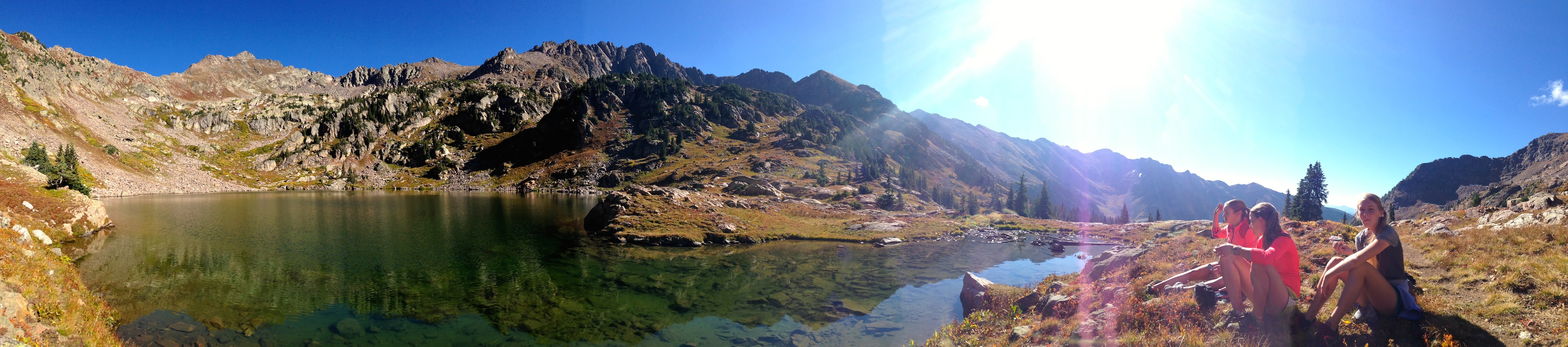
    Pitkin Lake above East Vail in the Gore, with SSCV skiers (l to r) Gracie Shanley, Annie Blakslee and Lyle Shipp. (Photo: Eric Pepper)
    Ski & Snowboard Club Vail skiers (l to r) Gracie Shanley, Annie Blakslee and Lyle Shipp at Pitkin Lake above East Vail in the Gore. (Photo: Eric Pepper)

    Five years ago, five ski buddies got together and founded Team HomeGrown. The idea back then, according to Sylvan Ellefson, was to create a sort of all-comers club.

    Kevin Hochtl, Josh Smith, Paul Gorbold, Dan Weiland, and Ellefson had all grown up around Vail, Colo., and this was a “homegrown” team they could lay claim to, no matter what stage of life or what stage of their ski career they were in.

    “We also wanted to provide a sort of support to the young kids growing up in the sport in the valley,” Ellefson explained. “Being able to look up to somebody, whether it is work or sport, is a very important part of keeping someone engaged in it. That was our belief.”

    Sylvan Ellefson representing Team HomeGrown/SSCV last season at U.S. nationals in Midway, Utah. (Photo: Bert Boyer/http://bertboyer.zenfolio.com/) All proceeds from photo sales will be directly donated to NNF.
    Sylvan Ellefson representing Team HomeGrown/SSCV last season at U.S. nationals in Midway, Utah. (Photo: Bert Boyer/http://bertboyer.zenfolio.com/) Proceeds from photo sales directly donated to NNF.

    Two years later in 2011, HomeGrown — the elite offshoot of Ski & Snowboard Club Vail (SSCV) — reached a new level with the addition of then-U.S. Ski Team members Noah Hoffman, from Aspen (still on the team), and Tad Elliott, from Durango.

    In 2012, Ryan Scott, a Montana State University grad from Boulder, came on as a sixth member with Ellefson, Hoffman, Elliott, and postgrads Christian Shanley (from Vail) and Max Scrimgeour (Steamboat Springs).

    “It became more of a Team Colorado, but still homegrown in the sense that we all grew up racing each other every weekend through middle school and high school,” Ellefson wrote in an email. “Racing ‘as a team,’ at Junior Nationals really gave a sense of unity. From that point, we wanted to help inspire the next generation of nordic skiers in the state of Colorado. Help them realize that nordic skiing can become a career, and if anything more, a way to develop an amazing tolerance for pain, mental strength, and an iron-clad work ethic.”

    This spring, Ellefson, 27, retired from skiing after making a run for the 2014 Olympics. Scott returned to Boulder full time to network and make a living in graphic design and web development.

    In a phone interview last month, Scott said he’d been training when he could, despite revving up to 30- to 40-hour work weeks by fall. Since parting ways with SSCV in the middle of last winter, he wasn’t sure what he’d do for support this season.

    “I might be figuring it out last minute, or racing independent and racing for Madshus,” Scott said.

    Neither Scott nor SSCV Head Coach Eric Pepper chose to elaborate on why Scott left the team.

    “I wasn’t involved in that conversation too much,” Pepper said.

    Despite battling mononucleosis symptoms as early as last October, Elliott was cleared to race in November and got in two distance starts in West Yellowstone, Mont., and Sovereign Lake, B.C. He placed 14th in B.C. (one place higher than his finish in West Yellowstone), then returned home to Durango, where a doctor diagnosed Elliott with the Epstein-Barr virus — best known as the cause of infectious mono.

    Tad Elliott (l) and Sylvan Ellefson (8) of SSCV/Team HomeGrown make their way up the last hill on the third of six laps with Mats Resaland (11) in the 30 k freestyle mass start at U.S. nationals at Soldier Hollow.
    Tad Elliott (l) and Sylvan Ellefson (8) of Team HomeGrown/SSCV make their way up the last hill almost halfway through the 30 k freestyle mass start at 2014 U.S. nationals. Ellefson won and Elliott did not finish.

    In January, he flew to Park City, Utah, to give the 30-kilometer skate mass start at U.S. nationals his best shot, but he didn’t finish.

    “I then took from January until July off of any training,” Elliott wrote in an email. “Really light training in August now a bit more structured training into the ski season.”

    Elliott, 26, is making a comeback this season, although he’s not sure how strong he’ll be.

    “The doctor who finally diagnosed me was nervous I wouldn’t be able to race again for a really long time,” he explained. “So being out 7 months off of my feet has been really small. I might not get back 100 percent, so there is really no expectations or goals I have to hit. I am coming back because I love skiing especially for Team HomeGrown, and Salomon, Honey Stinger, Caldwell Sport and Oakley. Without them saying get well and we will see you when you are ready, I probably would have retired from racing.”

    “I might not get back 100 percent, so there is really no expectations or goals I have to hit. I am coming back because I love skiing.” — Tad Elliott, SSCV Elite member

    During his recovery last winter, Elliott coached Durango Nordic juniors once a week.

    “That was all I could manage I felt so terrible,” he wrote.

    He worked for Salomon Running this spring and summer, and at a Durango mountain-bike shop called Mountain Bike Specialists, where his employers where empathetic and let him rest whenever he needed to.

    “All of my sponsors have stayed the same and showed their unconditional support,” Elliott explained. “My support team has stayed the exact same, and a piece of that has always been [coach] Zach Caldwell. We are using Firstbeat training systems in joint with my Suunto [heart-rate monitor] to track my heart rate variability to see how I am responding.”

    On Oct. 8, Elliott wrote on Facebook that he had been cleared to train.

    Out with the Old, In with SSCV Elite

    This season, Elliott will be one of two seniors on the SSCV Elite team — Hoffman being the other.

    Hannah Hardenbergh leading a high-school race in Colorado. (Photo: SSCV)
    Hannah Hardenbergh leading a high-school race last December in Colorado. (Photo: SSCV)

    Hannah Hardenbergh and Cameron Bobb joined the squad as its two postgrads, and for the time being, HomeGrown is no more.

    “We always knew that model is not sustainable if we want to grow the program,” Pepper said on the phone in early October.

    Compared to the last two years, Vail’s top-tier nordic team has downsized, and SSCV’s emphasis has shifted to local junior programming. In the grand scheme of things, developing younger skiers is what will make its program thrive, Pepper said.

    “We had talked to a number of potential people in the spring and what we really decided was we wanted to stay with who we had and not expand upon that this year,” he said. “Last year was obviously a really big push with Sylvan, being away from junior programing and athletes and families here, and with him not being in the mix anymore, and with Noah really needing minimal support from us, and Tad kind of coming back and seeing where he’s going to be at, it didn’t seem like there was a need for us to really pursue it this year.”

    A year-round world traveler, Hoffman stops by Vail a few times each year when he can — most recently working out with the SSCV juniors and Summit Nordic Ski Club earlier this week. Like Elliott, Hoffman also works with personal coach Zach Caldwell.

    Pepper has been Team HomeGrown’s coach for the last two seasons; Weiland, the longtime nordic program director at SSCV, coached the first two years before that.

    Ellefson said Weiland, Pepper and assistant coach Lenka Sterling essentially waived all coaching fees and worked pro bono for HomeGrown from the beginning.

    “I think they saw the potential of being coaches for what had the potential to be one of the best clubs in the nations, which I believe, to a degree we were one of the most competitive clubs, at a least in the men’s division,” Ellefson added. “They had full coaching schedules with the development team, high-school team and club team, so for Eric and Dan to even come out to our training sessions in the summer every single day was pretty instrumental.”

    When HomeGrown started in 2009, it was “basically unfunded” for the first year, Ellefson said. The five original team members scraped money together — from savings, their parents and personal sponsors — to self fund.

    The next year was better. The Rocky Mountain Nordic Angel nonprofit, which preceded HomeGrown, continued to supplement the team, and SSCV extended its support. The club initially let HomeGrown use its facilities, and by the next year, it granted its two athletes — Ellefson and Gorbold — access to additional training facilities and blew manmade snow for them in November. In 2011, Hoffman and Elliott came onboard to extend HomeGrown’s appeal to broader Colorado.

    “To grow the culture in nordic skiing is way bigger than just trying to keep growing team HomeGrown,” Ellefson said. “If you grow the culture, I think the team will grow.”

    “To grow the culture in nordic skiing is way bigger than just trying to keep growing team HomeGrown.” — Sylvan Ellefson, one of Team HomeGrown’s founders and SSCV Nordic Future Stars Head Coach

    That’s why he wasn’t disappointed to see the name go. Above all, he wanted to see a team that enticed athletes after high school or college to pursue a professional career in ski racing.

    “We are also moving more into how to fund these athletes better, and that we can do with the growth of the sport as a whole in the United States,” explained Ellefson, now a part-time coach for SSCV’s nordic future stars program (responsible for 40 to 60 kids ages 6 to 11) and vice president of sales and marketing at Cirque Mountain Apparel.

    2014 U.S. Distance Nationals 50 k classic mass start at Hillside trails in Anchorage, Alaska
    Noah Hoffman racing to second in the 2014 U.S. Distance Nationals 50 k classic mass start at Hillside trails in Anchorage, Alaska.

    “To this point we had all athletes that grew up in Colorado,” Pepper said of HomeGrown’s recruiting pool. “Most of the kids that came to us this year were ones we had an interest in and relationship with, but they weren’t Colorado kids.”

    That’s where SSCV had to make a decision. Ultimately, it resolved to focus on developing Colorado juniors rather than open HomeGrown to top skiers across the U.S., like several other elite teams do.

    Ten years ago, Pepper estimated SSCV had 10 total athletes.

    “Five years ago, it probably had 25 kids and now this year, it’ll probably be close to 80 with all our age groups,” he said. “[We’re] trying to establish a culture and improve trails … We have a ski academy now.”

    Vail Ski & Snowboard Academy, founded in 2007.  (Photo: SSCV)
    Vail Ski & Snowboard Academy, founded in 2007. (Photo: SSCV)

    The Vail Ski & Snowboard Academy, a public school for grades 5 through 12, was founded in 2007 and has nordic, alpine, snowboard, freeski, and freestyle teams as well as NCAA college programs, with seven kilometers of cross-country trails right outside its doors.

    This year, Vail’s two postgrads are from the area and decided to take a year off college. Hardenbergh deferred from Harvard, and Bobb grew up racing for the Summit County Nordic Club. Both are coming back from injury, Pepper said.

    “Its unfortunate when a racer post-grads in the U.S., it seems to be the feeling of World Juniors or bust,” he said. “We’re de-emphasizing it a bit … trying to give them more experiences, like a [SuperTour in] Bozeman. Their schedule isn’t that different domestically than a top-level junior, with western early season races, nationals, local races, [and] junior nationals … then [we’ll] look at opportunities.”

    SSCV did not go to Spring Series last year in Anchorage, opting for French and Swiss nationals (for the same price of a plane ticket to Alaska) instead. This season, Pepper predicted they’ll have a similar option for postgrads and seniors, depending how each athlete is doing.

    2015 SuperTour Finals in Sun Valley, Idaho, is a much more feasible trip from Colorado, “but Europe’s pretty appealing, too,” he said.

    Former postgrads Shanley and Scrimgeour are now entering their sophomore years skiing for Denver University and the University of Colorado-Boulder, respectively.

    And in terms of Vail’s male-to-female ratio: “We probably have more females than males, which is an interesting flip,” Pepper said, alluding to HomeGrown’s all-male status for the last four years. “In our U16 and older program, we have more females, but it’s pretty close to 50/50. In our older guys’ program, that was mostly coincidence.”

  • From the Arctic Circle to Bozeman: Hagensen Reflects on MSU Coaching Career

    From the Arctic Circle to Bozeman: Hagensen Reflects on MSU Coaching Career

    Gethe Hagensen runs along former Montana State University athlete Tyler Reinking in the 2012 NCAA Championship in Bozeman, Mont. Grethe was head nordic coach at the university for a decade. (Photo: Stuart Jennings)
    Grethe Hagensen runs alongside former Montana State University athlete Tyler Reinking at the 2012 NCAA Championship in Bozeman, Mont. Hagensen was head nordic coach at the university for a decade. (Photo: Stuart Jennings)

    Grethe Lise-Hagensen served as Montana State University’s Head Nordic Coach from 2003 to 2014. During her decade as head coach, Hagensen brought the team from a state of near non-existence to ranking third in the nation at the 2010 NCAA Championships. In May of 2014, Hagensen’s contract was not renewed by the university’s administration. FasterSkier sat down with Hagensen in July to talk about her time at the helm of the MSU program and the accomplishments she achieved during her ten years as head coach.

    ***

    BOZEMAN, Mont. — Like most Norwegians, Grethe-Lise Hagensen was born with proverbial skis on her feet. Unlike most Norwegians, she decided to bring her successful ski career to the United States.

    Hagensen grew up in Tromsø, Norway, roughly 300 miles above the Arctic Circle where she found an early introduction to skiing out of necessity. Her family didn’t have a car and like many of the other townspeople, she had no choice but to ski into town whenever she needed to go to school, buy groceries, or visit friends.

    Hagensen’s skiing soon evolved from a means of travel to a form of competition as she was introduced to racing. Her entrance into world of ski racing would change her life forever, and by the time she was a teenager she had already won a Norwegian national championship and was on the Norwegian National Ski Team.

    In 1979, Hagensen was part of what she described as the “the biggest athletic event in northern Norway.” A relay team consisting of Hagensen and fellow Tromsø skiers made their way to the top of the podium, astounding spectators.

    “It was a huge sensation. It is still probably the biggest athletic event that has ever happened in northern Norway because we were such underdogs,” she said during a recent in-person interview. “For us to win it was a shocking thing. Top ten would have been a sensation, and we ended up winning.”

    Hagensen first ventured to the U.S. to attend the University of Wyoming. During her time there, she earned all-American honors each of her four years at the university and was part of its winning team in the 3 x 5 k relay at the 1985 NCAA Skiing Championships.

    Hagensen graduated from the University of Wyoming in 1986. She returned to Norway, where she coached both soccer and skiing. She then married American John Villar and the couple had two daughters.

    In 2002, Hagensen and her family made the decision to move to Bozeman, Mont. for a year so that her children, Bjørk and Embla, could learn English. The family’s plan was changed when a friend informed Hagensen that the head coach position at Montana State University (MSU) was available.

    Hagensen applied for the job, accepted the university’s offer, and has lived in Bozeman ever since.

    “Suddenly they could smell gold”

    Grethe Hagensen smiles at an undated ski race. Hagensen served as head nordic coach at Montana State University from 2003 to 2014. In 2010 she lead the team to third place in the nordic rankings at the NCAA Championships. (Photo: Montana.edu)
    Grethe Hagensen smiles in an undated photo. Hagensen served as head nordic coach at Montana State University from 2003 to 2014. In 2010 she lead the team to third place in the nordic rankings at the NCAA Championships. (Photo: Montana.edu)

    When Hagensen took over as MSU’s head nordic coach in 2003, it was the first year since the 1980s that the university had a male team. While women had been part of the team for many years, their results were lackluster and recruitment was challenging.

    “You need to have results to get good athletes — it’s like the chicken and the egg,” Hagensen said of her entry into the program in 2003. “I thought it would take me five years to build up a winning team that would be competitive against CU [the University of Colorado] and DU [the University of Denver].”

    The winning combination came earlier than expected. While a handful of good finishes from MSU skiers scattered the results of the Rocky Mountain collegiate series in Hagensen’s early years as head coach, it wasn’t until 2007 that the team really started to excel.

    The turning point came during the first weekend of Rocky Mountain Intercollegiate Ski Association (RMISA) races at Soldier Hollow in Midway, Utah.  With a relatively strong first day of competition, Hagensen was optimistic about the mass-start races. During the women’s 10 k, she was waxing the men’s skis and conversing with a fellow coach.

    “I remember I said to one of the coaches, ‘I might get a medal today’ and he said to me, ‘Grethe, you might take the top three,’ ” Hagensen explained.  “After that I don’t remember anything.”

    Her colleague was correct as a trio of MSU women consisting of Jamie Woelk, Mandy Bowden Axelson and Claire Rennie rounded the corner into the final stretch of the women’s race. The three Bobcats swept the podium, separated by less than a second.

    It was the first time in RMISA history that a women’s team had taken all three spots on the podium in a single race, but the historic moment almost didn’t happen as all three skiers were nearly disqualified.

    “We almost got disqualified because someone said that I skied next to them,” Hagensen said. “I don’t remember skiing but I must have because I was in shock. I was so happy. Maybe I skied maybe I didn’t, who knows.”

    Despite the alleged incident, the women’s results stood and Hagensen was issued a warning. The moment, however, was a major turning point for the program, which had existed on a small scale four years prior.

    “Suddenly they could smell gold. Once you do it, you have broken the barrier,” Hagensen said.

    She credits the rapid rise of the MSU nordic team to a focus on American athletes who might have been overlooked by other universities, some of which heavily recruit European skiers and only the best American juniors.

    “I always had, not the best juniors in the U.S., but maybe the ones who were a little bit behind,” she said. “I tried to get them to become the best. You have Ryan Scott and Tyler Reinking, these guys were OK and then we just built them. That’s what made me the most proud over my years: taking care of the Americans.

    She also made sure to focus on building technique before anything else.

    “We tried to tap into whatever edge they had. Technique was something that we had to work on a lot,” she said. “You can’t be the best if your technique is a handicap. I tell everyone to focus on their technique and then we get them to the next level.”

    After joining the big show in 2007, MSU continued to progress at an unprecedented rate. With recruitment soaring and a tight-knit team, Hagensen entered the 2009/2010 season with high hopes.

    With their eyes on the NCAA Championships in Steamboat Springs, Colo., the team qualified a full six-person squad for the event: Scott, Reinking, Bernhard Roenning, Kaelin Kiesel, Mellie Park, and Casey Kutz.

    Underdogs from the beginning, MSU wasn’t expected to be overly competitive, let alone make a run for the podium. However, they did just that with all three men placing in the top 10 in the second day of competition. The results propelled the squad to third place overall at NCAAs.

    “We had a phenomenal year, and suddenly we had three [men in the] top ten and Kaelin Kiesil was fifth,” Hagensen said. “Sometimes everything lines up.”

    Later that year, Hagensen received the Intercollegiate Coach of the Year Award in recognition of her contributions to MSU.

    Termination After a Decade

    Upper-body power testing with the Montana State University Nordic Team (Dan Heil photo)
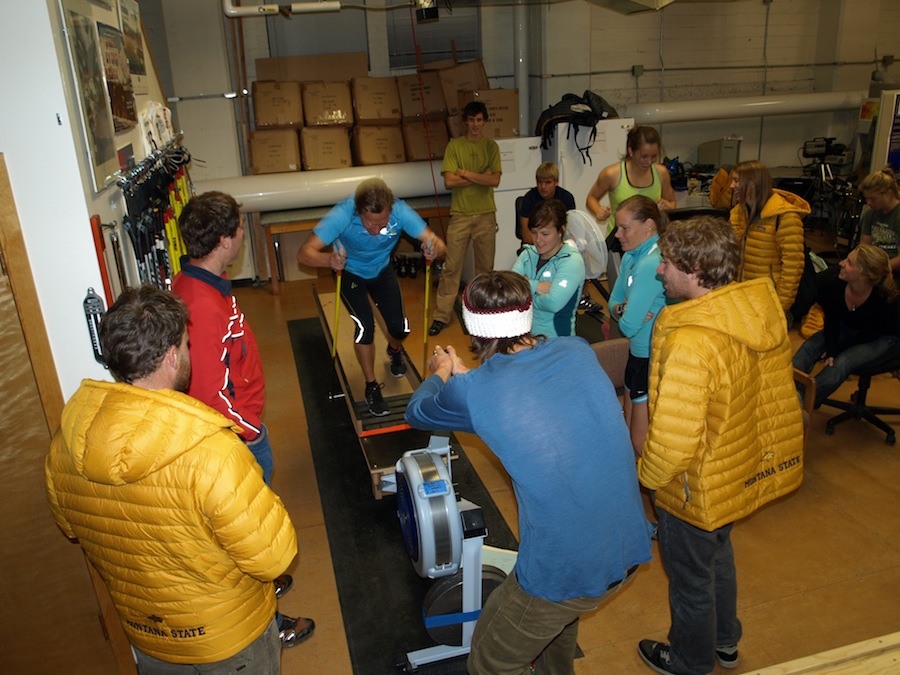
    The Montana State University Nordic Team performs upper-body testing in an undated photo. (Photo: Dan Heil)

    After 2010, both Hagensen and the MSU nordic team continued to find success with top finishes in the RMISA and NCAA race series. In 2012, for the first time in school history, MSU qualified a full team in both alpine and nordic for the NCAA Championships that took place on their home courses in Bozeman, Mont.

    Hagensen also received the RMISA Coach of the Year Award that year.

    During the 2012/2013 season Hagensen took a sabbatical year so that she could spend time with her mother in Norway who had just suffered a stroke. During that season, assistant coach Chad Andersen took over the responsibility of the team.

    In what would be her final season as MSU’s head nordic coach, Hagensen lead her team to qualify a full NCAA Championships squad once again. At the 2014 NCAAs in Soldier Hollow, MSU saw two athletes — Jessica Yeaton and Sawyer Kesselhiem — earn all-American honors with fifth- and ninth-place finishes.

    Adding to the season’s milestones, the nordic team won both the men’s and women’s awards for team of the year at the Montana State Athletics’ 2014 ALL (Academics, Leadership and Life Skills) Banquet in April.

    Not long after, Hagensen said she received a positive review from her athletic department and was given a mandate to hire a new assistant coach. The new assistant coach, Andrew Morehouse, had both a verbal and written agreement with Hagensen for his position that was yet to be made official by the university.

    In May, she said she was summoned MSU Athletic Director Peter Fields’ office for what she assumed would be a conversation about the assistant-coaching position.

    What she experienced was far from what she expected.

    Instead of discussing the assistant coach position, Fields told Hagensen that her contract would not be renewed in the coming year.

    “They asked me to come in and I thought they were going to ask me about the new assistant coach that I was to hire,” she said. “… Ten years of my life was canned in two minutes.”

    The university declined to comment on the decision due to its personal nature, according to Sports Information Director Tom Shutlz.

    “I’m still traumatized,” Hagensen said. “You would think that an institution would bring you in and give you a reprimand or warning or something, but the fact is that there is no job guarantee. You would think that Montana State University would be bigger than this and that they would communicate.”

    Hagensen claims that Fields gave her no indication as to why her contract was not renewed and failed to even thank her for ten years of service to the university.

    She quoted from her prepared statement regarding her departure from MSU:

    “I was surprised that after a decade of strong performance as a head coach, my boss Peter Fields made no comment to me about all the success that the nordic ski teams that I have coached have brought to MSU. Most surprising was the reaction of President Cruzado, who has as well reported record on workplace issue and good management practices. I realize that most of us have one-year contracts and that MSU management can make changes as they see fit. But after a decade as an MSU coach, to be tossed aside without any reason…”

    MSU issued a press release on May 22, which read in its entirety: “The contract of Montana State head Nordic ski coach Grethe Hagensen will not be renewed, announced Bobcat Athletics Director Peter Fields, Thursday afternoon. Hagensen recently completed her tenth year at Montana State. A national search for the position will be conducted.”

    There were those who weren’t surprised by the move. Three former skiers of Hagensen who wished to remain unnamed, claimed that coach was distracted and absent during her last year of coaching.

    When asked about these claims, Hagensen said she made a conscious effort to take a back seat in the 2013/2014 season because she did not want to overbear the atmosphere that assistant coach Chad Andersen had created during her sabbatical year.

    “Last year I wasn’t there and this year I was easing back in so that I wasn’t too powerful or too controlling,” Hagensen said. “Maybe I should have done it differently but those are small things. Not enough to get fired. It is an adjustment.”

    Despite some athlete discontent, Hagensen has received many positive reviews from former athletes, including Scott who graduated in 2012. While Scott had not yet returned an inquiry from FasterSkier at the time of publication, he was quoted in a 2011 Montana State University press release saying that, “she (Hagensen) cares about you personally as well as how you are doing as a skier. She taught me how to seek out my strengths and capitalize on those, which carries over to all aspects of my life.”

    In the same article, Axelson (member of the podium sweeping team in 2007) is quoted saying, “Grethe taught us that in order to be successful, you have to be self-motivated; you have to know what you want and go after it. When you are driven, opportunities come your way–that’s Grethe’s legacy.”

    On July 11, MSU announced the hiring of new head coach Kristina Trygstad-Saari, a Bozeman resident and former Dartmouth skier and coach.

    Hagensen was pleased that Trygstad-Saari was tapped for the position, insisting that Trygstad-Saari could accomplish the one goal Hagensen never did with MSU.

    “My dream while at MSU was always to win the NCAA Championship,” Hagensen wrote in an email after the announcement. “As the new head nordic coach, Kristina Trygstad-Saari brings experience in racing and coaching to the team. Together with MSU Alpine coach Kevin Frances, I believe the MSU ski team has the potential to achieve that goal, winning the NCAA Championship. I wish them all the best.”

    Unsure of what exactly lies ahead of her, Hagensen explained her future will likely involve traveling between the U.S. and Norway. During her sabbatical year she taught at the University of Tromsø which may be a future possibility for the Norwegian.

    She’s planned a trip to Oslo with her oldest daughter, Embla, who’s taking a postgraduate year at an outdoors school. Her youngest daughter, Bjørk, has a year left at a boarding school in Park City, Utah.

    Wherever Hagensen finds herself, she’s certain of one thing: she will always remember her time at Montana State with fond memories and will continue to be proud of the athletes she coached.

  • Johansson Surprises in Yellowstone SuperTour Sprint; Hanneman Outlunges Scott for Second

    Johansson Surprises in Yellowstone SuperTour Sprint; Hanneman Outlunges Scott for Second

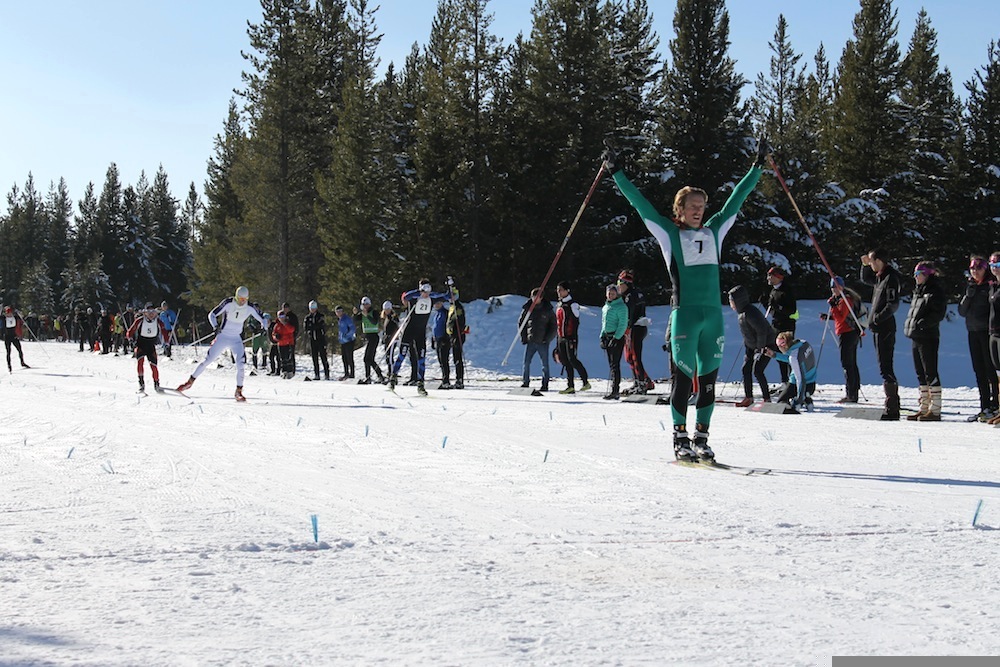
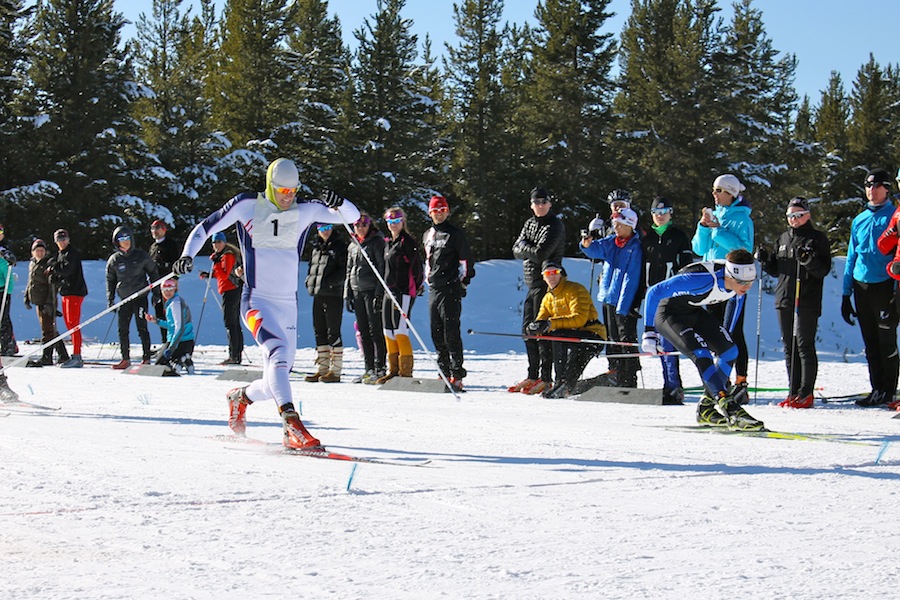
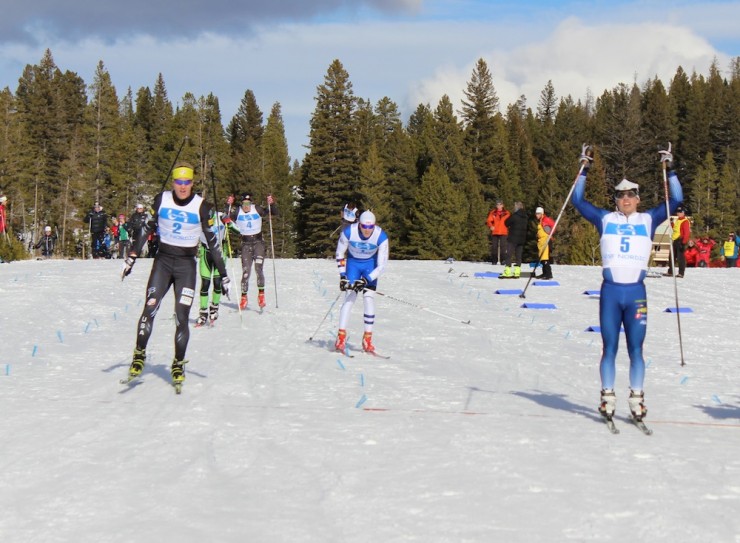
    Emil Johansson of Sweden's IK Jarl Rättvik celebrates his decisive victory in the West Yellowstone SuperTour 1.3-kilometer skate sprint on Friday. The seventh-fastest qualifier, Johansson went on to beat qualifying winner Ryan Scott  of SSCV/TeamHomeGrown (in white) and Reese Hanneman of APU, second from r. Hanneman outlunged Scott for second.
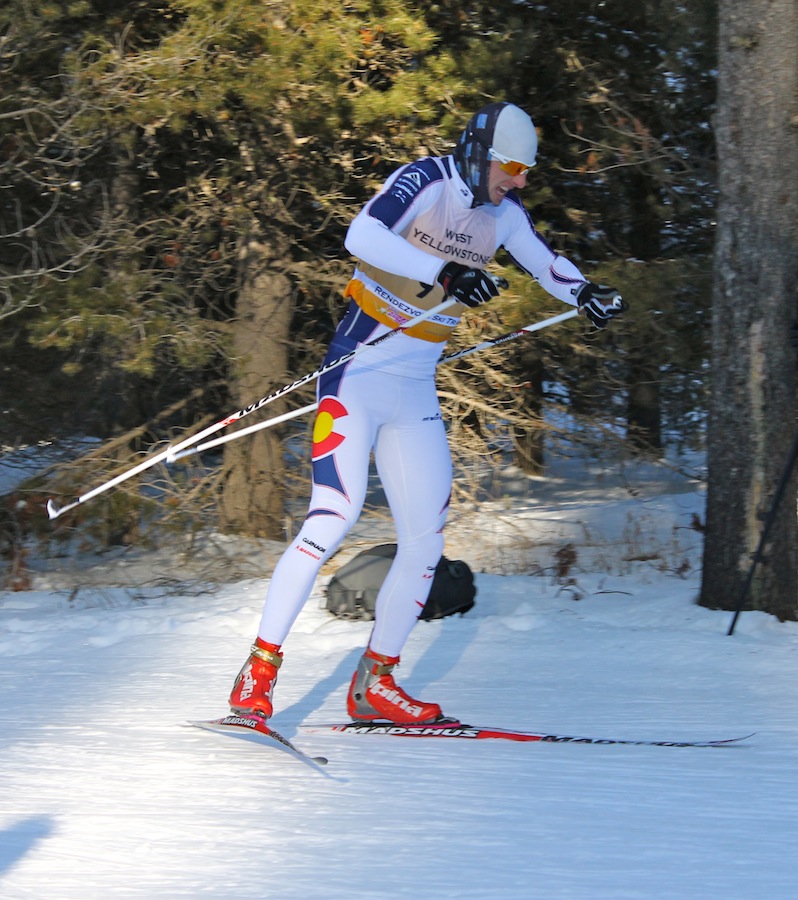
    Emil Johansson of Sweden’s IK Jarl Rättvik celebrates a decisive victory in Friday’s West Yellowstone SuperTour 1.3-kilometer skate sprint at the Rendezvous Ski Trails. The seventh-fastest qualifier, Johansson went on to beat qualifying winner Ryan Scott of SSCV/TeamHomeGrown (in white) and Reese Hanneman of APU (second from r). Hanneman outlunged Scott for second.

    WEST YELLOWSTONE, Mont. — A lot of people might not know who Emil Johansson is. To SuperTour spectators and most of the 200-plus racers (between the men’s and the women’s races) on Friday, he was an unknown: a Swede racing in the green suit of his home club IK Jarl Rättvik. An exchange student at the University of Colorado in Boulder, he’s not part of the nordic team there. It was hard to know what he was capable of.

    A SuperTour staple, Ryan Scott (Ski and Snowboard Club Vail/Team HomeGrown) won Friday’s qualifier and a quarterfinal in the 1.3-kilometer freestyle sprint, yet didn’t know half the men he was racing once he got to the final. Last year’s West Yellowstone skate prologue winner, Scott quickly learned who Johansson was.

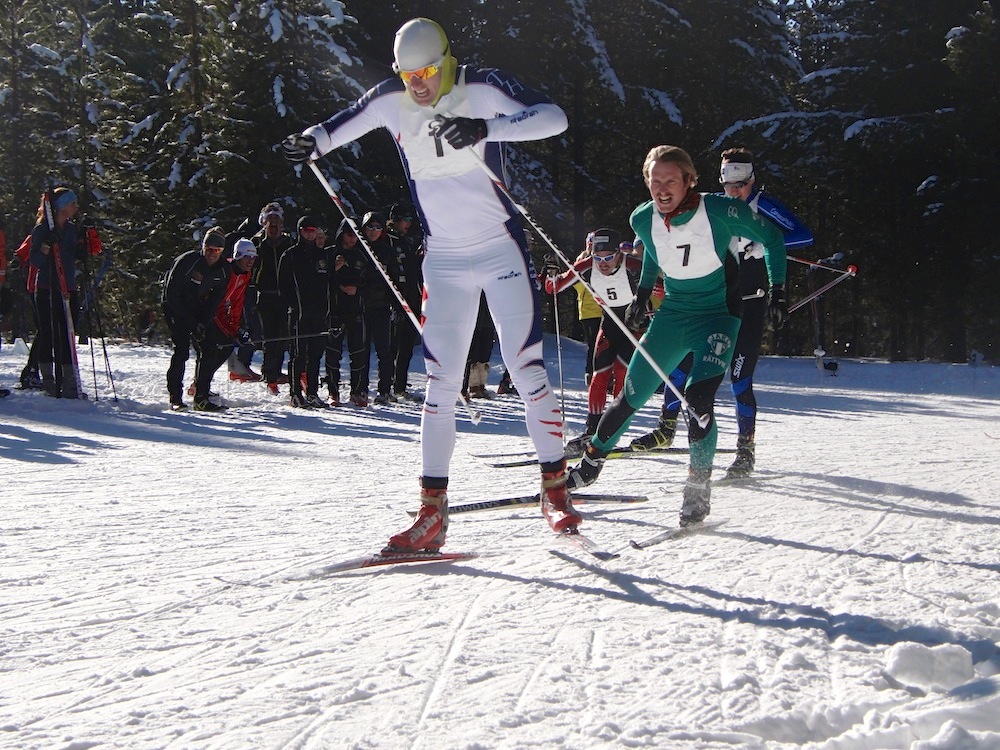
    Ryan Scott (SSCV/Team HomeGrown) leads Swede Emil Johansson (7) and Reese Hanneman (APU) in the semifinal of Friday's 1.3 k skate sprint at the SuperTour opener in West Yellowstone, Mont. All three finished less than a tenth of a second together to advance to the finals.
    Ryan Scott (SSCV/Team HomeGrown) leads Swede Emil Johansson (7) and Reese Hanneman (APU) in the semifinal of Friday’s 1.3 k skate sprint at the SuperTour opener in West Yellowstone, Mont. All three finished less than a tenth of a second of one another to advance to the finals.

    He had just advanced from the semifinal with a three-way photo finish for first with Johansson and Reese Hanneman, of Alaska Pacific University (APU). All three were in the final, along with Pierre Guedon (University of Denver), Sam Naney (Methow Olympic Development), and Dmitriy Ozerskiy (CXC).

    Johansson turned on the jets at the opportune time — on the last of two climbs on the short course — to win the SuperTour-opening sprint in 2:28.90. He hadn’t been the fastest throughout the day, ranking seventh in the qualifier (+5.17 off Scott’s time of 2:27.14), and winning the slowest quarterfinal in 2:30. But Johansson knew the game and beat Hanneman in second (+1.7), Scott in third (+1.8). Guedon, Naney and Ozerskiy finished separately in fourth through sixth, respectively.

    “Both the quarterfinal and semifinal was really close, but the final was pretty easy,” Johansson said. “Actually, it was the easiest round. Ryan was in the lead and I think he was kind of tired. I just got in his draft all the time and my plan was to push it hard on the last uphill. I thought someone should keep up with me, but they didn’t. I was pretty tired the last 200 meters, but I made it.”

    Johansson had enough time to look around before finishing, throwing with his arms into the air while cruising across the line. He pulled an upset on both Hanneman and Scott, whom he had gapped on the hill. Unable to respond, they lunged for second, which Hanneman took by 0.1 second. The two rolled across the line together, untangled themselves and showed  respect for each other after.

    “He was clean coming up behind and I never had any real contact with him,” Scott said of Hanneman, after leading the final up to the one-and-only hill, but failing to respond to Johansson’s attack on it. “I was loosing speed. I was trying to keep my tempo up; I know Reese had good cadence coming into that [finishing] stretch and a lot of power.”

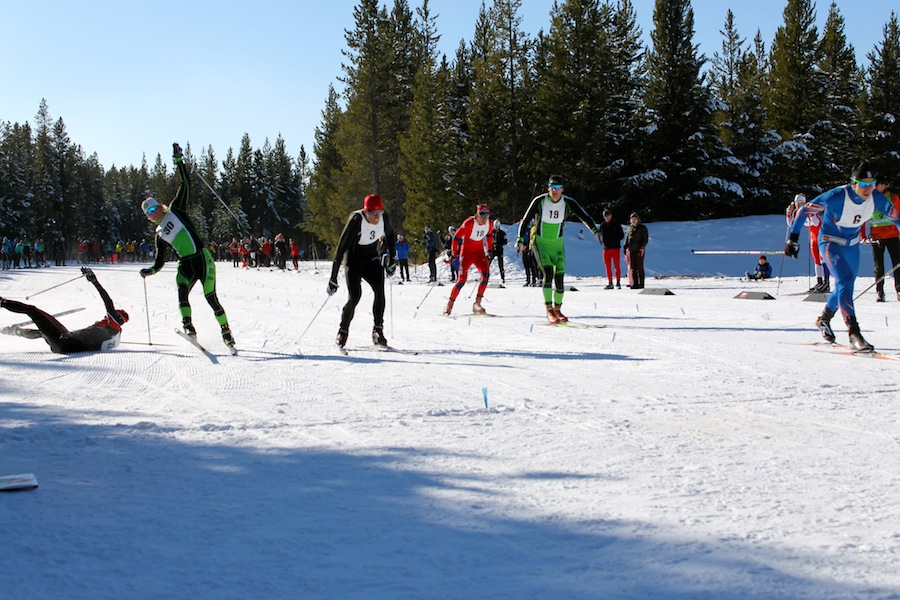
    Craftsbury's Pat O'Brien (second from l) and Pierre Guedon of the University of Denver (l) crashed just meters before the finish line in Friday's SuperTour 1.3 k skate sprint semifinal in West Yellowstone, Mont.
    Craftsbury’s Pat O’Brien (second from l) and Pierre Guedon of DU (l) crashed just meters before the finish line in Friday’s SuperTour 1.3 k skate sprint semifinal in West Yellowstone, Mont. CXC’s Dmitriy Ozerskiy (r) won the semi to advance to the final, along with Sam Naney of MOD (third from l).

    Unlike some the men in Friday’s heats, Scott made it through the rounds without falling victim to roughhousing “minus my poles being stepped on a couple times.” Others, like Pat O’Brien (Craftsbury Green Racing Project) and Noe Bellet (University of Utah), weren’t so lucky. The two crashed about a few meters before the finish of their semifinal when O’Brien tried to avoid tripping up with another skier on his left. He moved to the right, stepping into Bellet, and the two fell out of the running.

    Hanneman, who qualified in 21st, lunged at the finish of every round, finishing 0.5 seconds behind Scott in the quarterfinal. Not too thrilled with his qualifier, Hanneman made a point to push it in the heats and ended up with his career best in a SuperTour skate sprint.

    “I’ve been really focusing on my skating this summer so this is a great way to affirm to myself that I’ve hopefully made some progress,” he said.

    As for the course, Hanneman said it was “really fast”  with many tight corners in the middle section that made it “one of the most physical courses as far as contact between the skiers.” About 200 meters into the final, all six men converged on a single line, and Hanneman was caught in the middle. He said he double poled until there was room to move again, at which point he was in “dead last.”

    “Halfway through … I worked really hard to accelerate out of a couple of those corners and take some really aggressive far-outside and far-inside lines and pass some people,” Hanneman said. He got behind Scott and failed to latch onto Johansson on the uphill.

    “That’s where most people were [making a move] in the heats,” Scott said. “I think everyone was ramping up and expecting it, but people were just unable to answer that surge. It was a decisive move and impressive victory.”

    A student from Sweden’s Uppsala University currently on exchange at CU, Johansson was a big fan of the sprint course at the Rendezvous Ski Trails. “It’s a good course; I love it,” he said. “And on a day like this I love it even more.”

    For the two-day SuperTour series, the first of the season, Johansson said he was staying the CU nordic team. “When I came here I knew there was a ski team so I’ve been training with them sometimes,” he said. “Now I’m living with them this week, but I’m competing for my home club in Sweden.”

    Ryan Scott (SSCV/Team HomeGrown) pushes hard to win Friday's 1.3 k skate sprint qualifier by 0.62 seconds over teammate Sylvan Ellefson (not shown).
    Ryan Scott (SSCV/Team HomeGrown) pushes hard to win Friday’s 1.3 k skate sprint qualifier by 0.62 seconds over teammate Sylvan Ellefson (not shown).

    For Scott, third was short of his goal, but he’d take it.

    “Obviously my goal for today was to win the prologue and to win overall,” he said. “To be that close is tough, but I think it sets me up well for the weekends [ahead].” SuperTour leaders, including the top male and female sprinters, through the next weekend of racing in Bozeman, Mont., can earn World Cup starts in January.

    Scott was off to a solid start after winning the qualifier by 0.62 seconds ahead of teammate Sylvan Ellefson. According to Scott, Ellefson said he was “boxed out” in the quarterfinal, losing some finishing speed and placing third in the heat, 0.1 seconds behind Alex Schulz (CGRP) and Bellet, respectively. 

    According to U.S. Ski Team and APU member Erik Bjornsen, something similar happened to him. After qualifying in 16th, Bjornsen placed fourth in his quarterfinal, 0.5 seconds back from winner Ozerskiy, and did not advance to the semis. After leaving “a little too much in the tank” for the qualifier, Bjornsen made a move up to third on the final hill, but wasn’t in good enough position coming into the flat finishing stretch.

    “I tried to go right and [Guedon] kind of closed me off,” Bjornsen said. “That’s the way sprinting goes.”

    “It’s hard to say I feel good after posting that result; but honestly I didn’t feel that bad,” he added. “Everyone seems to be in really good shape which is awesome for the U.S. team. I’ll definitely go into the next races shooting for that podium!”

    Friday morning, Bjornsen woke up to discover his older sister and fellow USST member, Sadie, placed third in the classic sprint qualifier at the opening World Cup in Kuusamo, Finland. She ended up 26th on the day.

    “I was so excited for her,” Erik said. “I can tell she is in great shape and she has more to show. It’s been so fun to watch her train this past summer. She finally seems to be injury free and she deserves to have great results after all the hard work she has put in the last few years.”

    Results: Sprint brackets | Complete

    APU's Reese Hanneman (r) outlunges Ryan Scott of SSCV/Team HomeGrown for second place in Friday's West Yellowstone SuperTour 1.3 k skate sprint.
    APU’s Reese Hanneman (r) outlunges Ryan Scott of SSCV/Team HomeGrown for second place in Friday’s West Yellowstone SuperTour 1.3 k skate sprint.
  • The 12: Ski & Snowboard Club Vail/Team HomeGrown

    The 12: Ski & Snowboard Club Vail/Team HomeGrown

    Sylvan Ellefson (l) and his Ski & Snowboard Club Vail/Team HomeGrown teammates enjoying some on-snow time in Bend, Ore., this spring. (Photo: Eric Pepper)
    Sylvan Ellefson (l) and his Ski & Snowboard Club Vail/Team HomeGrown teammates enjoying some on-snow time this spring in Bend, Ore. (Photo: Eric Pepper)

    Note: This is the second preview in our series on U.S. elite teams, which we’ve dubbed the “The 12.” We asked coaches to tell us what’s new and whom to look out for in the coming season and will publish additional previews in the coming weeks in no particular order.

    Team: Ski & Snowboard Club Vail (SSCV)/Team HomeGrown

    Coaches: Eric Pepper (head coach), Dan Weiland (nordic program director), Lenka Palanova, Kevin Hoechtl, Allison Ebbets

    Senior roster: Noah Hoffman (U.S. Ski Team), Tad Elliott, Sylvan Ellefson, Ryan Scott

    Who’s new: none.

    Who’s missing: none.

    Coach’s comment: “We are excited to be able to support these four athletes,” head coach Eric Pepper said. “With the added excitement of an Olympic year, training has been great and we are looking forward to the race season.”

    Four Colorado-born skiers have Olympic aspirations with the Winter Games in Sochi, Russia, just over seven months away. Hoffman, Elliott, Ellefson, and Scott will receive full support of the SSCV in Vail, Colo., and wear the colors of HomeGrown, signifying the club’s in-state requirement.

    “What it comes down to for us is we want to make sure we can give top-level support to our athletes,” Pepper said about his selective elite team roster. Promising candidates have expressed interest in joining the team, but did not meet the “HomeGrown” standard, he explained.

    Top results last season:

    All four skiers made World Cup starts in 2012/2013. Hoffman and Elliott gained the most international experience as members of the U.S. Ski Team (USST). Ellefson’s World Cup eligibility, which carried over from being the U.S. Ski and Snowboard Association (USSA) SuperTour points leader in 2011/2012, expired after the December World Cup in Canmore, Alberta.

    Colorado native Noah Hoffman of the U.S. Ski Team and SSCV/Team HomeGrown at the 2013 World Championships in Val di Fiemme, Italy.
    Colorado native Noah Hoffman of the U.S. Ski Team and SSCV/Team HomeGrown at the 2013 World Championships in Val di Fiemme, Italy

    Scott, 23, filled one of the additional U.S. quota spots at the Canada World Cup after finding success at the SuperTour season opener in West Yellowstone, Mont., where he notched his first domestic win. He placed 51st in the Canmore sprint and 60th in the individual sprint Quebec City. A sprint specialist, Scott is currently training in Norway with a group of friends.

    “That’s something he’s done a couple of times and he really feels like he’s derived a lot of benefit from it,” Pepper said.

    The top-ranked distance skier in the U.S., Hoffman, 23, is coming off a strong season in which he placed 15th in the 15-kilometer freestyle individual start at World Championships in Val di Fiemme, Italy, and qualified for World Cup Finals. He underwent shoulder surgery this spring and has gradually added intensity and volume to his training program.

    “He’s as focused as ever and looking forward to the upcoming year,” Pepper said.

    Tad Elliott (SSCV/Team HomeGrown) racing for the U.S. Ski Team at 2013 World Championships in Val di Fiemme, Italy.
    Tad Elliott (SSCV/Team HomeGrown) racing for the U.S. Ski Team at 2013 World Championships in Val di Fiemme, Italy.

    Elliott, who turns 25 today, is no longer on the USST, but the former mountain-bike racer maintains a full commitment to skiing.

    “Nothing in his mind has changed one bit,” Pepper said. “Everything he’s got is going into [skiing] this year.”

    Elliott anchored the Americans’ 4 x 10 k relay team to 10th place at World Championships and scored World Cup points when he was 28th in the skiathlon in Canmore. He and Ellefson have already put in several offseason hours on snow in Bend, Ore. Ellefson, 26, joined the USST training camp there in May and led a two-week SSCV junior camp with Elliott.

    Hindered by an ankle injury at the tail end of 2011/2012, Ellefson battled illness last fall. His season-best World Cup finish was 57th in Quebec City, after cracking the top 50 the year before when he was 43rd in Rybinsk, Russia. In a recent interview with FasterSkier, Ellefson said he’ll attempt to climb to the top of the SuperTour points list again.

    While they won’t start the season in the USST uniform, Elliott, Ellefson and Scott are among those with a legitimate shot at grabbing one of the few coveted spots on the U.S. Olympic roster. The qualifying period ends January 12, and at that time, additional team members who did not meet the objective criteria may be named based on International Ski Federation (FIS) rankings.

    “It does definitely put a lot of emphasis on those early season races,” Pepper said. “We’re going to be approaching those at a higher level than we probably have previously.”

  • After Variable Season, Scott Refocuses on Skiing with Trip to Norway

    After Variable Season, Scott Refocuses on Skiing with Trip to Norway

    Ryan Scott (SSCV/Team HomeGrown) bringing it home for his first career win at the West Yellowstone SuperTour prologue on Nov. 24.
    Ryan Scott (SSCV/Team HomeGrown) bringing it home for his first career win at the West Yellowstone SuperTour prologue on Nov. 24.

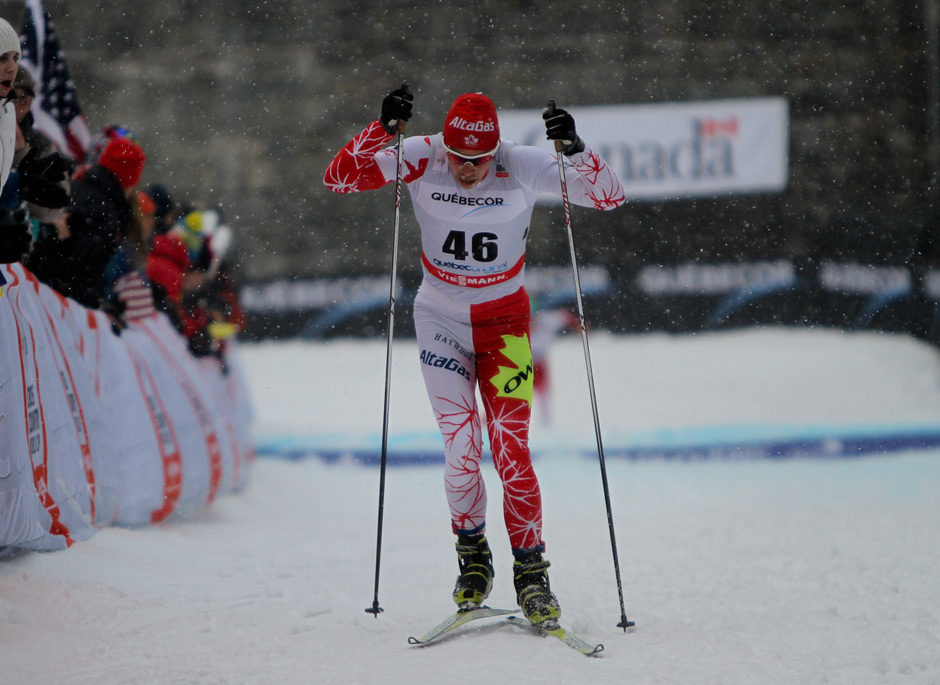
    From the outside, Ryan Scott’s 2012-2013 season seemed to be an inconsistent one. The 23-year-old sprinter for Ski & Snowboard Club Vail/Team HomeGrown started off strong, with a win at West Yellowstone and a podium in Bozeman, Mont, and his early season success earned one of the coveted spots to the Canadian World Cups in December. But in Quebec City he started to lose steam; he got sick upon arrival and didn’t race as he would have liked, taking 60th in qualifying in Quebec and 51st in Canmore.

    By the time Scott got to Soldier Hollow, Utah, for U.S. Nationals, he says he was “a little deflated.” He posted the fifth-fastest classic sprint qualifying time but didn’t reach the finals in either discipline. At the Midwest SuperTours later that month he didn’t make the finals, either, and after taking fourth in the sprint prologue in Aspen, Colo., Scott took a six-week break from racing while many of his peers raced Continental Cups in Europe. At SuperTour Finals he only entered the first two races, taking 26th in the classic sprint after qualifying eighth.

    By Scott’s own assessment, it was not season he’d hoped for.

    “There was really no game plan after January,” he said on the phone on Wednesday. “It was my fault; there was a lack of funds and I was unable to lay out much racing or get over to Europe to compete over there.”

    Despite the down year, Scott is motivated for another season and hopes to bring his sprinting to another level in the upcoming Olympic year. Part of his plan to accomplish this involves taking a trip to Norway for a month this June to train with college friends and travel the country.

    “Summer is a great time to go, because the training isn’t as structured,” Scott said. “It’s nice and sunny for the most part and it’s a break from training in the U.S. There’s different people to training with — new training stimuli — and that’s always exciting… I have a structured plan, I know what I should be doing and the different aspects to focus on, so it’s easy to jump in and do training with other people and have a little bit of an adventure, too.”

    Through connections with old Montana State University roommates and friends from college skiing, Scott will make stops in Oslo, Lillehammer, Trondheim and possibly a few more cities. In Oslo he’ll train with University of Colorado alum Vegard Kjoelhamar and his club, and in Lillehammer Scott will connect with another CU skier, 2013 NCAA Champion Rune Ødegård.

    Ryan Scott
    Scott racing in Canada this December.

    “I guess he’s good friends with Sjur Røthe, so there’s a good training group there,” Scott said.

    To add some competition to the trip, Scott will compete in the St. Olavsloppet, a four-day 350 k point-to-point running relay between Östersund, Sweden, and Trondheim. There are generally 15 people per team and each member rotates through 4 – 13 k legs. Scott participated in the race three years ago on a similar trip to Norway. The race generally attracts a large number of elite and recreational competitors; in 2012 the winning team included Eldar Rønning.

    While abroad, Scott also plans to meet up with his father, six-time Ironman World Champion Dave Scott, and compete in a triathlon “for fun.”

    “I’ll try to be in good shape for it, but I don’t know how much swimming I’ll be doing,” he laughed.

    Scott says that lightly, but he comes from an impressive family of elite athletes. Dave Scott was the most dominant triathlete in the Ironman distance in the 1980s, and Scott’s younger brother, Drew, is beginning to make a name for himself, too — he was second at the USA Triathlon Olympic Distance Nationals last season.

    Scott’s connections to the top level of triathlon begs the question: what ties him exclusively to skiing?

    “The racing aspect in triathlon is pretty exciting as well, but I’ve always been more drawn to skiing,” he said. “The only tough thing with skiing is there isn’t as much of a clear path to the top on how to move up. After a while it gets a little harder…there’s definitely not as much support or money in the sport, which makes it quite difficult, so most skiers I know are working on the side or full time.

    “My heart’s always been in skiing, but we’ll see,” Scott continued. “I’m not going to stick around skiing just to be a decent domestic skier. I think if I don’t break through in the next few seasons I might stop and pick up another profession or switch to triathlon.”

    When he comes back to the U.S. in mid-July, Scott plans to have a fresh outlook on skiing. His big goal this year is to qualify for the Olympics in Sochi, Russia, as a sprinter. He believes it’s difficult to maintain a full race schedule as a sprinter in the U.S., but he’s committed to the shorter distance.

    “I’m going to be focused solely on sprinting,” Scott said. “I think the disparity between distance skiers and sprinters will be more apparent this season. The all-arounders — there’s not much point to it other than the SuperTour leader’s bib, but as far as the Olympics are concerned they’ll be looking at the top in either sprint or distance, so it’ll be tough to sit in the middle.”

    Scott also wants to make it back to the World Cup. His experience in Canada last December was dampened by illness, but he says the exposure to the top level of racing was valuable.

    “It’s very motivating,” Scott said. “It’s just such a difference from our SuperTour races, where you have a few people cheering, to suddenly thousands of people cheering. Just the excitement was a really positive note of being there. So obviously I’d like to train hard and hopefully race fast and have another opportunity to show myself on the World Cup.”


  • Notes and Quotes: Québec Individual Sprint Edition

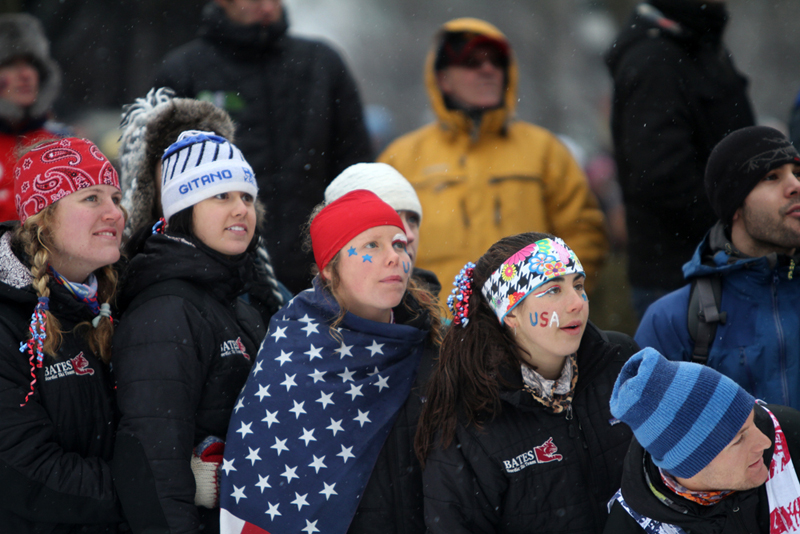
    The Bates College cheering section on Saturday during the Quebec World Cup 1.6 k men’s and women’s skate sprints.

    QUEBEC CITY – There were a lot of North Americans milling around the downtown World Cup sprint venue this weekend, but the ones inside of the fence were doing the most work.

    That’s not to say cheering doesn’t take energy, too. It just taxes different muscles.

    Either way, many racers found the support of thousands of spectators invaluable during the 1.6-kilometer individual sprint on Saturday – even if they didn’t make the top 30 to qualify.

    “It was a tunnel of noise,” said Patrick O’Brien of Vermont’s Craftsbury Green Racing Project (CGRP) after placing 53rd in the prelim. “The closest thing I can think of for me was Dartmouth Carnival at home times one hundred. Everywhere out there people were screaming your name and that was just awesome to have everyone come out. It is good for nordic skiing in general. I think everyone would say that this event was a huge success.”

    That positive feeling was echoed by most competitors regardless of their results.

    “I can’t get over how awesome the crowd is,” said Sylvan Ellefson (Ski & Snowboard Club Vail/Team HomeGrown), after placing 57th.  “The Bates [College] crew being out here again, my alma mater, that was just so loud so powerful going through there. We are in Canada, I’m from the United States, but it still feels like we are on home territory.”

    Eighteen-year-old Corey Stock of the Cambridge Sports Union, who placed 47th in her first World Cup, had a feeling a lot of people would come out for the event, but she had no idea what it would be like.

    “I just feel so lucky to have this be my first World Cup, a city sprint in Quebec with all these Americans cheering,” Stock said. “It was just really cool. My parents are here, my brother is here and the whole Dartmouth Ski Team is here so it is so awesome hearing them cheer on the side of the course. … I couldn’t have asked for a more exciting atmosphere.”

    As for the snow conditions, many North Americans used words like “sugary,” “soft,” and “mushy” to describe them – at least for the qualifier (organizers firmed it up for the heats).

    Jesse Cockney (AWCA) en route to placing 32nd in the Quebec World Cup individual sprint qualifier, 0.25 seconds outside the top 30.

    “Your tips were just cutting through mounds of sugar on all the turns so you tried to keep [them] up on top,” said Reese Hanneman of Alaska Pacific University (APU), who was 61st. “You were trying to hammer, but you’re also doing preventative damage control.”

    “I’m a bigger guy, but I’m a really bigger guy,” said Skyler Davis of the Stratton Mountain School T2 Team (SMS) and U.S. Ski Team (USST) after ranking 69th. “A big guy is like 180, and 25 pounds more …  With this stuff, any little movement your legs die a little bit, it was just so squirrelly.”

    Any experience on similar conditions mattered. Thomsen D’Hont of the Yellowknife Ski Club placed 65th in his first World Cup because of that.

    “I train in these conditions all the time in Whistler [British Columbia] so like the harder the conditions are, the better I am,” he said. “It was hard, but for sure, pretty fun … You can’t just focus on going hard, you have to focus on skiing well.”

    “I definitely went harder than I ever have before,” said APU skier Lauren Fritz, who was 55th in the qualifier. “My feet and shins were pretty tense, which I don’t think helped. … But the energy, oh my God, it’s so exciting. It’s easy to go harder.”

    “It was really tough; I just tried to ski as smooth as possible,” Canadian National Team member Perianne Jones said after placing 38th in her first race since tying her personal-best of 12th in a World Cup sprint in Kuusamo, Finland.

    “I know the course really well, but it’s never been as mushy as this,” she said.

    In his first individual World Cup, Russell Kennedy of the Alberta World Cup Academy (AWCA) placed 45th.

    “I like harder conditions,” he said. “I’m a bit bigger of a guy and the soft isn’t usually good for me, but I thought I skied it good all things considered. I don’t know, it was super fun.”

    Ryan Scott (SSCV/Team HomeGrown) wasn’t so comfortable on the course.

    “Just because we’ve been rollerskiing so much I haven’t had a lot of on-snow time, especially soft snow, not my thing so I’ll definitely be looking for a harder track in Canmore,” Scott said.

    Several skiers would remember the highlights of their weekend, which ranged.

    “I was really excited to race the team sprint,” said Andrea Dupont (Rocky Mountain Racers), who ranked 48th in the individual race after placing 20th in the team sprint with Kate Brennan (AWCA).

    “I hadn’t had an opportunity to do that before on a World Cup so that was really a positive experience,” Dupont added. “The weekend before we got to race with some of the Swiss girls in Canmore and they were actually the team right in front of us and we got to play cat-and-mouse with them which was a lot of fun.”

    While the two hail from different teams, Dupont and Brennan were really looking forward to the Canmore World Cup at home later this week.

    “There’s a lot of tactics on it and I am itching,” Dupont said. “I really, really want to make the top 30 there. This is super fun though. This is an amazing atmosphere and I hope it does something good for North American and Canadian skiing.”

    “I learned a lot just skiing in the different conditions,” said Brennan, who was 54th on Saturday. “Canmore’s been rock-solid this year so we haven’t had a chance to work in slush like this or just the deep pellets. It was cool, Quebec City put on quite a show.”

    “There’s a lot to take away from it,” said Jesse Cockney (AWCA), who just missed qualifying in 32nd. “I mean, just being ready for everything and just being able to go with the flow. The events are so big that things go wrong with them and you’ve got to just roll with the punches and just be relaxed, that’s the big thing.”

    He’s noticed how Canada’s top national-team racers Devon Kershaw and Alex Harvey usually adjust and tried to mimic them.

    “They’re pros at adjusting to jet lag, traveling long days, eating weird food, sleeping in weird rooms,” Cockney said. “I’m getting to the at point but I’m not quite a professional yet. Training with them in the summer helped a lot to see how they live every day. Training is above and beyond everything else for them.”

    That raises the question: what does it take to get to the next level? Holly Brooks (APU/USST), who was 36th said she didn’t have it.

    “It was hard to push it so I was really hoping to come in with a better qualification than that,” Brooks said.

    Ida Sargent (CGRP/USST) charges ahead in bib 1 to start things off in the 1.6 k Quebec World Cup individual freestyle sprints on Saturday. She was 44th in the qualifier. (Photo: FlyingPointRoad.com)

    Ida Sargent (CGRP/USST) placed 44th after being the first starter out on the course and wasn’t satisfied, either.

    “I just was, like, frantic, never found any flow out there and was just really rushed,” Sargent said. “It was tricky conditions. I couldn’t really go hard and get it going. I was struggling out there and I think skiing first I couldn’t focus. I felt like I was just being chased down.”

    Simi Hamilton (Sun Valley Ski Education Foundation) was another USST member who finished short of his expectations in failing to make the rounds. He placed 33rd.

    “I didn’t feel very good, but I just tried to stay light on my feet and just tried to stay upright,” he said after the qualifier. “It’s still early in the season and I never historically skied that fast early on. I was able to qualify in Kuusamo last weekend which is a good sign and hopefully I’ll just keep climbing throughout the whole season.”

    Phil Widmer (AWCA), who was 55th, said he felt like he skied the qualifier “reasonably well,” yet he had to reflect back and figure out where he lost time.

    “I’m not sure if my body was a little bit off or I didn’t technically execute,” Widmer said. “I might have been missing a little snap, but I need to be able to ski through those sorts of efforts. You train all year for it.”

    Dakota Blackhorse-von Jess (Bend Endurance Academy), who ranked 38th, felt much differently with positive feelings throughout the day.

    “This is the first time I felt good this season,” he said. “I’m a big up-and-down guy. When I’m high, I’m really jacked up. [Saturday] morning I wanted to race so everything was perfect. If I was the best in the world, that’s how I think I would feel. It just wasn’t enough today, I guess.”

    Caitlin Gregg of Central Cross Country (CXC), who was 49th, reflected on her race and tried to pick up tips from others.

    “It was tough to decide whether or not it was a high-tempo or a high-power day,” Gregg said. “I think somehow giving good powerful strokes, but obviously not bogging down, it’s a finessing of the ski. I could definitely tell some girls were pretty good at that.”

    One of her highlights was watching Kikkan Randall, whom she placed sixth with in a team sprint at the 2010 Olympics, win the team sprint in Quebec City.

    “That team is destined for big things,” she said. “That was sweet to watch.”

    Personally, she said the experience was great and an affirmation that her training was working.

    “This is why we do it weekend after weekend in the states to earn our berths over here,” she said. “Every time I come to these I’m reenergized for the next training or the next race cycle or whatnot. This is what you think back to when you’re training in the summer time and in the nasty fall weather. This is the best.”

    “Oh my God, it’s like a dream,” said APU skier Kate Fitzgerald, who was 52nd. “Especially to watch Jessie and Kikkan win. I was like, ‘I just watched history and I got to be here in person, too.’ ”

    “I went to bed last night and I was like, ‘Wow this is incredible what I’m getting to do,’ ” Kennedy said. “Especially downtown Quebec with all the spectators and stuff, it’s the first time I’ve been to a nordic race and felt like it’s a real sporting event, almost like a football game or something. It’s an unbelievable experience.”

    ***

  • Hello, World Cup

    Hello, World Cup

    The Quebec City sprint course is practically designed to make competitors feel like rock stars this Friday and Saturday during the much-anticipated World Cups. Photo: Ryan Scott.

    A rare opportunity presented itself this season for a higher than usual number of American athletes to compete in the two World Cups in Canada this December. For many of the best domestic-level athletes in the country, it was the chance to break into the next level and compete for the U.S. on the biggest stage there is in cross-country skiing. Earning one of those start rights became the focal point of the season for SuperTour athletes who thought they had a shot at making it.

    For American athletes in Quebec City about to compete in their first World Cup, that dream became a reality last week in Bozeman, Mont. Two hard-fought sprints later and just like that: they’re here. Hello, World Cup.

    “It was certainly stressful having such important races right off the bat this season,” said Alaska Pacific University’s Kate Fitzgerald “Had a few restless nights wondering how things were going to turn out.”

    Athletes learned they had made it in fittingly dramatic fashion: while lining up for the final race in Bozeman last weekend. U.S. Ski Team Head Coach Chris Grover emailed successful qualifiers the morning after the classic sprint, but at the remote, service-less Bohart Ranch the day of the mass start event, some athletes didn’t see it before departing for the venue.

    “When I heard…I was absolutely floored,” said Crafsbury Green Racing Project’s Pat O’Brien. “I got the news from some of the other athletes that had made the team right before the distance race. Needless to say it was a huge relief going into the last race in Bozeman!”

    The APU contingent found out from a teammate at about the same time.

    “Brent Knight came running up to us ten minutes before the 10 k classic and told us the list,” said APU’s Becca Rorabaugh. “It was a great boost to hear about it before we started; it certainly took the pressure off!”

    “I started yelling and whooping and giving all the girls high fives,” Fitzgerald said. “I was so excited! I knew it was going to be close so it was all the more exciting when I found out that I made it.”

    The cold, hard math of the selection criteria made the last few available spots heart-breakingly close. A single SuperTour point separated the last female who qualified from the first one that didn’t. Two points made that difference in the men’s field.

    “I was ecstatic upon hearing that I had officially made the World Cup team,” said Ryan Scott (SSCV Team HomeGrown). “I had such a disappointing classic sprint race in Bozeman that I thought for sure that I had lost my only opportunity to qualify with that one poor performance.”

    Now that they’ve made it, however, the real work begins. Simply wearing a World Cup bib is not enough; these athletes want to compete. In the words of Reid Pletcher, “TIME TO THROW DOWN!”

    Presenting the Americans who fought tooth-and-nail to make their first Eurosport appearance this Friday and Saturday — their hopes, dreams and aspirations. (For the full list of Americans competing in Quebec this weekend, look over here.)

    Get your cowbells ready.

    __________

    Erik Bjornsen (APU)

    The Methow Valley native has been on the U.S. Ski Team development squad for over a year, but this will be his first World Cup appearance. With a second and third-place showing in the Bozeman sprints, he was pretty clearly going to be on the Quebec roster. Still, Bjornsen said it was satisfying to officially meeting the season-long goal.

    “I was so excited to be named,” Bjornsen said. “It has been my goal since the beginning of the summer.”

    The 21-year-old turned down World Cup start spots last season because he didn’t think he was quite ready. “Now I think I should have a pretty good shot of mixing it up with some guys and I hope that in a couple years I will be a full time World Cup athlete,” he said.

    Bjornsen is approaching the Quebec races like he would any other.

    “I’m doing my usual training leading up to the races,” he said. “I’m sure I will start getting more nervous tomorrow but for now I’m just really excited to be here experiencing it. Quebec City seems really cool and it’s nice to be back with some of the USST crew.”

    __________

    Reid Pletcher (Sun Valley Ski Education Foundation)

    This is his first year out of college, but the Hailey, Idaho, native has already skied twice on the World Cup before: first in Canmore in 2008 at the age of 19 and again in Whistler in 2009. Quebec won’t be his first rodeo, but Pletcher is just as excited about the prospect of racing there as anybody else.

    “I would say I am most excited for the crowds and cheering,” he said. “There is nothing like hitting the last 100 meters and you can’t even focus because the noise is so overwhelming.”

    Pletcher was 35th and 37th, respectively, in Canmore and Whistler. He skied to his best SuperTour sprint result in Bozeman last weekend, and coming off the confidence of the win he wants to see action in the rounds in both Quebec and Canmore these next two weekends.

    “My goals for the next two weeks are to qualify for the heats and be in the mix of things,” he said. “My goals this season were to prove to myself and my competition that I have what it takes to be very competitive in professional skiing. Last week I had my best SuperTour result ever, and the World Cup makes it even more amazing.”

    __________

    Reese Hanneman (APU)

    With his classic sprint victory on Saturday, Hanneman all but guaranteed himself a ticket to Canada. It won’t be his first time on the World Cup stage, having competed in Canmore in 2010, but that didn’t make the moment he realized he was going any less meaningful.

    “When I actually saw my name on the list, it was a mix of excitement and calm,” Hanneman said. “It’s something that I had as a goal for such a long time, and I have spent so much time and energy trying to actually do it, and so to complete that objective gives you a sense of completion.”

    Like Bjornsen and Pletcher, Hanneman has moved past the initial excitement and says he’s ready for World Cup action — “Now I’m just so amped up!”

    In Canmore in 2010, where he was 70th, Hanneman was “inevitably nervous and star-struck,” he said. “Now I feel like I will be in a much better place mentally, having a lot more international racing experience and just more high level racing. My goal is to be able to just keep myself calm and go about business like its just another race, albeit an important one.”

    __________

    Skyler Davis (SMS T2/USST)

    Davis’ World Cup debut in 2011 didn’t go as planned thanks to mono, but it’s a different year and different season now: with a new coach and new team, Davis is feeling good about where he’s at.

    A slight cold held him back in Bozeman, but now Davis says he’s back to feeling 100% headed into the big show, and has a top-30 in his sights.

    “My biggest goal is to make it into the rounds,” Davis said. “I believe I’m capable, just have to put it together.”


    __________

    Pat O’Brien (CGRP)

    Craftsbury went to more training camps this summer in order to push its intensity with people from around the country, and for Pat O’Brien, the work paid off.

    “Obviously being my first World Cup, I am simply excited for the experience,” he said. Other than a few FIS races in Europe this will also O’Brien’s first significantly international race.

    “So much of ski racing is seeing that higher level and figuring out how to get there. The US girls have shown this year that there is no reason the American skiers can’t succeed on the big stage. It’s just a matter of hard work and believing in it.”

    He has performance goals, but believes the World Cup exposure will be more valuable than anything. The atmosphere will probably be pretty cool, too.

    “You know that everyone will be showing up and cheering like mad, especially for Alex Harvey. If he had a helicopter following him at Canadian nationals, imagine how nuts it’s going to be for a World Cup city sprint! I think this is great for the sport, to show Europeans that yes, skiing may not be the biggest sport here in the US or Canada, but it is a sport on the rise and something people care hugely about.”

    __________

    Ryan Scott (SSCV Team HomeGrown)

    The Boulder, Colorado, native spent a lot of time working on his skate sprinting this summer specifically for the purpose of competing in Quebec. “My emphasis all fall was to develop true speed for flat terrain,” he said.

    A few man-made bumps represent the only climbing on the city street course, which suits Scott just fine. “I do think this course…suits my skiing skyle and so I know that I will be prepared for a good performance. The first SuperTour races of the season were a great warm-up for these races.”

    Like his countrymen, Scott has high expectations — merely qualifying is not enough, he’s looking for a top-20.

    “Racing at such a large venue as in Quebec will be unparalleled to anything I have experienced in the U.S.,” he added. “The crowds provide great motivation so that will be something that I look forward to most. The team sprint will be an excellent chance to test my fitness and stay competitive with the rest of the field.”

    __________

    Dakota Blackhorse-von Jess (Bend Endurance Academy)

    Blackhorse-von Jess found out a little bit after everyone else that he would be going to Canada, as a new spot became available when Torin Koos declined the trip. He and coach Ben Husaby thought for a moment whether they’d be able to make it work, but realized “there aren’t any drawbacks to going and this is living the dream the way we all envision it,” Blackhorse-von Jess said.

    The Bend native has been to the big show before. In the Whistler World Cup in 2009, he was 34th in the classic sprint. As the last name on the qualifying list this year he has just the individual race to turn in the performance he wants: a top-30. In 2009 he says he let the whole production get to him; this time he knows what to expect.

    “I’m here to compete. You don’t get a lot of opportunities (they are few and far between with a lot of talented athletes competing for them) so when you get a chance like this, you have to do everything with it you can,” Blackhorse-von Jess said.

    “From watching Simi [Hamilton]’s career as a World Cup skier, it’s pretty clear that being off even a little can end a day early, but also that there is a completely reasonable expectation for success, even with little or no World Cup experience. So the plan is to go out there and qualify as fast as I can. It’s time to quit being a little conservative during qualifying and push deeper. Find that extra bit I’d normally save and push it as far as I can. This field isn’t looking like the normal weakened North American field of the last few years, so every hundredth could make the difference.”

    __________

    Sophie Caldwell (SMS T2)

    With numerous Junior World Championship trips under her belt, Caldwell is no stranger to high-profile international skiing. But this is the big-leagues, and as it will be the first World Cup of her career, she was thrilled when she heard she’d made her biggest early-season goal.

    Now that she’s here Caldwell is not sure where she’ll stack up, but is looking forward to turning in the best race she can.

    “I’m really looking forward to racing in the city,” she said. “Sadie [Bjornsen] told me the city sprint is the most I’ll ever feel like a celebrity in my life! I have a lot of family and friends coming up so it will be fun to see everyone and hopefully I’ll have some good races.”

    __________

    Lauren Fritz (APU)

    Fritz has seen Alpen Cup and OPA Cup-level skiing before, but this will be her first World Cup experience.

    “I’m pretty psyched to be here,” she said. “It took a while to process that I actually made the cut, but it was exciting to get the news with my teammates who also made it. There were a lot of high fives.”

    Once she takes to the snow in front of the Parliament building, Fritz says she’s going to go out and ski the best race she can.

    “Hopefully the results will be good. I have a tendency to do pretty well when I have no real expectations because I’m just psyched to be skiing and I’m more relaxed,” she said.

    “I think Quebec is going to be awesome because there are going to be a lot of fans here cheering for the Americans — family, friends from the East coast driving up, etc — and i’ve never done a race that is packed with fans the entire way.”

    __________

    Corey Stock (Dartmouth/Cambridge Sports Union)

    The 18-year-old from Massachusettes has done it again, and skied much faster than where her experience level would have predicted. It must be time to get used to it.

    The Dartmouth freshman focused her training this summer, spending time with APU on Eagle Glacier to give herself competitive training partners and quality on-snow time. Based on her third-place finish in the Bozeman classic sprint, which was thisclose to being a place or two higher, Stock clearly knew what she was doing. Now she’s in Quebec for her first World Cup races.

    Stock is a fierce competitor, but once the bib comes off after a race she’s all happy excitement, and makes a point of soaking in every part of her experience. It’s just a hunch, but we’ve a feeling the World Cup scene will be a commonplace one for her down the road.

    __________

    Becca Rorabaugh (APU)

    The Alaskan competed in the Canmore World Cup in 2009, where she was 59th in the classic sprint. Though she says she’s been a bit more tired than usual this fall, she’s worked more recovery into her preparation to be ready for Quebec. Rorabaugh certainly has a handful of international races under her belt, so she knows what she’s in for.

    “I was really relieved to hear that I was going. I knew I must have been close,” she said. “I really hope to improve on my last sprint place in Canmore, and I am so excited to be around a city sprint atmosphere!”


    __________

    Kate Fitzgerald (APU)

    It’s always thrilling to watch Ftizgerald race because every time she puts on a bib, she pushes herself just a bit further over the edge than those around her. Her reaction to finding out she’d made the Quebec team demonstrates why: it means that much.

    Now that she’s in Canada for her World Cup debut, Fitzgerald is taking in every part of the event.

    “The whole experience is so new to me so I do not really have many expectations,” she said. “My plan is to enjoy this incredible experience, soak it all in and see what it is like to be a World Cup skier! And on race day I plan to approach it like I do any other race- work hard and try my best. Only in these races I get the unique opportunity to see where I stack up with the best skiers in the world!”

    __________

    Caitlin Gregg (CXC)

    Unlike the rest of the Quebec qualifiers from the SuperTour, Gregg has seen her fair share of World Cup, World Championship, and Olympic-caliber racing. She was on her way to making the switch to post-skiing life this summer when she realized, after taking four months off of training to go to school, that she missed the sport too much to leave it quite yet.

    “With such a short amount of time to prepare I feel very fortunate to have skied as well as I did in Montana and to be heading to the World Cup,” she said.

    Her goals now are simple: to ski the best she can.

    “The US women are so strong right now on the World Cup and that excitement and enthusiasm is contagious,” she said. “I fell like I am racing in the company of celebrities and they are from the USA! The atmosphere of the City will bring an amazing amount of energy to the races.”

  • Pletcher Comes From Behind to Take Skate Sprint in Bozeman

    Pletcher Comes From Behind to Take Skate Sprint in Bozeman

    Reid Pletcher, victorious in the first true sprint of the season in Bozeman, Mont. Erik Bjornsen (left) was second and Ryan Scott (center) took third.

    BOZEMAN, Mont. — A certain excitement hung in the air at Bohart Ranch on Thursday morning. Perhaps it was because this was the first true sprint of the season. Maybe the field was happy to finally contest the event that was cancelled last weekend. Sprinting in its true, head-to-head format was also a long time returning to the beginning of the SuperTour calendar. Expectations were most certainly piqued with several World Cup qualifying spots up for the taking.

    When it was all said and done — the qualifying, the heats, the nervous skiing around between races — Sun Valley Ski Education Foundation’s Reid Pletcher came out on top, just edging out Erik Bjornsen (APU/USST) and Ryan Scott (SSCV Team HomeGrown). Alex Howe (Craftsbury Green Racing Project) finished a close fourth, Skyler Davis (SMS T2/USST) took fifth and Torin Koos (BSF/Rossignol) straggled in sixth.

    Pletcher finishing with Howe in the earlier heats.

    Pletcher flew under the radar throughout the morning, qualifying in fifth and never once winning a quarterfinal or semifinal. Even in the final round he followed the leader and tucked in behind Scott, who had dominated each of his earlier heats and did the same in the early stages of the final. Pletcher hadn’t even expected to make the last round, and at that point was simply skiing to hang on.

    “I was hoping for a top twelve,” he said. “I mean, I have a decent history in sprinting, but I haven’t done heats in years because of college racing [for Colorado University].

    “I’ll take this one, for sure. [The Quebec World Cup] would be amazing. All my goals are coming through, so I feel pretty good about this. I needed a good result to show me I was on track.”

    Earlier that morning, Pletcher finished second to Scott in his quarterfinal just ahead of Sam Naney (Methow Olympic Development/Madshus). In the semifinals he scraped through in third thanks in part to crashes that took out Rune Odegaard (Colorado University) and Pat O’Brien (Craftsbury Green Racing Project). All day long, Scott and Bjornsen made it look easy and Pletcher seemed to require more of an effort to survive each round. Or perhaps that’s just his style of skiing.

    “I was thinking for the final, I’m not going to have the energy for it, I’m just going to try to hold on.” Pletcher said.

    The men’s final leaving the line.

    He managed leave the double pole zone in second, but Scott quickly gapped the field and there was no drafting him. But before long he and Davis, who ended up in fifth, worked together and caught back up in time to catch a pull down the final hill.

    “I had the advantage on the downhill, and there was a strong headwind into the finish,” Pletcher said. “It just worked out. I had a little draft and did a little slingshot move coming into the finish. It went better than planned. It was phenomenal.”

    The difference between the top three was slim, but the win was definitive enough for Bjornsen to look sideways in the last stretch to see Pletcher with his arms already raised in celebration.

    A new International Ski Federation (FIS) rule gets rid of the penalty for changing finish lanes and Bjornsen made the most of it, first choosing the line behind Pletcher and then traveling left in front of Scott’s. In the end, though, Pletcher simply had too much momentum.

    “I’m always going for the win, but second is awesome so I’m pretty happy about that,” Bjornsen said. The USST D-Team member dug his way out from the back of the pack early on to first pass Koos, then Davis, then Scott.

    Bjornsen easily sliding through his semifinal.

    “I took it slow, so I felt I had quite a bit of energy left, and got past this big kid [pointing to Davis] on the flat section before the finish. Ryan was kind of dying, so I got past him. I was happy; it was fun.”

    Scott, who won the qualifying round and breezed through each of his heats without needing to exert much energy in the finish, said that he may have ultimately underestimated the men who lined up next to him in the final.

    “I had a lot of confidence coming out of last week,” Scott said. “My goal was obviously to win today; I just didn’t quite play it right in the final.”

    After skiing so easily through the rounds, Scott set out to immediately put distance between himself and the field in the last one.

    “I sized up the guys I was against and thought my best bet was to try to break [them], because I know they’re real quick in the finish,” Scott said. “I thought perhaps if I could string them out, and I’ve been feeling good, then I could maybe break them. The other heats I never had to finish very hard because I was able to break the group earlier, but not so much in the final. I underestimated the speed of the group a bit.”

    Scott, leading Davis and Pletcher, coasting through the end of the semis.

    Not appearing too put out, Scott concluded that he’d simply take Thursday’s performance as fuel for the next race, a classic sprint on Saturday.

    In fourth place, the domination of the SuperTour rookies continued with Alex Howe (Craftsbury Green Racing Project). The University of Vermont alum qualified in sixth and next won his quarterfinal, beating Pletcher. In the final he got boxed out and stuck at the very back of the pack, but bided his time and slowly moved up. Howe’s expectations earlier that morning had simply been to advance.

    “I really just wanted to be able to qualify and ski more than once,” Howe said. “So I was really happy.”

    Davis, in fifth, gave his result a “six out of ten.” He skied in second or third for most of the race but built up lactic acid in his legs so that, by the end, he was running on steam and upper body strength.

    “I came up into the finish and my legs were just gone,” he said. “It did anything to try to stay with these guys.”

    Koos, once unbeatable in any given sprint, has been battling illness recently and finished the final behind the field with his arms on his knees and his head down. The image is perhaps emblematic of a changing of the guard that seems to be taking place on the domestic circuit — the top five male sprinters on Thursday were all 24 years old and under.

    “I’m definitely excited to see younger guys skiing fast and coming through now,” Scott said. “I think it definitely bodes well.”

    Official results.

  • Scott Shakes Off Distance Race to Win West Yellowstone Prologue

    Scott Shakes Off Distance Race to Win West Yellowstone Prologue

    Ryan Scott (SSCV/Team HomeGrown) bringing it home for his first career win at the West Yellowstone SuperTour prologue on Nov. 24.

    WEST YELLOWSTONE, Mont. — Friday’s distance results in the first SuperTour of the season weren’t easy for everyone to swallow, especially not Ryan Scott of Ski & Snowboard Club Vail/Team HomeGrown.

    His coach Eric Pepper racked it up as a bad day. “He went out a little hard, blew up pretty hard [and] didn’t have great legs,” Pepper said on Saturday.

    Still, seeing he ranked 78th in the 9-kilometer skate individual start hurt.

    “That was embarrassing,” Scott said after finishing more than 2 ½ minutes behind first. Fortunately, he could seek some redemption in Saturday’s 1.6-kilometer freestyle prologue.

    Scott skating to a victory at the West Yellowstone prologue on Nov. 24.


    With just one shot in the point-to-point race, he could go all-out and try for a drastically better result. More than jump 70-plus places, he wanted to win.

    Scott successfully took the top honor for the first time in his skiing career, clocking 3 minutes, 0.96 seconds on the South Plateau course. He beat Erik Bjornsen of the U.S. Ski Team (USST) and Alaska Pacific University by 2.33 seconds.

    David Norris of Montana State University (MSU) and Mikey Sinnott (Sun Valley Ski Education Foundation) were just 0.01 seconds apart in third and fourth, respectively. Skyler Davis of the USST and Stratton Mountain School T2 Team, who was 105th on Friday, improved 100 places to finish fifth.

    In the men’s prologue, second through fifth place were separated by just 0.68 seconds.

    While Scott welcomed the victory, after never having won a SuperTour, International Ski Federation (FIS) or college race, it was more of a primer than anything.

    Low snow at the Rendezvous Ski Trails in town forced organizers to change the sprint format earlier in the week from sprint rounds to a prologue. The snowmobile trails on the plateau couldn’t sustain full sprints: they were neither wide enough nor conducive for getting athletes from the finish back to the start multiple times.

    The prologue didn’t count toward SuperTour standings and qualifying standards for the upcoming Canadian World Cups, but it was FIS-sanctioned and good practice for the Bozeman SuperTour freestyle and classic sprints as World Cup qualifiers next week.

    Either way, the 23-year-old MSU graduate was excited to drastically improve on his distance performance with his first win.

    “It was a solid effort,” Scott said. “I felt real quick, and yeah, it went well. I had a lot of confidence going into this course, being that it was so quick and flat, and the finish was pretty good, only a slight uphill, so I thought it could be a good day.”

    It turned out to be a great day for Scott, who finished 11th in the SuperTour sprint rankings last year. The course was one he and some 175 other competitors – male and female – were familiar with. It ended where they started Friday’s race, which meant one gradual climb to the finish and mostly flat before it.

    Unlike full sprints, where racers tend to conserve energy through the rounds, a prologue required a maximal effort. Pepper said he hadn’t expected Scott to win, but he didn’t rule him out, either.

    “He’s better in rounds than qualifying,” Pepper said. “This shows he’s been working on qualifying, so for him to have a good day like that is great.”

    Erik Bjornsen (APU/USST) puts it into high gear in the finishing stretch to place second at the West Yellowstone prologue on Nov. 24.
    At the same time, he was particularly impressed Scott could outdo a stacked field in which the top 20 finished within 10.21 seconds of one another.

    “A win is a bonus really,” Pepper said. “It’s impressive, those first 20 or 30 guys, they’re all really good. To get on top of that group when only a couple of top guys aren’t there feels great.”

    Even though Friday’s race didn’t cater to his strengths, Saturday’s result was a major boost moving forward.

    “It’s fairly rewarding to be able to come out and race fast today,” Scott said. “I know I can still kick it in gear and move pretty quick so that’s kind of what I’m shooting for. I’m glad I was able to perform well enough today and we’ll see, end of next week for the rounds and whatnot, the races up in Bozeman.

    “I’ve been really training for sprint this year,” he added. “I’m hungry.”

    Bjornsen as the runner-up tied his best SuperTour result – even though Saturday’s race wasn’t technically a SuperTour – since placing second in last year’s 15 k classic in Bozeman.

    He said last year wasn’t his best as far as sprints go (although he did place third in a NorAm classic sprint at Sovereign Lake, B.C.), so he made that a priority this year. Considering Saturday didn’t have World Cup implications, he used the prologue to try a few things.

    Mikey Sinnott (SVSEF) en route to a fourth-place finish.

    “I warmed up pretty hard and the goal was to go out hard and hammer the V2 alternate on the flats,” Bjornsen said.

    After the race, he spoke with some people who said they did some tuck skating. He didn’t do any of that, he said, just tall V2-ing to make every stroke count.  When he reached a road sign a few hundred meters from the finish, he focused on turning it on. With 100 meters to go, Bjornsen searched for the finishing kick he usually has, but it wasn’t there.

    “I knew that I left it all out there,” he said. “I actually ended up throwing up a little bit [after], but I definitely laid it all out there which I’m happy about.”

    While Bjornsen might have been pegged as a favorite, Norris was a sprint surprise finishing 2.72 seconds behind Scott.

    David Norris (MSU) racing to a third-place finish.

    It’s not that Norris hasn’t logged impressive results; he was second in the 20 k classic at NCAA Championships in March for MSU’s first-ever podium. The 21-year-old was second in the 30 k mass start at U.S. nationals last year and third in the Bozeman SuperTour 15 k classic behind Bjornsen.

    But a sprint podium?

    “I always want to win, so I was just going for that,” Norris said. “I just went hard right from the start. I was trying to hang on that last hundred meters.”

    He held on just enough to edge Sinnott, who was second to Sun Valley teammate Reid Pletcher in the West Yellowstone freestyle prologue last year. Preliminary results listed Davis in second, Norris in third and Bjornsen in fourth, but once timing data updated and results became official, the final standings came through.

    Just 0.29 seconds off the podium, Davis felt like he had a great race. The uncharacteristic leaping and shouts from his Stratton coaches indicated he was on the right track. With 100 meters to go, Kaeding was yelling for him harder than he’d ever heard, Davis said. Earlier in the race, program director Sverre Caldwell gave him a “woo hoo!” and jumped as he passed by.

    Skyler Davis (SMS/USST) in the finishing stretch of the West Yellowstone freestyle prologue. After thinking he was second initially, he ultimately placed fifth.

    “I was like, ‘I’ve never seen that so I better keep going real fast,’ ” Davis said after the race.

    While warming up, he laid out a pretty distinct game plan. Only one downhill made the course tough so he needed to build momentum fast and stay smooth. Like Bjornsen, that “little squiggly sign” was his cue to go hard.

    “I put it down from there and I saw the hundred meter and it was like, ‘Wooo, [then], uh oh, it’s hurting bad, like, really bad,’ ” he recalled. That’s where Kaeding’s presence helped him.

    “More than results everybody had kind of check marks they wanted to do, little process goals,” Kaeding said of his team, which included women’s prologue winner Sophie Caldwell. “Checked those all off. Everyone was happy with how those went. The results take care of themselves.”

    — Audrey Mangan contributed reporting

    ***

    Complete results (scroll down for men)

  • SuperTour Preview: Get ‘Em To the World Cups

    SuperTour Preview: Get ‘Em To the World Cups

    The major focal points for the SuperTour field this year are qualifying for the Canadian World Cups in December and World Championships in February. Photo: Flying Point Road.

    Ready or not, the 2013 SuperTour season is fast approaching. Here’s what you need to know about the domestic race scene this year.

    At this point, we’ve pretty much said everything we can about the twelve senior ski programs in the U.S. We ran a series throughout the summer highlighting each team’s past accomplishments and goals for the future. Read back through ‘em for comprehensive rosters and standalone previews (scroll down for links). Now that it’s November, it’s time to discuss who stands a shot at beating whom.

    First, there are a few unusual things about the race schedule to understand, as domestic results have an important role to play in qualifying athletes for bigger things this season. The U.S. can enter more athletes than usual in each World Cup race in Canada and can have eight athletes of each gender on its World Champs team, meaning that U.S. Ski Team (USST) members have a shot at top-end international competition this winter (those on the USST are not guaranteed World Championship slots, either).

    Not surprisingly, the big focus is a combination of Canadian World Cup starts and World Championships. The overall, sprint and distance SuperTour leader(s) at the end of each competition period get World Cup start rights no matter what year it is, but being consistently fast enough to be in one of those positions is hard.

    The five extra Nation’s Group spots afforded to the U.S. for each of the Quebec and Canmore World Cup races will be partially filled based on the SuperTour standings after the Bozeman races. With selection criteria theoretically reaching further into the field and requiring just two weekends of top results, the international stage suddenly seems much closer and more attainable. Who cares if SuperDario Cologna won’t be there, it’s still the World Cup!

    World Championship criteria are a slightly different story, but early SuperTour races could still help decide who gets to go. The U.S. will bring up to eight men and eight women, with the first spots going to athletes who reach a certain World Cup ranking by January 14. After that, USSA goes down the National Ranking List, which is created off of competitors’ best four USSA-scored races from the twelve months prior to the selection date.

    The road to Val di Fiemme, then, has already begun. The beginning of the current SuperTour and the week’s worth of racing at U.S. Nationals are further opportunities for athletes to turn in one of their four-best results and move up the ranking list.

    Consequently, there’s a lot potentially riding on the SuperTour this year, despite the continued absence of leader bonuses at the end of the season. It’s not that everyone wasn’t trying hard before, but with a handful of top-level start rights on the line that only come around every so often, things could get feisty. Dreams will come true and hearts will be broken.

    Now, the players: last year’s overall SuperTour leaders, Sylvan Ellefson (SSCV Team HomeGrown) and Jessie Diggins (SMS T2/USST), are already in Europe and out of the domestic picture for the next two weekends. Even so, the potential lineups for West Yellowstone and Bozeman are impressive.

    The Rookies

    Eric Packer (DAR). Photo: Flying Point Road.

    For the purposes of this preview, athletes can pretty much be divided into two groups: knowns and unknowns. Every spring a handful of top-tier college skiers graduate and the domestic circuit gets an injection of new blood. Most graduates have competed in SuperTours before, but not when it’s actually been their job to ski fast.

    So while the rookies aren’t joining the circuit as complete unknowns, their changed training circumstances can make the first results of the year a bit of a surprise. The 2012-2013 freshman class has generally never trained without academic demands competing for their time, and given the results they’ve been able to churn out even during school, count on them disrupting the status quo on the SuperTour this year.

    Take Eric Packer, who joins the SMS T2 team from Dartmouth College and already has a handful of SuperTour and national podiums to his name. Packer was probably the most consistent college performer, sprinting and distance-wise, on the circuit last year, and could be ready for a significant step forward in his transition to full-time racing.

    Reid Pletcher (CU) winning the skate sprint qualifier at West Yellowstone, 2011.

    There’s also Reid Pletcher, who has been described as a “sprint fiend” and returns to skiing for Sun Valley this winter after graduating from CU. Remember how he won the skate sprint in West Yellowstone last year, just six months after a climbing accident landed him in the ICU? Yeah, that was ridiculous. Imagine what he might do this winter with a strong summer of training behind him.

    Ryan Scott will be another sprinter to watch for. Regardless of the whole obstruction controversy, he was still in the classic finals at U.S. Nationals. At U23s he was the top American performer in the freestyle sprint. He didn’t race a whole lot after that, but his coaches at Ski & Snowboard Club Vail think he’s looking mighty fast in the run-up to the first race of the year.

    In the women’s field, newcomer Sophie Caldwell (SMS T2) presents the greatest threat to the usual SuperTour standbys. Amy Glen (Craftsbury Green Racing Project) did beat her by a toe-length at the biggest college race of 2012, but the name Caldwell regularly shows up at or near the top of the results sheet week after week — whether it’s Sophie or one of her equally fast relatives.

    The Upperclassmen

    Though they represent relatively known quantities, the more seasoned SuperTour athletes are no less intimidating for it. They’ve been around the block and they know what it takes to be at the top of the domestic field.

    Jennie Bender (CXC) was the second-ranked woman on the SuperTour last year, and stands a good chance at leading it in winter with Jessie Diggins now in Europe. Photo: Flying Point Road.

    Central Cross Country (CXC) was indisputably the best all-around team last year, and won the National Nordic Foundation’s team trophy in a landslide to prove it. The Midwest squad has lost a few athletes and coaches to other programs since last spring, but still claims four athletes ranked in the top five on the SuperTour in 2012: Jennie Bender, Karl Nygren and Caitlin and Brian Gregg. Look out for their fire engine-red spandex when the gun goes off.

    The next team to mention is undoubtedly Alaska Pacific University (APU). Sadie and Erik Bjornsen (APU/USST) are both racing stateside this November, and present a formidable threat when united with the rest of their teammates. Kate Fitzgerald, Becca Rorabough, Rosie Brennan, Reese Hanneman, Peter Kling — the Alaskans have a lot of returning talent. Thanks to Eagle Glacier, they’ll also be stepping onto their skis with more on-snow hours under their belts than anyone else.

    From the Bridger Ski Foundation, Torin Koos and Leif Zimmerman present solid all-around threats. Zimmerman has traditionally pulled off a distance win at West Yellowstone every year, and Koos will no doubt be looking for redemption for getting erased from the results the last time he raced in the U.S. When we spoke with him in June, Koos said that every day he thinks about the Canadian World Cups more than anything else.

    He’s probably not the only one. Mikey Sinnott (SVSEF), after finally earning his first World Cup starts in March, will be raring to get back. With two real, actual, sprints on the schedule in the first two weeks, Sinnott should be in contention to go to Canada. His teammate Matt Gelso is another name to watch in both sprint and distance. Representing Sun Valley’s women, Chelsea Holmes is coming off a strong finish to her 2012 season, where she was fifth in the 30 k at distance nationals.

    Matt Liebsch (Team Strong Heart/Team Birkie) skiing to the finish. Photo: Flying Point Road.

    Racing for Team StrongHeart/Team Birkie, Matt Liebsch is a perennial distance challenger. He took second in the 15 k freestyle at nationals and usually puts up solid distance results at the opening races. This year he’s been training in West Yellowstone longer than anyone getting ready to hit the ground running on November 23.

    In the east, the CGRP has another impressive lineup. Tim Reynolds and Pat O’Brien both finished the season strong at distance nationals and will want to continue the trajectory in 2013. To the north, Maine Winter Sports Center’s Welly Ramsey has been logging the hours with Kris Freeman and apparently been able to keep up at times, which can only be good for his skiing. Skyler Davis will be on the domestic circuit for the first period, at least, and could be a sprint contender for SMS T2 if he’s in full form.

    From Oregon, Dakota Blackhorse-von Jess (Bend Endurance Academy) proved last year he is not to be overlooked on a sprint day. And with more of those legitimately on the SuperTour schedule this year he’ll have plenty of opportunity to contend in the heats. XC Oregon added Santi and Carolyn Ocariz to its roster this year, and returning skiers Matt Briggs and Ollie Burruss will be looking to top their career-best SuperTour finishes from last season.

    That’s a lot of skiers entering the starting gate this week, and this list doesn’t even include everyone. At some level, each athlete is trying to do the same thing: ski better than they ever have before and hope that it’s enough to break through to the next level. The trouble is, they’ll have to get around each other first.

    * * *

    For more in-depth discussion of each team and its athletes, read FasterSkier’s features from this summer:

    Alaska Pacific University Nordic Ski Center | Bend Endurance Academy | Bridger Ski Foundation | Craftsbury GRP | CXC | Far West Farm Team | Maine Winter Sports Center | Methow OD | SMS T2 Team | SSCV Team HomeGrown |  Sun Valley SEF | XC Oregon

  • USST Elite Camp: Wrapping up with Natural Intervals, Final Thoughts

    USST Elite Camp: Wrapping up with Natural Intervals, Final Thoughts

    The Lake Placid USST Elite Camp concluded Friday with morning ski running/bounding natural intervals at Mt. Van Hoevenberg (shown above) and a distance double-pole session in the afternoon.

    LAKE PLACID, N.Y. – Friday morning’s U.S. Ski Team workout at the Mt. Van Hoevenberg nordic trails wasn’t designed to be too hard. According to men’s coach Jason Cork, the idea was to run with poles and ski bound for 45 minutes at Level 3 – a sort of tempo pace.

    Once a couple dozen athletes between the U.S. Ski Team (USST) and National Elite Group (NEG) got going around the designated loop, most realized what they were in for. Two weeks of dryland training at the USST Elite Camp in Lake Placid had taken its toll on their bodies, and on the last day of camp, they had to tackle Russian Hill – three to four times.

    Cork said he’d noticed the group’s fatigue levels increase throughout the last few days, especially during warmups.

    “You can see people are getting a little sloppy; you can tell they’re getting pretty fatigued,” he said. “But that’s kind of the whole point of having a training camp, you get the best guys together and have them kind of push each other a little bit and have an easy week afterward.”

    Friday afternoon, several athletes took part in the camp’s final workout – a 1-½ hour double pole – which USST head coach Chris Grover said was more of a recovery.

    According to Grover, the morning session was considered threshold-intensity, natural intervals. He went on to explain in an email how those intervals work.

    “The terrain dictated when the athletes were working harder (uphills) and going easier (downhills and flats),” Grover wrote. “They were probably above threshold at the tops of the hills and well below threshold at the bottoms of downhills.  A workout of this duration (45 min.) probably has about 25 minutes of real threshold work-time. But it closely mimics the demands of ski racing, which is important at this time of year.”

    Ryan Scott (Team HomeGrown/SSCV) leading the pack up Russian Hill at Mt. Van Hoevenberg during Friday’s threshold workout at the USST Elite Camp in Lake Placid, N.Y.

    The loop was marked by two big climbs, one of which was Russian Hill. It took the front group, with Ryan Scott (Team HomeGrown) leading about seven men and Liz Stephen (USST), about 11 minutes to complete. Others rounded the loop in about 15 minutes, and kept the effort going for 45 minutes or more.

    Asked what was next for many of his athletes, Grover said off days.

    “Some athletes will take just one day off after the camp, others will take two, and some will focus on active recovery for a few days,” he wrote. “It just depends on how each individual handled the load of the camp.”

    Looking back, Grover was satisfied with how things went throughout the last two weeks, with workouts ranging from intensity bounding intervals up Whiteface Mountain to the Climb to the Castle Rollerski Race up its access road. On Thursday, 40 skiers competed in a classic rollerski sprint time trial at the Olympic Jumping Complex.

    “I was impressed by the improvements of many of the athletes at the camp, USST athletes and club athletes alike,” Grover wrote. “Some of the most biggest gains in my mind include Liz’s overall fitness, Ida’s technique improvements in both skate and classic, Skyler’s performance in the sprint, and Ryan Scott’s performance in just about every workout. We had close to 50 of the country’s best athletes at the camp, across a spectrum of age groups, and it was really cool to see how hard everyone was working and how professional these athletes really are.”

    Next on the USST agenda is a final dryland camp in Park City, Utah, where the team will be from Oct. 8-18. Then, they’ll immediately fly north for an on-snow camp Oct. 18-27 at Frozen Thunder, where snow has been stockpiled in Canmore, Alberta.

    “The entire team will be in Park City and most of Team in Canmore, the exception being the Alaskans who will head home to find snow,” Grover wrote. “The main goal of the camp is exposure to altitude living (and an increase in Hb [hemoglobin] mass) prior to departing for Europe. Another goal is lab testing to follow up with tests completed on each athlete in the spring and summer; i.e. determining what sort of progress was made by athletes this summer and fall and what needs still must be met.  The goal of the Canmore period is to get on snow and to work on technique before heading to the World Cup, and to tune up for racing with some on-snow time trials.”

    ***

    More: USST Elite Camp: L3 Ski Running/Bounding | Photo gallery

  • USST Puts National Training Group Through the Paces

    USST Puts National Training Group Through the Paces

    Members of the National Training Group during a threshold workout at Soldier Hollow last week. Photo: Matt Whitcomb/U.S. Ski Team.

    Members of the U.S. Ski Team’s National Training Group (NTG) spent last week in Park City, Utah, for a training camp centered on group training and exposure to the resources at the Center of Excellence. Athletes joined interval sessions with the national team on the rollerski track at Soldier Hollow and underwent a series of physiological tests for assessment and feedback on their development.

    The camp was a new addition over last year’s schedule; the result of a decision by USST coaches to further focus on development.

    “Back in the spring we sat down and decided that we’d put in another camp into our development pipeline specifically for this NTG and have them come out to Park City with the intent to get them into the COE,” said Bryan Fish, USST development coach.

    Quality training was the camp’s primary goal, but with the COE nearby athletes were also able to work with the USST’s staff of physiology, strength and nutrition experts.

    “The feedback we got was very positive; the athletes felt like they got a lot of education out of being here,” Fish said. “We could send them home with test results and feedback, which we provided to their club coaches, on areas where they’re strong, areas where they can improve.”

    Emily Hannah, Marion Woods and Mary O’Connell. Photo: Matt Whitcomb/U.S. Ski Team.

    Over the course of the week, Fish said the workouts and test results he saw were encouraging.

    “What I’m seeing in the REGs and the J2 camp is that our athletes are indeed getting more fit and more prepared, tactically and technically. We’re seeing that in the physiology results that come in house,” Fish said. “For us, from the national team coaching staff, what we saw was hugely positive. It’s a testament to the clubs and these athletes that we’re training more; training better.”

    One such workout to provide positive feedback were threshold skate intervals at Soldier Hollow, which the NTG athletes completed alongside resident national team athletes across multiple disciplines — cross country, nordic combined and biathlon were all represented in the same workout.

    “Our general premise, from my perspective, is to get our best athletes together on occasion to train and compete,” Fish said. “They don’t have to train together 24/7 but getting together and going head-to-head they all learn and they all improve.”

    With most of the U.S. nordic combined team, biathlete Jeremy Teela and several U.S. cross-country athletes on the course with the NTG skiers at the same time, the threshold workout got “kinda frisky,” said nordic combined skier Billy Demong.

    “With all these cross country skiers and our guys, we went a little harder than we planned.”

    Too fast or no, Fish thought the collaboration was a valuable experience.

    “There’s a part of the training that’s intensity-based and another that’s tactical,” he said. “There’s a balance, and I feel you have to let a little bit of that go and train like you’d race. It was a prime opportunity to get in good tactical training on the Soldier Hollow courses, and for the most part they did a good job.”

    Billy Demong leading the pack through the flats during threshold. Photo: Bryan Fish/U.S. Ski Team.

    National Training Group Park City Camp Roster:

    Women:

    Emily Hannah (Steamboat Springs Winter Sports Club)

    Mary O’Connell (SSWSC)

    Becca Rorabaugh (Alaska Pacific University)

    Marion Woods (Alaska Winter Stars)

    Jesse Knori (Sun Valley Ski Education Foundation)

    Nichole Bathe (Central Cross Country)

    Heidi Halvorsen (Green Mountain Valley School)

    Men:

    Ryan Scott (Ski & Snowboard Club Vail Team HomeGrown)

    Will Wicherski (Williams College)

    Patrick Caldwell (Stratton Mountain School)

    Eli Hoenig (Cambridge Sports Union)

    Cal Deline (SSCV)

    Adam Martin (CXC)

  • Elite Team Preview: Ski and Snowboard Club Vail Team HomeGrown

    Elite Team Preview: Ski and Snowboard Club Vail Team HomeGrown

    Sylvan Ellefson, Noah Hoffman and Tad Elliott taking the early lead in the 50 k at Distance Nationals this spring. All three SSCV Team HomeGrown skiers are back on the squad this year.

    This is one of several previews in a quick-and-dirty series on U.S. elite teams. We asked coaches to send their 2012/2013 rosters and tell us what’s new for the coming season. We will be publishing additional reports over the next few weeks. Teams are presented in no particular order.

    Team: Ski & Snowboard Club Vail (SSCV) Team HomeGrown (Vail, Colo.)

    Coaches: Dan Weiland (nordic program director), Eric Pepper (head coach)

    Roster: Sylvan Ellefson, Tad Elliott (U.S. Ski Team), Noah Hoffman (U.S. Ski Team), Ryan Scott, Christian Shanley, Max Scrimgeour

    Who’s new: Ryan Scott (Montana State University grad), Christian Shanley (post-graduate, Vail Ski & Snowboard Academy grad), Max Scrimgeour (post-graduate, Steamboat Springs Winter Sports Club alum)

    Who’s missing: Mike Vigers (was a PG last year, now an incoming freshman at CU Boulder)

    Top results last season: There are many ways to measure progress on a team: on the domestic and international stage, based on individual and team-wide performance, and from the number of athletes who notice these results and want to be part of what you’re doing. The fact that SSCV’s elite squad made gains in practically every category at some point in the 2011-2012 season speaks to the size of the leap it made. Between personal bests on the World Cup for all three returning skiers and dominant U.S. results it’s safe to say that in the three years since its founding, SSCV Team HomeGrown has unmistakably arrived.

    Team Homegrown and USST members Tad Elliott (l) and Noah Hoffman (r) leading the men’s 30 k at U.S. Nationals. Photo: Flying Point Road.

    Elliott and Hoffman were new additions to the team last year and spent most of the winter in Europe as part of the USST B-team. As a national team rookie Elliott scored his first career World Cup points with a 27th in the Davos 30 k freestyle. Hoffman broke into the top 30 with a 26th in the Otepää 15 k classic and produced the best American result at World U23 Championships with a silver medal in the 15 k.

    Ellefson’s mere presence on the World Cup was a personal best for the Vail native; he earned his first career start rights late in the season by leading the SuperTour at the end of January. Apart from an unlucky crash in the Falun prologue at World Cup Finals, Ellefson made steady progress throughout his European tour, which head coach Eric Pepper says has been a big motivator throughout this summer. On the heels of his World Cup debut, Ellefson also managed to reclaim the yellow leader’s bib to secure a ticket back in November.

    “For a lot of people going to Europe, it’s tough: they go over and get their ass kicked and it’s really hard. And he went over there and he got better,” Pepper said. “He’s just more focused, more determined. He’s learned so much being over there about that next level, he’s just ready to go again. It’s crazy; you watch people who go over there and maybe struggle, but not him though. That’s what its about: going over there and getting better, and I think for him that’s exactly what he did.”

    The trio made similar strides domestically. With a full international schedule, Nationals and Spring Series were the only two events SSCV Team HomeGrown raced as a complete squad in the U.S., but this didn’t seem to matter when it came time to suit up. Elliott, Ellefson and Hoffman looked as though they’d spent all season racing together and went 1-3-4 in the 15 k freestyle in Rumford, Maine. A few months later in Craftsbury, Vermont, Elliott took second and Ellefson fourth in the 50 k at Distance Nationals. Somewhere in between, Elliott also won a little thing called the American Birkebeiner.

    Ryan Scott, left, skiing the heats at U.S. Nationals. Photo: Flying Point Road.

    The team has added three new names to its roster this year, Scott, Shanley and Scrimgeour. Pepper and nordic director Dan Weiland are keeping the squad relatively small for the moment in order to maintain a high level of financial support to its athletes, particularly its USST B-team members.

    The newcombers all join the squad as native Coloradoans. Scott is from Boulder and graduated from MSU this spring. Shanley moves up from the SSCV junior competition team to take a PG year with the senior squad (he deferred enrollment at Denver University). Scrimgeour was a Steamboat Springs Winter Sports Club athlete as a junior, and will also be a PG-er next year.

    All three skiers posted competitive results last winter. Scott has already begun to seriously establish himself as a senior-level sprinter; he was fourth at U.S. Nationals in the classic sprint and posted the top American freestyle sprint result at U23s with a 25th. Shanley was a J1 last season and finished seventh in the classic sprint qualifier at the Aspen SuperTour and eleventh in the 10 k a few hours later. He and Scrimgeour teamed up in March (along with SSCV junior Cal Deline) for a gold medal-winning Rocky Mountain relay at Junior Nationals.

    The team may also soon be adding a girl to its roster this season; Weiland said he is currently in the negotiation phase with a recent college graduate.

    Coach’s comment: In 2009 SSCV Team HomeGrown was founded, as the name suggests, to develop Colorado skiers. Next season could be its biggest yet, and with an all-Colorado 2012-2013 roster the team hasn’t wavered from that original intention.

    “The whole idea behind our team is Colorado-based athletes growing up and coming back after college to race for a Colorado team,” Weiland said. “That’s our selling point, and that’s what we’ll stick with.”

    Training-wise, new and returning members of the squad are all working this summer in order to do one thing: get faster. There’s a lot on the line for everyone this season, with World Championships in Val di Fiemme, Italy as the big target. From the work his athletes have put in so far, Pepper sees plenty of reason to look forward to the winter:

    “[Ellefson] had the opportunity to spend a week with the USST guys in Bend, and went back with our junior kids for another ten days, and he looks great. He’s in good shape; doing everything he needs to do… He’s just a totally different animal now. He’s gotten a lot faster, stronger, fitter; that was a huge jump for him last year. He was fourth in the 50 k and we considered that a disappointment. The year before he was ecstatic to be top 10, top 20 at U.S. Nationals.”

    Elliott and Hoffman will be in Vail a few times throughout the fall, but primarily they’ll be based out of Park City, Utah.

    “Tad’s doing some mountain biking too, and Noah’s trying really hard to basically get on snow every month this summer,” Pepper said. “May he was in Bend, Sognefjell in June, then Austria, and then he’s looking at a trip to New Zealand. Lots of on-snow time for him, that’s definitely one of his targets. Tad’s been hittin’ the weight room a lot harder too, taking bicep measurements.

    “[For Scott], I think it’s great to have an opportunity to make the transition to being a full-time athlete with full-time training, and not having to worry about the rigors of college. It’s an opportunity to really focus on racing, with a little more emphasis on sprinting in particular, and see how far he can take it.”

    Update July 13, 2012: This article originally stated Max Scrimgeour had yet to confirm his status with the team. Since publication Scrimgeour has officially joined SSCV Team HomeGrown.

    Returning SSCV Team HomeGrown skiers made it into the Vail Fourth of July parade as cardboard cutouts. Photo: Sylvan Ellefson.

    * * *

    Other previews: Bend Endurance Academy | Bridger Ski Foundation | Craftsbury GRP | CXC | Far West | Maine Winter Sports Center | Methow OD | Stratton Mountain School T2 Team | Sun Valley SEF | XC Oregon

  • Retivyk, Belov Deliver 1-2 Punch for Russia at U23s; Scott, Packer Lead North Americans In Top 30

    Retivyk, Belov Deliver 1-2 Punch for Russia at U23s; Scott, Packer Lead North Americans In Top 30

    Gleb Retivyk (RUS) coasting past the finish line for the U23 skate sprint title in Erzurum.

    ERZURUM, Turkey — With two gold medals in as many days at the World Junior/U23 Championships, Russia is clearly on top of its mens’ sprint game. Gleb Retivyk (RUS) took home a decisive win on Tuesday, skiing into the stadium in the final out of reach of his competitors, and maintained his lead all the way around the last corner and through the straightaway. His compatriot Evgeniy Belov (RUS) took second, and in a fight for third, Roman Furger (SUI) pulled off the bronze.

    Retivykh skiing through the stadium during qualifying. Photo: Erzurum WJSC 2012.

    Retivyk was recently fifth in the Moscow World Cup city sprint, but said success at U23s his motivation for training this year.

    “The race was perfect for me today as two Russian skiers were on the podium,” he said his win. “I have been preparing for this competition the whole year. I was working on the strength a lot before the season.”

    This was Retivyk’s first age-group victory; he was twice on the junior podium in Otepaa, Estonia last year, but never for gold.

    Belov, more of an all-around skier than sprint-specialist, called his silver-medal performance a good wake-up for the rest of the week.

    “I am immensely glad today,” he said. “When I was a junior I was quite good at free technique sprints.”

    Furger’s result surprised himself—“I never expected I could win a medal here,” he said.

    Other performances of note:

    –  Andrew Musgrave (GBR) qualified in third in the morning behind Retivyk and Gianluca Cologna (Dario’s brother). His strong V2 up the first hill turned many a European coach’s head, though it should no longer be a surprise when Musgrave does well. Musgrave looked posted to qualify for the finals, but in the semis took a spill at the top of the final downhill after getting caught up with another skier. He ended up in ninth.

    –  Norway had a surprisingly down day,with all failing to advance past the quarterfinals. Eivind Bakkene was the first red-clad skier in 14th; Finn Haagen Krogh was 16th.

    Scott and Packer lead the U.S. In 25th and 26th

    Americans Ryan Scott and Eric Packer were the lone North Americans to make the heats on Tuesday. Packer set the 18th-fastest qualifier while Scott scraped in with 30th. Three more fell just outside the cutoff: Graeme Killick in 31st, Erik Bjornsen in 32nd and Reese Hanneman in 33rd.

    Ryan Scott (USA) leading Retivyk and the rest of the first quarterfinal at the top of the first hill. Photo: Reese Hanneman.

    Before the first heat came into sight on the first hill out of the stadium, excited U.S. coaches radioed to each other that Scott had gotten off to a fast start. A few seconds later, the black American suit came into view a few paces ahead of Retivyk—the 30th qualifier leading the first.

    Scott remained ahead through the rolling downhill and until the second uphill, when he began to lose ground to the rest of the pack. He ended up crossing the line in fifth, which eventually put him in 25th overall.

    “It wasn’t the plan,” said Scott of his fast start. “Originally I thought I’d try to hang back and go on the second hill, but sometimes it’s nice to get out a little faster, you can stay out of trouble—a lot of people were falling and breaking stuff. That was my thinking on the spot.”

    He expected more of his competitors to be right with him on the first hill, but “no one really came until the next climb,” said Scott.

    When Retivyk made his move to overtake him, Scott thought he got “bogged down” trying to stay with him.

    “I haven’t trained a whole lot for sprints this year, this is the only time since U.S. Nationals I’ve ever skied heats,” he said. “Tactically, it would be nice to have a bit more practice rather than watching World Cup races.”

    Scott lives at altitude in Bozeman, Mont., which he thinks “definitely” gave him an advantage over skiers only used to sea level.

    U.S. trip leader and USST development coach Bryan Fish was pleased with Scott’s performance.

    “With a number 30 bib, he did absolutely everything he could. He ran out of gas at the end, but on the flip side, when you do that, you can never say you didn’t try—he left it all out on the course. You have to be pretty pleased with that.”

    Packer fared less well in his quarterfinal. He said he is used to being the one in control during head-to-head racing in the U.S, but here at U23s, he felt the butt end of aggressive skiing.

    Packer (USA) in fifth up the first hill of his quarterfinal.

    Out of the gates, Packer was in third, but rounding the corner to head out to the course, another skier skated right across his equipment.

    “I should have asserted myself more, but I kind of sat back for just a second and immediately dropped to sixth place,” said Packer.

    “For the rest of the race I tried to move up. It was a game of cat and mouse—people were driving in front and then walking, and I was between fourth and sixth for the rest of the race.”

    Packer believed he had the fitness to pass people, but wasn’t able to move quickly enough to sneak by before getting blocked.

    “When I’d come up behind someone, they move out in front of you because they sense you coming from behind. So that was a little bit frustrating, and a little different from what I’ve experienced.

    “What I found is that if you’re not in the first three spots in a race like this, then you have to have incredible speed to pass people—it can’t be a slow move, they won’t let it happen.”

    Despite disappoinment in not moving on, Packer was confident for the 15 k classic and the pursuit hat he could ski with the competition.

    “Normally I struggle a little racing at altitude, so feeling good today, especially in the qualifier, was really encouraging.”

    Erik Bjornsen, 32nd.

    For Bjornsen, who just missed the top 30, the qualifier was more fuel for next year, as got a better sense of when starting conservatively is too slow.

    “I don’t think I would change anything technically, but I probably should have gone out harder—I had a little left at the end,” he said. “But who knows, if I’d gone out harder, maybe I would have died in the finishing stretch.”

    In the difference of one place, Hanneman was 1.46 seconds behind Bjornsen, and was satisfied that he’d given the qualifier 100%.

    “I probably went the hardest I’ve gone all year, and technically I think I skied it almost perfectly,” he said. “In that respect I’m glad, I thought I had as good a race as I could have, considering it was a prelim at altitude with a lot of free skating, which is not my forte.”

    But, “30th I would have been happier with,” said Hanneman.

    After Killick, Bjornsen and Hanneman, Jesse Cockney (CAN) was 39th, David Greer (CAN) finished 47th and Christopher Hamilton (CAN) 50th.

    Final results

    Qualifier results

    Graeme Killick, 31st.


    Reese Hanneman, 33rd.


  • U.S. Nationals In Their Words: The Men’s Classic Sprint A-Final

    Torin Koos (BSF/Rossignol), Skyler Davis (SMS/USST) and Reese Hanneman (APU) skiing up the first hill in the semifinals. Photo: Flying Point Road.

    RUMFORD, Maine — The major story to come out of the final race of the 2012 U.S. Cross Country Championships was Torin Koos’s disqualification for obstruction of competition (which he plans to appeal). But in addition to the drama, an entire classic sprint day went on at Black Mountain.

    When the A-final field took the line Sunday afternoon, it was difficult to know what to expect. Koos seemed like the only safe bet to be first through the finish, as he’d handily won his quarterfinal and semifinal and his experience with high-stakes sprint racing was difficult to ignore.

    Ryan Scott (MSU/Team HomeGrown) leading his semifinal. Photo: Flying Point Road.

    Ryan Scott (MSU/Team HomeGrown) and Mike Sinnott (SVSEF) went 1-2 in their semi and had also skied strong throughout the day, and Tyler Kornfield (University of Alaska Fairbanks), who was third in their heat, looked like he was on fast skis.

    Fresh off his bronze medal from Friday’s 30 k mass start, Eric Packer (Dartmouth) was a hard classic skier to bet against. Skyler Davis (SMS/USST) had a slow start to the week, but won both his quarter and semi in the classic sprint and seemed to have found familiar form.

    The snow on the course at Black Mountain on Sunday was fast and icy in spots. As the day wore on, athletes said uphill parts of the trail in the shade became almost impossible to stride up, and in the men’s A-final, nearly everyone was slipping in those areas.

    In sprint racing, anything can happen. At first it seemed as if Koos was the clear-cut victor, but as the top three athletes in Koos, Kornfield and Sinnot waited by the podium, Koos learned he was disqualified for his second infraction in two races at nationals. The bumped Kornfield to first, gave Sinnot second place and Packer third.

    Tyler Kornfield (UAF) finishing the classic sprint A-final. Photo: Flying Point Road.

    Though it was by default, the victory was Kornfield’s second-career nationals sprint title. Coincidentally, his first in Alaska two years ago was also by default, as the winner was his UAF teammate, Erik Melin-Soederstroem of Sweden. Non-American podium finishers at nationals races are awarded prize money (unless he or she is an NCAA athlete), but not given medals.

    “It’s definitely not the way you’d want to win your national title,” Kornfield said in a phone interview on Sunday evening. “I mean, in the first place I was excited with second.”

    With a few hours to have processed the day’s events, Kornfield still wasn’t sure how to interpret the outcome of the race but, “overall I’m pretty excited,” he said.

    “Before this week, I hadn’t had the best start to the season, so I didn’t have great confidence,” he said immediately after his race. “I was pretty happy with the sprint at the beginning of the week, and the 30 k definitely gave me confidence. This is tied with the best result that I’ve gotten at Nationals, so I’m pretty excited about that.”

    When he still thought he’d placed third, Sinnott said he was generally pleased with his performance.

    “I’m pretty happy,” Sinnot said. “Obviously you always want the win, but I can’t really complain about a podium at nationals.”

    Following Koos’s disqualification, Packer unexpectedly found himself on the podium. Though he believed Koos to have deserved the gold medal, he added that he was happy to have ended up with a top-three at Nationals for a second time this year.

    Torin Koos (BSF/Rossignol) crossing the line in first in the A-final of the men's classic sprint at U.S. Nationals. While waiting to take to the podium, he found out his win was in question. Photo: Flying Point Road.

    FasterSkier talked to the contenders afterward — Sinnott and Kornfield before they learned of Koos’s disqualification, and Packer, Davis, Scott, Koos and Kornfield again afterwards. Here’s how the A-final unfolded in their eyes:

    (Note: Quotes from Koos as told to Glenn Jordan of the Portland Press Herald)

    Kornfield: “I hadn’t been getting very good starts [in earlier heats]. I was fifth or sixth coming out of the stadium [in the final]. I stuck with the pack beter than in the first two heats; that was definitely my weakness, so I wanted to change that a little bit. I was with the pack, and I was about fourth going down the hill to the switchback.”

    Sinnott: “It didn’t start off as quick as I’d wanted; there were a lot of strong double polers in that heat … I got into a place where I wanted to after that first big hill.”

    Packer: “I tried to take it easy out of the start — I didn’t want to expend too much energy, since it’s a long course. A 3:30 sprint is pretty long, so I tried to conserve energy up the first hill and really push the second.”

    Kornfield: “A lot of people were slipping on the step big hill, and I kind of got boxed in and that’s where Koos got away from us. He was slipping too — everybody was slipping — but he just got a few more strides in and he broke away.”

    Sinnott: “I just kind of pulled up right behind Torin, and felt like I was skiing well. Then it’s kind of icy there, I started sipping, and Torin made his move and that was kind of the end of the race for the rest of us and it was just a scramble to see who could hold on for second.”

    Koos: “I took the lead on the second climb, which was pretty difficult because it’s in the shade, so it’s not as soft as the rest of the course. It’s a little more glazed, so skis play a big factor there.”

    Scott (4th place): “We were all pretty tight in the group going down the hill … The heat was pretty aggressive, and how it worked out in the bottom there, everyone was tight on the turn.”

    Kornfield: “We were all double poling, and Torin was about one boot length in front of Ryan, and it seemed like he had a clear shot on what lane he wanted to choose. Right after he moved on Ryan there was a break in the tracks, so you had to pick another track. Torin tried to pick the inside track, and he moved onto Ryan’s skis, and it knocked Ryan off balance. It seemed like it took a while to get back his balance.”

    Koos: “My plan for the final was to stay in the top three … but if I could decide the race before [the final stretch] then, why not?”

    Sinnott: “[It was] really great racing by Torin to make a strong move while people were struggling …  It’s just a tough pitch because they washed out the tracks, and because it’s in the shade, it’s hard to get kick there. I had trouble there in the qualifier as well, and it’s just kind of a tough, off camber, steep little slick place and tough to go fast there. Torin made the most of it so that he attacked right at the top when everyone else was still in the middle of it. It was a smart move.”

    Packer: “I personally didn’t see anything that merited disqualification … I think [Koos] deserved the win today. He skied away from everybody.”

    Kornfield: “I was in third, then Ryan Scott moved over and I was able to double pole and make a gap with the downhill. My skis were running wicked fast. [I] just double poled to the finish.”

    Davis (5th): “The back hill kind of got really icy, and I slipped really badly. I started herring boning for the first time, and by that time I was like, [groans]. So with sixth, I obviously wanted to be on the podium, but that’s probably pretty good for how the season’s been going. It’s definitely good to be feeling strong.”

    (Note: Davis initially thought he placed sixth and was later moved to fifth with Koos’s disqualification. Karl Nygren won the B-final, which would have put him in seventh, but his place improved to sixth.)

    ***

    For men’s classic sprint results, click here.

    For qualifier results, click here.

  • Koos Disqualified In Classic Sprint; Plans To Appeal (UPDATED)

    Torin Koos (BSF/Rossignol) crossing the line in first in the A-final of the men's classic sprint at U.S. Nationals. While waiting to take to the podium, he found out his win was in question. Photo: Flying Point Road.

    After crossing the finish line in first in the U.S. Nationals classic sprint A-final, Torin Koos (BSF/Rossignol) was disqualified for moving into a lane in front of Ryan Scott (MSU/Team HomeGrown) before completely clearing Scott’s skis, which resulted in contact between Koos’ tails and Scott’s tips. A course controller saw the pass, and after the conclusion of the race, reported a violation to the jury.

    Per International Ski Federation (FIS) rules, the competition jury deemed the move to have been an obstruction of competition, which results in competition suspension and relegates the skier at fault to the back of the sprint heat. Tyler Kornfield (University of Alaska Fairbanks) thereby took the top of the podium, Mike Sinnott (SVSEF) moved into second and Eric Packer (Dartmouth College) finished third. Scott wound up in fourth, and Skyler Davis (SMS/USST) in fifth.

    Had this been the only rule infraction Koos had been docked within the current competition period, Koos would have placed sixth in the classic sprint and been issued a written warning and competition suspension. However, due to a mix-up at the start of Friday’s 30 k mass start classic race, he had also been given a written warning for lining up in the wrong starting position.

    Koos wore the blank green sprint leader bib on Friday, and in his explanation to the jury on Sunday, was told by his coaches to go to a start position turned out to be incorrect. Koos said he went to the spot he thought he’d been assigned, only to find someone already there. With only a few minutes to go before the race began, Koos said he tried unsuccessfully to find someone with a start list to figure out where he should go. With the clock ticking down until the gun went off, he moved to the first open spot he could find—position 29, which ended up being two rows ahead of where he should have been in position 43.

    “I couldn’t find anybody with a start list. This was right before the start,” said Koos on Sunday.

    According to jury member Eileen Carey, she and several other volunteers were in the starting pen with a grid of lane assignments. She said she witnessed no confusion in the start area in the last few minutes before the beginning of the race.

    The jury ruled after the 30 k that Koos’s start in the incorrect position did not affect the race outcome, and his fifth place finish remained on the results. But the written warning he was issued for Friday’s offense meant that his competition suspension on Sunday automatically defaulted to a disqualification. The ICR states that a competitor must be disqualified if he or she “receives a second written reprimand in the same season” (392.7).

    According to Koos’s account of the A-final on Sunday, which his competitors corroborated, the move in question occurred just after the men’s 1.6 k course split from the women’s 1.4 k loop, on a flat section that veered to the left after a substantial downhill, which had skiers carrying a lot of speed. The tracks went from four across to three, with a break in between for skiers to maneuver into the new track. Koos was skiing on Scott’s right-hand side just before the break in the tracks, and made his move to get on the inside, left-hand lane at the break, clipping Scott’s skis in the process.

    “I told Ryan right after the race—I apologized,” said Koos. “It was not deliberate, stuff like that happens all the time, so it’s interesting that this one time I’m called out.”

    The most recent version of the FIS Precision Rules, which are essentially updates made to the FIS International Competition Rules (ICR) in between the publication of a new ICR every four years, states that:

    In all competitions obstruction is defined as deliberately impeding, blocking (by not following best line), charging or pushing any competitor with any part of the body or ski equipment. When overtaking occurs, competitors must not cause any obstruction. The responsibility for a correct passing without obstruction is on the overtaking skier. The overtaking skier must have his/her skis in front of the skis of the overtaken skier before skiing his/her best line. (340.1.4)

    Koos and his Bridger Ski Foundation coaches protested the disqualification on the grounds that the obstruction was not intentional.

    The necessary steps for juries to take in the case of a rule infraction are outlined in the ICR, and more comprehensively in a separate document, the FIS Cross-Country Guidelines for Jury Work. According to the procedure outlined in item 7 of the guidelines, “Prior to the imposition of a penalty the person accused of an offence shall be given the opportunity to present a defense at a hearing orally or in writing” (also stated in ICR, 224.7).

    The jury informed Koos and his coaches in timing headquarters that he had committed a competition violation, and according to Carey was given the chance to defend himself. The jury then decided to disqualify him, and told Koos he could collect additional evidence in his defense to protest the disqualification. Koos then returned to the main lodge, where most of his competitors from the A-final were inside getting warm, and asked them to write down their version of what had happened during the race. At least three of them—Kornfield, Sinnott and Packer—were seen submitting their testimonials to Koos, which he brought back to the jury in the timing building as evidence, and awaited its verdict.

    After about twenty minutes of deliberation, the jury told Koos his disqualification remained unchanged, and that he could appeal their decision to FIS if he so chose. Early Sunday evening, Koos said he planned to submit an appeal on Monday morning, which would go through the U.S. Ski and Snowboard Association (USSA) to FIS. He would not specify if he would appeal Friday’s warning, Sunday’s suspension, or both.

    Asked after the jury’s final decision if anyone had seen the contact between Koos’s and Scott’s skis firsthand, USSA’s jury representative Allan Seranno said, “Yes: a controller who was put in place for that purpose. He gave that information to the jury, and then the jury made its decision based on that [evidence].”

    Back in the lodge, Scott explained what happened from his point of view. “We were all pretty tight in the group going down the hill,” he said. “The heat was pretty aggressive, and how it worked out in the bottom there, everyone was tight on the turn.”

    Asked if he thought Koos’s move interfered significantly with his race, he said, “You have to be aggressive in a sprint race to stay in there and stuff. It was [the jury’s] call that it was an obstruction.”

    Tyler Kornfield (UAF) finishing the classic sprint A-final. Photo: Flying Point Road.

    Kornfield, the eventual winner, had one of the best vantage points of the move during the race, as he was skiing in the tracks directly behind Scott. He said Koos was skiing level with Scott, double-poling in the track to the right of Scott and Kornfield.

    “It happened pretty quickly,” said Kornfield. “We were all double-poling, and Torin was about one boot length in front of Ryan, and it seemed like he had a clear shot on what lane he wanted to choose.”

    There was a break in the tracks around the corner, and the lanes went from four abreast to three.

    “Right after he moved on Ryan there was a break in the tracks, so you had to pick another track,” said Kornfield. “Torin tried to pick the inside track [on the left], and he moved onto Ryan’s skis, and it knocked Ryan off balance… It seemed like it took [Scott] a while to get back his balance.”

    Kornfield characterized the move as “unfair” on Koos’s part. “According to the rules, it was legal for them to disqualify him. I don’t know what to think about it,” he concluded. “It’s definitely not the way you’d want to win your national title.”

    Packer, who wound up in third, thought it was unfortunate that Koos had been disqualified, as in his mind it was clear that Koos had been the fastest skier out on the course, and that aggressive moves happen all the time on the World Cup that don’t result in disqualification.

    “I personally didn’t see anything that merited disqualification—I’m really bummed for him,” said Packer. “[Koos] is a great guy and I think deserved the win today—he skied away from everybody.”

    “It did not materially affect the outcome of the race,” said Koos after the jury’s final decision. “I’ve had a lot of people come up and be like, ‘Dude, I can’t believe that.’ And I don’t think they’re just talking.”

    From here, Koos can appeal the jury’s decision within 72 hours, which goes to an Appeals Commission at FIS.

    Carey said the FIS rules are unclear as to how to go about an appeal. “He can present whatever [evidence] he chooses, I’ve never been through this process,” she said. “It’s really unclear in the FIS rulebook. I supposed he can submit additional information if he gets any more. There’s not a specific appeal form, or a script process that’s outlined in the rulebook.”

    U.S. Nationals Chief of Competition Carlie Casey said that in the case of an appeal, the head TD, Kent Slaughter, could be contacted “if the FIS Appeals Committee wants more information.”

    As of early Sunday evening, Koos said he was just trying to figure out what he had to do to appeal. After he submits it on Monday, “Then it’s out of our hands,” he said, adding that at least “I can leave here and know there’s no doubt who the strongest athlete was.” Koos flies to Trondheim, Norway on Monday, where he will begin renting an apartment with his girlfriend to train and race with the club team there for the rest of the season.

    A national title, the $1,200 winner’s purse and Koos’s sponsor win schedule money are not the only things at stake in the outcome of the appeal. He wore the green sprint leader bib when he crossed the line on Sunday. The sprint leader after January 30, 2012 is awarded World Cup start rights, and if the disqualification remains, he won’t be able to hang onto it. If it comes down to it, Koos said he hopes USSA will make a discretionary decision in his favor regarding the start rights.

    “This is, I guess, some adversity,” he concluded.

    Men’s Heat Results.

    All Flying Point Road photo proceeds will be donated to the National Nordic Foundation (NNF).